What is a
TRIANGLE?
An acute angle is any angle less than 90 degrees. So, as
its name suggests, an acute triangle is a triangle whose
three angles are all smaller than ninety degrees. So if all
of a triangle's angles measure less than a right angle (a
90-degree, or square, angle), then it's an acute triangle.
Obtuse angles are simply angles larger than 90
degrees. We can spot them because they extend
past a right angle.
A right angle is an angle that measures exactly 90 degrees. It is
exactly a quarter of a circle. When you cut a pie into four equal
pieces, the tip of each slice will form a right angle.
How to Classify Triangles
We can split the word 'equilateral' in two parts: 'equi' meaning
equivalent and 'lateral' meaning side. So an equilateral
triangle is simply a triangle whose three sides are all equal.
An isosceles triangle is a triangle with two congruent,
or equal, sides. For example, this is an isosceles
triangle:
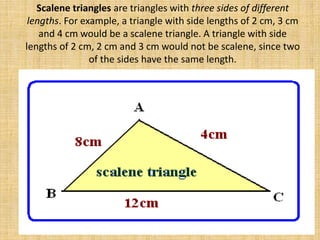
Scalene triangles are triangles with three sides of different
lengths. For example, a triangle with side lengths of 2 cm, 3 cm
and 4 cm would be a scalene triangle. A triangle with side
lengths of 2 cm, 2 cm and 3 cm would not be scalene, since two
of the sides have the same length.
According to the classification of pages
Median and Angle Bisectors
Like any polygon, the perimeter is the total distance around the
outside, which can be found by adding together the length of each
side. Or as a formula :perimeter = a+b+c where:
a,b and c are the lengths of each side of the triangle In the figure
above, drag any orange dot to resize the triangle. From the side
lengths shown, calculate the perimeter and verify your result
matches the formula at the top of the diagram.
How to calculate the perimeter of a
triangle
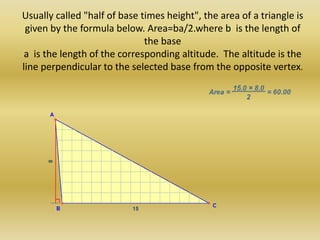
Usually called "half of base times height", the area of a triangle is
given by the formula below. Area=ba/2.where b is the length of
the base
a is the length of the corresponding altitude. The altitude is the
line perpendicular to the selected base from the opposite vertex.
Area of a Triangle
Bermuda triangle
Triangle

Triangle

  • 1.
  • 5.
    An acute angleis any angle less than 90 degrees. So, as its name suggests, an acute triangle is a triangle whose three angles are all smaller than ninety degrees. So if all of a triangle's angles measure less than a right angle (a 90-degree, or square, angle), then it's an acute triangle.
  • 6.
    Obtuse angles aresimply angles larger than 90 degrees. We can spot them because they extend past a right angle.
  • 7.
    A right angleis an angle that measures exactly 90 degrees. It is exactly a quarter of a circle. When you cut a pie into four equal pieces, the tip of each slice will form a right angle.
  • 8.
    How to ClassifyTriangles
  • 10.
    We can splitthe word 'equilateral' in two parts: 'equi' meaning equivalent and 'lateral' meaning side. So an equilateral triangle is simply a triangle whose three sides are all equal.
  • 11.
    An isosceles triangleis a triangle with two congruent, or equal, sides. For example, this is an isosceles triangle:
  • 12.
    Scalene triangles aretriangles with three sides of different lengths. For example, a triangle with side lengths of 2 cm, 3 cm and 4 cm would be a scalene triangle. A triangle with side lengths of 2 cm, 2 cm and 3 cm would not be scalene, since two of the sides have the same length.
  • 13.
    According to theclassification of pages
  • 17.
  • 18.
    Like any polygon,the perimeter is the total distance around the outside, which can be found by adding together the length of each side. Or as a formula :perimeter = a+b+c where: a,b and c are the lengths of each side of the triangle In the figure above, drag any orange dot to resize the triangle. From the side lengths shown, calculate the perimeter and verify your result matches the formula at the top of the diagram.
  • 19.
    How to calculatethe perimeter of a triangle
  • 20.
    Usually called "halfof base times height", the area of a triangle is given by the formula below. Area=ba/2.where b is the length of the base a is the length of the corresponding altitude. The altitude is the line perpendicular to the selected base from the opposite vertex.
  • 21.
    Area of aTriangle
  • 26.