Group 6 Jennifer Dado Roselyn Dela Cruz Prisdel Dado Tresain Eugenio Herbert Seva
Jennifer Dado
Laguna State Polytechnic University Elektronika BK Soviet personal computer
Elektronika  BK was a series of 16-bit  PDP-11 -compatible  Soviet   home computers  developed by NPO Scientific Center, at that time the leading Soviet microcomputer design team, responsible also for more powerful  UKNC  and  DVK  micros. First released in 1985, they were based on the К1801ВМ1 (Soviet  LSI-11 -compatible CPU) and were the only "official" [1]  Soviet home computer design that entered mass production. Sold for about 600-650  rubles  initially, they were rather expensive [2] , but still marginally affordable, so they became one of the most popular home computer models in Soviet Union even despite their numerous problems. Later, when that price edge was eclipsed by cheaper  Spectrum  clones, their powerful  CPU  and straightforward, easy to program architecture made them popular as  demo machines .  BK  ( БК ) is a  Russian  abbreviation which stands for "Бытовой Компьютер" -- domestic (or home) computer
ANDOS is a  Russian   operating system  for  Electronika BK-0010 , Electronika BK-0011 and  Electronika BK-0011M  series computers. It was created in 1990 and saw first release in 1992. Initially it was developed by Alexey Nadezhin (by whose name the system is named) and later also by Sergey Kamnev who joined the project
It was the only widespread system on BK series computers that used  MS-DOS  compatible  file system  format. ANDOS used  FAT12  filesystem on 800Kb floppy disks. For  Electronika BK-0011M  and Electronika BK-0011 ANDOS provided  Electronika BK-0010  emulation by loading BK-0010 ROM image into BK-0011(M) RAM. In minimal configuration the system was able to occupy less than 4 Kb of RAM. The system was able to support up to 64 disk drives (or hard drive partitions) as well as  RAM disks  in the computer's memory and tape recording. It also was able to have read-only access to MicroDOS file system format disks, although in the last version this function was transferred from system core to the file manager and became optional.
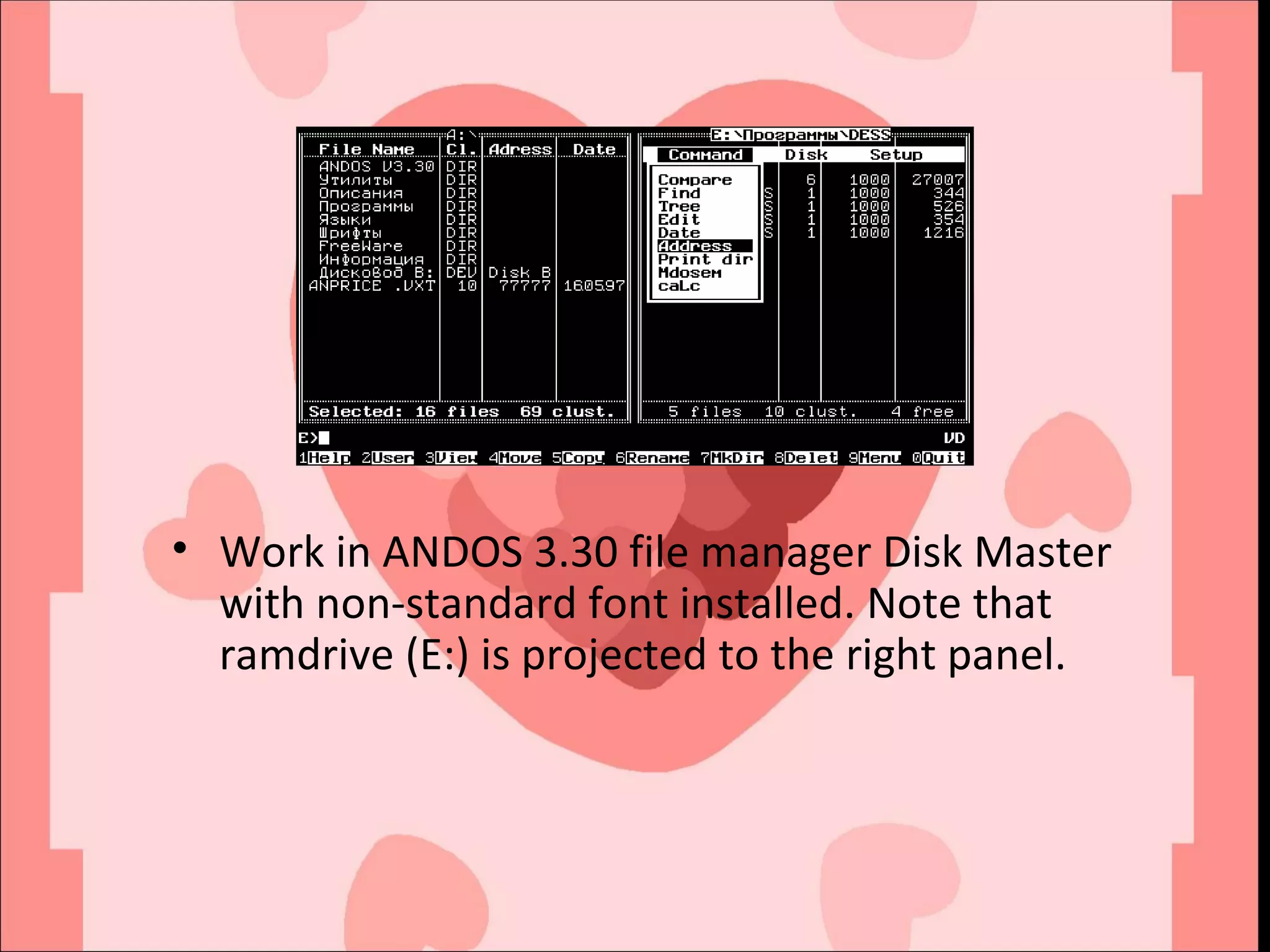
Work in ANDOS 3.30 file manager Disk Master with non-standard font installed. Note that ramdrive (E:) is projected to the right panel.
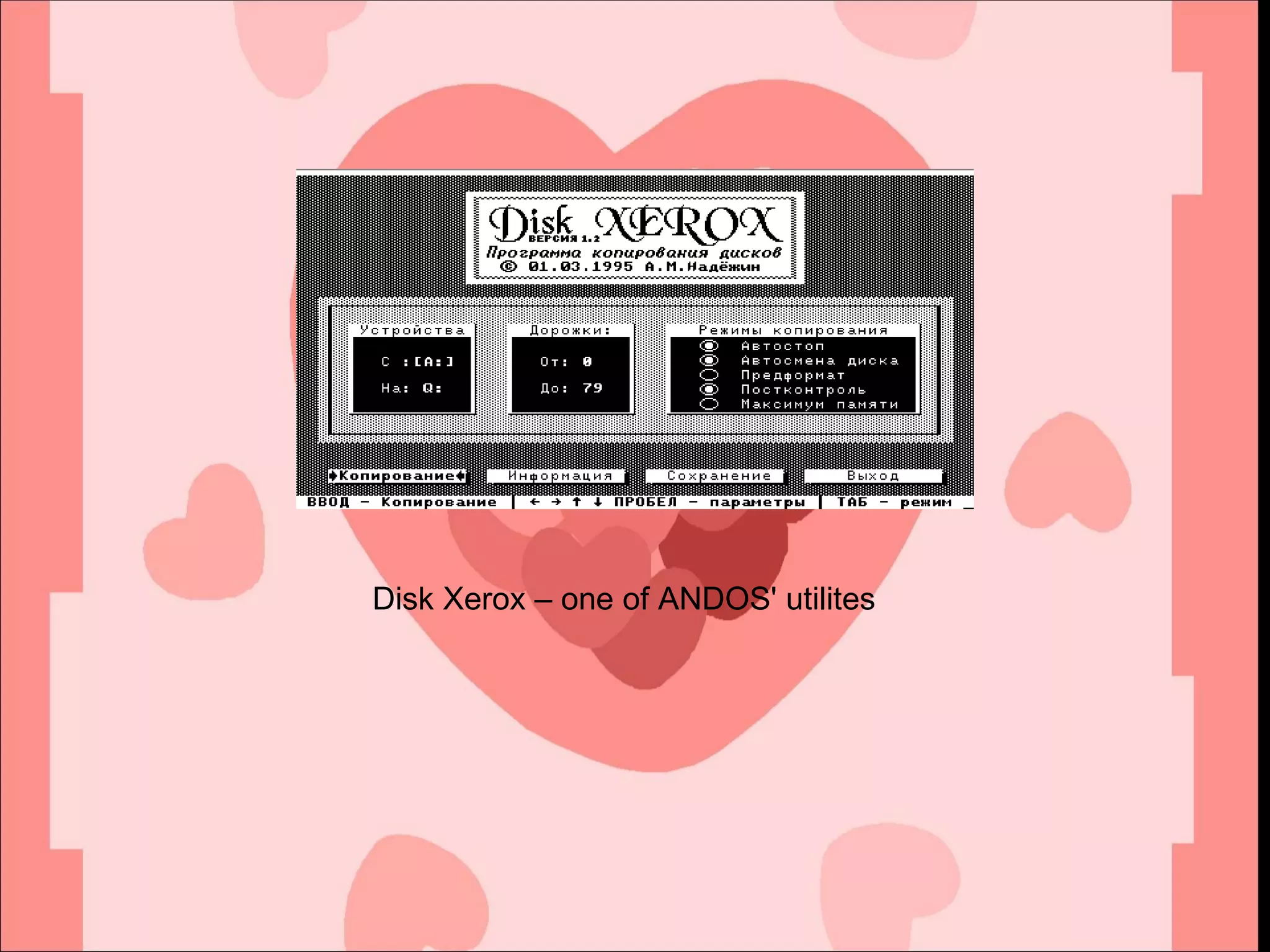
Disk Xerox – one of ANDOS' utilites
ANDOS' dynamic splash screen after system bootup  Company  /  developer  Alexey Nadezhin and Sergey Kamnev (ANCO company) Working state Abandoned Source model written in assembler and/or debugger Latest stable release 3.30 / December, 1997 Supported platforms Elektronika BK ( PDP-11  architecture) Default  user interface  Disk Master or BK Shell graphical non-windowing file managers.  License   Proprietary , commercial and freeware versions existed, latest version is free for download from the official site.
Basis (Bangladesh Association of Software and Information Services) is the national trade body representing the Software and IT service industry in Bangladesh. The association currently has over 260 members. BASIS member companies account for majority of the revenues generated by the software and IT Enabled Service (ITES) industry in the country.BASIS SoftExpo 2009, the biggest ICT extravaganza of the country kicked off on Tuesday, 27 January 2009 upholding the theme “Linking People with Technology and Branding Bangladesh as the Country with Immense Possibilities”.  Mr. A M A Muhith, Honorable Minister, Ministry of Finance, inaugurated the five-day event at the launching ceremony in the morning at the Harmony Hall, Bangladesh China Friendship Conference Center, Agargaon. Bangladesh Association of Software & Information Services (BASIS) organized the expo as its regular annual event. Lt. Col.
CSI-DOS is an  operating system , created in  Samara , for  Soviet  personal computers  Elektronika BK-0011M  and Elektronika BK-0011. CSI-DOS did not support the earlier model BK-0010. CSI-DOS used its own unique  file system  and supported only color graphic video mode. The system supported both hard and floppy drives as well as  RAM disks  in the computer's memory. It also included software to work with music co-processor AY-3-8910(12) and  Covox Speech Thing . There is a number of games and demonstration programs designed specially for the system. The system also included a  Turbo Vision -like  API  allowing simpler design of user applications as well as a file manager called  X-Shell .
Roselyn O. Dela Cruz
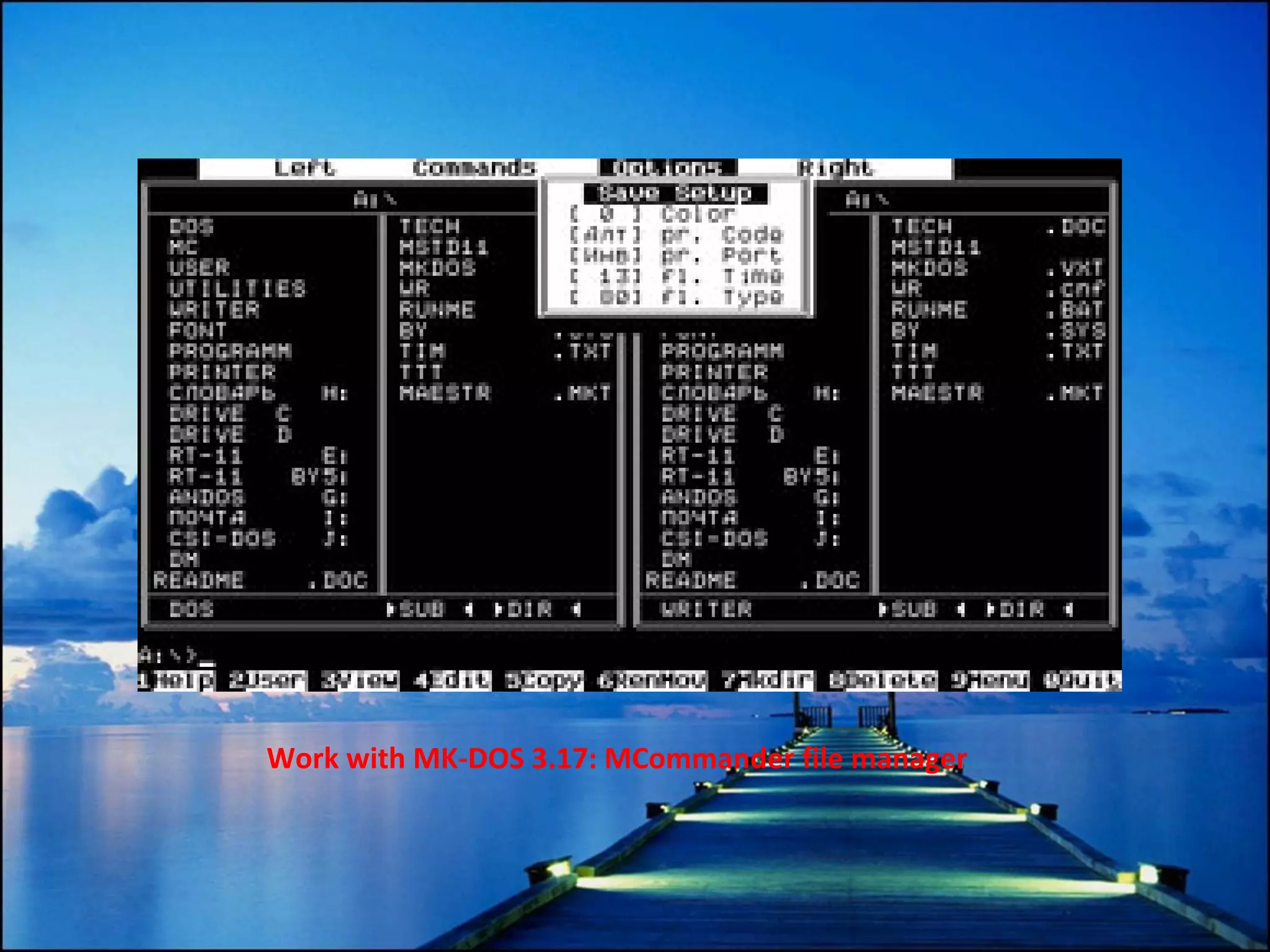
MK-DOS MK-DOS  - one of the most widespread  operating systems  for  Elektronika BK , Soviet personal computer, developed by  Mikhail Korolev  and  Dmitriy Butyrskiy  starting from 1993. Like ANDOS, the system provided full compatibility of operating environment for all models of BK, emulating environment of BK-0010 on more modern BK-0011 and BK-0011M. All requests to a magnetic tape from programs if they were made through proper ROM functions were redirected to a disk. The system supported up to 4 physical disk drives (the number actually limited by disk ROM installed) and as many as number of letters in Latin alphabet hard disk partitions used as separate logical drives with volume of each up to 32 MB.
Continuation.. MK-DOS  used a widespread on BK MicroDOS file system which did not support file fragmentation (like the file system used with  RT-11 ). While incompatible with RT-11's file system it shared many principles with it. MicroDOS file system had read-only support in  ANDOS.  The filename length was limited by  14 symbols  (the filename extension was not recognized separately and was considered as a part of the filename). Minimum installation of the system took not more than 8 KB of computer's memory. The system had functional graphic  Norton Commander -like file manager called  MCommander . The systems hipped with a number of utilities including emulators for  RT-11,FAT 12  and  CSI-DOS  file systems as add-ons for the file manager.
Work with MK-DOS 3.17: MCommander file manager
MICRODOS Later known as  OS-80 , was the only  TRS-80  disk operating system that made no attempt at TRSDOS compatibility. It was written by James W. Stutsman and released by Percom in 1979. Rather than using a command shell like  Model I TRSDOS ,  MICRODOS  used extensions to BASIC. It implemented most of the  Disk BASIC commands  added by TRSDOS. Also unlike the other operating systems, MICRODOS had no file system. All disk accesses were made using the starting sector and length. As stated in the manual: The philosophy at Percom is that a DOS for a microcomputer should make minimal demands on available resources while providing essential functions in accessing the disk. These functions include program save and load and a simple means of storing and retrieving data. Random access of the disk should be as easy to perform as sequential access.
Continuation.. MICRODOS  was designed around these principles. Its requirements are small – less than 7K of memory and only 5% of a diskette. Once MICRODOS has been loaded into memory (by power-on or reset) it is no longer dependent on the disk for anything. This, along with the low memory requirement, makes a 16K one-disk system quite useful. At some point after it was released,  MICRODOS  was renamed to OS-80. The name OS-80 was used in most Percom advertisements and the name MICRODOS seems to have disappeared by 1980. From a Percom advertisement in the August 1981 issue of  80Microcomputing : OS-80 , Percom’s fast extendable BASIC-language disk operating system, is included on diskette when you purchase an initial drive kit. Originally called MICRODOS, OS-80 was favorably reviewed in the June 1980 issue of Creative Computing magazine.
Continuation.. By  1981 , Percom sold three different versions for the TRS-80: OS-80 : the original single-density Model I version which sold for $29.95. OS-80D : the double-density Model I version for the Percom Doubler which sold for $49.95.  OS-80/III : the double-density Model III version which sold for $49.95.
Continuation.. MICRODOS  had three primary advantages over TRSDOS: Size : MICRODOS occupied only 7K of memory. This meant that MICRODOS could work on a 16K system, unlike TRSDOS.  Speed : MICRODOS was noticeably faster than TRSDOS. This was partly because it didn’t maintain a file system and partly because it was always resident in memory.  Disk compatibility : Any Model I OS-80 disk could be read using Model III OS-80/III. Not only that, but any programs on it would run unchanged. The same definitely could not be said about Model I TRSDOS 2.3 and Model III TRSDOS 1.3.
Continuation.. MICRODOS  had two main disadvantages over TRSDOS: Program compatibility : Most BASIC programs and all machine language programs designed to run under TRSDOS would not work with MICRODOS.  File compatibility : Because of the lack of a file system, it was difficult to transfer files between MICRODOS and TRSDOS.  Although not as widely remembered as other TRS-80 operating systems, MICRODOS was quite popular within its own niche. Percom continued to advertise and sell MICRODOS well into 1982.
KMON RT-11  ('RT' for  Real Time ) was a small, single-user real-time operating system for the DEC PDP-11 family of 16-bit computers. Users could choose from three variants with differing levels of support for multitasking: RT-11SJ  (Single Job) allowed only one task. RT-11FB  (Foreground/Background) supported two tasks: a high-priority, non-interactive "Foreground" job, and a low-priority, interactive "Background" job. RT-11XM  (extended Memory) provided support for memory beyond 64kb, but required a CPU with memory management hardware.
Continuation.. RT-11 was written in assembly language with heavy use of the conditional assembly and macro programming features of the MACRO-11 assembler. Every distribution included the source code of the operating system and its device drivers (with all the comments removed), and a utility named "SYSGEN" which would build the operating system and drivers according to a user-specified configuration. (The Linux kernel uses a similar approach; see menuconfig.) In early versions of RT-11, the device drivers were built into the kernel. In later versions of RT-11, the device drivers were built separate from the kernel and were loadable. It was not uncommon for end-users to write or enhance device drivers.
RAMON ( Rapid-Mobility Network Emulator ) In wireless networks, as in many areas of engineering, simulation has been the  de-facto  standard for testing, dimensioning and analyzing mobile protocols. Emulation, which presents a lower cost, more accurate, yet more complex engineering alternative to simulation, has not been widely used in mobile computing studies. RAMON is a software/hardware emulator tailored to mimic the realistic characteristics of wireless networks. RAMON is especially designed to study how mobile protocols cope with high vehicular speeds. The main advantage of RAMON is the rapid, cost-effective and accurate testing it provides. This ranges from proper identification of protocol bottlenecks, to testing of newly available wireless networks and hardware and software devices.
Continuation.. RAMON extends currently available wired-network emulators by adding wireless extension features. It glues together pieces of hardware and software to allow the replication of realistic mobile networks and mobile connection scenarios. RAMON emulates mobility in wireless networks by affecting the actual network physical parameters. It also emulates mobile unit speed, acceleration and trajectory changes, by controlling the causality between actual network parameters and network behavior perceived by the moving computer.
Norton is a computer security suite developed by Symantec corporation, with a focus on providing malware and exploit protection. Norton Antivirus was initially released in 1990. After Symantec acquired Central Point Software in 1994, NAV was integrated with its main competitor of the era, Central Point Anti-Virus (CPAV). CPAV was also licensed to Microsoft as the Microsoft Anti-Virus utility. it is also a file manager which essentially acts as the text user interface for DOS.
HC-DOS HC-GRAM Version 3.01.4  is a MS-DOS program is designed to graphically display water quality data using either Piper trilinear diagrams or Stiff diagrams. The program is written is Turbo Pascal version 6.0. The user can enter up to 400 samples at a time, and select which samples plot from the samples entered. All data entered can be saved in a disk file for later use. Up to five Stiff diagrams can be displayed on the screen, printer, plotter, or plot files at one time.  VGA, EGA, CGA, MDA , and Hercules monitors can be used. Printers must be  Epson, IBM Proprinter, IBM Quitewriter, HP Desk Jet, HP Laser Jet, HP Paint Jet, or PostScript  compatible. The plotters must be  HP7470, HP7475, HP7550, HP7585, or HP7595  compatible. Plot files that can be generated include  PCX, BMP, IMG, TIFF, WPG, CGM, VSHO , and  DXF . The program needs 480K of free memory, MS-DOS version 2.0 or higher, and a IBM 286 compatible or higher. hc-gram301.exe is a self extracting WinZip file. Simply execute the file and uncompress it in the folder of your choice. After uncompressing, follow the instructions in  "Install.doc" .
That’s all thank you!
Prisdel Dado
 
PascalDOS   an operating system  for the Soviet  PCs   BC-0010  and BC-0010-01 is designed for programming on the  programming language   Pascal,  a compiler that is ISO . According to the internal challenges of the system was somewhat similar to the RT-11, although the data storage used commonly in the BC  file system  MicroDOS.
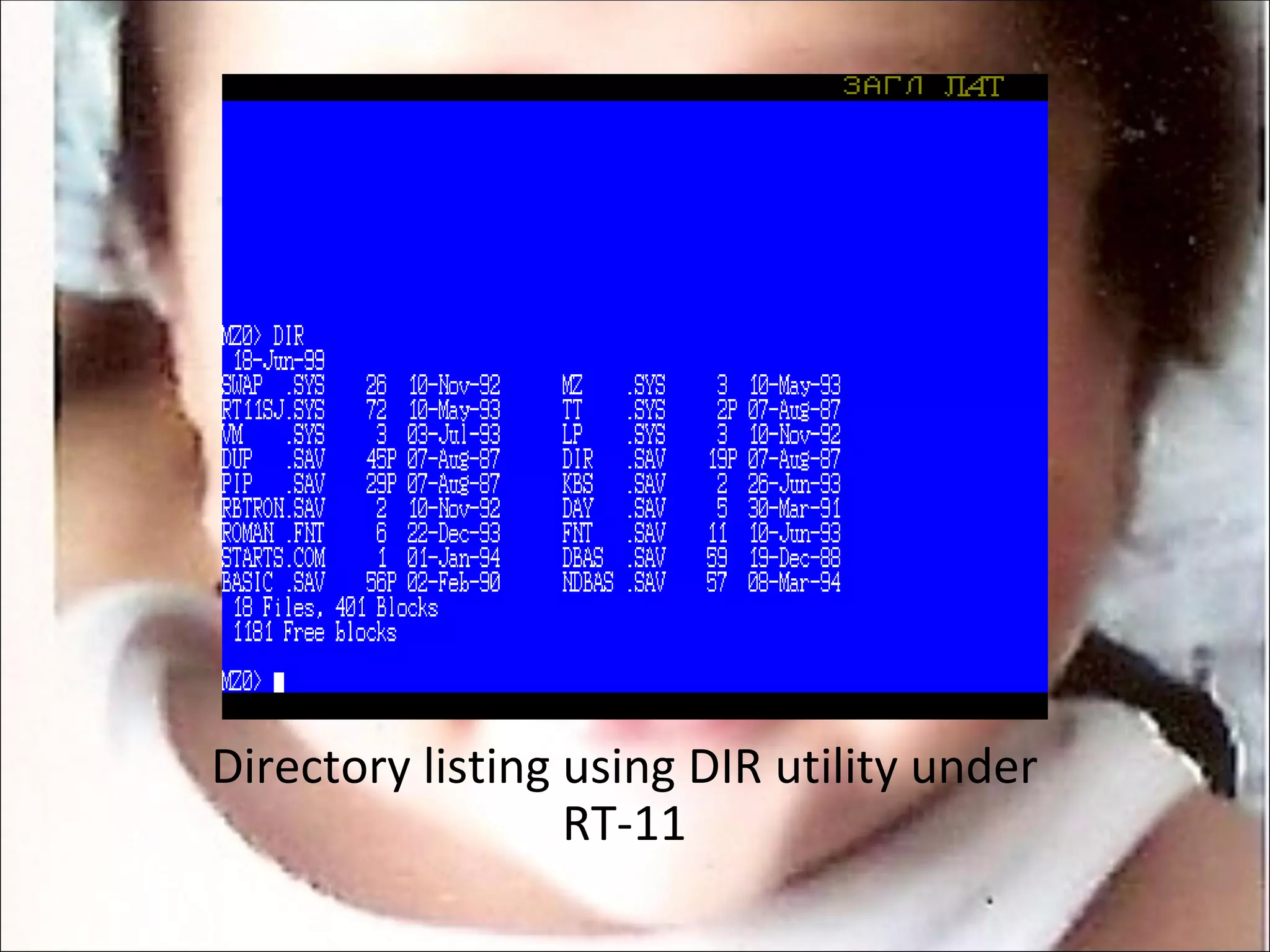
RT-11  ('RT' for  Real Time ) was a small, single-user  real-time operating system  for the  Digital Equipment Corporation   PDP-11  family of 16-bit computers. RT-11 was first implemented in 1970 and was widely used for  real-time  systems,  process control , and  data acquisition  across the full line of PDP-11 computers.
Directory listing using DIR utility under RT-11
ROM EMBEDED A ROM is embedded within an array of DRAM cells by changing a single mask in a DRAM fabrication process to selectively short circuit the DRAM capacitor lower electrode to its own wordline to create a read-only "1" or to the wordline of an adjacent cell to create a read only "0".
Users could choose from three variants with differing levels of support for  multitasking RT-11SJ  ( Single Job ) allowed only one task.   RT-11FB   (Foreground/Backgound) supported two tasks: a high-priority, non-interactive "Foreground" job, and a low-priority, interactive "Background" job.  RT-11XM  (eXtended Memory) provided support for memory beyond 64kb, but required a CPU with memory management hardware.
Turbo-DOS  Master-Disk produces 4 different versions: 2.1NT without  speeders , 2.1HS for Happy/Speedy, 2.1XF for XF551 and 2.1EX for 3 speeders: Happy+Speedy+XF551; supports 256k Xtra RAM / RD and supports use of batchfiles; has converter for DOS 3 and DOS 4; supports 4 formats, up to 360k; does not use RAM under OS ROM; DUP uses a Command Processor; all commands are avaiable via HELP key; works with XL/XE computers only, does not load/boot on Atari 400/800 no clue
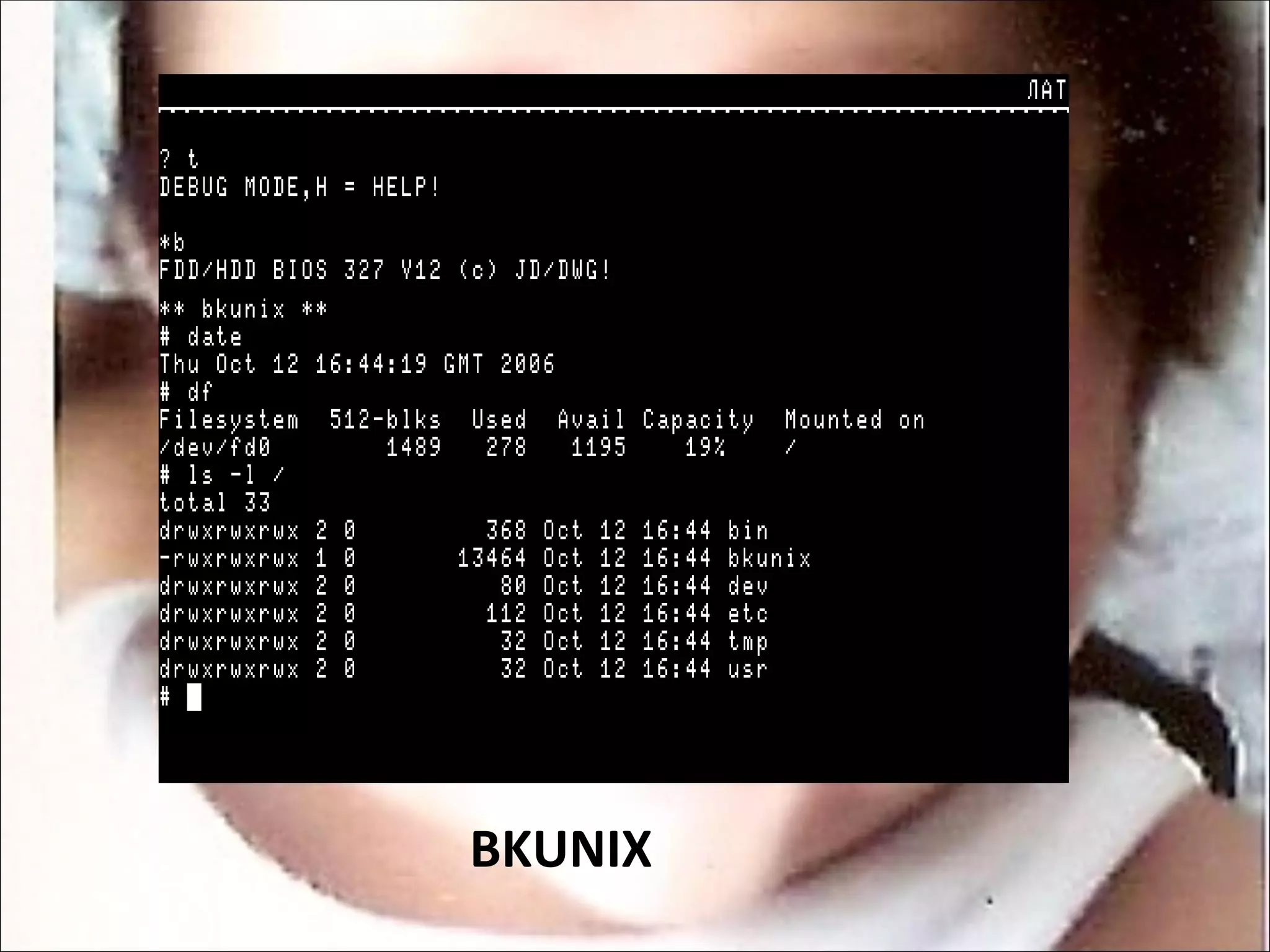
BKUNIX  is an  operating system  for  Soviet   Elektronika BK  personal computer. It is based  on LSX  kernel  (a version of  UNIX V6 ) and licensed under the  GNU General Public License . It is being developed by Sergey Vakulenko and Leonid Brukhis. BK-0010 and BK-0011M require different  compilations  of the kernel, but other parts are the same. The system supports up to three tasks at a moment and allows to mount up to three  file systems .
BKUNIX
OS/Wasp  Wasp MobileAsset is the #1 selling, industry-leading asset tracking solution for small to medium-sized businesses. Wasp has perfected an all-in-one solution to solve the asset tracking needs of government and educational
 
 
Tresain Eugenio
 
(AROS) AROS Research Operating System   is a  free software / open source  implementation of the  AmigaOS 3.1   APIs . Designed to be portable and flexible,  ports  are currently available for  x86 -based and  PowerPC -based  PCs  in  native  and hosted  flavors , with other architectures in development.
AROS Research Operating System AROS showing its Cyrillic support
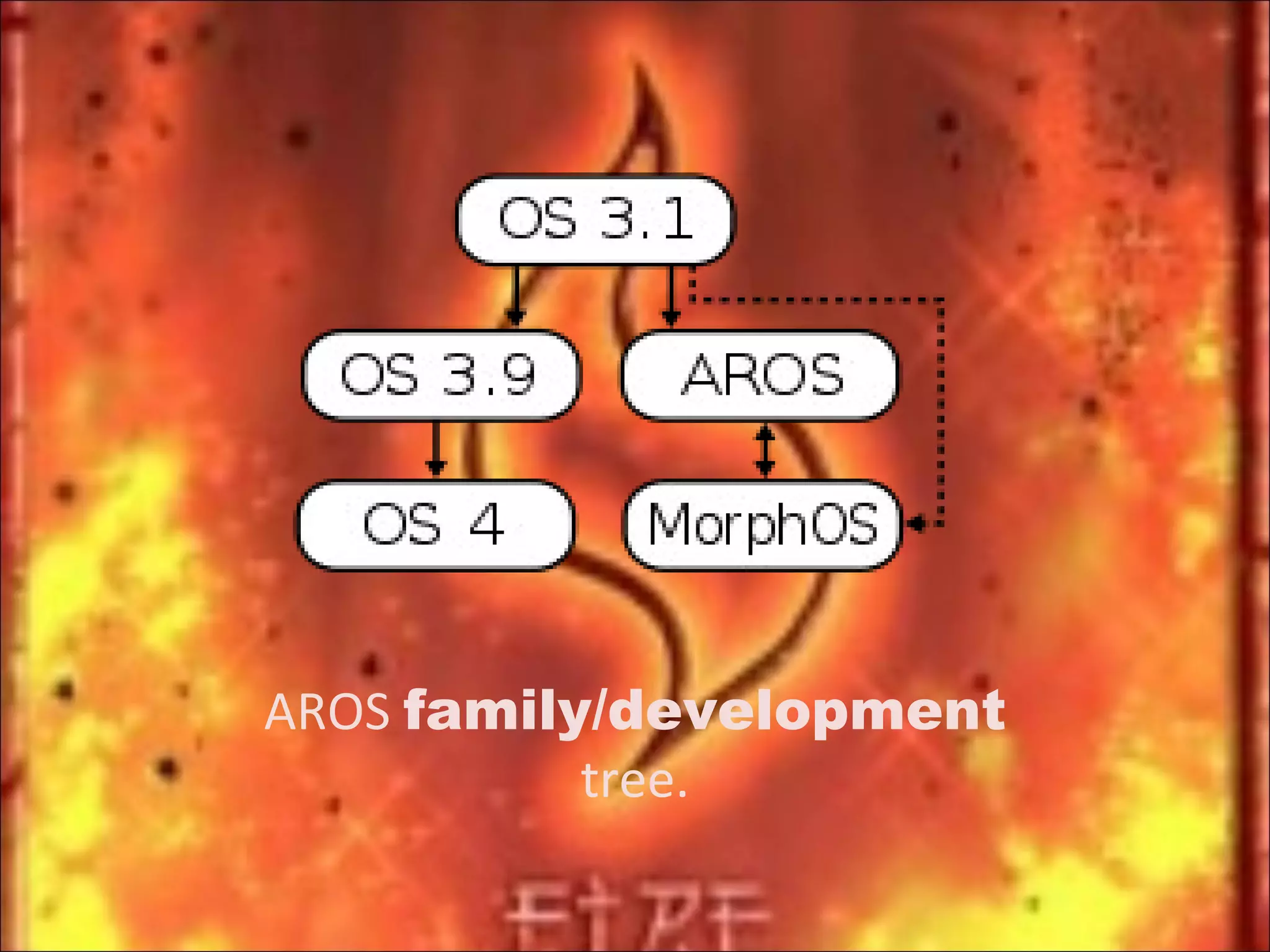
AROS  family/development  tree.
AtheOS was a  free software   operating system  for  x86 -based computers. It was  initially  intended as an  AmigaOS  clone [1] , but that objective was later abandoned. It is no longer in development, and has been superseded by the  Syllable  operating system.
The AtheOS Desktop
DexOS , is a  free and open source  32-bit games console type  operating system  for  32-bit x86 computers . It was written in entirely  assembly language  using  FASM (flat assembler) . The operating system's  GUI  was inspired by modern  video game consoles  but it also includes a  Command Line Interface . It was designed to boot from a 1.44  MB   floppy disk  and its  kernel  is less than 100 KB .DexOS can also be booted from a  CD ,  USB flash drive  or  hard drive .
Screenshot DexOS's GUI
EROS  is a new operating system being implemented at the University of Pennsylvania. The system merges some very old ideas in operating systems with some newer ideas about performance and resource management. The result is a small, secure, real-time operating system that provides orthogonal persistence. The EROS research effort has ended. Work is continuing from the EROS code base in the  CapROS  project, which is led by Charlie Landau.
FAMOS  is a true (believed to be the World First)  Memory  Operating System.  It runs entirely in memory and is completely independent of all disk drives.  FAMOS never needs to access a mass-storage device, except for the occasional purpose of non-volatile storage.  Among its many features, FAMOS:  - has a 32-bit 4Gb memory R/W editor  (called FAME)  - always tells you exactly where  everything  is in memory  - has a working USB1.1 Host Controller/Driver and supports USB mass-storage devices (pendrives) and USB audio streaming devices  
HelenOS  has been ported to run on many different  computer architectures  including  ARM ,  AMD64  (x86-64),  IA32 ,  IA64  (Itanium),  MIPS ,  PowerPC  (32-bit only), and  sparc64 . There are also incomplete ports to 64-bit  PowerPC  and the  Xen   hypervisor   paravirtualization  environment on IA32. It is developed mainly by staff and students at the Faculty of Mathematics and Physics at  Charles University in Prague , with help from other contributors around the world.
 
KolibriOS  (also known as  KOS  and  Kolibri ) is a  free   operating system  with a  monolithic   preemptive ,  real-time   kernel , video drivers, for  32-bit   x86 architecture  computers, developed and maintained by The KolibriOS Project Team. KolibriOS is a fork of  MenuetOS , written entirely in  FASM  ( assembly language ). However,  C-- ,  C ,  C++ ,  Free Pascal ,  Forth , among other high-level languages and compilers, can also be used in user application development.
CMD  is a  command line interpreter  that functions as a  command line  ( shell ). The current version is 0.26. The following is a list of the available commands: *Application management  and  processes  ( kill ,  ps )  *Dealing with the  file  	system  ( cp ,  ls ,  del ,  rn , ...)  *Other commands such as  cls ,  ver ,  exit ,  shutdown ,  help ,  pause ,  echo , ends  
KolibriOS
 
Herbert Seva
LoseThos LoseThos  is a  public-domain ,  x86-64   opcode ,  operating system , developed by Terry A. Davis. The stated goal of this project is "programming as entertainment." It is oriented toward video games, not the Internet, desk-top publishing or multimedia. It is not derived from any existing operating system, nor claims compatibility with such
LOseThos Features It is programmed with a language variant of  C / C++ . Kernel privilege at all times in all programs.  Identity mapped virtual-to-physical memory.  Master/slave MultiCore support -- not SMP.  640x480x16 color VGA graphics.  CD-ROMs.  Most hard drives, keyboards and mice.  It does not have  USB , printing, or networking support. But sound from the  PC Speaker  is available.
LSE/OS The LSE/OS  kernel  was a research kernel designed by a French research laboratory named Epita system laboratory . The project is now  open source . The main goal of the kernel was to never  crash  prompting the original designers to implement it as a modular  nanokernel  instead of the traditional  monolithic kernel  of "traditional"  operating systems . This choice was good because it allowed the drivers and services code to be moved out of the  kernel  (to  user space ). These services would then become un privileged  processes so that any error that occurs e.g. in a driver won't crash the system. In a monolithic kernel this is impossible.
MenuetOS MenuetOS (also known as MeOS) is an  operating system  with a  monolithic   preemptive ,  real-time   kernel , including video drivers, all written in  FASM   assembly language , for  64-bit  and  32-bit   x86 architecture  computers. by .Ville Mikael Turjanmaa
MenuetOS development has focused on fast, simple, efficient implementation. It has a graphical desktop, games, and networking abilities ( TCP/IP stack ), yet it still fits on one 1.44MB  floppy disk . It also facilitates easy, full-featured assembly language programming. This stands in marked contrast to the (as of 2007) widespread view that assembly languages are useful mainly for old and embedded systems. [ citation needed ] MenuetOS was originally written for 32-bit x86 architectures and released under the  GPL , thus many of its applications are distributed under the GPL. The 64-bit MenuetOS, often referred to as Menuet 64, remains a platform for learning 64-bit assembly language programming. 64-bit Menuet is distributed as  freeware  without the  source code  for core components. Menuet 64 works smoothly in  QEMU  which can emulate 64-bit machine atop a 32-bit machine.
NewOS NewOS is a open source operating system with an emphasis on design and portability. It is largely implemented in C/C++, with a small amount of assembly.  Currently, the system is mostly a kernel with a minimal amount of user space libraries and applications. Thus far, most of the work has been put into the kernel and other underlying support. As a result the system isn't that interesting from an end-user point of view (no gui, simple commands on a command line), but that can change given a moderate amount of work by the maintainers or any volunteers.
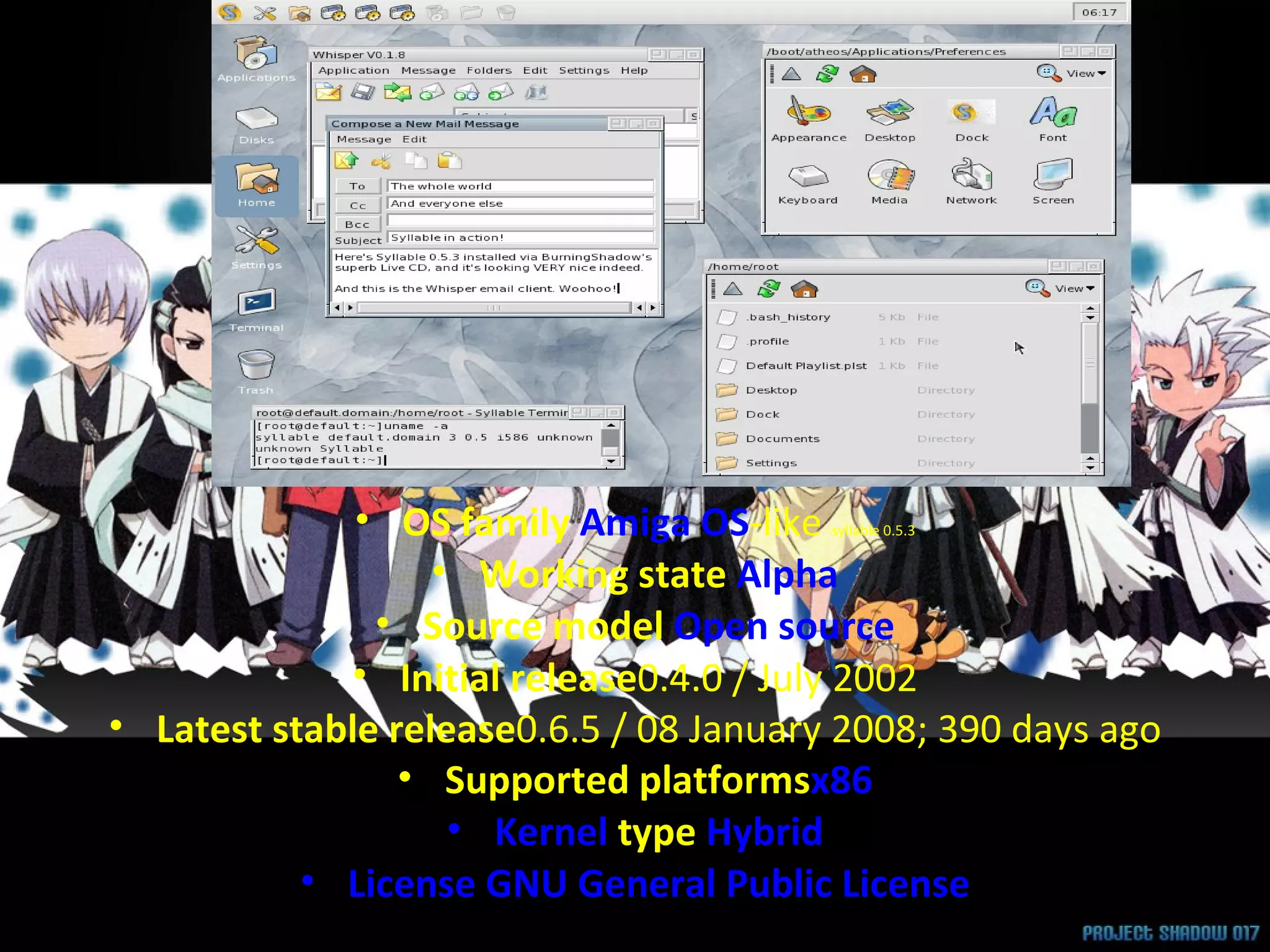
Syllable Syllable is a  free  and  open source   operating system  for  Pentium  and compatible processors. Its purpose is to create an easy-to-use desktop operating system for the home and small office user. It was  forked  from the stagnant  AtheOS  in July 2002. It has a native  web browser  ( ABrowse  which is  WebKit  -based),  email client  (Whisper), media player,  IDE , and many more applications
Features according to the website include: Native  64-bit   journaled   file system , the  AtheOS File System  (usually called  AFS , which is not the same as the  Andrew File System )  C++  oriented  API   Object-oriented  graphical  desktop environment  on a native  GUI  architecture  Mostly  POSIX  compliant  Software ports , including  Emacs ,  Vim ,  Perl ,  Python ,  Apache  and others.  GNU toolchain  ( GCC ,  Glibc ,  Binutils ,  Make )  Pre-emptive multitasking  with  multithreading   Symmetric multiprocessing  (multiple  processor ) support  Device drivers  for most common hardware (video, sound, network chips)  File system drivers for  FAT  (read/write),  NTFS  (read) and  ext2  (read)  REBOL  as system  scripting language
syllable 0.5.3 OS family  Amiga OS -like  syllable 0.5.3 Working state  Alpha Source model  Open source Initial release 0.4.0 / July 2002 Latest stable release 0.6.5 / 08 January 2008; 390 days ago Supported platforms x86 Kernel  type  Hybrid License   GNU General Public License
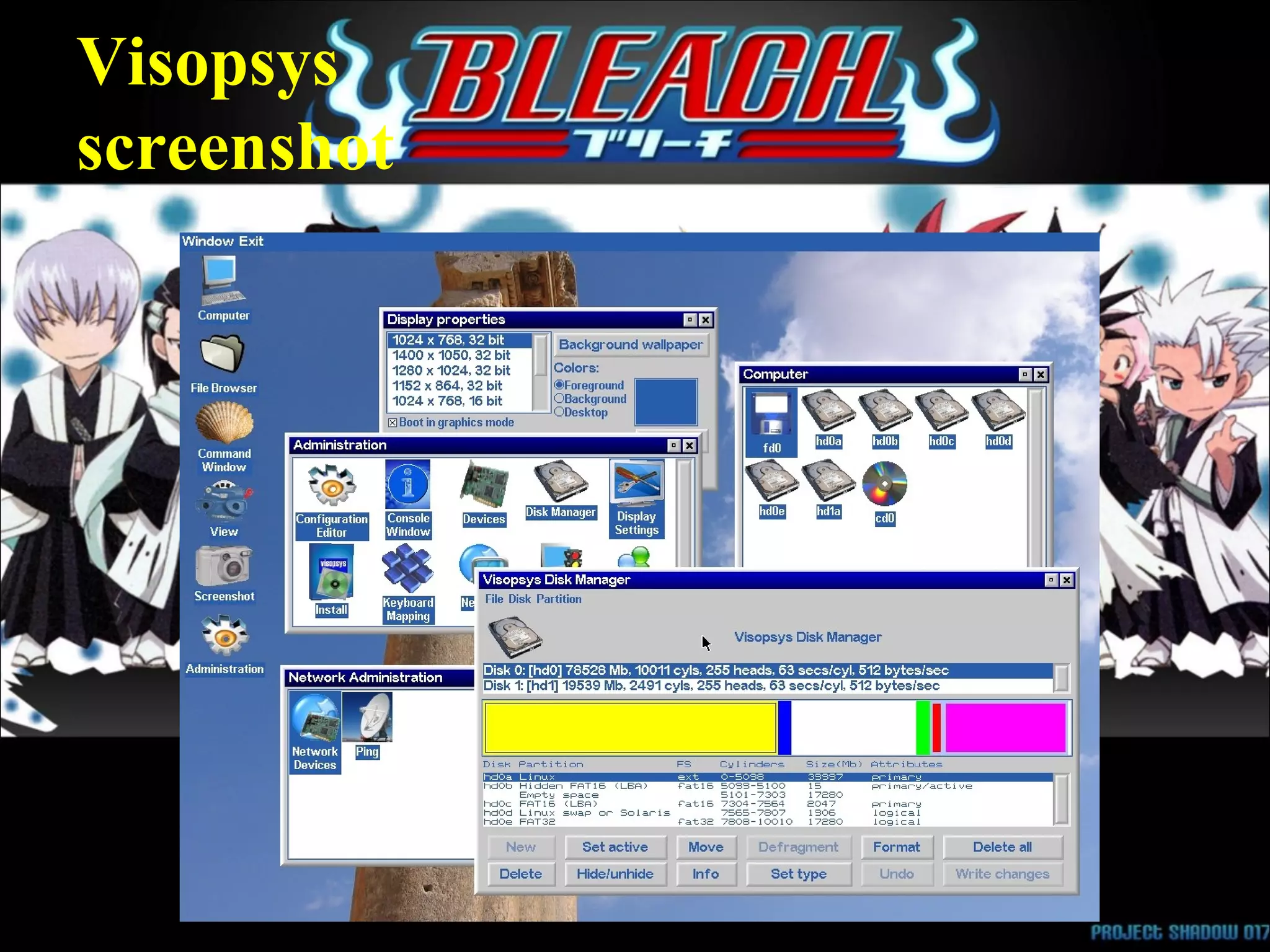
Visopsys screenshot
VISUAL OPERATING SYSTEM Visopsys is an alternative operating system for PC compatible computers.  Under development since late 1997, this system is small, fast, and open source.  It features a simple but functional graphical interface, preemptive multitasking, and virtual memory.  Though it attempts to be compatible in a number of ways, Visopsys is not a clone of any other operating system.
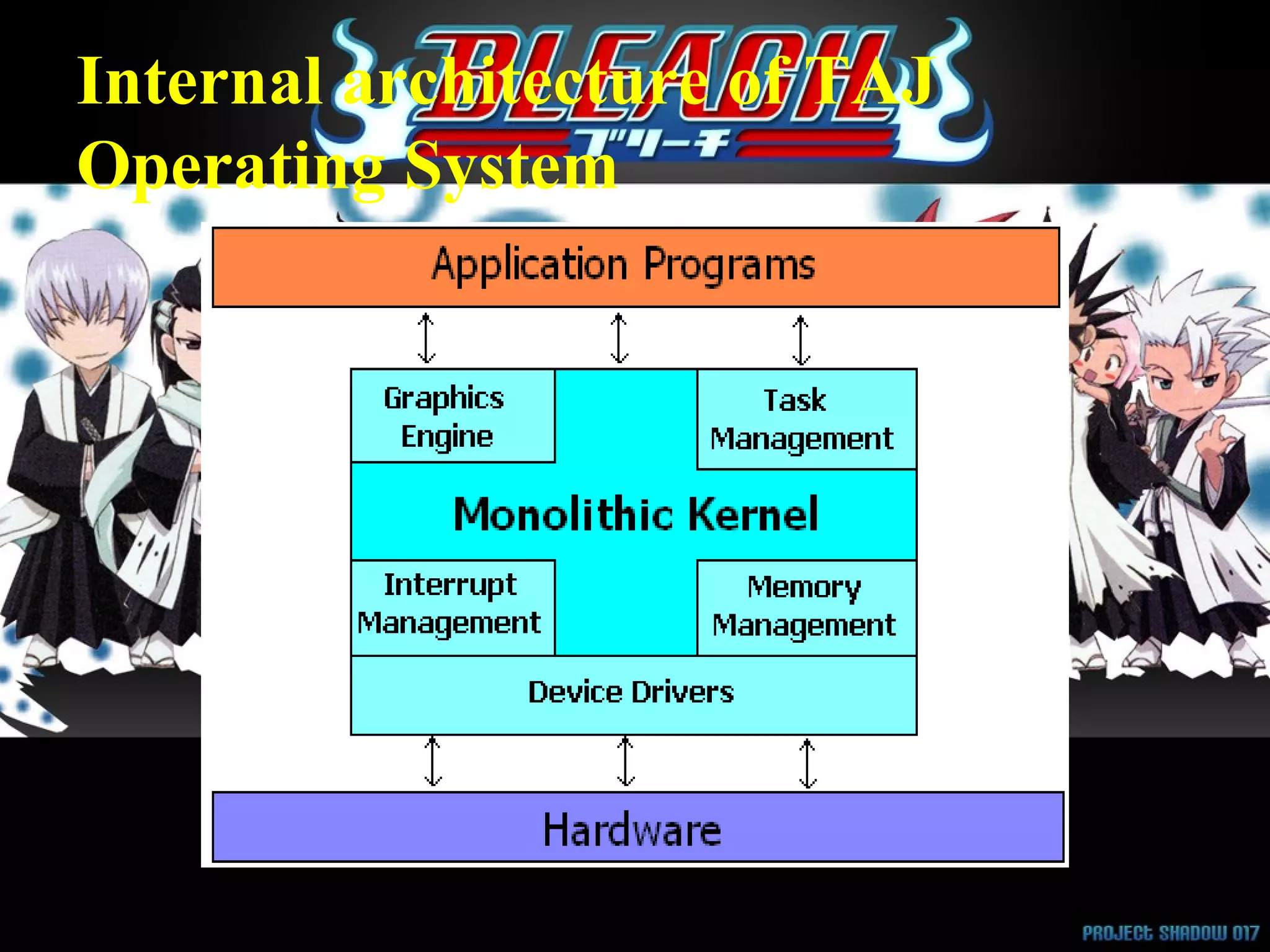
TajOS It is a first operating system developed in India which is totally based on object oriented concept. C++ is the first thing that comes to mind when we hear the word object oriented. And yes, TAJ OS is totally developed in C++,  which  removes all drawbacks of C language.  The code of TAJ operating system is well maintained by dividing it in different modules ( class  concept). All the data are highly secured by making them private and removing any chances of unauthorized access. The main heart of this operating system know as Kernel is a  Monolithic type , i.e. all devices drivers and supporting file are packed in one unit with kernel which greatly reduces the chances of crashes. The operating system is built in such a way that sudden power failure and other hardware problems will also not corrupt the system
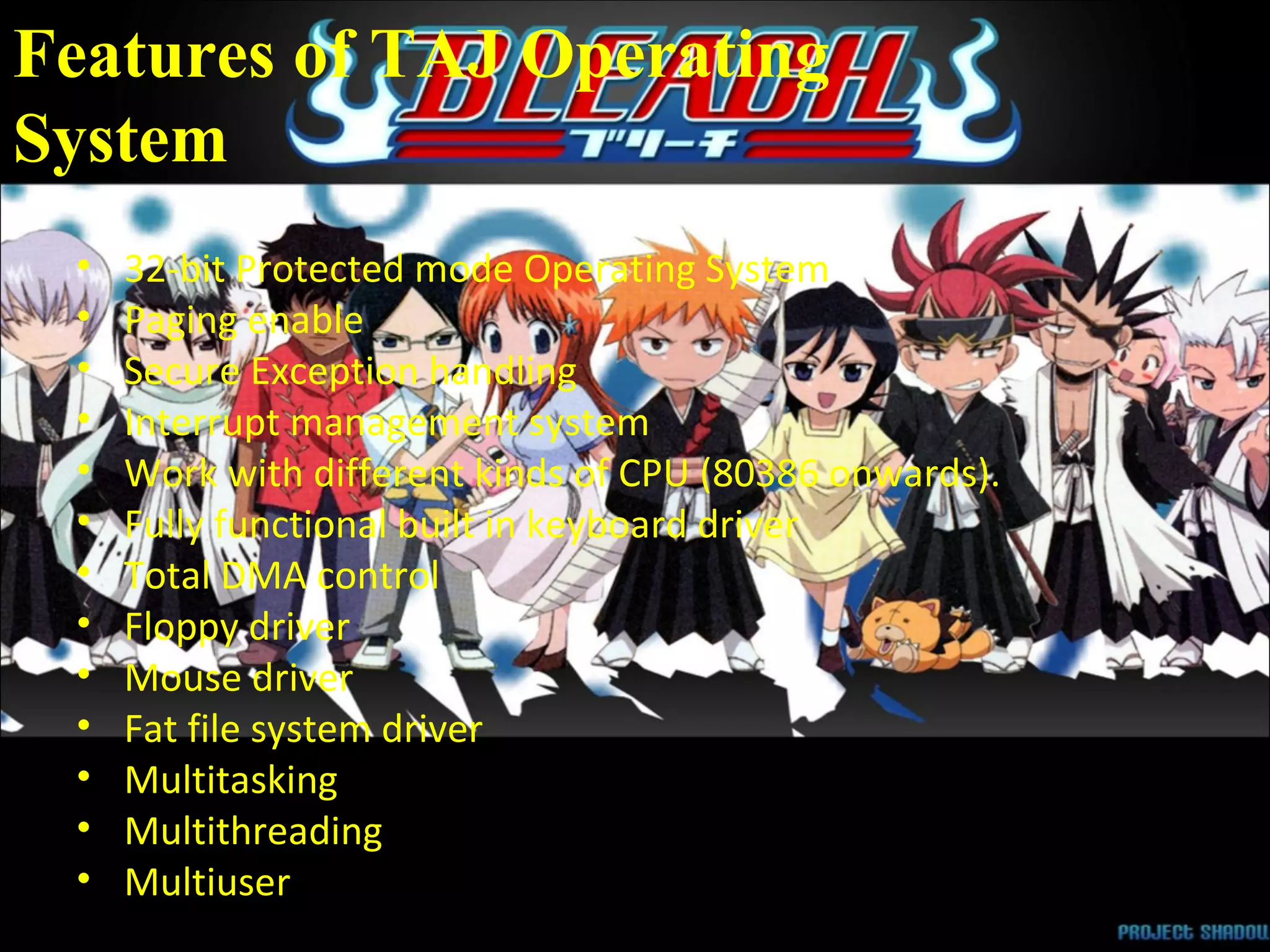
Features of TAJ Operating  System 32-bit Protected mode Operating System  Paging enable  Secure Exception handling  Interrupt management system  Work with different kinds of CPU (80386 onwards).  Fully functional built in keyboard driver  Total DMA control  Floppy driver  Mouse driver  Fat file system driver  Multitasking  Multithreading  Multiuser
Internal architecture of TAJ  Operating System
thank you! That’s all

tresain's group presentation

  • 1.
    Group 6 JenniferDado Roselyn Dela Cruz Prisdel Dado Tresain Eugenio Herbert Seva
  • 2.
  • 3.
    Laguna State PolytechnicUniversity Elektronika BK Soviet personal computer
  • 4.
    Elektronika BKwas a series of 16-bit PDP-11 -compatible Soviet home computers developed by NPO Scientific Center, at that time the leading Soviet microcomputer design team, responsible also for more powerful UKNC and DVK micros. First released in 1985, they were based on the К1801ВМ1 (Soviet LSI-11 -compatible CPU) and were the only "official" [1] Soviet home computer design that entered mass production. Sold for about 600-650 rubles initially, they were rather expensive [2] , but still marginally affordable, so they became one of the most popular home computer models in Soviet Union even despite their numerous problems. Later, when that price edge was eclipsed by cheaper Spectrum clones, their powerful CPU and straightforward, easy to program architecture made them popular as demo machines . BK ( БК ) is a Russian abbreviation which stands for "Бытовой Компьютер" -- domestic (or home) computer
  • 5.
    ANDOS is a Russian operating system for Electronika BK-0010 , Electronika BK-0011 and Electronika BK-0011M series computers. It was created in 1990 and saw first release in 1992. Initially it was developed by Alexey Nadezhin (by whose name the system is named) and later also by Sergey Kamnev who joined the project
  • 6.
    It was theonly widespread system on BK series computers that used MS-DOS compatible file system format. ANDOS used FAT12 filesystem on 800Kb floppy disks. For Electronika BK-0011M and Electronika BK-0011 ANDOS provided Electronika BK-0010 emulation by loading BK-0010 ROM image into BK-0011(M) RAM. In minimal configuration the system was able to occupy less than 4 Kb of RAM. The system was able to support up to 64 disk drives (or hard drive partitions) as well as RAM disks in the computer's memory and tape recording. It also was able to have read-only access to MicroDOS file system format disks, although in the last version this function was transferred from system core to the file manager and became optional.
  • 7.
    Work in ANDOS3.30 file manager Disk Master with non-standard font installed. Note that ramdrive (E:) is projected to the right panel.
  • 8.
    Disk Xerox –one of ANDOS' utilites
  • 9.
    ANDOS' dynamic splashscreen after system bootup Company  / developer Alexey Nadezhin and Sergey Kamnev (ANCO company) Working state Abandoned Source model written in assembler and/or debugger Latest stable release 3.30 / December, 1997 Supported platforms Elektronika BK ( PDP-11 architecture) Default user interface Disk Master or BK Shell graphical non-windowing file managers. License Proprietary , commercial and freeware versions existed, latest version is free for download from the official site.
  • 10.
    Basis (Bangladesh Associationof Software and Information Services) is the national trade body representing the Software and IT service industry in Bangladesh. The association currently has over 260 members. BASIS member companies account for majority of the revenues generated by the software and IT Enabled Service (ITES) industry in the country.BASIS SoftExpo 2009, the biggest ICT extravaganza of the country kicked off on Tuesday, 27 January 2009 upholding the theme “Linking People with Technology and Branding Bangladesh as the Country with Immense Possibilities”.  Mr. A M A Muhith, Honorable Minister, Ministry of Finance, inaugurated the five-day event at the launching ceremony in the morning at the Harmony Hall, Bangladesh China Friendship Conference Center, Agargaon. Bangladesh Association of Software & Information Services (BASIS) organized the expo as its regular annual event. Lt. Col.
  • 11.
    CSI-DOS is an operating system , created in Samara , for Soviet personal computers Elektronika BK-0011M and Elektronika BK-0011. CSI-DOS did not support the earlier model BK-0010. CSI-DOS used its own unique file system and supported only color graphic video mode. The system supported both hard and floppy drives as well as RAM disks in the computer's memory. It also included software to work with music co-processor AY-3-8910(12) and Covox Speech Thing . There is a number of games and demonstration programs designed specially for the system. The system also included a Turbo Vision -like API allowing simpler design of user applications as well as a file manager called X-Shell .
  • 12.
  • 13.
    MK-DOS MK-DOS - one of the most widespread operating systems for Elektronika BK , Soviet personal computer, developed by Mikhail Korolev and Dmitriy Butyrskiy starting from 1993. Like ANDOS, the system provided full compatibility of operating environment for all models of BK, emulating environment of BK-0010 on more modern BK-0011 and BK-0011M. All requests to a magnetic tape from programs if they were made through proper ROM functions were redirected to a disk. The system supported up to 4 physical disk drives (the number actually limited by disk ROM installed) and as many as number of letters in Latin alphabet hard disk partitions used as separate logical drives with volume of each up to 32 MB.
  • 14.
    Continuation.. MK-DOS used a widespread on BK MicroDOS file system which did not support file fragmentation (like the file system used with RT-11 ). While incompatible with RT-11's file system it shared many principles with it. MicroDOS file system had read-only support in ANDOS. The filename length was limited by 14 symbols (the filename extension was not recognized separately and was considered as a part of the filename). Minimum installation of the system took not more than 8 KB of computer's memory. The system had functional graphic Norton Commander -like file manager called MCommander . The systems hipped with a number of utilities including emulators for RT-11,FAT 12 and CSI-DOS file systems as add-ons for the file manager.
  • 15.
    Work with MK-DOS3.17: MCommander file manager
  • 16.
    MICRODOS Later knownas OS-80 , was the only TRS-80 disk operating system that made no attempt at TRSDOS compatibility. It was written by James W. Stutsman and released by Percom in 1979. Rather than using a command shell like Model I TRSDOS , MICRODOS used extensions to BASIC. It implemented most of the Disk BASIC commands added by TRSDOS. Also unlike the other operating systems, MICRODOS had no file system. All disk accesses were made using the starting sector and length. As stated in the manual: The philosophy at Percom is that a DOS for a microcomputer should make minimal demands on available resources while providing essential functions in accessing the disk. These functions include program save and load and a simple means of storing and retrieving data. Random access of the disk should be as easy to perform as sequential access.
  • 17.
    Continuation.. MICRODOS was designed around these principles. Its requirements are small – less than 7K of memory and only 5% of a diskette. Once MICRODOS has been loaded into memory (by power-on or reset) it is no longer dependent on the disk for anything. This, along with the low memory requirement, makes a 16K one-disk system quite useful. At some point after it was released, MICRODOS was renamed to OS-80. The name OS-80 was used in most Percom advertisements and the name MICRODOS seems to have disappeared by 1980. From a Percom advertisement in the August 1981 issue of 80Microcomputing : OS-80 , Percom’s fast extendable BASIC-language disk operating system, is included on diskette when you purchase an initial drive kit. Originally called MICRODOS, OS-80 was favorably reviewed in the June 1980 issue of Creative Computing magazine.
  • 18.
    Continuation.. By 1981 , Percom sold three different versions for the TRS-80: OS-80 : the original single-density Model I version which sold for $29.95. OS-80D : the double-density Model I version for the Percom Doubler which sold for $49.95. OS-80/III : the double-density Model III version which sold for $49.95.
  • 19.
    Continuation.. MICRODOS had three primary advantages over TRSDOS: Size : MICRODOS occupied only 7K of memory. This meant that MICRODOS could work on a 16K system, unlike TRSDOS. Speed : MICRODOS was noticeably faster than TRSDOS. This was partly because it didn’t maintain a file system and partly because it was always resident in memory. Disk compatibility : Any Model I OS-80 disk could be read using Model III OS-80/III. Not only that, but any programs on it would run unchanged. The same definitely could not be said about Model I TRSDOS 2.3 and Model III TRSDOS 1.3.
  • 20.
    Continuation.. MICRODOS had two main disadvantages over TRSDOS: Program compatibility : Most BASIC programs and all machine language programs designed to run under TRSDOS would not work with MICRODOS. File compatibility : Because of the lack of a file system, it was difficult to transfer files between MICRODOS and TRSDOS. Although not as widely remembered as other TRS-80 operating systems, MICRODOS was quite popular within its own niche. Percom continued to advertise and sell MICRODOS well into 1982.
  • 21.
    KMON RT-11 ('RT' for Real Time ) was a small, single-user real-time operating system for the DEC PDP-11 family of 16-bit computers. Users could choose from three variants with differing levels of support for multitasking: RT-11SJ (Single Job) allowed only one task. RT-11FB (Foreground/Background) supported two tasks: a high-priority, non-interactive "Foreground" job, and a low-priority, interactive "Background" job. RT-11XM (extended Memory) provided support for memory beyond 64kb, but required a CPU with memory management hardware.
  • 22.
    Continuation.. RT-11 waswritten in assembly language with heavy use of the conditional assembly and macro programming features of the MACRO-11 assembler. Every distribution included the source code of the operating system and its device drivers (with all the comments removed), and a utility named "SYSGEN" which would build the operating system and drivers according to a user-specified configuration. (The Linux kernel uses a similar approach; see menuconfig.) In early versions of RT-11, the device drivers were built into the kernel. In later versions of RT-11, the device drivers were built separate from the kernel and were loadable. It was not uncommon for end-users to write or enhance device drivers.
  • 23.
    RAMON ( Rapid-MobilityNetwork Emulator ) In wireless networks, as in many areas of engineering, simulation has been the de-facto standard for testing, dimensioning and analyzing mobile protocols. Emulation, which presents a lower cost, more accurate, yet more complex engineering alternative to simulation, has not been widely used in mobile computing studies. RAMON is a software/hardware emulator tailored to mimic the realistic characteristics of wireless networks. RAMON is especially designed to study how mobile protocols cope with high vehicular speeds. The main advantage of RAMON is the rapid, cost-effective and accurate testing it provides. This ranges from proper identification of protocol bottlenecks, to testing of newly available wireless networks and hardware and software devices.
  • 24.
    Continuation.. RAMON extendscurrently available wired-network emulators by adding wireless extension features. It glues together pieces of hardware and software to allow the replication of realistic mobile networks and mobile connection scenarios. RAMON emulates mobility in wireless networks by affecting the actual network physical parameters. It also emulates mobile unit speed, acceleration and trajectory changes, by controlling the causality between actual network parameters and network behavior perceived by the moving computer.
  • 25.
    Norton is acomputer security suite developed by Symantec corporation, with a focus on providing malware and exploit protection. Norton Antivirus was initially released in 1990. After Symantec acquired Central Point Software in 1994, NAV was integrated with its main competitor of the era, Central Point Anti-Virus (CPAV). CPAV was also licensed to Microsoft as the Microsoft Anti-Virus utility. it is also a file manager which essentially acts as the text user interface for DOS.
  • 26.
    HC-DOS HC-GRAM Version3.01.4 is a MS-DOS program is designed to graphically display water quality data using either Piper trilinear diagrams or Stiff diagrams. The program is written is Turbo Pascal version 6.0. The user can enter up to 400 samples at a time, and select which samples plot from the samples entered. All data entered can be saved in a disk file for later use. Up to five Stiff diagrams can be displayed on the screen, printer, plotter, or plot files at one time. VGA, EGA, CGA, MDA , and Hercules monitors can be used. Printers must be Epson, IBM Proprinter, IBM Quitewriter, HP Desk Jet, HP Laser Jet, HP Paint Jet, or PostScript compatible. The plotters must be HP7470, HP7475, HP7550, HP7585, or HP7595 compatible. Plot files that can be generated include PCX, BMP, IMG, TIFF, WPG, CGM, VSHO , and DXF . The program needs 480K of free memory, MS-DOS version 2.0 or higher, and a IBM 286 compatible or higher. hc-gram301.exe is a self extracting WinZip file. Simply execute the file and uncompress it in the folder of your choice. After uncompressing, follow the instructions in "Install.doc" .
  • 27.
  • 28.
  • 29.
  • 30.
    PascalDOS an operating system for the Soviet PCs BC-0010 and BC-0010-01 is designed for programming on the programming language Pascal, a compiler that is ISO . According to the internal challenges of the system was somewhat similar to the RT-11, although the data storage used commonly in the BC file system MicroDOS.
  • 31.
    RT-11 ('RT'for Real Time ) was a small, single-user real-time operating system for the Digital Equipment Corporation PDP-11 family of 16-bit computers. RT-11 was first implemented in 1970 and was widely used for real-time systems, process control , and data acquisition across the full line of PDP-11 computers.
  • 32.
    Directory listing usingDIR utility under RT-11
  • 33.
    ROM EMBEDED AROM is embedded within an array of DRAM cells by changing a single mask in a DRAM fabrication process to selectively short circuit the DRAM capacitor lower electrode to its own wordline to create a read-only "1" or to the wordline of an adjacent cell to create a read only "0".
  • 34.
    Users could choosefrom three variants with differing levels of support for multitasking RT-11SJ ( Single Job ) allowed only one task. RT-11FB (Foreground/Backgound) supported two tasks: a high-priority, non-interactive "Foreground" job, and a low-priority, interactive "Background" job. RT-11XM (eXtended Memory) provided support for memory beyond 64kb, but required a CPU with memory management hardware.
  • 35.
    Turbo-DOS Master-Diskproduces 4 different versions: 2.1NT without speeders , 2.1HS for Happy/Speedy, 2.1XF for XF551 and 2.1EX for 3 speeders: Happy+Speedy+XF551; supports 256k Xtra RAM / RD and supports use of batchfiles; has converter for DOS 3 and DOS 4; supports 4 formats, up to 360k; does not use RAM under OS ROM; DUP uses a Command Processor; all commands are avaiable via HELP key; works with XL/XE computers only, does not load/boot on Atari 400/800 no clue
  • 36.
    BKUNIX isan operating system for Soviet Elektronika BK personal computer. It is based on LSX kernel (a version of UNIX V6 ) and licensed under the GNU General Public License . It is being developed by Sergey Vakulenko and Leonid Brukhis. BK-0010 and BK-0011M require different compilations of the kernel, but other parts are the same. The system supports up to three tasks at a moment and allows to mount up to three file systems .
  • 37.
  • 38.
    OS/Wasp WaspMobileAsset is the #1 selling, industry-leading asset tracking solution for small to medium-sized businesses. Wasp has perfected an all-in-one solution to solve the asset tracking needs of government and educational
  • 39.
  • 40.
  • 41.
  • 42.
  • 43.
    (AROS) AROS ResearchOperating System is a free software / open source implementation of the AmigaOS 3.1 APIs . Designed to be portable and flexible, ports are currently available for x86 -based and PowerPC -based PCs in native and hosted flavors , with other architectures in development.
  • 44.
    AROS Research OperatingSystem AROS showing its Cyrillic support
  • 45.
  • 46.
    AtheOS was a free software operating system for x86 -based computers. It was initially intended as an AmigaOS clone [1] , but that objective was later abandoned. It is no longer in development, and has been superseded by the Syllable operating system.
  • 47.
  • 48.
    DexOS , isa free and open source 32-bit games console type operating system for 32-bit x86 computers . It was written in entirely assembly language using FASM (flat assembler) . The operating system's GUI was inspired by modern video game consoles but it also includes a Command Line Interface . It was designed to boot from a 1.44 MB floppy disk and its kernel is less than 100 KB .DexOS can also be booted from a CD , USB flash drive or hard drive .
  • 49.
  • 50.
    EROS isa new operating system being implemented at the University of Pennsylvania. The system merges some very old ideas in operating systems with some newer ideas about performance and resource management. The result is a small, secure, real-time operating system that provides orthogonal persistence. The EROS research effort has ended. Work is continuing from the EROS code base in the CapROS project, which is led by Charlie Landau.
  • 51.
    FAMOS isa true (believed to be the World First) Memory Operating System.  It runs entirely in memory and is completely independent of all disk drives.  FAMOS never needs to access a mass-storage device, except for the occasional purpose of non-volatile storage.  Among its many features, FAMOS:  - has a 32-bit 4Gb memory R/W editor (called FAME)  - always tells you exactly where everything is in memory  - has a working USB1.1 Host Controller/Driver and supports USB mass-storage devices (pendrives) and USB audio streaming devices  
  • 52.
    HelenOS hasbeen ported to run on many different computer architectures including ARM , AMD64 (x86-64), IA32 , IA64 (Itanium), MIPS , PowerPC (32-bit only), and sparc64 . There are also incomplete ports to 64-bit PowerPC and the Xen hypervisor paravirtualization environment on IA32. It is developed mainly by staff and students at the Faculty of Mathematics and Physics at Charles University in Prague , with help from other contributors around the world.
  • 53.
  • 54.
    KolibriOS (alsoknown as KOS and Kolibri ) is a free operating system with a monolithic preemptive , real-time kernel , video drivers, for 32-bit x86 architecture computers, developed and maintained by The KolibriOS Project Team. KolibriOS is a fork of MenuetOS , written entirely in FASM ( assembly language ). However, C-- , C , C++ , Free Pascal , Forth , among other high-level languages and compilers, can also be used in user application development.
  • 55.
    CMD isa command line interpreter that functions as a command line ( shell ). The current version is 0.26. The following is a list of the available commands: *Application management and processes ( kill , ps ) *Dealing with the file system ( cp , ls , del , rn , ...) *Other commands such as cls , ver , exit , shutdown , help , pause , echo , ends  
  • 56.
  • 57.
  • 58.
  • 59.
    LoseThos LoseThos is a public-domain , x86-64 opcode , operating system , developed by Terry A. Davis. The stated goal of this project is "programming as entertainment." It is oriented toward video games, not the Internet, desk-top publishing or multimedia. It is not derived from any existing operating system, nor claims compatibility with such
  • 60.
    LOseThos Features Itis programmed with a language variant of C / C++ . Kernel privilege at all times in all programs. Identity mapped virtual-to-physical memory. Master/slave MultiCore support -- not SMP. 640x480x16 color VGA graphics. CD-ROMs. Most hard drives, keyboards and mice. It does not have USB , printing, or networking support. But sound from the PC Speaker is available.
  • 61.
    LSE/OS The LSE/OS kernel was a research kernel designed by a French research laboratory named Epita system laboratory . The project is now open source . The main goal of the kernel was to never crash prompting the original designers to implement it as a modular nanokernel instead of the traditional monolithic kernel of "traditional" operating systems . This choice was good because it allowed the drivers and services code to be moved out of the kernel (to user space ). These services would then become un privileged processes so that any error that occurs e.g. in a driver won't crash the system. In a monolithic kernel this is impossible.
  • 62.
    MenuetOS MenuetOS (alsoknown as MeOS) is an operating system with a monolithic preemptive , real-time kernel , including video drivers, all written in FASM assembly language , for 64-bit and 32-bit x86 architecture computers. by .Ville Mikael Turjanmaa
  • 63.
    MenuetOS development hasfocused on fast, simple, efficient implementation. It has a graphical desktop, games, and networking abilities ( TCP/IP stack ), yet it still fits on one 1.44MB floppy disk . It also facilitates easy, full-featured assembly language programming. This stands in marked contrast to the (as of 2007) widespread view that assembly languages are useful mainly for old and embedded systems. [ citation needed ] MenuetOS was originally written for 32-bit x86 architectures and released under the GPL , thus many of its applications are distributed under the GPL. The 64-bit MenuetOS, often referred to as Menuet 64, remains a platform for learning 64-bit assembly language programming. 64-bit Menuet is distributed as freeware without the source code for core components. Menuet 64 works smoothly in QEMU which can emulate 64-bit machine atop a 32-bit machine.
  • 64.
    NewOS NewOS isa open source operating system with an emphasis on design and portability. It is largely implemented in C/C++, with a small amount of assembly. Currently, the system is mostly a kernel with a minimal amount of user space libraries and applications. Thus far, most of the work has been put into the kernel and other underlying support. As a result the system isn't that interesting from an end-user point of view (no gui, simple commands on a command line), but that can change given a moderate amount of work by the maintainers or any volunteers.
  • 65.
    Syllable Syllable isa free and open source operating system for Pentium and compatible processors. Its purpose is to create an easy-to-use desktop operating system for the home and small office user. It was forked from the stagnant AtheOS in July 2002. It has a native web browser ( ABrowse which is WebKit -based), email client (Whisper), media player, IDE , and many more applications
  • 66.
    Features according tothe website include: Native 64-bit journaled file system , the AtheOS File System (usually called AFS , which is not the same as the Andrew File System ) C++ oriented API Object-oriented graphical desktop environment on a native GUI architecture Mostly POSIX compliant Software ports , including Emacs , Vim , Perl , Python , Apache and others. GNU toolchain ( GCC , Glibc , Binutils , Make ) Pre-emptive multitasking with multithreading Symmetric multiprocessing (multiple processor ) support Device drivers for most common hardware (video, sound, network chips) File system drivers for FAT (read/write), NTFS (read) and ext2 (read) REBOL as system scripting language
  • 67.
    syllable 0.5.3 OSfamily Amiga OS -like syllable 0.5.3 Working state Alpha Source model Open source Initial release 0.4.0 / July 2002 Latest stable release 0.6.5 / 08 January 2008; 390 days ago Supported platforms x86 Kernel type Hybrid License GNU General Public License
  • 68.
  • 69.
    VISUAL OPERATING SYSTEMVisopsys is an alternative operating system for PC compatible computers.  Under development since late 1997, this system is small, fast, and open source.  It features a simple but functional graphical interface, preemptive multitasking, and virtual memory.  Though it attempts to be compatible in a number of ways, Visopsys is not a clone of any other operating system.
  • 70.
    TajOS It isa first operating system developed in India which is totally based on object oriented concept. C++ is the first thing that comes to mind when we hear the word object oriented. And yes, TAJ OS is totally developed in C++, which removes all drawbacks of C language. The code of TAJ operating system is well maintained by dividing it in different modules ( class concept). All the data are highly secured by making them private and removing any chances of unauthorized access. The main heart of this operating system know as Kernel is a Monolithic type , i.e. all devices drivers and supporting file are packed in one unit with kernel which greatly reduces the chances of crashes. The operating system is built in such a way that sudden power failure and other hardware problems will also not corrupt the system
  • 71.
    Features of TAJOperating System 32-bit Protected mode Operating System Paging enable Secure Exception handling Interrupt management system Work with different kinds of CPU (80386 onwards). Fully functional built in keyboard driver Total DMA control Floppy driver Mouse driver Fat file system driver Multitasking Multithreading Multiuser
  • 72.
    Internal architecture ofTAJ Operating System
  • 73.