Here are the answers to your questions:
1. ANDOS
2. MK-DOS
3. MicroDOS
4. CSI-DOS
5. BKUNIX
6. LoseThos
7. Extremely Reliable Operating System
8. AROS Research Operating System
9. ANDOS
10. BKUNIX
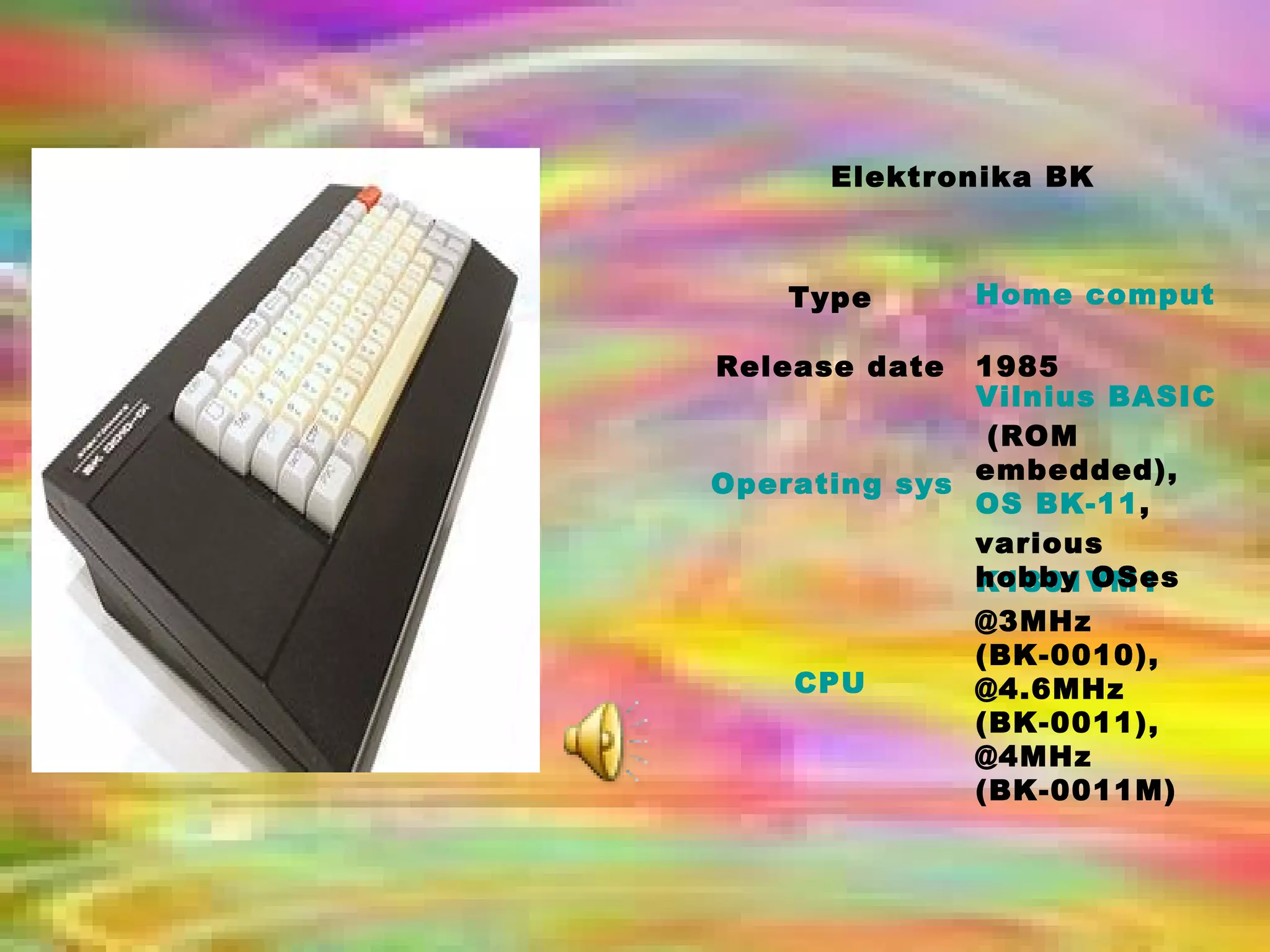
K1801VM1 @3MHz(BK-0010), @4.6MHz (BK-0011), @4MHz (BK-0011M) CPU Vilnius BASIC (ROM embedded), OS BK-11 , various hobby OSes Operating system 1985 Release date Home computer Type Elektronika BK
9.
ANDOS AO-DOS CSI-DOS DOSB10 DX-DOS FA-DOS HC-DOS KMON MICRODOS MK-DOS NORD NORTON-BK RAMON PASCAL DOS RT-11 TURBO-DOS BKUNIX OS/A WASP OPERATING SYSTEM
10.
ANDOS is a Russian operating system for Electronika BK-0010 , Electronika BK-0011 and Electronika BK-0011M series computers. It was created in 1990 and saw first release in 1992. Initially it was developed by Alexey Nadezhin (by whose name the system is named) and later also by Sergey Kamnev who joined the project. It was the only widespread system on BK series computers that used MS-DOS compatible file system format. ANDOS used FAT12 filesystem on 800Kb floppy disks. For Electronika BK-0011M and Electronika BK-0011 ANDOS provided Electronika BK-0010 emulation by loading BK-0010 ROM image into BK-0011(M) RAM. In minimal configuration the system was able to occupy less than 4 Kb of RAM. The system was able to support up to 64 disk drives (or hard drive partitions) as well as RAM disks in the computer's memory and tape recording. It also was able to have read-only access to MicroDOS file system format disks, although in the last version this function was transferred from system core to the file manager and became optional ANDOS
11.
CSI-DOS is an operating system , created in Samara , for Soviet personal computers Elektronika BK-0011M and Elektronika BK-0011. CSI-DOS did not support the earlier model BK-0010. CSI-DOS used its own unique file system and supported only color graphic video mode. The system supported both hard and floppy drives as well as RAM disks in the computer's memory. It also included software to work with music co-processor AY-3-8910(12) and Covox Speech Thing . There is a number of games and demonstration programs designed specially for the system. The system also included a Turbo Vision -like API allowing simpler design of user applications as well as a file manager called X-Shell . CSI-DOS
12.
MK-DOS - oneof the most widespread operating systems for Elektronika BK Soviet personal computer, developed by Mikhail Korolev and Dmitriy Butyrskiy starting from 1993. Like ANDOS , the system provided full compatibility of operating environment for all models of BK, emulating environment of BK-0010 on more modern BK-0011 and BK-0011M. All requests to a magnetic tape from programs if they were made through proper ROM funcrions were redirected to a disk. The system supported up to 4 physical disk drives (the number actually limited by disk ROM installed) and as many as number of letters in Latin alphbet hard disk partitions used as separate logical drives with volume of each up to 32 MB ( See also: drive letter assignment ). Starting from version 3.0 the system also supported mounting disk images as logical drives . When booted on BK-0011 or BK-0011M the system automatically created a RAM disk in the computer's memory. MK-DOS
13.
MK-DOS used awidespread on BK MicroDOS file system which did not support file fragmentation (like the file system used with RT-11 ). While incompatible with RT-11's file system it shared many principles with it. MicroDOS file system had read-only support in ANDOS. The filename length was limited by 14 symbols (the filename extension was not recognized separately and was considered as a part of the filename). Minimum installation of the system took not more than 8 KB of computer's memory. The system had functional graphic Norton Commander -like file manager called MCommander . The system shipped with a number of utilities including emulators for RT-11, FAT 12 and CSI-DOS file systems as add-ons for the file manager.
14.
RT-11 ('RT' for Real Time ) was a small, single-user real-time operating system for the Digital Equipment Corporation PDP-11 family of 16-bit computers. RT-11 was first implemented in 1970 and was widely used for real-time systems, process control , and data acquisition across the full line of PDP-11 computers RT-11
15.
MultitaskingRT-11 systems did not support preemptive multitasking , but most versions could run multiple simultaneous applications. All variants of the monitors provided a Background Job . The FB, XM and ZM monitors also provided a Foreground Job , as well as six System Jobs if selected via the SYSGEN System Generation program. These tasks had fixed priorities, with the Background Job lowest and the Foreground Job highest. It was possible to switch between jobs from the system console user interface, and SYSGEN could generate a monitor that provided a single Background Job (the SB, XB and ZB variants). Source code RT-11 was written in assembly language . Heavy use of the conditional assembly and macro programming features of the MACRO-11 assembler allowed a significant degree of configurability and allowed programmers to specify high-level instructions otherwise unprovided for in machine code. RT-11 distributions included the source code of the operating system and its device drivers with all the comments removed and a program named "SYSGEN" which would build the operating system and drivers according to a user-specified configuration. Developer's documentation included a kernel listing that included comments.
BKUNIX is an operating system for the Soviet Elektronika BK personal computer. It is based on LSX kernel (a version of UNIX V6 ) and licensed under the GNU General Public License . It is developed by Sergey Vakulenko and Leonid Broukhis. BK-0010 and BK-0011M require different compilations of the kernel, but other parts are the same. The system supports up to three concurrent tasks and allows mounting up to three file systems
AROS (AROS ResearchOperating System, formerly known as Amiga Research Operating System.) Atheos branched to become syllables DexOS EROS FAMOS Foremost Advance Memory Operating System HelenOS Kolibrios (fork of MenuetOS) LoseThos LSE/OS MenuetOS NewOS Syllable Visopspy TajOS
AROS Research OperatingSystem (AROS) is a free software / open source implementation of the AmigaOS 3.1 APIs . Designed to be portable and flexible, ports are currently available for x86 -based and PowerPC -based PCs in native and hosted flavors , with other architectures in development. AROS used to mean Amiga Research Operating System, but to avoid any trademark issues with the Amiga name it was changed to the recursive acronym AROS Research Operating System. The project, started in 1995 , has over the years become an almost "feature complete" implementation of AmigaOS - with currently (as of October 2008) only a few lacking areas of functionality. This was achieved by the efforts of a small team of developers. It can currently be installed on most IBM PC compatibles , and features native graphics drivers for video cards such as the GeForce range made by Nvidia . As of May 2007 USB keyboards and mice are also supported. AROS has been ported to the PowerPC board SAM4404EP from ACube Systems and is also planned to run on Efika .
22.
AtheOS was a free software operating system for x86 -based computers. It was initially intended as an AmigaOS clone [1] , but that objective was later abandoned. It is no longer in development, and has been superseded by the Syllable operating system. History It was created entirely by a Norwegian programmer , Kurt Skauen , from 1994 to the early 2000s; AtheOS was announced to the world in March 2000 on Usenet . Although it was licensed as free software , Skauen was more hesitant to accept contributions from the public than other free and open source operating system projects. The availability of the code under the GPL allowed other developers to launch Syllable, a fork from the AtheOS code base, with ongoing development. ATHEOS
23.
DexOS, is a free and open source 32-bit games console type operating system for 32-bit x86 computers . It was written in entirely assembly language using FASM (flat assembler) . The operating system's GUI was inspired by modern video game consoles but it also includes a Command Line Interface .It was designed to boot from a 1.44 MB floppy disk and its kernel is less than 100 KB .DexOS can also be booted from a CD , USB flash drive or hard drive . Running the operating system from other platforms such as DOS , Xbox , or PC emulators such as DOSbox is supported.Development is led by Craig Bamford and members of the DexOS community. Programs for DexOS are developed using 32-bit assembly language. [5] The current distribution comes with several programs including Tex4u , a text editor , Space Pong , a tennis game for two players, and FASM port. The operating system also includes a full TCP/IP stack . [1] DEX-OS
24.
EROS (The ExtremelyReliable Operating System) is an operating system developed by The EROS Group, LLC., the Johns Hopkins University , and the University of Pennsylvania . Interesting features include automatic data and process persistence , some preliminary real-time support, and capability-based security . EROS is purely a research operating system, and was never deployed in real world use. As of 2005, development has stopped in favor of two successor systems, CapROS and Coyotos . EROS
25.
HelenOS isan operating system based on a preemptible microkernel design. The source code of HelenOS is published under free software licences , making the operating system free software . Features HelenOS is based on a microkernel design. It is fully preemptible . It provides all the facilities expected of a modern kernel, including multitasking , multithreading , and symmetric multiprocessing , but is small and easy to expand. Particular features of HelenOS are: lightweight IPC , thread-local storage , Development HelenOS is developed mainly by staff and students at the Faculty of Mathematics and Physics at Charles University in Prague , with help from other contributors around the world. HELEN OS
KolibriOS (also knownas KOS and Kolibri) is a free operating system with a monolithic preemptive , real-time kernel , video drivers, for 32-bit x86 architecture computers, developed and maintained by The KolibriOS Project Team. KolibriOS is a fork of MenuetOS , written entirely in FASM ( assembly language ). However, C-- , C , C++ , Free Pascal , Forth , among other high-level languages and compilers, can also be used in user application development. KolibriOS is available in English, Russian and German. Features Boots from several devices. Graphical user interface based on VESA . Development kit: code editor with a macro-assembler ( FASM ) integrated TCP/IP stack Fits on a single 1.44MB floppy (many applications are compressed). Pre-emptive multitasking, streams, parallel execution of system calls. Supported file systems are FAT12, FAT16, FAT32 (long names support), NTFS (read only), ISO 9660 (including multisession). AC'97 audio codec support for Intel , nForce , nForce2 , nForce3 , nForce4 and SIS7012 chipsets. CD and DVD support. USB support (uhci controller). User can change themes directly in the OS .
28.
LoseThos is a public-domain , x86-64 opcode , operating system , developed by Terry A. Davis. The stated goal of this project is "programming as entertainment." It is oriented toward video games, not the Internet, desk-top publishing or multimedia. It is not derived from any existing operating system, nor claims compatibility with such Features It is programmed with a language variant of C / C++ . Kernel privilege at all times in all programs. Identity mapped virtual-to-physical memory. Master/slave MultiCore support -- not SMP. 640x480x16 color VGA graphics. CD-ROMs. Most hard drives, keyboards and mice. It does not have USB , printing, or networking support. But sound from the PC Speaker is available. LOSETH OS
29.
The LSE/OS kernel was a research kernel designed by a French research laboratory named Epita System Laboratory . The project is now open source . The main goal of the kernel was to never crash prompting the original designers to implement it as a modular nanokernel instead of the traditional monolithic kernel of "traditional" operating systems . This choice was good because it allowed the drivers and services code to be moved out of the kernel (to user space ). These services would then become un privileged processes so that any error that occurs e.g. in a driver won't crash the system. In a monolithic kernel this is impossible.[ LSE/OS
30.
MenuetOS (also knownas MeOS) is an operating system with a monolithic preemptive , real-time kernel , including video drivers, all written in FASM assembly language , for 64-bit and 32-bit x86 architecture computers, by Ville Mikael Turjanmaa . MenuetOS development has focused on fast, simple, efficient implementation. It has a graphical desktop, games, and networking abilities ( TCP/IP stack ), yet it still fits on one 1.44MB floppy disk . It also facilitates easy, full-featured assembly language programming. This stands in marked contrast to the (as of 2007) widespread view that assembly languages are useful mainly for old and embedded systems. MenuetOS was originally written for 32-bit x86 architectures and released under the GPL , thus many of its applications are distributed under the GPL. The 64-bit MenuetOS, often referred to as Menuet 64, remains a platform for learning 64-bit assembly language programming. 64-bit Menuet is distributed as freeware without the source code for core components. Menuet 64 works smoothly in QEMU which can emulate 64-bit machine atop a 32-bit machine. MENUET OS
31.
Syllable isa free and open source operating system for Pentium and compatible processors. Its purpose is to create an easy-to-use desktop operating system for the home and small office user. It was forked from the stagnant AtheOS in July 2002. SYLLABLE
1-10 : operatingsystem of Elektronica BK 11-15 : hobby operating system 16.It is the public-domain , x86-64 opcode , operating system , developed by Terry A. Davis. The stated goal of this project is "programming as entertainment? 17.What is the acronym of EROS? 18.What is the acronym of AROS? 19.It is a Russian operating system for Electronika BK-0010 , Electronika BK-0011 and Electronika BK-0011M series computers. It was created in 1990 and saw first release in 1992. 20. is an operating system for the Soviet Elektronika BK personal computer. It is based on LSX kernel (a version of UNIX V6 ) and licensed under the GNU General Public License . QuesTionS








![AtheOS was a free software operating system for x86 -based computers. It was initially intended as an AmigaOS clone [1] , but that objective was later abandoned. It is no longer in development, and has been superseded by the Syllable operating system. History It was created entirely by a Norwegian programmer , Kurt Skauen , from 1994 to the early 2000s; AtheOS was announced to the world in March 2000 on Usenet . Although it was licensed as free software , Skauen was more hesitant to accept contributions from the public than other free and open source operating system projects. The availability of the code under the GPL allowed other developers to launch Syllable, a fork from the AtheOS code base, with ongoing development. ATHEOS](https://image.slidesharecdn.com/ait-wit-1234939754550257-3/75/group6-report-22-2048.jpg)
![DexOS, is a free and open source 32-bit games console type operating system for 32-bit x86 computers . It was written in entirely assembly language using FASM (flat assembler) . The operating system's GUI was inspired by modern video game consoles but it also includes a Command Line Interface .It was designed to boot from a 1.44 MB floppy disk and its kernel is less than 100 KB .DexOS can also be booted from a CD , USB flash drive or hard drive . Running the operating system from other platforms such as DOS , Xbox , or PC emulators such as DOSbox is supported.Development is led by Craig Bamford and members of the DexOS community. Programs for DexOS are developed using 32-bit assembly language. [5] The current distribution comes with several programs including Tex4u , a text editor , Space Pong , a tennis game for two players, and FASM port. The operating system also includes a full TCP/IP stack . [1] DEX-OS](https://image.slidesharecdn.com/ait-wit-1234939754550257-3/75/group6-report-23-2048.jpg)