1
Trends Review 2021
The year everything changed
March 2021
2
Table of contents
1. Why Trends Review?
1. We are no longer the same
1. Eight lessons from the pandemic year
1. 2021 will be the year of...
1. The year we lost control.
2. If we have done anything, it is learn.
3. The encounter with oneself.
4. The year of emotional nakedness.
5. The reconfiguration of time.
6. The impossible, uncertainty and fragility.
7. The eclipse of consumption.
8. The way out of the crisis, neither in V, nor in W: a way out in K.
3
Why Trends Review?
01
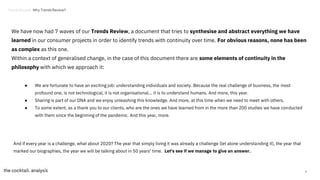
● We are fortunate to have an exciting job: understanding individuals and society. Because the real challenge of business, the most
profound one, is not technological, it is not organisational... it is to understand humans. And more, this year.
● Sharing is part of our DNA and we enjoy unleashing this knowledge. And more, at this time when we need to meet with others.
● To some extent, as a thank you to our clients, who are the ones we have learned from in the more than 200 studies we have conducted
with them since the beginning of the pandemic. And this year, more.
Trends Review. Why Trends Review?
4
We have now had 7 waves of our Trends Review, a document that tries to synthesise and abstract everything we have
learned in our consumer projects in order to identify trends with continuity over time. For obvious reasons, none has been
as complex as this one.
Within a context of generalised change, in the case of this document there are some elements of continuity in the
philosophy with which we approach it:
And if every year is a challenge, what about 2020? The year that simply living it was already a challenge (let alone understanding it), the year that
marked our biographies, the year we will be talking about in 50 years' time. Let's see if we manage to give an answer.
5
We are no longer the same
02
6
Our ability to govern ourselves called into
question
On the other hand, exit
at K.
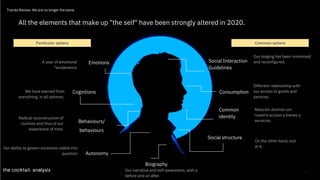
All the elements that make up "the self" have been strongly altered in 2020.
Trends Review. We are no longer the same
Emotions
Cognitions
Behaviours/
behaviours
Social Interaction
Guidelines
Consumption
Common
identity
Social structure
A year of emotional
"exuberance
We have learned from
everything, in all spheres.
Radical reconstruction of
routines and thus of our
experience of time.
Our staging has been minimised
and reconfigured.
Different relationship with
our access to goods and
services.
Relación distinta con
nuestro acceso a bienes y
servicios.
Particular sphere Common sphere
Autonomy
Biography
Our narrative and self-awareness, with a
before and an after.
7
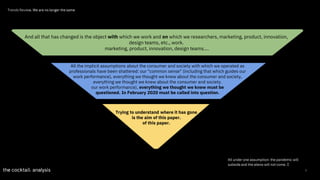
And all that has changed is the object with which we work and on which we researchers, marketing, product, innovation,
design teams, etc., work.
marketing, product, innovation, design teams....
All the implicit assumptions about the consumer and society with which we operated as
professionals have been shattered: our "common sense" (including that which guides our
work performance), everything we thought we knew about the consumer and society,
everything we thought we knew about the consumer and society.
our work performance), everything we thought we knew must be
questioned. In February 2020 must be called into question.
Trying to understand where it has gone
is the aim of this paper.
of this paper.
Trends Review. We are no longer the same
All under one assumption: the pandemic will
subside and the aliens will not come. 🛸
8
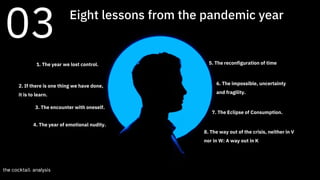
5. The reconfiguration of time
6. The impossible, uncertainty
and fragility.
7. The Eclipse of Consumption.
8. The way out of the crisis, neither in V
nor in W: A way out in K
1. The year we lost control.
2. If there is one thing we have done,
it is to learn.
3. The encounter with oneself.
4. The year of emotional nudity.
03 Eight lessons from the pandemic year
9
No. 1
The year we lost control
Trends Review. Eight lessons from the pandemic year
10
Confinement, state of alarm, curfew...
vocabulary that speaks of limitations and
restrictions, of loss of autonomy in
decision-making, in daily life and with
regard to the future.
Although it has sometimes freed us from
making decisions for which we lacked the
tools on an individual level, the result
ends up being a feeling of "drift", of
"dragging", of a lack of control over our
lives.
Trends Review. Eight lessons from the pandemic year
The year we lost control
11
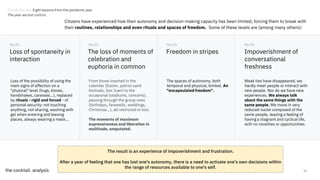
Citizens have experienced how their autonomy and decision-making capacity has been limited, forcing them to break with
their routines, relationships and even rituals and spaces of freedom. Some of these levels are (among many others):
Loss of spontaneity in
interaction
Loss of the possibility of using the
main signs of affection on a
"physical" level (hugs, kisses,
handshakes, caresses...), replaced
by rituals - rigid and forced - of
personal security: not touching
anything, not sharing, washing with
gel when entering and leaving
places, always wearing a mask...
No.01
The loss of moments of
celebration and
euphoria in common
No.02
Freedom in stripes
No.03
Impoverishment of
conversational
freshness
No.04
From those inserted in the
calendar (Easter, patron saint
festivals, San Juan) to the
occasional (stadiums, concerts),
passing through the group ones
(birthdays, farewells, weddings,
Christmas...), all restricted or lost.
The moments of maximum
expressiveness and liberation in
multitude, amputated.
The spaces of autonomy, both
temporal and physical, limited. An
"encapsulated freedom".
Weak ties have disappeared, we
hardly meet people or interact with
new people. Nor do we have new
experiences. We always talk
about the same things with the
same people. We move in very
reduced nuclei composed of the
same people, leaving a feeling of
having a stagnant and cyclical life,
with no novelties or opportunities.
The result is an experience of impoverishment and frustration.
After a year of feeling that one has lost one's autonomy, there is a need to activate one's own decisions within
the range of resources available to one's self.
Trends Review. Eight lessons from the pandemic year
The year we lost control
12
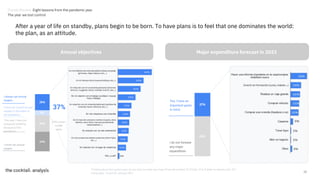
After a year of life on standby, plans begin to be born. To have plans is to feel that one dominates the world:
the plan, as an attitude.
Annual objectives Major expenditure forecast in 2021
Yes, I have an
important gasto
in mind
I do not foresee
any major
expenditure
Thinking about the current year, do you plan to make any major financial outlays? N (Total): 615; N (plan to spend a lot): 227
Camp date: 19 and 20 January 2021
This year I have not
proposed anything
because of the
pandemic.
I always set annual
targets...
I have set myself annual
targets in the wake of
the pandemic.
37%
35% Lower-
middle
class
I never set annual
targets
Trends Review. Eight lessons from the pandemic year
The year we lost control
13
The need to govern
ourselves again.
If the consumer has always wanted to feel powerful,
now even more so.
- After a year of helplessness, activation will be slow, with plans of greater or
lesser ambition depending on the impact of the crisis on the individual. The
need to build plans emerges as an indicator of mastery over my reality: this
is the time for planning tools. Brands have an opportunity here to facilitate
planning, a step prior to activation.
- Selling sometimes means pushing, sometimes it means raising barriers:
the consumer has felt dwarfed, brands should not increase this feeling: "don't
push me, don't make me afraid". This is not the time to "push", to generate fear
of scarcity ("there is only one left" "price only for today" "you have to do it now
or it will run out"...).
- Structure your sales proposal from the consumer's experience of power:
○ Let them decide when and how
○ Generating breakthrough experience, don't throw the ball too
far: small short goals allow you to feel progress, construction, etc.
. Long-term plans do not belong to me, I govern in the short and
achievable.
○ Allowing me to backtrack (cancellations) or delay the decision....
- This is not the time for Customer Journeys as dark, dead-end tunnels: open
FT, save preferences, settings... to come back to later.
Trends Review. Eight lessons from the pandemic year
The year we lost control
14
No. 2
If there is one thing we have
done, it is to learn.
Trends Review. Eight lessons from the pandemic year
15
Trends Review. Eight lessons from the pandemic year
If there is one thing we have done, it is to learn.
Faced with a challenge of such magnitude,
where common sense was blown to bits,
everything we knew and everything we
thought we knew was put to the test.
If there is one thing we have learned, it is
that we have learned: not everything, but
everything, in all areas. And above all, we
have learned that we can learn.
We have even learned more than the
market could have imagined: for the first
time in a long time, supply is lagging
behind the consumer.
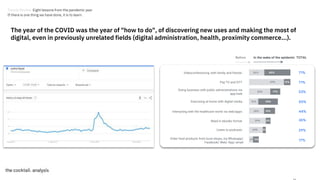
The year of the COVID was the year of "how to do", of discovering new uses and making the most of
digital, even in previously unrelated fields (digital administration, health, proximity commerce...).
Before In the wake of the epidemic TOTAL
Videoconferencing with family and friends
Pay TV and OTT
71%
71%
53%
50%
Doing business with public administrations via
app/web
44%
29%
35%
17%
Exercising at home with digital media
Interacting with the healthcare world via web/apps
Read in ebooks format
Listen to podcasts
Order food products from local shops, via Whatsapp/
Facebook/ Web/ App/ email
26% 45%
59% 12%
36% 17%
16% 34%
25% 19%
29% 6%
24% 5%
6% 11%
Trends Review. Eight lessons from the pandemic year
If there is one thing we have done, it is to learn.
17
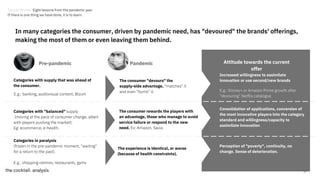
In many categories the consumer, driven by pandemic need, has "devoured" the brands' offerings,
making the most of them or even leaving them behind.
Categories with supply that was ahead of
the consumer.
The consumer "devours" the
supply-side advantage, "matches" it
and even "burns" it.
Categories with "balanced" supply
(moving at the pace of consumer change, albeit
with players pushing the market):
Eg: ecommerce, e-health.
The consumer rewards the players with
an advantage, those who manage to avoid
service failure or respond to the new
need. Ex: Amazon, Savia
Increased willingness to assimilate
innovation or use second/new brands
E.g.: Disney+ or Amazon Prime growth after
"devouring" Netflix catalogue
Consolidation of applications, conversion of
the most innovative players into the category
standard and willingness/capacity to
assimilate innovation
Categories in paralysis
(frozen in the pre-pandemic moment, "waiting"
for a return to the past).
E.g.: shopping centres, restaurants, gyms
The experience is identical, or worse
(because of health constraints).
Perception of "poverty", continuity, no
change. Sense of deterioration.
Pre-pandemic Attitude towards the current
offer
E.g.: banking, audiovisual content, Bizum
Pandemic
Trends Review. Eight lessons from the pandemic year
If there is one thing we have done, it is to learn.
18
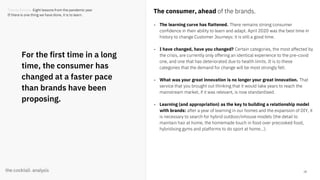
For the first time in a long
time, the consumer has
changed at a faster pace
than brands have been
proposing.
The consumer, ahead of the brands.
- The learning curve has flattened. There remains strong consumer
confidence in their ability to learn and adapt. April 2020 was the best time in
history to change Customer Journeys: it is still a good time.
- I have changed, have you changed? Certain categories, the most affected by
the crisis, are currently only offering an identical experience to the pre-covid
one, and one that has deteriorated due to health limits. It is to these
categories that the demand for change will be most strongly felt.
- What was your great innovation is no longer your great innovation. That
service that you brought out thinking that it would take years to reach the
mainstream market, if it was relevant, is now standardised.
- Learning (and appropriation) as the key to building a relationship model
with brands: after a year of learning in our homes and the expansion of DIY, it
is necessary to search for hybrid outdoor/inhouse models (the detail to
maintain hair at home, the homemade touch in food over precooked food,
hybridising gyms and platforms to do sport at home...).
Trends Review. Eight lessons from the pandemic year
If there is one thing we have done, it is to learn.
19
No. 3
The encounter with oneself.
Trends Review. Eight lessons from the pandemic year
20
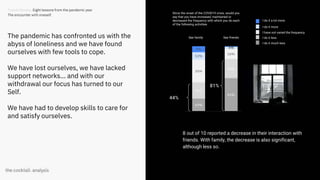
The pandemic has confronted us with the
abyss of loneliness and we have found
ourselves with few tools to cope.
We have lost ourselves, we have lacked
support networks... and with our
withdrawal our focus has turned to our
Self.
We have had to develop skills to care for
and satisfy ourselves.
I have not varied the frequency
I do it less
I do it more
I do it much less
I do it a lot more
44%
81%
8 out of 10 reported a decrease in their interaction with
friends. With family, the decrease is also significant,
although less so.
Since the onset of the COVID19 crisis, would you
say that you have increased, maintained or
decreased the frequency with which you do each
of the following activities
Trends Review. Eight lessons from the pandemic year
The encounter with oneself.
See family See friends
Reduced and limited contact and affection from
friends, family, work groups, losing "simple
acquaintances" and not adding new ones, etc.
21
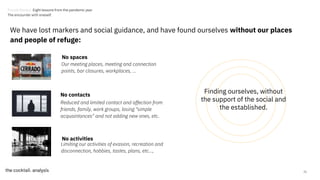
No spaces
No contacts
Our meeting places, meeting and connection
points, bar closures, workplaces, ...
No activities
Limiting our activities of evasion, recreation and
disconnection, hobbies, tastes, plans, etc...,
Finding ourselves, without
the support of the social and
the established.
We have lost markers and social guidance, and have found ourselves without our places
and people of refuge:
Trends Review. Eight lessons from the pandemic year
The encounter with oneself.
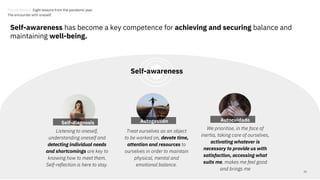
Self-awareness has become a key competence for achieving and securing balance and
maintaining well-being.
Treat ourselves as an object
to be worked on, devote time,
attention and resources to
ourselves in order to maintain
physical, mental and
emotional balance.
22
Autocuidado
Listening to oneself,
understanding oneself and
detecting individual needs
and shortcomings are key to
knowing how to meet them.
Self-reflection is here to stay.
We prioritise, in the face of
inertia, taking care of ourselves,
activating whatever is
necessary to provide us with
satisfaction, accessing what
suits me, makes me feel good
and brings me
Autogestión
Self-diagnosis
Self-awareness
Trends Review. Eight lessons from the pandemic year
The encounter with oneself.
23
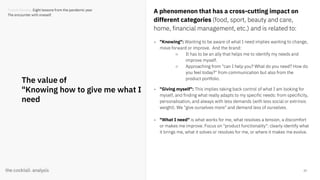
The value of
"Knowing how to give me what I
need
A phenomenon that has a cross-cutting impact on
different categories (food, sport, beauty and care,
home, financial management, etc.) and is related to:
- "Knowing": Wanting to be aware of what I need implies wanting to change,
move forward or improve. And the brand:
○ It has to be an ally that helps me to identify my needs and
improve myself.
○ Approaching from "can I help you? What do you need? How do
you feel today?" from communication but also from the
product portfolio.
- "Giving myself": This implies taking back control of what I am looking for
myself, and finding what really adapts to my specific needs: from specificity,
personalisation, and always with less demands (with less social or extrinsic
weight). We "give ourselves more" and demand less of ourselves.
- "What I need" is what works for me, what resolves a tension, a discomfort
or makes me improve. Focus on "product functionality": clearly identify what
it brings me, what it solves or resolves for me, or where it makes me evolve.
Trends Review. Eight lessons from the pandemic year
The encounter with oneself.
24
No. 4
The year of emotional nakedness.
Trends Review. Eight lessons from the pandemic year
25
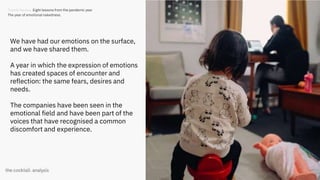
We have had our emotions on the surface,
and we have shared them.
A year in which the expression of emotions
has created spaces of encounter and
reflection: the same fears, desires and
needs.
The companies have been seen in the
emotional field and have been part of the
voices that have recognised a common
discomfort and experience.
Trends Review. Eight lessons from the pandemic year
The year of emotional nakedness.
26
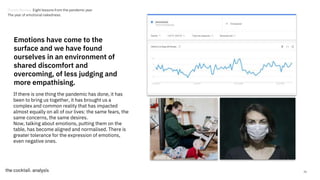
Emotions have come to the
surface and we have found
ourselves in an environment of
shared discomfort and
overcoming, of less judging and
more empathising.
If there is one thing the pandemic has done, it has
been to bring us together, it has brought us a
complex and common reality that has impacted
almost equally on all of our lives: the same fears, the
same concerns, the same desires.
Now, talking about emotions, putting them on the
table, has become aligned and normalised. There is
greater tolerance for the expression of emotions,
even negative ones.
Trends Review. Eight lessons from the pandemic year
The year of emotional nakedness.
27
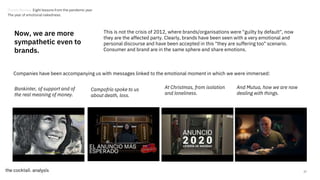
Now, we are more
sympathetic even to
brands.
This is not the crisis of 2012, where brands/organisations were "guilty by default", now
they are the affected party. Clearly, brands have been seen with a very emotional and
personal discourse and have been accepted in this "they are suffering too" scenario.
Consumer and brand are in the same sphere and share emotions.
Campofrío spoke to us
about death, loss.
At Christmas, from isolation
and loneliness.
Bankinter, of support and of
the real meaning of money.
And Mutua, how we are now
dealing with things.
Companies have been accompanying us with messages linked to the emotional moment in which we were immersed:
Trends Review. Eight lessons from the pandemic year
The year of emotional nakedness.
28
Your problems are my
problems... almost literally.
Opportunity to radically change the brand/consumer
relationship, as the symbolic distance between
brand/organisation and consumer has shortened.
- There has been reconciliation (consumer/brand): banking is no longer guilty,
insurance has a reason, logistics/distribution has shown its face, Telco's have
not failed as an almost essential service, the difficulties of catering and travel
are understood... If this is so,
○ Let's try out new codes of communication, leveraged on this new
legitimacy, with a more collaborative nature and running in a
more parallel way between the two (consumer/brand).
○ We find ourselves in a fertile scenario where it will be easier to
talk about and from emotions. The customer allows you to talk
about "what they can feel" because for the first time you have
lived it and shared it.
○ Even your good news is my good news. Talk about your
achievements because they are mine: in a context of wild
negativity, feeling that organisations are moving forward means
that we are all moving forward.
- In this framework of "empathy", and having assumed (with no desire to
go back) a significant abandonment of the face-to-face channel, new
spaces must be sought for remote human contact: the human factor
translates into a sense of relevance, understanding, understanding,
negotiation... and there is no desire to completely renounce it. New space
must be found for human interaction in FT, even if it is remote.
Trends Review. Eight lessons from the pandemic year
The year of emotional nakedness.
29
No. 5
The re-signification of time
Trends Review. And then?
30
Once our established routines and activities
were energised, we suddenly made a
discovery: time was ours and it was in our
hands.
This availability has made us appreciate it,
made it ours, and allowed us to feel that we
own something that not long ago we felt did
not belong to us.
The reconquest of time.
Trends Review. Eight lessons from the pandemic year
The re-signification of time
31
31
And contacts are
restricted to the
essentials in time and
people: only with those
closest to them and in
more direct interactions.
Avoiding, controlling and
reducing exposure has led to
more time-optimised actions
and relationships.
We act in a more limited
radius of action, less
distances: more
immediate and closer
activities, less travel,
less traffic jams, etc.
A large part of face-to-
face actions are taken to
the digital world:
teleconsultation,
teleworking, online
shopping, etc.
Inevitably we have become more operational. Undertaking a
temporary effort has to be well justified and make clear sense.
Trends Review. Eight lessons from the pandemic year
The re-signification of time
32
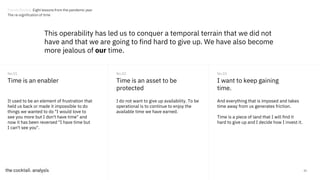
Time is an enabler
It used to be an element of frustration that
held us back or made it impossible to do
things we wanted to do "I would love to
see you more but I don't have time" and
now it has been reversed "I have time but
I can't see you".
No.01
Time is an asset to be
protected
No.02
I want to keep gaining
time.
No.03
I do not want to give up availability. To be
operational is to continue to enjoy the
available time we have earned.
And everything that is imposed and takes
time away from us generates friction.
Time is a piece of land that I will find it
hard to give up and I decide how I invest it.
This operability has led us to conquer a temporal terrain that we did not
have and that we are going to find hard to give up. We have also become
more jealous of our time.
Trends Review. Eight lessons from the pandemic year
The re-signification of time
33
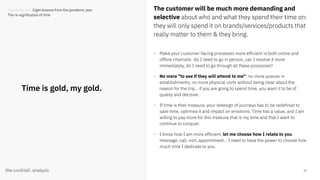
Time is gold, my gold.
The customer will be much more demanding and
selective about who and what they spend their time on:
they will only spend it on brands/services/products that
really matter to them & they bring.
- Make your customer-facing processes more efficient in both online and
offline channels: 'do I need to go in person, can I resolve it more
immediately, do I need to go through all these processes?
- No more "to see if they will attend to me": no more queues in
establishments, no more physical visits without being clear about the
reason for the trip... if you are going to spend time, you want it to be of
quality and decisive.
- If time is their treasure, your redesign of journeys has to be redefined to
save time, optimise it and impact on emotions. Time has a value, and I am
willing to pay more for this treasure that is my time and that I want to
continue to conquer.
- I know how I am more efficient, let me choose how I relate to you:
message, call, visit, appointment... I need to have the power to choose how
much time I dedicate to you.
Trends Review. Eight lessons from the pandemic year
The re-signification of time
34
No. 6
The impossible, uncertainty and
fragility
Trends Review. And then?
35
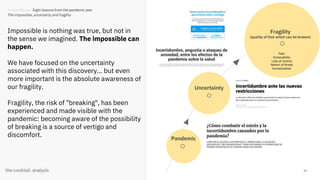
Impossible is nothing was true, but not in
the sense we imagined. The impossible can
happen.
We have focused on the uncertainty
associated with this discovery... but even
more important is the absolute awareness of
our fragility.
Fragility, the risk of "breaking", has been
experienced and made visible with the
pandemic: becoming aware of the possibility
of breaking is a source of vertigo and
discomfort. Pandemic
Fragility
(quality of that which can be broken)
La pandemia genera
incertidumbre
Fear
Vulnerability
Loss of control
Notion of threat
Humanisation
Uncertainty
La incertidumbre
revela nuestra
fragilidad
Trends Review. Eight lessons from the pandemic year
The impossible, uncertainty and fragility
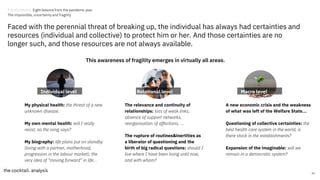
The relevance and continuity of
relationships: loss of weak links,
absence of support networks,
reorganisation of affections, ...
The rupture of routines&inertities as
a liberator of questioning and the
birth of big radical questions: should I
live where I have been living until now,
and with whom?
A new economic crisis and the weakness
of what was left of the Welfare State...
Questioning of collective certainties: the
best health care system in the world, is
there stock in the establishments?
Expansion of the imaginable: will we
remain in a democratic system?
My physical health: the threat of a new
unknown disease.
My own mental health: will I really
resist, as the song says?
My biography: life plans put on standby
(living with a partner, motherhood,
progression in the labour market), the
very idea of "moving forward" in life...
36
Faced with the perennial threat of breaking up, the individual has always had certainties and
resources (individual and collective) to protect him or her. And those certainties are no
longer such, and those resources are not always available.
This awareness of fragility emerges in virtually all areas.
Individual level Relational level Macro level
Trends Review. Eight lessons from the pandemic year
The impossible, uncertainty and fragility
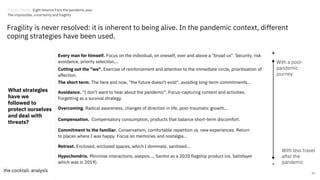
Overcoming. Radical awareness, changes of direction in life, post-traumatic growth...
The short term. The here and now, "the future doesn't exist", avoiding long-term commitments...
Avoidance. "I don't want to hear about the pandemic". Focus-capturing content and activities.
Forgetting as a survival strategy.
37
What strategies
have we
followed to
protect ourselves
and deal with
threats?
Every man for himself. Focus on the individual, on oneself, over and above a "broad us". Security, risk
avoidance, priority selection,...
Cutting out the "we". Exercise of reinforcement and attention to the immediate circle, prioritisation of
affection.
Retreat. Enclosed, enclosed spaces, which I dominate, sanitised...
Compensation. Compensatory consumption, products that balance short-term discomfort.
Commitment to the familiar. Conservatism, comfortable repetition vs. new experiences. Return
to places where I was happy. Focus on memories and nostalgia...
With a post-
pandemic
journey
Hypochondria. Minimise interactions, asepsis..., Sanitol as a 2020 flagship product (vs. Satisfayer
which was in 2019).
With less travel
after the
pandemic
+
-
Fragility is never resolved: it is inherent to being alive. In the pandemic context, different
coping strategies have been used.
Trends Review. Eight lessons from the pandemic year
The impossible, uncertainty and fragility
38
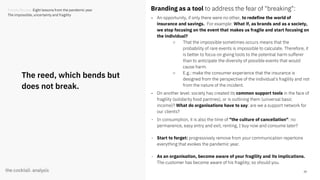
The reed, which bends but
does not break.
Branding as a tool to address the fear of "breaking":
- An opportunity, if only there were no other, to redefine the world of
insurance and savings. For example: What if, as brands and as a society,
we stop focusing on the event that makes us fragile and start focusing on
the individual?
○ That the impossible sometimes occurs means that the
probability of rare events is impossible to calculate. Therefore, it
is better to focus on giving tools to the potential harm sufferer
than to anticipate the diversity of possible events that would
cause harm.
○ E.g.: make the consumer experience that the insurance is
designed from the perspective of the individual's fragility and not
from the nature of the incident.
- On another level: society has created its common support tools in the face of
fragility (solidarity food pantries), or is outlining them (universal basic
income)? What do organisations have to say: are we a support network for
our clients?
- In consumption, it is also the time of "the culture of cancellation": no
permanence, easy entry and exit, renting, I buy now and consume later?
- Start to forget: progressively remove from your communication repertoire
everything that evokes the pandemic year.
- As an organisation, become aware of your fragility and its implications.
The customer has become aware of his fragility; so should you.
Trends Review. Eight lessons from the pandemic year
The impossible, uncertainty and fragility
39
No. 7
The eclipse of consumption
Trends Review. And then?
40
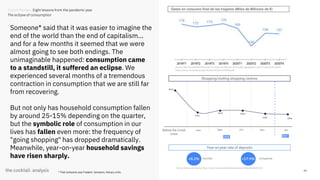
Someone* said that it was easier to imagine the
end of the world than the end of capitalism...
and for a few months it seemed that we were
almost going to see both endings. The
unimaginable happened: consumption came
to a standstill, it suffered an eclipse. We
experienced several months of a tremendous
contraction in consumption that we are still far
from recovering.
But not only has household consumption fallen
by around 25-15% depending on the quarter,
but the symbolic role of consumption in our
lives has fallen even more: the frequency of
"going shopping" has dropped dramatically.
Meanwhile, year-on-year household savings
have risen sharply.
* That someone was Frederic Jameson, literary critic.
Source: INE (Contabilidad NacionalTrimestral de España: principales agregados Cuarto trimestre de 2020)
https://www.ine.es/daco/daco42/daco4214/cntr0420a.pdf
Before the Covid
crisis
2020
Oct
June Sept Nov Jan
2021
Shopping/visiting shopping centres
+8.2% Families
Year-on-year rate of deposits
Companies
+17.9%
Source: Banco de España https://www.bde.es/webbde/es/estadis/infoest/bolest8.html
Trends Review. Eight lessons from the pandemic year
The eclipse of consumption
41
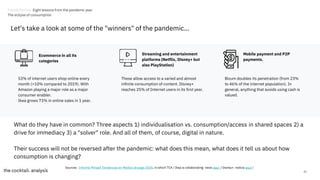
Let's take a look at some of the "winners" of the pandemic...
53% of internet users shop online every
month (+10% compared to 2019). With
Amazon playing a major role as a major
consumer enabler.
Ikea grows 73% in online sales in 1 year.
These allow access to a varied and almost
infinite consumption of content. Disney+
reaches 25% of Internet users in its first year.
Bizum doubles its penetration (from 23%
to 46% of the internet population). In
general, anything that avoids using cash is
valued.
Sources: Informe Minsait Tendencias en Medios de pago 2020, in which TCA / Ikea is collaborating: news aquí / Disney+: noticia aquí /
What do they have in common? Three aspects 1) individualisation vs. consumption/access in shared spaces 2) a
drive for immediacy 3) a "solver" role. And all of them, of course, digital in nature.
Their success will not be reversed after the pandemic: what does this mean, what does it tell us about how
consumption is changing?
Ecommerce in all its
categories
Streaming and entertainment
platforms (Netflix, Disney+ but
also PlayStation)
Mobile payment and P2P
payments.
Trends Review. Eight lessons from the pandemic year
The eclipse of consumption
42
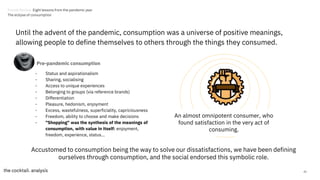
Until the advent of the pandemic, consumption was a universe of positive meanings,
allowing people to define themselves to others through the things they consumed.
- Status and aspirationalism
- Sharing, socialising
- Access to unique experiences
- Belonging to groups (via reference brands)
- Differentiation
- Pleasure, hedonism, enjoyment
- Excess, wastefulness, superficiality, capriciousness
- Freedom, ability to choose and make decisions
- "Shopping" was the synthesis of the meanings of
consumption, with value in itself: enjoyment,
freedom, experience, status...
Accustomed to consumption being the way to solve our dissatisfactions, we have been defining
ourselves through consumption, and the social endorsed this symbolic role.
Pre-pandemic consumption
An almost omnipotent consumer, who
found satisfaction in the very act of
consuming.
Trends Review. Eight lessons from the pandemic year
The eclipse of consumption
43
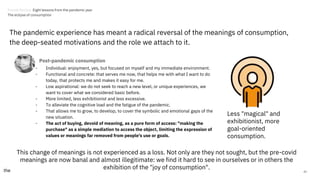
The pandemic experience has meant a radical reversal of the meanings of consumption,
the deep-seated motivations and the role we attach to it.
- Individual: enjoyment, yes, but focused on myself and my immediate environment.
- Functional and concrete: that serves me now, that helps me with what I want to do
today, that protects me and makes it easy for me.
- Low aspirational: we do not seek to reach a new level, or unique experiences, we
want to cover what we considered basic before.
- More limited, less exhibitionist and less excessive.
- To alleviate the cognitive load and the fatigue of the pandemic.
- That allows me to grow, to develop, to cover the symbolic and emotional gaps of the
new situation.
- The act of buying, devoid of meaning, as a pure form of access: "making the
purchase" as a simple mediation to access the object, limiting the expression of
values or meanings far removed from people's use or goals.
Less "magical" and
exhibitionist, more
goal-oriented
consumption.
This change of meanings is not experienced as a loss. Not only are they not sought, but the pre-covid
meanings are now banal and almost illegitimate: we find it hard to see in ourselves or in others the
exhibition of the "joy of consumption".
Post-pandemic consumption
Trends Review. Eight lessons from the pandemic year
The eclipse of consumption
44
Will consumption return
after its eclipse? Yes, of
course, but helping the
consumer to achieve his or
her goals, more
"introspective" and with
less symbolic prominence.
Towards a reconfiguration of the relationship with
consumption:
- We will never again say that a product "is functional" with disdain. Now,
being functional is critical. There are opportunities for the development of new
products and services that develop this quest for new functionality and individual
value, as well as for changing communication cues. And remember that
functional does not mean competing on price alone.
- Beyond the product, brands as platforms: providing a service architecture and
customer experience intended to be perceived as "solvers".
- Brands that continue to play their cards on status and aspirationalism will
have to establish a balance with a greater weighting of tangibles, functionality
and usage.
- The risks of the moment are confusing:
○ the "rebound" effect with the long-term trend: there will undoubtedly
be an initial moment of re-engagement with consumption and its
socialisation and display, but this orientation of consumption towards
the functional goes beyond this.
○ "Recovery of normality" with a "return to the past": the phenomena
behind this reconfiguration of consumption (spending more time at
home, online shopping, moving away from aspirationalism or
teleworking, the work of the self) are phenomena that are going to stay
and therefore push for this transformation of meanings.
Trends Review. Eight lessons from the pandemic year
The eclipse of consumption
45
Will consumption return
after its eclipse? Yes, of
course, but helping the
consumer to achieve his or
her goals, more
"introspective" and with
less symbolic prominence.
Towards a reconfiguration of the relationship with
consumption:
- Shopping centres, department stores, restaurants and leisure
will have to find new functional elements to add to their value
proposition to overcome the barriers of long, cumbersome and
time-consuming visit experiences with children... . Consumers will
become more sensitive to physical point-of-sale experiences that
do not facilitate or solve the fluidity of the process. And within the
shopping/leisure/restaurant triad that make up shopping centres,
where historically shopping was the actor that generated traction,
the weights will have to be redistributed.
Trends Review. Eight lessons from the pandemic year
The eclipse of consumption
46
No. 8
A way out of the crisis neither in V,
nor in W: a way out in K
Trends Review. And then?
47
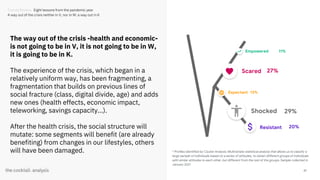
The way out of the crisis -health and economic-
is not going to be in V, it is not going to be in W,
it is going to be in K.
The experience of the crisis, which began in a
relatively uniform way, has been fragmenting, a
fragmentation that builds on previous lines of
social fracture (class, digital divide, age) and adds
new ones (health effects, economic impact,
teleworking, savings capacity...).
After the health crisis, the social structure will
mutate: some segments will benefit (are already
benefiting) from changes in our lifestyles, others
will have been damaged.
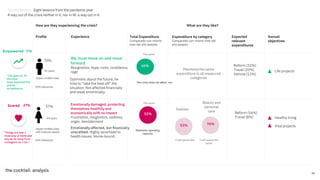
Empowered
Scared
Expectant
Shocked
Resistant
* Profiles identified by Cluster Analysis: Multivariate statistical analysis that allows us to classify a
large sample of individuals based on a series of attitudes, to obtain different groups of individuals
with similar attitudes to each other, but different from the rest of the groups. Sample collected in
January 2021
11%
27%
13%
29%
20%
Trends Review. Eight lessons from the pandemic year
A way out of the crisis neither in V, nor in W: a way out in K
How are they experiencing the crisis? What are they like?
Profile Experience
We must move on and move
forward
Resignation, hope, calm, confidence,
rage
42 years
70%
Upper-middle class
"Life goes on. At
the least
least expected this
will be
be behind us.
Emotionally damaged, protecting
themselves healthily and
economically with no impact
Frustration, resignation, sadness,
anger, bewilderment
Emotionally affected, but financially
unscathed. Highly sensitised to
health issues. Home-bound.
44 years
57%
"Things are bad. I
must stay at home and
stay as far away from
contagions as I can."
Upper-middle class
with cultural capital
Optimistic about the future, he
tries to "take the heat off" the
situation. Not affected financially
and weak emotionally:
65%
The same
55%
25% teleworks
Reform (22%)
Travel (20%)
Vehicle (13%)
Reform (16%)
Travel (8%)
Life projects
Healthy living
Vital projects
Fashion
53%
Beauty and
personal
care
70%
Maintains the same
expenditure in all measured
categories
The same
Maintains spending
capacity
The crisis does not affect him
24% teleworks
Total Expenditure Expenditure by category Expected
relevant
expenditures
Annual
objectives
Comparado con mismo
mes del año pasado
Comparado con mismo mes del
año pasado
I will spend less I will spend the
same
48
Empowered 11%
Scared 27%
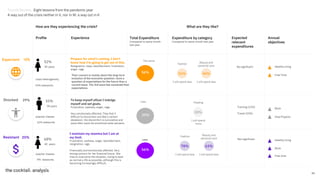
Trends Review. Eight lessons from the pandemic year
A way out of the crisis neither in V, nor in W: a way out in K
How are they experiencing the crisis? What are they like?
Profile Experience
Prepare for what's coming, I don't
know how I'm going to get out of this.
Resignation, hope, bewilderment, frustration,
anger, rage
45 years
52%
class heterogeneity
To keep myself afloat I indulge
myself and set goals.
Frustration, sadness, anger, rage.
Very emotionally affected. They find it
difficult to disconnect and feel a certain
obsession. His discomfort is cumulative and
wave after wave his emotional state worsens.
38 years
55%
popular classes
56%
Less
19% teleworks
The same
Less
22% teleworks
Total Expenditure Expenditure by category Expected
relevant
expenditures
Annual
objectives
Compared to same month
last year
Compared to same month last year
I maintain my stamina but I am at
my limit.
Frustration, sadness, anger, bewilderment,
resignation, rage.
Financially and emotionally affected. Very
strong concern for her financial future. She
tries to overcome the situation, trying to lead
as normal a life as possible, although this is
becoming increasingly difficult.
42 years
68%
Their concern is mainly about the long-term
evolution of the economic question: more a
question of expectations for the future than a
current issue. The 3rd wave has worsened their
expectations.
popular classes
9% teleworks
39%
56%
39%
Fashion
78%
I will spend less
Beauty and
personal care
I will spend less
Feeding
20%
I will spend
more
63%
Fashion
56%
I will spend less
Beauty and
personal care
I will spend less
44%
Training (13%)
Travel (10%)
No significant
Not significant
Healthy living
Free Time
Healthy living
Work
Free time
Work
Vital Projects
49
Expectant 13%
Shocked 29%
Resistant 20%
Trends Review. Eight lessons from the pandemic year
A way out of the crisis neither in V, nor in W: a way out in K
50
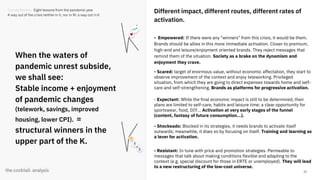
When the waters of
pandemic unrest subside,
we shall see:
Stable income + enjoyment
of pandemic changes
(telework, savings, improved
housing, lower CPI). =
structural winners in the
upper part of the K.
Different impact, different routes, different rates of
activation.
- Empowered: If there were any "winners" from this crisis, it would be them.
Brands should be allies in this more immediate activation. Closer to premium,
high-end and leisure/enjoyment oriented brands. They reject messages that
remind them of the situation. Society as a brake on the dynamism and
enjoyment they crave.
- Scared: target of enormous value, without economic affectation, they start to
observe improvement of the context and enjoy teleworking. Privileged
situation, from which they are going to direct expenses towards home and self-
care and self-strengthening. Brands as platforms for progressive activation.
- Expectant: While the final economic impact is still to be determined, their
plans are limited to self-care, habits and leisure time: a clear opportunity for
sportswear, food, DIY... Activation at very early stages of the funnel
(content, fantasy of future consumption...).
- Shockeado: Blocked in its strategies, it needs brands to activate itself
outwards; meanwhile, it does so by focusing on itself. Training and learning as
a lever for activation.
- Resistant: In tune with price and promotion strategies. Permeable to
messages that talk about making conditions flexible and adapting to the
context (e.g. special discount for those in ERTE or unemployed). They will lead
to a new restructuring of the low-cost universe.
Trends Review. Eight lessons from the pandemic year
A way out of the crisis neither in V, nor in W: a way out in K
51
2021 will be the year of...
04
52
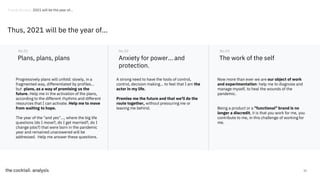
Plans, plans, plans
Progressively plans will unfold: slowly, in a
fragmented way, differentiated by profiles...
but plans, as a way of promising us the
future. Help me in the activation of the plans,
according to the different rhythms and different
resources that I can activate. Help me to move
from waiting to hope.
The year of the "and yes"..., where the big life
questions (do I move?, do I get married?, do I
change jobs?) that were born in the pandemic
year and remained unanswered will be
addressed. Help me answer these questions.
No.01
Anxiety for power... and
protection.
No.02
The work of the self
No.03
A strong need to have the tools of control,
control, decision making... to feel that I am the
actor in my life.
Promise me the future and that we'll do the
route together, without pressuring me or
leaving me behind.
Now more than ever we are our object of work
and experimentation: help me to diagnose and
manage myself, to heal the wounds of the
pandemic.
Being a product or a "functional" brand is no
longer a discredit, it is that you work for me, you
contribute to me, in this challenge of working for
me.
Thus, 2021 will be the year of...
Trends Review. 2021 will be the year of...
53
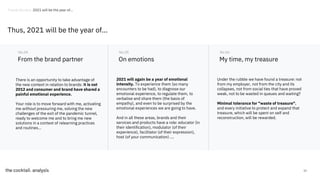
From the brand partner
There is an opportunity to take advantage of
the new context in relation to brands: it is not
2012 and consumer and brand have shared a
painful emotional experience.
Your role is to move forward with me, activating
me without pressuring me, solving the new
challenges of the exit of the pandemic tunnel,
ready to welcome me and to bring me new
solutions in a context of relearning practices
and routines...
No.04
On emotions
No.05
My time, my treasure
No.06
2021 will again be a year of emotional
intensity. To experience them (so many
encounters to be had), to diagnose our
emotional experience, to regulate them, to
verbalise and share them (the basis of
empathy), and even to be surprised by the
emotional experiences we are going to have.
And in all these areas, brands and their
services and products have a role: educator (in
their identification), modulator (of their
experience), facilitator (of their expression),
host (of your communication) ....
Under the rubble we have found a treasure: not
from my employer, not from the city and its
collapses, not from social ties that have proved
weak, not to be wasted in queues and waiting?
Minimal tolerance for "waste of treasure".
and every initiative to protect and expand that
treasure, which will be spent on self and
reconstruction, will be rewarded.
Thus, 2021 will be the year of...
Trends Review. 2021 will be the year of...
54
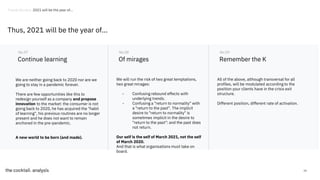
Continue learning
We are neither going back to 2020 nor are we
going to stay in a pandemic forever.
There are few opportunities like this to
redesign yourself as a company and propose
innovation to the market: the consumer is not
going back to 2020, he has acquired the "habit
of learning", his previous routines are no longer
present and he does not want to remain
anchored in the pre-pandemic.
A new world to be born (and made).
No.07
Of mirages
No.08
Remember the K
No.09
We will run the risk of two great temptations,
two great mirages:
- Confusing rebound effects with
underlying trends.
- Confusing a "return to normality" with
a "return to the past". The implicit
desire to "return to normality" is
sometimes implicit in the desire to
"return to the past": and the past does
not return.
Our self is the self of March 2021, not the self
of March 2020.
And that is what organisations must take on
board.
All of the above, although transversal for all
profiles, will be modulated according to the
position your clients have in the crisis exit
structure.
Different position, different rate of activation.
Thus, 2021 will be the year of...
Trends Review. 2021 will be the year of...
Thank you
Contacto
felipe.romero@tcanalysis.com
maria.herranz@tcanalysis.com
tcanalysis.com

Trends review 2021

  • 1.
    1 Trends Review 2021 Theyear everything changed March 2021
  • 2.
    2 Table of contents 1.Why Trends Review? 1. We are no longer the same 1. Eight lessons from the pandemic year 1. 2021 will be the year of... 1. The year we lost control. 2. If we have done anything, it is learn. 3. The encounter with oneself. 4. The year of emotional nakedness. 5. The reconfiguration of time. 6. The impossible, uncertainty and fragility. 7. The eclipse of consumption. 8. The way out of the crisis, neither in V, nor in W: a way out in K.
  • 3.
  • 4.
    ● We arefortunate to have an exciting job: understanding individuals and society. Because the real challenge of business, the most profound one, is not technological, it is not organisational... it is to understand humans. And more, this year. ● Sharing is part of our DNA and we enjoy unleashing this knowledge. And more, at this time when we need to meet with others. ● To some extent, as a thank you to our clients, who are the ones we have learned from in the more than 200 studies we have conducted with them since the beginning of the pandemic. And this year, more. Trends Review. Why Trends Review? 4 We have now had 7 waves of our Trends Review, a document that tries to synthesise and abstract everything we have learned in our consumer projects in order to identify trends with continuity over time. For obvious reasons, none has been as complex as this one. Within a context of generalised change, in the case of this document there are some elements of continuity in the philosophy with which we approach it: And if every year is a challenge, what about 2020? The year that simply living it was already a challenge (let alone understanding it), the year that marked our biographies, the year we will be talking about in 50 years' time. Let's see if we manage to give an answer.
  • 5.
    5 We are nolonger the same 02
  • 6.
    6 Our ability togovern ourselves called into question On the other hand, exit at K. All the elements that make up "the self" have been strongly altered in 2020. Trends Review. We are no longer the same Emotions Cognitions Behaviours/ behaviours Social Interaction Guidelines Consumption Common identity Social structure A year of emotional "exuberance We have learned from everything, in all spheres. Radical reconstruction of routines and thus of our experience of time. Our staging has been minimised and reconfigured. Different relationship with our access to goods and services. Relación distinta con nuestro acceso a bienes y servicios. Particular sphere Common sphere Autonomy Biography Our narrative and self-awareness, with a before and an after.
  • 7.
    7 And all thathas changed is the object with which we work and on which we researchers, marketing, product, innovation, design teams, etc., work. marketing, product, innovation, design teams.... All the implicit assumptions about the consumer and society with which we operated as professionals have been shattered: our "common sense" (including that which guides our work performance), everything we thought we knew about the consumer and society, everything we thought we knew about the consumer and society. our work performance), everything we thought we knew must be questioned. In February 2020 must be called into question. Trying to understand where it has gone is the aim of this paper. of this paper. Trends Review. We are no longer the same All under one assumption: the pandemic will subside and the aliens will not come. 🛸
  • 8.
    8 5. The reconfigurationof time 6. The impossible, uncertainty and fragility. 7. The Eclipse of Consumption. 8. The way out of the crisis, neither in V nor in W: A way out in K 1. The year we lost control. 2. If there is one thing we have done, it is to learn. 3. The encounter with oneself. 4. The year of emotional nudity. 03 Eight lessons from the pandemic year
  • 9.
    9 No. 1 The yearwe lost control Trends Review. Eight lessons from the pandemic year
  • 10.
    10 Confinement, state ofalarm, curfew... vocabulary that speaks of limitations and restrictions, of loss of autonomy in decision-making, in daily life and with regard to the future. Although it has sometimes freed us from making decisions for which we lacked the tools on an individual level, the result ends up being a feeling of "drift", of "dragging", of a lack of control over our lives. Trends Review. Eight lessons from the pandemic year The year we lost control
  • 11.
    11 Citizens have experiencedhow their autonomy and decision-making capacity has been limited, forcing them to break with their routines, relationships and even rituals and spaces of freedom. Some of these levels are (among many others): Loss of spontaneity in interaction Loss of the possibility of using the main signs of affection on a "physical" level (hugs, kisses, handshakes, caresses...), replaced by rituals - rigid and forced - of personal security: not touching anything, not sharing, washing with gel when entering and leaving places, always wearing a mask... No.01 The loss of moments of celebration and euphoria in common No.02 Freedom in stripes No.03 Impoverishment of conversational freshness No.04 From those inserted in the calendar (Easter, patron saint festivals, San Juan) to the occasional (stadiums, concerts), passing through the group ones (birthdays, farewells, weddings, Christmas...), all restricted or lost. The moments of maximum expressiveness and liberation in multitude, amputated. The spaces of autonomy, both temporal and physical, limited. An "encapsulated freedom". Weak ties have disappeared, we hardly meet people or interact with new people. Nor do we have new experiences. We always talk about the same things with the same people. We move in very reduced nuclei composed of the same people, leaving a feeling of having a stagnant and cyclical life, with no novelties or opportunities. The result is an experience of impoverishment and frustration. After a year of feeling that one has lost one's autonomy, there is a need to activate one's own decisions within the range of resources available to one's self. Trends Review. Eight lessons from the pandemic year The year we lost control
  • 12.
    12 After a yearof life on standby, plans begin to be born. To have plans is to feel that one dominates the world: the plan, as an attitude. Annual objectives Major expenditure forecast in 2021 Yes, I have an important gasto in mind I do not foresee any major expenditure Thinking about the current year, do you plan to make any major financial outlays? N (Total): 615; N (plan to spend a lot): 227 Camp date: 19 and 20 January 2021 This year I have not proposed anything because of the pandemic. I always set annual targets... I have set myself annual targets in the wake of the pandemic. 37% 35% Lower- middle class I never set annual targets Trends Review. Eight lessons from the pandemic year The year we lost control
  • 13.
    13 The need togovern ourselves again. If the consumer has always wanted to feel powerful, now even more so. - After a year of helplessness, activation will be slow, with plans of greater or lesser ambition depending on the impact of the crisis on the individual. The need to build plans emerges as an indicator of mastery over my reality: this is the time for planning tools. Brands have an opportunity here to facilitate planning, a step prior to activation. - Selling sometimes means pushing, sometimes it means raising barriers: the consumer has felt dwarfed, brands should not increase this feeling: "don't push me, don't make me afraid". This is not the time to "push", to generate fear of scarcity ("there is only one left" "price only for today" "you have to do it now or it will run out"...). - Structure your sales proposal from the consumer's experience of power: ○ Let them decide when and how ○ Generating breakthrough experience, don't throw the ball too far: small short goals allow you to feel progress, construction, etc. . Long-term plans do not belong to me, I govern in the short and achievable. ○ Allowing me to backtrack (cancellations) or delay the decision.... - This is not the time for Customer Journeys as dark, dead-end tunnels: open FT, save preferences, settings... to come back to later. Trends Review. Eight lessons from the pandemic year The year we lost control
  • 14.
    14 No. 2 If thereis one thing we have done, it is to learn. Trends Review. Eight lessons from the pandemic year
  • 15.
    15 Trends Review. Eightlessons from the pandemic year If there is one thing we have done, it is to learn. Faced with a challenge of such magnitude, where common sense was blown to bits, everything we knew and everything we thought we knew was put to the test. If there is one thing we have learned, it is that we have learned: not everything, but everything, in all areas. And above all, we have learned that we can learn. We have even learned more than the market could have imagined: for the first time in a long time, supply is lagging behind the consumer.
  • 16.
    The year ofthe COVID was the year of "how to do", of discovering new uses and making the most of digital, even in previously unrelated fields (digital administration, health, proximity commerce...). Before In the wake of the epidemic TOTAL Videoconferencing with family and friends Pay TV and OTT 71% 71% 53% 50% Doing business with public administrations via app/web 44% 29% 35% 17% Exercising at home with digital media Interacting with the healthcare world via web/apps Read in ebooks format Listen to podcasts Order food products from local shops, via Whatsapp/ Facebook/ Web/ App/ email 26% 45% 59% 12% 36% 17% 16% 34% 25% 19% 29% 6% 24% 5% 6% 11% Trends Review. Eight lessons from the pandemic year If there is one thing we have done, it is to learn.
  • 17.
    17 In many categoriesthe consumer, driven by pandemic need, has "devoured" the brands' offerings, making the most of them or even leaving them behind. Categories with supply that was ahead of the consumer. The consumer "devours" the supply-side advantage, "matches" it and even "burns" it. Categories with "balanced" supply (moving at the pace of consumer change, albeit with players pushing the market): Eg: ecommerce, e-health. The consumer rewards the players with an advantage, those who manage to avoid service failure or respond to the new need. Ex: Amazon, Savia Increased willingness to assimilate innovation or use second/new brands E.g.: Disney+ or Amazon Prime growth after "devouring" Netflix catalogue Consolidation of applications, conversion of the most innovative players into the category standard and willingness/capacity to assimilate innovation Categories in paralysis (frozen in the pre-pandemic moment, "waiting" for a return to the past). E.g.: shopping centres, restaurants, gyms The experience is identical, or worse (because of health constraints). Perception of "poverty", continuity, no change. Sense of deterioration. Pre-pandemic Attitude towards the current offer E.g.: banking, audiovisual content, Bizum Pandemic Trends Review. Eight lessons from the pandemic year If there is one thing we have done, it is to learn.
  • 18.
    18 For the firsttime in a long time, the consumer has changed at a faster pace than brands have been proposing. The consumer, ahead of the brands. - The learning curve has flattened. There remains strong consumer confidence in their ability to learn and adapt. April 2020 was the best time in history to change Customer Journeys: it is still a good time. - I have changed, have you changed? Certain categories, the most affected by the crisis, are currently only offering an identical experience to the pre-covid one, and one that has deteriorated due to health limits. It is to these categories that the demand for change will be most strongly felt. - What was your great innovation is no longer your great innovation. That service that you brought out thinking that it would take years to reach the mainstream market, if it was relevant, is now standardised. - Learning (and appropriation) as the key to building a relationship model with brands: after a year of learning in our homes and the expansion of DIY, it is necessary to search for hybrid outdoor/inhouse models (the detail to maintain hair at home, the homemade touch in food over precooked food, hybridising gyms and platforms to do sport at home...). Trends Review. Eight lessons from the pandemic year If there is one thing we have done, it is to learn.
  • 19.
    19 No. 3 The encounterwith oneself. Trends Review. Eight lessons from the pandemic year
  • 20.
    20 The pandemic hasconfronted us with the abyss of loneliness and we have found ourselves with few tools to cope. We have lost ourselves, we have lacked support networks... and with our withdrawal our focus has turned to our Self. We have had to develop skills to care for and satisfy ourselves. I have not varied the frequency I do it less I do it more I do it much less I do it a lot more 44% 81% 8 out of 10 reported a decrease in their interaction with friends. With family, the decrease is also significant, although less so. Since the onset of the COVID19 crisis, would you say that you have increased, maintained or decreased the frequency with which you do each of the following activities Trends Review. Eight lessons from the pandemic year The encounter with oneself. See family See friends
  • 21.
    Reduced and limitedcontact and affection from friends, family, work groups, losing "simple acquaintances" and not adding new ones, etc. 21 No spaces No contacts Our meeting places, meeting and connection points, bar closures, workplaces, ... No activities Limiting our activities of evasion, recreation and disconnection, hobbies, tastes, plans, etc..., Finding ourselves, without the support of the social and the established. We have lost markers and social guidance, and have found ourselves without our places and people of refuge: Trends Review. Eight lessons from the pandemic year The encounter with oneself.
  • 22.
    Self-awareness has becomea key competence for achieving and securing balance and maintaining well-being. Treat ourselves as an object to be worked on, devote time, attention and resources to ourselves in order to maintain physical, mental and emotional balance. 22 Autocuidado Listening to oneself, understanding oneself and detecting individual needs and shortcomings are key to knowing how to meet them. Self-reflection is here to stay. We prioritise, in the face of inertia, taking care of ourselves, activating whatever is necessary to provide us with satisfaction, accessing what suits me, makes me feel good and brings me Autogestión Self-diagnosis Self-awareness Trends Review. Eight lessons from the pandemic year The encounter with oneself.
  • 23.
    23 The value of "Knowinghow to give me what I need A phenomenon that has a cross-cutting impact on different categories (food, sport, beauty and care, home, financial management, etc.) and is related to: - "Knowing": Wanting to be aware of what I need implies wanting to change, move forward or improve. And the brand: ○ It has to be an ally that helps me to identify my needs and improve myself. ○ Approaching from "can I help you? What do you need? How do you feel today?" from communication but also from the product portfolio. - "Giving myself": This implies taking back control of what I am looking for myself, and finding what really adapts to my specific needs: from specificity, personalisation, and always with less demands (with less social or extrinsic weight). We "give ourselves more" and demand less of ourselves. - "What I need" is what works for me, what resolves a tension, a discomfort or makes me improve. Focus on "product functionality": clearly identify what it brings me, what it solves or resolves for me, or where it makes me evolve. Trends Review. Eight lessons from the pandemic year The encounter with oneself.
  • 24.
    24 No. 4 The yearof emotional nakedness. Trends Review. Eight lessons from the pandemic year
  • 25.
    25 We have hadour emotions on the surface, and we have shared them. A year in which the expression of emotions has created spaces of encounter and reflection: the same fears, desires and needs. The companies have been seen in the emotional field and have been part of the voices that have recognised a common discomfort and experience. Trends Review. Eight lessons from the pandemic year The year of emotional nakedness.
  • 26.
    26 Emotions have cometo the surface and we have found ourselves in an environment of shared discomfort and overcoming, of less judging and more empathising. If there is one thing the pandemic has done, it has been to bring us together, it has brought us a complex and common reality that has impacted almost equally on all of our lives: the same fears, the same concerns, the same desires. Now, talking about emotions, putting them on the table, has become aligned and normalised. There is greater tolerance for the expression of emotions, even negative ones. Trends Review. Eight lessons from the pandemic year The year of emotional nakedness.
  • 27.
    27 Now, we aremore sympathetic even to brands. This is not the crisis of 2012, where brands/organisations were "guilty by default", now they are the affected party. Clearly, brands have been seen with a very emotional and personal discourse and have been accepted in this "they are suffering too" scenario. Consumer and brand are in the same sphere and share emotions. Campofrío spoke to us about death, loss. At Christmas, from isolation and loneliness. Bankinter, of support and of the real meaning of money. And Mutua, how we are now dealing with things. Companies have been accompanying us with messages linked to the emotional moment in which we were immersed: Trends Review. Eight lessons from the pandemic year The year of emotional nakedness.
  • 28.
    28 Your problems aremy problems... almost literally. Opportunity to radically change the brand/consumer relationship, as the symbolic distance between brand/organisation and consumer has shortened. - There has been reconciliation (consumer/brand): banking is no longer guilty, insurance has a reason, logistics/distribution has shown its face, Telco's have not failed as an almost essential service, the difficulties of catering and travel are understood... If this is so, ○ Let's try out new codes of communication, leveraged on this new legitimacy, with a more collaborative nature and running in a more parallel way between the two (consumer/brand). ○ We find ourselves in a fertile scenario where it will be easier to talk about and from emotions. The customer allows you to talk about "what they can feel" because for the first time you have lived it and shared it. ○ Even your good news is my good news. Talk about your achievements because they are mine: in a context of wild negativity, feeling that organisations are moving forward means that we are all moving forward. - In this framework of "empathy", and having assumed (with no desire to go back) a significant abandonment of the face-to-face channel, new spaces must be sought for remote human contact: the human factor translates into a sense of relevance, understanding, understanding, negotiation... and there is no desire to completely renounce it. New space must be found for human interaction in FT, even if it is remote. Trends Review. Eight lessons from the pandemic year The year of emotional nakedness.
  • 29.
    29 No. 5 The re-significationof time Trends Review. And then?
  • 30.
    30 Once our establishedroutines and activities were energised, we suddenly made a discovery: time was ours and it was in our hands. This availability has made us appreciate it, made it ours, and allowed us to feel that we own something that not long ago we felt did not belong to us. The reconquest of time. Trends Review. Eight lessons from the pandemic year The re-signification of time
  • 31.
    31 31 And contacts are restrictedto the essentials in time and people: only with those closest to them and in more direct interactions. Avoiding, controlling and reducing exposure has led to more time-optimised actions and relationships. We act in a more limited radius of action, less distances: more immediate and closer activities, less travel, less traffic jams, etc. A large part of face-to- face actions are taken to the digital world: teleconsultation, teleworking, online shopping, etc. Inevitably we have become more operational. Undertaking a temporary effort has to be well justified and make clear sense. Trends Review. Eight lessons from the pandemic year The re-signification of time
  • 32.
    32 Time is anenabler It used to be an element of frustration that held us back or made it impossible to do things we wanted to do "I would love to see you more but I don't have time" and now it has been reversed "I have time but I can't see you". No.01 Time is an asset to be protected No.02 I want to keep gaining time. No.03 I do not want to give up availability. To be operational is to continue to enjoy the available time we have earned. And everything that is imposed and takes time away from us generates friction. Time is a piece of land that I will find it hard to give up and I decide how I invest it. This operability has led us to conquer a temporal terrain that we did not have and that we are going to find hard to give up. We have also become more jealous of our time. Trends Review. Eight lessons from the pandemic year The re-signification of time
  • 33.
    33 Time is gold,my gold. The customer will be much more demanding and selective about who and what they spend their time on: they will only spend it on brands/services/products that really matter to them & they bring. - Make your customer-facing processes more efficient in both online and offline channels: 'do I need to go in person, can I resolve it more immediately, do I need to go through all these processes? - No more "to see if they will attend to me": no more queues in establishments, no more physical visits without being clear about the reason for the trip... if you are going to spend time, you want it to be of quality and decisive. - If time is their treasure, your redesign of journeys has to be redefined to save time, optimise it and impact on emotions. Time has a value, and I am willing to pay more for this treasure that is my time and that I want to continue to conquer. - I know how I am more efficient, let me choose how I relate to you: message, call, visit, appointment... I need to have the power to choose how much time I dedicate to you. Trends Review. Eight lessons from the pandemic year The re-signification of time
  • 34.
    34 No. 6 The impossible,uncertainty and fragility Trends Review. And then?
  • 35.
    35 Impossible is nothingwas true, but not in the sense we imagined. The impossible can happen. We have focused on the uncertainty associated with this discovery... but even more important is the absolute awareness of our fragility. Fragility, the risk of "breaking", has been experienced and made visible with the pandemic: becoming aware of the possibility of breaking is a source of vertigo and discomfort. Pandemic Fragility (quality of that which can be broken) La pandemia genera incertidumbre Fear Vulnerability Loss of control Notion of threat Humanisation Uncertainty La incertidumbre revela nuestra fragilidad Trends Review. Eight lessons from the pandemic year The impossible, uncertainty and fragility
  • 36.
    The relevance andcontinuity of relationships: loss of weak links, absence of support networks, reorganisation of affections, ... The rupture of routines&inertities as a liberator of questioning and the birth of big radical questions: should I live where I have been living until now, and with whom? A new economic crisis and the weakness of what was left of the Welfare State... Questioning of collective certainties: the best health care system in the world, is there stock in the establishments? Expansion of the imaginable: will we remain in a democratic system? My physical health: the threat of a new unknown disease. My own mental health: will I really resist, as the song says? My biography: life plans put on standby (living with a partner, motherhood, progression in the labour market), the very idea of "moving forward" in life... 36 Faced with the perennial threat of breaking up, the individual has always had certainties and resources (individual and collective) to protect him or her. And those certainties are no longer such, and those resources are not always available. This awareness of fragility emerges in virtually all areas. Individual level Relational level Macro level Trends Review. Eight lessons from the pandemic year The impossible, uncertainty and fragility
  • 37.
    Overcoming. Radical awareness,changes of direction in life, post-traumatic growth... The short term. The here and now, "the future doesn't exist", avoiding long-term commitments... Avoidance. "I don't want to hear about the pandemic". Focus-capturing content and activities. Forgetting as a survival strategy. 37 What strategies have we followed to protect ourselves and deal with threats? Every man for himself. Focus on the individual, on oneself, over and above a "broad us". Security, risk avoidance, priority selection,... Cutting out the "we". Exercise of reinforcement and attention to the immediate circle, prioritisation of affection. Retreat. Enclosed, enclosed spaces, which I dominate, sanitised... Compensation. Compensatory consumption, products that balance short-term discomfort. Commitment to the familiar. Conservatism, comfortable repetition vs. new experiences. Return to places where I was happy. Focus on memories and nostalgia... With a post- pandemic journey Hypochondria. Minimise interactions, asepsis..., Sanitol as a 2020 flagship product (vs. Satisfayer which was in 2019). With less travel after the pandemic + - Fragility is never resolved: it is inherent to being alive. In the pandemic context, different coping strategies have been used. Trends Review. Eight lessons from the pandemic year The impossible, uncertainty and fragility
  • 38.
    38 The reed, whichbends but does not break. Branding as a tool to address the fear of "breaking": - An opportunity, if only there were no other, to redefine the world of insurance and savings. For example: What if, as brands and as a society, we stop focusing on the event that makes us fragile and start focusing on the individual? ○ That the impossible sometimes occurs means that the probability of rare events is impossible to calculate. Therefore, it is better to focus on giving tools to the potential harm sufferer than to anticipate the diversity of possible events that would cause harm. ○ E.g.: make the consumer experience that the insurance is designed from the perspective of the individual's fragility and not from the nature of the incident. - On another level: society has created its common support tools in the face of fragility (solidarity food pantries), or is outlining them (universal basic income)? What do organisations have to say: are we a support network for our clients? - In consumption, it is also the time of "the culture of cancellation": no permanence, easy entry and exit, renting, I buy now and consume later? - Start to forget: progressively remove from your communication repertoire everything that evokes the pandemic year. - As an organisation, become aware of your fragility and its implications. The customer has become aware of his fragility; so should you. Trends Review. Eight lessons from the pandemic year The impossible, uncertainty and fragility
  • 39.
    39 No. 7 The eclipseof consumption Trends Review. And then?
  • 40.
    40 Someone* said thatit was easier to imagine the end of the world than the end of capitalism... and for a few months it seemed that we were almost going to see both endings. The unimaginable happened: consumption came to a standstill, it suffered an eclipse. We experienced several months of a tremendous contraction in consumption that we are still far from recovering. But not only has household consumption fallen by around 25-15% depending on the quarter, but the symbolic role of consumption in our lives has fallen even more: the frequency of "going shopping" has dropped dramatically. Meanwhile, year-on-year household savings have risen sharply. * That someone was Frederic Jameson, literary critic. Source: INE (Contabilidad NacionalTrimestral de España: principales agregados Cuarto trimestre de 2020) https://www.ine.es/daco/daco42/daco4214/cntr0420a.pdf Before the Covid crisis 2020 Oct June Sept Nov Jan 2021 Shopping/visiting shopping centres +8.2% Families Year-on-year rate of deposits Companies +17.9% Source: Banco de España https://www.bde.es/webbde/es/estadis/infoest/bolest8.html Trends Review. Eight lessons from the pandemic year The eclipse of consumption
  • 41.
    41 Let's take alook at some of the "winners" of the pandemic... 53% of internet users shop online every month (+10% compared to 2019). With Amazon playing a major role as a major consumer enabler. Ikea grows 73% in online sales in 1 year. These allow access to a varied and almost infinite consumption of content. Disney+ reaches 25% of Internet users in its first year. Bizum doubles its penetration (from 23% to 46% of the internet population). In general, anything that avoids using cash is valued. Sources: Informe Minsait Tendencias en Medios de pago 2020, in which TCA / Ikea is collaborating: news aquí / Disney+: noticia aquí / What do they have in common? Three aspects 1) individualisation vs. consumption/access in shared spaces 2) a drive for immediacy 3) a "solver" role. And all of them, of course, digital in nature. Their success will not be reversed after the pandemic: what does this mean, what does it tell us about how consumption is changing? Ecommerce in all its categories Streaming and entertainment platforms (Netflix, Disney+ but also PlayStation) Mobile payment and P2P payments. Trends Review. Eight lessons from the pandemic year The eclipse of consumption
  • 42.
    42 Until the adventof the pandemic, consumption was a universe of positive meanings, allowing people to define themselves to others through the things they consumed. - Status and aspirationalism - Sharing, socialising - Access to unique experiences - Belonging to groups (via reference brands) - Differentiation - Pleasure, hedonism, enjoyment - Excess, wastefulness, superficiality, capriciousness - Freedom, ability to choose and make decisions - "Shopping" was the synthesis of the meanings of consumption, with value in itself: enjoyment, freedom, experience, status... Accustomed to consumption being the way to solve our dissatisfactions, we have been defining ourselves through consumption, and the social endorsed this symbolic role. Pre-pandemic consumption An almost omnipotent consumer, who found satisfaction in the very act of consuming. Trends Review. Eight lessons from the pandemic year The eclipse of consumption
  • 43.
    43 The pandemic experiencehas meant a radical reversal of the meanings of consumption, the deep-seated motivations and the role we attach to it. - Individual: enjoyment, yes, but focused on myself and my immediate environment. - Functional and concrete: that serves me now, that helps me with what I want to do today, that protects me and makes it easy for me. - Low aspirational: we do not seek to reach a new level, or unique experiences, we want to cover what we considered basic before. - More limited, less exhibitionist and less excessive. - To alleviate the cognitive load and the fatigue of the pandemic. - That allows me to grow, to develop, to cover the symbolic and emotional gaps of the new situation. - The act of buying, devoid of meaning, as a pure form of access: "making the purchase" as a simple mediation to access the object, limiting the expression of values or meanings far removed from people's use or goals. Less "magical" and exhibitionist, more goal-oriented consumption. This change of meanings is not experienced as a loss. Not only are they not sought, but the pre-covid meanings are now banal and almost illegitimate: we find it hard to see in ourselves or in others the exhibition of the "joy of consumption". Post-pandemic consumption Trends Review. Eight lessons from the pandemic year The eclipse of consumption
  • 44.
    44 Will consumption return afterits eclipse? Yes, of course, but helping the consumer to achieve his or her goals, more "introspective" and with less symbolic prominence. Towards a reconfiguration of the relationship with consumption: - We will never again say that a product "is functional" with disdain. Now, being functional is critical. There are opportunities for the development of new products and services that develop this quest for new functionality and individual value, as well as for changing communication cues. And remember that functional does not mean competing on price alone. - Beyond the product, brands as platforms: providing a service architecture and customer experience intended to be perceived as "solvers". - Brands that continue to play their cards on status and aspirationalism will have to establish a balance with a greater weighting of tangibles, functionality and usage. - The risks of the moment are confusing: ○ the "rebound" effect with the long-term trend: there will undoubtedly be an initial moment of re-engagement with consumption and its socialisation and display, but this orientation of consumption towards the functional goes beyond this. ○ "Recovery of normality" with a "return to the past": the phenomena behind this reconfiguration of consumption (spending more time at home, online shopping, moving away from aspirationalism or teleworking, the work of the self) are phenomena that are going to stay and therefore push for this transformation of meanings. Trends Review. Eight lessons from the pandemic year The eclipse of consumption
  • 45.
    45 Will consumption return afterits eclipse? Yes, of course, but helping the consumer to achieve his or her goals, more "introspective" and with less symbolic prominence. Towards a reconfiguration of the relationship with consumption: - Shopping centres, department stores, restaurants and leisure will have to find new functional elements to add to their value proposition to overcome the barriers of long, cumbersome and time-consuming visit experiences with children... . Consumers will become more sensitive to physical point-of-sale experiences that do not facilitate or solve the fluidity of the process. And within the shopping/leisure/restaurant triad that make up shopping centres, where historically shopping was the actor that generated traction, the weights will have to be redistributed. Trends Review. Eight lessons from the pandemic year The eclipse of consumption
  • 46.
    46 No. 8 A wayout of the crisis neither in V, nor in W: a way out in K Trends Review. And then?
  • 47.
    47 The way outof the crisis -health and economic- is not going to be in V, it is not going to be in W, it is going to be in K. The experience of the crisis, which began in a relatively uniform way, has been fragmenting, a fragmentation that builds on previous lines of social fracture (class, digital divide, age) and adds new ones (health effects, economic impact, teleworking, savings capacity...). After the health crisis, the social structure will mutate: some segments will benefit (are already benefiting) from changes in our lifestyles, others will have been damaged. Empowered Scared Expectant Shocked Resistant * Profiles identified by Cluster Analysis: Multivariate statistical analysis that allows us to classify a large sample of individuals based on a series of attitudes, to obtain different groups of individuals with similar attitudes to each other, but different from the rest of the groups. Sample collected in January 2021 11% 27% 13% 29% 20% Trends Review. Eight lessons from the pandemic year A way out of the crisis neither in V, nor in W: a way out in K
  • 48.
    How are theyexperiencing the crisis? What are they like? Profile Experience We must move on and move forward Resignation, hope, calm, confidence, rage 42 years 70% Upper-middle class "Life goes on. At the least least expected this will be be behind us. Emotionally damaged, protecting themselves healthily and economically with no impact Frustration, resignation, sadness, anger, bewilderment Emotionally affected, but financially unscathed. Highly sensitised to health issues. Home-bound. 44 years 57% "Things are bad. I must stay at home and stay as far away from contagions as I can." Upper-middle class with cultural capital Optimistic about the future, he tries to "take the heat off" the situation. Not affected financially and weak emotionally: 65% The same 55% 25% teleworks Reform (22%) Travel (20%) Vehicle (13%) Reform (16%) Travel (8%) Life projects Healthy living Vital projects Fashion 53% Beauty and personal care 70% Maintains the same expenditure in all measured categories The same Maintains spending capacity The crisis does not affect him 24% teleworks Total Expenditure Expenditure by category Expected relevant expenditures Annual objectives Comparado con mismo mes del año pasado Comparado con mismo mes del año pasado I will spend less I will spend the same 48 Empowered 11% Scared 27% Trends Review. Eight lessons from the pandemic year A way out of the crisis neither in V, nor in W: a way out in K
  • 49.
    How are theyexperiencing the crisis? What are they like? Profile Experience Prepare for what's coming, I don't know how I'm going to get out of this. Resignation, hope, bewilderment, frustration, anger, rage 45 years 52% class heterogeneity To keep myself afloat I indulge myself and set goals. Frustration, sadness, anger, rage. Very emotionally affected. They find it difficult to disconnect and feel a certain obsession. His discomfort is cumulative and wave after wave his emotional state worsens. 38 years 55% popular classes 56% Less 19% teleworks The same Less 22% teleworks Total Expenditure Expenditure by category Expected relevant expenditures Annual objectives Compared to same month last year Compared to same month last year I maintain my stamina but I am at my limit. Frustration, sadness, anger, bewilderment, resignation, rage. Financially and emotionally affected. Very strong concern for her financial future. She tries to overcome the situation, trying to lead as normal a life as possible, although this is becoming increasingly difficult. 42 years 68% Their concern is mainly about the long-term evolution of the economic question: more a question of expectations for the future than a current issue. The 3rd wave has worsened their expectations. popular classes 9% teleworks 39% 56% 39% Fashion 78% I will spend less Beauty and personal care I will spend less Feeding 20% I will spend more 63% Fashion 56% I will spend less Beauty and personal care I will spend less 44% Training (13%) Travel (10%) No significant Not significant Healthy living Free Time Healthy living Work Free time Work Vital Projects 49 Expectant 13% Shocked 29% Resistant 20% Trends Review. Eight lessons from the pandemic year A way out of the crisis neither in V, nor in W: a way out in K
  • 50.
    50 When the watersof pandemic unrest subside, we shall see: Stable income + enjoyment of pandemic changes (telework, savings, improved housing, lower CPI). = structural winners in the upper part of the K. Different impact, different routes, different rates of activation. - Empowered: If there were any "winners" from this crisis, it would be them. Brands should be allies in this more immediate activation. Closer to premium, high-end and leisure/enjoyment oriented brands. They reject messages that remind them of the situation. Society as a brake on the dynamism and enjoyment they crave. - Scared: target of enormous value, without economic affectation, they start to observe improvement of the context and enjoy teleworking. Privileged situation, from which they are going to direct expenses towards home and self- care and self-strengthening. Brands as platforms for progressive activation. - Expectant: While the final economic impact is still to be determined, their plans are limited to self-care, habits and leisure time: a clear opportunity for sportswear, food, DIY... Activation at very early stages of the funnel (content, fantasy of future consumption...). - Shockeado: Blocked in its strategies, it needs brands to activate itself outwards; meanwhile, it does so by focusing on itself. Training and learning as a lever for activation. - Resistant: In tune with price and promotion strategies. Permeable to messages that talk about making conditions flexible and adapting to the context (e.g. special discount for those in ERTE or unemployed). They will lead to a new restructuring of the low-cost universe. Trends Review. Eight lessons from the pandemic year A way out of the crisis neither in V, nor in W: a way out in K
  • 51.
    51 2021 will bethe year of... 04
  • 52.
    52 Plans, plans, plans Progressivelyplans will unfold: slowly, in a fragmented way, differentiated by profiles... but plans, as a way of promising us the future. Help me in the activation of the plans, according to the different rhythms and different resources that I can activate. Help me to move from waiting to hope. The year of the "and yes"..., where the big life questions (do I move?, do I get married?, do I change jobs?) that were born in the pandemic year and remained unanswered will be addressed. Help me answer these questions. No.01 Anxiety for power... and protection. No.02 The work of the self No.03 A strong need to have the tools of control, control, decision making... to feel that I am the actor in my life. Promise me the future and that we'll do the route together, without pressuring me or leaving me behind. Now more than ever we are our object of work and experimentation: help me to diagnose and manage myself, to heal the wounds of the pandemic. Being a product or a "functional" brand is no longer a discredit, it is that you work for me, you contribute to me, in this challenge of working for me. Thus, 2021 will be the year of... Trends Review. 2021 will be the year of...
  • 53.
    53 From the brandpartner There is an opportunity to take advantage of the new context in relation to brands: it is not 2012 and consumer and brand have shared a painful emotional experience. Your role is to move forward with me, activating me without pressuring me, solving the new challenges of the exit of the pandemic tunnel, ready to welcome me and to bring me new solutions in a context of relearning practices and routines... No.04 On emotions No.05 My time, my treasure No.06 2021 will again be a year of emotional intensity. To experience them (so many encounters to be had), to diagnose our emotional experience, to regulate them, to verbalise and share them (the basis of empathy), and even to be surprised by the emotional experiences we are going to have. And in all these areas, brands and their services and products have a role: educator (in their identification), modulator (of their experience), facilitator (of their expression), host (of your communication) .... Under the rubble we have found a treasure: not from my employer, not from the city and its collapses, not from social ties that have proved weak, not to be wasted in queues and waiting? Minimal tolerance for "waste of treasure". and every initiative to protect and expand that treasure, which will be spent on self and reconstruction, will be rewarded. Thus, 2021 will be the year of... Trends Review. 2021 will be the year of...
  • 54.
    54 Continue learning We areneither going back to 2020 nor are we going to stay in a pandemic forever. There are few opportunities like this to redesign yourself as a company and propose innovation to the market: the consumer is not going back to 2020, he has acquired the "habit of learning", his previous routines are no longer present and he does not want to remain anchored in the pre-pandemic. A new world to be born (and made). No.07 Of mirages No.08 Remember the K No.09 We will run the risk of two great temptations, two great mirages: - Confusing rebound effects with underlying trends. - Confusing a "return to normality" with a "return to the past". The implicit desire to "return to normality" is sometimes implicit in the desire to "return to the past": and the past does not return. Our self is the self of March 2021, not the self of March 2020. And that is what organisations must take on board. All of the above, although transversal for all profiles, will be modulated according to the position your clients have in the crisis exit structure. Different position, different rate of activation. Thus, 2021 will be the year of... Trends Review. 2021 will be the year of...
  • 55.

Editor's Notes

  • #14  SENSACIÓN DE PODER Y DISFRUTE. 2021, el año del gobierno de nosotros mismos. Volver a ser nuestros dueños / Yo soy mi dueño. sentirme poderoso, dejar el tema del gobierno de nosotros mismos Yo soy el dueño de mis decisiones.
  • #16 SE NOS HA ROTO EL SENTIDO COMÚN- LO IMPLÍCITO.
  • #19 PARALELISMO CON LA PIRATERÍA----> TB POR LA LIBERACIÓN DE CAMBIO.
  • #22 Al no tener lo social, autoconciencia de uno mismo. Descubres más el individualismo. Ante el abismo de la soledad, nos encontramos sin recursos y se revaloriza los recursos individuales.
  • #39 PARALELISMO CON LA PIRATERÍA----> TB POR LA LIBERACIÓN DE CAMBIO.
  • #40 l consumo en transformación: del placer a las metas El consumo en transformación: del placer a las metas
  • #41 El consumo en transformación: del placer a las metas
  • #45 PARALELISMO CON LA PIRATERÍA----> TB POR LA LIBERACIÓN DE CAMBIO.
  • #46 PARALELISMO CON LA PIRATERÍA----> TB POR LA LIBERACIÓN DE CAMBIO.