Trend Management Overview By:  Andrew McClure
Agenda Background Engagement Trend Management Overview Critical Success Factors Recommendations © Andrew McClure  September 10, 2009
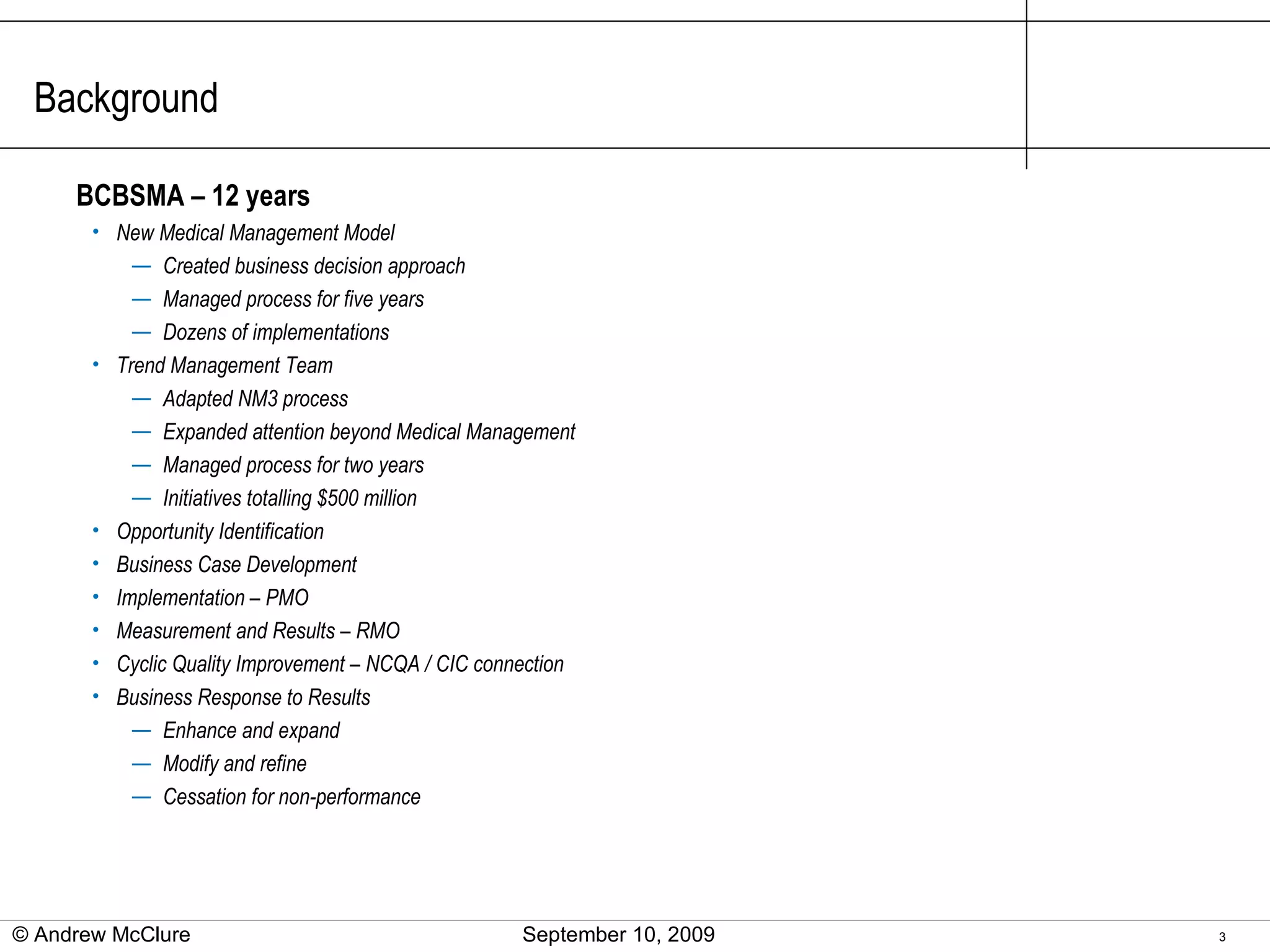
Background BCBSMA – 12 years New Medical Management Model Created business decision approach Managed process for five years Dozens of implementations Trend Management Team Adapted NM3 process Expanded attention beyond Medical Management Managed process for two years Initiatives totalling $500 million Opportunity Identification Business Case Development Implementation – PMO Measurement and Results – RMO Cyclic Quality Improvement – NCQA / CIC connection Business Response to Results Enhance and expand Modify and refine Cessation for non-performance © Andrew McClure  September 10, 2009
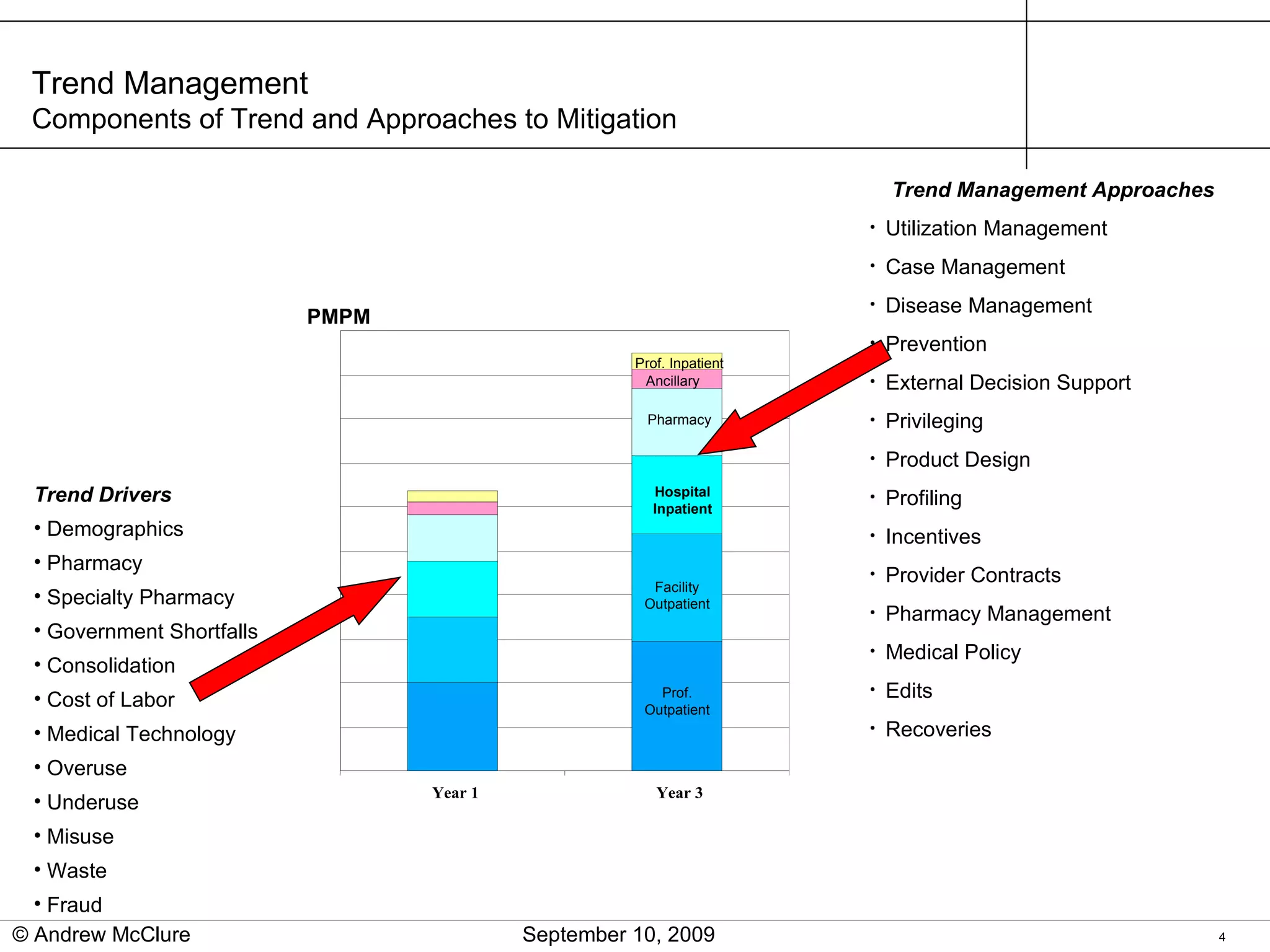
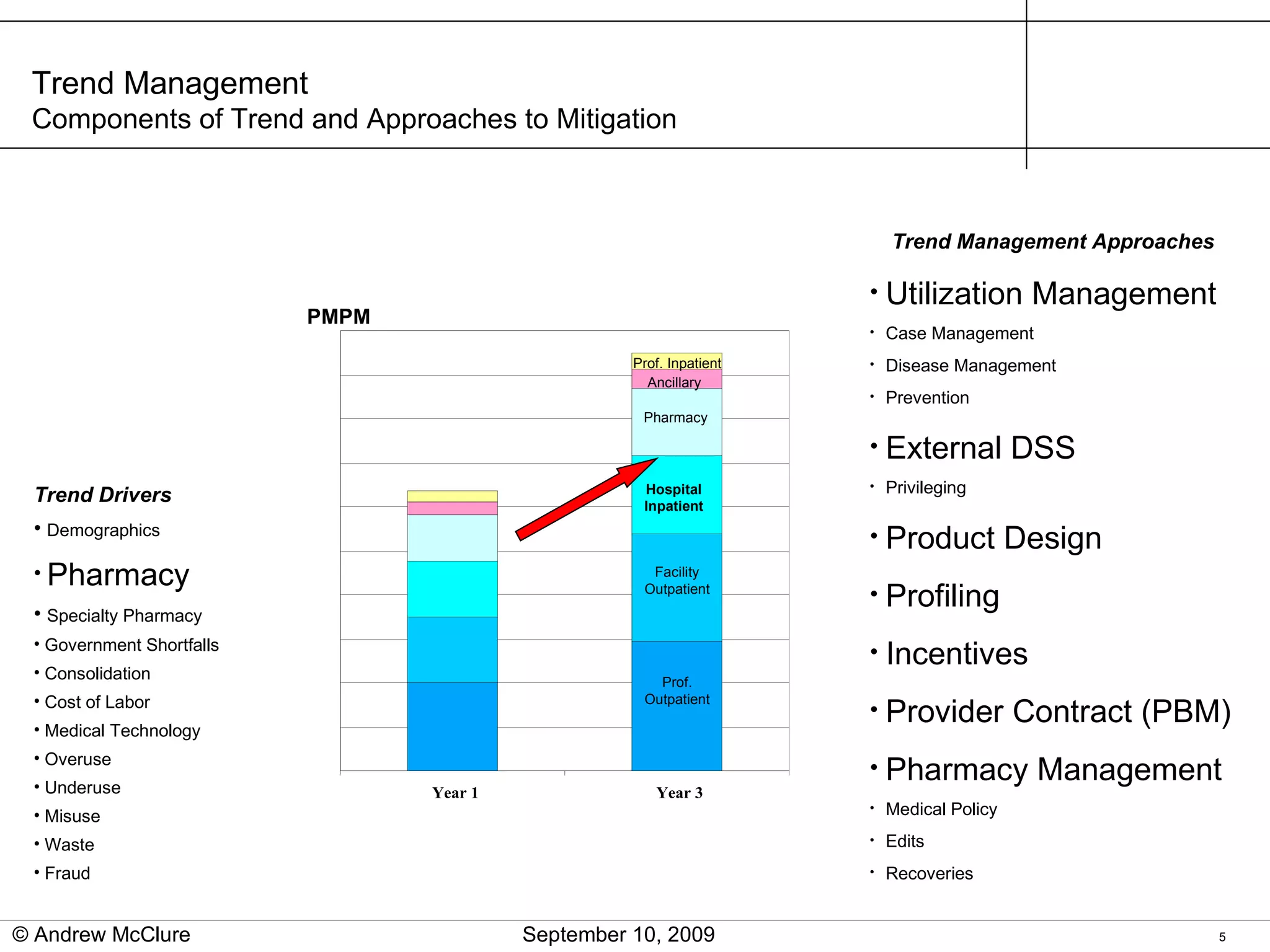
Trend Management  Components of Trend and Approaches to Mitigation Trend Management Approaches Utilization Management Case Management Disease Management Prevention External Decision Support Privileging Product Design Profiling Incentives Provider Contracts Pharmacy Management Medical Policy Edits Recoveries PMPM Trend Drivers Demographics Pharmacy Specialty Pharmacy Government Shortfalls Consolidation Cost of Labor Medical Technology Overuse  Underuse  Misuse Waste Fraud Prof. Inpatient Ancillary Hospital Inpatient Prof. Outpatient Facility Outpatient Pharmacy © Andrew McClure  September 10, 2009
Trend Management  Components of Trend and Approaches to Mitigation Trend Management Approaches Utilization Management Case Management Disease Management Prevention External DSS Privileging Product Design Profiling Incentives Provider Contract (PBM) Pharmacy Management Medical Policy Edits Recoveries PMPM Trend Drivers Demographics Pharmacy Specialty Pharmacy Government Shortfalls Consolidation Cost of Labor Medical Technology Overuse  Underuse  Misuse Waste Fraud Prof. Inpatient Ancillary Hospital Inpatient Prof. Outpatient Facility Outpatient Pharmacy © Andrew McClure  September 10, 2009
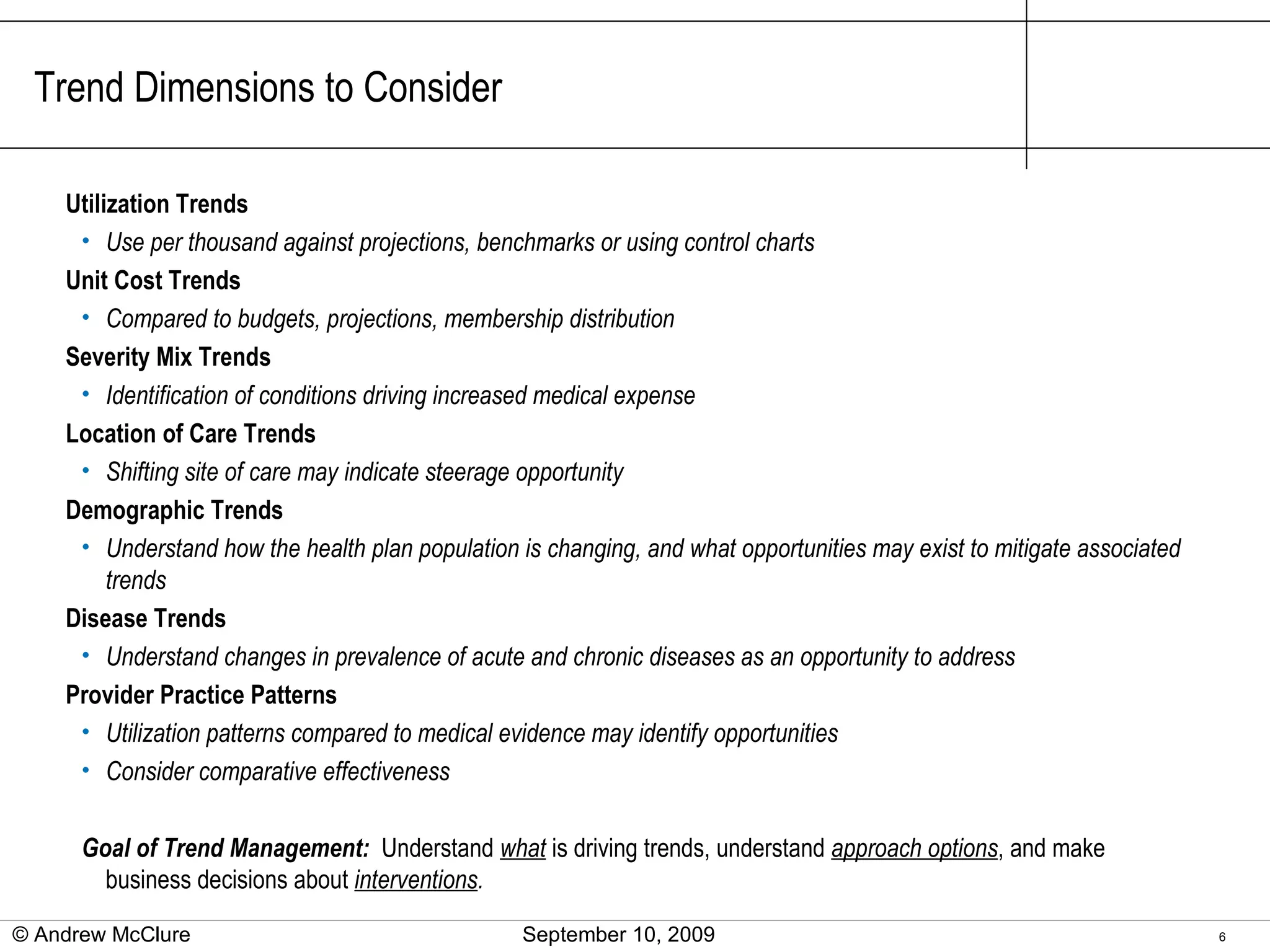
Trend Dimensions to Consider Utilization Trends Use per thousand against projections, benchmarks or using control charts Unit Cost Trends Compared to budgets, projections, membership distribution Severity Mix Trends Identification of conditions driving increased medical expense Location of Care Trends Shifting site of care may indicate steerage opportunity Demographic Trends Understand how the health plan population is changing, and what opportunities may exist to mitigate associated trends Disease Trends Understand changes in prevalence of acute and chronic diseases as an opportunity to address Provider Practice Patterns Utilization patterns compared to medical evidence may identify opportunities Consider comparative effectiveness Goal of Trend Management:  Understand  what  is driving trends, understand  approach options , and make business decisions about  interventions . © Andrew McClure  September 10, 2009
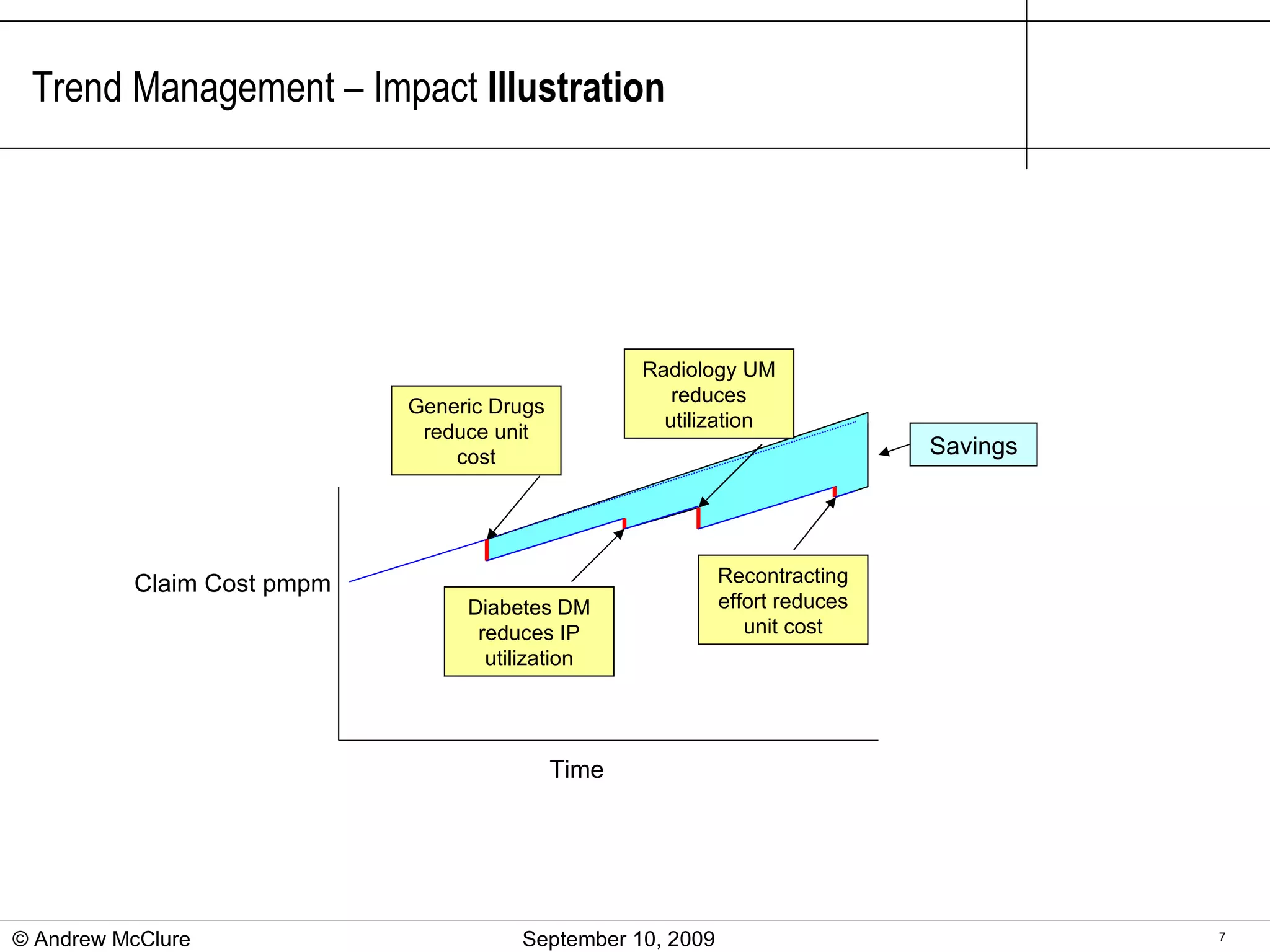
Claim Cost pmpm Time Savings Generic Drugs reduce unit cost Diabetes DM reduces IP utilization Radiology UM reduces utilization Recontracting effort reduces unit cost Trend Management – Impact  Illustration © Andrew McClure  September 10, 2009
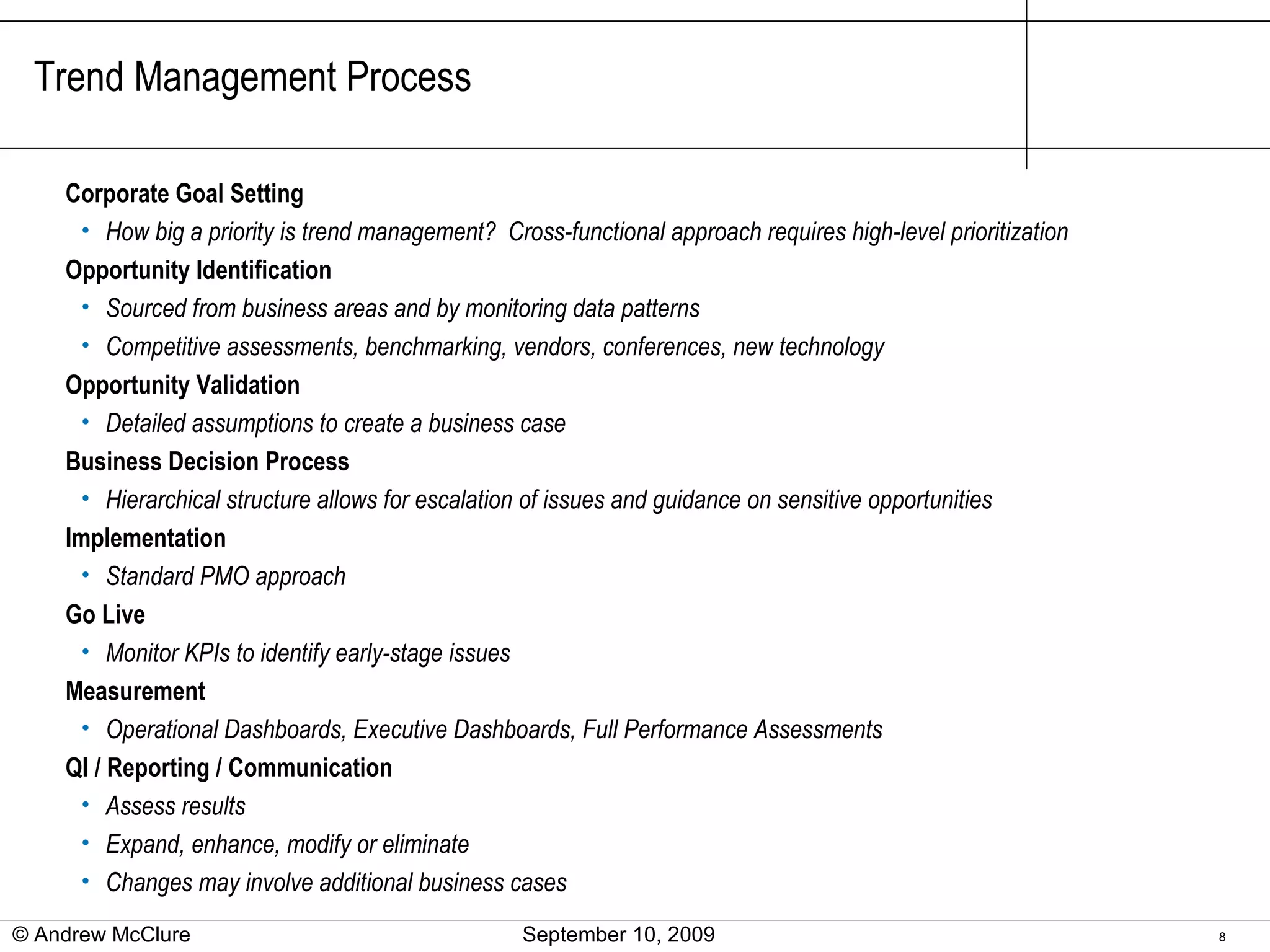
Trend Management Process Corporate Goal Setting How big a priority is trend management?  Cross-functional approach requires high-level prioritization Opportunity Identification Sourced from business areas and by monitoring data patterns Competitive assessments, benchmarking, vendors, conferences, new technology Opportunity Validation Detailed assumptions to create a business case Business Decision Process Hierarchical structure allows for escalation of issues and guidance on sensitive opportunities Implementation Standard PMO approach Go Live Monitor KPIs to identify early-stage issues Measurement Operational Dashboards, Executive Dashboards, Full Performance Assessments QI / Reporting / Communication Assess results Expand, enhance, modify or eliminate Changes may involve additional business cases © Andrew McClure  September 10, 2009
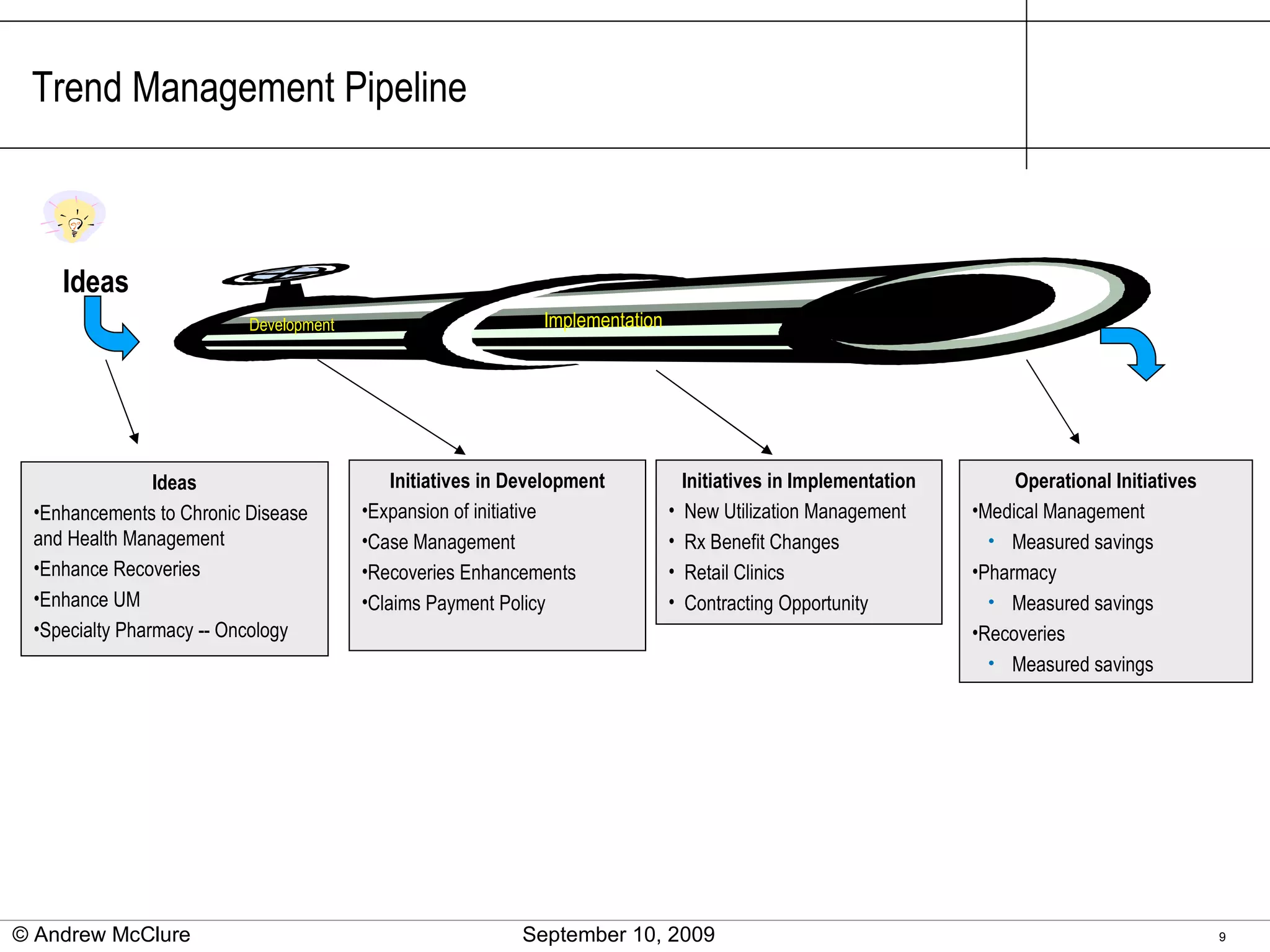
Trend Management Pipeline Ideas Development Implementation Operational Initiatives Medical Management Measured savings Pharmacy Measured savings Recoveries Measured savings Initiatives in Implementation New Utilization Management Rx Benefit Changes Retail Clinics Contracting Opportunity Initiatives in Development Expansion of initiative Case Management Recoveries Enhancements Claims Payment Policy Ideas Enhancements to Chronic Disease and Health Management Enhance Recoveries Enhance UM Specialty Pharmacy -- Oncology © Andrew McClure  September 10, 2009
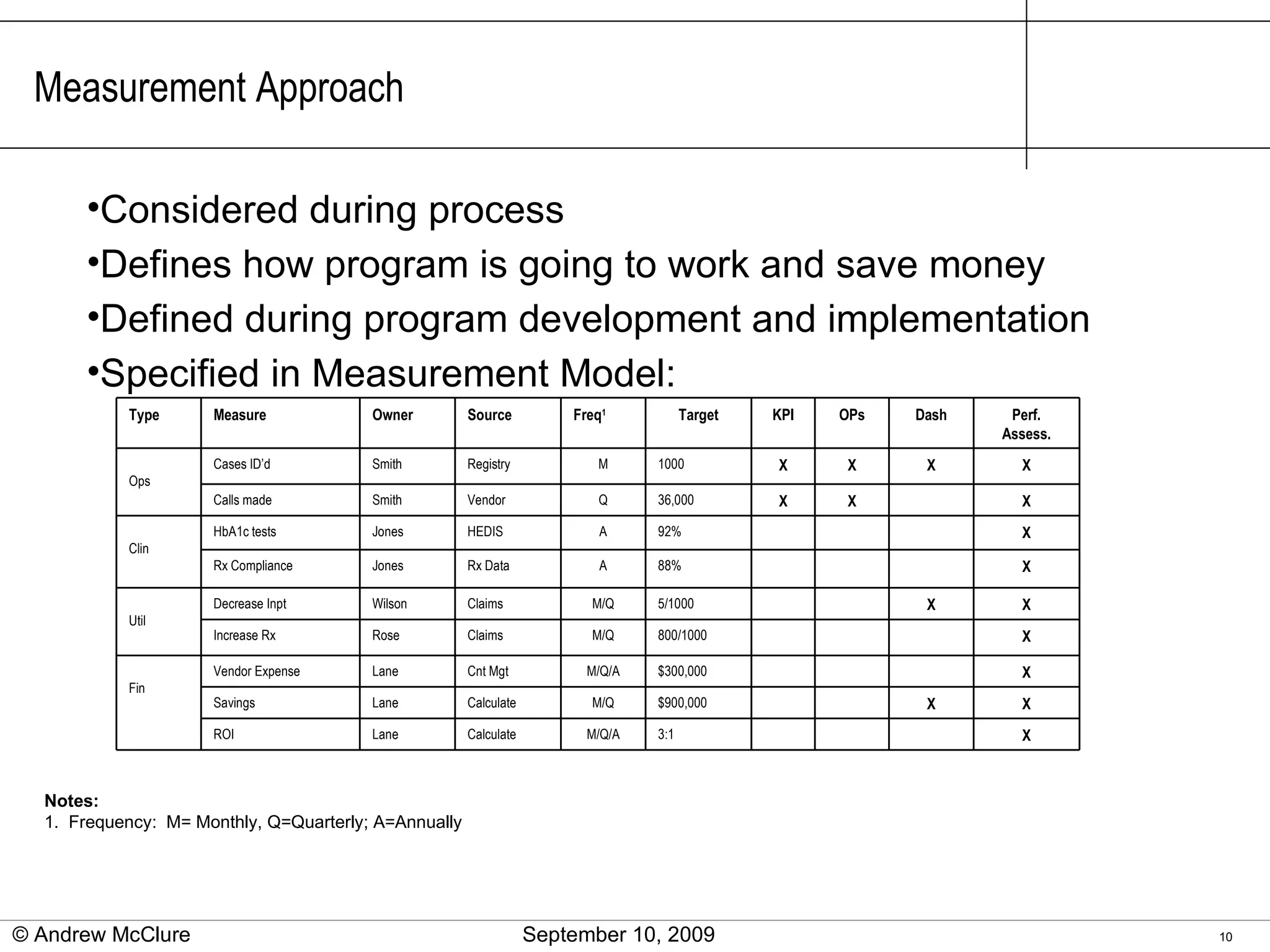
Measurement Approach Considered during process Defines how program is going to work and save money Defined during program development and implementation Specified in Measurement Model: Notes: 1.  Frequency:  M= Monthly, Q=Quarterly; A=Annually © Andrew McClure  September 10, 2009 Type Measure Owner Source Freq 1 Target KPI OPs Dash Perf. Assess. Ops Cases ID’d Smith Registry M 1000 X X X X Calls made Smith Vendor Q 36,000 X X X Clin HbA1c tests Jones HEDIS A 92% X Rx Compliance Jones Rx Data A 88% X Util Decrease Inpt Wilson Claims M/Q 5/1000 X X Increase Rx Rose Claims M/Q 800/1000 X Fin Vendor Expense Lane Cnt Mgt M/Q/A $300,000 X Savings Lane Calculate M/Q $900,000 X X ROI Lane Calculate M/Q/A 3:1 X
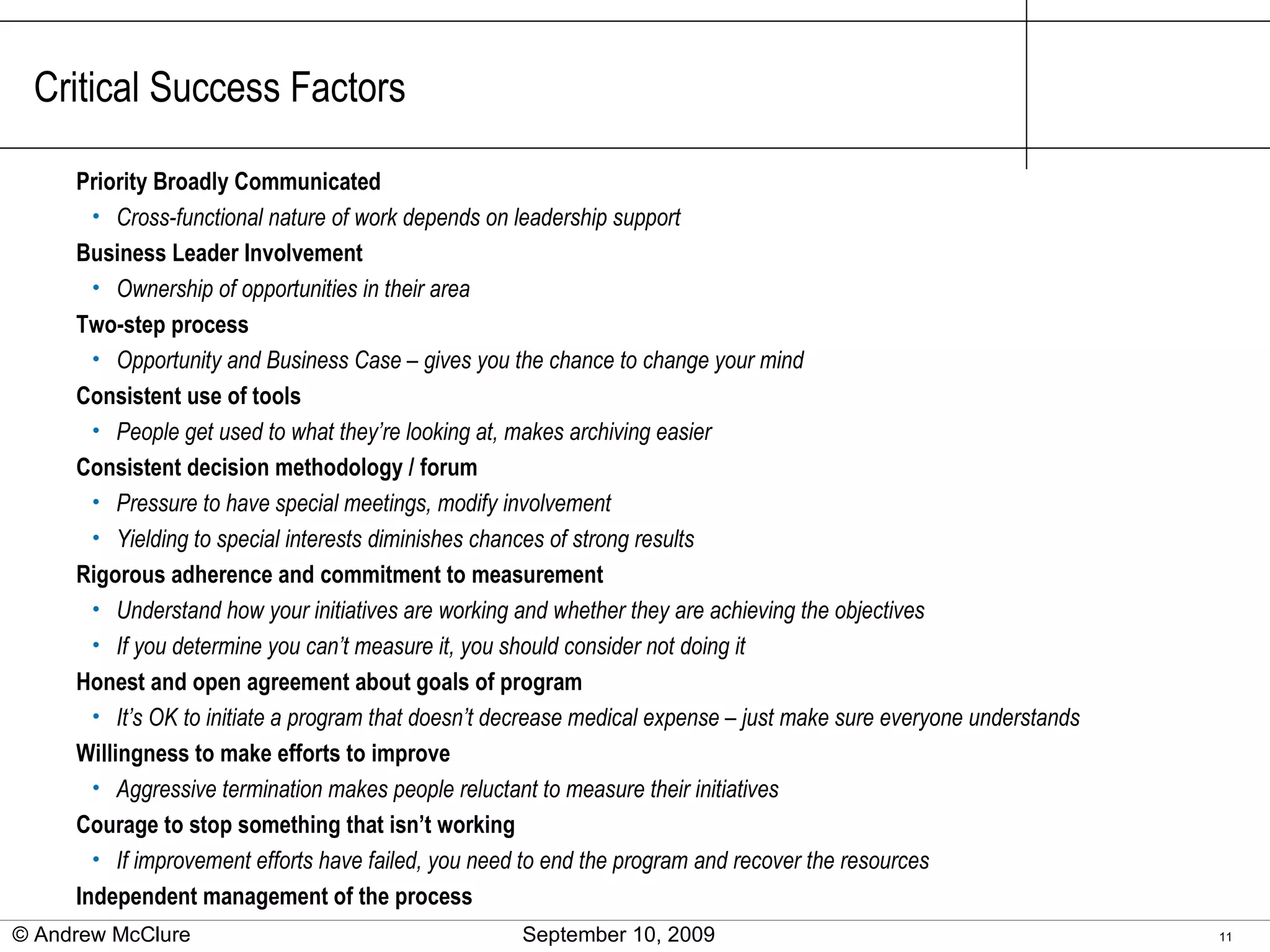
Critical Success Factors Priority Broadly Communicated Cross-functional nature of work depends on leadership support Business Leader Involvement Ownership of opportunities in their area Two-step process Opportunity and Business Case – gives you the chance to change your mind Consistent use of tools People get used to what they’re looking at, makes archiving easier Consistent decision methodology / forum Pressure to have special meetings, modify involvement Yielding to special interests diminishes chances of strong results Rigorous adherence and commitment to measurement Understand how your initiatives are working and whether they are achieving the objectives If you determine you can’t measure it, you should consider not doing it Honest and open agreement about goals of program It’s OK to initiate a program that doesn’t decrease medical expense – just make sure everyone understands Willingness to make efforts to improve Aggressive termination makes people reluctant to measure their initiatives Courage to stop something that isn’t working If improvement efforts have failed, you need to end the program and recover the resources Independent management of the process © Andrew McClure  September 10, 2009

Trend Overview

  • 1.
    Trend Management OverviewBy: Andrew McClure
  • 2.
    Agenda Background EngagementTrend Management Overview Critical Success Factors Recommendations © Andrew McClure September 10, 2009
  • 3.
    Background BCBSMA –12 years New Medical Management Model Created business decision approach Managed process for five years Dozens of implementations Trend Management Team Adapted NM3 process Expanded attention beyond Medical Management Managed process for two years Initiatives totalling $500 million Opportunity Identification Business Case Development Implementation – PMO Measurement and Results – RMO Cyclic Quality Improvement – NCQA / CIC connection Business Response to Results Enhance and expand Modify and refine Cessation for non-performance © Andrew McClure September 10, 2009
  • 4.
    Trend Management Components of Trend and Approaches to Mitigation Trend Management Approaches Utilization Management Case Management Disease Management Prevention External Decision Support Privileging Product Design Profiling Incentives Provider Contracts Pharmacy Management Medical Policy Edits Recoveries PMPM Trend Drivers Demographics Pharmacy Specialty Pharmacy Government Shortfalls Consolidation Cost of Labor Medical Technology Overuse Underuse Misuse Waste Fraud Prof. Inpatient Ancillary Hospital Inpatient Prof. Outpatient Facility Outpatient Pharmacy © Andrew McClure September 10, 2009
  • 5.
    Trend Management Components of Trend and Approaches to Mitigation Trend Management Approaches Utilization Management Case Management Disease Management Prevention External DSS Privileging Product Design Profiling Incentives Provider Contract (PBM) Pharmacy Management Medical Policy Edits Recoveries PMPM Trend Drivers Demographics Pharmacy Specialty Pharmacy Government Shortfalls Consolidation Cost of Labor Medical Technology Overuse Underuse Misuse Waste Fraud Prof. Inpatient Ancillary Hospital Inpatient Prof. Outpatient Facility Outpatient Pharmacy © Andrew McClure September 10, 2009
  • 6.
    Trend Dimensions toConsider Utilization Trends Use per thousand against projections, benchmarks or using control charts Unit Cost Trends Compared to budgets, projections, membership distribution Severity Mix Trends Identification of conditions driving increased medical expense Location of Care Trends Shifting site of care may indicate steerage opportunity Demographic Trends Understand how the health plan population is changing, and what opportunities may exist to mitigate associated trends Disease Trends Understand changes in prevalence of acute and chronic diseases as an opportunity to address Provider Practice Patterns Utilization patterns compared to medical evidence may identify opportunities Consider comparative effectiveness Goal of Trend Management: Understand what is driving trends, understand approach options , and make business decisions about interventions . © Andrew McClure September 10, 2009
  • 7.
    Claim Cost pmpmTime Savings Generic Drugs reduce unit cost Diabetes DM reduces IP utilization Radiology UM reduces utilization Recontracting effort reduces unit cost Trend Management – Impact Illustration © Andrew McClure September 10, 2009
  • 8.
    Trend Management ProcessCorporate Goal Setting How big a priority is trend management? Cross-functional approach requires high-level prioritization Opportunity Identification Sourced from business areas and by monitoring data patterns Competitive assessments, benchmarking, vendors, conferences, new technology Opportunity Validation Detailed assumptions to create a business case Business Decision Process Hierarchical structure allows for escalation of issues and guidance on sensitive opportunities Implementation Standard PMO approach Go Live Monitor KPIs to identify early-stage issues Measurement Operational Dashboards, Executive Dashboards, Full Performance Assessments QI / Reporting / Communication Assess results Expand, enhance, modify or eliminate Changes may involve additional business cases © Andrew McClure September 10, 2009
  • 9.
    Trend Management PipelineIdeas Development Implementation Operational Initiatives Medical Management Measured savings Pharmacy Measured savings Recoveries Measured savings Initiatives in Implementation New Utilization Management Rx Benefit Changes Retail Clinics Contracting Opportunity Initiatives in Development Expansion of initiative Case Management Recoveries Enhancements Claims Payment Policy Ideas Enhancements to Chronic Disease and Health Management Enhance Recoveries Enhance UM Specialty Pharmacy -- Oncology © Andrew McClure September 10, 2009
  • 10.
    Measurement Approach Consideredduring process Defines how program is going to work and save money Defined during program development and implementation Specified in Measurement Model: Notes: 1. Frequency: M= Monthly, Q=Quarterly; A=Annually © Andrew McClure September 10, 2009 Type Measure Owner Source Freq 1 Target KPI OPs Dash Perf. Assess. Ops Cases ID’d Smith Registry M 1000 X X X X Calls made Smith Vendor Q 36,000 X X X Clin HbA1c tests Jones HEDIS A 92% X Rx Compliance Jones Rx Data A 88% X Util Decrease Inpt Wilson Claims M/Q 5/1000 X X Increase Rx Rose Claims M/Q 800/1000 X Fin Vendor Expense Lane Cnt Mgt M/Q/A $300,000 X Savings Lane Calculate M/Q $900,000 X X ROI Lane Calculate M/Q/A 3:1 X
  • 11.
    Critical Success FactorsPriority Broadly Communicated Cross-functional nature of work depends on leadership support Business Leader Involvement Ownership of opportunities in their area Two-step process Opportunity and Business Case – gives you the chance to change your mind Consistent use of tools People get used to what they’re looking at, makes archiving easier Consistent decision methodology / forum Pressure to have special meetings, modify involvement Yielding to special interests diminishes chances of strong results Rigorous adherence and commitment to measurement Understand how your initiatives are working and whether they are achieving the objectives If you determine you can’t measure it, you should consider not doing it Honest and open agreement about goals of program It’s OK to initiate a program that doesn’t decrease medical expense – just make sure everyone understands Willingness to make efforts to improve Aggressive termination makes people reluctant to measure their initiatives Courage to stop something that isn’t working If improvement efforts have failed, you need to end the program and recover the resources Independent management of the process © Andrew McClure September 10, 2009

Editor's Notes

  • #2 Andrew
  • #5 Trend Drivers Demographics Pharmacy Specialty Pharmacy Government Shortfalls Consolidation Cost of Labor Medical Technology Overuse Underuse Misuse Waste Fraud Sources of Opportunity Identification Internal trend data Actuary – Medical Expense Analysis Health Services Evaluation -- Population-Based Assessment Accounts / Brokers Competition / Benchmarking Consultants (Accenture, BCG) Vendors – New Products, Joint Development Healthways ESI Others Cyclic QI of Existing Initiatives Literature, conferences, seminars Partnership with Delivery System Physician Forums Pharmacy and Therapeutics Committee IT / New Technology Contract Renewal Cycles
  • #6 Trend Drivers Demographics Pharmacy Specialty Pharmacy Government Shortfalls Consolidation Cost of Labor Medical Technology Overuse Underuse Misuse Waste Fraud Sources of Opportunity Identification Internal trend data Actuary – Medical Expense Analysis Health Services Evaluation -- Population-Based Assessment Accounts / Brokers Competition / Benchmarking Consultants (Accenture, BCG) Vendors – New Products, Joint Development Healthways ESI Others Cyclic QI of Existing Initiatives Literature, conferences, seminars Partnership with Delivery System Physician Forums Pharmacy and Therapeutics Committee IT / New Technology Contract Renewal Cycles