UPLIFT MODELING USING
CONCURRENT DECISION TREES
PRESENTED BY: And Ozbay
June 22, 2015
INTRODUCTION
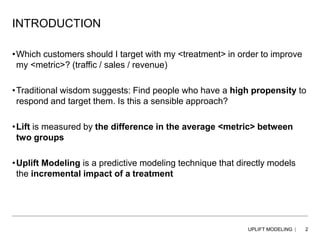
•Which customers should I target with my <treatment> in order to improve
my <metric>? (traffic / sales / revenue)
•Traditional wisdom suggests: Find people who have a high propensity to
respond and target them. Is this a sensible approach?
•Lift is measured by the difference in the average <metric> between
two groups
•Uplift Modeling is a predictive modeling technique that directly models
the incremental impact of a treatment
UPLIFT MODELING 2
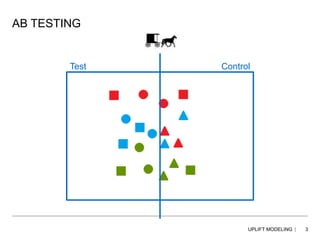
AB TESTING
Test Control
UPLIFT MODELING 3
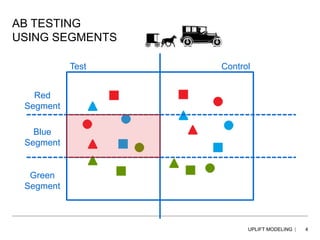
AB TESTING
USING SEGMENTS
Test Control
Red
Segment
Blue
Segment
Green
Segment
UPLIFT MODELING 4
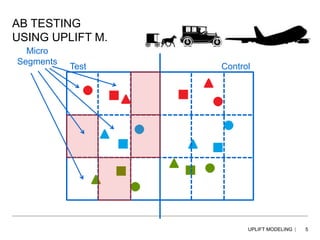
AB TESTING
USING UPLIFT M.
Test Control
Micro
Segments
UPLIFT MODELING 5
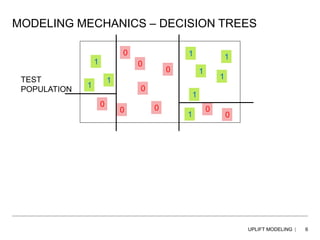
MODELING MECHANICS – DECISION TREES
UPLIFT MODELING 6
1 1
0
1
1
11
1
0
1
1
0
0
0
0
0
0
0
TEST
POPULATION
MODELING MECHANICS – UPLIFT TREES
UPLIFT MODELING 7
1 1
0
1
1
11
1
0
1
1
0
0
0
0
0
0
0
1
0
1
1
1
1
0
1
1
0 0
0
0
0
0
0
0
0
TEST
POPULATION
CONTROL
POPULATION
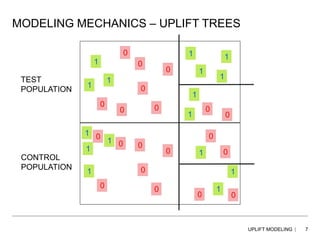
MODELING MECHANICS – UPLIFT TREES
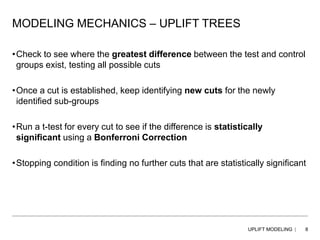
•Check to see where the greatest difference between the test and control
groups exist, testing all possible cuts
•Once a cut is established, keep identifying new cuts for the newly
identified sub-groups
•Run a t-test for every cut to see if the difference is statistically
significant using a Bonferroni Correction
•Stopping condition is finding no further cuts that are statistically significant
UPLIFT MODELING 8
QUESTIONS?
UPLIFT MODELING 9
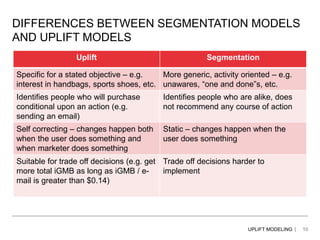
DIFFERENCES BETWEEN SEGMENTATION MODELS
AND UPLIFT MODELS
UPLIFT MODELING 10
Uplift Segmentation
Specific for a stated objective – e.g.
interest in handbags, sports shoes, etc.
More generic, activity oriented – e.g.
unawares, “one and done”s, etc.
Identifies people who will purchase
conditional upon an action (e.g.
sending an email)
Identifies people who are alike, does
not recommend any course of action
Self correcting – changes happen both
when the user does something and
when marketer does something
Static – changes happen when the
user does something
Suitable for trade off decisions (e.g. get
more total iGMB as long as iGMB / e-
mail is greater than $0.14)
Trade off decisions harder to
implement

Tree Based Uplift Modeling

  • 1.
    UPLIFT MODELING USING CONCURRENTDECISION TREES PRESENTED BY: And Ozbay June 22, 2015
  • 2.
    INTRODUCTION •Which customers shouldI target with my <treatment> in order to improve my <metric>? (traffic / sales / revenue) •Traditional wisdom suggests: Find people who have a high propensity to respond and target them. Is this a sensible approach? •Lift is measured by the difference in the average <metric> between two groups •Uplift Modeling is a predictive modeling technique that directly models the incremental impact of a treatment UPLIFT MODELING 2
  • 3.
  • 4.
    AB TESTING USING SEGMENTS TestControl Red Segment Blue Segment Green Segment UPLIFT MODELING 4
  • 5.
    AB TESTING USING UPLIFTM. Test Control Micro Segments UPLIFT MODELING 5
  • 6.
    MODELING MECHANICS –DECISION TREES UPLIFT MODELING 6 1 1 0 1 1 11 1 0 1 1 0 0 0 0 0 0 0 TEST POPULATION
  • 7.
    MODELING MECHANICS –UPLIFT TREES UPLIFT MODELING 7 1 1 0 1 1 11 1 0 1 1 0 0 0 0 0 0 0 1 0 1 1 1 1 0 1 1 0 0 0 0 0 0 0 0 0 TEST POPULATION CONTROL POPULATION
  • 8.
    MODELING MECHANICS –UPLIFT TREES •Check to see where the greatest difference between the test and control groups exist, testing all possible cuts •Once a cut is established, keep identifying new cuts for the newly identified sub-groups •Run a t-test for every cut to see if the difference is statistically significant using a Bonferroni Correction •Stopping condition is finding no further cuts that are statistically significant UPLIFT MODELING 8
  • 9.
  • 10.
    DIFFERENCES BETWEEN SEGMENTATIONMODELS AND UPLIFT MODELS UPLIFT MODELING 10 Uplift Segmentation Specific for a stated objective – e.g. interest in handbags, sports shoes, etc. More generic, activity oriented – e.g. unawares, “one and done”s, etc. Identifies people who will purchase conditional upon an action (e.g. sending an email) Identifies people who are alike, does not recommend any course of action Self correcting – changes happen both when the user does something and when marketer does something Static – changes happen when the user does something Suitable for trade off decisions (e.g. get more total iGMB as long as iGMB / e- mail is greater than $0.14) Trade off decisions harder to implement