INGLÉS7ºbásicoTEXTODELESTUDIANTE
TEXTO DEL ESTUDIANTE
Lina Alvarado Jantus
INGLÉS
básicobásico
+
READING
BO
O
KLET
&
W
O
RKBO
O
K
EDICIÓNESPECIALPARAELMINISTERIODEEDUCACIÓN
PROHIBIDASUCOMERCIALIZACIÓN
EDICIÓN ESPECIAL PARA EL MINISTERIO DE EDUCACIÓN
PROHIBIDA SU COMERCIALIZACIÓN
PEFC/29-31-75
9 789563 391336
ISBN: 978-956-339-133-6
9 789563 391671
ISBN PACK: 978-956-339-167-1
Lina Alvarado Jantus
TeacherofEnglish
InstitutoProfesionalChileno-Británico
TEXTO DEL ESTUDIANTE
INGLÉS
básico
Nombre:
Curso:
Colegio:
Este libro pertenece a:
TelohahechollegargratuitamenteelMinisteriodeEducaciónatravésdelestablecimientoeducacionalenelqueestudias.
Esparatuusopersonaltantoentucolegiocomoentucasa;cuídaloparaquetesirvadurantetodoelaño.
Sitecambiasdecolegiolodebesllevarcontigoyalfinalizarelaño,guardarloentucasa.
29
3. Circle the options that best represent your favorite activities
and abilities.
doing experiments meeting my friends
riding my bike chatting with friends
doing physical exercise
dance speak English
play soccer sing
4. Answer the following questions using full sentences.
a. What do you enjoy doing?
b.What can you do very well?
D R A F T I N G
5. Write an e-mail to your cyber-pal and tell him / her about your
personal interests and abilities. Use the Writing Box and the e-mail in
Exercise 1 as a guide.
W R I T I N G
6. With your partner, correct your e-mails.
7. Write a final version of your e-mail and send it to your partner.
E D I T I N G
An e-mail
✔Write a few words about
the topic of your e-mail in
the Subject slot.
✔Remember the parts
an e-mail has and the
order in which these are
organized.
✔Choose a greeting,
closing and signing off for
your e-mail.
✔Start a new paragraph
when you write about a
new idea.
✔Once you finish writing,
don’t forget to check
spelling and punctuation.
Writing
box
You have 45 minutes to
complete your writing task.
Decide how much time you will
spend on each step.
Organize
your time
UNIT 128
2. Which of these phrases are used as greeting, closing or signing off
when writing an e-mail? Complete the table.
Dear Ted, Love Hi, Best Write soon
I miss you. Cheers. Hi, Mary
Your friend Hello, Lots of love. Best wishesYour friend
Write soon
Greeting Closing Signing off
Write soon Your friend
1. Read the e-mail and observe how it is organized.
H A V E A L O O K A T . . . A n e m a i l
TO MY CYBER-PAL Lesson 5Writing
Dear Felipe,
Thanks for your e-mail! How are things with you? I hope you’re ok. I’m studying
a lot because I have many exams at school!
I’m writing this e-mail to tell you a little about who I am. I live in Seattle, in the
USA. It’s a beautiful city!
In my free time, I enjoy doing sports and meeting my friends. I can play
basketball and tennis very well.basketball and tennis very well.
What do you do on the weekends? On Saturdays, I visit my friends and play
basketball with them. I practice tennis on Sundays with my brother Jake.
What about you? Write soon.
Your friend
Tom.
chileancyber-friend@gmail.com
Tom_2013@hotmail.com
Your friend Tom
Greeting
Closing
BodySigning off
Did you know that …
The body of an
e-mail contains the
message you want to
communicate. After the
greeting, it is frequent
to open an e-mail asking
questions like How are
you / How are things
going? and / or giving
thanks for a previous
e-mail you received.
2
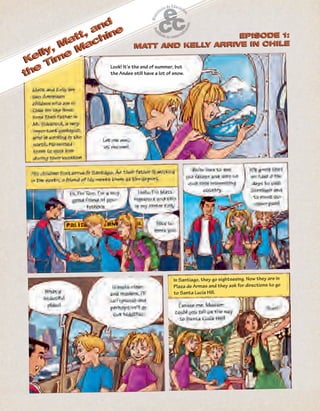
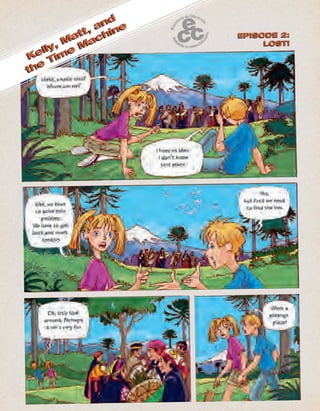
EPISODE 1:
MATT AND KELLY ARRIVE IN CHILE
EPISODE 1:
MATT AND KELLY ARRIVE IN CHILE
Look! It’s the end of summer, but
the Andes still have a lot of snow.
In Santiago, they go sightseeing. Now they are in
Plaza de Armas and they ask for directions to go
to Santa Lucía Hill.
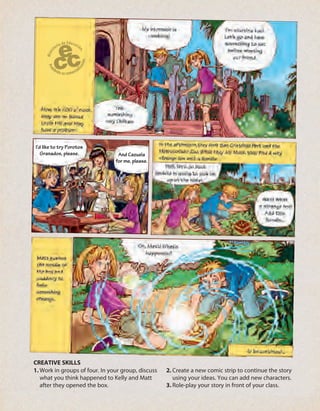
I’d like to try Porotos
Granados, please. And Cazuela
for me, please.
Kelly, Matt, and
the
Tim
e
Machine
Kelly, Matt, and
the
Tim
e
Machine
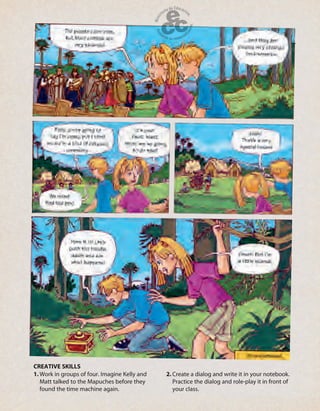
1. Work in groups of four. In your group, discuss
what you think happened to Kelly and Matt
after they opened the box.
2. Create a new comic strip to continue the story
using your ideas. You can add new characters.
3. Role-play your story in front of your class.
CREATIVE SKILLS
Comic Strip The adventures of the main characters of the book,
at the end of each unit.
2727
1 Read the text in Lesson 3 again and choose the correct alternative.
The girl is
a. Inviting her friends.
b.Describing her friends.
c. Telling a story.
2 Read the text again and find a characteristic for each noun.
a. San Antonio: ________________ city.
b.Seaworld: ________________ marine park.
LISTENING
3 10 Listen to the recording in Lesson 4 again and circle the best alternative.
The children are talking about:
a. Their vacations.
b.Their weekends.
c. Their school.
4 10 Listen to the recording again and complete the sentences.
a. Ann often visits her ________________.
b.In the afternoon, Dan watches ________________on TV.
c. Ema usually stays at ________________.
LANGUAGE
5 Read the information in the table. Complete the sentences using can / can’t.
a. Linda _______________________________.
b.Phil _______________________________.
c. Linda and Phil _______________________________.
Can... ride a horse? speak German? use a computer?
Linda ✔ ✘ ✔
Phil ✘ ✘ ✔
6 Complete the following sentences describing your weekend activities.
a. On Saturday morning, I .
b.On Sunday, .
READING
TRAVEL BACKTRAVEL BACK
2 pts
3 pts
3 pts
1 pt
1 pt
2 pts
TOTAL
SCORE
12 pts
Keep trying Review! Well done!
11 - 12
Excellent!
7 - 104 - 60 - 3
Travel back Short evaluation
activities after Lessons 2 and 4.
Listening,
speakingactivities,and
readingtexts.
Listen
tothe CD with yourtea
cher.
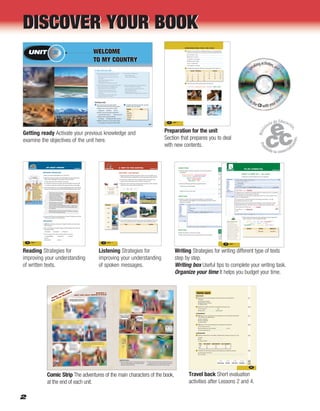
Getting ready Activate your previous knowledge and
examine the objectives of the unit here.
37UNIT 236
1 How much do you know about Chile?
Choose the correct answer for each question.
a. Which river is in the north of Chile?
i. Mapocho. ii. Biobío. iii. Loa.
b.Which city has the largest population?
i. Viña del Mar. ii. Arica. iii. Concepción.
c. Where is the Congress building?
i. Santiago. ii. Valparaíso. iii. La Serena.
d.Which mountain is in the south of Chile?
i. Aconcagua. ii. Parinacota. iii. Fitz Roy.
2 Complete the following fact file, and then
compare with your partner.
WELCOME
TO MY COUNTRY
WELCOME
TO MY COUNTRY
37
2UNIT 2UNIT
In this unit you will…In this unit you will…
listen and identify specific information in a radio
interview, in a museum visit and in a tour by:
• discriminating between correct and incorrect
information,
• using oral clues to predict content,
• discriminating sounds,
• identifying the correct sequence of events.
read and identify main ideas and explicit information
in an Internet article and in a webpage about
Chilean people, places, and traditions by:
• identifying type and purpose of a text,
• using the context to infer the meaning of
new words,
• using visual clues to interpret information,
• organizing information in a chart.
express ideas in dialogs about:
• personal experiences,
• Chilean people and places.
write short paragraphs and a brochure related to
Chilean people, places, and traditions:
• using language and vocabulary of the unit,
• talking about past states,
• using prepositions of place,
• recognizing the textual organization of a brochure.
Country Chile
Area
Population
Capital city
Language
Currency
Gettingready
UNIT 18
P R E P A R A T I O N F O R T H E U N I T
1 Read the clues and write complete sentences. Use an appropriate
pronoun (I, you, he/she, etc.) and the correct form of the verb to be.
a. Your shoes / new:
b.My sister / a nurse:
c. The keys / in my bag:
d.Sheila’s house / big:
e. Jim / 12 years old:
f. My parents / at home:
2 Complete the calendar. Write the missing days of the week on it.
Tuesday Wednesday Saturday
1 2 3 4 5
6 7 8 9 10 11 12
13 14 15 16 17 18 19
20 21 22 23 24 25 26
27 28 29 30
3 Write the name of the activity under each picture.
swimming playing the piano dancing riding a bike
1 2
3 4
Preparation for the unit
Section that prepares you to deal
with new contents.
UNIT 114
1. Kelly and her brother Matt are Ignacio’s cyber- pals. The children are in
Chile for the first time visiting him. Can you guess where they are from?
2. Do you have a cyber-pal? If not, would you like to have one? If you
could choose a cyber-pal, where would he / she be from?
3. Match the verbs in the box with the pictures and guess their meaning
in Spanish. Then check with the dictionary.
land ring take meet
1 2
3 4
4. Look at the Pictionary. It shows some words that will appear in the text
that you are going to listen to. Classify the words under these labels.
Time Actions Location
B E F O R E L I S T E N I N G
A TRIP TO THE CAPITAL Lesson 2ListeningListeningListening
Pictionary
around
arrive
early
7:00 am
leave
today
AmericanEnglish:
Cyber-pal
BritishEnglish:
Cyber-friend
AmericanEnglish:AmericanEnglish:
Listening Strategies for
improving your understanding
of spoken messages.
UNIT 110
1. Who’s your best friend? What’s his / her name?
2. Read these popular quotes about friendship. Are you familiar with
them in your language? Do you agree with them? Why?
a. “The only way to have a friend is to be one”.
b.“A friend is someone who gives you total freedom to be yourself”.
c. “I prefer to walk with a friend in the dark, than alone in the light”.
3. Look at what Kelly says and read this brief paragraph about the writer of
the novel. In what way do you think World War I influenced the novel?
The German writer Herman
Hesse wrote Demian in 1917,
when the United States
declared war on Germany
and the world was in a state
of chaos after World War I.
Herman Hesse is one of the
most frequently translated
German writers of the twentieth century. In 1946, Hesse
was honored with the Goethe Prize and the Nobel Prize
for Literature.
Demian tells the story of two friends walking to maturity,
Emile Sinclaire and Max Demian.
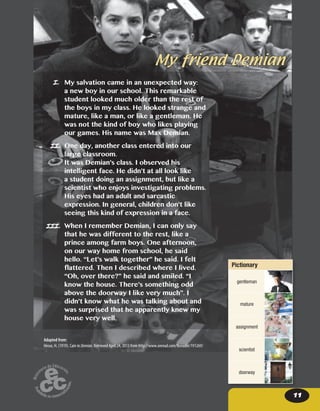
4. Look at the Pictionary and the picture on Page 11. What do you think
Sinclaire says about his friend Demian?
R E A D I N G
5. 2 Read and listen to the text on Page 11. Check if you were right
about Demian.
6. The novel Demian has eight chapters. What chapter is the source of
this extract? Why?
a. Chapter 5 b. Chapter 7 c. Chapter 2
7.Find a synonym for each of these words in the text.
I. unpredictable exceptional assertive
II. ironic
III. honored curious
I am the reporter
of a school
magazine. I
selected an
extract from the
novel Demian for
my literary section
today. Demian tells
the story of two
friends. Who’s your
best friend? What’s
his / her name?
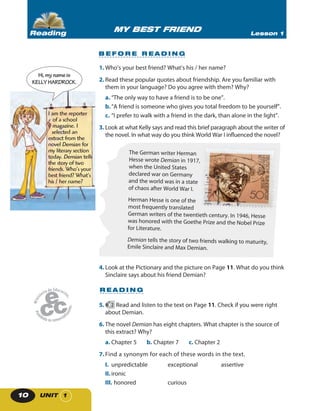
Hi, mynameis
KELLYHARDROCK.
B E F O R E R E A D I N G
MY BEST FRIEND Lesson 1Reading
Reading Strategies for
improving your understanding
of written texts.
Writing Strategies for writing different type of texts
step by step.
Writing box Useful tips to complete your writing task.
Organize your time It helps you budget your time.
DISCOVER YOUR BOOKDISCOVER YOUR BOOK
3
119UNIT 4118
TEST YOUR KNOWLEDGE
READING: PEOPLE ARE CHANGING
PLANET EARTH
LISTENING: THE LANGUAGE
OF DOLPHINS
4 63 Listen to the recording and circle the
correct alternative.
a. Amazing news comes from .
i. A zoo. ii. The jungle. iii. An aquarium.
b. A mother talks with her _________ -year-old baby.
i. Two ii. Four iii. Six
c. Two _________ are chatting to each other.
i. Dolphins ii. Whales iii. Sharks
5 63 Are these statements true (T) or false (F)?
a. ____ Very strange news comes from Hawaii.
b. ____ Scientists are not sure if the animals are talking.
c. ____ The animals communicate verbally and
non-verbally.
LANGUAGE
6 Complete each collocation with a word from the box.
pollution rain warming ozone
a. layer
b.Acid
c. Air
d.Global
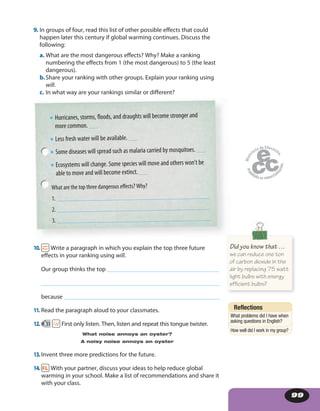
7 Write three predictions for the future in relation
to environment.
a.
b.
c.
SPEAKING
8 How can we help our planet? Mention three things
we can do.
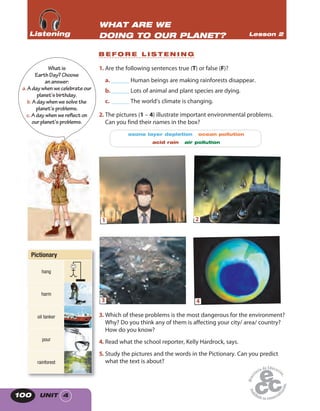
1 62 Read and listen to the text quickly. Write the correct
heading for each paragraph (I - IV).
a. Acid rain
b.Ozone layer depletion
c. Air pollution
d.Rainforest destruction
2 Read the text again. Are the statements true (T) or false (F)?
a. ____ The earth is very old.
b.____ People who live in cities are very healthy.
c. ____ Factories are very good for the environment.
3 Answer the following questions:
a. How old is planet Earth?
_____________________________________________
b.Why are fish dying?
_____________________________________________
c. What do aerosols and sprays do to the Ozone Layer?
_____________________________________________
The earth is 4,6 billion years old.
Modern man has lived on it for
only 35,000 years, but in that
time our planet has changed in
many ways. Many of the things
people are doing are good,
but many more are not good for
our world.
I._________________________
In big cities, cars and buses are
affecting the air. Many people
who live in cities are having very
bad health problems.
II._________________________
Factories are damaging the
land and the water, so many fish
are dying.
III._________________________
Many aerosols and sprays are
destroying the Ozone Layer.
They are making a big hole and
too much ultraviolet radiation is
entering the earth. This is causing
cancer in people around the world.
IV._________________________
People are cutting down
millions and millions of trees all
over the world. As a result, many
types of animals and plants are
disappearing.
SELF-EVALUATIONSELF-EVALUATIONTEST YOUR KNOWLEDGE
A Report
a. Work in groups of four.
b.Find information about the
Greenhouse Effect on the
suggested website.
c. Summarize and organize
all the information. Write a
report explaining how the
Greenhouse Effect works and
what changes it will bring.
You can follow this model:
Paragraph I
What is the greenhouse
effect?
Paragraph II
How does it work?
Paragraph III
What changes or
consequences will it bring?
Paragraph IV
What can we do?
How can we help?
d.Include drawings or get
pictures or illustrations
from magazines.
e. Present your report to your
classmates.
In this unit, which of these aspects
were strengths / weaknesses for
me? Why?
Reading
• relating the topic to my previous
knowledge
•	 comprehension	of	specific	
information
•	 identifying	the	purpose	of	
different types of text
•	 making	predictions	using	
cognates
Listening
• comprehension of specific
information
•	 identification	of	speakers
•	 identification	of	information	
sequence
Speaking
•	 participation	in	short	dialogs
•	 talking	about	the	environment
•	 making	predictions
•	 making	suggestions
Writing
•	 interview		format
•	 connection	of	ideas
•	 spelling	and	punctuation
•	 language	and	vocabulary
Language
Which of these unit contents were
easier for me to understand?
•	 Lesson	1: the future
•	 Lesson	2: the present continuous
•	 Lesson	3: obligations and
suggestions
•	 Lesson	4: inviting and asking
for help.
Which Language Focus section (s)
do I need to review?
PROJECT EVALUATION
Reflect on these questions:
•	 How	does	your	project	help	you	
look after the environment?
•	 What	are	the	strengths	and	
weaknesses of your project?
3 pts
TOTAL
SCORE
26 pts
Keep trying Review! Well done!
22 - 26
Excellent!
16 - 2110 - 150 - 9
Help!Great! Not too bad
3 pts
4 pts
3 pts
3 pts
3 pts
3 pts
4 pts
PROJECTPROJECT
http://www.eschooltoday.
com/climate-change/how-
the-greenhouse-effect-
happens.html
Listening section.
Pronunciation activities.
Speaking activities.
Writing activities.
Activities for fast learners.
Reading activities.
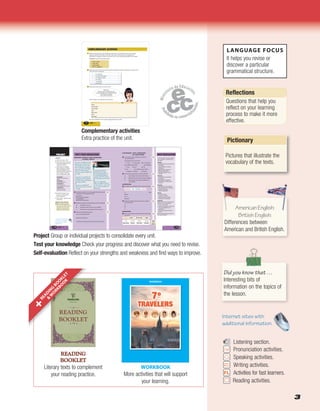
Reflections
Questions that help you
reflect on your learning
process to make it more
effective.
AmericanEnglish:
BritishEnglish:
Differences between
American and British English.
AmericanEnglish:AmericanEnglish:
Did you know that …
Interesting bits of
information on the topics of
the lesson.
LANGUAGE FOCUS
It helps you revise or
discover a particular
grammatical structure.
Internet sites with
additional information.
UNIT 132
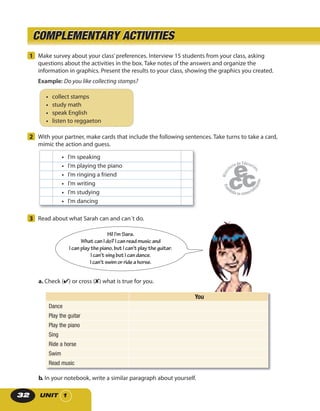
1 Make survey about your class’preferences. Interview 15 students from your class, asking
questions about the activities in the box. Take notes of the answers and organize the
information in graphics. Present the results to your class, showing the graphics you created.
Example: Do you like collecting stamps?
• collect stamps
• study math
• speak English
• listen to reggaeton
2 With your partner, make cards that include the following sentences. Take turns to take a card,
mimic the action and guess.
• I’m speaking
• I’m playing the piano
• I’m ringing a friend
• I’m writing
• I’m studying
• I’m dancing
3 Read about what Sarah can and can´t do.
Hi!I’mSara.
WhatcanIdo?Icanreadmusicand
Icanplaythepiano,butIcan’tplaytheguitar.
Ican’tsingbutIcandance.
Ican’tswimorrideahorse.
b. In your notebook, write a similar paragraph about yourself.
COMPLEMENTARY ACTIVITIESCOMPLEMENTARY ACTIVITIESCOMPLEMENTARY ACTIVITIESCOMPLEMENTARY ACTIVITIESCOMPLEMENTARY ACTIVITIES
a. Check (✔) or cross (✘) what is true for you.
You
Dance
Play the guitar
Play the piano
Sing
Ride a horse
Swim
Read music
Complementary activities
Extra practice of the unit.
WORKBOOK
INGLÉS7ºbásicoTEXTODELESTUDIANTE
EDICIÓNESPECIALPARAELMINISTERIODEEDUCACIÓNPROHIBIDASUCOMERCIALIZACIÓN
básico
WORKBOOK
More activities that will support
your learning.
READING
BOOKLET
TRAVELERS
7Obásico
INGLÉS
Lina Alvarado Jantus
READING
BOOKLET
Literary texts to complement
your reading practice.
READINGREADINGREADINGREADINGREADINGREADINGREADINGREADING
BOOKLETBOOKLETBOOKLETBOOKLETBOOKLETBOOKLETBOOKLETBOOKLET
TRAVELERSTRAVELERSTRAVELERS
77OObásicobásico
INGLÉSINGLÉSINGLÉSINGLÉSINGLÉSINGLÉS
Lina Alvarado JantusLina Alvarado JantusLina Alvarado Jantus
+READING
BO
O
KLET
&
W
O
RKBO
O
K
Pictionary
Pictures that illustrate the
vocabulary of the texts.
Project Group or individual projects to consolidate every unit.
Test your knowledge Check your progress and discover what you need to revise.
Self-evaluation Reflect on your strengths and weakness and find ways to improve.
4
GETTING READY . . . . . . . . . . . . . . . . . . . . . . . . . . . . . . . . . . . . . . . . . . . . . . . . . . . . . . . 7
PREPARATION FOR THE UNIT . . . . . . . . . . . . . . . . . . . . . . . . . . . . . . . . . . . . . . . . . . . . 8
LESSON 1 – READING
My best friend . . . . . . . . . . . . . . . . . . . . . . . . . . . . . . . . . . . . . . . . . . . . . . . . . . . . . . 10
Pronunciation – Numbers . . . . . . . . . . . . . . . . . . . . . . . . . . . . . . . . . . . . . . . . . . . . . 12
Language focus – Expressing likes and dislikes . . . . . . . . . . . . . . . . . . . . . . . . . . . 12
Written production – Paragraph about favorite activities . . . . . . . . . . . . . . . . . . 13
Oral production – Dialog about favorite activities . . . . . . . . . . . . . . . . . . . . . . . . . 13
LESSON 2 – LISTENING
A trip to the capital . . . . . . . . . . . . . . . . . . . . . . . . . . . . . . . . . . . . . . . . . . . . . . . . . 14
Language focus – The Present Continuous . . . . . . . . . . . . . . . . . . . . . . . . . . . . . . . 17
Pronunciation – /s/. . . . . . . . . . . . . . . . . . . . . . . . . . . . . . . . . . . . . . . . . . . . . . . . . . . 17
Written production – A short telephone conversation . . . . . . . . . . . . . . . . . . . . . 18
Oral production – A short telephone conversation. . . . . . . . . . . . . . . . . . . . . . . . . 18
TRAVEL BACK . . . . . . . . . . . . . . . . . . . . . . . . . . . . . . . . . . . . . . . . . . . . . . . . . . . . . . . . 19
LESSON 3 – READING
Living Abroad. . . . . . . . . . . . . . . . . . . . . . . . . . . . . . . . . . . . . . . . . . . . . . . . . . . . . . . 20
Language focus – Can / Can’t . . . . . . . . . . . . . . . . . . . . . . . . . . . . . . . . . . . . . . . . . . 22
Oral production – A short survey . . . . . . . . . . . . . . . . . . . . . . . . . . . . . . . . . . . . . . . 23
Pronunciation – /k/, / / . . . . . . . . . . . . . . . . . . . . . . . . . . . . . . . . . . . . . . . . . . . . . 23
Written production – An e-mail about a city / town. . . . . . . . . . . . . . . . . . . . . . . 23
LESSON 4 – LISTENING
What do you do on the weekend? . . . . . . . . . . . . . . . . . . . . . . . . . . . . . . . . . . . . 24
Language focus – Prepositions of time . . . . . . . . . . . . . . . . . . . . . . . . . . . . . . . . . . 25
Pronunciation – The days of the week. . . . . . . . . . . . . . . . . . . . . . . . . . . . . . . . . . . 26
Oral production – A dialog about weekend activities . . . . . . . . . . . . . . . . . . . . . . 26
Written production – A short paragraph about weekend activities . . . . . . . . . . 26
TRAVEL BACK . . . . . . . . . . . . . . . . . . . . . . . . . . . . . . . . . . . . . . . . . . . . . . . . . . . . . . . . 27
LESSON 5 – WRITING
To my cyber–pal . . . . . . . . . . . . . . . . . . . . . . . . . . . . . . . . . . . . . . . . . . . . . . . . . . . . 28
An e-mail . . . . . . . . . . . . . . . . . . . . . . . . . . . . . . . . . . . . . . . . . . . . . . . . . . . . . . . . . . . 28
KELLY HARDROCK, SCHOOL REPORTER. EPISODE 1 . . . . . . . . . . . . . . . . . . . . . . . . . 30
COMPLEMENTARY ACTIVITIES . . . . . . . . . . . . . . . . . . . . . . . . . . . . . . . . . . . . . . . . . . 32
PROJECT . . . . . . . . . . . . . . . . . . . . . . . . . . . . . . . . . . . . . . . . . . . . . . . . . . . . . . . . . . . . 34
TEST YOUR KNOWLEDGE. . . . . . . . . . . . . . . . . . . . . . . . . . . . . . . . . . . . . . . . . . . . . . . 34
SELF-EVALUATION. . . . . . . . . . . . . . . . . . . . . . . . . . . . . . . . . . . . . . . . . . . . . . . . . . . . 35
UNIT 16
UNIT 11UNIT
GETTING READY . . . . . . . . . . . . . . . . . . . . . . . . . . . . . . . . . . . . . . . . . . . . . . . . . . . . .37
PREPARATION FOR THE UNIT . . . . . . . . . . . . . . . . . . . . . . . . . . . . . . . . . . . . . . . . . .38
LESSON 1 – READING
La Tirana festival . . . . . . . . . . . . . . . . . . . . . . . . . . . . . . . . . . . . . . . . . . . . . . . . . . 40
Language focus – Question words . . . . . . . . . . . . . . . . . . . . . . . . . . . . . . . . . . . . .42
Pronunciation – /w/. . . . . . . . . . . . . . . . . . . . . . . . . . . . . . . . . . . . . . . . . . . . . . . . .42
Oral production – To ask and answer questions. . . . . . . . . . . . . . . . . . . . . . . . . .43
Written production – A traditional celebration . . . . . . . . . . . . . . . . . . . . . . . . . .43
LESSON 2 – LISTENING
In the north. . . . . . . . . . . . . . . . . . . . . . . . . . . . . . . . . . . . . . . . . . . . . . . . . . . . . . . . 44
Language focus – Prepositions of place. . . . . . . . . . . . . . . . . . . . . . . . . . . . . . . . .45
Pronunciation – / /, / /, / /, / / . . . . . . . . . . . . . . . . . . . . . . . . . . . . . . . . .46
Written production – Sentences about location of places . . . . . . . . . . . . . . . . .46
Oral production – Questions and answers about locations of places. . . . . . . . .46
TRAVEL BACK . . . . . . . . . . . . . . . . . . . . . . . . . . . . . . . . . . . . . . . . . . . . . . . . . . . . . . .47
LESSON 3 – READING
The people of the land. . . . . . . . . . . . . . . . . . . . . . . . . . . . . . . . . . . . . . . . . . . . . .48
Language focus – Past Simple for past states. . . . . . . . . . . . . . . . . . . . . . . . . . . .50
Oral production – Dialog about ethnic groups . . . . . . . . . . . . . . . . . . . . . . . . . . .51
Written production – Paragraph about ethnic groups . . . . . . . . . . . . . . . . . . . .51
LESSON 4 – LISTENING
Visiting the south . . . . . . . . . . . . . . . . . . . . . . . . . . . . . . . . . . . . . . . . . . . . . . . . . . 52
Language focus – Prepositions of time . . . . . . . . . . . . . . . . . . . . . . . . . . . . . . . . .53
Oral production – A report on daily routine . . . . . . . . . . . . . . . . . . . . . . . . . . . . .54
Written production – A paragraph about daily routine. . . . . . . . . . . . . . . . . . . .54
TRAVEL BACK . . . . . . . . . . . . . . . . . . . . . . . . . . . . . . . . . . . . . . . . . . . . . . . . . . . . . . .55
LESSON 5 – WRITING
Come to visit my country. . . . . . . . . . . . . . . . . . . . . . . . . . . . . . . . . . . . . . . . . . . . 56
A brochure . . . . . . . . . . . . . . . . . . . . . . . . . . . . . . . . . . . . . . . . . . . . . . . . . . . . . . . . .56
KELLY HARDROCK, SCHOOL REPORTER. EPISODE 2 . . . . . . . . . . . . . . . . . . . . . . . .58
COMPLEMENTARY ACTIVITIES . . . . . . . . . . . . . . . . . . . . . . . . . . . . . . . . . . . . . . . . .60
PROJECT . . . . . . . . . . . . . . . . . . . . . . . . . . . . . . . . . . . . . . . . . . . . . . . . . . . . . . . . . . .62
TEST YOUR KNOWLEDGE. . . . . . . . . . . . . . . . . . . . . . . . . . . . . . . . . . . . . . . . . . . . . .62
SELF-EVALUATION. . . . . . . . . . . . . . . . . . . . . . . . . . . . . . . . . . . . . . . . . . . . . . . . . . .63
UNIT 236
2UNIT 2UNIT
UNIT 11UNIT UNIT 22UNIT
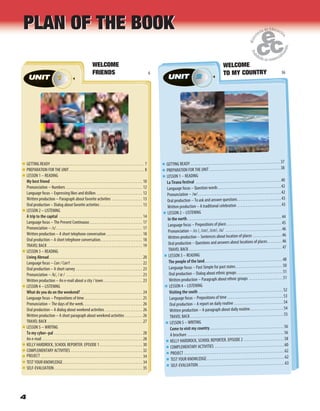
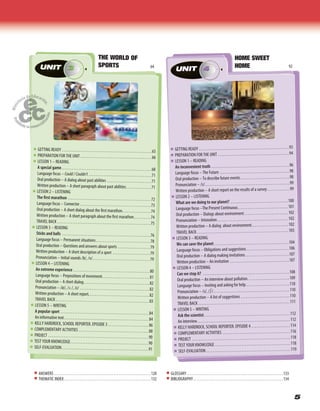
PLAN OF THE BOOKPLAN OF THE BOOK
WELCOME
FRIENDS 6
WELCOME
TO MY COUNTRY 36
5
ANSWERS . . . . . . . . . . . . . . . . . . . . . . . . . . . . . . . . . . . . . . . . . . . . . . . . . . . . . . . . .120
THEMATIC INDEX . . . . . . . . . . . . . . . . . . . . . . . . . . . . . . . . . . . . . . . . . . . . . . . . . . .132
GLOSSARY. . . . . . . . . . . . . . . . . . . . . . . . . . . . . . . . . . . . . . . . . . . . . . . . . . . . . . . . .133
BIBLIOGRAPHY. . . . . . . . . . . . . . . . . . . . . . . . . . . . . . . . . . . . . . . . . . . . . . . . . . . . .134
GETTING READY . . . . . . . . . . . . . . . . . . . . . . . . . . . . . . . . . . . . . . . . . . . . . . . . . . . . . 65
PREPARATION FOR THE UNIT . . . . . . . . . . . . . . . . . . . . . . . . . . . . . . . . . . . . . . . . . . 66
LESSON 1 – READING
A special game. . . . . . . . . . . . . . . . . . . . . . . . . . . . . . . . . . . . . . . . . . . . . . . . . . . . .68
Language focus – Could / Couldn’t . . . . . . . . . . . . . . . . . . . . . . . . . . . . . . . . . . . . . 71
Oral production – A dialog about past abilities . . . . . . . . . . . . . . . . . . . . . . . . . . 71
Written production – A short paragraph about past abilities. . . . . . . . . . . . . . .71
LESSON 2 – LISTENING
The first marathon . . . . . . . . . . . . . . . . . . . . . . . . . . . . . . . . . . . . . . . . . . . . . . . . . 72
Language focus – Connector. . . . . . . . . . . . . . . . . . . . . . . . . . . . . . . . . . . . . . . . . .73
Oral production – A short dialog about the first marathon. . . . . . . . . . . . . . . . . 74
Written production – A short paragraph about the first marathon. . . . . . . . . .74
TRAVEL BACK . . . . . . . . . . . . . . . . . . . . . . . . . . . . . . . . . . . . . . . . . . . . . . . . . . . . . . . 75
LESSON 3 – READING
Sticks and balls . . . . . . . . . . . . . . . . . . . . . . . . . . . . . . . . . . . . . . . . . . . . . . . . . . . . 76
Language focus – Permanent situations. . . . . . . . . . . . . . . . . . . . . . . . . . . . . . . .78
Oral production – Questions and answers about sports . . . . . . . . . . . . . . . . . . . 79
Written production – A short description of a sport . . . . . . . . . . . . . . . . . . . . . . 79
Pronunciation – Initial sounds /b/, /v/. . . . . . . . . . . . . . . . . . . . . . . . . . . . . . . . . .79
LESSON 4 – LISTENING
An extreme experience . . . . . . . . . . . . . . . . . . . . . . . . . . . . . . . . . . . . . . . . . . . . . 80
Language focus – Prepositions of movement. . . . . . . . . . . . . . . . . . . . . . . . . . . .81
Oral production – A short dialog. . . . . . . . . . . . . . . . . . . . . . . . . . . . . . . . . . . . . . .82
Pronunciation – / /, / /, / / . . . . . . . . . . . . . . . . . . . . . . . . . . . . . . . . . . . . . . . . . 82
Written production – A short report.. . . . . . . . . . . . . . . . . . . . . . . . . . . . . . . . . . . 82
TRAVEL BACK . . . . . . . . . . . . . . . . . . . . . . . . . . . . . . . . . . . . . . . . . . . . . . . . . . . . . . . 83
LESSON 5 – WRITING
A popular sport . . . . . . . . . . . . . . . . . . . . . . . . . . . . . . . . . . . . . . . . . . . . . . . . . . . . 84
An informative text. . . . . . . . . . . . . . . . . . . . . . . . . . . . . . . . . . . . . . . . . . . . . . . . . .84
KELLY HARDROCK, SCHOOL REPORTER. EPISODE 3 . . . . . . . . . . . . . . . . . . . . . . . . 86
COMPLEMENTARY ACTIVITIES . . . . . . . . . . . . . . . . . . . . . . . . . . . . . . . . . . . . . . . . . 88
PROJECT . . . . . . . . . . . . . . . . . . . . . . . . . . . . . . . . . . . . . . . . . . . . . . . . . . . . . . . . . . . 90
TEST YOUR KNOWLEDGE. . . . . . . . . . . . . . . . . . . . . . . . . . . . . . . . . . . . . . . . . . . . . . 90
SELF-EVALUATION. . . . . . . . . . . . . . . . . . . . . . . . . . . . . . . . . . . . . . . . . . . . . . . . . . .91
UNIT 364
UNIT 33UNIT THE WORLD OF
SPORTS 64
GETTING READY . . . . . . . . . . . . . . . . . . . . . . . . . . . . . . . . . . . . . . . . . . . . . . . . . . . . . 93
PREPARATION FOR THE UNIT . . . . . . . . . . . . . . . . . . . . . . . . . . . . . . . . . . . . . . . . . . 94
LESSON 1 – READING
An inconvenient truth . . . . . . . . . . . . . . . . . . . . . . . . . . . . . . . . . . . . . . . . . . . . . . 96
Language focus – The Future . . . . . . . . . . . . . . . . . . . . . . . . . . . . . . . . . . . . . . . . . 98
Oral production – To describe future events. . . . . . . . . . . . . . . . . . . . . . . . . . . . .98
Pronunciation – /s/. . . . . . . . . . . . . . . . . . . . . . . . . . . . . . . . . . . . . . . . . . . . . . . . . .99
Written production – A short report on the results of a survey . . . . . . . . . . . . . 99
LESSON 2 – LISTENING
What are we doing to our planet? . . . . . . . . . . . . . . . . . . . . . . . . . . . . . . . . . .100
Language focus –The Present Continuous. . . . . . . . . . . . . . . . . . . . . . . . . . . . . .101
Oral production – Dialogs about environment. . . . . . . . . . . . . . . . . . . . . . . . . .102
Pronunciation – Intonation. . . . . . . . . . . . . . . . . . . . . . . . . . . . . . . . . . . . . . . . . .102
Written production – A dialog about environment. . . . . . . . . . . . . . . . . . . . . .102
TRAVEL BACK . . . . . . . . . . . . . . . . . . . . . . . . . . . . . . . . . . . . . . . . . . . . . . . . . . . . . .103
LESSON 3 – READING
We can save the planet . . . . . . . . . . . . . . . . . . . . . . . . . . . . . . . . . . . . . . . . . . . .104
Language focus – Obligations and suggestions . . . . . . . . . . . . . . . . . . . . . . . . .106
Oral production – A dialog making invitations. . . . . . . . . . . . . . . . . . . . . . . . . .107
Written production – An invitation . . . . . . . . . . . . . . . . . . . . . . . . . . . . . . . . . . .107
LESSON 4 – LISTENING
Can we stop it? . . . . . . . . . . . . . . . . . . . . . . . . . . . . . . . . . . . . . . . . . . . . . . . . . . .108
Oral production – An interview about pollution. . . . . . . . . . . . . . . . . . . . . . . . .109
Language focus – Inviting and asking for help. . . . . . . . . . . . . . . . . . . . . . . . . .110
Pronunciation – /s/, / /. . . . . . . . . . . . . . . . . . . . . . . . . . . . . . . . . . . . . . . . . . . . .110
Written production – A list of suggestions . . . . . . . . . . . . . . . . . . . . . . . . . . . . .110
TRAVEL BACK . . . . . . . . . . . . . . . . . . . . . . . . . . . . . . . . . . . . . . . . . . . . . . . . . . . . . .111
LESSON 5 – WRITING
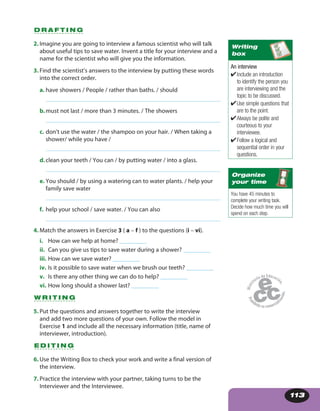
Ask the scientist. . . . . . . . . . . . . . . . . . . . . . . . . . . . . . . . . . . . . . . . . . . . . . . . . . .112
An interview. . . . . . . . . . . . . . . . . . . . . . . . . . . . . . . . . . . . . . . . . . . . . . . . . . . . . . .112
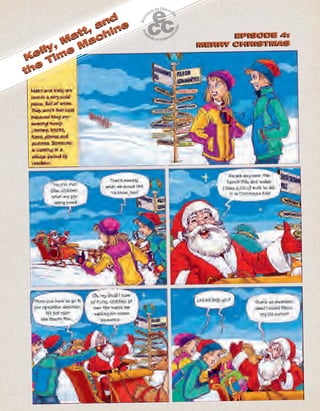
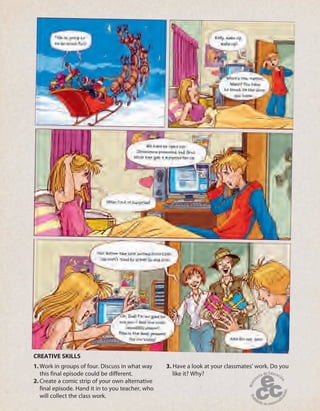
KELLY HARDROCK, SCHOOL REPORTER. EPISODE 4 . . . . . . . . . . . . . . . . . . . . . . .114
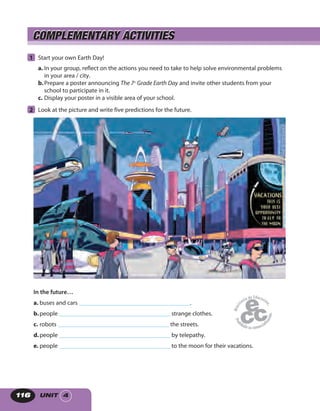
COMPLEMENTARY ACTIVITIES . . . . . . . . . . . . . . . . . . . . . . . . . . . . . . . . . . . . . . . .116
PROJECT . . . . . . . . . . . . . . . . . . . . . . . . . . . . . . . . . . . . . . . . . . . . . . . . . . . . . . . . . .118
TEST YOUR KNOWLEDGE. . . . . . . . . . . . . . . . . . . . . . . . . . . . . . . . . . . . . . . . . . . . .118
SELF-EVALUATION. . . . . . . . . . . . . . . . . . . . . . . . . . . . . . . . . . . . . . . . . . . . . . . . . .119
UNIT 492
UNIT 4UNIT 4
HOME SWEET
HOME 9233UNITUNIT UNIT 44UNIT
UNIT 16
UNIT 11UNIT
7
WELCOME, FRIENDS
1 Read this short poem. Do you agree with what it says about friendship? Why?
Friends at school
Are big and small.
Friends at school
Are best of all!
2 Think about the things you like to do with your friends. Compare with your partner.
Gettingready
7
WELCOME, FRIENDS
In this unit you will…In this unit you will…
listen and find specific information in a phone call
and in a conversation about free time activities by:
• identifying the sequence of events,
• recognizing vocabulary related to free time
activities,
• relating written and spoken versions,
• identifying expressions of time.
read and identify main ideas and specific
information in a literary extract and in an e-mail
about friends and favorite activities, by:
• recognizing main ideas from cognates,
• discriminating between correct and incorrect
information,
• recognizing type and purpose of a text,
• relating topic and personal knowledge.
express own ideas in short dialogs and monologues
about:
• favorite free time and weekend activities,
• personal experiences,
• abilities.
complete short paragraphs and write an e-mail
• describing favorite activities using the expressions
like, love, enjoy + ing,
• expressing abilities,
• using language and vocabulary related to free time
activities,
• using the appropriate format.
UNIT 18
P R E P A R A T I O N F O R T H E U N I T
1 Read the clues and write complete sentences. Use an appropriate
pronoun (I, you, he/she, etc.) and the correct form of the verb to be.
a. Your shoes / new:
b.My sister / a nurse:
c. The keys / in my bag:
d.Sheila’s house / big:
e. Jim / 12 years old:
f. My parents / at home:
2 Complete the calendar. Write the missing days of the week on it.
Tuesday Wednesday Saturday
1 2 3 4 5
6 7 8 9 10 11 12
13 14 15 16 17 18 19
20 21 22 23 24 25 26
27 28 29 30
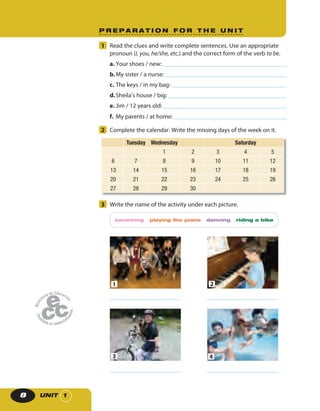
3 Write the name of the activity under each picture.
swimming playing the piano dancing riding a bike
1 2
3 4
9
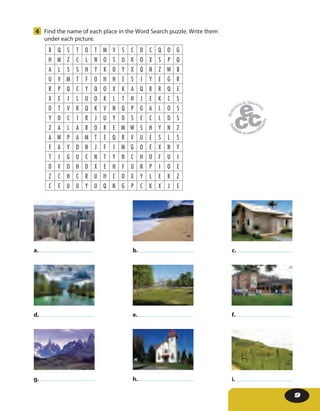
4 Find the name of each place in the Word Search puzzle. Write them
under each picture.
B Q S T O T M V S C D C Q O G
H M Z C L N O S U K O X S P Q
A L S S H Y K O Y X Q N Z W B
U V M T F O H H E S I Y E G R
R P Q C Y Q O X K A Q B R Q E
X E I L U O K L T H J E K C S
D T V K Q K V N Q P G A L O S
Y O C I R J U Y D S E C L D S
Z A L A R O R E M W S H Y N Z
A W P A M T E Q R V U E S L S
E A Y D N J F I M G O E X N Y
T I G U C N T Y N C H O F U I
D V O H D X E H F U N P I O E
Z C H C R U H C O X Y L E K Z
C E U U Y U Q N G P C K X J E
g. i.h.
d. f.e.
a. c.b.
UNIT 110
1. Who’s your best friend? What’s his / her name?
2. Read these popular quotes about friendship. Are you familiar with
them in your language? Do you agree with them? Why?
a. “The only way to have a friend is to be one”.
b.“A friend is someone who gives you total freedom to be yourself”.
c. “I prefer to walk with a friend in the dark, than alone in the light”.
3. Look at what Kelly says and read this brief paragraph about the writer of
the novel. In what way do you think World War I influenced the novel?
The German writer Herman
Hesse wrote Demian in 1917,
when the United States
declared war on Germany
and the world was in a state
of chaos after World War I.
Herman Hesse is one of the
most frequently translated
German writers of the twentieth century. In 1946, Hesse
was honored with the Goethe Prize and the Nobel Prize
for Literature.
Demian tells the story of two friends walking to maturity,
Emile Sinclaire and Max Demian.
4. Look at the Pictionary and the picture on Page 11. What do you think
Sinclaire says about his friend Demian?
R E A D I N G
5. 2 Read and listen to the text on Page 11. Check if you were right
about Demian.
6. The novel Demian has eight chapters. What chapter is the source of
this extract? Why?
a. Chapter 5 b. Chapter 7 c. Chapter 2
7.Find a synonym for each of these words in the text.
I. unpredictable exceptional assertive
II. ironic
III. honored curious
I am the reporter
of a school
magazine. I
selected an
extract from the
novel Demian for
my literary section
today. Demian tells
the story of two
friends. Who’s your
best friend? What’s
his / her name?
Hi,mynameis
KELLYHARDROCK.
B E F O R E R E A D I N G
MY BEST FRIEND Lesson 1Reading
11
My friend Demian
II.
III.
I.
Adapted from:
Hesse, H. (1919). Cain in Demian. Retrieved April 24, 2013 from http://www.onread.com/fbreader/191269/
My salvation came in an unexpected way:
a new boy in our school. This remarkable
student looked much older than the rest of
the boys in my class. He looked strange and
mature, like a man, or like a gentleman. He
was not the kind of boy who likes playing
our games. His name was Max Demian.
One day, another class entered into our
large classroom.
It was Demian’s class. I observed his
intelligent face. He didn’t at all look like
a student doing an assignment, but like a
scientist who enjoys investigating problems.
His eyes had an adult and sarcastic
expression. In general, children don’t like
seeing this kind of expression in a face.
When I remember Demian, I can only say
that he was different to the rest, like a
prince among farm boys. One afternoon,
on our way home from school, he said
hello. “Let’s walk together” he said. I felt
flattered. Then I described where I lived.
“Oh, over there?” he said and smiled. “I
know the house. There’s something odd
above the doorway I like very much”. I
didn’t know what he was talking about and
was surprised that he apparently knew my
house very well.
Pictionary
gentleman
mature
assignment
scientist
doorway
UNIT 112
10. Imagine you are Demian and you write a description of your
friend Sinclaire. How do you imagine him? Write a description using
the expressions that you learned in the Language Focus.
A F T E R R E A D I N G
11. 3 Listen and say these pairs of numbers. Clap the syllable that
recieves more emphasis in the pronunciation of every number.
13 - 30 14 - 40 15 - 50 16 - 60
17 - 70 18 - 80 19 - 90
Reflections
What problems did I have to
understand a literary extract
in English?
What can I do to do better
next time?
L A N G U A G E F O C U S Expressing likes and dislikes
1. Read these sentences from the text and pay attention to the words
in bold.
He was not the kind of boy who likes playing our games.
He looked like a scientist who enjoys investigating problems.
Children don’t like seeing this kind of expression in a face.
2. Underline the sentences that express negative preferences.
3. What is the subject of these sentences?
4. Complete the rule.
We express our favorite activities using / + a verb
ending in . We express our dislikes using don’t / doesn’t + a
verb ending in . If the subject is he, she or it, the verbs add
a letter in affirmative sentences.
8. Underline the information in the text that contradicts these statements.
a. Demian looked like a simple boy.
b.The classroom was small.
c. Demian looked like a boy who doesn’t like doing assignments.
d.Demian was a farm boy.
9. What attitude is the narrator expressing in this extract? How does he
feel about Demian? Discuss with your partner.
13
12. 4 Listen and repeat this conversation. Replace the underlined
sections with information that is true for you and role-play the
conversation with your partner.
K:What’s your best friend’s name?
D:Dan Peterson.
K:How old is he?
D:He’s twelve.
K:What are his favorite activities?
D:He likes playing football and tennis.
K:And what do you like doing?
D:I like swimming.
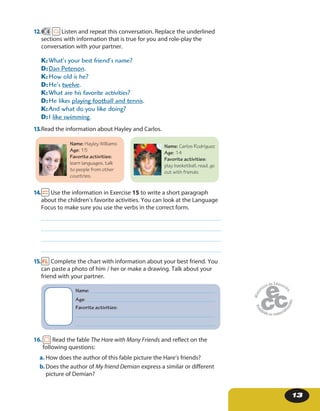
13.Read the information about Hayley and Carlos.
Name: Hayley Williams
Age: 15
Favorite activities:
learn languages, talk
to people from other
countries.
Name: Carlos Rodríguez
Age: 14
Favorite activities:
play basketball, read, go
out with friends.
14. Use the information in Exercise 15 to write a short paragraph
about the children’s favorite activities. You can look at the Language
Focus to make sure you use the verbs in the correct form.
15. Complete the chart with information about your best friend. You
can paste a photo of him / her or make a drawing. Talk about your
friend with your partner.
Name:
Age:
Favorite activities:
16. Read the fable The Hare with Many Friends and reflect on the
following questions:
a. How does the author of this fable picture the Hare’s friends?
b.Does the author of My friend Demian express a similar or different
picture of Demian?
UNIT 114
1. Kelly and her brother Matt are Ignacio’s cyber- pals. The children are in
Chile for the first time visiting him. Can you guess where they are from?
2. Do you have a cyber-pal? If not, would you like to have one? If you
could choose a cyber-pal, where would he / she be from?
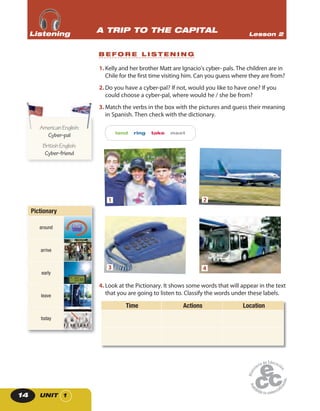
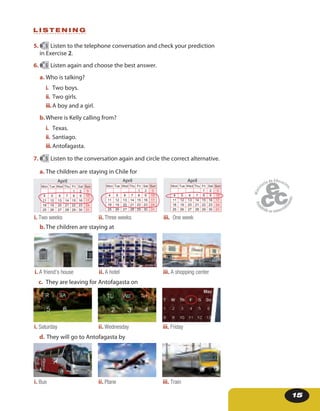
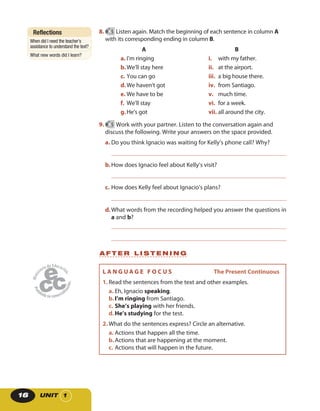
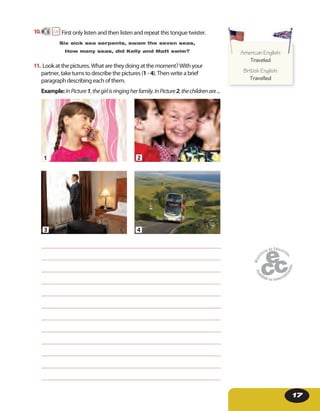
3. Match the verbs in the box with the pictures and guess their meaning
in Spanish. Then check with the dictionary.
land ring take meet
1 2
3 4
4. Look at the Pictionary. It shows some words that will appear in the text
that you are going to listen to. Classify the words under these labels.
Time Actions Location
B E F O R E L I S T E N I N G
A TRIP TO THE CAPITAL Lesson 2ListeningListeningListening
Pictionary
around
arrive
early
7:00 am
leave
today
AmericanEnglish:
Cyber-pal
BritishEnglish:
Cyber-friend
AmericanEnglish:AmericanEnglish:
15
5. 5 Listen to the telephone conversation and check your prediction
in Exercise 2.
6. 5 Listen again and choose the best answer.
a. Who is talking?
i. Two boys.
ii. Two girls.
iii.A boy and a girl.
b.Where is Kelly calling from?
i. Texas.
ii. Santiago.
iii.Antofagasta.
L I S T E N I N G
7. 5 Listen to the conversation again and circle the correct alternative.
a. The children are staying in Chile for
i. Two weeks ii. Three weeks iii. One week
Mon Tue Wed Thu Fri Sat Sun
1 2 3
4 5 6 7 8 9 10
11 12 13 14 15 16 17
18 19 20 21 22 23 24
25 26 27 28 29 30 31
April
Mon Tue Wed Thu Fri Sat Sun
1 2 3
4 5 6 7 8 9 10
11 12 13 14 15 16 17
18 19 20 21 22 23 24
25 26 27 28 29 30 31
April
Mon Tue Wed Thu Fri Sat Sun
1 2 3
4 5 6 7 8 9 10
11 12 13 14 15 16 17
18 19 20 21 22 23 24
25 26 27 28 29 30 31
April
b.The children are staying at
i. A friend’s house ii. A hotel iii. A shopping center
c. They are leaving for Antofagasta on
i. Saturday ii. Wednesday iii. Friday
i
d. They will go to Antofagasta by
i. Bus ii. Plane iii. Train
UNIT 116
A F T E R L I S T E N I N G
Reflections
When did I need the teacher’s
assistance to understand the text?
What new words did I learn?
L A N G U A G E F O C U S The Present Continuous
1. Read the sentences from the text and other examples.
a. Eh, Ignacio speaking.
b.I’m ringing from Santiago.
c. She’s playing with her friends.
d.He’s studying for the test.
2. What do the sentences express? Circle an alternative.
a. Actions that happen all the time.
b.Actions that are happening at the moment.
c. Actions that will happen in the future.
8. 5 Listen again. Match the beginning of each sentence in column A
with its corresponding ending in column B.
A
a. I’m ringing
b.We’ll stay here
c. You can go
d.We haven’t got
e. We have to be
f. We’ll stay
g.He’s got
B
i. with my father.
ii. at the airport.
iii. a big house there.
iv. from Santiago.
v. much time.
vi. for a week.
vii. all around the city.
9. 5 Work with your partner. Listen to the conversation again and
discuss the following. Write your answers on the space provided.
a. Do you think Ignacio was waiting for Kelly’s phone call? Why?
b.How does Ignacio feel about Kelly’s visit?
c. How does Kelly feel about Ignacio’s plans?
d.What words from the recording helped you answer the questions in
a and b?
17
10. 6 First only listen and then listen and repeat this tongue twister.
Six sick sea serpents, swam the seven seas,
How many seas, did Kelly and Matt swim?
11. Look at the pictures. What are they doing at the moment? With your
partner, take turns to describe the pictures (1 - 4). Then write a brief
paragraph describing each of them.
Example: InPicture1,thegirlisringingherfamily.InPicture2,thechildrenare...
2
4
1
3
American English:
Traveled
British English:
Travelled
American English:American English:
UNIT 118
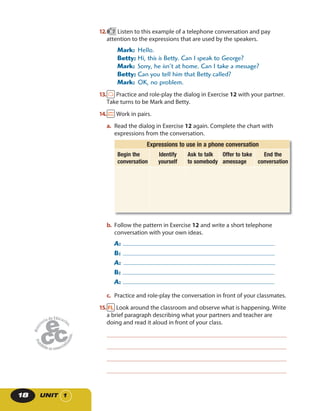
12. 7 Listen to this example of a telephone conversation and pay
attention to the expressions that are used by the speakers.
Mark: Hello.
Betty: Hi, this is Betty. Can I speak to George?
Mark: Sorry, he isn’t at home. Can I take a message?
Betty: Can you tell him that Betty called?
Mark: OK, no problem.
13. Practice and role-play the dialog in Exercise 12 with your partner.
Take turns to be Mark and Betty.
14. Work in pairs.
a. Read the dialog in Exercise 12 again. Complete the chart with
expressions from the conversation.
Expressions to use in a phone conversation
Begin the
conversation
Identify
yourself
Ask to talk
to somebody
Offer to take
amessage
End the
conversation
b. Follow the pattern in Exercise 12 and write a short telephone
conversation with your own ideas.
A:
B:
A:
B:
A:
c. Practice and role-play the conversation in front of your classmates.
15. Look around the classroom and observe what is happening. Write
a brief paragraph describing what your partners and teacher are
doing and read it aloud in front of your class.
1919
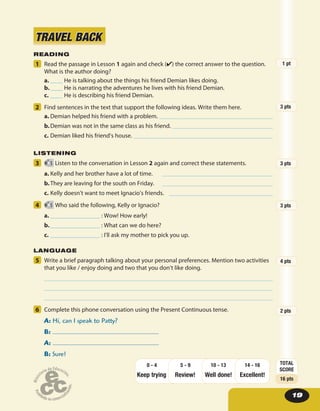
5 Write a brief paragraph talking about your personal preferences. Mention two activities
that you like / enjoy doing and two that you don’t like doing.
6 Complete this phone conversation using the Present Continuous tense.
A: Hi, can I speak to Patty?
B:
A:
B: Sure!
READING
1 Read the passage in Lesson 1 again and check (✔) the correct answer to the question.
What is the author doing?
a. ____ He is talking about the things his friend Demian likes doing.
b.____ He is narrating the adventures he lives with his friend Demian.
c. ____ He is describing his friend Demian.
2 Find sentences in the text that support the following ideas. Write them here.
a. Demian helped his friend with a problem.
b.Demian was not in the same class as his friend.
c. Demian liked his friend’s house.
LISTENING
3 5 Listen to the conversation in Lesson 2 again and correct these statements.
a. Kelly and her brother have a lot of time.
b.They are leaving for the south on Friday.
c. Kelly doesn’t want to meet Ignacio’s friends.
4 5 Who said the following, Kelly or Ignacio?
a. ________________ : Wow! How early!
b.________________ : What can we do here?
c. ________________ : I’ll ask my mother to pick you up.
LANGUAGE
TRAVEL BACKTRAVEL BACK
1 pt
3 pts
3 pts
3 pts
4 pts
2 pts
TOTAL
SCORE
16 pts
Keep trying Review! Well done!
14 - 16
Excellent!
10 - 135 - 90 - 4
UNIT 120
2. Have a quick look at the e-mail on Page 21 and identify all the words
that look similar in Spanish.
3. Ema sends this e-mail to her Chilean friends telling them about her
new city. Do you think she likes it?
4. How do you imagine the city where Ema is living? Discuss with your
partner.
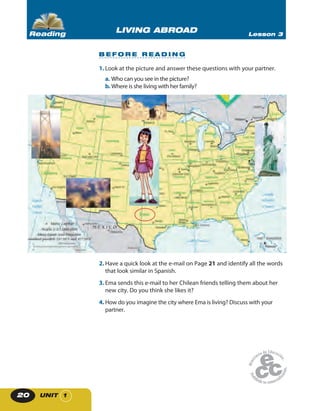
1. Look at the picture and answer these questions with your partner.
a. Who can you see in the picture?
b. Where is she living with her family?
B E F O R E R E A D I N G
LIVING ABROAD Lesson 3Reading
21
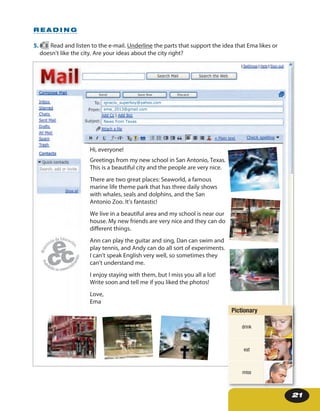
5. 8 Read and listen to the e-mail. Underline the parts that support the idea that Ema likes or
doesn’t like the city. Are your ideas about the city right?
R E A D I N G
Hi, everyone!
Greetings from my new school in San Antonio, Texas.
This is a beautiful city and the people are very nice.
There are two great places: Seaworld, a famous marine
life theme park that has three daily shows with whales,
seals and dolphins, and the San Antonio Zoo. It’s fantastic!
We live in a beautiful area and my school is near our
house. My new friends are very nice and they can do different
things.
Ann can play the guitar and sing, Dan can swim and play
tennis, and Andy can do all sort of experiments. I can’t speak
English very well, so sometimes they can’t understand me.
I enjoy staying with them, but I miss you all a lot!
Write soon and tell me if you liked the photos!
Love,
Ema
ignacio_superboy@yahoo.com
ema_2013@gmail.com
News from Texas
Hi, everyone!
Greetings from my new school in San Antonio, Texas.
This is a beautiful city and the people are very nice.
There are two great places: Seaworld, a famous
marine life theme park that has three daily shows
with whales, seals and dolphins, and the San
Antonio Zoo. It’s fantastic!
We live in a beautiful area and my school is near our
house. My new friends are very nice and they can do
different things.
Ann can play the guitar and sing, Dan can swim and
play tennis, and Andy can do all sort of experiments.
I can’t speak English very well, so sometimes they
can’t understand me.
I enjoy staying with them, but I miss you all a lot!
Write soon and tell me if you liked the photos!
Love,
Ema
Pictionary
drink
eat
miss
UNIT 122
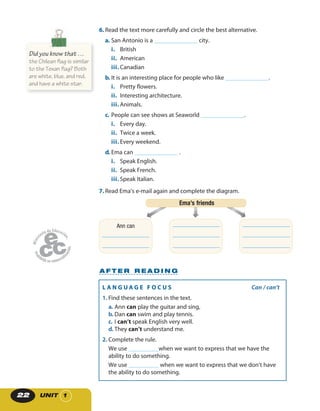
6. Read the text more carefully and circle the best alternative.
a. San Antonio is a ______________ city.
i. British
ii. American
iii. Canadian
b. It is an interesting place for people who like ______________.
i. Pretty flowers.
ii. Interesting architecture.
iii. Animals.
c. People can see shows at Seaworld ______________.
i. Every day.
ii. Twice a week.
iii. Every weekend.
d. Ema can ______________ .
i. Speak English.
ii. Speak French.
iii. Speak Italian.
7. Read Ema’s e-mail again and complete the diagram.
__________________
__________________
__________________
__________________
__________________
__________________
Ema’s friends
__________________
__________________
Ann can
A F T E R R E A D I N G
Did you know that …
the Chilean flag is similar
to the Texan flag? Both
are white, blue, and red,
and have a white star.
L A N G U A G E F O C U S   Can / can’t
1. Find these sentences in the text.
a. Ann can play the guitar and sing,
b. Dan can swim and play tennis.
c. I can’t speak English very well.
d. They can’t understand me.
2. Complete the rule.
We use __________when we want to express that we have the
ability to do something.
We use __________ when we want to express that we don’t have
the ability to do something.
23
8. 9 First only listen and then listen and repeat this tongue twister.
Can you can a can as a canner can can a can?
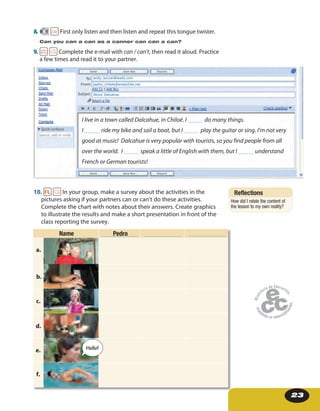
9. Complete the e-mail with can / can’t, then read it aloud. Practice
a few times and read it to your partner.
I live in a town called Dalcahue, in Chiloé. I _____ do many things.
I _____ ride my bike and sail a boat, but I _____ play the guitar or sing. I’m not very
good at music! Dalcahue is very popular with tourists, so you find people from all
over the world. I _____ speak a little of English with them, but I _____ understand
French or German tourists!
andy_soccer@walla.com
pedro_chilote@entelchile.net
About Dalcahue
10. In your group, make a survey about the activities in the
pictures asking if your partners can or can’t do these activities.
Complete the chart with notes about their answers. Create graphics
to illustrate the results and make a short presentation in front of the
class reporting the survey.
Name Pedro
a.
b.
c.
d.
e.
f.
Hello!
____________ ____________ ____________
Reflections
How did I relate the content of
the lesson to my own reality?
UNIT 124
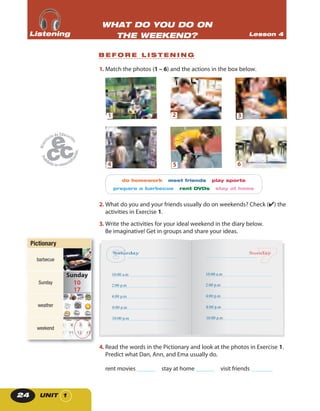
1. Match the photos (1 – 6) and the actions in the box below.
1
4
2
5
3
6
do homework meet friends play sports
prepare a barbecue rent DVDs stay at home
2. What do you and your friends usually do on weekends? Check (✔) the
activities in Exercise 1.
3. Write the activities for your ideal weekend in the diary below.
Be imaginative! Get in groups and share your ideas.
Saturday
10:00 a.m
2:00 p.m
4:00 p.m
8:00 p.m
10:00 p.m
Sunday
10:00 a.m
2:00 p.m
4:00 p.m
8:00 p.m
10:00 p.m
4. Read the words in the Pictionary and look at the photos in Exercise 1.
Predict what Dan, Ann, and Ema usually do.
rent movies ______ stay at home ______ visit friends _______
B E F O R E L I S T E N I N G
WHAT DO YOU DO ON
THE WEEKEND? Lesson 4ListeningListeningListening
PictionaryPictionary
barbecue
Sunday
weather
weekend
25
5. 10 Listen to the conversation and check your predictions in Exercise 4.
6. 10 Listen to the conversation again. Number the sentences in the
order you hear them.
a. How about going to visit Andy this afternoon? ______
b. I go to the club and meet some friends there. ______
c. I usually visit my grandparents. ______
d. What time do you study? ______
e. Do you often go to parties? ______
f. That’s a great idea! ______
7. 10 Listen to the conversation once more. Match the activities (a – f)
and the times (i – vi).
A
a. Go shopping.
b.Watch sports on TV.
c. Meet at Andy’s house.
d.Have dinner.
e. Have lunch.
f. Go for a ride.
B
i. 9:00 at night.
ii. 10:00 in the morning.
iii.Saturday morning.
iv. 4:30 p.m
v. Saturday afternoon.
vi. Two o’clock.
L I S T E N I N G
A F T E R L I S T E N I N G
L A N G U A G E F O C U S Prepositions of time
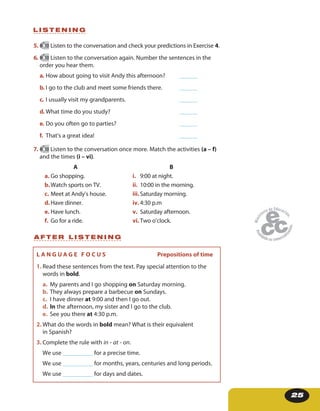
1. Read these sentences from the text. Pay special attention to the
words in bold.
a. My parents and I go shopping on Saturday morning.
b. They always prepare a barbecue on Sundays.
c. I have dinner at 9:00 and then I go out.
d. In the afternoon, my sister and I go to the club.
e. See you there at 4:30 p.m.
2. What do the words in bold mean? What is their equivalent
in Spanish?
3. Complete the rule with in - at - on.
We use __________ for a precise time.
We use __________ for months, years, centuries and long periods.
We use __________ for days and dates.
UNIT 126
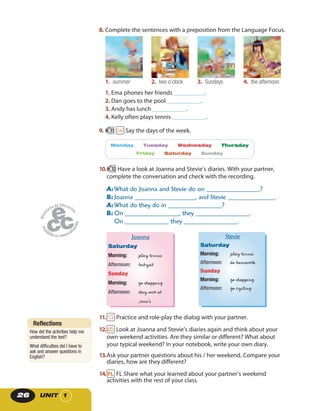
8. Complete the sentences with a preposition from the Language Focus.
1. summer 2. two o’clock 3. Sundays 4. the afternoon
1. Ema phones her friends __________.
2. Dan goes to the pool ___________.
3. Andy has lunch ___________.
4. Kelly often plays tennis ___________.
9. 11 Say the days of the week.
Monday Tuesday Wednesday Thursday
Friday Saturday Sunday
10. 12 Have a look at Joanna and Stevie’s diaries. With your partner,
complete the conversation and check with the recording.
A: What do Joanna and Stevie do on ________________?
B: Joanna __________________, and Stevie ______________.
A: What do they do in ________________?
B: On ________________, they ________________.
On _____________ they ________________.
Joanna
Saturday
Morning: play tennis
Afternoon: babysit
Sunday
Morning: go shopping
Afternoon: stay over at
Jane’s
Stevie
Saturday
Morning: play tennis
Afternoon: do homework
Sunday
Morning: go shopping
Afternoon: go cycling
11. Practice and role-play the dialog with your partner.
12. Look at Joanna and Stevie’s diaries again and think about your
own weekend activities. Are they similar or different? What about
your typical weekend? In your notebook, write your own diary.
13.Ask your partner questions about his / her weekend. Compare your
diaries, how are they different?
14. FL Share what your learned about your partner’s weekend
activities with the rest of your class.
Reflections
How did the activities help me
understand the text?
What difficulties did I have to
ask and answer questions in
English?
2727
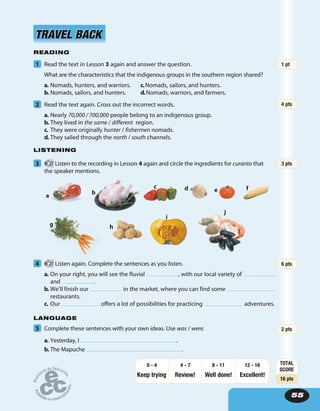
1 Read the text in Lesson 3 again and choose the correct alternative.
The girl is
a. Inviting her friends.
b.Describing her friends.
c. Telling a story.
2 Read the text again and find a characteristic for each noun.
a. San Antonio: ________________ city.
b.Seaworld: ________________ marine park.
LISTENING
3 10 Listen to the recording in Lesson 4 again and circle the best alternative.
The children are talking about:
a. Their vacations.
b.Their weekends.
c. Their school.
4 10 Listen to the recording again and complete the sentences.
a. Ann often visits her ________________.
b.In the afternoon, Dan watches ________________on TV.
c. Ema usually stays at ________________.
LANGUAGE
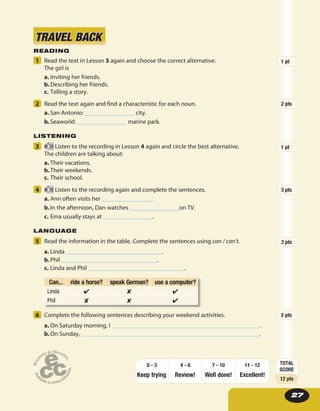
5 Read the information in the table. Complete the sentences using can / can’t.
a. Linda _______________________________.
b.Phil _______________________________.
c. Linda and Phil _______________________________.
Can... ride a horse? speak German? use a computer?
Linda ✔ ✘ ✔
Phil ✘ ✘ ✔
6 Complete the following sentences describing your weekend activities.
a. On Saturday morning, I .
b.On Sunday, .
READING
TRAVEL BACKTRAVEL BACK
2 pts
3 pts
3 pts
1 pt
1 pt
2 pts
TOTAL
SCORE
12 pts
Keep trying Review! Well done!
11 - 12
Excellent!
7 - 104 - 60 - 3
UNIT 128
2. Which of these phrases are used as greeting, closing or signing off
when writing an e-mail? Complete the table.
Dear Ted, Love Hi, Best Write soon
I miss you. Cheers. Hi, Mary
Your friend Hello, Lots of love. Best wishes
Greeting Closing Signing off
Write soon Your friend
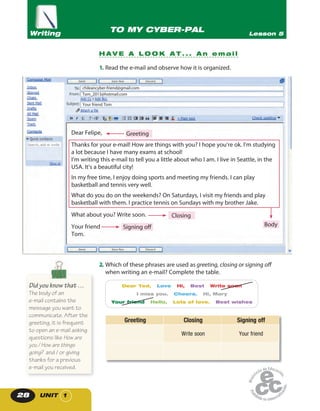
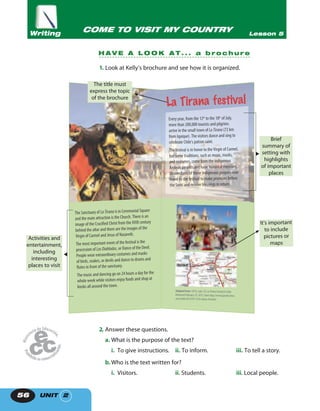
1. Read the e-mail and observe how it is organized.
H A V E A L O O K A T . . . A n e m a i l
TO MY CYBER-PAL Lesson 5Writing
Dear Felipe,
Thanks for your e-mail! How are things with you? I hope you’re ok. I’m studying
a lot because I have many exams at school!
I’m writing this e-mail to tell you a little about who I am. I live in Seattle, in the
USA. It’s a beautiful city!
In my free time, I enjoy doing sports and meeting my friends. I can play
basketball and tennis very well.
What do you do on the weekends? On Saturdays, I visit my friends and play
basketball with them. I practice tennis on Sundays with my brother Jake.
What about you? Write soon.
Your friend
Tom.
chileancyber-friend@gmail.com
Tom_2013@hotmail.com
Your friend Tom
Greeting
Closing
BodySigning off
Did you know that …
The body of an
e-mail contains the
message you want to
communicate. After the
greeting, it is frequent
to open an e-mail asking
questions like How are
you / How are things
going? and / or giving
thanks for a previous
e-mail you received.
29
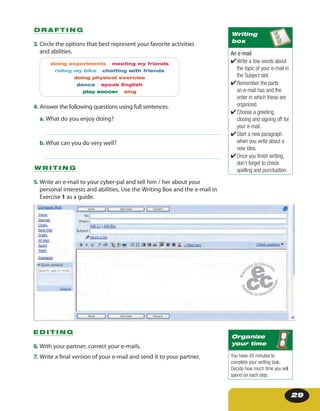
3. Circle the options that best represent your favorite activities
and abilities.
doing experiments meeting my friends
riding my bike chatting with friends
doing physical exercise
dance speak English
play soccer sing
4. Answer the following questions using full sentences.
a. What do you enjoy doing?
b.What can you do very well?
D R A F T I N G
5. Write an e-mail to your cyber-pal and tell him / her about your
personal interests and abilities. Use the Writing Box and the e-mail in
Exercise 1 as a guide.
W R I T I N G
6. With your partner, correct your e-mails.
7. Write a final version of your e-mail and send it to your partner.
E D I T I N G
An e-mail
✔Write a few words about
the topic of your e-mail in
the Subject slot.
✔Remember the parts
an e-mail has and the
order in which these are
organized.
✔Choose a greeting,
closing and signing off for
your e-mail.
✔Start a new paragraph
when you write about a
new idea.
✔Once you finish writing,
don’t forget to check
spelling and punctuation.
Writing
box
You have 45 minutes to
complete your writing task.
Decide how much time you will
spend on each step.
Organize
your time
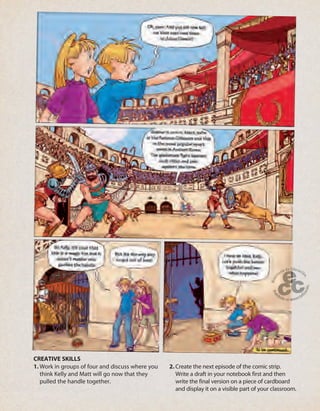
EPISODE 1:
MATT AND KELLY ARRIVE IN CHILE
EPISODE 1:
MATT AND KELLY ARRIVE IN CHILE
Look! It’s the end of summer, but
the Andes still have a lot of snow.
In Santiago, they go sightseeing. Now they are in
Plaza de Armas and they ask for directions to go
to Santa Lucía Hill.
Kelly, Matt, and
the
Time
Machine
Kelly, Matt, and
the
Time
Machine
I’d like to try Porotos
Granados, please. And Cazuela
for me, please.
1. Work in groups of four. In your group, discuss
what you think happened to Kelly and Matt
after they opened the box.
2. Create a new comic strip to continue the story
using your ideas. You can add new characters.
3. Role-play your story in front of your class.
CREATIVE SKILLS
UNIT 132
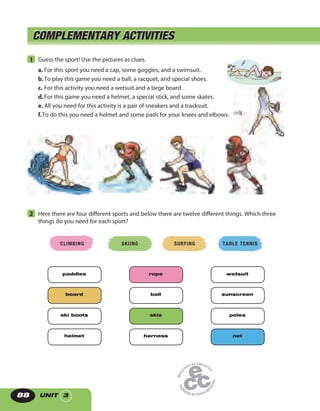
1 Make survey about your class’preferences. Interview 15 students from your class, asking
questions about the activities in the box. Take notes of the answers and organize the
information in graphics. Present the results to your class, showing the graphics you created.
Example: Do you like collecting stamps?
• collect stamps
• study math
• speak English
• listen to reggaeton
2 With your partner, make cards that include the following sentences. Take turns to take a card,
mimic the action and guess.
• I’m speaking
• I’m playing the piano
• I’m ringing a friend
• I’m writing
• I’m studying
• I’m dancing
3 Read about what Sarah can and can´t do.
Hi! I’m Sara.
What canI do?I canreadmusic and
I canplaythepiano,but I can’tplay theguitar.
I can’t singbut I candance.
I can’t swim orrideahorse.
b. In your notebook, write a similar paragraph about yourself.
COMPLEMENTARY ACTIVITIESCOMPLEMENTARY ACTIVITIES
a. Check (✔) or cross (✘) what is true for you.
You
Dance
Play the guitar
Play the piano
Sing
Ride a horse
Swim
Read music
33
3. Complete the timetable with your own information.
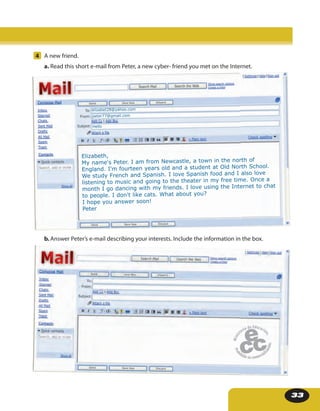
4 A new friend.
a. Read this short e-mail from Peter, a new cyber- friend you met on the Internet.
b. Answer Peter’s e-mail describing your interests. Include the information in the box.
Elizabeth,
My name's Peter. I am from Newcastle, a town in the north of
England. I'm fourteen years old and a student at Old North School.
We study French and Spanish. I love Spanish food and I also love
listening to music and going to the theater in my free time. Once a
month I go dancing with my friends. I love using the Internet to chat
to people. I don't like cats. What about you?
I hope you answer soon!
Peter
elizabet28@yahoo.com
peter77@gmail.com
Hello
UNIT 134
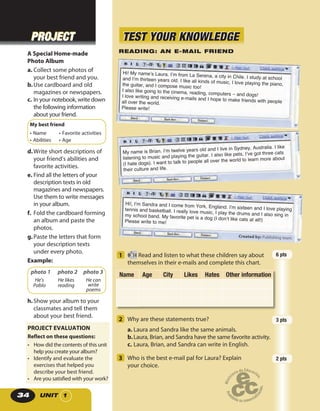
1 14 Read and listen to what these children say about
themselves in their e-mails and complete this chart.
2 Why are these statements true?
a. Laura and Sandra like the same animals.
b.Laura, Brian, and Sandra have the same favorite activity.
c. Laura, Brian, and Sandra can write in English.
3 Who is the best e-mail pal for Laura? Explain
your choice.
READING: AN E-MAIL FRIEND
Hi! My name’s Laura. I’m from La Serena, a city in Chile. I study at schooland I’m thirteen years old. I like all kinds of music, I love playing the piano,the guitar, and I compose music too!
I also like going to the cinema, reading, computers – and dogs!I love writing and receiving e-mails and I hope to make friends with peopleall over the world.
Please write!
My name is Brian. I’m twelve years old and I live in Sydney, Australia. I like
listening to music and playing the guitar. I also like pets, I’ve got three cats
(I hate dogs). I want to talk to people all over the world to learn more about
their culture and life.
Hi!, I’m Sandra and I come from York, England. I’m sixteen and I love playingtennis and basketball. I really love music, I play the drums and I also sing inmy school band. My favorite pet is a dog (I don’t like cats at all!)Please write to me!
TEST YOUR KNOWLEDGETEST YOUR KNOWLEDGE
Created by: Publishing team.
A Special Home-made
Photo Album
a. Collect some photos of
your best friend and you.
b.Use cardboard and old
magazines or newspapers.
c. In your notebook, write down
the following information
about your friend.
My best friend
• Name • Favorite activities
• Abilities • Age
d.Write short descriptions of
your friend’s abilities and
favorite activities.
e. Find all the letters of your
description texts in old
magazines and newspapers.
Use them to write messages
in your album.
f. Fold the cardboard forming
an album and paste the
photos.
g.Paste the letters that form
your description texts
under every photo.
Example:
photo 1 photo 2 photo 3
He likes
reading
He’s
Pablo
He can
write
poems
h.Show your album to your
classmates and tell them
about your best friend.
• How did the contents of this unit
help you create your album?
• Identify and evaluate the
exercises that helped you
describe your best friend.
• Are you satisfied with your work?
PROJECT EVALUATION
Reflect on these questions:
Name Age City Likes Hates Other information
6 pts
3 pts
2 pts
PROJECTPROJECT
3535
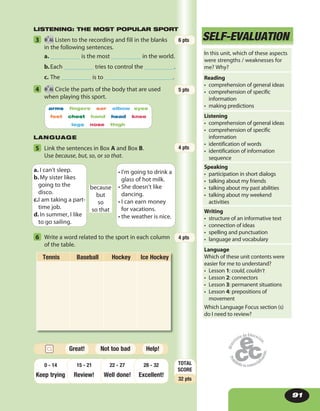
LANGUAGE
WRITING AND SPEAKING
LISTENING: ON VACATIONS
6 Read Peter’s diary and write two sentences
with the corresponding information and the
prepositions in, at, or on.
a.
b.
SATURDAY
Morning:
11: 00 - Go shopping
Afternoon:
5: 00 - Meet friends at the club
Evening:
7: 00 - Go to the movies
SUNDAY
Morning:
10: 00 - Play tennis with dad
Afternoon:
4: 00 - study for math test
4 15 Listen to the conversation and tick (✔ ) the
correct statement.
a. ____ The kids are talking about their homework.
b.____ The kids are talking about their friends.
c. ____ The kids are talking about weekend activities.
d.____ The kids are talking about summer activities.
5 15 Match the names (a - c) and the activities (i - vi).
a. Peter
b.Paul
c. Marie
i. Go camping
ii. Go to the beach
iii. Go to the country
iv. Ride a horse
SELF-EVALUATIONSELF-EVALUATION
7 Complete these sentences with information that
is true for you.
a. My name is ___________.
b.I’m ___________ old.
c. I like ___________.
d.I don’t like ___________ and I hate __________.
8 Exchange your personal information with
your partner.
In this unit, which of these aspects
were strengths / weaknesses for
me? Why?
Reading
• comprehension of general ideas
• comprehension of specific
information
• making predictions
Listening
• comprehension of general ideas
• comprehension of specific
information
• identification of words
• identification of information
sequence
Speaking
• participation in short dialogs
• talking about my friends
Writing
• e-mail format
• connection of ideas
• spelling and punctuation
• language and vocabulary
Language
Which of these unit contents were
easier for me to understand?
• Lesson 1: expressing likes and
dislikes.
• Lesson 2: the Present Continuous.
• Lesson 3: can / can`t
• Lesson 4: prepositions of time.
Which Language Focus section (s)
do I need to review?
2 pts
4 pts
4 pts
4 pts
TOTAL
SCORE
25 pts
Keep trying Review! Well done!
19 - 25
Excellent!
13 - 186 - 120 - 5
Help!Great! Not too bad
UNIT 236
2UNIT 2UNIT
37
1 How much do you know about Chile?
Choose the correct answer for each question.
a. Which river is in the north of Chile?
i. Mapocho. ii. Biobío. iii. Loa.
b.Which city has the largest population?
i. Viña del Mar. ii. Arica. iii. Concepción.
c. Where is the Congress building?
i. Santiago. ii. Valparaíso. iii. La Serena.
d.Which mountain is in the south of Chile?
i. Aconcagua. ii. Parinacota. iii. Fitz Roy.
2 Complete the following fact file, and then
compare with your partner.
WELCOME
TO MY COUNTRY
WELCOME
TO MY COUNTRY
37
In this unit you will…In this unit you will…
listen and identify specific information in a radio
interview, in a museum visit and in a tour by:
• discriminating between correct and incorrect
information,
• using oral clues to predict content,
• discriminating sounds,
• identifying the correct sequence of events.
read and identify main ideas and explicit information
in an Internet article and in a webpage about
Chilean people, places, and traditions by:
• identifying type and purpose of a text,
• using the context to infer the meaning of
new words,
• using visual clues to interpret information,
• organizing information in a chart.
express ideas in dialogs about:
• personal experiences,
• Chilean people and places.
write short paragraphs and a brochure related to
Chilean people, places, and traditions:
• using language and vocabulary of the unit,
• talking about past states,
• using prepositions of place,
• recognizing the textual organization of a brochure.
Country Chile
Area
Population
Capital city
Language
Currency
Gettingready
UNIT 238
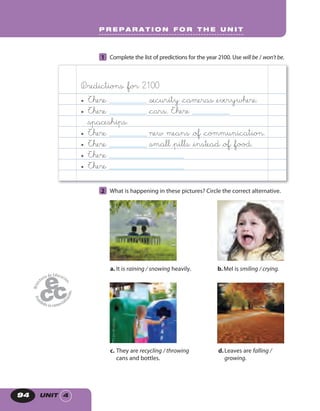
P R E P A R A T I O N F O R T H E U N I T
1 Complete the conversation with the correct form of the verb to be.
Miley: What the movie like?
Hugh: It’s awesome. There excellent actors in it.
Miley: the special effects good?
Hugh: Definitely! And the music very good, too.
Miley: it a science fiction movie?
Hugh: Yes, it , but there a great
deal of funny moments.
2 Circle the correct verb.
a. Jamie is / are very annoyed today.
b.Tom Mc Flurry is / are great in the game.
c. My parents is / are angry because my bedroom is a mess.
d.Sandra is / are very happy. She passed the English test.
e. My new jeans is / are on the chair.
f. Mom and Dad is / are very strict with my brother.
3 Write the plural of these words.
a. friend:
b.boy:
c. tree:
d.sister:
e. festival:
f. river:
g.boat:
h.picture:
39
4 Look at the pictures (1 - 4) and complete the sentences using the
words from the box.
at in on
5 Look at the people in the pictures. What are they doing? What are their
professions? Discuss with your partner.
a. My grandmother lives
.
c. My mother’s books are
.
b.Look! The balls are
.
d.They are .
UNIT 240
B E F O R E R E A D I N G
1. Answer these questions in your group.
a. What do people usually celebrate around the world?
b.What are the most important celebrations in Chile?
c. Do you know the name of a typical festival in your area?
2. Look at the pictures on Page 41. They illustrate the brochure that
Kelly Hardrock made after visiting her father in the north of Chile.
What do you know about this celebration?
3. Why do you think Kelly wrote a brochure about this celebration?
Discuss with your partner and complete what Kelly is saying.
LA TIRANA FESTIVAL Lesson 1Reading
4. 18 Read and listen to the text quickly and check your answers in
Exercises 2 and 3. Were your ideas right? In groups, discuss and
compare your answers.
American English:
Brochure
British English:
Brochure
American English:American English:
R E A D I N G
I wroteabout this
celebrationbecause
____________.
41
The Sanctuary of La Tirana is in Ceremonial Square andthe main attraction is the Church. There is an image ofthe Crucified Christ from the XVIII century behind thealtar and there are the images of the Virgin of Carmeland Jesus of Nazareth.
The most important event of the festival is theprocession of Las Diabladas, or Dance of the Devil.People wear extraordinary costumes and masks ofbirds, snakes, or devils and dance to drums and flutesin front of the sanctuary.
The music and dancing go on 24 hours a day for thewhole week while visitors enjoy foods and shop atkiosks all around the town.
Adapted from: (2012, July 13). LaTiranaFestivalinChile.Retrieved February 13, 2013, fromhttp://www.joeskit chen.com/chile/2012/07/13/la-tirana-festival/
Every year, from the 12th
to the 18th
of July, more than
200,000 tourists and pilgrims arrive in the small town
of La Tirana (72 km from Iquique). The visitors dance
and sing to celebrate Chile’s patron saint.
The festival is in honor to the Virgin of Carmel, but
some traditions, such as music, masks, and costumes,
come from the indigenous Andean peoples and have
historical meaning. Descendants of these indigenous
peoples now travel to the festival to make promises
before the Saint and receive blessings in return.
La Tirana festival
Pictionary
costume
devil
mask
Patron Saint
square
UNIT 242
5. Read the sentences. Write T (true) or F (false).
a. The event takes place in Iquique.
b. La Tirana Festival lasts for the whole month.
c. La Tirana is a combination of music, dance, and food.
d. The main event is Las Diabladas.
e. People wear spectacular costumes and masks.
6. Why do you think people wear costumes and masks of animal
creatures and devils in this festival? What do you think they
represent? Why?
A F T E R R E A D I N G
L A N G U A G E F O C U S Question words
1. Study these questions related to the text.
a. Where is La Tirana festival celebrated?
b.When does it take place?
c. What do the activities include?
2. Complete this general rule.
We use definite types of words called question words to ask
questions about place - (______), time - (______), things - (______).
7. 19 Listen and repeat. Pay special attention to the beginning of
the words.
where when what
who why whose whom
8. Fill in the blanks in these questions.
a. ________ do you ________ for your birthday?
b. ________ do you ________ on vacation?
c. ________ do you ________ for tests?
d. ________ do you ________ on Sundays?
e. ________ do you ________ in summer?
9. 20 Listen and repeat the questions in Exercise 8.
43
10.Create two questions about the text on Page 41.
a. ____________________________________
b. ____________________________________
11.Read and do what Ignacio says. Ask the questions to your partner
and write the answers.
a. ________ do people celebrate in your region? (event)
b. ________ does it take place? (time)
c. ________ is it celebrated? (place)
d. ________ do people do? (activities)
12. Use your notes to complete this paragraph about a traditional
celebration in Chile.
In (place), people
celebrate every (month / date).
People , ,
and .
13.Exchange paragraphs with your partner and check each other’s work.
14.Read the text on Page 41 and find words to complete this word map.
La Tirana Festival Place
15. Find information about another popular celebration in your
country. Prepare a presentation to share the information with
your class.
Completeeach blank
with a question word.
Reflections
What new words did I learn?
In what instances did I show
initiative?
UNIT 244
1. Answer Kelly’s questions.
1 2
3 4
5 6
2. With your partner, find out the meaning of the words in the
Pictionary. Think about a place in which you can find each object and
share your ideas.
3. You are going to listen to a recording about a very famous place in
Chile. Read the title of the lesson and look at the pictures in Exercise 1.
Can you guess what place it is?
Doyou
recognize
theplacesinthese
pictures?Which
regioninChiledothey
belongto?Which of
themwouldyouliketo
visit?Why?
IN THE NORTH Lesson 2ListeningListeningListening
B E F O R E L I S T E N I N G
Pictionary
clay
fortress
handcraft
parking lot
town hall
45
CARACOLES
HOSPITAL RINCÓN
SAN PEDRO
LICANCABUR
GUSTAVO LE PAIGE
D.ATIENZA
TOCONAO
TOCOPILLA
CALAMA
SQUARE
CHURCH
MUSEUM
HANDSCRAFTFAIR PARKING LOT
STADIUMGYM
TURBUS
TOWN HALL
4. 21 Listen to the recording and check your answer in Exercise 3.
5. 21 Listen to the recording again. Write M (Marcos), S (Sofía), or J (Jim).
a. We’re from Calama.
b. It’s a small but beautiful village.
c. People can visit San Pedro church.
d. It’s next to the museum.
e. It’s opposite to the stadium.
6. 21 Listen to the recording again. Number the places in the map in
the order they are mentioned.
L I S T E N I N G
A F T E R L I S T E N I N G
L A N G U A G E F O C U S Prepositions of place
1. Read these sentences from the text.
a. I’m in front of the Town Hall of San Pedro.
b.It’s a small but beautiful village near the city of Calama.
c. Opposite the church there is the Archeological Museum.
d.It’s next to the museum.
e. There is a big parking lot behind the museum.
2. Complete this rule.
Prepositions of are short words that we use to
indicate the of things.
UNIT 246
7. Read the sentences and label the places in the map.
a. The Town Hall is in front of the square, opposite the Post Office.
b. The police station is behind the Post Office.
c. The church is next to the Post Office.
d. There is a hospital near the square.
MAIN STREET
SquareSchool
CENTRALAVENUE
Library
8. 22 Listen and repeat these pairs of words.
clay – day
lot – not
fair – pair
near – here
9. 23 Listen and practice this dialog with your partner.
A: Excuse me, where is the Town Hall?
B: It’s in Main Street, opposite the Post Office.
A: And the police station?
B: It’s behind the Post Office.
A: Where can I find a hospital?
B: The hospital is in Central Avenue, in front of the library.
10. Look at the map in Exercise 6 again and choose a location. With
your partner, create a dialog that is similar to the dialog in Exercise 9.
Practice and role-play your dialog.
11. Create a map of your neighborhood and locate your house /
apartment and other places (school, square, church, etc.) in it. With
your partner, take turns to ask and answers questions about the
different places in your map.
47
READING
1 Read the text in Lesson 1 and match the numbers and the words.
2 Read the text again and correct these statements.
a. La Tirana is near Arica.
b.People dance and sing for seven days.
c. The most important event of the festival is a mass.
LISTENING
3 21 Listen to the recording in Lesson 2 again. Write T (true), F (false), or NM (not mentioned)
a. _________ Marcos and Sofía live in San Pedro.
b._________ Marcos and Sofía are tourist guides.
c. _________ The museum has 8,000 pieces in exhibition.
d._________ San Pedro church is made of clay.
e. _________ San Pedro church is very old.
f. _________ It takes around 60 minutes to walk around San Pedro.
LANGUAGE
4 Write appropriate questions for each answer.
a. _________________________ ?
I play soccer with my friends.
b._________________________ ?
I ‘m going to visit my grandparents.
c. _________________________ ?
My birthday’s in June.
5 Read the sentences and complete the drawing.
a. There is a car in front of the house.
b.There is a tree next to the house.
c. There is a tall building behind the house.
TRAVEL BACKTRAVEL BACK
3 pts
3 pts
6 pts
3 pts
3 pts
TOTAL
SCORE
18 pts
Keep trying Review! Well done!
14 - 18
Excellent!
9 - 135 - 80 - 4
72 24 200,000
people hours kilometers
UNIT 248
1. Look at the pictures and describe each of them. Where are these
people from? Answer Matt’s questions.
2. Write the names of these original Chilean peoples in the chart,
according to the place where they live / lived.
Aymara Chango Chono Diaguita
Mapuche Ona Picunche
North of Chile Center of Chile South of Chile
3. Look up the words in the bubbles in a dictionary.
sailors hunters nomads warriors
fishermen shepherds farmers
4. Relate each indigenous group in Exercise 2 to their characteristics in
the bubbles in Exercise 3.
5. Kelly and Matt visited the Magallanes Regional Museum in Punta Arenas.
In the museum, they read the brochure on Page 49. What information
do you think the brochure contains?
Wholived inChile
beforetheSpanish arrived?
What isthemeaningoftheword
Mapuche?
THE PEOPLE OF THE LAND Lesson 3Reading
B E F O R E R E A D I N G
49
R E A D I N G
In Chile, nearly 700,000 people belong to an indigenous group.
There are eight indigenous groups, and they represent 4.6% of
the total population.
The Mapuche, or people of the land, represent 87.3% of the
indigenous population. They live in the Bio-bio, Araucanía and
Los Lagos regions.
In Southern Patagonia, closer to Punta Arenas and Tierra del
Fuego, the original people were the Alacalufes, the Onas, and
the Yámanas.
They were nomad groups and lived in different places, taking
the natural resources around them to survive.
The Alacalufes were hunters and sailors. They were the first
to sail in their canoes through the south channels looking for
marine mammals and mollusks to eat. They used harpoons to
hunt the animals.
The Yámanas were also sailors. They lived between the Strait of
Magellan and Cape Horn.
The Onas were hunters and fishermen. They lived in Tierra del
Fuego and ate the guanaco and mollusks.
All these groups had an important spiritual life. They
celebrated many ceremonies and rituals with masks, painted
bodies, and dancing.
Some of them were artists. Even today, it is possible to see
their wall paintings of animals and landscapes in the area.
All these groups, except the Mapuches, are extinct now.
MuseumMuseum
Pictionary
farmer
fisherman
hunter
nomad
sailor
UNIT 250
6. 24 Read and listen to the museum’s brochure. Does it contain the
information you predicted in Exercise 5?
7. Read the text again. Circle the correct alternative to complete these
sentences.
a. The brochure is about indigenous people from the ____________.
i. central region
ii. north region
iii.south region
b.There are different indigenous groups in Chile.
i. five ii. eight iii. ten
8. Complete these conclusions about the text with your own ideas:
a. These groups were nomad because
b.The majority of these peoples are extinct because
A F T E R R E A D I N G
Reflections
Did I have difficulties to
understand the text?
Did I need the teacher’s
assistance?
L A N G U A G E F O C U S Past Simple for past states
1. Read these sentences from the text and other examples.
a. The original people were the Alacalufes, the Onas, and the
Yámanas.
b. The Alacalufes were hunters and sailors.
c. The Onas were hunters and fishermen.
d. Their language was very rich and difficult to understand.
2. What do the sentences in Point 1 express?
a. A present situation.
b. A past situation.
c. A future situation.
3. Complete this rule.
We use the Past Simple of the verb to express
that existed during a period of time in .
The verb to be has two forms in the past tense: (singular)
and (plural).
Did you know that …
Captain Fitz Roy called
Aysén the area of the
south of Chile because
it is the place where the
‘ice ends’?
51
9. Complete the table with information that is true for you today.
What about yesterday? Was it the same? With your partner, take turns
to compare how things were similar or different yesterday.
Example: I am in the classroom today but I was at home yesterday.
Today Yesterday
I am in / at…
My mom is in / at…
The food is…
My friends are very…
I am very…
10. Use the information in the text to complete this dialog in pairs.
A: Who were the original people in the south?
B: The , the and the .
A: What do you know about them?
B: They .
A: What were their main traditions?
B: They .
A: Were they artists?
B: .
11. 25 Listen to the recording and check. Create a new dialog to ask
questions about the Spanish conquerors. Use the dialog in Exercise
10 as a model and answer the questions with your own ideas. Role-
play the dialog.
12. Look for information about one important ethnic group in Chile and
complete the fact file.
Name Location Characteristics Religion Language
13. Use the information in Exercise 12 to write a paragraph about
the ethnic group you chose and read it aloud to your classmates.
14. Read a legend of an indigenous people in North America
and answer:
a. What characteristics of the Makiaweesug can you infer from
this legend? Did they exist?
b.Do you think the Makiaweesug are similar to the peoples described
in the text Museum?
UNIT 252
1. Kelly, Matt, and their father are now visiting another beautiful city
in Chile. Look at the Pictionary. In what city can you find a famous
bridge and sea lions? Can you guess what city they are visiting?
2. Work with your partner and check the meaning of these words and
phrases that look and sound very similar in Spanish.
a. market
b.local variety
c. botanical garden
d.nature sanctuary
e. native species
f. typical dish
3. 26 Listen and repeat, paying special attention to the initial sounds
of the words.
before bridge boat
buy vacation variety very visit
L I S T E N I N G
4. 27 You are going to listen to a tourist guide describing the city that
Kelly, Matt, and their father are visiting. Is it the same city you guessed
in Exercise 1?
5. 27 Listen again and choose the alternative that best completes
each statement.
a. The speaker is ___________.
i. A bus driver ii. A teacher. iii. A tour guide.
b.In the fluvial market you can see ___________.
i. Penguins. ii. Seals. iii. Sea lions.
c. If you visit the market, you will find ___________.
i. Toys. ii. Restaurants. iii. Books.
VISITING THE SOUTH Lesson 4ListeningListeningListening
B E F O R E L I S T E N I N G
Pictionary
bridge
on your left
on your right
seafood
sea lion
53
A F T E R L I S T E N I N G
6. 27 Listen to the recording again and number the places in the order
you hear them.
a
Calle-Calle river
b
Universidad Austral
c
Bridge
d
Fluvial market
7. 27 Listen once more and cross out the items in the boxes that the
speaker mentions.
a: Means of transport
boat bus kayak plane ship taxi train
b:Adventure sports
bungee jumping canopying hiking kayaking
rafting skating skiing trekking
L A N G U A G E F O C U S Prepositions of time
1. Read these sentences from the text. Pay special attention to the
words in bold.
a. During this tour, we’re going to visit the most typical and
important places in Valdivia.
b.After the tour, you can walk along the river, or take a boat or
a kayak.
c. Just one more thing before lunch: if you want to rent a horse,
just contact us.
2. Complete this rule.
When we want to indicate relationships of , we use
.
We use to indicate something that occurs through a
period of time.
We use to indicate something that occurs earlier than a
certain time or event.
We use to indicate something that occurs later than a
certain time or event.
UNIT 254
8. Read the expressions in the box. Write a sentence with each expression
using before / during or after.
Example: I study a lot during the week.
the concert the exam the week lunch
you cross the street the day
a. .
b. .
c. .
d. .
e. ?
f. .
9. 28 Listen to Anna talking about her daily routine. Practice
repeating the monolog aloud.
During the week,
I get up early, I have a shower
before breakfast, and then I go to
school. I always do my homework
when I get home. After that, I chat
with my friends on the Internet.
I usually watch TV after dinner,
before I go to bed.
10. What do you do every day after school? Is your routine similar to
Anna’s? Tell your partner.
11. Write a paragraph describing your typical routine during the
week and on the weekend.
Reflections
What did I most enjoy in this
lesson?
What can I do to do better in
the next unit?
55
READING
1 Read the text in Lesson 3 again and answer the question.
What are the characteristics that the indigenous groups in the southern region shared?
a. Nomads, hunters, and warriors. c.Nomads, sailors, and hunters.
b. Nomads, sailors, and hunters. d.Nomads, warriors, and farmers.
2 Read the text again. Cross out the incorrect words.
a. Nearly 70,000 / 700,000 people belong to an indigenous group.
b. They lived in the same / different region.
c. They were originally hunter / fishermen nomads.
d. They sailed through the north / south channels.
LISTENING
3 27 Listen to the recording in Lesson 4 again and circle the ingredients for curanto that
the speaker mentions.
TRAVEL BACKTRAVEL BACK
a
b
c d e f
g h
i
j
4 27 Listen again. Complete the sentences as you listen.
a. On your right, you will see the fluvial , with our local variety of
and .
b. We’ll finish our in the market, where you can find some
restaurants.
c. Our offers a lot of possibilities for practicing adventures.
LANGUAGE
5 Complete these sentences with your own ideas. Use was / were.
a. Yesterday, I .
b. The Mapuche .
2 pts
TOTAL
SCORE
16 pts
Keep trying Review! Well done!
12 - 16
Excellent!
8 - 114 - 70 - 4
6 pts
3 pts
4 pts
1 pt
UNIT 256
1. Look at Kelly’s brochure and see how it is organized.
2. Answer these questions.
a. What is the purpose of the text?
i. To give instructions. ii. To inform. iii. To tell a story.
b.Who is the text written for?
i. Visitors. ii. Students. iii. Local people.
COME TO VISIT MY COUNTRY Lesson 5Writing
H A V E A L O O K A T . . . a b r o c h u r e
The Sanctuary of La Tirana is in Ceremonial Square
and the main attraction is the Church. There is an
image of the Crucified Christ from the XVIII century
behind the altar and there are the images of the
Virgin of Carmel and Jesus of Nazareth.
The most important event of the festival is the
procession of Las Diabladas, or Dance of the Devil.
People wear extraordinary costumes and masks
of birds, snakes, or devils and dance to drums and
flutes in front of the sanctuary.
The music and dancing go on 24 hours a day for the
whole week while visitors enjoy foods and shop at
kiosks all around the town.
Adapted from: (2012, July 13). LaTiranaFestivalinChile.
Retrieved February 13, 2013, from http://www.joeskit chen.
com/chile/2012/07/13/la-tirana-festival/
Every year, from the 12th
to the 18th
of July,
more than 200,000 tourists and pilgrims
arrive in the small town of La Tirana (72 km
from Iquique). The visitors dance and sing to
celebrate Chile’s patron saint.
The festival is in honor to the Virgin of Carmel,
but some traditions, such as music, masks,
and costumes, come from the indigenous
Andean peoples and have historical meaning.
Descendants of these indigenous peoples now
travel to the festival to make promises before
the Saint and receive blessings in return.
La Tirana festival
Brief
summary of
setting with
highlights
of important
places
Activities and
entertainment,
including
interesting
places to visit
The title must
express the topic
of the brochure
It’s important
to include
pictures or
maps
57
3. Choose a traditional Chilean celebration and complete the word map.
4. Use the information in the word map to write full sentences
describing the festival you chose.
W R I T I N G
5. Write a brochure promoting the celebration you chose. Use your
notes in Exercise 3, the sentences in Exercise 4 and the model in
Exercise 1.
E D I T I N G
6. Use the checklist to correct your work and write a final version on a
piece of cardboard.
7. Add pictures or drawings and display the brochure on a visible place
of your classroom.
Name:
Place Date
Main events Activities and
entertainment
D R A F T I N G
A brochure
✔Add words to make it
more interesting and use
connectors to link the
different parts of your
brochure.
✔Check that the sentences
begin with capital letters
and end with full stops.
✔Check your work for
other punctuation
marks (question marks,
commas, etc.)
✔Check for spelling
mistakes.
✔Give your work a title.
Writing
box
You have 45 minutes to
complete your writing task.
Decide how much time you will
spend on each step.
Organize
your time
‘
Kelly, Matt, and
the
Time
Machine
EPISODE 2:
LOST!
EPISODE 2:
LOST!
Kelly, Matt, and
the
Time
Machine
1. Work in groups of four. Imagine Kelly and
Matt talked to the Mapuches before they
found the time machine again.
2. Create a dialog and write it in your notebook.
Practice the dialog and role-play it in front of
your class.
CREATIVE SKILLS
UNIT 260
COMPLEMENTARY ACTIVITIESCOMPLEMENTARY ACTIVITIES
1 In pairs, use the clues provided to ask and answer questions to complete the missing
information in each paragraph.
STUDENT A
TheYipeoplein(2)___________haveaholidaycalled(3)
__________everyyearfromAugust5th
to 8th
.
Whydowehavethisholiday?Becausewehaveamyth,(6)
______________,Yipeoplehadawrestlingcompetition.One
Yipersonwasverystrongandkindbuthedidsomethingtothe
devil,sothedevilsentlotsoflocuststotheareaanddestroyedthe
crops.(7)_________guidedtheYipeople.Hetoldthemtohold
torchestokillthelocusts.So,theYipeoplekilledallthelocusts.The
Yipeoplestillhavethisholiday.It’sveryimportant,eventhough
therearenolocustsanymore.Wheneverybodyholdsthetorches
(10)_______,thestreetslooklikeafiredragon.Theviewis
great.LotsofpeoplecometoourareatoenjoythefriendlyYi
people’sTorchDay.
Questions
2. Where …
3. What …
6. When …
7. Who…
10. When …
STUDENT B
(1)___________ in China have a holiday calledTorch Day (4)
____________.Why do we have this holiday? Because we
have (5) ____________.Three thousand years ago in August,
Yi people had a wrestling competition. OneYi person was very
strong and kind but he did something to the Devil, so the Devil
sent lots of locusts to the area and destroyed the crops.Then
Zhige Arlon guided theYi people. He told them to hold torches
to kill the locusts. So, theYi people killed (8) ______.TheYi
people still have this holiday. It’s very important, even though
there are no locusts anymore.When everybody holds
(9)________ at night, the streets look like a fire dragon.The
view is great. Lots of guests come to our area to enjoy the
friendlyYi people’sTorch Day. ,
Questions
1. Who …
4. When …
5. Why …
8. What …
9. What …
Torch DayTorch Day
61
2 In your group, give clues to your partners and make them guess what
you do. Don’t say the name of your profession!
3 Use the image code to find out the names of more outdoor activities.
a = e = i = o = u =
a. r pp ll ng
b.p r ch t ng
c. sn wb rd ng
d.s rf ng
e. m t cr ss
f. w nds rf ng
g. p r p nt ng
h. l g
Role card A
You are a very famous sailor.
You sail around the world
and you live on your boat.
Role card C
You are a fisherman. You
catch fish and then sell them
in the fluvial market.
Role card E
You are a famous politician.
You are the president of your
country and everybody thinks
you are a very good president.
Role card G
You are a tourist guide. You
show other people
interesting places to visit.
Role card D
You are a well-known hunter.
You hunt wild animals in the
forests.
Role card F
You are a good swimmer.
You can swim 100 meters in
54 seconds!
Role card B
You are an artist. You paint
landscapes and animals. You
are very poor because you only
sell one painting every year.
Role card H
You are a reporter. You travel
around the world collecting and
reporting news for newspapers,
radio, and television.
UNIT 26262
Valparaíso is a very important
Chilean port. There are lots of
interesting places you can visit
and activities you can do. There
are forty five hills in Valparaíso
and you can use funiculars to
visit them.
Near the main square, there are
some famous museums and there
is also a replica of an old sailing
ship in the Muelle Prat.
There are also many old book stores and shops where people
can buy antiques, typical products, and souvenirs.
If you go to the harbor, you can see lots of beautiful sea birds,
such as pelicans and seagulls, and also pigeons.
In summer, a lot of visitors come from all over the world
because there are many attractions : Quinta Vergara, Plaza
Victoria and Viña del Mar, which is a seaside holiday resort
next to Valparaíso.
Visitors can take a ride on the typical carriages called Victorias,
rent a bicycle, or go around the bay on a boat.
1 30 Read and listen to the text. Check (✔) or cross (✗)
the information that is correct or incorrect.
a. ____ It is far from the sea.
b.____ It is a place with a lot of hills.
c. ____ It is a city with cultural attractions.
d.____ It is a good place for shopping.
e. ____ You can use different means of transport.
2 Read the text again and complete the diagram.
READING: VALPARAÍSO
Places you can visit
_______________
_______________
_______________
Things you can buy
_______________
_______________
_______________
Activities you can do
_______________
_______________
_______________
Birds you can see
_______________
_______________
_______________
VALPARAISO
TEST YOUR KNOWLEDGETEST YOUR KNOWLEDGE
Createdby:Publishingteam.
A Tour
a. Work in groups of three.
b.Choose a city or area in
Chile that you like.
c. Look for information
about interesting places,
activities, traditional food,
music, and dances.
d.Write a script for your tour.
Use the information you
collected.
e. Your tour script must talk
about the places tourists
are visiting, the activities
they can do there, the food
they can eat, and any other
interesting information
about the area.
f. Create a brochure for
the tourists that includes
photos or drawings of the
area. Your brochure can
be projected as a Power
Point presentation, or as a
carboard poster, decorated
by your group.
g.Present the tour to your
classmates, role-playing the
situation of a tour. Project
or show your class the
brochure you created.
h.Role-play the tour in front
of your class.
PROJECT EVALUATION
Reflect on these questions:
• What valuable information about
Chile have you learned?
• Are you satisfied with your
project? Why?
• What are the strengths and
weaknesses of your project?
5 pts
4 pts
PROJECTPROJECT
63
LISTENING: INTO THE ATACAMA
3 31 Listen to the recording and circle the correct
alternative.
Does Paul like the place? YES NO
4 31 Listen to the recording again and identify
the following information.
a. Name of country :
b.Name of town:
c. Means of transport:
d.Name of bird:
5 Listen and complete.
a. The local people meet at a natural
.
b.There are flamingos and other
.
LANGUAGE
6 Complete the sentences using was / were and
the words in the box.
hunters nomads sailors religious
a. The Alacalufes sailed their boats through the
south channels. They __________________.
b. The Onas _________________. They ate the
guanaco meat.
c. The indigenous people from the south lived
in different places. They _________________.
d. Spiritual life was important for all the groups.
They _________________.
SPEAKING
7 Answer these questions. Then, role-play a
conversation with your classmate.
a. Where do you live?
b.What do you do in your free time?
c. When is your birthday?
SELF-EVALUATIONSELF-EVALUATION
In this unit, which of these aspects
were strengths / weaknesses for
me? Why?
Reading
• comprehension of general ideas
• comprehension of specific
information
• comprehension of instructions
• making predictions
Listening
• comprehension of general ideas
• comprehension of instructions
• identification of words
• identification of information
sequence
Speaking
• participation in short dialogs
• talking about location of places
• talking about past states
• talking about interesting places in
the city / town
Writing
• brochure format
• connection of ideas
• spelling and punctuation
• language and vocabulary
Language
Which of these unit contents were
easier for me to understand?
• Lesson 1: question words
• Lesson 2: prepositions of place
• Lesson 3: Past Simple for past
states
• Lesson 4: prepositions of time
Which Language Focus section (s)
do I need to review?
3 pts
TOTAL
SCORE
23 pts
Keep trying Review! Well done!
18 - 23
Excellent!
12 - 176 - 110 - 5
Help!Great! Not too bad
4 pts
4 pts
1 pt
2 pts
UNIT 364
UNIT 33UNIT
1 Look at these pictures of sports. Can you
identify them?
2 Two of the sports in the pictures are Olympic
sports and two of them are not. Write their
names under the corresponding column.
3 With your partner, add the names of some
more sports to each column.
65
THE WORLD
OF SPORTS
THE WORLD
OF SPORTS
In this unit you will…In this unit you will…
listen and identify explicit and main information
in a conversation and in personal reports about
sports by:
• recognizing vocabulary related to sports,
• matching oral texts and visual clues,
• discriminating sounds,
• identifying speakers.
read and identify main ideas in a literary extract and
in an encyclopedia article about sports and sports
events by:
• predicting content from pictures,
• predicting content from previous knowledge,
• discriminating between correct and incorrect
information,
• inferring topic from cognates,
• extracting specific information.
express own ideas in monologues and dialogs about:
• games and sports,
• personal experiences,
• paralyimpic sports and outdoor activities.
write a short paragraph and a brief informative text :
• using new vocabulary related to sports and
sports events,
• narrating experiences,
• comparing two sports,
• identifying the text structure of an informative text.
Olympic Sports Non-Olympic Sports
Gettingready
UNIT 366
1 Look at the pictures (1 – 6) and complete the sentences using
can / can’t.
a. He walk.
c. It run. d.They swim.
e. It hop. f. Norah play
tennis.
b.They fly.
2 Complete the chart with your own ideas. Use was / were / wasn’t /
weren’t.
Today Yesterday
My friends are at school.
Luke is happy.
My father is at the office.
Cynthia is in bed.
My grandparents are in London.
P R E P A R A T I O N F O R T H E U N I T
67
3 Unscramble the name of the sport.
a. e t n s n i: b. b v l e o l l a l y:
c. l o f g: d. g r b y u:
e. o c e r s c: f. n g o n g p i p:
4 Read the description and draw the picture. With your partner,
compare your pictures.
In Sutton there is a big castle and a river. There is a bridge across
the river. There are mountains; there is a big tree and a lot of
flowers. There are two children riding their bikes along the river.
5 Write sentences to describe the following places.
a. Your schoolyard:
b.Your classroom:
UNIT 368
A SPECIAL GAME Lesson 1Reading
B E F O R E R E A D I N G
1. Read what Dan says. What do you know about this novel’s plot?
In groups of four, discuss and circle the option that you think is correct.
a. A young girl from Kansas is transported, along with her dog
Toto, to a fantasy land by a tornado. In this place she lives
exciting adventures and learns that there’s no place like home.
b. A girl falls down a rabbit hole into a fantasy world where
peculiar creatures live. In this land she has some dangerous
experiences and meets very strange animals and human beings.
c. Four ordinary children discover a wardrobe in a house that
takes them to a magical land where they live many adventures
in the company of a lion who can talk.
2. Match the options (a - c) in Exercise 1 with the corresponding pictures
(1 - 3). Name the pictures with a title from the box.
2 3
The Chronicles of Narnia Alice in Wonderland
The Wizard of Oz
1
3. Look at the text title and the pictures. Does this sport look like a game
you know?
4. Look at the pictures again. What is this text about? Check (✔) the
alternative that best represents your predictions.
a. The description of a strange sport.
b.The story of a champion in the sport.
c. The story of how this sport was created.
Youaregoing
toreadaverypopularnovel
thatTimBurtonmadeinto
amoviein2010. Lookat
thetextandreadthetitle.
Canyouguessthenameof
thenovel?
69
Adapted from: Carroll, L. (1865).The Queen’s Croquet Ground. InAliceinWonderland. Retrieved April 19,
2013 from http://www.authorama.com/alice-in-wonderland-8.html
I.
Alice could not understand why that croquet ground
was so curious: it was all ridges and furrows: the
croquet balls were live hedgehogs, and the mallets
live flamingoes, and the soldiers had to double
themselves up and stand on their hands and feet, to
make the arches.
II.
At first, Alice could not manage her flamingo. The
animal looked at her face with an extremely funny
expression and Alice couldn’t control her laughter.
Besides, there was generally a ridge or a furrow in
the way and the doubled up soldiers were always
getting up. Alice soon came to the conclusion that it
was a very difficult game. The players all played at
once, without waiting for turns; and in a very short
time the Queen was in a furious passion, shouting,
“Off with his head!” or “Off with her head!”.
III.
Alice began to feel very nervous: she was sure she
could have a dispute with the Queen at any minute,
“and then,” thought she, “what will happen to me?
Everybody really enjoys cutting people heads off
here. Unfortunately, the Queen had only one way of
solving all difficulties, great or small. “Off with their
head!” she said, without even looking round.
he Queen’s
croquet ground
R E A D I N G
Pictionary
arches
crocket ground
doubled up
flamingo
hedgehog
ridges and
furrows
UNIT 370
5. 34 Read and listen to the text. Check your guess in Exercise 4.
Were you right?
6. Read the text once again. Match the headings (a – d) and the
paragraphs in the text (I – III). There is one extra heading you do not
need to use.
a. A game of animals.
b. A difficult game.
c. Alice in danger.
d. A curious version of croquet.
7. Read the text one more time and pay attention to the words in red.
Match each word (a - f) with its corresponding definition (i - vi).
i. At the same time.
ii. A word that connects two
ideas. It is a synonym of in
addition, also, and.
iii.An implement used to
strike a ball, as in croquet
and polo.
iv. A verbal controversy, an
angry altercation.
v. To direct or control the use
of something.
vi. The act of laughing. People
laugh when they consider
something funny.
a. mallet
b.manage
c. laughter
d.besides
e. at once
f. dispute
8. In groups of four, discuss the following questions and explain your
answers.
a. What was strange or unusual about the characters in the story?
b.What was strange or unusual about the setting (time and geographic
location in which a story takes place) of the story?
c. What events happened in the story that couldn’t happen in real life?
9. Did Alice experience difficulties when playing croquet?
a. Underline the parts in the text that support your answer.
b.In your notebook, make a list of the difficulties Alice experienced in
the game.
10. Think about the Queen and:
a. Circle the words that describe her.
b.Write a sentence that expresses a description of the Queen.
Did you know that …
There are about 200
croquet clubs across
the United States.
Many colleges have
croquet clubs, such
as The University of
Chicago, and Harvard
University. In England
and Wales there are
around 170 clubs
affiliated with the
Croquet Association?
71
L A N G U A G E F O C U S Could / Couldn’t
1. Read these sentences from the text. Pay attention to the words
in bold.
a. At first, Alice couldn’t manage her flamingo.
b.She was sure she could have a dispute with the Queen at
any minute.
2. Answer these questions.
a. What do the sentences in Point 1 refer to?
i. A suggestion.
ii. A possibility or ability.
b.Do you think these sentences refer to the present or the past?
3. Complete the rule.
______ and ______ are the Past tense forms of can and can’t. We
use ______ and ______ to talk about what was or wasn’t possible in
the past, or to refer to past ability or inability.
11.Go back to the text on Page 69.
a. In your notebook, write a list of the things Alice and the Queen could
and couldn’t do in the croquet game.
b.Use your notes in a. and the information in the Language Focus to
write a short paragraph about how difficult the game was for Alice.
12. 35 Listen and repeat this dialog.
Friend: Dan, when I was eight, I could run very fast but I couldn’t
swim. Now I can do both things well. What about you?
Dan: When I was eight, I couldn’t play basketball, but I could
jump high. Now I can do both things well too.
13. Replace the underlined sections in Exercise 12 by information that
is true for you. Practice the dialog with your partner taking turns to be
Dan and his friend.
14. Write a simple paragraph about how croquet is played in
Wonderland. Describe the crocket ground and the game equipment.
A F T E R R E A D I N G
Reflections
What were the main problems I
had to complete a description?
How much did I need the
teacher’s assistance to do
the task?
UNIT 372
1. Discuss these questions in your group.
a. Do you like running?
b.Do you think you are a fast runner?
c. When do you think you would run the fastest?
i. To escape from a fight or war.
ii. To carry a message or news to someone.
iii.To win a sport competition.
iv.Other... ____________________________.
2. Look at the map and find the countries and cities in the box. Do you
think it is possible to run from Marathon to Athens? And to Sparta?
Athens Sparta Marathon Greece
3. Read what Kelly says and answer her question.
4. Do you know what a marathon is? Discuss your ideas with your
partner.
5. Would you like to participate in a marathon? Why? What popular
marathons are you familiar with?
MybrotherMatt is
trainingtocompeteina
veryhardrace.Canyou
guesswhatraceit is?
a.Amarathon.
b.Ashortdistancerace.
c.Alongdistancerace.
THE FIRST MARATHON Lesson 2ListeningListeningListening
B E F O R E L I S T E N I N G
Pictionary
army
hill
plain
war
73
6. 36 Listen to the recording. Check (✔) the speakers in the conversation.
a. ____ A professional marathon runner and a coach.
b.____ Students and a teacher.
c. ____ A messenger and Greek men.
7. 36 Listen again and fill in each blank with the best alternative.
a. There was a big war in __________ BCE.
i. 49 ii. 490 iii. 1490
b.Pheidippides runs to Sparta for __________ days.
i. Two days ii. Two hours iii.  Twenty hours
c. Pheidippides runs __________ kilometers to Athens.
i.  40 ii.  4 iii.  44
d.Spiridon Louis was the first modern marathon race winner
in __________.
i. 1696 ii. 1796 iii. 1896
8. Do you think you could run as much as Pheidippides in a similar
situation? Why?
L I S T E N I N G
Reflections
What difficulties did I have when
listening to the recording?
How many exercises did I do
correctly?
L A N G U A G E F O C U S Connectors
1. Read these sentences. Pay special attention to the word in bold.
a. The Greeks send a messenger, so that he can get help.
b.The Spartans don’t want to fight because there isn’t a full moon,
so he returns to Marathon.
c. They win the battle but the Persians try to go to Athens to capture
the women and children.
2. What do the words in bold introduce? Match each word with an
alternative.
i. A reason. ii. A contrast. iii. A conclusion. iv. A purpose.
3. Complete the rule.
We use _____ to introduce a _______________ ; _________
to introduce _______________ , _________ to introduce
____________ , and _________ when to introduce _________ .
A F T E R L I S T E N I N G
UNIT 374
9. With your partner, make a list of the main events in the story
about Pheidippides. Go back to the Language Focus, find the
connectors that you can use to link the sentences in your list and
write a brief summary of the story.
10. 37 In pairs, complete the dialog about the first marathon. Then
practice and role-play it in front of your classmates.
You: Who was the first ____________?
Your partner: A man called ____________.
You: Where was he from?
Your partner: ____________, from a city called ____________.
You: What was his job?
Your partner: He _______________________.
You: And who was the first _____________ of the
Modern times?
Your partner: His name was _________. He was also
______________ and a _____________, like
__________________!
11.How much do you know now about the first marathon? Try this
Crossword puzzle!
4
5
6
3
1
2
Down
1. City where the first Ancient Olympic Games
were held.
2. City where Pheidippides died.
3. People that did not want to help the Greeks.
Across
4. Profession of the first marathon
winner in modern times.
5. Large empire of the Ancient World.
6. City in Greece. Pheidippides was born
there.
Clues
12. What is your answer to the following question? What do
you think? Discuss your ideas and opinions with a partner using
connectors.
a. Why do our bodies get superhuman strength when we are
confronted with danger?
http://www.britishcouncil.org/kids-stories-first-marathon.htm
AmericanEnglish:
Practice(verbandnoun)
BritishEnglish:
Practise(verb)
Practice(noun)
AmericanEnglish:AmericanEnglish:
READING
1 Read the text in Lesson 1 again and answer the questions with at least two words.
a. Why are there animals in the crocket ground?
b.What does Alice think about this crocket game?
c. Why is Alice nervous?
2 Read the text again. Find a synonym for these words and expressions in the
paragraphs in brackets.
a. control (II):
b.at the same time (III):
c. altercation (IV):
LISTENING
3 36 Listen to the recording in Lesson 2 again and circle the correct alternative.
a. Persia was a huge empire / nation.
b.The Persian soldiers were waiting at the foot / the top of the hill.
c. Spiridon Louis was a fireman / postman.
4 36 Listen to the recording again and check (✔) the best alternative
The conversation is about:
a. ___ The war between Greeks and Persians.
b.___ The origin of the Olympic Games.
c. ___ The origin of a first sport event.
LANGUAGE
5 Write two sentences saying two things you could do in the past very well.
a. .
b. .
6 Complete these sentences with so that, but, because and your own ideas.
a. Alice could play crocket well _______________________
b.Alice was scared of the Queen _______________________
c. I study very hard _______________________
TRAVEL BACKTRAVEL BACK
75
3 pts
2 pts
1 pt
3 pts
3 pts
3 pts
TOTAL
SCORE
15 pts
Keep trying Review! Well done!
12 - 15
Excellent!
8 - 114 - 70 - 3
UNIT 376
1. Look at the pictures (1 – 6). What do these people have in common?
2. Match each picture above (1 – 6) with the name of a sport in the box.
Swimming Running Gymnastics Motocross
Athletics Soccer
3. Some of the people in the pictures need some equipment to play.
Can you match the equipment and the sports?
4. Look at the words in the box in Exercise 3 again. What do you know
about those sports? Have you ever played any of them? Which of them
do you like the most? Why? Discuss with your partner.
5. Look at the words in the Pictionary and guess what sports they are
connected with.
a
b
c
d e
f
g
i
j
h
STICKS AND BALLS Lesson 3Reading
B E F O R E R E A D I N G
1
4
2
5
3
6
Tennis Soccer Golf Hockey Baseball
77
Matches consist of sets of games, with a maximum
of five sets for men and three sets for women.
Players win a set when they win six games and
at least two games more than the opponent. The
court may be grass, clay, hard, or carpet.
____________________________: This is a faster
variation of the original game, in three twenty minute
periods. The aim is to shoot the rubber puck into
the opponent’s goal. Goalkeepers need a lot of extra
protection because the puck travels at high speed.
____________________________: Two
teams of nine take turns to bat and field.
The batter has three attempts to hit the ball
that the pitcher throws and then run around
all the bases. The batter can only run when
the ball lands within ‘fair territory’ (inside the
base lines).
____________________________: Two teams
of eleven players use a stick to drive the ball
into their opponent’s goal. Goalkeepers need
helmets, gloves and leg pads. The ball can travel
at 160 km/h.
____________________________: Players use a
racquet to hit a ball over a net so that the ball
lands in the opposite court and cannot return.
Anyone who can hold a racquet can play this
game, including people in wheelchairs.
Adapted from: StickandBallGames. (1997). In DK Pocket Encyclopedia
(1st
American Edition, pp. 408-409). NewYork: DK Publishing.
R E A D I N G
7. 38 Read and listen to the text quickly. Check if you find the sports
you predicted in Exercise 5.
8. Read the text again and complete the chart with the name of the sport.
Equipment Sport
bat
gloves
helmet
leg pad
racquet
stick
Pictionary
base
goalkeeper
net
pitcher
puck
stick
AmericanEnglish:
Soccer
BritishEnglish:
Football
AmericanEnglish:AmericanEnglish:
6. Read the names of sports in the box and choose the one that corresponds
to each description in the text. There are more names than you need.
soccer baseball basketball hockey
ice hockey tennis golf
UNIT 378
L A N G U A G E F O C U S   Permanent Situations
1. Read these sentences from the reading text.
a. The batter has three attempts to hit the ball.
b.Goalkeepers need helmets, gloves and leg pads.
c. Matches consist of sets of games.
d.The aim is to shoot the rubber puck into the opponent’s goal.
2. Choose an alternative to answer these questions.
a. What do these sentences express?
i. Actions or events that happened in the past.
ii. Actions or events that will happen in the future.
iii.Actions or events that are always the same.
b.What tense is used in the sentences?
i. The Simple Present.
ii. The Present Continuous.
3. Complete this general rule.
We use the ________________ to express situations or events that
are permanent, or for those statements that express facts that are
always true (as in the case of general facts of nature).
In this tense, the 3rd
person singular (he, _______, _______, or a
name) adds an _________ at the end of the ________________.
9. Read the text Time Travelers and answer:
a. What does this text have in common with the one you read on
Page 77?
b. What type of description does this text make of basketball?
c. In what way is this description different to the other descriptions
of the other sports? Why is it different?
d. Why do you think the children and their teacher are so surprised
to see people playing basketball?
10.Fill in the blanks in these sentences with the Present tense of the
verbs in brackets.
a. Soccer ______ very popular and ___________ a lot of spectators
around the world. (be, attract)
b.Volleyball players __________ their hands and arms to knock a ball
over a net. (use)
c. Rugby teams __________ 15 players. (have)
d.American football __________ a tough game. (be)
e. Boxing and wrestling __________ combat sports. (be)
f. The five Olympic rings __________ the five continents of the world.
(represent)
A F T E R R E A D I N G
Did you know that …
golf is the only sport
that man has played on
the moon?
On 6th
February 1971,
Alan Shepard hit a
golf ball on the moon‘s
surface.
79
11. 39 Listen and repeat. Pay special attention to the initial sounds.
ball bat batter base best
12. 40 Answer the questions below. Then listen, compare, and
practice the conversation with your partner.
a. What’s your favorite sport?
b. What’s your favorite team?
c. Who’s your favorite sportsperson? Why?
d. What sports do you practice? How often?
13.Interview your partner about sports. Use your answers in Exercise 12
to role-play the conversation in front of your classmates.
14. In pairs, read the names of sports in the box. Choose one and write
a short description. Include the following points in your description:
basketball soccer golf rugby table tennis voleyball
• Number of teams in the field.
• Number of players in the teams.
• Special equipment.
• Aim of the game.
15. Vocabulary game. Fill in the blanks to complete the names of the
sports. Pay attention to the clues. With your partner, take turns to
describe each sport in detail.
a. __ u __ __ i n g b. c __ __ m b __ n g
c. __ __ r __ b __ __ s
Reflections
Did I have any problems to
write a description?
Did I use my previous
knowledge to do the task?
UNIT 380
1. Kelly is preparing an article on X-sports. Answer her questions.
2. In pairs, decide which of the feelings in the box can be related to
X-sports.
amazing amusing calm dangerous
exciting relaxing scary stressful
3. Look at the pictures (a – d) and write the name of the sport. Then
match the related action to a picture.
Example: To feel the wind around. - Picture a.
To smell the flowers. -
To go down a river. -
To see the landscape from above. -
a.
d.
b.
c.
4. Three children from International School are talking to Kelly about
practicing an X-sport. Do you think they like the experience?
5. The Pictionary shows words that will appear in Kelly’s interview. Look
at the words in the Pictionary, can you predict what sports do Kelly’s
friends practice?
Whatare
X-sports?Haveyouever
practicedanX-sport?
WhatX-sports can
peoplepractice
inChile?
AN EXTREME EXPERIENCE Lesson 4ListeningListeningListening
B E F O R E L I S T E N I N G
Pictionary
breeze
cord
dive
float
landscape
roller coaster
81
6. 41 Listen to the recording and check if your predictions in Exercises 4 and
5 were correct. Pay special attention to all familiar words you can identify.
7. 41 Listen to the recording again and relate each picture (1 – 3) to a
speaker (A, B, C).
8. Who says what? Write the name of the speaker, A (Andy), D (Dan), or
An (Ann).
a. _____: I just close my eyes and jump down.
b. _____: It’s a new experience.
c. _____: I can see the beautiful landscape.
d. _____: I can’t swim.
e. _____: I begin to go up and down the river.
f. _____: In contact with nature.
L I S T E N I N G
A F T E R L I S T E N I N G
L A N G U A G E F O C U S Prepositions of movement
1. Read these sentences from the text and other examples.
a. The journey from Santiago to La Serena is 470 km.
b.Every time I get on my bike and ride across the country, it’s a
new experience.
c. I’m always scary when he goes along the river! Up and down!
d.When I pull the cord I am calm again..., floating towards the
ground.
2. What do the words in bold indicate?
a. Time.
b.Place.
c. Movement.
3. Read and complete:
Words such as , , and are
prepositions of . They indicate in what direction the
action is performed.
Reflections
What were the main problems
I had to identify speakers?
How much did I relate the
topic to my own reality?
cycling
Speaker _____________
1
parachuting
Speaker _____________
2
white water rafting
Speaker _____________
3
UNIT 382
9. Practice the use of prepositions of movement.
a. Read the paragraph ignoring the gaps. What prepositions are
missing? Complete the paragraph.
Every morning, my father walks _______ our house _______ his
office. He walks _______ the stairs and _______ Cornell Street. He
then walks _______ the park.
When he arrives at the company, he goes _______ the stairs and into
his office.
b.Now write a similar paragraph describing the way from school to
your house. Use the paragraph as a model and the prepositions in
the Language Focus.
10. 42 First only listen. Then listen and repeat the tongue twister.
Pay special attention to the difference in the pronunciation of the
vowel sounds.
The batter with the butter is the batter that is better!
11. 43 In pairs, put this dialog in logical order. Then, practice and role-
play it in front of your classmates.
A: I love going up and down the water and riding the waves to
the shore.
B: Sure! Where’s this one?
A: I sure do. Our country has fantastic places to do that.
A: In Punta de Lobos, near Pichilemu.
B: Groovy! Do you usually do windsurfing?
A: Hi, guys! Do you want to see my photos?
B: What do you like most?
12. Read and write what Dan says.
13. Interview a classmate and write notes in your notebook. Report the
results to your classmates next class.
14. In your notebook, make a list of other extreme sports and the
equipment needed.
Example: Snowboarding – board, helmet, goggles, etc.
Youaregoing
tointerviewsomeonewho
practicesanX-sport.Prepare
thequestionsinyourgroup;
askaboutthenameof the
sport,thekindofequipment
required,theplacewherehe/
shepracticesit,his/ her
favoriteaspects,etc.
READING
1 Read the text in Lesson 3 again and check (✔) the best alternative.
The text is taken from
a. A book. c. An encyclopedia.
b. A sports magazine. d. A dictionary.
2 Read the text again and find information to correct these statements.
a. In baseball, the batter can run after he hits the ball.
b. Tennis is always played on the same kind of court.
c. Ice hockey is not dangerous for goalkeepers.
LISTENING
3 41 Listen to the recording in Lesson 4 again and find the correct order of the events.
Andy Dan
a. ___ He pulls the cord. a.___ He gets on his bike.
b. ___ He closes his eyes.  b.___ He smells the flowers.
c. ___ He jumps. c. ___ He feels the breeze.
LANGUAGE
4 Complete the paragraph with the Present tense of the verbs in brackets.
Basketball teams ______________ (have) five players. They ___________ (use) their hands
to pass the ball and ___________ (compete) to throw it into the opponent’s basket. It
___________ (be) a very popular team. Players ___________ (wear) colorful uniforms and
special shoes.
5 Look at the pictures and complete the sentences with the correct preposition.
a. My friends are riding ______________ the river.
b. Sheila is walking______________ Bolton St.
c. The trip ______________ Santiago ________ Viña is 120 km.
TRAVEL BACKTRAVEL BACK
83
1 pt
3 pts
6 pts
5 pts
4 pts
TOTAL
SCORE
19 pts
Keep trying Review! Well done!
16 - 19
Excellent!
11 - 156 - 100 - 5
UNIT 384
a. What type of text do you think it is? Why?
b.What kind of information does each paragraph contain?
c. Are these pictures helpful? Why?
d.Why are some words in bold?
e. What is the tense used? Why?
A POPULAR SPORT Lesson 5Writing
H A V E A L O O K A T . . . an informative text
1.Read and analyze this article. Answer the questions below.
Cricket is very popular in countries such as Australia
(the current world champions), New Zealand, India,
Pakistan, South Africa, and many of the islands of the
Caribbean. It is a very difficult and complex sport.
The field is oval-shaped. Two teams of eleven players
take turns to bat and to field.
The objective of these batters is to hit the ball
and score as many runs as possible. The batter
defends the wicket with a wooden bat.
The bowler tries to get the batsman out, in one
of these three ways: if the ball hits the wicket; if the
batsman uses his leg instead of his bat; or if one of the
members of the fielding team catches the ball. Players
wear leg pads, helmets, and gloves.
The winner is the team that scores more runs.
Cricket
Adapted from: Cricket. (n.d.). Retrieved April 23, 2013 from Philadelphia Cricket Club http://www.philacricket.com/
Default.aspx?p=DynamicModule&pageid=301926&ssid=186997&vnf=1
Did you know that …
When we write
informative texts it is
important to explain
things clearly. We can
present information in
many different ways. For
example, we can use short
and clear sentences;
include pictures or a
glossary to explain the
meaning of difficult words.
85
D R A F T I N G
2. Choose a sport that is popular in Chile or in any other country. Look
for information in encyclopedias, books, sports magazines, or Internet
articles, and complete this diagram.
3. Answer these questions with full, short, and clear sentences.
a. In what country(ies) is this sport popular?
b.What is the aim of the game?
c. What can you say about the teams / players?
d.What type of equipment do players wear?
e. Who wins the game?
f. What words do you want to include in the glossary?
W R I T I N G
4. Use the information in the Drafting section to a description of the sport
you chose. Use the Writing Box and the article in Exercise 1 as a guide.
E D I T I N G
5. With your partner, correct your articles.
6. Write a final version of your article and stick it on a colored piece of
cardboard. Add pictures or illustrations and display it on a visible
place of your classroom.
7. Make an oral presentation about the sport you chose.
You have 45 minutes to
complete your writing task.
Decide how much time you will
spend on each step.
Organize
your time
An informative text
✔Start making a chart
or mind map of the
information.
✔Write a few clear
sentences about each
topic.
✔Keep your explanations
short.
✔Start a new paragraph
when you write about a
new idea.
✔Include pictures if they
help to understand better.
✔Make a glossary of the
specific words related to
the sport.
✔Once you finish writing,
don’t forget to check
spelling and punctuation.
Writing
box
Teams / players: Aim of the game: Characteristics:
It’s popular in: Equipment:
Name:
UNIT 386
EPISODE 3:
WHERE ARE THE PLAYERS?
Kelly, Matt, and
the
Time
Machine
EPISODE 3:
WHERE ARE THE PLAYERS?
Kelly, Matt, and
the
Time
Machine
87
1. Work in groups of four and discuss where you
think Kelly and Matt will go now that they
pulled the handle together.
2. Create the next episode of the comic strip.
Write a draft in your notebook first and then
write the final version on a piece of cardboard
and display it on a visible part of your classroom.
CREATIVE SKILLS
UNIT 388
COMPLEMENTARY ACTIVITIESCOMPLEMENTARY ACTIVITIES
1 Guess the sport! Use the pictures as clues.
a. For this sport you need a cap, some goggles, and a swimsuit.
b.To play this game you need a ball, a racquet, and special shoes.
c. For this activity you need a wetsuit and a large board.
d.For this game you need a helmet, a special stick, and some skates.
e. All you need for this activity is a pair of sneakers and a tracksuit.
f.To do this you need a helmet and some pads for your knees and elbows.
2 Here there are four different sports and below there are twelve different things. Which three
things do you need for each sport?
CLIMBING SKIING SURFING TABLE TENNIS
paddles
board
ski boots
helmet
rope
ball
skis
harness
wetsuit
sunscreen
poles
net
89
3 Try this Olympic puzzle!
Across
1. A team sport with five players per team. (10)
5. An event where athletes try to jump the highest. (8)
7. A racquet sport. (6)
9. First place in the Olympics. (4)
10. Third place in the Olympics. (6)
12. Swimming pool event. (6)
13. A very long running race. (8)
14. A race where runners jump an obstacle. (7)
Down
1. An event where athletes fight with gloves. (6)
2. Second place in the Olympics. (6)
3. An event where athletes swim, run, and cycle. (9)
4. City of 2004 Summer Olympics. (6)
6. A team sport with eleven players per team. (6)
8. City of 2000 Summer Olympics. (6)
11. Fastest time ever. (6)
1 2 3 4
5
6
7 8
9
10 11
12
13
14
UNIT 390
1 45 Read and listen to the text. Find and write this
information.
a. A very important tennis tournament.
b.The origin of the score system in tennis.
c. A great male tennis player.
d.The woman that has won the most titles at Wimbledon.
e. The kind of court where this tournament is played.
2 Read the text again. Match the phrases in columns A and B.
TEST YOUR KNOWLEDGE
READING: TENNIS
B
i. £1,150,000
ii. 1,000 years ago
iii. 1968
A
a. When tennis started.
b.An important year for the
Wimbledon tournament.
c. Money champions get.
TEST YOUR KNOWLEDGE
A Poster
a. Search for information
about Paralympic Games
and Paralympic athletes
in Chile.
b.Collect the most important
data.
c. Decide what message you
want to communicate
about the Paralympic
Games in your poster.
d.Organize the information
you have and create a
visually attractive poster
using images, drawings,
your imagination and
creativity.
e. Display your poster in
your class.
Tennis started in France nearly 1,000 years ago.
The game was originally played in the courtyards
of royal palaces, using the walls (like squash)
instead of a net. The score system (15, 30, 40)
is probably based on the four quarters of a clock
face.
One of the most important tennis tournaments is
Wimbledon. It is the only Grand Slam tournament which
is played on grass.
Open tennis started at Wimbledon in 1968. It means that
amateurs and professionals can play in the Championships.
Pete Sampras and Roger Federer are the most successful male
players in Wimbledon. They won the tournament seven times.
Even more impressive is women’s champion Martina Navratilova,
with nine victories.
The prize money for the Championship is approximately £ 12
million. Of this, the men’s and the ladies’ singles champions
receive £ 1,150,000.
Wimbledon is the only tournament free from sponsorship. This
means that there are no advertisements around the courts.
Created by: Publishing team.• What valuable information
about the Paralympic Games
have you learned?
• What reflections can you make
about it?
• Are you satisfied with the
project? Why?
• What are the strengths and
weaknesses of your project?
• Did you face any problem? If yes,
how did you solve them?
• Discuss possible suggestions
for future projects.
PROJECT EVALUATION
Reflect on these questions:
5 pts
3 pts
PROJECTPROJECT
91
LANGUAGE
SELF-EVALUATION
LISTENING: THE MOST POPULAR SPORT
5 Link the sentences in Box A and Box B.
Use because, but, so, or so that.
because
but
so
so that
a. I can’t sleep.
b.My sister likes
going to the
disco.
c.I am taking a part-
time job.
d.In summer, I like
to go sailing.
• I’m going to drink a
glass of hot milk.
• She doesn’t like
dancing.
• I can earn money
for vacations.
• the weather is nice.
6 Write a word related to the sport in each column
of the table.
Tennis Baseball Hockey Ice Hockey
3 46 Listen to the recording and fill in the blanks
in the following sentences.
a. __________ is the most __________ in the world.
b.Each __________ tries to control the __________.
c. The __________ is to _______________________.
4 46 Circle the parts of the body that are used
when playing this sport.
6 pts
5 pts
4 pts
4 pts
SELF-EVALUATION
arms fingers ear elbow eyes
feet chest hand head knee
legs nose thigh
In this unit, which of these aspects
were strengths / weaknesses for
me? Why?
Reading
• comprehension of general ideas
• comprehension of specific
information
• making predictions
Listening
• comprehension of general ideas
• comprehension of specific
information
• identification of words
• identification of information
sequence
Speaking
• participation in short dialogs
• talking about my friends
• talking about my past abilities
• talking about my weekend
activities
Writing
• structure of an informative text
• connection of ideas
• spelling and punctuation
• language and vocabulary
Language
Which of these unit contents were
easier for me to understand?
• Lesson 1: could, couldn’t
• Lesson 2: connectors
• Lesson 3: permanent situations
• Lesson 4: prepositions of
movement
Which Language Focus section (s)
do I need to review?
TOTAL
SCORE
32 pts
Keep trying Review! Well done!
28 - 32
Excellent!
22 - 2715 - 210 - 14
Help!Great! Not too bad
UNIT 492
UNIT 4UNIT 4
9393
1 What differences can you find in the pictures?
2 What places do the pictures show?
3 With your partner, make a list of the main problems that affect our world and our country.
HOME
SWEET HOME
HOME
SWEET HOME
In this unit you will…In this unit you will…
listen and identify specific information in an
interview and in a radio advertisement, and in a
news report related to environmental problems by:
• predicting content from visual clues,
• recognizing the purpose of a text,
• distinguishing facts and opinions.
read and demonstrate comprehension of general
and specific information in an article and in a
website about the environment and taking care of
our planet by:
• inferring meaning of words from the context,
• identifying type and purpose of a text,
• relating content and personal knowledge,
• predicting content from pictures,
• distinguishing problems and solutions.
express ideas and personal opinions in monologues
and dialogs about:
• problems that affect the environment,
• suggestions to solve environmental problems,
• future actions to take care of our planet.
write a short paragraph and an interview:
• using vocabulary related to environmental
problems,
• making suggestions to solve environmental
problems,
• expressing personal opinions about the topic of
the unit.
• identifying the text structure of an interview.
Gettingready
UNIT 494
1 Complete the list of predictions for the year 2100. Use will be / won’t be.
Predictions &for 2100
• There _______________ &security &cameras &everywhere.
• There _______________ &cars. There _______________
&spaceships.
• There _______________ new means &of &communication.
• There _______________ &small &pills &instead &of &food.
• There ______________________________
2 What is happening in these pictures? Circle the correct alternative.
a. It is raining / snowing heavily.
d.Leaves are falling /
growing.
c. They are recycling / throwing
cans and bottles.
b.Mel is smiling / crying.
P R E P A R A T I O N F O R T H E U N I T
95
earth
drought
dry
sea
rainforest
recycle
sun
water
1 2
3 4
5 6
7 8
4 Complete these sentences with words from Exercise 3.
a. _______________level is rising because glaciers are melting.
b._______________affects plants and crops.
c. People are cutting down the trees in the _______________.
d.The temperatures on _______________change every year.
e. Nearly 97 percent of the world’s _______________is salty or undrinkable.
f. When you _______________, you turn your used products into new ones.
3 Draw a line from the words in the box to the pictures (1 – 8).
UNIT 496
B E F O R E R E A D I N G
1. Answer the children’s questions.
Whatdoes
inconvenientmean?
Whatis the
inconvenienttruth relatedto
theenvironment?
What do you know about
GlobalWarming?
2. The title of the text you are going to read is the name of a website.
Look at the words in the Pictionary and the pictures in the text. What
do you think is its purpose? Explain your answer. Then read the first
four lines of the text and check your ideas.
a. To explain and describe a problem.
b.To offer a job.
c. To advertise a new product.
AN INCONVENIENT TRUTH Lesson 1Reading
97
File Edit View Tools HelpFavorites
Back
Address
Search Favorites
Go Links
Start
File Edit View Tools HelpFavorites
Back
Address
Search Favorites
Go Links
Start
97
4. Read the information from the website and confirm or correct
your prediction.
5. Read the text again. Choose a title for each paragraph (I – III).
a. The effects of Global Warming
b.Global Warming
c. Causes of Global Warming
I. __________________________________________________
Greenhouse Gases, cars, and coal are some of the factors
that cause Global Warming. When we burn wood, coal,
or gasoline in our cars, we release a gas called carbon
dioxide. It traps some of the energy from the earth and
doesn’t let the energy go back out into space.
When carbon dioxide in the air goes up, the earth heats
up. That is the start of global warming.
Carbon dioxide is a Greenhouse Gas. There are several
other Greenhouse Gases. Carbon dioxide is responsible
for about half of our Global Warming and all the other
gases are responsible for the other half.
III. ______________________________
Scientists think that temperatures will
go up between two and six degrees
over the next century. This will cause
sea ice to melt and result in a rise in
sea level.
There will also be more evaporation
that will cause more clouds and more
rainfall. Some scientists also think that
there will be more hurricanes as a
result of Global Warming.
II. ______________________________
The earth’s temperature stays
almost the same from year to
year. If this average temperature
is higher, then we have Global
Warming.
Adapted from: AStudent’sGuidetoGlobalClimateChange. (n.d.).
Retrieved June 4, 2012, from http://www.epa.gov/climatechange/kids/
A N I N C O N V E N I E N T T R U T H
http://www.c2es.org/global-warming-basics/kidspage.cfm
R E A D I N G
Pictionary
burn
coal
half
heat
melt
3. 49 Read and listen to the text quickly. Circle all the cognates.
UNIT 498
6. Discuss these questions with your partner and share your ideas with
your class. Explain your answers.
a. What effects do you think Global Warming will have in the future
on humans and animals?
b.How can we help?
7. Read the poem Global Warming is about the Green Hair and answer
the following questions:
a. Underline the parts of the poem that refer to some effects of Global
Warming.
b.What parts of the text An Inconvenient Truth are related to your
underlined sections in the poem? How does language change to
express similar ideas?
c. What is the effect that the poet wants to cause on the reader? Do
you think both texts were written to cause a similar effect ?
8. 50 Read these questions and think about the answers.
Then listen to the recording and check.
a. What will happen with sea level in the future?
Sea level_________________________________________________.
b.What about rainfall?
It _______________________________________________________.
c. What will happen with the temperatures?
They ____________________________________________________.
A F T E R R E A D I N G
L A N G U A G E F O C U S The Future
1. Read these sentences from the text. Pay special attention to the
words in bold.
a. Scientists think that temperatures will go up between two and
six degrees over the next century.
b.This will cause sea ice to melt and result in a rise in sea level.
c. There will be more hurricanes as a result of Global Warming.
2. What are the sentences talking about?
a. Events that are happening now.
b.Events that happened recently.
c. Events that will probably happen in the future.
3. Complete the statement below.
To talk about things we think will happen in the future, we use
___________ + ___________.
99
Hurricanes, storms, floods, and draughts will become stronger and
more common. ___
Less fresh water will be available. ___
Some diseases will spread such as malaria carried by mosquitoes. ___
Ecosystems will change. Some species will move and others won’t be
able to move and will become extinct. ___
What are the top three dangerous effects? Why?
1. ___________________________________________________
2. ___________________________________________________
3. ___________________________________________________
9. In groups of four, read this list of other possible effects that could
happen later this century if global warming continues. Discuss the
following:
a. What are the most dangerous effects? Why? Make a ranking
numbering the effects from 1 (the most dangerous) to 5 (the least
dangerous).
b.Share your ranking with other groups. Explain your ranking using
will.
c. In what way are your rankings similar or different?
10. Write a paragraph in which you explain the top three future
effects in your ranking using will.
Our group thinks the top _____________________________________________
________________________________________________________________________
because _______________________________________________________________
11. Read the paragraph aloud to your classmates.
12. 51 First only listen. Then, listen and repeat this tongue twister.
What noise annoys an oyster?
A noisy noise annoys an oyster
13. Invent three more predictions for the future.
14. With your partner, discuss your ideas to help reduce global
warming in your school. Make a list of recommendations and share it
with your class.
Did you know that …
we can reduce one ton
of carbon dioxide in the
air by replacing 75 watt
light bulbs with energy
efficient bulbs?
Reflections
What problems did I have when
asking questions in English?
How well did I work in my group?
UNIT 4100
1. Are the following sentences true (T) or false (F)?
a. ______ Human beings are making rainforests disappear.
b.______ Lots of animal and plant species are dying.
c. ______ The world’s climate is changing.
2. The pictures (1 – 4) illustrate important environmental problems.
Can you find their names in the box?
ozone layer depletion ocean pollution
acid rain air pollution
1 2
3 4
3. Which of these problems is the most dangerous for the environment?
Why? Do you think any of them is affecting your city/ area/ country?
How do you know?
4. Read what the school reporter, Kelly Hardrock, says.
5. Study the pictures and the words in the Pictionary. Can you predict
what the text is about?
Whatis
EarthDay?Choose
ananswer:
a. Adaywhenwecelebrateour
planet’sbirthday.
b.Adaywhenwesolvethe
planet’sproblems.
c. Adaywhenwereflect on
ourplanet’sproblems.
WHAT ARE WE
DOING TO OUR PLANET? Lesson 2ListeningListeningListening
B E F O R E L I S T E N I N G
Pictionary
hang
harm
oil tanker
pour
rainforest
101
6. 52 Listen to the recording and check your prediction in Exercise 5.
Was it correct?
7. 52 What kind of text did you listen to? How did you know?
a. A conversation.
b.An interview.
c. An advertisement.
8. 52 Match the phrases in column A with the phrases in column B.
B
over the most important cities.
participate in Earth Day projects.
becoming dangerous to human health.
are pouring oil into the oceans.
A
Oil tankers
Eating fish is
Smog is hanging
Everybody can
9. 52 Choose the correct alternative to fill in the blanks.
a. The destruction of rainforests is endangering __________ of animals.
i. Thousands ii. Dozens iii.A lot
b.Every Earth __________ we take care of our planet’s problems.
i. Week ii. Month iii.Day
c. What is the purpose of this text?
i. To explain and describe a problem in detail.
ii. To motivate people to participate in a project that can help
the environment.
iii.To reflect about the future environmental problems the world
will have.
L I S T E N I N G
Did you know that …
humans are reducing
some fish species by up
to 10% of their original
population?
A F T E R L I S T E N I N G
L A N G U A G E F O C U S The Present Continuous
1. Read the sentences from the text. Are they similar or not? Why?
a. …a lot of people are feeling the environment is in real trouble.
b.…human beings are causing much of that trouble.
2. What do you think the sentences refer to? Choose an alternative.
a. Events that happened in the past.
b.Events that are happening at this time.
c. Events that will happen in the future.
3. Complete the following statement.
When we describe an action that is happening at the moment of
speaking, we use the ________. We also use this tense to talk about
trends or tendencies ( things that are changing in a specific direction).
UNIT 4102
10. 53 With your partner, follow the patterns below to ask and answer
questions about the text. Then, listen and practice with your own ideas.
a. A: Where is _________________ (hang)?
B: Over ______________________________.
b.A: What is ___________ (pollute) the_________?
B: Heavy___________________________.
c. A: ___________ are oil tankers______ (do)?
B: They ___________________________.
11. Match the words in column A with the words in column B to
form collocations. Then choose three pairs of words and create
example sentences with each pair.
B
disaster
effect
warming
converter
rain
layer
spill
A
global
acid
ozone
oil
green house
ecological
catalytic
12. 54 Listen and repeat.
a. What are you doing after class?
b. They´re waiting for the next act.
c. The actors are learning their lines.
13. In your group, think about your school and the environmental
problems you think are affecting your school community.
a. Create a survey of seven yes / no questions related to the
problems you discussed and ask the questions to your classmates.
b. Take notes of the answers.
14. Discuss your classmates’ answers in your group and answer the
following questions:
a. What questions got more Yes answers than others?
b.What consequences of Global Warming in your area did your
group mention?
15. With your partner, write a list of actions you can take to help make
your school a better and cleaner place.
16. Imagine you are the leaders of a ‘Green Committee’ at your
school and you need to create an activity to motivate students to
help the environment. What project would you create? Discuss it with
your partner.
American English:
Garbage
British English:
Rubbish
American English:American English:
Reflections
What problems did I have to
exchange information with my
classmates?
How much did I connect the
topic to my everyday life?
103
READING
1 Read the text in Lesson 1 again and answer the following questions.
a. How is Global Warming caused?
b.Where does carbon dioxide come from?
c. What do scientists think about temperatures in the future?
2 Read the text again and match the cause in column A (a – d) with the consequence in
column B (i – iv).
A
a. Temperatures go up.
b.We burn gasoline in our cars.
c. Carbon dioxide goes up.
d.There is more evaporation.
B
i. The earth heats up.
ii. There will be more clouds and rainfall.
iii.We release carbon dioxide.
iv.We have Global Warming.
LISTENING
3 52 Listen to the recording in Lesson 2 again. Are these statements true (T) or false (F)?
a. ___ On Earth Day, we take care of our planet.
b.___ Animals and plants are disappearing.
c. ___ Cities don’t have any problems.
d.___ School children can’t participate in Earth Day activities.
e. ___ Everybody can help change the planet.
4 52 Listen to the recording again and circle the correct alternative.
a. Oil / soil is polluting water.
b.Tankers are pouring oil into rivers / oceans.
c. Eating birds / fish is dangerous.
d.The destruction of rainforests / woods is threatening animals.
e. We can recycle gas / glass and paper.
L A N G U A G E
5 What do you think life will be like in the future? Answer this question writing a paragraph
in which you use the future form of the words in the box.
be be cause increase rain
Scientists predict that in the next twenty years, ___________________________________
____________________________________________________________________________
____________________________________________________________________________
TRAVEL BACKTRAVEL BACK
5 pts
TOTAL
SCORE
22 pts
Keep trying Review! Well done!
18 - 22
Excellent!
12 - 176 - 110 - 5
5 pts
5 pts
4 pts
3 pts
UNIT 4104
1. Answer Andy’s questions.
2. Look at the pictures and talk with your partner about the things
you can do to keep a healthy environment. Write a list of things that
can help:
a. In your community b. At home c. At school d. You
3. You are going to read a text about the envirorment. Read the title of
the text, the first two lines and the subheading. What do you think
the author wants to communicate in this text? Why?
4. Think about the concept ‘a Green World’. What does the author mean
by ‘green’? How much do you know about this concept? Discuss your
ideas with your partner.
Lookatthetwo
pictures.Whichof them
doyouthinkrepresents
ourworldtoday?Why?
WE CAN SAVE THE PLANET! Lesson 3Reading
B E F O R E R E A D I N G
1
2
105
LIVING IN A GREEN WORLD
pots to create mosaic for a table
or photo frame. You can also
use newspapers to make papier
mache art for a friend.
’Recycle‘ means to take your
used products like cans,
bottles, plastics, and paper
and donate them to groups
that turn them into new
products.
Adapted from: TakeActionforaGreenWorld.
(n.d.). Retrieved June 4, 2012, from http://kids.
nationalgeographic.com/kids/activities/funscien-
ce/green/
Scientists around the globe agree that we all must
do our share to take care of our planet. This means we
must change our daily lives to reduce Global Warming and
reducing the use of chemicals that deplete the Earth’s protective
ozone layer.
’Green‘ is a term that many people use to talk about taking care of
the planet and not overusing the resources that we all share. If you
want to make a difference, you should follow these three principles:
Reduce, Reuse, and Recycle
’Reduce‘ means to use less of everything: less energy, less paper, less
gas, and less water. It means you should ride a bike or drive a hybrid
car, and you should turn off the water when you are brushing your
teeth. ’Reuse‘ means to find new uses for your old products. You can
transform a pair of old jeans into a cool purse, or use broken flower
R E A D I N G
5. 55 Read and listen to the text quickly. Are your ideas in Exercises 3
and 4 included?
6. Read the text again and underline the most important ideas. Then
complete this digram that summarizes the text.
‘Green’ is...
How can we help?
7. With your partner, think about how green you are and discuss
it, explaining your ideas. Decide how you can put the article’s
recommendations into practice in your everyday life.
Pictionary
chemicals
flower pot
papier mache
photo frame
purse
UNIT 4106
8. Read the poem Global Warming and compare it with the text
Living in a Green World. Answer the following questions:
a. What is the attitude of every text author? Underline the parts in
each text that support your answers.
b. Which text expresses a more optimistic message?
c. What do these texts teach you about the environment?
9. 56 First only listen. Then, listen and repeat this tongue twister.
Silly Sally is shaking some sugar on her shiny shoes.
10.Work with your partner. Ask him / her about things you should / must
do in relation to the three principles in the text.
a. A: What must we do to the use of energy?
B: We should .
b. A: What should we old products?
B: We should .
c. A: What things can we ?
B: We can _________________ things like cans, .
A F T E R R E A D I N G
AmericanEnglish:
Liter
BritishEnglish:
Litre
AmericanEnglish:AmericanEnglish:
Did you know that …
we can save 1440 liters
of oil by recycling 1 ton
of office paper?
L A N G U A G E F O C U S   Obligations and suggestions
1. Read these sentences.
a. We all must do our share to take care of our planet.
b.We mustn’t forget Global Warming is a serious problem that is
affecting our world.
c. You should follow these three principles:
d.You should ride a bike or drive a hybrid car.
2. Which sentences in Point 1 express
a. An obligation? ________________
b.A suggestion? ________________
3. Complete the rule.
We use must, mustn’t, should and shouldn’t when we talk about
_________ and when we give _________.
107
11. 57 With your partner, complete the following dialog with your
own ideas. Then, listen to the recording and check.
A: What can we do to help our planet?
B: Well, we can _____________________ and .
A: How can we _______________________________ at school?
B: We should .
A: We should also .
12.Practice the dialog in Exercise 11 and present it to your classmates.
13. Do what Andy says.
Transport: We can __________________________________________.
Food: We ___________________________________________________.
Water: ____________________________________________________.
Other ideas: _______________________________________________.
14. Reflect on what you have learned about the environment in the
Lesson and complete the table. Then use your notes in the table to write a
paragraph that expresses what you have learned.
What I knew
before
What I wanted
to know
What I learned
What I would like to
continue learning
Before this Lesson I ____________________________________________________
________________________________________________________________________
I learned ______________________________________________________________
________________________________________________________________________
Now think aboutyouand
your family. Whatshould
you do to helpprotectthe
environment? Writesome
suggestions.
Reflections
How much did I need the
teacher’s assistance to talk
about the environment?
How much did I support
my partner?
UNIT 4108
1. What is pollution?
2. Look at the pictures (1 – 4). How many kinds of pollution can you see?
3. Write the names in the box on the line below each picture (1 – 4).
oil spill acid rain smog noise pollution
4. Read and do what Kelly says.
a. __ Pollution is one of the biggest global killers, affecting over
100 million people.
b. __ Pollution solutions are relatively low-cost.
c. __ Children are most susceptible to pollution.
5. Kelly Hardrock interviewed a neighbor and asked him questions about
pollution. Look at the words in the Pictionary that the man mentions
in the interview. Do you think the man has a pesimistic or optimistic
opinion? Why?
Checktheideas
thatyouthinkare
true.
CAN WE STOP IT? Lesson 4ListeningListeningListening
B E F O R E L I S T E N I N G
1 2
____________________________ ____________________________
43
____________________________ ____________________________
Pictionary
lungs
poison
109
L I S T E N I N G
6. 58 Listen to the recording and confirm or correct your ideas in
Exercise 5. Were you right? How do you know if the man’s attitude is
optimistic or pesimistic?
7. 58 Kelly’s neighbor mentions four negative effects of pollution. What
negative effects does he mention? Listen to the interview again and
complete the answers (a - d).
a. It’s irritating people’s__________.
b. It’s changing the __________.
c. It’s damaging our __________.
d. It’s poisoning the __________.
8. 58 Which of these suggestions does Kelly’s neighbor mentions?
Check (✔) the suggestions he gives.
a. ___ Engineers shouldn’t build more cars, we should use other
veihicles.
b. ___ We shouldn’t use gasoline cars.
c. ___ Engineers should learn how to use alternative sources of
energy, like solar and wind energy.
9. 58 Listen to the interview for the last time. Imagine Kelly is
interviewing you. In your notebook, take notes of your own answers
to her questions and share your ideas with your classmates,
explaining your points of view.
A F T E R L I S T E N I N G
10. 59 In your group, use the model below to talk about the different
types of pollution that were mentioned. Then, listen and complete.
A: How many types of pollution can you remember?
B: There are ______________ types of pollution: _______________.
A: How does pollution affect our environment?
B: It _____________________________________________________.
A: What type of pollution most affects our city / town?
B: I think ______________ is our worst problem.
Did you know that …
the word ‘smog’ is a
combination of the
words ‘smoke’ and ‘fog’?
Reflections
Did I use cognates to
understand the text?
Did I connect the topic of the
lesson with my own reality?
UNIT 4110
12. Role-play the conversations in the Language Focus and create
two more of your own in which you use the new expressions your
learned.
13. In groups of three, take turns to describe each picture. Describe
what you see, say what type of pollution is illustrated and give
possible solutions.
1 3 4
14. Find more information about a type of pollution and possible
ideas to stop it. Take notes in your notebook and share them with
your class.
11. 60 First only listen. Then listen and repeat this tongue twister.
Sean and Shane shipped the sheep ships cheaply.
AmericanEnglish:
Encyclopedia
BritishEnglish:
Encyclopaedia
AmericanEnglish:AmericanEnglish:
L A N G U A G E F O C U S Inviting and asking for help
1. Read these conversations.
a.
A:Can you help me, Sir?
B:Sure!
b.
A:Would you like to participate in an interesting survey?
B:Sorry! I don’t have time now.
c.
A:Teacher, can you help me with this question?
B:I’m sorry, I can’t answer questions in this exam.
2. Which of the sentences in Point 1 is used to
a. Ask for help? ______
b.Make an invitation? ______
c. Accept to do something? ______
d.Reject to do something? ______
3. Complete.
We use polite phrases such as _____________, _____________
when we want to _____________ or _____________. We
use ____________when we want to accept invitations, and
___________when we want to reject them.
111
READING
1 Read the text in Lesson 3 again. Are these statements true (T) or false (F)?
a. ____ We can contribute to stop Global Warming with personal actions.
b. ____ We should use more chemical products.
c. ____ We must throw away all bottles and cans.
d. ____ We should use our bicycles instead of cars.
2 Read the text again. Find a suitable verb to go with each word or phrase.
a. _________ efficient light bulbs.
b. _________ paper waste.
c. _________ water use.
d. _________ plastics.
e. _________ hybrid cars.
f. _________ old products.
g. _________ used bottles.
h. _________ a mosaic.
LISTENING
3 58 Listen to the recording in Lesson 4 again. What is the purpose of Kelly
Hardrock’s interview?
a. To communicate an important event related to pollution that has taken
place recently.
b. To show the opinion of a person who is not a celebrity about the
problem of pollution.
c. To discuss the problem of pollution in detail and generate a debate.
4 58 Listen to the recording again and complete these sentences.
a. Do you think pollution is an important __________________?
b. It’s also changing the __________________.
c. __________________ should build cleaner cars.
d. Can you make any __________________?
LANGUAGE
5 Write a brief paragraph that summarizes what you learned in the Unit. Use
the words in the box
follow reduce reuse recycle
TRAVEL BACKTRAVEL BACK
4 pts
TOTAL
SCORE
21 pts
Keep trying Review! Well done!
15 - 21
Excellent!
10 - 145 - 90 - 4
4 pts
1 pt
8 pts
4 pts
UNIT 4112
ASK THE SCIENTIST Lesson 5Writing
1. What is the purpose of this interview? What does the interviewer want
people to know? How do you know?
H A V E A L O O K A T . . . a n i n t e r v i e w
Protecting the environment
By Kelly Hardrock
March 14th
,2014
THE SCHOOL HERALD
Can individuals do anything to protect
the environment? People often say it’s
something governments should do.
However, there are many ways in which we
as individuals can help and it’s essential that
we act now.
Q: Dr. Lynwood, would you like to give us
some suggestions on this topic?
D.L.: Firstly, I think we can help save energy.
Q: How can we do that, Dr. Lynwood?
D.L.: Well, if people go on a short journey,
for example, they should ride bikes instead
of using their cars.
Or they should turn off the lights in their
houses when they are not using them.
Q: Do you think recycling is important?
D.L.: Sure! Many things can be recycled and
nowadays it is very easy. There are a lot of
bottle banks and paper depots
where people can waste paper.
Q: Would you like to add any other idea?
D.L.: Yes! I would like to invite people to
join a local action group and encourage
other people to do the same. They need
our support.
Created by: PublishingTeam.
113
D R A F T I N G
2. Imagine you are going to interview a famous scientist who will talk
about useful tips to save water. Invent a title for your interview and a
name for the scientist who will give you the information.
3. Find the scientist’s answers to the interview by putting these words
into the correct order.
a. have showers / People / rather than baths. / should
b.must not last / more than 3 minutes. / The showers
c. don’t use the water / the shampoo on your hair. / When taking a
shower/ while you have /
d.clean your teeth / You can / by putting water / into a glass.
e. You should / by using a watering can to water plants. / help your
family save water
f. help your school / save water. / You can also
4. Match the answers in Exercise 3 ( a – f ) to the questions (i – vi).
i. How can we help at home? _________
ii. Can you give us tips to save water during a shower? _________
iii. How can we save water? _________
iv. Is it possible to save water when we brush our teeth? _________
v. Is there any other thing we can do to help? _________
vi. How long should a shower last? _________
W R I T I N G
5. Put the questions and answers together to write the interview
and add two more questions of your own. Follow the model in
Exercise 1 and include all the necessary information (title, name of
interviewer, introduction).
E D I T I N G
6. Use the Writing Box to check your work and write a final version of
the interview.
7. Practice the interview with your partner, taking turns to be the
Interviewer and the Interviewee.
An interview
✔Include an introduction
to identify the person you
are interviewing and the
topic to be discussed.
✔Use simple questions that
are to the point.
✔Always be polite and
courteous to your
interviewee.
✔Follow a logical and
sequential order in your
questions.
Writing
box
You have 45 minutes to
complete your writing task.
Decide how much time you will
spend on each step.
Organize
your time
UNIT 4
EPISODE 4:
MERRY CHRISTMAS
EPISODE 4:
MERRY CHRISTMAS
Kelly, Matt, and
the
Time
Machine
Kelly, Matt, and
the
Time
Machine
1. Work in groups of four. Discuss in what way
this final episode could be different.
2. Create a comic strip of your own alternative
final episode. Hand it in to you teacher, who
will collect the class work.
3. Have a look at your classmates’ work. Do you
like it? Why?
CREATIVE SKILLS
UNIT 4116
COMPLEMENTARY ACTIVITIESCOMPLEMENTARY ACTIVITIES
1 Start your own Earth Day!
a. In your group, reflect on the actions you need to take to help solve environmental problems
in your area / city.
b.Prepare a poster announcing The 7th
Grade Earth Day and invite other students from your
school to participate in it.
c. Display your poster in a visible area of your school.
2 Look at the picture and write five predictions for the future.
In the future…
a. buses and cars _____________________________________.
b.people _____________________________________ strange clothes.
c. robots _____________________________________ the streets.
d.people _____________________________________ by telepathy.
e. people _____________________________________ to the moon for their vacations.
117
3 Complete the sentences with the collocations in the box; they are all related to the
environment. There is one extra collocation you will not need.
oil spill exhaust fumes catalytic converter ecological disaster
Greenhouse Effect acid rain ozone layer Global Warming
a. I think that the smoke from factories is more dangerous to the atmosphere than the
________________________ from cars. It contributes to ________________________, which
can destroy forests.
b.I don’t believe that there is a hole in the ________________________ because I can’t see it.
c. I like the fact that the ________________________ is making the planet hotter. I like hot
weather so I don’t think that ________________________ is a problem.
d.I think the _______________ on the Galapagos Islands was a preventable _________________.
4 Match the words in the box with the definitions below and then fill in the gaps. The first one has
been done for you.
environment Global Warming deforestation Greenhouse Gas
recycle environmentally friendly atmosphere natural resources
a. The natural world, including the land, water, air, plants and animals.
e.g. It is important to take care of the environment.
b.The mixture of gases around the Earth.
e.g. Oxygen is one of the gases in the Earth’s ______________________.
c. The process of removing the trees from an area of land.
e.g. People often talk about ___________________ in the Amazon and other parts of the world.
d.Designed not to harm the natural environment.
e.g. I ride a bicycle, because it’s more ______________________ than driving a car.
e. A gas that stops heat escaping from the atmosphere and causes the Earth’s temperature to rise.
e.g. Carbon dioxide is a ______________________.
f.The slow increase in the temperature of the Earth caused by Greenhouse Gases in the atmosphere.
e.g. I think governments have to do something about ______________________.
g.Valuable substances such as wood and oil that exist in a country’s land and sea.
e.g. Oil is one of our most important ______________________.
h.To change waste materials such as newspapers and bottles so they can be used again.
e.g. We always ______________________ all our bottles and waste paper.
UNIT 4118
TEST YOUR KNOWLEDGE
READING: PEOPLE ARE CHANGING
PLANET EARTH
1 62 Read and listen to the text quickly. Write the correct
heading for each paragraph (I - IV).
a. Acid rain
b.Ozone layer depletion
c. Air pollution
d.Rainforest destruction
2 Read the text again. Are the statements true (T) or false (F)?
a. ____ The earth is very old.
b.____ People who live in cities are very healthy.
c. ____ Factories are very good for the environment.
3 Answer the following questions:
a. How old is planet Earth?
_____________________________________________
b.Why are fish dying?
_____________________________________________
c. What do aerosols and sprays do to the Ozone Layer?
_____________________________________________
The earth is 4,6 billion years old.
Modern man has lived on it for
only 35,000 years, but in that
time our planet has changed in
many ways. Many of the things
people are doing are good,
but many more are not good for
our world.
I._________________________
In big cities, cars and buses are
affecting the air. Many people
who live in cities are having very
bad health problems.
II._________________________
Factories are damaging the
land and the water, so many fish
are dying.
III._________________________
Many aerosols and sprays are
destroying the Ozone Layer.
They are making a big hole and
too much ultraviolet radiation is
entering the earth. This is causing
cancer in people around the world.
IV._________________________
People are cutting down
millions and millions of trees all
over the world. As a result, many
types of animals and plants are
disappearing.
TEST YOUR KNOWLEDGE
A Report
a. Work in groups of four.
b.Find information about the
Greenhouse Effect on the
suggested website.
c. Summarize and organize
all the information. Write a
report explaining how the
Greenhouse Effect works and
what changes it will bring.
You can follow this model:
Paragraph I
What is the greenhouse
effect?
Paragraph II
How does it work?
Paragraph III
What changes or
consequences will it bring?
Paragraph IV
What can we do?
How can we help?
d.Include drawings or get
pictures or illustrations
from magazines.
e. Present your report to your
classmates.
PROJECT EVALUATION
Reflect on these questions:
• How does your project help you
look after the environment?
• What are the strengths and
weaknesses of your project?
3 pts
3 pts
4 pts
PROJECTPROJECT
http://www.eschooltoday.
com/climate-change/how-
the-greenhouse-effect-
happens.html
119
LISTENING: THE LANGUAGE
OF DOLPHINS
4 63 Listen to the recording and circle the
correct alternative.
a. Amazing news comes from .
i. A zoo. ii. The jungle. iii. An aquarium.
b. A mother talks with her _________ -year-old baby.
i. Two ii. Four iii. Six
c. Two _________ are chatting to each other.
i. Dolphins ii. Whales iii. Sharks
5 63 Are these statements true (T) or false (F)?
a. ____ Very strange news comes from Hawaii.
b. ____ Scientists are not sure if the animals are talking.
c. ____ The animals communicate verbally and
non-verbally.
LANGUAGE
6 Complete each collocation with a word from the box.
pollution rain warming ozone
a. layer
b.Acid
c. Air
d.Global
7 Write three predictions for the future in relation
to environment.
a.
b.
c.
SPEAKING
8 How can we help our planet? Mention three things
we can do.
SELF-EVALUATIONSELF-EVALUATION
In this unit, which of these aspects
were strengths / weaknesses for
me? Why?
Reading
• relating the topic to my previous
knowledge
• comprehension of specific
information
• identifying the purpose of
different types of text
• making predictions using
cognates
Listening
• comprehension of specific
information
• identification of speakers
• identification of information
sequence
Speaking
• participation in short dialogs
• talking about the environment
• making predictions
• making suggestions
Writing
• interview format
• connection of ideas
• spelling and punctuation
• language and vocabulary
Language
Which of these unit contents were
easier for me to understand?
• Lesson 1: the future
• Lesson 2: the present continuous
• Lesson 3: obligations and
suggestions
• Lesson 4: inviting and asking
for help.
Which Language Focus section (s)
do I need to review?
3 pts
TOTAL
SCORE
26 pts
Keep trying Review! Well done!
22 - 26
Excellent!
16 - 2110 - 150 - 9
Help!Great! Not too bad
3 pts
4 pts
3 pts
3 pts
INGLÉS7ºbásicoTEXTODELESTUDIANTE
TEXTO DEL ESTUDIANTE
Lina Alvarado Jantus
INGLÉS
básicobásico
+
READING
BO
O
KLET
&
W
O
RKBO
O
K
EDICIÓNESPECIALPARAELMINISTERIODEEDUCACIÓN
PROHIBIDASUCOMERCIALIZACIÓN
EDICIÓN ESPECIAL PARA EL MINISTERIO DE EDUCACIÓN
PROHIBIDA SU COMERCIALIZACIÓN
PEFC/29-31-75
9 789563 391336
ISBN: 978-956-339-133-6
9 789563 391671
ISBN PACK: 978-956-339-167-1

Travelers 7

  • 1.
    INGLÉS7ºbásicoTEXTODELESTUDIANTE TEXTO DEL ESTUDIANTE LinaAlvarado Jantus INGLÉS básicobásico + READING BO O KLET & W O RKBO O K EDICIÓNESPECIALPARAELMINISTERIODEEDUCACIÓN PROHIBIDASUCOMERCIALIZACIÓN EDICIÓN ESPECIAL PARA EL MINISTERIO DE EDUCACIÓN PROHIBIDA SU COMERCIALIZACIÓN PEFC/29-31-75 9 789563 391336 ISBN: 978-956-339-133-6 9 789563 391671 ISBN PACK: 978-956-339-167-1
  • 2.
    Lina Alvarado Jantus TeacherofEnglish InstitutoProfesionalChileno-Británico TEXTODEL ESTUDIANTE INGLÉS básico Nombre: Curso: Colegio: Este libro pertenece a: TelohahechollegargratuitamenteelMinisteriodeEducaciónatravésdelestablecimientoeducacionalenelqueestudias. Esparatuusopersonaltantoentucolegiocomoentucasa;cuídaloparaquetesirvadurantetodoelaño. Sitecambiasdecolegiolodebesllevarcontigoyalfinalizarelaño,guardarloentucasa.
  • 3.
    29 3. Circle theoptions that best represent your favorite activities and abilities. doing experiments meeting my friends riding my bike chatting with friends doing physical exercise dance speak English play soccer sing 4. Answer the following questions using full sentences. a. What do you enjoy doing? b.What can you do very well? D R A F T I N G 5. Write an e-mail to your cyber-pal and tell him / her about your personal interests and abilities. Use the Writing Box and the e-mail in Exercise 1 as a guide. W R I T I N G 6. With your partner, correct your e-mails. 7. Write a final version of your e-mail and send it to your partner. E D I T I N G An e-mail ✔Write a few words about the topic of your e-mail in the Subject slot. ✔Remember the parts an e-mail has and the order in which these are organized. ✔Choose a greeting, closing and signing off for your e-mail. ✔Start a new paragraph when you write about a new idea. ✔Once you finish writing, don’t forget to check spelling and punctuation. Writing box You have 45 minutes to complete your writing task. Decide how much time you will spend on each step. Organize your time UNIT 128 2. Which of these phrases are used as greeting, closing or signing off when writing an e-mail? Complete the table. Dear Ted, Love Hi, Best Write soon I miss you. Cheers. Hi, Mary Your friend Hello, Lots of love. Best wishesYour friend Write soon Greeting Closing Signing off Write soon Your friend 1. Read the e-mail and observe how it is organized. H A V E A L O O K A T . . . A n e m a i l TO MY CYBER-PAL Lesson 5Writing Dear Felipe, Thanks for your e-mail! How are things with you? I hope you’re ok. I’m studying a lot because I have many exams at school! I’m writing this e-mail to tell you a little about who I am. I live in Seattle, in the USA. It’s a beautiful city! In my free time, I enjoy doing sports and meeting my friends. I can play basketball and tennis very well.basketball and tennis very well. What do you do on the weekends? On Saturdays, I visit my friends and play basketball with them. I practice tennis on Sundays with my brother Jake. What about you? Write soon. Your friend Tom. chileancyber-friend@gmail.com Tom_2013@hotmail.com Your friend Tom Greeting Closing BodySigning off Did you know that … The body of an e-mail contains the message you want to communicate. After the greeting, it is frequent to open an e-mail asking questions like How are you / How are things going? and / or giving thanks for a previous e-mail you received. 2 EPISODE 1: MATT AND KELLY ARRIVE IN CHILE EPISODE 1: MATT AND KELLY ARRIVE IN CHILE Look! It’s the end of summer, but the Andes still have a lot of snow. In Santiago, they go sightseeing. Now they are in Plaza de Armas and they ask for directions to go to Santa Lucía Hill. I’d like to try Porotos Granados, please. And Cazuela for me, please. Kelly, Matt, and the Tim e Machine Kelly, Matt, and the Tim e Machine 1. Work in groups of four. In your group, discuss what you think happened to Kelly and Matt after they opened the box. 2. Create a new comic strip to continue the story using your ideas. You can add new characters. 3. Role-play your story in front of your class. CREATIVE SKILLS Comic Strip The adventures of the main characters of the book, at the end of each unit. 2727 1 Read the text in Lesson 3 again and choose the correct alternative. The girl is a. Inviting her friends. b.Describing her friends. c. Telling a story. 2 Read the text again and find a characteristic for each noun. a. San Antonio: ________________ city. b.Seaworld: ________________ marine park. LISTENING 3 10 Listen to the recording in Lesson 4 again and circle the best alternative. The children are talking about: a. Their vacations. b.Their weekends. c. Their school. 4 10 Listen to the recording again and complete the sentences. a. Ann often visits her ________________. b.In the afternoon, Dan watches ________________on TV. c. Ema usually stays at ________________. LANGUAGE 5 Read the information in the table. Complete the sentences using can / can’t. a. Linda _______________________________. b.Phil _______________________________. c. Linda and Phil _______________________________. Can... ride a horse? speak German? use a computer? Linda ✔ ✘ ✔ Phil ✘ ✘ ✔ 6 Complete the following sentences describing your weekend activities. a. On Saturday morning, I . b.On Sunday, . READING TRAVEL BACKTRAVEL BACK 2 pts 3 pts 3 pts 1 pt 1 pt 2 pts TOTAL SCORE 12 pts Keep trying Review! Well done! 11 - 12 Excellent! 7 - 104 - 60 - 3 Travel back Short evaluation activities after Lessons 2 and 4. Listening, speakingactivities,and readingtexts. Listen tothe CD with yourtea cher. Getting ready Activate your previous knowledge and examine the objectives of the unit here. 37UNIT 236 1 How much do you know about Chile? Choose the correct answer for each question. a. Which river is in the north of Chile? i. Mapocho. ii. Biobío. iii. Loa. b.Which city has the largest population? i. Viña del Mar. ii. Arica. iii. Concepción. c. Where is the Congress building? i. Santiago. ii. Valparaíso. iii. La Serena. d.Which mountain is in the south of Chile? i. Aconcagua. ii. Parinacota. iii. Fitz Roy. 2 Complete the following fact file, and then compare with your partner. WELCOME TO MY COUNTRY WELCOME TO MY COUNTRY 37 2UNIT 2UNIT In this unit you will…In this unit you will… listen and identify specific information in a radio interview, in a museum visit and in a tour by: • discriminating between correct and incorrect information, • using oral clues to predict content, • discriminating sounds, • identifying the correct sequence of events. read and identify main ideas and explicit information in an Internet article and in a webpage about Chilean people, places, and traditions by: • identifying type and purpose of a text, • using the context to infer the meaning of new words, • using visual clues to interpret information, • organizing information in a chart. express ideas in dialogs about: • personal experiences, • Chilean people and places. write short paragraphs and a brochure related to Chilean people, places, and traditions: • using language and vocabulary of the unit, • talking about past states, • using prepositions of place, • recognizing the textual organization of a brochure. Country Chile Area Population Capital city Language Currency Gettingready UNIT 18 P R E P A R A T I O N F O R T H E U N I T 1 Read the clues and write complete sentences. Use an appropriate pronoun (I, you, he/she, etc.) and the correct form of the verb to be. a. Your shoes / new: b.My sister / a nurse: c. The keys / in my bag: d.Sheila’s house / big: e. Jim / 12 years old: f. My parents / at home: 2 Complete the calendar. Write the missing days of the week on it. Tuesday Wednesday Saturday 1 2 3 4 5 6 7 8 9 10 11 12 13 14 15 16 17 18 19 20 21 22 23 24 25 26 27 28 29 30 3 Write the name of the activity under each picture. swimming playing the piano dancing riding a bike 1 2 3 4 Preparation for the unit Section that prepares you to deal with new contents. UNIT 114 1. Kelly and her brother Matt are Ignacio’s cyber- pals. The children are in Chile for the first time visiting him. Can you guess where they are from? 2. Do you have a cyber-pal? If not, would you like to have one? If you could choose a cyber-pal, where would he / she be from? 3. Match the verbs in the box with the pictures and guess their meaning in Spanish. Then check with the dictionary. land ring take meet 1 2 3 4 4. Look at the Pictionary. It shows some words that will appear in the text that you are going to listen to. Classify the words under these labels. Time Actions Location B E F O R E L I S T E N I N G A TRIP TO THE CAPITAL Lesson 2ListeningListeningListening Pictionary around arrive early 7:00 am leave today AmericanEnglish: Cyber-pal BritishEnglish: Cyber-friend AmericanEnglish:AmericanEnglish: Listening Strategies for improving your understanding of spoken messages. UNIT 110 1. Who’s your best friend? What’s his / her name? 2. Read these popular quotes about friendship. Are you familiar with them in your language? Do you agree with them? Why? a. “The only way to have a friend is to be one”. b.“A friend is someone who gives you total freedom to be yourself”. c. “I prefer to walk with a friend in the dark, than alone in the light”. 3. Look at what Kelly says and read this brief paragraph about the writer of the novel. In what way do you think World War I influenced the novel? The German writer Herman Hesse wrote Demian in 1917, when the United States declared war on Germany and the world was in a state of chaos after World War I. Herman Hesse is one of the most frequently translated German writers of the twentieth century. In 1946, Hesse was honored with the Goethe Prize and the Nobel Prize for Literature. Demian tells the story of two friends walking to maturity, Emile Sinclaire and Max Demian. 4. Look at the Pictionary and the picture on Page 11. What do you think Sinclaire says about his friend Demian? R E A D I N G 5. 2 Read and listen to the text on Page 11. Check if you were right about Demian. 6. The novel Demian has eight chapters. What chapter is the source of this extract? Why? a. Chapter 5 b. Chapter 7 c. Chapter 2 7.Find a synonym for each of these words in the text. I. unpredictable exceptional assertive II. ironic III. honored curious I am the reporter of a school magazine. I selected an extract from the novel Demian for my literary section today. Demian tells the story of two friends. Who’s your best friend? What’s his / her name? Hi, mynameis KELLYHARDROCK. B E F O R E R E A D I N G MY BEST FRIEND Lesson 1Reading Reading Strategies for improving your understanding of written texts. Writing Strategies for writing different type of texts step by step. Writing box Useful tips to complete your writing task. Organize your time It helps you budget your time. DISCOVER YOUR BOOKDISCOVER YOUR BOOK
  • 4.
    3 119UNIT 4118 TEST YOURKNOWLEDGE READING: PEOPLE ARE CHANGING PLANET EARTH LISTENING: THE LANGUAGE OF DOLPHINS 4 63 Listen to the recording and circle the correct alternative. a. Amazing news comes from . i. A zoo. ii. The jungle. iii. An aquarium. b. A mother talks with her _________ -year-old baby. i. Two ii. Four iii. Six c. Two _________ are chatting to each other. i. Dolphins ii. Whales iii. Sharks 5 63 Are these statements true (T) or false (F)? a. ____ Very strange news comes from Hawaii. b. ____ Scientists are not sure if the animals are talking. c. ____ The animals communicate verbally and non-verbally. LANGUAGE 6 Complete each collocation with a word from the box. pollution rain warming ozone a. layer b.Acid c. Air d.Global 7 Write three predictions for the future in relation to environment. a. b. c. SPEAKING 8 How can we help our planet? Mention three things we can do. 1 62 Read and listen to the text quickly. Write the correct heading for each paragraph (I - IV). a. Acid rain b.Ozone layer depletion c. Air pollution d.Rainforest destruction 2 Read the text again. Are the statements true (T) or false (F)? a. ____ The earth is very old. b.____ People who live in cities are very healthy. c. ____ Factories are very good for the environment. 3 Answer the following questions: a. How old is planet Earth? _____________________________________________ b.Why are fish dying? _____________________________________________ c. What do aerosols and sprays do to the Ozone Layer? _____________________________________________ The earth is 4,6 billion years old. Modern man has lived on it for only 35,000 years, but in that time our planet has changed in many ways. Many of the things people are doing are good, but many more are not good for our world. I._________________________ In big cities, cars and buses are affecting the air. Many people who live in cities are having very bad health problems. II._________________________ Factories are damaging the land and the water, so many fish are dying. III._________________________ Many aerosols and sprays are destroying the Ozone Layer. They are making a big hole and too much ultraviolet radiation is entering the earth. This is causing cancer in people around the world. IV._________________________ People are cutting down millions and millions of trees all over the world. As a result, many types of animals and plants are disappearing. SELF-EVALUATIONSELF-EVALUATIONTEST YOUR KNOWLEDGE A Report a. Work in groups of four. b.Find information about the Greenhouse Effect on the suggested website. c. Summarize and organize all the information. Write a report explaining how the Greenhouse Effect works and what changes it will bring. You can follow this model: Paragraph I What is the greenhouse effect? Paragraph II How does it work? Paragraph III What changes or consequences will it bring? Paragraph IV What can we do? How can we help? d.Include drawings or get pictures or illustrations from magazines. e. Present your report to your classmates. In this unit, which of these aspects were strengths / weaknesses for me? Why? Reading • relating the topic to my previous knowledge • comprehension of specific information • identifying the purpose of different types of text • making predictions using cognates Listening • comprehension of specific information • identification of speakers • identification of information sequence Speaking • participation in short dialogs • talking about the environment • making predictions • making suggestions Writing • interview format • connection of ideas • spelling and punctuation • language and vocabulary Language Which of these unit contents were easier for me to understand? • Lesson 1: the future • Lesson 2: the present continuous • Lesson 3: obligations and suggestions • Lesson 4: inviting and asking for help. Which Language Focus section (s) do I need to review? PROJECT EVALUATION Reflect on these questions: • How does your project help you look after the environment? • What are the strengths and weaknesses of your project? 3 pts TOTAL SCORE 26 pts Keep trying Review! Well done! 22 - 26 Excellent! 16 - 2110 - 150 - 9 Help!Great! Not too bad 3 pts 4 pts 3 pts 3 pts 3 pts 3 pts 4 pts PROJECTPROJECT http://www.eschooltoday. com/climate-change/how- the-greenhouse-effect- happens.html Listening section. Pronunciation activities. Speaking activities. Writing activities. Activities for fast learners. Reading activities. Reflections Questions that help you reflect on your learning process to make it more effective. AmericanEnglish: BritishEnglish: Differences between American and British English. AmericanEnglish:AmericanEnglish: Did you know that … Interesting bits of information on the topics of the lesson. LANGUAGE FOCUS It helps you revise or discover a particular grammatical structure. Internet sites with additional information. UNIT 132 1 Make survey about your class’preferences. Interview 15 students from your class, asking questions about the activities in the box. Take notes of the answers and organize the information in graphics. Present the results to your class, showing the graphics you created. Example: Do you like collecting stamps? • collect stamps • study math • speak English • listen to reggaeton 2 With your partner, make cards that include the following sentences. Take turns to take a card, mimic the action and guess. • I’m speaking • I’m playing the piano • I’m ringing a friend • I’m writing • I’m studying • I’m dancing 3 Read about what Sarah can and can´t do. Hi!I’mSara. WhatcanIdo?Icanreadmusicand Icanplaythepiano,butIcan’tplaytheguitar. Ican’tsingbutIcandance. Ican’tswimorrideahorse. b. In your notebook, write a similar paragraph about yourself. COMPLEMENTARY ACTIVITIESCOMPLEMENTARY ACTIVITIESCOMPLEMENTARY ACTIVITIESCOMPLEMENTARY ACTIVITIESCOMPLEMENTARY ACTIVITIES a. Check (✔) or cross (✘) what is true for you. You Dance Play the guitar Play the piano Sing Ride a horse Swim Read music Complementary activities Extra practice of the unit. WORKBOOK INGLÉS7ºbásicoTEXTODELESTUDIANTE EDICIÓNESPECIALPARAELMINISTERIODEEDUCACIÓNPROHIBIDASUCOMERCIALIZACIÓN básico WORKBOOK More activities that will support your learning. READING BOOKLET TRAVELERS 7Obásico INGLÉS Lina Alvarado Jantus READING BOOKLET Literary texts to complement your reading practice. READINGREADINGREADINGREADINGREADINGREADINGREADINGREADING BOOKLETBOOKLETBOOKLETBOOKLETBOOKLETBOOKLETBOOKLETBOOKLET TRAVELERSTRAVELERSTRAVELERS 77OObásicobásico INGLÉSINGLÉSINGLÉSINGLÉSINGLÉSINGLÉS Lina Alvarado JantusLina Alvarado JantusLina Alvarado Jantus +READING BO O KLET & W O RKBO O K Pictionary Pictures that illustrate the vocabulary of the texts. Project Group or individual projects to consolidate every unit. Test your knowledge Check your progress and discover what you need to revise. Self-evaluation Reflect on your strengths and weakness and find ways to improve.
  • 5.
    4 GETTING READY .. . . . . . . . . . . . . . . . . . . . . . . . . . . . . . . . . . . . . . . . . . . . . . . . . . . . . . 7 PREPARATION FOR THE UNIT . . . . . . . . . . . . . . . . . . . . . . . . . . . . . . . . . . . . . . . . . . . . 8 LESSON 1 – READING My best friend . . . . . . . . . . . . . . . . . . . . . . . . . . . . . . . . . . . . . . . . . . . . . . . . . . . . . . 10 Pronunciation – Numbers . . . . . . . . . . . . . . . . . . . . . . . . . . . . . . . . . . . . . . . . . . . . . 12 Language focus – Expressing likes and dislikes . . . . . . . . . . . . . . . . . . . . . . . . . . . 12 Written production – Paragraph about favorite activities . . . . . . . . . . . . . . . . . . 13 Oral production – Dialog about favorite activities . . . . . . . . . . . . . . . . . . . . . . . . . 13 LESSON 2 – LISTENING A trip to the capital . . . . . . . . . . . . . . . . . . . . . . . . . . . . . . . . . . . . . . . . . . . . . . . . . 14 Language focus – The Present Continuous . . . . . . . . . . . . . . . . . . . . . . . . . . . . . . . 17 Pronunciation – /s/. . . . . . . . . . . . . . . . . . . . . . . . . . . . . . . . . . . . . . . . . . . . . . . . . . . 17 Written production – A short telephone conversation . . . . . . . . . . . . . . . . . . . . . 18 Oral production – A short telephone conversation. . . . . . . . . . . . . . . . . . . . . . . . . 18 TRAVEL BACK . . . . . . . . . . . . . . . . . . . . . . . . . . . . . . . . . . . . . . . . . . . . . . . . . . . . . . . . 19 LESSON 3 – READING Living Abroad. . . . . . . . . . . . . . . . . . . . . . . . . . . . . . . . . . . . . . . . . . . . . . . . . . . . . . . 20 Language focus – Can / Can’t . . . . . . . . . . . . . . . . . . . . . . . . . . . . . . . . . . . . . . . . . . 22 Oral production – A short survey . . . . . . . . . . . . . . . . . . . . . . . . . . . . . . . . . . . . . . . 23 Pronunciation – /k/, / / . . . . . . . . . . . . . . . . . . . . . . . . . . . . . . . . . . . . . . . . . . . . . 23 Written production – An e-mail about a city / town. . . . . . . . . . . . . . . . . . . . . . . 23 LESSON 4 – LISTENING What do you do on the weekend? . . . . . . . . . . . . . . . . . . . . . . . . . . . . . . . . . . . . 24 Language focus – Prepositions of time . . . . . . . . . . . . . . . . . . . . . . . . . . . . . . . . . . 25 Pronunciation – The days of the week. . . . . . . . . . . . . . . . . . . . . . . . . . . . . . . . . . . 26 Oral production – A dialog about weekend activities . . . . . . . . . . . . . . . . . . . . . . 26 Written production – A short paragraph about weekend activities . . . . . . . . . . 26 TRAVEL BACK . . . . . . . . . . . . . . . . . . . . . . . . . . . . . . . . . . . . . . . . . . . . . . . . . . . . . . . . 27 LESSON 5 – WRITING To my cyber–pal . . . . . . . . . . . . . . . . . . . . . . . . . . . . . . . . . . . . . . . . . . . . . . . . . . . . 28 An e-mail . . . . . . . . . . . . . . . . . . . . . . . . . . . . . . . . . . . . . . . . . . . . . . . . . . . . . . . . . . . 28 KELLY HARDROCK, SCHOOL REPORTER. EPISODE 1 . . . . . . . . . . . . . . . . . . . . . . . . . 30 COMPLEMENTARY ACTIVITIES . . . . . . . . . . . . . . . . . . . . . . . . . . . . . . . . . . . . . . . . . . 32 PROJECT . . . . . . . . . . . . . . . . . . . . . . . . . . . . . . . . . . . . . . . . . . . . . . . . . . . . . . . . . . . . 34 TEST YOUR KNOWLEDGE. . . . . . . . . . . . . . . . . . . . . . . . . . . . . . . . . . . . . . . . . . . . . . . 34 SELF-EVALUATION. . . . . . . . . . . . . . . . . . . . . . . . . . . . . . . . . . . . . . . . . . . . . . . . . . . . 35 UNIT 16 UNIT 11UNIT GETTING READY . . . . . . . . . . . . . . . . . . . . . . . . . . . . . . . . . . . . . . . . . . . . . . . . . . . . .37 PREPARATION FOR THE UNIT . . . . . . . . . . . . . . . . . . . . . . . . . . . . . . . . . . . . . . . . . .38 LESSON 1 – READING La Tirana festival . . . . . . . . . . . . . . . . . . . . . . . . . . . . . . . . . . . . . . . . . . . . . . . . . . 40 Language focus – Question words . . . . . . . . . . . . . . . . . . . . . . . . . . . . . . . . . . . . .42 Pronunciation – /w/. . . . . . . . . . . . . . . . . . . . . . . . . . . . . . . . . . . . . . . . . . . . . . . . .42 Oral production – To ask and answer questions. . . . . . . . . . . . . . . . . . . . . . . . . .43 Written production – A traditional celebration . . . . . . . . . . . . . . . . . . . . . . . . . .43 LESSON 2 – LISTENING In the north. . . . . . . . . . . . . . . . . . . . . . . . . . . . . . . . . . . . . . . . . . . . . . . . . . . . . . . . 44 Language focus – Prepositions of place. . . . . . . . . . . . . . . . . . . . . . . . . . . . . . . . .45 Pronunciation – / /, / /, / /, / / . . . . . . . . . . . . . . . . . . . . . . . . . . . . . . . . .46 Written production – Sentences about location of places . . . . . . . . . . . . . . . . .46 Oral production – Questions and answers about locations of places. . . . . . . . .46 TRAVEL BACK . . . . . . . . . . . . . . . . . . . . . . . . . . . . . . . . . . . . . . . . . . . . . . . . . . . . . . .47 LESSON 3 – READING The people of the land. . . . . . . . . . . . . . . . . . . . . . . . . . . . . . . . . . . . . . . . . . . . . .48 Language focus – Past Simple for past states. . . . . . . . . . . . . . . . . . . . . . . . . . . .50 Oral production – Dialog about ethnic groups . . . . . . . . . . . . . . . . . . . . . . . . . . .51 Written production – Paragraph about ethnic groups . . . . . . . . . . . . . . . . . . . .51 LESSON 4 – LISTENING Visiting the south . . . . . . . . . . . . . . . . . . . . . . . . . . . . . . . . . . . . . . . . . . . . . . . . . . 52 Language focus – Prepositions of time . . . . . . . . . . . . . . . . . . . . . . . . . . . . . . . . .53 Oral production – A report on daily routine . . . . . . . . . . . . . . . . . . . . . . . . . . . . .54 Written production – A paragraph about daily routine. . . . . . . . . . . . . . . . . . . .54 TRAVEL BACK . . . . . . . . . . . . . . . . . . . . . . . . . . . . . . . . . . . . . . . . . . . . . . . . . . . . . . .55 LESSON 5 – WRITING Come to visit my country. . . . . . . . . . . . . . . . . . . . . . . . . . . . . . . . . . . . . . . . . . . . 56 A brochure . . . . . . . . . . . . . . . . . . . . . . . . . . . . . . . . . . . . . . . . . . . . . . . . . . . . . . . . .56 KELLY HARDROCK, SCHOOL REPORTER. EPISODE 2 . . . . . . . . . . . . . . . . . . . . . . . .58 COMPLEMENTARY ACTIVITIES . . . . . . . . . . . . . . . . . . . . . . . . . . . . . . . . . . . . . . . . .60 PROJECT . . . . . . . . . . . . . . . . . . . . . . . . . . . . . . . . . . . . . . . . . . . . . . . . . . . . . . . . . . .62 TEST YOUR KNOWLEDGE. . . . . . . . . . . . . . . . . . . . . . . . . . . . . . . . . . . . . . . . . . . . . .62 SELF-EVALUATION. . . . . . . . . . . . . . . . . . . . . . . . . . . . . . . . . . . . . . . . . . . . . . . . . . .63 UNIT 236 2UNIT 2UNIT UNIT 11UNIT UNIT 22UNIT PLAN OF THE BOOKPLAN OF THE BOOK WELCOME FRIENDS 6 WELCOME TO MY COUNTRY 36
  • 6.
    5 ANSWERS . .. . . . . . . . . . . . . . . . . . . . . . . . . . . . . . . . . . . . . . . . . . . . . . . . . . . . . . .120 THEMATIC INDEX . . . . . . . . . . . . . . . . . . . . . . . . . . . . . . . . . . . . . . . . . . . . . . . . . . .132 GLOSSARY. . . . . . . . . . . . . . . . . . . . . . . . . . . . . . . . . . . . . . . . . . . . . . . . . . . . . . . . .133 BIBLIOGRAPHY. . . . . . . . . . . . . . . . . . . . . . . . . . . . . . . . . . . . . . . . . . . . . . . . . . . . .134 GETTING READY . . . . . . . . . . . . . . . . . . . . . . . . . . . . . . . . . . . . . . . . . . . . . . . . . . . . . 65 PREPARATION FOR THE UNIT . . . . . . . . . . . . . . . . . . . . . . . . . . . . . . . . . . . . . . . . . . 66 LESSON 1 – READING A special game. . . . . . . . . . . . . . . . . . . . . . . . . . . . . . . . . . . . . . . . . . . . . . . . . . . . .68 Language focus – Could / Couldn’t . . . . . . . . . . . . . . . . . . . . . . . . . . . . . . . . . . . . . 71 Oral production – A dialog about past abilities . . . . . . . . . . . . . . . . . . . . . . . . . . 71 Written production – A short paragraph about past abilities. . . . . . . . . . . . . . .71 LESSON 2 – LISTENING The first marathon . . . . . . . . . . . . . . . . . . . . . . . . . . . . . . . . . . . . . . . . . . . . . . . . . 72 Language focus – Connector. . . . . . . . . . . . . . . . . . . . . . . . . . . . . . . . . . . . . . . . . .73 Oral production – A short dialog about the first marathon. . . . . . . . . . . . . . . . . 74 Written production – A short paragraph about the first marathon. . . . . . . . . .74 TRAVEL BACK . . . . . . . . . . . . . . . . . . . . . . . . . . . . . . . . . . . . . . . . . . . . . . . . . . . . . . . 75 LESSON 3 – READING Sticks and balls . . . . . . . . . . . . . . . . . . . . . . . . . . . . . . . . . . . . . . . . . . . . . . . . . . . . 76 Language focus – Permanent situations. . . . . . . . . . . . . . . . . . . . . . . . . . . . . . . .78 Oral production – Questions and answers about sports . . . . . . . . . . . . . . . . . . . 79 Written production – A short description of a sport . . . . . . . . . . . . . . . . . . . . . . 79 Pronunciation – Initial sounds /b/, /v/. . . . . . . . . . . . . . . . . . . . . . . . . . . . . . . . . .79 LESSON 4 – LISTENING An extreme experience . . . . . . . . . . . . . . . . . . . . . . . . . . . . . . . . . . . . . . . . . . . . . 80 Language focus – Prepositions of movement. . . . . . . . . . . . . . . . . . . . . . . . . . . .81 Oral production – A short dialog. . . . . . . . . . . . . . . . . . . . . . . . . . . . . . . . . . . . . . .82 Pronunciation – / /, / /, / / . . . . . . . . . . . . . . . . . . . . . . . . . . . . . . . . . . . . . . . . . 82 Written production – A short report.. . . . . . . . . . . . . . . . . . . . . . . . . . . . . . . . . . . 82 TRAVEL BACK . . . . . . . . . . . . . . . . . . . . . . . . . . . . . . . . . . . . . . . . . . . . . . . . . . . . . . . 83 LESSON 5 – WRITING A popular sport . . . . . . . . . . . . . . . . . . . . . . . . . . . . . . . . . . . . . . . . . . . . . . . . . . . . 84 An informative text. . . . . . . . . . . . . . . . . . . . . . . . . . . . . . . . . . . . . . . . . . . . . . . . . .84 KELLY HARDROCK, SCHOOL REPORTER. EPISODE 3 . . . . . . . . . . . . . . . . . . . . . . . . 86 COMPLEMENTARY ACTIVITIES . . . . . . . . . . . . . . . . . . . . . . . . . . . . . . . . . . . . . . . . . 88 PROJECT . . . . . . . . . . . . . . . . . . . . . . . . . . . . . . . . . . . . . . . . . . . . . . . . . . . . . . . . . . . 90 TEST YOUR KNOWLEDGE. . . . . . . . . . . . . . . . . . . . . . . . . . . . . . . . . . . . . . . . . . . . . . 90 SELF-EVALUATION. . . . . . . . . . . . . . . . . . . . . . . . . . . . . . . . . . . . . . . . . . . . . . . . . . .91 UNIT 364 UNIT 33UNIT THE WORLD OF SPORTS 64 GETTING READY . . . . . . . . . . . . . . . . . . . . . . . . . . . . . . . . . . . . . . . . . . . . . . . . . . . . . 93 PREPARATION FOR THE UNIT . . . . . . . . . . . . . . . . . . . . . . . . . . . . . . . . . . . . . . . . . . 94 LESSON 1 – READING An inconvenient truth . . . . . . . . . . . . . . . . . . . . . . . . . . . . . . . . . . . . . . . . . . . . . . 96 Language focus – The Future . . . . . . . . . . . . . . . . . . . . . . . . . . . . . . . . . . . . . . . . . 98 Oral production – To describe future events. . . . . . . . . . . . . . . . . . . . . . . . . . . . .98 Pronunciation – /s/. . . . . . . . . . . . . . . . . . . . . . . . . . . . . . . . . . . . . . . . . . . . . . . . . .99 Written production – A short report on the results of a survey . . . . . . . . . . . . . 99 LESSON 2 – LISTENING What are we doing to our planet? . . . . . . . . . . . . . . . . . . . . . . . . . . . . . . . . . .100 Language focus –The Present Continuous. . . . . . . . . . . . . . . . . . . . . . . . . . . . . .101 Oral production – Dialogs about environment. . . . . . . . . . . . . . . . . . . . . . . . . .102 Pronunciation – Intonation. . . . . . . . . . . . . . . . . . . . . . . . . . . . . . . . . . . . . . . . . .102 Written production – A dialog about environment. . . . . . . . . . . . . . . . . . . . . .102 TRAVEL BACK . . . . . . . . . . . . . . . . . . . . . . . . . . . . . . . . . . . . . . . . . . . . . . . . . . . . . .103 LESSON 3 – READING We can save the planet . . . . . . . . . . . . . . . . . . . . . . . . . . . . . . . . . . . . . . . . . . . .104 Language focus – Obligations and suggestions . . . . . . . . . . . . . . . . . . . . . . . . .106 Oral production – A dialog making invitations. . . . . . . . . . . . . . . . . . . . . . . . . .107 Written production – An invitation . . . . . . . . . . . . . . . . . . . . . . . . . . . . . . . . . . .107 LESSON 4 – LISTENING Can we stop it? . . . . . . . . . . . . . . . . . . . . . . . . . . . . . . . . . . . . . . . . . . . . . . . . . . .108 Oral production – An interview about pollution. . . . . . . . . . . . . . . . . . . . . . . . .109 Language focus – Inviting and asking for help. . . . . . . . . . . . . . . . . . . . . . . . . .110 Pronunciation – /s/, / /. . . . . . . . . . . . . . . . . . . . . . . . . . . . . . . . . . . . . . . . . . . . .110 Written production – A list of suggestions . . . . . . . . . . . . . . . . . . . . . . . . . . . . .110 TRAVEL BACK . . . . . . . . . . . . . . . . . . . . . . . . . . . . . . . . . . . . . . . . . . . . . . . . . . . . . .111 LESSON 5 – WRITING Ask the scientist. . . . . . . . . . . . . . . . . . . . . . . . . . . . . . . . . . . . . . . . . . . . . . . . . . .112 An interview. . . . . . . . . . . . . . . . . . . . . . . . . . . . . . . . . . . . . . . . . . . . . . . . . . . . . . .112 KELLY HARDROCK, SCHOOL REPORTER. EPISODE 4 . . . . . . . . . . . . . . . . . . . . . . .114 COMPLEMENTARY ACTIVITIES . . . . . . . . . . . . . . . . . . . . . . . . . . . . . . . . . . . . . . . .116 PROJECT . . . . . . . . . . . . . . . . . . . . . . . . . . . . . . . . . . . . . . . . . . . . . . . . . . . . . . . . . .118 TEST YOUR KNOWLEDGE. . . . . . . . . . . . . . . . . . . . . . . . . . . . . . . . . . . . . . . . . . . . .118 SELF-EVALUATION. . . . . . . . . . . . . . . . . . . . . . . . . . . . . . . . . . . . . . . . . . . . . . . . . .119 UNIT 492 UNIT 4UNIT 4 HOME SWEET HOME 9233UNITUNIT UNIT 44UNIT
  • 7.
  • 8.
    7 WELCOME, FRIENDS 1 Readthis short poem. Do you agree with what it says about friendship? Why? Friends at school Are big and small. Friends at school Are best of all! 2 Think about the things you like to do with your friends. Compare with your partner. Gettingready 7 WELCOME, FRIENDS In this unit you will…In this unit you will… listen and find specific information in a phone call and in a conversation about free time activities by: • identifying the sequence of events, • recognizing vocabulary related to free time activities, • relating written and spoken versions, • identifying expressions of time. read and identify main ideas and specific information in a literary extract and in an e-mail about friends and favorite activities, by: • recognizing main ideas from cognates, • discriminating between correct and incorrect information, • recognizing type and purpose of a text, • relating topic and personal knowledge. express own ideas in short dialogs and monologues about: • favorite free time and weekend activities, • personal experiences, • abilities. complete short paragraphs and write an e-mail • describing favorite activities using the expressions like, love, enjoy + ing, • expressing abilities, • using language and vocabulary related to free time activities, • using the appropriate format.
  • 9.
    UNIT 18 P RE P A R A T I O N F O R T H E U N I T 1 Read the clues and write complete sentences. Use an appropriate pronoun (I, you, he/she, etc.) and the correct form of the verb to be. a. Your shoes / new: b.My sister / a nurse: c. The keys / in my bag: d.Sheila’s house / big: e. Jim / 12 years old: f. My parents / at home: 2 Complete the calendar. Write the missing days of the week on it. Tuesday Wednesday Saturday 1 2 3 4 5 6 7 8 9 10 11 12 13 14 15 16 17 18 19 20 21 22 23 24 25 26 27 28 29 30 3 Write the name of the activity under each picture. swimming playing the piano dancing riding a bike 1 2 3 4
  • 10.
    9 4 Find thename of each place in the Word Search puzzle. Write them under each picture. B Q S T O T M V S C D C Q O G H M Z C L N O S U K O X S P Q A L S S H Y K O Y X Q N Z W B U V M T F O H H E S I Y E G R R P Q C Y Q O X K A Q B R Q E X E I L U O K L T H J E K C S D T V K Q K V N Q P G A L O S Y O C I R J U Y D S E C L D S Z A L A R O R E M W S H Y N Z A W P A M T E Q R V U E S L S E A Y D N J F I M G O E X N Y T I G U C N T Y N C H O F U I D V O H D X E H F U N P I O E Z C H C R U H C O X Y L E K Z C E U U Y U Q N G P C K X J E g. i.h. d. f.e. a. c.b.
  • 11.
    UNIT 110 1. Who’syour best friend? What’s his / her name? 2. Read these popular quotes about friendship. Are you familiar with them in your language? Do you agree with them? Why? a. “The only way to have a friend is to be one”. b.“A friend is someone who gives you total freedom to be yourself”. c. “I prefer to walk with a friend in the dark, than alone in the light”. 3. Look at what Kelly says and read this brief paragraph about the writer of the novel. In what way do you think World War I influenced the novel? The German writer Herman Hesse wrote Demian in 1917, when the United States declared war on Germany and the world was in a state of chaos after World War I. Herman Hesse is one of the most frequently translated German writers of the twentieth century. In 1946, Hesse was honored with the Goethe Prize and the Nobel Prize for Literature. Demian tells the story of two friends walking to maturity, Emile Sinclaire and Max Demian. 4. Look at the Pictionary and the picture on Page 11. What do you think Sinclaire says about his friend Demian? R E A D I N G 5. 2 Read and listen to the text on Page 11. Check if you were right about Demian. 6. The novel Demian has eight chapters. What chapter is the source of this extract? Why? a. Chapter 5 b. Chapter 7 c. Chapter 2 7.Find a synonym for each of these words in the text. I. unpredictable exceptional assertive II. ironic III. honored curious I am the reporter of a school magazine. I selected an extract from the novel Demian for my literary section today. Demian tells the story of two friends. Who’s your best friend? What’s his / her name? Hi,mynameis KELLYHARDROCK. B E F O R E R E A D I N G MY BEST FRIEND Lesson 1Reading
  • 12.
    11 My friend Demian II. III. I. Adaptedfrom: Hesse, H. (1919). Cain in Demian. Retrieved April 24, 2013 from http://www.onread.com/fbreader/191269/ My salvation came in an unexpected way: a new boy in our school. This remarkable student looked much older than the rest of the boys in my class. He looked strange and mature, like a man, or like a gentleman. He was not the kind of boy who likes playing our games. His name was Max Demian. One day, another class entered into our large classroom. It was Demian’s class. I observed his intelligent face. He didn’t at all look like a student doing an assignment, but like a scientist who enjoys investigating problems. His eyes had an adult and sarcastic expression. In general, children don’t like seeing this kind of expression in a face. When I remember Demian, I can only say that he was different to the rest, like a prince among farm boys. One afternoon, on our way home from school, he said hello. “Let’s walk together” he said. I felt flattered. Then I described where I lived. “Oh, over there?” he said and smiled. “I know the house. There’s something odd above the doorway I like very much”. I didn’t know what he was talking about and was surprised that he apparently knew my house very well. Pictionary gentleman mature assignment scientist doorway
  • 13.
    UNIT 112 10. Imagineyou are Demian and you write a description of your friend Sinclaire. How do you imagine him? Write a description using the expressions that you learned in the Language Focus. A F T E R R E A D I N G 11. 3 Listen and say these pairs of numbers. Clap the syllable that recieves more emphasis in the pronunciation of every number. 13 - 30 14 - 40 15 - 50 16 - 60 17 - 70 18 - 80 19 - 90 Reflections What problems did I have to understand a literary extract in English? What can I do to do better next time? L A N G U A G E F O C U S Expressing likes and dislikes 1. Read these sentences from the text and pay attention to the words in bold. He was not the kind of boy who likes playing our games. He looked like a scientist who enjoys investigating problems. Children don’t like seeing this kind of expression in a face. 2. Underline the sentences that express negative preferences. 3. What is the subject of these sentences? 4. Complete the rule. We express our favorite activities using / + a verb ending in . We express our dislikes using don’t / doesn’t + a verb ending in . If the subject is he, she or it, the verbs add a letter in affirmative sentences. 8. Underline the information in the text that contradicts these statements. a. Demian looked like a simple boy. b.The classroom was small. c. Demian looked like a boy who doesn’t like doing assignments. d.Demian was a farm boy. 9. What attitude is the narrator expressing in this extract? How does he feel about Demian? Discuss with your partner.
  • 14.
    13 12. 4 Listenand repeat this conversation. Replace the underlined sections with information that is true for you and role-play the conversation with your partner. K:What’s your best friend’s name? D:Dan Peterson. K:How old is he? D:He’s twelve. K:What are his favorite activities? D:He likes playing football and tennis. K:And what do you like doing? D:I like swimming. 13.Read the information about Hayley and Carlos. Name: Hayley Williams Age: 15 Favorite activities: learn languages, talk to people from other countries. Name: Carlos Rodríguez Age: 14 Favorite activities: play basketball, read, go out with friends. 14. Use the information in Exercise 15 to write a short paragraph about the children’s favorite activities. You can look at the Language Focus to make sure you use the verbs in the correct form. 15. Complete the chart with information about your best friend. You can paste a photo of him / her or make a drawing. Talk about your friend with your partner. Name: Age: Favorite activities: 16. Read the fable The Hare with Many Friends and reflect on the following questions: a. How does the author of this fable picture the Hare’s friends? b.Does the author of My friend Demian express a similar or different picture of Demian?
  • 15.
    UNIT 114 1. Kellyand her brother Matt are Ignacio’s cyber- pals. The children are in Chile for the first time visiting him. Can you guess where they are from? 2. Do you have a cyber-pal? If not, would you like to have one? If you could choose a cyber-pal, where would he / she be from? 3. Match the verbs in the box with the pictures and guess their meaning in Spanish. Then check with the dictionary. land ring take meet 1 2 3 4 4. Look at the Pictionary. It shows some words that will appear in the text that you are going to listen to. Classify the words under these labels. Time Actions Location B E F O R E L I S T E N I N G A TRIP TO THE CAPITAL Lesson 2ListeningListeningListening Pictionary around arrive early 7:00 am leave today AmericanEnglish: Cyber-pal BritishEnglish: Cyber-friend AmericanEnglish:AmericanEnglish:
  • 16.
    15 5. 5 Listento the telephone conversation and check your prediction in Exercise 2. 6. 5 Listen again and choose the best answer. a. Who is talking? i. Two boys. ii. Two girls. iii.A boy and a girl. b.Where is Kelly calling from? i. Texas. ii. Santiago. iii.Antofagasta. L I S T E N I N G 7. 5 Listen to the conversation again and circle the correct alternative. a. The children are staying in Chile for i. Two weeks ii. Three weeks iii. One week Mon Tue Wed Thu Fri Sat Sun 1 2 3 4 5 6 7 8 9 10 11 12 13 14 15 16 17 18 19 20 21 22 23 24 25 26 27 28 29 30 31 April Mon Tue Wed Thu Fri Sat Sun 1 2 3 4 5 6 7 8 9 10 11 12 13 14 15 16 17 18 19 20 21 22 23 24 25 26 27 28 29 30 31 April Mon Tue Wed Thu Fri Sat Sun 1 2 3 4 5 6 7 8 9 10 11 12 13 14 15 16 17 18 19 20 21 22 23 24 25 26 27 28 29 30 31 April b.The children are staying at i. A friend’s house ii. A hotel iii. A shopping center c. They are leaving for Antofagasta on i. Saturday ii. Wednesday iii. Friday i d. They will go to Antofagasta by i. Bus ii. Plane iii. Train
  • 17.
    UNIT 116 A FT E R L I S T E N I N G Reflections When did I need the teacher’s assistance to understand the text? What new words did I learn? L A N G U A G E F O C U S The Present Continuous 1. Read the sentences from the text and other examples. a. Eh, Ignacio speaking. b.I’m ringing from Santiago. c. She’s playing with her friends. d.He’s studying for the test. 2. What do the sentences express? Circle an alternative. a. Actions that happen all the time. b.Actions that are happening at the moment. c. Actions that will happen in the future. 8. 5 Listen again. Match the beginning of each sentence in column A with its corresponding ending in column B. A a. I’m ringing b.We’ll stay here c. You can go d.We haven’t got e. We have to be f. We’ll stay g.He’s got B i. with my father. ii. at the airport. iii. a big house there. iv. from Santiago. v. much time. vi. for a week. vii. all around the city. 9. 5 Work with your partner. Listen to the conversation again and discuss the following. Write your answers on the space provided. a. Do you think Ignacio was waiting for Kelly’s phone call? Why? b.How does Ignacio feel about Kelly’s visit? c. How does Kelly feel about Ignacio’s plans? d.What words from the recording helped you answer the questions in a and b?
  • 18.
    17 10. 6 Firstonly listen and then listen and repeat this tongue twister. Six sick sea serpents, swam the seven seas, How many seas, did Kelly and Matt swim? 11. Look at the pictures. What are they doing at the moment? With your partner, take turns to describe the pictures (1 - 4). Then write a brief paragraph describing each of them. Example: InPicture1,thegirlisringingherfamily.InPicture2,thechildrenare... 2 4 1 3 American English: Traveled British English: Travelled American English:American English:
  • 19.
    UNIT 118 12. 7Listen to this example of a telephone conversation and pay attention to the expressions that are used by the speakers. Mark: Hello. Betty: Hi, this is Betty. Can I speak to George? Mark: Sorry, he isn’t at home. Can I take a message? Betty: Can you tell him that Betty called? Mark: OK, no problem. 13. Practice and role-play the dialog in Exercise 12 with your partner. Take turns to be Mark and Betty. 14. Work in pairs. a. Read the dialog in Exercise 12 again. Complete the chart with expressions from the conversation. Expressions to use in a phone conversation Begin the conversation Identify yourself Ask to talk to somebody Offer to take amessage End the conversation b. Follow the pattern in Exercise 12 and write a short telephone conversation with your own ideas. A: B: A: B: A: c. Practice and role-play the conversation in front of your classmates. 15. Look around the classroom and observe what is happening. Write a brief paragraph describing what your partners and teacher are doing and read it aloud in front of your class.
  • 20.
    1919 5 Write abrief paragraph talking about your personal preferences. Mention two activities that you like / enjoy doing and two that you don’t like doing. 6 Complete this phone conversation using the Present Continuous tense. A: Hi, can I speak to Patty? B: A: B: Sure! READING 1 Read the passage in Lesson 1 again and check (✔) the correct answer to the question. What is the author doing? a. ____ He is talking about the things his friend Demian likes doing. b.____ He is narrating the adventures he lives with his friend Demian. c. ____ He is describing his friend Demian. 2 Find sentences in the text that support the following ideas. Write them here. a. Demian helped his friend with a problem. b.Demian was not in the same class as his friend. c. Demian liked his friend’s house. LISTENING 3 5 Listen to the conversation in Lesson 2 again and correct these statements. a. Kelly and her brother have a lot of time. b.They are leaving for the south on Friday. c. Kelly doesn’t want to meet Ignacio’s friends. 4 5 Who said the following, Kelly or Ignacio? a. ________________ : Wow! How early! b.________________ : What can we do here? c. ________________ : I’ll ask my mother to pick you up. LANGUAGE TRAVEL BACKTRAVEL BACK 1 pt 3 pts 3 pts 3 pts 4 pts 2 pts TOTAL SCORE 16 pts Keep trying Review! Well done! 14 - 16 Excellent! 10 - 135 - 90 - 4
  • 21.
    UNIT 120 2. Havea quick look at the e-mail on Page 21 and identify all the words that look similar in Spanish. 3. Ema sends this e-mail to her Chilean friends telling them about her new city. Do you think she likes it? 4. How do you imagine the city where Ema is living? Discuss with your partner. 1. Look at the picture and answer these questions with your partner. a. Who can you see in the picture? b. Where is she living with her family? B E F O R E R E A D I N G LIVING ABROAD Lesson 3Reading
  • 22.
    21 5. 8 Readand listen to the e-mail. Underline the parts that support the idea that Ema likes or doesn’t like the city. Are your ideas about the city right? R E A D I N G Hi, everyone! Greetings from my new school in San Antonio, Texas. This is a beautiful city and the people are very nice. There are two great places: Seaworld, a famous marine life theme park that has three daily shows with whales, seals and dolphins, and the San Antonio Zoo. It’s fantastic! We live in a beautiful area and my school is near our house. My new friends are very nice and they can do different things. Ann can play the guitar and sing, Dan can swim and play tennis, and Andy can do all sort of experiments. I can’t speak English very well, so sometimes they can’t understand me. I enjoy staying with them, but I miss you all a lot! Write soon and tell me if you liked the photos! Love, Ema ignacio_superboy@yahoo.com ema_2013@gmail.com News from Texas Hi, everyone! Greetings from my new school in San Antonio, Texas. This is a beautiful city and the people are very nice. There are two great places: Seaworld, a famous marine life theme park that has three daily shows with whales, seals and dolphins, and the San Antonio Zoo. It’s fantastic! We live in a beautiful area and my school is near our house. My new friends are very nice and they can do different things. Ann can play the guitar and sing, Dan can swim and play tennis, and Andy can do all sort of experiments. I can’t speak English very well, so sometimes they can’t understand me. I enjoy staying with them, but I miss you all a lot! Write soon and tell me if you liked the photos! Love, Ema Pictionary drink eat miss
  • 23.
    UNIT 122 6. Readthe text more carefully and circle the best alternative. a. San Antonio is a ______________ city. i. British ii. American iii. Canadian b. It is an interesting place for people who like ______________. i. Pretty flowers. ii. Interesting architecture. iii. Animals. c. People can see shows at Seaworld ______________. i. Every day. ii. Twice a week. iii. Every weekend. d. Ema can ______________ . i. Speak English. ii. Speak French. iii. Speak Italian. 7. Read Ema’s e-mail again and complete the diagram. __________________ __________________ __________________ __________________ __________________ __________________ Ema’s friends __________________ __________________ Ann can A F T E R R E A D I N G Did you know that … the Chilean flag is similar to the Texan flag? Both are white, blue, and red, and have a white star. L A N G U A G E F O C U S   Can / can’t 1. Find these sentences in the text. a. Ann can play the guitar and sing, b. Dan can swim and play tennis. c. I can’t speak English very well. d. They can’t understand me. 2. Complete the rule. We use __________when we want to express that we have the ability to do something. We use __________ when we want to express that we don’t have the ability to do something.
  • 24.
    23 8. 9 Firstonly listen and then listen and repeat this tongue twister. Can you can a can as a canner can can a can? 9. Complete the e-mail with can / can’t, then read it aloud. Practice a few times and read it to your partner. I live in a town called Dalcahue, in Chiloé. I _____ do many things. I _____ ride my bike and sail a boat, but I _____ play the guitar or sing. I’m not very good at music! Dalcahue is very popular with tourists, so you find people from all over the world. I _____ speak a little of English with them, but I _____ understand French or German tourists! andy_soccer@walla.com pedro_chilote@entelchile.net About Dalcahue 10. In your group, make a survey about the activities in the pictures asking if your partners can or can’t do these activities. Complete the chart with notes about their answers. Create graphics to illustrate the results and make a short presentation in front of the class reporting the survey. Name Pedro a. b. c. d. e. f. Hello! ____________ ____________ ____________ Reflections How did I relate the content of the lesson to my own reality?
  • 25.
    UNIT 124 1. Matchthe photos (1 – 6) and the actions in the box below. 1 4 2 5 3 6 do homework meet friends play sports prepare a barbecue rent DVDs stay at home 2. What do you and your friends usually do on weekends? Check (✔) the activities in Exercise 1. 3. Write the activities for your ideal weekend in the diary below. Be imaginative! Get in groups and share your ideas. Saturday 10:00 a.m 2:00 p.m 4:00 p.m 8:00 p.m 10:00 p.m Sunday 10:00 a.m 2:00 p.m 4:00 p.m 8:00 p.m 10:00 p.m 4. Read the words in the Pictionary and look at the photos in Exercise 1. Predict what Dan, Ann, and Ema usually do. rent movies ______ stay at home ______ visit friends _______ B E F O R E L I S T E N I N G WHAT DO YOU DO ON THE WEEKEND? Lesson 4ListeningListeningListening PictionaryPictionary barbecue Sunday weather weekend
  • 26.
    25 5. 10 Listento the conversation and check your predictions in Exercise 4. 6. 10 Listen to the conversation again. Number the sentences in the order you hear them. a. How about going to visit Andy this afternoon? ______ b. I go to the club and meet some friends there. ______ c. I usually visit my grandparents. ______ d. What time do you study? ______ e. Do you often go to parties? ______ f. That’s a great idea! ______ 7. 10 Listen to the conversation once more. Match the activities (a – f) and the times (i – vi). A a. Go shopping. b.Watch sports on TV. c. Meet at Andy’s house. d.Have dinner. e. Have lunch. f. Go for a ride. B i. 9:00 at night. ii. 10:00 in the morning. iii.Saturday morning. iv. 4:30 p.m v. Saturday afternoon. vi. Two o’clock. L I S T E N I N G A F T E R L I S T E N I N G L A N G U A G E F O C U S Prepositions of time 1. Read these sentences from the text. Pay special attention to the words in bold. a. My parents and I go shopping on Saturday morning. b. They always prepare a barbecue on Sundays. c. I have dinner at 9:00 and then I go out. d. In the afternoon, my sister and I go to the club. e. See you there at 4:30 p.m. 2. What do the words in bold mean? What is their equivalent in Spanish? 3. Complete the rule with in - at - on. We use __________ for a precise time. We use __________ for months, years, centuries and long periods. We use __________ for days and dates.
  • 27.
    UNIT 126 8. Completethe sentences with a preposition from the Language Focus. 1. summer 2. two o’clock 3. Sundays 4. the afternoon 1. Ema phones her friends __________. 2. Dan goes to the pool ___________. 3. Andy has lunch ___________. 4. Kelly often plays tennis ___________. 9. 11 Say the days of the week. Monday Tuesday Wednesday Thursday Friday Saturday Sunday 10. 12 Have a look at Joanna and Stevie’s diaries. With your partner, complete the conversation and check with the recording. A: What do Joanna and Stevie do on ________________? B: Joanna __________________, and Stevie ______________. A: What do they do in ________________? B: On ________________, they ________________. On _____________ they ________________. Joanna Saturday Morning: play tennis Afternoon: babysit Sunday Morning: go shopping Afternoon: stay over at Jane’s Stevie Saturday Morning: play tennis Afternoon: do homework Sunday Morning: go shopping Afternoon: go cycling 11. Practice and role-play the dialog with your partner. 12. Look at Joanna and Stevie’s diaries again and think about your own weekend activities. Are they similar or different? What about your typical weekend? In your notebook, write your own diary. 13.Ask your partner questions about his / her weekend. Compare your diaries, how are they different? 14. FL Share what your learned about your partner’s weekend activities with the rest of your class. Reflections How did the activities help me understand the text? What difficulties did I have to ask and answer questions in English?
  • 28.
    2727 1 Read thetext in Lesson 3 again and choose the correct alternative. The girl is a. Inviting her friends. b.Describing her friends. c. Telling a story. 2 Read the text again and find a characteristic for each noun. a. San Antonio: ________________ city. b.Seaworld: ________________ marine park. LISTENING 3 10 Listen to the recording in Lesson 4 again and circle the best alternative. The children are talking about: a. Their vacations. b.Their weekends. c. Their school. 4 10 Listen to the recording again and complete the sentences. a. Ann often visits her ________________. b.In the afternoon, Dan watches ________________on TV. c. Ema usually stays at ________________. LANGUAGE 5 Read the information in the table. Complete the sentences using can / can’t. a. Linda _______________________________. b.Phil _______________________________. c. Linda and Phil _______________________________. Can... ride a horse? speak German? use a computer? Linda ✔ ✘ ✔ Phil ✘ ✘ ✔ 6 Complete the following sentences describing your weekend activities. a. On Saturday morning, I . b.On Sunday, . READING TRAVEL BACKTRAVEL BACK 2 pts 3 pts 3 pts 1 pt 1 pt 2 pts TOTAL SCORE 12 pts Keep trying Review! Well done! 11 - 12 Excellent! 7 - 104 - 60 - 3
  • 29.
    UNIT 128 2. Whichof these phrases are used as greeting, closing or signing off when writing an e-mail? Complete the table. Dear Ted, Love Hi, Best Write soon I miss you. Cheers. Hi, Mary Your friend Hello, Lots of love. Best wishes Greeting Closing Signing off Write soon Your friend 1. Read the e-mail and observe how it is organized. H A V E A L O O K A T . . . A n e m a i l TO MY CYBER-PAL Lesson 5Writing Dear Felipe, Thanks for your e-mail! How are things with you? I hope you’re ok. I’m studying a lot because I have many exams at school! I’m writing this e-mail to tell you a little about who I am. I live in Seattle, in the USA. It’s a beautiful city! In my free time, I enjoy doing sports and meeting my friends. I can play basketball and tennis very well. What do you do on the weekends? On Saturdays, I visit my friends and play basketball with them. I practice tennis on Sundays with my brother Jake. What about you? Write soon. Your friend Tom. chileancyber-friend@gmail.com Tom_2013@hotmail.com Your friend Tom Greeting Closing BodySigning off Did you know that … The body of an e-mail contains the message you want to communicate. After the greeting, it is frequent to open an e-mail asking questions like How are you / How are things going? and / or giving thanks for a previous e-mail you received.
  • 30.
    29 3. Circle theoptions that best represent your favorite activities and abilities. doing experiments meeting my friends riding my bike chatting with friends doing physical exercise dance speak English play soccer sing 4. Answer the following questions using full sentences. a. What do you enjoy doing? b.What can you do very well? D R A F T I N G 5. Write an e-mail to your cyber-pal and tell him / her about your personal interests and abilities. Use the Writing Box and the e-mail in Exercise 1 as a guide. W R I T I N G 6. With your partner, correct your e-mails. 7. Write a final version of your e-mail and send it to your partner. E D I T I N G An e-mail ✔Write a few words about the topic of your e-mail in the Subject slot. ✔Remember the parts an e-mail has and the order in which these are organized. ✔Choose a greeting, closing and signing off for your e-mail. ✔Start a new paragraph when you write about a new idea. ✔Once you finish writing, don’t forget to check spelling and punctuation. Writing box You have 45 minutes to complete your writing task. Decide how much time you will spend on each step. Organize your time
  • 31.
    EPISODE 1: MATT ANDKELLY ARRIVE IN CHILE EPISODE 1: MATT AND KELLY ARRIVE IN CHILE Look! It’s the end of summer, but the Andes still have a lot of snow. In Santiago, they go sightseeing. Now they are in Plaza de Armas and they ask for directions to go to Santa Lucía Hill. Kelly, Matt, and the Time Machine Kelly, Matt, and the Time Machine
  • 32.
    I’d like totry Porotos Granados, please. And Cazuela for me, please. 1. Work in groups of four. In your group, discuss what you think happened to Kelly and Matt after they opened the box. 2. Create a new comic strip to continue the story using your ideas. You can add new characters. 3. Role-play your story in front of your class. CREATIVE SKILLS
  • 33.
    UNIT 132 1 Makesurvey about your class’preferences. Interview 15 students from your class, asking questions about the activities in the box. Take notes of the answers and organize the information in graphics. Present the results to your class, showing the graphics you created. Example: Do you like collecting stamps? • collect stamps • study math • speak English • listen to reggaeton 2 With your partner, make cards that include the following sentences. Take turns to take a card, mimic the action and guess. • I’m speaking • I’m playing the piano • I’m ringing a friend • I’m writing • I’m studying • I’m dancing 3 Read about what Sarah can and can´t do. Hi! I’m Sara. What canI do?I canreadmusic and I canplaythepiano,but I can’tplay theguitar. I can’t singbut I candance. I can’t swim orrideahorse. b. In your notebook, write a similar paragraph about yourself. COMPLEMENTARY ACTIVITIESCOMPLEMENTARY ACTIVITIES a. Check (✔) or cross (✘) what is true for you. You Dance Play the guitar Play the piano Sing Ride a horse Swim Read music
  • 34.
    33 3. Complete thetimetable with your own information. 4 A new friend. a. Read this short e-mail from Peter, a new cyber- friend you met on the Internet. b. Answer Peter’s e-mail describing your interests. Include the information in the box. Elizabeth, My name's Peter. I am from Newcastle, a town in the north of England. I'm fourteen years old and a student at Old North School. We study French and Spanish. I love Spanish food and I also love listening to music and going to the theater in my free time. Once a month I go dancing with my friends. I love using the Internet to chat to people. I don't like cats. What about you? I hope you answer soon! Peter elizabet28@yahoo.com peter77@gmail.com Hello
  • 35.
    UNIT 134 1 14Read and listen to what these children say about themselves in their e-mails and complete this chart. 2 Why are these statements true? a. Laura and Sandra like the same animals. b.Laura, Brian, and Sandra have the same favorite activity. c. Laura, Brian, and Sandra can write in English. 3 Who is the best e-mail pal for Laura? Explain your choice. READING: AN E-MAIL FRIEND Hi! My name’s Laura. I’m from La Serena, a city in Chile. I study at schooland I’m thirteen years old. I like all kinds of music, I love playing the piano,the guitar, and I compose music too! I also like going to the cinema, reading, computers – and dogs!I love writing and receiving e-mails and I hope to make friends with peopleall over the world. Please write! My name is Brian. I’m twelve years old and I live in Sydney, Australia. I like listening to music and playing the guitar. I also like pets, I’ve got three cats (I hate dogs). I want to talk to people all over the world to learn more about their culture and life. Hi!, I’m Sandra and I come from York, England. I’m sixteen and I love playingtennis and basketball. I really love music, I play the drums and I also sing inmy school band. My favorite pet is a dog (I don’t like cats at all!)Please write to me! TEST YOUR KNOWLEDGETEST YOUR KNOWLEDGE Created by: Publishing team. A Special Home-made Photo Album a. Collect some photos of your best friend and you. b.Use cardboard and old magazines or newspapers. c. In your notebook, write down the following information about your friend. My best friend • Name • Favorite activities • Abilities • Age d.Write short descriptions of your friend’s abilities and favorite activities. e. Find all the letters of your description texts in old magazines and newspapers. Use them to write messages in your album. f. Fold the cardboard forming an album and paste the photos. g.Paste the letters that form your description texts under every photo. Example: photo 1 photo 2 photo 3 He likes reading He’s Pablo He can write poems h.Show your album to your classmates and tell them about your best friend. • How did the contents of this unit help you create your album? • Identify and evaluate the exercises that helped you describe your best friend. • Are you satisfied with your work? PROJECT EVALUATION Reflect on these questions: Name Age City Likes Hates Other information 6 pts 3 pts 2 pts PROJECTPROJECT
  • 36.
    3535 LANGUAGE WRITING AND SPEAKING LISTENING:ON VACATIONS 6 Read Peter’s diary and write two sentences with the corresponding information and the prepositions in, at, or on. a. b. SATURDAY Morning: 11: 00 - Go shopping Afternoon: 5: 00 - Meet friends at the club Evening: 7: 00 - Go to the movies SUNDAY Morning: 10: 00 - Play tennis with dad Afternoon: 4: 00 - study for math test 4 15 Listen to the conversation and tick (✔ ) the correct statement. a. ____ The kids are talking about their homework. b.____ The kids are talking about their friends. c. ____ The kids are talking about weekend activities. d.____ The kids are talking about summer activities. 5 15 Match the names (a - c) and the activities (i - vi). a. Peter b.Paul c. Marie i. Go camping ii. Go to the beach iii. Go to the country iv. Ride a horse SELF-EVALUATIONSELF-EVALUATION 7 Complete these sentences with information that is true for you. a. My name is ___________. b.I’m ___________ old. c. I like ___________. d.I don’t like ___________ and I hate __________. 8 Exchange your personal information with your partner. In this unit, which of these aspects were strengths / weaknesses for me? Why? Reading • comprehension of general ideas • comprehension of specific information • making predictions Listening • comprehension of general ideas • comprehension of specific information • identification of words • identification of information sequence Speaking • participation in short dialogs • talking about my friends Writing • e-mail format • connection of ideas • spelling and punctuation • language and vocabulary Language Which of these unit contents were easier for me to understand? • Lesson 1: expressing likes and dislikes. • Lesson 2: the Present Continuous. • Lesson 3: can / can`t • Lesson 4: prepositions of time. Which Language Focus section (s) do I need to review? 2 pts 4 pts 4 pts 4 pts TOTAL SCORE 25 pts Keep trying Review! Well done! 19 - 25 Excellent! 13 - 186 - 120 - 5 Help!Great! Not too bad
  • 37.
  • 38.
    37 1 How muchdo you know about Chile? Choose the correct answer for each question. a. Which river is in the north of Chile? i. Mapocho. ii. Biobío. iii. Loa. b.Which city has the largest population? i. Viña del Mar. ii. Arica. iii. Concepción. c. Where is the Congress building? i. Santiago. ii. Valparaíso. iii. La Serena. d.Which mountain is in the south of Chile? i. Aconcagua. ii. Parinacota. iii. Fitz Roy. 2 Complete the following fact file, and then compare with your partner. WELCOME TO MY COUNTRY WELCOME TO MY COUNTRY 37 In this unit you will…In this unit you will… listen and identify specific information in a radio interview, in a museum visit and in a tour by: • discriminating between correct and incorrect information, • using oral clues to predict content, • discriminating sounds, • identifying the correct sequence of events. read and identify main ideas and explicit information in an Internet article and in a webpage about Chilean people, places, and traditions by: • identifying type and purpose of a text, • using the context to infer the meaning of new words, • using visual clues to interpret information, • organizing information in a chart. express ideas in dialogs about: • personal experiences, • Chilean people and places. write short paragraphs and a brochure related to Chilean people, places, and traditions: • using language and vocabulary of the unit, • talking about past states, • using prepositions of place, • recognizing the textual organization of a brochure. Country Chile Area Population Capital city Language Currency Gettingready
  • 39.
    UNIT 238 P RE P A R A T I O N F O R T H E U N I T 1 Complete the conversation with the correct form of the verb to be. Miley: What the movie like? Hugh: It’s awesome. There excellent actors in it. Miley: the special effects good? Hugh: Definitely! And the music very good, too. Miley: it a science fiction movie? Hugh: Yes, it , but there a great deal of funny moments. 2 Circle the correct verb. a. Jamie is / are very annoyed today. b.Tom Mc Flurry is / are great in the game. c. My parents is / are angry because my bedroom is a mess. d.Sandra is / are very happy. She passed the English test. e. My new jeans is / are on the chair. f. Mom and Dad is / are very strict with my brother. 3 Write the plural of these words. a. friend: b.boy: c. tree: d.sister: e. festival: f. river: g.boat: h.picture:
  • 40.
    39 4 Look atthe pictures (1 - 4) and complete the sentences using the words from the box. at in on 5 Look at the people in the pictures. What are they doing? What are their professions? Discuss with your partner. a. My grandmother lives . c. My mother’s books are . b.Look! The balls are . d.They are .
  • 41.
    UNIT 240 B EF O R E R E A D I N G 1. Answer these questions in your group. a. What do people usually celebrate around the world? b.What are the most important celebrations in Chile? c. Do you know the name of a typical festival in your area? 2. Look at the pictures on Page 41. They illustrate the brochure that Kelly Hardrock made after visiting her father in the north of Chile. What do you know about this celebration? 3. Why do you think Kelly wrote a brochure about this celebration? Discuss with your partner and complete what Kelly is saying. LA TIRANA FESTIVAL Lesson 1Reading 4. 18 Read and listen to the text quickly and check your answers in Exercises 2 and 3. Were your ideas right? In groups, discuss and compare your answers. American English: Brochure British English: Brochure American English:American English: R E A D I N G I wroteabout this celebrationbecause ____________.
  • 42.
    41 The Sanctuary ofLa Tirana is in Ceremonial Square andthe main attraction is the Church. There is an image ofthe Crucified Christ from the XVIII century behind thealtar and there are the images of the Virgin of Carmeland Jesus of Nazareth. The most important event of the festival is theprocession of Las Diabladas, or Dance of the Devil.People wear extraordinary costumes and masks ofbirds, snakes, or devils and dance to drums and flutesin front of the sanctuary. The music and dancing go on 24 hours a day for thewhole week while visitors enjoy foods and shop atkiosks all around the town. Adapted from: (2012, July 13). LaTiranaFestivalinChile.Retrieved February 13, 2013, fromhttp://www.joeskit chen.com/chile/2012/07/13/la-tirana-festival/ Every year, from the 12th to the 18th of July, more than 200,000 tourists and pilgrims arrive in the small town of La Tirana (72 km from Iquique). The visitors dance and sing to celebrate Chile’s patron saint. The festival is in honor to the Virgin of Carmel, but some traditions, such as music, masks, and costumes, come from the indigenous Andean peoples and have historical meaning. Descendants of these indigenous peoples now travel to the festival to make promises before the Saint and receive blessings in return. La Tirana festival Pictionary costume devil mask Patron Saint square
  • 43.
    UNIT 242 5. Readthe sentences. Write T (true) or F (false). a. The event takes place in Iquique. b. La Tirana Festival lasts for the whole month. c. La Tirana is a combination of music, dance, and food. d. The main event is Las Diabladas. e. People wear spectacular costumes and masks. 6. Why do you think people wear costumes and masks of animal creatures and devils in this festival? What do you think they represent? Why? A F T E R R E A D I N G L A N G U A G E F O C U S Question words 1. Study these questions related to the text. a. Where is La Tirana festival celebrated? b.When does it take place? c. What do the activities include? 2. Complete this general rule. We use definite types of words called question words to ask questions about place - (______), time - (______), things - (______). 7. 19 Listen and repeat. Pay special attention to the beginning of the words. where when what who why whose whom 8. Fill in the blanks in these questions. a. ________ do you ________ for your birthday? b. ________ do you ________ on vacation? c. ________ do you ________ for tests? d. ________ do you ________ on Sundays? e. ________ do you ________ in summer? 9. 20 Listen and repeat the questions in Exercise 8.
  • 44.
    43 10.Create two questionsabout the text on Page 41. a. ____________________________________ b. ____________________________________ 11.Read and do what Ignacio says. Ask the questions to your partner and write the answers. a. ________ do people celebrate in your region? (event) b. ________ does it take place? (time) c. ________ is it celebrated? (place) d. ________ do people do? (activities) 12. Use your notes to complete this paragraph about a traditional celebration in Chile. In (place), people celebrate every (month / date). People , , and . 13.Exchange paragraphs with your partner and check each other’s work. 14.Read the text on Page 41 and find words to complete this word map. La Tirana Festival Place 15. Find information about another popular celebration in your country. Prepare a presentation to share the information with your class. Completeeach blank with a question word. Reflections What new words did I learn? In what instances did I show initiative?
  • 45.
    UNIT 244 1. AnswerKelly’s questions. 1 2 3 4 5 6 2. With your partner, find out the meaning of the words in the Pictionary. Think about a place in which you can find each object and share your ideas. 3. You are going to listen to a recording about a very famous place in Chile. Read the title of the lesson and look at the pictures in Exercise 1. Can you guess what place it is? Doyou recognize theplacesinthese pictures?Which regioninChiledothey belongto?Which of themwouldyouliketo visit?Why? IN THE NORTH Lesson 2ListeningListeningListening B E F O R E L I S T E N I N G Pictionary clay fortress handcraft parking lot town hall
  • 46.
    45 CARACOLES HOSPITAL RINCÓN SAN PEDRO LICANCABUR GUSTAVOLE PAIGE D.ATIENZA TOCONAO TOCOPILLA CALAMA SQUARE CHURCH MUSEUM HANDSCRAFTFAIR PARKING LOT STADIUMGYM TURBUS TOWN HALL 4. 21 Listen to the recording and check your answer in Exercise 3. 5. 21 Listen to the recording again. Write M (Marcos), S (Sofía), or J (Jim). a. We’re from Calama. b. It’s a small but beautiful village. c. People can visit San Pedro church. d. It’s next to the museum. e. It’s opposite to the stadium. 6. 21 Listen to the recording again. Number the places in the map in the order they are mentioned. L I S T E N I N G A F T E R L I S T E N I N G L A N G U A G E F O C U S Prepositions of place 1. Read these sentences from the text. a. I’m in front of the Town Hall of San Pedro. b.It’s a small but beautiful village near the city of Calama. c. Opposite the church there is the Archeological Museum. d.It’s next to the museum. e. There is a big parking lot behind the museum. 2. Complete this rule. Prepositions of are short words that we use to indicate the of things.
  • 47.
    UNIT 246 7. Readthe sentences and label the places in the map. a. The Town Hall is in front of the square, opposite the Post Office. b. The police station is behind the Post Office. c. The church is next to the Post Office. d. There is a hospital near the square. MAIN STREET SquareSchool CENTRALAVENUE Library 8. 22 Listen and repeat these pairs of words. clay – day lot – not fair – pair near – here 9. 23 Listen and practice this dialog with your partner. A: Excuse me, where is the Town Hall? B: It’s in Main Street, opposite the Post Office. A: And the police station? B: It’s behind the Post Office. A: Where can I find a hospital? B: The hospital is in Central Avenue, in front of the library. 10. Look at the map in Exercise 6 again and choose a location. With your partner, create a dialog that is similar to the dialog in Exercise 9. Practice and role-play your dialog. 11. Create a map of your neighborhood and locate your house / apartment and other places (school, square, church, etc.) in it. With your partner, take turns to ask and answers questions about the different places in your map.
  • 48.
    47 READING 1 Read thetext in Lesson 1 and match the numbers and the words. 2 Read the text again and correct these statements. a. La Tirana is near Arica. b.People dance and sing for seven days. c. The most important event of the festival is a mass. LISTENING 3 21 Listen to the recording in Lesson 2 again. Write T (true), F (false), or NM (not mentioned) a. _________ Marcos and Sofía live in San Pedro. b._________ Marcos and Sofía are tourist guides. c. _________ The museum has 8,000 pieces in exhibition. d._________ San Pedro church is made of clay. e. _________ San Pedro church is very old. f. _________ It takes around 60 minutes to walk around San Pedro. LANGUAGE 4 Write appropriate questions for each answer. a. _________________________ ? I play soccer with my friends. b._________________________ ? I ‘m going to visit my grandparents. c. _________________________ ? My birthday’s in June. 5 Read the sentences and complete the drawing. a. There is a car in front of the house. b.There is a tree next to the house. c. There is a tall building behind the house. TRAVEL BACKTRAVEL BACK 3 pts 3 pts 6 pts 3 pts 3 pts TOTAL SCORE 18 pts Keep trying Review! Well done! 14 - 18 Excellent! 9 - 135 - 80 - 4 72 24 200,000 people hours kilometers
  • 49.
    UNIT 248 1. Lookat the pictures and describe each of them. Where are these people from? Answer Matt’s questions. 2. Write the names of these original Chilean peoples in the chart, according to the place where they live / lived. Aymara Chango Chono Diaguita Mapuche Ona Picunche North of Chile Center of Chile South of Chile 3. Look up the words in the bubbles in a dictionary. sailors hunters nomads warriors fishermen shepherds farmers 4. Relate each indigenous group in Exercise 2 to their characteristics in the bubbles in Exercise 3. 5. Kelly and Matt visited the Magallanes Regional Museum in Punta Arenas. In the museum, they read the brochure on Page 49. What information do you think the brochure contains? Wholived inChile beforetheSpanish arrived? What isthemeaningoftheword Mapuche? THE PEOPLE OF THE LAND Lesson 3Reading B E F O R E R E A D I N G
  • 50.
    49 R E AD I N G In Chile, nearly 700,000 people belong to an indigenous group. There are eight indigenous groups, and they represent 4.6% of the total population. The Mapuche, or people of the land, represent 87.3% of the indigenous population. They live in the Bio-bio, Araucanía and Los Lagos regions. In Southern Patagonia, closer to Punta Arenas and Tierra del Fuego, the original people were the Alacalufes, the Onas, and the Yámanas. They were nomad groups and lived in different places, taking the natural resources around them to survive. The Alacalufes were hunters and sailors. They were the first to sail in their canoes through the south channels looking for marine mammals and mollusks to eat. They used harpoons to hunt the animals. The Yámanas were also sailors. They lived between the Strait of Magellan and Cape Horn. The Onas were hunters and fishermen. They lived in Tierra del Fuego and ate the guanaco and mollusks. All these groups had an important spiritual life. They celebrated many ceremonies and rituals with masks, painted bodies, and dancing. Some of them were artists. Even today, it is possible to see their wall paintings of animals and landscapes in the area. All these groups, except the Mapuches, are extinct now. MuseumMuseum Pictionary farmer fisherman hunter nomad sailor
  • 51.
    UNIT 250 6. 24Read and listen to the museum’s brochure. Does it contain the information you predicted in Exercise 5? 7. Read the text again. Circle the correct alternative to complete these sentences. a. The brochure is about indigenous people from the ____________. i. central region ii. north region iii.south region b.There are different indigenous groups in Chile. i. five ii. eight iii. ten 8. Complete these conclusions about the text with your own ideas: a. These groups were nomad because b.The majority of these peoples are extinct because A F T E R R E A D I N G Reflections Did I have difficulties to understand the text? Did I need the teacher’s assistance? L A N G U A G E F O C U S Past Simple for past states 1. Read these sentences from the text and other examples. a. The original people were the Alacalufes, the Onas, and the Yámanas. b. The Alacalufes were hunters and sailors. c. The Onas were hunters and fishermen. d. Their language was very rich and difficult to understand. 2. What do the sentences in Point 1 express? a. A present situation. b. A past situation. c. A future situation. 3. Complete this rule. We use the Past Simple of the verb to express that existed during a period of time in . The verb to be has two forms in the past tense: (singular) and (plural). Did you know that … Captain Fitz Roy called Aysén the area of the south of Chile because it is the place where the ‘ice ends’?
  • 52.
    51 9. Complete thetable with information that is true for you today. What about yesterday? Was it the same? With your partner, take turns to compare how things were similar or different yesterday. Example: I am in the classroom today but I was at home yesterday. Today Yesterday I am in / at… My mom is in / at… The food is… My friends are very… I am very… 10. Use the information in the text to complete this dialog in pairs. A: Who were the original people in the south? B: The , the and the . A: What do you know about them? B: They . A: What were their main traditions? B: They . A: Were they artists? B: . 11. 25 Listen to the recording and check. Create a new dialog to ask questions about the Spanish conquerors. Use the dialog in Exercise 10 as a model and answer the questions with your own ideas. Role- play the dialog. 12. Look for information about one important ethnic group in Chile and complete the fact file. Name Location Characteristics Religion Language 13. Use the information in Exercise 12 to write a paragraph about the ethnic group you chose and read it aloud to your classmates. 14. Read a legend of an indigenous people in North America and answer: a. What characteristics of the Makiaweesug can you infer from this legend? Did they exist? b.Do you think the Makiaweesug are similar to the peoples described in the text Museum?
  • 53.
    UNIT 252 1. Kelly,Matt, and their father are now visiting another beautiful city in Chile. Look at the Pictionary. In what city can you find a famous bridge and sea lions? Can you guess what city they are visiting? 2. Work with your partner and check the meaning of these words and phrases that look and sound very similar in Spanish. a. market b.local variety c. botanical garden d.nature sanctuary e. native species f. typical dish 3. 26 Listen and repeat, paying special attention to the initial sounds of the words. before bridge boat buy vacation variety very visit L I S T E N I N G 4. 27 You are going to listen to a tourist guide describing the city that Kelly, Matt, and their father are visiting. Is it the same city you guessed in Exercise 1? 5. 27 Listen again and choose the alternative that best completes each statement. a. The speaker is ___________. i. A bus driver ii. A teacher. iii. A tour guide. b.In the fluvial market you can see ___________. i. Penguins. ii. Seals. iii. Sea lions. c. If you visit the market, you will find ___________. i. Toys. ii. Restaurants. iii. Books. VISITING THE SOUTH Lesson 4ListeningListeningListening B E F O R E L I S T E N I N G Pictionary bridge on your left on your right seafood sea lion
  • 54.
    53 A F TE R L I S T E N I N G 6. 27 Listen to the recording again and number the places in the order you hear them. a Calle-Calle river b Universidad Austral c Bridge d Fluvial market 7. 27 Listen once more and cross out the items in the boxes that the speaker mentions. a: Means of transport boat bus kayak plane ship taxi train b:Adventure sports bungee jumping canopying hiking kayaking rafting skating skiing trekking L A N G U A G E F O C U S Prepositions of time 1. Read these sentences from the text. Pay special attention to the words in bold. a. During this tour, we’re going to visit the most typical and important places in Valdivia. b.After the tour, you can walk along the river, or take a boat or a kayak. c. Just one more thing before lunch: if you want to rent a horse, just contact us. 2. Complete this rule. When we want to indicate relationships of , we use . We use to indicate something that occurs through a period of time. We use to indicate something that occurs earlier than a certain time or event. We use to indicate something that occurs later than a certain time or event.
  • 55.
    UNIT 254 8. Readthe expressions in the box. Write a sentence with each expression using before / during or after. Example: I study a lot during the week. the concert the exam the week lunch you cross the street the day a. . b. . c. . d. . e. ? f. . 9. 28 Listen to Anna talking about her daily routine. Practice repeating the monolog aloud. During the week, I get up early, I have a shower before breakfast, and then I go to school. I always do my homework when I get home. After that, I chat with my friends on the Internet. I usually watch TV after dinner, before I go to bed. 10. What do you do every day after school? Is your routine similar to Anna’s? Tell your partner. 11. Write a paragraph describing your typical routine during the week and on the weekend. Reflections What did I most enjoy in this lesson? What can I do to do better in the next unit?
  • 56.
    55 READING 1 Read thetext in Lesson 3 again and answer the question. What are the characteristics that the indigenous groups in the southern region shared? a. Nomads, hunters, and warriors. c.Nomads, sailors, and hunters. b. Nomads, sailors, and hunters. d.Nomads, warriors, and farmers. 2 Read the text again. Cross out the incorrect words. a. Nearly 70,000 / 700,000 people belong to an indigenous group. b. They lived in the same / different region. c. They were originally hunter / fishermen nomads. d. They sailed through the north / south channels. LISTENING 3 27 Listen to the recording in Lesson 4 again and circle the ingredients for curanto that the speaker mentions. TRAVEL BACKTRAVEL BACK a b c d e f g h i j 4 27 Listen again. Complete the sentences as you listen. a. On your right, you will see the fluvial , with our local variety of and . b. We’ll finish our in the market, where you can find some restaurants. c. Our offers a lot of possibilities for practicing adventures. LANGUAGE 5 Complete these sentences with your own ideas. Use was / were. a. Yesterday, I . b. The Mapuche . 2 pts TOTAL SCORE 16 pts Keep trying Review! Well done! 12 - 16 Excellent! 8 - 114 - 70 - 4 6 pts 3 pts 4 pts 1 pt
  • 57.
    UNIT 256 1. Lookat Kelly’s brochure and see how it is organized. 2. Answer these questions. a. What is the purpose of the text? i. To give instructions. ii. To inform. iii. To tell a story. b.Who is the text written for? i. Visitors. ii. Students. iii. Local people. COME TO VISIT MY COUNTRY Lesson 5Writing H A V E A L O O K A T . . . a b r o c h u r e The Sanctuary of La Tirana is in Ceremonial Square and the main attraction is the Church. There is an image of the Crucified Christ from the XVIII century behind the altar and there are the images of the Virgin of Carmel and Jesus of Nazareth. The most important event of the festival is the procession of Las Diabladas, or Dance of the Devil. People wear extraordinary costumes and masks of birds, snakes, or devils and dance to drums and flutes in front of the sanctuary. The music and dancing go on 24 hours a day for the whole week while visitors enjoy foods and shop at kiosks all around the town. Adapted from: (2012, July 13). LaTiranaFestivalinChile. Retrieved February 13, 2013, from http://www.joeskit chen. com/chile/2012/07/13/la-tirana-festival/ Every year, from the 12th to the 18th of July, more than 200,000 tourists and pilgrims arrive in the small town of La Tirana (72 km from Iquique). The visitors dance and sing to celebrate Chile’s patron saint. The festival is in honor to the Virgin of Carmel, but some traditions, such as music, masks, and costumes, come from the indigenous Andean peoples and have historical meaning. Descendants of these indigenous peoples now travel to the festival to make promises before the Saint and receive blessings in return. La Tirana festival Brief summary of setting with highlights of important places Activities and entertainment, including interesting places to visit The title must express the topic of the brochure It’s important to include pictures or maps
  • 58.
    57 3. Choose atraditional Chilean celebration and complete the word map. 4. Use the information in the word map to write full sentences describing the festival you chose. W R I T I N G 5. Write a brochure promoting the celebration you chose. Use your notes in Exercise 3, the sentences in Exercise 4 and the model in Exercise 1. E D I T I N G 6. Use the checklist to correct your work and write a final version on a piece of cardboard. 7. Add pictures or drawings and display the brochure on a visible place of your classroom. Name: Place Date Main events Activities and entertainment D R A F T I N G A brochure ✔Add words to make it more interesting and use connectors to link the different parts of your brochure. ✔Check that the sentences begin with capital letters and end with full stops. ✔Check your work for other punctuation marks (question marks, commas, etc.) ✔Check for spelling mistakes. ✔Give your work a title. Writing box You have 45 minutes to complete your writing task. Decide how much time you will spend on each step. Organize your time
  • 59.
    ‘ Kelly, Matt, and the Time Machine EPISODE2: LOST! EPISODE 2: LOST! Kelly, Matt, and the Time Machine
  • 60.
    1. Work ingroups of four. Imagine Kelly and Matt talked to the Mapuches before they found the time machine again. 2. Create a dialog and write it in your notebook. Practice the dialog and role-play it in front of your class. CREATIVE SKILLS
  • 61.
    UNIT 260 COMPLEMENTARY ACTIVITIESCOMPLEMENTARYACTIVITIES 1 In pairs, use the clues provided to ask and answer questions to complete the missing information in each paragraph. STUDENT A TheYipeoplein(2)___________haveaholidaycalled(3) __________everyyearfromAugust5th to 8th . Whydowehavethisholiday?Becausewehaveamyth,(6) ______________,Yipeoplehadawrestlingcompetition.One Yipersonwasverystrongandkindbuthedidsomethingtothe devil,sothedevilsentlotsoflocuststotheareaanddestroyedthe crops.(7)_________guidedtheYipeople.Hetoldthemtohold torchestokillthelocusts.So,theYipeoplekilledallthelocusts.The Yipeoplestillhavethisholiday.It’sveryimportant,eventhough therearenolocustsanymore.Wheneverybodyholdsthetorches (10)_______,thestreetslooklikeafiredragon.Theviewis great.LotsofpeoplecometoourareatoenjoythefriendlyYi people’sTorchDay. Questions 2. Where … 3. What … 6. When … 7. Who… 10. When … STUDENT B (1)___________ in China have a holiday calledTorch Day (4) ____________.Why do we have this holiday? Because we have (5) ____________.Three thousand years ago in August, Yi people had a wrestling competition. OneYi person was very strong and kind but he did something to the Devil, so the Devil sent lots of locusts to the area and destroyed the crops.Then Zhige Arlon guided theYi people. He told them to hold torches to kill the locusts. So, theYi people killed (8) ______.TheYi people still have this holiday. It’s very important, even though there are no locusts anymore.When everybody holds (9)________ at night, the streets look like a fire dragon.The view is great. Lots of guests come to our area to enjoy the friendlyYi people’sTorch Day. , Questions 1. Who … 4. When … 5. Why … 8. What … 9. What … Torch DayTorch Day
  • 62.
    61 2 In yourgroup, give clues to your partners and make them guess what you do. Don’t say the name of your profession! 3 Use the image code to find out the names of more outdoor activities. a = e = i = o = u = a. r pp ll ng b.p r ch t ng c. sn wb rd ng d.s rf ng e. m t cr ss f. w nds rf ng g. p r p nt ng h. l g Role card A You are a very famous sailor. You sail around the world and you live on your boat. Role card C You are a fisherman. You catch fish and then sell them in the fluvial market. Role card E You are a famous politician. You are the president of your country and everybody thinks you are a very good president. Role card G You are a tourist guide. You show other people interesting places to visit. Role card D You are a well-known hunter. You hunt wild animals in the forests. Role card F You are a good swimmer. You can swim 100 meters in 54 seconds! Role card B You are an artist. You paint landscapes and animals. You are very poor because you only sell one painting every year. Role card H You are a reporter. You travel around the world collecting and reporting news for newspapers, radio, and television.
  • 63.
    UNIT 26262 Valparaíso isa very important Chilean port. There are lots of interesting places you can visit and activities you can do. There are forty five hills in Valparaíso and you can use funiculars to visit them. Near the main square, there are some famous museums and there is also a replica of an old sailing ship in the Muelle Prat. There are also many old book stores and shops where people can buy antiques, typical products, and souvenirs. If you go to the harbor, you can see lots of beautiful sea birds, such as pelicans and seagulls, and also pigeons. In summer, a lot of visitors come from all over the world because there are many attractions : Quinta Vergara, Plaza Victoria and Viña del Mar, which is a seaside holiday resort next to Valparaíso. Visitors can take a ride on the typical carriages called Victorias, rent a bicycle, or go around the bay on a boat. 1 30 Read and listen to the text. Check (✔) or cross (✗) the information that is correct or incorrect. a. ____ It is far from the sea. b.____ It is a place with a lot of hills. c. ____ It is a city with cultural attractions. d.____ It is a good place for shopping. e. ____ You can use different means of transport. 2 Read the text again and complete the diagram. READING: VALPARAÍSO Places you can visit _______________ _______________ _______________ Things you can buy _______________ _______________ _______________ Activities you can do _______________ _______________ _______________ Birds you can see _______________ _______________ _______________ VALPARAISO TEST YOUR KNOWLEDGETEST YOUR KNOWLEDGE Createdby:Publishingteam. A Tour a. Work in groups of three. b.Choose a city or area in Chile that you like. c. Look for information about interesting places, activities, traditional food, music, and dances. d.Write a script for your tour. Use the information you collected. e. Your tour script must talk about the places tourists are visiting, the activities they can do there, the food they can eat, and any other interesting information about the area. f. Create a brochure for the tourists that includes photos or drawings of the area. Your brochure can be projected as a Power Point presentation, or as a carboard poster, decorated by your group. g.Present the tour to your classmates, role-playing the situation of a tour. Project or show your class the brochure you created. h.Role-play the tour in front of your class. PROJECT EVALUATION Reflect on these questions: • What valuable information about Chile have you learned? • Are you satisfied with your project? Why? • What are the strengths and weaknesses of your project? 5 pts 4 pts PROJECTPROJECT
  • 64.
    63 LISTENING: INTO THEATACAMA 3 31 Listen to the recording and circle the correct alternative. Does Paul like the place? YES NO 4 31 Listen to the recording again and identify the following information. a. Name of country : b.Name of town: c. Means of transport: d.Name of bird: 5 Listen and complete. a. The local people meet at a natural . b.There are flamingos and other . LANGUAGE 6 Complete the sentences using was / were and the words in the box. hunters nomads sailors religious a. The Alacalufes sailed their boats through the south channels. They __________________. b. The Onas _________________. They ate the guanaco meat. c. The indigenous people from the south lived in different places. They _________________. d. Spiritual life was important for all the groups. They _________________. SPEAKING 7 Answer these questions. Then, role-play a conversation with your classmate. a. Where do you live? b.What do you do in your free time? c. When is your birthday? SELF-EVALUATIONSELF-EVALUATION In this unit, which of these aspects were strengths / weaknesses for me? Why? Reading • comprehension of general ideas • comprehension of specific information • comprehension of instructions • making predictions Listening • comprehension of general ideas • comprehension of instructions • identification of words • identification of information sequence Speaking • participation in short dialogs • talking about location of places • talking about past states • talking about interesting places in the city / town Writing • brochure format • connection of ideas • spelling and punctuation • language and vocabulary Language Which of these unit contents were easier for me to understand? • Lesson 1: question words • Lesson 2: prepositions of place • Lesson 3: Past Simple for past states • Lesson 4: prepositions of time Which Language Focus section (s) do I need to review? 3 pts TOTAL SCORE 23 pts Keep trying Review! Well done! 18 - 23 Excellent! 12 - 176 - 110 - 5 Help!Great! Not too bad 4 pts 4 pts 1 pt 2 pts
  • 65.
  • 66.
    1 Look atthese pictures of sports. Can you identify them? 2 Two of the sports in the pictures are Olympic sports and two of them are not. Write their names under the corresponding column. 3 With your partner, add the names of some more sports to each column. 65 THE WORLD OF SPORTS THE WORLD OF SPORTS In this unit you will…In this unit you will… listen and identify explicit and main information in a conversation and in personal reports about sports by: • recognizing vocabulary related to sports, • matching oral texts and visual clues, • discriminating sounds, • identifying speakers. read and identify main ideas in a literary extract and in an encyclopedia article about sports and sports events by: • predicting content from pictures, • predicting content from previous knowledge, • discriminating between correct and incorrect information, • inferring topic from cognates, • extracting specific information. express own ideas in monologues and dialogs about: • games and sports, • personal experiences, • paralyimpic sports and outdoor activities. write a short paragraph and a brief informative text : • using new vocabulary related to sports and sports events, • narrating experiences, • comparing two sports, • identifying the text structure of an informative text. Olympic Sports Non-Olympic Sports Gettingready
  • 67.
    UNIT 366 1 Lookat the pictures (1 – 6) and complete the sentences using can / can’t. a. He walk. c. It run. d.They swim. e. It hop. f. Norah play tennis. b.They fly. 2 Complete the chart with your own ideas. Use was / were / wasn’t / weren’t. Today Yesterday My friends are at school. Luke is happy. My father is at the office. Cynthia is in bed. My grandparents are in London. P R E P A R A T I O N F O R T H E U N I T
  • 68.
    67 3 Unscramble thename of the sport. a. e t n s n i: b. b v l e o l l a l y: c. l o f g: d. g r b y u: e. o c e r s c: f. n g o n g p i p: 4 Read the description and draw the picture. With your partner, compare your pictures. In Sutton there is a big castle and a river. There is a bridge across the river. There are mountains; there is a big tree and a lot of flowers. There are two children riding their bikes along the river. 5 Write sentences to describe the following places. a. Your schoolyard: b.Your classroom:
  • 69.
    UNIT 368 A SPECIALGAME Lesson 1Reading B E F O R E R E A D I N G 1. Read what Dan says. What do you know about this novel’s plot? In groups of four, discuss and circle the option that you think is correct. a. A young girl from Kansas is transported, along with her dog Toto, to a fantasy land by a tornado. In this place she lives exciting adventures and learns that there’s no place like home. b. A girl falls down a rabbit hole into a fantasy world where peculiar creatures live. In this land she has some dangerous experiences and meets very strange animals and human beings. c. Four ordinary children discover a wardrobe in a house that takes them to a magical land where they live many adventures in the company of a lion who can talk. 2. Match the options (a - c) in Exercise 1 with the corresponding pictures (1 - 3). Name the pictures with a title from the box. 2 3 The Chronicles of Narnia Alice in Wonderland The Wizard of Oz 1 3. Look at the text title and the pictures. Does this sport look like a game you know? 4. Look at the pictures again. What is this text about? Check (✔) the alternative that best represents your predictions. a. The description of a strange sport. b.The story of a champion in the sport. c. The story of how this sport was created. Youaregoing toreadaverypopularnovel thatTimBurtonmadeinto amoviein2010. Lookat thetextandreadthetitle. Canyouguessthenameof thenovel?
  • 70.
    69 Adapted from: Carroll,L. (1865).The Queen’s Croquet Ground. InAliceinWonderland. Retrieved April 19, 2013 from http://www.authorama.com/alice-in-wonderland-8.html I. Alice could not understand why that croquet ground was so curious: it was all ridges and furrows: the croquet balls were live hedgehogs, and the mallets live flamingoes, and the soldiers had to double themselves up and stand on their hands and feet, to make the arches. II. At first, Alice could not manage her flamingo. The animal looked at her face with an extremely funny expression and Alice couldn’t control her laughter. Besides, there was generally a ridge or a furrow in the way and the doubled up soldiers were always getting up. Alice soon came to the conclusion that it was a very difficult game. The players all played at once, without waiting for turns; and in a very short time the Queen was in a furious passion, shouting, “Off with his head!” or “Off with her head!”. III. Alice began to feel very nervous: she was sure she could have a dispute with the Queen at any minute, “and then,” thought she, “what will happen to me? Everybody really enjoys cutting people heads off here. Unfortunately, the Queen had only one way of solving all difficulties, great or small. “Off with their head!” she said, without even looking round. he Queen’s croquet ground R E A D I N G Pictionary arches crocket ground doubled up flamingo hedgehog ridges and furrows
  • 71.
    UNIT 370 5. 34Read and listen to the text. Check your guess in Exercise 4. Were you right? 6. Read the text once again. Match the headings (a – d) and the paragraphs in the text (I – III). There is one extra heading you do not need to use. a. A game of animals. b. A difficult game. c. Alice in danger. d. A curious version of croquet. 7. Read the text one more time and pay attention to the words in red. Match each word (a - f) with its corresponding definition (i - vi). i. At the same time. ii. A word that connects two ideas. It is a synonym of in addition, also, and. iii.An implement used to strike a ball, as in croquet and polo. iv. A verbal controversy, an angry altercation. v. To direct or control the use of something. vi. The act of laughing. People laugh when they consider something funny. a. mallet b.manage c. laughter d.besides e. at once f. dispute 8. In groups of four, discuss the following questions and explain your answers. a. What was strange or unusual about the characters in the story? b.What was strange or unusual about the setting (time and geographic location in which a story takes place) of the story? c. What events happened in the story that couldn’t happen in real life? 9. Did Alice experience difficulties when playing croquet? a. Underline the parts in the text that support your answer. b.In your notebook, make a list of the difficulties Alice experienced in the game. 10. Think about the Queen and: a. Circle the words that describe her. b.Write a sentence that expresses a description of the Queen. Did you know that … There are about 200 croquet clubs across the United States. Many colleges have croquet clubs, such as The University of Chicago, and Harvard University. In England and Wales there are around 170 clubs affiliated with the Croquet Association?
  • 72.
    71 L A NG U A G E F O C U S Could / Couldn’t 1. Read these sentences from the text. Pay attention to the words in bold. a. At first, Alice couldn’t manage her flamingo. b.She was sure she could have a dispute with the Queen at any minute. 2. Answer these questions. a. What do the sentences in Point 1 refer to? i. A suggestion. ii. A possibility or ability. b.Do you think these sentences refer to the present or the past? 3. Complete the rule. ______ and ______ are the Past tense forms of can and can’t. We use ______ and ______ to talk about what was or wasn’t possible in the past, or to refer to past ability or inability. 11.Go back to the text on Page 69. a. In your notebook, write a list of the things Alice and the Queen could and couldn’t do in the croquet game. b.Use your notes in a. and the information in the Language Focus to write a short paragraph about how difficult the game was for Alice. 12. 35 Listen and repeat this dialog. Friend: Dan, when I was eight, I could run very fast but I couldn’t swim. Now I can do both things well. What about you? Dan: When I was eight, I couldn’t play basketball, but I could jump high. Now I can do both things well too. 13. Replace the underlined sections in Exercise 12 by information that is true for you. Practice the dialog with your partner taking turns to be Dan and his friend. 14. Write a simple paragraph about how croquet is played in Wonderland. Describe the crocket ground and the game equipment. A F T E R R E A D I N G Reflections What were the main problems I had to complete a description? How much did I need the teacher’s assistance to do the task?
  • 73.
    UNIT 372 1. Discussthese questions in your group. a. Do you like running? b.Do you think you are a fast runner? c. When do you think you would run the fastest? i. To escape from a fight or war. ii. To carry a message or news to someone. iii.To win a sport competition. iv.Other... ____________________________. 2. Look at the map and find the countries and cities in the box. Do you think it is possible to run from Marathon to Athens? And to Sparta? Athens Sparta Marathon Greece 3. Read what Kelly says and answer her question. 4. Do you know what a marathon is? Discuss your ideas with your partner. 5. Would you like to participate in a marathon? Why? What popular marathons are you familiar with? MybrotherMatt is trainingtocompeteina veryhardrace.Canyou guesswhatraceit is? a.Amarathon. b.Ashortdistancerace. c.Alongdistancerace. THE FIRST MARATHON Lesson 2ListeningListeningListening B E F O R E L I S T E N I N G Pictionary army hill plain war
  • 74.
    73 6. 36 Listento the recording. Check (✔) the speakers in the conversation. a. ____ A professional marathon runner and a coach. b.____ Students and a teacher. c. ____ A messenger and Greek men. 7. 36 Listen again and fill in each blank with the best alternative. a. There was a big war in __________ BCE. i. 49 ii. 490 iii. 1490 b.Pheidippides runs to Sparta for __________ days. i. Two days ii. Two hours iii.  Twenty hours c. Pheidippides runs __________ kilometers to Athens. i.  40 ii.  4 iii.  44 d.Spiridon Louis was the first modern marathon race winner in __________. i. 1696 ii. 1796 iii. 1896 8. Do you think you could run as much as Pheidippides in a similar situation? Why? L I S T E N I N G Reflections What difficulties did I have when listening to the recording? How many exercises did I do correctly? L A N G U A G E F O C U S Connectors 1. Read these sentences. Pay special attention to the word in bold. a. The Greeks send a messenger, so that he can get help. b.The Spartans don’t want to fight because there isn’t a full moon, so he returns to Marathon. c. They win the battle but the Persians try to go to Athens to capture the women and children. 2. What do the words in bold introduce? Match each word with an alternative. i. A reason. ii. A contrast. iii. A conclusion. iv. A purpose. 3. Complete the rule. We use _____ to introduce a _______________ ; _________ to introduce _______________ , _________ to introduce ____________ , and _________ when to introduce _________ . A F T E R L I S T E N I N G
  • 75.
    UNIT 374 9. Withyour partner, make a list of the main events in the story about Pheidippides. Go back to the Language Focus, find the connectors that you can use to link the sentences in your list and write a brief summary of the story. 10. 37 In pairs, complete the dialog about the first marathon. Then practice and role-play it in front of your classmates. You: Who was the first ____________? Your partner: A man called ____________. You: Where was he from? Your partner: ____________, from a city called ____________. You: What was his job? Your partner: He _______________________. You: And who was the first _____________ of the Modern times? Your partner: His name was _________. He was also ______________ and a _____________, like __________________! 11.How much do you know now about the first marathon? Try this Crossword puzzle! 4 5 6 3 1 2 Down 1. City where the first Ancient Olympic Games were held. 2. City where Pheidippides died. 3. People that did not want to help the Greeks. Across 4. Profession of the first marathon winner in modern times. 5. Large empire of the Ancient World. 6. City in Greece. Pheidippides was born there. Clues 12. What is your answer to the following question? What do you think? Discuss your ideas and opinions with a partner using connectors. a. Why do our bodies get superhuman strength when we are confronted with danger? http://www.britishcouncil.org/kids-stories-first-marathon.htm AmericanEnglish: Practice(verbandnoun) BritishEnglish: Practise(verb) Practice(noun) AmericanEnglish:AmericanEnglish:
  • 76.
    READING 1 Read thetext in Lesson 1 again and answer the questions with at least two words. a. Why are there animals in the crocket ground? b.What does Alice think about this crocket game? c. Why is Alice nervous? 2 Read the text again. Find a synonym for these words and expressions in the paragraphs in brackets. a. control (II): b.at the same time (III): c. altercation (IV): LISTENING 3 36 Listen to the recording in Lesson 2 again and circle the correct alternative. a. Persia was a huge empire / nation. b.The Persian soldiers were waiting at the foot / the top of the hill. c. Spiridon Louis was a fireman / postman. 4 36 Listen to the recording again and check (✔) the best alternative The conversation is about: a. ___ The war between Greeks and Persians. b.___ The origin of the Olympic Games. c. ___ The origin of a first sport event. LANGUAGE 5 Write two sentences saying two things you could do in the past very well. a. . b. . 6 Complete these sentences with so that, but, because and your own ideas. a. Alice could play crocket well _______________________ b.Alice was scared of the Queen _______________________ c. I study very hard _______________________ TRAVEL BACKTRAVEL BACK 75 3 pts 2 pts 1 pt 3 pts 3 pts 3 pts TOTAL SCORE 15 pts Keep trying Review! Well done! 12 - 15 Excellent! 8 - 114 - 70 - 3
  • 77.
    UNIT 376 1. Lookat the pictures (1 – 6). What do these people have in common? 2. Match each picture above (1 – 6) with the name of a sport in the box. Swimming Running Gymnastics Motocross Athletics Soccer 3. Some of the people in the pictures need some equipment to play. Can you match the equipment and the sports? 4. Look at the words in the box in Exercise 3 again. What do you know about those sports? Have you ever played any of them? Which of them do you like the most? Why? Discuss with your partner. 5. Look at the words in the Pictionary and guess what sports they are connected with. a b c d e f g i j h STICKS AND BALLS Lesson 3Reading B E F O R E R E A D I N G 1 4 2 5 3 6 Tennis Soccer Golf Hockey Baseball
  • 78.
    77 Matches consist ofsets of games, with a maximum of five sets for men and three sets for women. Players win a set when they win six games and at least two games more than the opponent. The court may be grass, clay, hard, or carpet. ____________________________: This is a faster variation of the original game, in three twenty minute periods. The aim is to shoot the rubber puck into the opponent’s goal. Goalkeepers need a lot of extra protection because the puck travels at high speed. ____________________________: Two teams of nine take turns to bat and field. The batter has three attempts to hit the ball that the pitcher throws and then run around all the bases. The batter can only run when the ball lands within ‘fair territory’ (inside the base lines). ____________________________: Two teams of eleven players use a stick to drive the ball into their opponent’s goal. Goalkeepers need helmets, gloves and leg pads. The ball can travel at 160 km/h. ____________________________: Players use a racquet to hit a ball over a net so that the ball lands in the opposite court and cannot return. Anyone who can hold a racquet can play this game, including people in wheelchairs. Adapted from: StickandBallGames. (1997). In DK Pocket Encyclopedia (1st American Edition, pp. 408-409). NewYork: DK Publishing. R E A D I N G 7. 38 Read and listen to the text quickly. Check if you find the sports you predicted in Exercise 5. 8. Read the text again and complete the chart with the name of the sport. Equipment Sport bat gloves helmet leg pad racquet stick Pictionary base goalkeeper net pitcher puck stick AmericanEnglish: Soccer BritishEnglish: Football AmericanEnglish:AmericanEnglish: 6. Read the names of sports in the box and choose the one that corresponds to each description in the text. There are more names than you need. soccer baseball basketball hockey ice hockey tennis golf
  • 79.
    UNIT 378 L AN G U A G E F O C U S   Permanent Situations 1. Read these sentences from the reading text. a. The batter has three attempts to hit the ball. b.Goalkeepers need helmets, gloves and leg pads. c. Matches consist of sets of games. d.The aim is to shoot the rubber puck into the opponent’s goal. 2. Choose an alternative to answer these questions. a. What do these sentences express? i. Actions or events that happened in the past. ii. Actions or events that will happen in the future. iii.Actions or events that are always the same. b.What tense is used in the sentences? i. The Simple Present. ii. The Present Continuous. 3. Complete this general rule. We use the ________________ to express situations or events that are permanent, or for those statements that express facts that are always true (as in the case of general facts of nature). In this tense, the 3rd person singular (he, _______, _______, or a name) adds an _________ at the end of the ________________. 9. Read the text Time Travelers and answer: a. What does this text have in common with the one you read on Page 77? b. What type of description does this text make of basketball? c. In what way is this description different to the other descriptions of the other sports? Why is it different? d. Why do you think the children and their teacher are so surprised to see people playing basketball? 10.Fill in the blanks in these sentences with the Present tense of the verbs in brackets. a. Soccer ______ very popular and ___________ a lot of spectators around the world. (be, attract) b.Volleyball players __________ their hands and arms to knock a ball over a net. (use) c. Rugby teams __________ 15 players. (have) d.American football __________ a tough game. (be) e. Boxing and wrestling __________ combat sports. (be) f. The five Olympic rings __________ the five continents of the world. (represent) A F T E R R E A D I N G Did you know that … golf is the only sport that man has played on the moon? On 6th February 1971, Alan Shepard hit a golf ball on the moon‘s surface.
  • 80.
    79 11. 39 Listenand repeat. Pay special attention to the initial sounds. ball bat batter base best 12. 40 Answer the questions below. Then listen, compare, and practice the conversation with your partner. a. What’s your favorite sport? b. What’s your favorite team? c. Who’s your favorite sportsperson? Why? d. What sports do you practice? How often? 13.Interview your partner about sports. Use your answers in Exercise 12 to role-play the conversation in front of your classmates. 14. In pairs, read the names of sports in the box. Choose one and write a short description. Include the following points in your description: basketball soccer golf rugby table tennis voleyball • Number of teams in the field. • Number of players in the teams. • Special equipment. • Aim of the game. 15. Vocabulary game. Fill in the blanks to complete the names of the sports. Pay attention to the clues. With your partner, take turns to describe each sport in detail. a. __ u __ __ i n g b. c __ __ m b __ n g c. __ __ r __ b __ __ s Reflections Did I have any problems to write a description? Did I use my previous knowledge to do the task?
  • 81.
    UNIT 380 1. Kellyis preparing an article on X-sports. Answer her questions. 2. In pairs, decide which of the feelings in the box can be related to X-sports. amazing amusing calm dangerous exciting relaxing scary stressful 3. Look at the pictures (a – d) and write the name of the sport. Then match the related action to a picture. Example: To feel the wind around. - Picture a. To smell the flowers. - To go down a river. - To see the landscape from above. - a. d. b. c. 4. Three children from International School are talking to Kelly about practicing an X-sport. Do you think they like the experience? 5. The Pictionary shows words that will appear in Kelly’s interview. Look at the words in the Pictionary, can you predict what sports do Kelly’s friends practice? Whatare X-sports?Haveyouever practicedanX-sport? WhatX-sports can peoplepractice inChile? AN EXTREME EXPERIENCE Lesson 4ListeningListeningListening B E F O R E L I S T E N I N G Pictionary breeze cord dive float landscape roller coaster
  • 82.
    81 6. 41 Listento the recording and check if your predictions in Exercises 4 and 5 were correct. Pay special attention to all familiar words you can identify. 7. 41 Listen to the recording again and relate each picture (1 – 3) to a speaker (A, B, C). 8. Who says what? Write the name of the speaker, A (Andy), D (Dan), or An (Ann). a. _____: I just close my eyes and jump down. b. _____: It’s a new experience. c. _____: I can see the beautiful landscape. d. _____: I can’t swim. e. _____: I begin to go up and down the river. f. _____: In contact with nature. L I S T E N I N G A F T E R L I S T E N I N G L A N G U A G E F O C U S Prepositions of movement 1. Read these sentences from the text and other examples. a. The journey from Santiago to La Serena is 470 km. b.Every time I get on my bike and ride across the country, it’s a new experience. c. I’m always scary when he goes along the river! Up and down! d.When I pull the cord I am calm again..., floating towards the ground. 2. What do the words in bold indicate? a. Time. b.Place. c. Movement. 3. Read and complete: Words such as , , and are prepositions of . They indicate in what direction the action is performed. Reflections What were the main problems I had to identify speakers? How much did I relate the topic to my own reality? cycling Speaker _____________ 1 parachuting Speaker _____________ 2 white water rafting Speaker _____________ 3
  • 83.
    UNIT 382 9. Practicethe use of prepositions of movement. a. Read the paragraph ignoring the gaps. What prepositions are missing? Complete the paragraph. Every morning, my father walks _______ our house _______ his office. He walks _______ the stairs and _______ Cornell Street. He then walks _______ the park. When he arrives at the company, he goes _______ the stairs and into his office. b.Now write a similar paragraph describing the way from school to your house. Use the paragraph as a model and the prepositions in the Language Focus. 10. 42 First only listen. Then listen and repeat the tongue twister. Pay special attention to the difference in the pronunciation of the vowel sounds. The batter with the butter is the batter that is better! 11. 43 In pairs, put this dialog in logical order. Then, practice and role- play it in front of your classmates. A: I love going up and down the water and riding the waves to the shore. B: Sure! Where’s this one? A: I sure do. Our country has fantastic places to do that. A: In Punta de Lobos, near Pichilemu. B: Groovy! Do you usually do windsurfing? A: Hi, guys! Do you want to see my photos? B: What do you like most? 12. Read and write what Dan says. 13. Interview a classmate and write notes in your notebook. Report the results to your classmates next class. 14. In your notebook, make a list of other extreme sports and the equipment needed. Example: Snowboarding – board, helmet, goggles, etc. Youaregoing tointerviewsomeonewho practicesanX-sport.Prepare thequestionsinyourgroup; askaboutthenameof the sport,thekindofequipment required,theplacewherehe/ shepracticesit,his/ her favoriteaspects,etc.
  • 84.
    READING 1 Read thetext in Lesson 3 again and check (✔) the best alternative. The text is taken from a. A book. c. An encyclopedia. b. A sports magazine. d. A dictionary. 2 Read the text again and find information to correct these statements. a. In baseball, the batter can run after he hits the ball. b. Tennis is always played on the same kind of court. c. Ice hockey is not dangerous for goalkeepers. LISTENING 3 41 Listen to the recording in Lesson 4 again and find the correct order of the events. Andy Dan a. ___ He pulls the cord. a.___ He gets on his bike. b. ___ He closes his eyes.  b.___ He smells the flowers. c. ___ He jumps. c. ___ He feels the breeze. LANGUAGE 4 Complete the paragraph with the Present tense of the verbs in brackets. Basketball teams ______________ (have) five players. They ___________ (use) their hands to pass the ball and ___________ (compete) to throw it into the opponent’s basket. It ___________ (be) a very popular team. Players ___________ (wear) colorful uniforms and special shoes. 5 Look at the pictures and complete the sentences with the correct preposition. a. My friends are riding ______________ the river. b. Sheila is walking______________ Bolton St. c. The trip ______________ Santiago ________ Viña is 120 km. TRAVEL BACKTRAVEL BACK 83 1 pt 3 pts 6 pts 5 pts 4 pts TOTAL SCORE 19 pts Keep trying Review! Well done! 16 - 19 Excellent! 11 - 156 - 100 - 5
  • 85.
    UNIT 384 a. Whattype of text do you think it is? Why? b.What kind of information does each paragraph contain? c. Are these pictures helpful? Why? d.Why are some words in bold? e. What is the tense used? Why? A POPULAR SPORT Lesson 5Writing H A V E A L O O K A T . . . an informative text 1.Read and analyze this article. Answer the questions below. Cricket is very popular in countries such as Australia (the current world champions), New Zealand, India, Pakistan, South Africa, and many of the islands of the Caribbean. It is a very difficult and complex sport. The field is oval-shaped. Two teams of eleven players take turns to bat and to field. The objective of these batters is to hit the ball and score as many runs as possible. The batter defends the wicket with a wooden bat. The bowler tries to get the batsman out, in one of these three ways: if the ball hits the wicket; if the batsman uses his leg instead of his bat; or if one of the members of the fielding team catches the ball. Players wear leg pads, helmets, and gloves. The winner is the team that scores more runs. Cricket Adapted from: Cricket. (n.d.). Retrieved April 23, 2013 from Philadelphia Cricket Club http://www.philacricket.com/ Default.aspx?p=DynamicModule&pageid=301926&ssid=186997&vnf=1 Did you know that … When we write informative texts it is important to explain things clearly. We can present information in many different ways. For example, we can use short and clear sentences; include pictures or a glossary to explain the meaning of difficult words.
  • 86.
    85 D R AF T I N G 2. Choose a sport that is popular in Chile or in any other country. Look for information in encyclopedias, books, sports magazines, or Internet articles, and complete this diagram. 3. Answer these questions with full, short, and clear sentences. a. In what country(ies) is this sport popular? b.What is the aim of the game? c. What can you say about the teams / players? d.What type of equipment do players wear? e. Who wins the game? f. What words do you want to include in the glossary? W R I T I N G 4. Use the information in the Drafting section to a description of the sport you chose. Use the Writing Box and the article in Exercise 1 as a guide. E D I T I N G 5. With your partner, correct your articles. 6. Write a final version of your article and stick it on a colored piece of cardboard. Add pictures or illustrations and display it on a visible place of your classroom. 7. Make an oral presentation about the sport you chose. You have 45 minutes to complete your writing task. Decide how much time you will spend on each step. Organize your time An informative text ✔Start making a chart or mind map of the information. ✔Write a few clear sentences about each topic. ✔Keep your explanations short. ✔Start a new paragraph when you write about a new idea. ✔Include pictures if they help to understand better. ✔Make a glossary of the specific words related to the sport. ✔Once you finish writing, don’t forget to check spelling and punctuation. Writing box Teams / players: Aim of the game: Characteristics: It’s popular in: Equipment: Name:
  • 87.
    UNIT 386 EPISODE 3: WHEREARE THE PLAYERS? Kelly, Matt, and the Time Machine EPISODE 3: WHERE ARE THE PLAYERS? Kelly, Matt, and the Time Machine
  • 88.
    87 1. Work ingroups of four and discuss where you think Kelly and Matt will go now that they pulled the handle together. 2. Create the next episode of the comic strip. Write a draft in your notebook first and then write the final version on a piece of cardboard and display it on a visible part of your classroom. CREATIVE SKILLS
  • 89.
    UNIT 388 COMPLEMENTARY ACTIVITIESCOMPLEMENTARYACTIVITIES 1 Guess the sport! Use the pictures as clues. a. For this sport you need a cap, some goggles, and a swimsuit. b.To play this game you need a ball, a racquet, and special shoes. c. For this activity you need a wetsuit and a large board. d.For this game you need a helmet, a special stick, and some skates. e. All you need for this activity is a pair of sneakers and a tracksuit. f.To do this you need a helmet and some pads for your knees and elbows. 2 Here there are four different sports and below there are twelve different things. Which three things do you need for each sport? CLIMBING SKIING SURFING TABLE TENNIS paddles board ski boots helmet rope ball skis harness wetsuit sunscreen poles net
  • 90.
    89 3 Try thisOlympic puzzle! Across 1. A team sport with five players per team. (10) 5. An event where athletes try to jump the highest. (8) 7. A racquet sport. (6) 9. First place in the Olympics. (4) 10. Third place in the Olympics. (6) 12. Swimming pool event. (6) 13. A very long running race. (8) 14. A race where runners jump an obstacle. (7) Down 1. An event where athletes fight with gloves. (6) 2. Second place in the Olympics. (6) 3. An event where athletes swim, run, and cycle. (9) 4. City of 2004 Summer Olympics. (6) 6. A team sport with eleven players per team. (6) 8. City of 2000 Summer Olympics. (6) 11. Fastest time ever. (6) 1 2 3 4 5 6 7 8 9 10 11 12 13 14
  • 91.
    UNIT 390 1 45Read and listen to the text. Find and write this information. a. A very important tennis tournament. b.The origin of the score system in tennis. c. A great male tennis player. d.The woman that has won the most titles at Wimbledon. e. The kind of court where this tournament is played. 2 Read the text again. Match the phrases in columns A and B. TEST YOUR KNOWLEDGE READING: TENNIS B i. £1,150,000 ii. 1,000 years ago iii. 1968 A a. When tennis started. b.An important year for the Wimbledon tournament. c. Money champions get. TEST YOUR KNOWLEDGE A Poster a. Search for information about Paralympic Games and Paralympic athletes in Chile. b.Collect the most important data. c. Decide what message you want to communicate about the Paralympic Games in your poster. d.Organize the information you have and create a visually attractive poster using images, drawings, your imagination and creativity. e. Display your poster in your class. Tennis started in France nearly 1,000 years ago. The game was originally played in the courtyards of royal palaces, using the walls (like squash) instead of a net. The score system (15, 30, 40) is probably based on the four quarters of a clock face. One of the most important tennis tournaments is Wimbledon. It is the only Grand Slam tournament which is played on grass. Open tennis started at Wimbledon in 1968. It means that amateurs and professionals can play in the Championships. Pete Sampras and Roger Federer are the most successful male players in Wimbledon. They won the tournament seven times. Even more impressive is women’s champion Martina Navratilova, with nine victories. The prize money for the Championship is approximately £ 12 million. Of this, the men’s and the ladies’ singles champions receive £ 1,150,000. Wimbledon is the only tournament free from sponsorship. This means that there are no advertisements around the courts. Created by: Publishing team.• What valuable information about the Paralympic Games have you learned? • What reflections can you make about it? • Are you satisfied with the project? Why? • What are the strengths and weaknesses of your project? • Did you face any problem? If yes, how did you solve them? • Discuss possible suggestions for future projects. PROJECT EVALUATION Reflect on these questions: 5 pts 3 pts PROJECTPROJECT
  • 92.
    91 LANGUAGE SELF-EVALUATION LISTENING: THE MOSTPOPULAR SPORT 5 Link the sentences in Box A and Box B. Use because, but, so, or so that. because but so so that a. I can’t sleep. b.My sister likes going to the disco. c.I am taking a part- time job. d.In summer, I like to go sailing. • I’m going to drink a glass of hot milk. • She doesn’t like dancing. • I can earn money for vacations. • the weather is nice. 6 Write a word related to the sport in each column of the table. Tennis Baseball Hockey Ice Hockey 3 46 Listen to the recording and fill in the blanks in the following sentences. a. __________ is the most __________ in the world. b.Each __________ tries to control the __________. c. The __________ is to _______________________. 4 46 Circle the parts of the body that are used when playing this sport. 6 pts 5 pts 4 pts 4 pts SELF-EVALUATION arms fingers ear elbow eyes feet chest hand head knee legs nose thigh In this unit, which of these aspects were strengths / weaknesses for me? Why? Reading • comprehension of general ideas • comprehension of specific information • making predictions Listening • comprehension of general ideas • comprehension of specific information • identification of words • identification of information sequence Speaking • participation in short dialogs • talking about my friends • talking about my past abilities • talking about my weekend activities Writing • structure of an informative text • connection of ideas • spelling and punctuation • language and vocabulary Language Which of these unit contents were easier for me to understand? • Lesson 1: could, couldn’t • Lesson 2: connectors • Lesson 3: permanent situations • Lesson 4: prepositions of movement Which Language Focus section (s) do I need to review? TOTAL SCORE 32 pts Keep trying Review! Well done! 28 - 32 Excellent! 22 - 2715 - 210 - 14 Help!Great! Not too bad
  • 93.
  • 94.
    9393 1 What differencescan you find in the pictures? 2 What places do the pictures show? 3 With your partner, make a list of the main problems that affect our world and our country. HOME SWEET HOME HOME SWEET HOME In this unit you will…In this unit you will… listen and identify specific information in an interview and in a radio advertisement, and in a news report related to environmental problems by: • predicting content from visual clues, • recognizing the purpose of a text, • distinguishing facts and opinions. read and demonstrate comprehension of general and specific information in an article and in a website about the environment and taking care of our planet by: • inferring meaning of words from the context, • identifying type and purpose of a text, • relating content and personal knowledge, • predicting content from pictures, • distinguishing problems and solutions. express ideas and personal opinions in monologues and dialogs about: • problems that affect the environment, • suggestions to solve environmental problems, • future actions to take care of our planet. write a short paragraph and an interview: • using vocabulary related to environmental problems, • making suggestions to solve environmental problems, • expressing personal opinions about the topic of the unit. • identifying the text structure of an interview. Gettingready
  • 95.
    UNIT 494 1 Completethe list of predictions for the year 2100. Use will be / won’t be. Predictions &for 2100 • There _______________ &security &cameras &everywhere. • There _______________ &cars. There _______________ &spaceships. • There _______________ new means &of &communication. • There _______________ &small &pills &instead &of &food. • There ______________________________ • There ______________________________ 2 What is happening in these pictures? Circle the correct alternative. a. It is raining / snowing heavily. d.Leaves are falling / growing. c. They are recycling / throwing cans and bottles. b.Mel is smiling / crying. P R E P A R A T I O N F O R T H E U N I T
  • 96.
    95 earth drought dry sea rainforest recycle sun water 1 2 3 4 56 7 8 4 Complete these sentences with words from Exercise 3. a. _______________level is rising because glaciers are melting. b._______________affects plants and crops. c. People are cutting down the trees in the _______________. d.The temperatures on _______________change every year. e. Nearly 97 percent of the world’s _______________is salty or undrinkable. f. When you _______________, you turn your used products into new ones. 3 Draw a line from the words in the box to the pictures (1 – 8).
  • 97.
    UNIT 496 B EF O R E R E A D I N G 1. Answer the children’s questions. Whatdoes inconvenientmean? Whatis the inconvenienttruth relatedto theenvironment? What do you know about GlobalWarming? 2. The title of the text you are going to read is the name of a website. Look at the words in the Pictionary and the pictures in the text. What do you think is its purpose? Explain your answer. Then read the first four lines of the text and check your ideas. a. To explain and describe a problem. b.To offer a job. c. To advertise a new product. AN INCONVENIENT TRUTH Lesson 1Reading
  • 98.
    97 File Edit ViewTools HelpFavorites Back Address Search Favorites Go Links Start File Edit View Tools HelpFavorites Back Address Search Favorites Go Links Start 97 4. Read the information from the website and confirm or correct your prediction. 5. Read the text again. Choose a title for each paragraph (I – III). a. The effects of Global Warming b.Global Warming c. Causes of Global Warming I. __________________________________________________ Greenhouse Gases, cars, and coal are some of the factors that cause Global Warming. When we burn wood, coal, or gasoline in our cars, we release a gas called carbon dioxide. It traps some of the energy from the earth and doesn’t let the energy go back out into space. When carbon dioxide in the air goes up, the earth heats up. That is the start of global warming. Carbon dioxide is a Greenhouse Gas. There are several other Greenhouse Gases. Carbon dioxide is responsible for about half of our Global Warming and all the other gases are responsible for the other half. III. ______________________________ Scientists think that temperatures will go up between two and six degrees over the next century. This will cause sea ice to melt and result in a rise in sea level. There will also be more evaporation that will cause more clouds and more rainfall. Some scientists also think that there will be more hurricanes as a result of Global Warming. II. ______________________________ The earth’s temperature stays almost the same from year to year. If this average temperature is higher, then we have Global Warming. Adapted from: AStudent’sGuidetoGlobalClimateChange. (n.d.). Retrieved June 4, 2012, from http://www.epa.gov/climatechange/kids/ A N I N C O N V E N I E N T T R U T H http://www.c2es.org/global-warming-basics/kidspage.cfm R E A D I N G Pictionary burn coal half heat melt 3. 49 Read and listen to the text quickly. Circle all the cognates.
  • 99.
    UNIT 498 6. Discussthese questions with your partner and share your ideas with your class. Explain your answers. a. What effects do you think Global Warming will have in the future on humans and animals? b.How can we help? 7. Read the poem Global Warming is about the Green Hair and answer the following questions: a. Underline the parts of the poem that refer to some effects of Global Warming. b.What parts of the text An Inconvenient Truth are related to your underlined sections in the poem? How does language change to express similar ideas? c. What is the effect that the poet wants to cause on the reader? Do you think both texts were written to cause a similar effect ? 8. 50 Read these questions and think about the answers. Then listen to the recording and check. a. What will happen with sea level in the future? Sea level_________________________________________________. b.What about rainfall? It _______________________________________________________. c. What will happen with the temperatures? They ____________________________________________________. A F T E R R E A D I N G L A N G U A G E F O C U S The Future 1. Read these sentences from the text. Pay special attention to the words in bold. a. Scientists think that temperatures will go up between two and six degrees over the next century. b.This will cause sea ice to melt and result in a rise in sea level. c. There will be more hurricanes as a result of Global Warming. 2. What are the sentences talking about? a. Events that are happening now. b.Events that happened recently. c. Events that will probably happen in the future. 3. Complete the statement below. To talk about things we think will happen in the future, we use ___________ + ___________.
  • 100.
    99 Hurricanes, storms, floods,and draughts will become stronger and more common. ___ Less fresh water will be available. ___ Some diseases will spread such as malaria carried by mosquitoes. ___ Ecosystems will change. Some species will move and others won’t be able to move and will become extinct. ___ What are the top three dangerous effects? Why? 1. ___________________________________________________ 2. ___________________________________________________ 3. ___________________________________________________ 9. In groups of four, read this list of other possible effects that could happen later this century if global warming continues. Discuss the following: a. What are the most dangerous effects? Why? Make a ranking numbering the effects from 1 (the most dangerous) to 5 (the least dangerous). b.Share your ranking with other groups. Explain your ranking using will. c. In what way are your rankings similar or different? 10. Write a paragraph in which you explain the top three future effects in your ranking using will. Our group thinks the top _____________________________________________ ________________________________________________________________________ because _______________________________________________________________ 11. Read the paragraph aloud to your classmates. 12. 51 First only listen. Then, listen and repeat this tongue twister. What noise annoys an oyster? A noisy noise annoys an oyster 13. Invent three more predictions for the future. 14. With your partner, discuss your ideas to help reduce global warming in your school. Make a list of recommendations and share it with your class. Did you know that … we can reduce one ton of carbon dioxide in the air by replacing 75 watt light bulbs with energy efficient bulbs? Reflections What problems did I have when asking questions in English? How well did I work in my group?
  • 101.
    UNIT 4100 1. Arethe following sentences true (T) or false (F)? a. ______ Human beings are making rainforests disappear. b.______ Lots of animal and plant species are dying. c. ______ The world’s climate is changing. 2. The pictures (1 – 4) illustrate important environmental problems. Can you find their names in the box? ozone layer depletion ocean pollution acid rain air pollution 1 2 3 4 3. Which of these problems is the most dangerous for the environment? Why? Do you think any of them is affecting your city/ area/ country? How do you know? 4. Read what the school reporter, Kelly Hardrock, says. 5. Study the pictures and the words in the Pictionary. Can you predict what the text is about? Whatis EarthDay?Choose ananswer: a. Adaywhenwecelebrateour planet’sbirthday. b.Adaywhenwesolvethe planet’sproblems. c. Adaywhenwereflect on ourplanet’sproblems. WHAT ARE WE DOING TO OUR PLANET? Lesson 2ListeningListeningListening B E F O R E L I S T E N I N G Pictionary hang harm oil tanker pour rainforest
  • 102.
    101 6. 52 Listento the recording and check your prediction in Exercise 5. Was it correct? 7. 52 What kind of text did you listen to? How did you know? a. A conversation. b.An interview. c. An advertisement. 8. 52 Match the phrases in column A with the phrases in column B. B over the most important cities. participate in Earth Day projects. becoming dangerous to human health. are pouring oil into the oceans. A Oil tankers Eating fish is Smog is hanging Everybody can 9. 52 Choose the correct alternative to fill in the blanks. a. The destruction of rainforests is endangering __________ of animals. i. Thousands ii. Dozens iii.A lot b.Every Earth __________ we take care of our planet’s problems. i. Week ii. Month iii.Day c. What is the purpose of this text? i. To explain and describe a problem in detail. ii. To motivate people to participate in a project that can help the environment. iii.To reflect about the future environmental problems the world will have. L I S T E N I N G Did you know that … humans are reducing some fish species by up to 10% of their original population? A F T E R L I S T E N I N G L A N G U A G E F O C U S The Present Continuous 1. Read the sentences from the text. Are they similar or not? Why? a. …a lot of people are feeling the environment is in real trouble. b.…human beings are causing much of that trouble. 2. What do you think the sentences refer to? Choose an alternative. a. Events that happened in the past. b.Events that are happening at this time. c. Events that will happen in the future. 3. Complete the following statement. When we describe an action that is happening at the moment of speaking, we use the ________. We also use this tense to talk about trends or tendencies ( things that are changing in a specific direction).
  • 103.
    UNIT 4102 10. 53With your partner, follow the patterns below to ask and answer questions about the text. Then, listen and practice with your own ideas. a. A: Where is _________________ (hang)? B: Over ______________________________. b.A: What is ___________ (pollute) the_________? B: Heavy___________________________. c. A: ___________ are oil tankers______ (do)? B: They ___________________________. 11. Match the words in column A with the words in column B to form collocations. Then choose three pairs of words and create example sentences with each pair. B disaster effect warming converter rain layer spill A global acid ozone oil green house ecological catalytic 12. 54 Listen and repeat. a. What are you doing after class? b. They´re waiting for the next act. c. The actors are learning their lines. 13. In your group, think about your school and the environmental problems you think are affecting your school community. a. Create a survey of seven yes / no questions related to the problems you discussed and ask the questions to your classmates. b. Take notes of the answers. 14. Discuss your classmates’ answers in your group and answer the following questions: a. What questions got more Yes answers than others? b.What consequences of Global Warming in your area did your group mention? 15. With your partner, write a list of actions you can take to help make your school a better and cleaner place. 16. Imagine you are the leaders of a ‘Green Committee’ at your school and you need to create an activity to motivate students to help the environment. What project would you create? Discuss it with your partner. American English: Garbage British English: Rubbish American English:American English: Reflections What problems did I have to exchange information with my classmates? How much did I connect the topic to my everyday life?
  • 104.
    103 READING 1 Read thetext in Lesson 1 again and answer the following questions. a. How is Global Warming caused? b.Where does carbon dioxide come from? c. What do scientists think about temperatures in the future? 2 Read the text again and match the cause in column A (a – d) with the consequence in column B (i – iv). A a. Temperatures go up. b.We burn gasoline in our cars. c. Carbon dioxide goes up. d.There is more evaporation. B i. The earth heats up. ii. There will be more clouds and rainfall. iii.We release carbon dioxide. iv.We have Global Warming. LISTENING 3 52 Listen to the recording in Lesson 2 again. Are these statements true (T) or false (F)? a. ___ On Earth Day, we take care of our planet. b.___ Animals and plants are disappearing. c. ___ Cities don’t have any problems. d.___ School children can’t participate in Earth Day activities. e. ___ Everybody can help change the planet. 4 52 Listen to the recording again and circle the correct alternative. a. Oil / soil is polluting water. b.Tankers are pouring oil into rivers / oceans. c. Eating birds / fish is dangerous. d.The destruction of rainforests / woods is threatening animals. e. We can recycle gas / glass and paper. L A N G U A G E 5 What do you think life will be like in the future? Answer this question writing a paragraph in which you use the future form of the words in the box. be be cause increase rain Scientists predict that in the next twenty years, ___________________________________ ____________________________________________________________________________ ____________________________________________________________________________ TRAVEL BACKTRAVEL BACK 5 pts TOTAL SCORE 22 pts Keep trying Review! Well done! 18 - 22 Excellent! 12 - 176 - 110 - 5 5 pts 5 pts 4 pts 3 pts
  • 105.
    UNIT 4104 1. AnswerAndy’s questions. 2. Look at the pictures and talk with your partner about the things you can do to keep a healthy environment. Write a list of things that can help: a. In your community b. At home c. At school d. You 3. You are going to read a text about the envirorment. Read the title of the text, the first two lines and the subheading. What do you think the author wants to communicate in this text? Why? 4. Think about the concept ‘a Green World’. What does the author mean by ‘green’? How much do you know about this concept? Discuss your ideas with your partner. Lookatthetwo pictures.Whichof them doyouthinkrepresents ourworldtoday?Why? WE CAN SAVE THE PLANET! Lesson 3Reading B E F O R E R E A D I N G 1 2
  • 106.
    105 LIVING IN AGREEN WORLD pots to create mosaic for a table or photo frame. You can also use newspapers to make papier mache art for a friend. ’Recycle‘ means to take your used products like cans, bottles, plastics, and paper and donate them to groups that turn them into new products. Adapted from: TakeActionforaGreenWorld. (n.d.). Retrieved June 4, 2012, from http://kids. nationalgeographic.com/kids/activities/funscien- ce/green/ Scientists around the globe agree that we all must do our share to take care of our planet. This means we must change our daily lives to reduce Global Warming and reducing the use of chemicals that deplete the Earth’s protective ozone layer. ’Green‘ is a term that many people use to talk about taking care of the planet and not overusing the resources that we all share. If you want to make a difference, you should follow these three principles: Reduce, Reuse, and Recycle ’Reduce‘ means to use less of everything: less energy, less paper, less gas, and less water. It means you should ride a bike or drive a hybrid car, and you should turn off the water when you are brushing your teeth. ’Reuse‘ means to find new uses for your old products. You can transform a pair of old jeans into a cool purse, or use broken flower R E A D I N G 5. 55 Read and listen to the text quickly. Are your ideas in Exercises 3 and 4 included? 6. Read the text again and underline the most important ideas. Then complete this digram that summarizes the text. ‘Green’ is... How can we help? 7. With your partner, think about how green you are and discuss it, explaining your ideas. Decide how you can put the article’s recommendations into practice in your everyday life. Pictionary chemicals flower pot papier mache photo frame purse
  • 107.
    UNIT 4106 8. Readthe poem Global Warming and compare it with the text Living in a Green World. Answer the following questions: a. What is the attitude of every text author? Underline the parts in each text that support your answers. b. Which text expresses a more optimistic message? c. What do these texts teach you about the environment? 9. 56 First only listen. Then, listen and repeat this tongue twister. Silly Sally is shaking some sugar on her shiny shoes. 10.Work with your partner. Ask him / her about things you should / must do in relation to the three principles in the text. a. A: What must we do to the use of energy? B: We should . b. A: What should we old products? B: We should . c. A: What things can we ? B: We can _________________ things like cans, . A F T E R R E A D I N G AmericanEnglish: Liter BritishEnglish: Litre AmericanEnglish:AmericanEnglish: Did you know that … we can save 1440 liters of oil by recycling 1 ton of office paper? L A N G U A G E F O C U S   Obligations and suggestions 1. Read these sentences. a. We all must do our share to take care of our planet. b.We mustn’t forget Global Warming is a serious problem that is affecting our world. c. You should follow these three principles: d.You should ride a bike or drive a hybrid car. 2. Which sentences in Point 1 express a. An obligation? ________________ b.A suggestion? ________________ 3. Complete the rule. We use must, mustn’t, should and shouldn’t when we talk about _________ and when we give _________.
  • 108.
    107 11. 57 Withyour partner, complete the following dialog with your own ideas. Then, listen to the recording and check. A: What can we do to help our planet? B: Well, we can _____________________ and . A: How can we _______________________________ at school? B: We should . A: We should also . 12.Practice the dialog in Exercise 11 and present it to your classmates. 13. Do what Andy says. Transport: We can __________________________________________. Food: We ___________________________________________________. Water: ____________________________________________________. Other ideas: _______________________________________________. 14. Reflect on what you have learned about the environment in the Lesson and complete the table. Then use your notes in the table to write a paragraph that expresses what you have learned. What I knew before What I wanted to know What I learned What I would like to continue learning Before this Lesson I ____________________________________________________ ________________________________________________________________________ I learned ______________________________________________________________ ________________________________________________________________________ Now think aboutyouand your family. Whatshould you do to helpprotectthe environment? Writesome suggestions. Reflections How much did I need the teacher’s assistance to talk about the environment? How much did I support my partner?
  • 109.
    UNIT 4108 1. Whatis pollution? 2. Look at the pictures (1 – 4). How many kinds of pollution can you see? 3. Write the names in the box on the line below each picture (1 – 4). oil spill acid rain smog noise pollution 4. Read and do what Kelly says. a. __ Pollution is one of the biggest global killers, affecting over 100 million people. b. __ Pollution solutions are relatively low-cost. c. __ Children are most susceptible to pollution. 5. Kelly Hardrock interviewed a neighbor and asked him questions about pollution. Look at the words in the Pictionary that the man mentions in the interview. Do you think the man has a pesimistic or optimistic opinion? Why? Checktheideas thatyouthinkare true. CAN WE STOP IT? Lesson 4ListeningListeningListening B E F O R E L I S T E N I N G 1 2 ____________________________ ____________________________ 43 ____________________________ ____________________________ Pictionary lungs poison
  • 110.
    109 L I ST E N I N G 6. 58 Listen to the recording and confirm or correct your ideas in Exercise 5. Were you right? How do you know if the man’s attitude is optimistic or pesimistic? 7. 58 Kelly’s neighbor mentions four negative effects of pollution. What negative effects does he mention? Listen to the interview again and complete the answers (a - d). a. It’s irritating people’s__________. b. It’s changing the __________. c. It’s damaging our __________. d. It’s poisoning the __________. 8. 58 Which of these suggestions does Kelly’s neighbor mentions? Check (✔) the suggestions he gives. a. ___ Engineers shouldn’t build more cars, we should use other veihicles. b. ___ We shouldn’t use gasoline cars. c. ___ Engineers should learn how to use alternative sources of energy, like solar and wind energy. 9. 58 Listen to the interview for the last time. Imagine Kelly is interviewing you. In your notebook, take notes of your own answers to her questions and share your ideas with your classmates, explaining your points of view. A F T E R L I S T E N I N G 10. 59 In your group, use the model below to talk about the different types of pollution that were mentioned. Then, listen and complete. A: How many types of pollution can you remember? B: There are ______________ types of pollution: _______________. A: How does pollution affect our environment? B: It _____________________________________________________. A: What type of pollution most affects our city / town? B: I think ______________ is our worst problem. Did you know that … the word ‘smog’ is a combination of the words ‘smoke’ and ‘fog’? Reflections Did I use cognates to understand the text? Did I connect the topic of the lesson with my own reality?
  • 111.
    UNIT 4110 12. Role-playthe conversations in the Language Focus and create two more of your own in which you use the new expressions your learned. 13. In groups of three, take turns to describe each picture. Describe what you see, say what type of pollution is illustrated and give possible solutions. 1 3 4 14. Find more information about a type of pollution and possible ideas to stop it. Take notes in your notebook and share them with your class. 11. 60 First only listen. Then listen and repeat this tongue twister. Sean and Shane shipped the sheep ships cheaply. AmericanEnglish: Encyclopedia BritishEnglish: Encyclopaedia AmericanEnglish:AmericanEnglish: L A N G U A G E F O C U S Inviting and asking for help 1. Read these conversations. a. A:Can you help me, Sir? B:Sure! b. A:Would you like to participate in an interesting survey? B:Sorry! I don’t have time now. c. A:Teacher, can you help me with this question? B:I’m sorry, I can’t answer questions in this exam. 2. Which of the sentences in Point 1 is used to a. Ask for help? ______ b.Make an invitation? ______ c. Accept to do something? ______ d.Reject to do something? ______ 3. Complete. We use polite phrases such as _____________, _____________ when we want to _____________ or _____________. We use ____________when we want to accept invitations, and ___________when we want to reject them.
  • 112.
    111 READING 1 Read thetext in Lesson 3 again. Are these statements true (T) or false (F)? a. ____ We can contribute to stop Global Warming with personal actions. b. ____ We should use more chemical products. c. ____ We must throw away all bottles and cans. d. ____ We should use our bicycles instead of cars. 2 Read the text again. Find a suitable verb to go with each word or phrase. a. _________ efficient light bulbs. b. _________ paper waste. c. _________ water use. d. _________ plastics. e. _________ hybrid cars. f. _________ old products. g. _________ used bottles. h. _________ a mosaic. LISTENING 3 58 Listen to the recording in Lesson 4 again. What is the purpose of Kelly Hardrock’s interview? a. To communicate an important event related to pollution that has taken place recently. b. To show the opinion of a person who is not a celebrity about the problem of pollution. c. To discuss the problem of pollution in detail and generate a debate. 4 58 Listen to the recording again and complete these sentences. a. Do you think pollution is an important __________________? b. It’s also changing the __________________. c. __________________ should build cleaner cars. d. Can you make any __________________? LANGUAGE 5 Write a brief paragraph that summarizes what you learned in the Unit. Use the words in the box follow reduce reuse recycle TRAVEL BACKTRAVEL BACK 4 pts TOTAL SCORE 21 pts Keep trying Review! Well done! 15 - 21 Excellent! 10 - 145 - 90 - 4 4 pts 1 pt 8 pts 4 pts
  • 113.
    UNIT 4112 ASK THESCIENTIST Lesson 5Writing 1. What is the purpose of this interview? What does the interviewer want people to know? How do you know? H A V E A L O O K A T . . . a n i n t e r v i e w Protecting the environment By Kelly Hardrock March 14th ,2014 THE SCHOOL HERALD Can individuals do anything to protect the environment? People often say it’s something governments should do. However, there are many ways in which we as individuals can help and it’s essential that we act now. Q: Dr. Lynwood, would you like to give us some suggestions on this topic? D.L.: Firstly, I think we can help save energy. Q: How can we do that, Dr. Lynwood? D.L.: Well, if people go on a short journey, for example, they should ride bikes instead of using their cars. Or they should turn off the lights in their houses when they are not using them. Q: Do you think recycling is important? D.L.: Sure! Many things can be recycled and nowadays it is very easy. There are a lot of bottle banks and paper depots where people can waste paper. Q: Would you like to add any other idea? D.L.: Yes! I would like to invite people to join a local action group and encourage other people to do the same. They need our support. Created by: PublishingTeam.
  • 114.
    113 D R AF T I N G 2. Imagine you are going to interview a famous scientist who will talk about useful tips to save water. Invent a title for your interview and a name for the scientist who will give you the information. 3. Find the scientist’s answers to the interview by putting these words into the correct order. a. have showers / People / rather than baths. / should b.must not last / more than 3 minutes. / The showers c. don’t use the water / the shampoo on your hair. / When taking a shower/ while you have / d.clean your teeth / You can / by putting water / into a glass. e. You should / by using a watering can to water plants. / help your family save water f. help your school / save water. / You can also 4. Match the answers in Exercise 3 ( a – f ) to the questions (i – vi). i. How can we help at home? _________ ii. Can you give us tips to save water during a shower? _________ iii. How can we save water? _________ iv. Is it possible to save water when we brush our teeth? _________ v. Is there any other thing we can do to help? _________ vi. How long should a shower last? _________ W R I T I N G 5. Put the questions and answers together to write the interview and add two more questions of your own. Follow the model in Exercise 1 and include all the necessary information (title, name of interviewer, introduction). E D I T I N G 6. Use the Writing Box to check your work and write a final version of the interview. 7. Practice the interview with your partner, taking turns to be the Interviewer and the Interviewee. An interview ✔Include an introduction to identify the person you are interviewing and the topic to be discussed. ✔Use simple questions that are to the point. ✔Always be polite and courteous to your interviewee. ✔Follow a logical and sequential order in your questions. Writing box You have 45 minutes to complete your writing task. Decide how much time you will spend on each step. Organize your time
  • 115.
    UNIT 4 EPISODE 4: MERRYCHRISTMAS EPISODE 4: MERRY CHRISTMAS Kelly, Matt, and the Time Machine Kelly, Matt, and the Time Machine
  • 116.
    1. Work ingroups of four. Discuss in what way this final episode could be different. 2. Create a comic strip of your own alternative final episode. Hand it in to you teacher, who will collect the class work. 3. Have a look at your classmates’ work. Do you like it? Why? CREATIVE SKILLS
  • 117.
    UNIT 4116 COMPLEMENTARY ACTIVITIESCOMPLEMENTARYACTIVITIES 1 Start your own Earth Day! a. In your group, reflect on the actions you need to take to help solve environmental problems in your area / city. b.Prepare a poster announcing The 7th Grade Earth Day and invite other students from your school to participate in it. c. Display your poster in a visible area of your school. 2 Look at the picture and write five predictions for the future. In the future… a. buses and cars _____________________________________. b.people _____________________________________ strange clothes. c. robots _____________________________________ the streets. d.people _____________________________________ by telepathy. e. people _____________________________________ to the moon for their vacations.
  • 118.
    117 3 Complete thesentences with the collocations in the box; they are all related to the environment. There is one extra collocation you will not need. oil spill exhaust fumes catalytic converter ecological disaster Greenhouse Effect acid rain ozone layer Global Warming a. I think that the smoke from factories is more dangerous to the atmosphere than the ________________________ from cars. It contributes to ________________________, which can destroy forests. b.I don’t believe that there is a hole in the ________________________ because I can’t see it. c. I like the fact that the ________________________ is making the planet hotter. I like hot weather so I don’t think that ________________________ is a problem. d.I think the _______________ on the Galapagos Islands was a preventable _________________. 4 Match the words in the box with the definitions below and then fill in the gaps. The first one has been done for you. environment Global Warming deforestation Greenhouse Gas recycle environmentally friendly atmosphere natural resources a. The natural world, including the land, water, air, plants and animals. e.g. It is important to take care of the environment. b.The mixture of gases around the Earth. e.g. Oxygen is one of the gases in the Earth’s ______________________. c. The process of removing the trees from an area of land. e.g. People often talk about ___________________ in the Amazon and other parts of the world. d.Designed not to harm the natural environment. e.g. I ride a bicycle, because it’s more ______________________ than driving a car. e. A gas that stops heat escaping from the atmosphere and causes the Earth’s temperature to rise. e.g. Carbon dioxide is a ______________________. f.The slow increase in the temperature of the Earth caused by Greenhouse Gases in the atmosphere. e.g. I think governments have to do something about ______________________. g.Valuable substances such as wood and oil that exist in a country’s land and sea. e.g. Oil is one of our most important ______________________. h.To change waste materials such as newspapers and bottles so they can be used again. e.g. We always ______________________ all our bottles and waste paper.
  • 119.
    UNIT 4118 TEST YOURKNOWLEDGE READING: PEOPLE ARE CHANGING PLANET EARTH 1 62 Read and listen to the text quickly. Write the correct heading for each paragraph (I - IV). a. Acid rain b.Ozone layer depletion c. Air pollution d.Rainforest destruction 2 Read the text again. Are the statements true (T) or false (F)? a. ____ The earth is very old. b.____ People who live in cities are very healthy. c. ____ Factories are very good for the environment. 3 Answer the following questions: a. How old is planet Earth? _____________________________________________ b.Why are fish dying? _____________________________________________ c. What do aerosols and sprays do to the Ozone Layer? _____________________________________________ The earth is 4,6 billion years old. Modern man has lived on it for only 35,000 years, but in that time our planet has changed in many ways. Many of the things people are doing are good, but many more are not good for our world. I._________________________ In big cities, cars and buses are affecting the air. Many people who live in cities are having very bad health problems. II._________________________ Factories are damaging the land and the water, so many fish are dying. III._________________________ Many aerosols and sprays are destroying the Ozone Layer. They are making a big hole and too much ultraviolet radiation is entering the earth. This is causing cancer in people around the world. IV._________________________ People are cutting down millions and millions of trees all over the world. As a result, many types of animals and plants are disappearing. TEST YOUR KNOWLEDGE A Report a. Work in groups of four. b.Find information about the Greenhouse Effect on the suggested website. c. Summarize and organize all the information. Write a report explaining how the Greenhouse Effect works and what changes it will bring. You can follow this model: Paragraph I What is the greenhouse effect? Paragraph II How does it work? Paragraph III What changes or consequences will it bring? Paragraph IV What can we do? How can we help? d.Include drawings or get pictures or illustrations from magazines. e. Present your report to your classmates. PROJECT EVALUATION Reflect on these questions: • How does your project help you look after the environment? • What are the strengths and weaknesses of your project? 3 pts 3 pts 4 pts PROJECTPROJECT http://www.eschooltoday. com/climate-change/how- the-greenhouse-effect- happens.html
  • 120.
    119 LISTENING: THE LANGUAGE OFDOLPHINS 4 63 Listen to the recording and circle the correct alternative. a. Amazing news comes from . i. A zoo. ii. The jungle. iii. An aquarium. b. A mother talks with her _________ -year-old baby. i. Two ii. Four iii. Six c. Two _________ are chatting to each other. i. Dolphins ii. Whales iii. Sharks 5 63 Are these statements true (T) or false (F)? a. ____ Very strange news comes from Hawaii. b. ____ Scientists are not sure if the animals are talking. c. ____ The animals communicate verbally and non-verbally. LANGUAGE 6 Complete each collocation with a word from the box. pollution rain warming ozone a. layer b.Acid c. Air d.Global 7 Write three predictions for the future in relation to environment. a. b. c. SPEAKING 8 How can we help our planet? Mention three things we can do. SELF-EVALUATIONSELF-EVALUATION In this unit, which of these aspects were strengths / weaknesses for me? Why? Reading • relating the topic to my previous knowledge • comprehension of specific information • identifying the purpose of different types of text • making predictions using cognates Listening • comprehension of specific information • identification of speakers • identification of information sequence Speaking • participation in short dialogs • talking about the environment • making predictions • making suggestions Writing • interview format • connection of ideas • spelling and punctuation • language and vocabulary Language Which of these unit contents were easier for me to understand? • Lesson 1: the future • Lesson 2: the present continuous • Lesson 3: obligations and suggestions • Lesson 4: inviting and asking for help. Which Language Focus section (s) do I need to review? 3 pts TOTAL SCORE 26 pts Keep trying Review! Well done! 22 - 26 Excellent! 16 - 2110 - 150 - 9 Help!Great! Not too bad 3 pts 4 pts 3 pts 3 pts
  • 121.
    INGLÉS7ºbásicoTEXTODELESTUDIANTE TEXTO DEL ESTUDIANTE LinaAlvarado Jantus INGLÉS básicobásico + READING BO O KLET & W O RKBO O K EDICIÓNESPECIALPARAELMINISTERIODEEDUCACIÓN PROHIBIDASUCOMERCIALIZACIÓN EDICIÓN ESPECIAL PARA EL MINISTERIO DE EDUCACIÓN PROHIBIDA SU COMERCIALIZACIÓN PEFC/29-31-75 9 789563 391336 ISBN: 978-956-339-133-6 9 789563 391671 ISBN PACK: 978-956-339-167-1