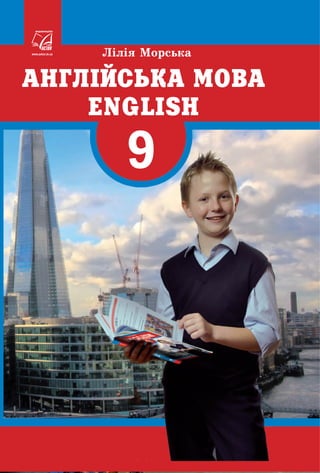
Ліëія Мîрська
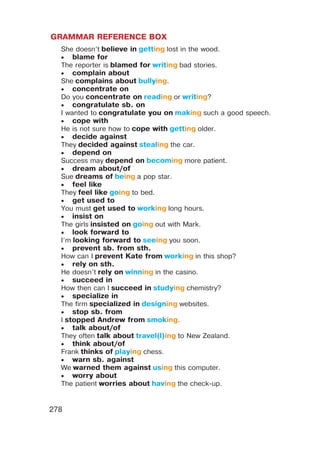
АÍÃËІÉÑЬÊА ÌÎВА
9
ЛіëіяМîрська
9
ENGLISH
АÍÃËІÉÑЬÊАÌÎВА
2017
ENGLISH
ÓÄÊ 811.111(075.3)
Ì 79
Морська Л.І.
М79 Англійська мова (9-й рік навчання) (English (Year 9)): підручник для 9 класу за-
гальноосвітніх навчальних закладів. — Тернопіль: Астон, 2017. — 280 c. : іл.
ISBN 978-966-308-691-0
Рекомендовано Міністерством освіти і науки України
(наказ МОН України від 20.03.2017 р. № 417)
Видано за рахунок державних коштів.
Продаж заборонено.
Експерти, які здійснили експертизу підручника під час проведення конкурсного відбору
проектів підручників для 9 класу загальноосвітніх навчальних закладів і зробили висновок про
доцільність надання підручнику грифа «Рекомендовано Міністерством освіти і науки України»:
Биховець Н. М., кандидат філологічних наук, старший науковий співробітник відділу
загального та порівняльно-історичного мовознавства Інституту мовознавства ім. О. О. Потебні
НАН України;
Навроцька Л. Г., учитель навчально-виховного комплексу № 2 м. Хмельницького, учитель-
методист.
Підручник призначений для учнів дев’ятих класів середніх загальноосвітніх навчальних
закладів.
Підручник складається із семи тематичних розділів відповідно до чинної програми
Міністерства освіти і науки («Світ професій», «Моя сім’я і друзі», «Наука і технології», «Природа.
Погодні умови. Навколишнє середовище», «Великобританія», «Стиль життя сучасної молоді.
Молодіжні клуби», «Засоби масової інформації: переваги та недоліки»). Кожен тематичний
розділ складається в середньому з 5 – 8 основних уроків і двох уроків на повторення
вивченого та закріплення сформованих навичок і вмінь. До кожного розділу додається по два
додаткових уроки без змістового наповнення, які вчитель зможе використати для задоволення
індивідуальних навчальних потреб учнів.
Умовні позначення
ISBN 978-966-308-691-0
© Морська Л. І., 2017
© ТзОВ «Видавництво Астон», 2017.
потренуйся
у вимові
скажи
англійською
послухай прочитай поміркуй
лексичні
завдання
вивчи
і запам’ятай
напиши, виконай
творче завдання
завдання для підго-
товки до підсумкової
атестації та ЗНО
3
REVISION LESSONS
LESSON 1
My Friends
Healthy Lifestyle
1. Listen to the text and answer the questions below.
Dear pupils!
It’s been eight years since you got acquainted with English. It’s certainly
been a wonderful time with exciting tours around the English speaking world.
There’s one more year to go – another year of a marvellous journey
into the wonders of Great Britain, mysteries of Mother Nature and the power of
science and technology, the magic of mass media, the happy and unforgettable
moments of family and friendship, the variety of occupational possibilities and
achievements, the best memories of easy-going youth life.
As you go on with the study of English, the textbook will help you get
prepared for the best performance at the English tests you will be asked to
take in the nearest future.
So, get ready for both enjoyment and consistent work! Remember,
success comes to those who take pains to reach it.
May success attend you!
1. What topics will you study this year?
2. Why do you need to work systematically with English?
3. In what way will this textbook be helpful for you?
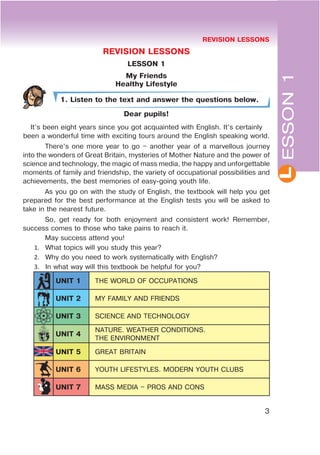
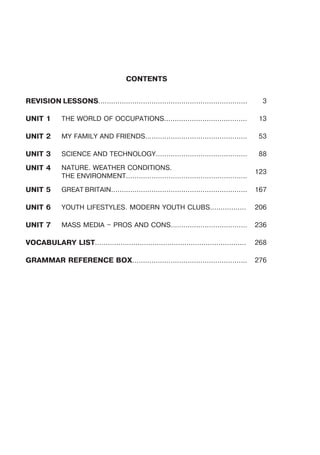
UNIT 1 THE WORLD OF OCCUPATIONS
UNIT 2 MY FAMILY AND FRIENDS
UNIT 3 SCIENCE AND TECHNOLOGY
UNIT 4
NATURE. WEATHER CONDITIONS.
THE ENVIRONMENT
UNIT 5 GREAT BRITAIN
UNIT 6 YOUTH LIFESTYLES. MODERN YOUTH CLUBS
UNIT 7 MASS MEDIA – PROS AND CONS
LESSON1
REVISION LESSONS
REVISION LESSONS
4
L
2. Practise speaking as it is given in the model.
Model: A: How do you keep in touch/interact with your friends/peers?
B: We often meet and go out for a walk…/ I use my cell phone
to talk to my best friends…/ We sometimes email each other,
but messaging is the most frequent mode of communication.
A: What about you?...
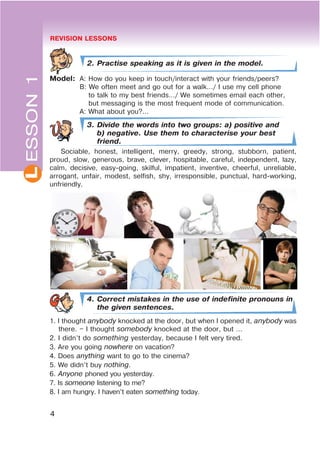
3. Divide the words into two groups: a) positive and
b) negative. Use them to characterise your best
friend.
Sociable, honest, intelligent, merry, greedy, strong, stubborn, patient,
proud, slow, generous, brave, clever, hospitable, careful, independent, lazy,
calm, decisive, easy-going, skilful, impatient, inventive, cheerful, unreliable,
arrogant, unfair, modest, selfish, shy, irresponsible, punctual, hard-working,
unfriendly.
4. Correct mistakes in the use of indefinite pronouns in
the given sentences.
1. I thought anybody knocked at the door, but when I opened it, anybody was
there. – I thought somebody knocked at the door, but …
2. I didn’t do something yesterday, because I felt very tired.
3. Are you going nowhere on vacation?
4. Does anything want to go to the cinema?
5. We didn’t buy nothing.
6. Anyone phoned you yesterday.
7. Is someone listening to me?
8. I am hungry. I haven’t eaten something today.
ESSON1
REVISION LESSONS
5
L
9. Would you like anything else?
10. There isn’t something interesting in this book.
5. Describe the lifestyles of œa live wireB and œa couch
potatoB. Use the model to help you.
Model:
“A live wire” person walks to school or work, but “a couch potato”
usually takes a bus or drives a car. “A live wire” does a lot of physical
exercises (works out in a gym, does his or her morning exercises
etc.), but “a couch potato” doesn’t exercise at all…
6. Fill in the blanks with the correct modal verb
(should(n’t), might, could(n’t). More than one variant is
possible.
1. You should focus more on your healthy habits. 2. You could/might eat
more fruit and vegetables if you want to lose weight. 3. Your book ____ be in
the living room. I saw it there a few minutes ago. 4. ____ I have something to
drink? 5. ____ I use your tablet to email my friend? 6. Ted ____ ski when he
was 6 years old. 7. Your brother ____ smoke. It is bad for his health.
7. Read an email and make up a similar one. Use the
Past Simple and the Past Continuous.
Model:
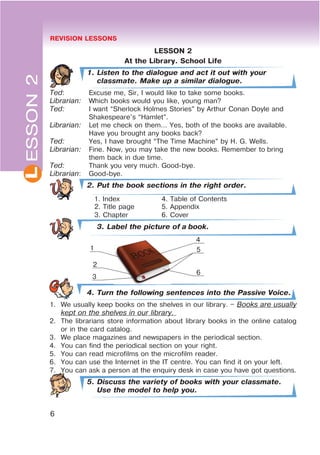
Hi, Kate!
The holidays have gone! It’s really sad. But I’ve got
plenty of marvellous impressions to share with you.
In June I went to a summer camp. It was great there.
Guess what happened while I was staying there?! An
earthquake!!! It was around 9 p.m. We were watching TV —
there was a nice comedy on when the earth started shaking.
We ran out of the house. There were a lot of people. They
were running here and there, the children were crying. In
about half an hour there was an announcement that the
earthquake was over, and people started returning to their
homes. It was quite a scary experience.
What about you? Did anything scary happen to you
during your summer holidays? I can’t wait to read your
stories.
Talk to you soon,
Linda.
ESSON1
REVISION LESSONS
6
L
LESSON 2
At the Library. School Life
1. Listen to the dialogue and act it out with your
classmate. Make up a similar dialogue.
Ted: Excuse me, Sir, I would like to take some books.
Librarian: Which books would you like, young man?
Ted: I want “Sherlock Holmes Stories” by Arthur Conan Doyle and
Shakespeare’s “Hamlet”.
Librarian: Let me check on them… Yes, both of the books are available.
Have you brought any books back?
Ted: Yes, I have brought “The Time Machine” by H. G. Wells.
Librarian: Fine. Now, you may take the new books. Remember to bring
them back in due time.
Ted: Thank you very much. Good-bye.
Librarian: Good-bye.
2. Put the book sections in the right order.
1. Index 4. Table of Contents
2. Title page 5. Appendix
3. Chapter 6. Cover
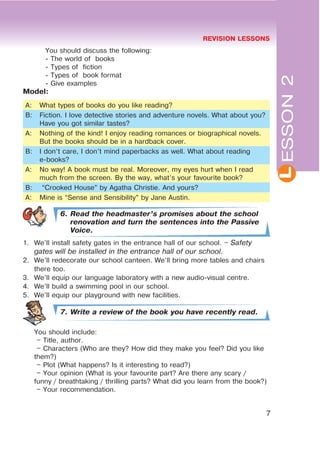
3. Label the picture of a book.
4. Turn the following sentences into the Passive Voice.
1. We usually keep books on the shelves in our library. – Books are usually
kept on the shelves in our library.
2. The librarians store information about library books in the online catalog
or in the card catalog.
3. We place magazines and newspapers in the periodical section.
4. You can find the periodical section on your right.
5. You can read microfilms on the microfilm reader.
6. You can use the Internet in the IT centre. You can find it on your left.
7. You can ask a person at the enquiry desk in case you have got questions.
5. Discuss the variety of books with your classmate.
Use the model to help you.
ESSON2
1
2
3
4
5
6
REVISION LESSONS
7
L
You should discuss the following:
- The world of books
- Types of fiction
- Types of book format
- Give examples
Model:
A: What types of books do you like reading?
B: Fiction. I love detective stories and adventure novels. What about you?
Have you got similar tastes?
A: Nothing of the kind! I enjoy reading romances or biographical novels.
But the books should be in a hardback cover.
B: I don’t care, I don’t mind paperbacks as well. What about reading
e-books?
A: No way! A book must be real. Moreover, my eyes hurt when I read
much from the screen. By the way, what’s your favourite book?
B: “Crooked House” by Agatha Christie. And yours?
A: Mine is “Sense and Sensibility” by Jane Austin.
6. Read the headmaster’s promises about the school
renovation and turn the sentences into the Passive
Voice.
1. We’ll install safety gates in the entrance hall of our school. – Safety
gates will be installed in the entrance hall of our school.
2. We’ll redecorate our school canteen. We’ll bring more tables and chairs
there too.
3. We’ll equip our language laboratory with a new audio-visual centre.
4. We’ll build a swimming pool in our school.
5. We’ll equip our playground with new facilities.
7. Write a review of the book you have recently read.
You should include:
– Title, author.
– Characters (Who are they? How did they make you feel? Did you like
them?)
– Plot (What happens? Is it interesting to read?)
– Your opinion (What is your favourite part? Are there any scary /
funny / breathtaking / thrilling parts? What did you learn from the book?)
– Your recommendation.
ESSON2
REVISION LESSONS
8
L
LESSON 3
Ukraine and Great Britain
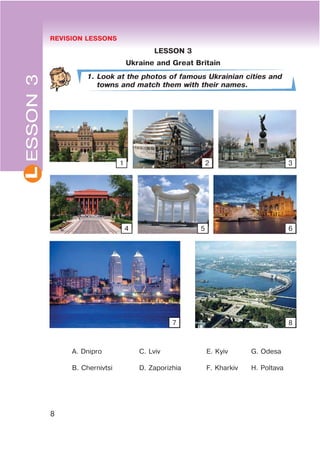
1. Look at the photos of famous Ukrainian cities and
towns and match them with their names.
A. Dnipro C. Lviv E. Kyiv G. Odesa
B. Chernivtsi D. Zaporizhia F. Kharkiv H. Poltava
ESSON3
1 2 3
4 5 6
7 8
REVISION LESSONS
9
L
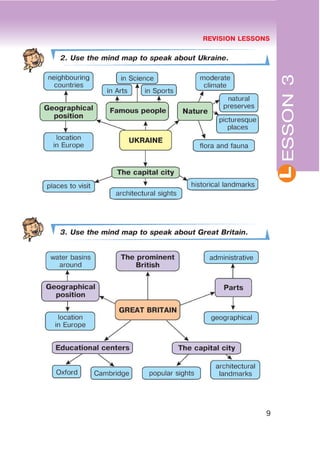
2. Use the mind map to speak about Ukraine.
3. Use the mind map to speak about Great Britain.
ESSON3
REVISION LESSONS
10
L
4. Read the sentences and guess which part of the
United Kingdom they tell about: England, Scotland,
Wales or Northern Ireland. There is a model to help
you.
1. The invention of the telephone was made by the person originally from
this part of the UK. – Scotland, because Alexander Bell invented the
telephone. He was a Scottish.
2. Its capital city is Cardiff. _________
3. A world famous music band started their career in one of its cities. Those
four became the symbol of world pop music of the XX century. _________
4. Its patron saint is St. George and the holiday falls on the 23rd
of April._______
5. Its flag is a white diagonal cross on a blue background. _________
6. The eldest son of the British monarch is traditionally granted the title of the
Prince of this part of the UK. _________
7. Belfast is the capital city here. _________
8. This part of the UK frightens people by its famous lake monster. ________
5. Compare the capital cities of Ukraine and the UK.
Use the model to help you.
Model:
With the population of about 13 million people, London is bigger than
Kyiv, which has got the population of about 5 million residents.
Kyiv is (much) younger than London. It was founded in 998, and
London began its history in the 1st
century before Christ (BC).
6. Correct the mistakes in the given sentences.
1. It’s quite colder this month than it was the previous month. – It’s rather
colder this month than it was the previous month.
2. She is clever but almost lazy.
3. It’s rather an interesting film.
4. I don’t almost understand what he means.
5. The teacher put a «12» for my test. It was almost a surprise.
6. Quite all students in our class love English.
ESSON3
REVISION LESSONS
11
L
LESSON 4
Music
Mass Media
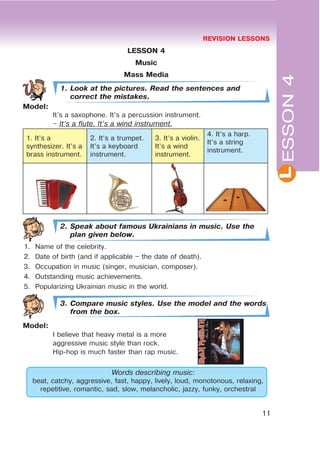
1. Look at the pictures. Read the sentences and
correct the mistakes.
Model:
It’s a saxophone. It’s a percussion instrument.
– It’s a flute. It’s a wind instrument.
1. It’s a
synthesizer. It’s a
brass instrument.
2. It’s a trumpet.
It’s a keyboard
instrument.
3. It’s a violin.
It’s a wind
instrument.
4. It’s a harp.
It’s a string
instrument.
2. Speak about famous Ukrainians in music. Use the
plan given below.
1. Name of the celebrity.
2. Date of birth (and if applicable – the date of death).
3. Occupation in music (singer, musician, composer).
4. Outstanding music achievements.
5. Popularizing Ukrainian music in the world.
3. Compare music styles. Use the model and the words
from the box.
Model:
I believe that heavy metal is a more
aggressive music style than rock.
Hip-hop is much faster than rap music.
Words describing music:
beat, catchy, aggressive, fast, happy, lively, loud, monotonous, relaxing,
repetitive, romantic, sad, slow, melancholic, jazzy, funky, orchestral
ESSON4
L
12
4. Turn the following sentences into the Active Voice.
Model:
More than two hundred songs were written by our local composer
last year. $ Our local composer wrote more than two hundred
songs last year.
1. In 1999 the first success was brought to Britney Spears by “Baby one
more time”.
2. Britney`s second son was born in 2006.
3. The Moonlight sonata was composed by Ludwig van Beethoven.
4. In 2005, Ruslana was given the Person of the Year Award in Turkey.
5. Mykola Lysenko was sent to prison in 1907 by the Russian monarch for
his hatred for Russian autocracy.
5. Sort out the words from the box in the correct
column.
a sports section, online news, celebrities, a review section, articles,
Sunday papers, main stories, editor, interviews, daily papers,
advertisement, the front page, journalists.
People
Things you find in a
newspaper
Other
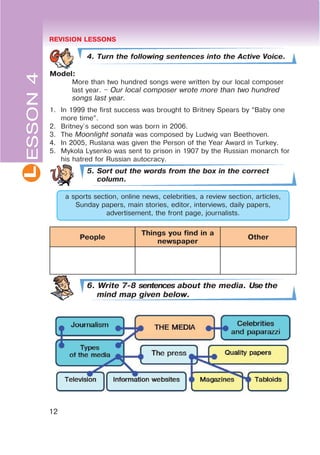
6. Write 7-8 sentences about the media. Use the
mind map given below.
ESSON4 REVISION LESSONS
L
13
ESSON5
LESSON 5
1. Listen to the dialogue and act it out with your
classmate. Pay attention to the words in bold.
Make up a similar dialogue.
Ted is talking to Mr. Rooney who he has just met in a cafe. They are
having a conversation when Ted asks Mr. Rooney what he does for
a living ...
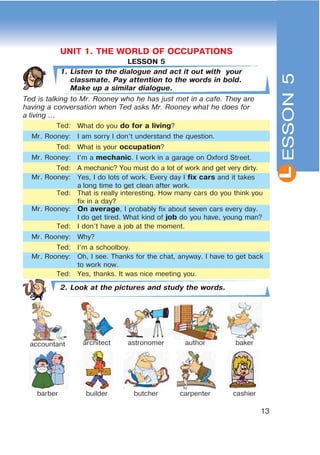
Ted: What do you do for a living?
Mr. Rooney: I am sorry I don’t understand the question.
Ted: What is your occupation?
Mr. Rooney: I’m a mechanic. I work in a garage on Oxford Street.
Ted: A mechanic? You must do a lot of work and get very dirty.
Mr. Rooney: Yes, I do lots of work. Every day I fix cars and it takes
a long time to get clean after work.
Ted: That is really interesting. How many cars do you think you
fix in a day?
Mr. Rooney: On average, I probably fix about seven cars every day.
I do get tired. What kind of job do you have, young man?
Ted: I don’t have a job at the moment.
Mr. Rooney: Why?
Ted: I’m a schoolboy.
Mr. Rooney: Oh, I see. Thanks for the chat, anyway. I have to get back
to work now.
Ted: Yes, thanks. It was nice meeting you.
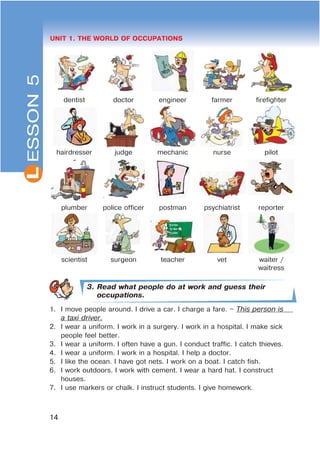
2. Look at the pictures and study the words.
accountant architect astronomer author baker
barber builder butcher carpenter cashier
L
UNIT 1. THE WORLD OF OCCUPATIONS
L
14
UNIT 1. THE WORLD OF OCCUPATIONS
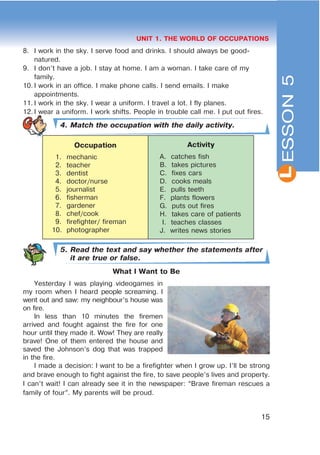
dentist doctor engineer farmer firefighter
hairdresser judge mechanic nurse pilot
plumber police officer postman psychiatrist reporter
scientist surgeon teacher vet waiter /
waitress
3. Read what people do at work and guess their
occupations.
1. I move people around. I drive a car. I charge a fare. – This person is
a taxi driver.
2. I wear a uniform. I work in a surgery. I work in a hospital. I make sick
people feel better.
3. I wear a uniform. I often have a gun. I conduct traffic. I catch thieves.
4. I wear a uniform. I work in a hospital. I help a doctor.
5. I like the ocean. I have got nets. I work on a boat. I catch fish.
6. I work outdoors. I work with cement. I wear a hard hat. I construct
houses.
7. I use markers or chalk. I instruct students. I give homework.
ESSON5
L
15
UNIT 1. THE WORLD OF OCCUPATIONS
8. I work in the sky. I serve food and drinks. I should always be good-
natured.
9. I don’t have a job. I stay at home. I am a woman. I take care of my
family.
10. I work in an office. I make phone calls. I send emails. I make
appointments.
11. I work in the sky. I wear a uniform. I travel a lot. I fly planes.
12. I wear a uniform. I work shifts. People in trouble call me. I put out fires.
4. Match the occupation with the daily activity.
Occupation
1. mechanic
2. teacher
3. dentist
4. doctor/nurse
5. journalist
6. fisherman
7. gardener
8. chef/cook
9. firefighter/ fireman
10. photographer
Activity
A. catches fish
B. takes pictures
C. fixes cars
D. cooks meals
E. pulls teeth
F. plants flowers
G. puts out fires
H. takes care of patients
I. teaches classes
J. writes news stories
5. Read the text and say whether the statements after
it are true or false.
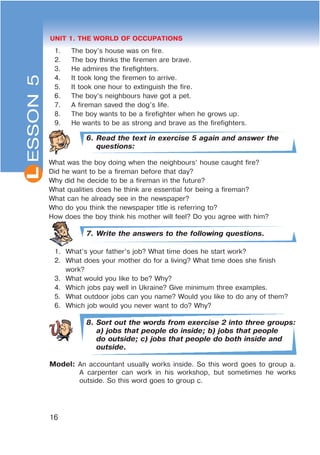
What I Want to Be
Yesterday I was playing videogames in
my room when I heard people screaming. I
went out and saw: my neighbour’s house was
on fire.
In less than 10 minutes the firemen
arrived and fought against the fire for one
hour until they made it. Wow! They are really
brave! One of them entered the house and
saved the Johnson’s dog that was trapped
in the fire.
I made a decision: I want to be a firefighter when I grow up. I’ll be strong
and brave enough to fight against the fire, to save people’s lives and property.
I can’t wait! I can already see it in the newspaper: “Brave fireman rescues a
family of four”. My parents will be proud.
ESSON5
L
16
UNIT 1. THE WORLD OF OCCUPATIONSESSON5
1. The boy’s house was on fire.
2. The boy thinks the firemen are brave.
3. He admires the firefighters.
4. It took long the firemen to arrive.
5. It took one hour to extinguish the fire.
6. The boy’s neighbours have got a pet.
7. A fireman saved the dog’s life.
8. The boy wants to be a firefighter when he grows up.
9. He wants to be as strong and brave as the firefighters.
6. Read the text in exercise 5 again and answer the
questions:
What was the boy doing when the neighbours’ house caught fire?
Did he want to be a fireman before that day?
Why did he decide to be a fireman in the future?
What qualities does he think are essential for being a fireman?
What can he already see in the newspaper?
Who do you think the newspaper title is referring to?
How does the boy think his mother will feel? Do you agree with him?
7. Write the answers to the following questions.
1. What’s your father’s job? What time does he start work?
2. What does your mother do for a living? What time does she finish
work?
3. What would you like to be? Why?
4. Which jobs pay well in Ukraine? Give minimum three examples.
5. What outdoor jobs can you name? Would you like to do any of them?
6. Which job would you never want to do? Why?
8. Sort out the words from exercise 2 into three groups:
a) jobs that people do inside; b) jobs that people
do outside; c) jobs that people do both inside and
outside.
Model: An accountant usually works inside. So this word goes to group a.
A carpenter can work in his workshop, but sometimes he works
outside. So this word goes to group c.
L
17
UNIT 1. THE WORLD OF OCCUPATIONS
LESSON 6
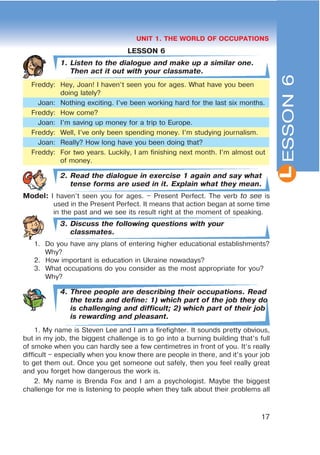
1. Listen to the dialogue and make up a similar one.
Then act it out with your classmate.
Freddy: Hey, Joan! I haven’t seen you for ages. What have you been
doing lately?
Joan: Nothing exciting. I’ve been working hard for the last six months.
Freddy: How come?
Joan: I’m saving up money for a trip to Europe.
Freddy: Well, I’ve only been spending money. I’m studying journalism.
Joan: Really? How long have you been doing that?
Freddy: For two years. Luckily, I am finishing next month. I’m almost out
of money.
2. Read the dialogue in exercise 1 again and say what
tense forms are used in it. Explain what they mean.
Model: I haven’t seen you for ages. – Present Perfect. The verb to see is
used in the Present Perfect. It means that action began at some time
in the past and we see its result right at the moment of speaking.
3. Discuss the following questions with your
classmates.
1. Do you have any plans of entering higher educational establishments?
Why?
2. How important is education in Ukraine nowadays?
3. What occupations do you consider as the most appropriate for you?
Why?
4. Three people are describing their occupations. Read
the texts and define: 1) which part of the job they do
is challenging and difficult; 2) which part of their job
is rewarding and pleasant.
1. My name is Steven Lee and I am a firefighter. It sounds pretty obvious,
but in my job, the biggest challenge is to go into a burning building that’s full
of smoke when you can hardly see a few centimetres in front of you. It’s really
difficult – especially when you know there are people in there, and it’s your job
to get them out. Once you get someone out safely, then you feel really great
and you forget how dangerous the work is.
2. My name is Brenda Fox and I am a psychologist. Maybe the biggest
challenge for me is listening to people when they talk about their problems all
ESSON6
L
18
UNIT 1. THE WORLD OF OCCUPATIONS
day. At the end of the day I’m usually worn out. At times, it can be depressing
as well. On the other hand, I see that my patients make real progress.
3. My name is Kevin Den. As a camp counselor, it’s difficult to find a way to
get through to kids with problems and win their trust. Sometimes kids are very
suspicious and find it hard to trust an adult – even a young adult. So the hardest
part of my job is to make them open up. Once you’ve done that, they almost
become different people. One of the things I find most rewarding is that I see
them as they develop confidence.
Model: Firefighter:
challenging and difficult – to enter a burning building that is full
of smoke; to find people in the burning place; – rewarding and
pleasant – to rescue people and save lives;
5. Read the text in exercise 4 again and suggest the
most challenging and rewarding things for the
following occupations: a police officer, a teacher,
a doctor, a journalist, a driver. Use the model in
exercise 4.
6. Read the following tongue-twister as quickly as you
can.
The enthusiasm that Theresa Thomas told of took the terribly thin
thirty-year-old Turkish thespian Theseus Thurber completely by surprise.
7. Read job descriptions and write down the
occupations.
1. This person puts things together. He or she often should work in
shifts. Such workers usually work in a factory, on an assembly line. –
assembly line factory worker.
2. This person usually works on weekdays, but often he or she needs to
work on weekends as well. These workers have a cash register which
they use in a shop.
3. This person wears a uniform, often of green colour. He is usually a
man. He has a gun and defends his own country.
4. This person works at or near home. These workers drive a tractor, grow
vegetables, and have animals in the field.
5. This person needs to walk or ride a bicycle a lot. He or she delivers
mail.
6. This person wears a uniform, usually of white colour. He or she feeds
people. These workers usually work in a kitchen and cook there.
ESSON6
L
19
UNIT 1. THE WORLD OF OCCUPATIONS
LESSON 7
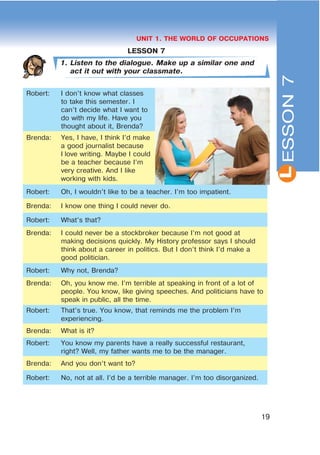
1. Listen to the dialogue. Make up a similar one and
act it out with your classmate.
Robert: I don’t know what classes
to take this semester. I
can’t decide what I want to
do with my life. Have you
thought about it, Brenda?
Brenda: Yes, I have, I think I’d make
a good journalist because
I love writing. Maybe I could
be a teacher because I’m
very creative. And I like
working with kids.
Robert: Oh, I wouldn’t like to be a teacher. I’m too impatient.
Brenda: I know one thing I could never do.
Robert: What’s that?
Brenda: I could never be a stockbroker because I’m not good at
making decisions quickly. My History professor says I should
think about a career in politics. But I don’t think I’d make a
good politician.
Robert: Why not, Brenda?
Brenda: Oh, you know me. I’m terrible at speaking in front of a lot of
people. You know, like giving speeches. And politicians have to
speak in public, all the time.
Robert: That’s true. You know, that reminds me the problem I’m
experiencing.
Brenda: What is it?
Robert: You know my parents have a really successful restaurant,
right? Well, my father wants me to be the manager.
Brenda: And you don’t want to?
Robert: No, not at all. I’d be a terrible manager. I’m too disorganized.
ESSON7
L
20
UNIT 1. THE WORLD OF OCCUPATIONS
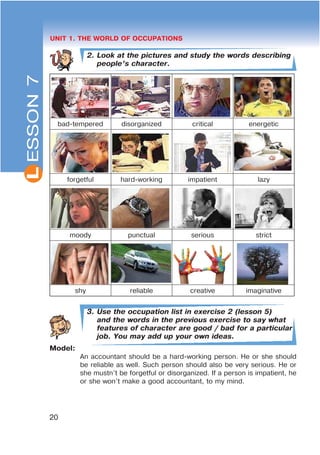
2. Look at the pictures and study the words describing
people’s character.
bad-tempered disorganized critical energetic
forgetful hard-working impatient lazy
moody punctual serious strict
shy reliable creative imaginative
3. Use the occupation list in exercise 2 (lesson 5)
and the words in the previous exercise to say what
features of character are good / bad for a particular
job. You may add up your own ideas.
Model:
An accountant should be a hard-working person. He or she should
be reliable as well. Such person should also be very serious. He or
she mustn’t be forgetful or disorganized. If a person is impatient, he
or she won’t make a good accountant, to my mind.
ESSON7
L
21
UNIT 1. THE WORLD OF OCCUPATIONS
ESSON7
4. Use the words in exercise 2 (lesson 5) and say
what people usually do at work. Use the model to
help you.
Model: an accountant.
This person usually works in an office. He or she counts the money
that is spent and earned by the company. He or she also counts the
money that is paid to workers.
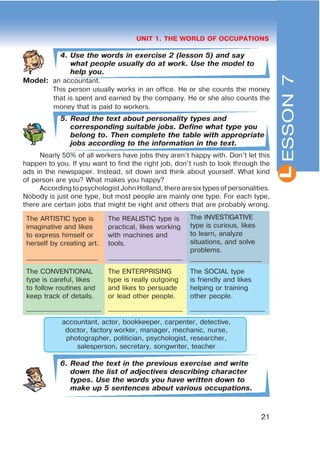
5. Read the text about personality types and
corresponding suitable jobs. Define what type you
belong to. Then complete the table with appropriate
jobs according to the information in the text.
Nearly 50% of all workers have jobs they aren’t happy with. Don’t let this
happen to you. If you want to find the right job, don’t rush to look through the
ads in the newspaper. Instead, sit down and think about yourself. What kind
of person are you? What makes you happy?
According to psychologist John Holland, there are six types of personalities.
Nobody is just one type, but most people are mainly one type. For each type,
there are certain jobs that might be right and others that are probably wrong.
The ARTISTIC type is
imaginative and likes
to express himself or
herself by creating art.
_____________________
The REALISTIC type is
practical, likes working
with machines and
tools.
______________________
The INVESTIGATIVE
type is curious, likes
to learn, analyze
situations, and solve
problems.
_____________________
The CONVENTIONAL
type is careful, likes
to follow routines and
keep track of details.
______________________
The ENTERPRISING
type is really outgoing
and likes to persuade
or lead other people.
______________________
The SOCIAL type
is friendly and likes
helping or training
other people.
______________________
accountant, actor, bookkeeper, carpenter, detective,
doctor, factory worker, manager, mechanic, nurse,
photographer, politician, psychologist, researcher,
salesperson, secretary, songwriter, teacher
6. Read the text in the previous exercise and write
down the list of adjectives describing character
types. Use the words you have written down to
make up 5 sentences about various occupations.
L
22
UNIT 1. THE WORLD OF OCCUPATIONS
LESSON 8
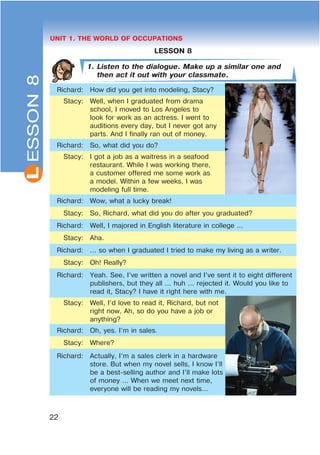
1. Listen to the dialogue. Make up a similar one and
then act it out with your classmate.
Richard: How did you get into modeling, Stacy?
Stacy: Well, when I graduated from drama
school, I moved to Los Angeles to
look for work as an actress. I went to
auditions every day, but I never got any
parts. And I finally ran out of money.
Richard: So, what did you do?
Stacy: I got a job as a waitress in a seafood
restaurant. While I was working there,
a customer offered me some work as
a model. Within a few weeks, I was
modeling full time.
Richard: Wow, what a lucky break!
Stacy: So, Richard, what did you do after you graduated?
Richard: Well, I majored in English literature in college ...
Stacy: Aha.
Richard: ... so when I graduated I tried to make my living as a writer.
Stacy: Oh! Really?
Richard: Yeah. See, I’ve written a novel and I’ve sent it to eight different
publishers, but they all ... huh ... rejected it. Would you like to
read it, Stacy? I have it right here with me.
Stacy: Well, I’d love to read it, Richard, but not
right now. Ah, so do you have a job or
anything?
Richard: Oh, yes. I’m in sales.
Stacy: Where?
Richard: Actually, I’m a sales clerk in a hardware
store. But when my novel sells, I know I’ll
be a best-selling author and I’ll make lots
of money ... When we meet next time,
everyone will be reading my novels…
ESSON8
L
23
UNIT 1. THE WORLD OF OCCUPATIONS
Focus on Grammar
Future Continuous
The last sentence of the previous exercise introduces a new tense
form for you. It’s the Future Continuous tense form. We use this tense form to
express:
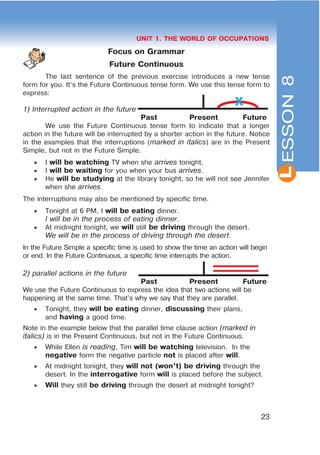
1) Interrupted action in the future
Past Present Future
We use the Future Continuous tense form to indicate that a longer
action in the future will be interrupted by a shorter action in the future. Notice
in the examples that the interruptions (marked in italics) are in the Present
Simple, but not in the Future Simple.
 I will be watching TV when she arrives tonight.
 I will be waiting for you when your bus arrives.
 He will be studying at the library tonight, so he will not see Jennifer
when she arrives.
The interruptions may also be mentioned by specific time.
 Tonight at 6 PM, I will be eating dinner.
I will be in the process of eating dinner.
 At midnight tonight, we will still be driving through the desert.
We will be in the process of driving through the desert.
In the Future Simple a specific time is used to show the time an action will begin
or end. In the Future Continuous, a specific time interrupts the action.
2) parallel actions in the future
Past Present Future
We use the Future Continuous to express the idea that two actions will be
happening at the same time. That’s why we say that they are parallel.
 Tonight, they will be eating dinner, discussing their plans,
and having a good time.
Note in the example below that the parallel time clause action (marked in
italics) is in the Present Continuous, but not in the Future Continuous.
 While Ellen is reading, Tim will be watching television. In the
negative form the negative particle not is placed after will.
 At midnight tonight, they will not (won’t) be driving through the
desert. In the interrogative form will is placed before the subject.
 Will they still be driving through the desert at midnight tonight?
ESSON8
X
L
24
UNIT 1. THE WORLD OF OCCUPATIONS
2. Put the verbs in brackets in the Future Continuous
tense form.
1. At this time next week I _______ (sit) in the plane on the way to New York
to start my first job.
2. Don’t call me after 2 pm tomorrow. I _____ (work) with my friends on our
test results.
3. If you want to see Liza tomorrow afternoon, you will have to go to the
school. She ______ (take) a test all afternoon.
4. The mechanic ______ (repair) my car this Saturday. His mother-in-law is
arriving on Friday.
5. While the plumber is fixing our water taps, I _____ (read) a newspaper in
the kitchen.
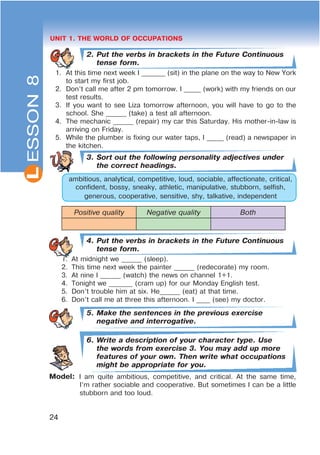
3. Sort out the following personality adjectives under
the correct headings.
ambitious, analytical, competitive, loud, sociable, affectionate, critical,
confident, bossy, sneaky, athletic, manipulative, stubborn, selfish,
generous, cooperative, sensitive, shy, talkative, independent
Positive quality Negative quality Both
4. Put the verbs in brackets in the Future Continuous
tense form.
1. At midnight we ______ (sleep).
2. This time next week the painter ______ (redecorate) my room.
3. At nine I ______ (watch) the news on channel 1+1.
4. Tonight we _______ (cram up) for our Monday English test.
5. Don’t trouble him at six. He______ (eat) at that time.
6. Don’t call me at three this afternoon. I ____ (see) my doctor.
5. Make the sentences in the previous exercise
negative and interrogative.
6. Write a description of your character type. Use
the words from exercise 3. You may add up more
features of your own. Then write what occupations
might be appropriate for you.
Model: I am quite ambitious, competitive, and critical. At the same time,
I’m rather sociable and cooperative. But sometimes I can be a little
stubborn and too loud.
ESSON8
L
25
UNIT 1. THE WORLD OF OCCUPATIONS
I think I could make a good manager. The job of a flight attendant
could also be suitable for me.
I don’t think I would make a successful accountant or an architect. I
am not creative enough for these occupations.
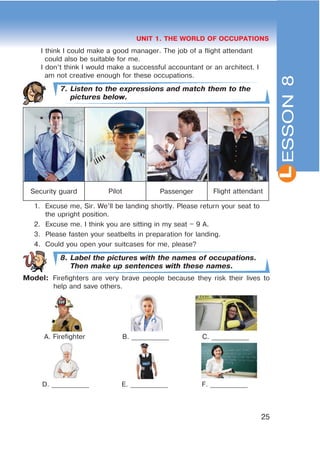
7. Listen to the expressions and match them to the
pictures below.
Security guard Pilot Passenger Flight attendant
1. Excuse me, Sir. We’ll be landing shortly. Please return your seat to
the upright position.
2. Excuse me. I think you are sitting in my seat – 9 A.
3. Please fasten your seatbelts in preparation for landing.
4. Could you open your suitcases for me, please?
8. Label the pictures with the names of occupations.
Then make up sentences with these names.
Model: Firefighters are very brave people because they risk their lives to
help and save others.
A. Firefighter B. ___________ C. ___________
D. ___________ E. ___________ F. ___________
ESSON8
L
26
UNIT 1. THE WORLD OF OCCUPATIONS
LESSON 9
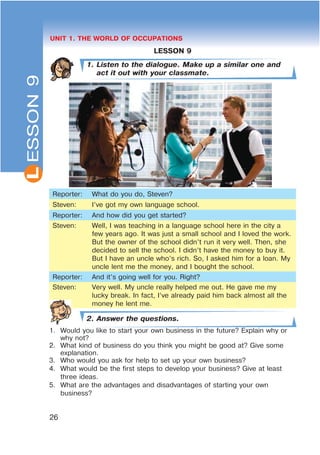
1. Listen to the dialogue. Make up a similar one and
act it out with your classmate.
Reporter: What do you do, Steven?
Steven: I’ve got my own language school.
Reporter: And how did you get started?
Steven: Well, I was teaching in a language school here in the city a
few years ago. It was just a small school and I loved the work.
But the owner of the school didn’t run it very well. Then, she
decided to sell the school. I didn’t have the money to buy it.
But I have an uncle who’s rich. So, I asked him for a loan. My
uncle lent me the money, and I bought the school.
Reporter: And it’s going well for you. Right?
Steven: Very well. My uncle really helped me out. He gave me my
lucky break. In fact, I’ve already paid him back almost all the
money he lent me.
2. Answer the questions.
1. Would you like to start your own business in the future? Explain why or
why not?
2. What kind of business do you think you might be good at? Give some
explanation.
3. Who would you ask for help to set up your own business?
4. What would be the first steps to develop your business? Give at least
three ideas.
5. What are the advantages and disadvantages of starting your own
business?
ESSON9
L
27
UNIT 1. THE WORLD OF OCCUPATIONS
3. Read the text and fill in the gaps with the
appropriate word.
A Happy Job
Do you want a job that brings you
happiness? If so you might want to consider
1) _____ as a career. A new 2) _____ has
said that hairdressers are the happiest
workers in the UK.
So what is it about being a hairdresser
that makes you 3) _____? Jonathan Pickup
who works at the Slice Salon in Newcastle
and has been a hairdresser for 21 years
says “It’s quite a young environment – it’s
quite 4)____. You mix with quite a lot of young people. You get to my age
and it is quite nice to be around people who are eager in their job”. Michael
Gooddy from examination body City & Guilds who conducted the survey said
there were lots of 5) _____why happiness and hairdressing should go hand
in 6) ____. “It is the relationship they have with their client which makes the
job what it is…They are appreciated. They make people feel 7) ____ and look
good.”
…But before you get out your curling 8) ____ and enrol on the nearest
hairdressing 9) _____, see what other hairdressers have to say! Here are some
of the comments posted on the BBC website following this story.
“I am a 10) ____ hairdresser … and gave up 8 years ago to do a degree.
I am now working at a university and have regular hours, no back problems,
Saturdays to do what I want with and no late nights. There is nothing I 11) ____
about hairdressing…”. Jill Handley from Norwich says “I did summer work [at a
hairdressers] as a teenager and 12) ____ every minute of it. There was no way
in the world I would want to be a stylist and now very 13) ____ working in IT.’
So maybe there are a few 14) ____ to being a hairdresser, even if the job
does make some people happy – long hours and a lot of 15) ____ may not
make everyone happy. If hairdressing isn’t your thing then you’ll be glad to
hear that the same survey found that, as well as hairdressers, clergy, chefs,
beauticians, 16) ____ and mechanics were also happy jobs to have. However,
to save yourself from unhappiness in your job avoid being social workers,
architects and estate agents! Maybe it’s about being able to do something
practical or creative that makes you happy?
ESSON9
L
28
UNIT 1. THE WORLD OF OCCUPATIONS
1 a. hairdresser b. hairdressing c. hairdressers d. hairdressed
2 a. researcher b. researching c. research d. researched
3 a. happiness b. happiest c. unhappy d. happy
4 a. trendy b. trend c. trends d. trendying
5 a. reasoning b. reason c. reasons d. reasoned
6 a. hand b. leg c. arm d. foot
7 a. well b. goods c. best d. good
8 a. scissors b. pliers c. tongs d. trimmers
9 a. discipline b. master c. course d. training
10 a. former b. previous c. current d. next
11 a. catch b. hate c. say d. miss
12 a. liked b. hated c. spoke d. missed
13 a. content b. contents c. contented d. contenting
14 a. downside b. downsiding c. downsiders d. downsides
15 a. sitting b. standing c. rising d. raising
16 a. plumber b. plumps c. plums d. plumbers
4. Read the text in the previous exercise again and
find the names of the occupations mentioned in
it. Say whether you would feel happy being one of
them. Give your reasons.
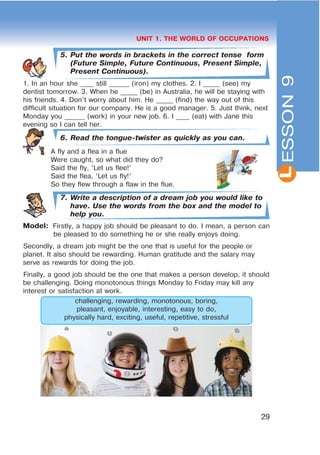
Model:
It is mentioned in the text that social workers
don’t feel happy at work. I wouldn’t say so.
Working with people who need your help or
some piece of advice is always pleasant:
you feel that people need you, they feel
better – you can see this progress in their
lives. I would feel happy working as a social
worker.
On the contrary, I wouldn’t feel happy being a
mechanic. There are a lot of disadvantages in
this occupation. It’s fine when it’s warm outside,
but what about wintertime? It’s not that warm in
those garages! Moreover, you are dirty all the time
because of the dirty cars, the oil and the grease from
the engine. No way! I wouldn’t like to be a mechanic.
ESSON9
L
29
UNIT 1. THE WORLD OF OCCUPATIONS
5. Put the words in brackets in the correct tense form
(Future Simple, Future Continuous, Present Simple,
Present Continuous).
1. In an hour she ____ still ______ (iron) my clothes. 2. I _____ (see) my
dentist tomorrow. 3. When he _____ (be) in Australia, he will be staying with
his friends. 4. Don’t worry about him. He _____ (find) the way out of this
difficult situation for our company. He is a good manager. 5. Just think, next
Monday you ______ (work) in your new job. 6. I ____ (eat) with Jane this
evening so I can tell her.
6. Read the tongue-twister as quickly as you can.
A fly and a flea in a flue
Were caught, so what did they do?
Said the fly, ‘Let us flee!’
Said the flea, ‘Let us fly!’
So they flew through a flaw in the flue.
7. Write a description of a dream job you would like to
have. Use the words from the box and the model to
help you.
Model: Firstly, a happy job should be pleasant to do. I mean, a person can
be pleased to do something he or she really enjoys doing.
Secondly, a dream job might be the one that is useful for the people or
planet. It also should be rewarding. Human gratitude and the salary may
serve as rewards for doing the job.
Finally, a good job should be the one that makes a person develop, it should
be challenging. Doing monotonous things Monday to Friday may kill any
interest or satisfaction at work.
challenging, rewarding, monotonous, boring,
pleasant, enjoyable, interesting, easy to do,
physically hard, exciting, useful, repetitive, stressful
ESSON9
L
30
UNIT 1. THE WORLD OF OCCUPATIONS
LESSON 10
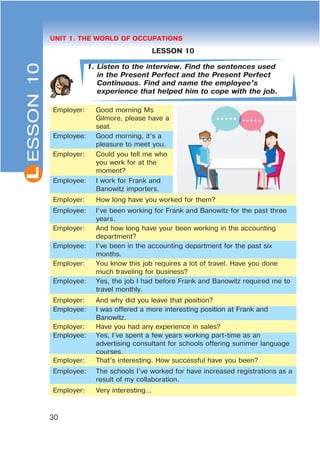
1. Listen to the interview. Find the sentences used
in the Present Perfect and the Present Perfect
Continuous. Find and name the employee’s
experience that helped him to cope with the job.
Employer: Good morning Ms
Gilmore, please have a
seat.
Employee: Good morning, it’s a
pleasure to meet you.
Employer: Could you tell me who
you work for at the
moment?
Employee: I work for Frank and
Banowitz importers.
Employer: How long have you worked for them?
Employee: I’ve been working for Frank and Banowitz for the past three
years.
Employer: And how long have your been working in the accounting
department?
Employee: I’ve been in the accounting department for the past six
months.
Employer: You know this job requires a lot of travel. Have you done
much traveling for business?
Employee: Yes, the job I had before Frank and Banowitz required me to
travel monthly.
Employer: And why did you leave that position?
Employee: I was offered a more interesting position at Frank and
Banowitz.
Employer: Have you had any experience in sales?
Employee: Yes, I’ve spent a few years working part-time as an
advertising consultant for schools offering summer language
courses.
Employer: That’s interesting. How successful have you been?
Employee: The schools I’ve worked for have increased registrations as a
result of my collaboration.
Employer: Very interesting...
ESSON10
L
31
UNIT 1. THE WORLD OF OCCUPATIONS
2. Read the sentences and guess the meaning of
the words. Then use the words to make up five
sentences of your own. Use the dictionary to
help you.
Job collocations
 Working environment – I have quite a stressful working
environment.
 Hours of work – I don’t think I would like to be a doctor because
the hours of work would be very tiring.
 Work-life balance – A sensible work-life balance can help
employees work more efficiently.
 Job satisfaction – It is hard to underestimate the value of job
satisfaction.
Career words
 Interview – The company needs to change the interview process
so that it hires the right candidates.
 Qualification – It is not always the case that a university degree is
the best qualification for the job.
 Experience – Some graduates have difficulty finding a job because
they do not have the relevant work experience.
 Training – Employers need to provide training to ensure that their
staff are able to adapt to new technologies.
 Promotion – He received a promotion as a result of the big efforts
he had been making.
 Resignation – There is a danger that employees will hand in
their resignation and look for another job.
Money words
 Salary – Not everyone is primarily interested in the salary on offer
when they choose a job.
 Pay – Some people prefer to work part time even though the pay is
less than full-time work.
 Bonus – One solution is to offer employees a bonus as an incentive
to make them work more efficiently.
 Perk – Nowadays, it is less common for companies to offer
a company car as a perk.
ESSON10
L
32
UNIT 1. THE WORLD OF OCCUPATIONS
3. When you finish your education, you will have to find
a job. Sometimes people need to apply for a job in
the written form. Read the statements and say which
you would include in your application letter.
1) what you could offer
to the job;
3) ask questions
about the job;
5) describe how
wonderful you are;
2) mention skills or
qualifications you have;
4) show enthusiasm
for the job;
6) state how much
money you need.
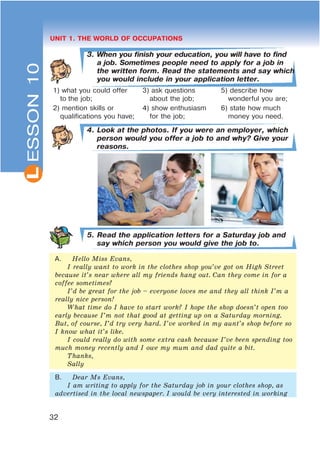
4. Look at the photos. If you were an employer, which
person would you offer a job to and why? Give your
reasons.
5. Read the application letters for a Saturday job and
say which person you would give the job to.
A. Hello Miss Evans,
I really want to work in the clothes shop you’ve got on High Street
because it’s near where all my friends hang out. Can they come in for a
coffee sometimes?
I’d be great for the job – everyone loves me and they all think I’m a
really nice person!
What time do I have to start work? I hope the shop doesn’t open too
early because I’m not that good at getting up on a Saturday morning.
But, of course, I’d try very hard. I’ve worked in my aunt’s shop before so
I know what it’s like.
I could really do with some extra cash because I’ve been spending too
much money recently and I owe my mum and dad quite a bit.
Thanks,
Sally
B. Dear Ms Evans,
I am writing to apply for the Saturday job in your clothes shop, as
advertised in the local newspaper. I would be very interested in working
ESSON10
L
33
UNIT 1. THE WORLD OF OCCUPATIONS
in a clothes shop since I follow the latest fashion and have always
wanted to work with clothes.
I am sixteen years old and still at school. One of my subjects is
Design and I am thinking about studying fashion design when I leave
school. I am not afraid of hard work and I am never late.
I would like to ask if you only wanted somebody for Saturdays, or
would Friday evenings be possible as well? If this were the case, then I
would be interested in working on Fridays, too. I would also be grateful
if you could let me know how much the wages will be.
I look forward to hearing from you.
Yours sincerely,
Barbara Green
6. Look at the two job advertisements. Use the template
of an application letter and exercise 5 and write your
application to one of the advertised companies.
Application letter template:
Paragraph 1: reason for writing, mention where you saw the advertisement
for the job and why you are interested in it.
Paragraph 2: refer to the advertisement and how your skills and
qualifications match the job.
Paragraph 3: show interest by asking for further information.
Paragraph 4: close with a formal phrase.
Advertisement A
Multi-national company offers the position of a secretary
We offer: - a competitive salary; - training; - the prospect of a career.
Applicants must: - have a university or college degree preferably
in economics; - be fluent in English; - have excellent computing skills
(Office, Excel, Powerpoint); be able to type and take shorthands; - have
a minimum of 2 year experience in interpreting and translating; - have a
strong commitment to the job.
Send your CV and application letter to Mary Wattson at wattson@gmail.com
Advertisement B
Small firm is seeking a secretary to its Executive
Applicants need to have a high school diploma, and good
communication skills. We consider shorthand and typing skills as
advantages.
All our employees experience a friendly environment, have flexible
working hours and anjoy a range of benefits that our company offers.
For a more detailed description, please visit our website:
www.nanofirm.com
ESSON10
L
34
UNIT 1. THE WORLD OF OCCUPATIONS
LESSON 11
1. Listen to the dialogue and make up a similar one.
Then act it out with your classmate.
Reporter: What do you do, Victor?
Victor: I’m a writer.
Reporter: What do you write?
Victor: I write plays and fiction, short stories
mainly, as well as magazine articles.
Reporter: Have you been writing full-time for
long?
Victor: About five years.
Reporter: And how did you become a writer?
Victor: Well, I used to work for a company. I was living in Los Angeles
at the time. I was writing company reports, brochures ... that
kind of thing. And I wrote for my own pleasure, you know, as a
hobby. One day, I entered a short story of mine in a magazine
contest ... and my story won the first prize. The editor of the
magazine liked my story so much that she asked me to write
another one. And paid me for it!
2. Listen to a report from a radio station. They asked
listeners to phone in and say which jobs they liked
most and which they liked least. Write the results
in the table.
Top jobs Worst jobs
…. and, just before the 8 o’clock news, we have the results of this week’s radio
poll in which you, our listeners, contacted us to let us know which professions
you most love and those which you love to hate. 6,722 listeners contacted us.
There were no surprises at the top… the five favourites were doctors, nurses,
teachers, firemen and surgeons. At the bottom of the table, those which are
the most unpopular are politicians, estate agents, lawyers, journalists and, most
surprising of all, footballers. To hear more, listen to our discussion on the full
results of the poll on our morning programme tomorrow, or go to our website
for a full list of winners and losers… and now we have (fade)...
ESSON11
L
35
UNIT 1. THE WORLD OF OCCUPATIONS
Focus on Grammar
Future Perfect
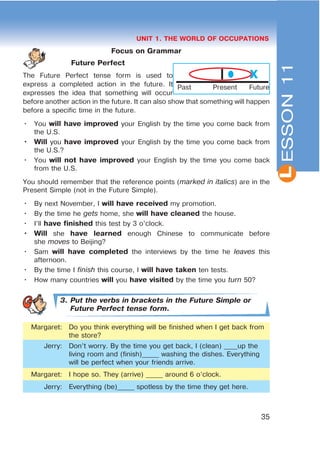
The Future Perfect tense form is used to
express a completed action in the future. It
expresses the idea that something will occur
before another action in the future. It can also show that something will happen
before a specific time in the future.
• You will have improved your English by the time you come back from
the U.S.
• Will you have improved your English by the time you come back from
the U.S.?
• You will not have improved your English by the time you come back
from the U.S.
You should remember that the reference points (marked in italics) are in the
Present Simple (not in the Future Simple).
• By next November, I will have received my promotion.
• By the time he gets home, she will have cleaned the house.
• I’ll have finished this test by 3 o’clock.
• Will she have learned enough Chinese to communicate before
she moves to Beijing?
• Sam will have completed the interviews by the time he leaves this
afternoon.
• By the time I finish this course, I will have taken ten tests.
• How many countries will you have visited by the time you turn 50?
3. Put the verbs in brackets in the Future Simple or
Future Perfect tense form.
Margaret: Do you think everything will be finished when I get back from
the store?
Jerry: Don’t worry. By the time you get back, I (clean) ____up the
living room and (finish)_____ washing the dishes. Everything
will be perfect when your friends arrive.
Margaret: I hope so. They (arrive) _____ around 6 o’clock.
Jerry: Everything (be)_____ spotless by the time they get here.
ESSON11
Past Present Future
X
L
36
UNIT 1. THE WORLD OF OCCUPATIONS
Nick: I just have two more courses before I graduate from university.
By this time next year, I (graduate)_____ , and I will already be
looking for a job.
Stacey: Does that scare you? Are you worried about the future?
Nick: Not really. I (go)_____ to a career counselor and get some
advice on how to find a good job.
Stacey: That’s a good idea.
Nick: I am also going to do an internship so that when I leave school,
I (complete, not only)_____ over 13 business courses, but I
(work, also) _____ in the real world.
4. Answer the questions.
1. At what age do people usually begin to work in
Ukraine?
2. At what age do people usually retire in Ukraine?
3. How have working conditions changed in recent
years?
4. Is it easy to find a job in Ukraine?
5. What are some common jobs for men in Ukraine?
6. What are some common jobs for women in
Ukraine?
7. Is it common for men and women to have the same
jobs in Ukraine? Give examples.
8. Which jobs are more popular in Ukraine than others, and why?
ESSON11
L
37
UNIT 1. THE WORLD OF OCCUPATIONS
5. Match the phrases with their explanations.
a. to work for a specific period of time 1. blue-collar worker
b. to work for more time than it is assigned
by the duties
2. white-collar worker
c. to have a lot of practical experience in
the job
3. to be paid by the hour
d. relating to wage earning workers who
wear work clothes or other specialized
clothing such as mechanics or miners
4. to be self-employed
e. a person who performs professional,
managerial, or administrative work in an
office, or other administrative setting
5. to do overtime
f. to work for the company or business
you are the owner of
6. to work shifts
g. to receive pay for work counted by the
number of hours completed at work
7. to get a good vocational
training
6. Imagine the world of occupations in the world in
twenty years from now. Write seven predictions
about how it will look like. Use the Future tense
forms you have learnt.
Model:
In twenty years from now there won’t be any blue-collar workers.
Robots will be doing all the dirty work. People will be just sitting in
their offices and observing the robots at work.
In twenty years from now computers will have replaced a part of a doctor’s
work.
ESSON11
L
38
UNIT 1. THE WORLD OF OCCUPATIONS
LESSON 12
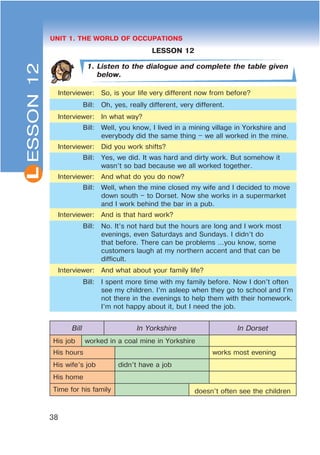
1. Listen to the dialogue and complete the table given
below.
Interviewer: So, is your life very different now from before?
Bill: Oh, yes, really different, very different.
Interviewer: In what way?
Bill: Well, you know, I lived in a mining village in Yorkshire and
everybody did the same thing – we all worked in the mine.
Interviewer: Did you work shifts?
Bill: Yes, we did. It was hard and dirty work. But somehow it
wasn’t so bad because we all worked together.
Interviewer: And what do you do now?
Bill: Well, when the mine closed my wife and I decided to move
down south – to Dorset. Now she works in a supermarket
and I work behind the bar in a pub.
Interviewer: And is that hard work?
Bill: No. It’s not hard but the hours are long and I work most
evenings, even Saturdays and Sundays. I didn’t do
that before. There can be problems …you know, some
customers laugh at my northern accent and that can be
difficult.
Interviewer: And what about your family life?
Bill: I spent more time with my family before. Now I don’t often
see my children. I’m asleep when they go to school and I’m
not there in the evenings to help them with their homework.
I’m not happy about it, but I need the job.
Bill In Yorkshire In Dorset
His job worked in a coal mine in Yorkshire
His hours works most evening
His wife’s job didn’t have a job
His home
Time for his family doesn’t often see the children
ESSON12
L
39
UNIT 1. THE WORLD OF OCCUPATIONS
Focus on Grammar
Future Perfect Continuous
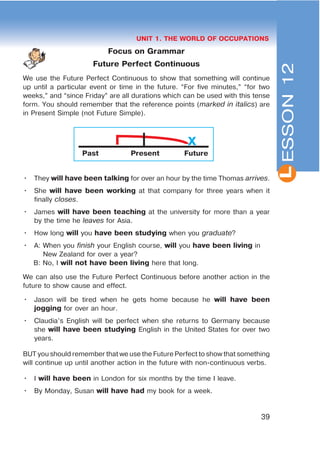
We use the Future Perfect Continuous to show that something will continue
up until a particular event or time in the future. “For five minutes,” “for two
weeks,” and “since Friday” are all durations which can be used with this tense
form. You should remember that the reference points (marked in italics) are
in Present Simple (not Future Simple).
Past Present Future
• They will have been talking for over an hour by the time Thomas arrives.
• She will have been working at that company for three years when it
finally closes.
• James will have been teaching at the university for more than a year
by the time he leaves for Asia.
• How long will you have been studying when you graduate?
• A: When you finish your English course, will you have been living in
New Zealand for over a year?
B: No, I will not have been living here that long.
We can also use the Future Perfect Continuous before another action in the
future to show cause and effect.
• Jason will be tired when he gets home because he will have been
jogging for over an hour.
• Claudia’s English will be perfect when she returns to Germany because
she will have been studying English in the United States for over two
years.
BUT you should remember that we use the Future Perfect to show that something
will continue up until another action in the future with non-continuous verbs.
• I will have been in London for six months by the time I leave.
• By Monday, Susan will have had my book for a week.
ESSON12
X
L
40
UNIT 1. THE WORLD OF OCCUPATIONSESSON12
2. Put the verbs in brackets in the Future Perfect or
the Future Perfect Continuous.
1. By the time we get to Chicago this evening, we (drive)____ more than
four hundred miles. We are going to be exhausted.
2. When Sarah goes on vacation next month, she (study)___ German for
over two years. She should be able to communicate fairly well while she
is in Austria.
3. I have not traveled much yet; however, I (visit)___ the Grand Canyon and
San Francisco by the time I leave the United States.
4. By the time you finish studying English at school, you (master) ___ all
twelve tenses including their passive forms.
5. Drive faster! If you don’t hurry up, she (have) ___ the baby by the time
we get to the hospital.
6. I came to England six months ago. I started my economics course three
months ago. When I return to Australia, I (study)___ for nine months and
I (be)___ in England for exactly one year.
7. Margie just called and said she would be here at 8 o’clock. By the time
she gets here, we (wait)___ for her for two hours.
8. Frank changed jobs again. If he keeps this up, he (change)___ jobs at
least four or five times by the end of the year.
9. Come over to my house around 9 o’clock. By then, I (complete)___ my
history essay and we can go to see a movie.
10. In June, my grandmother and grandfather (be) ___ married for fifty years.
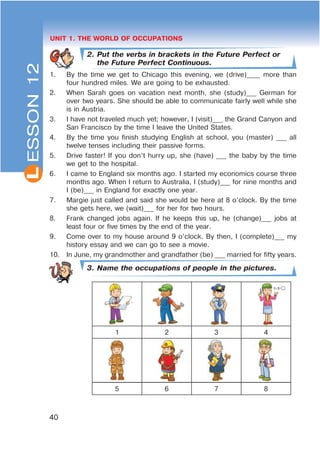
3. Name the occupations of people in the pictures.
1 2 3 4
5 6 7 8
L
41
UNIT 1. THE WORLD OF OCCUPATIONS
4. Read the short conversations and put the verbs in
brackets in the Future Continuous or the Future
Perfect Continuous tense form.
Simona: Margaret is really going to speak Spanish well when she gets
back from that language school in Mexico.
Isabelle: Hopefully! She (take)____ classes for more than six months.
Simona: She is going to be able to speak Spanish with some of our Latin
American clients.
Isabelle: Good. Two clients from Peru (visit) ____ us next month when
Margaret returns. We need someone to entertain them while
they are here.
Jason: I am leaving!
Nurse: Could you wait, please? The doctor is having some problems
with a patient.
Jason: The doctor was having problems with that patient an hour ago. If
I wait another ten minutes, I am sure he (have, still)___ problems
with her. By the time he’s finally ready to see me, I (wait)___ for
more than two hours.
Mr. Jones: What are you going to be doing next year at this time?
Mr. McIntyre: I (work)___ for a big law firm in New Orleans.
Mr. Jones: I didn’t know you were leaving Baton Rouge.
Mr. McIntyre: I got a great job offer which I just can’t refuse. Besides,
by the time I move, I (live)___ in Baton Rouge for over
twenty years. I think it’s about time for a change.
5. Answer the questions. Write your answers in the
copy-book.
1. What are some common occupations in Ukraine?
2. What are some jobs that you think would be boring?
3. Name three occupations that you could do.
4. Name three occupations that you could never do.
5. What are some jobs that children could do?
6. Which do you think are the demanding jobs?
7. Which are the least demanding jobs?
8. Which jobs are badly paid?
9. Which jobs are over-paid?
ESSON12
L
42
UNIT 1. THE WORLD OF OCCUPATIONS
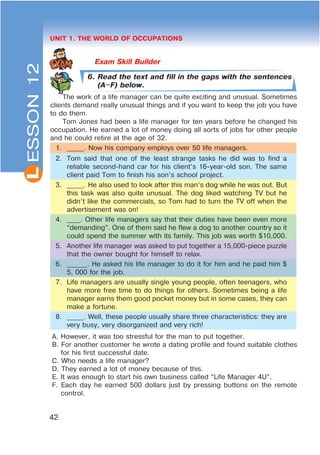
6. Read the text and fill in the gaps with the sentences
(A$F) below.
The work of a life manager can be quite exciting and unusual. Sometimes
clients demand really unusual things and if you want to keep the job you have
to do them.
Tom Jones had been a life manager for ten years before he changed his
occupation. He earned a lot of money doing all sorts of jobs for other people
and he could retire at the age of 32.
1. _____. Now his company employs over 50 life managers.
2. Tom said that one of the least strange tasks he did was to find a
reliable second-hand car for his client’s 16-year-old son. The same
client paid Tom to finish his son’s school project.
3. _____. He also used to look after this man’s dog while he was out. But
this task was also quite unusual. The dog liked watching TV but he
didn’t like the commercials, so Tom had to turn the TV off when the
advertisement was on!
4. ____. Other life managers say that their duties have been even more
“demanding”. One of them said he flew a dog to another country so it
could spend the summer with its family. This job was worth $10,000.
5. Another life manager was asked to put together a 15,000-piece puzzle
that the owner bought for himself to relax.
6. ______. He asked his life manager to do it for him and he paid him $
5, 000 for the job.
7. Life managers are usually single young people, often teenagers, who
have more free time to do things for others. Sometimes being a life
manager earns them good pocket money but in some cases, they can
make a fortune.
8. _____. Well, these people usually share three characteristics: they are
very busy, very disorganized and very rich!
A. However, it was too stressful for the man to put together.
B. For another customer he wrote a dating profile and found suitable clothes
for his first successful date.
C. Who needs a life manager?
D. They earned a lot of money because of this.
E. It was enough to start his own business called “Life Manager 4U”.
F. Each day he earned 500 dollars just by pressing buttons on the remote
control.
ESSON12
L
43
UNIT 1. THE WORLD OF OCCUPATIONS
7. After-task reflection. Say what key words in the text
and in the sentences A-F helped you to fill in the
gaps in exercise 6.
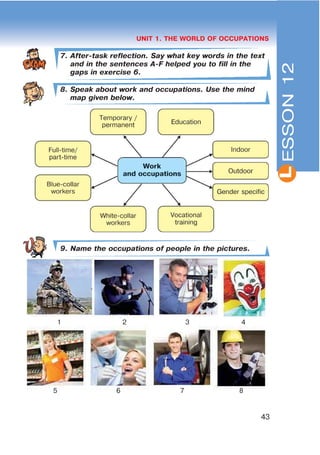
8. Speak about work and occupations. Use the mind
map given below.
9. Name the occupations of people in the pictures.
ESSON12
1 2 3 4
5 6 7 8
L
44
UNIT 1. THE WORLD OF OCCUPATIONS
REVISION LESSONS (UNIT I)
LESSON 13
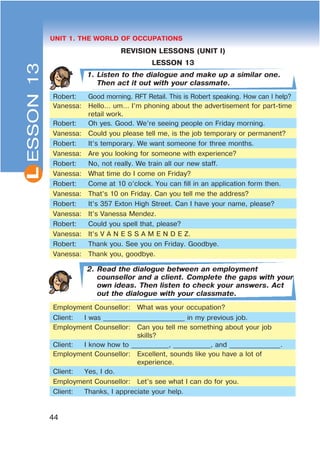
1. Listen to the dialogue and make up a similar one.
Then act it out with your classmate.
Robert: Good morning. RFT Retail. This is Robert speaking. How can I help?
Vanessa: Hello… um… I’m phoning about the advertisement for part-time
retail work.
Robert: Oh yes. Good. We’re seeing people on Friday morning.
Vanessa: Could you please tell me, is the job temporary or permanent?
Robert: It’s temporary. We want someone for three months.
Vanessa: Are you looking for someone with experience?
Robert: No, not really. We train all our new staff.
Vanessa: What time do I come on Friday?
Robert: Come at 10 o’clock. You can fill in an application form then.
Vanessa: That’s 10 on Friday. Can you tell me the address?
Robert: It’s 357 Exton High Street. Can I have your name, please?
Vanessa: It’s Vanessa Mendez.
Robert: Could you spell that, please?
Vanessa: It’s V A N E S S A M E N D E Z.
Robert: Thank you. See you on Friday. Goodbye.
Vanessa: Thank you, goodbye.
2. Read the dialogue between an employment
counsellor and a client. Complete the gaps with your
own ideas. Then listen to check your answers. Act
out the dialogue with your classmate.
Employment Counsellor: What was your occupation?
Client: I was ________________________ in my previous job.
Employment Counsellor: Can you tell me something about your job
skills?
Client: I know how to ___________, ___________, and _______________.
Employment Counsellor: Excellent, sounds like you have a lot of
experience.
Client: Yes, I do.
Employment Counsellor: Let’s see what I can do for you.
Client: Thanks, I appreciate your help.
ESSON13
L
45
UNIT 1. THE WORLD OF OCCUPATIONS
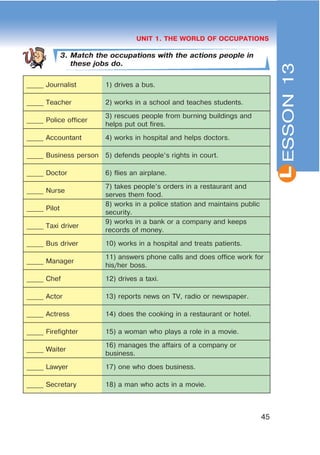
3. Match the occupations with the actions people in
these jobs do.
_____ Journalist 1) drives a bus.
_____ Teacher 2) works in a school and teaches students.
_____ Police officer
3) rescues people from burning buildings and
helps put out fires.
_____ Accountant 4) works in hospital and helps doctors.
_____ Business person 5) defends people’s rights in court.
_____ Doctor 6) flies an airplane.
_____ Nurse
7) takes people’s orders in a restaurant and
serves them food.
_____ Pilot
8) works in a police station and maintains public
security.
_____ Taxi driver
9) works in a bank or a company and keeps
records of money.
_____ Bus driver 10) works in a hospital and treats patients.
_____ Manager
11) answers phone calls and does office work for
his/her boss.
_____ Chef 12) drives a taxi.
_____ Actor 13) reports news on TV, radio or newspaper.
_____ Actress 14) does the cooking in a restaurant or hotel.
_____ Firefighter 15) a woman who plays a role in a movie.
_____ Waiter
16) manages the affairs of a company or
business.
_____ Lawyer 17) one who does business.
_____ Secretary 18) a man who acts in a movie.
ESSON13
L
46
UNIT 1. THE WORLD OF OCCUPATIONS
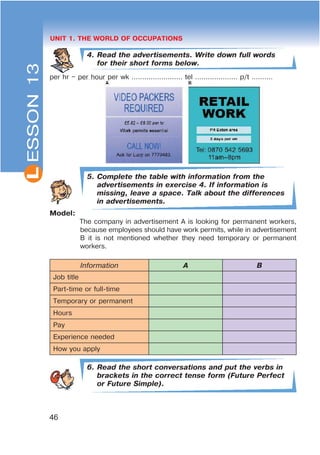
4. Read the advertisements. Write down full words
for their short forms below.
per hr – per hour per wk ........................ tel .................... p/t ……….
5. Complete the table with information from the
advertisements in exercise 4. If information is
missing, leave a space. Talk about the differences
in advertisements.
Model:
The company in advertisement A is looking for permanent workers,
because employees should have work permits, while in advertisement
B it is not mentioned whether they need temporary or permanent
workers.
Information A B
Job title
Part-time or full-time
Temporary or permanent
Hours
Pay
Experience needed
How you apply
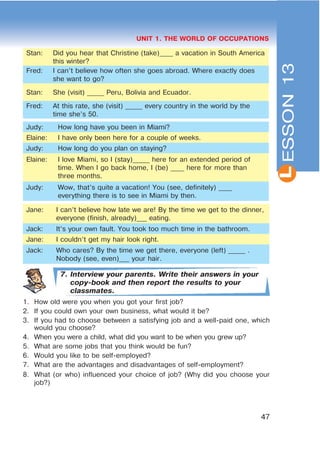
6. Read the short conversations and put the verbs in
brackets in the correct tense form (Future Perfect
or Future Simple).
ESSON13
L
47
UNIT 1. THE WORLD OF OCCUPATIONS
Stan: Did you hear that Christine (take)____ a vacation in South America
this winter?
Fred: I can’t believe how often she goes abroad. Where exactly does
she want to go?
Stan: She (visit) _____ Peru, Bolivia and Ecuador.
Fred: At this rate, she (visit) _____ every country in the world by the
time she’s 50.
Judy: How long have you been in Miami?
Elaine: I have only been here for a couple of weeks.
Judy: How long do you plan on staying?
Elaine: I love Miami, so I (stay)_____ here for an extended period of
time. When I go back home, I (be) ____ here for more than
three months.
Judy: Wow, that’s quite a vacation! You (see, definitely) ____
everything there is to see in Miami by then.
Jane: I can’t believe how late we are! By the time we get to the dinner,
everyone (finish, already)___ eating.
Jack: It’s your own fault. You took too much time in the bathroom.
Jane: I couldn’t get my hair look right.
Jack: Who cares? By the time we get there, everyone (left) _____ .
Nobody (see, even)___ your hair.
7. Interview your parents. Write their answers in your
copy-book and then report the results to your
classmates.
1. How old were you when you got your first job?
2. If you could own your own business, what would it be?
3. If you had to choose between a satisfying job and a well-paid one, which
would you choose?
4. When you were a child, what did you want to be when you grew up?
5. What are some jobs that you think would be fun?
6. Would you like to be self-employed?
7. What are the advantages and disadvantages of self-employment?
8. What (or who) influenced your choice of job? (Why did you choose your
job?)
ESSON13
L
48
UNIT 1. THE WORLD OF OCCUPATIONS
LESSON 14
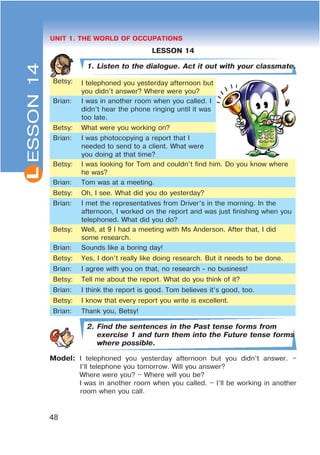
1. Listen to the dialogue. Act it out with your classmate.
Betsy: I telephoned you yesterday afternoon but
you didn’t answer? Where were you?
Brian: I was in another room when you called. I
didn’t hear the phone ringing until it was
too late.
Betsy: What were you working on?
Brian: I was photocopying a report that I
needed to send to a client. What were
you doing at that time?
Betsy: I was looking for Tom and couldn’t find him. Do you know where
he was?
Brian: Tom was at a meeting.
Betsy: Oh, I see. What did you do yesterday?
Brian: I met the representatives from Driver’s in the morning. In the
afternoon, I worked on the report and was just finishing when you
telephoned. What did you do?
Betsy: Well, at 9 I had a meeting with Ms Anderson. After that, I did
some research.
Brian: Sounds like a boring day!
Betsy: Yes, I don’t really like doing research. But it needs to be done.
Brian: I agree with you on that, no research - no business!
Betsy: Tell me about the report. What do you think of it?
Brian: I think the report is good. Tom believes it’s good, too.
Betsy: I know that every report you write is excellent.
Brian: Thank you, Betsy!
2. Find the sentences in the Past tense forms from
exercise 1 and turn them into the Future tense forms
where possible.
Model: I telephoned you yesterday afternoon but you didn’t answer. –
I’ll telephone you tomorrow. Will you answer?
Where were you? – Where will you be?
I was in another room when you called. – I’ll be working in another
room when you call.
ESSON14
L
49
UNIT 1. THE WORLD OF OCCUPATIONS
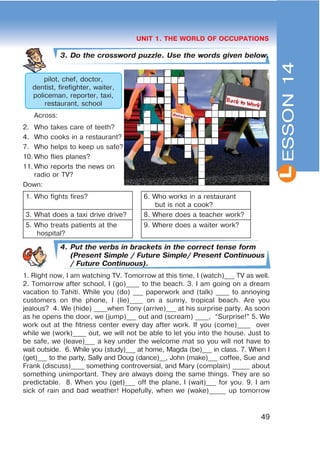
3. Do the crossword puzzle. Use the words given below.
pilot, chef, doctor,
dentist, firefighter, waiter,
policeman, reporter, taxi,
restaurant, school
Across:
2. Who takes care of teeth?
4. Who cooks in a restaurant?
7. Who helps to keep us safe?
10. Who flies planes?
11. Who reports the news on
radio or TV?
Down:
1. Who fights fires? 6. Who works in a restaurant
but is not a cook?
3. What does a taxi drive drive? 8. Where does a teacher work?
5. Who treats patients at the
hospital?
9. Where does a waiter work?
4. Put the verbs in brackets in the correct tense form
(Present Simple / Future Simple/ Present Continuous
/ Future Continuous).
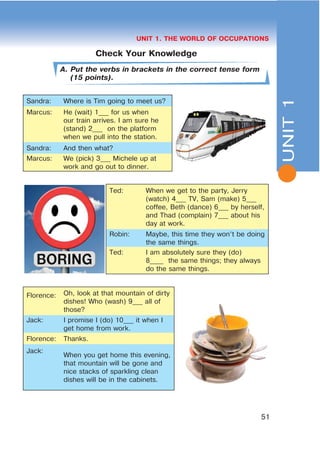
1. Right now, I am watching TV. Tomorrow at this time, I (watch)___ TV as well.
2. Tomorrow after school, I (go)____ to the beach. 3. I am going on a dream
vacation to Tahiti. While you (do) ___ paperwork and (talk) ____ to annoying
customers on the phone, I (lie)____ on a sunny, tropical beach. Are you
jealous? 4. We (hide) ____when Tony (arrive)___ at his surprise party. As soon
as he opens the door, we (jump)___ out and (scream) ____, “Surprise!” 5. We
work out at the fitness center every day after work. If you (come)____ over
while we (work)____ out, we will not be able to let you into the house. Just to
be safe, we (leave)___ a key under the welcome mat so you will not have to
wait outside. 6. While you (study)___ at home, Magda (be)___ in class. 7. When I
(get)___ to the party, Sally and Doug (dance)__, John (make)___ coffee, Sue and
Frank (discuss)____ something controversial, and Mary (complain) _____ about
something unimportant. They are always doing the same things. They are so
predictable. 8. When you (get)___ off the plane, I (wait)___ for you. 9. I am
sick of rain and bad weather! Hopefully, when we (wake)_____ up tomorrow
ESSON14
L
50
UNIT 1. THE WORLD OF OCCUPATIONS
morning, the sun (shine)___. 10. If you (need)_____ to contact me sometime
next week, I (stay)_____ at the Sheraton in San Francisco.
5. Answer the questions.
1. What do you think is the best job? What do you think is the worst? Why?
2. What do you think would be the most interesting job? The most boring?
3. What jobs in Ukraine are considered to be good jobs? Why?
4. Which jobs do you think are the most prestigious?
5. If money weren’t a problem for you, which job would you prefer to have?
6. Is it common for people in Ukraine to have one job for life?
7. Would you like to have a management position? Why?
8. What are the pros and cons of being a manager?
9. What are the qualities a good boss should have?
6. Read the short conversations and put the verbs in
brackets in the correct tense form (Future Perfect
or Future Perfect Continuous).
Jack: Have you been watching the Eco-Challenge on TV?
Janet: Isn’t that exciting? It has got to be the most unbelievably difficult
sporting event in the world.
Jack: I know. By the time they finish the course, they (raft)___ more
than 150 miles down a raging river, (hike)___ through 80 miles
of jungle, (climb) ___ a volcano and (kayak)___ through full of
sharks waters.
Janet: And don’t forget that they (move)___ for at least eight days.
Oliver: When are going to get your bachelor’s degree, Anne?
Anne: I am going to finish my degree next June. By the time I graduate,
I (go) ____ to four different colleges and universities, and I
(study) ___ for more than seven years.
Oliver: Wow, that’s a long time!
Anne: And I plan to continue on to get a Ph.D.
Oliver: Really? How long is that going to take?
Anne: By the time I finally finish studying, I (be)___ a student for over
13 years.
LESSON 15 (optional)
ESSON14
L
51
UNIT 1. THE WORLD OF OCCUPATIONS
Check Your Knowledge
A. Put the verbs in brackets in the correct tense form
(15 points).
Sandra: Where is Tim going to meet us?
Marcus: He (wait) 1___ for us when
our train arrives. I am sure he
(stand) 2___ on the platform
when we pull into the station.
Sandra: And then what?
Marcus: We (pick) 3___ Michele up at
work and go out to dinner.
Ted: When we get to the party, Jerry
(watch) 4___ TV, Sam (make) 5___
coffee, Beth (dance) 6___ by herself,
and Thad (complain) 7___ about his
day at work.
Robin: Maybe, this time they won’t be doing
the same things.
Ted: I am absolutely sure they (do)
8____ the same things; they always
do the same things.
Florence: Oh, look at that mountain of dirty
dishes! Who (wash) 9___ all of
those?
Jack: I promise I (do) 10___ it when I
get home from work.
Florence: Thanks.
Jack:
When you get home this evening,
that mountain will be gone and
nice stacks of sparkling clean
dishes will be in the cabinets.
UNIT1
L THE WORLD OF OCCUPATIONS
52
Max: Sarah has been in the kitchen all day
long.
Jake: It doesn’t sound like she’s having a very
good Thanksgiving.
Max: She (cook) 11___ for over seven hours by
the time everyone arrives for dinner this
afternoon. Hopefully, she (finish) 12____
everything by then.
Jake: Maybe we should help her.
Mike: It’s 6:00, and I have been working on my
essay for over three hours.
Sid: Do you think you (finish) 13___ by 10:00?
There’s a party at Donna’s tonight.
Mike: I (complete, probably) 14___ the essay by 10:00, but I
(work) 15___ on it for more than seven hours, and I don’t think I
am going to feel like going to a party.
B. Name the occupations (5 points).
C. Use the advertisements in exercise 4 (lesson 13) and
write an application letter to one of the companies
(10 points).
UNIT1
L
53
LESSON 16
1. Use the picture of a family tree and make up
sentences as it is given in the model.
Model: George is Mary’s husband.
Martha is Mary and George’s
daughter-in-law.
Tom is Laura’s brother.
2. Read the words and try to guess their meanings.
Dictionary definitions will help you.
spouse, parents, sibling, great-grandfather, great-grandmother, great-
grandchild, stepfather, stepmother, stepbrother, stepsister, half-brother,
half-sister, adopted child, foster parents
1. a husband or wife
2. the father and the mother of a person
3. a brother or sister
4. the grandfather of your parents
5. the grandmother of your parents
6. the grandchild of your child
7. a man who is married to your mother but who is not your father
8. a woman who is married to your father but who is not your mother
9. the son of your stepmother or stepfather
10. the daughter of your stepmother or stepfather
ESSON16
father
mother
son
daughter
husband
wife
cousin
aunt
uncle
niece
nephew
brother
sister
brother-in-law
sister-in-law
father-in-law
mother-in-law
son-in-law
daughter-in-law
parents-in-law
grandfather
grandmother
grandson
granddaughter
grandparents
grandchildren
George Mary
Martha Michael Tom Laura Henry
Hannah Rachel David Bill Sue
UNIT 2. MY FAMILY AND FRIENDS
54
L
11. a brother who is the son of only one of your parents
12. a sister who is the daughter of only one of your parents
13. a child who has been legally made part of a family that he or she was
not born into
14. the people who take someone else’s child into their family for a period of
time but without becoming his or her legal parents
3. Use the words from exercise 2 and talk about
families you know that have family members
described by such words. There is a model to help
you.
Model:
I would like to talk about my neighbours’ family. They are Mary
and Brian Smith. Brian is Mary’s second husband. Mary has got a
daughter from her first marriage. Together with Brian they have got
a son; his name is Mark. So Brian is Jane’s stepfather and she is
Brian’s stepdaughter. Mark is Jane’s half-brother.
4. Answer the questions.
When and where did your parents get married?
Who do you spend more time with, your mother or your father?
What do your aunts and uncles do?
Where do your aunts and uncles live?
What games does your mother (father) play?
What does your mother or father do for a living?
Does your father go on business trips?
When and where were your parents born?
How did your parents first meet?
ESSON16
UNIT 2. MY FAMILY AND FRIENDS
55
L
5. Read the text. Pay attention to the words in bold.
Match the title of the paragraphs with their numbers.
ANNA MARIE JARVIS: THE MOTHER OF MOTHER’S DAY
1. Mothers are important to everyone. After
all, where would we be without them? While
their contributions were known, there was
little support to celebrate their efforts until
Anna Marie Jarvis.
2. Anna, born on May 1, 1864, was
the daughter of Ann Jarvis, a West Virginia
homemaker. It was Ann’s life and work that
made such an impression on Anna.
3. Even before the Civil War, Ann Jarvis
looked for ways to help other mothers. She
understood that disease could be stopped
with proper sanitation. She started organizing
Mothers’ Work Day Clubs in several towns in
1858. They worked to help provide money,
medicine, and housekeeping assistance for women who were ill. They
were so successful that after two years doctors were encouraging the
formation of more groups.
4. Ann strongly advised the Mothers’ Work Day Clubs to remain neutral
during the Civil War. The Clubs cared for and fed soldiers from both the
Union and the Confederacy. She wanted the soldiers on both sides of the
conflict to be helped. Her idea was that it would help build places of peace
during a terrible war.
5. Ann herself did not have an easy life and lost eight of her twelve
children before they reached adulthood. Perhaps it was because of these
tragedies that she could identify with others going through hardship.
6. After the war, Ann Jarvis organized Mothers’ Friendship Day to help
bring together a community shattered by war. It was held annually for
several years.
7. Anna Jarvis had a good model of what a woman can do to help those
around her. Anna never married, and when her mother died, she dedicated
herself to getting a day established to honour all mothers.
8. While everyone had a mother, few were interested in having a day set
aside to honour them. The first memorial for mothers was celebrated in
Jarvis’s home town of Grafton, West Virginia, a year after Ann’s death. It’s
now the location of the International Mother’s Day shrine.
ESSON16
UNIT 2. MY FAMILY AND FRIENDS
56
L
A. The Mothers’ Work Day Clubs
and the attitude to the Civil War
B. The result of the activity of two
strong women
C. Ann’s desire to help people to
overcome the hardships of the
post-war period
D. Ann’s example for her daughter
Anna
E. Ann’s life, full of difficulties
F. The significance of mothers
G. The start for Mothers’ Work Day
Clubs
H. Birth of a child in 1864
Exam Skill Builder
6. After-task reflection. Answer the following questions.
1. What words in the text helped you to complete the task? 2. Which word
in paragraph 1 is synonymous to the word “significance”? 3. What key words
in paragraph 3 helped you to find the right matching? 4. Name the word (in a
phrase) in paragraph 5 which helped you to understand that Ann Jarvis’s life
was difficult. 5. Say what strategies helped you to complete the task.
7. Read the definitions of some words in bold from
exercise 5 and name them.
1. The time when you are an adult. – adulthood. 2. To give someone
the confidence or courage to do something. – _______. 3. To give all your
attention and effort to one particular thing. – ________. 4. Something that you
give or do in order to help something be successful. – _________. 5. To feel
sympathy with someone or to share their feelings. – ________. 6. Very shocked
and upset, very exhausted. – _________.
8. Pair work. Talk about your family. Tell your partner
how many people there are in your family, how old
they are, what they look like. Then ask your partner
about his/her family. Tell the class about your
partner’s family.
9. Read the tongue-twister as quickly as you can.
Elizabeth’s birthday is on the third Thursday of this month.
ESSON16
UNIT 2. MY FAMILY AND FRIENDS
57
L
LESSON 17
1. Find words and expressions in bold in exercise 5
(lesson 16). Make up one sentence with each word.
2. Listen to the dialogue and answer the questions
given below.
Daniel: So what were you like as a child?
Luisa: When I was a child, I was kind of
rebellious.
Daniel: You? Really? What was the turning
point?
Luisa: When I graduated from senior school.
Daniel: What do you mean?
Luisa: Until you graduate, you don’t
understand that life is just to begin.
After I finished the ninth form, I realized
that I still had a lot to learn.
Daniel: I know what you mean. I was really
immature when I was a child.
Luisa: What changed?
Daniel: I think I became more mature
after I got my first job. Once you
have a job, you learn to be more
independent.
Luisa: That’s true. Where did you work?
Daniel: In my father’s bank.
Luisa: Another turning point for me was when I got my dog, Pepper. I
know that sounds silly, but it was really important to me.
Daniel: Why was that so important?
Luisa: Well, I was eleven. I remember that having a dog made me feel
really responsible. Pepper would follow me everywhere and was
always waiting for me when I came home from school.
Daniel:
Actually, that sounds nice. I never had a dog, but I remember
when I got my first bicycle. That was a very important day for
me. For the first time, I could go out on my own and go as far as
I wanted to. I used to polish the bicycle every day and take really
good care of it. Of course, that only lasted a few months, and
then I lost interest in it!
ESSON17
UNIT 2. MY FAMILY AND FRIENDS
58
LESSON17
1. What was Luisa like as a child?
2. What was her turning point?
3. What did she realize after she finished senior school?
4. What was Daniel like as a child?
5. What happened after he got his first job?
FOCUS ON GRAMMAR
Would / Used to
Used to and would are both used to describe something that happened
regularly in the past but doesn’t happen any longer. However, if something
happened only once we can’t use used to or would – we must use the Past
Simple.
There are also important differences between used to and would. Would is
not used with stative verbs such as love,be,understand,and feel.
Example:
When I was a student,I used to love sleeping late on the weekends. (But:
When I was a student,I would love sleeping late on weekends.)
Would is slightly more formal, more ‘bookish’ and can convey the idea that
the speaker is reminiscing about the past. It is often used in writing to talk
about the past in a misty-eyed, sentimental way.
Example:
People would get very angry when the tax-collector came to town.
In those days people would draw water from the village well.
When I was a child I would wake up to the sound of birds singing.
3. Fill in the blanks with used to or would.
1. I didn’t ____ live in this city.
2. We _____ often go on holiday.
3. When I was a child, we ____ have a dog.
4. She ______ work as a teacher for many years.
5. As a student, he never ____ have any money.
6. Did you ____ like playing football at school?
7. There never ____ be a coffee shop here.
8. My father _____ always read to me before bed.
4. Read the dialogue in exercise 2. Make up a similar
one and then act it out with your partner.
5. Work in pairs. Ask and answer the questions. Pay
attention to the phrasal verbs in bold.
UNIT 2. MY FAMILY AND FRIENDS
59
L
1. Where did you grow up? Was it a good place to grow up? 2. Who do you
take after more: your mother or your father? In what ways? 3. Who looked
after you as a child when your parents were busy at work? 4. How well do
you get on with your parents? Who usually is the first to make up a quarrel
if something like that happens between you and your parents? 5. When was
the last time that your parents told you off? Why? 6. Who do you count on
more: your parents, your siblings, or your friends? Why?
6. Choose the correct answer to fill in the blanks.
1. A babysitter _____ the children when parents go out in the evenings.
a. looks at b. looks after c. looks for d. looks into
2. Searching the Internet is the quickest way to ______ a restaurant in a
new city.
a. look at b. look after c. look for d. look into
3. When Jack _____ he wants to be a fireman.
a. grows on b. grows after c. grows up d. grows out
4. I ____ you to make dinner while I am out.
a. count on b. count about c. count in d. count up
5. I was surprised at how well my new friend ______ my sister.
a. got up with b. got on about c. got away with d. got on with
6. We were angry last night, but we ____ at breakfast.
a. made with b. made in c. made out d. made up
7. I have to _____ my sick grandmother.
a. look on b. look for c. look around d. look after
8. I ___ my mother. We are both impatient.
a. take on b. take after c. take in d. take with
9. Oh! What a mess! Clean up your room. Your parents will ____ you ___
when they come home from work.
a. tell off b. tell after c. tell of d. tell for
10. Would you ___ my dog for me this weekend?
a. take after b. look after c. count on d. look for
11. I don’t ____ my new science teacher.
a. look after b. take after c. get on with d. count on
ESSON17
UNIT 2. MY FAMILY AND FRIENDS
60
L
7. Provide the correct phrasal verb for the given
definitions.
1. Rely on somebody or something – _______
2. Like each other, have friendly relationships with each other – _____
3. Try to find something – _____
4. To scold someone, to attack someone verbally for something bad that
he/she did – ____
5. Take care of somebody – _____
6. Resemble a family member – _____
7. Forgive each other, regain a friendly relationship – _____
8. Put questions to the words or word combinations in
italics.
1. She saw the Smiths last week. $ When
did she see the Smiths? 2. The new
student worked hard last week. 3. They
wanted to play football in the street. 4.
Shakespeare wrote “Romeo and Juliet”.
5. We decided to stay home because we
wanted to watch œTitanicB on œ1+1B.
6. The sun shone brightly yesterday. 7.
Ann invited us to her birthday party. 8.
He was late for the train as he lost his
way in the strange surroundings.
9. He came home after work at eight.
10. She bought that beautiful dress for
$60. 11. I thought it was your mother on
the phone. 12. They didn’t take part in the
concert because the girl caught cold and
had a fever. 13. Her father drove the car
perfectly but very fast. 14. The baby was
afraid of the old lady, that’s why he ran to
his mother and jumped into her arms.
15. I lost my purse last Friday. 16. Her
daughter caught cold in the wet weather.
17. At last they found the book the teacher
suggested to read.
9. Make up two sentences of your own with the phrasal
verbs from exercise 5.
ESSON17
UNIT 2. MY FAMILY AND FRIENDS
61
LESSON18
LESSON 18
1. Reveal a secret. Ask your partner the following
questions and then tell the class about him/her.
What are you called by your family?
Who do you like best in your family?
Who makes dinner for your family? Who does the shopping?
Do your family members all eat together? What do you talk about?
What sports do people in your family like?
What time do the people in your family wake up/ go to bed?
Which parent is stricter?
What, if anything, do your parents argue about?
Has your family ever moved/ taken a trip together?
What does your family do on weekends/ on holidays?
What kinds of housework does your father do?
What do you do that makes your parents happy?
Exam Skill Builder
2. Read the text and fill in the gaps (A$E) with the
sentences below.
1. One of the reasons for these problems is that parents and teenagers are
now spending less time together.
2. The survey asked 8,000 teenagers (aged 15-19) and their parents about
family relationships.
3. Family life is changing.
4. The biggest problem between teenagers and their parents, however, was
communication.
5. In many ways, the results of the survey were not surprising.
The Changing World of Teenagers
A _____. Couples are waiting
longer before they get
married and the average age
for the first wedding is now
30. This means that parents
are getting older and, at the same time, families are smaller because many
couples think that smaller is better. More mothers are going to work and
they have less time to spend at home with their children. How are these
changes affecting the lives of British teenagers? A new survey by the Britpoll
Organization has tried to learn more.
UNIT 2. MY FAMILY AND FRIENDS
62
L
B _____. What, for example, do teenagers like and dislike about their parents?
How do parents feel about their relationships with their children? What do
teenagers and parents want from each other? How well do they get on with
each other?
C _____. Most teenagers say that they love
their parents and that their parents love
them. They know that they can count on
their parents when they need them, and
40% like their parents’ sense of humour.
But there are problems, too. Parents
want their children to help more with the
housework and more than half of the
teenagers think that their parents tell
them off too often. “I’m 15, but they treat
me like a child”, was another common
complaint.
D _____. Most teens find it difficult to talk to their parents about personal
things like relationships, but, for some, there is very little communication
at all. “My mother never has any time, and my father is never there”, said
one 14-year-old. “They ask too many questions, but they never really listen
to my answers”, said another. “Dad gives me money every month, but he
doesn’t know who I am. I’m studying for my end-of-term exams, but he
never offers to help me”, she continued. Teenagers now have more money,
but they aren’t getting as much attention as before.
E _____. Teenagers often prefer to spend more time with their friends and
most parents don’t mind. Family meals are becoming a thing of the past
and teenagers often have dinner in front of the TV. It seems that the only
time that families are really together is for two weeks during the summer
holidays.
3. After-task reflection. Answer the following questions.
1. What key words in paragraph A helped you to complete the task?
2. What grammar phenomenon helped you to find the matching for
paragraph A?
3. Did grammar help you to find the matching for paragraph B? In what
way?
4. What key word in paragraph B and the sentence to be filled helped you
to find the matching?
5. What strategy helped you to find the matching for paragraph C?
ESSON18
UNIT 2. MY FAMILY AND FRIENDS
63
L
6. What two key words helped you to find the matching for paragraph D?
(Hint: they start with “c” and “l”)
7. What is the difference between the words “problem” and “reason”?
Which comes first: the reason and then the problem or vice versa?
4. Read the text in exercise 2 and say if the statements
are true or false.
1. Most people get married before they are 30.
2. Teenagers spend less time with their mothers than before.
3. Parents think that their children do enough housework.
4. Most teens find it easy to talk to their parents about girlfriends and
boyfriends.
5. Many parents are too busy to talk to their children.
6. Teenagers now have more money to spend.
7. Many teens do not spend enough time with their parents.
5. Find the phrasal verbs in the text in exercise 2.
Give their definitions.
6. Compare the information in the text in exercise
2 with the situation in Ukraine. In what ways is it
similar / different? Use the model to help you.
Think about:
 The average age of getting married.
 Parent-children relationships.
 Time teenagers spend together with parents.
 Pocket money.
 Family dinners.
Model: In Ukraine, there is no common tendency about the age of getting
married. There are couples who decide to create their own families
at the age of 22–25. People can get married after 30. There are
even couples who marry before they reach their 20th
birthday.
Parent-children relationships are very similar to those described in the text.
Parents are very busy nowadays in Ukraine. They try to work hard to cope
with the lack of money. That’s why very often they have to go abroad to earn
more there. As a result, their children stay with only one parent. This leads
to even more problems in their relationships.
7. Use the same statements from exercise 6 to speak
about the past in Ukraine. You may ask your parents
or grandparents for more information. There is a
model to help you.
ESSON18
UNIT 2. MY FAMILY AND FRIENDS
64
L
Model:
My grandmother says that people got married at a very
young age when she was a teenager. Her mother (my
great-grandmother) got married at the age of 16, for
example. She also said that parents would spend more
time with their children. Mothers were usually those who
spent time with the children, because fathers had to go
to work and earn a living for their families.
8. Fill in the blanks with the correct verb in the Past
Simple.
eat shut go spend fall feed
hold meet hurt lose find speak
ride give come drink begin drive
1. We _________ a delicious dinner at a Mexican restaurant last night.
2. There’s no money left in my pocket. I _________ my last penny yesterday.
I’m out of money.
3. When it _________ to rain yesterday afternoon, I _________ all of the windows
in the flat.
4. Peter was nervous when he ________ his baby in his arms for the first time.
5. I ________Jennifer’s parents when they visited her. She introduced me to
them.
6. Mary walked to school today. Rebecca _________ her car. Alison _________
her bicycle. Sandy ________ the bus.
7. I didn’t have any money, yesterday, so my roommate ________me enough
so I could pay for my lunch.
8. The children had a good time at the park yesterday. They ________ the
ducks on small pieces of bread.
9. When Alan slipped on the icy sidewalk yesterday, he ________ down and
________ his back. His back is very painful today.
10. Yesterday I called Jason on the phone. He wasn’t home, so I ________ to
his sister.
11. Jack _______ his pocketknife at the park yesterday. This morning he
_______ back to the park to look for it. Finally he _______ it in the grass. He
was glad to have it back.
12. Sue _______ a cup of coffee before class this morning.
ESSON18
UNIT 2. MY FAMILY AND FRIENDS
65
LESSON19
LESSON 19
1. Complete the time line with the dates and time
markers.
2. Listen to the interview and say when the events
given below happened in Mr.Morgan’s life.
Cristina: Hello, Mr Morgan. I’m Cristina Marcos from Stoke News. I’m
here to interview you.
Steven: Great. And do call me Steven.
Cristina: OK. Steven, where do you come from?
Steven: Well, I’m from Nigeria.
Cristina: So when did you come to England?
Steven:
A long time ago. My parents brought me to Great Britain when
I was five.
Cristina: So were you at school here?
Steven: I was at High Oak, and I left in 1992. Then I got a job in a local
shop.
Cristina: How long did you work there?
Steven: Just for a year. It was really boring, so I didn’t stay long.
Cristina: What did you do next?
Steven: I got an apprenticeship as a mechanic in a local garage.
Cristina: That was in 1993, right?
Steven: Yes. I worked at the garage for four years, but I always knew it
wasn’t the right job for me. I really wanted to work with young
people. I come from a big family and I love being with young
people.
Cristina: So is that when you decided to become a youth worker?
Steven: Yes, that’s right. I did a course in youth work at City College.
............ ............ 5 years 2 years last Now
ago ago year
1990 1996 ............ ............ ............ 20........
UNIT 2. MY FAMILY AND FRIENDS
66
L
Cristina: When was that?
Steven: In 1997. I was at college for three years, and then I started my
job at the Junction in 2000.
It was difficult at the beginning.
Cristina: Really?
Steven: Yes. The Junction had big money problems and in 2001 it
nearly closed. That’s when I started to think of ways to raise
money for the centre.
Cristina: What kind of things did you do?
Steven: Lots of different things. The first thing I did was in 2001. I …
1. He started to work for the Junction.
2. He got a job of a mechanic.
3. He studied at City College.
4. He got his first job in youth work.
Focus on Grammar
Past Tenses Review
3. Put the verbs in brackets in the Past Simple or the
Past Continuous.
1. I (share) a flat with him when we were students. He always (complain)
about my untidiness. 2. My dog (walk) along quietly when Mr. Red’s bulldog
ESSON19
UNIT 2. MY FAMILY AND FRIENDS
67
L
attacked it. 3. I (light) a fire at six and it (burn) brightly when Tom (come) in
at seven. 4. When I (arrive) the lecture had already started and the professor
(write) on the overhead projector. 5. When I (arrive) she (have) lunch. She
apologized for starting without me but said that she always (lunch) at half past
twelve. 6. He was very polite. Whenever his wife (enter) the room he (stand)
up. 7. He always (wear) a raincoat and (carry) an umbrella when he (walk)
to the office. 8. He (not allow) us to go out in the boat yesterday as a strong
wind (blow). 9. I just (open) the letter when the wind (blow) it out of my hand.
10. He suddenly (realize) that he (travel) in the wrong direction. 11. When I
(look) for my passport I (find) this old photograph.
4. Read the text about Barack Obama. Make up a time
line of the most important dates in his life. Then give
the titles to the paragraphs of his life story.
Barack Obama was born in Hawaii
on August 4th, 1961. His father was
born in Kenya. He grew up herding
goats as a domestic servant. Later he
won a scholarship that allowed him to
leave Kenya and attend the University of
Hawaii. Barack’s mother, Ann Dunham,
grew up in Kansas. Barack’s parents
met in the University of Hawaii where
they were both attending school. The
marriage between Obama’s parents was short and when Barack was two
years old his parents divorced. When Barack was six, they moved to Indonesia
near the capital of Jakarta where his half-sister Maya was born. At the age of
ten, Barack returned to Hawaii, and lived with his grandparents. Barack was
called “Barry” by his family and friends. He was sent to a private academy
called Punahou School in Honolulu.
Barack graduated from Punahou and went on to attend Occidental College
in Los Angeles. He later transferred to Columbia University in New York City
which he graduated from in 1983. He earned his undergraduate degree in
political science and became a community organizer in Harlem. He later moved
to Chicago to work for a church-based social-services organization there.
Barack Obama soon applied to and was accepted at Harvard Law School.
In 1990, he was elected president of the Harvard Law Review journal. He
was the first African American to serve in the post. After graduation from
law school, he refused job offers from top Manhattan law firms, with starting
salaries of $100,000-a-year range. Barack chose to return to Chicago and
ESSON19
UNIT 2. MY FAMILY AND FRIENDS
68
L
work for a small firm that specialized in civil-rights law. His work involved
defending the poor in housing and employment discrimination cases.
During his Harvard Law School years, Barack took a job as a summer
associate at a Chicago firm and the attorney assigned to mentor him was
Michelle Robinson. Robinson came from a working-class black family and
grew up on the South Side. The two began dating and were married in 1992.
Barack’s advocacy work led him to run for the Illinois State Senate, where
he served for eight years. In 2004, he became the third African American
since Reconstruction to be elected to the U.S. Senate. Barack was chosen as
the presidential candidate for the Democratic Party in August of 2008.
Barack is proud and grateful to his family, his wife, Michelle, and his two
daughters, Malia and Sasha.
5. Read the text in exercise 3 and answer the questions
below.
1. In what state was Barack Obama born? 2. Where was Barack Obama’s
father born? 3. Where was Barack Obama’s mother born? 4. Barack Obama
was two years old when his parents divorced. True or false? 5. When Barack
Obama was six, where did his family move to? 6. At the age of ten, Barack
moved back to Hawaii. Who did he live with? 7. By what nickname did Barack’s
family and friends call him? 8. In which field did Barack Obama earn his
undergraduate degree? 9. Where did Barack Obama go to law school?
10. For what position was Barack Obama elected for the Harvard Law Review
journal? 11. What company did Barack Obama serve eight years in? 12. After
Harvard Law School, Barack worked on civil-rights cases. True or false?
13. The Democratic Party chose Barack Obama as their presidential candidate
in August of 2008. True or false?
6. Study the template of an autobiography. Then turn the
Obama’s biography into the autobiography: imagine
being Barack Obama and writing the autobiography.
You may use the Internet for some more information.
Paragraph 1: Personal information
My name is Christopher Columbus. I am the son of Gomenico Colombo and
Susanna Fontanorossa. I live in Genoa, Italy. My siblings are Bartolomeo,
Giovanni and Giacorno. I was born in 1451. I have got two children, Diego and
Fernando. My wife’s name is Filipa.
Paragraph 2: Early life
When I was young, I used to help my father in working at his cheese stand.
Even in my young age, I used to dream of sailing and discovering lands.
ESSON19
UNIT 2. MY FAMILY AND FRIENDS
69
L
Paragraph 3: Education
I never entered a formal education, but I learned Latin and Portuguese. I have
become quite knowledgeable in Astronomy, Geography and History by reading
works of Ptolemy, Marco Polo, and Pope John Pius II.
Paragraph 4: Accomplishments
Through my persistence in achieving my dream to become a sailor, I was able
to discover the land now called America. My exploration proved that the Earth is
round. I also discovered the island of Japan and a lot more.
Paragraph 5: Descriptions
As a typical European man, I have light coloured eyes, a light complexion, blonde
hair and a height of about 6 feet. I am a persistent kind of a person. Once I have
a dream, I will do all my best to achieve it.
Paragraph 6: Obstacles
One of the biggest problems that I encountered in life was when kings and
queens from different nations kept neglecting my proposal to sail west and
discover lands. I finally convinced the Queen of Spain to allow me to sail west
and give me all the necessary materials and money for sailing.
7. Use the exercises 5 and 6 and write an
autobiography.
Use the following algorithm:
 Make up a list of five or six important events in your life;
 Make up a mind map of your life events by adding something special
about each event on the list;
 Write an autobiographic essay.
8. Project work.
Use the exercises 5 and 6 and write an antobiography pretending you’re
a celebrity in Ukraine (some famous singer, actor, polititian etc.). Use the
Internet for the necessary biographical information of the celebrity.
ESSON19
UNIT 2. MY FAMILY AND FRIENDS
70
L
LESSON 20
1. Listen to the dialogue and act it out with your
classmate.
Jack: My friend Rich is coming to town
next week. Have you ever met him?
Paul: No, I haven’t.
Jack: He’s kind of crazy, but a great guy.
Paul: Yeah? Why do you say so? What’s
he like?
Jack: He’s really hard-working, but very
much a loner. He’s pretty talented
and can do just about anything.
Paul: Sounds interesting. How old is he?
Jack: He is fifteen.
Paul: What does he look like? Maybe my
friend Alice would be interested in
meeting him.
Jack: He’s tall, slim and quite good looking. I’m sure your friend would
find him attractive. What’s she like?
Paul: She’s cheerful and very athletic.
Jack: Really? What sports does she like playing?
Paul: She’s a great tennis player and also goes bicycling a lot.
Jack: What does she look like?
Paul: She’s kind of exotic looking. She’s got long dark hair and piercing
black eyes. People think she is rather beautiful.
Jack: Do you think she would like to meet Rich?
Paul: Sure! Why don’t we introduce them to each other?
Jack: Great idea!
2. Study the words. Match them with their definitions.
Use the dictionary to help you. Then answer the
questions below.
1. Would you like to see such qualities in your friends?
2. What qualities make a friend into a good friend?
3. Do you consider yourself a good friend? Why?
ESSON20
UNIT 2. MY FAMILY AND FRIENDS
71
L
patient
obedient
mean
spiritual
critical
complimentary
loyal
generous
dishonest
selfish
rebellious
caring
expressing praise; flattering
not honest or fair; deceiving or fraudulent
showing a tendency towards rebellion
feeling or showing care and compassion
chiefly concerned with one’s own interest, advantage,
etc., esp to the total exclusion of the interests of others
faithful
willing and liberal in giving away one’s money, time, etc.
containing careful or analytical evaluations
bad-tempered; vicious
having a mind or emotions of a high and delicately
refined quality
tolerant; understanding
obeying or willing to obey
3. Read the extract from an autobiography essay
and say whether the statements are true or false.
Correct the false ones.
A Trip to the Past
One of the best summer holiday trips I’ve ever made was when my friends
and I were still students. We hiked the old wagon trail road to California and
camped along the Colorado Rocky Mountains.
We decided to travel like the first pioneers did and explore life as it was
120 years ago. The inspiration came from our teacher. He made us read
books such as “The Journals of Lewis and Clark”, who were the first Americans
employed by President Thomas Jefferson to explore the continental United
States and find a way to California.
We did research on the technology and equipment available 120 years
ago, and then made an agreement not to take anything invented after the
year 1870 except very good maps. We chose the year 1870 because by
then people had discovered tinned food which could keep the five of us from
starving. But just in case we took some fishing rods to catch fresh Rocky
Mountain fish!
We left on a sunny day in late June. We were prepared for many possible
situations – we knew it gets cold at night and that it’s hard to find firewood
in the dark. There were no hot showers for us at the end of the day and we
could hear strange sounds at night.
One night we saw a mountain lion, the next day it snowed in the middle of
the night, and then when the snow melted there was mud everywhere.
After about a week we got to California – tired but happy that we could
be so close to nature. We enjoyed all the fresh air, sleeping under the stars
and swimming and fishing in fresh water lakes. It was hard to go back to our
school desks – we wanted to return to the year 1870!
ESSON20
UNIT 2. MY FAMILY AND FRIENDS
72
L
1. The friends went on a trip because of the teacher.
2. They didn’t investigate life in California.
3. They chose the year 1870 because they could take some tins with them.
4. They didn’t know what to expect in the mountains.
5. They experienced different weather conditions.
6. They were happy to go back to school.
4. Put the verbs in brackets in the Past Simple or the
Past Perfect tense form.
1. After ten people (eat) that chicken they all (fall) ill. 2. We (not stop) until
we (finish) our home assignment. 3. Two men delivered a sofa which I (pay)
already for. 4. I (give) the book to my friend after I (read) it. 5. Jane (sign) the
letter which she (type) herself on her word processor. 6. I (pull out) into the
road after I (look) both ways. 7. We (hand) the forms in after we (complete)
them. 8. When the pupils (do) the experiment, they (write) a report on it. 9.
We (put out) the fire already when at last the firefighters (arrive). 10. They
(go) out after their mother (come) home from work.
5. Look at the pictures and describe them. Then say
how you usually spend time with your friends when
you get together.
6. Use the pictures in exercise 5 and make up a story
on one of them as if it happened to you and your
friends.
ESSON20
UNIT 2. MY FAMILY AND FRIENDS
73
L
7. Find the nicknames English children give each other
in the box of letters given below.
K O F R E A K Y S T N A P Y T R A M S
Y J O K E R L L U G N H O O P S O L T
N F U P A N U P U C E O B E E N P Y C
N U R E D N T W D A B L C R N O O E E
U N E E A E Z R R S L A Y D A B E N F
F N Y R C N Y T L U E T F Z S B M W R
G Y E P O K B K T M R L K A A Y A G E
W G S W O R L Z W O E C M O D R N I P
O I P O E D O E H O R A S Y O M C C S
N R W A D E B S F A M A W M A A T O S
D L K O O P Y T R A M S Y M R C O T I
E E L O P N A E B O C K R R O M U H M
R B M T E L M O O T E E O C Y A L E K
W O N S Y D E E P S H T U O M G I B E
O G P H G N I K E H T R D O T I S R R
M E N U T H E S U O P O O L R C A A G
A N A N A M R E P U S S W O M S G I N
N M M N M E T A L M O U T H E H U N K
Beanpole
Bigmouth
Carrot Top
Crazy Legs
Four Eyes
Freaky
Freckle face
Funny Girl
Heartbreaker
Hoops
Joker
Magic
Mama’s Boy
Metal Mouth
Miss Perfect
Mr.Cool Shorty
Smarty Pants
Snobby
Superman
The Brain
The Hunk
The King
Wonder Woman
Speedy
8. Put the verbs in brackets in the Past Simple
or the Past Continuous tense form.
1. Sally (eat) dinner last night when someone (knock) on the door. 2. At
6:00 p.m., Bob sat down at the table and began to eat. At 6:05 Bob (eat)
dinner. While Bob (eat) dinner, Ann (come) through the door. Bob went to
bed at 10:30. At 11:00 Bob (sleep). While Bob (sleep), the phone (ring).
3. My roommate’s parents (call) him last night while we (watch) TV. 4. I (call)
Paul at 7:00 but it wasn’t necessary because he already (get up). 5. I began
to study at seven last night. Fred (come) at seven-thirty. I (study) when Fred
(come). 6. My mother called me around five. My husband came home a little
after that. When he (come) home, I (talk) to my mother on the phone. 7. While
I (study) last night, Fred (drop by) to visit me. 8. As I (cross) the road I (step)
on a banana skin and (fall) heavily.
ESSON20
UNIT 2. MY FAMILY AND FRIENDS
74
L
LESSON 21
1. Listen to the conversations and pay attention to the
word combinations in bold. Use œFocus on GrammarB
reference below if necessary.
Conversation A:
A: Julie found her watch while cleaning her room yesterday.
B: I’m glad. She had been looking for it all week.
A: She also did very well on her English test last week.
B: That’s great. I know she had been studying for it for a long time.
A: Not only that. She’s getting married next month.
B:
Really? That’s strange. She hasn’t been going with her boyfriend very
long.
Conversation B:
A: Silvia won the San Francisco Marathon last weekend.
B: Yes, she told me. Isn’t that wonderful? I know she had been
training for it for months.
A: She wanted to have a party at her house to celebrate her victory.
B: Unfortunately, she had to cancel the party because her leg muscles
are too sore from running the marathon.
A: I know. That’s too bad. I had been looking forward to the party.
B: I had been planning to go to the party from the time I learned she
was going to have one.
Focus on Grammar
Past Perfect Continuous
We use the Past Perfect Continuous to show that something started in the
past and continued up until another time in the past. “For five minutes” and “for two
weeks” are both durations which can be used with the Past Perfect Continuous.
Examples:
• They had been talking for over
an hour before Tony arrived.
• She had been working at that company for three years when it went out
of business.
• How long had you been waiting for the bus before it arrived?
• Mike wanted to sit down because he had been standing all day at work.
• James had been teaching at the university for more than a year before
he left for Asia.
ESSON21
X
Past Present Future
UNIT 2. MY FAMILY AND FRIENDS
75
L
• A: How long had you been studying Turkish before you moved to Ankara?
B: I had not been studying Turkish very long.
Using the Past Perfect Continuous before another action in the past is a good
way to show cause and effect.
Examples:
• Jason was tired because he had been jogging.
• Sam gained weight because he had been overeating.
• Betty failed the final test because she had not been attending class.
It is important to remember that non-Continuous verbs cannot be used in any
continuous tenses including the Past Perfect Continuous.
Examples:
• The motorcycle had been belonging to George for years before Tina
bought it. — Not Correct
• The motorcycle had belonged to George for years before Tina bought
it. — Correct
It is also important to remember that passive forms of the Past Perfect
Continuous are not used.
2. Read the conversations in exercise 1 and act them
out with your classmate. Make up one similar
conversation.
3. Complete the sentences with the Present Perfect
Continuous or Past Perfect Continuous of the verbs
on the list.
ask expect fly give learn listen look
operate point out say see wait work
1. At last you are here! I _____ for you for over twenty minutes. 2. He knows
quite a lot of English. He _____ it for six years. 3. She finally said “Yes”. He _____
her to marry him for years. 4. I think I need a break. I _____ solidly for the
last three hours. 5. You _____ to a word I _____, have you? 6. For some time
now, world leaders _____ the necessity for agreement on arms reduction.
7. The police, who _____ trouble during the demonstration, were surprised
by the eventual absence of violence. 8. The manager of the company came
down with pneumonia. He _____ unwell for several days. 9. The chairman said
that the Board of Directors _____ serious thought to the possibility of entering
the American market. 10. At the inquiry into the plane crash, the pilot said in
evidence that he _____ this type of the aircraft for ten years. 11. I know why you
are having nightmares. You _____ too many horror films recently. 12. The new
one-way scheme _____ for just over twelve months, and traffic has improved
considerably as a result.
ESSON21
UNIT 2. MY FAMILY AND FRIENDS
76
L
4. Choose the correct answer.
Dear Jane,
I’m sorry I left without you last night,but I told you to meet me
early because the show started at 8:00. I 1._____ to get tickets for
that play for months,and I didn’t want to miss it. By the time I finally
left the coffee shop where we were supposed to meet,I 2. _____ five
cups of coffee and I 3. _____ over an hour. I had to leave because I
4. _____ to meet Kathy in front of the theater.
When I arrived at the theater,Kathy already 5. ______ up the
tickets and she was waiting for us near the entrance. She was really
angry because she 6. _____ for more than half an hour. She said she
almost 7. _____ up and 8. _____ into the theater without us.
Kathy told me you 9. ______ late several times in the past and that
she would not make plans with you again in the future. She mentioned
that she 10. _____ several movies because of your late arrivals. I think
you owe her an apology. And in the future,I suggest you be on time!
Love,
Susan
A B C D
1 was trying had tried has been trying had been trying
2 was having had had has been having had been having
3 was waiting had waited have been waiting had been waiting
4 was arranging had arranged have been
arranging
had been
arranging
5 was picking had picked has been picking had been picking
6 was waiting had waited has been waiting had been waiting
7 was giving had given has been giving had been giving
8 was going had gone has been going had been going
9 was being had been has been being had been being
10 was missing had missed has been missing had been missing
ESSON21
UNIT 2. MY FAMILY AND FRIENDS
77
L
5. Use an extract from a person’s autobiography to turn
it into his biography essay. There is a model to help
you.
Model: My name is Michael Smith and I was born on the 30th of August 1967,
in Long Beach, California. My parents were Eddie Smith and Joan
Smith. My mom died at the age of 57 in 1994 from lung cancer…
– Michael Smith was born on the 30th of August,1967 in Long
Beach,California. His parents were Eddie Smith and Joan Smith.
His mom died at the age of 57 in 1994 from lung cancer …..
My name is Michael Smith. I was born on the 30th
of August 1967, in Long
Beach, California. My parents were Eddie and Joan Smith. My early childhood
was a typical middle class environment of the 1960’s. My dad worked for
Simpson Buick as a salesman and my mom was a stay-at-home mother. I had
a happy, normal childhood as the only child.
My mom and dad divorced
when I was eight years old. My dad
remained married to my stepmother
Bev until his death. My mom
remarried two more times. My first
stepfather Vince became a big part
of my life and I maintained close
contact with him until his death in
2006, two days after my real dad
died. Yes, that was a very bad week,
losing both of my dads.
I lived with my mom until I was 16. By my sophomore year in high school I
had begun to hang around with friends that got me into a lot of trouble with a
number of things. I was rapidly heading down a negative path, but was fortunate
enough to notice it before I had done any serious damage. I moved in with
my dad and changed high schools and
friends. With the fresh start I was able to
finish high school without further incident,
graduating from Downey High School in
1985.
I had always wanted to become a police
officer, which I could not do until I was
21 years of age. So, to kill time and stay
out of trouble I joined the United States
ESSON21
UNIT 2. MY FAMILY AND FRIENDS
78
L
Army immediately after turning 18. I joined the
army and was sent to Fort Benning, Georgia for
basic training and airborne jump school. Some
of my happiest memories and some of my worst
memories come from my time in the army. One
thing that I am sure of is that it shaped me to
become the man that I am now. The army really
straightened me out from my troubled teenage
years.
6. Find the verbs in the past tense forms in exercise 5
and explain their usage.
7. Complete the sentences with the correct tense
form (Present Perfect/Past Perfect/Present Perfect
Continuous/Past Perfect Continuous).
1. It is already 9:30 PM and I (wait) _____ here for over an hour. If John
does not get here in the next five minutes, I am going to leave. 2. I was really
angry at John yesterday. By the time he finally arrived, I (wait) _____ for over
an hour. I almost left without him. 3. Did you hear that Ben was fired last
month? He (work) _____ for that import company for more than ten years and
he (work) _____ in almost every department. Nobody knew the company like
he did. 4. I (see) _____ many pictures of the pyramids before I went to Egypt.
Pictures of the monuments are very misleading. The pyramids are actually
quite small. 5. Sarah (climb) ____ the Matterhorn, (sail) ____ around the world,
and (go) _____ on safari in Kenya. She is such an adventurous person. 6. Sarah
(climb) _____ the Matterhorn, (sail) _____ around the world and (go) _____ on safari
in Kenya by the time she turned twenty-five. She (experience) _____ more by
that age than most people do in their entire lives. 7. When Melanie came into the
office yesterday, her eyes were red and watery. I think she (cry) _____.
8. Read the tongue-twisters as quickly as you can.
Thirty-three thousand people think that Thursday is their thirtieth birthday.
They think that their teeth get thinner at times they want to taste thick meat.
I thought the naughty Professor Tortoise taught ontology, but the naughty
Tortoise taught us tautology.
ESSON21
UNIT 2. MY FAMILY AND FRIENDS
79
L
LESSON 22
1. Listen to the dialogue and say whether the
statements below are true or false. Find the words in
bold and explain their meaning.
Linda: Mr. and Mrs. Thompson
moved to Seattle last week.
Brenda: That’s terrible news. They
had been living in this
neighbourhood for at least
twenty years.
Linda: True. But Mrs. Thompson was
promoted to a very high posi-
tion in her company. She couldn’t turn it down.
Brenda: Right, especially since she had been working there for such a
long time.
Linda: Yes. She had invested a great deal of energy and time in her
profession.
Brenda: Linda, did you have a chance to visit them before they left?
Linda: No. Unfortunately, by the time I went to say good bye to them,
they had already moved out.
1. The Thompsons stopped living in Seattle.
2. They had spent about twenty years in Seattle.
3. Linda saw the Thompsons before they had left the neighbourhood.
2. Rewrite the dialogue in exercise 1 as if the
Thompsons have moved to Seattle today. Make the
necessary changes in grammar.
3. Read an extract from a student’s autobiography.
Choose the correct answer.
My English is really getting better. I 1. _____ to learn the language since
1985, but only recently I have I been able to make some real progress. By
the time I started high school in 1988, I 2. ___ the language for almost three
years; however, I was only able to introduce myself and utter a few memorized
sentences. For a couple more years, I 3. _____ through grammar and vocabulary
lessons, which made absolutely no difference. Nothing worked, so I decided
to study abroad.
ESSON22
UNIT 2. MY FAMILY AND FRIENDS
80
L
I found an exchange program
in England that sounded like the
perfect answer. I 4. _____ with
a host family for one month.
It was a huge disappointment!
I 5. _____ there the whole time
staring at the host mother and
father hoping that there would be
some breakthrough. Nothing.
When I returned, I mentioned
to a friend that I 6. _____ problems
with the language for years. He recommended that I spend a year in an English
speaking country. I decided to go abroad again. I 7. _____ exchange programs
for a couple of weeks and finally decided on a school in the United States.
Well, it worked. I 8. _____ and 9. _____ in the U.S. for more than two years.
I 10. _____ here for at least another year before I return home. By then, I
should be completely fluent.
A B C D
1 am trying tried have been trying had been trying
2 am studying studied have been studying had been studying
3 am struggling struggled have been
struggling
had been
struggling
4 am staying stayed have been staying had been staying
5 am sitting sat have been sitting had been sitting
6 am having had have been having had been having
7 am
researching
researched have been
researching
had been
researching
8 am living lived have been living had been living
9 am studying studied have been studying had been studying
10 am staying had staying have been staying had been staying
4. Provide the term for the opposite sex.
Female Male Female Male
grandmother son
mother husband
stepdaughter uncle
ESSON22
UNIT 2. MY FAMILY AND FRIENDS
81
L
sister father-in-law
niece boy
cousin spouse
5. Put the verbs in brackets into the Past Continuous
or the Past Perfect tense form.
1. When I walked into the kitchen after dinner last night, my wife (wash)
the dishes, so I picked up a dish towel to help her. 2. By the time class was
over this morning, the rain (stop) so I didn’t need my umbrella anymore.
3. When I left for school this morning, it (rain) so I used my umbrella. 4. Last
night I started to study at 7:30. Dick came at 7:35. I (study) when Dick came.
5. By the time I walked into the kitchen after dinner, my husband (wash,
already) the dishes and (put) them away. 6. Last night I started ro study at
7:30.I finished studying at 9:00. Dick came at 9:30. By the time Dick came, I
(finish) my homework.
6. Match the definitions with the correct phrasal verb.
into in
turn
down out
1. to change or develop into something different
2. to develop in a particular result
3. to not accept an offer or request, to refuse
4. to give something to the person who has officially asked for it or who is in
charge
7. Replace the underlined word combinations with the
correct phrasal verb from exercise 6.
1. The teacher asked the students to give their copy-books to her:
- The teacher asked the students to turn in their papers.
2. How could you reject such a nice job offer?
3. Obviously, I’m disappointed at the way the things have developed.
4. Our holiday developed into a nightmare.
ESSON22
UNIT 2. MY FAMILY AND FRIENDS
82
L
REVISION LESSONS
LESSON 23
1. Listen to the dialogue and say whether the
statements below are true or false.
A: David had planned to ask his boss for a
salary raise last week.
B: I heard that he had been preparing to
ask for it for a long time.
A: David was a little nervous about asking.
That’s why he put it off for so long.
B: Well, what happened when David asked
for a salary raise? Did he get it or not?
A: What David didn’t know was the boss
had been reorganizing the company.
B: You mean, the boss had been planning to fire some of the
employees?
A: Exactly. And David was one of them. So, when David asked for a
salary raise, his boss told him the bad news.
B: I can imagine David’s disappointment. He had been working hard to
become one of the firm’s best paid employees.
1.David was a company boss.
2.David was planning to raise the salary for the company workers.
3.David was fired from the company.
4.David wasn’t satisfied with the money he had been earning at work.
2. Fill in the gaps with the correct word. The first
letters have already been given to help you.
1. My (s) son , Michael, is teaching me to use a computer. I want to get on
the Internet. 2. It was my birthday last week. My (b)_____ Freddie made me a
big chocolate cake. 3. My (c)______ Steven is great. He always buys me the
best computer games. 4. I’ve got three (d)_____ and two (s)_____. Christmas
is a very expensive time for me. 5. My (f)_____’s family is really nice. His
mother, my (g)_____, is great with the children. 6. Emily is always very tired.
Her (h)_____ never helps her with the twins. 7. My (a)_____ Emily is quite slim.
8. I’m a bit worried about my (s)_____. She hasn’t got a job at the moment. My
ESSON23
You are
fired!
UNIT 2. MY FAMILY AND FRIENDS
83
L
father is also worried about his (w)______. 9. Both my (p)______ wear glasses.
I don’t want to wear glasses when I grow up. 10. My (n)_____ is called Barbara
and my (n)_____ is called Alan. They are very cute children. Actually they are
twins.
3. Put the verbs in brackets in the Past Simple or the
Past Perfect tense form.
1. When she (ring) the office this
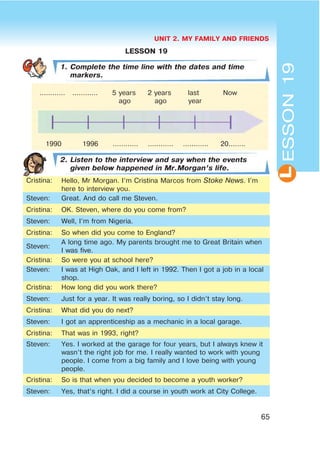
morning, Jim already (go out). 2.
By the time we (arrive), the party
(finish). 3. They (lock) the gates
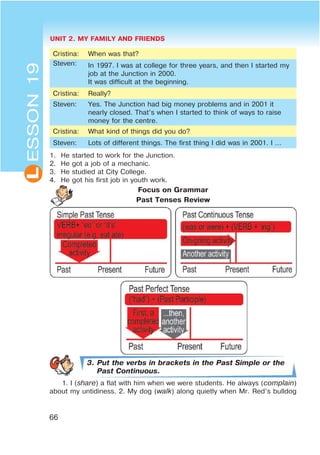
before I (get) there. 4. I (ring)
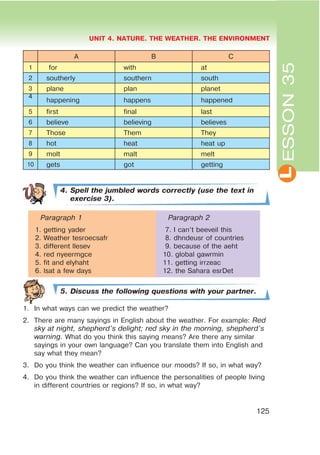
the shop to return the book as
soon as I (check) its contents. 5.
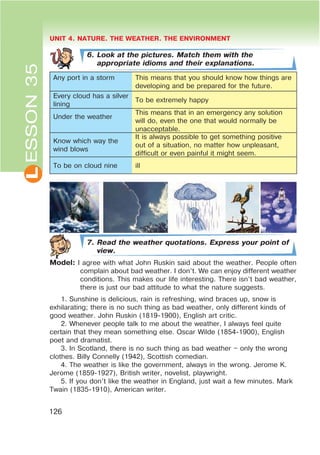
After we (discuss) the problem
on the phone I (write) him a letter
about it. 6. He (promise) to do
the job in an hour, but he still
(not finish) it by ten o’clock. 7. Before we (take) Tim to the theatre, he (never
see) a stage play before. 8. I (just clean) the carpet when the dog (come)
in, (shake) himself and the dirt from the dog (fall) off on the carpet. So, it
(become) dirty again.
4. Read the extract of a person’s autobiography and
choose the correct answer.
A Sporting Disaster
I never really enjoyed 1. _____ at school. I
remember when I played football. I was always put
in the net, but used to get bored and read a book.
Then, when the other side scored, the rest of my
2. ____ would shout at me. Later on I tried tennis,
which wasn’t much better. I used to have this habit
of dropping the racket each time I went to hit the
ball. The worst thing was when I actually won a 3.
_____ – I was so pleased that I ran and tried to
jump over the line but caught my foot on it, fell and
broke my arm.
ESSON23
UNIT 2. MY FAMILY AND FRIENDS
84
L
My latest attempt to get 4. _____ was when I
tried boxing at a local gym. I’ll never forget my first
match. I climbed into the 5. ___ and the bell went
for the start of the first round. I just shut my eyes
and swung my fist. Unfortunately, I hit the referee
and not my contestant. Needless to say that was
the end of my boxing career. Next I decided to
take up mountaineering. I 6. ____ a holiday in the
Himalayas with two old school friends. On our first
climb I managed to slip and found myself hanging
on the end of a rope half way up a mountain. All
my friends could do was to call out to me to 7. _____ until the rescuers arrived.
I guess I’ll never learn. I keep on trying out other sports even though I know
I’ll never be a champion!
A B C D
1 plays contests sports encounters
2 group selection team club
3 play game race fight
4 strong well slim fit
5 court ring pitch square
6 booked ordered paid bought
7 keep on hold on go on carry on
5. Take the role of one of your parents and write an
autobiography. Use the lessons 19-23 to help you.
6. Remember all the phrasal verbs you have learnt in
this unit. Make up sentences with each phrasal verb
you have named.
ESSON23
UNIT 2. MY FAMILY AND FRIENDS
85
L
LESSON 24
1. Listen to the dialogue and answer the questions.
A: Don! I heard you got married last
weekend. Congratulations. That’s
great news.
B: Thanks. Actually, it’s nothing new. I
had been dating Julia for six years
before I finally decided to propose.
A: Sorry, I missed the wedding.
B: Sorry you weren’t invited. We only had
a small ceremony. Only relatives were
invited. Any news from you?
A: I got a new job last week. Now, I’m an
architect working for a very successful
firm.
B: That’s great news!
A: Yes, it is. I had been preparing for this job for a long time.
1. What kind of Don’s news are the people discussing?
2. What kind of news does Don’s friend tell?
3. Is Don’s friend happy about his news? Why?
2. Interview your partner. Then tell the class what you
have found out. Be ready to answer your partner’s
questions.
• What are your brothers and sisters’ names? Are they students?
• How many cousins do you have? Where do they live?
• What games did you play with your sisters and brothers when you were
a child/with your cousins?
• Are any of your cousins the same age as you?
• How many are older than you/ how many are younger?
• Are any of your cousins married?
• Do you have any nieces or nephews?
• How many children would you like to have?
• What names would you like to give them?
3. Fill in the blanks with would or used to. In some
sentences both are possible.
1. I _____ have short hair when I was a teenager. 2. We ____ go to the same
little cafe for lunch every day when I was a student. 3. She _____ love playing
ESSON24
UNIT 2. MY FAMILY AND FRIENDS
86
L
badminton before she hurt her shoulder. 4. He ____ walk along the beach
every evening before bed. 5. I ____ always lose when I played chess with my
father. 6. She ____ be able to dance very well. 7. My grandfather ____ drink a
cup of coffee after dinner every night. 8. Luke ____ not have a car. 9. We ___
live in Brazil. 10. My family ___ often go to the countryside for the weekend
when I was young.
4. Fill in the blanks with the correct phrasal verb. Use
exercise 5, lesson 17 to help you.
1. Some people are surprised that I ______ my mother-in-law really well!”
2. Family and friends tell Steve he needs to _____, but he loves acting like
a child. 3. We can _____ Bill to get the job done. He is quite responsible.
4. My children ____ my husband, both in appearance and character.
5. I _____ my younger brother and sister while my parents were working.
6. I was so mad at Bob that I ____ him _____. 7. Do you know where he
lives? I am ______ the address of Bill Wilson.
5. Put the verbs in brackets in the Present Perfect or
the Past Perfect tense form.
1. You can have this newspaper. I (finish) reading it. 2. It isn’t raining now. It
(stop). 3. I was late. The party (start,already) by the time I got there. 4. This
bill isn’t right. I (pay) already for this thing. 5. I am not hungry. I already (eat).
6. At last the committee were ready to announce their decision. They (make
up) already their minds. 7. It’s ten o’clock. I (finish,already) my homework,
so I’m going to go to bed. 8. Do you want to see that programme? It (start)
just. 9. Carol missed her plane yesterday because of a traffic jam on her way
to the airport. By the time she got to the airport, her plane (leave,already).
10. I was not hungry. I (eat,already). 11. We had no car at that time. We (sell)
our old one. 12. Last night I went to bed at ten o’clock. I (finish,already) my
homework by ten. 13. We’re late. The party (start,already). 14. There was no
sign of a taxi although I (order) one half an hour before. 15. It’ll get warmer
in here. I (turn) the heating on. 16. I was really tired last night. I (have) a hard
day at the office.
LESSON 25 (optional)
ESSON24
UNIT 2. MY FAMILY AND FRIENDS
87
L
Check Your Knowledge
A. Correct mistakes in the given sentences (5 points).
1. Those kids are just looking after trouble.
2. Will you get on with my cat while I’m away.
3. Sam wants to be a policeman when he counts on.
4. Bill and Max decided to grow up. They grew up with each other and are
now very good friends.
5. Don’t you think that Sally tells her mother off? They are like twin sisters.
B. Verb tense review. Open the brackets with the
correct form of the verb (10 points).
1. When Carol (call) _____ last night, I (watch) _____ my favorite show on
television. 2. I (work) ______ for this company for more than thirty years, and
I intend to stay here until I retire! 3. Sharon (love) _____ to travel. She (go)
_____ abroad almost every summer. Next year, she is planning to go to Peru.
4. Thomas is an author. He (write) _____ mystery novels and travel memoirs.
He (write) _____ since he was twenty-eight. Altogether, he (write) _____ seven
novels, three collections of short stories and a book of poetry. 5. We were late
because we had some car problems. By the time we (get) _____ to the train
station, Susan (wait) _____ for us for more than two hours. 6. Sam (try) _____ to
change a light bulb when he (slip) _____ and (fall) _____. 7. Everyday I (wake)
_____ up at 6 o’clock, (eat) _____breakfast at 7 o’clock and (leave) _____ for
work at 8 o’clock. However, this morning I (get) _____ up at 6:30, (skip)
_____ breakfast and (leave) _____ for work late because I (forget) _____ to set
my alarm. 8. Right now, Jim (read) _____ the newspaper and Kathy (make)
_____ dinner. Last night at this time, they (do) _____ the same thing. She
(cook) _____ and he (read) _____ the newspaper. Tomorrow at this time, they
(do, also) _____ the same thing. She (prepare) _____ dinner and he (read)
_____. They are very predictable people! 9. By this time next summer, you
(complete) _____ your studies and (find) _____ a job. I, on the other hand,
(accomplish, not) _____ anything. I (study, still) _____ and you (work) _____ in
some new high paying job. 10. The students (be, usually) _____ taught by Mrs.
Monty. However, this week they (teach) _____ taught by Mr. Tanzer.
C. Rearrange the paragraphs in the correct order. The
first paragraph has been chosen to help you (10 points).
Autobiography
A. When I came out of the army I had put on 50 solid pounds and was old
enough to attempt to become a police officer. I applied to many offices and
my dream came true. I was accepted into the Long Beach Police Academy
on July 10th
, 1988.
ESSON25
UNIT 2. MY FAMILY AND FRIENDS
88
L
B. I will close out this autobiography with the most important thing in my
life, my family. I am married to my best friend, Amanda. We knew each
other and were just close friends for the first five or six years but we
became a couple nine years ago and have been married for eight years.
Neither of us can have children, but we have a large family of dogs and
cats that are our "kids." It makes us a happy, close knit pack of two
people, three dogs, and two cats.
C. During the time that I was in the police academy I was living with my
girlfriend. Shortly after graduating from the police academy we made
the mistake of getting married. We ended up divorced two years later,
which was a mutual decision and really the best thing for both of us.
D. During my career in law enforcement I worked in patrol as an officer,
later as a field training officer, and finally as a patrol sergeant. Over the
course of my career I also worked in detectives, in the Gang Enforcement
Section, and as a detective sergeant.
E. My military experience definitely made the police academy much easier for
me. I was already conditioned to withstand the extreme stress of the police
academy. The only difficulty I had in the police academy was a number of
injuries suffered during it, but I was able to continue in spite of them.
F. After five months I graduated from the police academy and was assigned
as a police rookie in training for the Patrol Division. The excitement of
being a police officer lived up to all my expectations. I literally enjoyed
the police work so much that I looked forward to going to work and I
could not believe that I was getting paid for it.
G. My retirement from law enforcement came sooner than I would have
liked because of a number of injuries sustained in the line of duty. The
primary of these injuries required having my spine fused. This injury
alone was enough to end my law enforcement career.
H. I miss my time in law enforcement nearly every day. But, I try to look at
it as getting to do a whole career of doing something that I loved. My
father worked at the same place for 30 years and hated every day of it.
I got to spend a slightly shortened career doing something I loved.
I. Since my retirement I have run a private investigations company that
I built from the ground up. I'm now going to school for a bachelor's
degree in psychology and will move on to a master's degree afterwards.
I am planning to go into counselling for police officers and military
veterans. As a veteran of both the military and law enforcement I believe
that I have the insight to be helpful to both groups, and share a common
ground with them that may make it easier for them to open up to me.
1 2 3 4 5 6 7 8 9
A
ESSON25
L
89
LESSON 26
1. Listen to the dialogue and say whether the statements
are true or false. Pay attention to the words and
phrases in bold. Use the dictionary to help you.
Nick: Hi, Jane!
Jane: Hi, Nick.
Nick: Did you enjoy the film about rockets?
Jane: Yes! It was very interesting and exciting. It’s
even difficult to imagine that one time in
our history, space travel was the dream of
writers and filmmakers.
Nick: Yeah, that’s true. But thanks to Robert
Goddard’s liquid-fuel rocket, space travel
has become a reality.
Jane: His invention now helps launch not only
rockets, but also space probes, space
shuttles, and satellites into space.
Nick: Have you understood about the process of launching a rocket into
space?
Jane: Actually, not very much… What does it take to launch it into space?
Nick: Space begins about one hundred miles, which is 160 kilometres
above the upper edge of Earth’s atmosphere. Rockets need
engines that are more powerful than jet engines to launch
into space. These powerful engines help the rocket to overcome
two strong forces: the Earth’s gravitational pull and air
resistance. Rockets with more than one stage could escape the
Earth’s atmosphere and journey into space.
Jane: Sorry… but what is a stage?
Nick: A stage is a section of the rocket that contains the engine or set
of engines and liquid-fuel. The first stage or bottom of the rocket is
much larger than the other stages. The first stage needs to contain
enough fuel to lift the entire rocket and its payload.
Jane: Payload??? Ah… What is that?
Nick: The payload or cargo of a rocket may be a satellite with scientific
equipment or a space shuttle.
Jane: Oh… It’s very complicated! How can you understand such things?
Nick: I love science and technology! It’s my cup of tea!
ESSON26
UNIT 3. SCIENCE AND TECHNOLOGY
L UNIT 3. SCIENCE AND TECHNOLOGY
90
1. In the past it was quite easy for people to launch rockets into space.
2. Space probes, space shuttles, satellites are types of rockets.
3. A payload is the first section of a rocket.
4. Nick enjoys reading and learning about scientific discoveries and
technological inventions.
5. It’s not easy for Jane to understand the story about rocket launching.
2. Group work. Discuss the following questions.
1. What is science?
2. What is the difference between science and technology?
3. What are some of the greatest technological achievements?
4. What are the advantages of technology?
5. What are the disadvantages of technology?
6. In your opinion, what is the greatest technological invention? Why?
7. What do you think have been the three most important or interesting
inventions been since 1850? How about since 1950?
Focus on Grammar
Passive Voice Overview
Tense Active Passive
Present
Simple
Once a year, the university
professors organize
a scientific conference.
Once a week, a scientific
conference is organized
by the university professors.
Present
Continuous
Right now, Ukrainian engineers
are developing a new
airplane.
Right now, a new airplane
is being developed by
Ukrainian engineers.
Past
Simple
Sam repaired the car.
The car was repaired by
Sam.
Past
Continuous
The salesman was
helping the customer when
the thief came into the store.
The customer was being
helped by the salesman when
the thief came into the store.
ESSON26
L
UNIT 3. SCIENCE AND TECHNOLOGY
91
Present
Perfect
Many tourists have
visited that castle.
That castle has been
visited by many tourists.
Past Perfect
George had repaired many
cars before he received his
mechanic’s license.
Many cars had been
repaired by George before
he received his mechanic’s
license.
Future
Simple
(will)
Someone will finish the work
by 5:00 pm.
The work will be finished by
5:00 pm.
Future
Simple
(be going to)
Sally is going to make a
beautiful dinner tonight.
A beautiful dinner is going to
be made by Sally tonight.
Future
Perfect
(will)
They will have
completed the project before
the deadline.
The project will have been
completed before the
deadline.
Used to Jerry used to pay the bills.
The bills used to be paid by
Jerry.
Future in the
Past (would)
I knew John would finish the
work by 5:00 pm.
I knew the work would be
finished by 5:00 pm.
3. Read the text. Find the sentences in the Passive
Voice. Say what tense forms are used. Change the
sentences into the Active Voice. Use the dictionary
to learn the meaning of the words in bold.
Evolution of the Airplane
Since that fateful day in December of 1903, airplane design has changed
dramatically. The Wright Brothers built a biplane with two propellers that
were chain-driven by a gasoline motor. Today’s airplanes use shorter wings
because they depend less on the lift that is produced by those wings. Our
dependence on air travel over the years has forced airplane design to catch
up with the times.
Everyday airplanes take off and land at airports around the world. You
know you need to go to these huge buildings to get on a plane, but what do
you know about them?
ESSON26
L UNIT 3. SCIENCE AND TECHNOLOGY
taxiway
exit
telescopic
corridor
92
All airports vary in size. There are smaller airstrips that may handle only
one plane per day. There are also larger airports like O’Hare in Chicago, Illinois,
or Heathrow in London. When the sites are chosen for airports, architects and
engineers search for areas with extremely level ground. This ground should
also be firmed and drained easily. The areas for future runways will need
to have very few trees, buildings, and hills. Pilots need as much visibility
as possible when landing their planes. The areas around runways should
also be cleared of possible smoke and weather that produces low visibility.
The birth of the reaction engine for airplanes was due to many scientists
throughout the years. When airplanes first flew onto the scene, their motion
was produced by propeller-driven engines. Air stream or jet engines used
in aircraft were developed by scientists and inventors in the late nineteenth
and early twentieth centuries.
4. Use the sentences in the Active Voice and then fill
in the blanks with the correct form of the verb in the
Passive Voice. The first sentence has already been
done.
1. Bob mailed the package. The package was mailed by Bob. 2. Mr. Can
delivers our mail. Our mail ______ by Mr. Can. 3. The children have eaten the
cake. The cake _____ by the children. 4. Linda wrote that letter. The letter
_____ by Linda. 5. The jeweller is going to fix my watch. My watch _____ by
the jeweller. 6. Ms. Bond will teach our class. Our class _____ by Ms. Bond.
ESSON26
AIRPORT
boarding passenger parking
runway walkway terminal taxiway area
L
UNIT 3. SCIENCE AND TECHNOLOGY
93
7. That company employs many people. Many people _____ by that company.
8. That company has hired Sue. Sue ______ by that company. 9. The secretary
is going to fax the letters. The letters _____by the secretary. 10. A college
student bought my old car. My old car _____ by a college student. 11. Mr.
Adams will do the work. The work _____ by Mr. Adams. 12. Mr. Fox washed
the windows. The windows _____ by Mr. Fox.
5. Look at the picture and study the words.
Guess who might say the following sentences.
Use the dictionary to help you.
1. Excuse me. I’m in seat 24B.
2. We shall be landing in fifteen minutes.
3. Could you please fasten your seatbelt?
4. Please return your seat to the upright position.
5. Please return your tray table to its upright and locked position.
6. Read or listen to the dialogue. Act it out with your
partner. Then make up a similar one.
A: Good morning. Can I have your ticket, please?
B: Here you are.
A: Thank you. Would you like smoking or non-smoking?
B: Non-smoking, please.
A: Would you like a window or an aisle seat?
B: An aisle seat, please.
ESSON26
L UNIT 3. SCIENCE AND TECHNOLOGY
94
A: Do you have any baggage?
B: Yes, this suitcase and this carry-on bag.
A: Here’s your boarding pass. Have a nice flight.
B: Thank you.
7. Give the words for the following definitions. Use the
words in bold from exercises 1 and 3. You may use
the dictionary to help you.
1. the frictional force that air exerts against a moving object. As an object
moves, this force slows it down
2. a paved strip of ground on a landing field for the landing and takeoff of
aircraft
3. one of two or more sections of a rocket that have their own fuel and engine
4. a reusable spacecraft designed to transport people and cargo between
earth and space
5. a manufactured object or vehicle intended to orbit the earth, the moon, or
another celestial body
6. something one likes or excels in
7. to send through the air, especially with a quick forward motion
8. an engine that produces motion as a result of the rearward discharge of
a jet of fluid
9. a machine for converting any of various forms of energy into mechanical
force and motion
10. the part of a vehicle’s load, especially an aircraft’s, from which revenue is
derived; passengers and cargo
11. the attraction that the earth exerts on an object or that an object exerts
on the earth
8. Answer the questions. Use the words from exercise 5.
1. Have you ever travelled by plane? Where to?
2. Do you remember the pilot’s name?
3. What had the flight attendant said before the plane took off?
4. What baggage did you put into the overhead compartment of the plane?
5. Did you notice the sign of “Emergency Exit”? Where was it located?
6. Which class was your seat in: economy, business, or first class?
7. Did you enjoy the flight?
ESSON26
L
UNIT 3. SCIENCE AND TECHNOLOGY
95
LESSON 27
1. Listen to the dialogue and write down the sentences
in the Passive Voice.
A: Can we leave soon? It’s been a long day.
B: Yes, all the beds have been made.
A: Has the laundry been put away yet?
B: Yes, and all the dishes have been done.
A: But has the garbage been taken out yet?
B: Oh, no. The garbage hasn’t been taken out yet. I’ll do it right away.
2. Group work. Discuss the following questions.
1. Do you think people should be allowed to clone organs? Why?
2. What do you think about GMO (genetically modified organisms)
vegetables?
3. What do you think robots should be used for?
4. Do you think unemployment (loss of jobs) will be caused by robots in
the future or more work places will be created? Why?
5. Do you think using cell phones too much is bad for our physical or
mental health? Why?
6. If you could copy your brain for future generations, would you? Why?
Focus on Grammar!
Past Present Future
Present Continuous Passive
Present Continuous Active Present Continuous Passive
am/is/are doing am/is/are being done
I am examining Tom at the moment.
Jane is reading my book now.
Tom is being examined by me at the
moment.
My book is being read by Jane now.
ESSON27
L UNIT 3. SCIENCE AND TECHNOLOGY
96
3. Rewrite the sentences in the Passive Voice. There is
a model to help you.
Model:
Sheila is drinking a cup of tea. — A cup of tea is being drunk by
Sheila.
1. My father is washing the car. 2. Farmer Joe is milking the cows. 3.
She is taking a picture of him. 4. I am writing a poem. 5. We are not playing
football. 6. He is not wearing a tie. 7. Is she preparing the party? 8. Are they
talking about the meeting? 9. Is she watering the flowers?
4. Read the statements below. Put them on a scale
from 1 (almost certain/ very probable) to 5 (almost
impossible/ very improbable). Give your reasons.
Model: I am almost certain that aliens have already visited the Earth. A lot
of people say they have seen UFOs. I guess they were brought by
aliens.
 Alien life exists on other planets.
 Aliens have already visited the Earth.
 Some people have been kidnapped by aliens.
 The US government has many secrets about UFOs.
 The Egyptian Pyramids were built with alien intelligence.
5. Read the newspaper article and match the paragraph
titles A$D whith the paragraphs 1$4.
A Different views
B Government announcement
C Government secrets
D Recent UFO sightings
UFOs Exist $ It’s Official!
1. _____
Unidentified flying objects (UFOs) are ‘definitely real’, according to
Nobutaka Machimura, a spokesperson for the Japanese government.
Machimura’s statement was made after the government was asked
about its policy on UFOs. Reporters were told that research should soon
begin to investigate the sightings of UFOs that have been reported.
ESSON27
L
UNIT 3. SCIENCE AND TECHNOLOGY
97
2. _____
No UFOs have been seen in Japan in recent years, but there have been
sightings in India, the United States, Britain and Poland. In Bangalore,
India, one man took pictures of bright lights in the sky that were in the
shape of a triangle. In Poland, seventeen unidentified triangular objects
were observed in the sky above Służew in the Polish capital city of
Warsaw. Around the world, over 20 UFO sightings are reported every
year.
3. ______
Machimura’s official acceptance of UFOs
came as a surprise to many ufologists.
Many governments are more secretive.
It is still believed by many people that an
alien spacecraft crashed in the desert near
Roswell, New Mexico. The US army, they
claim, hid the crash, but contact was made
between them and alien life forms. In the
United States, millions of dollars are spent
every year on research in the SETI (Search
for Extra Terrestrial Intelligence) project.
4. ______
Critics of SETI claim that the project is a waste of money. Enough
research has already been done, they say. Studies of UFO sightings show
that explanations have been found for more than 70%. Some sightings
have natural explanations. Others were dreams. Ordinary Americans,
however, are not convinced. Recent polls show that half the US agrees
with Nobutaka Machimura.
6. After-task reflection. Answer the following questions.
1. What key words in paragraph 1 helped you to match the headline? 2.
What strategy helped you to match the headline with the last paragraph? 3.
What word in paragraph 1 is synonymous to the word “announcement”? 4.
Find the evidence in paragraph 1 that the announcement was made by the
government.
ESSON27
L UNIT 3. SCIENCE AND TECHNOLOGY
98
7. Read the article in exercise 5 again and say whether
the statements are true or false.
1. The Japanese government has a policy on UFOs.
2. Many UFOs have been seen in Japan recently.
3. There have been only 20 UFO sightings in the last ten years.
4. Something secret happened in the New Mexico desert.
5. No research has been done into UFOs.
6. Most UFO sightings have ordinary explanations.
8. Study the sentences below and rewrite the second
sentence in each pair using either the Present Simple
Passive or the Present Continuous Passive tense form.
1. They discuss profits every Monday. Profits ______ every Monday.
2. They are discussing profits now. Profits ______ now. 3. She works with this
student twice a week. This student ______ twice a week. 4. She is working with
this student now. This student ______ now. 5. They renovate this building once
a decade. This building ______ once a decade. 6. They are renovating this
building now. This building ______ now. 7. Somebody is looking at me. I ______
at. 8. She washes her sons’ sweatshirts twice a week. Her sons’ sweatshirts
______ twice a week. 9. They are counting the money. The money ______.
10. Someone is painting the walls. The walls ______.
9. Read the tongue-twister as quickly as you can.
If coloured caterpillars could change their colours constantly, could they
keep their coloured coat coloured properly?
ESSON27
L
UNIT 3. SCIENCE AND TECHNOLOGY
99
LESSON 28
1. Pair work. Read the titles of podcasts and explain
why they may be true.
Model:
A: The Internet is a new drug because a lot of people
can’t live without e-mails, chatrooms or online
shopping.
B: I can say I am an Internet addict. I get furious
when there is no Internet connection.
 The Internet is a new drug.
 Relationships suffer because of technology.
 Being online for too long can kill.
 People can get addicted to information.
2. Group work. Discuss the following questions.
 Can science create negative changes in the world? How do you feel
about that?
 How will science change the world in the next 100 years?
 What changes would you like to see made to the world by science?
 Do you think that one day science will find a way to make people live
forever?
 How have technological advances affected our life?
 Do you think technological advances are always good? Can they
sometimes be harmful?
 How have technological advances affected communication/ how we
receive news/ education?
Focus on Grammar!
Past Continuous Passive
Past Continuous Active Past Continuous Passive
was/were doing was/were being done
Eg. I was photocopying a report
when you phoned. Researchers
were developing a new cure.
A report was being copied (by me)
when you phoned. A new cure was
being developed by researchers.
ESSON28
L UNIT 3. SCIENCE AND TECHNOLOGY
100
3. Rewrite the sentences in the Passive Voice. There is
a model to help you.
Model:
We were talking about Francis. — Francis was being talked about.
1. He was playing the guitar.
2. She was watching a film.
3. I was repairing their bikes.
4. They were not eating dinner.
5. We were not painting the gate.
6. You were not driving him home.
7. He was not feeding the dogs.
8. Was she reading these lines?
9. Were they carrying bags?
4. Read an example essay and then answer the
questions after it.
Most people cannot imagine their lives
without computers and especially the
Internet. However, recently, there has been
a lot of discussion about the good and bad
sides of this technological invention.
First of all, the Internet has revolutionized
the way we communicate, study and work.
As for communication, we can e-mail each
other, chat in chat rooms or use messaging
services to communicate faster. The Internet has allowed most people in
the world to keep in touch with their friends and families in other countries.
It also helps business people to run multinational companies and to buy
or sell products. Secondly, we can find the information we are looking for
or read the latest news at the click of a mouse. The Internet has made it
possible for people to study using distance
learning methods. Students can study at
home, send their work through the net and
communicate with their tutor hundreds of
kilometres away!
On the other hand, the Internet, as
many people claim, has stopped people
from meeting each other face to face.
ESSON28
L
UNIT 3. SCIENCE AND TECHNOLOGY
101
Furthermore, the Internet allows people to assume different identities so
when you meet someone on the Net you cannot be sure of who that person
really is. Dishonest people use the Internet to cheat and con others, often
innocent children or youngsters. Finally, the Internet can be addictive. There
are already too many people who spend most of their time in front of their
computer screens.
To sum up, the Internet, like most modern technologies, will remain a
controversial issue. Some people will always see it as beneficial while others
will consider it antisocial.
1. Is the language used formal or informal?
2. There are four paragraphs in the essay. What is the function
of each paragraph? Match each paragraph with its function:
a) arguments for; b) arguments against; c) introduction; d) conclusion.
3. What do the underlined words mean? Why were they used in this essay?
5. Use the prompts below to speak about the
advantages and disadvantages of technologies.
The more people use technology, the less they communicate.
Too much information, no time to think.
Technology helps you to keep up-to-date.
Communicating through technology is impersonal.
You can always keep in touch with your friends.
Technology lets you use language in new ways.
Emoticons and texting are killing language.
6. Use the ideas from exercise 5 and the underlined
phrases from exercise 4 and write an essay on the
positive and negative issues about technologies (for
example, mobile phones).
7. Write an essay on one of the following topics.
1. Advantages and disadvantages of plane travel.
2. Advantages and disadvantages of shopping online.
3. Advantages and disadvantages of distance education.
ESSON28
L UNIT 3. SCIENCE AND TECHNOLOGY
102
X
Past Present Future
LESSON 29
1. Listen to the dialogue and write down the sentences
in the Passive Voice.
A: Have Bob’s birthday presents been
wrapped yet?
B: Yes, they’ve already been wrapped.
A: Has the birthday cake been bought yet?
B: Yes, it’s already been bought.
A: Has it been decorated yet?
B: Yes, it’s already been decorated, and all the
invitations have been sent.
2. Group work. Discuss the following questions.
 How do you think face to face communication differs from
communication using computers?
 What social changes have cell phones made?
 What are good and bad points of using computers?
 What is your opinion about children playing violent video games?
 What do you think should be done to people who spread viruses or
create spam on the Internet?
 How often do you buy things on the Internet?
 Do you worry about identity theft or credit card number theft when
buying things on the Internet?
 Have you used a chat site? What do you think about it?
 Have you used the Internet to learn English or read or talk in English?
What are the pros and cons (good and bad points) about improving your
English by Internet rather than with a teacher?
Focus on Grammar!
Past Perfect Passive
Past Perfect Active Past Perfect Passive
had done had been done
George had repaired many cars
before he bought his own car.
Many cars had been repaired by
George before he bought his own car.
ESSON29
Past Present Future
X
L
UNIT 3. SCIENCE AND TECHNOLOGY
103
3. Rewrite the sentences in the Passive Voice. There is
a model to help you.
Model: I had worn blue shoes before I bought this nice pair of red shoes. $
Blue shoes had been worn by me before I bought this nice pair of red
shoes.
1. Joe had cleaned the tables before the guests went home. 2. We had
lost the key before we got to the house. 3. They had started a fight before
the police arrived. 4. I had already read the article when I found this book. 5. I
had not closed the window before the rain started. 6. She had not noticed me
at first but when I mentioned my name she remembered me immediately. 7. Had
she solved the problem by the time her father came back from Germany? 8. Had
he recorded that song before it was deleted from his computer?
4. Look at the picture and study the words.
Renewable Energy
5. Read the text and match the titles with the
paragraphs. There is one extra title.
Solar Energy: The Myths? The Facts!
A. Current solar devices aren’t effective; a breakthrough is needed.
B. Solar energy is too expensive.
C. More energy is needed to manufacture solar equipment than is saved
in its lifetime.
ESSON29
L UNIT 3. SCIENCE AND TECHNOLOGY
104
D. Solar energy can only heat water.
E. Collecting enough solar energy requires large areas of collectors.
F. Solar energy can’t be used at night.
G. There isn’t enough solar energy to maintain our current lifestyle.
H. Solar doesn’t yet supply much energy on a global scale.
Solar and other renewable energy supply options have the capability to
supply a large proportion of our energy requirements. The increased use of
renewable energy technologies will reduce pollutants and greenhouse-gas
emissions as the energy is derived from the natural source of sun, wind,
water and biomass.
1 Myth: _____
Reality: Solar (renewable) energy includes the production of electricity and
heat directly from solar radiation for many applications. Designing your
house to use solar energy passively can provide 60% – 100 % of your
heating and cooking requirements. Solar cells, wind generators and hydro
can supply electricity for any use. Biomass fuels include wood, alcohol, and
methane for heating, electricity generation or transportation.
2 Myth: _____
Reality: Solar heat can be stored in thermal mass so it is available on
demand at any time. In a solar efficient designed house, the building
elements themselves store the energy in their thermal mass for nighttime
comfort and for cloudy days. Electricity from solar cells can be stored in
batteries.
3 Myth: _____
Reality: Some solar technologies require no additional costs. Some solar
equipment costs less than conventional alternatives to buy and install and
also has lower running costs. Solar equipment costs more up front, but is
cheaper overall due to lower running and environmental costs.
4 Myth: _____
Reality: While researchers continue to produce further improvement in
a wide range of renewable energy technologies, the big breakthrough
needed is equality of financing terms with conventional energy. There is a
wide range of Australian and New Zealand solar water heaters which are
amongst the best in the world.
5 Myth: _____
Reality: There is sufficient roof space on homes alone to produce the total
electricity requirements using existing solar technology. Wind generators
occupy only a small space for the tower with the rest of the land area
being available for agricultural uses. Solar supply allows the use of small
modules which can be accurately matched to the land and which minimize
electricity distribution.
ESSON29
L
UNIT 3. SCIENCE AND TECHNOLOGY
105
6 Myth: _____
Reality: Even ignoring the bias in the statistics, solar (renewable) energy
supplies 28% of the world’s energy now, made up of 14,4% biomass
and 7, 5% hydro, in comparison to nuclear supplies of just 4,4 %. Solar
energy supplies all the energy used to grow plants, to evaporate water for
rain and to maintain the temperature of the planet, all necessary things
for the human life.
7 Myth: ____
Reality: A solar water heater will repay its energy ‘debt’ in only 6 to 18
months, depending on the location, and will last well in excess of fifteen
years. Solar cells module will collect over its operating life four times
more energy than used in its production.
6. After-task reflection. Answer the following questions.
1. How do you understand the meaning of “breakthrough”? What helped
you to understand the meaning of this word?
2. What strategy did you use to find the matching title for myth 1?
3. Which words in the corresponding paragraph helped you to find the
matching for title F?
4. Which word from paragraph Myth 3 is the opposite of “expensive”?
5. What strategy did you use to find the matching paragraph for title A?
6. What key words in paragraph Myth 5 helped you to find the matching
title?
7. What word combination in the corresponding title helped you to find the
matching for paragraph Myth 6?
8. Which word in the corresponding title meaning “production” (paragraph
Myth 7) helped you to find the matching?
7. In the text in exercise 5, find the sentences in the
Active Voice and turn them into the Passive Voice (if
possible).
Model:
The increased use of renewable energy technologies will reduce
pollutants and greenhouse-gas emissions as the energy is derived
from the natural source of sun, wind, water and biomass. – Pollutants
and greenhouse-gas emissions will be reduced by the increased
use of renewable energy technologies as the energy is derived from
the natural source of sun, wind, water and biomass.
ESSON29
L UNIT 3. SCIENCE AND TECHNOLOGY
106
LESSON 30
1. Listen to the dialogues and write down the sentences
in the Passive Voice.
A Headmaster: When will the students be given an exam?
Teacher: They will be given an exam next week.
Headmaster: When will they be told their results?
Teacher: They’ll be told their results the following week.
Headmaster: When will they be registered for next semester?
Teacher: They’ll be registered in May.
B Jack:
An important meeting will be held next month. Will you
be there?
Jane: Of course. What subject will be discussed?
Jack: We’ll discuss the problem of drugs in our community.
Jane: Will any law officers be invited?
Jack: Yes, we’re inviting several police officers.
Jane:
The drug dealers must be arrested or we’re going to
have more problems.
2. Look at the picture and study the words. Then read
the text and answer the questions after it.
Cars
A long time ago there were no cars. It was hard to go from place to place.
People walked or rode horses. Today, people still walk and use horses. But
they also drive cars. Cars are faster. Cars are comfortable.
Do you know who invented cars?
Many people think a French man named Nicolas Cugnot did. He made the
first car in 1769. The first car had only three wheels. It did not use gas. It used
steam! Nicolas Cugnot was also the
first man in a car crash. He drove
his car into a brick wall! When he
drove his car, he was only moving
about as fast as you can walk.
It may be hard to imagine, but
there once was a world without
automobiles. In this world, people
travelled on foot, by horse, by
ESSON30
L
UNIT 3. SCIENCE AND TECHNOLOGY
107
ESSON30
wagon, and when necessary, by simple row boats. Now everywhere you look,
minivans, sedans, convertibles, and sports cars fill our neighbourhood streets
and the highways.
Scientists define automobiles as self-propelled, four-wheeled vehicles
that are used to travel on land. These mechanical wonders are built to carry
two to four passengers and limited cargo. As science continued to advance
and more discoveries were made, this operational definition of automobiles
became very important. Scientists needed to distinguish automobiles from
trucks and buses. Trucks, which have larger heavier parts, were designed to
carry goods and products. Buses were designed to carry larger numbers of
people and small loads of cargo.
1. What is the name of the first car inventor?
2. What fuel did the first car use?
3. What kinds of cars can we see in modern streets?
4. What is the scientific definition of a car?
5. Can you name the parts a car is made of? What are they?
6. What is the American equivalent of the British word “bonnet”?
7. What is the difference between a saloon and a hatchback car?
L UNIT 3. SCIENCE AND TECHNOLOGY
108
ESSON30
3. Complete the sentences with the correct form of the
verbs (active or passive).
1. This book (have to return) _____ to the library today. 2. The other
books (return) _____ yesterday. 3. That book (should return) _____ tomorrow.
4. These letters (be going to mail) _____ tomorrow. 5. That letter (ought
to send) _____immediately. 6. This letter (must send) _____ today. 7. Those
letter (arrive) _____ yesterday. 8. I don’t have my car today. It’s in the garage.
It (repair) _____ right now. 9. Kate didn’t have her car last week because it
was in the garage. While it (repair)______, she took the bus to work. 10. The
mechanic (repair) _____ Tina’s car last week. 11. Glass (make) _____ from
sand. 12. You (should carry, not)_____ large sums of money with you. 13.
Large sums of money (ought to keep) ______ in a bank, don’t you think? 14.
At our high school, the students’ grades (send) ______ to their parents four
times each year. 15. I’m sorry, but the computer job is no longer available.
A new computer programmer (hire, already)_____. 16. Household cleaning
agents (must use) _____with care. 17. What products (manufacture) _____ in
your country? 18. Aluminium is a valuable metal that (can use)_____ again and
again. 19. Endangered wildlife (must protect)_____from extinction.
4. Science requires solving mathematical problems.
Read the problem and choose the correct item.
John leaves Chicago for New York at 5 a.m. He drives at an average
speed of 60 miles per hour and arrives at a rest area to take a breakfast break
for half an hour. He leaves the rest area at 8 a.m. and drives 200 miles before
taking one-hour break at another rest area. At 11 a.m. John leaves the second
area and drives the remaining 450 miles straight on, taking only a 10-minute
break at the third rest area, until he arrives at New York at 6 p.m. What is
John’s average driving speed between Chicago and the second rest area?
A) 54 mph (miles per hour) B) 60 mph C) 64 mph
D) 70 mph E) 80 mph
Collocation is a word or phrase that is often used with another word or
phrase, in a way that sounds correct to people who have spoken the language
all their lives, but might not be expected from the meaning.
Example: In the phrase œa hard frostB, œhardB is a collocation of œfrostB
and œstrongB would not sound natural.
5. Match the words in two columns to have collocations.
Make up 10 sentences with the collocations you have
made up. Use the dictionary to help you.
Model: Science collocates with education: Science education has become quite
popular recently. Informational does not collocate with technology.
L
UNIT 3. SCIENCE AND TECHNOLOGY
109
ESSON30
Exam Skill Builder
6. Read the conversation and choose the correct item.
Pay attention to collocations.
The future of transportation was a hot topic at last week’s Future of
Energy Summit in London hosted by Bloomberg New Energy Finance
(BNEF). In particular, discussions were 1. ______ around the question of what
transportation will look like as the sector tries to balance meeting demand and
compliance with air pollution standards. The experts had a talk.
Melisa: Andy Palmer, an expert in car 2. _____, said that the future of
transportation is 3. ____. Do you agree? Is that what your analysis
is 4. ______?
Tom: I agree, the future is electric, but the 5. _____ is still uncertain. In
many ways, transport looks like the power industry when BNEF first
started covering renewables back in 2004: you have growing policy
support, and most importantly, rapidly changing technology costs.
Melisa:
Yes, we can see the beginnings of the same effect with the
electrification of transport as battery costs fall.
Tom: There are a few other things that indicate that transportation is
moving toward EVs – first, the power sector is getting cleaner every
year and so an electric vehicle is cleaner every year.
Melisa: My long term view is that all passenger 6. _____ will have batteries
and plugs. The question is will they have gasoline 7. _____ as
back-ups too. This split between battery electrics and plug-in
hybrids is still uncertain.
A B C D
1 created built constructed made
2 making make production producing
3 electric electronic electronical electronically
4 describing expressing presenting showing
5 timeline timeframe timezone timescale
6 machines cars transports vehicles
7 tanks trunks bonnets hoods
education
museum
story
park
research
teaching
explanation
science technology
information
informational
education
educational
current
innovation
innovative
L UNIT 3. SCIENCE AND TECHNOLOGY
110
ESSON31
LESSON 31
1. Listen to the dialogue and write down the verb forms
in the Passive Voice.
A: Your back should be seen by a specialist.
B: Yes, my back is giving me a lot of problems.
A: You should be given a list of exercises.
B: Yes, I want to be treated by a good physical
therapist.
A: An anti-inflammatory medicine should be
prescribed for you.
B: Yes, my pain has to be reduced or I can’t
work very effectively.
2. Change the following sentences from the Passive
Voice into the Active Voice.
1. It is now 6 a.m. and at most of the hospitals in
the country patients are being wakened to take
their temperature. 2. Why wasn’t the car either
locked or put into the garage? 3. The house where
the stolen picture was found is being guarded
by the police. 4. It is said that too little money is
being spent by the government on roads. 5. Your
money could be put to good use instead of being
put in the bank. 6. For a long time the earth
was believed to be flat. 7. The pages have been
cut from this book. That’s why I can’t learn this
lesson. 8. This newspaper hasn’t been read. 9.
The stones were thrown by the student who was
afterwards led away by the police. 10. The football player was being escorted
from the field by a large crowd of his fans. 11. The fire was finally got under
control. 12. The plan hadn’t been well thought by the leader.
3. Read the text and choose the correct answer.
No one can be certain who really 1. _____ silk but according to the legend
it was a Chinese princess. One day, this princess watched in amazement as
the caterpillars on her father’s mulberry tree created beautiful silk thread.
L
UNIT 3. SCIENCE AND TECHNOLOGY
111
ESSON31
Before long, she realized that this thread
could be used to 2. _____ cloth. Then, in
about 1725 BC, the Chinese emperor’s
wife began to sponsor the cultivation of
silk worms and the manufacture of the
cloth. The process was kept secret, and
the Chinese guarded the secret 3. _____
for over 3,000 years. They exported the
cloth to many countries and attracted the envy of their trading rivals.
But then the secret got 4. _____. Another Chinese princess married an
Indian prince who 5. ____ her to tell him where the silk her clothes were made
from was produced, and how. He then got some silk worms and the Indian
silk industry was born. At about the same time, two monks smuggled seeds
of the mulberry tree and silkworm eggs out of China by hiding them in their
6. ____ sticks. They took the secret to Japan, where the Japanese silk industry
boomed – and Japan is still the main producer and manufacturer of silk today.
Why is silk so popular? It keeps people warm in winter while keeping them
7. _____ in summer. It is soft against the skin. Although modern materials are
now available, silk remains the most luxurious of all.
A B C D
1 investigated invented discovered founded
2 grow make develop do
3 deeply enormously carefully tightly
4 away through out over
5 made had persuaded suggested
6 walking wandering climbing hiking
7 chilled fresh cool cold
4. After-task reflection. Answer the following questions.
1. What strategy did you use to choose the correct item for tasks 1, 2, 3 and 6?
2. What kind of verbs are the verbs “get away”, “get through”, “get out”, “get
over”? Even if you don’t know the meaning of the whole verb, what helps
you in guessing? Do prepositions in these verbs help you to guess the
meaning of the whole verb? What could prepositions “away”, “through”,
“out” and “over” add to the meaning of the whole verb?
3. What kind of grammar rule could help you to choose the correct item for
task 5?
4. What are the antonyms for the words “chilled”, “fresh”, “cool” and “cold”?
Did knowing the antonyms help you to choose the correct item?
L UNIT 3. SCIENCE AND TECHNOLOGY
112
ESSON31
5. Study the diagrams and say which sentences refer
to Diagram A, which $ to diagram B, and which
compare the two diagrams.
1. The most popular kind of energy worldwide was oil.
2. Wind power as the energy source was used most widely by Germans.
3. Solar energy consumption in Germany was by sixteen per cent more
popular in comparison with the data worldwide.
4. Renewable energy sources comprised only thirteen per cent of worldwide
energy consumption, while almost 90 per cent of energy in the world was
generated by fossil fuels.
5. 14% of hydropower was generated in Germany in 2013 in comparison to
7% worldwide.
6. Solar energy consumption was very low in the world in 2013, while in
Germany it took the third position in popularity.
Oil
Gas
Coal
Nuclear
Hydro
Wind
Solar
Geothermal & biomass
Biofuels
1% 1%
0%
0%
7%
4%
30%
33%
24%
Fossil Fuels = 87%
A. Global energy consumption 2013
L
UNIT 3. SCIENCE AND TECHNOLOGY
113
ESSON31
B. Energy Consumption in Germany in 2013
6. Study the diagram of the US energy consumption
in 2010 and write 5$6 sentences about the most
important information. Use exercise 5 and the
model to help you.
Model:
A quarter of US energy intake (=consumption) in 2010 was comprised
by natural gas.
More than 50 percent of renewable energy for the needs of the US
people was generated by biomass in 2010.
In 2010, oil was still the most popular energy type that was consumed
by Americans.
Hydropower 14% Geothermal 0.015%
Solar 16%Wind 14%
Petroleum 37%
Coal 21%
Renewable
Energy 8%
Nuclear Electric
Power 9%
Natural Gas 25%
Source: U.S.Energy Information Administration
Total: 97,892 quadrillion Btu Total: 8,049 quadrillion Btu
Wind 11%
Solar 1%
Biomass 53%
Geothermal 3%
Hydroelectric
31%
Figure 1. Renewable energy consumptionin the nation's energy supply, 2010
L UNIT 3. SCIENCE AND TECHNOLOGY
114
ESSON32
REVISION LESSONS
LESSON 32
1. Listen to the dialogue and fill in the blanks with the
words from the box. Act out the dialogue with your
classmate. Then make up a similar one.
Agent: Cathay Pacific Airways. Can I______ you?
Ann: Yes. I ____ a flight from Tokyo to New York on Friday. Do you
have any_______?
Agent: Let me ____. Yes. I ______one on the 5: 30 flight.
Ann: Five thirty! What’s the check-in _____?
Agent: One hour before departure in economy. Thirty minutes in
business class. Will you ____that?
Ann: No. I won’t get to the________ in time. When will the next flight
______?
Agent: There won’t be another ______ flight on Friday. There will be one
on Saturday at the same time.
Ann: Fine. I’ll _____ that.
Agent: Just let me ______. Oh, I’m sorry, that flight’s full.
take, need, flight, see, time, help, have, airport,
direct, check, seats, leave
2. Turn the following sentences from the Active Voice
into the Passive Voice. There is a model to help you.
Model: Nobody has seen her for the last two weeks. –
She has not been seen for the last two weeks.
1. They still haven’t finished the report. 2. When we went there, they had
already sold the house. 3. Later on, I realised that somebody had eaten my
ice-cream cones. 4. Somebody has torn the buttons of my jacket off. 5. They
showed me the painting. 6. My mom gives me a sandwich every single
morning. 7. Did Jane Green win the tournament? 8. Somebody had torn some
pages out of her diary. 9. They sell fish and chips here. 10. ‘Who discovered
penicillin?’ – ‘Alexander Fleming discovered it in 1928.’ 11. They are pulling
down the old cinema. 12. Jane Austen wrote “Pride and Prejudice”. 13. We
repair dishwashers. 14. They haven’t invited Amy to their party.
L
UNIT 3. SCIENCE AND TECHNOLOGY
100 % _
90 % _
80 % _
70 % _
60 % _
50 % _
40 % _
30 % _
20 % _
10 % _
0 % _
115
South Korea China Australia United Kingdom United States
Italy Russia Brazil Turkey India
Source: February 2013
ESSON32
3. Complete the sentences with the correct form of the
verb (active or passive).
1. Where are you going to go to school next year? – I (accept)_____by
Shoreline Community College. 2. I think football is too violent. – I (agree)
______ with you. I (prefer) _____baseball. 3. When (your bike, steal)______?
– Two days ago. 4. (You,pay)_____ your electric bill yet? – No, I haven’t, but
I’d better pay it today. If I don’t, my electricity (shut off) _____ by the power
company. 5. Did you hear about the accident? – No. What (happen) _____?
6. A bicyclist (hit) _____ by a taxi in front of the dorm. – The bicyclist ( injure)
_____? – Yes. Someone (call) _____ an ambulance. The bicyclist (take) _____
to City Hospital and (treat) _____ in the emergency ward for cuts and bruises.
– What (happen) _____ to the taxi driver? – He (arrest)____for careless driving.
– He’s lucky that the bicyclist (kill,not) _____. 7. The Eiffel Tower (be)_____in
Paris, France. It (visit) _____ by millions of people every year. It (design)
_____ by Alexander Eiffel (1832-1923). It (erect) _____ in 1889 for the Paris
exposition. Since that time, it (be)_____ the most famous landmark in Paris.
Today it (recognize) _____ by people throughout the world.
4. Study the diagram about the use of mobile phones by
people of different age groups in ten countries. Write
5$6 sentences to describe the most relevant data.
Ages 16-24 Ages 25-34 Ages 35-44 Ages 45-54
Mobile Phone Usage By Age
L UNIT 3. SCIENCE AND TECHNOLOGY
116
Model: Mobile phones are used by almost 90 per cent of people aged
16–34 in South Korea in comparison to 50 % of the elderly people
who use them in this country.
In India, mobile phones are not so popular as in the other countries
on the list, because less than 15 per cent of all age groups use these
gadgets.
In Australia, mobile phones are most often used by teens and young
people under 25.
5. Look at the pictures and study the words.
6. Read the text and say whether the statements are
true or false. Correct the false statements.
Trains
The idea of the railway probably traces its origins to Roman times, when
many of their stone paved roads were set with long, smooth stones which
would accommodate the wheels of their chariots.
By the 16th century, mining engineers used tramroads, commonly with
wooden rails, to ease the movement of loaded mine wagons (known as trams
ESSON32
high-speed train passenger train
underground (BrE) /
subway (NAmE)steam trainfreight train
(BrE also goods train)
funicular cable car tram (BrE) / streetcar (US)
L
UNIT 3. SCIENCE AND TECHNOLOGY
117
ESSON32
or drams). Such tramroads existed in Britain by the mid-17th century, although
reports of a railway in Nottinghamshire were mentioned as early as 1602.
By the start of the 19th century, tramroads often ran for considerable
distances taking coal from its source to the point of consumption. In 1804,
Richard Trevithick demonstrated the first practical steam locomotive engine.
The first public railway as we know today carrying passengers was the Stockton
& Darlington Railway which was introduced in 1825.
A train has many carriages (or cars) linked together. The first carriage of a
train is called a locomotive. It has an engine. It gives the train power to move
along a railroad track. When a train travels, it may carry many people. It can
also take a lot of goods. If a train is to take people to different places, it is called
a passenger train. If a train is to deliver goods to different places, it is called a
freight train.
About two hundred years ago, the first locomotive was made in England. A
steam engine was used then. The locomotive was able to pull ten tons of iron,
seventy people, and five wagons for about nine miles. Later on, the English
people made the first train that ran at regular times.
In the 1960s and early 1970s, considerable interest developed in the
possibility of building tracked passenger vehicles that could travel much faster
than conventional trains. From the 1970s, interest in an alternative high-speed
technology centred on magnetic levitation, or maglev. This vehicle rides on an air
cushion created by electromagnetic reaction between an on-board device and
another embedded in its track.
1. The first trains can be found fifteen hundred years ago.
2. Coal miners were the first people to invent trains.
3. Locomotive is a carriage which carries goods.
4. The maglev trains were developed at the end of the previous century.
5. The first trains in England used magnetic levitation to travel long
distances.
6. Freight trains are used to carry passengers.
7. In the text in exercise 6, find the sentences in the
Passive Voice and turn them into the Active Voice.
8. Read the tongue-twister as quickly as you can.
Sweet sagacious Sally Sanders said she surely saw seven segregated
seaplanes sailing swiftly southward on Saturday.
L UNIT 3. SCIENCE AND TECHNOLOGY
118
LESSON 33
1. Listen to the dialogues and write down the verbs in
the Passive Voice.
A: Sorry. Your car can’t be repaired. It’s too old.
B: But, it has to be repaired. I need it.
A: No, there are several parts that can’t be replaced.
B: What do you mean, they can’t be replaced?
A: The carburator for this car can’t be found anywhere.
B:
You mean, parts can’t be bought for a 1936 Ford anymore,
don’t you?
2. Choose the correct column as in the example. Make
up as many sentences as you can.
Model: He hasn’t been seen since last summer.
He hasn’t been seen
The experiments have been
made
This device has been used
since for
V last summer.
1985.
a long time.
last month.
two weeks.
we were schoolchildren.
3. Use the phrases below to make up conversations on
travelling by plane.
Check-in
Good morning. May I have your passport please?
How many bags do you have?
Passport Control
May I have your ticket and passport please?
Thank you and have a pleasant flight.
ESSON33
L
UNIT 3. SCIENCE AND TECHNOLOGY
119
ESSON33
Security Check
Please put your mobile phone into your bag.
Please stand behind the yellow line.
Passengers
May I have a window / aisle seat please?
Yes, here you are.
I have two bags.
Thank you.
4. Match the words on the left with their definitions on
the right.
____ direct 1) better but more expensive travel condition
____ check 2) spaces for passengers to sit
____ in time 3) company that arranges travel
____ seats 4) non-stop
____ flight 5) confirm or make sure
____ economy class 6) early or not late
____ business class 7) cheap and usually less comfortable passenger
seats
____ travel agency 8) a journey made by aircraft
5. Complete the sentences with the correct form of the
verb (active or passive).
1. Yesterday our teacher (arrive) _____ five minutes late. 2. The morning paper
(read)_____ by over 200,000 people every day. 3. Last night my favourite TV
program (interrupt) _____ by a special news bulletin. 4. That’s not my coat. It
(belong) _____ to Louise. 5. Our mail (deliver) _____ before noon every day.
6. The “b” in “comb” (pronounce,not) _____. It is silent. 7. A bad accident
(happen) _____ on Highway 95 last night. 8. When I (arrive) _____at the
airport yesterday, I (meet) _____ by my cousin and a couple of her friends.
9. Yesterday I (hear) _____ about Margaret’s divorce. I (surprise) _____ by the
news. Janice (shock) _____. 10. A new house (build) _____ next to ours next
L UNIT 3. SCIENCE AND TECHNOLOGY
120
ESSON33
year. 11. Roberto (write) ______ this composition last week. That one (write)
_____ by Abdullah. 12. Radium (discover)_____ by Marie and Pierre Curie
in 1898. 13. At the football game yesterday, the winning goal (kick) _____
by Luigi. Over 100,000 people (attend) ______ the football game. 14. Do you
understand the explanation in the book? – No, I don’t. I (confuse) _____ by it.
6. Look at the pictures and label the numbers which
indicate the parts of a car.
LESSON 34 (OPTIONAL)
CHECK YOUR KNOWLEDGE
A. Read the text and choose the correct answer. (10 points)
Life on Mars?
In the UK people celebrate the first day of April by playing jokes on each
other and sometimes TV programmes and newspapers join in the fun! There
have been some very clever jokes over the years which people believed
because they were in the paper or on TV.
One that I remember vividly from when I was young was on a programme
called “Tomorrow’s World”. This programme looked at unusual scientific
inventions and stories. It was on every week, and was very popular. Well,
this particular April 1st
the programme started off looking at the number of
“missing people” in Britain over the last year. They then went on to “prove”
that the USA and Russia were starting a colony on the planet Mars and this
was where all these people had gone! They showed photographs of the planet
with heat rising from the ground. Apparently the people were living under the
ground in specially designed homes.
I believed this story completely! It seemed so real and so possible. That
was until I got to school the next day and realized that the whole thing was a
joke! But it was a very clever joke and one that I have always remembered.
1
2 3
4
5 6
7
8
9
10
11
12
13
14
15
L
UNIT 3. SCIENCE AND TECHNOLOGY
121
1. On 1 April
a. there are parties
b. people exchange stories
c. there are untrue stories in the media
2. “Tomorrow’s World”
a. was an educational programme for schoolchildren
b. was on TV regularly
c. taught people how to invent things
3. This particular programme was about
a. people on another planet
b. the space development programme
c. the problem of people who run away
4. On the programme you could see
a. the people
b. the people’s homes
c. pictures of the planet Mars
5. The writer
a. still believes the story
b. didn’t like the joke
c. liked the joke
B. Complete the sentences with the correct form of the verbs
(active or passive). (20 points)
In prehistoric times, huge herds of horses lived throughout the Americas.
But then, for some unknown reason, they (disappear) _____ completely from
North and South America. Even though the early horses (die) _____out of the
Americas, they (survive) _____ in Asia. Long ago, horses (domesticate) ______
by central Asian nomads. At first, horses (use) ______ in war and in hunting,
and oxen (use) ______for farming. Later, horses also (become) _____ farm
animals. Horses (reintroduce) _____ into the Americas by Spaniards in the
early fifteenth century. Spanish explorers (come) _____ in ships to the New
World with their horses on board. When the explorers (return)______ to Spain,
they (leave)______ some of their horses behind. These (develop) ______ into
wild herds. Native American tribes in the western plains (begin)______to use
horses around 1600. Wild horses (capture) ______and (tame) ______ for use
in war and-in hunting. In the I950s there were several million wild horses in
North America, By the 1970s, that number had become less than 20,000.
The wild horses (hunt) _____ and (kill) _____ principally for use as pet food.
Today in the United States, wild horses (protect) _____ by law. They (can
kill,not) _____ for sport or profit. What is your opinion? (Should protect,wild
horses)_____by law?
UNIT3
UNIT 3. SCIENCE AND TECHNOLOGY
122
C. Label the pictures. (10 points)
A B C
D E F
G H
I J
UNIT3
L
123
LESSON 35
1. Listen to the dialogues. Act them out with your
classmate. Make up similar dialogues.
a) Peter: Uh-oh.
Susan: What’s the matter?
Peter: It’s snowing, and it’s very cold.
Susan: Well, you’re wearing a coat.
Peter: But I’m not wearing boots.
Susan: That’s zero degrees Celsius!!! That’s really cold.
Peter: So let’s take a taxi.
Susan: Great idea. Come on!
b) Jane: It’s a fine day today, isn’t it?
Mike: Yes, it’s nice and bright this morning.
Jane: Yes. Much better than yesterday. It’s good to see the sun again.
Mike: Let’s hope it’ll keep fine for the weekend.
c) Ted: What a nasty day, isn’t it? It has been raining since yesterday
morning.
Brian: They say it’s going to get even colder.
Ted: Oh, no! I hate cold and rain.
Brian: Me too. Let’s hope it won’t last.
2. Look at the pictures for clues and complete the
sentences with the words from the box.
ESSON35
UNIT 4.
NATURE. THE WEATHER. THE ENVIRONMENT
L UNIT 4. NATURE. THE WEATHER. THE ENVIRONMENT
124
ESSON35
hot, raining, windy, sun, sunny, blowing, cloud, rain,
wind, cloudy, rainy, shining, cold
The sun is _____ today. It is _____ today. The earth needs the _____.
The weather is great today. It’s nice and ____.
The wind is _____ today. It will be _____ tomorrow.
The strong _____ will come from the south.
It will _____ tomorrow.
The weather will be ________ next week.
The _______ will come from the north.
The temperature will be very _________ - 5 below freezing.
It is _____ hard today. It will _______ tomorrow.
It will probably be ______ for the whole day tomorrow.
I hope it won’t be _______ tomorrow.
Look at that ______.
3. Read the text about British weather and fill in the
blanks with the correct words. Pay attention to the
words in bold.
Weather forecast: “Britain is getting ready (1) ____ a heatwave. Weather
forecasters say temperatures will rise to 33 degrees in the (2) ____. The hottest
places will be around London. The government has made a heatwave (3) ____.
There are four different levels. This week the weather people issued a Level
3 alert. This means that it is hot for two nights. The highest level is Level 4.
This is called a “red emergency”. This (4) ____ when it is so hot that fit and
healthy people can get ill or die. The heatwave will only (5) ____ a few days”.
I can’t (6) ____ this. This is not a heatwave. There are hundreds of countries
in the world that are hotter than Britain. (7) ____ countries don’t have different
alert levels. A real heatwave is when it’s over 45, like it was in India last month.
That’s a real heatwave. Lots of people died because of the (8) ____. I think
if it’s 45 degrees in England, most people will (9) ____. Perhaps global
warming will mean it will be that hot in the U.K one day. The weather all over
the world is (10) ____ crazier. Maybe it will snow in the Sahara Desert.
L
UNIT 4. NATURE. THE WEATHER. THE ENVIRONMENT
125
ESSON35
A B C
1 for with at
2 southerly southern south
3 plane plan planet
4
happening happens happened
5 first final last
6 believe believing believes
7 Those Them They
8 hot heat heat up
9 molt malt melt
10 gets got getting
4. Spell the jumbled words correctly (use the text in
exercise 3).
Paragraph 1
1. getting yader
2. Weather tesroecsafr
3. different llesev
4. red nyeermgce
5. fit and elyhaht
6. lsat a few days
Paragraph 2
7. I can’t beeveil this
8. dhndeusr of countries
9. because of the aeht
10. global gawrmin
11. getting irrzeac
12. the Sahara esrDet
5. Discuss the following questions with your partner.
1. In what ways can we predict the weather?
2. There are many sayings in English about the weather. For example: Red
sky at night, shepherd’s delight; red sky in the morning, shepherd’s
warning. What do you think this saying means? Are there any similar
sayings in your own language? Can you translate them into English and
say what they mean?
3. Do you think the weather can influence our moods? If so, in what way?
4. Do you think the weather can influence the personalities of people living
in different countries or regions? If so, in what way?
L UNIT 4. NATURE. THE WEATHER. THE ENVIRONMENT
126
6. Look at the pictures. Match them with the
appropriate idioms and their explanations.
Any port in a storm This means that you should know how things are
developing and be prepared for the future.
Every cloud has a silver
lining
To be extremely happy
Under the weather
This means that in an emergency any solution
will do, even the one that would normally be
unacceptable.
Know which way the
wind blows
It is always possible to get something positive
out of a situation, no matter how unpleasant,
difficult or even painful it might seem.
To be on cloud nine ill
7. Read the weather quotations. Express your point of
view.
Model: I agree with what John Ruskin said about the weather. People often
complain about bad weather. I don’t. We can enjoy different weather
conditions. This makes our life interesting. There isn’t bad weather,
there is just our bad attitude to what the nature suggests.
1. Sunshine is delicious, rain is refreshing, wind braces up, snow is
exhilarating; there is no such thing as bad weather, only different kinds of
good weather. John Ruskin (1819-1900), English art critic.
2. Whenever people talk to me about the weather, I always feel quite
certain that they mean something else. Oscar Wilde (1854-1900), English
poet and dramatist.
3. In Scotland, there is no such thing as bad weather – only the wrong
clothes. Billy Connelly (1942), Scottish comedian.
4. The weather is like the government, always in the wrong. Jerome K.
Jerome (1859-1927), British writer, novelist, playwright.
5. If you don’t like the weather in England, just wait a few minutes. Mark
Twain (1835-1910), American writer.
ESSON35
L
UNIT 4. NATURE. THE WEATHER. THE ENVIRONMENT
127
ESSON36
LESSON 36
1. Read the dialogue. Using the information in the
boxes, fill in the table and then practise speaking
with your partner as it is given in the model dialogue.
A: Do you know what the longest mountain range in the world is?
B: I have no idea. What is it?
A: The Andes is the longest mountain range in the world.
B: How long is it?
A:
It’s over 7000 kilometres long. And did you know that it is also the
highest mountain range outside of Asia?
B: Wow. That’s amazing.
Name Size Amazing fact
The longest mountain
range in the world
The largest ocean
in the World
The deepest lake
in the world
The biggest lake
in the world
The largest desert
in the world
The hottest desert
in the world
The driest desert
in the world
The longest river
in the world
The widest river
in the world
The longest river
in Asia
L UNIT 4. NATURE. THE WEATHER. THE ENVIRONMENT
128
ESSON36
The highest mountain
in Africa
The oldest mountains
in the world
The highest mountain
in the world
The largest island
in the world
The largest archipelago in
the world
The largest volcano in the
world
The Hottest Desert
in the World
The hottest desert
in the world is the
Sahara Desert. In
1922, scientists
recorded a record high
temperature of 58 °C.
Though it’s hot during
the day, it sometimes
freezes at night.
The Highest
Mountain
in the World
The highest mountain
in the world is Everest.
It is 8,848 metres
high. It is so high that
climbers often die on
Everest.
The Widest River
in the World
The widest river in the
world is the Amazon
River. During the wet
season, the Amazon
can be up to 40 km
wide. More water flows
down the Amazon than
the next 8 largest rivers
combined.
The Longest River
in Asia
The longest river in
Asia is the Yangtze.
It is 6,385 kilometres
long. It also has the
largest dam in the
world called the Three
Gorges Dam.
The Largest
Volcano
in the World
The largest volcano is
the world is Mauna Loa
in Hawaii. It is about
17,000 metres high
from base to summit.
Mauna Loa is much
larger than Everest but
most of Mauna Loa is
underwater.
The Longest River
in the World
The Nile was believed
to be the longest
river in the world. It is
6,650 kilometres long.
The Nile River gets
smaller as it gets near
its mouth because
of evaporation. Now
the longest river is
the Amazon River,
which is almost 7,000
kilometres long.
L
UNIT 4. NATURE. THE WEATHER. THE ENVIRONMENT
129
ESSON36
The Driest Desert
in the World
The Atacama desert is
the driest desert in the
world. It receives just
1 mm of rain per year.
Some places haven’t
had any rain in over
100 years.
The Oldest
Mountain Range in
the World
The oldest mountain
range in the world
is the Barberton
Greenstone in South
Africa. The rock in
these mountains is
about 3.2 billion years
old. The rock was
formed before there
was any animal life on
earth.
The Largest Ocean
in the World
The largest ocean in
the world is the Pacific
Ocean. It covers about
170 million square
kilometres. It covers
about 32% of the
surface of the earth.
The Largest
Archipelago
in the World
The largest archipelago
in the world is
Indonesia. It has about
17,500 islands. Only
about 6,000 islands are
inhabited by people.
The Highest
Mountain
in Africa
The highest mountain
in Africa is Kilimanjaro.
It is 5,892 metres
high. Mt. Kilimanjaro
is actually an extinct
volcano.
The Largest Island
in the World
The largest island in
the world is Greenland.
Greenland is about 2.2
million km.
The Biggest Lake
in the World
The biggest lake in the
world is the Caspian
Sea. It has a surface
area of 371,000
square kilometres. The
Caspian Sea is salty,
about 1/3 as salty as
the seawater.
The Deepest Lake
in the World
Lake Baikal in Russia
is the deepest lake
in the world. It is
1,637 metres deep.
It is also the largest
freshwater lake in the
world.
The Largest Desert
in the World
The largest desert in
the world is Antarctica.
Antarctica covers
about 14 million square
kilometres. Although
it is cold, it is actually
considered a desert
because it gets very
little precipitation each
year.
L UNIT 4. NATURE. THE WEATHER. THE ENVIRONMENT
130
2. Look at the pictures and study the words.
a) drought b) earthquake c) flood
d) forest fire/wildfire e) hurricane f) tsunami g) volcanic eruption
3. Use the words from exercise 2 (a-g) and match them
with the sentences 1-7.
1. It was 6.3 on the Richter scale. 2. The city is covered in ash and mud.
There is also a stream of molten lava. 3. “Katrina” is heading for Florida with
winds up to 170 miles per hour. 4. The Thames has broken its banks. 5. After
years without rain there is no food or water. 6. The high winds are making it
very difficult for the emergency services to put it out. 7. A massive undersea
earthquake caused a ten-metre-high wave.
4. What do you know about the lost world of Atlantis?
Which of the visuals might be Atlantis? Why? Read
the text to check your answers.
ESSON36
L
UNIT 4. NATURE. THE WEATHER. THE ENVIRONMENT
131
ESSON36
Atlantis
Around 350 BC Plato described Atlantis as a place that must have been
very beautiful. There were palaces, harbours, temples and docks. There were
spectacular buildings, fountains that had both hot and cold water, stone walls
covered with precious metals and huge statues made of gold. The capital
city was built on a hill and surrounded by rings of water, which were joined
by tunnels large enough for a ship to sail through. A huge canal connected
the outer rings of water to the ocean. On the outskirts of the capital city
there were vast fields where farmers grew the city’s food. The people had no
warning and the city disappeared in a day and a night!
5. Read the three texts on natural disasters below and
complete the table with the signs of disaster.
DISASTER earthquake hurricane tsunami
SIGNS
A. Hurricanes. When the skies turn gloomy and begin to change colours or
become very dark with hints of yellows or greens, it is time to seek shelter. The
rise in ocean temperatures causes strong upper tropospheric winds to blow,
as happened with hurricane Katrina in August 2007. As barometric pressure
falls, and temperatures rise and stillness settles over the sea. These are all
signs that a hurricane is on its way.
B. Tsunamis. Tsunamis are perhaps the most difficult to prepare for. An
earthquake near water may be an indication that a tsunami will shortly follow.
In a coastal area where the sea suddenly draws back many survivors report
a sucking sound. During the Indian Ocean tsunami of 26th December 2004,
the sea withdrew and many people then went onto the exposed sea bed to
investigate just before the fatal tsunami struck.
C. Earthquakes. Before the occurrence of an earthquake the subsurface
temperature of the earth rises between 5 and 9 degrees Celsius. This causes
negative effects on electromagnetic waves of the radio, television and
telephone. Before the earthquake, mobile telephones start malfunctioning.
10 to 20 hours before the occurrence of an earthquake, animals become
highly disturbed and restless. Domestic animals like cows, dogs, cats struggle
against being tied up, and even turn on the owner.
L UNIT 4. NATURE. THE WEATHER. THE ENVIRONMENT
132
ESSON36
Focus on Grammar
Modal Verbs
MIGHT
“Might” is most commonly used to express possibility. It can also be
used to make suggestions or requests.
Examples:
Your purse might be in the living room. – possibility
You might visit the botanical gardens during your visit. – suggestion
Might I borrow your pen? – request
Meaning
Affirmative forms
1. = Present 2. = Past
3. = Future
Negative forms
1. = Present 2. = Past
3. = Future
Also
use:
possibility
1. She might be on the bus.
I think her car is having
problems.
2. She might have taken the
bus. I’m not sure how she
got to work.
3. She might take the bus
to get home. I don’t think
Bill will be able to give her a
ride.
1. She might not be on the
bus. She might be walking
home.
2. She might not have taken
the bus. She might have
walked home.
3. She might not take the
bus. She might get a ride
from Bill.
could,may
suggestion
1. NO PRESENT FORM
2. You might have tried the
cheese cake.
3. You might try the
cheesecake.
1. NO PRESENT FORM
2. PAST FORM
UNCOMMON
3. You might not want to
eat the cheese cake. It’s
very calorific.
could
request
Might I have something to
drink?
Might I borrow the stapler?
Requests usually refer
to the near future.
NEGATIVE FORMS
UNCOMMON
could,may,can
L
UNIT 4. NATURE. THE WEATHER. THE ENVIRONMENT
133
ESSON36
6. Read the title of the text and look at the picture of
Pompeii below. Answer the questions and do the
tasks.
1. What might ‘THE UNWELCOME NEIGHBOUR’ refer to?
2. Why do you think scientists believe the eruption might have happened
during the day time?
3. Find the modals in the text and explain their meaning.
An Unwelcome Neighbour
After many quiet centuries, Vesuvius
awoke at around noon on 24th August AD
79. At different times during the previous
months there were usual signs of the
forthcoming eruption and so the locals must
have known that something terrible was
going to happen. It is a scientific assumption
that the first eruption must have happened
around 1 o’clock as the marketplace was
full of dead bodies. Others think that the town’s inhabitants may have been
expecting the danger but hadn’t realised it would happen so quickly. From
excavations of Pompeii and evidence found, it is obvious that the people can’t
have made any preparations to protect themselves from the flowing lava and
burning ash. With some planning, many people could have escaped the inferno.
The local authorities should have had plans ready for the evacuation of the town
but they didn’t pay attention to the danger. What is certain is that it all must
have happened so quickly that 2,000 people couldn’t have predicted that day
would turn into night in a matter of seconds.
7. Project work.
Search the Internet and find information about the weather in Britain
at different times of the year – especially extreme weather. Talk about
what you have discovered in class. Make relevant comparisons with Ukrainian
weather patterns.
L UNIT 4. NATURE. THE WEATHER. THE ENVIRONMENT
134
ESSON37
LESSON 37
1. Listen to the dialogues and write down all the modals
you hear. Then identify their meaning. Make up
similar dialogues and act them out with your partner.
a) A: Where will you go for vacation?
B: We might go to Paris.
A: That’s a great city.
B: Or we might go to Canada.
A: That’s a great country.
B: We really can’t decide.
b) A: Where’s Maria?
B: She’s not here.
A: She’s always here.
B: She must be sick.
A: She’s not sick. She’s never sick.
B: Then, she must be stuck in traffic.
c) A: Has anyone seen my safety glasses?
B:
I haven’t seen them. Could you have left them by the coffee
machine?
A: No, I looked there. I must have left them home.
B:
That’s all right. I have an extra pair. You’re welcome to borrow
them.
A: Thanks very much. I’ll return them to you after my shift.
B: That’s okay. I don’t need them today.
2. Read the text and choose the correct item. Write
down all the words that relate to the topic œNatural
disastersB.
The Solomon Islands were rattled by a 6.9 magnitude earthquake on
Saturday, a day after hundreds of people along the coast fled into the hills
following a 7.8 magnitude tremor.
L
UNIT 4. NATURE. THE WEATHER. THE ENVIRONMENT
135
ESSON37
The latest quake initially triggered a fresh tsunami warning for the Solomons
but that was lifted by authorities a short time later. No deaths were reported.
There were reports of damage to homes in remote areas, potentially
affecting hundreds of people, but Suzy Sainovski, World Vision’s Pacific Timor-
Leste spokeswoman, said it had been hard to get a full assessment from some
more remote communities that did not have mobile phone coverage.
“There are some initial reports that 3,000 people have been affected,”
Sainovski said. “Some of these are traditional houses that are on stilts, and
made with vegetation.”
The quake struck near the island of Makira. Sainovski said in the town
of Kirakira on the island, the quake damaged a hospital, a church and other
buildings including the World Vision office. She said 20 people were evacuated
from a hospital. She said the quake had caused some power failures throughout
the country.
The United States Geological Survey (USGS) said the quake happened 10 km
deep (six miles).
Micha Maghe, World Vision’s water sanitation and health project coordinator
in Kirakira, said the quake had been terrifying.
“When I got outside I could hear children crying, people shouting,” she said in
a statement. “We assembled at a school and I saw people moving towards high
ground … People just panicked and were frightened.”
Sainovski said there continued to be a number of aftershocks and power
cuts.
The Solomon Islands have been hit by a series of aftershocks since Friday’s
initial major quake that struck 130 km (80 miles) from the capital, Honiara.
That first powerful quake in the early hours of Friday triggered a series of
tsunami alerts across the region, sending hundreds of people in the Solomons
scrambling to higher ground.
Hundreds of people in southern Makira province, closest to the epicentre,
spent Friday night in the hills.
1. The tremor with 6.9 magnitude on the Richter scale was _____ in
a serious of earthquakes on Solomon Islands.
a. the first b. the second c. the last
2. The damage that the earthquake made to people was felt by ____ people.
a. 100 b. 3000 c. 20 d. no precise
number of
3. The capital of the Solomon Islands is _____.
a. Makira b. Honiara c. Micha Maghe d. Kirakira
4. The earthquake caused tsunami on Solomon Islands.
a. true b. false
L UNIT 4. NATURE. THE WEATHER. THE ENVIRONMENT
136
ESSON37
5. The people had to rescue themselves from earthquake tremors and
tsunami by hiding _____.
a. under the ground b. on hilly areas c. in hospitals d. in remote areas
Focus on Grammar
Modal Verbs
MAY
“May” is most commonly used to express possibility. It can also be used
to give or request permission.
Examples:
 Cheryl may be at home, or perhaps at work. – possibility
 Johnny, you may leave the table when you have finished your dinner. –
give permission
 May I use your bathroom? – request permission
Mea-
ning
Affirmative Forms
1. = Present 2. = Past
3. = Future
Negative Forms
1. = Present 2. = Past
3. = Future
Also
use:
possibility
1. Jack may be upset. I can’t
really tell if he is annoyed or
tired.
2. Jack may have been upset.
I couldn’t really tell if he was
annoyed or tired.
3. Jack may get upset if you
don’t tell him the truth.
1. Jack may not be upset.
Perhaps he is tired.
2. Jack may not have been
upset. Perhaps he was tired.
3. Jack may not get upset,
even if you tell him the truth.
might
givepermission
1. You may leave the table now
that you’re finished with your
dinner.
2. SHIFT TO “BE ALLOWED TO”
You were allowed to leave
the table after you finished
your dinner.
3. You may leave the table
when you finish your dinner.
1. You may not leave the
table. You’re not finished
with your dinner yet.
2. SHIFT TO “BE ALLOWED TO”
You were not allowed to
leave the table because you
hadn’t finished your dinner.
3. You may not leave the table
until you are finished with
your dinner.
can
request
permission
May I borrow your eraser?
May I make a phone call?
Requests usually refer to
the near future.
NO NEGATIVE FORMS
can,
might
L
UNIT 4. NATURE. THE WEATHER. THE ENVIRONMENT
137
ESSON37
3. Fill in the blanks with may or might. Then explain the
meaning of each modal use.
1. I was just wondering whether you ____ be able to help me. 2. ____ God bless
you in everything you do. 3. I told them I ____ go if I felt like it, but wasn’t sure.
4. Students ____ only borrow four books at a time. 5. The examiner says we ____
leave when we’ve finished. 6. It ____ be very expensive, but it’s much better than
the others. 7. You ____ try asking her for help – she knows her stuff. 8. You ____
have told me earlier! I came all this way for nothing. 9. I thought he _____ be able to
help me, but he was useless. 10. Customers ___ use the staff washroom. 11. I ____
join the drama club.
4. Match the sentences with their meaning.
1. You may not use my mobile phone!
2. Might I have a word in private?
3. I may see you at the weekend.
4. She wondered if she might borrow
some money.
5. They may have forgotten all about it.
6. May I have your attention, please?
a. Not sure about something
b. Something possible happened
c. Emphatic refusal
d. Polite request
e. Very polite request
f. Past request
5. Work with your partner. Practise asking and
answering the questions.
1. What is a disaster?
2. Have you ever been in a disaster?
3. What are some different kinds of disasters?
4. What kind of disasters are common in your country?
5. What is the difference between a strong wind and a hurricane?
6. What is the difference between a tornado and a hurricane?
7. Are there ways we can prepare ourselves in advance to cope with disasters?
8. How are families affected by disasters?
9. How are the problems solved after a disaster?
6. Rewrite the sentences as if the actions happened in
the past.
1. They may go for a walk for half an hour while I am preparing lunch.
2. My mother may be upset. I promised to call her, but forgot. I’ll call her
and apologize.
3. You may not leave your clothes everywhere. It creates a total mess in the
room.
4. You may not use a tablet during the test paper! Use your brains!
L UNIT 4. NATURE. THE WEATHER. THE ENVIRONMENT
138
ESSON38
LESSON 38
1. Listen to the dialogue and write down the modal
verbs you hear. Then identify their meaning.
Andy: Hurry up, guys.
James: We’re coming … Ouch! What was that?
Andy: Oh no! A snake! Did it bite you?
James: Yes, on my foot.
Andy: Poor you! That must hurt!
James: Yes, and it could be really dangerous …
Andy: Calm down.
James: It might be a poisonous snake, but it can’t be deadly. There
aren’t any deadly snakes in Britain.
Andy: I’ll phone the doctor. (on the phone) Hello, my friend’s got a
snake bite on his foot. What should we do? … Sorry, I don’t
understand. What do you mean? Are you saying that we should
call for an ambulance, or keep on walking? … Oh, I see! Thanks.
James: What does the doctor think?
Andy: You have to go to hospital. But we don’t have to call an
ambulance, so it can’t be too serious.
Focus on Grammar
Modal Verbs
MUST
“Must” is most commonly used to express certainty. It can also be used to
express necessity or strong recommendation. “Must not” can be used to prohibit
actions, but this sounds very severe; speakers prefer to use softer modal verbs
such as “should not” or “ought not” to dissuade rather than prohibit.
Examples: This must be the right address! – certainty
Students must pass an entrance examination to study at this
school. – necessity
You must take some medicine for that cough. – strong
recommendation
Jenny, you must not play in the street! – prohibition
œMust notB vs. œDo not have toB
“Must not” suggests that you are prohibited from doing something. “Do not
have to” suggests that someone is not required to do something.
Examples: You must not eat that. It is forbidden,it is not allowed.
You don’t have to eat that. You can if you want to,but it is
not necessary.
L
UNIT 4. NATURE. THE WEATHER. THE ENVIRONMENT
139
ESSON38
Mea-
ning
Affirmative Forms
1. = Present 2. = Past
3. = Future
Negative Forms
1. = Present 2. = Past
3. = Future
Also
use:
certainty
1. That must be Jerry. They
said he was tall with bright
red hair.
2. That must have been the
right restaurant. There are
no other restaurants on this
street.
3. NO FUTURE FORM
1. That must not be Jerry. He
is supposed to have red
hair.
2. That must not have been
the right restaurant. I guess
there is another one around
here somewhere.
3. NO FUTURE FORM
haveto
prohibition
You must not swim in that
river. It’s full of crocodiles.
You must not forget to take
your malaria medication
while your are in the tropics.
Prohibition usually refers
to the near future.
strong
recommendation
1. You must take some time
off and get some rest.
2. SHIFT TO “SHOULD”
You should have taken
some time off last week to
get some rest.
3. SHIFT TO “SHOULD”
You should take some time
off next week to get some
rest.
1. You mustn’t drink so much.
It’s not good for your health.
2. SHIFT TO “SHOULD”
You shouldn’t have drunk
so much. That caused the
accident.
3. SHIFT TO “SHOULD”
You shouldn’t drink at the
party. You are going to be
the designated driver.
should
necessity
1. You must have a permit to
enter the national park.
2. SHIFT TO “HAVE TO”
We had to have a permit to
enter the park.
3. We must get a permit to
enter the park next week.
1. SHIFT TO “HAVE TO”
We don’t have to get a
permit to enter the national
park.
2. SHIFT TO “HAVE TO”
We didn’t have to get a
permit to enter the national
park.
3. SHIFT TO “HAVE TO”
We won’t have to get a
permit to enter the national
park.
haveto
L UNIT 4. NATURE. THE WEATHER. THE ENVIRONMENT
140
ESSON38
2. Read the dialogue and act it out with your partner.
A: Everyone who works in this factory must observe safety regulations.
B: What are the safety regulations here?
A: For one thing, you must wear an apron because you are working with
chemicals.
B: I understand. What else?
A: You must wear ear protectors because the machines make loud
noises.
B: That’s okay. I wore an apron and ear protectors in my last job.
3. Work in groups of four. Use the statement below to
speak about the future of the Earth.
Model:
A: I believe the biggest danger we face is climate change.
B: I don’t agree. The climate will definitely change, but we will probably
survive.
C: I think people will be happier in the future.
D: I agree. In my opinion, the world will be a fairer place than it is today.
E:
I feel optimistic about the future. There is, of course, the risk that
humanity will disappear in some disaster, but I believe that we will
evolve into a more intelligent species.
4. Read the text and choose its best title from those
given in the box below.
1. A study of the worst disasters that have ever affected people on the Earth.
2. A description of the threats facing humanity and how probable they are.
3. An essay about how humanity will change in the future.
L
UNIT 4. NATURE. THE WEATHER. THE ENVIRONMENT
141
ESSON38
The End of the World: The Truth or
the Myth?
A. During this century the quantity of
greenhouse gases will probably double
and the average global temperature
will rise by at least 2 degrees. That’s a
bigger increase than any in the last 1,5
million years. This could completely alter
the climate in many regions and lead to disasters such as world food
shortages, mass migration, wars for water and other resources.
B. In the last century we have had four major flu epidemics as well as HIV
and SARS. There will certainly be another one in the near future. A virus
probably won’t wipe out the whole human race. However, in 1918 influenza
killed twenty million. A similar epidemic could be even worse today.
C. It hasn’t happened yet, but one day it is almost certain that a terrorist
group will get the necessary materials and technology to use weapons
of mass destruction. A nuclear, chemical or biological terrorist attack will
almost certainly happen in the next thirty years.
D. Over a long period, the risk of dying as a result of a meteor hitting the Earth
is about the same as the risk of dying in a plane crash. A huge meteor hits
the Earth about once every million years. It will happen again, and when
it happens, an enormous cloud of dust will rise into the atmosphere. This
will block out sunlight and kill plants. However, the most adaptable species
(humans, for example) will probably survive.
E. By 2050 robots will probably be able to think like humans. They will look
after us at home like mechanical servants. But they will also carry out
more complex tasks. For example, they will be able to work as doctors or
teachers. Some people think that the fantasies of science-fiction films will
come true. Humans won’t become extinct, but we will join together with
advanced robots and make a new species that will live forever.
F. Approximately every 50,000 years there is a volcano eruption. The
consequences are terrible and can last for years. It covers the land with
ash, and a huge cloud of sulphuric acid circles the Earth. Daytime is like s
moonlight night. Ice forms in the tropics. A super-volcano is twelve times
more likely than a large meteorite impact.
So, there they are. The future is full of dangers and the world will end
one day. However, I really don’t feel too worried. It may be irrational, but
I actually feel optimistic. I think it’s going to be very hard to kill off the
human race. And I’m quite looking forward to having my robot servant.
L UNIT 4. NATURE. THE WEATHER. THE ENVIRONMENT
142
ESSON38
5. Study the information about reading strategies and
then answer the questions using the given strategies.
In order to read effectively, you need to use different strategies depending
on what you are looking for in a text.
Strategy What do you do?
Skimming: to understand
the general idea of a text.
Look at the title, the photos, the
introduction and the final paragraph.
Finding the main idea of a
paragraph
Read the first sentence which often
summarises the main point. Look for the key
words.
Scanning: to find specific
information
Underline the key words in the questions,
find synonyms and similar expressions in
the text, and read carefully around the key
words (before them and after them).
1. Which happens more often: a very large meteor hits the Earth, or a
super-volcano erupts?
2. What will happen after both a meteorite impact and a super-volcano
eruption?
3. Which species will probably not die out completely after a large meteorite
impact?
4. When will robots’ minds be similar to ours?
5. Why does the writer feel optimistic about the future of humanity?
6. Match the paragraphs A-F of the text in exercise 4
with the pictures.
1 2 3
L
UNIT 4. NATURE. THE WEATHER. THE ENVIRONMENT
143
ESSON38
7. Complete the sentences with must,might or should.
4 5 6
7. Complete the sentences with must, might or should.
1. Nancy said you didn’t need to buy her anything for her birthday, but I
really think you ____ at least get her some flowers or a nice bottle of wine.
2. Debbie said she was really busy this week, but I think she _____show up
at the party if she doesn’t have to work overtime on Friday.
3. Nina said she would come over right after work, so she _____ be here by
6:00.
4. You _____be kidding! That can’t be true.
5. Dan: Where’s the remote control? I want to change the channel. – Fiona:
I don’t know. It _____ be under the couch. Or, perhaps I took it into the
kitchen. I’ll check in there.
6. For most people, learning a language is a challenging undertaking. Experts
agree that to make the most of your language learning experience, you
_____ practice the language regularly and push yourself to maintain old
vocabulary while acquiring new words and expressions.
7. New research suggests that exercise can reduce the chance of heart
disease as well as cancer. That’s why I told my father that he _____ start
walking once a day.
8. We should invite Sally to come to the picnic on Saturday. We haven’t seen
her in weeks, and she _____ really enjoy a nice day at the beach.
9. We had better call Tony to see if he’s at home before we go over to his
house. He _____ not be there and we don’t want to drive all the way over
there for nothing.
10. The book recommends adding fresh soil and using plant food to make your
garden flowers grow. Since some people might be allergic to chemicals in
artificial plant foods, the book says that you _____ use an organic brand to
avoid skin irritations.
L UNIT 4. NATURE. THE WEATHER. THE ENVIRONMENT
144
LESSON 39
1. Listen to the dialogue and write down the modal
verbs you hear. Then identify their meaning.
A: What’s your son going to do after high
school?
B: He might be a plumber.
A: That’s a good job.
B: He might be an electrician.
A: That’s a good field, too.
B: He really can’t decide.
Focus on Grammar
Modal Verbs
SHOULD
“Should” is most commonly used to make recommendations or give advice.
It can also be used to express obligation or expectation.
Examples:
 When you go to Berlin, you should visit the palaces in Potsdam. –
recommendation
 You should focus more on your family and less on work. – advice
 I really should be in the office by 7:00 AM. – obligation
 By now, they should already be in Dubai. – expectation
Mea-
ning
Affirmative Forms
1. = Present 2. = Past
3. = Future
Negative Forms
1. = Present 2. = Past
3. = Future
Also
use:
recommendation,advice
1. People with high cholesterol
should eat low-fat foods.
2. Frank should have eaten
low-fat foods. That might have
prevented his heart attack.
3. You should really start
eating better.
1. Sarah shouldn’t smoke so
much. It’s not good for her
health.
2. Sarah shouldn’t have
smoked so much. That’s
what caused her health
problems.
3. Sarah shouldn’t smoke
when she visits Martha next
week. Martha hates when
people smoke in her house.
oughtto
ESSON39
L
UNIT 4. NATURE. THE WEATHER. THE ENVIRONMENT
145
ESSON39
obligation
I should be at work before
9:00.
We should return the video
before the video rental store
closes.
&Should[ can also express
something between
recommendation and
obligation. &Be supposed to[
expresses a similar idea and
can easily be used in the
past or in negative forms.
NO NEGATIVE FORMS
besupposedto
expectation
1. Susan should be in New
York by now.
2. Susan should have arrived
in New York last week. Let’s
call her and see what she is
up to.
3. Susan should be in New
York by next week. Her new
job starts on Monday.
1. Susan shouldn’t be in
New York yet.
2. Susan shouldn’t have
arrived in New York until
yesterday.
3. Susan shouldn’t arrive in
New York until next week.
oughtto,
besupposedto
OUGHT TO
“Ought to” is used to advise or make recommendations. “Ought to” also
expresses assumption or expectation as well as strong probability, often with
the idea that something is deserved. “Ought not” (without “to”) is used to
advise against doing something.
Examples:
 You ought to stop smoking. – recommendation
 Jim ought to get the promotion. – It is expected because he deserves it.
 This stock ought to increase in value. – probability
Examples:
 You ought not smoke so much.
 She ought not take such risks while skiing.
 They ought not carry so much cash while travelling.
L UNIT 4. NATURE. THE WEATHER. THE ENVIRONMENT
146
ESSON39
Meaning
Affirmative Forms
1. = Present 2. = Past
3. = Future
Negative Forms
1. = Present 2. = Past
3. = Future
Also
use:
recommendation,
advice
1. Margaret ought to
exercise more.
2. Margaret ought to have
exercised more so she
would be better prepared
for the marathon.
3. Margaret ought to
come to the fitness centre
with us tonight.
1. Margaret ought not
exercise too much. It might
cause injury.
2. Margaret ought not have
run the marathon. She wasn’t
in good shape.
3. Margaret ought not stay
at home in front of the TV.
She should go to the fitness
centre with us.
should
assumption,
expectation,
probability
1. She ought to have the
package by now.
2. She ought to have
received the package
yesterday.
3. She ought to receive
the package tonight.
&Ought not[ is used
primarily to express negative
recommendations.
(See above.)
should
NEED
Need is a semi-modal verb because in some ways it is like a modal verb
and in other ways like a main verb.
We use need mostly in the negative form to indicate that there is no
obligation or necessity to do something:
• You needn’t take off your shoes.
We use needn’t have + -ed form to refer to events which happened but
which the speaker considers were unnecessary:
• You needn’t have waited for me.
(You waited for me but it wasn’t necessary.)
• You needn’t have bought so much food.
• There are only three of us staying for the weekend.
(You bought a lot of food but it wasn’t necessary.)
Semi-modal need Main verb need Comment
Need it be so dark in
here?(formal)
Does it need to be
so dark in here?
In these examples, the
meaning is the same for
semi-modal need and main
verb need + to.
You needn’t mention
this to your father.
You don’t need to
mention this to your
father.
L
UNIT 4. NATURE. THE WEATHER. THE ENVIRONMENT
147
ESSON39
2. Complete the sentences with must/ mustn’t/ need/
needn’t in the correct form.
1. You ____ go to the store today. There is plenty of food in the fridge.
2. Your hair is going grey. I think it ____ dyeing.
3. Your dress looks very expensive. It _____ have cost a fortune!
4. You _____ do the ironing. I’ll do it later.
5. Don’t tell me what I can and can’t do. I don’t ____ any advice from you.
6. It’s really important that you do it. You _____ forget about it.
7. The next bus is due to arrive in 15 minutes, so we don’t _____ to hurry.
8. It _____ have snowed last night because the roof is white.
9. People and animals _____ eat to live.
10. Tom _____ have hurried to the bus stop. The bus was delayed by twenty
minutes.
11. Ilona is a very rich person and she _____ work.
12. Ted won first prize. He _____ be very happy now.
13. – Do I have to clean my room? – No, you _____.
14. I can’t find my umbrella! I _____ have left it in the school.
15. It’s very cold in this country. I think you’ll _____ a warmer coat.
16. Lilly _____ worry about her exam. She’ll pass it.
3. Read the title of the text and the introduction
paragraph, look at the picture, and say what
creature it might be about. Read the text quickly and
check your predictions.
As Intelligent As…?
It looks like an alien, can copy other animals and can change colour, shape
and size in a second. Alec Peters investigates a mysterious creature that might
be too intelligent for humans to understand.
Ask biologists what the most intelligent creatures on the Earth are, and
they’ll probably come up with a fairly similar list: larger mammals such as
horses, dogs, dolphins, pigs, the great apes as well as some birds like crows
and ravens. But now some scientists believe that one of the most intelligent
beings on Earth is in fact the octopus – which doesn’t belong to any of these
groups.
Every schoolchild knows that octopuses (or octopi) have eight legs and
can shoot ink while trying to escape from enemies. But there are many other
L UNIT 4. NATURE. THE WEATHER. THE ENVIRONMENT
148
ESSON39
unusual things about octopuses. For
example, the legs of some octopuses
can grow to over nine metres in length
and are extremely strong. If an octopus
loses a leg, it can grow a new one. It
also has three hearts and complex eyes.
Octopuses have extremely soft, flexible
bodies and can escape through holes not
much bigger than their eyes. There are
many biologists who have stories about
walking into the laboratory after lunch to
find their octopus that had escaped from its aquarium and was now hiding in a
teapot or climbing a bookshelf!
However, little was known about octopus intelligence. There are several
reasons for this. Firstly, octopuses usually live at the bottom of a river mouths
and seas – areas which are not attractive to researchers. Secondly, they are
not social animals so it can be difficult to study their interaction with others.
Perhaps most importantly, octopus intelligence is not easy for humans to
understand. When we observe mammals such as rats or dogs we can often
instinctively understand their behaviour. Octopuses, however, seem like aliens.
In the 1950s, the US Air Force sponsored scientists to study the way octopuses
use their brains. They hoped that they could use this knowledge to help them build
better computers. However, their brains were so complex that the scientists gave
up quickly. And even today the octopus brain is a mystery. Octopuses have a very
complex nervous system and recent research suggests that they have some of
their intelligence inside each arm, which means that each arm can “think” for itself.
It also appears that they have good memories, perhaps similar to a cat’s. Some
octopuses in laboratories seem to play with objects as if they were toys – a sure
sign of intelligence. Others could pick up complicated skills like opening jars.
Perhaps the most striking thing about octopuses is their ability to change
their colour and body pattern. They do this to camouflage themselves and also
to communicate with others. They can completely change their appearance in
less than a second. It can change its skin to look like rocks, sand or plankton.
Some scientists have even suggested that these different patterns and
colours are in fact a very sophisticated language – and that each design is
a different verb, adjective or noun. But nobody has been able to work out
what they might be saying. It seems like the problem isn’t the limitation of the
animals… but the limitation of humans!
L
UNIT 4. NATURE. THE WEATHER. THE ENVIRONMENT
149
ESSON39
4. Read the text in exercise 3 again and choose the
correct answer.
1. Now some scientists believe that
a. all octopuses are more intelligent than larger mammals.
b. we can add the octopus to the list of most intelligent animals.
c. the octopus isn’t in fact a mammal.
d. we should find a new group for octopuses.
2. An octopus’s eye is
a. something that even schoolchildren know about.
b. rather unusual for a mammal.
c. rather unusual for a creature that lives in the sea.
d. not very complicated.
3. Octopuses are good at escaping because
a. they can change the shape of their body.
b. they choose surprising places to hide in.
c. they have very small eyes.
d. the scientists who study them often go out.
4. One of the reasons that we didn’t know how intelligent octopuses are until
recently was that
a. they live in places where researchers don’t like going.
b. they don’t like being observed.
c. they don’t like socializing with humans.
d. they are so different from other animals we know.
5. One thing that suggests that octopuses are intelligent is that
a. they were smarter than US Air Force computers.
b. their brains are similar to cats’.
c. they learn how to do complicated tasks.
d. the octopus brain is a mystery.
6. One of the reasons octopuses often change their appearance is because
a. they want to become less noticeable.
b. they get bored when they are eating for a long time.
c. they are very talkative.
d. they enjoy copying other animals.
L UNIT 4. NATURE. THE WEATHER. THE ENVIRONMENT
150
ESSON39
5. Find the words in bold in the text in exercise 3 and
try do define their meaning. Then match the words
with the definitions below.
1. to solve (as a problem) by a process of reasoning or calculation – _____
2. to cease doing or attempting something especially as an admission of
defeat – _____
3. to produce especially in dealing with a problem or challenge – _____
4. to acquire by study or experience – _____
6. Complete the table with as many names of living
creatures of the given categories as you can.
Mammals elephants, whales, dolphins, horses, hares,….
Birds eagles, storks, hens, swallows, ostriches, …
Fish sharks, carp, salmon, perch, cod, trout, eel, …
Insects beetles, bees, mosquitoes, flies, cockroaches, …
Reptiles crocodiles, lizards, iguanas,…
7. Project work. Use the Internet and other reference
material to find the information about some animal.
Make sure you find some facts that might be
unknown for your classmates, but which might be
interesting to find out.
8. Complete the sentences in the exercise 7 (lesson 38)
with could,ought to or have to.
9. Read the tongue-twister as quickly as you can.
Whether the weather be fine
or whether the weather be not,
We’ll weather the weather
whether we like it or not.
L
UNIT 4. NATURE. THE WEATHER. THE ENVIRONMENT
151
ESSON40
LESSON 40
1. Listen to the dialogue and write down the modal
verbs you hear. Then identify their meaning.
A: I can’t meet you tomorrow.
B: Why not?
A: I have an appointment.
B: Can you meet me on Tuesday?
A: Not sure. I might have to work.
B: I’ll call you tonight.
Focus on Grammar
Modal Verbs
CAN
œCanB is one of the most commonly used modal verbs in English. It can be
used to express ability or opportunity, to request or offer permission, and to
show possibility or impossibility.
Examples:
 I can ride a horse. ability
 We can stay with my brother when we are in Paris. opportunity
 She cannot stay out after 10 PM. permission
 Can you hand me the stapler? request
 Any child can grow up to be president. possibility
Mea-
ning
Affirmative Forms
1. = Present 2. = Past
3. = Future
Negative Forms
1. = Present 2. = Past
3. = Future
Also
use:
generalability
1. I can speak Chinese.
2. SHIFT TO “COULD”
I could speak Chinese when I
was a kid.
3. SHIFT TO “BE ABLE TO”
I will be able to speak Chinese
by the time I finish my course.
1. I can’t speak Swahili.
2. SHIFT TO “COULD”
I couldn’t speak Swahili.
3. SHIFT TO “BE ABLE TO”
I won’t be able to speak
Swahili.
beableto
L UNIT 4. NATURE. THE WEATHER. THE ENVIRONMENT
152
ESSON40
abilityduringaspecific
event
1. With a burst of adrenaline,
people can pick up cars.
2. SHIFT TO “BE ABLE TO”
With a sudden burst of
adrenaline, he was able to lift
the car off the child’s leg.
3. SHIFT TO “BE ABLE TO”
With a sudden burst of
adrenaline, he will be able to
lift the car.
1. Even with a burst of
adrenaline, people can’t pick
up something that heavy.
2. SHIFT TO “BE ABLE TO”
Even the weight lifter wasn’t
able to lift the car off the
child’s leg.
3. SHIFT TO “BE ABLE TO”
Even three men working
together won’t be able to lift
the car.
beableto
opportunity
1. I have some free time. I
can help her now.
2. SHIFT TO “BE ABLE TO”
I had some free time
yesterday. I was able to help
her at that time.
3. I’ll have some free time
tomorrow. I can help her then.
1. I don’t have any time. I
can’t help her now.
2. SHIFT TO “BE ABLE TO”
I didn’t have time yesterday.
I wasn’t able to help her at
that time.
3. I won’t have any time later.
I can’t help her then.
beableto
permission
1. I can drive Susan’s car when
she is out of town.
2. SHIFT TO “BE ALLOWED TO”
I was allowed to drive Susan’s
car while she was out of town
last week.
3. I can drive Susan’s car
while she is out of town next
week.
1. I can’t drive Susan’s car
when she is out of town.
2. SHIFT TO “BE ALLOWED TO”
I wasn’t allowed to drive
Susan’s car while she was
out of town last week.
3. I can’t drive Susan’s car
while she is out of town next
week.
may
request
Can I have a glass of water?
Can you give me a lift to
school?
Requests usually refer to the
near future.
Can’t I have a glass of water?
Can’t you give me a lift to
school?
Requests usually refer to
the near future.
could,may
possibility,
impossibility
Anyone can become rich and
famous if they know the right
people.
Learning a language can be a
real challenge.
This use is usually a
generalization or a
supposition.
It can’t cost more than a
dollar or two.
You can’t be 45! I thought
you were about 18 years old.
This use is usually a
generalization or a
supposition.
could
L
UNIT 4. NATURE. THE WEATHER. THE ENVIRONMENT
153
ESSON40
COULD
“Could” is used to express possibility or past ability as well as to make
suggestions and requests.
Examples:
 Extreme rain could cause the river to flood the city. possibility
 Nancy could ski like a pro by the age of 11. past ability
 You could see a movie or go out to dinner. suggestion
 Could I use your computer to email my boss? request
œCould notB vs. œMight notB
“Could not” suggests that it is impossible for something to happen.
“Might not” suggests you do not know if something happens.
Examples:
 Jack might not have the key. Maybe he does not have the key.
 Jack could not have the key. It is impossible that he has the key.
Mea-
ning
Affirmative Forms
1. = Present 2. = Past
3. = Future
Negative Forms
1. = Present 2. = Past
3. = Future
Also
use:
possibility
1. John could be the one who
stole the money.
2. John could have been the
one who stole the money.
3. John could go to jail for
stealing the money.
1. Mary couldn’t be the one
who stole the money.
2. Mary couldn’t have been
the one who stole the money.
3. Mary couldn’t possibly go
to jail for the crime.
might,
may
suggestion
1. NO PRESENT FORM
2. You could have spent your
vacation in Hawaii.
3. You could spend your
vacation in Hawaii.
NO NEGATIVE FORMS
pastability
I could run ten miles in my
twenties.
I could speak Chinese when I
was a kid.
œCouldB cannot be used in
positive sentences in which
you describe a momentary
or one-time ability.
Yesterday, I could lift the
couch by myself. - Incorrect
I couldn’t run more than a
mile in my twenties.
I couldn’t speak Swahili.
œCouldB can be used in
negative sentences in which
you describe a momentary
or one-time ability.
Yesterday, I couldn’t lift the
couch by myself. - Correct
beableto
L UNIT 4. NATURE. THE WEATHER. THE ENVIRONMENT
154
ESSON40
polite
request
Could I have something to
drink?
Could I borrow your stapler?
Requests usually refer to the
near future.
Couldn’t he come with us?
Couldn’t you help me with this
for just a second?
Requests usually refer to the
near future.
can,may,
might
WILL
“Will” is used with promises or voluntary actions that take place in the future.
This modal verb can also be used to make predictions about the future.
Examples:
 I promise that I will write you every single day. promise
 I will make dinner tonight. voluntary action
 He thinks it will rain tomorrow. prediction
Meaning Affirmative Forms Negative Forms
Also
use:
future
action,
prediction
The marketing director will be
replaced by someone from
the New York office.
Fred will be there by 8:00.
The marketing director will not
be replaced after all.
Fred will not be there. He has
a previous obligation.
shall
volunteering
promising
I will take care of everything
for you.
I will make the travel
arrangements. There’s no
need to worry.
I will never forget you.
I will never give up the fight
for freedom.
shall
2. Choose the correct item.
1. Rabbits can’t / must fly.
2. You could / mustn’t forget your book. You’ll need it.
3. Last year I must / had to learn Chinese. It was really difficult.
4. I’ve been learning English for seven years, so I can / have to speak it
quite well now.
5. You should / mustn’t try harder in class.
6. My mum can’t / couldn’t swim when she was a child.
7. You mustn’t / don’t have to wash your hair every day. Twice a week
is enough.
8. We had to / could see the sea from the house where we stayed last
summer.
9. She shouldn’t / mustn’t forget her hockey stick today because she’s
playing in a match.
L
UNIT 4. NATURE. THE WEATHER. THE ENVIRONMENT
155
ESSON40
10. I have to / can’t study tonight because we are having an important
test tomorrow.
11. You can / shouldn’t swim in the lake. It’s very dangerous.
12. My granddad mustn’t / didn’t have to study Science at school.
3. Work in pairs. Decide if predictions 1$6 are based
on opinions (O) or evidence (E). Then complete the
sentences with the words from the box below.
am going to/ are going to/ is going to/ might/
probably won’t/ will definitely
1. I think computers _____ become more intelligent than humans. I’m sure
of it!
2. Oh my goodness! He _____ die! – No, he isn’t. He’s a hero!
3. Nobody really knows but one day people ______ colonise another planet.
4. Maybe that will happen, but I ______ live to see it.
5. I feel awful. I _____ be sick!
6. Listen to those engines! They _____ explode!
4. Look at the picture and the newspaper headline and
answer the questions below.
1. What problems connected with
animals are presented here?
2. What kind of animals are in danger
of extinction?
3. What is the best way to protect such
animals?
4. What are the advantages and
disadvantages of keeping animals
in zoos?
5. Why are zoos popular places to visit?
5. Read the model essay and answer the questions
below. Pay attention to underlined words.
1. Does the writer mention your arguments (you expressed while answering
the questions from the previous exercise) for or against zoos?
2. Is the writer generally for or against zoos?
3. Do you find his/ her essay convincing?
“Zoos Are Last Chance For
Siberian Tiger”
L UNIT 4. NATURE. THE WEATHER. THE ENVIRONMENT
156
ESSON40
Although the function of zoos has changed little during the last 250 years,
zoos are very controversial today. Many people think they are cruel and have
no place in the modern world. It is my own opinion that zoos, although not
perfect, do have a useful function.
First of all, zoos are places of education. Zoos can help children to
appreciate nature. Furthermore, research into animal behaviour is done in zoos
and has increased our knowledge of zoology, genetics and even psychology.
Above all, zoos can protect the future of many species of animals. Many
species today are in danger of extinction and, thanks to breeding in zoos,
many animals have a chance of survival. Indeed there are some animals which
now only exist in zoos.
Opponents of zoos say that they are cruel. First of all, zoos cannot create
the environment in which animals live and, because of this, animals are bored
and depressed. Secondly, animals have frequent contact with human visitors
which can be stressful. However, in my opinion, most zoos have improved
recently. It is now quite rare to see animals in cages and most zoos try hard
to recreate the environments in which different animals live.
In conclusion, although zoos are not a perfect environment for animals, I
believe that they have more advantages than disadvantages. In an ideal world,
zoos would not be necessary. But as long as man hunts animals for profit and
destroys their environments, zoos are essential.
6. Compare the Opinion essay and the For/Against
essay. Do the tasks after the table.
Opinion essay For/ Against essay
Topic
Often includes “Do you agree?” Often includes: “Give
arguments for and
against…”
First
paragraph
Introduction Introduction
Second
paragraph
Two or three arguments/ examples
that support your opinion
Arguments for
Third
paragraph
Arguments which are against
your own opinion; saying why you
disagree with them
Arguments against
Conclusion
A summary of the arguments,
saying once again why you think
you are right
A summary of the
debate; your own
opinion at the very end
L
UNIT 4. NATURE. THE WEATHER. THE ENVIRONMENT
157
ESSON40
1. Identify the type of essay in the previous exercise.
2. Find the sentences in the model essay where the writer: a) mentions his/
her own opinion for the first time; b) says why he/ she disagrees with the
arguments of his/ her opponents.
3. Look at the following sentences from the model essay and say which
argument the writer thinks is the most important. What words or phrases
tell you this?
a. First of all,zoos are places of education.
b. Furthermore,research into animal behaviour is done in zoos.
c. Above all,zoos can protect the future of many species of animals.
7. Using the structure of the essay types (exercise 6)
and the model essay (exercise 5), write your own
essay on the topic œIt is wrong to kill animals for
their fur. Do you agree?B. Decide which arguments
given below are against killing animals for fur. What
is your own opinion?
1. It is cruel – animals which are kept for fur have short and unhappy lives.
2. Animal fur is warmer and more attractive than man-made materials.
3. It is unnecessary because we can now make man-made materials very
cheaply.
4. Wearing fur is natural – the man has been wearing it for thousands of years.
5. It has no place in the civilised world in the twenty-first century.
6. Some animals that are hunted for fur are endangered species.
L UNIT 4. NATURE. THE WEATHER. THE ENVIRONMENT
158
ESSON41
REVISION LESSONS
LESSON 41
1. Listen to the dialogue and write down the modal
verbs you hear. Then identify their meaning.
A: I’m worried about Julio. He’s never late to school.
B: That’s right. He must have missed the bus.
A: I can’t think of another explanation.
B: He might be sick and unable to
contact us.
A: That’s a possibility. I think we should
call his home and check up on him.
B:
He’s a very reliable student. I’m sure
something has come up.
2. Complete the sentences with the words from
the box.
earthquakes, drought, floods, wildfire, tsunami,
volcanoes, disease, hurricane
1. When _____ erupt, they are dangerous.
2. Thousands of trees got burnt by a furious ______ that started because of
the anomalous heat last week.
3. _______ can destroy buildings.
4. People sometimes drown in ______.
5. Yesterday lots of trees were knocked to the ground by a ________ .
6. A _____ can spread very quickly.
7. Most plants can’t survive in a _______ .
8. A ________ is a huge, dangerous wave.
3. Complete the sentences with the correct form of the
words from the box in exercise 2.
1. In the story of Noah’s Ark, there was a great ______.
2. Mount Vesuvius is a _____ which erupted in 79 AD and buried the Roman
city of Pompeii under five metres of ash.
3. The world’s longest _____ was in the Atacama Desert in Chile. It didn’t rain
there for 400 years.
L
UNIT 4. NATURE. THE WEATHER. THE ENVIRONMENT
159
ESSON41
4. An ______ near the coast of Japan in 2011 caused a terrible _____. The
disaster killed more than 15,000 people and destroyed more than 300,000
buildings.
5. In North America, a storm coming from the ocean is called a _____.
6. Malaria is a _____ which mosquitoes spread.
4. Choose the correct item.
The mountains are popular because people can / must ski and climb
there. You have to / mustn’t do mountain sports alone. You should / can’t
check the weather before you go into the mountains. We mustn’t / don’t
have to worry about avalanches if there’s no snow. People must / shouldn’t
go on the snow when there’s a danger of avalanches. If you are buried in an
avalanche, you don’t have to / can’t climb out. The snow is too heavy. You
have to / don’t have to wait for help. Someone must / can find you under
the snow very quickly, or you will die.
5. Complete the sentences with the verbs from the box
below. Sometimes more than one answer is possible.
can’t could might must
1. He ____ like chocolate. Everyone likes chocolate!
2. She ____ live in Spain. I’m not sure.
3. I’ve lost my bag. It ____ be somewhere at school, or maybe at Tom’s
house.
4. He ____ have a sister who’s 30. His mum and dad are only 40.
5. They ___ be from France. They don’t speak any French.
6. The people near the erupting volcano _____ feel very scared.
7. That car ____ cost a lot of money. It’s a BMW, and BMWs are always
expensive.
8. She _____ play the piano. I don’t know.
6. Choose the correct item.
A Miserable Holiday
Unfortunately, when we went on holiday last month we had the worst
weather you could possibly imagine. The night we arrived there was a really
1. _____ fog and the pilot had to wait until it had cleared before he could land
the plane. On the ground, it was absolutely freezing. The temperature couldn’t
L UNIT 4. NATURE. THE WEATHER. THE ENVIRONMENT
160
possibly have been higher than two or three degrees. For the first three days
there was 2. _____ rain and the first hail 3. ____ for twenty years!.
To make matters worse, there
were these terrible gusts of wind
and we heard that there had actually
been gales in the mountains that
had caused quite a lot of damage.
People said it had been one of
the hardest winters anyone could
remember. Suddenly on the fourth
day of our holiday the rain changed
to drizzle and then there were 4. ____
spells with the occasional shower. It
wasn’t what you’d call beach weather but at least it wasn’t 5. ______ with rain.
The last two days were quite 6. ____ though there was still a cool breeze on
the coast and it was really rather 7. ____ in the evening.
The morning we left, believe it or not, the temperature went up to twenty
eight degrees and in the coach on the way to the airport we were absolutely
boiling.
A B C D
1 strong hard thick firm
2 heavy thick huge strong
3 storm torment shower burst
4 sunny boiling humid cool
5 drizzling freezing boiling hailing
6 bland mild soft suave
7 freezing cold boiling frosty
7. Write down modal verbs in the previous exercise and
identify their meaning. Then write all words and word
combinations to describe weather conditions and
make up 5 sentences of your own.
8. Write down the words which relate to the topic
&Weather. Nature[ from the text in exercise 6. Make
up 5 sentences with the words you have written down.
ESSON41
L
UNIT 4. NATURE. THE WEATHER. THE ENVIRONMENT
161
ESSON42
LESSON 42
1. Listen to the dialogues and write down the modal
verbs you hear. Then identify their meaning. Make up
similar dialogues and act them out with your partner.
à. A: Will I meet your family?
B: No. They won’t be here this week.
A: When can I meet them?
B: Next week.
A: I can’t meet them next week.
B: Why not?
A: I must be in New York next week.
b. A: What will you name the baby?
B: We might name her Mary.
A: That’s a nice name.
B: We might name her Judy.
A: That’s a nice name, too.
B: We really can’t decide.
2. Choose the correct item to complete the
conversation.
Dad: You look tired. You 1_____ go to bed.
Bill:
I 2 _____ go to bed yet. I 3 ______ to learn my French vocabulary
first.
Dad:
Your French test isn’t tomorrow, it’s on Friday. You 4 _____ learn
the vocabulary tonight. You 5_____ learn it another day.
Bill:
No, I 6 ____ do it tonight, because I’m busy for the rest of the
week. And I 7 _____ get a bad mark in the test.
Dad:
You 8 _____ worry so much. Tonight, sleep is more important than
the test!
A B C D
1 shouldn’t mustn’t can’t should
2 can should can’t must
L UNIT 4. NATURE. THE WEATHER. THE ENVIRONMENT
162
ESSON42
3 have must shouldn’t can
4 don’t have to mustn’t can’t don’t have
5 mustn’t can doesn’t have to can’t
6 must mustn’t don’t have have
7 should must mustn’t have to
8 should must shouldn’t can
3. Complete the sentences with the words related to
the topic œNatural disastersB. Use exercise 2, lesson
41. The first letters have been written to help you.
1. A v_______ often produces ash when it erupts.
2. A w_____ often happens when it’s very hot for a long time.
3. If it doesn’t rain for a long time, there’s a d_____ and sometimes there’s a
famine, too. Many people starve.
4. A h______ is a very strong wind that can destroy trees and houses.
5. You should stay in bed if you have a serious d_____ which you might
spread to other people.
6. T_____ are big waves after an e_______ out at sea. When the waves hit the
coast, there are terrible ruins.
4. Work with your partner. Practise asking and
answering the following questions.
1. If you had the power to stop a natural disaster that has happened in the
past, which would you choose? Why?
2. What is the difference between natural disasters and manmade disasters?
3. Do some natural disasters occur repeatedly in the same area? Do many
people live in these areas?
4. What are examples of manmade disasters?
5. What examples are there of natural disasters? What kind of damage can
they cause?
6. Do you know anyone who has been in a natural disaster?
5. Complete the sentences with the words from the
box below.
can could have to must might should
1. Ted’s flight from Amsterdam took more than 11 hours. He ____ be
exhausted after such a long flight. He ___ prefer to stay in tonight and get
some rest.
L
UNIT 4. NATURE. THE WEATHER. THE ENVIRONMENT
163
ESSON42
2. If you want to get a better feeling for how the city is laid out, you
____ walk downtown and explore the waterfront.
3. Hiking the trail to the peak _____ be dangerous if you are not well
prepared for dramatic weather changes. You _____ research the route a little
more.
4. When you have a small child in the house, you _____ leave small objects
lying around. Such objects _____ be swallowed, causing serious injury or even
death.
5. Dave: _____ you hold your breath for more than a minute? – Nathan:
No, I can’t.
6. Please make sure to water my plants while I am gone. If they don’t get
enough water, they _____ die.
7. I _____ speak Arabic fluently when I was a child and we lived in Egypt.
But after we moved back to Canada, I had very little practice and forgot
almost everything I knew as a child. Now, I _____ just say a few things in the
language.
8. The book is optional. My professor said we _____ read it if we needed
extra points. But we _____ not read it if we don’t want to.
9. You _____ take your umbrella along with you today. The weatherman
on the news said there’s a storm north of here and it _____ rain later on this
afternoon.
10. Oh no! Frank’s wallet is lying on the coffee table. He _____ have left it
here last night.
11. _____ you always say the first thing that pops into your head? _____ you
think once in a while before you speak?
12. I had been reading the book last night before I went to bed. I didn’t
take it out of this room. It _____ be lying around here somewhere. Where
____ it be?
6. Choose the odd word out in each group and explain
why it doesn’t fit.
1. Zoology/ psychology/ biology/ science-fiction
2. Survive/ kill off/ become extinct/ wipe out
3. Scientist/ optimist/ zoologist/ biologist
4. Massive/ epidemic/ vast/ limited
5. Eel/ bat/ fly/ owl
6. Penguin/ ostrich/ skylark/ bee
7. Mosquito/ cockroach/ beetle/ ape
LESSONS 43-44 (OPTIONAL)
L UNIT 4. NATURE. THE WEATHER. THE ENVIRONMENT
164
CHECK YOUR KNOWLEDGE
A. Choose the correct item to complete the sentences (8 points).
1. Take your umbrella as it _____ today.
a. may rains b. may rain c. might rain
2. He is still at work ! He ______ late I am afraid.
a. may comes b. may come c. might came
3. John couldn’t repair his washing-machine; he _____ his neighbour.
a. mights ask b. might have asked c. may asked
4. They talked too loudly. They ______ the baby!
a. might have wake b. might have woken c. might has woke
5. Darling! I wonder if I _____ you that marvellous car you saw yesterday?
a. may offer b. might offer c. might offers
6. Mum! My friends are having a party tonight; _____ please?
a. may I go b. may they go c. may I gone
7. He _____ late because his flight has been delayed.
a. may been b. might is c. may be
8. Look at those clouds ! It ______ in a minute.
a. mays rain b. will may rain c. may rain
B. Choose the correct item to complete the sentences. More than
one correct item is possible. (10 points).
1. He _____ be able to help you.
a. may b. must c. should d. will
2. She ______ have to sell her car and other belongings to pay her debts.
a. will b. will probably c. might d. would
3. Where is Anna? – I don’t know. She _____ be at the swimming pool or
in the park.
a. could b. should c. must d. has to
UNIT4
L
UNIT 4. NATURE. THE WEATHER. THE ENVIRONMENT
165
4. It ______ be as easy as you think.
a. can’t b. couldn’t c. might not d. must not
5. Don’t ring the doorbell when you get there.
Maria’s little baby __________ sleeping.
a. must be b. should be c. may be d. may not be
6. How did the robbers get in? – We don’t know yet.
The old woman ______ to lock the door.
a. might forget b. could forget
c. might have
forgotten
d. must have
forgotten
7. I called her but there was no answer. She ____ left for New York already.
a. may have b. must have c. should have d. has probably
8. When can I see him? __________ come back before six today?
a. May he b. Might he c. Would he d. Is he likely to
9. I wonder who wrote that letter. _______ Jim have written it?
a. May b. Might c. Could
d. Is it possible
that
10. He said that he ______ go to Italy in June or July.
a. can b. should c. might d. would
C. Fill in the blanks with the correct modal verb (18 points).
1. Susan ____ hear the speaker because the crowd was cheering so loudly.
2. The television isn’t working. It ____ damaged during the move.
3. You _____ be rich to be a success. Some of the most successful people I
know haven’t got a penny to their name.
4. I’ve redone this math problem at least twenty times, but my answer is wrong
according to the answer key. The answer in the book _____ be wrong!
5. You _____ do the job if you didn’t speak Japanese fluently.
6. You _____ be kidding! That can’t be true.
7. You _____ leave the table once you have finished your meal and politely
excused yourself.
8. _____ we move into the living room? It’s more comfortable in there and
there’s a beautiful view of the lake.
UNIT4
L
UNIT 4. THE NATURE. THE WEATHER. THE ENVIRONMENT
166
UNIT4
9. If I had gone white water rafting with my friends, I _____ down the Colorado
River right now.
10. The lamp _____ be broken. Maybe the light bulb just burned out.
11. You _____ take along some cash. The restaurant may not accept credit
cards.
12. The machine _____ be turned on by flipping this switch.
13. I can’t stand these people - I _____ get out of here. I’m going to take off
for a while while you get rid of them.
14. You _____ forget to pay the rent tomorrow. The landlord is very strict about
paying on time.
15. Terry and Frank said they would come over right after work, so they _____
be here by 6:00.
16. Yesterday, I _____ cram all day for my French final. I didn’t get to sleep
until after midnight.
17. We _____ no longer suffer the injustice of oppression! Freedom shall be
ours!
18. If I had gone to the University of Miami, I _____ participated in their
Spanish immersion program.
L
167
LESSON 45
1. Read the text about the UK. Pay attention to word
combinations in bold.
What Makes the United Kingdom of Great Britain
and Northern Ireland?
The UK is situated north-west of the
European continent between the Atlantic
Ocean and the North Sea. It has a total land
area of 244,100 square kilometres, of which
nearly 99% is land and the remainder inland
water. From north to south it is about 1,000
kilometres long. The UK is a part of Europe.
“England” is sometimes, wrongly, used
in reference to the whole United Kingdom,
the entire island of Great Britain (or simply
Britain), or indeed the British Isles. This is
not only incorrect but can cause offence
to people from other parts of the UK. The
diverse history of England, Scotland and Wales has led to very different cultural
traditions.
England, Scotland, Wales, Great Britain refer to different parts of the UK.
The British Isles include many islands not even part of the UK.
The name the United Kingdom refers to the union of what were once four
separate countries: England (capital city - London),
Scotland (capital city - Edinburgh), Wales (capital
city - Cardiff), and Northern Ireland (capital city -
Belfast).
History of the UK
1536 - Act of Union joined England and Wales
1707 - Act of Union united Scotland and
England, together with Wales to form the Kingdom
of Great Britain.
1801 - The Irish Parliament voted to join the
Union. The Kingdom of Great Britain became the
United Kingdom of Great Britain and Ireland.
1922 – The name was changed to the United
Kingdom of Great Britain and Northern Ireland,
when most of the Southern counties in Ireland
chose independence.
ESSON45
UNIT 5. GREAT BRITAIN
L UNIT 5. GREAT BRITAIN
168
Great Britain is the largest Island in the UK. Great Britain (England, Scotland
and Wales) is surrounded by seas on all sides and is separated from the
European continent by the North Sea and the English Channel. It is just 1,000
kilometres from the south coast to the far north and just under 500 kilometres
in the widest part. No place in Great Britain is more than 120 kilometres from
the sea.
Great Britain is one of the most densely populated countries of Europe,
with the southern parts of the country reaching the highest density figures of
Europe as a whole.
The main mountain regions are the Cornish Heights, the Cumbrian in
Wales, the Cumbrian Mountains (in the Lake District) and the Pennines. The
highest mountain in Great Britain is Ben Nevis in Scotland.
There are many rivers in Great Britain. Among the most important rivers is
the Thames, which flows into the North Sea. Its length is 336 km and it is the
deepest river in Britain. It is navigable as far as the capital of Great Britain –
London. The longest river in Britain is the Severn. Its length is 354 km (220
miles). Other important rivers include the Trent, the Tay and the Tweed.
The capital and largest city, London, is in the southeast and is situated
on both sides of the River Thames. Greater London has a total land area
of 1,580 square kilometres with a population of 6.6 million inhabitants. It is
divided in 32 boroughs.
England Scotland Wales
Great Britain UK British Isles
ESSON45
L
UNIT 5. GREAT BRITAIN
169
ESSON45
2. Read the text in exercise 1 again and state the tense
forms of passive sentences (with word combinations
in bold).
3. Quiz. Choose the correct answer.
1) What’s the capital of the Republic of Ireland?
a) Cardiff b) Dublin c) London d) Belfast
2) Where in Britain can you find Loch Ness?
a) England b) Wales c) Scotland
d) Northern
Ireland
3) What is the capital of Scotland?
a) Glasgow b) Aberdeen c) Edinburgh d) Inverness
4) What is the highest mountain in Britain?
a) Snowdon b) Ben Nevis c) Ben Macdhui d) Scafell Pike
5) In which part of Britain can you find the Snowdonia National Park?
a) England b) Wales c) Scotland
d) Northern
Ireland
6) Which part of Britain is not in the flag of the UK?
a) England b) Wales c) Scotland
d) Northern
Ireland
7) What is the flag of the UK called?
a) Tricolore b) Union Jack
c) Stars and
Stripes
d) United
Kingdom
8) In which part of the UK is the Lake District?
a) England b) Wales c) Scotland
d) Northern
Ireland
4. Rewrite the sentences in the Passive Voice.
There is a model to help you.
Model:
Jane will buy a new computer. – A new computer will be bought by
Jane.
1. Her boyfriend will install it. 2. Millions of people will visit the museum.
3. Our boss will sign the contract. 4. You will not do it. 5. They will not show the
new film. 6. He won’t visit Sue. 7. They will not ask him. 8. Will the company
employ a new worker? 9. Will the plumber repair the shower?
L UNIT 5. GREAT BRITAIN
170
ESSON45
5. Write passive sentences in the Present Simple.
There is a model to help you.
Model: the documents / print - The documents are printed every morning.
1. the window / open ________________________________________.
2. the shoes / buy ___________________________________________.
3. the car / wash ____________________________________________.
4. the litter / throw away _____________________________________.
5. the letter / send __________________________________________.
6. the book / read / not _____________________________________.
7. the songs / sing / not _____________________________________.
8. the food / eat / not _______________________________________.
9. the shop / close / not _____________________________________.
6. Rewrite the sentences in the Passive Voice.
There is a model to help you.
Model: John collects money. – Money is collected by John.
1. Anna opened the window. 2. I will ask a question. 3. The sheep ate a
lot. 4. We do not clean our rooms. 5. William will not repair the car. 6. Did
Sue draw this circle?
7. Read the tongue-twister as quickly as you can.
If practice makes perfect and perfect needs practice, I’m perfectly
practised and practically perfect.
8. Give words for the given definitions. Use the text in
exercise 1 to help you. Make up sentences with the
words.
1. political freedom from control by the government of another country
2. the degree to which an area is filled with people or things
3. the art of upsetting someone by something you do or say
4. (adjective) spoken of a river that is deep and wide enough for ships to
travel on
5. a town, or part of a large city, that is responsible for managing its own
schools, hospitals, roads, etc
6. one of the people who live in a particular place.
L
UNIT 5. GREAT BRITAIN
171
ESSON46
LESSON 46
1. The ABC of Britain. Read the alphabet sentences.
Then match the pictures with the appropriate
alphabet letter telling the corresponding information
about the country.
1 2 3
4 5 6 7
8 9 10
A is for Albion, the first known name of Great Britain which means the
white cliffs of Dover.
B is for bowls, a game in which players roll large black balls at a small
white target ball.
C is for Cymbru which refers to Welsh and means ‘people of the valleys’.
L UNIT 5. GREAT BRITAIN
172
ESSON46
D is for dome, the Millennium Dome which is the world’s largest dome.
E is for Eisteddfod, a Welsh festival which features storytelling contest.
F is for folklore, a boggart, a household spirit which causes things to
disappear and milk to sour.
G is for Gaelic, the language spoken by the Scots.
H is for haggis, a Scottish dish of ground meat, spices, oatmeal, and
onions boiled in a sheep’s stomach.
I is for island (Great Britain is the largest of the British Isles).
J is for Jutes, the Germanic tribe that settled in early Great Britain.
K is for kilt, a traditional dress of Scottish men.
L is for lorry, the British word for truck.
M is for moorland ponies, wild ponies that live in the moors of Great Britain.
N is for the nations of Scotland and Wales that are included in Great
Britain.
O is for the obelisk in London that is made of red granite and stands about
68 feet high, weighs about 180 tons and is inscribed with Egyptian
hieroglyphs.
P is for Piccadilly Circus, which isn’t actually a circus with clowns and
acrobats but a traffic circle.
Q is for the Queen of England.
R is for Robin Hood, the legendary hero that stole from the rich to give to
the poor.
S is for Stonehenge, a mysterious arrangement of stones.
T is for the tower of London, a medieval stone fortress where the British
Crown jewels are kept.
U is for underground in Britain.
V is for the name of Victoria, which evokes a lot of national pride, for
instance the term Victorian England.
W is for Westminster Abbey, a 900 year old church where many famous
Britons are buried.
X marks the spot.
Y is for Yorkshire pudding, a breadlike dish served with roast beef.
L
UNIT 5. GREAT BRITAIN
173
ESSON46
FOCUS ON GRAMMAR
Defining and Non-defining Relative Clauses
Defining clauses Non-defining clauses
Specify a noun or pronoun in the
main clause and are necessary if we
want to understand the meaning of
a sentence.
I saw the girl who was outside our
house.
If we omit the defining clause, it is
not clear what girl we are talking
about.
Only describe a preceding noun
or pronoun (add some extra
information about them), but do not
specify them.
Ann,whom I admire,is not right in
this case.
If we leave them out (whom I
admire), the sentences remain
grammatically correct.
We do not write them with commas. They must be written with commas.
They follow after the pronouns who,
whose and whom (for persons),
which (for things),that (for
persons or things).
Do not use that in non-defining
relative clauses.
The relative pronoun can be
omitted.
That’s the hotel we stayed in last
year.
The relative pronoun is never
omitted with non-defining relative
clauses.
Non-defining relative clauses contain extra information about the noun
to which they relate: Example 1 contains information about the River Nile.
Example 2 contains information about the modern Olympic champions.
The River Nile, which is over 6,500 kilometres long, is Egypt’s main
source of water.
The modern Olympic champions,who compete every four years,have
to practise a lot.
Non-defining relative clauses do not tell us which person (who) or thing we
are talking about. It is already clear without the relative clause.
Sentences containing non-defining relative clauses remain grammatical
and have the meaning even if you remove the non-defining relative clause:
Example 1 - The River Nile is Egypt’s main source of water.
Example 2 - The modern Olympic champions have to practise a lot.
The relative pronoun usually comes immediately after the noun that it
relates to: The Eiffel Tower, which was built in 1887, is not far from the
Louvre museum.
L UNIT 5. GREAT BRITAIN
174
ESSON46
Non-defining relative clauses are separated from the rest of the sentence
by commas.
The relative pronoun which at the beginning of a non-defining relative clause
can refer to all the information contained in the previous part of the sentence,
rather than to just one word: Chris did really well in his exams,which is quite
a surprise.
2. Replace that with who or which in the following
sentences.
1. A soldier is someone that works in the army. - A soldier is someone _______
works in the army.
2. A student is a person that goes to school. - A student is a person _____
goes to school.
3. An ostrich is a bird that cannot fly. - An ostrich is a bird _____ cannot fly.
4. A cook is someone that makes meals at a restaurant. - A cook is
someone ______ makes meals at a restaurant.
5. A tire is a thing that you can find on a wheel. - A tire is a thing _____ you
can find on a wheel.
6. A stick is a piece of wood that is long and thin. - A stick is a piece of
wood _____ is long and thin.
3. Replace who or which with that if possible.
1. I saw a boy who ran out of your office. – I saw a boy _____ ran out of your
office.
2. My neighbour, who is 70 now, is a nice person. – My neighbour, ____ is 70
now, is a nice person.
3. We used my car, which was more comfortable. – We used my car, _____
was more comfortable.
4. Where is the T-shirt which I gave you? – Where is the T-shirt _____ I gave
you?
5. This is the girl who I told you about. – This is the girl _____ I told you about.
6. His work, which is quite boring, is important to him. – His work, _____ is
quite boring, is important to him.
7. The doll which you want costs 14 pounds. – The doll ______ you want costs
14 pounds.
8. Her sister Jane, who is three years younger, is a bright student. – Her sister
Jane, _____ is three years younger, is a bright student.
9. Sam, who we saw at the dance, is going to start a new company. –
Sam, _______ we saw at the dance, is going to start a new company.
L
UNIT 5. GREAT BRITAIN
175
ESSON46
4. Find relative clauses in exercise 1 and state whether
they are defining or non-defining.
5. Read the text about Seven Natural Wonders of Great
Britain. Match the paragraphs with the pictures and
then show the places you have read about on the
geographical map of the UK.
1. Giant’s Causeway, Northern Ireland. Located
on the northeast coast of Northern Ireland, this is
the most popular tourist attraction in the country.
It consists of almost 40,000 columns of basalt,
some reaching over 30 feet high, which are
crowded together, creating an unusual ensemble.
2. Highlands (Glen Coe), Scotland. This area is one
of the most wild and beautiful in all of Scotland.
It lies in the valley of the River Coe and is a
spectacular landscape of verdant hills and valleys.
It is a popular place for hikers and there are many
trails which lead into the hills.
3. Lake District, England. This region of north-
western England is a favourite vacationland
for many British as well as tourists from other
countries. Much of the activity in the area centres
around Windermere, one of the region’s many
lakes. The area is also associated with William
Wordsworth and Beatrix Potter, of literary fame.
4. Loch Ness, Scotland. One of the most popular
tourist attractions in all of Scotland, reputed
home of Nessie, the Loch Ness Monster. Most
people drive around the loch to attempt to spot
the legendary creature which has fascinated men,
women, and children all over the world.
5. White Cliffs of Dover, England. These chalky
white cliffs of calcium carbonate lie on England’s
southeastern shore, facing France. They are
famous as one of the first images seen by individuals
travelling from the mainland to England. The cliffs
rise up to 350 feet and dramatically herald one’s
arrival in England.
L UNIT 5. GREAT BRITAIN
176
ESSON46
6. Jurassic Coast, Devon & Dorset, England. This
100-mile stretch of coastline in southern England
is a World Heritage Site. The rugged coastline
features a sea arch at Durdle Door and rises to
over 600 feet high in spots.
7. Cheddar Gorge & Caves, Somerset, England.
This chasm, almost 400 feet deep, is Britain’s
largest. It is noteworthy for both its geology
and its history – the oldest complete human
skeleton in Great Britain, Cheddar Man, was
found in the Cheddar Caves, within the gorge.
He was estimated to be 9,000 years old.
6. Complete the text with the correct tense forms
(active or passive).
Hadrian’s Wall
In the year 122 AD, the Roman Emperor Hadrian (visit) _____ his provinces
in Britain. On his visit, the Roman soldiers (tell) _____ him that Pictish tribes from
Britain’s north (attack) _____ them. So Hadrian (give) _____ the order to build a
protective wall across one of the narrowest parts of the country. After 6 years
of hard work, the Wall (finish) _____ in 128. It (be) _____ 117 kilometres long
and about 4 metres high. The Wall (guard) _____ by 15,000 Roman soldiers.
Every 8 kilometres there (be) _____ a large fort in which up to 1,000 soldiers
(find) _____ shelter. The soldiers (watch) _____ over the frontier to the north and
(check) _____ the people who (want) _____ to enter or leave Roman Britain. In
order to pass through the Wall, people (must go) _____ to one of the small forts
that (serve) _____ as gateways. Those forts (call) _____ milecastles because
the distance from one fort to another (be) _____ one Roman mile (about 1,500
metres). Between the milecastles there (be) _____ two turrets from which the
soldiers (guard) _____ the Wall. If the Wall (attack) _____ by enemies, the soldiers
at the turrets (run) _____ to the nearest milecastle for help or (light) _____ a fire
that (can, see) _____ by the soldiers in the milecastle.
In 383 Hadrian’s Wall (abandon) _____ . Today Hadrian’s Wall (be) _____ the
most popular tourist attraction in northern England. In 1987, it (become) _____ a
UNESCO World Heritage Site.
7. Read the questions and answers. Take turns with
your partner to ask and answer the same questions
but in a different order.
Frequently Asked Questions about Great Britain
– Why do the English always drink milk with their tea?
The answer is that in the 17th
and 18th
centuries the china cups tea was served
L
UNIT 5. GREAT BRITAIN
177
ESSON46
in were so delicate they would crack from the heat of the tea. Milk was added
to cool the liquid and stop the cups from cracking. This is why, even today,
many English people add milk to their cups BEFORE adding the tea!
– Why do the British drive on the left?
Up to the late 18th
century, driving on the left was general in Europe. So why
should all milestones and signs be put to the right? In the late 50s people in
Britain thought about changing to the right, like in Europe. But they dismissed
the thought, because of the costs (steering wheels, signs etc.). Britain is an
island, so there was no need to change to the right. And the British kept a little
of their “splendid isolation”.
– What is the population of Britain?
In 2004 it was 59,834,300
– How many people live in London?
In 2000, London had a population of 7.4 million people. Britain’s second
biggest city is Birmingham, with almost 1 million inhabitants.
– What products does Britain export?
Machinery and transport, manufactured goods and chemicals are Britain’s largest
export earners. Oil and medicines are also widely exported.
– What are Britain’s national flowers?
The English national flower is the rose. In Scotland the national flower is the
thistle, in Wales it is the daffodil. The national flower of Northern Ireland is the
shamrock.
ROSE
England
SHAMROCK
Northern Ireland
THISTLE
Scotland
DAFFODIL
Wales
– What is the most popular food in Britain?
Curry, although fish and chips are still very popular. At Christmas time, roast
turkey is usually served for Christmas dinner.
– What is the origin of the name Big Ben?
Big Ben is actually the name of the bell within the tower at the top of the
Houses of Parliament. It was named after Sir Benjamin Hall who was the Chief
Commissioner of Works when Big Ben was made in 1856.
L UNIT 5. GREAT BRITAIN
178
ESSON46
– What age do children go to school in Britain?
School starts at the age of 5 (4 in Northern Ireland) and until the age of
16. Many children attend nursery schools (kindergarten) before starting school.
Children first attend infants school, then at age 7 they move to junior school
and then to secondary school at age 11 (12 in Scotland).
– What is the oldest university in Britain?
The University of Oxford was the first university in Britain and was established
in the 12th
century.
– Why does the Queen have two birthdays?
The Queen was actually born on the 21st April, but it has long been customary
to celebrate the Queen or King’s birthday on a day during the summer. Since
1805, the King or Queen’s ‘official’ birthday has been on the second Saturday
in June.
– What are the words to the British
National Anthem?
The National Anthem originated in a
patriotic song first performed in 1745.
The words are:
God save our gracious Queen!
Long live our noble Queen!
God save the Queen!
Send her victorious,
Happy and glorious,long to reign over us,
God save the Queen!
– What are Britain’s Overseas Territories?
Overseas Territories keep a connection with Britain because the people that
live there wish to. They have a lot of responsibility for conducting their own
affairs. Governors or commissioners are appointed by the Crown and retain
responsibility for external affairs, defence and, usually, internal security and
public service. They include: Anguilla, Bermuda, British Virgin Islands, British
Antarctic Territory, British Indian Ocean Territory, Cayman Islands, Falkland
Islands, Gibraltar, Montserrat, Pitcairn Islands, South Georgia & South Sandwich
Islands, St Helena, Ascension and Tristan da Cunha, Turks & Caicos Islands.
– What is the Commonwealth?
The Commonwealth has 53 members in it, including New Zealand. There are
people of many races and religions but they all have a shared heritage, based
on English as a common language and similar educational, judicial and legal
systems.
L
UNIT 5. GREAT BRITAIN
179
ESSON47
LESSON 47
1. Listen to the radio programme and answer the
following questions.
1. How did the fire start?
2. What made the fire take hold so strongly and make it difficult to fight?
3. How long had the fire been burning?
4. What happened to the population who weren’t wealthy?
5. How many homes were destroyed?
Callum: Hello, I’m Callum Robertson and this is London Life. I’m not in
the comfort of the studio today, as you might be able to hear,
I’m out and about in London. To be exact I’m in the street called
Pudding Lane. And it was here in this street that 440 years ago, in
September 1666, the Great Fire of London began. To tell us a bit
more about the fire and this particular location, I’ve been joined by
James Clare who is the Historic Buildings Architect for the City of
London. James, 440 years ago at the time of the Great Fire, what
was London like?
James: London was a very large medieval city, one of the major cities in
Europe and it was full of wooden buildings. The streets were very
narrow.
Callum: What do we know of how the fire started?
James: It started in the premises of a baker and it started very early in the
morning. It started fairly slowly but once it caught hold, it was very
rapid in spreading around.
Callum: And I suppose because the streets were so narrow and the
buildings were made of wood it was really a disaster waiting to
happen.
James: Absolutely. There were fires every so often but none was as great
as this. Compared to earlier fires, it took hold and it was fanned
by a very strong wind from the east which pushed the fire across
the city towards the west and there was very little, if anything, that
people could do to fight the fire at that time.
Callum: And how long did the fire last?
James: It lasted between four and five days although it continued to
smolder for many days after that.
Callum: How did the fire finally come to an end? Did it burn itself out?
L UNIT 5. GREAT BRITAIN
180
ESSON47
James: It certainly burnt so much of the city that there was relatively
little left to burn. The most significant factor was that the wind
weakened and this allowed the people to fight the fire and finally
to overcome it.
Callum: What were the effects of the fire?
James: There were enormous numbers of homeless people. The wealthy
were able to move out to the countryside but the main population
had to flee to open fields.
Callum: What was the extent of the destruction of the City of London?
James: St Paul’s Cathedral went on fire, the old St. Paul’s Cathedral.
There were some 13 or 14 thousand houses and 87 churches
burnt out.
Callum: James Clare, thank you very much.
James: Thank you very much, Callum.
Callum: Well, that’s all from this special edition of London Life from
Pudding Lane.
2. Match the words with their definitions. Use the
dictionary if necessary.
to fan the flames a large destructive fire
to put out a fire an area which is cleared of things that can burn to stop
a fire from spreading
a blaze to stop a fire from burning
an arsonist to make a fire stronger by providing a moving source of
air, for example, wind
the fire brigade a phrasal verb with the same meaning as ‘to extinguish
a fire’
to extinguish a fire a device which contains water, foam, carbon dioxide or
other substance which is used to put out fires
a conflagration a dramatic word for a fire which causes damage
a fire extinguisher the emergency service whose job is to put out fires
a fire break a person who deliberately starts a fire for criminal
reasons
3. How well do you know London? Read the information
about London sights and match each story with the
pictures below.
L
UNIT 5. GREAT BRITAIN
181
A. The Tower of London has a very interesting story behind it. It was built
by a man who was not even English, William of Normandy. William ordered
that this would be the “symbol of his power, a fortress for his defence, and a
prison for his enemies».
B. This bridge across the Thames River has a colourful and continuous
history that dates back to Roman times. The first London Bridge was built by
Romans sometime after 43 AD and some of its wooden remains have been
uncovered on the north side of the river. During its life the wooden structure
was renewed several times.
C. Containing such priceless antiquities as the Rosetta Stone, the Elgin
Marbles, an original copy of the Magna Carta, the Lindisfarne Gospels and the
Sutton Hoo treasure, the British Museum is considered to be in the first rank
among the world’s great museums.
D. Only about seven tenths of a mile in length, running between Oxford
Street to the south and Regent’s Park to the north, Baker Street enjoys a fame
and name recognition thanks to a fabulous hero from Arthur Conan Doyle’s
stories.
E. Westminster Abbey is the most beautiful of the Gothic churches in the
capital and was founded by Edward the Confessor in the 11th
century. All coronations
have taken place here since William the Conqueror. And most British monarchs
from Henry III to George II were buried here.
F. Built in 1703 years ago by the "man who was the Duke of Buckingham"
at that time. When George III became king, he liked the palace so much
that he bought it, and English kings and queens have lived in it ever since.
Buckingham Palace is attended night and day by special troops of the British
Army. Buckingham Palace is the official London residence of the British
monarch since Queen Victoria in 1837.
G. Trafalgar Square, London’s most famous, was laid out in 1829 to 1841
to commemorate Nelson’s victory at the Battle of the same name in 1805.
Dominating the square, on a column that is 185 feet high, is the 17 foot high
statue of Nelson himself.
H. Harrods is the place to come to buy that chic green bag that wraps all
purchases made here from a Chelsea bun to a grand piano.
I. Piccadilly Circus is London’s hub. Five major roads converge here – most of the
theatres are within a few hundred yards of it. In the centre of the area there is the
statue of Eros which was unveiled in 1893.
J. St Paul’s, London’s city cathedral was designed by Sir Christopher
Wren. The work was started 9 years after the medieval church had been burnt
down in the Great Fire.
ESSON47
L UNIT 5. GREAT BRITAIN
182
ESSON47
1098
6 7
4 5
3
2
1
L
UNIT 5. GREAT BRITAIN
183
ESSON47
4. Use exercise 3 and any reference material to
complete the table.
The sights
The year of
foundation
A designer
(if any)
A founder
(if any)
Location
Trafalgar Square
The Tower of London
Buckingham Palace
St. Paul’s Cathedral
The British Museum
Cleopatra’s Needle
The Albert Memorial
Westminster Abbey
5. Match the texts about five important events in recent
British history with the headings A$F. There is one
extra heading.
A. A new kind of leader _____ D. Listen to us _____
B. A sad day _____ E. They couldn’t escape _____
C. How did it get there? _____ F. On top of the world _____
Events That Changed Britain
1. The great train robbery. In 1963 a gang of 13 men carried out one of
the biggest robberies in British history. They stopped a train and stole 2,3
million pounds. During the robbery, the train driver was hit on the head and
died 7 years later. The police found their fingerprints and the gang travelled all
over the world to escape but, in the end, the police caught all thirteen of them.
Nobody ever found the money.
2. The coronation of Elizabeth II. King George VI was a very popular king
and the country was heartbroken when he died in 1952. The coronation of his
daughter, Elizabeth, took place on June 2nd
, 1952. Twenty million people watched
on television and another 11 million listened to the coronation on the radio. While
they were listening and watching, news came in from Nepal that Edmund Hilary
L UNIT 5. GREAT BRITAIN
184
ESSON47
and Sherpa Tensing had climbed to the top of Mount Everest, the first people to
do so. They reached the top on May 29th
but news took four days to come through.
3. Margaret Thatcher became the leader of the Conservative Party in
Britain in 1975 when the Labour Party were in power. There were many
problems in Britain in the late 1970s. People found it hard to get jobs, prices
were going up and, in 1979, the Conservative Party came up with a famous
slogan: “Labour isn’t working”. In May that year, Margaret Thatcher became
the Prime Minister, the first woman ever to be the Prime Minister in Britain.
She led the country for 11 years and changed it forever.
4. The Beatles in America. At the end of 1963, the Beatles were the most
popular pop group in England. Fans screamed at their concerts and they
sold millions of records. But, in America, nobody knew who they were. No
English groups were popular in America. Two months later, in February 1964,
the Beatles were number one there and millions of people watched them on
television on the Ed Sullivan show. Over the next few years, many groups like
the Rolling Stones and the Who also went to America and changed the world
of rock and roll.
5. The 1966 World Cup. In 1966, the world cup was played in England.
The excitement started four months before when the cup disappeared. A dog,
named Pickles, found it in a garden and nobody ever knew who took it and
how it got into the garden. When the football started, England made it to the
final against their old enemies, West Germany. It was an exciting match with
6 goals altogether, England winning 4-2. Just before the last goal, some fans
started running onto the pitch. The commentator famously said: “They think
it’s all over” and then, when the goal went in he continued: “It is now”.
6. After-task reflection. Answer the questions.
1. What words in paragraph 3 helped you to find the matching?
2. What words and grammar phenomenon helped you to find the matching
for the first paragraph?
3. What is the main idea in paragraph 5? Did knowing it help you to find the
extra heading?
7. Use the information below and make up relevant
comparisons as given in the model.
Model:
The Tube is quicker than the Airbus. The Airbus is more expensive
than the Tube. The Tube is not as quick as the Heathrow Express. In
other words the Heathrow Express is quicker than the Tube.
The Tube is the cheapest. A taxi is the most expensive.
L
UNIT 5. GREAT BRITAIN
185
ESSON47
1. The Tube
Journey Time. From Heathrow to King’s
Cross takes approximately 1 hour. There are
no traffic delays on the tube, but there are
sometimes other problems and delays can
occur.
Cost. From Heathrow to central London it
costs 3.70 for an adult single fare, 1.50 for
a child single fare.
Frequency. Trains leave every few minutes.
Comfort. The tube can be overcrowded, especially during rush hour. There
is limited space for luggage. Smoking is not allowed on the underground.
2. Airbus
Journey Time. From Heathrow terminal 4 to
London takes approximately 1 hour 45 minutes.
Cost. From Heathrow to central London it
costs 8.00 for an adult single fare, 4.00 for
a child single fare.
Frequency. Coaches leave every 20-30
minutes.
Comfort. When you book your ticket you are guaranteed a seat. Modern air-
conditioned, double-decker coaches. Smoking is not allowed on Airbus services.
3. Heathrow Express
Journey Time. From Heathrow to
Paddington takes 15 minutes.
Cost. From Heathrow to Paddington costs
6.00 for an adult single fare, 3.00 for a child
single fare. There is also a 10% discount for
booking online.
Frequency. Trains leave every 15 minutes.
Comfort. Modern, air conditioned trains. Smoking is not allowed on the
Heathrow Express. A special ‘quiet zone’ is available.
4. Taxi
Journey Time. The journey time obviously
changes according to the time of day and
traffic conditions (road works, diversions etc),
but takes between 30 and 75 minutes.
Cost. Cost can vary according to which
minicab company you use, but a typical fare is around 34.00
Frequency. There are usually lots of taxis available, but you may like to
book in advance and be met at the airport.
Comfort. You may get talking to the cabby - London taxi drivers are
famous for their ability to ‘chat’.
L UNIT 5. GREAT BRITAIN
186
LESSON 48
1. Find out about the life of a London taxi driver. Listen
to the radio programme and answer the questions
given below.
1. Where does the word ‘cab’ come from?
2. What is the name of the test that London taxi drivers must take?
3. How long does it take to prepare for and pass this test?
4. What does Mickey think of the congestion charge?
Callum: Hello, I’m Callum Robertson and this is London Life. In the
programme today – what do you think would be the most stressful
and dangerous job in Britain: a police officer, perhaps a deep sea
fishermen? Well no, according to a recent survey being a London
taxi driver takes that prize.
Taxi
driver:
It is a really tough job, mentally, physically. Traffic is getting worse
and worse. In London there are a lot of traffic jams. Often the
traffic runs very slowly because of this congestion. Congestion, a
word used to talk about the situation when there is a lot of traffic
which can’t move at a reasonable speed. For most of us if we
have to sit in a traffic jam for a few minutes we get stressed and
irritated. But imagine if you had to do that all day, every day as
your job! Perhaps then it’s a little easier to understand why taxi
drivers feel so stressed about their jobs.
Callum: Before we hear from another taxi driver, here’s a little bit of
background. One of the typical images of London is that of the
black taxi also known as a black cab. The word ‘cab’ is a shortened
form of the French word Cabriolet. Originally they were horse-
drawn vehicles and the ‘driver’ was known as a ‘cabbie’. This term
is still used today for a taxi driver, a cabbie. Cabbies and their
cabs have to be licensed and to get a license the driver in London
has to pass a very difficult test called ‘The Knowledge’. To prepare
for the test would-be drivers have to memorize routes and places
of interest around central London. This is an area which has about
25,000 streets!
ESSON48
L
UNIT 5. GREAT BRITAIN
187
ESSON48
They need to be able to take passengers from A to B without
having to look at a map and without having to ask for directions. It
usually takes nearly three years for drivers to learn the streets and
pass the test. Now, let’s hear some more from a London cabbie.
Mickey Tarbuck explains why he feels that the job is stressful.
Mickey
Tarbuck:
Well, during the course of the day we’re in traffic all day long and
the passengers that get into the back just want to get from A to B as
quickly as possible and sometimes they put you in a position where
as soon as they get in they say “I’ve got 15 minutes to get there”
and straightaway you’re under pressure to get ‘em there. It’s not
easy, with the road conditions now. When the congestion charge
first came in, it worked, it was good, the traffic did ease off. But it
seems to be getting back up to the levels it was when it came in.
2. Match the words whith their definitions
(use exercise 1).
a cab
an adjective used for people who want to have or who
are training for a particular job
a cabbie
when the road is so busy that the cars are not moving
or are moving very slowly
would-be to become less
congestion a taxi
to ease off
a scheme which is used in London and other cities.
Drivers have to pay to drive their cars in central
London during the day
the Congestion
Charge
when there are so many cars that it causes the traffic
to move slowly. Congestion causes traffic jams
a traffic jam a taxi driver
3. Choose the correct answer. Match the pictures with
the names of the places.
1. 8 million _____ live in London.
a. cats b. people c. sheep
2. London is 1959 years old. The Roman name of London was ____.
a. Londinium b. Lundy c. Laundry
L UNIT 5. GREAT BRITAIN
188
ESSON48
3. A London bus is _____.
a. black b. yellow c. red
4. The Prime Minister lives in _____.
a. St. Paul’s Cathedral b. 10 Downing Street c. Buckingham Palace
5. This is _____.
a. the Eiffel Tower b. the Devil’s Wheel c. the London Eye
6. From the Eye you can see _____ (more than one answer is possible).
a. Big Ben b. the Pyramids c. Nelson Column
d. the Statue of Liberty e. Tower Bridge f. the Tower of London
g. Buckingham Palace h. the Sydney Opera
House
4. Read the text about cultural life in Britain and match
the paragraphs with the headings below.
A. Changing national traditions.
B. Immigration in England.
C. The changing face of England.
1
2
3 4
5
6 7
8
L
UNIT 5. GREAT BRITAIN
189
1. Visitors to big cities in England are often surprised to hear very little
English. They see faces of all different colours, shops selling food from Jamaica,
South America, Italy and France, dozens of different kinds of restaurants
(Chinese and Indian are the most common), mosques for Pakistanis and
Somalis and temples for Indians. “Where are the English?”, the visitors ask.
2. Most of the “foreign” faces
that the visitors see are actually
English. England has a long history of
immigration. Many, such as the Irish,
have come to find work and better
pay. Large numbers of Poles, Italians
and South Americans have come for the
same reason, but the biggest groups
of economic immigrants have come
from Britain’s former colonies: Jamaica,
India, Pakistan and Nigeria, for example.
Others, like the French Protestants in the 17th
century or Russian Jews in the
20th
century came looking for religious freedom. Still other came because
they had no choice: these include slaves that came from black Africa, or, in
more recent times, refugees from countries like Somalia or Uganda who
were looking for political freedom.
3. With so many different nationalities, English identity is changing. About
30% of the population of London now come from non-English backgrounds. The
Church of England is less and less popular (more people now go to mosques
than churches). Fish and chips is no longer the most popular food in the country
(it is curry). There are also sometimes conflicts between the different nationality
groups. Although racial discrimination is illegal, it remains a serious problem. For
the first time ever, English people are now asking themselves: “What does it mean
to be English?”
5. After-task reflection. Answer the questions.
1. In what paragraphs have you found the word “face”? What strategy
helped you to choose the right matching for the heading C?
2. What kind of changing traditions does the text tell you about? Name
them. What paragraph gives the information about those traditions?
3. Was it difficult to find the matching for heading B? Why?
ESSON48
L UNIT 5. GREAT BRITAIN
190
ESSON48
6. Put the highlighted words from the text in the
previous exercise in the following categories. Explain
their meaning. Use the dictionary if necessary.
1. People who move from one country or place to another: _____
2. Reasons for moving to another country or place: _____
3. Religious places: _____
7. Read the text from exercise 4 and answer the
following questions.
1. Can you name three of Britain’s former colonies?
2. How many people in London do not come from an English background?
3. What is the most popular food in England?
4. When did French Protestants come to England?
5. Why did Russian Jews come to England?
6. Why did the Irish come to England?
7. Which countries did political refugees come from?
8. Where did slaves come from?
9. Which religions places are now more popular than churches?
10. Why are visitors to England sometimes surprised?
11. What are the most common kinds of restaurants?
12. What question do many English people often ask themselves?
8. Put commas in the given sentences, if necessary.
1. A babysitter is a girl who takes care of small children.
2. My new television which I bought last month is out of order.
3. He sent the book to his Irish pen-friend who really liked it.
4. Her purse which was full of money has been stolen.
5. The man who asked you for money wasn’t a beggar.
6. The goods which you have ordered are not available.
9. Read the tongue-twister as quickly as you can.
The batter with the butter is the batter that is better!
L
UNIT 5. GREAT BRITAIN
191
ESSON49
LESSON 49
1. Leave out that,who,which or whom, if possible.
1. The man that appeared at the doorway was called Jason Pollock.
2. The woman that she showed you in the theatre comes from Poland.
3. My mother, whom I love so much, is seriously ill.
4. My friend that I haven’t seen for 10 years is here.
5. The bracelet which we looked at in the shop was too expensive.
6. I liked the dancer who was wearing blue trousers.
2. Say whether the following sentences contain defining
or non-defining classes.
1. London, which is the capital of England, is one of the
largest cities in the world. – _____
2. This is the dress my mother has made for me. – _____
3. Queen Elizabeth II, who is 83, has been the queen of
England for 57 years now. – ____
4. That’s the dog that bit me. – _____
5. Tom Cruise, who has starred in a lot of films, is a famous
American actor. – ___
6. The village where I grew up is very small. – _____
7. Greg, whose job involves travelling a lot, has been in
nearly all the countries in the world. – _____
8. The office I have just rented is near my home. – _____
9. This is the officer that arrested the burglar. – _____
10. Lady Gaga, who is a well-known pop star, is only 24. – _____
3. Read the text and find and then state the following
elements that are typical of a postcard.
1. Salutation.
2. Informing of the location and the current activities.
3. Informing of some special things (exciting, upsetting, etc, example, the
weather conditions, some important events, success, failure, etc) and the
writer’s opinion of such things.
4. Informal signing off (‘cheers’) and use of first name only.
5. Ungrammatical language.
L UNIT 5. GREAT BRITAIN
192
ESSON49
6. Informal language (use of contractions and ‘OK’, use of smilies/
emoticons, etc).
Hello Sis,
This is my second week at the camp in Scotland and I’m really
loving it. I met lots of people from all over the world $ Poland,
Spain and even Africa and Asia. My roommate is a student from
Deha in Qatar! We both like English films so we have much to
talk about.
The weather hasn’t been very good so far. It rains every day.
After English classes we watch films or go to a sports centre.
That’s fine with me :) Hope you’re OK.
See you soon,
Peter
4. Make the sentences as short as possible (use
contractions, omit unnecessary words).
1. I miss you a lot. – Miss you a lot!
2. I hope to see you soon.
3. I cannot wait to see you again.
4. I will ring you when I come back.
5. I will not forget this holiday.
6. I have met a lot of interesting people.
5. Read the postcard and rewrite it to make the
postcard as short as possible. Add emoticons and
abbreviate as many words as you can.
L
UNIT 5. GREAT BRITAIN
193
Hi there,
I am sending you best wishes from Wales.
It is a wonderful place. There are lots of nice beaches and lovely castles
here!
It is sunny and breezy. I have seen lots of things and I have met a nice girl.
I hope you are all right.
I give you my hugs,
Thomas
6. Change the postcard from the previous exercise to
describe the same holiday but in a negative way.
Model: It’s a wonderful place. $ It’s a horrible place.
7. Read the card and put these words in the right places.
and saw beautiful by dear did some when took
last love hello great when very took had
__________ Fred,
__________ from England!
__________ the train to London __________ Saturday and
__________ some sightseeing and __________ shopping. The
weather was __________ so we __________ lunch in the sun in
Green Park and then __________ a walk __________ the river
__________ all the things you see on postcards (like this one!)
It was __________ late __________ we got back but it was a
__________ day.
See you ______________ I get back next week.
__________,
John
8. Use exercises 3-7 and write a postcard to your
friend. Imagine you’re on holiday in a new place
(a city, a country, a famous tourist attraction).
ESSON49
L UNIT 5. GREAT BRITAIN
194
ESSON50
LESSON 50
1. Look at the photos and read the information about
famous British people of different times. Then match
the paragraphs with appropriate photos. What else
do you know about these people?
a. Sir Winston Churchill was a politician, a soldier, an artist, and the 20th
century’s most famous and celebrated Prime Minister.
b. Isambard Kingdom Brunel was an extraordinary Victorian engineer. He
designed and built bridges, ships, railways and other structures.
c. Diana, Princess of Wales. From the time of her marriage to the Prince
of Wales in 1981 until her death in a car accident in Paris in 1997,
Diana, Princess of Wales was one of the world’s most high-profile, most
photographed, and most iconic celebrities.
d. Charles Darwin was a British naturalist of the nineteenth century. He and
others developed the theory of evolution. This theory forms the basis for
the modern life sciences. Darwin’s most famous books are ‘The Origin of
Species’ and ‘The Descent of Man’.
e. William Shakespeare was a playwright and poet whose works are considered
the greatest in English literature. He wrote dozens of plays which continue
to dominate world theatre.
f. Sir Isaac Newton was a mathematician and scientist who invented differential
calculus and formulated the theory of universal gravitation, a theory about
the nature of light, and three laws of motion.
g. Queen Elizabeth I. The daughter of King Henry VIII and Anne Boleyn, Queen
Elizabeth I reigned England from 1558–1603. Her reign was marked by
several plots to overthrow her, the execution of Mary Queen of Scots
(1587), the defeat of the Spanish Armada (1588), and domestic prosperity
and literary achievement.
h. John Lennon was a musician and composer who was a member of the
Beatles, the biggest rock band of the 1960s.
i. Horatio Nelson, 1st Viscount Nelson. Nelson is the greatest hero in British
naval history, an honour he earned by defeating Napoleon’s fleet in the
1805 Battle of Trafalgar.
j. Oliver Cromwell was a military, political, and religious figure who led the
Parliamentarian victory in the English Civil War (1642–1649) and called for
the execution of Charles I. He was Lord Protector of England for much of
the 1650s, ruling in place of the country’s traditional monarchy.
k. Captain James Cook was an explorer of the eighteenth century, known for
his voyages to the Pacific Ocean. Cook visited New Zealand, established
the first European colony in Australia, and was the first European to visit
Hawaii. He also approached Antarctica and explored much of the western
coast of North America.
L
UNIT 5. GREAT BRITAIN
195
l. King Alfred the Great. King of the West Saxons (871–899), scholar, and
lawmaker who repelled the Danes and helped consolidate England into a
unified kingdom.
m. Arthur Wellesley, 1st Duke of Wellington. British general and politician.
Commander of British troops during the Peninsular War (1808–1814), he
defeated Napoleon at Waterloo (1815), thus ending the Napoleonic Wars.
n. Margaret Thatcher. Baroness Thatcher was the United Kingdom’s first
woman prime minister, and she held the office of PM for longer than
anyone in the 20th century.
2. Read the text and choose the correct word.
John Winston Ono Lennon is one of the most fame / famous musical artists
ever. He shot to fame / famous as one of The Beatles. He co-wrote most of the
band’s songs, the majority of which are now rock classical / classics. He also
helped shape the social revolution of the 1960s. His solo career further elevated
/ elevator him as a music legend. Lennon also achieved fame as a peace activist.
Lennon was born in Liverpool in 1940. He was brought / bring up by an aunt,
who bought him a harmonica and taught him how to play / playing the banjo.
ESSON50
L UNIT 5. GREAT BRITAIN
196
ESSON50
Lennon’s mother played him Elvis Presley
records and he fell / fallen in love with Rock
and Roll. He told his mother and aunt he would
/ will be a famous singer one day.
Lennon met Paul McCartney in / at 1957
at a church hall concert. They became friends
and began writing / written songs together.
They formed a band called The Beatles. They
became popular playing live at local clubs in
Liverpool and Germany. Then they became the
most successful and influence / influential
band in music history. Lennon famously said
The Beatles were more popular / popularity
than Jesus.
Lennon left The Beatles in 1970. That / The same year he released the
‘John Lennon/Plastic Ono Band’ album, which he recorded with / by his
Japanese wife Yoko Ono. His album ‘Imagine’ followed in 1971. The title song
became an anthem / army for anti-war movements. More classic albums
followed. On 8th December 1980, Lennon was shot and killed outside his New
York apartment by a deranged / ranged fan.
3. Match the words from exercise 2 on the left with
their synonyms on the right.
Paragraphs 1 and 2
1. shot a. form
2 shape b. instructed
3. activist c. raised
4. brought up d. rose
5. taught e. well known
6. famous f. campaigner
Paragraphs 3 and 4
7. friends g. groups
8. formed h. important
9. influential i. came after
10. movements j. buddies
11. followed k mad
12. deranged l started
4. Complete the sentences with who / which / whose
and put commas, if necessary.
L
UNIT 5. GREAT BRITAIN
197
ESSON50
1. Our house is pretty old has 3 bedrooms.
2. A waiter is someone works in a restaurant.
3. The girl you saw at the disco was Susan.
4. My wife was unemployed has a new job.
5. Jack is my neighbour lived in the USA.
6. Was the fax number you gave me correct?
7. I asked Jill explained it to me.
8. Mr. Craig office is on the first floor can help you.
9. Your map was very helpful is on the table.
5. Read the tips for describing places and complete
them with the statements below.
1. Good points.
2. Bad points.
3. Background information (the population, the geographical location, local
transport, some historical details, the weather, the major industries, etc).
4. Things you can see and do (tourist sights, shops, nightlife, sports and
leisure activities, museums and galleries).
5. Conclusion.
Organize your description in paragraphs.
Start with an introduction: mention ________ – where the place is, how
old it is, what kind of place it is, how to get there.
Give your opinion – use a variety of adjectives to describe the place.
Mention _____ and _____.
Mention the ______ there.
End with a _____ in which you sum up what you think of the place.
6. Use the tips from exercise 6 to describe a world
famous city. Consult any reference information.
L UNIT 5. GREAT BRITAIN
198
ESSON51
REVISION LESSONS
LESSON 51
1. Listen to the dialogue and complete the table below.
Then speak about the advantages and disadvantages
of living in a city or in a village.
The City and the Country
David: How do you like living in this big city?
Maria: There are many things that are better than living in the country!
David: Can you give me some examples?
Maria:
Well, it is certainly more interesting than the country. There is so
much more to do and see!
David: Yes, but the city is more dangerous than the country.
Maria:
That’s true. People in the city aren’t as open and friendly as
those in the countryside.
David: I’m sure that the country is more relaxed, too!
Maria:
Yes, the city is busier than the country. However, the country is
much slower than the city.
David: I think that’s a good thing!
Maria:
Oh, I don’t. The country is so slow and boring! It’s much more
boring than the city.
David: How about the cost of living? Is the country cheaper than the city?
Maria: Oh, yes. The city is more expensive than the country.
David: Life in the country is also much healthier than in the city.
Maria:
Yes, it’s cleaner and less dangerous in the country. But the city is
so much more exciting. It’s faster, crazier and more fun than the
country.
David: I think YOU are crazy about moving to the city.
Maria:
Well, I’m young now. Maybe when I’m married and have children
I’ll move back to the country.
David Maria
This person believes that living in a big city is better
than living in a village
This person believes that the life in a village is less
interesting than that in a big city
This person believes that living in a city is not as safe
as living in the country
L
UNIT 5. GREAT BRITAIN
199
ESSON51
This person believes that people in the country are
friendlier and more hospitable than those in a big city
This person believes that the life in a big city is less
healthy than that in the countryside
2. Quiz: How well do you know the UK?
1. What is a traditional English food?
a. Fish ‘n’ Chips b. Hamburger c. Chili con carne
2. What are street markets in London called?
a. Camden b. Harrods c. Portobello
3. Where is the carnival in August held?
a. in Nottingham b. in Notting Hill c. in Wimbledon
4. Which river runs through Liverpool?
a. Severn b. Thames c. Mersey
5. Which sport is typically English?
a. Cricket b. Darts c. Rugby
6. What is the name of the long road leading to Buckingham Palace?
a. Oxford Street b. The Mall c. Downing Street
7. What is England’s national drink?
a. tea b. coffee c. cola
8. Which name is associated with the Globe Theatre in London?
a. William Shakespeare b. Charles Dickens c. Sir Arthur Conan Doyle
9. What is typical English cheese?
a. Cheddar b. Gorgonzola c. Parmesan
3. Complete the sentences with a suitable relative
pronoun or adverb.
1. That is the man _____ helped me when I fell down in the street.
2. Is that your car? No, mine is the one _____is parked just opposite the bank.
3. That is the woman _____ complained about the room service.
4. This is the park _____ we first met. Do you remember?
5. So, James is the man ______ son came on the school trip with us? I didn’t know.
6. If you have any question, ask the girl _____ is standing at the desk. She’ll help you.
7. They had to put away the dog _____ bit the boy. It was too dangerous.
8. I’m looking for a person _____ surname begins with a “k”.
9. Do you still go to that pub ______ we used to go as students?
10. The heating is not working. Do you know anyone _____ can fix it?
L UNIT 5. GREAT BRITAIN
200
4. Read the card and put these words in the right
places.
right past, really terrific, along, dear, did, fab, could snatch, news, just,
last, cheers, loads of, grabbed, terribly, as soon as, when
__________ Fred,
__________ from England!
__________ the train to London __________ Saturday and __________ some
sightseeing and __________ of shopping. The weather was __________ so
we __________ lunch in the sun in Green Park and then __________ a walk
_________ the river _________ all the things you see on postcards (like this one!)
It was __________ late __________ we got back but it was a __________
day.
See you ______________ I get back next week.
__________,
John.
5. Use that, who, which or whose to complete the
sentences. Put commas where necessary.
1. Miss Anderson ................ reputation is so good comes to help us. 2. What
have you done with the pen ................ I left on the table? 3. I delivered the
parcel to Charles ................ gave it to Ann. 4. His wife ................. is an
architect designed their new house. 5. Can you hear the noise ................ is
coming from the cellar? 6. Everybody ............... saw the attack should contact
the police. 7. The town ............... towers you can see is York. 8. Is he the new
teacher .............. you told me about? 9. His last film .............. is the best film
I’ve ever seen hasn’t got a big audience.
6. Read the poem about Great Britain and then learn it
by heart.
England, My England
What have I done for you,
England, my England?
What is there I would not do,
England, my own?
With your glorious eyes austere,
As the Lord were walking near,
Whispering terrible things and dear
As the Song on your bugles blown,
England — Round the world on your bugles blown!
(by William Ernest Henley)
ESSON51
L
UNIT 5. GREAT BRITAIN
201
ESSON52
LESSON 52
1. Join these sentences using relative pronouns
beginning with the words given. Omit the pronoun
if possible. Add commas if necessary.
1. My school is very big. It is in Madrid. — My school,which is in Madrid,is
very big.
2. Robert Pattinson is an actor. He plays Edward Cullen in the Twilight
saga. Robert Pattinson is ______.
3. Robert Pattinson is a British actor. He plays Edward Cullen in the Twilight
saga. Robert Pattinson ______ is a British actor.
4. I bought this cake yesterday. It tastes delicious. The cake ______ tastes
delicious.
5. Michael is a policeman. His father is a judge. Michael _____ is a policeman.
6.I bought a computer last month. It doesn’t work properly. The computer _____
doesn’t work properly.
7. Prince Charles will be the king of England one day. His mother is Queen
Elizabeth. Prince Charles _____ will be the king of England one day.
8. I was given a dog. It is very friendly. The dog _______ is very friendly.
9. The Adventures of Huckleberry Finn was written by Mark Twain. I enjoyed
it a lot. The Adventures of Huckleberry Finn ______ was written by Mark
Twain.
10. Mrs Kelly is the woman. She took me to hospital when I fainted at
school. Mrs Kelly is the woman _______.
2. Read the lyrics of one of the Beatles’ songs
œMichelleB, written by John Lennon and Paul
McCartney which won the Grammy Award for Song of
the Year in 1967. Sing the song with your classmates.
L UNIT 5. GREAT BRITAIN
202
Michelle, ma belle
These are words that go together well
My Michelle
Michelle, ma belle
Sont les mots qui vont tres bien ensemble
Tres bien ensemble
I love you, I love you, I love you
That’s all I want to say
Until I find a way
I will say the only words I know that
You’ll understand
Michelle, ma belle
Sont les mots qui vont tres bien ensemble
Tres bien ensemble
I need to, I need to, I need to
I need to make you see
Oh, what you mean to me
Until I do I’m hoping you will
Know what I mean – I love you
I want you, I want you, I want you
I think you know by now
I’ll get to you somehow
Until I do I’m telling you so
You’ll understand
Michelle, ma belle
Sont les mots qui vont tres bien ensemble
Tres bien ensemble
I will say the only words I know
That you’ll understand, my Michelle
3. Match the famous British with the years they were
born. Then find out when each person died.
1. John Lennon 1728
2. Charles Dickens 849
3. Geoffrey Chaucer 1642
4. Alfred the Great 1812
5. Charlie Chaplin 1940
6. Captain James Cook 1340
7. Sir Isaac Newton 1889
ESSON52
L
UNIT 5. GREAT BRITAIN
203
ESSON52
4. Read the sonnet and learn it by heart.
Sonnet XVIII
Shall I compare thee to a summer’s day?
Thou art more lovely and more temperate:
Rough winds do shake the darling buds of May,
And summer’s lease hath all too short a date:
Sometime too hot the eye of heaven shines,
And often is his gold complexion dimm’d;
And every fair from fair sometime declines,
By chance or nature’s changing course untrimm’d;
But thy eternal summer shall not fade
Nor lose possession of that fair thou owest;
Nor shall Death brag thou wander’st in his shade,
When in eternal lines to time thou growest:
So long as men can breathe or eyes can see,
So long lives this and this gives life to thee.
(by William Shakespeare)
5. Use the mind map to speak about the UK.
6. Project work.
Research the stereotypes which are part of the British Character. Select
the most important information about each country which will enable you
to build up the English stereotype, the Welsh stereotype, the Northern-Irish
stereotype and the Scottish stereotype. Refer to aspects such as clothes,
food, preferences, tastes, physical aspect, psychological characteristics.
Present your final conclusions to the class. You may use the Internet to help
you.
LESSONS 53-54 (OPTIONAL)
Popular sightsLocation British character
Famous people
The land
Some notes on history
Population
The UK
L UNIT 5. GREAT BRITAIN
204
Check Your Knowledge
A. Choose the correct relative pronoun (6 points).
1. The dog ..... barking you can hear is our neighbour’s dog.
a) who b) which c) whose
2. This is the purse ..... I am looking for.
a) what b) that c) whose
3. Could you tell me the name of the boy ..... is sitting opposite us?
a) that b) which c) whom
4. My mother, ..... worked as a nurse, is retired now.
a) that b) who c) which
5. I don’t know the phone number ..... is used in case of
emergencies.
a) what b) which c) who
6. We booked a really comfortable hotel room, ..... was a very good
idea.
a) that b) what c) which
B. Read the text and choose the correct answer (12 points).
Where to Live in London
London is so big that there is a great choice of places to buy a house but
of course there are many things to think about such as price, transport, shops
and green spaces. Here below are some of the districts you might want to
look at.
West London. Ealing is about 12 km
from the centre of the town and on two
underground lines. There are great shops
and a canal which is a pleasant place to walk.
South of Ealing, there are two areas you may
want to think about. Brentford is becoming a
very fashionable area to live with modern flats
built here. It is close to Kew Gardens, one
of the most beautiful gardens in London. The
other area is Acton which, because it is close to the BBC studios, is a place
where many BBC workers live.
North London. To the west of Hampstead is Finchley. North Finchley has a
number of large family houses and the largest Japanese community in Britain.
There are a lot of green spaces and the Northern Line underground runs through
here. A cheaper area is around Finsbury Park, another beautiful green area. 15
UNIT5
UNIT 5. GREAT BRITAIN
205
minutes by underground from the centre of London, this is an area where prices
are going to go up in the future.
East London. An interesting area is Beckton which used to be a very poor
part of London but is now easy to get to because of the Docklands Light
Railway and Underground. There are many new houses and flats here and it is
very close to the London Docklands Airport. It’s not a great place for shopping
but it isn’t too far from Stratford centre which is a big shopping centre. There’s
a ski slope in Beckton and a big supermarket. As prices nearer the centre of
London go up, more people are looking for a house here.
South London. You can’t beat Greenwich next to the river with its market
and park with beautiful views of the river. It is crowded and the traffic is bad
but it still feels like a village. At the top of the park is Blackheath, a real village
with small arts and crafts shops and lots of nice restaurants. It hasn’t got
many big shops but you can walk down the hill into Lewisham which is great
for shopping. Blackheath isn’t on the underground but Greenwich is. You can
catch a train from Blackheath to Charing Cross station.
1. It is pleasant to
a. walk from Ealing to Brentford
b. walk along the canal of Ealing
c. go shopping in Ealing
2. Finchley is
a. north of Hampstead
b. in West Hampstead
c. west of Hampstead
3. Beckton
a. is a very poor part of London
b. is near to an airport
c. has got lots of shops
4. Beckton
a. doesn’t have any shops
b. is more popular than it used to be
c. is a long way from Stratford
5. There are beautiful views
a. of Greenwich from the park
b. of Greenwich from the river
c. of the river from the park
6. Blackheath
a. is crowded
b. is on the underground railway
c. is on a hill
UNIT5
UNIT 6. YOUTH LIFESTYLE. MODERN YOUTH CLUBSL
206
UNIT 6. YOUTH LIFESTYLE. MODERN YOUTH CLUBS
LESSON 55. UNUSUAL PERSONALITIES
1. Listen to the dialogue and say whether the
statements are true or false. Make up a similar
dialogue and act it out with your partner.
Ann:
Wow! That was amazing!
I can’t believe I just did that!
Alison:
Neither can I! I was so
frightened I could hardly
watch you!
Ann:
I hope you took plenty of
photos.
Alison:
Of course I did, but I am not
sure they’ll be any good. My
hands were shaking!
Ann:
Never mind. You can take
better pictures next time.
Alison:
Next time? Ann, you are kidding! Don’t tell me skydiving is
going to be your new hobby!
Ann: I think it might be!
Alison:
You’re unbelievable! You were terrified before you got in the
plane.
Ann: I know, but that was all part of the thrill. Why don’t you try it?
Alison:
Oh, no, thanks. I would rather stay on solid ground if you don’t
mind.
1. The girl didn’t do the activity. She failed it.
2. The girl took pictures, but she thought they all were of bad quality.
3. The girl’s friend hopes that Ann will take up skydiving as a hobby.
4. Ann’s friend doesn’t have a desire to try skydiving.
2. Study the words in bold in the dialogue in exercise 1.
Say how they differ and what they have in common.
Model: The words “shaking” and “kidding” are Participle I forms of the
Continuous forms (Past Continuous and Present Continuous); the
word “amazing” …..
ESSON55
L
UNIT 6. YOUTH LIFESTYLE. MODERN YOUTH CLUBS
207
FOCUS ON GRAMMAR
GERUND
Part I
A gerund is a noun made from a verb by adding “-ing.” The gerund form of
the verb “read” is “reading.” You can use a gerund as the subject, a part of the
predicate (complement), or the object of a sentence.
Examples:
• Reading helps you learn English. subject of the sentence
• Her favourite hobby is reading. complement
• I enjoy reading. object of the sentence
Gerunds can be made negative by adding “not.”
• He enjoys not working.
• The best thing for your health is not smoking.
Not only gerunds can be used as the subject or the complement of a
sentence, but infinitives as well.
• Learning is important.
• To learn is important.
• The most important thing is learning.
• The most important thing is to learn.
As the object of a sentence, it is more difficult to choose between a
gerund or an infinitive. In such situations, gerunds and infinitives are not
normally interchangeable. Usually, the main verb in the sentence determines
whether you use a gerund or an infinitive. But there is also some confusion
in the use of both: the gerund and the infinitive.
• He enjoys swimming. œEnjoyB requires a gerund.
• He wants to swim. œWantB requires an infinitive.
Some verbs are followed by gerunds as objects (See Grammar
Reference Box):
• She suggested going to a movie.
• Mary keeps talking about her problems.
Some verbs are followed by infinitives (See Grammar Reference Box):
• She wants to go to a movie.
• Mary needs to talk about her problems.
Try to remember which verbs require gerunds, and which ones require
infinitives!
ESSON55
UNIT 6. YOUTH LIFESTYLE. MODERN YOUTH CLUBSL
208
3. Complete the sentences with the gerund or infinitive
forms of the verbs in brackets. Use the Grammar
Reference Box.
1. Dan enjoys (read) _____ science fiction. – Dan enjoys reading science
fiction. 2. Cheryl suggested (see) _____ a movie after lessons. 3. I miss (work)
____ in the travel industry. Maybe I can get my old job back. 4. Where did you
learn (speak) _____ Spanish? Was it in Spain or in Latin America? 5. Do you
mind (help) _____ me translate this letter? 6. He asked (talk) ______ to the store
manager. 7. You’ve never mentioned (live) _____ in Japan before. How long did
you live there? 8. If he keeps (come) _____ to work late, he’s going to get fired!
9. Debbie plans (study) _____ abroad next year. 10. I agreed (help) ____ Jack
wash his car.
4. Look at the pictures and study the vocabulary items.
sports fans workaholics couch potatoes chocoholics homebodies
bookworms gamblers clotheshorses food freaks talkaholics
5. Match the words from exercice 4 with their
definitions. Would you like to lead the life of any
person shown in the pictures? Why (or why not)?
1. They prefer staying home to going out.
2. Their main interest is in clothes and dressing fashionably.
3. They really love food and eating.
4. They love to play or watch sports.
5. They are addicted to mobile phones.
6. They are very hard workers and often work overtime.
7. They eat lots and lots of chocolate.
8. They like to take chances all the time.
9. They prefer watching TV to going out or getting exercise.
10. They love to read all the time.
ESSON55
L
UNIT 6. YOUTH LIFESTYLE. MODERN YOUTH CLUBS
209
6. Complete the sentences with the words from
exercise 2.
1. On her trip to Belgium, our ___ aunt Martha spent hundreds of dollars
on freshly-baked Belgian chocolate muffins and cakes. 2. Monica is such a
____. Last week she bought two pairs of shoes and three silk dresses that
were “half price”! 3. As a ___ Melisa’s boyfriend wears many shirts with team
logos, goes to many games, and becomes depressed when his favourite team
loses. 4. “Honey, please don’t be a ___! It’s so beautiful outside and all you
want to do is watch football.” 5. Elena’s husband must be a ___ because he
spends his life going to nearby libraries and bookstores. 6. “Don’t ask Mariano
to come with us. He’s a ____ and he’ll say NO to every invitation, even if you
want to celebrate his own birthday.”
7. Put the verbs in brackets in the correct form
(gerund or infinitive).
1. I begin (understand) what you mean. 2. He was fined for (exceed) the
speed limit. 3. I arranged (meet) them here. 4. It’s no use (wait) for her. She
won’t come. 5. I am looking forward to (see) you. 6. I am prepared (wait) here
all night if necessary. 7. The boys like (play) games but hate (do) lessons. 8.
I couldn’t help (overhear) what you said. 9. He surprised us all by (go) away
without (say) “Good-bye”. 10. Don’t forget (lock) the door before (go) to bed.
11. He tried (explain) but she refused (listen). 12. I regret (inform) you that
your application has been refused. 13. Please go on (write); I don’t mind (wait).
14. Would you mind (shut) the window? I hate (sit) in a draught. 15. I can’t help
(sneeze); I caught a cold yesterday from (sit) in a draught. 16. People used
(make) a fire by (rub) two sticks together. 17. His doctor advised him (give up)
(smoke). 18. Without (realize) it, he hindered us instead of (help) us. 19. After
(walk) for three hours we stopped to let the others (catch up) with us. 20. He
warned her (not touch) the wire.
8. Change the gerunds in the following sentences into
infinitives and explain the change in meaning.
Model: I forgot giving you my book. – This sentence means that I don’t
remember the act of giving you the book. I forgot to give you my
book. – This sentence means that I had to give you my book, but I
forgot to do that, and I probably feel sorry for that.
1. I forgot giving you my book.
2. He finished doing his homework.
3. She regrets saying that.
4. I remember telling her the address yesterday.
5. She stopped working at 5 o’clock.
ESSON55
UNIT 6. YOUTH LIFESTYLE. MODERN YOUTH CLUBSL
210
ESSON56
LESSON 56
1. Look at the pictures. What kind of people are they?
Why do we consider such people eccentric?
2. Discuss the following question: What is a hobby?
What hobbies do you know? Write down the definition
of the word œhobbyB. Make up a list of hobbies and
classify them. Exchange your ideas.
3. Read the text. Learn about the origin of the word
œhobbyB.
Pooktre Art
or Tree Shaping
Windshield Art Origami
Growing gigantic
plants
What Is a Hobby?
In the 16th
century a favourite toy for children of all
ages was the hobbyhorse. In appearance a hobbyhorse
could be as simple as a stick, or it could have a decorated
wooden imitation of horse’s head attached. Whether simple
or elaborate, children used them for the games of the
time involving war and knighthood. In time the popularity
of the hobbyhorse declined, but the pleasure of doing
L
UNIT 6. YOUTH LIFESTYLE. MODERN YOUTH CLUBS
211
ESSON56
something outside the routine activities of daily life
had brought a new word into the language, the word
hobby which is a shortened form of hobbyhorse.
Hobbies today include a vast range of activities.
The definition that best covers all these activities is
probably constructive leisure-time activities.
Hobbies differ like tastes. If you have chosen a
hobby according to your character and taste you are
lucky because your life becomes more interesting.
Hobbies are divided into four large classes: doing
things, making things, collecting things, and learning
things.
The most popular of all hobby groups is doing
things. It includes a wide variety of activities,
everything from gardening to travelling and from chess to volleyball.
Gardening is one of the oldest of man’s hobbies. It’s a well-known fact that
the English are very fond of gardening and growing flowers, especially roses.
Millions of people all over the world spend their holidays travelling, they
travel to enjoy picturesque places, or just for a change of scene. It’s always
interesting to discover new things, different ways of life, to meet different
people, to try different food, to listen to different musical rhythms.
Making things includes drawing, painting, making sculptures, designing
costumes, handicrafts. Two of the most
famous hobby painters were President
Eisenhower and Sir Winston Churchill.
Almost everyone collects something
at some period in his life: stamps, coins,
matchboxes, books, records, postcards, toys,
watches. Some collections have no real value.
Others become so large and valuable that
they are
housed in museums and galleries. Many
world-famous collections started with
one or two items.
No matter what kind of hobby you
have, it’s always the opportunity of
learning from it. Learning things can be
the most exciting aspect of a hobby.
UNIT 6. YOUTH LIFESTYLE. MODERN YOUTH CLUBSL
212
4. Compare your definition of the word œhobby’ with
the definition given in the text. Compare your list of
hobbies with the classification given in the text.
5. Find gerunds, verb + gerund, infinitive + gerund
combinations in the text in exercise 3 and state the
function of gerunds and infinitives (subject, object,
or complement).
FOCUS ON GRAMMAR
GERUND
Part II
Some verbs are usually followed by a gerund, BUT they can also be followed
by a noun plus infinitive. Using a noun plus infinitive will usually change who
is performing the action.
Examples:
• I advised taking the train. in general
• I advised him to take the train. He will take the train.
There are many “go + gerund” expressions used for adventure sports and
individual recreational activities.
Examples:
• I go swimming every weekend.
• Would you ever go skydiving?
6. Choose the correct answer.
1. Debbie urged visiting / them to visit the Eiffel Tower while they were in
Paris.
2. I remember getting / him to get up at 4:30 AM to make it to work on time.
3. The Math teacher doesn’t allow us to use / using calculators.
4. Sally wanted staying / us to stay longer, but I was so tired that we had
to leave.
5. The Japanese teacher encouraged speaking / the students to speak in
class.
6. The consultant advised reducing / them to reduce costs.
7. I need helping / you to help me move the table.
8. The zoo keeper permitted touching / us to touch the snake.
9. Do you mind waiting / me to wait a few more minutes?
10. The hiking course requires camping / us to camp in the snow.
ESSON56
L
UNIT 6. YOUTH LIFESTYLE. MODERN YOUTH CLUBS
213
7. Complete the sentences with the correct item.
1. Carrie Ann goes ____ every day.
a. studying b. surfing c. working
2. Delores goes ______ when she has time.
a. hiking in the
mountains
b. exercising at the
gym
c. visiting her mother
3. Sam went _______ in Paris.
a. staying in a hotel b. sightseeing c. seeing museums
4. Lisa and Kurt are going to go _______ tonight.
a. eating dinner b. seeing a movie c. dancing
5. Jamie has never gone ______ in that mall.
a. hanging out b. buying c. shopping
6. Patrick wanted to go ______ with his friends, but he had to work late.
a. tennising b. footballing c. bowling
7. He likes to go _______ .
a. surfing the Internet b. learning languages c. fishing
8. Stephanie loves to go _______ .
a. getting a tan b. lying on the beach c. sailing
9. Mina wants to go _______ at the weekend.
a. photographing b. relaxing c. camping
10. My classmates are planning to go _______ next week.
a. countryside painting b. mountain climbing c. reading in a library
ESSON56
UNIT 6. YOUTH LIFESTYLE. MODERN YOUTH CLUBSL
214
ESSON56
8. Read the text and complete it with the correct item.
The Collectors: a Good Hobby
The market for film posters is partly
(1) _______ by nostalgia, but today serious
collectors regard posters as an investment
and prices have risen as a result. David
Hutchinson is a typical collector with what
he is (2) _______ to call an addiction. ‘I loved
film posters as a child and I’ve been (3)
_______ ever since’, he says.
People collect posters of well-known
films, or ones they (4) _______ with some
memory, like their first date. Sometimes, (5)
_______ , a poster of an obscure 1920s film
may have a fantastic image and that’s what
(6) _______ . Only posters with good graphics
are of interest to serious collectors. Modern posters, using photographic
rather than drawn images, are not so stylish and are reproduced on a very
large scale. As a result, they are less collectable.
A B C D
1 driven pushed powered urged
2 merry happy jolly funny
3 hooked nailed stuck fixed
4
accompany correlate associate affiliate
5 regardless although moreover however
6 counts reckons catches minds
9. Read the tongue-twister as quickly as you can.
Slinking, sliding, slithering slyly,
Swifty slipping through the grasses shyly,
Silent but for swish and hiss
Is the senuous snake’s leglessness.
L
UNIT 6. YOUTH LIFESTYLE. MODERN YOUTH CLUBS
215
LESSON 57
1. Listen to the dialogue. Make up a similar one and
then act it out with your partner.
Ann: What’s your favourite club, Erik?
Erik: The Downtown Club. They have great music,
and one nice thing is that it’s never crowded.
Ann: That’s funny. There’s always a long wait
outside my favourite club. And I like it
because it’s absolutely packed most nights.
Erik: Why do you think it’s so popular?
Ann: Well, it just opened a couple of months ago,
everything is brand new and modern, and
there are lots of «hip» people who go there.
It’s called The Casablanca.
Erik: Oh, right. It’s the newest «in» place. I’ve heard the reason people
go there is just to be seen.
Ann: Exactly! Do you want to go there some night?
Erik: Why not?!
FOCUS ON GRAMMAR
GERUNDS
Part III
Gerunds are used after prepositions (See Grammar Reference Box for
most common cases).
• They admitted to committing the crime.
• Leslie made up for forgetting my birthday.
• He is thinking of studying abroad.
Remember that there are many “adjective + preposition” combinations
and “noun + preposition” combinations in English as well. These are also
followed by gerunds.
• Sandy is scared of flying. (adjective + preposition)
• Nick is anxious about taking the examination. (adjective +
preposition)
• His interest in becoming a snowboarder was well known.
(noun + preposition)
• Thomas’ story about seeing a grizzly bear was really exciting.
(noun + preposition)
ESSON57
UNIT 6. YOUTH LIFESTYLE. MODERN YOUTH CLUBSL
216
2. Choose the correct item.
1. Simone was talking about growing / to grow up in Tanzania. She has had
such an interesting life!
2. I need him helping / to help me lift this heavy box.
3. Thank you for to come / coming to the meeting on such short notice.
4. I suggest to visit / visiting Japan when the cherry trees are in bloom.
5. We hired professional translators to translate / translating the documents
into Arabic and Chinese.
6. After work, I always go jogging / to jog. I’m a fitness freak!
7. His interest in learning / to learn languages is very impressive.
8. Roberta is getting tired of to do / doing the same old job day in and day
out. I think she is going to quit!
9. Health professionals encourage people eating / to eat less red meat.
Exam Skill Buider
3. Read the information in the SPEAK OUT box. Then
listen to four people talking and complete the box
with the words and phrases you hear.
Teenager’s World
A. It seems to me that it’s all part of becoming an adult. The thing is, when
young people are in their teens, they start to question the values and
lifestyles of the adult world they see around them.
B. A lot of people believe that when young people reach their teens they look
for new role models in their lives. As far as I’m concerned, becoming a Goth
or a skater has absolutely nothing to do with looking for role models. Look
at young people sixty years ago – they looked and behaved like younger
versions of their parents.
C. Frankly, it’s all about money. If you think about it, every new youth fashion
makes millions of dollars.
D. Personally, I believe it’s all about music. I’m into nu-metal, my favourite
band is BioToxine.
Speak out
Giving opinions Justifying opinions
In my opinion…
If you ask me…
To be honest, …
……..
………..
Everybody knows that…
The reason why…. Is….
I mean…..
………
………
ESSON57
L
UNIT 6. YOUTH LIFESTYLE. MODERN YOUTH CLUBS
217
4. Complete the conversation with expressions from the
SPEAK OUT box.
Kate: Did you hear that discussion
programme on Thames Radio last
night? About why young people
belong to different groups?
Jay: Yes, I did. ________, I thought it was
pretty awful. _____, the presenter
couldn’t even control the guests!
Kate: _______, I found those two
academics really irritating. _____
making generalisations about young
people is so unhelpful.
Jay: I’m glad that young guy mentioned
music though. _____, that’s the most
important thing.
5. Work in small groups. Practise speaking as it is
suggested in the model.
Model: I have to cook and wash up.
Well, I like cooking but I hate washing up.
So do I. I enjoy cooking but I don’t care for washing up.
And I don’t mind washing up but I dislike cooking.
1. Hoover carpets and dust the furniture.
2. Answer the door and answer the phone.
3. Look after the baby and share a room with him.
4. Buy fruit at the market and carry it home.
5. Attend classes and do homework.
6. Give the baby his bath and wash his clothes.
7. Wash the car and clean the windows.
8. Walk the dogs and brush them.
9. Take the children to school and hurry to work afterwards.
10. Water the flowers and polish the shoes.
11. Make my beds and clean the rooms.
12. Collect the children from school and supervise their homework.
13. Talk to children and teach them French.
14. Visit my mother-in-law and go to work.
15. Go to the beach with the children and play in the sand.
16. Visit my doctor and go to the dentist.
17. Put the children to bed and tidy up after them.
ESSON57
UNIT 6. YOUTH LIFESTYLE. MODERN YOUTH CLUBSL
218
18. Do the ironing and water the flowers.
19. Date my girl-friend and present her flowers.
20. Attend parties and give presents.
Exam Skill Buider
6. Choose the correct item.
Fashion Hurts
Wearing fashionable clothes can be bad for
you! This may surprise you, but it is said that some
clothes can cause a 1______ of problems. Do you
find this difficult to believe? Well, researchers have
discovered that following the latest fashion 2_____
can be unhealthy. For example, if you tie a scarf too
tightly it increases your blood pressure. Tight jeans
and trousers, short skirts
and even sensible flat shoes
may all cause 3_____.
Experts say that things
we wear can also 4_____ to
stomach problems, rashes,
backache and painful feet.
Yet how can we explain this? Very tight clothes can
prevent people moving naturally, and this is not good
for you. If you wear trousers or skirts that are too
tight around the waist, then your stomach does not
have 5____ to expand after you have eaten, and this
can cause stomachache. Rashes can be caused by an
allergic 6____ to synthetic material. And last, but not least – wearing shoes
with high heels can lead to foot and back problems. Even practical shoes can
cause backache if they don’t 7____ you properly.
A B C D
1 variety group bundle collection
2 directions trends changes cultures
3 complaints conditions illnesses sickness
4 move lead go grow
5 extend area place room
6 reply response reaction return
7 shape match suit fit
ESSON57
L
UNIT 6. YOUTH LIFESTYLE. MODERN YOUTH CLUBS
219
LESSON 58
œDIFFICULTB TEENAGERS
1. Read the words in the box and guess their meaning.
Use the dictionary if necessary. Use the words to
complete the questions.
answer back, conflicts, moody, stress out, risky, ups and downs
1. Do you sometimes feel ______? If so, why?
2. Do you sometimes do ______ things? If so, what are they?
3. Do you ____ your parents/ teachers? Do you know it’s a sign of bad
behaviour?
4. What things ____ you ____ the most?
5. How do you deal with the ______ in your life?
6. How do you solve _____ with other people?
Exam Skill Buider
2. Read the introduction to the article on arguing and
say if you agree or disagree with what it says. Find
phrases which make the statements below true.
1. Teenagers use unpleasant comments when they argue.
2. Teenagers want you to feel guilty for all their worries.
3. Teenagers react emotionally in arguments.
How to Avoid Arguments with Teenagers?
Arguing with a teenager is not fun. Over the years they have learnt
ways of arguing which are hurtful, full of sarcasm and which make adults
feel responsible for all their problems. And what is worse, arguments with
teenagers are not helpful because young people never think before they say
horrible things to somebody. ESSON58
UNIT 6. YOUTH LIFESTYLE. MODERN YOUTH CLUBSL
220
3. Read the rest of the article and say whether the
statements below are true or false.
Teenagers argue when they feel the rules are too limiting and when adults
don’t treat them as grown-ups. They rebel when they are told what to do,
when parents choose their clothes or their friends, when adults say: “When I
was young, things were different…” So how can adults avoid arguments with
such young rebellious minds?
When it comes to discussing a problem, it’s better to listen to teenagers
and let them say what they think and feel. Listening doesn’t mean agreeing
with everything they say – it simply means they are treated as partners in a
conversation.
It’s important for teenagers to learn to compromise. They may not want to
compromise all the time but they should learn to understand that they can’t
always do what they want. Compromising teaches teenagers to see other
points of view.
Adults should learn to give more freedom to teenagers, especially over the
weekend when it is time for them to relax, though asking to ring parents and
say where they are and what they are doing – it’s a compromise but it shows
that the teenagers are trusted. It also makes them feel more grown-up.
Parents shouldn’t joke about the appearance of their teenaged children – what
seems silly to an adult may be very important to them. They should know that they
are loved with or without good marks at school. Also it is necessary to remember
to never criticize them in front of others.
1. Teenagers argue when they feel they control their decisions.
2. Listening helps adults understand the teenage point of view.
3. Teenagers have to learn to compromise sometimes.
4. Teenagers need some freedom to feel like adults.
5. There are some things adults should not do when talking to a teenager.
6. The text gives advice to both adults and teenagers.
4. Choose the correct item.
1. Agatha invited me spending / to spend the summer at her family’s home in
Costa Rica.
2. I didn’t believe Camille’s story about to find / finding a rattlesnake in her bed.
3. The terrible weather forced us to change / changing our plans.
4. Diane has been scared of to swim / swimming in the ocean ever since she saw
the movie “Jaws.”
5. I don’t know how you got my son to eat / eating his broccoli. He hates
vegetables!
ESSON58
L
UNIT 6. YOUTH LIFESTYLE. MODERN YOUTH CLUBS
221
6. I went bungee jumping / to bungee jump when I was in New Zealand. It was
awesome!
7. Sally loves to go to window shop / window shopping in her free time. She
doesn’t usually buy anything, she just likes to look.
8. His reasons for to choose / choosing to study Latin were always unclear
to me.
5. Work in small groups. Practise speaking as the
model suggests.
Model: Did he say he had stolen the documents?
Yes, he admitted stealing them. / Actually no, he denied stealing
them. / No, he didn’t, but he is suspected of stealing them. / I
have heard that he has been accused of/charged with stealing
them.
1. Did he say he had planned the hold-up? 2. Did he say he had taken part
in the robbery? 3. Did he say he had hijacked the plane? 4. Did he say he had
kidnapped the businessman? 5. Did he say he had fired at the policeman? 6. Did
he say he had attacked the cashier? 7. Did he say he had shot the driver? 8. Did
he say he had threatened the Prime Minister? 9. Did he say he had sent the letter
bombs? 10. Did he say he had received the stolen goods? 11. Did he say he had
sold the secret information? 12. Did he say he had given false evidence? 13. Did
he say he had started the fires? 14. Did he say he had helped the prisoners to
escape?
6. Work in pairs. Use the model to give some advice to
people.
Model: Problem 1. You should talk to your mum asking her to forgive you.
You should promise her to always tell the truth. And you should keep
your word!
1. I had problems at school so I skipped lessons for about a month. I didn’t
tell my mum about it and I lied to her every day saying that I was at
school. She found out the truth and I’ve lost her trust.
2. My “friend” lies about me to other friends. She invents things I never
said and tells my friends horrible things about me which aren’t true. They
don’t want to meet me anymore!
3. My friend has really bad taste in clothes. Everybody laughs at her but
she can’t see it. She has asked me a few times how she looks and I
say she looks wonderful even though she doesn’t. Now I feel really bad
about it and I think she should know the truth.
ESSON58
UNIT 6. YOUTH LIFESTYLE. MODERN YOUTH CLUBSL
222
ESSON59
LESSON 59
1. Listen to the dialogue and write down all the gerund
and infinitive forms of the verbs you hear. Then make
up a similar dialogue and act it out with your partner.
A: Would you like to go hiking with me this weekend?
B: I don’t have hiking boots. If I had hiking boots, I’d love to go.
A:
Professor Jones is giving a lecture on modern poetry. How about
going with me?
B:
Thanks for asking, but I don’t understand modern poetry. If I
understood it better, I’d really like to attend that lecture.
A:
Your father doesn’t need the car tonight. Let’s go to the baseball
game on the other side of the town.
B:
Unfortunately, I can’t drive at night. If I were able to drive at night, I’d
enjoy going to that game.
2. Choose the correct item.
1. Michael’s talent for choosing / to choose the right investments made
him rich. 2. Katie’s talking caused me making / to make a mistake. 3. I’m
bored of to do / doing the same old thing every weekend. 4. Neil Armstrong is
famous for to be / being the first man to walk on the Moon. 5. The zoo keeper
allowed us to pet / petting the cheetah. 6. I went to snorkel / snorkelling
in Hawaii. It was spectacular! 7. Carrie reminded me calling / to call Dave
and Stacey and invite them over for dinner. 8. The little girl pretended to be
/ being sick, so that she didn’t have to go to school. 9. She took up to play/
playing the piano at the age of six. 10. Constance denied to be / being
related to the royal family.
3. Read the text and say whether the statements below
are true or false.
Off the Streets
It’s a typical Saturday afternoon on
Cathedral Square in Peterborough, in the
east of England. Two noisy gangs of young
people are sitting in the centre of the square.
One group are wearing tracksuits and
baseball caps and brand-new white trainers.
A lot of them are wearing jewellery, like gold
chains and earrings. They’re the “Chavs”. The
L
UNIT 6. YOUTH LIFESTYLE. MODERN YOUTH CLUBS
223
ESSON59
opposite team are the “Goths”. They’re wearing black Doctor Marten boots,
long black coats and black T-shirts with the names of their favourite bands
on them. Nervous shoppers hurry past them, trying not to make eye contact.
It seems to be quiet but you feel that at any moment a fight could start. The
police say these young people are probably harmless – perhaps they just
hang around the square because there’s nothing better to do. But older
people say they are tired of putting up with the noise and litter. These
kinds of problems certainly aren’t unique to Peterborough. But after trying
several different methods, Peterborough
City Council has a radical plan to change
things.
The council’s controversial plan to bring
peace to the city starts on a Tuesday morning
during the half-term holiday. A group of
fourteen Chavs and Goths of both sexes are
travelling by bus to a secret location in the
countryside, ten miles out of town. There are
more Chavs than Goths – maybe it’s hard
for some Goths to get up in the mornings! When they finally arrive, supervisors
ask them to put on camouflage clothing. And then the two gangs spend the
rest of the morning pretending to shoot at each other.
Don’t worry – the guns are not real (they fire plastic balls filled with paint)
and it’s all for fun. But isn’t it dangerous to fight aggression with aggression? Is
a game of paintball really the best way to bring young people together? Steve
Mayes, the organizer of the event, feels that it is. “It gets rid of a lot of energy
too – it’s much better than playing games on Playstations and Xboxes”, he says.
Meanwhile, the Chavs and Goths are fooling around: there’s a lot of shouting
and laughter and everyone appears to be having fun.
At the end of the day it is clear that the event was a success – the two
groups are already talking to each other. “It’s like football. You choose which
team you belong to”, says Denise, another organizer. “But at the end of the
day, Chavs and Goths are the same sort of people”.
Dan, one of the Goths, says, “There was a lot of aggression to begin with
but everyone calmed down in the end. I bumped into an old friend from
primary school who I hadn’t spoken to for years but he seems just the same
as ever – in fact I got on with him really well.” The atmosphere in town is
probably a lot better now.
1. The scenes that are described in the first paragraph don’t happen very
often.
2. The shoppers in Peterborough are afraid to look at the young people in
the square.
3. The police don’t think the young people are dangerous.
UNIT 6. YOUTH LIFESTYLE. MODERN YOUTH CLUBSL
224
4. Peterborough isn’t the only place where you can find such problems.
5. Only boys are taking part in the council’s events.
6. At the end of the day Chavs and Goths start playing football together.
4. Find phrasal verbs in the text in exercise 3 (in bold)
and match them with the following definitions.
1. Be quiet and relaxed after you have been nervous or excited – ___
2. Behave in a silly or irresponsible way – _____
3. Tolerate, accept – ____
4. Have a good relationship with – ______
5. Wait or spend time somewhere and do nothing – _____
6. Meet somebody when you don’t expect to – _____
7. Wear clothes – _____
5. Complete the sentences with the correct form of a
phrasal verb from exercise 4.
1. I only started to _____ my sister after she left home!
2. Your boyfriend never helps you. I don’t know why you _____ his laziness.
3. The kids always _____ when the teacher isn’t in the classroom.
4. Guess what! I _____ Matt in the supermarket yesterday. He’s married now!
5. Get up and ____ your coat. It’s beautiful outside! Stop playing those silly
games on your laptop!
6. Try not to worry… just have a cup of tea and try to _____.
7. The gang used to ____ in the park until the neighbours started complaining.
6. Complete the sentences with the correct preposition.
Use the Grammar Reference Box or the dictionary if
necessary.
1. The tablet must not be taken _____ getting up in the morning.
2. _____ having a shower, I waited for Steven.
3. In spite ____ studying a lot he didn’t pass the exams.
4. Pat is angry _____ walking in the rain.
5. John is good ____ working in the garden.
6. The girl is crazy ____ playing tennis.
7. We are excited _____ making our own film.
8. Sandy is famous ____ singing songs.
9. I’m fed up ___ being treated as a child.
10. Hannah is fond ___ going to parties.
11. She is glad ___ getting a present again.
12. Are you interested ____writing poems?
ESSON59
L
UNIT 6. YOUTH LIFESTYLE. MODERN YOUTH CLUBS
225
LESSON 60
1. Listen to the dialogue and write down all the infinitive
forms of the verbs you hear. Then turn the infinitives
into gerunds where possible and explain the changes
in meaning (if any).
A: We don’t like to drive on 101.
B: I understand.
A: We hate to drive fast.
B: You have to drive fast on 101.
A: We don’t like to drive downtown.
B: Why not?
A: We don’t like to stop at red lights.
2. Complete the sentences, using gerunds.
Model: I would never think of…
I would never think of cheating you.
1. I wish you did something to help instead of … 2. You seem to be very
fond of… 3. The boy was severely reprimanded for… 4. They saw no reason
for… 5. You must be tired of…6. There are many difficulties involved in… 7.
He doesn’t take any interest in… 8. The people were warned of the danger
of… 9. Who is responsible for… 10. She was not interested in…11. That
company specializes in… 12. My doctor advised me to give up… 13. The
prisoner was accused of… 14. By…, the student improved his chances of…
15. The customer left the shop without… 16. Many people get a great deal of
satisfaction from… 17. He ran the risk of… 18. We asked a solicitor for advice
before… 19. We had to put off… 20. I told him not to bother about…
3. Complete the sentences with the correct form of
the verb in brackets (gerund or infinitive) and explain
the meaning of the item you choose.
1. Sheryl forgot (bring) her purse, so I lent her ten dollars. 2. I completely
forgot (come) here when I was a kid. But now I remember! My parents
brought me here when I was three. 3. Lydia really regrets (drop) out of
high school. She has really had to struggle to make a living because of that
decision. 4. I regret (inform) you that Mr. Smith has passed away. 5. Did you
remember (pack) your swimsuit? Our vacation in Hawaii won’t be much fun
if you can’t go swimming. 6. Do you remember (be) stuck in that elevator
when we were in New York? I thought we would never get out of there! 7. If
you can’t find the key, try (open) the lock with something else, like a knife or
ESSON60
UNIT 6. YOUTH LIFESTYLE. MODERN YOUTH CLUBSL
226
4. How would you understand the following messages?
Choose the correct item for each situation.
The gym is closed 3-5
p.m. Friday for staff
training
a. The public can use the gym for part of Friday
b. The gym is closed for one day
c. No staff are available on Friday after 5 p.m.
Take one tablet twice
a day with food.
a. You should eat before taking these tablets
b. You should take these tablets for two days
c. You should have two tablets per day
To: Tom
From: Joe
Tom – Football training is cancelled
until further notice because Mike
has gone away, maybe we could do
something else this week.
Tom and Joe aren’t playing football
because
a. They’re going away for a week
b. Mike is somewhere else
c. Training is on another day
No dogs are allowed
anywhere on the
beach between May
and September
a. Dog owners must avoid certain areas of the
beach
b. You can never take your dog
onto this beach
c. Dogs are welcome at certain times
of the year
5. Read the information about youth clubs and then
answer the questions after the text.
Youth Clubs Have Been Around for More Than 150 Years
The activities they offer may have changed
a little, but their purpose remains much the
same. In 1863, Rev Arthur Sweatman said
youth clubs provided “evening recreation,
companionship, an entertaining but healthy
literature, useful instruction, and a strong
guiding influence to lead young people
onward and upward socially and morally”. The
language may be old-fashioned, but youth
clubs still focus on the same vital things today.
ESSON60
a screwdriver. 8. She tried (tell) him the terrible truth, but she just couldn’t bring
herself to do it. 9. I dread (think) of what might happen next. 10. I dread (go) to
work tomorrow. I think I’m going to call in sick.
L
UNIT 6. YOUTH LIFESTYLE. MODERN YOUTH CLUBS
227
What is a youth club?
Youth clubs give young people a low-cost place to go outside of school,
offering them a sense of belonging. The activities and support from club
leaders and volunteers allow young people to learn new skills and build
confidence and resilience for the future, as well as have fun. Young people
choose to go there, with youth clubs open to all young people.
There are around 11,000 youth clubs in England.
What do youth clubs offer?
The youth clubs offer a huge range of
activities. There is everything from boxing
to dance, as well as clubs focusing on the
environment, creative arts and leadership and
work skills.
Relationships are also at the heart of youth
clubs - both with friends and the adults who work
there. For some young people, their relationship with their youth worker or club
volunteer may be the only meaningful relationship they have with an adult.
Youth clubs offer something for everyone. It’s important that every young
person in the UK has access to a club that’s right for them.
1. What youth clubs do you know in Ukraine?
2. What British youth clubs do you know?
3. Do you belong to any youth club? If yes, what do the club members do?
What keeps you interested in the club’s activities?
4. If your answer to the previous question was “no”, which youth clubs would
you like to join? What activities would you like to be engaged there?
5. What is your opinion on the importance of youth clubs for the young
people?
6. Look at the pictures and name the activities which
teenagers enjoy doing at youth clubs. Which
activities would you like to participate in and why? ESSON60
1 2 3
4 5 6
UNIT 6. YOUTH LIFESTYLE. MODERN YOUTH CLUBSL
228
REVISION LESSONS
LESSON 61
1. Listen to the dialogue. Make up a similar one and
then act it out with your partner.
Ronald: Do you want to see a movie tonight?
Carol: Hmm. Maybe. What’s playing?
Lucy:
How about the new Steven Spielberg’s
film? I’ve heard it’s really exciting.
Carol: Who’s Steven Spielberg?
Ronald:
You know. He directed Jaws,E.T., and
Jurassic Park.
Carol:
Oh, Jurassic Park was boring. The
book by Michael Crichton was
fascinating, but the film was terrible!!
Lucy:
Well, I’m interested in that new Johnny Depp movie. It’s a
romance. It’s been playing for about a month.
Carol:
Now that sounds good. I’ve never seen him in a romance, and I
think he’s a wonderful actor!!
Lucy:
You never saw Johnny Depp in Benny and Joon? That’s one
of my favourite movies of all time!
Carol: Actually, I didn’t see that.
Lucy: It was OK.
Ronald: I saw it, too. And I thought it was awful.
Lucy:
Well, I’ll call the cinema and find out what time this new movie
starts. Hello. Could you tell me what time the new Johnny
Depp movie is playing tonight? Oh,really? Oh. OK,thanks.
You guys won’t believe this. The new Johnny Depp’s movie just
finished playing last night!!
Ronald: Oh, no.
Lucy: Yeah. What else could we do?
Ronald: I have an idea.
Carol: What?
Ronald: The new skating rink opens tonight. Let’s go ice-skating.
Lucy: Ice-skating? That sounds like fun!
Carol: Let’s do it!!
ESSON61
L
UNIT 6. YOUTH LIFESTYLE. MODERN YOUTH CLUBS
229
2. Work in pairs. Practise speaking as in the model.
Model: My brother plays tennis but hardly ever watches it.
My brother prefers playing tennis to watching it too.
But my brother likes watching tennis rather than playing it.
1. My sister sings in a choir but hardly ever sings solo. 2. My father talks. He
hardly ever listens. 3. My boyfriend drinks at parties; he hardly ever dances.
4. My uncle stays at home for his holidays; he hardly ever goes abroad. 5. My
grandmother listens to the radio; she hardly ever watches TV. 6. My sister
spends money; she hardly ever saves it. 7. My mother phones; she hardly ever
does cooking. 8. My friend types; he hardly ever writes. 9. My grandfather
mows the lawn but hardly ever weeds the garden. 10. My sister-in-law cooks
but hardly ever goes shopping. While my brother-in-law does the shopping, but
he hardly ever cooks something. 11. My cousin takes taxis; she hardly ever waits
for the bus. 12. My boss takes people to restaurants; he hardly ever invites them
to his house. 13. My nephew drives but hardly ever lets me drive. 14. My niece eats
out; she hardly ever cooks for herself. 15. My son cycles; he hardly ever walks.
3. Read the story and then say what your idea of an
interesting life is. How can modern people make their
life more exciting and not turn themselves into coach
potatoes?
A husband and wife come home from work, exhausted and stressed out.
They don’t feel like preparing a real dinner, so they cook something in the
microwave. Then they sit down on the couch for an evening, mesmerized by
the TV set. Hours later, after having fallen asleep, they wake up and stumble
off to bed. Each day they continue to do the same thing: get up, go to work,
come home, grab a bite, then sit down and vegetate in front of the TV set.
Does this sound like you? If so, are you satisfied with your existence? Isn’t
there more to life than being a couch potato?
4. Choose the correct item.
1. He expects finishing / to finish his studies next summer. 2. National park
officials do not permit entering / to enter the park without an official guide.
You can hire one at the park office. 3. He offered to carry / carrying her
books on the way home. 4. The archaeologist reported finding / to find a
large, previously unknown pyramid deep in the jungle. 5. Samantha keeps to
forget / forgetting to send us the documents. We need to have them by
next week! 6. Felix decided not accepting / to accept the position in Miami
because he wanted to stay in New York. 7. Exercising and eating / To
exercise and to eat right can help you live a long and healthy life. 8. The
refugees risked being / to be captured as they tried to escape through the
ESSON61
UNIT 6. YOUTH LIFESTYLE. MODERN YOUTH CLUBSL
230
mountains. 9. You have to wait forever at the doctor’s office. I suggest to
take/ taking a good book to help kill time. 10. Mr. Miller asked to be / being
included in the meeting with the new clients.
5. Complete the sentences with the correct preposition.
Use the Grammar Reference Box or the dictionary if
necessary.
1. My friend is good at playing volleyball.
2. She complains ______ bullying.
3. They are afraid ______ losing the match.
4. She doesn’t feel _____ working on the computer.
5. We are looking forward ____ going out at the weekend.
6. Laura dreams ____ living on a small island.
7. Andrew apologized _____being late.
8. I don’t agree ______ what you are saying.
9. The girls insisted ______ going out with Kerry.
10. Edward thinks _____ climbing trees this afternoon.
Exam Skill Buider
6. The people below are all planning an evening’s
entertainment. Read the descriptions of eight
evenings out and match them with the people.
Three descriptions are extra.
1. Anna is meeting an old school friend on Saturday night. She’d like to go
somewhere they can chat and have a good meal, but hear some music at
the same time.
2. Henry wants to listen to music in a lively place. He’s a confident person and
is going out alone in order to meet new people.
3. George is planning to celebrate the end of his exams with his friends on
Friday night. They want music and dancing, but no food, as they don’t have
a lot of money.
4. Maria loves all kinds of music and wants to relax after a hard semester at
school. She’d like to sit quietly and listen to music.
5. Carol is taking a friend out. She’s looking for a quiet place where they can
eat and discuss some important plans for the future project in Geography.
A. “Julius Caesar” at the Octagon: A very modern and exciting performance
of one of Shakespeare’s most popular works! After great success in other
parts of Europe this entertaining play comes to Britain for the first time.
ESSON61
L
UNIT 6. YOUTH LIFESTYLE. MODERN YOUTH CLUBS
231
B. 70’s Night! : Party! Party! Party! There’s no time to stop! DJ Mike Murray
and his 70’s disco music will keep you entertained all night! Eight until late
this Friday. Light snacks available – if you have time!
C. Riverstone Restaurant: We are proud to announce a new chef and a new
menu at the Riverstone! Choose from a wide selection of modern European
dishes. Restaurant opens 7 p.m. every evening. Live music every Friday
and Saturday night after 9 p.m.
D. Hollywood Stars: Make new friends and have fun at our Hollywood Stars
night this weekend. Dress up as your favourite film star and enjoy a live
band and disco.
E. Jazz and Stuff: “Jazz and Stuff” is one of the best concerts this town has
seen for ages. Stars from around the world entertain with jazz, blues,
country, soul, rock’n’roll and pop. There’s something for everyone.
F. “Life after Children”: A warm and entertaining play about a mother who
is trying to look after her child and keep her job at the same time. This
comedy should be seen by anyone with children – or anyone who’s ever
been a child!
G. Upton Restaurant: Set on the edge of town and in pretty gardens, the
Upton is the perfect place for romantic evenings, business meetings or
for talking to friends. The quiet and pleasant place provides exciting and
creative menus as well as a high standard service.
H. A night out at “Squares”: It’s a great new club that provides different kinds
of entertainment through the week. Comedy nights are on Fridays and
Saturdays and there’s live music on Mondays and Wednesdays. The rest
of the week is dance time. Food available at lunchtimes only.
ESSON61
1
3
2
UNIT 6. YOUTH LIFESTYLE. MODERN YOUTH CLUBSL
232
LESSON 62
1. Read the comments teenagers wrote on the blog
page discussing the importance of intelligence and
beautiful appearance. What is your point of view on
each comment?
Looks are not as important as personality, but of course
we notice good-looking person more quickly.
KraZZeman
Attractive people do better in life than the rest of us.
They find jobs faster, they get partners more easily, and
most importantly (I read somewhere), they live longer. It
doesn’t matter how intelligent you are if you’re ugly!
XrayPex
Most people say personality, but it’s not as simple as
that. Imagine two girls who have similar personalities, but
one of them is prettier… I know which one I prefer for a
girlfriend.
bandAnna
My best friend went out with the most amazing-looking
boy, but after a few days she realized he wasn’t as
interesting as she thought at first. Now her boyfriend is
an ordinary looking guy.
maddy377
Boys are not as stupid as girls think of us. Of course, we
like good looks, but they’re not as important as a warm
heart and a good sense of humour.
donLondon
You meet someone who is warm, friendly, generous,
sensitive, honest and so on. But if they are ugly, it’s a
non-starter.
msmSorry
ESSON62
L
UNIT 6. YOUTH LIFESTYLE. MODERN YOUTH CLUBS
233
2. Complete the sentences with the correct preposition.
Use the Grammar Reference Box or the dictionary if
necessary.
1. He is clever _____ skateboarding.
2. Joe is keen _____ drawing.
3. She is proud _____ riding a snowboard.
4. We’re sick _____ sitting around like this.
5. He’s sorry ____ eating in the lesson.
6. I’m tired _____ waiting for you.
7. She is used _____ smoking.
8. I’m worried _____ making mistakes.
9. There’s a chance _____ catching a cold these days.
10. Peggy is in danger _____ making a mistake.
11. He has difficulty _____ texting.
12. He is in doubt _____ buying the correct software for his computer system.
13. I like the idea _____ setting up a new email account.
14. They were accused _____ breaking into a shop.
15. She doesn’t believe ____ wishing on stars.
3. Choose the correct item.
1. The certification program requires me to take / taking several tests.
2. I told the others meeting / to meet me at the beach after work. Why don’t
you come along?
3. Robin talked me into to participate / participating in the 24-hour dance
marathon.
4. He appreciated us to help / our helping him prepare for the Halloween
party.
5. To go / Going skydiving tomorrow will test how brave you are.
6. Don’t you need to take / taking a break? You’ve been working non-stop
for over 8 hours!
7. Us to arrive / our arriving late would be an insult to our dinner hosts.
8. Beth was excited about meeting / to meet the world famous photographer.
9. How did you manage getting / to get tickets for that concert? It has been
sold out for months.
ESSON62
UNIT 6. YOUTH LIFESTYLE. MODERN YOUTH CLUBSL
234
4. You are going for your holiday abroad. Work in pairs.
Practise speaking as it is suggested in the model.
Model: Someone will have to put the milk bottles out.
Would you mind putting them out?
1. Someone will have to make sandwiches. 2. Someone will have to keep
an eye on the children. 3. Someone will have to buy bread. 4. Someone will
have to get some fruit at the market. 5. Someone will have to work out our
route. 6. Someone will have to book the rooms. 7. Someone will have to tell
the neighbours we are going away. 8. Someone will have to look after the
passports. 9. Someone will have to buy maps. 10. Someone will have to defrost
the fridge. 11. Someone will have to pack for the children. 12. Someone will
have to lock the cases. 13. Someone will have to bring the luggage down to
the hall. 14. Someone will have to ask Mrs. Jones to forward our letters. 15.
Someone will have to amuse the children during the journey.
5. Read the story as quickly as you can.
A SAD STORY
This is a story about four people named Everybody, Somebody, Anybody
and Nobody. There was an important job to be done and Everybody was sure
that Somebody would do it. Anybody could have done it but Nobody did it.
Somebody got angry about that, because it was Everybody’s job. Everybody
thought Anybody could do it, but Nobody realised that Everybody wouldn’t
do it. It ended up that Everybody blamed Somebody, when Nobody did, what
Anybody could have done.
LESSONS 63-64 (optional)
UNIT6
L
UNIT 6. YOUTH LIFESTYLE. MODERN YOUTH CLUBS
235
Check Your Knowledge
A. Choose the correct item (10 points).
More and more young people are recognizing the advantages of living in
1_____ country and are deciding to study abroad. They realize it’s the best
way to learn 2_____ the customs and the way of life of other people. Student
exchanges give teenagers the 3_____ to live somewhere 4_____ for a school
year. 5_______ they are living abroad, they will eat new food, experience new
traditions and learn the way people 6______ own age live from day to day.
Students stay with carefully chosen host families and attend a 7_____
school. 8______ student on the exchange programme has 9_______ who directly
supports them the whole time they are abroad. To qualify as an exchange
student, you 10______ be aged between 15 and 18 years and be good at a
foreign language.
A B C D
1 separate another different new
2 for about of by
3 opportunity occasion reason cause
4 else well too also
5 Whether Although However While
6 its her their our
7 home local near close
8 Many Every All Both
9 anybody everyone anyone somebody
10 must ought have need
B. Fill in the blanks with the correct preposition (13 points).
1. The reporter is blamed ____ writing bad stories. 2. Do you concentrate
____ reading or writing? 3. I wanted to congratulate you ____ making such a good
speech. 4. Success may depend ____ becoming more patient. 5. Sue dreams
____ being a pop star. 6. They feel ____ going to bed. 7. The girls insisted ____
going out with Mark. 8. I’m looking forward _____ seeing you soon. 9. How then
can I succeed ____ studying chemistry? 10. The firm specialized ____ designing
websites. 11. I stopped Andrew _____ smoking. 12. We warned them ____ using
this computer. 13. The patient worries ____ having the check-up.
UNIT6
L
236
UNIT 7. MASS MEDIA $ PROS AND CONS
LESSON 65
THE WORLD OF TECHNOLOGY AND MEDIA
1. Listen to the dialogue. Make up a similar one and
then act it out with your partner.
Doris: I read the instructions, but I’m still not sure how to use my digital
camera.
Kevin: Actually, it’s pretty easy. First of all, don’t forget to turn it on.
Doris: Got it!
Kevin:
Then select the mode of recording. And remember to press the
RECORD button.
Doris: That’s all?
Kevin: Pretty much. Just make sure to recharge the batteries every few
weeks. And try not to drop it. It’s fragile.
Doris: Good advice.
Kevin:
And one more thing. Be sure to edit your movies to make the
recording better.
2. Look at the pictures and study the words.
Surveillance
The daily papers Yellow press A satellite camera
The Internet News broadcasting A radio set A TV/television set
company/television
3. Use the words from exercise 2 to speak about the
changes in mass media that have taken place with
the development of modern technologies. There is a
model to help you.
ESSON65
L
UNIT 7. MASS MEDIA $ PROS AND CONS
237
Model: Well, actually, all mass media have changed greatly. Take the press
as an example. The newspapers have become more colourful, of
better printing quality. You can also read your favourite newspapers
online.
FOCUS ON GRAMMAR!
COUNTABLE AND UNCOUNTABLE NOUNS
English nouns are often described as “countable” or “uncountable”.
Countable nouns are easy to recognize. They are things that we can count.
For example: œpenB.
We can count pens. We can have one, two, three or more pens. Countable
nouns can be singular or plural: My dog is playing. My dogs are hungry.
We can use the indefinite article a/an with countable nouns:
A dog is an animal.
When a countable noun is singular, we must use a word like a/the/my/
this with it:
I want an orange. (not I want orange.)
Where is my bottle? (not Where is bottle?)
When a countable noun is plural, we can use it alone:
I like oranges. Bottles can break.
We can use some and any with countable nouns:
I’ve got some dollars. Have you got any pens?
We can use a few and many with countable nouns:
I’ve got a few dollars. I haven’t got many pens.
Note!!! “People” is countable. “People” is the plural of “person”.
We can count people:
There is one person here. There are three people here.
Uncountable nouns are substances, concepts etc that we cannot divide
into separate elements. We cannot “count” them. For example, we cannot
count “milk”. We can count “bottles of milk” or “litres of milk”, but we
cannot count “milk” itself. Here are some more uncountable nouns:
music, art, love, happiness, advice, information, news,
furniture, luggage, rice, sugar, butter, water, electricity,
gas, power, money, currency, television, radio
We usually treat uncountable nouns as singular. We use a singular verb.
ESSON65
UNIT 7. MASS MEDIA $ PROS AND CONSL
238
• This news is very important. Your luggage looks heavy.
We do not usually use the indefinite article a/an with uncountable nouns. We
cannot say “an information” or “a music”. But we can say “a something of”:
• a piece of news,a bottle of water,a grain of rice.
We can use some and any with uncountable nouns:
• I’ve got some money. Have you got any rice?
We can use a little and much with uncountable nouns:
• I’ve got a little money. I haven’t got much rice.
Sometimes, the same noun can be countable and uncountable, often with
a change of meaning.
Countable Uncountable
There are two hairs in my
coffee!
hair I don’t have much hair.
There are two lights in our
bedroom.
light
Close the curtain. There’s too
much light!
Shhh! I thought I heard a
noise.
noise
It’s difficult to work when there
is too much noise.
Have you got a paper to read?
(= newspaper)
paper
I want to draw a picture. Have
you got some paper?
Our house has seven rooms. room Is there room for me to sit here?
We had a great time at the
party.
time Have you got time for a coffee?
Macbeth is one of
Shakespeare’s greatest works.
work I have no money. I need work!
4. Complete the questions using much or many.
1. How ___ money do you have? 2. How ___ people live in your city? 3. How
___ does that book cost? 4. How ___ rice is there? 5. How ___ apples are there
in the basket? 6. How ___ petrol do we need? 7. How ___ children are in the
class? 8. How ___ teachers do you have?
5. Choose the correct word in brackets. There is a
model to help you.
Model: There (is, are) are students in the classroom. (student).
1. How (much, many) ___ do you need? (money) 2. Do you have (a little, a
few)___ for the parking meter? (coin) 3. We read (several, a bit of) ___ in our
English class last year. (story) 4. There (was, were) _____ a lot of _____ used
ESSON65
L
UNIT 7. MASS MEDIA $ PROS AND CONS
239
in the construction of that building. (glass) 5. The prisoners were given (a, some)
_____ slice of _____ and a glass of water. (bread) 6. Did you receive (a few, some)
______ from your brother? (mail) 7. Yes, and my sister sent me (a bit of, a few)
_____ too. (letter) 8. All of (this, these) _____ must be replaced. (equipment)
9. There (is, are) ______ a group of _____ in the playground. (child) 10. If your
lemonade is too sour, add (a little, a few) ______. (sugar) 11. There (is, are)
twelve _____ in a foot. (inch) 12. My parents gave me (plenty of, many) _____,
but I didn’t listen... (advice) 13. If your tree doesn’t have (many, much) _____ ,
it might be sick. (leaf) 14. I have (a lot of, many) ______ to do. (work) 15. I need
(a, some) ______ drink of. (water) 16. He has had (much, many) _____since he
graduated from CEGEP. (job) 17. There (was, were) _____ lots of _____ at the
concert. (person) 18. How (many, much) _____ did you put in this soup? (salt)
19. Would you like (some, a) _____ bowl of _____ (salad)? 20. We need (some,
a) ______ new _____ for this apartment (furniture).
6. Practise speaking as it is suggested in the model.
Use the clues given below.
Model: A: Did you hear that the government is going to introduce higher
taxes?
B: No, I didn’t. You don’t say so!!! It’s going to be impossible to live on.
Brazil, beat,
Spain/ no/
what, score
price of food, go
up/ yes/
on the news/
earthquake/
Thailand/ no/
anybody/ killed
tornado/
California/yes/in
the Internet/ awful
7. Project work. Carry out a survey about the popularity
of mass media with the people in your town (village).
You should include the following information: the number of TVs (radio
sets, DVDs, VCRs – video cassette recorder) in your respondents’ houses;
the number of houses using satellite/cable TV; the number of homes with the
Internet access; the most popular newspapers (TV channels).
Report your findings to your classmates.
Model: According to my findings, radio sets are (aren’t) popular with the
residents of my town (city, village). ____ (your number) of the
households out of ____ (your number) surveyed have got a radio
set. Something similar (different) can be said about ….
ESSON65
UNIT 7. MASS MEDIA $ PROS AND CONSL
240
LESSON 66
THE INTERNET: HAVEN’T YOU BEEN SWITCHED ON YET?
1. Listen to the dialogue. Make up a similar one and
then role-play it with your classmates. Then say what
you use the Internet for.
Mark:
Hey!! Nice computer!! What’s
this for?
Sandra:
That’s a modem. It’s used to
connect the computer to the
phone line, so I can send
faxes and access the Internet.
Mark:
So you can go on-line
and all that?
Sandra:
Yes. And I use the World Wide
Web for finding information
on foreign languages,
movies, UFOs ... just about
anything.
Mark: Sports? Cars?
Sandra:
Uh-huh. And I can exchange information
with people, too. I belong to a “chat group” on English.
Mark: Hmm. I just use my computer to write letters and reports.
Sandra: Why don’t you get on the Internet? It’s not really expensive.
Mark: Maybe I will. It sounds like fun.
Sandra:
I have such a great time working and playing on my computer.
But, do you know the best thing about it?
Mark: What?
Sandra:
The best thing is that I can keep in touch with my family and
friends without the phone.
Mark: Oh, you use e-mail, right?
Sandra:
Right. At the beginning of the year I was spending a fortune on
long-distance calls back home, but now my mother and my two
sisters have e-mail, so we send each other messages almost
every day.
Mark: That sounds great!!
ESSON66
L
UNIT 7. MASS MEDIA $ PROS AND CONS
241
2. Read the text and do the quiz after it. Do you
personally use Google? What can you say about this
search engine?
How to Change the World: Google
Google began in 1996 as a project by Larry Page
and Sergey Brin. Larry and Sergey were both studying
at Stanford University in Palo Alto, California. In their
research project they came up with a plan to make a
search engine that ranked websites according to the
number of other websites that linked to that site.
The domain google.com was registered in 1997 and
Google Corporation was formed a year later. Google
started selling advertisements with its keyword searches
in 2000, and so Google Adwords and Adsense were born.
The term PageRank was patented in 2001 – this term is
actually named after co-founder Larry Page and not, as
some think, named because it is the rank of a webpage.
In 2004, Google launched its own free web-based email service, known as
Gmail. This service was made to rival the free online mail services supplied by
Yahoo and Hotmail.
Google also launched Google Earth that is a map
of the earth based on satellite imagery. The cool
part is that you can zoom right in to street level and
actually see your own street and even your house! In
2006 Google launched Google Video, a cool search
tool with thousands of videos available: from personal
homemade videos to TV shows made by the big
television corporations.
In 2006 Google was added to the Oxford English
dictionary as a verb – the verb “to Google” has become
so popular that Google has even been worried that
their brand name might lose their copyright and patent
protections.
Today Google is the most widely used search
engine on the Internet with a 54% market share and receives about a billion
search requests per day. Therefore, with the many applications and products
that Google has brought out, and the control it has over the Internet it is
possible that Google will become a very influential part of our lives in years to
come.
ESSON66
UNIT 7. MASS MEDIA $ PROS AND CONSL
242
1. In Palo Alto, Larry and Sergey’s plan was:
a) to make a search engine.
b) to prepare a research project.
c) to rank the University website.
2. Actually, the term “PageRank” represents:
a) the rank of a webpage.
b) a co-founder’s last name.
c) the position a webpage has.
3. In 2004, Google launched Gmail:
a) to compete with Hotmail and Yahoo.
b) to start selling email advertisements.
c) to provide free Hotmail email service.
4. When the verb “to Google” was added to a dictionary,
a) Google worried about losing market share.
b) Google was sure to lose control over the internet.
c) Google worried about losing copyright protection.
5. How many search requests does Google receive per day?
a) 1,000,000 search requests.
b) 1,000,000,000 search requests.
c) 100,000,000 search requests.
3. Sort out these nouns into three groups:
a) countable; b) uncountable; c) both.
1. homework 6. star 12. money 18. bell
2. apple 7. chair 13. time 19. milk
3. straw 8. butter 14. car 20. accommodation
4. hair 9. bread 15. friend 21. equipment
5. music 10. cat 16. noise 22. news
11. liberty 17. rice
4. Use the pictures, the words from the box and the
model to make word combinations. Then make up
sentences with the word combinations you have
made up.
Model: chocolate – a bar = a bar of chocolate. I was presented a bar of
chocolate at the party.
ESSON66
L
UNIT 7. MASS MEDIA $ PROS AND CONS
243
bag tin carton slice packet bowl pound
box pinch glass bottle litre can kilo
cup barrel tube bucket spoon jar
5. Match the words with their definitions.
1. online a. spend time online looking for web-sites
2. surf b. connected to the Internet
3. a virus c. a computer file sent with an e-mail message
4. a chat room d. information that you store under a particular name
5. log on/off e. move information from the Internet to your computer
6. crash f. disconnected from the internet
7. offline g. start/finish using a computer system
8. download h. when a computer or programme stops working
suddenly
9. a file i. a web-site people use for exchanging messages
10. an
attachment
j. a programme that enters your computer and damages
or destroys information
6. Discuss the questions given below.
1. Do you often use the Internet? When did you first use the Internet? About
how many hours a day do you use the Internet? Who uses the Internet
the most in your family?
2. Have you ever bought something using the Internet?
3. Do you use the Internet for fun or education? How can the internet help
ESSON66
UNIT 7. MASS MEDIA $ PROS AND CONSL
244
you learn English? Do you take advantage of this? What are some of the
ways the Internet can be used for education?
4. How can the Internet be improved? Do you think our lives have been
improved by the Internet?
5. Do you think the Internet favours men or women?
6. What are the sites you most commonly access?
7. What is the best thing about the Internet?
8. What problems does the Internet create? What problems does it solve?
9. Have you ever chatted on the Internet?
10. Do you think that the Internet is safe for children? Why ? Do you think
that it is important for schools to have Internet access? Why?
11. Do you think that it is a good or bad habit for young people to play
computer games?
12. Give a reason why you think that email is a good way for people to
communicate.
13. The Internet can help people work from home. Do you think that this is
good or bad?
14. How has the Internet changed society?
7. Project work. Surf the Internet to make up a list of
very important English learning resources. In your
list write a short review of each site (what kind
of information it contains, eg. grammar practice,
vocabulary learning, etc, what type of audience it is
aimed at, eg. pupils, students, teachers etc), and
provide your own assessment of the sites (rank each
of them as important, very important, or suggest
your own assessment scale).
Model:
https://learnenglish.britishcouncil.org/en/english-grammar
This is a link to the website which helps English learners to practise grammar.
It contains grammar rules and then directs visitors to do some grammar
exercises. Both students/ pupils and teachers can use this website. It’s a
good website, and I would rank it as “important”.
ESSON66
L
UNIT 7. MASS MEDIA $ PROS AND CONS
245
LESSON 67
TELEVISION. RADIO. PRESS
1. Listen to the dialogue. Make up a similar one
reviewing the film you have recently seen and then
act it out with your partner.
Pauline: Tonight we’re going to review the
new James Bond film. Well, I really
liked this new James Bond actor very
much ...
Colin: Hmm.
Pauline: ... he’s the best actor they’ve ever
had in the role. Warm, human, even
funny. A totally believable character.
Colin: I have to agree, a perfect 007 type.
Pauline, what do you think of the
story?
Pauline: It was a standard story for a Bond
movie, ah ...the usual beautiful
women, the usual evil villain, nothing
new.
Colin: Well, I’m surprised. I have to say that I thought the story was
unusually good.
Pauline: Well, I can’t agree with you there.
Colin: Well, what do you think about the cinematography?
Pauline: I was not very impressed at all by the cinematography.
Everything looked fake, not real. I can’t believe that it was
actually filmed in Africa where the story took place.
Colin: I can’t believe you! I haven’t seen such a good cinematography
in a long time, especially in the action scene.
Pauline: Now, that brings up another weakness in the film: the special
effects. Again, it’s just the same old stuff ... the car that flies, the
pen that’s really a gun, you get tired of that kind of thing.
Colin: I hardly think you and I saw the same movie, Pauline. I have to
say that the special effects were the best ever in a Bond film.
For example, the scene ...
Pauline: Excuse me, Colin. We’re going to have a break for a
commercial.
Colin: You’re right, Pauline.
ESSON67
UNIT 7. MASS MEDIA $ PROS AND CONSL
246
2. Look at the pictures and study the words denoting
media and press occupations.
editor copy editor librarian publisher
columnist correspondent makeup artist critic
camera man TV broadcaster proofreader printing press
operator
3. Read the sentences and guess the occupations
described. The words and pictures from exercise 2
will help you.
1. A _______applies cosmetics on the faces of people who appear on TV.
2. A foreign _____ is a journalist who sends news or commentaries from
abroad.
3. A ____ is someone who edits the writing submitted by newspaper
reporters and decides on headlines.
4. A _____ is a person or a company whose business is publishing books,
newspapers, magazines, etc.
5. A ____ is a person who works in a place that lends books or old
newspapers.
6. A ____ is someone who writes or broadcasts reviews of books, movies,
plays or music on radio or TV.
7. A _____ is a journalist who writes a regular column or feature for a
newspaper or magazine.
8. A book _____ is the person responsible for the publication of books.
ESSON67
L
UNIT 7. MASS MEDIA $ PROS AND CONS
247
4. Read the text and fill in the blanks with the words
from the box.
available disappear influence incredible
learning nowadays responsibility success
threat weakness
The Influence of Television
Television is a form of media that has great
ability to ____ and persuade the viewing public.
The talking box in our living room has assumed
the role it plays today as a result of the ____ of
society. This may seem like a negative view but
a society’s strength is based on the relationships
between people, and ____ so much time is spent
away from others and together with the media.
Over the past decades, people have less and
less time ____ due to careers, divorces and the
constant struggle for success. Parents spend less
time with their children, which is an important ___
that nothing can replace. Therefore, parents must
spend more time with their children, otherwise,
the old values will slowly ____ and new values,
established by television, will take their place.
Television has ____ power. In a society
where money means ____ and influence, television has taken its place among
the most prosperous of businesses. The solution of changing its role in society
lies within man himself. Television has much to offer because it is a great tool
for _____, communication and for information. We, society, are responsible for
making television a ____ to traditional values and future generations.
5. Complete the sentences. Two words are right, one
is wrong. Which word is wrong?
1. Could you turn/switch/get the television on, please?
2. Did you watch/look at/see the film last night?
3. He switched the TV on/in/off.
4. He used the remote control to change the station / channel / television.
5. What’s on telly / tele / TV tonight?
6. Could you record/make/video the football match for me? I’m out this
evening, but I want to watch it when I get in.
ESSON67
UNIT 7. MASS MEDIA $ PROS AND CONSL
248
6. Interview your partner about television. Ask the
questions below.
• How much television do you watch every week?
• What’s the most popular programme in your family?
• What do you think of TV?
• Are you selective about what you watch or a couch potato?
• What sort of programmes do you enjoy watching?
• Do you think you watch too much TV?
• Do you think people your age in your country generally watch too
much TV?
7. Using the text in exercise 4 compare television
and the Internet as mass media types. Include
the following criteria:
– influence; – reliability; – source of information; – accessibility.
Model:
Television used to be very influential, but now with the spread of the
Internet its influence has decreased a lot. More and more people now
prefer the Internet to television as the source of information, as well as
the type of entertainment. ….
ESSON67
L
UNIT 7. MASS MEDIA $ PROS AND CONS
249
LESSON 68
WHICH IS THE BEST MEDIUM?
1. Listen to the dialogues. Make up similar ones and
then act them out with your partner.
à) Kathy: How did you like the movie?
Ronald: Well, I’ve never seen such a bad acting from Jim
Carrey.
Kathy: Oh, really? He’s usually pretty good.
Ronald: Well, not in that movie. I wish he chose better roles.
b) Karl: What do you think of that documentary about Australia?
Ronald: Oh, I learned so much. I didn’t know they had so many
different kinds of animals there. And the photography!!
Karl: Yeah, it was something, wasn’t it?
Ronald: Aha, it was pretty amazing. It made me want to go there
and see it myself sometime.
2. Look at the pictures and study the words denoting
radio and television programmes. Then read
the titles of different programmes and define which
category they belong to.
documentary soap opera detective show news special
game show weather forecast talk show sports
1. Late Night Talk with Julia Waters 5. The $10,000 Question
2. Murder on Her Mind 6. Last Week in Washington
3. The Amazing Underwater World 7. Passion and Intrigue
4. World Cup Special 8. Hurricane Prediction Centre
ESSON68
UNIT 7. MASS MEDIA $ PROS AND CONSL
250
3. Complete the table and then compare different
mass media as it is given in the model.
Model: I believe that the Internet is more comfortable to use because you
can choose whatever you want to find out and at any time good for
you. – But it is more expensive because you have to pay for the
Internet access, while using television is free of charge.
Television The Internet Radio Press
Price cheap
Convenience
very
convenient
The speed of getting
information
slow
Accessibility everywhere
Sense perception
involvement
auditory
4. Read the information about the system of British
Press and then compare British newspapers with
the Ukrainian ones.
British daily newspapers can be divided into two main categories depending
on their style, and various sub-categories relating to their political bias.
1. The tabloids are newspapers produced for entertainment rather than to
provide serious news. They are usually the size of a large magazine with lots
of pictures and focus on celebrities, crime and scandal. This section includes:
The Daily Star; The News of the World; The Sun; The Daily Mirror;
2. National daily newspapers (with the exception of the Daily Express) are
full-size newspapers which include current affairs, national and international
news and sports sections. They are: The Daily Telegraph (Politically right-
wing); The Times (Centre-right / establishment); The Daily Express (Right-
wing); The Daily Mail (Centre-right); The Independent (Centre); The Guardian
(Centre-left)
3. Evening papers. These editions come on sale in the late-afternoon, and
are popular with commuters returning home from work. The example: The
Evening Standard (Centre-right, sports and entertainment).
ESSON68
L
UNIT 7. MASS MEDIA $ PROS AND CONS
251
4. The Sunday papers are usually more expensive than
their daily equivalents, and generally include a magazine
and special sections on travel, finance etc. Many tabloids
also have a Sunday version. For example: The Sunday Times
(Centre/investigative); The Observer (Centre/investigative);
The Sunday Telegraph (Right-wing); The Independent on
Sunday (Centre-left).
5. Local papers. Most UK regions have local papers produced weekly or
daily with news of local events, politics, social news and local sports news.
FOCUS ON VOCABULARY
UNDERSTANDING NEWSPAPER HEADLINES
Noun Phrases
Headlines often contain a noun phrase with no verb. A noun phrase
describes a noun (i.e. around strange, exotic people). Here are some examples
of noun phrase headlines:
Under Pressure from Boss Unexpected Visit
Overwhelming Response of Voters
It’s useful to ask yourself questions such as: From what?,About what?,
From whom?,To whom? etc. when reading these type of headlines. By asking
yourself these questions, you can begin preparing yourself for the article. This
practice helps the brain prepare itself by starting to think about vocabulary
related to the subject. Here’s an example:
Unexpected Visit
The questions you can ask yourself are: From whom? Why was the visit
unexpected? Who was visited? etc. These questions will help focus your
mind on vocabulary related to relationships, travelling, surprises, important
reasons for visits, etc.
5. Look through this textbook and find text headlines.
What questions can you ask yourself to help you
understand each headline better?
6. Speak about a TV commercial. Include the following
information:
- name of the product it advertises;
- what images (pictures) are shown in the advertisement?
- who do you think the advertisement is aimed at (who do they want to
attract to buy the product?)
- what kind of music is used in it?
- does the advertisement have a slogan? What is it?
- what message are the advertisers giving us about this product?
- write down three ideas or feelings which you associate with this
advertisement.
ESSON68
UNIT 7. MASS MEDIA $ PROS AND CONSL
252
7. Listen to the dialogue and write down all the modal
verbs you hear. Then make up a similar dialogue
and act it up with your partner.
A: I have to throw out these old newspapers.
B: Yes, you should throw them out right away.
A: I also need to take back my library books.
B: Yes, they’re due. You ought to take them back now.
A: I’m giving back those tools I borrowed.
B: Yes, thank you for giving them back. I need them.
Exam Skill Builder
ESSON68
8. Read the text and choose the correct item.
A News Broadcast
Good evening. This is Jana Hingis reporting from Laguana. The A_____
rains that have affected the north of the country have produced serious
flooding. The Minister for Agriculture said that the situation is now B_____
control. Emergency supplies have been dropped by helicopter to families who
were C______ to get to distribution centres. Local charities have also provided
clothes and temporary shelter for victims of the disaster.
In the south, the drought continues to force thousands of refugees to
head north. Many of these people are suffering from D_____ and are weak
from months of famine. International aid organizations are trying to reach
them with essential food supplies, but the civil war is making the job of these
organizations extremely difficult.
In neighbouring Kwilulia the cholera epidemic is spreading as a E_____ of
lack of medicines and clean water. The Ministry of Health has issued a F______
to all people planning to visit Kwilulia to make sure they are vaccinated against
cholera. The extreme temperatures and the high levels of G______ are not
helping the situation. A United Nations spokesman said this could turn out to
be one of the worst epidemics in the country’s history.
1 2 3 4
A thick dense heavy strong
B under below out away
C unable impossible unwilling uncertain
D injuries damages diseases hurts
E because result reason cause
F advice recipe warning advertisement
G damp humidity wet drizzle
L
UNIT 7. MASS MEDIA $ PROS AND CONS
253
ESSON69
LESSON 69
1. Look at the pictures and read the phrasal verbs with
œupB and their definitions. Match the verbs with the
pictures and the definitions. Use the dictionary to
help you.
1 2 3 4
5 6 7 8
a. fill up
b. grow up
c. clear up
d. bring up
e. fed up (with something or somebody)
f. put up (with something or somebody)
g. break up
h. pick up
1. to become an adult ____
2. to fill to the top ____
3. to raise a child ____
4. to end a relationship _____
5. to feel annoyed, unhappy, or bored, especially with a situation that has
existed for a long time ____
6. to tolerate, accept or continue to accept an unpleasant situation or
experience ____
7. to take (passengers or freight) into a vehicle ____
8. to make clear or clearer, to clarify ____
UNIT 7. MASS MEDIA $ PROS AND CONSL
254
2. Look at the pictures and match them with the words
from the box.
1. TV commercial 3. advertising slogan 5. billboard 7. advertising poster
2. leaflet 4. neon light ads 6. spam 8. junk mail
3. Read the first paragraph of each letter (A$C) and
say which writer:
1. Agrees with Steve Maddock’s article. ______
2. Partially agrees with Steve Maddock’s article. ______
3. Disagrees with Steve Maddock’s article. ______
ESSON69
L
UNIT 7. MASS MEDIA $ PROS AND CONS
255
ESSON69
Letter A
Dear Sir/Madam,
I am writing in response to Steve Maddock’s article, “Time To
Declare War On Advertising” which appeared in Saturday’s paper. As
someone who works in the advertising profession, I have to say that
many of Mr. Maddock’s views are exaggerated or simply wrong.
Firstly, I’m surprised that Mr. Maddock, a journalist in one of the
biggest daily newspapers, doesn’t realize that most of his newspaper’s
income comes from advertising. If advertising didn’t exist, newspapers
would be more expensive – and thinner! And there is no doubt
that there would be fewer titles to choose from. This is also true of
magazines and TV channels. Does Mr Maddock really want a return
to the days without advertising – the Dark Ages of the 1940s – when
there was one public TV channel, two public radio stations and dull
magazines and newspapers?
Mr Maddock complains about how irritating adverts are. I wonder
if he has a sense of humour? Hasn’t he noticed that adverts are
entertaining and, above all, informative? It’s a sad fact that there are
often more ideas and creativity in a thirty-second TV commercial than
there are in the programmes that come before or after it. Everyone has
a favourite advert that we look forward to seeing. Adverts often capture
the public’s imagination and we talk about them and even start to use
their slogans in everyday situations. Comedians make jokes about them.
Pop video producers copy their ideas.
If adverts irritate Mr Maddock so much, there is a simple solution.
The three-minute ad-break on TV is just enough time to make a nice
cup of tea. And while you’re in the kitchen, Mr. Maddock, look at
the box of teabags. Why did you decide to buy them? A long, serious
discussion with friends about different teabags? Or was it perhaps
thanks to a memorable thirty-second advert?
Yours faithfully,
Ashley Borland
UNIT 7. MASS MEDIA $ PROS AND CONSL
256
Letter B
Dear Sir/Madam,
After reading Steve Maddock’s article in Saturday’s paper (“Time To Declare
War On Advertising”) I wanted to congratulate him on a brilliant piece.
Like Mr Maddock, I am also fed up with the ridiculous stereotypes you find
in adverts. Look at car adverts, for example. In adverts, driving is never stressful
or boring – it’s one of the most exciting things a man can experience (for women
it’s eating chocolate). There are never traffic jams because when you buy a new car
all the roads magically become empty of traffic.
There are other mysteries. Why does nobody wear glasses – unless it’s not an
advert for an optician’s? Why do women in adverts always slowly brush their
hair in a kind of trance? How do they find the time? In my house, people would
start banging on the bathroom door because they wanted to use the shower. And
why do people who eat yoghurts always look as if they’ve just discovered the
meaning of life? And are biscuits really that exciting?
I don’t know anyone who behaves like the people who I have to watch
on my TV every twenty minutes. And yet, I have been watching fools like
these advertised products for the past twenty years! Do people who work for
advertising agencies have any contact with real life? Or do they just sit in their
offices and watch old adverts all day?
I wonder what other readers think.
Yours faithfully,
Kim Grant
ESSON69
L
UNIT 7. MASS MEDIA $ PROS AND CONS
257
ESSON69
Letter C
Dear Sir/Madam,
I am writing in response to Steve Maddock’s article, which appeared
in your paper on March 22nd
. Although I agree with many of the things
Mr Maddock wrote, I feel he didn’t mention some important points.
A recent report suggests that, on average, each person has to put up
with about 3,000 advertising messages every day. At first sight, this
number seems impossible, but let’s think about it. First of all, there are
adverts in papers and magazines, on TV and on the radio. Then there’s
spam – emails with advertisements – and pop-up adverts on Internet
pages. Then there are billboards in the street. Finally, there is junk mail
and leaflets, advertising slogans on T-shirts and shopping bags, posters
in waiting rooms, on public transport, at sports matches and concerts.
Advertising completely invaded our lives.
Do you or I buy 3,000 products every day? No, of course not. So
not only is advertising irritating and an invasion of our privacy, as Mr
Maddock suggests – but it’s a waste of money.
But there’s another point that Mr Maddock didn’t mention:
advertising makes us dissatisfied. All of us are bombarded every day by
adverts showing us people who are more attractive and successful than
us. In reality, most of us have longer and much more comfortable lives
than our ancestors and yet people are more dissatisfied with their lives
than ever before. A coincidence?
In short, advertising is one big lie. It tells us that luxuries are
necessities and what you already have is not satisfactory. In fact, if
you can relax in the evenings by watching adverts you already have all
you need to live comfortably. The purpose of advertising is to make you
forget this.
Yours faithfully,
Jane Forester
UNIT 7. MASS MEDIA $ PROS AND CONSL
258
4. Scan the letters from the previous exercise again
and try to decide what Steve Maddock wrote about in
his article. Then find all phrasal verbs in the text you
have learnt from exercise 1.
5. Read the letters from exercise 3 and match them
with the titles. There are two titles that you don’t
need.
1. More advertising clichés.
2. How advertising helps the economy.
3. Life before advertising.
4. Why advertising is a good thing.
5. How advertising makes us unhappy.
6. Read the letters from exercise 3 again and say
whether the statements are true or false.
1. Ashley Borland believes that, thanks to advertising, there is a bigger range of
newspapers and magazines on the market.
2. Ashley Borland suggests that the 1940s were an exciting decade to live in.
3. The author of the first letter thinks that adverts take a lot of their ideas from
pop videos.
4. Kim Grant uses the examples of car adverts to show how exciting adverts
can be.
5. The writer of the second letter suggests that stereotypes in adverts don’t
change very quickly.
6. Jane Forester doesn’t believe that people have contact with 3,000 advertising
messages daily.
7. She thinks that advertising makes us feel that what we own is never good
enough.
7. Work in groups to answer the following questions.
1. Which of the opinions (exercise 3) in the letters do you agree with most?
Why?
2. What is your favourite billboard/ TV advert? Why do you like it?
3. Can you think of any advertising slogans which have entered everyday
language?
4. Can you think of any more clichés or stereotypes that are used in
adverts?
ESSON69
L
UNIT 7. MASS MEDIA $ PROS AND CONS
259
ESSON70
REVISION LESSONS
LESSON 70
1. Listen to the dialogue. Make up a similar one and
then act it out with your partner. Name some other
books that have got their screen adaptations.
Express your opinion about both the movie and the
book.
Maggie:
This John Grisham’s novel looks
interesting.
Freddy:
Oh, it is. It’s about a guy who joins a
corrupt law firm and then can’t leave.
Luckily he has a brave wife who helps
him out of the mess.
Maggie: Hmm. Maybe I read it.
Freddy: Well, the movie is even better.
Maggie:
Oh, is that the movie that stars Tom
Cruise?
Freddy: Yeah. Why don’t we buy the video?
Maggie: You don’t mind seeing it again?
Freddy:
Not at all. You buy the video, and I’ll
bring the popcorn!!
2. Discuss the questions given below.
1. What is the most shocking advertisement you have seen? What is the
funniest advertisement you have seen? Describe it.
2. What makes an ad memorable? Do you buy products because of advertising?
3. Do you find advertising persuasive? Why is it necessary to advertise?
4. Should advertisers be allowed to advertise to children? Should alcohol or
tobacco companies be allowed to advertise? Why or why not?
5. Do favourite or annoying celebrities make you want or not want to buy a
product?
6. Is there truth in advertising?
7. What kinds of advertisements attract your attention?
8. Do you think ads should interrupt TV or radio programmes? What are the
alternatives?
9. What is the best way to advertise to children? Adults? Seniors? Etc.
UNIT 7. MASS MEDIA $ PROS AND CONSL
260
3. Complete the dialogue with who or that.
KAREN: Which one is Keanu Reeves?
PEDRO:
Oh, you know him. He’s the one
___ starred in “Speed”.
KAREN:
Yeah, I remember. It’s one of the
movies ____ was really exciting. We
were glued to our seats.
PEDRO:
Right. Reeves is a detective ____
is hunted by a crazy guy. The guy
puts a bomb on a bus ____ has a
lot of people on it.
KAREN: What happens to the people? I forgot.
PEDRO: Well, a woman ____ is on the bus gets really frightened and ...
KAREN:
Oh, now I remember: there’s the bus ___ can’t stop,
the girl ____ gets hurt, the man ___ gets caught, and the couple
____ fall in love.
PEDRO: Yeah! What a great movie!
4. Read the reviews and write down your own ones for
the pictures of movies below.
1. Dr. Jekyll and Mr. Hyde, 1941.
This is a movie that keeps you glued to
your seat!! Spencer Tracy stars in this
terrifying story about a scientist who has
a split personality. This 1941 classic also
stars Lana Turner and Ingrid Bergman.
2. The Wizard of Oz, 1939. For the
child in all of us. Watch the magic of
Dorothy’s adventures in the Land of Oz.
Meet the Scarecrow, the Tin Man, and
the Cowardly Lion. The film stars Judy
Garland. She sings some of the greatest
songs in movie history. This is a movie
that’s out of this world.
ESSON71
L
UNIT 7. MASS MEDIA $ PROS AND CONS
261
ESSON71
3. The English Patient, 1996. After being nominated for twelve Oscars this
movie won nine awards. The story is about a Hungarian Count who has been
badly disfigured by fire. You will be surprised at how good The English Patient
is, and how fantastic the actors are in this movie. One of the most fascinating
films I’ve ever seen. It’s a romantic story about four people during the Second
World War. The actors are fantastic. You won’t be bored for a single second.
A must-see.
5. Make riddles about movies you have watched and let
others guess. There is a model to help you.
Model: It is a romantic movie, about a boy and a girl who fall in love aboard
a large ship. The ship hits an iceberg and sinks. The boy finds a
piece of wood and offers it to the girl to stay afloat. In the end, the
boy dies saving the girl’s life. The girl is found alive and rescued. The
movie is a story of true love.
Can you guess the movie? (Class answer should be: “The Titanic”).
6. Read the chat between two friends. Can you
understand it? In case you have some difficulties,
use the glossary given below.
UNIT 7. MASS MEDIA $ PROS AND CONSL
262
7. Write a message to your online friend about the
news in your life for the past week. Use the glossary
below.
ESSON71
L
UNIT 7. MASS MEDIA $ PROS AND CONS
263
ESSON72
LESSON 72
1. Listen to the dialogue. Make up a similar one and
then act it out with your classmates.
Lisa: Jason ... Jason!! Turn down
the TV a little, please.
Jason: Oh, but this is my favourite
programme!!!
Lisa: I know. But it’s very loud.
Jason: OK. I’ll turn it down.
Lisa: That’s better. Thanks.
Jason: Lisa, please pick up your things.
They’re all over the living room
floor.
Lisa: In a minute, Jason. I’m on
the phone.
Jason: OK. But do it as soon as
you hang up.
Lisa: Sure. No problem!!
Jason: Goodness!! Were we like
this when we were kids?
Lisa: Definitely!
Exam Skill Builder
2. Complete the sentences with the correct item.
I’m (0) _a journalist for a local newspaper. I’ve been a journalist (1)
__________ about 6 years. It’s not a great job but, (2) __________ the other
hand, there are lots of worse jobs. In my job, I have (3) __________ write
about crimes in our town. When somebody (4) __________ a crime and they
(5) __________ arrested, the police telephone my office. I then go to the police
station and talk to the police officers (6) __________ arrested the criminal and
find (7) __________ exactly what happened. Then I go to the court and listen to
(8) __________ judge and see what sentence he gives. Sometimes, it is quite
boring. However, there have (9) __________ some very exciting days with police
and journalists coming to our little town. I’d like (10) __________ get a job as a
TV reporter and travel all over the world. Maybe one day....
A B C D
0 the a this that
1 since for by in
UNIT 7. MASS MEDIA $ PROS AND CONSL
264
ESSON72
2 at above on with
3 to up not un
4 does kills completes commits
5 got get gets gotted
6 who where whom which
7 after for out up
8 the a this that
9 be had has been
10 when to till but
3. Discuss the questions given below.
What is the newspapers’ role in society? Why do we buy newspapers?
Will newspapers disappear in the future? How often do you read them? What
newspaper do you read? What kind of magazines do you read?
Do you think that news is censored in some countries? In your country?
What is your favourite section to read?
How often do you watch the news? Do you feel bad if you miss it? Do you
think that the news is necessary? Why? Where do you get it?
Which kind of news is the best? Why? (e.g. newspaper, TV, Internet etc)
Do you think the news tells us just information without giving its opinion?
Should the news give an opinion? Do you think the news is shocking now?
How has it changed over the years?
What is the biggest news you ever heard in your life? How did it affect you?
Do you think people need to know all of the news? What do people not
need to know?
Do you think that reading a newspaper is a good way to improve your
English?
4. Watch the news and tell your class about the current
events: a) locally; b) worldwide.
5. Use the following grid to make up word combinations
with uncountable nouns and then make up sentences
with them.
L
UNIT 7. MASS MEDIA $ PROS AND CONS
265
ESSON72
6. Use the pictures to do the task. Discuss in pairs.
7. Get ready to speak about mass media. Use the mind
map given below.
LESSONS 73-74 (Optional)
advice furniture garbage
news baggage
research
equipment
information
a piece of
How can I find
out the weather
forecast?
Describe ways to get the news
UNIT 7. MASS MEDIA $ PROS AND CONSL MASS MEDIA $ PROS AND CONSMASS MEDIA $ PROS AND CONS
266
Check Your Knowledge
A. Choose the correct answer (7 points).
Celebrity Big Brother
One of the most talked about TV
programmes in Britain is Celebrity
Big Brother. It is a (0) __________
TV show but with famous people.
Usually they are people who have
been forgotten and want to get back
into the (1) __________ columns. The
celebrities don’t often (2) __________
with each other but they often (3)
__________ and sometimes have terrible arguments, shouting at each other. I
don’t know why they can’t (4) __________ with each other. Maybe they are just
acting so that they are written about in the (5) __________ newspapers. Some
people think these shows are stupid but a girl who I used to (6) __________
loved them.
A B C
0 soap reality documentary
1 headline newsagent’s gossip
2 fall in love split up with go out with
3 fall out fall down fall in
4 come on get on go on
5 gossip headline tabloid
6 get out with fall out with go out with
B. Choose the correct answer (10 points).
If you want to see a good film about (0) __________ you should see Twelve
Angry Men (1) __________ Henry Fonda. The (2) __________ is very simple. A
man has been (3) __________ of murder and the twelve men are the jury, the
people who have to decide if he is (4) __________ or guilty. Eleven of them say
he is guilty but one, Henry Fonda’s character, doesn’t (5) __________. Slowly
he makes the other eleven change their minds. Some people might think that
the film is boring because the whole film takes place in one room. There are
no special (6) __________ and not much action but it is really (7) __________.
It was (8) __________ by Sidney Lumet (9) __________ is famous for films
UNIT7
L
UNIT 7. MASS MEDIA $ PROS AND CONS
UNIT7
267
like Serpico and Dog Day Afternoon. He was born in 1924 and he is still
making films. I think the government should make a (10) __________ saying
that everybody must see this film!
A B C D
0 criminal crime thief court
1 acting actor character starring
2 soundtrack plot dialogue director
3 guilty arrested accused commit
4 arrogant innocent criminal modest
5 agree opinion argue disagree
6 actions plots effects dialogues
7 uninteresting predictable unambitious unforgettable
8 director direct direction directed
9 which who whose what
10 treaty border law member
C. Put the verbs in brackets in the correct form: active or passive
(8 points).
One of the most popular TV shows in Britain is Dr Who. It (0) (show) has been
shown on BBC television since 1963 and there have been 9 actors who (1)
(play) _______________ the part of the Doctor. It (2) (watch) _______________
by millions of people each week. The doctor (3) (fight) _______________ many
enemies, the most famous are the Daleks, a kind of robot. The Doctor (4)
(travel) _______________ through time but doesn’t usually know where he will
stop. A lot of people say they (5) (watch) _______________ the programme
from behind the sofa because it is very frightening but it isn’t really frightening
at all because it is obvious that the monsters (6) (make) _______________ of
plastic! I liked it best when the doctor (7) (play) _______________ by Tom Baker
about 30 years ago. He (8) (act) _______________ very well and was very funny.
LESSONS 73-74 (Optional).
VOCABULARY LIST
268
UNIT 1
Lesson 5
do for a living
occupation
mechanic
fix cars
on average
get tired
job
accountant
architect
astronomer
author
baker
barber
builder
butcher
carpenter
cashier
dentist
doctor
engineer
farmer
firefighter
hairdresser
judge
mechanic
nurse
pilot
plumber
police officer
postman
psychiatrist
reporter
scientist
surgeon
teacher
vet
waiter / waitress
screaming
on fire
firemen
fight against the fire
brave
to save people’s lives
rescue
Lesson 6
saving
spending money
out of money
worn out
depressing
camp counselor
get through to
win
trust
suspicious
open up
rewarding
confidence.
Lesson 7
creative
stockbroker
good at making decisions
career
politics
politician
remind
manager
disorganized
bad-tempered
critical
energetic
forgetful
hard-working
impatient
lazy
moody
punctual
serious
strict
shy
reliable
creative
imaginative
Lesson 8
get into modeling
graduated from
look for
an actress
ran out of
lucky break
majored
writer
publisher
in sales
a sales clerk
hardware
best-selling author
Lesson 9
get started
owner
run
loan
lend
came true
lucky break
hairdresser
conducted the survey
relationship
enrol
stylist
clergy
chefs
beautician
estate agent
social worker
Lesson 10
accounting
department
require
position
part-time
advertising consultant
collaboration
working environment
work-life balance
job satisfaction
qualification
promotion
resignation
salary
bonus
perk
VOCABULARY LIST
269
Lesson 11
company reports
brochures
entered a story
contest
lawyers
footballers
spotless
career counselor
internship
working conditions
blue-collar worker
white-collar worker
self-employed
do overtime
work shifts
vocational
Lesson 12
mine
clients
entertain
patient
job offer
refuse
life manager
demand
retire
employ
worth
pocket money
make a fortune
Lesson 13
retail
temporary
permanent
staff
application
employment
counsellor
Lesson 14
representatives
research
excellent
spouse
sibling
great-grandfather
stepfather
stepmother
stepbrother
half-brother
adopted child
foster parents
UNIT 2
Lesson 16
contributions
support
make an impression on
smb
disease
proper
provide
assistance
encouraging
neutral
cared for
adulthood
identify with
shatter
annually
dedicated
established
set aside
Lesson 17
rebellious
turning point
immature
mature
independent
silly
on my own
grow up
take after
looked after
get on with
make up
tell smb off
count on
Lesson 18
communication
average
wedding
affect
treat
complaint
attention
a thing of the past
lack of money
Lesson 19
interview
qualifications
apprenticeship
youth worker
raise money
scholarship
attend
marriage
divorced
remarried
earn a degree
undergraduate
community organizer
elect
graduation
discrimination
attorney
mentor
dating
advocacy work
grateful
Lesson 20
crazy
loner
slim
attractive
piercing
patient
obedient
mean
spiritual
critical
complimentary
loyal
VOCABULARY LIST
270
generous
dishonest
selfish
rebellious
caring
equipment
starving
fishing rods
melted
mud
Lesson 22
terrible
neighbourhood
promote
turn smth down
invest
move out
utter
memorize
make no difference
abroad
exchange program
disappointment
breakthrough
fluent
Lesson 23
salary raise
put smth off
fire
employees
score
habit
drop
racket
attempt
fist
referee
contestant
mountaineering
slip
call out
Lesson 24
Congratulations
missed
wedding
ceremony
successful
UNIT 3
Lesson 26
rocket
liquid-fuel
launch
space probes space
shuttles
satellites
space
upper
atmosphere
engines
jet engines
vercome
Earth’s gravitational pull
air resistance
stage
escape
journey
fuel
entire
payload
complicated
oscience
my cup of tea
chain-driven
wing
catch up with
airports
airstrip
visibility
landing
runways
air stream
jet engines
upright
reclining
aisle seat
carry-on bag
boarding pass
Lesson 26
clone
generations
Lesson 27
announcement
sightings
unidentified flying
objects (UFOs)
spokesperson
government
spokesperson
government
triangle
observed
acceptance
ufologists
alien
spacecraft
extra Terrestrial
Intelligence
convince
Lesson 28
drug addict
furious
Internet connection
suffer
addicted
scare
technological advances
affected
harmful
keep in touch with
at the click of a mouse
face to face
assume
the Net
innocent
controversial
beneficial
consider
Lesson 29
wrap
spam
spread viruses
renewable energy
natural gas
jet engine
furnace
VOCABULARY LIST
271
uranium
nuclear power plant
wind generator
windmill
sailboat
hydroelectric dam
watermill
solar panel
wind power
solar cell
Lesson 30
boot (BrE)
trunk (NAmE)
bonnet (BrE)
hood
exhaust
tailpipe
tyre (BrE)
tire (NAmE)
convertible
tail light
saloon (BrE)
sedan (NAmE)
saloon (BrE)
sedan (NAmE)
aerial (BrE)
antenna (NAmE)
rear window
hubcap
side window
door
bumper
wing (BrE)
fender (NAmE)
hatchback
estate car (BrE)
station wagon (NAmE)
headlight
four-wheel drive
indicator (BrE)
turn signal (NAmE)
people carrier (BrE)
minivan (especially NAmE)
sports car (US also sport car)
inventor
fuel
mechanical wonder
truck
cargo
wagon
aluminium
summit
Lesson 31
physical therapist
anti-inflammatory
prescribe
reduce
silk
princess
amazement
caterpillar
mulberry
thread
cloth
emperor
worms
manufacture
envy
rival
industry
monk
smuggle
seed
boom
luxurious
wind power
consumption
comprise
per cent
generate
fossil fuel
intake
consume
Lesson 32
flight
check-in
paved road
smooth
wheel
chariot
tramroad
rail
mine wagon
coal
steam locomotive
engine
carriage
locomotive
goods
freight train
vehicle
conventional
high-speed
magnetic levitation
maglev
air cushion
electromagnetic
reaction
on-board
embed
Lesson 33
repair
replace
carburettor
UNIT 4
Lesson 35
Celsius
nasty
weather forecast
heatwave
alert
emergency
Lesson 36
desert
flow
volcano
base
river mouth
evaporation
rock
surface
archipelago
inhabit
VOCABULARY LIST
272
extinct
freshwater
precipitation
drought
earthquake
flood
forest fire
wildfire
hurricane
tsunami
volcanic eruption
Lesson 37
safety glasses
rattle
magnitude
tremor
trigger
warning
remote
assessment
mobile phone coverage
stilt
evacuate
power failure
aftershock
power cut
scramble
epicentre
tornado
Lesson 38
snake
poisonous
deadly
ambulance
safety regulations
climate change
survive
humanity
disappear
evolve
species
greenhouse gases
alter
influenza
weapon
nuclear
enormous
dust
sunlight
adaptable
advanced
consequence
ash
sulphuric acid
kill off
Lesson 39
alien
mysterious
creature
come up with
mammal
ape
raven
octopus
ink
enemy
flexible
give up
pick up
camouflage
sophisticated
work out
whale
eagle
stork
swallow
ostrich
perch
cod
trout
eel
beetle
mosquito
cockroach
lizard
Lesson 40
appointment
argument
behaviour
zoology
genetics
psychology
extinction
breeding
survival
recreate
advantage
disadvantage
profit
essential
fur
endangered species
Lesson 41
check up on
come up
ash
gusts of wind
gale
drizzle
spell
breeze
coach
Lesson 42
famine
starve
exhaust
weatherman
wallet
pop
once in a while
UNIT 5
Lesson 45
inland
the European Union
island
the British Isles
offence
separate
independence
surround
densely populated
density
navigable
inhabitant
VOCABULARY LIST
273
divide
borough
Lesson 46
Albion
cliff
bowl
people of the valleys
Millenium Dome
sour
haggis
tribe
kilt
lorry
moorland
moor
hieroglyph
medieval
fortress
jewel
tourist attraction
valley
verdant
trail
attempt
spot
legendary creature
chalky
shore
mainland
herald
chasm
noteworthy
gorge
Lesson 47
lane
the Great Fire of
London
particular
timber
premises
fan
smoulder
overcome
flee
flame
put out a fire
blaze
arsonist
extinguish
conflagration
defence
prison
enemy
palace
troops
commemorate
victor
converge
carry out
heartbroken
Lesson 48
tough
congestion
cab
cabbie
license
would-be
memorize
route
straightway
under pressure
ease off
traffic jam
mosque
temple
better pay
reason
immigrant
freedom
refugee
identity
background
Lesson 49
salutation
success
failure
signing off
emoticon
Lesson 50
celebrated
high-profile
iconic
descent
playwright
universal gravitation
laws of motion
reign
overthrow
execution
defeat
prosperity
naval
approach
Lesson 51
snatch
cheers
grab
sightseeing
reputation
parcel
cellar
audience
glorious
whisper
bugle
UNIT 6
Lesson 55
sport fan
workaholic
couch potato
chocoholic
homebody
bookworm
gambler
clotheshorse
food freak
talkaholic
take chances
overhear
regret
sneeze
hinder
VOCABULARY LIST
274
Lesson 56
attach
elaborate
knighthood
decline
picturesque
handicraft
stamp
coin
value
urge
encourage
permit
Lesson 57
pack
brand new
in bloom
quit
role model
concern
fashion
awful
irritating
tidy up
rashes
tight
waist
expand
Lesson 58
answer back
moody
stress out
risky
ups and downs
guilty
argument
avoid
grown-up
rebel
rebellious
treat
compromise
silly
skip
trust
Lesson 59
cheetah
snorkelling
spectacular
take up
royal family
gang
tracksuit
jewellery
chain
earring
harmless
hang around
put up with
put on
shoot
aggression
paintball
meanwhile
fool around
calm down
bump into
get on with
Lesson 60
youth clubs
purpose
recreation
companionship
entertaining
guiding influence
lead
onward
upward
old-fashioned
vital
low-cost
a sense of belonging
volunteers
confidence
resilience
meaningful
access
Lesson 61
exciting
directed
fascinating
terrible
awful
cinema
find
skating
exhausted
stressed out
couch
mesmerized
stumble off
grab a bite
existence
chat
have a good meal
lively
snack
available
announce
chef
live band
entertain
the edge of town
high standard service
entertainment
Lesson 62
good-looking
attractive
ugly
personality
amazing-looking
ordinary looking guy
stupid
warm heart
non-starter
Lesson 65
cellular phone
dial
press
button
recharge the batteries
VOCABULARY LIST
275
drop
fragile
the daily papers
yellow press
a satellite
surveillance camera
the Internet
news broadcasting
company/television
a radio set
a TV/television
internet access
channels
surveyed
Lesson 66
modem
connect
phone line
go online
exchange
“chat group”
keep in touch with
spend a fortune
long-distance calls
came up with a plan
link
domain
keyword search
patent
co-founder
webpage
web-based email service
rival
satellite imagery
zoom in
search tool
copyright
search engine
application
influential
Lesson 67
press
review
evil villain
at all
fake
commercial
editor
copy editor
librarian
publisher
columnist
correspondent
makeup artist
critic
camera man
TV broadcaster
proofreader
printing press operator
commentaries
submit
headline
ability
persuade
assume
the media
struggle
replace
otherwise
values
prosperous
solution
Lesson 68
documentary
soap opera
detective show
news special
game show
weather forecast
talk show
sports
political bias
tabloids
daily newspapers
commuter
Sunday paper
equivalent
weakness
special effect
stuff
Local papers
headline
advertisement
flooding
Emergency supplies
distribution
charities
temporary shelter
victim
drought
refugees
famine
cholera epidemic
spokesman
fill up
grow up
clear up
bring up
fed up
put up
break up
pick up
Lesson 70
star
glued to our seats
crazy
detective
frightened
split personality
magic
adventures
out of this world
nominated
must-see
sinks
stay afloat
Turn down
hang up
Definitely
the criminal
disappear
censor
GRAMMAR REFERENCE BOX
276
1. Gerund after Preposition
after: After having a shower, I waited for Steven.
before: The tablet must not be taken before getting up in the morning.
by: I manage it by working much longer than 40-hour weeks.
in spite of: In spite of studying a lot he didn’t pass the exams.
on: What was her reaction on hearing the news?
without: He told the joke without laughing.
2. Gerund after Adjective + Preposition
afraid of: They are afraid of losing the match.
angry about/at: Pat is angry about walking in the rain.
bad at/good at: John is good at working in the garden.
 clever at
He is clever at skateboarding.
 crazy about
The girl is crazy about playing tennis.
 disappointed about/at
He is disappointed about seeing such a bad report.
 excited about
We are excited about making our own film.
 famous for
Sandy is famous for singing songs.
 fed up with
I’m fed up with being treated as a child.
 fond of
Hannah is fond of going to parties.
 glad about
She is glad about getting married again.
 happy about/at
The children are not happy about seeing a doctor.
 interested in
Are you interested in writing poems?
 keen on
Joe is keen on drawing.
 proud of
She is proud of riding a snowboard.
 sick of
We’re sick of sitting around like this.
 sorry about/for
He’s sorry for eating in the lesson.
 tired of
I’m tired of waiting for you.
 used to
She is used to smoking.
 worried about
I’m worried about making mistakes.
GRAMMAR REFERENCE BOX
277
3. Gerund after Noun + Preposition
 advantage of
What is the advantage of farming over hunting?
 chance of
There’s a chance of catching a cold these days.
 choice between
There’s a choice between flying to London Heathrow or Stansted.
 danger of
Peggy is in danger of making a mistake.
 difficulty in
He has difficulty in texting.
 doubt about
He is in doubt about buying the correct software for his computer
system.
 hope of
There’s little hope of catching the new Corvette.
 idea of
I like the idea of setting up a new email account.
 interest in
There’s no interest in writing letters.
 method of
This is a simple method of finding solutions.
 opportunity of
There’s some opportunity of bringing her parents together again.
 possibility of
These wheels offer the possibility of riding tubeless.
 problem of
He has the problem of swimming too slow.
 reason for
There’s a real reason for winning the contest.
 risk of
There’s a risk of digging too deep.
 trouble for
He was in trouble for stealing.
 way of
This is a new way of building a wall.
4. Gerund after Verb + Preposition
 accuse of
They were accused of breaking into a shop.
 agree with
I agree with playing darts.
 apologize for
They apologize for being late.
 believe in
GRAMMAR REFERENCE BOX
278
She doesn’t believe in getting lost in the wood.
 blame for
The reporter is blamed for writing bad stories.
 complain about
She complains about bullying.
 concentrate on
Do you concentrate on reading or writing?
 congratulate sb. on
I wanted to congratulate you on making such a good speech.
 cope with
He is not sure how to cope with getting older.
 decide against
They decided against stealing the car.
 depend on
Success may depend on becoming more patient.
 dream about/of
Sue dreams of being a pop star.
 feel like
They feel like going to bed.
 get used to
You must get used to working long hours.
 insist on
The girls insisted on going out with Mark.
 look forward to
I’m looking forward to seeing you soon.
 prevent sb. from sth.
How can I prevent Kate from working in this shop?
 rely on sth.
He doesn’t rely on winning in the casino.
 succeed in
How then can I succeed in studying chemistry?
 specialize in
The firm specialized in designing websites.
 stop sb. from
I stopped Andrew from smoking.
 talk about/of
They often talk about travel(l)ing to New Zealand.
 think about/of
Frank thinks of playing chess.
 warn sb. against
We warned them against using this computer.
 worry about
The patient worries about having the check-up.
CONTENTS
REVISION LESSONS...................................................................... 3
UNIT 1 THE WORLD OF OCCUPATIONS....................................... 13
UNIT 2 MY FAMILY AND FRIENDS................................................ 53
UNIT 3 SCIENCE AND TECHNOLOGY........................................... 88
UNIT 4 NATURE. WEATHER CONDITIONS.
THE ENVIRONMENT.........................................................
123
UNIT 5 GREAT BRITAIN................................................................ 167
UNIT 6 YOUTH LIFESTYLES. MODERN YOUTH CLUBS................. 206
UNIT 7 MASS MEDIA – PROS AND CONS.................................... 236
VOCABULARY LIST....................................................................... 268
GRAMMAR REFERENCE BOX...................................................... 276
Лілія Морська
АНГЛІЙСЬКА МОВА
(9-й рік навчання)
ϳäðó÷íèê äëÿ 9 êëàñó
çàãàëüíîîñâ³òí³õ íàâ÷àëüíèõ çàêëàä³â
Liliya Morska
ENGLISH
Year 9
A textbook for the eighth form of secondary schools
Рекомендовано Міністерством освіти і науки України
Видано за рахунок державних коштів.
Продаж заборонено.
Автор та видавництво висловлюють щиру подяку Нетелі Хенлет,
магістру Колумбійського університету, відповідальному волонтеру
Корпусу Миру США в Україні (2015)
за літературне редагування підручника
Головний редактор Іван Білах
Фахове редагування Наталії Бахурської
Дизайн і комп’ютерна верстка Інни Малявської
Підписано до друку 19.06.2017 р. Формат 70х100 1/16.
Папір офсетний. Гарнітура Pragmatica. Друк офсетний.
Умовно-друк. арк. 22,68. Облік.-видавн. арк. 25,0. Наклад 5995 пр. Зам. № 4.
ТзОВ «Видавництво Астон»
46006, м. Тернопіль, вул. Гайова, 8
Свідоцтво про внесення до Державного реєстру суб’єктів
видавничої справи ТР №28 від 09.06.2005 р.
www.aston.te.ua, e-mail: tovaston@gmail.com

Anglijska 9-klas-morska-2017

  • 1.
  • 2.
    ÓÄÊ 811.111(075.3) Ì 79 МорськаЛ.І. М79 Англійська мова (9-й рік навчання) (English (Year 9)): підручник для 9 класу за- гальноосвітніх навчальних закладів. — Тернопіль: Астон, 2017. — 280 c. : іл. ISBN 978-966-308-691-0 Рекомендовано Міністерством освіти і науки України (наказ МОН України від 20.03.2017 р. № 417) Видано за рахунок державних коштів. Продаж заборонено. Експерти, які здійснили експертизу підручника під час проведення конкурсного відбору проектів підручників для 9 класу загальноосвітніх навчальних закладів і зробили висновок про доцільність надання підручнику грифа «Рекомендовано Міністерством освіти і науки України»: Биховець Н. М., кандидат філологічних наук, старший науковий співробітник відділу загального та порівняльно-історичного мовознавства Інституту мовознавства ім. О. О. Потебні НАН України; Навроцька Л. Г., учитель навчально-виховного комплексу № 2 м. Хмельницького, учитель- методист. Підручник призначений для учнів дев’ятих класів середніх загальноосвітніх навчальних закладів. Підручник складається із семи тематичних розділів відповідно до чинної програми Міністерства освіти і науки («Світ професій», «Моя сім’я і друзі», «Наука і технології», «Природа. Погодні умови. Навколишнє середовище», «Великобританія», «Стиль життя сучасної молоді. Молодіжні клуби», «Засоби масової інформації: переваги та недоліки»). Кожен тематичний розділ складається в середньому з 5 – 8 основних уроків і двох уроків на повторення вивченого та закріплення сформованих навичок і вмінь. До кожного розділу додається по два додаткових уроки без змістового наповнення, які вчитель зможе використати для задоволення індивідуальних навчальних потреб учнів. Умовні позначення ISBN 978-966-308-691-0 © Морська Л. І., 2017 © ТзОВ «Видавництво Астон», 2017. потренуйся у вимові скажи англійською послухай прочитай поміркуй лексичні завдання вивчи і запам’ятай напиши, виконай творче завдання завдання для підго- товки до підсумкової атестації та ЗНО
  • 3.
    3 REVISION LESSONS LESSON 1 MyFriends Healthy Lifestyle 1. Listen to the text and answer the questions below. Dear pupils! It’s been eight years since you got acquainted with English. It’s certainly been a wonderful time with exciting tours around the English speaking world. There’s one more year to go – another year of a marvellous journey into the wonders of Great Britain, mysteries of Mother Nature and the power of science and technology, the magic of mass media, the happy and unforgettable moments of family and friendship, the variety of occupational possibilities and achievements, the best memories of easy-going youth life. As you go on with the study of English, the textbook will help you get prepared for the best performance at the English tests you will be asked to take in the nearest future. So, get ready for both enjoyment and consistent work! Remember, success comes to those who take pains to reach it. May success attend you! 1. What topics will you study this year? 2. Why do you need to work systematically with English? 3. In what way will this textbook be helpful for you? UNIT 1 THE WORLD OF OCCUPATIONS UNIT 2 MY FAMILY AND FRIENDS UNIT 3 SCIENCE AND TECHNOLOGY UNIT 4 NATURE. WEATHER CONDITIONS. THE ENVIRONMENT UNIT 5 GREAT BRITAIN UNIT 6 YOUTH LIFESTYLES. MODERN YOUTH CLUBS UNIT 7 MASS MEDIA – PROS AND CONS LESSON1 REVISION LESSONS
  • 4.
    REVISION LESSONS 4 L 2. Practisespeaking as it is given in the model. Model: A: How do you keep in touch/interact with your friends/peers? B: We often meet and go out for a walk…/ I use my cell phone to talk to my best friends…/ We sometimes email each other, but messaging is the most frequent mode of communication. A: What about you?... 3. Divide the words into two groups: a) positive and b) negative. Use them to characterise your best friend. Sociable, honest, intelligent, merry, greedy, strong, stubborn, patient, proud, slow, generous, brave, clever, hospitable, careful, independent, lazy, calm, decisive, easy-going, skilful, impatient, inventive, cheerful, unreliable, arrogant, unfair, modest, selfish, shy, irresponsible, punctual, hard-working, unfriendly. 4. Correct mistakes in the use of indefinite pronouns in the given sentences. 1. I thought anybody knocked at the door, but when I opened it, anybody was there. – I thought somebody knocked at the door, but … 2. I didn’t do something yesterday, because I felt very tired. 3. Are you going nowhere on vacation? 4. Does anything want to go to the cinema? 5. We didn’t buy nothing. 6. Anyone phoned you yesterday. 7. Is someone listening to me? 8. I am hungry. I haven’t eaten something today. ESSON1
  • 5.
    REVISION LESSONS 5 L 9. Wouldyou like anything else? 10. There isn’t something interesting in this book. 5. Describe the lifestyles of œa live wireB and œa couch potatoB. Use the model to help you. Model: “A live wire” person walks to school or work, but “a couch potato” usually takes a bus or drives a car. “A live wire” does a lot of physical exercises (works out in a gym, does his or her morning exercises etc.), but “a couch potato” doesn’t exercise at all… 6. Fill in the blanks with the correct modal verb (should(n’t), might, could(n’t). More than one variant is possible. 1. You should focus more on your healthy habits. 2. You could/might eat more fruit and vegetables if you want to lose weight. 3. Your book ____ be in the living room. I saw it there a few minutes ago. 4. ____ I have something to drink? 5. ____ I use your tablet to email my friend? 6. Ted ____ ski when he was 6 years old. 7. Your brother ____ smoke. It is bad for his health. 7. Read an email and make up a similar one. Use the Past Simple and the Past Continuous. Model: Hi, Kate! The holidays have gone! It’s really sad. But I’ve got plenty of marvellous impressions to share with you. In June I went to a summer camp. It was great there. Guess what happened while I was staying there?! An earthquake!!! It was around 9 p.m. We were watching TV — there was a nice comedy on when the earth started shaking. We ran out of the house. There were a lot of people. They were running here and there, the children were crying. In about half an hour there was an announcement that the earthquake was over, and people started returning to their homes. It was quite a scary experience. What about you? Did anything scary happen to you during your summer holidays? I can’t wait to read your stories. Talk to you soon, Linda. ESSON1
  • 6.
    REVISION LESSONS 6 L LESSON 2 Atthe Library. School Life 1. Listen to the dialogue and act it out with your classmate. Make up a similar dialogue. Ted: Excuse me, Sir, I would like to take some books. Librarian: Which books would you like, young man? Ted: I want “Sherlock Holmes Stories” by Arthur Conan Doyle and Shakespeare’s “Hamlet”. Librarian: Let me check on them… Yes, both of the books are available. Have you brought any books back? Ted: Yes, I have brought “The Time Machine” by H. G. Wells. Librarian: Fine. Now, you may take the new books. Remember to bring them back in due time. Ted: Thank you very much. Good-bye. Librarian: Good-bye. 2. Put the book sections in the right order. 1. Index 4. Table of Contents 2. Title page 5. Appendix 3. Chapter 6. Cover 3. Label the picture of a book. 4. Turn the following sentences into the Passive Voice. 1. We usually keep books on the shelves in our library. – Books are usually kept on the shelves in our library. 2. The librarians store information about library books in the online catalog or in the card catalog. 3. We place magazines and newspapers in the periodical section. 4. You can find the periodical section on your right. 5. You can read microfilms on the microfilm reader. 6. You can use the Internet in the IT centre. You can find it on your left. 7. You can ask a person at the enquiry desk in case you have got questions. 5. Discuss the variety of books with your classmate. Use the model to help you. ESSON2 1 2 3 4 5 6
  • 7.
    REVISION LESSONS 7 L You shoulddiscuss the following: - The world of books - Types of fiction - Types of book format - Give examples Model: A: What types of books do you like reading? B: Fiction. I love detective stories and adventure novels. What about you? Have you got similar tastes? A: Nothing of the kind! I enjoy reading romances or biographical novels. But the books should be in a hardback cover. B: I don’t care, I don’t mind paperbacks as well. What about reading e-books? A: No way! A book must be real. Moreover, my eyes hurt when I read much from the screen. By the way, what’s your favourite book? B: “Crooked House” by Agatha Christie. And yours? A: Mine is “Sense and Sensibility” by Jane Austin. 6. Read the headmaster’s promises about the school renovation and turn the sentences into the Passive Voice. 1. We’ll install safety gates in the entrance hall of our school. – Safety gates will be installed in the entrance hall of our school. 2. We’ll redecorate our school canteen. We’ll bring more tables and chairs there too. 3. We’ll equip our language laboratory with a new audio-visual centre. 4. We’ll build a swimming pool in our school. 5. We’ll equip our playground with new facilities. 7. Write a review of the book you have recently read. You should include: – Title, author. – Characters (Who are they? How did they make you feel? Did you like them?) – Plot (What happens? Is it interesting to read?) – Your opinion (What is your favourite part? Are there any scary / funny / breathtaking / thrilling parts? What did you learn from the book?) – Your recommendation. ESSON2
  • 8.
    REVISION LESSONS 8 L LESSON 3 Ukraineand Great Britain 1. Look at the photos of famous Ukrainian cities and towns and match them with their names. A. Dnipro C. Lviv E. Kyiv G. Odesa B. Chernivtsi D. Zaporizhia F. Kharkiv H. Poltava ESSON3 1 2 3 4 5 6 7 8
  • 9.
    REVISION LESSONS 9 L 2. Usethe mind map to speak about Ukraine. 3. Use the mind map to speak about Great Britain. ESSON3
  • 10.
    REVISION LESSONS 10 L 4. Readthe sentences and guess which part of the United Kingdom they tell about: England, Scotland, Wales or Northern Ireland. There is a model to help you. 1. The invention of the telephone was made by the person originally from this part of the UK. – Scotland, because Alexander Bell invented the telephone. He was a Scottish. 2. Its capital city is Cardiff. _________ 3. A world famous music band started their career in one of its cities. Those four became the symbol of world pop music of the XX century. _________ 4. Its patron saint is St. George and the holiday falls on the 23rd of April._______ 5. Its flag is a white diagonal cross on a blue background. _________ 6. The eldest son of the British monarch is traditionally granted the title of the Prince of this part of the UK. _________ 7. Belfast is the capital city here. _________ 8. This part of the UK frightens people by its famous lake monster. ________ 5. Compare the capital cities of Ukraine and the UK. Use the model to help you. Model: With the population of about 13 million people, London is bigger than Kyiv, which has got the population of about 5 million residents. Kyiv is (much) younger than London. It was founded in 998, and London began its history in the 1st century before Christ (BC). 6. Correct the mistakes in the given sentences. 1. It’s quite colder this month than it was the previous month. – It’s rather colder this month than it was the previous month. 2. She is clever but almost lazy. 3. It’s rather an interesting film. 4. I don’t almost understand what he means. 5. The teacher put a «12» for my test. It was almost a surprise. 6. Quite all students in our class love English. ESSON3
  • 11.
    REVISION LESSONS 11 L LESSON 4 Music MassMedia 1. Look at the pictures. Read the sentences and correct the mistakes. Model: It’s a saxophone. It’s a percussion instrument. – It’s a flute. It’s a wind instrument. 1. It’s a synthesizer. It’s a brass instrument. 2. It’s a trumpet. It’s a keyboard instrument. 3. It’s a violin. It’s a wind instrument. 4. It’s a harp. It’s a string instrument. 2. Speak about famous Ukrainians in music. Use the plan given below. 1. Name of the celebrity. 2. Date of birth (and if applicable – the date of death). 3. Occupation in music (singer, musician, composer). 4. Outstanding music achievements. 5. Popularizing Ukrainian music in the world. 3. Compare music styles. Use the model and the words from the box. Model: I believe that heavy metal is a more aggressive music style than rock. Hip-hop is much faster than rap music. Words describing music: beat, catchy, aggressive, fast, happy, lively, loud, monotonous, relaxing, repetitive, romantic, sad, slow, melancholic, jazzy, funky, orchestral ESSON4
  • 12.
    L 12 4. Turn thefollowing sentences into the Active Voice. Model: More than two hundred songs were written by our local composer last year. $ Our local composer wrote more than two hundred songs last year. 1. In 1999 the first success was brought to Britney Spears by “Baby one more time”. 2. Britney`s second son was born in 2006. 3. The Moonlight sonata was composed by Ludwig van Beethoven. 4. In 2005, Ruslana was given the Person of the Year Award in Turkey. 5. Mykola Lysenko was sent to prison in 1907 by the Russian monarch for his hatred for Russian autocracy. 5. Sort out the words from the box in the correct column. a sports section, online news, celebrities, a review section, articles, Sunday papers, main stories, editor, interviews, daily papers, advertisement, the front page, journalists. People Things you find in a newspaper Other 6. Write 7-8 sentences about the media. Use the mind map given below. ESSON4 REVISION LESSONS
  • 13.
    L 13 ESSON5 LESSON 5 1. Listento the dialogue and act it out with your classmate. Pay attention to the words in bold. Make up a similar dialogue. Ted is talking to Mr. Rooney who he has just met in a cafe. They are having a conversation when Ted asks Mr. Rooney what he does for a living ... Ted: What do you do for a living? Mr. Rooney: I am sorry I don’t understand the question. Ted: What is your occupation? Mr. Rooney: I’m a mechanic. I work in a garage on Oxford Street. Ted: A mechanic? You must do a lot of work and get very dirty. Mr. Rooney: Yes, I do lots of work. Every day I fix cars and it takes a long time to get clean after work. Ted: That is really interesting. How many cars do you think you fix in a day? Mr. Rooney: On average, I probably fix about seven cars every day. I do get tired. What kind of job do you have, young man? Ted: I don’t have a job at the moment. Mr. Rooney: Why? Ted: I’m a schoolboy. Mr. Rooney: Oh, I see. Thanks for the chat, anyway. I have to get back to work now. Ted: Yes, thanks. It was nice meeting you. 2. Look at the pictures and study the words. accountant architect astronomer author baker barber builder butcher carpenter cashier L UNIT 1. THE WORLD OF OCCUPATIONS
  • 14.
    L 14 UNIT 1. THEWORLD OF OCCUPATIONS dentist doctor engineer farmer firefighter hairdresser judge mechanic nurse pilot plumber police officer postman psychiatrist reporter scientist surgeon teacher vet waiter / waitress 3. Read what people do at work and guess their occupations. 1. I move people around. I drive a car. I charge a fare. – This person is a taxi driver. 2. I wear a uniform. I work in a surgery. I work in a hospital. I make sick people feel better. 3. I wear a uniform. I often have a gun. I conduct traffic. I catch thieves. 4. I wear a uniform. I work in a hospital. I help a doctor. 5. I like the ocean. I have got nets. I work on a boat. I catch fish. 6. I work outdoors. I work with cement. I wear a hard hat. I construct houses. 7. I use markers or chalk. I instruct students. I give homework. ESSON5
  • 15.
    L 15 UNIT 1. THEWORLD OF OCCUPATIONS 8. I work in the sky. I serve food and drinks. I should always be good- natured. 9. I don’t have a job. I stay at home. I am a woman. I take care of my family. 10. I work in an office. I make phone calls. I send emails. I make appointments. 11. I work in the sky. I wear a uniform. I travel a lot. I fly planes. 12. I wear a uniform. I work shifts. People in trouble call me. I put out fires. 4. Match the occupation with the daily activity. Occupation 1. mechanic 2. teacher 3. dentist 4. doctor/nurse 5. journalist 6. fisherman 7. gardener 8. chef/cook 9. firefighter/ fireman 10. photographer Activity A. catches fish B. takes pictures C. fixes cars D. cooks meals E. pulls teeth F. plants flowers G. puts out fires H. takes care of patients I. teaches classes J. writes news stories 5. Read the text and say whether the statements after it are true or false. What I Want to Be Yesterday I was playing videogames in my room when I heard people screaming. I went out and saw: my neighbour’s house was on fire. In less than 10 minutes the firemen arrived and fought against the fire for one hour until they made it. Wow! They are really brave! One of them entered the house and saved the Johnson’s dog that was trapped in the fire. I made a decision: I want to be a firefighter when I grow up. I’ll be strong and brave enough to fight against the fire, to save people’s lives and property. I can’t wait! I can already see it in the newspaper: “Brave fireman rescues a family of four”. My parents will be proud. ESSON5
  • 16.
    L 16 UNIT 1. THEWORLD OF OCCUPATIONSESSON5 1. The boy’s house was on fire. 2. The boy thinks the firemen are brave. 3. He admires the firefighters. 4. It took long the firemen to arrive. 5. It took one hour to extinguish the fire. 6. The boy’s neighbours have got a pet. 7. A fireman saved the dog’s life. 8. The boy wants to be a firefighter when he grows up. 9. He wants to be as strong and brave as the firefighters. 6. Read the text in exercise 5 again and answer the questions: What was the boy doing when the neighbours’ house caught fire? Did he want to be a fireman before that day? Why did he decide to be a fireman in the future? What qualities does he think are essential for being a fireman? What can he already see in the newspaper? Who do you think the newspaper title is referring to? How does the boy think his mother will feel? Do you agree with him? 7. Write the answers to the following questions. 1. What’s your father’s job? What time does he start work? 2. What does your mother do for a living? What time does she finish work? 3. What would you like to be? Why? 4. Which jobs pay well in Ukraine? Give minimum three examples. 5. What outdoor jobs can you name? Would you like to do any of them? 6. Which job would you never want to do? Why? 8. Sort out the words from exercise 2 into three groups: a) jobs that people do inside; b) jobs that people do outside; c) jobs that people do both inside and outside. Model: An accountant usually works inside. So this word goes to group a. A carpenter can work in his workshop, but sometimes he works outside. So this word goes to group c.
  • 17.
    L 17 UNIT 1. THEWORLD OF OCCUPATIONS LESSON 6 1. Listen to the dialogue and make up a similar one. Then act it out with your classmate. Freddy: Hey, Joan! I haven’t seen you for ages. What have you been doing lately? Joan: Nothing exciting. I’ve been working hard for the last six months. Freddy: How come? Joan: I’m saving up money for a trip to Europe. Freddy: Well, I’ve only been spending money. I’m studying journalism. Joan: Really? How long have you been doing that? Freddy: For two years. Luckily, I am finishing next month. I’m almost out of money. 2. Read the dialogue in exercise 1 again and say what tense forms are used in it. Explain what they mean. Model: I haven’t seen you for ages. – Present Perfect. The verb to see is used in the Present Perfect. It means that action began at some time in the past and we see its result right at the moment of speaking. 3. Discuss the following questions with your classmates. 1. Do you have any plans of entering higher educational establishments? Why? 2. How important is education in Ukraine nowadays? 3. What occupations do you consider as the most appropriate for you? Why? 4. Three people are describing their occupations. Read the texts and define: 1) which part of the job they do is challenging and difficult; 2) which part of their job is rewarding and pleasant. 1. My name is Steven Lee and I am a firefighter. It sounds pretty obvious, but in my job, the biggest challenge is to go into a burning building that’s full of smoke when you can hardly see a few centimetres in front of you. It’s really difficult – especially when you know there are people in there, and it’s your job to get them out. Once you get someone out safely, then you feel really great and you forget how dangerous the work is. 2. My name is Brenda Fox and I am a psychologist. Maybe the biggest challenge for me is listening to people when they talk about their problems all ESSON6
  • 18.
    L 18 UNIT 1. THEWORLD OF OCCUPATIONS day. At the end of the day I’m usually worn out. At times, it can be depressing as well. On the other hand, I see that my patients make real progress. 3. My name is Kevin Den. As a camp counselor, it’s difficult to find a way to get through to kids with problems and win their trust. Sometimes kids are very suspicious and find it hard to trust an adult – even a young adult. So the hardest part of my job is to make them open up. Once you’ve done that, they almost become different people. One of the things I find most rewarding is that I see them as they develop confidence. Model: Firefighter: challenging and difficult – to enter a burning building that is full of smoke; to find people in the burning place; – rewarding and pleasant – to rescue people and save lives; 5. Read the text in exercise 4 again and suggest the most challenging and rewarding things for the following occupations: a police officer, a teacher, a doctor, a journalist, a driver. Use the model in exercise 4. 6. Read the following tongue-twister as quickly as you can. The enthusiasm that Theresa Thomas told of took the terribly thin thirty-year-old Turkish thespian Theseus Thurber completely by surprise. 7. Read job descriptions and write down the occupations. 1. This person puts things together. He or she often should work in shifts. Such workers usually work in a factory, on an assembly line. – assembly line factory worker. 2. This person usually works on weekdays, but often he or she needs to work on weekends as well. These workers have a cash register which they use in a shop. 3. This person wears a uniform, often of green colour. He is usually a man. He has a gun and defends his own country. 4. This person works at or near home. These workers drive a tractor, grow vegetables, and have animals in the field. 5. This person needs to walk or ride a bicycle a lot. He or she delivers mail. 6. This person wears a uniform, usually of white colour. He or she feeds people. These workers usually work in a kitchen and cook there. ESSON6
  • 19.
    L 19 UNIT 1. THEWORLD OF OCCUPATIONS LESSON 7 1. Listen to the dialogue. Make up a similar one and act it out with your classmate. Robert: I don’t know what classes to take this semester. I can’t decide what I want to do with my life. Have you thought about it, Brenda? Brenda: Yes, I have, I think I’d make a good journalist because I love writing. Maybe I could be a teacher because I’m very creative. And I like working with kids. Robert: Oh, I wouldn’t like to be a teacher. I’m too impatient. Brenda: I know one thing I could never do. Robert: What’s that? Brenda: I could never be a stockbroker because I’m not good at making decisions quickly. My History professor says I should think about a career in politics. But I don’t think I’d make a good politician. Robert: Why not, Brenda? Brenda: Oh, you know me. I’m terrible at speaking in front of a lot of people. You know, like giving speeches. And politicians have to speak in public, all the time. Robert: That’s true. You know, that reminds me the problem I’m experiencing. Brenda: What is it? Robert: You know my parents have a really successful restaurant, right? Well, my father wants me to be the manager. Brenda: And you don’t want to? Robert: No, not at all. I’d be a terrible manager. I’m too disorganized. ESSON7
  • 20.
    L 20 UNIT 1. THEWORLD OF OCCUPATIONS 2. Look at the pictures and study the words describing people’s character. bad-tempered disorganized critical energetic forgetful hard-working impatient lazy moody punctual serious strict shy reliable creative imaginative 3. Use the occupation list in exercise 2 (lesson 5) and the words in the previous exercise to say what features of character are good / bad for a particular job. You may add up your own ideas. Model: An accountant should be a hard-working person. He or she should be reliable as well. Such person should also be very serious. He or she mustn’t be forgetful or disorganized. If a person is impatient, he or she won’t make a good accountant, to my mind. ESSON7
  • 21.
    L 21 UNIT 1. THEWORLD OF OCCUPATIONS ESSON7 4. Use the words in exercise 2 (lesson 5) and say what people usually do at work. Use the model to help you. Model: an accountant. This person usually works in an office. He or she counts the money that is spent and earned by the company. He or she also counts the money that is paid to workers. 5. Read the text about personality types and corresponding suitable jobs. Define what type you belong to. Then complete the table with appropriate jobs according to the information in the text. Nearly 50% of all workers have jobs they aren’t happy with. Don’t let this happen to you. If you want to find the right job, don’t rush to look through the ads in the newspaper. Instead, sit down and think about yourself. What kind of person are you? What makes you happy? According to psychologist John Holland, there are six types of personalities. Nobody is just one type, but most people are mainly one type. For each type, there are certain jobs that might be right and others that are probably wrong. The ARTISTIC type is imaginative and likes to express himself or herself by creating art. _____________________ The REALISTIC type is practical, likes working with machines and tools. ______________________ The INVESTIGATIVE type is curious, likes to learn, analyze situations, and solve problems. _____________________ The CONVENTIONAL type is careful, likes to follow routines and keep track of details. ______________________ The ENTERPRISING type is really outgoing and likes to persuade or lead other people. ______________________ The SOCIAL type is friendly and likes helping or training other people. ______________________ accountant, actor, bookkeeper, carpenter, detective, doctor, factory worker, manager, mechanic, nurse, photographer, politician, psychologist, researcher, salesperson, secretary, songwriter, teacher 6. Read the text in the previous exercise and write down the list of adjectives describing character types. Use the words you have written down to make up 5 sentences about various occupations.
  • 22.
    L 22 UNIT 1. THEWORLD OF OCCUPATIONS LESSON 8 1. Listen to the dialogue. Make up a similar one and then act it out with your classmate. Richard: How did you get into modeling, Stacy? Stacy: Well, when I graduated from drama school, I moved to Los Angeles to look for work as an actress. I went to auditions every day, but I never got any parts. And I finally ran out of money. Richard: So, what did you do? Stacy: I got a job as a waitress in a seafood restaurant. While I was working there, a customer offered me some work as a model. Within a few weeks, I was modeling full time. Richard: Wow, what a lucky break! Stacy: So, Richard, what did you do after you graduated? Richard: Well, I majored in English literature in college ... Stacy: Aha. Richard: ... so when I graduated I tried to make my living as a writer. Stacy: Oh! Really? Richard: Yeah. See, I’ve written a novel and I’ve sent it to eight different publishers, but they all ... huh ... rejected it. Would you like to read it, Stacy? I have it right here with me. Stacy: Well, I’d love to read it, Richard, but not right now. Ah, so do you have a job or anything? Richard: Oh, yes. I’m in sales. Stacy: Where? Richard: Actually, I’m a sales clerk in a hardware store. But when my novel sells, I know I’ll be a best-selling author and I’ll make lots of money ... When we meet next time, everyone will be reading my novels… ESSON8
  • 23.
    L 23 UNIT 1. THEWORLD OF OCCUPATIONS Focus on Grammar Future Continuous The last sentence of the previous exercise introduces a new tense form for you. It’s the Future Continuous tense form. We use this tense form to express: 1) Interrupted action in the future Past Present Future We use the Future Continuous tense form to indicate that a longer action in the future will be interrupted by a shorter action in the future. Notice in the examples that the interruptions (marked in italics) are in the Present Simple, but not in the Future Simple.  I will be watching TV when she arrives tonight.  I will be waiting for you when your bus arrives.  He will be studying at the library tonight, so he will not see Jennifer when she arrives. The interruptions may also be mentioned by specific time.  Tonight at 6 PM, I will be eating dinner. I will be in the process of eating dinner.  At midnight tonight, we will still be driving through the desert. We will be in the process of driving through the desert. In the Future Simple a specific time is used to show the time an action will begin or end. In the Future Continuous, a specific time interrupts the action. 2) parallel actions in the future Past Present Future We use the Future Continuous to express the idea that two actions will be happening at the same time. That’s why we say that they are parallel.  Tonight, they will be eating dinner, discussing their plans, and having a good time. Note in the example below that the parallel time clause action (marked in italics) is in the Present Continuous, but not in the Future Continuous.  While Ellen is reading, Tim will be watching television. In the negative form the negative particle not is placed after will.  At midnight tonight, they will not (won’t) be driving through the desert. In the interrogative form will is placed before the subject.  Will they still be driving through the desert at midnight tonight? ESSON8 X
  • 24.
    L 24 UNIT 1. THEWORLD OF OCCUPATIONS 2. Put the verbs in brackets in the Future Continuous tense form. 1. At this time next week I _______ (sit) in the plane on the way to New York to start my first job. 2. Don’t call me after 2 pm tomorrow. I _____ (work) with my friends on our test results. 3. If you want to see Liza tomorrow afternoon, you will have to go to the school. She ______ (take) a test all afternoon. 4. The mechanic ______ (repair) my car this Saturday. His mother-in-law is arriving on Friday. 5. While the plumber is fixing our water taps, I _____ (read) a newspaper in the kitchen. 3. Sort out the following personality adjectives under the correct headings. ambitious, analytical, competitive, loud, sociable, affectionate, critical, confident, bossy, sneaky, athletic, manipulative, stubborn, selfish, generous, cooperative, sensitive, shy, talkative, independent Positive quality Negative quality Both 4. Put the verbs in brackets in the Future Continuous tense form. 1. At midnight we ______ (sleep). 2. This time next week the painter ______ (redecorate) my room. 3. At nine I ______ (watch) the news on channel 1+1. 4. Tonight we _______ (cram up) for our Monday English test. 5. Don’t trouble him at six. He______ (eat) at that time. 6. Don’t call me at three this afternoon. I ____ (see) my doctor. 5. Make the sentences in the previous exercise negative and interrogative. 6. Write a description of your character type. Use the words from exercise 3. You may add up more features of your own. Then write what occupations might be appropriate for you. Model: I am quite ambitious, competitive, and critical. At the same time, I’m rather sociable and cooperative. But sometimes I can be a little stubborn and too loud. ESSON8
  • 25.
    L 25 UNIT 1. THEWORLD OF OCCUPATIONS I think I could make a good manager. The job of a flight attendant could also be suitable for me. I don’t think I would make a successful accountant or an architect. I am not creative enough for these occupations. 7. Listen to the expressions and match them to the pictures below. Security guard Pilot Passenger Flight attendant 1. Excuse me, Sir. We’ll be landing shortly. Please return your seat to the upright position. 2. Excuse me. I think you are sitting in my seat – 9 A. 3. Please fasten your seatbelts in preparation for landing. 4. Could you open your suitcases for me, please? 8. Label the pictures with the names of occupations. Then make up sentences with these names. Model: Firefighters are very brave people because they risk their lives to help and save others. A. Firefighter B. ___________ C. ___________ D. ___________ E. ___________ F. ___________ ESSON8
  • 26.
    L 26 UNIT 1. THEWORLD OF OCCUPATIONS LESSON 9 1. Listen to the dialogue. Make up a similar one and act it out with your classmate. Reporter: What do you do, Steven? Steven: I’ve got my own language school. Reporter: And how did you get started? Steven: Well, I was teaching in a language school here in the city a few years ago. It was just a small school and I loved the work. But the owner of the school didn’t run it very well. Then, she decided to sell the school. I didn’t have the money to buy it. But I have an uncle who’s rich. So, I asked him for a loan. My uncle lent me the money, and I bought the school. Reporter: And it’s going well for you. Right? Steven: Very well. My uncle really helped me out. He gave me my lucky break. In fact, I’ve already paid him back almost all the money he lent me. 2. Answer the questions. 1. Would you like to start your own business in the future? Explain why or why not? 2. What kind of business do you think you might be good at? Give some explanation. 3. Who would you ask for help to set up your own business? 4. What would be the first steps to develop your business? Give at least three ideas. 5. What are the advantages and disadvantages of starting your own business? ESSON9
  • 27.
    L 27 UNIT 1. THEWORLD OF OCCUPATIONS 3. Read the text and fill in the gaps with the appropriate word. A Happy Job Do you want a job that brings you happiness? If so you might want to consider 1) _____ as a career. A new 2) _____ has said that hairdressers are the happiest workers in the UK. So what is it about being a hairdresser that makes you 3) _____? Jonathan Pickup who works at the Slice Salon in Newcastle and has been a hairdresser for 21 years says “It’s quite a young environment – it’s quite 4)____. You mix with quite a lot of young people. You get to my age and it is quite nice to be around people who are eager in their job”. Michael Gooddy from examination body City & Guilds who conducted the survey said there were lots of 5) _____why happiness and hairdressing should go hand in 6) ____. “It is the relationship they have with their client which makes the job what it is…They are appreciated. They make people feel 7) ____ and look good.” …But before you get out your curling 8) ____ and enrol on the nearest hairdressing 9) _____, see what other hairdressers have to say! Here are some of the comments posted on the BBC website following this story. “I am a 10) ____ hairdresser … and gave up 8 years ago to do a degree. I am now working at a university and have regular hours, no back problems, Saturdays to do what I want with and no late nights. There is nothing I 11) ____ about hairdressing…”. Jill Handley from Norwich says “I did summer work [at a hairdressers] as a teenager and 12) ____ every minute of it. There was no way in the world I would want to be a stylist and now very 13) ____ working in IT.’ So maybe there are a few 14) ____ to being a hairdresser, even if the job does make some people happy – long hours and a lot of 15) ____ may not make everyone happy. If hairdressing isn’t your thing then you’ll be glad to hear that the same survey found that, as well as hairdressers, clergy, chefs, beauticians, 16) ____ and mechanics were also happy jobs to have. However, to save yourself from unhappiness in your job avoid being social workers, architects and estate agents! Maybe it’s about being able to do something practical or creative that makes you happy? ESSON9
  • 28.
    L 28 UNIT 1. THEWORLD OF OCCUPATIONS 1 a. hairdresser b. hairdressing c. hairdressers d. hairdressed 2 a. researcher b. researching c. research d. researched 3 a. happiness b. happiest c. unhappy d. happy 4 a. trendy b. trend c. trends d. trendying 5 a. reasoning b. reason c. reasons d. reasoned 6 a. hand b. leg c. arm d. foot 7 a. well b. goods c. best d. good 8 a. scissors b. pliers c. tongs d. trimmers 9 a. discipline b. master c. course d. training 10 a. former b. previous c. current d. next 11 a. catch b. hate c. say d. miss 12 a. liked b. hated c. spoke d. missed 13 a. content b. contents c. contented d. contenting 14 a. downside b. downsiding c. downsiders d. downsides 15 a. sitting b. standing c. rising d. raising 16 a. plumber b. plumps c. plums d. plumbers 4. Read the text in the previous exercise again and find the names of the occupations mentioned in it. Say whether you would feel happy being one of them. Give your reasons. Model: It is mentioned in the text that social workers don’t feel happy at work. I wouldn’t say so. Working with people who need your help or some piece of advice is always pleasant: you feel that people need you, they feel better – you can see this progress in their lives. I would feel happy working as a social worker. On the contrary, I wouldn’t feel happy being a mechanic. There are a lot of disadvantages in this occupation. It’s fine when it’s warm outside, but what about wintertime? It’s not that warm in those garages! Moreover, you are dirty all the time because of the dirty cars, the oil and the grease from the engine. No way! I wouldn’t like to be a mechanic. ESSON9
  • 29.
    L 29 UNIT 1. THEWORLD OF OCCUPATIONS 5. Put the words in brackets in the correct tense form (Future Simple, Future Continuous, Present Simple, Present Continuous). 1. In an hour she ____ still ______ (iron) my clothes. 2. I _____ (see) my dentist tomorrow. 3. When he _____ (be) in Australia, he will be staying with his friends. 4. Don’t worry about him. He _____ (find) the way out of this difficult situation for our company. He is a good manager. 5. Just think, next Monday you ______ (work) in your new job. 6. I ____ (eat) with Jane this evening so I can tell her. 6. Read the tongue-twister as quickly as you can. A fly and a flea in a flue Were caught, so what did they do? Said the fly, ‘Let us flee!’ Said the flea, ‘Let us fly!’ So they flew through a flaw in the flue. 7. Write a description of a dream job you would like to have. Use the words from the box and the model to help you. Model: Firstly, a happy job should be pleasant to do. I mean, a person can be pleased to do something he or she really enjoys doing. Secondly, a dream job might be the one that is useful for the people or planet. It also should be rewarding. Human gratitude and the salary may serve as rewards for doing the job. Finally, a good job should be the one that makes a person develop, it should be challenging. Doing monotonous things Monday to Friday may kill any interest or satisfaction at work. challenging, rewarding, monotonous, boring, pleasant, enjoyable, interesting, easy to do, physically hard, exciting, useful, repetitive, stressful ESSON9
  • 30.
    L 30 UNIT 1. THEWORLD OF OCCUPATIONS LESSON 10 1. Listen to the interview. Find the sentences used in the Present Perfect and the Present Perfect Continuous. Find and name the employee’s experience that helped him to cope with the job. Employer: Good morning Ms Gilmore, please have a seat. Employee: Good morning, it’s a pleasure to meet you. Employer: Could you tell me who you work for at the moment? Employee: I work for Frank and Banowitz importers. Employer: How long have you worked for them? Employee: I’ve been working for Frank and Banowitz for the past three years. Employer: And how long have your been working in the accounting department? Employee: I’ve been in the accounting department for the past six months. Employer: You know this job requires a lot of travel. Have you done much traveling for business? Employee: Yes, the job I had before Frank and Banowitz required me to travel monthly. Employer: And why did you leave that position? Employee: I was offered a more interesting position at Frank and Banowitz. Employer: Have you had any experience in sales? Employee: Yes, I’ve spent a few years working part-time as an advertising consultant for schools offering summer language courses. Employer: That’s interesting. How successful have you been? Employee: The schools I’ve worked for have increased registrations as a result of my collaboration. Employer: Very interesting... ESSON10
  • 31.
    L 31 UNIT 1. THEWORLD OF OCCUPATIONS 2. Read the sentences and guess the meaning of the words. Then use the words to make up five sentences of your own. Use the dictionary to help you. Job collocations  Working environment – I have quite a stressful working environment.  Hours of work – I don’t think I would like to be a doctor because the hours of work would be very tiring.  Work-life balance – A sensible work-life balance can help employees work more efficiently.  Job satisfaction – It is hard to underestimate the value of job satisfaction. Career words  Interview – The company needs to change the interview process so that it hires the right candidates.  Qualification – It is not always the case that a university degree is the best qualification for the job.  Experience – Some graduates have difficulty finding a job because they do not have the relevant work experience.  Training – Employers need to provide training to ensure that their staff are able to adapt to new technologies.  Promotion – He received a promotion as a result of the big efforts he had been making.  Resignation – There is a danger that employees will hand in their resignation and look for another job. Money words  Salary – Not everyone is primarily interested in the salary on offer when they choose a job.  Pay – Some people prefer to work part time even though the pay is less than full-time work.  Bonus – One solution is to offer employees a bonus as an incentive to make them work more efficiently.  Perk – Nowadays, it is less common for companies to offer a company car as a perk. ESSON10
  • 32.
    L 32 UNIT 1. THEWORLD OF OCCUPATIONS 3. When you finish your education, you will have to find a job. Sometimes people need to apply for a job in the written form. Read the statements and say which you would include in your application letter. 1) what you could offer to the job; 3) ask questions about the job; 5) describe how wonderful you are; 2) mention skills or qualifications you have; 4) show enthusiasm for the job; 6) state how much money you need. 4. Look at the photos. If you were an employer, which person would you offer a job to and why? Give your reasons. 5. Read the application letters for a Saturday job and say which person you would give the job to. A. Hello Miss Evans, I really want to work in the clothes shop you’ve got on High Street because it’s near where all my friends hang out. Can they come in for a coffee sometimes? I’d be great for the job – everyone loves me and they all think I’m a really nice person! What time do I have to start work? I hope the shop doesn’t open too early because I’m not that good at getting up on a Saturday morning. But, of course, I’d try very hard. I’ve worked in my aunt’s shop before so I know what it’s like. I could really do with some extra cash because I’ve been spending too much money recently and I owe my mum and dad quite a bit. Thanks, Sally B. Dear Ms Evans, I am writing to apply for the Saturday job in your clothes shop, as advertised in the local newspaper. I would be very interested in working ESSON10
  • 33.
    L 33 UNIT 1. THEWORLD OF OCCUPATIONS in a clothes shop since I follow the latest fashion and have always wanted to work with clothes. I am sixteen years old and still at school. One of my subjects is Design and I am thinking about studying fashion design when I leave school. I am not afraid of hard work and I am never late. I would like to ask if you only wanted somebody for Saturdays, or would Friday evenings be possible as well? If this were the case, then I would be interested in working on Fridays, too. I would also be grateful if you could let me know how much the wages will be. I look forward to hearing from you. Yours sincerely, Barbara Green 6. Look at the two job advertisements. Use the template of an application letter and exercise 5 and write your application to one of the advertised companies. Application letter template: Paragraph 1: reason for writing, mention where you saw the advertisement for the job and why you are interested in it. Paragraph 2: refer to the advertisement and how your skills and qualifications match the job. Paragraph 3: show interest by asking for further information. Paragraph 4: close with a formal phrase. Advertisement A Multi-national company offers the position of a secretary We offer: - a competitive salary; - training; - the prospect of a career. Applicants must: - have a university or college degree preferably in economics; - be fluent in English; - have excellent computing skills (Office, Excel, Powerpoint); be able to type and take shorthands; - have a minimum of 2 year experience in interpreting and translating; - have a strong commitment to the job. Send your CV and application letter to Mary Wattson at wattson@gmail.com Advertisement B Small firm is seeking a secretary to its Executive Applicants need to have a high school diploma, and good communication skills. We consider shorthand and typing skills as advantages. All our employees experience a friendly environment, have flexible working hours and anjoy a range of benefits that our company offers. For a more detailed description, please visit our website: www.nanofirm.com ESSON10
  • 34.
    L 34 UNIT 1. THEWORLD OF OCCUPATIONS LESSON 11 1. Listen to the dialogue and make up a similar one. Then act it out with your classmate. Reporter: What do you do, Victor? Victor: I’m a writer. Reporter: What do you write? Victor: I write plays and fiction, short stories mainly, as well as magazine articles. Reporter: Have you been writing full-time for long? Victor: About five years. Reporter: And how did you become a writer? Victor: Well, I used to work for a company. I was living in Los Angeles at the time. I was writing company reports, brochures ... that kind of thing. And I wrote for my own pleasure, you know, as a hobby. One day, I entered a short story of mine in a magazine contest ... and my story won the first prize. The editor of the magazine liked my story so much that she asked me to write another one. And paid me for it! 2. Listen to a report from a radio station. They asked listeners to phone in and say which jobs they liked most and which they liked least. Write the results in the table. Top jobs Worst jobs …. and, just before the 8 o’clock news, we have the results of this week’s radio poll in which you, our listeners, contacted us to let us know which professions you most love and those which you love to hate. 6,722 listeners contacted us. There were no surprises at the top… the five favourites were doctors, nurses, teachers, firemen and surgeons. At the bottom of the table, those which are the most unpopular are politicians, estate agents, lawyers, journalists and, most surprising of all, footballers. To hear more, listen to our discussion on the full results of the poll on our morning programme tomorrow, or go to our website for a full list of winners and losers… and now we have (fade)... ESSON11
  • 35.
    L 35 UNIT 1. THEWORLD OF OCCUPATIONS Focus on Grammar Future Perfect The Future Perfect tense form is used to express a completed action in the future. It expresses the idea that something will occur before another action in the future. It can also show that something will happen before a specific time in the future. • You will have improved your English by the time you come back from the U.S. • Will you have improved your English by the time you come back from the U.S.? • You will not have improved your English by the time you come back from the U.S. You should remember that the reference points (marked in italics) are in the Present Simple (not in the Future Simple). • By next November, I will have received my promotion. • By the time he gets home, she will have cleaned the house. • I’ll have finished this test by 3 o’clock. • Will she have learned enough Chinese to communicate before she moves to Beijing? • Sam will have completed the interviews by the time he leaves this afternoon. • By the time I finish this course, I will have taken ten tests. • How many countries will you have visited by the time you turn 50? 3. Put the verbs in brackets in the Future Simple or Future Perfect tense form. Margaret: Do you think everything will be finished when I get back from the store? Jerry: Don’t worry. By the time you get back, I (clean) ____up the living room and (finish)_____ washing the dishes. Everything will be perfect when your friends arrive. Margaret: I hope so. They (arrive) _____ around 6 o’clock. Jerry: Everything (be)_____ spotless by the time they get here. ESSON11 Past Present Future X
  • 36.
    L 36 UNIT 1. THEWORLD OF OCCUPATIONS Nick: I just have two more courses before I graduate from university. By this time next year, I (graduate)_____ , and I will already be looking for a job. Stacey: Does that scare you? Are you worried about the future? Nick: Not really. I (go)_____ to a career counselor and get some advice on how to find a good job. Stacey: That’s a good idea. Nick: I am also going to do an internship so that when I leave school, I (complete, not only)_____ over 13 business courses, but I (work, also) _____ in the real world. 4. Answer the questions. 1. At what age do people usually begin to work in Ukraine? 2. At what age do people usually retire in Ukraine? 3. How have working conditions changed in recent years? 4. Is it easy to find a job in Ukraine? 5. What are some common jobs for men in Ukraine? 6. What are some common jobs for women in Ukraine? 7. Is it common for men and women to have the same jobs in Ukraine? Give examples. 8. Which jobs are more popular in Ukraine than others, and why? ESSON11
  • 37.
    L 37 UNIT 1. THEWORLD OF OCCUPATIONS 5. Match the phrases with their explanations. a. to work for a specific period of time 1. blue-collar worker b. to work for more time than it is assigned by the duties 2. white-collar worker c. to have a lot of practical experience in the job 3. to be paid by the hour d. relating to wage earning workers who wear work clothes or other specialized clothing such as mechanics or miners 4. to be self-employed e. a person who performs professional, managerial, or administrative work in an office, or other administrative setting 5. to do overtime f. to work for the company or business you are the owner of 6. to work shifts g. to receive pay for work counted by the number of hours completed at work 7. to get a good vocational training 6. Imagine the world of occupations in the world in twenty years from now. Write seven predictions about how it will look like. Use the Future tense forms you have learnt. Model: In twenty years from now there won’t be any blue-collar workers. Robots will be doing all the dirty work. People will be just sitting in their offices and observing the robots at work. In twenty years from now computers will have replaced a part of a doctor’s work. ESSON11
  • 38.
    L 38 UNIT 1. THEWORLD OF OCCUPATIONS LESSON 12 1. Listen to the dialogue and complete the table given below. Interviewer: So, is your life very different now from before? Bill: Oh, yes, really different, very different. Interviewer: In what way? Bill: Well, you know, I lived in a mining village in Yorkshire and everybody did the same thing – we all worked in the mine. Interviewer: Did you work shifts? Bill: Yes, we did. It was hard and dirty work. But somehow it wasn’t so bad because we all worked together. Interviewer: And what do you do now? Bill: Well, when the mine closed my wife and I decided to move down south – to Dorset. Now she works in a supermarket and I work behind the bar in a pub. Interviewer: And is that hard work? Bill: No. It’s not hard but the hours are long and I work most evenings, even Saturdays and Sundays. I didn’t do that before. There can be problems …you know, some customers laugh at my northern accent and that can be difficult. Interviewer: And what about your family life? Bill: I spent more time with my family before. Now I don’t often see my children. I’m asleep when they go to school and I’m not there in the evenings to help them with their homework. I’m not happy about it, but I need the job. Bill In Yorkshire In Dorset His job worked in a coal mine in Yorkshire His hours works most evening His wife’s job didn’t have a job His home Time for his family doesn’t often see the children ESSON12
  • 39.
    L 39 UNIT 1. THEWORLD OF OCCUPATIONS Focus on Grammar Future Perfect Continuous We use the Future Perfect Continuous to show that something will continue up until a particular event or time in the future. “For five minutes,” “for two weeks,” and “since Friday” are all durations which can be used with this tense form. You should remember that the reference points (marked in italics) are in Present Simple (not Future Simple). Past Present Future • They will have been talking for over an hour by the time Thomas arrives. • She will have been working at that company for three years when it finally closes. • James will have been teaching at the university for more than a year by the time he leaves for Asia. • How long will you have been studying when you graduate? • A: When you finish your English course, will you have been living in New Zealand for over a year? B: No, I will not have been living here that long. We can also use the Future Perfect Continuous before another action in the future to show cause and effect. • Jason will be tired when he gets home because he will have been jogging for over an hour. • Claudia’s English will be perfect when she returns to Germany because she will have been studying English in the United States for over two years. BUT you should remember that we use the Future Perfect to show that something will continue up until another action in the future with non-continuous verbs. • I will have been in London for six months by the time I leave. • By Monday, Susan will have had my book for a week. ESSON12 X
  • 40.
    L 40 UNIT 1. THEWORLD OF OCCUPATIONSESSON12 2. Put the verbs in brackets in the Future Perfect or the Future Perfect Continuous. 1. By the time we get to Chicago this evening, we (drive)____ more than four hundred miles. We are going to be exhausted. 2. When Sarah goes on vacation next month, she (study)___ German for over two years. She should be able to communicate fairly well while she is in Austria. 3. I have not traveled much yet; however, I (visit)___ the Grand Canyon and San Francisco by the time I leave the United States. 4. By the time you finish studying English at school, you (master) ___ all twelve tenses including their passive forms. 5. Drive faster! If you don’t hurry up, she (have) ___ the baby by the time we get to the hospital. 6. I came to England six months ago. I started my economics course three months ago. When I return to Australia, I (study)___ for nine months and I (be)___ in England for exactly one year. 7. Margie just called and said she would be here at 8 o’clock. By the time she gets here, we (wait)___ for her for two hours. 8. Frank changed jobs again. If he keeps this up, he (change)___ jobs at least four or five times by the end of the year. 9. Come over to my house around 9 o’clock. By then, I (complete)___ my history essay and we can go to see a movie. 10. In June, my grandmother and grandfather (be) ___ married for fifty years. 3. Name the occupations of people in the pictures. 1 2 3 4 5 6 7 8
  • 41.
    L 41 UNIT 1. THEWORLD OF OCCUPATIONS 4. Read the short conversations and put the verbs in brackets in the Future Continuous or the Future Perfect Continuous tense form. Simona: Margaret is really going to speak Spanish well when she gets back from that language school in Mexico. Isabelle: Hopefully! She (take)____ classes for more than six months. Simona: She is going to be able to speak Spanish with some of our Latin American clients. Isabelle: Good. Two clients from Peru (visit) ____ us next month when Margaret returns. We need someone to entertain them while they are here. Jason: I am leaving! Nurse: Could you wait, please? The doctor is having some problems with a patient. Jason: The doctor was having problems with that patient an hour ago. If I wait another ten minutes, I am sure he (have, still)___ problems with her. By the time he’s finally ready to see me, I (wait)___ for more than two hours. Mr. Jones: What are you going to be doing next year at this time? Mr. McIntyre: I (work)___ for a big law firm in New Orleans. Mr. Jones: I didn’t know you were leaving Baton Rouge. Mr. McIntyre: I got a great job offer which I just can’t refuse. Besides, by the time I move, I (live)___ in Baton Rouge for over twenty years. I think it’s about time for a change. 5. Answer the questions. Write your answers in the copy-book. 1. What are some common occupations in Ukraine? 2. What are some jobs that you think would be boring? 3. Name three occupations that you could do. 4. Name three occupations that you could never do. 5. What are some jobs that children could do? 6. Which do you think are the demanding jobs? 7. Which are the least demanding jobs? 8. Which jobs are badly paid? 9. Which jobs are over-paid? ESSON12
  • 42.
    L 42 UNIT 1. THEWORLD OF OCCUPATIONS 6. Read the text and fill in the gaps with the sentences (A$F) below. The work of a life manager can be quite exciting and unusual. Sometimes clients demand really unusual things and if you want to keep the job you have to do them. Tom Jones had been a life manager for ten years before he changed his occupation. He earned a lot of money doing all sorts of jobs for other people and he could retire at the age of 32. 1. _____. Now his company employs over 50 life managers. 2. Tom said that one of the least strange tasks he did was to find a reliable second-hand car for his client’s 16-year-old son. The same client paid Tom to finish his son’s school project. 3. _____. He also used to look after this man’s dog while he was out. But this task was also quite unusual. The dog liked watching TV but he didn’t like the commercials, so Tom had to turn the TV off when the advertisement was on! 4. ____. Other life managers say that their duties have been even more “demanding”. One of them said he flew a dog to another country so it could spend the summer with its family. This job was worth $10,000. 5. Another life manager was asked to put together a 15,000-piece puzzle that the owner bought for himself to relax. 6. ______. He asked his life manager to do it for him and he paid him $ 5, 000 for the job. 7. Life managers are usually single young people, often teenagers, who have more free time to do things for others. Sometimes being a life manager earns them good pocket money but in some cases, they can make a fortune. 8. _____. Well, these people usually share three characteristics: they are very busy, very disorganized and very rich! A. However, it was too stressful for the man to put together. B. For another customer he wrote a dating profile and found suitable clothes for his first successful date. C. Who needs a life manager? D. They earned a lot of money because of this. E. It was enough to start his own business called “Life Manager 4U”. F. Each day he earned 500 dollars just by pressing buttons on the remote control. ESSON12
  • 43.
    L 43 UNIT 1. THEWORLD OF OCCUPATIONS 7. After-task reflection. Say what key words in the text and in the sentences A-F helped you to fill in the gaps in exercise 6. 8. Speak about work and occupations. Use the mind map given below. 9. Name the occupations of people in the pictures. ESSON12 1 2 3 4 5 6 7 8
  • 44.
    L 44 UNIT 1. THEWORLD OF OCCUPATIONS REVISION LESSONS (UNIT I) LESSON 13 1. Listen to the dialogue and make up a similar one. Then act it out with your classmate. Robert: Good morning. RFT Retail. This is Robert speaking. How can I help? Vanessa: Hello… um… I’m phoning about the advertisement for part-time retail work. Robert: Oh yes. Good. We’re seeing people on Friday morning. Vanessa: Could you please tell me, is the job temporary or permanent? Robert: It’s temporary. We want someone for three months. Vanessa: Are you looking for someone with experience? Robert: No, not really. We train all our new staff. Vanessa: What time do I come on Friday? Robert: Come at 10 o’clock. You can fill in an application form then. Vanessa: That’s 10 on Friday. Can you tell me the address? Robert: It’s 357 Exton High Street. Can I have your name, please? Vanessa: It’s Vanessa Mendez. Robert: Could you spell that, please? Vanessa: It’s V A N E S S A M E N D E Z. Robert: Thank you. See you on Friday. Goodbye. Vanessa: Thank you, goodbye. 2. Read the dialogue between an employment counsellor and a client. Complete the gaps with your own ideas. Then listen to check your answers. Act out the dialogue with your classmate. Employment Counsellor: What was your occupation? Client: I was ________________________ in my previous job. Employment Counsellor: Can you tell me something about your job skills? Client: I know how to ___________, ___________, and _______________. Employment Counsellor: Excellent, sounds like you have a lot of experience. Client: Yes, I do. Employment Counsellor: Let’s see what I can do for you. Client: Thanks, I appreciate your help. ESSON13
  • 45.
    L 45 UNIT 1. THEWORLD OF OCCUPATIONS 3. Match the occupations with the actions people in these jobs do. _____ Journalist 1) drives a bus. _____ Teacher 2) works in a school and teaches students. _____ Police officer 3) rescues people from burning buildings and helps put out fires. _____ Accountant 4) works in hospital and helps doctors. _____ Business person 5) defends people’s rights in court. _____ Doctor 6) flies an airplane. _____ Nurse 7) takes people’s orders in a restaurant and serves them food. _____ Pilot 8) works in a police station and maintains public security. _____ Taxi driver 9) works in a bank or a company and keeps records of money. _____ Bus driver 10) works in a hospital and treats patients. _____ Manager 11) answers phone calls and does office work for his/her boss. _____ Chef 12) drives a taxi. _____ Actor 13) reports news on TV, radio or newspaper. _____ Actress 14) does the cooking in a restaurant or hotel. _____ Firefighter 15) a woman who plays a role in a movie. _____ Waiter 16) manages the affairs of a company or business. _____ Lawyer 17) one who does business. _____ Secretary 18) a man who acts in a movie. ESSON13
  • 46.
    L 46 UNIT 1. THEWORLD OF OCCUPATIONS 4. Read the advertisements. Write down full words for their short forms below. per hr – per hour per wk ........................ tel .................... p/t ………. 5. Complete the table with information from the advertisements in exercise 4. If information is missing, leave a space. Talk about the differences in advertisements. Model: The company in advertisement A is looking for permanent workers, because employees should have work permits, while in advertisement B it is not mentioned whether they need temporary or permanent workers. Information A B Job title Part-time or full-time Temporary or permanent Hours Pay Experience needed How you apply 6. Read the short conversations and put the verbs in brackets in the correct tense form (Future Perfect or Future Simple). ESSON13
  • 47.
    L 47 UNIT 1. THEWORLD OF OCCUPATIONS Stan: Did you hear that Christine (take)____ a vacation in South America this winter? Fred: I can’t believe how often she goes abroad. Where exactly does she want to go? Stan: She (visit) _____ Peru, Bolivia and Ecuador. Fred: At this rate, she (visit) _____ every country in the world by the time she’s 50. Judy: How long have you been in Miami? Elaine: I have only been here for a couple of weeks. Judy: How long do you plan on staying? Elaine: I love Miami, so I (stay)_____ here for an extended period of time. When I go back home, I (be) ____ here for more than three months. Judy: Wow, that’s quite a vacation! You (see, definitely) ____ everything there is to see in Miami by then. Jane: I can’t believe how late we are! By the time we get to the dinner, everyone (finish, already)___ eating. Jack: It’s your own fault. You took too much time in the bathroom. Jane: I couldn’t get my hair look right. Jack: Who cares? By the time we get there, everyone (left) _____ . Nobody (see, even)___ your hair. 7. Interview your parents. Write their answers in your copy-book and then report the results to your classmates. 1. How old were you when you got your first job? 2. If you could own your own business, what would it be? 3. If you had to choose between a satisfying job and a well-paid one, which would you choose? 4. When you were a child, what did you want to be when you grew up? 5. What are some jobs that you think would be fun? 6. Would you like to be self-employed? 7. What are the advantages and disadvantages of self-employment? 8. What (or who) influenced your choice of job? (Why did you choose your job?) ESSON13
  • 48.
    L 48 UNIT 1. THEWORLD OF OCCUPATIONS LESSON 14 1. Listen to the dialogue. Act it out with your classmate. Betsy: I telephoned you yesterday afternoon but you didn’t answer? Where were you? Brian: I was in another room when you called. I didn’t hear the phone ringing until it was too late. Betsy: What were you working on? Brian: I was photocopying a report that I needed to send to a client. What were you doing at that time? Betsy: I was looking for Tom and couldn’t find him. Do you know where he was? Brian: Tom was at a meeting. Betsy: Oh, I see. What did you do yesterday? Brian: I met the representatives from Driver’s in the morning. In the afternoon, I worked on the report and was just finishing when you telephoned. What did you do? Betsy: Well, at 9 I had a meeting with Ms Anderson. After that, I did some research. Brian: Sounds like a boring day! Betsy: Yes, I don’t really like doing research. But it needs to be done. Brian: I agree with you on that, no research - no business! Betsy: Tell me about the report. What do you think of it? Brian: I think the report is good. Tom believes it’s good, too. Betsy: I know that every report you write is excellent. Brian: Thank you, Betsy! 2. Find the sentences in the Past tense forms from exercise 1 and turn them into the Future tense forms where possible. Model: I telephoned you yesterday afternoon but you didn’t answer. – I’ll telephone you tomorrow. Will you answer? Where were you? – Where will you be? I was in another room when you called. – I’ll be working in another room when you call. ESSON14
  • 49.
    L 49 UNIT 1. THEWORLD OF OCCUPATIONS 3. Do the crossword puzzle. Use the words given below. pilot, chef, doctor, dentist, firefighter, waiter, policeman, reporter, taxi, restaurant, school Across: 2. Who takes care of teeth? 4. Who cooks in a restaurant? 7. Who helps to keep us safe? 10. Who flies planes? 11. Who reports the news on radio or TV? Down: 1. Who fights fires? 6. Who works in a restaurant but is not a cook? 3. What does a taxi drive drive? 8. Where does a teacher work? 5. Who treats patients at the hospital? 9. Where does a waiter work? 4. Put the verbs in brackets in the correct tense form (Present Simple / Future Simple/ Present Continuous / Future Continuous). 1. Right now, I am watching TV. Tomorrow at this time, I (watch)___ TV as well. 2. Tomorrow after school, I (go)____ to the beach. 3. I am going on a dream vacation to Tahiti. While you (do) ___ paperwork and (talk) ____ to annoying customers on the phone, I (lie)____ on a sunny, tropical beach. Are you jealous? 4. We (hide) ____when Tony (arrive)___ at his surprise party. As soon as he opens the door, we (jump)___ out and (scream) ____, “Surprise!” 5. We work out at the fitness center every day after work. If you (come)____ over while we (work)____ out, we will not be able to let you into the house. Just to be safe, we (leave)___ a key under the welcome mat so you will not have to wait outside. 6. While you (study)___ at home, Magda (be)___ in class. 7. When I (get)___ to the party, Sally and Doug (dance)__, John (make)___ coffee, Sue and Frank (discuss)____ something controversial, and Mary (complain) _____ about something unimportant. They are always doing the same things. They are so predictable. 8. When you (get)___ off the plane, I (wait)___ for you. 9. I am sick of rain and bad weather! Hopefully, when we (wake)_____ up tomorrow ESSON14
  • 50.
    L 50 UNIT 1. THEWORLD OF OCCUPATIONS morning, the sun (shine)___. 10. If you (need)_____ to contact me sometime next week, I (stay)_____ at the Sheraton in San Francisco. 5. Answer the questions. 1. What do you think is the best job? What do you think is the worst? Why? 2. What do you think would be the most interesting job? The most boring? 3. What jobs in Ukraine are considered to be good jobs? Why? 4. Which jobs do you think are the most prestigious? 5. If money weren’t a problem for you, which job would you prefer to have? 6. Is it common for people in Ukraine to have one job for life? 7. Would you like to have a management position? Why? 8. What are the pros and cons of being a manager? 9. What are the qualities a good boss should have? 6. Read the short conversations and put the verbs in brackets in the correct tense form (Future Perfect or Future Perfect Continuous). Jack: Have you been watching the Eco-Challenge on TV? Janet: Isn’t that exciting? It has got to be the most unbelievably difficult sporting event in the world. Jack: I know. By the time they finish the course, they (raft)___ more than 150 miles down a raging river, (hike)___ through 80 miles of jungle, (climb) ___ a volcano and (kayak)___ through full of sharks waters. Janet: And don’t forget that they (move)___ for at least eight days. Oliver: When are going to get your bachelor’s degree, Anne? Anne: I am going to finish my degree next June. By the time I graduate, I (go) ____ to four different colleges and universities, and I (study) ___ for more than seven years. Oliver: Wow, that’s a long time! Anne: And I plan to continue on to get a Ph.D. Oliver: Really? How long is that going to take? Anne: By the time I finally finish studying, I (be)___ a student for over 13 years. LESSON 15 (optional) ESSON14
  • 51.
    L 51 UNIT 1. THEWORLD OF OCCUPATIONS Check Your Knowledge A. Put the verbs in brackets in the correct tense form (15 points). Sandra: Where is Tim going to meet us? Marcus: He (wait) 1___ for us when our train arrives. I am sure he (stand) 2___ on the platform when we pull into the station. Sandra: And then what? Marcus: We (pick) 3___ Michele up at work and go out to dinner. Ted: When we get to the party, Jerry (watch) 4___ TV, Sam (make) 5___ coffee, Beth (dance) 6___ by herself, and Thad (complain) 7___ about his day at work. Robin: Maybe, this time they won’t be doing the same things. Ted: I am absolutely sure they (do) 8____ the same things; they always do the same things. Florence: Oh, look at that mountain of dirty dishes! Who (wash) 9___ all of those? Jack: I promise I (do) 10___ it when I get home from work. Florence: Thanks. Jack: When you get home this evening, that mountain will be gone and nice stacks of sparkling clean dishes will be in the cabinets. UNIT1
  • 52.
    L THE WORLDOF OCCUPATIONS 52 Max: Sarah has been in the kitchen all day long. Jake: It doesn’t sound like she’s having a very good Thanksgiving. Max: She (cook) 11___ for over seven hours by the time everyone arrives for dinner this afternoon. Hopefully, she (finish) 12____ everything by then. Jake: Maybe we should help her. Mike: It’s 6:00, and I have been working on my essay for over three hours. Sid: Do you think you (finish) 13___ by 10:00? There’s a party at Donna’s tonight. Mike: I (complete, probably) 14___ the essay by 10:00, but I (work) 15___ on it for more than seven hours, and I don’t think I am going to feel like going to a party. B. Name the occupations (5 points). C. Use the advertisements in exercise 4 (lesson 13) and write an application letter to one of the companies (10 points). UNIT1
  • 53.
    L 53 LESSON 16 1. Usethe picture of a family tree and make up sentences as it is given in the model. Model: George is Mary’s husband. Martha is Mary and George’s daughter-in-law. Tom is Laura’s brother. 2. Read the words and try to guess their meanings. Dictionary definitions will help you. spouse, parents, sibling, great-grandfather, great-grandmother, great- grandchild, stepfather, stepmother, stepbrother, stepsister, half-brother, half-sister, adopted child, foster parents 1. a husband or wife 2. the father and the mother of a person 3. a brother or sister 4. the grandfather of your parents 5. the grandmother of your parents 6. the grandchild of your child 7. a man who is married to your mother but who is not your father 8. a woman who is married to your father but who is not your mother 9. the son of your stepmother or stepfather 10. the daughter of your stepmother or stepfather ESSON16 father mother son daughter husband wife cousin aunt uncle niece nephew brother sister brother-in-law sister-in-law father-in-law mother-in-law son-in-law daughter-in-law parents-in-law grandfather grandmother grandson granddaughter grandparents grandchildren George Mary Martha Michael Tom Laura Henry Hannah Rachel David Bill Sue UNIT 2. MY FAMILY AND FRIENDS
  • 54.
    UNIT 2. MYFAMILY AND FRIENDS 54 L 11. a brother who is the son of only one of your parents 12. a sister who is the daughter of only one of your parents 13. a child who has been legally made part of a family that he or she was not born into 14. the people who take someone else’s child into their family for a period of time but without becoming his or her legal parents 3. Use the words from exercise 2 and talk about families you know that have family members described by such words. There is a model to help you. Model: I would like to talk about my neighbours’ family. They are Mary and Brian Smith. Brian is Mary’s second husband. Mary has got a daughter from her first marriage. Together with Brian they have got a son; his name is Mark. So Brian is Jane’s stepfather and she is Brian’s stepdaughter. Mark is Jane’s half-brother. 4. Answer the questions. When and where did your parents get married? Who do you spend more time with, your mother or your father? What do your aunts and uncles do? Where do your aunts and uncles live? What games does your mother (father) play? What does your mother or father do for a living? Does your father go on business trips? When and where were your parents born? How did your parents first meet? ESSON16
  • 55.
    UNIT 2. MYFAMILY AND FRIENDS 55 L 5. Read the text. Pay attention to the words in bold. Match the title of the paragraphs with their numbers. ANNA MARIE JARVIS: THE MOTHER OF MOTHER’S DAY 1. Mothers are important to everyone. After all, where would we be without them? While their contributions were known, there was little support to celebrate their efforts until Anna Marie Jarvis. 2. Anna, born on May 1, 1864, was the daughter of Ann Jarvis, a West Virginia homemaker. It was Ann’s life and work that made such an impression on Anna. 3. Even before the Civil War, Ann Jarvis looked for ways to help other mothers. She understood that disease could be stopped with proper sanitation. She started organizing Mothers’ Work Day Clubs in several towns in 1858. They worked to help provide money, medicine, and housekeeping assistance for women who were ill. They were so successful that after two years doctors were encouraging the formation of more groups. 4. Ann strongly advised the Mothers’ Work Day Clubs to remain neutral during the Civil War. The Clubs cared for and fed soldiers from both the Union and the Confederacy. She wanted the soldiers on both sides of the conflict to be helped. Her idea was that it would help build places of peace during a terrible war. 5. Ann herself did not have an easy life and lost eight of her twelve children before they reached adulthood. Perhaps it was because of these tragedies that she could identify with others going through hardship. 6. After the war, Ann Jarvis organized Mothers’ Friendship Day to help bring together a community shattered by war. It was held annually for several years. 7. Anna Jarvis had a good model of what a woman can do to help those around her. Anna never married, and when her mother died, she dedicated herself to getting a day established to honour all mothers. 8. While everyone had a mother, few were interested in having a day set aside to honour them. The first memorial for mothers was celebrated in Jarvis’s home town of Grafton, West Virginia, a year after Ann’s death. It’s now the location of the International Mother’s Day shrine. ESSON16
  • 56.
    UNIT 2. MYFAMILY AND FRIENDS 56 L A. The Mothers’ Work Day Clubs and the attitude to the Civil War B. The result of the activity of two strong women C. Ann’s desire to help people to overcome the hardships of the post-war period D. Ann’s example for her daughter Anna E. Ann’s life, full of difficulties F. The significance of mothers G. The start for Mothers’ Work Day Clubs H. Birth of a child in 1864 Exam Skill Builder 6. After-task reflection. Answer the following questions. 1. What words in the text helped you to complete the task? 2. Which word in paragraph 1 is synonymous to the word “significance”? 3. What key words in paragraph 3 helped you to find the right matching? 4. Name the word (in a phrase) in paragraph 5 which helped you to understand that Ann Jarvis’s life was difficult. 5. Say what strategies helped you to complete the task. 7. Read the definitions of some words in bold from exercise 5 and name them. 1. The time when you are an adult. – adulthood. 2. To give someone the confidence or courage to do something. – _______. 3. To give all your attention and effort to one particular thing. – ________. 4. Something that you give or do in order to help something be successful. – _________. 5. To feel sympathy with someone or to share their feelings. – ________. 6. Very shocked and upset, very exhausted. – _________. 8. Pair work. Talk about your family. Tell your partner how many people there are in your family, how old they are, what they look like. Then ask your partner about his/her family. Tell the class about your partner’s family. 9. Read the tongue-twister as quickly as you can. Elizabeth’s birthday is on the third Thursday of this month. ESSON16
  • 57.
    UNIT 2. MYFAMILY AND FRIENDS 57 L LESSON 17 1. Find words and expressions in bold in exercise 5 (lesson 16). Make up one sentence with each word. 2. Listen to the dialogue and answer the questions given below. Daniel: So what were you like as a child? Luisa: When I was a child, I was kind of rebellious. Daniel: You? Really? What was the turning point? Luisa: When I graduated from senior school. Daniel: What do you mean? Luisa: Until you graduate, you don’t understand that life is just to begin. After I finished the ninth form, I realized that I still had a lot to learn. Daniel: I know what you mean. I was really immature when I was a child. Luisa: What changed? Daniel: I think I became more mature after I got my first job. Once you have a job, you learn to be more independent. Luisa: That’s true. Where did you work? Daniel: In my father’s bank. Luisa: Another turning point for me was when I got my dog, Pepper. I know that sounds silly, but it was really important to me. Daniel: Why was that so important? Luisa: Well, I was eleven. I remember that having a dog made me feel really responsible. Pepper would follow me everywhere and was always waiting for me when I came home from school. Daniel: Actually, that sounds nice. I never had a dog, but I remember when I got my first bicycle. That was a very important day for me. For the first time, I could go out on my own and go as far as I wanted to. I used to polish the bicycle every day and take really good care of it. Of course, that only lasted a few months, and then I lost interest in it! ESSON17
  • 58.
    UNIT 2. MYFAMILY AND FRIENDS 58 LESSON17 1. What was Luisa like as a child? 2. What was her turning point? 3. What did she realize after she finished senior school? 4. What was Daniel like as a child? 5. What happened after he got his first job? FOCUS ON GRAMMAR Would / Used to Used to and would are both used to describe something that happened regularly in the past but doesn’t happen any longer. However, if something happened only once we can’t use used to or would – we must use the Past Simple. There are also important differences between used to and would. Would is not used with stative verbs such as love,be,understand,and feel. Example: When I was a student,I used to love sleeping late on the weekends. (But: When I was a student,I would love sleeping late on weekends.) Would is slightly more formal, more ‘bookish’ and can convey the idea that the speaker is reminiscing about the past. It is often used in writing to talk about the past in a misty-eyed, sentimental way. Example: People would get very angry when the tax-collector came to town. In those days people would draw water from the village well. When I was a child I would wake up to the sound of birds singing. 3. Fill in the blanks with used to or would. 1. I didn’t ____ live in this city. 2. We _____ often go on holiday. 3. When I was a child, we ____ have a dog. 4. She ______ work as a teacher for many years. 5. As a student, he never ____ have any money. 6. Did you ____ like playing football at school? 7. There never ____ be a coffee shop here. 8. My father _____ always read to me before bed. 4. Read the dialogue in exercise 2. Make up a similar one and then act it out with your partner. 5. Work in pairs. Ask and answer the questions. Pay attention to the phrasal verbs in bold.
  • 59.
    UNIT 2. MYFAMILY AND FRIENDS 59 L 1. Where did you grow up? Was it a good place to grow up? 2. Who do you take after more: your mother or your father? In what ways? 3. Who looked after you as a child when your parents were busy at work? 4. How well do you get on with your parents? Who usually is the first to make up a quarrel if something like that happens between you and your parents? 5. When was the last time that your parents told you off? Why? 6. Who do you count on more: your parents, your siblings, or your friends? Why? 6. Choose the correct answer to fill in the blanks. 1. A babysitter _____ the children when parents go out in the evenings. a. looks at b. looks after c. looks for d. looks into 2. Searching the Internet is the quickest way to ______ a restaurant in a new city. a. look at b. look after c. look for d. look into 3. When Jack _____ he wants to be a fireman. a. grows on b. grows after c. grows up d. grows out 4. I ____ you to make dinner while I am out. a. count on b. count about c. count in d. count up 5. I was surprised at how well my new friend ______ my sister. a. got up with b. got on about c. got away with d. got on with 6. We were angry last night, but we ____ at breakfast. a. made with b. made in c. made out d. made up 7. I have to _____ my sick grandmother. a. look on b. look for c. look around d. look after 8. I ___ my mother. We are both impatient. a. take on b. take after c. take in d. take with 9. Oh! What a mess! Clean up your room. Your parents will ____ you ___ when they come home from work. a. tell off b. tell after c. tell of d. tell for 10. Would you ___ my dog for me this weekend? a. take after b. look after c. count on d. look for 11. I don’t ____ my new science teacher. a. look after b. take after c. get on with d. count on ESSON17
  • 60.
    UNIT 2. MYFAMILY AND FRIENDS 60 L 7. Provide the correct phrasal verb for the given definitions. 1. Rely on somebody or something – _______ 2. Like each other, have friendly relationships with each other – _____ 3. Try to find something – _____ 4. To scold someone, to attack someone verbally for something bad that he/she did – ____ 5. Take care of somebody – _____ 6. Resemble a family member – _____ 7. Forgive each other, regain a friendly relationship – _____ 8. Put questions to the words or word combinations in italics. 1. She saw the Smiths last week. $ When did she see the Smiths? 2. The new student worked hard last week. 3. They wanted to play football in the street. 4. Shakespeare wrote “Romeo and Juliet”. 5. We decided to stay home because we wanted to watch œTitanicB on œ1+1B. 6. The sun shone brightly yesterday. 7. Ann invited us to her birthday party. 8. He was late for the train as he lost his way in the strange surroundings. 9. He came home after work at eight. 10. She bought that beautiful dress for $60. 11. I thought it was your mother on the phone. 12. They didn’t take part in the concert because the girl caught cold and had a fever. 13. Her father drove the car perfectly but very fast. 14. The baby was afraid of the old lady, that’s why he ran to his mother and jumped into her arms. 15. I lost my purse last Friday. 16. Her daughter caught cold in the wet weather. 17. At last they found the book the teacher suggested to read. 9. Make up two sentences of your own with the phrasal verbs from exercise 5. ESSON17
  • 61.
    UNIT 2. MYFAMILY AND FRIENDS 61 LESSON18 LESSON 18 1. Reveal a secret. Ask your partner the following questions and then tell the class about him/her. What are you called by your family? Who do you like best in your family? Who makes dinner for your family? Who does the shopping? Do your family members all eat together? What do you talk about? What sports do people in your family like? What time do the people in your family wake up/ go to bed? Which parent is stricter? What, if anything, do your parents argue about? Has your family ever moved/ taken a trip together? What does your family do on weekends/ on holidays? What kinds of housework does your father do? What do you do that makes your parents happy? Exam Skill Builder 2. Read the text and fill in the gaps (A$E) with the sentences below. 1. One of the reasons for these problems is that parents and teenagers are now spending less time together. 2. The survey asked 8,000 teenagers (aged 15-19) and their parents about family relationships. 3. Family life is changing. 4. The biggest problem between teenagers and their parents, however, was communication. 5. In many ways, the results of the survey were not surprising. The Changing World of Teenagers A _____. Couples are waiting longer before they get married and the average age for the first wedding is now 30. This means that parents are getting older and, at the same time, families are smaller because many couples think that smaller is better. More mothers are going to work and they have less time to spend at home with their children. How are these changes affecting the lives of British teenagers? A new survey by the Britpoll Organization has tried to learn more.
  • 62.
    UNIT 2. MYFAMILY AND FRIENDS 62 L B _____. What, for example, do teenagers like and dislike about their parents? How do parents feel about their relationships with their children? What do teenagers and parents want from each other? How well do they get on with each other? C _____. Most teenagers say that they love their parents and that their parents love them. They know that they can count on their parents when they need them, and 40% like their parents’ sense of humour. But there are problems, too. Parents want their children to help more with the housework and more than half of the teenagers think that their parents tell them off too often. “I’m 15, but they treat me like a child”, was another common complaint. D _____. Most teens find it difficult to talk to their parents about personal things like relationships, but, for some, there is very little communication at all. “My mother never has any time, and my father is never there”, said one 14-year-old. “They ask too many questions, but they never really listen to my answers”, said another. “Dad gives me money every month, but he doesn’t know who I am. I’m studying for my end-of-term exams, but he never offers to help me”, she continued. Teenagers now have more money, but they aren’t getting as much attention as before. E _____. Teenagers often prefer to spend more time with their friends and most parents don’t mind. Family meals are becoming a thing of the past and teenagers often have dinner in front of the TV. It seems that the only time that families are really together is for two weeks during the summer holidays. 3. After-task reflection. Answer the following questions. 1. What key words in paragraph A helped you to complete the task? 2. What grammar phenomenon helped you to find the matching for paragraph A? 3. Did grammar help you to find the matching for paragraph B? In what way? 4. What key word in paragraph B and the sentence to be filled helped you to find the matching? 5. What strategy helped you to find the matching for paragraph C? ESSON18
  • 63.
    UNIT 2. MYFAMILY AND FRIENDS 63 L 6. What two key words helped you to find the matching for paragraph D? (Hint: they start with “c” and “l”) 7. What is the difference between the words “problem” and “reason”? Which comes first: the reason and then the problem or vice versa? 4. Read the text in exercise 2 and say if the statements are true or false. 1. Most people get married before they are 30. 2. Teenagers spend less time with their mothers than before. 3. Parents think that their children do enough housework. 4. Most teens find it easy to talk to their parents about girlfriends and boyfriends. 5. Many parents are too busy to talk to their children. 6. Teenagers now have more money to spend. 7. Many teens do not spend enough time with their parents. 5. Find the phrasal verbs in the text in exercise 2. Give their definitions. 6. Compare the information in the text in exercise 2 with the situation in Ukraine. In what ways is it similar / different? Use the model to help you. Think about:  The average age of getting married.  Parent-children relationships.  Time teenagers spend together with parents.  Pocket money.  Family dinners. Model: In Ukraine, there is no common tendency about the age of getting married. There are couples who decide to create their own families at the age of 22–25. People can get married after 30. There are even couples who marry before they reach their 20th birthday. Parent-children relationships are very similar to those described in the text. Parents are very busy nowadays in Ukraine. They try to work hard to cope with the lack of money. That’s why very often they have to go abroad to earn more there. As a result, their children stay with only one parent. This leads to even more problems in their relationships. 7. Use the same statements from exercise 6 to speak about the past in Ukraine. You may ask your parents or grandparents for more information. There is a model to help you. ESSON18
  • 64.
    UNIT 2. MYFAMILY AND FRIENDS 64 L Model: My grandmother says that people got married at a very young age when she was a teenager. Her mother (my great-grandmother) got married at the age of 16, for example. She also said that parents would spend more time with their children. Mothers were usually those who spent time with the children, because fathers had to go to work and earn a living for their families. 8. Fill in the blanks with the correct verb in the Past Simple. eat shut go spend fall feed hold meet hurt lose find speak ride give come drink begin drive 1. We _________ a delicious dinner at a Mexican restaurant last night. 2. There’s no money left in my pocket. I _________ my last penny yesterday. I’m out of money. 3. When it _________ to rain yesterday afternoon, I _________ all of the windows in the flat. 4. Peter was nervous when he ________ his baby in his arms for the first time. 5. I ________Jennifer’s parents when they visited her. She introduced me to them. 6. Mary walked to school today. Rebecca _________ her car. Alison _________ her bicycle. Sandy ________ the bus. 7. I didn’t have any money, yesterday, so my roommate ________me enough so I could pay for my lunch. 8. The children had a good time at the park yesterday. They ________ the ducks on small pieces of bread. 9. When Alan slipped on the icy sidewalk yesterday, he ________ down and ________ his back. His back is very painful today. 10. Yesterday I called Jason on the phone. He wasn’t home, so I ________ to his sister. 11. Jack _______ his pocketknife at the park yesterday. This morning he _______ back to the park to look for it. Finally he _______ it in the grass. He was glad to have it back. 12. Sue _______ a cup of coffee before class this morning. ESSON18
  • 65.
    UNIT 2. MYFAMILY AND FRIENDS 65 LESSON19 LESSON 19 1. Complete the time line with the dates and time markers. 2. Listen to the interview and say when the events given below happened in Mr.Morgan’s life. Cristina: Hello, Mr Morgan. I’m Cristina Marcos from Stoke News. I’m here to interview you. Steven: Great. And do call me Steven. Cristina: OK. Steven, where do you come from? Steven: Well, I’m from Nigeria. Cristina: So when did you come to England? Steven: A long time ago. My parents brought me to Great Britain when I was five. Cristina: So were you at school here? Steven: I was at High Oak, and I left in 1992. Then I got a job in a local shop. Cristina: How long did you work there? Steven: Just for a year. It was really boring, so I didn’t stay long. Cristina: What did you do next? Steven: I got an apprenticeship as a mechanic in a local garage. Cristina: That was in 1993, right? Steven: Yes. I worked at the garage for four years, but I always knew it wasn’t the right job for me. I really wanted to work with young people. I come from a big family and I love being with young people. Cristina: So is that when you decided to become a youth worker? Steven: Yes, that’s right. I did a course in youth work at City College. ............ ............ 5 years 2 years last Now ago ago year 1990 1996 ............ ............ ............ 20........
  • 66.
    UNIT 2. MYFAMILY AND FRIENDS 66 L Cristina: When was that? Steven: In 1997. I was at college for three years, and then I started my job at the Junction in 2000. It was difficult at the beginning. Cristina: Really? Steven: Yes. The Junction had big money problems and in 2001 it nearly closed. That’s when I started to think of ways to raise money for the centre. Cristina: What kind of things did you do? Steven: Lots of different things. The first thing I did was in 2001. I … 1. He started to work for the Junction. 2. He got a job of a mechanic. 3. He studied at City College. 4. He got his first job in youth work. Focus on Grammar Past Tenses Review 3. Put the verbs in brackets in the Past Simple or the Past Continuous. 1. I (share) a flat with him when we were students. He always (complain) about my untidiness. 2. My dog (walk) along quietly when Mr. Red’s bulldog ESSON19
  • 67.
    UNIT 2. MYFAMILY AND FRIENDS 67 L attacked it. 3. I (light) a fire at six and it (burn) brightly when Tom (come) in at seven. 4. When I (arrive) the lecture had already started and the professor (write) on the overhead projector. 5. When I (arrive) she (have) lunch. She apologized for starting without me but said that she always (lunch) at half past twelve. 6. He was very polite. Whenever his wife (enter) the room he (stand) up. 7. He always (wear) a raincoat and (carry) an umbrella when he (walk) to the office. 8. He (not allow) us to go out in the boat yesterday as a strong wind (blow). 9. I just (open) the letter when the wind (blow) it out of my hand. 10. He suddenly (realize) that he (travel) in the wrong direction. 11. When I (look) for my passport I (find) this old photograph. 4. Read the text about Barack Obama. Make up a time line of the most important dates in his life. Then give the titles to the paragraphs of his life story. Barack Obama was born in Hawaii on August 4th, 1961. His father was born in Kenya. He grew up herding goats as a domestic servant. Later he won a scholarship that allowed him to leave Kenya and attend the University of Hawaii. Barack’s mother, Ann Dunham, grew up in Kansas. Barack’s parents met in the University of Hawaii where they were both attending school. The marriage between Obama’s parents was short and when Barack was two years old his parents divorced. When Barack was six, they moved to Indonesia near the capital of Jakarta where his half-sister Maya was born. At the age of ten, Barack returned to Hawaii, and lived with his grandparents. Barack was called “Barry” by his family and friends. He was sent to a private academy called Punahou School in Honolulu. Barack graduated from Punahou and went on to attend Occidental College in Los Angeles. He later transferred to Columbia University in New York City which he graduated from in 1983. He earned his undergraduate degree in political science and became a community organizer in Harlem. He later moved to Chicago to work for a church-based social-services organization there. Barack Obama soon applied to and was accepted at Harvard Law School. In 1990, he was elected president of the Harvard Law Review journal. He was the first African American to serve in the post. After graduation from law school, he refused job offers from top Manhattan law firms, with starting salaries of $100,000-a-year range. Barack chose to return to Chicago and ESSON19
  • 68.
    UNIT 2. MYFAMILY AND FRIENDS 68 L work for a small firm that specialized in civil-rights law. His work involved defending the poor in housing and employment discrimination cases. During his Harvard Law School years, Barack took a job as a summer associate at a Chicago firm and the attorney assigned to mentor him was Michelle Robinson. Robinson came from a working-class black family and grew up on the South Side. The two began dating and were married in 1992. Barack’s advocacy work led him to run for the Illinois State Senate, where he served for eight years. In 2004, he became the third African American since Reconstruction to be elected to the U.S. Senate. Barack was chosen as the presidential candidate for the Democratic Party in August of 2008. Barack is proud and grateful to his family, his wife, Michelle, and his two daughters, Malia and Sasha. 5. Read the text in exercise 3 and answer the questions below. 1. In what state was Barack Obama born? 2. Where was Barack Obama’s father born? 3. Where was Barack Obama’s mother born? 4. Barack Obama was two years old when his parents divorced. True or false? 5. When Barack Obama was six, where did his family move to? 6. At the age of ten, Barack moved back to Hawaii. Who did he live with? 7. By what nickname did Barack’s family and friends call him? 8. In which field did Barack Obama earn his undergraduate degree? 9. Where did Barack Obama go to law school? 10. For what position was Barack Obama elected for the Harvard Law Review journal? 11. What company did Barack Obama serve eight years in? 12. After Harvard Law School, Barack worked on civil-rights cases. True or false? 13. The Democratic Party chose Barack Obama as their presidential candidate in August of 2008. True or false? 6. Study the template of an autobiography. Then turn the Obama’s biography into the autobiography: imagine being Barack Obama and writing the autobiography. You may use the Internet for some more information. Paragraph 1: Personal information My name is Christopher Columbus. I am the son of Gomenico Colombo and Susanna Fontanorossa. I live in Genoa, Italy. My siblings are Bartolomeo, Giovanni and Giacorno. I was born in 1451. I have got two children, Diego and Fernando. My wife’s name is Filipa. Paragraph 2: Early life When I was young, I used to help my father in working at his cheese stand. Even in my young age, I used to dream of sailing and discovering lands. ESSON19
  • 69.
    UNIT 2. MYFAMILY AND FRIENDS 69 L Paragraph 3: Education I never entered a formal education, but I learned Latin and Portuguese. I have become quite knowledgeable in Astronomy, Geography and History by reading works of Ptolemy, Marco Polo, and Pope John Pius II. Paragraph 4: Accomplishments Through my persistence in achieving my dream to become a sailor, I was able to discover the land now called America. My exploration proved that the Earth is round. I also discovered the island of Japan and a lot more. Paragraph 5: Descriptions As a typical European man, I have light coloured eyes, a light complexion, blonde hair and a height of about 6 feet. I am a persistent kind of a person. Once I have a dream, I will do all my best to achieve it. Paragraph 6: Obstacles One of the biggest problems that I encountered in life was when kings and queens from different nations kept neglecting my proposal to sail west and discover lands. I finally convinced the Queen of Spain to allow me to sail west and give me all the necessary materials and money for sailing. 7. Use the exercises 5 and 6 and write an autobiography. Use the following algorithm:  Make up a list of five or six important events in your life;  Make up a mind map of your life events by adding something special about each event on the list;  Write an autobiographic essay. 8. Project work. Use the exercises 5 and 6 and write an antobiography pretending you’re a celebrity in Ukraine (some famous singer, actor, polititian etc.). Use the Internet for the necessary biographical information of the celebrity. ESSON19
  • 70.
    UNIT 2. MYFAMILY AND FRIENDS 70 L LESSON 20 1. Listen to the dialogue and act it out with your classmate. Jack: My friend Rich is coming to town next week. Have you ever met him? Paul: No, I haven’t. Jack: He’s kind of crazy, but a great guy. Paul: Yeah? Why do you say so? What’s he like? Jack: He’s really hard-working, but very much a loner. He’s pretty talented and can do just about anything. Paul: Sounds interesting. How old is he? Jack: He is fifteen. Paul: What does he look like? Maybe my friend Alice would be interested in meeting him. Jack: He’s tall, slim and quite good looking. I’m sure your friend would find him attractive. What’s she like? Paul: She’s cheerful and very athletic. Jack: Really? What sports does she like playing? Paul: She’s a great tennis player and also goes bicycling a lot. Jack: What does she look like? Paul: She’s kind of exotic looking. She’s got long dark hair and piercing black eyes. People think she is rather beautiful. Jack: Do you think she would like to meet Rich? Paul: Sure! Why don’t we introduce them to each other? Jack: Great idea! 2. Study the words. Match them with their definitions. Use the dictionary to help you. Then answer the questions below. 1. Would you like to see such qualities in your friends? 2. What qualities make a friend into a good friend? 3. Do you consider yourself a good friend? Why? ESSON20
  • 71.
    UNIT 2. MYFAMILY AND FRIENDS 71 L patient obedient mean spiritual critical complimentary loyal generous dishonest selfish rebellious caring expressing praise; flattering not honest or fair; deceiving or fraudulent showing a tendency towards rebellion feeling or showing care and compassion chiefly concerned with one’s own interest, advantage, etc., esp to the total exclusion of the interests of others faithful willing and liberal in giving away one’s money, time, etc. containing careful or analytical evaluations bad-tempered; vicious having a mind or emotions of a high and delicately refined quality tolerant; understanding obeying or willing to obey 3. Read the extract from an autobiography essay and say whether the statements are true or false. Correct the false ones. A Trip to the Past One of the best summer holiday trips I’ve ever made was when my friends and I were still students. We hiked the old wagon trail road to California and camped along the Colorado Rocky Mountains. We decided to travel like the first pioneers did and explore life as it was 120 years ago. The inspiration came from our teacher. He made us read books such as “The Journals of Lewis and Clark”, who were the first Americans employed by President Thomas Jefferson to explore the continental United States and find a way to California. We did research on the technology and equipment available 120 years ago, and then made an agreement not to take anything invented after the year 1870 except very good maps. We chose the year 1870 because by then people had discovered tinned food which could keep the five of us from starving. But just in case we took some fishing rods to catch fresh Rocky Mountain fish! We left on a sunny day in late June. We were prepared for many possible situations – we knew it gets cold at night and that it’s hard to find firewood in the dark. There were no hot showers for us at the end of the day and we could hear strange sounds at night. One night we saw a mountain lion, the next day it snowed in the middle of the night, and then when the snow melted there was mud everywhere. After about a week we got to California – tired but happy that we could be so close to nature. We enjoyed all the fresh air, sleeping under the stars and swimming and fishing in fresh water lakes. It was hard to go back to our school desks – we wanted to return to the year 1870! ESSON20
  • 72.
    UNIT 2. MYFAMILY AND FRIENDS 72 L 1. The friends went on a trip because of the teacher. 2. They didn’t investigate life in California. 3. They chose the year 1870 because they could take some tins with them. 4. They didn’t know what to expect in the mountains. 5. They experienced different weather conditions. 6. They were happy to go back to school. 4. Put the verbs in brackets in the Past Simple or the Past Perfect tense form. 1. After ten people (eat) that chicken they all (fall) ill. 2. We (not stop) until we (finish) our home assignment. 3. Two men delivered a sofa which I (pay) already for. 4. I (give) the book to my friend after I (read) it. 5. Jane (sign) the letter which she (type) herself on her word processor. 6. I (pull out) into the road after I (look) both ways. 7. We (hand) the forms in after we (complete) them. 8. When the pupils (do) the experiment, they (write) a report on it. 9. We (put out) the fire already when at last the firefighters (arrive). 10. They (go) out after their mother (come) home from work. 5. Look at the pictures and describe them. Then say how you usually spend time with your friends when you get together. 6. Use the pictures in exercise 5 and make up a story on one of them as if it happened to you and your friends. ESSON20
  • 73.
    UNIT 2. MYFAMILY AND FRIENDS 73 L 7. Find the nicknames English children give each other in the box of letters given below. K O F R E A K Y S T N A P Y T R A M S Y J O K E R L L U G N H O O P S O L T N F U P A N U P U C E O B E E N P Y C N U R E D N T W D A B L C R N O O E E U N E E A E Z R R S L A Y D A B E N F F N Y R C N Y T L U E T F Z S B M W R G Y E P O K B K T M R L K A A Y A G E W G S W O R L Z W O E C M O D R N I P O I P O E D O E H O R A S Y O M C C S N R W A D E B S F A M A W M A A T O S D L K O O P Y T R A M S Y M R C O T I E E L O P N A E B O C K R R O M U H M R B M T E L M O O T E E O C Y A L E K W O N S Y D E E P S H T U O M G I B E O G P H G N I K E H T R D O T I S R R M E N U T H E S U O P O O L R C A A G A N A N A M R E P U S S W O M S G I N N M M N M E T A L M O U T H E H U N K Beanpole Bigmouth Carrot Top Crazy Legs Four Eyes Freaky Freckle face Funny Girl Heartbreaker Hoops Joker Magic Mama’s Boy Metal Mouth Miss Perfect Mr.Cool Shorty Smarty Pants Snobby Superman The Brain The Hunk The King Wonder Woman Speedy 8. Put the verbs in brackets in the Past Simple or the Past Continuous tense form. 1. Sally (eat) dinner last night when someone (knock) on the door. 2. At 6:00 p.m., Bob sat down at the table and began to eat. At 6:05 Bob (eat) dinner. While Bob (eat) dinner, Ann (come) through the door. Bob went to bed at 10:30. At 11:00 Bob (sleep). While Bob (sleep), the phone (ring). 3. My roommate’s parents (call) him last night while we (watch) TV. 4. I (call) Paul at 7:00 but it wasn’t necessary because he already (get up). 5. I began to study at seven last night. Fred (come) at seven-thirty. I (study) when Fred (come). 6. My mother called me around five. My husband came home a little after that. When he (come) home, I (talk) to my mother on the phone. 7. While I (study) last night, Fred (drop by) to visit me. 8. As I (cross) the road I (step) on a banana skin and (fall) heavily. ESSON20
  • 74.
    UNIT 2. MYFAMILY AND FRIENDS 74 L LESSON 21 1. Listen to the conversations and pay attention to the word combinations in bold. Use œFocus on GrammarB reference below if necessary. Conversation A: A: Julie found her watch while cleaning her room yesterday. B: I’m glad. She had been looking for it all week. A: She also did very well on her English test last week. B: That’s great. I know she had been studying for it for a long time. A: Not only that. She’s getting married next month. B: Really? That’s strange. She hasn’t been going with her boyfriend very long. Conversation B: A: Silvia won the San Francisco Marathon last weekend. B: Yes, she told me. Isn’t that wonderful? I know she had been training for it for months. A: She wanted to have a party at her house to celebrate her victory. B: Unfortunately, she had to cancel the party because her leg muscles are too sore from running the marathon. A: I know. That’s too bad. I had been looking forward to the party. B: I had been planning to go to the party from the time I learned she was going to have one. Focus on Grammar Past Perfect Continuous We use the Past Perfect Continuous to show that something started in the past and continued up until another time in the past. “For five minutes” and “for two weeks” are both durations which can be used with the Past Perfect Continuous. Examples: • They had been talking for over an hour before Tony arrived. • She had been working at that company for three years when it went out of business. • How long had you been waiting for the bus before it arrived? • Mike wanted to sit down because he had been standing all day at work. • James had been teaching at the university for more than a year before he left for Asia. ESSON21 X Past Present Future
  • 75.
    UNIT 2. MYFAMILY AND FRIENDS 75 L • A: How long had you been studying Turkish before you moved to Ankara? B: I had not been studying Turkish very long. Using the Past Perfect Continuous before another action in the past is a good way to show cause and effect. Examples: • Jason was tired because he had been jogging. • Sam gained weight because he had been overeating. • Betty failed the final test because she had not been attending class. It is important to remember that non-Continuous verbs cannot be used in any continuous tenses including the Past Perfect Continuous. Examples: • The motorcycle had been belonging to George for years before Tina bought it. — Not Correct • The motorcycle had belonged to George for years before Tina bought it. — Correct It is also important to remember that passive forms of the Past Perfect Continuous are not used. 2. Read the conversations in exercise 1 and act them out with your classmate. Make up one similar conversation. 3. Complete the sentences with the Present Perfect Continuous or Past Perfect Continuous of the verbs on the list. ask expect fly give learn listen look operate point out say see wait work 1. At last you are here! I _____ for you for over twenty minutes. 2. He knows quite a lot of English. He _____ it for six years. 3. She finally said “Yes”. He _____ her to marry him for years. 4. I think I need a break. I _____ solidly for the last three hours. 5. You _____ to a word I _____, have you? 6. For some time now, world leaders _____ the necessity for agreement on arms reduction. 7. The police, who _____ trouble during the demonstration, were surprised by the eventual absence of violence. 8. The manager of the company came down with pneumonia. He _____ unwell for several days. 9. The chairman said that the Board of Directors _____ serious thought to the possibility of entering the American market. 10. At the inquiry into the plane crash, the pilot said in evidence that he _____ this type of the aircraft for ten years. 11. I know why you are having nightmares. You _____ too many horror films recently. 12. The new one-way scheme _____ for just over twelve months, and traffic has improved considerably as a result. ESSON21
  • 76.
    UNIT 2. MYFAMILY AND FRIENDS 76 L 4. Choose the correct answer. Dear Jane, I’m sorry I left without you last night,but I told you to meet me early because the show started at 8:00. I 1._____ to get tickets for that play for months,and I didn’t want to miss it. By the time I finally left the coffee shop where we were supposed to meet,I 2. _____ five cups of coffee and I 3. _____ over an hour. I had to leave because I 4. _____ to meet Kathy in front of the theater. When I arrived at the theater,Kathy already 5. ______ up the tickets and she was waiting for us near the entrance. She was really angry because she 6. _____ for more than half an hour. She said she almost 7. _____ up and 8. _____ into the theater without us. Kathy told me you 9. ______ late several times in the past and that she would not make plans with you again in the future. She mentioned that she 10. _____ several movies because of your late arrivals. I think you owe her an apology. And in the future,I suggest you be on time! Love, Susan A B C D 1 was trying had tried has been trying had been trying 2 was having had had has been having had been having 3 was waiting had waited have been waiting had been waiting 4 was arranging had arranged have been arranging had been arranging 5 was picking had picked has been picking had been picking 6 was waiting had waited has been waiting had been waiting 7 was giving had given has been giving had been giving 8 was going had gone has been going had been going 9 was being had been has been being had been being 10 was missing had missed has been missing had been missing ESSON21
  • 77.
    UNIT 2. MYFAMILY AND FRIENDS 77 L 5. Use an extract from a person’s autobiography to turn it into his biography essay. There is a model to help you. Model: My name is Michael Smith and I was born on the 30th of August 1967, in Long Beach, California. My parents were Eddie Smith and Joan Smith. My mom died at the age of 57 in 1994 from lung cancer… – Michael Smith was born on the 30th of August,1967 in Long Beach,California. His parents were Eddie Smith and Joan Smith. His mom died at the age of 57 in 1994 from lung cancer ….. My name is Michael Smith. I was born on the 30th of August 1967, in Long Beach, California. My parents were Eddie and Joan Smith. My early childhood was a typical middle class environment of the 1960’s. My dad worked for Simpson Buick as a salesman and my mom was a stay-at-home mother. I had a happy, normal childhood as the only child. My mom and dad divorced when I was eight years old. My dad remained married to my stepmother Bev until his death. My mom remarried two more times. My first stepfather Vince became a big part of my life and I maintained close contact with him until his death in 2006, two days after my real dad died. Yes, that was a very bad week, losing both of my dads. I lived with my mom until I was 16. By my sophomore year in high school I had begun to hang around with friends that got me into a lot of trouble with a number of things. I was rapidly heading down a negative path, but was fortunate enough to notice it before I had done any serious damage. I moved in with my dad and changed high schools and friends. With the fresh start I was able to finish high school without further incident, graduating from Downey High School in 1985. I had always wanted to become a police officer, which I could not do until I was 21 years of age. So, to kill time and stay out of trouble I joined the United States ESSON21
  • 78.
    UNIT 2. MYFAMILY AND FRIENDS 78 L Army immediately after turning 18. I joined the army and was sent to Fort Benning, Georgia for basic training and airborne jump school. Some of my happiest memories and some of my worst memories come from my time in the army. One thing that I am sure of is that it shaped me to become the man that I am now. The army really straightened me out from my troubled teenage years. 6. Find the verbs in the past tense forms in exercise 5 and explain their usage. 7. Complete the sentences with the correct tense form (Present Perfect/Past Perfect/Present Perfect Continuous/Past Perfect Continuous). 1. It is already 9:30 PM and I (wait) _____ here for over an hour. If John does not get here in the next five minutes, I am going to leave. 2. I was really angry at John yesterday. By the time he finally arrived, I (wait) _____ for over an hour. I almost left without him. 3. Did you hear that Ben was fired last month? He (work) _____ for that import company for more than ten years and he (work) _____ in almost every department. Nobody knew the company like he did. 4. I (see) _____ many pictures of the pyramids before I went to Egypt. Pictures of the monuments are very misleading. The pyramids are actually quite small. 5. Sarah (climb) ____ the Matterhorn, (sail) ____ around the world, and (go) _____ on safari in Kenya. She is such an adventurous person. 6. Sarah (climb) _____ the Matterhorn, (sail) _____ around the world and (go) _____ on safari in Kenya by the time she turned twenty-five. She (experience) _____ more by that age than most people do in their entire lives. 7. When Melanie came into the office yesterday, her eyes were red and watery. I think she (cry) _____. 8. Read the tongue-twisters as quickly as you can. Thirty-three thousand people think that Thursday is their thirtieth birthday. They think that their teeth get thinner at times they want to taste thick meat. I thought the naughty Professor Tortoise taught ontology, but the naughty Tortoise taught us tautology. ESSON21
  • 79.
    UNIT 2. MYFAMILY AND FRIENDS 79 L LESSON 22 1. Listen to the dialogue and say whether the statements below are true or false. Find the words in bold and explain their meaning. Linda: Mr. and Mrs. Thompson moved to Seattle last week. Brenda: That’s terrible news. They had been living in this neighbourhood for at least twenty years. Linda: True. But Mrs. Thompson was promoted to a very high posi- tion in her company. She couldn’t turn it down. Brenda: Right, especially since she had been working there for such a long time. Linda: Yes. She had invested a great deal of energy and time in her profession. Brenda: Linda, did you have a chance to visit them before they left? Linda: No. Unfortunately, by the time I went to say good bye to them, they had already moved out. 1. The Thompsons stopped living in Seattle. 2. They had spent about twenty years in Seattle. 3. Linda saw the Thompsons before they had left the neighbourhood. 2. Rewrite the dialogue in exercise 1 as if the Thompsons have moved to Seattle today. Make the necessary changes in grammar. 3. Read an extract from a student’s autobiography. Choose the correct answer. My English is really getting better. I 1. _____ to learn the language since 1985, but only recently I have I been able to make some real progress. By the time I started high school in 1988, I 2. ___ the language for almost three years; however, I was only able to introduce myself and utter a few memorized sentences. For a couple more years, I 3. _____ through grammar and vocabulary lessons, which made absolutely no difference. Nothing worked, so I decided to study abroad. ESSON22
  • 80.
    UNIT 2. MYFAMILY AND FRIENDS 80 L I found an exchange program in England that sounded like the perfect answer. I 4. _____ with a host family for one month. It was a huge disappointment! I 5. _____ there the whole time staring at the host mother and father hoping that there would be some breakthrough. Nothing. When I returned, I mentioned to a friend that I 6. _____ problems with the language for years. He recommended that I spend a year in an English speaking country. I decided to go abroad again. I 7. _____ exchange programs for a couple of weeks and finally decided on a school in the United States. Well, it worked. I 8. _____ and 9. _____ in the U.S. for more than two years. I 10. _____ here for at least another year before I return home. By then, I should be completely fluent. A B C D 1 am trying tried have been trying had been trying 2 am studying studied have been studying had been studying 3 am struggling struggled have been struggling had been struggling 4 am staying stayed have been staying had been staying 5 am sitting sat have been sitting had been sitting 6 am having had have been having had been having 7 am researching researched have been researching had been researching 8 am living lived have been living had been living 9 am studying studied have been studying had been studying 10 am staying had staying have been staying had been staying 4. Provide the term for the opposite sex. Female Male Female Male grandmother son mother husband stepdaughter uncle ESSON22
  • 81.
    UNIT 2. MYFAMILY AND FRIENDS 81 L sister father-in-law niece boy cousin spouse 5. Put the verbs in brackets into the Past Continuous or the Past Perfect tense form. 1. When I walked into the kitchen after dinner last night, my wife (wash) the dishes, so I picked up a dish towel to help her. 2. By the time class was over this morning, the rain (stop) so I didn’t need my umbrella anymore. 3. When I left for school this morning, it (rain) so I used my umbrella. 4. Last night I started to study at 7:30. Dick came at 7:35. I (study) when Dick came. 5. By the time I walked into the kitchen after dinner, my husband (wash, already) the dishes and (put) them away. 6. Last night I started ro study at 7:30.I finished studying at 9:00. Dick came at 9:30. By the time Dick came, I (finish) my homework. 6. Match the definitions with the correct phrasal verb. into in turn down out 1. to change or develop into something different 2. to develop in a particular result 3. to not accept an offer or request, to refuse 4. to give something to the person who has officially asked for it or who is in charge 7. Replace the underlined word combinations with the correct phrasal verb from exercise 6. 1. The teacher asked the students to give their copy-books to her: - The teacher asked the students to turn in their papers. 2. How could you reject such a nice job offer? 3. Obviously, I’m disappointed at the way the things have developed. 4. Our holiday developed into a nightmare. ESSON22
  • 82.
    UNIT 2. MYFAMILY AND FRIENDS 82 L REVISION LESSONS LESSON 23 1. Listen to the dialogue and say whether the statements below are true or false. A: David had planned to ask his boss for a salary raise last week. B: I heard that he had been preparing to ask for it for a long time. A: David was a little nervous about asking. That’s why he put it off for so long. B: Well, what happened when David asked for a salary raise? Did he get it or not? A: What David didn’t know was the boss had been reorganizing the company. B: You mean, the boss had been planning to fire some of the employees? A: Exactly. And David was one of them. So, when David asked for a salary raise, his boss told him the bad news. B: I can imagine David’s disappointment. He had been working hard to become one of the firm’s best paid employees. 1.David was a company boss. 2.David was planning to raise the salary for the company workers. 3.David was fired from the company. 4.David wasn’t satisfied with the money he had been earning at work. 2. Fill in the gaps with the correct word. The first letters have already been given to help you. 1. My (s) son , Michael, is teaching me to use a computer. I want to get on the Internet. 2. It was my birthday last week. My (b)_____ Freddie made me a big chocolate cake. 3. My (c)______ Steven is great. He always buys me the best computer games. 4. I’ve got three (d)_____ and two (s)_____. Christmas is a very expensive time for me. 5. My (f)_____’s family is really nice. His mother, my (g)_____, is great with the children. 6. Emily is always very tired. Her (h)_____ never helps her with the twins. 7. My (a)_____ Emily is quite slim. 8. I’m a bit worried about my (s)_____. She hasn’t got a job at the moment. My ESSON23 You are fired!
  • 83.
    UNIT 2. MYFAMILY AND FRIENDS 83 L father is also worried about his (w)______. 9. Both my (p)______ wear glasses. I don’t want to wear glasses when I grow up. 10. My (n)_____ is called Barbara and my (n)_____ is called Alan. They are very cute children. Actually they are twins. 3. Put the verbs in brackets in the Past Simple or the Past Perfect tense form. 1. When she (ring) the office this morning, Jim already (go out). 2. By the time we (arrive), the party (finish). 3. They (lock) the gates before I (get) there. 4. I (ring) the shop to return the book as soon as I (check) its contents. 5. After we (discuss) the problem on the phone I (write) him a letter about it. 6. He (promise) to do the job in an hour, but he still (not finish) it by ten o’clock. 7. Before we (take) Tim to the theatre, he (never see) a stage play before. 8. I (just clean) the carpet when the dog (come) in, (shake) himself and the dirt from the dog (fall) off on the carpet. So, it (become) dirty again. 4. Read the extract of a person’s autobiography and choose the correct answer. A Sporting Disaster I never really enjoyed 1. _____ at school. I remember when I played football. I was always put in the net, but used to get bored and read a book. Then, when the other side scored, the rest of my 2. ____ would shout at me. Later on I tried tennis, which wasn’t much better. I used to have this habit of dropping the racket each time I went to hit the ball. The worst thing was when I actually won a 3. _____ – I was so pleased that I ran and tried to jump over the line but caught my foot on it, fell and broke my arm. ESSON23
  • 84.
    UNIT 2. MYFAMILY AND FRIENDS 84 L My latest attempt to get 4. _____ was when I tried boxing at a local gym. I’ll never forget my first match. I climbed into the 5. ___ and the bell went for the start of the first round. I just shut my eyes and swung my fist. Unfortunately, I hit the referee and not my contestant. Needless to say that was the end of my boxing career. Next I decided to take up mountaineering. I 6. ____ a holiday in the Himalayas with two old school friends. On our first climb I managed to slip and found myself hanging on the end of a rope half way up a mountain. All my friends could do was to call out to me to 7. _____ until the rescuers arrived. I guess I’ll never learn. I keep on trying out other sports even though I know I’ll never be a champion! A B C D 1 plays contests sports encounters 2 group selection team club 3 play game race fight 4 strong well slim fit 5 court ring pitch square 6 booked ordered paid bought 7 keep on hold on go on carry on 5. Take the role of one of your parents and write an autobiography. Use the lessons 19-23 to help you. 6. Remember all the phrasal verbs you have learnt in this unit. Make up sentences with each phrasal verb you have named. ESSON23
  • 85.
    UNIT 2. MYFAMILY AND FRIENDS 85 L LESSON 24 1. Listen to the dialogue and answer the questions. A: Don! I heard you got married last weekend. Congratulations. That’s great news. B: Thanks. Actually, it’s nothing new. I had been dating Julia for six years before I finally decided to propose. A: Sorry, I missed the wedding. B: Sorry you weren’t invited. We only had a small ceremony. Only relatives were invited. Any news from you? A: I got a new job last week. Now, I’m an architect working for a very successful firm. B: That’s great news! A: Yes, it is. I had been preparing for this job for a long time. 1. What kind of Don’s news are the people discussing? 2. What kind of news does Don’s friend tell? 3. Is Don’s friend happy about his news? Why? 2. Interview your partner. Then tell the class what you have found out. Be ready to answer your partner’s questions. • What are your brothers and sisters’ names? Are they students? • How many cousins do you have? Where do they live? • What games did you play with your sisters and brothers when you were a child/with your cousins? • Are any of your cousins the same age as you? • How many are older than you/ how many are younger? • Are any of your cousins married? • Do you have any nieces or nephews? • How many children would you like to have? • What names would you like to give them? 3. Fill in the blanks with would or used to. In some sentences both are possible. 1. I _____ have short hair when I was a teenager. 2. We ____ go to the same little cafe for lunch every day when I was a student. 3. She _____ love playing ESSON24
  • 86.
    UNIT 2. MYFAMILY AND FRIENDS 86 L badminton before she hurt her shoulder. 4. He ____ walk along the beach every evening before bed. 5. I ____ always lose when I played chess with my father. 6. She ____ be able to dance very well. 7. My grandfather ____ drink a cup of coffee after dinner every night. 8. Luke ____ not have a car. 9. We ___ live in Brazil. 10. My family ___ often go to the countryside for the weekend when I was young. 4. Fill in the blanks with the correct phrasal verb. Use exercise 5, lesson 17 to help you. 1. Some people are surprised that I ______ my mother-in-law really well!” 2. Family and friends tell Steve he needs to _____, but he loves acting like a child. 3. We can _____ Bill to get the job done. He is quite responsible. 4. My children ____ my husband, both in appearance and character. 5. I _____ my younger brother and sister while my parents were working. 6. I was so mad at Bob that I ____ him _____. 7. Do you know where he lives? I am ______ the address of Bill Wilson. 5. Put the verbs in brackets in the Present Perfect or the Past Perfect tense form. 1. You can have this newspaper. I (finish) reading it. 2. It isn’t raining now. It (stop). 3. I was late. The party (start,already) by the time I got there. 4. This bill isn’t right. I (pay) already for this thing. 5. I am not hungry. I already (eat). 6. At last the committee were ready to announce their decision. They (make up) already their minds. 7. It’s ten o’clock. I (finish,already) my homework, so I’m going to go to bed. 8. Do you want to see that programme? It (start) just. 9. Carol missed her plane yesterday because of a traffic jam on her way to the airport. By the time she got to the airport, her plane (leave,already). 10. I was not hungry. I (eat,already). 11. We had no car at that time. We (sell) our old one. 12. Last night I went to bed at ten o’clock. I (finish,already) my homework by ten. 13. We’re late. The party (start,already). 14. There was no sign of a taxi although I (order) one half an hour before. 15. It’ll get warmer in here. I (turn) the heating on. 16. I was really tired last night. I (have) a hard day at the office. LESSON 25 (optional) ESSON24
  • 87.
    UNIT 2. MYFAMILY AND FRIENDS 87 L Check Your Knowledge A. Correct mistakes in the given sentences (5 points). 1. Those kids are just looking after trouble. 2. Will you get on with my cat while I’m away. 3. Sam wants to be a policeman when he counts on. 4. Bill and Max decided to grow up. They grew up with each other and are now very good friends. 5. Don’t you think that Sally tells her mother off? They are like twin sisters. B. Verb tense review. Open the brackets with the correct form of the verb (10 points). 1. When Carol (call) _____ last night, I (watch) _____ my favorite show on television. 2. I (work) ______ for this company for more than thirty years, and I intend to stay here until I retire! 3. Sharon (love) _____ to travel. She (go) _____ abroad almost every summer. Next year, she is planning to go to Peru. 4. Thomas is an author. He (write) _____ mystery novels and travel memoirs. He (write) _____ since he was twenty-eight. Altogether, he (write) _____ seven novels, three collections of short stories and a book of poetry. 5. We were late because we had some car problems. By the time we (get) _____ to the train station, Susan (wait) _____ for us for more than two hours. 6. Sam (try) _____ to change a light bulb when he (slip) _____ and (fall) _____. 7. Everyday I (wake) _____ up at 6 o’clock, (eat) _____breakfast at 7 o’clock and (leave) _____ for work at 8 o’clock. However, this morning I (get) _____ up at 6:30, (skip) _____ breakfast and (leave) _____ for work late because I (forget) _____ to set my alarm. 8. Right now, Jim (read) _____ the newspaper and Kathy (make) _____ dinner. Last night at this time, they (do) _____ the same thing. She (cook) _____ and he (read) _____ the newspaper. Tomorrow at this time, they (do, also) _____ the same thing. She (prepare) _____ dinner and he (read) _____. They are very predictable people! 9. By this time next summer, you (complete) _____ your studies and (find) _____ a job. I, on the other hand, (accomplish, not) _____ anything. I (study, still) _____ and you (work) _____ in some new high paying job. 10. The students (be, usually) _____ taught by Mrs. Monty. However, this week they (teach) _____ taught by Mr. Tanzer. C. Rearrange the paragraphs in the correct order. The first paragraph has been chosen to help you (10 points). Autobiography A. When I came out of the army I had put on 50 solid pounds and was old enough to attempt to become a police officer. I applied to many offices and my dream came true. I was accepted into the Long Beach Police Academy on July 10th , 1988. ESSON25
  • 88.
    UNIT 2. MYFAMILY AND FRIENDS 88 L B. I will close out this autobiography with the most important thing in my life, my family. I am married to my best friend, Amanda. We knew each other and were just close friends for the first five or six years but we became a couple nine years ago and have been married for eight years. Neither of us can have children, but we have a large family of dogs and cats that are our "kids." It makes us a happy, close knit pack of two people, three dogs, and two cats. C. During the time that I was in the police academy I was living with my girlfriend. Shortly after graduating from the police academy we made the mistake of getting married. We ended up divorced two years later, which was a mutual decision and really the best thing for both of us. D. During my career in law enforcement I worked in patrol as an officer, later as a field training officer, and finally as a patrol sergeant. Over the course of my career I also worked in detectives, in the Gang Enforcement Section, and as a detective sergeant. E. My military experience definitely made the police academy much easier for me. I was already conditioned to withstand the extreme stress of the police academy. The only difficulty I had in the police academy was a number of injuries suffered during it, but I was able to continue in spite of them. F. After five months I graduated from the police academy and was assigned as a police rookie in training for the Patrol Division. The excitement of being a police officer lived up to all my expectations. I literally enjoyed the police work so much that I looked forward to going to work and I could not believe that I was getting paid for it. G. My retirement from law enforcement came sooner than I would have liked because of a number of injuries sustained in the line of duty. The primary of these injuries required having my spine fused. This injury alone was enough to end my law enforcement career. H. I miss my time in law enforcement nearly every day. But, I try to look at it as getting to do a whole career of doing something that I loved. My father worked at the same place for 30 years and hated every day of it. I got to spend a slightly shortened career doing something I loved. I. Since my retirement I have run a private investigations company that I built from the ground up. I'm now going to school for a bachelor's degree in psychology and will move on to a master's degree afterwards. I am planning to go into counselling for police officers and military veterans. As a veteran of both the military and law enforcement I believe that I have the insight to be helpful to both groups, and share a common ground with them that may make it easier for them to open up to me. 1 2 3 4 5 6 7 8 9 A ESSON25
  • 89.
    L 89 LESSON 26 1. Listento the dialogue and say whether the statements are true or false. Pay attention to the words and phrases in bold. Use the dictionary to help you. Nick: Hi, Jane! Jane: Hi, Nick. Nick: Did you enjoy the film about rockets? Jane: Yes! It was very interesting and exciting. It’s even difficult to imagine that one time in our history, space travel was the dream of writers and filmmakers. Nick: Yeah, that’s true. But thanks to Robert Goddard’s liquid-fuel rocket, space travel has become a reality. Jane: His invention now helps launch not only rockets, but also space probes, space shuttles, and satellites into space. Nick: Have you understood about the process of launching a rocket into space? Jane: Actually, not very much… What does it take to launch it into space? Nick: Space begins about one hundred miles, which is 160 kilometres above the upper edge of Earth’s atmosphere. Rockets need engines that are more powerful than jet engines to launch into space. These powerful engines help the rocket to overcome two strong forces: the Earth’s gravitational pull and air resistance. Rockets with more than one stage could escape the Earth’s atmosphere and journey into space. Jane: Sorry… but what is a stage? Nick: A stage is a section of the rocket that contains the engine or set of engines and liquid-fuel. The first stage or bottom of the rocket is much larger than the other stages. The first stage needs to contain enough fuel to lift the entire rocket and its payload. Jane: Payload??? Ah… What is that? Nick: The payload or cargo of a rocket may be a satellite with scientific equipment or a space shuttle. Jane: Oh… It’s very complicated! How can you understand such things? Nick: I love science and technology! It’s my cup of tea! ESSON26 UNIT 3. SCIENCE AND TECHNOLOGY
  • 90.
    L UNIT 3.SCIENCE AND TECHNOLOGY 90 1. In the past it was quite easy for people to launch rockets into space. 2. Space probes, space shuttles, satellites are types of rockets. 3. A payload is the first section of a rocket. 4. Nick enjoys reading and learning about scientific discoveries and technological inventions. 5. It’s not easy for Jane to understand the story about rocket launching. 2. Group work. Discuss the following questions. 1. What is science? 2. What is the difference between science and technology? 3. What are some of the greatest technological achievements? 4. What are the advantages of technology? 5. What are the disadvantages of technology? 6. In your opinion, what is the greatest technological invention? Why? 7. What do you think have been the three most important or interesting inventions been since 1850? How about since 1950? Focus on Grammar Passive Voice Overview Tense Active Passive Present Simple Once a year, the university professors organize a scientific conference. Once a week, a scientific conference is organized by the university professors. Present Continuous Right now, Ukrainian engineers are developing a new airplane. Right now, a new airplane is being developed by Ukrainian engineers. Past Simple Sam repaired the car. The car was repaired by Sam. Past Continuous The salesman was helping the customer when the thief came into the store. The customer was being helped by the salesman when the thief came into the store. ESSON26
  • 91.
    L UNIT 3. SCIENCEAND TECHNOLOGY 91 Present Perfect Many tourists have visited that castle. That castle has been visited by many tourists. Past Perfect George had repaired many cars before he received his mechanic’s license. Many cars had been repaired by George before he received his mechanic’s license. Future Simple (will) Someone will finish the work by 5:00 pm. The work will be finished by 5:00 pm. Future Simple (be going to) Sally is going to make a beautiful dinner tonight. A beautiful dinner is going to be made by Sally tonight. Future Perfect (will) They will have completed the project before the deadline. The project will have been completed before the deadline. Used to Jerry used to pay the bills. The bills used to be paid by Jerry. Future in the Past (would) I knew John would finish the work by 5:00 pm. I knew the work would be finished by 5:00 pm. 3. Read the text. Find the sentences in the Passive Voice. Say what tense forms are used. Change the sentences into the Active Voice. Use the dictionary to learn the meaning of the words in bold. Evolution of the Airplane Since that fateful day in December of 1903, airplane design has changed dramatically. The Wright Brothers built a biplane with two propellers that were chain-driven by a gasoline motor. Today’s airplanes use shorter wings because they depend less on the lift that is produced by those wings. Our dependence on air travel over the years has forced airplane design to catch up with the times. Everyday airplanes take off and land at airports around the world. You know you need to go to these huge buildings to get on a plane, but what do you know about them? ESSON26
  • 92.
    L UNIT 3.SCIENCE AND TECHNOLOGY taxiway exit telescopic corridor 92 All airports vary in size. There are smaller airstrips that may handle only one plane per day. There are also larger airports like O’Hare in Chicago, Illinois, or Heathrow in London. When the sites are chosen for airports, architects and engineers search for areas with extremely level ground. This ground should also be firmed and drained easily. The areas for future runways will need to have very few trees, buildings, and hills. Pilots need as much visibility as possible when landing their planes. The areas around runways should also be cleared of possible smoke and weather that produces low visibility. The birth of the reaction engine for airplanes was due to many scientists throughout the years. When airplanes first flew onto the scene, their motion was produced by propeller-driven engines. Air stream or jet engines used in aircraft were developed by scientists and inventors in the late nineteenth and early twentieth centuries. 4. Use the sentences in the Active Voice and then fill in the blanks with the correct form of the verb in the Passive Voice. The first sentence has already been done. 1. Bob mailed the package. The package was mailed by Bob. 2. Mr. Can delivers our mail. Our mail ______ by Mr. Can. 3. The children have eaten the cake. The cake _____ by the children. 4. Linda wrote that letter. The letter _____ by Linda. 5. The jeweller is going to fix my watch. My watch _____ by the jeweller. 6. Ms. Bond will teach our class. Our class _____ by Ms. Bond. ESSON26 AIRPORT boarding passenger parking runway walkway terminal taxiway area
  • 93.
    L UNIT 3. SCIENCEAND TECHNOLOGY 93 7. That company employs many people. Many people _____ by that company. 8. That company has hired Sue. Sue ______ by that company. 9. The secretary is going to fax the letters. The letters _____by the secretary. 10. A college student bought my old car. My old car _____ by a college student. 11. Mr. Adams will do the work. The work _____ by Mr. Adams. 12. Mr. Fox washed the windows. The windows _____ by Mr. Fox. 5. Look at the picture and study the words. Guess who might say the following sentences. Use the dictionary to help you. 1. Excuse me. I’m in seat 24B. 2. We shall be landing in fifteen minutes. 3. Could you please fasten your seatbelt? 4. Please return your seat to the upright position. 5. Please return your tray table to its upright and locked position. 6. Read or listen to the dialogue. Act it out with your partner. Then make up a similar one. A: Good morning. Can I have your ticket, please? B: Here you are. A: Thank you. Would you like smoking or non-smoking? B: Non-smoking, please. A: Would you like a window or an aisle seat? B: An aisle seat, please. ESSON26
  • 94.
    L UNIT 3.SCIENCE AND TECHNOLOGY 94 A: Do you have any baggage? B: Yes, this suitcase and this carry-on bag. A: Here’s your boarding pass. Have a nice flight. B: Thank you. 7. Give the words for the following definitions. Use the words in bold from exercises 1 and 3. You may use the dictionary to help you. 1. the frictional force that air exerts against a moving object. As an object moves, this force slows it down 2. a paved strip of ground on a landing field for the landing and takeoff of aircraft 3. one of two or more sections of a rocket that have their own fuel and engine 4. a reusable spacecraft designed to transport people and cargo between earth and space 5. a manufactured object or vehicle intended to orbit the earth, the moon, or another celestial body 6. something one likes or excels in 7. to send through the air, especially with a quick forward motion 8. an engine that produces motion as a result of the rearward discharge of a jet of fluid 9. a machine for converting any of various forms of energy into mechanical force and motion 10. the part of a vehicle’s load, especially an aircraft’s, from which revenue is derived; passengers and cargo 11. the attraction that the earth exerts on an object or that an object exerts on the earth 8. Answer the questions. Use the words from exercise 5. 1. Have you ever travelled by plane? Where to? 2. Do you remember the pilot’s name? 3. What had the flight attendant said before the plane took off? 4. What baggage did you put into the overhead compartment of the plane? 5. Did you notice the sign of “Emergency Exit”? Where was it located? 6. Which class was your seat in: economy, business, or first class? 7. Did you enjoy the flight? ESSON26
  • 95.
    L UNIT 3. SCIENCEAND TECHNOLOGY 95 LESSON 27 1. Listen to the dialogue and write down the sentences in the Passive Voice. A: Can we leave soon? It’s been a long day. B: Yes, all the beds have been made. A: Has the laundry been put away yet? B: Yes, and all the dishes have been done. A: But has the garbage been taken out yet? B: Oh, no. The garbage hasn’t been taken out yet. I’ll do it right away. 2. Group work. Discuss the following questions. 1. Do you think people should be allowed to clone organs? Why? 2. What do you think about GMO (genetically modified organisms) vegetables? 3. What do you think robots should be used for? 4. Do you think unemployment (loss of jobs) will be caused by robots in the future or more work places will be created? Why? 5. Do you think using cell phones too much is bad for our physical or mental health? Why? 6. If you could copy your brain for future generations, would you? Why? Focus on Grammar! Past Present Future Present Continuous Passive Present Continuous Active Present Continuous Passive am/is/are doing am/is/are being done I am examining Tom at the moment. Jane is reading my book now. Tom is being examined by me at the moment. My book is being read by Jane now. ESSON27
  • 96.
    L UNIT 3.SCIENCE AND TECHNOLOGY 96 3. Rewrite the sentences in the Passive Voice. There is a model to help you. Model: Sheila is drinking a cup of tea. — A cup of tea is being drunk by Sheila. 1. My father is washing the car. 2. Farmer Joe is milking the cows. 3. She is taking a picture of him. 4. I am writing a poem. 5. We are not playing football. 6. He is not wearing a tie. 7. Is she preparing the party? 8. Are they talking about the meeting? 9. Is she watering the flowers? 4. Read the statements below. Put them on a scale from 1 (almost certain/ very probable) to 5 (almost impossible/ very improbable). Give your reasons. Model: I am almost certain that aliens have already visited the Earth. A lot of people say they have seen UFOs. I guess they were brought by aliens.  Alien life exists on other planets.  Aliens have already visited the Earth.  Some people have been kidnapped by aliens.  The US government has many secrets about UFOs.  The Egyptian Pyramids were built with alien intelligence. 5. Read the newspaper article and match the paragraph titles A$D whith the paragraphs 1$4. A Different views B Government announcement C Government secrets D Recent UFO sightings UFOs Exist $ It’s Official! 1. _____ Unidentified flying objects (UFOs) are ‘definitely real’, according to Nobutaka Machimura, a spokesperson for the Japanese government. Machimura’s statement was made after the government was asked about its policy on UFOs. Reporters were told that research should soon begin to investigate the sightings of UFOs that have been reported. ESSON27
  • 97.
    L UNIT 3. SCIENCEAND TECHNOLOGY 97 2. _____ No UFOs have been seen in Japan in recent years, but there have been sightings in India, the United States, Britain and Poland. In Bangalore, India, one man took pictures of bright lights in the sky that were in the shape of a triangle. In Poland, seventeen unidentified triangular objects were observed in the sky above Służew in the Polish capital city of Warsaw. Around the world, over 20 UFO sightings are reported every year. 3. ______ Machimura’s official acceptance of UFOs came as a surprise to many ufologists. Many governments are more secretive. It is still believed by many people that an alien spacecraft crashed in the desert near Roswell, New Mexico. The US army, they claim, hid the crash, but contact was made between them and alien life forms. In the United States, millions of dollars are spent every year on research in the SETI (Search for Extra Terrestrial Intelligence) project. 4. ______ Critics of SETI claim that the project is a waste of money. Enough research has already been done, they say. Studies of UFO sightings show that explanations have been found for more than 70%. Some sightings have natural explanations. Others were dreams. Ordinary Americans, however, are not convinced. Recent polls show that half the US agrees with Nobutaka Machimura. 6. After-task reflection. Answer the following questions. 1. What key words in paragraph 1 helped you to match the headline? 2. What strategy helped you to match the headline with the last paragraph? 3. What word in paragraph 1 is synonymous to the word “announcement”? 4. Find the evidence in paragraph 1 that the announcement was made by the government. ESSON27
  • 98.
    L UNIT 3.SCIENCE AND TECHNOLOGY 98 7. Read the article in exercise 5 again and say whether the statements are true or false. 1. The Japanese government has a policy on UFOs. 2. Many UFOs have been seen in Japan recently. 3. There have been only 20 UFO sightings in the last ten years. 4. Something secret happened in the New Mexico desert. 5. No research has been done into UFOs. 6. Most UFO sightings have ordinary explanations. 8. Study the sentences below and rewrite the second sentence in each pair using either the Present Simple Passive or the Present Continuous Passive tense form. 1. They discuss profits every Monday. Profits ______ every Monday. 2. They are discussing profits now. Profits ______ now. 3. She works with this student twice a week. This student ______ twice a week. 4. She is working with this student now. This student ______ now. 5. They renovate this building once a decade. This building ______ once a decade. 6. They are renovating this building now. This building ______ now. 7. Somebody is looking at me. I ______ at. 8. She washes her sons’ sweatshirts twice a week. Her sons’ sweatshirts ______ twice a week. 9. They are counting the money. The money ______. 10. Someone is painting the walls. The walls ______. 9. Read the tongue-twister as quickly as you can. If coloured caterpillars could change their colours constantly, could they keep their coloured coat coloured properly? ESSON27
  • 99.
    L UNIT 3. SCIENCEAND TECHNOLOGY 99 LESSON 28 1. Pair work. Read the titles of podcasts and explain why they may be true. Model: A: The Internet is a new drug because a lot of people can’t live without e-mails, chatrooms or online shopping. B: I can say I am an Internet addict. I get furious when there is no Internet connection.  The Internet is a new drug.  Relationships suffer because of technology.  Being online for too long can kill.  People can get addicted to information. 2. Group work. Discuss the following questions.  Can science create negative changes in the world? How do you feel about that?  How will science change the world in the next 100 years?  What changes would you like to see made to the world by science?  Do you think that one day science will find a way to make people live forever?  How have technological advances affected our life?  Do you think technological advances are always good? Can they sometimes be harmful?  How have technological advances affected communication/ how we receive news/ education? Focus on Grammar! Past Continuous Passive Past Continuous Active Past Continuous Passive was/were doing was/were being done Eg. I was photocopying a report when you phoned. Researchers were developing a new cure. A report was being copied (by me) when you phoned. A new cure was being developed by researchers. ESSON28
  • 100.
    L UNIT 3.SCIENCE AND TECHNOLOGY 100 3. Rewrite the sentences in the Passive Voice. There is a model to help you. Model: We were talking about Francis. — Francis was being talked about. 1. He was playing the guitar. 2. She was watching a film. 3. I was repairing their bikes. 4. They were not eating dinner. 5. We were not painting the gate. 6. You were not driving him home. 7. He was not feeding the dogs. 8. Was she reading these lines? 9. Were they carrying bags? 4. Read an example essay and then answer the questions after it. Most people cannot imagine their lives without computers and especially the Internet. However, recently, there has been a lot of discussion about the good and bad sides of this technological invention. First of all, the Internet has revolutionized the way we communicate, study and work. As for communication, we can e-mail each other, chat in chat rooms or use messaging services to communicate faster. The Internet has allowed most people in the world to keep in touch with their friends and families in other countries. It also helps business people to run multinational companies and to buy or sell products. Secondly, we can find the information we are looking for or read the latest news at the click of a mouse. The Internet has made it possible for people to study using distance learning methods. Students can study at home, send their work through the net and communicate with their tutor hundreds of kilometres away! On the other hand, the Internet, as many people claim, has stopped people from meeting each other face to face. ESSON28
  • 101.
    L UNIT 3. SCIENCEAND TECHNOLOGY 101 Furthermore, the Internet allows people to assume different identities so when you meet someone on the Net you cannot be sure of who that person really is. Dishonest people use the Internet to cheat and con others, often innocent children or youngsters. Finally, the Internet can be addictive. There are already too many people who spend most of their time in front of their computer screens. To sum up, the Internet, like most modern technologies, will remain a controversial issue. Some people will always see it as beneficial while others will consider it antisocial. 1. Is the language used formal or informal? 2. There are four paragraphs in the essay. What is the function of each paragraph? Match each paragraph with its function: a) arguments for; b) arguments against; c) introduction; d) conclusion. 3. What do the underlined words mean? Why were they used in this essay? 5. Use the prompts below to speak about the advantages and disadvantages of technologies. The more people use technology, the less they communicate. Too much information, no time to think. Technology helps you to keep up-to-date. Communicating through technology is impersonal. You can always keep in touch with your friends. Technology lets you use language in new ways. Emoticons and texting are killing language. 6. Use the ideas from exercise 5 and the underlined phrases from exercise 4 and write an essay on the positive and negative issues about technologies (for example, mobile phones). 7. Write an essay on one of the following topics. 1. Advantages and disadvantages of plane travel. 2. Advantages and disadvantages of shopping online. 3. Advantages and disadvantages of distance education. ESSON28
  • 102.
    L UNIT 3.SCIENCE AND TECHNOLOGY 102 X Past Present Future LESSON 29 1. Listen to the dialogue and write down the sentences in the Passive Voice. A: Have Bob’s birthday presents been wrapped yet? B: Yes, they’ve already been wrapped. A: Has the birthday cake been bought yet? B: Yes, it’s already been bought. A: Has it been decorated yet? B: Yes, it’s already been decorated, and all the invitations have been sent. 2. Group work. Discuss the following questions.  How do you think face to face communication differs from communication using computers?  What social changes have cell phones made?  What are good and bad points of using computers?  What is your opinion about children playing violent video games?  What do you think should be done to people who spread viruses or create spam on the Internet?  How often do you buy things on the Internet?  Do you worry about identity theft or credit card number theft when buying things on the Internet?  Have you used a chat site? What do you think about it?  Have you used the Internet to learn English or read or talk in English? What are the pros and cons (good and bad points) about improving your English by Internet rather than with a teacher? Focus on Grammar! Past Perfect Passive Past Perfect Active Past Perfect Passive had done had been done George had repaired many cars before he bought his own car. Many cars had been repaired by George before he bought his own car. ESSON29 Past Present Future X
  • 103.
    L UNIT 3. SCIENCEAND TECHNOLOGY 103 3. Rewrite the sentences in the Passive Voice. There is a model to help you. Model: I had worn blue shoes before I bought this nice pair of red shoes. $ Blue shoes had been worn by me before I bought this nice pair of red shoes. 1. Joe had cleaned the tables before the guests went home. 2. We had lost the key before we got to the house. 3. They had started a fight before the police arrived. 4. I had already read the article when I found this book. 5. I had not closed the window before the rain started. 6. She had not noticed me at first but when I mentioned my name she remembered me immediately. 7. Had she solved the problem by the time her father came back from Germany? 8. Had he recorded that song before it was deleted from his computer? 4. Look at the picture and study the words. Renewable Energy 5. Read the text and match the titles with the paragraphs. There is one extra title. Solar Energy: The Myths? The Facts! A. Current solar devices aren’t effective; a breakthrough is needed. B. Solar energy is too expensive. C. More energy is needed to manufacture solar equipment than is saved in its lifetime. ESSON29
  • 104.
    L UNIT 3.SCIENCE AND TECHNOLOGY 104 D. Solar energy can only heat water. E. Collecting enough solar energy requires large areas of collectors. F. Solar energy can’t be used at night. G. There isn’t enough solar energy to maintain our current lifestyle. H. Solar doesn’t yet supply much energy on a global scale. Solar and other renewable energy supply options have the capability to supply a large proportion of our energy requirements. The increased use of renewable energy technologies will reduce pollutants and greenhouse-gas emissions as the energy is derived from the natural source of sun, wind, water and biomass. 1 Myth: _____ Reality: Solar (renewable) energy includes the production of electricity and heat directly from solar radiation for many applications. Designing your house to use solar energy passively can provide 60% – 100 % of your heating and cooking requirements. Solar cells, wind generators and hydro can supply electricity for any use. Biomass fuels include wood, alcohol, and methane for heating, electricity generation or transportation. 2 Myth: _____ Reality: Solar heat can be stored in thermal mass so it is available on demand at any time. In a solar efficient designed house, the building elements themselves store the energy in their thermal mass for nighttime comfort and for cloudy days. Electricity from solar cells can be stored in batteries. 3 Myth: _____ Reality: Some solar technologies require no additional costs. Some solar equipment costs less than conventional alternatives to buy and install and also has lower running costs. Solar equipment costs more up front, but is cheaper overall due to lower running and environmental costs. 4 Myth: _____ Reality: While researchers continue to produce further improvement in a wide range of renewable energy technologies, the big breakthrough needed is equality of financing terms with conventional energy. There is a wide range of Australian and New Zealand solar water heaters which are amongst the best in the world. 5 Myth: _____ Reality: There is sufficient roof space on homes alone to produce the total electricity requirements using existing solar technology. Wind generators occupy only a small space for the tower with the rest of the land area being available for agricultural uses. Solar supply allows the use of small modules which can be accurately matched to the land and which minimize electricity distribution. ESSON29
  • 105.
    L UNIT 3. SCIENCEAND TECHNOLOGY 105 6 Myth: _____ Reality: Even ignoring the bias in the statistics, solar (renewable) energy supplies 28% of the world’s energy now, made up of 14,4% biomass and 7, 5% hydro, in comparison to nuclear supplies of just 4,4 %. Solar energy supplies all the energy used to grow plants, to evaporate water for rain and to maintain the temperature of the planet, all necessary things for the human life. 7 Myth: ____ Reality: A solar water heater will repay its energy ‘debt’ in only 6 to 18 months, depending on the location, and will last well in excess of fifteen years. Solar cells module will collect over its operating life four times more energy than used in its production. 6. After-task reflection. Answer the following questions. 1. How do you understand the meaning of “breakthrough”? What helped you to understand the meaning of this word? 2. What strategy did you use to find the matching title for myth 1? 3. Which words in the corresponding paragraph helped you to find the matching for title F? 4. Which word from paragraph Myth 3 is the opposite of “expensive”? 5. What strategy did you use to find the matching paragraph for title A? 6. What key words in paragraph Myth 5 helped you to find the matching title? 7. What word combination in the corresponding title helped you to find the matching for paragraph Myth 6? 8. Which word in the corresponding title meaning “production” (paragraph Myth 7) helped you to find the matching? 7. In the text in exercise 5, find the sentences in the Active Voice and turn them into the Passive Voice (if possible). Model: The increased use of renewable energy technologies will reduce pollutants and greenhouse-gas emissions as the energy is derived from the natural source of sun, wind, water and biomass. – Pollutants and greenhouse-gas emissions will be reduced by the increased use of renewable energy technologies as the energy is derived from the natural source of sun, wind, water and biomass. ESSON29
  • 106.
    L UNIT 3.SCIENCE AND TECHNOLOGY 106 LESSON 30 1. Listen to the dialogues and write down the sentences in the Passive Voice. A Headmaster: When will the students be given an exam? Teacher: They will be given an exam next week. Headmaster: When will they be told their results? Teacher: They’ll be told their results the following week. Headmaster: When will they be registered for next semester? Teacher: They’ll be registered in May. B Jack: An important meeting will be held next month. Will you be there? Jane: Of course. What subject will be discussed? Jack: We’ll discuss the problem of drugs in our community. Jane: Will any law officers be invited? Jack: Yes, we’re inviting several police officers. Jane: The drug dealers must be arrested or we’re going to have more problems. 2. Look at the picture and study the words. Then read the text and answer the questions after it. Cars A long time ago there were no cars. It was hard to go from place to place. People walked or rode horses. Today, people still walk and use horses. But they also drive cars. Cars are faster. Cars are comfortable. Do you know who invented cars? Many people think a French man named Nicolas Cugnot did. He made the first car in 1769. The first car had only three wheels. It did not use gas. It used steam! Nicolas Cugnot was also the first man in a car crash. He drove his car into a brick wall! When he drove his car, he was only moving about as fast as you can walk. It may be hard to imagine, but there once was a world without automobiles. In this world, people travelled on foot, by horse, by ESSON30
  • 107.
    L UNIT 3. SCIENCEAND TECHNOLOGY 107 ESSON30 wagon, and when necessary, by simple row boats. Now everywhere you look, minivans, sedans, convertibles, and sports cars fill our neighbourhood streets and the highways. Scientists define automobiles as self-propelled, four-wheeled vehicles that are used to travel on land. These mechanical wonders are built to carry two to four passengers and limited cargo. As science continued to advance and more discoveries were made, this operational definition of automobiles became very important. Scientists needed to distinguish automobiles from trucks and buses. Trucks, which have larger heavier parts, were designed to carry goods and products. Buses were designed to carry larger numbers of people and small loads of cargo. 1. What is the name of the first car inventor? 2. What fuel did the first car use? 3. What kinds of cars can we see in modern streets? 4. What is the scientific definition of a car? 5. Can you name the parts a car is made of? What are they? 6. What is the American equivalent of the British word “bonnet”? 7. What is the difference between a saloon and a hatchback car?
  • 108.
    L UNIT 3.SCIENCE AND TECHNOLOGY 108 ESSON30 3. Complete the sentences with the correct form of the verbs (active or passive). 1. This book (have to return) _____ to the library today. 2. The other books (return) _____ yesterday. 3. That book (should return) _____ tomorrow. 4. These letters (be going to mail) _____ tomorrow. 5. That letter (ought to send) _____immediately. 6. This letter (must send) _____ today. 7. Those letter (arrive) _____ yesterday. 8. I don’t have my car today. It’s in the garage. It (repair) _____ right now. 9. Kate didn’t have her car last week because it was in the garage. While it (repair)______, she took the bus to work. 10. The mechanic (repair) _____ Tina’s car last week. 11. Glass (make) _____ from sand. 12. You (should carry, not)_____ large sums of money with you. 13. Large sums of money (ought to keep) ______ in a bank, don’t you think? 14. At our high school, the students’ grades (send) ______ to their parents four times each year. 15. I’m sorry, but the computer job is no longer available. A new computer programmer (hire, already)_____. 16. Household cleaning agents (must use) _____with care. 17. What products (manufacture) _____ in your country? 18. Aluminium is a valuable metal that (can use)_____ again and again. 19. Endangered wildlife (must protect)_____from extinction. 4. Science requires solving mathematical problems. Read the problem and choose the correct item. John leaves Chicago for New York at 5 a.m. He drives at an average speed of 60 miles per hour and arrives at a rest area to take a breakfast break for half an hour. He leaves the rest area at 8 a.m. and drives 200 miles before taking one-hour break at another rest area. At 11 a.m. John leaves the second area and drives the remaining 450 miles straight on, taking only a 10-minute break at the third rest area, until he arrives at New York at 6 p.m. What is John’s average driving speed between Chicago and the second rest area? A) 54 mph (miles per hour) B) 60 mph C) 64 mph D) 70 mph E) 80 mph Collocation is a word or phrase that is often used with another word or phrase, in a way that sounds correct to people who have spoken the language all their lives, but might not be expected from the meaning. Example: In the phrase œa hard frostB, œhardB is a collocation of œfrostB and œstrongB would not sound natural. 5. Match the words in two columns to have collocations. Make up 10 sentences with the collocations you have made up. Use the dictionary to help you. Model: Science collocates with education: Science education has become quite popular recently. Informational does not collocate with technology.
  • 109.
    L UNIT 3. SCIENCEAND TECHNOLOGY 109 ESSON30 Exam Skill Builder 6. Read the conversation and choose the correct item. Pay attention to collocations. The future of transportation was a hot topic at last week’s Future of Energy Summit in London hosted by Bloomberg New Energy Finance (BNEF). In particular, discussions were 1. ______ around the question of what transportation will look like as the sector tries to balance meeting demand and compliance with air pollution standards. The experts had a talk. Melisa: Andy Palmer, an expert in car 2. _____, said that the future of transportation is 3. ____. Do you agree? Is that what your analysis is 4. ______? Tom: I agree, the future is electric, but the 5. _____ is still uncertain. In many ways, transport looks like the power industry when BNEF first started covering renewables back in 2004: you have growing policy support, and most importantly, rapidly changing technology costs. Melisa: Yes, we can see the beginnings of the same effect with the electrification of transport as battery costs fall. Tom: There are a few other things that indicate that transportation is moving toward EVs – first, the power sector is getting cleaner every year and so an electric vehicle is cleaner every year. Melisa: My long term view is that all passenger 6. _____ will have batteries and plugs. The question is will they have gasoline 7. _____ as back-ups too. This split between battery electrics and plug-in hybrids is still uncertain. A B C D 1 created built constructed made 2 making make production producing 3 electric electronic electronical electronically 4 describing expressing presenting showing 5 timeline timeframe timezone timescale 6 machines cars transports vehicles 7 tanks trunks bonnets hoods education museum story park research teaching explanation science technology information informational education educational current innovation innovative
  • 110.
    L UNIT 3.SCIENCE AND TECHNOLOGY 110 ESSON31 LESSON 31 1. Listen to the dialogue and write down the verb forms in the Passive Voice. A: Your back should be seen by a specialist. B: Yes, my back is giving me a lot of problems. A: You should be given a list of exercises. B: Yes, I want to be treated by a good physical therapist. A: An anti-inflammatory medicine should be prescribed for you. B: Yes, my pain has to be reduced or I can’t work very effectively. 2. Change the following sentences from the Passive Voice into the Active Voice. 1. It is now 6 a.m. and at most of the hospitals in the country patients are being wakened to take their temperature. 2. Why wasn’t the car either locked or put into the garage? 3. The house where the stolen picture was found is being guarded by the police. 4. It is said that too little money is being spent by the government on roads. 5. Your money could be put to good use instead of being put in the bank. 6. For a long time the earth was believed to be flat. 7. The pages have been cut from this book. That’s why I can’t learn this lesson. 8. This newspaper hasn’t been read. 9. The stones were thrown by the student who was afterwards led away by the police. 10. The football player was being escorted from the field by a large crowd of his fans. 11. The fire was finally got under control. 12. The plan hadn’t been well thought by the leader. 3. Read the text and choose the correct answer. No one can be certain who really 1. _____ silk but according to the legend it was a Chinese princess. One day, this princess watched in amazement as the caterpillars on her father’s mulberry tree created beautiful silk thread.
  • 111.
    L UNIT 3. SCIENCEAND TECHNOLOGY 111 ESSON31 Before long, she realized that this thread could be used to 2. _____ cloth. Then, in about 1725 BC, the Chinese emperor’s wife began to sponsor the cultivation of silk worms and the manufacture of the cloth. The process was kept secret, and the Chinese guarded the secret 3. _____ for over 3,000 years. They exported the cloth to many countries and attracted the envy of their trading rivals. But then the secret got 4. _____. Another Chinese princess married an Indian prince who 5. ____ her to tell him where the silk her clothes were made from was produced, and how. He then got some silk worms and the Indian silk industry was born. At about the same time, two monks smuggled seeds of the mulberry tree and silkworm eggs out of China by hiding them in their 6. ____ sticks. They took the secret to Japan, where the Japanese silk industry boomed – and Japan is still the main producer and manufacturer of silk today. Why is silk so popular? It keeps people warm in winter while keeping them 7. _____ in summer. It is soft against the skin. Although modern materials are now available, silk remains the most luxurious of all. A B C D 1 investigated invented discovered founded 2 grow make develop do 3 deeply enormously carefully tightly 4 away through out over 5 made had persuaded suggested 6 walking wandering climbing hiking 7 chilled fresh cool cold 4. After-task reflection. Answer the following questions. 1. What strategy did you use to choose the correct item for tasks 1, 2, 3 and 6? 2. What kind of verbs are the verbs “get away”, “get through”, “get out”, “get over”? Even if you don’t know the meaning of the whole verb, what helps you in guessing? Do prepositions in these verbs help you to guess the meaning of the whole verb? What could prepositions “away”, “through”, “out” and “over” add to the meaning of the whole verb? 3. What kind of grammar rule could help you to choose the correct item for task 5? 4. What are the antonyms for the words “chilled”, “fresh”, “cool” and “cold”? Did knowing the antonyms help you to choose the correct item?
  • 112.
    L UNIT 3.SCIENCE AND TECHNOLOGY 112 ESSON31 5. Study the diagrams and say which sentences refer to Diagram A, which $ to diagram B, and which compare the two diagrams. 1. The most popular kind of energy worldwide was oil. 2. Wind power as the energy source was used most widely by Germans. 3. Solar energy consumption in Germany was by sixteen per cent more popular in comparison with the data worldwide. 4. Renewable energy sources comprised only thirteen per cent of worldwide energy consumption, while almost 90 per cent of energy in the world was generated by fossil fuels. 5. 14% of hydropower was generated in Germany in 2013 in comparison to 7% worldwide. 6. Solar energy consumption was very low in the world in 2013, while in Germany it took the third position in popularity. Oil Gas Coal Nuclear Hydro Wind Solar Geothermal & biomass Biofuels 1% 1% 0% 0% 7% 4% 30% 33% 24% Fossil Fuels = 87% A. Global energy consumption 2013
  • 113.
    L UNIT 3. SCIENCEAND TECHNOLOGY 113 ESSON31 B. Energy Consumption in Germany in 2013 6. Study the diagram of the US energy consumption in 2010 and write 5$6 sentences about the most important information. Use exercise 5 and the model to help you. Model: A quarter of US energy intake (=consumption) in 2010 was comprised by natural gas. More than 50 percent of renewable energy for the needs of the US people was generated by biomass in 2010. In 2010, oil was still the most popular energy type that was consumed by Americans. Hydropower 14% Geothermal 0.015% Solar 16%Wind 14% Petroleum 37% Coal 21% Renewable Energy 8% Nuclear Electric Power 9% Natural Gas 25% Source: U.S.Energy Information Administration Total: 97,892 quadrillion Btu Total: 8,049 quadrillion Btu Wind 11% Solar 1% Biomass 53% Geothermal 3% Hydroelectric 31% Figure 1. Renewable energy consumptionin the nation's energy supply, 2010
  • 114.
    L UNIT 3.SCIENCE AND TECHNOLOGY 114 ESSON32 REVISION LESSONS LESSON 32 1. Listen to the dialogue and fill in the blanks with the words from the box. Act out the dialogue with your classmate. Then make up a similar one. Agent: Cathay Pacific Airways. Can I______ you? Ann: Yes. I ____ a flight from Tokyo to New York on Friday. Do you have any_______? Agent: Let me ____. Yes. I ______one on the 5: 30 flight. Ann: Five thirty! What’s the check-in _____? Agent: One hour before departure in economy. Thirty minutes in business class. Will you ____that? Ann: No. I won’t get to the________ in time. When will the next flight ______? Agent: There won’t be another ______ flight on Friday. There will be one on Saturday at the same time. Ann: Fine. I’ll _____ that. Agent: Just let me ______. Oh, I’m sorry, that flight’s full. take, need, flight, see, time, help, have, airport, direct, check, seats, leave 2. Turn the following sentences from the Active Voice into the Passive Voice. There is a model to help you. Model: Nobody has seen her for the last two weeks. – She has not been seen for the last two weeks. 1. They still haven’t finished the report. 2. When we went there, they had already sold the house. 3. Later on, I realised that somebody had eaten my ice-cream cones. 4. Somebody has torn the buttons of my jacket off. 5. They showed me the painting. 6. My mom gives me a sandwich every single morning. 7. Did Jane Green win the tournament? 8. Somebody had torn some pages out of her diary. 9. They sell fish and chips here. 10. ‘Who discovered penicillin?’ – ‘Alexander Fleming discovered it in 1928.’ 11. They are pulling down the old cinema. 12. Jane Austen wrote “Pride and Prejudice”. 13. We repair dishwashers. 14. They haven’t invited Amy to their party.
  • 115.
    L UNIT 3. SCIENCEAND TECHNOLOGY 100 % _ 90 % _ 80 % _ 70 % _ 60 % _ 50 % _ 40 % _ 30 % _ 20 % _ 10 % _ 0 % _ 115 South Korea China Australia United Kingdom United States Italy Russia Brazil Turkey India Source: February 2013 ESSON32 3. Complete the sentences with the correct form of the verb (active or passive). 1. Where are you going to go to school next year? – I (accept)_____by Shoreline Community College. 2. I think football is too violent. – I (agree) ______ with you. I (prefer) _____baseball. 3. When (your bike, steal)______? – Two days ago. 4. (You,pay)_____ your electric bill yet? – No, I haven’t, but I’d better pay it today. If I don’t, my electricity (shut off) _____ by the power company. 5. Did you hear about the accident? – No. What (happen) _____? 6. A bicyclist (hit) _____ by a taxi in front of the dorm. – The bicyclist ( injure) _____? – Yes. Someone (call) _____ an ambulance. The bicyclist (take) _____ to City Hospital and (treat) _____ in the emergency ward for cuts and bruises. – What (happen) _____ to the taxi driver? – He (arrest)____for careless driving. – He’s lucky that the bicyclist (kill,not) _____. 7. The Eiffel Tower (be)_____in Paris, France. It (visit) _____ by millions of people every year. It (design) _____ by Alexander Eiffel (1832-1923). It (erect) _____ in 1889 for the Paris exposition. Since that time, it (be)_____ the most famous landmark in Paris. Today it (recognize) _____ by people throughout the world. 4. Study the diagram about the use of mobile phones by people of different age groups in ten countries. Write 5$6 sentences to describe the most relevant data. Ages 16-24 Ages 25-34 Ages 35-44 Ages 45-54 Mobile Phone Usage By Age
  • 116.
    L UNIT 3.SCIENCE AND TECHNOLOGY 116 Model: Mobile phones are used by almost 90 per cent of people aged 16–34 in South Korea in comparison to 50 % of the elderly people who use them in this country. In India, mobile phones are not so popular as in the other countries on the list, because less than 15 per cent of all age groups use these gadgets. In Australia, mobile phones are most often used by teens and young people under 25. 5. Look at the pictures and study the words. 6. Read the text and say whether the statements are true or false. Correct the false statements. Trains The idea of the railway probably traces its origins to Roman times, when many of their stone paved roads were set with long, smooth stones which would accommodate the wheels of their chariots. By the 16th century, mining engineers used tramroads, commonly with wooden rails, to ease the movement of loaded mine wagons (known as trams ESSON32 high-speed train passenger train underground (BrE) / subway (NAmE)steam trainfreight train (BrE also goods train) funicular cable car tram (BrE) / streetcar (US)
  • 117.
    L UNIT 3. SCIENCEAND TECHNOLOGY 117 ESSON32 or drams). Such tramroads existed in Britain by the mid-17th century, although reports of a railway in Nottinghamshire were mentioned as early as 1602. By the start of the 19th century, tramroads often ran for considerable distances taking coal from its source to the point of consumption. In 1804, Richard Trevithick demonstrated the first practical steam locomotive engine. The first public railway as we know today carrying passengers was the Stockton & Darlington Railway which was introduced in 1825. A train has many carriages (or cars) linked together. The first carriage of a train is called a locomotive. It has an engine. It gives the train power to move along a railroad track. When a train travels, it may carry many people. It can also take a lot of goods. If a train is to take people to different places, it is called a passenger train. If a train is to deliver goods to different places, it is called a freight train. About two hundred years ago, the first locomotive was made in England. A steam engine was used then. The locomotive was able to pull ten tons of iron, seventy people, and five wagons for about nine miles. Later on, the English people made the first train that ran at regular times. In the 1960s and early 1970s, considerable interest developed in the possibility of building tracked passenger vehicles that could travel much faster than conventional trains. From the 1970s, interest in an alternative high-speed technology centred on magnetic levitation, or maglev. This vehicle rides on an air cushion created by electromagnetic reaction between an on-board device and another embedded in its track. 1. The first trains can be found fifteen hundred years ago. 2. Coal miners were the first people to invent trains. 3. Locomotive is a carriage which carries goods. 4. The maglev trains were developed at the end of the previous century. 5. The first trains in England used magnetic levitation to travel long distances. 6. Freight trains are used to carry passengers. 7. In the text in exercise 6, find the sentences in the Passive Voice and turn them into the Active Voice. 8. Read the tongue-twister as quickly as you can. Sweet sagacious Sally Sanders said she surely saw seven segregated seaplanes sailing swiftly southward on Saturday.
  • 118.
    L UNIT 3.SCIENCE AND TECHNOLOGY 118 LESSON 33 1. Listen to the dialogues and write down the verbs in the Passive Voice. A: Sorry. Your car can’t be repaired. It’s too old. B: But, it has to be repaired. I need it. A: No, there are several parts that can’t be replaced. B: What do you mean, they can’t be replaced? A: The carburator for this car can’t be found anywhere. B: You mean, parts can’t be bought for a 1936 Ford anymore, don’t you? 2. Choose the correct column as in the example. Make up as many sentences as you can. Model: He hasn’t been seen since last summer. He hasn’t been seen The experiments have been made This device has been used since for V last summer. 1985. a long time. last month. two weeks. we were schoolchildren. 3. Use the phrases below to make up conversations on travelling by plane. Check-in Good morning. May I have your passport please? How many bags do you have? Passport Control May I have your ticket and passport please? Thank you and have a pleasant flight. ESSON33
  • 119.
    L UNIT 3. SCIENCEAND TECHNOLOGY 119 ESSON33 Security Check Please put your mobile phone into your bag. Please stand behind the yellow line. Passengers May I have a window / aisle seat please? Yes, here you are. I have two bags. Thank you. 4. Match the words on the left with their definitions on the right. ____ direct 1) better but more expensive travel condition ____ check 2) spaces for passengers to sit ____ in time 3) company that arranges travel ____ seats 4) non-stop ____ flight 5) confirm or make sure ____ economy class 6) early or not late ____ business class 7) cheap and usually less comfortable passenger seats ____ travel agency 8) a journey made by aircraft 5. Complete the sentences with the correct form of the verb (active or passive). 1. Yesterday our teacher (arrive) _____ five minutes late. 2. The morning paper (read)_____ by over 200,000 people every day. 3. Last night my favourite TV program (interrupt) _____ by a special news bulletin. 4. That’s not my coat. It (belong) _____ to Louise. 5. Our mail (deliver) _____ before noon every day. 6. The “b” in “comb” (pronounce,not) _____. It is silent. 7. A bad accident (happen) _____ on Highway 95 last night. 8. When I (arrive) _____at the airport yesterday, I (meet) _____ by my cousin and a couple of her friends. 9. Yesterday I (hear) _____ about Margaret’s divorce. I (surprise) _____ by the news. Janice (shock) _____. 10. A new house (build) _____ next to ours next
  • 120.
    L UNIT 3.SCIENCE AND TECHNOLOGY 120 ESSON33 year. 11. Roberto (write) ______ this composition last week. That one (write) _____ by Abdullah. 12. Radium (discover)_____ by Marie and Pierre Curie in 1898. 13. At the football game yesterday, the winning goal (kick) _____ by Luigi. Over 100,000 people (attend) ______ the football game. 14. Do you understand the explanation in the book? – No, I don’t. I (confuse) _____ by it. 6. Look at the pictures and label the numbers which indicate the parts of a car. LESSON 34 (OPTIONAL) CHECK YOUR KNOWLEDGE A. Read the text and choose the correct answer. (10 points) Life on Mars? In the UK people celebrate the first day of April by playing jokes on each other and sometimes TV programmes and newspapers join in the fun! There have been some very clever jokes over the years which people believed because they were in the paper or on TV. One that I remember vividly from when I was young was on a programme called “Tomorrow’s World”. This programme looked at unusual scientific inventions and stories. It was on every week, and was very popular. Well, this particular April 1st the programme started off looking at the number of “missing people” in Britain over the last year. They then went on to “prove” that the USA and Russia were starting a colony on the planet Mars and this was where all these people had gone! They showed photographs of the planet with heat rising from the ground. Apparently the people were living under the ground in specially designed homes. I believed this story completely! It seemed so real and so possible. That was until I got to school the next day and realized that the whole thing was a joke! But it was a very clever joke and one that I have always remembered. 1 2 3 4 5 6 7 8 9 10 11 12 13 14 15
  • 121.
    L UNIT 3. SCIENCEAND TECHNOLOGY 121 1. On 1 April a. there are parties b. people exchange stories c. there are untrue stories in the media 2. “Tomorrow’s World” a. was an educational programme for schoolchildren b. was on TV regularly c. taught people how to invent things 3. This particular programme was about a. people on another planet b. the space development programme c. the problem of people who run away 4. On the programme you could see a. the people b. the people’s homes c. pictures of the planet Mars 5. The writer a. still believes the story b. didn’t like the joke c. liked the joke B. Complete the sentences with the correct form of the verbs (active or passive). (20 points) In prehistoric times, huge herds of horses lived throughout the Americas. But then, for some unknown reason, they (disappear) _____ completely from North and South America. Even though the early horses (die) _____out of the Americas, they (survive) _____ in Asia. Long ago, horses (domesticate) ______ by central Asian nomads. At first, horses (use) ______ in war and in hunting, and oxen (use) ______for farming. Later, horses also (become) _____ farm animals. Horses (reintroduce) _____ into the Americas by Spaniards in the early fifteenth century. Spanish explorers (come) _____ in ships to the New World with their horses on board. When the explorers (return)______ to Spain, they (leave)______ some of their horses behind. These (develop) ______ into wild herds. Native American tribes in the western plains (begin)______to use horses around 1600. Wild horses (capture) ______and (tame) ______ for use in war and-in hunting. In the I950s there were several million wild horses in North America, By the 1970s, that number had become less than 20,000. The wild horses (hunt) _____ and (kill) _____ principally for use as pet food. Today in the United States, wild horses (protect) _____ by law. They (can kill,not) _____ for sport or profit. What is your opinion? (Should protect,wild horses)_____by law? UNIT3
  • 122.
    UNIT 3. SCIENCEAND TECHNOLOGY 122 C. Label the pictures. (10 points) A B C D E F G H I J UNIT3
  • 123.
    L 123 LESSON 35 1. Listento the dialogues. Act them out with your classmate. Make up similar dialogues. a) Peter: Uh-oh. Susan: What’s the matter? Peter: It’s snowing, and it’s very cold. Susan: Well, you’re wearing a coat. Peter: But I’m not wearing boots. Susan: That’s zero degrees Celsius!!! That’s really cold. Peter: So let’s take a taxi. Susan: Great idea. Come on! b) Jane: It’s a fine day today, isn’t it? Mike: Yes, it’s nice and bright this morning. Jane: Yes. Much better than yesterday. It’s good to see the sun again. Mike: Let’s hope it’ll keep fine for the weekend. c) Ted: What a nasty day, isn’t it? It has been raining since yesterday morning. Brian: They say it’s going to get even colder. Ted: Oh, no! I hate cold and rain. Brian: Me too. Let’s hope it won’t last. 2. Look at the pictures for clues and complete the sentences with the words from the box. ESSON35 UNIT 4. NATURE. THE WEATHER. THE ENVIRONMENT
  • 124.
    L UNIT 4.NATURE. THE WEATHER. THE ENVIRONMENT 124 ESSON35 hot, raining, windy, sun, sunny, blowing, cloud, rain, wind, cloudy, rainy, shining, cold The sun is _____ today. It is _____ today. The earth needs the _____. The weather is great today. It’s nice and ____. The wind is _____ today. It will be _____ tomorrow. The strong _____ will come from the south. It will _____ tomorrow. The weather will be ________ next week. The _______ will come from the north. The temperature will be very _________ - 5 below freezing. It is _____ hard today. It will _______ tomorrow. It will probably be ______ for the whole day tomorrow. I hope it won’t be _______ tomorrow. Look at that ______. 3. Read the text about British weather and fill in the blanks with the correct words. Pay attention to the words in bold. Weather forecast: “Britain is getting ready (1) ____ a heatwave. Weather forecasters say temperatures will rise to 33 degrees in the (2) ____. The hottest places will be around London. The government has made a heatwave (3) ____. There are four different levels. This week the weather people issued a Level 3 alert. This means that it is hot for two nights. The highest level is Level 4. This is called a “red emergency”. This (4) ____ when it is so hot that fit and healthy people can get ill or die. The heatwave will only (5) ____ a few days”. I can’t (6) ____ this. This is not a heatwave. There are hundreds of countries in the world that are hotter than Britain. (7) ____ countries don’t have different alert levels. A real heatwave is when it’s over 45, like it was in India last month. That’s a real heatwave. Lots of people died because of the (8) ____. I think if it’s 45 degrees in England, most people will (9) ____. Perhaps global warming will mean it will be that hot in the U.K one day. The weather all over the world is (10) ____ crazier. Maybe it will snow in the Sahara Desert.
  • 125.
    L UNIT 4. NATURE.THE WEATHER. THE ENVIRONMENT 125 ESSON35 A B C 1 for with at 2 southerly southern south 3 plane plan planet 4 happening happens happened 5 first final last 6 believe believing believes 7 Those Them They 8 hot heat heat up 9 molt malt melt 10 gets got getting 4. Spell the jumbled words correctly (use the text in exercise 3). Paragraph 1 1. getting yader 2. Weather tesroecsafr 3. different llesev 4. red nyeermgce 5. fit and elyhaht 6. lsat a few days Paragraph 2 7. I can’t beeveil this 8. dhndeusr of countries 9. because of the aeht 10. global gawrmin 11. getting irrzeac 12. the Sahara esrDet 5. Discuss the following questions with your partner. 1. In what ways can we predict the weather? 2. There are many sayings in English about the weather. For example: Red sky at night, shepherd’s delight; red sky in the morning, shepherd’s warning. What do you think this saying means? Are there any similar sayings in your own language? Can you translate them into English and say what they mean? 3. Do you think the weather can influence our moods? If so, in what way? 4. Do you think the weather can influence the personalities of people living in different countries or regions? If so, in what way?
  • 126.
    L UNIT 4.NATURE. THE WEATHER. THE ENVIRONMENT 126 6. Look at the pictures. Match them with the appropriate idioms and their explanations. Any port in a storm This means that you should know how things are developing and be prepared for the future. Every cloud has a silver lining To be extremely happy Under the weather This means that in an emergency any solution will do, even the one that would normally be unacceptable. Know which way the wind blows It is always possible to get something positive out of a situation, no matter how unpleasant, difficult or even painful it might seem. To be on cloud nine ill 7. Read the weather quotations. Express your point of view. Model: I agree with what John Ruskin said about the weather. People often complain about bad weather. I don’t. We can enjoy different weather conditions. This makes our life interesting. There isn’t bad weather, there is just our bad attitude to what the nature suggests. 1. Sunshine is delicious, rain is refreshing, wind braces up, snow is exhilarating; there is no such thing as bad weather, only different kinds of good weather. John Ruskin (1819-1900), English art critic. 2. Whenever people talk to me about the weather, I always feel quite certain that they mean something else. Oscar Wilde (1854-1900), English poet and dramatist. 3. In Scotland, there is no such thing as bad weather – only the wrong clothes. Billy Connelly (1942), Scottish comedian. 4. The weather is like the government, always in the wrong. Jerome K. Jerome (1859-1927), British writer, novelist, playwright. 5. If you don’t like the weather in England, just wait a few minutes. Mark Twain (1835-1910), American writer. ESSON35
  • 127.
    L UNIT 4. NATURE.THE WEATHER. THE ENVIRONMENT 127 ESSON36 LESSON 36 1. Read the dialogue. Using the information in the boxes, fill in the table and then practise speaking with your partner as it is given in the model dialogue. A: Do you know what the longest mountain range in the world is? B: I have no idea. What is it? A: The Andes is the longest mountain range in the world. B: How long is it? A: It’s over 7000 kilometres long. And did you know that it is also the highest mountain range outside of Asia? B: Wow. That’s amazing. Name Size Amazing fact The longest mountain range in the world The largest ocean in the World The deepest lake in the world The biggest lake in the world The largest desert in the world The hottest desert in the world The driest desert in the world The longest river in the world The widest river in the world The longest river in Asia
  • 128.
    L UNIT 4.NATURE. THE WEATHER. THE ENVIRONMENT 128 ESSON36 The highest mountain in Africa The oldest mountains in the world The highest mountain in the world The largest island in the world The largest archipelago in the world The largest volcano in the world The Hottest Desert in the World The hottest desert in the world is the Sahara Desert. In 1922, scientists recorded a record high temperature of 58 °C. Though it’s hot during the day, it sometimes freezes at night. The Highest Mountain in the World The highest mountain in the world is Everest. It is 8,848 metres high. It is so high that climbers often die on Everest. The Widest River in the World The widest river in the world is the Amazon River. During the wet season, the Amazon can be up to 40 km wide. More water flows down the Amazon than the next 8 largest rivers combined. The Longest River in Asia The longest river in Asia is the Yangtze. It is 6,385 kilometres long. It also has the largest dam in the world called the Three Gorges Dam. The Largest Volcano in the World The largest volcano is the world is Mauna Loa in Hawaii. It is about 17,000 metres high from base to summit. Mauna Loa is much larger than Everest but most of Mauna Loa is underwater. The Longest River in the World The Nile was believed to be the longest river in the world. It is 6,650 kilometres long. The Nile River gets smaller as it gets near its mouth because of evaporation. Now the longest river is the Amazon River, which is almost 7,000 kilometres long.
  • 129.
    L UNIT 4. NATURE.THE WEATHER. THE ENVIRONMENT 129 ESSON36 The Driest Desert in the World The Atacama desert is the driest desert in the world. It receives just 1 mm of rain per year. Some places haven’t had any rain in over 100 years. The Oldest Mountain Range in the World The oldest mountain range in the world is the Barberton Greenstone in South Africa. The rock in these mountains is about 3.2 billion years old. The rock was formed before there was any animal life on earth. The Largest Ocean in the World The largest ocean in the world is the Pacific Ocean. It covers about 170 million square kilometres. It covers about 32% of the surface of the earth. The Largest Archipelago in the World The largest archipelago in the world is Indonesia. It has about 17,500 islands. Only about 6,000 islands are inhabited by people. The Highest Mountain in Africa The highest mountain in Africa is Kilimanjaro. It is 5,892 metres high. Mt. Kilimanjaro is actually an extinct volcano. The Largest Island in the World The largest island in the world is Greenland. Greenland is about 2.2 million km. The Biggest Lake in the World The biggest lake in the world is the Caspian Sea. It has a surface area of 371,000 square kilometres. The Caspian Sea is salty, about 1/3 as salty as the seawater. The Deepest Lake in the World Lake Baikal in Russia is the deepest lake in the world. It is 1,637 metres deep. It is also the largest freshwater lake in the world. The Largest Desert in the World The largest desert in the world is Antarctica. Antarctica covers about 14 million square kilometres. Although it is cold, it is actually considered a desert because it gets very little precipitation each year.
  • 130.
    L UNIT 4.NATURE. THE WEATHER. THE ENVIRONMENT 130 2. Look at the pictures and study the words. a) drought b) earthquake c) flood d) forest fire/wildfire e) hurricane f) tsunami g) volcanic eruption 3. Use the words from exercise 2 (a-g) and match them with the sentences 1-7. 1. It was 6.3 on the Richter scale. 2. The city is covered in ash and mud. There is also a stream of molten lava. 3. “Katrina” is heading for Florida with winds up to 170 miles per hour. 4. The Thames has broken its banks. 5. After years without rain there is no food or water. 6. The high winds are making it very difficult for the emergency services to put it out. 7. A massive undersea earthquake caused a ten-metre-high wave. 4. What do you know about the lost world of Atlantis? Which of the visuals might be Atlantis? Why? Read the text to check your answers. ESSON36
  • 131.
    L UNIT 4. NATURE.THE WEATHER. THE ENVIRONMENT 131 ESSON36 Atlantis Around 350 BC Plato described Atlantis as a place that must have been very beautiful. There were palaces, harbours, temples and docks. There were spectacular buildings, fountains that had both hot and cold water, stone walls covered with precious metals and huge statues made of gold. The capital city was built on a hill and surrounded by rings of water, which were joined by tunnels large enough for a ship to sail through. A huge canal connected the outer rings of water to the ocean. On the outskirts of the capital city there were vast fields where farmers grew the city’s food. The people had no warning and the city disappeared in a day and a night! 5. Read the three texts on natural disasters below and complete the table with the signs of disaster. DISASTER earthquake hurricane tsunami SIGNS A. Hurricanes. When the skies turn gloomy and begin to change colours or become very dark with hints of yellows or greens, it is time to seek shelter. The rise in ocean temperatures causes strong upper tropospheric winds to blow, as happened with hurricane Katrina in August 2007. As barometric pressure falls, and temperatures rise and stillness settles over the sea. These are all signs that a hurricane is on its way. B. Tsunamis. Tsunamis are perhaps the most difficult to prepare for. An earthquake near water may be an indication that a tsunami will shortly follow. In a coastal area where the sea suddenly draws back many survivors report a sucking sound. During the Indian Ocean tsunami of 26th December 2004, the sea withdrew and many people then went onto the exposed sea bed to investigate just before the fatal tsunami struck. C. Earthquakes. Before the occurrence of an earthquake the subsurface temperature of the earth rises between 5 and 9 degrees Celsius. This causes negative effects on electromagnetic waves of the radio, television and telephone. Before the earthquake, mobile telephones start malfunctioning. 10 to 20 hours before the occurrence of an earthquake, animals become highly disturbed and restless. Domestic animals like cows, dogs, cats struggle against being tied up, and even turn on the owner.
  • 132.
    L UNIT 4.NATURE. THE WEATHER. THE ENVIRONMENT 132 ESSON36 Focus on Grammar Modal Verbs MIGHT “Might” is most commonly used to express possibility. It can also be used to make suggestions or requests. Examples: Your purse might be in the living room. – possibility You might visit the botanical gardens during your visit. – suggestion Might I borrow your pen? – request Meaning Affirmative forms 1. = Present 2. = Past 3. = Future Negative forms 1. = Present 2. = Past 3. = Future Also use: possibility 1. She might be on the bus. I think her car is having problems. 2. She might have taken the bus. I’m not sure how she got to work. 3. She might take the bus to get home. I don’t think Bill will be able to give her a ride. 1. She might not be on the bus. She might be walking home. 2. She might not have taken the bus. She might have walked home. 3. She might not take the bus. She might get a ride from Bill. could,may suggestion 1. NO PRESENT FORM 2. You might have tried the cheese cake. 3. You might try the cheesecake. 1. NO PRESENT FORM 2. PAST FORM UNCOMMON 3. You might not want to eat the cheese cake. It’s very calorific. could request Might I have something to drink? Might I borrow the stapler? Requests usually refer to the near future. NEGATIVE FORMS UNCOMMON could,may,can
  • 133.
    L UNIT 4. NATURE.THE WEATHER. THE ENVIRONMENT 133 ESSON36 6. Read the title of the text and look at the picture of Pompeii below. Answer the questions and do the tasks. 1. What might ‘THE UNWELCOME NEIGHBOUR’ refer to? 2. Why do you think scientists believe the eruption might have happened during the day time? 3. Find the modals in the text and explain their meaning. An Unwelcome Neighbour After many quiet centuries, Vesuvius awoke at around noon on 24th August AD 79. At different times during the previous months there were usual signs of the forthcoming eruption and so the locals must have known that something terrible was going to happen. It is a scientific assumption that the first eruption must have happened around 1 o’clock as the marketplace was full of dead bodies. Others think that the town’s inhabitants may have been expecting the danger but hadn’t realised it would happen so quickly. From excavations of Pompeii and evidence found, it is obvious that the people can’t have made any preparations to protect themselves from the flowing lava and burning ash. With some planning, many people could have escaped the inferno. The local authorities should have had plans ready for the evacuation of the town but they didn’t pay attention to the danger. What is certain is that it all must have happened so quickly that 2,000 people couldn’t have predicted that day would turn into night in a matter of seconds. 7. Project work. Search the Internet and find information about the weather in Britain at different times of the year – especially extreme weather. Talk about what you have discovered in class. Make relevant comparisons with Ukrainian weather patterns.
  • 134.
    L UNIT 4.NATURE. THE WEATHER. THE ENVIRONMENT 134 ESSON37 LESSON 37 1. Listen to the dialogues and write down all the modals you hear. Then identify their meaning. Make up similar dialogues and act them out with your partner. a) A: Where will you go for vacation? B: We might go to Paris. A: That’s a great city. B: Or we might go to Canada. A: That’s a great country. B: We really can’t decide. b) A: Where’s Maria? B: She’s not here. A: She’s always here. B: She must be sick. A: She’s not sick. She’s never sick. B: Then, she must be stuck in traffic. c) A: Has anyone seen my safety glasses? B: I haven’t seen them. Could you have left them by the coffee machine? A: No, I looked there. I must have left them home. B: That’s all right. I have an extra pair. You’re welcome to borrow them. A: Thanks very much. I’ll return them to you after my shift. B: That’s okay. I don’t need them today. 2. Read the text and choose the correct item. Write down all the words that relate to the topic œNatural disastersB. The Solomon Islands were rattled by a 6.9 magnitude earthquake on Saturday, a day after hundreds of people along the coast fled into the hills following a 7.8 magnitude tremor.
  • 135.
    L UNIT 4. NATURE.THE WEATHER. THE ENVIRONMENT 135 ESSON37 The latest quake initially triggered a fresh tsunami warning for the Solomons but that was lifted by authorities a short time later. No deaths were reported. There were reports of damage to homes in remote areas, potentially affecting hundreds of people, but Suzy Sainovski, World Vision’s Pacific Timor- Leste spokeswoman, said it had been hard to get a full assessment from some more remote communities that did not have mobile phone coverage. “There are some initial reports that 3,000 people have been affected,” Sainovski said. “Some of these are traditional houses that are on stilts, and made with vegetation.” The quake struck near the island of Makira. Sainovski said in the town of Kirakira on the island, the quake damaged a hospital, a church and other buildings including the World Vision office. She said 20 people were evacuated from a hospital. She said the quake had caused some power failures throughout the country. The United States Geological Survey (USGS) said the quake happened 10 km deep (six miles). Micha Maghe, World Vision’s water sanitation and health project coordinator in Kirakira, said the quake had been terrifying. “When I got outside I could hear children crying, people shouting,” she said in a statement. “We assembled at a school and I saw people moving towards high ground … People just panicked and were frightened.” Sainovski said there continued to be a number of aftershocks and power cuts. The Solomon Islands have been hit by a series of aftershocks since Friday’s initial major quake that struck 130 km (80 miles) from the capital, Honiara. That first powerful quake in the early hours of Friday triggered a series of tsunami alerts across the region, sending hundreds of people in the Solomons scrambling to higher ground. Hundreds of people in southern Makira province, closest to the epicentre, spent Friday night in the hills. 1. The tremor with 6.9 magnitude on the Richter scale was _____ in a serious of earthquakes on Solomon Islands. a. the first b. the second c. the last 2. The damage that the earthquake made to people was felt by ____ people. a. 100 b. 3000 c. 20 d. no precise number of 3. The capital of the Solomon Islands is _____. a. Makira b. Honiara c. Micha Maghe d. Kirakira 4. The earthquake caused tsunami on Solomon Islands. a. true b. false
  • 136.
    L UNIT 4.NATURE. THE WEATHER. THE ENVIRONMENT 136 ESSON37 5. The people had to rescue themselves from earthquake tremors and tsunami by hiding _____. a. under the ground b. on hilly areas c. in hospitals d. in remote areas Focus on Grammar Modal Verbs MAY “May” is most commonly used to express possibility. It can also be used to give or request permission. Examples:  Cheryl may be at home, or perhaps at work. – possibility  Johnny, you may leave the table when you have finished your dinner. – give permission  May I use your bathroom? – request permission Mea- ning Affirmative Forms 1. = Present 2. = Past 3. = Future Negative Forms 1. = Present 2. = Past 3. = Future Also use: possibility 1. Jack may be upset. I can’t really tell if he is annoyed or tired. 2. Jack may have been upset. I couldn’t really tell if he was annoyed or tired. 3. Jack may get upset if you don’t tell him the truth. 1. Jack may not be upset. Perhaps he is tired. 2. Jack may not have been upset. Perhaps he was tired. 3. Jack may not get upset, even if you tell him the truth. might givepermission 1. You may leave the table now that you’re finished with your dinner. 2. SHIFT TO “BE ALLOWED TO” You were allowed to leave the table after you finished your dinner. 3. You may leave the table when you finish your dinner. 1. You may not leave the table. You’re not finished with your dinner yet. 2. SHIFT TO “BE ALLOWED TO” You were not allowed to leave the table because you hadn’t finished your dinner. 3. You may not leave the table until you are finished with your dinner. can request permission May I borrow your eraser? May I make a phone call? Requests usually refer to the near future. NO NEGATIVE FORMS can, might
  • 137.
    L UNIT 4. NATURE.THE WEATHER. THE ENVIRONMENT 137 ESSON37 3. Fill in the blanks with may or might. Then explain the meaning of each modal use. 1. I was just wondering whether you ____ be able to help me. 2. ____ God bless you in everything you do. 3. I told them I ____ go if I felt like it, but wasn’t sure. 4. Students ____ only borrow four books at a time. 5. The examiner says we ____ leave when we’ve finished. 6. It ____ be very expensive, but it’s much better than the others. 7. You ____ try asking her for help – she knows her stuff. 8. You ____ have told me earlier! I came all this way for nothing. 9. I thought he _____ be able to help me, but he was useless. 10. Customers ___ use the staff washroom. 11. I ____ join the drama club. 4. Match the sentences with their meaning. 1. You may not use my mobile phone! 2. Might I have a word in private? 3. I may see you at the weekend. 4. She wondered if she might borrow some money. 5. They may have forgotten all about it. 6. May I have your attention, please? a. Not sure about something b. Something possible happened c. Emphatic refusal d. Polite request e. Very polite request f. Past request 5. Work with your partner. Practise asking and answering the questions. 1. What is a disaster? 2. Have you ever been in a disaster? 3. What are some different kinds of disasters? 4. What kind of disasters are common in your country? 5. What is the difference between a strong wind and a hurricane? 6. What is the difference between a tornado and a hurricane? 7. Are there ways we can prepare ourselves in advance to cope with disasters? 8. How are families affected by disasters? 9. How are the problems solved after a disaster? 6. Rewrite the sentences as if the actions happened in the past. 1. They may go for a walk for half an hour while I am preparing lunch. 2. My mother may be upset. I promised to call her, but forgot. I’ll call her and apologize. 3. You may not leave your clothes everywhere. It creates a total mess in the room. 4. You may not use a tablet during the test paper! Use your brains!
  • 138.
    L UNIT 4.NATURE. THE WEATHER. THE ENVIRONMENT 138 ESSON38 LESSON 38 1. Listen to the dialogue and write down the modal verbs you hear. Then identify their meaning. Andy: Hurry up, guys. James: We’re coming … Ouch! What was that? Andy: Oh no! A snake! Did it bite you? James: Yes, on my foot. Andy: Poor you! That must hurt! James: Yes, and it could be really dangerous … Andy: Calm down. James: It might be a poisonous snake, but it can’t be deadly. There aren’t any deadly snakes in Britain. Andy: I’ll phone the doctor. (on the phone) Hello, my friend’s got a snake bite on his foot. What should we do? … Sorry, I don’t understand. What do you mean? Are you saying that we should call for an ambulance, or keep on walking? … Oh, I see! Thanks. James: What does the doctor think? Andy: You have to go to hospital. But we don’t have to call an ambulance, so it can’t be too serious. Focus on Grammar Modal Verbs MUST “Must” is most commonly used to express certainty. It can also be used to express necessity or strong recommendation. “Must not” can be used to prohibit actions, but this sounds very severe; speakers prefer to use softer modal verbs such as “should not” or “ought not” to dissuade rather than prohibit. Examples: This must be the right address! – certainty Students must pass an entrance examination to study at this school. – necessity You must take some medicine for that cough. – strong recommendation Jenny, you must not play in the street! – prohibition œMust notB vs. œDo not have toB “Must not” suggests that you are prohibited from doing something. “Do not have to” suggests that someone is not required to do something. Examples: You must not eat that. It is forbidden,it is not allowed. You don’t have to eat that. You can if you want to,but it is not necessary.
  • 139.
    L UNIT 4. NATURE.THE WEATHER. THE ENVIRONMENT 139 ESSON38 Mea- ning Affirmative Forms 1. = Present 2. = Past 3. = Future Negative Forms 1. = Present 2. = Past 3. = Future Also use: certainty 1. That must be Jerry. They said he was tall with bright red hair. 2. That must have been the right restaurant. There are no other restaurants on this street. 3. NO FUTURE FORM 1. That must not be Jerry. He is supposed to have red hair. 2. That must not have been the right restaurant. I guess there is another one around here somewhere. 3. NO FUTURE FORM haveto prohibition You must not swim in that river. It’s full of crocodiles. You must not forget to take your malaria medication while your are in the tropics. Prohibition usually refers to the near future. strong recommendation 1. You must take some time off and get some rest. 2. SHIFT TO “SHOULD” You should have taken some time off last week to get some rest. 3. SHIFT TO “SHOULD” You should take some time off next week to get some rest. 1. You mustn’t drink so much. It’s not good for your health. 2. SHIFT TO “SHOULD” You shouldn’t have drunk so much. That caused the accident. 3. SHIFT TO “SHOULD” You shouldn’t drink at the party. You are going to be the designated driver. should necessity 1. You must have a permit to enter the national park. 2. SHIFT TO “HAVE TO” We had to have a permit to enter the park. 3. We must get a permit to enter the park next week. 1. SHIFT TO “HAVE TO” We don’t have to get a permit to enter the national park. 2. SHIFT TO “HAVE TO” We didn’t have to get a permit to enter the national park. 3. SHIFT TO “HAVE TO” We won’t have to get a permit to enter the national park. haveto
  • 140.
    L UNIT 4.NATURE. THE WEATHER. THE ENVIRONMENT 140 ESSON38 2. Read the dialogue and act it out with your partner. A: Everyone who works in this factory must observe safety regulations. B: What are the safety regulations here? A: For one thing, you must wear an apron because you are working with chemicals. B: I understand. What else? A: You must wear ear protectors because the machines make loud noises. B: That’s okay. I wore an apron and ear protectors in my last job. 3. Work in groups of four. Use the statement below to speak about the future of the Earth. Model: A: I believe the biggest danger we face is climate change. B: I don’t agree. The climate will definitely change, but we will probably survive. C: I think people will be happier in the future. D: I agree. In my opinion, the world will be a fairer place than it is today. E: I feel optimistic about the future. There is, of course, the risk that humanity will disappear in some disaster, but I believe that we will evolve into a more intelligent species. 4. Read the text and choose its best title from those given in the box below. 1. A study of the worst disasters that have ever affected people on the Earth. 2. A description of the threats facing humanity and how probable they are. 3. An essay about how humanity will change in the future.
  • 141.
    L UNIT 4. NATURE.THE WEATHER. THE ENVIRONMENT 141 ESSON38 The End of the World: The Truth or the Myth? A. During this century the quantity of greenhouse gases will probably double and the average global temperature will rise by at least 2 degrees. That’s a bigger increase than any in the last 1,5 million years. This could completely alter the climate in many regions and lead to disasters such as world food shortages, mass migration, wars for water and other resources. B. In the last century we have had four major flu epidemics as well as HIV and SARS. There will certainly be another one in the near future. A virus probably won’t wipe out the whole human race. However, in 1918 influenza killed twenty million. A similar epidemic could be even worse today. C. It hasn’t happened yet, but one day it is almost certain that a terrorist group will get the necessary materials and technology to use weapons of mass destruction. A nuclear, chemical or biological terrorist attack will almost certainly happen in the next thirty years. D. Over a long period, the risk of dying as a result of a meteor hitting the Earth is about the same as the risk of dying in a plane crash. A huge meteor hits the Earth about once every million years. It will happen again, and when it happens, an enormous cloud of dust will rise into the atmosphere. This will block out sunlight and kill plants. However, the most adaptable species (humans, for example) will probably survive. E. By 2050 robots will probably be able to think like humans. They will look after us at home like mechanical servants. But they will also carry out more complex tasks. For example, they will be able to work as doctors or teachers. Some people think that the fantasies of science-fiction films will come true. Humans won’t become extinct, but we will join together with advanced robots and make a new species that will live forever. F. Approximately every 50,000 years there is a volcano eruption. The consequences are terrible and can last for years. It covers the land with ash, and a huge cloud of sulphuric acid circles the Earth. Daytime is like s moonlight night. Ice forms in the tropics. A super-volcano is twelve times more likely than a large meteorite impact. So, there they are. The future is full of dangers and the world will end one day. However, I really don’t feel too worried. It may be irrational, but I actually feel optimistic. I think it’s going to be very hard to kill off the human race. And I’m quite looking forward to having my robot servant.
  • 142.
    L UNIT 4.NATURE. THE WEATHER. THE ENVIRONMENT 142 ESSON38 5. Study the information about reading strategies and then answer the questions using the given strategies. In order to read effectively, you need to use different strategies depending on what you are looking for in a text. Strategy What do you do? Skimming: to understand the general idea of a text. Look at the title, the photos, the introduction and the final paragraph. Finding the main idea of a paragraph Read the first sentence which often summarises the main point. Look for the key words. Scanning: to find specific information Underline the key words in the questions, find synonyms and similar expressions in the text, and read carefully around the key words (before them and after them). 1. Which happens more often: a very large meteor hits the Earth, or a super-volcano erupts? 2. What will happen after both a meteorite impact and a super-volcano eruption? 3. Which species will probably not die out completely after a large meteorite impact? 4. When will robots’ minds be similar to ours? 5. Why does the writer feel optimistic about the future of humanity? 6. Match the paragraphs A-F of the text in exercise 4 with the pictures. 1 2 3
  • 143.
    L UNIT 4. NATURE.THE WEATHER. THE ENVIRONMENT 143 ESSON38 7. Complete the sentences with must,might or should. 4 5 6 7. Complete the sentences with must, might or should. 1. Nancy said you didn’t need to buy her anything for her birthday, but I really think you ____ at least get her some flowers or a nice bottle of wine. 2. Debbie said she was really busy this week, but I think she _____show up at the party if she doesn’t have to work overtime on Friday. 3. Nina said she would come over right after work, so she _____ be here by 6:00. 4. You _____be kidding! That can’t be true. 5. Dan: Where’s the remote control? I want to change the channel. – Fiona: I don’t know. It _____ be under the couch. Or, perhaps I took it into the kitchen. I’ll check in there. 6. For most people, learning a language is a challenging undertaking. Experts agree that to make the most of your language learning experience, you _____ practice the language regularly and push yourself to maintain old vocabulary while acquiring new words and expressions. 7. New research suggests that exercise can reduce the chance of heart disease as well as cancer. That’s why I told my father that he _____ start walking once a day. 8. We should invite Sally to come to the picnic on Saturday. We haven’t seen her in weeks, and she _____ really enjoy a nice day at the beach. 9. We had better call Tony to see if he’s at home before we go over to his house. He _____ not be there and we don’t want to drive all the way over there for nothing. 10. The book recommends adding fresh soil and using plant food to make your garden flowers grow. Since some people might be allergic to chemicals in artificial plant foods, the book says that you _____ use an organic brand to avoid skin irritations.
  • 144.
    L UNIT 4.NATURE. THE WEATHER. THE ENVIRONMENT 144 LESSON 39 1. Listen to the dialogue and write down the modal verbs you hear. Then identify their meaning. A: What’s your son going to do after high school? B: He might be a plumber. A: That’s a good job. B: He might be an electrician. A: That’s a good field, too. B: He really can’t decide. Focus on Grammar Modal Verbs SHOULD “Should” is most commonly used to make recommendations or give advice. It can also be used to express obligation or expectation. Examples:  When you go to Berlin, you should visit the palaces in Potsdam. – recommendation  You should focus more on your family and less on work. – advice  I really should be in the office by 7:00 AM. – obligation  By now, they should already be in Dubai. – expectation Mea- ning Affirmative Forms 1. = Present 2. = Past 3. = Future Negative Forms 1. = Present 2. = Past 3. = Future Also use: recommendation,advice 1. People with high cholesterol should eat low-fat foods. 2. Frank should have eaten low-fat foods. That might have prevented his heart attack. 3. You should really start eating better. 1. Sarah shouldn’t smoke so much. It’s not good for her health. 2. Sarah shouldn’t have smoked so much. That’s what caused her health problems. 3. Sarah shouldn’t smoke when she visits Martha next week. Martha hates when people smoke in her house. oughtto ESSON39
  • 145.
    L UNIT 4. NATURE.THE WEATHER. THE ENVIRONMENT 145 ESSON39 obligation I should be at work before 9:00. We should return the video before the video rental store closes. &Should[ can also express something between recommendation and obligation. &Be supposed to[ expresses a similar idea and can easily be used in the past or in negative forms. NO NEGATIVE FORMS besupposedto expectation 1. Susan should be in New York by now. 2. Susan should have arrived in New York last week. Let’s call her and see what she is up to. 3. Susan should be in New York by next week. Her new job starts on Monday. 1. Susan shouldn’t be in New York yet. 2. Susan shouldn’t have arrived in New York until yesterday. 3. Susan shouldn’t arrive in New York until next week. oughtto, besupposedto OUGHT TO “Ought to” is used to advise or make recommendations. “Ought to” also expresses assumption or expectation as well as strong probability, often with the idea that something is deserved. “Ought not” (without “to”) is used to advise against doing something. Examples:  You ought to stop smoking. – recommendation  Jim ought to get the promotion. – It is expected because he deserves it.  This stock ought to increase in value. – probability Examples:  You ought not smoke so much.  She ought not take such risks while skiing.  They ought not carry so much cash while travelling.
  • 146.
    L UNIT 4.NATURE. THE WEATHER. THE ENVIRONMENT 146 ESSON39 Meaning Affirmative Forms 1. = Present 2. = Past 3. = Future Negative Forms 1. = Present 2. = Past 3. = Future Also use: recommendation, advice 1. Margaret ought to exercise more. 2. Margaret ought to have exercised more so she would be better prepared for the marathon. 3. Margaret ought to come to the fitness centre with us tonight. 1. Margaret ought not exercise too much. It might cause injury. 2. Margaret ought not have run the marathon. She wasn’t in good shape. 3. Margaret ought not stay at home in front of the TV. She should go to the fitness centre with us. should assumption, expectation, probability 1. She ought to have the package by now. 2. She ought to have received the package yesterday. 3. She ought to receive the package tonight. &Ought not[ is used primarily to express negative recommendations. (See above.) should NEED Need is a semi-modal verb because in some ways it is like a modal verb and in other ways like a main verb. We use need mostly in the negative form to indicate that there is no obligation or necessity to do something: • You needn’t take off your shoes. We use needn’t have + -ed form to refer to events which happened but which the speaker considers were unnecessary: • You needn’t have waited for me. (You waited for me but it wasn’t necessary.) • You needn’t have bought so much food. • There are only three of us staying for the weekend. (You bought a lot of food but it wasn’t necessary.) Semi-modal need Main verb need Comment Need it be so dark in here?(formal) Does it need to be so dark in here? In these examples, the meaning is the same for semi-modal need and main verb need + to. You needn’t mention this to your father. You don’t need to mention this to your father.
  • 147.
    L UNIT 4. NATURE.THE WEATHER. THE ENVIRONMENT 147 ESSON39 2. Complete the sentences with must/ mustn’t/ need/ needn’t in the correct form. 1. You ____ go to the store today. There is plenty of food in the fridge. 2. Your hair is going grey. I think it ____ dyeing. 3. Your dress looks very expensive. It _____ have cost a fortune! 4. You _____ do the ironing. I’ll do it later. 5. Don’t tell me what I can and can’t do. I don’t ____ any advice from you. 6. It’s really important that you do it. You _____ forget about it. 7. The next bus is due to arrive in 15 minutes, so we don’t _____ to hurry. 8. It _____ have snowed last night because the roof is white. 9. People and animals _____ eat to live. 10. Tom _____ have hurried to the bus stop. The bus was delayed by twenty minutes. 11. Ilona is a very rich person and she _____ work. 12. Ted won first prize. He _____ be very happy now. 13. – Do I have to clean my room? – No, you _____. 14. I can’t find my umbrella! I _____ have left it in the school. 15. It’s very cold in this country. I think you’ll _____ a warmer coat. 16. Lilly _____ worry about her exam. She’ll pass it. 3. Read the title of the text and the introduction paragraph, look at the picture, and say what creature it might be about. Read the text quickly and check your predictions. As Intelligent As…? It looks like an alien, can copy other animals and can change colour, shape and size in a second. Alec Peters investigates a mysterious creature that might be too intelligent for humans to understand. Ask biologists what the most intelligent creatures on the Earth are, and they’ll probably come up with a fairly similar list: larger mammals such as horses, dogs, dolphins, pigs, the great apes as well as some birds like crows and ravens. But now some scientists believe that one of the most intelligent beings on Earth is in fact the octopus – which doesn’t belong to any of these groups. Every schoolchild knows that octopuses (or octopi) have eight legs and can shoot ink while trying to escape from enemies. But there are many other
  • 148.
    L UNIT 4.NATURE. THE WEATHER. THE ENVIRONMENT 148 ESSON39 unusual things about octopuses. For example, the legs of some octopuses can grow to over nine metres in length and are extremely strong. If an octopus loses a leg, it can grow a new one. It also has three hearts and complex eyes. Octopuses have extremely soft, flexible bodies and can escape through holes not much bigger than their eyes. There are many biologists who have stories about walking into the laboratory after lunch to find their octopus that had escaped from its aquarium and was now hiding in a teapot or climbing a bookshelf! However, little was known about octopus intelligence. There are several reasons for this. Firstly, octopuses usually live at the bottom of a river mouths and seas – areas which are not attractive to researchers. Secondly, they are not social animals so it can be difficult to study their interaction with others. Perhaps most importantly, octopus intelligence is not easy for humans to understand. When we observe mammals such as rats or dogs we can often instinctively understand their behaviour. Octopuses, however, seem like aliens. In the 1950s, the US Air Force sponsored scientists to study the way octopuses use their brains. They hoped that they could use this knowledge to help them build better computers. However, their brains were so complex that the scientists gave up quickly. And even today the octopus brain is a mystery. Octopuses have a very complex nervous system and recent research suggests that they have some of their intelligence inside each arm, which means that each arm can “think” for itself. It also appears that they have good memories, perhaps similar to a cat’s. Some octopuses in laboratories seem to play with objects as if they were toys – a sure sign of intelligence. Others could pick up complicated skills like opening jars. Perhaps the most striking thing about octopuses is their ability to change their colour and body pattern. They do this to camouflage themselves and also to communicate with others. They can completely change their appearance in less than a second. It can change its skin to look like rocks, sand or plankton. Some scientists have even suggested that these different patterns and colours are in fact a very sophisticated language – and that each design is a different verb, adjective or noun. But nobody has been able to work out what they might be saying. It seems like the problem isn’t the limitation of the animals… but the limitation of humans!
  • 149.
    L UNIT 4. NATURE.THE WEATHER. THE ENVIRONMENT 149 ESSON39 4. Read the text in exercise 3 again and choose the correct answer. 1. Now some scientists believe that a. all octopuses are more intelligent than larger mammals. b. we can add the octopus to the list of most intelligent animals. c. the octopus isn’t in fact a mammal. d. we should find a new group for octopuses. 2. An octopus’s eye is a. something that even schoolchildren know about. b. rather unusual for a mammal. c. rather unusual for a creature that lives in the sea. d. not very complicated. 3. Octopuses are good at escaping because a. they can change the shape of their body. b. they choose surprising places to hide in. c. they have very small eyes. d. the scientists who study them often go out. 4. One of the reasons that we didn’t know how intelligent octopuses are until recently was that a. they live in places where researchers don’t like going. b. they don’t like being observed. c. they don’t like socializing with humans. d. they are so different from other animals we know. 5. One thing that suggests that octopuses are intelligent is that a. they were smarter than US Air Force computers. b. their brains are similar to cats’. c. they learn how to do complicated tasks. d. the octopus brain is a mystery. 6. One of the reasons octopuses often change their appearance is because a. they want to become less noticeable. b. they get bored when they are eating for a long time. c. they are very talkative. d. they enjoy copying other animals.
  • 150.
    L UNIT 4.NATURE. THE WEATHER. THE ENVIRONMENT 150 ESSON39 5. Find the words in bold in the text in exercise 3 and try do define their meaning. Then match the words with the definitions below. 1. to solve (as a problem) by a process of reasoning or calculation – _____ 2. to cease doing or attempting something especially as an admission of defeat – _____ 3. to produce especially in dealing with a problem or challenge – _____ 4. to acquire by study or experience – _____ 6. Complete the table with as many names of living creatures of the given categories as you can. Mammals elephants, whales, dolphins, horses, hares,…. Birds eagles, storks, hens, swallows, ostriches, … Fish sharks, carp, salmon, perch, cod, trout, eel, … Insects beetles, bees, mosquitoes, flies, cockroaches, … Reptiles crocodiles, lizards, iguanas,… 7. Project work. Use the Internet and other reference material to find the information about some animal. Make sure you find some facts that might be unknown for your classmates, but which might be interesting to find out. 8. Complete the sentences in the exercise 7 (lesson 38) with could,ought to or have to. 9. Read the tongue-twister as quickly as you can. Whether the weather be fine or whether the weather be not, We’ll weather the weather whether we like it or not.
  • 151.
    L UNIT 4. NATURE.THE WEATHER. THE ENVIRONMENT 151 ESSON40 LESSON 40 1. Listen to the dialogue and write down the modal verbs you hear. Then identify their meaning. A: I can’t meet you tomorrow. B: Why not? A: I have an appointment. B: Can you meet me on Tuesday? A: Not sure. I might have to work. B: I’ll call you tonight. Focus on Grammar Modal Verbs CAN œCanB is one of the most commonly used modal verbs in English. It can be used to express ability or opportunity, to request or offer permission, and to show possibility or impossibility. Examples:  I can ride a horse. ability  We can stay with my brother when we are in Paris. opportunity  She cannot stay out after 10 PM. permission  Can you hand me the stapler? request  Any child can grow up to be president. possibility Mea- ning Affirmative Forms 1. = Present 2. = Past 3. = Future Negative Forms 1. = Present 2. = Past 3. = Future Also use: generalability 1. I can speak Chinese. 2. SHIFT TO “COULD” I could speak Chinese when I was a kid. 3. SHIFT TO “BE ABLE TO” I will be able to speak Chinese by the time I finish my course. 1. I can’t speak Swahili. 2. SHIFT TO “COULD” I couldn’t speak Swahili. 3. SHIFT TO “BE ABLE TO” I won’t be able to speak Swahili. beableto
  • 152.
    L UNIT 4.NATURE. THE WEATHER. THE ENVIRONMENT 152 ESSON40 abilityduringaspecific event 1. With a burst of adrenaline, people can pick up cars. 2. SHIFT TO “BE ABLE TO” With a sudden burst of adrenaline, he was able to lift the car off the child’s leg. 3. SHIFT TO “BE ABLE TO” With a sudden burst of adrenaline, he will be able to lift the car. 1. Even with a burst of adrenaline, people can’t pick up something that heavy. 2. SHIFT TO “BE ABLE TO” Even the weight lifter wasn’t able to lift the car off the child’s leg. 3. SHIFT TO “BE ABLE TO” Even three men working together won’t be able to lift the car. beableto opportunity 1. I have some free time. I can help her now. 2. SHIFT TO “BE ABLE TO” I had some free time yesterday. I was able to help her at that time. 3. I’ll have some free time tomorrow. I can help her then. 1. I don’t have any time. I can’t help her now. 2. SHIFT TO “BE ABLE TO” I didn’t have time yesterday. I wasn’t able to help her at that time. 3. I won’t have any time later. I can’t help her then. beableto permission 1. I can drive Susan’s car when she is out of town. 2. SHIFT TO “BE ALLOWED TO” I was allowed to drive Susan’s car while she was out of town last week. 3. I can drive Susan’s car while she is out of town next week. 1. I can’t drive Susan’s car when she is out of town. 2. SHIFT TO “BE ALLOWED TO” I wasn’t allowed to drive Susan’s car while she was out of town last week. 3. I can’t drive Susan’s car while she is out of town next week. may request Can I have a glass of water? Can you give me a lift to school? Requests usually refer to the near future. Can’t I have a glass of water? Can’t you give me a lift to school? Requests usually refer to the near future. could,may possibility, impossibility Anyone can become rich and famous if they know the right people. Learning a language can be a real challenge. This use is usually a generalization or a supposition. It can’t cost more than a dollar or two. You can’t be 45! I thought you were about 18 years old. This use is usually a generalization or a supposition. could
  • 153.
    L UNIT 4. NATURE.THE WEATHER. THE ENVIRONMENT 153 ESSON40 COULD “Could” is used to express possibility or past ability as well as to make suggestions and requests. Examples:  Extreme rain could cause the river to flood the city. possibility  Nancy could ski like a pro by the age of 11. past ability  You could see a movie or go out to dinner. suggestion  Could I use your computer to email my boss? request œCould notB vs. œMight notB “Could not” suggests that it is impossible for something to happen. “Might not” suggests you do not know if something happens. Examples:  Jack might not have the key. Maybe he does not have the key.  Jack could not have the key. It is impossible that he has the key. Mea- ning Affirmative Forms 1. = Present 2. = Past 3. = Future Negative Forms 1. = Present 2. = Past 3. = Future Also use: possibility 1. John could be the one who stole the money. 2. John could have been the one who stole the money. 3. John could go to jail for stealing the money. 1. Mary couldn’t be the one who stole the money. 2. Mary couldn’t have been the one who stole the money. 3. Mary couldn’t possibly go to jail for the crime. might, may suggestion 1. NO PRESENT FORM 2. You could have spent your vacation in Hawaii. 3. You could spend your vacation in Hawaii. NO NEGATIVE FORMS pastability I could run ten miles in my twenties. I could speak Chinese when I was a kid. œCouldB cannot be used in positive sentences in which you describe a momentary or one-time ability. Yesterday, I could lift the couch by myself. - Incorrect I couldn’t run more than a mile in my twenties. I couldn’t speak Swahili. œCouldB can be used in negative sentences in which you describe a momentary or one-time ability. Yesterday, I couldn’t lift the couch by myself. - Correct beableto
  • 154.
    L UNIT 4.NATURE. THE WEATHER. THE ENVIRONMENT 154 ESSON40 polite request Could I have something to drink? Could I borrow your stapler? Requests usually refer to the near future. Couldn’t he come with us? Couldn’t you help me with this for just a second? Requests usually refer to the near future. can,may, might WILL “Will” is used with promises or voluntary actions that take place in the future. This modal verb can also be used to make predictions about the future. Examples:  I promise that I will write you every single day. promise  I will make dinner tonight. voluntary action  He thinks it will rain tomorrow. prediction Meaning Affirmative Forms Negative Forms Also use: future action, prediction The marketing director will be replaced by someone from the New York office. Fred will be there by 8:00. The marketing director will not be replaced after all. Fred will not be there. He has a previous obligation. shall volunteering promising I will take care of everything for you. I will make the travel arrangements. There’s no need to worry. I will never forget you. I will never give up the fight for freedom. shall 2. Choose the correct item. 1. Rabbits can’t / must fly. 2. You could / mustn’t forget your book. You’ll need it. 3. Last year I must / had to learn Chinese. It was really difficult. 4. I’ve been learning English for seven years, so I can / have to speak it quite well now. 5. You should / mustn’t try harder in class. 6. My mum can’t / couldn’t swim when she was a child. 7. You mustn’t / don’t have to wash your hair every day. Twice a week is enough. 8. We had to / could see the sea from the house where we stayed last summer. 9. She shouldn’t / mustn’t forget her hockey stick today because she’s playing in a match.
  • 155.
    L UNIT 4. NATURE.THE WEATHER. THE ENVIRONMENT 155 ESSON40 10. I have to / can’t study tonight because we are having an important test tomorrow. 11. You can / shouldn’t swim in the lake. It’s very dangerous. 12. My granddad mustn’t / didn’t have to study Science at school. 3. Work in pairs. Decide if predictions 1$6 are based on opinions (O) or evidence (E). Then complete the sentences with the words from the box below. am going to/ are going to/ is going to/ might/ probably won’t/ will definitely 1. I think computers _____ become more intelligent than humans. I’m sure of it! 2. Oh my goodness! He _____ die! – No, he isn’t. He’s a hero! 3. Nobody really knows but one day people ______ colonise another planet. 4. Maybe that will happen, but I ______ live to see it. 5. I feel awful. I _____ be sick! 6. Listen to those engines! They _____ explode! 4. Look at the picture and the newspaper headline and answer the questions below. 1. What problems connected with animals are presented here? 2. What kind of animals are in danger of extinction? 3. What is the best way to protect such animals? 4. What are the advantages and disadvantages of keeping animals in zoos? 5. Why are zoos popular places to visit? 5. Read the model essay and answer the questions below. Pay attention to underlined words. 1. Does the writer mention your arguments (you expressed while answering the questions from the previous exercise) for or against zoos? 2. Is the writer generally for or against zoos? 3. Do you find his/ her essay convincing? “Zoos Are Last Chance For Siberian Tiger”
  • 156.
    L UNIT 4.NATURE. THE WEATHER. THE ENVIRONMENT 156 ESSON40 Although the function of zoos has changed little during the last 250 years, zoos are very controversial today. Many people think they are cruel and have no place in the modern world. It is my own opinion that zoos, although not perfect, do have a useful function. First of all, zoos are places of education. Zoos can help children to appreciate nature. Furthermore, research into animal behaviour is done in zoos and has increased our knowledge of zoology, genetics and even psychology. Above all, zoos can protect the future of many species of animals. Many species today are in danger of extinction and, thanks to breeding in zoos, many animals have a chance of survival. Indeed there are some animals which now only exist in zoos. Opponents of zoos say that they are cruel. First of all, zoos cannot create the environment in which animals live and, because of this, animals are bored and depressed. Secondly, animals have frequent contact with human visitors which can be stressful. However, in my opinion, most zoos have improved recently. It is now quite rare to see animals in cages and most zoos try hard to recreate the environments in which different animals live. In conclusion, although zoos are not a perfect environment for animals, I believe that they have more advantages than disadvantages. In an ideal world, zoos would not be necessary. But as long as man hunts animals for profit and destroys their environments, zoos are essential. 6. Compare the Opinion essay and the For/Against essay. Do the tasks after the table. Opinion essay For/ Against essay Topic Often includes “Do you agree?” Often includes: “Give arguments for and against…” First paragraph Introduction Introduction Second paragraph Two or three arguments/ examples that support your opinion Arguments for Third paragraph Arguments which are against your own opinion; saying why you disagree with them Arguments against Conclusion A summary of the arguments, saying once again why you think you are right A summary of the debate; your own opinion at the very end
  • 157.
    L UNIT 4. NATURE.THE WEATHER. THE ENVIRONMENT 157 ESSON40 1. Identify the type of essay in the previous exercise. 2. Find the sentences in the model essay where the writer: a) mentions his/ her own opinion for the first time; b) says why he/ she disagrees with the arguments of his/ her opponents. 3. Look at the following sentences from the model essay and say which argument the writer thinks is the most important. What words or phrases tell you this? a. First of all,zoos are places of education. b. Furthermore,research into animal behaviour is done in zoos. c. Above all,zoos can protect the future of many species of animals. 7. Using the structure of the essay types (exercise 6) and the model essay (exercise 5), write your own essay on the topic œIt is wrong to kill animals for their fur. Do you agree?B. Decide which arguments given below are against killing animals for fur. What is your own opinion? 1. It is cruel – animals which are kept for fur have short and unhappy lives. 2. Animal fur is warmer and more attractive than man-made materials. 3. It is unnecessary because we can now make man-made materials very cheaply. 4. Wearing fur is natural – the man has been wearing it for thousands of years. 5. It has no place in the civilised world in the twenty-first century. 6. Some animals that are hunted for fur are endangered species.
  • 158.
    L UNIT 4.NATURE. THE WEATHER. THE ENVIRONMENT 158 ESSON41 REVISION LESSONS LESSON 41 1. Listen to the dialogue and write down the modal verbs you hear. Then identify their meaning. A: I’m worried about Julio. He’s never late to school. B: That’s right. He must have missed the bus. A: I can’t think of another explanation. B: He might be sick and unable to contact us. A: That’s a possibility. I think we should call his home and check up on him. B: He’s a very reliable student. I’m sure something has come up. 2. Complete the sentences with the words from the box. earthquakes, drought, floods, wildfire, tsunami, volcanoes, disease, hurricane 1. When _____ erupt, they are dangerous. 2. Thousands of trees got burnt by a furious ______ that started because of the anomalous heat last week. 3. _______ can destroy buildings. 4. People sometimes drown in ______. 5. Yesterday lots of trees were knocked to the ground by a ________ . 6. A _____ can spread very quickly. 7. Most plants can’t survive in a _______ . 8. A ________ is a huge, dangerous wave. 3. Complete the sentences with the correct form of the words from the box in exercise 2. 1. In the story of Noah’s Ark, there was a great ______. 2. Mount Vesuvius is a _____ which erupted in 79 AD and buried the Roman city of Pompeii under five metres of ash. 3. The world’s longest _____ was in the Atacama Desert in Chile. It didn’t rain there for 400 years.
  • 159.
    L UNIT 4. NATURE.THE WEATHER. THE ENVIRONMENT 159 ESSON41 4. An ______ near the coast of Japan in 2011 caused a terrible _____. The disaster killed more than 15,000 people and destroyed more than 300,000 buildings. 5. In North America, a storm coming from the ocean is called a _____. 6. Malaria is a _____ which mosquitoes spread. 4. Choose the correct item. The mountains are popular because people can / must ski and climb there. You have to / mustn’t do mountain sports alone. You should / can’t check the weather before you go into the mountains. We mustn’t / don’t have to worry about avalanches if there’s no snow. People must / shouldn’t go on the snow when there’s a danger of avalanches. If you are buried in an avalanche, you don’t have to / can’t climb out. The snow is too heavy. You have to / don’t have to wait for help. Someone must / can find you under the snow very quickly, or you will die. 5. Complete the sentences with the verbs from the box below. Sometimes more than one answer is possible. can’t could might must 1. He ____ like chocolate. Everyone likes chocolate! 2. She ____ live in Spain. I’m not sure. 3. I’ve lost my bag. It ____ be somewhere at school, or maybe at Tom’s house. 4. He ____ have a sister who’s 30. His mum and dad are only 40. 5. They ___ be from France. They don’t speak any French. 6. The people near the erupting volcano _____ feel very scared. 7. That car ____ cost a lot of money. It’s a BMW, and BMWs are always expensive. 8. She _____ play the piano. I don’t know. 6. Choose the correct item. A Miserable Holiday Unfortunately, when we went on holiday last month we had the worst weather you could possibly imagine. The night we arrived there was a really 1. _____ fog and the pilot had to wait until it had cleared before he could land the plane. On the ground, it was absolutely freezing. The temperature couldn’t
  • 160.
    L UNIT 4.NATURE. THE WEATHER. THE ENVIRONMENT 160 possibly have been higher than two or three degrees. For the first three days there was 2. _____ rain and the first hail 3. ____ for twenty years!. To make matters worse, there were these terrible gusts of wind and we heard that there had actually been gales in the mountains that had caused quite a lot of damage. People said it had been one of the hardest winters anyone could remember. Suddenly on the fourth day of our holiday the rain changed to drizzle and then there were 4. ____ spells with the occasional shower. It wasn’t what you’d call beach weather but at least it wasn’t 5. ______ with rain. The last two days were quite 6. ____ though there was still a cool breeze on the coast and it was really rather 7. ____ in the evening. The morning we left, believe it or not, the temperature went up to twenty eight degrees and in the coach on the way to the airport we were absolutely boiling. A B C D 1 strong hard thick firm 2 heavy thick huge strong 3 storm torment shower burst 4 sunny boiling humid cool 5 drizzling freezing boiling hailing 6 bland mild soft suave 7 freezing cold boiling frosty 7. Write down modal verbs in the previous exercise and identify their meaning. Then write all words and word combinations to describe weather conditions and make up 5 sentences of your own. 8. Write down the words which relate to the topic &Weather. Nature[ from the text in exercise 6. Make up 5 sentences with the words you have written down. ESSON41
  • 161.
    L UNIT 4. NATURE.THE WEATHER. THE ENVIRONMENT 161 ESSON42 LESSON 42 1. Listen to the dialogues and write down the modal verbs you hear. Then identify their meaning. Make up similar dialogues and act them out with your partner. à. A: Will I meet your family? B: No. They won’t be here this week. A: When can I meet them? B: Next week. A: I can’t meet them next week. B: Why not? A: I must be in New York next week. b. A: What will you name the baby? B: We might name her Mary. A: That’s a nice name. B: We might name her Judy. A: That’s a nice name, too. B: We really can’t decide. 2. Choose the correct item to complete the conversation. Dad: You look tired. You 1_____ go to bed. Bill: I 2 _____ go to bed yet. I 3 ______ to learn my French vocabulary first. Dad: Your French test isn’t tomorrow, it’s on Friday. You 4 _____ learn the vocabulary tonight. You 5_____ learn it another day. Bill: No, I 6 ____ do it tonight, because I’m busy for the rest of the week. And I 7 _____ get a bad mark in the test. Dad: You 8 _____ worry so much. Tonight, sleep is more important than the test! A B C D 1 shouldn’t mustn’t can’t should 2 can should can’t must
  • 162.
    L UNIT 4.NATURE. THE WEATHER. THE ENVIRONMENT 162 ESSON42 3 have must shouldn’t can 4 don’t have to mustn’t can’t don’t have 5 mustn’t can doesn’t have to can’t 6 must mustn’t don’t have have 7 should must mustn’t have to 8 should must shouldn’t can 3. Complete the sentences with the words related to the topic œNatural disastersB. Use exercise 2, lesson 41. The first letters have been written to help you. 1. A v_______ often produces ash when it erupts. 2. A w_____ often happens when it’s very hot for a long time. 3. If it doesn’t rain for a long time, there’s a d_____ and sometimes there’s a famine, too. Many people starve. 4. A h______ is a very strong wind that can destroy trees and houses. 5. You should stay in bed if you have a serious d_____ which you might spread to other people. 6. T_____ are big waves after an e_______ out at sea. When the waves hit the coast, there are terrible ruins. 4. Work with your partner. Practise asking and answering the following questions. 1. If you had the power to stop a natural disaster that has happened in the past, which would you choose? Why? 2. What is the difference between natural disasters and manmade disasters? 3. Do some natural disasters occur repeatedly in the same area? Do many people live in these areas? 4. What are examples of manmade disasters? 5. What examples are there of natural disasters? What kind of damage can they cause? 6. Do you know anyone who has been in a natural disaster? 5. Complete the sentences with the words from the box below. can could have to must might should 1. Ted’s flight from Amsterdam took more than 11 hours. He ____ be exhausted after such a long flight. He ___ prefer to stay in tonight and get some rest.
  • 163.
    L UNIT 4. NATURE.THE WEATHER. THE ENVIRONMENT 163 ESSON42 2. If you want to get a better feeling for how the city is laid out, you ____ walk downtown and explore the waterfront. 3. Hiking the trail to the peak _____ be dangerous if you are not well prepared for dramatic weather changes. You _____ research the route a little more. 4. When you have a small child in the house, you _____ leave small objects lying around. Such objects _____ be swallowed, causing serious injury or even death. 5. Dave: _____ you hold your breath for more than a minute? – Nathan: No, I can’t. 6. Please make sure to water my plants while I am gone. If they don’t get enough water, they _____ die. 7. I _____ speak Arabic fluently when I was a child and we lived in Egypt. But after we moved back to Canada, I had very little practice and forgot almost everything I knew as a child. Now, I _____ just say a few things in the language. 8. The book is optional. My professor said we _____ read it if we needed extra points. But we _____ not read it if we don’t want to. 9. You _____ take your umbrella along with you today. The weatherman on the news said there’s a storm north of here and it _____ rain later on this afternoon. 10. Oh no! Frank’s wallet is lying on the coffee table. He _____ have left it here last night. 11. _____ you always say the first thing that pops into your head? _____ you think once in a while before you speak? 12. I had been reading the book last night before I went to bed. I didn’t take it out of this room. It _____ be lying around here somewhere. Where ____ it be? 6. Choose the odd word out in each group and explain why it doesn’t fit. 1. Zoology/ psychology/ biology/ science-fiction 2. Survive/ kill off/ become extinct/ wipe out 3. Scientist/ optimist/ zoologist/ biologist 4. Massive/ epidemic/ vast/ limited 5. Eel/ bat/ fly/ owl 6. Penguin/ ostrich/ skylark/ bee 7. Mosquito/ cockroach/ beetle/ ape LESSONS 43-44 (OPTIONAL)
  • 164.
    L UNIT 4.NATURE. THE WEATHER. THE ENVIRONMENT 164 CHECK YOUR KNOWLEDGE A. Choose the correct item to complete the sentences (8 points). 1. Take your umbrella as it _____ today. a. may rains b. may rain c. might rain 2. He is still at work ! He ______ late I am afraid. a. may comes b. may come c. might came 3. John couldn’t repair his washing-machine; he _____ his neighbour. a. mights ask b. might have asked c. may asked 4. They talked too loudly. They ______ the baby! a. might have wake b. might have woken c. might has woke 5. Darling! I wonder if I _____ you that marvellous car you saw yesterday? a. may offer b. might offer c. might offers 6. Mum! My friends are having a party tonight; _____ please? a. may I go b. may they go c. may I gone 7. He _____ late because his flight has been delayed. a. may been b. might is c. may be 8. Look at those clouds ! It ______ in a minute. a. mays rain b. will may rain c. may rain B. Choose the correct item to complete the sentences. More than one correct item is possible. (10 points). 1. He _____ be able to help you. a. may b. must c. should d. will 2. She ______ have to sell her car and other belongings to pay her debts. a. will b. will probably c. might d. would 3. Where is Anna? – I don’t know. She _____ be at the swimming pool or in the park. a. could b. should c. must d. has to UNIT4
  • 165.
    L UNIT 4. NATURE.THE WEATHER. THE ENVIRONMENT 165 4. It ______ be as easy as you think. a. can’t b. couldn’t c. might not d. must not 5. Don’t ring the doorbell when you get there. Maria’s little baby __________ sleeping. a. must be b. should be c. may be d. may not be 6. How did the robbers get in? – We don’t know yet. The old woman ______ to lock the door. a. might forget b. could forget c. might have forgotten d. must have forgotten 7. I called her but there was no answer. She ____ left for New York already. a. may have b. must have c. should have d. has probably 8. When can I see him? __________ come back before six today? a. May he b. Might he c. Would he d. Is he likely to 9. I wonder who wrote that letter. _______ Jim have written it? a. May b. Might c. Could d. Is it possible that 10. He said that he ______ go to Italy in June or July. a. can b. should c. might d. would C. Fill in the blanks with the correct modal verb (18 points). 1. Susan ____ hear the speaker because the crowd was cheering so loudly. 2. The television isn’t working. It ____ damaged during the move. 3. You _____ be rich to be a success. Some of the most successful people I know haven’t got a penny to their name. 4. I’ve redone this math problem at least twenty times, but my answer is wrong according to the answer key. The answer in the book _____ be wrong! 5. You _____ do the job if you didn’t speak Japanese fluently. 6. You _____ be kidding! That can’t be true. 7. You _____ leave the table once you have finished your meal and politely excused yourself. 8. _____ we move into the living room? It’s more comfortable in there and there’s a beautiful view of the lake. UNIT4
  • 166.
    L UNIT 4. THENATURE. THE WEATHER. THE ENVIRONMENT 166 UNIT4 9. If I had gone white water rafting with my friends, I _____ down the Colorado River right now. 10. The lamp _____ be broken. Maybe the light bulb just burned out. 11. You _____ take along some cash. The restaurant may not accept credit cards. 12. The machine _____ be turned on by flipping this switch. 13. I can’t stand these people - I _____ get out of here. I’m going to take off for a while while you get rid of them. 14. You _____ forget to pay the rent tomorrow. The landlord is very strict about paying on time. 15. Terry and Frank said they would come over right after work, so they _____ be here by 6:00. 16. Yesterday, I _____ cram all day for my French final. I didn’t get to sleep until after midnight. 17. We _____ no longer suffer the injustice of oppression! Freedom shall be ours! 18. If I had gone to the University of Miami, I _____ participated in their Spanish immersion program.
  • 167.
    L 167 LESSON 45 1. Readthe text about the UK. Pay attention to word combinations in bold. What Makes the United Kingdom of Great Britain and Northern Ireland? The UK is situated north-west of the European continent between the Atlantic Ocean and the North Sea. It has a total land area of 244,100 square kilometres, of which nearly 99% is land and the remainder inland water. From north to south it is about 1,000 kilometres long. The UK is a part of Europe. “England” is sometimes, wrongly, used in reference to the whole United Kingdom, the entire island of Great Britain (or simply Britain), or indeed the British Isles. This is not only incorrect but can cause offence to people from other parts of the UK. The diverse history of England, Scotland and Wales has led to very different cultural traditions. England, Scotland, Wales, Great Britain refer to different parts of the UK. The British Isles include many islands not even part of the UK. The name the United Kingdom refers to the union of what were once four separate countries: England (capital city - London), Scotland (capital city - Edinburgh), Wales (capital city - Cardiff), and Northern Ireland (capital city - Belfast). History of the UK 1536 - Act of Union joined England and Wales 1707 - Act of Union united Scotland and England, together with Wales to form the Kingdom of Great Britain. 1801 - The Irish Parliament voted to join the Union. The Kingdom of Great Britain became the United Kingdom of Great Britain and Ireland. 1922 – The name was changed to the United Kingdom of Great Britain and Northern Ireland, when most of the Southern counties in Ireland chose independence. ESSON45 UNIT 5. GREAT BRITAIN
  • 168.
    L UNIT 5.GREAT BRITAIN 168 Great Britain is the largest Island in the UK. Great Britain (England, Scotland and Wales) is surrounded by seas on all sides and is separated from the European continent by the North Sea and the English Channel. It is just 1,000 kilometres from the south coast to the far north and just under 500 kilometres in the widest part. No place in Great Britain is more than 120 kilometres from the sea. Great Britain is one of the most densely populated countries of Europe, with the southern parts of the country reaching the highest density figures of Europe as a whole. The main mountain regions are the Cornish Heights, the Cumbrian in Wales, the Cumbrian Mountains (in the Lake District) and the Pennines. The highest mountain in Great Britain is Ben Nevis in Scotland. There are many rivers in Great Britain. Among the most important rivers is the Thames, which flows into the North Sea. Its length is 336 km and it is the deepest river in Britain. It is navigable as far as the capital of Great Britain – London. The longest river in Britain is the Severn. Its length is 354 km (220 miles). Other important rivers include the Trent, the Tay and the Tweed. The capital and largest city, London, is in the southeast and is situated on both sides of the River Thames. Greater London has a total land area of 1,580 square kilometres with a population of 6.6 million inhabitants. It is divided in 32 boroughs. England Scotland Wales Great Britain UK British Isles ESSON45
  • 169.
    L UNIT 5. GREATBRITAIN 169 ESSON45 2. Read the text in exercise 1 again and state the tense forms of passive sentences (with word combinations in bold). 3. Quiz. Choose the correct answer. 1) What’s the capital of the Republic of Ireland? a) Cardiff b) Dublin c) London d) Belfast 2) Where in Britain can you find Loch Ness? a) England b) Wales c) Scotland d) Northern Ireland 3) What is the capital of Scotland? a) Glasgow b) Aberdeen c) Edinburgh d) Inverness 4) What is the highest mountain in Britain? a) Snowdon b) Ben Nevis c) Ben Macdhui d) Scafell Pike 5) In which part of Britain can you find the Snowdonia National Park? a) England b) Wales c) Scotland d) Northern Ireland 6) Which part of Britain is not in the flag of the UK? a) England b) Wales c) Scotland d) Northern Ireland 7) What is the flag of the UK called? a) Tricolore b) Union Jack c) Stars and Stripes d) United Kingdom 8) In which part of the UK is the Lake District? a) England b) Wales c) Scotland d) Northern Ireland 4. Rewrite the sentences in the Passive Voice. There is a model to help you. Model: Jane will buy a new computer. – A new computer will be bought by Jane. 1. Her boyfriend will install it. 2. Millions of people will visit the museum. 3. Our boss will sign the contract. 4. You will not do it. 5. They will not show the new film. 6. He won’t visit Sue. 7. They will not ask him. 8. Will the company employ a new worker? 9. Will the plumber repair the shower?
  • 170.
    L UNIT 5.GREAT BRITAIN 170 ESSON45 5. Write passive sentences in the Present Simple. There is a model to help you. Model: the documents / print - The documents are printed every morning. 1. the window / open ________________________________________. 2. the shoes / buy ___________________________________________. 3. the car / wash ____________________________________________. 4. the litter / throw away _____________________________________. 5. the letter / send __________________________________________. 6. the book / read / not _____________________________________. 7. the songs / sing / not _____________________________________. 8. the food / eat / not _______________________________________. 9. the shop / close / not _____________________________________. 6. Rewrite the sentences in the Passive Voice. There is a model to help you. Model: John collects money. – Money is collected by John. 1. Anna opened the window. 2. I will ask a question. 3. The sheep ate a lot. 4. We do not clean our rooms. 5. William will not repair the car. 6. Did Sue draw this circle? 7. Read the tongue-twister as quickly as you can. If practice makes perfect and perfect needs practice, I’m perfectly practised and practically perfect. 8. Give words for the given definitions. Use the text in exercise 1 to help you. Make up sentences with the words. 1. political freedom from control by the government of another country 2. the degree to which an area is filled with people or things 3. the art of upsetting someone by something you do or say 4. (adjective) spoken of a river that is deep and wide enough for ships to travel on 5. a town, or part of a large city, that is responsible for managing its own schools, hospitals, roads, etc 6. one of the people who live in a particular place.
  • 171.
    L UNIT 5. GREATBRITAIN 171 ESSON46 LESSON 46 1. The ABC of Britain. Read the alphabet sentences. Then match the pictures with the appropriate alphabet letter telling the corresponding information about the country. 1 2 3 4 5 6 7 8 9 10 A is for Albion, the first known name of Great Britain which means the white cliffs of Dover. B is for bowls, a game in which players roll large black balls at a small white target ball. C is for Cymbru which refers to Welsh and means ‘people of the valleys’.
  • 172.
    L UNIT 5.GREAT BRITAIN 172 ESSON46 D is for dome, the Millennium Dome which is the world’s largest dome. E is for Eisteddfod, a Welsh festival which features storytelling contest. F is for folklore, a boggart, a household spirit which causes things to disappear and milk to sour. G is for Gaelic, the language spoken by the Scots. H is for haggis, a Scottish dish of ground meat, spices, oatmeal, and onions boiled in a sheep’s stomach. I is for island (Great Britain is the largest of the British Isles). J is for Jutes, the Germanic tribe that settled in early Great Britain. K is for kilt, a traditional dress of Scottish men. L is for lorry, the British word for truck. M is for moorland ponies, wild ponies that live in the moors of Great Britain. N is for the nations of Scotland and Wales that are included in Great Britain. O is for the obelisk in London that is made of red granite and stands about 68 feet high, weighs about 180 tons and is inscribed with Egyptian hieroglyphs. P is for Piccadilly Circus, which isn’t actually a circus with clowns and acrobats but a traffic circle. Q is for the Queen of England. R is for Robin Hood, the legendary hero that stole from the rich to give to the poor. S is for Stonehenge, a mysterious arrangement of stones. T is for the tower of London, a medieval stone fortress where the British Crown jewels are kept. U is for underground in Britain. V is for the name of Victoria, which evokes a lot of national pride, for instance the term Victorian England. W is for Westminster Abbey, a 900 year old church where many famous Britons are buried. X marks the spot. Y is for Yorkshire pudding, a breadlike dish served with roast beef.
  • 173.
    L UNIT 5. GREATBRITAIN 173 ESSON46 FOCUS ON GRAMMAR Defining and Non-defining Relative Clauses Defining clauses Non-defining clauses Specify a noun or pronoun in the main clause and are necessary if we want to understand the meaning of a sentence. I saw the girl who was outside our house. If we omit the defining clause, it is not clear what girl we are talking about. Only describe a preceding noun or pronoun (add some extra information about them), but do not specify them. Ann,whom I admire,is not right in this case. If we leave them out (whom I admire), the sentences remain grammatically correct. We do not write them with commas. They must be written with commas. They follow after the pronouns who, whose and whom (for persons), which (for things),that (for persons or things). Do not use that in non-defining relative clauses. The relative pronoun can be omitted. That’s the hotel we stayed in last year. The relative pronoun is never omitted with non-defining relative clauses. Non-defining relative clauses contain extra information about the noun to which they relate: Example 1 contains information about the River Nile. Example 2 contains information about the modern Olympic champions. The River Nile, which is over 6,500 kilometres long, is Egypt’s main source of water. The modern Olympic champions,who compete every four years,have to practise a lot. Non-defining relative clauses do not tell us which person (who) or thing we are talking about. It is already clear without the relative clause. Sentences containing non-defining relative clauses remain grammatical and have the meaning even if you remove the non-defining relative clause: Example 1 - The River Nile is Egypt’s main source of water. Example 2 - The modern Olympic champions have to practise a lot. The relative pronoun usually comes immediately after the noun that it relates to: The Eiffel Tower, which was built in 1887, is not far from the Louvre museum.
  • 174.
    L UNIT 5.GREAT BRITAIN 174 ESSON46 Non-defining relative clauses are separated from the rest of the sentence by commas. The relative pronoun which at the beginning of a non-defining relative clause can refer to all the information contained in the previous part of the sentence, rather than to just one word: Chris did really well in his exams,which is quite a surprise. 2. Replace that with who or which in the following sentences. 1. A soldier is someone that works in the army. - A soldier is someone _______ works in the army. 2. A student is a person that goes to school. - A student is a person _____ goes to school. 3. An ostrich is a bird that cannot fly. - An ostrich is a bird _____ cannot fly. 4. A cook is someone that makes meals at a restaurant. - A cook is someone ______ makes meals at a restaurant. 5. A tire is a thing that you can find on a wheel. - A tire is a thing _____ you can find on a wheel. 6. A stick is a piece of wood that is long and thin. - A stick is a piece of wood _____ is long and thin. 3. Replace who or which with that if possible. 1. I saw a boy who ran out of your office. – I saw a boy _____ ran out of your office. 2. My neighbour, who is 70 now, is a nice person. – My neighbour, ____ is 70 now, is a nice person. 3. We used my car, which was more comfortable. – We used my car, _____ was more comfortable. 4. Where is the T-shirt which I gave you? – Where is the T-shirt _____ I gave you? 5. This is the girl who I told you about. – This is the girl _____ I told you about. 6. His work, which is quite boring, is important to him. – His work, _____ is quite boring, is important to him. 7. The doll which you want costs 14 pounds. – The doll ______ you want costs 14 pounds. 8. Her sister Jane, who is three years younger, is a bright student. – Her sister Jane, _____ is three years younger, is a bright student. 9. Sam, who we saw at the dance, is going to start a new company. – Sam, _______ we saw at the dance, is going to start a new company.
  • 175.
    L UNIT 5. GREATBRITAIN 175 ESSON46 4. Find relative clauses in exercise 1 and state whether they are defining or non-defining. 5. Read the text about Seven Natural Wonders of Great Britain. Match the paragraphs with the pictures and then show the places you have read about on the geographical map of the UK. 1. Giant’s Causeway, Northern Ireland. Located on the northeast coast of Northern Ireland, this is the most popular tourist attraction in the country. It consists of almost 40,000 columns of basalt, some reaching over 30 feet high, which are crowded together, creating an unusual ensemble. 2. Highlands (Glen Coe), Scotland. This area is one of the most wild and beautiful in all of Scotland. It lies in the valley of the River Coe and is a spectacular landscape of verdant hills and valleys. It is a popular place for hikers and there are many trails which lead into the hills. 3. Lake District, England. This region of north- western England is a favourite vacationland for many British as well as tourists from other countries. Much of the activity in the area centres around Windermere, one of the region’s many lakes. The area is also associated with William Wordsworth and Beatrix Potter, of literary fame. 4. Loch Ness, Scotland. One of the most popular tourist attractions in all of Scotland, reputed home of Nessie, the Loch Ness Monster. Most people drive around the loch to attempt to spot the legendary creature which has fascinated men, women, and children all over the world. 5. White Cliffs of Dover, England. These chalky white cliffs of calcium carbonate lie on England’s southeastern shore, facing France. They are famous as one of the first images seen by individuals travelling from the mainland to England. The cliffs rise up to 350 feet and dramatically herald one’s arrival in England.
  • 176.
    L UNIT 5.GREAT BRITAIN 176 ESSON46 6. Jurassic Coast, Devon & Dorset, England. This 100-mile stretch of coastline in southern England is a World Heritage Site. The rugged coastline features a sea arch at Durdle Door and rises to over 600 feet high in spots. 7. Cheddar Gorge & Caves, Somerset, England. This chasm, almost 400 feet deep, is Britain’s largest. It is noteworthy for both its geology and its history – the oldest complete human skeleton in Great Britain, Cheddar Man, was found in the Cheddar Caves, within the gorge. He was estimated to be 9,000 years old. 6. Complete the text with the correct tense forms (active or passive). Hadrian’s Wall In the year 122 AD, the Roman Emperor Hadrian (visit) _____ his provinces in Britain. On his visit, the Roman soldiers (tell) _____ him that Pictish tribes from Britain’s north (attack) _____ them. So Hadrian (give) _____ the order to build a protective wall across one of the narrowest parts of the country. After 6 years of hard work, the Wall (finish) _____ in 128. It (be) _____ 117 kilometres long and about 4 metres high. The Wall (guard) _____ by 15,000 Roman soldiers. Every 8 kilometres there (be) _____ a large fort in which up to 1,000 soldiers (find) _____ shelter. The soldiers (watch) _____ over the frontier to the north and (check) _____ the people who (want) _____ to enter or leave Roman Britain. In order to pass through the Wall, people (must go) _____ to one of the small forts that (serve) _____ as gateways. Those forts (call) _____ milecastles because the distance from one fort to another (be) _____ one Roman mile (about 1,500 metres). Between the milecastles there (be) _____ two turrets from which the soldiers (guard) _____ the Wall. If the Wall (attack) _____ by enemies, the soldiers at the turrets (run) _____ to the nearest milecastle for help or (light) _____ a fire that (can, see) _____ by the soldiers in the milecastle. In 383 Hadrian’s Wall (abandon) _____ . Today Hadrian’s Wall (be) _____ the most popular tourist attraction in northern England. In 1987, it (become) _____ a UNESCO World Heritage Site. 7. Read the questions and answers. Take turns with your partner to ask and answer the same questions but in a different order. Frequently Asked Questions about Great Britain – Why do the English always drink milk with their tea? The answer is that in the 17th and 18th centuries the china cups tea was served
  • 177.
    L UNIT 5. GREATBRITAIN 177 ESSON46 in were so delicate they would crack from the heat of the tea. Milk was added to cool the liquid and stop the cups from cracking. This is why, even today, many English people add milk to their cups BEFORE adding the tea! – Why do the British drive on the left? Up to the late 18th century, driving on the left was general in Europe. So why should all milestones and signs be put to the right? In the late 50s people in Britain thought about changing to the right, like in Europe. But they dismissed the thought, because of the costs (steering wheels, signs etc.). Britain is an island, so there was no need to change to the right. And the British kept a little of their “splendid isolation”. – What is the population of Britain? In 2004 it was 59,834,300 – How many people live in London? In 2000, London had a population of 7.4 million people. Britain’s second biggest city is Birmingham, with almost 1 million inhabitants. – What products does Britain export? Machinery and transport, manufactured goods and chemicals are Britain’s largest export earners. Oil and medicines are also widely exported. – What are Britain’s national flowers? The English national flower is the rose. In Scotland the national flower is the thistle, in Wales it is the daffodil. The national flower of Northern Ireland is the shamrock. ROSE England SHAMROCK Northern Ireland THISTLE Scotland DAFFODIL Wales – What is the most popular food in Britain? Curry, although fish and chips are still very popular. At Christmas time, roast turkey is usually served for Christmas dinner. – What is the origin of the name Big Ben? Big Ben is actually the name of the bell within the tower at the top of the Houses of Parliament. It was named after Sir Benjamin Hall who was the Chief Commissioner of Works when Big Ben was made in 1856.
  • 178.
    L UNIT 5.GREAT BRITAIN 178 ESSON46 – What age do children go to school in Britain? School starts at the age of 5 (4 in Northern Ireland) and until the age of 16. Many children attend nursery schools (kindergarten) before starting school. Children first attend infants school, then at age 7 they move to junior school and then to secondary school at age 11 (12 in Scotland). – What is the oldest university in Britain? The University of Oxford was the first university in Britain and was established in the 12th century. – Why does the Queen have two birthdays? The Queen was actually born on the 21st April, but it has long been customary to celebrate the Queen or King’s birthday on a day during the summer. Since 1805, the King or Queen’s ‘official’ birthday has been on the second Saturday in June. – What are the words to the British National Anthem? The National Anthem originated in a patriotic song first performed in 1745. The words are: God save our gracious Queen! Long live our noble Queen! God save the Queen! Send her victorious, Happy and glorious,long to reign over us, God save the Queen! – What are Britain’s Overseas Territories? Overseas Territories keep a connection with Britain because the people that live there wish to. They have a lot of responsibility for conducting their own affairs. Governors or commissioners are appointed by the Crown and retain responsibility for external affairs, defence and, usually, internal security and public service. They include: Anguilla, Bermuda, British Virgin Islands, British Antarctic Territory, British Indian Ocean Territory, Cayman Islands, Falkland Islands, Gibraltar, Montserrat, Pitcairn Islands, South Georgia & South Sandwich Islands, St Helena, Ascension and Tristan da Cunha, Turks & Caicos Islands. – What is the Commonwealth? The Commonwealth has 53 members in it, including New Zealand. There are people of many races and religions but they all have a shared heritage, based on English as a common language and similar educational, judicial and legal systems.
  • 179.
    L UNIT 5. GREATBRITAIN 179 ESSON47 LESSON 47 1. Listen to the radio programme and answer the following questions. 1. How did the fire start? 2. What made the fire take hold so strongly and make it difficult to fight? 3. How long had the fire been burning? 4. What happened to the population who weren’t wealthy? 5. How many homes were destroyed? Callum: Hello, I’m Callum Robertson and this is London Life. I’m not in the comfort of the studio today, as you might be able to hear, I’m out and about in London. To be exact I’m in the street called Pudding Lane. And it was here in this street that 440 years ago, in September 1666, the Great Fire of London began. To tell us a bit more about the fire and this particular location, I’ve been joined by James Clare who is the Historic Buildings Architect for the City of London. James, 440 years ago at the time of the Great Fire, what was London like? James: London was a very large medieval city, one of the major cities in Europe and it was full of wooden buildings. The streets were very narrow. Callum: What do we know of how the fire started? James: It started in the premises of a baker and it started very early in the morning. It started fairly slowly but once it caught hold, it was very rapid in spreading around. Callum: And I suppose because the streets were so narrow and the buildings were made of wood it was really a disaster waiting to happen. James: Absolutely. There were fires every so often but none was as great as this. Compared to earlier fires, it took hold and it was fanned by a very strong wind from the east which pushed the fire across the city towards the west and there was very little, if anything, that people could do to fight the fire at that time. Callum: And how long did the fire last? James: It lasted between four and five days although it continued to smolder for many days after that. Callum: How did the fire finally come to an end? Did it burn itself out?
  • 180.
    L UNIT 5.GREAT BRITAIN 180 ESSON47 James: It certainly burnt so much of the city that there was relatively little left to burn. The most significant factor was that the wind weakened and this allowed the people to fight the fire and finally to overcome it. Callum: What were the effects of the fire? James: There were enormous numbers of homeless people. The wealthy were able to move out to the countryside but the main population had to flee to open fields. Callum: What was the extent of the destruction of the City of London? James: St Paul’s Cathedral went on fire, the old St. Paul’s Cathedral. There were some 13 or 14 thousand houses and 87 churches burnt out. Callum: James Clare, thank you very much. James: Thank you very much, Callum. Callum: Well, that’s all from this special edition of London Life from Pudding Lane. 2. Match the words with their definitions. Use the dictionary if necessary. to fan the flames a large destructive fire to put out a fire an area which is cleared of things that can burn to stop a fire from spreading a blaze to stop a fire from burning an arsonist to make a fire stronger by providing a moving source of air, for example, wind the fire brigade a phrasal verb with the same meaning as ‘to extinguish a fire’ to extinguish a fire a device which contains water, foam, carbon dioxide or other substance which is used to put out fires a conflagration a dramatic word for a fire which causes damage a fire extinguisher the emergency service whose job is to put out fires a fire break a person who deliberately starts a fire for criminal reasons 3. How well do you know London? Read the information about London sights and match each story with the pictures below.
  • 181.
    L UNIT 5. GREATBRITAIN 181 A. The Tower of London has a very interesting story behind it. It was built by a man who was not even English, William of Normandy. William ordered that this would be the “symbol of his power, a fortress for his defence, and a prison for his enemies». B. This bridge across the Thames River has a colourful and continuous history that dates back to Roman times. The first London Bridge was built by Romans sometime after 43 AD and some of its wooden remains have been uncovered on the north side of the river. During its life the wooden structure was renewed several times. C. Containing such priceless antiquities as the Rosetta Stone, the Elgin Marbles, an original copy of the Magna Carta, the Lindisfarne Gospels and the Sutton Hoo treasure, the British Museum is considered to be in the first rank among the world’s great museums. D. Only about seven tenths of a mile in length, running between Oxford Street to the south and Regent’s Park to the north, Baker Street enjoys a fame and name recognition thanks to a fabulous hero from Arthur Conan Doyle’s stories. E. Westminster Abbey is the most beautiful of the Gothic churches in the capital and was founded by Edward the Confessor in the 11th century. All coronations have taken place here since William the Conqueror. And most British monarchs from Henry III to George II were buried here. F. Built in 1703 years ago by the "man who was the Duke of Buckingham" at that time. When George III became king, he liked the palace so much that he bought it, and English kings and queens have lived in it ever since. Buckingham Palace is attended night and day by special troops of the British Army. Buckingham Palace is the official London residence of the British monarch since Queen Victoria in 1837. G. Trafalgar Square, London’s most famous, was laid out in 1829 to 1841 to commemorate Nelson’s victory at the Battle of the same name in 1805. Dominating the square, on a column that is 185 feet high, is the 17 foot high statue of Nelson himself. H. Harrods is the place to come to buy that chic green bag that wraps all purchases made here from a Chelsea bun to a grand piano. I. Piccadilly Circus is London’s hub. Five major roads converge here – most of the theatres are within a few hundred yards of it. In the centre of the area there is the statue of Eros which was unveiled in 1893. J. St Paul’s, London’s city cathedral was designed by Sir Christopher Wren. The work was started 9 years after the medieval church had been burnt down in the Great Fire. ESSON47
  • 182.
    L UNIT 5.GREAT BRITAIN 182 ESSON47 1098 6 7 4 5 3 2 1
  • 183.
    L UNIT 5. GREATBRITAIN 183 ESSON47 4. Use exercise 3 and any reference material to complete the table. The sights The year of foundation A designer (if any) A founder (if any) Location Trafalgar Square The Tower of London Buckingham Palace St. Paul’s Cathedral The British Museum Cleopatra’s Needle The Albert Memorial Westminster Abbey 5. Match the texts about five important events in recent British history with the headings A$F. There is one extra heading. A. A new kind of leader _____ D. Listen to us _____ B. A sad day _____ E. They couldn’t escape _____ C. How did it get there? _____ F. On top of the world _____ Events That Changed Britain 1. The great train robbery. In 1963 a gang of 13 men carried out one of the biggest robberies in British history. They stopped a train and stole 2,3 million pounds. During the robbery, the train driver was hit on the head and died 7 years later. The police found their fingerprints and the gang travelled all over the world to escape but, in the end, the police caught all thirteen of them. Nobody ever found the money. 2. The coronation of Elizabeth II. King George VI was a very popular king and the country was heartbroken when he died in 1952. The coronation of his daughter, Elizabeth, took place on June 2nd , 1952. Twenty million people watched on television and another 11 million listened to the coronation on the radio. While they were listening and watching, news came in from Nepal that Edmund Hilary
  • 184.
    L UNIT 5.GREAT BRITAIN 184 ESSON47 and Sherpa Tensing had climbed to the top of Mount Everest, the first people to do so. They reached the top on May 29th but news took four days to come through. 3. Margaret Thatcher became the leader of the Conservative Party in Britain in 1975 when the Labour Party were in power. There were many problems in Britain in the late 1970s. People found it hard to get jobs, prices were going up and, in 1979, the Conservative Party came up with a famous slogan: “Labour isn’t working”. In May that year, Margaret Thatcher became the Prime Minister, the first woman ever to be the Prime Minister in Britain. She led the country for 11 years and changed it forever. 4. The Beatles in America. At the end of 1963, the Beatles were the most popular pop group in England. Fans screamed at their concerts and they sold millions of records. But, in America, nobody knew who they were. No English groups were popular in America. Two months later, in February 1964, the Beatles were number one there and millions of people watched them on television on the Ed Sullivan show. Over the next few years, many groups like the Rolling Stones and the Who also went to America and changed the world of rock and roll. 5. The 1966 World Cup. In 1966, the world cup was played in England. The excitement started four months before when the cup disappeared. A dog, named Pickles, found it in a garden and nobody ever knew who took it and how it got into the garden. When the football started, England made it to the final against their old enemies, West Germany. It was an exciting match with 6 goals altogether, England winning 4-2. Just before the last goal, some fans started running onto the pitch. The commentator famously said: “They think it’s all over” and then, when the goal went in he continued: “It is now”. 6. After-task reflection. Answer the questions. 1. What words in paragraph 3 helped you to find the matching? 2. What words and grammar phenomenon helped you to find the matching for the first paragraph? 3. What is the main idea in paragraph 5? Did knowing it help you to find the extra heading? 7. Use the information below and make up relevant comparisons as given in the model. Model: The Tube is quicker than the Airbus. The Airbus is more expensive than the Tube. The Tube is not as quick as the Heathrow Express. In other words the Heathrow Express is quicker than the Tube. The Tube is the cheapest. A taxi is the most expensive.
  • 185.
    L UNIT 5. GREATBRITAIN 185 ESSON47 1. The Tube Journey Time. From Heathrow to King’s Cross takes approximately 1 hour. There are no traffic delays on the tube, but there are sometimes other problems and delays can occur. Cost. From Heathrow to central London it costs 3.70 for an adult single fare, 1.50 for a child single fare. Frequency. Trains leave every few minutes. Comfort. The tube can be overcrowded, especially during rush hour. There is limited space for luggage. Smoking is not allowed on the underground. 2. Airbus Journey Time. From Heathrow terminal 4 to London takes approximately 1 hour 45 minutes. Cost. From Heathrow to central London it costs 8.00 for an adult single fare, 4.00 for a child single fare. Frequency. Coaches leave every 20-30 minutes. Comfort. When you book your ticket you are guaranteed a seat. Modern air- conditioned, double-decker coaches. Smoking is not allowed on Airbus services. 3. Heathrow Express Journey Time. From Heathrow to Paddington takes 15 minutes. Cost. From Heathrow to Paddington costs 6.00 for an adult single fare, 3.00 for a child single fare. There is also a 10% discount for booking online. Frequency. Trains leave every 15 minutes. Comfort. Modern, air conditioned trains. Smoking is not allowed on the Heathrow Express. A special ‘quiet zone’ is available. 4. Taxi Journey Time. The journey time obviously changes according to the time of day and traffic conditions (road works, diversions etc), but takes between 30 and 75 minutes. Cost. Cost can vary according to which minicab company you use, but a typical fare is around 34.00 Frequency. There are usually lots of taxis available, but you may like to book in advance and be met at the airport. Comfort. You may get talking to the cabby - London taxi drivers are famous for their ability to ‘chat’.
  • 186.
    L UNIT 5.GREAT BRITAIN 186 LESSON 48 1. Find out about the life of a London taxi driver. Listen to the radio programme and answer the questions given below. 1. Where does the word ‘cab’ come from? 2. What is the name of the test that London taxi drivers must take? 3. How long does it take to prepare for and pass this test? 4. What does Mickey think of the congestion charge? Callum: Hello, I’m Callum Robertson and this is London Life. In the programme today – what do you think would be the most stressful and dangerous job in Britain: a police officer, perhaps a deep sea fishermen? Well no, according to a recent survey being a London taxi driver takes that prize. Taxi driver: It is a really tough job, mentally, physically. Traffic is getting worse and worse. In London there are a lot of traffic jams. Often the traffic runs very slowly because of this congestion. Congestion, a word used to talk about the situation when there is a lot of traffic which can’t move at a reasonable speed. For most of us if we have to sit in a traffic jam for a few minutes we get stressed and irritated. But imagine if you had to do that all day, every day as your job! Perhaps then it’s a little easier to understand why taxi drivers feel so stressed about their jobs. Callum: Before we hear from another taxi driver, here’s a little bit of background. One of the typical images of London is that of the black taxi also known as a black cab. The word ‘cab’ is a shortened form of the French word Cabriolet. Originally they were horse- drawn vehicles and the ‘driver’ was known as a ‘cabbie’. This term is still used today for a taxi driver, a cabbie. Cabbies and their cabs have to be licensed and to get a license the driver in London has to pass a very difficult test called ‘The Knowledge’. To prepare for the test would-be drivers have to memorize routes and places of interest around central London. This is an area which has about 25,000 streets! ESSON48
  • 187.
    L UNIT 5. GREATBRITAIN 187 ESSON48 They need to be able to take passengers from A to B without having to look at a map and without having to ask for directions. It usually takes nearly three years for drivers to learn the streets and pass the test. Now, let’s hear some more from a London cabbie. Mickey Tarbuck explains why he feels that the job is stressful. Mickey Tarbuck: Well, during the course of the day we’re in traffic all day long and the passengers that get into the back just want to get from A to B as quickly as possible and sometimes they put you in a position where as soon as they get in they say “I’ve got 15 minutes to get there” and straightaway you’re under pressure to get ‘em there. It’s not easy, with the road conditions now. When the congestion charge first came in, it worked, it was good, the traffic did ease off. But it seems to be getting back up to the levels it was when it came in. 2. Match the words whith their definitions (use exercise 1). a cab an adjective used for people who want to have or who are training for a particular job a cabbie when the road is so busy that the cars are not moving or are moving very slowly would-be to become less congestion a taxi to ease off a scheme which is used in London and other cities. Drivers have to pay to drive their cars in central London during the day the Congestion Charge when there are so many cars that it causes the traffic to move slowly. Congestion causes traffic jams a traffic jam a taxi driver 3. Choose the correct answer. Match the pictures with the names of the places. 1. 8 million _____ live in London. a. cats b. people c. sheep 2. London is 1959 years old. The Roman name of London was ____. a. Londinium b. Lundy c. Laundry
  • 188.
    L UNIT 5.GREAT BRITAIN 188 ESSON48 3. A London bus is _____. a. black b. yellow c. red 4. The Prime Minister lives in _____. a. St. Paul’s Cathedral b. 10 Downing Street c. Buckingham Palace 5. This is _____. a. the Eiffel Tower b. the Devil’s Wheel c. the London Eye 6. From the Eye you can see _____ (more than one answer is possible). a. Big Ben b. the Pyramids c. Nelson Column d. the Statue of Liberty e. Tower Bridge f. the Tower of London g. Buckingham Palace h. the Sydney Opera House 4. Read the text about cultural life in Britain and match the paragraphs with the headings below. A. Changing national traditions. B. Immigration in England. C. The changing face of England. 1 2 3 4 5 6 7 8
  • 189.
    L UNIT 5. GREATBRITAIN 189 1. Visitors to big cities in England are often surprised to hear very little English. They see faces of all different colours, shops selling food from Jamaica, South America, Italy and France, dozens of different kinds of restaurants (Chinese and Indian are the most common), mosques for Pakistanis and Somalis and temples for Indians. “Where are the English?”, the visitors ask. 2. Most of the “foreign” faces that the visitors see are actually English. England has a long history of immigration. Many, such as the Irish, have come to find work and better pay. Large numbers of Poles, Italians and South Americans have come for the same reason, but the biggest groups of economic immigrants have come from Britain’s former colonies: Jamaica, India, Pakistan and Nigeria, for example. Others, like the French Protestants in the 17th century or Russian Jews in the 20th century came looking for religious freedom. Still other came because they had no choice: these include slaves that came from black Africa, or, in more recent times, refugees from countries like Somalia or Uganda who were looking for political freedom. 3. With so many different nationalities, English identity is changing. About 30% of the population of London now come from non-English backgrounds. The Church of England is less and less popular (more people now go to mosques than churches). Fish and chips is no longer the most popular food in the country (it is curry). There are also sometimes conflicts between the different nationality groups. Although racial discrimination is illegal, it remains a serious problem. For the first time ever, English people are now asking themselves: “What does it mean to be English?” 5. After-task reflection. Answer the questions. 1. In what paragraphs have you found the word “face”? What strategy helped you to choose the right matching for the heading C? 2. What kind of changing traditions does the text tell you about? Name them. What paragraph gives the information about those traditions? 3. Was it difficult to find the matching for heading B? Why? ESSON48
  • 190.
    L UNIT 5.GREAT BRITAIN 190 ESSON48 6. Put the highlighted words from the text in the previous exercise in the following categories. Explain their meaning. Use the dictionary if necessary. 1. People who move from one country or place to another: _____ 2. Reasons for moving to another country or place: _____ 3. Religious places: _____ 7. Read the text from exercise 4 and answer the following questions. 1. Can you name three of Britain’s former colonies? 2. How many people in London do not come from an English background? 3. What is the most popular food in England? 4. When did French Protestants come to England? 5. Why did Russian Jews come to England? 6. Why did the Irish come to England? 7. Which countries did political refugees come from? 8. Where did slaves come from? 9. Which religions places are now more popular than churches? 10. Why are visitors to England sometimes surprised? 11. What are the most common kinds of restaurants? 12. What question do many English people often ask themselves? 8. Put commas in the given sentences, if necessary. 1. A babysitter is a girl who takes care of small children. 2. My new television which I bought last month is out of order. 3. He sent the book to his Irish pen-friend who really liked it. 4. Her purse which was full of money has been stolen. 5. The man who asked you for money wasn’t a beggar. 6. The goods which you have ordered are not available. 9. Read the tongue-twister as quickly as you can. The batter with the butter is the batter that is better!
  • 191.
    L UNIT 5. GREATBRITAIN 191 ESSON49 LESSON 49 1. Leave out that,who,which or whom, if possible. 1. The man that appeared at the doorway was called Jason Pollock. 2. The woman that she showed you in the theatre comes from Poland. 3. My mother, whom I love so much, is seriously ill. 4. My friend that I haven’t seen for 10 years is here. 5. The bracelet which we looked at in the shop was too expensive. 6. I liked the dancer who was wearing blue trousers. 2. Say whether the following sentences contain defining or non-defining classes. 1. London, which is the capital of England, is one of the largest cities in the world. – _____ 2. This is the dress my mother has made for me. – _____ 3. Queen Elizabeth II, who is 83, has been the queen of England for 57 years now. – ____ 4. That’s the dog that bit me. – _____ 5. Tom Cruise, who has starred in a lot of films, is a famous American actor. – ___ 6. The village where I grew up is very small. – _____ 7. Greg, whose job involves travelling a lot, has been in nearly all the countries in the world. – _____ 8. The office I have just rented is near my home. – _____ 9. This is the officer that arrested the burglar. – _____ 10. Lady Gaga, who is a well-known pop star, is only 24. – _____ 3. Read the text and find and then state the following elements that are typical of a postcard. 1. Salutation. 2. Informing of the location and the current activities. 3. Informing of some special things (exciting, upsetting, etc, example, the weather conditions, some important events, success, failure, etc) and the writer’s opinion of such things. 4. Informal signing off (‘cheers’) and use of first name only. 5. Ungrammatical language.
  • 192.
    L UNIT 5.GREAT BRITAIN 192 ESSON49 6. Informal language (use of contractions and ‘OK’, use of smilies/ emoticons, etc). Hello Sis, This is my second week at the camp in Scotland and I’m really loving it. I met lots of people from all over the world $ Poland, Spain and even Africa and Asia. My roommate is a student from Deha in Qatar! We both like English films so we have much to talk about. The weather hasn’t been very good so far. It rains every day. After English classes we watch films or go to a sports centre. That’s fine with me :) Hope you’re OK. See you soon, Peter 4. Make the sentences as short as possible (use contractions, omit unnecessary words). 1. I miss you a lot. – Miss you a lot! 2. I hope to see you soon. 3. I cannot wait to see you again. 4. I will ring you when I come back. 5. I will not forget this holiday. 6. I have met a lot of interesting people. 5. Read the postcard and rewrite it to make the postcard as short as possible. Add emoticons and abbreviate as many words as you can.
  • 193.
    L UNIT 5. GREATBRITAIN 193 Hi there, I am sending you best wishes from Wales. It is a wonderful place. There are lots of nice beaches and lovely castles here! It is sunny and breezy. I have seen lots of things and I have met a nice girl. I hope you are all right. I give you my hugs, Thomas 6. Change the postcard from the previous exercise to describe the same holiday but in a negative way. Model: It’s a wonderful place. $ It’s a horrible place. 7. Read the card and put these words in the right places. and saw beautiful by dear did some when took last love hello great when very took had __________ Fred, __________ from England! __________ the train to London __________ Saturday and __________ some sightseeing and __________ shopping. The weather was __________ so we __________ lunch in the sun in Green Park and then __________ a walk __________ the river __________ all the things you see on postcards (like this one!) It was __________ late __________ we got back but it was a __________ day. See you ______________ I get back next week. __________, John 8. Use exercises 3-7 and write a postcard to your friend. Imagine you’re on holiday in a new place (a city, a country, a famous tourist attraction). ESSON49
  • 194.
    L UNIT 5.GREAT BRITAIN 194 ESSON50 LESSON 50 1. Look at the photos and read the information about famous British people of different times. Then match the paragraphs with appropriate photos. What else do you know about these people? a. Sir Winston Churchill was a politician, a soldier, an artist, and the 20th century’s most famous and celebrated Prime Minister. b. Isambard Kingdom Brunel was an extraordinary Victorian engineer. He designed and built bridges, ships, railways and other structures. c. Diana, Princess of Wales. From the time of her marriage to the Prince of Wales in 1981 until her death in a car accident in Paris in 1997, Diana, Princess of Wales was one of the world’s most high-profile, most photographed, and most iconic celebrities. d. Charles Darwin was a British naturalist of the nineteenth century. He and others developed the theory of evolution. This theory forms the basis for the modern life sciences. Darwin’s most famous books are ‘The Origin of Species’ and ‘The Descent of Man’. e. William Shakespeare was a playwright and poet whose works are considered the greatest in English literature. He wrote dozens of plays which continue to dominate world theatre. f. Sir Isaac Newton was a mathematician and scientist who invented differential calculus and formulated the theory of universal gravitation, a theory about the nature of light, and three laws of motion. g. Queen Elizabeth I. The daughter of King Henry VIII and Anne Boleyn, Queen Elizabeth I reigned England from 1558–1603. Her reign was marked by several plots to overthrow her, the execution of Mary Queen of Scots (1587), the defeat of the Spanish Armada (1588), and domestic prosperity and literary achievement. h. John Lennon was a musician and composer who was a member of the Beatles, the biggest rock band of the 1960s. i. Horatio Nelson, 1st Viscount Nelson. Nelson is the greatest hero in British naval history, an honour he earned by defeating Napoleon’s fleet in the 1805 Battle of Trafalgar. j. Oliver Cromwell was a military, political, and religious figure who led the Parliamentarian victory in the English Civil War (1642–1649) and called for the execution of Charles I. He was Lord Protector of England for much of the 1650s, ruling in place of the country’s traditional monarchy. k. Captain James Cook was an explorer of the eighteenth century, known for his voyages to the Pacific Ocean. Cook visited New Zealand, established the first European colony in Australia, and was the first European to visit Hawaii. He also approached Antarctica and explored much of the western coast of North America.
  • 195.
    L UNIT 5. GREATBRITAIN 195 l. King Alfred the Great. King of the West Saxons (871–899), scholar, and lawmaker who repelled the Danes and helped consolidate England into a unified kingdom. m. Arthur Wellesley, 1st Duke of Wellington. British general and politician. Commander of British troops during the Peninsular War (1808–1814), he defeated Napoleon at Waterloo (1815), thus ending the Napoleonic Wars. n. Margaret Thatcher. Baroness Thatcher was the United Kingdom’s first woman prime minister, and she held the office of PM for longer than anyone in the 20th century. 2. Read the text and choose the correct word. John Winston Ono Lennon is one of the most fame / famous musical artists ever. He shot to fame / famous as one of The Beatles. He co-wrote most of the band’s songs, the majority of which are now rock classical / classics. He also helped shape the social revolution of the 1960s. His solo career further elevated / elevator him as a music legend. Lennon also achieved fame as a peace activist. Lennon was born in Liverpool in 1940. He was brought / bring up by an aunt, who bought him a harmonica and taught him how to play / playing the banjo. ESSON50
  • 196.
    L UNIT 5.GREAT BRITAIN 196 ESSON50 Lennon’s mother played him Elvis Presley records and he fell / fallen in love with Rock and Roll. He told his mother and aunt he would / will be a famous singer one day. Lennon met Paul McCartney in / at 1957 at a church hall concert. They became friends and began writing / written songs together. They formed a band called The Beatles. They became popular playing live at local clubs in Liverpool and Germany. Then they became the most successful and influence / influential band in music history. Lennon famously said The Beatles were more popular / popularity than Jesus. Lennon left The Beatles in 1970. That / The same year he released the ‘John Lennon/Plastic Ono Band’ album, which he recorded with / by his Japanese wife Yoko Ono. His album ‘Imagine’ followed in 1971. The title song became an anthem / army for anti-war movements. More classic albums followed. On 8th December 1980, Lennon was shot and killed outside his New York apartment by a deranged / ranged fan. 3. Match the words from exercise 2 on the left with their synonyms on the right. Paragraphs 1 and 2 1. shot a. form 2 shape b. instructed 3. activist c. raised 4. brought up d. rose 5. taught e. well known 6. famous f. campaigner Paragraphs 3 and 4 7. friends g. groups 8. formed h. important 9. influential i. came after 10. movements j. buddies 11. followed k mad 12. deranged l started 4. Complete the sentences with who / which / whose and put commas, if necessary.
  • 197.
    L UNIT 5. GREATBRITAIN 197 ESSON50 1. Our house is pretty old has 3 bedrooms. 2. A waiter is someone works in a restaurant. 3. The girl you saw at the disco was Susan. 4. My wife was unemployed has a new job. 5. Jack is my neighbour lived in the USA. 6. Was the fax number you gave me correct? 7. I asked Jill explained it to me. 8. Mr. Craig office is on the first floor can help you. 9. Your map was very helpful is on the table. 5. Read the tips for describing places and complete them with the statements below. 1. Good points. 2. Bad points. 3. Background information (the population, the geographical location, local transport, some historical details, the weather, the major industries, etc). 4. Things you can see and do (tourist sights, shops, nightlife, sports and leisure activities, museums and galleries). 5. Conclusion. Organize your description in paragraphs. Start with an introduction: mention ________ – where the place is, how old it is, what kind of place it is, how to get there. Give your opinion – use a variety of adjectives to describe the place. Mention _____ and _____. Mention the ______ there. End with a _____ in which you sum up what you think of the place. 6. Use the tips from exercise 6 to describe a world famous city. Consult any reference information.
  • 198.
    L UNIT 5.GREAT BRITAIN 198 ESSON51 REVISION LESSONS LESSON 51 1. Listen to the dialogue and complete the table below. Then speak about the advantages and disadvantages of living in a city or in a village. The City and the Country David: How do you like living in this big city? Maria: There are many things that are better than living in the country! David: Can you give me some examples? Maria: Well, it is certainly more interesting than the country. There is so much more to do and see! David: Yes, but the city is more dangerous than the country. Maria: That’s true. People in the city aren’t as open and friendly as those in the countryside. David: I’m sure that the country is more relaxed, too! Maria: Yes, the city is busier than the country. However, the country is much slower than the city. David: I think that’s a good thing! Maria: Oh, I don’t. The country is so slow and boring! It’s much more boring than the city. David: How about the cost of living? Is the country cheaper than the city? Maria: Oh, yes. The city is more expensive than the country. David: Life in the country is also much healthier than in the city. Maria: Yes, it’s cleaner and less dangerous in the country. But the city is so much more exciting. It’s faster, crazier and more fun than the country. David: I think YOU are crazy about moving to the city. Maria: Well, I’m young now. Maybe when I’m married and have children I’ll move back to the country. David Maria This person believes that living in a big city is better than living in a village This person believes that the life in a village is less interesting than that in a big city This person believes that living in a city is not as safe as living in the country
  • 199.
    L UNIT 5. GREATBRITAIN 199 ESSON51 This person believes that people in the country are friendlier and more hospitable than those in a big city This person believes that the life in a big city is less healthy than that in the countryside 2. Quiz: How well do you know the UK? 1. What is a traditional English food? a. Fish ‘n’ Chips b. Hamburger c. Chili con carne 2. What are street markets in London called? a. Camden b. Harrods c. Portobello 3. Where is the carnival in August held? a. in Nottingham b. in Notting Hill c. in Wimbledon 4. Which river runs through Liverpool? a. Severn b. Thames c. Mersey 5. Which sport is typically English? a. Cricket b. Darts c. Rugby 6. What is the name of the long road leading to Buckingham Palace? a. Oxford Street b. The Mall c. Downing Street 7. What is England’s national drink? a. tea b. coffee c. cola 8. Which name is associated with the Globe Theatre in London? a. William Shakespeare b. Charles Dickens c. Sir Arthur Conan Doyle 9. What is typical English cheese? a. Cheddar b. Gorgonzola c. Parmesan 3. Complete the sentences with a suitable relative pronoun or adverb. 1. That is the man _____ helped me when I fell down in the street. 2. Is that your car? No, mine is the one _____is parked just opposite the bank. 3. That is the woman _____ complained about the room service. 4. This is the park _____ we first met. Do you remember? 5. So, James is the man ______ son came on the school trip with us? I didn’t know. 6. If you have any question, ask the girl _____ is standing at the desk. She’ll help you. 7. They had to put away the dog _____ bit the boy. It was too dangerous. 8. I’m looking for a person _____ surname begins with a “k”. 9. Do you still go to that pub ______ we used to go as students? 10. The heating is not working. Do you know anyone _____ can fix it?
  • 200.
    L UNIT 5.GREAT BRITAIN 200 4. Read the card and put these words in the right places. right past, really terrific, along, dear, did, fab, could snatch, news, just, last, cheers, loads of, grabbed, terribly, as soon as, when __________ Fred, __________ from England! __________ the train to London __________ Saturday and __________ some sightseeing and __________ of shopping. The weather was __________ so we __________ lunch in the sun in Green Park and then __________ a walk _________ the river _________ all the things you see on postcards (like this one!) It was __________ late __________ we got back but it was a __________ day. See you ______________ I get back next week. __________, John. 5. Use that, who, which or whose to complete the sentences. Put commas where necessary. 1. Miss Anderson ................ reputation is so good comes to help us. 2. What have you done with the pen ................ I left on the table? 3. I delivered the parcel to Charles ................ gave it to Ann. 4. His wife ................. is an architect designed their new house. 5. Can you hear the noise ................ is coming from the cellar? 6. Everybody ............... saw the attack should contact the police. 7. The town ............... towers you can see is York. 8. Is he the new teacher .............. you told me about? 9. His last film .............. is the best film I’ve ever seen hasn’t got a big audience. 6. Read the poem about Great Britain and then learn it by heart. England, My England What have I done for you, England, my England? What is there I would not do, England, my own? With your glorious eyes austere, As the Lord were walking near, Whispering terrible things and dear As the Song on your bugles blown, England — Round the world on your bugles blown! (by William Ernest Henley) ESSON51
  • 201.
    L UNIT 5. GREATBRITAIN 201 ESSON52 LESSON 52 1. Join these sentences using relative pronouns beginning with the words given. Omit the pronoun if possible. Add commas if necessary. 1. My school is very big. It is in Madrid. — My school,which is in Madrid,is very big. 2. Robert Pattinson is an actor. He plays Edward Cullen in the Twilight saga. Robert Pattinson is ______. 3. Robert Pattinson is a British actor. He plays Edward Cullen in the Twilight saga. Robert Pattinson ______ is a British actor. 4. I bought this cake yesterday. It tastes delicious. The cake ______ tastes delicious. 5. Michael is a policeman. His father is a judge. Michael _____ is a policeman. 6.I bought a computer last month. It doesn’t work properly. The computer _____ doesn’t work properly. 7. Prince Charles will be the king of England one day. His mother is Queen Elizabeth. Prince Charles _____ will be the king of England one day. 8. I was given a dog. It is very friendly. The dog _______ is very friendly. 9. The Adventures of Huckleberry Finn was written by Mark Twain. I enjoyed it a lot. The Adventures of Huckleberry Finn ______ was written by Mark Twain. 10. Mrs Kelly is the woman. She took me to hospital when I fainted at school. Mrs Kelly is the woman _______. 2. Read the lyrics of one of the Beatles’ songs œMichelleB, written by John Lennon and Paul McCartney which won the Grammy Award for Song of the Year in 1967. Sing the song with your classmates.
  • 202.
    L UNIT 5.GREAT BRITAIN 202 Michelle, ma belle These are words that go together well My Michelle Michelle, ma belle Sont les mots qui vont tres bien ensemble Tres bien ensemble I love you, I love you, I love you That’s all I want to say Until I find a way I will say the only words I know that You’ll understand Michelle, ma belle Sont les mots qui vont tres bien ensemble Tres bien ensemble I need to, I need to, I need to I need to make you see Oh, what you mean to me Until I do I’m hoping you will Know what I mean – I love you I want you, I want you, I want you I think you know by now I’ll get to you somehow Until I do I’m telling you so You’ll understand Michelle, ma belle Sont les mots qui vont tres bien ensemble Tres bien ensemble I will say the only words I know That you’ll understand, my Michelle 3. Match the famous British with the years they were born. Then find out when each person died. 1. John Lennon 1728 2. Charles Dickens 849 3. Geoffrey Chaucer 1642 4. Alfred the Great 1812 5. Charlie Chaplin 1940 6. Captain James Cook 1340 7. Sir Isaac Newton 1889 ESSON52
  • 203.
    L UNIT 5. GREATBRITAIN 203 ESSON52 4. Read the sonnet and learn it by heart. Sonnet XVIII Shall I compare thee to a summer’s day? Thou art more lovely and more temperate: Rough winds do shake the darling buds of May, And summer’s lease hath all too short a date: Sometime too hot the eye of heaven shines, And often is his gold complexion dimm’d; And every fair from fair sometime declines, By chance or nature’s changing course untrimm’d; But thy eternal summer shall not fade Nor lose possession of that fair thou owest; Nor shall Death brag thou wander’st in his shade, When in eternal lines to time thou growest: So long as men can breathe or eyes can see, So long lives this and this gives life to thee. (by William Shakespeare) 5. Use the mind map to speak about the UK. 6. Project work. Research the stereotypes which are part of the British Character. Select the most important information about each country which will enable you to build up the English stereotype, the Welsh stereotype, the Northern-Irish stereotype and the Scottish stereotype. Refer to aspects such as clothes, food, preferences, tastes, physical aspect, psychological characteristics. Present your final conclusions to the class. You may use the Internet to help you. LESSONS 53-54 (OPTIONAL) Popular sightsLocation British character Famous people The land Some notes on history Population The UK
  • 204.
    L UNIT 5.GREAT BRITAIN 204 Check Your Knowledge A. Choose the correct relative pronoun (6 points). 1. The dog ..... barking you can hear is our neighbour’s dog. a) who b) which c) whose 2. This is the purse ..... I am looking for. a) what b) that c) whose 3. Could you tell me the name of the boy ..... is sitting opposite us? a) that b) which c) whom 4. My mother, ..... worked as a nurse, is retired now. a) that b) who c) which 5. I don’t know the phone number ..... is used in case of emergencies. a) what b) which c) who 6. We booked a really comfortable hotel room, ..... was a very good idea. a) that b) what c) which B. Read the text and choose the correct answer (12 points). Where to Live in London London is so big that there is a great choice of places to buy a house but of course there are many things to think about such as price, transport, shops and green spaces. Here below are some of the districts you might want to look at. West London. Ealing is about 12 km from the centre of the town and on two underground lines. There are great shops and a canal which is a pleasant place to walk. South of Ealing, there are two areas you may want to think about. Brentford is becoming a very fashionable area to live with modern flats built here. It is close to Kew Gardens, one of the most beautiful gardens in London. The other area is Acton which, because it is close to the BBC studios, is a place where many BBC workers live. North London. To the west of Hampstead is Finchley. North Finchley has a number of large family houses and the largest Japanese community in Britain. There are a lot of green spaces and the Northern Line underground runs through here. A cheaper area is around Finsbury Park, another beautiful green area. 15 UNIT5
  • 205.
    UNIT 5. GREATBRITAIN 205 minutes by underground from the centre of London, this is an area where prices are going to go up in the future. East London. An interesting area is Beckton which used to be a very poor part of London but is now easy to get to because of the Docklands Light Railway and Underground. There are many new houses and flats here and it is very close to the London Docklands Airport. It’s not a great place for shopping but it isn’t too far from Stratford centre which is a big shopping centre. There’s a ski slope in Beckton and a big supermarket. As prices nearer the centre of London go up, more people are looking for a house here. South London. You can’t beat Greenwich next to the river with its market and park with beautiful views of the river. It is crowded and the traffic is bad but it still feels like a village. At the top of the park is Blackheath, a real village with small arts and crafts shops and lots of nice restaurants. It hasn’t got many big shops but you can walk down the hill into Lewisham which is great for shopping. Blackheath isn’t on the underground but Greenwich is. You can catch a train from Blackheath to Charing Cross station. 1. It is pleasant to a. walk from Ealing to Brentford b. walk along the canal of Ealing c. go shopping in Ealing 2. Finchley is a. north of Hampstead b. in West Hampstead c. west of Hampstead 3. Beckton a. is a very poor part of London b. is near to an airport c. has got lots of shops 4. Beckton a. doesn’t have any shops b. is more popular than it used to be c. is a long way from Stratford 5. There are beautiful views a. of Greenwich from the park b. of Greenwich from the river c. of the river from the park 6. Blackheath a. is crowded b. is on the underground railway c. is on a hill UNIT5
  • 206.
    UNIT 6. YOUTHLIFESTYLE. MODERN YOUTH CLUBSL 206 UNIT 6. YOUTH LIFESTYLE. MODERN YOUTH CLUBS LESSON 55. UNUSUAL PERSONALITIES 1. Listen to the dialogue and say whether the statements are true or false. Make up a similar dialogue and act it out with your partner. Ann: Wow! That was amazing! I can’t believe I just did that! Alison: Neither can I! I was so frightened I could hardly watch you! Ann: I hope you took plenty of photos. Alison: Of course I did, but I am not sure they’ll be any good. My hands were shaking! Ann: Never mind. You can take better pictures next time. Alison: Next time? Ann, you are kidding! Don’t tell me skydiving is going to be your new hobby! Ann: I think it might be! Alison: You’re unbelievable! You were terrified before you got in the plane. Ann: I know, but that was all part of the thrill. Why don’t you try it? Alison: Oh, no, thanks. I would rather stay on solid ground if you don’t mind. 1. The girl didn’t do the activity. She failed it. 2. The girl took pictures, but she thought they all were of bad quality. 3. The girl’s friend hopes that Ann will take up skydiving as a hobby. 4. Ann’s friend doesn’t have a desire to try skydiving. 2. Study the words in bold in the dialogue in exercise 1. Say how they differ and what they have in common. Model: The words “shaking” and “kidding” are Participle I forms of the Continuous forms (Past Continuous and Present Continuous); the word “amazing” ….. ESSON55
  • 207.
    L UNIT 6. YOUTHLIFESTYLE. MODERN YOUTH CLUBS 207 FOCUS ON GRAMMAR GERUND Part I A gerund is a noun made from a verb by adding “-ing.” The gerund form of the verb “read” is “reading.” You can use a gerund as the subject, a part of the predicate (complement), or the object of a sentence. Examples: • Reading helps you learn English. subject of the sentence • Her favourite hobby is reading. complement • I enjoy reading. object of the sentence Gerunds can be made negative by adding “not.” • He enjoys not working. • The best thing for your health is not smoking. Not only gerunds can be used as the subject or the complement of a sentence, but infinitives as well. • Learning is important. • To learn is important. • The most important thing is learning. • The most important thing is to learn. As the object of a sentence, it is more difficult to choose between a gerund or an infinitive. In such situations, gerunds and infinitives are not normally interchangeable. Usually, the main verb in the sentence determines whether you use a gerund or an infinitive. But there is also some confusion in the use of both: the gerund and the infinitive. • He enjoys swimming. œEnjoyB requires a gerund. • He wants to swim. œWantB requires an infinitive. Some verbs are followed by gerunds as objects (See Grammar Reference Box): • She suggested going to a movie. • Mary keeps talking about her problems. Some verbs are followed by infinitives (See Grammar Reference Box): • She wants to go to a movie. • Mary needs to talk about her problems. Try to remember which verbs require gerunds, and which ones require infinitives! ESSON55
  • 208.
    UNIT 6. YOUTHLIFESTYLE. MODERN YOUTH CLUBSL 208 3. Complete the sentences with the gerund or infinitive forms of the verbs in brackets. Use the Grammar Reference Box. 1. Dan enjoys (read) _____ science fiction. – Dan enjoys reading science fiction. 2. Cheryl suggested (see) _____ a movie after lessons. 3. I miss (work) ____ in the travel industry. Maybe I can get my old job back. 4. Where did you learn (speak) _____ Spanish? Was it in Spain or in Latin America? 5. Do you mind (help) _____ me translate this letter? 6. He asked (talk) ______ to the store manager. 7. You’ve never mentioned (live) _____ in Japan before. How long did you live there? 8. If he keeps (come) _____ to work late, he’s going to get fired! 9. Debbie plans (study) _____ abroad next year. 10. I agreed (help) ____ Jack wash his car. 4. Look at the pictures and study the vocabulary items. sports fans workaholics couch potatoes chocoholics homebodies bookworms gamblers clotheshorses food freaks talkaholics 5. Match the words from exercice 4 with their definitions. Would you like to lead the life of any person shown in the pictures? Why (or why not)? 1. They prefer staying home to going out. 2. Their main interest is in clothes and dressing fashionably. 3. They really love food and eating. 4. They love to play or watch sports. 5. They are addicted to mobile phones. 6. They are very hard workers and often work overtime. 7. They eat lots and lots of chocolate. 8. They like to take chances all the time. 9. They prefer watching TV to going out or getting exercise. 10. They love to read all the time. ESSON55
  • 209.
    L UNIT 6. YOUTHLIFESTYLE. MODERN YOUTH CLUBS 209 6. Complete the sentences with the words from exercise 2. 1. On her trip to Belgium, our ___ aunt Martha spent hundreds of dollars on freshly-baked Belgian chocolate muffins and cakes. 2. Monica is such a ____. Last week she bought two pairs of shoes and three silk dresses that were “half price”! 3. As a ___ Melisa’s boyfriend wears many shirts with team logos, goes to many games, and becomes depressed when his favourite team loses. 4. “Honey, please don’t be a ___! It’s so beautiful outside and all you want to do is watch football.” 5. Elena’s husband must be a ___ because he spends his life going to nearby libraries and bookstores. 6. “Don’t ask Mariano to come with us. He’s a ____ and he’ll say NO to every invitation, even if you want to celebrate his own birthday.” 7. Put the verbs in brackets in the correct form (gerund or infinitive). 1. I begin (understand) what you mean. 2. He was fined for (exceed) the speed limit. 3. I arranged (meet) them here. 4. It’s no use (wait) for her. She won’t come. 5. I am looking forward to (see) you. 6. I am prepared (wait) here all night if necessary. 7. The boys like (play) games but hate (do) lessons. 8. I couldn’t help (overhear) what you said. 9. He surprised us all by (go) away without (say) “Good-bye”. 10. Don’t forget (lock) the door before (go) to bed. 11. He tried (explain) but she refused (listen). 12. I regret (inform) you that your application has been refused. 13. Please go on (write); I don’t mind (wait). 14. Would you mind (shut) the window? I hate (sit) in a draught. 15. I can’t help (sneeze); I caught a cold yesterday from (sit) in a draught. 16. People used (make) a fire by (rub) two sticks together. 17. His doctor advised him (give up) (smoke). 18. Without (realize) it, he hindered us instead of (help) us. 19. After (walk) for three hours we stopped to let the others (catch up) with us. 20. He warned her (not touch) the wire. 8. Change the gerunds in the following sentences into infinitives and explain the change in meaning. Model: I forgot giving you my book. – This sentence means that I don’t remember the act of giving you the book. I forgot to give you my book. – This sentence means that I had to give you my book, but I forgot to do that, and I probably feel sorry for that. 1. I forgot giving you my book. 2. He finished doing his homework. 3. She regrets saying that. 4. I remember telling her the address yesterday. 5. She stopped working at 5 o’clock. ESSON55
  • 210.
    UNIT 6. YOUTHLIFESTYLE. MODERN YOUTH CLUBSL 210 ESSON56 LESSON 56 1. Look at the pictures. What kind of people are they? Why do we consider such people eccentric? 2. Discuss the following question: What is a hobby? What hobbies do you know? Write down the definition of the word œhobbyB. Make up a list of hobbies and classify them. Exchange your ideas. 3. Read the text. Learn about the origin of the word œhobbyB. Pooktre Art or Tree Shaping Windshield Art Origami Growing gigantic plants What Is a Hobby? In the 16th century a favourite toy for children of all ages was the hobbyhorse. In appearance a hobbyhorse could be as simple as a stick, or it could have a decorated wooden imitation of horse’s head attached. Whether simple or elaborate, children used them for the games of the time involving war and knighthood. In time the popularity of the hobbyhorse declined, but the pleasure of doing
  • 211.
    L UNIT 6. YOUTHLIFESTYLE. MODERN YOUTH CLUBS 211 ESSON56 something outside the routine activities of daily life had brought a new word into the language, the word hobby which is a shortened form of hobbyhorse. Hobbies today include a vast range of activities. The definition that best covers all these activities is probably constructive leisure-time activities. Hobbies differ like tastes. If you have chosen a hobby according to your character and taste you are lucky because your life becomes more interesting. Hobbies are divided into four large classes: doing things, making things, collecting things, and learning things. The most popular of all hobby groups is doing things. It includes a wide variety of activities, everything from gardening to travelling and from chess to volleyball. Gardening is one of the oldest of man’s hobbies. It’s a well-known fact that the English are very fond of gardening and growing flowers, especially roses. Millions of people all over the world spend their holidays travelling, they travel to enjoy picturesque places, or just for a change of scene. It’s always interesting to discover new things, different ways of life, to meet different people, to try different food, to listen to different musical rhythms. Making things includes drawing, painting, making sculptures, designing costumes, handicrafts. Two of the most famous hobby painters were President Eisenhower and Sir Winston Churchill. Almost everyone collects something at some period in his life: stamps, coins, matchboxes, books, records, postcards, toys, watches. Some collections have no real value. Others become so large and valuable that they are housed in museums and galleries. Many world-famous collections started with one or two items. No matter what kind of hobby you have, it’s always the opportunity of learning from it. Learning things can be the most exciting aspect of a hobby.
  • 212.
    UNIT 6. YOUTHLIFESTYLE. MODERN YOUTH CLUBSL 212 4. Compare your definition of the word œhobby’ with the definition given in the text. Compare your list of hobbies with the classification given in the text. 5. Find gerunds, verb + gerund, infinitive + gerund combinations in the text in exercise 3 and state the function of gerunds and infinitives (subject, object, or complement). FOCUS ON GRAMMAR GERUND Part II Some verbs are usually followed by a gerund, BUT they can also be followed by a noun plus infinitive. Using a noun plus infinitive will usually change who is performing the action. Examples: • I advised taking the train. in general • I advised him to take the train. He will take the train. There are many “go + gerund” expressions used for adventure sports and individual recreational activities. Examples: • I go swimming every weekend. • Would you ever go skydiving? 6. Choose the correct answer. 1. Debbie urged visiting / them to visit the Eiffel Tower while they were in Paris. 2. I remember getting / him to get up at 4:30 AM to make it to work on time. 3. The Math teacher doesn’t allow us to use / using calculators. 4. Sally wanted staying / us to stay longer, but I was so tired that we had to leave. 5. The Japanese teacher encouraged speaking / the students to speak in class. 6. The consultant advised reducing / them to reduce costs. 7. I need helping / you to help me move the table. 8. The zoo keeper permitted touching / us to touch the snake. 9. Do you mind waiting / me to wait a few more minutes? 10. The hiking course requires camping / us to camp in the snow. ESSON56
  • 213.
    L UNIT 6. YOUTHLIFESTYLE. MODERN YOUTH CLUBS 213 7. Complete the sentences with the correct item. 1. Carrie Ann goes ____ every day. a. studying b. surfing c. working 2. Delores goes ______ when she has time. a. hiking in the mountains b. exercising at the gym c. visiting her mother 3. Sam went _______ in Paris. a. staying in a hotel b. sightseeing c. seeing museums 4. Lisa and Kurt are going to go _______ tonight. a. eating dinner b. seeing a movie c. dancing 5. Jamie has never gone ______ in that mall. a. hanging out b. buying c. shopping 6. Patrick wanted to go ______ with his friends, but he had to work late. a. tennising b. footballing c. bowling 7. He likes to go _______ . a. surfing the Internet b. learning languages c. fishing 8. Stephanie loves to go _______ . a. getting a tan b. lying on the beach c. sailing 9. Mina wants to go _______ at the weekend. a. photographing b. relaxing c. camping 10. My classmates are planning to go _______ next week. a. countryside painting b. mountain climbing c. reading in a library ESSON56
  • 214.
    UNIT 6. YOUTHLIFESTYLE. MODERN YOUTH CLUBSL 214 ESSON56 8. Read the text and complete it with the correct item. The Collectors: a Good Hobby The market for film posters is partly (1) _______ by nostalgia, but today serious collectors regard posters as an investment and prices have risen as a result. David Hutchinson is a typical collector with what he is (2) _______ to call an addiction. ‘I loved film posters as a child and I’ve been (3) _______ ever since’, he says. People collect posters of well-known films, or ones they (4) _______ with some memory, like their first date. Sometimes, (5) _______ , a poster of an obscure 1920s film may have a fantastic image and that’s what (6) _______ . Only posters with good graphics are of interest to serious collectors. Modern posters, using photographic rather than drawn images, are not so stylish and are reproduced on a very large scale. As a result, they are less collectable. A B C D 1 driven pushed powered urged 2 merry happy jolly funny 3 hooked nailed stuck fixed 4 accompany correlate associate affiliate 5 regardless although moreover however 6 counts reckons catches minds 9. Read the tongue-twister as quickly as you can. Slinking, sliding, slithering slyly, Swifty slipping through the grasses shyly, Silent but for swish and hiss Is the senuous snake’s leglessness.
  • 215.
    L UNIT 6. YOUTHLIFESTYLE. MODERN YOUTH CLUBS 215 LESSON 57 1. Listen to the dialogue. Make up a similar one and then act it out with your partner. Ann: What’s your favourite club, Erik? Erik: The Downtown Club. They have great music, and one nice thing is that it’s never crowded. Ann: That’s funny. There’s always a long wait outside my favourite club. And I like it because it’s absolutely packed most nights. Erik: Why do you think it’s so popular? Ann: Well, it just opened a couple of months ago, everything is brand new and modern, and there are lots of «hip» people who go there. It’s called The Casablanca. Erik: Oh, right. It’s the newest «in» place. I’ve heard the reason people go there is just to be seen. Ann: Exactly! Do you want to go there some night? Erik: Why not?! FOCUS ON GRAMMAR GERUNDS Part III Gerunds are used after prepositions (See Grammar Reference Box for most common cases). • They admitted to committing the crime. • Leslie made up for forgetting my birthday. • He is thinking of studying abroad. Remember that there are many “adjective + preposition” combinations and “noun + preposition” combinations in English as well. These are also followed by gerunds. • Sandy is scared of flying. (adjective + preposition) • Nick is anxious about taking the examination. (adjective + preposition) • His interest in becoming a snowboarder was well known. (noun + preposition) • Thomas’ story about seeing a grizzly bear was really exciting. (noun + preposition) ESSON57
  • 216.
    UNIT 6. YOUTHLIFESTYLE. MODERN YOUTH CLUBSL 216 2. Choose the correct item. 1. Simone was talking about growing / to grow up in Tanzania. She has had such an interesting life! 2. I need him helping / to help me lift this heavy box. 3. Thank you for to come / coming to the meeting on such short notice. 4. I suggest to visit / visiting Japan when the cherry trees are in bloom. 5. We hired professional translators to translate / translating the documents into Arabic and Chinese. 6. After work, I always go jogging / to jog. I’m a fitness freak! 7. His interest in learning / to learn languages is very impressive. 8. Roberta is getting tired of to do / doing the same old job day in and day out. I think she is going to quit! 9. Health professionals encourage people eating / to eat less red meat. Exam Skill Buider 3. Read the information in the SPEAK OUT box. Then listen to four people talking and complete the box with the words and phrases you hear. Teenager’s World A. It seems to me that it’s all part of becoming an adult. The thing is, when young people are in their teens, they start to question the values and lifestyles of the adult world they see around them. B. A lot of people believe that when young people reach their teens they look for new role models in their lives. As far as I’m concerned, becoming a Goth or a skater has absolutely nothing to do with looking for role models. Look at young people sixty years ago – they looked and behaved like younger versions of their parents. C. Frankly, it’s all about money. If you think about it, every new youth fashion makes millions of dollars. D. Personally, I believe it’s all about music. I’m into nu-metal, my favourite band is BioToxine. Speak out Giving opinions Justifying opinions In my opinion… If you ask me… To be honest, … …….. ……….. Everybody knows that… The reason why…. Is…. I mean….. ……… ……… ESSON57
  • 217.
    L UNIT 6. YOUTHLIFESTYLE. MODERN YOUTH CLUBS 217 4. Complete the conversation with expressions from the SPEAK OUT box. Kate: Did you hear that discussion programme on Thames Radio last night? About why young people belong to different groups? Jay: Yes, I did. ________, I thought it was pretty awful. _____, the presenter couldn’t even control the guests! Kate: _______, I found those two academics really irritating. _____ making generalisations about young people is so unhelpful. Jay: I’m glad that young guy mentioned music though. _____, that’s the most important thing. 5. Work in small groups. Practise speaking as it is suggested in the model. Model: I have to cook and wash up. Well, I like cooking but I hate washing up. So do I. I enjoy cooking but I don’t care for washing up. And I don’t mind washing up but I dislike cooking. 1. Hoover carpets and dust the furniture. 2. Answer the door and answer the phone. 3. Look after the baby and share a room with him. 4. Buy fruit at the market and carry it home. 5. Attend classes and do homework. 6. Give the baby his bath and wash his clothes. 7. Wash the car and clean the windows. 8. Walk the dogs and brush them. 9. Take the children to school and hurry to work afterwards. 10. Water the flowers and polish the shoes. 11. Make my beds and clean the rooms. 12. Collect the children from school and supervise their homework. 13. Talk to children and teach them French. 14. Visit my mother-in-law and go to work. 15. Go to the beach with the children and play in the sand. 16. Visit my doctor and go to the dentist. 17. Put the children to bed and tidy up after them. ESSON57
  • 218.
    UNIT 6. YOUTHLIFESTYLE. MODERN YOUTH CLUBSL 218 18. Do the ironing and water the flowers. 19. Date my girl-friend and present her flowers. 20. Attend parties and give presents. Exam Skill Buider 6. Choose the correct item. Fashion Hurts Wearing fashionable clothes can be bad for you! This may surprise you, but it is said that some clothes can cause a 1______ of problems. Do you find this difficult to believe? Well, researchers have discovered that following the latest fashion 2_____ can be unhealthy. For example, if you tie a scarf too tightly it increases your blood pressure. Tight jeans and trousers, short skirts and even sensible flat shoes may all cause 3_____. Experts say that things we wear can also 4_____ to stomach problems, rashes, backache and painful feet. Yet how can we explain this? Very tight clothes can prevent people moving naturally, and this is not good for you. If you wear trousers or skirts that are too tight around the waist, then your stomach does not have 5____ to expand after you have eaten, and this can cause stomachache. Rashes can be caused by an allergic 6____ to synthetic material. And last, but not least – wearing shoes with high heels can lead to foot and back problems. Even practical shoes can cause backache if they don’t 7____ you properly. A B C D 1 variety group bundle collection 2 directions trends changes cultures 3 complaints conditions illnesses sickness 4 move lead go grow 5 extend area place room 6 reply response reaction return 7 shape match suit fit ESSON57
  • 219.
    L UNIT 6. YOUTHLIFESTYLE. MODERN YOUTH CLUBS 219 LESSON 58 œDIFFICULTB TEENAGERS 1. Read the words in the box and guess their meaning. Use the dictionary if necessary. Use the words to complete the questions. answer back, conflicts, moody, stress out, risky, ups and downs 1. Do you sometimes feel ______? If so, why? 2. Do you sometimes do ______ things? If so, what are they? 3. Do you ____ your parents/ teachers? Do you know it’s a sign of bad behaviour? 4. What things ____ you ____ the most? 5. How do you deal with the ______ in your life? 6. How do you solve _____ with other people? Exam Skill Buider 2. Read the introduction to the article on arguing and say if you agree or disagree with what it says. Find phrases which make the statements below true. 1. Teenagers use unpleasant comments when they argue. 2. Teenagers want you to feel guilty for all their worries. 3. Teenagers react emotionally in arguments. How to Avoid Arguments with Teenagers? Arguing with a teenager is not fun. Over the years they have learnt ways of arguing which are hurtful, full of sarcasm and which make adults feel responsible for all their problems. And what is worse, arguments with teenagers are not helpful because young people never think before they say horrible things to somebody. ESSON58
  • 220.
    UNIT 6. YOUTHLIFESTYLE. MODERN YOUTH CLUBSL 220 3. Read the rest of the article and say whether the statements below are true or false. Teenagers argue when they feel the rules are too limiting and when adults don’t treat them as grown-ups. They rebel when they are told what to do, when parents choose their clothes or their friends, when adults say: “When I was young, things were different…” So how can adults avoid arguments with such young rebellious minds? When it comes to discussing a problem, it’s better to listen to teenagers and let them say what they think and feel. Listening doesn’t mean agreeing with everything they say – it simply means they are treated as partners in a conversation. It’s important for teenagers to learn to compromise. They may not want to compromise all the time but they should learn to understand that they can’t always do what they want. Compromising teaches teenagers to see other points of view. Adults should learn to give more freedom to teenagers, especially over the weekend when it is time for them to relax, though asking to ring parents and say where they are and what they are doing – it’s a compromise but it shows that the teenagers are trusted. It also makes them feel more grown-up. Parents shouldn’t joke about the appearance of their teenaged children – what seems silly to an adult may be very important to them. They should know that they are loved with or without good marks at school. Also it is necessary to remember to never criticize them in front of others. 1. Teenagers argue when they feel they control their decisions. 2. Listening helps adults understand the teenage point of view. 3. Teenagers have to learn to compromise sometimes. 4. Teenagers need some freedom to feel like adults. 5. There are some things adults should not do when talking to a teenager. 6. The text gives advice to both adults and teenagers. 4. Choose the correct item. 1. Agatha invited me spending / to spend the summer at her family’s home in Costa Rica. 2. I didn’t believe Camille’s story about to find / finding a rattlesnake in her bed. 3. The terrible weather forced us to change / changing our plans. 4. Diane has been scared of to swim / swimming in the ocean ever since she saw the movie “Jaws.” 5. I don’t know how you got my son to eat / eating his broccoli. He hates vegetables! ESSON58
  • 221.
    L UNIT 6. YOUTHLIFESTYLE. MODERN YOUTH CLUBS 221 6. I went bungee jumping / to bungee jump when I was in New Zealand. It was awesome! 7. Sally loves to go to window shop / window shopping in her free time. She doesn’t usually buy anything, she just likes to look. 8. His reasons for to choose / choosing to study Latin were always unclear to me. 5. Work in small groups. Practise speaking as the model suggests. Model: Did he say he had stolen the documents? Yes, he admitted stealing them. / Actually no, he denied stealing them. / No, he didn’t, but he is suspected of stealing them. / I have heard that he has been accused of/charged with stealing them. 1. Did he say he had planned the hold-up? 2. Did he say he had taken part in the robbery? 3. Did he say he had hijacked the plane? 4. Did he say he had kidnapped the businessman? 5. Did he say he had fired at the policeman? 6. Did he say he had attacked the cashier? 7. Did he say he had shot the driver? 8. Did he say he had threatened the Prime Minister? 9. Did he say he had sent the letter bombs? 10. Did he say he had received the stolen goods? 11. Did he say he had sold the secret information? 12. Did he say he had given false evidence? 13. Did he say he had started the fires? 14. Did he say he had helped the prisoners to escape? 6. Work in pairs. Use the model to give some advice to people. Model: Problem 1. You should talk to your mum asking her to forgive you. You should promise her to always tell the truth. And you should keep your word! 1. I had problems at school so I skipped lessons for about a month. I didn’t tell my mum about it and I lied to her every day saying that I was at school. She found out the truth and I’ve lost her trust. 2. My “friend” lies about me to other friends. She invents things I never said and tells my friends horrible things about me which aren’t true. They don’t want to meet me anymore! 3. My friend has really bad taste in clothes. Everybody laughs at her but she can’t see it. She has asked me a few times how she looks and I say she looks wonderful even though she doesn’t. Now I feel really bad about it and I think she should know the truth. ESSON58
  • 222.
    UNIT 6. YOUTHLIFESTYLE. MODERN YOUTH CLUBSL 222 ESSON59 LESSON 59 1. Listen to the dialogue and write down all the gerund and infinitive forms of the verbs you hear. Then make up a similar dialogue and act it out with your partner. A: Would you like to go hiking with me this weekend? B: I don’t have hiking boots. If I had hiking boots, I’d love to go. A: Professor Jones is giving a lecture on modern poetry. How about going with me? B: Thanks for asking, but I don’t understand modern poetry. If I understood it better, I’d really like to attend that lecture. A: Your father doesn’t need the car tonight. Let’s go to the baseball game on the other side of the town. B: Unfortunately, I can’t drive at night. If I were able to drive at night, I’d enjoy going to that game. 2. Choose the correct item. 1. Michael’s talent for choosing / to choose the right investments made him rich. 2. Katie’s talking caused me making / to make a mistake. 3. I’m bored of to do / doing the same old thing every weekend. 4. Neil Armstrong is famous for to be / being the first man to walk on the Moon. 5. The zoo keeper allowed us to pet / petting the cheetah. 6. I went to snorkel / snorkelling in Hawaii. It was spectacular! 7. Carrie reminded me calling / to call Dave and Stacey and invite them over for dinner. 8. The little girl pretended to be / being sick, so that she didn’t have to go to school. 9. She took up to play/ playing the piano at the age of six. 10. Constance denied to be / being related to the royal family. 3. Read the text and say whether the statements below are true or false. Off the Streets It’s a typical Saturday afternoon on Cathedral Square in Peterborough, in the east of England. Two noisy gangs of young people are sitting in the centre of the square. One group are wearing tracksuits and baseball caps and brand-new white trainers. A lot of them are wearing jewellery, like gold chains and earrings. They’re the “Chavs”. The
  • 223.
    L UNIT 6. YOUTHLIFESTYLE. MODERN YOUTH CLUBS 223 ESSON59 opposite team are the “Goths”. They’re wearing black Doctor Marten boots, long black coats and black T-shirts with the names of their favourite bands on them. Nervous shoppers hurry past them, trying not to make eye contact. It seems to be quiet but you feel that at any moment a fight could start. The police say these young people are probably harmless – perhaps they just hang around the square because there’s nothing better to do. But older people say they are tired of putting up with the noise and litter. These kinds of problems certainly aren’t unique to Peterborough. But after trying several different methods, Peterborough City Council has a radical plan to change things. The council’s controversial plan to bring peace to the city starts on a Tuesday morning during the half-term holiday. A group of fourteen Chavs and Goths of both sexes are travelling by bus to a secret location in the countryside, ten miles out of town. There are more Chavs than Goths – maybe it’s hard for some Goths to get up in the mornings! When they finally arrive, supervisors ask them to put on camouflage clothing. And then the two gangs spend the rest of the morning pretending to shoot at each other. Don’t worry – the guns are not real (they fire plastic balls filled with paint) and it’s all for fun. But isn’t it dangerous to fight aggression with aggression? Is a game of paintball really the best way to bring young people together? Steve Mayes, the organizer of the event, feels that it is. “It gets rid of a lot of energy too – it’s much better than playing games on Playstations and Xboxes”, he says. Meanwhile, the Chavs and Goths are fooling around: there’s a lot of shouting and laughter and everyone appears to be having fun. At the end of the day it is clear that the event was a success – the two groups are already talking to each other. “It’s like football. You choose which team you belong to”, says Denise, another organizer. “But at the end of the day, Chavs and Goths are the same sort of people”. Dan, one of the Goths, says, “There was a lot of aggression to begin with but everyone calmed down in the end. I bumped into an old friend from primary school who I hadn’t spoken to for years but he seems just the same as ever – in fact I got on with him really well.” The atmosphere in town is probably a lot better now. 1. The scenes that are described in the first paragraph don’t happen very often. 2. The shoppers in Peterborough are afraid to look at the young people in the square. 3. The police don’t think the young people are dangerous.
  • 224.
    UNIT 6. YOUTHLIFESTYLE. MODERN YOUTH CLUBSL 224 4. Peterborough isn’t the only place where you can find such problems. 5. Only boys are taking part in the council’s events. 6. At the end of the day Chavs and Goths start playing football together. 4. Find phrasal verbs in the text in exercise 3 (in bold) and match them with the following definitions. 1. Be quiet and relaxed after you have been nervous or excited – ___ 2. Behave in a silly or irresponsible way – _____ 3. Tolerate, accept – ____ 4. Have a good relationship with – ______ 5. Wait or spend time somewhere and do nothing – _____ 6. Meet somebody when you don’t expect to – _____ 7. Wear clothes – _____ 5. Complete the sentences with the correct form of a phrasal verb from exercise 4. 1. I only started to _____ my sister after she left home! 2. Your boyfriend never helps you. I don’t know why you _____ his laziness. 3. The kids always _____ when the teacher isn’t in the classroom. 4. Guess what! I _____ Matt in the supermarket yesterday. He’s married now! 5. Get up and ____ your coat. It’s beautiful outside! Stop playing those silly games on your laptop! 6. Try not to worry… just have a cup of tea and try to _____. 7. The gang used to ____ in the park until the neighbours started complaining. 6. Complete the sentences with the correct preposition. Use the Grammar Reference Box or the dictionary if necessary. 1. The tablet must not be taken _____ getting up in the morning. 2. _____ having a shower, I waited for Steven. 3. In spite ____ studying a lot he didn’t pass the exams. 4. Pat is angry _____ walking in the rain. 5. John is good ____ working in the garden. 6. The girl is crazy ____ playing tennis. 7. We are excited _____ making our own film. 8. Sandy is famous ____ singing songs. 9. I’m fed up ___ being treated as a child. 10. Hannah is fond ___ going to parties. 11. She is glad ___ getting a present again. 12. Are you interested ____writing poems? ESSON59
  • 225.
    L UNIT 6. YOUTHLIFESTYLE. MODERN YOUTH CLUBS 225 LESSON 60 1. Listen to the dialogue and write down all the infinitive forms of the verbs you hear. Then turn the infinitives into gerunds where possible and explain the changes in meaning (if any). A: We don’t like to drive on 101. B: I understand. A: We hate to drive fast. B: You have to drive fast on 101. A: We don’t like to drive downtown. B: Why not? A: We don’t like to stop at red lights. 2. Complete the sentences, using gerunds. Model: I would never think of… I would never think of cheating you. 1. I wish you did something to help instead of … 2. You seem to be very fond of… 3. The boy was severely reprimanded for… 4. They saw no reason for… 5. You must be tired of…6. There are many difficulties involved in… 7. He doesn’t take any interest in… 8. The people were warned of the danger of… 9. Who is responsible for… 10. She was not interested in…11. That company specializes in… 12. My doctor advised me to give up… 13. The prisoner was accused of… 14. By…, the student improved his chances of… 15. The customer left the shop without… 16. Many people get a great deal of satisfaction from… 17. He ran the risk of… 18. We asked a solicitor for advice before… 19. We had to put off… 20. I told him not to bother about… 3. Complete the sentences with the correct form of the verb in brackets (gerund or infinitive) and explain the meaning of the item you choose. 1. Sheryl forgot (bring) her purse, so I lent her ten dollars. 2. I completely forgot (come) here when I was a kid. But now I remember! My parents brought me here when I was three. 3. Lydia really regrets (drop) out of high school. She has really had to struggle to make a living because of that decision. 4. I regret (inform) you that Mr. Smith has passed away. 5. Did you remember (pack) your swimsuit? Our vacation in Hawaii won’t be much fun if you can’t go swimming. 6. Do you remember (be) stuck in that elevator when we were in New York? I thought we would never get out of there! 7. If you can’t find the key, try (open) the lock with something else, like a knife or ESSON60
  • 226.
    UNIT 6. YOUTHLIFESTYLE. MODERN YOUTH CLUBSL 226 4. How would you understand the following messages? Choose the correct item for each situation. The gym is closed 3-5 p.m. Friday for staff training a. The public can use the gym for part of Friday b. The gym is closed for one day c. No staff are available on Friday after 5 p.m. Take one tablet twice a day with food. a. You should eat before taking these tablets b. You should take these tablets for two days c. You should have two tablets per day To: Tom From: Joe Tom – Football training is cancelled until further notice because Mike has gone away, maybe we could do something else this week. Tom and Joe aren’t playing football because a. They’re going away for a week b. Mike is somewhere else c. Training is on another day No dogs are allowed anywhere on the beach between May and September a. Dog owners must avoid certain areas of the beach b. You can never take your dog onto this beach c. Dogs are welcome at certain times of the year 5. Read the information about youth clubs and then answer the questions after the text. Youth Clubs Have Been Around for More Than 150 Years The activities they offer may have changed a little, but their purpose remains much the same. In 1863, Rev Arthur Sweatman said youth clubs provided “evening recreation, companionship, an entertaining but healthy literature, useful instruction, and a strong guiding influence to lead young people onward and upward socially and morally”. The language may be old-fashioned, but youth clubs still focus on the same vital things today. ESSON60 a screwdriver. 8. She tried (tell) him the terrible truth, but she just couldn’t bring herself to do it. 9. I dread (think) of what might happen next. 10. I dread (go) to work tomorrow. I think I’m going to call in sick.
  • 227.
    L UNIT 6. YOUTHLIFESTYLE. MODERN YOUTH CLUBS 227 What is a youth club? Youth clubs give young people a low-cost place to go outside of school, offering them a sense of belonging. The activities and support from club leaders and volunteers allow young people to learn new skills and build confidence and resilience for the future, as well as have fun. Young people choose to go there, with youth clubs open to all young people. There are around 11,000 youth clubs in England. What do youth clubs offer? The youth clubs offer a huge range of activities. There is everything from boxing to dance, as well as clubs focusing on the environment, creative arts and leadership and work skills. Relationships are also at the heart of youth clubs - both with friends and the adults who work there. For some young people, their relationship with their youth worker or club volunteer may be the only meaningful relationship they have with an adult. Youth clubs offer something for everyone. It’s important that every young person in the UK has access to a club that’s right for them. 1. What youth clubs do you know in Ukraine? 2. What British youth clubs do you know? 3. Do you belong to any youth club? If yes, what do the club members do? What keeps you interested in the club’s activities? 4. If your answer to the previous question was “no”, which youth clubs would you like to join? What activities would you like to be engaged there? 5. What is your opinion on the importance of youth clubs for the young people? 6. Look at the pictures and name the activities which teenagers enjoy doing at youth clubs. Which activities would you like to participate in and why? ESSON60 1 2 3 4 5 6
  • 228.
    UNIT 6. YOUTHLIFESTYLE. MODERN YOUTH CLUBSL 228 REVISION LESSONS LESSON 61 1. Listen to the dialogue. Make up a similar one and then act it out with your partner. Ronald: Do you want to see a movie tonight? Carol: Hmm. Maybe. What’s playing? Lucy: How about the new Steven Spielberg’s film? I’ve heard it’s really exciting. Carol: Who’s Steven Spielberg? Ronald: You know. He directed Jaws,E.T., and Jurassic Park. Carol: Oh, Jurassic Park was boring. The book by Michael Crichton was fascinating, but the film was terrible!! Lucy: Well, I’m interested in that new Johnny Depp movie. It’s a romance. It’s been playing for about a month. Carol: Now that sounds good. I’ve never seen him in a romance, and I think he’s a wonderful actor!! Lucy: You never saw Johnny Depp in Benny and Joon? That’s one of my favourite movies of all time! Carol: Actually, I didn’t see that. Lucy: It was OK. Ronald: I saw it, too. And I thought it was awful. Lucy: Well, I’ll call the cinema and find out what time this new movie starts. Hello. Could you tell me what time the new Johnny Depp movie is playing tonight? Oh,really? Oh. OK,thanks. You guys won’t believe this. The new Johnny Depp’s movie just finished playing last night!! Ronald: Oh, no. Lucy: Yeah. What else could we do? Ronald: I have an idea. Carol: What? Ronald: The new skating rink opens tonight. Let’s go ice-skating. Lucy: Ice-skating? That sounds like fun! Carol: Let’s do it!! ESSON61
  • 229.
    L UNIT 6. YOUTHLIFESTYLE. MODERN YOUTH CLUBS 229 2. Work in pairs. Practise speaking as in the model. Model: My brother plays tennis but hardly ever watches it. My brother prefers playing tennis to watching it too. But my brother likes watching tennis rather than playing it. 1. My sister sings in a choir but hardly ever sings solo. 2. My father talks. He hardly ever listens. 3. My boyfriend drinks at parties; he hardly ever dances. 4. My uncle stays at home for his holidays; he hardly ever goes abroad. 5. My grandmother listens to the radio; she hardly ever watches TV. 6. My sister spends money; she hardly ever saves it. 7. My mother phones; she hardly ever does cooking. 8. My friend types; he hardly ever writes. 9. My grandfather mows the lawn but hardly ever weeds the garden. 10. My sister-in-law cooks but hardly ever goes shopping. While my brother-in-law does the shopping, but he hardly ever cooks something. 11. My cousin takes taxis; she hardly ever waits for the bus. 12. My boss takes people to restaurants; he hardly ever invites them to his house. 13. My nephew drives but hardly ever lets me drive. 14. My niece eats out; she hardly ever cooks for herself. 15. My son cycles; he hardly ever walks. 3. Read the story and then say what your idea of an interesting life is. How can modern people make their life more exciting and not turn themselves into coach potatoes? A husband and wife come home from work, exhausted and stressed out. They don’t feel like preparing a real dinner, so they cook something in the microwave. Then they sit down on the couch for an evening, mesmerized by the TV set. Hours later, after having fallen asleep, they wake up and stumble off to bed. Each day they continue to do the same thing: get up, go to work, come home, grab a bite, then sit down and vegetate in front of the TV set. Does this sound like you? If so, are you satisfied with your existence? Isn’t there more to life than being a couch potato? 4. Choose the correct item. 1. He expects finishing / to finish his studies next summer. 2. National park officials do not permit entering / to enter the park without an official guide. You can hire one at the park office. 3. He offered to carry / carrying her books on the way home. 4. The archaeologist reported finding / to find a large, previously unknown pyramid deep in the jungle. 5. Samantha keeps to forget / forgetting to send us the documents. We need to have them by next week! 6. Felix decided not accepting / to accept the position in Miami because he wanted to stay in New York. 7. Exercising and eating / To exercise and to eat right can help you live a long and healthy life. 8. The refugees risked being / to be captured as they tried to escape through the ESSON61
  • 230.
    UNIT 6. YOUTHLIFESTYLE. MODERN YOUTH CLUBSL 230 mountains. 9. You have to wait forever at the doctor’s office. I suggest to take/ taking a good book to help kill time. 10. Mr. Miller asked to be / being included in the meeting with the new clients. 5. Complete the sentences with the correct preposition. Use the Grammar Reference Box or the dictionary if necessary. 1. My friend is good at playing volleyball. 2. She complains ______ bullying. 3. They are afraid ______ losing the match. 4. She doesn’t feel _____ working on the computer. 5. We are looking forward ____ going out at the weekend. 6. Laura dreams ____ living on a small island. 7. Andrew apologized _____being late. 8. I don’t agree ______ what you are saying. 9. The girls insisted ______ going out with Kerry. 10. Edward thinks _____ climbing trees this afternoon. Exam Skill Buider 6. The people below are all planning an evening’s entertainment. Read the descriptions of eight evenings out and match them with the people. Three descriptions are extra. 1. Anna is meeting an old school friend on Saturday night. She’d like to go somewhere they can chat and have a good meal, but hear some music at the same time. 2. Henry wants to listen to music in a lively place. He’s a confident person and is going out alone in order to meet new people. 3. George is planning to celebrate the end of his exams with his friends on Friday night. They want music and dancing, but no food, as they don’t have a lot of money. 4. Maria loves all kinds of music and wants to relax after a hard semester at school. She’d like to sit quietly and listen to music. 5. Carol is taking a friend out. She’s looking for a quiet place where they can eat and discuss some important plans for the future project in Geography. A. “Julius Caesar” at the Octagon: A very modern and exciting performance of one of Shakespeare’s most popular works! After great success in other parts of Europe this entertaining play comes to Britain for the first time. ESSON61
  • 231.
    L UNIT 6. YOUTHLIFESTYLE. MODERN YOUTH CLUBS 231 B. 70’s Night! : Party! Party! Party! There’s no time to stop! DJ Mike Murray and his 70’s disco music will keep you entertained all night! Eight until late this Friday. Light snacks available – if you have time! C. Riverstone Restaurant: We are proud to announce a new chef and a new menu at the Riverstone! Choose from a wide selection of modern European dishes. Restaurant opens 7 p.m. every evening. Live music every Friday and Saturday night after 9 p.m. D. Hollywood Stars: Make new friends and have fun at our Hollywood Stars night this weekend. Dress up as your favourite film star and enjoy a live band and disco. E. Jazz and Stuff: “Jazz and Stuff” is one of the best concerts this town has seen for ages. Stars from around the world entertain with jazz, blues, country, soul, rock’n’roll and pop. There’s something for everyone. F. “Life after Children”: A warm and entertaining play about a mother who is trying to look after her child and keep her job at the same time. This comedy should be seen by anyone with children – or anyone who’s ever been a child! G. Upton Restaurant: Set on the edge of town and in pretty gardens, the Upton is the perfect place for romantic evenings, business meetings or for talking to friends. The quiet and pleasant place provides exciting and creative menus as well as a high standard service. H. A night out at “Squares”: It’s a great new club that provides different kinds of entertainment through the week. Comedy nights are on Fridays and Saturdays and there’s live music on Mondays and Wednesdays. The rest of the week is dance time. Food available at lunchtimes only. ESSON61 1 3 2
  • 232.
    UNIT 6. YOUTHLIFESTYLE. MODERN YOUTH CLUBSL 232 LESSON 62 1. Read the comments teenagers wrote on the blog page discussing the importance of intelligence and beautiful appearance. What is your point of view on each comment? Looks are not as important as personality, but of course we notice good-looking person more quickly. KraZZeman Attractive people do better in life than the rest of us. They find jobs faster, they get partners more easily, and most importantly (I read somewhere), they live longer. It doesn’t matter how intelligent you are if you’re ugly! XrayPex Most people say personality, but it’s not as simple as that. Imagine two girls who have similar personalities, but one of them is prettier… I know which one I prefer for a girlfriend. bandAnna My best friend went out with the most amazing-looking boy, but after a few days she realized he wasn’t as interesting as she thought at first. Now her boyfriend is an ordinary looking guy. maddy377 Boys are not as stupid as girls think of us. Of course, we like good looks, but they’re not as important as a warm heart and a good sense of humour. donLondon You meet someone who is warm, friendly, generous, sensitive, honest and so on. But if they are ugly, it’s a non-starter. msmSorry ESSON62
  • 233.
    L UNIT 6. YOUTHLIFESTYLE. MODERN YOUTH CLUBS 233 2. Complete the sentences with the correct preposition. Use the Grammar Reference Box or the dictionary if necessary. 1. He is clever _____ skateboarding. 2. Joe is keen _____ drawing. 3. She is proud _____ riding a snowboard. 4. We’re sick _____ sitting around like this. 5. He’s sorry ____ eating in the lesson. 6. I’m tired _____ waiting for you. 7. She is used _____ smoking. 8. I’m worried _____ making mistakes. 9. There’s a chance _____ catching a cold these days. 10. Peggy is in danger _____ making a mistake. 11. He has difficulty _____ texting. 12. He is in doubt _____ buying the correct software for his computer system. 13. I like the idea _____ setting up a new email account. 14. They were accused _____ breaking into a shop. 15. She doesn’t believe ____ wishing on stars. 3. Choose the correct item. 1. The certification program requires me to take / taking several tests. 2. I told the others meeting / to meet me at the beach after work. Why don’t you come along? 3. Robin talked me into to participate / participating in the 24-hour dance marathon. 4. He appreciated us to help / our helping him prepare for the Halloween party. 5. To go / Going skydiving tomorrow will test how brave you are. 6. Don’t you need to take / taking a break? You’ve been working non-stop for over 8 hours! 7. Us to arrive / our arriving late would be an insult to our dinner hosts. 8. Beth was excited about meeting / to meet the world famous photographer. 9. How did you manage getting / to get tickets for that concert? It has been sold out for months. ESSON62
  • 234.
    UNIT 6. YOUTHLIFESTYLE. MODERN YOUTH CLUBSL 234 4. You are going for your holiday abroad. Work in pairs. Practise speaking as it is suggested in the model. Model: Someone will have to put the milk bottles out. Would you mind putting them out? 1. Someone will have to make sandwiches. 2. Someone will have to keep an eye on the children. 3. Someone will have to buy bread. 4. Someone will have to get some fruit at the market. 5. Someone will have to work out our route. 6. Someone will have to book the rooms. 7. Someone will have to tell the neighbours we are going away. 8. Someone will have to look after the passports. 9. Someone will have to buy maps. 10. Someone will have to defrost the fridge. 11. Someone will have to pack for the children. 12. Someone will have to lock the cases. 13. Someone will have to bring the luggage down to the hall. 14. Someone will have to ask Mrs. Jones to forward our letters. 15. Someone will have to amuse the children during the journey. 5. Read the story as quickly as you can. A SAD STORY This is a story about four people named Everybody, Somebody, Anybody and Nobody. There was an important job to be done and Everybody was sure that Somebody would do it. Anybody could have done it but Nobody did it. Somebody got angry about that, because it was Everybody’s job. Everybody thought Anybody could do it, but Nobody realised that Everybody wouldn’t do it. It ended up that Everybody blamed Somebody, when Nobody did, what Anybody could have done. LESSONS 63-64 (optional) UNIT6
  • 235.
    L UNIT 6. YOUTHLIFESTYLE. MODERN YOUTH CLUBS 235 Check Your Knowledge A. Choose the correct item (10 points). More and more young people are recognizing the advantages of living in 1_____ country and are deciding to study abroad. They realize it’s the best way to learn 2_____ the customs and the way of life of other people. Student exchanges give teenagers the 3_____ to live somewhere 4_____ for a school year. 5_______ they are living abroad, they will eat new food, experience new traditions and learn the way people 6______ own age live from day to day. Students stay with carefully chosen host families and attend a 7_____ school. 8______ student on the exchange programme has 9_______ who directly supports them the whole time they are abroad. To qualify as an exchange student, you 10______ be aged between 15 and 18 years and be good at a foreign language. A B C D 1 separate another different new 2 for about of by 3 opportunity occasion reason cause 4 else well too also 5 Whether Although However While 6 its her their our 7 home local near close 8 Many Every All Both 9 anybody everyone anyone somebody 10 must ought have need B. Fill in the blanks with the correct preposition (13 points). 1. The reporter is blamed ____ writing bad stories. 2. Do you concentrate ____ reading or writing? 3. I wanted to congratulate you ____ making such a good speech. 4. Success may depend ____ becoming more patient. 5. Sue dreams ____ being a pop star. 6. They feel ____ going to bed. 7. The girls insisted ____ going out with Mark. 8. I’m looking forward _____ seeing you soon. 9. How then can I succeed ____ studying chemistry? 10. The firm specialized ____ designing websites. 11. I stopped Andrew _____ smoking. 12. We warned them ____ using this computer. 13. The patient worries ____ having the check-up. UNIT6
  • 236.
    L 236 UNIT 7. MASSMEDIA $ PROS AND CONS LESSON 65 THE WORLD OF TECHNOLOGY AND MEDIA 1. Listen to the dialogue. Make up a similar one and then act it out with your partner. Doris: I read the instructions, but I’m still not sure how to use my digital camera. Kevin: Actually, it’s pretty easy. First of all, don’t forget to turn it on. Doris: Got it! Kevin: Then select the mode of recording. And remember to press the RECORD button. Doris: That’s all? Kevin: Pretty much. Just make sure to recharge the batteries every few weeks. And try not to drop it. It’s fragile. Doris: Good advice. Kevin: And one more thing. Be sure to edit your movies to make the recording better. 2. Look at the pictures and study the words. Surveillance The daily papers Yellow press A satellite camera The Internet News broadcasting A radio set A TV/television set company/television 3. Use the words from exercise 2 to speak about the changes in mass media that have taken place with the development of modern technologies. There is a model to help you. ESSON65
  • 237.
    L UNIT 7. MASSMEDIA $ PROS AND CONS 237 Model: Well, actually, all mass media have changed greatly. Take the press as an example. The newspapers have become more colourful, of better printing quality. You can also read your favourite newspapers online. FOCUS ON GRAMMAR! COUNTABLE AND UNCOUNTABLE NOUNS English nouns are often described as “countable” or “uncountable”. Countable nouns are easy to recognize. They are things that we can count. For example: œpenB. We can count pens. We can have one, two, three or more pens. Countable nouns can be singular or plural: My dog is playing. My dogs are hungry. We can use the indefinite article a/an with countable nouns: A dog is an animal. When a countable noun is singular, we must use a word like a/the/my/ this with it: I want an orange. (not I want orange.) Where is my bottle? (not Where is bottle?) When a countable noun is plural, we can use it alone: I like oranges. Bottles can break. We can use some and any with countable nouns: I’ve got some dollars. Have you got any pens? We can use a few and many with countable nouns: I’ve got a few dollars. I haven’t got many pens. Note!!! “People” is countable. “People” is the plural of “person”. We can count people: There is one person here. There are three people here. Uncountable nouns are substances, concepts etc that we cannot divide into separate elements. We cannot “count” them. For example, we cannot count “milk”. We can count “bottles of milk” or “litres of milk”, but we cannot count “milk” itself. Here are some more uncountable nouns: music, art, love, happiness, advice, information, news, furniture, luggage, rice, sugar, butter, water, electricity, gas, power, money, currency, television, radio We usually treat uncountable nouns as singular. We use a singular verb. ESSON65
  • 238.
    UNIT 7. MASSMEDIA $ PROS AND CONSL 238 • This news is very important. Your luggage looks heavy. We do not usually use the indefinite article a/an with uncountable nouns. We cannot say “an information” or “a music”. But we can say “a something of”: • a piece of news,a bottle of water,a grain of rice. We can use some and any with uncountable nouns: • I’ve got some money. Have you got any rice? We can use a little and much with uncountable nouns: • I’ve got a little money. I haven’t got much rice. Sometimes, the same noun can be countable and uncountable, often with a change of meaning. Countable Uncountable There are two hairs in my coffee! hair I don’t have much hair. There are two lights in our bedroom. light Close the curtain. There’s too much light! Shhh! I thought I heard a noise. noise It’s difficult to work when there is too much noise. Have you got a paper to read? (= newspaper) paper I want to draw a picture. Have you got some paper? Our house has seven rooms. room Is there room for me to sit here? We had a great time at the party. time Have you got time for a coffee? Macbeth is one of Shakespeare’s greatest works. work I have no money. I need work! 4. Complete the questions using much or many. 1. How ___ money do you have? 2. How ___ people live in your city? 3. How ___ does that book cost? 4. How ___ rice is there? 5. How ___ apples are there in the basket? 6. How ___ petrol do we need? 7. How ___ children are in the class? 8. How ___ teachers do you have? 5. Choose the correct word in brackets. There is a model to help you. Model: There (is, are) are students in the classroom. (student). 1. How (much, many) ___ do you need? (money) 2. Do you have (a little, a few)___ for the parking meter? (coin) 3. We read (several, a bit of) ___ in our English class last year. (story) 4. There (was, were) _____ a lot of _____ used ESSON65
  • 239.
    L UNIT 7. MASSMEDIA $ PROS AND CONS 239 in the construction of that building. (glass) 5. The prisoners were given (a, some) _____ slice of _____ and a glass of water. (bread) 6. Did you receive (a few, some) ______ from your brother? (mail) 7. Yes, and my sister sent me (a bit of, a few) _____ too. (letter) 8. All of (this, these) _____ must be replaced. (equipment) 9. There (is, are) ______ a group of _____ in the playground. (child) 10. If your lemonade is too sour, add (a little, a few) ______. (sugar) 11. There (is, are) twelve _____ in a foot. (inch) 12. My parents gave me (plenty of, many) _____, but I didn’t listen... (advice) 13. If your tree doesn’t have (many, much) _____ , it might be sick. (leaf) 14. I have (a lot of, many) ______ to do. (work) 15. I need (a, some) ______ drink of. (water) 16. He has had (much, many) _____since he graduated from CEGEP. (job) 17. There (was, were) _____ lots of _____ at the concert. (person) 18. How (many, much) _____ did you put in this soup? (salt) 19. Would you like (some, a) _____ bowl of _____ (salad)? 20. We need (some, a) ______ new _____ for this apartment (furniture). 6. Practise speaking as it is suggested in the model. Use the clues given below. Model: A: Did you hear that the government is going to introduce higher taxes? B: No, I didn’t. You don’t say so!!! It’s going to be impossible to live on. Brazil, beat, Spain/ no/ what, score price of food, go up/ yes/ on the news/ earthquake/ Thailand/ no/ anybody/ killed tornado/ California/yes/in the Internet/ awful 7. Project work. Carry out a survey about the popularity of mass media with the people in your town (village). You should include the following information: the number of TVs (radio sets, DVDs, VCRs – video cassette recorder) in your respondents’ houses; the number of houses using satellite/cable TV; the number of homes with the Internet access; the most popular newspapers (TV channels). Report your findings to your classmates. Model: According to my findings, radio sets are (aren’t) popular with the residents of my town (city, village). ____ (your number) of the households out of ____ (your number) surveyed have got a radio set. Something similar (different) can be said about …. ESSON65
  • 240.
    UNIT 7. MASSMEDIA $ PROS AND CONSL 240 LESSON 66 THE INTERNET: HAVEN’T YOU BEEN SWITCHED ON YET? 1. Listen to the dialogue. Make up a similar one and then role-play it with your classmates. Then say what you use the Internet for. Mark: Hey!! Nice computer!! What’s this for? Sandra: That’s a modem. It’s used to connect the computer to the phone line, so I can send faxes and access the Internet. Mark: So you can go on-line and all that? Sandra: Yes. And I use the World Wide Web for finding information on foreign languages, movies, UFOs ... just about anything. Mark: Sports? Cars? Sandra: Uh-huh. And I can exchange information with people, too. I belong to a “chat group” on English. Mark: Hmm. I just use my computer to write letters and reports. Sandra: Why don’t you get on the Internet? It’s not really expensive. Mark: Maybe I will. It sounds like fun. Sandra: I have such a great time working and playing on my computer. But, do you know the best thing about it? Mark: What? Sandra: The best thing is that I can keep in touch with my family and friends without the phone. Mark: Oh, you use e-mail, right? Sandra: Right. At the beginning of the year I was spending a fortune on long-distance calls back home, but now my mother and my two sisters have e-mail, so we send each other messages almost every day. Mark: That sounds great!! ESSON66
  • 241.
    L UNIT 7. MASSMEDIA $ PROS AND CONS 241 2. Read the text and do the quiz after it. Do you personally use Google? What can you say about this search engine? How to Change the World: Google Google began in 1996 as a project by Larry Page and Sergey Brin. Larry and Sergey were both studying at Stanford University in Palo Alto, California. In their research project they came up with a plan to make a search engine that ranked websites according to the number of other websites that linked to that site. The domain google.com was registered in 1997 and Google Corporation was formed a year later. Google started selling advertisements with its keyword searches in 2000, and so Google Adwords and Adsense were born. The term PageRank was patented in 2001 – this term is actually named after co-founder Larry Page and not, as some think, named because it is the rank of a webpage. In 2004, Google launched its own free web-based email service, known as Gmail. This service was made to rival the free online mail services supplied by Yahoo and Hotmail. Google also launched Google Earth that is a map of the earth based on satellite imagery. The cool part is that you can zoom right in to street level and actually see your own street and even your house! In 2006 Google launched Google Video, a cool search tool with thousands of videos available: from personal homemade videos to TV shows made by the big television corporations. In 2006 Google was added to the Oxford English dictionary as a verb – the verb “to Google” has become so popular that Google has even been worried that their brand name might lose their copyright and patent protections. Today Google is the most widely used search engine on the Internet with a 54% market share and receives about a billion search requests per day. Therefore, with the many applications and products that Google has brought out, and the control it has over the Internet it is possible that Google will become a very influential part of our lives in years to come. ESSON66
  • 242.
    UNIT 7. MASSMEDIA $ PROS AND CONSL 242 1. In Palo Alto, Larry and Sergey’s plan was: a) to make a search engine. b) to prepare a research project. c) to rank the University website. 2. Actually, the term “PageRank” represents: a) the rank of a webpage. b) a co-founder’s last name. c) the position a webpage has. 3. In 2004, Google launched Gmail: a) to compete with Hotmail and Yahoo. b) to start selling email advertisements. c) to provide free Hotmail email service. 4. When the verb “to Google” was added to a dictionary, a) Google worried about losing market share. b) Google was sure to lose control over the internet. c) Google worried about losing copyright protection. 5. How many search requests does Google receive per day? a) 1,000,000 search requests. b) 1,000,000,000 search requests. c) 100,000,000 search requests. 3. Sort out these nouns into three groups: a) countable; b) uncountable; c) both. 1. homework 6. star 12. money 18. bell 2. apple 7. chair 13. time 19. milk 3. straw 8. butter 14. car 20. accommodation 4. hair 9. bread 15. friend 21. equipment 5. music 10. cat 16. noise 22. news 11. liberty 17. rice 4. Use the pictures, the words from the box and the model to make word combinations. Then make up sentences with the word combinations you have made up. Model: chocolate – a bar = a bar of chocolate. I was presented a bar of chocolate at the party. ESSON66
  • 243.
    L UNIT 7. MASSMEDIA $ PROS AND CONS 243 bag tin carton slice packet bowl pound box pinch glass bottle litre can kilo cup barrel tube bucket spoon jar 5. Match the words with their definitions. 1. online a. spend time online looking for web-sites 2. surf b. connected to the Internet 3. a virus c. a computer file sent with an e-mail message 4. a chat room d. information that you store under a particular name 5. log on/off e. move information from the Internet to your computer 6. crash f. disconnected from the internet 7. offline g. start/finish using a computer system 8. download h. when a computer or programme stops working suddenly 9. a file i. a web-site people use for exchanging messages 10. an attachment j. a programme that enters your computer and damages or destroys information 6. Discuss the questions given below. 1. Do you often use the Internet? When did you first use the Internet? About how many hours a day do you use the Internet? Who uses the Internet the most in your family? 2. Have you ever bought something using the Internet? 3. Do you use the Internet for fun or education? How can the internet help ESSON66
  • 244.
    UNIT 7. MASSMEDIA $ PROS AND CONSL 244 you learn English? Do you take advantage of this? What are some of the ways the Internet can be used for education? 4. How can the Internet be improved? Do you think our lives have been improved by the Internet? 5. Do you think the Internet favours men or women? 6. What are the sites you most commonly access? 7. What is the best thing about the Internet? 8. What problems does the Internet create? What problems does it solve? 9. Have you ever chatted on the Internet? 10. Do you think that the Internet is safe for children? Why ? Do you think that it is important for schools to have Internet access? Why? 11. Do you think that it is a good or bad habit for young people to play computer games? 12. Give a reason why you think that email is a good way for people to communicate. 13. The Internet can help people work from home. Do you think that this is good or bad? 14. How has the Internet changed society? 7. Project work. Surf the Internet to make up a list of very important English learning resources. In your list write a short review of each site (what kind of information it contains, eg. grammar practice, vocabulary learning, etc, what type of audience it is aimed at, eg. pupils, students, teachers etc), and provide your own assessment of the sites (rank each of them as important, very important, or suggest your own assessment scale). Model: https://learnenglish.britishcouncil.org/en/english-grammar This is a link to the website which helps English learners to practise grammar. It contains grammar rules and then directs visitors to do some grammar exercises. Both students/ pupils and teachers can use this website. It’s a good website, and I would rank it as “important”. ESSON66
  • 245.
    L UNIT 7. MASSMEDIA $ PROS AND CONS 245 LESSON 67 TELEVISION. RADIO. PRESS 1. Listen to the dialogue. Make up a similar one reviewing the film you have recently seen and then act it out with your partner. Pauline: Tonight we’re going to review the new James Bond film. Well, I really liked this new James Bond actor very much ... Colin: Hmm. Pauline: ... he’s the best actor they’ve ever had in the role. Warm, human, even funny. A totally believable character. Colin: I have to agree, a perfect 007 type. Pauline, what do you think of the story? Pauline: It was a standard story for a Bond movie, ah ...the usual beautiful women, the usual evil villain, nothing new. Colin: Well, I’m surprised. I have to say that I thought the story was unusually good. Pauline: Well, I can’t agree with you there. Colin: Well, what do you think about the cinematography? Pauline: I was not very impressed at all by the cinematography. Everything looked fake, not real. I can’t believe that it was actually filmed in Africa where the story took place. Colin: I can’t believe you! I haven’t seen such a good cinematography in a long time, especially in the action scene. Pauline: Now, that brings up another weakness in the film: the special effects. Again, it’s just the same old stuff ... the car that flies, the pen that’s really a gun, you get tired of that kind of thing. Colin: I hardly think you and I saw the same movie, Pauline. I have to say that the special effects were the best ever in a Bond film. For example, the scene ... Pauline: Excuse me, Colin. We’re going to have a break for a commercial. Colin: You’re right, Pauline. ESSON67
  • 246.
    UNIT 7. MASSMEDIA $ PROS AND CONSL 246 2. Look at the pictures and study the words denoting media and press occupations. editor copy editor librarian publisher columnist correspondent makeup artist critic camera man TV broadcaster proofreader printing press operator 3. Read the sentences and guess the occupations described. The words and pictures from exercise 2 will help you. 1. A _______applies cosmetics on the faces of people who appear on TV. 2. A foreign _____ is a journalist who sends news or commentaries from abroad. 3. A ____ is someone who edits the writing submitted by newspaper reporters and decides on headlines. 4. A _____ is a person or a company whose business is publishing books, newspapers, magazines, etc. 5. A ____ is a person who works in a place that lends books or old newspapers. 6. A ____ is someone who writes or broadcasts reviews of books, movies, plays or music on radio or TV. 7. A _____ is a journalist who writes a regular column or feature for a newspaper or magazine. 8. A book _____ is the person responsible for the publication of books. ESSON67
  • 247.
    L UNIT 7. MASSMEDIA $ PROS AND CONS 247 4. Read the text and fill in the blanks with the words from the box. available disappear influence incredible learning nowadays responsibility success threat weakness The Influence of Television Television is a form of media that has great ability to ____ and persuade the viewing public. The talking box in our living room has assumed the role it plays today as a result of the ____ of society. This may seem like a negative view but a society’s strength is based on the relationships between people, and ____ so much time is spent away from others and together with the media. Over the past decades, people have less and less time ____ due to careers, divorces and the constant struggle for success. Parents spend less time with their children, which is an important ___ that nothing can replace. Therefore, parents must spend more time with their children, otherwise, the old values will slowly ____ and new values, established by television, will take their place. Television has ____ power. In a society where money means ____ and influence, television has taken its place among the most prosperous of businesses. The solution of changing its role in society lies within man himself. Television has much to offer because it is a great tool for _____, communication and for information. We, society, are responsible for making television a ____ to traditional values and future generations. 5. Complete the sentences. Two words are right, one is wrong. Which word is wrong? 1. Could you turn/switch/get the television on, please? 2. Did you watch/look at/see the film last night? 3. He switched the TV on/in/off. 4. He used the remote control to change the station / channel / television. 5. What’s on telly / tele / TV tonight? 6. Could you record/make/video the football match for me? I’m out this evening, but I want to watch it when I get in. ESSON67
  • 248.
    UNIT 7. MASSMEDIA $ PROS AND CONSL 248 6. Interview your partner about television. Ask the questions below. • How much television do you watch every week? • What’s the most popular programme in your family? • What do you think of TV? • Are you selective about what you watch or a couch potato? • What sort of programmes do you enjoy watching? • Do you think you watch too much TV? • Do you think people your age in your country generally watch too much TV? 7. Using the text in exercise 4 compare television and the Internet as mass media types. Include the following criteria: – influence; – reliability; – source of information; – accessibility. Model: Television used to be very influential, but now with the spread of the Internet its influence has decreased a lot. More and more people now prefer the Internet to television as the source of information, as well as the type of entertainment. …. ESSON67
  • 249.
    L UNIT 7. MASSMEDIA $ PROS AND CONS 249 LESSON 68 WHICH IS THE BEST MEDIUM? 1. Listen to the dialogues. Make up similar ones and then act them out with your partner. à) Kathy: How did you like the movie? Ronald: Well, I’ve never seen such a bad acting from Jim Carrey. Kathy: Oh, really? He’s usually pretty good. Ronald: Well, not in that movie. I wish he chose better roles. b) Karl: What do you think of that documentary about Australia? Ronald: Oh, I learned so much. I didn’t know they had so many different kinds of animals there. And the photography!! Karl: Yeah, it was something, wasn’t it? Ronald: Aha, it was pretty amazing. It made me want to go there and see it myself sometime. 2. Look at the pictures and study the words denoting radio and television programmes. Then read the titles of different programmes and define which category they belong to. documentary soap opera detective show news special game show weather forecast talk show sports 1. Late Night Talk with Julia Waters 5. The $10,000 Question 2. Murder on Her Mind 6. Last Week in Washington 3. The Amazing Underwater World 7. Passion and Intrigue 4. World Cup Special 8. Hurricane Prediction Centre ESSON68
  • 250.
    UNIT 7. MASSMEDIA $ PROS AND CONSL 250 3. Complete the table and then compare different mass media as it is given in the model. Model: I believe that the Internet is more comfortable to use because you can choose whatever you want to find out and at any time good for you. – But it is more expensive because you have to pay for the Internet access, while using television is free of charge. Television The Internet Radio Press Price cheap Convenience very convenient The speed of getting information slow Accessibility everywhere Sense perception involvement auditory 4. Read the information about the system of British Press and then compare British newspapers with the Ukrainian ones. British daily newspapers can be divided into two main categories depending on their style, and various sub-categories relating to their political bias. 1. The tabloids are newspapers produced for entertainment rather than to provide serious news. They are usually the size of a large magazine with lots of pictures and focus on celebrities, crime and scandal. This section includes: The Daily Star; The News of the World; The Sun; The Daily Mirror; 2. National daily newspapers (with the exception of the Daily Express) are full-size newspapers which include current affairs, national and international news and sports sections. They are: The Daily Telegraph (Politically right- wing); The Times (Centre-right / establishment); The Daily Express (Right- wing); The Daily Mail (Centre-right); The Independent (Centre); The Guardian (Centre-left) 3. Evening papers. These editions come on sale in the late-afternoon, and are popular with commuters returning home from work. The example: The Evening Standard (Centre-right, sports and entertainment). ESSON68
  • 251.
    L UNIT 7. MASSMEDIA $ PROS AND CONS 251 4. The Sunday papers are usually more expensive than their daily equivalents, and generally include a magazine and special sections on travel, finance etc. Many tabloids also have a Sunday version. For example: The Sunday Times (Centre/investigative); The Observer (Centre/investigative); The Sunday Telegraph (Right-wing); The Independent on Sunday (Centre-left). 5. Local papers. Most UK regions have local papers produced weekly or daily with news of local events, politics, social news and local sports news. FOCUS ON VOCABULARY UNDERSTANDING NEWSPAPER HEADLINES Noun Phrases Headlines often contain a noun phrase with no verb. A noun phrase describes a noun (i.e. around strange, exotic people). Here are some examples of noun phrase headlines: Under Pressure from Boss Unexpected Visit Overwhelming Response of Voters It’s useful to ask yourself questions such as: From what?,About what?, From whom?,To whom? etc. when reading these type of headlines. By asking yourself these questions, you can begin preparing yourself for the article. This practice helps the brain prepare itself by starting to think about vocabulary related to the subject. Here’s an example: Unexpected Visit The questions you can ask yourself are: From whom? Why was the visit unexpected? Who was visited? etc. These questions will help focus your mind on vocabulary related to relationships, travelling, surprises, important reasons for visits, etc. 5. Look through this textbook and find text headlines. What questions can you ask yourself to help you understand each headline better? 6. Speak about a TV commercial. Include the following information: - name of the product it advertises; - what images (pictures) are shown in the advertisement? - who do you think the advertisement is aimed at (who do they want to attract to buy the product?) - what kind of music is used in it? - does the advertisement have a slogan? What is it? - what message are the advertisers giving us about this product? - write down three ideas or feelings which you associate with this advertisement. ESSON68
  • 252.
    UNIT 7. MASSMEDIA $ PROS AND CONSL 252 7. Listen to the dialogue and write down all the modal verbs you hear. Then make up a similar dialogue and act it up with your partner. A: I have to throw out these old newspapers. B: Yes, you should throw them out right away. A: I also need to take back my library books. B: Yes, they’re due. You ought to take them back now. A: I’m giving back those tools I borrowed. B: Yes, thank you for giving them back. I need them. Exam Skill Builder ESSON68 8. Read the text and choose the correct item. A News Broadcast Good evening. This is Jana Hingis reporting from Laguana. The A_____ rains that have affected the north of the country have produced serious flooding. The Minister for Agriculture said that the situation is now B_____ control. Emergency supplies have been dropped by helicopter to families who were C______ to get to distribution centres. Local charities have also provided clothes and temporary shelter for victims of the disaster. In the south, the drought continues to force thousands of refugees to head north. Many of these people are suffering from D_____ and are weak from months of famine. International aid organizations are trying to reach them with essential food supplies, but the civil war is making the job of these organizations extremely difficult. In neighbouring Kwilulia the cholera epidemic is spreading as a E_____ of lack of medicines and clean water. The Ministry of Health has issued a F______ to all people planning to visit Kwilulia to make sure they are vaccinated against cholera. The extreme temperatures and the high levels of G______ are not helping the situation. A United Nations spokesman said this could turn out to be one of the worst epidemics in the country’s history. 1 2 3 4 A thick dense heavy strong B under below out away C unable impossible unwilling uncertain D injuries damages diseases hurts E because result reason cause F advice recipe warning advertisement G damp humidity wet drizzle
  • 253.
    L UNIT 7. MASSMEDIA $ PROS AND CONS 253 ESSON69 LESSON 69 1. Look at the pictures and read the phrasal verbs with œupB and their definitions. Match the verbs with the pictures and the definitions. Use the dictionary to help you. 1 2 3 4 5 6 7 8 a. fill up b. grow up c. clear up d. bring up e. fed up (with something or somebody) f. put up (with something or somebody) g. break up h. pick up 1. to become an adult ____ 2. to fill to the top ____ 3. to raise a child ____ 4. to end a relationship _____ 5. to feel annoyed, unhappy, or bored, especially with a situation that has existed for a long time ____ 6. to tolerate, accept or continue to accept an unpleasant situation or experience ____ 7. to take (passengers or freight) into a vehicle ____ 8. to make clear or clearer, to clarify ____
  • 254.
    UNIT 7. MASSMEDIA $ PROS AND CONSL 254 2. Look at the pictures and match them with the words from the box. 1. TV commercial 3. advertising slogan 5. billboard 7. advertising poster 2. leaflet 4. neon light ads 6. spam 8. junk mail 3. Read the first paragraph of each letter (A$C) and say which writer: 1. Agrees with Steve Maddock’s article. ______ 2. Partially agrees with Steve Maddock’s article. ______ 3. Disagrees with Steve Maddock’s article. ______ ESSON69
  • 255.
    L UNIT 7. MASSMEDIA $ PROS AND CONS 255 ESSON69 Letter A Dear Sir/Madam, I am writing in response to Steve Maddock’s article, “Time To Declare War On Advertising” which appeared in Saturday’s paper. As someone who works in the advertising profession, I have to say that many of Mr. Maddock’s views are exaggerated or simply wrong. Firstly, I’m surprised that Mr. Maddock, a journalist in one of the biggest daily newspapers, doesn’t realize that most of his newspaper’s income comes from advertising. If advertising didn’t exist, newspapers would be more expensive – and thinner! And there is no doubt that there would be fewer titles to choose from. This is also true of magazines and TV channels. Does Mr Maddock really want a return to the days without advertising – the Dark Ages of the 1940s – when there was one public TV channel, two public radio stations and dull magazines and newspapers? Mr Maddock complains about how irritating adverts are. I wonder if he has a sense of humour? Hasn’t he noticed that adverts are entertaining and, above all, informative? It’s a sad fact that there are often more ideas and creativity in a thirty-second TV commercial than there are in the programmes that come before or after it. Everyone has a favourite advert that we look forward to seeing. Adverts often capture the public’s imagination and we talk about them and even start to use their slogans in everyday situations. Comedians make jokes about them. Pop video producers copy their ideas. If adverts irritate Mr Maddock so much, there is a simple solution. The three-minute ad-break on TV is just enough time to make a nice cup of tea. And while you’re in the kitchen, Mr. Maddock, look at the box of teabags. Why did you decide to buy them? A long, serious discussion with friends about different teabags? Or was it perhaps thanks to a memorable thirty-second advert? Yours faithfully, Ashley Borland
  • 256.
    UNIT 7. MASSMEDIA $ PROS AND CONSL 256 Letter B Dear Sir/Madam, After reading Steve Maddock’s article in Saturday’s paper (“Time To Declare War On Advertising”) I wanted to congratulate him on a brilliant piece. Like Mr Maddock, I am also fed up with the ridiculous stereotypes you find in adverts. Look at car adverts, for example. In adverts, driving is never stressful or boring – it’s one of the most exciting things a man can experience (for women it’s eating chocolate). There are never traffic jams because when you buy a new car all the roads magically become empty of traffic. There are other mysteries. Why does nobody wear glasses – unless it’s not an advert for an optician’s? Why do women in adverts always slowly brush their hair in a kind of trance? How do they find the time? In my house, people would start banging on the bathroom door because they wanted to use the shower. And why do people who eat yoghurts always look as if they’ve just discovered the meaning of life? And are biscuits really that exciting? I don’t know anyone who behaves like the people who I have to watch on my TV every twenty minutes. And yet, I have been watching fools like these advertised products for the past twenty years! Do people who work for advertising agencies have any contact with real life? Or do they just sit in their offices and watch old adverts all day? I wonder what other readers think. Yours faithfully, Kim Grant ESSON69
  • 257.
    L UNIT 7. MASSMEDIA $ PROS AND CONS 257 ESSON69 Letter C Dear Sir/Madam, I am writing in response to Steve Maddock’s article, which appeared in your paper on March 22nd . Although I agree with many of the things Mr Maddock wrote, I feel he didn’t mention some important points. A recent report suggests that, on average, each person has to put up with about 3,000 advertising messages every day. At first sight, this number seems impossible, but let’s think about it. First of all, there are adverts in papers and magazines, on TV and on the radio. Then there’s spam – emails with advertisements – and pop-up adverts on Internet pages. Then there are billboards in the street. Finally, there is junk mail and leaflets, advertising slogans on T-shirts and shopping bags, posters in waiting rooms, on public transport, at sports matches and concerts. Advertising completely invaded our lives. Do you or I buy 3,000 products every day? No, of course not. So not only is advertising irritating and an invasion of our privacy, as Mr Maddock suggests – but it’s a waste of money. But there’s another point that Mr Maddock didn’t mention: advertising makes us dissatisfied. All of us are bombarded every day by adverts showing us people who are more attractive and successful than us. In reality, most of us have longer and much more comfortable lives than our ancestors and yet people are more dissatisfied with their lives than ever before. A coincidence? In short, advertising is one big lie. It tells us that luxuries are necessities and what you already have is not satisfactory. In fact, if you can relax in the evenings by watching adverts you already have all you need to live comfortably. The purpose of advertising is to make you forget this. Yours faithfully, Jane Forester
  • 258.
    UNIT 7. MASSMEDIA $ PROS AND CONSL 258 4. Scan the letters from the previous exercise again and try to decide what Steve Maddock wrote about in his article. Then find all phrasal verbs in the text you have learnt from exercise 1. 5. Read the letters from exercise 3 and match them with the titles. There are two titles that you don’t need. 1. More advertising clichés. 2. How advertising helps the economy. 3. Life before advertising. 4. Why advertising is a good thing. 5. How advertising makes us unhappy. 6. Read the letters from exercise 3 again and say whether the statements are true or false. 1. Ashley Borland believes that, thanks to advertising, there is a bigger range of newspapers and magazines on the market. 2. Ashley Borland suggests that the 1940s were an exciting decade to live in. 3. The author of the first letter thinks that adverts take a lot of their ideas from pop videos. 4. Kim Grant uses the examples of car adverts to show how exciting adverts can be. 5. The writer of the second letter suggests that stereotypes in adverts don’t change very quickly. 6. Jane Forester doesn’t believe that people have contact with 3,000 advertising messages daily. 7. She thinks that advertising makes us feel that what we own is never good enough. 7. Work in groups to answer the following questions. 1. Which of the opinions (exercise 3) in the letters do you agree with most? Why? 2. What is your favourite billboard/ TV advert? Why do you like it? 3. Can you think of any advertising slogans which have entered everyday language? 4. Can you think of any more clichés or stereotypes that are used in adverts? ESSON69
  • 259.
    L UNIT 7. MASSMEDIA $ PROS AND CONS 259 ESSON70 REVISION LESSONS LESSON 70 1. Listen to the dialogue. Make up a similar one and then act it out with your partner. Name some other books that have got their screen adaptations. Express your opinion about both the movie and the book. Maggie: This John Grisham’s novel looks interesting. Freddy: Oh, it is. It’s about a guy who joins a corrupt law firm and then can’t leave. Luckily he has a brave wife who helps him out of the mess. Maggie: Hmm. Maybe I read it. Freddy: Well, the movie is even better. Maggie: Oh, is that the movie that stars Tom Cruise? Freddy: Yeah. Why don’t we buy the video? Maggie: You don’t mind seeing it again? Freddy: Not at all. You buy the video, and I’ll bring the popcorn!! 2. Discuss the questions given below. 1. What is the most shocking advertisement you have seen? What is the funniest advertisement you have seen? Describe it. 2. What makes an ad memorable? Do you buy products because of advertising? 3. Do you find advertising persuasive? Why is it necessary to advertise? 4. Should advertisers be allowed to advertise to children? Should alcohol or tobacco companies be allowed to advertise? Why or why not? 5. Do favourite or annoying celebrities make you want or not want to buy a product? 6. Is there truth in advertising? 7. What kinds of advertisements attract your attention? 8. Do you think ads should interrupt TV or radio programmes? What are the alternatives? 9. What is the best way to advertise to children? Adults? Seniors? Etc.
  • 260.
    UNIT 7. MASSMEDIA $ PROS AND CONSL 260 3. Complete the dialogue with who or that. KAREN: Which one is Keanu Reeves? PEDRO: Oh, you know him. He’s the one ___ starred in “Speed”. KAREN: Yeah, I remember. It’s one of the movies ____ was really exciting. We were glued to our seats. PEDRO: Right. Reeves is a detective ____ is hunted by a crazy guy. The guy puts a bomb on a bus ____ has a lot of people on it. KAREN: What happens to the people? I forgot. PEDRO: Well, a woman ____ is on the bus gets really frightened and ... KAREN: Oh, now I remember: there’s the bus ___ can’t stop, the girl ____ gets hurt, the man ___ gets caught, and the couple ____ fall in love. PEDRO: Yeah! What a great movie! 4. Read the reviews and write down your own ones for the pictures of movies below. 1. Dr. Jekyll and Mr. Hyde, 1941. This is a movie that keeps you glued to your seat!! Spencer Tracy stars in this terrifying story about a scientist who has a split personality. This 1941 classic also stars Lana Turner and Ingrid Bergman. 2. The Wizard of Oz, 1939. For the child in all of us. Watch the magic of Dorothy’s adventures in the Land of Oz. Meet the Scarecrow, the Tin Man, and the Cowardly Lion. The film stars Judy Garland. She sings some of the greatest songs in movie history. This is a movie that’s out of this world. ESSON71
  • 261.
    L UNIT 7. MASSMEDIA $ PROS AND CONS 261 ESSON71 3. The English Patient, 1996. After being nominated for twelve Oscars this movie won nine awards. The story is about a Hungarian Count who has been badly disfigured by fire. You will be surprised at how good The English Patient is, and how fantastic the actors are in this movie. One of the most fascinating films I’ve ever seen. It’s a romantic story about four people during the Second World War. The actors are fantastic. You won’t be bored for a single second. A must-see. 5. Make riddles about movies you have watched and let others guess. There is a model to help you. Model: It is a romantic movie, about a boy and a girl who fall in love aboard a large ship. The ship hits an iceberg and sinks. The boy finds a piece of wood and offers it to the girl to stay afloat. In the end, the boy dies saving the girl’s life. The girl is found alive and rescued. The movie is a story of true love. Can you guess the movie? (Class answer should be: “The Titanic”). 6. Read the chat between two friends. Can you understand it? In case you have some difficulties, use the glossary given below.
  • 262.
    UNIT 7. MASSMEDIA $ PROS AND CONSL 262 7. Write a message to your online friend about the news in your life for the past week. Use the glossary below. ESSON71
  • 263.
    L UNIT 7. MASSMEDIA $ PROS AND CONS 263 ESSON72 LESSON 72 1. Listen to the dialogue. Make up a similar one and then act it out with your classmates. Lisa: Jason ... Jason!! Turn down the TV a little, please. Jason: Oh, but this is my favourite programme!!! Lisa: I know. But it’s very loud. Jason: OK. I’ll turn it down. Lisa: That’s better. Thanks. Jason: Lisa, please pick up your things. They’re all over the living room floor. Lisa: In a minute, Jason. I’m on the phone. Jason: OK. But do it as soon as you hang up. Lisa: Sure. No problem!! Jason: Goodness!! Were we like this when we were kids? Lisa: Definitely! Exam Skill Builder 2. Complete the sentences with the correct item. I’m (0) _a journalist for a local newspaper. I’ve been a journalist (1) __________ about 6 years. It’s not a great job but, (2) __________ the other hand, there are lots of worse jobs. In my job, I have (3) __________ write about crimes in our town. When somebody (4) __________ a crime and they (5) __________ arrested, the police telephone my office. I then go to the police station and talk to the police officers (6) __________ arrested the criminal and find (7) __________ exactly what happened. Then I go to the court and listen to (8) __________ judge and see what sentence he gives. Sometimes, it is quite boring. However, there have (9) __________ some very exciting days with police and journalists coming to our little town. I’d like (10) __________ get a job as a TV reporter and travel all over the world. Maybe one day.... A B C D 0 the a this that 1 since for by in
  • 264.
    UNIT 7. MASSMEDIA $ PROS AND CONSL 264 ESSON72 2 at above on with 3 to up not un 4 does kills completes commits 5 got get gets gotted 6 who where whom which 7 after for out up 8 the a this that 9 be had has been 10 when to till but 3. Discuss the questions given below. What is the newspapers’ role in society? Why do we buy newspapers? Will newspapers disappear in the future? How often do you read them? What newspaper do you read? What kind of magazines do you read? Do you think that news is censored in some countries? In your country? What is your favourite section to read? How often do you watch the news? Do you feel bad if you miss it? Do you think that the news is necessary? Why? Where do you get it? Which kind of news is the best? Why? (e.g. newspaper, TV, Internet etc) Do you think the news tells us just information without giving its opinion? Should the news give an opinion? Do you think the news is shocking now? How has it changed over the years? What is the biggest news you ever heard in your life? How did it affect you? Do you think people need to know all of the news? What do people not need to know? Do you think that reading a newspaper is a good way to improve your English? 4. Watch the news and tell your class about the current events: a) locally; b) worldwide. 5. Use the following grid to make up word combinations with uncountable nouns and then make up sentences with them.
  • 265.
    L UNIT 7. MASSMEDIA $ PROS AND CONS 265 ESSON72 6. Use the pictures to do the task. Discuss in pairs. 7. Get ready to speak about mass media. Use the mind map given below. LESSONS 73-74 (Optional) advice furniture garbage news baggage research equipment information a piece of How can I find out the weather forecast? Describe ways to get the news
  • 266.
    UNIT 7. MASSMEDIA $ PROS AND CONSL MASS MEDIA $ PROS AND CONSMASS MEDIA $ PROS AND CONS 266 Check Your Knowledge A. Choose the correct answer (7 points). Celebrity Big Brother One of the most talked about TV programmes in Britain is Celebrity Big Brother. It is a (0) __________ TV show but with famous people. Usually they are people who have been forgotten and want to get back into the (1) __________ columns. The celebrities don’t often (2) __________ with each other but they often (3) __________ and sometimes have terrible arguments, shouting at each other. I don’t know why they can’t (4) __________ with each other. Maybe they are just acting so that they are written about in the (5) __________ newspapers. Some people think these shows are stupid but a girl who I used to (6) __________ loved them. A B C 0 soap reality documentary 1 headline newsagent’s gossip 2 fall in love split up with go out with 3 fall out fall down fall in 4 come on get on go on 5 gossip headline tabloid 6 get out with fall out with go out with B. Choose the correct answer (10 points). If you want to see a good film about (0) __________ you should see Twelve Angry Men (1) __________ Henry Fonda. The (2) __________ is very simple. A man has been (3) __________ of murder and the twelve men are the jury, the people who have to decide if he is (4) __________ or guilty. Eleven of them say he is guilty but one, Henry Fonda’s character, doesn’t (5) __________. Slowly he makes the other eleven change their minds. Some people might think that the film is boring because the whole film takes place in one room. There are no special (6) __________ and not much action but it is really (7) __________. It was (8) __________ by Sidney Lumet (9) __________ is famous for films UNIT7
  • 267.
    L UNIT 7. MASSMEDIA $ PROS AND CONS UNIT7 267 like Serpico and Dog Day Afternoon. He was born in 1924 and he is still making films. I think the government should make a (10) __________ saying that everybody must see this film! A B C D 0 criminal crime thief court 1 acting actor character starring 2 soundtrack plot dialogue director 3 guilty arrested accused commit 4 arrogant innocent criminal modest 5 agree opinion argue disagree 6 actions plots effects dialogues 7 uninteresting predictable unambitious unforgettable 8 director direct direction directed 9 which who whose what 10 treaty border law member C. Put the verbs in brackets in the correct form: active or passive (8 points). One of the most popular TV shows in Britain is Dr Who. It (0) (show) has been shown on BBC television since 1963 and there have been 9 actors who (1) (play) _______________ the part of the Doctor. It (2) (watch) _______________ by millions of people each week. The doctor (3) (fight) _______________ many enemies, the most famous are the Daleks, a kind of robot. The Doctor (4) (travel) _______________ through time but doesn’t usually know where he will stop. A lot of people say they (5) (watch) _______________ the programme from behind the sofa because it is very frightening but it isn’t really frightening at all because it is obvious that the monsters (6) (make) _______________ of plastic! I liked it best when the doctor (7) (play) _______________ by Tom Baker about 30 years ago. He (8) (act) _______________ very well and was very funny. LESSONS 73-74 (Optional).
  • 268.
    VOCABULARY LIST 268 UNIT 1 Lesson5 do for a living occupation mechanic fix cars on average get tired job accountant architect astronomer author baker barber builder butcher carpenter cashier dentist doctor engineer farmer firefighter hairdresser judge mechanic nurse pilot plumber police officer postman psychiatrist reporter scientist surgeon teacher vet waiter / waitress screaming on fire firemen fight against the fire brave to save people’s lives rescue Lesson 6 saving spending money out of money worn out depressing camp counselor get through to win trust suspicious open up rewarding confidence. Lesson 7 creative stockbroker good at making decisions career politics politician remind manager disorganized bad-tempered critical energetic forgetful hard-working impatient lazy moody punctual serious strict shy reliable creative imaginative Lesson 8 get into modeling graduated from look for an actress ran out of lucky break majored writer publisher in sales a sales clerk hardware best-selling author Lesson 9 get started owner run loan lend came true lucky break hairdresser conducted the survey relationship enrol stylist clergy chefs beautician estate agent social worker Lesson 10 accounting department require position part-time advertising consultant collaboration working environment work-life balance job satisfaction qualification promotion resignation salary bonus perk
  • 269.
    VOCABULARY LIST 269 Lesson 11 companyreports brochures entered a story contest lawyers footballers spotless career counselor internship working conditions blue-collar worker white-collar worker self-employed do overtime work shifts vocational Lesson 12 mine clients entertain patient job offer refuse life manager demand retire employ worth pocket money make a fortune Lesson 13 retail temporary permanent staff application employment counsellor Lesson 14 representatives research excellent spouse sibling great-grandfather stepfather stepmother stepbrother half-brother adopted child foster parents UNIT 2 Lesson 16 contributions support make an impression on smb disease proper provide assistance encouraging neutral cared for adulthood identify with shatter annually dedicated established set aside Lesson 17 rebellious turning point immature mature independent silly on my own grow up take after looked after get on with make up tell smb off count on Lesson 18 communication average wedding affect treat complaint attention a thing of the past lack of money Lesson 19 interview qualifications apprenticeship youth worker raise money scholarship attend marriage divorced remarried earn a degree undergraduate community organizer elect graduation discrimination attorney mentor dating advocacy work grateful Lesson 20 crazy loner slim attractive piercing patient obedient mean spiritual critical complimentary loyal
  • 270.
    VOCABULARY LIST 270 generous dishonest selfish rebellious caring equipment starving fishing rods melted mud Lesson22 terrible neighbourhood promote turn smth down invest move out utter memorize make no difference abroad exchange program disappointment breakthrough fluent Lesson 23 salary raise put smth off fire employees score habit drop racket attempt fist referee contestant mountaineering slip call out Lesson 24 Congratulations missed wedding ceremony successful UNIT 3 Lesson 26 rocket liquid-fuel launch space probes space shuttles satellites space upper atmosphere engines jet engines vercome Earth’s gravitational pull air resistance stage escape journey fuel entire payload complicated oscience my cup of tea chain-driven wing catch up with airports airstrip visibility landing runways air stream jet engines upright reclining aisle seat carry-on bag boarding pass Lesson 26 clone generations Lesson 27 announcement sightings unidentified flying objects (UFOs) spokesperson government spokesperson government triangle observed acceptance ufologists alien spacecraft extra Terrestrial Intelligence convince Lesson 28 drug addict furious Internet connection suffer addicted scare technological advances affected harmful keep in touch with at the click of a mouse face to face assume the Net innocent controversial beneficial consider Lesson 29 wrap spam spread viruses renewable energy natural gas jet engine furnace
  • 271.
    VOCABULARY LIST 271 uranium nuclear powerplant wind generator windmill sailboat hydroelectric dam watermill solar panel wind power solar cell Lesson 30 boot (BrE) trunk (NAmE) bonnet (BrE) hood exhaust tailpipe tyre (BrE) tire (NAmE) convertible tail light saloon (BrE) sedan (NAmE) saloon (BrE) sedan (NAmE) aerial (BrE) antenna (NAmE) rear window hubcap side window door bumper wing (BrE) fender (NAmE) hatchback estate car (BrE) station wagon (NAmE) headlight four-wheel drive indicator (BrE) turn signal (NAmE) people carrier (BrE) minivan (especially NAmE) sports car (US also sport car) inventor fuel mechanical wonder truck cargo wagon aluminium summit Lesson 31 physical therapist anti-inflammatory prescribe reduce silk princess amazement caterpillar mulberry thread cloth emperor worms manufacture envy rival industry monk smuggle seed boom luxurious wind power consumption comprise per cent generate fossil fuel intake consume Lesson 32 flight check-in paved road smooth wheel chariot tramroad rail mine wagon coal steam locomotive engine carriage locomotive goods freight train vehicle conventional high-speed magnetic levitation maglev air cushion electromagnetic reaction on-board embed Lesson 33 repair replace carburettor UNIT 4 Lesson 35 Celsius nasty weather forecast heatwave alert emergency Lesson 36 desert flow volcano base river mouth evaporation rock surface archipelago inhabit
  • 272.
    VOCABULARY LIST 272 extinct freshwater precipitation drought earthquake flood forest fire wildfire hurricane tsunami volcaniceruption Lesson 37 safety glasses rattle magnitude tremor trigger warning remote assessment mobile phone coverage stilt evacuate power failure aftershock power cut scramble epicentre tornado Lesson 38 snake poisonous deadly ambulance safety regulations climate change survive humanity disappear evolve species greenhouse gases alter influenza weapon nuclear enormous dust sunlight adaptable advanced consequence ash sulphuric acid kill off Lesson 39 alien mysterious creature come up with mammal ape raven octopus ink enemy flexible give up pick up camouflage sophisticated work out whale eagle stork swallow ostrich perch cod trout eel beetle mosquito cockroach lizard Lesson 40 appointment argument behaviour zoology genetics psychology extinction breeding survival recreate advantage disadvantage profit essential fur endangered species Lesson 41 check up on come up ash gusts of wind gale drizzle spell breeze coach Lesson 42 famine starve exhaust weatherman wallet pop once in a while UNIT 5 Lesson 45 inland the European Union island the British Isles offence separate independence surround densely populated density navigable inhabitant
  • 273.
    VOCABULARY LIST 273 divide borough Lesson 46 Albion cliff bowl peopleof the valleys Millenium Dome sour haggis tribe kilt lorry moorland moor hieroglyph medieval fortress jewel tourist attraction valley verdant trail attempt spot legendary creature chalky shore mainland herald chasm noteworthy gorge Lesson 47 lane the Great Fire of London particular timber premises fan smoulder overcome flee flame put out a fire blaze arsonist extinguish conflagration defence prison enemy palace troops commemorate victor converge carry out heartbroken Lesson 48 tough congestion cab cabbie license would-be memorize route straightway under pressure ease off traffic jam mosque temple better pay reason immigrant freedom refugee identity background Lesson 49 salutation success failure signing off emoticon Lesson 50 celebrated high-profile iconic descent playwright universal gravitation laws of motion reign overthrow execution defeat prosperity naval approach Lesson 51 snatch cheers grab sightseeing reputation parcel cellar audience glorious whisper bugle UNIT 6 Lesson 55 sport fan workaholic couch potato chocoholic homebody bookworm gambler clotheshorse food freak talkaholic take chances overhear regret sneeze hinder
  • 274.
    VOCABULARY LIST 274 Lesson 56 attach elaborate knighthood decline picturesque handicraft stamp coin value urge encourage permit Lesson57 pack brand new in bloom quit role model concern fashion awful irritating tidy up rashes tight waist expand Lesson 58 answer back moody stress out risky ups and downs guilty argument avoid grown-up rebel rebellious treat compromise silly skip trust Lesson 59 cheetah snorkelling spectacular take up royal family gang tracksuit jewellery chain earring harmless hang around put up with put on shoot aggression paintball meanwhile fool around calm down bump into get on with Lesson 60 youth clubs purpose recreation companionship entertaining guiding influence lead onward upward old-fashioned vital low-cost a sense of belonging volunteers confidence resilience meaningful access Lesson 61 exciting directed fascinating terrible awful cinema find skating exhausted stressed out couch mesmerized stumble off grab a bite existence chat have a good meal lively snack available announce chef live band entertain the edge of town high standard service entertainment Lesson 62 good-looking attractive ugly personality amazing-looking ordinary looking guy stupid warm heart non-starter Lesson 65 cellular phone dial press button recharge the batteries
  • 275.
    VOCABULARY LIST 275 drop fragile the dailypapers yellow press a satellite surveillance camera the Internet news broadcasting company/television a radio set a TV/television internet access channels surveyed Lesson 66 modem connect phone line go online exchange “chat group” keep in touch with spend a fortune long-distance calls came up with a plan link domain keyword search patent co-founder webpage web-based email service rival satellite imagery zoom in search tool copyright search engine application influential Lesson 67 press review evil villain at all fake commercial editor copy editor librarian publisher columnist correspondent makeup artist critic camera man TV broadcaster proofreader printing press operator commentaries submit headline ability persuade assume the media struggle replace otherwise values prosperous solution Lesson 68 documentary soap opera detective show news special game show weather forecast talk show sports political bias tabloids daily newspapers commuter Sunday paper equivalent weakness special effect stuff Local papers headline advertisement flooding Emergency supplies distribution charities temporary shelter victim drought refugees famine cholera epidemic spokesman fill up grow up clear up bring up fed up put up break up pick up Lesson 70 star glued to our seats crazy detective frightened split personality magic adventures out of this world nominated must-see sinks stay afloat Turn down hang up Definitely the criminal disappear censor
  • 276.
    GRAMMAR REFERENCE BOX 276 1.Gerund after Preposition after: After having a shower, I waited for Steven. before: The tablet must not be taken before getting up in the morning. by: I manage it by working much longer than 40-hour weeks. in spite of: In spite of studying a lot he didn’t pass the exams. on: What was her reaction on hearing the news? without: He told the joke without laughing. 2. Gerund after Adjective + Preposition afraid of: They are afraid of losing the match. angry about/at: Pat is angry about walking in the rain. bad at/good at: John is good at working in the garden.  clever at He is clever at skateboarding.  crazy about The girl is crazy about playing tennis.  disappointed about/at He is disappointed about seeing such a bad report.  excited about We are excited about making our own film.  famous for Sandy is famous for singing songs.  fed up with I’m fed up with being treated as a child.  fond of Hannah is fond of going to parties.  glad about She is glad about getting married again.  happy about/at The children are not happy about seeing a doctor.  interested in Are you interested in writing poems?  keen on Joe is keen on drawing.  proud of She is proud of riding a snowboard.  sick of We’re sick of sitting around like this.  sorry about/for He’s sorry for eating in the lesson.  tired of I’m tired of waiting for you.  used to She is used to smoking.  worried about I’m worried about making mistakes.
  • 277.
    GRAMMAR REFERENCE BOX 277 3.Gerund after Noun + Preposition  advantage of What is the advantage of farming over hunting?  chance of There’s a chance of catching a cold these days.  choice between There’s a choice between flying to London Heathrow or Stansted.  danger of Peggy is in danger of making a mistake.  difficulty in He has difficulty in texting.  doubt about He is in doubt about buying the correct software for his computer system.  hope of There’s little hope of catching the new Corvette.  idea of I like the idea of setting up a new email account.  interest in There’s no interest in writing letters.  method of This is a simple method of finding solutions.  opportunity of There’s some opportunity of bringing her parents together again.  possibility of These wheels offer the possibility of riding tubeless.  problem of He has the problem of swimming too slow.  reason for There’s a real reason for winning the contest.  risk of There’s a risk of digging too deep.  trouble for He was in trouble for stealing.  way of This is a new way of building a wall. 4. Gerund after Verb + Preposition  accuse of They were accused of breaking into a shop.  agree with I agree with playing darts.  apologize for They apologize for being late.  believe in
  • 278.
    GRAMMAR REFERENCE BOX 278 Shedoesn’t believe in getting lost in the wood.  blame for The reporter is blamed for writing bad stories.  complain about She complains about bullying.  concentrate on Do you concentrate on reading or writing?  congratulate sb. on I wanted to congratulate you on making such a good speech.  cope with He is not sure how to cope with getting older.  decide against They decided against stealing the car.  depend on Success may depend on becoming more patient.  dream about/of Sue dreams of being a pop star.  feel like They feel like going to bed.  get used to You must get used to working long hours.  insist on The girls insisted on going out with Mark.  look forward to I’m looking forward to seeing you soon.  prevent sb. from sth. How can I prevent Kate from working in this shop?  rely on sth. He doesn’t rely on winning in the casino.  succeed in How then can I succeed in studying chemistry?  specialize in The firm specialized in designing websites.  stop sb. from I stopped Andrew from smoking.  talk about/of They often talk about travel(l)ing to New Zealand.  think about/of Frank thinks of playing chess.  warn sb. against We warned them against using this computer.  worry about The patient worries about having the check-up.
  • 279.
    CONTENTS REVISION LESSONS...................................................................... 3 UNIT1 THE WORLD OF OCCUPATIONS....................................... 13 UNIT 2 MY FAMILY AND FRIENDS................................................ 53 UNIT 3 SCIENCE AND TECHNOLOGY........................................... 88 UNIT 4 NATURE. WEATHER CONDITIONS. THE ENVIRONMENT......................................................... 123 UNIT 5 GREAT BRITAIN................................................................ 167 UNIT 6 YOUTH LIFESTYLES. MODERN YOUTH CLUBS................. 206 UNIT 7 MASS MEDIA – PROS AND CONS.................................... 236 VOCABULARY LIST....................................................................... 268 GRAMMAR REFERENCE BOX...................................................... 276
  • 280.
    Лілія Морська АНГЛІЙСЬКА МОВА (9-йрік навчання) ϳäðó÷íèê äëÿ 9 êëàñó çàãàëüíîîñâ³òí³õ íàâ÷àëüíèõ çàêëàä³â Liliya Morska ENGLISH Year 9 A textbook for the eighth form of secondary schools Рекомендовано Міністерством освіти і науки України Видано за рахунок державних коштів. Продаж заборонено. Автор та видавництво висловлюють щиру подяку Нетелі Хенлет, магістру Колумбійського університету, відповідальному волонтеру Корпусу Миру США в Україні (2015) за літературне редагування підручника Головний редактор Іван Білах Фахове редагування Наталії Бахурської Дизайн і комп’ютерна верстка Інни Малявської Підписано до друку 19.06.2017 р. Формат 70х100 1/16. Папір офсетний. Гарнітура Pragmatica. Друк офсетний. Умовно-друк. арк. 22,68. Облік.-видавн. арк. 25,0. Наклад 5995 пр. Зам. № 4. ТзОВ «Видавництво Астон» 46006, м. Тернопіль, вул. Гайова, 8 Свідоцтво про внесення до Державного реєстру суб’єктів видавничої справи ТР №28 від 09.06.2005 р. www.aston.te.ua, e-mail: tovaston@gmail.com