Προχωρημένοι
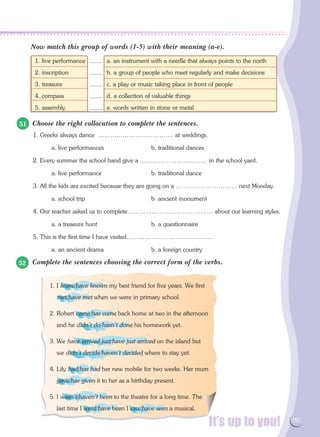
ΙΝΣΤΙΤΟΥΤΟ ΤΕΧΝΟΛΟΓΙΑΣ ΥΠΟΛΟΓΙΣΤΩΝ ΚΑΙ ΕΚΔΟΣΕΩΝ «ΔΙΟΦΑΝΤΟΣ»
Α΄ ΓΥΜΝΑΣΙΟΥ
ISBN 978-960-06-2685-8
Κωδικός Βιβλίου: 0-21-0048
WORKBOOK
ThinkTeen!1stGradeofJuniorHighSchoolWORKBOOKΠροχωρημένοι
(01) 000000 0 21 0048 7
ΥΠΟΥΡΓΕΙΟ ΠΑΙΔΕΙΑΣ, ΕΡΕΥΝΑΣ ΚΑΙ ΘΡΗΣΚΕΥΜΑΤΩΝ
ΙΝΣΤΙΤΟΥΤΟ ΕΚΠΑΙΔΕΥΤΙΚΗΣ ΠΟΛΙΤΙΚΗΣ
1st Grade of Junior High School
WORKBOOK
Προχωρημένοι
Eυαγγελία Καραγιάννη, Εκπαιδευτικός
Βασιλική Κουή, Εκπαιδευτικός
Αικατερίνη Νικολάκη, Εκπαιδευτικός
Ελένη Μπιντάκα, Σχολικός Σύμβουλος
Μαρία Μπαστάκη, Εκπαιδευτικός
Ευαγγελία Γεωργούλη, Εκπαιδευτικός
Βασίλειος Λόγιος,
Σκιτσογράφος-Εικονογράφος
Χρυσούλα Κανελλοπούλου, Εκπαιδευτικός
Ιωσήφ Ε. Χρυσοχόος, Πάρεδρος ε.θ. του
Παιδαγωγικού Ινστιτούτου
Αφοί Ν. Παππά & Σία Α.Ε.Β.Ε.
ΣΥΓΓΡΑΦΕΙΣ
ΚΡΙΤΕΣ-ΑΞΙΟΛΟΓΗΤΕΣ
ΕΙΚΟΝΟΓΡΑΦΗΣΗ
ΦΙΛΟΛΟΓΙΚΗ ΕΠΙΜΕΛΕΙΑ
ΥΠΕΥΘΥΝΟΣ ΤΟΥ ΜΑΘΗΜΑΤΟΣ ΚΑΙ
ΤΟΥ ΥΠΟΕΡΓΟΥ
ΚΑΤΑ ΤΗ ΣΥΓΓΡΑΦΗ
ΠΡΟΕΚΤΥΠΩΤΙΚΕΣ
ΕΡΓΑΣΙΕΣ
Γ΄ Κ.Π.Σ. / ΕΠΕΑΕΚ ΙΙ Ενέργεια 2.2.1 / Κατηγορία Πράξεων 2.2.1.α:
«Αναμόρφωση των προγραμμάτων σπουδών και συγγραφή νέων εκπαιδευτικών πακέτων»
	 ΠΑΙΔΑΓΩΓΙΚΟ ΙΝΣΤΙΤΟΥΤΟ
	 Δημήτριος Γ. Βλάχος
	 Ομότιμος Καθηγητής Α.Π.Θ.
	 Πρόεδρος του Παιδαγωγικού Ινστιτούτου
Πράξη με τίτλο:	 «Συγγραφή νέων βιβλίων και παραγωγή
	 υποστηρικτικού εκπαιδευτικού υλικού με βάση
	 το ΔΕΠΠΣ και τα ΑΠΣ για το Γυμνάσιο»
	 Επιστημονικοί Υπεύθυνοι Έργου
	 Αντώνιος Σ. Μπομπέτσης
	 Σύμβουλος του Παιδαγωγικού Ινστιτούτου
	 Γεώργιος Κ. Παληός
	 Σύμβουλος του Παιδαγωγικού Ινστιτούτου
	 Αναπληρωτές Επιστημονικοί Υπεύθυνοι Έργου
	 Ιγνάτιος Ε. Χατζηευστρατίου
	 Μόνιμος Πάρεδρος του Παιδαγωγικού Ινστιτούτου
	 Γεώργιος Χαρ. Πολύζος
	 Πάρεδρος ε.θ. του Παιδαγωγικού Ινστιτούτου
Έργο συγχρηματοδοτούμενο 75% από το Ευρωπαϊκό Κοινωνικό Ταμείο και 25% από εθνικούς πόρους.
ΣΤΟΙΧΕΙΑ ΑΡΧΙΚΗΣ ΕΚ∆ΟΣΗΣ
ΣΤΟΙΧΕΙΑ ΕΠΑΝΕΚ∆ΟΣΗΣ
Η επανέκδοση του παρόντος βιβλίου πραγματοποιήθηκε
από το Ινστιτούτο Τεχνολογίας Υπολογιστών & Εκδόσεων
«Διόφαντος» μέσω ψηφιακής μακέτας, η οποία δημιουργή-
θηκε με χρηματοδότηση από το ΕΣΠΑ / ΕΠ «Εκπαίδευση
& Διά Βίου Μάθηση» / Πράξη «ΣΤΗΡΙΖΩ».
Οι διορθώσεις πραγματοποιήθηκαν κατόπιν έγκρισης του Δ.Σ. του Ινστιτούτου Εκπαιδευτικής Πολιτικής
00 WORKBOOK PROXO SEL XX1-XX6.indd 2 24/2/2015 9:20:06 πµ
1st Grade of Junior High School
Workbook
Προχωρημένοι
ΥΠΟΥΡΓΕΙΟ ΠΑΙΔΕΙΑΣ, ΕΡΕΥΝΑΣ ΚΑΙ ΘΡΗΣΚΕΥΜΑΤΩΝ
ΙΝΣΤΙΤΟΥΤΟ ΕΚΠΑΙΔΕΥΤΙΚΗΣ ΠΟΛΙΤΙΚΗΣ
Ευαγγελία Καραγιάννη Βασιλική Κουή Αικατερίνη Νικολάκη
ΑΝΑΔΟΧΟΣ ΣΥΓΓΡΑΦΗΣ
ΙΝΣΤΙΤΟΥΤΟ ΤΕΧΝΟΛΟΓΙΑΣ ΥΠΟΛΟΓΙΣΤΩΝ ΚΑΙ ΕΚΔΟΣΕΩΝ «ΔΙΟΦΑΝΤΟΣ»
Η συγγραφή και η επιστηµονική επιµέλεια του βιβλίου πραγµατοποιήθηκε
υπό την αιγίδα του Παιδαγωγικού Ινστιτούτου
00 WORKBOOK PROXO SEL XX1-XX6.indd 3 20/1/2016 10:31:33 πµ
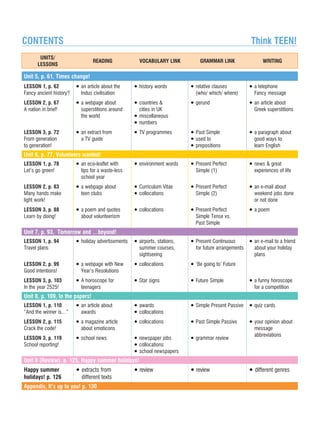
CONTENTS	 Think TEEN!
UNITS/
LESSONS
READING VOCABULARY LINK GRAMMAR LINK WRITING
Unit 1, p. 1, Welcome!
• students' profiles • classroom instructions
• signs
• leisure activities
• the verb ‘to be'
• the verb ‘have got'
• questions
• an e-mail about
you to a new keypal
Unit 2, p. 9, Junior High School Life!
LESSON 1, p. 10
Fancy school?
LESSON 2, p. 16
Join our club!
LESSON 3, p. 22
TEEN best-sellers!
• an article about
unusual schools
• children's presentations
of their school clubs
• Sophie's letter to her
friend about a film
• school subjects
• school clubs
• idioms with ‘time'
• collocations
• Present Simple
• adverbs of frequency
• Present Continuous
• action vs state verbs
• word order
• Present Simple 
Present Continuous
• a school timetable
• a paragraph about
your favourite
school day
• a paragraph about
your student type
• an e-mail describing
family photos
• the blurb of a book
or a film
Unit 3, p. 27, TEEN matters!
LESSON 1, p. 28
Food for thought!
LESSON 2, p. 33
Your problem sorted!
LESSON 3, p. 38
We're on a shopping
spree!
• a quiz about healthy
snacking
• a presentation of Bob's
snacking habits
• children's letters to
Agony Aunt
• house advertisements
• food
• ‘food' collocations
• adjectives
• adjectives of feelings
• collocations
• opposites
• advertisement
abbreviations
• nouns  quantifiers
(a lot of/much/many/
a few/a little/some/any)
• modals (must/
mustn't/don't have to)
• modals (must/ may/
might/should/shouldn't)
• comparative
 superlative
• a paragraph about
your snacking
habits
• a letter of advice
• a paragraph
explaining your
opinion
Unit 4, p. 43, Looking back on the past!
LESSON 1, p. 44
On a mystery tour!
LESSON 2, p. 51
Tell me a story!
LESSON 3, p. 56
We survived
the tsunami!
• the history of the
Vikings
• jokes
• news reports
• music
• puppets
• poetry
• famous people
• burglary
• weather
• collocations
• disasters
• Past Simple of the
verb ‘to be'
• Past Simple of regular
 irregular verbs
• Past Continuous Tense
• Past Simple 
Past Continuous
• your biography for
your class year
book
• a paragraph
describing what
was happening at
specific times in the
past
• a story
00 WORKBOOK PROXO SEL XX1-XX6.indd 5 13/5/2015 2:53:52 µµ
UNITS/
LESSONS
READING VOCABULARY LINK GRAMMAR LINK WRITING
Unit 5, p. 61, Times change!
LESSON 1, p. 62
Fancy ancient history?
LESSON 2, p. 67
A nation in brief!
LESSON 3, p. 72
From generation
to generation!
• an article about the
Indus civilisation
• a webpage about
superstitions around
the world
• an extract from
a TV guide
• history words
• countries 
cities in UK
• miscellaneous
• numbers
• TV programmes
• relative clauses
(who/ which/ where)
• gerund
• Past Simple
• used to
• prepositions
• a telephone
Fancy message
• an article about
Greek superstitions
• a paragraph about
good ways to
learn English
Unit 6, p. 77, Volunteers wanted!
LESSON 1, p. 78
Let's go green!
LESSON 2, p. 83
Many hands make
light work!
LESSON 3, p. 88
Learn by doing!
• an eco-leaflet with
tips for a waste-less
school year
• a webpage about
teen clubs
• a poem and quotes
about volunteerism
• environment words
• Curriculum Vitae
• collocations
• collocations
• Present Perfect
Simple (1)
• Present Perfect
Simple (2)
• Present Perfect
Simple Tense vs.
Past Simple
• news  great
experiences of life
• an e-mail about
weekend jobs done
or not done
• a poem
Unit 7, p. 93, Tomorrow and …beyond!
LESSON 1, p. 94
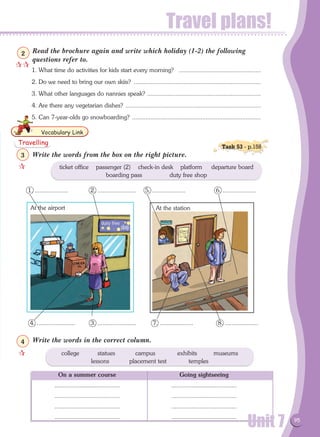
Travel plans
LESSON 2, p. 99
Good intentions!
LESSON 3, p. 103
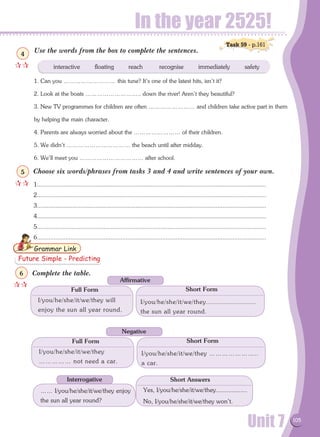
In the year 2525!
• holiday advertisements
• a webpage with New
Year's Resolutions
• A horoscope for
teenagers
• airports, stations,
summer courses,
sightseeing
• collocations
• Star signs
• Present Continuous
for future arrangements
• ‘Be going to' Future
• Future Simple
• an e-mail to a friend
about your holiday
plans
• a funny horoscope
for a competition
Unit 8, p. 109, In the papers!
LESSON 1, p. 110
“And the winner is…”
LESSON 2, p. 115
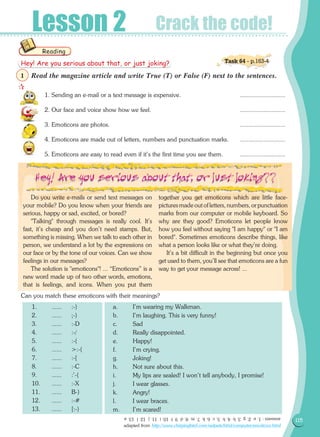
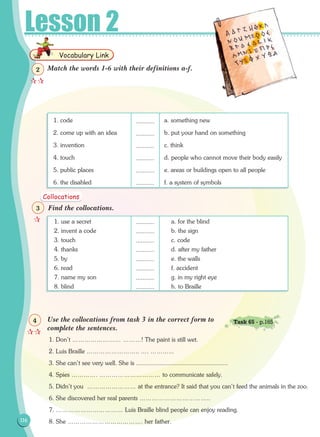
Crack the code!
LESSON 3, p. 119
School reporting!
• an article about
awards
• a magazine article
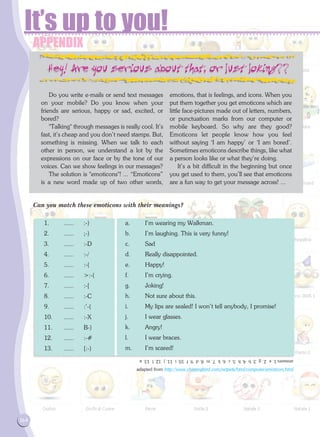
about emoticons
• school news
• awards
• collocations
• collocations
• newspaper jobs
• collocations
• school newspapers
• Simple Present Passive
• Past Simple Passive
• grammar review
• quiz cards
• your opinion about
message
abbreviations
Unit 9 (Review), p. 125, Happy summer holidays!
Happy summer
holidays! p. 126
• extracts from
different texts
• review • review • different genres
Appendix, It’s up to you! p. 130
CONTENTS	 Think TEEN!
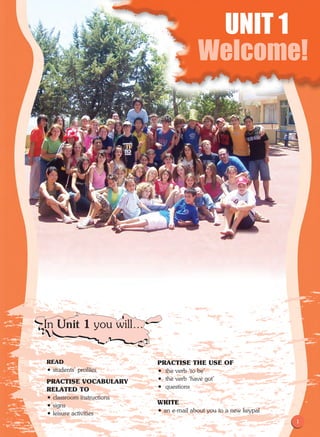
1
Unit 1
Welcome!
READ
• students' profiles	
PRACTISE VOCABULARY 	
RELATED TO
• classroom instructions
• signs
• leisure activities
PRACTISE THE USE OF
• the verb ‘to be'
• the verb ‘have got'
• questions
WRITE
• an e-mail about you to a new keypal
UNIT 1
Welcome!
In Unit 1 you will…
1
UNIT 1
2
The children below met at the TEEN camp last summer. Read their profiles (1-4)
and write the name of the child/children who:
Read their profiles (1-4) again and find who their
keypals are (a-e). There's an extra keypal you don't need
to use.
Reading
1. like films			 ……………………		 ……………………
2. like football 			 ……………………		 ……………………
3. like music 		 …………………… 		 ……………………
4. love shopping 		 ……………………		 ……………………
5. loves pets 			 ……………………
6. play a musical instrument	 ……………………		 ……………………
7. plays basketball		 ……………………
8. surfs the Internet 		 ……………………
b Hello! My name's Luigi andI'm from Milan, Italy. I'm 13years old and I want to travel alot. I want to meet new peopleand see new places. I also want to be afamous footballer. I love football and Ipractise every day. My favourite team isMilan. I want to play for them one day.
2 Hi! My name's Nadia. I'm
from Moscow, Russia. I'm 11
years old and I'm crazy about
fashion. I love going shopping
with my friends. I don't buy much but I like
looking at shop windows.
c Hi! My name's Amanda and
I'm from Cyprus. I love sports,
especially swimming but I also like
music. I don't sing very well but I
can play the guitar. I love songs
from other countries. Can you
send me a song of your country?
1 My name's Thomas but my friendscall me Tom. I'm from Santos, Braziland I'm 12 years old. I love footieand I play with my friends almostevery day. My favourite TVprogramme is sports.
Who's my keypal?

1

2 Task 1 - p.131
a Hi! I'm Sarah. I'm 11 years
old and I'm from Edinburgh,
Scotland. I enjoy going to the
cinema with my friends every
weekend. I like all kinds of films. I also like
reading. I often buy teen mags. They
often have articles on my favourite films
or my favourite actors.
3 Hello! My name's Jason. I'm
10 years old and I've got lots of
hobbies. I enjoy using theInternet and reading about newfilms. I prefer adventure films. What aboutyou? My favourite actor is Tom Cruise. Doyou like him?
Welcome!
3
Unit 1
Match the sentences 1-5 with the pictures a-e.
4 Hi, there! I'm Miranda and I
come from Bulgaria. I'm seven
years old. I've got a sister and
two brothers. A big family, isn't
it? I can play the piano and I can
sing very well. I'm in the school choir and I
often sing karaoke at parties. I prefer
healthy food because I want to be slim and
beautiful. When I grow up, I want to be a
famous singer.
d Hi! I'm Yiannis from Karditsa,
Greece. I come from a big family
and I like that. Have you got a big
family, too? I love animals! I've
got two pets, Alfy, my dog and
Jerry, my hamster. I don't like football but I
play basketball. I also like board games. I'm
very good at chess.
Vocabulary Link
1. Open your
books on page 10! 2. Listen to the CD.
4. Work in pairs.
5. Write an e-mail
to your keypal.
3. Work in groups.
a.
c.
b.
e.
d.
Classroom instructions

3
e Hello! I'm Mandy and I'm 12
years old. I like reading fashion
magazines and buying clothes. I
usually spend all my pocket money
on T-shirts or necklaces. I also love
making my own jewellery. My
mum says I'm good at it. She often wears my
accessories.
UNIT 1
4
Match the signs (1-6) with the places (a-e). There is an extra sign you do not need to
use.
Match the words (1-6) with a-f to form collocations.
Adults 6 €
Under 12 FREE Mind the gap
Sorry no
lesson today
Danger!
ROCKS ON
ROAD
Out of
order
1. sing
2. play
3. go
4. listen
5. read
6. watch
a. a TV programme / a film
b. books / newspapers / magazines
c. to music / to the radio
d. swimming / white water rafting / horse riding / shopping
e. football / volleyball / tennis / basketball / a musical
instrument / chess
f. a song
.......f.........
................
................
................
................
................
e.
No
smoking
Signs

4
1
2
3
4
5
6
b.a. c.
d.
Leisure activities

5
Unit 1
Welcome!
Complete the tables.
Grammar Link
The verb 'to be'

6
I am
You are
.................
She is
It is
We are
.................
.................
Greek!
Full Form	 Short Form
Affirmative
Interrogative Short Answers
Negative
Greek.
French?
………..
You're
He's
.............
.............
.............
You're
They're
English.
Yes, you are./ No, you aren't.
Yes, I am./........................
...........................................
...........................................
...........................................
...........................................
...........................................
...........................................
I am not	 I'm not
................	 You're not	 (You aren't)
He is not	 He's not	 (………….)
She is not	 .................	 (She isn't)
It is not	 It's not 	 (………….)
.................	 We're not	 (We aren't)
You are not	 .................	 (You aren't)
They are not	 They're not	 (………….)
Am I
Are you
Is he/she/it
Are we / you / they
5
UNIT 1
6
Write true sentences about you and your family
using the verb ‘to be' in the correct form.
e.g. My dad / be / English.	 My dad isn't English.
1. My best friend / be / 12 years old ........................................................................................
2. Mum / be / at home now .....................................................................................................
3. Football / be / my favourite sport ........................................................................................
4. My best friend and I / be / in the same class ........................................................................
5. I / be / crazy about fashion...................................................................................................
6. There / be / two cinemas near my school.............................................................................
Complete the tables.
Task 2 - p.131

7
The verb 'have got'

8
I have got
..................
..................
She has got
It has got
We have got
..................
..................
a pet.
Full Form	 Short Form
Interrogative Short Answers
Negative
a large family.
a teddy bear?
………..
You're got
He's got
.............
.............
.............
You've got
They've got
a book.
Yes, you have./ No, you haven't.
Yes, I have./........................
...........................................
...........................................
...........................................
I have not got	 …………….
...................	 You haven't got
He has not got	 ……………..
……………	 She hasn't got
It has not got	 ……………..
...................	 We haven't got
You have not got	 You haven't got
They have not got	 ………………
Have I got
…….. you …..
Has he/she/it
…… we/you/they got
Affirmative
Welcome!
Unit 1 7
your teacher two blue pens
1. you a pet
2. your friend a new bike
3. your parents a blue car
4. your favourite animal four legs
5. your best friend a new PC game
Write questions using have/has and give true answers.
Look at the answers and write questions. Then you can ask
your partner these questions.
e.g. What's your name?	 My name's Christina.
1. .............................................................		 All right, thanks.
2. .............................................................		 I'm from Kalamata.
3. .............................................................		 I'm twelve.
4. .............................................................		 Maths and English.
5. .............................................................		 I'm in the first grade of Junior High School.
6. .............................................................		 Swimming.
1. ....................................................................................................................
2. ....................................................................................................................
3. ....................................................................................................................
4. ....................................................................................................................
5. ....................................................................................................................
e.g. Has your teacher got two blue pens? Yes, he has.

9

10 Task 3 - p.132
UNIT 1
8
Write an e-mail to your new keypal and present yourself.
• Write 2 paragraphs.
	  In the first paragraph write
	 • your name
	 • how old you are
	 • where you are from
	 • your hobbies
	 In the second paragraph write a few things about your family
	 • your parents
	 • your brothers/sisters
• Ask your friend to write back and tell you about himself/herself.
Writing
Hello!
....................................................................................................
...........................................................................................................................
...........................................................................................................................
...........................................................................................................................
...........................................................................................................................
...........................................................................................................................
...........................................................................................................................
...........................................................................................................................
...........................................................................................................................
My profile

11
Task 4 - p.132
9
READ
• an article about unusual schools
• children's presentations of their school
clubs
• Sophie's letter to her friend about a
film
PRACTISE COLLOCATIONS  	
VOCABULARY RELATED TO
• school subjects
• school clubs
• idioms with ‘time'
PRACTISE THE USE OF
• Present Simple
• adverbs of frequency
• Present Continuous
• action vs. state verbs
• word order
WRITE
• a paragraph about your student type
• an e-mail describing family photos
• the blurb of a book or a film
UNIT 2
Junior High School Life!
In Unit 2 you will…
9
LESSON 1:Fancy school?
LESSON 2: Join our club!
LESSON 3: TEEN best-sellers!
Lesson 1
10
Read this article and then write (S) for Santa Claus School and
(A) for the School of the Air.
SANTA
CLAUS
SCHOOL
It's time to get
ready for the New
Santa School Year!
The Santa Claus
School is more
than 70 years old.
It opens for 6 days
every year; Octo-
ber 13, 14 and 15
and November 3, 4, and 5. Lessons take
place at the Santa House in downtown
Midland, Michigan.
At the Santa School, students meet Mr
Santas and Mrs Santas from around the
world. Everyone listens to Santa stories. We
come together to share our love of Christmas
and the magical spirit of Santa Claus. The
School is full of love, laughter, and learning.
That's why it is the oldest and most famous
school of its kind.
Come to our school and experience what
Christmas dreams are made of!
adapted from http://www.santaclausschool.com/
SCHOOL OF
THE AIR
The Alice Springs
School of the Air is
for children living
in Central Australia.
These children live
in an area which is miles away from cities and
towns. They are active, healthy, and have lots
of free time. They learn about animals and
plants of the Outback. Most of them learn to
ride horses at an early age.
The School of the Air simply helps these
children learn about the outside world.
Children do not go to school every day. They
have ‘on air lessons'. Students listen to
interesting radio lessons and watch
educational videos. Teachers send them their
homework through e-mail and students send
it back.
adapted from http://www.assoa.nt.edu.au/
Reading
e.g. It's a school for children.	 A
1. This school works only a few days a year.	 …
2. Students come from different places of the world.	 …
3. Students live away from big cities.	 …
4. Students listen to their teacher on the radio.	 …
5. Students tell stories about Father Christmas.	 …
6. Students enjoy Christmas holidays.	 …
7. Students get their homework assignments electronically.	 …
Is this your ideal school?

1
Task 5 - p.133
Unit 2 11
Fancy school ?
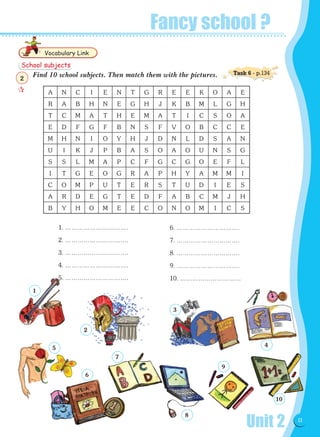
Find 10 school subjects. Then match them with the pictures.
1. ………………………….
2. ………………………….
3. ………………………….
4. ………………………….
5. ………………………….
6. ………………………….
7. ………………………….
8. ………………………….
9. ………………………….
10. …………………………
Vocabulary Link
A N C I E N T G R E E K O A E
R A B H N E G H J K B M L G H
T C M A T H E M A T I C S O A
E D F G F B N S F V O B C C E
M H N I O Y H J D N L D S A N
U I K J P B A S O A O U N S G
S S L M A P C F G C G O E F L
I T G E O G R A P H Y A M M I
C O M P U T E R S T U D I E S
A R D E G T E D F A B C M J H
B Y H O M E E C O N O M I C S
1
2
5
6
7
3
8
9
4
10
School subjects

2
Task 6 - p.134
Lesson 1
12
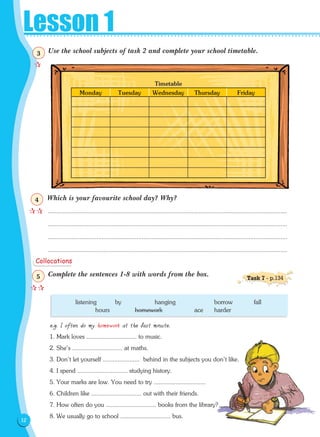
Use the school subjects of task 2 and complete your school timetable.
Which is your favourite school day? Why?
e.g. I often do my homework at the last minute.
1. Mark loves .............................. to music.
2. She's .............................. at maths.
3. Don't let yourself ...................... behind in the subjects you don't like.
4. I spend .............................. studying history.
5. Your marks are low. You need to try ...............................
6. Children like .............................. out with their friends.
7. How often do you .............................. books from the library?
8. We usually go to school .............................. bus.
Complete the sentences 1-8 with words from the box.
...............................................................................................................................................
...............................................................................................................................................
...............................................................................................................................................
...............................................................................................................................................
listening	by		hanging		borrow		fall
	hours		homework		ace	harder

3

4

5
Collocations
Task 7 - p.134
Timetable
Monday Tuesday Wednesday Thursday Friday
01 WORKBOOK PROXO SEL 001-026.indd 12 13/5/2015 2:57:56 µµ
Unit 2 13
Fancy school ?
1. The 3rd person singular in affirmative takes an -s
	 e.g. I read a book.  He ....................................................
2. Verbs ending in -s, -ss, -sh, -ch, -x, -o take -es
	 e.g. I watch TV.  She .......................................................
3. Verbs ending in consonant+y take -ies
	 e.g. We study maths.  He..................................................
4. We ask questions with do and does. 	
	 e.g. ……you visit your grandparents at weekends?
	 ……your dad work late?
5. We make negative sentences with don't and doesn't.
	 e.g. She ……..play football.
We …….. go to the cinema on weekdays.
Complete the tables.
Grammar Link
Complete the examples.
I read
You read
………….
She reads
………….
We read
You read
They read
books.
Full Form	 Short Form
Affirmative
Interrogative Short Answers
Negative
comics.
newspapers?
Yes, you do./ No, you don't.
Yes, I do. /..........................
...........................................
Yes, she does. / No, she doesn't.
...........................................
...........................................
...........................................
...........................................
I …. not read	 I don't read
...................	 You …….. read
He does not read	 ……………….
………………..	 She doesn't read
………………..	 ……………….
We do not read	 ……………….
You do not read	 ........................
……………….	 They don't read
…… I read
Do you read
Does he read
…… she …..
……. it ……
…… we read
Do you ……..
……. they read


7
6
Present Simple
Lesson 1
14
Write the verbs in the 3rd person singular in the right column.
e.g. Do you watch (watch) TV every day?
1. My dad and mum ......................................... (go) jogging every evening.
2. My sister ......................................... (play) volleyball at the weekend.
3. I ......................................... (not study) Chinese at school.
4. The children......................................... (visit) their grandparents every Sunday.
5. ............. Maria ................ (work) in a hospital?
6. Joanne ......................................... (do) the ironing every Saturday.
7. My brother ......................................... (not / tidy) his room very often.
8. Our parents ......................................... (wash) the dishes after lunch.
9. My grandad ......................................... (play) chess at weekends.
10. ............... you .......................... (set) the table at noon?
He/ She/ It.........
Write the verbs in brackets in the correct form of Present
Simple.
look tidy go want rain wash cry play
make read study watch come do speak carry
	 -s	 -es	 -ies
looks	 goes	tidies

8

9 Task 8 - p.135

15
Fancy school ?
1. I …………………. go to school early in the morning.
2. I …………………. go shopping.
3. I see my friends …………………..
4. I have English classes …………………..
5. ………………………………………………………………..
6. ………………………………………………………………..
What type of student are you? Why?
Write a short paragraph and put it on
display in your classroom. How many
students are the same type as you?
Use time expressions from the box to complete the sentences about you. Write
two more sentences.
	 always		 usually		 often		 sometimes
once/twice/three times a week never at the weekend
		 in the summer		 on Mondays
Writing
STEPS
• Describe what type of student you are in a
short paragraph.
• Explain why. The student type quiz in the
student's book on page 8 can help you.
• Do you need to change anything?
• Read your paragraph again and correct
your mistakes.
type Ôof student: .................................
................................................................................................................................................
................................................................................................................................................
................................................................................................................................................
................................................................................................................................................
................................................................................................................................................
................................................................................................................................................
................................................................................................................................................
................................................................................................................................................
................................................................................................................................................
................................................................................................................................................
Adverbs of frequency

10
Student types

11
Unit 2
Lesson 2
16
Read the texts 1-4 and match them with the school clubs.
There's an extra club you don't need to use.
Reading
HEALTH CLUB ECO CLUB MOVIES CLUB
DRAMA CLUB PHOTOGRAPHY CLUB
Which club do they belong to?

1 Task 9 - p.136
1. Hi! I'm Mark. I love adventure films and
musicals. We have a large collection of
films in our club. My favourite one is
Matrix. There's lots of action and amazing
visual effects. At the moment we are
watching ‘Home Alone’. I don't like it
much. It's baby stuff.
3. Hi! I'm Mike and
I'm really interested
in medicine. I'd like
to be a doctor when
I grow up. I'm lucky
there is such a club
at our school. We
learn about our body and what we can
do to be fit. We need to eat lots of
vegetables and fruit and drink 2 litres of
water every day. We also need to take
regular exercise. We are going mountain
climbing this weekend. Cool, isn't it?
2. Hello! My name's
Helena. We've got lots of
clubs at our school. My
friends like acting and
singing and that's why
they are in the Drama
Club. I enjoy taking snaps
of beautiful landscapes.
I've got some good ones from my summer
holidays. This week we are learning how to
download our photos from our digital camera
to the computer.
4. Hello, there! My name's Dorothy. My friends
and I are really worried about pollution of
the environment. There are often traffic jams
in our area and there are not many trees.
We've decided to form a club to protect the
environment. At the moment we are putting up
posters on our school walls.
Unit 2 17
Join our club!
e.g. cookery
1. newcomer
2. snap
3. poor
4. offer
5. charity
6. choir
7. orphan
8. coach
9. recipe
10. delicious	
e.g. I don't have many friends at school. You see I'm a newcomer . We have just moved
to our new house.
1. I don't think they can afford a new TV. They are quite __________________ .
2. I'd like to make a chocolate cake. Do you know a good ________________?
3. I've got a good _________ of the castle.
4. Jenny sings in the school ____________ .
5. Mrs. Smith is very rich and often gives money to ___________________ .
6. That English restaurant serves ______________ food. I like their roast beef most of all.
Match the words 1-10 with their definitions a-j.
a. a child with no parents
b. a new person in a place
c. he/she trains a sports team
d. it tells you how to cook something
e. an organisation that gives money to the poor
f. give
g. group of people singing together
h. not rich
i. photograph
j. tasty
k. skill of preparing food
Use some of the words from task 2 to complete the following sentences.
Vocabulary Link

2
k
.......
.......
.......
.......
.......
.......
.......
.......
.......
.......

3
18
Lesson 2
Full Form		 Short Form
I am reading		 I'm reading	
You are reading 	 ...........................
...........................	 He's ...................
She is .................	 ...........................
It ........................	 ...........................
We are reading	 ...........................
You ....................	 You're reading
They ..................	 ...........................	
Full Form		 Short Form
I …. not reading	 I'm not reading
...........................	 You aren't reading
He is not reading	 ...........................
...........................	 She isn't reading
...........................	 ...........................
We are not reading 	 ...........................
You are not reading 	 ...........................
...........................	 They...................
Match the phrases from the box with the pictures 1-3. There's one phrase
you don't need to use.
Complete the tables.
I'm having the time of my life!	 Take your time!	 Get back in time for dinner!
		 Don't waste your time and do your homework!
1. ......................................
2. ...................................... 3. ......................................
Grammar Link
Idioms with 'time'
Present Continuous

4

5
Affirmative
Negative
a novel.
a fairy tale.
Unit 2 19
Join our club!
					Short Answers
…… I reading				 Yes, you are./ No, you aren't.
Are you reading			 Yes, I am./ No, I'm not.
Is he reading				 ......................................
…… she ……..….			 Yes, she is. No, she isn't.
……. it ……..…… 			 ......................................
…… we …………	 		 ......................................
Are you …………			 ......................................
……. they reading			 ......................................
1. Verbs ending in consonant + e, drop -e and take -ing,
e.g. ...............................................................................................................
2. Verbs ending in consonant + y, keep the -y and take -ing,
e.g. ................................................................................................................
3. Verbs ending in consonant + stressed vowel + consonant, double the final
consonant, e.g. ..............................................................................................
4. Verbs ending in -ie, change -ie to -y,
e.g. ...............................................................................................................	
e.g. 		 play playing
1. make	 .............................................	
2. cook		 ...........................................
3. go		 ...........................................
4. tidy		 ...........................................
5. sit		 ...........................................
6. lie		 ...........................................
7. run		 ...........................................
8. visit		 ...........................................
9. come	 ...........................................	
10. carry	 ...........................................	
Match the examples with the spelling rules.
Can you find more examples in your student’ s book (page 16) and make a list?
.....................................................................................................................................
.....................................................................................................................................
.....................................................................................................................................
Write the verbs in -ing form.
a. die → dying
b. drive → driving
c. sit → sitting
d. tidy → tidying
EXAMPLES	 SPELLING RULES
Interrogative
a comic?

6

7
20
Lesson 2
Write the verbs in brackets in the correct form of Present
Continuous.
1. My dad …………………………. (sleep) on the bed at the moment. Be quiet!
2. The children ……………………… (study) history. Don't make any noise.
3. …………………………… (you / go) to the supermarket? No, I'm not.
4. My mum…………………………… (lie) on the sofa. She's tired.
5. I ………………………… (not / make) a cake at the moment.
6. …………………………….. (he / sit) on my chair?
7. We ……………………………. (put) up a school play this month.
You are writing an e-mail to your keypal and you are attaching these family
photos. Complete the e-mail explaining what these photos show. Use the verbs
in Present Continuous.
e.g. Listen! The baby is crying. (cry).
my brother/ wash the dishes
I/ listen to my new CD
my brother/ swim
I/have dinner with my parents
my brother/ do his homework I/ ride my bike in the forest
1 2 3
4 5
6

8
Task 10 - p.137

9
My photos
Writing
Unit 2 21
Join our club!
Dear Christine,
Hi! Thanks for your e-mail and the photos you sent me. My God,
you're beautiful! Here are some photos of my family. My brother
is in photo number 1. He is
....................................................................................................................
....................................................................................................................
....................................................................................................................
....................................................................................................................
....................................................................................................................
....................................................................................................................
....................................................................................................................
....................................................................................................................
....................................................................................................................
....................................................................................................................
....................................................................................................................
....................................................................................................................
....................................................................................................................
....................................................................................................................
....................................................................................................................
....................................................................................................................
....................................................................................................................
....................................................................................................................
....................................................................................................................
....................................................................................................................
22
Lesson 3
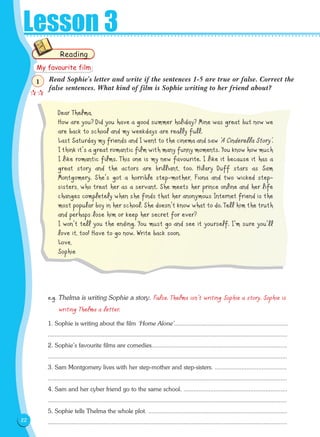
Read Sophie's letter and write if the sentences 1-5 are true or false. Correct the
false sentences. What kind of film is Sophie writing to her friend about?
Dear Thelma,
How are you? Did you have a good summer holiday? Mine was great but now we
are back to school and my weekdays are really full.
Last Saturday my friends and I went to the cinema and saw ‘A Cinderella Story’.
I think it's a great romantic film with many funny moments. You know how much
I like romantic films. This one is my new favourite. I like it because it has a
great story and the actors are brilliant, too. Hilary Duff stars as Sam
Montgomery. She's got a horrible step-mother, Fiona and two wicked step-
sisters, who treat her as a servant. She meets her prince online and her life
changes completely when she finds that her anonymous Internet friend is the
most popular boy in her school. She doesn't know what to do. Tell him the truth
and perhaps lose him or keep her secret for ever?
I won't tell you the ending. You must go and see it yourself. I'm sure you'll
love it, too! Have to go now. Write back soon.
Love,
Sophie
e.g. Thelma is writing Sophie a story. False. Thelma isn't writing Sophie a story. Sophie is
writing Thelma a letter.
1. Sophie is writing about the film ‘Home Alone'....................................................................
...............................................................................................................................................
2. Sophie's favourite films are comedies.................................................................................
...............................................................................................................................................
3. Sam Montgomery lives with her step-mother and step-sisters. ...........................................
...............................................................................................................................................
4. Sam and her cyber friend go to the same school. ..............................................................
...............................................................................................................................................
5. Sophie tells Thelma the whole plot. ...................................................................................
...............................................................................................................................................
Reading
My favourite film

1
Unit 2 23
TEEN best-sellers!
Match the phrases 1-7 with a-g to form sentences.
We are moving
1. My girlfriend has no sense
2. Read the blurb
3. He's an ordinary
4. I'm cold. Is
5. I've got no
6. J. Wilson is certainly
7. Here's a review of
Choose the right word to fill in the gaps.
1. Jacqueline Wilson is a(n) …. author.
	 a. talented	 b. gorgeous	 c. ordinary
2. Dorothy and I have the same … in music.
	 a. songs	 b. taste	 c. sense
3. Have you got this book in …?
	 a. best-seller	 b. review	 c. paperback
4. In this film Sarah wants to …. from home.
	 a. move	 b. run away	 c. break up
5. We've got lots of time. … the hurry?
	 a. Who	 b. When	 c. Why
6. My dad is a(n) …. He writes books for children.
	 a. author	 b. teacher 	 c. publisher
7. Can you see the title of the book on the …?
	 a. plot	 b. cover	 c. blurb
8. The main … in the film is a poor orphan.
	 a. character	 b. author	 c. publisher
h
...........
...........
...........
............
..........
...........
...........
a. 13-year-old boy.
b. of humour.
c. a best-selling author.
d. to see what the book is about.
e. the heating on?
f. your favourite film.
g. secrets from my best friend.
h. house next month.
Vocabulary Link
Collocations

2

3 Task 12 - p.138
Task 11 - p.137
24
Lesson 3
e.g. every/Tom/football/plays/day Tom plays football every day.
1. after/you/do/the/do/washing up/dinner/?
...............................................................................................................................................
2. not/brother/does/tidy/my/his/at/weekend/room/the
...............................................................................................................................................
3. is/grandma/my/doing/the/the/at/ironing/moment
...............................................................................................................................................
4. watching/now/you/a/are/film/TV/on/?
...............................................................................................................................................
	 e.g. I love adventure films. State. ......................................................................
1.	 We are visiting our grandparents this weekend.............................................................
2.	 My dad drives to work every morning. ........................................................................
3.	 My sister likes bedtime stories. .....................................................................................
4.	 I don't believe in ghost stories.	....................................................................................
5.	 Do you know her address? ..........................................................................................
6.	 Sharon is riding her bike at the moment. ....................................................................
7.	 John is studying for a test. ...........................................................................................
e.g. Mary is doing her homework at the moment.
a.	 Mum gets up early .........................................................
b.	 Our teacher is writing on the board ...............................
c.	 Dad is washing the car ..................................................
d.	 The bank opens at 8.00 am ..........................................
e.	 We don't tidy our rooms ...............................................
Put the words in the correct order.
Underline the verb in each sentence and write if it shows an action or a state.
Complete the sentences with every day or at the moment
Grammar Link

Word order
Action vs. State verbs
Present Simple vs. Present Continuous

4

5

6
25
Unit 2
TEEN best-sellers!
e.g. My parents don't smoke (not / smoke).
1. Magda is in her room. She ………… ………………. (write) in her diary.
2. What time ………………………….. (your dad / come) home every day?
3. We ………………………. (go) to school by bus every morning.
4. Tom and his friends ……………..…… …………… (not / play) football today.
5. Turn off the TV! I …………………….. (study)!
6. ………………………..……. (you / cook) on Sundays or have lunch at a restaurant?
e.g. How does Hilary usually go to school every day?
Hillary usually goes to school on foot every day.
1.	 Where ........................................................................................................	
	 The boy is sitting near the window.
2.	 Who ..........................................................................................................	
Claire is tidying her bedroom.
3.	 Why ..........................................................................................................	
	 He is sleeping because he is tired.
4.	 What .........................................................................................................	
	 Tom reads a lot of books during his holidays.
5.	 When ........................................................................................................	
	 Emma eats cornflakes in the morning.
Write the verbs in the brackets in the correct form of
Present Simple or Present Continuous.
Look at the sentences and write questions.

8

7
Task 13 - p.138
Lesson 1
2626
TEEN best-sellers!Lesson 3
Write the blurb of your favourite book or film for the school library catalogue.
Read the blurbs in the student's book again to get ideas.
Writing
................................................................................................................................................
................................................................................................................................................
................................................................................................................................................
................................................................................................................................................
................................................................................................................................................
................................................................................................................................................
................................................................................................................................................
................................................................................................................................................
................................................................................................................................................
................................................................................................................................................
................................................................................................................................................
................................................................................................................................................
...............................................................................................................................................
A blurb

9
27
READ
• a quiz about healthy snacking
• a presentation of Bob's snacking habits
• children's letters to Agony Aunt
• house advertisements
PRACTISE COLLOCATIONS
 VOCABULARY RELATED TO
• food
• adjectives
• opposites
• advertisement abbreviations	
PRACTISE THE USE OF
• nouns and quantifiers
• modals (must/ mustn't/ don't have to/ may/
might/ should/ shouldn't)
• comparative  superlative
WRITE
• a paragraph about your snacking habits
• a letter of advice
• a paragraph explaining your opinion
UNIT 3
TEEN matters!
In Unit 3 you will…
LESSON 1: Food for thought!
LESSON 2: Your problem sorted!
LESSON 3: We’re on a shopping spree!
27
Lesson 1
28
Circle the tick () or the cross () to find out if healthy snacking is a piece
of cake for you!
	 QUESTIONS	 TRUE	FALSE
	 1. I think about how healthy a snack is every time I choose to have one!	 	 
	 2. I usually choose the healthiest snack, such as yoghurt, an apple etc.	 	 
	 3. I plan ahead what snacks I eat every day.	 	 
	 4. There are always healthy snacks around at home.	 	 
	 5. I rarely buy snacks from the school canteen.	 	 
	 6. My parents never buy unhealthy snacks from the supermarket.	 	 
	 7. I don't like junk food.	 	 
	 8. I often check how much fat and how many calories 			
there are in the snacks I have.	 	 
	 9. I don't snack when I'm bored or stressed.	 	 
	 10. I don't snack when I watch TV or do my homework.	 	 
How many ticks have you got? …
Reading
	 Based on http://kidshealth.org/teen/food_fitness/nutrition/snacking.html
Healthy Snacking Quiz

1
• 7 or more : You certainly follow a healthy diet. Snacking is no problem for you.
There's always something healthy to snack on.
• 4 - 6 : You know what is healthy and what is not. However, you have an unhealthy
snack from time to time. Be careful! You don't want to lose balance.
• 3 or fewer : You know what is good and what is bad for you but you seem to have a
sweet tooth. You need to try harder.
Food for thought!
Unit 3 29
Bob did the ‘Healthy Snacking' Quiz. How many ticks has he got?
Hi! My name's Bob and I like snacks. Every time I choose to have a
chocolate I know it's bad for me and my teeth. That's why I only have a
small bar of chocolate once a week. I don't often buy food from the
school canteen because my parents say that canteens sell unhealthy
snacks. I usually have a good breakfast every morning and I take a fruit
with me for the break. I don't plan ahead what snacks I'll have during the
day but there's always something healthy around. My parents sometimes
buy sweets, biscuits and fizzy drinks from the supermarket. I love going to my favourite fast
food restaurant with my friends every Saturday. I always have a double cheeseburger. I'm not
fat so I don't worry about calories and things like that. I never eat in front of the TV or when
I'm bored. That's a rule at our home!
Bob has got ………………
Write the words under the pictures.
Vocabulary Link
chips 1 .................................
2 .................................
3 .................................
4 .................................
5 .................................
6 ................................. 7 .................................
8 .................................

3

2
Task 14 - p.138
Food
Lesson 1
30
Match the words/ phrases 1-9 with a-i to form collocations.
1.	 skip
2.	 pay
3.	 high
4.	 once
5.	 normal-sized
6.	 poor
7.	 bad
8.	 go through
9.	 cut down
…...i…..
………..
………..
………..
………..
………..
………..
………..
………..
a.	 for your heart
b.	 recipe books
c.	 in a while
d.	 in fats
e.	 eating habits
f.	 meals
g.	 on fatty foods
h.	 attention
i.	 a meal
Write the opposites.
e.g. canned fruit ≠ fresh fruit
1. full-fat milk ≠ …………………………………….....
2. white bread ≠ ……………………………………....
3. good eating habits ≠ …………………………….…
4. fast-food meal ≠ ………………………………..…..
5. huge amounts of additives ≠ ………………………
Complete the sentences with the adjectives of the
words in brackets.
e.g. You must have three normal-sized meals a day. (NORMAL SIZE)
1. Fast food isn't ……………………… for teenagers. (HEALTH)
2. Lisa is …………………………. she is slim. There's no need to go on a diet. (LUCK)
3. Are there any ………………………… drinks in your fridge? (FIZZ)
4. The doctor says that my granddad mustn't eat …………………… food. (SALT)
5. Yummy! I love my granny's apple pie. It's always so ……………………… (TASTE)
6. We're having chicken with ………………………… potatoes for lunch. (BAKE)
Choose the correct word.
1. I must …. down on fatty foods.
	 a. give		 b. cut		 c. stop
Collocations

4

5

6

7 Task 15 - p.139
Food for thought!
Unit 3 31
2. Unhealthy food is usually high in ….
	 a. calories	 b. energy	 c. water
3. Don't eat so much meat. It's bad for your ….
	 a. heart	 b. recipe	 c. meal
4. Let's have some tofu ….!
	 a. chicken	 b. fruit		c. burgers
5. Buy … bread. It's healthier!
	 a. whole grain	 b. frozen	 c. boiled
6. Carbonated water makes drinks ….
	 a. sugary	 b. salty		c. fizzy
Put ticks in the right columns. Then write sentences in your notebook.
Complete the sentences with must / mustn't / don't have to.
e.g. I must have three normal-sized meals a day.
1. You ………………………. go on a diet. You are in good shape!
2. You ……………………… eat fast food very often.
3. You …………………… drink lots of water every day.
4. Young children ……………………… drink fizzy drinks. They are bad for their health.
5. You …………………….. stop eating burgers completely. You can have fast food once a month.
6. We ………………………. take some regular exercise to keep fit. Let's start jogging!
Grammar Link
Nouns and Quantifiers

8
Modals - must / mustn't / don't have to

9
a lot of some/any much many a few a little
oranges    
water
eggs
yoghurt
steaks
bread
02 WORKBOOK PROXO SEL 027-060.indd 31 13/5/2015 2:58:57 µµ
Lesson 1
32
Food for thought!
Look at the quiz and Bob's paragraph in task 1
and write a short paragraph about your snacking
habits. Compare it with your partner's and decide
who's got healthier eating habits.
...............................................................................................................................................
...............................................................................................................................................
...............................................................................................................................................
...............................................................................................................................................
...............................................................................................................................................
...............................................................................................................................................
...............................................................................................................................................
...............................................................................................................................................
...............................................................................................................................................
...............................................................................................................................................
...............................................................................................................................................
Writing
Give examples of what you
eat. Use the language you’ve
learnt in this lesson.

10
My snacking habits
Unit 3 33
Your problem sorted!Lesson 2
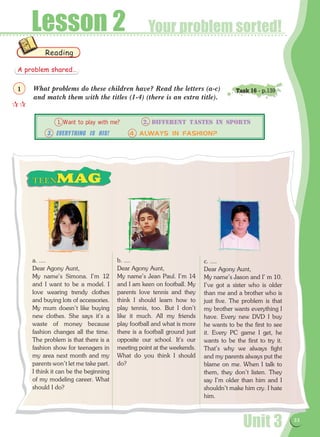
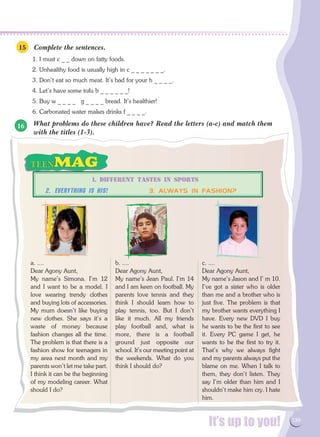
What problems do these children have? Read the letters (a-c)
and match them with the titles (1-4) (there is an extra title).
a. ....
Dear Agony Aunt,
My name's Simona. I'm 12
and I want to be a model. I
love wearing trendy clothes
and buying lots of accessories.
My mum doesn't like buying
new clothes. She says it's a
waste of money because
fashion changes all the time.
The problem is that there is a
fashion show for teenagers in
my area next month and my
parents won't let me take part.
I think it can be the beginning
of my modeling career. What
should I do?
b. ....
Dear Agony Aunt,
My name's Jean Paul. I'm 14
and I am keen on football. My
parents love tennis and they
think I should learn how to
play tennis, too. But I don't
like it much. All my friends
play football and what is more
there is a football ground just
opposite our school. It's our
meeting point at the weekends.
What do you think I should
do?
c. ....
Dear Agony Aunt,
My name's Jason and I' m 10.
I've got a sister who is older
than me and a brother who is
just five. The problem is that
my brother wants everything I
have. Every new DVD I buy
he wants to be the first to see
it. Every PC game I get, he
wants to be the first to try it.
That's why we always fight
and my parents always put the
blame on me. When I talk to
them, they don't listen. They
say I'm older than him and I
shouldn't make him cry. I hate
him.
Reading
	 1. Want to play with me?	 2. DIFFERENT TASTES IN SPORTS
3. Everything is His!	 4. ALWAYS IN FASHION?
A problem shared…

1 Task 16 - p.139
34
Lesson 2
Read the letters again and decide what they should do.
1. Simona should
a. take part in the fashion show without her parents' permission.
b. tell her parents why this show is important to her.
c. not take part in the show because she is very young.
2. Jean Paul should
a. tell his parents that he would like to play both football and tennis.
b. play tennis only and stop playing football.
c. not play football at weekends.
3. Jason should
a. share all his things with his little brother.
b. hide his favourite things and give his brother the toys and DVDs he doesn't like any
more.
c. start crying like his brother to get his parents' attention.
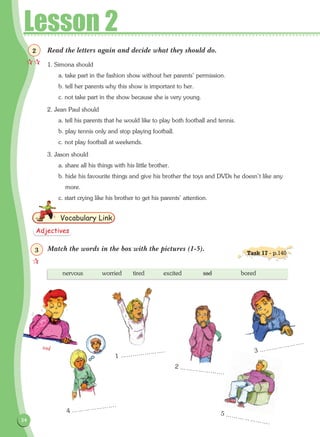
Match the words in the box with the pictures (1-5).
Vocabulary Link
nervous	 worried	 tired	 excited	 sad		 bored
sad
1 ………………….
2 ………………….
4 ………………….
5 ………………….
3 ………………….

2
Adjectives

3 Task 17 - p.140
Unit 3 35
1. The girl sitting next to him must be his sister. ........ a. I'm 50% sure.
2. She may/might be his mother. ........ b. I think this is not so good for you.
3. You should stop biting your nails. ........ c. I'm almost 100% sure.
4. You shouldn't feel so nervous about tests. ........ d. I think this is good for you.
Your problem sorted!
Use the adjectives from task 3 to complete the sentences.
e.g. I feel sad when I see poor children in the streets.
1. My dad gets ……………………. when I don't do well on a test.
2. I feel ……………………… when there's nothing interesting on TV.
3. All children feel …………………… when Christmas holidays are near.
4. Stop looking at me! You make me feel ………………………...
5. I feel dead …………………. after a week's work.
Match 1-4 with a-d.
Look at the pictures and complete the sentences 1-4 with must or may/might.
Grammar Link
1. Susan ................ be at Jenny's party.There’s no answer. 2. John ……………. be dead tired.
He has cleaned the whole house.
3. Jerry ……………. be in hospital.
He wasn't at school this morning.
4. Mark and Tim ……………. be twins.They look identical!

4
Task 18 - p.140
Making Guesses - Giving Advice

5

6
36
Lesson 2
Match the problems (1-7) with the
suggestions (a-g) and then write
sentences using should or shouldn't.
e.g.
I've got bad marks in my
school report.
1. ..........................................
..............................................
2. ..........................................
..............................................
3. ..........................................
..............................................
4. ..........................................
..............................................
5. ..........................................
..............................................
6. ..........................................
..............................................
a. ..........................................
..............................................
b. ..........................................
..............................................
c. ..........................................
..............................................
d. ..........................................
..............................................
e. ..........................................
..............................................
f. ..........................................
..............................................
7. ..........................................
..............................................
g. ..........................................
..............................................
You should work harder!


7
I've got bad marks in my school report. ....h.... a. buy it
1. My mum looks very tired. .......... b. call your friends on your mobile
2. I spend lots of money on mobile phone cards. .......... c. cross the road
3. I love this CD. .......... d. drink it
4. I'm thirsty but this water isn't clean. .......... e. help with the housework
5. This T-shirt looks awful on you! .......... f. take your umbrella
6. It's raining. .......... g. wear it
7. There're lots of cars. .......... h. work harder
37
Your problem sorted!
Choose a letter from task 1 on page 33 and write a short reply. Follow the
guidelines in the writing section of the student's book on page 36.
Writing
................................................................................................................................................
................................................................................................................................................
................................................................................................................................................
................................................................................................................................................
................................................................................................................................................
................................................................................................................................................
................................................................................................................................................
................................................................................................................................................
................................................................................................................................................
................................................................................................................................................
................................................................................................................................................
................................................................................................................................................
................................................................................................................................................
................................................................................................................................................

8
A letter of advice
Unit 3
38
1. shopping spree …. a. exciting
2. review …. b. a report about a book or a film
3. fan …. c. time when you buy lots of things
4. court …. d. people work and make goods there
5. take part in …. e. new information for a computer programme
6. update …. f. lots of
7. factory …. g. s/he likes an actor/ a singer etc or a game/ a tv show etc a lot
8. thrilling …. h. you can play tennis there
9. loads of …. i. join
Lesson 3
Match the words (1-9) with their
meaning (a-i).
Choose the right word to complete the sentences.
1. He joined the … when he was 18.
	 a. factory	 b. army	 c. update
2. Would you like to … a ticket for the match?
	 a. win	 b. save	 c. solve
3. Can you help me … this puzzle? It's very difficult.
	 a. choose	 b. explore	 c. solve
4. Lisa took … in the school singing contest.
	 a. part	 b. prize	 c. price
5. Chimps are very … animals.
	 a. fun	 b. funny	 c. thrilling
6. My brother doesn't like giving his … to other children.
	 a. toys	 b. games	 c. review
7. Going out with friends is great …
	 a. funny	 b. fan	 c. fun
8. My sister is Avril Lavigne's … She's got all her CDs.
	 a. fan	 b. fun	 c. funny
Vocabulary Link

1
Collocations

2 Task 19 - p.140
Unit 3 39
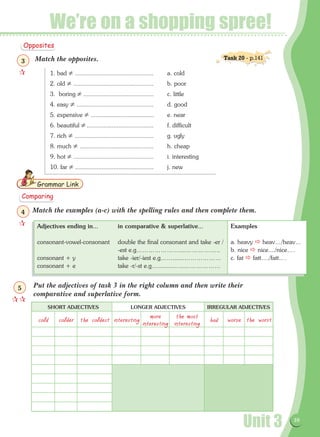
1. bad ≠	...............................................	 a. cold
2. old ≠	................................................	 b. poor
3. boring ≠	..........................................	 c. little
4. easy ≠	..............................................	 d. good
5. expensive ≠	......................................	 e. near
6. beautiful ≠	........................................	 f. difficult
7. rich ≠	...............................................	 g. ugly
8. much ≠	............................................	 h. cheap
9. hot ≠	................................................	 i. interesting
10. far ≠	...............................................	 j. new
We’re on a shopping spree!
Match the opposites.
Match the examples (a-c) with the spelling rules and then complete them.
Put the adjectives of task 3 in the right column and then write their
comparative and superlative form.
Grammar Link
Opposites

3

4
Task 20 - p.141
Comparing

5
Adjectives ending in…
consonant-vowel-consonant
consonant + y
consonant + e
in comparative  superlative…
double the final consonant and take -er /
-est e.g…………………....……………..
take -ier/-iest e.g…….......………………
take -r/-st e.g….........…...………………
Examples
a. heavy  heav…/heav…
b. nice  nice..../nice….
c. fat  fatt…./fatt….
SHORT ADJECTIVES LONGER ADJECTIVES IRREGULAR ADJECTIVES
cold colder the coldest interesting
more
interesting
the most
interesting
bad worse the worst
40
Lesson 3
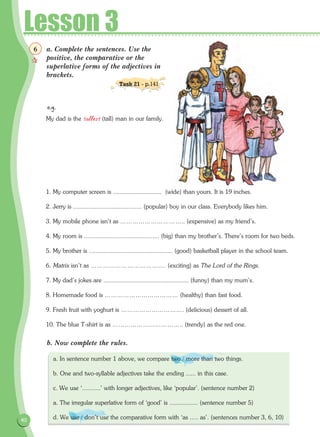
a. Complete the sentences. Use the
positive, the comparative or the
superlative forms of the adjectives in
brackets.
1. My computer screen is ............................. (wide) than yours. It is 19 inches.
2. Jerry is ......................................... (popular) boy in our class. Everybody likes him.
3. My mobile phone isn't as ………………………….. (expensive) as my friend's.
4. My room is ............................................. (big) than my brother's. There's room for two beds.
5. My brother is .................................................. (good) basketball player in the school team.
6. Matrix isn't as ………………………………. (exciting) as The Lord of the Rings.
7. My dad's jokes are ................................................... (funny) than my mum's.
8. Homemade food is ……………………………… (healthy) than fast food.
9. Fresh fruit with yoghurt is …………………………. (delicious) dessert of all.
10. The blue T-shirt is as …………………………….. (trendy) as the red one.
b. Now complete the rules.
My dad is the tallest (tall) man in our family.
e.g.

6
Task 21 - p.141
a. In sentence number 1 above, we compare two / more than two things.
b. One and two-syllable adjectives take the ending ...... in this case.
c. We use ‘...........' with longer adjectives, like ‘popular'. (sentence number 2)
a. The irregular superlative form of ‘good' is ................. (sentence number 5)
d. We use / don't use the comparative form with ‘as ..... as'. (sentences number 3, 6, 10)
41
We’re on a shopping spree!
Read the house ads, match the abbreviations and complete the sentences with
A, B or C.
House C
Reading
€ 300,000.00
Detached hse by the sea
3 beds
lounge, kit
bath/wc
garage
40 mins from city centre
€ 250,000.00traditional country cottage4 beds
big lounge with fireplace, kitbath/wc
big gdns
€ 150,000.00small flat in a modern block
big lounge, kit
bath
rear gdn
20 mins from city centre
ABBREVIATIONS
• hse	 • garden
• beds	 • minutes
• kit	 • house
• bath	 • bedrooms
• mins	 • bathroom
• gdn	 • kitchen
1. House … is more expensive than House C.
2. House … is nearer the city centre than House A.
3. House … is the most traditional of all.
4. House …the cheapest of all.
5. House … is more modern than House C.
6. House … is bigger than House B.
House BHouse A
House ads

7
Unit 3
42
Lesson 3
Choose the right car for the Marsilettis. Use comparative, superlative or as…
as to present your opinion and to explain your choice.
We’re on a shopping spree!
Writing
	 old	 long	 fast	 beautiful 	 slow	 expensive	 cheap
Mr Marsiletti goes to work by car.
Mrs Marsiletti has got a small car.
They often go on excursions at weekends.
They've got €26,000.00
I think car … is the right car for the Marsilettis because
•	 it is cheaper than ………………………………………………………………………..
•	 ……………………………………………………………………………………………
•	 ……………………………………………………………………………………………
•	 ……………………………………………………………………………………………
•	 ……………………………………………………………………………………………
Giving your opinion

8
Car A Car B Car C
Year: 1992 1968 1998
Length: 2.7m 2.2m 7m
Speed: 120km/h 70km/h 140km/h
Price: € 20,000 € 7,000 € 50,000
43
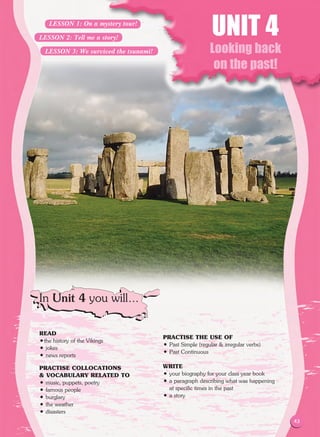
Looking back
on the past!
READ
•the history of the Vikings
• jokes
• news reports
PRACTISE COLLOCATIONS
 VOCABULARY RELATED TO
• music, puppets, poetry
• famous people
• burglary
• the weather
• disasters
PRACTISE THE USE OF
• Past Simple (regular  irregular verbs)
• Past Continuous
WRITE
• your biography for your class year book
• a paragraph describing what was happening
at specific times in the past
• a story
UNIT 4
In Unit 4 you will…
LESSON 1: On a mystery tour!
LESSON 2: Tell me a story!
LESSON 3: We survived the tsunami!
43
Lesson 1
Read the first paragraph about the Vikings and circle the places they visited
on the map.
THE VIKINGS
RAIDERS, TRAVELLERS OR BRAVE EXPLORERS?
Reading
The Vikings sailed the seas, attacked towns
and stole treasures all over Europe between the
years 800 and 1100. They started from
Scandinavia and attacked many countries in
Europe. They settled in Britain, Ireland and
France. They also crossed the Atlantic Ocean and
arrived in Iceland and Greenland. They
discovered North America but they also travelled
east to Russia and south to Arabia.
They were good farmers and excellent
shipbuilders. They used their ships for wars. They
also used them to carry people and goods to new
lands. In winter, when there was not much farm
work to do, they stayed at home and did other
interesting jobs. Men made swords to use them in
battles. The Vikings liked swords so much they
often decorated themselves with gold and gave
them names. Women cooked food and made
clothes, shoes and jewellery for them, their
children and their husbands. The Vikings believed
in many gods and goddesses. Their favourite was
Odin, the god of the dead!
In 866 the Vikings captured an Anglo-Saxon
town. They called it Jorvik and it was the capital
of the Viking kingdom for 200 years. They made
Jorvik rich and one of the most famous cities in
Britain. Some years ago,
archeologists discovered
part of that Viking
town in York, the
modern city of Jorvik.
They found many
things such as jewellery,
coins and clothes. If
you ever go to York
and you want to travel
back in time and see
how the Vikings lived,
visit the Jorvik Viking
Centre!
Adapted from Wilson, D. M. (1987) The Vikings,
Activity Book, British Museum Press
Pictures from Maynard, C. (1996) Viking Times, Kingfisher
Scandinavia
Britain
Iceland
Ireland
France
Arabia

1
The Vikings

44
On a mystery tour!
Unit 4 45
Now read the text and complete the notes.
Use the words in the box to complete the spidergrams.
Vocabulary Link
• The Vikings were ………………………… and ............................................
	 a. pirates	 b. sailors		c. farmers
• In winter
	 o men ...........................................................................................
	 o women ………………………and ..............................................
• Their favourite god was …………………….
• ……………………….. was the capital of their kingdom.
• The name of the museum in York is ...........................................................
puppeteer classical music poet plays voice sonnet opera line
The Muppet Show composer puppet symphony poem Macbeth
playwright Sesame Street TV programmes Romeo and Juliet
•
•
•opera
playwright
•
•
•
•
•
•
•
•
•
•
•The Muppet
Show
Mozart
Shakespeare
Henson
Task 22a - p.142 Task 22b - p.143

2
Music, puppets, poetry

3
Lesson 1
46
Choose the right word.
Complete the tables.
Complete the sentences. Use was, wasn't, were, weren't.
1. Paul …… at school yesterday. He ……. ill.
2. My CD player …… on my desk two minutes ago.
3. Where …… you last Sunday? I …… on a picnic.
4. ……. Jim and George at the party? No, they ………
5. My room ……… tidy this morning. Everything was upside down.
1.	 People used the dynamite to .… canals.
	 a. build	 b. compose	 c. invent
2.	 Columbus … America.
	 a. invented	 b. discovered	 c. created
3.	 Who … the lamp?
	 a. built	 b. invented	 c. discovered
4.	 Mozart composed his first … when he was 5.
	 a. play	 b. music	 c. invention
5.	 Walt Disney is the … of Mickey Mouse.
	 a. inventor	 b. composer	 c. creator
6.	 The Little Mermaid is my favourite …
	 a. fairy tale	 b. poem	 c. sonnet
Grammar Link
Task 23 - p.143
Collocations
Past Simple of the verb ‘to be’

4

5
I was	 			
You were
He/She/It …………………
We/You/They …………….
Full Form	 Short FormAffirmative
Interrogative Short Answers
Negative
I was	 			
You were
He/She/It …………………
We/You/They …………….
I was not	 I wasn't
You.............................	 You ..........................
He/She/It.....................	 ...................................
We/You/They..............	 We/You/They.............
…… I?	
……… you?
Was he/she/it?	
…… we/you/they?
6
On a mystery tour!
Unit 4 47
Complete the tables.
Complete the examples.
1.	Regular verbs in the Past Simple end in -ed e.g. I walk in the forest 			
 I……………… yesterday.
2.	Verbs ending in consonant-e take -d e.g. They like chocolate.  They …………………
3.	Verbs ending in consonant-vowel-consonant and stressed in the final syllable double the
final consonant e.g. I stop at 5 o' clock.  I………………
4.	Verbs ending in consonant + y take -ied e.g. We try hard.  We………………………….
5.	In questions and negative sentences we use did e.g. ……you visit your grandparents last
weekend? Yes, I did.
6.	We use was/were in questions and negative sentences with the verb ‘to be'. e.g. ……you
at school an hour ago? No, I ……………
I/You/He/She/It/We/They
invented a speaking watch.
Full Form	 Short Form
Affirmative
Short Answers
Negative
Yes, I/you/he/she/it/we/they ….
No, I/you/he/she/it/we/they …..
I/You/He/She/It	
We/They … not invent
a speaking watch.
I/You/He/She/It /
We/They didn't ……
a speaking watch.
Did I/you/he/she/it/we/they
………….. a solar car?
I/You/He/She/It/We/ They wrote an e-mail.
Full Form	 Short Form
Short Answers
Yes, I/you/he/she/it/we/they ……
No, I/you/he/she/it/we/they ……
I/You/He/She/It
We/They … not write a letter.
I/You/He/She/It
We/They didn't …… a letter.
Did I/you/he/she/it/we/they
………….. an e-mail?
Past Simple of regular verbs
Past Simple of irregular verbs

7

8
Interrogative
Interrogative
Negative
Affirmative
Lesson 1
48
Write the verbs in the Past Simple in the correct column.
Write questions and short answers.
study write cook stop listen try say look find stay prefer
discover invent compose go plan play like tidy love
	 consonant + -ed	 -e + -d  -ed	 double consonant-ed	 consonant + y  -ied
	cook  cooked		 stop  stopped
	 Irregular verbs	 vowel + y  -ed
	 write  wrote
	
1. your friend/ go to the cinema/ last night? 
...............................................................
...............................................................
2. Brian/ win the gold medal/ this morning? 
...............................................................
...............................................................
3. you/ visit/ the Acropolis/ last year? 
...............................................................
...............................................................
4. Jill/ write/ an e-mail/ two hours ago? 
...............................................................
...............................................................
5. granddad/ be/ museum/ on Sunday? 
...............................................................
...............................................................
you/go/to school/yesterday? 
e.g. Did you go to school yesterday?
Yes, I did.

9

10
On a mystery tour!
Unit 4 49
1.	 We usually have cornflakes for breakfast. DIDN'T
	 We ........................................ this morning.
2.	 Jack plays football with his friends every day. BASKETBALL
	 Yesterday morning Jack ........................................
3.	 I usually visit my grandparents on Mondays. LAST MONDAY
	 I didn't .........................................
4.	 It usually takes me two hours to drive back home from work. ONE
	 It ........................................ to drive back home from work yesterday.
5.	 There aren't any kids in the park now. TWO HOURS AGO
	 There .........................................
Stuart: 	 Did you watch (you/watch) Madonna's concert on TV last night?
Ann: 	 No, I didn't. I had (have) a lot of homework.
Stuart: 	 Really? What 1
................................ (you/do)?
Ann:	I 2
........................... (finish) drawing a map for geography, I 3
...................... (revise)
the vocabulary for the test in English and I 4
......................... (study) the piano.
Stuart: 	Wow! You 5
...................... (be) terribly busy! What time 6
.............................. (you/
finish)?
Ann:	I 7
........................... (start) at four o'clock in the afternoon and I 8
............................
(finish) at ten. What about you? When 9
......................................... (you/study)?
Stuart: 	I 10
............................ (finish) everything on Saturday so I 11
....................... (be) free
on Sunday.
Ann:	 That's cool!
Change the sentences into Past Simple. Use the words in bold.
e.g. I get up at seven o'clock every morning. YESTERDAY
Yesterday I got up at eight o'clock.
Fill in the gaps with the correct form of the verbs in brackets in
the Past Simple.
Task 24 - p.143

11

12
Lesson 1
50
On a mystery tour!
Writing
DATES	 EVENTS
•	 …/…/.... 	 I was born
•	 ................	 started …………………..
•	 ................	 .......................................
•	 ................	 .......................................
•	 ................	 .......................................
•	 ................	 .......................................
•	 ................	 .......................................
My life started on…………….., the day I was born.........................................
........................................................................................................................
........................................................................................................................
........................................................................................................................
........................................................................................................................
........................................................................................................................
........................................................................................................................
........................................................................................................................
........................................................................................................................
Write your biography for your class year book. First, make a list of the most
important dates and events in your life and then write a short paragraph using
the Past Simple.
My biography

13
Unit 4 51
Tell me a story!Lesson 2
Read the jokes (1-3) and match them with the pictures (a-c).
Reading
JOKE 3
For weeks, a six-year old kid kept telling his teacher about the babybrother or sister they were expecting in his family.One day his mum let him feel the baby's movements. The six-yearold was impressed, but said nothing. He also stopped telling histeacher about the baby.
One day the teacher asked, “Tommy, what has become of that babyyou were expecting at home?”
Tommy started crying and said,
……………...…………………………………………
JOKE 2
One day a little girl was sitting and watching her mother wash the
dishes at the kitchen sink. She suddenly saw that her mother had
several strands of white hair. She looked at her mother and asked,
“Why are some of your hairs white, Mummy?” Her mother replied,
“Well, every time you do something wrong and make me cry or
unhappy, one of my hairs turns white.” The little girl thought about
this for a while and then said,
…………………………………………………………
JOKE 1
Early one morning, a mother was trying to wake up her son. “Wake up,
son. Time to go to school!”
“But why, Mum? I don't want to go.”
“Tell me why you don't want to go.”
“Well, the kids hate me, and the teachers hate me, too!”
“Oh, that's no reason not to go to school. Come on now and get ready.”
“Tell me why I should go to school” said the son.
…………………………………………………………
.....a .....b
.....c
Jokes

1
52
Lesson 2
Read the jokes again and find the last sentence to complete
them (1-4). There's an extra one.
a. “Mummy, is this why all of grandma's hair is white?”
b. While leaving the room, she overheard her son say, “Who was 'that'?”
c. “I think Mummy ate it!”
d. “Well, for one, you're 52 years old. And for another, you're the headmaster!”
Match the words in the box with pictures 1-8.
a broken window	 a police report pavement	 a burglar
lie on a sofa	 a lock	 jewellery	 the wind was blowing
Complete the sentences.
1.	 I wrote a story for a competition and won first p………
2.	 Mr. Wilson is our new n………….. He has just moved into the flat next door.
3.	 I must tidy my room. It's in a terrible m………….
4.	 John was standing on the p……………. outside the cinema. He was waiting for his friend.
5.	 After the bank robbery, we called the p………. and they arrived five minutes later.
6.	 We decided to s……… our summer holidays in Kalavryta.
7.	 Two b…………… got into my flat and stole my j……………….
8.	 Can you help me r…………………. my bike? It's got a flat tyre.
Vocabulary Link
1................................ 2................................
3................................ 4................................
5................................ 6................................
7................................ 8................................

2 Task 25 - p.144
Task 27 - p.144-5

3
Task 26 - p.144
Collocations

4
Unit 4 53
Tell me a story!
Delete the odd one out.
1.	 It was raining …
	 a. heavily	 b. cats and dogs	 c. slightly
2.	 It was a … summer morning.
	 a. wind	 b. rainy	 c. sunny
3.	 The … was coming up.
	 a. sun	 b. flower	 c. wind
4.	 Jeff and Diana …
	 a. asked out	 b. got married	 c. fell in love
5.	 We felt … when she told us the good news.
	 a. disappointed	 b. excited	 c. happy
Complete the table.
.
Grammar Link

5
Past Continuous

6
I was watching	
You were watching 	
…………………	
She was ………….
It ……………….
We were watching	
You ……………	
They …………..
TV at 7.00
in the evening.
Full Form	 Short Form
Full Form	
Short Answers
a film?
Yes, you were./ No, you weren't.
Yes, I was./ No, I wasn't.
…………………………
Yes, she was. No, she wasn't.
………………………..
......................................
......................................
......................................
I …. not watching	 I wasn't watching
.............................	 You weren't watching
He was not watching	 …………………
…………………..	 She wasn't watching
…………………..	 ………………….
We were not watching	 ………………….
You were not watching	 .............................
……………………	 They…………….
		 the news.
…… I watching
Were you watching
Was he watching
…… she ……….
……. it …… ……
…… we …………
Were you …………
……. they watching
Interrogative
Negative
Affirmative
54
Lesson 2
1. Did you have a good breakfast yesterday morning?
...............................................................................................................................................
2. Were you doing your homework at 10 o' clock last night?
...............................................................................................................................................
3. Did you go to school on foot last Monday?
...............................................................................................................................................
4. Were your parents watching TV at 8.30 yesterday evening?
...............................................................................................................................................
5. Was your best friend listening to music when the teacher came in this morning?
...............................................................................................................................................
6. Did your teacher give you much homework last week?
...............................................................................................................................................
7. Where were you at 9 o' clock in the morning?
...............................................................................................................................................
8. What was your teacher doing when the school bell rang at 2.00?
...............................................................................................................................................
What was happening in the classroom when the teacher got in?
Answer the questions about you.
1. Jimmy and Tim ……………………
(listen) to music on their MP3s.
2. Emily ………………………… (write)
a note.
3. Paul ……………………………(draw)
a cartoon on the board.
4. Billy…………………………………
(sleep) on his desk.
5. Kelly ……………………(talk) on her
mobile.

7

8

Unit 4 55
Tell me a story!
Look around you and see what is happening (weather, family etc). Take notes
(time-events-actions). Come back to your notes the following day and write
what was happening in your house. Compare your notes with your partner' s
and find similarities and/or differences.
Writing
At ........ o'clock yesterday ...............................................................................................
...................................................................................................................................
...................................................................................................................................
...................................................................................................................................
...................................................................................................................................
...................................................................................................................................
...................................................................................................................................
...................................................................................................................................
...................................................................................................................................
...................................................................................................................................
...................................................................................................................................
...................................................................................................................................
...................................................................................................................................
...................................................................................................................................
...................................................................................................................................
...................................................................................................................................
...................................................................................................................................
...................................................................................................................................
..................................................................................................................................
What was happening

9
NOTES
56
Lesson 3
Read the headlines of the news reports and tick the
disasters (a-e) you think they are about. Then read the news
and check if you are right.
Read the news again and complete the table
Reading
TYPE OF DISASTER	..................	 bad weather	 ....................................
PLACE	 ..................	..................	 ....................................
DATE	 13/1/2006	 ..................	....................................
DEAD PEOPLE	..................	66	-
DAMAGE	 ..................	..................	 Beaches and wildlife in 		
			 danger
AN OIL DISASTER
Madrid, Nov 21, 2002
Last week, an oil tanker
on its way to Singapore
was caught in a terrible
storm near Spain. The
tanker sank about 150
miles from Spain. It was
carrying more than 20
million gallons of fuel oil
and about 1.6 million
gallons of oil went into the
Atlantic Ocean. Beaches
and wildlife are in danger.
a. a police car accident 	 b. a fire 		 c. an environmental disaster
			 d. a tsunami 	 e. bad weather
World News in brief!

1

2
Task 28 - p.145
adapted from
http://www.timeforkids.com/TFK/hh
FIRES RAGE INTHREE STATES
N. Mexico, Jan 13, 2006Firefighters in Texas,New Mexico andOklahoma are trying tocontrol dozens of firesthat started last month.The fast-moving firesdestroyed small townsand damaged more than500,000 acres of land.At least five people losttheir lives.
POLISH TRAGEDY IN
SNOW BOUND
EUROPE
Warsaw, Jan 29, 2006
Frigid weather caused
severe damages across
Europe over the
weekend. At least 66
people died when a roof
fell because of heavy
snow in Poland. Cars
couldn't move because of
Snow in France,
Switzerland, Italy, Spain
and Portugal and there
were lots of car accidents.
Unit 4 57
We survived the tsunami!
Find and circle 10 words related to disasters.
Choose the right word.
1.	 The mountain ……. team saved the climbers.
	 a. police	 b. rescue	 c. fire
2.	 The earthquake destroyed many houses and lots of people were left …
	 a. homeless	 b. killed	 c. injured
3.	 We wanted to know what was going …
	 a. up	 b. out	 c. on
4.	 A lot of people were standing outside the hotel in … after the earthquake.
	 a. shock	 b. help	 c. shelter
5.	 While I was talking with my friend on the phone, the phone … dead.
	 a. came	 b. got	 c. went
6.	 They had a terrible car … and now they are in hospital.
	 a. crash	 b. shut	 c. fire
7.	 A strong aftershock … the area.
	 a. trapped	 b. cut	 c. rocked
8.	 The hurricane … thousands of schools.
	 a. destroyed	 b. rescued	 c. crashed
Vocabulary Link
Disasters
Collocations

3

4 Task 29 - p.145
T S U N A M I A G I L M C P O X
B F M O H E A R T H Q U A K E A
F I R E S N J O P R T B R W Y S
L N E P R E S C U E K I C E R H
O T P A L I O N T D E D R C B E
O R A B G K H U R R I C A N E L
D O L B E N S P Q A R O S Y Z T
C L E G P T I O F R A N H C E E
D A V A L A N C E L E C E W K R
E K A N E S T H O M E L E S S E
V O L C A N I C E R U P T I O N
58
Lesson 3
Match the sentences (1-5) with a-e and write sentences.
Complete the sentences with when or while.
Complete the sentences with the Past Simple or the Past
Continuous of the verbs in brackets.
1.
2.
3.
4.
5.
1. ……………….. the teacher got into the classroom, we were writing on the
blackboard.
2. ……………….. Mum was cooking, I was talking on the phone.
3. We were really sorry ………………………. we heard about your accident.
4. ……………………. we were having breakfast, the hurricane hit our town.
5. The children were tidying their rooms …………………… their mum came home.
6. Vicky was wearing a red dress …………………… we saw her last night.
7. ……………………….. we were playing basketball, I hurt my leg.
1. Jimmy and Tim …………………… (listen) to music when Mum …………………….. (call).
2. She …………………………… (work) on her computer when it …………………… (crash).
3. While Paul ………………………… (surf) the Internet, the lights ………………….. (go) off.
Grammar Link
1.	 I was ironing my T-shirt
2.	 Dad was sleeping and
3.	 Sophie took a photo of us
4.	 She was waiting for the bus when
5.	 Mr. Dudney helped the fire fighters
a.	 while we were fighting.
b.	 she saw her best friend.
c.	 when I burnt my finger.
d.	 mum was reading the newspaper.
e.	 and saved the trapped kids.
Past Simple  Past Continuous

5

6

7 Task 30 - p.146
Unit 4 59
We survived the tsunami!
4. I ……………………………. (cut) the grass when my aunt …………………………. (come)
5. When Anna …………………… (arrive), the baby ………………………… (cry).
6. Nigel …………………….. (break) his leg while he ……………………………….. (ski).
7. They ………………………… (take) a test when the headmaster ………………………..
(enter) the classroom
Complete the text with Past Simple or Past Continuous of the verbs in brackets.
You'll never believe what happened to us the other
day! While my brother and I ………………………….
(1
watch) TV, we ………………………. (2
see) a tiny
grey mouse running across the room. We
…………………… (3
panic) and …………………….
(4
scream). Our parents …………………….. (5
not be) at
home and we ……………………… (6
have) to do
something quickly. We ………………………. (7
close) the doors and …………………….
(8
trap) the mouse in the living room. While my brother …………………………………. (9
look)
for the mouse under the sofa, I got a basket and ……………………………. (10
wait). A few
minutes later we …………………………… (11
see) its little tail behind the coffee table. ‘Now
we'll get you!' said my brother. The mouse ………… (12
be) scared and
………………………………. (13
not know) where to go. When it …………………….. (14
get)
out of its shelter, I ………………………………. (15
throw) the basket over it and luckily we
…………………………… (16
trap) it. But it ……………………. (17
be) so cute that we
…………… ………………………… (18
not want) to kill it. So we ……………………………….
(19
decide) to take it to the nearest field and set it free. You just can't imagine how fast it
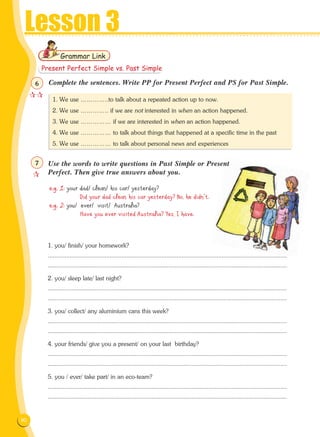
………………………… (20
disappear). That was quite an adventure for it, wasn't it?

8
60
Lesson 3 We survived the tsunami!
You are taking part in a short story competition. Think of something
interesting, funny, strange or sad which happened to you or your family in the
past and write about it. Think of a title.
Write:
Writing
• when it happened
• where it happened
• what was going on at the time
• what was the interesting/funny/strange/sad event
• what happened afterwards.
You'll never believe what happened to..................................................
.........................................................................................................
.........................................................................................................
.........................................................................................................
.........................................................................................................
.........................................................................................................
.........................................................................................................
.........................................................................................................
.........................................................................................................
.........................................................................................................
.........................................................................................................
.........................................................................................................
.........................................................................................................
A story

9
Be careful with the tenses!
61
READ
• an article about the Indus civilisation
• a webpage about superstitions around
the world
• an extract from a TV guide
PRACTISE VOCABULARY
RELATED TO
• history
• numbers
• types of TV programmes
PRACTISE THE USE OF
• relative clauses (who / which / where)
• gerund
• Past Simple / used to
• prepositions
WRITE
• a telephone message
• an article about Greek superstitions
• a paragraph about good ways to learn
English
UNIT 5
Times change!
In Unit 5 you will…
LESSON 1:Fancy ancient history?
LESSON 2: A nation in brief!
LESSON 3: From generation to generation!
Lesson 1
62
Read the article about the Indus quickly and match the headings (A-F) with
each paragraph (1-5). There is an extra heading you don't need to use.
We know very little about this civilisation, but what we know is amazing! Over 4,000 years
ago, in the Indus Valley, people built huge cities, with straight streets, and brick homes with
private baths! Kids played with toys and women wore lipstick!
How do we know this information about the Indus? In 1922, archaeologists found the remains
of two ancient cities, Harappa and Mohenjo-Daro. The civilisation is called the Indus Valley
Civilisation (or sometimes, the Harappan civilisation). It existed from about 3000 BC to about
1500 BC, about the same time as the Egyptian and Sumerian civilisations.
The houses were one or two storeys high made of brick, with flat roofs, and were all the same.
Each house was built around a yard. There were no windows on the outside walls, only on
the inside. Each home had its own private bathroom!
People were very good farmers. They grew peas, melons, wheat, and dates. They raised
sheep, pigs and zebus (a kind of cow). Each town had a large central building where they kept
crops for all in the town to enjoy. They also caught fish in the river with fish hooks! The people
used camels, oxen and elephants to travel over land. They had carts with wooden wheels.
They also had ships to sail around the Arabian Sea.
Men and women dressed in colourful robes. Women wore jewellery of gold and precious
stones!
They had a written language but we cannot understand it. The ancient Indus civilisation
mysteriously disappeared around 1500 BC. No one knows what happened to these people,
or where they went.
based on information from: http://members.aol.com/donnclass/Indialife.html,
http://www.historyforkids.org/index.htm
Reading
1
2
3
4
5
The mysterious Indus civilisation

1
Task 31 - p.146-7
03 WORKBOOK PROXO SEL 061-092.indd 62 13/5/2015 3:00:33 µµ
Fancy ancient history?
Unit 5 63
Fancy ancient history?
Read the text again and complete the notes.
Write the words from the box under the pictures 1-8.
The Indus Civilisation 	 from …….. BC to ……… BC
Names of two ancient cities	
characteristics of the houses	 …. storeys, ……. roof, ….. windows
jobs	
men and women's clothes	
women's accessories 	
Vocabulary Link
crops beard statue mummy amphitheatre
helmet temple hunting
1. ............................................
4. ....................................
7. ..........................
2. ............................................
3. ....................................
5. ..................................................
6. .............................
8. .............................

2

3 Task 32 - p.147
Lesson 1
64
Choose the right word to complete the sentences.
1.	 The main ……………. in Greece are olives, cotton, tobacco and grapes.
	 a. languages	 b. crops	 c. trade
2.	 Have you ever visited the ancient……………. of Poseidon at Sounio?
	 a. temple	 b. wall	 c. mummy
3.	 Let's visit the local museum and see the marble ………………… of Apollo.
	 a. mummy	 b. statue	 c. gladiator
4.	 Rameses II ……………… Egypt for sixty-seven years.
	 a. traded	 b. studied	 c. ruled
5.	 The murmillo gladiators wore bronze ………………. which protected their face and neck.
	 a. helmets	 b. beards	 c. statues
6.	 E-mails are a fast and cheap way to ………………………. with your friends.
	 a. communicate	 b. trade	 c. rule
7.	 Our teacher has decided to grow a ………………. and a moustache.
	 a. crop	 b. hair	 c. beard
8.	 There were two ………………… languages in Roman Times, Latin and Greek.
	 a. wild	 b. official	 c. ancient
Match the phrases 1-3 with a-c to complete the rules.
Complete the sentences. Use who, which, where.
1. That's the hotel …………….. we stayed during our holidays.
Grammar Link
In relative clauses,
1. we use who ……	 a. to talk about things and animals.
2. we use which ……	 b. to talk about places where something happens.
3. we use where ……	 c. to talk about people.
Collocations
Relative Clauses - Who/Which/Where

4

5
Task 33 - p.147-8

6
Fancy ancient history?
Unit 5 65
2. This is the teacher ………………….. teaches English at our school.
4. This is the kiosk ……………………. we buy our
favourite magazines.
5. A gladiator is a person ……………………. fights other
men or animals.
6. That's the post office ……………………. sells stamps.
3. This is the helmet …………………… the famous
motorcyclist wore during the race.
My school, 1
……………………. is on a small hill in the north of our village, has about 100
students, 2
………………….. live in the area. There is a big playground, 3
…………………..
Task 34 - p.148Complete the paragraph with who, which, where.

7
Lesson 1
66
Fancy ancient history?
children play sports. There is also a small amphitheatre 4
……………………….. we put on our
school plays. My favourite teacher is Mr Vassiliou, 5
……………. teaches geography. My best
friend doesn't like geography. She says she prefers maths, 6
……………….. is more interesting.
Look at the brochure of the Attica Zoological Park and use the
information to complete a recorded telephone message in
English with information about the park. When you finish you
can try to record it with your partner.
Thank you for calling the Attica Zoological
1
………………………..
The Park is open every 2
……………………
from 3
……………………… to sunset.
The tickets are 4
………………… for
5
………………… and 6
………………….. for
children between 3-12. There are also special
prices for 7
…………….. and 8
………………….
The disabled and children under 3 can visit the
park for 9
…………………..
In the Park you can find a gift
10
……………………. where you can buy
11
………………….. and a
12
……………………….
For more information, you can call
13
……………………………. or send an e-mail
at 14
……………………………….
Writing
A recorded message

8 Task 35 - p.148
Attica Zoological Park
OPEN ALL YEAR ROUND
from 9.00 am to sunset
Admission
€ 11 for adults
€ 9 for children aged 3-12
Under 3: free
For groups over 25 people: € 9
Special prices for schools
Disabled: free
There's a gift shop where you can buy
souvenirs and a café where you can enjoy a
drink or have a rest.
We organise children's parties, events and
educational programmes for schools.
INFORMATION
Tel. 210 6634724
e-mail: zoo@atticapark.gr
Unit 5 67
A nation in brief!Lesson 2
Look through this webpage about superstitions around the world. How many
countries are the superstitions from? ......
adapted from:
www.oldsuperstitions.com
http://www.topics-mag.com/internatl/superstitions/page.htm
Reading
In Japan,
• the snake is an animal of God and
people never kill snakes. Some people
put a piece of snake skin in their wallets
because this will help them become
rich.
• number four is an unlucky number
because it is pronounced as the word
‘death' in Japanese, so most people try
to avoid it. Hospitals don't have a
fourth floor and most hotels don't use
number four for their rooms.
In China,
• red colour brings luck and happiness.
During the Chinese New Year period,
people decorate their house using red
decorations. At weddings, they also
wear red. The bride needs to wear red
shoes, and the bridegroom also needs
to wear something red, such as a red
tie or a red handkerchief.
In Thailand,
• number 6 can change things. Good luck
can turn into bad luck because number
6 can be number 9 if you turn it upside
down. So, if you get a number 6 on
your examination ID card, you may get
a low mark even though you have done
well on your test.
In Turkey
• when you stand between two
people whose names are the same,
you should wish for something
because your wish will come true
• if you drop food on your clothes
while you're eating something,
you'll have some guests that day.
In Brazil,
• if you eat lentils on January
1st, you'll make good money
during the year.
In Korea,
• students don't wash their hair on a
day they have a test because they
believe that when they wash their
hair, water will wash their memories
away, too. So, they won't be able to
remember what they studied for the
test.
Superstitions around the world

1
68
Lesson 2
1. animals .......................................
2. colours .......................................	
3. food ....................................... 	
4. luck at school .......................................
5. numbers .......................................	
6. wishes .......................................	
Choose the right word to complete the sentences.
Write the countries and the cities on
the map of the United Kingdom.
	ENGLAND	 London
	WALES	 Edinburgh
	SCOTLAND	 Cardiff
	 NORTHERN IRELAND	 Belfast
Vocabulary Link

2

4

3
Geography
Find one country that has superstitions about:
Some people believe that…
1. snake skin can bring you good/bad luck.
2. number four is a(n) lucky/unlucky number.
3. you can be rich if you eat vegetables/lentils on New Year's Day.
4. water on your hair can bring you good/bad luck with a school test.
5. red is a(n) lucky/unlucky colour.
6. number four/six can change your test results.
7. your wish will/will not come true if you find yourself between two kids with the same name.
8. if you drop water/food on your clothes, you can expect visitors.
Unit 5 69
A nation in brief!
Match the numbers in the phrases with the words.
Write the following words in the correct group.
63% of the students	 a. two thousand and eight
600 km	 b. sixty-three per cent
16.7 cm 	 c. two million, seven thousand and sixteen
16,789 m	 d. six hundred
€ 2,008 	 e. sixteen point seven
2,007,016 people	 f. sixteen thousand, seven hundred and eighty-nine
population	 cultural centre	 football	 musicals	 official language
	attend school		island		home-based activities		
tennis tournament			 500km wide		 core subjects		
	Open Golf Tournament			theatre			gardening
visiting relatives		comedies			Grand National
	 private schools	 do-it-yourself activities		 National Curriculum
GEOGRAPHY	 LEISURE 	 THE ARTS	 EDUCATION	 SPORTS		
		 ACTIVITIES
Word groups
Numbers

5

6
70
Lesson 2
Write the numbers in words.
a. 9.86 m : ............................................................................................................................
b. 3,568,900 people : 	...........................................................................................................
c. 50% discount : ..................................................................................................................
d. 809 students : ..................................................................................................................
e. 18,065 e-mails : ................................................................................................................
f. 19, 034,652 viewers : ........................................................................................................
Complete the sentences with the gerund of the verbs in brackets.
1. Danny likes ……………………………….. (play) computer games.
2. My best friend enjoys ………………………….. (listen) to music.
3. ………………………… (visit) relatives is usually very boring.
4. ………………………… (go) out with friends is the most popular pastime in Greece.
5. Savas is very good at …………………………. (repair) bikes.
6. I prefer ………………………..... (download) songs from the Internet to ………………...
(tidy) my room.
7. What about ………………………………. (swim)
in the pool in the afternoon?
8. Many people believe that …………………………
(open) an umbrella in the house can bring bad luck.
Complete the sentences about yourself using the gerund. 	
Then compare your answers with your partner's.
1. My favourite pastime is ……………………………………………
2. I enjoy …………………………………………………………………… at weekends.
3. I'm good at ………………………………… but I'm not so good at …………………………
4. I'm interested in ……………………………………………………
5. ……………………………….. is the most boring activity.
Grammar Link

7
Task 36 - p.149
Gerund

8
Task 37 - p.149

9

Unit 5 71
A nation in brief!
Are the Greeks superstitious? Collect information from books, the Internet
and/or ask your parents and grandparents. Then write a short article for
your school newspaper.
Writing
People in Greece are .....................................................................................................
.......................................................................................................................................
First, they believe that	...................................................................................................
.......................................................................................................................................
.......................................................................................................................................
.......................................................................................................................................
Second, they think that ..................................................................................................
.......................................................................................................................................
.......................................................................................................................................
.......................................................................................................................................
Finally, they ...................................................................................................................
.......................................................................................................................................
.......................................................................................................................................
A R E T H E G R E E K S
S U P E R S T I T I O U S ?
An article about superstitions

10
72
Lesson 3
You are in England and you would like to watch some TV. Have a look at this
page of a TV guide and take notes on three programmes you would like to
watch. Then compare your notes with your partner's. Have you chosen the
same programmes?
Reading
	 TIME	 CHANNEL	 PROGRAMME
BBC 1	 BBC 2	 ITV1 LONDON	
5.00 pm Final Score	 4.30 pm Ready Steady Cook	 5.00 pm Emmerdale
	 5.15 pm Sudo-Q	 5.30 pm Geography
5.30 pm Pink Panther 	 6.30 pm Baby Animals and Animals	 6.30 pm ITV News  Weather		
	 with shells
7.00 pm Match of the day 	 7.00 pm What the ancients did for us 	 7.00 pm Heartbeat
7.45 pm BBC News  Weather	 7.45 pm the Weakest Link 	 7.30 pm George Michael, I'm your 	
		 man
TV GUIDE FRIDAY 22 January
SPORTS
Final Score
Ray Stubbs gives all the results
and reports from the
Premiership, as well as a
round-up of the stories in the
FA Cup and Scotland.
FILM
The Pink Panther
Peter Sellers as Inspector
Clouseau tries to stop the theft
of a precious diamond known
as the Pink Panther.
SPORTS
Holland vs. England
Gary Lineker presents
England's friendly match
against Holland live from the
Amsterdam Arena. 	
COOKERY
Ready Steady Cook
Talented chefs work against the clock
and make delicious dishes in 20
minutes.
GAME SHOW
Sudo-Q
Three teams compete to see who will
become today's Sudo-Q champion.
DOCUMENTARY
The Greeks
We examine the inventions of ancient
civilisations. Adam Hart-Davis tests
some of the greatest inventions from
the world of ancient Greece and
shows us the lasting effect the Greeks
have had on today's technology.
DOCUMENTARY
Baby Animals and Animals with
Shells
A look at the planet we live on.
GAME SHOW
The Weakest Link
Anne Robinson hosts this general
knowledge quiz.
SOAP
Emmerdale
Edna discovers that Tom's in love
with Rosemary. Donna and Marlon
decide to build their future together.
Turner cries for Shelly and his
destroyed family.
EDUCATION
Geography
Mountains and Coasts: Life on the
Coast
A look at how Brighton's coast has
changed to attract tourists.
DRAMA
Heartbeat
Intelligence Matters
The Police are after a Russian spy.
Peggy thinks she has found evidence
of a murder and asks David to help
her find the truth.
MUSIC AND ART
George Michael, I'm your man
Melvyn Bragg interviews George
Michael in a South Bank Show
special. George discusses his career,
his life and work.
adopted from www.radiotimes.com
TV Guide

1
Unit 5 73
From generation to generation!
The Browns are all at home on Friday and they would like to
watch TV. Help them decide which programmes to watch at
5.00, 6.30 and 7.45 pm. Is there a programme all the family
can watch together?
There are two TV sets at their home.
Mr Brown likes watching the news, sports and general
knowledge quizzes.
Mrs Brown likes watching cookery programmes, soap
operas, dramas, game shows and the news.
Mary, the 13-year-old daughter of the family, prefers watching
music programmes, documentaries, game shows, dramas and
her favourite soap, Emmerdale. She never misses it.
Jack, the 11-year-old son of the family, loves football, films,
geography and documentaries about animals.
5.00
6.30
7.45
• Read their preferences.
• Look at the TV Guide and find a
programme for each one of them so
that they can all watch something at
5.00, 6.30 and 7.45 pm.
• Take notes on the TV Guide.
Task 38 - p.150-1

2
	 TV programme	 channel	 names
	 Sports	 BBC1	 Mr Brown  Jack
74
	soap	 police	 drama	 cartoon	 chat show	 documentary
	 music programme	 sports programme	 the news	 commercials	
Lesson 3
Write the type of TV programme the each TV screen
(1-9) shows.
Your English speaking friend is visiting Greece and wants to watch some TV.
Match the Greek programmes (1-8) with the types of programmes (a-h) to tell
your friend what is on.
Vocabulary Link
1. Κεντρικό δελτίο ειδήσεων
2. Γουίνι, το μικρό αρκουδάκι
3. Οι δυνάμεις της φύσης
4. Τόλμη και Γοητεία
5. Πρόσωπο με πρόσωπο
6. Οι ιστορίες του αστυνόμου Μπέκα
7. Αστέρια στο πεντάγραμμο
8. Η κερκίδα του Σαββάτου
a.	soap
b.	police drama
c.	 cartoon
d.	chat show
e.	documentary
f.	 music programme
g.	sports programme
h.	the news
..............
..............
..............
..............
..............
..............
..............
..............
1. ………………………
4. ………………………
7. ………………………
8. ………………………
9. ………………………
5. ………………………
6. ………………………
2. ………………………
3. ………………………
TV programmes

3

4
Task 39 - p.151
Unit 5 75
From generation to generation!
Choose a, b or c to complete the sentences.
Change the sentences using ‘used to' or ‘didn't use to'.
Grammar Link
1. My mum ……………….care of her brothers and sisters when she was at home.
	 used to take	 b. use to take	 c. was taking
2. Every summer we …………………. go to bed late.
	 a. use to	 b. used to	 c. used
3. Boys …………………… playing pacman.
	 a. use to love	 b. loved	 c. used to
4. Did you use to talk to your friends on the phone? Yes, I ……………….
	 a. did	 b. used	 c. use to
5. My grandparents ……………………. vegetables in their garden.
	 a. grow	 b. growing 	 c. grew
1. When I was younger, I watched cartoons on TV.
........................................................................................................................................
2. My brother didn't play computer games some years ago but now he does.
........................................................................................................................................
3. We went to Santorini every summer.
........................................................................................................................................
4. My parents studied French at school.
........................................................................................................................................
5. Pat didn't wear trousers when she was young.
........................................................................................................................................
6. Mike ate pizza on Saturdays.
........................................................................................................................................
Talking about past habits - Past Simple / Used to

5

6
76
Lesson 3
Complete the sentences with -/on/from/to.
1. I've found lots of information ………. the Internet.
2. I can use ………… the web to find the lyrics of my favourite songs.
3. Tony surfs …………… the Internet for hours every day.
4. Is the telephone line OK? I can't connect …………. the Internet.
5. Where did you get this ringing tone from? You just download it ……… this web site.
Ask one of your parents or grandparents how they learnt English and what they
did to practice it. Take notes of their answers. Then write a short paragraph.
You may read your partner's paragraph and spot similarities and/or differences.
Writing
My ........................................... had lessons at ...................................................
............................................................................................................................
............................................................................................................................
............................................................................................................................
............................................................................................................................
............................................................................................................................
............................................................................................................................
............................................................................................................................
............................................................................................................................
............................................................................................................................
............................................................................................................................
............................................................................................................................
............................................................................................................................
Prepositions
Good ways to learn English

7

8
Notes
77
READ
• an eco-leaflet with tips for a ‘waste-less’
school year
• a webpage about teen clubs
• a poem and quotes about volunteerism
PRACTISE COLLOCATIONS 
VOCABULARY RELATED TO
• environment  recycling
• CVs	
PRACTISE THE USE OF
• Present Perfect Simple
• Present Perfect Simple vs. Past Simple
WRITE
•mini-dialogues about your news
• an e-mail to your keypal telling him/her
about the jobs you have/haven't done at
the weekend
• a poem
17th International Children's Painting Competition,
painted by 13-year-old Evdokia Vallis, Greece (European winner)
UNIT 6
Volunteers wanted!
LESSON 1: Let’s go green!				
LESSON 2: Many hands make light work!
LESSON 3: Learn by doing!
In Unit 6 you will…
Lesson 1
78
Read this eco-leaflet. Do you follow any of the advice? Take notes and then
compare them with your partner's.
Tips for a Waste-Less School Year
1.	Use products made from recycled materials. You can use refillable pens, rechargeable batteries, and
scrap paper for notes. Recycling and reusing helps the environment and saves you money.
2.	Before starting a new school year, check what things you have already got. You can reuse notebooks
and old binders. Share your used books with friends, relatives, or younger schoolchildren.
3.	Use non-toxic products, such as batteries with less mercury, vegetable-based inks, and water-based
paints.
4.	Use products that can last for long. Backpacks and notebooks can be reused for many years. Don't
buy new ones every school year.
5.	If you bring your lunch to school, put it in a reusable plastic or cloth bag, or lunch box. Bring drinks
in a thermos instead of bottles or cartons.
6.	If your parents drive you to school, try carpooling or take the bus. Try walking, biking, or skating.
You can have less air pollution and less traffic in your area.
7.	Share the message with your friends and schoolmates. Waste less by reducing, reusing, and recycling.
Volunteer for, or start an environmental club or recycling project in your school. Work with your
teachers and friends to find ways to tell everyone in your area to make waste reduction a part of their
everyday lives.
based on http://www.epa.gov/epaoswer/osw/specials/funfacts/school.htm
Read the leaflet again and find.
1. three school things that you can use again
........................................ 	 ........................................	 ........................................
2. two products that are not bad for the environment 	
........................................	 ........................................
3. two food or drink containers that can be used many times
........................................	 ........................................
4. three ways to go to school without polluting the air
........................................	 ........................................	 ........................................
Reading
•	 I ....................................................................................................
•	 .........................................................................................................
•	 .........................................................................................................
•	 .........................................................................................................

1
Tips for a ‘waste-less’ school year

2 Task 40 - p.152
Let’s go green!
Unit 6 79
Use the clues to do the crossword puzzle.
ACROSS
1. a group of people living in the same area
2. a shop
3. things we throw away
4. a short phrase
5. put something in the bin (two words)
6. take off/away	
DOWN
7. offer to work without getting any money
8. a person or company that makes sth
How can we make every day a Green Day? Choose the
correct word to complete the sentences.
Vocabulary Link

Recycling

3

4 Task 41 - p.153
1.	Don't throw away/recycle things you can use again!
2.	 Clean/up Pollute the beaches!
3.	 Pick up/Drop the rubbish from your school playground!
4.	Don't save/waste water when you have a shower! Always
turn the tap off when you don't need it.
5.	 Take care of/Kill wild animals!
6.	 Don't plant/cut down trees!
7.	 Don't use/park your car when you go to the city centre!
7 1 8
2
3
4
5
6
Lesson 1
80
Change the sentences of task 4 using the opposite ideas.
Make any necessary changes.
e.g.
Don't throw away things you can
use again. Recycle things you can
use again.
Clean up the beaches. Don't pollute
the beaches.
Put a tick next to the correct sentences.
Complete the table with the correct form of the verbs.
Grammar Link
We use the Present Perfect Simple:
1.	 to talk about finished actions that are important now 		 
2.	 to talk about things that happened at a specific time in the past 		
3.	 to talk about our news and experiences 		
4.	to talk about things we used to do in the past but we don't do now 		
5.	 when the exact time of the action is not important 		
6.	 to talk about habits and routines		
	 VERB	 PAST SIMPLE	 PAST PARTICIPLE
	 hear		 heard
		 thought	
	 make		
			 thrown
	 buy		
		 gave	
			 gone
	 put		

5
Task 42 - p.153
Present Perfect Simple (1)

6

7
Task 43 - p.153
Let’s go green!
Unit 6 81
Complete the table.
Complete the sentences using the Present Perfect Simple of the
verbs in brackets.
1. We ……………………………………….. (recycle) 100 aluminium cans this week.
2. My best friend …………………………………….. (decide) to reuse his old notebooks.
3. I ……………………………………… (not join) an eco team yet.
4. ………………… anyone …………………………….. (volunteer) for the ‘Clean-up Day’?
5. Tina ………………………………. (adopt) a stray dog.
6. At Gregory's school, they …………………………….. (clean) up a beach.
Use the information from the table to write sentences using the Present Perfect
Simple. Then write about yourself.
1. Ron and Harry have collected cans for recycling but they ....................................................
2. ..............................................................................................................................................
..................................................................................................................................................
I/you/we/they have formed an eco team.
He/She/It.................................................
Full Form	 Short Form
Affirmative
I/you/we/they ……………….an eco team.
He/She/It.................................................
I/you/we/they ..................not thrown
away the old books.
He/She/It.................................................
................................................................
Full Form	 Short Form
Negative
I/you/we/they....................thrown away
the old books.
He/She/It .................................................
.................................................................
…… I/you/we/they cleaned up the beach?
……. he/she/it ............................................
Short Answers
Interrogative
Yes, I/you/we/they………/
No, I/you/we/they
Yes, he/she/it…………../
No, ……………………
Task 44 - p.154

8

9

10
	 Ron and Harry	 Peter	 Jessica	 you
collect cans for recycling	 	 	 	
work in an eco team	 	 		
drop litter in the street			 
82
Lesson 1
3. ............................................................................................................................................
................................................................................................................................................
4. ...........................................................................................................................................
................................................................................................................................................
Write a few things about you. Then, tell your partner and write mini-dialogues
about your news and/or great experiences in your life. Practise them with your
partner.
News/Life experiences!
I've bought tickets for the match!
I've flown a model plane!
...................................................!
....................................................!
....................................................!
Writing  Speaking
Mini-dialogues

11
e.g.
I've bought tickets for the
football match this Saturday!
What about you?
I haven't. But I've got
some great news too.
Many teens are interested in helping animals or the environment. Perhaps you want to help
stray animals in your area. Maybe you'd like to start a recycling programme at your school.
Or you may want to help people know more about animals in danger or Earth-friendly
farming. Whatever your want to do, you can make a real difference by forming or joining
an animal/environmental protection club. Follow the links and find answers to all your
questions.
...... a. Here's how you can start:
1. Talk to your friends
2. Find someone to help you
3. Get the word out!
...... b. If you want your schoolmates and friends to take your group seriously, you should be able to
answer their questions. So before you start your project, get the facts!
...... c. Your club can do a lot with little money. If you want to collect extra money to help an animal or
environmental group, try one of these ideas. Have a car wash, a dog wash, a bottle collection.
Hold a raffle. Organise a sports event. Have a vegetarian supper for students, parents, and
teachers.
...... d. One person can do a lot for animals and the Earth. But when there are many people, they can
do much more.
...... e. Need a few ideas? Take a look at what these clubs have done.
S T U D E N T A C T I O N G U I D E
based on http://www.humaneteen.org/
1. Many hands make light work
2. Look at our work!
3. Start your own club!
4. Know your stuff!
5. Have fun by raising money
6. Club information Form
Many hands make light work!
Read the first paragraph. What is the text about?
The text is about how teenagers can
a. adopt an animal
b. help the earth and animals
c. protect their school
Read the links (1-6) and match them with the content of the webpages
(a-e). There is an extra link you don't need to use.
Reading
Student Action Guide

1

2
Task 45 - p.154
Unit 6 83
03 WORKBOOK PROXO SEL 061-092.indd 83 13/5/2015 4:50:05 µµ
84
Lesson 2
Penny Ioannou wants to be a member of a music club for teenagers. Help her
write the headings from the box in her CV.
INTERESTS DATE OF BIRTH ADDRESS SKILLS
NAME EXPERIENCE NATIONALITY LANGUAGES
EDUCATION TELEPHONE NUMBER
Choose the correct word to complete the sentences.
1.	 Are you …………………….. in doing voluntary work?
	 a. experience	 b. interested	 c. good
2.	 If you have some ……………… time, you can join us!
	 a. spare	 b. helping	 c. experience
3.	 If you want to help, fill in a(n) ………………. form and post it now!
	 a. qualification	 b. personal	 c. application
4.	 Do you have any …………………… in working with young children?
	 a. interview	 b. experience	 c. qualities
5.	 His dad works for an international company and gets a high ……………………
	 a. salary	 b. hour	 c. qualification
Vocabulary Link
1
…………	 Penny Ioannou
2
…………	 12 Nikitara Street
3
………… 	 210-2789 609
4
…………	 Greek
5
…………	 1 August 1995
6
…………	2000-2007
5th
Primary School of Marousi
7
…………	English (Level B1)
German (Level A1)
8
…………	 Computer literate (MS Word, MS Outlook)
9
…………	 Member of the school choir
10
…………	 reading, playing volleyball
Curriculum Vitae
Collocations

3

4 Task 46 - p.155
CURRICULUM VITAE
85
• clean windows
• tidy desk
• collect CDs
• make bed
• put clothes in wardrobe
• clean carpet
• pick up tennis racket
Many hands make light work!
Use the phrases from the box to complete the sentences.
		 just		 yet		 already	 for a month
Monica has 1
………………………. finished Senior High School. She has often worked as a
volunteer for the local community but now she is looking for a job. She has also worked at her
dad's shop 2
………………… Last week she read about an interesting job in the newspaper
and she is going to apply for it. She got an application form for the job this morning and she
has 3
……………….. filled it in but she hasn't sent it 4
……………………………
Look at the picture and the list of jobs Tessa's mum gave her
and write sentences about what she has or hasn't done. Use
just/already/yet.
Grammar Link
1. ........................................................................................................................................	
2. ........................................................................................................................................	
3. ........................................................................................................................................	
4. ........................................................................................................................................	
5. ........................................................................................................................................
6. ........................................................................................................................................	
7. ........................................................................................................................................
Present Perfect Simple (2)

5

6
Task 47 - p.155
Task 48 - p.155
86
Lesson 2
Look at the pictures and write sentences using the
Present Perfect Simple.
sad/fail a test
He is sad because he has failed a test.
worried/dad have an accident
He ......................................................
tired/take part in an eco team	
They ......................................................
excited/buy a new MP3 playerShe ......................................................
surprised/friends give him a party
He ......................................................
happy/win a medalShe ......................................................

7
Task 49 - p.156

Unit 6 87
Many hands make light work!
On Saturday morning make a list of the things you have to do at the weekend.
Come back to your notes on Sunday and check which you have done and which
you haven't done. Then write an e-mail to your keypal. Tell him about what you
have/haven’t done. Ask him/her about what things s/he has done.
Writing
………………, hi!
I have just finished some things I had to do. ...................................... ............................
.........................................................................................................................................
.........................................................................................................................................
.........................................................................................................................................
.........................................................................................................................................
.........................................................................................................................................
.........................................................................................................................................
.........................................................................................................................................
.........................................................................................................................................
Things to do this weekend
........................................................................................................................................................
........................................................................................................................................................
What I've done this weekend

8
88
Lesson 3
Read the poem and complete the gaps with the words from the box. Why do
people volunteer?
hand volunteer inside heart self fame
WHY BE A VOLUNTEER
It's not for the money, it's not for 1 ……………..
and it's not for any personal gain.
It's for love of fellow man,
It's just to lend a helping 2 …………….. .
It's just to give a part of 3 ……………...
That's something you can't buy with wealth.
It's not the medals worn with pride.
It's just for that feeling deep 4 …………….. .
It's that reward down in your 5 ……………...
It's the feeling that you've been a part
Of helping others far and near,
That makes you a 6 ……………...
from http://www.canteach.ca/elementary/songspoems93.html
Read these quotes about volunteerism. Which are the characteristics of a
volunteer?
Volunteers don't necessarily have the time, but they have the heart. Anonymous
We make a living by what we get, we make a life by what we give. Winston Churchill
One is not born into the world to do everything but to do something. Henry David Thoreau
from http://www.volunteertoday.com/ARCHIVES2002/volpoems.html
...............................................................................................................................................
...............................................................................................................................................
Reading
Look for words that rhyme.
Don't worry about words you
don't know!
Enjoy poetry!
Why be a volunteer

1

2
Unit 6 89
Learn by doing!
Match the words (1-10) with their meaning (a-j).
Find the collocations.
Complete the sentences using collocations from task 4. You
may need to change the verb forms.
1. Greeks always dance ………………………………. at weddings.
2. Every summer the school band give a …………………………… in the school yard.
3. All the kids are excited because they are going on a ………………………… next Monday.
4. Our teacher asked us to complete…………………………………… about our learning
styles.
5. This is the first time I have visited…………………………………….
1. live …	 a. performance	 b. church
2. ancient …	 a. drama	 b. trip
3. traditional …	 a. a questionnaire	 b. dances
4. school …	 a. temple	 b. trip
5. complete …	 a. a questionnaire	 b. an assembly
6. visit …	 a. a foreign country	 b. a performance
1. monument	 a. an officer in the army
2. church	 b. an instrument with a needle that always points to the north
3. orator	 c. an old building, important in history
4. general	 d. a group of people who meet regularly and make decisions
5. tyrant	 e. words written in stone or metal
6. live performance	 f. temple
7. inscription	 g. a play or music taking place in front of people
8. treasure	 h. someone who is good at making political speeches
9. compass	 i. a collection of valuable things
10. assembly	 j. someone with a lot of power who rules with cruelty

3 Task 50 - p.156-7
Task 51 - p.157
Collocations

4

5
........
........
........
........
........
........
........
........
........
........
........
........
Vocabulary Link
90
Lesson 3
Complete the sentences. Write PP for Present Perfect and PS for Past Simple.
e.g. 1: your dad/ clean/ his car/ yesterday?
Did your dad clean his car yesterday? No, he didn't.
e.g. 2: you/ ever/ visit/ Australia?
Have you ever visited Australia? Yes, I have.
1. you/ finish/ your homework?
...............................................................................................................................................
...............................................................................................................................................
2. you/ sleep late/ last night?
...............................................................................................................................................
...............................................................................................................................................
3. you/ collect/ any aluminium cans this week?
...............................................................................................................................................
...............................................................................................................................................
4. your friends/ give you a present/ on your last birthday?
...............................................................................................................................................
...............................................................................................................................................
5. you / ever/ take part/ in an eco-team?
...............................................................................................................................................
...............................................................................................................................................
Grammar Link
1. We use …………..to talk about a repeated action up to now.
2. We use ………….. if we are not interested in when an action happened.
3. We use …………… if we are interested in when an action happened.
4. We use …………… to talk about things that happened at a specific time in the past
5. We use …………… to talk about personal news and experiences
Present Perfect Simple vs. Past Simple

6

7 Use the words to write questions in Past Simple or Present
Perfect. Then give true answers about you.
Unit 6 91
Learn by doing!
Complete the sentences using the Present Perfect Simple or
the Past Simple of the verbs in brackets.
1. I ……………………………. (know) my best friend for five years. We first
…………………………. (meet) when we were in primary school.
2. Antonio …………………………….. (come) back home at two in the afternoon and he
…………………………………… (do) his homework yet.
3. We ……………………………… (just/arrive) on the island but we ………………………
…………………….. (not/decide) where to stay yet.
4. Jennifer ……………………………. (have) her new mobile for two weeks. Her mum
………………………………… (give) it to her as a birthday present.
5. I …………………………………. (not/be) to the theatre for a long time. The last time I
…………………………. (go) I ………………………… (see) a musical.
An easy way to write a poem is to use the letters of a word and start each new
line with a word beginning from this letter. Here's another poem about
volunteers written in this way. Read it and then write a poem about volunteers
or any other topic you have talked about in this lesson.
Writing

8

9
Task 52 - p.157
A poem
Valuable is the work you do.
Outstanding in how you always come through.
Loyal, sincere and full of good cheer,
Untiring in your efforts throughout the year.
Notable are the contributions you make,
Trustworthy in every project you take.
Eager to reach your every goal,
Effective in the way you fulfil your role.
Ready with a smile like a shining star,
Special and wonderful - that's what you are.
from http://www.canteach.ca/elementary/songspoems93.html
Volunteers
92
Lesson 3
V ...........................................................................................................................................
O ...........................................................................................................................................
L ...........................................................................................................................................
U ...........................................................................................................................................
N ...........................................................................................................................................
T ...........................................................................................................................................
E ...........................................................................................................................................
R ....................................................................................................................................
...................................................................................................................................
...................................................................................................................................
...................................................................................................................................
...................................................................................................................................
...................................................................................................................................
...................................................................................................................................
...................................................................................................................................
...................................................................................................................................
...................................................................................................................................
...................................................................................................................................
...............................................................................................................................
...........................................................................................................................
.....................................................................................................................
- Work in groups if you like!-Think of the adjectives youcan use to describe volunteersand their work.- Then make simple sentences.- Use your dictionaries.
93
UNIT 7
Tomorrow and...
beyond!
READ
• holiday advertisements
• a webpage with new year's resolutions
• a horoscope for teenagers
PRACTISE COLLOCATIONS
 VOCABULARY RELATED TO
• airports, stations, summer courses,
sightseeing
• star signs
PRACTISE THE USE OF
• Present Continuous for future
arrangements
• ‘Be going to' future
• Future Simple
WRITE
• an e-mail to a friend about your
holiday plans
• a funny horoscope for a competition
LESSON 1: Travel plans!
LESSON 2: Good intentions!
LESSON 3: In the year 2525!
In Unit 7 you will…
94
Match the advertisements (A-C) with the details of the holidays they offer (1-2).
There's an extra advertisement you don't need to use.
1 When you are travelling with children,
family holidays need planning. We organise
clubs, activities and supervision for children
of all ages. As a result, they have a great
time and you don't have to worry about a
thing. Children love our holidays, and we
love having them along. All our childcare
staff are English speaking and have a great
number of fun ways to keep children
happy. During the morning and afternoon
they organise nature walks, face painting,
singing sessions and games on the beach.
Older children learn how to sail, snorkel,
try their hand at windsurfing, practise
football, or learn to play volleyball.
2 With over 30 years' experience in the Alps, we know what makes a great holiday. We choose the
best Alpine resorts, with lots of snow for you to enjoy. Our hotels are warm, welcoming places that
combine hotel-style comforts with the relaxed atmosphere of a chalet. Some hotels are for adults,
while others also offer childcare. You'll find good food, wine and company at all hotels.
adapted from www.thisistravel.co.uk
Reading
Skiing Holidaysgreat choice, great value• Europe's top resorts• family  adult only options
• skiing  snowboarding more about our skiing holidays
Family Holidays
with fantastic childcare
• supervised childcare clubs
• English-speaking nannies
• daily sports and activities
 read more about childcare
Holiday advertisements

1
Singles  Couples
child-free holidays
• great beach
• friendly  relaxed atmosphere
• as active as you want to be
 more about holidays for singles
 couples
A
B
C
Lesson 1
04 WORKBOOK PROXO SEL 093-129.indd 94 13/5/2015 3:37:52 µµ
Travel plans!
95
college statues campus exhibits museums
lessons placement test temples
Read the brochure again and write which holiday (1-2) the following
questions refer to.
1. What time do activities for kids start every morning? ..................................................
2. Do we need to bring our own skiis? .............................................................................
3. What other languages do nannies speak? .....................................................................
4. Are there any vegetarian dishes? ..................................................................................
5. Can 7-year-olds go snowboarding? ..............................................................................
Write the words from the box on the right picture.
Write the words in the correct column.
	 On a summer course	 Going sightseeing
	 .......................................	 .......................................
	 .......................................	 .......................................
	 .......................................	 .......................................
	 .......................................	 .......................................
Vocabulary Link
ticket office passenger (2) check-in desk platform departure board
boarding pass duty free shop

2
Travelling

3

4
Task 53 - p.158
At the airport
3. .......................4. .......................
2. .......................1. .................... 5. .................... 6. ....................
7. .................... 8. ....................
At the station
Unit 7
Lesson 1
96
Complete the sentences
with one word.
1. This summer I'm doing an English language ……………… at a college in Reading.
2. We're taking a ……………………… test on Monday.
3. Tomorrow we're visiting a huge amusement …………………………
4. The marbles of the Parthenon are one of the most important …………………. of the British
museum.
5. Let's spend the ………………… day sightseeing.
6. I've got great ……………………..! We have no lessons tomorrow.
7. Where's Alex? He's ………………….. a week in England.
8. Is he staying at a hotel? No. He's staying at the college ………………….
Tick the right sentences.
We use the Present Continuous to talk about
1. 	 an action we are doing right now
2. 	 habits and states
3. 	 what people are doing in a photo
4. 	 an action in the past
5. 	 personal arrangements or fixed plans for the future
Grammar Link

5

6
Task 54 - p.158
Present Continuous - Talking about future arrangements
Travel plans!
Unit 7 97
Match the following sentences with the uses of Present Continuous in task 6.
a. In this photo we are having a picnic in the forest.
b. Terry is flying to Rome tomorrow morning.
c. I'm sending a text message to my friend.
d. I'm sitting with my best friend today.
e. We're spending our holidays in Spain this summer.
f. Tina's watching a new film at the moment.
A friend of yours is planning to start a language
course. You want to know more about her plans.
Use the words to make questions.
(which school/attend) ...................................................................?
(when/meet your classmates) ........................................................?
(study English)...............................................................................?
(take any exams) ..........................................................................?
Your parents are planning a family holiday and they have just shown you this
advertisement. You think it is interesting. Use your notes to write an e-mail to
your friend to tell him/her
	 • about this holiday
		 where it is and
		 when you are leaving
	 • what you plan to do there
		 activities, sports you're planning to do
		 facilities you're planning to use
	 • ask him/her if s/he would like to join you with their family
Writing

7

8

9
The International School.
Next Monday.
No. German.
Yes. At the end of the term.
Lesson 1
98
Travel plans!
……………………… , hi!
I've just seen this amazing holiday advertisement and my family have decided to go.
...............................................................................................................................................
...............................................................................................................................................
...............................................................................................................................................
...............................................................................................................................................
...............................................................................................................................................
...............................................................................................................................................
...............................................................................................................................................
...............................................................................................................................................
TEENS Holidays
want to be independent?
• want to have a family holiday but also
be on your own?
• want to be with kids of your age?
• love adventure and sports ?
 read more about Teens Holidays
 resorts onGreek islands(say which)
 leaving nextFriday by …..(boat/plane)
 separatebedrooms, GREAT
 teen beachparties every night
 basketball courts,tennis courts, footballpitch, swimming pools,extreme sports such as…
 Computer games(a TV  a computer with
an Internet connection
in every room)
 teen clubs
such as…
99
a.	For example, I'm going to volunteer for causes I care about or I'm going to make dinner
for the family without being asked.
b.	 I'm going to spend less time on my cell phone or computer.
c.	 I'm not going to eat out so often.
d.	I'm not going to let others treat me badly (either emotionally or physically).
e.	They really do want what's best for me and can help me even if they are angry or
disappointed.
f.	 I'm not going to look or feel stupid about myself.
g.	 For example, I'm going to get more sleep, exercise, and listen to my body.
h.	Being healthy and having good friends are things that can make you happy, aren't they?
i.	 I'm going to ask an adult when I have to make difficult choices.
j.	I'm going to talk to a friend, write in a diary, or exercise (instead of doing things that are
bad like skipping school, drinking alcohol or smoking).
Good intentions!Lesson 2
Read this webpage. Who is the article for?
	 a. teenagers		 b. parents
Happiness and success in life come easier to teens who have a positive self-image, healthy habits,
and supportive parents in their lives. In order to help our teenagers focus on positive, healthy
behaviours, our website offers the following New Year's Resolutions for your teens:
adapted from http://www.parenttoparent.com/health/NewYearForTeens.php
Read the webpage more carefully now and match the resolutions (1-10) with
the sentences (a-j).
Reading
1. I'm going to present myself in a positive way.
2. I'm going to spend more time with people.
3. I'm going to learn how to say “No” to things that are not good for me.
4. I'm going to make small, healthy changes in my eating habits every day.
5. I'm going to take better care of myself.
6. I'm going to help someone else.
7. I'm going to be more honest with my parents about my problems.
8. I'm going to try new, healthy ways to deal with anger or stress.
9. I'm going to give and ask for respect in my relationships.
10.I'm going to find something to be thankful for every day.
New Year’s Resolutions for Teens

1
NEW YEAR'S RESOLUTIONS FOR TEENS

2
Unit 7
100
Lesson 2
.............................................................................................................................................
.............................................................................................................................................
.............................................................................................................................................
.............................................................................................................................................
.............................................................................................................................................
.............................................................................................................................................
Match the words 1-8 with a-h to form collocations.
Use the collocations in task 3 to complete the sentences. You
may need to change the form of the words.
1. Sometimes teenagers don't …………………. ……………… about themselves.
2. Why are you ……………………………………………….? Look! There has been an accident!
3. Stop ………………………………….! It's a very bad habit!
4. My dad always ……………………………….. when he rides his motorbike.
5. You should ………………………………. . Staring at the screen for hours is bad for your eyes.
6. Remember to ………………………………. when you drive!
7. Terry doesn't ………………………………. lately. He often fights with other children.
8. She's full of …………………………. but that doesn't help much. She must study harder!
Choose 3 collocations from the text on page 108 in your
student's book and write sentences about you.
Vocabulary Link
Collocations
Task 55 - p.159

3

4 Task 56 - p.159
Task 57 - p.160

5
1. good ......... a. well
2. think ......... b. out of the window
3. behave ......... c. intentions
4. watch ......... d. a helmet
5. stare ......... e. your seatbelt
6. bite ......... f. positive
7. wear ......... g. my nails
8. fasten ......... h. less TV
Unit 7 101
1. We use the Present Continuous to talk about …
2. We use ‘be going to' to talk about …
a. our general plans and intentions
b. fixed plans for the future
Good intentions!
Match 1-2 with a-b to complete the rules.
Write the verbs in brackets in the ‘be going to' tense and complete the sentences.
Use ‘be going to' and the words in brackets to ask questions in the following
situations.
1. Your friend has decided to go shopping. (what/buy)
.............................................................................................................................................
2. Your mum is getting dressed. (who/meet)
.............................................................................................................................................
Grammar Link
Be going to - Talking about future plans and intentions

6

7
1. I …………………………………….. (think) more about
people in need.
2. Tom …………………………………….. (not/use) his dad's
laptop without asking him first.
3. My friends and I ……………………………………(listen) to
the radio more often.
4. Our grandparents …………………………………….. (take)
us on holiday with them this year.
5. I …………………………………….. (eat) less junk food.

8
Lesson 2 Good intentions!
3. Your friend is holding a cinema ticket. (what film/see)
.............................................................................................................................................
4. Your granny has just bought a new vase. (where/put)
.............................................................................................................................................
5. Your teacher is holding your tests. (when/give)
.............................................................................................................................................
Correct the incorrect sentences. There is one correct sentence!
1. I'm going to meeting Tina at eight o'clock tomorrow morning.
.............................................................................................................................................
2. We're fly to Amsterdam tomorrow.
.............................................................................................................................................
3. My cousin going to buy a new mobile soon.
.............................................................................................................................................
4. Are you to watch the concert on TV tonight?
.............................................................................................................................................
5. I'm going not to eat this cheese pie. It smells horrible.
.............................................................................................................................................
6. My sister is getting married next month.
.............................................................................................................................................

9
102
103
1. ………………… 'll have to work on Sunday.
2. …………… and …………… must be careful because they may have an accident on Friday.
3. ……………………. 'll meet a new person in the middle of the week.
4. …………………….must be careful with money on Friday.
5. ……………… and ………….. 'll have fun on Sunday.
In the year 2525!Lesson 3
Reading
Weekly Teenscope
Task 58 - p.160-1Read the horoscope for teens and complete the sentences with
the star signs.
ARIES
Aries, calm down and get things straight in
your head. Think about your future and
make a strong decision. Listen to your
teachers on Friday. Sunday's for friends.
TAURUS
Taurus, it's time to get close. If there's
someone for you, go out and enjoy yourself.
If you're on your own, keep your eyes open.
A friend might do something crazy. You
might come up with a bright new idea.
GEMINI
Get on with your work, Gemini. Look after
yourself. Someone's taking an interest! That's
for sure! There could be a development in
your romantic life. Talk with a friend on
Sunday.
CANCER
Problems with homework. Someone or
something is putting the pressure on. You
may feel like getting out for fun. You can do
that for a bit. Take care with safety on Friday.
Enjoy friendship or romance on Saturday.
LEO
Hang close with the family, Leo. You've got
something new as you come into the
midweek. It could be romance. It could be a
new activity or project. Watch yourself if
you're doing sports on Friday.
VIRGO
You'll be busy as the week begins. There
may be changes in your home life. There'll
be exciting activities on Saturday but there
may be work for you on Sunday.
LIBRA
Organise your money at the beginning of the
week, Libra. School or training schedules might
change on Friday. Family will be important in
the weeks ahead. Sunday's a fun day for you.
SCORPIO
Scorpio, you're ready for anything as the week
begins! Don't do anything silly with your money
on Friday. There could be someone new in your
neighbourhood. Sunday's a family day. Relax at
home!
SAGITTARIUS
Start slow, Sagittarius! But you can go faster as
the week unfolds. It's still your time and there's a
New Moon in your sign on Saturday. New
image! New directions! New romance! You
choose when to put the new 'you' into action.
CAPRICORN
Friends are here, Capricorn. It's time for crazy
talk and a bit of crazy action. Not too much but
just enough to loosen up! There's something
going on deep inside you at the moment. Let
yourself dream for a while.
AQUARIUS
You'll be making friends in the weeks ahead but, for
now, you'll just have to follow the rules and do what
you're told. There could be a change in your life.
Slow down on Friday and Saturday. You're ready
to have the time of your life on Sunday!
PISCES
You'll want more freedom as the week begins.
You'll want to talk a lot and do things. But life has
other plans for you. Don't fight it, Pisces. The best
way to do this is to listen to others and do what
they ask you to do. Saturday is for friends and fun!
adapted from http://www.astrologycom.com/weeklyteen.html
W E E K L Y T E E N S C O P E

1
Unit 7
104
Lesson 3
Match the star signs with the drawings a-l.
Aries (21/3 - 20/4)
Taurus (21/4 - 21/5)	
Gemini (22/5 - 21/6)
Cancer (22/6 - 23/7)	
Leo (24/7 - 23/8)	
Virgo (24/8 - 23/9)
Libra (24/9 - 23/10)	
Scorpio (24/10 - 22/11)
Sagittarius (23/11 - 22/12)
Capricorn (23/12 - 20/1)	
Aquarius (21/1 - 19/2)	
Pisces (20/2 - 20 /3)	
a
Match the collocations 1-10 with a-j.
Vocabulary Link
b c d
e f g h
i j k l
Star signs

2
Collocations

3
.............. .............. .............. ..............
.............. .............. .............. ..............
.............. .............. .............. ..............
1. interactive .............. a. the sun
2. at the touch of .............. b. a command
3. enjoy .............. c. stadium
4. all year .............. d. time
5. follow .............. e. round
6. for .............. f. my children's safety
7. crowded .............. g. video watch
8. dance .............. h. a button
9. at the same .............. i. to the rhythm of music
10. worry about .............. j. example
Unit 7 105
In the year 2525!
Use the words from the box to complete the sentences.
1. Can you ……………………… this tune? It's one of the latest hits, isn't it?
2. Look at the boats ……………………….. down the river! Aren't they beautiful?
3. New TV programmes for children are often …………………… and children take active part in them
by helping the main character.
4. Parents are always worried about the …………………… of their children.
5. We didn't …………………………… the beach until after midday.
6. We'll meet you …………………………… after school.
Choose six words/phrases from tasks 3 and 4 and write sentences of your own.
1.........................................................................................................................................
2.........................................................................................................................................
3.........................................................................................................................................
4.........................................................................................................................................
5.........................................................................................................................................
6.........................................................................................................................................
Complete the table.
interactive floating reach recognise immediately safety
Grammar Link
Task 59 - p.161

4

5
Future Simple - Predicting

6
I/you/he/she/it/we/they will
enjoy the sun all year round.
I/you/he/she/it/we/they.........................
the sun all year round.
Full Form Short Form
Affirmative
Interrogative
I/you/he/she/it/we/they
…………… not need a car.
I/you/he/she/it/we/they …………………..
a car.
Full Form Short Form
Negative
…… I/you/he/she/it/we/they enjoy
the sun all year round?
Yes, I/you/he/she/it/we/they..................
No, I/you/he/she/it/we/they won't.
Short Answers
106
Lesson 3
We use the Future Simple
1. to talk about what we think will happen
2. to guess what will happen
3. to describe what people are doing at the moment
4. with words/expressions like: I think, I hope, perhaps
Look at the pictures and write predictions about your partner.
1. ............................
2. ............................
3. ............................
4. ............................
7
8
Task 60 - p.161
Tick the right sentences.
In the year 2525!
Answer the questions and make predictions about your future.
1. Will you study psychology when you finish school?
...............................................................................................................................................
2. Will you travel around the world? Where?
...............................................................................................................................................
3. Will you work as a musician?
...............................................................................................................................................
4. Will you have a sports car?
...............................................................................................................................................
5. Will you live with your parents until you are thirty years old? Why?
...............................................................................................................................................
6. Will you marry someone famous? Why?/Why not?
...............................................................................................................................................

9
Unit 7 107
108
Lesson 3 In the year 2525!
A Teen magazine is organising a horoscope writing competition. Read the
advertisement and write your friend’s horoscope and send it to the magazine.
HAVE YOU EVER THOUGHT OF WRITING
YOUR FRIENDS' HOROSCOPE?
Here's your chance! Take part in our competition and win amazing prizes!
Write your best friend's horoscope.
Think of funny things that will happen to him/her this week
 at home
 at school
 on holiday
Our readers will vote for the funniest horoscope!
Writing
...................................................................................................................................
...................................................................................................................................
...................................................................................................................................
...................................................................................................................................
...................................................................................................................................
...................................................................................................................................
...................................................................................................................................
...................................................................................................................................
...................................................................................................................................

10
THE FUNNIEST
HOROSCOPE
COMPETITION
READ
• an article about awards
• a magazine article about emoticons
• school news
PRACTISE COLLOCATIONS 
VOCABULARY RELATED TO
• awards
• school newspapers
• newspaper jobs
PRACTISE THE USE OF
• Present Simple Passive
• Past Simple Passive
WRITE
• quiz cards
• your opinion about message abbreviations
In Unit 8 you will…
LESSON 1: “And the winner is …!”
LESSON 2: Crack the code!
LESSON 3: School reporting!
109
UNIT 8
In the papers !
110
Lesson 1
110
Read an article about three well-known awards. Which award (a-d)
is each paragraph (1-3) of the article abowt? There's an extra
award you don't need to use.
A. The Nobel Prizes
B. The Hans Christian Andersen Award
C. THE EMMY AWARDS D. The Caledonian Junior Award
Would you like to know more about awards? Do you think that all
prizes are for show biz stars or only for the gifted? Well, there are
also awards for all those who have influenced our lives for the better
and even for people with disabilities!
1.
This award is for all young people from 7 -14
years old. It belongs to a Family of Awards for
young people with serious learning disabilities
and those who have smaller learning difficulties
but they also face social, emotional 
behavioural difficulties.
Participation
• offers young people equality of
opportunity
• helps participants to meet other people
• increases self confidence and
independence
• encourages young people to undertake
activities they did not think possible
• recognises the young person's ability
• is good fun
2.
It is known as the Little Nobel Prize and is one
of the highest prizes in children's literature. It
is presented to only one author and one
illustrator every two years by the International
Board on Books for Young People (IBBY).
The prize is named after a famous Danish
author who wrote marvellous stories for
children. Winners receive a gold medal from
the hand of the Queen of Denmark.
3.
They are awards in Physics, Chemistry,
Literature, Peace, Physiology or Medicine and
Economics. The first five prizes were started by
a famous Swedish scientist through his will in
1895; they were first awarded in 1901. A sixth
prize for economics, was instituted by Sweden's
central bank in 1968. All six prizes are highly
prestigious awards. With the exception of the
Peace Prize, which is handed out in Oslo, they
are all handed out in Stockholm at an annual
ceremony on December 10, the anniversary of
Nobel's death.
Sources: www.thecaledonianaward.co.uk http://en.wikipedia.org/wiki/
Reading
Awards

1 Task 61 - p.162
“And the winner is ...!”
Unit 8 111
Match the words 1-8 with the words a-h to form collocations.
1. become ……………………………..
2. choose ………………………….
3. golden …………………………..
4. leading ………………………….
5. high-profile ……………………
6. record ……………………………
7. contemporary ……………………
8. vote ……………………………
a. music
b. a member
c. sales
d. by phone
e. statue
f. award
g. role
h. the winners
Delete the word which does not collocate with the word in capitals.
1.	 film	 music	 vote	 INDUSTRY
2. 	 annual	 prize	 main	 EVENT
3. 	 small	 annual	 golden	 STATUE
4. 	 statue	 leading	 important	 ROLE
5.	 prestigious	 first	 record	 PRIZE
6. 	 big	 classical	 modern	 MUSIC
Read the text and complete the gaps.
The Oscars are the most 1
……………… award in the film 2
………………. Everybody looks
forward to this glamorous 3
……………… event. The golden 4
……………… is given out to
the 5
………………. The most important Oscar is the Best Picture 6
……………… which is
given to the best film of the 7
………………. Walt Disney has won more Oscars than anyone
else. He was 8
……………… for 64 and won 26!
In the Top of the Pops awards the 9
……………… of the BBC1 music show choose the
winners. In the American Music Awards the nominations are based on the artists'
10
……………… sales.
Vocabulary Link
Collocations
Task 62 - p.163

2

3

4
Task 63 - p.163
112
Lesson 1
112
Tick the right sentence.
1. We use the Active Voice to say what someone does.
	 a. 20,000 fans choose the winner.
	 b. The winner is chosen by 20,000 fans.
2. We use the Passive Voice to say what happens to someone or something
	 a. They give the Best Picture prize to the best film of the year.
	 b. The Best Picture Prize is given to the best film of the year.
3. We use the Passive Voice when we don't know who did the action or when it is not
important.
	 a. They nominated Walt Disney for 64 Oscars.
	 b. Walt Disney was nominated for 64 Oscars.
4. In the Passive Voice if we want to mention the person who does the action, we use the
agent.
	  a. The Academy of Motion Picture Arts and Sciences was set up in 1927 with
just 36 members.
	 b. The Oscars are organised by the Academy of Motion Picture Arts and
Sciences.
Are the sentences active or passive? Write A for active and P for passive.
1. I always have breakfast before I go to school.
2. English is spoken all over the world.
3. Babies are fed by their mothers.
4. We visit our grandparents every weekend.
5. Lots of films are produced in Hollywood.
6. Anna wants to buy a new tennis racket.
7. We don't wear uniforms at my school.
8. Millions of e-mails are sent every day .
Grammar Link
Passive Structures - Present Simple Passive

5

6
“And the winner is ...!”
Change the sentences from Active to Passive. Omit the agent when appropriate.
The Internet is used by lots of teenagers.
1. Maids make the beds.
........................................................................................................................................................	
2. Cleaners clean the floors every day.
........................................................................................................................................................	
3. Waiters serve breakfast at 8.00 am.
........................................................................................................................................................	
4. Tom takes photos for the school newspaper.
........................................................................................................................................................	
5. The zoo-keeper feeds the animals.
........................................................................................................................................................

7
e.g. Lots of teenagers use the Internet.
Unit 8 113
114
Lesson 1
114
Use the passive to write quiz cards. You can use your Greek books to find
interesting facts. Then photocopy the cards and play with your partner or in
groups.
Are The Brits awards held
in November?
...........................................................................................................................................................................................................................................
...............................................
...............................................
..................................................
............................................
...............................................
...............................................
...............................................
..................................................
............................................
...............................................
...............................................
...............................................
..................................................
............................................
...............................................
Reading
No. They're held in February
Where is coffee produced?
In Brazil
“And the winner is ...!”
Quiz cards

8
115
Lesson 2 Crack the code!
Read the magazine article and write True (T) or False (F) next to the sentences.
1. Sending an e-mail or a text message is expensive. 	 ...........................
2. Our face and voice show how we feel. 	 ...........................
3. Emoticons are photos. 	 ...........................
4. Emoticons are made out of letters, numbers and punctuation marks.	 ...........................
5. Emoticons are easy to read even if it's the first time you see them. 	 ...........................
Do you write e-mails or send text messages on
your mobile? Do you know when your friends are
serious, happy or sad, excited, or bored?
Talking through messages is really cool. It's
fast, it's cheap and you don't need stamps. But,
something is missing. When we talk to each other in
person, we understand a lot by the expressions on
our face or by the tone of our voices. Can we show
feelings in our messages?
The solution is emoticons! ... “Emoticons” is a
new word made up of two other words, emotions,
that is feelings, and icons. When you put them
together you get emoticons which are little face-
picturesmadeoutofletters,numbers,orpunctuation
marks from our computer or mobile keyboard. So
why are they good? Emoticons let people know
how you feel without saying I am happy or I am
bored. Sometimes emoticons describe things, like
what a person looks like or what they're doing.
It's a bit difficult in the beginning but once you
get used to them, you'll see that emoticons are a fun
way to get your message across! ...
Can you match these emoticons with their meanings?
1.	 ......	 :-)
2.	 ......	 ;-)	
3.	 ......	 :-D
4.	 ......	 :-/	
5.	 ......	 :-(	
6.	 ......	 :-(
7.	 ......	 :-[
8.	 ......	 :-C	
9.	 ......	 :'-(	
10.	 ......	 :-X
11.	 ......	 B-)
12.	 ...... 	 :-#	
13.	 ...... 	 [:-)	
a.	 I'm wearing my Walkman.
b.	 I'm laughing. This is very funny!
c.	 Sad
d.	 Really disappointed.
e.	 Happy!
f.	 I'm crying.
g.	 Joking!
h.	 Not sure about this.
i.	 My lips are sealed! I won't tell anybody, I promise!
j.	 I wear glasses.
k.	 Angry!
l.	 I wear braces.
m.	 I'm scared!
Reading
answers:1.e2.g3.b4.h5.c6.k7.m8.d9.f10.i11.j12.l13.a
adapted from http://www.chirpingbird.com/netpets/html/computer/emoticon.html
Hey! Are you serious about that, or just joking?

1
Task 64 - p.163-4
Lesson 2
Find the collocations.
Use the collocations from task 3 in the correct form to
complete the sentences.
1. Don't …………………… ………! The paint is still wet.
2. Luis Braille …………………….. …. ………...
3. She can’t see very well. She is .......................................................
4. Spies …………. ………………………… to communicate safely.
5. Didn't you …………………… at the entrance? It said that you can't feed the animals in the zoo.
6. She discovered her real parents ……………………………..
7. …………………………… Luis Braille blind people can enjoy reading.
8. She ………………………………. her father.
1. use a secret	 a. for the blind
2. invent a code	 b. the sign
3. touch	 c. code
4. thanks	 d. after my father
5. by	 e. the walls
6. read	 f. accident
7. name my son	 g. in my right eye
8. blind	 h. to Braille

3
Collocations

4 Task 65 - p.165
...........
...........
...........
...........
...........
...........
...........
...........
116116
Vocabulary Link

2 Match the words 1-6 with their definitions a-f.
1. code	 a. something new
2. come up with an idea	 b. put your hand on something
3. invention	 c. think
4. touch	 d. people who cannot move their body easily
5. public places	 e. areas or buildings open to all people
6. the disabled	 f. a system of symbols
...........
...........
...........
...........
...........
...........
Unit 8 117
Crack the code!
Write Present for sentences in Present Simple Passive, Past for sentences in Past
Simple Passive and Active for the sentences in the active voice.
1. They handed in their homework. .........................................................................................
2. We were taught by an Australian teacher..............................................................................
3. Mum washes our clothes once a week..................................................................................
4. When was Einstein born?......................................................................................................
5. I am invited to parties almost every week..............................................................................
6. We are tidying our rooms at the moment..............................................................................
7. The windows are cleaned every Monday..............................................................................
8. He was studying for a test when the teacher came in............................................................
Follow the example and complete the sentences using Present
Simple or Past Simple Passive.
e.g. Braille invented a code for the blind.
A code for the blind was invented by Braille.
1. They give her the first prize every year.
She ................................................... the first prize every year.
2. He sends hundreds of faxes every month.
Hundreds of faxes ..................................................................................... every month.
3. Who stole my mobile phone?
Who ...................................................my mobile phone...........................................by?
4. They didn't sell many tickets this time.
Few tickets ................................................... this time. 	
5. My grandparents give me € 10 once a month.
I ................................................... € 10 by my grandparents once a month.
6. The fire destroyed the factory.
The factory................................................... by the fire.
Grammar Link
Passive Structures - Past Simple Passive

5

6
118118
Lesson 2
w8: Wait g2g: Got To Go idk: I Don't know
Complete the text using Present Simple or Past Simple Passive.
Jerry was given (give) an MP3 player for his birthday last week and he's really excited about
it. CD players 1
…………………………… (use) by many people but they aren't as modern as
MP3s. They are also much smaller than CD-players, which means that an MP3
2
………………………………………… (easily/carry) everywhere. Also, you don't need to
have CDs with you because all the songs 3
………………………………… (save) directly on
the MP3. Jerry's MP3 4
…………………………………. (design) by a famous German designer
and it 5
……………………………… (manufacture) in China.
Make a list of the abbreviations you use when you send text messages in Greek.
Ask your friends if they use the same. Which are the most often used? Search
the Internet and find similar abbreviations in English. Is language in danger
because young people use this way of communication so often? Write a
paragraph giving your opinion.
Writing
...............................................................................................................................................
...............................................................................................................................................
...............................................................................................................................................
...............................................................................................................................................
...............................................................................................................................................
...............................................................................................................................................
...............................................................................................................................................
...............................................................................................................................................
...............................................................................................................................................
...............................................................................................................................................
Crack the code!

7
A survey

8
b4: Before
Unit 8 119
Lesson 3 School reporting!
Match the news (1-4) with the headlines (A-E). There's an
extra headline you don't need to use.
A. A new meeting place at our school!
B. Who will be the champion this year?
C. A farewell party
D. When, How, By Whom? Visit our exhibition and find out…
E. Will our school win first prize in the national dancing competition?
Junior High School News in brief
1 .......................................................
This year our dancers are dancing at the
Athens Hotel on May 10th. The competition
is always shown live on TV all over the
country. Many famous people will be there!
Don't miss it!
2 .......................................................
A one-day football tournament is organised
by the PE teachers of our high school at the
end of every school year. The best footballers
from the second and the third grade take part
in it. The winners are given a medal. If you
want to take part, ask your PE teacher for an
application form.
3 .......................................................
The students of the first grade of junior high
school are going to present a special exhibition
on inventions next Friday. The visitors can
learn about great inventions of the past. A big
thanks to Mr Ikonomou, the technology
teacher, who helped the students with their
work.
4 .......................................................
Do you remember that huge room at the
end of the corridor? It's a new cool place
now. Some students had the idea of turning
it into a place where students could spend
their breaks. So, remember to stop by and
tell us what you think. Pop music is played
from 8 to 3. Snacks and drinks are served at
the mini-bar. Newspapers and magazines
can be borrowed for free!
Choose the right answer.
1. At the Athens hotel you can
a. watch a competition on TV.
b. meet famous people
c. watch a football match
2. The football tournament is organised by
a. the headmaster.
b. the students of the third grade.
c. the gym teachers.
Reading
High School News in brief

1

2
Task 66 - p.165
120120
Lesson 3
3. In the tournament, ……… play football.
a. students of all grades
b. students and teachers
c. students of two grades
4. In the exhibition you can learn about who....
a. made the first telephone.
b. built the Acropolis.
c. won the World Cup.
5. For the new meeting place at school a … was used.
a. library
b. canteen
c. big room
Circle the newspaper
jobs in the table and
then match them with
the definitions.
1. This person writes news for a newspaper, or the television..................................................	
2. This person takes photos. ...................................................................................................	
3. This person draws cartoons. ...............................................................................................	
4. This person decides what to put in a newspaper or a magazine and checks for mistakes. 	
................................................................................................................................................
5. This person helps with the layout of the page. ....................................................................
6. This person studies a subject and tries to find new facts about it. .......................................
Vocabulary Link
Newspaper jobs

3
P H O T O G R A P H E R
A B I R Y S I C A N D E
D O J K E T E E N T I P
O C A R T O O N I S T O
M B K E N E T R A C O R
G F E D E S I G N E R T
E R M A N A R W H Y T E
D C R E S E A R C H E R
121
	 word processing	 file		 recipe		 interview	 review
lyrics issue included article
School reporting!
Choose the right word/phrase from Column B to complete the collocations in
Column A.
COLUMN A
1.	 a great way ....................................
2.	 attached .........................................
3.	 the spring .......................................
4.	 read ...............................................
5.	 get..................................................
6.	 take part ........................................
7.	 I'm short.........................................
8.	 ask a challenging............................
9.	 have artistic....................................
10.	draw...............................................
11.	dig up ............................................
12.	use .................................................
13.	ask..................................................
14.	set...................................................
15.	catchy.............................................
COLUMN B
the Internet
started
of ideas
information
a comic strip
file
in a workshop
our article
question
realistic targets
headlines
of learning
issue of our newspaper
skills
for sponsorship
Use the words from the box to complete the e-mail.
Dear Pertra and Hans,
Your 1
……………… on school newspapers was great and your advice helped us make our own
paper. Can you have a look at the 2
……………… attached and tell us what you think?
• We have 3
……………… some articles on the protection of the environment and on natural
disasters.
• There's also an 4
……………… with a famous Greek author, Manos Kontoleon. Teenagers love
his books!
• I wrote a 5
……………… about Mama Mia, you know, the famous musical and my friend, Maria,
wrote the 6
……………… of some of the songs in it.
• Michalis wrote a 7
……………… for his favourite chicken-pie! Don't forget to try it! It's delicious!
• Yiannis did the 8
………………. He's really good at this, isn't he?
So, why don't you read the summer 9
……………… of our school newspaper and send us your
comments?
Write back soon.
Love,
Magda
Review

4
Task 67 - p.166

5
Unit 8
122122
Lesson 3
1. Maria's just bought a new CD...........................................................................................
2. My parents are cooking dinner at the moment..................................................................
3. Did you go to the cinema yesterday?................................................................................
4. I always try hard at school.................................................................................................
5. The school computers were stolen last night. ...................................................................
6. Tenia is going to take part in the Basketball Finals............................................................
7. Will it rain tomorrow?........................................................................................................
8. The teacher was checking our homework while we were taking a test. ............................
9. Good wine is also produced in Spain. .............................................................................. 	
Write the names of the tenses in the right box with the key words.
Grammar Link
Read the sentences and underline the verbs. Then write what tense they are in.
Review

6

7
A.				
yesterday
last week
two days ago
in 1990
last year
B.
every day
always
usually
often
sometimes
never
on Sundays
C.
now
at the moment
at present
Look!
Listen!
D.			
just
yet
already
ever
never
since 2005
for three years
E.	
tomorrow
next week
next year
soon
I hope
I think
perhaps
E.
while
as
04 WORKBOOK PROXO SEL 093-129.indd 122 13/5/2015 3:40:47 µµ
Unit 8 123
School reporting!
Change the sentences into interrogative or negative.
1. There were two parks near my house a few years ago.
........................................................................................................................................... 
2. I have never visited Australia. (you/ever)
............................................................................................................................................ ?
3. I'm going to be more honest. (you)
............................................................................................................................................ ?
4. Coffee is served at the school canteen.
........................................................................................................................................... 
5. I often do my homework at the last minute. (you)
............................................................................................................................................ ?
6. Mary made a cake yesterday morning.
........................................................................................................................................... 
Choose a or b to complete the sentences.
1. Dad is excited because he ……… a new laptop.
	 a. bought		 b. has bought
2. I………more fruit and vegetables from now on.
	 a. 'm going to eat	 b. 'm eating
3. In my free time I enjoy ……… to music.
	 a. to listen		 b. listening
4. Joanne ……… the ironing every Saturday.
	 a. is doing		 b. does
5. Mr. Kennick is the teacher ……… teaches maths at our school.
	 a. which		 b. who
6. My bike is ……… than my brother's.
	 a. faster		 b. more fast
7. My grandparents ……… vegetables in their garden.
	 a. used to grow	 b. used to grew
8. Ted ……………… chess at weekends.
	 a. plays		 b. plaies

8

9
Lesson 3
124124
School reporting!
9.	 Your marks are not good. You ………… work harder.
	 a. should to		 b. should
10.	 When …………. Edison born?
	 a. was			 b. is
Answer the questions.
1. What do you do in your free time?
...............................................................................................................................................
2. Did you go to school on foot last Monday?
...............................................................................................................................................
3. Where were you at 9 o' clock this morning?
...............................................................................................................................................
4. Will you travel around the world when you grow up? Where?
...............................................................................................................................................
5. Have you ever broken your leg?
...............................................................................................................................................

10
125
(Review)
READ
• extracts from different texts
PRACTISE COLLOCATIONS
 VOCABULARY
REVISE GRAMMAR
RECOGNISE
• different genres
UNIT 9Happy summer
holidays!
In Unit 9 you will…
04 WORKBOOK PROXO SEL 093-129.indd 125 13/5/2015 3:45:32 µµ
Review
126
Read the extracts from different texts of your workbook (1-7) and match
them with the right heading (a-g).
Extracts
1. ...................................................................................
They started from Scandinavia and attacked many
countries in Europe. They settled in Britain, Ireland and
France. They also crossed the Atlantic Ocean and arrived
in Iceland and Greenland. They discovered North America
but they also travelled east to Russia and south to
Arabia. 	
2. ....................................................................................
In Thailand,
number 6 can change things. Good luck can turn into bad
luck because number 6 can be number 9 if you turn it
over.
3. ....................................................................................
The School of the Air simply helps these children learn
about the outside world. Children do not go to school
every day. They have 'on air lessons'.	
4. ....................................................................................
If your parents drive you to school, try carpooling or take
the bus. Try walking, biking, or skating. You can have less
air pollution and less traffic in your area.	
5. ....................................................................................
Frigid weather caused severe damages across Europe
over the weekend. At least 66 people died when a roof
fell because of heavy snow in Poland.	
6. ....................................................................................
When you are travelling with children, family holidays
need planning. We organise clubs, activities and
supervision for children of all ages. As a result, they have
a great time and you don't have to worry about a thing.
7. ...................................................................................
We know very little about this civilisation, but what we
know is amazing! Over 4,000 years ago, in the Indus
Valley, people built huge cities, with straight streets, and
brick homes with private baths! Kids played with toys and
women wore lipstick!	
Reading
a. Is this your ideal school?
How much do you remember?

1
b. The mysterious Indus
civilisation
c. Superstitions around
the world
d. The Vikings
e. Holiday advertisements
f. Tips for a waste-lessschool year
g. World News in brief!
04 WORKBOOK PROXO SEL 093-129.indd 126 13/5/2015 3:45:33 µµ
Happy summer holidays!
Unit 9 127
Which text in the workbook did you enjoy the most? Why?
................................................................................................................................................
................................................................................................................................................
Which text in the workbook wasn't interesting?
................................................................................................................................................
................................................................................................................................................
Present your opinion to the class and find out the most popular texts.
Can you write four words in every group?
	 SCHOOL SUBJECTS FOOD	 WEATHER	 DISASTERS
			
			 windy	
				 earthquake
	science			
		 spaghetti	
Choose the correct word to complete the sentences.
1. Don't let yourself fall ……………..with your school work.
	a. off			b. out		c. behind
2. Read the ……………..and see what the book is about.
	 a. cover		 b. blurb	 c. paperback
3. Playing football with your friends is great 	 ….……….
	 a. fun 			 b. worry	 c. gymnastics
Vocabulary Link
	 TV PROGRAMMES	 ENVIRONMENT	 SPORTS	 HOLIDAYS
	 documentary		 wall scaling	
			
			
		 recycling		 camp
Word Groups

2

3
04 WORKBOOK PROXO SEL 093-129.indd 127 13/5/2015 4:50:37 µµ
Review
128
4. Ron and Jean fell in ………. at first sight.
	 a. happiness		 b. love		 c. heart
5. Rameses II ………. Egypt for sixty-seven years.
	 a. communicated	 b. traded		 c. ruled
6. We've got a project in biology. I need to ………. the Internet for information.
	a. look			b. download			c. surf
7. If you have some ……… time, you can join us!
	a. spare		b. fun			c. good
8. There are important ……………………….. at the British Museum.
	 a. snacks		 b. temples		 c. exhibits
Choose the right option.
Grammar Link
Review

4
1. 	 The children visit / are visiting their grandparents every Sunday.
2.	 My mum is lying / lies on the sofa. She's tired.
3.	 Our teacher is writing on the board at the moment / every day.
4.	You mustn't / don't have eat fast food very often.
5.	 My bedroom is bigger / biggest than my brother's.
6.	She worked / was working on her computer when it crashed.
7.	My grandparents were growing / used to grow vegetables in their garden.
8.	I lost / have lost my pen. It was here a minute ago!
9.	 I'll be / I was a famous footballer one day in the future.
10.	Maria is having a birthday party. What are we going to buy / buying her?
04 WORKBOOK PROXO SEL 093-129.indd 128 13/5/2015 3:45:33 µµ
Happy summer holidays!
Unit 9 129
These are some of the genres you were taught this year. Go through your
workbook and find the unit and lesson you worked on these. Then make a list
of useful phrases for each genre.
a. A letter of advice		
b. A story		
c. An article on superstitions		
d. An e-mail about your holiday plans	
e. An e-mail describing family photos	
f. Description of your snacking habits
g. Giving your opinion	
h. Quiz cards
i. The blurb of a book or film
j. Your biography
Useful phrases
A letter of advice :
•I'm writing to give you some advice on …
•I hope my ideas are useful…
...............................................................................................................................................
...............................................................................................................................................
...............................................................................................................................................
...............................................................................................................................................
...............................................................................................................................................
...............................................................................................................................................
...............................................................................................................................................
...............................................................................................................................................
...............................................................................................................................................
...............................................................................................................................................
LessonUnit

5
Genres
Writing
04 WORKBOOK PROXO SEL 093-129.indd 129 13/5/2015 3:45:33 µµ
130
It’s up to you! 131
e.g. My dad is/isn't English.
1. My best friend is/isn't 12 years old.
2. Mum is/isn't at home now.
3. Football is/isn't my favourite sport.
4. My best friend and I are/aren't in the same class.
5. I am/'m not crazy about fashion.
6. There are/aren't two cinemas near my school.
It’s up to you!
The children below met at the TEEN camp last summer and are now keypals.
Read their profiles (1-3) and find who their keypals are (a-c).
Circle the correct form of the verb ‘to be' to
write true sentences about you and your family.
UNIT 1
2
1
b. Hello! My name's Luigi andI'm from Milan, Italy. I'm 13years old and I want to travel alot. I want to meet new peopleand see new places. I also want to be afamous footballer. I love football and Ipractise every day. My favourite team isMilan. I want to play for them one day.
1. My name's Thomas but my friendscall me Tom. I'm from Santos, Braziland I'm 12 years old. I love footieand I play with my friends almostevery day. My favourite TVprogramme is sports.
a. Hi! I'm Sarah. I'm 11 years
old and I'm from Edinburgh,
Scotland. I enjoy going to the
cinema with my friends every
weekend. I like all kinds of films. I also like
reading. I often buy teen mags. They
often have articles on my favourite films
or my favourite actors.
c. Hello! I'm Mandy and I'm 12
years old. I like reading fashion
magazines and buying clothes. I
usually spend all my pocket money
on T-shirts or necklaces. I also love
making my own jewellery. My
mum says I'm good at it. She often wears my
accessories.
2. Hi! My name's Nadia. I'm from
Moscow, Russia. I'm 11 years old
and I'm crazy about fashion. I
love going shopping with my
friends. I don't buy much but I like looking
at shop windows.
3. Hello! My name's Jason. I'm
10 years old and I've got lots of
hobbies. I enjoy using theInternet and reading about new
films. I prefer adventure films.What about you? My favourite actor is TomCruise. Do you like him?
APPENDIX
It’s up to you!
132
Match the answers with the questions. Then you can ask your partner these
questions.
e.g. What's your name?
1. What grade are you in?
2. What's your favourite sport?
3. How are you, today?
4. How old are you?
5. Where are you from?
6. What are your favourite subjects?	
This is your e-mail to your new keypal. Read it and complete the gaps.
In the first paragraph write
	 • your name
	 • how old you are
	 • where you are from
	 • your hobbies
In the second paragraph write a few things about your family
	 • your parents
	 • your brothers/sisters
Ask your friend to write back and tell you about himself/herself.
My name's Christina.
a. All right, thanks.
b. I'm from Kalamata.
c. I'm twelve.
d. Maths and English.
e. I'm in the first grade of Junior High School.
f. Swimming
Hello!
My name's …………………… and I'm …………………. years old. I'm
from …………………… city/town/village in the east/west/north/south
of………………….near ………………… In my free time I like ............
....................................................................................What about you?
I've got a small/large family of ............................members, ...................
.............................................................................................................and me. My dad is
............................................................ and my mum is.....................................................
My brother/sister is ..............................years old. S/he ......................................................
Have you got a small or a large family? Write back and tell me all about you!
Love,
…………………………….
3
4
It’s up to you! 133
Read this article and then answer the True/False questions.
UNIT 2
SANTA
CLAUS
SCHOOL
It's time to get
ready for the New
Santa School Year!
The Santa Claus
School is more
than 70 years old.
It opens for 6 days
every year; Octo-
ber 13, 14 and 15
and November 3, 4, and 5. Lessons take
place at the Santa House in downtown
Midland, Michigan.
At the Santa School, students meet Mr
Santas and Mrs Santas from around the
world. Everyone listens to Santa stories. We
come together to share our love of Christmas
and the magical spirit of Santa Claus. The
School is full of love, laughter, and learning.
That's why it is the oldest and most famous
school of its kind.
Come to our school and experience what
Christmas dreams are made of!
adapted from http://www.santaclausschool.com/
SCHOOL
OF THE AIR
The Alice Springs
School of the Air is
for children living in
Central Australia. These children live in an
area which is miles away from cities and
towns. They are active, healthy, and have lots
of free time. They learn about animals and
plants of the Outback. Most of them learn to
ride horses at an early age.
The School of the Air simply helps these
children learn about the outside world.
Children do not go to school every day. They
have ‘on air lessons'. Students listen to
interesting radio lessons and watch
educational videos. Teachers send them their
homework through e-mail and students send
it back.
adapted from http://www.assoa.nt.edu.au/
TEXT A
e.g. The Santa Claus school is a school for children F
1. This school works only a few days a year.			 …
2. Students come from different places of the world.		 …
3. Students tell stories about Father Christmas.		 …
4. Students hate Christmas holidays.				 …
TEXT B
1. Students live away from big cities.				 …
2. Students listen to their teacher on the radio.		 …
3. Students get their homework assignments by post.		 …
5
APPENDIX
It’s up to you!
134
Look at the pictures and write the 10 school subjects.
Complete the sentences.
e.g. I often do my homework at the last minute.
1. Mark loves l _ _ _ _ _ _ _ _ to music.
2. She's a _ _ at maths.
3. Don't let yourself f _ _ _ behind in the subjects you don't like.
4. I spend h _ _ _ _ studying history.
5. Your marks are low. You need to try h _ _ _ _ _ .
6. Children like h _ _ _ _ _ _ out with their friends.
7. How often do you b _ _ _ _ _ books from the library?
8. We usually go to school b _ bus.
1
2
3
4
5
6
7
9
8
10
6
7
..................................
..................................
..................................
..................................
..................................
..................................
..................................
..................................
..................................
..................................
It’s up to you! 135
do not tidy visit watch wash work not study play (2) go set
Complete the sentences with the verbs from the box in the correct form of
Present Simple.
e.g. Do you watch TV every day?
1. My dad and mum .........................…………… jogging every evening.
2. My sister .......................................................... volleyball at the weekend.
3. I ......................... ………………………….. Chinese at school.
4. The children ................................... their grandparents every Sunday.
5. …….……. Maria ……………………… in a hospital?
6. Joanne ………………….. the ironing every Saturday.
7. My brother …………………………… his room very often.
8. Our parents …….......................................... the dishes after lunch.
9. My grandad ……………………………. chess at weekends.
10. ………you …………………………… the table at noon?
8
APPENDIX
It’s up to you!
136
APPENDIX
Read the texts and match them with the school clubs. There's an extra club you
don't need to use.
9a
HEALTH CLUB ECO CLUB MOVIES CLUB
DRAMA CLUB PHOTOGRAPHY CLUB
1. Hi! I'm Mark. I love adventure films and
musicals. We have a large collection of
films in our club. My favourite one is
Matrix. There's lots of action and amazing
visual effects. At the moment we are
watching ‘Home Alone’. I don't like it
much. It's baby stuff.
3. Hi! I'm Mike and
I'm really interested
in medicine. I'd like
to be a doctor when
I grow up. I'm lucky
there is such a club
at our school. We
learn about our body and what we can
do to be fit. We need to eat lots of
vegetables and fruit and drink 2 litres of
water every day. We also need to take
regular exercise. We are going mountain
climbing this weekend. Cool, isn't it?
2. Hello! My name's
Helena. We've got lots of
clubs at our school. My
friends like acting and
singing and that's why
they are in the Drama
Club. I enjoy taking snaps
of beautiful landscapes.
I've got some good ones from my summer
holidays. This week we are learning how to
download our photos from our digital camera
to the computer.
4. Hello, there! My name's Dorothy. My friends
and I are really worried about pollution of
the environment. There are often traffic jams
in our area and there are not many trees.
We've decided to form a club to protect the
environment. At the moment we are putting up
posters on our school walls.
It’s up to you! 137
lie sleep put cry not make sit go study
a. Her friends are in the Drama Club. .......................................................................
b. He doesn't like ‘Home Alone’. ..............................................................................
c. He loves watching films. ........................................................................................
d. He wants to be a doctor. .......................................................................................
e. Her friends worry about the environment. ............................................................
f. She is helping her club put up posters. ...................................................................
g. He is learning how to be healthy. ..........................................................................
h. She is learning how to put her photos on her PC. .................................................
Complete the sentences with the verbs from the box in the correct form of Present
Continuous.
e.g. Listen! The baby is crying.
1. My dad …………………………. on the bed at the moment. Be quiet!
2. The children ……………………… history. Don't make noise.
3. ………… you ………………………… to the supermarket? No, I'm not.
4. My mum…………………………… on the sofa. She's tired.
5. I ………………………… a cake at the moment.
6. ……………he ……………….. on my chair?
7. We ……………………………. up a school play this month.
Choose the right word to complete the sentences.
e.g. We are moving car/house next month
1. My girlfriend has no sense/smell of humour.
2. Read the cover/blurb to see what the book is about.
3. He's an ordinary/adventure 13-year-old boy.
4. I'm cold. Is the heating on/in?
5. I've got no secrets/covers from my best friend.
6. J. Wilson is certainly a best-selling author/publisher.
7. Here's a best-seller/review of your favourite film.
Who are the following sentences about? Write Mark, Helena, Mike or Dorothy
next to the sentences.
9b
10
11
APPENDIX
It’s up to you!
138
study not smoke not play go cook write come
	steak 		pasta		vegetables 		dairy products		cereal		
	fruit			cake 		chips		hamburgers
Complete the sentences with the correct form of Present Simple or Present
Continuous of the verbs in the box.
e.g. My parents don't smoke.
1. Magda is in her room. She ………… ………………. in her diary.
2. What time ……………your dad ……………………… home every day?
3. We ………………………. to school by bus every morning.
4. Tom and his friends ……………..…… …………… football today.
5. Turn off the TV! I …………………….. !
6. …………… you …………………. on Sundays or have lunch at a restaurant?
Write the words in the box under the correct picture.
Complete the sentences.
1. Jacqueline Wilson is a t _ _ _ _ _ _ _ author.
2. Dorothy and I have the same t _ _ _ _ in music.
3. Have you got this book in p _ _ _ _ _ _ _ _?
4. In this film Sarah wants to r _ _ a _ _ _ from home.
5. We've got lots of time. W _ _ the hurry?
6. My dad is an a _ _ _ _ _. He writes books for children.
7. Can you see the title of the book on the c _ _ _ _?
8. The main c _ _ _ _ _ _ _ _ in the film is a poor orphan.
UNIT 3
chips
1 ...................... 2 .....................
3 .....................
4 .......................
5 ........................ 6 ........................
7 ......................... 8 ...........................
12
13
14
05 WORKBOOK PROXO SEL 130-170.indd 138 13/5/2015 3:50:03 µµ
It’s up to you! 139
a. ....
Dear Agony Aunt,
My name's Simona. I'm 12
and I want to be a model. I
love wearing trendy clothes
and buying lots of accessories.
My mum doesn't like buying
new clothes. She says it's a
waste of money because
fashion changes all the time.
The problem is that there is a
fashion show for teenagers in
my area next month and my
parents won't let me take part.
I think it can be the beginning
of my modeling career. What
should I do?
b. ....
Dear Agony Aunt,
My name's Jean Paul. I'm 14
and I am keen on football. My
parents love tennis and they
think I should learn how to
play tennis, too. But I don't
like it much. All my friends
play football and, what is
more, there is a football
ground just opposite our
school. It's our meeting point at
the weekends. What do you
think I should do?
c. ....
Dear Agony Aunt,
My name's Jason and I' m 10.
I've got a sister who is older
than me and a brother who is
just five. The problem is that
my brother wants everything I
have. Every new DVD I buy
he wants to be the first to see
it. Every PC game I get, he
wants to be the first to try it.
That's why we always fight
and my parents always put the
blame on me. When I talk to
them, they don't listen. They
say I'm older than him and I
shouldn't make him cry. I hate
him.
1. DIFFERENT TASTES IN SPORTS
2. Everything is His!	 3. ALWAYS IN FASHION?
Complete the sentences.
1. I must c _ _ down on fatty foods.
2. Unhealthy food is usually high in c _ _ _ _ _ _ _.
3. Don't eat so much meat. It's bad for your h _ _ _ _.
4. Let's have some tofu b _ _ _ _ _ _!
5. Buy w _ _ _ _ g _ _ _ _ bread. It's healthier!
6. Carbonated water makes drinks f _ _ _ _.
What problems do these children have? Read the letters (a-c) and match them
with the titles (1-3).
15
16
APPENDIX
It’s up to you!
140
Write how these people feel under the pictures.
Choose the correct adjectives to complete the sentences.
e.g. I feel sad /happy when I see poor children in the streets.
1. My dad gets tired/worried when I don't do well on a test.
2. I feel bored/excited when there's nothing interesting on TV.
3. All children feel worried/excited when Christmas holidays are near.
4. Stop looking at me! You make me feel nervous/excited.
5. I feel dead bored/tired after a week's work.
Choose the right word to complete the sentences.
1. He joined the a _ _ _ when he was 18.
2. Would you like to w _ _ a ticket for the match?
3. Can you help me s _ _ _ _ this puzzle? It's very difficult.
4. Lisa took p _ _ _ in the school singing contest.
5. Chimps are very f _ _ _ _ animals.
6. My brother doesn't like giving his t _ _ _ to other children.
7. Going out with friends is great f _ _.
8. My sister is Avril Lavigne's f _ _.She's got all her CDs.
17
sad
1 ………………….
2 ………………….
4 …………………. 5 ………………….
3 ………………….
18
19
It’s up to you! 141
healthy wide expensive trendy big
exciting good funny tall popular delicious
Write the opposites.
1. bad ≠....................................................
2. old ≠.....................................................
3. boring ≠...............................................
4. easy ≠...................................................
5. expensive ≠..........................................
6. beautiful ≠............................................
7. rich ≠....................................................
8. much ≠.................................................
9. hot ≠.....................................................
10. far ≠....................................................
Complete the sentences. Use the positive, the
comparative or the superlative forms of the
adjectives in the box.
e.g. My dad is the tallest man in our family.
1. My computer screen is ............................................ than yours. It is 19 inches.
2. Jerry is ......................................... boy in our class. Everybody likes him.
3. My mobile phone isn't as ………………………….. as my friend's. It was only € 30.
4. My room is .................................................... than my brother's. There's room for two beds.
5. My brother is .................................................. basketball player in the school team.
6. Matrix isn't as ………………………………. as The Lord of the Rings.
7. My dad's jokes are ................................................... than my mum's.
8. Homemade food is ……………………………… than fast food.
9. Fresh fruit with yoghurt is …………………………. dessert of all.
10. The blue T-shirt is as …………………………….. as the red one.
20
21
APPENDIX
It’s up to you!
142
THE VIKINGS
RAIDERS, TRAVELLERS OR BRAVE EXPLORERS?
The Vikings sailed the seas, attacked towns
and stole treasures all over Europe between the
years 800 and 1100. They started from
Scandinavia and attacked many countries in
Europe. They settled in Britain, Ireland and
France. They also crossed the Atlantic Ocean and
arrived in Iceland and Greenland. They
discovered North America but they also travelled
east to Russia and south to Arabia.
They were good farmers and excellent
shipbuilders. They used their ships for wars. They
also used them to carry people and goods to new
lands. In winter, when there was not much farm
work to do, they stayed at home and did other
interesting jobs. Men made swords to use them in
battles. The Vikings liked swords so much they
often decorated themselves with gold and gave
them names. Women cooked food and made
clothes, shoes and jewellery for them, their
children and their husbands. The Vikings believed
in many gods and goddesses. Their favourite was
Odin, the god of the dead!
In 866 the Vikings captured an Anglo-Saxon
town. They called it Jorvik and it was the capital of
the Viking kingdom for 200 years. They made
Jorvik rich and one of the most famous cities in
Britain. Some years
ago, archeologists
discovered part of
that Viking town in
York, the modern city
of Jorvik. They found
many things such as
jewellery, coins and
clothes. If you ever go
to York and you want
to travel back in time
and see how the
Vikings lived, visit the
Jorvik Viking Centre!
Adapted from Wilson, D. M. (1987) The Vikings,
Activity Book, British Museum Press
Pictures from Maynard, C. (1996) Viking Times, Kingfisher
Scandinavia
Britain
Iceland
Ireland
France
Arabia
Now read the text and answer these questions.
• What were the Vikings good at? .........................................................................................
• What did the Vikings (both men and women) do in winter?...............................................
• Who was their favourite god?..............................................................................................
• What was the capital of their kingdom?...............................................................................
• Where is the Jorvik museum? What is its name? ................................................................
UNIT 4
22A
It’s up to you! 143
revise watch do finish (4) study (2) be (2) start have
Find the words (1-10) in the article. In pairs, guess what they mean and match
them with a-j.
Complete the sentences with the right word.
1. People used the dynamite to b _ _ _ _ canals.
2. Columbus d _ _ _ _ _ _ _ _ _ America.
3. Who i _ _ _ _ _ _ _ the lamp?
4. Mozart composed his first m _ _ _ _ when he was 5.
5. Walt Disney is the c _ _ _ _ _ _ of Mickey Mouse.
6. The Little Mermaid is my favourite f _ _ _ _ t _ _ _.
Fill in the gaps with the correct form of the verbs in the box in the Past
Simple.
Stuart: Did you watch Madonna's concert on TV last night?
Ann: 	 No, I didn't. I had a lot of homework.
Stuart: Really? What 1
________ you _____________?
Ann:	I 2
_______________ drawing a map for geography, I 3
____________ my
vocabulary for the test in English and I 4
______________ my piano.
23
24
22B
1. sail ……. a. fight between armies, ships or planes during war
2. attack ……. b. to try to hurt or kill someone
3. treasure ……. c. to make a place or a country your home
4. settle ……. d. places
5. shipbuilder ……. e. travel on water
6. goods ……. f. catch a person and keep them as a prisoner
7. lands ……. g. a person who makes ships and boats
8. sword ……. h. a collection of valuable things
9. battle ……. i. things we sell such as food, drinks, clothes etc
10. capture ……. j. a kind of knife used at wars to kill someone
APPENDIX
It’s up to you!
144
police prize spend neighbour
burglars mess repair pavement
1................................ 2................................ 3................................ 4................................
5................................ 6................................
7................................ 8................................
Stuart: Wow! You 5
_________ terribly busy! What time 6
_____ you _______________?
Ann:	I 7
_______________ at four o'clock in the afternoon and I 8
______________ at ten. What
about you? When 9
_______you ___________________ ?
Stuart: I 10
_______________ everything on Saturday so I 11
____________ free on Sunday.
Ann: That's cool!
Read the jokes again and find the last sentence to complete them (1-3).
a. “Mummy, is this why all of grandma's hair is white?”
b. “I think Mummy ate it!”
c. “Well, for one, you're 52 years old. And for another, you're the headmaster!”
Write the correct word(s) under the pictures.
Complete the sentences with the right word from the box.
1. I wrote a story for a competition and won first …..………
2. Mr. Wilson is our new ………….. He has just moved into the flat next door.
3. I must tidy my room. It's in a terrible ………….
4. John was standing on the ……………. outside the cinema. He was waiting for his friend.
25
26
27
It’s up to you! 145
....
5. After the bank robbery, we called the ………. and they arrived five minutes later.
6. We decided to ……… our summer holidays at Kalavryta.
7. Two …………… got into my flat and stole my ……………….
8. Can you help me …………………. my bike? It's got a flat tyre.
Read the headlines of the news reports and tick the disasters you think they are
about. Then read the news and check if you are right.
Complete the sentences with the right word.
1. The mountain r _ _ _ _ _ team saved the climbers.
2. The earthquake destroyed many houses and lots of people were left h _ _ _ _ _ _ _.
3. We wanted to know what was going o _.
4. A lot of people were standing outside the hotel in s _ _ _ _ after the earthquake.
5. While I was talking with my friend on the phone, the phone w _ _ _ dead.
6. They had a terrible car c _ _ _ _ and now they are in hospital.
7. A strong aftershock r _ _ _ _ _ the area.
8. The hurricane d _ _ _ _ _ _ _ _ thousands of schools.
28
1
2
29
a. a fire b. an environmental disaster c. bad weather
adapted from http://www.timeforkids.com/TFK/hh
FIRES RAGE IN
THREE STATES
N. Mexico, Jan 13, 2006
Firefighters in Texas,
New Mexico and
Oklahoma are trying to
control dozens of fires
that started last month.
The fast-moving fires
destroyed small towns
and damaged more than
500,000 acres of land.
At least five people lost
their lives.
POLISH TRAGEDY IN
SNOW BOUND
EUROPE
Warsaw, Jan 29, 2006
Frigid weather caused
severe damages across
Europe over the
weekend. At least 66
people died when a roof
fell because of heavy
snow in Poland. Cars
couldn't move because of
Snow in France,
Switzerland, Italy, Spain
and Portugal and there
were lots of car accidents.
AN OIL DISASTER
Madrid, Nov 21, 2002
Last week, an oil tanker
on its way to Singapore
was caught in a terrible
storm near Spain. The
tanker sank about 150
miles from Spain. It was
carrying more than 20
million gallons of fuel oil
and about 1.6 million
gallons of oil went into the
Atlantic Ocean. Beaches
and wildlife are in danger.
3
APPENDIX
It’s up to you!
146
Choose the correct form of the Past Simple or the Past Continuous of the verbs
to complete the sentences.
Read the article about the Indus quickly and match the headings (A-E) with
each paragraph (1-5).
UNIT 5
31
30
We know very little about this civilisation, but what we know is amazing! Over 4,000 years
ago, in the Indus Valley, people built huge cities, with straight streets, and brick homes with
private baths! Kids played with toys and women wore lipstick!
How do we know this information about the Indus? In 1922, archaeologists found the remains
of two ancient cities, Harappa and Mohenjo-Daro. The civilisation is called the Indus Valley
Civilisation (or sometimes, the Harappan civilisation). It existed from about 3000 BC to about
1500 BC, about the same time as the Egyptian and Sumerian civilisations.
The houses were one or two storeys high made of brick, with flat roofs, and were all the same.
Each house was built around a yard. There were no windows on the outside walls, only on
the inside. Each home had its own private bathroom!
People were very good farmers. They grew peas, melons, wheat, and dates. They raised
sheep, pigs and zebus (a kind of cow). Each town had a large central building where they kept
crops for all in the town to enjoy. They also caught fish in the river with fish hooks! The people
used camels, oxen and elephants to travel over land. They had carts with wooden wheels.
They also had ships to sail around the Arabian Sea.
1
2
3
1. Jimmy and Tim listened/were listening to music when Mum called/was calling.
2. She worked/was working on her computer when it crashed/was crashing.
3. While Paul surfed/was surfing the Internet, the lights went/were going off.
4. I cut/was cutting the grass when my aunt came/was coming.
5. When Anna arrived/was arriving, the baby cried/was crying.
6. Nigel broke/was breaking his leg while he skied/was skiing.
7. They wrote/were writing a test when the headmaster entered/was entering the classroom.
It’s up to you! 147
Men and women dressed in colourful robes. Women wore jewellery of gold and precious
stones!
They had a written language but we cannot understand it. The ancient Indus civilisation
mysteriously disappeared around 1500 BC. No one knows what happened to these people,
or where they went.
based on information from: http://members.aol.com/donnclass/Indialife.html,
http://www.historyforkids.org/index.htm
Write the words under the pictures. Then match the pictures (1-8) with the
definitions (a-i). There's an extra definition you don't need to use.
a. we find it in Egypt
b. a figure made of metal, stone etc.
c. a building where people worship gods
d. a hat we wear when we ride a motorbike
e. grain or fruit that is grown in one season
f. killing wild animals or birds for sport or
food
g. a circular building with no roof
h. hair that grows on the chin of a man
i. a man fighting another man or an animal
Complete the sentences with the right word.
1. The main c _ _ _ _ in Greece are olives, cotton, tobacco and grapes.
2. Have you ever visited the ancient t _ _ _ _ _ of Poseidon in Sounio?
3. Let's visit the local museum and see the marble s _ _ _ _ _ of Apollo.
4. Rameses II r _ _ _ _ Egypt for sixty-seven years.
4
5
1. ................................ 4. ..........................2. .................................. 3. .....................
5. .....................................
6. ....................
7. ............................. 8. .............................
33
32
APPENDIX
It’s up to you!
148
5. The murmillo gladiators wore bronze h _ _ _ _ _ _, which protected their face and neck.
6. E-mails are a fast and cheap way to c _ _ _ _ _ _ _ _ _ _ with your friends.
7. Our teacher has decided to grow a b _ _ _ _ and a moustache.
8. There were two o _ _ _ _ _ _ _ languages in Roman Times, Latin and Greek.
Choose the right relative pronoun to complete the paragraph.
My school, 1
where/which is on a small hill in the north of our village has about 100 students
2
who/which live in the area. There is a big playground, 3
which/where children play sports.
There is also a small amphitheatre 4
which/where we put on our school plays. My favourite
teacher is Mr Vassiliou, 5
who/which teaches geography. My best friend doesn't like geography.
She says she prefers maths, 6
where/which is more interesting.
Look at the brochure of the Attica Zoological Park and use the information to
prepare a recorded telephone message in English with information about the
park. Include information about:
• Opening hours
• Tickets and prices for adults, children,
groups etc
• shops
• Telephone number and e-mail address
When you finish you can try to record it
with your partner.
34
35
...............................................................................
...............................................................................
...............................................................................
...............................................................................
...............................................................................
...............................................................................
...............................................................................
...............................................................................
...............................................................................
Attica Zoological Park
OPEN ALL YEAR ROUND
from 9.00 am to sunset
Admission
€ 11 for adults
€ 9 for children aged 3-12
Under 3: free
For groups over 25 people: € 9
Special prices for schools
Disabled: free
There's a gift shop where you can buy
souvenirs and a café where you can enjoy a
drink or have a rest.
We organise children's parties, events and
educational programmes for schools.
INFORMATION
Tel. 210 6634724
e-mail: zoo@atticapark.gr
It’s up to you! 149
tidy download play go repair visit listen open swim
Complete the numbers.
a. 9.86 m : _ _ _ _ point _ _ _ _ _ _-_ _ _ metres
b. 3,568,900 people : three _ _ _ _ _ _ _, five _ _ _ _ _ _ _ and sixty-eight _ _ _ _ _ _ _ _,
nine _ _ _ _ _ _ _ people
c. 50% discount: _ _ _ _ _ _ _ _ _ _ _ _ discount
d. 809 students: _ _ _ _ _ _ _ _ _ _ _ _ and nine students
e. 18,065 e-mails: eighteen _ _ _ _ _ _ _ _ and _ _ _ _ _-five e-mails
f. 19, 034,652 viewers: _ _ _ _ _ _ _ _ million, _ _ _ _ _ _ - _ _ _ _ thousand, _ _ _ hundred
and _ _ _ _ _ - _ _ _ viewers
Complete the sentences with the gerund of the verbs in the box.
1. Danny likes ……………………………….. computer games.
2. My best friend enjoys ………………………….. to music.
3. ………………………… relatives is usually very boring.
4. ………………………… out with friends is the most popular pastime in Greece.
5. Savas is very good at …………………………. bikes.
6. I prefer ………………………..... songs from the Internet 					
to …………………... my room.
7. What about ………………………………. in
the pool in the afternoon?
8. Many people believe that ………………………… an
umbrella in the house can bring bad luck.
36
37
APPENDIX
It’s up to you!
150
The Browns are all at home on
Friday and they would like to
watch TV. Help them decide which
programmes to watch at 5.00, 6.30
and 7.45 pm. Is there a programme
all the family can watch together?
BBC 1	 BBC 2	 ITV1 LONDON	
5.00 pm Final Score	 4.30 pm Ready Steady Cook	 5.00 pm Emmerdale
	 5.15 pm Sudo-Q	 5.30 pm Geography
5.30 pm Pink Panther 	 6.30 pm Baby Animals and Animals	 6.30 pm ITV News  Weather		
	 with shells
7.00 pm Match of the day 	 7.00 pm What the ancients did for us 	 7.00 pm Heartbeat
7.45 pm BBC News  Weather	 7.45 pm the Weakest Link 	 7.30 pm George Michael, I'm your 	
		 man
TV GUIDE FRIDAY 22 January
SPORTS
Final Score
Ray Stubbs gives all the results
and reports from the
Premiership, as well as a
round-up of the stories in the
FA Cup and Scotland.
FILM
The Pink Panther
Peter Sellers as Inspector
Clouseau tries to stop the theft
of a precious diamond known
as the Pink Panther.
SPORTS
Holland vs. England
Gary Lineker presents
England's friendly match
against Holland live from the
Amsterdam Arena. 	
COOKERY
Ready Steady Cook
Talented chefs work against the clock
and make delicious dishes in 20
minutes.
GAME SHOW
Sudo-Q
Three teams compete to see who will
become today's Sudo-Q champion.
DOCUMENTARY
The Greeks
We examine the inventions of ancient
civilisations. Adam Hart-Davis tests
some of the greatest inventions from
the world of ancient Greece and
shows us the lasting effect the Greeks
have had on today's technology.
DOCUMENTARY
Baby Animals and Animals with
Shells
A look at the planet we live on.
GAME SHOW
The Weakest Link
Anne Robinson hosts this general
knowledge quiz.
SOAP
Emmerdale
Edna discovers that Tom's in love
with Rosemary. Donna and Marlon
decide to build their future together.
Turner cries for Shelly and his
destroyed family.
EDUCATION
Geography
Mountains and Coasts: Life on the
Coast
A look at how Brighton's coast has
changed to attract tourists.
DRAMA
Heartbeat
Intelligence Matters
The Police are after a Russian spy.
Peggy thinks she has found evidence
of a murder and asks David to help
her find the truth.
MUSIC AND ART
George Michael, I'm your man
Melvyn Bragg interviews George
Michael in a South Bank Show
special. George discusses his career,
his life and work.
adopted from www.radiotimes.com
38
• First, circle the programmes starting
at 5.00, 6.00  7.45. Read thedescriptions of the programmes and
underline key words.• Then read the family's preferences,
underline key words and write their
names in the right box.• Are there one or two programmes
that they can watch at these times?
It’s up to you! 151
Mr Brown likes watching the news, sports and general
knowledge quizzes.
Mrs Brown likes watching cookery programmes, soap operas,
dramas, game shows and the news.
Mary, the 13-year-old daughter of the family, prefers watching
music programmes, documentaries, game shows, dramas and
her favourite soap, Emmerdale. She never misses it.
Jack, the 11-year-old son of the family, loves football, films,
geography and documentaries about animals.
Write the type of TV programme that each TV screen shows.
1. ………………………
4. ………………………
7. ………………………
8. ………………………
9. ………………………
5. ………………………
6. ………………………
2. ………………………
3. ………………………
39
	 TV programme	 channel	 names
	 Sports	 BBC1	 Mr Brown  Jack
5.00
6.30
7.45
APPENDIX
It’s up to you!
Tips for a ‘Waste-Less’ School Year
1.	Use products made from recycled materials. You can use refillable pens, rechargeable
batteries, and scrap paper for notes. Recycling and reusing helps the environment and
saves you money.
2.	Before starting a new school year, check what things you have already got. You can reuse
notebooks and old binders. Share your used books with friends,
relatives, or younger schoolchildren.
3.	Use non-toxic products, such as batteries with less mercury,
vegetable-based inks, and water-based paints.
4.	Use products that can last for long. Backpacks and notebooks
can be reused for many years. Don't buy new ones every
school year.
5.	If you bring your lunch to school, put it in a reusable plastic or
cloth bag, or lunch box. Bring drinks in a thermos instead of
bottles or cartons.
6.	If your parents drive you to school, try carpooling or take the
bus. Try walking, biking, or skating. You can have less air
pollution and less traffic in your area.
7.	Share the message with your friends and schoolmates. Waste
less by reducing, reusing, and recycling. Volunteer for, or start
an environmental club or recycling project in your school.
Work with your teachers and friends to find ways to tell
everyone in your area to make waste reduction a part of their
everyday lives.
based on http://www.epa.gov/epaoswer/osw/specials/funfacts/school.htm
Read the leaflet again and find:
1. five school things that you can use again
................................... .................................. ..................................
................................... .................................. ..................................
2. three products that are not bad for the environment
................................... .................................. ..................................
3. four food of drink containers that can be used many times
................................... .................................. ..................................
................................... .................................. ..................................
4. four ways to go to school without polluting the air
................................... .................................. ..................................
UNIT 6
152152
40
153
Match the opposites and then do task 5.
1. take care of animals
2. clean up
3. throw away things
4. pick up litter
5. save water
6. plant trees
7. use the car
…………
…………
…………
…………
…………
…………
…………
a. recycle
b. pollute
c. drop litter
d. waste water
e. kill animals
f. cut down trees
g. park the car
Complete the table.
be
catch
come
cut
do
drink
drive
eat
find
get
have
know
leave
meet
read
run
say
see
sit
speak
swim
take
tell
write
How can we make every day a Green Day?
Complete the sentences with the correct word.
1. Don't t _ _ _ _ away things you can use again!
2. C _ _ _ _ up the beaches!
3. P _ _ _ u _ the rubbish from your school playground!
4. Don't w _ _ _ _ water when you have a shower! Always
turn the tap off when you don't need it.
5. T _ _ _ c _ _ _ of wild animals!
6. Don't c _ _ d _ _ _ trees!
7. Don't u _ _ your car when you go to the city centre!
	 VERB	 PAST SIMPLE	 PAST PARTICIPLE
41
43
42
It’s up to you!
APPENDIX
It’s up to you!
adopt plant decide clean not join recycle volunteer cut
Complete the sentences using the Present Perfect Simple of the verbs in the
box. There are extra verbs you don't need to use.
1. We ……………………………………….. 100 aluminium cans this week.
2. My best friend …………………………………….. to reuse his old notebooks.
3. I ……………………………………… an eco team yet.
4. ………………… anyone …………………………….. for the ‘Clean-up Day’?
5. Tina ………………………………. a stray dog.
6. At Gregory's school, they …………………………….. up a beach.
Read the links (1-5) and match them with the content of the web pages (a-e).
Many teens are interested in helping animals or the environment. Perhaps you want to help
stray animals in your area. Maybe you'd like to start a recycling programme at your school.
Or you may want to help people know more about animals in danger or Earth-friendly
farming. Whatever your want to do, you can make a real difference by forming or joining an
animal/environmental protection club. Follow the links and find answers to all your questions.
........... a. Here's how you can start:
	 1. Talk to your friends
	 2. Find someone to help you
	 3. Get the word out!
........... b. If you want your schoolmates and friends to take your group seriously, you should be able to
answer their questions. So before you start your project, get the facts!
........... c. Your club can do a lot with little money. If you want to collect extra money to help an animal or
environmental group, try one of these ideas. Have a car wash, a dog wash, a bottle collection.
Hold a raffle. Organise a sports event. Have a vegetarian supper for students, parents, and
teachers.
........... d. One person can do a lot for animals and the Earth. But when there are many people, they can
do much more.
........... e. Need a few ideas? Take a look at what these clubs have done.
S T U D E N T A C T I O N G U I D E
based on http://www.humaneteen.org/
1. Many hands make light work
2. Look at our work!
3. Start your own club!
4. Know your stuff!
5. Have fun by raising money
44
45
154
It’s up to you! 155
Complete the sentences with the right word.
1. Are you i _ _ _ _ _ _ _ _ _ in doing voluntary work?
2. If you have some s _ _ _ _ time, you can join us!
3. If you want to help, fill in an a _ _ _ _ _ _ _ _ _ _ form and post it now!
4. Do you have any e _ _ _ _ _ _ _ _ _ in working with young children?
5. His dad works for an international company and gets a high s _ _ _ _ _.
Choose the right word(s) to complete the sentences.
• clean windows
• tidy desk
• collect CDs
• make bed
• put clothes in wardrobe
• clean carpet
• pick up tennis racket
46
47
48
Monica has 1
just/yet finished Senior High School. She has often worked as a volunteer for the
local community but now she is looking for a job. She has also worked at her dad's shop 2
just/
for a month. Last week she read about an interesting job in the newspaper and she is going
to apply for it. She got an application form for the job this morning and she has 3
just/yet filled
it in but she hasn't sent it 4
already/yet.
1. Tessa ............................................................... (just/ clean) the windows.
2. She ................................................................. (already/ tidy) her desk.
3. She.................................................................. (collect) the CDs from the floor yet.
4. She ................................................................. (already/ make) her bed.
5. She ................................................................. (already/ put) her clothes in the wardrobe.
6. She ................................................................. (clean) the carpet yet.
7. She ................................................................. (just/ pick up) the tennis racket from the floor.
Look at the picture and the list of jobs Tessa's mum gave her and complete the
sentences about what she has or hasn't done. Use just/already/yet.
APPENDIX
It’s up to you!
156
Look at the pictures and follow the example to sentences using the Present
Perfect Simple.
Match the words (1-5) with their meaning (a-e). The words are in two groups
to help you.
He is sad because he has failed a test. She...................................................................
She...................................................................
He..............................................................
They..........................................................
He..............................................................
1. monument			 a. an officer in the army
2. church			 b. an old building, important in history
3. orator			 c. temple
4. general			 d. someone who is good at making political speeches
5. tyrant			 e someone with a lot of power who rules with cruelty
49
50
........
........
........
........
........
It’s up to you! 157
1. live performance	 a. an instrument with a needle that always points to the north
2. inscription	 b. a group of people who meet regularly and make decisions
3. treasure	 c. a play or music taking place in front of people
4. compass	 d. a collection of valuable things
5. assembly	 e. words written in stone or metal
Now match this group of words (1-5) with their meaning (a-e).
Choose the right collocation to complete the sentences.
1. Greeks always dance ………………………………. at weddings.
a. live performances	 b. traditional dances
2. Every summer the school band give a …………………………… in the school yard.
a. live performance	 b. traditional dance
3. All the kids are excited because they are going on a ………………………… next Monday.
a. school trip	 b. ancient monument
4. Our teacher asked us to complete…………………………………… about our learning styles.
a. a treasure hunt	 b. a questionnaire
5. This is the first time I have visited…………………………………….
a. an ancient drama	 b. a foreign country
Complete the sentences choosing the correct form of the verbs.
51
52
1. I knew/have known my best friend for five years. We first
met/have met when we were in primary school.
2. Robert came/has come back home at two in the afternoon
and he didn't do/hasn't done his homework yet.
3. We have arrived just/have just arrived on the island but
we didn't decide/haven't decided where to stay yet.
4. Lily had/has had her new mobile for two weeks. Her mum
gave/has given it to her as a birthday present.
5. I wasn't/haven't been to the theatre for a long time. The
last time I went/have been I saw/have seen a musical.
........
........
........
........
........
APPENDIX
It’s up to you!
158
Write the words on the pictures.
Complete the sentences with one word.
1. This summer I'm doing an English language
c _ _ _ _ _ at a college in Reading.
2. We're takting a p _ _ _ _ _ _ _ _ test on Monday.
3. Tomorrow we're visiting a huge amusement p _ _ _.
4. The marbles of the Parthenon are one of the 				 most
important e _ _ _ _ _ _ _ of the British museum.
5. Let's spend the w _ _ _ _ day sightseeing.
6. I've got great n _ _ _! We have no lessons tomorrow.
7. Where's Alex? He's s _ _ _ _ _ _ _ a week in England.
8. Is he staying at a hotel? No. He's staying at the college c _ _ _ _ _.
UNIT 7
53
54
At the airport
3. .......................4. .......................
2. .......................1. .................... 5. .................... 6. ....................
7. .................... 8. ....................
At the station
It’s up to you! 159
Match the words (1-8) with a-j to form collocations. There are two extra
options you don't need to use. When you finish, try to write collocations (9-10)
for the two extra options.
1. good	 a. well
2. think	 b. out of the window
3. behave	 c. asking my parent's permission
4. watch	 d. intentions
5. stare	 e. a helmet
6. bite	 f. a decision
7. wear	 g. your seatbelt
8. fasten	 h. positive
9.	 i. my nails
10.	 j. less TV
Complete the sentences with the correct collocations.
1. Sometimes teenagers don't t _ _ _ _ p _ _ _ _ _ _ _ about themselves.
2. Why are you s _ _ _ ing o _ _ o _ t _ _ w _ _ _ _ _?
Look! There has been an accident!
3. Stop b _ _ ing y _ _ _ n _ _ _ _! It's a very bad habit!
4. My dad always w _ _ _ s h _ _ h _ _ _ _ _ when he rides his motorbike.
5. You should w _ _ _ _ l _ _ _ TV . Staring at the screen for hours is bad for your eyes.
6. Remember to f _ _ _ _ _ y _ _ _ s _ _ _ _ _ _ _ when you drive!
7. Terry doesn't b _ _ _ _ _ w _ _ _ lately. He often fights with other children.
8. She's full of g _ _ _ i _ _ _ _ _ _ _ _ _ but that doesn't help much. She must study
harder!
55
56
.............
.............
.............
.............
.............
.............
.............
.............
.............
.............
APPENDIX
It’s up to you!
ARIES
Aries, calm down and get things straight in
your head. Think about your future and
make a strong decision. Listen to your
teachers on Friday. Sunday's for friends.
TAURUS
Taurus, it's time to get close. If there's
someone for you, go out and enjoy yourself.
If you're on your own, keep your eyes open.
A friend might do something crazy. You
might come up with a bright new idea.
GEMINI
Get on with your work, Gemini. Look after
yourself. Someone's taking an interest! That's
for sure! There could be a development in
your romantic life. Talk with a friend on
Sunday.
CANCER
Problems with homework. Someone or
something is putting the pressure on. You
may feel like getting out for fun. You can do
that for a bit. Take care with safety on Friday.
Enjoy friendship or romance on Saturday.
LEO
Hang close to the family, Leo. You've got
something new as you come into the
midweek. It could be romance. It could be a
new activity or project. Watch yourself if
you're doing sports on Friday.
VIRGO
You'll be busy as the week begins. There
may be changes in your home life. There'll
be exciting activities on Saturday but there
may be work for you on Sunday.
LIBRA
Organise your money at the beginning of the
week, Libra. School or training schedules might
change on Friday. Family will be important in
the weeks ahead. Sunday's a fun day for you.
SCORPIO
Scorpio, you're ready for anything as the week
begins! Don't do anything silly with your
money on Friday. There could be someone
new in your neighbourhood. Sunday's a family
day. Relax at home!
SAGITTARIUS
Start slow, Sagittarius! But you can go faster as
the week unfolds. It's still your time and there's
a New Moon in your sign on Saturday. New
image! New directions! New romance! You
choose when to put the new 'you' into action.
CAPRICORN
Friends are here, Capricorn. It's time for crazy
talk and a bit of crazy action. Not too much
but just enough to loosen up! There's
something going on deep inside you at the
moment. Let yourself dream for a while.
AQUARIUS
You'll be making friends in the weeks ahead but,
for now, you'll just have to follow the rules and do
what you're told. There could be a change in your
life. Slow down on Friday and Saturday. You're
ready to have the time of your life on Sunday!
PISCES
You'll want more freedom as the week begins.
You'll want to talk a lot and do things. But life has
other plans for you. Don't fight it, Pisces. The best
way to do this is to listen to others and do what
they ask you to do. Saturday is for friends and fun!
adapted from http://www.astrologycom.com/weeklyteen.html
W E E K L Y T E E N S C O P E
Find 3 collocations from the text on page 108 in your student's book and copy
the sentences here. Then underline the collocations.
................................................................................................................................................
................................................................................................................................................
................................................................................................................................................
................................................................................................................................................
................................................................................................................................................
Read the horoscope for teens and choose the right star signs to complete the
sentences that follow.
57
58
160
It’s up to you! 161
Complete the sentences with the right word.
1. Can you r _ _ _ _ _ _ _ _ this tune? It's one of the latest hits, isn't it?
2. Look at the boats f _ _ _ _ _ _ _ down the river! Aren't they beautiful?
3. New TV programmes for children are often i _ _ _ _ _ _ _ _ _ _ and children take active
part in them by helping the main character.
4. Parents are always worried about the s _ _ _ _ _ of their children.
5. We didn't r _ _ _ _ the beach until after midday.
6. We'll meet you i _ _ _ _ _ _ _ _ _ _ after school.
Match the pictures with the predictions.
a. You'll give your dad a surprise birthday party. 		 …..
b. You'll make new friends.					 …..
c. You'll be a clothes designer.				 …..
d. Someone you know will have a car accident		 …..
1.
2.
3.
4.
59
60
1. Virgos / Geminis 'll have to work on Sunday.
2. Pisces / Cancers and Aquariuses / Leos must be careful because they may have an
accident on Friday.
3. Sagittariuses / Leos 'll meet a new person in the middle of the week.
4. Scorpios / Pisces must be careful with money on Friday.
5. Pisces / Aquariuses and Libras / Geminis 'll have fun on Sunday.
APPENDIX
It’s up to you!
162
APPENDIX
Read an article about three well-known awards. Which award (A-C) is
each paragraph (1-3) of the article about?
UNIT 8
A. The Nobel Prizes
B. The Hans Christian Andersen Award
C. The Caledonian Junior Award
Would you like to know more about awards? Do you think that all
prizes are for show biz stars or only for the gifted? Well, there are
also awards for all those who have influenced our lives for the better
and even for people with disabilities!
1.
This award is for all young people from 7 -14
years old. It belongs to a Family of Awards for
young people with serious learning disabilities
and those who have smaller learning difficulties
but they also face social, emotional 
behavioural difficulties.
Participation
• offers young people equality of
opportunity
• helps participants to meet other people
• increases self confidence and
independence
• encourages young people to undertake
activities they did not think possible
• recognises the young person's ability
• is good fun
2.
It is known as the Little Nobel Prize and is one
of the highest prizes in children's literature. It
is presented to only one author and one
illustrator every two years by the International
Board on Books for Young People (IBBY).
The prize is named after a famous Danish
author who wrote marvellous stories for
children. Winners receive a gold medal from
the hand of the Queen of Denmark.
3.
They are awards in Physics, Chemistry,
Literature, Peace, Physiology or Medicine and
Economics. The first five prizes were started by
a famous Swedish scientist through his will in
1895; they were first awarded in 1901. A sixth
prize for economics, was instituted by Sweden's
central bank in 1968. All six prizes are highly
prestigious awards. With the exception of the
Peace Prize, which is handed out in Oslo, they
are all handed out in Stockholm at an annual
ceremony on December 10, the anniversary of
Nobel's death.
Sources: www.thecaledonianaward.co.uk http://en.wikipedia.org/wiki/
61
It’s up to you! 163
Write collocations next to the following words.
1. film ................................................
2. annual ...........................................
3. golden ...........................................
4. leading ..........................................
5. prestigious .....................................
6. record ...........................................
7. contemporary ................................
8. vote ...............................................
Read the text and complete the gaps.
The Oscars are the most 1
p……………… award in the film 2
i……………….
Everybody looks forward to this glamorous 3
a……………… event. The
golden 4
s……………… is given out to the 5
w………………. The most
important Oscar is the Best Picture 6
a……………… which is given to the best
film of the 7
y………………. Walt Disney has won more Oscars than anyone
else. He was 8
n……………… for 64 and won 26!
In the Top of the Pops awards the 9
n……………… of the BBC1 music show
choose the winners.
In the American Music Awards the nominations are based on the artists' 		
10
r……………… sales.
Read the text on page 164 and answer the questions. Underline the relevant
information in the text.
1. Is sending an e-mail or a text message expensive?
..................................................................................................
2. Do facial expressions help us understand how someone feels?
..................................................................................................
3. What are the emoticons?
...................................................................................................
4. What are they made out of?
...................................................................................................
5. Are emoticons easy to read?
...................................................................................................
62
64
63
APPENDIX
It’s up to you!
Do you write e-mails or send text messages
on your mobile? Do you know when your
friends are serious, happy or sad, excited, or
bored?
Talking through messages is really cool. It's
fast, it's cheap and you don't need stamps. But,
something is missing. When we talk to each
other in person, we understand a lot by the
expressions on our face or by the tone of our
voices. Can we show feelings in our messages?
The solution is emoticons! ... “Emoticons”
is a new word made up of two other words,
emotions, that is feelings, and icons. When you
put them together you get emoticons which are
little face-pictures made out of letters, numbers,
or punctuation marks from our computer or
mobile keyboard. So why are they good?
Emoticons let people know how you feel
without saying ‘I am happy’ or ‘I am bored’.
Sometimes emoticons describe things, like what
a person looks like or what they're doing.
It's a bit difficult in the beginning but once
you get used to them, you'll see that emoticons
are a fun way to get your message across! ...
Can you match these emoticons with their meanings?
1.	 ......	 :-)
2.	 ......	 ;-)	
3.	 ......	 :-D
4.	 ......	 :-/	
5.	 ......	 :-(	
6.	 ......	 :-(
7.	 ......	 :-[
8.	 ......	 :-C	
9.	 ......	 :'-(	
10.	 ......	 :-X
11.	 ......	 B-)
12.	 ...... 	 :-#	
13.	 ...... 	 [:-)	
a.	 I'm wearing my Walkman.
b.	 I'm laughing. This is very funny!
c.	 Sad
d.	 Really disappointed.
e.	 Happy!
f.	 I'm crying.
g.	 Joking!
h.	 Not sure about this.
i.	 My lips are sealed! I won't tell anybody, I promise!
j.	 I wear glasses.
k.	 Angry!
l.	 I wear braces.
m.	 I'm scared!
answers:1.e2.g3.b4.h5.c6.k7.m8.d9.f10.i11.j12.l13.a
adapted from http://www.chirpingbird.com/netpets/html/computer/emoticon.html
164
165
High School News in brief
	 used a secret code	 by accident	 invented a code	 touch the walls
thanks to 	 named her son after 	 read the sign	 blind in her right eye	
Use the collocations in the box to complete the sentences.
1. Don't …………………… ……….! The paint is still wet.
2. Luis Braille …………………….. …. for the blind.
3. She was …………………. ……………… after a car accident.
4. Spies …………. ………………………… to communicate safely.
5. Didn't you …………………… at the entrance? It said that you can't feed the animals in
the zoo.
6. She discovered her real parents ……………………………..
7. ……………………………Luis Braille blind people can enjoy reading.
8. She ………………………………. her father.
Match the news (1-4) with the headlines (A-D).
A. A new meeting place at our school!
B. Who will be the champion this year?
C. When, How, By Whom? Visit our exhibition and find out…
D. Will our school win first prize in the national dancing competition?
3 .......................................................
The students of the first grade of junior high
school are going to present a special exhibition
on inventions next Friday. The visitors can
learn about great inventions of the past. A big
thanks to Mr Ikonomou, the technology teacher,
who helped the students with their work.
4 .......................................................
Do you remember that huge room at the end
of the corridor? It's a new cool place now.
Some students had the idea of turning it into
a place where students could spend their
breaks. So, remember to stop by and tell us
what you think. Pop music is played from 8
to 3. Snacks and drinks are served at the
mini-bar. Newspapers and magazines can be
borrowed for free!
1 .......................................................
This year our dancers are dancing at the
Athens Hotel on May 10th. The competition
is always shown live on TV all over the
country. Many famous people will be there!
Don't miss it!
2 .......................................................
A one-day football tournament is organised
by the PE teachers of our junior high school
at the end of every school year. The best
footballers from the second and the third
grade take part in it. The winners are given
a medal. If you want to take part, ask your
PE teacher for an application form.
65
66
It’s up to you! 165
APPENDIX
It’s up to you!
166
Find the missing words and complete the e-mail.
Dear Pertra and Hans,
Your 1
a _ _ _ _ _ _ on school newspapers was great and your advice helped us make our
own paper. Can you have a look at the 2
f _ _ _ attached and tell us what you think?
	 • We have 3
i _ _ _ _ _ _ _ some articles on the protection of the environment and on
natural disasters.
	 • There's also an 4
i _ _ _ _ _ _ _ _ with a famous Greek author, Mano Kontoleon.
Teenagers love his books!
	 • I wrote a 5
r _ _ _ _ _ about Mama Mia, you know, the famous musical and my
friend, Maria, wrote the 6
l _ _ _ _ _ of some of the songs in it.
	 • Michalis wrote a 7
r _ _ _ _ _ for his favourite chicken-pie! Don't forget to try it! It's
delicious!
	 • Yiannis did the 8
w _ _ _ p _ _ _ _ _ _ _ _ _ . He's really good at this, isn't he?
So, why don't you read the summer 9
i _ _ _ _ of our school newspaper and send us your
comments?
Write back soon.
Love,
Magda
67
*ΠΗΓΕΣ ΚΕΙΜΕΝΩΝ  ΕΙΚΟΝΩΝ ΠΟΥ ΧΡΗΣΙΜΟΠΟΙΗΘΗΚΑΝ ΓΙΑ:
Αγγλικά Α΄ Γυμνασίου - Επίπεδο Προχωρημένων - Βιβλίο Μαθητή
ΚΕΙΜΕΝΑ
UNIT 2
	 • Is this your ideal school?, σελίδα 10, Τα δύο κείμενα βασίζονται στο http://www.santaclausschool.com/
και στο http://www.assoa.nt.edu.au/
UNIT 3
	 • Healthy Snacking Quiz, based on http://kidshealth.org/teen/food_fitness/nutrition/snacking.html
UNIT 4
	 • The Vikings, βασισμένο στο Wilson, D. M. (1987) The Vikings, Activity Book, British Museum Press
	 • World News in brief, βασισμένα σε ειδήσεις από http://www.timeforkids.com/TFK/hh
UNIT 5
	 • The mysterious Indus civilisation, based on information from:
http://members.aol.com/donnclass/Indialife.html, http://www.historyforkids.org/index.htm
	 • Superstitions around the world, adapted from: www.oldsuperstitions.com,
http://www.topics-mag.com/internatl/superstitions/page.htm
	 • TV Guide, adapted from www.radiotimes.com
UNIT 6
	 • Tips for a waste-less school year based on
http://www.epa.gov/epaoswer/osw/specials/funfacts/school.htm
	 • Student action guide based on http://www.humaneteen.org/
	 • Why be a volunteer (poem) from http://www.canteach.ca/elementary/songspoems93.html
	 • (quotes) from http://www.volunteertoday.com/ARCHIVES2002/volpoems.html
	 • Volunteers (poem) from http://www.canteach.ca/elementary/songspoems93.html
UNIT 7
	 • Holiday advertisements adapted from www.thisistravel.co.uk
	 • The new year resolutions for teens adapted from
http://www.parenttoparent.com/health/NewYearForTeens.php
	 • Weekly Teenscope adapted from
http://www.astrologycom.com/weeklyteen.html
UNIT 8
	 • Awards based on www.thecaledonianaward.co.uk, http://en.wikipedia.org/wiki/
	 • adapted from http://www.chirpingbird.com/netpets/html/computer/emoticon.html
05 WORKBOOK PROXO SEL 130-170.indd 167 13/5/2015 5:03:09 µµ
ΦΩΤΟΓΡΑΦΙΕΣ
UNIT 2
U	 • Φωτογραφία Αη Βασίλη, σελίδα 10, από ETweekly, 31, σελίδα 22
	 • Φωτογραφία παιδιού, σελίδα 10, από http://www.assoa.nt.edu.au/
UNIT 3
	 • Φωτογραφίες Wilson σελίδα 23, από http://www.kidsatrandomhouse.co.uk/jacquelinewilson/
UNIT 4
	 • Εξώφυλλα
Η Σαββίνα, η Μοένια και τα χρώματα - Βησσαρία Ζορμπά-Ραμμοπούλου - Εκδόσεις Ακρίτας
	 Indigo Blue by Cathy Cassidy - Puffin 2005
	 Matilda http://en.wikipedia.org
	 • Φωτογραφία Vikings  χάρτης, σελίδα 44 από Maynard, C. (1996) Viking Times, Kingfisher
UNIT 5
	 • Φωτογραφία Αττικό Ζωολογικό Πάρκο, σελίδα 66 από φυλλάδιο του Αττικού
Ζωολογικού Πάρκου
UNIT 6
	 • Ζωγραφιά σελίδα 77, από τον 17ο Διεθνή Διαγωνισμό Ζωγραφικής για παιδιά από την Ευδοκία
Βαλλή από www.unep.bayer.com
	 • Ζωγραφιά σελίδα 79, από τον 17ο Διεθνή Διαγωνισμό Ζωγραφικής για παιδιά από
www.unep.bayer.com
UNIT 8
	 • Φωτογραφία σελίδα 109, από http://en.wikipedia.org
	 Επίσης στο εξώφυλλο καθώς και στις εσωτερικές σελίδες του βιβλίου χρησιμοποιήθηκαν
	 • Φωτογραφίες του Χρήστου, του Περικλή και της Βιβιάνας Ντίνου
	 • Φωτογραφίες της Μάγδας Πλέσσα
	 • Φωτογραφίες του Κωνσταντίνου και της Τίνας Θεοφανοπούλου
05 WORKBOOK PROXO SEL 130-170.indd 169 13/5/2015 3:55:54 µµ
Βάσει του ν. 3966/2011 τα διδακτικά βιβλία του Δημοτικού,
του Γυμνασίου, του Λυκείου, των ΕΠΑ.Λ. και των ΕΠΑ.Σ.
τυπώνονται από το ΙΤΥΕ - ΔΙΟΦΑΝΤΟΣ και διανέμονται
δωρεάν στα Δημόσια Σχολεία. Τα βιβλία μπορεί να
διατίθενται προς πώληση, όταν φέρουν στη δεξιά κάτω
γωνία του εμπροσθόφυλλου ένδειξη «ΔIΑΤΙΘΕΤΑΙ ΜΕ
ΤΙΜΗ ΠΩΛΗΣΗΣ». Κάθε αντίτυπο που διατίθεται προς
πώληση και δεν φέρει την παραπάνω ένδειξη θεωρείται
κλεψίτυπο και ο παραβάτης διώκεται σύμφωνα με τις
διατάξεις του άρθρου 7 του νόμου 1129 της 15/21 Μαρτίου
1946 (ΦΕΚ 1946,108, Α').
Απαγορεύεται η αναπαραγωγή οποιουδήποτε τμήματος
αυτού του βιβλίου, που καλύπτεται από δικαιώματα
(copyright), ή η χρήση του σε οποιαδήποτε μορφή, χωρίς
τη γραπτή άδεια του Υπουργείου Παιδείας, Έρευνας και
Θρησκευμάτων / IΤΥΕ - ΔΙΟΦΑΝΤΟΣ.
05 WORKBOOK PROXO SEL 130-170.indd 170 20/1/2016 10:30:16 πµ
Προχωρημένοι
ΙΝΣΤΙΤΟΥΤΟ ΤΕΧΝΟΛΟΓΙΑΣ ΥΠΟΛΟΓΙΣΤΩΝ ΚΑΙ ΕΚΔΟΣΕΩΝ «ΔΙΟΦΑΝΤΟΣ»
Α΄ ΓΥΜΝΑΣΙΟΥ
ISBN 978-960-06-2685-8
Κωδικός Βιβλίου: 0-21-0048
WORKBOOK
ThinkTeen!1stGradeofJuniorHighSchoolWORKBOOKΠροχωρημένοι
(01) 000000 0 21 0048 7
ΥΠΟΥΡΓΕΙΟ ΠΑΙΔΕΙΑΣ, ΕΡΕΥΝΑΣ ΚΑΙ ΘΡΗΣΚΕΥΜΑΤΩΝ
ΙΝΣΤΙΤΟΥΤΟ ΕΚΠΑΙΔΕΥΤΙΚΗΣ ΠΟΛΙΤΙΚΗΣ

Agglika-a-gym-proch_te

  • 1.
    Προχωρημένοι ΙΝΣΤΙΤΟΥΤΟ ΤΕΧΝΟΛΟΓΙΑΣ ΥΠΟΛΟΓΙΣΤΩΝΚΑΙ ΕΚΔΟΣΕΩΝ «ΔΙΟΦΑΝΤΟΣ» Α΄ ΓΥΜΝΑΣΙΟΥ ISBN 978-960-06-2685-8 Κωδικός Βιβλίου: 0-21-0048 WORKBOOK ThinkTeen!1stGradeofJuniorHighSchoolWORKBOOKΠροχωρημένοι (01) 000000 0 21 0048 7 ΥΠΟΥΡΓΕΙΟ ΠΑΙΔΕΙΑΣ, ΕΡΕΥΝΑΣ ΚΑΙ ΘΡΗΣΚΕΥΜΑΤΩΝ ΙΝΣΤΙΤΟΥΤΟ ΕΚΠΑΙΔΕΥΤΙΚΗΣ ΠΟΛΙΤΙΚΗΣ
  • 2.
    1st Grade ofJunior High School WORKBOOK Προχωρημένοι
  • 3.
    Eυαγγελία Καραγιάννη, Εκπαιδευτικός ΒασιλικήΚουή, Εκπαιδευτικός Αικατερίνη Νικολάκη, Εκπαιδευτικός Ελένη Μπιντάκα, Σχολικός Σύμβουλος Μαρία Μπαστάκη, Εκπαιδευτικός Ευαγγελία Γεωργούλη, Εκπαιδευτικός Βασίλειος Λόγιος, Σκιτσογράφος-Εικονογράφος Χρυσούλα Κανελλοπούλου, Εκπαιδευτικός Ιωσήφ Ε. Χρυσοχόος, Πάρεδρος ε.θ. του Παιδαγωγικού Ινστιτούτου Αφοί Ν. Παππά & Σία Α.Ε.Β.Ε. ΣΥΓΓΡΑΦΕΙΣ ΚΡΙΤΕΣ-ΑΞΙΟΛΟΓΗΤΕΣ ΕΙΚΟΝΟΓΡΑΦΗΣΗ ΦΙΛΟΛΟΓΙΚΗ ΕΠΙΜΕΛΕΙΑ ΥΠΕΥΘΥΝΟΣ ΤΟΥ ΜΑΘΗΜΑΤΟΣ ΚΑΙ ΤΟΥ ΥΠΟΕΡΓΟΥ ΚΑΤΑ ΤΗ ΣΥΓΓΡΑΦΗ ΠΡΟΕΚΤΥΠΩΤΙΚΕΣ ΕΡΓΑΣΙΕΣ Γ΄ Κ.Π.Σ. / ΕΠΕΑΕΚ ΙΙ Ενέργεια 2.2.1 / Κατηγορία Πράξεων 2.2.1.α: «Αναμόρφωση των προγραμμάτων σπουδών και συγγραφή νέων εκπαιδευτικών πακέτων» ΠΑΙΔΑΓΩΓΙΚΟ ΙΝΣΤΙΤΟΥΤΟ Δημήτριος Γ. Βλάχος Ομότιμος Καθηγητής Α.Π.Θ. Πρόεδρος του Παιδαγωγικού Ινστιτούτου Πράξη με τίτλο: «Συγγραφή νέων βιβλίων και παραγωγή υποστηρικτικού εκπαιδευτικού υλικού με βάση το ΔΕΠΠΣ και τα ΑΠΣ για το Γυμνάσιο» Επιστημονικοί Υπεύθυνοι Έργου Αντώνιος Σ. Μπομπέτσης Σύμβουλος του Παιδαγωγικού Ινστιτούτου Γεώργιος Κ. Παληός Σύμβουλος του Παιδαγωγικού Ινστιτούτου Αναπληρωτές Επιστημονικοί Υπεύθυνοι Έργου Ιγνάτιος Ε. Χατζηευστρατίου Μόνιμος Πάρεδρος του Παιδαγωγικού Ινστιτούτου Γεώργιος Χαρ. Πολύζος Πάρεδρος ε.θ. του Παιδαγωγικού Ινστιτούτου Έργο συγχρηματοδοτούμενο 75% από το Ευρωπαϊκό Κοινωνικό Ταμείο και 25% από εθνικούς πόρους. ΣΤΟΙΧΕΙΑ ΑΡΧΙΚΗΣ ΕΚ∆ΟΣΗΣ ΣΤΟΙΧΕΙΑ ΕΠΑΝΕΚ∆ΟΣΗΣ Η επανέκδοση του παρόντος βιβλίου πραγματοποιήθηκε από το Ινστιτούτο Τεχνολογίας Υπολογιστών & Εκδόσεων «Διόφαντος» μέσω ψηφιακής μακέτας, η οποία δημιουργή- θηκε με χρηματοδότηση από το ΕΣΠΑ / ΕΠ «Εκπαίδευση & Διά Βίου Μάθηση» / Πράξη «ΣΤΗΡΙΖΩ». Οι διορθώσεις πραγματοποιήθηκαν κατόπιν έγκρισης του Δ.Σ. του Ινστιτούτου Εκπαιδευτικής Πολιτικής 00 WORKBOOK PROXO SEL XX1-XX6.indd 2 24/2/2015 9:20:06 πµ
  • 4.
    1st Grade ofJunior High School Workbook Προχωρημένοι ΥΠΟΥΡΓΕΙΟ ΠΑΙΔΕΙΑΣ, ΕΡΕΥΝΑΣ ΚΑΙ ΘΡΗΣΚΕΥΜΑΤΩΝ ΙΝΣΤΙΤΟΥΤΟ ΕΚΠΑΙΔΕΥΤΙΚΗΣ ΠΟΛΙΤΙΚΗΣ Ευαγγελία Καραγιάννη Βασιλική Κουή Αικατερίνη Νικολάκη ΑΝΑΔΟΧΟΣ ΣΥΓΓΡΑΦΗΣ ΙΝΣΤΙΤΟΥΤΟ ΤΕΧΝΟΛΟΓΙΑΣ ΥΠΟΛΟΓΙΣΤΩΝ ΚΑΙ ΕΚΔΟΣΕΩΝ «ΔΙΟΦΑΝΤΟΣ» Η συγγραφή και η επιστηµονική επιµέλεια του βιβλίου πραγµατοποιήθηκε υπό την αιγίδα του Παιδαγωγικού Ινστιτούτου 00 WORKBOOK PROXO SEL XX1-XX6.indd 3 20/1/2016 10:31:33 πµ
  • 6.
    CONTENTS Think TEEN! UNITS/ LESSONS READINGVOCABULARY LINK GRAMMAR LINK WRITING Unit 1, p. 1, Welcome! • students' profiles • classroom instructions • signs • leisure activities • the verb ‘to be' • the verb ‘have got' • questions • an e-mail about you to a new keypal Unit 2, p. 9, Junior High School Life! LESSON 1, p. 10 Fancy school? LESSON 2, p. 16 Join our club! LESSON 3, p. 22 TEEN best-sellers! • an article about unusual schools • children's presentations of their school clubs • Sophie's letter to her friend about a film • school subjects • school clubs • idioms with ‘time' • collocations • Present Simple • adverbs of frequency • Present Continuous • action vs state verbs • word order • Present Simple Present Continuous • a school timetable • a paragraph about your favourite school day • a paragraph about your student type • an e-mail describing family photos • the blurb of a book or a film Unit 3, p. 27, TEEN matters! LESSON 1, p. 28 Food for thought! LESSON 2, p. 33 Your problem sorted! LESSON 3, p. 38 We're on a shopping spree! • a quiz about healthy snacking • a presentation of Bob's snacking habits • children's letters to Agony Aunt • house advertisements • food • ‘food' collocations • adjectives • adjectives of feelings • collocations • opposites • advertisement abbreviations • nouns quantifiers (a lot of/much/many/ a few/a little/some/any) • modals (must/ mustn't/don't have to) • modals (must/ may/ might/should/shouldn't) • comparative superlative • a paragraph about your snacking habits • a letter of advice • a paragraph explaining your opinion Unit 4, p. 43, Looking back on the past! LESSON 1, p. 44 On a mystery tour! LESSON 2, p. 51 Tell me a story! LESSON 3, p. 56 We survived the tsunami! • the history of the Vikings • jokes • news reports • music • puppets • poetry • famous people • burglary • weather • collocations • disasters • Past Simple of the verb ‘to be' • Past Simple of regular irregular verbs • Past Continuous Tense • Past Simple Past Continuous • your biography for your class year book • a paragraph describing what was happening at specific times in the past • a story 00 WORKBOOK PROXO SEL XX1-XX6.indd 5 13/5/2015 2:53:52 µµ
  • 7.
    UNITS/ LESSONS READING VOCABULARY LINKGRAMMAR LINK WRITING Unit 5, p. 61, Times change! LESSON 1, p. 62 Fancy ancient history? LESSON 2, p. 67 A nation in brief! LESSON 3, p. 72 From generation to generation! • an article about the Indus civilisation • a webpage about superstitions around the world • an extract from a TV guide • history words • countries cities in UK • miscellaneous • numbers • TV programmes • relative clauses (who/ which/ where) • gerund • Past Simple • used to • prepositions • a telephone Fancy message • an article about Greek superstitions • a paragraph about good ways to learn English Unit 6, p. 77, Volunteers wanted! LESSON 1, p. 78 Let's go green! LESSON 2, p. 83 Many hands make light work! LESSON 3, p. 88 Learn by doing! • an eco-leaflet with tips for a waste-less school year • a webpage about teen clubs • a poem and quotes about volunteerism • environment words • Curriculum Vitae • collocations • collocations • Present Perfect Simple (1) • Present Perfect Simple (2) • Present Perfect Simple Tense vs. Past Simple • news great experiences of life • an e-mail about weekend jobs done or not done • a poem Unit 7, p. 93, Tomorrow and …beyond! LESSON 1, p. 94 Travel plans LESSON 2, p. 99 Good intentions! LESSON 3, p. 103 In the year 2525! • holiday advertisements • a webpage with New Year's Resolutions • A horoscope for teenagers • airports, stations, summer courses, sightseeing • collocations • Star signs • Present Continuous for future arrangements • ‘Be going to' Future • Future Simple • an e-mail to a friend about your holiday plans • a funny horoscope for a competition Unit 8, p. 109, In the papers! LESSON 1, p. 110 “And the winner is…” LESSON 2, p. 115 Crack the code! LESSON 3, p. 119 School reporting! • an article about awards • a magazine article about emoticons • school news • awards • collocations • collocations • newspaper jobs • collocations • school newspapers • Simple Present Passive • Past Simple Passive • grammar review • quiz cards • your opinion about message abbreviations Unit 9 (Review), p. 125, Happy summer holidays! Happy summer holidays! p. 126 • extracts from different texts • review • review • different genres Appendix, It’s up to you! p. 130 CONTENTS Think TEEN!
  • 8.
    1 Unit 1 Welcome! READ • students'profiles PRACTISE VOCABULARY RELATED TO • classroom instructions • signs • leisure activities PRACTISE THE USE OF • the verb ‘to be' • the verb ‘have got' • questions WRITE • an e-mail about you to a new keypal UNIT 1 Welcome! In Unit 1 you will… 1
  • 9.
    UNIT 1 2 The childrenbelow met at the TEEN camp last summer. Read their profiles (1-4) and write the name of the child/children who: Read their profiles (1-4) again and find who their keypals are (a-e). There's an extra keypal you don't need to use. Reading 1. like films …………………… …………………… 2. like football …………………… …………………… 3. like music …………………… …………………… 4. love shopping …………………… …………………… 5. loves pets …………………… 6. play a musical instrument …………………… …………………… 7. plays basketball …………………… 8. surfs the Internet …………………… b Hello! My name's Luigi andI'm from Milan, Italy. I'm 13years old and I want to travel alot. I want to meet new peopleand see new places. I also want to be afamous footballer. I love football and Ipractise every day. My favourite team isMilan. I want to play for them one day. 2 Hi! My name's Nadia. I'm from Moscow, Russia. I'm 11 years old and I'm crazy about fashion. I love going shopping with my friends. I don't buy much but I like looking at shop windows. c Hi! My name's Amanda and I'm from Cyprus. I love sports, especially swimming but I also like music. I don't sing very well but I can play the guitar. I love songs from other countries. Can you send me a song of your country? 1 My name's Thomas but my friendscall me Tom. I'm from Santos, Braziland I'm 12 years old. I love footieand I play with my friends almostevery day. My favourite TVprogramme is sports. Who's my keypal?  1  2 Task 1 - p.131 a Hi! I'm Sarah. I'm 11 years old and I'm from Edinburgh, Scotland. I enjoy going to the cinema with my friends every weekend. I like all kinds of films. I also like reading. I often buy teen mags. They often have articles on my favourite films or my favourite actors. 3 Hello! My name's Jason. I'm 10 years old and I've got lots of hobbies. I enjoy using theInternet and reading about newfilms. I prefer adventure films. What aboutyou? My favourite actor is Tom Cruise. Doyou like him?
  • 10.
    Welcome! 3 Unit 1 Match thesentences 1-5 with the pictures a-e. 4 Hi, there! I'm Miranda and I come from Bulgaria. I'm seven years old. I've got a sister and two brothers. A big family, isn't it? I can play the piano and I can sing very well. I'm in the school choir and I often sing karaoke at parties. I prefer healthy food because I want to be slim and beautiful. When I grow up, I want to be a famous singer. d Hi! I'm Yiannis from Karditsa, Greece. I come from a big family and I like that. Have you got a big family, too? I love animals! I've got two pets, Alfy, my dog and Jerry, my hamster. I don't like football but I play basketball. I also like board games. I'm very good at chess. Vocabulary Link 1. Open your books on page 10! 2. Listen to the CD. 4. Work in pairs. 5. Write an e-mail to your keypal. 3. Work in groups. a. c. b. e. d. Classroom instructions  3 e Hello! I'm Mandy and I'm 12 years old. I like reading fashion magazines and buying clothes. I usually spend all my pocket money on T-shirts or necklaces. I also love making my own jewellery. My mum says I'm good at it. She often wears my accessories.
  • 11.
    UNIT 1 4 Match thesigns (1-6) with the places (a-e). There is an extra sign you do not need to use. Match the words (1-6) with a-f to form collocations. Adults 6 € Under 12 FREE Mind the gap Sorry no lesson today Danger! ROCKS ON ROAD Out of order 1. sing 2. play 3. go 4. listen 5. read 6. watch a. a TV programme / a film b. books / newspapers / magazines c. to music / to the radio d. swimming / white water rafting / horse riding / shopping e. football / volleyball / tennis / basketball / a musical instrument / chess f. a song .......f......... ................ ................ ................ ................ ................ e. No smoking Signs  4 1 2 3 4 5 6 b.a. c. d. Leisure activities  5
  • 12.
    Unit 1 Welcome! Complete thetables. Grammar Link The verb 'to be'  6 I am You are ................. She is It is We are ................. ................. Greek! Full Form Short Form Full Form Short Form Affirmative Interrogative Short Answers Negative Greek. French? ……….. You're He's ............. ............. ............. You're They're English. Yes, you are./ No, you aren't. Yes, I am./........................ ........................................... ........................................... ........................................... ........................................... ........................................... ........................................... I am not I'm not ................ You're not (You aren't) He is not He's not (………….) She is not ................. (She isn't) It is not It's not (………….) ................. We're not (We aren't) You are not ................. (You aren't) They are not They're not (………….) Am I Are you Is he/she/it Are we / you / they 5
  • 13.
    UNIT 1 6 Write truesentences about you and your family using the verb ‘to be' in the correct form. e.g. My dad / be / English. My dad isn't English. 1. My best friend / be / 12 years old ........................................................................................ 2. Mum / be / at home now ..................................................................................................... 3. Football / be / my favourite sport ........................................................................................ 4. My best friend and I / be / in the same class ........................................................................ 5. I / be / crazy about fashion................................................................................................... 6. There / be / two cinemas near my school............................................................................. Complete the tables. Task 2 - p.131  7 The verb 'have got'  8 I have got .................. .................. She has got It has got We have got .................. .................. a pet. Full Form Short Form Full Form Short Form Interrogative Short Answers Negative a large family. a teddy bear? ……….. You're got He's got ............. ............. ............. You've got They've got a book. Yes, you have./ No, you haven't. Yes, I have./........................ ........................................... ........................................... ........................................... I have not got ……………. ................... You haven't got He has not got …………….. …………… She hasn't got It has not got …………….. ................... We haven't got You have not got You haven't got They have not got ……………… Have I got …….. you ….. Has he/she/it …… we/you/they got Affirmative
  • 14.
    Welcome! Unit 1 7 yourteacher two blue pens 1. you a pet 2. your friend a new bike 3. your parents a blue car 4. your favourite animal four legs 5. your best friend a new PC game Write questions using have/has and give true answers. Look at the answers and write questions. Then you can ask your partner these questions. e.g. What's your name? My name's Christina. 1. ............................................................. All right, thanks. 2. ............................................................. I'm from Kalamata. 3. ............................................................. I'm twelve. 4. ............................................................. Maths and English. 5. ............................................................. I'm in the first grade of Junior High School. 6. ............................................................. Swimming. 1. .................................................................................................................... 2. .................................................................................................................... 3. .................................................................................................................... 4. .................................................................................................................... 5. .................................................................................................................... e.g. Has your teacher got two blue pens? Yes, he has.  9  10 Task 3 - p.132
  • 15.
    UNIT 1 8 Write ane-mail to your new keypal and present yourself. • Write 2 paragraphs.  In the first paragraph write • your name • how old you are • where you are from • your hobbies  In the second paragraph write a few things about your family • your parents • your brothers/sisters • Ask your friend to write back and tell you about himself/herself. Writing Hello! .................................................................................................... ........................................................................................................................... ........................................................................................................................... ........................................................................................................................... ........................................................................................................................... ........................................................................................................................... ........................................................................................................................... ........................................................................................................................... ........................................................................................................................... My profile  11 Task 4 - p.132
  • 16.
    9 READ • an articleabout unusual schools • children's presentations of their school clubs • Sophie's letter to her friend about a film PRACTISE COLLOCATIONS VOCABULARY RELATED TO • school subjects • school clubs • idioms with ‘time' PRACTISE THE USE OF • Present Simple • adverbs of frequency • Present Continuous • action vs. state verbs • word order WRITE • a paragraph about your student type • an e-mail describing family photos • the blurb of a book or a film UNIT 2 Junior High School Life! In Unit 2 you will… 9 LESSON 1:Fancy school? LESSON 2: Join our club! LESSON 3: TEEN best-sellers!
  • 17.
    Lesson 1 10 Read thisarticle and then write (S) for Santa Claus School and (A) for the School of the Air. SANTA CLAUS SCHOOL It's time to get ready for the New Santa School Year! The Santa Claus School is more than 70 years old. It opens for 6 days every year; Octo- ber 13, 14 and 15 and November 3, 4, and 5. Lessons take place at the Santa House in downtown Midland, Michigan. At the Santa School, students meet Mr Santas and Mrs Santas from around the world. Everyone listens to Santa stories. We come together to share our love of Christmas and the magical spirit of Santa Claus. The School is full of love, laughter, and learning. That's why it is the oldest and most famous school of its kind. Come to our school and experience what Christmas dreams are made of! adapted from http://www.santaclausschool.com/ SCHOOL OF THE AIR The Alice Springs School of the Air is for children living in Central Australia. These children live in an area which is miles away from cities and towns. They are active, healthy, and have lots of free time. They learn about animals and plants of the Outback. Most of them learn to ride horses at an early age. The School of the Air simply helps these children learn about the outside world. Children do not go to school every day. They have ‘on air lessons'. Students listen to interesting radio lessons and watch educational videos. Teachers send them their homework through e-mail and students send it back. adapted from http://www.assoa.nt.edu.au/ Reading e.g. It's a school for children. A 1. This school works only a few days a year. … 2. Students come from different places of the world. … 3. Students live away from big cities. … 4. Students listen to their teacher on the radio. … 5. Students tell stories about Father Christmas. … 6. Students enjoy Christmas holidays. … 7. Students get their homework assignments electronically. … Is this your ideal school?  1 Task 5 - p.133
  • 18.
    Unit 2 11 Fancyschool ? Find 10 school subjects. Then match them with the pictures. 1. …………………………. 2. …………………………. 3. …………………………. 4. …………………………. 5. …………………………. 6. …………………………. 7. …………………………. 8. …………………………. 9. …………………………. 10. ………………………… Vocabulary Link A N C I E N T G R E E K O A E R A B H N E G H J K B M L G H T C M A T H E M A T I C S O A E D F G F B N S F V O B C C E M H N I O Y H J D N L D S A N U I K J P B A S O A O U N S G S S L M A P C F G C G O E F L I T G E O G R A P H Y A M M I C O M P U T E R S T U D I E S A R D E G T E D F A B C M J H B Y H O M E E C O N O M I C S 1 2 5 6 7 3 8 9 4 10 School subjects  2 Task 6 - p.134
  • 19.
    Lesson 1 12 Use theschool subjects of task 2 and complete your school timetable. Which is your favourite school day? Why? e.g. I often do my homework at the last minute. 1. Mark loves .............................. to music. 2. She's .............................. at maths. 3. Don't let yourself ...................... behind in the subjects you don't like. 4. I spend .............................. studying history. 5. Your marks are low. You need to try ............................... 6. Children like .............................. out with their friends. 7. How often do you .............................. books from the library? 8. We usually go to school .............................. bus. Complete the sentences 1-8 with words from the box. ............................................................................................................................................... ............................................................................................................................................... ............................................................................................................................................... ............................................................................................................................................... listening by hanging borrow fall hours homework ace harder  3  4  5 Collocations Task 7 - p.134 Timetable Monday Tuesday Wednesday Thursday Friday 01 WORKBOOK PROXO SEL 001-026.indd 12 13/5/2015 2:57:56 µµ
  • 20.
    Unit 2 13 Fancyschool ? 1. The 3rd person singular in affirmative takes an -s e.g. I read a book.  He .................................................... 2. Verbs ending in -s, -ss, -sh, -ch, -x, -o take -es e.g. I watch TV.  She ....................................................... 3. Verbs ending in consonant+y take -ies e.g. We study maths.  He.................................................. 4. We ask questions with do and does. e.g. ……you visit your grandparents at weekends? ……your dad work late? 5. We make negative sentences with don't and doesn't. e.g. She ……..play football. We …….. go to the cinema on weekdays. Complete the tables. Grammar Link Complete the examples. I read You read …………. She reads …………. We read You read They read books. Full Form Short Form Affirmative Interrogative Short Answers Negative comics. newspapers? Yes, you do./ No, you don't. Yes, I do. /.......................... ........................................... Yes, she does. / No, she doesn't. ........................................... ........................................... ........................................... ........................................... I …. not read I don't read ................... You …….. read He does not read ………………. ……………….. She doesn't read ……………….. ………………. We do not read ………………. You do not read ........................ ………………. They don't read …… I read Do you read Does he read …… she ….. ……. it …… …… we read Do you …….. ……. they read   7 6 Present Simple
  • 21.
    Lesson 1 14 Write theverbs in the 3rd person singular in the right column. e.g. Do you watch (watch) TV every day? 1. My dad and mum ......................................... (go) jogging every evening. 2. My sister ......................................... (play) volleyball at the weekend. 3. I ......................................... (not study) Chinese at school. 4. The children......................................... (visit) their grandparents every Sunday. 5. ............. Maria ................ (work) in a hospital? 6. Joanne ......................................... (do) the ironing every Saturday. 7. My brother ......................................... (not / tidy) his room very often. 8. Our parents ......................................... (wash) the dishes after lunch. 9. My grandad ......................................... (play) chess at weekends. 10. ............... you .......................... (set) the table at noon? He/ She/ It......... Write the verbs in brackets in the correct form of Present Simple. look tidy go want rain wash cry play make read study watch come do speak carry -s -es -ies looks goes tidies  8  9 Task 8 - p.135 
  • 22.
    15 Fancy school ? 1.I …………………. go to school early in the morning. 2. I …………………. go shopping. 3. I see my friends ………………….. 4. I have English classes ………………….. 5. ……………………………………………………………….. 6. ……………………………………………………………….. What type of student are you? Why? Write a short paragraph and put it on display in your classroom. How many students are the same type as you? Use time expressions from the box to complete the sentences about you. Write two more sentences. always usually often sometimes once/twice/three times a week never at the weekend in the summer on Mondays Writing STEPS • Describe what type of student you are in a short paragraph. • Explain why. The student type quiz in the student's book on page 8 can help you. • Do you need to change anything? • Read your paragraph again and correct your mistakes. type Ôof student: ................................. ................................................................................................................................................ ................................................................................................................................................ ................................................................................................................................................ ................................................................................................................................................ ................................................................................................................................................ ................................................................................................................................................ ................................................................................................................................................ ................................................................................................................................................ ................................................................................................................................................ ................................................................................................................................................ Adverbs of frequency  10 Student types  11 Unit 2
  • 23.
    Lesson 2 16 Read thetexts 1-4 and match them with the school clubs. There's an extra club you don't need to use. Reading HEALTH CLUB ECO CLUB MOVIES CLUB DRAMA CLUB PHOTOGRAPHY CLUB Which club do they belong to?  1 Task 9 - p.136 1. Hi! I'm Mark. I love adventure films and musicals. We have a large collection of films in our club. My favourite one is Matrix. There's lots of action and amazing visual effects. At the moment we are watching ‘Home Alone’. I don't like it much. It's baby stuff. 3. Hi! I'm Mike and I'm really interested in medicine. I'd like to be a doctor when I grow up. I'm lucky there is such a club at our school. We learn about our body and what we can do to be fit. We need to eat lots of vegetables and fruit and drink 2 litres of water every day. We also need to take regular exercise. We are going mountain climbing this weekend. Cool, isn't it? 2. Hello! My name's Helena. We've got lots of clubs at our school. My friends like acting and singing and that's why they are in the Drama Club. I enjoy taking snaps of beautiful landscapes. I've got some good ones from my summer holidays. This week we are learning how to download our photos from our digital camera to the computer. 4. Hello, there! My name's Dorothy. My friends and I are really worried about pollution of the environment. There are often traffic jams in our area and there are not many trees. We've decided to form a club to protect the environment. At the moment we are putting up posters on our school walls.
  • 24.
    Unit 2 17 Joinour club! e.g. cookery 1. newcomer 2. snap 3. poor 4. offer 5. charity 6. choir 7. orphan 8. coach 9. recipe 10. delicious e.g. I don't have many friends at school. You see I'm a newcomer . We have just moved to our new house. 1. I don't think they can afford a new TV. They are quite __________________ . 2. I'd like to make a chocolate cake. Do you know a good ________________? 3. I've got a good _________ of the castle. 4. Jenny sings in the school ____________ . 5. Mrs. Smith is very rich and often gives money to ___________________ . 6. That English restaurant serves ______________ food. I like their roast beef most of all. Match the words 1-10 with their definitions a-j. a. a child with no parents b. a new person in a place c. he/she trains a sports team d. it tells you how to cook something e. an organisation that gives money to the poor f. give g. group of people singing together h. not rich i. photograph j. tasty k. skill of preparing food Use some of the words from task 2 to complete the following sentences. Vocabulary Link  2 k ....... ....... ....... ....... ....... ....... ....... ....... ....... .......  3
  • 25.
    18 Lesson 2 Full Form Short Form I am reading I'm reading You are reading ........................... ........................... He's ................... She is ................. ........................... It ........................ ........................... We are reading ........................... You .................... You're reading They .................. ........................... Full Form Short Form I …. not reading I'm not reading ........................... You aren't reading He is not reading ........................... ........................... She isn't reading ........................... ........................... We are not reading ........................... You are not reading ........................... ........................... They................... Match the phrases from the box with the pictures 1-3. There's one phrase you don't need to use. Complete the tables. I'm having the time of my life! Take your time! Get back in time for dinner! Don't waste your time and do your homework! 1. ...................................... 2. ...................................... 3. ...................................... Grammar Link Idioms with 'time' Present Continuous  4  5 Affirmative Negative a novel. a fairy tale.
  • 26.
    Unit 2 19 Joinour club! Short Answers …… I reading Yes, you are./ No, you aren't. Are you reading Yes, I am./ No, I'm not. Is he reading ...................................... …… she ……..…. Yes, she is. No, she isn't. ……. it ……..…… ...................................... …… we ………… ...................................... Are you ………… ...................................... ……. they reading ...................................... 1. Verbs ending in consonant + e, drop -e and take -ing, e.g. ............................................................................................................... 2. Verbs ending in consonant + y, keep the -y and take -ing, e.g. ................................................................................................................ 3. Verbs ending in consonant + stressed vowel + consonant, double the final consonant, e.g. .............................................................................................. 4. Verbs ending in -ie, change -ie to -y, e.g. ............................................................................................................... e.g. play playing 1. make ............................................. 2. cook ........................................... 3. go ........................................... 4. tidy ........................................... 5. sit ........................................... 6. lie ........................................... 7. run ........................................... 8. visit ........................................... 9. come ........................................... 10. carry ........................................... Match the examples with the spelling rules. Can you find more examples in your student’ s book (page 16) and make a list? ..................................................................................................................................... ..................................................................................................................................... ..................................................................................................................................... Write the verbs in -ing form. a. die → dying b. drive → driving c. sit → sitting d. tidy → tidying EXAMPLES SPELLING RULES Interrogative a comic?  6  7
  • 27.
    20 Lesson 2 Write theverbs in brackets in the correct form of Present Continuous. 1. My dad …………………………. (sleep) on the bed at the moment. Be quiet! 2. The children ……………………… (study) history. Don't make any noise. 3. …………………………… (you / go) to the supermarket? No, I'm not. 4. My mum…………………………… (lie) on the sofa. She's tired. 5. I ………………………… (not / make) a cake at the moment. 6. …………………………….. (he / sit) on my chair? 7. We ……………………………. (put) up a school play this month. You are writing an e-mail to your keypal and you are attaching these family photos. Complete the e-mail explaining what these photos show. Use the verbs in Present Continuous. e.g. Listen! The baby is crying. (cry). my brother/ wash the dishes I/ listen to my new CD my brother/ swim I/have dinner with my parents my brother/ do his homework I/ ride my bike in the forest 1 2 3 4 5 6  8 Task 10 - p.137  9 My photos Writing
  • 28.
    Unit 2 21 Joinour club! Dear Christine, Hi! Thanks for your e-mail and the photos you sent me. My God, you're beautiful! Here are some photos of my family. My brother is in photo number 1. He is .................................................................................................................... .................................................................................................................... .................................................................................................................... .................................................................................................................... .................................................................................................................... .................................................................................................................... .................................................................................................................... .................................................................................................................... .................................................................................................................... .................................................................................................................... .................................................................................................................... .................................................................................................................... .................................................................................................................... .................................................................................................................... .................................................................................................................... .................................................................................................................... .................................................................................................................... .................................................................................................................... .................................................................................................................... ....................................................................................................................
  • 29.
    22 Lesson 3 Read Sophie'sletter and write if the sentences 1-5 are true or false. Correct the false sentences. What kind of film is Sophie writing to her friend about? Dear Thelma, How are you? Did you have a good summer holiday? Mine was great but now we are back to school and my weekdays are really full. Last Saturday my friends and I went to the cinema and saw ‘A Cinderella Story’. I think it's a great romantic film with many funny moments. You know how much I like romantic films. This one is my new favourite. I like it because it has a great story and the actors are brilliant, too. Hilary Duff stars as Sam Montgomery. She's got a horrible step-mother, Fiona and two wicked step- sisters, who treat her as a servant. She meets her prince online and her life changes completely when she finds that her anonymous Internet friend is the most popular boy in her school. She doesn't know what to do. Tell him the truth and perhaps lose him or keep her secret for ever? I won't tell you the ending. You must go and see it yourself. I'm sure you'll love it, too! Have to go now. Write back soon. Love, Sophie e.g. Thelma is writing Sophie a story. False. Thelma isn't writing Sophie a story. Sophie is writing Thelma a letter. 1. Sophie is writing about the film ‘Home Alone'.................................................................... ............................................................................................................................................... 2. Sophie's favourite films are comedies................................................................................. ............................................................................................................................................... 3. Sam Montgomery lives with her step-mother and step-sisters. ........................................... ............................................................................................................................................... 4. Sam and her cyber friend go to the same school. .............................................................. ............................................................................................................................................... 5. Sophie tells Thelma the whole plot. ................................................................................... ............................................................................................................................................... Reading My favourite film  1
  • 30.
    Unit 2 23 TEENbest-sellers! Match the phrases 1-7 with a-g to form sentences. We are moving 1. My girlfriend has no sense 2. Read the blurb 3. He's an ordinary 4. I'm cold. Is 5. I've got no 6. J. Wilson is certainly 7. Here's a review of Choose the right word to fill in the gaps. 1. Jacqueline Wilson is a(n) …. author. a. talented b. gorgeous c. ordinary 2. Dorothy and I have the same … in music. a. songs b. taste c. sense 3. Have you got this book in …? a. best-seller b. review c. paperback 4. In this film Sarah wants to …. from home. a. move b. run away c. break up 5. We've got lots of time. … the hurry? a. Who b. When c. Why 6. My dad is a(n) …. He writes books for children. a. author b. teacher c. publisher 7. Can you see the title of the book on the …? a. plot b. cover c. blurb 8. The main … in the film is a poor orphan. a. character b. author c. publisher h ........... ........... ........... ............ .......... ........... ........... a. 13-year-old boy. b. of humour. c. a best-selling author. d. to see what the book is about. e. the heating on? f. your favourite film. g. secrets from my best friend. h. house next month. Vocabulary Link Collocations  2  3 Task 12 - p.138 Task 11 - p.137
  • 31.
    24 Lesson 3 e.g. every/Tom/football/plays/dayTom plays football every day. 1. after/you/do/the/do/washing up/dinner/? ............................................................................................................................................... 2. not/brother/does/tidy/my/his/at/weekend/room/the ............................................................................................................................................... 3. is/grandma/my/doing/the/the/at/ironing/moment ............................................................................................................................................... 4. watching/now/you/a/are/film/TV/on/? ............................................................................................................................................... e.g. I love adventure films. State. ...................................................................... 1. We are visiting our grandparents this weekend............................................................. 2. My dad drives to work every morning. ........................................................................ 3. My sister likes bedtime stories. ..................................................................................... 4. I don't believe in ghost stories. .................................................................................... 5. Do you know her address? .......................................................................................... 6. Sharon is riding her bike at the moment. .................................................................... 7. John is studying for a test. ........................................................................................... e.g. Mary is doing her homework at the moment. a. Mum gets up early ......................................................... b. Our teacher is writing on the board ............................... c. Dad is washing the car .................................................. d. The bank opens at 8.00 am .......................................... e. We don't tidy our rooms ............................................... Put the words in the correct order. Underline the verb in each sentence and write if it shows an action or a state. Complete the sentences with every day or at the moment Grammar Link  Word order Action vs. State verbs Present Simple vs. Present Continuous  4  5  6
  • 32.
    25 Unit 2 TEEN best-sellers! e.g.My parents don't smoke (not / smoke). 1. Magda is in her room. She ………… ………………. (write) in her diary. 2. What time ………………………….. (your dad / come) home every day? 3. We ………………………. (go) to school by bus every morning. 4. Tom and his friends ……………..…… …………… (not / play) football today. 5. Turn off the TV! I …………………….. (study)! 6. ………………………..……. (you / cook) on Sundays or have lunch at a restaurant? e.g. How does Hilary usually go to school every day? Hillary usually goes to school on foot every day. 1. Where ........................................................................................................ The boy is sitting near the window. 2. Who .......................................................................................................... Claire is tidying her bedroom. 3. Why .......................................................................................................... He is sleeping because he is tired. 4. What ......................................................................................................... Tom reads a lot of books during his holidays. 5. When ........................................................................................................ Emma eats cornflakes in the morning. Write the verbs in the brackets in the correct form of Present Simple or Present Continuous. Look at the sentences and write questions.  8  7 Task 13 - p.138
  • 33.
    Lesson 1 2626 TEEN best-sellers!Lesson3 Write the blurb of your favourite book or film for the school library catalogue. Read the blurbs in the student's book again to get ideas. Writing ................................................................................................................................................ ................................................................................................................................................ ................................................................................................................................................ ................................................................................................................................................ ................................................................................................................................................ ................................................................................................................................................ ................................................................................................................................................ ................................................................................................................................................ ................................................................................................................................................ ................................................................................................................................................ ................................................................................................................................................ ................................................................................................................................................ ............................................................................................................................................... A blurb  9
  • 34.
    27 READ • a quizabout healthy snacking • a presentation of Bob's snacking habits • children's letters to Agony Aunt • house advertisements PRACTISE COLLOCATIONS VOCABULARY RELATED TO • food • adjectives • opposites • advertisement abbreviations PRACTISE THE USE OF • nouns and quantifiers • modals (must/ mustn't/ don't have to/ may/ might/ should/ shouldn't) • comparative superlative WRITE • a paragraph about your snacking habits • a letter of advice • a paragraph explaining your opinion UNIT 3 TEEN matters! In Unit 3 you will… LESSON 1: Food for thought! LESSON 2: Your problem sorted! LESSON 3: We’re on a shopping spree! 27
  • 35.
    Lesson 1 28 Circle thetick () or the cross () to find out if healthy snacking is a piece of cake for you! QUESTIONS TRUE FALSE 1. I think about how healthy a snack is every time I choose to have one!   2. I usually choose the healthiest snack, such as yoghurt, an apple etc.   3. I plan ahead what snacks I eat every day.   4. There are always healthy snacks around at home.   5. I rarely buy snacks from the school canteen.   6. My parents never buy unhealthy snacks from the supermarket.   7. I don't like junk food.   8. I often check how much fat and how many calories there are in the snacks I have.   9. I don't snack when I'm bored or stressed.   10. I don't snack when I watch TV or do my homework.   How many ticks have you got? … Reading Based on http://kidshealth.org/teen/food_fitness/nutrition/snacking.html Healthy Snacking Quiz  1 • 7 or more : You certainly follow a healthy diet. Snacking is no problem for you. There's always something healthy to snack on. • 4 - 6 : You know what is healthy and what is not. However, you have an unhealthy snack from time to time. Be careful! You don't want to lose balance. • 3 or fewer : You know what is good and what is bad for you but you seem to have a sweet tooth. You need to try harder.
  • 36.
    Food for thought! Unit3 29 Bob did the ‘Healthy Snacking' Quiz. How many ticks has he got? Hi! My name's Bob and I like snacks. Every time I choose to have a chocolate I know it's bad for me and my teeth. That's why I only have a small bar of chocolate once a week. I don't often buy food from the school canteen because my parents say that canteens sell unhealthy snacks. I usually have a good breakfast every morning and I take a fruit with me for the break. I don't plan ahead what snacks I'll have during the day but there's always something healthy around. My parents sometimes buy sweets, biscuits and fizzy drinks from the supermarket. I love going to my favourite fast food restaurant with my friends every Saturday. I always have a double cheeseburger. I'm not fat so I don't worry about calories and things like that. I never eat in front of the TV or when I'm bored. That's a rule at our home! Bob has got ……………… Write the words under the pictures. Vocabulary Link chips 1 ................................. 2 ................................. 3 ................................. 4 ................................. 5 ................................. 6 ................................. 7 ................................. 8 .................................  3  2 Task 14 - p.138 Food
  • 37.
    Lesson 1 30 Match thewords/ phrases 1-9 with a-i to form collocations. 1. skip 2. pay 3. high 4. once 5. normal-sized 6. poor 7. bad 8. go through 9. cut down …...i….. ……….. ……….. ……….. ……….. ……….. ……….. ……….. ……….. a. for your heart b. recipe books c. in a while d. in fats e. eating habits f. meals g. on fatty foods h. attention i. a meal Write the opposites. e.g. canned fruit ≠ fresh fruit 1. full-fat milk ≠ ……………………………………..... 2. white bread ≠ …………………………………….... 3. good eating habits ≠ …………………………….… 4. fast-food meal ≠ ………………………………..….. 5. huge amounts of additives ≠ ……………………… Complete the sentences with the adjectives of the words in brackets. e.g. You must have three normal-sized meals a day. (NORMAL SIZE) 1. Fast food isn't ……………………… for teenagers. (HEALTH) 2. Lisa is …………………………. she is slim. There's no need to go on a diet. (LUCK) 3. Are there any ………………………… drinks in your fridge? (FIZZ) 4. The doctor says that my granddad mustn't eat …………………… food. (SALT) 5. Yummy! I love my granny's apple pie. It's always so ……………………… (TASTE) 6. We're having chicken with ………………………… potatoes for lunch. (BAKE) Choose the correct word. 1. I must …. down on fatty foods. a. give b. cut c. stop Collocations  4  5  6  7 Task 15 - p.139
  • 38.
    Food for thought! Unit3 31 2. Unhealthy food is usually high in …. a. calories b. energy c. water 3. Don't eat so much meat. It's bad for your …. a. heart b. recipe c. meal 4. Let's have some tofu ….! a. chicken b. fruit c. burgers 5. Buy … bread. It's healthier! a. whole grain b. frozen c. boiled 6. Carbonated water makes drinks …. a. sugary b. salty c. fizzy Put ticks in the right columns. Then write sentences in your notebook. Complete the sentences with must / mustn't / don't have to. e.g. I must have three normal-sized meals a day. 1. You ………………………. go on a diet. You are in good shape! 2. You ……………………… eat fast food very often. 3. You …………………… drink lots of water every day. 4. Young children ……………………… drink fizzy drinks. They are bad for their health. 5. You …………………….. stop eating burgers completely. You can have fast food once a month. 6. We ………………………. take some regular exercise to keep fit. Let's start jogging! Grammar Link Nouns and Quantifiers  8 Modals - must / mustn't / don't have to  9 a lot of some/any much many a few a little oranges     water eggs yoghurt steaks bread 02 WORKBOOK PROXO SEL 027-060.indd 31 13/5/2015 2:58:57 µµ
  • 39.
    Lesson 1 32 Food forthought! Look at the quiz and Bob's paragraph in task 1 and write a short paragraph about your snacking habits. Compare it with your partner's and decide who's got healthier eating habits. ............................................................................................................................................... ............................................................................................................................................... ............................................................................................................................................... ............................................................................................................................................... ............................................................................................................................................... ............................................................................................................................................... ............................................................................................................................................... ............................................................................................................................................... ............................................................................................................................................... ............................................................................................................................................... ............................................................................................................................................... Writing Give examples of what you eat. Use the language you’ve learnt in this lesson.  10 My snacking habits
  • 40.
    Unit 3 33 Yourproblem sorted!Lesson 2 What problems do these children have? Read the letters (a-c) and match them with the titles (1-4) (there is an extra title). a. .... Dear Agony Aunt, My name's Simona. I'm 12 and I want to be a model. I love wearing trendy clothes and buying lots of accessories. My mum doesn't like buying new clothes. She says it's a waste of money because fashion changes all the time. The problem is that there is a fashion show for teenagers in my area next month and my parents won't let me take part. I think it can be the beginning of my modeling career. What should I do? b. .... Dear Agony Aunt, My name's Jean Paul. I'm 14 and I am keen on football. My parents love tennis and they think I should learn how to play tennis, too. But I don't like it much. All my friends play football and what is more there is a football ground just opposite our school. It's our meeting point at the weekends. What do you think I should do? c. .... Dear Agony Aunt, My name's Jason and I' m 10. I've got a sister who is older than me and a brother who is just five. The problem is that my brother wants everything I have. Every new DVD I buy he wants to be the first to see it. Every PC game I get, he wants to be the first to try it. That's why we always fight and my parents always put the blame on me. When I talk to them, they don't listen. They say I'm older than him and I shouldn't make him cry. I hate him. Reading 1. Want to play with me? 2. DIFFERENT TASTES IN SPORTS 3. Everything is His! 4. ALWAYS IN FASHION? A problem shared…  1 Task 16 - p.139
  • 41.
    34 Lesson 2 Read theletters again and decide what they should do. 1. Simona should a. take part in the fashion show without her parents' permission. b. tell her parents why this show is important to her. c. not take part in the show because she is very young. 2. Jean Paul should a. tell his parents that he would like to play both football and tennis. b. play tennis only and stop playing football. c. not play football at weekends. 3. Jason should a. share all his things with his little brother. b. hide his favourite things and give his brother the toys and DVDs he doesn't like any more. c. start crying like his brother to get his parents' attention. Match the words in the box with the pictures (1-5). Vocabulary Link nervous worried tired excited sad bored sad 1 …………………. 2 …………………. 4 …………………. 5 …………………. 3 ………………….  2 Adjectives  3 Task 17 - p.140
  • 42.
    Unit 3 35 1.The girl sitting next to him must be his sister. ........ a. I'm 50% sure. 2. She may/might be his mother. ........ b. I think this is not so good for you. 3. You should stop biting your nails. ........ c. I'm almost 100% sure. 4. You shouldn't feel so nervous about tests. ........ d. I think this is good for you. Your problem sorted! Use the adjectives from task 3 to complete the sentences. e.g. I feel sad when I see poor children in the streets. 1. My dad gets ……………………. when I don't do well on a test. 2. I feel ……………………… when there's nothing interesting on TV. 3. All children feel …………………… when Christmas holidays are near. 4. Stop looking at me! You make me feel ………………………... 5. I feel dead …………………. after a week's work. Match 1-4 with a-d. Look at the pictures and complete the sentences 1-4 with must or may/might. Grammar Link 1. Susan ................ be at Jenny's party.There’s no answer. 2. John ……………. be dead tired. He has cleaned the whole house. 3. Jerry ……………. be in hospital. He wasn't at school this morning. 4. Mark and Tim ……………. be twins.They look identical!  4 Task 18 - p.140 Making Guesses - Giving Advice  5  6
  • 43.
    36 Lesson 2 Match theproblems (1-7) with the suggestions (a-g) and then write sentences using should or shouldn't. e.g. I've got bad marks in my school report. 1. .......................................... .............................................. 2. .......................................... .............................................. 3. .......................................... .............................................. 4. .......................................... .............................................. 5. .......................................... .............................................. 6. .......................................... .............................................. a. .......................................... .............................................. b. .......................................... .............................................. c. .......................................... .............................................. d. .......................................... .............................................. e. .......................................... .............................................. f. .......................................... .............................................. 7. .......................................... .............................................. g. .......................................... .............................................. You should work harder!   7 I've got bad marks in my school report. ....h.... a. buy it 1. My mum looks very tired. .......... b. call your friends on your mobile 2. I spend lots of money on mobile phone cards. .......... c. cross the road 3. I love this CD. .......... d. drink it 4. I'm thirsty but this water isn't clean. .......... e. help with the housework 5. This T-shirt looks awful on you! .......... f. take your umbrella 6. It's raining. .......... g. wear it 7. There're lots of cars. .......... h. work harder
  • 44.
    37 Your problem sorted! Choosea letter from task 1 on page 33 and write a short reply. Follow the guidelines in the writing section of the student's book on page 36. Writing ................................................................................................................................................ ................................................................................................................................................ ................................................................................................................................................ ................................................................................................................................................ ................................................................................................................................................ ................................................................................................................................................ ................................................................................................................................................ ................................................................................................................................................ ................................................................................................................................................ ................................................................................................................................................ ................................................................................................................................................ ................................................................................................................................................ ................................................................................................................................................ ................................................................................................................................................  8 A letter of advice Unit 3
  • 45.
    38 1. shopping spree…. a. exciting 2. review …. b. a report about a book or a film 3. fan …. c. time when you buy lots of things 4. court …. d. people work and make goods there 5. take part in …. e. new information for a computer programme 6. update …. f. lots of 7. factory …. g. s/he likes an actor/ a singer etc or a game/ a tv show etc a lot 8. thrilling …. h. you can play tennis there 9. loads of …. i. join Lesson 3 Match the words (1-9) with their meaning (a-i). Choose the right word to complete the sentences. 1. He joined the … when he was 18. a. factory b. army c. update 2. Would you like to … a ticket for the match? a. win b. save c. solve 3. Can you help me … this puzzle? It's very difficult. a. choose b. explore c. solve 4. Lisa took … in the school singing contest. a. part b. prize c. price 5. Chimps are very … animals. a. fun b. funny c. thrilling 6. My brother doesn't like giving his … to other children. a. toys b. games c. review 7. Going out with friends is great … a. funny b. fan c. fun 8. My sister is Avril Lavigne's … She's got all her CDs. a. fan b. fun c. funny Vocabulary Link  1 Collocations  2 Task 19 - p.140
  • 46.
    Unit 3 39 1.bad ≠ ............................................... a. cold 2. old ≠ ................................................ b. poor 3. boring ≠ .......................................... c. little 4. easy ≠ .............................................. d. good 5. expensive ≠ ...................................... e. near 6. beautiful ≠ ........................................ f. difficult 7. rich ≠ ............................................... g. ugly 8. much ≠ ............................................ h. cheap 9. hot ≠ ................................................ i. interesting 10. far ≠ ............................................... j. new We’re on a shopping spree! Match the opposites. Match the examples (a-c) with the spelling rules and then complete them. Put the adjectives of task 3 in the right column and then write their comparative and superlative form. Grammar Link Opposites  3  4 Task 20 - p.141 Comparing  5 Adjectives ending in… consonant-vowel-consonant consonant + y consonant + e in comparative superlative… double the final consonant and take -er / -est e.g…………………....…………….. take -ier/-iest e.g…….......……………… take -r/-st e.g….........…...……………… Examples a. heavy  heav…/heav… b. nice  nice..../nice…. c. fat  fatt…./fatt…. SHORT ADJECTIVES LONGER ADJECTIVES IRREGULAR ADJECTIVES cold colder the coldest interesting more interesting the most interesting bad worse the worst
  • 47.
    40 Lesson 3 a. Completethe sentences. Use the positive, the comparative or the superlative forms of the adjectives in brackets. 1. My computer screen is ............................. (wide) than yours. It is 19 inches. 2. Jerry is ......................................... (popular) boy in our class. Everybody likes him. 3. My mobile phone isn't as ………………………….. (expensive) as my friend's. 4. My room is ............................................. (big) than my brother's. There's room for two beds. 5. My brother is .................................................. (good) basketball player in the school team. 6. Matrix isn't as ………………………………. (exciting) as The Lord of the Rings. 7. My dad's jokes are ................................................... (funny) than my mum's. 8. Homemade food is ……………………………… (healthy) than fast food. 9. Fresh fruit with yoghurt is …………………………. (delicious) dessert of all. 10. The blue T-shirt is as …………………………….. (trendy) as the red one. b. Now complete the rules. My dad is the tallest (tall) man in our family. e.g.  6 Task 21 - p.141 a. In sentence number 1 above, we compare two / more than two things. b. One and two-syllable adjectives take the ending ...... in this case. c. We use ‘...........' with longer adjectives, like ‘popular'. (sentence number 2) a. The irregular superlative form of ‘good' is ................. (sentence number 5) d. We use / don't use the comparative form with ‘as ..... as'. (sentences number 3, 6, 10)
  • 48.
    41 We’re on ashopping spree! Read the house ads, match the abbreviations and complete the sentences with A, B or C. House C Reading € 300,000.00 Detached hse by the sea 3 beds lounge, kit bath/wc garage 40 mins from city centre € 250,000.00traditional country cottage4 beds big lounge with fireplace, kitbath/wc big gdns € 150,000.00small flat in a modern block big lounge, kit bath rear gdn 20 mins from city centre ABBREVIATIONS • hse • garden • beds • minutes • kit • house • bath • bedrooms • mins • bathroom • gdn • kitchen 1. House … is more expensive than House C. 2. House … is nearer the city centre than House A. 3. House … is the most traditional of all. 4. House …the cheapest of all. 5. House … is more modern than House C. 6. House … is bigger than House B. House BHouse A House ads  7 Unit 3
  • 49.
    42 Lesson 3 Choose theright car for the Marsilettis. Use comparative, superlative or as… as to present your opinion and to explain your choice. We’re on a shopping spree! Writing old long fast beautiful slow expensive cheap Mr Marsiletti goes to work by car. Mrs Marsiletti has got a small car. They often go on excursions at weekends. They've got €26,000.00 I think car … is the right car for the Marsilettis because • it is cheaper than ……………………………………………………………………….. • …………………………………………………………………………………………… • …………………………………………………………………………………………… • …………………………………………………………………………………………… • …………………………………………………………………………………………… Giving your opinion  8 Car A Car B Car C Year: 1992 1968 1998 Length: 2.7m 2.2m 7m Speed: 120km/h 70km/h 140km/h Price: € 20,000 € 7,000 € 50,000
  • 50.
    43 Looking back on thepast! READ •the history of the Vikings • jokes • news reports PRACTISE COLLOCATIONS VOCABULARY RELATED TO • music, puppets, poetry • famous people • burglary • the weather • disasters PRACTISE THE USE OF • Past Simple (regular irregular verbs) • Past Continuous WRITE • your biography for your class year book • a paragraph describing what was happening at specific times in the past • a story UNIT 4 In Unit 4 you will… LESSON 1: On a mystery tour! LESSON 2: Tell me a story! LESSON 3: We survived the tsunami! 43
  • 51.
    Lesson 1 Read thefirst paragraph about the Vikings and circle the places they visited on the map. THE VIKINGS RAIDERS, TRAVELLERS OR BRAVE EXPLORERS? Reading The Vikings sailed the seas, attacked towns and stole treasures all over Europe between the years 800 and 1100. They started from Scandinavia and attacked many countries in Europe. They settled in Britain, Ireland and France. They also crossed the Atlantic Ocean and arrived in Iceland and Greenland. They discovered North America but they also travelled east to Russia and south to Arabia. They were good farmers and excellent shipbuilders. They used their ships for wars. They also used them to carry people and goods to new lands. In winter, when there was not much farm work to do, they stayed at home and did other interesting jobs. Men made swords to use them in battles. The Vikings liked swords so much they often decorated themselves with gold and gave them names. Women cooked food and made clothes, shoes and jewellery for them, their children and their husbands. The Vikings believed in many gods and goddesses. Their favourite was Odin, the god of the dead! In 866 the Vikings captured an Anglo-Saxon town. They called it Jorvik and it was the capital of the Viking kingdom for 200 years. They made Jorvik rich and one of the most famous cities in Britain. Some years ago, archeologists discovered part of that Viking town in York, the modern city of Jorvik. They found many things such as jewellery, coins and clothes. If you ever go to York and you want to travel back in time and see how the Vikings lived, visit the Jorvik Viking Centre! Adapted from Wilson, D. M. (1987) The Vikings, Activity Book, British Museum Press Pictures from Maynard, C. (1996) Viking Times, Kingfisher Scandinavia Britain Iceland Ireland France Arabia  1 The Vikings  44
  • 52.
    On a mysterytour! Unit 4 45 Now read the text and complete the notes. Use the words in the box to complete the spidergrams. Vocabulary Link • The Vikings were ………………………… and ............................................ a. pirates b. sailors c. farmers • In winter o men ........................................................................................... o women ………………………and .............................................. • Their favourite god was ……………………. • ……………………….. was the capital of their kingdom. • The name of the museum in York is ........................................................... puppeteer classical music poet plays voice sonnet opera line The Muppet Show composer puppet symphony poem Macbeth playwright Sesame Street TV programmes Romeo and Juliet • • •opera playwright • • • • • • • • • • •The Muppet Show Mozart Shakespeare Henson Task 22a - p.142 Task 22b - p.143  2 Music, puppets, poetry  3
  • 53.
    Lesson 1 46 Choose theright word. Complete the tables. Complete the sentences. Use was, wasn't, were, weren't. 1. Paul …… at school yesterday. He ……. ill. 2. My CD player …… on my desk two minutes ago. 3. Where …… you last Sunday? I …… on a picnic. 4. ……. Jim and George at the party? No, they ……… 5. My room ……… tidy this morning. Everything was upside down. 1. People used the dynamite to .… canals. a. build b. compose c. invent 2. Columbus … America. a. invented b. discovered c. created 3. Who … the lamp? a. built b. invented c. discovered 4. Mozart composed his first … when he was 5. a. play b. music c. invention 5. Walt Disney is the … of Mickey Mouse. a. inventor b. composer c. creator 6. The Little Mermaid is my favourite … a. fairy tale b. poem c. sonnet Grammar Link Task 23 - p.143 Collocations Past Simple of the verb ‘to be’  4  5 I was You were He/She/It ………………… We/You/They ……………. Full Form Short FormAffirmative Interrogative Short Answers Negative I was You were He/She/It ………………… We/You/They ……………. I was not I wasn't You............................. You .......................... He/She/It..................... ................................... We/You/They.............. We/You/They............. …… I? ……… you? Was he/she/it? …… we/you/they? 6
  • 54.
    On a mysterytour! Unit 4 47 Complete the tables. Complete the examples. 1. Regular verbs in the Past Simple end in -ed e.g. I walk in the forest  I……………… yesterday. 2. Verbs ending in consonant-e take -d e.g. They like chocolate.  They ………………… 3. Verbs ending in consonant-vowel-consonant and stressed in the final syllable double the final consonant e.g. I stop at 5 o' clock.  I……………… 4. Verbs ending in consonant + y take -ied e.g. We try hard.  We…………………………. 5. In questions and negative sentences we use did e.g. ……you visit your grandparents last weekend? Yes, I did. 6. We use was/were in questions and negative sentences with the verb ‘to be'. e.g. ……you at school an hour ago? No, I …………… I/You/He/She/It/We/They invented a speaking watch. Full Form Short Form Affirmative Short Answers Negative Yes, I/you/he/she/it/we/they …. No, I/you/he/she/it/we/they ….. I/You/He/She/It We/They … not invent a speaking watch. I/You/He/She/It / We/They didn't …… a speaking watch. Did I/you/he/she/it/we/they ………….. a solar car? I/You/He/She/It/We/ They wrote an e-mail. Full Form Short Form Short Answers Yes, I/you/he/she/it/we/they …… No, I/you/he/she/it/we/they …… I/You/He/She/It We/They … not write a letter. I/You/He/She/It We/They didn't …… a letter. Did I/you/he/she/it/we/they ………….. an e-mail? Past Simple of regular verbs Past Simple of irregular verbs  7  8 Interrogative Interrogative Negative Affirmative
  • 55.
    Lesson 1 48 Write theverbs in the Past Simple in the correct column. Write questions and short answers. study write cook stop listen try say look find stay prefer discover invent compose go plan play like tidy love consonant + -ed -e + -d  -ed double consonant-ed consonant + y  -ied cook  cooked stop  stopped Irregular verbs vowel + y  -ed write  wrote 1. your friend/ go to the cinema/ last night?  ............................................................... ............................................................... 2. Brian/ win the gold medal/ this morning?  ............................................................... ............................................................... 3. you/ visit/ the Acropolis/ last year?  ............................................................... ............................................................... 4. Jill/ write/ an e-mail/ two hours ago?  ............................................................... ............................................................... 5. granddad/ be/ museum/ on Sunday?  ............................................................... ............................................................... you/go/to school/yesterday?  e.g. Did you go to school yesterday? Yes, I did.  9  10
  • 56.
    On a mysterytour! Unit 4 49 1. We usually have cornflakes for breakfast. DIDN'T We ........................................ this morning. 2. Jack plays football with his friends every day. BASKETBALL Yesterday morning Jack ........................................ 3. I usually visit my grandparents on Mondays. LAST MONDAY I didn't ......................................... 4. It usually takes me two hours to drive back home from work. ONE It ........................................ to drive back home from work yesterday. 5. There aren't any kids in the park now. TWO HOURS AGO There ......................................... Stuart: Did you watch (you/watch) Madonna's concert on TV last night? Ann: No, I didn't. I had (have) a lot of homework. Stuart: Really? What 1 ................................ (you/do)? Ann: I 2 ........................... (finish) drawing a map for geography, I 3 ...................... (revise) the vocabulary for the test in English and I 4 ......................... (study) the piano. Stuart: Wow! You 5 ...................... (be) terribly busy! What time 6 .............................. (you/ finish)? Ann: I 7 ........................... (start) at four o'clock in the afternoon and I 8 ............................ (finish) at ten. What about you? When 9 ......................................... (you/study)? Stuart: I 10 ............................ (finish) everything on Saturday so I 11 ....................... (be) free on Sunday. Ann: That's cool! Change the sentences into Past Simple. Use the words in bold. e.g. I get up at seven o'clock every morning. YESTERDAY Yesterday I got up at eight o'clock. Fill in the gaps with the correct form of the verbs in brackets in the Past Simple. Task 24 - p.143  11  12
  • 57.
    Lesson 1 50 On amystery tour! Writing DATES EVENTS • …/…/.... I was born • ................ started ………………….. • ................ ....................................... • ................ ....................................... • ................ ....................................... • ................ ....................................... • ................ ....................................... My life started on…………….., the day I was born......................................... ........................................................................................................................ ........................................................................................................................ ........................................................................................................................ ........................................................................................................................ ........................................................................................................................ ........................................................................................................................ ........................................................................................................................ ........................................................................................................................ Write your biography for your class year book. First, make a list of the most important dates and events in your life and then write a short paragraph using the Past Simple. My biography  13
  • 58.
    Unit 4 51 Tellme a story!Lesson 2 Read the jokes (1-3) and match them with the pictures (a-c). Reading JOKE 3 For weeks, a six-year old kid kept telling his teacher about the babybrother or sister they were expecting in his family.One day his mum let him feel the baby's movements. The six-yearold was impressed, but said nothing. He also stopped telling histeacher about the baby. One day the teacher asked, “Tommy, what has become of that babyyou were expecting at home?” Tommy started crying and said, ……………...………………………………………… JOKE 2 One day a little girl was sitting and watching her mother wash the dishes at the kitchen sink. She suddenly saw that her mother had several strands of white hair. She looked at her mother and asked, “Why are some of your hairs white, Mummy?” Her mother replied, “Well, every time you do something wrong and make me cry or unhappy, one of my hairs turns white.” The little girl thought about this for a while and then said, ………………………………………………………… JOKE 1 Early one morning, a mother was trying to wake up her son. “Wake up, son. Time to go to school!” “But why, Mum? I don't want to go.” “Tell me why you don't want to go.” “Well, the kids hate me, and the teachers hate me, too!” “Oh, that's no reason not to go to school. Come on now and get ready.” “Tell me why I should go to school” said the son. ………………………………………………………… .....a .....b .....c Jokes  1
  • 59.
    52 Lesson 2 Read thejokes again and find the last sentence to complete them (1-4). There's an extra one. a. “Mummy, is this why all of grandma's hair is white?” b. While leaving the room, she overheard her son say, “Who was 'that'?” c. “I think Mummy ate it!” d. “Well, for one, you're 52 years old. And for another, you're the headmaster!” Match the words in the box with pictures 1-8. a broken window a police report pavement a burglar lie on a sofa a lock jewellery the wind was blowing Complete the sentences. 1. I wrote a story for a competition and won first p……… 2. Mr. Wilson is our new n………….. He has just moved into the flat next door. 3. I must tidy my room. It's in a terrible m…………. 4. John was standing on the p……………. outside the cinema. He was waiting for his friend. 5. After the bank robbery, we called the p………. and they arrived five minutes later. 6. We decided to s……… our summer holidays in Kalavryta. 7. Two b…………… got into my flat and stole my j………………. 8. Can you help me r…………………. my bike? It's got a flat tyre. Vocabulary Link 1................................ 2................................ 3................................ 4................................ 5................................ 6................................ 7................................ 8................................  2 Task 25 - p.144 Task 27 - p.144-5  3 Task 26 - p.144 Collocations  4
  • 60.
    Unit 4 53 Tellme a story! Delete the odd one out. 1. It was raining … a. heavily b. cats and dogs c. slightly 2. It was a … summer morning. a. wind b. rainy c. sunny 3. The … was coming up. a. sun b. flower c. wind 4. Jeff and Diana … a. asked out b. got married c. fell in love 5. We felt … when she told us the good news. a. disappointed b. excited c. happy Complete the table. . Grammar Link  5 Past Continuous  6 I was watching You were watching ………………… She was …………. It ………………. We were watching You …………… They ………….. TV at 7.00 in the evening. Full Form Short Form Full Form Short Answers a film? Yes, you were./ No, you weren't. Yes, I was./ No, I wasn't. ………………………… Yes, she was. No, she wasn't. ……………………….. ...................................... ...................................... ...................................... I …. not watching I wasn't watching ............................. You weren't watching He was not watching ………………… ………………….. She wasn't watching ………………….. …………………. We were not watching …………………. You were not watching ............................. …………………… They……………. the news. …… I watching Were you watching Was he watching …… she ………. ……. it …… …… …… we ………… Were you ………… ……. they watching Interrogative Negative Affirmative
  • 61.
    54 Lesson 2 1. Didyou have a good breakfast yesterday morning? ............................................................................................................................................... 2. Were you doing your homework at 10 o' clock last night? ............................................................................................................................................... 3. Did you go to school on foot last Monday? ............................................................................................................................................... 4. Were your parents watching TV at 8.30 yesterday evening? ............................................................................................................................................... 5. Was your best friend listening to music when the teacher came in this morning? ............................................................................................................................................... 6. Did your teacher give you much homework last week? ............................................................................................................................................... 7. Where were you at 9 o' clock in the morning? ............................................................................................................................................... 8. What was your teacher doing when the school bell rang at 2.00? ............................................................................................................................................... What was happening in the classroom when the teacher got in? Answer the questions about you. 1. Jimmy and Tim …………………… (listen) to music on their MP3s. 2. Emily ………………………… (write) a note. 3. Paul ……………………………(draw) a cartoon on the board. 4. Billy………………………………… (sleep) on his desk. 5. Kelly ……………………(talk) on her mobile.  7  8 
  • 62.
    Unit 4 55 Tellme a story! Look around you and see what is happening (weather, family etc). Take notes (time-events-actions). Come back to your notes the following day and write what was happening in your house. Compare your notes with your partner' s and find similarities and/or differences. Writing At ........ o'clock yesterday ............................................................................................... ................................................................................................................................... ................................................................................................................................... ................................................................................................................................... ................................................................................................................................... ................................................................................................................................... ................................................................................................................................... ................................................................................................................................... ................................................................................................................................... ................................................................................................................................... ................................................................................................................................... ................................................................................................................................... ................................................................................................................................... ................................................................................................................................... ................................................................................................................................... ................................................................................................................................... ................................................................................................................................... ................................................................................................................................... .................................................................................................................................. What was happening  9 NOTES
  • 63.
    56 Lesson 3 Read theheadlines of the news reports and tick the disasters (a-e) you think they are about. Then read the news and check if you are right. Read the news again and complete the table Reading TYPE OF DISASTER .................. bad weather .................................... PLACE .................. .................. .................................... DATE 13/1/2006 .................. .................................... DEAD PEOPLE .................. 66 - DAMAGE .................. .................. Beaches and wildlife in danger AN OIL DISASTER Madrid, Nov 21, 2002 Last week, an oil tanker on its way to Singapore was caught in a terrible storm near Spain. The tanker sank about 150 miles from Spain. It was carrying more than 20 million gallons of fuel oil and about 1.6 million gallons of oil went into the Atlantic Ocean. Beaches and wildlife are in danger. a. a police car accident b. a fire c. an environmental disaster d. a tsunami e. bad weather World News in brief!  1  2 Task 28 - p.145 adapted from http://www.timeforkids.com/TFK/hh FIRES RAGE INTHREE STATES N. Mexico, Jan 13, 2006Firefighters in Texas,New Mexico andOklahoma are trying tocontrol dozens of firesthat started last month.The fast-moving firesdestroyed small townsand damaged more than500,000 acres of land.At least five people losttheir lives. POLISH TRAGEDY IN SNOW BOUND EUROPE Warsaw, Jan 29, 2006 Frigid weather caused severe damages across Europe over the weekend. At least 66 people died when a roof fell because of heavy snow in Poland. Cars couldn't move because of Snow in France, Switzerland, Italy, Spain and Portugal and there were lots of car accidents.
  • 64.
    Unit 4 57 Wesurvived the tsunami! Find and circle 10 words related to disasters. Choose the right word. 1. The mountain ……. team saved the climbers. a. police b. rescue c. fire 2. The earthquake destroyed many houses and lots of people were left … a. homeless b. killed c. injured 3. We wanted to know what was going … a. up b. out c. on 4. A lot of people were standing outside the hotel in … after the earthquake. a. shock b. help c. shelter 5. While I was talking with my friend on the phone, the phone … dead. a. came b. got c. went 6. They had a terrible car … and now they are in hospital. a. crash b. shut c. fire 7. A strong aftershock … the area. a. trapped b. cut c. rocked 8. The hurricane … thousands of schools. a. destroyed b. rescued c. crashed Vocabulary Link Disasters Collocations  3  4 Task 29 - p.145 T S U N A M I A G I L M C P O X B F M O H E A R T H Q U A K E A F I R E S N J O P R T B R W Y S L N E P R E S C U E K I C E R H O T P A L I O N T D E D R C B E O R A B G K H U R R I C A N E L D O L B E N S P Q A R O S Y Z T C L E G P T I O F R A N H C E E D A V A L A N C E L E C E W K R E K A N E S T H O M E L E S S E V O L C A N I C E R U P T I O N
  • 65.
    58 Lesson 3 Match thesentences (1-5) with a-e and write sentences. Complete the sentences with when or while. Complete the sentences with the Past Simple or the Past Continuous of the verbs in brackets. 1. 2. 3. 4. 5. 1. ……………….. the teacher got into the classroom, we were writing on the blackboard. 2. ……………….. Mum was cooking, I was talking on the phone. 3. We were really sorry ………………………. we heard about your accident. 4. ……………………. we were having breakfast, the hurricane hit our town. 5. The children were tidying their rooms …………………… their mum came home. 6. Vicky was wearing a red dress …………………… we saw her last night. 7. ……………………….. we were playing basketball, I hurt my leg. 1. Jimmy and Tim …………………… (listen) to music when Mum …………………….. (call). 2. She …………………………… (work) on her computer when it …………………… (crash). 3. While Paul ………………………… (surf) the Internet, the lights ………………….. (go) off. Grammar Link 1. I was ironing my T-shirt 2. Dad was sleeping and 3. Sophie took a photo of us 4. She was waiting for the bus when 5. Mr. Dudney helped the fire fighters a. while we were fighting. b. she saw her best friend. c. when I burnt my finger. d. mum was reading the newspaper. e. and saved the trapped kids. Past Simple Past Continuous  5  6  7 Task 30 - p.146
  • 66.
    Unit 4 59 Wesurvived the tsunami! 4. I ……………………………. (cut) the grass when my aunt …………………………. (come) 5. When Anna …………………… (arrive), the baby ………………………… (cry). 6. Nigel …………………….. (break) his leg while he ……………………………….. (ski). 7. They ………………………… (take) a test when the headmaster ……………………….. (enter) the classroom Complete the text with Past Simple or Past Continuous of the verbs in brackets. You'll never believe what happened to us the other day! While my brother and I …………………………. (1 watch) TV, we ………………………. (2 see) a tiny grey mouse running across the room. We …………………… (3 panic) and ……………………. (4 scream). Our parents …………………….. (5 not be) at home and we ……………………… (6 have) to do something quickly. We ………………………. (7 close) the doors and ……………………. (8 trap) the mouse in the living room. While my brother …………………………………. (9 look) for the mouse under the sofa, I got a basket and ……………………………. (10 wait). A few minutes later we …………………………… (11 see) its little tail behind the coffee table. ‘Now we'll get you!' said my brother. The mouse ………… (12 be) scared and ………………………………. (13 not know) where to go. When it …………………….. (14 get) out of its shelter, I ………………………………. (15 throw) the basket over it and luckily we …………………………… (16 trap) it. But it ……………………. (17 be) so cute that we …………… ………………………… (18 not want) to kill it. So we ………………………………. (19 decide) to take it to the nearest field and set it free. You just can't imagine how fast it ………………………… (20 disappear). That was quite an adventure for it, wasn't it?  8
  • 67.
    60 Lesson 3 Wesurvived the tsunami! You are taking part in a short story competition. Think of something interesting, funny, strange or sad which happened to you or your family in the past and write about it. Think of a title. Write: Writing • when it happened • where it happened • what was going on at the time • what was the interesting/funny/strange/sad event • what happened afterwards. You'll never believe what happened to.................................................. ......................................................................................................... ......................................................................................................... ......................................................................................................... ......................................................................................................... ......................................................................................................... ......................................................................................................... ......................................................................................................... ......................................................................................................... ......................................................................................................... ......................................................................................................... ......................................................................................................... ......................................................................................................... A story  9 Be careful with the tenses!
  • 68.
    61 READ • an articleabout the Indus civilisation • a webpage about superstitions around the world • an extract from a TV guide PRACTISE VOCABULARY RELATED TO • history • numbers • types of TV programmes PRACTISE THE USE OF • relative clauses (who / which / where) • gerund • Past Simple / used to • prepositions WRITE • a telephone message • an article about Greek superstitions • a paragraph about good ways to learn English UNIT 5 Times change! In Unit 5 you will… LESSON 1:Fancy ancient history? LESSON 2: A nation in brief! LESSON 3: From generation to generation!
  • 69.
    Lesson 1 62 Read thearticle about the Indus quickly and match the headings (A-F) with each paragraph (1-5). There is an extra heading you don't need to use. We know very little about this civilisation, but what we know is amazing! Over 4,000 years ago, in the Indus Valley, people built huge cities, with straight streets, and brick homes with private baths! Kids played with toys and women wore lipstick! How do we know this information about the Indus? In 1922, archaeologists found the remains of two ancient cities, Harappa and Mohenjo-Daro. The civilisation is called the Indus Valley Civilisation (or sometimes, the Harappan civilisation). It existed from about 3000 BC to about 1500 BC, about the same time as the Egyptian and Sumerian civilisations. The houses were one or two storeys high made of brick, with flat roofs, and were all the same. Each house was built around a yard. There were no windows on the outside walls, only on the inside. Each home had its own private bathroom! People were very good farmers. They grew peas, melons, wheat, and dates. They raised sheep, pigs and zebus (a kind of cow). Each town had a large central building where they kept crops for all in the town to enjoy. They also caught fish in the river with fish hooks! The people used camels, oxen and elephants to travel over land. They had carts with wooden wheels. They also had ships to sail around the Arabian Sea. Men and women dressed in colourful robes. Women wore jewellery of gold and precious stones! They had a written language but we cannot understand it. The ancient Indus civilisation mysteriously disappeared around 1500 BC. No one knows what happened to these people, or where they went. based on information from: http://members.aol.com/donnclass/Indialife.html, http://www.historyforkids.org/index.htm Reading 1 2 3 4 5 The mysterious Indus civilisation  1 Task 31 - p.146-7 03 WORKBOOK PROXO SEL 061-092.indd 62 13/5/2015 3:00:33 µµ
  • 70.
    Fancy ancient history? Unit5 63 Fancy ancient history? Read the text again and complete the notes. Write the words from the box under the pictures 1-8. The Indus Civilisation from …….. BC to ……… BC Names of two ancient cities characteristics of the houses …. storeys, ……. roof, ….. windows jobs men and women's clothes women's accessories Vocabulary Link crops beard statue mummy amphitheatre helmet temple hunting 1. ............................................ 4. .................................... 7. .......................... 2. ............................................ 3. .................................... 5. .................................................. 6. ............................. 8. .............................  2  3 Task 32 - p.147
  • 71.
    Lesson 1 64 Choose theright word to complete the sentences. 1. The main ……………. in Greece are olives, cotton, tobacco and grapes. a. languages b. crops c. trade 2. Have you ever visited the ancient……………. of Poseidon at Sounio? a. temple b. wall c. mummy 3. Let's visit the local museum and see the marble ………………… of Apollo. a. mummy b. statue c. gladiator 4. Rameses II ……………… Egypt for sixty-seven years. a. traded b. studied c. ruled 5. The murmillo gladiators wore bronze ………………. which protected their face and neck. a. helmets b. beards c. statues 6. E-mails are a fast and cheap way to ………………………. with your friends. a. communicate b. trade c. rule 7. Our teacher has decided to grow a ………………. and a moustache. a. crop b. hair c. beard 8. There were two ………………… languages in Roman Times, Latin and Greek. a. wild b. official c. ancient Match the phrases 1-3 with a-c to complete the rules. Complete the sentences. Use who, which, where. 1. That's the hotel …………….. we stayed during our holidays. Grammar Link In relative clauses, 1. we use who …… a. to talk about things and animals. 2. we use which …… b. to talk about places where something happens. 3. we use where …… c. to talk about people. Collocations Relative Clauses - Who/Which/Where  4  5 Task 33 - p.147-8  6
  • 72.
    Fancy ancient history? Unit5 65 2. This is the teacher ………………….. teaches English at our school. 4. This is the kiosk ……………………. we buy our favourite magazines. 5. A gladiator is a person ……………………. fights other men or animals. 6. That's the post office ……………………. sells stamps. 3. This is the helmet …………………… the famous motorcyclist wore during the race. My school, 1 ……………………. is on a small hill in the north of our village, has about 100 students, 2 ………………….. live in the area. There is a big playground, 3 ………………….. Task 34 - p.148Complete the paragraph with who, which, where.  7
  • 73.
    Lesson 1 66 Fancy ancienthistory? children play sports. There is also a small amphitheatre 4 ……………………….. we put on our school plays. My favourite teacher is Mr Vassiliou, 5 ……………. teaches geography. My best friend doesn't like geography. She says she prefers maths, 6 ……………….. is more interesting. Look at the brochure of the Attica Zoological Park and use the information to complete a recorded telephone message in English with information about the park. When you finish you can try to record it with your partner. Thank you for calling the Attica Zoological 1 ……………………….. The Park is open every 2 …………………… from 3 ……………………… to sunset. The tickets are 4 ………………… for 5 ………………… and 6 ………………….. for children between 3-12. There are also special prices for 7 …………….. and 8 …………………. The disabled and children under 3 can visit the park for 9 ………………….. In the Park you can find a gift 10 ……………………. where you can buy 11 ………………….. and a 12 ………………………. For more information, you can call 13 ……………………………. or send an e-mail at 14 ………………………………. Writing A recorded message  8 Task 35 - p.148 Attica Zoological Park OPEN ALL YEAR ROUND from 9.00 am to sunset Admission € 11 for adults € 9 for children aged 3-12 Under 3: free For groups over 25 people: € 9 Special prices for schools Disabled: free There's a gift shop where you can buy souvenirs and a café where you can enjoy a drink or have a rest. We organise children's parties, events and educational programmes for schools. INFORMATION Tel. 210 6634724 e-mail: zoo@atticapark.gr
  • 74.
    Unit 5 67 Anation in brief!Lesson 2 Look through this webpage about superstitions around the world. How many countries are the superstitions from? ...... adapted from: www.oldsuperstitions.com http://www.topics-mag.com/internatl/superstitions/page.htm Reading In Japan, • the snake is an animal of God and people never kill snakes. Some people put a piece of snake skin in their wallets because this will help them become rich. • number four is an unlucky number because it is pronounced as the word ‘death' in Japanese, so most people try to avoid it. Hospitals don't have a fourth floor and most hotels don't use number four for their rooms. In China, • red colour brings luck and happiness. During the Chinese New Year period, people decorate their house using red decorations. At weddings, they also wear red. The bride needs to wear red shoes, and the bridegroom also needs to wear something red, such as a red tie or a red handkerchief. In Thailand, • number 6 can change things. Good luck can turn into bad luck because number 6 can be number 9 if you turn it upside down. So, if you get a number 6 on your examination ID card, you may get a low mark even though you have done well on your test. In Turkey • when you stand between two people whose names are the same, you should wish for something because your wish will come true • if you drop food on your clothes while you're eating something, you'll have some guests that day. In Brazil, • if you eat lentils on January 1st, you'll make good money during the year. In Korea, • students don't wash their hair on a day they have a test because they believe that when they wash their hair, water will wash their memories away, too. So, they won't be able to remember what they studied for the test. Superstitions around the world  1
  • 75.
    68 Lesson 2 1. animals....................................... 2. colours ....................................... 3. food ....................................... 4. luck at school ....................................... 5. numbers ....................................... 6. wishes ....................................... Choose the right word to complete the sentences. Write the countries and the cities on the map of the United Kingdom. ENGLAND London WALES Edinburgh SCOTLAND Cardiff NORTHERN IRELAND Belfast Vocabulary Link  2  4  3 Geography Find one country that has superstitions about: Some people believe that… 1. snake skin can bring you good/bad luck. 2. number four is a(n) lucky/unlucky number. 3. you can be rich if you eat vegetables/lentils on New Year's Day. 4. water on your hair can bring you good/bad luck with a school test. 5. red is a(n) lucky/unlucky colour. 6. number four/six can change your test results. 7. your wish will/will not come true if you find yourself between two kids with the same name. 8. if you drop water/food on your clothes, you can expect visitors.
  • 76.
    Unit 5 69 Anation in brief! Match the numbers in the phrases with the words. Write the following words in the correct group. 63% of the students a. two thousand and eight 600 km b. sixty-three per cent 16.7 cm c. two million, seven thousand and sixteen 16,789 m d. six hundred € 2,008 e. sixteen point seven 2,007,016 people f. sixteen thousand, seven hundred and eighty-nine population cultural centre football musicals official language attend school island home-based activities tennis tournament 500km wide core subjects Open Golf Tournament theatre gardening visiting relatives comedies Grand National private schools do-it-yourself activities National Curriculum GEOGRAPHY LEISURE THE ARTS EDUCATION SPORTS ACTIVITIES Word groups Numbers  5  6
  • 77.
    70 Lesson 2 Write thenumbers in words. a. 9.86 m : ............................................................................................................................ b. 3,568,900 people : ........................................................................................................... c. 50% discount : .................................................................................................................. d. 809 students : .................................................................................................................. e. 18,065 e-mails : ................................................................................................................ f. 19, 034,652 viewers : ........................................................................................................ Complete the sentences with the gerund of the verbs in brackets. 1. Danny likes ……………………………….. (play) computer games. 2. My best friend enjoys ………………………….. (listen) to music. 3. ………………………… (visit) relatives is usually very boring. 4. ………………………… (go) out with friends is the most popular pastime in Greece. 5. Savas is very good at …………………………. (repair) bikes. 6. I prefer ………………………..... (download) songs from the Internet to ………………... (tidy) my room. 7. What about ………………………………. (swim) in the pool in the afternoon? 8. Many people believe that ………………………… (open) an umbrella in the house can bring bad luck. Complete the sentences about yourself using the gerund. Then compare your answers with your partner's. 1. My favourite pastime is …………………………………………… 2. I enjoy …………………………………………………………………… at weekends. 3. I'm good at ………………………………… but I'm not so good at ………………………… 4. I'm interested in …………………………………………………… 5. ……………………………….. is the most boring activity. Grammar Link  7 Task 36 - p.149 Gerund  8 Task 37 - p.149  9 
  • 78.
    Unit 5 71 Anation in brief! Are the Greeks superstitious? Collect information from books, the Internet and/or ask your parents and grandparents. Then write a short article for your school newspaper. Writing People in Greece are ..................................................................................................... ....................................................................................................................................... First, they believe that ................................................................................................... ....................................................................................................................................... ....................................................................................................................................... ....................................................................................................................................... Second, they think that .................................................................................................. ....................................................................................................................................... ....................................................................................................................................... ....................................................................................................................................... Finally, they ................................................................................................................... ....................................................................................................................................... ....................................................................................................................................... A R E T H E G R E E K S S U P E R S T I T I O U S ? An article about superstitions  10
  • 79.
    72 Lesson 3 You arein England and you would like to watch some TV. Have a look at this page of a TV guide and take notes on three programmes you would like to watch. Then compare your notes with your partner's. Have you chosen the same programmes? Reading TIME CHANNEL PROGRAMME BBC 1 BBC 2 ITV1 LONDON 5.00 pm Final Score 4.30 pm Ready Steady Cook 5.00 pm Emmerdale 5.15 pm Sudo-Q 5.30 pm Geography 5.30 pm Pink Panther 6.30 pm Baby Animals and Animals 6.30 pm ITV News Weather with shells 7.00 pm Match of the day 7.00 pm What the ancients did for us 7.00 pm Heartbeat 7.45 pm BBC News Weather 7.45 pm the Weakest Link 7.30 pm George Michael, I'm your man TV GUIDE FRIDAY 22 January SPORTS Final Score Ray Stubbs gives all the results and reports from the Premiership, as well as a round-up of the stories in the FA Cup and Scotland. FILM The Pink Panther Peter Sellers as Inspector Clouseau tries to stop the theft of a precious diamond known as the Pink Panther. SPORTS Holland vs. England Gary Lineker presents England's friendly match against Holland live from the Amsterdam Arena. COOKERY Ready Steady Cook Talented chefs work against the clock and make delicious dishes in 20 minutes. GAME SHOW Sudo-Q Three teams compete to see who will become today's Sudo-Q champion. DOCUMENTARY The Greeks We examine the inventions of ancient civilisations. Adam Hart-Davis tests some of the greatest inventions from the world of ancient Greece and shows us the lasting effect the Greeks have had on today's technology. DOCUMENTARY Baby Animals and Animals with Shells A look at the planet we live on. GAME SHOW The Weakest Link Anne Robinson hosts this general knowledge quiz. SOAP Emmerdale Edna discovers that Tom's in love with Rosemary. Donna and Marlon decide to build their future together. Turner cries for Shelly and his destroyed family. EDUCATION Geography Mountains and Coasts: Life on the Coast A look at how Brighton's coast has changed to attract tourists. DRAMA Heartbeat Intelligence Matters The Police are after a Russian spy. Peggy thinks she has found evidence of a murder and asks David to help her find the truth. MUSIC AND ART George Michael, I'm your man Melvyn Bragg interviews George Michael in a South Bank Show special. George discusses his career, his life and work. adopted from www.radiotimes.com TV Guide  1
  • 80.
    Unit 5 73 Fromgeneration to generation! The Browns are all at home on Friday and they would like to watch TV. Help them decide which programmes to watch at 5.00, 6.30 and 7.45 pm. Is there a programme all the family can watch together? There are two TV sets at their home. Mr Brown likes watching the news, sports and general knowledge quizzes. Mrs Brown likes watching cookery programmes, soap operas, dramas, game shows and the news. Mary, the 13-year-old daughter of the family, prefers watching music programmes, documentaries, game shows, dramas and her favourite soap, Emmerdale. She never misses it. Jack, the 11-year-old son of the family, loves football, films, geography and documentaries about animals. 5.00 6.30 7.45 • Read their preferences. • Look at the TV Guide and find a programme for each one of them so that they can all watch something at 5.00, 6.30 and 7.45 pm. • Take notes on the TV Guide. Task 38 - p.150-1  2 TV programme channel names Sports BBC1 Mr Brown Jack
  • 81.
    74 soap police drama cartoon chat show documentary music programme sports programme the news commercials Lesson 3 Write the type of TV programme the each TV screen (1-9) shows. Your English speaking friend is visiting Greece and wants to watch some TV. Match the Greek programmes (1-8) with the types of programmes (a-h) to tell your friend what is on. Vocabulary Link 1. Κεντρικό δελτίο ειδήσεων 2. Γουίνι, το μικρό αρκουδάκι 3. Οι δυνάμεις της φύσης 4. Τόλμη και Γοητεία 5. Πρόσωπο με πρόσωπο 6. Οι ιστορίες του αστυνόμου Μπέκα 7. Αστέρια στο πεντάγραμμο 8. Η κερκίδα του Σαββάτου a. soap b. police drama c. cartoon d. chat show e. documentary f. music programme g. sports programme h. the news .............. .............. .............. .............. .............. .............. .............. .............. 1. ……………………… 4. ……………………… 7. ……………………… 8. ……………………… 9. ……………………… 5. ……………………… 6. ……………………… 2. ……………………… 3. ……………………… TV programmes  3  4 Task 39 - p.151
  • 82.
    Unit 5 75 Fromgeneration to generation! Choose a, b or c to complete the sentences. Change the sentences using ‘used to' or ‘didn't use to'. Grammar Link 1. My mum ……………….care of her brothers and sisters when she was at home. used to take b. use to take c. was taking 2. Every summer we …………………. go to bed late. a. use to b. used to c. used 3. Boys …………………… playing pacman. a. use to love b. loved c. used to 4. Did you use to talk to your friends on the phone? Yes, I ………………. a. did b. used c. use to 5. My grandparents ……………………. vegetables in their garden. a. grow b. growing c. grew 1. When I was younger, I watched cartoons on TV. ........................................................................................................................................ 2. My brother didn't play computer games some years ago but now he does. ........................................................................................................................................ 3. We went to Santorini every summer. ........................................................................................................................................ 4. My parents studied French at school. ........................................................................................................................................ 5. Pat didn't wear trousers when she was young. ........................................................................................................................................ 6. Mike ate pizza on Saturdays. ........................................................................................................................................ Talking about past habits - Past Simple / Used to  5  6
  • 83.
    76 Lesson 3 Complete thesentences with -/on/from/to. 1. I've found lots of information ………. the Internet. 2. I can use ………… the web to find the lyrics of my favourite songs. 3. Tony surfs …………… the Internet for hours every day. 4. Is the telephone line OK? I can't connect …………. the Internet. 5. Where did you get this ringing tone from? You just download it ……… this web site. Ask one of your parents or grandparents how they learnt English and what they did to practice it. Take notes of their answers. Then write a short paragraph. You may read your partner's paragraph and spot similarities and/or differences. Writing My ........................................... had lessons at ................................................... ............................................................................................................................ ............................................................................................................................ ............................................................................................................................ ............................................................................................................................ ............................................................................................................................ ............................................................................................................................ ............................................................................................................................ ............................................................................................................................ ............................................................................................................................ ............................................................................................................................ ............................................................................................................................ ............................................................................................................................ Prepositions Good ways to learn English  7  8 Notes
  • 84.
    77 READ • an eco-leafletwith tips for a ‘waste-less’ school year • a webpage about teen clubs • a poem and quotes about volunteerism PRACTISE COLLOCATIONS VOCABULARY RELATED TO • environment recycling • CVs PRACTISE THE USE OF • Present Perfect Simple • Present Perfect Simple vs. Past Simple WRITE •mini-dialogues about your news • an e-mail to your keypal telling him/her about the jobs you have/haven't done at the weekend • a poem 17th International Children's Painting Competition, painted by 13-year-old Evdokia Vallis, Greece (European winner) UNIT 6 Volunteers wanted! LESSON 1: Let’s go green! LESSON 2: Many hands make light work! LESSON 3: Learn by doing! In Unit 6 you will…
  • 85.
    Lesson 1 78 Read thiseco-leaflet. Do you follow any of the advice? Take notes and then compare them with your partner's. Tips for a Waste-Less School Year 1. Use products made from recycled materials. You can use refillable pens, rechargeable batteries, and scrap paper for notes. Recycling and reusing helps the environment and saves you money. 2. Before starting a new school year, check what things you have already got. You can reuse notebooks and old binders. Share your used books with friends, relatives, or younger schoolchildren. 3. Use non-toxic products, such as batteries with less mercury, vegetable-based inks, and water-based paints. 4. Use products that can last for long. Backpacks and notebooks can be reused for many years. Don't buy new ones every school year. 5. If you bring your lunch to school, put it in a reusable plastic or cloth bag, or lunch box. Bring drinks in a thermos instead of bottles or cartons. 6. If your parents drive you to school, try carpooling or take the bus. Try walking, biking, or skating. You can have less air pollution and less traffic in your area. 7. Share the message with your friends and schoolmates. Waste less by reducing, reusing, and recycling. Volunteer for, or start an environmental club or recycling project in your school. Work with your teachers and friends to find ways to tell everyone in your area to make waste reduction a part of their everyday lives. based on http://www.epa.gov/epaoswer/osw/specials/funfacts/school.htm Read the leaflet again and find. 1. three school things that you can use again ........................................ ........................................ ........................................ 2. two products that are not bad for the environment ........................................ ........................................ 3. two food or drink containers that can be used many times ........................................ ........................................ 4. three ways to go to school without polluting the air ........................................ ........................................ ........................................ Reading • I .................................................................................................... • ......................................................................................................... • ......................................................................................................... • .........................................................................................................  1 Tips for a ‘waste-less’ school year  2 Task 40 - p.152
  • 86.
    Let’s go green! Unit6 79 Use the clues to do the crossword puzzle. ACROSS 1. a group of people living in the same area 2. a shop 3. things we throw away 4. a short phrase 5. put something in the bin (two words) 6. take off/away DOWN 7. offer to work without getting any money 8. a person or company that makes sth How can we make every day a Green Day? Choose the correct word to complete the sentences. Vocabulary Link  Recycling  3  4 Task 41 - p.153 1. Don't throw away/recycle things you can use again! 2. Clean/up Pollute the beaches! 3. Pick up/Drop the rubbish from your school playground! 4. Don't save/waste water when you have a shower! Always turn the tap off when you don't need it. 5. Take care of/Kill wild animals! 6. Don't plant/cut down trees! 7. Don't use/park your car when you go to the city centre! 7 1 8 2 3 4 5 6
  • 87.
    Lesson 1 80 Change thesentences of task 4 using the opposite ideas. Make any necessary changes. e.g. Don't throw away things you can use again. Recycle things you can use again. Clean up the beaches. Don't pollute the beaches. Put a tick next to the correct sentences. Complete the table with the correct form of the verbs. Grammar Link We use the Present Perfect Simple: 1. to talk about finished actions that are important now  2. to talk about things that happened at a specific time in the past 3. to talk about our news and experiences 4. to talk about things we used to do in the past but we don't do now 5. when the exact time of the action is not important 6. to talk about habits and routines VERB PAST SIMPLE PAST PARTICIPLE hear heard thought make thrown buy gave gone put  5 Task 42 - p.153 Present Perfect Simple (1)  6  7 Task 43 - p.153
  • 88.
    Let’s go green! Unit6 81 Complete the table. Complete the sentences using the Present Perfect Simple of the verbs in brackets. 1. We ……………………………………….. (recycle) 100 aluminium cans this week. 2. My best friend …………………………………….. (decide) to reuse his old notebooks. 3. I ……………………………………… (not join) an eco team yet. 4. ………………… anyone …………………………….. (volunteer) for the ‘Clean-up Day’? 5. Tina ………………………………. (adopt) a stray dog. 6. At Gregory's school, they …………………………….. (clean) up a beach. Use the information from the table to write sentences using the Present Perfect Simple. Then write about yourself. 1. Ron and Harry have collected cans for recycling but they .................................................... 2. .............................................................................................................................................. .................................................................................................................................................. I/you/we/they have formed an eco team. He/She/It................................................. Full Form Short Form Affirmative I/you/we/they ……………….an eco team. He/She/It................................................. I/you/we/they ..................not thrown away the old books. He/She/It................................................. ................................................................ Full Form Short Form Negative I/you/we/they....................thrown away the old books. He/She/It ................................................. ................................................................. …… I/you/we/they cleaned up the beach? ……. he/she/it ............................................ Short Answers Interrogative Yes, I/you/we/they………/ No, I/you/we/they Yes, he/she/it…………../ No, …………………… Task 44 - p.154  8  9  10 Ron and Harry Peter Jessica you collect cans for recycling    work in an eco team   drop litter in the street 
  • 89.
    82 Lesson 1 3. ............................................................................................................................................ ................................................................................................................................................ 4............................................................................................................................................ ................................................................................................................................................ Write a few things about you. Then, tell your partner and write mini-dialogues about your news and/or great experiences in your life. Practise them with your partner. News/Life experiences! I've bought tickets for the match! I've flown a model plane! ...................................................! ....................................................! ....................................................! Writing Speaking Mini-dialogues  11 e.g. I've bought tickets for the football match this Saturday! What about you? I haven't. But I've got some great news too.
  • 90.
    Many teens areinterested in helping animals or the environment. Perhaps you want to help stray animals in your area. Maybe you'd like to start a recycling programme at your school. Or you may want to help people know more about animals in danger or Earth-friendly farming. Whatever your want to do, you can make a real difference by forming or joining an animal/environmental protection club. Follow the links and find answers to all your questions. ...... a. Here's how you can start: 1. Talk to your friends 2. Find someone to help you 3. Get the word out! ...... b. If you want your schoolmates and friends to take your group seriously, you should be able to answer their questions. So before you start your project, get the facts! ...... c. Your club can do a lot with little money. If you want to collect extra money to help an animal or environmental group, try one of these ideas. Have a car wash, a dog wash, a bottle collection. Hold a raffle. Organise a sports event. Have a vegetarian supper for students, parents, and teachers. ...... d. One person can do a lot for animals and the Earth. But when there are many people, they can do much more. ...... e. Need a few ideas? Take a look at what these clubs have done. S T U D E N T A C T I O N G U I D E based on http://www.humaneteen.org/ 1. Many hands make light work 2. Look at our work! 3. Start your own club! 4. Know your stuff! 5. Have fun by raising money 6. Club information Form Many hands make light work! Read the first paragraph. What is the text about? The text is about how teenagers can a. adopt an animal b. help the earth and animals c. protect their school Read the links (1-6) and match them with the content of the webpages (a-e). There is an extra link you don't need to use. Reading Student Action Guide  1  2 Task 45 - p.154 Unit 6 83 03 WORKBOOK PROXO SEL 061-092.indd 83 13/5/2015 4:50:05 µµ
  • 91.
    84 Lesson 2 Penny Ioannouwants to be a member of a music club for teenagers. Help her write the headings from the box in her CV. INTERESTS DATE OF BIRTH ADDRESS SKILLS NAME EXPERIENCE NATIONALITY LANGUAGES EDUCATION TELEPHONE NUMBER Choose the correct word to complete the sentences. 1. Are you …………………….. in doing voluntary work? a. experience b. interested c. good 2. If you have some ……………… time, you can join us! a. spare b. helping c. experience 3. If you want to help, fill in a(n) ………………. form and post it now! a. qualification b. personal c. application 4. Do you have any …………………… in working with young children? a. interview b. experience c. qualities 5. His dad works for an international company and gets a high …………………… a. salary b. hour c. qualification Vocabulary Link 1 ………… Penny Ioannou 2 ………… 12 Nikitara Street 3 ………… 210-2789 609 4 ………… Greek 5 ………… 1 August 1995 6 ………… 2000-2007 5th Primary School of Marousi 7 ………… English (Level B1) German (Level A1) 8 ………… Computer literate (MS Word, MS Outlook) 9 ………… Member of the school choir 10 ………… reading, playing volleyball Curriculum Vitae Collocations  3  4 Task 46 - p.155 CURRICULUM VITAE
  • 92.
    85 • clean windows •tidy desk • collect CDs • make bed • put clothes in wardrobe • clean carpet • pick up tennis racket Many hands make light work! Use the phrases from the box to complete the sentences. just yet already for a month Monica has 1 ………………………. finished Senior High School. She has often worked as a volunteer for the local community but now she is looking for a job. She has also worked at her dad's shop 2 ………………… Last week she read about an interesting job in the newspaper and she is going to apply for it. She got an application form for the job this morning and she has 3 ……………….. filled it in but she hasn't sent it 4 …………………………… Look at the picture and the list of jobs Tessa's mum gave her and write sentences about what she has or hasn't done. Use just/already/yet. Grammar Link 1. ........................................................................................................................................ 2. ........................................................................................................................................ 3. ........................................................................................................................................ 4. ........................................................................................................................................ 5. ........................................................................................................................................ 6. ........................................................................................................................................ 7. ........................................................................................................................................ Present Perfect Simple (2)  5  6 Task 47 - p.155 Task 48 - p.155
  • 93.
    86 Lesson 2 Look atthe pictures and write sentences using the Present Perfect Simple. sad/fail a test He is sad because he has failed a test. worried/dad have an accident He ...................................................... tired/take part in an eco team They ...................................................... excited/buy a new MP3 playerShe ...................................................... surprised/friends give him a party He ...................................................... happy/win a medalShe ......................................................  7 Task 49 - p.156 
  • 94.
    Unit 6 87 Manyhands make light work! On Saturday morning make a list of the things you have to do at the weekend. Come back to your notes on Sunday and check which you have done and which you haven't done. Then write an e-mail to your keypal. Tell him about what you have/haven’t done. Ask him/her about what things s/he has done. Writing ………………, hi! I have just finished some things I had to do. ...................................... ............................ ......................................................................................................................................... ......................................................................................................................................... ......................................................................................................................................... ......................................................................................................................................... ......................................................................................................................................... ......................................................................................................................................... ......................................................................................................................................... ......................................................................................................................................... Things to do this weekend ........................................................................................................................................................ ........................................................................................................................................................ What I've done this weekend  8
  • 95.
    88 Lesson 3 Read thepoem and complete the gaps with the words from the box. Why do people volunteer? hand volunteer inside heart self fame WHY BE A VOLUNTEER It's not for the money, it's not for 1 …………….. and it's not for any personal gain. It's for love of fellow man, It's just to lend a helping 2 …………….. . It's just to give a part of 3 ……………... That's something you can't buy with wealth. It's not the medals worn with pride. It's just for that feeling deep 4 …………….. . It's that reward down in your 5 ……………... It's the feeling that you've been a part Of helping others far and near, That makes you a 6 ……………... from http://www.canteach.ca/elementary/songspoems93.html Read these quotes about volunteerism. Which are the characteristics of a volunteer? Volunteers don't necessarily have the time, but they have the heart. Anonymous We make a living by what we get, we make a life by what we give. Winston Churchill One is not born into the world to do everything but to do something. Henry David Thoreau from http://www.volunteertoday.com/ARCHIVES2002/volpoems.html ............................................................................................................................................... ............................................................................................................................................... Reading Look for words that rhyme. Don't worry about words you don't know! Enjoy poetry! Why be a volunteer  1  2
  • 96.
    Unit 6 89 Learnby doing! Match the words (1-10) with their meaning (a-j). Find the collocations. Complete the sentences using collocations from task 4. You may need to change the verb forms. 1. Greeks always dance ………………………………. at weddings. 2. Every summer the school band give a …………………………… in the school yard. 3. All the kids are excited because they are going on a ………………………… next Monday. 4. Our teacher asked us to complete…………………………………… about our learning styles. 5. This is the first time I have visited……………………………………. 1. live … a. performance b. church 2. ancient … a. drama b. trip 3. traditional … a. a questionnaire b. dances 4. school … a. temple b. trip 5. complete … a. a questionnaire b. an assembly 6. visit … a. a foreign country b. a performance 1. monument a. an officer in the army 2. church b. an instrument with a needle that always points to the north 3. orator c. an old building, important in history 4. general d. a group of people who meet regularly and make decisions 5. tyrant e. words written in stone or metal 6. live performance f. temple 7. inscription g. a play or music taking place in front of people 8. treasure h. someone who is good at making political speeches 9. compass i. a collection of valuable things 10. assembly j. someone with a lot of power who rules with cruelty  3 Task 50 - p.156-7 Task 51 - p.157 Collocations  4  5 ........ ........ ........ ........ ........ ........ ........ ........ ........ ........ ........ ........ Vocabulary Link
  • 97.
    90 Lesson 3 Complete thesentences. Write PP for Present Perfect and PS for Past Simple. e.g. 1: your dad/ clean/ his car/ yesterday? Did your dad clean his car yesterday? No, he didn't. e.g. 2: you/ ever/ visit/ Australia? Have you ever visited Australia? Yes, I have. 1. you/ finish/ your homework? ............................................................................................................................................... ............................................................................................................................................... 2. you/ sleep late/ last night? ............................................................................................................................................... ............................................................................................................................................... 3. you/ collect/ any aluminium cans this week? ............................................................................................................................................... ............................................................................................................................................... 4. your friends/ give you a present/ on your last birthday? ............................................................................................................................................... ............................................................................................................................................... 5. you / ever/ take part/ in an eco-team? ............................................................................................................................................... ............................................................................................................................................... Grammar Link 1. We use …………..to talk about a repeated action up to now. 2. We use ………….. if we are not interested in when an action happened. 3. We use …………… if we are interested in when an action happened. 4. We use …………… to talk about things that happened at a specific time in the past 5. We use …………… to talk about personal news and experiences Present Perfect Simple vs. Past Simple  6  7 Use the words to write questions in Past Simple or Present Perfect. Then give true answers about you.
  • 98.
    Unit 6 91 Learnby doing! Complete the sentences using the Present Perfect Simple or the Past Simple of the verbs in brackets. 1. I ……………………………. (know) my best friend for five years. We first …………………………. (meet) when we were in primary school. 2. Antonio …………………………….. (come) back home at two in the afternoon and he …………………………………… (do) his homework yet. 3. We ……………………………… (just/arrive) on the island but we ……………………… …………………….. (not/decide) where to stay yet. 4. Jennifer ……………………………. (have) her new mobile for two weeks. Her mum ………………………………… (give) it to her as a birthday present. 5. I …………………………………. (not/be) to the theatre for a long time. The last time I …………………………. (go) I ………………………… (see) a musical. An easy way to write a poem is to use the letters of a word and start each new line with a word beginning from this letter. Here's another poem about volunteers written in this way. Read it and then write a poem about volunteers or any other topic you have talked about in this lesson. Writing  8  9 Task 52 - p.157 A poem Valuable is the work you do. Outstanding in how you always come through. Loyal, sincere and full of good cheer, Untiring in your efforts throughout the year. Notable are the contributions you make, Trustworthy in every project you take. Eager to reach your every goal, Effective in the way you fulfil your role. Ready with a smile like a shining star, Special and wonderful - that's what you are. from http://www.canteach.ca/elementary/songspoems93.html Volunteers
  • 99.
    92 Lesson 3 V ........................................................................................................................................... O........................................................................................................................................... L ........................................................................................................................................... U ........................................................................................................................................... N ........................................................................................................................................... T ........................................................................................................................................... E ........................................................................................................................................... E ........................................................................................................................................... R .................................................................................................................................... ................................................................................................................................... ................................................................................................................................... ................................................................................................................................... ................................................................................................................................... ................................................................................................................................... ................................................................................................................................... ................................................................................................................................... ................................................................................................................................... ................................................................................................................................... ................................................................................................................................... ............................................................................................................................... ........................................................................................................................... ..................................................................................................................... - Work in groups if you like!-Think of the adjectives youcan use to describe volunteersand their work.- Then make simple sentences.- Use your dictionaries.
  • 100.
    93 UNIT 7 Tomorrow and... beyond! READ •holiday advertisements • a webpage with new year's resolutions • a horoscope for teenagers PRACTISE COLLOCATIONS VOCABULARY RELATED TO • airports, stations, summer courses, sightseeing • star signs PRACTISE THE USE OF • Present Continuous for future arrangements • ‘Be going to' future • Future Simple WRITE • an e-mail to a friend about your holiday plans • a funny horoscope for a competition LESSON 1: Travel plans! LESSON 2: Good intentions! LESSON 3: In the year 2525! In Unit 7 you will…
  • 101.
    94 Match the advertisements(A-C) with the details of the holidays they offer (1-2). There's an extra advertisement you don't need to use. 1 When you are travelling with children, family holidays need planning. We organise clubs, activities and supervision for children of all ages. As a result, they have a great time and you don't have to worry about a thing. Children love our holidays, and we love having them along. All our childcare staff are English speaking and have a great number of fun ways to keep children happy. During the morning and afternoon they organise nature walks, face painting, singing sessions and games on the beach. Older children learn how to sail, snorkel, try their hand at windsurfing, practise football, or learn to play volleyball. 2 With over 30 years' experience in the Alps, we know what makes a great holiday. We choose the best Alpine resorts, with lots of snow for you to enjoy. Our hotels are warm, welcoming places that combine hotel-style comforts with the relaxed atmosphere of a chalet. Some hotels are for adults, while others also offer childcare. You'll find good food, wine and company at all hotels. adapted from www.thisistravel.co.uk Reading Skiing Holidaysgreat choice, great value• Europe's top resorts• family adult only options • skiing snowboarding more about our skiing holidays Family Holidays with fantastic childcare • supervised childcare clubs • English-speaking nannies • daily sports and activities  read more about childcare Holiday advertisements  1 Singles Couples child-free holidays • great beach • friendly relaxed atmosphere • as active as you want to be  more about holidays for singles couples A B C Lesson 1 04 WORKBOOK PROXO SEL 093-129.indd 94 13/5/2015 3:37:52 µµ
  • 102.
    Travel plans! 95 college statuescampus exhibits museums lessons placement test temples Read the brochure again and write which holiday (1-2) the following questions refer to. 1. What time do activities for kids start every morning? .................................................. 2. Do we need to bring our own skiis? ............................................................................. 3. What other languages do nannies speak? ..................................................................... 4. Are there any vegetarian dishes? .................................................................................. 5. Can 7-year-olds go snowboarding? .............................................................................. Write the words from the box on the right picture. Write the words in the correct column. On a summer course Going sightseeing ....................................... ....................................... ....................................... ....................................... ....................................... ....................................... ....................................... ....................................... Vocabulary Link ticket office passenger (2) check-in desk platform departure board boarding pass duty free shop  2 Travelling  3  4 Task 53 - p.158 At the airport 3. .......................4. ....................... 2. .......................1. .................... 5. .................... 6. .................... 7. .................... 8. .................... At the station Unit 7
  • 103.
    Lesson 1 96 Complete thesentences with one word. 1. This summer I'm doing an English language ……………… at a college in Reading. 2. We're taking a ……………………… test on Monday. 3. Tomorrow we're visiting a huge amusement ………………………… 4. The marbles of the Parthenon are one of the most important …………………. of the British museum. 5. Let's spend the ………………… day sightseeing. 6. I've got great ……………………..! We have no lessons tomorrow. 7. Where's Alex? He's ………………….. a week in England. 8. Is he staying at a hotel? No. He's staying at the college …………………. Tick the right sentences. We use the Present Continuous to talk about 1. an action we are doing right now 2. habits and states 3. what people are doing in a photo 4. an action in the past 5. personal arrangements or fixed plans for the future Grammar Link  5  6 Task 54 - p.158 Present Continuous - Talking about future arrangements
  • 104.
    Travel plans! Unit 797 Match the following sentences with the uses of Present Continuous in task 6. a. In this photo we are having a picnic in the forest. b. Terry is flying to Rome tomorrow morning. c. I'm sending a text message to my friend. d. I'm sitting with my best friend today. e. We're spending our holidays in Spain this summer. f. Tina's watching a new film at the moment. A friend of yours is planning to start a language course. You want to know more about her plans. Use the words to make questions. (which school/attend) ...................................................................? (when/meet your classmates) ........................................................? (study English)...............................................................................? (take any exams) ..........................................................................? Your parents are planning a family holiday and they have just shown you this advertisement. You think it is interesting. Use your notes to write an e-mail to your friend to tell him/her • about this holiday  where it is and  when you are leaving • what you plan to do there  activities, sports you're planning to do  facilities you're planning to use • ask him/her if s/he would like to join you with their family Writing  7  8  9 The International School. Next Monday. No. German. Yes. At the end of the term.
  • 105.
    Lesson 1 98 Travel plans! ………………………, hi! I've just seen this amazing holiday advertisement and my family have decided to go. ............................................................................................................................................... ............................................................................................................................................... ............................................................................................................................................... ............................................................................................................................................... ............................................................................................................................................... ............................................................................................................................................... ............................................................................................................................................... ............................................................................................................................................... TEENS Holidays want to be independent? • want to have a family holiday but also be on your own? • want to be with kids of your age? • love adventure and sports ?  read more about Teens Holidays  resorts onGreek islands(say which)  leaving nextFriday by …..(boat/plane)  separatebedrooms, GREAT  teen beachparties every night  basketball courts,tennis courts, footballpitch, swimming pools,extreme sports such as…  Computer games(a TV a computer with an Internet connection in every room)  teen clubs such as…
  • 106.
    99 a. For example, I'mgoing to volunteer for causes I care about or I'm going to make dinner for the family without being asked. b. I'm going to spend less time on my cell phone or computer. c. I'm not going to eat out so often. d. I'm not going to let others treat me badly (either emotionally or physically). e. They really do want what's best for me and can help me even if they are angry or disappointed. f. I'm not going to look or feel stupid about myself. g. For example, I'm going to get more sleep, exercise, and listen to my body. h. Being healthy and having good friends are things that can make you happy, aren't they? i. I'm going to ask an adult when I have to make difficult choices. j. I'm going to talk to a friend, write in a diary, or exercise (instead of doing things that are bad like skipping school, drinking alcohol or smoking). Good intentions!Lesson 2 Read this webpage. Who is the article for? a. teenagers b. parents Happiness and success in life come easier to teens who have a positive self-image, healthy habits, and supportive parents in their lives. In order to help our teenagers focus on positive, healthy behaviours, our website offers the following New Year's Resolutions for your teens: adapted from http://www.parenttoparent.com/health/NewYearForTeens.php Read the webpage more carefully now and match the resolutions (1-10) with the sentences (a-j). Reading 1. I'm going to present myself in a positive way. 2. I'm going to spend more time with people. 3. I'm going to learn how to say “No” to things that are not good for me. 4. I'm going to make small, healthy changes in my eating habits every day. 5. I'm going to take better care of myself. 6. I'm going to help someone else. 7. I'm going to be more honest with my parents about my problems. 8. I'm going to try new, healthy ways to deal with anger or stress. 9. I'm going to give and ask for respect in my relationships. 10.I'm going to find something to be thankful for every day. New Year’s Resolutions for Teens  1 NEW YEAR'S RESOLUTIONS FOR TEENS  2 Unit 7
  • 107.
    100 Lesson 2 ............................................................................................................................................. ............................................................................................................................................. ............................................................................................................................................. ............................................................................................................................................. ............................................................................................................................................. ............................................................................................................................................. Match thewords 1-8 with a-h to form collocations. Use the collocations in task 3 to complete the sentences. You may need to change the form of the words. 1. Sometimes teenagers don't …………………. ……………… about themselves. 2. Why are you ……………………………………………….? Look! There has been an accident! 3. Stop ………………………………….! It's a very bad habit! 4. My dad always ……………………………….. when he rides his motorbike. 5. You should ………………………………. . Staring at the screen for hours is bad for your eyes. 6. Remember to ………………………………. when you drive! 7. Terry doesn't ………………………………. lately. He often fights with other children. 8. She's full of …………………………. but that doesn't help much. She must study harder! Choose 3 collocations from the text on page 108 in your student's book and write sentences about you. Vocabulary Link Collocations Task 55 - p.159  3  4 Task 56 - p.159 Task 57 - p.160  5 1. good ......... a. well 2. think ......... b. out of the window 3. behave ......... c. intentions 4. watch ......... d. a helmet 5. stare ......... e. your seatbelt 6. bite ......... f. positive 7. wear ......... g. my nails 8. fasten ......... h. less TV
  • 108.
    Unit 7 101 1.We use the Present Continuous to talk about … 2. We use ‘be going to' to talk about … a. our general plans and intentions b. fixed plans for the future Good intentions! Match 1-2 with a-b to complete the rules. Write the verbs in brackets in the ‘be going to' tense and complete the sentences. Use ‘be going to' and the words in brackets to ask questions in the following situations. 1. Your friend has decided to go shopping. (what/buy) ............................................................................................................................................. 2. Your mum is getting dressed. (who/meet) ............................................................................................................................................. Grammar Link Be going to - Talking about future plans and intentions  6  7 1. I …………………………………….. (think) more about people in need. 2. Tom …………………………………….. (not/use) his dad's laptop without asking him first. 3. My friends and I ……………………………………(listen) to the radio more often. 4. Our grandparents …………………………………….. (take) us on holiday with them this year. 5. I …………………………………….. (eat) less junk food.  8
  • 109.
    Lesson 2 Goodintentions! 3. Your friend is holding a cinema ticket. (what film/see) ............................................................................................................................................. 4. Your granny has just bought a new vase. (where/put) ............................................................................................................................................. 5. Your teacher is holding your tests. (when/give) ............................................................................................................................................. Correct the incorrect sentences. There is one correct sentence! 1. I'm going to meeting Tina at eight o'clock tomorrow morning. ............................................................................................................................................. 2. We're fly to Amsterdam tomorrow. ............................................................................................................................................. 3. My cousin going to buy a new mobile soon. ............................................................................................................................................. 4. Are you to watch the concert on TV tonight? ............................................................................................................................................. 5. I'm going not to eat this cheese pie. It smells horrible. ............................................................................................................................................. 6. My sister is getting married next month. .............................................................................................................................................  9 102
  • 110.
    103 1. ………………… 'llhave to work on Sunday. 2. …………… and …………… must be careful because they may have an accident on Friday. 3. ……………………. 'll meet a new person in the middle of the week. 4. …………………….must be careful with money on Friday. 5. ……………… and ………….. 'll have fun on Sunday. In the year 2525!Lesson 3 Reading Weekly Teenscope Task 58 - p.160-1Read the horoscope for teens and complete the sentences with the star signs. ARIES Aries, calm down and get things straight in your head. Think about your future and make a strong decision. Listen to your teachers on Friday. Sunday's for friends. TAURUS Taurus, it's time to get close. If there's someone for you, go out and enjoy yourself. If you're on your own, keep your eyes open. A friend might do something crazy. You might come up with a bright new idea. GEMINI Get on with your work, Gemini. Look after yourself. Someone's taking an interest! That's for sure! There could be a development in your romantic life. Talk with a friend on Sunday. CANCER Problems with homework. Someone or something is putting the pressure on. You may feel like getting out for fun. You can do that for a bit. Take care with safety on Friday. Enjoy friendship or romance on Saturday. LEO Hang close with the family, Leo. You've got something new as you come into the midweek. It could be romance. It could be a new activity or project. Watch yourself if you're doing sports on Friday. VIRGO You'll be busy as the week begins. There may be changes in your home life. There'll be exciting activities on Saturday but there may be work for you on Sunday. LIBRA Organise your money at the beginning of the week, Libra. School or training schedules might change on Friday. Family will be important in the weeks ahead. Sunday's a fun day for you. SCORPIO Scorpio, you're ready for anything as the week begins! Don't do anything silly with your money on Friday. There could be someone new in your neighbourhood. Sunday's a family day. Relax at home! SAGITTARIUS Start slow, Sagittarius! But you can go faster as the week unfolds. It's still your time and there's a New Moon in your sign on Saturday. New image! New directions! New romance! You choose when to put the new 'you' into action. CAPRICORN Friends are here, Capricorn. It's time for crazy talk and a bit of crazy action. Not too much but just enough to loosen up! There's something going on deep inside you at the moment. Let yourself dream for a while. AQUARIUS You'll be making friends in the weeks ahead but, for now, you'll just have to follow the rules and do what you're told. There could be a change in your life. Slow down on Friday and Saturday. You're ready to have the time of your life on Sunday! PISCES You'll want more freedom as the week begins. You'll want to talk a lot and do things. But life has other plans for you. Don't fight it, Pisces. The best way to do this is to listen to others and do what they ask you to do. Saturday is for friends and fun! adapted from http://www.astrologycom.com/weeklyteen.html W E E K L Y T E E N S C O P E  1 Unit 7
  • 111.
    104 Lesson 3 Match thestar signs with the drawings a-l. Aries (21/3 - 20/4) Taurus (21/4 - 21/5) Gemini (22/5 - 21/6) Cancer (22/6 - 23/7) Leo (24/7 - 23/8) Virgo (24/8 - 23/9) Libra (24/9 - 23/10) Scorpio (24/10 - 22/11) Sagittarius (23/11 - 22/12) Capricorn (23/12 - 20/1) Aquarius (21/1 - 19/2) Pisces (20/2 - 20 /3) a Match the collocations 1-10 with a-j. Vocabulary Link b c d e f g h i j k l Star signs  2 Collocations  3 .............. .............. .............. .............. .............. .............. .............. .............. .............. .............. .............. .............. 1. interactive .............. a. the sun 2. at the touch of .............. b. a command 3. enjoy .............. c. stadium 4. all year .............. d. time 5. follow .............. e. round 6. for .............. f. my children's safety 7. crowded .............. g. video watch 8. dance .............. h. a button 9. at the same .............. i. to the rhythm of music 10. worry about .............. j. example
  • 112.
    Unit 7 105 Inthe year 2525! Use the words from the box to complete the sentences. 1. Can you ……………………… this tune? It's one of the latest hits, isn't it? 2. Look at the boats ……………………….. down the river! Aren't they beautiful? 3. New TV programmes for children are often …………………… and children take active part in them by helping the main character. 4. Parents are always worried about the …………………… of their children. 5. We didn't …………………………… the beach until after midday. 6. We'll meet you …………………………… after school. Choose six words/phrases from tasks 3 and 4 and write sentences of your own. 1......................................................................................................................................... 2......................................................................................................................................... 3......................................................................................................................................... 4......................................................................................................................................... 5......................................................................................................................................... 6......................................................................................................................................... Complete the table. interactive floating reach recognise immediately safety Grammar Link Task 59 - p.161  4  5 Future Simple - Predicting  6 I/you/he/she/it/we/they will enjoy the sun all year round. I/you/he/she/it/we/they......................... the sun all year round. Full Form Short Form Affirmative Interrogative I/you/he/she/it/we/they …………… not need a car. I/you/he/she/it/we/they ………………….. a car. Full Form Short Form Negative …… I/you/he/she/it/we/they enjoy the sun all year round? Yes, I/you/he/she/it/we/they.................. No, I/you/he/she/it/we/they won't. Short Answers
  • 113.
    106 Lesson 3 We usethe Future Simple 1. to talk about what we think will happen 2. to guess what will happen 3. to describe what people are doing at the moment 4. with words/expressions like: I think, I hope, perhaps Look at the pictures and write predictions about your partner. 1. ............................ 2. ............................ 3. ............................ 4. ............................ 7 8 Task 60 - p.161 Tick the right sentences.
  • 114.
    In the year2525! Answer the questions and make predictions about your future. 1. Will you study psychology when you finish school? ............................................................................................................................................... 2. Will you travel around the world? Where? ............................................................................................................................................... 3. Will you work as a musician? ............................................................................................................................................... 4. Will you have a sports car? ............................................................................................................................................... 5. Will you live with your parents until you are thirty years old? Why? ............................................................................................................................................... 6. Will you marry someone famous? Why?/Why not? ...............................................................................................................................................  9 Unit 7 107
  • 115.
    108 Lesson 3 Inthe year 2525! A Teen magazine is organising a horoscope writing competition. Read the advertisement and write your friend’s horoscope and send it to the magazine. HAVE YOU EVER THOUGHT OF WRITING YOUR FRIENDS' HOROSCOPE? Here's your chance! Take part in our competition and win amazing prizes! Write your best friend's horoscope. Think of funny things that will happen to him/her this week  at home  at school  on holiday Our readers will vote for the funniest horoscope! Writing ................................................................................................................................... ................................................................................................................................... ................................................................................................................................... ................................................................................................................................... ................................................................................................................................... ................................................................................................................................... ................................................................................................................................... ................................................................................................................................... ...................................................................................................................................  10 THE FUNNIEST HOROSCOPE COMPETITION
  • 116.
    READ • an articleabout awards • a magazine article about emoticons • school news PRACTISE COLLOCATIONS VOCABULARY RELATED TO • awards • school newspapers • newspaper jobs PRACTISE THE USE OF • Present Simple Passive • Past Simple Passive WRITE • quiz cards • your opinion about message abbreviations In Unit 8 you will… LESSON 1: “And the winner is …!” LESSON 2: Crack the code! LESSON 3: School reporting! 109 UNIT 8 In the papers !
  • 117.
    110 Lesson 1 110 Read anarticle about three well-known awards. Which award (a-d) is each paragraph (1-3) of the article abowt? There's an extra award you don't need to use. A. The Nobel Prizes B. The Hans Christian Andersen Award C. THE EMMY AWARDS D. The Caledonian Junior Award Would you like to know more about awards? Do you think that all prizes are for show biz stars or only for the gifted? Well, there are also awards for all those who have influenced our lives for the better and even for people with disabilities! 1. This award is for all young people from 7 -14 years old. It belongs to a Family of Awards for young people with serious learning disabilities and those who have smaller learning difficulties but they also face social, emotional behavioural difficulties. Participation • offers young people equality of opportunity • helps participants to meet other people • increases self confidence and independence • encourages young people to undertake activities they did not think possible • recognises the young person's ability • is good fun 2. It is known as the Little Nobel Prize and is one of the highest prizes in children's literature. It is presented to only one author and one illustrator every two years by the International Board on Books for Young People (IBBY). The prize is named after a famous Danish author who wrote marvellous stories for children. Winners receive a gold medal from the hand of the Queen of Denmark. 3. They are awards in Physics, Chemistry, Literature, Peace, Physiology or Medicine and Economics. The first five prizes were started by a famous Swedish scientist through his will in 1895; they were first awarded in 1901. A sixth prize for economics, was instituted by Sweden's central bank in 1968. All six prizes are highly prestigious awards. With the exception of the Peace Prize, which is handed out in Oslo, they are all handed out in Stockholm at an annual ceremony on December 10, the anniversary of Nobel's death. Sources: www.thecaledonianaward.co.uk http://en.wikipedia.org/wiki/ Reading Awards  1 Task 61 - p.162
  • 118.
    “And the winneris ...!” Unit 8 111 Match the words 1-8 with the words a-h to form collocations. 1. become …………………………….. 2. choose …………………………. 3. golden ………………………….. 4. leading …………………………. 5. high-profile …………………… 6. record …………………………… 7. contemporary …………………… 8. vote …………………………… a. music b. a member c. sales d. by phone e. statue f. award g. role h. the winners Delete the word which does not collocate with the word in capitals. 1. film music vote INDUSTRY 2. annual prize main EVENT 3. small annual golden STATUE 4. statue leading important ROLE 5. prestigious first record PRIZE 6. big classical modern MUSIC Read the text and complete the gaps. The Oscars are the most 1 ……………… award in the film 2 ………………. Everybody looks forward to this glamorous 3 ……………… event. The golden 4 ……………… is given out to the 5 ………………. The most important Oscar is the Best Picture 6 ……………… which is given to the best film of the 7 ………………. Walt Disney has won more Oscars than anyone else. He was 8 ……………… for 64 and won 26! In the Top of the Pops awards the 9 ……………… of the BBC1 music show choose the winners. In the American Music Awards the nominations are based on the artists' 10 ……………… sales. Vocabulary Link Collocations Task 62 - p.163  2  3  4 Task 63 - p.163
  • 119.
    112 Lesson 1 112 Tick theright sentence. 1. We use the Active Voice to say what someone does. a. 20,000 fans choose the winner. b. The winner is chosen by 20,000 fans. 2. We use the Passive Voice to say what happens to someone or something a. They give the Best Picture prize to the best film of the year. b. The Best Picture Prize is given to the best film of the year. 3. We use the Passive Voice when we don't know who did the action or when it is not important. a. They nominated Walt Disney for 64 Oscars. b. Walt Disney was nominated for 64 Oscars. 4. In the Passive Voice if we want to mention the person who does the action, we use the agent. a. The Academy of Motion Picture Arts and Sciences was set up in 1927 with just 36 members. b. The Oscars are organised by the Academy of Motion Picture Arts and Sciences. Are the sentences active or passive? Write A for active and P for passive. 1. I always have breakfast before I go to school. 2. English is spoken all over the world. 3. Babies are fed by their mothers. 4. We visit our grandparents every weekend. 5. Lots of films are produced in Hollywood. 6. Anna wants to buy a new tennis racket. 7. We don't wear uniforms at my school. 8. Millions of e-mails are sent every day . Grammar Link Passive Structures - Present Simple Passive  5  6
  • 120.
    “And the winneris ...!” Change the sentences from Active to Passive. Omit the agent when appropriate. The Internet is used by lots of teenagers. 1. Maids make the beds. ........................................................................................................................................................ 2. Cleaners clean the floors every day. ........................................................................................................................................................ 3. Waiters serve breakfast at 8.00 am. ........................................................................................................................................................ 4. Tom takes photos for the school newspaper. ........................................................................................................................................................ 5. The zoo-keeper feeds the animals. ........................................................................................................................................................  7 e.g. Lots of teenagers use the Internet. Unit 8 113
  • 121.
    114 Lesson 1 114 Use thepassive to write quiz cards. You can use your Greek books to find interesting facts. Then photocopy the cards and play with your partner or in groups. Are The Brits awards held in November? ........................................................................................................................................................................................................................................... ............................................... ............................................... .................................................. ............................................ ............................................... ............................................... ............................................... .................................................. ............................................ ............................................... ............................................... ............................................... .................................................. ............................................ ............................................... Reading No. They're held in February Where is coffee produced? In Brazil “And the winner is ...!” Quiz cards  8
  • 122.
    115 Lesson 2 Crackthe code! Read the magazine article and write True (T) or False (F) next to the sentences. 1. Sending an e-mail or a text message is expensive. ........................... 2. Our face and voice show how we feel. ........................... 3. Emoticons are photos. ........................... 4. Emoticons are made out of letters, numbers and punctuation marks. ........................... 5. Emoticons are easy to read even if it's the first time you see them. ........................... Do you write e-mails or send text messages on your mobile? Do you know when your friends are serious, happy or sad, excited, or bored? Talking through messages is really cool. It's fast, it's cheap and you don't need stamps. But, something is missing. When we talk to each other in person, we understand a lot by the expressions on our face or by the tone of our voices. Can we show feelings in our messages? The solution is emoticons! ... “Emoticons” is a new word made up of two other words, emotions, that is feelings, and icons. When you put them together you get emoticons which are little face- picturesmadeoutofletters,numbers,orpunctuation marks from our computer or mobile keyboard. So why are they good? Emoticons let people know how you feel without saying I am happy or I am bored. Sometimes emoticons describe things, like what a person looks like or what they're doing. It's a bit difficult in the beginning but once you get used to them, you'll see that emoticons are a fun way to get your message across! ... Can you match these emoticons with their meanings? 1. ...... :-) 2. ...... ;-) 3. ...... :-D 4. ...... :-/ 5. ...... :-( 6. ...... :-( 7. ...... :-[ 8. ...... :-C 9. ...... :'-( 10. ...... :-X 11. ...... B-) 12. ...... :-# 13. ...... [:-) a. I'm wearing my Walkman. b. I'm laughing. This is very funny! c. Sad d. Really disappointed. e. Happy! f. I'm crying. g. Joking! h. Not sure about this. i. My lips are sealed! I won't tell anybody, I promise! j. I wear glasses. k. Angry! l. I wear braces. m. I'm scared! Reading answers:1.e2.g3.b4.h5.c6.k7.m8.d9.f10.i11.j12.l13.a adapted from http://www.chirpingbird.com/netpets/html/computer/emoticon.html Hey! Are you serious about that, or just joking?  1 Task 64 - p.163-4
  • 123.
    Lesson 2 Find thecollocations. Use the collocations from task 3 in the correct form to complete the sentences. 1. Don't …………………… ………! The paint is still wet. 2. Luis Braille …………………….. …. ………... 3. She can’t see very well. She is ....................................................... 4. Spies …………. ………………………… to communicate safely. 5. Didn't you …………………… at the entrance? It said that you can't feed the animals in the zoo. 6. She discovered her real parents …………………………….. 7. …………………………… Luis Braille blind people can enjoy reading. 8. She ………………………………. her father. 1. use a secret a. for the blind 2. invent a code b. the sign 3. touch c. code 4. thanks d. after my father 5. by e. the walls 6. read f. accident 7. name my son g. in my right eye 8. blind h. to Braille  3 Collocations  4 Task 65 - p.165 ........... ........... ........... ........... ........... ........... ........... ........... 116116 Vocabulary Link  2 Match the words 1-6 with their definitions a-f. 1. code a. something new 2. come up with an idea b. put your hand on something 3. invention c. think 4. touch d. people who cannot move their body easily 5. public places e. areas or buildings open to all people 6. the disabled f. a system of symbols ........... ........... ........... ........... ........... ...........
  • 124.
    Unit 8 117 Crackthe code! Write Present for sentences in Present Simple Passive, Past for sentences in Past Simple Passive and Active for the sentences in the active voice. 1. They handed in their homework. ......................................................................................... 2. We were taught by an Australian teacher.............................................................................. 3. Mum washes our clothes once a week.................................................................................. 4. When was Einstein born?...................................................................................................... 5. I am invited to parties almost every week.............................................................................. 6. We are tidying our rooms at the moment.............................................................................. 7. The windows are cleaned every Monday.............................................................................. 8. He was studying for a test when the teacher came in............................................................ Follow the example and complete the sentences using Present Simple or Past Simple Passive. e.g. Braille invented a code for the blind. A code for the blind was invented by Braille. 1. They give her the first prize every year. She ................................................... the first prize every year. 2. He sends hundreds of faxes every month. Hundreds of faxes ..................................................................................... every month. 3. Who stole my mobile phone? Who ...................................................my mobile phone...........................................by? 4. They didn't sell many tickets this time. Few tickets ................................................... this time. 5. My grandparents give me € 10 once a month. I ................................................... € 10 by my grandparents once a month. 6. The fire destroyed the factory. The factory................................................... by the fire. Grammar Link Passive Structures - Past Simple Passive  5  6
  • 125.
    118118 Lesson 2 w8: Waitg2g: Got To Go idk: I Don't know Complete the text using Present Simple or Past Simple Passive. Jerry was given (give) an MP3 player for his birthday last week and he's really excited about it. CD players 1 …………………………… (use) by many people but they aren't as modern as MP3s. They are also much smaller than CD-players, which means that an MP3 2 ………………………………………… (easily/carry) everywhere. Also, you don't need to have CDs with you because all the songs 3 ………………………………… (save) directly on the MP3. Jerry's MP3 4 …………………………………. (design) by a famous German designer and it 5 ……………………………… (manufacture) in China. Make a list of the abbreviations you use when you send text messages in Greek. Ask your friends if they use the same. Which are the most often used? Search the Internet and find similar abbreviations in English. Is language in danger because young people use this way of communication so often? Write a paragraph giving your opinion. Writing ............................................................................................................................................... ............................................................................................................................................... ............................................................................................................................................... ............................................................................................................................................... ............................................................................................................................................... ............................................................................................................................................... ............................................................................................................................................... ............................................................................................................................................... ............................................................................................................................................... ............................................................................................................................................... Crack the code!  7 A survey  8 b4: Before
  • 126.
    Unit 8 119 Lesson3 School reporting! Match the news (1-4) with the headlines (A-E). There's an extra headline you don't need to use. A. A new meeting place at our school! B. Who will be the champion this year? C. A farewell party D. When, How, By Whom? Visit our exhibition and find out… E. Will our school win first prize in the national dancing competition? Junior High School News in brief 1 ....................................................... This year our dancers are dancing at the Athens Hotel on May 10th. The competition is always shown live on TV all over the country. Many famous people will be there! Don't miss it! 2 ....................................................... A one-day football tournament is organised by the PE teachers of our high school at the end of every school year. The best footballers from the second and the third grade take part in it. The winners are given a medal. If you want to take part, ask your PE teacher for an application form. 3 ....................................................... The students of the first grade of junior high school are going to present a special exhibition on inventions next Friday. The visitors can learn about great inventions of the past. A big thanks to Mr Ikonomou, the technology teacher, who helped the students with their work. 4 ....................................................... Do you remember that huge room at the end of the corridor? It's a new cool place now. Some students had the idea of turning it into a place where students could spend their breaks. So, remember to stop by and tell us what you think. Pop music is played from 8 to 3. Snacks and drinks are served at the mini-bar. Newspapers and magazines can be borrowed for free! Choose the right answer. 1. At the Athens hotel you can a. watch a competition on TV. b. meet famous people c. watch a football match 2. The football tournament is organised by a. the headmaster. b. the students of the third grade. c. the gym teachers. Reading High School News in brief  1  2 Task 66 - p.165
  • 127.
    120120 Lesson 3 3. Inthe tournament, ……… play football. a. students of all grades b. students and teachers c. students of two grades 4. In the exhibition you can learn about who.... a. made the first telephone. b. built the Acropolis. c. won the World Cup. 5. For the new meeting place at school a … was used. a. library b. canteen c. big room Circle the newspaper jobs in the table and then match them with the definitions. 1. This person writes news for a newspaper, or the television.................................................. 2. This person takes photos. ................................................................................................... 3. This person draws cartoons. ............................................................................................... 4. This person decides what to put in a newspaper or a magazine and checks for mistakes. ................................................................................................................................................ 5. This person helps with the layout of the page. .................................................................... 6. This person studies a subject and tries to find new facts about it. ....................................... Vocabulary Link Newspaper jobs  3 P H O T O G R A P H E R A B I R Y S I C A N D E D O J K E T E E N T I P O C A R T O O N I S T O M B K E N E T R A C O R G F E D E S I G N E R T E R M A N A R W H Y T E D C R E S E A R C H E R
  • 128.
    121 word processing file recipe interview review lyrics issue included article School reporting! Choose the right word/phrase from Column B to complete the collocations in Column A. COLUMN A 1. a great way .................................... 2. attached ......................................... 3. the spring ....................................... 4. read ............................................... 5. get.................................................. 6. take part ........................................ 7. I'm short......................................... 8. ask a challenging............................ 9. have artistic.................................... 10. draw............................................... 11. dig up ............................................ 12. use ................................................. 13. ask.................................................. 14. set................................................... 15. catchy............................................. COLUMN B the Internet started of ideas information a comic strip file in a workshop our article question realistic targets headlines of learning issue of our newspaper skills for sponsorship Use the words from the box to complete the e-mail. Dear Pertra and Hans, Your 1 ……………… on school newspapers was great and your advice helped us make our own paper. Can you have a look at the 2 ……………… attached and tell us what you think? • We have 3 ……………… some articles on the protection of the environment and on natural disasters. • There's also an 4 ……………… with a famous Greek author, Manos Kontoleon. Teenagers love his books! • I wrote a 5 ……………… about Mama Mia, you know, the famous musical and my friend, Maria, wrote the 6 ……………… of some of the songs in it. • Michalis wrote a 7 ……………… for his favourite chicken-pie! Don't forget to try it! It's delicious! • Yiannis did the 8 ………………. He's really good at this, isn't he? So, why don't you read the summer 9 ……………… of our school newspaper and send us your comments? Write back soon. Love, Magda Review  4 Task 67 - p.166  5 Unit 8
  • 129.
    122122 Lesson 3 1. Maria'sjust bought a new CD........................................................................................... 2. My parents are cooking dinner at the moment.................................................................. 3. Did you go to the cinema yesterday?................................................................................ 4. I always try hard at school................................................................................................. 5. The school computers were stolen last night. ................................................................... 6. Tenia is going to take part in the Basketball Finals............................................................ 7. Will it rain tomorrow?........................................................................................................ 8. The teacher was checking our homework while we were taking a test. ............................ 9. Good wine is also produced in Spain. .............................................................................. Write the names of the tenses in the right box with the key words. Grammar Link Read the sentences and underline the verbs. Then write what tense they are in. Review  6  7 A. yesterday last week two days ago in 1990 last year B. every day always usually often sometimes never on Sundays C. now at the moment at present Look! Listen! D. just yet already ever never since 2005 for three years E. tomorrow next week next year soon I hope I think perhaps E. while as 04 WORKBOOK PROXO SEL 093-129.indd 122 13/5/2015 3:40:47 µµ
  • 130.
    Unit 8 123 Schoolreporting! Change the sentences into interrogative or negative. 1. There were two parks near my house a few years ago. ...........................................................................................................................................  2. I have never visited Australia. (you/ever) ............................................................................................................................................ ? 3. I'm going to be more honest. (you) ............................................................................................................................................ ? 4. Coffee is served at the school canteen. ...........................................................................................................................................  5. I often do my homework at the last minute. (you) ............................................................................................................................................ ? 6. Mary made a cake yesterday morning. ...........................................................................................................................................  Choose a or b to complete the sentences. 1. Dad is excited because he ……… a new laptop. a. bought b. has bought 2. I………more fruit and vegetables from now on. a. 'm going to eat b. 'm eating 3. In my free time I enjoy ……… to music. a. to listen b. listening 4. Joanne ……… the ironing every Saturday. a. is doing b. does 5. Mr. Kennick is the teacher ……… teaches maths at our school. a. which b. who 6. My bike is ……… than my brother's. a. faster b. more fast 7. My grandparents ……… vegetables in their garden. a. used to grow b. used to grew 8. Ted ……………… chess at weekends. a. plays b. plaies  8  9
  • 131.
    Lesson 3 124124 School reporting! 9. Your marks are not good. You ………… work harder. a. should to b. should 10. When …………. Edison born? a. was b. is Answer the questions. 1. What do you do in your free time? ............................................................................................................................................... 2. Did you go to school on foot last Monday? ............................................................................................................................................... 3. Where were you at 9 o' clock this morning? ............................................................................................................................................... 4. Will you travel around the world when you grow up? Where? ............................................................................................................................................... 5. Have you ever broken your leg? ...............................................................................................................................................  10
  • 132.
    125 (Review) READ • extracts fromdifferent texts PRACTISE COLLOCATIONS VOCABULARY REVISE GRAMMAR RECOGNISE • different genres UNIT 9Happy summer holidays! In Unit 9 you will… 04 WORKBOOK PROXO SEL 093-129.indd 125 13/5/2015 3:45:32 µµ
  • 133.
    Review 126 Read the extractsfrom different texts of your workbook (1-7) and match them with the right heading (a-g). Extracts 1. ................................................................................... They started from Scandinavia and attacked many countries in Europe. They settled in Britain, Ireland and France. They also crossed the Atlantic Ocean and arrived in Iceland and Greenland. They discovered North America but they also travelled east to Russia and south to Arabia. 2. .................................................................................... In Thailand, number 6 can change things. Good luck can turn into bad luck because number 6 can be number 9 if you turn it over. 3. .................................................................................... The School of the Air simply helps these children learn about the outside world. Children do not go to school every day. They have 'on air lessons'. 4. .................................................................................... If your parents drive you to school, try carpooling or take the bus. Try walking, biking, or skating. You can have less air pollution and less traffic in your area. 5. .................................................................................... Frigid weather caused severe damages across Europe over the weekend. At least 66 people died when a roof fell because of heavy snow in Poland. 6. .................................................................................... When you are travelling with children, family holidays need planning. We organise clubs, activities and supervision for children of all ages. As a result, they have a great time and you don't have to worry about a thing. 7. ................................................................................... We know very little about this civilisation, but what we know is amazing! Over 4,000 years ago, in the Indus Valley, people built huge cities, with straight streets, and brick homes with private baths! Kids played with toys and women wore lipstick! Reading a. Is this your ideal school? How much do you remember?  1 b. The mysterious Indus civilisation c. Superstitions around the world d. The Vikings e. Holiday advertisements f. Tips for a waste-lessschool year g. World News in brief! 04 WORKBOOK PROXO SEL 093-129.indd 126 13/5/2015 3:45:33 µµ
  • 134.
    Happy summer holidays! Unit9 127 Which text in the workbook did you enjoy the most? Why? ................................................................................................................................................ ................................................................................................................................................ Which text in the workbook wasn't interesting? ................................................................................................................................................ ................................................................................................................................................ Present your opinion to the class and find out the most popular texts. Can you write four words in every group? SCHOOL SUBJECTS FOOD WEATHER DISASTERS windy earthquake science spaghetti Choose the correct word to complete the sentences. 1. Don't let yourself fall ……………..with your school work. a. off b. out c. behind 2. Read the ……………..and see what the book is about. a. cover b. blurb c. paperback 3. Playing football with your friends is great ….………. a. fun b. worry c. gymnastics Vocabulary Link TV PROGRAMMES ENVIRONMENT SPORTS HOLIDAYS documentary wall scaling recycling camp Word Groups  2  3 04 WORKBOOK PROXO SEL 093-129.indd 127 13/5/2015 4:50:37 µµ
  • 135.
    Review 128 4. Ron andJean fell in ………. at first sight. a. happiness b. love c. heart 5. Rameses II ………. Egypt for sixty-seven years. a. communicated b. traded c. ruled 6. We've got a project in biology. I need to ………. the Internet for information. a. look b. download c. surf 7. If you have some ……… time, you can join us! a. spare b. fun c. good 8. There are important ……………………….. at the British Museum. a. snacks b. temples c. exhibits Choose the right option. Grammar Link Review  4 1. The children visit / are visiting their grandparents every Sunday. 2. My mum is lying / lies on the sofa. She's tired. 3. Our teacher is writing on the board at the moment / every day. 4. You mustn't / don't have eat fast food very often. 5. My bedroom is bigger / biggest than my brother's. 6. She worked / was working on her computer when it crashed. 7. My grandparents were growing / used to grow vegetables in their garden. 8. I lost / have lost my pen. It was here a minute ago! 9. I'll be / I was a famous footballer one day in the future. 10. Maria is having a birthday party. What are we going to buy / buying her? 04 WORKBOOK PROXO SEL 093-129.indd 128 13/5/2015 3:45:33 µµ
  • 136.
    Happy summer holidays! Unit9 129 These are some of the genres you were taught this year. Go through your workbook and find the unit and lesson you worked on these. Then make a list of useful phrases for each genre. a. A letter of advice b. A story c. An article on superstitions d. An e-mail about your holiday plans e. An e-mail describing family photos f. Description of your snacking habits g. Giving your opinion h. Quiz cards i. The blurb of a book or film j. Your biography Useful phrases A letter of advice : •I'm writing to give you some advice on … •I hope my ideas are useful… ............................................................................................................................................... ............................................................................................................................................... ............................................................................................................................................... ............................................................................................................................................... ............................................................................................................................................... ............................................................................................................................................... ............................................................................................................................................... ............................................................................................................................................... ............................................................................................................................................... ............................................................................................................................................... LessonUnit  5 Genres Writing 04 WORKBOOK PROXO SEL 093-129.indd 129 13/5/2015 3:45:33 µµ
  • 137.
  • 138.
    It’s up toyou! 131 e.g. My dad is/isn't English. 1. My best friend is/isn't 12 years old. 2. Mum is/isn't at home now. 3. Football is/isn't my favourite sport. 4. My best friend and I are/aren't in the same class. 5. I am/'m not crazy about fashion. 6. There are/aren't two cinemas near my school. It’s up to you! The children below met at the TEEN camp last summer and are now keypals. Read their profiles (1-3) and find who their keypals are (a-c). Circle the correct form of the verb ‘to be' to write true sentences about you and your family. UNIT 1 2 1 b. Hello! My name's Luigi andI'm from Milan, Italy. I'm 13years old and I want to travel alot. I want to meet new peopleand see new places. I also want to be afamous footballer. I love football and Ipractise every day. My favourite team isMilan. I want to play for them one day. 1. My name's Thomas but my friendscall me Tom. I'm from Santos, Braziland I'm 12 years old. I love footieand I play with my friends almostevery day. My favourite TVprogramme is sports. a. Hi! I'm Sarah. I'm 11 years old and I'm from Edinburgh, Scotland. I enjoy going to the cinema with my friends every weekend. I like all kinds of films. I also like reading. I often buy teen mags. They often have articles on my favourite films or my favourite actors. c. Hello! I'm Mandy and I'm 12 years old. I like reading fashion magazines and buying clothes. I usually spend all my pocket money on T-shirts or necklaces. I also love making my own jewellery. My mum says I'm good at it. She often wears my accessories. 2. Hi! My name's Nadia. I'm from Moscow, Russia. I'm 11 years old and I'm crazy about fashion. I love going shopping with my friends. I don't buy much but I like looking at shop windows. 3. Hello! My name's Jason. I'm 10 years old and I've got lots of hobbies. I enjoy using theInternet and reading about new films. I prefer adventure films.What about you? My favourite actor is TomCruise. Do you like him?
  • 139.
    APPENDIX It’s up toyou! 132 Match the answers with the questions. Then you can ask your partner these questions. e.g. What's your name? 1. What grade are you in? 2. What's your favourite sport? 3. How are you, today? 4. How old are you? 5. Where are you from? 6. What are your favourite subjects? This is your e-mail to your new keypal. Read it and complete the gaps. In the first paragraph write • your name • how old you are • where you are from • your hobbies In the second paragraph write a few things about your family • your parents • your brothers/sisters Ask your friend to write back and tell you about himself/herself. My name's Christina. a. All right, thanks. b. I'm from Kalamata. c. I'm twelve. d. Maths and English. e. I'm in the first grade of Junior High School. f. Swimming Hello! My name's …………………… and I'm …………………. years old. I'm from …………………… city/town/village in the east/west/north/south of………………….near ………………… In my free time I like ............ ....................................................................................What about you? I've got a small/large family of ............................members, ................... .............................................................................................................and me. My dad is ............................................................ and my mum is..................................................... My brother/sister is ..............................years old. S/he ...................................................... Have you got a small or a large family? Write back and tell me all about you! Love, ……………………………. 3 4
  • 140.
    It’s up toyou! 133 Read this article and then answer the True/False questions. UNIT 2 SANTA CLAUS SCHOOL It's time to get ready for the New Santa School Year! The Santa Claus School is more than 70 years old. It opens for 6 days every year; Octo- ber 13, 14 and 15 and November 3, 4, and 5. Lessons take place at the Santa House in downtown Midland, Michigan. At the Santa School, students meet Mr Santas and Mrs Santas from around the world. Everyone listens to Santa stories. We come together to share our love of Christmas and the magical spirit of Santa Claus. The School is full of love, laughter, and learning. That's why it is the oldest and most famous school of its kind. Come to our school and experience what Christmas dreams are made of! adapted from http://www.santaclausschool.com/ SCHOOL OF THE AIR The Alice Springs School of the Air is for children living in Central Australia. These children live in an area which is miles away from cities and towns. They are active, healthy, and have lots of free time. They learn about animals and plants of the Outback. Most of them learn to ride horses at an early age. The School of the Air simply helps these children learn about the outside world. Children do not go to school every day. They have ‘on air lessons'. Students listen to interesting radio lessons and watch educational videos. Teachers send them their homework through e-mail and students send it back. adapted from http://www.assoa.nt.edu.au/ TEXT A e.g. The Santa Claus school is a school for children F 1. This school works only a few days a year. … 2. Students come from different places of the world. … 3. Students tell stories about Father Christmas. … 4. Students hate Christmas holidays. … TEXT B 1. Students live away from big cities. … 2. Students listen to their teacher on the radio. … 3. Students get their homework assignments by post. … 5
  • 141.
    APPENDIX It’s up toyou! 134 Look at the pictures and write the 10 school subjects. Complete the sentences. e.g. I often do my homework at the last minute. 1. Mark loves l _ _ _ _ _ _ _ _ to music. 2. She's a _ _ at maths. 3. Don't let yourself f _ _ _ behind in the subjects you don't like. 4. I spend h _ _ _ _ studying history. 5. Your marks are low. You need to try h _ _ _ _ _ . 6. Children like h _ _ _ _ _ _ out with their friends. 7. How often do you b _ _ _ _ _ books from the library? 8. We usually go to school b _ bus. 1 2 3 4 5 6 7 9 8 10 6 7 .................................. .................................. .................................. .................................. .................................. .................................. .................................. .................................. .................................. ..................................
  • 142.
    It’s up toyou! 135 do not tidy visit watch wash work not study play (2) go set Complete the sentences with the verbs from the box in the correct form of Present Simple. e.g. Do you watch TV every day? 1. My dad and mum .........................…………… jogging every evening. 2. My sister .......................................................... volleyball at the weekend. 3. I ......................... ………………………….. Chinese at school. 4. The children ................................... their grandparents every Sunday. 5. …….……. Maria ……………………… in a hospital? 6. Joanne ………………….. the ironing every Saturday. 7. My brother …………………………… his room very often. 8. Our parents …….......................................... the dishes after lunch. 9. My grandad ……………………………. chess at weekends. 10. ………you …………………………… the table at noon? 8
  • 143.
    APPENDIX It’s up toyou! 136 APPENDIX Read the texts and match them with the school clubs. There's an extra club you don't need to use. 9a HEALTH CLUB ECO CLUB MOVIES CLUB DRAMA CLUB PHOTOGRAPHY CLUB 1. Hi! I'm Mark. I love adventure films and musicals. We have a large collection of films in our club. My favourite one is Matrix. There's lots of action and amazing visual effects. At the moment we are watching ‘Home Alone’. I don't like it much. It's baby stuff. 3. Hi! I'm Mike and I'm really interested in medicine. I'd like to be a doctor when I grow up. I'm lucky there is such a club at our school. We learn about our body and what we can do to be fit. We need to eat lots of vegetables and fruit and drink 2 litres of water every day. We also need to take regular exercise. We are going mountain climbing this weekend. Cool, isn't it? 2. Hello! My name's Helena. We've got lots of clubs at our school. My friends like acting and singing and that's why they are in the Drama Club. I enjoy taking snaps of beautiful landscapes. I've got some good ones from my summer holidays. This week we are learning how to download our photos from our digital camera to the computer. 4. Hello, there! My name's Dorothy. My friends and I are really worried about pollution of the environment. There are often traffic jams in our area and there are not many trees. We've decided to form a club to protect the environment. At the moment we are putting up posters on our school walls.
  • 144.
    It’s up toyou! 137 lie sleep put cry not make sit go study a. Her friends are in the Drama Club. ....................................................................... b. He doesn't like ‘Home Alone’. .............................................................................. c. He loves watching films. ........................................................................................ d. He wants to be a doctor. ....................................................................................... e. Her friends worry about the environment. ............................................................ f. She is helping her club put up posters. ................................................................... g. He is learning how to be healthy. .......................................................................... h. She is learning how to put her photos on her PC. ................................................. Complete the sentences with the verbs from the box in the correct form of Present Continuous. e.g. Listen! The baby is crying. 1. My dad …………………………. on the bed at the moment. Be quiet! 2. The children ……………………… history. Don't make noise. 3. ………… you ………………………… to the supermarket? No, I'm not. 4. My mum…………………………… on the sofa. She's tired. 5. I ………………………… a cake at the moment. 6. ……………he ……………….. on my chair? 7. We ……………………………. up a school play this month. Choose the right word to complete the sentences. e.g. We are moving car/house next month 1. My girlfriend has no sense/smell of humour. 2. Read the cover/blurb to see what the book is about. 3. He's an ordinary/adventure 13-year-old boy. 4. I'm cold. Is the heating on/in? 5. I've got no secrets/covers from my best friend. 6. J. Wilson is certainly a best-selling author/publisher. 7. Here's a best-seller/review of your favourite film. Who are the following sentences about? Write Mark, Helena, Mike or Dorothy next to the sentences. 9b 10 11
  • 145.
    APPENDIX It’s up toyou! 138 study not smoke not play go cook write come steak pasta vegetables dairy products cereal fruit cake chips hamburgers Complete the sentences with the correct form of Present Simple or Present Continuous of the verbs in the box. e.g. My parents don't smoke. 1. Magda is in her room. She ………… ………………. in her diary. 2. What time ……………your dad ……………………… home every day? 3. We ………………………. to school by bus every morning. 4. Tom and his friends ……………..…… …………… football today. 5. Turn off the TV! I …………………….. ! 6. …………… you …………………. on Sundays or have lunch at a restaurant? Write the words in the box under the correct picture. Complete the sentences. 1. Jacqueline Wilson is a t _ _ _ _ _ _ _ author. 2. Dorothy and I have the same t _ _ _ _ in music. 3. Have you got this book in p _ _ _ _ _ _ _ _? 4. In this film Sarah wants to r _ _ a _ _ _ from home. 5. We've got lots of time. W _ _ the hurry? 6. My dad is an a _ _ _ _ _. He writes books for children. 7. Can you see the title of the book on the c _ _ _ _? 8. The main c _ _ _ _ _ _ _ _ in the film is a poor orphan. UNIT 3 chips 1 ...................... 2 ..................... 3 ..................... 4 ....................... 5 ........................ 6 ........................ 7 ......................... 8 ........................... 12 13 14 05 WORKBOOK PROXO SEL 130-170.indd 138 13/5/2015 3:50:03 µµ
  • 146.
    It’s up toyou! 139 a. .... Dear Agony Aunt, My name's Simona. I'm 12 and I want to be a model. I love wearing trendy clothes and buying lots of accessories. My mum doesn't like buying new clothes. She says it's a waste of money because fashion changes all the time. The problem is that there is a fashion show for teenagers in my area next month and my parents won't let me take part. I think it can be the beginning of my modeling career. What should I do? b. .... Dear Agony Aunt, My name's Jean Paul. I'm 14 and I am keen on football. My parents love tennis and they think I should learn how to play tennis, too. But I don't like it much. All my friends play football and, what is more, there is a football ground just opposite our school. It's our meeting point at the weekends. What do you think I should do? c. .... Dear Agony Aunt, My name's Jason and I' m 10. I've got a sister who is older than me and a brother who is just five. The problem is that my brother wants everything I have. Every new DVD I buy he wants to be the first to see it. Every PC game I get, he wants to be the first to try it. That's why we always fight and my parents always put the blame on me. When I talk to them, they don't listen. They say I'm older than him and I shouldn't make him cry. I hate him. 1. DIFFERENT TASTES IN SPORTS 2. Everything is His! 3. ALWAYS IN FASHION? Complete the sentences. 1. I must c _ _ down on fatty foods. 2. Unhealthy food is usually high in c _ _ _ _ _ _ _. 3. Don't eat so much meat. It's bad for your h _ _ _ _. 4. Let's have some tofu b _ _ _ _ _ _! 5. Buy w _ _ _ _ g _ _ _ _ bread. It's healthier! 6. Carbonated water makes drinks f _ _ _ _. What problems do these children have? Read the letters (a-c) and match them with the titles (1-3). 15 16
  • 147.
    APPENDIX It’s up toyou! 140 Write how these people feel under the pictures. Choose the correct adjectives to complete the sentences. e.g. I feel sad /happy when I see poor children in the streets. 1. My dad gets tired/worried when I don't do well on a test. 2. I feel bored/excited when there's nothing interesting on TV. 3. All children feel worried/excited when Christmas holidays are near. 4. Stop looking at me! You make me feel nervous/excited. 5. I feel dead bored/tired after a week's work. Choose the right word to complete the sentences. 1. He joined the a _ _ _ when he was 18. 2. Would you like to w _ _ a ticket for the match? 3. Can you help me s _ _ _ _ this puzzle? It's very difficult. 4. Lisa took p _ _ _ in the school singing contest. 5. Chimps are very f _ _ _ _ animals. 6. My brother doesn't like giving his t _ _ _ to other children. 7. Going out with friends is great f _ _. 8. My sister is Avril Lavigne's f _ _.She's got all her CDs. 17 sad 1 …………………. 2 …………………. 4 …………………. 5 …………………. 3 …………………. 18 19
  • 148.
    It’s up toyou! 141 healthy wide expensive trendy big exciting good funny tall popular delicious Write the opposites. 1. bad ≠.................................................... 2. old ≠..................................................... 3. boring ≠............................................... 4. easy ≠................................................... 5. expensive ≠.......................................... 6. beautiful ≠............................................ 7. rich ≠.................................................... 8. much ≠................................................. 9. hot ≠..................................................... 10. far ≠.................................................... Complete the sentences. Use the positive, the comparative or the superlative forms of the adjectives in the box. e.g. My dad is the tallest man in our family. 1. My computer screen is ............................................ than yours. It is 19 inches. 2. Jerry is ......................................... boy in our class. Everybody likes him. 3. My mobile phone isn't as ………………………….. as my friend's. It was only € 30. 4. My room is .................................................... than my brother's. There's room for two beds. 5. My brother is .................................................. basketball player in the school team. 6. Matrix isn't as ………………………………. as The Lord of the Rings. 7. My dad's jokes are ................................................... than my mum's. 8. Homemade food is ……………………………… than fast food. 9. Fresh fruit with yoghurt is …………………………. dessert of all. 10. The blue T-shirt is as …………………………….. as the red one. 20 21
  • 149.
    APPENDIX It’s up toyou! 142 THE VIKINGS RAIDERS, TRAVELLERS OR BRAVE EXPLORERS? The Vikings sailed the seas, attacked towns and stole treasures all over Europe between the years 800 and 1100. They started from Scandinavia and attacked many countries in Europe. They settled in Britain, Ireland and France. They also crossed the Atlantic Ocean and arrived in Iceland and Greenland. They discovered North America but they also travelled east to Russia and south to Arabia. They were good farmers and excellent shipbuilders. They used their ships for wars. They also used them to carry people and goods to new lands. In winter, when there was not much farm work to do, they stayed at home and did other interesting jobs. Men made swords to use them in battles. The Vikings liked swords so much they often decorated themselves with gold and gave them names. Women cooked food and made clothes, shoes and jewellery for them, their children and their husbands. The Vikings believed in many gods and goddesses. Their favourite was Odin, the god of the dead! In 866 the Vikings captured an Anglo-Saxon town. They called it Jorvik and it was the capital of the Viking kingdom for 200 years. They made Jorvik rich and one of the most famous cities in Britain. Some years ago, archeologists discovered part of that Viking town in York, the modern city of Jorvik. They found many things such as jewellery, coins and clothes. If you ever go to York and you want to travel back in time and see how the Vikings lived, visit the Jorvik Viking Centre! Adapted from Wilson, D. M. (1987) The Vikings, Activity Book, British Museum Press Pictures from Maynard, C. (1996) Viking Times, Kingfisher Scandinavia Britain Iceland Ireland France Arabia Now read the text and answer these questions. • What were the Vikings good at? ......................................................................................... • What did the Vikings (both men and women) do in winter?............................................... • Who was their favourite god?.............................................................................................. • What was the capital of their kingdom?............................................................................... • Where is the Jorvik museum? What is its name? ................................................................ UNIT 4 22A
  • 150.
    It’s up toyou! 143 revise watch do finish (4) study (2) be (2) start have Find the words (1-10) in the article. In pairs, guess what they mean and match them with a-j. Complete the sentences with the right word. 1. People used the dynamite to b _ _ _ _ canals. 2. Columbus d _ _ _ _ _ _ _ _ _ America. 3. Who i _ _ _ _ _ _ _ the lamp? 4. Mozart composed his first m _ _ _ _ when he was 5. 5. Walt Disney is the c _ _ _ _ _ _ of Mickey Mouse. 6. The Little Mermaid is my favourite f _ _ _ _ t _ _ _. Fill in the gaps with the correct form of the verbs in the box in the Past Simple. Stuart: Did you watch Madonna's concert on TV last night? Ann: No, I didn't. I had a lot of homework. Stuart: Really? What 1 ________ you _____________? Ann: I 2 _______________ drawing a map for geography, I 3 ____________ my vocabulary for the test in English and I 4 ______________ my piano. 23 24 22B 1. sail ……. a. fight between armies, ships or planes during war 2. attack ……. b. to try to hurt or kill someone 3. treasure ……. c. to make a place or a country your home 4. settle ……. d. places 5. shipbuilder ……. e. travel on water 6. goods ……. f. catch a person and keep them as a prisoner 7. lands ……. g. a person who makes ships and boats 8. sword ……. h. a collection of valuable things 9. battle ……. i. things we sell such as food, drinks, clothes etc 10. capture ……. j. a kind of knife used at wars to kill someone
  • 151.
    APPENDIX It’s up toyou! 144 police prize spend neighbour burglars mess repair pavement 1................................ 2................................ 3................................ 4................................ 5................................ 6................................ 7................................ 8................................ Stuart: Wow! You 5 _________ terribly busy! What time 6 _____ you _______________? Ann: I 7 _______________ at four o'clock in the afternoon and I 8 ______________ at ten. What about you? When 9 _______you ___________________ ? Stuart: I 10 _______________ everything on Saturday so I 11 ____________ free on Sunday. Ann: That's cool! Read the jokes again and find the last sentence to complete them (1-3). a. “Mummy, is this why all of grandma's hair is white?” b. “I think Mummy ate it!” c. “Well, for one, you're 52 years old. And for another, you're the headmaster!” Write the correct word(s) under the pictures. Complete the sentences with the right word from the box. 1. I wrote a story for a competition and won first …..……… 2. Mr. Wilson is our new ………….. He has just moved into the flat next door. 3. I must tidy my room. It's in a terrible …………. 4. John was standing on the ……………. outside the cinema. He was waiting for his friend. 25 26 27
  • 152.
    It’s up toyou! 145 .... 5. After the bank robbery, we called the ………. and they arrived five minutes later. 6. We decided to ……… our summer holidays at Kalavryta. 7. Two …………… got into my flat and stole my ………………. 8. Can you help me …………………. my bike? It's got a flat tyre. Read the headlines of the news reports and tick the disasters you think they are about. Then read the news and check if you are right. Complete the sentences with the right word. 1. The mountain r _ _ _ _ _ team saved the climbers. 2. The earthquake destroyed many houses and lots of people were left h _ _ _ _ _ _ _. 3. We wanted to know what was going o _. 4. A lot of people were standing outside the hotel in s _ _ _ _ after the earthquake. 5. While I was talking with my friend on the phone, the phone w _ _ _ dead. 6. They had a terrible car c _ _ _ _ and now they are in hospital. 7. A strong aftershock r _ _ _ _ _ the area. 8. The hurricane d _ _ _ _ _ _ _ _ thousands of schools. 28 1 2 29 a. a fire b. an environmental disaster c. bad weather adapted from http://www.timeforkids.com/TFK/hh FIRES RAGE IN THREE STATES N. Mexico, Jan 13, 2006 Firefighters in Texas, New Mexico and Oklahoma are trying to control dozens of fires that started last month. The fast-moving fires destroyed small towns and damaged more than 500,000 acres of land. At least five people lost their lives. POLISH TRAGEDY IN SNOW BOUND EUROPE Warsaw, Jan 29, 2006 Frigid weather caused severe damages across Europe over the weekend. At least 66 people died when a roof fell because of heavy snow in Poland. Cars couldn't move because of Snow in France, Switzerland, Italy, Spain and Portugal and there were lots of car accidents. AN OIL DISASTER Madrid, Nov 21, 2002 Last week, an oil tanker on its way to Singapore was caught in a terrible storm near Spain. The tanker sank about 150 miles from Spain. It was carrying more than 20 million gallons of fuel oil and about 1.6 million gallons of oil went into the Atlantic Ocean. Beaches and wildlife are in danger. 3
  • 153.
    APPENDIX It’s up toyou! 146 Choose the correct form of the Past Simple or the Past Continuous of the verbs to complete the sentences. Read the article about the Indus quickly and match the headings (A-E) with each paragraph (1-5). UNIT 5 31 30 We know very little about this civilisation, but what we know is amazing! Over 4,000 years ago, in the Indus Valley, people built huge cities, with straight streets, and brick homes with private baths! Kids played with toys and women wore lipstick! How do we know this information about the Indus? In 1922, archaeologists found the remains of two ancient cities, Harappa and Mohenjo-Daro. The civilisation is called the Indus Valley Civilisation (or sometimes, the Harappan civilisation). It existed from about 3000 BC to about 1500 BC, about the same time as the Egyptian and Sumerian civilisations. The houses were one or two storeys high made of brick, with flat roofs, and were all the same. Each house was built around a yard. There were no windows on the outside walls, only on the inside. Each home had its own private bathroom! People were very good farmers. They grew peas, melons, wheat, and dates. They raised sheep, pigs and zebus (a kind of cow). Each town had a large central building where they kept crops for all in the town to enjoy. They also caught fish in the river with fish hooks! The people used camels, oxen and elephants to travel over land. They had carts with wooden wheels. They also had ships to sail around the Arabian Sea. 1 2 3 1. Jimmy and Tim listened/were listening to music when Mum called/was calling. 2. She worked/was working on her computer when it crashed/was crashing. 3. While Paul surfed/was surfing the Internet, the lights went/were going off. 4. I cut/was cutting the grass when my aunt came/was coming. 5. When Anna arrived/was arriving, the baby cried/was crying. 6. Nigel broke/was breaking his leg while he skied/was skiing. 7. They wrote/were writing a test when the headmaster entered/was entering the classroom.
  • 154.
    It’s up toyou! 147 Men and women dressed in colourful robes. Women wore jewellery of gold and precious stones! They had a written language but we cannot understand it. The ancient Indus civilisation mysteriously disappeared around 1500 BC. No one knows what happened to these people, or where they went. based on information from: http://members.aol.com/donnclass/Indialife.html, http://www.historyforkids.org/index.htm Write the words under the pictures. Then match the pictures (1-8) with the definitions (a-i). There's an extra definition you don't need to use. a. we find it in Egypt b. a figure made of metal, stone etc. c. a building where people worship gods d. a hat we wear when we ride a motorbike e. grain or fruit that is grown in one season f. killing wild animals or birds for sport or food g. a circular building with no roof h. hair that grows on the chin of a man i. a man fighting another man or an animal Complete the sentences with the right word. 1. The main c _ _ _ _ in Greece are olives, cotton, tobacco and grapes. 2. Have you ever visited the ancient t _ _ _ _ _ of Poseidon in Sounio? 3. Let's visit the local museum and see the marble s _ _ _ _ _ of Apollo. 4. Rameses II r _ _ _ _ Egypt for sixty-seven years. 4 5 1. ................................ 4. ..........................2. .................................. 3. ..................... 5. ..................................... 6. .................... 7. ............................. 8. ............................. 33 32
  • 155.
    APPENDIX It’s up toyou! 148 5. The murmillo gladiators wore bronze h _ _ _ _ _ _, which protected their face and neck. 6. E-mails are a fast and cheap way to c _ _ _ _ _ _ _ _ _ _ with your friends. 7. Our teacher has decided to grow a b _ _ _ _ and a moustache. 8. There were two o _ _ _ _ _ _ _ languages in Roman Times, Latin and Greek. Choose the right relative pronoun to complete the paragraph. My school, 1 where/which is on a small hill in the north of our village has about 100 students 2 who/which live in the area. There is a big playground, 3 which/where children play sports. There is also a small amphitheatre 4 which/where we put on our school plays. My favourite teacher is Mr Vassiliou, 5 who/which teaches geography. My best friend doesn't like geography. She says she prefers maths, 6 where/which is more interesting. Look at the brochure of the Attica Zoological Park and use the information to prepare a recorded telephone message in English with information about the park. Include information about: • Opening hours • Tickets and prices for adults, children, groups etc • shops • Telephone number and e-mail address When you finish you can try to record it with your partner. 34 35 ............................................................................... ............................................................................... ............................................................................... ............................................................................... ............................................................................... ............................................................................... ............................................................................... ............................................................................... ............................................................................... Attica Zoological Park OPEN ALL YEAR ROUND from 9.00 am to sunset Admission € 11 for adults € 9 for children aged 3-12 Under 3: free For groups over 25 people: € 9 Special prices for schools Disabled: free There's a gift shop where you can buy souvenirs and a café where you can enjoy a drink or have a rest. We organise children's parties, events and educational programmes for schools. INFORMATION Tel. 210 6634724 e-mail: zoo@atticapark.gr
  • 156.
    It’s up toyou! 149 tidy download play go repair visit listen open swim Complete the numbers. a. 9.86 m : _ _ _ _ point _ _ _ _ _ _-_ _ _ metres b. 3,568,900 people : three _ _ _ _ _ _ _, five _ _ _ _ _ _ _ and sixty-eight _ _ _ _ _ _ _ _, nine _ _ _ _ _ _ _ people c. 50% discount: _ _ _ _ _ _ _ _ _ _ _ _ discount d. 809 students: _ _ _ _ _ _ _ _ _ _ _ _ and nine students e. 18,065 e-mails: eighteen _ _ _ _ _ _ _ _ and _ _ _ _ _-five e-mails f. 19, 034,652 viewers: _ _ _ _ _ _ _ _ million, _ _ _ _ _ _ - _ _ _ _ thousand, _ _ _ hundred and _ _ _ _ _ - _ _ _ viewers Complete the sentences with the gerund of the verbs in the box. 1. Danny likes ……………………………….. computer games. 2. My best friend enjoys ………………………….. to music. 3. ………………………… relatives is usually very boring. 4. ………………………… out with friends is the most popular pastime in Greece. 5. Savas is very good at …………………………. bikes. 6. I prefer ………………………..... songs from the Internet to …………………... my room. 7. What about ………………………………. in the pool in the afternoon? 8. Many people believe that ………………………… an umbrella in the house can bring bad luck. 36 37
  • 157.
    APPENDIX It’s up toyou! 150 The Browns are all at home on Friday and they would like to watch TV. Help them decide which programmes to watch at 5.00, 6.30 and 7.45 pm. Is there a programme all the family can watch together? BBC 1 BBC 2 ITV1 LONDON 5.00 pm Final Score 4.30 pm Ready Steady Cook 5.00 pm Emmerdale 5.15 pm Sudo-Q 5.30 pm Geography 5.30 pm Pink Panther 6.30 pm Baby Animals and Animals 6.30 pm ITV News Weather with shells 7.00 pm Match of the day 7.00 pm What the ancients did for us 7.00 pm Heartbeat 7.45 pm BBC News Weather 7.45 pm the Weakest Link 7.30 pm George Michael, I'm your man TV GUIDE FRIDAY 22 January SPORTS Final Score Ray Stubbs gives all the results and reports from the Premiership, as well as a round-up of the stories in the FA Cup and Scotland. FILM The Pink Panther Peter Sellers as Inspector Clouseau tries to stop the theft of a precious diamond known as the Pink Panther. SPORTS Holland vs. England Gary Lineker presents England's friendly match against Holland live from the Amsterdam Arena. COOKERY Ready Steady Cook Talented chefs work against the clock and make delicious dishes in 20 minutes. GAME SHOW Sudo-Q Three teams compete to see who will become today's Sudo-Q champion. DOCUMENTARY The Greeks We examine the inventions of ancient civilisations. Adam Hart-Davis tests some of the greatest inventions from the world of ancient Greece and shows us the lasting effect the Greeks have had on today's technology. DOCUMENTARY Baby Animals and Animals with Shells A look at the planet we live on. GAME SHOW The Weakest Link Anne Robinson hosts this general knowledge quiz. SOAP Emmerdale Edna discovers that Tom's in love with Rosemary. Donna and Marlon decide to build their future together. Turner cries for Shelly and his destroyed family. EDUCATION Geography Mountains and Coasts: Life on the Coast A look at how Brighton's coast has changed to attract tourists. DRAMA Heartbeat Intelligence Matters The Police are after a Russian spy. Peggy thinks she has found evidence of a murder and asks David to help her find the truth. MUSIC AND ART George Michael, I'm your man Melvyn Bragg interviews George Michael in a South Bank Show special. George discusses his career, his life and work. adopted from www.radiotimes.com 38 • First, circle the programmes starting at 5.00, 6.00 7.45. Read thedescriptions of the programmes and underline key words.• Then read the family's preferences, underline key words and write their names in the right box.• Are there one or two programmes that they can watch at these times?
  • 158.
    It’s up toyou! 151 Mr Brown likes watching the news, sports and general knowledge quizzes. Mrs Brown likes watching cookery programmes, soap operas, dramas, game shows and the news. Mary, the 13-year-old daughter of the family, prefers watching music programmes, documentaries, game shows, dramas and her favourite soap, Emmerdale. She never misses it. Jack, the 11-year-old son of the family, loves football, films, geography and documentaries about animals. Write the type of TV programme that each TV screen shows. 1. ……………………… 4. ……………………… 7. ……………………… 8. ……………………… 9. ……………………… 5. ……………………… 6. ……………………… 2. ……………………… 3. ……………………… 39 TV programme channel names Sports BBC1 Mr Brown Jack 5.00 6.30 7.45
  • 159.
    APPENDIX It’s up toyou! Tips for a ‘Waste-Less’ School Year 1. Use products made from recycled materials. You can use refillable pens, rechargeable batteries, and scrap paper for notes. Recycling and reusing helps the environment and saves you money. 2. Before starting a new school year, check what things you have already got. You can reuse notebooks and old binders. Share your used books with friends, relatives, or younger schoolchildren. 3. Use non-toxic products, such as batteries with less mercury, vegetable-based inks, and water-based paints. 4. Use products that can last for long. Backpacks and notebooks can be reused for many years. Don't buy new ones every school year. 5. If you bring your lunch to school, put it in a reusable plastic or cloth bag, or lunch box. Bring drinks in a thermos instead of bottles or cartons. 6. If your parents drive you to school, try carpooling or take the bus. Try walking, biking, or skating. You can have less air pollution and less traffic in your area. 7. Share the message with your friends and schoolmates. Waste less by reducing, reusing, and recycling. Volunteer for, or start an environmental club or recycling project in your school. Work with your teachers and friends to find ways to tell everyone in your area to make waste reduction a part of their everyday lives. based on http://www.epa.gov/epaoswer/osw/specials/funfacts/school.htm Read the leaflet again and find: 1. five school things that you can use again ................................... .................................. .................................. ................................... .................................. .................................. 2. three products that are not bad for the environment ................................... .................................. .................................. 3. four food of drink containers that can be used many times ................................... .................................. .................................. ................................... .................................. .................................. 4. four ways to go to school without polluting the air ................................... .................................. .................................. UNIT 6 152152 40
  • 160.
    153 Match the oppositesand then do task 5. 1. take care of animals 2. clean up 3. throw away things 4. pick up litter 5. save water 6. plant trees 7. use the car ………… ………… ………… ………… ………… ………… ………… a. recycle b. pollute c. drop litter d. waste water e. kill animals f. cut down trees g. park the car Complete the table. be catch come cut do drink drive eat find get have know leave meet read run say see sit speak swim take tell write How can we make every day a Green Day? Complete the sentences with the correct word. 1. Don't t _ _ _ _ away things you can use again! 2. C _ _ _ _ up the beaches! 3. P _ _ _ u _ the rubbish from your school playground! 4. Don't w _ _ _ _ water when you have a shower! Always turn the tap off when you don't need it. 5. T _ _ _ c _ _ _ of wild animals! 6. Don't c _ _ d _ _ _ trees! 7. Don't u _ _ your car when you go to the city centre! VERB PAST SIMPLE PAST PARTICIPLE 41 43 42 It’s up to you!
  • 161.
    APPENDIX It’s up toyou! adopt plant decide clean not join recycle volunteer cut Complete the sentences using the Present Perfect Simple of the verbs in the box. There are extra verbs you don't need to use. 1. We ……………………………………….. 100 aluminium cans this week. 2. My best friend …………………………………….. to reuse his old notebooks. 3. I ……………………………………… an eco team yet. 4. ………………… anyone …………………………….. for the ‘Clean-up Day’? 5. Tina ………………………………. a stray dog. 6. At Gregory's school, they …………………………….. up a beach. Read the links (1-5) and match them with the content of the web pages (a-e). Many teens are interested in helping animals or the environment. Perhaps you want to help stray animals in your area. Maybe you'd like to start a recycling programme at your school. Or you may want to help people know more about animals in danger or Earth-friendly farming. Whatever your want to do, you can make a real difference by forming or joining an animal/environmental protection club. Follow the links and find answers to all your questions. ........... a. Here's how you can start: 1. Talk to your friends 2. Find someone to help you 3. Get the word out! ........... b. If you want your schoolmates and friends to take your group seriously, you should be able to answer their questions. So before you start your project, get the facts! ........... c. Your club can do a lot with little money. If you want to collect extra money to help an animal or environmental group, try one of these ideas. Have a car wash, a dog wash, a bottle collection. Hold a raffle. Organise a sports event. Have a vegetarian supper for students, parents, and teachers. ........... d. One person can do a lot for animals and the Earth. But when there are many people, they can do much more. ........... e. Need a few ideas? Take a look at what these clubs have done. S T U D E N T A C T I O N G U I D E based on http://www.humaneteen.org/ 1. Many hands make light work 2. Look at our work! 3. Start your own club! 4. Know your stuff! 5. Have fun by raising money 44 45 154
  • 162.
    It’s up toyou! 155 Complete the sentences with the right word. 1. Are you i _ _ _ _ _ _ _ _ _ in doing voluntary work? 2. If you have some s _ _ _ _ time, you can join us! 3. If you want to help, fill in an a _ _ _ _ _ _ _ _ _ _ form and post it now! 4. Do you have any e _ _ _ _ _ _ _ _ _ in working with young children? 5. His dad works for an international company and gets a high s _ _ _ _ _. Choose the right word(s) to complete the sentences. • clean windows • tidy desk • collect CDs • make bed • put clothes in wardrobe • clean carpet • pick up tennis racket 46 47 48 Monica has 1 just/yet finished Senior High School. She has often worked as a volunteer for the local community but now she is looking for a job. She has also worked at her dad's shop 2 just/ for a month. Last week she read about an interesting job in the newspaper and she is going to apply for it. She got an application form for the job this morning and she has 3 just/yet filled it in but she hasn't sent it 4 already/yet. 1. Tessa ............................................................... (just/ clean) the windows. 2. She ................................................................. (already/ tidy) her desk. 3. She.................................................................. (collect) the CDs from the floor yet. 4. She ................................................................. (already/ make) her bed. 5. She ................................................................. (already/ put) her clothes in the wardrobe. 6. She ................................................................. (clean) the carpet yet. 7. She ................................................................. (just/ pick up) the tennis racket from the floor. Look at the picture and the list of jobs Tessa's mum gave her and complete the sentences about what she has or hasn't done. Use just/already/yet.
  • 163.
    APPENDIX It’s up toyou! 156 Look at the pictures and follow the example to sentences using the Present Perfect Simple. Match the words (1-5) with their meaning (a-e). The words are in two groups to help you. He is sad because he has failed a test. She................................................................... She................................................................... He.............................................................. They.......................................................... He.............................................................. 1. monument a. an officer in the army 2. church b. an old building, important in history 3. orator c. temple 4. general d. someone who is good at making political speeches 5. tyrant e someone with a lot of power who rules with cruelty 49 50 ........ ........ ........ ........ ........
  • 164.
    It’s up toyou! 157 1. live performance a. an instrument with a needle that always points to the north 2. inscription b. a group of people who meet regularly and make decisions 3. treasure c. a play or music taking place in front of people 4. compass d. a collection of valuable things 5. assembly e. words written in stone or metal Now match this group of words (1-5) with their meaning (a-e). Choose the right collocation to complete the sentences. 1. Greeks always dance ………………………………. at weddings. a. live performances b. traditional dances 2. Every summer the school band give a …………………………… in the school yard. a. live performance b. traditional dance 3. All the kids are excited because they are going on a ………………………… next Monday. a. school trip b. ancient monument 4. Our teacher asked us to complete…………………………………… about our learning styles. a. a treasure hunt b. a questionnaire 5. This is the first time I have visited……………………………………. a. an ancient drama b. a foreign country Complete the sentences choosing the correct form of the verbs. 51 52 1. I knew/have known my best friend for five years. We first met/have met when we were in primary school. 2. Robert came/has come back home at two in the afternoon and he didn't do/hasn't done his homework yet. 3. We have arrived just/have just arrived on the island but we didn't decide/haven't decided where to stay yet. 4. Lily had/has had her new mobile for two weeks. Her mum gave/has given it to her as a birthday present. 5. I wasn't/haven't been to the theatre for a long time. The last time I went/have been I saw/have seen a musical. ........ ........ ........ ........ ........
  • 165.
    APPENDIX It’s up toyou! 158 Write the words on the pictures. Complete the sentences with one word. 1. This summer I'm doing an English language c _ _ _ _ _ at a college in Reading. 2. We're takting a p _ _ _ _ _ _ _ _ test on Monday. 3. Tomorrow we're visiting a huge amusement p _ _ _. 4. The marbles of the Parthenon are one of the most important e _ _ _ _ _ _ _ of the British museum. 5. Let's spend the w _ _ _ _ day sightseeing. 6. I've got great n _ _ _! We have no lessons tomorrow. 7. Where's Alex? He's s _ _ _ _ _ _ _ a week in England. 8. Is he staying at a hotel? No. He's staying at the college c _ _ _ _ _. UNIT 7 53 54 At the airport 3. .......................4. ....................... 2. .......................1. .................... 5. .................... 6. .................... 7. .................... 8. .................... At the station
  • 166.
    It’s up toyou! 159 Match the words (1-8) with a-j to form collocations. There are two extra options you don't need to use. When you finish, try to write collocations (9-10) for the two extra options. 1. good a. well 2. think b. out of the window 3. behave c. asking my parent's permission 4. watch d. intentions 5. stare e. a helmet 6. bite f. a decision 7. wear g. your seatbelt 8. fasten h. positive 9. i. my nails 10. j. less TV Complete the sentences with the correct collocations. 1. Sometimes teenagers don't t _ _ _ _ p _ _ _ _ _ _ _ about themselves. 2. Why are you s _ _ _ ing o _ _ o _ t _ _ w _ _ _ _ _? Look! There has been an accident! 3. Stop b _ _ ing y _ _ _ n _ _ _ _! It's a very bad habit! 4. My dad always w _ _ _ s h _ _ h _ _ _ _ _ when he rides his motorbike. 5. You should w _ _ _ _ l _ _ _ TV . Staring at the screen for hours is bad for your eyes. 6. Remember to f _ _ _ _ _ y _ _ _ s _ _ _ _ _ _ _ when you drive! 7. Terry doesn't b _ _ _ _ _ w _ _ _ lately. He often fights with other children. 8. She's full of g _ _ _ i _ _ _ _ _ _ _ _ _ but that doesn't help much. She must study harder! 55 56 ............. ............. ............. ............. ............. ............. ............. ............. ............. .............
  • 167.
    APPENDIX It’s up toyou! ARIES Aries, calm down and get things straight in your head. Think about your future and make a strong decision. Listen to your teachers on Friday. Sunday's for friends. TAURUS Taurus, it's time to get close. If there's someone for you, go out and enjoy yourself. If you're on your own, keep your eyes open. A friend might do something crazy. You might come up with a bright new idea. GEMINI Get on with your work, Gemini. Look after yourself. Someone's taking an interest! That's for sure! There could be a development in your romantic life. Talk with a friend on Sunday. CANCER Problems with homework. Someone or something is putting the pressure on. You may feel like getting out for fun. You can do that for a bit. Take care with safety on Friday. Enjoy friendship or romance on Saturday. LEO Hang close to the family, Leo. You've got something new as you come into the midweek. It could be romance. It could be a new activity or project. Watch yourself if you're doing sports on Friday. VIRGO You'll be busy as the week begins. There may be changes in your home life. There'll be exciting activities on Saturday but there may be work for you on Sunday. LIBRA Organise your money at the beginning of the week, Libra. School or training schedules might change on Friday. Family will be important in the weeks ahead. Sunday's a fun day for you. SCORPIO Scorpio, you're ready for anything as the week begins! Don't do anything silly with your money on Friday. There could be someone new in your neighbourhood. Sunday's a family day. Relax at home! SAGITTARIUS Start slow, Sagittarius! But you can go faster as the week unfolds. It's still your time and there's a New Moon in your sign on Saturday. New image! New directions! New romance! You choose when to put the new 'you' into action. CAPRICORN Friends are here, Capricorn. It's time for crazy talk and a bit of crazy action. Not too much but just enough to loosen up! There's something going on deep inside you at the moment. Let yourself dream for a while. AQUARIUS You'll be making friends in the weeks ahead but, for now, you'll just have to follow the rules and do what you're told. There could be a change in your life. Slow down on Friday and Saturday. You're ready to have the time of your life on Sunday! PISCES You'll want more freedom as the week begins. You'll want to talk a lot and do things. But life has other plans for you. Don't fight it, Pisces. The best way to do this is to listen to others and do what they ask you to do. Saturday is for friends and fun! adapted from http://www.astrologycom.com/weeklyteen.html W E E K L Y T E E N S C O P E Find 3 collocations from the text on page 108 in your student's book and copy the sentences here. Then underline the collocations. ................................................................................................................................................ ................................................................................................................................................ ................................................................................................................................................ ................................................................................................................................................ ................................................................................................................................................ Read the horoscope for teens and choose the right star signs to complete the sentences that follow. 57 58 160
  • 168.
    It’s up toyou! 161 Complete the sentences with the right word. 1. Can you r _ _ _ _ _ _ _ _ this tune? It's one of the latest hits, isn't it? 2. Look at the boats f _ _ _ _ _ _ _ down the river! Aren't they beautiful? 3. New TV programmes for children are often i _ _ _ _ _ _ _ _ _ _ and children take active part in them by helping the main character. 4. Parents are always worried about the s _ _ _ _ _ of their children. 5. We didn't r _ _ _ _ the beach until after midday. 6. We'll meet you i _ _ _ _ _ _ _ _ _ _ after school. Match the pictures with the predictions. a. You'll give your dad a surprise birthday party. ….. b. You'll make new friends. ….. c. You'll be a clothes designer. ….. d. Someone you know will have a car accident ….. 1. 2. 3. 4. 59 60 1. Virgos / Geminis 'll have to work on Sunday. 2. Pisces / Cancers and Aquariuses / Leos must be careful because they may have an accident on Friday. 3. Sagittariuses / Leos 'll meet a new person in the middle of the week. 4. Scorpios / Pisces must be careful with money on Friday. 5. Pisces / Aquariuses and Libras / Geminis 'll have fun on Sunday.
  • 169.
    APPENDIX It’s up toyou! 162 APPENDIX Read an article about three well-known awards. Which award (A-C) is each paragraph (1-3) of the article about? UNIT 8 A. The Nobel Prizes B. The Hans Christian Andersen Award C. The Caledonian Junior Award Would you like to know more about awards? Do you think that all prizes are for show biz stars or only for the gifted? Well, there are also awards for all those who have influenced our lives for the better and even for people with disabilities! 1. This award is for all young people from 7 -14 years old. It belongs to a Family of Awards for young people with serious learning disabilities and those who have smaller learning difficulties but they also face social, emotional behavioural difficulties. Participation • offers young people equality of opportunity • helps participants to meet other people • increases self confidence and independence • encourages young people to undertake activities they did not think possible • recognises the young person's ability • is good fun 2. It is known as the Little Nobel Prize and is one of the highest prizes in children's literature. It is presented to only one author and one illustrator every two years by the International Board on Books for Young People (IBBY). The prize is named after a famous Danish author who wrote marvellous stories for children. Winners receive a gold medal from the hand of the Queen of Denmark. 3. They are awards in Physics, Chemistry, Literature, Peace, Physiology or Medicine and Economics. The first five prizes were started by a famous Swedish scientist through his will in 1895; they were first awarded in 1901. A sixth prize for economics, was instituted by Sweden's central bank in 1968. All six prizes are highly prestigious awards. With the exception of the Peace Prize, which is handed out in Oslo, they are all handed out in Stockholm at an annual ceremony on December 10, the anniversary of Nobel's death. Sources: www.thecaledonianaward.co.uk http://en.wikipedia.org/wiki/ 61
  • 170.
    It’s up toyou! 163 Write collocations next to the following words. 1. film ................................................ 2. annual ........................................... 3. golden ........................................... 4. leading .......................................... 5. prestigious ..................................... 6. record ........................................... 7. contemporary ................................ 8. vote ............................................... Read the text and complete the gaps. The Oscars are the most 1 p……………… award in the film 2 i………………. Everybody looks forward to this glamorous 3 a……………… event. The golden 4 s……………… is given out to the 5 w………………. The most important Oscar is the Best Picture 6 a……………… which is given to the best film of the 7 y………………. Walt Disney has won more Oscars than anyone else. He was 8 n……………… for 64 and won 26! In the Top of the Pops awards the 9 n……………… of the BBC1 music show choose the winners. In the American Music Awards the nominations are based on the artists' 10 r……………… sales. Read the text on page 164 and answer the questions. Underline the relevant information in the text. 1. Is sending an e-mail or a text message expensive? .................................................................................................. 2. Do facial expressions help us understand how someone feels? .................................................................................................. 3. What are the emoticons? ................................................................................................... 4. What are they made out of? ................................................................................................... 5. Are emoticons easy to read? ................................................................................................... 62 64 63
  • 171.
    APPENDIX It’s up toyou! Do you write e-mails or send text messages on your mobile? Do you know when your friends are serious, happy or sad, excited, or bored? Talking through messages is really cool. It's fast, it's cheap and you don't need stamps. But, something is missing. When we talk to each other in person, we understand a lot by the expressions on our face or by the tone of our voices. Can we show feelings in our messages? The solution is emoticons! ... “Emoticons” is a new word made up of two other words, emotions, that is feelings, and icons. When you put them together you get emoticons which are little face-pictures made out of letters, numbers, or punctuation marks from our computer or mobile keyboard. So why are they good? Emoticons let people know how you feel without saying ‘I am happy’ or ‘I am bored’. Sometimes emoticons describe things, like what a person looks like or what they're doing. It's a bit difficult in the beginning but once you get used to them, you'll see that emoticons are a fun way to get your message across! ... Can you match these emoticons with their meanings? 1. ...... :-) 2. ...... ;-) 3. ...... :-D 4. ...... :-/ 5. ...... :-( 6. ...... :-( 7. ...... :-[ 8. ...... :-C 9. ...... :'-( 10. ...... :-X 11. ...... B-) 12. ...... :-# 13. ...... [:-) a. I'm wearing my Walkman. b. I'm laughing. This is very funny! c. Sad d. Really disappointed. e. Happy! f. I'm crying. g. Joking! h. Not sure about this. i. My lips are sealed! I won't tell anybody, I promise! j. I wear glasses. k. Angry! l. I wear braces. m. I'm scared! answers:1.e2.g3.b4.h5.c6.k7.m8.d9.f10.i11.j12.l13.a adapted from http://www.chirpingbird.com/netpets/html/computer/emoticon.html 164
  • 172.
    165 High School Newsin brief used a secret code by accident invented a code touch the walls thanks to named her son after read the sign blind in her right eye Use the collocations in the box to complete the sentences. 1. Don't …………………… ……….! The paint is still wet. 2. Luis Braille …………………….. …. for the blind. 3. She was …………………. ……………… after a car accident. 4. Spies …………. ………………………… to communicate safely. 5. Didn't you …………………… at the entrance? It said that you can't feed the animals in the zoo. 6. She discovered her real parents …………………………….. 7. ……………………………Luis Braille blind people can enjoy reading. 8. She ………………………………. her father. Match the news (1-4) with the headlines (A-D). A. A new meeting place at our school! B. Who will be the champion this year? C. When, How, By Whom? Visit our exhibition and find out… D. Will our school win first prize in the national dancing competition? 3 ....................................................... The students of the first grade of junior high school are going to present a special exhibition on inventions next Friday. The visitors can learn about great inventions of the past. A big thanks to Mr Ikonomou, the technology teacher, who helped the students with their work. 4 ....................................................... Do you remember that huge room at the end of the corridor? It's a new cool place now. Some students had the idea of turning it into a place where students could spend their breaks. So, remember to stop by and tell us what you think. Pop music is played from 8 to 3. Snacks and drinks are served at the mini-bar. Newspapers and magazines can be borrowed for free! 1 ....................................................... This year our dancers are dancing at the Athens Hotel on May 10th. The competition is always shown live on TV all over the country. Many famous people will be there! Don't miss it! 2 ....................................................... A one-day football tournament is organised by the PE teachers of our junior high school at the end of every school year. The best footballers from the second and the third grade take part in it. The winners are given a medal. If you want to take part, ask your PE teacher for an application form. 65 66 It’s up to you! 165
  • 173.
    APPENDIX It’s up toyou! 166 Find the missing words and complete the e-mail. Dear Pertra and Hans, Your 1 a _ _ _ _ _ _ on school newspapers was great and your advice helped us make our own paper. Can you have a look at the 2 f _ _ _ attached and tell us what you think? • We have 3 i _ _ _ _ _ _ _ some articles on the protection of the environment and on natural disasters. • There's also an 4 i _ _ _ _ _ _ _ _ with a famous Greek author, Mano Kontoleon. Teenagers love his books! • I wrote a 5 r _ _ _ _ _ about Mama Mia, you know, the famous musical and my friend, Maria, wrote the 6 l _ _ _ _ _ of some of the songs in it. • Michalis wrote a 7 r _ _ _ _ _ for his favourite chicken-pie! Don't forget to try it! It's delicious! • Yiannis did the 8 w _ _ _ p _ _ _ _ _ _ _ _ _ . He's really good at this, isn't he? So, why don't you read the summer 9 i _ _ _ _ of our school newspaper and send us your comments? Write back soon. Love, Magda 67
  • 174.
    *ΠΗΓΕΣ ΚΕΙΜΕΝΩΝ ΕΙΚΟΝΩΝ ΠΟΥ ΧΡΗΣΙΜΟΠΟΙΗΘΗΚΑΝ ΓΙΑ: Αγγλικά Α΄ Γυμνασίου - Επίπεδο Προχωρημένων - Βιβλίο Μαθητή ΚΕΙΜΕΝΑ UNIT 2 • Is this your ideal school?, σελίδα 10, Τα δύο κείμενα βασίζονται στο http://www.santaclausschool.com/ και στο http://www.assoa.nt.edu.au/ UNIT 3 • Healthy Snacking Quiz, based on http://kidshealth.org/teen/food_fitness/nutrition/snacking.html UNIT 4 • The Vikings, βασισμένο στο Wilson, D. M. (1987) The Vikings, Activity Book, British Museum Press • World News in brief, βασισμένα σε ειδήσεις από http://www.timeforkids.com/TFK/hh UNIT 5 • The mysterious Indus civilisation, based on information from: http://members.aol.com/donnclass/Indialife.html, http://www.historyforkids.org/index.htm • Superstitions around the world, adapted from: www.oldsuperstitions.com, http://www.topics-mag.com/internatl/superstitions/page.htm • TV Guide, adapted from www.radiotimes.com UNIT 6 • Tips for a waste-less school year based on http://www.epa.gov/epaoswer/osw/specials/funfacts/school.htm • Student action guide based on http://www.humaneteen.org/ • Why be a volunteer (poem) from http://www.canteach.ca/elementary/songspoems93.html • (quotes) from http://www.volunteertoday.com/ARCHIVES2002/volpoems.html • Volunteers (poem) from http://www.canteach.ca/elementary/songspoems93.html UNIT 7 • Holiday advertisements adapted from www.thisistravel.co.uk • The new year resolutions for teens adapted from http://www.parenttoparent.com/health/NewYearForTeens.php • Weekly Teenscope adapted from http://www.astrologycom.com/weeklyteen.html UNIT 8 • Awards based on www.thecaledonianaward.co.uk, http://en.wikipedia.org/wiki/ • adapted from http://www.chirpingbird.com/netpets/html/computer/emoticon.html 05 WORKBOOK PROXO SEL 130-170.indd 167 13/5/2015 5:03:09 µµ
  • 176.
    ΦΩΤΟΓΡΑΦΙΕΣ UNIT 2 U •Φωτογραφία Αη Βασίλη, σελίδα 10, από ETweekly, 31, σελίδα 22 • Φωτογραφία παιδιού, σελίδα 10, από http://www.assoa.nt.edu.au/ UNIT 3 • Φωτογραφίες Wilson σελίδα 23, από http://www.kidsatrandomhouse.co.uk/jacquelinewilson/ UNIT 4 • Εξώφυλλα Η Σαββίνα, η Μοένια και τα χρώματα - Βησσαρία Ζορμπά-Ραμμοπούλου - Εκδόσεις Ακρίτας Indigo Blue by Cathy Cassidy - Puffin 2005 Matilda http://en.wikipedia.org • Φωτογραφία Vikings χάρτης, σελίδα 44 από Maynard, C. (1996) Viking Times, Kingfisher UNIT 5 • Φωτογραφία Αττικό Ζωολογικό Πάρκο, σελίδα 66 από φυλλάδιο του Αττικού Ζωολογικού Πάρκου UNIT 6 • Ζωγραφιά σελίδα 77, από τον 17ο Διεθνή Διαγωνισμό Ζωγραφικής για παιδιά από την Ευδοκία Βαλλή από www.unep.bayer.com • Ζωγραφιά σελίδα 79, από τον 17ο Διεθνή Διαγωνισμό Ζωγραφικής για παιδιά από www.unep.bayer.com UNIT 8 • Φωτογραφία σελίδα 109, από http://en.wikipedia.org Επίσης στο εξώφυλλο καθώς και στις εσωτερικές σελίδες του βιβλίου χρησιμοποιήθηκαν • Φωτογραφίες του Χρήστου, του Περικλή και της Βιβιάνας Ντίνου • Φωτογραφίες της Μάγδας Πλέσσα • Φωτογραφίες του Κωνσταντίνου και της Τίνας Θεοφανοπούλου 05 WORKBOOK PROXO SEL 130-170.indd 169 13/5/2015 3:55:54 µµ
  • 177.
    Βάσει του ν.3966/2011 τα διδακτικά βιβλία του Δημοτικού, του Γυμνασίου, του Λυκείου, των ΕΠΑ.Λ. και των ΕΠΑ.Σ. τυπώνονται από το ΙΤΥΕ - ΔΙΟΦΑΝΤΟΣ και διανέμονται δωρεάν στα Δημόσια Σχολεία. Τα βιβλία μπορεί να διατίθενται προς πώληση, όταν φέρουν στη δεξιά κάτω γωνία του εμπροσθόφυλλου ένδειξη «ΔIΑΤΙΘΕΤΑΙ ΜΕ ΤΙΜΗ ΠΩΛΗΣΗΣ». Κάθε αντίτυπο που διατίθεται προς πώληση και δεν φέρει την παραπάνω ένδειξη θεωρείται κλεψίτυπο και ο παραβάτης διώκεται σύμφωνα με τις διατάξεις του άρθρου 7 του νόμου 1129 της 15/21 Μαρτίου 1946 (ΦΕΚ 1946,108, Α'). Απαγορεύεται η αναπαραγωγή οποιουδήποτε τμήματος αυτού του βιβλίου, που καλύπτεται από δικαιώματα (copyright), ή η χρήση του σε οποιαδήποτε μορφή, χωρίς τη γραπτή άδεια του Υπουργείου Παιδείας, Έρευνας και Θρησκευμάτων / IΤΥΕ - ΔΙΟΦΑΝΤΟΣ. 05 WORKBOOK PROXO SEL 130-170.indd 170 20/1/2016 10:30:16 πµ
  • 178.
    Προχωρημένοι ΙΝΣΤΙΤΟΥΤΟ ΤΕΧΝΟΛΟΓΙΑΣ ΥΠΟΛΟΓΙΣΤΩΝΚΑΙ ΕΚΔΟΣΕΩΝ «ΔΙΟΦΑΝΤΟΣ» Α΄ ΓΥΜΝΑΣΙΟΥ ISBN 978-960-06-2685-8 Κωδικός Βιβλίου: 0-21-0048 WORKBOOK ThinkTeen!1stGradeofJuniorHighSchoolWORKBOOKΠροχωρημένοι (01) 000000 0 21 0048 7 ΥΠΟΥΡΓΕΙΟ ΠΑΙΔΕΙΑΣ, ΕΡΕΥΝΑΣ ΚΑΙ ΘΡΗΣΚΕΥΜΑΤΩΝ ΙΝΣΤΙΤΟΥΤΟ ΕΚΠΑΙΔΕΥΤΙΚΗΣ ΠΟΛΙΤΙΚΗΣ