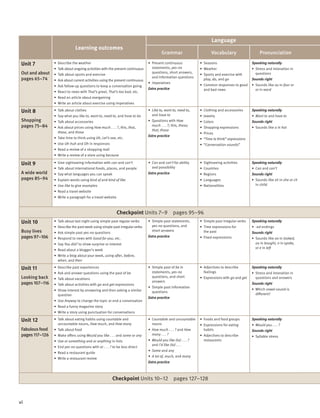
iv
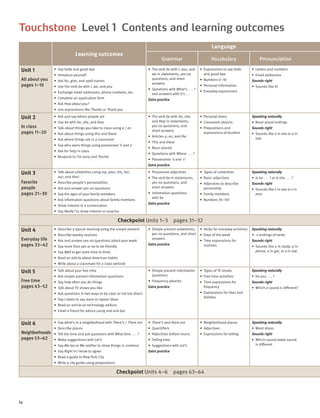
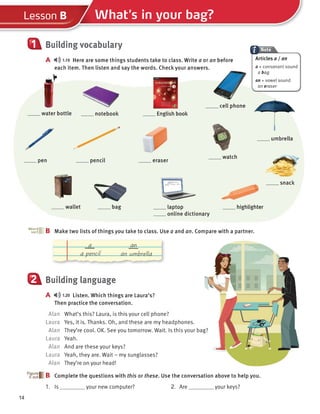
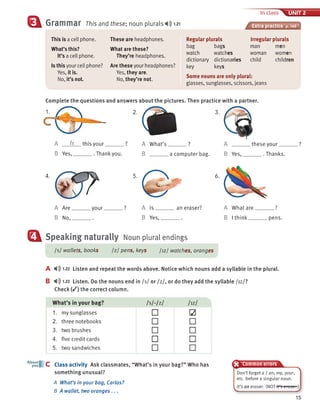
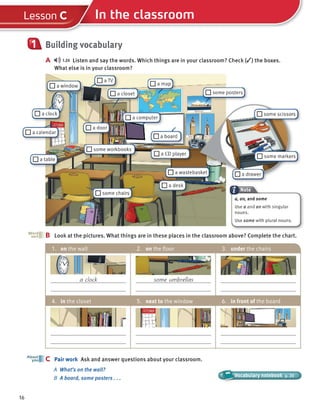
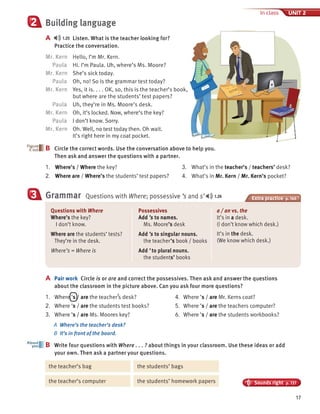
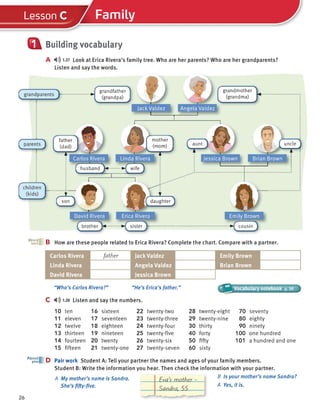
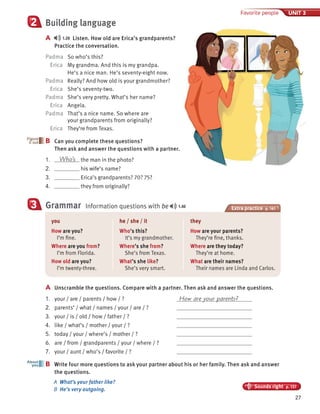
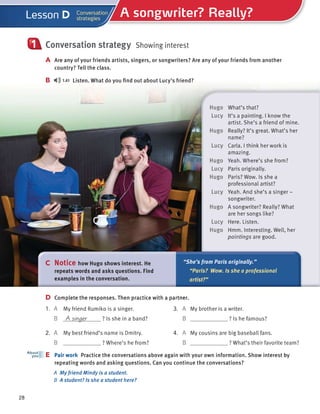
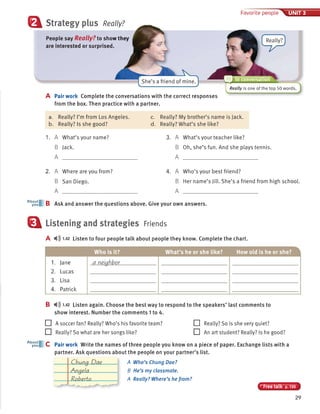
Touchstone Level 1 Contents and learning outcomes
Unit 4
Everyday life
pages 33–42
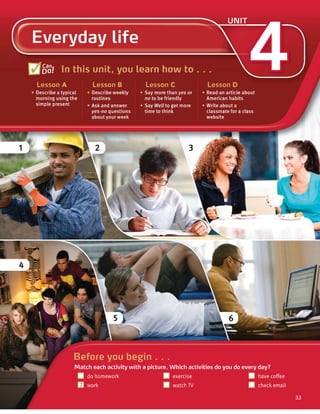
• Describe a typical morning using the simple present
• Describe weekly routines
• Ask and answer yes-no questions about your week
• Say more than yes or no to be friendly
• Say Well to get more time to think
• Read an article about American habits
• Write about a classmate for a class website
• Simple present statements,
yes-no questions, and short
answers
Extra practice
• Verbs for everyday activities
• Days of the week
• Time expressions for
routines
Speaking naturally
• -s endings of verbs
Sounds right
• Sounds like u in study, o in
phone, e in get, or a in law
Unit 5
Free time
pages 43–52
• Talk about your free time
• Ask simple present information questions
• Say how often you do things
• Talk about TV shows you like
• Ask questions in two ways to be clear or not too direct
• Say I mean to say more or repeat ideas
• Read an article on technology addicts
• Email a friend for advice using and and but
• Simple present information
questions
• Frequency adverbs
Extra practice
• Types of TV shows
• Free-time activities
• Time expressions for
frequency
• Expressions for likes and
dislikes
Speaking naturally
• Do you . . . ?
Sounds right
• Which o sound is different?
Unit 6
Neighborhoods
pages 53–62
• Say what’s in a neighborhood with There’s / There are
• Describe places
• Tell the time and ask questions with What time . . . ?
• Make suggestions with Let’s
• Say Me too or Me neither to show things in common
• Say Right or I know to agree
• Read a guide to New York City
• Write a city guide using prepositions
• There’s and there are
• Quantifiers
• Adjectives before nouns
• Telling time
• Suggestions with Let’s
Extra practice
• Neighborhood places
• Adjectives
• Expressions for telling
Speaking naturally
• Word stress
Sounds right
• Which sound vowel sound
is different
Checkpoint Units 4–6 pages 63–64
Learning outcomes
Language
Grammar Vocabulary Pronunciation
Unit 1
All about you
pages 1–10
• Say hello and good-bye
• Introduce yourself
• Ask for, give, and spell names
• Use the verb be with I, we, and you
• Exchange email addresses, phone numbers, etc.
• Complete an application form
• Ask How about you?
• Use expressions like Thanks or Thank you
• The verb be with I, you, and
we in statements, yes-no
questions, and short
answers
• Questions with What’s . . . ?
and answers with It’s . . .
Extra practice
• Expressions to say hello
and good-bye
• Numbers 0–10
• Personal information
• Everyday expressions
• Letters and numbers
• Email addresses
Sounds right
• Sounds like hi
Unit 2
In class
pages 11–20
• Ask and say where people are
• Use be with he, she, and they
• Talk about things you take to class using a / an
• Ask about things using this and these
• Ask where things are in a classroom
• Say who owns things using possessive ’s and s’
• Ask for help in class
• Respond to I’m sorry and Thanks
• The verb be with he, she,
and they in statements,
yes-no questions, and
short answers
• Articles a, an, and the
• This and these
• Noun plurals
• Questions with Where . . . ?
• Possessives ’s and s’
Extra practice
• Personal items
• Classroom objects
• Prepositions and
expressions of location
Speaking naturally
• Noun plural endings
Sounds right
• Sounds like e in she or a in
late
Unit 3
Favorite
people
pages 21–30
• Talk about celebrities using my, your, his, her,
our, and their
• Describe people’s personalities
• Ask and answer yes-no questions
• Say the ages of your family members
• Ask information questions about family members
• Show interest in a conversation
• Say Really? to show interest or surprise
• Possessive adjectives
• The verb be in statements,
yes-no questions, and
short answers
• Information questions
with be
Extra practice
• Types of celebrities
• Basic adjectives
• Adjectives to describe
personality
• Family members
• Numbers 10–101
Speaking naturally
• Is he . . . ? or Is she . . . ?
Sounds right
• Sounds like s in see or z in
zero
Checkpoint Units 1–3 pages 31–32
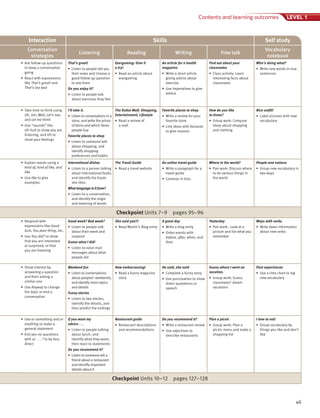
v
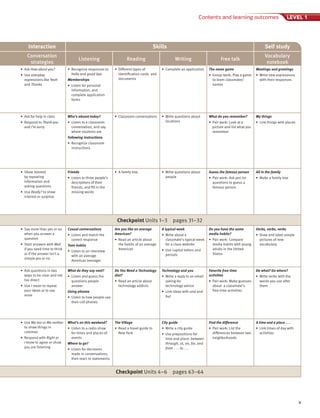
Contents and learning outcomes LEVEL 1
• Say more than yes or no
when you answer a
question
• Start answers with Well
if you need time to think
or if the answer isn’t a
simple yes or no
Casual conversations
• Listen and match the
correct response
Teen habits
• Listen to an interview
with an average
American teenager
Are you like an average
American?
• Read an article about
the habits of an average
American
A typical week
• Write about a
classmate’s typical week
for a class website
• Use capital letters and
periods
Do you have the same
media habits?
• Pair work: Compare
media habits with young
adults in the United
States
Verbs, verbs, verbs
• Draw and label simple
pictures of new
vocabulary
• Ask questions in two
ways to be clear and not
too direct
• Use I mean to repeat
your ideas or to say
more
What do they say next?
• Listen and guess the
questions people
answer
Using phones
• Listen to how people use
their cell phones
Do You Need a Technology
diet?
• Read an article about
technology addicts
Technology and you
• Write a reply to an email
asking for
technology advice
• Link ideas with and and
but
Favorite free-time
activities
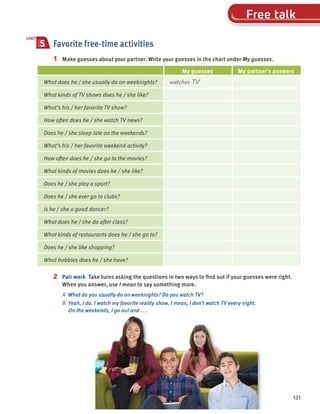
• Pair work: Make guesses
about a classmate’s
free-time activities
Do what? Go where?
• Write verbs with the
words you use after
them
• Use Me too or Me neither
to show things in
common
• Respond with Right or
I know to agree or show
you are listening
What’s on this weekend?
• Listen to a radio show
for times and places of
events
Where to go?
• Listen for decisions
made in conversations,
then react to statements
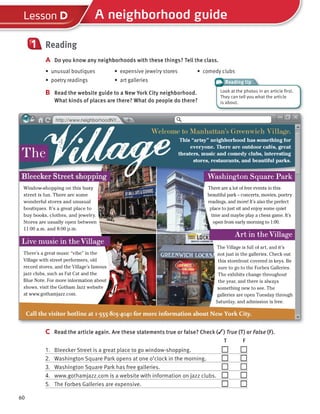
The Village
• Read a travel guide to
New York
City guide
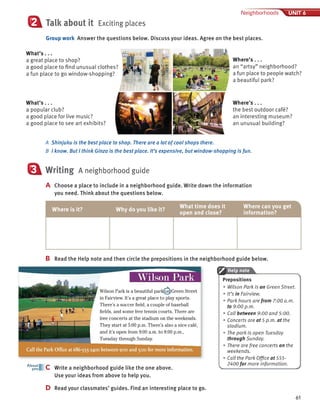
• Write a city guide
• Use prepositions for
time and place: between
through, at, on, for, and
from . . . to . . .
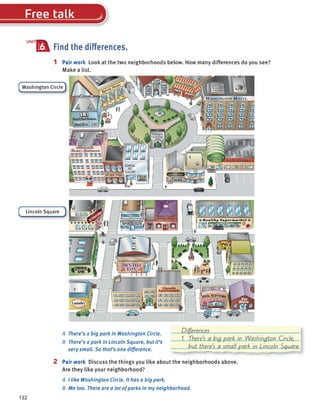
Find the difference
• Pair work: List the
differences between two
neighborhoods
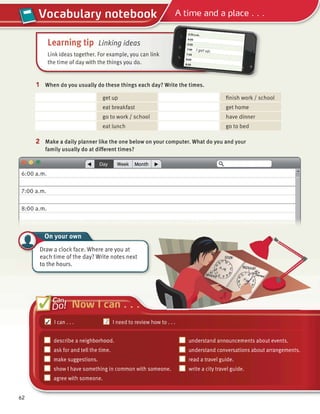
A time and a place . . .
• Link times of day with
activities
Checkpoint Units 4–6 pages 63–64
Interaction Skills Self study
Conversation
strategies
Listening Reading Writing Free talk
Vocabulary
notebook
• Ask How about you?
• Use everyday
expressions like Yeah
and Thanks
• Recognize responses to
hello and good-bye
Memberships
• Listen for personal
information, and
complete application
forms
• Different types of
identification cards and
documents
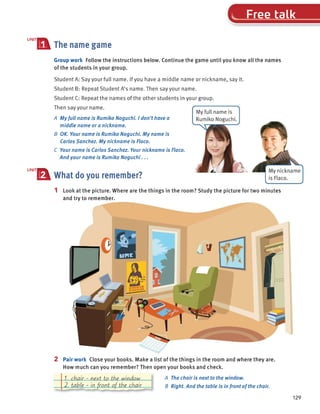
• Complete an application The name game
• Group work: Play a game
to learn classmates’
names
Meetings and greetings
• Write new expressions
with their responses
• Ask for help in class
• Respond to Thank you
and I’m sorry
Who’s absent today?
• Listen to a classroom
conversation, and say
where students are
Following instructions
• Recognize classroom
instructions
• Classroom conversations • Write questions about
locations
What do you remember?
• Pair work: Look at a
picture and list what you
remember
My things
• Link things with places
• Show interest
by repeating
information and
asking questions
• Use Really? to show
interest or surprise
Friends
• Listen to three people’s
descriptions of their
friends, and fill in the
missing words
• A family tree • Write questions about
people
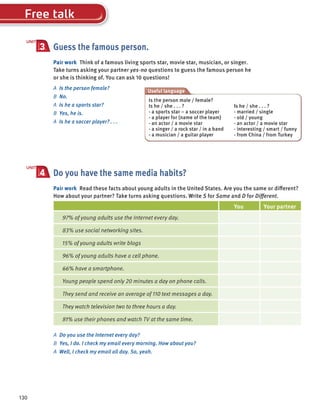
Guess the famous person
• Pair work: Ask yes-no
questions to guess a
famous person
All in the family
• Make a family tree
Checkpoint Units 1–3 pages 31–32
vi
Unit 10
Busy lives
pages 97–106
• Talk about last night using simple past regular verbs
• Describe the past week using simple past irregular verbs
• Ask simple past yes-no questions
• Respond to news with Good for you, etc.
• Say You did? to show surprise or interest
• Read about a blogger’s week
• Write a blog about your week, using after, before,
when, and then
• Simple past statements,
yes-no questions, and
short answers
Extra practice
• Simple past irregular verbs
• Time expressions for
the past
• Fixed expressions
Speaking naturally
• -ed endings
Sounds right
• Sounds like oo in looked,
ou in bought, o in spoke,
or e in left
Unit 11
Looking back
pages 107–116
• Describe past experiences
• Ask and answer questions using the past of be
• Talk about vacations
• Talk about activities with go and get expressions
• Show interest by answering and then asking a similar
question
• Use Anyway to change the topic or end a conversation
• Read a funny magazine story
• Write a story using punctuation for conversations
• Simple past of be in
statements, yes-no
questions, and short
answers
• Simple past information
questions
Extra practice
• Adjectives to describe
feelings
• Expressions with go and get
Speaking naturally
• Stress and intonation in
questions and answers
Sounds right
• Which vowel sound is
different?
Unit 12
Fabulousfood
pages117–126
• Talk about eating habits using countable and
uncountable nouns, How much, and How many
• Talk about food
• Make offers using Would you like . . . and some or any
• Use or something and or anything in lists
• End yes-no questions with or . . . ? to be less direct
• Read a restaurant guide
• Write a restaurant review
• Countable and uncountable
nouns
• How much . . . ? and How
many . . . ?
• Would you like (to) . . . ?
and I’d like (to) . . .
• Some and any
• A lot of, much, and many
Extra practice
• Foods and food groups
• Expressions for eating
habits
• Adjectives to describe
restaurants
Speaking naturally
• Would you . . . ?
Sounds right
• Syllable stress
Checkpoint Units 10–12 pages 127–128
Learning outcomes
Language
Grammar Vocabulary Pronunciation
Unit 7
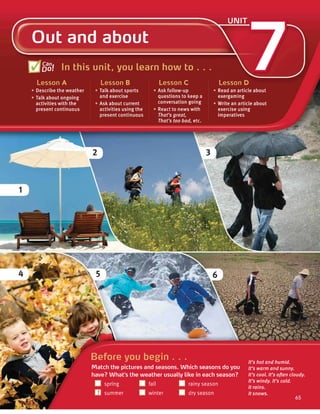
Out and about
pages 65–74
• Describe the weather
• Talk about ongoing activities with the present continuous
• Talk about sports and exercise
• Ask about current activities using the present continuous
• Ask follow-up questions to keep a conversation going
• React to news with That’s great, That’s too bad, etc.
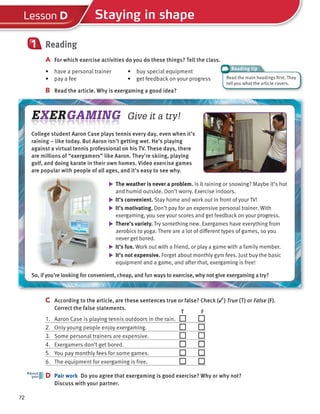
• Read an article about exergaming
• Write an article about exercise using imperatives
• Present continuous
statements, yes-no
questions, short answers,
and information questions
• Imperatives
Extra practice
• Seasons
• Weather
• Sports and exercise with
play, do, and go
• Common responses to good
and bad news
Speaking naturally
• Stress and intonation in
questions
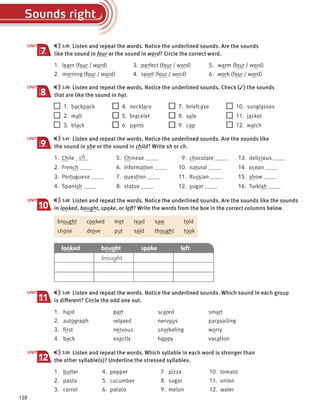
Sounds right
• Sounds like ou in four or
or in word
Unit 8
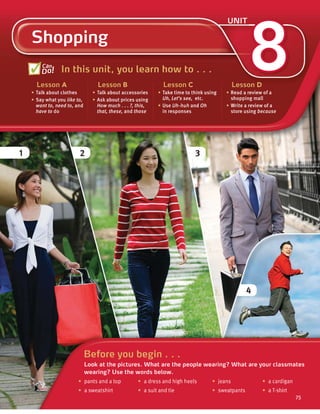
Shopping
pages 75–84
• Talk about clothes
• Say what you like to, want to, need to, and have to do
• Talk about accessories
• Ask about prices using How much . . . ?, this, that,
these, and those
• Take time to think using Uh, Let’s see, etc.
• Use Uh-huh and Oh in responses
• Read a review of a shopping mall
• Write a review of a store using because
• Like to, want to, need to,
and have to
• Questions with How
much . . . ?; this, these;
that, those
Extra practice
• Clothing and accessories
• Jewelry
• Colors
• Shopping expressions
• Prices
• “Time to think” expressions
• “Conversation sounds”
Speaking naturally
• Want to and have to
Sounds right
• Sounds like a in hat
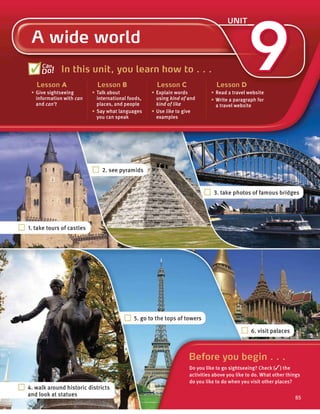
Unit 9
A wide world
pages 85–94
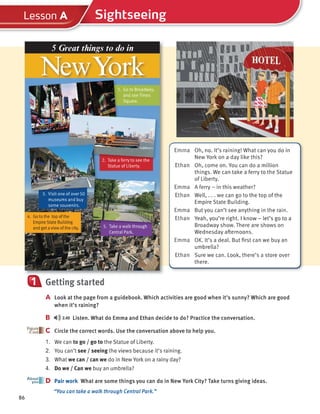
• Give sightseeing information with can and can’t
• Talk about international foods, places, and people
• Say what languages you can speak
• Explain words using kind of and kind of like
• Use like to give examples
• Read a travel website
• Write a paragraph for a travel website
• Can and can’t for ability
and possibility
Extra practice
• Sightseeing activities
• Countries
• Regions
• Languages
• Nationalities
Speaking naturally
• Can and can’t
Sounds right
• Sounds like sh in she or ch
in child
Checkpoint Units 7–9 pages 95–96
LEVEL 1
vii
LEVEL 1
LEVEL 1
Contents and learning outcomes LEVEL 1
• Respond with
expressions like Good
luck, You poor thing, etc.
• Use You did? to show
that you are interested
or surprised, or that
you are listening
Good week? Bad week?
• Listen to people talk
about their week and
respond
Guess what I did!
• Listen to voice mail
messages about what
people did
She said yes!!!
• Read Martin’s Blog entry
A great day
• Write a blog entry
• Order events with
before, after, when, and
then
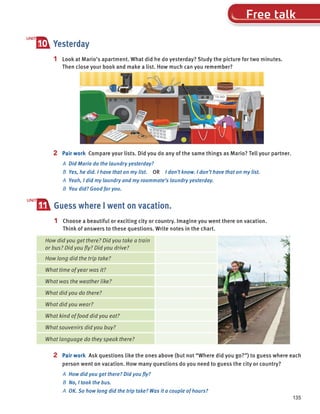
Yesterday
• Pair work: Look at a
picture and list what you
remember
Ways with verbs
• Write down information
about new verbs
• Show interest by
answering a question
and then asking a
similar one
• Use Anyway to change
the topic or end a
conversation
Weekend fun
• Listen to conversations
about peoples’ weekends,
and identify main topics
and details
Funny stories
• Listen to two stories,
identify the details, and
then predict the endings
How embarrassing!
• Read a funny magazine
story
He said, she said
• Complete a funny story
• Use punctuation to show
direct quotations or
speech
Guess where I went on
vacation.
• Group work: Guess
classmates’ dream
vacations
Past experiences
• Use a time chart to log
new vocabulary
• Use or something and or
anything to make a
general statement
• End yes-no questions
with or . . . ? to be less
direct
If you want my
advice . . .
• Listen to people talking
about lunch, and
identify what they want;
then react to statements
Do you recommend it?
• Listen to someone tell a
friend about a restaurant
and identify important
details about it
Restaurant guide
• Restaurant descriptions
and recommendations
Do you recommend it?
• Write a restaurant review
• Use adjectives to
describe restaurants
Plan a picnic
• Group work: Plan a
picnic menu and make a
shopping list
I love to eat!
• Group vocabulary by
things you like and don’t
like
Checkpoint Units 10–12 pages 127–128
Interaction Skills Self study
Conversation
strategies
Listening Reading Writing Free talk
Vocabulary
notebook
• Ask follow-up questions
to keep a conversation
going
• React with expressions
like That’s great! and
That’s too bad
That’s great!
• Listen to people tell you
their news and choose a
good follow-up question
to ask them
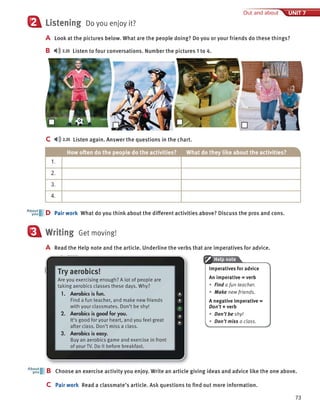
Do you enjoy it?
• Listen to people talk
about exercises they like
Exergaming: Give it
a try!
• Read an article about
exergaming
An article for a health
magazine
• Write a short article
giving advice about
exercise
• Use imperatives to give
advice
Find out about your
classmates
• Class activity: Learn
interesting facts about
classmates
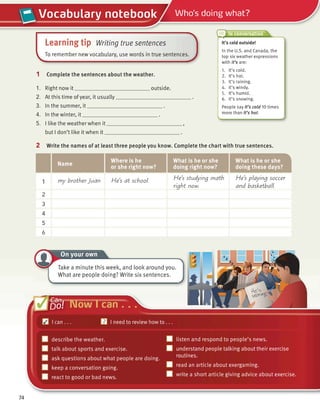
Who’s doing what?
• Write new words in true
sentences
• Take time to think using
Uh, Um, Well, Let’s see,
and Let me think
• Use “sounds” like
Uh-huh to show you are
listening, and Oh to
show your feelings
I’ll take it.
• Listen to conversations in a
store, and write the prices
of items and which items
people buy
Favorite places to shop
• Listen to someone talk
about shopping, and
identify shopping
preferences and habits
The Dubai Mall: Shopping,
Entertainment, Lifestyle
• Read a review of
a mall
Favorite places to shop
• Write a review for your
favorite store
• Link ideas with because
to give reasons
How do you like
to dress?
• Group work: Compare
ideas about shopping
and clothing
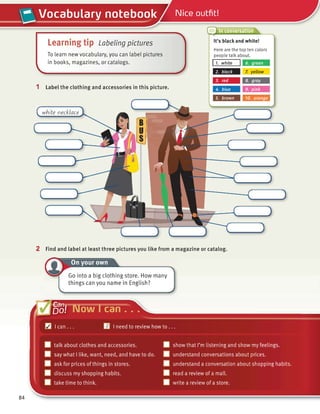
Nice outfit!
• Label pictures with new
vocabulary
• Explain words using a
kind of, kind of like, and
like
• Use like to give
examples
International dishes
• Listen to a person talking
about international foods,
and identify the foods
she likes
What language is it from?
• Listen to a conversation,
and identify the origin
and meaning of words
The Travel Guide
• Read a travel website
An online travel guide
• Write a paragraph for a
travel guide
• Commas in lists
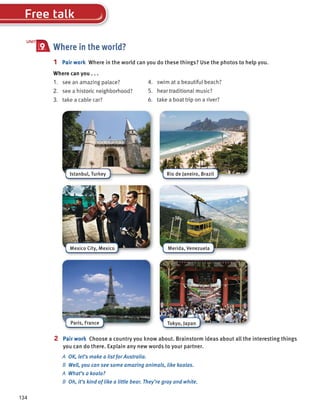
Where in the world?
• Pair work: Discuss where
to do various things in
the world
People and nations
• Group new vocabulary in
two ways
Checkpoint Units 7–9 pages 95–96
Cambridge University Press
978-1-107-67987-0 – Touchstone Level 1
Michael McCarthy Jeanne McCarten and Helen Sandiford
Excerpt
More information
© in this web service Cambridge University Press www.cambridge.org
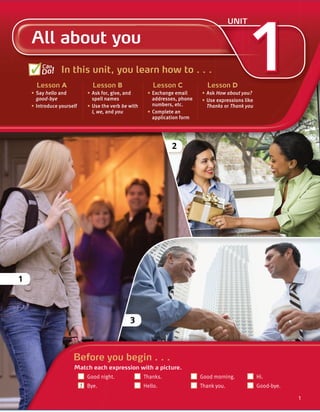
1
All about you
UNIT
In this unit, you learn how to . . .
Lesson A
• Say hello and
good-bye
• Introduce yourself
Lesson B
• Ask for, give, and
spell names
• Use the verb be with
I, we, and you
Lesson C
• Exchange email
addresses, phone
numbers, etc.
• Complete an
application form
Lesson D
• Ask How about you?
• Use expressions like
Thanks or Thank you
Can
Do!
1
2
1
1
Before you begin . . .
Match each expression with a picture.
Good night. Thanks. Good morning. Hi.
Bye. Hello. Thank you. Good-bye.
3
1
1
Cambridge University Press
978-1-107-67987-0 – Touchstone Level 1
Michael McCarthy Jeanne McCarten and Helen Sandiford
Excerpt
More information
© in this web service Cambridge University Press www.cambridge.org
2
Lesson A Hello and good-bye
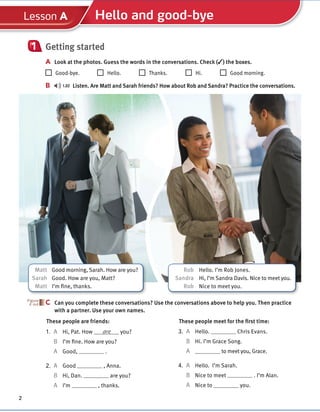
Getting started
A Look at the photos. Guess the words in the conversations. Check (✓) the boxes.
Good-bye. Hello. Thanks. Hi. Good morning.
B 1.02 Listen. Are Matt and Sarah friends? How about Rob and Sandra? Practice the conversations.
1
C Can you complete these conversations? Use the conversations above to help you. Then practice
with a partner. Use your own names.
C
These people meet for the first time:
3. A Hello. Chris Evans.
B Hi. I’m Grace Song.
A to meet you, Grace.
4. A Hello. I’m Sarah.
B Nice to meet . I’m Alan.
A Nice to you.
These people are friends:
1. A Hi, Pat. How are you?
B I’m fine. How are you?
A Good, .
2. A Good , Anna.
B Hi, Dan. are you?
A I’m , thanks.
Matt Good morning, Sarah. How are you?
Sarah Good. How are you, Matt?
Matt I’m fine, thanks.
Rob Hello. I’m Rob Jones.
Sandra Hi, I’m Sandra Davis. Nice to meet you.
Rob Nice to meet you.
Cambridge University Press
978-1-107-67987-0 – Touchstone Level 1
Michael McCarthy Jeanne McCarten and Helen Sandiford
Excerpt
More information
© in this web service Cambridge University Press www.cambridge.org
3
All about you UNIT 1
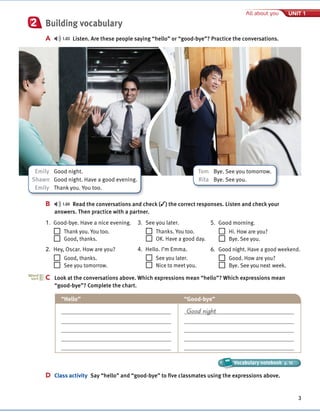
Building vocabulary
A 1.03 Listen. Are these people saying “hello” or “good-bye”? Practice the conversations.
2
B 1.04 Read the conversations and check (✓) the correct responses. Listen and check your
answers. Then practice with a partner.
3. See you later.
Thanks. You too.
OK. Have a good day.
4. Hello. I’m Emma.
See you later.
Nice to meet you.
5. Good morning.
Hi. How are you?
Bye. See you.
6. Good night. Have a good weekend.
Good. How are you?
Bye. See you next week.
C Look at the conversations above. Which expressions mean “hello”? Which expressions mean
“good-bye”? Complete the chart.
“Hello” “Good-bye”
Good night
D Class activity Say “hello” and “good-bye” to five classmates using the expressions above.
C
Word
sort
Vocabulary notebook p. 10
Vocabulary notebook
Vocabulary notebook
1. Good-bye. Have a nice evening.
Thank you. You too.
Good, thanks.
2. Hey, Oscar. How are you?
Good, thanks.
See you tomorrow.
Emily Good night.
Shawn Good night. Have a good evening.
Emily Thank you. You too.
Tom Bye. See you tomorrow.
Rita Bye. See you.
Cambridge University Press
978-1-107-67987-0 – Touchstone Level 1
Michael McCarthy Jeanne McCarten and Helen Sandiford
Excerpt
More information
© in this web service Cambridge University Press www.cambridge.org
4
About
you
Names
Lesson B
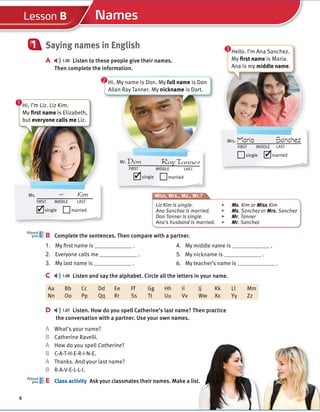
Saying names in English
A 1.05 Listen to these people give their names.
Then complete the information.
1
B Complete the sentences. Then compare with a partner.
C 1.06 Listen and say the alphabet. Circle all the letters in your name.
Aa Bb Cc Dd Ee Ff Gg Hh Ii Jj Kk Ll Mm
Nn Oo Pp Qq Rr Ss Tt Uu Vv Ww Xx Yy Zz
D 1.07 Listen. How do you spell Catherine’s last name? Then practice
the conversation with a partner. Use your own names.
A What’s your name?
B Catherine Ravelli.
A How do you spell Catherine?
B C-A-T-H-E-R-I-N-E.
A Thanks. And your last name?
B R-A-V-E-L-L-I.
E Class activity Ask your classmates their names. Make a list.
E
About
you
Hi, I’m Liz. Liz Kim.
My first name is Elizabeth,
but everyone calls me Liz.
Ms. — Kim
FIRST MIDDLE LAST
single married
✓
Mr. Don RayTanner
FIRST MIDDLE LAST
single married
✓
Mrs. Maria Sanchez
FIRST MIDDLE LAST
single married
✓
1. My first name is .
2. Everyone calls me .
3. My last name is .
4. My middle name is .
5. My nickname is .
6. My teacher’s name is .
1
Hi. My name is Don. My full name is Don
Allan Ray Tanner. My nickname is Dart.
2
Hello. I’m Ana Sanchez.
My first name is Maria.
Ana is my middle name.
3
Miss, Mrs., Ms., Mr.?
Liz Kim is single. ▶ Ms. Kim or Miss Kim
Ana Sanchez is married. ▶ Ms. Sanchez or Mrs. Sanchez
Don Tanner is single. ▶ Mr. Tanner
Ana’s husband is married. ▶ Mr. Sanchez
Cambridge University Press
978-1-107-67987-0 – Touchstone Level 1
Michael McCarthy Jeanne McCarten and Helen Sandiford
Excerpt
More information
© in this web service Cambridge University Press www.cambridge.org
5
All about you UNIT 1
5
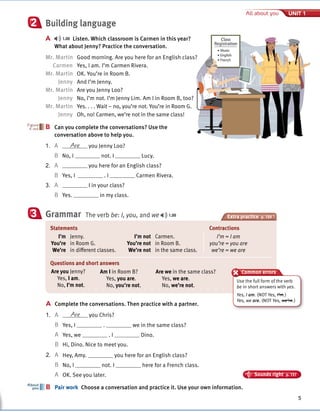
Building language
A 1.08 Listen. Which classroom is Carmen in this year?
What about Jenny? Practice the conversation.
Mr. Martin Good morning. Are you here for an English class?
Carmen Yes, I am. I’m Carmen Rivera.
Mr. Martin OK. You’re in Room B.
Jenny And I’m Jenny.
Mr. Martin Are you Jenny Loo?
Jenny No, I’m not. I’m Jenny Lim. Am I in Room B, too?
Mr. Martin Yes. . . . Wait – no, you’re not. You’re in Room G.
Jenny Oh, no! Carmen, we’re not in the same class!
B Can you complete the conversations? Use the
conversation above to help you.
1. A Are you Jenny Loo?
B No, I not. I Lucy.
2. A you here for an English class?
B Yes, I . I Carmen Rivera.
3. A I in your class?
B Yes. in my class.
2
B Can you complete the conversations? Use the
Grammar The verb be: I, you, and we 1.09
3 Extra practice p. 139
Common errors
A Complete the conversations. Then practice with a partner.
1. A Are you Chris?
B Yes, I . we in the same class?
A Yes, we . I Dino.
B Hi, Dino. Nice to meet you.
2. A Hey, Amy. you here for an English class?
B No, I not. I here for a French class.
A OK. See you later.
B Pair work Choose a conversation and practice it. Use your own information.
B
About
you
Statements Contractions
I’m
You’re
We’re
Jenny.
in Room G.
in different classes.
I’m not
You’re not
We’re not
Carmen.
in Room B.
in the same class.
I’m = I am
you’re = you are
we’re = we are
Are you Jenny?
Yes, I am.
No, I’m not.
Are we in the same class?
Yes, we are.
No, we’re not.
Questions and short answers
Am I in Room B?
Yes, you are.
No, you’re not.
Sounds right p. 137
Use the full form of the verb
be in short answers with yes.
Yes, I am. (NOT Yes, I’m.)
Yes, we are. (NOT Yes, we’re.)
Cambridge University Press
978-1-107-67987-0 – Touchstone Level 1
Michael McCarthy Jeanne McCarten and Helen Sandiford
Excerpt
More information
© in this web service Cambridge University Press www.cambridge.org
PASSPORT
PASSEPORT
Passport No./No de passeport
649 321 508
P<CAN<BARTON<<JAMESDAVID<<<<<<<<<<<<<<<<<<
<<<<<<<<649321508<<<<<<<<<<<<<<<<<<<<<<<
Surname/Nom
Given names/Prénoms
Nationality/Nationalité
BARTON
JAMES DAVID
CANADIAN/CANADIEN
CANADA
6
Personal information
Lesson C
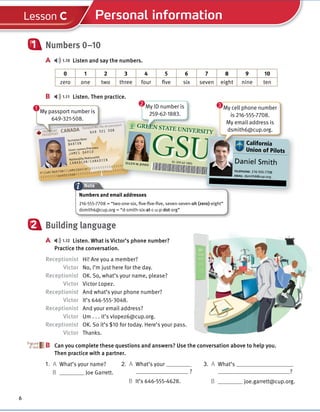
Numbers 0–10
A 1.10 Listen and say the numbers.
0 1 2 3 4 5 6 7 8 9 10
zero one two three four five six seven eight nine ten
B 1.11 Listen. Then practice.
1
Note
Building language
A 1.12 Listen. What is Victor’s phone number?
Practice the conversation.
Receptionist Hi! Are you a member?
Victor No, I’m just here for the day.
Receptionist OK. So, what’s your name, please?
Victor Victor Lopez.
Receptionist And what’s your phone number?
Victor It’s 646-555-3048.
Receptionist And your email address?
Victor Um . . . it’s vlopez6@cup.org.
Receptionist OK. So it’s $10 for today. Here’s your pass.
Victor Thanks.
B Can you complete these questions and answers? Use the conversation above to help you.
Then practice with a partner.
2
B
PASSPORT
PASSEPORT
Passport No./No de passeport
649 321 508
CANADA
PASSPORT
PASSPORT
My passport number is
649-321-508.
Passport No./No de passeport
<<<<<<<<<<<<<<<<<<
<<<<<<<<<<<<<<<<<<<<<<<
GREEN STATE UNIVERSITY
GSU
ELLEN M. JONES
ID: 259-62-1883
1. A What’s your name?
B Joe Garrett.
2. A What’s your
?
3. A What’s
?
B It’s 646-555-4628. B joe.garrett@cup.org.
1
GREEN STATE UNIVERSITY
GSU California
Union of Pilots
Daniel Smith
TELEPHONE: 216-555-7708
EMAIL: dsmith6@cup.org
California
My cell phone number
is 216-555-7708.
My email address is
dsmith6@cup.org.
3
GREEN STATE UNIVERSITY
My ID number is
259-62-1883.
2
Numbers and email addresses
216-555-7708 = “two-one-six, five-five-five, seven-seven-oh (zero)-eight”
dsmith6@cup.org = “d-smith-six-at-c-u-p-dot-org”
Cambridge University Press
978-1-107-67987-0 – Touchstone Level 1
Michael McCarthy Jeanne McCarten and Helen Sandiford
Excerpt
More information
© in this web service Cambridge University Press www.cambridge.org
Extra practice p. 139
7
All about you UNIT 1
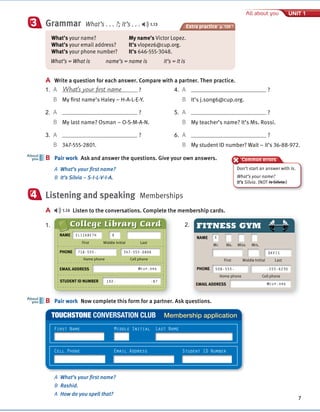
Grammar What’s . . . ?; It’s . . . 1.13
3
A Write a question for each answer. Compare with a partner. Then practice.
4. A ?
B It’s j.song6@cup.org.
5. A ?
B My teacher’s name? It’s Ms. Rossi.
6. A ?
B My student ID number? Wait – it’s 36-88-972.
B Pair work Ask and answer the questions. Give your own answers.
A What’s your first name?
B It’s Silvia – S-I-L-V-I-A.
Listening and speaking Memberships
A 1.14 Listen to the conversations. Complete the membership cards.
B
About
you
4
Common errors
B Pair work Now complete this form for a partner. Ask questions.
B
About
you
A What’s your first name?
B Rashid.
A How do you spell that?
1.
TOUCHSTONE CONVERSATION CLUB Membership application
First Name Middle Initial Last Name
Cell Phone Email Address Student ID Number
What’s your name?
What’s your email address?
What’s your phone number?
My name’s Victor Lopez.
It’s vlopez6@cup.org.
It’s 646-555-3048.
What’s = What is name’s = name is It’s = It is
2.
NAME
First Middle Initial Last
Mr. Ms. Miss Mrs.
PHONE
Home phone Cell phone
508-555-
X
-555-6230
DAVIS
EMAIL ADDRESS @cup.org
FITNESS GYM
College Library Card
PHONE
Home phone Cell phone
718-555- 347-555-0806
EMAIL ADDRESS @cup.org
STUDENT ID NUMBER 192- -87
NAME
First Middle Initial Last
ELIZABETH R
1. A What’s your first name ?
B My first name’s Haley – H-A-L-E-Y.
2. A ?
B My last name? Osman – O-S-M-A-N.
3. A ?
B 347-555-2801.
Don’t start an answer with Is.
What’s your name?
It’s Silvia. (NOT Is Silvia.)
Cambridge University Press
978-1-107-67987-0 – Touchstone Level 1
Michael McCarthy Jeanne McCarten and Helen Sandiford
Excerpt
More information
© in this web service Cambridge University Press www.cambridge.org
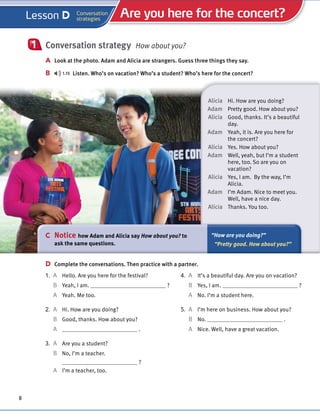
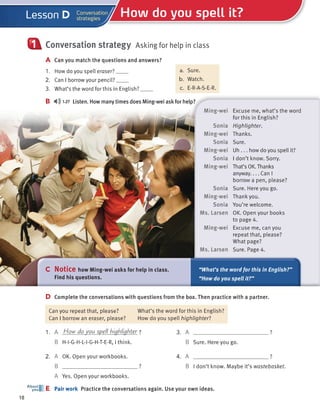
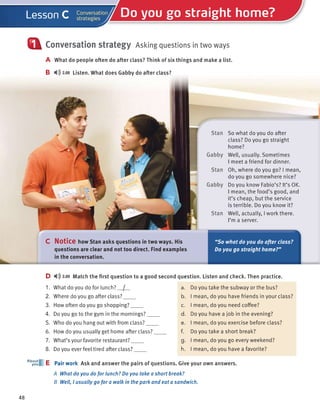
Conversation strategy How about you?
A Look at the photo. Adam and Alicia are strangers. Guess three things they say.
B 1.15 Listen. Who’s on vacation? Who’s a student? Who’s here for the concert?
1
Alicia Hi. How are you doing?
Adam Pretty good. How about you?
Alicia Good, thanks. It’s a beautiful
day.
Adam Yeah, it is. Are you here for
the concert?
Alicia Yes. How about you?
Adam Well, yeah, but I’m a student
here, too. So are you on
vacation?
Alicia Yes, I am. By the way, I’m
Alicia.
Adam I’m Adam. Nice to meet you.
Well, have a nice day.
Alicia Thanks. You too.
C Notice how Adam and Alicia say How about you? to
ask the same questions.
“How are you doing?”
“Pretty good. How about you?”
8
4. A It’s a beautiful day. Are you on vacation?
B Yes, I am. ?
A No. I’m a student here.
5. A I’m here on business. How about you?
B No. .
A Nice. Well, have a great vacation.
D Complete the conversations. Then practice with a partner.
1. A Hello. Are you here for the festival?
B Yeah, I am. ?
A Yeah. Me too.
2. A Hi. How are you doing?
B Good, thanks. How about you?
A .
3. A Are you a student?
B No, I’m a teacher.
?
A I’m a teacher, too.
Are you here for the concert?
Conversation
strategies
Lesson D
Cambridge University Press
978-1-107-67987-0 – Touchstone Level 1
Michael McCarthy Jeanne McCarten and Helen Sandiford
Excerpt
More information
© in this web service Cambridge University Press www.cambridge.org
9
All about you UNIT 1
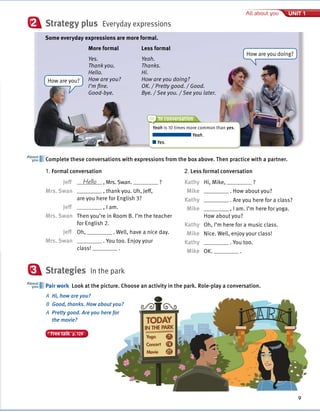
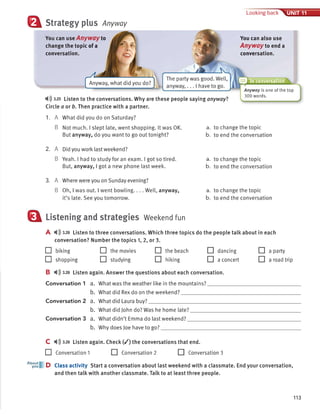
Strategy plus Everyday expressions
2
Some everyday expressions are more formal.
Complete these conversations with expressions from the box above. Then practice with a partner.
About
you
More formal
Yes.
Thank you.
Hello.
How are you?
I’m fine.
Good-bye.
Less formal
Yeah.
Thanks.
Hi.
How are you doing?
OK. / Pretty good. / Good.
Bye. / See you. / See you later.
1. Formal conversation
Jeff Hello , Mrs. Swan. ?
Mrs. Swan , thank you. Uh, Jeff,
are you here for English 3?
Jeff , I am.
Mrs. Swan Then you’re in Room B. I’m the teacher
for English 2.
Jeff Oh, . Well, have a nice day.
Mrs. Swan . You too. Enjoy your
class! .
2. Less formal conversation
Kathy Hi, Mike, ?
Mike . How about you?
Kathy . Are you here for a class?
Mike , I am. I’m here for yoga.
How about you?
Kathy Oh, I’m here for a music class.
Mike Nice. Well, enjoy your class!
Kathy . You too.
Mike OK. .
Free talk p. 129
Strategies In the park
Pair work Look at the picture. Choose an activity in the park. Role-play a conversation.
A Hi, how are you?
B Good, thanks. How about you?
A Pretty good. Are you here for
the movie?
3
Pair work
About
you
I’m fine.
Good-bye.
In conversation
How are you doing?
How are you?
Yeah is 10 times more common than yes.
Yeah.
Yes.
Cambridge University Press
978-1-107-67987-0 – Touchstone Level 1
Michael McCarthy Jeanne McCarten and Helen Sandiford
Excerpt
More information
© in this web service Cambridge University Press www.cambridge.org
10
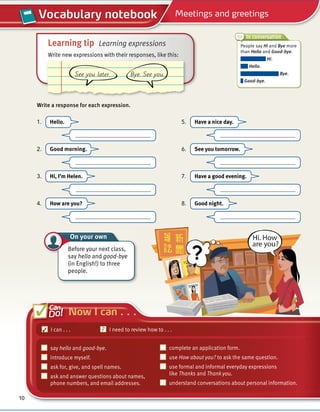
Vocabulary notebook Meetings and greetings
Vocabulary notebook
Vocabulary notebook
Learning tip Learning expressions
Write new expressions with their responses, like this:
See you later. Bye. See you.
On your own
10
10
Can
Do!
complete an application form.
use How about you? to ask the same question.
use formal and informal everyday expressions
like Thanks and Thank you.
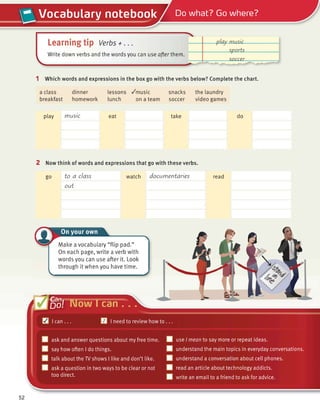
understand conversations about personal information.
say hello and good-bye.
introduce myself.
ask for, give, and spell names.
ask and answer questions about names,
phone numbers, and email addresses.
Now I can . . .
I can . . . I need to review how to . . .
?
In conversation
Write a response for each expression.
1. Hello.
2. Good morning.
3. Hi, I’m Helen.
4. How are you?
5. Have a nice day.
6. See you tomorrow.
7. Have a good evening.
8. Good night.
People say Hi and Bye more
than Hello and Good-bye.
Hi.
Hello.
Bye.
Good-bye.
Before your next class,
say hello and good-bye
(in English!) to three
people.
2
1 3
4 5
6
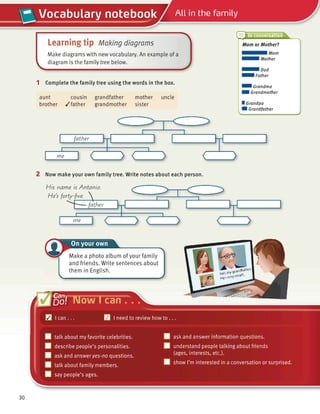
117
12
Fabulous food
UNIT
In this unit, you learn how to . . .
Lesson A
• Talk about eating
habits using countable
and uncountable
nouns, How much,
and How many
Lesson B
• Talk about food
• Make offers using
Would you like . . .
and some or any
Lesson C
• Use or something and
or anything in lists
• End yes-no questions
with or . . . ? to be
less direct
Lesson D
• Read a restaurant
guide
• Write a restaurant
review
Can
Do!
117
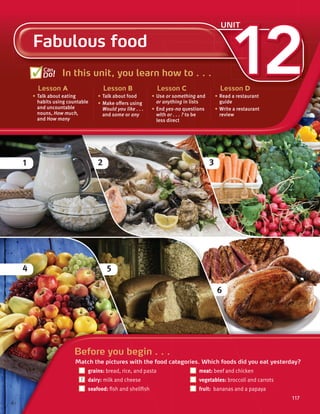
Before you begin . . .
Match the pictures with the food categories. Which foods did you eat yesterday?
grains: bread, rice, and pasta meat: beef and chicken
dairy: milk and cheese vegetables: broccoli and carrots
seafood: fish and shellfish fruit: bananas and a papaya
117
1
118
Lesson A Eating habits
Getting started
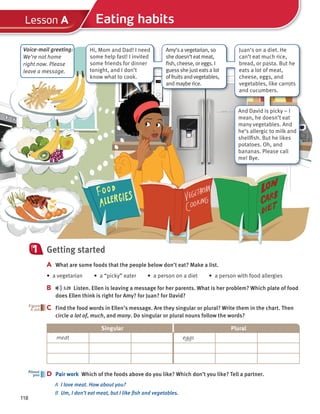
A What are some foods that the people below don’t eat? Make a list.
• a vegetarian • a “picky” eater • a person on a diet • a person with food allergies
B 3.29 Listen. Ellen is leaving a message for her parents. What is her problem? Which plate of food
does Ellen think is right for Amy? for Juan? for David?
1
C Find the food words in Ellen’s message. Are they singular or plural? Write them in the chart. Then
circle a lot of, much, and many. Do singular or plural nouns follow the words?
C
Singular Plural
meat eggs
D Pair work Which of the foods above do you like? Which don’t you like? Tell a partner.
A I love meat. How about you?
B Um, I don’t eat meat, but I like fish and vegetables.
D
About
you
Voice-mail greeting:
We’re not home
right now. Please
leave a message.
And David is picky – I
mean, he doesn’t eat
many vegetables. And
he’s allergic to milk and
shellfish. But he likes
potatoes. Oh, and
bananas. Please call
me! Bye.
Hi, Mom and Dad! I need
some help fast! I invited
some friends for dinner
tonight, and I don’t
know what to cook.
Amy’savegetarian,so
shedoesn’teatmeat,
fish,cheese,oreggs.I
guessshejusteatsalot
offruitsandvegetables,
andmayberice.
Juan’s on a diet. He
can’t eat much rice,
bread, or pasta. But he
eats a lot of meat,
cheese, eggs, and
vegetables, like carrots
and cucumbers.
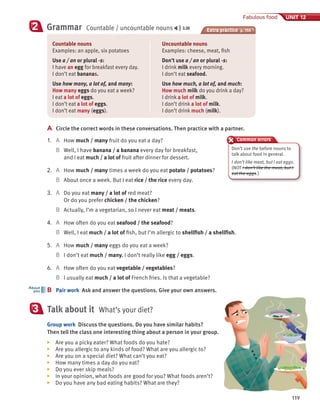
A Circle the correct words in these conversations. Then practice with a partner.
1. A How much / many fruit do you eat a day?
B Well, I have banana / a banana every day for breakfast,
and I eat much / a lot of fruit after dinner for dessert.
2. A How much / many times a week do you eat potato / potatoes?
B About once a week. But I eat rice / the rice every day.
3. A Do you eat many / a lot of red meat?
Or do you prefer chicken / the chicken?
B Actually, I’m a vegetarian, so I never eat meat / meats.
4. A How often do you eat seafood / the seafood?
B Well, I eat much / a lot of fish, but I’m allergic to shellfish / a shellfish.
5. A How much / many eggs do you eat a week?
B I don’t eat much / many. I don’t really like egg / eggs.
6. A How often do you eat vegetable / vegetables?
B I usually eat much / a lot of French fries. Is that a vegetable?
B Pair work Ask and answer the questions. Give your own answers.
Talk about it What’s your diet?
Group work Discuss the questions. Do you have similar habits?
Then tell the class one interesting thing about a person in your group.
▶ Are you a picky eater? What foods do you hate?
▶ Are you allergic to any kinds of food? What are you allergic to?
▶ Are you on a special diet? What can’t you eat?
▶ How many times a day do you eat?
▶ Do you ever skip meals?
▶ In your opinion, what foods are good for you? What foods aren’t?
▶ Do you have any bad eating habits? What are they?
B
About
you
3
119
Fabulous food UNIT 12
Grammar Countable / uncountable nouns 3.30
2 Extra practice p. 150
Countable nouns
Examples: an apple, six potatoes
Use a / an or plural -s:
I have an egg for breakfast every day.
I don’t eat bananas.
Use how many, a lot of, and many:
How many eggs do you eat a week?
I eat a lot of eggs.
I don’t eat a lot of eggs.
I don’t eat many (eggs).
Uncountable nouns
Examples: cheese, meat, fish
Don’t use a / an or plural -s:
I drink milk every morning.
I don’t eat seafood.
Use how much, a lot of, and much:
How much milk do you drink a day?
I drink a lot of milk.
I don’t drink a lot of milk.
I don’t drink much (milk).
Common errors
Don’t use the before nouns to
talk about food in general.
I don’t like meat, but I eat eggs.
(NOT I don’t like the meat, but I
eat the eggs.)
lamb
120
What’s for dinner?
Lesson B
Building vocabulary
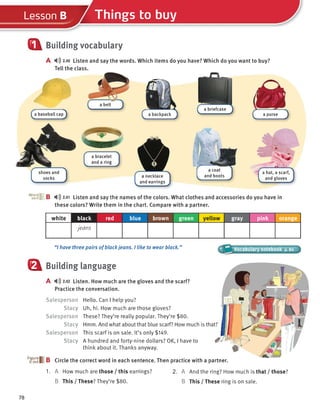
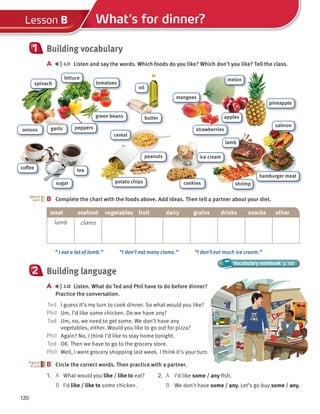
A 3.31 Listen and say the words. Which foods do you like? Which don’t you like? Tell the class.
1
B Complete the chart with the foods above. Add ideas. Then tell a partner about your diet.
B
Word
sort
“ I eat a lot of lamb.” “I don’t eat many clams.” “I don’t eat much ice cream.”
Vocabulary notebook p. 126
Vocabulary notebook
Vocabulary notebook
Building language
A 3.32 Listen. What do Ted and Phil have to do before dinner?
Practice the conversation.
Ted I guess it’s my turn to cook dinner. So what would you like?
Phil Um, I’d like some chicken. Do we have any?
Ted Um, no, we need to get some. We don’t have any
vegetables, either. Would you like to go out for pizza?
Phil Again? No, I think I’d like to stay home tonight.
Ted OK. Then we have to go to the grocery store.
Phil Well, I went grocery shopping last week. I think it’s your turn.
B Circle the correct words. Then practice with a partner.
1. A What would you like / like to eat?
B I’d like / like to some chicken.
2
B
2. A I’d like some / any fish.
B We don’t have some / any. Let’s go buy some / any.
meat seafood vegetables fruit dairy grains drinks snacks other
lamb clams
oil
salmon
cereal
lettuce
tomatoes
spinach
garlic
onions peppers
butter
melon
strawberries
mangoes
apples
pineapple
sugar
coffee tea
ice cream
shrimp
hamburger meat
peanuts
potato chips cookies
green beans
121
Fabulous food UNIT 12
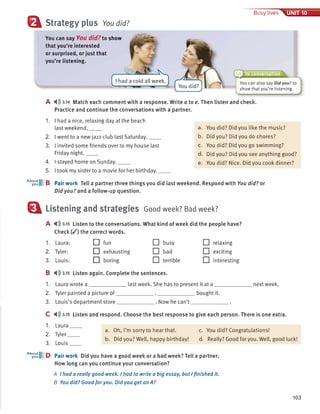
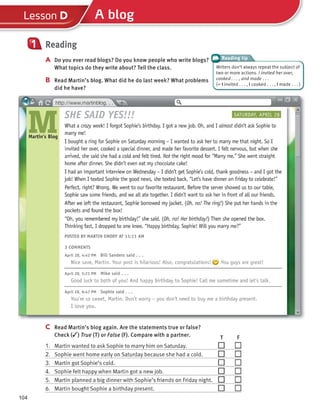
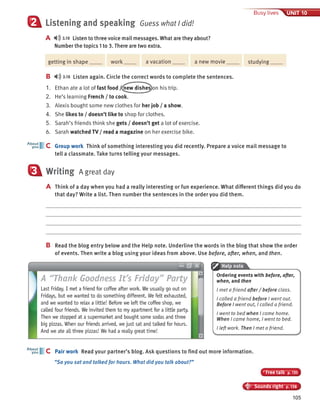
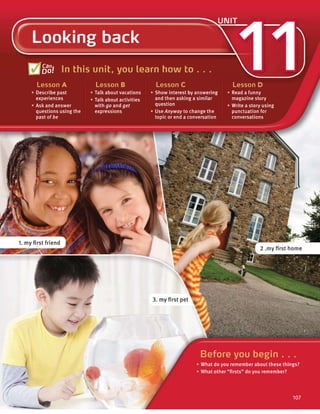
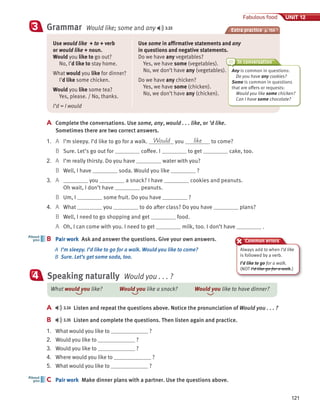
Grammar Would like; some and any 3.33
3 Extra practice p. 150
Use would like + to + verb
or would like + noun.
Would you like to go out?
No, I’d like to stay home.
What would you like for dinner?
I’d like some chicken.
Would you like some tea?
Yes, please. / No, thanks.
I’d = I would
Use some in affirmative statements and any
in questions and negative statements.
Do we have any vegetables?
Yes, we have some (vegetables).
No, we don’t have any (vegetables).
Do we have any chicken?
Yes, we have some (chicken).
No, we don’t have any (chicken).
A Complete the conversations. Use some, any, would . . . like, or ’d like.
Sometimes there are two correct answers.
1. A I’m sleepy. I’d like to go for a walk. Would you like to come?
B Sure. Let’s go out for coffee. I to get cake, too.
2. A I’m really thirsty. Do you have water with you?
B Well, I have soda. Would you like ?
3. A you a snack? I have cookies and peanuts.
Oh wait, I don’t have peanuts.
B Um, I some fruit. Do you have ?
4. A What you to do after class? Do you have plans?
B Well, I need to go shopping and get food.
A Oh, I can come with you. I need to get milk, too. I don’t have .
B Pair work Ask and answer the questions. Give your own answers.
A I’m sleepy. I’d like to go for a walk. Would you like to come?
B Sure. Let’s get some soda, too.
B
About
you
In conversation
Common errors
Speaking naturally Would you . . . ?
4
A 3.34 Listen and repeat the questions above. Notice the pronunciation of Would you . . . ?
B 3.35 Listen and complete the questions. Then listen again and practice.
1. What would you like to ?
2. Would you like to ?
3. Would you like to ?
4. Where would you like to ?
5. What would you like to ?
C Pair work Make dinner plans with a partner. Use the questions above.
C
About
you
What would you like? Would you like a snack? Would you like to have dinner?
Any is common in questions:
Do you have any cookies?
Some is common in questions
that are offers or requests:
Would you like some chicken?
Can I have some chocolate?
Always add to when I’d like
is followed by a verb.
I’d like to go for a walk.
(NOT I’d like go for a walk.)
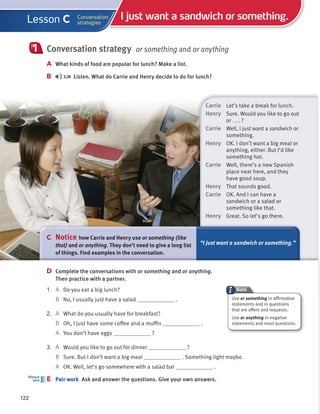
Carrie Let’s take a break for lunch.
Henry Sure. Would you like to go out
or . . . ?
Carrie Well, I just want a sandwich or
something.
Henry OK. I don’t want a big meal or
anything, either. But I’d like
something hot.
Carrie Well, there’s a new Spanish
place near here, and they
have good soup.
Henry That sounds good.
Carrie OK. And I can have a
sandwich or a salad or
something like that.
Henry Great. So let’s go there.
Conversation strategy or something and or anything
A What kinds of food are popular for lunch? Make a list.
B 3.36 Listen. What do Carrie and Henry decide to do for lunch?
1
C Notice how Carrie and Henry use or something (like
that) and or anything. They don’t need to give a long list
of things. Find examples in the conversation.
“I just want a sandwich or something.”
D Complete the conversations with or something and or anything.
Then practice with a partner.
1. A Do you eat a big lunch?
B No, I usually just have a salad .
2. A What do you usually have for breakfast?
B Oh, I just have some coffee and a muffin .
A You don’t have eggs ?
3. A Would you like to go out for dinner ?
B Sure. But I don’t want a big meal . Something light maybe.
A OK. Well, let’s go somewhere with a salad bar .
E Pair work Ask and answer the questions. Give your own answers.
E
About
you
Note
122
I just want a sandwich or something.
Conversation
strategies
Lesson C
Use or something in affirmative
statements and in questions
that are offers and requests.
Use or anything in negative
statements and most questions.
123
Fabulous food UNIT 12
Pair work Check (✓) the questions you can end with or . . . ? and write it in
the blank. Then ask and answer all of the questions.
1. Do you eat lunch every day or . . . ?
2. Do you make your own lunch ?
3. Where do you usually eat ?
4. Do you just have something light ?
5. Would you like to have lunch sometime ?
6. Where would you like to go ?
A Do you eat lunch every day or . . . ?
B Well, I never skip lunch. I usually go out and buy a sandwich or something.
Pair work
About
you
Listening and strategies If you want my advice . . .
A 3.37 Listen to the conversations. Complete the sentence about each person. Write a to e.
There is one extra phrase.
1. Jack
2. Rachel
3. Peter
4. Abby
B 3.37 Listen again. Do you agree with the advice that is given to the people above? Circle I agree
or I don’t really agree, and complete each sentence with your own view.
1. I agree / I don’t really agree. I think that .
2. I agree / I don’t really agree. I feel that .
3. I agree / I don’t really agree. I think that .
4. I agree / I don’t really agree. I believe that .
C Pair work Make plans to go out after class today. Discuss what kind of food you’d like. Agree on a
place to go.
A So, would you like to go out for lunch after class, or . . . ?
B Sure. I don’t really want a big meal or anything. So maybe a sandwich or something.
3
✓
Sounds right p. 138
Free talk p. 136
a. wants to buy a sandwich at a food stand.
b. doesn’t usually eat anything for lunch.
c. would like a nice big omelette.
d. would like to have a big meal.
e. doesn’t want pizza or anything.
Strategy plus or . . . ?
You can use or . . . ?
at the end of yes-no
questions to make
them less direct.
2
In conversation
Would you like to
go out or . . . ?
Well, I just want a
sandwich or something.
Or is one of the top
50 words.
124
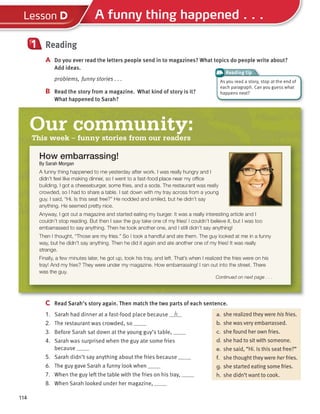
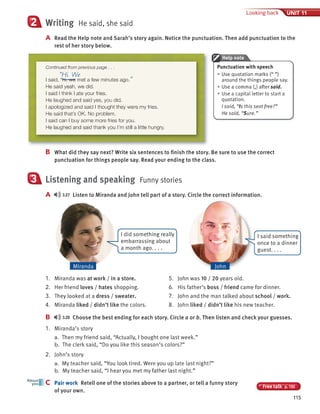
Reading
A Do you know an interesting restaurant? What’s special about it?
Check (✓) the boxes. Then tell the class.
1
It has a nice atmosphere. It has a beautiful view.
It has live music. It has good service.
It serves unusual food. other
B Read the restaurant guide. Which restaurant would you like
to try? Tell a partner why you’d like to go there.
Reading tip
Great places to eat
Lesson D
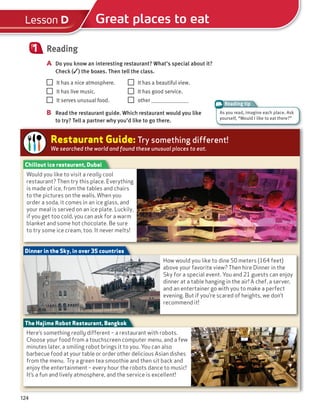
Restaurant Guide: Try something different!
We searched the world and found these unusual places to eat.
How would you like to dine 50 meters (164 feet)
above your favorite view? Then hire Dinner in the
Sky for a special event. You and 21 guests can enjoy
dinner at a table hanging in the air! A chef, a server,
and an entertainer go with you to make a perfect
evening. But if you’re scared of heights, we don’t
recommend it!
Dinner in the Sky, in over 35 countries
Here’s something really different – a restaurant with robots.
Choose your food from a touchscreen computer menu, and a few
minutes later, a smiling robot brings it to you. You can also
barbecue food at your table or order other delicious Asian dishes
from the menu. Try a green tea smoothie and then sit back and
enjoy the entertainment – every hour the robots dance to music!
It’s a fun and lively atmosphere, and the service is excellent!
The Hajime Robot Restaurant, Bangkok
Would you like to visit a really cool
restaurant? Then try this place. Everything
is made of ice, from the tables and chairs
to the pictures on the walls. When you
order a soda, it comes in an ice glass, and
your meal is served on an ice plate. Luckily,
if you get too cold, you can ask for a warm
blanket and some hot chocolate. Be sure
to try some ice cream, too. It never melts!
Chillout ice restaurant, Dubai
As you read, imagine each place. Ask
yourself, “Would I like to eat there?”
125
Fabulous food UNIT 12
C Read the article again, and answer these questions. Explain your answers to a partner.
1. What can you do if you feel cold at the Chillout ice restaurant?
2. What dish does the writer recommend there?
3. How many people can dine in the sky at one time?
4. Who goes up with the guests at Dinner in the Sky?
5. What can you order at the Hajime Robot Restaurant?
6. Why do you think people try restaurants like these?
Listening and writing Do you recommend it?
A 3.38 Listen to Olivia talk about a restaurant she went to last week. What do you find out
about it? Circle the correct words.
2
1. The restaurant was Italian / Spanish.
2. They serve great seafood / pasta.
3. Olivia had a rice dish / a seafood salad.
4. It’s good for meat eaters / vegetarians.
5. The service was fast / slow.
6. The atmosphere was fun / relaxed.
7. It was expensive / inexpensive.
8. Olivia recommends it / doesn’t recommend it.
B Read the review and the Help note. Underline the adjectives that describe the Healthy Bites restaurant.
C Write a review of a restaurant you know. Talk about the atmosphere, the food,
the service, and the price.
D Read your classmates’ reviews. Which restaurant would you like to try?
C Write a review of a restaurant you know. Talk about the atmosphere, the food,
About
you
Talk about it What are your favorite places to eat?
Group work Discuss the questions. Agree on a place you’d like
to go to together.
▶ How often do you go out to eat?
▶ When you eat out, do you go to restaurants? cafés? fast-food places?
food stands?
▶ Do you have a favorite place to eat? Where is it? Why do you like it?
▶ Where can you get good, cheap food?
▶ Where can you hang out with friends?
▶ Which restaurant in your city would you like to try?
▶ Which restaurant don’t you recommend? Why not?
3
Help note
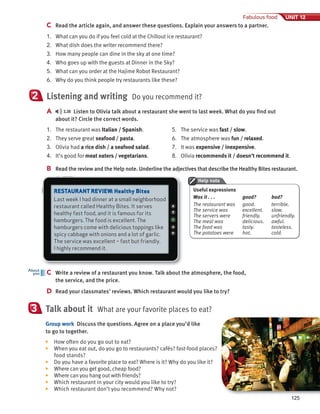
RESTAURANT REVIEW: Healthy Bites
Last week I had dinner at a small neighborhood
restaurant called Healthy Bites. It serves
healthy fast food, and it is famous for its
hamburgers. The food is excellent. The
hamburgers come with delicious toppings like
spicy cabbage with onions and a lot of garlic.
The service was excellent – fast but friendly.
I highly recommend it.
Useful expressions
Was it . . . good? bad?
The restaurant was good. terrible.
The service was excellent. slow.
The servers were friendly. unfriendly.
The meal was delicious. awful.
The food was tasty. tasteless.
The potatoes were hot. cold.
126
Vocabulary notebook
Vocabulary notebook
Vocabulary notebook I love to eat.
Can
Do!
Learning tip Grouping vocabulary
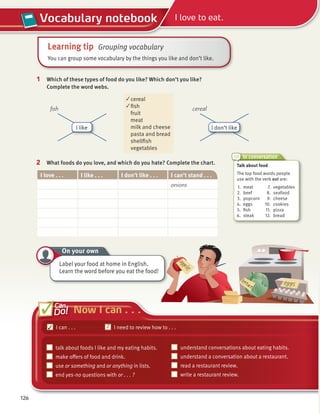
You can group some vocabulary by the things you like and don’t like.
understand conversations about eating habits.
understand a conversation about a restaurant.
read a restaurant review.
write a restaurant review.
talk about foods I like and my eating habits.
make offers of food and drink.
use or something and or anything in lists.
end yes-no questions with or . . . ?
Now I can . . .
I can . . . I need to review how to . . .
?
Which of these types of food do you like? Which don’t you like?
Complete the word webs.
1
What foods do you love, and which do you hate? Complete the chart.
2
I love . . . I like . . . I don’t like . . . I can’t stand . . .
onions
cereal
fish
fruit
meat
milk and cheese
pasta and bread
shellfish
vegetables
✓
✓
In conversation
Talk about food
The top food words people
use with the verb eat are:
1. meat
2. beef
3. popcorn
4. eggs
5. fish
6. steak
7. vegetables
8. seafood
9. cheese
10. cookies
11. pizza
12. bread
fish cereal
On your own
Label your food at home in English.
Learn the word before you eat the food!
l like l don’t like
127
Checkpoint Units 10–12
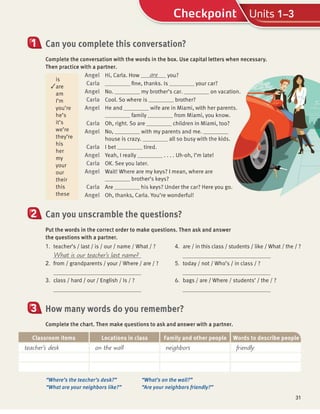
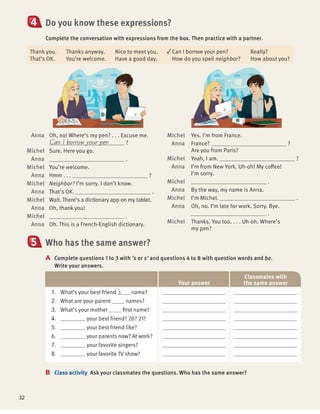
What’s the question?
Complete the conversation with information questions. Then practice with a partner.
A I’m so tired this morning.
B So what did you do last night ?
A Last night? Oh, I went to see a band.
B You did? ?
A The Mall Kids. They’re a new group.
B Yeah? ?
A They were great. I was at the club really late.
B ?
A Around 2:00 a.m. So anyway, ?
B Oh, I just went home and watched TV. The usual.
A Well, let’s go out tonight or something.
B Oh, OK. ?
A Actually, I’d like to see The Mall Kids again.
B OK. But let’s not stay out too late. We both have to work tomorrow!
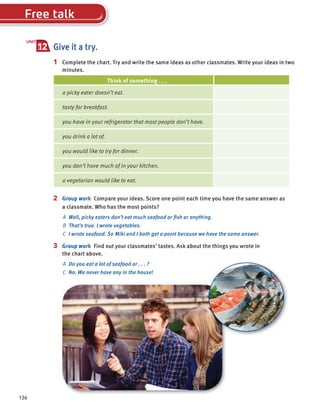
Do you have a balanced diet?
A Think about the different types of food you eat. Complete the chart.
1
2
I eat a lot of . . . I don’t eat many . . . I don’t eat much . . . I never eat . . .
B Pair work Compare your chart with a partner. Ask follow-up questions.
A I eat a lot of meat.
B Really? How much do you eat? Do you eat it every day?
Ask a question in two ways; answer and ask a similar question.
A Think of a yes-no question to add to each question below. End the question with or . . . ?
1. How was your weekend? I mean, did you do anything special or . . . ?
2. What did you do last summer? I mean, ?
3. What did you do for your last birthday? I mean, ?
4. What would you like to do tonight? I mean, ?
B Pair work Ask and answer the questions. After you answer a question, ask a similar one.
A How was your weekend? I mean, did you do anything special or . . . ?
B Well, I went to the beach on Saturday. How about you? What did you do?
3
128
What’s the right expression?
Complete the conversation with these expressions. (Use anyway twice.) Then practice with a partner.
4
or something Good for you anyway Congratulations You did
or anything good luck I know thank goodness I’m sorry to hear that
✓
Bryan How was your weekend? Did you go away or anything ?
Julia No, but I went to a karaoke club.
Bryan Really? ? So how was it?
Julia Great! I sang in a contest and won $50.
Bryan ! I didn’t know you were a singer.
Julia Well, I practiced every day for a month.
Bryan !
Julia And I practiced! Ten of my friends were there.
So, , did you do anything special?
Bryan Not really. I had to study for an exam on Saturday and Sunday.
I studied all weekend and then got sick.
Julia . You need to take care of yourself.
Bryan Yeah. . . . . Well, , I have to go.
I want to study my notes. But after the exam, let’s meet for
coffee .
Julia OK. So with your exam.
Show some interest!
A Complete each sentence with a simple past verb. Then add time expressions
to five sentences to make them true for you.
1. I went on an interesting trip.
2. I some new clothes.
3. I someone famous.
4. I an international phone call.
5. I a party at my house.
6. I some Italian food.
7. I on the beach.
8. I English with a tourist.
9. I some money.
10. I lost in the city.
B Pair work Take turns telling a partner your sentences.
Respond with You did? and ask questions.
A I went on an interesting trip last month.
B You did? Where did you go? . . .
5
I went on an interesting trip last month.
touchstone 01 - 01 book.pdf

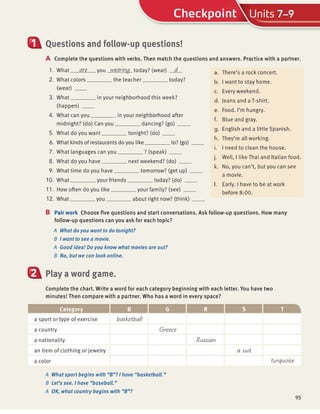
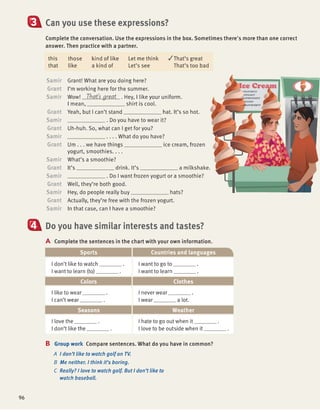
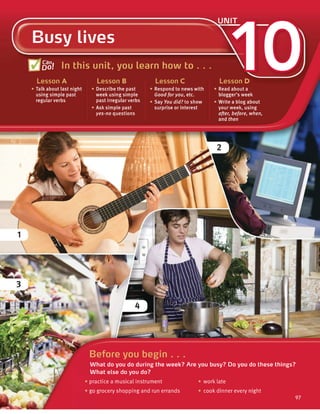
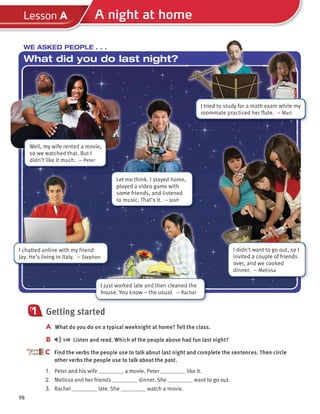
touchstone 01 - 01 book.pdf

  • 3.
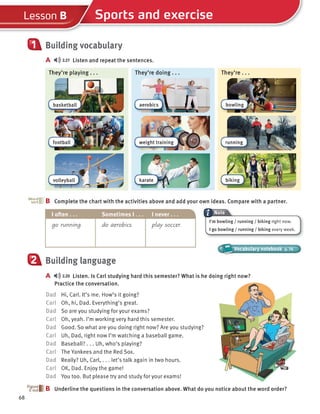
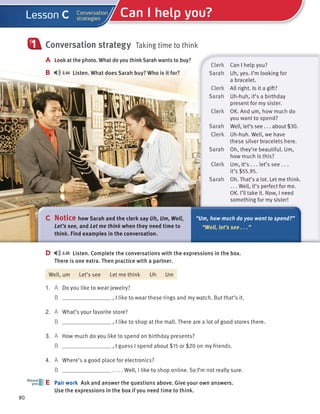
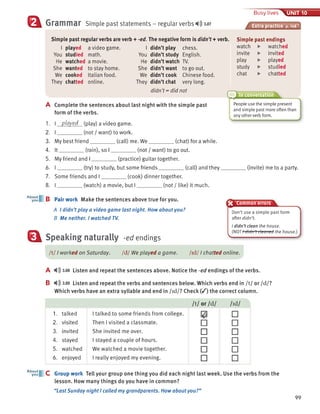
    iv Touchstone Level 1Contents and learning outcomes Unit 4 Everyday life pages 33–42 • Describe a typical morning using the simple present • Describe weekly routines • Ask and answer yes-no questions about your week • Say more than yes or no to be friendly • Say Well to get more time to think • Read an article about American habits • Write about a classmate for a class website • Simple present statements, yes-no questions, and short answers Extra practice • Verbs for everyday activities • Days of the week • Time expressions for routines Speaking naturally • -s endings of verbs Sounds right • Sounds like u in study, o in phone, e in get, or a in law Unit 5 Free time pages 43–52 • Talk about your free time • Ask simple present information questions • Say how often you do things • Talk about TV shows you like • Ask questions in two ways to be clear or not too direct • Say I mean to say more or repeat ideas • Read an article on technology addicts • Email a friend for advice using and and but • Simple present information questions • Frequency adverbs Extra practice • Types of TV shows • Free-time activities • Time expressions for frequency • Expressions for likes and dislikes Speaking naturally • Do you . . . ? Sounds right • Which o sound is different? Unit 6 Neighborhoods pages 53–62 • Say what’s in a neighborhood with There’s / There are • Describe places • Tell the time and ask questions with What time . . . ? • Make suggestions with Let’s • Say Me too or Me neither to show things in common • Say Right or I know to agree • Read a guide to New York City • Write a city guide using prepositions • There’s and there are • Quantifiers • Adjectives before nouns • Telling time • Suggestions with Let’s Extra practice • Neighborhood places • Adjectives • Expressions for telling Speaking naturally • Word stress Sounds right • Which sound vowel sound is different Checkpoint Units 4–6 pages 63–64 Learning outcomes Language Grammar Vocabulary Pronunciation Unit 1 All about you pages 1–10 • Say hello and good-bye • Introduce yourself • Ask for, give, and spell names • Use the verb be with I, we, and you • Exchange email addresses, phone numbers, etc. • Complete an application form • Ask How about you? • Use expressions like Thanks or Thank you • The verb be with I, you, and we in statements, yes-no questions, and short answers • Questions with What’s . . . ? and answers with It’s . . . Extra practice • Expressions to say hello and good-bye • Numbers 0–10 • Personal information • Everyday expressions • Letters and numbers • Email addresses Sounds right • Sounds like hi Unit 2 In class pages 11–20 • Ask and say where people are • Use be with he, she, and they • Talk about things you take to class using a / an • Ask about things using this and these • Ask where things are in a classroom • Say who owns things using possessive ’s and s’ • Ask for help in class • Respond to I’m sorry and Thanks • The verb be with he, she, and they in statements, yes-no questions, and short answers • Articles a, an, and the • This and these • Noun plurals • Questions with Where . . . ? • Possessives ’s and s’ Extra practice • Personal items • Classroom objects • Prepositions and expressions of location Speaking naturally • Noun plural endings Sounds right • Sounds like e in she or a in late Unit 3 Favorite people pages 21–30 • Talk about celebrities using my, your, his, her, our, and their • Describe people’s personalities • Ask and answer yes-no questions • Say the ages of your family members • Ask information questions about family members • Show interest in a conversation • Say Really? to show interest or surprise • Possessive adjectives • The verb be in statements, yes-no questions, and short answers • Information questions with be Extra practice • Types of celebrities • Basic adjectives • Adjectives to describe personality • Family members • Numbers 10–101 Speaking naturally • Is he . . . ? or Is she . . . ? Sounds right • Sounds like s in see or z in zero Checkpoint Units 1–3 pages 31–32
  • 4.
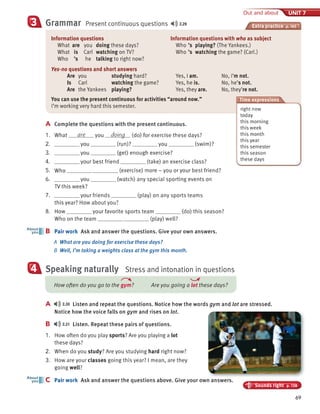
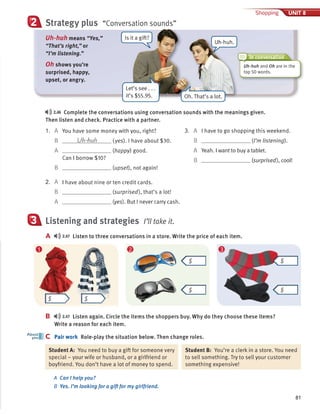
    v Contents and learningoutcomes LEVEL 1 • Say more than yes or no when you answer a question • Start answers with Well if you need time to think or if the answer isn’t a simple yes or no Casual conversations • Listen and match the correct response Teen habits • Listen to an interview with an average American teenager Are you like an average American? • Read an article about the habits of an average American A typical week • Write about a classmate’s typical week for a class website • Use capital letters and periods Do you have the same media habits? • Pair work: Compare media habits with young adults in the United States Verbs, verbs, verbs • Draw and label simple pictures of new vocabulary • Ask questions in two ways to be clear and not too direct • Use I mean to repeat your ideas or to say more What do they say next? • Listen and guess the questions people answer Using phones • Listen to how people use their cell phones Do You Need a Technology diet? • Read an article about technology addicts Technology and you • Write a reply to an email asking for technology advice • Link ideas with and and but Favorite free-time activities • Pair work: Make guesses about a classmate’s free-time activities Do what? Go where? • Write verbs with the words you use after them • Use Me too or Me neither to show things in common • Respond with Right or I know to agree or show you are listening What’s on this weekend? • Listen to a radio show for times and places of events Where to go? • Listen for decisions made in conversations, then react to statements The Village • Read a travel guide to New York City guide • Write a city guide • Use prepositions for time and place: between through, at, on, for, and from . . . to . . . Find the difference • Pair work: List the differences between two neighborhoods A time and a place . . . • Link times of day with activities Checkpoint Units 4–6 pages 63–64 Interaction Skills Self study Conversation strategies Listening Reading Writing Free talk Vocabulary notebook • Ask How about you? • Use everyday expressions like Yeah and Thanks • Recognize responses to hello and good-bye Memberships • Listen for personal information, and complete application forms • Different types of identification cards and documents • Complete an application The name game • Group work: Play a game to learn classmates’ names Meetings and greetings • Write new expressions with their responses • Ask for help in class • Respond to Thank you and I’m sorry Who’s absent today? • Listen to a classroom conversation, and say where students are Following instructions • Recognize classroom instructions • Classroom conversations • Write questions about locations What do you remember? • Pair work: Look at a picture and list what you remember My things • Link things with places • Show interest by repeating information and asking questions • Use Really? to show interest or surprise Friends • Listen to three people’s descriptions of their friends, and fill in the missing words • A family tree • Write questions about people Guess the famous person • Pair work: Ask yes-no questions to guess a famous person All in the family • Make a family tree Checkpoint Units 1–3 pages 31–32
  • 5.
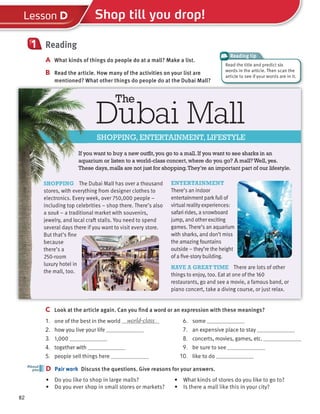
    vi Unit 10 Busy lives pages97–106 • Talk about last night using simple past regular verbs • Describe the past week using simple past irregular verbs • Ask simple past yes-no questions • Respond to news with Good for you, etc. • Say You did? to show surprise or interest • Read about a blogger’s week • Write a blog about your week, using after, before, when, and then • Simple past statements, yes-no questions, and short answers Extra practice • Simple past irregular verbs • Time expressions for the past • Fixed expressions Speaking naturally • -ed endings Sounds right • Sounds like oo in looked, ou in bought, o in spoke, or e in left Unit 11 Looking back pages 107–116 • Describe past experiences • Ask and answer questions using the past of be • Talk about vacations • Talk about activities with go and get expressions • Show interest by answering and then asking a similar question • Use Anyway to change the topic or end a conversation • Read a funny magazine story • Write a story using punctuation for conversations • Simple past of be in statements, yes-no questions, and short answers • Simple past information questions Extra practice • Adjectives to describe feelings • Expressions with go and get Speaking naturally • Stress and intonation in questions and answers Sounds right • Which vowel sound is different? Unit 12 Fabulousfood pages117–126 • Talk about eating habits using countable and uncountable nouns, How much, and How many • Talk about food • Make offers using Would you like . . . and some or any • Use or something and or anything in lists • End yes-no questions with or . . . ? to be less direct • Read a restaurant guide • Write a restaurant review • Countable and uncountable nouns • How much . . . ? and How many . . . ? • Would you like (to) . . . ? and I’d like (to) . . . • Some and any • A lot of, much, and many Extra practice • Foods and food groups • Expressions for eating habits • Adjectives to describe restaurants Speaking naturally • Would you . . . ? Sounds right • Syllable stress Checkpoint Units 10–12 pages 127–128 Learning outcomes Language Grammar Vocabulary Pronunciation Unit 7 Out and about pages 65–74 • Describe the weather • Talk about ongoing activities with the present continuous • Talk about sports and exercise • Ask about current activities using the present continuous • Ask follow-up questions to keep a conversation going • React to news with That’s great, That’s too bad, etc. • Read an article about exergaming • Write an article about exercise using imperatives • Present continuous statements, yes-no questions, short answers, and information questions • Imperatives Extra practice • Seasons • Weather • Sports and exercise with play, do, and go • Common responses to good and bad news Speaking naturally • Stress and intonation in questions Sounds right • Sounds like ou in four or or in word Unit 8 Shopping pages 75–84 • Talk about clothes • Say what you like to, want to, need to, and have to do • Talk about accessories • Ask about prices using How much . . . ?, this, that, these, and those • Take time to think using Uh, Let’s see, etc. • Use Uh-huh and Oh in responses • Read a review of a shopping mall • Write a review of a store using because • Like to, want to, need to, and have to • Questions with How much . . . ?; this, these; that, those Extra practice • Clothing and accessories • Jewelry • Colors • Shopping expressions • Prices • “Time to think” expressions • “Conversation sounds” Speaking naturally • Want to and have to Sounds right • Sounds like a in hat Unit 9 A wide world pages 85–94 • Give sightseeing information with can and can’t • Talk about international foods, places, and people • Say what languages you can speak • Explain words using kind of and kind of like • Use like to give examples • Read a travel website • Write a paragraph for a travel website • Can and can’t for ability and possibility Extra practice • Sightseeing activities • Countries • Regions • Languages • Nationalities Speaking naturally • Can and can’t Sounds right • Sounds like sh in she or ch in child Checkpoint Units 7–9 pages 95–96
  • 6.
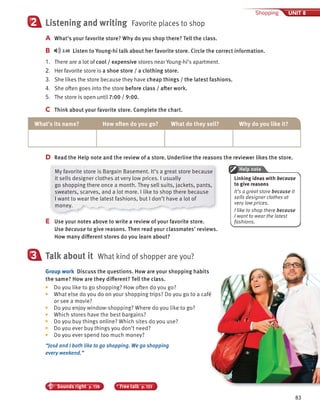
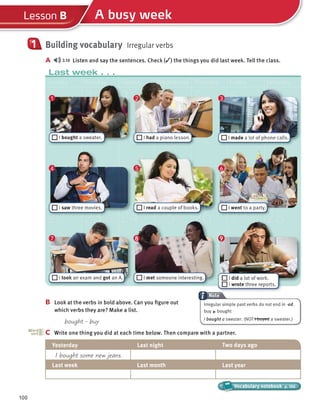
    LEVEL 1 vii LEVEL 1 LEVEL1 Contents and learning outcomes LEVEL 1 • Respond with expressions like Good luck, You poor thing, etc. • Use You did? to show that you are interested or surprised, or that you are listening Good week? Bad week? • Listen to people talk about their week and respond Guess what I did! • Listen to voice mail messages about what people did She said yes!!! • Read Martin’s Blog entry A great day • Write a blog entry • Order events with before, after, when, and then Yesterday • Pair work: Look at a picture and list what you remember Ways with verbs • Write down information about new verbs • Show interest by answering a question and then asking a similar one • Use Anyway to change the topic or end a conversation Weekend fun • Listen to conversations about peoples’ weekends, and identify main topics and details Funny stories • Listen to two stories, identify the details, and then predict the endings How embarrassing! • Read a funny magazine story He said, she said • Complete a funny story • Use punctuation to show direct quotations or speech Guess where I went on vacation. • Group work: Guess classmates’ dream vacations Past experiences • Use a time chart to log new vocabulary • Use or something and or anything to make a general statement • End yes-no questions with or . . . ? to be less direct If you want my advice . . . • Listen to people talking about lunch, and identify what they want; then react to statements Do you recommend it? • Listen to someone tell a friend about a restaurant and identify important details about it Restaurant guide • Restaurant descriptions and recommendations Do you recommend it? • Write a restaurant review • Use adjectives to describe restaurants Plan a picnic • Group work: Plan a picnic menu and make a shopping list I love to eat! • Group vocabulary by things you like and don’t like Checkpoint Units 10–12 pages 127–128 Interaction Skills Self study Conversation strategies Listening Reading Writing Free talk Vocabulary notebook • Ask follow-up questions to keep a conversation going • React with expressions like That’s great! and That’s too bad That’s great! • Listen to people tell you their news and choose a good follow-up question to ask them Do you enjoy it? • Listen to people talk about exercises they like Exergaming: Give it a try! • Read an article about exergaming An article for a health magazine • Write a short article giving advice about exercise • Use imperatives to give advice Find out about your classmates • Class activity: Learn interesting facts about classmates Who’s doing what? • Write new words in true sentences • Take time to think using Uh, Um, Well, Let’s see, and Let me think • Use “sounds” like Uh-huh to show you are listening, and Oh to show your feelings I’ll take it. • Listen to conversations in a store, and write the prices of items and which items people buy Favorite places to shop • Listen to someone talk about shopping, and identify shopping preferences and habits The Dubai Mall: Shopping, Entertainment, Lifestyle • Read a review of a mall Favorite places to shop • Write a review for your favorite store • Link ideas with because to give reasons How do you like to dress? • Group work: Compare ideas about shopping and clothing Nice outfit! • Label pictures with new vocabulary • Explain words using a kind of, kind of like, and like • Use like to give examples International dishes • Listen to a person talking about international foods, and identify the foods she likes What language is it from? • Listen to a conversation, and identify the origin and meaning of words The Travel Guide • Read a travel website An online travel guide • Write a paragraph for a travel guide • Commas in lists Where in the world? • Pair work: Discuss where to do various things in the world People and nations • Group new vocabulary in two ways Checkpoint Units 7–9 pages 95–96
  • 8.
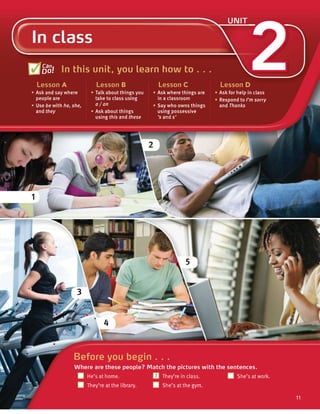
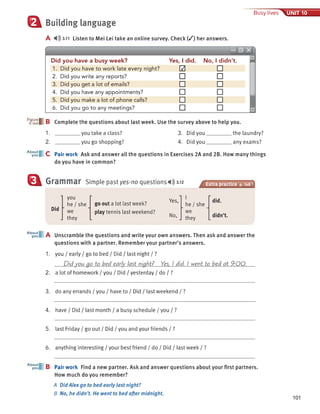
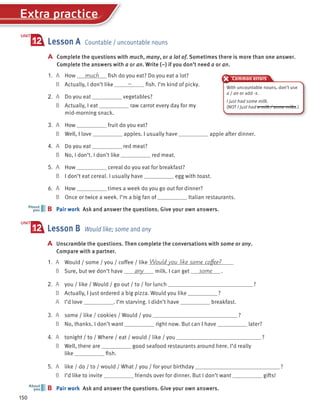
    Cambridge University Press 978-1-107-67987-0– Touchstone Level 1 Michael McCarthy Jeanne McCarten and Helen Sandiford Excerpt More information © in this web service Cambridge University Press www.cambridge.org 1 All about you UNIT In this unit, you learn how to . . . Lesson A • Say hello and good-bye • Introduce yourself Lesson B • Ask for, give, and spell names • Use the verb be with I, we, and you Lesson C • Exchange email addresses, phone numbers, etc. • Complete an application form Lesson D • Ask How about you? • Use expressions like Thanks or Thank you Can Do! 1 2 1 1 Before you begin . . . Match each expression with a picture. Good night. Thanks. Good morning. Hi. Bye. Hello. Thank you. Good-bye. 3 1 1
  • 9.
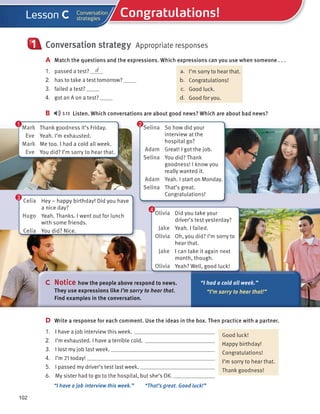
    Cambridge University Press 978-1-107-67987-0– Touchstone Level 1 Michael McCarthy Jeanne McCarten and Helen Sandiford Excerpt More information © in this web service Cambridge University Press www.cambridge.org 2 Lesson A Hello and good-bye Getting started A Look at the photos. Guess the words in the conversations. Check (✓) the boxes. Good-bye. Hello. Thanks. Hi. Good morning. B 1.02 Listen. Are Matt and Sarah friends? How about Rob and Sandra? Practice the conversations. 1 C Can you complete these conversations? Use the conversations above to help you. Then practice with a partner. Use your own names. C These people meet for the first time: 3. A Hello. Chris Evans. B Hi. I’m Grace Song. A to meet you, Grace. 4. A Hello. I’m Sarah. B Nice to meet . I’m Alan. A Nice to you. These people are friends: 1. A Hi, Pat. How are you? B I’m fine. How are you? A Good, . 2. A Good , Anna. B Hi, Dan. are you? A I’m , thanks. Matt Good morning, Sarah. How are you? Sarah Good. How are you, Matt? Matt I’m fine, thanks. Rob Hello. I’m Rob Jones. Sandra Hi, I’m Sandra Davis. Nice to meet you. Rob Nice to meet you.
  • 10.
    Cambridge University Press 978-1-107-67987-0– Touchstone Level 1 Michael McCarthy Jeanne McCarten and Helen Sandiford Excerpt More information © in this web service Cambridge University Press www.cambridge.org 3 All about you UNIT 1 Building vocabulary A 1.03 Listen. Are these people saying “hello” or “good-bye”? Practice the conversations. 2 B 1.04 Read the conversations and check (✓) the correct responses. Listen and check your answers. Then practice with a partner. 3. See you later. Thanks. You too. OK. Have a good day. 4. Hello. I’m Emma. See you later. Nice to meet you. 5. Good morning. Hi. How are you? Bye. See you. 6. Good night. Have a good weekend. Good. How are you? Bye. See you next week. C Look at the conversations above. Which expressions mean “hello”? Which expressions mean “good-bye”? Complete the chart. “Hello” “Good-bye” Good night D Class activity Say “hello” and “good-bye” to five classmates using the expressions above. C Word sort Vocabulary notebook p. 10 Vocabulary notebook Vocabulary notebook 1. Good-bye. Have a nice evening. Thank you. You too. Good, thanks. 2. Hey, Oscar. How are you? Good, thanks. See you tomorrow. Emily Good night. Shawn Good night. Have a good evening. Emily Thank you. You too. Tom Bye. See you tomorrow. Rita Bye. See you.
  • 11.
    Cambridge University Press 978-1-107-67987-0– Touchstone Level 1 Michael McCarthy Jeanne McCarten and Helen Sandiford Excerpt More information © in this web service Cambridge University Press www.cambridge.org 4 About you Names Lesson B Saying names in English A 1.05 Listen to these people give their names. Then complete the information. 1 B Complete the sentences. Then compare with a partner. C 1.06 Listen and say the alphabet. Circle all the letters in your name. Aa Bb Cc Dd Ee Ff Gg Hh Ii Jj Kk Ll Mm Nn Oo Pp Qq Rr Ss Tt Uu Vv Ww Xx Yy Zz D 1.07 Listen. How do you spell Catherine’s last name? Then practice the conversation with a partner. Use your own names. A What’s your name? B Catherine Ravelli. A How do you spell Catherine? B C-A-T-H-E-R-I-N-E. A Thanks. And your last name? B R-A-V-E-L-L-I. E Class activity Ask your classmates their names. Make a list. E About you Hi, I’m Liz. Liz Kim. My first name is Elizabeth, but everyone calls me Liz. Ms. — Kim FIRST MIDDLE LAST single married ✓ Mr. Don RayTanner FIRST MIDDLE LAST single married ✓ Mrs. Maria Sanchez FIRST MIDDLE LAST single married ✓ 1. My first name is . 2. Everyone calls me . 3. My last name is . 4. My middle name is . 5. My nickname is . 6. My teacher’s name is . 1 Hi. My name is Don. My full name is Don Allan Ray Tanner. My nickname is Dart. 2 Hello. I’m Ana Sanchez. My first name is Maria. Ana is my middle name. 3 Miss, Mrs., Ms., Mr.? Liz Kim is single. ▶ Ms. Kim or Miss Kim Ana Sanchez is married. ▶ Ms. Sanchez or Mrs. Sanchez Don Tanner is single. ▶ Mr. Tanner Ana’s husband is married. ▶ Mr. Sanchez
  • 12.
    Cambridge University Press 978-1-107-67987-0– Touchstone Level 1 Michael McCarthy Jeanne McCarten and Helen Sandiford Excerpt More information © in this web service Cambridge University Press www.cambridge.org 5 All about you UNIT 1 5 Building language A 1.08 Listen. Which classroom is Carmen in this year? What about Jenny? Practice the conversation. Mr. Martin Good morning. Are you here for an English class? Carmen Yes, I am. I’m Carmen Rivera. Mr. Martin OK. You’re in Room B. Jenny And I’m Jenny. Mr. Martin Are you Jenny Loo? Jenny No, I’m not. I’m Jenny Lim. Am I in Room B, too? Mr. Martin Yes. . . . Wait – no, you’re not. You’re in Room G. Jenny Oh, no! Carmen, we’re not in the same class! B Can you complete the conversations? Use the conversation above to help you. 1. A Are you Jenny Loo? B No, I not. I Lucy. 2. A you here for an English class? B Yes, I . I Carmen Rivera. 3. A I in your class? B Yes. in my class. 2 B Can you complete the conversations? Use the Grammar The verb be: I, you, and we 1.09 3 Extra practice p. 139 Common errors A Complete the conversations. Then practice with a partner. 1. A Are you Chris? B Yes, I . we in the same class? A Yes, we . I Dino. B Hi, Dino. Nice to meet you. 2. A Hey, Amy. you here for an English class? B No, I not. I here for a French class. A OK. See you later. B Pair work Choose a conversation and practice it. Use your own information. B About you Statements Contractions I’m You’re We’re Jenny. in Room G. in different classes. I’m not You’re not We’re not Carmen. in Room B. in the same class. I’m = I am you’re = you are we’re = we are Are you Jenny? Yes, I am. No, I’m not. Are we in the same class? Yes, we are. No, we’re not. Questions and short answers Am I in Room B? Yes, you are. No, you’re not. Sounds right p. 137 Use the full form of the verb be in short answers with yes. Yes, I am. (NOT Yes, I’m.) Yes, we are. (NOT Yes, we’re.)
  • 13.
    Cambridge University Press 978-1-107-67987-0– Touchstone Level 1 Michael McCarthy Jeanne McCarten and Helen Sandiford Excerpt More information © in this web service Cambridge University Press www.cambridge.org PASSPORT PASSEPORT Passport No./No de passeport 649 321 508 P<CAN<BARTON<<JAMESDAVID<<<<<<<<<<<<<<<<<< <<<<<<<<649321508<<<<<<<<<<<<<<<<<<<<<<< Surname/Nom Given names/Prénoms Nationality/Nationalité BARTON JAMES DAVID CANADIAN/CANADIEN CANADA 6 Personal information Lesson C Numbers 0–10 A 1.10 Listen and say the numbers. 0 1 2 3 4 5 6 7 8 9 10 zero one two three four five six seven eight nine ten B 1.11 Listen. Then practice. 1 Note Building language A 1.12 Listen. What is Victor’s phone number? Practice the conversation. Receptionist Hi! Are you a member? Victor No, I’m just here for the day. Receptionist OK. So, what’s your name, please? Victor Victor Lopez. Receptionist And what’s your phone number? Victor It’s 646-555-3048. Receptionist And your email address? Victor Um . . . it’s vlopez6@cup.org. Receptionist OK. So it’s $10 for today. Here’s your pass. Victor Thanks. B Can you complete these questions and answers? Use the conversation above to help you. Then practice with a partner. 2 B PASSPORT PASSEPORT Passport No./No de passeport 649 321 508 CANADA PASSPORT PASSPORT My passport number is 649-321-508. Passport No./No de passeport <<<<<<<<<<<<<<<<<< <<<<<<<<<<<<<<<<<<<<<<< GREEN STATE UNIVERSITY GSU ELLEN M. JONES ID: 259-62-1883 1. A What’s your name? B Joe Garrett. 2. A What’s your ? 3. A What’s ? B It’s 646-555-4628. B joe.garrett@cup.org. 1 GREEN STATE UNIVERSITY GSU California Union of Pilots Daniel Smith TELEPHONE: 216-555-7708 EMAIL: dsmith6@cup.org California My cell phone number is 216-555-7708. My email address is dsmith6@cup.org. 3 GREEN STATE UNIVERSITY GREEN STATE UNIVERSITY GREEN STATE UNIVERSITY GREEN STATE UNIVERSITY GREEN STATE UNIVERSITY GREEN STATE UNIVERSITY My ID number is 259-62-1883. 2 Numbers and email addresses 216-555-7708 = “two-one-six, five-five-five, seven-seven-oh (zero)-eight” dsmith6@cup.org = “d-smith-six-at-c-u-p-dot-org”
  • 14.
    Cambridge University Press 978-1-107-67987-0– Touchstone Level 1 Michael McCarthy Jeanne McCarten and Helen Sandiford Excerpt More information © in this web service Cambridge University Press www.cambridge.org Extra practice p. 139 7 All about you UNIT 1 Grammar What’s . . . ?; It’s . . . 1.13 3 A Write a question for each answer. Compare with a partner. Then practice. 4. A ? B It’s j.song6@cup.org. 5. A ? B My teacher’s name? It’s Ms. Rossi. 6. A ? B My student ID number? Wait – it’s 36-88-972. B Pair work Ask and answer the questions. Give your own answers. A What’s your first name? B It’s Silvia – S-I-L-V-I-A. Listening and speaking Memberships A 1.14 Listen to the conversations. Complete the membership cards. B About you 4 Common errors B Pair work Now complete this form for a partner. Ask questions. B About you A What’s your first name? B Rashid. A How do you spell that? 1. TOUCHSTONE CONVERSATION CLUB Membership application First Name Middle Initial Last Name Cell Phone Email Address Student ID Number What’s your name? What’s your email address? What’s your phone number? My name’s Victor Lopez. It’s vlopez6@cup.org. It’s 646-555-3048. What’s = What is name’s = name is It’s = It is 2. NAME First Middle Initial Last Mr. Ms. Miss Mrs. PHONE Home phone Cell phone 508-555- X -555-6230 DAVIS EMAIL ADDRESS @cup.org FITNESS GYM College Library Card PHONE Home phone Cell phone 718-555- 347-555-0806 EMAIL ADDRESS @cup.org STUDENT ID NUMBER 192- -87 NAME First Middle Initial Last ELIZABETH R 1. A What’s your first name ? B My first name’s Haley – H-A-L-E-Y. 2. A ? B My last name? Osman – O-S-M-A-N. 3. A ? B 347-555-2801. Don’t start an answer with Is. What’s your name? It’s Silvia. (NOT Is Silvia.)
  • 15.
    Cambridge University Press 978-1-107-67987-0– Touchstone Level 1 Michael McCarthy Jeanne McCarten and Helen Sandiford Excerpt More information © in this web service Cambridge University Press www.cambridge.org Conversation strategy How about you? A Look at the photo. Adam and Alicia are strangers. Guess three things they say. B 1.15 Listen. Who’s on vacation? Who’s a student? Who’s here for the concert? 1 Alicia Hi. How are you doing? Adam Pretty good. How about you? Alicia Good, thanks. It’s a beautiful day. Adam Yeah, it is. Are you here for the concert? Alicia Yes. How about you? Adam Well, yeah, but I’m a student here, too. So are you on vacation? Alicia Yes, I am. By the way, I’m Alicia. Adam I’m Adam. Nice to meet you. Well, have a nice day. Alicia Thanks. You too. C Notice how Adam and Alicia say How about you? to ask the same questions. “How are you doing?” “Pretty good. How about you?” 8 4. A It’s a beautiful day. Are you on vacation? B Yes, I am. ? A No. I’m a student here. 5. A I’m here on business. How about you? B No. . A Nice. Well, have a great vacation. D Complete the conversations. Then practice with a partner. 1. A Hello. Are you here for the festival? B Yeah, I am. ? A Yeah. Me too. 2. A Hi. How are you doing? B Good, thanks. How about you? A . 3. A Are you a student? B No, I’m a teacher. ? A I’m a teacher, too. Are you here for the concert? Conversation strategies Lesson D
  • 16.
    Cambridge University Press 978-1-107-67987-0– Touchstone Level 1 Michael McCarthy Jeanne McCarten and Helen Sandiford Excerpt More information © in this web service Cambridge University Press www.cambridge.org 9 All about you UNIT 1 Strategy plus Everyday expressions 2 Some everyday expressions are more formal. Complete these conversations with expressions from the box above. Then practice with a partner. Complete these conversations with expressions from the box above. Then practice with a partner. About you More formal Yes. Thank you. Hello. How are you? I’m fine. Good-bye. Less formal Yeah. Thanks. Hi. How are you doing? OK. / Pretty good. / Good. Bye. / See you. / See you later. 1. Formal conversation Jeff Hello , Mrs. Swan. ? Mrs. Swan , thank you. Uh, Jeff, are you here for English 3? Jeff , I am. Mrs. Swan Then you’re in Room B. I’m the teacher for English 2. Jeff Oh, . Well, have a nice day. Mrs. Swan . You too. Enjoy your class! . 2. Less formal conversation Kathy Hi, Mike, ? Mike . How about you? Kathy . Are you here for a class? Mike , I am. I’m here for yoga. How about you? Kathy Oh, I’m here for a music class. Mike Nice. Well, enjoy your class! Kathy . You too. Mike OK. . Free talk p. 129 Strategies In the park Pair work Look at the picture. Choose an activity in the park. Role-play a conversation. A Hi, how are you? B Good, thanks. How about you? A Pretty good. Are you here for the movie? 3 Pair work About you I’m fine. Good-bye. In conversation How are you doing? How are you? Yeah is 10 times more common than yes. Yeah. Yes.
  • 17.
    Cambridge University Press 978-1-107-67987-0– Touchstone Level 1 Michael McCarthy Jeanne McCarten and Helen Sandiford Excerpt More information © in this web service Cambridge University Press www.cambridge.org 10 Vocabulary notebook Meetings and greetings Vocabulary notebook Vocabulary notebook Learning tip Learning expressions Write new expressions with their responses, like this: See you later. Bye. See you. On your own 10 10 Can Do! complete an application form. use How about you? to ask the same question. use formal and informal everyday expressions like Thanks and Thank you. understand conversations about personal information. say hello and good-bye. introduce myself. ask for, give, and spell names. ask and answer questions about names, phone numbers, and email addresses. Now I can . . . I can . . . I need to review how to . . . ? In conversation Write a response for each expression. 1. Hello. 2. Good morning. 3. Hi, I’m Helen. 4. How are you? 5. Have a nice day. 6. See you tomorrow. 7. Have a good evening. 8. Good night. People say Hi and Bye more than Hello and Good-bye. Hi. Hello. Bye. Good-bye. Before your next class, say hello and good-bye (in English!) to three people.
  • 124.
    2 1 3 4 5 6 117 12 Fabulousfood UNIT In this unit, you learn how to . . . Lesson A • Talk about eating habits using countable and uncountable nouns, How much, and How many Lesson B • Talk about food • Make offers using Would you like . . . and some or any Lesson C • Use or something and or anything in lists • End yes-no questions with or . . . ? to be less direct Lesson D • Read a restaurant guide • Write a restaurant review Can Do! 117 Before you begin . . . Match the pictures with the food categories. Which foods did you eat yesterday? grains: bread, rice, and pasta meat: beef and chicken dairy: milk and cheese vegetables: broccoli and carrots seafood: fish and shellfish fruit: bananas and a papaya 117 1
  • 125.
    118 Lesson A Eatinghabits Getting started A What are some foods that the people below don’t eat? Make a list. • a vegetarian • a “picky” eater • a person on a diet • a person with food allergies B 3.29 Listen. Ellen is leaving a message for her parents. What is her problem? Which plate of food does Ellen think is right for Amy? for Juan? for David? 1 C Find the food words in Ellen’s message. Are they singular or plural? Write them in the chart. Then circle a lot of, much, and many. Do singular or plural nouns follow the words? C Singular Plural meat eggs D Pair work Which of the foods above do you like? Which don’t you like? Tell a partner. A I love meat. How about you? B Um, I don’t eat meat, but I like fish and vegetables. D About you Voice-mail greeting: We’re not home right now. Please leave a message. And David is picky – I mean, he doesn’t eat many vegetables. And he’s allergic to milk and shellfish. But he likes potatoes. Oh, and bananas. Please call me! Bye. Hi, Mom and Dad! I need some help fast! I invited some friends for dinner tonight, and I don’t know what to cook. Amy’savegetarian,so shedoesn’teatmeat, fish,cheese,oreggs.I guessshejusteatsalot offruitsandvegetables, andmayberice. Juan’s on a diet. He can’t eat much rice, bread, or pasta. But he eats a lot of meat, cheese, eggs, and vegetables, like carrots and cucumbers.
  • 126.
    A Circle thecorrect words in these conversations. Then practice with a partner. 1. A How much / many fruit do you eat a day? B Well, I have banana / a banana every day for breakfast, and I eat much / a lot of fruit after dinner for dessert. 2. A How much / many times a week do you eat potato / potatoes? B About once a week. But I eat rice / the rice every day. 3. A Do you eat many / a lot of red meat? Or do you prefer chicken / the chicken? B Actually, I’m a vegetarian, so I never eat meat / meats. 4. A How often do you eat seafood / the seafood? B Well, I eat much / a lot of fish, but I’m allergic to shellfish / a shellfish. 5. A How much / many eggs do you eat a week? B I don’t eat much / many. I don’t really like egg / eggs. 6. A How often do you eat vegetable / vegetables? B I usually eat much / a lot of French fries. Is that a vegetable? B Pair work Ask and answer the questions. Give your own answers. Talk about it What’s your diet? Group work Discuss the questions. Do you have similar habits? Then tell the class one interesting thing about a person in your group. ▶ Are you a picky eater? What foods do you hate? ▶ Are you allergic to any kinds of food? What are you allergic to? ▶ Are you on a special diet? What can’t you eat? ▶ How many times a day do you eat? ▶ Do you ever skip meals? ▶ In your opinion, what foods are good for you? What foods aren’t? ▶ Do you have any bad eating habits? What are they? B About you 3 119 Fabulous food UNIT 12 Grammar Countable / uncountable nouns 3.30 2 Extra practice p. 150 Countable nouns Examples: an apple, six potatoes Use a / an or plural -s: I have an egg for breakfast every day. I don’t eat bananas. Use how many, a lot of, and many: How many eggs do you eat a week? I eat a lot of eggs. I don’t eat a lot of eggs. I don’t eat many (eggs). Uncountable nouns Examples: cheese, meat, fish Don’t use a / an or plural -s: I drink milk every morning. I don’t eat seafood. Use how much, a lot of, and much: How much milk do you drink a day? I drink a lot of milk. I don’t drink a lot of milk. I don’t drink much (milk). Common errors Don’t use the before nouns to talk about food in general. I don’t like meat, but I eat eggs. (NOT I don’t like the meat, but I eat the eggs.)
  • 127.
    lamb 120 What’s for dinner? LessonB Building vocabulary A 3.31 Listen and say the words. Which foods do you like? Which don’t you like? Tell the class. 1 B Complete the chart with the foods above. Add ideas. Then tell a partner about your diet. B Word sort “ I eat a lot of lamb.” “I don’t eat many clams.” “I don’t eat much ice cream.” Vocabulary notebook p. 126 Vocabulary notebook Vocabulary notebook Building language A 3.32 Listen. What do Ted and Phil have to do before dinner? Practice the conversation. Ted I guess it’s my turn to cook dinner. So what would you like? Phil Um, I’d like some chicken. Do we have any? Ted Um, no, we need to get some. We don’t have any vegetables, either. Would you like to go out for pizza? Phil Again? No, I think I’d like to stay home tonight. Ted OK. Then we have to go to the grocery store. Phil Well, I went grocery shopping last week. I think it’s your turn. B Circle the correct words. Then practice with a partner. 1. A What would you like / like to eat? B I’d like / like to some chicken. 2 B 2. A I’d like some / any fish. B We don’t have some / any. Let’s go buy some / any. meat seafood vegetables fruit dairy grains drinks snacks other lamb clams oil salmon cereal lettuce tomatoes spinach garlic onions peppers butter melon strawberries mangoes apples pineapple sugar coffee tea ice cream shrimp hamburger meat peanuts potato chips cookies green beans
  • 128.
    121 Fabulous food UNIT12 Grammar Would like; some and any 3.33 3 Extra practice p. 150 Use would like + to + verb or would like + noun. Would you like to go out? No, I’d like to stay home. What would you like for dinner? I’d like some chicken. Would you like some tea? Yes, please. / No, thanks. I’d = I would Use some in affirmative statements and any in questions and negative statements. Do we have any vegetables? Yes, we have some (vegetables). No, we don’t have any (vegetables). Do we have any chicken? Yes, we have some (chicken). No, we don’t have any (chicken). A Complete the conversations. Use some, any, would . . . like, or ’d like. Sometimes there are two correct answers. 1. A I’m sleepy. I’d like to go for a walk. Would you like to come? B Sure. Let’s go out for coffee. I to get cake, too. 2. A I’m really thirsty. Do you have water with you? B Well, I have soda. Would you like ? 3. A you a snack? I have cookies and peanuts. Oh wait, I don’t have peanuts. B Um, I some fruit. Do you have ? 4. A What you to do after class? Do you have plans? B Well, I need to go shopping and get food. A Oh, I can come with you. I need to get milk, too. I don’t have . B Pair work Ask and answer the questions. Give your own answers. A I’m sleepy. I’d like to go for a walk. Would you like to come? B Sure. Let’s get some soda, too. B About you In conversation Common errors Speaking naturally Would you . . . ? 4 A 3.34 Listen and repeat the questions above. Notice the pronunciation of Would you . . . ? B 3.35 Listen and complete the questions. Then listen again and practice. 1. What would you like to ? 2. Would you like to ? 3. Would you like to ? 4. Where would you like to ? 5. What would you like to ? C Pair work Make dinner plans with a partner. Use the questions above. C About you What would you like? Would you like a snack? Would you like to have dinner? Any is common in questions: Do you have any cookies? Some is common in questions that are offers or requests: Would you like some chicken? Can I have some chocolate? Always add to when I’d like is followed by a verb. I’d like to go for a walk. (NOT I’d like go for a walk.)
  • 129.
    Carrie Let’s takea break for lunch. Henry Sure. Would you like to go out or . . . ? Carrie Well, I just want a sandwich or something. Henry OK. I don’t want a big meal or anything, either. But I’d like something hot. Carrie Well, there’s a new Spanish place near here, and they have good soup. Henry That sounds good. Carrie OK. And I can have a sandwich or a salad or something like that. Henry Great. So let’s go there. Conversation strategy or something and or anything A What kinds of food are popular for lunch? Make a list. B 3.36 Listen. What do Carrie and Henry decide to do for lunch? 1 C Notice how Carrie and Henry use or something (like that) and or anything. They don’t need to give a long list of things. Find examples in the conversation. “I just want a sandwich or something.” D Complete the conversations with or something and or anything. Then practice with a partner. 1. A Do you eat a big lunch? B No, I usually just have a salad . 2. A What do you usually have for breakfast? B Oh, I just have some coffee and a muffin . A You don’t have eggs ? 3. A Would you like to go out for dinner ? B Sure. But I don’t want a big meal . Something light maybe. A OK. Well, let’s go somewhere with a salad bar . E Pair work Ask and answer the questions. Give your own answers. E About you Note 122 I just want a sandwich or something. Conversation strategies Lesson C Use or something in affirmative statements and in questions that are offers and requests. Use or anything in negative statements and most questions.
  • 130.
    123 Fabulous food UNIT12 Pair work Check (✓) the questions you can end with or . . . ? and write it in the blank. Then ask and answer all of the questions. 1. Do you eat lunch every day or . . . ? 2. Do you make your own lunch ? 3. Where do you usually eat ? 4. Do you just have something light ? 5. Would you like to have lunch sometime ? 6. Where would you like to go ? A Do you eat lunch every day or . . . ? B Well, I never skip lunch. I usually go out and buy a sandwich or something. Pair work About you Listening and strategies If you want my advice . . . A 3.37 Listen to the conversations. Complete the sentence about each person. Write a to e. There is one extra phrase. 1. Jack 2. Rachel 3. Peter 4. Abby B 3.37 Listen again. Do you agree with the advice that is given to the people above? Circle I agree or I don’t really agree, and complete each sentence with your own view. 1. I agree / I don’t really agree. I think that . 2. I agree / I don’t really agree. I feel that . 3. I agree / I don’t really agree. I think that . 4. I agree / I don’t really agree. I believe that . C Pair work Make plans to go out after class today. Discuss what kind of food you’d like. Agree on a place to go. A So, would you like to go out for lunch after class, or . . . ? B Sure. I don’t really want a big meal or anything. So maybe a sandwich or something. 3 ✓ Sounds right p. 138 Free talk p. 136 a. wants to buy a sandwich at a food stand. b. doesn’t usually eat anything for lunch. c. would like a nice big omelette. d. would like to have a big meal. e. doesn’t want pizza or anything. Strategy plus or . . . ? You can use or . . . ? at the end of yes-no questions to make them less direct. 2 In conversation Would you like to go out or . . . ? Well, I just want a sandwich or something. Or is one of the top 50 words.
  • 131.
    124 Reading A Do youknow an interesting restaurant? What’s special about it? Check (✓) the boxes. Then tell the class. 1 It has a nice atmosphere. It has a beautiful view. It has live music. It has good service. It serves unusual food. other B Read the restaurant guide. Which restaurant would you like to try? Tell a partner why you’d like to go there. Reading tip Great places to eat Lesson D Restaurant Guide: Try something different! We searched the world and found these unusual places to eat. How would you like to dine 50 meters (164 feet) above your favorite view? Then hire Dinner in the Sky for a special event. You and 21 guests can enjoy dinner at a table hanging in the air! A chef, a server, and an entertainer go with you to make a perfect evening. But if you’re scared of heights, we don’t recommend it! Dinner in the Sky, in over 35 countries Here’s something really different – a restaurant with robots. Choose your food from a touchscreen computer menu, and a few minutes later, a smiling robot brings it to you. You can also barbecue food at your table or order other delicious Asian dishes from the menu. Try a green tea smoothie and then sit back and enjoy the entertainment – every hour the robots dance to music! It’s a fun and lively atmosphere, and the service is excellent! The Hajime Robot Restaurant, Bangkok Would you like to visit a really cool restaurant? Then try this place. Everything is made of ice, from the tables and chairs to the pictures on the walls. When you order a soda, it comes in an ice glass, and your meal is served on an ice plate. Luckily, if you get too cold, you can ask for a warm blanket and some hot chocolate. Be sure to try some ice cream, too. It never melts! Chillout ice restaurant, Dubai As you read, imagine each place. Ask yourself, “Would I like to eat there?”
  • 132.
    125 Fabulous food UNIT12 C Read the article again, and answer these questions. Explain your answers to a partner. 1. What can you do if you feel cold at the Chillout ice restaurant? 2. What dish does the writer recommend there? 3. How many people can dine in the sky at one time? 4. Who goes up with the guests at Dinner in the Sky? 5. What can you order at the Hajime Robot Restaurant? 6. Why do you think people try restaurants like these? Listening and writing Do you recommend it? A 3.38 Listen to Olivia talk about a restaurant she went to last week. What do you find out about it? Circle the correct words. 2 1. The restaurant was Italian / Spanish. 2. They serve great seafood / pasta. 3. Olivia had a rice dish / a seafood salad. 4. It’s good for meat eaters / vegetarians. 5. The service was fast / slow. 6. The atmosphere was fun / relaxed. 7. It was expensive / inexpensive. 8. Olivia recommends it / doesn’t recommend it. B Read the review and the Help note. Underline the adjectives that describe the Healthy Bites restaurant. C Write a review of a restaurant you know. Talk about the atmosphere, the food, the service, and the price. D Read your classmates’ reviews. Which restaurant would you like to try? C Write a review of a restaurant you know. Talk about the atmosphere, the food, About you Talk about it What are your favorite places to eat? Group work Discuss the questions. Agree on a place you’d like to go to together. ▶ How often do you go out to eat? ▶ When you eat out, do you go to restaurants? cafés? fast-food places? food stands? ▶ Do you have a favorite place to eat? Where is it? Why do you like it? ▶ Where can you get good, cheap food? ▶ Where can you hang out with friends? ▶ Which restaurant in your city would you like to try? ▶ Which restaurant don’t you recommend? Why not? 3 Help note RESTAURANT REVIEW: Healthy Bites Last week I had dinner at a small neighborhood restaurant called Healthy Bites. It serves healthy fast food, and it is famous for its hamburgers. The food is excellent. The hamburgers come with delicious toppings like spicy cabbage with onions and a lot of garlic. The service was excellent – fast but friendly. I highly recommend it. Useful expressions Was it . . . good? bad? The restaurant was good. terrible. The service was excellent. slow. The servers were friendly. unfriendly. The meal was delicious. awful. The food was tasty. tasteless. The potatoes were hot. cold.
  • 133.
    126 Vocabulary notebook Vocabulary notebook Vocabularynotebook I love to eat. Can Do! Learning tip Grouping vocabulary You can group some vocabulary by the things you like and don’t like. understand conversations about eating habits. understand a conversation about a restaurant. read a restaurant review. write a restaurant review. talk about foods I like and my eating habits. make offers of food and drink. use or something and or anything in lists. end yes-no questions with or . . . ? Now I can . . . I can . . . I need to review how to . . . ? Which of these types of food do you like? Which don’t you like? Complete the word webs. 1 What foods do you love, and which do you hate? Complete the chart. 2 I love . . . I like . . . I don’t like . . . I can’t stand . . . onions cereal fish fruit meat milk and cheese pasta and bread shellfish vegetables ✓ ✓ In conversation Talk about food The top food words people use with the verb eat are: 1. meat 2. beef 3. popcorn 4. eggs 5. fish 6. steak 7. vegetables 8. seafood 9. cheese 10. cookies 11. pizza 12. bread fish cereal On your own Label your food at home in English. Learn the word before you eat the food! l like l don’t like
  • 134.
    127 Checkpoint Units 10–12 What’sthe question? Complete the conversation with information questions. Then practice with a partner. A I’m so tired this morning. B So what did you do last night ? A Last night? Oh, I went to see a band. B You did? ? A The Mall Kids. They’re a new group. B Yeah? ? A They were great. I was at the club really late. B ? A Around 2:00 a.m. So anyway, ? B Oh, I just went home and watched TV. The usual. A Well, let’s go out tonight or something. B Oh, OK. ? A Actually, I’d like to see The Mall Kids again. B OK. But let’s not stay out too late. We both have to work tomorrow! Do you have a balanced diet? A Think about the different types of food you eat. Complete the chart. 1 2 I eat a lot of . . . I don’t eat many . . . I don’t eat much . . . I never eat . . . B Pair work Compare your chart with a partner. Ask follow-up questions. A I eat a lot of meat. B Really? How much do you eat? Do you eat it every day? Ask a question in two ways; answer and ask a similar question. A Think of a yes-no question to add to each question below. End the question with or . . . ? 1. How was your weekend? I mean, did you do anything special or . . . ? 2. What did you do last summer? I mean, ? 3. What did you do for your last birthday? I mean, ? 4. What would you like to do tonight? I mean, ? B Pair work Ask and answer the questions. After you answer a question, ask a similar one. A How was your weekend? I mean, did you do anything special or . . . ? B Well, I went to the beach on Saturday. How about you? What did you do? 3
  • 135.
    128 What’s the rightexpression? Complete the conversation with these expressions. (Use anyway twice.) Then practice with a partner. 4 or something Good for you anyway Congratulations You did or anything good luck I know thank goodness I’m sorry to hear that ✓ Bryan How was your weekend? Did you go away or anything ? Julia No, but I went to a karaoke club. Bryan Really? ? So how was it? Julia Great! I sang in a contest and won $50. Bryan ! I didn’t know you were a singer. Julia Well, I practiced every day for a month. Bryan ! Julia And I practiced! Ten of my friends were there. So, , did you do anything special? Bryan Not really. I had to study for an exam on Saturday and Sunday. I studied all weekend and then got sick. Julia . You need to take care of yourself. Bryan Yeah. . . . . Well, , I have to go. I want to study my notes. But after the exam, let’s meet for coffee . Julia OK. So with your exam. Show some interest! A Complete each sentence with a simple past verb. Then add time expressions to five sentences to make them true for you. 1. I went on an interesting trip. 2. I some new clothes. 3. I someone famous. 4. I an international phone call. 5. I a party at my house. 6. I some Italian food. 7. I on the beach. 8. I English with a tourist. 9. I some money. 10. I lost in the city. B Pair work Take turns telling a partner your sentences. Respond with You did? and ask questions. A I went on an interesting trip last month. B You did? Where did you go? . . . 5 I went on an interesting trip last month.