Download as PDF, PPTX

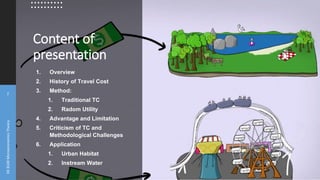

![MATH EX(DE)PRESSION
DE 8100 Microeconomics Theory 11
ji
i
j
ij
i
i
ij e
S
Q
C
M
v
U
)
,
,
(
Each individual i choosing site j to visit
Probability of individual i, choosing site j *
m
j
S
Q
C
M
v
S
Q
C
M
v
j
i
j
ij
i
i
i
j
ij
i
i
e
e
i
1
)
,
,
(
)
,
,
(
* )
(
Pr
Maximum likelihood methods can estimate the
parameters of v( ) once its functional form is
specified.
change in environmental quality from to
0
j
Q 1
j
Q
ji
i
j
ij
i
i
ji
i
j
ji
ij
i
i e
S
Q
C
M
v
e
S
Q
CS
C
M
v
)
,
,
(
)
,
,
( 0
1
CSji is the Compensate Surplus (CS)
Note: compensating surplus for individual i is zero if i does
not visit the site (Freeman, 1993).
Adding uncertainty (says if individual not visits the site) so we get the expected
value of realized utility
]
)
,
,
(
[
]
)
,
,
(
[ 0
*
1
*
*
ji
i
j
ij
i
i
ji
i
j
ji
ij
i
i e
S
Q
C
M
v
E
e
S
Q
CS
C
M
v
E
where v*( ) is the maximum of j
all
for
e
S
Q
C
M
v ji
i
j
ij
i
i
)
,
,
(
Compensating Surplus (CS) can then be defined as
b
e
e
CS
m
j
Q
v
m
j
Q
v
ji
j
j
1
)
(
1
)
(
*
0
1
ln
ln
where b is the coefficient on income
Note: other arguments in v( ) are omitted for simplicity (Freeman, 1993).](https://image.slidesharecdn.com/travelcostmodelwarawut-210618023025/85/Travel-cost-model-warawut-11-320.jpg)

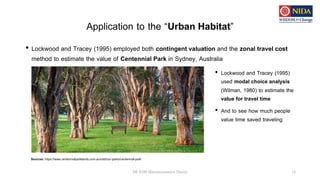
![Application to the “Urban Habitat”
• The probability that an individual will choose a particular mode of transport was taken to be a
function of the time and money costs involved. The choice between modes 1 and 2 was
modeled using logit analysis:
• Logistic regression using maximum likelihood estimation to determine the coefficients
• The average value of time saved (a1/a2) was found to be $5.40 per hour (Lockwood and Tracey,
1995).
DE 8100 Microeconomics Theory 15
)
(
)
(
)]
1
/(
ln[ 1
2
2
2
1
1
0
1
1 c
c
a
t
t
a
a
p
p
](https://image.slidesharecdn.com/travelcostmodelwarawut-210618023025/85/Travel-cost-model-warawut-15-320.jpg)
![Application to the “Urban Habitat”
• relationship between the number of visits and travel cost
• where the population of zone a is Pa, the number of visitors form zone a is Va, COST is the travel cost from
zone a, and the estimated coefficients are C(1) and C(2).
• By assessing the effects of additions to travel cost on visitor numbers, the area under an imputed demand curve
can be constructed and can be used as a measure of consumer surplus
• With 3.1 million annual visits, the value of the park’s annual use value was found to be $23 million (Lockwood and
Tracey, 1995).
DE 8100 Microeconomics Theory 16
)]
2
(
)
)[(
1
( C
COST
C
P
V
a
a
](https://image.slidesharecdn.com/travelcostmodelwarawut-210618023025/85/Travel-cost-model-warawut-16-320.jpg)

![Application to “Instream Water”
• Sanders et al. (1991) also estimated the probability of participation and The demand
function for recreation benefits was estimated using a logit participation model
ln[P/(1-P)] = BX
where
• the probability of participation is P,
• the vector of coefficients is B,
• and X is the vector of explanatory variables.
• The logit model is then estimated using the maximum likelihood estimator.
• The logit estimate of consumer surplus is affected by the probability of participation](https://image.slidesharecdn.com/travelcostmodelwarawut-210618023025/85/Travel-cost-model-warawut-18-320.jpg)


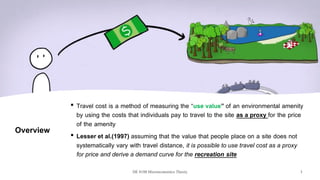
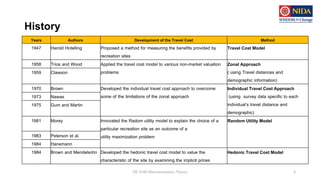
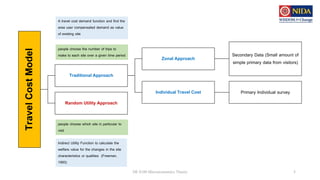
The document provides an overview of the travel cost method, a non-market valuation technique used to estimate the economic value of environmental amenities like recreation sites. It discusses the history and development of the travel cost method from its origins in the 1940s to more recent innovations like the random utility model. The traditional zonal and individual travel cost approaches are described as well as advantages, limitations, and ways to address methodological challenges. Applications of the travel cost method to valuing urban parks and instream flows for recreation are also summarized.


