TRAUMATIC INJURIES TO PRIMARY TEETH
By
Dr. Sumaiya Hassan
(MDS trainee – Department of Operative
Dentistry)
(DIDC – DUHS)
Epidemiology of Dental Trauma
• At 5 years, 31-40 % boys and 16-30 % girls will have suffered some dental
trauma.
• At 12 years, 12-33 % boys and 4-19 girls will have suffered some dental
trauma.
• Boys affected twice as often as girls.
• Maxillary anteriors are the most affected teeth.
• Concussions, subluxation and luxation are the commonest injuries in
primary dentition.
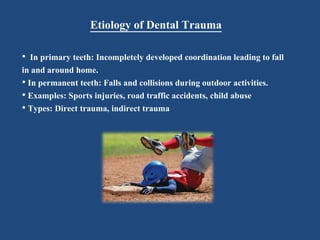
Etiology of Dental Trauma
• In primary teeth: Incompletely developed coordination leading to fall
in and around home.
• In permanent teeth: Falls and collisions during outdoor activities.
• Examples: Sports injuries, road traffic accidents, child abuse
• Types: Direct trauma, indirect trauma
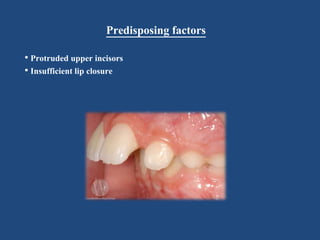
Predisposing factors
• Protruded upper incisors
• Insufficient lip closure
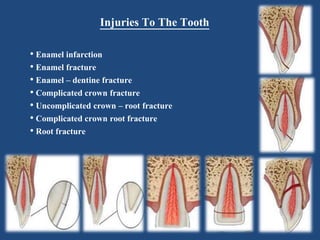
Injuries To The Tooth
• Enamel infarction
• Enamel fracture
• Enamel – dentine fracture
• Complicated crown fracture
• Uncomplicated crown – root fracture
• Complicated crown root fracture
• Root fracture
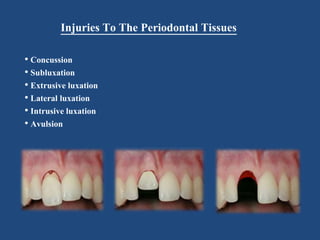
Injuries To The Periodontal Tissues
• Concussion
• Subluxation
• Extrusive luxation
• Lateral luxation
• Intrusive luxation
• Avulsion
Injuries To The Supporting Bone
• Comminution of socket wall
• Fracture of socket wall
• Fracture of alveolar process
• Fracture of jaw bones
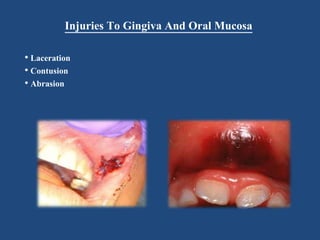
Injuries To Gingiva And Oral Mucosa
• Laceration
• Contusion
• Abrasion
Dental And Medical History
• When, where, how?
• Lost teeth fragments?
• Headache, vomiting, amnesia?
•Bleeding disorders?
• Drug allergies?
• Tetanus immunization status?
• Rheumatic fever?
Extraoral Examination
• General examination (look for signs of shock e.g. pallor, cold skin,
irregular pulse, hypotension)
• Facial swelling, bruises, lacerations
• Limitation of mandibular movement or mandibular deviation
Intraoral Examination
• Inspection (Laceration, abrasion, lip swelling, occlusal abnormality,
fractured or cracked crowns, tooth color change)
• Palpation (mobility of tooth or alveolar process)
• Percussion ( dull note?)
Treatment Of Traumatized Primary Teeth
Uncomplicated crown fracture
Complicated crown fracture
Crown – root fracture
Root fracture
Concussion
Subluxation
Extrusive luxation
Enameloplasty, restoration
Pulpectomy, obturation with ZnO/ Eugenol;
extraction
Extraction
Remove coronal necrotic fragment
Occlusal relief, analgesics
Soft diet, follow up; extraction
Extraction
Intrusive luxation Palatal displacement  extraction; buccal
displacement followup for spontaneous
reeruption
Avulsion No treatment (No replantation, no space mantainer)
Trauma To Primary Teeth

Trauma To Primary Teeth

  • 1.
    TRAUMATIC INJURIES TOPRIMARY TEETH By Dr. Sumaiya Hassan (MDS trainee – Department of Operative Dentistry) (DIDC – DUHS)
  • 2.
    Epidemiology of DentalTrauma • At 5 years, 31-40 % boys and 16-30 % girls will have suffered some dental trauma. • At 12 years, 12-33 % boys and 4-19 girls will have suffered some dental trauma. • Boys affected twice as often as girls. • Maxillary anteriors are the most affected teeth. • Concussions, subluxation and luxation are the commonest injuries in primary dentition.
  • 3.
    Etiology of DentalTrauma • In primary teeth: Incompletely developed coordination leading to fall in and around home. • In permanent teeth: Falls and collisions during outdoor activities. • Examples: Sports injuries, road traffic accidents, child abuse • Types: Direct trauma, indirect trauma
  • 4.
    Predisposing factors • Protrudedupper incisors • Insufficient lip closure
  • 5.
    Injuries To TheTooth • Enamel infarction • Enamel fracture • Enamel – dentine fracture • Complicated crown fracture • Uncomplicated crown – root fracture • Complicated crown root fracture • Root fracture
  • 6.
    Injuries To ThePeriodontal Tissues • Concussion • Subluxation • Extrusive luxation • Lateral luxation • Intrusive luxation • Avulsion
  • 7.
    Injuries To TheSupporting Bone • Comminution of socket wall • Fracture of socket wall • Fracture of alveolar process • Fracture of jaw bones
  • 8.
    Injuries To GingivaAnd Oral Mucosa • Laceration • Contusion • Abrasion
  • 9.
    Dental And MedicalHistory • When, where, how? • Lost teeth fragments? • Headache, vomiting, amnesia? •Bleeding disorders? • Drug allergies? • Tetanus immunization status? • Rheumatic fever?
  • 10.
    Extraoral Examination • Generalexamination (look for signs of shock e.g. pallor, cold skin, irregular pulse, hypotension) • Facial swelling, bruises, lacerations • Limitation of mandibular movement or mandibular deviation
  • 11.
    Intraoral Examination • Inspection(Laceration, abrasion, lip swelling, occlusal abnormality, fractured or cracked crowns, tooth color change) • Palpation (mobility of tooth or alveolar process) • Percussion ( dull note?)
  • 12.
    Treatment Of TraumatizedPrimary Teeth Uncomplicated crown fracture Complicated crown fracture Crown – root fracture Root fracture Concussion Subluxation Extrusive luxation Enameloplasty, restoration Pulpectomy, obturation with ZnO/ Eugenol; extraction Extraction Remove coronal necrotic fragment Occlusal relief, analgesics Soft diet, follow up; extraction Extraction Intrusive luxation Palatal displacement  extraction; buccal displacement followup for spontaneous reeruption Avulsion No treatment (No replantation, no space mantainer)