Application of Transtheoretical Model to Promote
the Nutritional Status (Anemia) of Reproductive
Age Group Women of Province-6
PSD carried out in partial fulfilment of the requirements for the
Theories and Principles of Health Behavior, Health Promotion,
Education and Communication, HPE 611
Group A
11/30/2021 1
Public
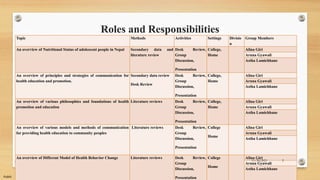
Roles and Responsibilities
Topic Methods Activities Settings Divisio
n
Group Members
An overview of Nutritional Status of adolescent people in Nepal Secondary data and
literature review
Desk Review,
Group
Discussion,
Presentation
College,
Home
Alina Giri
Aruna Gyawali
Astha Lamichhane
An overview of principles and strategies of communication for
health education and promotion.
Secondary data review
Desk Review
Desk Review,
Group
Discussion,
Presentation
College,
Home
Alina Giri
Aruna Gyawali
Astha Lamichhane
An overview of various philosophies and foundations of health
promotion and education
Literature reviews Desk Review,
Group
Discussion,
Presentation
College,
Home
Alina Giri
Aruna Gyawali
Astha Lamichhane
An overview of various models and methods of communication
for providing health education to community peoples
Literature reviews Desk Review,
Group
Discussion,
Presentation
College
Home
Alina Giri
Aruna Gyawali
Astha Lamichhane
An overview of Different Model of Health Behavior Change Literature reviews Desk Review,
Group
Discussion,
Presentation
College
Home
Alina Giri
Aruna Gyawali
Astha Lamichhane
11/30/2021 2
Public
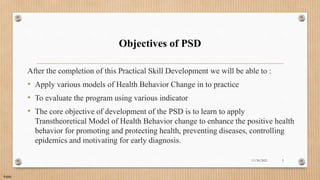
Objectives of PSD
After the completion of this Practical Skill Development we will be able to :
• Apply various models of Health Behavior Change in to practice
• To evaluate the program using various indicator
• The core objective of development of the PSD is to learn to apply
Transtheoretical Model of Health Behavior change to enhance the positive health
behavior for promoting and protecting health, preventing diseases, controlling
epidemics and motivating for early diagnosis.
11/30/2021 3
Public
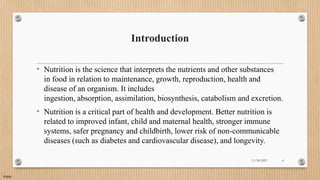
Introduction
• Nutrition is the science that interprets the nutrients and other substances
in food in relation to maintenance, growth, reproduction, health and
disease of an organism. It includes
ingestion, absorption, assimilation, biosynthesis, catabolism and excretion.
• Nutrition is a critical part of health and development. Better nutrition is
related to improved infant, child and maternal health, stronger immune
systems, safer pregnancy and childbirth, lower risk of non-communicable
diseases (such as diabetes and cardiovascular disease), and longevity.
11/30/2021 4
Public
Nepal government has set the goal of Nutrition programme as follow:
• “The goal of National Nutrition Programme is to achieve nutritional well-
being of all people to maintain a healthy life to contribute in the socio-
economic development of the country, through improved nutrition
programme implementation in collaboration with relevant sectors.”
• The general objective of the National Nutrition Programme conducted by
MOHP is to enhance nutritional well-being, reduce child and maternal
mortality and to contribute for equitable human development.
• The targeted beneficiaries of MOHP are women and children. For them
the government of Nepal has distributed iron and calcium tablet for
pregnant women regular growth monitoring of the children for
management of acute malnutrition. Vitamin A supplementation program
etc.
11/30/2021 5
Public
Statement of Problem
• According to Global Nutrition report 2020, Among under 5 children, 149.0 million are
stunted, 49.5 million are wasted and 40.1 million are overweight. Global, regional and
national patterns cover nutrition inequalities within countries and by sociodemographic
characteristics, such as location, age, sex, wealth and education. Data gaps are more
prominent for certain nutrition indicators, locations, and key population characteristics,
such as ethnicity and disability. These data breaks prevent both improved understanding
of nutrition inequalities and informed priority-setting.
• Looking at the Maternal infant young child nutrition targets, the world is disoriented to
meet the anaemia target, 32.8% (613.2 million) female population of aged 15-49 age
group are anaemic. The rate is much higher 40.1% (35.3 million) among pregnant
population than non-pregnant adolescent girls and women which is 32.5% (577.9
million,)
11/30/2021 6
Public
Nutritional Status of Women:
• 11% of women are shorter than 145 cm. A total of 17% women are thin, with 11%
mildly thin and 6% moderately and severely thin. Further, 22% are overweight or
obese, with 17% being overweight and 5% obese.
• The proportion of short women (below 145 cm) is lowest in Province 7 at 7% and
highest in Province 2 at 14%.
• Younger women are more likely to be thin than their older counterparts. For instance,
30% of women age 15-19 are thin compared with 13% of women age 40-49.
• The proportion of thin women is higher in terai (23%) than in mountain and hill
ecological zones (12% each).
• Province 2 has the highest proportion of thin women (29%).
• Further, Province 3 has the highest proportion of overweight/obese women (35%).
• Overweight/obesity increases with wealth and household food security. For example,
45% of women in the highest wealth quintile are overweight/obese compared with
10% in the lowest wealth quintile.
11/30/2021 7
Public
Anemia prevalence in women :
• 35.1% of women of reproductive age have anemia and 5.4% of women
have obesity.
• A higher proportion of women in terai (52%) are anemic compared with
women from mountain (35%) and hill (29%) ecological zones.
• Prevalence of anemia among women is highest in Province 2 (58%) and
lowest in Province 4 (28%)
• Pregnant women and breastfeeding women (each 46%) are more likely to
be anemic than other women (39%).
11/30/2021 8
Public
National nutrition program
There is various ongoing program to address the nutrition problem:
• Protein Energy Malnutrition Control Program
• Iron Deficiency Anemia Control Program
• Deworming
• Iodine Deficiency Disorder Elimination Program
• Vitamin A Deficiency Disorder Control Program
11/30/2021 9
Public
Health Problem Prioritization
• Anaemia has severe nutritional and health consequences, including high maternal
mortality, inadequate growth and impaired mental development in children. Anaemia
during pregnancy increases the risk of fetal growth retardation and low birth weight,
premature delivery, increased perinatal mortality, and reduced resistance to infection
of both mother and baby. Anaemia also results in decreased work capacity, including
reduced care giving and general productivity.
• Anaemia is an extremely serious public health problem in Nepal. The 1998 Nepal
Micronutrient Status Survey reported an overall anaemia prevalence of 68% among
women. The prevalence of anaemia among pregnant women was even higher (75%).
In other words, three out of four pregnant women in Nepal are anaemic.
11/30/2021 10
Public
Theory Of Health Behavior Change
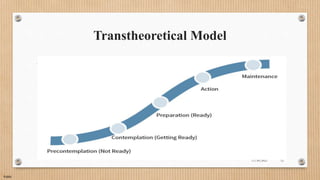
Transtheoretical Model
The transtheoretical model of behavior change is an integrative theory of therapy that
assesses an individual’s readiness to act on a new healthier behavior, and provides
strategies, or processes of change to guide the individual. The model is composed of
constructs such as: stages of change, processes of change, levels of change, self-efficacy,
and decisional balance
The Transtheoretical Model (TTM) focuses on the decision-making of the individual and
is a model of intentional change. The TTM operates on the assumption that people do not
change behaviors quickly and decisively. Rather, change in behavior, especially habitual
behavior, occurs continuously through a cyclical process.
11/30/2021 11
Public
Transtheoretical Model
11/30/2021 12
Public
Objectives
General Objective
• To improve the anemic status of female of Reproductive Age group residing on Province
6.
Specific Objectives
• To measure anemic status of women in the community.
• To find out stage of women who are ready to adopt healthy lifestyle as per stage of
change model
• To provide the adequate consciousness about health and nutritional status among the care
givers
11/30/2021 13
Public
• To impart the nutritional education to reproductive age group female and
under 5 children
• To Provide the Preventive Promotive, Referral and Follow-up services
related to nutrition to the reproductive aged group female of Province 6.
• To explain the importance of ANC and PNC visit and consumption of Iron
folic acid tablets
• To explain about the worm infestation and measures to protect
11/30/2021 14
Public
Behavioral
Diagnosis
Negative Behaviour:
• Neglected ANC and PNC check up
• Food Taboos
• Unsafe abortion
• Worm infestation
• Lack of Iron folic acid supplementation
• Not using Family planning commodities
11/30/2021 15
Public
Positive Behaviour:
• Proper antenatal and postnatal care and consumption of Iron and Folic
acid tablet.
• Consumption of Nutritious diet containing vitamins and minerals
• Use of family planning commodities to maintain the birth spacing
• Proper handwashing with soap and water before eating, feeding the
children and after defecation to prevent worm infestation.
11/30/2021 16
Public
Target Group
Going through the key facts and segregated data, nutrition problem is more
prominent in Terai region, whereas among 7 province, province no 6 has
more nutrition problem than others. The problem is markedly seen among
the female with no education and with lowest wealth quintile.
Therefore, the target audience will be the women of reproductive age group
of Terai region of province 6. The targeted group will be selected from
lowest wealth quintile who have no education.
11/30/2021 17
Public
Content of the Health Education Program
• Meaning and definition of nutrition
• Introduction of anemia
• Importance of nutritive diet and personal hygiene to prevent anemia
• Harmful effects of anemia on both mother and baby
• Causes of anemia
• Measures to prevent and control anemia
• Importance of family planning to prevent anemia among reproductive age group
women.
11/30/2021 18
Public
Method and Media of Health Education
• With help of this media exposure habit of population of all 7province radio can
be a good means of Information and communication media. If the target
audiences are given about the nutrition information in the caller back tune along
with radio station they can tune in for the further information, it can be very
effective for the target population. As 30% owning radio and 94% owns mobile
phones. Where 56% knows how to tune radio/Fm in their mobile phones.
• Parallelly we can also make nutrition program for television for once a week for
those target population who has access to television as the reliability is highest
and 38% of the target audience of selected province has access to television. 18%
watch television after radio.
11/30/2021 19
Public
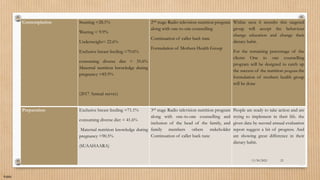
Implementation Plan by Using TTM
Stages Stages supported by
data
Media Action
Pre-contemplation Wasted =79.4%
Stunted= 9%
Underweight= 46.4%
Exclusive breast feeding for
6 months=66.1%
Not consuming diverse diet
=50%
Maternal nutrition
knowledge
(NDHS 2016)
Introductory Radio Nutrition
program at daytime
Television Nutrition program at
nighttime
Development of caller back
tune, collaboration with NTC
NCELL and SMART cell
Radio program is targeted
for Women’s reproductive
age group (WRA)
Television program is
targeted for Husbands
group who has decision
making power in home.
The program will run for 6
months
11/30/2021 20
Public
Contemplation Stunting =28.1%
Wasting = 9.9%
Underweight= 22.6%
Exclusive breast feeding =70.6%
consuming diverse diet = 35.6%
Maternal nutrition knowledge during
pregnancy =85.9%
(2017 Annual survey)
2nd stage Radio television nutrition program
along with one-to-one counselling
Continuation of caller back tune
Formulation of Mothers Health Group
Within next 6 months this targeted
group will accept the behaviour
change education and change their
dietary habit.
For the remaining percentage of the
clients One to one counselling
program will be designed to catch up
the success of the nutrition program the
formulation of mothers health group
will be done
Preparation Exclusive breast feeding =71.1%
consuming diverse diet = 41.6%
Maternal nutrition knowledge during
pregnancy =90.5%
(SUAAHAARA)
3rd stage Radio television nutrition program
along with one-to-one counselling and
inclusion of the head of the family, and
family members others stakeholder
Continuation of caller back tune
People are ready to take action and are
trying to implement in their life. the
given data by second annual evaluation
report suggest a bit of progress. And
are showing great difference in their
dietary habit.
11/30/2021 21
Public
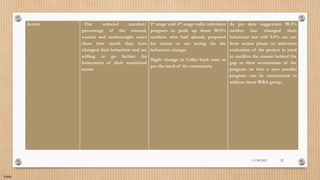
Action The reduced number/
percentage of the stunted,
wasted and underweight cases
show how much they have
changed their behaviour and are
willing to go further for
betterment of their nutritional
status
1st stage and 4th stage radio television
program to push up those 90.5%
mothers who had already prepared
for action or are acting for the
behaviour change.
Slight change in Caller back tune as
per the need of the community.
As per data suggestion 90.5%
mother has changed their
behaviour but still 9.5% are out
from action phase so mid-term
evaluation of the project is need
to confirm the reason behind the
gap or their termination of the
program so that a new parallel
program can be constructed to
address those WRA group.
11/30/2021 22
Public
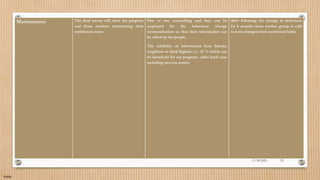
Maintenance The final survey will show the progress
and those mothers maintaining their
nutritional status
One to one counselling and they can be
employed for the behaviour change
communication so that their information can
be relied by the people.
The reliability of information from friends,
neighbors is third highest i.e., 21 % which can
be beneficial for our program. caller back tune
including success stories.
After following the change in behaviour
for 6 months these mother group is said
to have changed their nutritional habit.
11/30/2021 23
Public
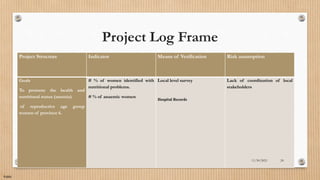
Project Log Frame
Project Structure Indicator Means of Verification Risk assumption
Goals
To promote the health and
nutritional status (anemia)
of reproductive age group
women of province 6.
# % of women identified with
nutritional problems.
# % of anaemic women
Local level survey
Hospital Records
Lack of coordination of local
stakeholders
11/30/2021 24
Public
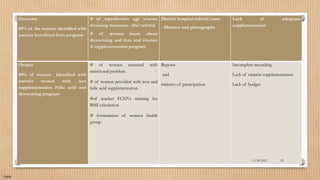
Outcome
60% of the women identified with
anemia benefitted from program
# of reproductive age women
receiving treatment after referral
# of women know about
deworming and iron and vitamin
A supplementation program
District hospital referral cases
- Minutes and photographs
Lack of adequate
supplementation
Output
80% of women identified with
anemia treated with iron
supplementation Folic acid and
deworming program
# of women screened with
nutritional problem
# of women provided with iron and
folic acid supplementation
#of teacher FCHVs training for
BMI calculation
# formulation of women health
group..
Reports
and
minutes of participation
Incomplete recording
Lack of vitamin supplementation
Lack of budget
11/30/2021 25
Public
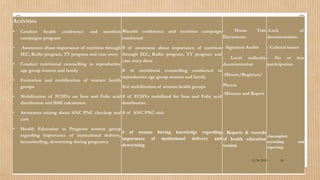
Activities
• Conduct health conference and nutrition
campaigns program
• Awareness about importance of nutrition through
IEC, Radio program, TV program and case story.
• Conduct nutritional counselling to reproductive
age group women and family
• Formation and mobilization of women health
groups
• Mobilization of FCHVs on Iron and Folic acid
distribution and BMI calculation
• Awareness raising about ANC PNC checkup and
care
• Health Education to Pregnant women group
regarding importance of institutional delivery,
breastfeeding, deworming during pregnancy
#health conference and nutrition campaign
conducted
# of awareness about importance of nutrition
through IEC, Radio program, TV program and
case story done
# of nutritional counselling conducted to
reproductive age group women and family
#of mobilization of women health groups
# of FCHVs mobilized for Iron and Folic acid
distribution.
# of ANC PNC visit
# of women having knowledge regarding
importance of institutional delivery and
deworming
- Home Visit
Documents
- Signature Audits
- Local authority
documentation
-Minute/Registers/
Photos
-Minutes and Report
- Reports & records
of health education
session
-Lack of
documentation
- Cultural issues
- No or less
participation
-Incomplete
recording and
reporting
11/30/2021 26
Public
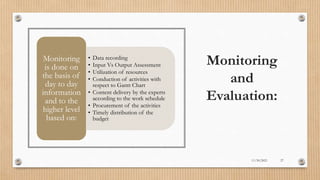
Monitoring
and
Evaluation:
• Data recording
• Input Vs Output Assessment
• Utilization of resources
• Conduction of activities with
respect to Gantt Chart
• Content delivery by the experts
according to the work schedule
• Procurement of the activities
• Timely distribution of the
budget
Monitoring
is done on
the basis of
day to day
information
and to the
higher level
based on:
11/30/2021 27
Public
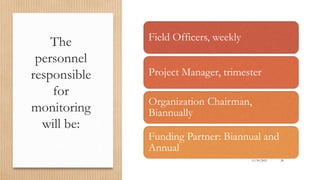
The
personnel
responsible
for
monitoring
will be:
Field Officers, weekly
Project Manager, trimester
Organization Chairman,
Biannually
Funding Partner: Biannual and
Annual
11/30/2021 28
Public
Evaluation of Program
Process evaluation:
• Number of Health Education session conducted
• Proportion of health educators providing nutrition education
• Proportion of pregnant women receiving iron and folic acid supplement
• Number of mothers groups formulated
• Number of radio program conducted
• Number of health education session conducted through television
11/30/2021 29
Public
Outcome Evaluation
• Increased level of Knowledge regarding nutrition among reproductive age
group women.
• Reproductive age group women identified with anemia benefitted from
program
• Anemic women receiving iron and folic acid after referral
• Percentage of mothers fully aware about ANC Natal & PNC care
• FCHVs mobilization on BMI calculation
11/30/2021 30
Public
Impact evaluation
• Decreased rate of anemic women
• Increased rate of institutional delivery
• Decreased Maternal mortality Rate
• Decrease in childhood Mortality
• Community involvement in local food production
11/30/2021 31
Public
LIMITATION AND SUMMARY
This project is only a theoretical concept, it would have been more better if it
can be applied in a real scenario.
There are several limitations of TTM, which should be considered when
using this theory in public health.limitations of this model includes:
This theory ignores the social context in which change occurs, such as
socio ecnomic status and income.
The line between the stage can be arbitary with no set criteria of how to
determine a person's stage of change.
11/30/2021 32
Public
There is no clear sense for how much time is needed for each stage, or
how long a person can remain in a stage.
11/30/2021 33
Public
Summary
Anemia has severe nutritional and health
consequences, including high maternal mortality,
inadequate growth and impaired mental development
in children. Anemia during pregnancy increases the
risk of fetal growth retardation and low birth weight,
premature delivery, increased perinatal mortality, and
reduced resistance to infection of both mother and
baby. Anemia also results in decreased work capacity,
including reduced care giving and general productivity.
Anemia is an extremely serious public health problem
in Nepal. The 1998 Nepal Micronutrient Status Survey
reported an overall anemia prevalence of 68% among
women. The prevalence of anemia among pregnant
women was even higher (75%). In other words, three
out of four pregnant women in Nepal are anaemic.
Furthermore, the survey also found a prevalence of
78% among pre-school children, while virtually all
infants between 6-11 months of age were anemic
(90%), which is a period of rapid physical and mental
growth.
11/30/2021 34
Public
Learning From PSD
• Review the plan documents according to the objective of the study
• To apply the theories of health behavior, change in practice.
• Learned to apply the constructs of PIE model to community-based health
education program
• To evaluate the program using various indicators.
11/30/2021 35
Public
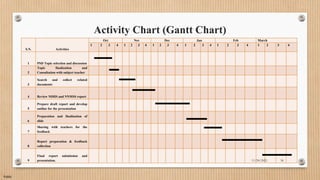
Activity Chart (Gantt Chart)
S.N. Activities
Oct Nov Dec Jan Feb March
1 2 3 4 1 2 3 4 1 2 3 4 1 2 3 4 1 2 3 4 1 2 3 4
1 PSD Topic selection and discussion
2
Topic finalization and
Consultation with subject teacher
3
Search and collect related
documents
4 Review NDHS and NNMSS report
5
Prepare draft report and develop
outline for the presentation

6
Preparation and finalization of
slide
7
Sharing with teachers for the
feedback
8
Report preparation & feedback
collection
9
Final report submission and
presentation. 11/30/2021 36
Public
References
• https://www.mohp.gov.np/eng/program/child-health-services/nutrition
• SUAAHARA II good nutrition program Annual Survey year one USAID 2017
• SUAAHARA II good nutrition program Annual Survey year Two USAID 2018
• Community-based model for improving child nutrition status - a success story in Yen Bai,Hanoi, 4-2016
• Creating An Analysis Plan 2013 CDC
• Nutrition Education: A State−of−the−art Review − Nutrition policy discussion paper No. 1 and 2 Robert C. Hornik, University of
Pennsylvania
• Multi-sector Nutrition Plan 2013-2017 (2023) National Planning Commission government of Nepal
• Sustainable Development Goals status and Road map 2016-2030, National Planning Commission government of Nepal 2017
• UNICEF/WHO/World Bank Joint Child Malnutrition Estimates Expanded Database: Stunting, Wasting and Overweight, (March 2019,
New York), NCD Risk Factor Collaboration 2019, WHO Global Health Observatory 2019.
• https://globalnutritionreport.org/reports/2020-global-nutrition-report/inequalities-global-burden-malnutrition/
• https://globalnutritionreport.org/reports/global-nutrition-report-2018/appendix-3-countries-significant-multiple-forms-malnutrition/
• https://globalnutritionreport.org/reports/global-nutrition-report-2018/appendix-2-countries-track-global-nutrition-targets/
• A RESEARCH REPORT ON United Nations Educational, Scientific and Cultural Organization Empowered lives. Resilient nations.
MEDIA & THE NEPALI PUBLIC 2012 Media Foundation- Nepal Japan in collaboration with UNESCO
11/30/2021 37
Public
11/30/2021 38

Transtheorotical model for program development

  • 1.
    Application of TranstheoreticalModel to Promote the Nutritional Status (Anemia) of Reproductive Age Group Women of Province-6 PSD carried out in partial fulfilment of the requirements for the Theories and Principles of Health Behavior, Health Promotion, Education and Communication, HPE 611 Group A 11/30/2021 1
  • 2.
    Public Roles and Responsibilities TopicMethods Activities Settings Divisio n Group Members An overview of Nutritional Status of adolescent people in Nepal Secondary data and literature review Desk Review, Group Discussion, Presentation College, Home Alina Giri Aruna Gyawali Astha Lamichhane An overview of principles and strategies of communication for health education and promotion. Secondary data review Desk Review Desk Review, Group Discussion, Presentation College, Home Alina Giri Aruna Gyawali Astha Lamichhane An overview of various philosophies and foundations of health promotion and education Literature reviews Desk Review, Group Discussion, Presentation College, Home Alina Giri Aruna Gyawali Astha Lamichhane An overview of various models and methods of communication for providing health education to community peoples Literature reviews Desk Review, Group Discussion, Presentation College Home Alina Giri Aruna Gyawali Astha Lamichhane An overview of Different Model of Health Behavior Change Literature reviews Desk Review, Group Discussion, Presentation College Home Alina Giri Aruna Gyawali Astha Lamichhane 11/30/2021 2
  • 3.
    Public Objectives of PSD Afterthe completion of this Practical Skill Development we will be able to : • Apply various models of Health Behavior Change in to practice • To evaluate the program using various indicator • The core objective of development of the PSD is to learn to apply Transtheoretical Model of Health Behavior change to enhance the positive health behavior for promoting and protecting health, preventing diseases, controlling epidemics and motivating for early diagnosis. 11/30/2021 3
  • 4.
    Public Introduction • Nutrition isthe science that interprets the nutrients and other substances in food in relation to maintenance, growth, reproduction, health and disease of an organism. It includes ingestion, absorption, assimilation, biosynthesis, catabolism and excretion. • Nutrition is a critical part of health and development. Better nutrition is related to improved infant, child and maternal health, stronger immune systems, safer pregnancy and childbirth, lower risk of non-communicable diseases (such as diabetes and cardiovascular disease), and longevity. 11/30/2021 4
  • 5.
    Public Nepal government hasset the goal of Nutrition programme as follow: • “The goal of National Nutrition Programme is to achieve nutritional well- being of all people to maintain a healthy life to contribute in the socio- economic development of the country, through improved nutrition programme implementation in collaboration with relevant sectors.” • The general objective of the National Nutrition Programme conducted by MOHP is to enhance nutritional well-being, reduce child and maternal mortality and to contribute for equitable human development. • The targeted beneficiaries of MOHP are women and children. For them the government of Nepal has distributed iron and calcium tablet for pregnant women regular growth monitoring of the children for management of acute malnutrition. Vitamin A supplementation program etc. 11/30/2021 5
  • 6.
    Public Statement of Problem •According to Global Nutrition report 2020, Among under 5 children, 149.0 million are stunted, 49.5 million are wasted and 40.1 million are overweight. Global, regional and national patterns cover nutrition inequalities within countries and by sociodemographic characteristics, such as location, age, sex, wealth and education. Data gaps are more prominent for certain nutrition indicators, locations, and key population characteristics, such as ethnicity and disability. These data breaks prevent both improved understanding of nutrition inequalities and informed priority-setting. • Looking at the Maternal infant young child nutrition targets, the world is disoriented to meet the anaemia target, 32.8% (613.2 million) female population of aged 15-49 age group are anaemic. The rate is much higher 40.1% (35.3 million) among pregnant population than non-pregnant adolescent girls and women which is 32.5% (577.9 million,) 11/30/2021 6
  • 7.
    Public Nutritional Status ofWomen: • 11% of women are shorter than 145 cm. A total of 17% women are thin, with 11% mildly thin and 6% moderately and severely thin. Further, 22% are overweight or obese, with 17% being overweight and 5% obese. • The proportion of short women (below 145 cm) is lowest in Province 7 at 7% and highest in Province 2 at 14%. • Younger women are more likely to be thin than their older counterparts. For instance, 30% of women age 15-19 are thin compared with 13% of women age 40-49. • The proportion of thin women is higher in terai (23%) than in mountain and hill ecological zones (12% each). • Province 2 has the highest proportion of thin women (29%). • Further, Province 3 has the highest proportion of overweight/obese women (35%). • Overweight/obesity increases with wealth and household food security. For example, 45% of women in the highest wealth quintile are overweight/obese compared with 10% in the lowest wealth quintile. 11/30/2021 7
  • 8.
    Public Anemia prevalence inwomen : • 35.1% of women of reproductive age have anemia and 5.4% of women have obesity. • A higher proportion of women in terai (52%) are anemic compared with women from mountain (35%) and hill (29%) ecological zones. • Prevalence of anemia among women is highest in Province 2 (58%) and lowest in Province 4 (28%) • Pregnant women and breastfeeding women (each 46%) are more likely to be anemic than other women (39%). 11/30/2021 8
  • 9.
    Public National nutrition program Thereis various ongoing program to address the nutrition problem: • Protein Energy Malnutrition Control Program • Iron Deficiency Anemia Control Program • Deworming • Iodine Deficiency Disorder Elimination Program • Vitamin A Deficiency Disorder Control Program 11/30/2021 9
  • 10.
    Public Health Problem Prioritization •Anaemia has severe nutritional and health consequences, including high maternal mortality, inadequate growth and impaired mental development in children. Anaemia during pregnancy increases the risk of fetal growth retardation and low birth weight, premature delivery, increased perinatal mortality, and reduced resistance to infection of both mother and baby. Anaemia also results in decreased work capacity, including reduced care giving and general productivity. • Anaemia is an extremely serious public health problem in Nepal. The 1998 Nepal Micronutrient Status Survey reported an overall anaemia prevalence of 68% among women. The prevalence of anaemia among pregnant women was even higher (75%). In other words, three out of four pregnant women in Nepal are anaemic. 11/30/2021 10
  • 11.
    Public Theory Of HealthBehavior Change Transtheoretical Model The transtheoretical model of behavior change is an integrative theory of therapy that assesses an individual’s readiness to act on a new healthier behavior, and provides strategies, or processes of change to guide the individual. The model is composed of constructs such as: stages of change, processes of change, levels of change, self-efficacy, and decisional balance The Transtheoretical Model (TTM) focuses on the decision-making of the individual and is a model of intentional change. The TTM operates on the assumption that people do not change behaviors quickly and decisively. Rather, change in behavior, especially habitual behavior, occurs continuously through a cyclical process. 11/30/2021 11
  • 12.
  • 13.
    Public Objectives General Objective • Toimprove the anemic status of female of Reproductive Age group residing on Province 6. Specific Objectives • To measure anemic status of women in the community. • To find out stage of women who are ready to adopt healthy lifestyle as per stage of change model • To provide the adequate consciousness about health and nutritional status among the care givers 11/30/2021 13
  • 14.
    Public • To impartthe nutritional education to reproductive age group female and under 5 children • To Provide the Preventive Promotive, Referral and Follow-up services related to nutrition to the reproductive aged group female of Province 6. • To explain the importance of ANC and PNC visit and consumption of Iron folic acid tablets • To explain about the worm infestation and measures to protect 11/30/2021 14
  • 15.
    Public Behavioral Diagnosis Negative Behaviour: • NeglectedANC and PNC check up • Food Taboos • Unsafe abortion • Worm infestation • Lack of Iron folic acid supplementation • Not using Family planning commodities 11/30/2021 15
  • 16.
    Public Positive Behaviour: • Properantenatal and postnatal care and consumption of Iron and Folic acid tablet. • Consumption of Nutritious diet containing vitamins and minerals • Use of family planning commodities to maintain the birth spacing • Proper handwashing with soap and water before eating, feeding the children and after defecation to prevent worm infestation. 11/30/2021 16
  • 17.
    Public Target Group Going throughthe key facts and segregated data, nutrition problem is more prominent in Terai region, whereas among 7 province, province no 6 has more nutrition problem than others. The problem is markedly seen among the female with no education and with lowest wealth quintile. Therefore, the target audience will be the women of reproductive age group of Terai region of province 6. The targeted group will be selected from lowest wealth quintile who have no education. 11/30/2021 17
  • 18.
    Public Content of theHealth Education Program • Meaning and definition of nutrition • Introduction of anemia • Importance of nutritive diet and personal hygiene to prevent anemia • Harmful effects of anemia on both mother and baby • Causes of anemia • Measures to prevent and control anemia • Importance of family planning to prevent anemia among reproductive age group women. 11/30/2021 18
  • 19.
    Public Method and Mediaof Health Education • With help of this media exposure habit of population of all 7province radio can be a good means of Information and communication media. If the target audiences are given about the nutrition information in the caller back tune along with radio station they can tune in for the further information, it can be very effective for the target population. As 30% owning radio and 94% owns mobile phones. Where 56% knows how to tune radio/Fm in their mobile phones. • Parallelly we can also make nutrition program for television for once a week for those target population who has access to television as the reliability is highest and 38% of the target audience of selected province has access to television. 18% watch television after radio. 11/30/2021 19
  • 20.
    Public Implementation Plan byUsing TTM Stages Stages supported by data Media Action Pre-contemplation Wasted =79.4% Stunted= 9% Underweight= 46.4% Exclusive breast feeding for 6 months=66.1% Not consuming diverse diet =50% Maternal nutrition knowledge (NDHS 2016) Introductory Radio Nutrition program at daytime Television Nutrition program at nighttime Development of caller back tune, collaboration with NTC NCELL and SMART cell Radio program is targeted for Women’s reproductive age group (WRA) Television program is targeted for Husbands group who has decision making power in home. The program will run for 6 months 11/30/2021 20
  • 21.
    Public Contemplation Stunting =28.1% Wasting= 9.9% Underweight= 22.6% Exclusive breast feeding =70.6% consuming diverse diet = 35.6% Maternal nutrition knowledge during pregnancy =85.9% (2017 Annual survey) 2nd stage Radio television nutrition program along with one-to-one counselling Continuation of caller back tune Formulation of Mothers Health Group Within next 6 months this targeted group will accept the behaviour change education and change their dietary habit. For the remaining percentage of the clients One to one counselling program will be designed to catch up the success of the nutrition program the formulation of mothers health group will be done Preparation Exclusive breast feeding =71.1% consuming diverse diet = 41.6% Maternal nutrition knowledge during pregnancy =90.5% (SUAAHAARA) 3rd stage Radio television nutrition program along with one-to-one counselling and inclusion of the head of the family, and family members others stakeholder Continuation of caller back tune People are ready to take action and are trying to implement in their life. the given data by second annual evaluation report suggest a bit of progress. And are showing great difference in their dietary habit. 11/30/2021 21
  • 22.
    Public Action The reducednumber/ percentage of the stunted, wasted and underweight cases show how much they have changed their behaviour and are willing to go further for betterment of their nutritional status 1st stage and 4th stage radio television program to push up those 90.5% mothers who had already prepared for action or are acting for the behaviour change. Slight change in Caller back tune as per the need of the community. As per data suggestion 90.5% mother has changed their behaviour but still 9.5% are out from action phase so mid-term evaluation of the project is need to confirm the reason behind the gap or their termination of the program so that a new parallel program can be constructed to address those WRA group. 11/30/2021 22
  • 23.
    Public Maintenance The finalsurvey will show the progress and those mothers maintaining their nutritional status One to one counselling and they can be employed for the behaviour change communication so that their information can be relied by the people. The reliability of information from friends, neighbors is third highest i.e., 21 % which can be beneficial for our program. caller back tune including success stories. After following the change in behaviour for 6 months these mother group is said to have changed their nutritional habit. 11/30/2021 23
  • 24.
    Public Project Log Frame ProjectStructure Indicator Means of Verification Risk assumption Goals To promote the health and nutritional status (anemia) of reproductive age group women of province 6. # % of women identified with nutritional problems. # % of anaemic women Local level survey Hospital Records Lack of coordination of local stakeholders 11/30/2021 24
  • 25.
    Public Outcome 60% of thewomen identified with anemia benefitted from program # of reproductive age women receiving treatment after referral # of women know about deworming and iron and vitamin A supplementation program District hospital referral cases - Minutes and photographs Lack of adequate supplementation Output 80% of women identified with anemia treated with iron supplementation Folic acid and deworming program # of women screened with nutritional problem # of women provided with iron and folic acid supplementation #of teacher FCHVs training for BMI calculation # formulation of women health group.. Reports and minutes of participation Incomplete recording Lack of vitamin supplementation Lack of budget 11/30/2021 25
  • 26.
    Public Activities • Conduct healthconference and nutrition campaigns program • Awareness about importance of nutrition through IEC, Radio program, TV program and case story. • Conduct nutritional counselling to reproductive age group women and family • Formation and mobilization of women health groups • Mobilization of FCHVs on Iron and Folic acid distribution and BMI calculation • Awareness raising about ANC PNC checkup and care • Health Education to Pregnant women group regarding importance of institutional delivery, breastfeeding, deworming during pregnancy #health conference and nutrition campaign conducted # of awareness about importance of nutrition through IEC, Radio program, TV program and case story done # of nutritional counselling conducted to reproductive age group women and family #of mobilization of women health groups # of FCHVs mobilized for Iron and Folic acid distribution. # of ANC PNC visit # of women having knowledge regarding importance of institutional delivery and deworming - Home Visit Documents - Signature Audits - Local authority documentation -Minute/Registers/ Photos -Minutes and Report - Reports & records of health education session -Lack of documentation - Cultural issues - No or less participation -Incomplete recording and reporting 11/30/2021 26
  • 27.
    Public Monitoring and Evaluation: • Data recording •Input Vs Output Assessment • Utilization of resources • Conduction of activities with respect to Gantt Chart • Content delivery by the experts according to the work schedule • Procurement of the activities • Timely distribution of the budget Monitoring is done on the basis of day to day information and to the higher level based on: 11/30/2021 27
  • 28.
    Public The personnel responsible for monitoring will be: Field Officers,weekly Project Manager, trimester Organization Chairman, Biannually Funding Partner: Biannual and Annual 11/30/2021 28
  • 29.
    Public Evaluation of Program Processevaluation: • Number of Health Education session conducted • Proportion of health educators providing nutrition education • Proportion of pregnant women receiving iron and folic acid supplement • Number of mothers groups formulated • Number of radio program conducted • Number of health education session conducted through television 11/30/2021 29
  • 30.
    Public Outcome Evaluation • Increasedlevel of Knowledge regarding nutrition among reproductive age group women. • Reproductive age group women identified with anemia benefitted from program • Anemic women receiving iron and folic acid after referral • Percentage of mothers fully aware about ANC Natal & PNC care • FCHVs mobilization on BMI calculation 11/30/2021 30
  • 31.
    Public Impact evaluation • Decreasedrate of anemic women • Increased rate of institutional delivery • Decreased Maternal mortality Rate • Decrease in childhood Mortality • Community involvement in local food production 11/30/2021 31
  • 32.
    Public LIMITATION AND SUMMARY Thisproject is only a theoretical concept, it would have been more better if it can be applied in a real scenario. There are several limitations of TTM, which should be considered when using this theory in public health.limitations of this model includes: This theory ignores the social context in which change occurs, such as socio ecnomic status and income. The line between the stage can be arbitary with no set criteria of how to determine a person's stage of change. 11/30/2021 32
  • 33.
    Public There is noclear sense for how much time is needed for each stage, or how long a person can remain in a stage. 11/30/2021 33
  • 34.
    Public Summary Anemia has severenutritional and health consequences, including high maternal mortality, inadequate growth and impaired mental development in children. Anemia during pregnancy increases the risk of fetal growth retardation and low birth weight, premature delivery, increased perinatal mortality, and reduced resistance to infection of both mother and baby. Anemia also results in decreased work capacity, including reduced care giving and general productivity. Anemia is an extremely serious public health problem in Nepal. The 1998 Nepal Micronutrient Status Survey reported an overall anemia prevalence of 68% among women. The prevalence of anemia among pregnant women was even higher (75%). In other words, three out of four pregnant women in Nepal are anaemic. Furthermore, the survey also found a prevalence of 78% among pre-school children, while virtually all infants between 6-11 months of age were anemic (90%), which is a period of rapid physical and mental growth. 11/30/2021 34
  • 35.
    Public Learning From PSD •Review the plan documents according to the objective of the study • To apply the theories of health behavior, change in practice. • Learned to apply the constructs of PIE model to community-based health education program • To evaluate the program using various indicators. 11/30/2021 35
  • 36.
    Public Activity Chart (GanttChart) S.N. Activities Oct Nov Dec Jan Feb March 1 2 3 4 1 2 3 4 1 2 3 4 1 2 3 4 1 2 3 4 1 2 3 4 1 PSD Topic selection and discussion 2 Topic finalization and Consultation with subject teacher 3 Search and collect related documents 4 Review NDHS and NNMSS report 5 Prepare draft report and develop outline for the presentation 6 Preparation and finalization of slide 7 Sharing with teachers for the feedback 8 Report preparation & feedback collection 9 Final report submission and presentation. 11/30/2021 36
  • 37.
    Public References • https://www.mohp.gov.np/eng/program/child-health-services/nutrition • SUAAHARAII good nutrition program Annual Survey year one USAID 2017 • SUAAHARA II good nutrition program Annual Survey year Two USAID 2018 • Community-based model for improving child nutrition status - a success story in Yen Bai,Hanoi, 4-2016 • Creating An Analysis Plan 2013 CDC • Nutrition Education: A State−of−the−art Review − Nutrition policy discussion paper No. 1 and 2 Robert C. Hornik, University of Pennsylvania • Multi-sector Nutrition Plan 2013-2017 (2023) National Planning Commission government of Nepal • Sustainable Development Goals status and Road map 2016-2030, National Planning Commission government of Nepal 2017 • UNICEF/WHO/World Bank Joint Child Malnutrition Estimates Expanded Database: Stunting, Wasting and Overweight, (March 2019, New York), NCD Risk Factor Collaboration 2019, WHO Global Health Observatory 2019. • https://globalnutritionreport.org/reports/2020-global-nutrition-report/inequalities-global-burden-malnutrition/ • https://globalnutritionreport.org/reports/global-nutrition-report-2018/appendix-3-countries-significant-multiple-forms-malnutrition/ • https://globalnutritionreport.org/reports/global-nutrition-report-2018/appendix-2-countries-track-global-nutrition-targets/ • A RESEARCH REPORT ON United Nations Educational, Scientific and Cultural Organization Empowered lives. Resilient nations. MEDIA & THE NEPALI PUBLIC 2012 Media Foundation- Nepal Japan in collaboration with UNESCO 11/30/2021 37
  • 38.