Transport Layer Protocols
(end-to-end communication)
All modules and procedures pertaining to transportation of data or data stream
are categorized into this layer. As all other layers, this layer communicates with
its peer Transport layer of the remote host.
Transport layer offers peer-to-peer and end-to-end connection between two
processes on remote hosts.
Transport layer takes data from upper layer (i.e. Application layer) and then
breaks it into smaller size segments, numbers each byte, and hands over to
lower layer (Network Layer) for delivery.
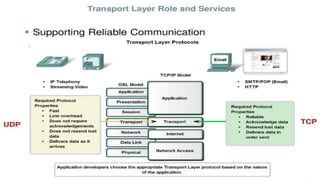
Transport Layer Role and Services
 Shares the transport link between applications
 Ensure data reliability
 Handles errors and data losses
Transport Layer Functions
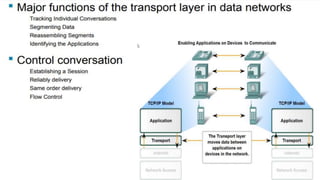
 This Layer is the first one which breaks the information data, supplied by
Application layer in to smaller units called segments. It numbers every byte in
the segment and maintains their accounting.
 This layer ensures that data must be received in the same sequence in which it
was sent.
 This layer provides end-to-end delivery of data between hosts which may or
may not belong to the same subnet.
 All server processes intend to communicate over the network are equipped
with well-known Transport Service Access Points (TSAPs) also known as
port numbers.
End-to-End Communication
A process on one host identifies its peer host on remote network by means of
TSAPs, also known as Port numbers. TSAPs are very well defined and a process
which is trying to communicate with its peer knows this in advance.
The two main Transport layer protocols are:
1. Transmission Control Protocol
It provides reliable communication between two hosts.
2. User Datagram Protocol
It provides unreliable communication between two hosts.
Applications Requirements Vary
• Because different applications have different requirements, there are multiple
Transport layer protocols.
Transmission Control Protocol TCP
Features
 TCP is reliable protocol. That is, the receiver always sends either positive or
negative acknowledgement about the data packet to the sender, so that the
sender always has bright clue about whether the data packet is reached the
destination or it needs to resend it.
 TCP ensures that the data reaches intended destination in the same order it was
sent.
 TCP is connection oriented. TCP requires that connection between two remote
points be established before sending actual data.
 TCP provides error-checking and recovery mechanism.
 TCP provides end-to-end communication.
 TCP provides flow control and quality of service.
 TCP operates in Client/Server point-to-point mode.
 TCP provides full duplex server, i.e. it can perform roles of both receiver and
sender.
Header
The length of TCP header is minimum 20 bytes and maximum 60 bytes.
 Source Port (16-bits): It identifies source port of the application process on the sending device.
 Destination Port (16-bits): It identifies destination port of the application process on the receiving device.
 Sequence Number (32-bits): Sequence number of data bytes of a segment in a session.
 Acknowledgement Number (32-bits): When ACK flag is set, this number contains the next sequence number of
the data byte expected and works as acknowledgement of the previous data received.
 Data Offset (4-bits): This field implies both, the size of TCP header (32-bit words) and the offset of data in
current packet in the whole TCP segment.
 Reserved (3-bits): Reserved for future use and all are set zero by default.
 Flags (1-bit each):
o NS: Nonce Sum bit is used by Explicit Congestion Notification signaling process.
o CWR: When a host receives packet with ECE bit set, it sets Congestion Windows Reduced to acknowledge
that ECE received.
o ECE: It has two meanings:
 If SYN bit is clear to 0, then ECE means that the IP packet has its CE (congestion experience) bit set.
 If SYN bit is set to 1, ECE means that the device is ECT capable.
o URG: It indicates that Urgent Pointer field has significant data and should be processed.
o ACK: It indicates that Acknowledgement field has significance. If ACK is cleared to 0, it indicates that packet
does not contain any acknowledgement.
o PSH: When set, it is a request to the receiving station to PUSH data as soon as it comes to the receiving
application without buffering it.
o RST: Reset flag has the following features:
 It is used to refuse an incoming connection.
 It is used to reject a segment.
 It is used to restart a connection.
o SYN: This flag is used to set up a connection between hosts.
o FIN: This flag is used to release a connection and no more data is exchanged thereafter. Because packets
with SYN and FIN flags have sequence numbers, they are processed in correct order.
 Windows Size: This field is used for flow control between two stations and indicates the amount of buffer (in
bytes) the receiver has allocated for a segment, i.e. how much data is the receiver expecting.
 Checksum: This field contains the checksum of Header, Data, and Pseudo Headers.
 Urgent Pointer: It points to the urgent data byte if URG flag is set to 1.
 Options: It facilitates additional options which are not covered by the regular header. Option field is always
described in 32-bit words. If this field contains data less than 32-bit, padding is used to cover the remaining
bits to reach 32-bit boundary.
Addressing:TCP communication between two remote hosts is done by means of port
numbers (TSAPs). Ports numbers can range from 0 – 65535 which are divided as:
System Ports (0 – 1023)
User Ports ( 1024 – 49151)
Private/Dynamic Ports (49152 – 65535)
Socket address: combination of an IP address and a port number.
Connection Management
TCP communication works in Server/Client model. The client initiates the
connection and the server either accepts or rejects it. Three-way handshaking is
used for connection management.
Establishment
Client initiates the connection and sends the segment with a Sequence number.
Server acknowledges it back with its own Sequence number and ACK of client’s
segment which is one more than client’s Sequence number. Client after receiving
ACK of its segment sends an acknowledgement of Server’s response.
Release
Either of server and client can send TCP segment with FIN flag set to 1. When the
receiving end responds it back by ACKnowledging FIN, that direction of TCP
communication is closed and connection is released.
Bandwidth Management
TCP uses the concept of window size to accommodate the need of Bandwidth
management. Window size tells the sender at the remote end the number of data
byte segments the receiver at this end can receive. TCP uses slow start phase by
using window size 1 and increases the window size exponentially after each
successful communication.
For example, the client uses windows size 2 and sends 2 bytes of data. When the
acknowledgement of this segment received the windows size is doubled to 4 and
next the segment sent will be 4 data bytes long. When the acknowledgement of 4-
byte data segment is received, the client sets windows size to 8 and so on.
If an acknowledgement is missed, i.e. data lost in transit network or it received
NACK, then the window size is reduced to half and slow start phase starts again.
Error Control and Flow Control
TCP uses port numbers to know what application process it needs to handover the
data segment. Along with that, it uses sequence numbers to synchronize itself with
the remote host. All data segments are sent and received with sequence numbers.
The Sender knows which last data segment was received by the Receiver when it
gets ACK. The Receiver knows about the last segment sent by the Sender by
referring to the sequence number of recently received packet.
If the sequence number of a segment recently received does not match with the
sequence number the receiver was expecting, then it is discarded and NACK is sent
back. If two segments arrive with the same sequence number, the TCP timestamp
value is compared to make a decision.
Multiplexing
The technique to combine two or more data streams in one session is called
Multiplexing. When a TCP client initializes a connection with Server, it always
refers to a well-defined port number which indicates the application process. The
client itself uses a randomly generated port number from private port number
pools.
Using TCP Multiplexing, a client can communicate with a number of different
application process in a single session. For example, a client requests a web page
which in turn contains different types of data (HTTP, SMTP, FTP etc.) the TCP
session timeout is increased and the session is kept open for longer time so that the
three-way handshake overhead can be avoided.
This enables the client system to receive multiple connection over single virtual
connection. These virtual connections are not good for Servers if the timeout is too
long.
Congestion Control
When large amount of data is fed to system which is not capable of handling it,
congestion occurs. TCP controls congestion by means of Window mechanism.
TCP sets a window size telling the other end how much data segment to send.
TCP may use three algorithms for congestion control:
Additive increase, Multiplicative Decrease
Slow Start
Timeout React
Timer Management
TCP uses different types of timers to control and management various tasks:
Keep-alive timer:
 This timer is used to check the integrity and validity of a connection.
 When keep-alive time expires, the host sends a probe to check if the connection still exists.
Retransmission timer:
 This timer maintains stateful session of data sent.
 If the acknowledgement of sent data does not receive within the Retransmission time, the
data segment is sent again.
Persist timer:
 TCP session can be paused by either host by sending Window Size 0.
 To resume the session a host needs to send Window Size with some larger value.
 If this segment never reaches the other end, both ends may wait for each other for infinite time.
 When the Persist timer expires, the host resends its window size to let the other end know.
 Persist Timer helps avoid deadlocks in communication.
Timed-Wait:
 After releasing a connection, either of the hosts waits for a Timed-Wait time to terminate
the connection completely.
 This is in order to make sure that the other end has received the acknowledgement of its
connection termination request.
 Timed-out can be a maximum of 240 seconds (4 minutes).
Crash Recovery
TCP is very reliable protocol. It provides sequence number to each of byte sent in segment. It
provides the feedback mechanism i.e. when a host receives a packet, it is bound to ACK that
packet having the next sequence number expected (if it is not the last segment).
When a TCP Server crashes mid-way communication and re-starts its process, it sends TPDU
broadcast to all its hosts. The hosts can then send the last data segment which was never
unacknowledged and carry onwards.
User Datagram Protocol UDP
The User Datagram Protocol (UDP) is simplest Transport Layer communication protocol
available of the TCP/IP protocol suite. It involves minimum amount of communication
mechanism. UDP is said to be an unreliable transport protocol but it uses IP services which
provides best effort delivery mechanism.
In UDP, the receiver does not generate an acknowledgement of packet received and in turn, the
sender does not wait for any acknowledgement of packet sent. This shortcoming makes this
protocol unreliable as well as easier on processing.
Requirement of UDP
A question may arise, why do we need an unreliable protocol to transport the data? We deploy
UDP where the acknowledgement packets share significant amount of bandwidth along with the
actual data. For example, in case of video streaming, thousands of packets are forwarded
towards its users. Acknowledging all the packets is troublesome and may contain huge amount
of bandwidth wastage. The best delivery mechanism of underlying IP protocol ensures best
efforts to deliver its packets, but even if some packets in video streaming get lost, the impact is
not calamitous and can be ignored easily. Loss of few packets in video and voice traffic
sometimes goes unnoticed.
Features of UDP
 UDP is used when acknowledgement of data does not hold any significance.
 UDP is good protocol for data flowing in one direction.
 UDP is simple and suitable for query based communications.
 UDP is not connection oriented.
 UDP does not provide congestion control mechanism.
 UDP does not guarantee ordered delivery of data.
 UDP is stateless.
 UDP is suitable protocol for streaming applications such as VoIP, multimedia
streaming.
UDP Header
UDP header is as simple as its function.
UDP header contains four main parameters:
 Source Port: This 16 bits information is used to identify the source port of the packet.
 Destination Port: This 16 bits information is used identify application level service on
destination machine.
 Length: Length field specifies the entire length of UDP packet (including header). It is
16-bits field and minimum value is 8-byte, i.e. the size of UDP header itself.
 Checksum: This field stores the checksum value generated by the sender before sending.
IPv4 has this field as optional so when checksum field does not contain any value, it is
made 0 and all its bits are set to zero.
UDP application
Here are few applications where UDP is used to transmit data:
Domain Name Services
Simple Network Management Protocol
Trivial File Transfer Protocol
Routing Information Protocol
Kerberos
UDP Encapsulation and Decapsulation
When a process has a message to send through UDP, it passes the message to UDP
along with a pair of socket addresses and the length of data.
UDP Data Transfer
Transport_Layer_Protocols.pptx

Transport_Layer_Protocols.pptx

  • 1.
  • 2.
    All modules andprocedures pertaining to transportation of data or data stream are categorized into this layer. As all other layers, this layer communicates with its peer Transport layer of the remote host. Transport layer offers peer-to-peer and end-to-end connection between two processes on remote hosts. Transport layer takes data from upper layer (i.e. Application layer) and then breaks it into smaller size segments, numbers each byte, and hands over to lower layer (Network Layer) for delivery.
  • 3.
    Transport Layer Roleand Services  Shares the transport link between applications  Ensure data reliability  Handles errors and data losses
  • 4.
    Transport Layer Functions This Layer is the first one which breaks the information data, supplied by Application layer in to smaller units called segments. It numbers every byte in the segment and maintains their accounting.  This layer ensures that data must be received in the same sequence in which it was sent.  This layer provides end-to-end delivery of data between hosts which may or may not belong to the same subnet.  All server processes intend to communicate over the network are equipped with well-known Transport Service Access Points (TSAPs) also known as port numbers.
  • 6.
    End-to-End Communication A processon one host identifies its peer host on remote network by means of TSAPs, also known as Port numbers. TSAPs are very well defined and a process which is trying to communicate with its peer knows this in advance.
  • 7.
    The two mainTransport layer protocols are: 1. Transmission Control Protocol It provides reliable communication between two hosts. 2. User Datagram Protocol It provides unreliable communication between two hosts. Applications Requirements Vary • Because different applications have different requirements, there are multiple Transport layer protocols.
  • 9.
    Transmission Control ProtocolTCP Features  TCP is reliable protocol. That is, the receiver always sends either positive or negative acknowledgement about the data packet to the sender, so that the sender always has bright clue about whether the data packet is reached the destination or it needs to resend it.  TCP ensures that the data reaches intended destination in the same order it was sent.  TCP is connection oriented. TCP requires that connection between two remote points be established before sending actual data.  TCP provides error-checking and recovery mechanism.  TCP provides end-to-end communication.  TCP provides flow control and quality of service.  TCP operates in Client/Server point-to-point mode.  TCP provides full duplex server, i.e. it can perform roles of both receiver and sender.
  • 10.
    Header The length ofTCP header is minimum 20 bytes and maximum 60 bytes.
  • 11.
     Source Port(16-bits): It identifies source port of the application process on the sending device.  Destination Port (16-bits): It identifies destination port of the application process on the receiving device.  Sequence Number (32-bits): Sequence number of data bytes of a segment in a session.  Acknowledgement Number (32-bits): When ACK flag is set, this number contains the next sequence number of the data byte expected and works as acknowledgement of the previous data received.  Data Offset (4-bits): This field implies both, the size of TCP header (32-bit words) and the offset of data in current packet in the whole TCP segment.  Reserved (3-bits): Reserved for future use and all are set zero by default.  Flags (1-bit each): o NS: Nonce Sum bit is used by Explicit Congestion Notification signaling process. o CWR: When a host receives packet with ECE bit set, it sets Congestion Windows Reduced to acknowledge that ECE received. o ECE: It has two meanings:  If SYN bit is clear to 0, then ECE means that the IP packet has its CE (congestion experience) bit set.  If SYN bit is set to 1, ECE means that the device is ECT capable. o URG: It indicates that Urgent Pointer field has significant data and should be processed. o ACK: It indicates that Acknowledgement field has significance. If ACK is cleared to 0, it indicates that packet does not contain any acknowledgement.
  • 12.
    o PSH: Whenset, it is a request to the receiving station to PUSH data as soon as it comes to the receiving application without buffering it. o RST: Reset flag has the following features:  It is used to refuse an incoming connection.  It is used to reject a segment.  It is used to restart a connection. o SYN: This flag is used to set up a connection between hosts. o FIN: This flag is used to release a connection and no more data is exchanged thereafter. Because packets with SYN and FIN flags have sequence numbers, they are processed in correct order.  Windows Size: This field is used for flow control between two stations and indicates the amount of buffer (in bytes) the receiver has allocated for a segment, i.e. how much data is the receiver expecting.  Checksum: This field contains the checksum of Header, Data, and Pseudo Headers.  Urgent Pointer: It points to the urgent data byte if URG flag is set to 1.  Options: It facilitates additional options which are not covered by the regular header. Option field is always described in 32-bit words. If this field contains data less than 32-bit, padding is used to cover the remaining bits to reach 32-bit boundary.
  • 13.
    Addressing:TCP communication betweentwo remote hosts is done by means of port numbers (TSAPs). Ports numbers can range from 0 – 65535 which are divided as: System Ports (0 – 1023) User Ports ( 1024 – 49151) Private/Dynamic Ports (49152 – 65535) Socket address: combination of an IP address and a port number.
  • 15.
    Connection Management TCP communicationworks in Server/Client model. The client initiates the connection and the server either accepts or rejects it. Three-way handshaking is used for connection management.
  • 16.
    Establishment Client initiates theconnection and sends the segment with a Sequence number. Server acknowledges it back with its own Sequence number and ACK of client’s segment which is one more than client’s Sequence number. Client after receiving ACK of its segment sends an acknowledgement of Server’s response. Release Either of server and client can send TCP segment with FIN flag set to 1. When the receiving end responds it back by ACKnowledging FIN, that direction of TCP communication is closed and connection is released.
  • 18.
    Bandwidth Management TCP usesthe concept of window size to accommodate the need of Bandwidth management. Window size tells the sender at the remote end the number of data byte segments the receiver at this end can receive. TCP uses slow start phase by using window size 1 and increases the window size exponentially after each successful communication. For example, the client uses windows size 2 and sends 2 bytes of data. When the acknowledgement of this segment received the windows size is doubled to 4 and next the segment sent will be 4 data bytes long. When the acknowledgement of 4- byte data segment is received, the client sets windows size to 8 and so on. If an acknowledgement is missed, i.e. data lost in transit network or it received NACK, then the window size is reduced to half and slow start phase starts again.
  • 19.
    Error Control andFlow Control TCP uses port numbers to know what application process it needs to handover the data segment. Along with that, it uses sequence numbers to synchronize itself with the remote host. All data segments are sent and received with sequence numbers. The Sender knows which last data segment was received by the Receiver when it gets ACK. The Receiver knows about the last segment sent by the Sender by referring to the sequence number of recently received packet. If the sequence number of a segment recently received does not match with the sequence number the receiver was expecting, then it is discarded and NACK is sent back. If two segments arrive with the same sequence number, the TCP timestamp value is compared to make a decision.
  • 21.
    Multiplexing The technique tocombine two or more data streams in one session is called Multiplexing. When a TCP client initializes a connection with Server, it always refers to a well-defined port number which indicates the application process. The client itself uses a randomly generated port number from private port number pools. Using TCP Multiplexing, a client can communicate with a number of different application process in a single session. For example, a client requests a web page which in turn contains different types of data (HTTP, SMTP, FTP etc.) the TCP session timeout is increased and the session is kept open for longer time so that the three-way handshake overhead can be avoided. This enables the client system to receive multiple connection over single virtual connection. These virtual connections are not good for Servers if the timeout is too long.
  • 23.
    Congestion Control When largeamount of data is fed to system which is not capable of handling it, congestion occurs. TCP controls congestion by means of Window mechanism. TCP sets a window size telling the other end how much data segment to send. TCP may use three algorithms for congestion control: Additive increase, Multiplicative Decrease Slow Start Timeout React
  • 24.
    Timer Management TCP usesdifferent types of timers to control and management various tasks: Keep-alive timer:  This timer is used to check the integrity and validity of a connection.  When keep-alive time expires, the host sends a probe to check if the connection still exists. Retransmission timer:  This timer maintains stateful session of data sent.  If the acknowledgement of sent data does not receive within the Retransmission time, the data segment is sent again. Persist timer:  TCP session can be paused by either host by sending Window Size 0.  To resume the session a host needs to send Window Size with some larger value.  If this segment never reaches the other end, both ends may wait for each other for infinite time.  When the Persist timer expires, the host resends its window size to let the other end know.  Persist Timer helps avoid deadlocks in communication.
  • 25.
    Timed-Wait:  After releasinga connection, either of the hosts waits for a Timed-Wait time to terminate the connection completely.  This is in order to make sure that the other end has received the acknowledgement of its connection termination request.  Timed-out can be a maximum of 240 seconds (4 minutes). Crash Recovery TCP is very reliable protocol. It provides sequence number to each of byte sent in segment. It provides the feedback mechanism i.e. when a host receives a packet, it is bound to ACK that packet having the next sequence number expected (if it is not the last segment). When a TCP Server crashes mid-way communication and re-starts its process, it sends TPDU broadcast to all its hosts. The hosts can then send the last data segment which was never unacknowledged and carry onwards.
  • 26.
    User Datagram ProtocolUDP The User Datagram Protocol (UDP) is simplest Transport Layer communication protocol available of the TCP/IP protocol suite. It involves minimum amount of communication mechanism. UDP is said to be an unreliable transport protocol but it uses IP services which provides best effort delivery mechanism. In UDP, the receiver does not generate an acknowledgement of packet received and in turn, the sender does not wait for any acknowledgement of packet sent. This shortcoming makes this protocol unreliable as well as easier on processing. Requirement of UDP A question may arise, why do we need an unreliable protocol to transport the data? We deploy UDP where the acknowledgement packets share significant amount of bandwidth along with the actual data. For example, in case of video streaming, thousands of packets are forwarded towards its users. Acknowledging all the packets is troublesome and may contain huge amount of bandwidth wastage. The best delivery mechanism of underlying IP protocol ensures best efforts to deliver its packets, but even if some packets in video streaming get lost, the impact is not calamitous and can be ignored easily. Loss of few packets in video and voice traffic sometimes goes unnoticed.
  • 28.
    Features of UDP UDP is used when acknowledgement of data does not hold any significance.  UDP is good protocol for data flowing in one direction.  UDP is simple and suitable for query based communications.  UDP is not connection oriented.  UDP does not provide congestion control mechanism.  UDP does not guarantee ordered delivery of data.  UDP is stateless.  UDP is suitable protocol for streaming applications such as VoIP, multimedia streaming.
  • 29.
    UDP Header UDP headeris as simple as its function.
  • 30.
    UDP header containsfour main parameters:  Source Port: This 16 bits information is used to identify the source port of the packet.  Destination Port: This 16 bits information is used identify application level service on destination machine.  Length: Length field specifies the entire length of UDP packet (including header). It is 16-bits field and minimum value is 8-byte, i.e. the size of UDP header itself.  Checksum: This field stores the checksum value generated by the sender before sending. IPv4 has this field as optional so when checksum field does not contain any value, it is made 0 and all its bits are set to zero. UDP application Here are few applications where UDP is used to transmit data: Domain Name Services Simple Network Management Protocol Trivial File Transfer Protocol Routing Information Protocol Kerberos
  • 31.
    UDP Encapsulation andDecapsulation When a process has a message to send through UDP, it passes the message to UDP along with a pair of socket addresses and the length of data.
  • 32.