Elemica – T&L sourcing
Optimization
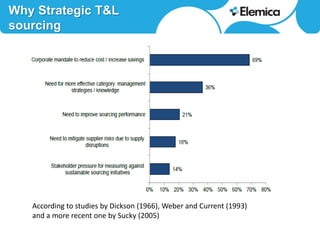
Why Strategic T&L
sourcing
According to studies by Dickson (1966), Weber and Current (1993)
and a more recent one by Sucky (2005)
Trend in T&L sourcing
• Tender complexity increases
– From local to regional tendering
– From service specific to
Network
• Increasing Supply chain
performance demands
– Transit time reliability
– Ability to absorb disruptions,
Alternative services and routings
Optimize your tendering
process
Speed up your decision process
• Develop awarding scenario’s
upfront and check after every
round where you are.
• Know your implementation cost
before you consider switching
suppliers.
• Reduce your workload during a
tender, focus only on those
area’s where you can gain.
Optimize your analyses
• Utilize your historical data to simulate the
cost of your future network with elements
such as:
– Weights/volumes.
– Peaks
– Routings
• Execute a sensitivity checks:
 currencies,
 fuel, e.d.
Optimize the decision
• Find the best between
• Current status and Cheapest pricing
• quality and timeliness
• Mitigate supplier risks to supply chain disruption
• Current and alternative performance (better or worse)
• Use the knowledge from your historical data.
• disturbances, reliability
We have a great tool
Our tool helps you to support these decisions.
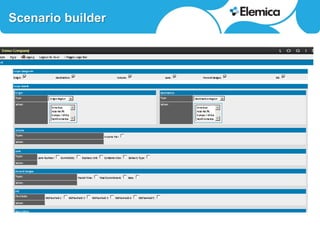
• It evaluate the effects of your awarding scenario’s
with a baseline: What if you would stick to our
incumbents.
• Scenario’s are based on various constrains.
– It quantifies the financial impact your objectives
or constrains have.
• For example: reduce the nr carriers by location to 1.
– You compare the difference and measure it
against the effects to your supply chain.
Scenario builder
An example
Small parcels
• Small parcels
• Weight < 70 kg
• Dimensions:
Max hight = 60 cm
Max width = 60 cm
Max length = 120 cm
and 2* Hight + 2*width + length < 3 meter.
• Service
• World wide pick-up or delivery
• Express delivery before 9, 12 or end of day
• Expedited service (consolidation and slower
transport means)
Market
• Main players are
– UPS
– DHL
– Fedex
– TNT
– GLS
Each of these players have own “strong area’s”
where they are able to offer “domestic” small
parcel services.
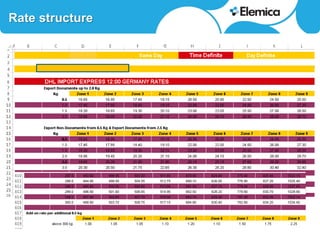
Rate structure
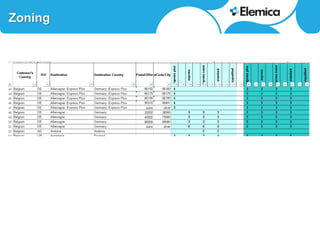
Zoning
Zoning
Focus changed
• Focus has changed from Zone, rate
calculation towards surcharges.
– Fuel can be 0% up to 20% of the cost
• Varies by carrier, Service and freight payer
– Customs clearance
– Special surcharges. Out of business regions etc
Decision making
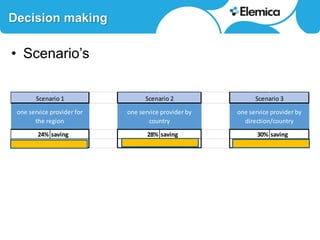
• Scenario’s
24% saving 28% saving 30% saving
Scenario 1 Scenario 2 Scenario 3
one service provider for
the region
one service provider by
country
one service provider by
direction/country
229,636 266,717 285,949
Where do we go to:
• We look for Reliability and quality of your
service providers. The data collected in the
Operating network provides you insight to
current strength and weaknesses of your
partners.
• Model probabilities on:
Carrier Transit times,
Seasonal effects
0
0.2
0.4
0.6
0.8
1
1.2
1 2 3 4 5 6
lane data distribution
of carrier 1 on lane 6
gamma distribution
(aplha=0.9, beta =2)

Fulfillment Breakout – Gary Neights, Elemica: “Demand-Side Order Automation Metrics”

  • 1.
    Elemica – T&Lsourcing Optimization
  • 2.
    Why Strategic T&L sourcing Accordingto studies by Dickson (1966), Weber and Current (1993) and a more recent one by Sucky (2005)
  • 3.
    Trend in T&Lsourcing • Tender complexity increases – From local to regional tendering – From service specific to Network • Increasing Supply chain performance demands – Transit time reliability – Ability to absorb disruptions, Alternative services and routings
  • 4.
    Optimize your tendering process Speedup your decision process • Develop awarding scenario’s upfront and check after every round where you are. • Know your implementation cost before you consider switching suppliers. • Reduce your workload during a tender, focus only on those area’s where you can gain.
  • 5.
    Optimize your analyses •Utilize your historical data to simulate the cost of your future network with elements such as: – Weights/volumes. – Peaks – Routings • Execute a sensitivity checks:  currencies,  fuel, e.d.
  • 6.
    Optimize the decision •Find the best between • Current status and Cheapest pricing • quality and timeliness • Mitigate supplier risks to supply chain disruption • Current and alternative performance (better or worse) • Use the knowledge from your historical data. • disturbances, reliability
  • 7.
    We have agreat tool Our tool helps you to support these decisions. • It evaluate the effects of your awarding scenario’s with a baseline: What if you would stick to our incumbents. • Scenario’s are based on various constrains. – It quantifies the financial impact your objectives or constrains have. • For example: reduce the nr carriers by location to 1. – You compare the difference and measure it against the effects to your supply chain.
  • 8.
  • 9.
    An example Small parcels •Small parcels • Weight < 70 kg • Dimensions: Max hight = 60 cm Max width = 60 cm Max length = 120 cm and 2* Hight + 2*width + length < 3 meter. • Service • World wide pick-up or delivery • Express delivery before 9, 12 or end of day • Expedited service (consolidation and slower transport means)
  • 10.
    Market • Main playersare – UPS – DHL – Fedex – TNT – GLS Each of these players have own “strong area’s” where they are able to offer “domestic” small parcel services.
  • 11.
  • 12.
  • 13.
  • 14.
    Focus changed • Focushas changed from Zone, rate calculation towards surcharges. – Fuel can be 0% up to 20% of the cost • Varies by carrier, Service and freight payer – Customs clearance – Special surcharges. Out of business regions etc
  • 15.
    Decision making • Scenario’s 24%saving 28% saving 30% saving Scenario 1 Scenario 2 Scenario 3 one service provider for the region one service provider by country one service provider by direction/country 229,636 266,717 285,949
  • 16.
    Where do wego to: • We look for Reliability and quality of your service providers. The data collected in the Operating network provides you insight to current strength and weaknesses of your partners. • Model probabilities on: Carrier Transit times, Seasonal effects 0 0.2 0.4 0.6 0.8 1 1.2 1 2 3 4 5 6 lane data distribution of carrier 1 on lane 6 gamma distribution (aplha=0.9, beta =2)