Optimizing Supply Chain
Network Design With
Location Intelligence
TABLE OF
CONTENTS
Introduction
Chapters
What is Supply Chain Network Design?
Supply Chain Network Design Challenges
5 Steps to Create a Supply Chain Network Design
Key Features of a Supply Chain Network Optimization Software
How Location Intelligence Helps Supply Chain Network Optimization
Leverage Dista to Build a Future-Proof and Resilient Supply Chain
1.
2.
3.
4.
5.
6.
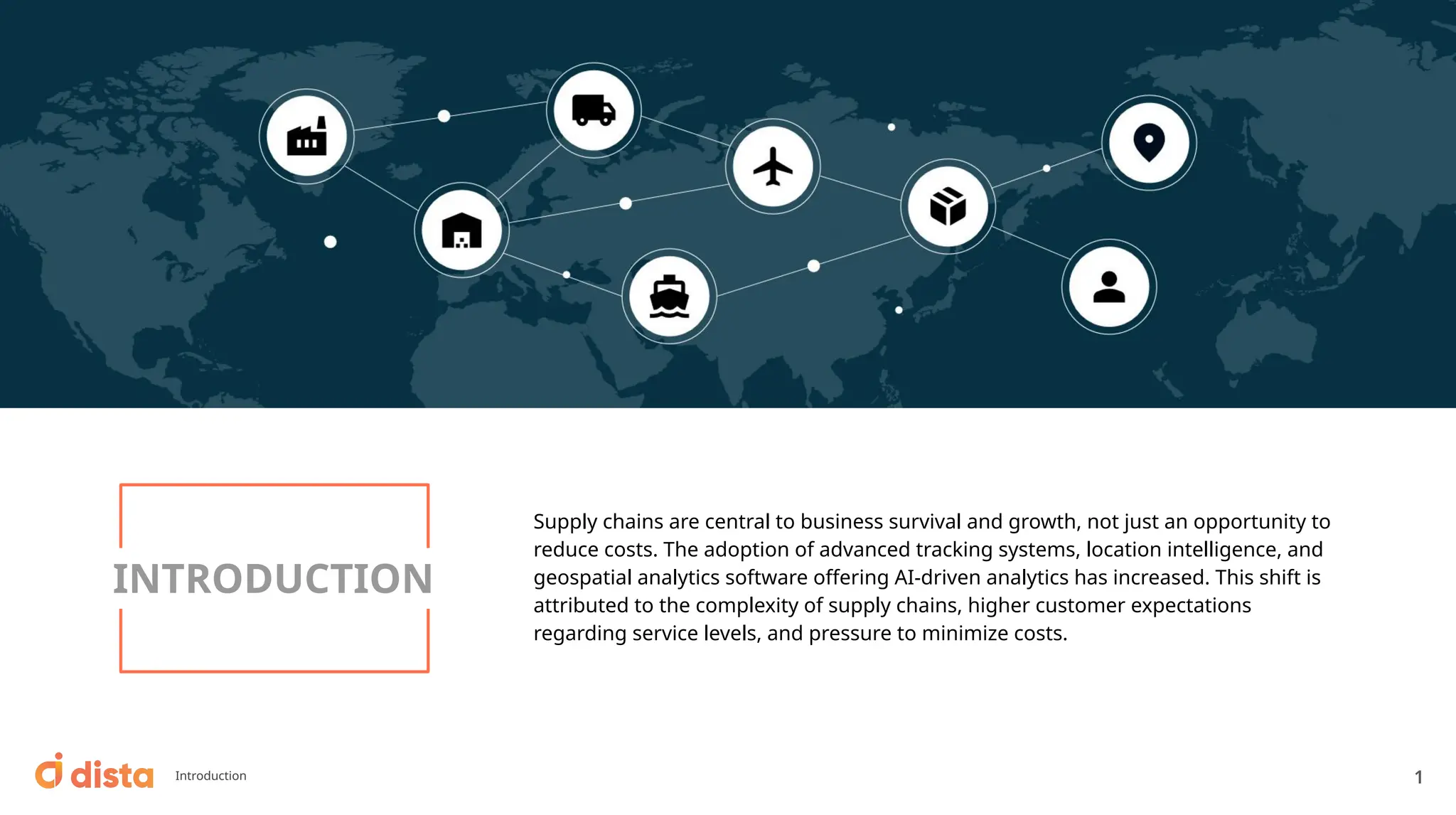
Supply chains are central to business survival and growth, not just an opportunity to
reduce costs. The adoption of advanced tracking systems, location intelligence, and
geospatial analytics software offering AI-driven analytics has increased. This shift is
attributed to the complexity of supply chains, higher customer expectations
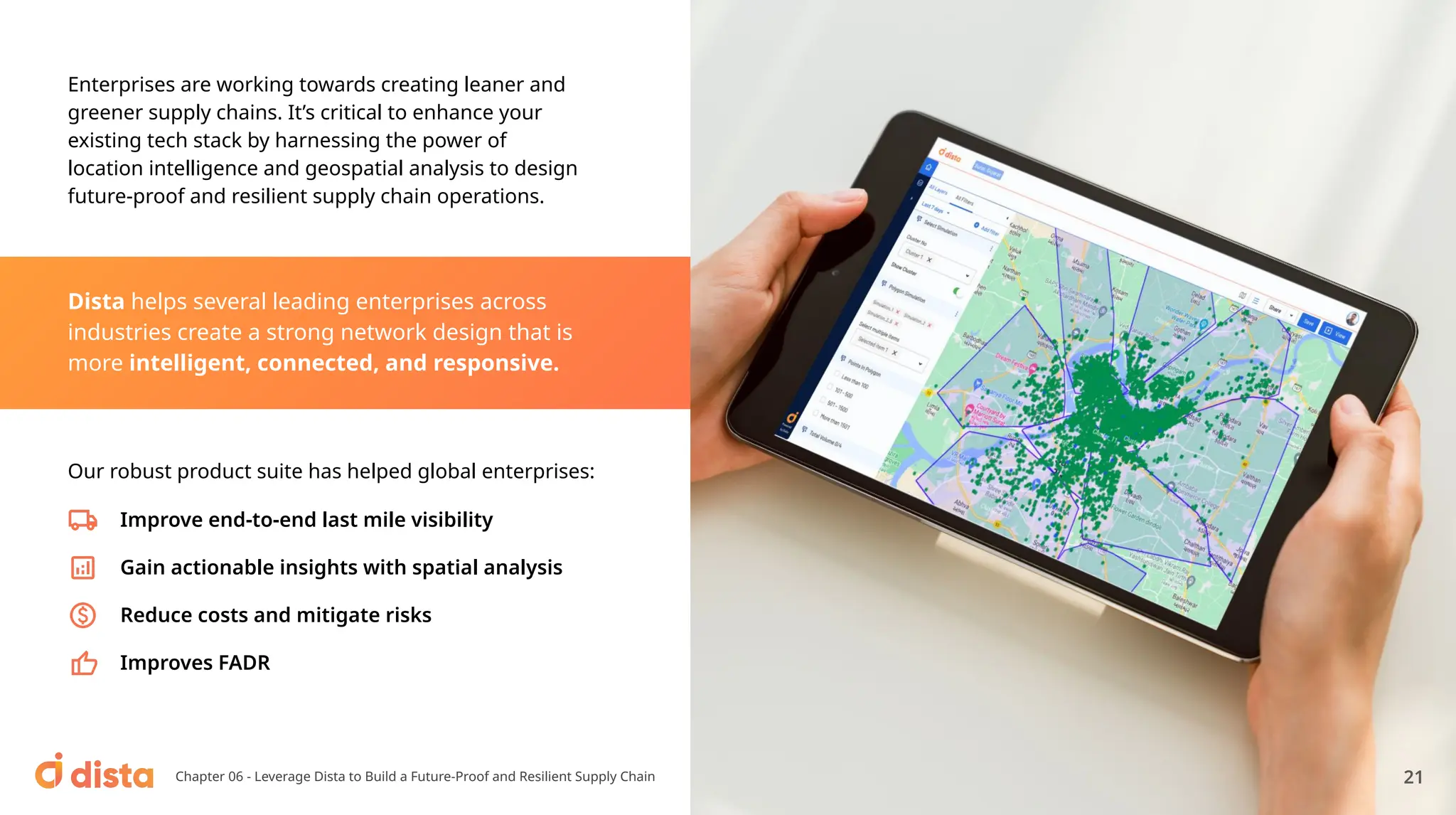
regarding service levels, and pressure to minimize costs.
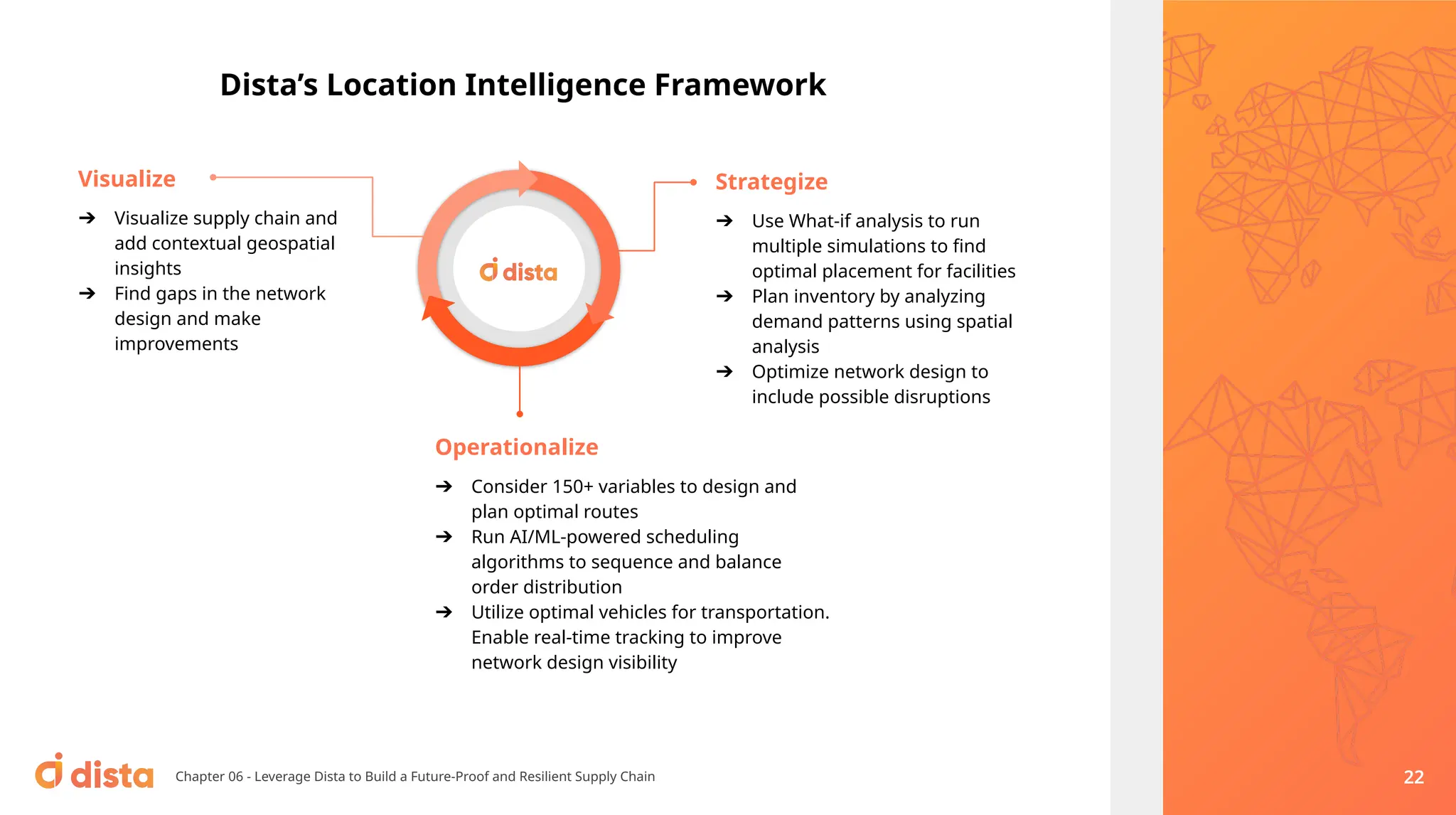
INTRODUCTION
Introduction 1
1
Gartner
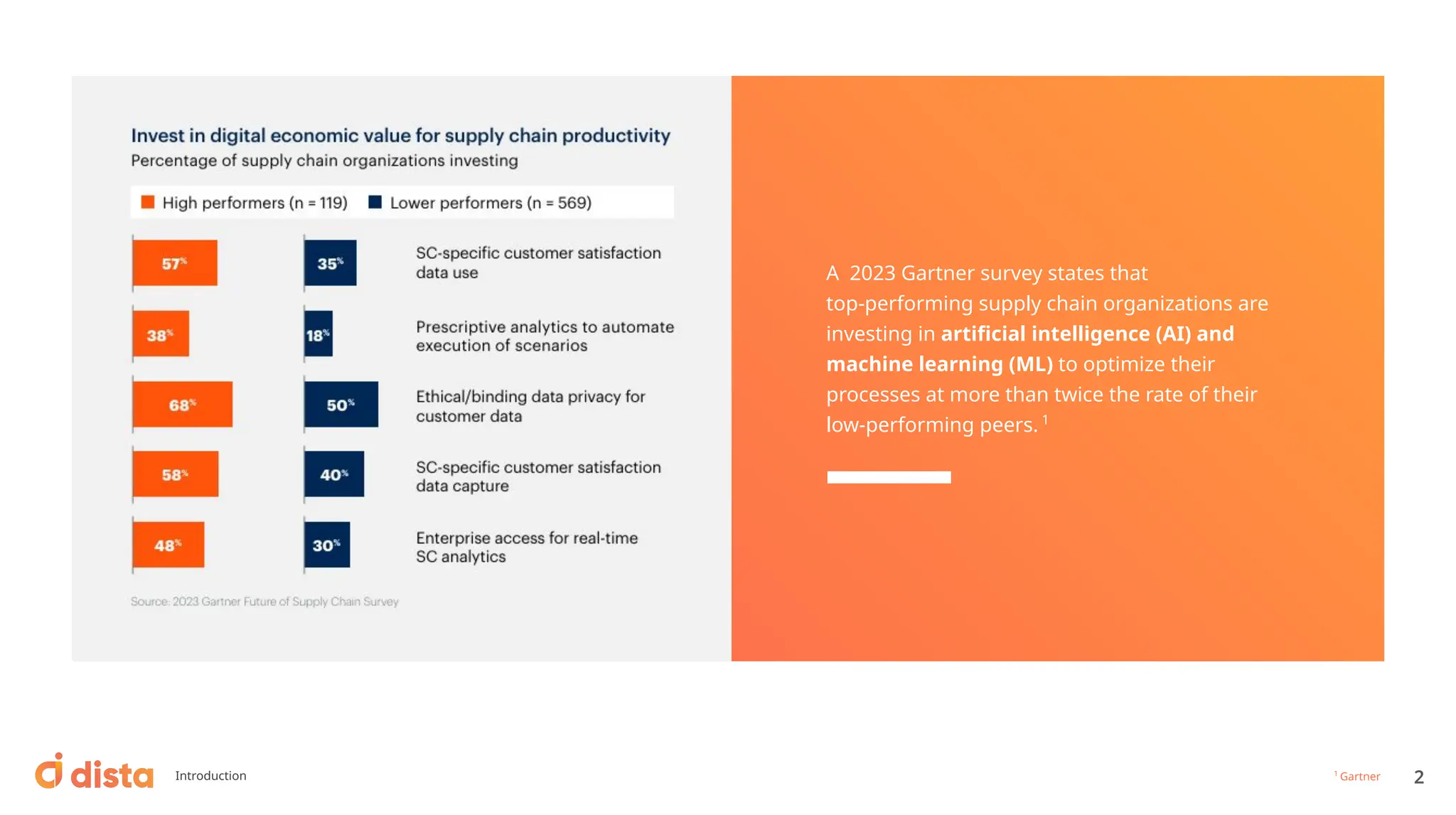
A 2023 Gartner survey states that
top-performing supply chain organizations are
investing in artificial intelligence (AI) and
machine learning (ML) to optimize their
processes at more than twice the rate of their
low-performing peers. 1
2
Introduction
Lowers supply
chain cost
Minimizes inventory
Facilitates faster
route-to-market
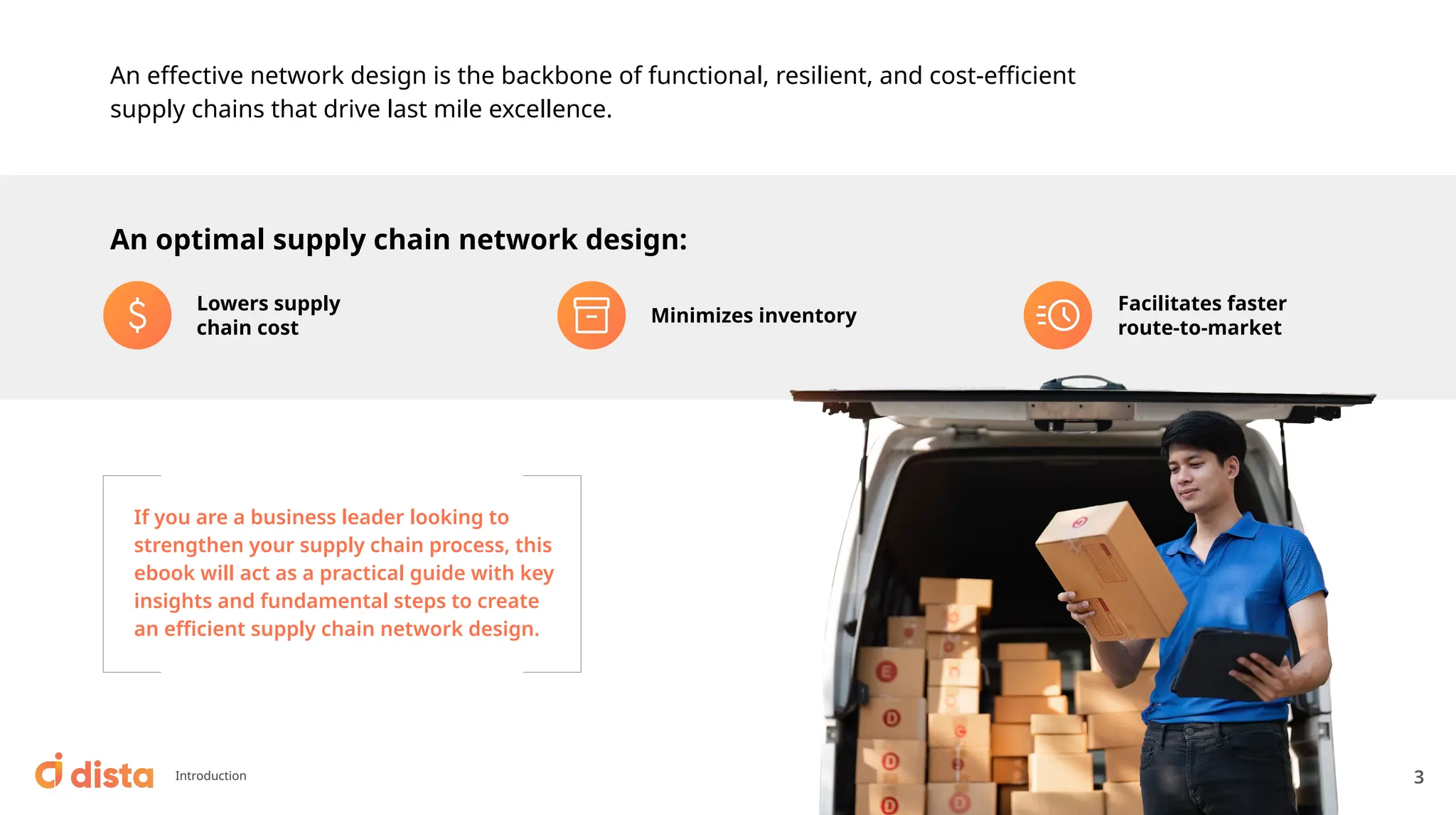
An effective network design is the backbone of functional, resilient, and cost-efficient
supply chains that drive last mile excellence.
An optimal supply chain network design:
If you are a business leader looking to
strengthen your supply chain process, this
ebook will act as a practical guide with key
insights and fundamental steps to create
an efficient supply chain network design.
Introduction 3
What is Supply Chain Network
Design?
Chapter 1
4
Supply chain network design is a process that evaluates the
end-to-end function of your supply chain, from manufacturing
to distribution, transportation, inventories, warehousing, etc.,
to make it cost-effective and efficient.
An optimum supply chain network impacts all its stakeholders,
including manufacturers, suppliers, warehouse managers,
distribution channels, retail and delivery partners, and more.
The main aim of optimizing a supply chain network is to
Minimize costs
Maximize delivery efficiency
Enhance customer experience
Chapter 01 - What is Supply Chain Network Design? 5
Chapter 01 - What is Supply Chain Network Design?
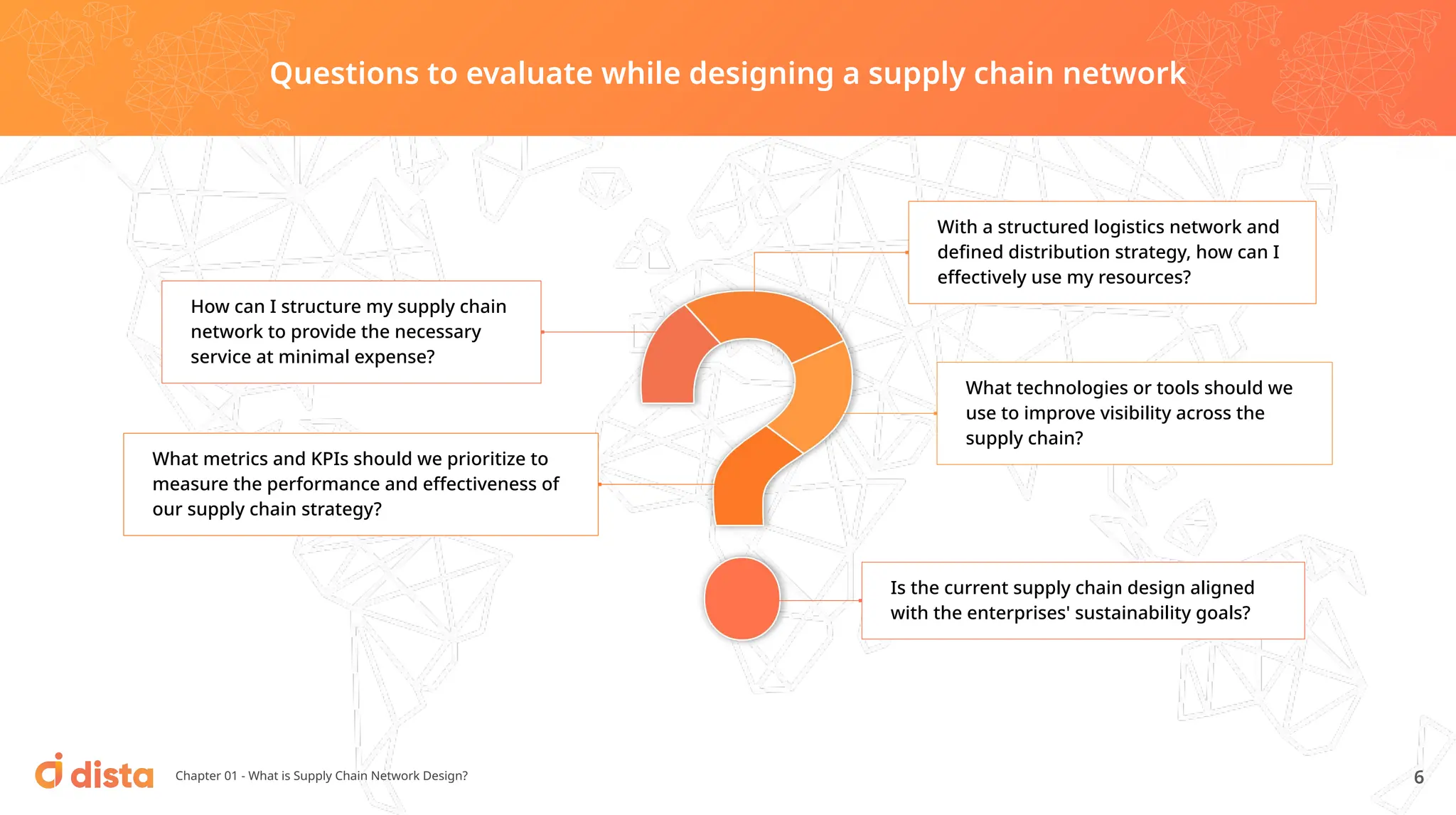
How can I structure my supply chain
network to provide the necessary
service at minimal expense?
With a structured logistics network and
defined distribution strategy, how can I
effectively use my resources?
What technologies or tools should we
use to improve visibility across the
supply chain?
What metrics and KPIs should we prioritize to
measure the performance and effectiveness of
our supply chain strategy?
Is the current supply chain design aligned
with the enterprises' sustainability goals?
Questions to evaluate while designing a supply chain network
6
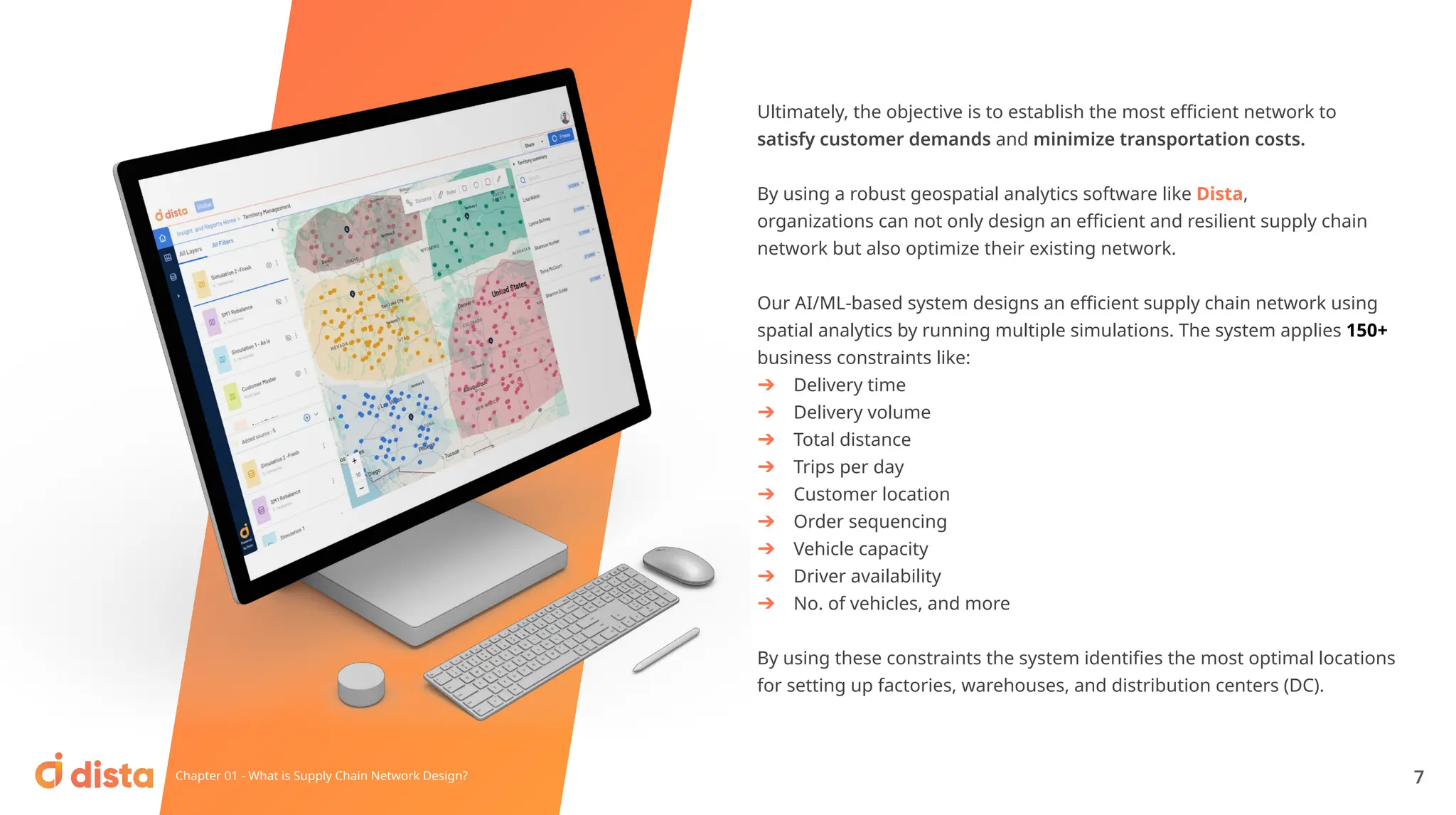
Ultimately, the objective is to establish the most efficient network to
satisfy customer demands and minimize transportation costs.
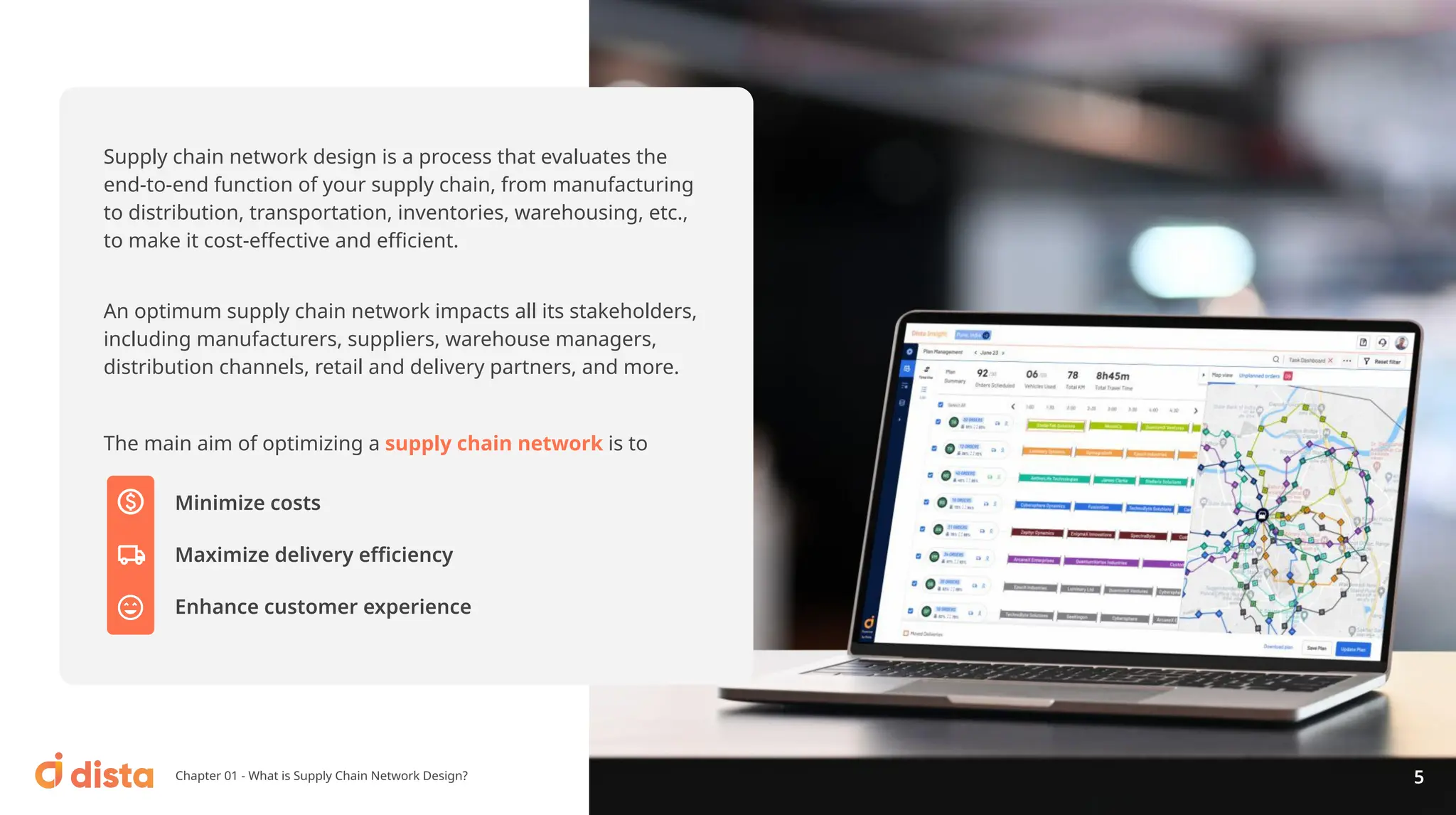
By using a robust geospatial analytics software like Dista,
organizations can not only design an efficient and resilient supply chain
network but also optimize their existing network.
Our AI/ML-based system designs an efficient supply chain network using
spatial analytics by running multiple simulations. The system applies 150+
business constraints like:
➔ Delivery time
➔ Delivery volume
➔ Total distance
➔ Trips per day
➔ Customer location
➔ Order sequencing
➔ Vehicle capacity
➔ Driver availability
➔ No. of vehicles, and more
By using these constraints the system identifies the most optimal locations
for setting up factories, warehouses, and distribution centers (DC).
Chapter 01 - What is Supply Chain Network Design? 7
Supply Chain Network Design
Challenges
Chapter 2
8
Chapter 02 - Supply Chain Network Design Challenges
Complex Global Networks
Global supply chains are complex as
they encompass multiple stakeholders.
Coordinating logistics and complying
with diverse regulatory frameworks
across borders is challenging.
9
Low FADR
Unable to fit dynamic deliveries in
allocated slots resulting in low
first-attempt delivery rate (FADR), poor
customer experience, and high costs
Lack of Geospatial Insights
Lack of critical geospatial insights such
as high customer density areas, low
competition area clusters, map-based
visualization of existing networks,
affects the flow of goods.
Chapter 02 - Supply Chain Network Design Challenges
Disruptions and Risks
Lack of tools to proactively identify and
mitigate risks such as natural
disasters, geopolitical tensions, or
demand fluctuations.
10
Sustainability Compliances
Unable to balance sustainability
objectives like controlling emissions,
minimizing energy waste, etc is daunting
and complicated
Limited Visibility
Limited visibility into the supply chain
network results in ineffective design.
Siloed data of suppliers, customer
demand, logistics, etc.,hampers
operations.
5 Steps to Create a Supply Chain
Network Design
Chapter 3
11
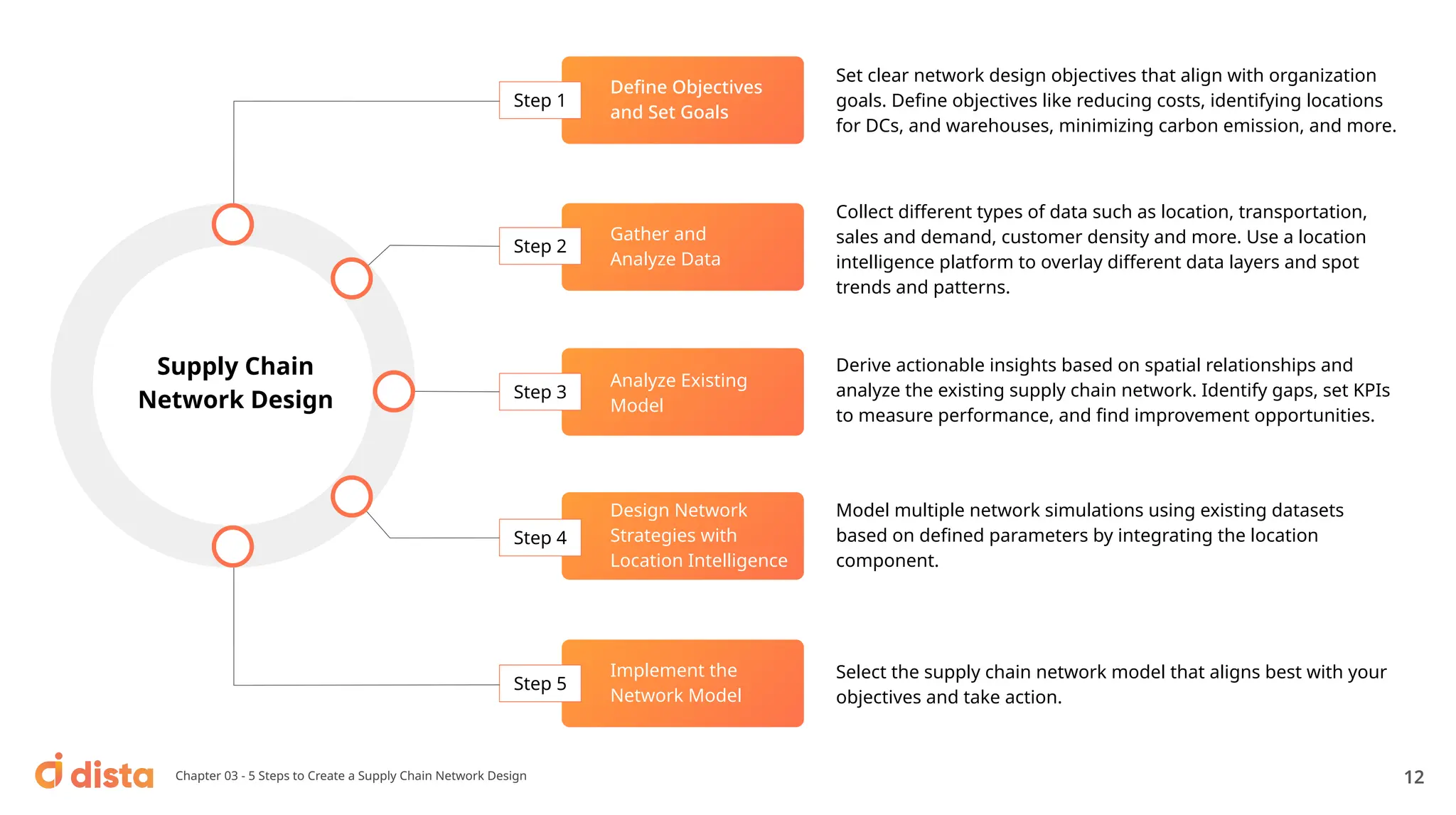
Step 1
Define Objectives
and Set Goals
Set clear network design objectives that align with organization
goals. Define objectives like reducing costs, identifying locations
for DCs, and warehouses, minimizing carbon emission, and more.
Step 2
Gather and
Analyze Data
Collect different types of data such as location, transportation,
sales and demand, customer density and more. Use a location
intelligence platform to overlay different data layers and spot
trends and patterns.
Step 3
Analyze Existing
Model
Derive actionable insights based on spatial relationships and
analyze the existing supply chain network. Identify gaps, set KPIs
to measure performance, and find improvement opportunities.
Step 4
Design Network
Strategies with
Location Intelligence
Model multiple network simulations using existing datasets
based on defined parameters by integrating the location
component.
Step 5
Implement the
Network Model
Select the supply chain network model that aligns best with your
objectives and take action.
Supply Chain
Network Design
Chapter 03 - 5 Steps to Create a Supply Chain Network Design 12
Key Features of a Supply Chain
Network Optimization Software
Chapter 4
13
According to a 2024 KPMG research,
nearly half of supply chain organizations
will invest in applications that support AI
and advanced analytics capabilities.2
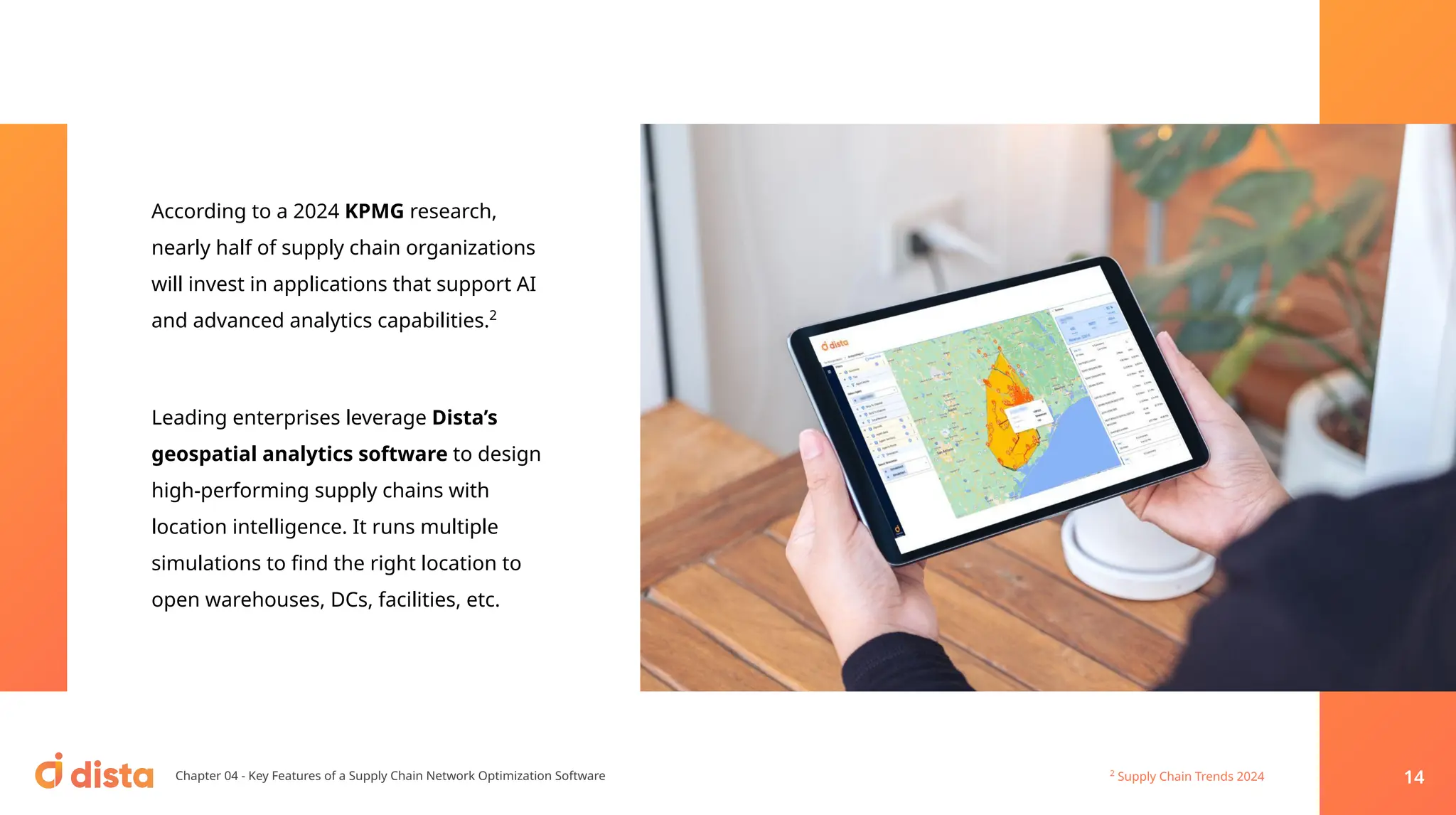
Leading enterprises leverage Dista’s
geospatial analytics software to design
high-performing supply chains with
location intelligence. It runs multiple
simulations to find the right location to
open warehouses, DCs, facilities, etc.
Chapter 04 - Key Features of a Supply Chain Network Optimization Software 2
Supply Chain Trends 2024 14
Key Features
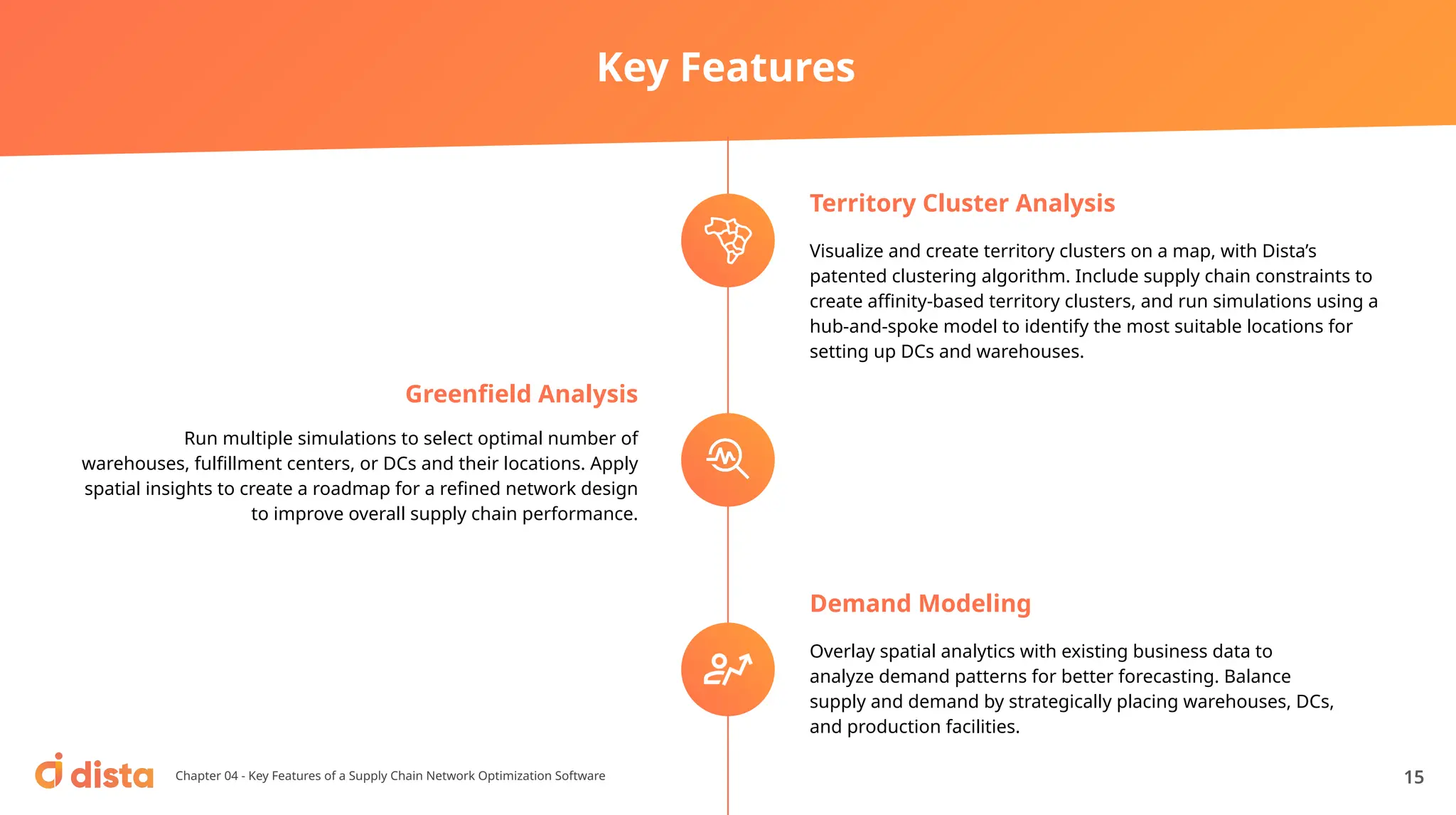
Territory Cluster Analysis
Visualize and create territory clusters on a map, with Dista’s
patented clustering algorithm. Include supply chain constraints to
create affinity-based territory clusters, and run simulations using a
hub-and-spoke model to identify the most suitable locations for
setting up DCs and warehouses.
Greenfield Analysis
Run multiple simulations to select optimal number of
warehouses, fulfillment centers, or DCs and their locations. Apply
spatial insights to create a roadmap for a refined network design
to improve overall supply chain performance.
Demand Modeling
Overlay spatial analytics with existing business data to
analyze demand patterns for better forecasting. Balance
supply and demand by strategically placing warehouses, DCs,
and production facilities.
Chapter 04 - Key Features of a Supply Chain Network Optimization Software 15
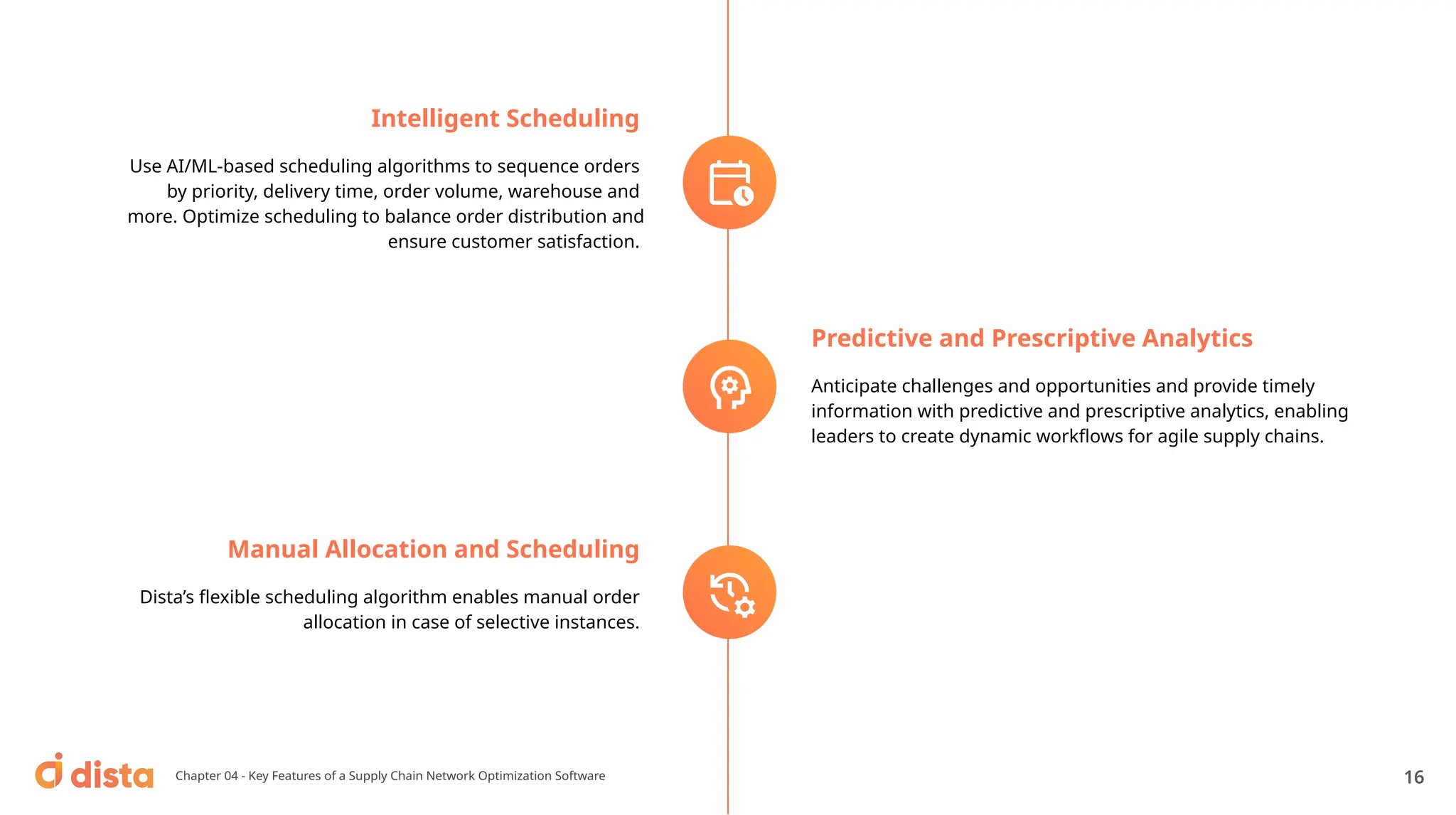
Manual Allocation and Scheduling
Dista’s flexible scheduling algorithm enables manual order
allocation in case of selective instances.
Predictive and Prescriptive Analytics
Anticipate challenges and opportunities and provide timely
information with predictive and prescriptive analytics, enabling
leaders to create dynamic workflows for agile supply chains.
Intelligent Scheduling
Use AI/ML-based scheduling algorithms to sequence orders
by priority, delivery time, order volume, warehouse and
more. Optimize scheduling to balance order distribution and
ensure customer satisfaction.
16
Chapter 04 - Key Features of a Supply Chain Network Optimization Software
How Location Intelligence Helps
Supply Chain Network Optimization
Chapter 5
17
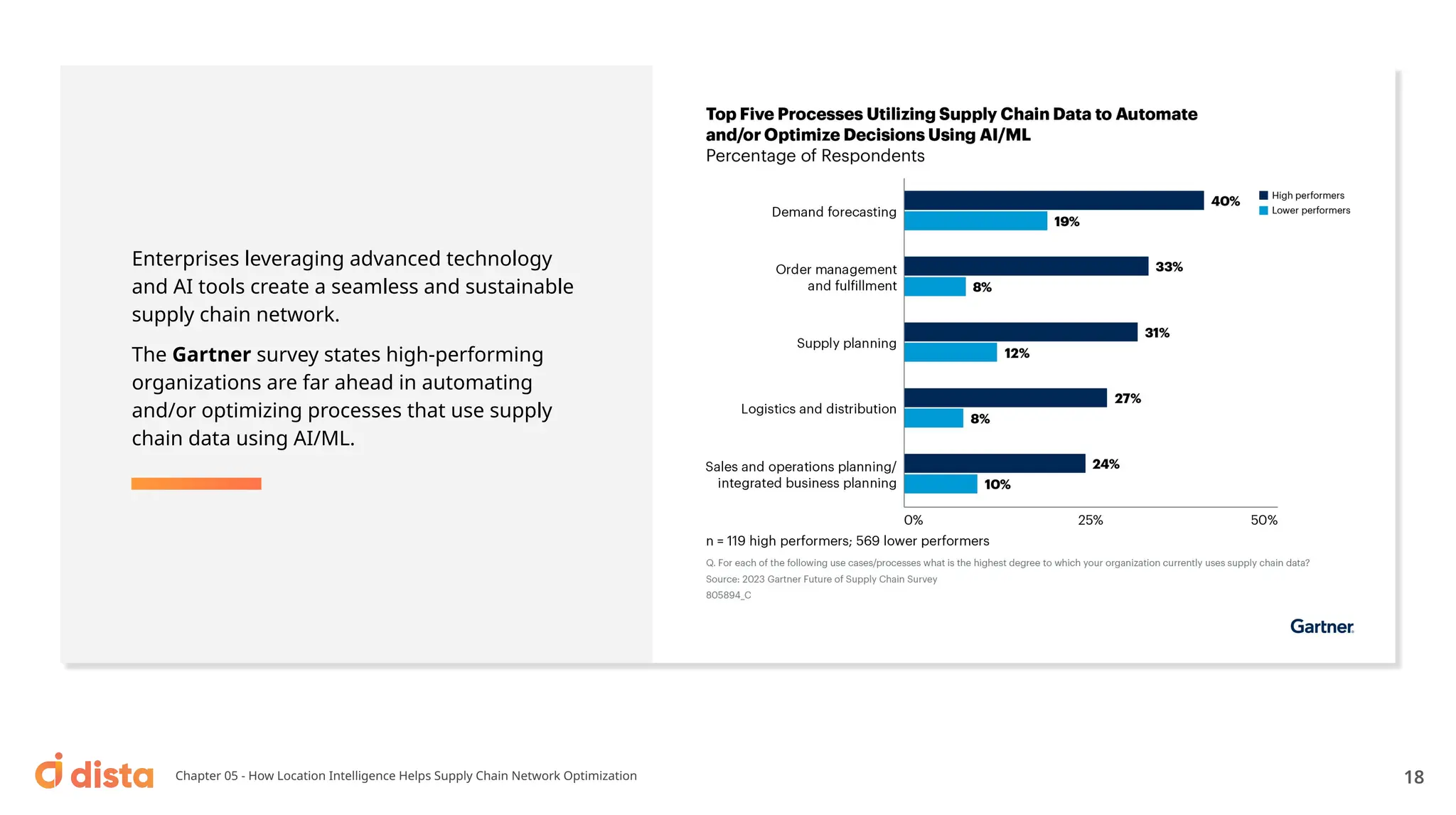
Enterprises leveraging advanced technology
and AI tools create a seamless and sustainable
supply chain network.
The Gartner survey states high-performing
organizations are far ahead in automating
and/or optimizing processes that use supply
chain data using AI/ML.
Chapter 05 - How Location Intelligence Helps Supply Chain Network Optimization 18
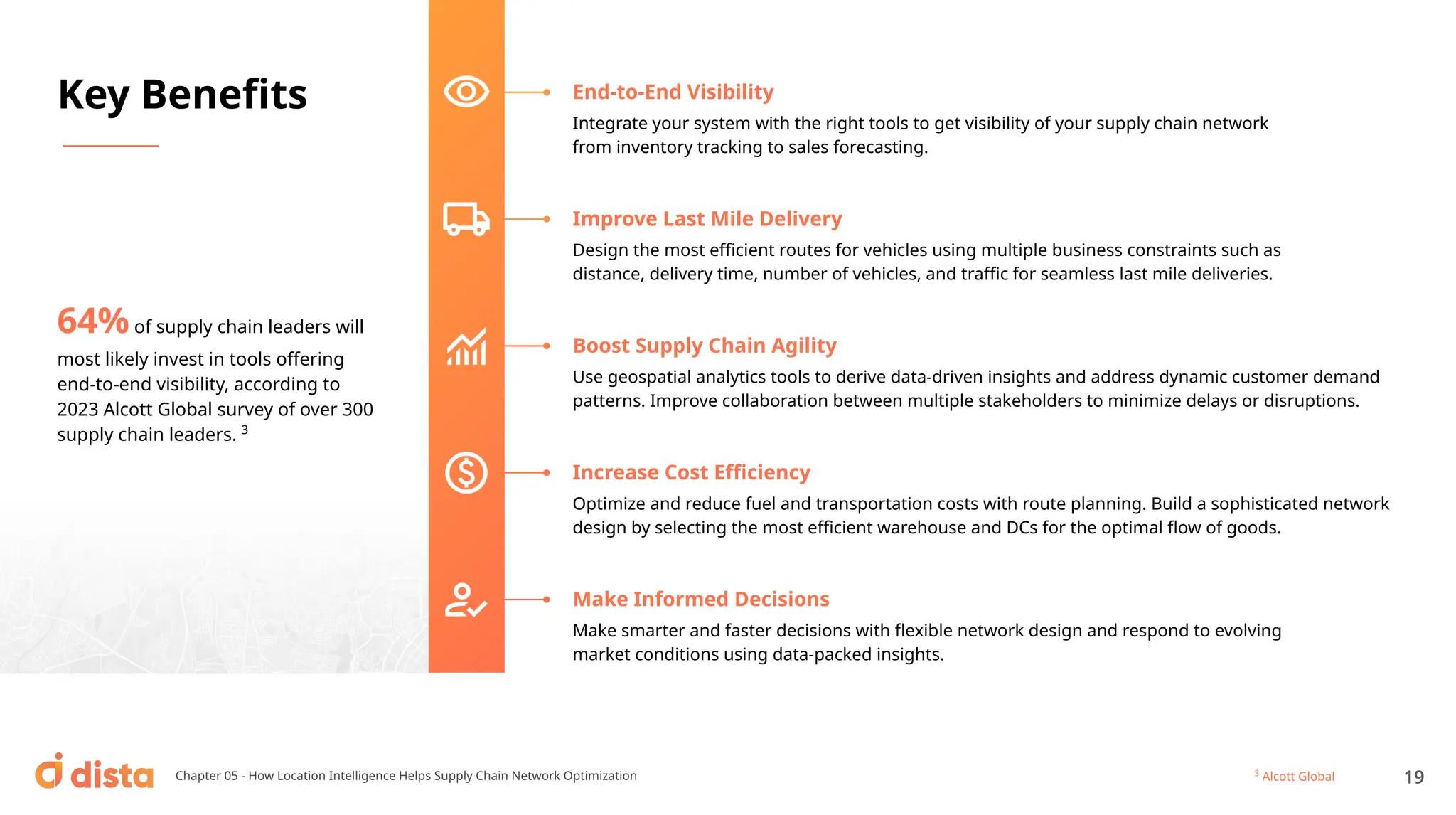
End-to-End Visibility
Integrate your system with the right tools to get visibility of your supply chain network
from inventory tracking to sales forecasting.
Improve Last Mile Delivery
Design the most efficient routes for vehicles using multiple business constraints such as
distance, delivery time, number of vehicles, and traffic for seamless last mile deliveries.
Boost Supply Chain Agility
Use geospatial analytics tools to derive data-driven insights and address dynamic customer demand
patterns. Improve collaboration between multiple stakeholders to minimize delays or disruptions.
Increase Cost Efficiency
Optimize and reduce fuel and transportation costs with route planning. Build a sophisticated network
design by selecting the most efficient warehouse and DCs for the optimal flow of goods.
Make Informed Decisions
Chapter 05 - How Location Intelligence Helps Supply Chain Network Optimization
64%of supply chain leaders will
most likely invest in tools offering
end-to-end visibility, according to
2023 Alcott Global survey of over 300
supply chain leaders. 3
Make smarter and faster decisions with flexible network design and respond to evolving
market conditions using data-packed insights.
Key Benefits
3
Alcott Global 19
Leverage Dista to Build a Future-Proof
and Resilient Supply Chain
Chapter 6
20
Enterprises are working towards creating leaner and
greener supply chains. It’s critical to enhance your
existing tech stack by harnessing the power of
location intelligence and geospatial analysis to design
future-proof and resilient supply chain operations.
Dista helps several leading enterprises across
industries create a strong network design that is
more intelligent, connected, and responsive.
Chapter 06 - Leverage Dista to Build a Future-Proof and Resilient Supply Chain 21
Our robust product suite has helped global enterprises:
Improve end-to-end last mile visibility
Gain actionable insights with spatial analysis
Reduce costs and mitigate risks
Improves FADR
Chapter 06 - Leverage Dista to Build a Future-Proof and Resilient Supply Chain
Visualize
➔ Visualize supply chain and
add contextual geospatial
insights
➔ Find gaps in the network
design and make
improvements
Strategize
➔ Use What-if analysis to run
multiple simulations to find
optimal placement for facilities
➔ Plan inventory by analyzing
demand patterns using spatial
analysis
➔ Optimize network design to
include possible disruptions
Operationalize
➔ Consider 150+ variables to design and
plan optimal routes
➔ Run AI/ML-powered scheduling
algorithms to sequence and balance
order distribution
➔ Utilize optimal vehicles for transportation.
Enable real-time tracking to improve
network design visibility
Dista’s Location Intelligence Framework
22
What is Supply Chain
Network Optimization?
How Does it Work?
E-Commerce Platform
Leverages Dista Insight
to Improve Supply Chain
Network Design
7 Best Practices for
Supply Chain Network
Optimization
23
Resources
Explore Explore
Explore
Download Datasheet Download Brochure
Visit www.dista.ai
and take the first step
towards becoming a
location-intelligent
organization.
24
Author
Designer
Designer
Sneha Bokil
Ninad Sonkamble
Anchal Jena
Core Components
Scheduling &
Routing
Asset
Tracking
Territory
Management
Auto-
clustering
Capacity &
Skillset Mgt
Collaboration
Engine
Geospatial
Visualization
Smart Nudges Customizable
Dashboards
Task
Management
Technology &
Framework
Mobility
Platform
Event
Framework
White
Labelling
Recommendation
Engine
Integration
Framework
Processor
Engine
Template
Engine
Workflow
Engine
Reporting
Engine
Industries Financial
Services &
Insurance
CPG
Retail &
Ecommerce
Energy &
Utilities
Healthcare &
Pharma Telecom
Food &
Beverages Services
Transport &
Logistics
Products
Dista
DELIVER
Dista
SALES
Dista
DELIVER
Dista
SERVICE
Dista
INSIGHT
MORE
TO COME
MORE
TO COME
MORE
TO COME
Biz Solutions Market
Expansion
Geospatial
Analytics
Cash/
Collections
Management
Network
Optimization
Fleet
Management
Field Service
Management
Delivery
Management
Salesforce
Management
Ride
Management
Dista
platform
MORE
TO COME
The ‘Dista’ Platform

[Ebook] Optimizing Supply Chain Network With Location Intelligence

  • 1.
    Optimizing Supply Chain NetworkDesign With Location Intelligence
  • 2.
    TABLE OF CONTENTS Introduction Chapters What isSupply Chain Network Design? Supply Chain Network Design Challenges 5 Steps to Create a Supply Chain Network Design Key Features of a Supply Chain Network Optimization Software How Location Intelligence Helps Supply Chain Network Optimization Leverage Dista to Build a Future-Proof and Resilient Supply Chain 1. 2. 3. 4. 5. 6.
  • 3.
    Supply chains arecentral to business survival and growth, not just an opportunity to reduce costs. The adoption of advanced tracking systems, location intelligence, and geospatial analytics software offering AI-driven analytics has increased. This shift is attributed to the complexity of supply chains, higher customer expectations regarding service levels, and pressure to minimize costs. INTRODUCTION Introduction 1
  • 4.
    1 Gartner A 2023 Gartnersurvey states that top-performing supply chain organizations are investing in artificial intelligence (AI) and machine learning (ML) to optimize their processes at more than twice the rate of their low-performing peers. 1 2 Introduction
  • 5.
    Lowers supply chain cost Minimizesinventory Facilitates faster route-to-market An effective network design is the backbone of functional, resilient, and cost-efficient supply chains that drive last mile excellence. An optimal supply chain network design: If you are a business leader looking to strengthen your supply chain process, this ebook will act as a practical guide with key insights and fundamental steps to create an efficient supply chain network design. Introduction 3
  • 6.
    What is SupplyChain Network Design? Chapter 1 4
  • 7.
    Supply chain networkdesign is a process that evaluates the end-to-end function of your supply chain, from manufacturing to distribution, transportation, inventories, warehousing, etc., to make it cost-effective and efficient. An optimum supply chain network impacts all its stakeholders, including manufacturers, suppliers, warehouse managers, distribution channels, retail and delivery partners, and more. The main aim of optimizing a supply chain network is to Minimize costs Maximize delivery efficiency Enhance customer experience Chapter 01 - What is Supply Chain Network Design? 5
  • 8.
    Chapter 01 -What is Supply Chain Network Design? How can I structure my supply chain network to provide the necessary service at minimal expense? With a structured logistics network and defined distribution strategy, how can I effectively use my resources? What technologies or tools should we use to improve visibility across the supply chain? What metrics and KPIs should we prioritize to measure the performance and effectiveness of our supply chain strategy? Is the current supply chain design aligned with the enterprises' sustainability goals? Questions to evaluate while designing a supply chain network 6
  • 9.
    Ultimately, the objectiveis to establish the most efficient network to satisfy customer demands and minimize transportation costs. By using a robust geospatial analytics software like Dista, organizations can not only design an efficient and resilient supply chain network but also optimize their existing network. Our AI/ML-based system designs an efficient supply chain network using spatial analytics by running multiple simulations. The system applies 150+ business constraints like: ➔ Delivery time ➔ Delivery volume ➔ Total distance ➔ Trips per day ➔ Customer location ➔ Order sequencing ➔ Vehicle capacity ➔ Driver availability ➔ No. of vehicles, and more By using these constraints the system identifies the most optimal locations for setting up factories, warehouses, and distribution centers (DC). Chapter 01 - What is Supply Chain Network Design? 7
  • 10.
    Supply Chain NetworkDesign Challenges Chapter 2 8
  • 11.
    Chapter 02 -Supply Chain Network Design Challenges Complex Global Networks Global supply chains are complex as they encompass multiple stakeholders. Coordinating logistics and complying with diverse regulatory frameworks across borders is challenging. 9 Low FADR Unable to fit dynamic deliveries in allocated slots resulting in low first-attempt delivery rate (FADR), poor customer experience, and high costs Lack of Geospatial Insights Lack of critical geospatial insights such as high customer density areas, low competition area clusters, map-based visualization of existing networks, affects the flow of goods.
  • 12.
    Chapter 02 -Supply Chain Network Design Challenges Disruptions and Risks Lack of tools to proactively identify and mitigate risks such as natural disasters, geopolitical tensions, or demand fluctuations. 10 Sustainability Compliances Unable to balance sustainability objectives like controlling emissions, minimizing energy waste, etc is daunting and complicated Limited Visibility Limited visibility into the supply chain network results in ineffective design. Siloed data of suppliers, customer demand, logistics, etc.,hampers operations.
  • 13.
    5 Steps toCreate a Supply Chain Network Design Chapter 3 11
  • 14.
    Step 1 Define Objectives andSet Goals Set clear network design objectives that align with organization goals. Define objectives like reducing costs, identifying locations for DCs, and warehouses, minimizing carbon emission, and more. Step 2 Gather and Analyze Data Collect different types of data such as location, transportation, sales and demand, customer density and more. Use a location intelligence platform to overlay different data layers and spot trends and patterns. Step 3 Analyze Existing Model Derive actionable insights based on spatial relationships and analyze the existing supply chain network. Identify gaps, set KPIs to measure performance, and find improvement opportunities. Step 4 Design Network Strategies with Location Intelligence Model multiple network simulations using existing datasets based on defined parameters by integrating the location component. Step 5 Implement the Network Model Select the supply chain network model that aligns best with your objectives and take action. Supply Chain Network Design Chapter 03 - 5 Steps to Create a Supply Chain Network Design 12
  • 15.
    Key Features ofa Supply Chain Network Optimization Software Chapter 4 13
  • 16.
    According to a2024 KPMG research, nearly half of supply chain organizations will invest in applications that support AI and advanced analytics capabilities.2 Leading enterprises leverage Dista’s geospatial analytics software to design high-performing supply chains with location intelligence. It runs multiple simulations to find the right location to open warehouses, DCs, facilities, etc. Chapter 04 - Key Features of a Supply Chain Network Optimization Software 2 Supply Chain Trends 2024 14
  • 17.
    Key Features Territory ClusterAnalysis Visualize and create territory clusters on a map, with Dista’s patented clustering algorithm. Include supply chain constraints to create affinity-based territory clusters, and run simulations using a hub-and-spoke model to identify the most suitable locations for setting up DCs and warehouses. Greenfield Analysis Run multiple simulations to select optimal number of warehouses, fulfillment centers, or DCs and their locations. Apply spatial insights to create a roadmap for a refined network design to improve overall supply chain performance. Demand Modeling Overlay spatial analytics with existing business data to analyze demand patterns for better forecasting. Balance supply and demand by strategically placing warehouses, DCs, and production facilities. Chapter 04 - Key Features of a Supply Chain Network Optimization Software 15
  • 18.
    Manual Allocation andScheduling Dista’s flexible scheduling algorithm enables manual order allocation in case of selective instances. Predictive and Prescriptive Analytics Anticipate challenges and opportunities and provide timely information with predictive and prescriptive analytics, enabling leaders to create dynamic workflows for agile supply chains. Intelligent Scheduling Use AI/ML-based scheduling algorithms to sequence orders by priority, delivery time, order volume, warehouse and more. Optimize scheduling to balance order distribution and ensure customer satisfaction. 16 Chapter 04 - Key Features of a Supply Chain Network Optimization Software
  • 19.
    How Location IntelligenceHelps Supply Chain Network Optimization Chapter 5 17
  • 20.
    Enterprises leveraging advancedtechnology and AI tools create a seamless and sustainable supply chain network. The Gartner survey states high-performing organizations are far ahead in automating and/or optimizing processes that use supply chain data using AI/ML. Chapter 05 - How Location Intelligence Helps Supply Chain Network Optimization 18
  • 21.
    End-to-End Visibility Integrate yoursystem with the right tools to get visibility of your supply chain network from inventory tracking to sales forecasting. Improve Last Mile Delivery Design the most efficient routes for vehicles using multiple business constraints such as distance, delivery time, number of vehicles, and traffic for seamless last mile deliveries. Boost Supply Chain Agility Use geospatial analytics tools to derive data-driven insights and address dynamic customer demand patterns. Improve collaboration between multiple stakeholders to minimize delays or disruptions. Increase Cost Efficiency Optimize and reduce fuel and transportation costs with route planning. Build a sophisticated network design by selecting the most efficient warehouse and DCs for the optimal flow of goods. Make Informed Decisions Chapter 05 - How Location Intelligence Helps Supply Chain Network Optimization 64%of supply chain leaders will most likely invest in tools offering end-to-end visibility, according to 2023 Alcott Global survey of over 300 supply chain leaders. 3 Make smarter and faster decisions with flexible network design and respond to evolving market conditions using data-packed insights. Key Benefits 3 Alcott Global 19
  • 22.
    Leverage Dista toBuild a Future-Proof and Resilient Supply Chain Chapter 6 20
  • 23.
    Enterprises are workingtowards creating leaner and greener supply chains. It’s critical to enhance your existing tech stack by harnessing the power of location intelligence and geospatial analysis to design future-proof and resilient supply chain operations. Dista helps several leading enterprises across industries create a strong network design that is more intelligent, connected, and responsive. Chapter 06 - Leverage Dista to Build a Future-Proof and Resilient Supply Chain 21 Our robust product suite has helped global enterprises: Improve end-to-end last mile visibility Gain actionable insights with spatial analysis Reduce costs and mitigate risks Improves FADR
  • 24.
    Chapter 06 -Leverage Dista to Build a Future-Proof and Resilient Supply Chain Visualize ➔ Visualize supply chain and add contextual geospatial insights ➔ Find gaps in the network design and make improvements Strategize ➔ Use What-if analysis to run multiple simulations to find optimal placement for facilities ➔ Plan inventory by analyzing demand patterns using spatial analysis ➔ Optimize network design to include possible disruptions Operationalize ➔ Consider 150+ variables to design and plan optimal routes ➔ Run AI/ML-powered scheduling algorithms to sequence and balance order distribution ➔ Utilize optimal vehicles for transportation. Enable real-time tracking to improve network design visibility Dista’s Location Intelligence Framework 22
  • 25.
    What is SupplyChain Network Optimization? How Does it Work? E-Commerce Platform Leverages Dista Insight to Improve Supply Chain Network Design 7 Best Practices for Supply Chain Network Optimization 23 Resources Explore Explore Explore Download Datasheet Download Brochure
  • 26.
    Visit www.dista.ai and takethe first step towards becoming a location-intelligent organization. 24 Author Designer Designer Sneha Bokil Ninad Sonkamble Anchal Jena Core Components Scheduling & Routing Asset Tracking Territory Management Auto- clustering Capacity & Skillset Mgt Collaboration Engine Geospatial Visualization Smart Nudges Customizable Dashboards Task Management Technology & Framework Mobility Platform Event Framework White Labelling Recommendation Engine Integration Framework Processor Engine Template Engine Workflow Engine Reporting Engine Industries Financial Services & Insurance CPG Retail & Ecommerce Energy & Utilities Healthcare & Pharma Telecom Food & Beverages Services Transport & Logistics Products Dista DELIVER Dista SALES Dista DELIVER Dista SERVICE Dista INSIGHT MORE TO COME MORE TO COME MORE TO COME Biz Solutions Market Expansion Geospatial Analytics Cash/ Collections Management Network Optimization Fleet Management Field Service Management Delivery Management Salesforce Management Ride Management Dista platform MORE TO COME The ‘Dista’ Platform