Presented By
Group CMBM
Nepal Commerce Campus
Presented to:
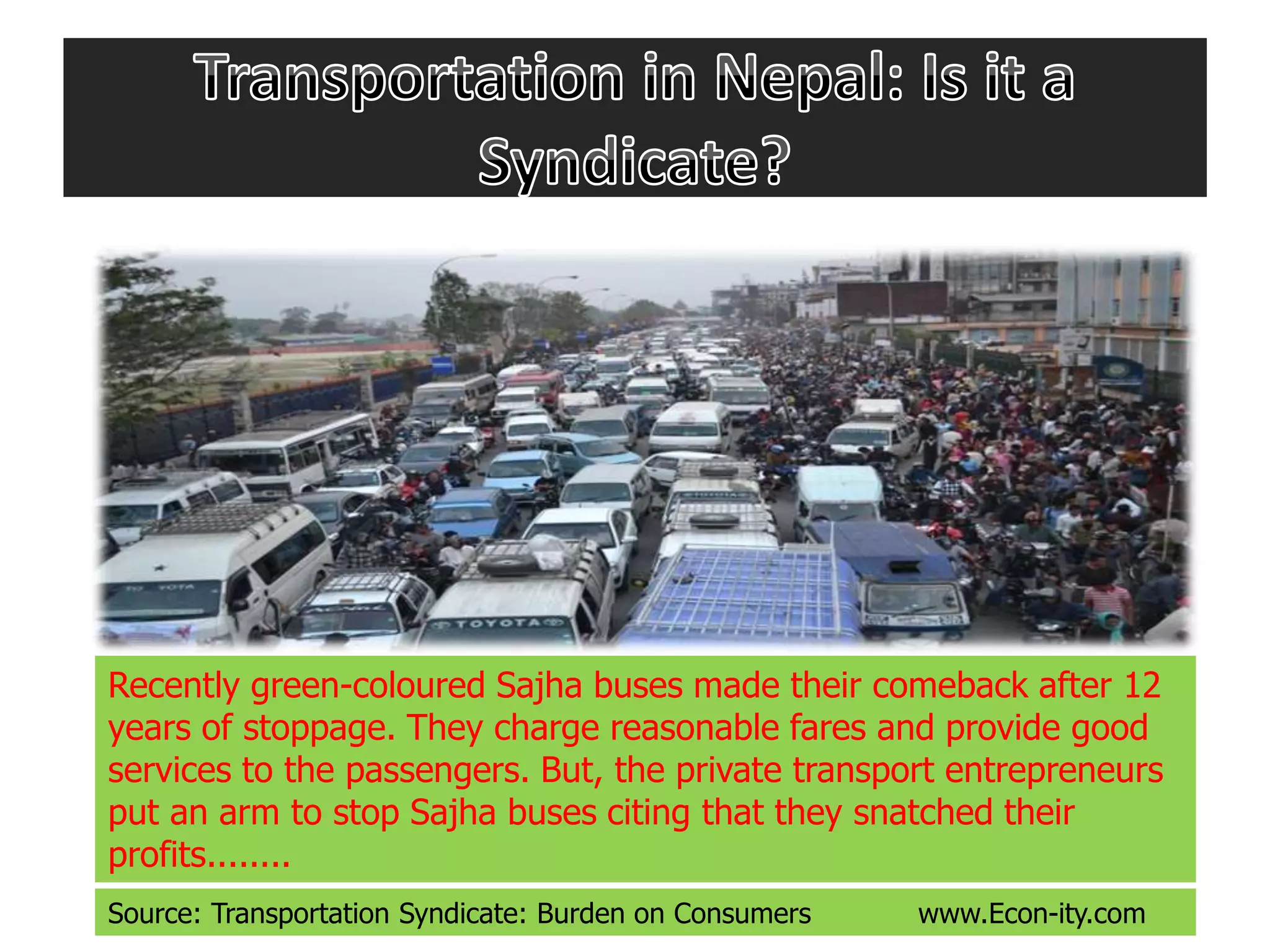
Recently green-coloured Sajha buses made their comeback after 12
years of stoppage. They charge reasonable fares and provide good
services to the passengers. But, the private transport entrepreneurs
put an arm to stop Sajha buses citing that they snatched their
profits........
Source: Transportation Syndicate: Burden on Consumers www.Econ-ity.com
 Every body of us puts a constant struggle to
grab yourself a seat in Nepal Yatayat. isn’t
it???
 Has anyone wondered why the number of
buses on this specific route is limited despite
of high demand????
 Why aren’t people investing in this industry
despite such profitable prospect it offers????
 We thus thought of inquiring of this question
that seeks an answer..........
 One of our group member got a chance to seat
beside the driver and through casual
conversation got opportunity to ask why is it
so???
 Driver replied, “Our bus association determines
the number of vehicles that are allowed to ply
this route”.
 He further added that operating a bus on this
specific route would cost four times the actual
amount of buying a bus. The association
charges this three-fold fee to permit a new bus
 Based on Dialogue and Our personal
experience, it was crystal-clear that
transport entrepreneurs were operating:
Syndicate
 Recently in 2013 in Pokhara, some youths
challenged the monopoly
 The monopoly was of the Pokhara Bus
Entrepreneurs Committee
 Youths opened another competitive
transportation committee (Bindabasini Bus
Sewa)
 Even though it had acquired necessary
permissions to do so
 The new committee was not allowed to bring its buses
into operation by the existing committee as a Result
Bindabasini Bus collapsed
Factor Behind this:
Syndicate
Source:
reportersnepal.com
History of the syndicate practice
in Nepal
 First association of transport entrepreneurs was
the Purbanchal Motor
 Association established in 1974, Min bahadur
Suwar
 Afer this, there were a series of associations
that opened up across the country
 Prithvi Highway Syndicate opened in Pokhara
 Arniko Yatayat in Kathamndu
 Seti Mahakali in the Western region
 Paschim Nepal in Butwal
 Narayani Yatayat in Hetauda
 Later in 1982, all these associations joined hands and lobbied with the
government to form first ever national federation under the name
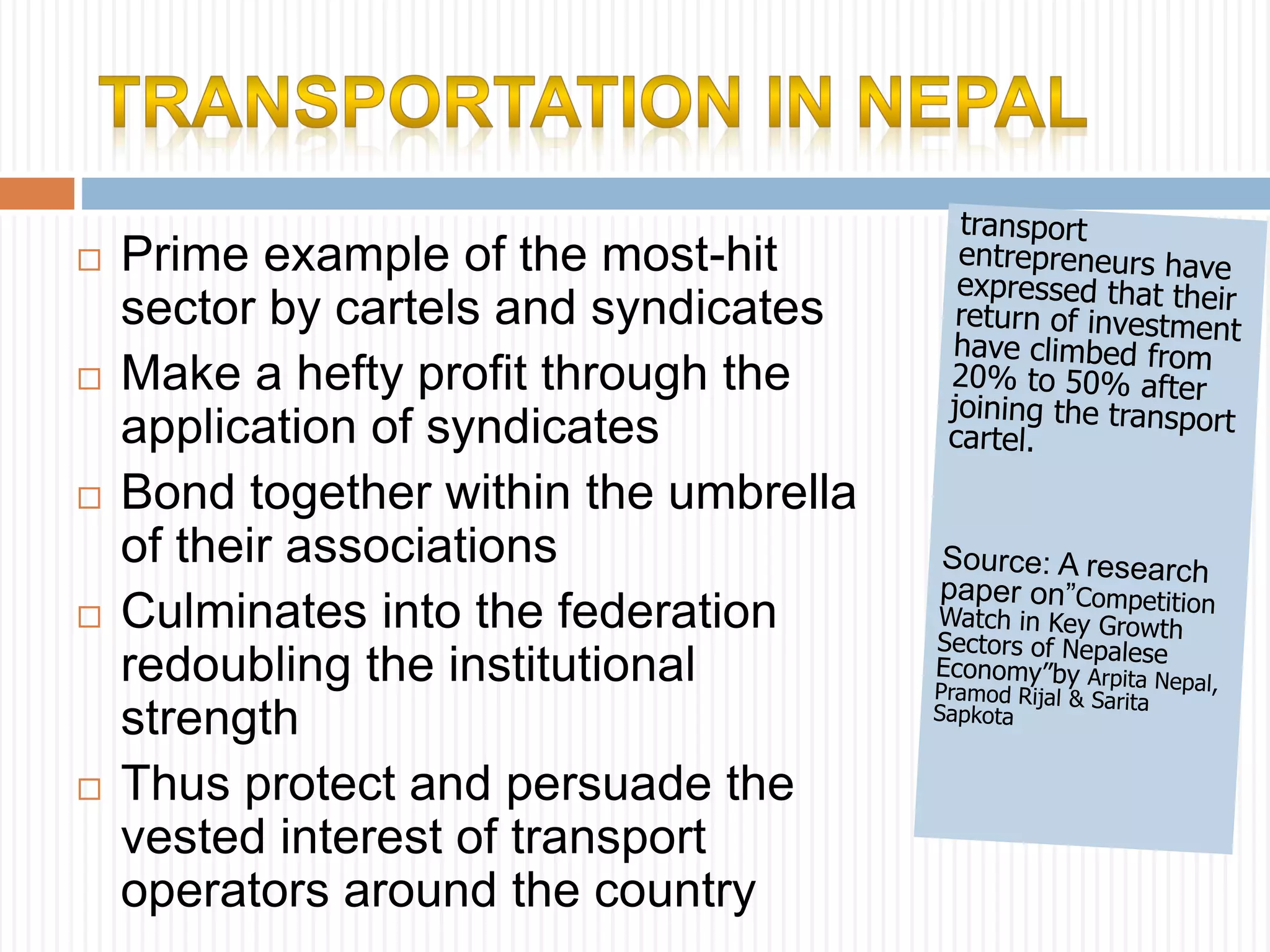
 Prime example of the most-hit
sector by cartels and syndicates
 Make a hefty profit through the
application of syndicates
 Bond together within the umbrella
of their associations
 Culminates into the federation
redoubling the institutional
strength
 Thus protect and persuade the
vested interest of transport
operators around the country
Process of Syndicate In Nepal
 Barrier to entry
 Route permit
 Quota
 Barrier to expansion
 Barrier to full scale operation
 Price fixation
(Road permits from the government are only provided on recommendation of the
transportation syndicate and the dealing with association if route is not permitted
cost NRs. 400,000-500,000)
Source:(United Nations World Food Programme [WFP]& Nepal Development Research
 Resulting to dominant positions in the market
collectively and abuse of such position
 Carteling and Syndicate practice in
transportation:
 Price fixation on minor and some major
roads
 Application of higher charges on services
 Queue and rotational system in operation
 Use of old and worn out vehicles
 Overload in cargo transportation
 Restrict new entry by putting heavy
syndicate charges or physical threat
What Fosters these practices?
 Traditional microeconomics: describes cartels
as inherently unstable organization pointing out
game theory strategies that demonstrate better
pay-offs for cheating (Rubinfeld & Pyndick, 1998)
 Cartel enforcement is stronger when
government policy is to implicitly support cartels,
usingJapan as a historical example.
 When the expected cost of punishment is
greater than the expected benefit from cheating,
cartels sustain
What Fosters these practices?
 Nepalese fosters these practices just for few
reasons: to have cost benefits like “trip fee”,to
have insurance claim in a easiest way, ticketing,
staff monitoring and even maintenance of the
vehicle in some cases
 To gain monopoly and to have good return on
investment
Where syndicate exists:
 Almost in all part of Nepal
 With different faces and organization
 Different faces of the syndicate system are:
 Rotational system
 Queue system
 Dial system(wait time to operate as decided by
the Association)
 Odd-even number plate system
Where syndicate exists:
 System has now been imposed on major
transport routes, including routes of:
 Itahari-Kathmandu
 Biratnagar-Kathmandu
 Dhangadi-Kathmandu
 Bhairahawa-Kathmandu
 Nepalgunj-Kathmandu, and others
Some Association responsible
for Syndicate
 The Federation of Truck Tanker and
Transport Entrepreneurs Nepal: Had
formally decided to impose the odd and
even number plate system on cargo
vehicles, announcing the resumption of
syndicate system
 Seti-Mahakali Truck Entrepreneurs
Association: has been imposing
syndicate system in the Far West, saying
that they are finding it hard survive amid
stiff competition
 And many more associations
Current scenario in Nepal
 Deputy Traffic Inspector Ganesh Rai says:
 Bus drivers receive lower fines than ordinary
users of the common road.
 If their license are confiscated they are
allowed to send their union representative to
retrieve it rather than attending the station in
person
 License are never suspended
 Main reason for reckless driving
 Driver joke that the “driving license is license
to kill”
Current scenario in Nepal
 Encouragement allowance paid to the officer is
15% of fine collected
 Politician have strong control over carteling
 24 truck syndicate controlling road trade,
carried out through Birgunj (country’s principal
custom point)
Source: The Rising Nepal – 2012, 14 December
Is Syndicate legal???
Competition Promotion and Market
Protection(CPMP) Act 2009
Consumer Protection Act, 1998
Traffic and Transportation Management
Act, 1992
Anti-Syndicate Legal Provisions
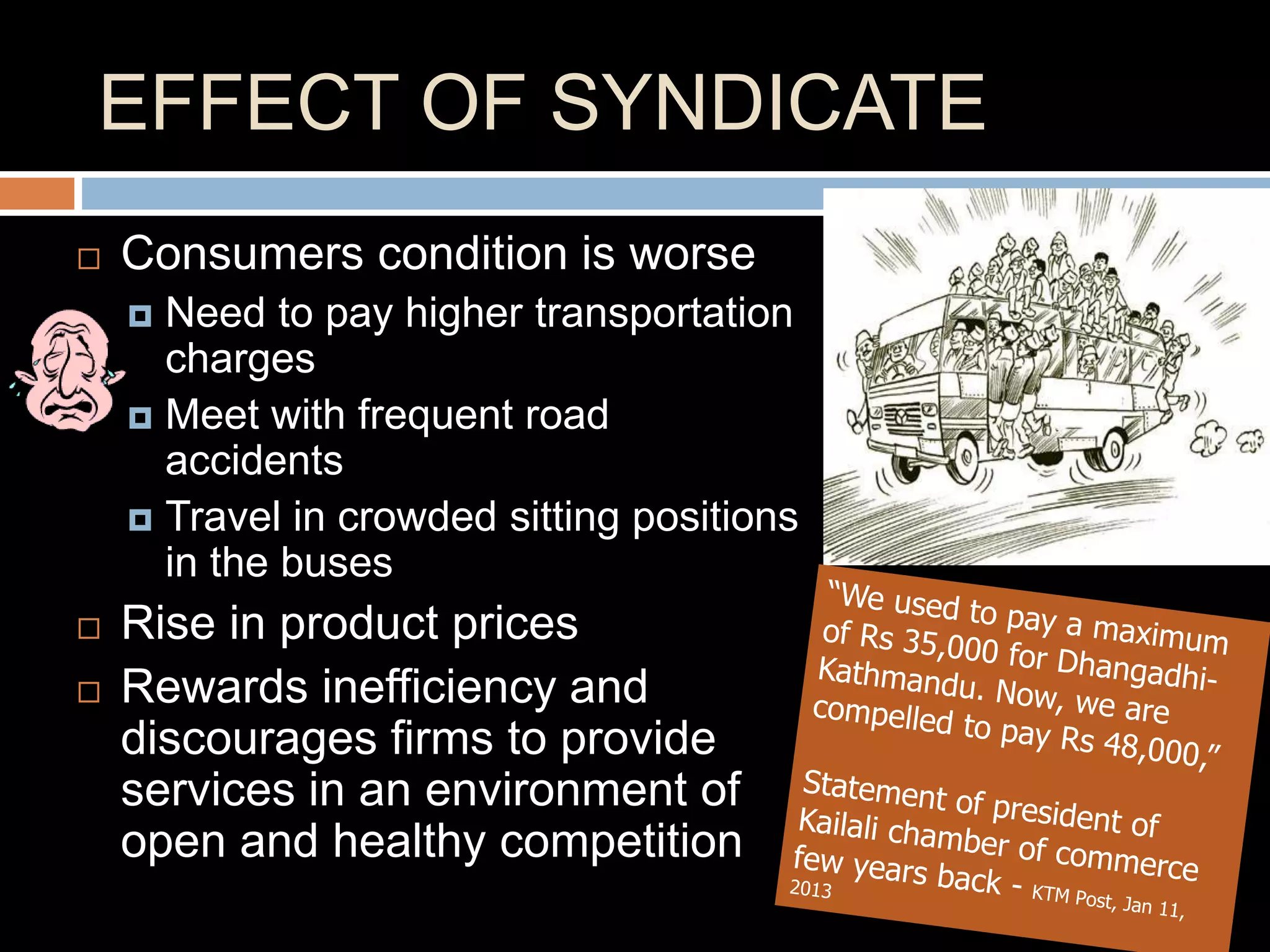
EFFECT OF SYNDICATE
 Consumers condition is worse
 Need to pay higher transportation
charges
 Meet with frequent road
accidents
 Travel in crowded sitting positions
in the buses
 Rise in product prices
 Rewards inefficiency and
discourages firms to provide
services in an environment of
open and healthy competition
EFFECT OF SYNDICATE
 According to FNCCI transport fares being
charged by truck tanker transport
entrepreneurs have gone up by 50 percent
over the normal fare
What has Government done?
 The government has prohibited the syndicate system in the
transportation sector few years ago
 When Madhav Kumar Nepal was PM, had directed the Home
Ministry to put an end to the syndicate system at the earliest
 The government in its budget for 2009-10 and 2010-11 also
termed the system ‘unlawful’, saying that the registration of
associations found to be imposing this system will be
scrapped
Source: nepalnews.com/The kathmandu post
Contd..
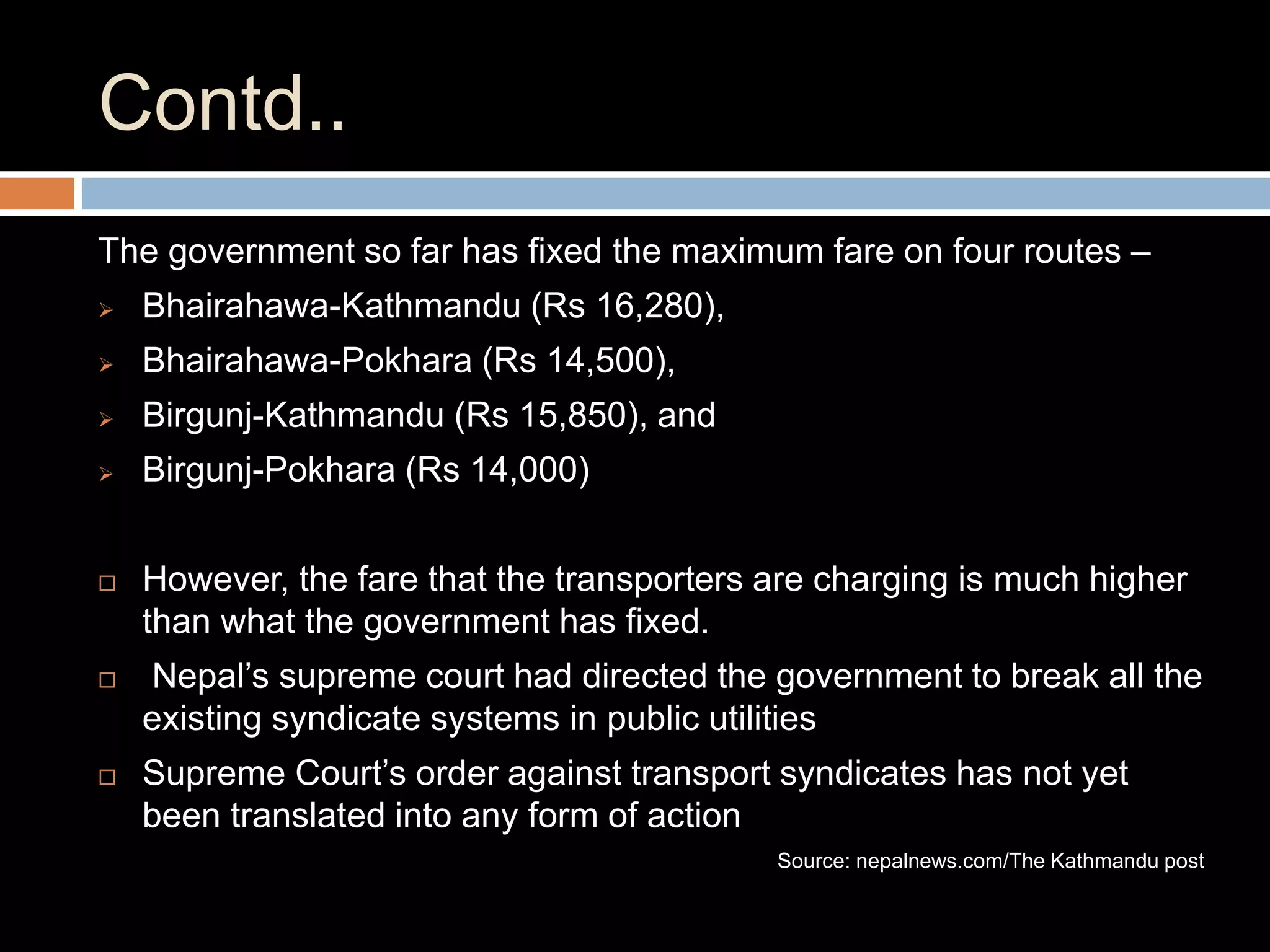
The government so far has fixed the maximum fare on four routes –
 Bhairahawa-Kathmandu (Rs 16,280),
 Bhairahawa-Pokhara (Rs 14,500),
 Birgunj-Kathmandu (Rs 15,850), and
 Birgunj-Pokhara (Rs 14,000)
 However, the fare that the transporters are charging is much higher
than what the government has fixed.
 Nepal’s supreme court had directed the government to break all the
existing syndicate systems in public utilities
 Supreme Court’s order against transport syndicates has not yet
been translated into any form of action
Source: nepalnews.com/The Kathmandu post
Why doesn’t the Law work?
 Associations often exert pressure through
◦ Means of strikes
◦ Lock-outs
◦ Interruptions in services
◦ Force government accept their demands
 Demands based on such unlawful means of threat
and violence by the associations and its members
◦ Reduce the efficiency of the economy
◦ Harm the interests of the common consumers
 The government has failed to end syndicate as
political parties are protecting those who are
imposing the system
Why doesn’t the Law work?
 CPMP has provision of 11 board members
from different groups of stakeholders
 Entrusted with
 Investigation
 Monitoring
 Observing and taking other necessary measures
 It includes ex-officio members
 They are busy with their own offices
Why doesn’t the Law work?
 CPMP has provision of hiring employees of
Nepal government as market protection officer
 Purpose: case against anti-competitive activities
 It lacks institutional back-up for implementation
 Government sustained anti-Competitive practice
(only 8000 taxis are registered in Kathmandu)
 Institutional reform: Since syndicate in transport
are rooted to deepest corner of Nepal, District
Development Officers should be allowed to
apply CPMP Act.
 In order to end syndicate of all sorts:
 Democratic space should be created for all
to exercise their legitimate rights
 Unethical politics is the root cause of many
ills, root it out
 Political solidarity to fight against the
pernicious syndicalism imposed
 Civil society members, consumers’ rights
groups and conscious people must rise up
to bring an end to this
How can we Contribute
Conclusion
 What syndicates do is limit the resources
 Kills quality and stifles innovation
 Syndicates allow for market monopolies to
firmly set themselves into the system and
 We, the consumers, are made to pay
exorbitant prices for low quality goods and
services in the wake of lesser options being
available to us.
 www.newbusinessage.com/Economy%20And%20Policy/730
 www.economist.com/blogs/banyan/2012/08/public-transport
 Competition Promotion and Market Protection(CPMP) Act, 2009
 Consumer Protection Act, 1998
 Traffic and Transportation Management Act, 1992
 Ahmed, F., & Regmi, P. P. (2009). Study on Transport Constraints
in Western Nepal. Kathmandu: Department for International
Development; World Food Program.
 Nepal, A., Rijal, P., & Sapkota, S. (2013). Compitition Watch in
Key Growth Sectors of Nepalese Economy. Kathmandu:
Samriddhi, The Prosperity Foundation.
 Salvatore, Dominic, ‘Managerial Economics in a Global Economy’
Irwing/McGraw Hill, USA
 www.investopedia.com/articles/financial-theory
 Nepalnews.comews report

Transport System in Nepal

  • 2.
    Presented By Group CMBM NepalCommerce Campus Presented to:
  • 3.
    Recently green-coloured Sajhabuses made their comeback after 12 years of stoppage. They charge reasonable fares and provide good services to the passengers. But, the private transport entrepreneurs put an arm to stop Sajha buses citing that they snatched their profits........ Source: Transportation Syndicate: Burden on Consumers www.Econ-ity.com
  • 4.
     Every bodyof us puts a constant struggle to grab yourself a seat in Nepal Yatayat. isn’t it???  Has anyone wondered why the number of buses on this specific route is limited despite of high demand????  Why aren’t people investing in this industry despite such profitable prospect it offers????  We thus thought of inquiring of this question that seeks an answer..........
  • 5.
     One ofour group member got a chance to seat beside the driver and through casual conversation got opportunity to ask why is it so???  Driver replied, “Our bus association determines the number of vehicles that are allowed to ply this route”.  He further added that operating a bus on this specific route would cost four times the actual amount of buying a bus. The association charges this three-fold fee to permit a new bus
  • 6.
     Based onDialogue and Our personal experience, it was crystal-clear that transport entrepreneurs were operating: Syndicate
  • 7.
     Recently in2013 in Pokhara, some youths challenged the monopoly  The monopoly was of the Pokhara Bus Entrepreneurs Committee  Youths opened another competitive transportation committee (Bindabasini Bus Sewa)  Even though it had acquired necessary permissions to do so
  • 8.
     The newcommittee was not allowed to bring its buses into operation by the existing committee as a Result Bindabasini Bus collapsed Factor Behind this: Syndicate Source: reportersnepal.com
  • 9.
    History of thesyndicate practice in Nepal  First association of transport entrepreneurs was the Purbanchal Motor  Association established in 1974, Min bahadur Suwar  Afer this, there were a series of associations that opened up across the country  Prithvi Highway Syndicate opened in Pokhara  Arniko Yatayat in Kathamndu  Seti Mahakali in the Western region  Paschim Nepal in Butwal  Narayani Yatayat in Hetauda  Later in 1982, all these associations joined hands and lobbied with the government to form first ever national federation under the name
  • 10.
     Prime exampleof the most-hit sector by cartels and syndicates  Make a hefty profit through the application of syndicates  Bond together within the umbrella of their associations  Culminates into the federation redoubling the institutional strength  Thus protect and persuade the vested interest of transport operators around the country
  • 11.
    Process of SyndicateIn Nepal  Barrier to entry  Route permit  Quota  Barrier to expansion  Barrier to full scale operation  Price fixation (Road permits from the government are only provided on recommendation of the transportation syndicate and the dealing with association if route is not permitted cost NRs. 400,000-500,000) Source:(United Nations World Food Programme [WFP]& Nepal Development Research
  • 12.
     Resulting todominant positions in the market collectively and abuse of such position  Carteling and Syndicate practice in transportation:  Price fixation on minor and some major roads  Application of higher charges on services  Queue and rotational system in operation  Use of old and worn out vehicles  Overload in cargo transportation  Restrict new entry by putting heavy syndicate charges or physical threat
  • 13.
    What Fosters thesepractices?  Traditional microeconomics: describes cartels as inherently unstable organization pointing out game theory strategies that demonstrate better pay-offs for cheating (Rubinfeld & Pyndick, 1998)  Cartel enforcement is stronger when government policy is to implicitly support cartels, usingJapan as a historical example.  When the expected cost of punishment is greater than the expected benefit from cheating, cartels sustain
  • 14.
    What Fosters thesepractices?  Nepalese fosters these practices just for few reasons: to have cost benefits like “trip fee”,to have insurance claim in a easiest way, ticketing, staff monitoring and even maintenance of the vehicle in some cases  To gain monopoly and to have good return on investment
  • 15.
    Where syndicate exists: Almost in all part of Nepal  With different faces and organization  Different faces of the syndicate system are:  Rotational system  Queue system  Dial system(wait time to operate as decided by the Association)  Odd-even number plate system
  • 16.
    Where syndicate exists: System has now been imposed on major transport routes, including routes of:  Itahari-Kathmandu  Biratnagar-Kathmandu  Dhangadi-Kathmandu  Bhairahawa-Kathmandu  Nepalgunj-Kathmandu, and others
  • 17.
    Some Association responsible forSyndicate  The Federation of Truck Tanker and Transport Entrepreneurs Nepal: Had formally decided to impose the odd and even number plate system on cargo vehicles, announcing the resumption of syndicate system  Seti-Mahakali Truck Entrepreneurs Association: has been imposing syndicate system in the Far West, saying that they are finding it hard survive amid stiff competition  And many more associations
  • 18.
    Current scenario inNepal  Deputy Traffic Inspector Ganesh Rai says:  Bus drivers receive lower fines than ordinary users of the common road.  If their license are confiscated they are allowed to send their union representative to retrieve it rather than attending the station in person  License are never suspended  Main reason for reckless driving  Driver joke that the “driving license is license to kill”
  • 19.
    Current scenario inNepal  Encouragement allowance paid to the officer is 15% of fine collected  Politician have strong control over carteling  24 truck syndicate controlling road trade, carried out through Birgunj (country’s principal custom point) Source: The Rising Nepal – 2012, 14 December
  • 20.
  • 21.
    Competition Promotion andMarket Protection(CPMP) Act 2009 Consumer Protection Act, 1998 Traffic and Transportation Management Act, 1992 Anti-Syndicate Legal Provisions
  • 22.
    EFFECT OF SYNDICATE Consumers condition is worse  Need to pay higher transportation charges  Meet with frequent road accidents  Travel in crowded sitting positions in the buses  Rise in product prices  Rewards inefficiency and discourages firms to provide services in an environment of open and healthy competition
  • 23.
    EFFECT OF SYNDICATE According to FNCCI transport fares being charged by truck tanker transport entrepreneurs have gone up by 50 percent over the normal fare
  • 24.
    What has Governmentdone?  The government has prohibited the syndicate system in the transportation sector few years ago  When Madhav Kumar Nepal was PM, had directed the Home Ministry to put an end to the syndicate system at the earliest  The government in its budget for 2009-10 and 2010-11 also termed the system ‘unlawful’, saying that the registration of associations found to be imposing this system will be scrapped Source: nepalnews.com/The kathmandu post
  • 25.
    Contd.. The government sofar has fixed the maximum fare on four routes –  Bhairahawa-Kathmandu (Rs 16,280),  Bhairahawa-Pokhara (Rs 14,500),  Birgunj-Kathmandu (Rs 15,850), and  Birgunj-Pokhara (Rs 14,000)  However, the fare that the transporters are charging is much higher than what the government has fixed.  Nepal’s supreme court had directed the government to break all the existing syndicate systems in public utilities  Supreme Court’s order against transport syndicates has not yet been translated into any form of action Source: nepalnews.com/The Kathmandu post
  • 26.
    Why doesn’t theLaw work?  Associations often exert pressure through ◦ Means of strikes ◦ Lock-outs ◦ Interruptions in services ◦ Force government accept their demands  Demands based on such unlawful means of threat and violence by the associations and its members ◦ Reduce the efficiency of the economy ◦ Harm the interests of the common consumers  The government has failed to end syndicate as political parties are protecting those who are imposing the system
  • 27.
    Why doesn’t theLaw work?  CPMP has provision of 11 board members from different groups of stakeholders  Entrusted with  Investigation  Monitoring  Observing and taking other necessary measures  It includes ex-officio members  They are busy with their own offices
  • 28.
    Why doesn’t theLaw work?  CPMP has provision of hiring employees of Nepal government as market protection officer  Purpose: case against anti-competitive activities  It lacks institutional back-up for implementation  Government sustained anti-Competitive practice (only 8000 taxis are registered in Kathmandu)  Institutional reform: Since syndicate in transport are rooted to deepest corner of Nepal, District Development Officers should be allowed to apply CPMP Act.
  • 29.
     In orderto end syndicate of all sorts:  Democratic space should be created for all to exercise their legitimate rights  Unethical politics is the root cause of many ills, root it out  Political solidarity to fight against the pernicious syndicalism imposed  Civil society members, consumers’ rights groups and conscious people must rise up to bring an end to this How can we Contribute
  • 30.
    Conclusion  What syndicatesdo is limit the resources  Kills quality and stifles innovation  Syndicates allow for market monopolies to firmly set themselves into the system and  We, the consumers, are made to pay exorbitant prices for low quality goods and services in the wake of lesser options being available to us.
  • 31.
     www.newbusinessage.com/Economy%20And%20Policy/730  www.economist.com/blogs/banyan/2012/08/public-transport Competition Promotion and Market Protection(CPMP) Act, 2009  Consumer Protection Act, 1998  Traffic and Transportation Management Act, 1992  Ahmed, F., & Regmi, P. P. (2009). Study on Transport Constraints in Western Nepal. Kathmandu: Department for International Development; World Food Program.  Nepal, A., Rijal, P., & Sapkota, S. (2013). Compitition Watch in Key Growth Sectors of Nepalese Economy. Kathmandu: Samriddhi, The Prosperity Foundation.  Salvatore, Dominic, ‘Managerial Economics in a Global Economy’ Irwing/McGraw Hill, USA  www.investopedia.com/articles/financial-theory  Nepalnews.comews report