SEMINA
R ON
TRANSPARENT
CONCRETE
BY,
SWAGAT KUMAR SAHOO
14011182
7TH SEMESTER
CIVIL ENGINEERING
VSSUT, BURLA
CONTENTS
INTRODUCTION
MATERIAL USED
PRINCIPLE
MANUFACTURING PROCESS
APPLICATIONS
ADVANTAGES AND DISADVANTAGES
CONCLUSION
REFERENCES
INTRODUCTION
Transparent concrete - Light-Transmissive
property.
Light-Transmissive property- uniform distribution
Plastic Optical Fibres (POF) .
Also known as Translucent concrete.
MATERIAL USED FOR TRANSPARENT
CONCRETE
The two basic materials are:-
1. Fine concrete
2. Optical fibres.
Fine concrete : cement & fine aggregate (sand)
OPTICAL FIBRES
Optical fibre is hair thin cylindrical fibre of glass or any
transparent medium.
The fibres which are used for optical communication
are wave guides made from transparent dielectrics.
Its function is to guide visible and infrared lights over
long distances.
PRINCIPLE
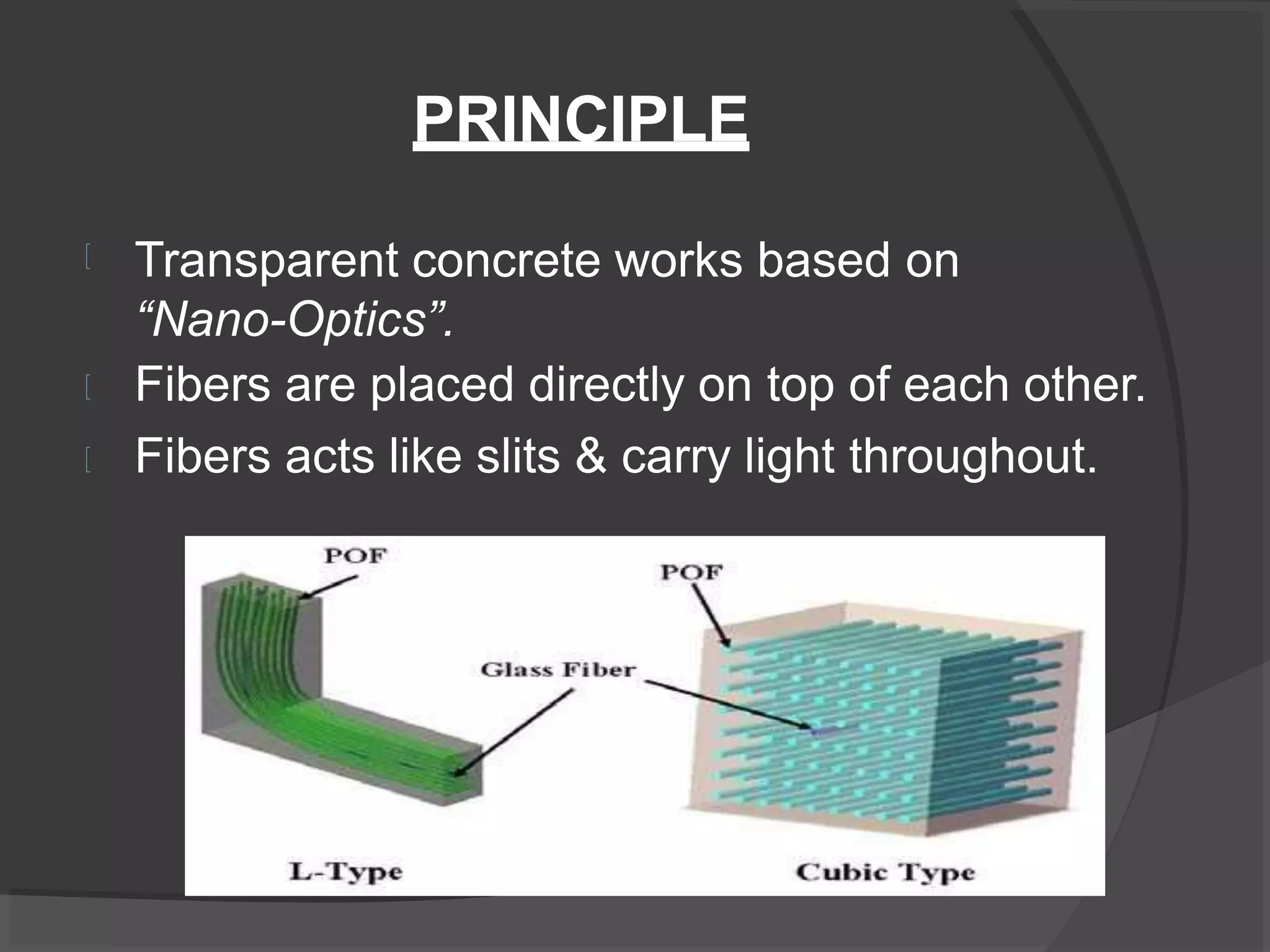
Transparent concrete works based on
“Nano-Optics”.
Fibers are placed directly on top of each other.
Fibers acts like slits & carry light throughout.
MANUFACTURING PROCESS
almost same as regular concrete.
concrete are poured into the mould in layers.
On top of each layers, a layer of fibers is
infused.
Fiber & concrete are alternately inserted into
moulds at intervals of approx. 2 mm to 5mm.
Adding 4% to 5% optical fibres by volume
into the concrete mixture.
MANUFACTURING PROCESS….
The concrete mixture is made from fine
aggregate & cement.
1000’s of strands of optical fibres are cast into
concrete.
Smaller or thinner layers allow an increased
amount of light to pass through the concrete.
The casted material is cut into panels or blocks
& polished.
APPLICATIONS
Floors, pavements and load-bearing walls.
Interior wall cladding & dividing walls
Partitions wall
In furniture
Light sidewalks at night.
Illuminating speed bumps
ADVANTAGES
1. Energy saving.
2. Good aesthetical view to the
building.
3. It can be used in green buildings.
4. Cost Saving.
5. To transmit heat into the buildings
in cold countries.
DISADVANTAGES
Especially skilled persons are
required for the casting work of
transparent concrete.
It has relatively less tension bearing
capacity than normal concrete.
CONCLUSI
ON
developed by adding optical fibre or large
diameter glass fibre .
good light guiding property
It doesn’t loose the strength parameter also it has
very vital property from the aesthetic point of view.
concept of green energy saving
REFERENC
ES
Bhavin k.Kashiyani,Varsha raina,Jayeshkumar Pittroda,Dr.Bhavnaben
K.Shah,(2013)A Study on transparent Concrete:A Novel Architectural
Material to Explore Construction Sector,International Journal of
Engineering and Innovative Technology(IJEIT),8,2,pp 83-87
Jainping He,Zhi Zhou,Jinping Ou,(2011) Study on Smart Transparent
Concrete Product and Its Performances,The 6thInternational owrkshop on
Advanced Smart Materials and Smart Structures Technology
en.wikipedia.org/wiki/Translucent_concrete
THANK YOU
“TRANSPARENT CONCRETE IS
DEFINITELY THE PRESENT AND
THE FUTURE”

Transparent concrete

  • 1.
    SEMINA R ON TRANSPARENT CONCRETE BY, SWAGAT KUMARSAHOO 14011182 7TH SEMESTER CIVIL ENGINEERING VSSUT, BURLA
  • 2.
  • 3.
    INTRODUCTION Transparent concrete -Light-Transmissive property. Light-Transmissive property- uniform distribution Plastic Optical Fibres (POF) . Also known as Translucent concrete.
  • 4.
    MATERIAL USED FORTRANSPARENT CONCRETE The two basic materials are:- 1. Fine concrete 2. Optical fibres. Fine concrete : cement & fine aggregate (sand)
  • 5.
    OPTICAL FIBRES Optical fibreis hair thin cylindrical fibre of glass or any transparent medium. The fibres which are used for optical communication are wave guides made from transparent dielectrics. Its function is to guide visible and infrared lights over long distances.
  • 7.
    PRINCIPLE Transparent concrete worksbased on “Nano-Optics”. Fibers are placed directly on top of each other. Fibers acts like slits & carry light throughout.
  • 8.
    MANUFACTURING PROCESS almost sameas regular concrete. concrete are poured into the mould in layers. On top of each layers, a layer of fibers is infused. Fiber & concrete are alternately inserted into moulds at intervals of approx. 2 mm to 5mm. Adding 4% to 5% optical fibres by volume into the concrete mixture.
  • 9.
    MANUFACTURING PROCESS…. The concretemixture is made from fine aggregate & cement. 1000’s of strands of optical fibres are cast into concrete. Smaller or thinner layers allow an increased amount of light to pass through the concrete. The casted material is cut into panels or blocks & polished.
  • 10.
    APPLICATIONS Floors, pavements andload-bearing walls. Interior wall cladding & dividing walls Partitions wall In furniture Light sidewalks at night. Illuminating speed bumps
  • 11.
    ADVANTAGES 1. Energy saving. 2.Good aesthetical view to the building. 3. It can be used in green buildings. 4. Cost Saving. 5. To transmit heat into the buildings in cold countries.
  • 12.
    DISADVANTAGES Especially skilled personsare required for the casting work of transparent concrete. It has relatively less tension bearing capacity than normal concrete.
  • 13.
    CONCLUSI ON developed by addingoptical fibre or large diameter glass fibre . good light guiding property It doesn’t loose the strength parameter also it has very vital property from the aesthetic point of view. concept of green energy saving
  • 14.
    REFERENC ES Bhavin k.Kashiyani,Varsha raina,JayeshkumarPittroda,Dr.Bhavnaben K.Shah,(2013)A Study on transparent Concrete:A Novel Architectural Material to Explore Construction Sector,International Journal of Engineering and Innovative Technology(IJEIT),8,2,pp 83-87 Jainping He,Zhi Zhou,Jinping Ou,(2011) Study on Smart Transparent Concrete Product and Its Performances,The 6thInternational owrkshop on Advanced Smart Materials and Smart Structures Technology en.wikipedia.org/wiki/Translucent_concrete
  • 15.
    THANK YOU “TRANSPARENT CONCRETEIS DEFINITELY THE PRESENT AND THE FUTURE”