06/06/14 © The University of Sheffield
Ben Kearns
Research Associate
The University of Sheffield
Whole Systems Modelling to Aid
Commissioning of Long-Term
Conditions
06/06/14 © The University of Sheffield
 Often require complex pathways of care.
 Chronic conditions → repeated use of NHS services.
 Need for high-quality care pathways = need for
evidence-based planning and commissioning.
NHS services and people with long-
term conditions
06/06/14 © The University of Sheffield
 Systematic framework for evaluating the potential
costs and health-impact of service re-designs.
 Move from considering single parts of the system
to the whole system.
Whole systems modelling
06/06/14 © The University of Sheffield
 Improving Quality & Effectiveness of Services,
Therapies and Self-management in longer-term
depression (IQuESTs study).
 Translate research into routine NHS care.
 Evaluate potential service re-designs to improve
self-management in Sheffield.
Case-study: depression
06/06/14 © The University of Sheffield
 Interviews with local service experts (managers,
service users, clinicians, academics).
 Conceptual modelling to understand current care
pathways in Sheffield.
 Mathematical model for health economic evaluation.
 Disease-level model (depression) and service-level
model (care pathways).
Process
06/06/14 © The University of Sheffield
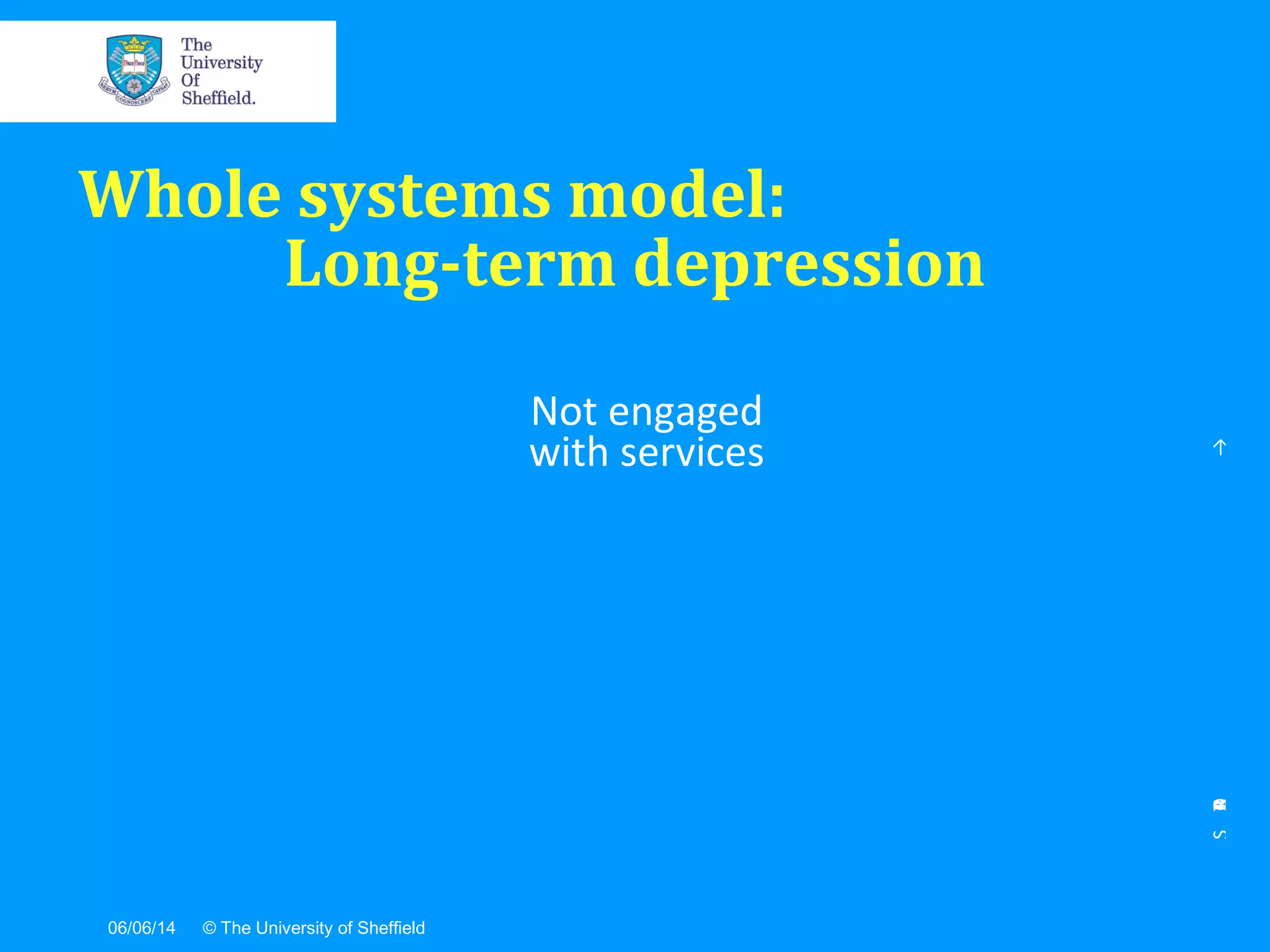
Whole systems model:
Long-term depression
STEPPEDCARE→
Not engaged
with services
06/06/14 © The University of Sheffield
 Three service re-designs evaluated, shown to be
potentially cost-effective, currently being piloted.
 Demonstrates feasibility of using whole-systems
models to inform evidence-based decision making.
Tosh, Kearns, Brennan et al (2013). Innovation in health economic modelling
of service improvements for longer-term depression: demonstration in
a local health community. BMC health services research, 13(1), 150.
http://www.biomedcentral.com/1472-6963/13/150
Results
06/06/14 © The University of Sheffield
 Move towards patient-centred modelling:
 Engagement with services and impact of co-
morbidities.
 Diabetes-depression case-study.
 University of Sheffield training course: “Planning
and commissioning whole-pathways of care for
patients with long-term conditions”.
Implications for future work
06/06/14 © The University of Sheffield
The below applies to the IQuESTS study.
NIHR Collaborations for Leadership in Applied Health Research and
Care for South Yorkshire (CLAHRC SY) acknowledges funding from
the National Institute for Health Research. The views and opinions
expressed are those of the authors, and not necessarily those of the
NHS, the NIHR or the Department of Health.
CLAHRC SY would also like to acknowledge the participation and
resources of our partner organisations. Further details can be found at
http://www.clahrc-sy.nihr.ac.uk..
Acknowledgement
06/06/14 © The University of Sheffield
The below applies to the IQuESTS study.
NIHR Collaborations for Leadership in Applied Health Research and
Care for South Yorkshire (CLAHRC SY) acknowledges funding from
the National Institute for Health Research. The views and opinions
expressed are those of the authors, and not necessarily those of the
NHS, the NIHR or the Department of Health.
CLAHRC SY would also like to acknowledge the participation and
resources of our partner organisations. Further details can be found at
http://www.clahrc-sy.nihr.ac.uk..
Acknowledgement

Whole systems modelling to aid commissioning of long-term conditions

  • 1.
    06/06/14 © TheUniversity of Sheffield Ben Kearns Research Associate The University of Sheffield Whole Systems Modelling to Aid Commissioning of Long-Term Conditions
  • 2.
    06/06/14 © TheUniversity of Sheffield  Often require complex pathways of care.  Chronic conditions → repeated use of NHS services.  Need for high-quality care pathways = need for evidence-based planning and commissioning. NHS services and people with long- term conditions
  • 3.
    06/06/14 © TheUniversity of Sheffield  Systematic framework for evaluating the potential costs and health-impact of service re-designs.  Move from considering single parts of the system to the whole system. Whole systems modelling
  • 4.
    06/06/14 © TheUniversity of Sheffield  Improving Quality & Effectiveness of Services, Therapies and Self-management in longer-term depression (IQuESTs study).  Translate research into routine NHS care.  Evaluate potential service re-designs to improve self-management in Sheffield. Case-study: depression
  • 5.
    06/06/14 © TheUniversity of Sheffield  Interviews with local service experts (managers, service users, clinicians, academics).  Conceptual modelling to understand current care pathways in Sheffield.  Mathematical model for health economic evaluation.  Disease-level model (depression) and service-level model (care pathways). Process
  • 6.
    06/06/14 © TheUniversity of Sheffield Whole systems model: Long-term depression STEPPEDCARE→ Not engaged with services
  • 7.
    06/06/14 © TheUniversity of Sheffield  Three service re-designs evaluated, shown to be potentially cost-effective, currently being piloted.  Demonstrates feasibility of using whole-systems models to inform evidence-based decision making. Tosh, Kearns, Brennan et al (2013). Innovation in health economic modelling of service improvements for longer-term depression: demonstration in a local health community. BMC health services research, 13(1), 150. http://www.biomedcentral.com/1472-6963/13/150 Results
  • 8.
    06/06/14 © TheUniversity of Sheffield  Move towards patient-centred modelling:  Engagement with services and impact of co- morbidities.  Diabetes-depression case-study.  University of Sheffield training course: “Planning and commissioning whole-pathways of care for patients with long-term conditions”. Implications for future work
  • 9.
    06/06/14 © TheUniversity of Sheffield The below applies to the IQuESTS study. NIHR Collaborations for Leadership in Applied Health Research and Care for South Yorkshire (CLAHRC SY) acknowledges funding from the National Institute for Health Research. The views and opinions expressed are those of the authors, and not necessarily those of the NHS, the NIHR or the Department of Health. CLAHRC SY would also like to acknowledge the participation and resources of our partner organisations. Further details can be found at http://www.clahrc-sy.nihr.ac.uk.. Acknowledgement
  • 10.
    06/06/14 © TheUniversity of Sheffield The below applies to the IQuESTS study. NIHR Collaborations for Leadership in Applied Health Research and Care for South Yorkshire (CLAHRC SY) acknowledges funding from the National Institute for Health Research. The views and opinions expressed are those of the authors, and not necessarily those of the NHS, the NIHR or the Department of Health. CLAHRC SY would also like to acknowledge the participation and resources of our partner organisations. Further details can be found at http://www.clahrc-sy.nihr.ac.uk.. Acknowledgement

Editor's Notes

  • #3 Care pathways may include multiple sectors, eg primary, 2ndry, tertiary, voluntary. Repeated use can lead to large costs and resource use for the healthcare system Evidence-based decisions leads onto…
  • #4 …Health economic evaluation of services. E.g.: Improve GP case-finding = good, but what about knock-on effects (capacity/resources of other services for extra cases).
  • #5 For the South-Yorkshire CLARHC
  • #6 Conceptual modelling – looked at everything, had to decide what to include for mathematical model.
  • #7 60% do not present to services, and about 60% drop-out at each stage.
  • #9 Dep: 60% don’t present, 60% drop-out at each stage. So, no matter how good services are, won’t mean a thing if patients don’t engage with them. Training course to increase awareness of usefulness of this work.