https://pixabay.com/photos/books-bookstore-book-reading-1204029/shared under CC0
1
Transitional Words & Phrases
Lunch&Learn
(CLB5+)
https://pixabay.com/photos/books-bookstore-book-reading-1204029/shared under CC0
2
Welcome to the English Online community!
Our Equity, Diversity, and Inclusion Acknowledgment
This community welcomes, appreciates, and respects everyone –
it doesn’t matter what country you’re from or who you are!
Everyone is welcome at English Online.
Discrimination of any kind, however, (including political, religious, nationality, or gender-based)
is NOT WELCOME.
If you are uncomfortable attending this class (or any other at EO), you are free to leave and
email us at info@myenglishonline.ca
Introduction
What is a transition?
3
Transitions
4
Introduction
A transition is a change.
In grammar, a transitional word or
phrase is one that is used to link or
connect one idea to another.
Think of transitional words and phrases
as words that signal a change or a
new idea is coming.
5
Transitional Words and Phrases
We use different transitional words and
phrases depending on:
1. What kind of ideas we are linking together.
2. Whether we are speaking (or writing)
formally, or casually.
Today, we’ll focus on the most common
transition words and phrases used in
informal speech.
6
Uses of Transitional Words and
Phrases
7
1. Cause and Effect:
Cause (noun): someone or something that makes something
happen
Effect (noun): a change that is caused by something
8
1. Cause and Effect:
1. I spilled the orange juice. CAUSE
2. I cleaned the floor. EFFECT
so/as a result/therefore:
I spilled the orange juice, so I cleaned the floor.
because, since:
I cleaned the floor because I spilled the orange juice.
9
1. Cause and Effect: because/since so/as a result/therefore
1. I spilled the orange juice. CAUSE
2. I cleaned the floor. EFFECT
so/as a result/therefore: (come before the effect)
I spilled the orange juice, so I cleaned the floor.
I spilled the orange juice. As a result, I cleaned the floor.
because, since: (come before the cause)
I cleaned the floor because I spilled the orange juice.
Since I spilled the orange juice, I cleaned the floor.
10
2. Time/Sequence (to show the order of events):
First (of all)… (and) then/next (and) finally
Here are 3 separate ideas:
1. I woke up late.
2. I missed the bus.
3. I was late for work.
11
2. Time (to show the order of events):
First (of all)… then/next (and) finally
Here are 3 separate ideas linked by transitions:
Let me tell you about my day. First, I woke up late. Then, I
missed the bus. Finally, I was late for work. I hope tomorrow is
better.
12
3. Contrast (2 different ideas that conflict):
But Though (or although) however
1. I love to ski.
2. I hate the cold.
I love to ski, but I hate the cold.
I love to ski, though I hate the cold.
I love to ski however, I hate the cold.
13
4. Connect (2 similar ideas):
And Also As well
1. I love coffee.
2. I love chocolate.
I love coffee and chocolate.
I love coffee. I love chocolate as well.
I love coffee and I also love chocolate.
14
https://pixabay.com/photos/books-bookstore-book-reading-shop-1204038/ shared under CC0
Let’spractice!
https://pixabay.com/photos/books-bookstore-book-reading-shop-1204038/ shared under CC0
1. Cause and Effect:
so/as a result/therefore: (before the effect)
because, since: (before the cause)
Link the following sentences using a transition.
Example:
I forgot to buy bread. (Cause)
I couldn’t make toast for breakfast. (Effect)
Since I forgot to buy bread, I couldn’t make toast for breakfast.
I forgot to buy bread, so I couldn’t make toast for breakfast.
16
1. Cause and Effect:
so/as a result/therefore: (before the effect)
because, since: (before the cause)
1. The weather is warm.
You don’t need a sweater.
17
1. Cause and Effect:
so/as a result/therefore: (before the effect)
because, since: (before the cause)
1. The weather is warm. (CAUSE)
You don’t need a sweater. (EFFECT)
You don’t need a sweater since the weather is warm.
The weather is warm, so you don’t need a sweater.
18
Cause and Effect:
so/as a result/therefore: (before the effect)
because, since: (before the cause)
2. My mother is coming to visit.
I must clean my house.
19
Cause and Effect:
so/as a result/therefore: (before the effect)
because, since: (before the cause)
2. My mother is coming to visit. (CAUSE)
I must clean my house. (EFFECT)
Since my mother is coming to visit, I must clean my house.
My mother is coming to visit. Therefore, I must clean my house.
20
Cause and Effect:
so/as a result/therefore: (before the effect)
because, since: (before the cause)
3. My computer is broken.
I can’t work today.
21
Cause and Effect:
so/as a result/therefore: (before the effect)
because, since: (before the cause)
3. My computer is broken.
I can’t work today.
My computer is broken so I can’t work today.
Because my computer is broken, I can’t work today.
22
Cause and Effect:
so/as a result/therefore: (before the effect)
because, since: (before the cause)
4. The sun is shining.
The children can play outside.
23
Cause and Effect:
so/as a result/therefore: (before the effect)
because, since: (before the cause)
4. The sun is shining.
The children can play outside.
Since/because the sun is shining, the children can play
outside.
The children can play outside because the sun is shining.
The sun is shining, so the children can play outside.
24
2. Time/sequence (to show the order of events):
First (of all)… then/next (and) finally
1. I want a new job.
2. I will buy a new car.
3. I will go on vacation.
25
2. Time/sequence (to show the order of events):
First (of all)… then/next (and) finally
1. I need a new job.
2. I will buy a new car.
3. I will take a vacation.
First, I need a new job. Then, I will buy a new car. Finally, I will
take a vacation.
26
2. Time/sequence (to show the order of events):
First (of all)… then/next (and) finally
1. Boil the water.
2. Steep your tea for 5 minutes.
3. Enjoy!
27
2. Time/sequence (to show the order of events):
First (of all)… then/next (and) finally
1. Boil the water.
2. Steep your tea for 5 minutes.
3. Enjoy!
To make a cup of tea, first boil the water. Then, steep your tea for
5 minutes. Finally, enjoy!
28
2. Time/sequence (to show the order of events):
First (of all)… then/next (and) finally
Think of 3 things you did this morning or yesterday.
Link the 3 ideas using these transitions.
29
3. Contrast (2 different ideas):
But Though (or although) however
1. I would like to come to the movie.
2. I must study tonight.
30
3. Contrast (2 different ideas):
But Though (or although) however
1. I would like to come to the movie.
2. I must study tonight.
I would like to come to the movie however, I must study tonight.
Though I would like to come to the movie, I must study tonight.
31
4. Connect (2 similar ideas):
And Also As well In addition
Jay loves hiking. He loves kayaking.
32
4. Connect (2 similar ideas):
And Also As well In addition
Jay loves hiking. He loves kayaking.
Jay loves hiking and kayaking.
Jay loves hiking. He loves kayaking as well.
33
Fill in the Blanks with the correct transition.
Ask: What type of transition?
Which one would work?
1. I had a great day. __________ I went for a walk. ________ I found
$20.00! ___________, I went for ice cream.
34
Fill in the Blanks with the correct transition.
Ask: What type of transition?
Which one would work?
1. I had a great day. __First, __ I went for a walk. __Then,__ I found
$20.00! __Finally__ I went for ice cream.
35
Fill in the Blanks with the correct transition.
Ask: What kind of transition?
Which one would work?
2. I hate television, _________ the rest of my family loves it.
36
Fill in the Blanks with the correct transition.
Ask: What kind of transition?
Which one would work?
2. I hate television, __but__ the rest of my family loves it.
37
Fill in the Blanks with the correct transition.
Ask: What kind of transition?
Which one would work?
3. The dress arrived ____ it doesn’t fit me.
38
Fill in the Blanks with the correct transition.
Ask: What kind of transition?
Which one would work?
3. The dress arrived__but__it doesn’t fit me.
39
Fill in the Blanks with the correct transition.
Ask: What kind of transition?
Which one would work?
4. We stayed in a hotel _________ our house was being painted.
40
Fill in the Blanks with the correct transition.
Ask: What kind of transition?
Which one would work?
4. We stayed in a hotel _because/since_ our house was being painted.
41
Fill in the Blanks with the correct transition.
Ask: What kind of transition?
Which one would work?
5. Our house was being painted____ we stayed in a hotel.
42
Fill in the Blanks with the correct transition.
Ask: What kind of transition?
Which one would work?
5. Our house was being painted_so__ we stayed in a hotel.
43
Fill in the Blanks with the correct transition.
Ask: What kind of transition?
Which one would work?
6. The dog went outside and ________ he came in for lunch.
44
Fill in the Blanks with the correct transition.
Ask: What kind of transition?
Which one would work?
6. The dog went outside and _then__ he came in for lunch.
45
“Stay safe when shopping online”
Listen to the audio. Pay attention to transition words and phrases that you
hear.
https://www.youtube.com/watch?v=LC_qM1P6nG4&ab_channel=IdentityMan
gementInstitute
46
Fill in the blanks of this article with transitions.
As the number of e-commerce sites grows each day, more ______
more people prefer to shop online for convenience, choices _____
ease of price comparison. Online shopping is easier than ever
before with Internet-connected computers, phones ______ tablets.
With the availability of Wi-Fi in many
locations, internet access for online shopping is no longer an issue,
__________security has become a major concern for consumers and
businesses. If you are a regular online shopper, there are a few
steps that you can take to protect yourself from identity theft,
prevent online fraud ____ avoid
paying higher prices.
Here are a few steps that you can take to protect yourself when
shopping online.
47
Fill in the blanks of this article with transitions.
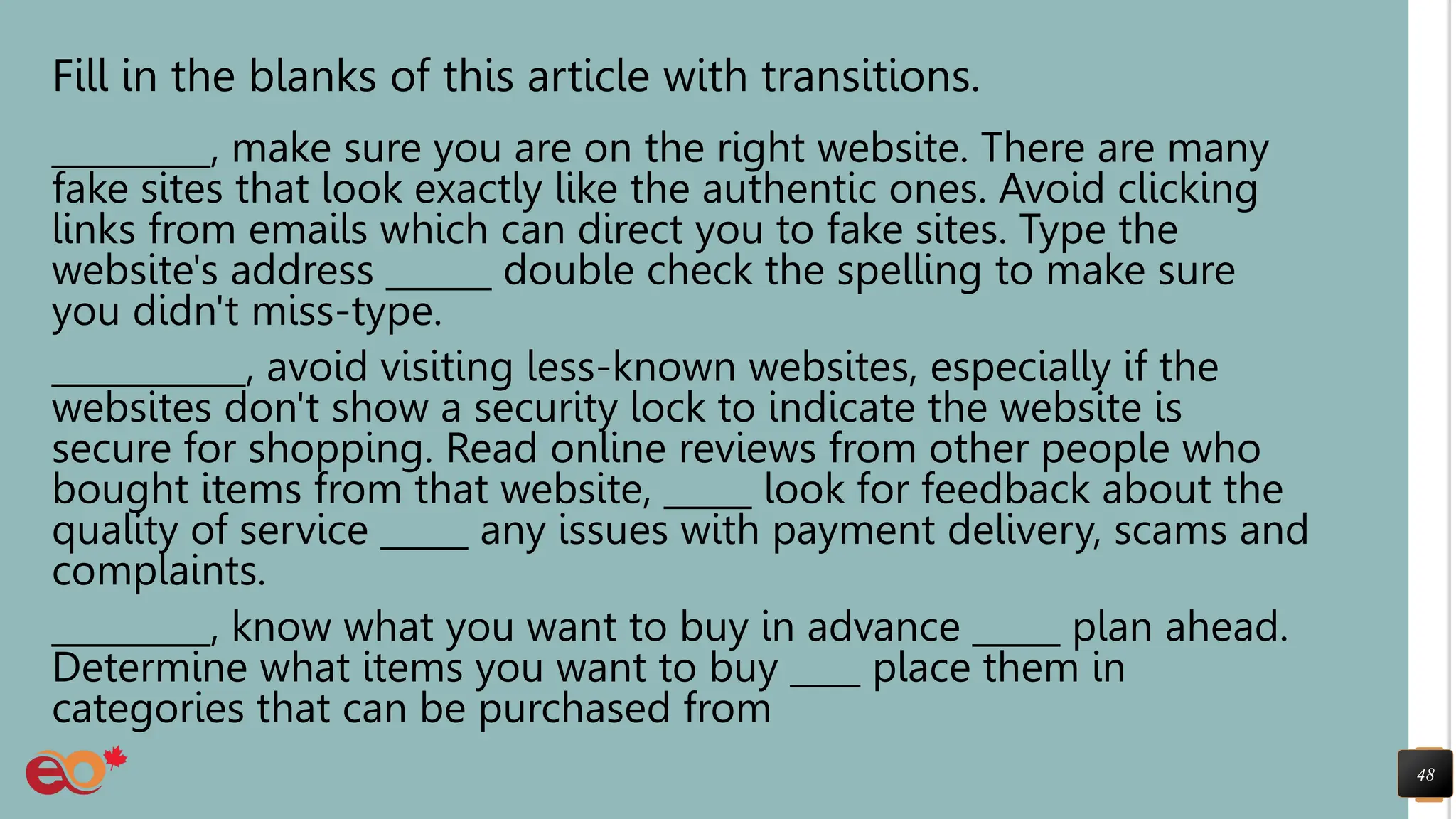
_________, make sure you are on the right website. There are many
fake sites that look exactly like the authentic ones. Avoid clicking
links from emails which can direct you to fake sites. Type the
website's address ______ double check the spelling to make sure
you didn't miss-type.
___________, avoid visiting less-known websites, especially if the
websites don't show a security lock to indicate the website is
secure for shopping. Read online reviews from other people who
bought items from that website, _____ look for feedback about the
quality of service _____ any issues with payment delivery, scams and
complaints.
_________, know what you want to buy in advance _____ plan ahead.
Determine what items you want to buy ____ place them in
categories that can be purchased from
48
Fill in the blanks of this article with transitions.
one merchant. Limiting the number of websites from which you
buy things will reduce the number of times that you share your
credit card _____ personal information.
Once you have selected your items and placed them in the
shopping cart, you must decide how to pay. _________credit cards
are the most common type of payments, be sure to enter yours
correctly.
Some credit cards offer some protection ________ other methods of
payment may not.
49
Fill in the blanks of this article with transitions.
For example, if there's a problem, the law gives consumers the right to
dispute credit card charge's and _______ withholds payment while the
dispute is investigated. If someone uses your credit card without your
permission, you can be charged anyway. But most credit card companies
waive all charges to keep their customers happy.
Before you enter your credit card or other sensitive information
online, make sure that the website address is correct ____ starts with
HTTPS. The S stands for secure _____ means that your information is
encrypted before it's transmitted. __________, you can also look for the
lock sign, which would indicate the site is secure. Other online shopping
considerations include shipping terms ____ cost, prices, return policies,
taxes, other costs, and perks, like coupons, discounts and free shipping.
50
Fill in the blanks of this article with transitions.
With careful planning, when selecting merchants and products for
online shopping you can be confident that you have the best deal _____
stay safe when shopping online. Even if you shop in the
stores, you can check the prices online and make sure you're not
overpaying.
Source:
https://pblapg.language.ca/wp-content/uploads/2021/01/CLB-5-6-Shopping-
Online-Jan-2021-version.pdf
51
Love the Hallways
52
Many speak of opportunities, “When one door closes, another one opens.”
But rarely about the hallway. The transition. The in-between where you are
and where you are headed.
The hallway doesn’t have to be a scary, dark, endless confusion.
It can be a space of massive transformation, great memories, and peace.
Author unknown.
Transitional Words & Phrases: (Formal) Writing
Here are some more formal transitional words and phrases that we use in
writing.
https://allesl.com/transition-words/
53
Questions?
54
https://pixabay.com/photos/cup-of-coffee-laptop-office-macbook-1280537/ shared under CC0
HOMEWORK – Link the ideas below using transitional words
and phrases.
1. I lost my purse. My wallet wasn’t inside.
2. I am hoping for an early Spring. I love to garden.
3. You are coming for dinner. Can you bring a salad?
4. I would love to take a vacation. Vacations are expensive.
5. Mya has many friends. She prefers to be alone.
Use: but, since, because, and, as well, however, though
55
https://pixabay.com/photos/books-pages-story-stories-notes-1245690/ shared under CC0
HOMEWORK: The details:
1. Submit your homework to Lori on Skype: live:loramoren
2. After class, you have until the 11:59 pm the same day to complete the assignment.
3. I will correct the homework and offer feedback. 
Language Contest
Want to learn more expressions, Canadian cultural
references and idioms?
Check English Online’s Facebook and Instagram
pages and take the challenge
of our Language Contest every
other Thursday!
You can win EO personalized
prizes and improve your English
skills one idiom at a time!
58
Sources:
https://app.ellii.com/lesson/2546-transition-words-phrases
https://15worksheets.com/worksheet/transition-words-6/
59
Thankyou!
Lori Morency
Skype: live:loramoren
livelearn.ca
Thankyou!
Blaine
broberts@myenglishonline.ca
livelearn.ca
1-204-946-5140
Website:
livelearn.ca
Email:
info@myenglishonline.ca

TransitionWordsPhrasesCLB5+EnglishOnline.pptx

  • 1.
    https://pixabay.com/photos/books-bookstore-book-reading-1204029/shared under CC0 1 TransitionalWords & Phrases Lunch&Learn (CLB5+) https://pixabay.com/photos/books-bookstore-book-reading-1204029/shared under CC0
  • 2.
    2 Welcome to theEnglish Online community! Our Equity, Diversity, and Inclusion Acknowledgment This community welcomes, appreciates, and respects everyone – it doesn’t matter what country you’re from or who you are! Everyone is welcome at English Online. Discrimination of any kind, however, (including political, religious, nationality, or gender-based) is NOT WELCOME. If you are uncomfortable attending this class (or any other at EO), you are free to leave and email us at info@myenglishonline.ca
  • 3.
  • 4.
  • 5.
    Introduction A transition isa change. In grammar, a transitional word or phrase is one that is used to link or connect one idea to another. Think of transitional words and phrases as words that signal a change or a new idea is coming. 5
  • 6.
    Transitional Words andPhrases We use different transitional words and phrases depending on: 1. What kind of ideas we are linking together. 2. Whether we are speaking (or writing) formally, or casually. Today, we’ll focus on the most common transition words and phrases used in informal speech. 6
  • 7.
    Uses of TransitionalWords and Phrases 7
  • 8.
    1. Cause andEffect: Cause (noun): someone or something that makes something happen Effect (noun): a change that is caused by something 8
  • 9.
    1. Cause andEffect: 1. I spilled the orange juice. CAUSE 2. I cleaned the floor. EFFECT so/as a result/therefore: I spilled the orange juice, so I cleaned the floor. because, since: I cleaned the floor because I spilled the orange juice. 9
  • 10.
    1. Cause andEffect: because/since so/as a result/therefore 1. I spilled the orange juice. CAUSE 2. I cleaned the floor. EFFECT so/as a result/therefore: (come before the effect) I spilled the orange juice, so I cleaned the floor. I spilled the orange juice. As a result, I cleaned the floor. because, since: (come before the cause) I cleaned the floor because I spilled the orange juice. Since I spilled the orange juice, I cleaned the floor. 10
  • 11.
    2. Time/Sequence (toshow the order of events): First (of all)… (and) then/next (and) finally Here are 3 separate ideas: 1. I woke up late. 2. I missed the bus. 3. I was late for work. 11
  • 12.
    2. Time (toshow the order of events): First (of all)… then/next (and) finally Here are 3 separate ideas linked by transitions: Let me tell you about my day. First, I woke up late. Then, I missed the bus. Finally, I was late for work. I hope tomorrow is better. 12
  • 13.
    3. Contrast (2different ideas that conflict): But Though (or although) however 1. I love to ski. 2. I hate the cold. I love to ski, but I hate the cold. I love to ski, though I hate the cold. I love to ski however, I hate the cold. 13
  • 14.
    4. Connect (2similar ideas): And Also As well 1. I love coffee. 2. I love chocolate. I love coffee and chocolate. I love coffee. I love chocolate as well. I love coffee and I also love chocolate. 14
  • 15.
    https://pixabay.com/photos/books-bookstore-book-reading-shop-1204038/ shared underCC0 Let’spractice! https://pixabay.com/photos/books-bookstore-book-reading-shop-1204038/ shared under CC0
  • 16.
    1. Cause andEffect: so/as a result/therefore: (before the effect) because, since: (before the cause) Link the following sentences using a transition. Example: I forgot to buy bread. (Cause) I couldn’t make toast for breakfast. (Effect) Since I forgot to buy bread, I couldn’t make toast for breakfast. I forgot to buy bread, so I couldn’t make toast for breakfast. 16
  • 17.
    1. Cause andEffect: so/as a result/therefore: (before the effect) because, since: (before the cause) 1. The weather is warm. You don’t need a sweater. 17
  • 18.
    1. Cause andEffect: so/as a result/therefore: (before the effect) because, since: (before the cause) 1. The weather is warm. (CAUSE) You don’t need a sweater. (EFFECT) You don’t need a sweater since the weather is warm. The weather is warm, so you don’t need a sweater. 18
  • 19.
    Cause and Effect: so/asa result/therefore: (before the effect) because, since: (before the cause) 2. My mother is coming to visit. I must clean my house. 19
  • 20.
    Cause and Effect: so/asa result/therefore: (before the effect) because, since: (before the cause) 2. My mother is coming to visit. (CAUSE) I must clean my house. (EFFECT) Since my mother is coming to visit, I must clean my house. My mother is coming to visit. Therefore, I must clean my house. 20
  • 21.
    Cause and Effect: so/asa result/therefore: (before the effect) because, since: (before the cause) 3. My computer is broken. I can’t work today. 21
  • 22.
    Cause and Effect: so/asa result/therefore: (before the effect) because, since: (before the cause) 3. My computer is broken. I can’t work today. My computer is broken so I can’t work today. Because my computer is broken, I can’t work today. 22
  • 23.
    Cause and Effect: so/asa result/therefore: (before the effect) because, since: (before the cause) 4. The sun is shining. The children can play outside. 23
  • 24.
    Cause and Effect: so/asa result/therefore: (before the effect) because, since: (before the cause) 4. The sun is shining. The children can play outside. Since/because the sun is shining, the children can play outside. The children can play outside because the sun is shining. The sun is shining, so the children can play outside. 24
  • 25.
    2. Time/sequence (toshow the order of events): First (of all)… then/next (and) finally 1. I want a new job. 2. I will buy a new car. 3. I will go on vacation. 25
  • 26.
    2. Time/sequence (toshow the order of events): First (of all)… then/next (and) finally 1. I need a new job. 2. I will buy a new car. 3. I will take a vacation. First, I need a new job. Then, I will buy a new car. Finally, I will take a vacation. 26
  • 27.
    2. Time/sequence (toshow the order of events): First (of all)… then/next (and) finally 1. Boil the water. 2. Steep your tea for 5 minutes. 3. Enjoy! 27
  • 28.
    2. Time/sequence (toshow the order of events): First (of all)… then/next (and) finally 1. Boil the water. 2. Steep your tea for 5 minutes. 3. Enjoy! To make a cup of tea, first boil the water. Then, steep your tea for 5 minutes. Finally, enjoy! 28
  • 29.
    2. Time/sequence (toshow the order of events): First (of all)… then/next (and) finally Think of 3 things you did this morning or yesterday. Link the 3 ideas using these transitions. 29
  • 30.
    3. Contrast (2different ideas): But Though (or although) however 1. I would like to come to the movie. 2. I must study tonight. 30
  • 31.
    3. Contrast (2different ideas): But Though (or although) however 1. I would like to come to the movie. 2. I must study tonight. I would like to come to the movie however, I must study tonight. Though I would like to come to the movie, I must study tonight. 31
  • 32.
    4. Connect (2similar ideas): And Also As well In addition Jay loves hiking. He loves kayaking. 32
  • 33.
    4. Connect (2similar ideas): And Also As well In addition Jay loves hiking. He loves kayaking. Jay loves hiking and kayaking. Jay loves hiking. He loves kayaking as well. 33
  • 34.
    Fill in theBlanks with the correct transition. Ask: What type of transition? Which one would work? 1. I had a great day. __________ I went for a walk. ________ I found $20.00! ___________, I went for ice cream. 34
  • 35.
    Fill in theBlanks with the correct transition. Ask: What type of transition? Which one would work? 1. I had a great day. __First, __ I went for a walk. __Then,__ I found $20.00! __Finally__ I went for ice cream. 35
  • 36.
    Fill in theBlanks with the correct transition. Ask: What kind of transition? Which one would work? 2. I hate television, _________ the rest of my family loves it. 36
  • 37.
    Fill in theBlanks with the correct transition. Ask: What kind of transition? Which one would work? 2. I hate television, __but__ the rest of my family loves it. 37
  • 38.
    Fill in theBlanks with the correct transition. Ask: What kind of transition? Which one would work? 3. The dress arrived ____ it doesn’t fit me. 38
  • 39.
    Fill in theBlanks with the correct transition. Ask: What kind of transition? Which one would work? 3. The dress arrived__but__it doesn’t fit me. 39
  • 40.
    Fill in theBlanks with the correct transition. Ask: What kind of transition? Which one would work? 4. We stayed in a hotel _________ our house was being painted. 40
  • 41.
    Fill in theBlanks with the correct transition. Ask: What kind of transition? Which one would work? 4. We stayed in a hotel _because/since_ our house was being painted. 41
  • 42.
    Fill in theBlanks with the correct transition. Ask: What kind of transition? Which one would work? 5. Our house was being painted____ we stayed in a hotel. 42
  • 43.
    Fill in theBlanks with the correct transition. Ask: What kind of transition? Which one would work? 5. Our house was being painted_so__ we stayed in a hotel. 43
  • 44.
    Fill in theBlanks with the correct transition. Ask: What kind of transition? Which one would work? 6. The dog went outside and ________ he came in for lunch. 44
  • 45.
    Fill in theBlanks with the correct transition. Ask: What kind of transition? Which one would work? 6. The dog went outside and _then__ he came in for lunch. 45
  • 46.
    “Stay safe whenshopping online” Listen to the audio. Pay attention to transition words and phrases that you hear. https://www.youtube.com/watch?v=LC_qM1P6nG4&ab_channel=IdentityMan gementInstitute 46
  • 47.
    Fill in theblanks of this article with transitions. As the number of e-commerce sites grows each day, more ______ more people prefer to shop online for convenience, choices _____ ease of price comparison. Online shopping is easier than ever before with Internet-connected computers, phones ______ tablets. With the availability of Wi-Fi in many locations, internet access for online shopping is no longer an issue, __________security has become a major concern for consumers and businesses. If you are a regular online shopper, there are a few steps that you can take to protect yourself from identity theft, prevent online fraud ____ avoid paying higher prices. Here are a few steps that you can take to protect yourself when shopping online. 47
  • 48.
    Fill in theblanks of this article with transitions. _________, make sure you are on the right website. There are many fake sites that look exactly like the authentic ones. Avoid clicking links from emails which can direct you to fake sites. Type the website's address ______ double check the spelling to make sure you didn't miss-type. ___________, avoid visiting less-known websites, especially if the websites don't show a security lock to indicate the website is secure for shopping. Read online reviews from other people who bought items from that website, _____ look for feedback about the quality of service _____ any issues with payment delivery, scams and complaints. _________, know what you want to buy in advance _____ plan ahead. Determine what items you want to buy ____ place them in categories that can be purchased from 48
  • 49.
    Fill in theblanks of this article with transitions. one merchant. Limiting the number of websites from which you buy things will reduce the number of times that you share your credit card _____ personal information. Once you have selected your items and placed them in the shopping cart, you must decide how to pay. _________credit cards are the most common type of payments, be sure to enter yours correctly. Some credit cards offer some protection ________ other methods of payment may not. 49
  • 50.
    Fill in theblanks of this article with transitions. For example, if there's a problem, the law gives consumers the right to dispute credit card charge's and _______ withholds payment while the dispute is investigated. If someone uses your credit card without your permission, you can be charged anyway. But most credit card companies waive all charges to keep their customers happy. Before you enter your credit card or other sensitive information online, make sure that the website address is correct ____ starts with HTTPS. The S stands for secure _____ means that your information is encrypted before it's transmitted. __________, you can also look for the lock sign, which would indicate the site is secure. Other online shopping considerations include shipping terms ____ cost, prices, return policies, taxes, other costs, and perks, like coupons, discounts and free shipping. 50
  • 51.
    Fill in theblanks of this article with transitions. With careful planning, when selecting merchants and products for online shopping you can be confident that you have the best deal _____ stay safe when shopping online. Even if you shop in the stores, you can check the prices online and make sure you're not overpaying. Source: https://pblapg.language.ca/wp-content/uploads/2021/01/CLB-5-6-Shopping- Online-Jan-2021-version.pdf 51
  • 52.
    Love the Hallways 52 Manyspeak of opportunities, “When one door closes, another one opens.” But rarely about the hallway. The transition. The in-between where you are and where you are headed. The hallway doesn’t have to be a scary, dark, endless confusion. It can be a space of massive transformation, great memories, and peace. Author unknown.
  • 53.
    Transitional Words &Phrases: (Formal) Writing Here are some more formal transitional words and phrases that we use in writing. https://allesl.com/transition-words/ 53
  • 54.
  • 55.
    HOMEWORK – Linkthe ideas below using transitional words and phrases. 1. I lost my purse. My wallet wasn’t inside. 2. I am hoping for an early Spring. I love to garden. 3. You are coming for dinner. Can you bring a salad? 4. I would love to take a vacation. Vacations are expensive. 5. Mya has many friends. She prefers to be alone. Use: but, since, because, and, as well, however, though 55 https://pixabay.com/photos/books-pages-story-stories-notes-1245690/ shared under CC0
  • 56.
    HOMEWORK: The details: 1.Submit your homework to Lori on Skype: live:loramoren 2. After class, you have until the 11:59 pm the same day to complete the assignment. 3. I will correct the homework and offer feedback. 
  • 57.
    Language Contest Want tolearn more expressions, Canadian cultural references and idioms? Check English Online’s Facebook and Instagram pages and take the challenge of our Language Contest every other Thursday! You can win EO personalized prizes and improve your English skills one idiom at a time!
  • 58.
  • 59.
  • 60.
  • 61.