Transition Words
and Phrases
Coherence
• Coherence in writing occurs through sentence-to-
sentence connections, when transitions are used to
link ideas.
• Texts that are coherent progress logically and hold
the reader's attention throughout the piece.
• Coherent writing is better writing!
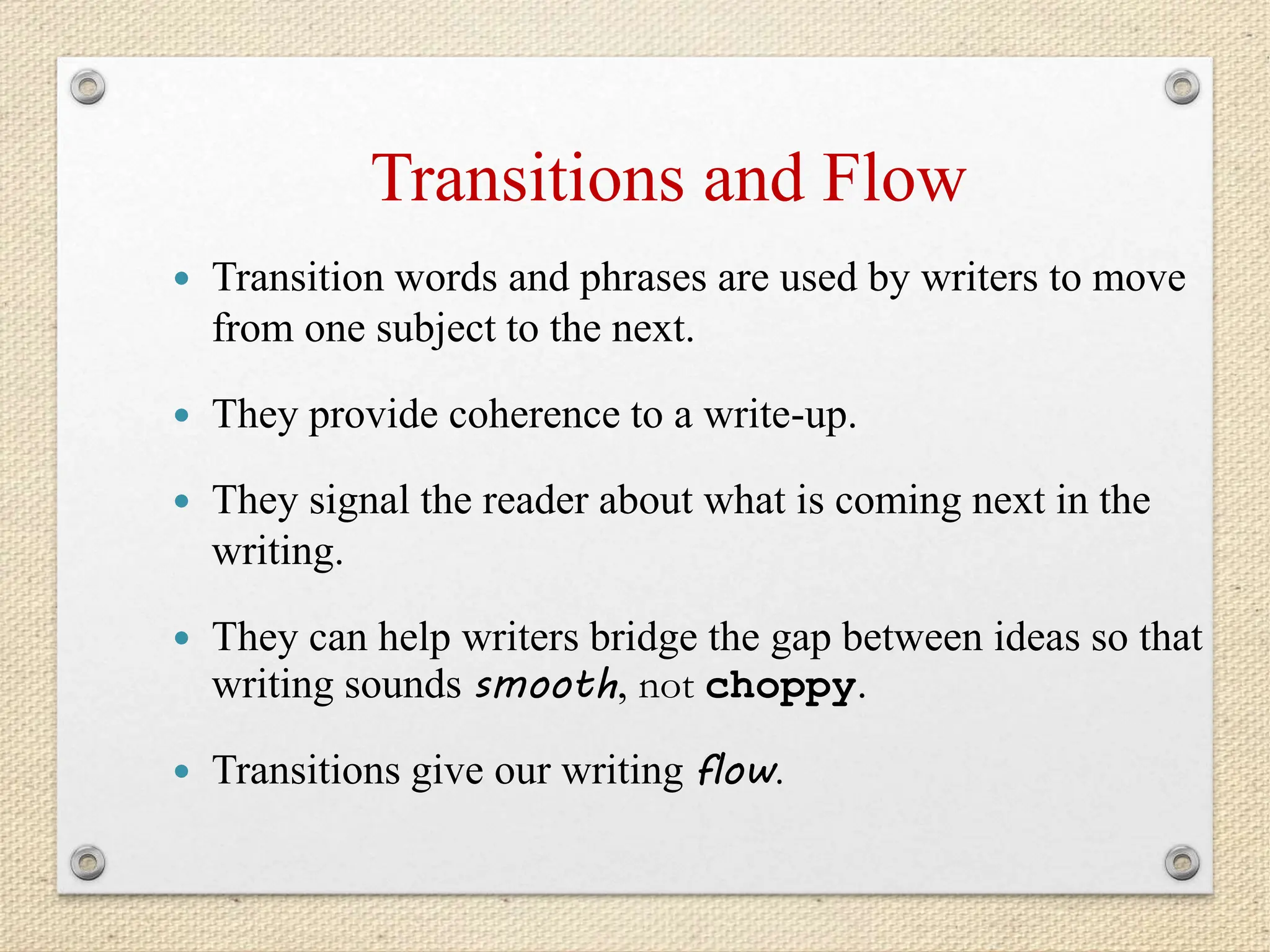
Transitions and Flow
 Transition words and phrases are used by writers to move
from one subject to the next.
 They provide coherence to a write-up.
 They signal the reader about what is coming next in the
writing.
 They can help writers bridge the gap between ideas so that
writing sounds smooth, not choppy.
 Transitions give our writing flow.
For example
Take these two sentences:
Murad likes to eat pizza. He does not want pizza today.
Using transition words, you can put these two together to make one
smooth sentence instead of two choppy ones.
Murad likes to eat pizza, however, he does not want pizza today.
This sentence sounds better and is much easier to read!
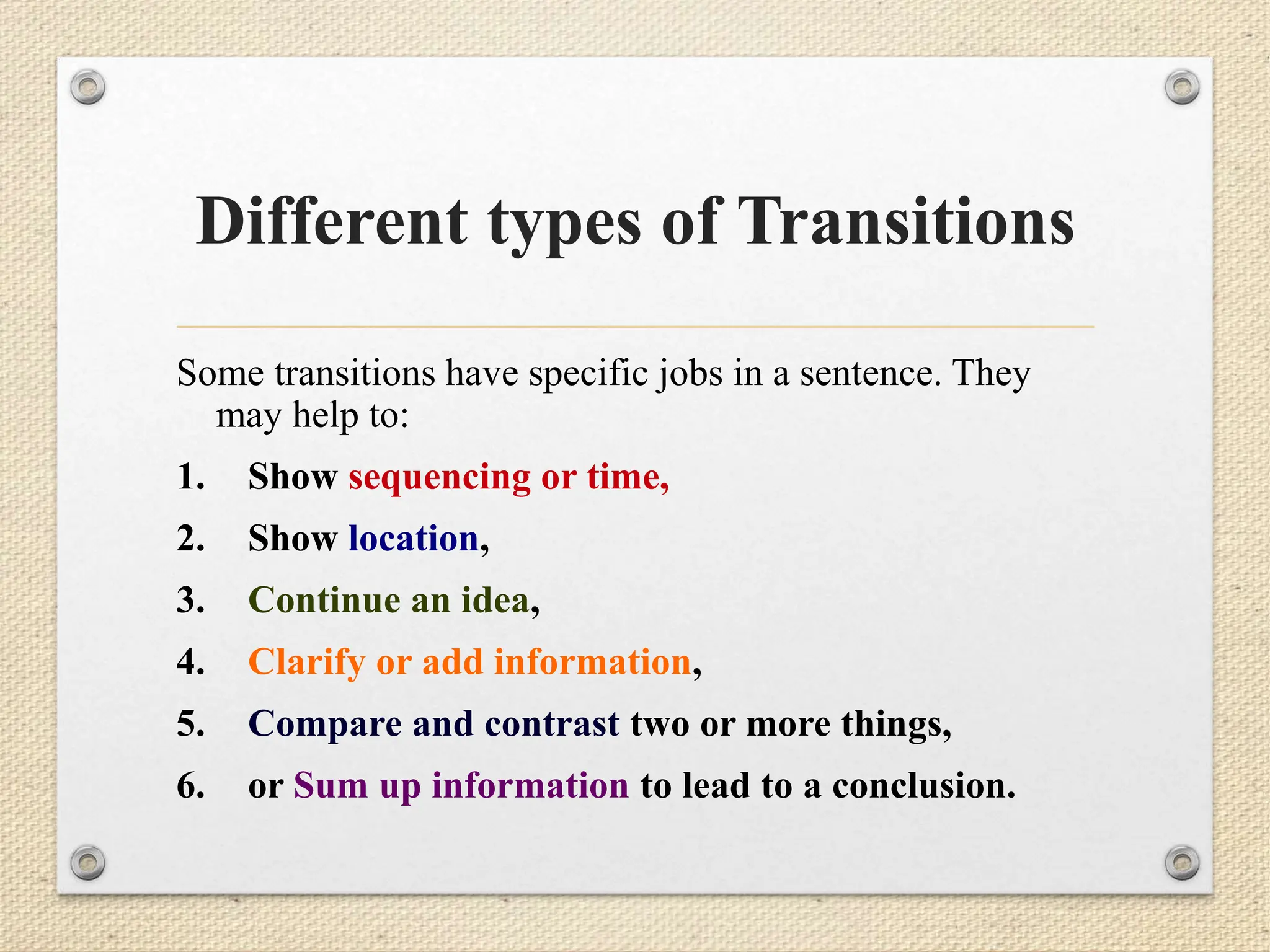
Different types of Transitions
Some transitions have specific jobs in a sentence. They
may help to:
1. Show sequencing or time,
2. Show location,
3. Continue an idea,
4. Clarify or add information,
5. Compare and contrast two or more things,
6. or Sum up information to lead to a conclusion.
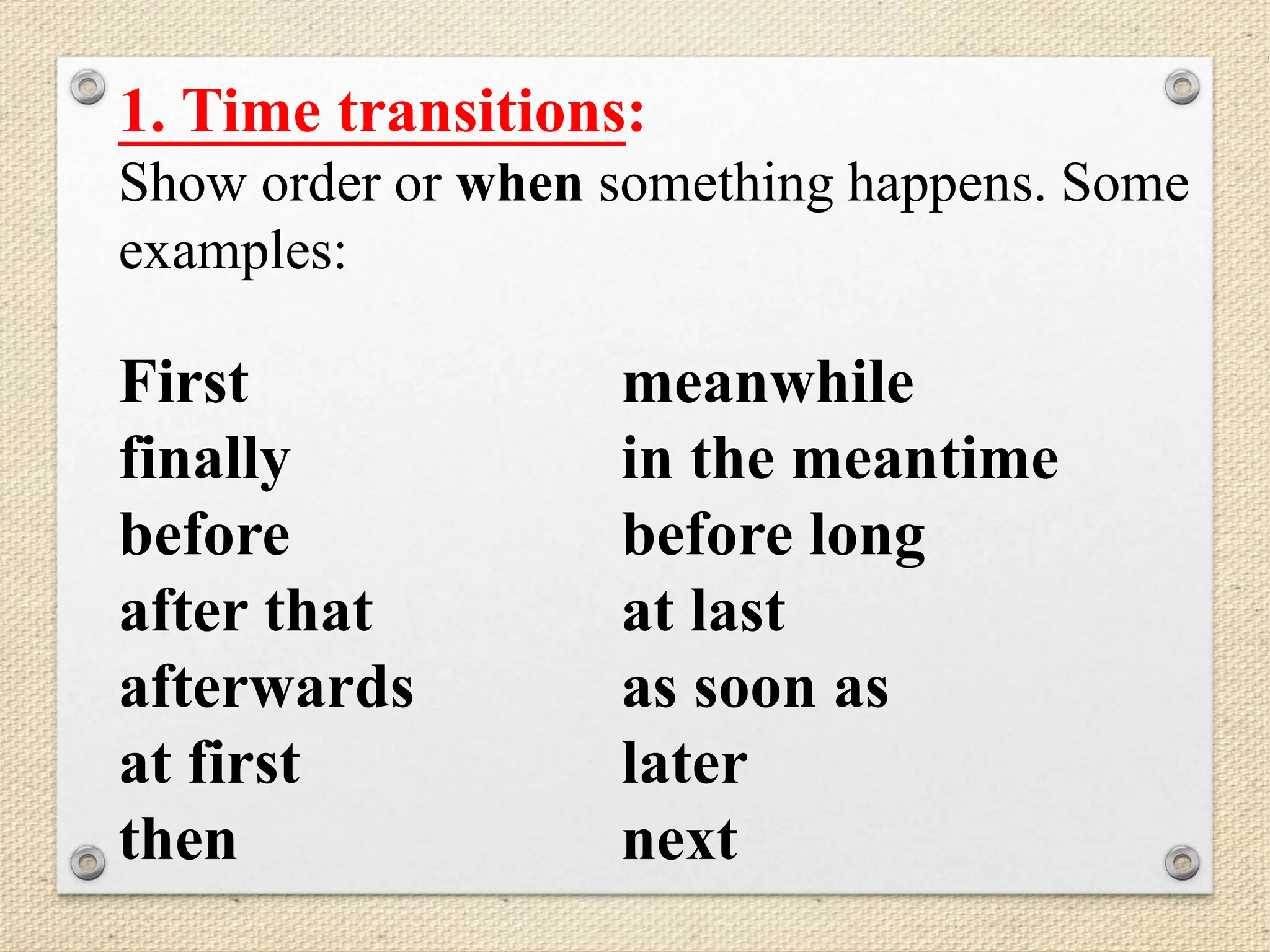
1. Time transitions:
Show order or when something happens. Some
examples:
First meanwhile
finally in the meantime
before before long
after that at last
afterwards as soon as
at first later
then next
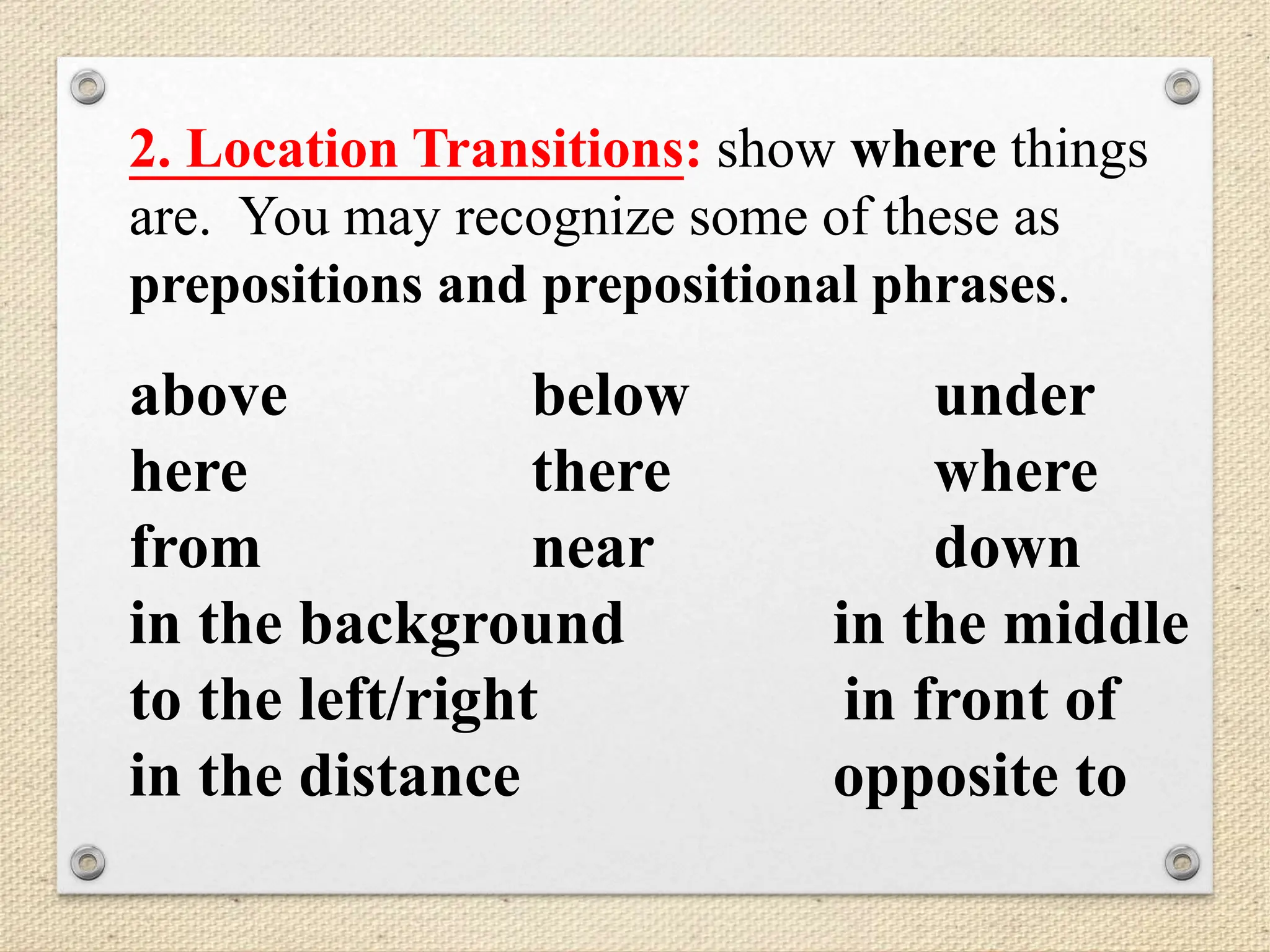
2. Location Transitions: show where things
are. You may recognize some of these as
prepositions and prepositional phrases.
above below under
here there where
from near down
in the background in the middle
to the left/right in front of
in the distance opposite to
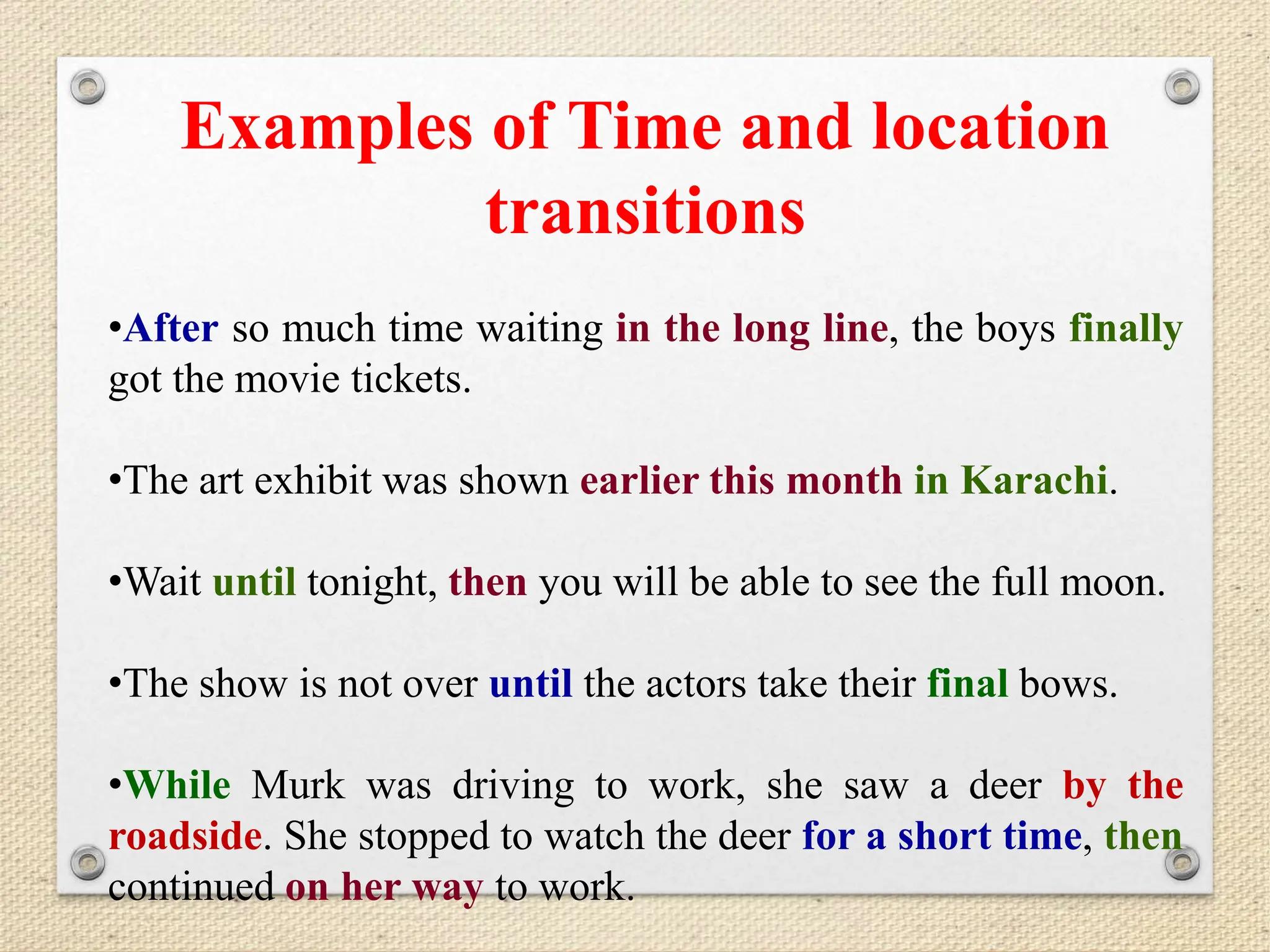
Examples of Time and location
transitions
•After so much time waiting in the long line, the boys finally
got the movie tickets.
•The art exhibit was shown earlier this month in Karachi.
•Wait until tonight, then you will be able to see the full moon.
•The show is not over until the actors take their final bows.
•While Murk was driving to work, she saw a deer by the
roadside. She stopped to watch the deer for a short time, then
continued on her way to work.
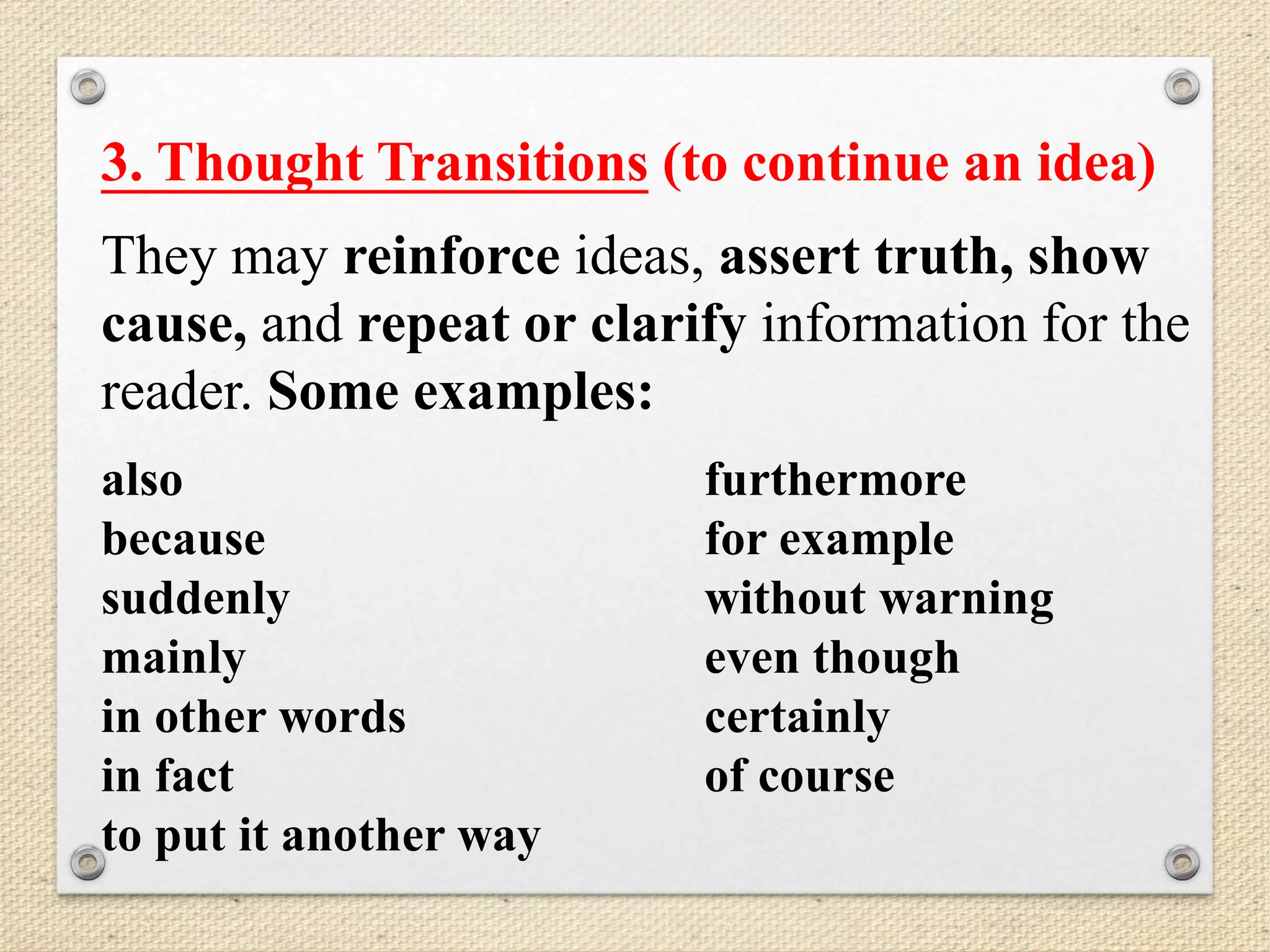
3. Thought Transitions (to continue an idea)
They may reinforce ideas, assert truth, show
cause, and repeat or clarify information for the
reader. Some examples:
also furthermore
because for example
suddenly without warning
mainly even though
in other words certainly
in fact of course
to put it another way
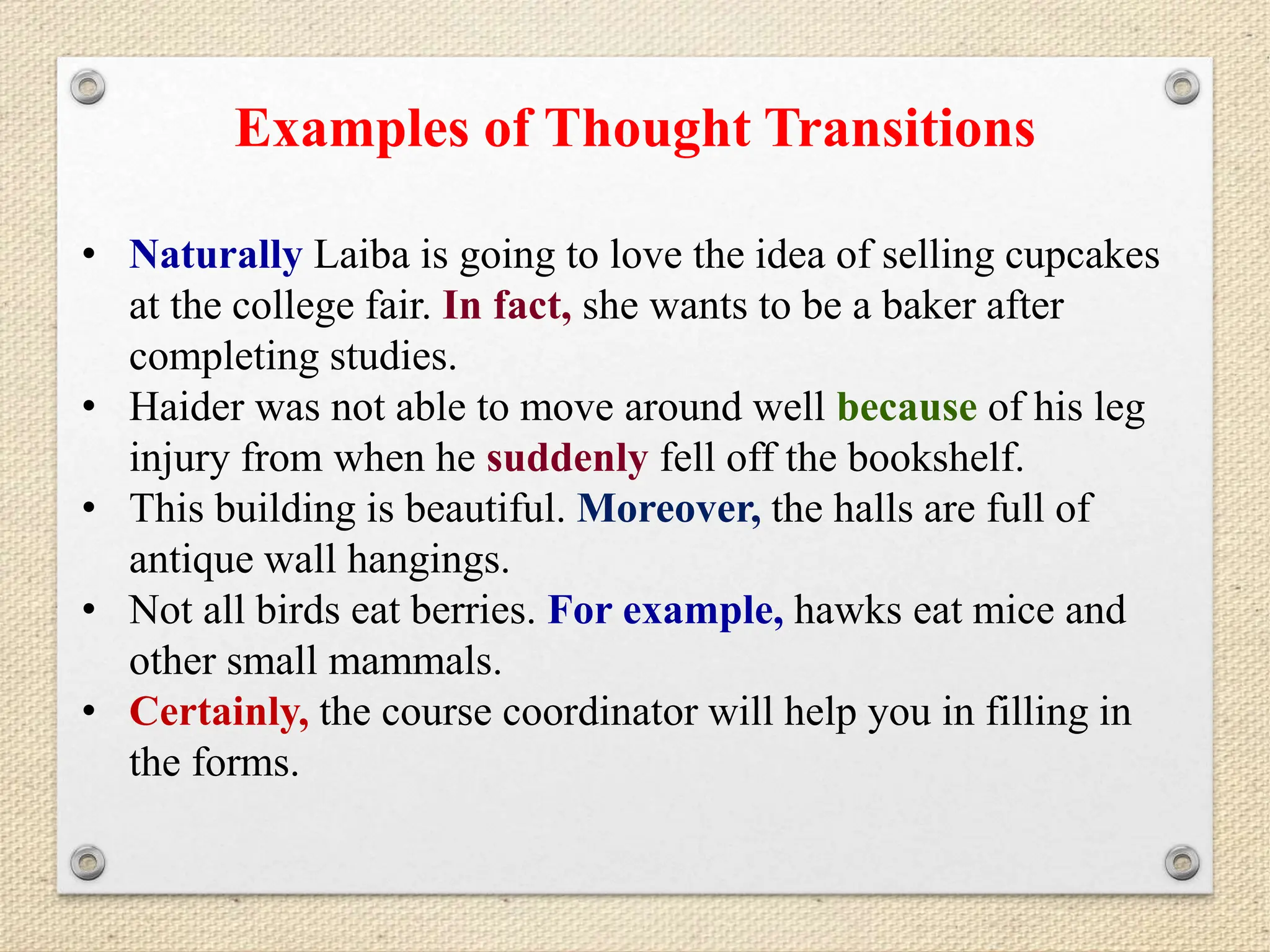
Examples of Thought Transitions
• Naturally Laiba is going to love the idea of selling cupcakes
at the college fair. In fact, she wants to be a baker after
completing studies.
• Haider was not able to move around well because of his leg
injury from when he suddenly fell off the bookshelf.
• This building is beautiful. Moreover, the halls are full of
antique wall hangings.
• Not all birds eat berries. For example, hawks eat mice and
other small mammals.
• Certainly, the course coordinator will help you in filling in
the forms.
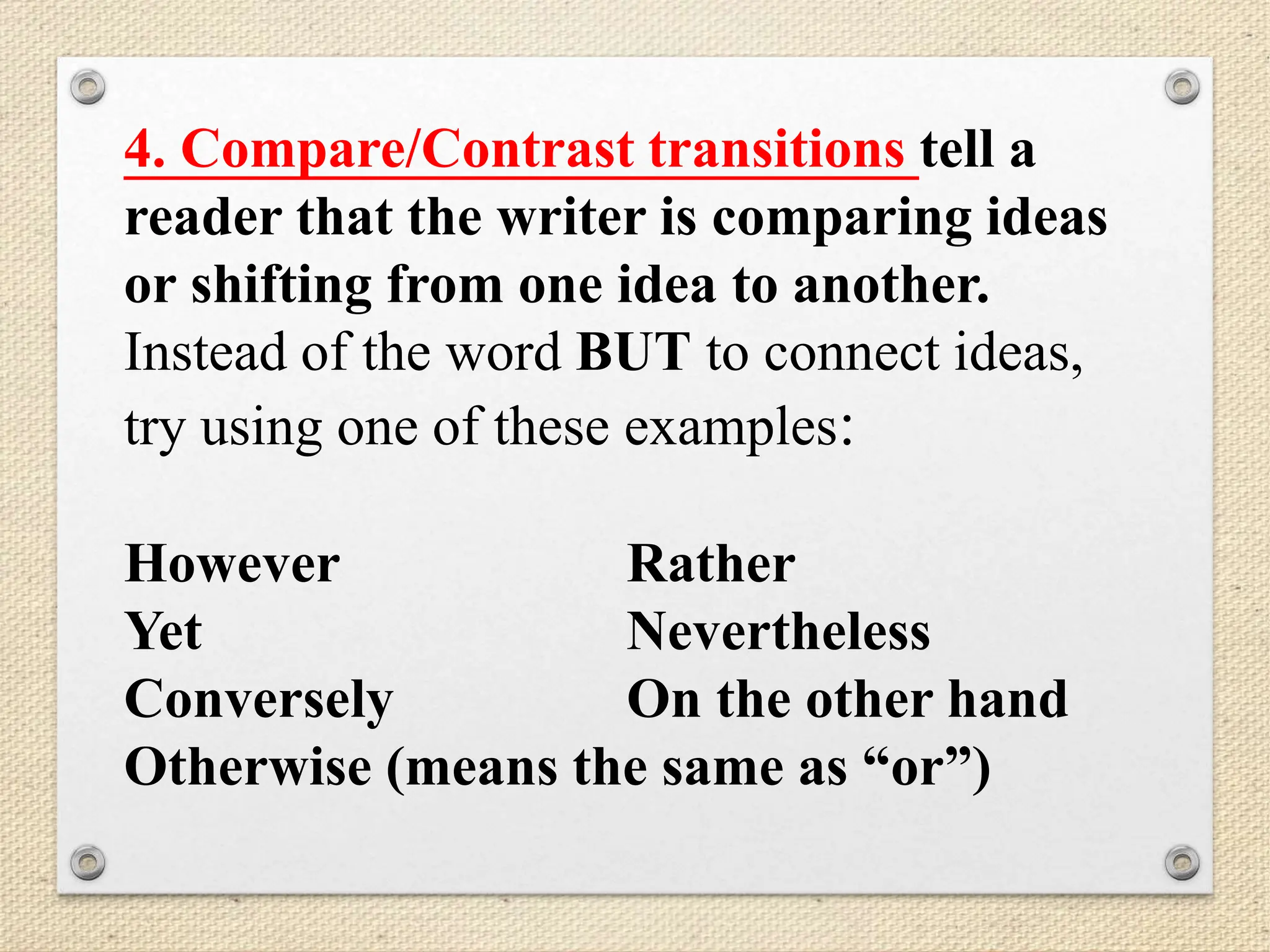
4. Compare/Contrast transitions tell a
reader that the writer is comparing ideas
or shifting from one idea to another.
Instead of the word BUT to connect ideas,
try using one of these examples:
However Rather
Yet Nevertheless
Conversely On the other hand
Otherwise (means the same as “or”)
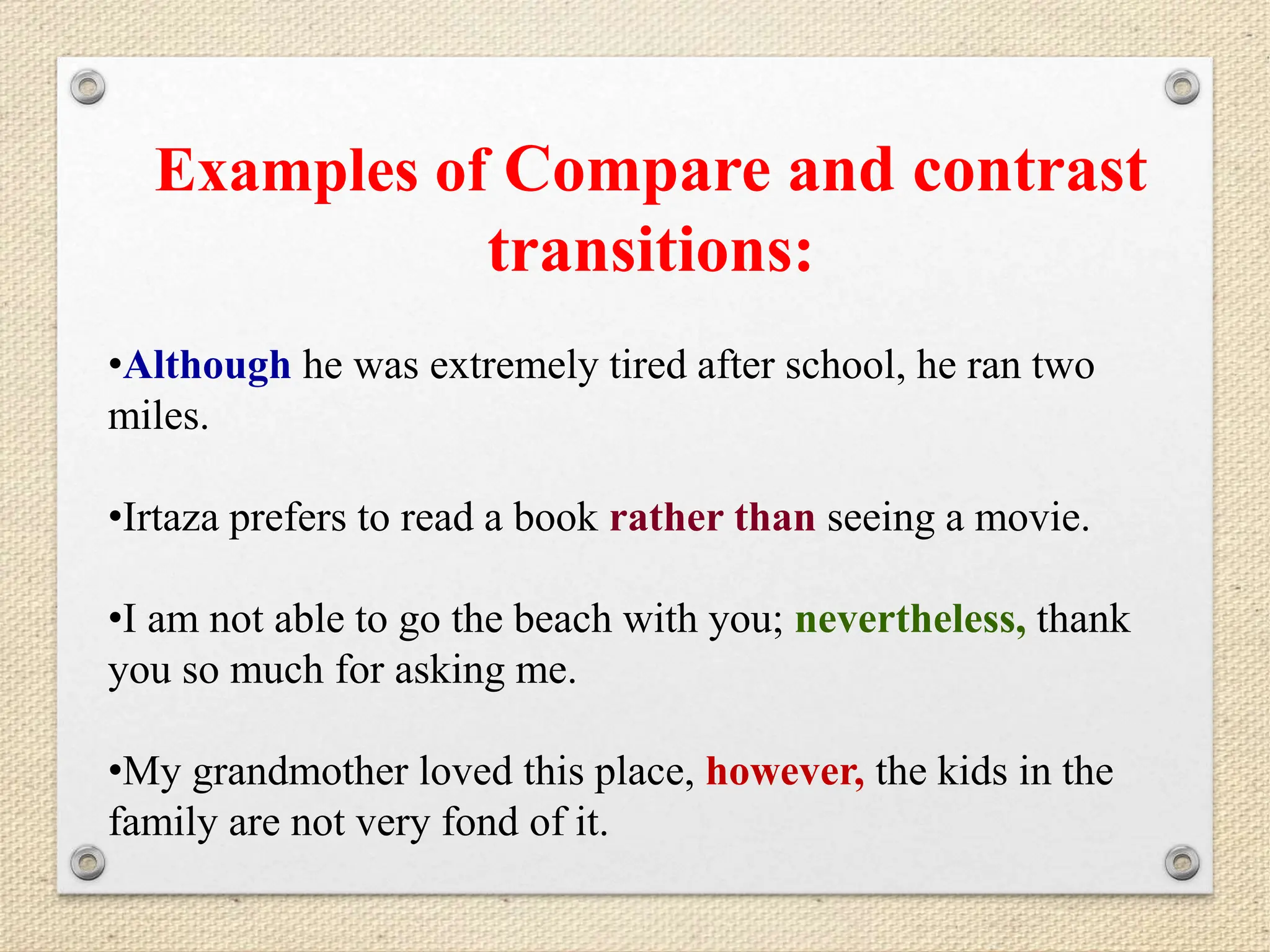
Examples of Compare and contrast
transitions:
•Although he was extremely tired after school, he ran two
miles.
•Irtaza prefers to read a book rather than seeing a movie.
•I am not able to go the beach with you; nevertheless, thank
you so much for asking me.
•My grandmother loved this place, however, the kids in the
family are not very fond of it.
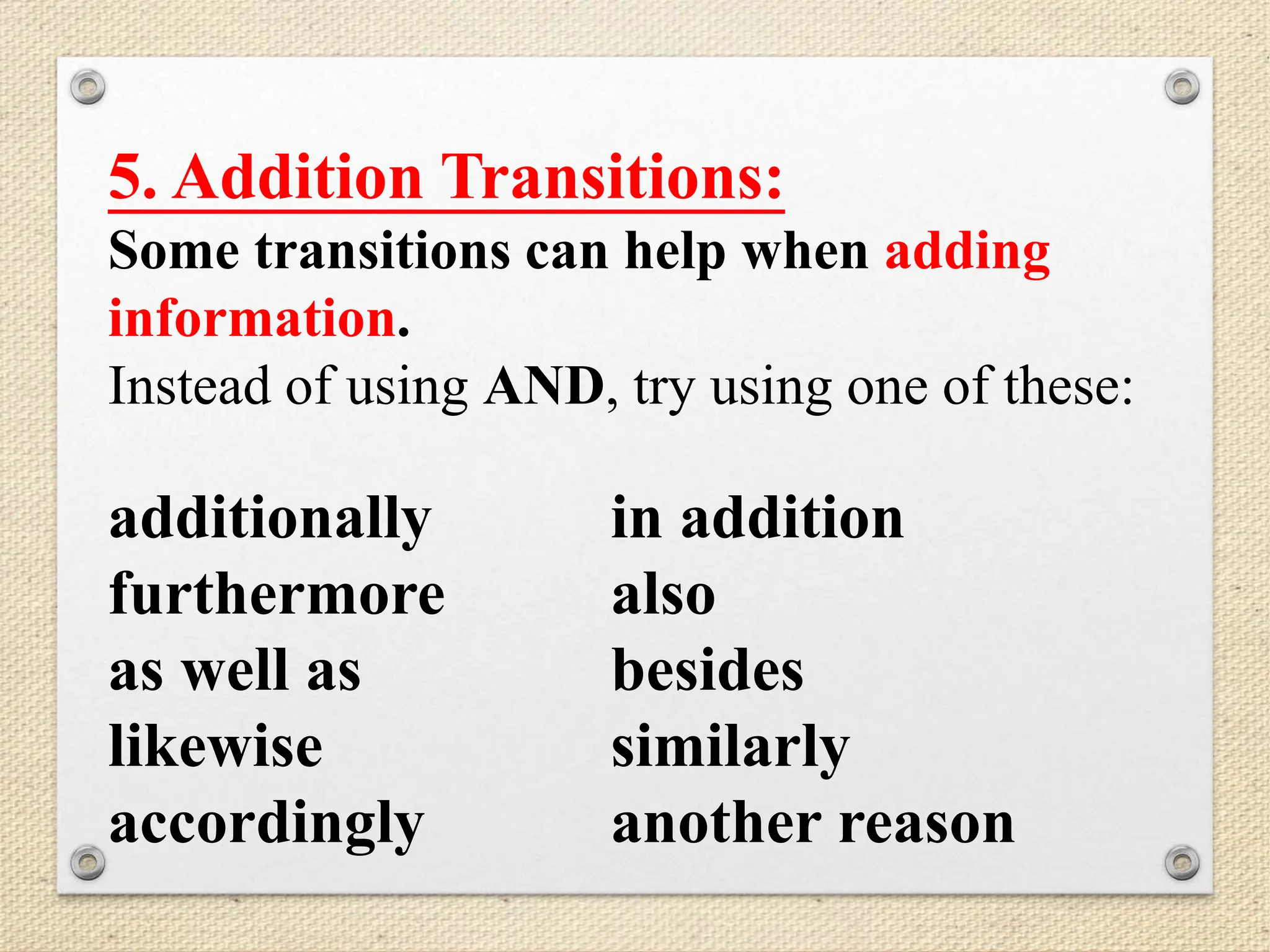
5. Addition Transitions:
Some transitions can help when adding
information.
Instead of using AND, try using one of these:
additionally in addition
furthermore also
as well as besides
likewise similarly
accordingly another reason
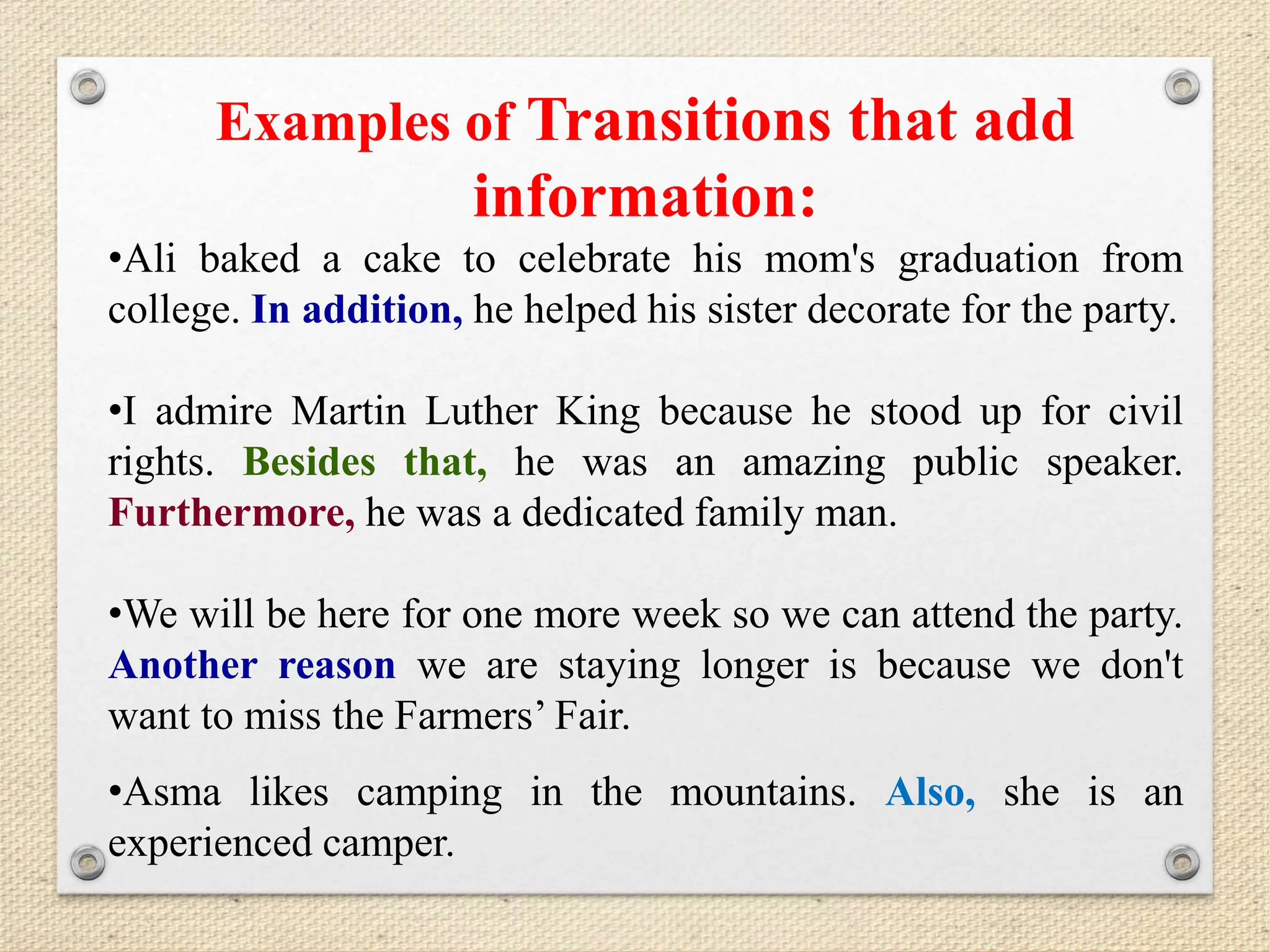
Examples of Transitions that add
information:
•Ali baked a cake to celebrate his mom's graduation from
college. In addition, he helped his sister decorate for the party.
•I admire Martin Luther King because he stood up for civil
rights. Besides that, he was an amazing public speaker.
Furthermore, he was a dedicated family man.
•We will be here for one more week so we can attend the party.
Another reason we are staying longer is because we don't
want to miss the Farmers’ Fair.
•Asma likes camping in the mountains. Also, she is an
experienced camper.
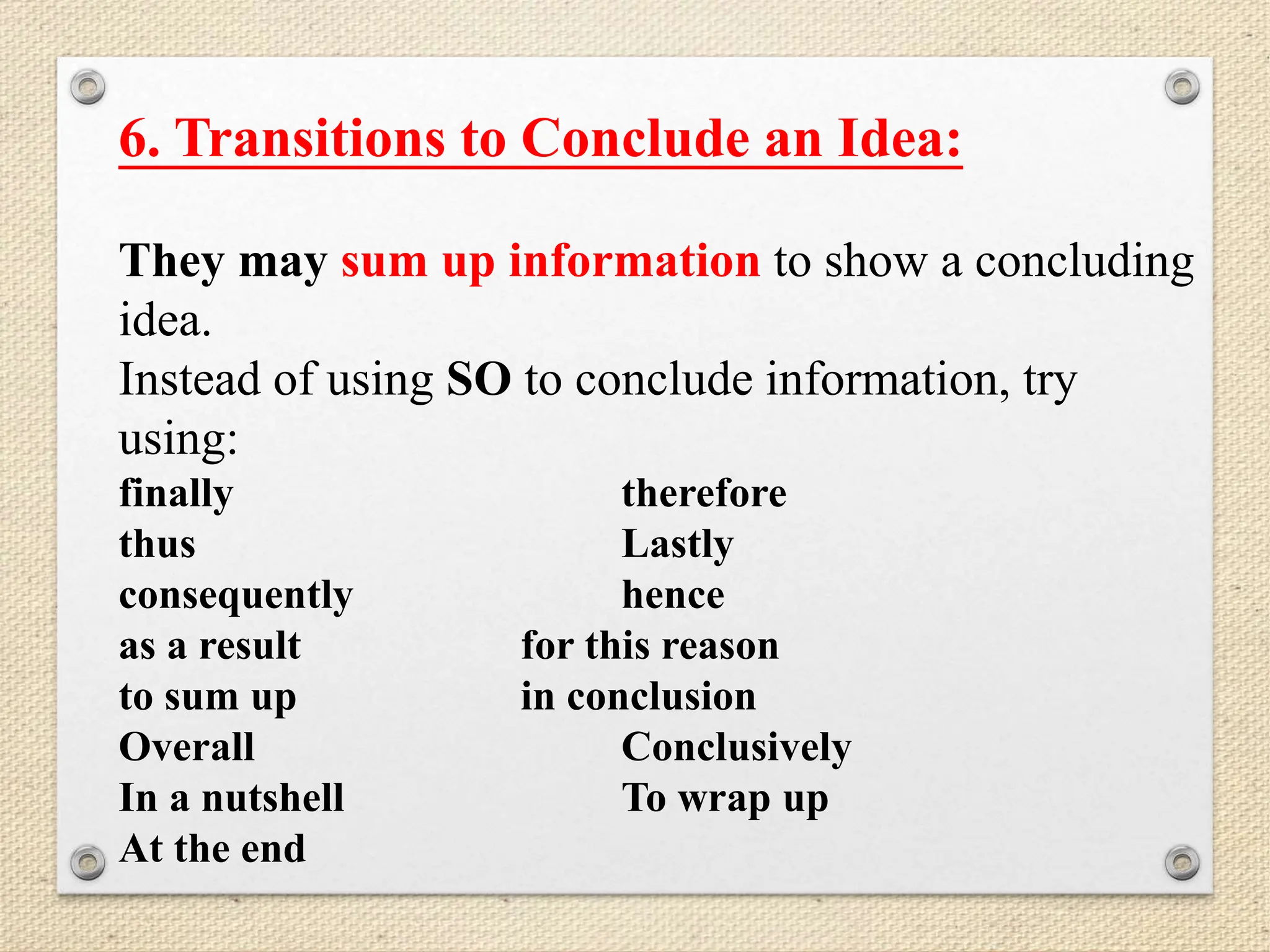
6. Transitions to Conclude an Idea:
They may sum up information to show a concluding
idea.
Instead of using SO to conclude information, try
using:
finally therefore
thus Lastly
consequently hence
as a result for this reason
to sum up in conclusion
Overall Conclusively
In a nutshell To wrap up
At the end
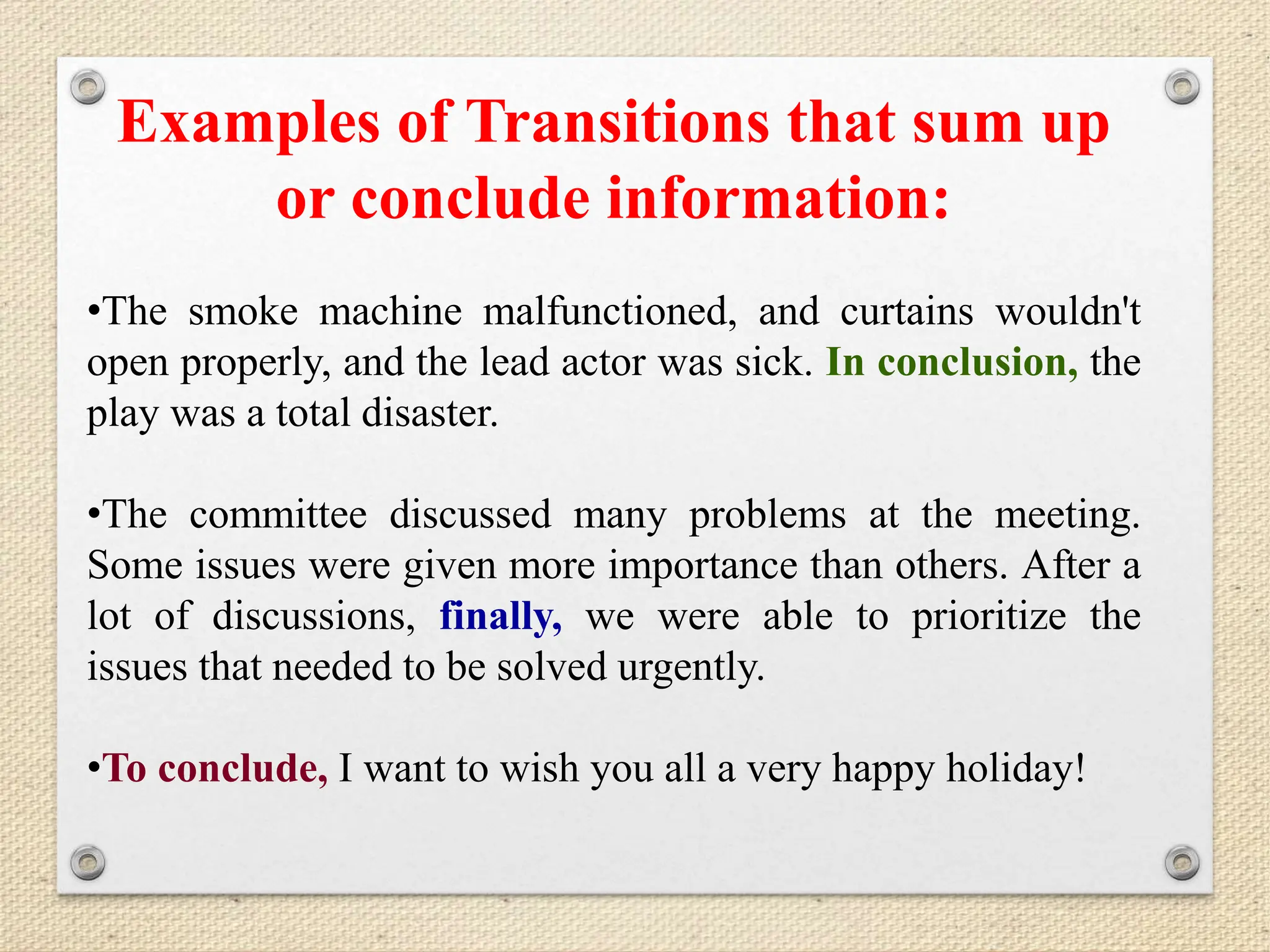
Examples of Transitions that sum up
or conclude information:
•The smoke machine malfunctioned, and curtains wouldn't
open properly, and the lead actor was sick. In conclusion, the
play was a total disaster.
•The committee discussed many problems at the meeting.
Some issues were given more importance than others. After a
lot of discussions, finally, we were able to prioritize the
issues that needed to be solved urgently.
•To conclude, I want to wish you all a very happy holiday!
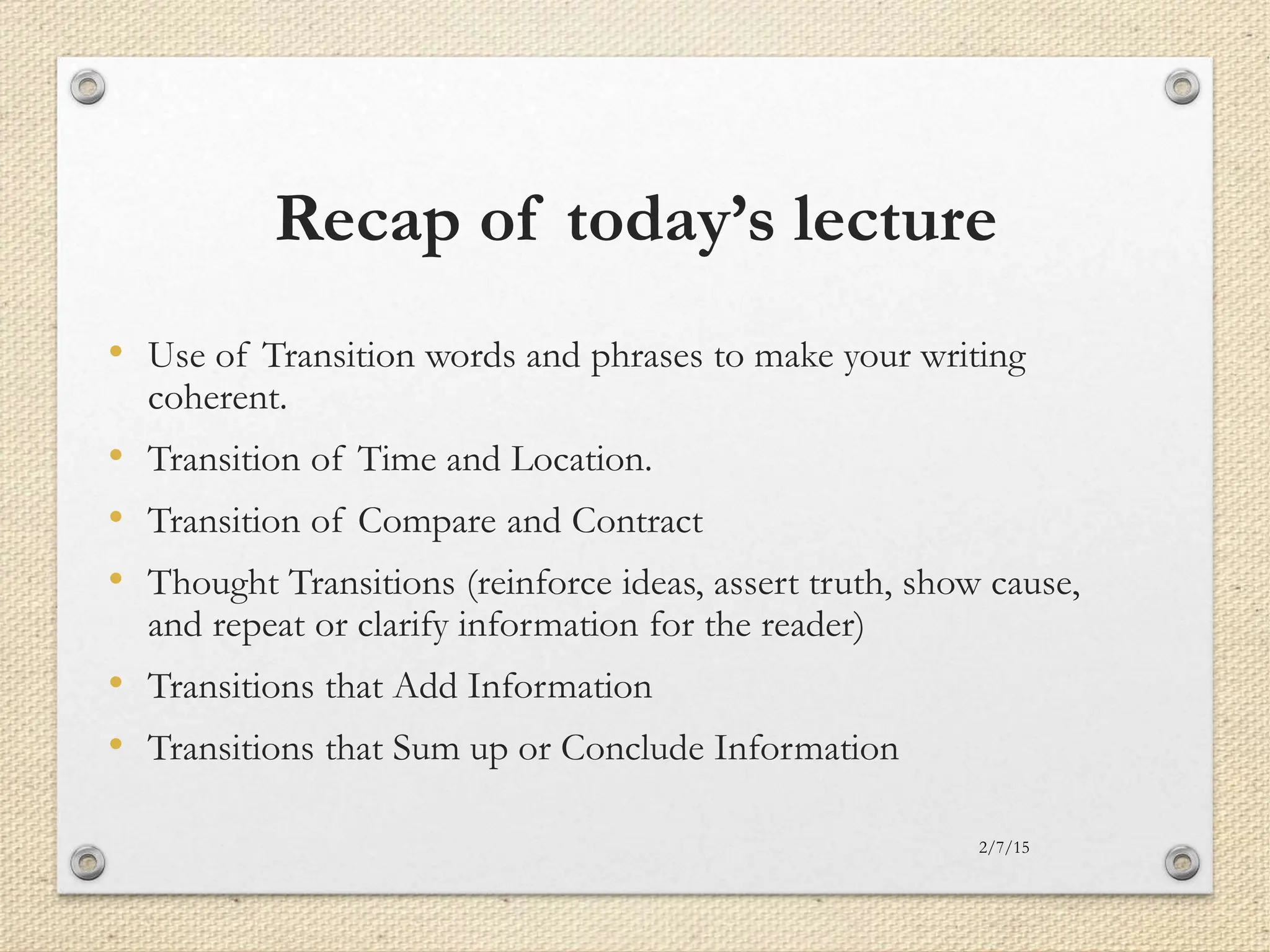
Recap of today’s lecture
• Use of Transition words and phrases to make your writing
coherent.
• Transition of Time and Location.
• Transition of Compare and Contract
• Thought Transitions (reinforce ideas, assert truth, show cause,
and repeat or clarify information for the reader)
• Transitions that Add Information
• Transitions that Sum up or Conclude Information
2/7/15
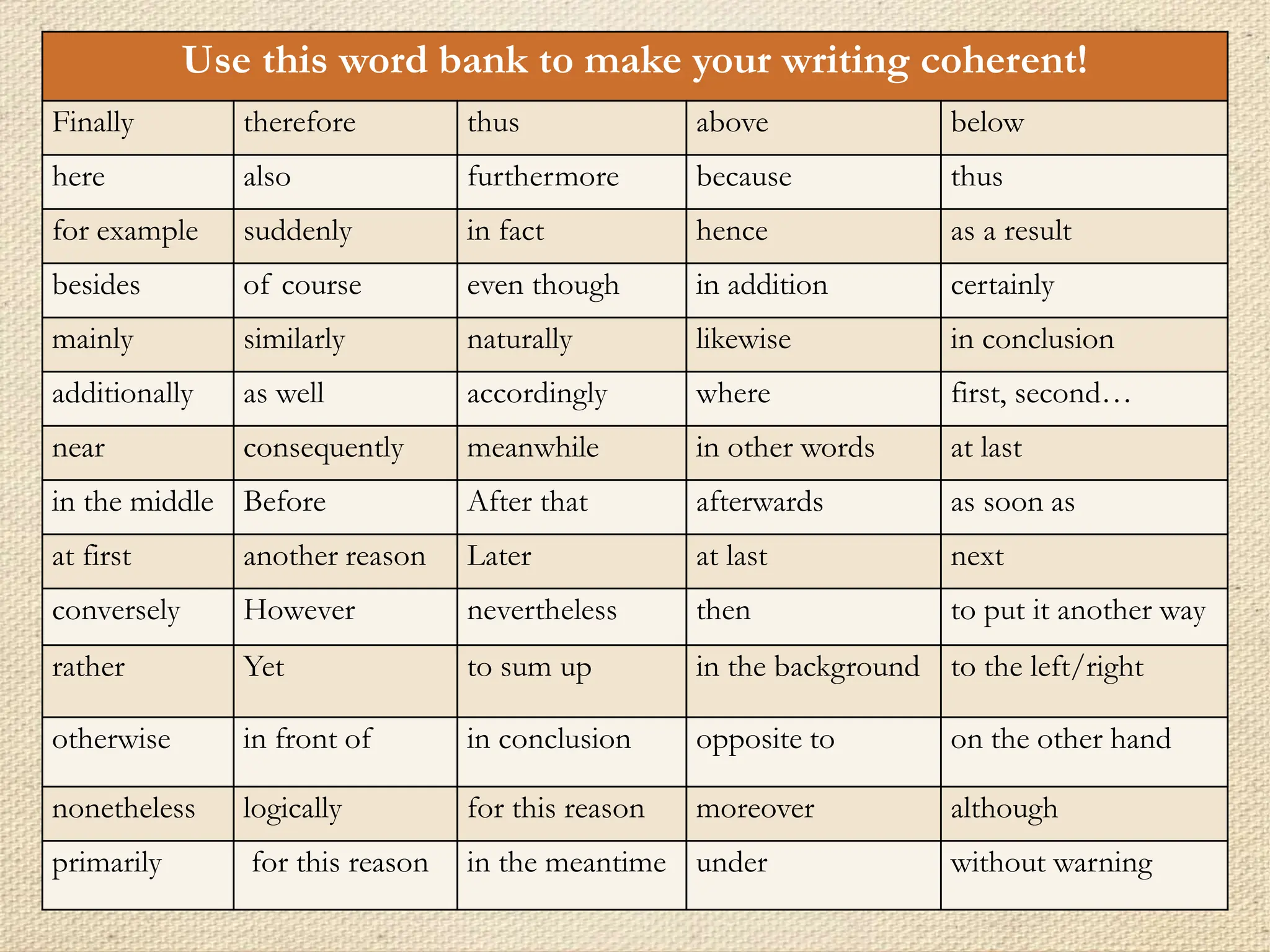
Use this word bank to make your writing coherent!
Finally therefore thus above below
here also furthermore because thus
for example suddenly in fact hence as a result
besides of course even though in addition certainly
mainly similarly naturally likewise in conclusion
additionally as well accordingly where first, second…
near consequently meanwhile in other words at last
in the middle Before After that afterwards as soon as
at first another reason Later at last next
conversely However nevertheless then to put it another way
rather Yet to sum up in the background to the left/right
otherwise in front of in conclusion opposite to on the other hand
nonetheless logically for this reason moreover although
primarily for this reason in the meantime under without warning

Transition Words and Phrases (1).pptx

  • 1.
  • 2.
    Coherence • Coherence inwriting occurs through sentence-to- sentence connections, when transitions are used to link ideas. • Texts that are coherent progress logically and hold the reader's attention throughout the piece. • Coherent writing is better writing!
  • 3.
    Transitions and Flow Transition words and phrases are used by writers to move from one subject to the next.  They provide coherence to a write-up.  They signal the reader about what is coming next in the writing.  They can help writers bridge the gap between ideas so that writing sounds smooth, not choppy.  Transitions give our writing flow.
  • 4.
    For example Take thesetwo sentences: Murad likes to eat pizza. He does not want pizza today. Using transition words, you can put these two together to make one smooth sentence instead of two choppy ones. Murad likes to eat pizza, however, he does not want pizza today. This sentence sounds better and is much easier to read!
  • 5.
    Different types ofTransitions Some transitions have specific jobs in a sentence. They may help to: 1. Show sequencing or time, 2. Show location, 3. Continue an idea, 4. Clarify or add information, 5. Compare and contrast two or more things, 6. or Sum up information to lead to a conclusion.
  • 6.
    1. Time transitions: Showorder or when something happens. Some examples: First meanwhile finally in the meantime before before long after that at last afterwards as soon as at first later then next
  • 7.
    2. Location Transitions:show where things are. You may recognize some of these as prepositions and prepositional phrases. above below under here there where from near down in the background in the middle to the left/right in front of in the distance opposite to
  • 8.
    Examples of Timeand location transitions •After so much time waiting in the long line, the boys finally got the movie tickets. •The art exhibit was shown earlier this month in Karachi. •Wait until tonight, then you will be able to see the full moon. •The show is not over until the actors take their final bows. •While Murk was driving to work, she saw a deer by the roadside. She stopped to watch the deer for a short time, then continued on her way to work.
  • 9.
    3. Thought Transitions(to continue an idea) They may reinforce ideas, assert truth, show cause, and repeat or clarify information for the reader. Some examples: also furthermore because for example suddenly without warning mainly even though in other words certainly in fact of course to put it another way
  • 10.
    Examples of ThoughtTransitions • Naturally Laiba is going to love the idea of selling cupcakes at the college fair. In fact, she wants to be a baker after completing studies. • Haider was not able to move around well because of his leg injury from when he suddenly fell off the bookshelf. • This building is beautiful. Moreover, the halls are full of antique wall hangings. • Not all birds eat berries. For example, hawks eat mice and other small mammals. • Certainly, the course coordinator will help you in filling in the forms.
  • 11.
    4. Compare/Contrast transitionstell a reader that the writer is comparing ideas or shifting from one idea to another. Instead of the word BUT to connect ideas, try using one of these examples: However Rather Yet Nevertheless Conversely On the other hand Otherwise (means the same as “or”)
  • 12.
    Examples of Compareand contrast transitions: •Although he was extremely tired after school, he ran two miles. •Irtaza prefers to read a book rather than seeing a movie. •I am not able to go the beach with you; nevertheless, thank you so much for asking me. •My grandmother loved this place, however, the kids in the family are not very fond of it.
  • 13.
    5. Addition Transitions: Sometransitions can help when adding information. Instead of using AND, try using one of these: additionally in addition furthermore also as well as besides likewise similarly accordingly another reason
  • 14.
    Examples of Transitionsthat add information: •Ali baked a cake to celebrate his mom's graduation from college. In addition, he helped his sister decorate for the party. •I admire Martin Luther King because he stood up for civil rights. Besides that, he was an amazing public speaker. Furthermore, he was a dedicated family man. •We will be here for one more week so we can attend the party. Another reason we are staying longer is because we don't want to miss the Farmers’ Fair. •Asma likes camping in the mountains. Also, she is an experienced camper.
  • 15.
    6. Transitions toConclude an Idea: They may sum up information to show a concluding idea. Instead of using SO to conclude information, try using: finally therefore thus Lastly consequently hence as a result for this reason to sum up in conclusion Overall Conclusively In a nutshell To wrap up At the end
  • 16.
    Examples of Transitionsthat sum up or conclude information: •The smoke machine malfunctioned, and curtains wouldn't open properly, and the lead actor was sick. In conclusion, the play was a total disaster. •The committee discussed many problems at the meeting. Some issues were given more importance than others. After a lot of discussions, finally, we were able to prioritize the issues that needed to be solved urgently. •To conclude, I want to wish you all a very happy holiday!
  • 17.
    Recap of today’slecture • Use of Transition words and phrases to make your writing coherent. • Transition of Time and Location. • Transition of Compare and Contract • Thought Transitions (reinforce ideas, assert truth, show cause, and repeat or clarify information for the reader) • Transitions that Add Information • Transitions that Sum up or Conclude Information 2/7/15
  • 18.
    Use this wordbank to make your writing coherent! Finally therefore thus above below here also furthermore because thus for example suddenly in fact hence as a result besides of course even though in addition certainly mainly similarly naturally likewise in conclusion additionally as well accordingly where first, second… near consequently meanwhile in other words at last in the middle Before After that afterwards as soon as at first another reason Later at last next conversely However nevertheless then to put it another way rather Yet to sum up in the background to the left/right otherwise in front of in conclusion opposite to on the other hand nonetheless logically for this reason moreover although primarily for this reason in the meantime under without warning