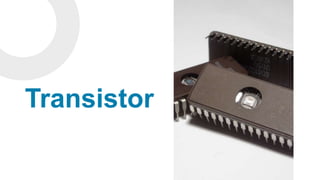
Transistor
View more
Presented By
Presented To
Teacher Name
Lecturer
Department of ___
University Name
Name: Your name
ID: Your ID
Section: Your Section
Course Name: Your Course Name
Course Code: Your Course Code
University Name
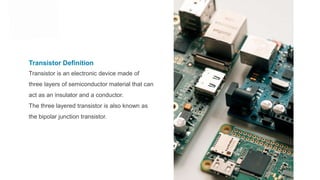
Transistor Definition
Transistor is an electronic device made of
three layers of semiconductor material that can
act as an insulator and a conductor.
The three layered transistor is also known as
the bipolar junction transistor.
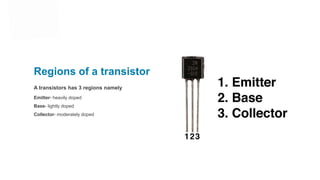
Emitter- heavily doped
Base- lightly doped
Collector- moderately doped
A transistors has 3 regions namely
Regions of a transistor
Bipolar Junction Transistor
BJT
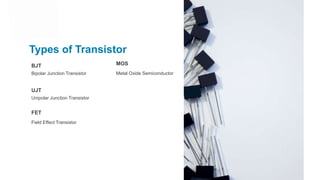
Types of Transistor
Field Effect Transistor
FET
Unipolar Junction Transistor
UJT
Metal Oxide Semiconductor
MOS
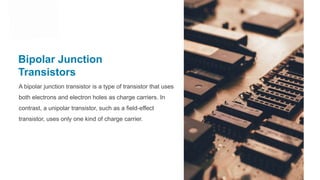
Bipolar Junction
Transistors
A bipolar junction transistor is a type of transistor that uses
both electrons and electron holes as charge carriers. In
contrast, a unipolar transistor, such as a field-effect
transistor, uses only one kind of charge carrier.
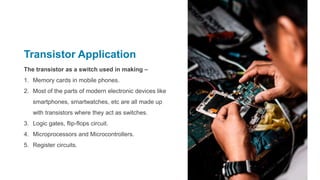
The transistor as a switch used in making –
1. Memory cards in mobile phones.
2. Most of the parts of modern electronic devices like
smartphones, smartwatches, etc are all made up
with transistors where they act as switches.
3. Logic gates, flip-flops circuit.
4. Microprocessors and Microcontrollers.
5. Register circuits.
Transistor Application
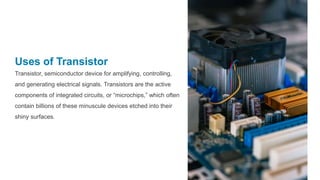
Transistor, semiconductor device for amplifying, controlling,
and generating electrical signals. Transistors are the active
components of integrated circuits, or “microchips,” which often
contain billions of these minuscule devices etched into their
shiny surfaces.
Uses of Transistor
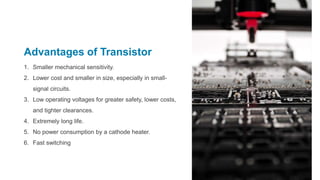
1. Smaller mechanical sensitivity.
2. Lower cost and smaller in size, especially in small-
signal circuits.
3. Low operating voltages for greater safety, lower costs,
and tighter clearances.
4. Extremely long life.
5. No power consumption by a cathode heater.
6. Fast switching
Advantages of Transistor
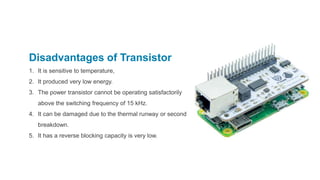
1. It is sensitive to temperature,
2. It produced very low energy.
3. The power transistor cannot be operating satisfactorily
above the switching frequency of 15 kHz.
4. It can be damaged due to the thermal runway or second
breakdown.
5. It has a reverse blocking capacity is very low.
Disadvantages of Transistor
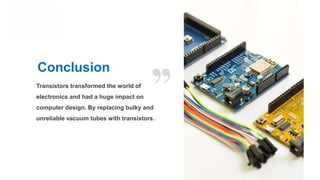
Conclusion
Transistors transformed the world of
electronics and had a huge impact on
computer design. By replacing bulky and
unreliable vacuum tubes with transistors.
Thank You
For Your Time and Attention

Transistor powerpoint presentaion - Electronics powerpoint presentation - transistor pptx ppt

  • 1.
  • 2.
    Presented By Presented To TeacherName Lecturer Department of ___ University Name Name: Your name ID: Your ID Section: Your Section Course Name: Your Course Name Course Code: Your Course Code University Name
  • 3.
    Transistor Definition Transistor isan electronic device made of three layers of semiconductor material that can act as an insulator and a conductor. The three layered transistor is also known as the bipolar junction transistor.
  • 4.
    Emitter- heavily doped Base-lightly doped Collector- moderately doped A transistors has 3 regions namely Regions of a transistor
  • 5.
    Bipolar Junction Transistor BJT Typesof Transistor Field Effect Transistor FET Unipolar Junction Transistor UJT Metal Oxide Semiconductor MOS
  • 6.
    Bipolar Junction Transistors A bipolarjunction transistor is a type of transistor that uses both electrons and electron holes as charge carriers. In contrast, a unipolar transistor, such as a field-effect transistor, uses only one kind of charge carrier.
  • 7.
    The transistor asa switch used in making – 1. Memory cards in mobile phones. 2. Most of the parts of modern electronic devices like smartphones, smartwatches, etc are all made up with transistors where they act as switches. 3. Logic gates, flip-flops circuit. 4. Microprocessors and Microcontrollers. 5. Register circuits. Transistor Application
  • 8.
    Transistor, semiconductor devicefor amplifying, controlling, and generating electrical signals. Transistors are the active components of integrated circuits, or “microchips,” which often contain billions of these minuscule devices etched into their shiny surfaces. Uses of Transistor
  • 9.
    1. Smaller mechanicalsensitivity. 2. Lower cost and smaller in size, especially in small- signal circuits. 3. Low operating voltages for greater safety, lower costs, and tighter clearances. 4. Extremely long life. 5. No power consumption by a cathode heater. 6. Fast switching Advantages of Transistor
  • 10.
    1. It issensitive to temperature, 2. It produced very low energy. 3. The power transistor cannot be operating satisfactorily above the switching frequency of 15 kHz. 4. It can be damaged due to the thermal runway or second breakdown. 5. It has a reverse blocking capacity is very low. Disadvantages of Transistor
  • 11.
    Conclusion Transistors transformed theworld of electronics and had a huge impact on computer design. By replacing bulky and unreliable vacuum tubes with transistors.
  • 12.
    Thank You For YourTime and Attention