Assessing Adherence
to the PhRMA Code


       Workshop C
       January 30, 2013
Introductions

• Eve Costopoulos - Vice President, Corporate Ethics and
  Compliance/Internal Audit, Eisai
• Marjorie E. Powell - Senior Assistant General Counsel, PhRMA
• Paul Silver - Practice Leader, Huron Life Sciences
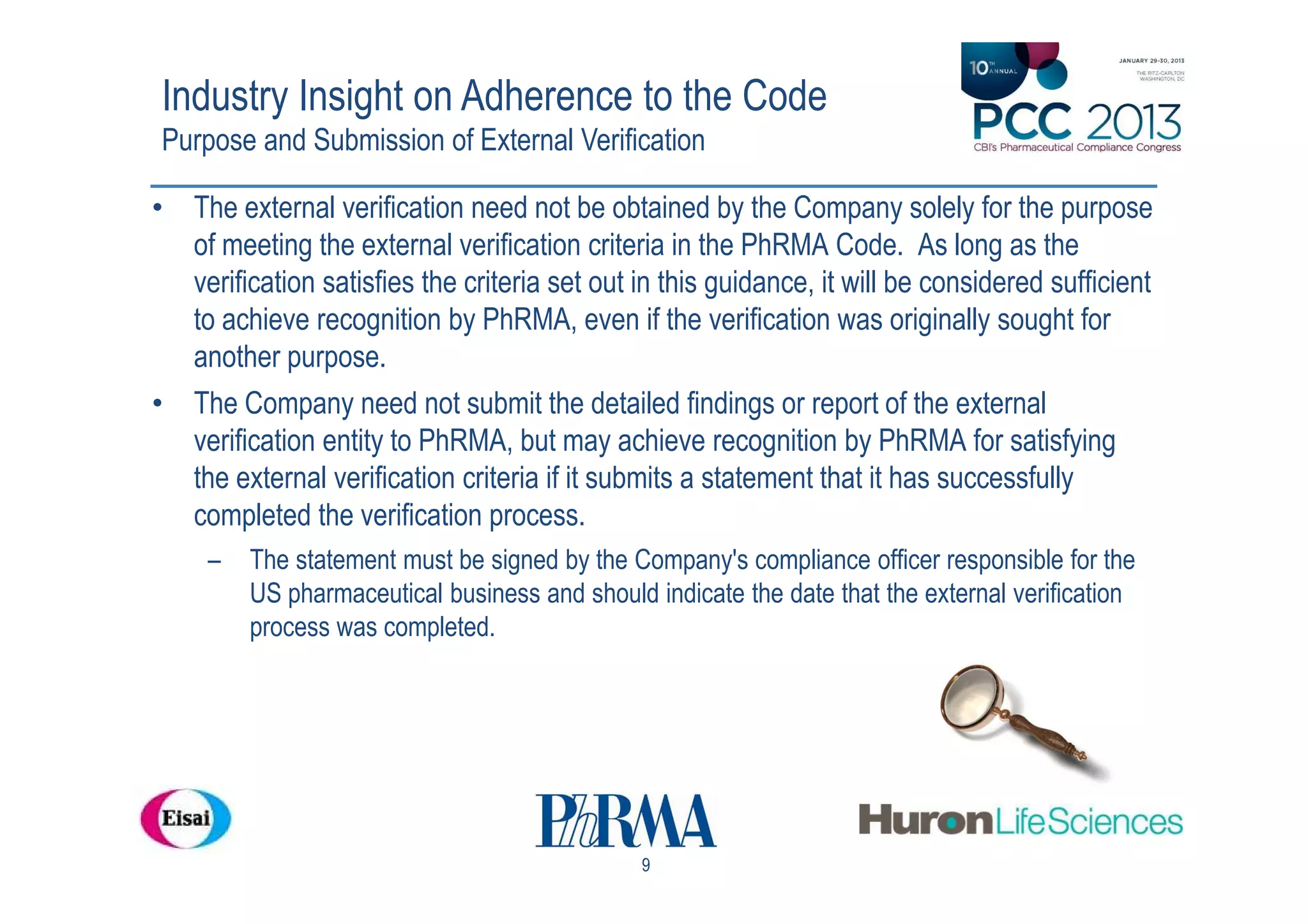
• Marci Juneau - Director, Huron Life Sciences


                        Eve Marjorie
                        Paul Marci


                                 1
Our Session

•   PhRMA’s Perspective on Assessing Adherence to the Code
•   Providing Insights from Industry on Adherence
•   Providing Guidance into the Independent Verification Review Process
•   Open Questions for Panel
•   Challenges You Are Seeing
•   Action Items


                                   2
PhRMA Code
General Overview of Code
The PhRMAceutical Research and Manufacturers of America (PhRMA) represents research-based
pharmaceutical and biotechnology companies.


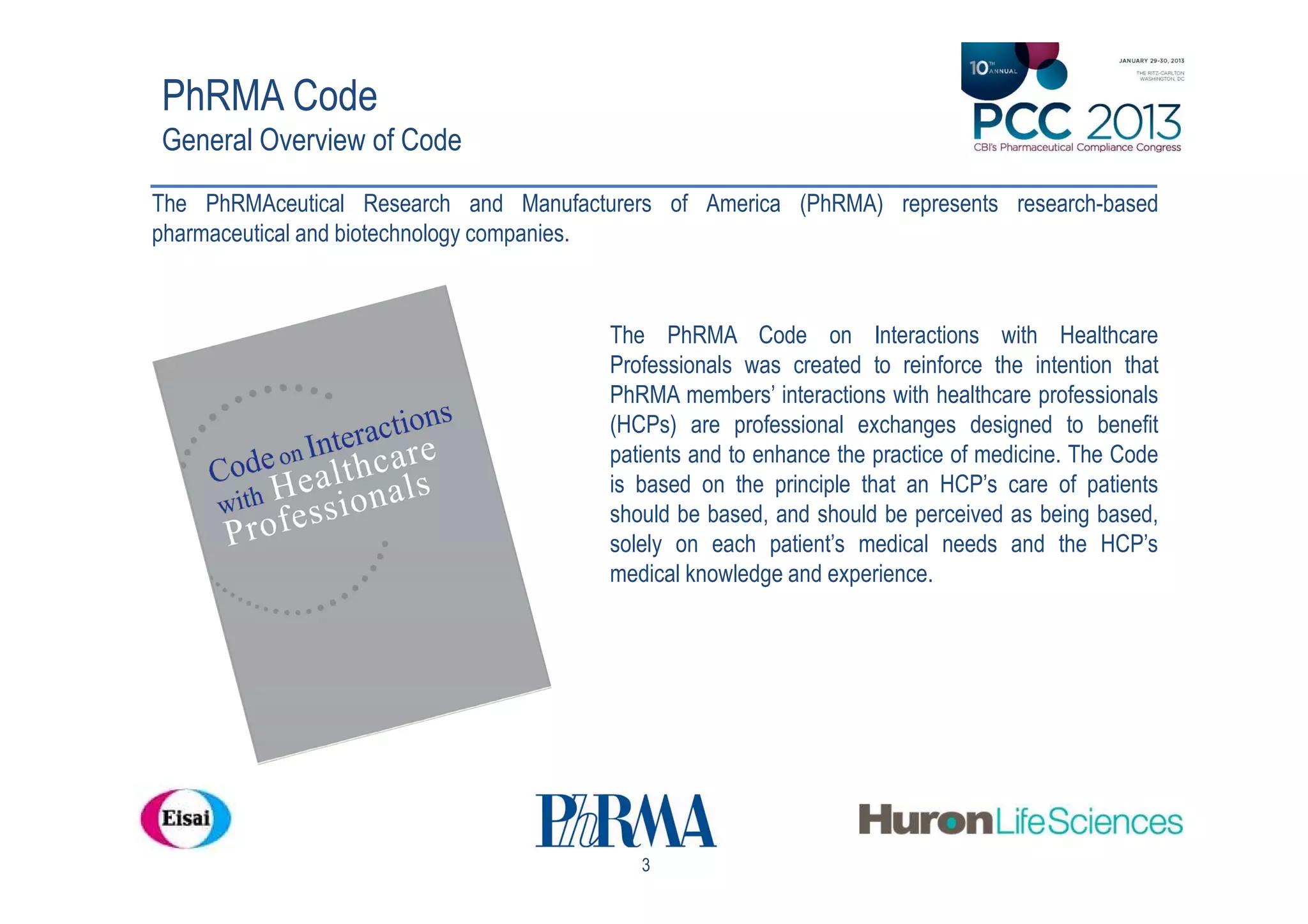
                                        The PhRMA Code on Interactions with Healthcare
                                        Professionals was created to reinforce the intention that
                                        PhRMA members’ interactions with healthcare professionals
                                        (HCPs) are professional exchanges designed to benefit
                                        patients and to enhance the practice of medicine. The Code
                                        is based on the principle that an HCP’s care of patients
                                        should be based, and should be perceived as being based,
                                        solely on each patient’s medical needs and the HCP’s
                                        medical knowledge and experience.


                                           3
PhRMA’s Perspective on Assessing
Adherence to the Code


PhRMA Code on Interactions with Health Care Professionals
• Code has 15 Provisions
• Agree to sign the PhRMA Code: Commit to comply with the PhRMA Code
    – Need not be a PhRMA member company to sign the Code
• Submit name and contact information for Compliance Officer
• Yearly certification that the company has policies and procedures in place to
  foster compliance with the Code
• Certify that the company:
    –   Has policies
    –   Has trained staff
    –   Has a system to monitor compliance
    –   Has a system to address non-compliance


                                            4
PhRMA’s Perspective on Assessing
Adherence to the Code


• External verification that the company has policies and procedures in place to
  foster compliance with the PhRMA Code
    – External verification need not be solely for PhRMA Code purposes
    – Do not need to submit the findings or report
• PhRMA Code has evolved over the years
    – Found code from the 1960s
    – Code most recently revised in 2008, and effective in 2009
• Several states require compliance with the PhRMA Code or a similar state
  code


                                             5
Industry Insight on Adherence to the Code
Overlap with State Requirements


• Nevada
    – “Does your company use one of the two model codes of conduct [Code of Interactions
      with Healthcare Professionals by PhRMA] or Code of Ethics on Interactions with Health
      Care Professionals by AdvaMed (for manufacturers or wholesalers of devices or
      appliances)] without modification?”
• Massachusetts
    – “Our company has adopted a program to routinely train appropriate employees, including,
      without limitation, all sales and marketing staff regarding the marketing code of conduct,
      as described in 105 C.M.R. 970.000.”
    – “Our company has policies and procedures in place for conducting investigations into any
      and all non-compliance with 105 C.M.R. 970.000, taking corrective actions in response to
      all non-compliance…”
• California
    – Annual Declaration of Compliance


                                              6
Industry Insight on Adherence to the Code
External Verification Guidance

As of January 1, 2009, the revised PhRMA Code states that all companies (PhRMA
members and non-members) that interact with HCPs about pharmaceuticals should
adopt procedures to assure adherence to the Code including its 15 sections regarding
various aspects of pharmaceutical company interactions with HCPs.

The PhRMA Code encourages member companies to seek external verification
periodically – ideally at least once every three years – to evaluate whether the company
has policies, procedures, or guidelines in place to foster compliance with the Code.

In May 2012, PhRMA published external verification guidelines that outline the
organization’s expectations as they relate to confirmation of a company’s compliance
with the Code.


                                          7
Industry Insight on Adherence to the Code
    Credentials of External Verification

The Company should ensure that the entity it selects to conduct an external verification
of its policies and procedures in connection with the PhRMA Code possesses sufficient
expertise, objectivity, and independence from the Company to be credible in
performing the verification function.
•     Objectivity means being independent in fact, maintaining an attitude of impartiality, and
      having intellectual honesty.
•     Independence means that the external verification entity and the person or persons who
      conduct the verification evaluation must be free from personal, external, and organizational
      impairments to independence.
•     An external entity can be independent and objective even if it currently provides or has
      previously provided other advice and services to the Company. The external verifying entity
      can include outside counsel, external auditors, or another entity that has the relevant
      knowledge and expertise to credibly perform the verification function.
        –   It is the responsibility of the Company and the verifying entity to ensure that any other interactions
            between the Company and the entity will not compromise the entity’s ability to perform a full and fair
            external verification of the Company’s policies and procedures in connection with the PhRMA Code.


                                                        8
Industry Insight on Adherence to the Code
Purpose and Submission of External Verification

• The external verification need not be obtained by the Company solely for the purpose
  of meeting the external verification criteria in the PhRMA Code. As long as the
  verification satisfies the criteria set out in this guidance, it will be considered sufficient
  to achieve recognition by PhRMA, even if the verification was originally sought for
  another purpose.
• The Company need not submit the detailed findings or report of the external
  verification entity to PhRMA, but may achieve recognition by PhRMA for satisfying
  the external verification criteria if it submits a statement that it has successfully
  completed the verification process.
     –   The statement must be signed by the Company's compliance officer responsible for the
         US pharmaceutical business and should indicate the date that the external verification
         process was completed.


                                               9
Industry Insight on Adherence to the Code
Addressing Observations

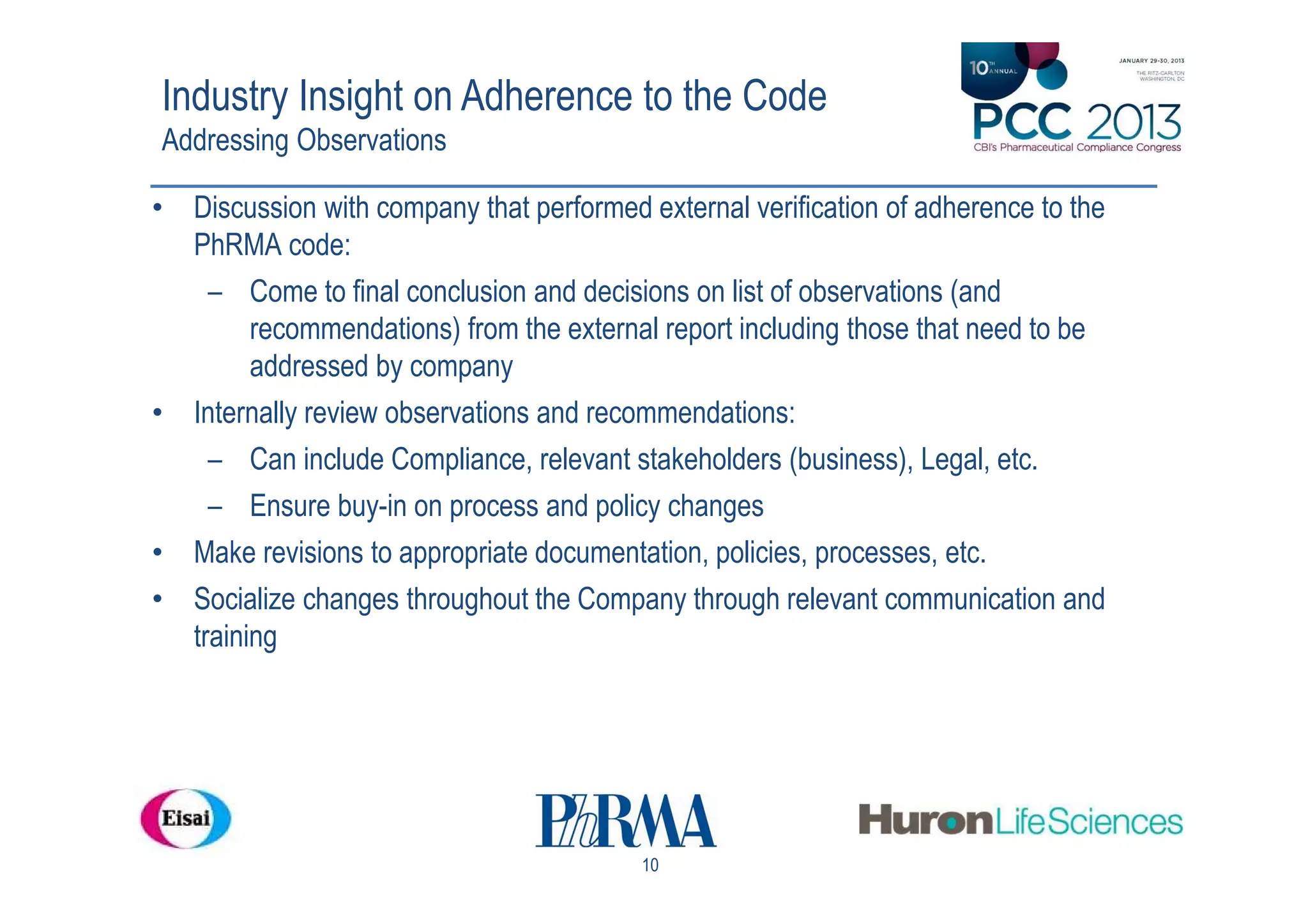
• Discussion with company that performed external verification of adherence to the
  PhRMA code:
    – Come to final conclusion and decisions on list of observations (and
        recommendations) from the external report including those that need to be
        addressed by company
• Internally review observations and recommendations:
    – Can include Compliance, relevant stakeholders (business), Legal, etc.
    – Ensure buy-in on process and policy changes
• Make revisions to appropriate documentation, policies, processes, etc.
• Socialize changes throughout the Company through relevant communication and
  training


                                          10
Independent Verification Review Process
External Verification Requirements

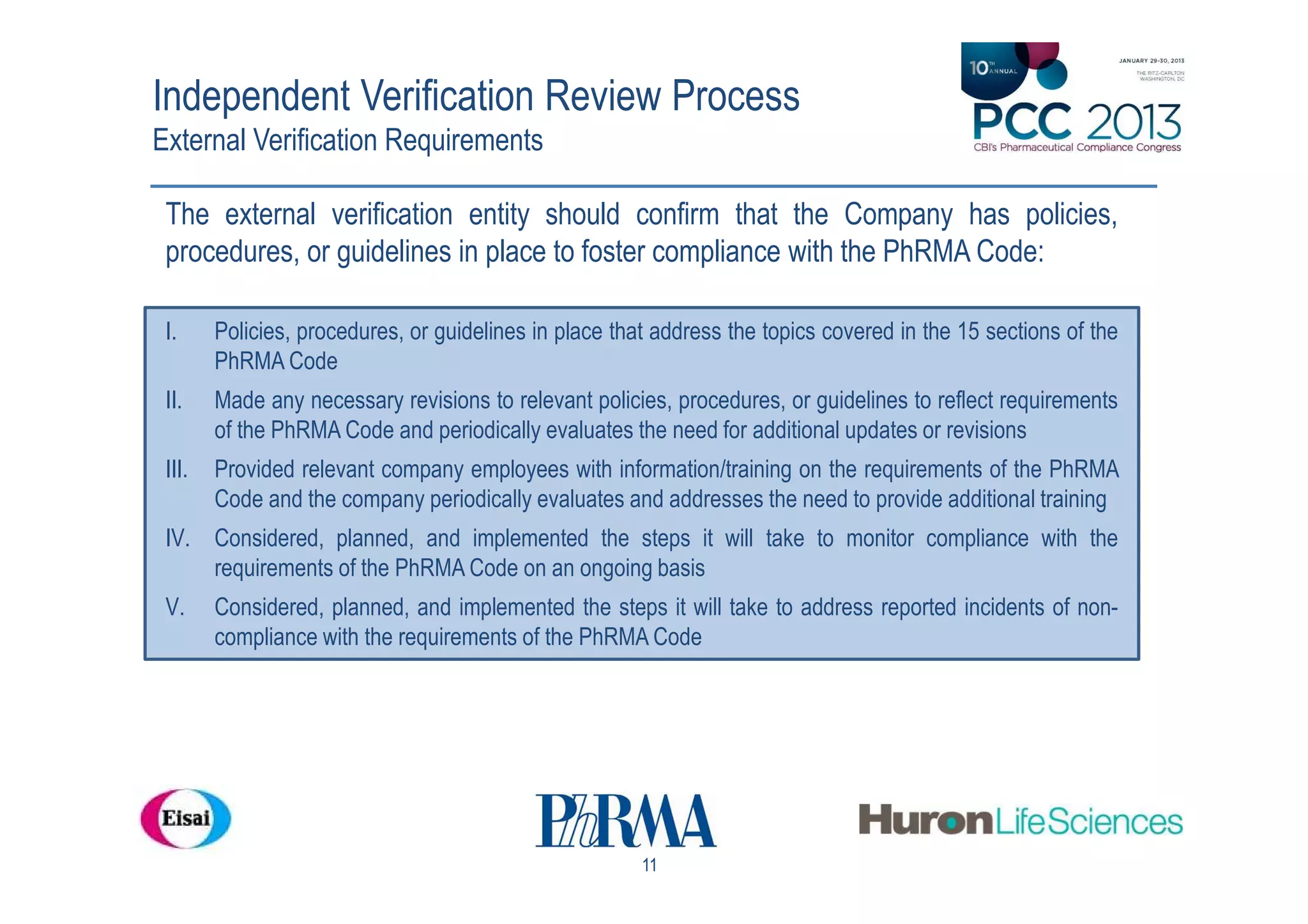
 The external verification entity should confirm that the Company has policies,
 procedures, or guidelines in place to foster compliance with the PhRMA Code:

 I.     Policies, procedures, or guidelines in place that address the topics covered in the 15 sections of the
        PhRMA Code
 II.    Made any necessary revisions to relevant policies, procedures, or guidelines to reflect requirements
        of the PhRMA Code and periodically evaluates the need for additional updates or revisions
 III.   Provided relevant company employees with information/training on the requirements of the PhRMA
        Code and the company periodically evaluates and addresses the need to provide additional training
 IV. Considered, planned, and implemented the steps it will take to monitor compliance with the
     requirements of the PhRMA Code on an ongoing basis
 V.     Considered, planned, and implemented the steps it will take to address reported incidents of non-
        compliance with the requirements of the PhRMA Code


                                                        11
Independent Verification Review Process
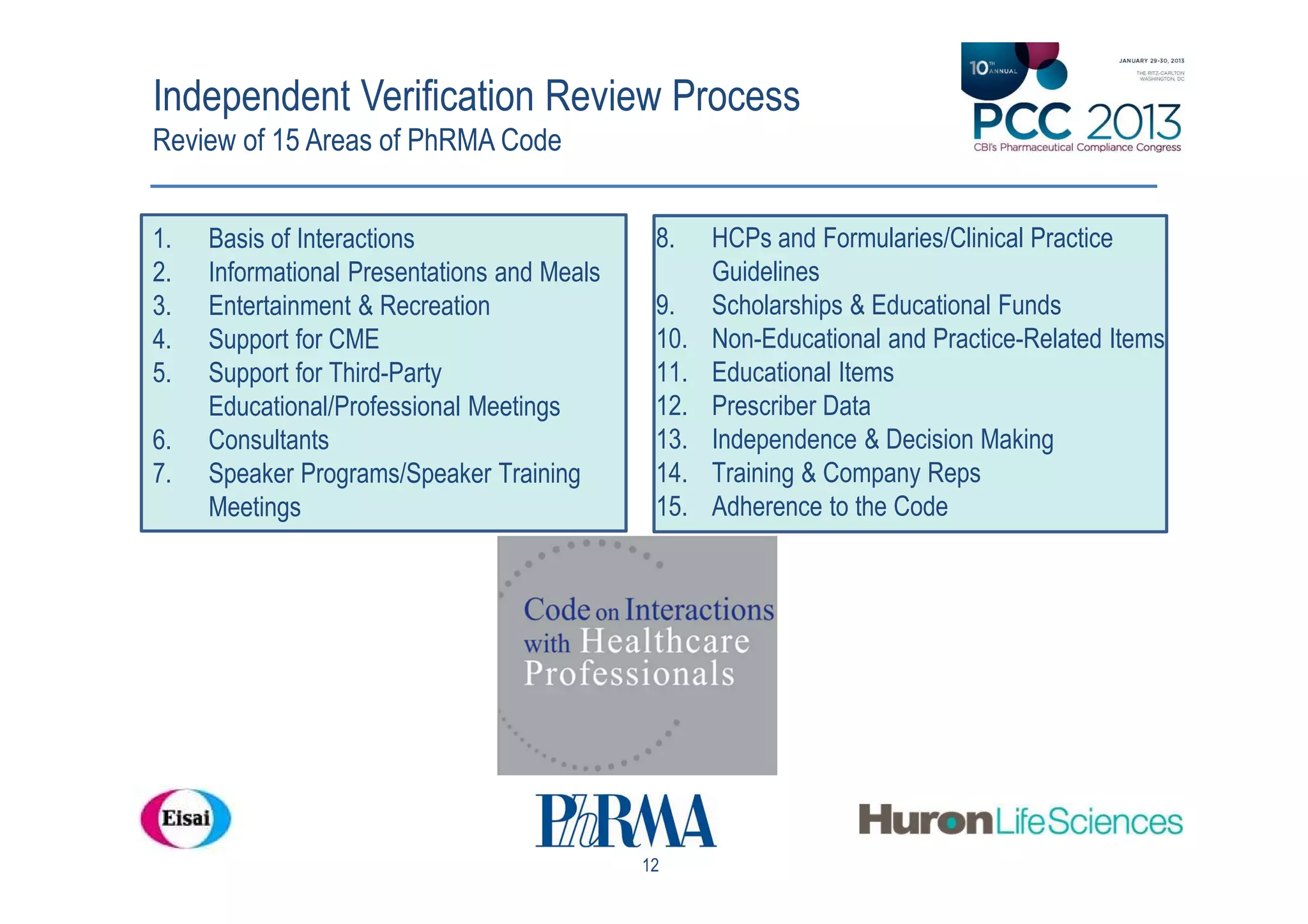
Review of 15 Areas of PhRMA Code


1.   Basis of Interactions                    8.    HCPs and Formularies/Clinical Practice
2.   Informational Presentations and Meals          Guidelines
3.   Entertainment & Recreation               9.    Scholarships & Educational Funds
4.   Support for CME                          10.   Non-Educational and Practice-Related Items
5.   Support for Third-Party                  11.   Educational Items
     Educational/Professional Meetings        12.   Prescriber Data
6.   Consultants                              13.   Independence & Decision Making
7.   Speaker Programs/Speaker Training        14.   Training & Company Reps
     Meetings                                 15.   Adherence to the Code


                                             12
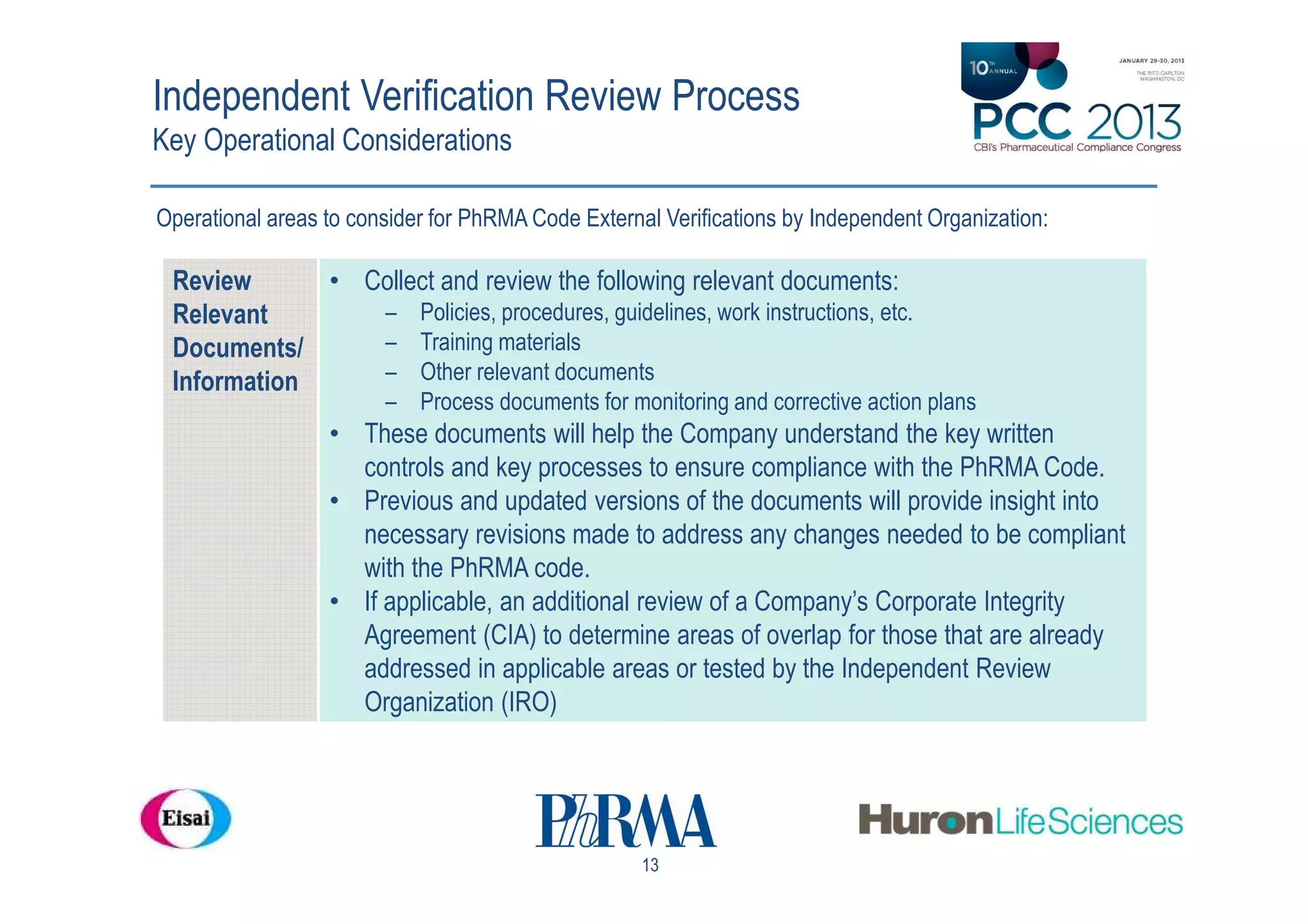
Independent Verification Review Process
Key Operational Considerations

Operational areas to consider for PhRMA Code External Verifications by Independent Organization:

 Review      • Collect and review the following relevant documents:
 Relevant       – Policies, procedures, guidelines, work instructions, etc.
 Documents/     – Training materials
 Information    – Other relevant documents
                        – Process documents for monitoring and corrective action plans
                  • These documents will help the Company understand the key written
                    controls and key processes to ensure compliance with the PhRMA Code.
                  • Previous and updated versions of the documents will provide insight into
                    necessary revisions made to address any changes needed to be compliant
                    with the PhRMA code.
                  • If applicable, an additional review of a Company’s Corporate Integrity
                    Agreement (CIA) to determine areas of overlap for those that are already
                    addressed in applicable areas or tested by the Independent Review
                    Organization (IRO)


                                                    13
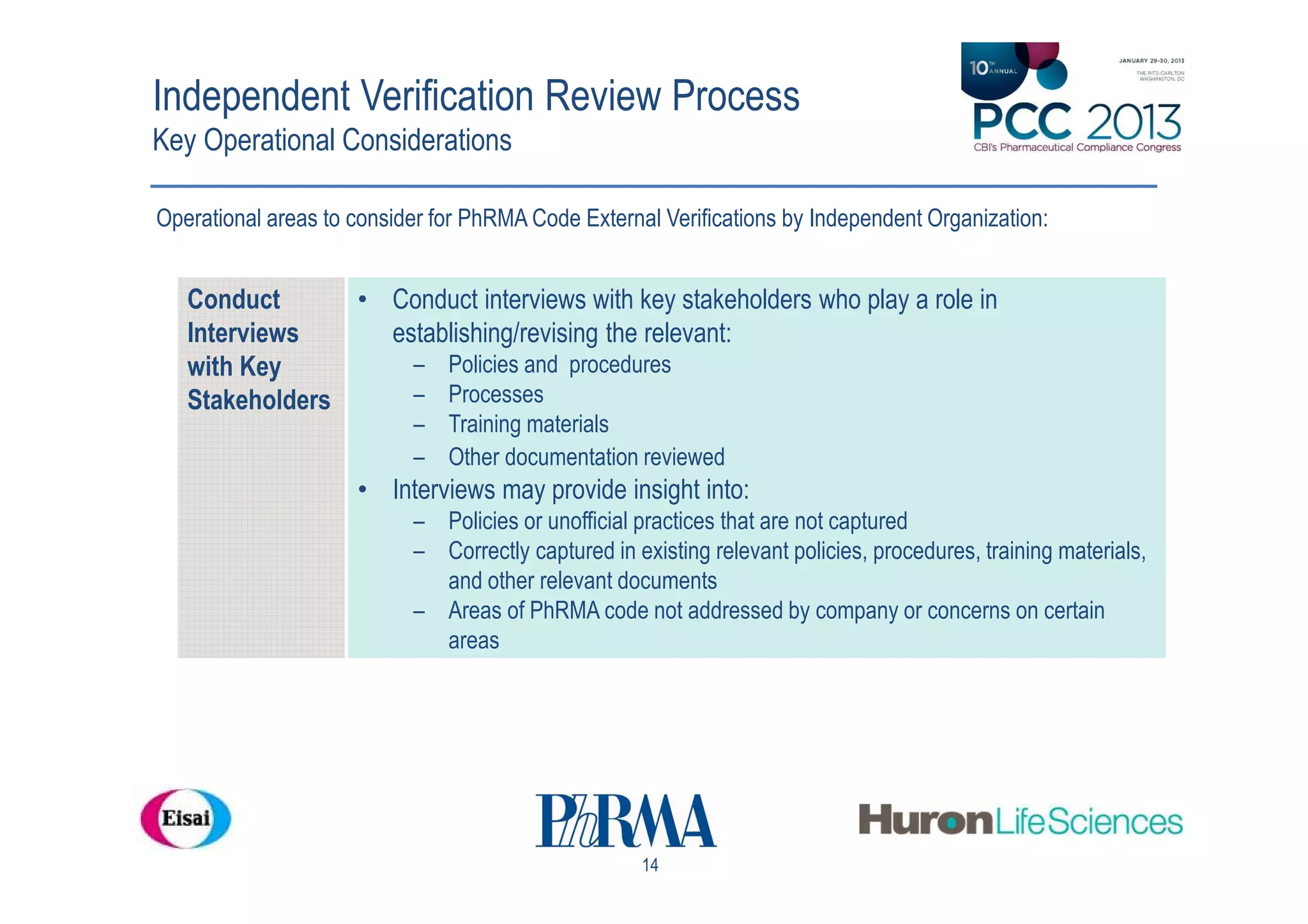
Independent Verification Review Process
Key Operational Considerations

Operational areas to consider for PhRMA Code External Verifications by Independent Organization:


   Conduct      • Conduct interviews with key stakeholders who play a role in
   Interviews     establishing/revising the relevant:
   with Key         – Policies and procedures
   Stakeholders     – Processes
                           – Training materials
                           – Other documentation reviewed
                     • Interviews may provide insight into:
                           – Policies or unofficial practices that are not captured
                           – Correctly captured in existing relevant policies, procedures, training materials,
                             and other relevant documents
                           – Areas of PhRMA code not addressed by company or concerns on certain
                             areas


                                                    14
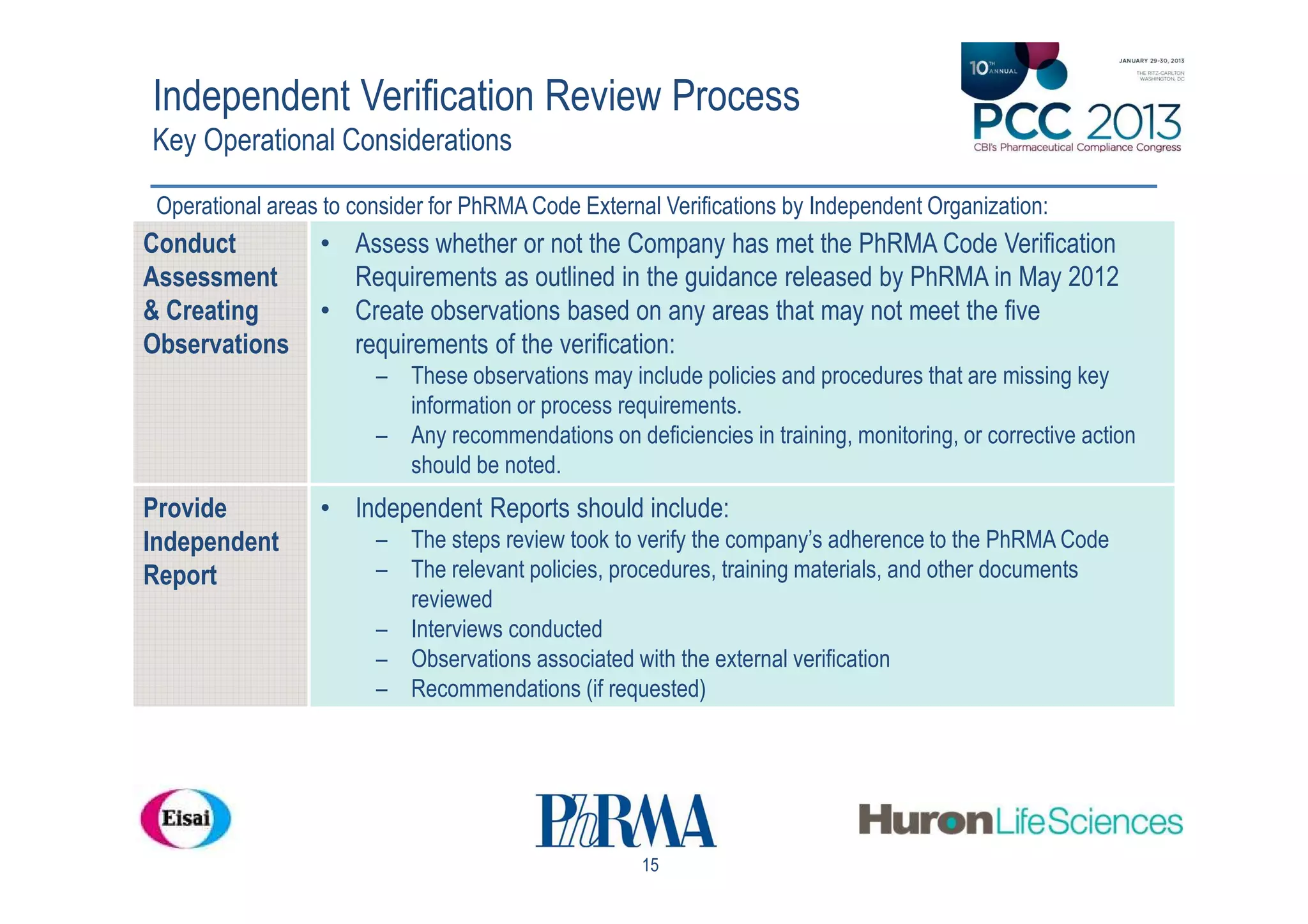
Independent Verification Review Process
Key Operational Considerations

 Operational areas to consider for PhRMA Code External Verifications by Independent Organization:
Conduct           • Assess whether or not the Company has met the PhRMA Code Verification
Assessment          Requirements as outlined in the guidance released by PhRMA in May 2012
& Creating        • Create observations based on any areas that may not meet the five
Observations        requirements of the verification:
                        – These observations may include policies and procedures that are missing key
                          information or process requirements.
                        – Any recommendations on deficiencies in training, monitoring, or corrective action
                          should be noted.
Provide           • Independent Reports should include:
Independent             – The steps review took to verify the company’s adherence to the PhRMA Code
Report                  – The relevant policies, procedures, training materials, and other documents
                          reviewed
                        – Interviews conducted
                        – Observations associated with the external verification
                        – Recommendations (if requested)


                                                     15
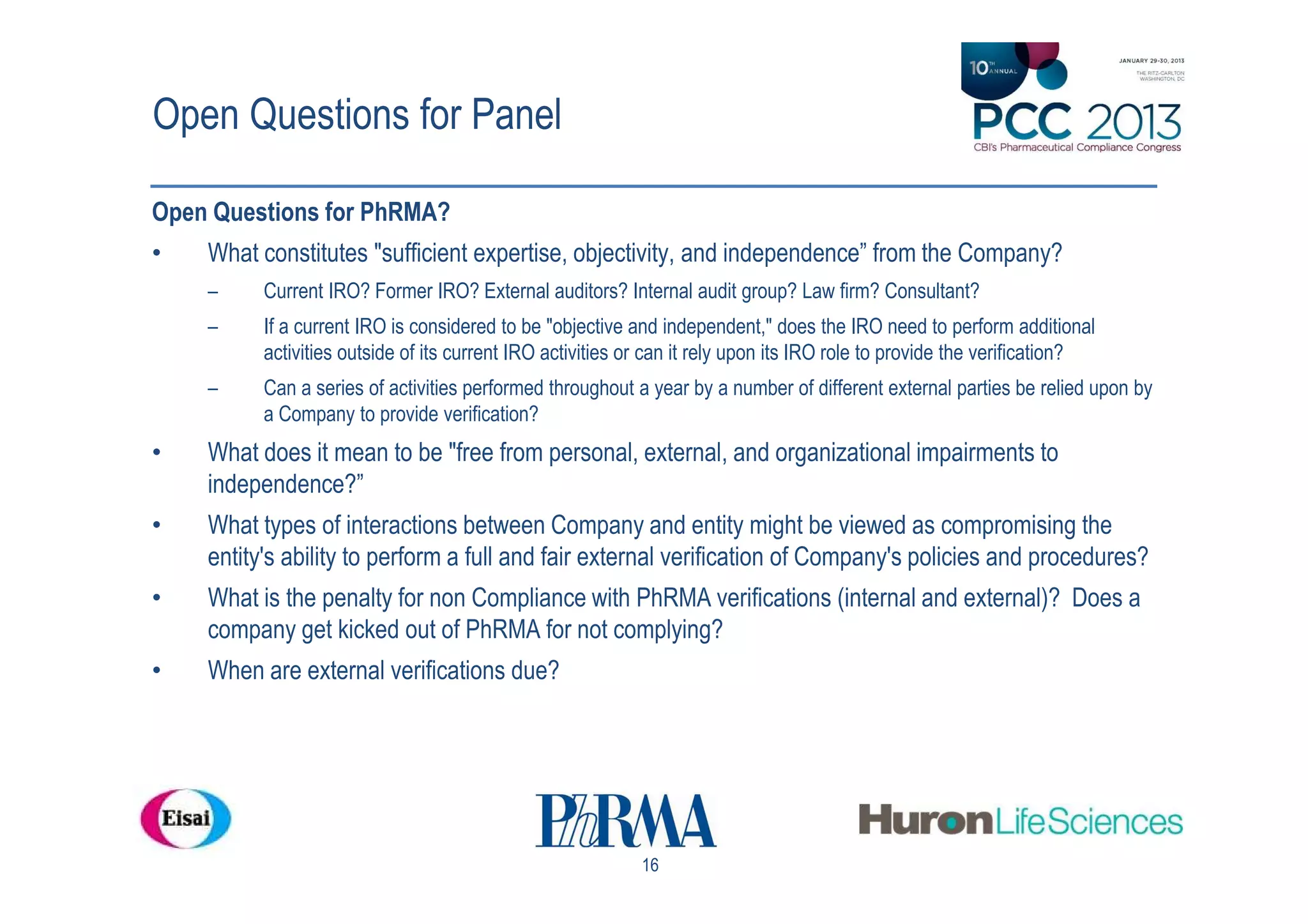
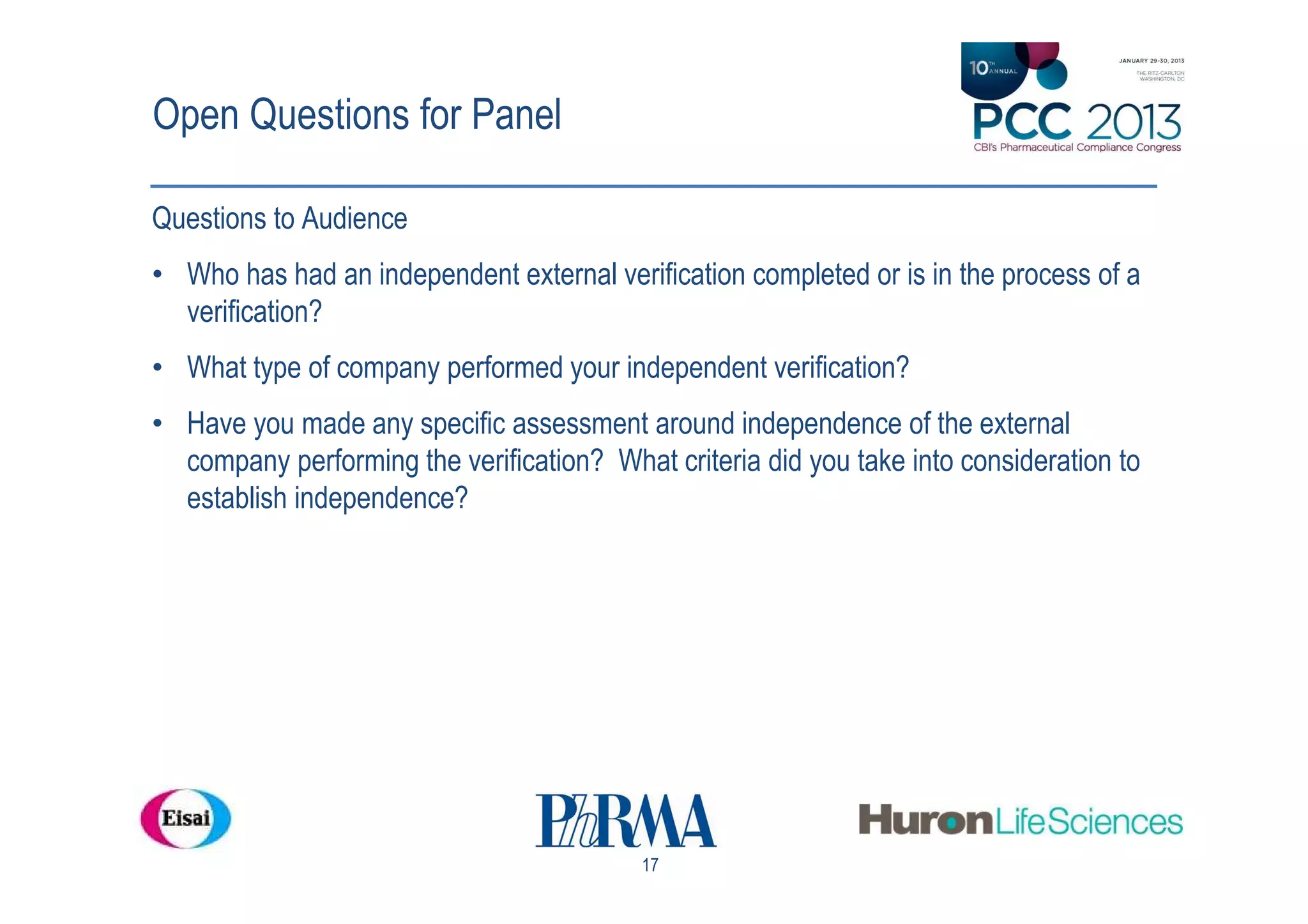
Open Questions for Panel

Open Questions for PhRMA?
•   What constitutes "sufficient expertise, objectivity, and independence” from the Company?
    –     Current IRO? Former IRO? External auditors? Internal audit group? Law firm? Consultant?
    –     If a current IRO is considered to be "objective and independent," does the IRO need to perform additional
          activities outside of its current IRO activities or can it rely upon its IRO role to provide the verification?
    –     Can a series of activities performed throughout a year by a number of different external parties be relied upon by
          a Company to provide verification?
•   What does it mean to be "free from personal, external, and organizational impairments to
    independence?”
•   What types of interactions between Company and entity might be viewed as compromising the
    entity's ability to perform a full and fair external verification of Company's policies and procedures?
•   What is the penalty for non Compliance with PhRMA verifications (internal and external)? Does a
    company get kicked out of PhRMA for not complying?
•   When are external verifications due?


                                                            16
Open Questions for Panel

Questions to Audience
• Who has had an independent external verification completed or is in the process of a
  verification?
• What type of company performed your independent verification?
• Have you made any specific assessment around independence of the external
  company performing the verification? What criteria did you take into consideration to
  establish independence?


                                           17
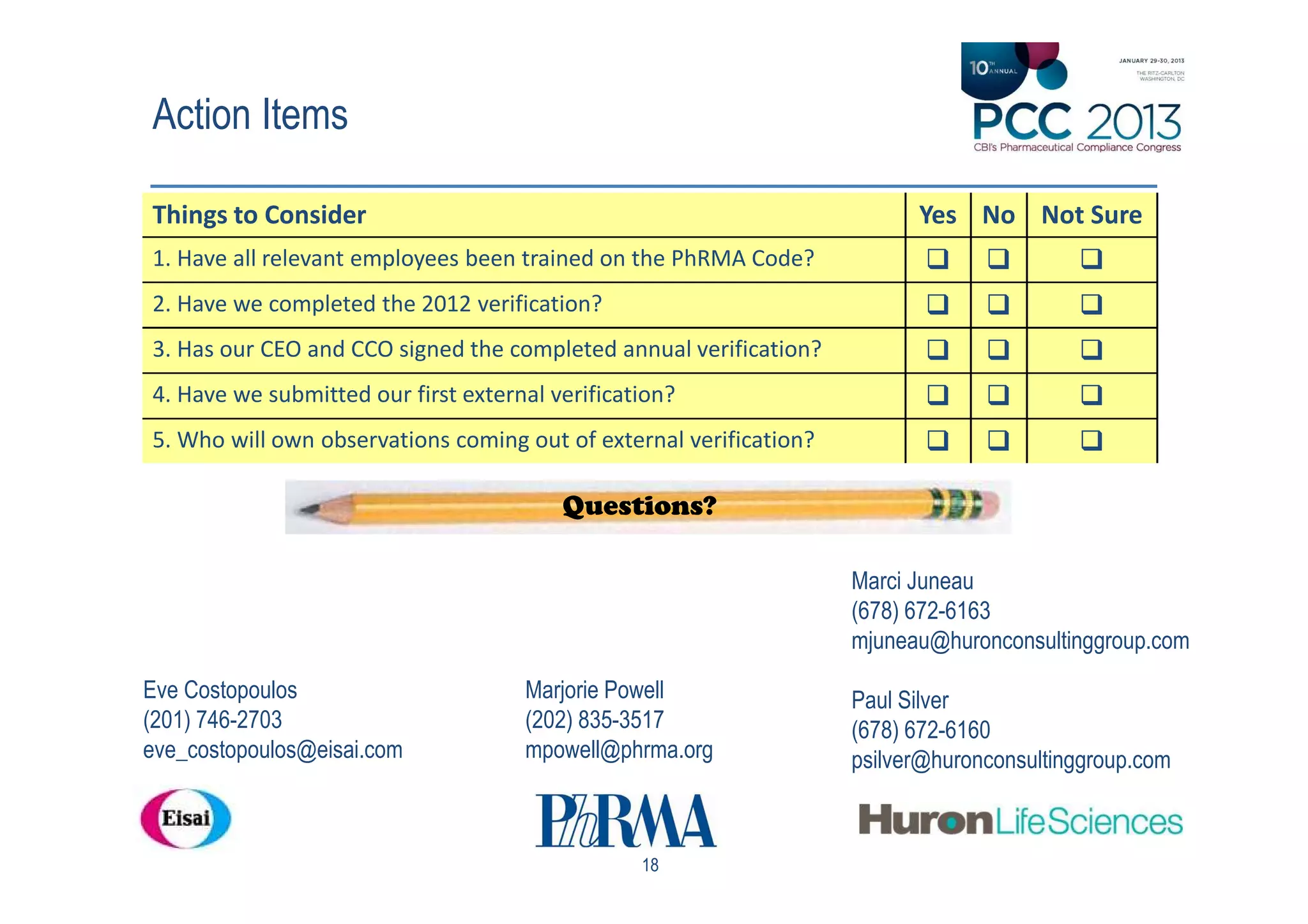
Action Items

Things to Consider                                                        Yes No Not Sure
1. Have all relevant employees been trained on the PhRMA Code?
2. Have we completed the 2012 verification?
3. Has our CEO and CCO signed the completed annual verification?
4. Have we submitted our first external verification?
5. Who will own observations coming out of external verification?

                                         Questions?

                                                                    Marci Juneau
                                                                    (678) 672-6163
                                                                    mjuneau@huronconsultinggroup.com
Eve Costopoulos                      Marjorie Powell                Paul Silver
(201) 746-2703                       (202) 835-3517                 (678) 672-6160
eve_costopoulos@eisai.com            mpowell@phrma.org              psilver@huronconsultinggroup.com


                                                 18

Assessing Adherence to the PhRMA Code

  • 1.
    Assessing Adherence to thePhRMA Code Workshop C January 30, 2013
  • 2.
    Introductions • Eve Costopoulos- Vice President, Corporate Ethics and Compliance/Internal Audit, Eisai • Marjorie E. Powell - Senior Assistant General Counsel, PhRMA • Paul Silver - Practice Leader, Huron Life Sciences • Marci Juneau - Director, Huron Life Sciences Eve Marjorie Paul Marci 1
  • 3.
    Our Session • PhRMA’s Perspective on Assessing Adherence to the Code • Providing Insights from Industry on Adherence • Providing Guidance into the Independent Verification Review Process • Open Questions for Panel • Challenges You Are Seeing • Action Items 2
  • 4.
    PhRMA Code General Overviewof Code The PhRMAceutical Research and Manufacturers of America (PhRMA) represents research-based pharmaceutical and biotechnology companies. The PhRMA Code on Interactions with Healthcare Professionals was created to reinforce the intention that PhRMA members’ interactions with healthcare professionals (HCPs) are professional exchanges designed to benefit patients and to enhance the practice of medicine. The Code is based on the principle that an HCP’s care of patients should be based, and should be perceived as being based, solely on each patient’s medical needs and the HCP’s medical knowledge and experience. 3
  • 5.
    PhRMA’s Perspective onAssessing Adherence to the Code PhRMA Code on Interactions with Health Care Professionals • Code has 15 Provisions • Agree to sign the PhRMA Code: Commit to comply with the PhRMA Code – Need not be a PhRMA member company to sign the Code • Submit name and contact information for Compliance Officer • Yearly certification that the company has policies and procedures in place to foster compliance with the Code • Certify that the company: – Has policies – Has trained staff – Has a system to monitor compliance – Has a system to address non-compliance 4
  • 6.
    PhRMA’s Perspective onAssessing Adherence to the Code • External verification that the company has policies and procedures in place to foster compliance with the PhRMA Code – External verification need not be solely for PhRMA Code purposes – Do not need to submit the findings or report • PhRMA Code has evolved over the years – Found code from the 1960s – Code most recently revised in 2008, and effective in 2009 • Several states require compliance with the PhRMA Code or a similar state code 5
  • 7.
    Industry Insight onAdherence to the Code Overlap with State Requirements • Nevada – “Does your company use one of the two model codes of conduct [Code of Interactions with Healthcare Professionals by PhRMA] or Code of Ethics on Interactions with Health Care Professionals by AdvaMed (for manufacturers or wholesalers of devices or appliances)] without modification?” • Massachusetts – “Our company has adopted a program to routinely train appropriate employees, including, without limitation, all sales and marketing staff regarding the marketing code of conduct, as described in 105 C.M.R. 970.000.” – “Our company has policies and procedures in place for conducting investigations into any and all non-compliance with 105 C.M.R. 970.000, taking corrective actions in response to all non-compliance…” • California – Annual Declaration of Compliance 6
  • 8.
    Industry Insight onAdherence to the Code External Verification Guidance As of January 1, 2009, the revised PhRMA Code states that all companies (PhRMA members and non-members) that interact with HCPs about pharmaceuticals should adopt procedures to assure adherence to the Code including its 15 sections regarding various aspects of pharmaceutical company interactions with HCPs. The PhRMA Code encourages member companies to seek external verification periodically – ideally at least once every three years – to evaluate whether the company has policies, procedures, or guidelines in place to foster compliance with the Code. In May 2012, PhRMA published external verification guidelines that outline the organization’s expectations as they relate to confirmation of a company’s compliance with the Code. 7
  • 9.
    Industry Insight onAdherence to the Code Credentials of External Verification The Company should ensure that the entity it selects to conduct an external verification of its policies and procedures in connection with the PhRMA Code possesses sufficient expertise, objectivity, and independence from the Company to be credible in performing the verification function. • Objectivity means being independent in fact, maintaining an attitude of impartiality, and having intellectual honesty. • Independence means that the external verification entity and the person or persons who conduct the verification evaluation must be free from personal, external, and organizational impairments to independence. • An external entity can be independent and objective even if it currently provides or has previously provided other advice and services to the Company. The external verifying entity can include outside counsel, external auditors, or another entity that has the relevant knowledge and expertise to credibly perform the verification function. – It is the responsibility of the Company and the verifying entity to ensure that any other interactions between the Company and the entity will not compromise the entity’s ability to perform a full and fair external verification of the Company’s policies and procedures in connection with the PhRMA Code. 8
  • 10.
    Industry Insight onAdherence to the Code Purpose and Submission of External Verification • The external verification need not be obtained by the Company solely for the purpose of meeting the external verification criteria in the PhRMA Code. As long as the verification satisfies the criteria set out in this guidance, it will be considered sufficient to achieve recognition by PhRMA, even if the verification was originally sought for another purpose. • The Company need not submit the detailed findings or report of the external verification entity to PhRMA, but may achieve recognition by PhRMA for satisfying the external verification criteria if it submits a statement that it has successfully completed the verification process. – The statement must be signed by the Company's compliance officer responsible for the US pharmaceutical business and should indicate the date that the external verification process was completed. 9
  • 11.
    Industry Insight onAdherence to the Code Addressing Observations • Discussion with company that performed external verification of adherence to the PhRMA code: – Come to final conclusion and decisions on list of observations (and recommendations) from the external report including those that need to be addressed by company • Internally review observations and recommendations: – Can include Compliance, relevant stakeholders (business), Legal, etc. – Ensure buy-in on process and policy changes • Make revisions to appropriate documentation, policies, processes, etc. • Socialize changes throughout the Company through relevant communication and training 10
  • 12.
    Independent Verification ReviewProcess External Verification Requirements The external verification entity should confirm that the Company has policies, procedures, or guidelines in place to foster compliance with the PhRMA Code: I. Policies, procedures, or guidelines in place that address the topics covered in the 15 sections of the PhRMA Code II. Made any necessary revisions to relevant policies, procedures, or guidelines to reflect requirements of the PhRMA Code and periodically evaluates the need for additional updates or revisions III. Provided relevant company employees with information/training on the requirements of the PhRMA Code and the company periodically evaluates and addresses the need to provide additional training IV. Considered, planned, and implemented the steps it will take to monitor compliance with the requirements of the PhRMA Code on an ongoing basis V. Considered, planned, and implemented the steps it will take to address reported incidents of non- compliance with the requirements of the PhRMA Code 11
  • 13.
    Independent Verification ReviewProcess Review of 15 Areas of PhRMA Code 1. Basis of Interactions 8. HCPs and Formularies/Clinical Practice 2. Informational Presentations and Meals Guidelines 3. Entertainment & Recreation 9. Scholarships & Educational Funds 4. Support for CME 10. Non-Educational and Practice-Related Items 5. Support for Third-Party 11. Educational Items Educational/Professional Meetings 12. Prescriber Data 6. Consultants 13. Independence & Decision Making 7. Speaker Programs/Speaker Training 14. Training & Company Reps Meetings 15. Adherence to the Code 12
  • 14.
    Independent Verification ReviewProcess Key Operational Considerations Operational areas to consider for PhRMA Code External Verifications by Independent Organization: Review • Collect and review the following relevant documents: Relevant – Policies, procedures, guidelines, work instructions, etc. Documents/ – Training materials Information – Other relevant documents – Process documents for monitoring and corrective action plans • These documents will help the Company understand the key written controls and key processes to ensure compliance with the PhRMA Code. • Previous and updated versions of the documents will provide insight into necessary revisions made to address any changes needed to be compliant with the PhRMA code. • If applicable, an additional review of a Company’s Corporate Integrity Agreement (CIA) to determine areas of overlap for those that are already addressed in applicable areas or tested by the Independent Review Organization (IRO) 13
  • 15.
    Independent Verification ReviewProcess Key Operational Considerations Operational areas to consider for PhRMA Code External Verifications by Independent Organization: Conduct • Conduct interviews with key stakeholders who play a role in Interviews establishing/revising the relevant: with Key – Policies and procedures Stakeholders – Processes – Training materials – Other documentation reviewed • Interviews may provide insight into: – Policies or unofficial practices that are not captured – Correctly captured in existing relevant policies, procedures, training materials, and other relevant documents – Areas of PhRMA code not addressed by company or concerns on certain areas 14
  • 16.
    Independent Verification ReviewProcess Key Operational Considerations Operational areas to consider for PhRMA Code External Verifications by Independent Organization: Conduct • Assess whether or not the Company has met the PhRMA Code Verification Assessment Requirements as outlined in the guidance released by PhRMA in May 2012 & Creating • Create observations based on any areas that may not meet the five Observations requirements of the verification: – These observations may include policies and procedures that are missing key information or process requirements. – Any recommendations on deficiencies in training, monitoring, or corrective action should be noted. Provide • Independent Reports should include: Independent – The steps review took to verify the company’s adherence to the PhRMA Code Report – The relevant policies, procedures, training materials, and other documents reviewed – Interviews conducted – Observations associated with the external verification – Recommendations (if requested) 15
  • 17.
    Open Questions forPanel Open Questions for PhRMA? • What constitutes "sufficient expertise, objectivity, and independence” from the Company? – Current IRO? Former IRO? External auditors? Internal audit group? Law firm? Consultant? – If a current IRO is considered to be "objective and independent," does the IRO need to perform additional activities outside of its current IRO activities or can it rely upon its IRO role to provide the verification? – Can a series of activities performed throughout a year by a number of different external parties be relied upon by a Company to provide verification? • What does it mean to be "free from personal, external, and organizational impairments to independence?” • What types of interactions between Company and entity might be viewed as compromising the entity's ability to perform a full and fair external verification of Company's policies and procedures? • What is the penalty for non Compliance with PhRMA verifications (internal and external)? Does a company get kicked out of PhRMA for not complying? • When are external verifications due? 16
  • 18.
    Open Questions forPanel Questions to Audience • Who has had an independent external verification completed or is in the process of a verification? • What type of company performed your independent verification? • Have you made any specific assessment around independence of the external company performing the verification? What criteria did you take into consideration to establish independence? 17
  • 19.
    Action Items Things toConsider Yes No Not Sure 1. Have all relevant employees been trained on the PhRMA Code? 2. Have we completed the 2012 verification? 3. Has our CEO and CCO signed the completed annual verification? 4. Have we submitted our first external verification? 5. Who will own observations coming out of external verification? Questions? Marci Juneau (678) 672-6163 mjuneau@huronconsultinggroup.com Eve Costopoulos Marjorie Powell Paul Silver (201) 746-2703 (202) 835-3517 (678) 672-6160 eve_costopoulos@eisai.com mpowell@phrma.org psilver@huronconsultinggroup.com 18