KEY QUESTIONS
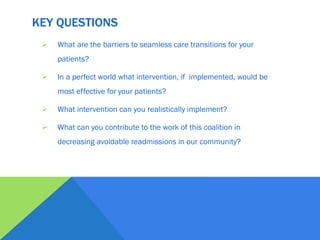
 What are the barriers to seamless care transitions for your
patients?
 In a perfect world what intervention, if implemented, would be
most effective for your patients?
 What intervention can you realistically implement?
 What can you contribute to the work of this coalition in
decreasing avoidable readmissions in our community?
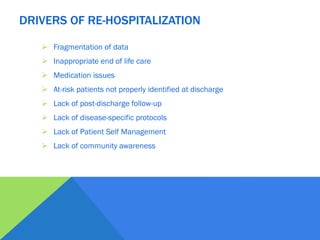
 Fragmentation of data
 Inappropriate end of life care
 Medication issues
 At-risk patients not properly identified at discharge
 Lack of post-discharge follow-up
 Lack of disease-specific protocols
 Lack of Patient Self Management
 Lack of community awareness
DRIVERS OF RE-HOSPITALIZATION
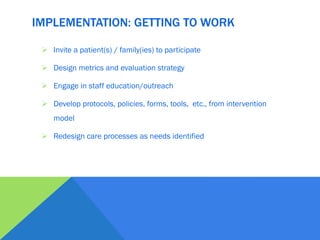
IMPLEMENTATION: GETTING TO WORK
 Invite a patient(s) / family(ies) to participate
 Design metrics and evaluation strategy
 Engage in staff education/outreach
 Develop protocols, policies, forms, tools, etc., from intervention
model
 Redesign care processes as needs identified
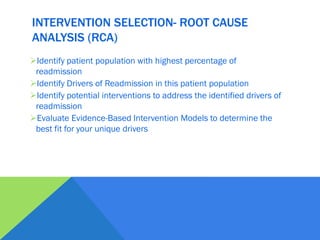
INTERVENTION SELECTION- ROOT CAUSE
ANALYSIS (RCA)
Identify patient population with highest percentage of
readmission
Identify Drivers of Readmission in this patient population
Identify potential interventions to address the identified drivers of
readmission
Evaluate Evidence-Based Intervention Models to determine the
best fit for your unique drivers
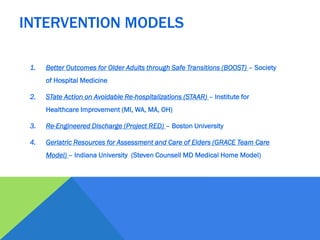
1. Better Outcomes for Older Adults through Safe Transitions (BOOST) – Society
of Hospital Medicine
2. STate Action on Avoidable Re-hospitalizations (STAAR) – Institute for
Healthcare Improvement (MI, WA, MA, OH)
3. Re-Engineered Discharge (Project RED) – Boston University
4. Geriatric Resources for Assessment and Care of Elders (GRACE Team Care
Model) – Indiana University (Steven Counsell MD Medical Home Model)
INTERVENTION MODELS
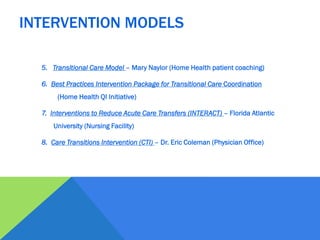
5. Transitional Care Model – Mary Naylor (Home Health patient coaching)
6. Best Practices Intervention Package for Transitional Care Coordination
(Home Health QI Initiative)
7. Interventions to Reduce Acute Care Transfers (INTERACT) – Florida Atlantic
University (Nursing Facility)
8. Care Transitions Intervention (CTI) – Dr. Eric Coleman (Physician Office)
INTERVENTION MODELS
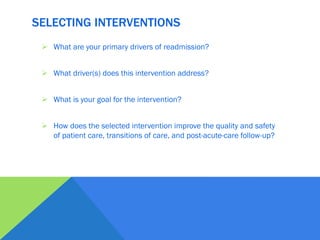
SELECTING INTERVENTIONS
 What are your primary drivers of readmission?
 What driver(s) does this intervention address?
 What is your goal for the intervention?
 How does the selected intervention improve the quality and safety
of patient care, transitions of care, and post-acute-care follow-up?
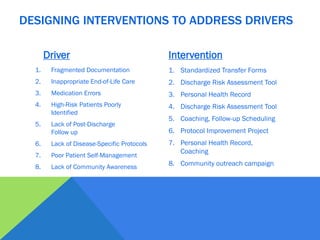
Driver
1. Fragmented Documentation
2. Inappropriate End-of-Life Care
3. Medication Errors
4. High-Risk Patients Poorly
Identified
5. Lack of Post-Discharge
Follow up
6. Lack of Disease-Specific Protocols
7. Poor Patient Self-Management
8. Lack of Community Awareness
Intervention
1. Standardized Transfer Forms
2. Discharge Risk Assessment Tool
3. Personal Health Record
4. Discharge Risk Assessment Tool
5. Coaching, Follow-up Scheduling
6. Protocol Improvement Project
7. Personal Health Record,
Coaching
8. Community outreach campaign
DESIGNING INTERVENTIONS TO ADDRESS DRIVERS
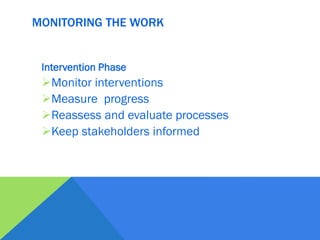
MONITORING THE WORK
Intervention Phase
Monitor interventions
Measure progress
Reassess and evaluate processes
Keep stakeholders informed
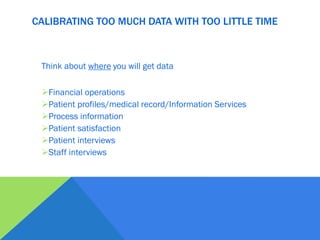
Think about where you will get data
Financial operations
Patient profiles/medical record/Information Services
Process information
Patient satisfaction
Patient interviews
Staff interviews
CALIBRATING TOO MUCH DATA WITH TOO LITTLE TIME
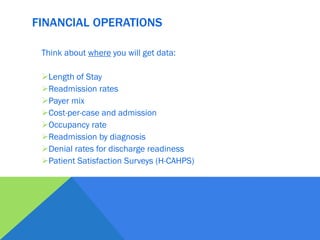
Think about where you will get data:
Length of Stay
Readmission rates
Payer mix
Cost-per-case and admission
Occupancy rate
Readmission by diagnosis
Denial rates for discharge readiness
Patient Satisfaction Surveys (H-CAHPS)
FINANCIAL OPERATIONS
Think about knowing when and from where patients
are readmitted
Medical record
Admission source
Patient interview
Discharge disposition
Discharge risk assessments
PATIENT PROFILES
Think about processes that impact and are impacted by readmission
 Holding in ER, ICU, recovery
 Denied days for delay in discharge
 ER diversion rates
 Discharge planning process
 Bed turnover measures
 Patient education
 Referrals
PROCESS INFORMATION
PATIENT SATISFACTION
Think about how a patient’s perception impacts readmission (H-CAHPS)
 Medication management
• Question # 16
• Question # 17
 Discharge Planning
• Question # 19
• Question # 20
Think about how staff can give you their perspective on
processes that impact their work and readmissions
 Discharge process
 Discharge risk factors
 Patient education
 Tools
 Opportunities
 Solutions
STAFF INTERVIEWS
Think about questions you can ask the patient that
will help you understand readmission
Reason for readmission
Discharge process
Discharge risk factors
Patient efficacy – response to education
Solutions
PATIENT INTERVIEWS
Index Admission: The initial inpatient admission within a given 30-day period.
Readmission: A patient readmitted to an inpatient bed within 30 days of
discharge from the previous inpatient hospitalization (index admission).
Outcome: An expected change that results from an intervention, reflecting an
effect on root cause.
Improvement: Meeting a benchmark set at intervention implementation or
achievement of statistical significance over a defined time period.
DEFINITIONS
SURVEYING THE WORK
Surveillance Phase
Analyze data
Adjust interventions
Report data to stakeholders
Monitor – Improve – Report activities
”…the secret of the care of the patient is in caring
for the patient.”
Francis W. Peabody, MD (1881-1927)
REMEMBER
Definition: Patient Experience
The sum of all interactions, shaped by an
organization’s culture, that impact patient
perceptions across the continuum of care
TEAMWORK IN VALUE-BASED CARE
 Patients are starting to discover that
their healthcare is not nearly as good as
it should be.
TEAMWORK IN VALUE-BASED CARE
 Patients are starting to discover that their
healthcare is not nearly as good as it should
be.
 Value-based care is the right thing to do,
and it’s not that hard.
TEAMWORK IN VALUE-BASED CARE
• Patients are starting to discover that their healthcare is not
nearly as good as it should be.
• Value-based care is the right thing to do, and it’s not that
hard.
• Value-based care will make any healthcare provider stand
out from the crowd.
TEAMWORK IN VALUE-BASED CARE CARE
1. Providers and patients know each others’ names.
2. Patients’ opinions are actively sought, listened to and
honored where possible (a suggestion box, patient
satisfaction survey or mission statement doesn’t
constitute being value-based — if you think they are then
you aren’t value-based).
3. Patients tell you that their doctors and other team
members really listened to what they had to say (again, if
you think satisfaction surveys qualify, you aren’t there yet).
TEAMWORK IN VALUE-BASED CARE
1. Patients are treated as the most important
member of the healthcare team and taught how
they can best contribute to the team’s success.
2. Providers feel that their patients are actively
involved in their own care.
3. You see a significant improvement in patient
health status, health literacy / adherence/ self-
management, engagement, level of utilization
and patient/provider experience.
TEAMWORK IN VALUE-BASED CARE
CALL TO ACTION
Reduction in preventable readmissions cannot be
accomplished by individuals or providers working in
isolation.
Determine which post-acute care providers readmit
patients to your facility most often and why.
For a free copy of this deck with
notes please contact:
CJ Fulton
618-579-9192
healthideation@gmail.com

Presentation on Teamwork for Avoiding Potentially Avoidable Readmissions

  • 2.
    KEY QUESTIONS  Whatare the barriers to seamless care transitions for your patients?  In a perfect world what intervention, if implemented, would be most effective for your patients?  What intervention can you realistically implement?  What can you contribute to the work of this coalition in decreasing avoidable readmissions in our community?
  • 3.
     Fragmentation ofdata  Inappropriate end of life care  Medication issues  At-risk patients not properly identified at discharge  Lack of post-discharge follow-up  Lack of disease-specific protocols  Lack of Patient Self Management  Lack of community awareness DRIVERS OF RE-HOSPITALIZATION
  • 4.
    IMPLEMENTATION: GETTING TOWORK  Invite a patient(s) / family(ies) to participate  Design metrics and evaluation strategy  Engage in staff education/outreach  Develop protocols, policies, forms, tools, etc., from intervention model  Redesign care processes as needs identified
  • 5.
    INTERVENTION SELECTION- ROOTCAUSE ANALYSIS (RCA) Identify patient population with highest percentage of readmission Identify Drivers of Readmission in this patient population Identify potential interventions to address the identified drivers of readmission Evaluate Evidence-Based Intervention Models to determine the best fit for your unique drivers
  • 6.
    1. Better Outcomesfor Older Adults through Safe Transitions (BOOST) – Society of Hospital Medicine 2. STate Action on Avoidable Re-hospitalizations (STAAR) – Institute for Healthcare Improvement (MI, WA, MA, OH) 3. Re-Engineered Discharge (Project RED) – Boston University 4. Geriatric Resources for Assessment and Care of Elders (GRACE Team Care Model) – Indiana University (Steven Counsell MD Medical Home Model) INTERVENTION MODELS
  • 7.
    5. Transitional CareModel – Mary Naylor (Home Health patient coaching) 6. Best Practices Intervention Package for Transitional Care Coordination (Home Health QI Initiative) 7. Interventions to Reduce Acute Care Transfers (INTERACT) – Florida Atlantic University (Nursing Facility) 8. Care Transitions Intervention (CTI) – Dr. Eric Coleman (Physician Office) INTERVENTION MODELS
  • 8.
    SELECTING INTERVENTIONS  Whatare your primary drivers of readmission?  What driver(s) does this intervention address?  What is your goal for the intervention?  How does the selected intervention improve the quality and safety of patient care, transitions of care, and post-acute-care follow-up?
  • 9.
    Driver 1. Fragmented Documentation 2.Inappropriate End-of-Life Care 3. Medication Errors 4. High-Risk Patients Poorly Identified 5. Lack of Post-Discharge Follow up 6. Lack of Disease-Specific Protocols 7. Poor Patient Self-Management 8. Lack of Community Awareness Intervention 1. Standardized Transfer Forms 2. Discharge Risk Assessment Tool 3. Personal Health Record 4. Discharge Risk Assessment Tool 5. Coaching, Follow-up Scheduling 6. Protocol Improvement Project 7. Personal Health Record, Coaching 8. Community outreach campaign DESIGNING INTERVENTIONS TO ADDRESS DRIVERS
  • 10.
    MONITORING THE WORK InterventionPhase Monitor interventions Measure progress Reassess and evaluate processes Keep stakeholders informed
  • 11.
    Think about whereyou will get data Financial operations Patient profiles/medical record/Information Services Process information Patient satisfaction Patient interviews Staff interviews CALIBRATING TOO MUCH DATA WITH TOO LITTLE TIME
  • 12.
    Think about whereyou will get data: Length of Stay Readmission rates Payer mix Cost-per-case and admission Occupancy rate Readmission by diagnosis Denial rates for discharge readiness Patient Satisfaction Surveys (H-CAHPS) FINANCIAL OPERATIONS
  • 13.
    Think about knowingwhen and from where patients are readmitted Medical record Admission source Patient interview Discharge disposition Discharge risk assessments PATIENT PROFILES
  • 14.
    Think about processesthat impact and are impacted by readmission  Holding in ER, ICU, recovery  Denied days for delay in discharge  ER diversion rates  Discharge planning process  Bed turnover measures  Patient education  Referrals PROCESS INFORMATION
  • 15.
    PATIENT SATISFACTION Think abouthow a patient’s perception impacts readmission (H-CAHPS)  Medication management • Question # 16 • Question # 17  Discharge Planning • Question # 19 • Question # 20
  • 16.
    Think about howstaff can give you their perspective on processes that impact their work and readmissions  Discharge process  Discharge risk factors  Patient education  Tools  Opportunities  Solutions STAFF INTERVIEWS
  • 17.
    Think about questionsyou can ask the patient that will help you understand readmission Reason for readmission Discharge process Discharge risk factors Patient efficacy – response to education Solutions PATIENT INTERVIEWS
  • 18.
    Index Admission: Theinitial inpatient admission within a given 30-day period. Readmission: A patient readmitted to an inpatient bed within 30 days of discharge from the previous inpatient hospitalization (index admission). Outcome: An expected change that results from an intervention, reflecting an effect on root cause. Improvement: Meeting a benchmark set at intervention implementation or achievement of statistical significance over a defined time period. DEFINITIONS
  • 19.
    SURVEYING THE WORK SurveillancePhase Analyze data Adjust interventions Report data to stakeholders Monitor – Improve – Report activities
  • 20.
    ”…the secret ofthe care of the patient is in caring for the patient.” Francis W. Peabody, MD (1881-1927) REMEMBER
  • 21.
    Definition: Patient Experience Thesum of all interactions, shaped by an organization’s culture, that impact patient perceptions across the continuum of care TEAMWORK IN VALUE-BASED CARE
  • 22.
     Patients arestarting to discover that their healthcare is not nearly as good as it should be. TEAMWORK IN VALUE-BASED CARE
  • 23.
     Patients arestarting to discover that their healthcare is not nearly as good as it should be.  Value-based care is the right thing to do, and it’s not that hard. TEAMWORK IN VALUE-BASED CARE
  • 24.
    • Patients arestarting to discover that their healthcare is not nearly as good as it should be. • Value-based care is the right thing to do, and it’s not that hard. • Value-based care will make any healthcare provider stand out from the crowd. TEAMWORK IN VALUE-BASED CARE CARE
  • 25.
    1. Providers andpatients know each others’ names. 2. Patients’ opinions are actively sought, listened to and honored where possible (a suggestion box, patient satisfaction survey or mission statement doesn’t constitute being value-based — if you think they are then you aren’t value-based). 3. Patients tell you that their doctors and other team members really listened to what they had to say (again, if you think satisfaction surveys qualify, you aren’t there yet). TEAMWORK IN VALUE-BASED CARE
  • 26.
    1. Patients aretreated as the most important member of the healthcare team and taught how they can best contribute to the team’s success. 2. Providers feel that their patients are actively involved in their own care. 3. You see a significant improvement in patient health status, health literacy / adherence/ self- management, engagement, level of utilization and patient/provider experience. TEAMWORK IN VALUE-BASED CARE
  • 27.
    CALL TO ACTION Reductionin preventable readmissions cannot be accomplished by individuals or providers working in isolation. Determine which post-acute care providers readmit patients to your facility most often and why.
  • 28.
    For a freecopy of this deck with notes please contact: CJ Fulton 618-579-9192 healthideation@gmail.com