AITD National Conference
April 13, 2011

Lorraine Salloum
Manager, Organisational Performance
NSW Workers Compensation Commission
“Significant change only occurs
when it is driven from the topic”
Agenda
 Setting the context - NSW Workers Compensation Commission
 The Cultural Agenda
 Developing the Cultural Transformation Strategy

 Key initiatives





Positive Culture Program
Leadership Strategy
Review, Recognition & Development
Systems

 Results so far & lessons learned
NSW Workers Compensation
Commission
 Statutory Tribunal established in 2002
 Major organisation restructures 2004
 Dec 2007 Announcement of comprehensive review (Bendelta Review)

Purpose Access opportunities for improvement to better position the
Commission to meet user expectations

Key Message ‘Move from being good to better’
Scope
 Dispute Resolution Model
 Case Management Practices
 Corporate Services, Support and Governance
 Resourcing
Performance Improvement
Initiatives
 Revised internal Structure – implemented Oct 2009

 People strategies (Teamwork, Performance Management, Reward

and Recognition)

 Review of Arbitrator Engagement – implemented June 2010

 Introduction of Professional Development Framework for

Arbitrators and Approved Medical Specialists

 Key Performance Indicators Framework – output and outcome

focused, internal / external
Personal Accountability
Taking responsibility for own actions and focusing on what
actions can be taken at an individual level to improve
performance of the organisation
WCC had signs that personal accountability was an
organisational issue:
 Blame
 Victim thinking
 Procrastination
 Creativity Problems
Conflicts with existing values and objectives
Personal Accountability
Initiatives focused on increasing personal accountability for
the Commission’s culture and performance

If an individual embraces personal accountability they will
be focused on what they can control and what they can do
to change culture for the better
 What can I do to best adapt to change?
 How can I help the organisation change for the better?
 What can I do to better communicate with those around

me?
Translating personal accountability to
the cultural agenda
Cultural agenda = desired culture
Personal accountability is about taking action to improve the situation
 Identifying ways to take action
 Avoiding blame
 Eliminating victim thinking
 Stopping procrastination

Without personal accountability individuals waste time, lower levels of
morale and performance
Doesn’t matter what the desired culture is – personal accountability is
important.
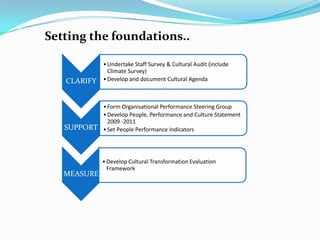
Setting the foundations..

CLARIFY

• Undertake Staff Survey & Cultural Audit (include
Climate Survey)
• Develop and document Cultural Agenda

SUPPORT

• Form Organisational Performance Steering Group
• Develop People, Performance and Culture Statement
2009 -2011
• Set People Performance Indicators

MEASURE

• Develop Cultural Transformation Evaluation
Framework
Cultural Audit - Staff
 Cultural Climate Survey

 Small group sessions
 How would you describe the Commission’s culture?

 What would you like the Commission’s culture to be?

 Individual Interviews
Cultural Agenda
“A high performance culture that collaborates within and
across teams”
Themes* Leadership, Teams, Empowerment,
Communication, Performance Management
Blame = individual accountability – organisation/mgrs
* Common between managers and staff
Measurement
 Simple, minimal cost
 Survey using Commitment – Apathy Scale (managers)

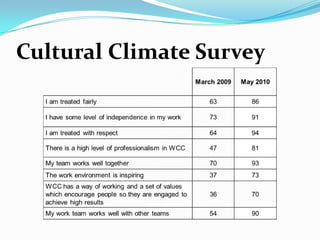
 Cultural Climate Survey (Staff)
 Cultural Transformation Evaluation Framework
The Baseline Surveys
Staff cultural climate survey - 8 question survey focusing on
motivation, engagement, teamwork and values
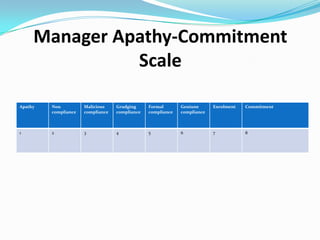
Managers Apathy-Commitment scale – asked to plot on a
apathy – commitment scale where they believed the level
of commitment of staff to behaviors demonstrating
1. Performance Culture
2. Collaboration within and across teams
Manager Apathy-Commitment
Scale
Apathy

Non
compliance

Malicious
compliance

Grudging
compliance

Formal
compliance

Geniune
compliance

Enrolment

Commitment

1

2

3

4

5

6

7

8
Communicating the Cultural
Agenda
 Importance of communication from Senior

Management
 Visible commitment to personal and organisational

change
 Recognition staff had set the cultural agenda
 All WCC people strategies link back to the cultural

agenda
Cultural Transformation Strategy
 Aim to increase employee commitment to a number

of desired behaviours ‘Cultural Agenda’
 Plan of initiatives and activities to move the

organisation from actual culture to desired culture.
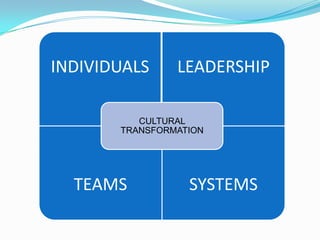
INDIVIDUALS

LEADERSHIP

CULTURAL
TRANSFORMATION

TEAMS

SYSTEMS
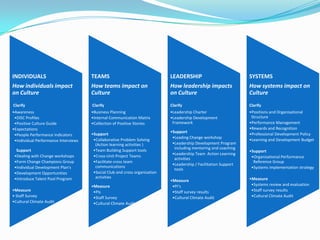
INDIVIDUALS

TEAMS

LEADERSHIP

SYSTEMS

How individuals impact
on Culture

How teams impact on
Culture

How leadership impacts
on Culture

How systems impact on
Culture

Clarify

Clarify

Clarify

Clarify

•Awareness
•DISC Profiles
•Positive Culture Guide
•Expectations
•People Performance Indicators
•Individual Performance Interviews

•Business Planning
•Internal Communication Matrix
•Collection of Positive Stories

•Leadership Charter
•Leadership Development
Framework

•Positions and Organisational
Structure
•Performance Management
•Rewards and Recognition
•Professional Development Policy
•Learning and Development Budget

Support
•Dealing with Change workshops
•Form Change Champions Group
•Individual Development Plan's
•Development Opportunities
•Introduce Talent Pool Program
•Measure
• Staff Survey
•Cultural Climate Audit

•Support
•Collaborative Problem Solving
(Action learning activities )
•Team Building Support tools
•Cross-Unit Project Teams
•Facilitate cross team
communications
•Social Club and across
organisation activities
•Measure
•PIs
•Staff Survey
•Cultural Climate Audit

•Support
•Leading Change workshop
•Leadership Development Program
including mentoring and coaching
•Leadership Team Action Learning
activities
•Leadership / Facilitation Support
tools
•Measure
•PI’s
•Staff survey results
•Cultural Climate Audit

•Support
•Organisational Performance
Reference Group
•Systems implementation strategy
•Measure
•Systems review and evaluation
•Staff survey results
•Cultural Climate Audit
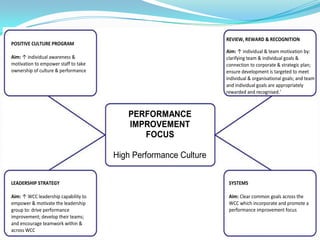
REVIEW, REWARD & RECOGNITION

POSITIVE CULTURE PROGRAM

Aim: ↑ individual & team motivation by:
clarifying team & individual goals &
connection to corporate & strategic plan;
ensure development is targeted to meet
individual & organisational goals; and team
and individual goals are appropriately
rewarded and recognised.’

Aim: ↑ individual awareness &
motivation to empower staff to take
ownership of culture & performance

PERFORMANCE
IMPROVEMENT
FOCUS
High Performance Culture
LEADERSHIP STRATEGY

SYSTEMS

Aim: ↑ WCC leadership capability to
empower & motivate the leadership
group to: drive performance
improvement; develop their teams;
and encourage teamwork within &
across WCC

Aim: Clear common goals across the
WCC which incorporate and promote a
performance improvement focus
People, Performance & Culture 2009 - 2011
PEOPLE &
PERFORMANCE

FOCUS
Fostering commitment &
strengthening people capacity

KEY STRATEGIES
Implement the capability framework into people planning activities

Encourage continuous learning for all staff

Develop and implement a performance management approach which fosters skilled
and committed people

CULTURE

A positive and cohesive
workplace culture that
supports the achievement of
WCC vision, mission and goals

Nurture initiative
Develop and implement a cultural transformation strategy that meets staff and
managements cultural agenda

Build and strengthen teams using business-focused activities

Improve internal communications
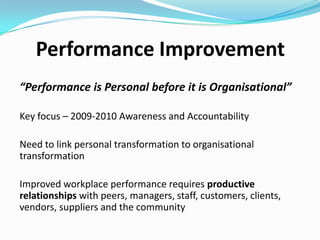
Performance Improvement
“Performance is Personal before it is Organisational”
Key focus – 2009-2010 Awareness and Accountability
Need to link personal transformation to organisational
transformation
Improved workplace performance requires productive
relationships with peers, managers, staff, customers, clients,
vendors, suppliers and the community
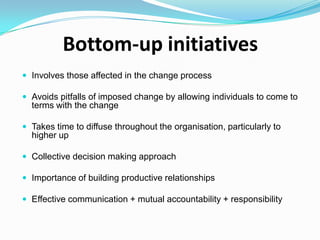
Bottom-up initiatives
 Involves those affected in the change process
 Avoids pitfalls of imposed change by allowing individuals to come to

terms with the change
 Takes time to diffuse throughout the organisation, particularly to

higher up
 Collective decision making approach
 Importance of building productive relationships
 Effective communication + mutual accountability + responsibility
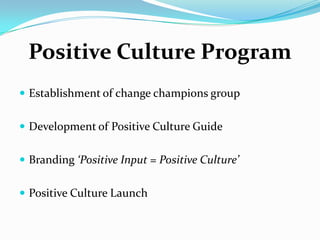
Positive Culture Program
 Establishment of change champions group
 Development of Positive Culture Guide
 Branding ‘Positive Input = Positive Culture’

 Positive Culture Launch
Change Champions Group
 23 staff – representatives of every level and unit / branch
 Gauge of Commission culture & reality testers
 Fortnightly meetings - facilitated discussion ‘ToP method’ –

weekly topics around areas identified in the cultural agenda

 Group developed ‘Positive Culture Guide’

 Build momentum – shift mindset from ‘blame’ to personal

accountability
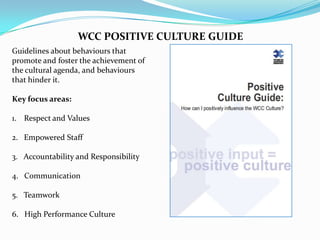
WCC POSITIVE CULTURE GUIDE
Guidelines about behaviours that
promote and foster the achievement of
the cultural agenda, and behaviours
that hinder it.
Key focus areas:
1. Respect and Values
2. Empowered Staff

3. Accountability and Responsibility
4. Communication
5. Teamwork

6. High Performance Culture
Organisational Review Launch Video
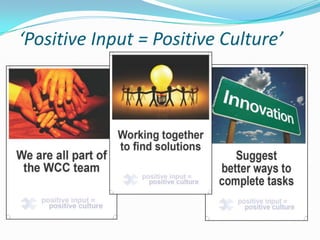
‘Positive Input = Positive Culture’
‘Positive Input = Positive Culture”
 Visibility of messages promoting personal accountability

(Screen savers, posters, staff newsletter header, intranet)
 Monthly themed communications – reminders of

behaviours contributing to achieving cultural agenda
 Part of induction
Leadership Strategy
Aim*: Strengthen leadership capability to drive performance
improvement, meet cultural agenda & encourage personal
accountability
 Leadership Program Supervisors – Middle Management
 Business Coaching

Individual middle management

 Executive Coaching – individual Individual senior management
 Executive Coaching – team Team senior management

*Change champions identified leadership as the biggest barrier to
achieving the cultural agenda
Leadership Program
University of New England Partnerships Pty Ltd - Sustaining out Business 2011:
Driving Performance Improvement Program
Workplace program –Diploma of Government
12 month program, workshops, coaching & on the job tasks &
Focus on: individual accountability, providing leadership; facilitating change;
managing individual and team performance
Integration into business
 Collaborative problem solving
 Development of Leadership Charter
 Cross organisation business improvement projects – individual and group
Use of group workshops to apply theory to practice using current Commission
challenges managers face in the workplace.
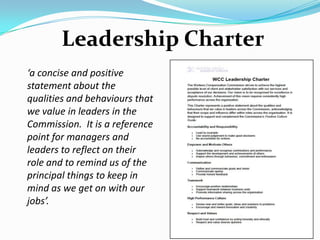
Leadership Charter
‘a concise and positive
statement about the
qualities and behaviours that
we value in leaders in the
Commission. It is a reference
point for managers and
leaders to reflect on their
role and to remind us of the
principal things to keep in
mind as we get on with our
jobs’.
Organisational Performance Reference
Group
 Renewal of change champions group
 Representative from each unit / branch, as well as a

cross-section of Grades.
 Provide input into initiatives aimed at improving

organisaitonal performance.
 Initiatives include: Performance Management system;

Reward and recognition; and Learning and Development
Development
Review, Recognition & Development
 Development of fully integrated online performance

management system – implementation 1 July 2011

 Development of policy
 Consultation document – key questions, issues to consider,

preferred position

 Clear identification of risks and reasons for resistance
 Explore personal accountability for implementation
Business Planning Review
Unit business planning review
Identification of ‘business as usual’ or ‘performance improvement’
Promote consideration of all strategic focus areas and encourage
suggestions for organisational projects and improvements, as well as
possible individual contributions.
Coaching of managers
Guide on how to facilitate business planning activities to provide
individual accountability within the team
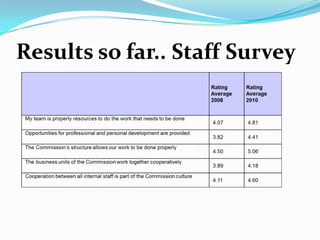
Results so far.. Staff Survey
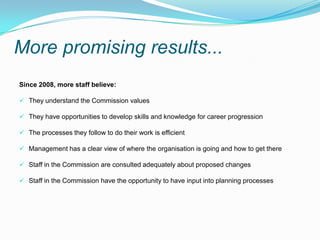
More promising results...
Since 2008, more staff believe:
 They understand the Commission values
 They have opportunities to develop skills and knowledge for career progression
 The processes they follow to do their work is efficient
 Management has a clear view of where the organisation is going and how to get there
 Staff in the Commission are consulted adequately about proposed changes
 Staff in the Commission have the opportunity to have input into planning processes
Cultural Climate Survey
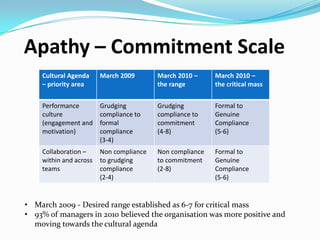
Apathy – Commitment Scale
Cultural Agenda
– priority area

March 2009

March 2010 –
the range

March 2010 –
the critical mass

Performance
culture
(engagement and
motivation)

Grudging
compliance to
formal
compliance
(3-4)

Grudging
compliance to
commitment
(4-8)

Formal to
Genuine
Compliance
(5-6)

Collaboration –
within and across
teams

Non compliance
to grudging
compliance
(2-4)

Non compliance
to commitment
(2-8)

Formal to
Genuine
Compliance
(5-6)

• March 2009 - Desired range established as 6-7 for critical mass
• 93% of managers in 2010 believed the organisation was more positive and
moving towards the cultural agenda
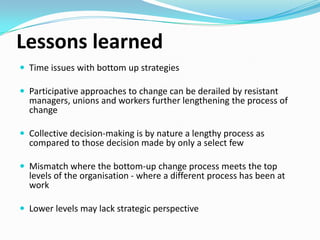
Lessons learned
 Time issues with bottom up strategies
 Participative approaches to change can be derailed by resistant

managers, unions and workers further lengthening the process of
change.

 Collective decision-making is by nature a lengthy process as

compared to those decision made by only a select few.

 Mismatch where the bottom-up change process meets the top

levels of the organisation - where a different process has been at
work.

 Lower levels may lack strategic perspective.
Lessons learned
 Substantial energy to get bottom-up initiatives started and keep it focused
 Difficulty of incorporating all perspectives.

 Raises questions about the motivation and skill of employees to develop an

ambitious solution that will force them to change.
 Don’t always need expensive metrics and measurements. Save budget for

initiatives if you have a limited budget.
 Adopt a business approach.
 Initiatives to enable personal insight and shifts in mindset.
Lessons learned
 Top-down efforts alone are not sufficient to achieve transformational

change.
 When to use top-down or bottom-up strategies
 Bottom-up – where innovation and collective decision making is required (e.g.
positive culture
 Top down – direction to create focus and conditions for performance

improvement
 Blend with broad-base, bottom-up performance improvement to get people at

all levels to take a fresh approach to solving problems and improving
performance(e.g. Review, Recognition and Development)
Looking forward
 Implementation of the Review, Recognition and Development

system
 Next phase – focus on collaborative problem solving, action

learning and teams
 Maintain broad involvement and use of teams to tackle issue

and promote buy-in
 Challenge – to keep up the momentum!

Transforming Culture

  • 1.
    AITD National Conference April13, 2011 Lorraine Salloum Manager, Organisational Performance NSW Workers Compensation Commission
  • 2.
    “Significant change onlyoccurs when it is driven from the topic”
  • 3.
    Agenda  Setting thecontext - NSW Workers Compensation Commission  The Cultural Agenda  Developing the Cultural Transformation Strategy  Key initiatives     Positive Culture Program Leadership Strategy Review, Recognition & Development Systems  Results so far & lessons learned
  • 4.
    NSW Workers Compensation Commission Statutory Tribunal established in 2002  Major organisation restructures 2004  Dec 2007 Announcement of comprehensive review (Bendelta Review) Purpose Access opportunities for improvement to better position the Commission to meet user expectations Key Message ‘Move from being good to better’ Scope  Dispute Resolution Model  Case Management Practices  Corporate Services, Support and Governance  Resourcing
  • 5.
    Performance Improvement Initiatives  Revisedinternal Structure – implemented Oct 2009  People strategies (Teamwork, Performance Management, Reward and Recognition)  Review of Arbitrator Engagement – implemented June 2010  Introduction of Professional Development Framework for Arbitrators and Approved Medical Specialists  Key Performance Indicators Framework – output and outcome focused, internal / external
  • 6.
    Personal Accountability Taking responsibilityfor own actions and focusing on what actions can be taken at an individual level to improve performance of the organisation WCC had signs that personal accountability was an organisational issue:  Blame  Victim thinking  Procrastination  Creativity Problems Conflicts with existing values and objectives
  • 7.
    Personal Accountability Initiatives focusedon increasing personal accountability for the Commission’s culture and performance If an individual embraces personal accountability they will be focused on what they can control and what they can do to change culture for the better  What can I do to best adapt to change?  How can I help the organisation change for the better?  What can I do to better communicate with those around me?
  • 8.
    Translating personal accountabilityto the cultural agenda Cultural agenda = desired culture Personal accountability is about taking action to improve the situation  Identifying ways to take action  Avoiding blame  Eliminating victim thinking  Stopping procrastination Without personal accountability individuals waste time, lower levels of morale and performance Doesn’t matter what the desired culture is – personal accountability is important.
  • 9.
    Setting the foundations.. CLARIFY •Undertake Staff Survey & Cultural Audit (include Climate Survey) • Develop and document Cultural Agenda SUPPORT • Form Organisational Performance Steering Group • Develop People, Performance and Culture Statement 2009 -2011 • Set People Performance Indicators MEASURE • Develop Cultural Transformation Evaluation Framework
  • 10.
    Cultural Audit -Staff  Cultural Climate Survey  Small group sessions  How would you describe the Commission’s culture?  What would you like the Commission’s culture to be?  Individual Interviews
  • 11.
    Cultural Agenda “A highperformance culture that collaborates within and across teams” Themes* Leadership, Teams, Empowerment, Communication, Performance Management Blame = individual accountability – organisation/mgrs * Common between managers and staff
  • 12.
    Measurement  Simple, minimalcost  Survey using Commitment – Apathy Scale (managers)  Cultural Climate Survey (Staff)  Cultural Transformation Evaluation Framework
  • 13.
    The Baseline Surveys Staffcultural climate survey - 8 question survey focusing on motivation, engagement, teamwork and values Managers Apathy-Commitment scale – asked to plot on a apathy – commitment scale where they believed the level of commitment of staff to behaviors demonstrating 1. Performance Culture 2. Collaboration within and across teams
  • 14.
  • 15.
    Communicating the Cultural Agenda Importance of communication from Senior Management  Visible commitment to personal and organisational change  Recognition staff had set the cultural agenda  All WCC people strategies link back to the cultural agenda
  • 16.
    Cultural Transformation Strategy Aim to increase employee commitment to a number of desired behaviours ‘Cultural Agenda’  Plan of initiatives and activities to move the organisation from actual culture to desired culture.
  • 17.
  • 18.
    INDIVIDUALS TEAMS LEADERSHIP SYSTEMS How individuals impact onCulture How teams impact on Culture How leadership impacts on Culture How systems impact on Culture Clarify Clarify Clarify Clarify •Awareness •DISC Profiles •Positive Culture Guide •Expectations •People Performance Indicators •Individual Performance Interviews •Business Planning •Internal Communication Matrix •Collection of Positive Stories •Leadership Charter •Leadership Development Framework •Positions and Organisational Structure •Performance Management •Rewards and Recognition •Professional Development Policy •Learning and Development Budget Support •Dealing with Change workshops •Form Change Champions Group •Individual Development Plan's •Development Opportunities •Introduce Talent Pool Program •Measure • Staff Survey •Cultural Climate Audit •Support •Collaborative Problem Solving (Action learning activities ) •Team Building Support tools •Cross-Unit Project Teams •Facilitate cross team communications •Social Club and across organisation activities •Measure •PIs •Staff Survey •Cultural Climate Audit •Support •Leading Change workshop •Leadership Development Program including mentoring and coaching •Leadership Team Action Learning activities •Leadership / Facilitation Support tools •Measure •PI’s •Staff survey results •Cultural Climate Audit •Support •Organisational Performance Reference Group •Systems implementation strategy •Measure •Systems review and evaluation •Staff survey results •Cultural Climate Audit
  • 19.
    REVIEW, REWARD &RECOGNITION POSITIVE CULTURE PROGRAM Aim: ↑ individual & team motivation by: clarifying team & individual goals & connection to corporate & strategic plan; ensure development is targeted to meet individual & organisational goals; and team and individual goals are appropriately rewarded and recognised.’ Aim: ↑ individual awareness & motivation to empower staff to take ownership of culture & performance PERFORMANCE IMPROVEMENT FOCUS High Performance Culture LEADERSHIP STRATEGY SYSTEMS Aim: ↑ WCC leadership capability to empower & motivate the leadership group to: drive performance improvement; develop their teams; and encourage teamwork within & across WCC Aim: Clear common goals across the WCC which incorporate and promote a performance improvement focus
  • 20.
    People, Performance &Culture 2009 - 2011 PEOPLE & PERFORMANCE FOCUS Fostering commitment & strengthening people capacity KEY STRATEGIES Implement the capability framework into people planning activities Encourage continuous learning for all staff Develop and implement a performance management approach which fosters skilled and committed people CULTURE A positive and cohesive workplace culture that supports the achievement of WCC vision, mission and goals Nurture initiative Develop and implement a cultural transformation strategy that meets staff and managements cultural agenda Build and strengthen teams using business-focused activities Improve internal communications
  • 21.
    Performance Improvement “Performance isPersonal before it is Organisational” Key focus – 2009-2010 Awareness and Accountability Need to link personal transformation to organisational transformation Improved workplace performance requires productive relationships with peers, managers, staff, customers, clients, vendors, suppliers and the community
  • 22.
    Bottom-up initiatives  Involvesthose affected in the change process  Avoids pitfalls of imposed change by allowing individuals to come to terms with the change  Takes time to diffuse throughout the organisation, particularly to higher up  Collective decision making approach  Importance of building productive relationships  Effective communication + mutual accountability + responsibility
  • 23.
    Positive Culture Program Establishment of change champions group  Development of Positive Culture Guide  Branding ‘Positive Input = Positive Culture’  Positive Culture Launch
  • 24.
    Change Champions Group 23 staff – representatives of every level and unit / branch  Gauge of Commission culture & reality testers  Fortnightly meetings - facilitated discussion ‘ToP method’ – weekly topics around areas identified in the cultural agenda  Group developed ‘Positive Culture Guide’  Build momentum – shift mindset from ‘blame’ to personal accountability
  • 25.
    WCC POSITIVE CULTUREGUIDE Guidelines about behaviours that promote and foster the achievement of the cultural agenda, and behaviours that hinder it. Key focus areas: 1. Respect and Values 2. Empowered Staff 3. Accountability and Responsibility 4. Communication 5. Teamwork 6. High Performance Culture
  • 26.
  • 27.
    ‘Positive Input =Positive Culture’
  • 28.
    ‘Positive Input =Positive Culture”  Visibility of messages promoting personal accountability (Screen savers, posters, staff newsletter header, intranet)  Monthly themed communications – reminders of behaviours contributing to achieving cultural agenda  Part of induction
  • 29.
    Leadership Strategy Aim*: Strengthenleadership capability to drive performance improvement, meet cultural agenda & encourage personal accountability  Leadership Program Supervisors – Middle Management  Business Coaching Individual middle management  Executive Coaching – individual Individual senior management  Executive Coaching – team Team senior management *Change champions identified leadership as the biggest barrier to achieving the cultural agenda
  • 30.
    Leadership Program University ofNew England Partnerships Pty Ltd - Sustaining out Business 2011: Driving Performance Improvement Program Workplace program –Diploma of Government 12 month program, workshops, coaching & on the job tasks & Focus on: individual accountability, providing leadership; facilitating change; managing individual and team performance Integration into business  Collaborative problem solving  Development of Leadership Charter  Cross organisation business improvement projects – individual and group Use of group workshops to apply theory to practice using current Commission challenges managers face in the workplace.
  • 31.
    Leadership Charter ‘a conciseand positive statement about the qualities and behaviours that we value in leaders in the Commission. It is a reference point for managers and leaders to reflect on their role and to remind us of the principal things to keep in mind as we get on with our jobs’.
  • 32.
    Organisational Performance Reference Group Renewal of change champions group  Representative from each unit / branch, as well as a cross-section of Grades.  Provide input into initiatives aimed at improving organisaitonal performance.  Initiatives include: Performance Management system; Reward and recognition; and Learning and Development Development
  • 33.
    Review, Recognition &Development  Development of fully integrated online performance management system – implementation 1 July 2011  Development of policy  Consultation document – key questions, issues to consider, preferred position  Clear identification of risks and reasons for resistance  Explore personal accountability for implementation
  • 34.
    Business Planning Review Unitbusiness planning review Identification of ‘business as usual’ or ‘performance improvement’ Promote consideration of all strategic focus areas and encourage suggestions for organisational projects and improvements, as well as possible individual contributions. Coaching of managers Guide on how to facilitate business planning activities to provide individual accountability within the team
  • 35.
    Results so far..Staff Survey
  • 36.
    More promising results... Since2008, more staff believe:  They understand the Commission values  They have opportunities to develop skills and knowledge for career progression  The processes they follow to do their work is efficient  Management has a clear view of where the organisation is going and how to get there  Staff in the Commission are consulted adequately about proposed changes  Staff in the Commission have the opportunity to have input into planning processes
  • 37.
  • 38.
    Apathy – CommitmentScale Cultural Agenda – priority area March 2009 March 2010 – the range March 2010 – the critical mass Performance culture (engagement and motivation) Grudging compliance to formal compliance (3-4) Grudging compliance to commitment (4-8) Formal to Genuine Compliance (5-6) Collaboration – within and across teams Non compliance to grudging compliance (2-4) Non compliance to commitment (2-8) Formal to Genuine Compliance (5-6) • March 2009 - Desired range established as 6-7 for critical mass • 93% of managers in 2010 believed the organisation was more positive and moving towards the cultural agenda
  • 39.
    Lessons learned  Timeissues with bottom up strategies  Participative approaches to change can be derailed by resistant managers, unions and workers further lengthening the process of change.  Collective decision-making is by nature a lengthy process as compared to those decision made by only a select few.  Mismatch where the bottom-up change process meets the top levels of the organisation - where a different process has been at work.  Lower levels may lack strategic perspective.
  • 40.
    Lessons learned  Substantialenergy to get bottom-up initiatives started and keep it focused  Difficulty of incorporating all perspectives.  Raises questions about the motivation and skill of employees to develop an ambitious solution that will force them to change.  Don’t always need expensive metrics and measurements. Save budget for initiatives if you have a limited budget.  Adopt a business approach.  Initiatives to enable personal insight and shifts in mindset.
  • 41.
    Lessons learned  Top-downefforts alone are not sufficient to achieve transformational change.  When to use top-down or bottom-up strategies  Bottom-up – where innovation and collective decision making is required (e.g. positive culture  Top down – direction to create focus and conditions for performance improvement  Blend with broad-base, bottom-up performance improvement to get people at all levels to take a fresh approach to solving problems and improving performance(e.g. Review, Recognition and Development)
  • 42.
    Looking forward  Implementationof the Review, Recognition and Development system  Next phase – focus on collaborative problem solving, action learning and teams  Maintain broad involvement and use of teams to tackle issue and promote buy-in  Challenge – to keep up the momentum!