SYNCHRONOUS
GENERATORS
EE 3824 ENERGY CONVERSION
Class on 11-19-2013
1/12/2023 Prof. Z. Jan Bochynski 1
INTRODUCTION TO AC AND DC MACHINES
AC Machines
Synchronous Machines and Induction Machines
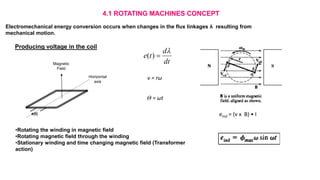
4.1 ROTATING MACHINES CONCEPT
Horizontal
axis
Magnetic
Field
e(t)
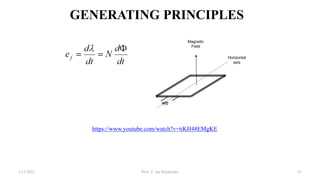
Electromechanical energy conversion occurs when changes in the flux linkages λ resulting from
mechanical motion.
dt
d
t
e


)
(
•Rotating the winding in magnetic field
•Rotating magnetic field through the winding
•Stationary winding and time changing magnetic field (Transformer
action)
Producing voltage in the coil
eind = (v x B) • I
v = rω
Θ = ωt
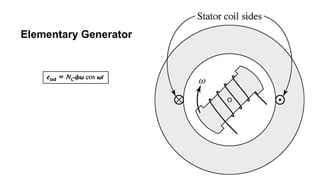
Elementary Generator
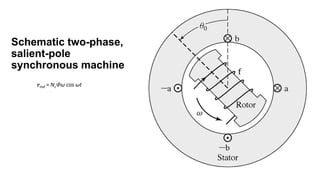
Schematic two-phase,
salient-pole
synchronous machine
eind = NcΦω cos ωt
Copyright © The McGraw-Hill Companies, Inc. Permission required for reproduction or display.
4-6
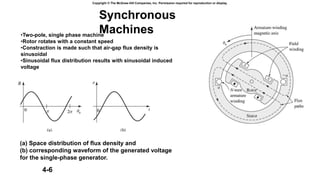
(a) Space distribution of flux density and
(b) corresponding waveform of the generated voltage
for the single-phase generator.
Synchronous
Machines
•Two-pole, single phase machine
•Rotor rotates with a constant speed
•Constraction is made such that air-gap flux density is
sinusoidal
•Sinusoidal flux distribution results with sinusoidal induced
voltage
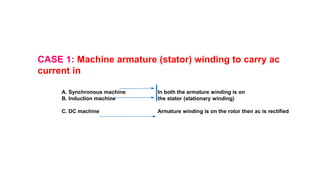
CASE 1: Machine armature (stator) winding to carry ac
current in
A. Synchronous machine In both the armature winding is on
B. Induction machine the stator (stationary winding)
C. DC machine Armature winding is on the rotor then ac is rectified
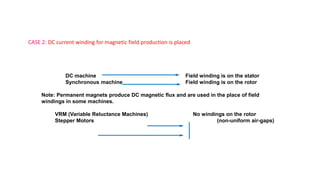
DC machine Field winding is on the stator
Synchronous machine Field winding is on the rotor
Note: Permanent magnets produce DC magnetic flux and are used in the place of field
windings in some machines.
VRM (Variable Reluctance Machines) No windings on the rotor
Stepper Motors (non-uniform air-gaps)
CASE 2: DC current winding for magnetic field production is placed
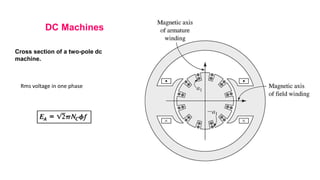
Cross section of a two-pole dc
machine.
DC Machines
Rms voltage in one phase
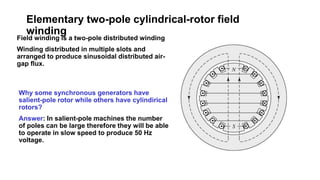
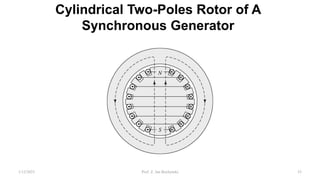
Elementary two-pole cylindrical-rotor field
winding
Field winding is a two-pole distributed winding
Winding distributed in multiple slots and
arranged to produce sinusoidal distributed air-
gap flux.
Why some synchronous generators have
salient-pole rotor while others have cylindirical
rotors?
Answer: In salient-pole machines the number
of poles can be large therefore they will be able
to operate in slow speed to produce 50 Hz
voltage.
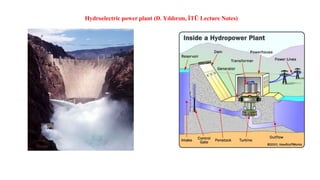
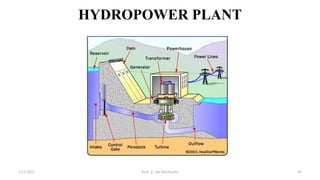
Hydroelectric power plant (D. Yıldırım, İTÜ Lecture Notes)
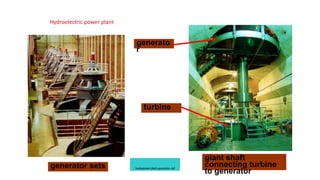
generator sets
giant shaft
connecting turbine
to generator
generato
r
turbine
hydropower-plant-generator.swf
Hydroelectric power plant
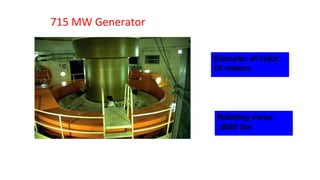
Diameter of rotor:
16 meters
Rotating mass:
2650 ton
715 MW Generator
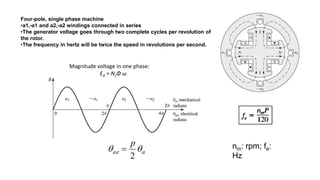
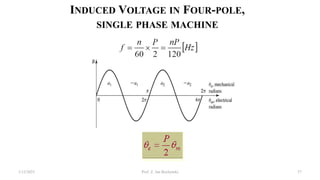
Four-pole, single phase machine
•a1,-a1 and a2,-a2 windings connected in series
•The generator voltage goes through two complete cycles per revolution of
the rotor.
•The frequency in hertz will be twice the speed in revolutions per second.
a
ae
p


2
 nm: rpm; fe:
Hz
Magnitude voltage in one phase:
EA = NcΦ ω
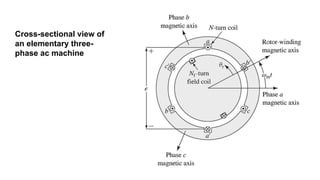
Cross-sectional view of
an elementary three-
phase ac machine
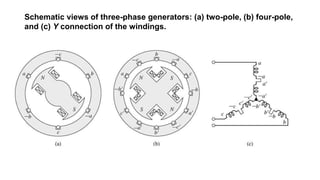
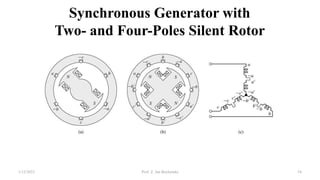
Schematic views of three-phase generators: (a) two-pole, (b) four-pole,
and (c) Y connection of the windings.
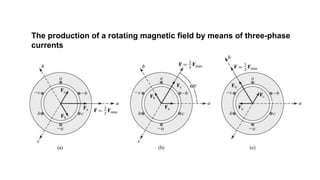
The production of a rotating magnetic field by means of three-phase
currents
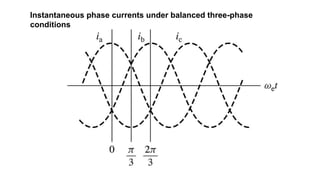
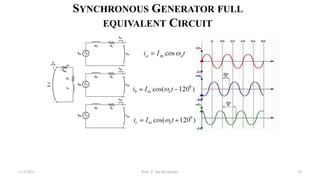
Instantaneous phase currents under balanced three-phase
conditions
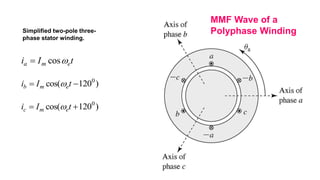
Simplified two-pole three-
phase stator winding.
MMF Wave of a
Polyphase Winding
t
I
i e
m
a 
cos

)
120
cos( 0

 t
I
i e
m
b 
)
120
cos( 0

 t
I
i e
m
c 
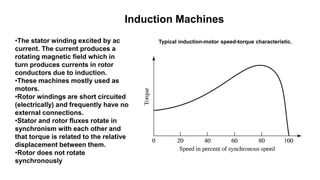
Typical induction-motor speed-torque characteristic.
Induction Machines
•The stator winding excited by ac
current. The current produces a
rotating magnetic field which in
turn produces currents in rotor
conductors due to induction.
•These machines mostly used as
motors.
•Rotor windings are short circuited
(electrically) and frequently have no
external connections.
•Stator and rotor fluxes rotate in
synchronism with each other and
that torque is related to the relative
displacement between them.
•Rotor does not rotate
synchronously
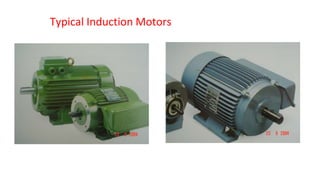
Typical Induction Motors
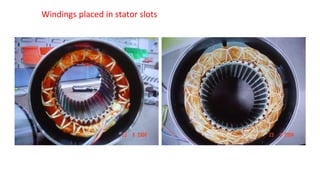
Windings placed in stator slots
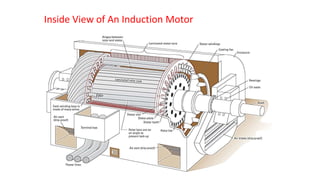
Inside View of An Induction Motor
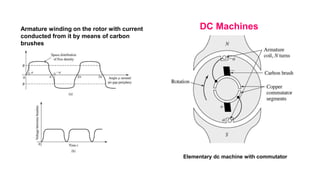
Elementary dc machine with commutator
DC Machines
Armature winding on the rotor with current
conducted from it by means of carbon
brushes
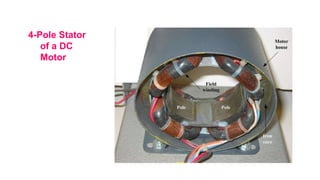
4-Pole Stator
of a DC
Motor
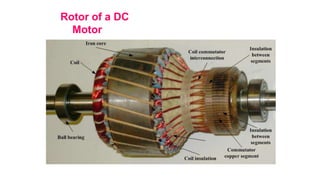
Rotor of a DC
Motor
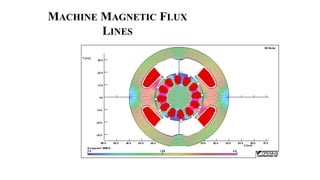
MACHINE MAGNETIC FLUX
LINES
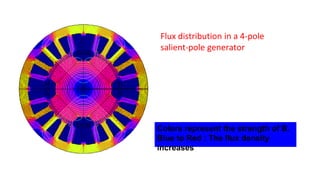
Flux distribution in a 4-pole
salient-pole generator
Colors represent the strength of B.
Blue to Red : The flux density
increases
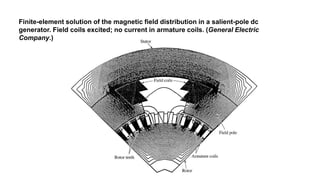
Finite-element solution of the magnetic field distribution in a salient-pole dc
generator. Field coils excited; no current in armature coils. (General Electric
Company.)
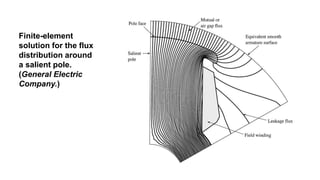
Finite-element
solution for the flux
distribution around
a salient pole.
(General Electric
Company.)
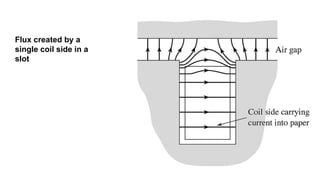
Flux created by a
single coil side in a
slot
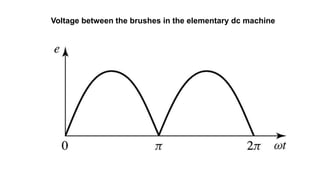
Voltage between the brushes in the elementary dc machine
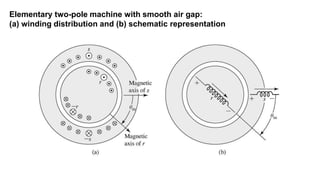
Elementary two-pole machine with smooth air gap:
(a) winding distribution and (b) schematic representation
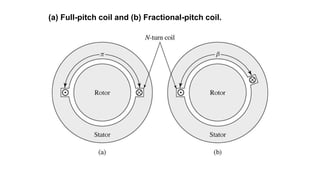
(a) Full-pitch coil and (b) Fractional-pitch coil.
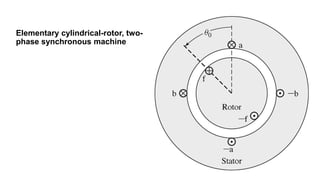
Elementary cylindrical-rotor, two-
phase synchronous machine
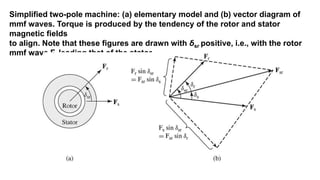
Simplified two-pole machine: (a) elementary model and (b) vector diagram of
mmf waves. Torque is produced by the tendency of the rotor and stator
magnetic fields
to align. Note that these figures are drawn with ẟsr positive, i.e., with the rotor
mmf wave Fr leading that of the stator.
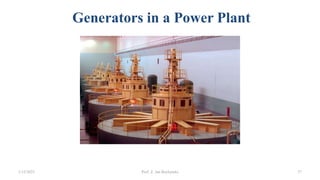
Generators in a Power Plant
1/12/2023 Prof. Z. Jan Bochynski 37
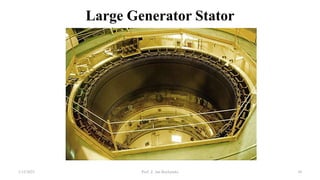
Large Generator Stator
1/12/2023 Prof. Z. Jan Bochynski 38
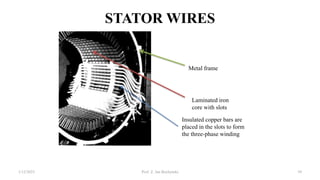
STATOR WIRES
1/12/2023 Prof. Z. Jan Bochynski 39
Insulated copper bars are
placed in the slots to form
the three-phase winding
Laminated iron
core with slots
Metal frame
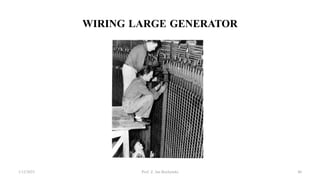
WIRING LARGE GENERATOR
1/12/2023 Prof. Z. Jan Bochynski 40
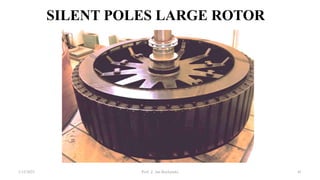
SILENT POLES LARGE ROTOR
1/12/2023 Prof. Z. Jan Bochynski 41
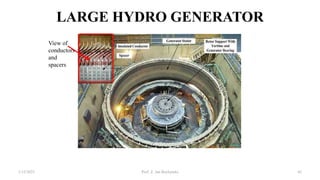
LARGE HYDRO GENERATOR
1/12/2023 Prof. Z. Jan Bochynski 42
View of
conductors
and
spacers
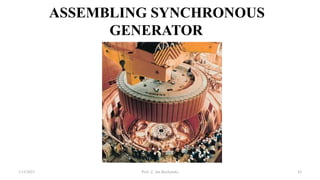
ASSEMBLING SYNCHRONOUS
GENERATOR
1/12/2023 Prof. Z. Jan Bochynski 43
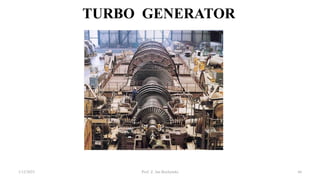
TURBO GENERATOR
1/12/2023 Prof. Z. Jan Bochynski 44
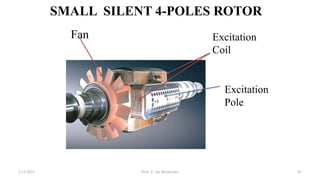
SMALL SILENT 4-POLES ROTOR
1/12/2023 Prof. Z. Jan Bochynski 45
Excitation
Coil
Excitation
Pole
Fan
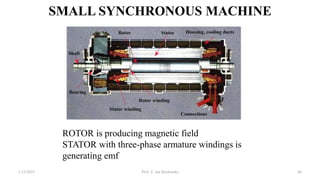
SMALL SYNCHRONOUS MACHINE
ROTOR is producing magnetic field
STATOR with three-phase armature windings is
generating emf
1/12/2023 Prof. Z. Jan Bochynski 46
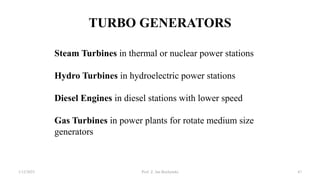
TURBO GENERATORS
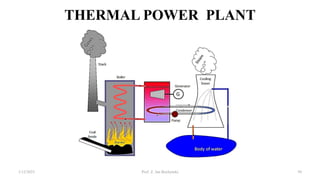
Steam Turbines in thermal or nuclear power stations
Hydro Turbines in hydroelectric power stations
Diesel Engines in diesel stations with lower speed
Gas Turbines in power plants for rotate medium size
generators
1/12/2023 Prof. Z. Jan Bochynski 47
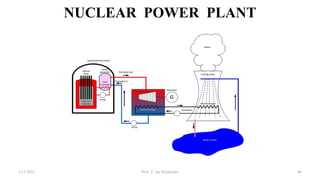
NUCLEAR POWER PLANT
1/12/2023 Prof. Z. Jan Bochynski 48
HYDROPOWER PLANT
1/12/2023 Prof. Z. Jan Bochynski 49
THERMAL POWER PLANT
1/12/2023 Prof. Z. Jan Bochynski 50
GENERATING PRINCIPLES
Horizontal
axis
Magnetic
Field
e(t)
1/12/2023 Prof. Z. Jan Bochynski 51
https://www.youtube.com/watch?v=tiKH48EMgKE
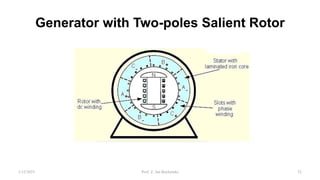
Generator with Two-poles Salient Rotor
1/12/2023 Prof. Z. Jan Bochynski 52
Cylindrical Two-Poles Rotor of A
Synchronous Generator
1/12/2023 Prof. Z. Jan Bochynski 53
Synchronous Generator with
Two- and Four-Poles Silent Rotor
1/12/2023 Prof. Z. Jan Bochynski 54
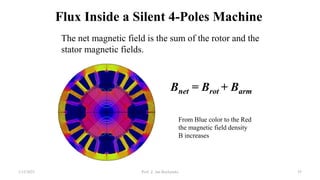
Flux Inside a Silent 4-Poles Machine
1/12/2023 Prof. Z. Jan Bochynski 55
From Blue color to the Red
the magnetic field density
B increases
Bnet = Brot + Barm
The net magnetic field is the sum of the rotor and the
stator magnetic fields.
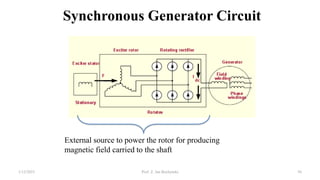
Synchronous Generator Circuit
1/12/2023 Prof. Z. Jan Bochynski 56
External source to power the rotor for producing
magnetic field carried to the shaft
INDUCED VOLTAGE IN FOUR-POLE,
SINGLE PHASE MACHINE
1/12/2023 Prof. Z. Jan Bochynski 57
SYNCHRONOUS GENERATOR FULL
EQUIVALENT CIRCUIT
1/12/2023 Prof. Z. Jan Bochynski 58
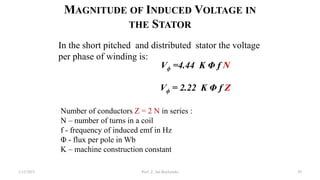
MAGNITUDE OF INDUCED VOLTAGE IN
THE STATOR
Number of conductors Z = 2 N in series :
N – number of turns in a coil
f - frequency of induced emf in Hz
Φ - flux per pole in Wb
K – machine construction constant
In the short pitched and distributed stator the voltage
per phase of winding is:
Vϕ =4.44 K Φ f N
Vϕ = 2.22 K Φ f Z
1/12/2023 Prof. Z. Jan Bochynski 59
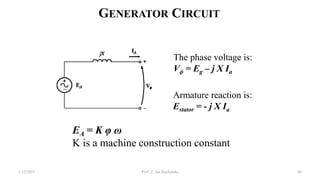
GENERATOR CIRCUIT
The phase voltage is:
Vϕ = Eg – j X Ia
Armature reaction is:
Estator = - j X Ia
EA = K φ ω
K is a machine construction constant
1/12/2023 Prof. Z. Jan Bochynski 60
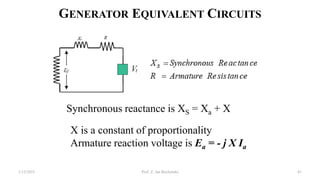
GENERATOR EQUIVALENT CIRCUITS
Synchronous reactance is XS = Xa + X
X is a constant of proportionality
Armature reaction voltage is Ea = - j X Ia
1/12/2023 Prof. Z. Jan Bochynski 61
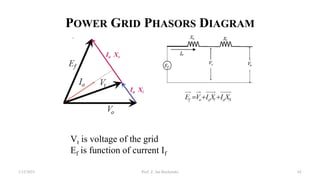
POWER GRID PHASORS DIAGRAM
Vt is voltage of the grid
Ef is function of current If
1/12/2023 Prof. Z. Jan Bochynski 62
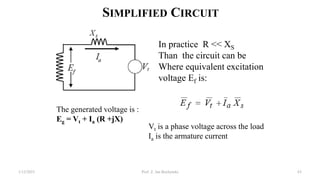
SIMPLIFIED CIRCUIT
In practice R << XS
Than the circuit can be
Where equivalent excitation
voltage Ef is:
The generated voltage is :
Eg = Vt + Ia (R +jX)
Vt is a phase voltage across the load
Ia is the armature current
1/12/2023 Prof. Z. Jan Bochynski 63
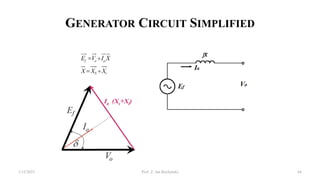
GENERATOR CIRCUIT SIMPLIFIED
1/12/2023 Prof. Z. Jan Bochynski 64
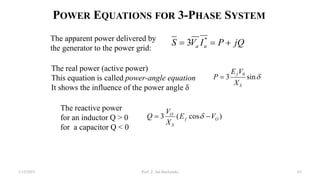
POWER EQUATIONS FOR 3-PHASE SYSTEM
jQ
P
I
V
S a
a 

 *
3
The apparent power delivered by
the generator to the power grid:

sin
3 0
S
f
X
V
E
P 
The real power (active power)
This equation is called power-angle equation
It shows the influence of the power angle δ
The reactive power
for an inductor Q > 0
for a capacitor Q < 0
)
cos
(
3 O
f
S
O
V
E
X
V
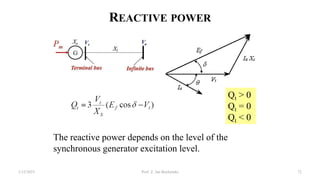
Q 
 
1/12/2023 Prof. Z. Jan Bochynski 65
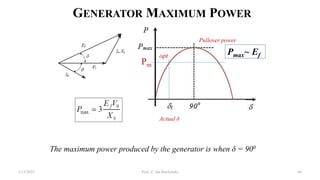
GENERATOR MAXIMUM POWER
Pm
opt
Actual δ
Pullover power
The maximum power produced by the generator is when δ = 900
Pmax~ Ef
1/12/2023 Prof. Z. Jan Bochynski 66
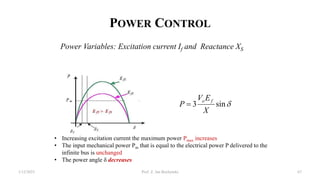
POWER CONTROL
1/12/2023 Prof. Z. Jan Bochynski 67
Power Variables: Excitation current If and Reactance XS

sin
3
X
E
V
P
f
o

• Increasing excitation current the maximum power Pmax increases
• The input mechanical power Pm that is equal to the electrical power P delivered to the
infinite bus is unchanged
• The power angle δ decreases
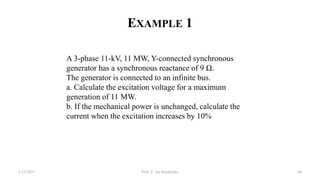
EXAMPLE 1
1/12/2023 Prof. Z. Jan Bochynski 68
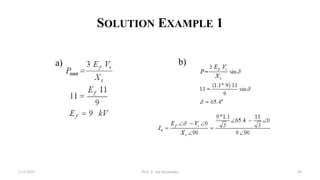
A 3-phase 11-kV, 11 MW, Y-connected synchronous
generator has a synchronous reactance of 9 Ω.
The generator is connected to an infinite bus.
a. Calculate the excitation voltage for a maximum
generation of 11 MW.
b. If the mechanical power is unchanged, calculate the
current when the excitation increases by 10%
SOLUTION EXAMPLE 1
1/12/2023 Prof. Z. Jan Bochynski 69
a) b)
1/12/2023 Prof. Z. Jan Bochynski 70
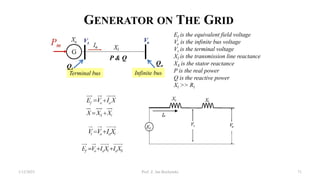
GENERATOR ON THE GRID
1/12/2023 Prof. Z. Jan Bochynski 71
Terminal bus Infinite bus
P & Q
Qt
Qo
Ef is the equivalent field voltage
Vo is the infinite bus voltage
Vt is the terminal voltage
Xl is the transmission line reactance
XS is the stator reactance
P is the real power
Q is the reactive power
Xl >> Rl
REACTIVE POWER
1/12/2023 Prof. Z. Jan Bochynski 72
The reactive power depends on the level of the
synchronous generator excitation level.
Qt > 0
Qt = 0
Qt < 0
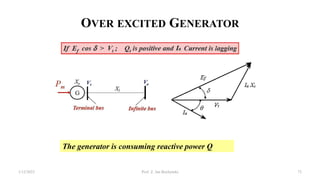
OVER EXCITED GENERATOR
The generator is consuming reactive power Q
1/12/2023 Prof. Z. Jan Bochynski 73
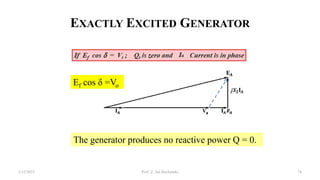
EXACTLY EXCITED GENERATOR
The generator produces no reactive power Q = 0.
Ef cos δ =Vo
1/12/2023 Prof. Z. Jan Bochynski 74
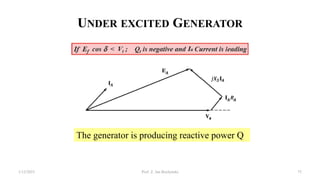
UNDER EXCITED GENERATOR
The generator is producing reactive power Q
1/12/2023 Prof. Z. Jan Bochynski 75
INCREASING TRANSMISSION LINE CAPACITY
1/12/2023 Prof. Z. Jan Bochynski 76
Usually in the transmission system current is lower
than the wires capacity. We can add to the system
more power increasing the mechanical power of the
turbine.
• This can be done by reducing inductive reactive
power (adding in series a capacitor to balance
reactive inductance)
• Connecting generators in parallel
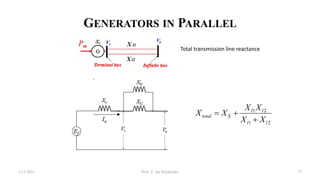
GENERATORS IN PARALLEL
1/12/2023 Prof. Z. Jan Bochynski 77
Total transmission line reactance
2
1
2
1
l
l
l
l
S
total
X
X
X
X
X
X



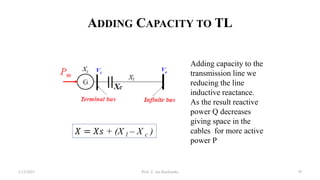
ADDING CAPACITY TO TL
1/12/2023 Prof. Z. Jan Bochynski 78
Adding capacity to the
transmission line we
reducing the line
inductive reactance.
As the result reactive
power Q decreases
giving space in the
cables for more active
power P
𝑋 = 𝑋𝑠 + (X l – X c )
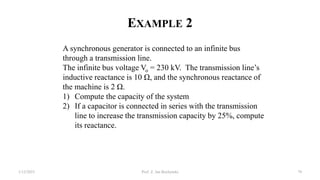
EXAMPLE 2
1/12/2023 Prof. Z. Jan Bochynski 79
A synchronous generator is connected to an infinite bus
through a transmission line.
The infinite bus voltage Vo = 230 kV. The transmission line’s
inductive reactance is 10 Ω, and the synchronous reactance of
the machine is 2 Ω.
1) Compute the capacity of the system
2) If a capacitor is connected in series with the transmission
line to increase the transmission capacity by 25%, compute
its reactance.
mF
C
X
MW
X
X
X
kV
kV
MW
X
X
X
E
V
MW
MW
x
P
capacity
New
C
C
l
s
C
l
s
f
o
1
4
.
2
5031
210
230
5031
3
5031
4025
25
.
1
:
_
max












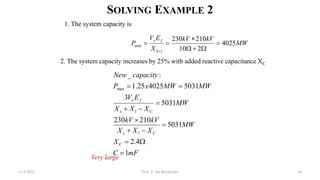
SOLVING EXAMPLE 2
1/12/2023 Prof. Z. Jan Bochynski 80
1. The system capacity is
MW
kV
kV
X
E
V
P
l
S
f
o
4025
2
10
210
230
max 







2. The system capacity increases by 25% with added reactive capacitance XC
Very large
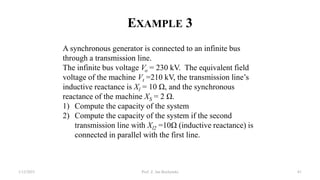
EXAMPLE 3
1/12/2023 Prof. Z. Jan Bochynski 81
A synchronous generator is connected to an infinite bus
through a transmission line.
The infinite bus voltage Vo = 230 kV. The equivalent field
voltage of the machine Vt =210 kV, the transmission line’s
inductive reactance is Xl = 10 Ω, and the synchronous
reactance of the machine XS = 2 Ω.
1) Compute the capacity of the system
2) Compute the capacity of the system if the second
transmission line with Xl2 =10Ω (inductive reactance) is
connected in parallel with the first line.
SOLVING EXAMPLE 3
1/12/2023 Prof. Z. Jan Bochynski 82
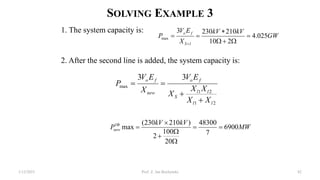
1. The system capacity is:
GW
kV
kV
X
E
V
P
l
S
f
o
025
.
4
2
10
210
230
3
max 







2. After the second line is added, the system capacity is:
2
1
2
1
max
3
3
l
l
l
l
S
f
o
new
f
o
X
X
X
X
X
E
V
X
E
V
P




MW
kV
kV
Pnew 6900
7
48300
20
100
2
)
210
230
(
max
1








SYNCHRONOUS GENERATOR
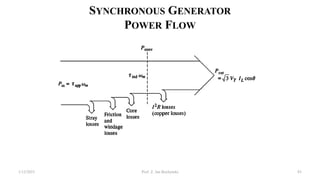
POWER FLOW
1/12/2023 Prof. Z. Jan Bochynski 83
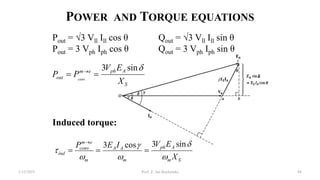
POWER AND TORQUE EQUATIONS
Pout = √3 Vll Ill cos θ
Pout = 3 Vph Iph cos θ
Qout = √3 Vll Ill sin θ
Qout = 3 Vph Iph sin θ
Induced torque:
S
m
A
ph
m
A
A
m
e
m
conv
ind
X
E
V
I
E
P






sin
3
cos
3




S
A
ph
e
m
out
X
E
V
P
P conv

sin
3

 
1/12/2023 Prof. Z. Jan Bochynski 84
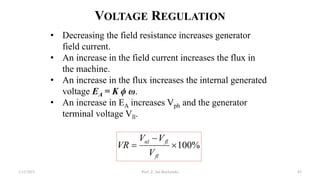
VOLTAGE REGULATION
%
100



fl
fl
nl
V
V
V
VR
• Decreasing the field resistance increases generator
field current.
• An increase in the field current increases the flux in
the machine.
• An increase in the flux increases the internal generated
voltage EA = K ϕ ω.
• An increase in EA increases Vph and the generator
terminal voltage Vll.
1/12/2023 Prof. Z. Jan Bochynski 85
EXAMPLE 4
1/12/2023 Prof. Z. Jan Bochynski 86
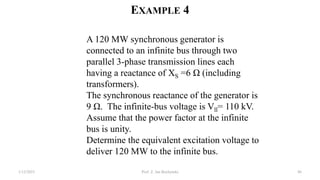
A 120 MW synchronous generator is
connected to an infinite bus through two
parallel 3-phase transmission lines each
having a reactance of XS =6 Ω (including
transformers).
The synchronous reactance of the generator is
9 Ω. The infinite-bus voltage is Vll= 110 kV.
Assume that the power factor at the infinite
bus is unity.
Determine the equivalent excitation voltage to
deliver 120 MW to the infinite bus.
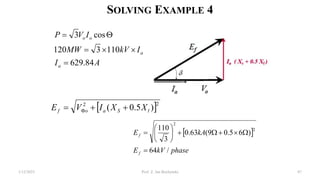
SOLVING EXAMPLE 4
1/12/2023 Prof. Z. Jan Bochynski 87
A
I
I
kV
MW
I
V
P
a
a
o
o
84
.
629
110
3
120
cos
3






 2
2
)
5
.
0
( l
S
a
o
f X
X
I
V
E 

 
 
phase
kV
E
kA
E
f
f
/
64
)
6
5
.
0
9
(
63
.
0
3
110 2
2













HOMEWORK
Due day next Tuesday class on 11-18-2013
El-Sharkawi Chapter 12
Exercises 12.17 to 12.21
1/12/2023 Prof. Z. Jan Bochynski 88
SYNCHRONOUS MOTOR
1/12/2023 Prof. Z. Jan Bochynski 89
https://www.youtube.com/watch?v=Vk2jDXxZIhs

SYNCHRONOUS GENERATOR.pptx

  • 1.
    SYNCHRONOUS GENERATORS EE 3824 ENERGYCONVERSION Class on 11-19-2013 1/12/2023 Prof. Z. Jan Bochynski 1
  • 2.
    INTRODUCTION TO ACAND DC MACHINES AC Machines Synchronous Machines and Induction Machines
  • 3.
    4.1 ROTATING MACHINESCONCEPT Horizontal axis Magnetic Field e(t) Electromechanical energy conversion occurs when changes in the flux linkages λ resulting from mechanical motion. dt d t e   ) ( •Rotating the winding in magnetic field •Rotating magnetic field through the winding •Stationary winding and time changing magnetic field (Transformer action) Producing voltage in the coil eind = (v x B) • I v = rω Θ = ωt
  • 4.
  • 5.
  • 6.
    Copyright © TheMcGraw-Hill Companies, Inc. Permission required for reproduction or display. 4-6 (a) Space distribution of flux density and (b) corresponding waveform of the generated voltage for the single-phase generator. Synchronous Machines •Two-pole, single phase machine •Rotor rotates with a constant speed •Constraction is made such that air-gap flux density is sinusoidal •Sinusoidal flux distribution results with sinusoidal induced voltage
  • 7.
    CASE 1: Machinearmature (stator) winding to carry ac current in A. Synchronous machine In both the armature winding is on B. Induction machine the stator (stationary winding) C. DC machine Armature winding is on the rotor then ac is rectified
  • 8.
    DC machine Fieldwinding is on the stator Synchronous machine Field winding is on the rotor Note: Permanent magnets produce DC magnetic flux and are used in the place of field windings in some machines. VRM (Variable Reluctance Machines) No windings on the rotor Stepper Motors (non-uniform air-gaps) CASE 2: DC current winding for magnetic field production is placed
  • 9.
    Cross section ofa two-pole dc machine. DC Machines Rms voltage in one phase
  • 10.
    Elementary two-pole cylindrical-rotorfield winding Field winding is a two-pole distributed winding Winding distributed in multiple slots and arranged to produce sinusoidal distributed air- gap flux. Why some synchronous generators have salient-pole rotor while others have cylindirical rotors? Answer: In salient-pole machines the number of poles can be large therefore they will be able to operate in slow speed to produce 50 Hz voltage.
  • 11.
    Hydroelectric power plant(D. Yıldırım, İTÜ Lecture Notes)
  • 12.
    generator sets giant shaft connectingturbine to generator generato r turbine hydropower-plant-generator.swf Hydroelectric power plant
  • 13.
    Diameter of rotor: 16meters Rotating mass: 2650 ton 715 MW Generator
  • 14.
    Four-pole, single phasemachine •a1,-a1 and a2,-a2 windings connected in series •The generator voltage goes through two complete cycles per revolution of the rotor. •The frequency in hertz will be twice the speed in revolutions per second. a ae p   2  nm: rpm; fe: Hz Magnitude voltage in one phase: EA = NcΦ ω
  • 15.
    Cross-sectional view of anelementary three- phase ac machine
  • 16.
    Schematic views ofthree-phase generators: (a) two-pole, (b) four-pole, and (c) Y connection of the windings.
  • 17.
    The production ofa rotating magnetic field by means of three-phase currents
  • 18.
    Instantaneous phase currentsunder balanced three-phase conditions
  • 19.
    Simplified two-pole three- phasestator winding. MMF Wave of a Polyphase Winding t I i e m a  cos  ) 120 cos( 0   t I i e m b  ) 120 cos( 0   t I i e m c 
  • 20.
    Typical induction-motor speed-torquecharacteristic. Induction Machines •The stator winding excited by ac current. The current produces a rotating magnetic field which in turn produces currents in rotor conductors due to induction. •These machines mostly used as motors. •Rotor windings are short circuited (electrically) and frequently have no external connections. •Stator and rotor fluxes rotate in synchronism with each other and that torque is related to the relative displacement between them. •Rotor does not rotate synchronously
  • 21.
  • 22.
    Windings placed instator slots
  • 23.
    Inside View ofAn Induction Motor
  • 24.
    Elementary dc machinewith commutator DC Machines Armature winding on the rotor with current conducted from it by means of carbon brushes
  • 25.
  • 26.
    Rotor of aDC Motor
  • 27.
  • 28.
    Flux distribution ina 4-pole salient-pole generator Colors represent the strength of B. Blue to Red : The flux density increases
  • 29.
    Finite-element solution ofthe magnetic field distribution in a salient-pole dc generator. Field coils excited; no current in armature coils. (General Electric Company.)
  • 30.
    Finite-element solution for theflux distribution around a salient pole. (General Electric Company.)
  • 31.
    Flux created bya single coil side in a slot
  • 32.
    Voltage between thebrushes in the elementary dc machine
  • 33.
    Elementary two-pole machinewith smooth air gap: (a) winding distribution and (b) schematic representation
  • 34.
    (a) Full-pitch coiland (b) Fractional-pitch coil.
  • 35.
  • 36.
    Simplified two-pole machine:(a) elementary model and (b) vector diagram of mmf waves. Torque is produced by the tendency of the rotor and stator magnetic fields to align. Note that these figures are drawn with ẟsr positive, i.e., with the rotor mmf wave Fr leading that of the stator.
  • 37.
    Generators in aPower Plant 1/12/2023 Prof. Z. Jan Bochynski 37
  • 38.
    Large Generator Stator 1/12/2023Prof. Z. Jan Bochynski 38
  • 39.
    STATOR WIRES 1/12/2023 Prof.Z. Jan Bochynski 39 Insulated copper bars are placed in the slots to form the three-phase winding Laminated iron core with slots Metal frame
  • 40.
    WIRING LARGE GENERATOR 1/12/2023Prof. Z. Jan Bochynski 40
  • 41.
    SILENT POLES LARGEROTOR 1/12/2023 Prof. Z. Jan Bochynski 41
  • 42.
    LARGE HYDRO GENERATOR 1/12/2023Prof. Z. Jan Bochynski 42 View of conductors and spacers
  • 43.
  • 44.
  • 45.
    SMALL SILENT 4-POLESROTOR 1/12/2023 Prof. Z. Jan Bochynski 45 Excitation Coil Excitation Pole Fan
  • 46.
    SMALL SYNCHRONOUS MACHINE ROTORis producing magnetic field STATOR with three-phase armature windings is generating emf 1/12/2023 Prof. Z. Jan Bochynski 46
  • 47.
    TURBO GENERATORS Steam Turbinesin thermal or nuclear power stations Hydro Turbines in hydroelectric power stations Diesel Engines in diesel stations with lower speed Gas Turbines in power plants for rotate medium size generators 1/12/2023 Prof. Z. Jan Bochynski 47
  • 48.
    NUCLEAR POWER PLANT 1/12/2023Prof. Z. Jan Bochynski 48
  • 49.
  • 50.
    THERMAL POWER PLANT 1/12/2023Prof. Z. Jan Bochynski 50
  • 51.
    GENERATING PRINCIPLES Horizontal axis Magnetic Field e(t) 1/12/2023 Prof.Z. Jan Bochynski 51 https://www.youtube.com/watch?v=tiKH48EMgKE
  • 52.
    Generator with Two-polesSalient Rotor 1/12/2023 Prof. Z. Jan Bochynski 52
  • 53.
    Cylindrical Two-Poles Rotorof A Synchronous Generator 1/12/2023 Prof. Z. Jan Bochynski 53
  • 54.
    Synchronous Generator with Two-and Four-Poles Silent Rotor 1/12/2023 Prof. Z. Jan Bochynski 54
  • 55.
    Flux Inside aSilent 4-Poles Machine 1/12/2023 Prof. Z. Jan Bochynski 55 From Blue color to the Red the magnetic field density B increases Bnet = Brot + Barm The net magnetic field is the sum of the rotor and the stator magnetic fields.
  • 56.
    Synchronous Generator Circuit 1/12/2023Prof. Z. Jan Bochynski 56 External source to power the rotor for producing magnetic field carried to the shaft
  • 57.
    INDUCED VOLTAGE INFOUR-POLE, SINGLE PHASE MACHINE 1/12/2023 Prof. Z. Jan Bochynski 57
  • 58.
    SYNCHRONOUS GENERATOR FULL EQUIVALENTCIRCUIT 1/12/2023 Prof. Z. Jan Bochynski 58
  • 59.
    MAGNITUDE OF INDUCEDVOLTAGE IN THE STATOR Number of conductors Z = 2 N in series : N – number of turns in a coil f - frequency of induced emf in Hz Φ - flux per pole in Wb K – machine construction constant In the short pitched and distributed stator the voltage per phase of winding is: Vϕ =4.44 K Φ f N Vϕ = 2.22 K Φ f Z 1/12/2023 Prof. Z. Jan Bochynski 59
  • 60.
    GENERATOR CIRCUIT The phasevoltage is: Vϕ = Eg – j X Ia Armature reaction is: Estator = - j X Ia EA = K φ ω K is a machine construction constant 1/12/2023 Prof. Z. Jan Bochynski 60
  • 61.
    GENERATOR EQUIVALENT CIRCUITS Synchronousreactance is XS = Xa + X X is a constant of proportionality Armature reaction voltage is Ea = - j X Ia 1/12/2023 Prof. Z. Jan Bochynski 61
  • 62.
    POWER GRID PHASORSDIAGRAM Vt is voltage of the grid Ef is function of current If 1/12/2023 Prof. Z. Jan Bochynski 62
  • 63.
    SIMPLIFIED CIRCUIT In practiceR << XS Than the circuit can be Where equivalent excitation voltage Ef is: The generated voltage is : Eg = Vt + Ia (R +jX) Vt is a phase voltage across the load Ia is the armature current 1/12/2023 Prof. Z. Jan Bochynski 63
  • 64.
    GENERATOR CIRCUIT SIMPLIFIED 1/12/2023Prof. Z. Jan Bochynski 64
  • 65.
    POWER EQUATIONS FOR3-PHASE SYSTEM jQ P I V S a a    * 3 The apparent power delivered by the generator to the power grid:  sin 3 0 S f X V E P  The real power (active power) This equation is called power-angle equation It shows the influence of the power angle δ The reactive power for an inductor Q > 0 for a capacitor Q < 0 ) cos ( 3 O f S O V E X V Q    1/12/2023 Prof. Z. Jan Bochynski 65
  • 66.
    GENERATOR MAXIMUM POWER Pm opt Actualδ Pullover power The maximum power produced by the generator is when δ = 900 Pmax~ Ef 1/12/2023 Prof. Z. Jan Bochynski 66
  • 67.
    POWER CONTROL 1/12/2023 Prof.Z. Jan Bochynski 67 Power Variables: Excitation current If and Reactance XS  sin 3 X E V P f o  • Increasing excitation current the maximum power Pmax increases • The input mechanical power Pm that is equal to the electrical power P delivered to the infinite bus is unchanged • The power angle δ decreases
  • 68.
    EXAMPLE 1 1/12/2023 Prof.Z. Jan Bochynski 68 A 3-phase 11-kV, 11 MW, Y-connected synchronous generator has a synchronous reactance of 9 Ω. The generator is connected to an infinite bus. a. Calculate the excitation voltage for a maximum generation of 11 MW. b. If the mechanical power is unchanged, calculate the current when the excitation increases by 10%
  • 69.
    SOLUTION EXAMPLE 1 1/12/2023Prof. Z. Jan Bochynski 69 a) b)
  • 70.
    1/12/2023 Prof. Z.Jan Bochynski 70
  • 71.
    GENERATOR ON THEGRID 1/12/2023 Prof. Z. Jan Bochynski 71 Terminal bus Infinite bus P & Q Qt Qo Ef is the equivalent field voltage Vo is the infinite bus voltage Vt is the terminal voltage Xl is the transmission line reactance XS is the stator reactance P is the real power Q is the reactive power Xl >> Rl
  • 72.
    REACTIVE POWER 1/12/2023 Prof.Z. Jan Bochynski 72 The reactive power depends on the level of the synchronous generator excitation level. Qt > 0 Qt = 0 Qt < 0
  • 73.
    OVER EXCITED GENERATOR Thegenerator is consuming reactive power Q 1/12/2023 Prof. Z. Jan Bochynski 73
  • 74.
    EXACTLY EXCITED GENERATOR Thegenerator produces no reactive power Q = 0. Ef cos δ =Vo 1/12/2023 Prof. Z. Jan Bochynski 74
  • 75.
    UNDER EXCITED GENERATOR Thegenerator is producing reactive power Q 1/12/2023 Prof. Z. Jan Bochynski 75
  • 76.
    INCREASING TRANSMISSION LINECAPACITY 1/12/2023 Prof. Z. Jan Bochynski 76 Usually in the transmission system current is lower than the wires capacity. We can add to the system more power increasing the mechanical power of the turbine. • This can be done by reducing inductive reactive power (adding in series a capacitor to balance reactive inductance) • Connecting generators in parallel
  • 77.
    GENERATORS IN PARALLEL 1/12/2023Prof. Z. Jan Bochynski 77 Total transmission line reactance 2 1 2 1 l l l l S total X X X X X X   
  • 78.
    ADDING CAPACITY TOTL 1/12/2023 Prof. Z. Jan Bochynski 78 Adding capacity to the transmission line we reducing the line inductive reactance. As the result reactive power Q decreases giving space in the cables for more active power P 𝑋 = 𝑋𝑠 + (X l – X c )
  • 79.
    EXAMPLE 2 1/12/2023 Prof.Z. Jan Bochynski 79 A synchronous generator is connected to an infinite bus through a transmission line. The infinite bus voltage Vo = 230 kV. The transmission line’s inductive reactance is 10 Ω, and the synchronous reactance of the machine is 2 Ω. 1) Compute the capacity of the system 2) If a capacitor is connected in series with the transmission line to increase the transmission capacity by 25%, compute its reactance.
  • 80.
    mF C X MW X X X kV kV MW X X X E V MW MW x P capacity New C C l s C l s f o 1 4 . 2 5031 210 230 5031 3 5031 4025 25 . 1 : _ max             SOLVING EXAMPLE 2 1/12/2023Prof. Z. Jan Bochynski 80 1. The system capacity is MW kV kV X E V P l S f o 4025 2 10 210 230 max         2. The system capacity increases by 25% with added reactive capacitance XC Very large
  • 81.
    EXAMPLE 3 1/12/2023 Prof.Z. Jan Bochynski 81 A synchronous generator is connected to an infinite bus through a transmission line. The infinite bus voltage Vo = 230 kV. The equivalent field voltage of the machine Vt =210 kV, the transmission line’s inductive reactance is Xl = 10 Ω, and the synchronous reactance of the machine XS = 2 Ω. 1) Compute the capacity of the system 2) Compute the capacity of the system if the second transmission line with Xl2 =10Ω (inductive reactance) is connected in parallel with the first line.
  • 82.
    SOLVING EXAMPLE 3 1/12/2023Prof. Z. Jan Bochynski 82 1. The system capacity is: GW kV kV X E V P l S f o 025 . 4 2 10 210 230 3 max         2. After the second line is added, the system capacity is: 2 1 2 1 max 3 3 l l l l S f o new f o X X X X X E V X E V P     MW kV kV Pnew 6900 7 48300 20 100 2 ) 210 230 ( max 1        
  • 83.
  • 84.
    POWER AND TORQUEEQUATIONS Pout = √3 Vll Ill cos θ Pout = 3 Vph Iph cos θ Qout = √3 Vll Ill sin θ Qout = 3 Vph Iph sin θ Induced torque: S m A ph m A A m e m conv ind X E V I E P       sin 3 cos 3     S A ph e m out X E V P P conv  sin 3    1/12/2023 Prof. Z. Jan Bochynski 84
  • 85.
    VOLTAGE REGULATION % 100    fl fl nl V V V VR • Decreasingthe field resistance increases generator field current. • An increase in the field current increases the flux in the machine. • An increase in the flux increases the internal generated voltage EA = K ϕ ω. • An increase in EA increases Vph and the generator terminal voltage Vll. 1/12/2023 Prof. Z. Jan Bochynski 85
  • 86.
    EXAMPLE 4 1/12/2023 Prof.Z. Jan Bochynski 86 A 120 MW synchronous generator is connected to an infinite bus through two parallel 3-phase transmission lines each having a reactance of XS =6 Ω (including transformers). The synchronous reactance of the generator is 9 Ω. The infinite-bus voltage is Vll= 110 kV. Assume that the power factor at the infinite bus is unity. Determine the equivalent excitation voltage to deliver 120 MW to the infinite bus.
  • 87.
    SOLVING EXAMPLE 4 1/12/2023Prof. Z. Jan Bochynski 87 A I I kV MW I V P a a o o 84 . 629 110 3 120 cos 3        2 2 ) 5 . 0 ( l S a o f X X I V E       phase kV E kA E f f / 64 ) 6 5 . 0 9 ( 63 . 0 3 110 2 2             
  • 88.
    HOMEWORK Due day nextTuesday class on 11-18-2013 El-Sharkawi Chapter 12 Exercises 12.17 to 12.21 1/12/2023 Prof. Z. Jan Bochynski 88
  • 89.
    SYNCHRONOUS MOTOR 1/12/2023 Prof.Z. Jan Bochynski 89 https://www.youtube.com/watch?v=Vk2jDXxZIhs