
Annual Report & Accounts 2013
Contents
Key events 2013	 1
Transcom in brief	 2
Comments from the CEO	 4
Markets and trends	 8
Business model and value creation	 10
Client cases	 18
Regional overview	 20
People and sustainability	 22
Corporate governance	 27
Risk management	 32
Executive management	 34
Board of Directors	 36
The Transcom share and shareholders 	 38
Directors’ report	 39
Five-year summary	 42
Financial statements and notes	 43
Audit report	 73
Financial calendar	 74
HUMAN RIGHTS
Principle 1–2:
pages 1, 6, 7, 22–26, 33
LABOR
Principle 3–6:
pages 1, 6, 7, 22–26, 32,
46, 52
ENVIRONMENT
Principle 7–9:
pages 1, 6 22–26
ANTI-CORRUPTION
Principle 10:
pages 1, 6 22–26, 31, 33
This integrated annual and CSR report serves as
Transcom’s Communication On Progress to the UN
Global Compact and is for the first time prepared in
accordance with the International Integrated Report-
ing Council’s Framework Principles.
UN Global Compact principles are ­primarily
­addressed on the following pages, but also in other
parts throughout the Annual Report. ­Several other
issues of importance, such as ­supply chain manage-
ment, are also described in our Code of Business
Conduct, Supplier Code of Business Conduct and on
our website, www.transcom.com.
Comments from the CEO
During 2013, we solidified the turnaround
of the company. Our key operational
­performance indicators continued to
improve, with a positive impact on profit-
ability. See page 4.
Markets and trends
The market for customer care outsourcing
continues to grow at a healthy rate. At the
same time, client requirements are chang-
ing rapidly, emphasizing customer experi-
ence. See page 8.
Business model and value creation
Transcom’s customer experience frame-
work is founded on solid business intelli-
gence. The insight we gain through analyt-
ics enables innovation and also drives
efficiency and cost savings through process
optimization. See page 10.
People and sustainability
Transcom’s CSR focus areas are people
development, equality & diversity, and
­community engagement. See page 22.
Business
­intelligence
and
analytics
PROCESS
IMPROVEMENT
INNOVATION
How we
deliver
customer
experience
SETTLEMENT AGREEMENT SIGNED
CONCERNING FORMER FRENCH SUBSIDIARY
Transcom signed a €5.3 million settlement agreement in August
2013, releasing it from any further liabilities with respect to the
liquidation of its former loss-making French subsidiary. The
€5.3 million cost should be viewed in the context of the significant
negative cash flows generated by the former French subsidiary
during the last few years, amounting to €12.5 million in 2012
alone. While Transcom no longer has any operations in France,
we ­continue to offer French-language services to our clients from
our near shore centers in Europe and North Africa.
SETTLEMENT AGREEMENT RESOLVING TAX DISPUTE IN ITALY
During the year, Transcom agreed with Italian tax authorities to
resolve a tax dispute concerning the fiscal years 2003–2009.
The agreed amount was lower than the gross provision booked
against the initial tax claims, resulting in a positive effect on net
income in 2013 amounting to €3.8 million.
DIVESTMENT OF GERMAN CREDIT
MANAGEMENT SERVICES OPERATIONS
On December 30, 2013, Transcom announced the successful
closing of the divestment of its German Credit Management
­Services operations (CMS Germany) to Tesch Group, a portfolio
company of Avedon Capital Partners, for €9.0 million on a cash
and debt free basis. CMS Germany had a turnover of €9.0 million
in 2012.
ESTABLISHMENT OF OPERATIONS IN COLOMBIA
Transcom has opened a contact center in Cali, Colombia, sup­
porting the company’s strategy to expand in fast-growing Latin
­American markets. The new site in Colombia will also strengthen
Transcom’s capability to offer near-shore English and Spanish-­
language services to North American clients, as well as offshore
Spanish-­language services to clients in Spain.
ORGANIZATIONAL CHANGES IN
THE NORTH AMERICA & ASIA PACIFIC REGION
In order to increase focus and accountability in strategic markets,
driving profitable growth in North America and the Asia Pacific
region, Transcom announced a realignment of the management
structure in this region in December 2013. Transcom’s President
& CEO, Johan Eriksson, has also assumed responsibility for the
North America & Asia Pacific region. Neil Rae, formerly General
Manager for the North America & Asia Pacific region, has taken
responsibility for our operations in North America. Siva Subrama-
niam, formerly Country Manager for the Philippines and Head of
Sales for Asia Pacific, has taken over responsibility for our activities
in Asia Pacific.
TRANSCOM CARES LAUNCHED AS OVERARCHING CORPO-
RATE SOCIAL RESPONSIBILITY GOVERNANCE PROGRAM
In November 2013, Transcom announced that the company has
established “Transcom Cares” as the overarching governance
­program for its Corporate Social Responsibility (CSR) activities.
Three prioritized focus areas make up the core of the program:
people development, equality & diversity, and community engage-
ment. In addition to these focus areas, Transcom fully supports
the ten principles of the UN Global Compact with respect to
human rights, labor rights, environmental care and anti-corruption
work. Therefore, as part of our on-going pledge to deliver an out-
standing customer experience in a global sustainable society,
Transcom is a continued signatory of the UN Global Compact.
Key financial highlights
Gross profit and EBIT
€ million
0
200
400
600
800
09 10 11 12 13
-30
0
30
60
90
120
150
09 10 11 12 13
EBIT (adjuste
EBIT (reporte
Key events 2013
■ ■ Gross profit 
EBIT
EBIT (adjusted, excluding
non-recurring items)
Revenues
€ million
• 9.3% revenue growth in core CRM
business, net of currency effects
• Adjusted EBIT increased by
€8.7 million to €17.6 million
560,2
123,4
554,1 95,8
589,1
111,9
605,6
111,8
653,2
131,1
Transcom Annual Report and Accounts 2013 1
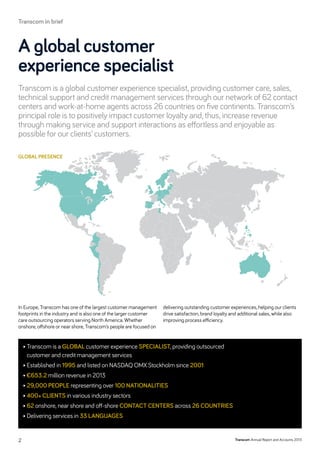
Transcom is a global customer experience specialist, providing customer care, sales,
technical support and credit management services through our network of 62 contact
centers and work-at-home agents across 26 countries on five continents. Transcom’s
principal role is to positively impact customer loyalty and, thus, increase revenue
through making service and support interactions as effortless and enjoyable as
­possible for our clients’ customers.
A global customer
experience ­specialist
global presence
• Transcom is a global customer experience specialist, providing outsourced
customer and credit management services
• Established in 1995 and listed on NASDAQ OMX Stockholm since 2001
• €653.2 million revenue in 2013
• 29,000 people representing over 100 nationalities
• 400+ clients in various industry sectors
• 62 onshore, near shore and off-shore contact centers across 26 countries
• Delivering services in 33 languages
In Europe, Transcom has one of the largest customer management
footprints in the industry and is also one of the larger customer
care outsourcing operators serving North America. Whether
onshore, ­offshore or near shore, Transcom’s people are focused on
delivering outstanding customer experiences, helping our clients
drive satisfaction, brand loyalty and additional sales, while also
improving process efficiency.
Transcom Annual Report and Accounts 20132
Transcom in brief
Vision
Recognized as a global leader in
­customer experience.­
Mission
Transcom enables companies
to ­enhance their business per­
formance by improving the
­experience of their ­customers.
We accomplish this through:
•	 Talented, experienced and
committed people, who deliver
outstanding customer experi-
ence across a multitude of
channels
•	 Innovative technology for
­capturing, processing and
­analyzing customer intelligence
•	 Continuously improved pro-
cesses, working methods and
systems, for serving customers
and advising clients
•	 Deep understanding of
­customer trends, needs and
behavior
Services and solutions
Transcom’s service portfolio is designed
to enable the creation of outstanding
customer experiences, while also
reducing cost and helping to drive
growth for our clients. Our suite of
services includes ­customer care,
sales, technical support and credit
management services, delivered
through our extensive network of contact
centers and work-at-home agents.
Our customer experience specialists
engage with our clients’ customers in
multiple channels, including phone,
e-mail, chat and in social media
communities. Please read more about
Transcom’s service portfolio on page 12.
Revenues by region Revenues by industry Number of employees
by region
North
Europe,
30%
North Europe, 18%Communications,
61%
Central  South
Europe, 22%
Central  South
Europe, 21%
Iberia 
Latam, 20%
Iberia 
Latam, 21%
Financial
­services, 15%
Retail, 7%
Public
sector, 6%
Services, 4%
Healthcare, 3%
Other, 4%
North America
 Asia
Pacific, 19%
North America
 Asia
Pacific, 37%
CMS, 9% CMS, 3%
Transcom Annual Report and Accounts 2013 3
Transcom in brief
IMPROVED OPERATIONAL AND FINANCIAL STABILITY
During 2013, we continued to focus on enhancing Transcom’s per-
formance. I am happy with the results we achieved in terms of
improving the company’s operational and financial stability, creat-
ing a solid foundation for future profitable growth. Transcom’s
adjusted EBIT in 2013 was €17.6 million, an increase by €8.7 million
compared to 2012 (€8.9 million). We achieved this primarily
through improved efficiency, higher business volumes and the
implementation of cost savings measures. We continued to
improve on key operational metrics. Our seat utilization ratio
increased by one percentage point to 86%, and the proportion of
revenue that we generate offshore, at higher margins, increased by
two percentage points to 22%. Our efficiency measures also
strengthened, while staff attrition was stable compared to 2012.
During the year, we resolved a number of short-term challenges,
which I described in last year’s annual report. For example, we
signed a settlement agreement concerning our former French sub-
sidiary, stopping the considerable losses generated there over the
past several years. While Transcom no longer has any operations in
France, we will continue to offer French-language services to our cli-
ents from our near shore centers in Europe and North Africa. We
also reached a satisfactory agreement with Italian tax authorities
during the year, resolving a tax dispute in that country. These issues
had weighed on our results, created uncertainty, and have also con-
sumed significant attention from management. Therefore, I am
very pleased that we were able to finalize these agreements in 2013.
The fact that we are now generating a stronger cash flow is
important and very positive. During the last quarter of 2013, our net
debt decreased by €13.5 million. Our financial flexibility has also
improved following the successful renegotiation of our existing
Revolving Credit Facility, which was due to expire in October 2014.
Transcom’s turnaround solidified
During 2013, we solidified the turnaround of the company. Our key operational perfor-
mance indicators continued to improve, with a positive impact on profitability. At the
same time, we continued to grow our revenue at a healthy rate. In 2014, we will focus
on three priorities in order to further enhance our performance: improving efficiency
and creating profitable growth in North America, strengthening operational perfor-
mance and financial predictability in the North Europe region, and driving efficiency
and growth in Latin America. In 2013, we launched Transcom Cares as our global CSR
governance program in order to ensure that we meet the expectations of all our key
stakeholders. Three focus areas make up the foundation of the program: people devel-
opment, equality  diversity, and community engagement.
Improvements on four KPIs vs. previous year
Key performance driver Trend vs.
2012
2013 vs.
2012
Average Seat Utilization ratio 87% vs. 85%
Share of revenue generated
offshore 22% vs. 20%
Average Efficiency ratio
(­billable over worked hours)
positive
­development
Monthly staff attrition stable
0
100
200
300
400
500
600
700
800
2013201220112010200920082007
0
1
2
3
4
5
6
■ Revenue, (€m)  Operating margin*, %
* Excluding non-recurring items.
We soldified the turnaround of Transcom in 2013
599.2
6.0
631.8
4.4
560.2
4.3
589.1
2.2
554.1
0.7
605.6
1.5
653.2
2.7
Transcom Annual Report and Accounts 20134
Comments from the CEO
“We continued to focus on
enhancing Transcom’s per-
formance in 2013. I am
happy with the results we
achieved in terms of
improving operational and
financial stability, creating a
solid foundation for future
profitable growth.”
ALL REGIONS CONTRIBUTED
TO HEALTHY TOP-LINE GROWTH
We continued to grow our top line at a healthy rate in 2013. Organic
growth in our core CRM business, net of currency effects, was
9.3%. All our regions contributed positively, mainly through
expanding relationships with existing clients. In several cases, the
excellent work from our delivery teams has allowed us to grow with
current clients in new geographies. I expect that this development
will continue in 2014. Our long-term goal is to grow revenue at
least in line with the overall industry growth in the markets where
we choose to compete.
IMPORTANT PRIORITIES IN 2014
Efficiency and profitable growth in
the North ­America  Asia Pacific region
While we made good progress in 2013, there are a number of
important issues we need to address in order to further improve
profitability and complete the turnaround of the company. One of
the most important priorities for 2014 is to improve results in North
America, both through new business development and increased
efficiency. In response to the decreased seat utilization we have
experienced in North America, partly due to the shift of volumes to
offshore locations, we have closed six contact centers since 2012.
Our primary objective is to improve profitability while creating
opportunities for future profitable growth in North America. We are
focusing on developing new business to be delivered from onshore
sites, complementing our offshore business.
Since 2012, we have successfully more than doubled the busi-
ness volumes we handle in our contact centers in the Philippines.
In addition to expanding our offshore business, primarily serving
clients in North America and the UK, we have also won several new
clients in the Asia Pacific region, e.g. in Australia and the Philip-
pines. In the years ahead, we expect demand from companies in
the Asia Pacific region to continue to grow at a rapid pace. We will
focus on positioning Transcom to make the most of these attrac-
tive market opportunities.
Delivering on these plans, and improving results in the North
America  Asia Pacific region, is of the highest priority for us.
Therefore, in order to increase focus and accountability, we
realigned the management structure and expanded the manage-
ment team in the region, effective January 1, 2014. In addition to
my role as President  CEO, I have assumed responsibility for the
North America  Asia Pacific region on an interim basis. Neil Rae is
responsible for our operations in North America, and Siva Subra-
maniam leads our activities in Asia Pacific. Neil and Siva both
report to me in my capacity as General Manager for the North
America  Asia Pacific region.
Improve operational performance and financial
predictability in the North Europe region
The pricing model currently used in the North Europe region
implies a relatively greater exposure to the accuracy of volume
forecasts, compared to other regions. Our staffing levels are deter-
mined based on detailed volume forecasts, and an inaccurate pro-
jection often leads to a situation where we are either overstaffed or
understaffed. This affects profitability as well as service quality for
the client. We did experience this situation at times during 2013,
impacting our performance and financial predictability negatively.
Our target is to achieve an appropriate mix of pricing models used
in all regions, in order to avoid excessive financial risk associated
with poor forecast accuracy. Consequently, we have begun imple-
menting a new agreement with one of our largest clients in the
Transcom Annual Report and Accounts 2013 5
Comments from the CEO
region. This implementation will continue during 2014 with the
objective of improving efficiency and financial predictability, while
also delivering a better service quality to our client.
Efficiency and growth in Latin America
During the year, volumes delivered in Chile fell, necessitating the clo-
sure of one of our sites in the country towards the end of the year. At
the same time, we ramped up business with clients in Peru and
Colombia, also opening a new site in Cali, Colombia. These signifi-
cant volume adjustments have weighed on margins, and the stabili-
zation of our operations in Latin America will be a key activity in 2014.
The establishment of operations in Colombia will support our
goal to expand in fast-growing Latin American markets. Colombia
continues to evolve quickly as an attractive location for the delivery
of customer care outsourcing services, providing a competitive
cost structure, a growing labor pool, government support and an
expanding economy. Our new site will also strengthen Transcom’s
capability to offer near shore English and Spanish-language ser-
vices to North American clients, as well as offshore Spanish-lan-
guage services to clients in Spain.
FOCUS ON DELIVERING OUTSTANDING
CUSTOMER EXPERIENCE
Transcom enables companies to enhance their business perfor-
mance by improving the experience of their customers. Our vision
is to be recognized as a global leader in customer experience.
In order to succeed, we need to create an environment that brings
together innovative solutions, processes and technology with
­people. I am very pleased with the many projects we implemented
during 2013 in order to improve business processes and create
a better customer experience. I invite you to read more about our
approach on pages 10–19. You will also find a couple of cases there
that exemplify how we work together with our clients to enhance
customer loyalty and improve process efficiency.
TRANSCOM CARES, OUR GLOBAL
CSR GOVERNANCE PROGRAM
In order to be successful and create value, we need to meet the
expectations of all our key stakeholders: our clients, employees
and investors, as well as the communities that we are a part of. This
is the basis for our Corporate Social Responsibility (CSR) work,
which forms an integral part of our day-to-day business activities.
At Transcom, CSR means that we always do our utmost to do the
right thing by our clients, our people and our communities. This
ambition is encapsulated in Transcom Cares, the overarching gov-
ernance program for our CSR activities. While this program initially
covered our community engagement activities, we broadened the
program’s scope in 2013 in order to provide strengthened gover-
nance and coordination for all Transcom’s CSR focus areas. During
2013, we also expanded our stakeholder dialogues, validating the
materiality analysis we performed in 2012 in order to identify and
prioritize sustainability issues as well as risks and opportunities.
Three prioritized focus areas make up the core of the Transcom
Cares program: people development, equality  diversity, and
community engagement.
People development
Every year, we hire thousands of new people on whom our busi-
ness results depend. So it is not an exaggeration to say that people
truly make all the difference in our business. It is important for us to
be recognized as a responsible employer, attracting people and
strengthening our brand in all our local markets. We aim to create
honest, flexible, safe and comfortable working environments where
our people can develop their careers and enjoy their working lives.
Equality and diversity
The global presence and demands from the more than 400 inter-
national brands that we serve has made us a forerunner in equality
and diversity. We are focused on attracting top talent and retaining
Important priorities in 2014
	Increase onshore seat utilization
in North America
	Successfully implement action plan
to improve operational ­performance
in the North region
	Improve operational performance
in Latin America
Transcom Annual Report and Accounts 20136
Comments from the CEO
people to build a truly global company that is prepared to meet and
deliver towards diverse business cultures in all corners of the world.
We strive for gender equality on all levels, and are dedicated to
showing that equal opportunity employment is part of our DNA.
Community engagement
We believe that a committed involvement in the communities in
which we operate not only strengthens our employer brand, but
also maintains our license to operate in the markets where we
choose to compete. Many of our community engagement activities
depend on our employees’ passion to contribute their time and
energy, making us all proud to work at Transcom.
UN Global Compact
In addition to the three CSR focus areas described above, Trans-
com fully supports the ten principles of the UN Global ­Compact
with respect to human rights, labor rights, environmental care and
anti-corruption work. These principles are an integral part of our
corporate strategy, business culture and day-to-day operations.
Therefore, as part of our on-going pledge to deliver an outstanding
customer experience in a global sustainable society, Transcom is
a continued signatory of the UN Global Compact. We are whole-
heartedly committed to ensuring that we comply with the UN
Global Compact and its principles.
Let me close by thanking all our employees for your hard work
and strong commitment, which were central to our achievements
in 2013.
Johan Eriksson
President  CEO of Transcom
Transcom Annual Report and Accounts 2013 7
Comments from the CEO
Changing and growing market for
customer management outsourcing
Continued industry growth driven by domestic markets
in Asia Pacific and Latin America
The global customer management outsourcing market is expected to grow
by approximately 5% annually from 2012 to 2017. In some markets, the
growth rate is expected to be significantly higher: ~20% in emerging Asian
economies and 8–9% in Latin America.
A growing middle class and an increased penetration of smartphones and
mobile technologies in emerging markets will drive the need for services in
native (non-English) languages. This domestic expansion will generate new
growth opportunities for customer care outsourcing companies.
An increased use of outsourcing also presents an opportunity for addi-
tional growth. Only 20% of the global customer care market is outsourced
today, but the number of new contracts has grown steadily since 2010.
Source: Gartner 2013 and Everest Group 2014
Non-voice interactions set to overtake phone in 2017
Digital natives expect customer service to be accessible at all times. They
also expect to be able to resolve their issues via the channel of their choice,
without the hassle of having to switch modes of communication.
Today, almost 80% of revenue for customer care outsourcing companies
is generated by voice-based services, i.e. phone. However, multichannel and
automated self-service solutions are growing rapidly. Gartner predicts that
non-voice services will overtake the voice channel in 2016 or 2017.
Growth is expected to be highest in the web, chat, SMS and mobile app
channels. Less complex issues will increasingly be resolved via self-service
tools or non-voice interactions, resulting in fewer voice calls for contact cen-
ters. At the same time, more complex issues will migrate to the voice channel.
This will put pressure on current business models, e.g. in terms of staff
recruitment and training, price models and performance measurement.
Source: Gartner
Businesses need to invest in processes and
solutions to handle the non-voice shift
According to a study by Gartner, most organizations are ill-prepared to
­handle the rapid shift towards non-voice solutions for customer service.
In 2013, only 2% of the companies had invested in a multichannel cus-
tomer service strategy, enabling them to provide a consistent customer
experience in all channels. Up to 2015, it is estimated that this number will
grow to 20%, creating new business opportunities for service providers
with strong non-voice capabilities and offerings.
Source: Gartner 2013
Customer management BPO markets
by channels
Percentage of companies that have invested in
multi-channel customer service strategy
Nonvoice
Voice
0
10 000
20 000
30 000
40 000
Other
Emerging
Mature As
Eastern Eu
Western E
Latin Ame
North Am
2017e2013
Customer management BPO markets
USD million
2013–17 CAGR
5.5%
8.6%
2.7%
1.7%
1.3%
19.6%
14.1%
North America
Latin America
Western Europe
Eastern Europe
Mature Asia/Pacific
Emerging Asia/Pacific
Other
32,924
40,139
0
20
40
60
80
100
2017e2013
0
5
10
15
20
2015e2013
22%
50%
78%
2%
50%
20%
Transcom Annual Report and Accounts 20138
Markets and trends
Proactive engagement
increases loyalty
Studies have concluded that reducing the
effort and time customers have to spend to
get their issue resolved drives increased loy-
alty. Research shows that exceeding customer
expectations during service interactions (e.g.
by offering a refund or a free product) makes
little difference in terms of customer loyalty.
Instead, what customers really want is a
­simple, quick solution to their issue.
Forrester expects an increasing number
of companies to explore proactive engage-
ment in order to improve customer service
and reduce effort. For example, customer
insight can be used to proactively reach out
to customers at the right time, when they are
likely to require assistance. For example, if a
customer has spent more than 45 seconds
on a self-service website, they might auto-
matically be invited to chat with a customer
service representative who will help solve
their problem before they have to call cus-
tomer service.
Source: Corporate Executive Board 2013 and Forrester Research, 2013
Customer experience is becoming more important
as a competitive differentiator
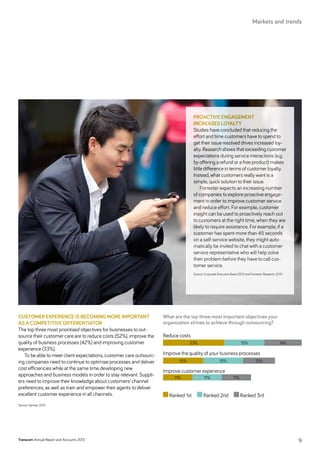
The top three most prioritized objectives for businesses to out-
source their customer care are to reduce costs (52%), improve the
quality of business processes (42%) and improving customer
experience (33%).
To be able to meet client expectations, customer care outsourc-
ing companies need to continue to optimize processes and deliver
cost efficiencies while at the same time developing new
approaches and business models in order to stay relevant. Suppli-
ers need to improve their knowledge about customers’ channel
preferences, as well as train and empower their agents to deliver
excellent customer experience in all channels.
Source: Gartner 2013
Reduce costs
Improve the quality of your business processes
Improve customer experience
What are the top three most important objectives your
organization strives to achieve through outsourcing?
23%
15%
11%
15%
15%
11%
14%
12%
11%
Ranked 1st  Ranked 2nd  Ranked 3rd
Markets and trends
Transcom Annual Report and Accounts 2013 9
Our brand promise:
Delivering outstanding
customer experience
Customer experience has become a popular catchphrase in the
last few years, as companies in many industry sectors attempt to
differentiate themselves in an increasingly competitive market-
place. One can think about the notion of customer experience from
many different angles, since it is really the sum total of a custom-
er’s experience with a product, a service, or a brand. There is a mul-
titude of “touch points” where a customer can interact with an
organization, e.g. when evaluating, purchasing, using, or getting
support for a product. And a customer’s perception of his or her
interactions at each of these touch points influences the overall
experience and, ultimately, customer loyalty.
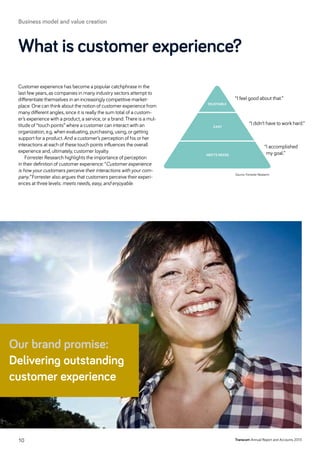
Forrester Research highlights the importance of perception
in their definition of customer experience: “Customer experience
is how your customers perceive their interactions with your com-
pany.” Forrester also argues that customers perceive their experi-
ences at three levels: meets needs, easy, and enjoyable.
What is customer experience?
Enjoyable
Easy
Meets needs
Source: Forrester Research
“I feel good about that.”
“I didn’t have to work hard.”
“I accomplished
my goal.”
Transcom Annual Report and Accounts 201310
Business model and value creation
Value for our clients’ customers
• Ability to get information, or resolve an
issue, quickly and with minimal effort
• Ability to use voice and non-voice
channels as required.
• Receive attractive, personalized offers,
based on an understanding of potential
needs
Transcom
• Transcom’s operations add value to
our clients’ businesses by supporting
the creation of outstanding customer
experiences, while reducing cost and
helping to drive growth
Value for our clients
• Improved customer experience, leading
to higher loyalty
• Increased sales
• Lower cost and improved quality of
business processes
• Access to technology and best practices
• Analytics capabilities, improving
customer understanding
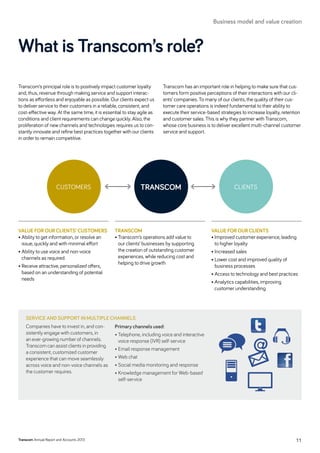
Transcom’s principal role is to positively impact customer loyalty
and, thus, revenue through making service and support interac-
tions as effortless and enjoyable as possible. Our clients expect us
to deliver service to their customers in a reliable, consistent, and
cost-effective way. At the same time, it is essential to stay agile as
conditions and client requirements can change quickly. Also, the
proliferation of new channels and technologies requires us to con-
stantly innovate and refine best practices together with our clients
in order to remain competitive.
Transcom has an important role in helping to make sure that cus-
tomers form positive perceptions of their interactions with our cli-
ents’ companies. To many of our clients, the quality of their cus-
tomer care operations is indeed fundamental to their ability to
execute their service-based strategies to increase loyalty, retention
and customer sales. This is why they partner with Transcom,
whose core business is to deliver excellent multi-channel customer
service and support.
Service and support in multiple channels
Companies have to invest in, and con-
sistently engage with customers, in
an ever-growing number of channels.
Transcom can assist clients in providing
a consistent, customized customer
experience that can move seamlessly
across voice and non-voice channels as
the customer requires.
transcomCUSTOMERS Clients
Primary channels used:
• Telephone, including voice and interactive
voice response (IVR) self-service
• Email response management
• Web chat
• Social media monitoring and response
• Knowledge management for Web-based
self-service
What is Transcom’s role?
Transcom Annual Report and Accounts 2013 11
Business model and value creation
Besides cost savings, the most important reasons for outsourcing customer care
are to improve business processes and create a better customer experience.
Transcom’s approach is built on the collection and analysis of sound and solid
data. The insight we gain together with our clients enables innovation and also
drives efficiency and cost savings through operational process optimization.
How Transcom contributes to
a better customer experience
Our Services
Customer service
Customer experience specialists
­trained to support best-in-class
­product, service and brand experi-
ences for our clients’ customers.
Customer retention
Preventing defection and maximizing
the lifetime of a customer.
Cross- and upselling
Building relationships and identifying
customer needs during any type of
interaction, and taking appropriate
action to satisfy the customer’s need.
Technical support
Tiered support models, from the sim-
plest questions to more complex sup-
port scenarios.
Customer acquisition
Acquiring new customers cost-­
efficiently, and building strong cus-
tomer relationships as a basis for
future interactions.
Credit management
services (CMS)
Early collections, Contingent
­collections and Legal collections.
Business model and value creation
Transcom Annual Report and Accounts 201312
Business
intelligence
and analytics
PROCESS
IMPROVEMENT
INNOVATION
How we deliver
customer
experience
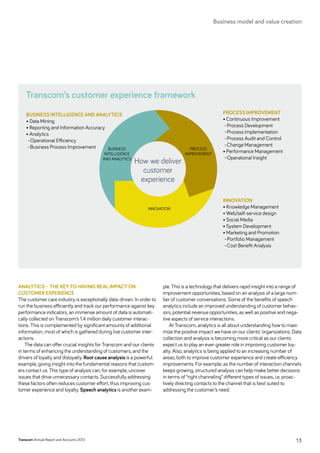
Business intelligence and analytics
• Data Mining
• Reporting and Information Accuracy
• Analytics
–Operational Efficiency
–Business Process Improvement
INNOVATION
• Knowledge Management
• Web/self-service design
• Social Media
• System Development
• Marketing and Promotion
–Portfolio Management
–Cost Benefit Analysis
PROCESS IMPROVEMENT
• Continuous Improvement
–Process Development
–Process Implementation
–Process Audit and Control
–Change Management
• Performance Management
–Operational Insight
ANALYTICS – THE KEY TO HAVING REAL IMPACT ON
CUSTOMER EXPERIENCE
The customer care industry is exceptionally data-driven. In order to
run the business efficiently and track our performance against key
performance indicators, an immense amount of data is automati-
cally collected on Transcom’s 1.4 million daily customer interac-
tions. This is complemented by significant amounts of additional
information, most of which is gathered during live customer inter-
actions.
The data can offer crucial insights for Transcom and our clients
in terms of enhancing the understanding of customers, and the
drivers of loyalty and disloyalty. Root cause analysis is a powerful
example, giving insight into the fundamental reasons that custom-
ers contact us. This type of analysis can, for example, uncover
issues that drive unnecessary contacts. Successfully addressing
these factors often reduces customer effort, thus improving cus-
tomer experience and loyalty. Speech analytics is another exam-
ple. This is a technology that delivers rapid insight into a range of
improvement opportunities, based on an analysis of a large num-
ber of customer conversations. Some of the benefits of speech
analytics include an improved understanding of customer behav-
iors, potential revenue opportunities, as well as positive and nega-
tive aspects of service interactions.
At Transcom, analytics is all about understanding how to maxi-
mize the positive impact we have on our clients’ organizations. Data
collection and analysis is becoming more critical as our clients
expect us to play an ever-greater role in improving customer loy-
alty. Also, analytics is being applied to an increasing number of
areas, both to improve customer experience and create efficiency
improvements. For example, as the number of interaction channels
keeps growing, structured analysis can help make better decisions
in terms of “right channeling” different types of issues, i.e. proac-
tively directing contacts to the channel that is best suited to
addressing the customer’s need.
Transcom’s customer experience framework
Business model and value creation
Transcom Annual Report and Accounts 2013 13
ONGOING PROCESS IMPROVEMENTS, DRIVING EFFICIENCY
AND COST SAVINGS
Given the high level of complexity in successfully managing a con-
tact center, coupled with the rapid pace of change, effective pro-
cess management is vital. Streamlining and standardizing basic
aspects of service delivery, and ensuring quality control, is funda-
mental. Our clients expect us to continuously improve our working
processes in order to ensure efficiency as well as high-quality inter-
actions with their customers. Analytics can have a powerful impact
in this area as well, creating new insights into how processes, tech-
nology and people can come together in order to generate superior
results.
Although automation and self-service solutions are becoming
more important in our industry, effective workforce management is
fundamental to running a customer care operation, not least to
manage the inherent volatility in our industry. Therefore, workforce
optimization is at the very core of Transcom’s client proposition.
Our approach to recruitment, induction, performance manage-
ment and organizational culture adaptation has been refined over
many years across several hundreds of deployments in different
industries and geographies.
We are also continuously investing in processes, methods and
tools that help our people deliver better services with lower risk,
higher consistency and better efficiency. One example of this is a
knowledge base that Transcom created in 2013 for a global con-
sumer electronics client in order to lower handle time and improve
quality and productivity. Before the implementation of the new tool,
the information supporting the customer service representatives
was inconsistent and resided in multiple, non-integrated, systems.
The new one-stop-shop solution brought together process maps,
decision trees, simulators, FAQs and product how-to information.
The information is continuously refined and enriched by agent
feedback, content ratings and rankings of the most viewed sec-
tions. Since the launch of the system, average handling time has
decreased while customer satisfaction scores are up by 14 percent-
age points.
1.4 million daily customer
interactions
Transcom Annual Report and Accounts 201314
Business model and value creation
CONTINUOUS INNOVATION IN ORDER TO STAY AHEAD
Innovation, agility, and best practice implementation are some of
the most important things our clients say they expect Transcom to
bring to their customer service organizations. They want us to push
them to stay ahead and to help put them in a position from which
they are able to benefit from the unrelenting change that charac-
terizes many industries today.
Contact centers are complex environments which merge many
different disciplines and skills. Continuous improvement is neces-
sary in each individual area, but also in terms of how the different
components are combined into customized solutions for each cli-
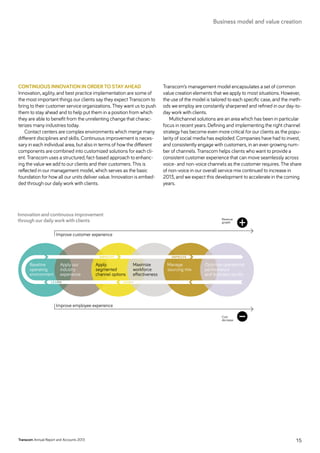
ent. Transcom uses a structured, fact-based approach to enhanc-
ing the value we add to our clients and their customers. This is
reflected in our management model, which serves as the basic
foundation for how all our units deliver value. Innovation is embed-
ded through our daily work with clients.
Transcom’s management model encapsulates a set of common
value creation elements that we apply to most situations. However,
the use of the model is tailored to each specific case, and the meth-
ods we employ are constantly sharpened and refined in our day-to-
day work with clients.
Multichannel solutions are an area which has been in particular
focus in recent years. Defining and implementing the right channel
strategy has become even more critical for our clients as the popu-
larity of social media has exploded. Companies have had to invest,
and consistently engage with customers, in an ever-growing num-
ber of channels. Transcom helps clients who want to provide a
consistent customer experience that can move seamlessly across
voice- and non-voice channels as the customer requires. The share
of non-voice in our overall service mix continued to increase in
2013, and we expect this development to accelerate in the coming
years.
Improve customer experience
Improve employee experience
Baseline
operating
environment
Apply our
industry
experience
Maximize
workforce
effectiveness
Manage
sourcing mix
Optimize operational
performance
and business results
Apply
segmented
channel options
Revenue
growth
Cost
decrease
Innovation and continuous improvement
through our daily work with clients
Transcom Annual Report and Accounts 2013 15
Business model and value creation
Customer care – a real-time business
The continuous balancing of cost efficiency and productivity with the ­delivery
of great customer experience is a challenge that Transcom helps its clients
face up to every day. Success hinges on continuous real-time resource man-
agement, and a client-vendor partnership that is characterized by trust, open
communication, and collaborative decision-making.
CONTINUOUS REAL-TIME MANAGEMENT ESSENTIAL
IN ORDER TO MANAGE VOLATILITY
The customer care business truly runs in real time. A high degree
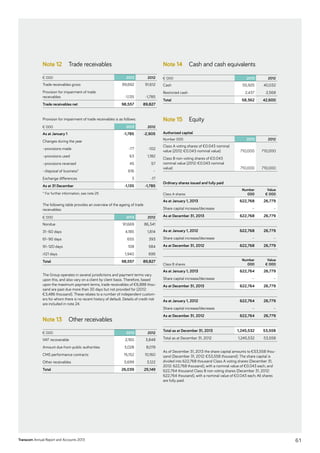
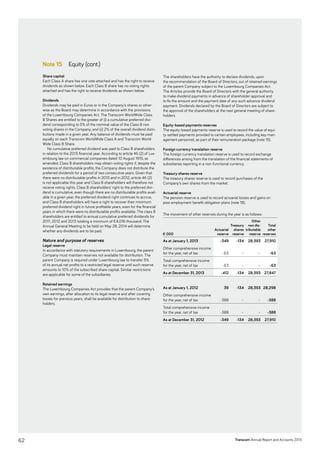
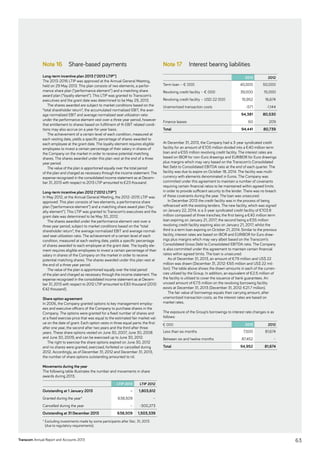
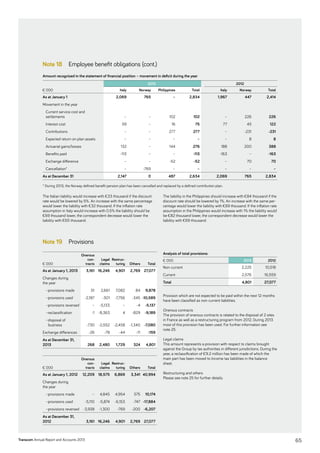
of flexibility and responsiveness is vital as the volume of customer
interactions can vary significantly, both during the course of a sin-
gle day and from month to month. Even though self-service chan-
nels are on the rise, a significant share of customer contacts is han-
dled by people interacting directly with people using various
communications channels.
Ensuring a consistently high service level, at a justifiable cost,
depends in large part on the ability to make available the appropri-
ate number of customer service representatives with the right
skills, at the right time. A multitude of factors have a direct impact
on the volume of customer inquiries a company can expect to
receive at any given point in time. In order to estimate future cus-
tomer service staffing requirements, a volume forecast is created,
based on an aggregate view of known factors, e.g. planned cam-
paigns, new product launches, invoicing changes, recent volume
trends, seasonality factors, etc.
Based on the demand forecast, a formula is used to calculate
the number of people needed to meet the projected demand at a
given time of day or night. However, the target is continuously mov-
ing as various hard-to-predict events influence the actual number
of customer contacts that need to be responded to, e.g. weather
conditions, service changes or interruptions, delays in sending out
invoices, etc. At the same time, changes in staffing availability can
occur, e.g. due to sickness or staff attrition. This makes it necessary
to make continuous, real-time adjustments to staffing schedules in
order to accommodate changes to both the demand side (volume
of customer contacts) and the supply side (available resources to
handle the contacts). Recruiting and training new staff takes a few
weeks, so significant gaps can be challenging to address in the
short term, e.g. a large increase in the expected number of cus-
tomer inquiries as a result of an unplanned product campaign.
The customer care business
truly runs in real time
Transcom Annual Report and Accounts 201316
Business model and value creation
Pricing Model Key characteristics
Price per transaction
(e.g. call or data entry)
• Transcom gets paid for each transaction, e.g.
each call taken
• Time spent per transaction is capped – critical
to balance quality and time spent on each
transaction
• Accuracy of volume forecast is key to planning
and profitability
Price per activity • Typically used for back-office tasks/processes
• Time spent per activity is capped – important
to balance quality and time spent on each task
• Transcom uses client systems and pre-defined
processes
• Back-office tasks usually take longer to com-
plete than the typical call
Pricing Model Key characteristics
Price per minute • Transcom gets paid based on the time the agent
spends with each customer (usually no cap)
• Accuracy of volume forecast is key to planning
and profitability, but less risk than in price per
call models
Price per hour • Provides a greater degree of financial predict-
ability and stability
Transcom’s capability to successfully manage this inherent
­volatility in customer care management operations is fundamental
to delivering a great customer experience while at the same time
keeping costs under control and generating a profit. An effective
partnership with clients is critical to success, with close collabora-
tion on important issues such as volume forecasting and process
improvements.
THE PRICING MODEL – AN IMPORTANT TOOL
IN STRIKING THE RIGHT BALANCE
The commercial model, governing the relationship between Trans-
com and our clients, is also a very important factor in striking the
right balance between revenue, service levels and cost. This bal-
ance varies, e.g. depending on the industry, the type of customer
contacts, and client priorities. The pricing models that Transcom
uses with its clients generally fall into four key categories, as out-
lined in the table below. Although the basic terms are usually set
out in multi-year frame agreements, the models are regularly
reviewed and adjusted, as our partnerships evolve over time and
our clients’ priorities shift.
Each pricing model has its own tradeoffs in terms of cost, qual-
ity, and predictability for Transcom and our clients. For example, a
cost-per-contact unit rate creates an incentive to reduce handling
times, in contrast to a cost-per-minute model. This can, in turn,
have implications in terms of customer service quality and, ulti-
mately, customer loyalty. Therefore, various KPIs are used in order
to manage quality, e.g. first-call resolution and customer satisfac-
tion scores. Performance against these KPIs is usually tied to
bonuses or financial penalties.
The pricing model used also has important implications for
Transcom in terms of financial predictability and stability. For
example, models based on a price per customer contact or per
minute spent resolving a customer issue, imply a higher exposure
to the accuracy of volume forecasts than a contract based on an
agreed staffing level (price per hour worked). Transcom’s target is
to achieve an appropriate mix of pricing models used in all regions,
in order to avoid excessive financial risk associated with poor fore-
cast accuracy. For example, the business model mix currently used
in the North Europe region is more exposed to the accuracy of vol-
ume forecasts, compared to other regions. However, a new agree-
ment with one of our largest clients in the region is gradually being
implemented during 2014, improving financial predictability.
Irrespective of the commercial model used, effective workforce
management is fundamental to successfully operating a contact
center, not least in order to manage volatile demand. Therefore,
workforce optimization is at the very core of Transcom’s client
proposition, and is an integral part of our Customer Experience
Management framework, which is described on pages 12–15.
Transcom Annual Report and Accounts 2013 17
Business model and value creation
Improved customer experience
and reduced cost through process efficiency
The client situation
This client is an established leader in the
global consumer electronics market, with
a strong position in high-tech electronics
manufacturing and digital media.
At the start of Transcom’s partnership
with this client, we realized that the cost
associated with the service booking pro-
cess was too high. The analysis of the situa-
tion revealed a lack of a clearly defined
end-to-end service booking process. There
was a need to create stronger alignment
between Transcom’s customer service rep-
resentatives, our client’s claims processing
department, and their technicians.
The solution
Transcom’s Customer Experience Manage-
ment team allocated a Process Improve-
ment Manager who assessed, reviewed,
and assisted in mapping our client’s busi-
ness processes.
By mapping out the existing service
booking procedure, we discovered that the
understanding of policies was poor, and
that there was no well-documented step-
by-step process. Hence, all individuals
involved, from the customer service repre-
sentatives through to the Claims Depart-
ment and the technicians, were together
performing a set of procedures that did not
generate the correct resolution for the end-
users. The negative impact to our client’s
bottom line was clear. The cost of each
incorrect service booking, resulting from
the process misalignment, was estimated
at $120. Each month, approximately 6,000
service booking requests are launched.
After Transcom completed the process
mapping and documentation, there was an
official review and sign-off by the client.
Transcom then translated the process
maps into robust training materials and
created decision trees that are easy to fol-
low for our customer service representa-
tives. We shared the information with our
client’s Claims Department and Service
Center teams. We also updated our Quality
Monitoring Form to ensure that we have an
efficient audit mechanism in place for mon-
itoring compliance to the agreed process.
The results
As a result of this project, we managed to
reduce the number of incorrect service
booking requests from a 7% threshold (the
target set by our client) to 3%. The reduc-
tion in errors translates directly into a
reduction of our client’s costs for service
bookings – from approximately $500,000
in 2013 to $250,000 (projected) in 2014.
After this project, Transcom has become
a trusted business partner to this client,
expanding our service delivery to them
from Customer Service to Customer Expe-
rience Management – supporting our client
on process improvements and innovation
activities.
Client case
18 Transcom Annual Report and Accounts 2013
Innovative knowledge management solution,
­enhancing productivity and customer experience
The client situation
At the start of this client project, we
observed performance gaps on agent pro-
ductivity and quality of support, due to a lack
of appropriate tools. The issue was that we
did not have a dynamic and well-designed
Knowledge Base (KB) system that could aid
our agents in supporting and resolving cus-
tomer issues. Also, our client’s existing
Knowledge Base had no reporting capabili-
ties. Thus, our Management Team and Pro-
cess Owners did not have the capability to
monitor and analyze data trends for plan-
ning and decision-making purposes. They
also did not have dedicated Knowledge
Management resources to analyze, design,
develop, manage and maintain knowledge
base content. The reference information
that our agents had to use was spread out
across many different documents, affecting
their productivity negatively.
The solution
Transcom’s Customer Experience Manage-
ment team analyzed the situation and
arrived at a solution through a detailed
review and mapping of processes and key
issues. In order to improve overall agent
performance, customer satisfaction, and
solution accuracy, there was clearly a need
to develop and implement a robust and
dynamic knowledge base (KB) system. This
KB system had to address known gaps on
agent productivity and quality.
We proposed a “One-Stop-Shop” repos-
itory of support tools and materials. This
system features a User Interface design
that includes a responsive “Search” func-
tionality, clearly outlined “Decision Trees”
for troubleshooting top call drivers, as well
as robust product simulators that help the
agents walk a customer through trouble-
shooting steps, take less time to handle
their calls, and ensure compliance to poli-
cies and procedures.
Included in Transcom’s proposal was the
creation of a team of experienced content
developers who focus on designing and
managing the Knowledge Base learning
materials. This same group of individuals is
also tasked with functioning as point of
contact for all the KB-related needs of the
client and our internal Operations Team.
Following approval by our client, the KM
program was launched in late September
2013, initially supporting almost 200
agents. The KM team has grown from three
dedicated content developers to nine mem-
bers by January 2014, as requested by the
client. The team has since developed a sig-
nificant amount of content, supporting four
lines of business.
The results
As usage of the KB tool increased, we also
started experiencing improvements in
agent productivity and performance qual-
ity. Average Handle Time was reduced by
23 seconds, and Customer Satisfaction
survey results reached an all-time high of
85% vs. the 80% target.
Client case
19Transcom Annual Report and Accounts 2013
An extensive global footprint
* Excluding non-recurring costs
NORTH EUROPE CENTRAL  SOUTH EUROPE IBERIA  LATAM
The North Region consists of ­Sweden, Norway,
Denmark, Latvia, Lithuania, Estonia, and
the Netherlands.
The Central  South Europe region consists of
Austria, Belgium, Croatia, Germany, Hungary, Italy,
Luxembourg, Poland, Switzerland, and Tunisia.
The Iberia  Latam region consists of Chile, Peru,
Portugal, Spain and Colombia.
Share of total revenue Share of total revenue Share of total revenue
30% 22% 20%
Highlights 2013 Highlights 2013 Highlights 2013
• Implementation of new price model with large
client, improving financial predictability and
­stability
• Closure of loss-making Danish CRM operations
• Significant growth in interpretation business
• New sites in Umeå, Sweden and Oslo, Norway
• Closure of the Norrköping site in Sweden
• A number of smaller, unprofitable contracts
were ended
• Deconsolidation of Transcom’s former
­loss-making French subsidiary
• Belgian operation divested
• Renegotiation of labor agreements in Germany,
lowering costs and increasing flexibility
• Significant volume increase with installed
client base in Italy
• New contact center opened in Cali, Colombia
• Valdivia site in Chile closed
• Volume increase with telecom and financial
­services clients in Spain
Priorities 2014 Priorities 2014 Priorities 2014
• Continued implementation of new price
model with large client, enhancing financial
­predictability and stability
• New business development
• Further develop near shore, multilingual delivery
capacity
• Expansion with local clients in Latin America
(€m)
2013
Jan–Dec
2012
Jan–Dec Growth
Revenue 197.0 180.4 9.2%
Gross profit 30.3 28.2 7.4%
Gross margin 15.4% 15.6%
EBIT 4.4 6.0 –27.0%
EBIT margin 2.2% 3.3%
EBIT adj* 5.0 6.6
EBIT margin adj 2.5% 3.7%
(€m)
2013
Jan–Dec
2012
Jan–Dec Growth
Revenue 145.8 138.3 5.5%
Gross profit 27.6 18.7 48.1%
Gross margin 18.9% 13.5%
EBIT 4.5 –7.4 –
EBIT margin 3.1% –5.4%
EBIT adj* 4.2 –5.3
EBIT margin adj 2.9% –3.8%
(€m)
2013
Jan–Dec
2012
Jan–Dec Growth
Revenue 130.9 119.4 9.6%
Gross profit 25.2 24.3 3.7%
Gross margin 19.3% 20.4%
EBIT 3.1 5.1 –39.3%
EBIT margin 2.3% 4.2%
EBIT adj* 3.7 5.4
EBIT margin adj 2.8% 4.6%
Our global delivery network with 62 sites across five continents is one of the most
extensive in our industry. We deliver services from onshore, near shore as well as from
offshore contact centers. Our wide geographic presence means that we can offer our
clients flexibility with regards to sourcing options and devise solutions that are well-
adapted to clients’ needs. Transcom’s global business is managed within five units.
Transcom Annual Report and Accounts 201320
Regional overview
* Excluding non-recurring costs
NORTH AMERICA  ASIA PACIFIC credit management services
The North America  Asia Pacific region consists
of Canada, the Philippines, USA, the United King-
dom and Australia.
CMS operations in Austria, the Czech Republic,
the United Kingdom, Poland, Denmark, Norway
and Sweden (Germany deconsolidated as per
December 30, 2013).
Share of total revenue Share of total revenue
19% 9%
Highlights 2013 Highlights 2013
• Significant expansion of operations in the
­Philippines
• London, Ontario site closed in order to improve
capacity utilization onshore
• Realignment of management structure, and
expansion of management team, in order to
increase focus and accountability
• CMS Germany sold to Tesch Group, a portfolio
company of Avedon Capital Partners, for €9.0
million on a cash and debt free basis
• Measures implemented to lower production
and overhead costs
• CMS UK integrated with the Central  South
region, effective January 1, 2014
Priorities 2014 Priorities 2014
• Continue expanding in local markets
in Asia Pacific
• Create opportunities for profitable growth
in North America
• Finalize strategic review for remaining CMS
country units. Primary options considered
include a divestment and/or the integration
of parts of the business with Transcom’s CRM
operations.
(€m)
2013
Jan–Dec
2012
Jan–Dec Growth
Revenue 122.7 112.1 9.4%
Gross profit 30.4 27.1 12.4%
Gross margin 24.8% 24.1%
EBIT –1.4 –2.3 –
EBIT margin –1.1% –2.1%
EBIT adj* –1.4 0.2
EBIT margin adj –1.2% 0.2%
(€m)
2013
Jan–Dec
2012
Jan–Dec Growth
Revenue 56.8 55.3 2.7%
Gross profit 17.5 13.6 28.8%
Gross margin 30.9% 24.6%
EBIT 5.1 1.7 194.3%
EBIT margin 9.0% 3.1%
EBIT adj* 6.2 1.9
EBIT margin adj 10.9% 3.5%
Transcom Annual Report and Accounts 2013 21
Regional overview
Building sustainability through people
In a people-intensive business like ours, where long-term success
largely depends on the ability to attract and develop the right peo-
ple, we believe it makes sense to focus our corporate social
responsibility (CSR) efforts on people as well. During 2013, our
stakeholder dialogues verified this view.
Materiality result
Transcom has conducted a materiality analysis in order to identify
which sustainability aspects are considered to be most material
and to prioritize amongst these in order to allocate adequate
resources to achieve the highest impact. The process began in
2012 when employees were involved via internal stakeholder dia-
logues on the topic of CSR. Regular dialogues are conducted with
investors to keep them informed of our performance, challenges
and opportunities.
This year, Transcom also conducted specific external stake-
holder dialogues though web-based surveys and feedback meet-
ings on significant CSR aspects with key groups, such as investors,
ESG and equity analysts, clients and media.
The result can be seen in the matrix below. It shows the rated
importance and relevance of all sustainability issues to internal and
external stakeholder groups. Materiality analysis is an on-going
process at Transcom which needs to continuously adapt to our
fast-growing business. At the moment, two aspects are rated only
by external stakeholders: customer satisfaction and customer
brand experience. As they are an integral part of Transcom’s oper-
ations, these aspects will be rated internally during 2014.
At Transcom, our 29,000 people make all the difference. Every day, our customer
experience specialists handle approximately 1.4 million interactions with our clients’
customers in more than 33 languages. We rely on knowledgeable, motivated people
to deliver a great customer experience every time – in any customer situation and
throughout any channel. Our ability to find the right people with the right skills and
­attitudes, in combination with efficient training methods and processes to drive
­performance, is essential to making this happen.
A
O
M L
J
NI
B
E
CK
H
DP
F
G
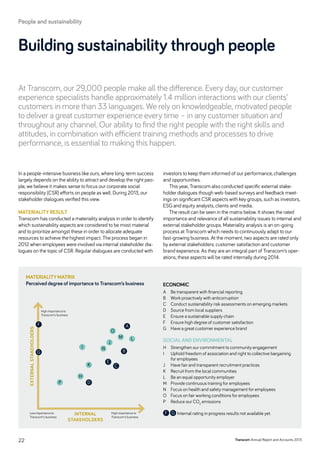
Materiality Matrix
Perceived degree of importance to Transcom’s business
Low importance to
Transcom’s business
Internal
stakeholders
High importance to
Transcom’s business
High importance to
Transcom’s business
externalstakeholders
Economic
A Be transparent with financial reporting
B Work proactively with anticorruption
C Conduct sustainability risk assessments on emerging ­markets
D Source from local suppliers
E Ensure a sustainable supply chain
F Ensure high degree of customer satisfaction
G Have a great customer experience brand
Social and Environmental
H Strengthen our commitment to community engagement
I Uphold freedom of association and right to collective ­bargaining
for employees
J Have fair and transparent recruitment practices
K Recruit from the local communities
L Be an equal opportunity employer
M Provide continuous training for employees
N Focus on health and safety management for employees
O Focus on fair working conditions for employees
P Reduce our CO2
emissions
F G Internal rating in progress results not available yet.
Transcom Annual Report and Accounts 201322
People and sustainability
Given the nature of our operations, both internal and external
groups rated environmental issues the lowest. This does not mean
that they are unimportant, but simply that they are considered to
be the least material sustainability aspect for Transcom. Therefore,
we have limited our environmental KPIs to business travel, which
we try to minimize.
The issues considered most material were the following: being
transparent with financial reporting, being an equal opportunity
employer and to provide continuous training for employees. The
external and internal rating was very similar with no major discrep-
ancies. The results overall confirmed the relevance of the focus
areas of Transcom’s CSR program, further described below.
“Transcom Cares” launched in 2013
At Transcom, Corporate Social Responsibility (CSR) means that we
always do our utmost to do the right thing by our clients, our people
and our communities. We are convinced that our commitment to
sustainability also helps us to attract, retain and develop the best
people, which is critical to our long-term success.
In November 2013, we established Transcom Cares as the over-
arching governance program for Transcom’s Corporate Social
responsibility (CSR) activities. Transcom Cares was initially started
several years ago as a concept for our community engagement
activities in the Philippines. Now, we are making Transcom Cares
global and we are also broadening the program’s scope to provide
strengthened governance and coordination for all Transcom’s CSR
focus areas: people development, equality  diversity, and commu-
nity engagement.
Read more about our CSR governance in the Corporate Gover-
nance report on pages 27–33.
People development
Transcom’s ability to attract and develop top talents is business
critical. In order to ensure that we are successful in finding the right
people, the company has a clear goal of becoming an employer of
choice in our industry. Besides offering a stimulating working expe-
rience, competitive compensation and robust training, the opportu-
nity for career development is one of the key factors that attracts
new talents to the company.
We offer a multitude of opportunities for employees to develop
in their roles. There is a clearly defined career progression, either as
a line manager or specialist. There are hundreds of examples of
senior leaders at Transcom who started out as agents or in junior
support roles. We have a high retention of the best people because
we are strong on promoting training and career development. This
translates into a skilled workforce with a high degree of specialist
knowledge.
The absolute majority of our first line management positions,
as well as functional specialist roles, are filled by internal candi-
dates. In 2012, Transcom launched a careers portal accessible to
all employees where they can search for positions of interest within
the company and apply directly online. Career growth opportuni-
ties within Transcom are attractive, not least in our fastest-growing
operations. In 2013, Transcom decided to launch a redesigned
­Talent Management Program, putting the necessary tools in place
to manage the process on a global level, ensuring greater transpar-
ency and efficiency. This program will be implemented in 2014. In
2013, Transcom also decided to design and implement a program
with the objective of identifying top candidates in a structured way.
Transcom does not promote a single operating model that has
to work everywhere in our global operation. We manage people
according to a different philosophy – for everyone’s benefit. We use
consistent structures and processes, but adapt our personnel
management to local conditions. We see our employees in their
social context. So starting with the same expectations and the
same framework for measurement in five different business units,
we can manage people in five different ways, while still achieving
the same top results. Transcom’s flexibility extends to building up
networks of qualified home agents in many markets, as well as
service centers. This extends our recruiting base and also contrib-
utes to expertise development and lower attrition rates.
Our investment in people and internal mobility also simplifies
our recruiting activities. All of our Business Managers, and five out
of six Team Leaders, are internally recruited. When we do recruit
externally, approximately 20 percent of our recruitments come
through recommendations – up to 40 percent in some markets.
A people’s business requires good leaders. Therefore, Transcom
is committed to ensuring good leadership on all levels of manage-
ment. In 2012 Transcom launched a global training- and coaching
program addressing first line management. We continued the
implementation of this program during 2013 with good results.
most important aspects
to each stakeholder group
Employees • Be an equal opportunity employer
• Be transparent with financial reporting
• Work proactively with anticorruption
Owners • Provide continuous training for employees
• Be transparent with financial reporting
• Have fair and transparent recruitment practices
Investors • Provide continuous training for employees
• Focus on fair working conditions for employees
• Ensure high degree of customer satisfaction
• Focus on health and safetymanagementforemployees
Equity analysts • Be transparent with financial reporting
• Focus on fair working conditions for employees
• Be an equal opportunity employer
ESG analysts • Focus on fair working conditions for employees
• Uphold freedom of association and right to collective
bargaining
• Ensure high degree of customer satisfaction
Clients • Have fair and transparent recruitment practices
• Be an equal opportunity employer
• Focus on fair working conditions for employees
Transcom Annual Report and Accounts 2013 23
People and sustainability
Equal Opportunities
Transcom is focused on attracting top talent and retaining people
to build a truly global company that is prepared to meet and deliver
towards diverse business cultures in all corners of the world. We
strive for gender equality on all levels, and are dedicated to show-
ing that equal opportunity employment is part of our DNA. Diver-
sity of cultures and languages is fundamental to our service deliv-
ery capability, e.g. in our multilingual near shore centers.
The gender distribution among managers is good overall, with
women making up 51 percent of managerial employees. Our tar-
get is to improve this number even more.
A unique position that Transcom is proud to fill in many markets
is that of a platform for career development for young people and
new graduates. In many countries, we are a top employer of people
aged 18–26. Our agents learn about direct client interaction in a
dynamic environment, strengthening their communication and
technology skills; they become product specialists, handle conflicts
and, in turn, are rewarded for a job well done. Transcom is proud of
the role we play in the lives of our current and former employees.
Community engagement
Local community engagement is how Transcom Cares started.
Getting involved in the communities in which we operate not only
strengthens our employer brand, but also maintains our license to
operate in the markets where we choose to compete. Many of our
community engagement activities depend on our employees’ pas-
sion to contribute their time and energy.
People want to work for a company that has a sustainable
approach to business and that contributes to building communities.
It is clear that our community engagement activities support
recruitment and staff retention.
Transcom also runs programs to make life easier for our
employees. On-site child care centers, pharmacies, and employee
microloans are some examples.
Environmental care
Transcom has a precautionary approach to all environmental chal-
lenges in our operations. We undertake training and support local
initiatives with our employees to encourage greater environmental
responsibility in our workplaces and always promote environmen-
tally friendly technologies and equipment. Our focus is on minimiz-
ing our greenhouse gas emissions through limiting business travel
and decreasing energy consumption in all our facilities. Our data
from 2013 reflect our increased monitoring, measurement and
reductions of carbon emission.
Carbon emissions 2013 2012
CO2
emission, business travel (tonnes) 1,827 1,508
CO2
emission, per employee
(tonnes/employee) 0.065 0.051
CO2
emission, by revenue
(tonnes/­million €) 2.80 2.49
CSR area Target
Equal opportunities • Increase the number of women in mana-
gerial positions in the coming three years
in order to better reflect the gender distri-
bution for the total workforce.
• Promote equal opportunities by increasing
awareness and focus on the issue
throughout the organization.
People development • Become the employer of choice in the
industry, in order to attract and retain top
talent.
• Promote internal career development
through bringing inspiring case examples
to light.
• Introduce a global Talent Management
program.
Anticorruption • Continue with anticorruption training,
reaching all managers by 2015.
• Complete anticorruption screening of
major suppliers during 2014.
Climate Change and
energy consumption
• Reduce CO2
emissions by minimizing
business travel and increasing use of
­teleconferencing.
• Review the energy consumption at all
facilities and sites.
Human rights • Complete CSR assessment of 20 largest
suppliers during 2014.
• Perform CSR risk analysis of value chain.
• Initiate complete CSR procurement pro-
cess with self-assessments, evaluation
and audits.
Transcom Annual Report and Accounts 201324
People and sustainability
Many of our senior leaders started as agents or in junior support roles
Team Leader
Agent
Contact Center Manager
Business Manager
Country Manager
Support Functions:
– IT
– Quality
– Operations
– HR
– Finance
Juan Brun, Spain
First job at Transcom?
Started as team leader in July 2002
Current position?
Operations Director for Iberia  Latam
Region (2010)
What do you like the most about
a career at Transcom?
“To be able to work with committed and
talented people as our people makes the
difference in our business, they are the
engine of the company.”
Øistein Lund, Norway
First job at Transcom?
Started as agent in 1997
Current position?
Contact Center Manager Norway (2006)
What do you like the most about
a career at Transcom?
“The possibility to continuously take on
new challenges as the career path is
evolving. For me it has been a great
experience to be part of the Transcom
Norway journey from the beginning in
1997.”
Dyne del Rosario-Tubbs, ­Philippines
First job at Transcom?
Started as Quality Assurance Specialist
in April 2006
Current position?
Senior Client Operations Manager (2013)
What do you like the most about a career
at Transcom?
“I was given the opportunity to test the
waters in different departments enabling
me to find out where I would like to build
a career. Transcom has always been
good at looking after me and addressing
my concerns.”
85% of Transcom’s managers
are recruited internally
Transcom Annual Report and Accounts 2013 25
People and sustainability
Percentage of managers who
have received anti­corruption
training
Full-time employees and
temporary staff, 2013
93% 24,315
7% 4,276
■ Trained ■ To be trained
■ Full-time employees
■ Temporary staff
Total number of employees per region
Region Total # of employees
North Europe 5,050
Central  South Europe 5,947
Iberia  Latam 6,056
North America  Asia Pacific 10,632
CMS 761
Corporate 145
Composition of governance body per employee category
according to gender
Employee Category % men % women
Managers 49 51
Teamleaders 47 53
Employees 43 57
Transcom’s core values:
PASSION
• We are relationship-, network- and service-driven
• We see our clients’ customers’ challenges as our own, and always
go that extra mile to deliver service
• We are passionate about improving customer experience – whenever and
wherever possible
EXCELLENCE
• We have high ambitions – going for leadership in ­customer experience
• We focus on quality in everything we do
• We incorporate industry and company best practices to continuously improve the way we deliver
INNOVATION
• We are progressive and move quickly to anticipate new customer trends and needs
• We are open-minded, exploring new ways to support and deliver improved
customer experience
• We greet new ways of working with openness and ­enthusiasm
Transcom Annual Report and Accounts 201326
People and sustainability
Corporate governance
1 Overview
Transcom WorldWide S.A. (“Transcom”) is
a Luxembourg public limited liability com-
pany (a société anonyme), and its SDRs are
listed on the NASDAQ OMX Stockholm
Exchange.
Transcom recognizes the importance of,
and is committed to the highest standards
of corporate governance. Among other
things, this means that Transcom:
• Maintains an efficient organizational
structure with clearly defined areas of
responsibility,
• Ensures that its financial reporting is
transparent and
• Continuously strives to be a good corpo-
rate citizen.
Transcom’s corporate governance structure
is illustrated below:
Corporate governance within Transcom is
based on the Luxembourg law and the list-
ing requirements of the NASDAQ OMX
Stockholm. Transcom follows the ‘’Ten
Principles of Corporate Governance’’ of the
Luxembourg Stock Exchange, as published
in May 2013. Refer to page 31-32 for
related explanations.
Internal regulations that affect corporate
governance include Articles of Association,
the Corporate Governance Charter, the
Board’s instructions to the CEO, CFO and
Regional General Managers (RGMs), Code
of Business Conduct, Insider Trading policy
and other policies/steering documents
issued within the Group. The Corporate
Governance Charter is available on the
company’s website.
2 Shareholders’ Meeting
The Shareholders’ meeting is the apex gov-
erning body for Transcom. Amongst other
key powers provided for by the applicable
Luxembourg laws, the general meeting of
shareholders is also the only one autho-
rized to amend the articles of association of
the Company. The quorum and majority
requirements vary depending on the nature
of the resolution in question, as per applica-
ble Luxembourg law and the articles of
association of the Company.
The Annual General Meeting (“AGM”) is
convened in Luxembourg each year on the
last Wednesday of the month of May at 10
am at the registered office of the Company
or at such other place as may be specified
in the notice convening the Meeting.
Shareholders
General Meeting
Audit Committee
Internal Audit
Group CFO
Group Operations
 HR Director
Respective business functions
Group CIO
Nomination Committee
Remuneration Committee
Regional General Managers
Board of Directors
President  CEO
External Audit
Independent Opinion
Provides updates  findingsElects Board
Vote at General meetings
Internal Audit
plan, Charter
 Instructions
Appointment,
Instructions,
Strategy
Reporting,
Updates
Reporting,
Updates
Reporting, UpdatesReporting, Updates
Internal steering documentsInternal steering documents
Reporting,
Updates
Reporting,
Updates
Reporting,
Updates
Charters 
instructions
Charters 
instructions
Results of self evaluation
Proposal
for Board
Elects
Reporting, Updates
Reporting,
Updates
Transcom Governance model
Transcom Annual Report and Accounts 2013 27
Corporate governance
The Annual general meeting has the rights
conferred by Luxembourg laws and the
operating processes of the AGM are in line
with the applicable Luxembourg laws.
In 2013, one shareholders’ meeting was
held: the statutory AGM on May 29, 2013.
At the meeting, shareholders representing
59.78 percent (rounded) of the total num-
ber of class A shares, were present either
personally or by proxy. (For further details
on voting rights, refer to page 38 and Note
15 to accounts. Information related to num-
ber of shares issued, the number of shares
with voting rights and the number of trea-
sury shares is available on Page 38).
Shareholders exercised their rights to
decide on the key affairs and the following
resolutions were adopted by the AGM:
• Approval of the annual accounts and the
consolidated accounts for the financial
year ended 31 December 2012.
• Allocation of the results as of 31 Decem-
ber 2012.
• Discharge of the liability of the members
of the board of directors for, and in con-
nection with, the financial year ended 31
December 2012.
• Re-election of all existing Directors for the
period until the close of the next AGM.
• Election of Statutory auditors.
• Determination of Directors’ fees.
• Approval of the procedures for the
­Nomination committee.
• Approval for guidelines on remuneration
of Senior Executives.
• Approval of a long term incentive plan
for executive management for 2013
(the “LTIP 2013”).
The minutes of the AGM are available on
Transcom’s website. The next AGM will be
held on May 28th, 2014.
3 Major holdings
Transcom’s share ownership is disclosed on
page 38 under “The Transcom share and
shareholders” section. All other significant
relationships between Transcom and its
major shareholders, in so far as it is aware
of them, are described in note 27 “Related
Party Transactions”.
4 Nomination Committee
The Nomination Committee is formed each
year in October in consultation with the
largest shareholders of Transcom.
A Nomination Committee of major
shareholders in Transcom has been formed
in accordance with the resolution of the
2013 Annual General Meeting. The Nomi-
nation Committee is comprised of Mia
Brunell Livfors on behalf of Investment AB
Kinnevik, Stefan Charette on behalf of
Creades AB, and Arne Lööw on behalf of
the Fourth Swedish National Pension Fund
(Fjärde AP-fonden). Mia Brunell Livfors has
been elected Chairman of the Nomination
Committee.
The Nomination Committee invites pro-
posals from shareholders wishing to pro-
pose candidates for election to the Board of
Directors. The Nomination Committee will
submit a proposal for the composition of
the Board of Directors; remuneration for the
Board of Directors and the auditor; and a
proposal on the Chairman of the 2014
Annual General Meeting, which will be pre-
sented to the 2014 Annual General Meet-
ing for approval. The Nomination Commit-
tee met three times during 2013.
No of meetings attended
Mia Brunell Livfors
(Chair)
3/3
Stefan Charette 3/3
Arne Lööw 1/3
5 Board of Directors
As per the applicable Luxembourg laws, the
board of directors is elected by sharehold-
ers’ meetings, and can be removed at any
time, with or without cause, by a resolution
in shareholders’ meetings.
Independence status Remuneration attendance
Vis-à-vis major
shareholders
Vis-à-vis the
­company and its
management
Incl. any remunera-
tion for Committees Board
Audit
Committee
Remuneration­
Committee
Laurie Bowen Independent Independent 46,000 7 6
Henning Boysen Independent Independent 94,500 8 (C) 6 3 (C)
Stefan Charette Not independent Independent 46,000 8 6
Alexander Izosimov Independent Independent 42,500 7 3
Dermot Jenkinson Independent Independent 42,500 6 3
Mikael Larsson1
Not independent Independent 57,500 8 6 (C) 2
Roel Louwhoff Independent Independent 40,000 5
Number of meetings (Total) 8 6 3
– Physical meetings 5 4 3
– Conference calls 3 2 –
1) Mikael Larsson joined the Remuneration Committee after AGM held in May 2013 and attended both meetings held thereafter
(C) Chairman of Board/Committees
The President and CEO and CFO were present at all Board meetings.
Transcom Annual Report and Accounts 201328
Corporate governance
The Board of Directors is ultimately respon-
sible for the organization of Transcom and
the management of its operations. The
President and CEO, appointed by the Board
of Directors, is responsible for handling the
day-to-day management of the Company
in accordance with instructions from the
Board. The President and CEO is supported
by the Executive Management Committee
(the “Executive Committee”) which includes
Head of Group functions and Regional
­General Managers (RGM’s).
The Board of Directors, in addition to the
instructions to The President and CEO, has
also issued formal instructions to the Chief
Financial Officer and Regional General
Managers following the “Grandfather Prin-
ciple”.
5.1 Composition of the Board of Directors
of the Company (“The Board of Directors”)
The Board of Directors is comprised of
seven directors whereof:
• Five Directors are independent vis-à-vis
major shareholders and
• All Directors are independent vis-à-vis the
management.
Summary curriculum vitae for each
Director and the list of paid positions held
by them in other companies is disclosed on
pages 36–37.
The table on page 28 gives an overview
of the meetings held by the Board of Direc-
tors and its committees in 2013, as well as
information about the attendance and
remuneration of Directors in 2013.
The principal criteria used by the Com-
pany in order to determine the independ-
ence of the members of its Board of Direc-
tors are those listed in Annex ii of the
European Commission recommen­dations
of February 15, 2005 on the role of Non-
Executive Directors (and members of the
Supervisory Board) of listed companies and
on the committees of the Board (or Super­
visory Board).
5.2 The responsibility of the Board of
­Directors and work in 2013
The Board of Directors is in charge of the
overall governance and strategic direction
of the Company. The Board of Directors
provides effective support for, and control
of, the activities of the Executive Commit-
tee. It is responsible for the performance of
all acts of administration necessary or use-
ful for accomplishing the Company’s pur-
poses, except for matters reserved by Lux-
embourg law to the general meeting of
shareholders.
In order to carry out its work more effec-
tively, the Board of Directors has created
a Remuneration Committee and an Audit
Committee. These committees handle
business within their respective areas and
present recommendations and reports on
which the Board of Directors may base its
decisions and actions. The internal regula-
tions of the Audit Committee and the
Remuneration Committee along with the
internal regulations of the Nomination
Committee have been formally defined
in the corporate governance charter.
In 2013, the Board addressed and dis-
cussed the following (apart from regular
matters in the annual Board work cycle):
• Continuous work relating to strategic
plans and direction
• Settlement agreement concerning former
French subsidiary
• Review and approval of new sites and
other investment proposals
• Corporate social responsibility related
matters
• Divestment of German CMS operations
• Tax matters
• Financing matters
• Organizational design and alignment
• Executive Committee’s updated risk
assessment.
Evaluation of the Board and its
Committees
The Board of Directors carries out an
annual assessment wherein the Board of
Directors evaluates its own performance
and the performance of its committees. As
part of the evaluation process, the Chair-
man carried out one-on-one feedback ses-
sions with each individual board member,
which also included feedback on perfor-
mance in committees. This annual assess-
ment process also entails a review of com-
petencies, board process and internal
communication within the board. A sum-
mary of the evaluation is also presented to
the Nomination Committee. This process is
conducted in accordance with the corpo-
rate governance charter of the Company.
Consequently, the remuneration committee
was strengthened further in 2013.
5.3 Remuneration Committee
At the statutory Board of Directors meeting
following the 2013 Annual General Meet-
ing, the Board of Directors decided that the
Remuneration Committee be comprised of
Henning Boysen, Mikael Larsson, Alexan-
der Izosimov, and Dermot Jenkinson. Hen-
ning Boysen was elected as its Chairman.
The responsibilities of the Remuneration
Committee include issues regarding sala-
ries, pension plans, bonus programs and
other employment terms for the President
 CEO and senior management.
The Remuneration Committee held
three meetings during 2013; all the mem-
bers attended the meetings.
5.4 Audit Committee
At the statutory Board of Directors meeting
following the 2013 Annual General Meet-
ing, the Board of Directors decided that the
Audit Committee be comprised of Mikael
Larsson, Stefan Charette and Laurie
Bowen. Mikael Larsson was elected as its
Chairman.
On behalf of the Board, the Audit Com-
mittee discharges its responsibilities in the
following areas:
a. The scope and correctness of financial
statements
b. Compliance with legal and regulatory
requirements
c. Internal control environment
d. Risk management
e. Code of Business conduct
The Audit Committee focuses on ensuring
quality and accuracy in the Company’s
financial reporting, the internal controls
within the Company, the qualification and
independence of the auditors and the
Company’s adherence to prevailing rules
and regulations. Where applicable, it
reviews transactions between the Com-
pany and related parties.
Transcom Annual Report and Accounts 2013 29
Corporate governance
For details of audit committee meetings
and attendance, refer to the table on page
28. The CEO, CFO, Statutory audit engage-
ment partner, Head of Internal Audit, Group
Financial Controller, Head of Group Tax, etc.
were called to the meeting as required. The
Audit Committee met once in 2013 with
the Statutory auditors, without the presence
of the management.
6 Executive Committee
The Board of Directors has appointed an
executive management team (the “Man-
agement Team” or Executive Committee).
A full list of its members is provided on
pages 34-35.
6.1 Responsibility and reporting
– corporate social responsibility (csr)
Jörgen Skoog, Global Operations  HR
Director, is responsible for the implementa-
tion of Transcom’s CSR strategy. Regional
General Managers inform Jörgen on a reg-
ular basis about CSR activities and results
in their respective business units. Jörgen
regularly reports on CSR to Transcom’s
Executive Committee, and President  CEO
Johan Eriksson informs the Board of Direc-
tors on progress and challenges specifically
related to CSR.
7 Remuneration
The guidelines for remuneration for mem-
bers of the Executive Committee are
approved by the Annual General Meeting
of Shareholders. Refer to the AGM minutes
on Transcom’s website for details. Further
details on the remuneration policy for
Board members and members of Executive
Committee can be found in the Corporate
Governance Charter on the website. The
total amount of remuneration and other
benefits granted directly or indirectly by the
Company to the members of its Board of
Directors is provided in note 3. The total
amount of remuneration and other benefits
granted directly or indirectly by the Com-
pany to the members of its Management
Team is provided in note 3.
Transcom did not grant any loan to any
member of its Board of Directors or to any
member of the Management Team.
8 Market abuse related
­considerations
Transcom has adopted and applies an
insider trading policy.
9 Internal Control
The Board of Directors has overall respon-
sibility for Transcom’s risk and internal con-
trol systems and for monitoring their effec-
tiveness. The Board of Directors monitors
the ongoing process by which critical risks
to the business are identified, evaluated and
managed. The Board of Directors also reg-
ularly reviews the actual performance of
the business compared with budgets and
forecasts, as well as other key performance
indicators.
Transcom’s internal control systems are
designed to manage, rather than eliminate,
risks that might impact on the achievement
of its objectives, and can only provide rea-
sonable, and not absolute assurance
against material misstatement or loss. In
assessing what constitutes reasonable
assurance, the Board of Directors considers
the materiality of financial and non-finan-
cial risks and the relationship between the
costs of, and benefit from, internal control
systems.
Each year the Audit Committee
assesses the effectiveness of Transcom’s
risk management and internal controls sys-
tem (including financial, operational and
compliance controls) on the basis of:
• Established procedures, including those
already described, which are in place to
manage perceived risks;
• Management reviews and responds to
internal audit and Statutory auditors’
reports, and advises the Audit Committee
on controls;
• The continuous Group-wide process for
formally identifying, evaluating and man-
aging the significant risks to the achieve-
ment of the Group’s objectives; and
• Reports to the Audit Committee on the
results of internal audit reviews.
Executive Committee and senior manage-
ment are responsible for the implementa-
tion and maintenance of the risk and inter-
nal control systems, which are reviewed
periodically. Transcom has a matrix organi-
zation, which means that those on the
Executive Committee are responsible for
ensuring that the work within their regions
is carried out efficiently.
Lines of responsibility and delegated
authorities are clearly defined. The Group’s
policies and procedures are regularly
updated and distributed throughout the
Group. The principal features of the Group’s
systems of internal control are designed to:
• Maintain proper accounting records;
• Provide reliable financial information;
• Identify and manage business risks;
• Maintain compliance with appropriate
legislation and regulation; and
• Identify and adopt best practice; and
• Safeguard assets.
Internal audit (referred to as Group Internal
Control in the Company) reviews the effec-
tiveness of risk and internal control systems
throughout the Group. The principal fea-
tures of the control framework and the
methods by which the Board of Directors
satisfies itself that it is operating effectively
are detailed below.
Control environment
Transcom has an established governance
framework, the key features of which
include:
• Terms of reference for the Board of Direc-
tors and each of its committees;
• A clear organizational structure, with doc-
umented delegation of authority to Execu-
tives from the Board.
• A Group policy framework, which sets out
risk management and control standards
for the Group’s operations worldwide; and
• The Group’s basic guidelines for manage-
ment of its activities and decision-making
processes are governed by the Group’s
code of conduct.
• Defined procedures for the approval of
major transactions and capital allocations.
Financial reporting: Transcom has estab-
lished an accounting policy which is
updated as required. It contains detailed
guidelines of the financial reporting princi-
ples adopted by the Company. The Group
Financial Controller manages the reporting
process to ensure the completeness and
Transcom Annual Report and Accounts 201330
Corporate governance
correctness of financial reporting and its
compliance with IFRS requirements.
Anticorruption management:
Transcom’s Code of Business Conduct,
available in 17 languages, covers the four
areas of The UN Global Compact, environ-
mental care, human rights, labour rights
and anticorruption practices, all of which
Transcom respects and supports fully. All
employees are required to sign the Code
when starting their employment with
Transcom and are given suitable training on
the key values of the Code. Further, we have
implemented a Supplier Code of Business
Conduct to promote ethical business prac-
tices in our supply chain.
Whistleblower process: The Board of
Directors has established a whistleblowing
process which enables personnel to report
violations in accounting, reporting, internal
controls, non-compliance with Code of
Business Conduct, Group policies, applica-
ble laws, etc. Personnel are requested to
report the matters to local Human
Resources manager or to Transcom’s inter-
nal whistleblower function at whistleblower.
reporting@transcom.com. The whistle-
blower reporting mechanism also facilitates
anonymous reporting. All allegations are
taken seriously and an enquiry is conducted
to not only investigate the alleged viola-
tions, but also to identify root causes to
facilitate further strengthening of internal
controls.
Corporate plan
The Management Team submits an annual
corporate plan to the Board of Directors for
approval. The plan includes a quantified
assessment of its planned operating and
financial performance for the next financial
year for each business unit, together with a
strategic plan for the group for the follow-
ing two years.
Group management reviews the plans
with each operational team. The individual
plans are based on key economic and
financial assumptions and incorporate an
assessment of the risk and sensitivities
underlying the projections.
Performance monitoring
and review
Monthly performance and financial reports
are produced for each business unit, with
comparisons to budget. Reports are con-
solidated for overall review by the Manage-
ment Team together with forecasts for the
income statement and cash flow. Detailed
reports are presented to the Board of Direc-
tors on a regular basis.
Risk identification, assessment
and management
The Group’s risk management and control
framework is designed to support the iden-
tification, assessment, monitoring, man-
agement and control of risks that are signif-
icant to the achievement of the Group’s
business objectives.
Transcom’s risk management frame-
work is based on the following
key ­principles:
a. Comprehensive scope: Risks are
assessed for a number of defined catego-
ries. The Executive committee is respon-
sible for reviewing and monitoring the
financial, strategic, human resources,
operational, commercial, technological,
compliance and other applicable risks. It
monitors the completeness of the Group’s
risk profile on a regular basis through a
Group risk monitoring framework. This
helps the Company to proactively identify
the most important risks. The risk assess-
ment process also entails identification of
risk owners in the Company.
b. Regular reporting: Risks are evaluated in
terms of their potential impact and likeli-
hood. The results of the risk assessment
along with mitigation plans for key risks
are presented to the Audit Committee on
a periodic basis for review.
c. Follow up: Risk mitigation plans are fol-
lowed up on a periodic basis and the sta-
tus of mitigation plans/activities are peri-
odically reported to the Audit Committee.
The Group Internal Control function is
responsible for coordinating and monitor-
ing the risk management processes in the
Group and consolidating the periodic risk
reporting for the Board of Directors and the
Audit Committee.
Transcom continuously works to improve
the policies which govern the management
and control of both financial and non-finan-
cial risks. The adoption of these policies
throughout the Group enables a broadly
consistent approach to the management of
risk at business unit level.
The table on pages 32–33 sets out a
summary of key risks Transcom faces while
operating in a highly fragmented and com-
petitive global industry.
Monitoring
The Board of Directors reviews the effec-
tiveness of established internal controls
through the Audit Committee, which
receives reports from the Management
Team and the Group’s internal control func-
tion as described above.
Transcom’s Internal Control function is
responsible for following up on critical risks
and action plans and reporting the status of
action plans to the Audit Committee on a
periodic basis.
10 Explanation from the Company
of its decision relating to corpo-
rate governance and key devia-
tions from the Swedish Corpo-
rate Governance Code
Corporate governance within the Company
is based on Luxembourg law and the Com-
pany follows the “Ten Principles of Corpo-
rate Governance” issued by the Luxem-
bourg Stock Exchange, except as described
below.
Instead of recommendation 4.2 and the
associated recommendations related to
structure of nomination committee of the
Ten Principles of Corporate Governance,
the Nomination Committee of the Com-
pany is made up of representatives of major
shareholders and two out of three repre-
sentatives are not members of the Board of
the Company. The nomination committee is
elected during the third quarter of the year.
Instead of recommendation 9.3, the cur-
rent Audit Committee is composed of three
directors, two of whom are not independent
vis-à-vis the shareholders and one director
is independent vis-à-vis both the manage-
ment and the shareholders of the Com-
pany. However, all Audit committee meet-
Transcom Annual Report and Accounts 2013 31
Corporate governance
Risk How it may impact Transcom Transcom’s management of risks
Business risks
Economic risks Ongoing volatility in the global economy may have
an adverse effect on our clients’ businesses which
could have a material adverse effect on our reve-
nue, profitability  strategy.
We continuously observe the economic develop-
ment to align our strategy and goals in view of the
ever-evolving economic condition.
Client  industry concentration A significant portion of the Company’s revenues is
generated from a limited number of key clients in
few industry sectors. Any significant loss of work
from one or more of these clients, or a prolonged
downturn in one or more of these industry verticals,
could adversely affect our business.
We systematically monitor this risk with multiple
variables at site level. Our strategy aims to increas-
ingly diversify the risks by operating in different
geographies, clients and industry verticals.
Capacity utilization  productivity/efficiency risks Our financial results depend on our capacity utiliza-
tion and our ability to manage our workforce effi-
ciently in view of client demands. Any sustained
failure in ensuring optimal capacity utilization and/
or optimal productivity/efficiency may have a
material adverse effect on the Company’s overall
profitability.
We have established a governance structure for
review of investments in capacity.
Our core processes are designed to optimize
these critical KPIs.
We systematically and continuously monitor
capacity utilization and efficiency for each client,
site, and program and continuously identify reme-
diation plans and focus areas for improvement.
People related risks If Transcom is unable to attract and retain skilled
staff, this may adversely impact the Company’s
business. The customer care outsourcing industry
is prone to high staff attrition.
Transcom has deployed robust talent management
and career development programs which help us in
talent retention, more details are available in pages
23–24.
Furthermore, the Company carries out periodic
employee satisfaction surveys and other bench-
marking exercises to identify improvement areas
and further strengthen our position as employer of
choice in our industry.
Disasters, disruption  hazard risks Continuity of our operations may be affected by
natural events, wars, terrorist attacks, other civil
disturbances, epidemics, technical failures etc. Any
sustained disruption of our services may lead to
significant deterioration in our profitability from the
affected site/country/region.
We carry out detailed business impact analysis and
have developed business continuity plans, which
are periodically tested through drills and updates.
For technological risks, we have developed back
up  disaster recovery plans and strategies.
Also, we have secured insurance against busi-
ness interruptions and loss of profit for a limited
period.
Exchange rate fluctuation risks We are exposed to exchange rate fluctuations:
Transaction exposure: In some contracts (mostly
offshore delivery) we have costs and revenues in
different currencies.
Translation exposure: A movement in the value
of a currency relative to the Euro (which is Trans-
com’s reporting currency) could impact the results.
Transcom continuously monitors foreign exchange
fluctuations. As a principle, we aim to avoid foreign
exchange fluctuation risks by trying to negotiate
contracts with costs and revenues in the same
­currency. Furthermore, the Audit Committee has
approved a formal hedging policy which governs
the terms, conditions and procedure for any hedg-
ing transaction executed by the Company.
ings held in 2013 were also attended by the
Chairman of the Board, who is independent
vis-à-vis both the management and the
shareholders, ensuring adequate independ-
ence in the functioning of the Audit Com-
mittee, thereby aligning with the intent of
the recommendation cited above.
The governance framework adopted by
the Company is in principle compliant with
the regulations contained in the Swedish
Corporate Governance Code, subject to key
deviations mentioned below.
Instead of rule 1.5 and 1.7 of the Swedish
Corporate Governance Code, the share-
holders’ meetings are conducted in English;
the related material presented at such
meetings and the minutes is also in English.
English is the official language of the Com-
pany and the only language comprehensi-
ble to all key stakeholders given that the
Company’s place of registration and stock
market listing are in different countries.
Instead of rule 6.1 of the Swedish Corporate
Governance Code, the chairman of the
board is elected by the Board of Directors at
the statutory board meeting following the
Annual General Meeting. This is in line with
the Luxembourg law, the Company’s arti-
cles of association and the recommenda-
tion 2.4 of the Ten Principles of Corporate
Governance.
Transcom Annual Report and Accounts 201332
Corporate governance
Risk How it may impact Transcom Transcom’s management of risks
Impairment risk A substantial part of our assets consists of goodwill
and any significant impairment would affect our
results and shareholders’ equity.
We annually evaluate the Goodwill on our balance
sheet to identify any necessary impairment
requirements, in view of the best available informa-
tion;
Significant increase in input costs If we are unable to pass on any significant increase
in our key input costs – Human resources, technol-
ogy, telecommunication, etc. to clients, our operat-
ing results could be adversely affected.
Transcom tries to apply bespoke pricing and/or
commercial models with clients, where possible,
We continuously monitor events and legislations
which can lead to significant increases in our input
costs. Also, we are continuously evaluating new
locations for our delivery centers in countries with
stable and competitive wages and other input
costs.
Tax audits  litigation risks The Group is subject to tax audits in the normal
course of business. A negative outcome in respect
of such audits or litigation may have a materially
adverse effect on the Group’s business, financial
condition and results of operations, beyond what
has already been provided for.
We observe all applicable laws, rules, regulation
and disclosure requirements.
We seek to plan and manage our tax affairs effi-
ciently in all the jurisdictions in which we operate
and to ensure that decisions taken are supported
with documentation that supports the facts, con-
clusions and risks involved.
We engage external tax experts for advice in
complex matters to ensure that our interpretation
and application of tax laws of the concerned juris-
diction is consistent and prudent. We follow tax liti-
gations closely and create provisions in relation to
tax risks for which management believes it is prob-
able. All transactions we engage in must have busi-
ness purpose or commercial rationale.
Corporate Social Responsibility-related risks
Corruption and other unethical practices We have operations in countries which have been
assessed as more risky for corrupt practices. Any
corrupt practices engaged in by our employee(s)
may affect our goal to be a responsible corporate
citizen.
We have zero tolerance towards any corrupt and
unethical practices. Our Code of Business Conduct
is available in 17 languages. All our employees sign
this document when they start their employment.
They are given suitable training on the key values of
the Code including current anti-corruption prac-
tices. All managers receive training on this topic
every year.
Supply chain malpractices Any violations of ethical business practices by our
vendor(s) may affect our goal to be a responsible
corporate citizen.
We have a formal Supplier Code of Business Con-
duct (SCBC) based on the 10 principles of the UN
Global compact. SCBC covers ethical business
practices, respect for human and labor rights, and
environmental care. All suppliers, including their
employees, agents and subcontractors are
expected to adhere to SCBC and make a commit-
ment by signing.
In 2013, we have established a process of sup-
plier self-assessment to control adherence to the
requirements in our SCBC, starting with the largest
suppliers.
Transcom Annual Report and Accounts 2013 33
Corporate governance
Born: 1965
Share ownership, including related natural and legal persons, as at Dec 31,
2013: 250,000 Class A shares and 750,000 Class B shares
Johan was appointed President and Chief Executive Officer of Transcom
in 2011. He joined Transcom in October 2010 to head up our operations in
the Nordics as General Manager of the North Europe Region.
Immediately before joining Transcom Johan spent three years as Presi-
dent  CEO of international staffing and recruitment company, Poolia AB
(publ). He joined Poolia from Loomis, one of the world’s leading players in
Cash Handling services, where he held the post of Chief Operating Officer,
responsible for operations in 14 countries. Between 1992 and 2007 he
worked for the global outsourced security business, Securitas, latterly as
Regional President for the Nordic Region. During his time with the company
he also held posts in the UK, Germany, Austria and Sweden.
Johan holds a Bachelor of Science (BSc) in Business Administration and
Economics from the University of Karlstad.
Significant commitments outside of Transcom: Member of the Board of
Scan Coin Holding AB.
Born: 1973
Share ownership, including related natural and legal persons, as at Dec 31,
2013: 0 Class A shares and 100,000 Class B shares
Pär Christiansen joined Transcom in 2013 as Chief Financial Officer
(CFO).
Before joining Transcom, Pär served as CFO of MTR Stockholm, the
MTR company that operates the Stockholm underground system. Prior to
this role, Mr Christiansen held a number of senior management positions at
SAS Group, the Scandinavian airline carrier, most recently as Vice President
Group Business  Financial Control at SAS Operations. He also has man-
agement consulting experience from Establish Inc.
Pär Christiansen holds a Master of Science Degree in Mechanical
Engineering from the Lund Institute of Technology, as well as a Bachelor’s
Degree in Economics and Business Administration from the University of
Lund.
Born: 1959
Share ownership, including related natural and legal persons, as at Dec 31,
2013: 214,000 A shares and 208,000 B shares.
Roberto joined Transcom’s Group Executive team in July 2011, and is
responsible for our operations in Italy, Croatia, Germany, Hungary, Poland
and the United Kingdom as well as the offshore operations in Tunisia that
serve the French and Italian markets.
Prior to his current role, Roberto served as Transcom’s Italy Country
Manager for seven years.
Before joining Transcom, Roberto’s career in the outsourcing industry
includes ten years of general management experience, and an additional
ten years at Hewlett Packard (HP). Roberto is a member of the Board of the
Italian Call Center Association since the late 1990s, and is currently vice
president of the Association.
Roberto holds a degree in Business Administration from Bocconi Univer-
sity in Milan.
Born: 1967
Share ownership, including related natural and legal persons, as at Dec 31,
2013: 135,857 Class A shares and 42,000 Class B shares
Christian joined Transcom in 2012 as General Manager of the North
Europe Region, with responsibility for Transcom’s operations in Sweden,
Norway, Denmark, the Netherlands, and the Baltic countries.
Prior to joining Transcom, Christian was CEO of ZeroLime, a software
company developing and deploying video-based recruitment solutions.
Christian also spent several years in senior management roles at Sykes.
He was also part of the management team that established the Excellent
Group in the Nordics.
Christian holds a Masters Degree in Political Science, International Rela-
tions from the University of Uppsala.
Johan Eriksson,
President  Chief
Executive Officer and
Acting General Mana-
ger, North America 
Asia Pacific region
Pär Christiansen,
Chief Financial
Officer (CFO) and
Acting General
Manager, CMS
business unit
Roberto Boggio,
General Manager,
Central  South
Europe Region
Christian Hultén,
General Manager,
North Europe
Region
Executive management
Transcom Annual Report and Accounts 201334
Executive management
Born: 1975
Share ownership, including related natural and legal persons, as at Dec 31,
2013: 494,465 Class A shares and 0 Class B shares
In 2014, Neil Rae was given responsibility for Transcom’s operations in
North America, reporting to the General Manager for the North America 
Asia Pacific region. Neil joined Transcom in 2004 as a Key Account Manag-
er and has also served in the roles of Director of Client Services, Director for
Sales and Account Management, Country Manager in North America, and
as General Manager for the North America  Asia Pacific region between
January 2012 and December 2013.
Before joining Transcom, Neil spent two years at the helm of a training
and development consulting firm in Toronto, Canada. Neil has also held a
leadership position at a business services company specializing in working
with commercial properties.
Neil holds a BA from the University of Guelph.
Born: 1963
Share ownership, including related natural and legal persons, as at Dec 31,
2013: 161,640 Class A shares and 0 Class B shares
Isabel joined Transcom in 2011 as General Manager of Iberia and Latin
America. She is responsible for our operations and business activities in
Spain, Portugal and Latin America.
Before joining Transcom, Isabel spent more than 20 years in the contact
center industry, holding senior roles at several key customer care outsourc-
ing players, including Teleperformance Spain, where she served as CEO
and President for more than 11 years.
Isabel is also the president of the Spanish Contact Centre Association.
Isabel holds a Degree in Law from the Universidad Autónoma de Madrid
and a Masters in Marketing, Communication and Publicity, which she com-
pleted at the Instituto de Directivos de Empresa.
Born: 1958
Share ownership, including related natural and legal persons, as at Dec 31,
2013: 0 Class A shares and 0 Class B shares
In 2014, Siva Subramaniam was given the responsibility for Transcom’s
activities in Asia Pacific, reporting to the General Manager for the North
America  Asia Pacific region.
Prior to this role, Siva served as Transcom’s Country Manager for The
Philippines and Head of Sales for the Asia Pacific region since 2009.
Siva has more than 26 years of contact center management experi-
ence. Prior to joining Transcom, Siva was the Vice President for Customer
Experience at AIG Consumer Finance Group in Asia. He also held senior
roles with Aspect Software as the Vice President for Business Development
 Marketing (Asia Pacific  Middle-East), TeleTech International, Avaya
Global Services Asia Pacific and Deloitte Consulting (Customer Relationship
Management Practice).
Born: 1960
Share ownership, including related natural and legal persons, as at Dec 31,
2013: 50,000 Class A shares and 50,000 Class B shares
Jörgen was appointed to Transcom’s Group Executive team in 2011. He
joined Transcom in 2002 as HR manager for the North Region and has also
served as Head of Operations for North Europe, Acting General Manager
for the North Europe Region, and Acting General Manager for the former
Central Europe Region.
Jörgen’s experience prior to joining Transcom includes 13 years with the
Ericsson Group, where he held positions in global management of Human
Resources as well as in Administration.
Jörgen holds a degree in Human Resource Management and Enterprise
Organization from University of Karlstad.
Neil Rae,
General Manager
(North America)
Isabel Sánchez-
Lozano,
General Manager,
Iberia  Latam
Region
Siva
Subramaniam,
General Manager
(Asia Pacific)
Jörgen Skoog,
Global Operations
and HR Director
Born: 1954
Share ownership, including related natural and legal persons, as at Dec 31,
2013: 198,000 Class A shares and 0 Class B shares
Sytze Koopmans joined Transcom as CIO in 2013, and is responsible
for Transcom’s ICT infrastructure, ICT infrastructure operations, client
ICT offering support and maintaining and implementing the ICT strategic
roadmap.
Prior to joining Transcom, Sytze held a number of CIO and CTO posi-
tions in the telecommunication, engineering, fulfillment and contact center
industries, including with ClientLogic International Operations (now: Sitel).
Sytze holds Master degrees in Electrical Engineering and Computer Sci-
ence from the Twente University in the Netherlands.
Sytze Koopmans,
Chief Information
Officer (CIO)
Transcom Annual Report and Accounts 2013 35
Executive management
Chairman of the Board of Transcom WorldWide S.A. since 2012.
Joined Transcom WorldWide S.A.’s Board in 2009. Chairman of the Remu-
neration Committee of Transcom Worldwide S.A.
Born: 1946
Nationality: Danish citizen
Share ownership, including related natural and legal persons, as at Dec 31,
2013: 75,353 Class A shares and 75,352 Class B shares
Mr Boysen is Chairman of Kuoni, one of Europe’s leading leisure travel
companies, a position he has held since 2006, board member since 2003.
Other board assignments: Chairman of Apodan Nordic and member of
the board of Nupo AS. Mr Boysen was formerly President and CEO of Gate
Gourmet from 1996 to 2004. Between 1988 and 1992 he was COO and
Deputy President of Saudia Catering in Saudi Arabia. Mr Boysen holds a
Masters in Economics from Aarhus University, Denmark.
Joined Transcom WorldWide S.A.’s Board in 2012. Member of the Audit
Committee of Transcom WorldWide S.A.
Born: 1961
Nationality: American and British citizen
Share ownership, including related natural and legal persons, as at Dec 31,
2013: 0 Class A shares and 0 Class B shares
Mrs Bowen is currently CEO, Cable  Wireless Business Solutions.
She has held numerous international leadership roles including President,
Enterprise Business for Tata Communications (part of the multinational
Indian Tata Group), President of British Telecom’s Global Financial Services
business and the Chief Executive of BT Radianz. Mrs Bowen spent over
twenty years at IBM working in the USA and Europe in a number of senior
leadership positions, including global roles in the telecommunications
and financial services sectors. Mrs Bowen graduated from Washington
University in St Louis, USA, with an MBA and BSc degrees in Electrical
Engineering and Computer Science.
Member of the Board of Transcom WorldWide S.A. since 2011. Member of
the Audit Committee of Transcom WorldWide S.A.
Born: 1972
Nationality: Swedish citizen
Share ownership, including related natural and legal persons, as at Dec 31,
2013: 786,490 Class A shares and 183,300 Class B shares
Chairman of the Board of the public companies Concentric AB and
Note AB and board member of the public companies Haldex, Lindab and
Creades. Experience from 9 public boards and 6 nomination committees.
CEO of public investment company Creades AB. Previously CEO of the
public companies Investment AB Öresund, AB Custos and private company
Brokk AB. Mr Charette holds a MSc in Mathematical Finance from Cass
Business School and a BSc in Electrical Engineering from the Royal Institute
of Technology.
Henning Boysen, Chairman of the Board Laurie Bowen
Stefan Charette
Joined Transcom WorldWide S.A.’s Board in 2012. Member of the Remu-
neration Committee of Transcom WorldWide S.A.
Born: 1964
Nationality: Russian citizen
Share ownership, including related natural and legal persons, as at Dec 31,
2013: 0 Class A shares and 7,000,000 Class B shares
Mr.Izosimov is a director of LM Ericsson AB, Modern Times Group
(MTG), East Capital AB, EVRAZ Group S.A., EVRAZ Plc and Dynasty Foun-
dation. He is also on the Executive Board of ICC (International Chamber
of Commerce), and has been a member of the Board of the GSMA (the
governing body for the global mobile telecommunications industry), as
well a member of the Russian Prime Minister’s Council for Competitive-
ness and Entrepreneurship. Alexander Izosimov served as Chief Executive
Officer of the VimpelCom Group and, latterly, the enlarged VimpelCom Ltd,
which is one of the world’s largest emerging market telecommunications
companies, between 2003 and 2011. Mr. Izosimov previously held several
senior management positions at Mars, Inc. over a period of seven years,
including as a member of the Global Executive Management Board and as
Regional President for Russia, the CIS, Eastern Europe and the Nordics. Mr.
Izosimov also worked as a consultant for McKinsey  Co in Stockholm and
London for five years.
Mr. Izosimov graduated from the Moscow Aviation Institute with a Mas-
ter’s degree in Science and from INSEAD with an MBA.
Alexander Izosimov
Board of Directors
Transcom Annual Report and Accounts 201336
Board of Directors
Joined Transcom WorldWide S.A.’s Board in 2012. Member of the Remu-
neration Committee of Transcom WorldWide S.A.
Born: 1954
Nationality: British citizen
Share ownership, including related natural and legal persons, as at Dec 31,
2013: 1,800,000 Class A shares and 0 Class B shares
Dermot Jenkinson is the founder of beCogent Ltd, and was the com-
pany’s Chairman until its sale in August 2010. Mr. Jenkinson remained
with the business in an advisory capacity until March 2011. Mr. Jenkinson
has a wide range of other business interests, including membership of the
boards of John Menzies plc and the Scottish Friendly Society. Mr. Jenkinson
was previously Executive Chairman of Early Learning Centre and Execu-
tive Chairman of Smythsons. Mr. Jenkinson was also one of the founder
shareholders of Regal Hotel Group, and was its director from inception until
the business was sold in 1999. Mr. Jenkinson won Scottish Entrepreneur of
the Year 2009, and is a graduate of the GSIA program at Carnegie Mellon
University in Pittsburgh, USA.
Member of the Board of Transcom WorldWide S.A. since 2007.
Born: 1965
Nationality: Dutch citizen
Share ownership, including related natural and legal persons, as at Dec 31,
2013: 8,499 Class A shares and 8,323 Class B shares
Previously Chief Executive Officer of BT Operate, part of British Telecom
plc. and responsible for all communication-services during the London
2012 Olympic Games. Before that Chief Operating Officer for the interna-
tional business process outsourcer ClientLogic Corporation. Before that,
Chief Operating Officer at SNT Group, a European call center provider. His
early career was as a management consultant with Andersen Consulting
(now Accenture) where he worked in the CRM practice in Europe and North
America. Mr Louwhoff holds an MBA from University of Groningen in the
Netherlands.
Joined Transcom WorldWide S.A.’s Board in 2012. Chairman of the Audit
Committee of Transcom WorldWide S.A. Member of the Remuneration
Committee of Transcom WorldWide S.A.
Born: 1968
Nationality: Swedish citizen
Share ownership, including related natural and legal persons, as at Dec 31,
2013: 0 Class A shares and 0 Class B shares
Mr. Larsson is a member of the boards of BillerudKorsnäs AB, Vireo En-
ergy AB, and a number of wholly owned companies within the Investment
AB Kinnevik group. Mikael Larsson is Chief Financial Officer of Investment
AB Kinnevik since 2001. Prior to joining Kinnevik, Mr. Larsson worked six
years with audit and transaction advisory services at Arthur Andersen in
Stockholm. He also has experience from his position as Group Controller
at Scandinavian Leisure Group (today Thomas Cook Northern Europe). Mr.
Larsson is a graduate in Business Administration from Uppsala University.
Roel Louwhoff
Dermot Jenkinson Mikael Larsson
Transcom Annual Report and Accounts 2013 37
Board of Directors
The Annual General Meeting of Kinnevik shareholders held on May
18, 2001 voted to distribute new A and B shares in Transcom
WorldWide on the Stockholmsbörsen O-List and on the NASDAQ
Stock Exchange in New York. The new shares consequently began
trading on September 6, 2001, under the symbols TWWA and
TWWB in Stockholm, and TRCMA and TRCMB in New York. In May
2003, Transcom delisted its shares from the NASDAQ Stock
Exchange. Transcom class A and B Share SDRs are currently listed
on the NASDAQ OMX Nordic Exchange’s Small Cap list under the
symbols “TWW SDB A” and “TWW SDB B”.
As per 31 December 2013, Transcom had an issued capital of
EUR 53,557,907.519 divided into a total of 1,245,532,733 shares of
which 622,767,823 are of class A with one voting right each and
622,764,910 are of class B with no voting rights. The total number
of voting rights in Transcom, including Transcom treasury shares,
as per 31 December 2013 is 622,767,8231
. The total number of
voting rights in Transcom, excluding Transcom treasury shares2
, as
per 31 December 2013 is 622,755,130.
The market capitalization of Transcom WorldWide S.A. at the
close of business on December 31, 2013 was SEK 1,525.8 million
(€172.3 million).
1)
	 This is the number of voting rights to be taken into account for the ­calculation of the thres-
holds provided for in Article 8 of the Luxembourg law of 11 January 2008 on transparency
requirements for issuers of securities.
2)
The voting rights attached to the treasury shares held by Transcom are suspended in ac-
cordance with Luxembourg applicable law.
Transcom shareholders as at Dec 31, 2013* SDB A SDB B Total shares (A+B) % of capital % of votes
Investment AB Kinnevik 247,164,416 163,806,834 410,971,250 33.0% 39.7%
Creades AB 82,152,249 0 82,152,249 6.6% 13.2%
Avanza Pension 25,255,461 54,682,968 79,938,429 6.4% 4.1%
Nordnet Pensionsförsäkring AB 13,388,587 64,870,413 78,259,000 6.3% 2.1%
Fjärde AP-fonden 25,242,492 28,322,625 53,565,117 4.3% 4.1%
Unionen 22,517,200 24,117,200 46,634,400 3.7% 3.6%
Nordea Fonder 20,963,978 23,456,789 44,420,767 3.6% 3.4%
Total, top 7 shareholders 436,684,383 359,256,829 795,941,212 63.9% 70.1%
* Shareholders owning at least 3 percent of capital
0
5,000
10,000
15,000
20,000
0.50
0.75
1.00
1.25
1.50
02.01.2013 28.12.2013
The Transcom Share
(SEK)	 Volume (thousand)
The Transcom share
and shareholders
Volume (TWW SDB B)Transcom WorldWide B
NASDAQ OMX Nordic Small Cap Index (rebased)
Transcom Annual Report and Accounts 201338
Transcom share
Directors’ Report
Principal activities
Transcom (the “Company”) is a global customer experience spe-
cialist, providing customer care, sales, technical support and credit
management services through an extensive network of contact
centers and work-at-home agents.
Transcom’s operations add value to clients’ businesses by sup-
porting the creation of outstanding customer experiences, while
reducing cost and helping to drive growth. Transcom does this
directly, by delivering exceptional multi-channel customer service
and support in a cost-effective way. But Transcom’s goal is also
that the Company’s activities benefit other parts of clients’ busi-
nesses. For example, Transcom’s analytics capabilities can gener-
ate insights that ultimately contribute to the creation of a differenti-
ated customer experience, setting Transcom’s clients apart in an
increasingly competitive marketplace.
At the end of 2013, Transcom employed approximately 29,000
customer experience specialists at 62 contact centers across 26
countries, delivering services in 33 languages to over 400 interna-
tional brands in various industry verticals. Whether onshore, off-
shore or near shore, Transcom agents are focused on delivering
outstanding customer experiences, driving satisfaction, brand loy-
alty and additional sales while also adding insights and value to cli-
ents’ business operations.
Capitalization
As at December 31, 2013, the issued and outstanding share capital
was €53,557,907.519 consisting of 622,767,823 Transcom World-
Wide Class A voting shares, each with a nominal value of €0.043,
and 622,764,910 Transcom WorldWide Class B non-voting shares,
each with a nominal value of €0.043, with a total market capital-
ization of SEK 1,525.8 million (€172.3 million).
Stock Exchange Listing	
On September 6, 2001, Transcom was listed on the O-list of the
Stockholm Stock Exchange, the Stockholmsbörsen. Transcom
class A and B shares are currently listed on the NASDAQ OMX
Nordic Small Cap list under the symbols “TWW SDB A” and “TWW
SDB B”.
Executive Management
Johan Eriksson was appointed President and Chief Executive Offi-
cer of Transcom in 2011 (joined Transcom in 2010 as General
Manager of the North Europe Region). Mr Eriksson also currently
serves as Acting General Manager of Transcom’s North America 
Asia Pacific region.
Pär Christiansen joined the company as Chief Financial Officer
in 2013.
Sytze Koopmans joined Transcom in 2013 as Chief Information
Officer. In 2013, Neil Rae was appointed General Manager North
America, reporting to the General Manager of the North America 
Asia Pacific region (joined Transcom in 2004).
Siva Subramaniam was appointed General Manager Asia
Pacific in 2013, reporting to the General Manager of the North
America  Asia Pacific region (joined Transcom in 2009).
Christian Hultén joined Transcom as General Manager of the
North Europe region in 2012. During 2011, Isabel Sánchez-Lozano
joined the Company as General Manager of the Iberia  Latam
region, and Roberto Boggio was appointed General Manager of the
former South region, now Central  South Europe (joined Trans-
com in 2004).
Jörgen Skoog, Operations  HR Director, was appointed to
Transcom’s Group Executive team in 2011 (joined Transcom in
2002).
Board procedures
Transcom’s Board held eight Board meetings during 2013, of which
five were physical meetings and three were held via conference
calls. The Audit Committee held six meetings during 2013, of
which four were physical meetings and two were held via confer-
ence calls. The Remuneration Committee held three meetings in
2013, of which two were physical meetings and one was held via
conference call.
2013 activities
Business review
At the end of 2013, The Company had 62 operating centers
employing almost 29,000 people, providing services from 26
country markets. Transcom’s global operations are divided into five
units: North Europe, Central  South Europe, Iberia  Latam, North
America  Asia Pacific, and Credit Management Services (CMS).
Please refer to pages 20–21 for a review of performance and
significant developments during the year in each region.
Transcom Annual Report and Accounts 2013 39
Directors’ Report
Consolidated results
Net revenue in 2013 increased by 7.9% to €653.2 million (2012:
€605.6 million). Earnings before interest and taxes (EBIT)
increased to €–5.4 million (2012: €–17.6 million). Operating
income in 2013 was impacted by a €21.1 million write-down of
goodwill related to the CMS business unit. This impairment is a
non-recurring, non-cash charge to earnings. It will not affect Trans-
com’s liquidity, cash flow or bank covenants, or have any impact on
future operations. The charges are based on long-term assess-
ments, and not specifically related to the short-term performance
of the respective business unit.
Transcom reported a pretax loss of €–12.2 million (2012:
€–23.6 million), with a net loss of €–18.6 million, compared with
€–30.6 million in 2012. Transcom reported earnings per share
(before dilution) of –1.5 Euro cents (–2.4 Euro cents in 2012).
Transcom’s 2013 results were impacted by restructuring and
other non-recurring costs amounting to €23.0 million. These costs
are mainly related to the goodwill write-down described above, as
well as to capacity adjustments and organizational restructuring
undertaken during the year in order to increase efficiency and lower
the cost base.
Excluding the effect of restructuring and other non-recurring
costs, earnings before interest and taxes (EBIT) in 2013 increased
to €17.6 million (2012: €8.9 million).
Financial position
Operating cash flow before changes in working capital in 2013 was
€7.1 million (2012: €–9.3 million). Net cash flows used in investing
activities amounted to €–4.5 million (2012: €–9.4 million). The
working capital movement was €2.8 million (2012: €–3.1 million).
Transcom made no acquisitions in the financial year ended
December 31, 2013. Transcom had liquid funds of €58.4 million
(2012: €42.6 million) at December 31, 2013. Gross debt was €94.4
million (2012: €80.7 million) giving a net debt of €36.2 million. The
equity to assets ratio at December 31, 2013 was 32.2% (37.1% at
December 31, 2012).
Research and Development
During the year ended 31 December 2013, the Company did not
conduct RD activities.
Risk Management
The Company’s operations are affected by several risks which, to
varying degrees, have an impact on the Company’s revenue and
financial position. These risks are monitored and to the extent pos-
sible, controlled by the Company. The risk factors which are
deemed to be of most significance to the Company are described
in the Corporate Governance report on pages 32–33.
Requirements of article 11 (1) of the law of 19 May 2006
on takeover bids (“Law on Takeover Bids’’)
According to the Law on Takeover Bids, Transcom is required to
publish certain information on the following items:
(a) Structure of the share capital with, among other, the indication
of different classes of shares and the rights attached to them
together with the percentage of total share capital represented
by each class. Such information is provided on page 38 in the
section “The Transcom share and shareholders” of this Annual
Report.
(b) Restrictions on transfer of securities – As per the articles of
association of Transcom, there are no restrictions on the trans-
fer of shares. However, Transcom’s insider trading policy
includes an approval process (CEO/CFO approval) for insider
trading.
(c) Direct and indirect shareholding is presented on page 38 in the
section “The Transcom share and shareholders”.
(d) This section is not applicable to Transcom as there are no hold-
ers of any securities at Transcom with special control rights.
(e) The system of control of any employee share scheme where
the control rights are not exercised directly by the employees.
The Long Term Incentive Programs for 2012 and 2013 were
approved by the annual general meeting of shareholders in
2012 and 2013 respectively and they are published on
­Transcom’s website (www.transcom.com).
(f) Apart from the existence of class A voting shares and class B
non-voting shares in the share capital of Transcom, there are no
restrictions on voting rights attached to the shares.
(g) As of the date hereof, Transcom is not aware of any agreements
between the shareholders that may result in restrictions on the
transfer of securities and/or affect their voting rights.
(h) The corporate governance of the Company is described and
can be found in the articles of association of Transcom and the
corporate governance charter posted on Transcom’s website, as
well as in the corporate governance section of this annual
report.
(i) The powers of the board members, and in particular the power
to issue and buy back shares can be found in the articles of asso-
ciation of Transcom, corporate governance charter and the reso-
lutions of the annual general meeting of the shareholders taken
on 29 May 2013, all posted on Transcom’s website.
(j) This section of the Law of Takeover Bids is not applicable to
Transcom.
(k) The remuneration guidelines for senior executives were
approved by of the annual general meeting of the shareholders
on 29 May 2013. Any agreements between Transcom and the
board members or the employees are made on a case by case
basis according to the customary laws in the country in which
they are employed.
Transcom Annual Report and Accounts 201340
Directors’ Report
Post Balance Sheet Events
Transcom has renegotiated its existing Revolving Credit Facility,
which was due to expire in October 2014. An agreement, coming
into effect on January 29, 2014, has been reached with all existing
lenders – SEB, DNB and Handelsbanken – to implement a new
€103.8 million three-year facility to replace the existing one. The
new facility is composed of a €40.0 million term loan with partial
amortization starting in 2015, as well as a €55.0 million multicur-
rency revolving credit facility, and an €8.8 million short-term facil-
ity. The implementation of the new loan agreement does not lead
to the extinguishment of the previous loan, under IAS 39.
Transcom’s CMS operation in the United Kingdom will form part
of the company’s Central  South Europe region, effective January
1, 2014. Starting in Q1 2014, Transcom’s segment reporting will
reflect this change.
Outlook
Entering 2014, Transcom will continue to focus on revenue growth
and improved profitability through operational efficiency and busi-
ness development.
Transcom’s seat capacity utilization continued to improve in
2013 as a result of successful business development and neces-
sary capacity adjustments in some geographical areas. Transcom’s
target will always be to optimize the utilization of available capacity,
and this will continue to be an important focus area throughout
2014.
Henning Boysen
Chairman of the Board of Directors,
Luxembourg, Grand Duchy of Luxembourg
April 10, 2014
Transcom Annual Report and Accounts 2013 41
Directors’ Report
Transcom Annual Report and Accounts 2013
2013 2012 2011 2010 2009
Revenue (€m) 653.2 605.6 554.1 589.1 560.2
Profit/loss before tax (€m) -12.2 -23.6 -32.0 -5.6 25.3
Profit/loss for the year (€m) -18.6 -30.6 -50.4 -8.0 20.6
Net cash flow from operating activities (€m) 9.9 -12.4 27.5 29.1 17.7
Net cash flow from operating activities
per share (Euro cents) 1 -1 32 40 24
Earnings per share (Euro cents) -1.5 -2.4 -63.0 -11.0 28.0
Return on Equity -15.2% -23.0% -29.5% -4.6% 12.0%
Operating margin -0.8% -2.9% -5.1% -1.1% 4.3%
Equity ratio 32.2% 37.1% 43.0% 45.8% 45.6%
Net debt/EBITDA 1.5 2.0 0.8 2.5 2.3
Five-year summary
42
Transcom Annual Report and Accounts 2013
€ 000 Note 2013 2012
Revenue 2 653,184 605,581
Cost of sales 3, 4, 6 -522,086 -493,749
Gross profit 2 131,098 111,832
Marketing expenses 3, 4 -5,963 -6,459
Administrative expenses 3, 4, 5 -107,255 -102,742
Restructuring expenses 19, 25 -7,082 -247
Impairment of intangible assets 6 -21,125 -20,641
Net gain on disposal of business 25 5,128 –
Other operating income/expenses -246 622
Operating loss 2 -5,445 -17,635
Financial income 7 123 366
Financial expenses 7 -6,913 -6,320
Loss before tax -12,235 -23,589
Income tax expense 8 -6,328 -6,975
Loss for the year -18,563 -30,564
Attributable to:
– equity holders of the parent -18,563 -30,564
– non-controlling interests – –
Earnings per share attributable to equity holders of the parent 9
Earnings before and after dilution per A class share,
Euro cent per common share -1.5 -2.4
Earnings before and after dilution per B class share,
Euro cent per common share -1.5 -2.4
Consolidated
income statement
for the year ended December 31, 2013
43
Transcom Annual Report and Accounts 2013
€ 000 2013 2012
Loss for the year -18,563 -30,564
Other comprehensive income
Other comprehensive income to be reclassified
to profit or loss in subsequent periods:
Exchange differences on translation of foreign operations -3,198 1,522
-3,198 1,522
Other comprehensive income not to be reclassified
to profit or loss in subsequent periods:
Actuarial profit/loss on post employment benefit obligations -138 -388
Income tax effect 75 –
-63 -388
Other comprehensive income for the year, net of tax -3,261 1,134
Total comprehensive income for the year, net of tax -21,824 -29,430
Attributable to:
– equity holders of the parent -21,824 -29,430
– non-controlling interests – –
Consolidated statement
of comprehensive income
for the year ended December 31, 2013
44
Transcom Annual Report and Accounts 2013
€ 000 Note Dec 31, 2013 Dec 31, 2012
Assets
Non-current assets
Intangible assets 10 116,334 147,921
Property, plant and equipment 11 15,609 14,518
Deferred tax assets 8 4,784 3,540
Other receivables 24 1,143 1,350
137,870 167,329
Current assets
Trade receivables 12, 24 98,557 89,827
Income tax receivables 4,823 3,542
Other receivables 13, 24 26,039 25,149
Prepaid expenses and accrued income 24 19,966 29,685
Cash and cash equivalents 14, 24 58,362 42,600
207,747 190,803
Total assets 345,617 358,132
Consolidated statement
of financial position
for the year ended December 31, 2013
45
Transcom Annual Report and Accounts 2013
€ 000 Note Dec 31, 2013 Dec 31, 2012
Equity and liabilities
Equity attributable to equity holders of the parent 15
Share capital 53,558 53,558
Other contributed capital 11,458 11,458
Reserves 17,583 20,704
Retained earnings including net loss for the year 28,743 47,306
111,342 133,026
Non-current liabilities
Interest bearing liabilities 17, 24 16 70,572
Employee benefit obligations 18 2,635 2,834
Provisions 19 2,225 10,518
Deferred tax liabilities 8 2,680 2,650
Income tax payables 4,417 –
Other liabilities 73 67
12,046 86,641
Current liabilities
Interest bearing liabilities 17, 24 94,425 10,167
Provisions 19 2,576 16,559
Trade payables 24 25,562 24,797
Income tax payables 9,809 544
Other liabilities 20, 24 37,931 24,726
Accrued expenses and prepaid income 21, 24 51,926 61,672
222,229 138,465
Total liabilities 234,275 225,106
Total equity and liabilities 345,617 358,132
Consolidated statement
of financial position (continued)
for the year ended December 31, 2013
46
Transcom Annual Report and Accounts 2013
Equity attributable to equity holders of the parent
Reserves
€ 000
Share
capital
Other
contributed
capital
Legal
­reserve
Equity
based
payments
Foreign
translation
­reserve
Other
reserves
Retained
earnings Total
As at January 1, 2013 53,558 11,458 4,213 42 -11,461 27,910 47,306 133,026
Loss for the year – – – – – – -18,563 -18,563
Other comprehensive income
for the year, net of tax – – – – -3,198 -63 – -3,261
Total comprehensive income
for the year, net of tax – – – – -3,198 -63 -18,563 -21,824
Equity based payments – – – 140 – – – 140
As at December 31, 2013 53,558 11,458 4,213 182 -14,659 27,847 28,743 111,342
As at January 1, 2012 53,558 11,458 3,908 – –12,983 28,298 78,175 162,414
Loss for the year – – – – – – -30,564 -30,564
Other comprehensive income
for the year, net of tax – – – – 1,522 -388 – 1,134
Transfer of legal reserve – – 305 – – – -305 0
Total comprehensive income
for the year, net of tax – – 305 – 1,522 -388 -30,869 -29,430
Equity based payments – – – 42 – – – 42
As at December 31, 2012 53,558 11,458 4,213 42 -11,461 27,910 47,306 133,026
Consolidated statement
of changes in equity
for the year ended December 31, 2013
47
Transcom Annual Report and Accounts 2013
€ 000 Note 2013 2012
Cash flows from operating activities
Loss before tax -12,235 -23,589
Adjustments for non cash items:
Depreciation and amortization 6 9,123 11,083
Impairment losses 6 21,125 20,641
Change in provisions including employee benefit obligations 18, 19 1,678 -13,496
Result from disposal of business -5,128 –
Other non-cash adjustments 431 3,207
Income taxes paid -7,885 -7,136
Cash flows from operating activities before changes in working capital 7,109 -9,290
Change in operating receivables -5,500 -14,158
Change in operating liabilities 8,301 11,009
Changes in working capital 2,801 -3,149
Net cash flow from operating activities 9,910 -12,439
Cash flows from investing activities
Investments in property, plant and equipment 11 -8,467 -8,530
Investments in intangible assets 10 -631 -823
Investments in business, net of cash -80 –
Disposals of property plant and equipment 193 –
Disposals of business, net of cash 25 4,475 –
Changes in other non-current assets -8 –
Net cash flow from investing activities -4,518 -9,353
Cash flows from financing activities
Proceeds from borrowings 17 14,000 15,244
Payments of finance lease liabilities -147 –
Interest paid -2,630 -2,981
Net cash flow from financing activities 11,223 12,263
Net cash flow for the year 16,615 -9,529
Cash and cash equivalents at beginning of the year 42,600 52,076
Net cash flow for the year 16,615 -9,529
Exchange rate differences in cash and cash equivalents -853 53
Cash and cash equivalents at end of the year 14 58,362 42,600
Consolidated statement
of cash flows
for the year ended December 31, 2013
48
Transcom Annual Report and Accounts 2013
Notes to the consolidated
financial statements
for the year ended December 31, 2013
Note 1 Summary of significant
accounting and valuation policies
1.1 General
Transcom WorldWide S.A. (the “Company” or the “parent entity”) and
its subsidiaries (together, “Transcom” or the “Group”) provide multi­
language customer relationship management products and services
(“CRM”) and credit management services (“CMS”), including customer
help lines and other telephone-based marketing and customer service
programs (“teleservices”) to clients in customer-intensive industries.
The Company is a limited liability Company (“Société Anonyme”)
incorporated and existing under the laws of the Grand Duchy of Luxem-
bourg. The Company was registered on June 11, 1997 with the Luxem-
bourg Register of Commerce under the number RCS B59528. The regis-
tered office of the Company is at 45, Rue des Scillas, L-2529,
Luxembourg. Transcom WorldWide S.A. class A and class B shares are
listed on the Nordic Exchange Small Cap list under the symbols “TWW
SDB A” and “TWW SDB B”.
The consolidated financial statements were authorized for issue by the
Board of Directors on April 10, 2014. These consolidated financial state-
ments will be submitted for approval at the Annual General Meeting on
May 28, 2014.
1.2 Basis of preparation
The consolidated financial statements of Transcom WorldWide S.A.
have been prepared in accordance with International Financial Report-
ing Standards (IFRS) as adopted by the European Union. The consoli-
dated financial statements have been prepared under the historical
cost basis. The consolidated financial statements are presented in
Euros which is the Group’s reporting currency, rounded in thousands
of Euros. The consolidated and annual accounts pertain to January 1–
December 31 for income statement items and December 31 for bal-
ance sheet items.
The preparation of financial statements in conformity with IFRS
requires the use of certain critical accounting estimates. It also requires
management to exercise its judgment in the process of applying the
Group’s accounting policies. The areas involving a higher degree of
judgment or complexity, or areas where assumptions and estimates
are significant to the consolidated financial statements are disclosed
in note 26.
The principal accounting policies applied in the preparation of these
consolidated financial statements are set out below. These policies
have been consistently applied to all the years presented, unless other-
wise stated.
As at 31 December 2013, current liabilities amounted to €222,229
thousand and exceeded current assets (€207,747) mainly due to the
short term nature of the existing loan facility described in note 17. On
29 January 2014, the Company refinanced on a long term basis its
loan facility as further explained in notes 17 and 28 so that it will be
able to face its short term payment obligations.
1.2.1 Changes in accounting policies and disclosures
New and amended standards that are effective for the first time for the
financial year beginning January 1, 2013 adopted by the Group.
•	 A new version of IAS 1 Presentation of Financial Statements states
how items within Other comprehensive income should be present-
ed. The change requires the items to be divided into two categories:
items that will be reclassified under earnings for the year and items
that will not be reclassified.
•	 The amended IFRS 7 Financial instruments require new disclosure
requirements for the settling of financial assets and liabilities.
•	 IFRS 13 Fair value measurement establishes a single source of guid-
ance under IFRS for all fair value measurements. IFRS 13 does not
change when an entity is required to use fair value, but rather pro-
vides guidance on how to measure fair value under IFRS when fair
value is required or permitted. The adoption of this standard did not
have any impact on the financial position or performance of the
Group.
•	 The revised IAS 19 Employee Benefits has not had any significant
impact on the report and therefore not led to any change.
•	 Other changes to IFRS have not had material effect on the consoli-
dated accounts nor the disclosures.
Standards issued but not yet effective
•	 The standards and interpretations that are issued, but not yet effec-
tive, up to the date of issuance of the Group’s financial statements
are disclosed below. The Group intends to adopt these standards, if
applicable, when they become effective.
•	 IFRS 9 Financial Instruments, as issued, reflects the first phase of
the IASB’s work on the replacement of IAS 39 and applies to classi-
fication and measurement of financial assets and financial liabilities
as defined in IAS 39. The adoption of the first phase of IFRS 9 will
have an effect on the classification and measurements of the
Group’s financial liabilities. The Group will quantify the effect in con-
junction with the other phases, when the final standard including all
phases is issued.
•	 Investment Entities (Amendments to IFRS 10, IFRS 12 and IAS 27),
these amendments are effective for annual periods beginning on or
after 1 January 2014 and provide an exception to the consolidation
requirement for entities that meet the definition of an investment
entity to account for subsidiaries at fair value through profit or loss.
It is not expected that this amendment would be relevant to the
Group, since none of the entities in the Group would qualify to be an
investment entity under IFRS 10.
•	 IAS 32 Offsetting Financial Assets and Financial Liabilities –
Amendments to IAS 32 clarifies the meaning of “currently has a
legally enforceable right to set-off” and the criteria for non-simulta-
neous settlement mechanisms of clearing houses to clarify for off-
setting. These are effective for annual periods beginning on or after
1 January 2014. These amendments are not expected to be relevant
to the Group.
•	 IFRIC Interpretation 21 Levies (IFRIC 21) clarifies that an entity rec-
ognizes a liability for a levy when the activity that triggers payment,
as identified by the relevant legislation, occurs. For a levy that is trig-
gered upon reaching a minimum threshold, the interpretation clari-
fies that no liability should be anticipated before the specified mini-
mum threshold is reached. IFRIC 21 is effective for annual periods
beginning on or after 1 January 2014. The Group does not expect
that IFRIC 21 will have material financial impact in future financial
statements.
•	 IAS 39 Novation of Derivatives and Continuation of Hedge Account-
ing – Amendments to IAS 39 provide relief from discontinuing
hedge accounting when novation of derivative designated as a
hedging instrument meets certain criteria. These amendments are
effective for annual periods beginning on or after 1 January 2014.
The Group has not novated its derivatives during the current period.
However, these amendments would be considered for future nova-
tions.
1.3 Consolidation
Subsidiaries are all entities over which the Group has the power to
­govern the financial and operating policies generally accompanying a
shareholding of more than one half of the voting rights. The existence
and effect of potential voting rights that are currently exercisable or
49
Transcom Annual Report and Accounts 2013
convertible are considered when assessing whether the Group controls
another entity. The Group also assesses existence of control where it
does not have more than 50% of the voting power but is able to govern
the financial and operating policies by virtue of de-facto control. De-
facto control may arise in circumstances where the size of the Group’s
voting rights relative to the size and dispersion of holdings of other
shareholders give the Group the power to govern the financial and
operating policies, etc. Subsidiaries are fully consolidated from the date
on which control is transferred to the Group. They are deconsolidated
from the date that control ceases.
The Group applies the acquisition method to account for business
combinations. The consideration transferred for the acquisition of a
subsidiary is the fair values of the assets transferred, the liabilities
incurred to the former owners of the acquiree and the equity interests
issued by the Group. The consideration transferred includes the fair
value of any asset or liability resulting from a contingent consideration
arrangement. Identifiable assets acquired and liabilities and contingent
liabilities assumed in a business combination are measured initially at
their fair values at the acquisition date. The Group recognizes any non-
controlling interest in the acquiree on an acquisition-by-acquisition
basis, either at fair value or at the non-controlling interest’s proportion-
ate share of the recognized amounts of acquiree’s identifiable net
assets.
If the business combination is achieved in stages, the acquisition
date fair value of the acquirer’s previously held equity interest in the
acquiree is remeasured to fair value at the acquisition date through
profit or loss.
Any contingent consideration to be transferred by the Group is rec-
ognized at fair value at the acquisition date. Subsequent changes to the
fair value of the contingent consideration that is deemed to be an asset
or liability is recognized in accordance with IAS 39 either in the income
statement or as a change to other comprehensive income. Contingent
consideration that is classified as equity is not remeasured, and its sub-
sequent settlement is accounted for within equity.
In acquisitions where the net value of acquired assets and assumed
liabilities and contingent liabilities, the difference is reported as good-
will. When the difference is negative, it is recognized in the Income
statement.
Intra-Group receivables and liabilities, revenue and expenses, and
unrealized gains and losses that arise from transactions between
Group companies are eliminated in the consolidated accounts.
The financial reports of subsidiaries are included in the consolidated
accounts from the acquisition date until control ceases. When the
Group ceases to have control any retained interest in the entity is re-
measured to its fair value at the date when control is lost, with the
change in carrying amount recognized in profit or loss. The fair value is
the initial carrying amount for the purposes of subsequently accounting
for the retained interest as an associate, joint venture or financial asset.
In addition, any amounts previously recognized in other comprehensive
income in respect of that entity are accounted for as if the Group had
directly disposed of the related assets or liabilities. This may mean that
amounts previously recognized in other comprehensive income are
reclassified to profit or loss.
1.4 Foreign currency translation
(a) Functional and presentation currency
Items included in the financial statements of each of the Group’s enti-
ties are measured using the currency of the primary economic environ-
ment in which the entity operates (‘the functional currency’). The con-
solidated financial statements are presented in ‘Euro (€)’, which is the
Group’s presentation currency.
(b) Transactions and balances
Foreign currency transactions are translated into the functional curren-
cy using the exchange rates prevailing at the dates of the transactions
or valuation where items are re-measured. Foreign exchange gains and
losses resulting from the settlement of such transactions and from the
translation at year-end exchange rates of monetary assets and liabili-
ties denominated in foreign currencies are recognized in the income
statement within “finance income/finance costs”.
(c) Group companies
The results and financial position of all the Group entities (none of
which has the currency of a hyper-inflationary economy) that have a
functional currency different from the presentation currency are trans-
lated into the Group’s presentation currency as follows:
•	 assets and liabilities for each statement of financial position pre-
sented are translated at the closing rate at the date of that statement
of financial position;
•	 income and expenses for each income statement are translated at
average exchange rates (unless this average is not a reasonable
approximation of the cumulative effect of the rates prevailing on the
transaction dates, in which case income and expenses are translated
at the rate on the dates of the transactions); and
•	 all resulting exchange differences are recognized in other compre-
hensive income.
On consolidation, exchange differences arising from the translation of
the net investment in foreign operations, and of borrowings and other
currency instruments designated as hedges of such investments, are
recognized directly in other comprehensive income. When a foreign
operation is partially disposed of or sold, exchange differences that
were recorded in equity are recognized in the income statement as part
of the gain or loss on sale.
Goodwill and fair value adjustments arising on the acquisition of a
foreign entity are treated as assets and liabilities of the foreign entity
and translated at the closing rate. Exchange differences arising are rec-
ognized directly in other comprehensive income as the year’s change
in the foreign translation reserve.
1.5 Property, plant and equipment
All property, plant and equipment are stated at historical cost less
depreciation. Historical cost includes expenditure that is directly attrib-
utable to the acquisition of the items.
Subsequent costs are included in the asset’s carrying amount or
recognized as a separate asset, as appropriate, only when it is probable
that future economic benefits associated with the item will flow to the
Group and the cost of the item can be measured reliably. The carrying
amount of the replaced part is derecognized. All other repairs and
maintenance are charged to the income statement during the financial
period in which they are incurred.
Depreciation on assets is calculated using the straight-line method
to allocate their cost less their residual values over their estimated
­useful lives, as follows:
•	 Telephone switch	 5 years
•	 Fixtures and fittings	 3–5 years
•	 Computer, hardware and software	 3–5 years
•	 Office improvements and others	 3–5 years
The assets’ residual values and useful lives are reviewed, and adjusted
if appropriate, at the end of each reporting period. An asset’s carrying
amount is written down immediately to its recoverable amount if the
asset’s carrying amount is greater than its estimated recoverable
amount (note 1.7).
Gains and losses on disposals are determined by comparing the
proceeds with the carrying amount and are recognized within ‘other
income/ other expenses’ in the income statement.
1.6 Intangible assets
(a) Goodwill
Goodwill represents the excess of the cost of an acquisition over the
fair value of the Group’s share of the net identifiable assets of the
acquired subsidiary at the date of acquisition. Goodwill on acquisitions
of subsidiaries is included in ‘intangible assets’. Goodwill is tested
annually for impairment and carried at cost less accumulated impair-
ment losses. Impairment losses on goodwill are not reversed. Gains
and losses on the disposal of an entity include the carrying amount of
goodwill relating to the entity sold.
Goodwill is allocated to cash-generating units for the purpose of
impairment testing. The allocation is made to those cash-generating
units or Groups of cash-generating units that are expected to benefit
from the business combination in which the goodwill arose, identified
according to operating segment.
(b) Customer relationships
Contractual customer relationships acquired in a business combination
are recognized at fair value at the acquisition date. The contractual cus-
tomer relations have a finite useful life and are carried at cost less
accumulated amortization and are assessed for impairment whenever
there is an indication that the asset is impaired. Amortization is calcu-
lated using the straight-line method over the expected life of the cus-
tomer relationship which is between 7 to 15 years.
50
Transcom Annual Report and Accounts 2013
(c) Development costs
Costs associated with maintaining computer software programs are
recognized as an expense as incurred. Development costs that are
directly attributable to the design and testing of identifiable and unique
software products controlled by the Group are recognized as intangible
assets when the following criteria are met:
•	 it is technically feasible to complete the software product so that it
will be available for use;
•	 management intends to complete the software product and use or
sell it;
•	 there is an ability to use or sell the software product;
•	 it can be demonstrated how the software product will generate
probable future economic benefits;
•	 adequate technical, financial and other resources to complete the
development and to use or sell the software product are available;
and
•	 the expenditure attributable to the software product during its devel-
opment can be reliably measured.
Directly attributable costs that are capitalized as part of the software
product, include the software development employee costs and an
appropriate portion of relevant overheads.
Other development expenditures that do not meet these criteria are
recognized as an expense as incurred. Development costs previously
recognized as an expense are not recognized as an asset in a subse-
quent period.
Computer software development costs recognized as assets are
amortized over their estimated useful lives, which is between 3 to 5
years.
1.7 Impairment of non-financial assets
Assets that have an indefinite useful life – for example, goodwill or
intangible assets not ready to use – are not subject to amortization and
are tested annually for impairment. Assets that are subject to amortiza-
tion are reviewed for impairment whenever events or changes in cir-
cumstances indicate that the carrying amount may not be recoverable.
The recoverable amount is the higher of an asset’s fair value less costs
to sell and value in use.
For the purposes of assessing impairment, assets are grouped at
the lowest levels for which there are separately identifiable cash flows
(cash-generating units). Transcom’s operations in each segmental
region are considered the Group’s cash-generating units in this regard.
Non-financial assets other than goodwill that suffered an impairment
are reviewed for possible reversal of the impairment at each reporting
date. An impairment loss is recognized for the amount by which an
asset’s or cash-generating unit’s carrying amount exceeds its recover-
able amount.
Impairment losses are recognized in the income statement. Impair-
ment losses attributable to a cash-generating unit are mainly allocated
to goodwill after which they are divided proportionately among other
assets in the unit. The recoverable amount of cash-generating units is
the higher of their fair value less costs to sell and value in use. Value in
use is measured by discounting future cash flows using a discounting
factor that takes into account the risk-free rate of interest and the risk
associated with the specific asset.
Impairment of goodwill is not reversed. Impairment of other assets
is reversed if a change has been made in the assumptions that served
as the basis for determining the recoverable amount. Impairment is
reversed only to the extent the carrying value of the assets following
the reversal does not exceed the carrying value that the asset would
have had if the impairment had not been recognized.
1.8 Financial assets and liabilities
A financial instrument is defined as any form of agreement giving rise
to a financial asset in a company and a financial liability or equity
instrument in a counterparty. Financial instruments recognized in the
balance sheet include, on the asset side, cash and bank balances,
accounts receivable and other equity instruments, loans receivable.
Included among liabilities and equity are accounts payable, debt and
equity instruments in issue and loan liabilities.
Financial instruments are initially recognized at cost, corresponding
to the instrument’s fair value plus transaction expenses. An exception
is made for financial instruments in the category financial assets or lia-
bilities recognized at fair value through profit and loss, that are recog-
nized at fair value excluding transaction costs. Measurement depends
on how they are classified, as indicated below.
A financial asset or financial liability is recognized in the balance sheet
when the company becomes party to the instrument’s contractual
terms. Receivables are recognized when the company has performed
and there is a contractual obligation on the counterparty to pay, even if
an invoice has not yet been received. Accounts receivable are recog-
nized in the balance sheet when an invoice has been sent. Liabilities are
recognized when the counterparty has performed and there is a con-
tractual obligation to pay, even if an invoice has not yet been received.
Trade accounts payable are recognized when an invoice is received.
A financial asset is removed from the balance sheet when the rights
in the agreement are realized, expire or the company loses control over
them. A financial liability is removed from the balance sheet when the
obligation in the agreement has been discharged or otherwise extin-
guished.
Financial assets and liabilities are offset and the net amount report-
ed in the statement of financial position when there is a legally enforce-
able right to offset the recognized amounts and there is an intention to
settle on a net basis or realize the asset and settle the liability simulta-
neously.
1.9 Non-current receivables and other receivables
These receivables fall into the category Loans and accounts receivable
and are assessed at their discounted current value if their expected
maturity exceeds 12 months. If their maturities are shorter, they are
assessed at accrued cost.
1.10 Trade receivables
Trade receivables are classified in the category loans and receivables.
Trade receivables are amounts due from customers for services per-
formed in the ordinary course of business. If collection is expected in
one year or less (or in the normal operating cycle of the business if lon-
ger), they are classified as current assets. If not, they are presented as
non-current assets.
Trade receivables are recognized initially at fair value and subse-
quently measured at amortized cost using the effective interest meth-
od, less provision for impairment. The anticipated receivable is short,
so they are carried at accrued cost without discounting.
Impairment are determined individually or according to statistical
models based on historical experience in each country. Impairment
needs are addressed when receivables have fallen overdue for pay-
ment by a certain number of days, which differs between countries, or
if Transcom becomes aware that the counterparty has become insol-
vent. Provisions for impaired receivables are recognized as administra-
tive expenses in the Consolidated Income Statement.
1.11 Cash and cash equivalents
In the consolidated statement of cash flows, cash and cash equivalents
includes cash in hand, deposits held at call with banks, other short-term
highly liquid investments with original maturities of three months or less
and bank overdrafts. In the consolidated statement of financial position,
bank overdrafts are shown within borrowings in current liabilities.
1.12 Borrowings
Borrowings are classified as other financial liabilities, which means
that they are recognized initially at fair value, net of transaction costs
incurred. Borrowings are subsequently carried at amortized cost; any
difference between the proceeds (net of transaction costs) and the
redemption value is recognized in the income statement over the peri-
od of the borrowings using the effective interest method. Non-current
borrowings have an anticipated maturity of more than one year, while
current borrowings have a maturity of less than one year. The Group’s
non-current borrowings generally have short or long fixed interest peri-
ods, which means that the nominal loan amount plus accrued interest
is a good approximation of the borrowing calculated according to the
effective rate model.
1.13 Trade Payables
Trade payables are classified in the category other financial liabilities.
Trade payables are obligations to pay for goods or services that have
been acquired in the ordinary course of business from suppliers. Trade
payables are classified as current liabilities if payment is due within one
year or less (or in the normal operating cycle of the business if longer).
If not, they are presented as non-current liabilities.
Trade payables are recognized initially at fair value and subsequently
measured at amortized cost using the effective interest method.
51
Transcom Annual Report and Accounts 2013
1.14 Other payables, other liabilities, accrued expenses
and prepaid income
Other payables, other liabilities, accrued expenses and prepaid income
are recognized initially at fair value and subsequently measured at
amortized cost using the effective interest method.
1.15 Leasing
Leasing is classified in the consolidated accounts as either finance or
operating leasing.
When the Group, as lessee, essentially enjoys the economic benefits
and bears the economic risks attributable to the leased asset, it is clas-
sified as a finance lease. The leased asset is recognized in the balance
sheet as a fixed asset, while the estimated present value of future lease
payments is recognized as a liability. The portion of the lease fee that
falls due for payment within one year is recognized as a current liability,
while the remainder is recognized as a long-term liability.
Minimum lease fees for finance leases are divided between interest
expense and amortization of the outstanding liability. Interest expense
is divided over the lease term so that each reporting period is charged
with an amount corresponding to a fixed interest rate for the liability
recognized in each period. Variable fees are expensed in the period in
which they arise.
Leases in which a significant portion of the risks and rewards of
ownership are retained by the lessor are classified as operating leases.
Payments made under operating leases (net of any incentives received
from the lessor) are charged to the income statement on a straight-line
basis over the period of the lease.
The Group leases certain property, plant and equipment. Leases of
property, plant and equipment where the Group has substantially all
the risks and rewards of ownership are classified as finance leases.
Finance leases are capitalized at the lease’s commencement at the
lower of the fair value of the leased property and the present value of
the minimum lease payments.
Each lease payment is allocated between the liability and finance
charges. The corresponding rental obligations, net of finance charges,
are included in other long-term payables. The interest element of the
finance cost is charged to the income statement over the lease period
so as to produce a constant periodic rate of interest on the remaining
balance of the liability for each period. The property, plant and equip-
ment acquired under finance leases is depreciated over the shorter of
the useful life of the asset and the lease term.
1.16 Current and deferred income tax
The tax expense for the period comprises current and deferred tax.
Tax is recognized in the income statement, except to the extent that it
relates to items recognized in other comprehensive income or directly
in equity. In this case, the tax is also recognized in other comprehensive
income or directly in equity, respectively.
The current income tax charge is calculated on the basis of the tax
laws enacted or substantively enacted at the reporting date in the coun-
tries where the Company and its subsidiaries operate and generate tax-
able income. Management periodically evaluates positions taken in tax
returns with respect to situations in which applicable tax regulation is
subject to interpretation. It establishes provisions where appropriate on
the basis of amounts expected to be paid to the tax authorities.
Deferred income tax is recognized, using the liability method, on
temporary differences arising between the tax bases of assets and lia-
bilities and their carrying amounts in the consolidated financial state-
ments. However, deferred tax liabilities are not recognized if they arise
from the initial recognition of goodwill; deferred income tax is not
accounted for if it arises from initial recognition of an asset or liability
in a transaction other than a business combination that at the time of
the transaction affects neither accounting nor taxable profit or loss.
Deferred income tax is determined using tax rates (and laws) that have
been enacted or substantively enacted by the reporting date and are
expected to apply when the related deferred income tax asset is real-
ized or the deferred income tax liability is settled.
Deferred income tax assets are recognized only to the extent that it
is probable that future taxable profit will be available against which the
temporary differences can be utilized.
Deferred income tax is provided on temporary differences arising on
investments in subsidiaries and associates, except for deferred income
tax liability where the timing of the reversal of the temporary difference
is controlled by the Group and it is probable that the temporary differ-
ence will not reverse in the foreseeable future.
Deferred income tax assets and liabilities are offset when there is a
legally enforceable right to offset current tax assets against current tax
liabilities and when the deferred income taxes assets and liabilities
relate to income taxes levied by the same taxation authority on either
the same taxable entity or different taxable entities where there is an
intention to settle the balances on a net basis.
1.17 Employee benefits
Group companies operate various pension schemes. The schemes are
generally funded through payments to insurance companies or trustee-
administered funds, determined by periodic actuarial calculations. The
Group has both defined benefit and defined contribution plans.
A defined contribution plan is a pension plan under which the Group
pays fixed contributions into a separate entity. The Group has no legal
or constructive obligations to pay further contributions if the fund does
not hold sufficient assets to pay all employees the benefits relating to
employee service in the current and prior periods.
A defined benefit plan is a pension plan that is not a defined contri-
bution plan. Typically defined benefit plans define an amount of pen-
sion benefit that an employee will receive on retirement, usually depen-
dent on one or more factors such as age, years of service and
compensation. The liability recognized in the statement of financial
position in respect of defined benefit pension plans is the present value
of the defined benefit obligation at the end of the reporting period less
the fair value of plan assets, together with adjustments for unrecog-
nized past-service costs. The defined benefit obligation is calculated
annually by independent actuaries using the projected unit credit
method. The present value of the defined benefit obligation is deter-
mined by discounting the estimated future cash outflows using interest
rates of high-quality corporate bonds that are denominated in the cur-
rency in which the benefits will be paid, and that have terms to maturity
approximating to the terms of the related pension obligation.
Actuarial gains and losses arising from experience adjustments and
changes in actuarial assumptions are charged or credited to other
comprehensive income in the period in which they arise.
Past-service costs are recognized immediately in income, unless the
changes to the pension plan are conditional on the employees remain-
ing in service for a specified period of time (the vesting period). In this
case, the past-service costs are amortized on a straight-line basis over
the vesting period.
The Group’s main defined benefit plans are termination indemnity
plan in Italy and a pension plan in Philippines.
1.18 Share capital and treasury shares
Ordinary shares are classified as equity.
Incremental costs directly attributable to the issue of new ordinary
shares or options are shown in equity as a deduction, net of tax, from
the proceeds.
Where any Group Company purchases the Company’s equity share
capital (treasury shares), the consideration paid, including any directly
attributable incremental costs (net of income taxes) is deducted from
equity attributable to the Company’s equity holders until the shares are
cancelled or reissued. Where such ordinary shares are subsequently
reissued, any consideration received, net of any directly attributable
incremental transaction costs and the related income tax effects, is
included in equity attributable to the Company’s equity holders.
1.19 Equity based payments
The Group issues equity-settled share-based payments to certain em-
ployees and key management. Equity-settled share based payments
are measured at fair value (excluding the effect of non market-based
vesting conditions) at the date of grant. The fair value determined at the
grant date of the equity-settled share-based payments is recognized as
an expense on a graded vesting basis over the vesting period, based on
the Group’s estimate of the shares that will eventually vest and adjusted
for the effect of non market vesting conditions. Fair value is measured
using the Black-Scholes pricing model or any relevant valuation model.
The expected life used in the model is adjusted at the end of each re-
porting period, based on management’s best estimate, for the effect of
non-transferability, exercise restrictions and behavioral considerations.
1.20 Dividend
Dividend is recognized as a liability in the Group’s financial statements
in the period in which the dividends are approved by the Annual Gener-
al Meeting.
52
Transcom Annual Report and Accounts 2013
1.21 Provisions
Provisions for restructuring costs and legal claims are recognized
when: the Group has a present legal or constructive obligation as a
result of past events; it is probable that an outflow of resources will be
required to settle the obligation; and the amount has been reliably esti-
mated. Restructuring provisions comprise lease termination penalties
and employee termination payments. Provisions are not recognized for
future operating losses.
Where there are a number of similar obligations, the likelihood that
an outflow will be required in settlement is determined by considering
the class of obligations as a whole. A provision is recognized even if the
likelihood of an outflow with respect to any one item included in the
same class of obligations may be small.
Provisions are measured at the present value of the expenditures
expected to be required to settle the obligation using a pre-tax rate that
reflects current market assessments of the time value of money and
the risks specific to the obligation.
1.22 Contingent liabilities
A contingent liability is recognized when there is a possible obligation
that arises from past events whose existence will be confirmed only by
one or more uncertain future events or when there is an obligation that
is not recognized as a liability or provision because it is not probable
that an outflow of resources will be required.
1.23 Revenue recognition
Revenue comprises the fair value of the consideration received or
receivable for the sale of services in the ordinary course of the Group’s
activities. Revenue is shown net of value-added tax, returns, rebates
and discounts and after eliminating sales within the Group.
The Group has two primary sources of revenues being its CRM
(Customer Relationship Management) and its CMS (Credit Manage-
ment Services) businesses.
In relation to its CRM business, revenue mainly arise from call servic-
es operations. The Group recognizes revenue when the amount of reve-
nue can be reliably measured, it is probable that future economic
benefits will flow to the Group and when specific criteria have been met
for each of the Group’s activities as described below. The Group bases
its estimates on historical results, taking into consideration the type of
customer, the type of transaction and the specifics of each arrangement.
•	 Revenues related to inbound teleservices are recognized at the time
services are provided on a per-call basis.
•	 Revenues on outbound teleservices and debt collection are recog-
nized at the time services are provided on either a per-call, per-sale
or per-collection basis under a fully executed contractual agreement
and record reductions to revenues for contractual penalties and
holdbacks for failure to meet specified minimum service levels and
other performance based contingencies.
•	 Revenues from other CRM services are recognized as services are
provided. Generally service revenues are billed in the month follow-
ing provision of related services. Contracts to provide call center
services typically do not involve fees related to customer set-up,
­initiation or activation.
In relation to its CMS business, revenue mainly arise from fees and
commissions generated from the collection of receivables on behalf of
customers.
Accrued income on CMS activities is recognized on incomplete
activities where a fair assessment of the work achieved to date and the
future cash inflows associated with it can be measured with reasonable
accuracy. The Company calculates accrued income based on the num-
ber of collection cases expected to be solved (“success rates”) in the
future multiplied by the estimated cost incurred per case.
1.24 Financial income and expenses
Financial income and expenses consist of interest income on bank bal-
ances and receivables and interest-bearing securities, bank fees, inter-
est expenses on loans, dividend income, exchange rate differences,
realized and unrealized gains on financial investments, and derivatives
used in financial operations.
1.25 Fair value measurement
The Group measures financial instruments, such as, derivatives, and
non-financial assets, at fair value at each balance sheet date. Also, fair
values of financial instruments measured at amortized cost are dis-
closed in note 24.
Fair value is the price that would be received to sell an asset or paid
to transfer a liability in an orderly transaction between market partici-
pants at the measurement date. The fair value measurement is based
on the presumption that the transaction to sell the asset or transfer the
liability takes place either:
•	 In the principal market for the asset or liability, or
•	 In the absence of a principal market, in the most advantageous
market for the asset or liability
The principal or the most advantageous market must be accessible to
by the Group.
The fair value of an asset or a liability is measured using the
assumptions that market participants would use when pricing the asset
or liability, assuming that market participants act in their economic
best interest.
A fair value measurement of a non-financial asset takes into
account a market participant’s ability to generate economic benefits by
using the asset in its highest and best use by selling it to another mar-
ket participant that would use the asset in its highest and best use.
The Group uses valuation techniques that are appropriate in the cir-
cumstances and for which sufficient data are available to measure fair
value, maximising the use of relevant observable inputs and minimizing
the use of unobservable inputs.
All assets and liabilities for which fair value is measured or disclosed
in the financial statements are categorised within the fair value hierar-
chy, described as follows, based on the lowest level input that is signifi-
cant to the fair value measurement as a whole:
•	 Level 1 – Quoted (unadjusted) market prices in active markets for
identical assets or liabilities
•	 Level 2 – Valuation techniques for which the lowest level input that
is significant to the fair value measurement is directly or indirectly
observable
•	 Level 3 – Valuation techniques for which the lowest level input that
is significant to the fair value measurement is unobservable.
For assets and liabilities that are recognized in the financial statements
on a recurring basis, the Group determines whether transfers have
occurred between Levels in the hierarchy by re-assessing categoriza-
tion (based on the lowest level input that is significant to the fair value
measurement as a whole) at the end of each reporting period.
1.3 Cash flow statement
The cash flow statement includes changes in the balance of liquid
assets. The Group’s liquid assets consist of cash and bank balances.
Cash flow is divided into cash flows from operating activities, investing
activities and financing activities.
Cash flow from investing activities includes only actual disburse-
ments for investments during the year.
Foreign subsidiaries’ transactions are translated in the cash flow state-
ment at the average exchange rate for the period. Acquired and divested
subsidiaries are recognized as cash flow from investing activities, net,
after deducting liquid assets in the acquired or divested company.
1.4 Segment reporting
Operating segments are reported in a manner consistent with the inter-
nal reporting provided to and is evaluated regularly by the chief operat-
ing decision-maker. The chief operating decision-maker, who is respon-
sible for allocating resources and assessing performance of the
operating segments, has been identified as the regional general man-
ager that makes strategic decisions. Transcom’s operating segments
are North Europe CRM (Denmark, Netherlands, Norway, Sweden, Esto-
nia, Latvia and Lithuania), Central  South Europe CRM (Austria, Bel-
gium, Croatia, Germany, Hungary, Italy, Luxembourg, Poland, Slovakia,
Switzerland, and Tunisia), Iberia  Latam CRM (Chile, Peru, Portugal
and Spain), North America  Asia Pacific CRM (Canada, the Philippines,
USA, the United Kingdom and Australia), and CMS (Austria, the Czech
Republic, the United Kingdom, Poland, Denmark, Norway and Sweden).
53
Transcom Annual Report and Accounts 2013
2013 CRM CMS
€ 000 North Europe
Central 
South Europe
Iberia 
Latam
North
America
 AP Total CRM Total CMS
Total
Group
Revenue
Total segment revenue 205,049 167,603 131,805 167,775 672,232 57,481 729,713
Inter-segment revenue -8,043 -21,775 -938 -45,098 -75,854 -675 -76,529
Revenue from external customers 197,006 145,828 130,867 122,677 596,378 56,806 653,184
Gross profit 30,289 27,629 25,220 30,426 113,564 17,534 131,098
Profit/loss from segments 4,358 4,537 3,068 -1,408 10,555 5,125 15,680
Intangible asset impairment -21,125
Operating loss -5,445
2012 CRM CMS
€ 000 North Europe
Central 
South Europe
Iberia 
Latam
North
America
 AP Total CRM Total CMS
Total
Group
Revenue
Total segment revenue 188,307 155,482 119,791 114,512 578,092 56,043 634,135
Inter-segment revenue -7,877 -17,195 -358 -2,381 -27,811 -742 -28,553
Revenue from external customers 180,430 138,287 119,433 112,131 550,280 55,301 605,582
Gross profit 28,190 18,654 24,314 27,062 98,220 13,612 111,832
Profit/loss from segments 5,969 -7,444 5,051 -2,312 1,264 1,741 3,005
Intangible asset impairment -20,641
Operating loss -17,635
Note 2 Segmental information
In 2013, the management changed the structure of the internal organi-
zation of the Group in a manner that has caused the composition of the
Group reportable segments to change, compared to the prior financial
year. Consequently, the corresponding items of segment information
for the year ended 31 December 2012 have been restated. Since 2012,
revenue is reported in the segment in which it is delivered.
For management purposes the business is considered from a
­service perspective where management separately considers multi-­
language customer relationship management products and services
(“CRM”) and credit management services (“CMS”).
The Group reportable segments are composed as follows:
•	 CRM North America  Asia Pacific: Canada, the Philippines, USA,
the United Kingdom and Australia;
•	 CRM Central and South Europe: Austria, Belgium, Croatia, Germany,
Hungary, Italy, Luxembourg, Poland, Slovakia, Switzerland and
­Tunisia (France deconsolidated per March 1, 2013);
•	 CRM Iberia  Latam: Chile, Peru, Portugal, Spain and Colombia;
•	 CRM North Europe: Denmark, Netherlands, Norway, Sweden,
­Estonia, Latvia and Lithuania;
•	 CMS: Austria, the Czech Republic, the United Kingdom, Poland,
­Denmark, Norway and Sweden (Germany deconsolidated per
December 30, 2013).
Inter-segment transfer prices between operating segments are on an
arm’s length basis in a manner similar to transactions with third parties.
An appropriate mark-up is being applied according to Transcom’s
Transfer Pricing Policy, in order to encourage use of Group resources.
Revenues from the two largest single customers and arising from
sales by both the CRM and CMS segments amounted to €111,794
thousand December 31, 2013 (December 31, 2012: €106,746 thou-
sand) and €64,634 thousand December 31, 2013 (December 31, 2012:
€58,344 thousand) respectively. The revenues amounting to €111,794
thousand are derived from the segments CMS, Central  South Europe
and North Europe and the revenues amounting to €64,634 thousand
are derived from the segments Iberia  Latam and Central  South
Europe.
54
Transcom Annual Report and Accounts 2013
Note 3 Personnel expenses
Salaries, other remuneration and social security charges were as follows:
2013 2012
€ 000
Board of Directors and
senior management Other employees
Board of Directors and
­senior management Other employees
Salaries and other remunerations 2,835 423,083 3,045 394,931
Social security charges 503 65,592 598 62,836
Pension expenses 301 8,648 234 8,971
Personnel expenses are recognized in the following line items in the income statement:
2013 2012
Cost of sales 457,701 432,327
Marketing expenses 3,563 3,808
Administrative expenses 39,698 34,480
Total 500,962 470,615
Note 4 Leases
Operating leases
Operating lease expenses amounting to €34,494 thousand (2012:
€30,630 thousand) mainly relating to the lease of office building and
equipment, are included in the income statement. In 2013, €24,525
thousand (2012: €22,218 thousand) was paid for rent related to non-
cancellable leases. Generally, the Group’s lease contracts require
deposits and certain provisions for inflation-indexed rental increases.
Future payments for rent on non-cancellable leases for premises are
as follows:
€ 000 2013 2012
Less than one year 27,636 23,141
Between one and five years 35,389 39,448
More than five years – 1,212
Total 63,025 63,801
Directors’ remuneration; The President and Chief Executive Officer,
Johan Eriksson, received salary and remuneration of €627 thousand
in the year (2012: €641 thousand). The Chairman of the Board, Mr
Henning Boysen, received €95 thousand as Board fees (2012: €95
thousand), and the other members of the Board received a total of
€275 thousand as Board fees (2012: €292 thousand). The Board
fees are determined by the Annual General Meeting, compensation of
the President and Chief Executive Officer is determined by the Board,
compensation of senior management is determined by the Board in
conjunction with the President and Chief Executive Officer.
Finance leases
Property, plant and equipment (note 11) includes the following amounts
where the Group is a lessee under a finance lease:
€ 000 2013 2012
Cost – capitalized finance leases 293 259
Accumulated depreciation -158 -72
Net book value 135 187
Lease liabilities are effectively secured as the rights to the leased
assets revert to the lessor in the event of default.
Gross finance lease liabilities – minimum lease payments:
€ 000 2013 2012
Less than one year 53 137
Between one and five years 16 108
69 245
Future finance charges on finance leases -9 -36
Present value of finance lease liabilities 60 209
The present value of finance lease liabilities is as follows:
€ 000 2013 2012
Less than one year 44 167
Between one and five years 16 42
Present value of finance lease liabilities 60 209
55
Transcom Annual Report and Accounts 2013
Note 5 Remuneration to auditors
For the financial year ended December 31, 2013 and December 31,
2012 the approved statutory auditor, and as the case may be affiliated
companies of the auditor, billed fees to the Group in relation with the
following services:
€ 000 2013 2012
Audit of the statutory and consolidated
accounts 678 707
Interim review 70 70
Other services 58 60
Total 806 837
Note 6 Amortization, depreciation
and impairment
Amortization and depreciation
€ 000 2013 2012
Customer relationships -1,941 -2,781
Development costs -894 -1,114
Other intangibles -179 -130
Telephone switch -626 -1,505
Fixture and fittings -1,575 -1,592
Computer hardware and software -2,847 -2,201
Office improvements -1,061 -1,761
-9,123 -11,084
Impairment
Goodwill -21,125 -14,729
Customer relationships – -5,912
-21,125 -20,641
Total -30,248 -31,725
Amortization, depreciation and impairment are recognized in the
­following line items in the income statement:
€ 000 2013 2012
Cost of sales -6,305 -7,189
Impairment of intangible assets -21,125 -20,641
Other operating expenses -2,818 -3,895
Total -30,248 -31,725
Note 7 Financial income and expenses
Financial income
€ 000 2013 2012
Interest income on bank deposits 123 366
Total 123 366
Financial expenses
€ 000 2013 2012
Interest expense on bank borrowings -3,275 -2,628
Other financing costs -2,333 -2,211
Exchange difference, net -1,305 -1,481
Total -6,913 -6,320
56
Transcom Annual Report and Accounts 2013
Note 8 Taxes
Income tax expense
€ 000 2013 2012
Current income tax on profit/loss for the year -9,987 -6,031
Adjustments in respect of prior years (a) 2,285 -2,067
Current taxes -7,702 -8,098
Current year origination and reversal of
temporary differences 930 1,638
Adjustments in respect of prior years 444 -515
Deferred taxes 1,374 1,123
Income tax expense -6,328 -6,975
(a) This amount mainly represents provisions, or reversal thereof, with re-
spect to legal claims brought against the Group by tax ­authorities in vari-
ous jurisdictions.
Effective tax rate
A reconciliation of the statutory tax rate to the Company’s effective tax
rate applicable to income from continuous operations was:
€ 000 2013 % 2012 %
Profit/loss before tax -12,235 -23,589
Calculated tax based on
tax rate in Luxembourg 3,667 -30.0 6,953 -29.6
Foreign tax rate differential 3,378 -27.6 3,445 -14.6
Losses for which no tax
­benefit is recognized -13,800 112.8 -10,508 44.6
Losses utilized for which
no deferred tax assets were
previously recognized 448 -3.7 1,097 -4.7
Adjustments in respect of
­prior years 2,729 -22.3 -2,582 11.0
Expenses not allowable for
tax purposes -5,837 47.7 -7,152 30.3
Income not taxable for
tax purposes 3,134 -25.6 1,540 -6.5
Other -47 0.4 232 -1.0
Income tax expense -6,328 51.6 -6,975 29.6
The movement in deferred income tax assets and liabilities during the
year, without taking into consideration the offsetting balances within
the same tax jurisdictions, is as follows:
Deferred tax assets
€ 000
Property,
plant and
equip-
ment
Tax
losses Others Total
As at ­January 1, 2013 98 2,912 530 3,540
Income statement movement 782 -15 641 1,408
Exchange differences – -160 -4 -164
As at December 31, 2013 880 2,737 1,167 4,784
As at ­January 1, 2012 1,158 3,325 605 5,088
Income statement movement -1,060 -418 -81 -1,559
Tax relating to components of
other comprehensive income – 5 6 11
As at December 31, 2012 98 2,912 530 3,540
Deferred tax liabilities
€ 000
Property,
plant and
equip-
ment
Intangi-
ble
­assets Others Total
As at ­January 1, 2013 447 1,156 1,047 2,650
Income statement movement -403 347 91 35
Exchange differences – – -5 -5
As at December 31, 2013 44 1,503 1,133 2,680
As at ­January 1, 2012 200 3,694 1,448 5,342
Income statement movement 247 -2,495 -433 -2,681
Exchange differences – -43 32 -11
As at December 31, 2012 447 1,156 1,047 2,650
Deferred tax assets are recognized for tax losses carried forward to the
extent that the realization of the related tax benefit through future tax-
able profit is probable. The Group did not recognize deferred tax assets
of €80,072 thousand (2012: €55,448 thousand) in respect of losses
amounting to €274,405 thousand (2012: €192,100 thousand) which
do not expire.
No deferred tax liability was recognized in respect of €146,783
thousand (2012 €133,069 thousand) of unremitted earnings of subsi­
diaries because the Group was in a position to control the timing of the
reversal of the temporary differences and it was unlikely that such
­differences would reverse in a foreseeable future.
Note 9 Earnings per share
Basic earnings per share amounts were calculated by dividing profit/
loss for the year attributable to equity holders of the parent by the
weighted average number of shares in issue during the year.
2013 2012
Profit/loss for the year attributable to equity
holders of the parent (€ 000) -18,563 -30,564
Weighted average number of shares in issue
during the year (000) 1,245,532 1,245,532
Basic earnings per share (Euro cent) -1,5 -2,4
Diluted earnings per share amounts were calculated by dividing profit/
loss for the year attributable to equity holders of the parent by the
weighted average number of shares in issue during the year adjusted
for outstanding share options of nil (2012: nil).
2013 2012
Profit/loss for the year attributable to equity
holders of the parent (€ 000) -18,563 -30,564
Weighted average number of shares in issue
during the year adjusted for outstanding
stock options (000) 1,245,532 1,245,532
Diluted earnings per share (Euro cent) -1,5 -2,4
During 2013, there were 622,768 thousand weighted average Class A
Shares and 622,764 thousand weighted average Class B shares in
issue (2012: 622,768 thousand Class A shares, 622,764 thousand
Class B shares).
There are no subsequent events which could have an impact on the
basic earnings per share or the diluted earnings per share.
57
Transcom Annual Report and Accounts 2013
Note 10 Intangible assets
Cost
€ 000 Goodwill
Customer
­relationships
Development
cost Others Total
As at January 1, 2013 154,962 26,126 10,137 2,533 193,758
Investments – 2 469 160 631
Acquisition of business 310 – – – 310
Disposal – – – -4 -4
Disposal of business* -8,577 – – -28 -8,605
Exchange differences -2,783 -503 – 2 -3,284
As at December 31, 2013 143,912 25,625 10,606 2,663 182,806
* For further information, see note 25
Amortization and impairment
As at January 1, 2013 -14,729 -21,016 -7,968 -2,124 -45,837
Amortization for the year – -1,941 -894 -179 -3,014
Impairment charge for the year -21,125 – – – -21,125
Disposal – – – 4 4
Disposal of business* 2,688 – – 19 2,707
Exchange differences 373 466 – -46 793
As at December 31, 2013 -32,793 -22,491 -8,862 -2,326 -66,472
Net book value as at December 31, 2013 111,119 3,134 1,744 337 116,334
* For further information, see note 25
Cost
As at January 1, 2012 154,795 26,333 9,680 2,234 193,042
Investments – – 457 366 823
Reclassifications 50 – – -50 0
Exchange differences 117 -207 – -17 -107
As at December 31, 2012 154,962 26,126 10,137 2,533 193,758
Amortization and impairment
As at January 1, 2012 – -12,487 -6,854 -2,019 -21,360
Amortization for the year – -2,781 -1,114 -130 -4,025
Impairment charge for the year -14,729 -5,912 – – -20,641
Exchange differences – 164 – 25 189
As at December 31, 2012 -14,729 -21,016 -7,968 -2,124 -45,837
Net book value as at December 31, 2012 140,233 5,110 2,169 409 147,921
58
Transcom Annual Report and Accounts 2013
Note 10 Intangible assets (cont.)
Goodwill
Impairment testing for cash generating units containing goodwill
For the purpose of impairment testing, goodwill is allocated to the
Group’s operating divisions which represent the lowest level within the
Group at which the goodwill is monitored for internal management
purposes, which is not higher than the Group’s operating segments
as reported in note 2.
The aggregate carrying amount of goodwill allocated to each unit after
impairment is as follows:
€ 000 2013 2012
North Europe (CRM) 36,096 36,216
Central  South Europe (CRM) 1,395 1,131
Iberia  Latam (CRM) 10,121 10,120
North America  Asia Pacific (CRM) 41,621 43,046
CMS 21,886 49,720
Total* 111,119 140,233
* As explained in note 2, in 2013, the management changed the structure of
the internal organization of the Group in a manner that has caused the
composition of the Group reportable segments to change, compared to
the prior financial year. Consequently, the carrying value of the goodwill al-
located to each operating division has been modified compared to the pri-
or financial year in order to reflect the new Group structure.
Value in use was determined by discounting the future cash flows gen-
erated from the continuing use of the units and it was concluded that
the fair value less cost to sell did not exceed the value in use.
The calculation of the value in use was based on the following key
assumptions:
Cash flows were projected based on past experience, actual operat-
ing results and the 3-year financial plans approved by the Board of
Directors. Beyond the specifically forecasted period of three years, the
Company extrapolates cash flows for the remaining years based on
estimated constant growth rates ranging from 2.0% to 2.1% (2012:
1.75% to 2.25%) depending on management’s understanding of the
market in the region in which the unit is based. The anticipated annual
revenue growth included in the cash-flow projections has been based
on historical experience and expectations of future changes in the
market conditions. Market conditions take into account the nature of
risk within geographical markets and management’s estimations of
change within these markets. These rates do not exceed the average
long-term growth rates for the relevant markets.
Post-tax discount rates ranging from 9.3% to 14.0% (2012: 9.6% to
14.7%) were applied in determining the recoverable amounts of the
units. The discount rates were estimated based on past experience,
industry average weighted cost of capital and Group’s industry related
beta adjusted to reflect management’s assessment of specific risks
related to the unit. While management applied post-tax discount rates
to post-tax cash flows, it has concluded that the result were not materi-
ally different from applying pre-tax discount rates to pre-tax cash flows.
In general, the impairment tests for 2013 were to a large extent
affected by the global economic slowdown and the continued revenue
erosion which significantly reduced the estimated recoverable amounts
of the different cash-generating units compared to prior year. In spite
of the various recovery actions taken by the Company, the future
development is still uncertain, including the development in market
prices and demand, cost
and efficiency development.
Based on the results of the testing, the management of the Group
has recognized an impairment charge of €21,125 thousand in 2013
(2012: €14,729 thousand) in relation to the CMS segment.
Management has performed a sensitivity analysis on the key
assumptions underlying the computation of the value in use of the
­segments using the following reasonably possible changes:
a) discount rate : increase/decrease ranging from 0.5% to 1%
b) long term growth rate : increase/decrease ranging from 0.5% to 1%
c) EBITA margin variation : increase/decrease ranging from 1% to 2%
For North Europe, Central and South Europe, Iberia and Latam, and
North America and Asia Pacific units: reasonably possible changes in
key assumptions as above would not trigger an impairment loss to be
recognized.
Customer relationships and development costs
Customer relationships mainly consist of intangible assets that were
identified during the past acquisitions based on the discounted cash
flows expected to be derived from the use and eventual sale of the
asset, determined at the date of acquisition. As at December 31, 2013
these assets were tested for impairment. Based on the results of the
testing, the management has recognised no impairment charge in
2013 (2012: €5,912 thousand).
Development costs consist of amounts identified by management
where it is considered that technological and economical feasibility
exists, usually determined by reference to the achievement of defined
milestones according to an established project management model.
These costs relate to development of assets for the use in the Group.
As at December 31, 2013 these assets were tested for impairment.
Based on the results of the testing, the management has recognised
no impairment charge in 2013 (2012: nil).
59
Transcom Annual Report and Accounts 2013
Note 11 Property, plant and equipment
Cost
€ 000
Telephone
switch
Fixtures
and fittings
Computer hard-
ware and software
Office
­improvements Total
As at January 1, 2013 36,132 27,058 54,644 22,332 140,166
Investments 97 3,195 3,966 1,209 8,467
Disposals -1,364 -1,992 -1,832 -1,994 -7,182
Disposal of business* -3,144 -1,372 -4,348 -3,049 -11,913
Reclassifications -6 184 -179 1 0
Exchange differences -825 -379 -789 -388 -2,381
As at December 31, 2013 30,890 26,694 51,462 18,111 127,157
* For further information, see note 25.
Depreciation and impairment
As at January 1, 2013 -34,611 -23,801 -48,655 -18,581 -125,648
Depreciation for the year -626 -1,575 -2,847 -1,061 -6,109
Disposals 1,295 1,895 1,661 1,975 6,826
Disposal of business* 3111 1363 4,246 2,477 11,197
Reclassifications 3 -50 45 2 0
Exchange differences 811 339 706 330 2,186
As at December 31, 2013 -30,017 -21,829 -44,844 -14,858 -111,548
Net book value as at December 31, 2013 873 4,865 6,618 3,253 15,609
* For further information, see note 25.
Cost
As at January 1, 2012 36,204 24,962 50,832 21,120 133,118
Investments 856 1,744 4,808 1,122 8,530
Disposals -524 -255 -1,006 -540 -2,325
Reclassifications -763 231 -106 – -638
Exchange differences 359 376 116 630 1,481
As at December 31, 2012 36,132 27,058 54,644 22,332 140,166
Depreciation and impairment
As at January 1, 2012 -34,083 -22,202 -47,549 -16,898 -120,732
Depreciation for the year -1,505 -1,592 -2,201 -1,761 -7,059
Disposals 504 255 1,005 528 2,292
Reclassifications 763 -17 106 -214 638
Exchange differences -290 -245 -16 -236 -787
As at December 31, 2012 -34,611 -23,801 -48,655 -18,581 -125,648
Net book value as at December 31, 2012 1,521 3,257 5,989 3,751 14,518
60
Transcom Annual Report and Accounts 2013
Note 12 Trade receivables
€ 000 2013 2012
Trade receivables gross 99,692 91,612
Provision for impairment of trade
­receivables -1,135 -1,785
Trade receivables net 98,557 89,827
Provision for impairment of trade receivables is as follows:
€ 000 2013 2012
As at January 1 -1,785 -2,905
Changes during the year
–provisions made -77 -102
–provisions used 63 1,182
–provisions reversed 45 57
–disposal of business* 616 –
Exchange differences 3 -17
As at 31 December -1,135 -1,785
* For further information, see note 25
The following table provides an overview of the ageing of trade
­receivables:
€ 000 2013 2012
Nondue 91,669 86,341
31–60 days 4,185 1,814
61–90 days 655 393
91–120 days 108 584
121 days 1,940 695
Total 98,557 89,827
The Group operates in several jurisdictions and payment terms vary
upon this, and also vary on a client by client basis. Therefore, based
upon the maximum payment terms, trade receivables of €6,888 thou-
sand are past due more than 30 days but not provided for (2012:
€3,486 thousand). These relates to a number of independent custom-
ers for whom there is no recent history of default. Details of credit risk
are included in note 24.	
Note 13 Other receivables
€ 000 2013 2012
VAT recoverable 2,160 3,848
Amount due from public authorities 3,028 8,019
CMS performance contracts 15,152 10,160
Other receivables 5,699 3,122
Total 26,039 25,149
Note 14 Cash and cash equivalents
€ 000 2013 2012
Cash 55,925 40,032
Restricted cash 2,437 2,568
Total 58,362 42,600
Note 15 Equity
Authorized capital
Number 000 2013 2012
Class A voting shares of €0.043 nominal
value (2012: €0.043 nominal value) 710,000 710,000
Class B non-voting shares of €0.043
­nominal value (2012: €0.043 nominal
­value) 710,000 710,000
Ordinary shares issued and fully paid
Class A shares
Number
000
Value
€ 000
As at January 1, 2013 622,768 26,779
Share capital increase/decrease – –
As at December 31, 2013 622,768 26,779
As at January 1, 2012 622,768 26,779
Share capital increase/decrease – –
As at December 31, 2012 622,768 26,779
Class B shares
Number
000
Value
€ 000
As at January 1, 2013 622,764 26,779
Share capital increase/decrease – –
As at December 31, 2013 622,764 26,779
As at January 1, 2012 622,764 26,779
Share capital increase/decrease – –
As at December 31, 2012 622,764 26,779
Total as at December 31, 2013 1,245,532 53,558
Total as at December 31, 2012 1,245,532 53,558
As of December 31, 2013 the share capital amounts to €53,558 thou-
sand (December 31, 2012: €53,558 thousand). The share capital is
divided into 622,768 thousand Class A voting shares (December 31,
2012: 622,768 thousand), with a nominal value of €0.043 each, and
622,764 thousand Class B non voting shares (December 31, 2012:
622,764 thousand), with a nominal value of €0.043 each; All shares
are fully paid.
61
Transcom Annual Report and Accounts 2013
Note 15 Equity (cont.)
Share capital
Each Class A share has one vote attached and has the right to receive
dividends as shown below. Each Class B share has no voting rights
attached and has the right to receive dividends as shown below.
Dividends
Dividends may be paid in Euros or in the Company’s shares or other-
wise as the Board may determine in accordance with the provisions
of the Luxembourg Companies Act. The Transcom WorldWide Class
B Shares are entitled to the greater of (i) a cumulative preferred divi-
dend corresponding to 5% of the nominal value of the Class B non
­voting shares in the Company; and (ii) 2% of the overall dividend distri-
butions made in a given year. Any balance of dividends must be paid
equally on each Transcom WorldWide Class A and Transcom World-
Wide Class B Share.
No cumulative preferred dividend was paid to Class B shareholders
in relation to the 2013 financial year. According to article 46 (2) of Lux-
embourg law on commercial companies dated 10 August 1915, as
amended, Class B shareholders may obtain voting rights if, despite the
existence of distributable profits, the Company does not distribute the
preferred dividends for a period of two consecutive years. Given that
there were no distributable profits in 2013 and in 2012, article 46 (2)
is not applicable this year and Class B shareholders will therefore not
receive voting rights. Class B shareholders’ right to the preferred divi-
dend is cumulative, even though there are no distributable profits avail-
able in a given year, the preferred dividend right continues to accrue,
and Class B shareholders will have a right to recover their minimum
preferred dividend right in future profitable years, even for the financial
years in which there were no distributable profits available. The class B
shareholders are entitled to annual cumulative preferred dividends for
2011, 2012 and 2013 totaling a minimum of €4,016 thousand. The
Annual General Meeting to be held on May 28, 2014 will determine
whether any dividends are to be paid.
Nature and purpose of reserves
Legal reserve
In accordance with statutory requirements in Luxembourg, the parent
Company must maintain reserves not available for distribution. The
parent Company is required under Luxembourg law to transfer 5%
of its annual net profits to a restricted legal reserve until such reserve
amounts to 10% of the subscribed share capital. Similar restrictions
are applicable for some of the subsidiaries.
Retained earnings
The Luxembourg Companies Act provides that the parent Company’s
own earnings, after allocation to its legal reserve and after covering
losses for previous years, shall be available for distribution to share-
holders.
The shareholders have the authority to declare dividends, upon
the recommendation of the Board of Directors, out of retained earnings
of the parent Company subject to the Luxembourg Companies Act.
The Articles provide the Board of Directors with the general authority
to make dividend payments in advance of shareholder approval and
to fix the amount and the payment date of any such advance dividend
payment. Dividends declared by the Board of Directors are subject to
the approval of the shareholders at the next general meeting of share-
holders.
Equity-based payments reserves
The equity-based payments reserve is used to record the value of equi-
ty-settled payments provided to certain employees, including key man-
agement personnel, as part of their remuneration package (note 15).
Foreign currency translation reserve
The foreign currency translation reserve is used to record exchange
differences arising from the translation of the financial statements of
subsidiaries reporting in a non-functional currency.
Treasury shares reserve
The treasury shares reserve is used to record purchases of the
­Company’s own shares from the market.
Actuarial reserve
The pension reserve is used to record actuarial losses and gains on
post employment benefit obligation plans (note 18).
The movement of other reserves during the year is as follows:
€ 000
Actuarial
reserve
Treasury
shares
reserve
Other
non dis-
tributable
reserve
Total
other
­reserves
As at ­January 1, 2013 -349 -134 28,393 27,910
Other comprehensive income
for the year, net of tax -63 – – -63
Total comprehensive income
for the year, net of tax -63 – – -63
As at December 31, 2013 -412 -134 28,393 27,847
As at ­January 1, 2012 39 -134 28,393 28,298
Other comprehensive income
for the year, net of tax -388 – – -388
Total comprehensive income
for the year, net of tax -388 – – -388
As at December 31, 2012 -349 -134 28,393 27,910
62
Transcom Annual Report and Accounts 2013
Note 16 Share-based payments
Long-term incentive plan 2013 (“2013 LTIP”)
The 2013-2016 LTIP was approved at the Annual General Meeting,
held on 29 May 2013. This plan consists of two elements, a perfor-
mance share plan (“performance element”) and a matching share
award plan (“loyalty element”). This LTIP was granted to Transcom’s
executives and the grant date was determined to be May 29, 2013.
The shares awarded are subject to market conditions based on the
“total shareholder return”, the accumulated normalized EBIT, the aver-
age normalized EBIT and average normalized seat utilization ratio
under the performance element vest over a three year period, however
that entitlement to shares based on fulfilment of th EBIT related condi-
tions may also accrue on a year-for-year basis.
The achievement of a certain level of each condition, measured at
each vesting date, yields a specific percentage of shares awarded to
each employee at the grant date. The loyalty element requires eligible
employees to invest a certain percentage of their salary in shares of
the Company on the market in order to receive potential matching
shares. The shares awarded under this plan vest at the end of a three
year period.
The value of the plan is apportioned equally over the total period
of the plan and charged as necessary through the income statement. The
expense recognized in the consolidated income statement as at Decem-
ber 31, 2013 with respect to 2013 LTIP amounted to €23 thousand.
Long-term incentive plan 2012 (“2012 LTIP”)
In May 2012, at the Annual General Meeting, the 2012–2015 LTIP was
approved. This plan consists of two elements, a performance share
plan (“performance element”) and a matching share award plan (“loy-
alty element”). This LTIP was granted to Transcom’s executives and the
grant date was determined to be May 30, 2012.
The shares awarded under the performance element vest over a
three year period, subject to market conditions based on the “total
shareholder return”, the average normalized EBIT and average normal-
ized seat utilization ratio. The achievement of a certain level of each
condition, measured at each vesting date, yields a specific percentage
of shares awarded to each employee at the grant date. The loyalty ele-
ment requires eligible employees to invest a certain percentage of their
salary in shares of the Company on the market in order to receive
potential matching shares. The shares awarded under this plan vest at
the end of a three year period.
The value of the plan is apportioned equally over the total period
of the plan and charged as necessary through the income statement. The
expense recognized in the consolidated income statement as at Decem-
ber 31, 2013 with respect to 2012 LTIP amounted to €83 thousand (2012:
€42 thousand).
Share option agreement
In 2006, the Company granted options to key management employ-
ees and executive officers of the Company to purchase shares in the
Company. The options were granted for a fixed number of shares and
at a fixed exercise price that was equal to the estimated fair market val-
ue on the date of grant. Each option vests in three equal parts: the first
after one year, the second after two years and the third after three
years. These share options vested on June 30, 2007, June 30, 2008
and June 30, 2009, and can be exercised up to June 30, 2012.
The right to exercise the share options expired on June 30, 2012
and no shares were granted, exercised, forfeited or cancelled during
2012. Accordingly, as of December 31, 2012 and December 31, 2013,
the number of share options outstanding amounted to nil.
Movements during the year
The following table illustrates the number and movements in share
awards during 2013.
LTIP 2013 LTIP 2012
Outstanding at 1 January 2013 – 1,803,612
Granted during the year* 638,509 –
Cancelled during the year – -300,273
Outstanding at 31 December 2013 638,509 1,503,339
* Excluding investments made by some participants after Dec. 31, 2013
(due to regulatory requirements).
Note 17 Interest bearing liabilities
2013 2012
Term loan – € 000 40,000 50,000
Revolving credit facility – € 000 39,000 15,000
Revolving credit facility – USD 22 000 15,952 16,674
Unamortized transaction costs -571 -1,144
94,381 80,530
Finance leases 60 209
Total 94,441 80,739
At December 31, 2013, the Company had a 3-year syndicated credit
facility for an amount of €105 million divided into a €40 million term
loan and a €55 million revolving credit facility. The interest rates are
based on IBOR for non-Euro drawings and EURIBOR for Euro drawings
plus margins which may vary based on the Transcom’s Consolidated
Net Debt to Consolidated EBITDA ratio at the end of each quarter. The
facility was due to expire on October 18, 2014. The facility was multi-
currency with elements denominated in Euros. The Company was
committed under this agreement to maintain a number of covenants
requiring certain financial ratios to be maintained within agreed limits
in order to provide sufficient security to the lender. There was no breach
of these covenants during the year. The loan was unsecured.
In December 2013 the credit facility was in the process of being
­refinanced with the existing lenders. The new facility, which was signed
on January 22, 2014, is a 3-year syndicated credit facility of €103.8
million composed of three tranches; the first being a €40 million term
loan expiring on January 21, 2017; the second being a €55 million
revolving credit facility expiring also on January 21, 2017; whilst the
third is a term loan expiring on October 21, 2014. Similar to the previous
facility, interest rates are based on IBOR and EURIBOR for Euro draw-
ings plus margins which may vary albeit based on the Transcom’s
Consolidated Gross Debt to Consolidated EBITDA ratio. The Company
is also committed under this agreement to maintain certain financial
ratios within agreed limits. The loan is unsecured.
As of December 31, 2013, an amount of €79 million and US$ 22
million was drawn (December 31, 2012: €65 million and US$ 22 mil-
lion). The table above shows the drawn amounts in each of the curren-
cies utilized by the Group. In addition, an equivalent of €2.5 million of
the facility is utilized to cover the issuance of bank guarantees. An
unused amount of €7.5 million on the revolving borrowing facility
exists at December 31, 2013 (December 31, 2012: €21.7 million).
The fair value of borrowings equals their carrying amount, after
unamortized transaction costs, as the interest rates are based on
­market rates.
The exposure of the Group’s borrowings to interest rate changes is as
follows:
€ 000 2013 2012
Less than six months 7,500 81,674
Between six and twelve months 87,452 –
Total 94,952 81,674
63
Transcom Annual Report and Accounts 2013
Note 18 Employee benefit obligations
The Group has employee benefit schemes in Italy and Philippines in
relation to termination indemnity and defined benefit pensions. A full
actuarial valuation was carried out to December 31, 2013 by a qualified,
independent actuary.
Reconciliation to the statement of financial position
2013 2012
Long-term rate of
­return ­expected at
31/12/13, %
Value at 31/12/13
€ 000
Long-term rate of
­return ­expected at
31/12/12, %
Value at
31/12/12, € 000
Italy – – – –
Norway – – 2.2 1,329
Philippines – – – –
Market value of assets – – – 1,329
Italy – 2,147 – 2,069
Norway – – – 2,094
Philippines – 487 – –
Present value of scheme liabilities – 2,634 – 4,163
Italy – 2,147 – 2,069
Norway – – – 765
Philippines – 487 – –
Net scheme liability – 2,634 – 2,834
Analysis of the amount charged to operating profit
2013 2012
€ 000 Italy Norway Philippines Total Italy Norway Total
Current service cost – – 102 102 – 226 226
Total operating charge – – 102 102 – 226 226
Analysis of the amount credited to other finance costs
2013 2012
€ 000 Italy Norway Philippines Total Italy Norway Total
Expected return on pension scheme assets – – – – – 8 8
Interest on pension scheme ­liabilities 59 – 16 75 77 45 122
Total finance cost 59 – 16 75 77 53 130
The major assumptions used by the actuary for the calculation of the defined benefit pension scheme were:
Italy Norway Philippines
% 2013 2012 2013 2012 2013
Rate of increase in salaries 2.0 2.0 – 3.3 3.0
Rate of increase in pensions in payment – 2.0 – – –
Discount rate 3.8 4.3 – 2.2 6.0
The expected return on plan assets is equal to the weighted average
return appropriate to each class of asset within the schemes.
Assumptions regarding future mortality experience are set in accor-
dance with published statistics and experience in each territory.
64
Transcom Annual Report and Accounts 2013
Note 18 Employee benefit obligations (cont.)
Amount recognized in the statement of financial position – movement in deficit during the year
2013 2012
€ 000 Italy Norway Philippines Total Italy Norway Total
As at January 1 2,069 765 – 2,834 1,967 447 2,414
Movement in the year
Current service cost and
settlements – – 102 102 – 226 226
Interest cost 59 – 16 75 77 45 122
Contributions – – 277 277 – -231 -231
Expected return on plan assets – – – – – 8 8
Actuarial gains/losses 132 – 144 276 188 200 388
Benefits paid -113 – – -113 -163 – -163
Exchange difference – – -52 -52 – 70 70
Cancellation* – -765 – – – – –
As at December 31 2,147 0 487 2,634 2,069 765 2,834
* During 2013, the Norway defined benefit pension plan has been cancelled and replaced by a defined contribution plan.
The Italian liability would increase with €33 thousand if the discount
rate would be lowered by 5%. An increase with the same percentage
would lower the liability with €32 thousand. If the inflation rate
assumption in Italy would increase with 0.5% the liability should be
€69 thousand lower, the correspondent decrease would lower the
­liability with €65 thousand.
The liability in the Philippines should increase with €84 thousand if the
discount rate should be lowered by 1%. An increase with the same per-
centage would lower the liability with €69 thousand. If the inflation rate
assumption in the Philippines would increase with 1% the liability would
be €82 thousand lower, the correspondent decrease would lower the
liability with €69 thousand.
Note 19 Provisions
€ 000
Onerous
con-
tracts
Legal
claims
Restruc-
turing Others Total
As at January 1, 2013 3,161 16,246 4,901 2,769 27,077
Changes during
the year
–provisions made 51 2,661 7,082 84 9,878
–provisions used -2,187 -301 -7,756 -345 -10,589
–provisions reversed – -5,133 – -4 -5,137
–reclassification -1 -8,363 4 -829 -9,189
–disposal of
­business -730 -2,552 -2,458 -1,340 -7,080
Exchange differences -26 -78 -44 -11 -159
As at December 31,
2013 268 2,480 1,729 324 4,801
€ 000
Onerous
con-
tracts
Legal
claims
Restruc-
turing Others Total
As at January 1, 2012 12,209 18,575 6,869 3,341 40,994
Changes during
the year
–provisions made – 4,845 4,954 375 10,174
–provisions used -5,110 -5,874 -6,153 -747 -17,884
–provisions reversed -3,938 -1,300 -769 -200 -6,207
As at December 31,
2012 3,161 16,246 4,901 2,769 27,077
Analysis of total provisions:
€ 000 2013 2012
Non-current 2,225 10,518
Current 2,576 16,559
Total 4,801 27,077
Provision which are not expected to be paid within the next 12 months
have been classified as non-current liabilities.
Onerous contracts
The provision of onerous contracts is related to the disposal of 2 sites
in France as well as a restructuring program from 2012. During 2013
most of this provision has been used. For further information see
note 25.
Legal claims
This amount represents a provision with respect to claims brought
against the Group by tax authorities in different jurisdictions. During the
year, a reclassification of €9.2 million has been made of which the
main part has been moved to Income tax liabilities in the balance
sheet.
Restructuring and others
Please see note 25 for further details.
65
Transcom Annual Report and Accounts 2013
Note 20 Other liabilities
€ 000 2013 2012
VAT payable 7,942 7,747
Liabilities to public authorities 10,288 11,462
CMS client funds 8,493 1,507
Other current liabilities 11,208 4,010
Total 37,931 24,726
Note 21 Accrued expenses
and prepaid income
€ 000 2013 2012
Accrued staff related expenses 30,328 30,145
Other accrued expenses 21,183 31,400
Deferred income 415 127
Total 51,926 61,672
Note 22 Commitments and contingencies
The Group has contingent liabilities related to litigations and legal
claims arising in the ordinary course of business.
The integrated worldwide nature of Transcom’s operations involves
a significant level of intra-group transactions which can give rise to
complexity and delays in agreeing the Group’s tax position with the
various tax authorities in the jurisdictions in which the Group operates.
The Group occasionally faces tax audits which, in some cases, result in
disputes with tax authorities. During these tax audits, local tax authori-
ties may question or challenge the Group’s tax positions. Disputes with
tax authorities can lead to litigations in front of several courts resulting
in lengthy legal proceedings.
As of December 31, 2013, there are four ongoing tax audits. Some
of these tax enquiries have resulted in re-assessments, while others are
still at an early stage and no re-assessment has yet been raised. Man-
agement is required to make estimates and judgments about the ulti-
mate outcome of these investigations or litigations in determining legal
provisions. Final claims or court rulings may differ from management
estimates. In relation to one of these four tax audits , Transcom has
received a notice of reassessment for the financial year 2008, which
has been provided for. This particular audit also concerns the financial
years 2009–2011. For these years, the factual circumstances are not
the same as for 2008. No provision has been recorded for these years.
The Group has provided €2,375 thousand (2012: €16,246 thou-
sand) in relation to tax risks for which management believes it is prob-
able that there will be cash outflows.
Based on its analysis and risk assessment, management does not
recognize any additional tax exposure (2012: €17,600 thousand) other
than the amount provided for, to disclose. In addition to the above tax
risks, the Group may be subject to other tax claims going forward for
which the risk of future economic outflows is currently evaluated to be
remote.
€ 000 2013 2012
Tax risks estimated with probable
cash outflows and therefore provided
for (note 19) 2,375 16,246
Tax risks estimated with less than
­probable cash outflows and therefore
not provided for – 17,600
Total tax exposure estimated
by management 2,375 33,846
Guarantees
At December 31, 2013 the Group had outstanding bank guarantees for
an amount of €3.6 million (2012: €13.0 million) with respect to perfor-
mance and warranty guarantees mainly for the provision of services/
rental agreements. The Company is also supporting its subsidiaries
through guarantees issued in the normal course of business.
66
Transcom Annual Report and Accounts 2013
Note 23 Investment in subsidiaries
Subsidiary
Country of
incorporation Domicile
2013
Capital/voting
interest (%)
2012
Capital/voting
interest (%)
Transcom WorldWide (Australia) Pty Ltd Australia Sydney 100 100
IS Forderungsmanagement GmbH Austria Linz 100 100
IS-Inkasso Service GmbH Austria Linz 100 100
Transcom WorldWide GmbH Austria Vienna 100 100
Transcom WorldWide Belgium S.A. Belgium Milmort 100 100
Transcom WorldWide (North America) Inc. Canada St.Catharine’s 100 100
Transcom Insurance Agency Inc. Canada St.Catharine’s 100 100
Transcom WorldWide Chile Limitada Chile Santiago de Chile 100 100
TWW Colombia SAS Colombia Cali 100 –
IS Inkasso Servis d.o.o. Croatia Osijek 100 100
Transcom WorldWide d.o.o. Croatia Osijek 100 100
Transcom WorldWide Czech Republic s.r.o. Czech Republic Praha 100 100
Transcom CMS A/S Denmark Albertslund 100 100
Transcom Denmark A/S Denmark Vordingborg 100 100
Transcom Eesti OÜ Estonia Tallinn 100 100
Transcom Finland OY Finland Helsinki 100 100
Transcom WorldWide (France) SAS* France Velizy Villacoublay – 100
CIS International GmbH Germany Tönisvorst 100 100
IK Transcom Europe GmbH Germany Düsseldorf 100 100
Transcom CMS Forderungsmanagement GmbH* Germany Tönisvorst – 100
Transcom WorldWide GmbH Germany Rostock 100 100
Transcom Halle GmbH Germany Halle 100 –
Transcom Rostock GmbH Germany Rostock 100 –
Transcom Services GmbH Germany Rostock 100 –
Transcom WorldWide (Hong Kong) Limited (in liquidation) Hong Kong Hong Kong 100 100
CEE Holding Kft. Hungary Budapest 100 100
Transcom Hungary Kft. Hungary Budapest 100 100
Transcom WorldWide SpA Italy Milan 100 100
SIA Transcom WorldWide Latvia Latvia Riga 100 100
Transcom WorldWide Vilnius UAB Lithuania Vilnius 100 100
Transcom WorldWide Luxembourg S.a.r.l. Luxembourg Howald 100 –
Transcom Europe Holding B.V. The Netherlands Amsterdam 100 100
Transcom WorldWide B.V. The Netherlands Groningen 100 100
CIS Concept AS Norway Oslo 100 100
Transcom Collection AS Norway Oslo 100 100
Transcom AS Norway Rolvsoy 100 100
Transcom Financial Services AS Norway Oslo 100 100
Transcom Norge AS Norway Rolvsoy 100 100
Transcom Worldwide Peru S.A.C. Peru Lima 100 100
NuComm International Philippines Inc. (under dissolution) Philippines Pasig City 100 100
Transcom WorldWide (Philippines), Inc. Philippines Pasig City 100 100
Transcom WorldWide (Philippines) Holding, Inc. Philippines Pasig City 100 100
Transcom WorldWide CMS Poland Sp. z o.o. Poland Wroclaw 100 100
Kancelaria Prawna Transcom Jolanta Żmijewska – Siadak sp. k. Poland Olsztyn 100 100
Transcom WorldWide Poland Sp. z o.o. Poland Olsztyn 100 100
67
Transcom Annual Report and Accounts 2013
Note 23 Investment in subsidiaries (cont.)
Subsidiary
Country of
incorporation Domicile
2013
Capital/voting
interest (%)
2012
Capital/voting
interest (%)
TWW Serviços de Helpline e de Atendimento Telefónico Lda Portugal Vila Nova de Famalicão 100 100
Transcom WorldWide Slovakia s.r.o. Slovakia Bratislava 100 100
Transcom WorldWide Spain S.L.U. Spain Madrid 100 100
Transcom Worldwide Global S.L. Spain Madrid 100 100
Stockholms Tolkförmedling AB Sweden Stockholm 100 100
Tolk- och språktjänst i Östergötland AB Sweden Norrköping 100 100
Transcom AB Sweden Karlskoga 100 100
Transcom Credit Management Services AB Sweden Karlskoga 100 100
Transvoice Sweden AB Sweden Karlskoga 100 100
Transcom WorldWide AB Sweden Stockholm 100 –
IS Inkasso Service GmbH Switzerland Rheineck 100 100
Transcom WorldWide AG Switzerland Zurich 100 100
Transcom WorldWide Tunisie Sarl Tunisia Tunis 100 100
Top Up Mortgages Limited** United Kingdom St Albans, Herts 100 100
Transcom WorldWide (UK) Limited** United Kingdom St Albans, Herts 100 100
Newman  Company Limited** United Kingdom Leeds 100 100
Cloud 10 Corp United States Denver 100 100
Transcom WorldWide (US) Inc. United States Delaware 100 100
* In 2013, the French subsidiary Transcom WorldWide France SAS was deconsolidated and the German subsidiary Transcom CMS
­Forderungsmanagement GmbH, was disposed. For further information, see note 25.
** The subsidiaries in United Kingdom are exempt from the requirements of the Companies Act 2006 relating to the audits of its respectively individual
­accounts.
Note 24 Financial instrument risk management objectives and policies
Like other businesses internationally operating, the Group is exposed
to risks related to foreign exchange, interest rates and counterparties.
This note describes the Group’s objectives, policies and processes for
managing these risks and the methods used to measure them. Further
quantitative information with respect to these risks is presented
throughout the financial statements.
The Group’s principal financial liabilities comprise of bank loans,
trade and other payables and accruals and deferred income. The main
purpose of these instruments is to raise finance for the Group’s opera-
tions. The Group has various financial assets consisting of trade and
other receivables, prepayments and accrued income and cash and
short term deposits which arise directly from its operations.
The main risks arising from the Group’s financial instruments are
liquidity risk, credit/counterparty risk, foreign currency risk, and interest
rate risk. The Board of Directors reviews and agrees policies for man-
aging each of these risks which are summarized below. Unless stated
in this note, there have been no substantive changes from the previous
period in the Group’s exposure to financial instrument risks, its objec-
tives, policies and processes for managing those risks, or the methods
used to measure them.
Management controls and procedures
The Board has overall responsibility for the determination of the
Group’s risk management objectives and policies. The overall objective
of the Board is to set policies that seek to reduce risk as far as possible,
without unduly affecting the Group’s competitiveness and flexibility. It
has delegated the authority for designing and operating the associated
processes to the Group’s treasury department. As such, the Group’s
liquidity, credit/counterparty, foreign exchange and interest rate risks
are managed by the Group’s treasury department under policies
approved by the Board of Directors. Further details regarding these
policies are set out below.
Risk exposures are monitored and reported to management on a
quarterly basis, together with required actions when tolerance limits
are exceeded.
For the presentation of market risks, IFRS 7 requires sensitivity anal-
ysis that shows the effects of hypothetical changes of relevant risk
variables on the income statement and shareholders’ equity. Transcom
is exposed to liquidity risk and interest rate risk, the periodic effects of
which are determined by relating the hypothetical changes in the risk
variables to the balance of financial instruments at the reporting date
(cf below). It is assumed that the balance at the reporting date is repre-
sentative for the year as a whole.
Interest rate risk
The Group’s exposure to the risk of changes in market interest rates
relates primarily to the Group’s revolving credit facility.
The interest is calculated on each loan under the facility agreement
for each term as the aggregate of the Interbank offered rate (IBOR),
plus a margin calculated on the basis of consolidated total net debt to
consolidated EBITDA. As old loans expire and are replaced with new
ones, the new interest rates may increase due to external or internal
conditions, thereby increasing financial costs for the Group.
Interest rate risk is not hedged today, either through derivative finan-
cial instruments or otherwise.
68
Transcom Annual Report and Accounts 2013
Note 24 Financial instrument risk manage-
ment objectives and policies (cont.)
The following table demonstrates the sensitivity to a possible change in
interest rates, with all other variables held constant, of the Group’s prof-
it before tax (through the impact on floating rate borrowings). There is
no impact on the Group’s equity.
2013 2012
Increase/­
decrease in
basis points
Effect
on profit
before tax
Effect
on profit
before tax
Euro 10 -80 -65
US Dollar 10 -16 -17
Euro -10 80 65
US Dollar -10 16 17
Foreign exchange rates
Exchange rates is the risk that fluctuations in exchange rates will nega-
tively affect the Group’s income statement, balance sheet and/or cash
flows. The most important currencies for Transcom Group, other than
euro (EUR), are US Dollar, Swedish Krona, Norwegian Krona and Great
Britain Pound. The following exchange rates have been used to trans-
late transactions in foreign currency in the financial accounts:
Foreign exchange rates
2013 2012
Currency
Average
rate
Closing
rate
Average
rate
Closing
rate
US Dollar 1.33 1.38 1.29 1.32
Swedish Krona 8.66 8.86 8.68 8.58
Norwegian Krona 7.82 8.36 7.46 7.35
Great Britain Pound 0.85 0.83 0.81 0.82
Due to its activities in a large number of countries and currencies, the
Group is subject to foreign exchange risks of two different types.
The first type of risk, transactional risk, may occur when the Group
invoices clients in one currency and must pay its costs in another cur-
rency. Foreign exchange variations may lead to unexpected volatility
of margins and deterioration or improvement of profitability and cash
flow at the entity level. The Group seeks to minimise these movements
by matching the currency of revenue with the currency of costs where
possible, by negotiating pricing adjustments and/or indexation of con-
tracts to foreign exchange rates, and by implementing hedging instru-
ments on a case-by-case basis, under close supervision of the Board
and Audit Committee. At closing of the 2013 and 2012 accounts, no
hedging instruments are in place.
The second type of risk, translation risk, results from the conversion
of assets, liabilities, revenues and costs denominated in non-reporting
currencies, into the Group reporting currency, which is the Euro. In
2013, 54% (2012: 54%) of the Group’s sales were denominated in cur-
rencies other than the presentation currency of the Group. The Board
has decided not to hedge these exposures as they do not constitute a
direct cash flow exposure.
The following table demonstrates the sensitivity of translation and
transaction risks to a reasonably possible change in the currencies the
Group is most exposed to, with all other variables held constant, of the
Group’s operating profit/loss and the impact on the profit/loss for the
year. Exposures in other currencies have an immaterial impact.
2013 2012
Increase/
decrease in
Euro rate
Effect on
Operating
profit/loss
Effect on
profit/
loss for
the year
Effect on
Operating
profit/loss
Effect on
profit/
loss for
the year
US Dollar 10% -252 889 131 -300
Swedish
Krona 10% -1,095 953 571 560
Norwegian
Krona 10% 26 156 21 100
Great Britain
Pound 10% 11 245 -125 -250
US Dollar -10% 252 -889 -196 450
Swedish
Krona -10% 1,095 -953 -856 -840
Norwegian
Krona -10% -26 -156 -32 -150
Great Britain
Pound -10% -11 -245 187 375
Credit / Counterparty risk
With respect to credit risk arising from the financial assets of the
Group, which comprise balances from credit sales and cash and cash
equivalents, the Group’s exposure to credit risk arises from default of
the counterparty, with a maximum exposure equal to the carrying value
of these instruments.
Prior to accepting new accounts and wherever practicable, credit
checks are performed using a reputable external source. Credit risk is
reviewed monthly by senior management based on the aged debt
reports, and corrective action is taken if pre-agreed limits are exceed-
ed. Bank counterparty risk is mitigated by concentrating the Group’s
cash management activity and cash balances with a limited number
of top tier banks in each of the Group’s regions.
The risk of default of a Client is considered to be limited based on
historical default rates, credit checks and the fact that the Group deals
with only a limited number of Clients. However, if needed, appropriate
provisions are made in accordance with Group policy.
Further analysis on gross trade debtors, provisions and ageing of net
trade debtors are provided in note 12. The maximum exposure to credit
risk is represented by the carrying amount of each financial asset on
the statement of financial position.
Liquidity risk
Liquidity risk arises from the Group’s management of its working capi-
tal as well as the finance charges and principal repayments on its debt
instruments. In essence, it is the risk that the Group will encounter diffi-
culty in meeting its financial obligations as they fall due.
The Group monitors this risk using a consolidated cash flow model
in order to identify peaks and needs in liquidity and identify benefits
which can be attained by controlled placement and utilization of avail-
able funds.
A significant mitigating factor of the Group’s liquidity risk is the
unused proportion of the Revolving Credit facility agreement as dis-
closed in note 17, as well as other financing sources which may be
implemented from time to time by the Group. The unused proportion
of the Credit Facility as at December 31, 2013 was €7,5 million
(December 31, 2012: €22,7 million).
69
Transcom Annual Report and Accounts 2013
Note 24 Financial instrument risk manage-
ment objectives and policies (cont.)
The table below summarizes the maturity profile of the Group’s finan-
cial assets and liabilities based on contractual undiscounted payments:
2013
€ 000 1 year 1–5 years
Carrying
amount
Fair
value
Financial assets:
Other receivables – 1,143 1,143 1,143
Total non-current 1,143 1,143 1,143
Trade and other
receivables 98,557 – 98,557 98,557
Other receivables
incl. accrued income 38,659 – 38,659 38,659
Cash and cash
­equivalents 58,362 – 58,362 58,362
Total current
­financial assets 195,578 – 195,578 195,578
Total financial
assets 195,578 1,143 196,721 196,721
Financial liabilities:
Interest-bearing
­liabilities – 16 16 16
Total non-current
liabilities – 16 16 16
Interest-bearing
­liabilities 94,425 – 94,425 94,425
Trade payables 25,562 – 25,562 25,562
Other liabilities incl.
accrued expenses 69,893 – 69,893 69,893
Total current
­financial liabilities 189,880 – 189,880 189,880
Total financial
­liabilities 189,880 16 189,896 189,896
2012
€ 000
1
year
1–5
years
Carrying
amount
Fair
value
Financial assets:
Other receivables – 1,350 1,350 1,350
Total non-current – 1,350 1,350 1,350
Trade and other
receivables 89,827 – 89,827 89,827
Other receivables
incl. accrued income 56,981 – 56,981 56,981
Cash and cash
­equivalents 42,600 – 42,600 42,600
Total current
­financial assets 189,408 0 189,408 189,408
Total financial assets 189,408 1,350 190,758 190,758
Financial ­liabilities:
Interest-bearing
­liabilities – 70,572 70,572 70,572
Total non-current
liabilities – 70,572 70,572 70,572
Interest-bearing
­liabilities 10,167 – 10,167 10,167
Trade payables 23,123 – 23,123 23,123
Other liabilities incl.
accrued expenses 62,055 – 62,055 62,055
Total current
­financial ­liabilities 95,345 – 95,345 95,345
Total financial
­liabilities 95,345 70,572 165,917 165,917
Capital management The primary objective of the Group’s capital
management is to ensure that it maintains a strong credit rating and
healthy capital ratios in order to support its business and maximize
shareholder value.
The Group manages its capital structure and makes adjustments to
it, in light of changes in economic conditions. To maintain or adjust the
capital structure, the Group may adjust the dividend payment to share-
holders, return capital to shareholders or issue new shares. No changes
were made in the objectives, policies or processes during the years
ended December 31, 2013 and December 31, 2012.
The Group monitors capital using a return on capital employed ratio,
which is profit before interest, tax and amortization divided by total
assets less current liabilities. The Group’s policy is to ensure that the
ratio follows predicted patterns based on previous year’s results, and is
in accordance with forecasted results.
The table below summarizes the ratio as at December 31, 2013 and
December 31, 2012.
€ 000 2013 2012
Profit/loss before interest,
tax and amortization 18,498 6,901
Total assets 345,617 358,132
Current liabilities -222,229 -138,465
Capital employed 123,388 219,667
Return on capital employed 14,99% 3,14%
70
Transcom Annual Report and Accounts 2013
Note 25 Significant disposals
and ­restructuring
€ 000 Germany France Belgium Total
Consideration received 9,000 – 650 9,650
Goodwill –5,889 – – –5,889
Intangible assets –9 – –9
Property, plant and equipment –485 –163 –68 –716
Investments –212 – –212
Receivables –3,360 –2,011 –28 –5,399
Cash and cash equivalents –1,405 –1,483 – –2,888
Provisions 379 6,701 – 7,080
Other liabilities 2,874 6,191 – 9,065
Net carrying value of assets
and liabilities disposed –8,098 9,226 –96 1,032
Write-off of intercompany
­balances – –3,267 – –3,267
Transaction costs –1,981 – –306 –2,287
Net capital gain/loss –1,079 5,959 248 5,128
Consideration received 9,000 – 650 9,650
Cash and cash equivalents
­disposed –1,405 –1,483 – –2,888
Transaction costs –1,981 – –306 –2,287
Net cash flow from disposal
of subsidiary 5,614 –1,483 344 4,475
On December 30 of 2013, Transcom announced the closing of the
divestment of its German CMS company Transcom CMS Forderungs-
management GmbH. The company had a turnover of €9.0 million in
2012. The disposal resulted in a loss amounting to €1.1 million.
In 2010, Transcom’s Board of Directors approved the disposal of
two French sites located in Roanne and Tulle. In April and June 2011,
Transcom entered into a definitive agreement to divest these sites and
transfered ownership of the site and its business. In August 2013,
Transcom signed a €5.3 million settlement agreement, releasing the
company from any further liabilities with respect to the liquidation of
its former loss-making French subsidiary.
In the third quarter, Transcom divested its operations in Belgium.
The contribution of Transcom’s former Belgian entity to Group results
is not material. In the fiscal year 2012, this entity reported revenues
amounting to €4.2 million.
Restructuring programs – 2013 and 2012
During the first quarter of 2013, the Group recorded €6.0 million in
restructuring costs. These costs are mainly related to the settlement
agreement connected with the closure of Transcom’s former subsidiary
in France, Transcom Worldwide (France) S.A.S. as well as the move-
ment of Transcoms Head office from Luxembourg to Sweden.
During the fourth quarter of 2013, restructuring costs amounting
to €1.0 million was recorded for the closure of the Norrköping site in
Sweden and the Valdivia site in Chile.
During the second quarter of 2012, four sites in North America were
closed and capacity was transferred to the Philippines. The cost to
close these sites amounted to €5,270 thousand, out of which restruc-
turing costs amounted to €3,699 thousand, other non-recurring costs
amounted to €959 thousand and €612 thousand corresponded to
write offs of tangible assets.
During the fourth quarter of 2012, the Group launched a restructur-
ing program aiming at reorganizing central support teams. This pro-
gram consisted of restructuring and non-recurring costs amounting
to €1,870 thousand, of which restructuring costs amounted to €1,255
thousand and non-recurring costs amounted to €615 thousand.
Note 26 Critical accounting estimates
and judgements
Estimates and judgments are continually evaluated and are based on
historical experience and other factors, including expectations of future
events that are believed to be reasonable under the circumstances.
The Group makes estimates and assumptions concerning the future.
The resulting accounting estimates will, by definition, seldom equal
the related actual results. The estimates and assumptions that have
a significant risk of causing a material adjustment to the carrying
amounts of assets and liabilities within the next financial year are
addressed below.
(a) Deferred tax assets
Deferred tax assets are recognized for all unused tax losses to the
extent that it is probable that taxable profit will be available against
which the losses can be utilized. Significant management judgment is
required to determine the amount of deferred tax assets that can be
recognized, based upon the likely timing and level of future taxable
profits. The carrying value of recognized deferred tax assets as at
December 31, 2013 was €4,784 thousand (2012: €3,540 thousand)
(note 8).
(b) Provisions for bad and doubtful debts
The Group continually monitors provisions for bad and doubtful debts;
however a significant level of judgment is required by management to
determine appropriate amounts to be provided. Management reviews
and ascertains each debt individually based upon knowledge of the
­client, knowledge of the sector and other economic factors, and calcu-
lates an appropriate provision considering the time that a debt has
remained overdue. At December 31, 2013, the provision for bad and
doubtful debts was €1,135 thousand (2012: €1,785 thousand) (note 12).
(c) Impairment of goodwill and intangible assets
The Company annually evaluates the carrying value of goodwill for
potential impairment by comparing projected discounted cash flows
(using a suitable discount rate) associated with such assets to the relat-
ed carrying value. An impairment test is also carried out should events
or circumstances change which may indicate that there may be need
for impairment. An impairment loss would be recognized when the
estimated future discounted cash flow generated by the asset is less
than the carrying amount of the asset. An impairment loss would be
measured as the amount by which the carrying value of the asset
exceeds the recoverable amount.
The Group performed its annual impairment test of goodwill as at
December 31, 2013. Please refer to note 10 for further details. In the
year ended December 31, 2013, an impairment loss was recorded in
connection with goodwill for an amount of €21,125 thousand (2012:
€14,729 thousand), other intangible assets € nil (2012: €5,912 thou-
sand). Changes in the assumptions and estimates used may have a
significant effect on the income statement and statement of financial
position. Please see note 10 for a sensitivity analysis of some of the
assumptions made.
(d) Pension assumptions
The liabilities of the defined benefit pension schemes operated by the
Group are determined using methods relying on actuarial assumptions
and estimates. Details of the key assumptions are set out in note 18.
The Group takes advice from independent actuaries relating to the
appropriateness of the assumptions. Changes in the assumptions and
estimates used may have a significant effect on the income statement,
statement of financial position and other comprehensive income.
71
Transcom Annual Report and Accounts 2013
Note 26 Critical accounting estimates
and judgements (cont.)
(e) Provisions
The Group recognizes a provision where there is a present obligation
from a past event, a transfer of economic benefits is probable and the
amount of costs of the transfer can be estimated reliably. The Group
reviews outstanding legal cases following developments in the legal
proceedings and at each reporting date, in order to assess the need
for provisions and disclosures in its financial statements. Among the
factors considered in making decisions on provisions are the nature
of litigation, claim or assessment, the legal process and potential level
of damages in the jurisdiction in which the litigation, claim or assess-
ment has been brought, the progress of the case (including the prog-
ress after the date of the financial statements but before those state-
ments are issued), the opinions or views of legal advisers, experience
on similar cases and any decision of the Group’s management as to
how it will respond to the litigation, claim or assessment.
(f) Share-based payments
The Group measures the cost of equity-settled transactions with
employees by reference to the fair value of the equity instruments at
the date at which they are granted. Estimating fair value for share-
based payment transactions requires determination of the most appro-
priate valuation model, which is dependent on the terms and conditions
of the grant. This estimate also requires determination of the most
appropriate inputs to the valuation model including the expected life of
the share option, volatility and dividend yield and making assumptions
about them. The assumptions and models used for estimating fair val-
ue for share-based payment transactions are disclosed in note 16.
Note 27 Related party transactions
Investment AB Kinnevik and subsidiaries are significant shareholders
of the Group as well as Tele2 group, MTG group. Accordingly, these
companies have been regarded as related parties to Transcom. Busi-
ness relations between Transcom and all closely related parties are
subject to commercial terms and conditions.
€ 000 2013 2012
Revenues
Tele2 companies 104,917 104,372
MTG Group companies 15,721 3,065
Others 209 –
Operating expenses
Tele2 companies -1,566 -574
MTG Group companies – -12
Others -303 –
Trade receivables
Tele2 companies 17,959 18,548
MTG Group companies 865 481
Others 223 –
Trade payables
Tele2 companies -123 -241
MTG Group companies – –
Others -241 –
Note 28 Events after the reporting period
Transcom has renegotiated its existing Revolving Credit Facility, which
was due to expire in October 2014. An agreement, coming into effect
on January 29, 2014, has been reached with all existing lenders, to
implement a new €103.8 million three-year facility to replace the exist-
ing one. The new facility is composed of a €40.0 million term loan with
partial amortization starting in 2015, as well as a €55.0 million multi-
currency revolving credit facility, and an €8.8 million short-term facility.
The implementation of the new loan agreement does not lead to the
extinguishment of the previous loan, under IAS 39.
Transcom’s CMS operation in the United Kingdom will form part
of the company’s Central  South Europe region, effective January 1,
2014.
72
Transcom Annual Report and Accounts 2013
To the Shareholders of
Transcom WorldWide S.A.
45, rue des Scillas
L-2529 Howald
Luxembourg
Report on the consolidated financial statements
Following our appointment by the General Meeting of the Shareholders
dated 29 May 2013, we have audited the accompanying consolidated
financial statements of Transcom WorldWide S.A., which comprise the
consolidated statement of financial position as at 31 December 2013,
the consolidated income statement, the consolidated statement of
comprehensive income, the consolidated statement of changes in
equity, the consolidated cash flow statement for the year then ended,
and a summary of significant accounting policies and other explana-
tory information.
Board of Directors’ responsibility for the
consolidated financial ­statements
The Board of Directors is responsible for the preparation and fair pres-
entation of these consolidated financial statements in accordance with
International Financial Reporting Standards as adopted by the Euro-
pean Union and for such internal control as the Board of Directors
determines is necessary to enable the preparation and presentation of
consolidated financial statements that are free from material misstate-
ment, whether due to fraud or error.
Responsibility of the “réviseur d’entreprises agréé”
Our responsibility is to express an opinion on these consolidated finan-
cial statements based on our audit. We conducted our audit in accord-
ance with International Standards on Auditing as adopted for Luxem-
bourg by the “Commission de Surveillance du Secteur Financier”.
Those standards require that we comply with ethical requirements and
plan and perform the audit to obtain reasonable assurance about
whether the consolidated financial statements are free from material
misstatement. An audit involves performing procedures to obtain audit
evidence about the amounts and disclosures in the consolidated finan-
cial statements. The procedures selected depend on the judgement of
the “réviseur d’entreprises agréé”, including the assessment of the risks
of material misstatement of the consolidated financial statements,
whether due to fraud or error. In making those risk assessments, the
“réviseur d’entreprises agréé” considers internal control relevant to the
entity’s preparation and fair presentation of the consolidated financial
statements in order to design audit procedures that are appropriate in
the circumstances, but not for the purpose of expressing an opinion on
the effectiveness of the entity’s internal control. An audit also includes
evaluating the appropriateness of accounting policies used and the rea-
sonableness of accounting estimates made by the Board of Directors,
as well as evaluating the overall presentation of the consolidated finan-
cial statements. We believe that the audit evidence we have obtained is
sufficient and appropriate to provide a basis for our audit opinion.
Opinion
In our opinion, the consolidated financial statements give a true and fair
view of the financial position of Transcom WorldWide S.A. as of 31
December 2013, and of its financial performance and its cash flows for
the year then ended in accordance with International Financial Report-
ing Standards as adopted by the European Union.
Report on other legal and regulatory requirements
The consolidated directors’ report (pages 39–41), which is the respon-
sibility of the Board of Directors, is consistent with the consolidated
financial statements. The accompanying corporate governance state-
ment, which is the responsibility of the Board of Directors, is consistent
with the consolidated financial statements and includes the information
required by the law with respect to the corporate governance statement
(pages 27–33).
Independent
auditor’s report
Ernst  Young
Société anonyme
Cabinet de révision agréé
Olivier LEMAIRE
	
Luxembourg, 10 April 2014
73
Transcom Annual Report and Accounts 2013
Financial calendar
April 25, 2014
First quarter earnings announcement
May 28, 2014
Annual General Meeting of shareholders in Luxembourg
July 17, 2014
Second quarter earnings announcement
October 23, 2014
Third quarter earnings announcement
February 2015
Fourth quarter earnings announcement
Contact
Corporate and registered office
Transcom WorldWide S.A.
45, rue des Scillas
L-2529 Howald
Luxembourg
Company registration number:
RCS B59528
www.transcom.com
Investor relations
Rålambsvägen 17
11th Floor
SE-112 59 Stockholm
Sweden
Tel: +46 8 120 800 88
E-mail: ir@transcom.com
74
Transcom Annual Report and Accounts 2013 75
Transcom WorldWide S.A.
45, rue des Scillas
L-2529 Howald
Luxembourg
Company registration number:
RCS B59528
www.transcom.com

Transcom 2013 Annual Report

  • 1.
    Annual Report &Accounts 2013
  • 2.
    Contents Key events 2013 1 Transcom in brief 2 Comments from the CEO 4 Markets and trends 8 Business model and value creation 10 Client cases 18 Regional overview 20 People and sustainability 22 Corporate governance 27 Risk management 32 Executive management 34 Board of Directors 36 The Transcom share and shareholders 38 Directors’ report 39 Five-year summary 42 Financial statements and notes 43 Audit report 73 Financial calendar 74 HUMAN RIGHTS Principle 1–2: pages 1, 6, 7, 22–26, 33 LABOR Principle 3–6: pages 1, 6, 7, 22–26, 32, 46, 52 ENVIRONMENT Principle 7–9: pages 1, 6 22–26 ANTI-CORRUPTION Principle 10: pages 1, 6 22–26, 31, 33 This integrated annual and CSR report serves as Transcom’s Communication On Progress to the UN Global Compact and is for the first time prepared in accordance with the International Integrated Report- ing Council’s Framework Principles. UN Global Compact principles are ­primarily ­addressed on the following pages, but also in other parts throughout the Annual Report. ­Several other issues of importance, such as ­supply chain manage- ment, are also described in our Code of Business Conduct, Supplier Code of Business Conduct and on our website, www.transcom.com. Comments from the CEO During 2013, we solidified the turnaround of the company. Our key operational ­performance indicators continued to improve, with a positive impact on profit- ability. See page 4. Markets and trends The market for customer care outsourcing continues to grow at a healthy rate. At the same time, client requirements are chang- ing rapidly, emphasizing customer experi- ence. See page 8. Business model and value creation Transcom’s customer experience frame- work is founded on solid business intelli- gence. The insight we gain through analyt- ics enables innovation and also drives efficiency and cost savings through process optimization. See page 10. People and sustainability Transcom’s CSR focus areas are people development, equality & diversity, and ­community engagement. See page 22. Business ­intelligence and analytics PROCESS IMPROVEMENT INNOVATION How we deliver customer experience
  • 3.
    SETTLEMENT AGREEMENT SIGNED CONCERNINGFORMER FRENCH SUBSIDIARY Transcom signed a €5.3 million settlement agreement in August 2013, releasing it from any further liabilities with respect to the liquidation of its former loss-making French subsidiary. The €5.3 million cost should be viewed in the context of the significant negative cash flows generated by the former French subsidiary during the last few years, amounting to €12.5 million in 2012 alone. While Transcom no longer has any operations in France, we ­continue to offer French-language services to our clients from our near shore centers in Europe and North Africa. SETTLEMENT AGREEMENT RESOLVING TAX DISPUTE IN ITALY During the year, Transcom agreed with Italian tax authorities to resolve a tax dispute concerning the fiscal years 2003–2009. The agreed amount was lower than the gross provision booked against the initial tax claims, resulting in a positive effect on net income in 2013 amounting to €3.8 million. DIVESTMENT OF GERMAN CREDIT MANAGEMENT SERVICES OPERATIONS On December 30, 2013, Transcom announced the successful closing of the divestment of its German Credit Management ­Services operations (CMS Germany) to Tesch Group, a portfolio company of Avedon Capital Partners, for €9.0 million on a cash and debt free basis. CMS Germany had a turnover of €9.0 million in 2012. ESTABLISHMENT OF OPERATIONS IN COLOMBIA Transcom has opened a contact center in Cali, Colombia, sup­ porting the company’s strategy to expand in fast-growing Latin ­American markets. The new site in Colombia will also strengthen Transcom’s capability to offer near-shore English and Spanish-­ language services to North American clients, as well as offshore Spanish-­language services to clients in Spain. ORGANIZATIONAL CHANGES IN THE NORTH AMERICA & ASIA PACIFIC REGION In order to increase focus and accountability in strategic markets, driving profitable growth in North America and the Asia Pacific region, Transcom announced a realignment of the management structure in this region in December 2013. Transcom’s President & CEO, Johan Eriksson, has also assumed responsibility for the North America & Asia Pacific region. Neil Rae, formerly General Manager for the North America & Asia Pacific region, has taken responsibility for our operations in North America. Siva Subrama- niam, formerly Country Manager for the Philippines and Head of Sales for Asia Pacific, has taken over responsibility for our activities in Asia Pacific. TRANSCOM CARES LAUNCHED AS OVERARCHING CORPO- RATE SOCIAL RESPONSIBILITY GOVERNANCE PROGRAM In November 2013, Transcom announced that the company has established “Transcom Cares” as the overarching governance ­program for its Corporate Social Responsibility (CSR) activities. Three prioritized focus areas make up the core of the program: people development, equality & diversity, and community engage- ment. In addition to these focus areas, Transcom fully supports the ten principles of the UN Global Compact with respect to human rights, labor rights, environmental care and anti-corruption work. Therefore, as part of our on-going pledge to deliver an out- standing customer experience in a global sustainable society, Transcom is a continued signatory of the UN Global Compact. Key financial highlights Gross profit and EBIT € million 0 200 400 600 800 09 10 11 12 13 -30 0 30 60 90 120 150 09 10 11 12 13 EBIT (adjuste EBIT (reporte Key events 2013 ■ ■ Gross profit  EBIT EBIT (adjusted, excluding non-recurring items) Revenues € million • 9.3% revenue growth in core CRM business, net of currency effects • Adjusted EBIT increased by €8.7 million to €17.6 million 560,2 123,4 554,1 95,8 589,1 111,9 605,6 111,8 653,2 131,1 Transcom Annual Report and Accounts 2013 1
  • 4.
    Transcom is aglobal customer experience specialist, providing customer care, sales, technical support and credit management services through our network of 62 contact centers and work-at-home agents across 26 countries on five continents. Transcom’s principal role is to positively impact customer loyalty and, thus, increase revenue through making service and support interactions as effortless and enjoyable as ­possible for our clients’ customers. A global customer experience ­specialist global presence • Transcom is a global customer experience specialist, providing outsourced customer and credit management services • Established in 1995 and listed on NASDAQ OMX Stockholm since 2001 • €653.2 million revenue in 2013 • 29,000 people representing over 100 nationalities • 400+ clients in various industry sectors • 62 onshore, near shore and off-shore contact centers across 26 countries • Delivering services in 33 languages In Europe, Transcom has one of the largest customer management footprints in the industry and is also one of the larger customer care outsourcing operators serving North America. Whether onshore, ­offshore or near shore, Transcom’s people are focused on delivering outstanding customer experiences, helping our clients drive satisfaction, brand loyalty and additional sales, while also improving process efficiency. Transcom Annual Report and Accounts 20132 Transcom in brief
  • 5.
    Vision Recognized as aglobal leader in ­customer experience.­ Mission Transcom enables companies to ­enhance their business per­ formance by improving the ­experience of their ­customers. We accomplish this through: • Talented, experienced and committed people, who deliver outstanding customer experi- ence across a multitude of channels • Innovative technology for ­capturing, processing and ­analyzing customer intelligence • Continuously improved pro- cesses, working methods and systems, for serving customers and advising clients • Deep understanding of ­customer trends, needs and behavior Services and solutions Transcom’s service portfolio is designed to enable the creation of outstanding customer experiences, while also reducing cost and helping to drive growth for our clients. Our suite of services includes ­customer care, sales, technical support and credit management services, delivered through our extensive network of contact centers and work-at-home agents. Our customer experience specialists engage with our clients’ customers in multiple channels, including phone, e-mail, chat and in social media communities. Please read more about Transcom’s service portfolio on page 12. Revenues by region Revenues by industry Number of employees by region North Europe, 30% North Europe, 18%Communications, 61% Central South Europe, 22% Central South Europe, 21% Iberia Latam, 20% Iberia Latam, 21% Financial ­services, 15% Retail, 7% Public sector, 6% Services, 4% Healthcare, 3% Other, 4% North America Asia Pacific, 19% North America Asia Pacific, 37% CMS, 9% CMS, 3% Transcom Annual Report and Accounts 2013 3 Transcom in brief
  • 6.
    IMPROVED OPERATIONAL ANDFINANCIAL STABILITY During 2013, we continued to focus on enhancing Transcom’s per- formance. I am happy with the results we achieved in terms of improving the company’s operational and financial stability, creat- ing a solid foundation for future profitable growth. Transcom’s adjusted EBIT in 2013 was €17.6 million, an increase by €8.7 million compared to 2012 (€8.9 million). We achieved this primarily through improved efficiency, higher business volumes and the implementation of cost savings measures. We continued to improve on key operational metrics. Our seat utilization ratio increased by one percentage point to 86%, and the proportion of revenue that we generate offshore, at higher margins, increased by two percentage points to 22%. Our efficiency measures also strengthened, while staff attrition was stable compared to 2012. During the year, we resolved a number of short-term challenges, which I described in last year’s annual report. For example, we signed a settlement agreement concerning our former French sub- sidiary, stopping the considerable losses generated there over the past several years. While Transcom no longer has any operations in France, we will continue to offer French-language services to our cli- ents from our near shore centers in Europe and North Africa. We also reached a satisfactory agreement with Italian tax authorities during the year, resolving a tax dispute in that country. These issues had weighed on our results, created uncertainty, and have also con- sumed significant attention from management. Therefore, I am very pleased that we were able to finalize these agreements in 2013. The fact that we are now generating a stronger cash flow is important and very positive. During the last quarter of 2013, our net debt decreased by €13.5 million. Our financial flexibility has also improved following the successful renegotiation of our existing Revolving Credit Facility, which was due to expire in October 2014. Transcom’s turnaround solidified During 2013, we solidified the turnaround of the company. Our key operational perfor- mance indicators continued to improve, with a positive impact on profitability. At the same time, we continued to grow our revenue at a healthy rate. In 2014, we will focus on three priorities in order to further enhance our performance: improving efficiency and creating profitable growth in North America, strengthening operational perfor- mance and financial predictability in the North Europe region, and driving efficiency and growth in Latin America. In 2013, we launched Transcom Cares as our global CSR governance program in order to ensure that we meet the expectations of all our key stakeholders. Three focus areas make up the foundation of the program: people devel- opment, equality diversity, and community engagement. Improvements on four KPIs vs. previous year Key performance driver Trend vs. 2012 2013 vs. 2012 Average Seat Utilization ratio 87% vs. 85% Share of revenue generated offshore 22% vs. 20% Average Efficiency ratio (­billable over worked hours) positive ­development Monthly staff attrition stable 0 100 200 300 400 500 600 700 800 2013201220112010200920082007 0 1 2 3 4 5 6 ■ Revenue, (€m)  Operating margin*, % * Excluding non-recurring items. We soldified the turnaround of Transcom in 2013 599.2 6.0 631.8 4.4 560.2 4.3 589.1 2.2 554.1 0.7 605.6 1.5 653.2 2.7 Transcom Annual Report and Accounts 20134 Comments from the CEO
  • 7.
    “We continued tofocus on enhancing Transcom’s per- formance in 2013. I am happy with the results we achieved in terms of improving operational and financial stability, creating a solid foundation for future profitable growth.” ALL REGIONS CONTRIBUTED TO HEALTHY TOP-LINE GROWTH We continued to grow our top line at a healthy rate in 2013. Organic growth in our core CRM business, net of currency effects, was 9.3%. All our regions contributed positively, mainly through expanding relationships with existing clients. In several cases, the excellent work from our delivery teams has allowed us to grow with current clients in new geographies. I expect that this development will continue in 2014. Our long-term goal is to grow revenue at least in line with the overall industry growth in the markets where we choose to compete. IMPORTANT PRIORITIES IN 2014 Efficiency and profitable growth in the North ­America Asia Pacific region While we made good progress in 2013, there are a number of important issues we need to address in order to further improve profitability and complete the turnaround of the company. One of the most important priorities for 2014 is to improve results in North America, both through new business development and increased efficiency. In response to the decreased seat utilization we have experienced in North America, partly due to the shift of volumes to offshore locations, we have closed six contact centers since 2012. Our primary objective is to improve profitability while creating opportunities for future profitable growth in North America. We are focusing on developing new business to be delivered from onshore sites, complementing our offshore business. Since 2012, we have successfully more than doubled the busi- ness volumes we handle in our contact centers in the Philippines. In addition to expanding our offshore business, primarily serving clients in North America and the UK, we have also won several new clients in the Asia Pacific region, e.g. in Australia and the Philip- pines. In the years ahead, we expect demand from companies in the Asia Pacific region to continue to grow at a rapid pace. We will focus on positioning Transcom to make the most of these attrac- tive market opportunities. Delivering on these plans, and improving results in the North America Asia Pacific region, is of the highest priority for us. Therefore, in order to increase focus and accountability, we realigned the management structure and expanded the manage- ment team in the region, effective January 1, 2014. In addition to my role as President CEO, I have assumed responsibility for the North America Asia Pacific region on an interim basis. Neil Rae is responsible for our operations in North America, and Siva Subra- maniam leads our activities in Asia Pacific. Neil and Siva both report to me in my capacity as General Manager for the North America Asia Pacific region. Improve operational performance and financial predictability in the North Europe region The pricing model currently used in the North Europe region implies a relatively greater exposure to the accuracy of volume forecasts, compared to other regions. Our staffing levels are deter- mined based on detailed volume forecasts, and an inaccurate pro- jection often leads to a situation where we are either overstaffed or understaffed. This affects profitability as well as service quality for the client. We did experience this situation at times during 2013, impacting our performance and financial predictability negatively. Our target is to achieve an appropriate mix of pricing models used in all regions, in order to avoid excessive financial risk associated with poor forecast accuracy. Consequently, we have begun imple- menting a new agreement with one of our largest clients in the Transcom Annual Report and Accounts 2013 5 Comments from the CEO
  • 8.
    region. This implementationwill continue during 2014 with the objective of improving efficiency and financial predictability, while also delivering a better service quality to our client. Efficiency and growth in Latin America During the year, volumes delivered in Chile fell, necessitating the clo- sure of one of our sites in the country towards the end of the year. At the same time, we ramped up business with clients in Peru and Colombia, also opening a new site in Cali, Colombia. These signifi- cant volume adjustments have weighed on margins, and the stabili- zation of our operations in Latin America will be a key activity in 2014. The establishment of operations in Colombia will support our goal to expand in fast-growing Latin American markets. Colombia continues to evolve quickly as an attractive location for the delivery of customer care outsourcing services, providing a competitive cost structure, a growing labor pool, government support and an expanding economy. Our new site will also strengthen Transcom’s capability to offer near shore English and Spanish-language ser- vices to North American clients, as well as offshore Spanish-lan- guage services to clients in Spain. FOCUS ON DELIVERING OUTSTANDING CUSTOMER EXPERIENCE Transcom enables companies to enhance their business perfor- mance by improving the experience of their customers. Our vision is to be recognized as a global leader in customer experience. In order to succeed, we need to create an environment that brings together innovative solutions, processes and technology with ­people. I am very pleased with the many projects we implemented during 2013 in order to improve business processes and create a better customer experience. I invite you to read more about our approach on pages 10–19. You will also find a couple of cases there that exemplify how we work together with our clients to enhance customer loyalty and improve process efficiency. TRANSCOM CARES, OUR GLOBAL CSR GOVERNANCE PROGRAM In order to be successful and create value, we need to meet the expectations of all our key stakeholders: our clients, employees and investors, as well as the communities that we are a part of. This is the basis for our Corporate Social Responsibility (CSR) work, which forms an integral part of our day-to-day business activities. At Transcom, CSR means that we always do our utmost to do the right thing by our clients, our people and our communities. This ambition is encapsulated in Transcom Cares, the overarching gov- ernance program for our CSR activities. While this program initially covered our community engagement activities, we broadened the program’s scope in 2013 in order to provide strengthened gover- nance and coordination for all Transcom’s CSR focus areas. During 2013, we also expanded our stakeholder dialogues, validating the materiality analysis we performed in 2012 in order to identify and prioritize sustainability issues as well as risks and opportunities. Three prioritized focus areas make up the core of the Transcom Cares program: people development, equality diversity, and community engagement. People development Every year, we hire thousands of new people on whom our busi- ness results depend. So it is not an exaggeration to say that people truly make all the difference in our business. It is important for us to be recognized as a responsible employer, attracting people and strengthening our brand in all our local markets. We aim to create honest, flexible, safe and comfortable working environments where our people can develop their careers and enjoy their working lives. Equality and diversity The global presence and demands from the more than 400 inter- national brands that we serve has made us a forerunner in equality and diversity. We are focused on attracting top talent and retaining Important priorities in 2014 Increase onshore seat utilization in North America Successfully implement action plan to improve operational ­performance in the North region Improve operational performance in Latin America Transcom Annual Report and Accounts 20136 Comments from the CEO
  • 9.
    people to builda truly global company that is prepared to meet and deliver towards diverse business cultures in all corners of the world. We strive for gender equality on all levels, and are dedicated to showing that equal opportunity employment is part of our DNA. Community engagement We believe that a committed involvement in the communities in which we operate not only strengthens our employer brand, but also maintains our license to operate in the markets where we choose to compete. Many of our community engagement activities depend on our employees’ passion to contribute their time and energy, making us all proud to work at Transcom. UN Global Compact In addition to the three CSR focus areas described above, Trans- com fully supports the ten principles of the UN Global ­Compact with respect to human rights, labor rights, environmental care and anti-corruption work. These principles are an integral part of our corporate strategy, business culture and day-to-day operations. Therefore, as part of our on-going pledge to deliver an outstanding customer experience in a global sustainable society, Transcom is a continued signatory of the UN Global Compact. We are whole- heartedly committed to ensuring that we comply with the UN Global Compact and its principles. Let me close by thanking all our employees for your hard work and strong commitment, which were central to our achievements in 2013. Johan Eriksson President CEO of Transcom Transcom Annual Report and Accounts 2013 7 Comments from the CEO
  • 10.
    Changing and growingmarket for customer management outsourcing Continued industry growth driven by domestic markets in Asia Pacific and Latin America The global customer management outsourcing market is expected to grow by approximately 5% annually from 2012 to 2017. In some markets, the growth rate is expected to be significantly higher: ~20% in emerging Asian economies and 8–9% in Latin America. A growing middle class and an increased penetration of smartphones and mobile technologies in emerging markets will drive the need for services in native (non-English) languages. This domestic expansion will generate new growth opportunities for customer care outsourcing companies. An increased use of outsourcing also presents an opportunity for addi- tional growth. Only 20% of the global customer care market is outsourced today, but the number of new contracts has grown steadily since 2010. Source: Gartner 2013 and Everest Group 2014 Non-voice interactions set to overtake phone in 2017 Digital natives expect customer service to be accessible at all times. They also expect to be able to resolve their issues via the channel of their choice, without the hassle of having to switch modes of communication. Today, almost 80% of revenue for customer care outsourcing companies is generated by voice-based services, i.e. phone. However, multichannel and automated self-service solutions are growing rapidly. Gartner predicts that non-voice services will overtake the voice channel in 2016 or 2017. Growth is expected to be highest in the web, chat, SMS and mobile app channels. Less complex issues will increasingly be resolved via self-service tools or non-voice interactions, resulting in fewer voice calls for contact cen- ters. At the same time, more complex issues will migrate to the voice channel. This will put pressure on current business models, e.g. in terms of staff recruitment and training, price models and performance measurement. Source: Gartner Businesses need to invest in processes and solutions to handle the non-voice shift According to a study by Gartner, most organizations are ill-prepared to ­handle the rapid shift towards non-voice solutions for customer service. In 2013, only 2% of the companies had invested in a multichannel cus- tomer service strategy, enabling them to provide a consistent customer experience in all channels. Up to 2015, it is estimated that this number will grow to 20%, creating new business opportunities for service providers with strong non-voice capabilities and offerings. Source: Gartner 2013 Customer management BPO markets by channels Percentage of companies that have invested in multi-channel customer service strategy Nonvoice Voice 0 10 000 20 000 30 000 40 000 Other Emerging Mature As Eastern Eu Western E Latin Ame North Am 2017e2013 Customer management BPO markets USD million 2013–17 CAGR 5.5% 8.6% 2.7% 1.7% 1.3% 19.6% 14.1% North America Latin America Western Europe Eastern Europe Mature Asia/Pacific Emerging Asia/Pacific Other 32,924 40,139 0 20 40 60 80 100 2017e2013 0 5 10 15 20 2015e2013 22% 50% 78% 2% 50% 20% Transcom Annual Report and Accounts 20138 Markets and trends
  • 11.
    Proactive engagement increases loyalty Studieshave concluded that reducing the effort and time customers have to spend to get their issue resolved drives increased loy- alty. Research shows that exceeding customer expectations during service interactions (e.g. by offering a refund or a free product) makes little difference in terms of customer loyalty. Instead, what customers really want is a ­simple, quick solution to their issue. Forrester expects an increasing number of companies to explore proactive engage- ment in order to improve customer service and reduce effort. For example, customer insight can be used to proactively reach out to customers at the right time, when they are likely to require assistance. For example, if a customer has spent more than 45 seconds on a self-service website, they might auto- matically be invited to chat with a customer service representative who will help solve their problem before they have to call cus- tomer service. Source: Corporate Executive Board 2013 and Forrester Research, 2013 Customer experience is becoming more important as a competitive differentiator The top three most prioritized objectives for businesses to out- source their customer care are to reduce costs (52%), improve the quality of business processes (42%) and improving customer experience (33%). To be able to meet client expectations, customer care outsourc- ing companies need to continue to optimize processes and deliver cost efficiencies while at the same time developing new approaches and business models in order to stay relevant. Suppli- ers need to improve their knowledge about customers’ channel preferences, as well as train and empower their agents to deliver excellent customer experience in all channels. Source: Gartner 2013 Reduce costs Improve the quality of your business processes Improve customer experience What are the top three most important objectives your organization strives to achieve through outsourcing? 23% 15% 11% 15% 15% 11% 14% 12% 11% Ranked 1st  Ranked 2nd  Ranked 3rd Markets and trends Transcom Annual Report and Accounts 2013 9
  • 12.
    Our brand promise: Deliveringoutstanding customer experience Customer experience has become a popular catchphrase in the last few years, as companies in many industry sectors attempt to differentiate themselves in an increasingly competitive market- place. One can think about the notion of customer experience from many different angles, since it is really the sum total of a custom- er’s experience with a product, a service, or a brand. There is a mul- titude of “touch points” where a customer can interact with an organization, e.g. when evaluating, purchasing, using, or getting support for a product. And a customer’s perception of his or her interactions at each of these touch points influences the overall experience and, ultimately, customer loyalty. Forrester Research highlights the importance of perception in their definition of customer experience: “Customer experience is how your customers perceive their interactions with your com- pany.” Forrester also argues that customers perceive their experi- ences at three levels: meets needs, easy, and enjoyable. What is customer experience? Enjoyable Easy Meets needs Source: Forrester Research “I feel good about that.” “I didn’t have to work hard.” “I accomplished my goal.” Transcom Annual Report and Accounts 201310 Business model and value creation
  • 13.
    Value for ourclients’ customers • Ability to get information, or resolve an issue, quickly and with minimal effort • Ability to use voice and non-voice channels as required. • Receive attractive, personalized offers, based on an understanding of potential needs Transcom • Transcom’s operations add value to our clients’ businesses by supporting the creation of outstanding customer experiences, while reducing cost and helping to drive growth Value for our clients • Improved customer experience, leading to higher loyalty • Increased sales • Lower cost and improved quality of business processes • Access to technology and best practices • Analytics capabilities, improving customer understanding Transcom’s principal role is to positively impact customer loyalty and, thus, revenue through making service and support interac- tions as effortless and enjoyable as possible. Our clients expect us to deliver service to their customers in a reliable, consistent, and cost-effective way. At the same time, it is essential to stay agile as conditions and client requirements can change quickly. Also, the proliferation of new channels and technologies requires us to con- stantly innovate and refine best practices together with our clients in order to remain competitive. Transcom has an important role in helping to make sure that cus- tomers form positive perceptions of their interactions with our cli- ents’ companies. To many of our clients, the quality of their cus- tomer care operations is indeed fundamental to their ability to execute their service-based strategies to increase loyalty, retention and customer sales. This is why they partner with Transcom, whose core business is to deliver excellent multi-channel customer service and support. Service and support in multiple channels Companies have to invest in, and con- sistently engage with customers, in an ever-growing number of channels. Transcom can assist clients in providing a consistent, customized customer experience that can move seamlessly across voice and non-voice channels as the customer requires. transcomCUSTOMERS Clients Primary channels used: • Telephone, including voice and interactive voice response (IVR) self-service • Email response management • Web chat • Social media monitoring and response • Knowledge management for Web-based self-service What is Transcom’s role? Transcom Annual Report and Accounts 2013 11 Business model and value creation
  • 14.
    Besides cost savings,the most important reasons for outsourcing customer care are to improve business processes and create a better customer experience. Transcom’s approach is built on the collection and analysis of sound and solid data. The insight we gain together with our clients enables innovation and also drives efficiency and cost savings through operational process optimization. How Transcom contributes to a better customer experience Our Services Customer service Customer experience specialists ­trained to support best-in-class ­product, service and brand experi- ences for our clients’ customers. Customer retention Preventing defection and maximizing the lifetime of a customer. Cross- and upselling Building relationships and identifying customer needs during any type of interaction, and taking appropriate action to satisfy the customer’s need. Technical support Tiered support models, from the sim- plest questions to more complex sup- port scenarios. Customer acquisition Acquiring new customers cost-­ efficiently, and building strong cus- tomer relationships as a basis for future interactions. Credit management services (CMS) Early collections, Contingent ­collections and Legal collections. Business model and value creation Transcom Annual Report and Accounts 201312
  • 15.
    Business intelligence and analytics PROCESS IMPROVEMENT INNOVATION How wedeliver customer experience Business intelligence and analytics • Data Mining • Reporting and Information Accuracy • Analytics –Operational Efficiency –Business Process Improvement INNOVATION • Knowledge Management • Web/self-service design • Social Media • System Development • Marketing and Promotion –Portfolio Management –Cost Benefit Analysis PROCESS IMPROVEMENT • Continuous Improvement –Process Development –Process Implementation –Process Audit and Control –Change Management • Performance Management –Operational Insight ANALYTICS – THE KEY TO HAVING REAL IMPACT ON CUSTOMER EXPERIENCE The customer care industry is exceptionally data-driven. In order to run the business efficiently and track our performance against key performance indicators, an immense amount of data is automati- cally collected on Transcom’s 1.4 million daily customer interac- tions. This is complemented by significant amounts of additional information, most of which is gathered during live customer inter- actions. The data can offer crucial insights for Transcom and our clients in terms of enhancing the understanding of customers, and the drivers of loyalty and disloyalty. Root cause analysis is a powerful example, giving insight into the fundamental reasons that custom- ers contact us. This type of analysis can, for example, uncover issues that drive unnecessary contacts. Successfully addressing these factors often reduces customer effort, thus improving cus- tomer experience and loyalty. Speech analytics is another exam- ple. This is a technology that delivers rapid insight into a range of improvement opportunities, based on an analysis of a large num- ber of customer conversations. Some of the benefits of speech analytics include an improved understanding of customer behav- iors, potential revenue opportunities, as well as positive and nega- tive aspects of service interactions. At Transcom, analytics is all about understanding how to maxi- mize the positive impact we have on our clients’ organizations. Data collection and analysis is becoming more critical as our clients expect us to play an ever-greater role in improving customer loy- alty. Also, analytics is being applied to an increasing number of areas, both to improve customer experience and create efficiency improvements. For example, as the number of interaction channels keeps growing, structured analysis can help make better decisions in terms of “right channeling” different types of issues, i.e. proac- tively directing contacts to the channel that is best suited to addressing the customer’s need. Transcom’s customer experience framework Business model and value creation Transcom Annual Report and Accounts 2013 13
  • 16.
    ONGOING PROCESS IMPROVEMENTS,DRIVING EFFICIENCY AND COST SAVINGS Given the high level of complexity in successfully managing a con- tact center, coupled with the rapid pace of change, effective pro- cess management is vital. Streamlining and standardizing basic aspects of service delivery, and ensuring quality control, is funda- mental. Our clients expect us to continuously improve our working processes in order to ensure efficiency as well as high-quality inter- actions with their customers. Analytics can have a powerful impact in this area as well, creating new insights into how processes, tech- nology and people can come together in order to generate superior results. Although automation and self-service solutions are becoming more important in our industry, effective workforce management is fundamental to running a customer care operation, not least to manage the inherent volatility in our industry. Therefore, workforce optimization is at the very core of Transcom’s client proposition. Our approach to recruitment, induction, performance manage- ment and organizational culture adaptation has been refined over many years across several hundreds of deployments in different industries and geographies. We are also continuously investing in processes, methods and tools that help our people deliver better services with lower risk, higher consistency and better efficiency. One example of this is a knowledge base that Transcom created in 2013 for a global con- sumer electronics client in order to lower handle time and improve quality and productivity. Before the implementation of the new tool, the information supporting the customer service representatives was inconsistent and resided in multiple, non-integrated, systems. The new one-stop-shop solution brought together process maps, decision trees, simulators, FAQs and product how-to information. The information is continuously refined and enriched by agent feedback, content ratings and rankings of the most viewed sec- tions. Since the launch of the system, average handling time has decreased while customer satisfaction scores are up by 14 percent- age points. 1.4 million daily customer interactions Transcom Annual Report and Accounts 201314 Business model and value creation
  • 17.
    CONTINUOUS INNOVATION INORDER TO STAY AHEAD Innovation, agility, and best practice implementation are some of the most important things our clients say they expect Transcom to bring to their customer service organizations. They want us to push them to stay ahead and to help put them in a position from which they are able to benefit from the unrelenting change that charac- terizes many industries today. Contact centers are complex environments which merge many different disciplines and skills. Continuous improvement is neces- sary in each individual area, but also in terms of how the different components are combined into customized solutions for each cli- ent. Transcom uses a structured, fact-based approach to enhanc- ing the value we add to our clients and their customers. This is reflected in our management model, which serves as the basic foundation for how all our units deliver value. Innovation is embed- ded through our daily work with clients. Transcom’s management model encapsulates a set of common value creation elements that we apply to most situations. However, the use of the model is tailored to each specific case, and the meth- ods we employ are constantly sharpened and refined in our day-to- day work with clients. Multichannel solutions are an area which has been in particular focus in recent years. Defining and implementing the right channel strategy has become even more critical for our clients as the popu- larity of social media has exploded. Companies have had to invest, and consistently engage with customers, in an ever-growing num- ber of channels. Transcom helps clients who want to provide a consistent customer experience that can move seamlessly across voice- and non-voice channels as the customer requires. The share of non-voice in our overall service mix continued to increase in 2013, and we expect this development to accelerate in the coming years. Improve customer experience Improve employee experience Baseline operating environment Apply our industry experience Maximize workforce effectiveness Manage sourcing mix Optimize operational performance and business results Apply segmented channel options Revenue growth Cost decrease Innovation and continuous improvement through our daily work with clients Transcom Annual Report and Accounts 2013 15 Business model and value creation
  • 18.
    Customer care –a real-time business The continuous balancing of cost efficiency and productivity with the ­delivery of great customer experience is a challenge that Transcom helps its clients face up to every day. Success hinges on continuous real-time resource man- agement, and a client-vendor partnership that is characterized by trust, open communication, and collaborative decision-making. CONTINUOUS REAL-TIME MANAGEMENT ESSENTIAL IN ORDER TO MANAGE VOLATILITY The customer care business truly runs in real time. A high degree of flexibility and responsiveness is vital as the volume of customer interactions can vary significantly, both during the course of a sin- gle day and from month to month. Even though self-service chan- nels are on the rise, a significant share of customer contacts is han- dled by people interacting directly with people using various communications channels. Ensuring a consistently high service level, at a justifiable cost, depends in large part on the ability to make available the appropri- ate number of customer service representatives with the right skills, at the right time. A multitude of factors have a direct impact on the volume of customer inquiries a company can expect to receive at any given point in time. In order to estimate future cus- tomer service staffing requirements, a volume forecast is created, based on an aggregate view of known factors, e.g. planned cam- paigns, new product launches, invoicing changes, recent volume trends, seasonality factors, etc. Based on the demand forecast, a formula is used to calculate the number of people needed to meet the projected demand at a given time of day or night. However, the target is continuously mov- ing as various hard-to-predict events influence the actual number of customer contacts that need to be responded to, e.g. weather conditions, service changes or interruptions, delays in sending out invoices, etc. At the same time, changes in staffing availability can occur, e.g. due to sickness or staff attrition. This makes it necessary to make continuous, real-time adjustments to staffing schedules in order to accommodate changes to both the demand side (volume of customer contacts) and the supply side (available resources to handle the contacts). Recruiting and training new staff takes a few weeks, so significant gaps can be challenging to address in the short term, e.g. a large increase in the expected number of cus- tomer inquiries as a result of an unplanned product campaign. The customer care business truly runs in real time Transcom Annual Report and Accounts 201316 Business model and value creation
  • 19.
    Pricing Model Keycharacteristics Price per transaction (e.g. call or data entry) • Transcom gets paid for each transaction, e.g. each call taken • Time spent per transaction is capped – critical to balance quality and time spent on each transaction • Accuracy of volume forecast is key to planning and profitability Price per activity • Typically used for back-office tasks/processes • Time spent per activity is capped – important to balance quality and time spent on each task • Transcom uses client systems and pre-defined processes • Back-office tasks usually take longer to com- plete than the typical call Pricing Model Key characteristics Price per minute • Transcom gets paid based on the time the agent spends with each customer (usually no cap) • Accuracy of volume forecast is key to planning and profitability, but less risk than in price per call models Price per hour • Provides a greater degree of financial predict- ability and stability Transcom’s capability to successfully manage this inherent ­volatility in customer care management operations is fundamental to delivering a great customer experience while at the same time keeping costs under control and generating a profit. An effective partnership with clients is critical to success, with close collabora- tion on important issues such as volume forecasting and process improvements. THE PRICING MODEL – AN IMPORTANT TOOL IN STRIKING THE RIGHT BALANCE The commercial model, governing the relationship between Trans- com and our clients, is also a very important factor in striking the right balance between revenue, service levels and cost. This bal- ance varies, e.g. depending on the industry, the type of customer contacts, and client priorities. The pricing models that Transcom uses with its clients generally fall into four key categories, as out- lined in the table below. Although the basic terms are usually set out in multi-year frame agreements, the models are regularly reviewed and adjusted, as our partnerships evolve over time and our clients’ priorities shift. Each pricing model has its own tradeoffs in terms of cost, qual- ity, and predictability for Transcom and our clients. For example, a cost-per-contact unit rate creates an incentive to reduce handling times, in contrast to a cost-per-minute model. This can, in turn, have implications in terms of customer service quality and, ulti- mately, customer loyalty. Therefore, various KPIs are used in order to manage quality, e.g. first-call resolution and customer satisfac- tion scores. Performance against these KPIs is usually tied to bonuses or financial penalties. The pricing model used also has important implications for Transcom in terms of financial predictability and stability. For example, models based on a price per customer contact or per minute spent resolving a customer issue, imply a higher exposure to the accuracy of volume forecasts than a contract based on an agreed staffing level (price per hour worked). Transcom’s target is to achieve an appropriate mix of pricing models used in all regions, in order to avoid excessive financial risk associated with poor fore- cast accuracy. For example, the business model mix currently used in the North Europe region is more exposed to the accuracy of vol- ume forecasts, compared to other regions. However, a new agree- ment with one of our largest clients in the region is gradually being implemented during 2014, improving financial predictability. Irrespective of the commercial model used, effective workforce management is fundamental to successfully operating a contact center, not least in order to manage volatile demand. Therefore, workforce optimization is at the very core of Transcom’s client proposition, and is an integral part of our Customer Experience Management framework, which is described on pages 12–15. Transcom Annual Report and Accounts 2013 17 Business model and value creation
  • 20.
    Improved customer experience andreduced cost through process efficiency The client situation This client is an established leader in the global consumer electronics market, with a strong position in high-tech electronics manufacturing and digital media. At the start of Transcom’s partnership with this client, we realized that the cost associated with the service booking pro- cess was too high. The analysis of the situa- tion revealed a lack of a clearly defined end-to-end service booking process. There was a need to create stronger alignment between Transcom’s customer service rep- resentatives, our client’s claims processing department, and their technicians. The solution Transcom’s Customer Experience Manage- ment team allocated a Process Improve- ment Manager who assessed, reviewed, and assisted in mapping our client’s busi- ness processes. By mapping out the existing service booking procedure, we discovered that the understanding of policies was poor, and that there was no well-documented step- by-step process. Hence, all individuals involved, from the customer service repre- sentatives through to the Claims Depart- ment and the technicians, were together performing a set of procedures that did not generate the correct resolution for the end- users. The negative impact to our client’s bottom line was clear. The cost of each incorrect service booking, resulting from the process misalignment, was estimated at $120. Each month, approximately 6,000 service booking requests are launched. After Transcom completed the process mapping and documentation, there was an official review and sign-off by the client. Transcom then translated the process maps into robust training materials and created decision trees that are easy to fol- low for our customer service representa- tives. We shared the information with our client’s Claims Department and Service Center teams. We also updated our Quality Monitoring Form to ensure that we have an efficient audit mechanism in place for mon- itoring compliance to the agreed process. The results As a result of this project, we managed to reduce the number of incorrect service booking requests from a 7% threshold (the target set by our client) to 3%. The reduc- tion in errors translates directly into a reduction of our client’s costs for service bookings – from approximately $500,000 in 2013 to $250,000 (projected) in 2014. After this project, Transcom has become a trusted business partner to this client, expanding our service delivery to them from Customer Service to Customer Expe- rience Management – supporting our client on process improvements and innovation activities. Client case 18 Transcom Annual Report and Accounts 2013
  • 21.
    Innovative knowledge managementsolution, ­enhancing productivity and customer experience The client situation At the start of this client project, we observed performance gaps on agent pro- ductivity and quality of support, due to a lack of appropriate tools. The issue was that we did not have a dynamic and well-designed Knowledge Base (KB) system that could aid our agents in supporting and resolving cus- tomer issues. Also, our client’s existing Knowledge Base had no reporting capabili- ties. Thus, our Management Team and Pro- cess Owners did not have the capability to monitor and analyze data trends for plan- ning and decision-making purposes. They also did not have dedicated Knowledge Management resources to analyze, design, develop, manage and maintain knowledge base content. The reference information that our agents had to use was spread out across many different documents, affecting their productivity negatively. The solution Transcom’s Customer Experience Manage- ment team analyzed the situation and arrived at a solution through a detailed review and mapping of processes and key issues. In order to improve overall agent performance, customer satisfaction, and solution accuracy, there was clearly a need to develop and implement a robust and dynamic knowledge base (KB) system. This KB system had to address known gaps on agent productivity and quality. We proposed a “One-Stop-Shop” repos- itory of support tools and materials. This system features a User Interface design that includes a responsive “Search” func- tionality, clearly outlined “Decision Trees” for troubleshooting top call drivers, as well as robust product simulators that help the agents walk a customer through trouble- shooting steps, take less time to handle their calls, and ensure compliance to poli- cies and procedures. Included in Transcom’s proposal was the creation of a team of experienced content developers who focus on designing and managing the Knowledge Base learning materials. This same group of individuals is also tasked with functioning as point of contact for all the KB-related needs of the client and our internal Operations Team. Following approval by our client, the KM program was launched in late September 2013, initially supporting almost 200 agents. The KM team has grown from three dedicated content developers to nine mem- bers by January 2014, as requested by the client. The team has since developed a sig- nificant amount of content, supporting four lines of business. The results As usage of the KB tool increased, we also started experiencing improvements in agent productivity and performance qual- ity. Average Handle Time was reduced by 23 seconds, and Customer Satisfaction survey results reached an all-time high of 85% vs. the 80% target. Client case 19Transcom Annual Report and Accounts 2013
  • 22.
    An extensive globalfootprint * Excluding non-recurring costs NORTH EUROPE CENTRAL SOUTH EUROPE IBERIA LATAM The North Region consists of ­Sweden, Norway, Denmark, Latvia, Lithuania, Estonia, and the Netherlands. The Central South Europe region consists of Austria, Belgium, Croatia, Germany, Hungary, Italy, Luxembourg, Poland, Switzerland, and Tunisia. The Iberia Latam region consists of Chile, Peru, Portugal, Spain and Colombia. Share of total revenue Share of total revenue Share of total revenue 30% 22% 20% Highlights 2013 Highlights 2013 Highlights 2013 • Implementation of new price model with large client, improving financial predictability and ­stability • Closure of loss-making Danish CRM operations • Significant growth in interpretation business • New sites in Umeå, Sweden and Oslo, Norway • Closure of the Norrköping site in Sweden • A number of smaller, unprofitable contracts were ended • Deconsolidation of Transcom’s former ­loss-making French subsidiary • Belgian operation divested • Renegotiation of labor agreements in Germany, lowering costs and increasing flexibility • Significant volume increase with installed client base in Italy • New contact center opened in Cali, Colombia • Valdivia site in Chile closed • Volume increase with telecom and financial ­services clients in Spain Priorities 2014 Priorities 2014 Priorities 2014 • Continued implementation of new price model with large client, enhancing financial ­predictability and stability • New business development • Further develop near shore, multilingual delivery capacity • Expansion with local clients in Latin America (€m) 2013 Jan–Dec 2012 Jan–Dec Growth Revenue 197.0 180.4 9.2% Gross profit 30.3 28.2 7.4% Gross margin 15.4% 15.6% EBIT 4.4 6.0 –27.0% EBIT margin 2.2% 3.3% EBIT adj* 5.0 6.6 EBIT margin adj 2.5% 3.7% (€m) 2013 Jan–Dec 2012 Jan–Dec Growth Revenue 145.8 138.3 5.5% Gross profit 27.6 18.7 48.1% Gross margin 18.9% 13.5% EBIT 4.5 –7.4 – EBIT margin 3.1% –5.4% EBIT adj* 4.2 –5.3 EBIT margin adj 2.9% –3.8% (€m) 2013 Jan–Dec 2012 Jan–Dec Growth Revenue 130.9 119.4 9.6% Gross profit 25.2 24.3 3.7% Gross margin 19.3% 20.4% EBIT 3.1 5.1 –39.3% EBIT margin 2.3% 4.2% EBIT adj* 3.7 5.4 EBIT margin adj 2.8% 4.6% Our global delivery network with 62 sites across five continents is one of the most extensive in our industry. We deliver services from onshore, near shore as well as from offshore contact centers. Our wide geographic presence means that we can offer our clients flexibility with regards to sourcing options and devise solutions that are well- adapted to clients’ needs. Transcom’s global business is managed within five units. Transcom Annual Report and Accounts 201320 Regional overview
  • 23.
    * Excluding non-recurringcosts NORTH AMERICA ASIA PACIFIC credit management services The North America Asia Pacific region consists of Canada, the Philippines, USA, the United King- dom and Australia. CMS operations in Austria, the Czech Republic, the United Kingdom, Poland, Denmark, Norway and Sweden (Germany deconsolidated as per December 30, 2013). Share of total revenue Share of total revenue 19% 9% Highlights 2013 Highlights 2013 • Significant expansion of operations in the ­Philippines • London, Ontario site closed in order to improve capacity utilization onshore • Realignment of management structure, and expansion of management team, in order to increase focus and accountability • CMS Germany sold to Tesch Group, a portfolio company of Avedon Capital Partners, for €9.0 million on a cash and debt free basis • Measures implemented to lower production and overhead costs • CMS UK integrated with the Central South region, effective January 1, 2014 Priorities 2014 Priorities 2014 • Continue expanding in local markets in Asia Pacific • Create opportunities for profitable growth in North America • Finalize strategic review for remaining CMS country units. Primary options considered include a divestment and/or the integration of parts of the business with Transcom’s CRM operations. (€m) 2013 Jan–Dec 2012 Jan–Dec Growth Revenue 122.7 112.1 9.4% Gross profit 30.4 27.1 12.4% Gross margin 24.8% 24.1% EBIT –1.4 –2.3 – EBIT margin –1.1% –2.1% EBIT adj* –1.4 0.2 EBIT margin adj –1.2% 0.2% (€m) 2013 Jan–Dec 2012 Jan–Dec Growth Revenue 56.8 55.3 2.7% Gross profit 17.5 13.6 28.8% Gross margin 30.9% 24.6% EBIT 5.1 1.7 194.3% EBIT margin 9.0% 3.1% EBIT adj* 6.2 1.9 EBIT margin adj 10.9% 3.5% Transcom Annual Report and Accounts 2013 21 Regional overview
  • 24.
    Building sustainability throughpeople In a people-intensive business like ours, where long-term success largely depends on the ability to attract and develop the right peo- ple, we believe it makes sense to focus our corporate social responsibility (CSR) efforts on people as well. During 2013, our stakeholder dialogues verified this view. Materiality result Transcom has conducted a materiality analysis in order to identify which sustainability aspects are considered to be most material and to prioritize amongst these in order to allocate adequate resources to achieve the highest impact. The process began in 2012 when employees were involved via internal stakeholder dia- logues on the topic of CSR. Regular dialogues are conducted with investors to keep them informed of our performance, challenges and opportunities. This year, Transcom also conducted specific external stake- holder dialogues though web-based surveys and feedback meet- ings on significant CSR aspects with key groups, such as investors, ESG and equity analysts, clients and media. The result can be seen in the matrix below. It shows the rated importance and relevance of all sustainability issues to internal and external stakeholder groups. Materiality analysis is an on-going process at Transcom which needs to continuously adapt to our fast-growing business. At the moment, two aspects are rated only by external stakeholders: customer satisfaction and customer brand experience. As they are an integral part of Transcom’s oper- ations, these aspects will be rated internally during 2014. At Transcom, our 29,000 people make all the difference. Every day, our customer experience specialists handle approximately 1.4 million interactions with our clients’ customers in more than 33 languages. We rely on knowledgeable, motivated people to deliver a great customer experience every time – in any customer situation and throughout any channel. Our ability to find the right people with the right skills and ­attitudes, in combination with efficient training methods and processes to drive ­performance, is essential to making this happen. A O M L J NI B E CK H DP F G Materiality Matrix Perceived degree of importance to Transcom’s business Low importance to Transcom’s business Internal stakeholders High importance to Transcom’s business High importance to Transcom’s business externalstakeholders Economic A Be transparent with financial reporting B Work proactively with anticorruption C Conduct sustainability risk assessments on emerging ­markets D Source from local suppliers E Ensure a sustainable supply chain F Ensure high degree of customer satisfaction G Have a great customer experience brand Social and Environmental H Strengthen our commitment to community engagement I Uphold freedom of association and right to collective ­bargaining for employees J Have fair and transparent recruitment practices K Recruit from the local communities L Be an equal opportunity employer M Provide continuous training for employees N Focus on health and safety management for employees O Focus on fair working conditions for employees P Reduce our CO2 emissions F G Internal rating in progress results not available yet. Transcom Annual Report and Accounts 201322 People and sustainability
  • 25.
    Given the natureof our operations, both internal and external groups rated environmental issues the lowest. This does not mean that they are unimportant, but simply that they are considered to be the least material sustainability aspect for Transcom. Therefore, we have limited our environmental KPIs to business travel, which we try to minimize. The issues considered most material were the following: being transparent with financial reporting, being an equal opportunity employer and to provide continuous training for employees. The external and internal rating was very similar with no major discrep- ancies. The results overall confirmed the relevance of the focus areas of Transcom’s CSR program, further described below. “Transcom Cares” launched in 2013 At Transcom, Corporate Social Responsibility (CSR) means that we always do our utmost to do the right thing by our clients, our people and our communities. We are convinced that our commitment to sustainability also helps us to attract, retain and develop the best people, which is critical to our long-term success. In November 2013, we established Transcom Cares as the over- arching governance program for Transcom’s Corporate Social responsibility (CSR) activities. Transcom Cares was initially started several years ago as a concept for our community engagement activities in the Philippines. Now, we are making Transcom Cares global and we are also broadening the program’s scope to provide strengthened governance and coordination for all Transcom’s CSR focus areas: people development, equality diversity, and commu- nity engagement. Read more about our CSR governance in the Corporate Gover- nance report on pages 27–33. People development Transcom’s ability to attract and develop top talents is business critical. In order to ensure that we are successful in finding the right people, the company has a clear goal of becoming an employer of choice in our industry. Besides offering a stimulating working expe- rience, competitive compensation and robust training, the opportu- nity for career development is one of the key factors that attracts new talents to the company. We offer a multitude of opportunities for employees to develop in their roles. There is a clearly defined career progression, either as a line manager or specialist. There are hundreds of examples of senior leaders at Transcom who started out as agents or in junior support roles. We have a high retention of the best people because we are strong on promoting training and career development. This translates into a skilled workforce with a high degree of specialist knowledge. The absolute majority of our first line management positions, as well as functional specialist roles, are filled by internal candi- dates. In 2012, Transcom launched a careers portal accessible to all employees where they can search for positions of interest within the company and apply directly online. Career growth opportuni- ties within Transcom are attractive, not least in our fastest-growing operations. In 2013, Transcom decided to launch a redesigned ­Talent Management Program, putting the necessary tools in place to manage the process on a global level, ensuring greater transpar- ency and efficiency. This program will be implemented in 2014. In 2013, Transcom also decided to design and implement a program with the objective of identifying top candidates in a structured way. Transcom does not promote a single operating model that has to work everywhere in our global operation. We manage people according to a different philosophy – for everyone’s benefit. We use consistent structures and processes, but adapt our personnel management to local conditions. We see our employees in their social context. So starting with the same expectations and the same framework for measurement in five different business units, we can manage people in five different ways, while still achieving the same top results. Transcom’s flexibility extends to building up networks of qualified home agents in many markets, as well as service centers. This extends our recruiting base and also contrib- utes to expertise development and lower attrition rates. Our investment in people and internal mobility also simplifies our recruiting activities. All of our Business Managers, and five out of six Team Leaders, are internally recruited. When we do recruit externally, approximately 20 percent of our recruitments come through recommendations – up to 40 percent in some markets. A people’s business requires good leaders. Therefore, Transcom is committed to ensuring good leadership on all levels of manage- ment. In 2012 Transcom launched a global training- and coaching program addressing first line management. We continued the implementation of this program during 2013 with good results. most important aspects to each stakeholder group Employees • Be an equal opportunity employer • Be transparent with financial reporting • Work proactively with anticorruption Owners • Provide continuous training for employees • Be transparent with financial reporting • Have fair and transparent recruitment practices Investors • Provide continuous training for employees • Focus on fair working conditions for employees • Ensure high degree of customer satisfaction • Focus on health and safetymanagementforemployees Equity analysts • Be transparent with financial reporting • Focus on fair working conditions for employees • Be an equal opportunity employer ESG analysts • Focus on fair working conditions for employees • Uphold freedom of association and right to collective bargaining • Ensure high degree of customer satisfaction Clients • Have fair and transparent recruitment practices • Be an equal opportunity employer • Focus on fair working conditions for employees Transcom Annual Report and Accounts 2013 23 People and sustainability
  • 26.
    Equal Opportunities Transcom isfocused on attracting top talent and retaining people to build a truly global company that is prepared to meet and deliver towards diverse business cultures in all corners of the world. We strive for gender equality on all levels, and are dedicated to show- ing that equal opportunity employment is part of our DNA. Diver- sity of cultures and languages is fundamental to our service deliv- ery capability, e.g. in our multilingual near shore centers. The gender distribution among managers is good overall, with women making up 51 percent of managerial employees. Our tar- get is to improve this number even more. A unique position that Transcom is proud to fill in many markets is that of a platform for career development for young people and new graduates. In many countries, we are a top employer of people aged 18–26. Our agents learn about direct client interaction in a dynamic environment, strengthening their communication and technology skills; they become product specialists, handle conflicts and, in turn, are rewarded for a job well done. Transcom is proud of the role we play in the lives of our current and former employees. Community engagement Local community engagement is how Transcom Cares started. Getting involved in the communities in which we operate not only strengthens our employer brand, but also maintains our license to operate in the markets where we choose to compete. Many of our community engagement activities depend on our employees’ pas- sion to contribute their time and energy. People want to work for a company that has a sustainable approach to business and that contributes to building communities. It is clear that our community engagement activities support recruitment and staff retention. Transcom also runs programs to make life easier for our employees. On-site child care centers, pharmacies, and employee microloans are some examples. Environmental care Transcom has a precautionary approach to all environmental chal- lenges in our operations. We undertake training and support local initiatives with our employees to encourage greater environmental responsibility in our workplaces and always promote environmen- tally friendly technologies and equipment. Our focus is on minimiz- ing our greenhouse gas emissions through limiting business travel and decreasing energy consumption in all our facilities. Our data from 2013 reflect our increased monitoring, measurement and reductions of carbon emission. Carbon emissions 2013 2012 CO2 emission, business travel (tonnes) 1,827 1,508 CO2 emission, per employee (tonnes/employee) 0.065 0.051 CO2 emission, by revenue (tonnes/­million €) 2.80 2.49 CSR area Target Equal opportunities • Increase the number of women in mana- gerial positions in the coming three years in order to better reflect the gender distri- bution for the total workforce. • Promote equal opportunities by increasing awareness and focus on the issue throughout the organization. People development • Become the employer of choice in the industry, in order to attract and retain top talent. • Promote internal career development through bringing inspiring case examples to light. • Introduce a global Talent Management program. Anticorruption • Continue with anticorruption training, reaching all managers by 2015. • Complete anticorruption screening of major suppliers during 2014. Climate Change and energy consumption • Reduce CO2 emissions by minimizing business travel and increasing use of ­teleconferencing. • Review the energy consumption at all facilities and sites. Human rights • Complete CSR assessment of 20 largest suppliers during 2014. • Perform CSR risk analysis of value chain. • Initiate complete CSR procurement pro- cess with self-assessments, evaluation and audits. Transcom Annual Report and Accounts 201324 People and sustainability
  • 27.
    Many of oursenior leaders started as agents or in junior support roles Team Leader Agent Contact Center Manager Business Manager Country Manager Support Functions: – IT – Quality – Operations – HR – Finance Juan Brun, Spain First job at Transcom? Started as team leader in July 2002 Current position? Operations Director for Iberia Latam Region (2010) What do you like the most about a career at Transcom? “To be able to work with committed and talented people as our people makes the difference in our business, they are the engine of the company.” Øistein Lund, Norway First job at Transcom? Started as agent in 1997 Current position? Contact Center Manager Norway (2006) What do you like the most about a career at Transcom? “The possibility to continuously take on new challenges as the career path is evolving. For me it has been a great experience to be part of the Transcom Norway journey from the beginning in 1997.” Dyne del Rosario-Tubbs, ­Philippines First job at Transcom? Started as Quality Assurance Specialist in April 2006 Current position? Senior Client Operations Manager (2013) What do you like the most about a career at Transcom? “I was given the opportunity to test the waters in different departments enabling me to find out where I would like to build a career. Transcom has always been good at looking after me and addressing my concerns.” 85% of Transcom’s managers are recruited internally Transcom Annual Report and Accounts 2013 25 People and sustainability
  • 28.
    Percentage of managerswho have received anti­corruption training Full-time employees and temporary staff, 2013 93% 24,315 7% 4,276 ■ Trained ■ To be trained ■ Full-time employees ■ Temporary staff Total number of employees per region Region Total # of employees North Europe 5,050 Central South Europe 5,947 Iberia Latam 6,056 North America Asia Pacific 10,632 CMS 761 Corporate 145 Composition of governance body per employee category according to gender Employee Category % men % women Managers 49 51 Teamleaders 47 53 Employees 43 57 Transcom’s core values: PASSION • We are relationship-, network- and service-driven • We see our clients’ customers’ challenges as our own, and always go that extra mile to deliver service • We are passionate about improving customer experience – whenever and wherever possible EXCELLENCE • We have high ambitions – going for leadership in ­customer experience • We focus on quality in everything we do • We incorporate industry and company best practices to continuously improve the way we deliver INNOVATION • We are progressive and move quickly to anticipate new customer trends and needs • We are open-minded, exploring new ways to support and deliver improved customer experience • We greet new ways of working with openness and ­enthusiasm Transcom Annual Report and Accounts 201326 People and sustainability
  • 29.
    Corporate governance 1 Overview TranscomWorldWide S.A. (“Transcom”) is a Luxembourg public limited liability com- pany (a société anonyme), and its SDRs are listed on the NASDAQ OMX Stockholm Exchange. Transcom recognizes the importance of, and is committed to the highest standards of corporate governance. Among other things, this means that Transcom: • Maintains an efficient organizational structure with clearly defined areas of responsibility, • Ensures that its financial reporting is transparent and • Continuously strives to be a good corpo- rate citizen. Transcom’s corporate governance structure is illustrated below: Corporate governance within Transcom is based on the Luxembourg law and the list- ing requirements of the NASDAQ OMX Stockholm. Transcom follows the ‘’Ten Principles of Corporate Governance’’ of the Luxembourg Stock Exchange, as published in May 2013. Refer to page 31-32 for related explanations. Internal regulations that affect corporate governance include Articles of Association, the Corporate Governance Charter, the Board’s instructions to the CEO, CFO and Regional General Managers (RGMs), Code of Business Conduct, Insider Trading policy and other policies/steering documents issued within the Group. The Corporate Governance Charter is available on the company’s website. 2 Shareholders’ Meeting The Shareholders’ meeting is the apex gov- erning body for Transcom. Amongst other key powers provided for by the applicable Luxembourg laws, the general meeting of shareholders is also the only one autho- rized to amend the articles of association of the Company. The quorum and majority requirements vary depending on the nature of the resolution in question, as per applica- ble Luxembourg law and the articles of association of the Company. The Annual General Meeting (“AGM”) is convened in Luxembourg each year on the last Wednesday of the month of May at 10 am at the registered office of the Company or at such other place as may be specified in the notice convening the Meeting. Shareholders General Meeting Audit Committee Internal Audit Group CFO Group Operations HR Director Respective business functions Group CIO Nomination Committee Remuneration Committee Regional General Managers Board of Directors President CEO External Audit Independent Opinion Provides updates findingsElects Board Vote at General meetings Internal Audit plan, Charter Instructions Appointment, Instructions, Strategy Reporting, Updates Reporting, Updates Reporting, UpdatesReporting, Updates Internal steering documentsInternal steering documents Reporting, Updates Reporting, Updates Reporting, Updates Charters instructions Charters instructions Results of self evaluation Proposal for Board Elects Reporting, Updates Reporting, Updates Transcom Governance model Transcom Annual Report and Accounts 2013 27 Corporate governance
  • 30.
    The Annual generalmeeting has the rights conferred by Luxembourg laws and the operating processes of the AGM are in line with the applicable Luxembourg laws. In 2013, one shareholders’ meeting was held: the statutory AGM on May 29, 2013. At the meeting, shareholders representing 59.78 percent (rounded) of the total num- ber of class A shares, were present either personally or by proxy. (For further details on voting rights, refer to page 38 and Note 15 to accounts. Information related to num- ber of shares issued, the number of shares with voting rights and the number of trea- sury shares is available on Page 38). Shareholders exercised their rights to decide on the key affairs and the following resolutions were adopted by the AGM: • Approval of the annual accounts and the consolidated accounts for the financial year ended 31 December 2012. • Allocation of the results as of 31 Decem- ber 2012. • Discharge of the liability of the members of the board of directors for, and in con- nection with, the financial year ended 31 December 2012. • Re-election of all existing Directors for the period until the close of the next AGM. • Election of Statutory auditors. • Determination of Directors’ fees. • Approval of the procedures for the ­Nomination committee. • Approval for guidelines on remuneration of Senior Executives. • Approval of a long term incentive plan for executive management for 2013 (the “LTIP 2013”). The minutes of the AGM are available on Transcom’s website. The next AGM will be held on May 28th, 2014. 3 Major holdings Transcom’s share ownership is disclosed on page 38 under “The Transcom share and shareholders” section. All other significant relationships between Transcom and its major shareholders, in so far as it is aware of them, are described in note 27 “Related Party Transactions”. 4 Nomination Committee The Nomination Committee is formed each year in October in consultation with the largest shareholders of Transcom. A Nomination Committee of major shareholders in Transcom has been formed in accordance with the resolution of the 2013 Annual General Meeting. The Nomi- nation Committee is comprised of Mia Brunell Livfors on behalf of Investment AB Kinnevik, Stefan Charette on behalf of Creades AB, and Arne Lööw on behalf of the Fourth Swedish National Pension Fund (Fjärde AP-fonden). Mia Brunell Livfors has been elected Chairman of the Nomination Committee. The Nomination Committee invites pro- posals from shareholders wishing to pro- pose candidates for election to the Board of Directors. The Nomination Committee will submit a proposal for the composition of the Board of Directors; remuneration for the Board of Directors and the auditor; and a proposal on the Chairman of the 2014 Annual General Meeting, which will be pre- sented to the 2014 Annual General Meet- ing for approval. The Nomination Commit- tee met three times during 2013. No of meetings attended Mia Brunell Livfors (Chair) 3/3 Stefan Charette 3/3 Arne Lööw 1/3 5 Board of Directors As per the applicable Luxembourg laws, the board of directors is elected by sharehold- ers’ meetings, and can be removed at any time, with or without cause, by a resolution in shareholders’ meetings. Independence status Remuneration attendance Vis-à-vis major shareholders Vis-à-vis the ­company and its management Incl. any remunera- tion for Committees Board Audit Committee Remuneration­ Committee Laurie Bowen Independent Independent 46,000 7 6 Henning Boysen Independent Independent 94,500 8 (C) 6 3 (C) Stefan Charette Not independent Independent 46,000 8 6 Alexander Izosimov Independent Independent 42,500 7 3 Dermot Jenkinson Independent Independent 42,500 6 3 Mikael Larsson1 Not independent Independent 57,500 8 6 (C) 2 Roel Louwhoff Independent Independent 40,000 5 Number of meetings (Total) 8 6 3 – Physical meetings 5 4 3 – Conference calls 3 2 – 1) Mikael Larsson joined the Remuneration Committee after AGM held in May 2013 and attended both meetings held thereafter (C) Chairman of Board/Committees The President and CEO and CFO were present at all Board meetings. Transcom Annual Report and Accounts 201328 Corporate governance
  • 31.
    The Board ofDirectors is ultimately respon- sible for the organization of Transcom and the management of its operations. The President and CEO, appointed by the Board of Directors, is responsible for handling the day-to-day management of the Company in accordance with instructions from the Board. The President and CEO is supported by the Executive Management Committee (the “Executive Committee”) which includes Head of Group functions and Regional ­General Managers (RGM’s). The Board of Directors, in addition to the instructions to The President and CEO, has also issued formal instructions to the Chief Financial Officer and Regional General Managers following the “Grandfather Prin- ciple”. 5.1 Composition of the Board of Directors of the Company (“The Board of Directors”) The Board of Directors is comprised of seven directors whereof: • Five Directors are independent vis-à-vis major shareholders and • All Directors are independent vis-à-vis the management. Summary curriculum vitae for each Director and the list of paid positions held by them in other companies is disclosed on pages 36–37. The table on page 28 gives an overview of the meetings held by the Board of Direc- tors and its committees in 2013, as well as information about the attendance and remuneration of Directors in 2013. The principal criteria used by the Com- pany in order to determine the independ- ence of the members of its Board of Direc- tors are those listed in Annex ii of the European Commission recommen­dations of February 15, 2005 on the role of Non- Executive Directors (and members of the Supervisory Board) of listed companies and on the committees of the Board (or Super­ visory Board). 5.2 The responsibility of the Board of ­Directors and work in 2013 The Board of Directors is in charge of the overall governance and strategic direction of the Company. The Board of Directors provides effective support for, and control of, the activities of the Executive Commit- tee. It is responsible for the performance of all acts of administration necessary or use- ful for accomplishing the Company’s pur- poses, except for matters reserved by Lux- embourg law to the general meeting of shareholders. In order to carry out its work more effec- tively, the Board of Directors has created a Remuneration Committee and an Audit Committee. These committees handle business within their respective areas and present recommendations and reports on which the Board of Directors may base its decisions and actions. The internal regula- tions of the Audit Committee and the Remuneration Committee along with the internal regulations of the Nomination Committee have been formally defined in the corporate governance charter. In 2013, the Board addressed and dis- cussed the following (apart from regular matters in the annual Board work cycle): • Continuous work relating to strategic plans and direction • Settlement agreement concerning former French subsidiary • Review and approval of new sites and other investment proposals • Corporate social responsibility related matters • Divestment of German CMS operations • Tax matters • Financing matters • Organizational design and alignment • Executive Committee’s updated risk assessment. Evaluation of the Board and its Committees The Board of Directors carries out an annual assessment wherein the Board of Directors evaluates its own performance and the performance of its committees. As part of the evaluation process, the Chair- man carried out one-on-one feedback ses- sions with each individual board member, which also included feedback on perfor- mance in committees. This annual assess- ment process also entails a review of com- petencies, board process and internal communication within the board. A sum- mary of the evaluation is also presented to the Nomination Committee. This process is conducted in accordance with the corpo- rate governance charter of the Company. Consequently, the remuneration committee was strengthened further in 2013. 5.3 Remuneration Committee At the statutory Board of Directors meeting following the 2013 Annual General Meet- ing, the Board of Directors decided that the Remuneration Committee be comprised of Henning Boysen, Mikael Larsson, Alexan- der Izosimov, and Dermot Jenkinson. Hen- ning Boysen was elected as its Chairman. The responsibilities of the Remuneration Committee include issues regarding sala- ries, pension plans, bonus programs and other employment terms for the President CEO and senior management. The Remuneration Committee held three meetings during 2013; all the mem- bers attended the meetings. 5.4 Audit Committee At the statutory Board of Directors meeting following the 2013 Annual General Meet- ing, the Board of Directors decided that the Audit Committee be comprised of Mikael Larsson, Stefan Charette and Laurie Bowen. Mikael Larsson was elected as its Chairman. On behalf of the Board, the Audit Com- mittee discharges its responsibilities in the following areas: a. The scope and correctness of financial statements b. Compliance with legal and regulatory requirements c. Internal control environment d. Risk management e. Code of Business conduct The Audit Committee focuses on ensuring quality and accuracy in the Company’s financial reporting, the internal controls within the Company, the qualification and independence of the auditors and the Company’s adherence to prevailing rules and regulations. Where applicable, it reviews transactions between the Com- pany and related parties. Transcom Annual Report and Accounts 2013 29 Corporate governance
  • 32.
    For details ofaudit committee meetings and attendance, refer to the table on page 28. The CEO, CFO, Statutory audit engage- ment partner, Head of Internal Audit, Group Financial Controller, Head of Group Tax, etc. were called to the meeting as required. The Audit Committee met once in 2013 with the Statutory auditors, without the presence of the management. 6 Executive Committee The Board of Directors has appointed an executive management team (the “Man- agement Team” or Executive Committee). A full list of its members is provided on pages 34-35. 6.1 Responsibility and reporting – corporate social responsibility (csr) Jörgen Skoog, Global Operations HR Director, is responsible for the implementa- tion of Transcom’s CSR strategy. Regional General Managers inform Jörgen on a reg- ular basis about CSR activities and results in their respective business units. Jörgen regularly reports on CSR to Transcom’s Executive Committee, and President CEO Johan Eriksson informs the Board of Direc- tors on progress and challenges specifically related to CSR. 7 Remuneration The guidelines for remuneration for mem- bers of the Executive Committee are approved by the Annual General Meeting of Shareholders. Refer to the AGM minutes on Transcom’s website for details. Further details on the remuneration policy for Board members and members of Executive Committee can be found in the Corporate Governance Charter on the website. The total amount of remuneration and other benefits granted directly or indirectly by the Company to the members of its Board of Directors is provided in note 3. The total amount of remuneration and other benefits granted directly or indirectly by the Com- pany to the members of its Management Team is provided in note 3. Transcom did not grant any loan to any member of its Board of Directors or to any member of the Management Team. 8 Market abuse related ­considerations Transcom has adopted and applies an insider trading policy. 9 Internal Control The Board of Directors has overall respon- sibility for Transcom’s risk and internal con- trol systems and for monitoring their effec- tiveness. The Board of Directors monitors the ongoing process by which critical risks to the business are identified, evaluated and managed. The Board of Directors also reg- ularly reviews the actual performance of the business compared with budgets and forecasts, as well as other key performance indicators. Transcom’s internal control systems are designed to manage, rather than eliminate, risks that might impact on the achievement of its objectives, and can only provide rea- sonable, and not absolute assurance against material misstatement or loss. In assessing what constitutes reasonable assurance, the Board of Directors considers the materiality of financial and non-finan- cial risks and the relationship between the costs of, and benefit from, internal control systems. Each year the Audit Committee assesses the effectiveness of Transcom’s risk management and internal controls sys- tem (including financial, operational and compliance controls) on the basis of: • Established procedures, including those already described, which are in place to manage perceived risks; • Management reviews and responds to internal audit and Statutory auditors’ reports, and advises the Audit Committee on controls; • The continuous Group-wide process for formally identifying, evaluating and man- aging the significant risks to the achieve- ment of the Group’s objectives; and • Reports to the Audit Committee on the results of internal audit reviews. Executive Committee and senior manage- ment are responsible for the implementa- tion and maintenance of the risk and inter- nal control systems, which are reviewed periodically. Transcom has a matrix organi- zation, which means that those on the Executive Committee are responsible for ensuring that the work within their regions is carried out efficiently. Lines of responsibility and delegated authorities are clearly defined. The Group’s policies and procedures are regularly updated and distributed throughout the Group. The principal features of the Group’s systems of internal control are designed to: • Maintain proper accounting records; • Provide reliable financial information; • Identify and manage business risks; • Maintain compliance with appropriate legislation and regulation; and • Identify and adopt best practice; and • Safeguard assets. Internal audit (referred to as Group Internal Control in the Company) reviews the effec- tiveness of risk and internal control systems throughout the Group. The principal fea- tures of the control framework and the methods by which the Board of Directors satisfies itself that it is operating effectively are detailed below. Control environment Transcom has an established governance framework, the key features of which include: • Terms of reference for the Board of Direc- tors and each of its committees; • A clear organizational structure, with doc- umented delegation of authority to Execu- tives from the Board. • A Group policy framework, which sets out risk management and control standards for the Group’s operations worldwide; and • The Group’s basic guidelines for manage- ment of its activities and decision-making processes are governed by the Group’s code of conduct. • Defined procedures for the approval of major transactions and capital allocations. Financial reporting: Transcom has estab- lished an accounting policy which is updated as required. It contains detailed guidelines of the financial reporting princi- ples adopted by the Company. The Group Financial Controller manages the reporting process to ensure the completeness and Transcom Annual Report and Accounts 201330 Corporate governance
  • 33.
    correctness of financialreporting and its compliance with IFRS requirements. Anticorruption management: Transcom’s Code of Business Conduct, available in 17 languages, covers the four areas of The UN Global Compact, environ- mental care, human rights, labour rights and anticorruption practices, all of which Transcom respects and supports fully. All employees are required to sign the Code when starting their employment with Transcom and are given suitable training on the key values of the Code. Further, we have implemented a Supplier Code of Business Conduct to promote ethical business prac- tices in our supply chain. Whistleblower process: The Board of Directors has established a whistleblowing process which enables personnel to report violations in accounting, reporting, internal controls, non-compliance with Code of Business Conduct, Group policies, applica- ble laws, etc. Personnel are requested to report the matters to local Human Resources manager or to Transcom’s inter- nal whistleblower function at whistleblower. reporting@transcom.com. The whistle- blower reporting mechanism also facilitates anonymous reporting. All allegations are taken seriously and an enquiry is conducted to not only investigate the alleged viola- tions, but also to identify root causes to facilitate further strengthening of internal controls. Corporate plan The Management Team submits an annual corporate plan to the Board of Directors for approval. The plan includes a quantified assessment of its planned operating and financial performance for the next financial year for each business unit, together with a strategic plan for the group for the follow- ing two years. Group management reviews the plans with each operational team. The individual plans are based on key economic and financial assumptions and incorporate an assessment of the risk and sensitivities underlying the projections. Performance monitoring and review Monthly performance and financial reports are produced for each business unit, with comparisons to budget. Reports are con- solidated for overall review by the Manage- ment Team together with forecasts for the income statement and cash flow. Detailed reports are presented to the Board of Direc- tors on a regular basis. Risk identification, assessment and management The Group’s risk management and control framework is designed to support the iden- tification, assessment, monitoring, man- agement and control of risks that are signif- icant to the achievement of the Group’s business objectives. Transcom’s risk management frame- work is based on the following key ­principles: a. Comprehensive scope: Risks are assessed for a number of defined catego- ries. The Executive committee is respon- sible for reviewing and monitoring the financial, strategic, human resources, operational, commercial, technological, compliance and other applicable risks. It monitors the completeness of the Group’s risk profile on a regular basis through a Group risk monitoring framework. This helps the Company to proactively identify the most important risks. The risk assess- ment process also entails identification of risk owners in the Company. b. Regular reporting: Risks are evaluated in terms of their potential impact and likeli- hood. The results of the risk assessment along with mitigation plans for key risks are presented to the Audit Committee on a periodic basis for review. c. Follow up: Risk mitigation plans are fol- lowed up on a periodic basis and the sta- tus of mitigation plans/activities are peri- odically reported to the Audit Committee. The Group Internal Control function is responsible for coordinating and monitor- ing the risk management processes in the Group and consolidating the periodic risk reporting for the Board of Directors and the Audit Committee. Transcom continuously works to improve the policies which govern the management and control of both financial and non-finan- cial risks. The adoption of these policies throughout the Group enables a broadly consistent approach to the management of risk at business unit level. The table on pages 32–33 sets out a summary of key risks Transcom faces while operating in a highly fragmented and com- petitive global industry. Monitoring The Board of Directors reviews the effec- tiveness of established internal controls through the Audit Committee, which receives reports from the Management Team and the Group’s internal control func- tion as described above. Transcom’s Internal Control function is responsible for following up on critical risks and action plans and reporting the status of action plans to the Audit Committee on a periodic basis. 10 Explanation from the Company of its decision relating to corpo- rate governance and key devia- tions from the Swedish Corpo- rate Governance Code Corporate governance within the Company is based on Luxembourg law and the Com- pany follows the “Ten Principles of Corpo- rate Governance” issued by the Luxem- bourg Stock Exchange, except as described below. Instead of recommendation 4.2 and the associated recommendations related to structure of nomination committee of the Ten Principles of Corporate Governance, the Nomination Committee of the Com- pany is made up of representatives of major shareholders and two out of three repre- sentatives are not members of the Board of the Company. The nomination committee is elected during the third quarter of the year. Instead of recommendation 9.3, the cur- rent Audit Committee is composed of three directors, two of whom are not independent vis-à-vis the shareholders and one director is independent vis-à-vis both the manage- ment and the shareholders of the Com- pany. However, all Audit committee meet- Transcom Annual Report and Accounts 2013 31 Corporate governance
  • 34.
    Risk How itmay impact Transcom Transcom’s management of risks Business risks Economic risks Ongoing volatility in the global economy may have an adverse effect on our clients’ businesses which could have a material adverse effect on our reve- nue, profitability strategy. We continuously observe the economic develop- ment to align our strategy and goals in view of the ever-evolving economic condition. Client industry concentration A significant portion of the Company’s revenues is generated from a limited number of key clients in few industry sectors. Any significant loss of work from one or more of these clients, or a prolonged downturn in one or more of these industry verticals, could adversely affect our business. We systematically monitor this risk with multiple variables at site level. Our strategy aims to increas- ingly diversify the risks by operating in different geographies, clients and industry verticals. Capacity utilization productivity/efficiency risks Our financial results depend on our capacity utiliza- tion and our ability to manage our workforce effi- ciently in view of client demands. Any sustained failure in ensuring optimal capacity utilization and/ or optimal productivity/efficiency may have a material adverse effect on the Company’s overall profitability. We have established a governance structure for review of investments in capacity. Our core processes are designed to optimize these critical KPIs. We systematically and continuously monitor capacity utilization and efficiency for each client, site, and program and continuously identify reme- diation plans and focus areas for improvement. People related risks If Transcom is unable to attract and retain skilled staff, this may adversely impact the Company’s business. The customer care outsourcing industry is prone to high staff attrition. Transcom has deployed robust talent management and career development programs which help us in talent retention, more details are available in pages 23–24. Furthermore, the Company carries out periodic employee satisfaction surveys and other bench- marking exercises to identify improvement areas and further strengthen our position as employer of choice in our industry. Disasters, disruption hazard risks Continuity of our operations may be affected by natural events, wars, terrorist attacks, other civil disturbances, epidemics, technical failures etc. Any sustained disruption of our services may lead to significant deterioration in our profitability from the affected site/country/region. We carry out detailed business impact analysis and have developed business continuity plans, which are periodically tested through drills and updates. For technological risks, we have developed back up disaster recovery plans and strategies. Also, we have secured insurance against busi- ness interruptions and loss of profit for a limited period. Exchange rate fluctuation risks We are exposed to exchange rate fluctuations: Transaction exposure: In some contracts (mostly offshore delivery) we have costs and revenues in different currencies. Translation exposure: A movement in the value of a currency relative to the Euro (which is Trans- com’s reporting currency) could impact the results. Transcom continuously monitors foreign exchange fluctuations. As a principle, we aim to avoid foreign exchange fluctuation risks by trying to negotiate contracts with costs and revenues in the same ­currency. Furthermore, the Audit Committee has approved a formal hedging policy which governs the terms, conditions and procedure for any hedg- ing transaction executed by the Company. ings held in 2013 were also attended by the Chairman of the Board, who is independent vis-à-vis both the management and the shareholders, ensuring adequate independ- ence in the functioning of the Audit Com- mittee, thereby aligning with the intent of the recommendation cited above. The governance framework adopted by the Company is in principle compliant with the regulations contained in the Swedish Corporate Governance Code, subject to key deviations mentioned below. Instead of rule 1.5 and 1.7 of the Swedish Corporate Governance Code, the share- holders’ meetings are conducted in English; the related material presented at such meetings and the minutes is also in English. English is the official language of the Com- pany and the only language comprehensi- ble to all key stakeholders given that the Company’s place of registration and stock market listing are in different countries. Instead of rule 6.1 of the Swedish Corporate Governance Code, the chairman of the board is elected by the Board of Directors at the statutory board meeting following the Annual General Meeting. This is in line with the Luxembourg law, the Company’s arti- cles of association and the recommenda- tion 2.4 of the Ten Principles of Corporate Governance. Transcom Annual Report and Accounts 201332 Corporate governance
  • 35.
    Risk How itmay impact Transcom Transcom’s management of risks Impairment risk A substantial part of our assets consists of goodwill and any significant impairment would affect our results and shareholders’ equity. We annually evaluate the Goodwill on our balance sheet to identify any necessary impairment requirements, in view of the best available informa- tion; Significant increase in input costs If we are unable to pass on any significant increase in our key input costs – Human resources, technol- ogy, telecommunication, etc. to clients, our operat- ing results could be adversely affected. Transcom tries to apply bespoke pricing and/or commercial models with clients, where possible, We continuously monitor events and legislations which can lead to significant increases in our input costs. Also, we are continuously evaluating new locations for our delivery centers in countries with stable and competitive wages and other input costs. Tax audits litigation risks The Group is subject to tax audits in the normal course of business. A negative outcome in respect of such audits or litigation may have a materially adverse effect on the Group’s business, financial condition and results of operations, beyond what has already been provided for. We observe all applicable laws, rules, regulation and disclosure requirements. We seek to plan and manage our tax affairs effi- ciently in all the jurisdictions in which we operate and to ensure that decisions taken are supported with documentation that supports the facts, con- clusions and risks involved. We engage external tax experts for advice in complex matters to ensure that our interpretation and application of tax laws of the concerned juris- diction is consistent and prudent. We follow tax liti- gations closely and create provisions in relation to tax risks for which management believes it is prob- able. All transactions we engage in must have busi- ness purpose or commercial rationale. Corporate Social Responsibility-related risks Corruption and other unethical practices We have operations in countries which have been assessed as more risky for corrupt practices. Any corrupt practices engaged in by our employee(s) may affect our goal to be a responsible corporate citizen. We have zero tolerance towards any corrupt and unethical practices. Our Code of Business Conduct is available in 17 languages. All our employees sign this document when they start their employment. They are given suitable training on the key values of the Code including current anti-corruption prac- tices. All managers receive training on this topic every year. Supply chain malpractices Any violations of ethical business practices by our vendor(s) may affect our goal to be a responsible corporate citizen. We have a formal Supplier Code of Business Con- duct (SCBC) based on the 10 principles of the UN Global compact. SCBC covers ethical business practices, respect for human and labor rights, and environmental care. All suppliers, including their employees, agents and subcontractors are expected to adhere to SCBC and make a commit- ment by signing. In 2013, we have established a process of sup- plier self-assessment to control adherence to the requirements in our SCBC, starting with the largest suppliers. Transcom Annual Report and Accounts 2013 33 Corporate governance
  • 36.
    Born: 1965 Share ownership,including related natural and legal persons, as at Dec 31, 2013: 250,000 Class A shares and 750,000 Class B shares Johan was appointed President and Chief Executive Officer of Transcom in 2011. He joined Transcom in October 2010 to head up our operations in the Nordics as General Manager of the North Europe Region. Immediately before joining Transcom Johan spent three years as Presi- dent CEO of international staffing and recruitment company, Poolia AB (publ). He joined Poolia from Loomis, one of the world’s leading players in Cash Handling services, where he held the post of Chief Operating Officer, responsible for operations in 14 countries. Between 1992 and 2007 he worked for the global outsourced security business, Securitas, latterly as Regional President for the Nordic Region. During his time with the company he also held posts in the UK, Germany, Austria and Sweden. Johan holds a Bachelor of Science (BSc) in Business Administration and Economics from the University of Karlstad. Significant commitments outside of Transcom: Member of the Board of Scan Coin Holding AB. Born: 1973 Share ownership, including related natural and legal persons, as at Dec 31, 2013: 0 Class A shares and 100,000 Class B shares Pär Christiansen joined Transcom in 2013 as Chief Financial Officer (CFO). Before joining Transcom, Pär served as CFO of MTR Stockholm, the MTR company that operates the Stockholm underground system. Prior to this role, Mr Christiansen held a number of senior management positions at SAS Group, the Scandinavian airline carrier, most recently as Vice President Group Business Financial Control at SAS Operations. He also has man- agement consulting experience from Establish Inc. Pär Christiansen holds a Master of Science Degree in Mechanical Engineering from the Lund Institute of Technology, as well as a Bachelor’s Degree in Economics and Business Administration from the University of Lund. Born: 1959 Share ownership, including related natural and legal persons, as at Dec 31, 2013: 214,000 A shares and 208,000 B shares. Roberto joined Transcom’s Group Executive team in July 2011, and is responsible for our operations in Italy, Croatia, Germany, Hungary, Poland and the United Kingdom as well as the offshore operations in Tunisia that serve the French and Italian markets. Prior to his current role, Roberto served as Transcom’s Italy Country Manager for seven years. Before joining Transcom, Roberto’s career in the outsourcing industry includes ten years of general management experience, and an additional ten years at Hewlett Packard (HP). Roberto is a member of the Board of the Italian Call Center Association since the late 1990s, and is currently vice president of the Association. Roberto holds a degree in Business Administration from Bocconi Univer- sity in Milan. Born: 1967 Share ownership, including related natural and legal persons, as at Dec 31, 2013: 135,857 Class A shares and 42,000 Class B shares Christian joined Transcom in 2012 as General Manager of the North Europe Region, with responsibility for Transcom’s operations in Sweden, Norway, Denmark, the Netherlands, and the Baltic countries. Prior to joining Transcom, Christian was CEO of ZeroLime, a software company developing and deploying video-based recruitment solutions. Christian also spent several years in senior management roles at Sykes. He was also part of the management team that established the Excellent Group in the Nordics. Christian holds a Masters Degree in Political Science, International Rela- tions from the University of Uppsala. Johan Eriksson, President Chief Executive Officer and Acting General Mana- ger, North America Asia Pacific region Pär Christiansen, Chief Financial Officer (CFO) and Acting General Manager, CMS business unit Roberto Boggio, General Manager, Central South Europe Region Christian Hultén, General Manager, North Europe Region Executive management Transcom Annual Report and Accounts 201334 Executive management
  • 37.
    Born: 1975 Share ownership,including related natural and legal persons, as at Dec 31, 2013: 494,465 Class A shares and 0 Class B shares In 2014, Neil Rae was given responsibility for Transcom’s operations in North America, reporting to the General Manager for the North America Asia Pacific region. Neil joined Transcom in 2004 as a Key Account Manag- er and has also served in the roles of Director of Client Services, Director for Sales and Account Management, Country Manager in North America, and as General Manager for the North America Asia Pacific region between January 2012 and December 2013. Before joining Transcom, Neil spent two years at the helm of a training and development consulting firm in Toronto, Canada. Neil has also held a leadership position at a business services company specializing in working with commercial properties. Neil holds a BA from the University of Guelph. Born: 1963 Share ownership, including related natural and legal persons, as at Dec 31, 2013: 161,640 Class A shares and 0 Class B shares Isabel joined Transcom in 2011 as General Manager of Iberia and Latin America. She is responsible for our operations and business activities in Spain, Portugal and Latin America. Before joining Transcom, Isabel spent more than 20 years in the contact center industry, holding senior roles at several key customer care outsourc- ing players, including Teleperformance Spain, where she served as CEO and President for more than 11 years. Isabel is also the president of the Spanish Contact Centre Association. Isabel holds a Degree in Law from the Universidad Autónoma de Madrid and a Masters in Marketing, Communication and Publicity, which she com- pleted at the Instituto de Directivos de Empresa. Born: 1958 Share ownership, including related natural and legal persons, as at Dec 31, 2013: 0 Class A shares and 0 Class B shares In 2014, Siva Subramaniam was given the responsibility for Transcom’s activities in Asia Pacific, reporting to the General Manager for the North America Asia Pacific region. Prior to this role, Siva served as Transcom’s Country Manager for The Philippines and Head of Sales for the Asia Pacific region since 2009. Siva has more than 26 years of contact center management experi- ence. Prior to joining Transcom, Siva was the Vice President for Customer Experience at AIG Consumer Finance Group in Asia. He also held senior roles with Aspect Software as the Vice President for Business Development Marketing (Asia Pacific Middle-East), TeleTech International, Avaya Global Services Asia Pacific and Deloitte Consulting (Customer Relationship Management Practice). Born: 1960 Share ownership, including related natural and legal persons, as at Dec 31, 2013: 50,000 Class A shares and 50,000 Class B shares Jörgen was appointed to Transcom’s Group Executive team in 2011. He joined Transcom in 2002 as HR manager for the North Region and has also served as Head of Operations for North Europe, Acting General Manager for the North Europe Region, and Acting General Manager for the former Central Europe Region. Jörgen’s experience prior to joining Transcom includes 13 years with the Ericsson Group, where he held positions in global management of Human Resources as well as in Administration. Jörgen holds a degree in Human Resource Management and Enterprise Organization from University of Karlstad. Neil Rae, General Manager (North America) Isabel Sánchez- Lozano, General Manager, Iberia Latam Region Siva Subramaniam, General Manager (Asia Pacific) Jörgen Skoog, Global Operations and HR Director Born: 1954 Share ownership, including related natural and legal persons, as at Dec 31, 2013: 198,000 Class A shares and 0 Class B shares Sytze Koopmans joined Transcom as CIO in 2013, and is responsible for Transcom’s ICT infrastructure, ICT infrastructure operations, client ICT offering support and maintaining and implementing the ICT strategic roadmap. Prior to joining Transcom, Sytze held a number of CIO and CTO posi- tions in the telecommunication, engineering, fulfillment and contact center industries, including with ClientLogic International Operations (now: Sitel). Sytze holds Master degrees in Electrical Engineering and Computer Sci- ence from the Twente University in the Netherlands. Sytze Koopmans, Chief Information Officer (CIO) Transcom Annual Report and Accounts 2013 35 Executive management
  • 38.
    Chairman of theBoard of Transcom WorldWide S.A. since 2012. Joined Transcom WorldWide S.A.’s Board in 2009. Chairman of the Remu- neration Committee of Transcom Worldwide S.A. Born: 1946 Nationality: Danish citizen Share ownership, including related natural and legal persons, as at Dec 31, 2013: 75,353 Class A shares and 75,352 Class B shares Mr Boysen is Chairman of Kuoni, one of Europe’s leading leisure travel companies, a position he has held since 2006, board member since 2003. Other board assignments: Chairman of Apodan Nordic and member of the board of Nupo AS. Mr Boysen was formerly President and CEO of Gate Gourmet from 1996 to 2004. Between 1988 and 1992 he was COO and Deputy President of Saudia Catering in Saudi Arabia. Mr Boysen holds a Masters in Economics from Aarhus University, Denmark. Joined Transcom WorldWide S.A.’s Board in 2012. Member of the Audit Committee of Transcom WorldWide S.A. Born: 1961 Nationality: American and British citizen Share ownership, including related natural and legal persons, as at Dec 31, 2013: 0 Class A shares and 0 Class B shares Mrs Bowen is currently CEO, Cable Wireless Business Solutions. She has held numerous international leadership roles including President, Enterprise Business for Tata Communications (part of the multinational Indian Tata Group), President of British Telecom’s Global Financial Services business and the Chief Executive of BT Radianz. Mrs Bowen spent over twenty years at IBM working in the USA and Europe in a number of senior leadership positions, including global roles in the telecommunications and financial services sectors. Mrs Bowen graduated from Washington University in St Louis, USA, with an MBA and BSc degrees in Electrical Engineering and Computer Science. Member of the Board of Transcom WorldWide S.A. since 2011. Member of the Audit Committee of Transcom WorldWide S.A. Born: 1972 Nationality: Swedish citizen Share ownership, including related natural and legal persons, as at Dec 31, 2013: 786,490 Class A shares and 183,300 Class B shares Chairman of the Board of the public companies Concentric AB and Note AB and board member of the public companies Haldex, Lindab and Creades. Experience from 9 public boards and 6 nomination committees. CEO of public investment company Creades AB. Previously CEO of the public companies Investment AB Öresund, AB Custos and private company Brokk AB. Mr Charette holds a MSc in Mathematical Finance from Cass Business School and a BSc in Electrical Engineering from the Royal Institute of Technology. Henning Boysen, Chairman of the Board Laurie Bowen Stefan Charette Joined Transcom WorldWide S.A.’s Board in 2012. Member of the Remu- neration Committee of Transcom WorldWide S.A. Born: 1964 Nationality: Russian citizen Share ownership, including related natural and legal persons, as at Dec 31, 2013: 0 Class A shares and 7,000,000 Class B shares Mr.Izosimov is a director of LM Ericsson AB, Modern Times Group (MTG), East Capital AB, EVRAZ Group S.A., EVRAZ Plc and Dynasty Foun- dation. He is also on the Executive Board of ICC (International Chamber of Commerce), and has been a member of the Board of the GSMA (the governing body for the global mobile telecommunications industry), as well a member of the Russian Prime Minister’s Council for Competitive- ness and Entrepreneurship. Alexander Izosimov served as Chief Executive Officer of the VimpelCom Group and, latterly, the enlarged VimpelCom Ltd, which is one of the world’s largest emerging market telecommunications companies, between 2003 and 2011. Mr. Izosimov previously held several senior management positions at Mars, Inc. over a period of seven years, including as a member of the Global Executive Management Board and as Regional President for Russia, the CIS, Eastern Europe and the Nordics. Mr. Izosimov also worked as a consultant for McKinsey Co in Stockholm and London for five years. Mr. Izosimov graduated from the Moscow Aviation Institute with a Mas- ter’s degree in Science and from INSEAD with an MBA. Alexander Izosimov Board of Directors Transcom Annual Report and Accounts 201336 Board of Directors
  • 39.
    Joined Transcom WorldWideS.A.’s Board in 2012. Member of the Remu- neration Committee of Transcom WorldWide S.A. Born: 1954 Nationality: British citizen Share ownership, including related natural and legal persons, as at Dec 31, 2013: 1,800,000 Class A shares and 0 Class B shares Dermot Jenkinson is the founder of beCogent Ltd, and was the com- pany’s Chairman until its sale in August 2010. Mr. Jenkinson remained with the business in an advisory capacity until March 2011. Mr. Jenkinson has a wide range of other business interests, including membership of the boards of John Menzies plc and the Scottish Friendly Society. Mr. Jenkinson was previously Executive Chairman of Early Learning Centre and Execu- tive Chairman of Smythsons. Mr. Jenkinson was also one of the founder shareholders of Regal Hotel Group, and was its director from inception until the business was sold in 1999. Mr. Jenkinson won Scottish Entrepreneur of the Year 2009, and is a graduate of the GSIA program at Carnegie Mellon University in Pittsburgh, USA. Member of the Board of Transcom WorldWide S.A. since 2007. Born: 1965 Nationality: Dutch citizen Share ownership, including related natural and legal persons, as at Dec 31, 2013: 8,499 Class A shares and 8,323 Class B shares Previously Chief Executive Officer of BT Operate, part of British Telecom plc. and responsible for all communication-services during the London 2012 Olympic Games. Before that Chief Operating Officer for the interna- tional business process outsourcer ClientLogic Corporation. Before that, Chief Operating Officer at SNT Group, a European call center provider. His early career was as a management consultant with Andersen Consulting (now Accenture) where he worked in the CRM practice in Europe and North America. Mr Louwhoff holds an MBA from University of Groningen in the Netherlands. Joined Transcom WorldWide S.A.’s Board in 2012. Chairman of the Audit Committee of Transcom WorldWide S.A. Member of the Remuneration Committee of Transcom WorldWide S.A. Born: 1968 Nationality: Swedish citizen Share ownership, including related natural and legal persons, as at Dec 31, 2013: 0 Class A shares and 0 Class B shares Mr. Larsson is a member of the boards of BillerudKorsnäs AB, Vireo En- ergy AB, and a number of wholly owned companies within the Investment AB Kinnevik group. Mikael Larsson is Chief Financial Officer of Investment AB Kinnevik since 2001. Prior to joining Kinnevik, Mr. Larsson worked six years with audit and transaction advisory services at Arthur Andersen in Stockholm. He also has experience from his position as Group Controller at Scandinavian Leisure Group (today Thomas Cook Northern Europe). Mr. Larsson is a graduate in Business Administration from Uppsala University. Roel Louwhoff Dermot Jenkinson Mikael Larsson Transcom Annual Report and Accounts 2013 37 Board of Directors
  • 40.
    The Annual GeneralMeeting of Kinnevik shareholders held on May 18, 2001 voted to distribute new A and B shares in Transcom WorldWide on the Stockholmsbörsen O-List and on the NASDAQ Stock Exchange in New York. The new shares consequently began trading on September 6, 2001, under the symbols TWWA and TWWB in Stockholm, and TRCMA and TRCMB in New York. In May 2003, Transcom delisted its shares from the NASDAQ Stock Exchange. Transcom class A and B Share SDRs are currently listed on the NASDAQ OMX Nordic Exchange’s Small Cap list under the symbols “TWW SDB A” and “TWW SDB B”. As per 31 December 2013, Transcom had an issued capital of EUR 53,557,907.519 divided into a total of 1,245,532,733 shares of which 622,767,823 are of class A with one voting right each and 622,764,910 are of class B with no voting rights. The total number of voting rights in Transcom, including Transcom treasury shares, as per 31 December 2013 is 622,767,8231 . The total number of voting rights in Transcom, excluding Transcom treasury shares2 , as per 31 December 2013 is 622,755,130. The market capitalization of Transcom WorldWide S.A. at the close of business on December 31, 2013 was SEK 1,525.8 million (€172.3 million). 1) This is the number of voting rights to be taken into account for the ­calculation of the thres- holds provided for in Article 8 of the Luxembourg law of 11 January 2008 on transparency requirements for issuers of securities. 2) The voting rights attached to the treasury shares held by Transcom are suspended in ac- cordance with Luxembourg applicable law. Transcom shareholders as at Dec 31, 2013* SDB A SDB B Total shares (A+B) % of capital % of votes Investment AB Kinnevik 247,164,416 163,806,834 410,971,250 33.0% 39.7% Creades AB 82,152,249 0 82,152,249 6.6% 13.2% Avanza Pension 25,255,461 54,682,968 79,938,429 6.4% 4.1% Nordnet Pensionsförsäkring AB 13,388,587 64,870,413 78,259,000 6.3% 2.1% Fjärde AP-fonden 25,242,492 28,322,625 53,565,117 4.3% 4.1% Unionen 22,517,200 24,117,200 46,634,400 3.7% 3.6% Nordea Fonder 20,963,978 23,456,789 44,420,767 3.6% 3.4% Total, top 7 shareholders 436,684,383 359,256,829 795,941,212 63.9% 70.1% * Shareholders owning at least 3 percent of capital 0 5,000 10,000 15,000 20,000 0.50 0.75 1.00 1.25 1.50 02.01.2013 28.12.2013 The Transcom Share (SEK) Volume (thousand) The Transcom share and shareholders Volume (TWW SDB B)Transcom WorldWide B NASDAQ OMX Nordic Small Cap Index (rebased) Transcom Annual Report and Accounts 201338 Transcom share
  • 41.
    Directors’ Report Principal activities Transcom(the “Company”) is a global customer experience spe- cialist, providing customer care, sales, technical support and credit management services through an extensive network of contact centers and work-at-home agents. Transcom’s operations add value to clients’ businesses by sup- porting the creation of outstanding customer experiences, while reducing cost and helping to drive growth. Transcom does this directly, by delivering exceptional multi-channel customer service and support in a cost-effective way. But Transcom’s goal is also that the Company’s activities benefit other parts of clients’ busi- nesses. For example, Transcom’s analytics capabilities can gener- ate insights that ultimately contribute to the creation of a differenti- ated customer experience, setting Transcom’s clients apart in an increasingly competitive marketplace. At the end of 2013, Transcom employed approximately 29,000 customer experience specialists at 62 contact centers across 26 countries, delivering services in 33 languages to over 400 interna- tional brands in various industry verticals. Whether onshore, off- shore or near shore, Transcom agents are focused on delivering outstanding customer experiences, driving satisfaction, brand loy- alty and additional sales while also adding insights and value to cli- ents’ business operations. Capitalization As at December 31, 2013, the issued and outstanding share capital was €53,557,907.519 consisting of 622,767,823 Transcom World- Wide Class A voting shares, each with a nominal value of €0.043, and 622,764,910 Transcom WorldWide Class B non-voting shares, each with a nominal value of €0.043, with a total market capital- ization of SEK 1,525.8 million (€172.3 million). Stock Exchange Listing On September 6, 2001, Transcom was listed on the O-list of the Stockholm Stock Exchange, the Stockholmsbörsen. Transcom class A and B shares are currently listed on the NASDAQ OMX Nordic Small Cap list under the symbols “TWW SDB A” and “TWW SDB B”. Executive Management Johan Eriksson was appointed President and Chief Executive Offi- cer of Transcom in 2011 (joined Transcom in 2010 as General Manager of the North Europe Region). Mr Eriksson also currently serves as Acting General Manager of Transcom’s North America Asia Pacific region. Pär Christiansen joined the company as Chief Financial Officer in 2013. Sytze Koopmans joined Transcom in 2013 as Chief Information Officer. In 2013, Neil Rae was appointed General Manager North America, reporting to the General Manager of the North America Asia Pacific region (joined Transcom in 2004). Siva Subramaniam was appointed General Manager Asia Pacific in 2013, reporting to the General Manager of the North America Asia Pacific region (joined Transcom in 2009). Christian Hultén joined Transcom as General Manager of the North Europe region in 2012. During 2011, Isabel Sánchez-Lozano joined the Company as General Manager of the Iberia Latam region, and Roberto Boggio was appointed General Manager of the former South region, now Central South Europe (joined Trans- com in 2004). Jörgen Skoog, Operations HR Director, was appointed to Transcom’s Group Executive team in 2011 (joined Transcom in 2002). Board procedures Transcom’s Board held eight Board meetings during 2013, of which five were physical meetings and three were held via conference calls. The Audit Committee held six meetings during 2013, of which four were physical meetings and two were held via confer- ence calls. The Remuneration Committee held three meetings in 2013, of which two were physical meetings and one was held via conference call. 2013 activities Business review At the end of 2013, The Company had 62 operating centers employing almost 29,000 people, providing services from 26 country markets. Transcom’s global operations are divided into five units: North Europe, Central South Europe, Iberia Latam, North America Asia Pacific, and Credit Management Services (CMS). Please refer to pages 20–21 for a review of performance and significant developments during the year in each region. Transcom Annual Report and Accounts 2013 39 Directors’ Report
  • 42.
    Consolidated results Net revenuein 2013 increased by 7.9% to €653.2 million (2012: €605.6 million). Earnings before interest and taxes (EBIT) increased to €–5.4 million (2012: €–17.6 million). Operating income in 2013 was impacted by a €21.1 million write-down of goodwill related to the CMS business unit. This impairment is a non-recurring, non-cash charge to earnings. It will not affect Trans- com’s liquidity, cash flow or bank covenants, or have any impact on future operations. The charges are based on long-term assess- ments, and not specifically related to the short-term performance of the respective business unit. Transcom reported a pretax loss of €–12.2 million (2012: €–23.6 million), with a net loss of €–18.6 million, compared with €–30.6 million in 2012. Transcom reported earnings per share (before dilution) of –1.5 Euro cents (–2.4 Euro cents in 2012). Transcom’s 2013 results were impacted by restructuring and other non-recurring costs amounting to €23.0 million. These costs are mainly related to the goodwill write-down described above, as well as to capacity adjustments and organizational restructuring undertaken during the year in order to increase efficiency and lower the cost base. Excluding the effect of restructuring and other non-recurring costs, earnings before interest and taxes (EBIT) in 2013 increased to €17.6 million (2012: €8.9 million). Financial position Operating cash flow before changes in working capital in 2013 was €7.1 million (2012: €–9.3 million). Net cash flows used in investing activities amounted to €–4.5 million (2012: €–9.4 million). The working capital movement was €2.8 million (2012: €–3.1 million). Transcom made no acquisitions in the financial year ended December 31, 2013. Transcom had liquid funds of €58.4 million (2012: €42.6 million) at December 31, 2013. Gross debt was €94.4 million (2012: €80.7 million) giving a net debt of €36.2 million. The equity to assets ratio at December 31, 2013 was 32.2% (37.1% at December 31, 2012). Research and Development During the year ended 31 December 2013, the Company did not conduct RD activities. Risk Management The Company’s operations are affected by several risks which, to varying degrees, have an impact on the Company’s revenue and financial position. These risks are monitored and to the extent pos- sible, controlled by the Company. The risk factors which are deemed to be of most significance to the Company are described in the Corporate Governance report on pages 32–33. Requirements of article 11 (1) of the law of 19 May 2006 on takeover bids (“Law on Takeover Bids’’) According to the Law on Takeover Bids, Transcom is required to publish certain information on the following items: (a) Structure of the share capital with, among other, the indication of different classes of shares and the rights attached to them together with the percentage of total share capital represented by each class. Such information is provided on page 38 in the section “The Transcom share and shareholders” of this Annual Report. (b) Restrictions on transfer of securities – As per the articles of association of Transcom, there are no restrictions on the trans- fer of shares. However, Transcom’s insider trading policy includes an approval process (CEO/CFO approval) for insider trading. (c) Direct and indirect shareholding is presented on page 38 in the section “The Transcom share and shareholders”. (d) This section is not applicable to Transcom as there are no hold- ers of any securities at Transcom with special control rights. (e) The system of control of any employee share scheme where the control rights are not exercised directly by the employees. The Long Term Incentive Programs for 2012 and 2013 were approved by the annual general meeting of shareholders in 2012 and 2013 respectively and they are published on ­Transcom’s website (www.transcom.com). (f) Apart from the existence of class A voting shares and class B non-voting shares in the share capital of Transcom, there are no restrictions on voting rights attached to the shares. (g) As of the date hereof, Transcom is not aware of any agreements between the shareholders that may result in restrictions on the transfer of securities and/or affect their voting rights. (h) The corporate governance of the Company is described and can be found in the articles of association of Transcom and the corporate governance charter posted on Transcom’s website, as well as in the corporate governance section of this annual report. (i) The powers of the board members, and in particular the power to issue and buy back shares can be found in the articles of asso- ciation of Transcom, corporate governance charter and the reso- lutions of the annual general meeting of the shareholders taken on 29 May 2013, all posted on Transcom’s website. (j) This section of the Law of Takeover Bids is not applicable to Transcom. (k) The remuneration guidelines for senior executives were approved by of the annual general meeting of the shareholders on 29 May 2013. Any agreements between Transcom and the board members or the employees are made on a case by case basis according to the customary laws in the country in which they are employed. Transcom Annual Report and Accounts 201340 Directors’ Report
  • 43.
    Post Balance SheetEvents Transcom has renegotiated its existing Revolving Credit Facility, which was due to expire in October 2014. An agreement, coming into effect on January 29, 2014, has been reached with all existing lenders – SEB, DNB and Handelsbanken – to implement a new €103.8 million three-year facility to replace the existing one. The new facility is composed of a €40.0 million term loan with partial amortization starting in 2015, as well as a €55.0 million multicur- rency revolving credit facility, and an €8.8 million short-term facil- ity. The implementation of the new loan agreement does not lead to the extinguishment of the previous loan, under IAS 39. Transcom’s CMS operation in the United Kingdom will form part of the company’s Central South Europe region, effective January 1, 2014. Starting in Q1 2014, Transcom’s segment reporting will reflect this change. Outlook Entering 2014, Transcom will continue to focus on revenue growth and improved profitability through operational efficiency and busi- ness development. Transcom’s seat capacity utilization continued to improve in 2013 as a result of successful business development and neces- sary capacity adjustments in some geographical areas. Transcom’s target will always be to optimize the utilization of available capacity, and this will continue to be an important focus area throughout 2014. Henning Boysen Chairman of the Board of Directors, Luxembourg, Grand Duchy of Luxembourg April 10, 2014 Transcom Annual Report and Accounts 2013 41 Directors’ Report
  • 44.
    Transcom Annual Reportand Accounts 2013 2013 2012 2011 2010 2009 Revenue (€m) 653.2 605.6 554.1 589.1 560.2 Profit/loss before tax (€m) -12.2 -23.6 -32.0 -5.6 25.3 Profit/loss for the year (€m) -18.6 -30.6 -50.4 -8.0 20.6 Net cash flow from operating activities (€m) 9.9 -12.4 27.5 29.1 17.7 Net cash flow from operating activities per share (Euro cents) 1 -1 32 40 24 Earnings per share (Euro cents) -1.5 -2.4 -63.0 -11.0 28.0 Return on Equity -15.2% -23.0% -29.5% -4.6% 12.0% Operating margin -0.8% -2.9% -5.1% -1.1% 4.3% Equity ratio 32.2% 37.1% 43.0% 45.8% 45.6% Net debt/EBITDA 1.5 2.0 0.8 2.5 2.3 Five-year summary 42
  • 45.
    Transcom Annual Reportand Accounts 2013 € 000 Note 2013 2012 Revenue 2 653,184 605,581 Cost of sales 3, 4, 6 -522,086 -493,749 Gross profit 2 131,098 111,832 Marketing expenses 3, 4 -5,963 -6,459 Administrative expenses 3, 4, 5 -107,255 -102,742 Restructuring expenses 19, 25 -7,082 -247 Impairment of intangible assets 6 -21,125 -20,641 Net gain on disposal of business 25 5,128 – Other operating income/expenses -246 622 Operating loss 2 -5,445 -17,635 Financial income 7 123 366 Financial expenses 7 -6,913 -6,320 Loss before tax -12,235 -23,589 Income tax expense 8 -6,328 -6,975 Loss for the year -18,563 -30,564 Attributable to: – equity holders of the parent -18,563 -30,564 – non-controlling interests – – Earnings per share attributable to equity holders of the parent 9 Earnings before and after dilution per A class share, Euro cent per common share -1.5 -2.4 Earnings before and after dilution per B class share, Euro cent per common share -1.5 -2.4 Consolidated income statement for the year ended December 31, 2013 43
  • 46.
    Transcom Annual Reportand Accounts 2013 € 000 2013 2012 Loss for the year -18,563 -30,564 Other comprehensive income Other comprehensive income to be reclassified to profit or loss in subsequent periods: Exchange differences on translation of foreign operations -3,198 1,522 -3,198 1,522 Other comprehensive income not to be reclassified to profit or loss in subsequent periods: Actuarial profit/loss on post employment benefit obligations -138 -388 Income tax effect 75 – -63 -388 Other comprehensive income for the year, net of tax -3,261 1,134 Total comprehensive income for the year, net of tax -21,824 -29,430 Attributable to: – equity holders of the parent -21,824 -29,430 – non-controlling interests – – Consolidated statement of comprehensive income for the year ended December 31, 2013 44
  • 47.
    Transcom Annual Reportand Accounts 2013 € 000 Note Dec 31, 2013 Dec 31, 2012 Assets Non-current assets Intangible assets 10 116,334 147,921 Property, plant and equipment 11 15,609 14,518 Deferred tax assets 8 4,784 3,540 Other receivables 24 1,143 1,350 137,870 167,329 Current assets Trade receivables 12, 24 98,557 89,827 Income tax receivables 4,823 3,542 Other receivables 13, 24 26,039 25,149 Prepaid expenses and accrued income 24 19,966 29,685 Cash and cash equivalents 14, 24 58,362 42,600 207,747 190,803 Total assets 345,617 358,132 Consolidated statement of financial position for the year ended December 31, 2013 45
  • 48.
    Transcom Annual Reportand Accounts 2013 € 000 Note Dec 31, 2013 Dec 31, 2012 Equity and liabilities Equity attributable to equity holders of the parent 15 Share capital 53,558 53,558 Other contributed capital 11,458 11,458 Reserves 17,583 20,704 Retained earnings including net loss for the year 28,743 47,306 111,342 133,026 Non-current liabilities Interest bearing liabilities 17, 24 16 70,572 Employee benefit obligations 18 2,635 2,834 Provisions 19 2,225 10,518 Deferred tax liabilities 8 2,680 2,650 Income tax payables 4,417 – Other liabilities 73 67 12,046 86,641 Current liabilities Interest bearing liabilities 17, 24 94,425 10,167 Provisions 19 2,576 16,559 Trade payables 24 25,562 24,797 Income tax payables 9,809 544 Other liabilities 20, 24 37,931 24,726 Accrued expenses and prepaid income 21, 24 51,926 61,672 222,229 138,465 Total liabilities 234,275 225,106 Total equity and liabilities 345,617 358,132 Consolidated statement of financial position (continued) for the year ended December 31, 2013 46
  • 49.
    Transcom Annual Reportand Accounts 2013 Equity attributable to equity holders of the parent Reserves € 000 Share capital Other contributed capital Legal ­reserve Equity based payments Foreign translation ­reserve Other reserves Retained earnings Total As at January 1, 2013 53,558 11,458 4,213 42 -11,461 27,910 47,306 133,026 Loss for the year – – – – – – -18,563 -18,563 Other comprehensive income for the year, net of tax – – – – -3,198 -63 – -3,261 Total comprehensive income for the year, net of tax – – – – -3,198 -63 -18,563 -21,824 Equity based payments – – – 140 – – – 140 As at December 31, 2013 53,558 11,458 4,213 182 -14,659 27,847 28,743 111,342 As at January 1, 2012 53,558 11,458 3,908 – –12,983 28,298 78,175 162,414 Loss for the year – – – – – – -30,564 -30,564 Other comprehensive income for the year, net of tax – – – – 1,522 -388 – 1,134 Transfer of legal reserve – – 305 – – – -305 0 Total comprehensive income for the year, net of tax – – 305 – 1,522 -388 -30,869 -29,430 Equity based payments – – – 42 – – – 42 As at December 31, 2012 53,558 11,458 4,213 42 -11,461 27,910 47,306 133,026 Consolidated statement of changes in equity for the year ended December 31, 2013 47
  • 50.
    Transcom Annual Reportand Accounts 2013 € 000 Note 2013 2012 Cash flows from operating activities Loss before tax -12,235 -23,589 Adjustments for non cash items: Depreciation and amortization 6 9,123 11,083 Impairment losses 6 21,125 20,641 Change in provisions including employee benefit obligations 18, 19 1,678 -13,496 Result from disposal of business -5,128 – Other non-cash adjustments 431 3,207 Income taxes paid -7,885 -7,136 Cash flows from operating activities before changes in working capital 7,109 -9,290 Change in operating receivables -5,500 -14,158 Change in operating liabilities 8,301 11,009 Changes in working capital 2,801 -3,149 Net cash flow from operating activities 9,910 -12,439 Cash flows from investing activities Investments in property, plant and equipment 11 -8,467 -8,530 Investments in intangible assets 10 -631 -823 Investments in business, net of cash -80 – Disposals of property plant and equipment 193 – Disposals of business, net of cash 25 4,475 – Changes in other non-current assets -8 – Net cash flow from investing activities -4,518 -9,353 Cash flows from financing activities Proceeds from borrowings 17 14,000 15,244 Payments of finance lease liabilities -147 – Interest paid -2,630 -2,981 Net cash flow from financing activities 11,223 12,263 Net cash flow for the year 16,615 -9,529 Cash and cash equivalents at beginning of the year 42,600 52,076 Net cash flow for the year 16,615 -9,529 Exchange rate differences in cash and cash equivalents -853 53 Cash and cash equivalents at end of the year 14 58,362 42,600 Consolidated statement of cash flows for the year ended December 31, 2013 48
  • 51.
    Transcom Annual Reportand Accounts 2013 Notes to the consolidated financial statements for the year ended December 31, 2013 Note 1 Summary of significant accounting and valuation policies 1.1 General Transcom WorldWide S.A. (the “Company” or the “parent entity”) and its subsidiaries (together, “Transcom” or the “Group”) provide multi­ language customer relationship management products and services (“CRM”) and credit management services (“CMS”), including customer help lines and other telephone-based marketing and customer service programs (“teleservices”) to clients in customer-intensive industries. The Company is a limited liability Company (“Société Anonyme”) incorporated and existing under the laws of the Grand Duchy of Luxem- bourg. The Company was registered on June 11, 1997 with the Luxem- bourg Register of Commerce under the number RCS B59528. The regis- tered office of the Company is at 45, Rue des Scillas, L-2529, Luxembourg. Transcom WorldWide S.A. class A and class B shares are listed on the Nordic Exchange Small Cap list under the symbols “TWW SDB A” and “TWW SDB B”. The consolidated financial statements were authorized for issue by the Board of Directors on April 10, 2014. These consolidated financial state- ments will be submitted for approval at the Annual General Meeting on May 28, 2014. 1.2 Basis of preparation The consolidated financial statements of Transcom WorldWide S.A. have been prepared in accordance with International Financial Report- ing Standards (IFRS) as adopted by the European Union. The consoli- dated financial statements have been prepared under the historical cost basis. The consolidated financial statements are presented in Euros which is the Group’s reporting currency, rounded in thousands of Euros. The consolidated and annual accounts pertain to January 1– December 31 for income statement items and December 31 for bal- ance sheet items. The preparation of financial statements in conformity with IFRS requires the use of certain critical accounting estimates. It also requires management to exercise its judgment in the process of applying the Group’s accounting policies. The areas involving a higher degree of judgment or complexity, or areas where assumptions and estimates are significant to the consolidated financial statements are disclosed in note 26. The principal accounting policies applied in the preparation of these consolidated financial statements are set out below. These policies have been consistently applied to all the years presented, unless other- wise stated. As at 31 December 2013, current liabilities amounted to €222,229 thousand and exceeded current assets (€207,747) mainly due to the short term nature of the existing loan facility described in note 17. On 29 January 2014, the Company refinanced on a long term basis its loan facility as further explained in notes 17 and 28 so that it will be able to face its short term payment obligations. 1.2.1 Changes in accounting policies and disclosures New and amended standards that are effective for the first time for the financial year beginning January 1, 2013 adopted by the Group. • A new version of IAS 1 Presentation of Financial Statements states how items within Other comprehensive income should be present- ed. The change requires the items to be divided into two categories: items that will be reclassified under earnings for the year and items that will not be reclassified. • The amended IFRS 7 Financial instruments require new disclosure requirements for the settling of financial assets and liabilities. • IFRS 13 Fair value measurement establishes a single source of guid- ance under IFRS for all fair value measurements. IFRS 13 does not change when an entity is required to use fair value, but rather pro- vides guidance on how to measure fair value under IFRS when fair value is required or permitted. The adoption of this standard did not have any impact on the financial position or performance of the Group. • The revised IAS 19 Employee Benefits has not had any significant impact on the report and therefore not led to any change. • Other changes to IFRS have not had material effect on the consoli- dated accounts nor the disclosures. Standards issued but not yet effective • The standards and interpretations that are issued, but not yet effec- tive, up to the date of issuance of the Group’s financial statements are disclosed below. The Group intends to adopt these standards, if applicable, when they become effective. • IFRS 9 Financial Instruments, as issued, reflects the first phase of the IASB’s work on the replacement of IAS 39 and applies to classi- fication and measurement of financial assets and financial liabilities as defined in IAS 39. The adoption of the first phase of IFRS 9 will have an effect on the classification and measurements of the Group’s financial liabilities. The Group will quantify the effect in con- junction with the other phases, when the final standard including all phases is issued. • Investment Entities (Amendments to IFRS 10, IFRS 12 and IAS 27), these amendments are effective for annual periods beginning on or after 1 January 2014 and provide an exception to the consolidation requirement for entities that meet the definition of an investment entity to account for subsidiaries at fair value through profit or loss. It is not expected that this amendment would be relevant to the Group, since none of the entities in the Group would qualify to be an investment entity under IFRS 10. • IAS 32 Offsetting Financial Assets and Financial Liabilities – Amendments to IAS 32 clarifies the meaning of “currently has a legally enforceable right to set-off” and the criteria for non-simulta- neous settlement mechanisms of clearing houses to clarify for off- setting. These are effective for annual periods beginning on or after 1 January 2014. These amendments are not expected to be relevant to the Group. • IFRIC Interpretation 21 Levies (IFRIC 21) clarifies that an entity rec- ognizes a liability for a levy when the activity that triggers payment, as identified by the relevant legislation, occurs. For a levy that is trig- gered upon reaching a minimum threshold, the interpretation clari- fies that no liability should be anticipated before the specified mini- mum threshold is reached. IFRIC 21 is effective for annual periods beginning on or after 1 January 2014. The Group does not expect that IFRIC 21 will have material financial impact in future financial statements. • IAS 39 Novation of Derivatives and Continuation of Hedge Account- ing – Amendments to IAS 39 provide relief from discontinuing hedge accounting when novation of derivative designated as a hedging instrument meets certain criteria. These amendments are effective for annual periods beginning on or after 1 January 2014. The Group has not novated its derivatives during the current period. However, these amendments would be considered for future nova- tions. 1.3 Consolidation Subsidiaries are all entities over which the Group has the power to ­govern the financial and operating policies generally accompanying a shareholding of more than one half of the voting rights. The existence and effect of potential voting rights that are currently exercisable or 49
  • 52.
    Transcom Annual Reportand Accounts 2013 convertible are considered when assessing whether the Group controls another entity. The Group also assesses existence of control where it does not have more than 50% of the voting power but is able to govern the financial and operating policies by virtue of de-facto control. De- facto control may arise in circumstances where the size of the Group’s voting rights relative to the size and dispersion of holdings of other shareholders give the Group the power to govern the financial and operating policies, etc. Subsidiaries are fully consolidated from the date on which control is transferred to the Group. They are deconsolidated from the date that control ceases. The Group applies the acquisition method to account for business combinations. The consideration transferred for the acquisition of a subsidiary is the fair values of the assets transferred, the liabilities incurred to the former owners of the acquiree and the equity interests issued by the Group. The consideration transferred includes the fair value of any asset or liability resulting from a contingent consideration arrangement. Identifiable assets acquired and liabilities and contingent liabilities assumed in a business combination are measured initially at their fair values at the acquisition date. The Group recognizes any non- controlling interest in the acquiree on an acquisition-by-acquisition basis, either at fair value or at the non-controlling interest’s proportion- ate share of the recognized amounts of acquiree’s identifiable net assets. If the business combination is achieved in stages, the acquisition date fair value of the acquirer’s previously held equity interest in the acquiree is remeasured to fair value at the acquisition date through profit or loss. Any contingent consideration to be transferred by the Group is rec- ognized at fair value at the acquisition date. Subsequent changes to the fair value of the contingent consideration that is deemed to be an asset or liability is recognized in accordance with IAS 39 either in the income statement or as a change to other comprehensive income. Contingent consideration that is classified as equity is not remeasured, and its sub- sequent settlement is accounted for within equity. In acquisitions where the net value of acquired assets and assumed liabilities and contingent liabilities, the difference is reported as good- will. When the difference is negative, it is recognized in the Income statement. Intra-Group receivables and liabilities, revenue and expenses, and unrealized gains and losses that arise from transactions between Group companies are eliminated in the consolidated accounts. The financial reports of subsidiaries are included in the consolidated accounts from the acquisition date until control ceases. When the Group ceases to have control any retained interest in the entity is re- measured to its fair value at the date when control is lost, with the change in carrying amount recognized in profit or loss. The fair value is the initial carrying amount for the purposes of subsequently accounting for the retained interest as an associate, joint venture or financial asset. In addition, any amounts previously recognized in other comprehensive income in respect of that entity are accounted for as if the Group had directly disposed of the related assets or liabilities. This may mean that amounts previously recognized in other comprehensive income are reclassified to profit or loss. 1.4 Foreign currency translation (a) Functional and presentation currency Items included in the financial statements of each of the Group’s enti- ties are measured using the currency of the primary economic environ- ment in which the entity operates (‘the functional currency’). The con- solidated financial statements are presented in ‘Euro (€)’, which is the Group’s presentation currency. (b) Transactions and balances Foreign currency transactions are translated into the functional curren- cy using the exchange rates prevailing at the dates of the transactions or valuation where items are re-measured. Foreign exchange gains and losses resulting from the settlement of such transactions and from the translation at year-end exchange rates of monetary assets and liabili- ties denominated in foreign currencies are recognized in the income statement within “finance income/finance costs”. (c) Group companies The results and financial position of all the Group entities (none of which has the currency of a hyper-inflationary economy) that have a functional currency different from the presentation currency are trans- lated into the Group’s presentation currency as follows: • assets and liabilities for each statement of financial position pre- sented are translated at the closing rate at the date of that statement of financial position; • income and expenses for each income statement are translated at average exchange rates (unless this average is not a reasonable approximation of the cumulative effect of the rates prevailing on the transaction dates, in which case income and expenses are translated at the rate on the dates of the transactions); and • all resulting exchange differences are recognized in other compre- hensive income. On consolidation, exchange differences arising from the translation of the net investment in foreign operations, and of borrowings and other currency instruments designated as hedges of such investments, are recognized directly in other comprehensive income. When a foreign operation is partially disposed of or sold, exchange differences that were recorded in equity are recognized in the income statement as part of the gain or loss on sale. Goodwill and fair value adjustments arising on the acquisition of a foreign entity are treated as assets and liabilities of the foreign entity and translated at the closing rate. Exchange differences arising are rec- ognized directly in other comprehensive income as the year’s change in the foreign translation reserve. 1.5 Property, plant and equipment All property, plant and equipment are stated at historical cost less depreciation. Historical cost includes expenditure that is directly attrib- utable to the acquisition of the items. Subsequent costs are included in the asset’s carrying amount or recognized as a separate asset, as appropriate, only when it is probable that future economic benefits associated with the item will flow to the Group and the cost of the item can be measured reliably. The carrying amount of the replaced part is derecognized. All other repairs and maintenance are charged to the income statement during the financial period in which they are incurred. Depreciation on assets is calculated using the straight-line method to allocate their cost less their residual values over their estimated ­useful lives, as follows: • Telephone switch 5 years • Fixtures and fittings 3–5 years • Computer, hardware and software 3–5 years • Office improvements and others 3–5 years The assets’ residual values and useful lives are reviewed, and adjusted if appropriate, at the end of each reporting period. An asset’s carrying amount is written down immediately to its recoverable amount if the asset’s carrying amount is greater than its estimated recoverable amount (note 1.7). Gains and losses on disposals are determined by comparing the proceeds with the carrying amount and are recognized within ‘other income/ other expenses’ in the income statement. 1.6 Intangible assets (a) Goodwill Goodwill represents the excess of the cost of an acquisition over the fair value of the Group’s share of the net identifiable assets of the acquired subsidiary at the date of acquisition. Goodwill on acquisitions of subsidiaries is included in ‘intangible assets’. Goodwill is tested annually for impairment and carried at cost less accumulated impair- ment losses. Impairment losses on goodwill are not reversed. Gains and losses on the disposal of an entity include the carrying amount of goodwill relating to the entity sold. Goodwill is allocated to cash-generating units for the purpose of impairment testing. The allocation is made to those cash-generating units or Groups of cash-generating units that are expected to benefit from the business combination in which the goodwill arose, identified according to operating segment. (b) Customer relationships Contractual customer relationships acquired in a business combination are recognized at fair value at the acquisition date. The contractual cus- tomer relations have a finite useful life and are carried at cost less accumulated amortization and are assessed for impairment whenever there is an indication that the asset is impaired. Amortization is calcu- lated using the straight-line method over the expected life of the cus- tomer relationship which is between 7 to 15 years. 50
  • 53.
    Transcom Annual Reportand Accounts 2013 (c) Development costs Costs associated with maintaining computer software programs are recognized as an expense as incurred. Development costs that are directly attributable to the design and testing of identifiable and unique software products controlled by the Group are recognized as intangible assets when the following criteria are met: • it is technically feasible to complete the software product so that it will be available for use; • management intends to complete the software product and use or sell it; • there is an ability to use or sell the software product; • it can be demonstrated how the software product will generate probable future economic benefits; • adequate technical, financial and other resources to complete the development and to use or sell the software product are available; and • the expenditure attributable to the software product during its devel- opment can be reliably measured. Directly attributable costs that are capitalized as part of the software product, include the software development employee costs and an appropriate portion of relevant overheads. Other development expenditures that do not meet these criteria are recognized as an expense as incurred. Development costs previously recognized as an expense are not recognized as an asset in a subse- quent period. Computer software development costs recognized as assets are amortized over their estimated useful lives, which is between 3 to 5 years. 1.7 Impairment of non-financial assets Assets that have an indefinite useful life – for example, goodwill or intangible assets not ready to use – are not subject to amortization and are tested annually for impairment. Assets that are subject to amortiza- tion are reviewed for impairment whenever events or changes in cir- cumstances indicate that the carrying amount may not be recoverable. The recoverable amount is the higher of an asset’s fair value less costs to sell and value in use. For the purposes of assessing impairment, assets are grouped at the lowest levels for which there are separately identifiable cash flows (cash-generating units). Transcom’s operations in each segmental region are considered the Group’s cash-generating units in this regard. Non-financial assets other than goodwill that suffered an impairment are reviewed for possible reversal of the impairment at each reporting date. An impairment loss is recognized for the amount by which an asset’s or cash-generating unit’s carrying amount exceeds its recover- able amount. Impairment losses are recognized in the income statement. Impair- ment losses attributable to a cash-generating unit are mainly allocated to goodwill after which they are divided proportionately among other assets in the unit. The recoverable amount of cash-generating units is the higher of their fair value less costs to sell and value in use. Value in use is measured by discounting future cash flows using a discounting factor that takes into account the risk-free rate of interest and the risk associated with the specific asset. Impairment of goodwill is not reversed. Impairment of other assets is reversed if a change has been made in the assumptions that served as the basis for determining the recoverable amount. Impairment is reversed only to the extent the carrying value of the assets following the reversal does not exceed the carrying value that the asset would have had if the impairment had not been recognized. 1.8 Financial assets and liabilities A financial instrument is defined as any form of agreement giving rise to a financial asset in a company and a financial liability or equity instrument in a counterparty. Financial instruments recognized in the balance sheet include, on the asset side, cash and bank balances, accounts receivable and other equity instruments, loans receivable. Included among liabilities and equity are accounts payable, debt and equity instruments in issue and loan liabilities. Financial instruments are initially recognized at cost, corresponding to the instrument’s fair value plus transaction expenses. An exception is made for financial instruments in the category financial assets or lia- bilities recognized at fair value through profit and loss, that are recog- nized at fair value excluding transaction costs. Measurement depends on how they are classified, as indicated below. A financial asset or financial liability is recognized in the balance sheet when the company becomes party to the instrument’s contractual terms. Receivables are recognized when the company has performed and there is a contractual obligation on the counterparty to pay, even if an invoice has not yet been received. Accounts receivable are recog- nized in the balance sheet when an invoice has been sent. Liabilities are recognized when the counterparty has performed and there is a con- tractual obligation to pay, even if an invoice has not yet been received. Trade accounts payable are recognized when an invoice is received. A financial asset is removed from the balance sheet when the rights in the agreement are realized, expire or the company loses control over them. A financial liability is removed from the balance sheet when the obligation in the agreement has been discharged or otherwise extin- guished. Financial assets and liabilities are offset and the net amount report- ed in the statement of financial position when there is a legally enforce- able right to offset the recognized amounts and there is an intention to settle on a net basis or realize the asset and settle the liability simulta- neously. 1.9 Non-current receivables and other receivables These receivables fall into the category Loans and accounts receivable and are assessed at their discounted current value if their expected maturity exceeds 12 months. If their maturities are shorter, they are assessed at accrued cost. 1.10 Trade receivables Trade receivables are classified in the category loans and receivables. Trade receivables are amounts due from customers for services per- formed in the ordinary course of business. If collection is expected in one year or less (or in the normal operating cycle of the business if lon- ger), they are classified as current assets. If not, they are presented as non-current assets. Trade receivables are recognized initially at fair value and subse- quently measured at amortized cost using the effective interest meth- od, less provision for impairment. The anticipated receivable is short, so they are carried at accrued cost without discounting. Impairment are determined individually or according to statistical models based on historical experience in each country. Impairment needs are addressed when receivables have fallen overdue for pay- ment by a certain number of days, which differs between countries, or if Transcom becomes aware that the counterparty has become insol- vent. Provisions for impaired receivables are recognized as administra- tive expenses in the Consolidated Income Statement. 1.11 Cash and cash equivalents In the consolidated statement of cash flows, cash and cash equivalents includes cash in hand, deposits held at call with banks, other short-term highly liquid investments with original maturities of three months or less and bank overdrafts. In the consolidated statement of financial position, bank overdrafts are shown within borrowings in current liabilities. 1.12 Borrowings Borrowings are classified as other financial liabilities, which means that they are recognized initially at fair value, net of transaction costs incurred. Borrowings are subsequently carried at amortized cost; any difference between the proceeds (net of transaction costs) and the redemption value is recognized in the income statement over the peri- od of the borrowings using the effective interest method. Non-current borrowings have an anticipated maturity of more than one year, while current borrowings have a maturity of less than one year. The Group’s non-current borrowings generally have short or long fixed interest peri- ods, which means that the nominal loan amount plus accrued interest is a good approximation of the borrowing calculated according to the effective rate model. 1.13 Trade Payables Trade payables are classified in the category other financial liabilities. Trade payables are obligations to pay for goods or services that have been acquired in the ordinary course of business from suppliers. Trade payables are classified as current liabilities if payment is due within one year or less (or in the normal operating cycle of the business if longer). If not, they are presented as non-current liabilities. Trade payables are recognized initially at fair value and subsequently measured at amortized cost using the effective interest method. 51
  • 54.
    Transcom Annual Reportand Accounts 2013 1.14 Other payables, other liabilities, accrued expenses and prepaid income Other payables, other liabilities, accrued expenses and prepaid income are recognized initially at fair value and subsequently measured at amortized cost using the effective interest method. 1.15 Leasing Leasing is classified in the consolidated accounts as either finance or operating leasing. When the Group, as lessee, essentially enjoys the economic benefits and bears the economic risks attributable to the leased asset, it is clas- sified as a finance lease. The leased asset is recognized in the balance sheet as a fixed asset, while the estimated present value of future lease payments is recognized as a liability. The portion of the lease fee that falls due for payment within one year is recognized as a current liability, while the remainder is recognized as a long-term liability. Minimum lease fees for finance leases are divided between interest expense and amortization of the outstanding liability. Interest expense is divided over the lease term so that each reporting period is charged with an amount corresponding to a fixed interest rate for the liability recognized in each period. Variable fees are expensed in the period in which they arise. Leases in which a significant portion of the risks and rewards of ownership are retained by the lessor are classified as operating leases. Payments made under operating leases (net of any incentives received from the lessor) are charged to the income statement on a straight-line basis over the period of the lease. The Group leases certain property, plant and equipment. Leases of property, plant and equipment where the Group has substantially all the risks and rewards of ownership are classified as finance leases. Finance leases are capitalized at the lease’s commencement at the lower of the fair value of the leased property and the present value of the minimum lease payments. Each lease payment is allocated between the liability and finance charges. The corresponding rental obligations, net of finance charges, are included in other long-term payables. The interest element of the finance cost is charged to the income statement over the lease period so as to produce a constant periodic rate of interest on the remaining balance of the liability for each period. The property, plant and equip- ment acquired under finance leases is depreciated over the shorter of the useful life of the asset and the lease term. 1.16 Current and deferred income tax The tax expense for the period comprises current and deferred tax. Tax is recognized in the income statement, except to the extent that it relates to items recognized in other comprehensive income or directly in equity. In this case, the tax is also recognized in other comprehensive income or directly in equity, respectively. The current income tax charge is calculated on the basis of the tax laws enacted or substantively enacted at the reporting date in the coun- tries where the Company and its subsidiaries operate and generate tax- able income. Management periodically evaluates positions taken in tax returns with respect to situations in which applicable tax regulation is subject to interpretation. It establishes provisions where appropriate on the basis of amounts expected to be paid to the tax authorities. Deferred income tax is recognized, using the liability method, on temporary differences arising between the tax bases of assets and lia- bilities and their carrying amounts in the consolidated financial state- ments. However, deferred tax liabilities are not recognized if they arise from the initial recognition of goodwill; deferred income tax is not accounted for if it arises from initial recognition of an asset or liability in a transaction other than a business combination that at the time of the transaction affects neither accounting nor taxable profit or loss. Deferred income tax is determined using tax rates (and laws) that have been enacted or substantively enacted by the reporting date and are expected to apply when the related deferred income tax asset is real- ized or the deferred income tax liability is settled. Deferred income tax assets are recognized only to the extent that it is probable that future taxable profit will be available against which the temporary differences can be utilized. Deferred income tax is provided on temporary differences arising on investments in subsidiaries and associates, except for deferred income tax liability where the timing of the reversal of the temporary difference is controlled by the Group and it is probable that the temporary differ- ence will not reverse in the foreseeable future. Deferred income tax assets and liabilities are offset when there is a legally enforceable right to offset current tax assets against current tax liabilities and when the deferred income taxes assets and liabilities relate to income taxes levied by the same taxation authority on either the same taxable entity or different taxable entities where there is an intention to settle the balances on a net basis. 1.17 Employee benefits Group companies operate various pension schemes. The schemes are generally funded through payments to insurance companies or trustee- administered funds, determined by periodic actuarial calculations. The Group has both defined benefit and defined contribution plans. A defined contribution plan is a pension plan under which the Group pays fixed contributions into a separate entity. The Group has no legal or constructive obligations to pay further contributions if the fund does not hold sufficient assets to pay all employees the benefits relating to employee service in the current and prior periods. A defined benefit plan is a pension plan that is not a defined contri- bution plan. Typically defined benefit plans define an amount of pen- sion benefit that an employee will receive on retirement, usually depen- dent on one or more factors such as age, years of service and compensation. The liability recognized in the statement of financial position in respect of defined benefit pension plans is the present value of the defined benefit obligation at the end of the reporting period less the fair value of plan assets, together with adjustments for unrecog- nized past-service costs. The defined benefit obligation is calculated annually by independent actuaries using the projected unit credit method. The present value of the defined benefit obligation is deter- mined by discounting the estimated future cash outflows using interest rates of high-quality corporate bonds that are denominated in the cur- rency in which the benefits will be paid, and that have terms to maturity approximating to the terms of the related pension obligation. Actuarial gains and losses arising from experience adjustments and changes in actuarial assumptions are charged or credited to other comprehensive income in the period in which they arise. Past-service costs are recognized immediately in income, unless the changes to the pension plan are conditional on the employees remain- ing in service for a specified period of time (the vesting period). In this case, the past-service costs are amortized on a straight-line basis over the vesting period. The Group’s main defined benefit plans are termination indemnity plan in Italy and a pension plan in Philippines. 1.18 Share capital and treasury shares Ordinary shares are classified as equity. Incremental costs directly attributable to the issue of new ordinary shares or options are shown in equity as a deduction, net of tax, from the proceeds. Where any Group Company purchases the Company’s equity share capital (treasury shares), the consideration paid, including any directly attributable incremental costs (net of income taxes) is deducted from equity attributable to the Company’s equity holders until the shares are cancelled or reissued. Where such ordinary shares are subsequently reissued, any consideration received, net of any directly attributable incremental transaction costs and the related income tax effects, is included in equity attributable to the Company’s equity holders. 1.19 Equity based payments The Group issues equity-settled share-based payments to certain em- ployees and key management. Equity-settled share based payments are measured at fair value (excluding the effect of non market-based vesting conditions) at the date of grant. The fair value determined at the grant date of the equity-settled share-based payments is recognized as an expense on a graded vesting basis over the vesting period, based on the Group’s estimate of the shares that will eventually vest and adjusted for the effect of non market vesting conditions. Fair value is measured using the Black-Scholes pricing model or any relevant valuation model. The expected life used in the model is adjusted at the end of each re- porting period, based on management’s best estimate, for the effect of non-transferability, exercise restrictions and behavioral considerations. 1.20 Dividend Dividend is recognized as a liability in the Group’s financial statements in the period in which the dividends are approved by the Annual Gener- al Meeting. 52
  • 55.
    Transcom Annual Reportand Accounts 2013 1.21 Provisions Provisions for restructuring costs and legal claims are recognized when: the Group has a present legal or constructive obligation as a result of past events; it is probable that an outflow of resources will be required to settle the obligation; and the amount has been reliably esti- mated. Restructuring provisions comprise lease termination penalties and employee termination payments. Provisions are not recognized for future operating losses. Where there are a number of similar obligations, the likelihood that an outflow will be required in settlement is determined by considering the class of obligations as a whole. A provision is recognized even if the likelihood of an outflow with respect to any one item included in the same class of obligations may be small. Provisions are measured at the present value of the expenditures expected to be required to settle the obligation using a pre-tax rate that reflects current market assessments of the time value of money and the risks specific to the obligation. 1.22 Contingent liabilities A contingent liability is recognized when there is a possible obligation that arises from past events whose existence will be confirmed only by one or more uncertain future events or when there is an obligation that is not recognized as a liability or provision because it is not probable that an outflow of resources will be required. 1.23 Revenue recognition Revenue comprises the fair value of the consideration received or receivable for the sale of services in the ordinary course of the Group’s activities. Revenue is shown net of value-added tax, returns, rebates and discounts and after eliminating sales within the Group. The Group has two primary sources of revenues being its CRM (Customer Relationship Management) and its CMS (Credit Manage- ment Services) businesses. In relation to its CRM business, revenue mainly arise from call servic- es operations. The Group recognizes revenue when the amount of reve- nue can be reliably measured, it is probable that future economic benefits will flow to the Group and when specific criteria have been met for each of the Group’s activities as described below. The Group bases its estimates on historical results, taking into consideration the type of customer, the type of transaction and the specifics of each arrangement. • Revenues related to inbound teleservices are recognized at the time services are provided on a per-call basis. • Revenues on outbound teleservices and debt collection are recog- nized at the time services are provided on either a per-call, per-sale or per-collection basis under a fully executed contractual agreement and record reductions to revenues for contractual penalties and holdbacks for failure to meet specified minimum service levels and other performance based contingencies. • Revenues from other CRM services are recognized as services are provided. Generally service revenues are billed in the month follow- ing provision of related services. Contracts to provide call center services typically do not involve fees related to customer set-up, ­initiation or activation. In relation to its CMS business, revenue mainly arise from fees and commissions generated from the collection of receivables on behalf of customers. Accrued income on CMS activities is recognized on incomplete activities where a fair assessment of the work achieved to date and the future cash inflows associated with it can be measured with reasonable accuracy. The Company calculates accrued income based on the num- ber of collection cases expected to be solved (“success rates”) in the future multiplied by the estimated cost incurred per case. 1.24 Financial income and expenses Financial income and expenses consist of interest income on bank bal- ances and receivables and interest-bearing securities, bank fees, inter- est expenses on loans, dividend income, exchange rate differences, realized and unrealized gains on financial investments, and derivatives used in financial operations. 1.25 Fair value measurement The Group measures financial instruments, such as, derivatives, and non-financial assets, at fair value at each balance sheet date. Also, fair values of financial instruments measured at amortized cost are dis- closed in note 24. Fair value is the price that would be received to sell an asset or paid to transfer a liability in an orderly transaction between market partici- pants at the measurement date. The fair value measurement is based on the presumption that the transaction to sell the asset or transfer the liability takes place either: • In the principal market for the asset or liability, or • In the absence of a principal market, in the most advantageous market for the asset or liability The principal or the most advantageous market must be accessible to by the Group. The fair value of an asset or a liability is measured using the assumptions that market participants would use when pricing the asset or liability, assuming that market participants act in their economic best interest. A fair value measurement of a non-financial asset takes into account a market participant’s ability to generate economic benefits by using the asset in its highest and best use by selling it to another mar- ket participant that would use the asset in its highest and best use. The Group uses valuation techniques that are appropriate in the cir- cumstances and for which sufficient data are available to measure fair value, maximising the use of relevant observable inputs and minimizing the use of unobservable inputs. All assets and liabilities for which fair value is measured or disclosed in the financial statements are categorised within the fair value hierar- chy, described as follows, based on the lowest level input that is signifi- cant to the fair value measurement as a whole: • Level 1 – Quoted (unadjusted) market prices in active markets for identical assets or liabilities • Level 2 – Valuation techniques for which the lowest level input that is significant to the fair value measurement is directly or indirectly observable • Level 3 – Valuation techniques for which the lowest level input that is significant to the fair value measurement is unobservable. For assets and liabilities that are recognized in the financial statements on a recurring basis, the Group determines whether transfers have occurred between Levels in the hierarchy by re-assessing categoriza- tion (based on the lowest level input that is significant to the fair value measurement as a whole) at the end of each reporting period. 1.3 Cash flow statement The cash flow statement includes changes in the balance of liquid assets. The Group’s liquid assets consist of cash and bank balances. Cash flow is divided into cash flows from operating activities, investing activities and financing activities. Cash flow from investing activities includes only actual disburse- ments for investments during the year. Foreign subsidiaries’ transactions are translated in the cash flow state- ment at the average exchange rate for the period. Acquired and divested subsidiaries are recognized as cash flow from investing activities, net, after deducting liquid assets in the acquired or divested company. 1.4 Segment reporting Operating segments are reported in a manner consistent with the inter- nal reporting provided to and is evaluated regularly by the chief operat- ing decision-maker. The chief operating decision-maker, who is respon- sible for allocating resources and assessing performance of the operating segments, has been identified as the regional general man- ager that makes strategic decisions. Transcom’s operating segments are North Europe CRM (Denmark, Netherlands, Norway, Sweden, Esto- nia, Latvia and Lithuania), Central South Europe CRM (Austria, Bel- gium, Croatia, Germany, Hungary, Italy, Luxembourg, Poland, Slovakia, Switzerland, and Tunisia), Iberia Latam CRM (Chile, Peru, Portugal and Spain), North America Asia Pacific CRM (Canada, the Philippines, USA, the United Kingdom and Australia), and CMS (Austria, the Czech Republic, the United Kingdom, Poland, Denmark, Norway and Sweden). 53
  • 56.
    Transcom Annual Reportand Accounts 2013 2013 CRM CMS € 000 North Europe Central South Europe Iberia Latam North America AP Total CRM Total CMS Total Group Revenue Total segment revenue 205,049 167,603 131,805 167,775 672,232 57,481 729,713 Inter-segment revenue -8,043 -21,775 -938 -45,098 -75,854 -675 -76,529 Revenue from external customers 197,006 145,828 130,867 122,677 596,378 56,806 653,184 Gross profit 30,289 27,629 25,220 30,426 113,564 17,534 131,098 Profit/loss from segments 4,358 4,537 3,068 -1,408 10,555 5,125 15,680 Intangible asset impairment -21,125 Operating loss -5,445 2012 CRM CMS € 000 North Europe Central South Europe Iberia Latam North America AP Total CRM Total CMS Total Group Revenue Total segment revenue 188,307 155,482 119,791 114,512 578,092 56,043 634,135 Inter-segment revenue -7,877 -17,195 -358 -2,381 -27,811 -742 -28,553 Revenue from external customers 180,430 138,287 119,433 112,131 550,280 55,301 605,582 Gross profit 28,190 18,654 24,314 27,062 98,220 13,612 111,832 Profit/loss from segments 5,969 -7,444 5,051 -2,312 1,264 1,741 3,005 Intangible asset impairment -20,641 Operating loss -17,635 Note 2 Segmental information In 2013, the management changed the structure of the internal organi- zation of the Group in a manner that has caused the composition of the Group reportable segments to change, compared to the prior financial year. Consequently, the corresponding items of segment information for the year ended 31 December 2012 have been restated. Since 2012, revenue is reported in the segment in which it is delivered. For management purposes the business is considered from a ­service perspective where management separately considers multi-­ language customer relationship management products and services (“CRM”) and credit management services (“CMS”). The Group reportable segments are composed as follows: • CRM North America Asia Pacific: Canada, the Philippines, USA, the United Kingdom and Australia; • CRM Central and South Europe: Austria, Belgium, Croatia, Germany, Hungary, Italy, Luxembourg, Poland, Slovakia, Switzerland and ­Tunisia (France deconsolidated per March 1, 2013); • CRM Iberia Latam: Chile, Peru, Portugal, Spain and Colombia; • CRM North Europe: Denmark, Netherlands, Norway, Sweden, ­Estonia, Latvia and Lithuania; • CMS: Austria, the Czech Republic, the United Kingdom, Poland, ­Denmark, Norway and Sweden (Germany deconsolidated per December 30, 2013). Inter-segment transfer prices between operating segments are on an arm’s length basis in a manner similar to transactions with third parties. An appropriate mark-up is being applied according to Transcom’s Transfer Pricing Policy, in order to encourage use of Group resources. Revenues from the two largest single customers and arising from sales by both the CRM and CMS segments amounted to €111,794 thousand December 31, 2013 (December 31, 2012: €106,746 thou- sand) and €64,634 thousand December 31, 2013 (December 31, 2012: €58,344 thousand) respectively. The revenues amounting to €111,794 thousand are derived from the segments CMS, Central South Europe and North Europe and the revenues amounting to €64,634 thousand are derived from the segments Iberia Latam and Central South Europe. 54
  • 57.
    Transcom Annual Reportand Accounts 2013 Note 3 Personnel expenses Salaries, other remuneration and social security charges were as follows: 2013 2012 € 000 Board of Directors and senior management Other employees Board of Directors and ­senior management Other employees Salaries and other remunerations 2,835 423,083 3,045 394,931 Social security charges 503 65,592 598 62,836 Pension expenses 301 8,648 234 8,971 Personnel expenses are recognized in the following line items in the income statement: 2013 2012 Cost of sales 457,701 432,327 Marketing expenses 3,563 3,808 Administrative expenses 39,698 34,480 Total 500,962 470,615 Note 4 Leases Operating leases Operating lease expenses amounting to €34,494 thousand (2012: €30,630 thousand) mainly relating to the lease of office building and equipment, are included in the income statement. In 2013, €24,525 thousand (2012: €22,218 thousand) was paid for rent related to non- cancellable leases. Generally, the Group’s lease contracts require deposits and certain provisions for inflation-indexed rental increases. Future payments for rent on non-cancellable leases for premises are as follows: € 000 2013 2012 Less than one year 27,636 23,141 Between one and five years 35,389 39,448 More than five years – 1,212 Total 63,025 63,801 Directors’ remuneration; The President and Chief Executive Officer, Johan Eriksson, received salary and remuneration of €627 thousand in the year (2012: €641 thousand). The Chairman of the Board, Mr Henning Boysen, received €95 thousand as Board fees (2012: €95 thousand), and the other members of the Board received a total of €275 thousand as Board fees (2012: €292 thousand). The Board fees are determined by the Annual General Meeting, compensation of the President and Chief Executive Officer is determined by the Board, compensation of senior management is determined by the Board in conjunction with the President and Chief Executive Officer. Finance leases Property, plant and equipment (note 11) includes the following amounts where the Group is a lessee under a finance lease: € 000 2013 2012 Cost – capitalized finance leases 293 259 Accumulated depreciation -158 -72 Net book value 135 187 Lease liabilities are effectively secured as the rights to the leased assets revert to the lessor in the event of default. Gross finance lease liabilities – minimum lease payments: € 000 2013 2012 Less than one year 53 137 Between one and five years 16 108 69 245 Future finance charges on finance leases -9 -36 Present value of finance lease liabilities 60 209 The present value of finance lease liabilities is as follows: € 000 2013 2012 Less than one year 44 167 Between one and five years 16 42 Present value of finance lease liabilities 60 209 55
  • 58.
    Transcom Annual Reportand Accounts 2013 Note 5 Remuneration to auditors For the financial year ended December 31, 2013 and December 31, 2012 the approved statutory auditor, and as the case may be affiliated companies of the auditor, billed fees to the Group in relation with the following services: € 000 2013 2012 Audit of the statutory and consolidated accounts 678 707 Interim review 70 70 Other services 58 60 Total 806 837 Note 6 Amortization, depreciation and impairment Amortization and depreciation € 000 2013 2012 Customer relationships -1,941 -2,781 Development costs -894 -1,114 Other intangibles -179 -130 Telephone switch -626 -1,505 Fixture and fittings -1,575 -1,592 Computer hardware and software -2,847 -2,201 Office improvements -1,061 -1,761 -9,123 -11,084 Impairment Goodwill -21,125 -14,729 Customer relationships – -5,912 -21,125 -20,641 Total -30,248 -31,725 Amortization, depreciation and impairment are recognized in the ­following line items in the income statement: € 000 2013 2012 Cost of sales -6,305 -7,189 Impairment of intangible assets -21,125 -20,641 Other operating expenses -2,818 -3,895 Total -30,248 -31,725 Note 7 Financial income and expenses Financial income € 000 2013 2012 Interest income on bank deposits 123 366 Total 123 366 Financial expenses € 000 2013 2012 Interest expense on bank borrowings -3,275 -2,628 Other financing costs -2,333 -2,211 Exchange difference, net -1,305 -1,481 Total -6,913 -6,320 56
  • 59.
    Transcom Annual Reportand Accounts 2013 Note 8 Taxes Income tax expense € 000 2013 2012 Current income tax on profit/loss for the year -9,987 -6,031 Adjustments in respect of prior years (a) 2,285 -2,067 Current taxes -7,702 -8,098 Current year origination and reversal of temporary differences 930 1,638 Adjustments in respect of prior years 444 -515 Deferred taxes 1,374 1,123 Income tax expense -6,328 -6,975 (a) This amount mainly represents provisions, or reversal thereof, with re- spect to legal claims brought against the Group by tax ­authorities in vari- ous jurisdictions. Effective tax rate A reconciliation of the statutory tax rate to the Company’s effective tax rate applicable to income from continuous operations was: € 000 2013 % 2012 % Profit/loss before tax -12,235 -23,589 Calculated tax based on tax rate in Luxembourg 3,667 -30.0 6,953 -29.6 Foreign tax rate differential 3,378 -27.6 3,445 -14.6 Losses for which no tax ­benefit is recognized -13,800 112.8 -10,508 44.6 Losses utilized for which no deferred tax assets were previously recognized 448 -3.7 1,097 -4.7 Adjustments in respect of ­prior years 2,729 -22.3 -2,582 11.0 Expenses not allowable for tax purposes -5,837 47.7 -7,152 30.3 Income not taxable for tax purposes 3,134 -25.6 1,540 -6.5 Other -47 0.4 232 -1.0 Income tax expense -6,328 51.6 -6,975 29.6 The movement in deferred income tax assets and liabilities during the year, without taking into consideration the offsetting balances within the same tax jurisdictions, is as follows: Deferred tax assets € 000 Property, plant and equip- ment Tax losses Others Total As at ­January 1, 2013 98 2,912 530 3,540 Income statement movement 782 -15 641 1,408 Exchange differences – -160 -4 -164 As at December 31, 2013 880 2,737 1,167 4,784 As at ­January 1, 2012 1,158 3,325 605 5,088 Income statement movement -1,060 -418 -81 -1,559 Tax relating to components of other comprehensive income – 5 6 11 As at December 31, 2012 98 2,912 530 3,540 Deferred tax liabilities € 000 Property, plant and equip- ment Intangi- ble ­assets Others Total As at ­January 1, 2013 447 1,156 1,047 2,650 Income statement movement -403 347 91 35 Exchange differences – – -5 -5 As at December 31, 2013 44 1,503 1,133 2,680 As at ­January 1, 2012 200 3,694 1,448 5,342 Income statement movement 247 -2,495 -433 -2,681 Exchange differences – -43 32 -11 As at December 31, 2012 447 1,156 1,047 2,650 Deferred tax assets are recognized for tax losses carried forward to the extent that the realization of the related tax benefit through future tax- able profit is probable. The Group did not recognize deferred tax assets of €80,072 thousand (2012: €55,448 thousand) in respect of losses amounting to €274,405 thousand (2012: €192,100 thousand) which do not expire. No deferred tax liability was recognized in respect of €146,783 thousand (2012 €133,069 thousand) of unremitted earnings of subsi­ diaries because the Group was in a position to control the timing of the reversal of the temporary differences and it was unlikely that such ­differences would reverse in a foreseeable future. Note 9 Earnings per share Basic earnings per share amounts were calculated by dividing profit/ loss for the year attributable to equity holders of the parent by the weighted average number of shares in issue during the year. 2013 2012 Profit/loss for the year attributable to equity holders of the parent (€ 000) -18,563 -30,564 Weighted average number of shares in issue during the year (000) 1,245,532 1,245,532 Basic earnings per share (Euro cent) -1,5 -2,4 Diluted earnings per share amounts were calculated by dividing profit/ loss for the year attributable to equity holders of the parent by the weighted average number of shares in issue during the year adjusted for outstanding share options of nil (2012: nil). 2013 2012 Profit/loss for the year attributable to equity holders of the parent (€ 000) -18,563 -30,564 Weighted average number of shares in issue during the year adjusted for outstanding stock options (000) 1,245,532 1,245,532 Diluted earnings per share (Euro cent) -1,5 -2,4 During 2013, there were 622,768 thousand weighted average Class A Shares and 622,764 thousand weighted average Class B shares in issue (2012: 622,768 thousand Class A shares, 622,764 thousand Class B shares). There are no subsequent events which could have an impact on the basic earnings per share or the diluted earnings per share. 57
  • 60.
    Transcom Annual Reportand Accounts 2013 Note 10 Intangible assets Cost € 000 Goodwill Customer ­relationships Development cost Others Total As at January 1, 2013 154,962 26,126 10,137 2,533 193,758 Investments – 2 469 160 631 Acquisition of business 310 – – – 310 Disposal – – – -4 -4 Disposal of business* -8,577 – – -28 -8,605 Exchange differences -2,783 -503 – 2 -3,284 As at December 31, 2013 143,912 25,625 10,606 2,663 182,806 * For further information, see note 25 Amortization and impairment As at January 1, 2013 -14,729 -21,016 -7,968 -2,124 -45,837 Amortization for the year – -1,941 -894 -179 -3,014 Impairment charge for the year -21,125 – – – -21,125 Disposal – – – 4 4 Disposal of business* 2,688 – – 19 2,707 Exchange differences 373 466 – -46 793 As at December 31, 2013 -32,793 -22,491 -8,862 -2,326 -66,472 Net book value as at December 31, 2013 111,119 3,134 1,744 337 116,334 * For further information, see note 25 Cost As at January 1, 2012 154,795 26,333 9,680 2,234 193,042 Investments – – 457 366 823 Reclassifications 50 – – -50 0 Exchange differences 117 -207 – -17 -107 As at December 31, 2012 154,962 26,126 10,137 2,533 193,758 Amortization and impairment As at January 1, 2012 – -12,487 -6,854 -2,019 -21,360 Amortization for the year – -2,781 -1,114 -130 -4,025 Impairment charge for the year -14,729 -5,912 – – -20,641 Exchange differences – 164 – 25 189 As at December 31, 2012 -14,729 -21,016 -7,968 -2,124 -45,837 Net book value as at December 31, 2012 140,233 5,110 2,169 409 147,921 58
  • 61.
    Transcom Annual Reportand Accounts 2013 Note 10 Intangible assets (cont.) Goodwill Impairment testing for cash generating units containing goodwill For the purpose of impairment testing, goodwill is allocated to the Group’s operating divisions which represent the lowest level within the Group at which the goodwill is monitored for internal management purposes, which is not higher than the Group’s operating segments as reported in note 2. The aggregate carrying amount of goodwill allocated to each unit after impairment is as follows: € 000 2013 2012 North Europe (CRM) 36,096 36,216 Central South Europe (CRM) 1,395 1,131 Iberia Latam (CRM) 10,121 10,120 North America Asia Pacific (CRM) 41,621 43,046 CMS 21,886 49,720 Total* 111,119 140,233 * As explained in note 2, in 2013, the management changed the structure of the internal organization of the Group in a manner that has caused the composition of the Group reportable segments to change, compared to the prior financial year. Consequently, the carrying value of the goodwill al- located to each operating division has been modified compared to the pri- or financial year in order to reflect the new Group structure. Value in use was determined by discounting the future cash flows gen- erated from the continuing use of the units and it was concluded that the fair value less cost to sell did not exceed the value in use. The calculation of the value in use was based on the following key assumptions: Cash flows were projected based on past experience, actual operat- ing results and the 3-year financial plans approved by the Board of Directors. Beyond the specifically forecasted period of three years, the Company extrapolates cash flows for the remaining years based on estimated constant growth rates ranging from 2.0% to 2.1% (2012: 1.75% to 2.25%) depending on management’s understanding of the market in the region in which the unit is based. The anticipated annual revenue growth included in the cash-flow projections has been based on historical experience and expectations of future changes in the market conditions. Market conditions take into account the nature of risk within geographical markets and management’s estimations of change within these markets. These rates do not exceed the average long-term growth rates for the relevant markets. Post-tax discount rates ranging from 9.3% to 14.0% (2012: 9.6% to 14.7%) were applied in determining the recoverable amounts of the units. The discount rates were estimated based on past experience, industry average weighted cost of capital and Group’s industry related beta adjusted to reflect management’s assessment of specific risks related to the unit. While management applied post-tax discount rates to post-tax cash flows, it has concluded that the result were not materi- ally different from applying pre-tax discount rates to pre-tax cash flows. In general, the impairment tests for 2013 were to a large extent affected by the global economic slowdown and the continued revenue erosion which significantly reduced the estimated recoverable amounts of the different cash-generating units compared to prior year. In spite of the various recovery actions taken by the Company, the future development is still uncertain, including the development in market prices and demand, cost and efficiency development. Based on the results of the testing, the management of the Group has recognized an impairment charge of €21,125 thousand in 2013 (2012: €14,729 thousand) in relation to the CMS segment. Management has performed a sensitivity analysis on the key assumptions underlying the computation of the value in use of the ­segments using the following reasonably possible changes: a) discount rate : increase/decrease ranging from 0.5% to 1% b) long term growth rate : increase/decrease ranging from 0.5% to 1% c) EBITA margin variation : increase/decrease ranging from 1% to 2% For North Europe, Central and South Europe, Iberia and Latam, and North America and Asia Pacific units: reasonably possible changes in key assumptions as above would not trigger an impairment loss to be recognized. Customer relationships and development costs Customer relationships mainly consist of intangible assets that were identified during the past acquisitions based on the discounted cash flows expected to be derived from the use and eventual sale of the asset, determined at the date of acquisition. As at December 31, 2013 these assets were tested for impairment. Based on the results of the testing, the management has recognised no impairment charge in 2013 (2012: €5,912 thousand). Development costs consist of amounts identified by management where it is considered that technological and economical feasibility exists, usually determined by reference to the achievement of defined milestones according to an established project management model. These costs relate to development of assets for the use in the Group. As at December 31, 2013 these assets were tested for impairment. Based on the results of the testing, the management has recognised no impairment charge in 2013 (2012: nil). 59
  • 62.
    Transcom Annual Reportand Accounts 2013 Note 11 Property, plant and equipment Cost € 000 Telephone switch Fixtures and fittings Computer hard- ware and software Office ­improvements Total As at January 1, 2013 36,132 27,058 54,644 22,332 140,166 Investments 97 3,195 3,966 1,209 8,467 Disposals -1,364 -1,992 -1,832 -1,994 -7,182 Disposal of business* -3,144 -1,372 -4,348 -3,049 -11,913 Reclassifications -6 184 -179 1 0 Exchange differences -825 -379 -789 -388 -2,381 As at December 31, 2013 30,890 26,694 51,462 18,111 127,157 * For further information, see note 25. Depreciation and impairment As at January 1, 2013 -34,611 -23,801 -48,655 -18,581 -125,648 Depreciation for the year -626 -1,575 -2,847 -1,061 -6,109 Disposals 1,295 1,895 1,661 1,975 6,826 Disposal of business* 3111 1363 4,246 2,477 11,197 Reclassifications 3 -50 45 2 0 Exchange differences 811 339 706 330 2,186 As at December 31, 2013 -30,017 -21,829 -44,844 -14,858 -111,548 Net book value as at December 31, 2013 873 4,865 6,618 3,253 15,609 * For further information, see note 25. Cost As at January 1, 2012 36,204 24,962 50,832 21,120 133,118 Investments 856 1,744 4,808 1,122 8,530 Disposals -524 -255 -1,006 -540 -2,325 Reclassifications -763 231 -106 – -638 Exchange differences 359 376 116 630 1,481 As at December 31, 2012 36,132 27,058 54,644 22,332 140,166 Depreciation and impairment As at January 1, 2012 -34,083 -22,202 -47,549 -16,898 -120,732 Depreciation for the year -1,505 -1,592 -2,201 -1,761 -7,059 Disposals 504 255 1,005 528 2,292 Reclassifications 763 -17 106 -214 638 Exchange differences -290 -245 -16 -236 -787 As at December 31, 2012 -34,611 -23,801 -48,655 -18,581 -125,648 Net book value as at December 31, 2012 1,521 3,257 5,989 3,751 14,518 60
  • 63.
    Transcom Annual Reportand Accounts 2013 Note 12 Trade receivables € 000 2013 2012 Trade receivables gross 99,692 91,612 Provision for impairment of trade ­receivables -1,135 -1,785 Trade receivables net 98,557 89,827 Provision for impairment of trade receivables is as follows: € 000 2013 2012 As at January 1 -1,785 -2,905 Changes during the year –provisions made -77 -102 –provisions used 63 1,182 –provisions reversed 45 57 –disposal of business* 616 – Exchange differences 3 -17 As at 31 December -1,135 -1,785 * For further information, see note 25 The following table provides an overview of the ageing of trade ­receivables: € 000 2013 2012 Nondue 91,669 86,341 31–60 days 4,185 1,814 61–90 days 655 393 91–120 days 108 584 121 days 1,940 695 Total 98,557 89,827 The Group operates in several jurisdictions and payment terms vary upon this, and also vary on a client by client basis. Therefore, based upon the maximum payment terms, trade receivables of €6,888 thou- sand are past due more than 30 days but not provided for (2012: €3,486 thousand). These relates to a number of independent custom- ers for whom there is no recent history of default. Details of credit risk are included in note 24. Note 13 Other receivables € 000 2013 2012 VAT recoverable 2,160 3,848 Amount due from public authorities 3,028 8,019 CMS performance contracts 15,152 10,160 Other receivables 5,699 3,122 Total 26,039 25,149 Note 14 Cash and cash equivalents € 000 2013 2012 Cash 55,925 40,032 Restricted cash 2,437 2,568 Total 58,362 42,600 Note 15 Equity Authorized capital Number 000 2013 2012 Class A voting shares of €0.043 nominal value (2012: €0.043 nominal value) 710,000 710,000 Class B non-voting shares of €0.043 ­nominal value (2012: €0.043 nominal ­value) 710,000 710,000 Ordinary shares issued and fully paid Class A shares Number 000 Value € 000 As at January 1, 2013 622,768 26,779 Share capital increase/decrease – – As at December 31, 2013 622,768 26,779 As at January 1, 2012 622,768 26,779 Share capital increase/decrease – – As at December 31, 2012 622,768 26,779 Class B shares Number 000 Value € 000 As at January 1, 2013 622,764 26,779 Share capital increase/decrease – – As at December 31, 2013 622,764 26,779 As at January 1, 2012 622,764 26,779 Share capital increase/decrease – – As at December 31, 2012 622,764 26,779 Total as at December 31, 2013 1,245,532 53,558 Total as at December 31, 2012 1,245,532 53,558 As of December 31, 2013 the share capital amounts to €53,558 thou- sand (December 31, 2012: €53,558 thousand). The share capital is divided into 622,768 thousand Class A voting shares (December 31, 2012: 622,768 thousand), with a nominal value of €0.043 each, and 622,764 thousand Class B non voting shares (December 31, 2012: 622,764 thousand), with a nominal value of €0.043 each; All shares are fully paid. 61
  • 64.
    Transcom Annual Reportand Accounts 2013 Note 15 Equity (cont.) Share capital Each Class A share has one vote attached and has the right to receive dividends as shown below. Each Class B share has no voting rights attached and has the right to receive dividends as shown below. Dividends Dividends may be paid in Euros or in the Company’s shares or other- wise as the Board may determine in accordance with the provisions of the Luxembourg Companies Act. The Transcom WorldWide Class B Shares are entitled to the greater of (i) a cumulative preferred divi- dend corresponding to 5% of the nominal value of the Class B non ­voting shares in the Company; and (ii) 2% of the overall dividend distri- butions made in a given year. Any balance of dividends must be paid equally on each Transcom WorldWide Class A and Transcom World- Wide Class B Share. No cumulative preferred dividend was paid to Class B shareholders in relation to the 2013 financial year. According to article 46 (2) of Lux- embourg law on commercial companies dated 10 August 1915, as amended, Class B shareholders may obtain voting rights if, despite the existence of distributable profits, the Company does not distribute the preferred dividends for a period of two consecutive years. Given that there were no distributable profits in 2013 and in 2012, article 46 (2) is not applicable this year and Class B shareholders will therefore not receive voting rights. Class B shareholders’ right to the preferred divi- dend is cumulative, even though there are no distributable profits avail- able in a given year, the preferred dividend right continues to accrue, and Class B shareholders will have a right to recover their minimum preferred dividend right in future profitable years, even for the financial years in which there were no distributable profits available. The class B shareholders are entitled to annual cumulative preferred dividends for 2011, 2012 and 2013 totaling a minimum of €4,016 thousand. The Annual General Meeting to be held on May 28, 2014 will determine whether any dividends are to be paid. Nature and purpose of reserves Legal reserve In accordance with statutory requirements in Luxembourg, the parent Company must maintain reserves not available for distribution. The parent Company is required under Luxembourg law to transfer 5% of its annual net profits to a restricted legal reserve until such reserve amounts to 10% of the subscribed share capital. Similar restrictions are applicable for some of the subsidiaries. Retained earnings The Luxembourg Companies Act provides that the parent Company’s own earnings, after allocation to its legal reserve and after covering losses for previous years, shall be available for distribution to share- holders. The shareholders have the authority to declare dividends, upon the recommendation of the Board of Directors, out of retained earnings of the parent Company subject to the Luxembourg Companies Act. The Articles provide the Board of Directors with the general authority to make dividend payments in advance of shareholder approval and to fix the amount and the payment date of any such advance dividend payment. Dividends declared by the Board of Directors are subject to the approval of the shareholders at the next general meeting of share- holders. Equity-based payments reserves The equity-based payments reserve is used to record the value of equi- ty-settled payments provided to certain employees, including key man- agement personnel, as part of their remuneration package (note 15). Foreign currency translation reserve The foreign currency translation reserve is used to record exchange differences arising from the translation of the financial statements of subsidiaries reporting in a non-functional currency. Treasury shares reserve The treasury shares reserve is used to record purchases of the ­Company’s own shares from the market. Actuarial reserve The pension reserve is used to record actuarial losses and gains on post employment benefit obligation plans (note 18). The movement of other reserves during the year is as follows: € 000 Actuarial reserve Treasury shares reserve Other non dis- tributable reserve Total other ­reserves As at ­January 1, 2013 -349 -134 28,393 27,910 Other comprehensive income for the year, net of tax -63 – – -63 Total comprehensive income for the year, net of tax -63 – – -63 As at December 31, 2013 -412 -134 28,393 27,847 As at ­January 1, 2012 39 -134 28,393 28,298 Other comprehensive income for the year, net of tax -388 – – -388 Total comprehensive income for the year, net of tax -388 – – -388 As at December 31, 2012 -349 -134 28,393 27,910 62
  • 65.
    Transcom Annual Reportand Accounts 2013 Note 16 Share-based payments Long-term incentive plan 2013 (“2013 LTIP”) The 2013-2016 LTIP was approved at the Annual General Meeting, held on 29 May 2013. This plan consists of two elements, a perfor- mance share plan (“performance element”) and a matching share award plan (“loyalty element”). This LTIP was granted to Transcom’s executives and the grant date was determined to be May 29, 2013. The shares awarded are subject to market conditions based on the “total shareholder return”, the accumulated normalized EBIT, the aver- age normalized EBIT and average normalized seat utilization ratio under the performance element vest over a three year period, however that entitlement to shares based on fulfilment of th EBIT related condi- tions may also accrue on a year-for-year basis. The achievement of a certain level of each condition, measured at each vesting date, yields a specific percentage of shares awarded to each employee at the grant date. The loyalty element requires eligible employees to invest a certain percentage of their salary in shares of the Company on the market in order to receive potential matching shares. The shares awarded under this plan vest at the end of a three year period. The value of the plan is apportioned equally over the total period of the plan and charged as necessary through the income statement. The expense recognized in the consolidated income statement as at Decem- ber 31, 2013 with respect to 2013 LTIP amounted to €23 thousand. Long-term incentive plan 2012 (“2012 LTIP”) In May 2012, at the Annual General Meeting, the 2012–2015 LTIP was approved. This plan consists of two elements, a performance share plan (“performance element”) and a matching share award plan (“loy- alty element”). This LTIP was granted to Transcom’s executives and the grant date was determined to be May 30, 2012. The shares awarded under the performance element vest over a three year period, subject to market conditions based on the “total shareholder return”, the average normalized EBIT and average normal- ized seat utilization ratio. The achievement of a certain level of each condition, measured at each vesting date, yields a specific percentage of shares awarded to each employee at the grant date. The loyalty ele- ment requires eligible employees to invest a certain percentage of their salary in shares of the Company on the market in order to receive potential matching shares. The shares awarded under this plan vest at the end of a three year period. The value of the plan is apportioned equally over the total period of the plan and charged as necessary through the income statement. The expense recognized in the consolidated income statement as at Decem- ber 31, 2013 with respect to 2012 LTIP amounted to €83 thousand (2012: €42 thousand). Share option agreement In 2006, the Company granted options to key management employ- ees and executive officers of the Company to purchase shares in the Company. The options were granted for a fixed number of shares and at a fixed exercise price that was equal to the estimated fair market val- ue on the date of grant. Each option vests in three equal parts: the first after one year, the second after two years and the third after three years. These share options vested on June 30, 2007, June 30, 2008 and June 30, 2009, and can be exercised up to June 30, 2012. The right to exercise the share options expired on June 30, 2012 and no shares were granted, exercised, forfeited or cancelled during 2012. Accordingly, as of December 31, 2012 and December 31, 2013, the number of share options outstanding amounted to nil. Movements during the year The following table illustrates the number and movements in share awards during 2013. LTIP 2013 LTIP 2012 Outstanding at 1 January 2013 – 1,803,612 Granted during the year* 638,509 – Cancelled during the year – -300,273 Outstanding at 31 December 2013 638,509 1,503,339 * Excluding investments made by some participants after Dec. 31, 2013 (due to regulatory requirements). Note 17 Interest bearing liabilities 2013 2012 Term loan – € 000 40,000 50,000 Revolving credit facility – € 000 39,000 15,000 Revolving credit facility – USD 22 000 15,952 16,674 Unamortized transaction costs -571 -1,144 94,381 80,530 Finance leases 60 209 Total 94,441 80,739 At December 31, 2013, the Company had a 3-year syndicated credit facility for an amount of €105 million divided into a €40 million term loan and a €55 million revolving credit facility. The interest rates are based on IBOR for non-Euro drawings and EURIBOR for Euro drawings plus margins which may vary based on the Transcom’s Consolidated Net Debt to Consolidated EBITDA ratio at the end of each quarter. The facility was due to expire on October 18, 2014. The facility was multi- currency with elements denominated in Euros. The Company was committed under this agreement to maintain a number of covenants requiring certain financial ratios to be maintained within agreed limits in order to provide sufficient security to the lender. There was no breach of these covenants during the year. The loan was unsecured. In December 2013 the credit facility was in the process of being ­refinanced with the existing lenders. The new facility, which was signed on January 22, 2014, is a 3-year syndicated credit facility of €103.8 million composed of three tranches; the first being a €40 million term loan expiring on January 21, 2017; the second being a €55 million revolving credit facility expiring also on January 21, 2017; whilst the third is a term loan expiring on October 21, 2014. Similar to the previous facility, interest rates are based on IBOR and EURIBOR for Euro draw- ings plus margins which may vary albeit based on the Transcom’s Consolidated Gross Debt to Consolidated EBITDA ratio. The Company is also committed under this agreement to maintain certain financial ratios within agreed limits. The loan is unsecured. As of December 31, 2013, an amount of €79 million and US$ 22 million was drawn (December 31, 2012: €65 million and US$ 22 mil- lion). The table above shows the drawn amounts in each of the curren- cies utilized by the Group. In addition, an equivalent of €2.5 million of the facility is utilized to cover the issuance of bank guarantees. An unused amount of €7.5 million on the revolving borrowing facility exists at December 31, 2013 (December 31, 2012: €21.7 million). The fair value of borrowings equals their carrying amount, after unamortized transaction costs, as the interest rates are based on ­market rates. The exposure of the Group’s borrowings to interest rate changes is as follows: € 000 2013 2012 Less than six months 7,500 81,674 Between six and twelve months 87,452 – Total 94,952 81,674 63
  • 66.
    Transcom Annual Reportand Accounts 2013 Note 18 Employee benefit obligations The Group has employee benefit schemes in Italy and Philippines in relation to termination indemnity and defined benefit pensions. A full actuarial valuation was carried out to December 31, 2013 by a qualified, independent actuary. Reconciliation to the statement of financial position 2013 2012 Long-term rate of ­return ­expected at 31/12/13, % Value at 31/12/13 € 000 Long-term rate of ­return ­expected at 31/12/12, % Value at 31/12/12, € 000 Italy – – – – Norway – – 2.2 1,329 Philippines – – – – Market value of assets – – – 1,329 Italy – 2,147 – 2,069 Norway – – – 2,094 Philippines – 487 – – Present value of scheme liabilities – 2,634 – 4,163 Italy – 2,147 – 2,069 Norway – – – 765 Philippines – 487 – – Net scheme liability – 2,634 – 2,834 Analysis of the amount charged to operating profit 2013 2012 € 000 Italy Norway Philippines Total Italy Norway Total Current service cost – – 102 102 – 226 226 Total operating charge – – 102 102 – 226 226 Analysis of the amount credited to other finance costs 2013 2012 € 000 Italy Norway Philippines Total Italy Norway Total Expected return on pension scheme assets – – – – – 8 8 Interest on pension scheme ­liabilities 59 – 16 75 77 45 122 Total finance cost 59 – 16 75 77 53 130 The major assumptions used by the actuary for the calculation of the defined benefit pension scheme were: Italy Norway Philippines % 2013 2012 2013 2012 2013 Rate of increase in salaries 2.0 2.0 – 3.3 3.0 Rate of increase in pensions in payment – 2.0 – – – Discount rate 3.8 4.3 – 2.2 6.0 The expected return on plan assets is equal to the weighted average return appropriate to each class of asset within the schemes. Assumptions regarding future mortality experience are set in accor- dance with published statistics and experience in each territory. 64
  • 67.
    Transcom Annual Reportand Accounts 2013 Note 18 Employee benefit obligations (cont.) Amount recognized in the statement of financial position – movement in deficit during the year 2013 2012 € 000 Italy Norway Philippines Total Italy Norway Total As at January 1 2,069 765 – 2,834 1,967 447 2,414 Movement in the year Current service cost and settlements – – 102 102 – 226 226 Interest cost 59 – 16 75 77 45 122 Contributions – – 277 277 – -231 -231 Expected return on plan assets – – – – – 8 8 Actuarial gains/losses 132 – 144 276 188 200 388 Benefits paid -113 – – -113 -163 – -163 Exchange difference – – -52 -52 – 70 70 Cancellation* – -765 – – – – – As at December 31 2,147 0 487 2,634 2,069 765 2,834 * During 2013, the Norway defined benefit pension plan has been cancelled and replaced by a defined contribution plan. The Italian liability would increase with €33 thousand if the discount rate would be lowered by 5%. An increase with the same percentage would lower the liability with €32 thousand. If the inflation rate assumption in Italy would increase with 0.5% the liability should be €69 thousand lower, the correspondent decrease would lower the ­liability with €65 thousand. The liability in the Philippines should increase with €84 thousand if the discount rate should be lowered by 1%. An increase with the same per- centage would lower the liability with €69 thousand. If the inflation rate assumption in the Philippines would increase with 1% the liability would be €82 thousand lower, the correspondent decrease would lower the liability with €69 thousand. Note 19 Provisions € 000 Onerous con- tracts Legal claims Restruc- turing Others Total As at January 1, 2013 3,161 16,246 4,901 2,769 27,077 Changes during the year –provisions made 51 2,661 7,082 84 9,878 –provisions used -2,187 -301 -7,756 -345 -10,589 –provisions reversed – -5,133 – -4 -5,137 –reclassification -1 -8,363 4 -829 -9,189 –disposal of ­business -730 -2,552 -2,458 -1,340 -7,080 Exchange differences -26 -78 -44 -11 -159 As at December 31, 2013 268 2,480 1,729 324 4,801 € 000 Onerous con- tracts Legal claims Restruc- turing Others Total As at January 1, 2012 12,209 18,575 6,869 3,341 40,994 Changes during the year –provisions made – 4,845 4,954 375 10,174 –provisions used -5,110 -5,874 -6,153 -747 -17,884 –provisions reversed -3,938 -1,300 -769 -200 -6,207 As at December 31, 2012 3,161 16,246 4,901 2,769 27,077 Analysis of total provisions: € 000 2013 2012 Non-current 2,225 10,518 Current 2,576 16,559 Total 4,801 27,077 Provision which are not expected to be paid within the next 12 months have been classified as non-current liabilities. Onerous contracts The provision of onerous contracts is related to the disposal of 2 sites in France as well as a restructuring program from 2012. During 2013 most of this provision has been used. For further information see note 25. Legal claims This amount represents a provision with respect to claims brought against the Group by tax authorities in different jurisdictions. During the year, a reclassification of €9.2 million has been made of which the main part has been moved to Income tax liabilities in the balance sheet. Restructuring and others Please see note 25 for further details. 65
  • 68.
    Transcom Annual Reportand Accounts 2013 Note 20 Other liabilities € 000 2013 2012 VAT payable 7,942 7,747 Liabilities to public authorities 10,288 11,462 CMS client funds 8,493 1,507 Other current liabilities 11,208 4,010 Total 37,931 24,726 Note 21 Accrued expenses and prepaid income € 000 2013 2012 Accrued staff related expenses 30,328 30,145 Other accrued expenses 21,183 31,400 Deferred income 415 127 Total 51,926 61,672 Note 22 Commitments and contingencies The Group has contingent liabilities related to litigations and legal claims arising in the ordinary course of business. The integrated worldwide nature of Transcom’s operations involves a significant level of intra-group transactions which can give rise to complexity and delays in agreeing the Group’s tax position with the various tax authorities in the jurisdictions in which the Group operates. The Group occasionally faces tax audits which, in some cases, result in disputes with tax authorities. During these tax audits, local tax authori- ties may question or challenge the Group’s tax positions. Disputes with tax authorities can lead to litigations in front of several courts resulting in lengthy legal proceedings. As of December 31, 2013, there are four ongoing tax audits. Some of these tax enquiries have resulted in re-assessments, while others are still at an early stage and no re-assessment has yet been raised. Man- agement is required to make estimates and judgments about the ulti- mate outcome of these investigations or litigations in determining legal provisions. Final claims or court rulings may differ from management estimates. In relation to one of these four tax audits , Transcom has received a notice of reassessment for the financial year 2008, which has been provided for. This particular audit also concerns the financial years 2009–2011. For these years, the factual circumstances are not the same as for 2008. No provision has been recorded for these years. The Group has provided €2,375 thousand (2012: €16,246 thou- sand) in relation to tax risks for which management believes it is prob- able that there will be cash outflows. Based on its analysis and risk assessment, management does not recognize any additional tax exposure (2012: €17,600 thousand) other than the amount provided for, to disclose. In addition to the above tax risks, the Group may be subject to other tax claims going forward for which the risk of future economic outflows is currently evaluated to be remote. € 000 2013 2012 Tax risks estimated with probable cash outflows and therefore provided for (note 19) 2,375 16,246 Tax risks estimated with less than ­probable cash outflows and therefore not provided for – 17,600 Total tax exposure estimated by management 2,375 33,846 Guarantees At December 31, 2013 the Group had outstanding bank guarantees for an amount of €3.6 million (2012: €13.0 million) with respect to perfor- mance and warranty guarantees mainly for the provision of services/ rental agreements. The Company is also supporting its subsidiaries through guarantees issued in the normal course of business. 66
  • 69.
    Transcom Annual Reportand Accounts 2013 Note 23 Investment in subsidiaries Subsidiary Country of incorporation Domicile 2013 Capital/voting interest (%) 2012 Capital/voting interest (%) Transcom WorldWide (Australia) Pty Ltd Australia Sydney 100 100 IS Forderungsmanagement GmbH Austria Linz 100 100 IS-Inkasso Service GmbH Austria Linz 100 100 Transcom WorldWide GmbH Austria Vienna 100 100 Transcom WorldWide Belgium S.A. Belgium Milmort 100 100 Transcom WorldWide (North America) Inc. Canada St.Catharine’s 100 100 Transcom Insurance Agency Inc. Canada St.Catharine’s 100 100 Transcom WorldWide Chile Limitada Chile Santiago de Chile 100 100 TWW Colombia SAS Colombia Cali 100 – IS Inkasso Servis d.o.o. Croatia Osijek 100 100 Transcom WorldWide d.o.o. Croatia Osijek 100 100 Transcom WorldWide Czech Republic s.r.o. Czech Republic Praha 100 100 Transcom CMS A/S Denmark Albertslund 100 100 Transcom Denmark A/S Denmark Vordingborg 100 100 Transcom Eesti OÜ Estonia Tallinn 100 100 Transcom Finland OY Finland Helsinki 100 100 Transcom WorldWide (France) SAS* France Velizy Villacoublay – 100 CIS International GmbH Germany Tönisvorst 100 100 IK Transcom Europe GmbH Germany Düsseldorf 100 100 Transcom CMS Forderungsmanagement GmbH* Germany Tönisvorst – 100 Transcom WorldWide GmbH Germany Rostock 100 100 Transcom Halle GmbH Germany Halle 100 – Transcom Rostock GmbH Germany Rostock 100 – Transcom Services GmbH Germany Rostock 100 – Transcom WorldWide (Hong Kong) Limited (in liquidation) Hong Kong Hong Kong 100 100 CEE Holding Kft. Hungary Budapest 100 100 Transcom Hungary Kft. Hungary Budapest 100 100 Transcom WorldWide SpA Italy Milan 100 100 SIA Transcom WorldWide Latvia Latvia Riga 100 100 Transcom WorldWide Vilnius UAB Lithuania Vilnius 100 100 Transcom WorldWide Luxembourg S.a.r.l. Luxembourg Howald 100 – Transcom Europe Holding B.V. The Netherlands Amsterdam 100 100 Transcom WorldWide B.V. The Netherlands Groningen 100 100 CIS Concept AS Norway Oslo 100 100 Transcom Collection AS Norway Oslo 100 100 Transcom AS Norway Rolvsoy 100 100 Transcom Financial Services AS Norway Oslo 100 100 Transcom Norge AS Norway Rolvsoy 100 100 Transcom Worldwide Peru S.A.C. Peru Lima 100 100 NuComm International Philippines Inc. (under dissolution) Philippines Pasig City 100 100 Transcom WorldWide (Philippines), Inc. Philippines Pasig City 100 100 Transcom WorldWide (Philippines) Holding, Inc. Philippines Pasig City 100 100 Transcom WorldWide CMS Poland Sp. z o.o. Poland Wroclaw 100 100 Kancelaria Prawna Transcom Jolanta Żmijewska – Siadak sp. k. Poland Olsztyn 100 100 Transcom WorldWide Poland Sp. z o.o. Poland Olsztyn 100 100 67
  • 70.
    Transcom Annual Reportand Accounts 2013 Note 23 Investment in subsidiaries (cont.) Subsidiary Country of incorporation Domicile 2013 Capital/voting interest (%) 2012 Capital/voting interest (%) TWW Serviços de Helpline e de Atendimento Telefónico Lda Portugal Vila Nova de Famalicão 100 100 Transcom WorldWide Slovakia s.r.o. Slovakia Bratislava 100 100 Transcom WorldWide Spain S.L.U. Spain Madrid 100 100 Transcom Worldwide Global S.L. Spain Madrid 100 100 Stockholms Tolkförmedling AB Sweden Stockholm 100 100 Tolk- och språktjänst i Östergötland AB Sweden Norrköping 100 100 Transcom AB Sweden Karlskoga 100 100 Transcom Credit Management Services AB Sweden Karlskoga 100 100 Transvoice Sweden AB Sweden Karlskoga 100 100 Transcom WorldWide AB Sweden Stockholm 100 – IS Inkasso Service GmbH Switzerland Rheineck 100 100 Transcom WorldWide AG Switzerland Zurich 100 100 Transcom WorldWide Tunisie Sarl Tunisia Tunis 100 100 Top Up Mortgages Limited** United Kingdom St Albans, Herts 100 100 Transcom WorldWide (UK) Limited** United Kingdom St Albans, Herts 100 100 Newman Company Limited** United Kingdom Leeds 100 100 Cloud 10 Corp United States Denver 100 100 Transcom WorldWide (US) Inc. United States Delaware 100 100 * In 2013, the French subsidiary Transcom WorldWide France SAS was deconsolidated and the German subsidiary Transcom CMS ­Forderungsmanagement GmbH, was disposed. For further information, see note 25. ** The subsidiaries in United Kingdom are exempt from the requirements of the Companies Act 2006 relating to the audits of its respectively individual ­accounts. Note 24 Financial instrument risk management objectives and policies Like other businesses internationally operating, the Group is exposed to risks related to foreign exchange, interest rates and counterparties. This note describes the Group’s objectives, policies and processes for managing these risks and the methods used to measure them. Further quantitative information with respect to these risks is presented throughout the financial statements. The Group’s principal financial liabilities comprise of bank loans, trade and other payables and accruals and deferred income. The main purpose of these instruments is to raise finance for the Group’s opera- tions. The Group has various financial assets consisting of trade and other receivables, prepayments and accrued income and cash and short term deposits which arise directly from its operations. The main risks arising from the Group’s financial instruments are liquidity risk, credit/counterparty risk, foreign currency risk, and interest rate risk. The Board of Directors reviews and agrees policies for man- aging each of these risks which are summarized below. Unless stated in this note, there have been no substantive changes from the previous period in the Group’s exposure to financial instrument risks, its objec- tives, policies and processes for managing those risks, or the methods used to measure them. Management controls and procedures The Board has overall responsibility for the determination of the Group’s risk management objectives and policies. The overall objective of the Board is to set policies that seek to reduce risk as far as possible, without unduly affecting the Group’s competitiveness and flexibility. It has delegated the authority for designing and operating the associated processes to the Group’s treasury department. As such, the Group’s liquidity, credit/counterparty, foreign exchange and interest rate risks are managed by the Group’s treasury department under policies approved by the Board of Directors. Further details regarding these policies are set out below. Risk exposures are monitored and reported to management on a quarterly basis, together with required actions when tolerance limits are exceeded. For the presentation of market risks, IFRS 7 requires sensitivity anal- ysis that shows the effects of hypothetical changes of relevant risk variables on the income statement and shareholders’ equity. Transcom is exposed to liquidity risk and interest rate risk, the periodic effects of which are determined by relating the hypothetical changes in the risk variables to the balance of financial instruments at the reporting date (cf below). It is assumed that the balance at the reporting date is repre- sentative for the year as a whole. Interest rate risk The Group’s exposure to the risk of changes in market interest rates relates primarily to the Group’s revolving credit facility. The interest is calculated on each loan under the facility agreement for each term as the aggregate of the Interbank offered rate (IBOR), plus a margin calculated on the basis of consolidated total net debt to consolidated EBITDA. As old loans expire and are replaced with new ones, the new interest rates may increase due to external or internal conditions, thereby increasing financial costs for the Group. Interest rate risk is not hedged today, either through derivative finan- cial instruments or otherwise. 68
  • 71.
    Transcom Annual Reportand Accounts 2013 Note 24 Financial instrument risk manage- ment objectives and policies (cont.) The following table demonstrates the sensitivity to a possible change in interest rates, with all other variables held constant, of the Group’s prof- it before tax (through the impact on floating rate borrowings). There is no impact on the Group’s equity. 2013 2012 Increase/­ decrease in basis points Effect on profit before tax Effect on profit before tax Euro 10 -80 -65 US Dollar 10 -16 -17 Euro -10 80 65 US Dollar -10 16 17 Foreign exchange rates Exchange rates is the risk that fluctuations in exchange rates will nega- tively affect the Group’s income statement, balance sheet and/or cash flows. The most important currencies for Transcom Group, other than euro (EUR), are US Dollar, Swedish Krona, Norwegian Krona and Great Britain Pound. The following exchange rates have been used to trans- late transactions in foreign currency in the financial accounts: Foreign exchange rates 2013 2012 Currency Average rate Closing rate Average rate Closing rate US Dollar 1.33 1.38 1.29 1.32 Swedish Krona 8.66 8.86 8.68 8.58 Norwegian Krona 7.82 8.36 7.46 7.35 Great Britain Pound 0.85 0.83 0.81 0.82 Due to its activities in a large number of countries and currencies, the Group is subject to foreign exchange risks of two different types. The first type of risk, transactional risk, may occur when the Group invoices clients in one currency and must pay its costs in another cur- rency. Foreign exchange variations may lead to unexpected volatility of margins and deterioration or improvement of profitability and cash flow at the entity level. The Group seeks to minimise these movements by matching the currency of revenue with the currency of costs where possible, by negotiating pricing adjustments and/or indexation of con- tracts to foreign exchange rates, and by implementing hedging instru- ments on a case-by-case basis, under close supervision of the Board and Audit Committee. At closing of the 2013 and 2012 accounts, no hedging instruments are in place. The second type of risk, translation risk, results from the conversion of assets, liabilities, revenues and costs denominated in non-reporting currencies, into the Group reporting currency, which is the Euro. In 2013, 54% (2012: 54%) of the Group’s sales were denominated in cur- rencies other than the presentation currency of the Group. The Board has decided not to hedge these exposures as they do not constitute a direct cash flow exposure. The following table demonstrates the sensitivity of translation and transaction risks to a reasonably possible change in the currencies the Group is most exposed to, with all other variables held constant, of the Group’s operating profit/loss and the impact on the profit/loss for the year. Exposures in other currencies have an immaterial impact. 2013 2012 Increase/ decrease in Euro rate Effect on Operating profit/loss Effect on profit/ loss for the year Effect on Operating profit/loss Effect on profit/ loss for the year US Dollar 10% -252 889 131 -300 Swedish Krona 10% -1,095 953 571 560 Norwegian Krona 10% 26 156 21 100 Great Britain Pound 10% 11 245 -125 -250 US Dollar -10% 252 -889 -196 450 Swedish Krona -10% 1,095 -953 -856 -840 Norwegian Krona -10% -26 -156 -32 -150 Great Britain Pound -10% -11 -245 187 375 Credit / Counterparty risk With respect to credit risk arising from the financial assets of the Group, which comprise balances from credit sales and cash and cash equivalents, the Group’s exposure to credit risk arises from default of the counterparty, with a maximum exposure equal to the carrying value of these instruments. Prior to accepting new accounts and wherever practicable, credit checks are performed using a reputable external source. Credit risk is reviewed monthly by senior management based on the aged debt reports, and corrective action is taken if pre-agreed limits are exceed- ed. Bank counterparty risk is mitigated by concentrating the Group’s cash management activity and cash balances with a limited number of top tier banks in each of the Group’s regions. The risk of default of a Client is considered to be limited based on historical default rates, credit checks and the fact that the Group deals with only a limited number of Clients. However, if needed, appropriate provisions are made in accordance with Group policy. Further analysis on gross trade debtors, provisions and ageing of net trade debtors are provided in note 12. The maximum exposure to credit risk is represented by the carrying amount of each financial asset on the statement of financial position. Liquidity risk Liquidity risk arises from the Group’s management of its working capi- tal as well as the finance charges and principal repayments on its debt instruments. In essence, it is the risk that the Group will encounter diffi- culty in meeting its financial obligations as they fall due. The Group monitors this risk using a consolidated cash flow model in order to identify peaks and needs in liquidity and identify benefits which can be attained by controlled placement and utilization of avail- able funds. A significant mitigating factor of the Group’s liquidity risk is the unused proportion of the Revolving Credit facility agreement as dis- closed in note 17, as well as other financing sources which may be implemented from time to time by the Group. The unused proportion of the Credit Facility as at December 31, 2013 was €7,5 million (December 31, 2012: €22,7 million). 69
  • 72.
    Transcom Annual Reportand Accounts 2013 Note 24 Financial instrument risk manage- ment objectives and policies (cont.) The table below summarizes the maturity profile of the Group’s finan- cial assets and liabilities based on contractual undiscounted payments: 2013 € 000 1 year 1–5 years Carrying amount Fair value Financial assets: Other receivables – 1,143 1,143 1,143 Total non-current 1,143 1,143 1,143 Trade and other receivables 98,557 – 98,557 98,557 Other receivables incl. accrued income 38,659 – 38,659 38,659 Cash and cash ­equivalents 58,362 – 58,362 58,362 Total current ­financial assets 195,578 – 195,578 195,578 Total financial assets 195,578 1,143 196,721 196,721 Financial liabilities: Interest-bearing ­liabilities – 16 16 16 Total non-current liabilities – 16 16 16 Interest-bearing ­liabilities 94,425 – 94,425 94,425 Trade payables 25,562 – 25,562 25,562 Other liabilities incl. accrued expenses 69,893 – 69,893 69,893 Total current ­financial liabilities 189,880 – 189,880 189,880 Total financial ­liabilities 189,880 16 189,896 189,896 2012 € 000 1 year 1–5 years Carrying amount Fair value Financial assets: Other receivables – 1,350 1,350 1,350 Total non-current – 1,350 1,350 1,350 Trade and other receivables 89,827 – 89,827 89,827 Other receivables incl. accrued income 56,981 – 56,981 56,981 Cash and cash ­equivalents 42,600 – 42,600 42,600 Total current ­financial assets 189,408 0 189,408 189,408 Total financial assets 189,408 1,350 190,758 190,758 Financial ­liabilities: Interest-bearing ­liabilities – 70,572 70,572 70,572 Total non-current liabilities – 70,572 70,572 70,572 Interest-bearing ­liabilities 10,167 – 10,167 10,167 Trade payables 23,123 – 23,123 23,123 Other liabilities incl. accrued expenses 62,055 – 62,055 62,055 Total current ­financial ­liabilities 95,345 – 95,345 95,345 Total financial ­liabilities 95,345 70,572 165,917 165,917 Capital management The primary objective of the Group’s capital management is to ensure that it maintains a strong credit rating and healthy capital ratios in order to support its business and maximize shareholder value. The Group manages its capital structure and makes adjustments to it, in light of changes in economic conditions. To maintain or adjust the capital structure, the Group may adjust the dividend payment to share- holders, return capital to shareholders or issue new shares. No changes were made in the objectives, policies or processes during the years ended December 31, 2013 and December 31, 2012. The Group monitors capital using a return on capital employed ratio, which is profit before interest, tax and amortization divided by total assets less current liabilities. The Group’s policy is to ensure that the ratio follows predicted patterns based on previous year’s results, and is in accordance with forecasted results. The table below summarizes the ratio as at December 31, 2013 and December 31, 2012. € 000 2013 2012 Profit/loss before interest, tax and amortization 18,498 6,901 Total assets 345,617 358,132 Current liabilities -222,229 -138,465 Capital employed 123,388 219,667 Return on capital employed 14,99% 3,14% 70
  • 73.
    Transcom Annual Reportand Accounts 2013 Note 25 Significant disposals and ­restructuring € 000 Germany France Belgium Total Consideration received 9,000 – 650 9,650 Goodwill –5,889 – – –5,889 Intangible assets –9 – –9 Property, plant and equipment –485 –163 –68 –716 Investments –212 – –212 Receivables –3,360 –2,011 –28 –5,399 Cash and cash equivalents –1,405 –1,483 – –2,888 Provisions 379 6,701 – 7,080 Other liabilities 2,874 6,191 – 9,065 Net carrying value of assets and liabilities disposed –8,098 9,226 –96 1,032 Write-off of intercompany ­balances – –3,267 – –3,267 Transaction costs –1,981 – –306 –2,287 Net capital gain/loss –1,079 5,959 248 5,128 Consideration received 9,000 – 650 9,650 Cash and cash equivalents ­disposed –1,405 –1,483 – –2,888 Transaction costs –1,981 – –306 –2,287 Net cash flow from disposal of subsidiary 5,614 –1,483 344 4,475 On December 30 of 2013, Transcom announced the closing of the divestment of its German CMS company Transcom CMS Forderungs- management GmbH. The company had a turnover of €9.0 million in 2012. The disposal resulted in a loss amounting to €1.1 million. In 2010, Transcom’s Board of Directors approved the disposal of two French sites located in Roanne and Tulle. In April and June 2011, Transcom entered into a definitive agreement to divest these sites and transfered ownership of the site and its business. In August 2013, Transcom signed a €5.3 million settlement agreement, releasing the company from any further liabilities with respect to the liquidation of its former loss-making French subsidiary. In the third quarter, Transcom divested its operations in Belgium. The contribution of Transcom’s former Belgian entity to Group results is not material. In the fiscal year 2012, this entity reported revenues amounting to €4.2 million. Restructuring programs – 2013 and 2012 During the first quarter of 2013, the Group recorded €6.0 million in restructuring costs. These costs are mainly related to the settlement agreement connected with the closure of Transcom’s former subsidiary in France, Transcom Worldwide (France) S.A.S. as well as the move- ment of Transcoms Head office from Luxembourg to Sweden. During the fourth quarter of 2013, restructuring costs amounting to €1.0 million was recorded for the closure of the Norrköping site in Sweden and the Valdivia site in Chile. During the second quarter of 2012, four sites in North America were closed and capacity was transferred to the Philippines. The cost to close these sites amounted to €5,270 thousand, out of which restruc- turing costs amounted to €3,699 thousand, other non-recurring costs amounted to €959 thousand and €612 thousand corresponded to write offs of tangible assets. During the fourth quarter of 2012, the Group launched a restructur- ing program aiming at reorganizing central support teams. This pro- gram consisted of restructuring and non-recurring costs amounting to €1,870 thousand, of which restructuring costs amounted to €1,255 thousand and non-recurring costs amounted to €615 thousand. Note 26 Critical accounting estimates and judgements Estimates and judgments are continually evaluated and are based on historical experience and other factors, including expectations of future events that are believed to be reasonable under the circumstances. The Group makes estimates and assumptions concerning the future. The resulting accounting estimates will, by definition, seldom equal the related actual results. The estimates and assumptions that have a significant risk of causing a material adjustment to the carrying amounts of assets and liabilities within the next financial year are addressed below. (a) Deferred tax assets Deferred tax assets are recognized for all unused tax losses to the extent that it is probable that taxable profit will be available against which the losses can be utilized. Significant management judgment is required to determine the amount of deferred tax assets that can be recognized, based upon the likely timing and level of future taxable profits. The carrying value of recognized deferred tax assets as at December 31, 2013 was €4,784 thousand (2012: €3,540 thousand) (note 8). (b) Provisions for bad and doubtful debts The Group continually monitors provisions for bad and doubtful debts; however a significant level of judgment is required by management to determine appropriate amounts to be provided. Management reviews and ascertains each debt individually based upon knowledge of the ­client, knowledge of the sector and other economic factors, and calcu- lates an appropriate provision considering the time that a debt has remained overdue. At December 31, 2013, the provision for bad and doubtful debts was €1,135 thousand (2012: €1,785 thousand) (note 12). (c) Impairment of goodwill and intangible assets The Company annually evaluates the carrying value of goodwill for potential impairment by comparing projected discounted cash flows (using a suitable discount rate) associated with such assets to the relat- ed carrying value. An impairment test is also carried out should events or circumstances change which may indicate that there may be need for impairment. An impairment loss would be recognized when the estimated future discounted cash flow generated by the asset is less than the carrying amount of the asset. An impairment loss would be measured as the amount by which the carrying value of the asset exceeds the recoverable amount. The Group performed its annual impairment test of goodwill as at December 31, 2013. Please refer to note 10 for further details. In the year ended December 31, 2013, an impairment loss was recorded in connection with goodwill for an amount of €21,125 thousand (2012: €14,729 thousand), other intangible assets € nil (2012: €5,912 thou- sand). Changes in the assumptions and estimates used may have a significant effect on the income statement and statement of financial position. Please see note 10 for a sensitivity analysis of some of the assumptions made. (d) Pension assumptions The liabilities of the defined benefit pension schemes operated by the Group are determined using methods relying on actuarial assumptions and estimates. Details of the key assumptions are set out in note 18. The Group takes advice from independent actuaries relating to the appropriateness of the assumptions. Changes in the assumptions and estimates used may have a significant effect on the income statement, statement of financial position and other comprehensive income. 71
  • 74.
    Transcom Annual Reportand Accounts 2013 Note 26 Critical accounting estimates and judgements (cont.) (e) Provisions The Group recognizes a provision where there is a present obligation from a past event, a transfer of economic benefits is probable and the amount of costs of the transfer can be estimated reliably. The Group reviews outstanding legal cases following developments in the legal proceedings and at each reporting date, in order to assess the need for provisions and disclosures in its financial statements. Among the factors considered in making decisions on provisions are the nature of litigation, claim or assessment, the legal process and potential level of damages in the jurisdiction in which the litigation, claim or assess- ment has been brought, the progress of the case (including the prog- ress after the date of the financial statements but before those state- ments are issued), the opinions or views of legal advisers, experience on similar cases and any decision of the Group’s management as to how it will respond to the litigation, claim or assessment. (f) Share-based payments The Group measures the cost of equity-settled transactions with employees by reference to the fair value of the equity instruments at the date at which they are granted. Estimating fair value for share- based payment transactions requires determination of the most appro- priate valuation model, which is dependent on the terms and conditions of the grant. This estimate also requires determination of the most appropriate inputs to the valuation model including the expected life of the share option, volatility and dividend yield and making assumptions about them. The assumptions and models used for estimating fair val- ue for share-based payment transactions are disclosed in note 16. Note 27 Related party transactions Investment AB Kinnevik and subsidiaries are significant shareholders of the Group as well as Tele2 group, MTG group. Accordingly, these companies have been regarded as related parties to Transcom. Busi- ness relations between Transcom and all closely related parties are subject to commercial terms and conditions. € 000 2013 2012 Revenues Tele2 companies 104,917 104,372 MTG Group companies 15,721 3,065 Others 209 – Operating expenses Tele2 companies -1,566 -574 MTG Group companies – -12 Others -303 – Trade receivables Tele2 companies 17,959 18,548 MTG Group companies 865 481 Others 223 – Trade payables Tele2 companies -123 -241 MTG Group companies – – Others -241 – Note 28 Events after the reporting period Transcom has renegotiated its existing Revolving Credit Facility, which was due to expire in October 2014. An agreement, coming into effect on January 29, 2014, has been reached with all existing lenders, to implement a new €103.8 million three-year facility to replace the exist- ing one. The new facility is composed of a €40.0 million term loan with partial amortization starting in 2015, as well as a €55.0 million multi- currency revolving credit facility, and an €8.8 million short-term facility. The implementation of the new loan agreement does not lead to the extinguishment of the previous loan, under IAS 39. Transcom’s CMS operation in the United Kingdom will form part of the company’s Central South Europe region, effective January 1, 2014. 72
  • 75.
    Transcom Annual Reportand Accounts 2013 To the Shareholders of Transcom WorldWide S.A. 45, rue des Scillas L-2529 Howald Luxembourg Report on the consolidated financial statements Following our appointment by the General Meeting of the Shareholders dated 29 May 2013, we have audited the accompanying consolidated financial statements of Transcom WorldWide S.A., which comprise the consolidated statement of financial position as at 31 December 2013, the consolidated income statement, the consolidated statement of comprehensive income, the consolidated statement of changes in equity, the consolidated cash flow statement for the year then ended, and a summary of significant accounting policies and other explana- tory information. Board of Directors’ responsibility for the consolidated financial ­statements The Board of Directors is responsible for the preparation and fair pres- entation of these consolidated financial statements in accordance with International Financial Reporting Standards as adopted by the Euro- pean Union and for such internal control as the Board of Directors determines is necessary to enable the preparation and presentation of consolidated financial statements that are free from material misstate- ment, whether due to fraud or error. Responsibility of the “réviseur d’entreprises agréé” Our responsibility is to express an opinion on these consolidated finan- cial statements based on our audit. We conducted our audit in accord- ance with International Standards on Auditing as adopted for Luxem- bourg by the “Commission de Surveillance du Secteur Financier”. Those standards require that we comply with ethical requirements and plan and perform the audit to obtain reasonable assurance about whether the consolidated financial statements are free from material misstatement. An audit involves performing procedures to obtain audit evidence about the amounts and disclosures in the consolidated finan- cial statements. The procedures selected depend on the judgement of the “réviseur d’entreprises agréé”, including the assessment of the risks of material misstatement of the consolidated financial statements, whether due to fraud or error. In making those risk assessments, the “réviseur d’entreprises agréé” considers internal control relevant to the entity’s preparation and fair presentation of the consolidated financial statements in order to design audit procedures that are appropriate in the circumstances, but not for the purpose of expressing an opinion on the effectiveness of the entity’s internal control. An audit also includes evaluating the appropriateness of accounting policies used and the rea- sonableness of accounting estimates made by the Board of Directors, as well as evaluating the overall presentation of the consolidated finan- cial statements. We believe that the audit evidence we have obtained is sufficient and appropriate to provide a basis for our audit opinion. Opinion In our opinion, the consolidated financial statements give a true and fair view of the financial position of Transcom WorldWide S.A. as of 31 December 2013, and of its financial performance and its cash flows for the year then ended in accordance with International Financial Report- ing Standards as adopted by the European Union. Report on other legal and regulatory requirements The consolidated directors’ report (pages 39–41), which is the respon- sibility of the Board of Directors, is consistent with the consolidated financial statements. The accompanying corporate governance state- ment, which is the responsibility of the Board of Directors, is consistent with the consolidated financial statements and includes the information required by the law with respect to the corporate governance statement (pages 27–33). Independent auditor’s report Ernst Young Société anonyme Cabinet de révision agréé Olivier LEMAIRE Luxembourg, 10 April 2014 73
  • 76.
    Transcom Annual Reportand Accounts 2013 Financial calendar April 25, 2014 First quarter earnings announcement May 28, 2014 Annual General Meeting of shareholders in Luxembourg July 17, 2014 Second quarter earnings announcement October 23, 2014 Third quarter earnings announcement February 2015 Fourth quarter earnings announcement Contact Corporate and registered office Transcom WorldWide S.A. 45, rue des Scillas L-2529 Howald Luxembourg Company registration number: RCS B59528 www.transcom.com Investor relations Rålambsvägen 17 11th Floor SE-112 59 Stockholm Sweden Tel: +46 8 120 800 88 E-mail: ir@transcom.com 74
  • 77.
    Transcom Annual Reportand Accounts 2013 75 Transcom WorldWide S.A. 45, rue des Scillas L-2529 Howald Luxembourg Company registration number: RCS B59528 www.transcom.com