Home Ventilation Workshop
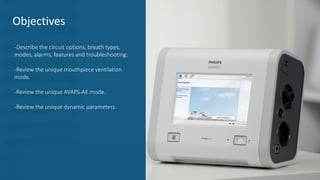
Objectives
-Describe the circuit options, breath types,
modes, alarms, features and troubleshooting.
-Review the unique mouthpiece ventilation
mode.
-Review the unique AVAPS-AE mode.
-Review the unique dynamic parameters.
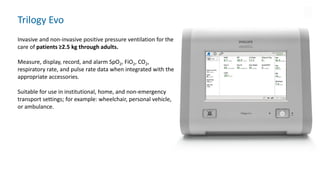
Trilogy Evo
Invasive and non-invasive positive pressure ventilation for the
care of patients ≥2.5 kg through adults.
Measure, display, record, and alarm SpO2, FiO2, CO2,
respiratory rate, and pulse rate data when integrated with the
appropriate accessories.
Suitable for use in institutional, home, and non-emergency
transport settings; for example: wheelchair, personal vehicle,
or ambulance.
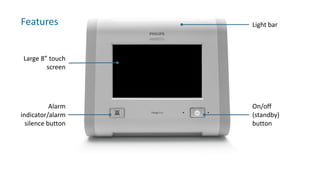
Features
Alarm
indicator/alarm
silence button
On/off
(standby)
button
Light bar
Large 8” touch
screen
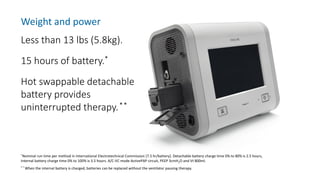
Less than 13 lbs (5.8kg).
15 hours of battery.*
Hot swappable detachable
battery provides
uninterrupted therapy.**
*Nominal run time per method in International Electrotechnical Commission (7.5 hr/battery). Detachable battery charge time 0% to 80% is 2.5 hours,
Internal battery charge time 0% to 100% is 3.5 hours. A/C-VC mode ActivePAP circuit, PEEP 3cmH2O and Vt 800ml.
* * When the internal battery is charged, batteries can be replaced without the ventilator pausing therapy.
Weight and power
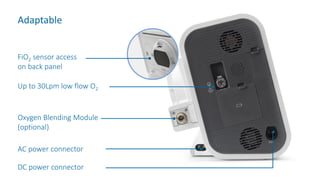
Adaptable
FiO2 sensor access
on back panel
Up to 30Lpm low flow O2
Oxygen Blending Module
(optional)
AC power connector
DC power connector
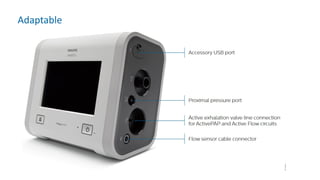
Adaptable
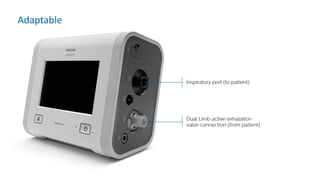
Adaptable
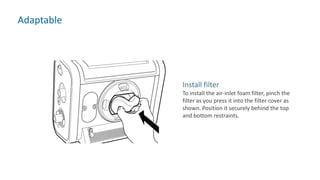
Adaptable
Install filter
To install the air-inlet foam filter, pinch the
filter as you press it into the filter cover as
shown. Position it securely behind the top
and bottom restraints.
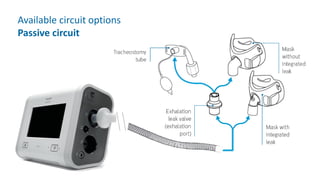
Available circuit options
Passive circuit
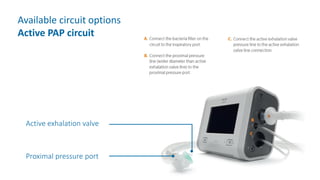
Available circuit options
Active PAP circuit
Proximal pressure port
Active exhalation valve
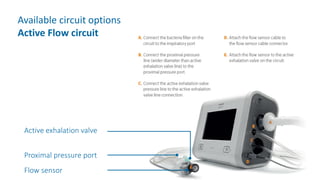
Available circuit options
Active Flow circuit
Proximal pressure port
Active exhalation valve
Flow sensor
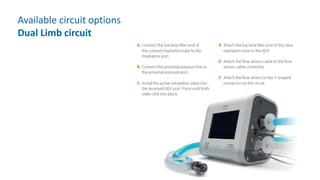
Available circuit options
Dual Limb circuit
Available circuit options
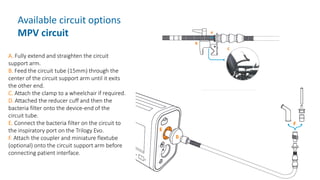
MPV circuit
A. Fully extend and straighten the circuit
support arm.
B. Feed the circuit tube (15mm) through the
center of the circuit support arm until it exits
the other end.
C. Attach the clamp to a wheelchair if required.
D. Attached the reducer cuff and then the
bacteria filter onto the device-end of the
circuit tube.
E. Connect the bacteria filter on the circuit to
the inspiratory port on the Trilogy Evo.
F. Attach the coupler and miniature flextube
(optional) onto the circuit support arm before
connecting patient interface.
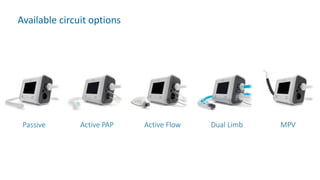
Available circuit options
Passive Active PAP Active Flow Dual Limb MPV
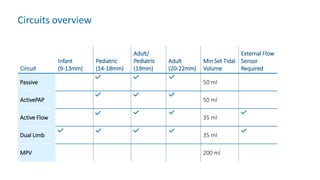
Circuits overview
Circuit
Infant
(9-13mm)
Pediatric
(14-18mm)
Adult/
Pediatric
(19mm)
Adult
(20-22mm)
Min Set Tidal
Volume
External Flow
Sensor
Required
Passive 50 ml
ActivePAP 50 ml
Active Flow 35 ml
Dual Limb 35 ml
MPV 200 ml
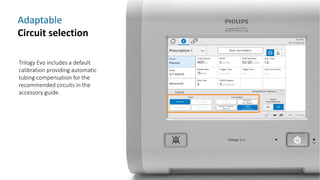
Adaptable
Circuit selection
Trilogy Evo includes a default
calibration providing automatic
tubing compensation for the
recommended circuits in the
accessory guide.
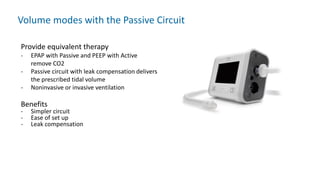
Volume modes with the Passive Circuit
Provide equivalent therapy
- EPAP with Passive and PEEP with Active
remove CO2
- Passive circuit with leak compensation delivers
the prescribed tidal volume
- Noninvasive or invasive ventilation
Benefits
- Simpler circuit
- Ease of set up
- Leak compensation
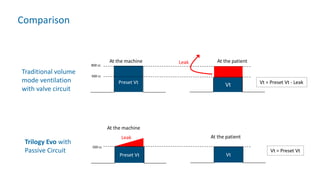
Preset Vt
At the machine At the patient
Vt
Preset Vt
At the machine
At the patient
Vt
Leak
Vt = Preset Vt
Vt = Preset Vt - Leak
Leak
800 cc
500 cc
500 cc
Traditional volume
mode ventilation
with valve circuit
Comparison
Trilogy Evo with
Passive Circuit
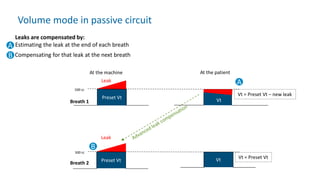
Leaks are compensated by:
Estimating the leak at the end of each breath
At the patient
Vt = Preset Vt – new leak
Vt
Breath 1
Breath 2 Preset Vt
Leak
Vt Vt = Preset Vt
Preset Vt
At the machine
Leak
500 cc
500 cc
Volume mode in passive circuit
A
B Compensating for that leak at the next breath
A
B
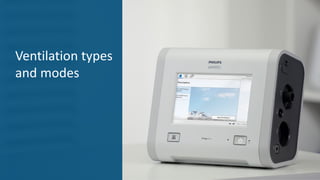
Ventilation types
and modes
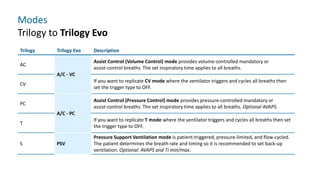
Modes
Trilogy to Trilogy Evo
Trilogy Trilogy Evo Description
AC
A/C - VC
Assist Control (Volume Control) mode provides volume-controlled mandatory or
assist-control breaths. The set inspiratory time applies to all breaths.
CV
If you want to replicate CV mode where the ventilator triggers and cycles all breaths then
set the trigger type to OFF.
PC
A/C - PC
Assist Control (Pressure Control) mode provides pressure-controlled mandatory or
assist-control breaths. The set inspiratory time applies to all breaths. Optional AVAPS.
T
If you want to replicate T mode where the ventilator triggers and cycles all breaths then set
the trigger type to OFF.
S PSV
Pressure Support Ventilation mode is patient-triggered, pressure-limited, and flow-cycled.
The patient determines the breath rate and timing so it is recommended to set back-up
ventilation. Optional: AVAPS and Ti min/max.
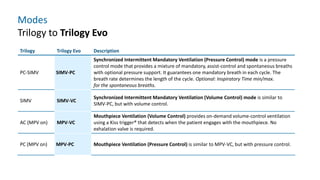
Trilogy Trilogy Evo Description
PC-SIMV SIMV-PC
Synchronized Intermittent Mandatory Ventilation (Pressure Control) mode is a pressure
control mode that provides a mixture of mandatory, assist-control and spontaneous breaths
with optional pressure support. It guarantees one mandatory breath in each cycle. The
breath rate determines the length of the cycle. Optional: Inspiratory Time min/max.
for the spontaneous breaths.
SIMV SIMV-VC
Synchronized Intermittent Mandatory Ventilation (Volume Control) mode is similar to
SIMV-PC, but with volume control.
AC (MPV on) MPV-VC
Mouthpiece Ventilation (Volume Control) provides on-demand volume-control ventilation
using a Kiss trigger® that detects when the patient engages with the mouthpiece. No
exhalation valve is required.
PC (MPV on) MPV-PC Mouthpiece Ventilation (Pressure Control) is similar to MPV-VC, but with pressure control.
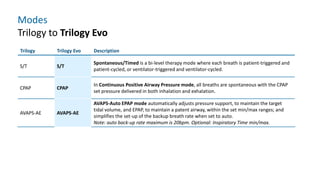
Modes
Trilogy to Trilogy Evo
Trilogy Trilogy Evo Description
S/T S/T
Spontaneous/Timed is a bi-level therapy mode where each breath is patient-triggered and
patient-cycled, or ventilator-triggered and ventilator-cycled.
CPAP CPAP
In Continuous Positive Airway Pressure mode, all breaths are spontaneous with the CPAP
set pressure delivered in both inhalation and exhalation.
AVAPS-AE AVAPS-AE
AVAPS-Auto EPAP mode automatically adjusts pressure support, to maintain the target
tidal volume, and EPAP, to maintain a patent airway, within the set min/max ranges; and
simplifies the set-up of the backup breath rate when set to auto.
Note: auto back-up rate maximum is 20bpm. Optional: Inspiratory Time min/max.
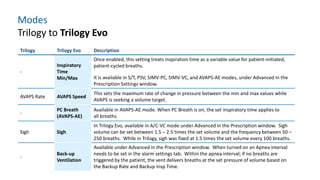
Modes
Trilogy to Trilogy Evo
Trilogy Trilogy Evo Description
-
Inspiratory
Time
Min/Max
Once enabled, this setting treats inspiration time as a variable value for patient-initiated,
patient-cycled breaths.
It is available in S/T, PSV, SIMV-PC, SIMV-VC, and AVAPS-AE modes, under Advanced in the
Prescription Settings window.
AVAPS Rate AVAPS Speed
This sets the maximum rate of change in pressure between the min and max values while
AVAPS is seeking a volume target.
-
PC Breath
(AVAPS-AE)
Available in AVAPS-AE mode. When PC Breath is on, the set inspiratory time applies to
all breaths.
Sigh Sigh
In Trilogy Evo, available in A/C-VC mode under Advanced in the Prescription window. Sigh
volume can be set between 1.5 – 2.5 times the set volume and the frequency between 50 –
250 breaths. While in Trilogy, sigh was fixed at 1.5 times the set volume every 100 breaths.
-
Back-up
Ventilation
Available under Advanced in the Prescription window. When turned on an Apnea interval
needs to be set in the alarm settings tab. Within the apnea interval; if no breaths are
triggered by the patient, the vent delivers breaths at the set pressure of volume based on
the Backup Rate and Backup Insp Time.
Modes
Trilogy to Trilogy Evo
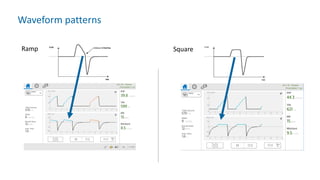
Waveform patterns
Ramp Square
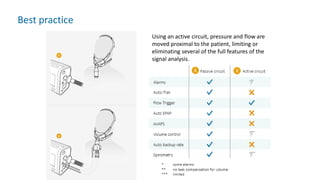
Best practice
Using an active circuit, pressure and flow are
moved proximal to the patient, limiting or
eliminating several of the full features of the
signal analysis.
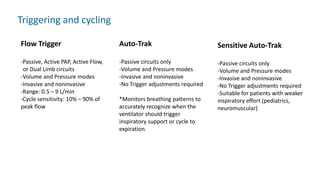
Triggering and cycling
Flow Trigger
-Passive, Active PAP, Active Flow,
or Dual Limb circuits
-Volume and Pressure modes
-Invasive and noninvasive
-Range: 0.5 – 9 L/min
-Cycle sensitivity: 10% – 90% of
peak flow
Auto-Trak
-Passive circuits only
-Volume and Pressure modes
-Invasive and noninvasive
-No Trigger adjustments required
*Monitors breathing patterns to
accurately recognize when the
ventilator should trigger
inspiratory support or cycle to
expiration.
Sensitive Auto-Trak
-Passive circuits only
-Volume and Pressure modes
-Invasive and noninvasive
-No Trigger adjustments required
-Suitable for patients with weaker
inspiratory effort (pediatrics,
neuromuscular)
29
Detects
Responds
Tracks
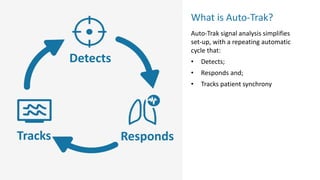
What is Auto-Trak?
Auto-Trak signal analysis simplifies
set-up, with a repeating automatic
cycle that:
• Detects;
• Responds and;
• Tracks patient synchrony
What is Auto-Trak? How does Auto-Trak work? The components of Auto-Trak
Auto-Trak
The components of Auto-Trak
Triggering
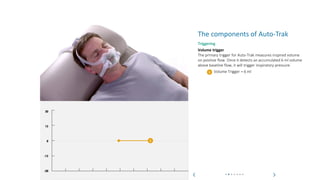
Volume trigger
The primary trigger for Auto-Trak measures inspired volume
on positive flow. Once it detects an accumulated 6 ml volume
above baseline flow, it will trigger inspiratory pressure.
Volume Trigger = 6 ml
1
30
15
0
-15
-30
1
What is Auto-Trak? How does Auto-Trak work? The components of Auto-Trak
Auto-Trak
The components of Auto-Trak
Triggering
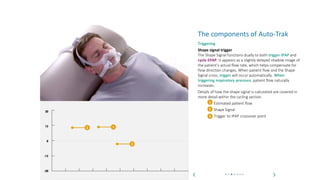
Shape signal trigger
The Shape Signal functions dually to both trigger IPAP and
cycle EPAP. It appears as a slightly delayed shadow image of
the patient’s actual flow rate, which helps compensate for
flow direction changes. When patient flow and the Shape
Signal cross, trigger will occur automatically. When
triggering inspiratory pressure, patient flow naturally
increases.
Details of how the shape signal is calculated are covered in
more detail within the cycling section.
Estimated patient flow
Shape Signal
Trigger to IPAP crossover point
1
2
3
30
15
0
-15
-30
1
2
3
What is Auto-Trak? How does Auto-Trak work? The components of Auto-Trak
Auto-Trak
The components of Auto-Trak
Triggering
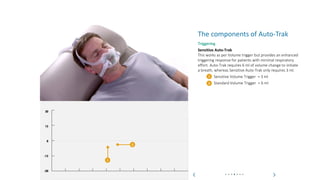
Sensitive Auto-Trak
This works as per Volume trigger but provides an enhanced
triggering response for patients with minimal respiratory
effort. Auto-Trak requires 6 ml of volume change to initiate
a breath, whereas Sensitive Auto-Trak only requires 3 ml.
Sensitive Volume Trigger = 3 ml
Standard Volume Trigger = 6 ml
1
2
30
15
0
-15
-30
1
2
TIME
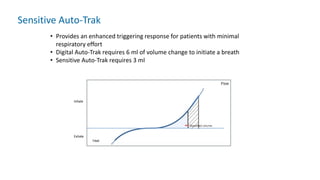
Sensitive Auto-Trak
• Provides an enhanced triggering response for patients with minimal
respiratory effort
• Digital Auto-Trak requires 6 ml of volume change to initiate a breath
• Sensitive Auto-Trak requires 3 ml
Inhale
Exhale
What is Auto-Trak? How does Auto-Trak work? The components of Auto-Trak
Auto-Trak
The components of Auto-Trak
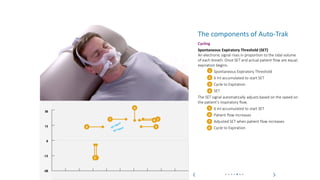
Cycling
Spontaneous Expiratory Threshold (SET)
An electronic signal rises in proportion to the tidal volume
of each breath. Once SET and actual patient flow are equal,
expiration begins.
Spontaneous Expiratory Threshold
6 ml accumulated to start SET
Cycle to Expiration
SET
The SET signal automatically adjusts based on the speed on
the patient’s inspiratory flow.
6 ml accumulated to start SET
Patient flow increases
Adjusted SET when patient flow increases
Cycle to Expiration
1
2
3
4
5
6
7
8
30
15
0
-15
-30
1
2
3
4
5
6
7 8
What is Auto-Trak? How does Auto-Trak work? The components of Auto-Trak
Auto-Trak
The components of Auto-Trak
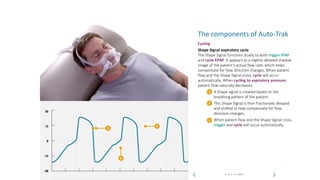
Cycling
Shape Signal expiratory cycle
The Shape Signal functions dually to both trigger IPAP
and cycle EPAP. It appears as a slightly delayed shadow
image of the patient’s actual flow rate, which helps
compensate for flow direction changes. When patient
flow and the Shape Signal cross, cycle will occur
automatically. When cycling to expiratory pressure,
patient flow naturally decreases.
A Shape signal is created based on the
breathing pattern of the patient.
This Shape Signal is then fractionally delayed
and shifted to help compensate for flow
direction changes.
When patient flow and the Shape Signal cross,
trigger and cycle will occur automatically.
1
2
3
30
15
0
-15
-30
1
2
3
3
What is Auto-Trak? How does Auto-Trak work? The components of Auto-Trak
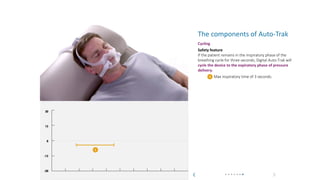
Auto-Trak
The components of Auto-Trak
Cycling
Safety feature
If the patient remains in the inspiratory phase of the
breathing cycle for three seconds, Digital Auto-Trak will
cycle the device to the expiratory phase of pressure
delivery.
Max inspiratory time of 3 seconds.
1
30
15
0
-15
-30
1
AVAPS-AE is a auto-titration mode of noninvasive ventilation designed to
better treat respiratory insufficiency patients (OHS, COPD and NMD) in the
hospital and homecare environments
Achieving a targeted volume is completely automatic
• Auto Pressure Support
• Auto EPAP
• Auto backup rate
AVAPS-AE
- Adjustable AVAPS allows you to adjust the maximum rate at which the
pressure support automatically changes to achieve the target tidal volume
- It can be set from 1 cm H2O per minute to 5 cm H2O per minute
- Allows clinician to customize the setting to the patient’s needs
Adjustable AVAPS
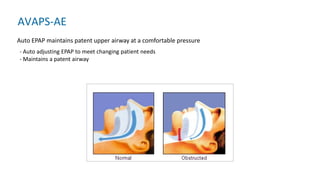
- Auto adjusting EPAP to meet changing patient needs
- Maintains a patent airway
Auto EPAP maintains patent upper airway at a comfortable pressure
AVAPS-AE
Auto Back-up rate
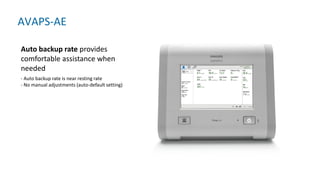
- Auto backup rate is near resting rate
- No manual adjustments (auto-default setting)
Auto backup rate provides
comfortable assistance when
needed
AVAPS-AE
Mouthpiece Ventilation (MPV)
Expanding ventilatory support
MPV
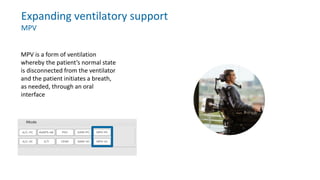
MPV is a form of ventilation
whereby the patient’s normal state
is disconnected from the ventilator
and the patient initiates a breath,
as needed, through an oral
interface
Patient selection
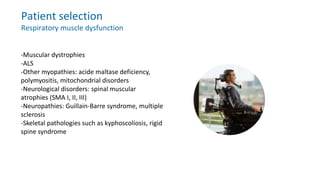
Respiratory muscle dysfunction
-Muscular dystrophies
-ALS
-Other myopathies: acide maltase deficiency,
polymyositis, mitochondrial disorders
-Neurological disorders: spinal muscular
atrophies (SMA I, II, III)
-Neuropathies: Guillain-Barre syndrome, multiple
sclerosis
-Skeletal pathologies such as kyphoscoliosis, rigid
spine syndrome
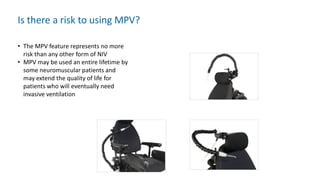
Is there a risk to using MPV?
• The MPV feature represents no more
risk than any other form of NIV
• MPV may be used an entire lifetime by
some neuromuscular patients and
may extend the quality of life for
patients who will eventually need
invasive ventilation
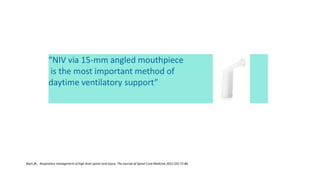
“NIV via 15-mm angled mouthpiece
is the most important method of
daytime ventilatory support”
Bach,JR., Respiratory management of high level spinal cord injury, The Journal of Spinal Cord Medicine.2012 (35) 72-80.
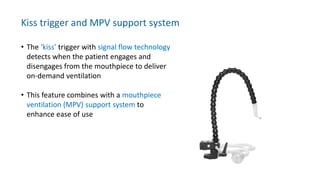
Kiss trigger and MPV support system
• The ‘kiss’ trigger with signal flow technology
detects when the patient engages and
disengages from the mouthpiece to deliver
on-demand ventilation
• This feature combines with a mouthpiece
ventilation (MPV) support system to
enhance ease of use
MPV history
• MPV technique originated in 1950’s as a
therapeutic adjunct for dyspnea in polio
patients
• John E. Affeldt of Rancho Los Amigos
Hospital
– IPPV with a mouthpiece could relieve dyspnea
in ventilator-dependent polio patients
– Used when negative pressure was interrupted
by transfers, nursing care, physical therapy
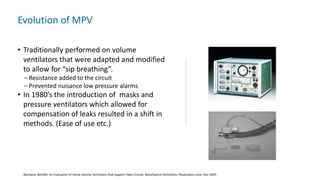
Evolution of MPV
• Traditionally performed on volume
ventilators that were adapted and modified
to allow for “sip breathing”.
– Resistance added to the circuit
– Prevented nuisance low pressure alarms
• In 1980’s the introduction of masks and
pressure ventilators which allowed for
compensation of leaks resulted in a shift in
methods. (Ease of use etc.)
Bointano, Benditt; An Evaluation of Home volume Ventilators that Support Open-Circuit, Mouthpiece Ventilation, Respiratory Care, Nov 2005.
• Neuromuscular disease
• Polio Myelitis
• Duchene Muscular Dystrophy (DMD)
• Quadriplegia (SCI)
• Amyotrophic Lateral Sclerosis (ALS)
• Multiple Sclerosis (MS)
• NIV dependent patients – breaks for activities of daily living
Disease state targets
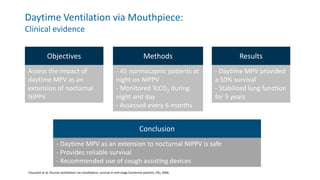
Daytime Ventilation via Mouthpiece:
Clinical evidence
Toussaint et al, Diurnal ventilations via mouthpiece: survival in end-stage Duchenne patients, ERJ, 2006.
Objectives Methods
Assess the impact of
daytime MPV as an
extension of nocturnal
NIPPV
- 45 normocapnic patients at
night on NIPPV
- Monitored TcCO2 during
night and day
- Assessed every 6 months
Results
- Daytime MPV provided
a 50% survival
- Stabilized lung function
for 5 years
Conclusion
- Daytime MPV as an extension to nocturnal NIPPV is safe
- Provides reliable survival
- Recommended use of cough assisting devices
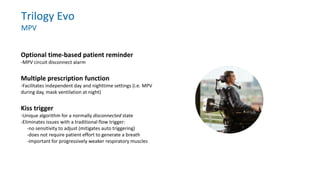
Trilogy Evo
MPV
Optional time-based patient reminder
-MPV circuit disconnect alarm
Multiple prescription function
-Facilitates independent day and nighttime settings (i.e. MPV
during day, mask ventilation at night)
Kiss trigger
-Unique algorithm for a normally disconnected state
-Eliminates issues with a traditional flow trigger:
-no sensitivity to adjust (mitigates auto triggering)
-does not require patient effort to generate a breath
-important for progressively weaker respiratory muscles
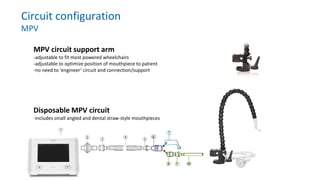
Circuit configuration
MPV
MPV circuit support arm
-adjustable to fit most powered wheelchairs
-adjustable to optimize position of mouthpiece to patient
-no need to ‘engineer’ circuit and connection/support
Disposable MPV circuit
-includes small angled and dental straw-style mouthpieces
Research evidence
Mouthpiece ventilation
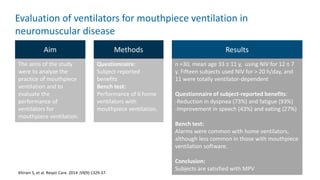
Evaluation of ventilators for mouthpiece ventilation in neuromuscular disease.
Khirani S, et al. Respir Care. 2014 ;59(9):1329-37.
Evaluation of ventilators for mouthpiece ventilation in
neuromuscular disease
Khirani S, et al. Respir Care. 2014 ;59(9):1329-37.
Aim Methods
The aims of the study
were to analyze the
practice of mouthpiece
ventilation and to
evaluate the
performance of
ventilators for
mouthpiece ventilation.
Questionnaire:
Subject-reported
benefits
Bench test:
Performance of 6 home
ventilators with
mouthpiece ventilation.
Results
n =30, mean age 33 ± 11 y, using NIV for 12 ± 7
y. Fifteen subjects used NIV for > 20 h/day, and
11 were totally ventilator-dependent
Questionnaire of subject-reported benefits:
-Reduction in dyspnea (73%) and fatigue (93%)
-Improvement in speech (43%) and eating (27%)
Bench test:
Alarms were common with home ventilators,
although less common in those with mouthpiece
ventilation software.
Conclusion:
Subjects are satisfied with MPV
Understanding the Trilogy Evo
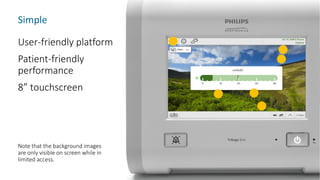
Simple
User-friendly platform
Patient-friendly
performance
8” touchscreen
Note that the background images
are only visible on screen while in
limited access.
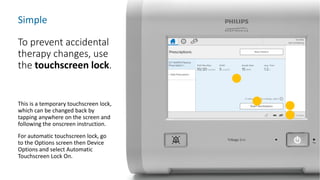
Simple
To prevent accidental
therapy changes, use
the touchscreen lock.
This is a temporary touchscreen lock,
which can be changed back by
tapping anywhere on the screen and
following the onscreen instruction.
For automatic touchscreen lock, go
to the Options screen then Device
Options and select Automatic
Touchscreen Lock On.
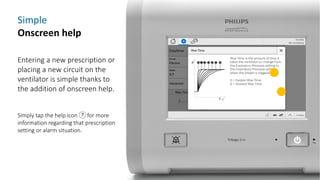
Simple
Onscreen help
Entering a new prescription or
placing a new circuit on the
ventilator is simple thanks to
the addition of onscreen help.
Simply tap the help icon for more
information regarding that prescription
setting or alarm situation.
Simple
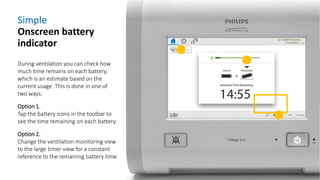
Onscreen battery
indicator
During ventilation you can check how
much time remains on each battery,
which is an estimate based on the
current usage. This is done in one of
two ways.
Option 1.
Tap the battery icons in the toolbar to
see the time remaining on each battery.
Option 2.
Change the ventilation monitoring view
to the large timer view for a constant
reference to the remaining battery time.
Connected
Connected
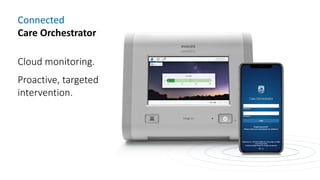
Care Orchestrator
Cloud monitoring.
Proactive, targeted
intervention.
Connected
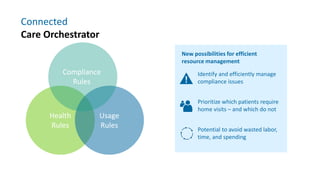
Care Orchestrator
New possibilities for efficient
resource management
Identify and efficiently manage
compliance issues
Prioritize which patients require
home visits – and which do not
Potential to avoid wasted labor,
time, and spending
Health
Rules
Usage
Rules
Compliance
Rules
Connected
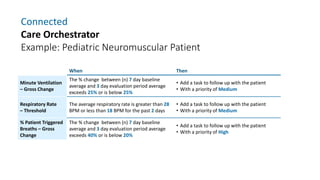
Care Orchestrator
Example: Pediatric Neuromuscular Patient
When Then
Minute Ventilation
– Gross Change
The % change between (n) 7 day baseline
average and 3 day evaluation period average
exceeds 25% or is below 25%
• Add a task to follow up with the patient
• With a priority of Medium
Respiratory Rate
– Threshold
The average respiratory rate is greater than 28
BPM or less than 18 BPM for the past 2 days
• Add a task to follow up with the patient
• With a priority of Medium
% Patient Triggered
Breaths – Gross
Change
The % change between (n) 7 day baseline
average and 3 day evaluation period average
exceeds 40% or is below 20%
• Add a task to follow up with the patient
• With a priority of High
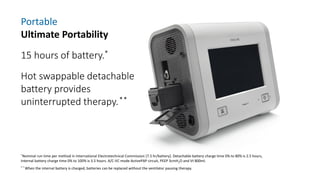
Portable
Portable
Ultimate Portability
15 hours of battery.*
Hot swappable detachable
battery provides
uninterrupted therapy.**
*Nominal run time per method in International Electrotechnical Commission (7.5 hr/battery). Detachable battery charge time 0% to 80% is 2.5 hours,
Internal battery charge time 0% to 100% is 3.5 hours. A/C-VC mode ActivePAP circuit, PEEP 3cmH2O and Vt 800ml.
* * When the internal battery is charged, batteries can be replaced without the ventilator pausing therapy.
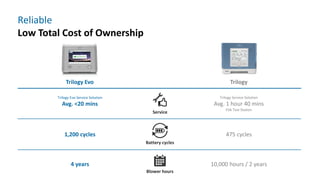
Reliable
Reliable
Low Total Cost of Ownership
Service
Battery cycles
Blower hours
Trilogy Evo Trilogy
Trilogy Evo Service Solution
Avg. <20 mins
Trilogy Service Solution
Avg. 1 hour 40 mins
FSA Test Station
1,200 cycles 475 cycles
4 years 10,000 hours / 2 years
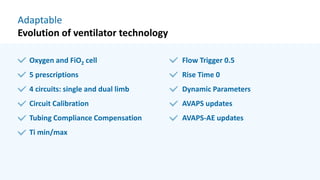
Adaptable
Adaptable
Seamlessly transition across care environments
utilizing the same clinical technology
Different care
settings
Same clinical
technology
Adaptable
Evolution of ventilator technology
Oxygen and FiO2 cell
5 prescriptions
4 circuits: single and dual limb
Circuit Calibration
Tubing Compliance Compensation
Ti min/max
Flow Trigger 0.5
Rise Time 0
Dynamic Parameters
AVAPS updates
AVAPS-AE updates
Adaptable
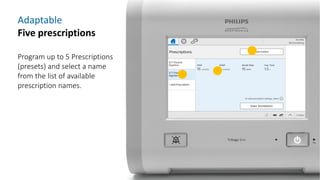
Five prescriptions
Program up to 5 Prescriptions
(presets) and select a name
from the list of available
prescription names.
Adaptable
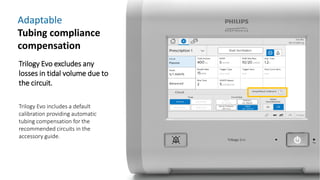
Tubing compliance
compensation
Trilogy Evo excludes any
losses in tidal volume due to
the circuit.
Trilogy Evo includes a default
calibration providing automatic
tubing compensation for the
recommended circuits in the
accessory guide.
Adaptable
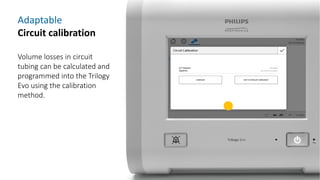
Circuit calibration
Volume losses in circuit
tubing can be calculated and
programmed into the Trilogy
Evo using the calibration
method.
Adaptable
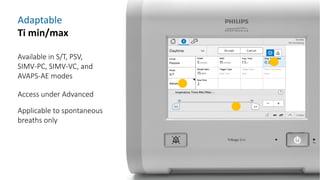
Ti min/max
Available in S/T, PSV,
SIMV-PC, SIMV-VC, and
AVAPS-AE modes
Access under Advanced
Applicable to spontaneous
breaths only
Adaptable
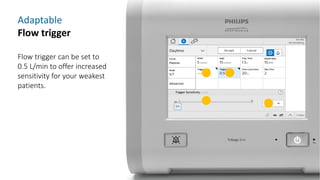
Flow trigger
Flow trigger can be set to
0.5 L/min to offer increased
sensitivity for your weakest
patients.
Adaptable
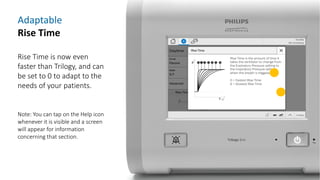
Rise Time
Rise Time is now even
faster than Trilogy, and can
be set to 0 to adapt to the
needs of your patients.
Note: You can tap on the Help icon
whenever it is visible and a screen
will appear for information
concerning that section.
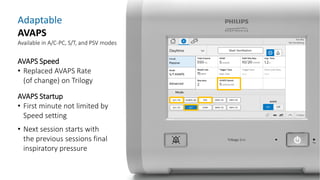
AVAPS Speed
• Replaced AVAPS Rate
(of change) on Trilogy
AVAPS Startup
• First minute not limited by
Speed setting
• Next session starts with
the previous sessions final
inspiratory pressure
Adaptable
AVAPS
Available in A/C-PC, S/T, and PSV modes
Adaptable
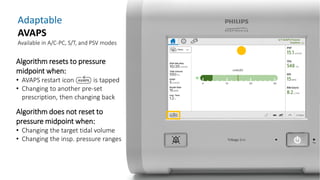
AVAPS
Available in A/C-PC, S/T, and PSV modes
Algorithm resets to pressure
midpoint when:
• AVAPS restart icon is tapped
• Changing to another pre-set
prescription, then changing back
Algorithm does not reset to
pressure midpoint when:
• Changing the target tidal volume
• Changing the insp. pressure ranges
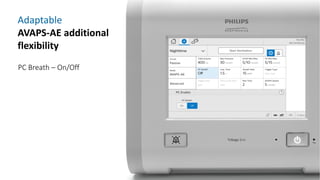
PC Breath – On/Off
Adaptable
AVAPS-AE additional
flexibility
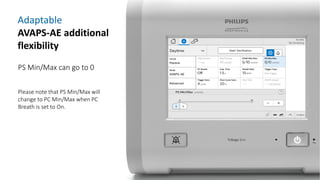
PS Min/Max can go to 0
Please note that PS Min/Max will
change to PC Min/Max when PC
Breath is set to On.
Adaptable
AVAPS-AE additional
flexibility
Adaptable
AVAPS-AE additional
flexibility
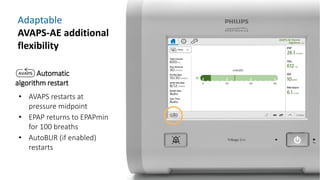
Automatic
algorithm restart
• AVAPS restarts at
pressure midpoint
• EPAP returns to EPAPmin
for 100 breaths
• AutoBUR (if enabled)
restarts
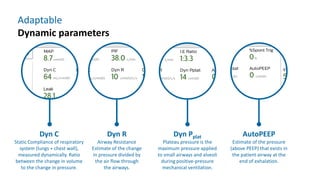
Dyn C
Static Compliance of respiratory
system (lungs + chest wall),
measured dynamically. Ratio
between the change in volume
to the change in pressure.
Adaptable
Dynamic parameters
Dyn R
Airway Resistance
Estimate of the change
in pressure divided by
the air flow through
the airways.
Dyn Pplat
Plateau pressure is the
maximum pressure applied
to small airways and alveoli
during positive-pressure
mechanical ventilation.
AutoPEEP
Estimate of the pressure
(above PEEP) that exists in
the patient airway at the
end of exhalation.
Adaptable
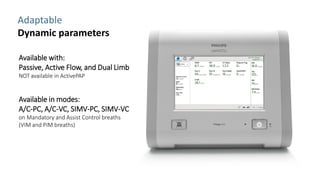
Dynamic parameters
Available with:
Passive, Active Flow, and Dual Limb
NOT available in ActivePAP
Available in modes:
A/C-PC, A/C-VC, SIMV-PC, SIMV-VC
on Mandatory and Assist Control breaths
(VIM and PIM breaths)
Adaptable
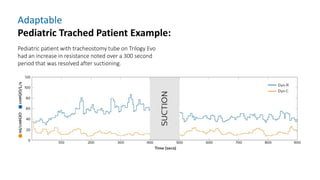
Pediatric Trached Patient Example:
Pediatric patient with tracheostomy tube on Trilogy Evo
had an increase in resistance noted over a 300 second
period that was resolved after suctioning.
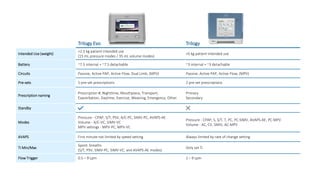
Trilogy Evo Trilogy
Intended Use (weight)
>2.5 kg patient intended use
(15 mL pressure modes / 35 mL volume modes)
>5 kg patient intended use
Battery ~7.5 internal + ~7.5 detachable ~3 internal + ~3 detachable
Circuits Passive, Active PAP, Active Flow, Dual Limb, (MPV) Passive, Active PAP, Active Flow, (MPV)
Pre-sets 5 pre-set prescriptions 2 pre-set prescriptions
Prescription naming
Prescription #, Nighttime, Mouthpiece, Transport,
Exacerbation, Daytime, Exercise, Weaning, Emergency, Other
Primary
Secondary
Standby
Modes
Pressure - CPAP, S/T, PSV, A/C-PC, SIMV-PC, AVAPS-AE
Volume - A/C-VC, SIMV-VC
MPV settings - MPV-PC, MPV-VC
Pressure - CPAP, S, S/T, T, PC, PC-SIMV, AVAPS-AE, PC-MPV
Volume - AC, CV, SMIV, AC-MPV
AVAPS First minute not limited by speed setting Always limited by rate of change setting
Ti Min/Max
Spont. breaths
(S/T, PSV, SIMV-PC, SIMV-VC, and AVAPS-AE modes)
Only set Ti
Flow Trigger 0.5 – 9 Lpm 1 – 9 Lpm
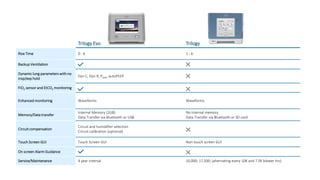
Trilogy Evo Trilogy
Rise Time 0 - 6 1 - 6
Backup Ventilation
Dynamic lung parameters with no
insp/exp hold
Dyn C, Dyn R, Pplat, autoPEEP
FiO2 sensor and EtCO2 monitoring
Enhanced monitoring Waveforms Waveforms
Memory/Data transfer
Internal Memory (2GB)
Data Transfer via Bluetooth or USB
No internal memory
Data Transfer via Bluetooth or SD card
Circuit compensation
Circuit and humidifier selection
Circuit calibration (optional)
Touch Screen GUI Touch Screen GUI Non-touch screen GUI
On screen Alarm Guidance
Service/Maintenance 4 year interval 10,000; 17,500; (alternating every 10K and 7.5K blower hrs)
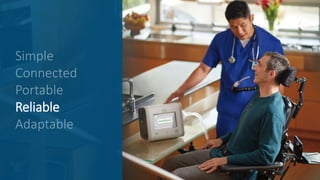
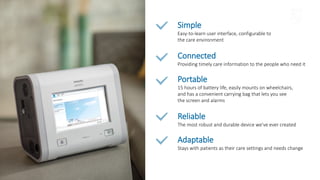
Simple
Easy-to-learn user interface, configurable to
the care environment
Connected
Providing timely care information to the people who need it
Portable
15 hours of battery life, easily mounts on wheelchairs,
and has a convenient carrying bag that lets you see
the screen and alarms
Reliable
The most robust and durable device we’ve ever created
Adaptable
Stays with patients as their care settings and needs change
CEU certificate
• To obtain your CEU certificate log on to
– https://www.ganesco.com/philips-attendee/login.php
– Log in or create a log in if you are a new user
– Complete the evaluation and print out your certificate.
• If you are claiming AARC credits, you must compete
the evaluation within 30 days or you will
not receive credit for the program.
Traning Slides home ventilation workshop trilogy evo.pdf

Traning Slides home ventilation workshop trilogy evo.pdf

  • 1.
  • 2.
    Objectives -Describe the circuitoptions, breath types, modes, alarms, features and troubleshooting. -Review the unique mouthpiece ventilation mode. -Review the unique AVAPS-AE mode. -Review the unique dynamic parameters.
  • 3.
    Trilogy Evo Invasive andnon-invasive positive pressure ventilation for the care of patients ≥2.5 kg through adults. Measure, display, record, and alarm SpO2, FiO2, CO2, respiratory rate, and pulse rate data when integrated with the appropriate accessories. Suitable for use in institutional, home, and non-emergency transport settings; for example: wheelchair, personal vehicle, or ambulance.
  • 4.
  • 5.
    Less than 13lbs (5.8kg). 15 hours of battery.* Hot swappable detachable battery provides uninterrupted therapy.** *Nominal run time per method in International Electrotechnical Commission (7.5 hr/battery). Detachable battery charge time 0% to 80% is 2.5 hours, Internal battery charge time 0% to 100% is 3.5 hours. A/C-VC mode ActivePAP circuit, PEEP 3cmH2O and Vt 800ml. * * When the internal battery is charged, batteries can be replaced without the ventilator pausing therapy. Weight and power
  • 6.
    Adaptable FiO2 sensor access onback panel Up to 30Lpm low flow O2 Oxygen Blending Module (optional) AC power connector DC power connector
  • 7.
  • 8.
  • 9.
    Adaptable Install filter To installthe air-inlet foam filter, pinch the filter as you press it into the filter cover as shown. Position it securely behind the top and bottom restraints.
  • 10.
  • 11.
    Available circuit options ActivePAP circuit Proximal pressure port Active exhalation valve
  • 12.
    Available circuit options ActiveFlow circuit Proximal pressure port Active exhalation valve Flow sensor
  • 13.
  • 14.
    Available circuit options MPVcircuit A. Fully extend and straighten the circuit support arm. B. Feed the circuit tube (15mm) through the center of the circuit support arm until it exits the other end. C. Attach the clamp to a wheelchair if required. D. Attached the reducer cuff and then the bacteria filter onto the device-end of the circuit tube. E. Connect the bacteria filter on the circuit to the inspiratory port on the Trilogy Evo. F. Attach the coupler and miniature flextube (optional) onto the circuit support arm before connecting patient interface.
  • 15.
    Available circuit options PassiveActive PAP Active Flow Dual Limb MPV
  • 16.
    Circuits overview Circuit Infant (9-13mm) Pediatric (14-18mm) Adult/ Pediatric (19mm) Adult (20-22mm) Min SetTidal Volume External Flow Sensor Required Passive 50 ml ActivePAP 50 ml Active Flow 35 ml Dual Limb 35 ml MPV 200 ml
  • 17.
    Adaptable Circuit selection Trilogy Evoincludes a default calibration providing automatic tubing compensation for the recommended circuits in the accessory guide.
  • 18.
    Volume modes withthe Passive Circuit Provide equivalent therapy - EPAP with Passive and PEEP with Active remove CO2 - Passive circuit with leak compensation delivers the prescribed tidal volume - Noninvasive or invasive ventilation Benefits - Simpler circuit - Ease of set up - Leak compensation
  • 19.
    Preset Vt At themachine At the patient Vt Preset Vt At the machine At the patient Vt Leak Vt = Preset Vt Vt = Preset Vt - Leak Leak 800 cc 500 cc 500 cc Traditional volume mode ventilation with valve circuit Comparison Trilogy Evo with Passive Circuit
  • 20.
    Leaks are compensatedby: Estimating the leak at the end of each breath At the patient Vt = Preset Vt – new leak Vt Breath 1 Breath 2 Preset Vt Leak Vt Vt = Preset Vt Preset Vt At the machine Leak 500 cc 500 cc Volume mode in passive circuit A B Compensating for that leak at the next breath A B
  • 21.
  • 22.
    Modes Trilogy to TrilogyEvo Trilogy Trilogy Evo Description AC A/C - VC Assist Control (Volume Control) mode provides volume-controlled mandatory or assist-control breaths. The set inspiratory time applies to all breaths. CV If you want to replicate CV mode where the ventilator triggers and cycles all breaths then set the trigger type to OFF. PC A/C - PC Assist Control (Pressure Control) mode provides pressure-controlled mandatory or assist-control breaths. The set inspiratory time applies to all breaths. Optional AVAPS. T If you want to replicate T mode where the ventilator triggers and cycles all breaths then set the trigger type to OFF. S PSV Pressure Support Ventilation mode is patient-triggered, pressure-limited, and flow-cycled. The patient determines the breath rate and timing so it is recommended to set back-up ventilation. Optional: AVAPS and Ti min/max.
  • 23.
    Trilogy Trilogy EvoDescription PC-SIMV SIMV-PC Synchronized Intermittent Mandatory Ventilation (Pressure Control) mode is a pressure control mode that provides a mixture of mandatory, assist-control and spontaneous breaths with optional pressure support. It guarantees one mandatory breath in each cycle. The breath rate determines the length of the cycle. Optional: Inspiratory Time min/max. for the spontaneous breaths. SIMV SIMV-VC Synchronized Intermittent Mandatory Ventilation (Volume Control) mode is similar to SIMV-PC, but with volume control. AC (MPV on) MPV-VC Mouthpiece Ventilation (Volume Control) provides on-demand volume-control ventilation using a Kiss trigger® that detects when the patient engages with the mouthpiece. No exhalation valve is required. PC (MPV on) MPV-PC Mouthpiece Ventilation (Pressure Control) is similar to MPV-VC, but with pressure control. Modes Trilogy to Trilogy Evo
  • 24.
    Trilogy Trilogy EvoDescription S/T S/T Spontaneous/Timed is a bi-level therapy mode where each breath is patient-triggered and patient-cycled, or ventilator-triggered and ventilator-cycled. CPAP CPAP In Continuous Positive Airway Pressure mode, all breaths are spontaneous with the CPAP set pressure delivered in both inhalation and exhalation. AVAPS-AE AVAPS-AE AVAPS-Auto EPAP mode automatically adjusts pressure support, to maintain the target tidal volume, and EPAP, to maintain a patent airway, within the set min/max ranges; and simplifies the set-up of the backup breath rate when set to auto. Note: auto back-up rate maximum is 20bpm. Optional: Inspiratory Time min/max. Modes Trilogy to Trilogy Evo
  • 25.
    Trilogy Trilogy EvoDescription - Inspiratory Time Min/Max Once enabled, this setting treats inspiration time as a variable value for patient-initiated, patient-cycled breaths. It is available in S/T, PSV, SIMV-PC, SIMV-VC, and AVAPS-AE modes, under Advanced in the Prescription Settings window. AVAPS Rate AVAPS Speed This sets the maximum rate of change in pressure between the min and max values while AVAPS is seeking a volume target. - PC Breath (AVAPS-AE) Available in AVAPS-AE mode. When PC Breath is on, the set inspiratory time applies to all breaths. Sigh Sigh In Trilogy Evo, available in A/C-VC mode under Advanced in the Prescription window. Sigh volume can be set between 1.5 – 2.5 times the set volume and the frequency between 50 – 250 breaths. While in Trilogy, sigh was fixed at 1.5 times the set volume every 100 breaths. - Back-up Ventilation Available under Advanced in the Prescription window. When turned on an Apnea interval needs to be set in the alarm settings tab. Within the apnea interval; if no breaths are triggered by the patient, the vent delivers breaths at the set pressure of volume based on the Backup Rate and Backup Insp Time. Modes Trilogy to Trilogy Evo
  • 26.
  • 27.
    Best practice Using anactive circuit, pressure and flow are moved proximal to the patient, limiting or eliminating several of the full features of the signal analysis.
  • 28.
    Triggering and cycling FlowTrigger -Passive, Active PAP, Active Flow, or Dual Limb circuits -Volume and Pressure modes -Invasive and noninvasive -Range: 0.5 – 9 L/min -Cycle sensitivity: 10% – 90% of peak flow Auto-Trak -Passive circuits only -Volume and Pressure modes -Invasive and noninvasive -No Trigger adjustments required *Monitors breathing patterns to accurately recognize when the ventilator should trigger inspiratory support or cycle to expiration. Sensitive Auto-Trak -Passive circuits only -Volume and Pressure modes -Invasive and noninvasive -No Trigger adjustments required -Suitable for patients with weaker inspiratory effort (pediatrics, neuromuscular)
  • 29.
    29 Detects Responds Tracks What is Auto-Trak? Auto-Traksignal analysis simplifies set-up, with a repeating automatic cycle that: • Detects; • Responds and; • Tracks patient synchrony
  • 30.
    What is Auto-Trak?How does Auto-Trak work? The components of Auto-Trak Auto-Trak The components of Auto-Trak Triggering Volume trigger The primary trigger for Auto-Trak measures inspired volume on positive flow. Once it detects an accumulated 6 ml volume above baseline flow, it will trigger inspiratory pressure. Volume Trigger = 6 ml 1 30 15 0 -15 -30 1
  • 31.
    What is Auto-Trak?How does Auto-Trak work? The components of Auto-Trak Auto-Trak The components of Auto-Trak Triggering Shape signal trigger The Shape Signal functions dually to both trigger IPAP and cycle EPAP. It appears as a slightly delayed shadow image of the patient’s actual flow rate, which helps compensate for flow direction changes. When patient flow and the Shape Signal cross, trigger will occur automatically. When triggering inspiratory pressure, patient flow naturally increases. Details of how the shape signal is calculated are covered in more detail within the cycling section. Estimated patient flow Shape Signal Trigger to IPAP crossover point 1 2 3 30 15 0 -15 -30 1 2 3
  • 32.
    What is Auto-Trak?How does Auto-Trak work? The components of Auto-Trak Auto-Trak The components of Auto-Trak Triggering Sensitive Auto-Trak This works as per Volume trigger but provides an enhanced triggering response for patients with minimal respiratory effort. Auto-Trak requires 6 ml of volume change to initiate a breath, whereas Sensitive Auto-Trak only requires 3 ml. Sensitive Volume Trigger = 3 ml Standard Volume Trigger = 6 ml 1 2 30 15 0 -15 -30 1 2
  • 33.
    TIME Sensitive Auto-Trak • Providesan enhanced triggering response for patients with minimal respiratory effort • Digital Auto-Trak requires 6 ml of volume change to initiate a breath • Sensitive Auto-Trak requires 3 ml Inhale Exhale
  • 34.
    What is Auto-Trak?How does Auto-Trak work? The components of Auto-Trak Auto-Trak The components of Auto-Trak Cycling Spontaneous Expiratory Threshold (SET) An electronic signal rises in proportion to the tidal volume of each breath. Once SET and actual patient flow are equal, expiration begins. Spontaneous Expiratory Threshold 6 ml accumulated to start SET Cycle to Expiration SET The SET signal automatically adjusts based on the speed on the patient’s inspiratory flow. 6 ml accumulated to start SET Patient flow increases Adjusted SET when patient flow increases Cycle to Expiration 1 2 3 4 5 6 7 8 30 15 0 -15 -30 1 2 3 4 5 6 7 8
  • 35.
    What is Auto-Trak?How does Auto-Trak work? The components of Auto-Trak Auto-Trak The components of Auto-Trak Cycling Shape Signal expiratory cycle The Shape Signal functions dually to both trigger IPAP and cycle EPAP. It appears as a slightly delayed shadow image of the patient’s actual flow rate, which helps compensate for flow direction changes. When patient flow and the Shape Signal cross, cycle will occur automatically. When cycling to expiratory pressure, patient flow naturally decreases. A Shape signal is created based on the breathing pattern of the patient. This Shape Signal is then fractionally delayed and shifted to help compensate for flow direction changes. When patient flow and the Shape Signal cross, trigger and cycle will occur automatically. 1 2 3 30 15 0 -15 -30 1 2 3 3
  • 36.
    What is Auto-Trak?How does Auto-Trak work? The components of Auto-Trak Auto-Trak The components of Auto-Trak Cycling Safety feature If the patient remains in the inspiratory phase of the breathing cycle for three seconds, Digital Auto-Trak will cycle the device to the expiratory phase of pressure delivery. Max inspiratory time of 3 seconds. 1 30 15 0 -15 -30 1
  • 37.
    AVAPS-AE is aauto-titration mode of noninvasive ventilation designed to better treat respiratory insufficiency patients (OHS, COPD and NMD) in the hospital and homecare environments Achieving a targeted volume is completely automatic • Auto Pressure Support • Auto EPAP • Auto backup rate AVAPS-AE
  • 38.
    - Adjustable AVAPSallows you to adjust the maximum rate at which the pressure support automatically changes to achieve the target tidal volume - It can be set from 1 cm H2O per minute to 5 cm H2O per minute - Allows clinician to customize the setting to the patient’s needs Adjustable AVAPS
  • 39.
    - Auto adjustingEPAP to meet changing patient needs - Maintains a patent airway Auto EPAP maintains patent upper airway at a comfortable pressure AVAPS-AE
  • 40.
    Auto Back-up rate -Auto backup rate is near resting rate - No manual adjustments (auto-default setting) Auto backup rate provides comfortable assistance when needed AVAPS-AE
  • 41.
  • 42.
    Expanding ventilatory support MPV MPVis a form of ventilation whereby the patient’s normal state is disconnected from the ventilator and the patient initiates a breath, as needed, through an oral interface
  • 43.
    Patient selection Respiratory muscledysfunction -Muscular dystrophies -ALS -Other myopathies: acide maltase deficiency, polymyositis, mitochondrial disorders -Neurological disorders: spinal muscular atrophies (SMA I, II, III) -Neuropathies: Guillain-Barre syndrome, multiple sclerosis -Skeletal pathologies such as kyphoscoliosis, rigid spine syndrome
  • 44.
    Is there arisk to using MPV? • The MPV feature represents no more risk than any other form of NIV • MPV may be used an entire lifetime by some neuromuscular patients and may extend the quality of life for patients who will eventually need invasive ventilation
  • 45.
    “NIV via 15-mmangled mouthpiece is the most important method of daytime ventilatory support” Bach,JR., Respiratory management of high level spinal cord injury, The Journal of Spinal Cord Medicine.2012 (35) 72-80.
  • 46.
    Kiss trigger andMPV support system • The ‘kiss’ trigger with signal flow technology detects when the patient engages and disengages from the mouthpiece to deliver on-demand ventilation • This feature combines with a mouthpiece ventilation (MPV) support system to enhance ease of use
  • 47.
    MPV history • MPVtechnique originated in 1950’s as a therapeutic adjunct for dyspnea in polio patients • John E. Affeldt of Rancho Los Amigos Hospital – IPPV with a mouthpiece could relieve dyspnea in ventilator-dependent polio patients – Used when negative pressure was interrupted by transfers, nursing care, physical therapy
  • 48.
    Evolution of MPV •Traditionally performed on volume ventilators that were adapted and modified to allow for “sip breathing”. – Resistance added to the circuit – Prevented nuisance low pressure alarms • In 1980’s the introduction of masks and pressure ventilators which allowed for compensation of leaks resulted in a shift in methods. (Ease of use etc.) Bointano, Benditt; An Evaluation of Home volume Ventilators that Support Open-Circuit, Mouthpiece Ventilation, Respiratory Care, Nov 2005.
  • 49.
    • Neuromuscular disease •Polio Myelitis • Duchene Muscular Dystrophy (DMD) • Quadriplegia (SCI) • Amyotrophic Lateral Sclerosis (ALS) • Multiple Sclerosis (MS) • NIV dependent patients – breaks for activities of daily living Disease state targets
  • 50.
    Daytime Ventilation viaMouthpiece: Clinical evidence Toussaint et al, Diurnal ventilations via mouthpiece: survival in end-stage Duchenne patients, ERJ, 2006. Objectives Methods Assess the impact of daytime MPV as an extension of nocturnal NIPPV - 45 normocapnic patients at night on NIPPV - Monitored TcCO2 during night and day - Assessed every 6 months Results - Daytime MPV provided a 50% survival - Stabilized lung function for 5 years Conclusion - Daytime MPV as an extension to nocturnal NIPPV is safe - Provides reliable survival - Recommended use of cough assisting devices
  • 51.
    Trilogy Evo MPV Optional time-basedpatient reminder -MPV circuit disconnect alarm Multiple prescription function -Facilitates independent day and nighttime settings (i.e. MPV during day, mask ventilation at night) Kiss trigger -Unique algorithm for a normally disconnected state -Eliminates issues with a traditional flow trigger: -no sensitivity to adjust (mitigates auto triggering) -does not require patient effort to generate a breath -important for progressively weaker respiratory muscles
  • 52.
    Circuit configuration MPV MPV circuitsupport arm -adjustable to fit most powered wheelchairs -adjustable to optimize position of mouthpiece to patient -no need to ‘engineer’ circuit and connection/support Disposable MPV circuit -includes small angled and dental straw-style mouthpieces
  • 53.
    Research evidence Mouthpiece ventilation Evaluationof ventilators for mouthpiece ventilation in neuromuscular disease. Khirani S, et al. Respir Care. 2014 ;59(9):1329-37.
  • 54.
    Evaluation of ventilatorsfor mouthpiece ventilation in neuromuscular disease Khirani S, et al. Respir Care. 2014 ;59(9):1329-37. Aim Methods The aims of the study were to analyze the practice of mouthpiece ventilation and to evaluate the performance of ventilators for mouthpiece ventilation. Questionnaire: Subject-reported benefits Bench test: Performance of 6 home ventilators with mouthpiece ventilation. Results n =30, mean age 33 ± 11 y, using NIV for 12 ± 7 y. Fifteen subjects used NIV for > 20 h/day, and 11 were totally ventilator-dependent Questionnaire of subject-reported benefits: -Reduction in dyspnea (73%) and fatigue (93%) -Improvement in speech (43%) and eating (27%) Bench test: Alarms were common with home ventilators, although less common in those with mouthpiece ventilation software. Conclusion: Subjects are satisfied with MPV
  • 55.
  • 56.
    Simple User-friendly platform Patient-friendly performance 8” touchscreen Notethat the background images are only visible on screen while in limited access.
  • 57.
    Simple To prevent accidental therapychanges, use the touchscreen lock. This is a temporary touchscreen lock, which can be changed back by tapping anywhere on the screen and following the onscreen instruction. For automatic touchscreen lock, go to the Options screen then Device Options and select Automatic Touchscreen Lock On.
  • 58.
    Simple Onscreen help Entering anew prescription or placing a new circuit on the ventilator is simple thanks to the addition of onscreen help. Simply tap the help icon for more information regarding that prescription setting or alarm situation.
  • 59.
    Simple Onscreen battery indicator During ventilationyou can check how much time remains on each battery, which is an estimate based on the current usage. This is done in one of two ways. Option 1. Tap the battery icons in the toolbar to see the time remaining on each battery. Option 2. Change the ventilation monitoring view to the large timer view for a constant reference to the remaining battery time.
  • 60.
  • 61.
  • 62.
    Connected Care Orchestrator New possibilitiesfor efficient resource management Identify and efficiently manage compliance issues Prioritize which patients require home visits – and which do not Potential to avoid wasted labor, time, and spending Health Rules Usage Rules Compliance Rules
  • 63.
    Connected Care Orchestrator Example: PediatricNeuromuscular Patient When Then Minute Ventilation – Gross Change The % change between (n) 7 day baseline average and 3 day evaluation period average exceeds 25% or is below 25% • Add a task to follow up with the patient • With a priority of Medium Respiratory Rate – Threshold The average respiratory rate is greater than 28 BPM or less than 18 BPM for the past 2 days • Add a task to follow up with the patient • With a priority of Medium % Patient Triggered Breaths – Gross Change The % change between (n) 7 day baseline average and 3 day evaluation period average exceeds 40% or is below 20% • Add a task to follow up with the patient • With a priority of High
  • 64.
  • 65.
    Portable Ultimate Portability 15 hoursof battery.* Hot swappable detachable battery provides uninterrupted therapy.** *Nominal run time per method in International Electrotechnical Commission (7.5 hr/battery). Detachable battery charge time 0% to 80% is 2.5 hours, Internal battery charge time 0% to 100% is 3.5 hours. A/C-VC mode ActivePAP circuit, PEEP 3cmH2O and Vt 800ml. * * When the internal battery is charged, batteries can be replaced without the ventilator pausing therapy.
  • 66.
  • 67.
    Reliable Low Total Costof Ownership Service Battery cycles Blower hours Trilogy Evo Trilogy Trilogy Evo Service Solution Avg. <20 mins Trilogy Service Solution Avg. 1 hour 40 mins FSA Test Station 1,200 cycles 475 cycles 4 years 10,000 hours / 2 years
  • 68.
  • 69.
    Adaptable Seamlessly transition acrosscare environments utilizing the same clinical technology Different care settings Same clinical technology
  • 70.
    Adaptable Evolution of ventilatortechnology Oxygen and FiO2 cell 5 prescriptions 4 circuits: single and dual limb Circuit Calibration Tubing Compliance Compensation Ti min/max Flow Trigger 0.5 Rise Time 0 Dynamic Parameters AVAPS updates AVAPS-AE updates
  • 71.
    Adaptable Five prescriptions Program upto 5 Prescriptions (presets) and select a name from the list of available prescription names.
  • 72.
    Adaptable Tubing compliance compensation Trilogy Evoexcludes any losses in tidal volume due to the circuit. Trilogy Evo includes a default calibration providing automatic tubing compensation for the recommended circuits in the accessory guide.
  • 73.
    Adaptable Circuit calibration Volume lossesin circuit tubing can be calculated and programmed into the Trilogy Evo using the calibration method.
  • 74.
    Adaptable Ti min/max Available inS/T, PSV, SIMV-PC, SIMV-VC, and AVAPS-AE modes Access under Advanced Applicable to spontaneous breaths only
  • 75.
    Adaptable Flow trigger Flow triggercan be set to 0.5 L/min to offer increased sensitivity for your weakest patients.
  • 76.
    Adaptable Rise Time Rise Timeis now even faster than Trilogy, and can be set to 0 to adapt to the needs of your patients. Note: You can tap on the Help icon whenever it is visible and a screen will appear for information concerning that section.
  • 77.
    AVAPS Speed • ReplacedAVAPS Rate (of change) on Trilogy AVAPS Startup • First minute not limited by Speed setting • Next session starts with the previous sessions final inspiratory pressure Adaptable AVAPS Available in A/C-PC, S/T, and PSV modes
  • 78.
    Adaptable AVAPS Available in A/C-PC,S/T, and PSV modes Algorithm resets to pressure midpoint when: • AVAPS restart icon is tapped • Changing to another pre-set prescription, then changing back Algorithm does not reset to pressure midpoint when: • Changing the target tidal volume • Changing the insp. pressure ranges
  • 79.
    PC Breath –On/Off Adaptable AVAPS-AE additional flexibility
  • 80.
    PS Min/Max cango to 0 Please note that PS Min/Max will change to PC Min/Max when PC Breath is set to On. Adaptable AVAPS-AE additional flexibility
  • 81.
    Adaptable AVAPS-AE additional flexibility Automatic algorithm restart •AVAPS restarts at pressure midpoint • EPAP returns to EPAPmin for 100 breaths • AutoBUR (if enabled) restarts
  • 82.
    Dyn C Static Complianceof respiratory system (lungs + chest wall), measured dynamically. Ratio between the change in volume to the change in pressure. Adaptable Dynamic parameters Dyn R Airway Resistance Estimate of the change in pressure divided by the air flow through the airways. Dyn Pplat Plateau pressure is the maximum pressure applied to small airways and alveoli during positive-pressure mechanical ventilation. AutoPEEP Estimate of the pressure (above PEEP) that exists in the patient airway at the end of exhalation.
  • 83.
    Adaptable Dynamic parameters Available with: Passive,Active Flow, and Dual Limb NOT available in ActivePAP Available in modes: A/C-PC, A/C-VC, SIMV-PC, SIMV-VC on Mandatory and Assist Control breaths (VIM and PIM breaths)
  • 84.
    Adaptable Pediatric Trached PatientExample: Pediatric patient with tracheostomy tube on Trilogy Evo had an increase in resistance noted over a 300 second period that was resolved after suctioning.
  • 85.
    Trilogy Evo Trilogy IntendedUse (weight) >2.5 kg patient intended use (15 mL pressure modes / 35 mL volume modes) >5 kg patient intended use Battery ~7.5 internal + ~7.5 detachable ~3 internal + ~3 detachable Circuits Passive, Active PAP, Active Flow, Dual Limb, (MPV) Passive, Active PAP, Active Flow, (MPV) Pre-sets 5 pre-set prescriptions 2 pre-set prescriptions Prescription naming Prescription #, Nighttime, Mouthpiece, Transport, Exacerbation, Daytime, Exercise, Weaning, Emergency, Other Primary Secondary Standby Modes Pressure - CPAP, S/T, PSV, A/C-PC, SIMV-PC, AVAPS-AE Volume - A/C-VC, SIMV-VC MPV settings - MPV-PC, MPV-VC Pressure - CPAP, S, S/T, T, PC, PC-SIMV, AVAPS-AE, PC-MPV Volume - AC, CV, SMIV, AC-MPV AVAPS First minute not limited by speed setting Always limited by rate of change setting Ti Min/Max Spont. breaths (S/T, PSV, SIMV-PC, SIMV-VC, and AVAPS-AE modes) Only set Ti Flow Trigger 0.5 – 9 Lpm 1 – 9 Lpm
  • 86.
    Trilogy Evo Trilogy RiseTime 0 - 6 1 - 6 Backup Ventilation Dynamic lung parameters with no insp/exp hold Dyn C, Dyn R, Pplat, autoPEEP FiO2 sensor and EtCO2 monitoring Enhanced monitoring Waveforms Waveforms Memory/Data transfer Internal Memory (2GB) Data Transfer via Bluetooth or USB No internal memory Data Transfer via Bluetooth or SD card Circuit compensation Circuit and humidifier selection Circuit calibration (optional) Touch Screen GUI Touch Screen GUI Non-touch screen GUI On screen Alarm Guidance Service/Maintenance 4 year interval 10,000; 17,500; (alternating every 10K and 7.5K blower hrs)
  • 87.
    Simple Easy-to-learn user interface,configurable to the care environment Connected Providing timely care information to the people who need it Portable 15 hours of battery life, easily mounts on wheelchairs, and has a convenient carrying bag that lets you see the screen and alarms Reliable The most robust and durable device we’ve ever created Adaptable Stays with patients as their care settings and needs change
  • 88.
    CEU certificate • Toobtain your CEU certificate log on to – https://www.ganesco.com/philips-attendee/login.php – Log in or create a log in if you are a new user – Complete the evaluation and print out your certificate. • If you are claiming AARC credits, you must compete the evaluation within 30 days or you will not receive credit for the program.