Received: 30‐11‐2017 Edited by: Yi Cui
Chinese Medical Journal ¦ April 5, 2018 ¦ Volume 131 ¦ Issue 7 871
Introduction
2015 American Thyroid Association Guidelines
recommend “Visual identification of the recurrent
laryngeal [RLN] during dissection in all cases”
Surgical anatomy
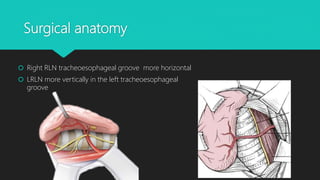
 Right RLN tracheoesophageal groove more horizontal
 LRLN more vertically in the left tracheoesophageal
groove
Relationship of RLN and Berry’s ligament
 fibrous structure that anchors the thyroid gland to the first three rings of the tracheal cartilage
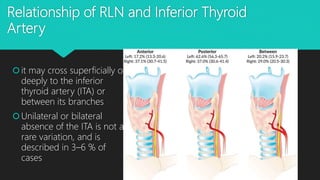
Relationship of RLN and Inferior Thyroid
Artery
it may cross superficially or
deeply to the inferior
thyroid artery (ITA) or
between its branches
Unilateral or bilateral
absence of the ITA is not a
rare variation, and is
described in 3–6 % of
cases
Tubercle of Zuckerkandl
 is the posterior and lateral projection of the thyroid gland.
 described as “an arrow pointing to the recurrent laryngeal nerve
 In patients with an identifiable tubercle of Zuckerkandl, the recurrent laryngeal nerve is located
medial to the tubercle in the vast majority of instances
Surgical anatomy
On both sides nerves
enter the larynx at the
cricothyroid articulation
beneath the fibers of the
inferior constrictor
muscles of the pharynx.
“non-recurrent” inferior laryngeal nerve
 (0.6%), the right recurrent
laryngeal nerve passes directly
from the vagus in the neck
towards the larynx and does not
recur around subclavian artery.
 Make it susceptible to injury
The “false” nonrecurrent nerve
enlarged anastomic branches between
the normal RLN and the cervical
sympathetic chain may mimic a
nonrecurrent laryngeal nerve (NRLN)
in up to 7.5 % of the cases
Another confounding condition is
represented by small branches
connecting an NRLN and the stellate
sympathetic ganglion
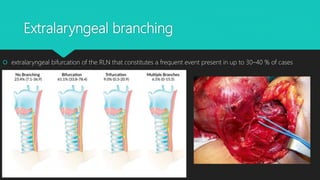
Extralaryngeal branching
 extralaryngeal bifurcation of the RLN that constitutes a frequent event present in up to 30–40 % of cases
Approaches to RLN identification
lateral approach
• routine
• uncomplicated
• Theodor Kocher
Inferior approach
• revision
Superior
• least used
• consistent
lateral approach
identifies the RLN at the midpole of the thyroid lobe.
This approach is usually used and applicable to most cases
except those with a very large cervical or substernal goiter or
the presence of a fibrous scar due to previous surgery.
However, injury to the extralaryngeal branching of the RLN may
occur with this approach.
inferior approach
finds the RLN at the lower pole of the thyroid lobe around the
tracheoesophageal groove.
advantage is that extralaryngeal branching rarely occurs at this
level
disadvantage is that it involves the dissection of a long
segment, and it may be difficult to find the RLN because of
inferior thyroid artery bleeding.
Superior approach
identifies the RLN at the laryngeal entry point, which is above
the ligament of Berry
useful for large cervical or substernal goiters, where the nerve
cannot be found using a lateral or inferior approach.
The advantage of this approach is that the RLN entry point is
relatively constant
The disadvantage is that dissection around the ligament of
Berry is not easy because this region is fibrous and has a rich
vasculature.
Therefore, we introduce a new approach to help identify
the RLN in special cases
Material and method
 This study was conducted on 71 patients with thyroid cancer.
 Duration : March 2010 and November 2014
 Setting : Furan University Shanghai Cancer center.
 Study type : cohort study
The medial approach was performed
1. Revision cases with the presence of a fibrous scar due to previous
surgery
2. Multifocal thyroid cancer with local invasion (RLN, esophagus, and
carotid sheath) and lymph nodes metastasis
3. other cases in which it was difficult to find the RLN using the standard
approaches.
Surgical technique
 A collar incision was used, and subplatysmal flaps were elevated.
 The strap muscles were separated in the midline to expose the thyroid gland
 the thyroid isthmus was clamped and transected at its attachment to the
opposite lobe. The lobe was separated internally from the trachea until half
of the lateral side of tracheal rings 2–4 was exposed from the thyroid lobe
 Using the third tracheal ring as a landmark located 0.3 cm from the lateral
surface of the tracheal ring
 the surgeon employed a careful blunt dissection to expose the RLN through
the layers of the fibers
• To avoid accidental bleeding of
the inferior thyroid artery caused
by injure, we try to identify the
RLN above the level of the artery.
In the author’s observation, this
level is about the third tracheal
ring.
• The location of the RLN in the
level of third tracheal ring is
relatively stable by its anatomical
characteristic, which is suitable
for both sides.
All patients then received a total thyroidectomy and central
lymph nodes dissection (with or without lateral lymph nodes
dissection)
A postoperative laryngoscopy was performed for all patients.
Patients were followed up every 6 months
for 12 to 62 months, with a median of 28 months.
Results
 Age : 16 to 68 years
 29 males and 42 females
 in all of the cases, RLNs were successfully identified
 Of the 71 patients, 22 were revision surgeries.
 Among the remaining 49 patients, 81.6% (40 of 49) of the patients were T4
Complication rate
Number of case Complication
7 patients had clinical and biochemical
hypocalcaemia, which was corrected
using calcium supplementation.
2 cases showed unilateral vocal cord
paralysis one fully recovered after 6
months, while the other showed
lateral vocal paralysis and were
treated with a tracheotomy.
Discussion
 In China, most thyroid procedures are performed by general surgeons even
though most of them are not well trained for thyroid cancer surgeries. Thus,
in our cancer center, reoperative thyroid procedures and those with severe
thyroid cancers are very common.
 In revision cases , the lateral side of the thyroid was difficult to separate
because of scarring and the loss of normal tissue planes; thus, the RLN could
not be identify by regular approaches.
 multifocal thyroid cancers with local invasion (RLN, esophagus, and carotid
sheath) and lymph nodes metastasis also difficult in terms of finding the RLN
with the three common approaches.
 Thyroid surgeons should have a number of different techniques available if
identification of the RLN proves troublesome.
 In this case series, we described a new backup approach for the
identification of the RLN. This work represents the largest series of patients
undergoing thyroid surgery using this method and provides valuable safety
data for surgeons wishing to use it as a backup method for RLN
identification in special cases.
Most patients in our study were in the late stages of thyroid
cancer, which makes it difficult to identify the RLN.
 However, in all of the cases, the RLNs were successfully
identified by the medial approach. The data also confirm that
identifying the RLN with the medial approach does not increase
the risk of operative complications, including vocal paralysis,
hypocalcaemia, primary hemorrhage, or wound complications.
The patient size in this study seems to be small compared to
other studies on thyroid surgery.
However, the purpose of this study was to describe a backup of
the RLN identification approach for special cases, not routine
cases.
Especially in underdeveloped countries which, intraoperative
neuromonitoring of the RLN is expensive and not available in
most cases
THANK YOU

Recurrent laryngeal nerve

  • 1.
    Received: 30‐11‐2017 Editedby: Yi Cui Chinese Medical Journal ¦ April 5, 2018 ¦ Volume 131 ¦ Issue 7 871
  • 2.
    Introduction 2015 American ThyroidAssociation Guidelines recommend “Visual identification of the recurrent laryngeal [RLN] during dissection in all cases”
  • 3.
    Surgical anatomy  RightRLN tracheoesophageal groove more horizontal  LRLN more vertically in the left tracheoesophageal groove
  • 4.
    Relationship of RLNand Berry’s ligament  fibrous structure that anchors the thyroid gland to the first three rings of the tracheal cartilage
  • 5.
    Relationship of RLNand Inferior Thyroid Artery it may cross superficially or deeply to the inferior thyroid artery (ITA) or between its branches Unilateral or bilateral absence of the ITA is not a rare variation, and is described in 3–6 % of cases
  • 6.
    Tubercle of Zuckerkandl is the posterior and lateral projection of the thyroid gland.  described as “an arrow pointing to the recurrent laryngeal nerve  In patients with an identifiable tubercle of Zuckerkandl, the recurrent laryngeal nerve is located medial to the tubercle in the vast majority of instances
  • 7.
    Surgical anatomy On bothsides nerves enter the larynx at the cricothyroid articulation beneath the fibers of the inferior constrictor muscles of the pharynx.
  • 8.
    “non-recurrent” inferior laryngealnerve  (0.6%), the right recurrent laryngeal nerve passes directly from the vagus in the neck towards the larynx and does not recur around subclavian artery.  Make it susceptible to injury
  • 9.
    The “false” nonrecurrentnerve enlarged anastomic branches between the normal RLN and the cervical sympathetic chain may mimic a nonrecurrent laryngeal nerve (NRLN) in up to 7.5 % of the cases Another confounding condition is represented by small branches connecting an NRLN and the stellate sympathetic ganglion
  • 10.
    Extralaryngeal branching  extralaryngealbifurcation of the RLN that constitutes a frequent event present in up to 30–40 % of cases
  • 11.
    Approaches to RLNidentification lateral approach • routine • uncomplicated • Theodor Kocher Inferior approach • revision Superior • least used • consistent
  • 12.
    lateral approach identifies theRLN at the midpole of the thyroid lobe. This approach is usually used and applicable to most cases except those with a very large cervical or substernal goiter or the presence of a fibrous scar due to previous surgery. However, injury to the extralaryngeal branching of the RLN may occur with this approach.
  • 13.
    inferior approach finds theRLN at the lower pole of the thyroid lobe around the tracheoesophageal groove. advantage is that extralaryngeal branching rarely occurs at this level disadvantage is that it involves the dissection of a long segment, and it may be difficult to find the RLN because of inferior thyroid artery bleeding.
  • 14.
    Superior approach identifies theRLN at the laryngeal entry point, which is above the ligament of Berry useful for large cervical or substernal goiters, where the nerve cannot be found using a lateral or inferior approach. The advantage of this approach is that the RLN entry point is relatively constant The disadvantage is that dissection around the ligament of Berry is not easy because this region is fibrous and has a rich vasculature.
  • 15.
    Therefore, we introducea new approach to help identify the RLN in special cases
  • 16.
    Material and method This study was conducted on 71 patients with thyroid cancer.  Duration : March 2010 and November 2014  Setting : Furan University Shanghai Cancer center.  Study type : cohort study
  • 17.
    The medial approachwas performed 1. Revision cases with the presence of a fibrous scar due to previous surgery 2. Multifocal thyroid cancer with local invasion (RLN, esophagus, and carotid sheath) and lymph nodes metastasis 3. other cases in which it was difficult to find the RLN using the standard approaches.
  • 18.
    Surgical technique  Acollar incision was used, and subplatysmal flaps were elevated.  The strap muscles were separated in the midline to expose the thyroid gland  the thyroid isthmus was clamped and transected at its attachment to the opposite lobe. The lobe was separated internally from the trachea until half of the lateral side of tracheal rings 2–4 was exposed from the thyroid lobe  Using the third tracheal ring as a landmark located 0.3 cm from the lateral surface of the tracheal ring  the surgeon employed a careful blunt dissection to expose the RLN through the layers of the fibers
  • 19.
    • To avoidaccidental bleeding of the inferior thyroid artery caused by injure, we try to identify the RLN above the level of the artery. In the author’s observation, this level is about the third tracheal ring. • The location of the RLN in the level of third tracheal ring is relatively stable by its anatomical characteristic, which is suitable for both sides.
  • 20.
    All patients thenreceived a total thyroidectomy and central lymph nodes dissection (with or without lateral lymph nodes dissection) A postoperative laryngoscopy was performed for all patients. Patients were followed up every 6 months for 12 to 62 months, with a median of 28 months.
  • 21.
    Results  Age :16 to 68 years  29 males and 42 females  in all of the cases, RLNs were successfully identified  Of the 71 patients, 22 were revision surgeries.  Among the remaining 49 patients, 81.6% (40 of 49) of the patients were T4
  • 22.
    Complication rate Number ofcase Complication 7 patients had clinical and biochemical hypocalcaemia, which was corrected using calcium supplementation. 2 cases showed unilateral vocal cord paralysis one fully recovered after 6 months, while the other showed lateral vocal paralysis and were treated with a tracheotomy.
  • 23.
    Discussion  In China,most thyroid procedures are performed by general surgeons even though most of them are not well trained for thyroid cancer surgeries. Thus, in our cancer center, reoperative thyroid procedures and those with severe thyroid cancers are very common.  In revision cases , the lateral side of the thyroid was difficult to separate because of scarring and the loss of normal tissue planes; thus, the RLN could not be identify by regular approaches.  multifocal thyroid cancers with local invasion (RLN, esophagus, and carotid sheath) and lymph nodes metastasis also difficult in terms of finding the RLN with the three common approaches.
  • 24.
     Thyroid surgeonsshould have a number of different techniques available if identification of the RLN proves troublesome.  In this case series, we described a new backup approach for the identification of the RLN. This work represents the largest series of patients undergoing thyroid surgery using this method and provides valuable safety data for surgeons wishing to use it as a backup method for RLN identification in special cases.
  • 25.
    Most patients inour study were in the late stages of thyroid cancer, which makes it difficult to identify the RLN.  However, in all of the cases, the RLNs were successfully identified by the medial approach. The data also confirm that identifying the RLN with the medial approach does not increase the risk of operative complications, including vocal paralysis, hypocalcaemia, primary hemorrhage, or wound complications.
  • 26.
    The patient sizein this study seems to be small compared to other studies on thyroid surgery. However, the purpose of this study was to describe a backup of the RLN identification approach for special cases, not routine cases. Especially in underdeveloped countries which, intraoperative neuromonitoring of the RLN is expensive and not available in most cases
  • 27.

Editor's Notes

  • #2 Thyroid surgeries are the most frequently performed endocrine procedures worldwide.
  • #3 One of the most serious complications of thyroid surgery is injury to the recurrent laryngeal nerve (RLN), which varies from 0.5% to 14.0%, depending on the type of disease the type of surgery the extent of resection and the surgical technique
  • #4 Detailed and comprehensive knowledge of the RLNs’ anatomic relationships and variations is of paramount importance in order to avoid nerve injury during thyroidectomy.
  • #5 The RLN was consistently noted on the medial aspect of this superficial fascia near to the thyroid  
  • #7 ,” since the nerve is found between the tubercle of Zuckerkandl and the surface of the trachea
  • #8 The most common site of injury to the RLN is near the BL, where the nerves penetrate into the larynx
  • #9 The presence of a left-sided NRLN is extremely rare and is associated with a situs inversus totalis [19–21]. in presence of aberrant right subclavian artery, arising from the aorta after the left subclavian artery has given off, in addition, attention needs to be paid to the possible existence of a non‐RLN, especially in the right side, and preoperative evaluation of an aberrant right subclavian artery with either a computed tomography scan or ultrasound is necessary.
  • #10 Before concluding that it is a nonrecurrent ILN, one should follow it to identify whether it originates from the vagus nerve (VN) or from the cervical sympathetic system. ST, Sympathetic trunk
  • #11 Therefore, division of the RLN, when present, usually occurs close to the ligament of Berry where it becomes particularly vulnerable RLN branching is uncommon below the inferior thyroid artery but should always be suspected when a thin “main trunk” is identified. At this stage, it is worth dissecting the nerve retrograde to make sure that the identified RLN is not the posterior branch of a very proximally bifurcated RLN. in type 1 (arterial; 46.3 %), division occurs near inferior thyroid artery. In type 2 (post- arterial; 31.5 %), division is found on post-arterial segment. In type 3 (prelaryngeal; 11 %), division is located very close to laryngeal entry point. In type 4 (prearterial; 11 %), bifurcation takes place before the nerve crossing the inferior thyroid artery.
  • #12 Currently, there are three approaches used to identify the nerve all three techniques is that the RLN is identified from the lateral side of the thyroid. Yet, in some special cases when the lateral side of the thyroid is difficult to divide, it is not possible to use any of the three techniques to identify the RLN.
  • #22 which means that most of the patients in this study were in the late stage of thyroid cancer.