Presented by,
MANJU A. THOMAS
 Role-plays
 Reverse Role Plays
 Rotational Role Plays
 Finding Metaphors
 Simulations
 Business Games
 Learning Objectives
 Domains Of Learning
 The changing of one's behaviour to assume
 a role
 Unconsciously to fill a social role
 Consciously to act out an adopted role.
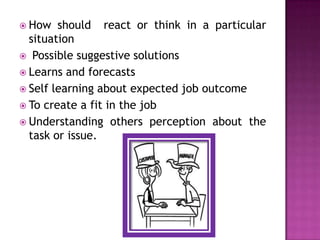
 How   should react or think in a particular
  situation
 Possible suggestive solutions
 Learns and forecasts
 Self learning about expected job outcome
 To create a fit in the job
 Understanding others perception about the
  task or issue.
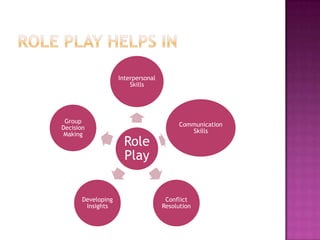
Interpersonal
                        Skills


 Group
                                         Communication
Decision
                                            Skills
 Making
                      Role
                      Play


       Developing                    Conflict
        Insights                    Resolution
 When  two participants have reached what
 appears to be an intractable situation in
 their discussions.

 They    are asked by the trainers to exchange
 roles.

 Understanding   and respecting the other
 person's point of view.
 It   starts as a single role play.

 After  the interaction of participants, the
  trainer will stop the role play and discuss
  what happened so far.

 Then the participants are asked to exchange
  characters.

 This method allows a variety of ways to
  approach the roles.
 Its   just the story telling
“Story telling
is the most
powerful way
of
incorporating
ideas into
today's world”
Robert Mcaffe
 Change   in behaviour ,attitudes ,habits

 Simplifies   complex facts

 Metaphorwill express a thousand different
 meanings all at once

 How two unrelated things are similar. "Her
 willpower was rock”.
    virtual medium through which various types
    of skills can be acquired.

 Most   commonly used in corporate situations

 To  improve business awareness and
    management skills.
A  tool for identification of management
 training and development needs.

 Anattentive trainer can nevertheless derive
 valuable information on many aspects of
 management skills, knowledge, attitudes and
 shortcomings in a situation that is close to
 actual practice.
 Functional   Simulations
     Making decisions in a particular area of the
      business
 Total   Enterprise Simulations
     Give a general overview of a company and give
      experience of making executive management
      decisions.
 They    get trainees involved in learning, and
  they are emotionally engaging.
 Increases employee's willingness to practice,
  encourages retention, and improves their
  skills.
 Provide a consistent message of what needs
  to be learned, simulators can incorporate
  more situations or problems that a trainee
  might encounter.
 Simulations have been found to result in such
  positive outcomes as shorter training times
  and increased return on investment.
 Type  of simulators that try to present the
  way an industry, company, organization,
  consultancy, or subunit of a company
  functions.
 Trainees are given some information that
  describes a particular situation and are then
  asked to make decisions that will best suit in
  the favor of the company.
 System provides the feedback about the
  impact of their decisions.
 Again,on the basis of the feedback they are
 asked to make the decisions again.

 Thisprocess continues until some meaningful
 results do not come out or some predefined
 state of the organization exists or a specified
 number of trail are completed.
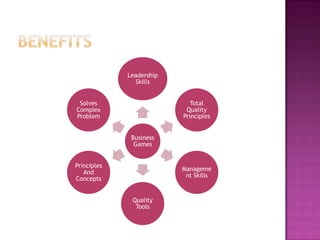
Leadership
               Skills


 Solves                      Total
Complex                    Quality
Problem                   Principles


              Business
               Games


Principles
                          Manageme
   And
                           nt Skills
Concepts


              Quality
               Tools
 Describe  what a learner will be able to do as
  a result of learning.
 Learning outcomes.


 Three  domains of learning: knowledge, skills
  and attitudes.
 Cognitive,   psychomotor     and   affective
  domains of learning.
A  statement of a learning objective
 contains a verb (an action) and an object
 (usually a noun).
 Learningobjectives define learning outcomes
 and focus teaching.

 They help to clarify, organize and prioritize
 learning.

 They help students evaluate their own
 progress and encourage them to take
 responsibility for their learning.
   This domain focuses on intellectual skills.

   Bloom’s        Taxonomy          (knowledge,
    comprehension,      application,     analysis,
    synthesis, and evaluation) is frequently used
    to describe the increasing complexity of
    cognitive skills as trainees move from
    beginner to more advanced in their
    knowledge of content.

   The cognitive domain is the core learning
    domain.
 Coursesthat are hybrid (presented in both an
 online and face-to-face format), often
 present the cognitive portion of the course
 via the web and use classroom time for the
 more      affective,    psychomotor,      and
 interpersonal learning outcomes.

 Higher cognitive skills provide opportunities
 for trainees to develop interpersonal domain
 learning.
   Graphics to show relationships between ideas
   Organized class notes
   Tables that provide summary information
   PowerPoint slides
   Additional examples
   Self-check quizzes
   A discussion board
   Case studies
   Drill and practice of content that must be memorized
   Flash animations or simulations of challenging and key
    concepts
   Practice questions with answers and “expert” explanations
   Links to similar information presented in a different way
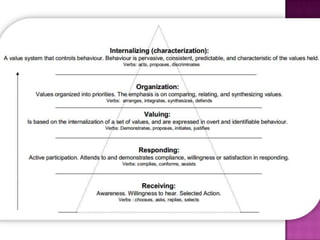
 The affective domain is critical for learning
 but is often not specifically addressed.

 Thisis the domain that deals with attitudes,
 motivation, willingness to participate,
 valuing what is being learned, and ultimately
 incorporating the values of a discipline into a
 way of life.
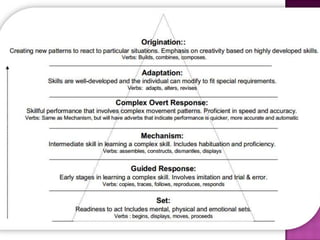
 The   psychomotor domain focuses on
 performing sequences of motor activities to a
 specified level of accuracy, smoothness,
 rapidity, or force.

 Underlyingthe motor activity is cognitive
 understanding.
 Action(elementary movement)
 Coordination (synchronized movement)
 Formation (bodily movement)
 Production (combine verbal and nonverbal
  movement
 The Interpersonal domain focuses on people
 interacting with others.

 Interpersonalskills are learned by seeing
 models, practicing the skills, and getting
 feedback in the form of coaching. While
 short videos, good explanations, and
 checklists can facilitate the conceptual
 learning of the skills, the actual acquisition
 of the interpersonal skill is best done with
 face-to-face contact and lots of instructor
 feedback.
   The levels in this domain should not be
    considered hierarchical as in the cognitive
    domain, but more as a list of skills. These
    include the following:
       Seeking/giving information (asking for and offering
        information)
       Proposing (putting forward an idea)
       Building and supporting (helping another person’s
        idea move forward)
       Shutting out/bringing in (excluding or involving
        another)
       Disagreeing (appropriately offering a difference of
        opinion)
       Summarizing (Restating in a compact form a
        discussion or collection of ideas)

Training Methods

  • 1.
  • 2.
     Role-plays  ReverseRole Plays  Rotational Role Plays  Finding Metaphors  Simulations  Business Games  Learning Objectives  Domains Of Learning
  • 4.
     The changingof one's behaviour to assume a role  Unconsciously to fill a social role  Consciously to act out an adopted role.
  • 5.
     How should react or think in a particular situation  Possible suggestive solutions  Learns and forecasts  Self learning about expected job outcome  To create a fit in the job  Understanding others perception about the task or issue.
  • 6.
    Interpersonal Skills Group Communication Decision Skills Making Role Play Developing Conflict Insights Resolution
  • 7.
     When two participants have reached what appears to be an intractable situation in their discussions.  They are asked by the trainers to exchange roles.  Understanding and respecting the other person's point of view.
  • 8.
     It starts as a single role play.  After the interaction of participants, the trainer will stop the role play and discuss what happened so far.  Then the participants are asked to exchange characters.  This method allows a variety of ways to approach the roles.
  • 9.
     Its just the story telling
  • 10.
    “Story telling is themost powerful way of incorporating ideas into today's world” Robert Mcaffe
  • 11.
     Change in behaviour ,attitudes ,habits  Simplifies complex facts  Metaphorwill express a thousand different meanings all at once  How two unrelated things are similar. "Her willpower was rock”.
  • 12.
    virtual medium through which various types of skills can be acquired.  Most commonly used in corporate situations  To improve business awareness and management skills.
  • 13.
    A toolfor identification of management training and development needs.  Anattentive trainer can nevertheless derive valuable information on many aspects of management skills, knowledge, attitudes and shortcomings in a situation that is close to actual practice.
  • 14.
     Functional Simulations  Making decisions in a particular area of the business  Total Enterprise Simulations  Give a general overview of a company and give experience of making executive management decisions.
  • 15.
     They get trainees involved in learning, and they are emotionally engaging.  Increases employee's willingness to practice, encourages retention, and improves their skills.  Provide a consistent message of what needs to be learned, simulators can incorporate more situations or problems that a trainee might encounter.  Simulations have been found to result in such positive outcomes as shorter training times and increased return on investment.
  • 16.
     Type of simulators that try to present the way an industry, company, organization, consultancy, or subunit of a company functions.  Trainees are given some information that describes a particular situation and are then asked to make decisions that will best suit in the favor of the company.  System provides the feedback about the impact of their decisions.
  • 17.
     Again,on thebasis of the feedback they are asked to make the decisions again.  Thisprocess continues until some meaningful results do not come out or some predefined state of the organization exists or a specified number of trail are completed.
  • 18.
    Leadership Skills Solves Total Complex Quality Problem Principles Business Games Principles Manageme And nt Skills Concepts Quality Tools
  • 19.
     Describe what a learner will be able to do as a result of learning.  Learning outcomes.  Three domains of learning: knowledge, skills and attitudes.  Cognitive, psychomotor and affective domains of learning.
  • 20.
    A statementof a learning objective contains a verb (an action) and an object (usually a noun).
  • 21.
     Learningobjectives definelearning outcomes and focus teaching.  They help to clarify, organize and prioritize learning.  They help students evaluate their own progress and encourage them to take responsibility for their learning.
  • 22.
    This domain focuses on intellectual skills.  Bloom’s Taxonomy (knowledge, comprehension, application, analysis, synthesis, and evaluation) is frequently used to describe the increasing complexity of cognitive skills as trainees move from beginner to more advanced in their knowledge of content.  The cognitive domain is the core learning domain.
  • 23.
     Coursesthat arehybrid (presented in both an online and face-to-face format), often present the cognitive portion of the course via the web and use classroom time for the more affective, psychomotor, and interpersonal learning outcomes.  Higher cognitive skills provide opportunities for trainees to develop interpersonal domain learning.
  • 24.
    Graphics to show relationships between ideas  Organized class notes  Tables that provide summary information  PowerPoint slides  Additional examples  Self-check quizzes  A discussion board  Case studies  Drill and practice of content that must be memorized  Flash animations or simulations of challenging and key concepts  Practice questions with answers and “expert” explanations  Links to similar information presented in a different way
  • 25.
     The affectivedomain is critical for learning but is often not specifically addressed.  Thisis the domain that deals with attitudes, motivation, willingness to participate, valuing what is being learned, and ultimately incorporating the values of a discipline into a way of life.
  • 27.
     The psychomotor domain focuses on performing sequences of motor activities to a specified level of accuracy, smoothness, rapidity, or force.  Underlyingthe motor activity is cognitive understanding.
  • 29.
     Action(elementary movement) Coordination (synchronized movement)  Formation (bodily movement)  Production (combine verbal and nonverbal movement
  • 30.
     The Interpersonaldomain focuses on people interacting with others.  Interpersonalskills are learned by seeing models, practicing the skills, and getting feedback in the form of coaching. While short videos, good explanations, and checklists can facilitate the conceptual learning of the skills, the actual acquisition of the interpersonal skill is best done with face-to-face contact and lots of instructor feedback.
  • 31.
    The levels in this domain should not be considered hierarchical as in the cognitive domain, but more as a list of skills. These include the following:  Seeking/giving information (asking for and offering information)  Proposing (putting forward an idea)  Building and supporting (helping another person’s idea move forward)  Shutting out/bringing in (excluding or involving another)  Disagreeing (appropriately offering a difference of opinion)  Summarizing (Restating in a compact form a discussion or collection of ideas)