Group no. 5
Team Members:
Siddharth Goel 2014274
Smriti Aggarwal 2014282
Surabhi Choudhary 2014288
T. Jegan 2014294
Tarun Sharma 2014302
Udayan 2014309
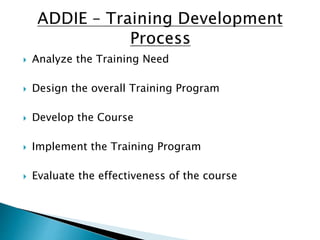
 Analyze the Training Need
 Design the overall Training Program
 Develop the Course
 Implement the Training Program
 Evaluate the effectiveness of the course
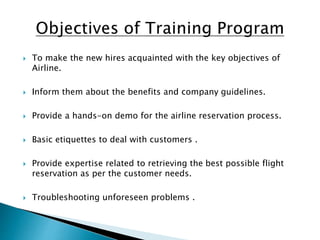
 To make the new hires acquainted with the key objectives of
Airline.
 Inform them about the benefits and company guidelines.
 Provide a hands-on demo for the airline reservation process.
 Basic etiquettes to deal with customers .
 Provide expertise related to retrieving the best possible flight
reservation as per the customer needs.
 Troubleshooting unforeseen problems .
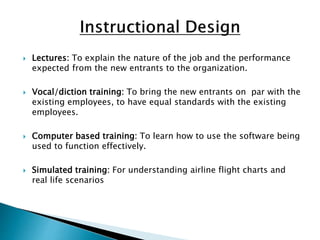
 Lectures: To explain the nature of the job and the performance
expected from the new entrants to the organization.
 Vocal/diction training: To bring the new entrants on par with the
existing employees, to have equal standards with the existing
employees.
 Computer based training: To learn how to use the software being
used to function effectively.
 Simulated training: For understanding airline flight charts and
real life scenarios
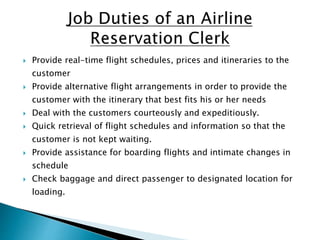
 Provide real-time flight schedules, prices and itineraries to the
customer
 Provide alternative flight arrangements in order to provide the
customer with the itinerary that best fits his or her needs
 Deal with the customers courteously and expeditiously.
 Quick retrieval of flight schedules and information so that the
customer is not kept waiting.
 Provide assistance for boarding flights and intimate changes in
schedule
 Check baggage and direct passenger to designated location for
loading.
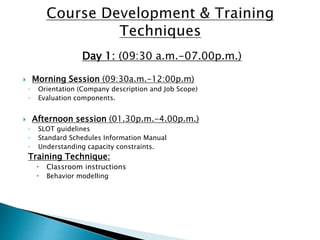
Day 1: (09:30 a.m.-07.00p.m.)
 Morning Session (09:30a.m.-12:00p.m)
◦ Orientation (Company description and Job Scope)
◦ Evaluation components.
 Afternoon session (01.30p.m.-4.00p.m.)
◦ SLOT guidelines
◦ Standard Schedules Information Manual
◦ Understanding capacity constraints.
Training Technique:
 Classroom instructions
 Behavior modelling
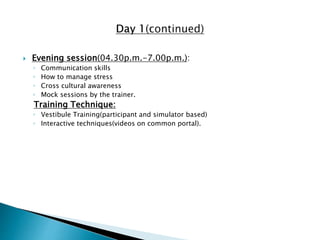
 Evening session(04.30p.m.-7.00p.m.):
◦ Communication skills
◦ How to manage stress
◦ Cross cultural awareness
◦ Mock sessions by the trainer.
Training Technique:
◦ Vestibule Training(participant and simulator based)
◦ Interactive techniques(videos on common portal).
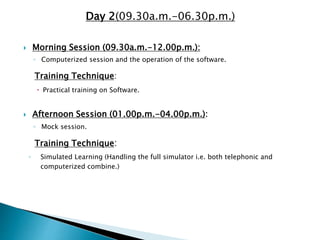
Day 2(09.30a.m.-06.30p.m.)
 Morning Session (09.30a.m.-12.00p.m.):
◦ Computerized session and the operation of the software.
Training Technique:
 Practical training on Software.
 Afternoon Session (01.00p.m.-04.00p.m.):
◦ Mock session.
Training Technique:
◦ Simulated Learning (Handling the full simulator i.e. both telephonic and
computerized combine.)
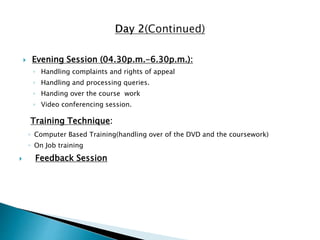
 Evening Session (04.30p.m.-6.30p.m.):
◦ Handling complaints and rights of appeal
◦ Handling and processing queries.
◦ Handing over the course work
◦ Video conferencing session.
Training Technique:
◦ Computer Based Training(handling over of the DVD and the coursework)
◦ On Job training
 Feedback Session
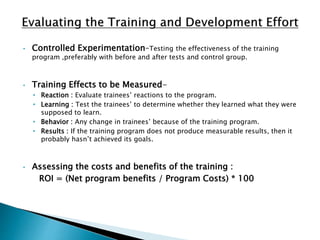
• Controlled Experimentation–Testing the effectiveness of the training
program ,preferably with before and after tests and control group.
• Training Effects to be Measured-
• Reaction : Evaluate trainees’ reactions to the program.
• Learning : Test the trainees’ to determine whether they learned what they were
supposed to learn.
• Behavior : Any change in trainees’ because of the training program.
• Results : If the training program does not produce measurable results, then it
probably hasn’t achieved its goals.
• Assessing the costs and benefits of the training :
ROI = (Net program benefits / Program Costs) * 100
-Thank You-

Training program for airline reservation clerk

  • 1.
    Group no. 5 TeamMembers: Siddharth Goel 2014274 Smriti Aggarwal 2014282 Surabhi Choudhary 2014288 T. Jegan 2014294 Tarun Sharma 2014302 Udayan 2014309
  • 2.
     Analyze theTraining Need  Design the overall Training Program  Develop the Course  Implement the Training Program  Evaluate the effectiveness of the course
  • 3.
     To makethe new hires acquainted with the key objectives of Airline.  Inform them about the benefits and company guidelines.  Provide a hands-on demo for the airline reservation process.  Basic etiquettes to deal with customers .  Provide expertise related to retrieving the best possible flight reservation as per the customer needs.  Troubleshooting unforeseen problems .
  • 4.
     Lectures: Toexplain the nature of the job and the performance expected from the new entrants to the organization.  Vocal/diction training: To bring the new entrants on par with the existing employees, to have equal standards with the existing employees.  Computer based training: To learn how to use the software being used to function effectively.  Simulated training: For understanding airline flight charts and real life scenarios
  • 5.
     Provide real-timeflight schedules, prices and itineraries to the customer  Provide alternative flight arrangements in order to provide the customer with the itinerary that best fits his or her needs  Deal with the customers courteously and expeditiously.  Quick retrieval of flight schedules and information so that the customer is not kept waiting.  Provide assistance for boarding flights and intimate changes in schedule  Check baggage and direct passenger to designated location for loading.
  • 6.
    Day 1: (09:30a.m.-07.00p.m.)  Morning Session (09:30a.m.-12:00p.m) ◦ Orientation (Company description and Job Scope) ◦ Evaluation components.  Afternoon session (01.30p.m.-4.00p.m.) ◦ SLOT guidelines ◦ Standard Schedules Information Manual ◦ Understanding capacity constraints. Training Technique:  Classroom instructions  Behavior modelling
  • 7.
     Evening session(04.30p.m.-7.00p.m.): ◦Communication skills ◦ How to manage stress ◦ Cross cultural awareness ◦ Mock sessions by the trainer. Training Technique: ◦ Vestibule Training(participant and simulator based) ◦ Interactive techniques(videos on common portal).
  • 8.
    Day 2(09.30a.m.-06.30p.m.)  MorningSession (09.30a.m.-12.00p.m.): ◦ Computerized session and the operation of the software. Training Technique:  Practical training on Software.  Afternoon Session (01.00p.m.-04.00p.m.): ◦ Mock session. Training Technique: ◦ Simulated Learning (Handling the full simulator i.e. both telephonic and computerized combine.)
  • 9.
     Evening Session(04.30p.m.-6.30p.m.): ◦ Handling complaints and rights of appeal ◦ Handling and processing queries. ◦ Handing over the course work ◦ Video conferencing session. Training Technique: ◦ Computer Based Training(handling over of the DVD and the coursework) ◦ On Job training  Feedback Session
  • 10.
    • Controlled Experimentation–Testingthe effectiveness of the training program ,preferably with before and after tests and control group. • Training Effects to be Measured- • Reaction : Evaluate trainees’ reactions to the program. • Learning : Test the trainees’ to determine whether they learned what they were supposed to learn. • Behavior : Any change in trainees’ because of the training program. • Results : If the training program does not produce measurable results, then it probably hasn’t achieved its goals. • Assessing the costs and benefits of the training : ROI = (Net program benefits / Program Costs) * 100
  • 11.