A STUDY ON TRAINING AND DEVELOPMENT


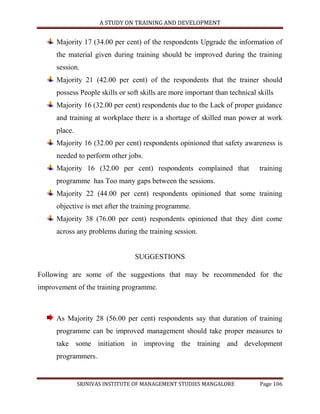
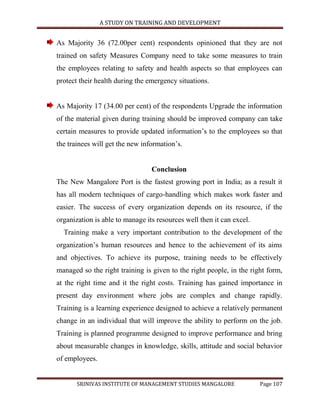
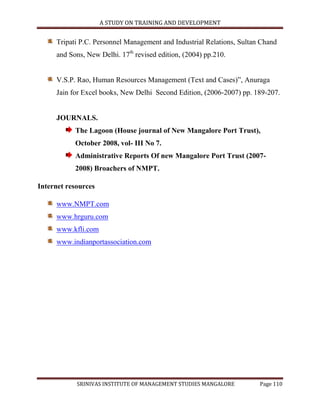
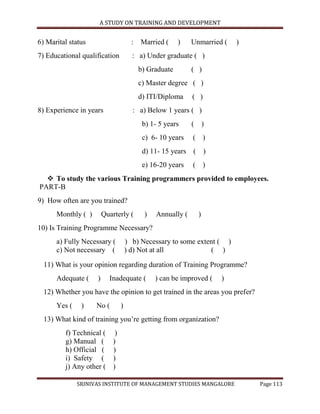
        “A STUDY ON TRAINING AND DEVELOPMENT”

WITH REFERENCE TO NEW MANGALORE PORT TRUST, MANGALORE.


                  DHANARAJ NAIK. P.G
                   (Reg No: 092130508)


                   UNDER OF THE GUIDE
                       Mr.PRADEEP.M.D


         DEPARTMENT OF SOCIAL WORK
 SRINIVAS INSTITUTE OF MANAGEMENT STUDIES
                     Mangalore – 575 001
                           2010-2011


        SRINIVAS INSTITUTE OF MANAGEMENT STUDIES MANGALORE   Page 1
A STUDY ON TRAINING AND DEVELOPMENT


    “A STUDY ON TRAINING AND DEVELOPMENT”
WITH REFERENCE TO NEW MANGALORE PORT TRUST,
                MANGALORE.
 DISSERTATION SUBMITTED TO MANGALORE UNIVERSITY

  IN PARTIAL FULFILLMENT OF THE REQIUREMENTS FOR

      MASTERS DEGREE IN SOCIAL WORK (M.S.W)

                         SUBMITTED BY
                      DHANARAJ NAIK P.G.
                          (Reg.092130508)


       DEPARTMENT OF SOCIAL WORK

SRINIVAS INSTITUTE OF MANAGEMENT STUDIES
               MANGALORE – 575 001

                         2010-2011
      SRINIVAS INSTITUTE OF MANAGEMENT STUDIES MANGALORE   Page 2
A STUDY ON TRAINING AND DEVELOPMENT


                              DECLARATION

            I hereby declare that the study was carried out by me in the year 2010-

2011 as a partial fulfillment of the requirements for the Masters’ degree in Social

Work      (M.S.W)     in   Mangalore     University,    under   the   guidance   of

Mr.Pradeep.M.D B.A.(Law), LL.B., M.S.W., (LL.M) Lecturer, Department of Social

Work, Srinivas Institute of Management Studies, Pandeshwar, Mangalore.


        The research work, either fully or partially, has not previously formed the

basis for the award of any degree, diploma or other similar title in any

organization/institution/universities.


Place: Mangalore


Date:      /04/2011                                    DHANARAJ NAIK.P.G.


              SRINIVAS INSTITUTE OF MANAGEMENT STUDIES MANGALORE             Page 3
A STUDY ON TRAINING AND DEVELOPMENT


                  DEDICATED TO

My beloved Parents Gangyanaik, Pujar & Gouribai

                  My Well Wishers

                          And

  All My Sweet Friends and College Staff


  SRINIVAS INSTITUTE OF MANAGEMENT STUDIES MANGALORE   Page 4
A STUDY ON TRAINING AND DEVELOPMENT


                    Acknowledgement
„The value of special people cannot be measured but only treasured‟

At the outset I would like to express my sincere appreciation thanks and gratitude
to my guide, Mr.Pradeep.M.D B.A. (Law), LL.B., M.S.W., (LL.M) Lecturer,
Department of Social Work, Srinivas Institute of Management Studies, for input
guidance, valuable suggestions, content, encouragement and appreciation
throughout the period of study.

I express my sincere gratitude to Mr. P. Tamilvanan, Chairman, New
Mangalore Port Trust and Mr. C. Harichandran, Secretary, New Mangalore
Port Trust, for giving me an opportunity to carry out the research project in their
esteemed organization.

I also extend my thanks to Mr. T. Khalid, Statistical and Research Officer,
Management Services Division, New Mangalore Port Trust, Mr. Osmond
Fernandez, Senior Research Assistant, Mr. Sadashiva B. R., Deputy Traffic
Manager, HRD cell of NMPT and employees and staff of New Mangalore Port
trust.

My heartfelt thanks to all my friends, field mates and class mates for helping and
sharing materials in success of my study.

Last but not the least, I would say that it is the love and prayer of my parents,
my sister, my friend and my family and also their moral support and a lot more
than words can express to complete this dissertation work.

Place: Mangalore

Date:    /04/2011                                  DHANARAJ NAIK P.G.

             SRINIVAS INSTITUTE OF MANAGEMENT STUDIES MANGALORE              Page 5
A STUDY ON TRAINING AND DEVELOPMENT


                     CONTENTS


 CHAPTER                         TITLE                         PAGE NO.

     1.          A. INTRODUCTION                                 01-19

                 B. COMPANY PROFILE                              20-26

     2.          REVIEW OF LITREATURE                            27-39

     3.          METHODOLOGY                                     40-45

     4.          ANALYSIS & INTERPRETATION                       46-87

     5.          MAJOR FINDINGS, SUGGESTION                      88-92
                 AND CONCLUSION

ANNEXURE – 1 B IBLIOGRAPHY                                       93-94

ANNEXURE - 2      QUESTIONNAIRE                                 95-101


          SRINIVAS INSTITUTE OF MANAGEMENT STUDIES MANGALORE             Page 6
A STUDY ON TRAINING AND DEVELOPMENT


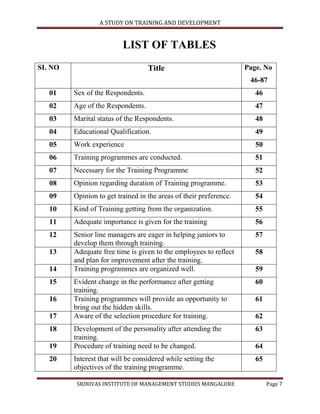
                          LIST OF TABLES
SI. NO                             Title                            Page. No
                                                                     46-87
   01    Sex of the Respondents.                                       46
   02    Age of the Respondents.                                       47
   03    Marital status of the Respondents.                            48
   04    Educational Qualification.                                    49
   05    Work experience                                               50
   06    Training programmes are conducted.                            51
   07    Necessary for the Training Programme                          52
   08    Opinion regarding duration of Training programme.             53
   09    Opinion to get trained in the areas of their preference.      54
   10    Kind of Training getting from the organization.               55
   11    Adequate importance is given for the training                 56
   12    Senior line managers are eager in helping juniors to          57
         develop them through training.
   13    Adequate free time is given to the employees to reflect       58
         and plan for improvement after the training.
   14    Training programmes are organized well.                       59
   15    Evident change in the performance after getting               60
         training.
   16    Training programmes will provide an opportunity to            61
         bring out the hidden skills.
   17    Aware of the selection procedure for training.                62
   18    Development of the personality after attending the            63
         training.
   19    Procedure of training need to be changed.                     64
   20    Interest that will be considered while setting the            65
         objectives of the training programme.

          SRINIVAS INSTITUTE OF MANAGEMENT STUDIES MANGALORE                Page 7
A STUDY ON TRAINING AND DEVELOPMENT


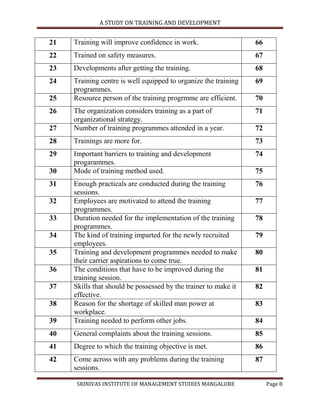
21   Training will improve confidence in work.                   66
22   Trained on safety measures.                                 67
23   Developments after getting the training.                    68
24   Training centre is well equipped to organize the training   69
     programmes.
25   Resource person of the training progrmme are efficient.     70
26   The organization considers training as a part of            71
     organizational strategy.
27   Number of training programmes attended in a year.           72
28   Trainings are more for.                                     73
29   Important barriers to training and development              74
     progarammes.
30   Mode of training method used.                               75
31   Enough practicals are conducted during the training         76
     sessions.
32   Employees are motivated to attend the training              77
     programmes.
33   Duration needed for the implementation of the training      78
     programmes.
34   The kind of training imparted for the newly recruited       79
     employees.
35   Training and development programmes needed to make          80
     their carrier aspirations to come true.
36   The conditions that have to be improved during the          81
     training session.
37   Skills that should be possessed by the trainer to make it   82
     effective.
38   Reason for the shortage of skilled man power at             83
     workplace.
39   Training needed to perform other jobs.                      84
40   General complaints about the training sessions.             85
41   Degree to which the training objective is met.              86
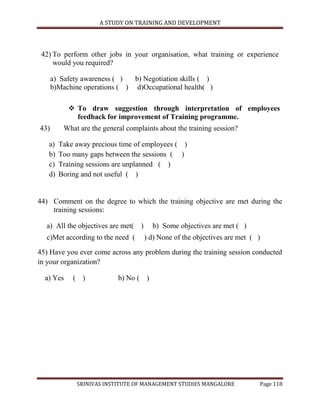
42   Come across with any problems during the training           87
     sessions.

      SRINIVAS INSTITUTE OF MANAGEMENT STUDIES MANGALORE              Page 8
A STUDY ON TRAINING AND DEVELOPMENT


           CHAPTER -1

 a. INTRODUCTION


SRINIVAS INSTITUTE OF MANAGEMENT STUDIES MANGALORE   Page 9
A STUDY ON TRAINING AND DEVELOPMENT


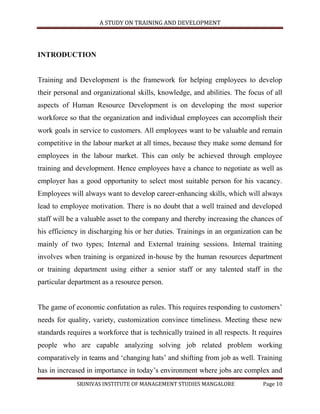
INTRODUCTION


Training and Development is the framework for helping employees to develop
their personal and organizational skills, knowledge, and abilities. The focus of all
aspects of Human Resource Development is on developing the most superior
workforce so that the organization and individual employees can accomplish their
work goals in service to customers. All employees want to be valuable and remain
competitive in the labour market at all times, because they make some demand for
employees in the labour market. This can only be achieved through employee
training and development. Hence employees have a chance to negotiate as well as
employer has a good opportunity to select most suitable person for his vacancy.
Employees will always want to develop career-enhancing skills, which will always
lead to employee motivation. There is no doubt that a well trained and developed
staff will be a valuable asset to the company and thereby increasing the chances of
his efficiency in discharging his or her duties. Trainings in an organization can be
mainly of two types; Internal and External training sessions. Internal training
involves when training is organized in-house by the human resources department
or training department using either a senior staff or any talented staff in the
particular department as a resource person.


The game of economic confutation as rules. This requires responding to customers‟
needs for quality, variety, customization convince timeliness. Meeting these new
standards requires a workforce that is technically trained in all respects. It requires
people who are capable analyzing solving job related problem working
comparatively in teams and „changing hats‟ and shifting from job as well. Training
has in increased in importance in today‟s environment where jobs are complex and
             SRINIVAS INSTITUTE OF MANAGEMENT STUDIES MANGALORE                 Page 10
A STUDY ON TRAINING AND DEVELOPMENT


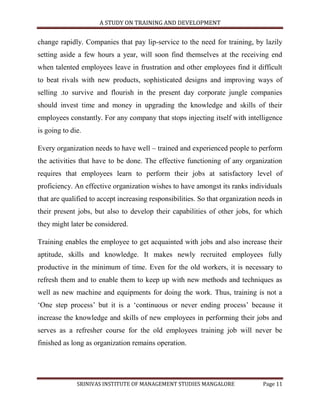
change rapidly. Companies that pay lip-service to the need for training, by lazily
setting aside a few hours a year, will soon find themselves at the receiving end
when talented employees leave in frustration and other employees find it difficult
to beat rivals with new products, sophisticated designs and improving ways of
selling .to survive and flourish in the present day corporate jungle companies
should invest time and money in upgrading the knowledge and skills of their
employees constantly. For any company that stops injecting itself with intelligence
is going to die.

Every organization needs to have well – trained and experienced people to perform
the activities that have to be done. The effective functioning of any organization
requires that employees learn to perform their jobs at satisfactory level of
proficiency. An effective organization wishes to have amongst its ranks individuals
that are qualified to accept increasing responsibilities. So that organization needs in
their present jobs, but also to develop their capabilities of other jobs, for which
they might later be considered.

Training enables the employee to get acquainted with jobs and also increase their
aptitude, skills and knowledge. It makes newly recruited employees fully
productive in the minimum of time. Even for the old workers, it is necessary to
refresh them and to enable them to keep up with new methods and techniques as
well as new machine and equipments for doing the work. Thus, training is not a
„One step process‟ but it is a „continuous or never ending process‟ because it
increase the knowledge and skills of new employees in performing their jobs and
serves as a refresher course for the old employees training job will never be
finished as long as organization remains operation.


              SRINIVAS INSTITUTE OF MANAGEMENT STUDIES MANGALORE                Page 11
A STUDY ON TRAINING AND DEVELOPMENT


Training can be introduced simply as a process of assisting a person for enhancing
his efficiency and effectiveness to a particular work area by getting more
knowledge and practices. Also training is important to establish specific skills,
abilities and knowledge to an employee. For an organization, training and
development are important as well as organizational growth, because the
organizational growth and profit are also dependent on the training. But the
training is not a core of organizational development. It is a function of the
organizational development.


Training is different form education; particularly formal education. The education
is concerned mainly with enhancement of knowledge, but the aims of training are
increasing knowledge while changing attitudes and Competences in good manner.

Basically the education is formulated with in the framework and to syllabus, but
the training is not formed in to the frame and as well as syllabus. It may differ from
one employee to another, one group to another, even the group in the same class.
The reason for that can be mentioned as difference of attitudes and skills from one
person to another.


Even the situation is that, after good training programme, all different type skilled
one group of employees can get in to similar capacity, similar skilled group. That
is an advantage of the trainings .In the field of Human Resources Management,
Training and Development is the field concern with organizational activities which
are aimed to bettering individual and group performances in organizational
settings. It has been known by many names in the field HRM, such as employee
development, human resources development, learning and development etc.
Training is really developing employees‟ capacities through learning and
practicing.
              SRINIVAS INSTITUTE OF MANAGEMENT STUDIES MANGALORE               Page 12
A STUDY ON TRAINING AND DEVELOPMENT


On the other hand external training is normally arranged outside the firm and is
mostly organized by training institutes or consultants. Whichever training, it is
very important for all staff and helps in building career positioning and preparing
staff for greater challenges in developing world. However the training is costly.
Because of that, people who work at firms do not receive external trainings most of
times. The cost is a major issue for the lack of training programmes in Sri Lanka.
But nowadays, a new concept has come with these trainings which is “Trainers
through trainees”. While training their employees in large quantities, many
countries use that method in present days to reduce their training costs. The theory
of this is, sending a little group or an individual for a training programme under a
bonding agreement or without a bond. When they come back to work, the
externally trained employees train the employees who have not participated for
above training programme by internal training programmes.


Employers of labour should enable employees to pursue training and development
in a direction that they choose and are interested in, not just in company-assigned
directions. Companies should support learning, in general, and not just in support
of knowledge needed for the employee's current or next anticipated job. It should
be noted that the key factor is keeping the employee interested, attending, engaged,
motivated and retained.


For every employee to perform well, especially Supervisors and Managers, there is
a need for constant training and development. The right employee training,
development and education provides big payoffs for the employer in increased
productivity, knowledge, loyalty, and contribution to general growth of the firm. In
most cases external trainings for instance provide participants with the avenue to
meet new set of people in the same field and network. The meeting will give them
             SRINIVAS INSTITUTE OF MANAGEMENT STUDIES MANGALORE              Page 13
A STUDY ON TRAINING AND DEVELOPMENT


the chance to compare issues and find out what is obtainable in each others
environment. This for sure will introduce positive changes where necessary.
It is not mentioned in any where that the employers, managers and supervisors are
not suitable for training programmes. They also must be highly trained if they are
expected to do their best for the organization. Through that they will have best
abilities and competencies to manage the organization. Training employees not
only creates a more positive corporate culture, but also add a value to its key
resources.


Raw human resources can make only limited contribution to the organization to
achieve its goals and objectives. Hence the demands for the developed employees
are continuously increasing. Thus the training is a kind of investment.


CONCEPTUAL FRAMEWORK
Training often has been referred to as teaching specific skills and behavior. It is
usually reserved for people who have to be brought up to performing level in some
specific skills. The skills are almost always behavioral as distinct from conceptual
or intelligence.
Development, in contrast is considered to be more general than training and more
oriented to individual needs in addition to organizational needs and it is most often
aimed towards management people. There is more theory involved with such
education and hence less concern with specific behavior than is the case with
training. Usually the intent of development is to provide knowledge and
understanding will enable people to carry out non technical organizational
functions more effectively such as problem solving, decision making and relating
to people.


              SRINIVAS INSTITUTE OF MANAGEMENT STUDIES MANGALORE              Page 14
A STUDY ON TRAINING AND DEVELOPMENT


Meaning


The term „Training‟ is concerned with impacting specific skills for a particular
purpose. Training refers to a planned effort by a company to facilitate employees‟
learning of job-related competencies. These competencies include knowledge,
skills, or behaviours that are critical for successful job performance in the
immediate term or near future. This is in contrast with development, which is
training that provides employees with competencies for anticipated future jobs and
roles. The goal of training is for employees to master the knowledge, skill, and
behaviours emphasized in training programs and to apply them to their day-to-day
activities.


High-leverage training is linked to strategic business goals and objectives, uses
an instructional design process to ensure that training is effective, and compares or
benchmarks the company‟s training programs against training programs in other
companies. High-leverage training practices also help to create working conditions
that encourage continuous learning. Continuous learning requires employees to
understand the entire work system, including the relationships among their jobs,
their work units, and the company. Employees are expected to acquire new skills
and knowledge, apply them on the job, and share this information with other
employees. Managers take an active role in identifying training needs and help to
ensure that employees use training in their work. To facilitate the sharing of
knowledge, managers may use informational maps that show where knowledge lies
within the company (for example, directories and/or skills inventories that list what
individuals do as well as the specialized knowledge they possess) and use
              SRINIVAS INSTITUTE OF MANAGEMENT STUDIES MANGALORE              Page 15
A STUDY ON TRAINING AND DEVELOPMENT


technology such as groupware or the internet that allows employees in various
business units to work simultaneously on problems and share Information.
Training is used to improve employee performance, which leads to improved
business results. Training is seen as one of several possible solutions to improve
performance. Other solutions can include such actions as changing the job or
increasing employee motivation through pay and incentives. Today there is a
greater emphasis on:
• Providing educational opportunities for all employees.
• An ongoing process of performance improvement that is directly measurable
rather than organizing one-time training events.
• The need to demonstrate to executives, managers, and trainees the benefits of
training.
• Learning as a lifelong event in which senior management, trainer managers, and
employees have ownership.
• Training being used to help attain strategic business objectives, which help
companies, gains a competitive advantage.


Measuring the return on investment in research and development, marketing, sales,
and human resources is key for demonstrating the value to the business. Each of
Medtronic‟s businesses uses a scorecard to measure success and return on
investment. Medtronic is currently developing metrics to measure how training
contributes to the company‟s success.


Definitions:
“Edwin. B.Ellppo” has defined “Training as the cut of increasing the knowledge
and skills of an employee for doing a particular job”.


               SRINIVAS INSTITUTE OF MANAGEMENT STUDIES MANGALORE          Page 16
A STUDY ON TRAINING AND DEVELOPMENT


“Michael Armstrong” defines “Training as the systematic development of the
knowledge skills and attitudes acquired by an individual to perform adequately a
given task or job”.


“Michael J.Jucious” “Training is any process by which the attitude, skills and
abilities of employees to perform specific jobs are improved”.


“Michael Armstrong” “Training is the systematic modification of behavior
through learning which occurs as a result of education, instruction, development.


The above definition suggests that training enhance the skill and capabilities of the
individuals in an organization. For training to be successful, the employees have to
be convinced of its utility and effectiveness.
A successful training program, which in turn enhance organizational performance.


THEORETICAL FRAME WORK

The Efficiency of an organization depends on the capacity and talents of its
personnel and how motivated they are capability of the depends on his ability to
work and type of training he receives. After the employees have been selected for
various positions in an organization, training them for the specific tasks to which
they been assigned assumes great importance. It is true in many originations that
before employees are fitted into a harmonious working relationship with the other
employees, he is given adequate training. Training      is the act of increasing the
knowledge and skills of an employee for performing a particular job. The major
outcome of training is learning. Trainees learn new habits, refined skills and useful
knowledge during the training that helps him improve performance. Training

             SRINIVAS INSTITUTE OF MANAGEMENT STUDIES MANGALORE               Page 17
A STUDY ON TRAINING AND DEVELOPMENT


enables an employee to do his present job more efficiently and prepare himself for
a higher level job.

Training is needed to serve the following purposes.

           Newly recruited employees require training so as to perform their
             tasks effectively. Instruction, guidance, coaching help them to handle
             jobs competently without any wastage.
           Training is necessary to prepare existing employees for higher level
             jobs (promotion).
           Existing employees require refresher training so as to keep abreast of
             the latest development operation. In face of rapid technological
             changes, this is an absolute necessity.
           Training is necessary when a person moves from one job to another
             (transfer). After training the employee can change jobs quickly,
             improve his performance levels and achieve career goals comfortable.
           Training is necessary to make employees mobile and versatile. They
             can be placed on various jobs depending on organizational needs.
           Training is needed to bridge the gap between what the employees has
             and what the job demands. Training is needed to make employees
             more productive and useful in the long run.
           Training is needed for employees to again acceptance from peers
             (learning a job quickly and being able to pull their own weight is one
             of the best ways for them to gain acceptance.


Thus, training is meant for operatives and development is meant for managers.
Training tries to improve a specific skill relating to a job whereas development

              SRINIVAS INSTITUTE OF MANAGEMENT STUDIES MANGALORE            Page 18
A STUDY ON TRAINING AND DEVELOPMENT


aims at improving the total personality of an individual. Training is one-shot deal;
whereas development is an ongoing continuous process. The scope of training is on
individual employee, whereas eth scope of development is on the entire work
group or the organization. Training is mostly the result of initiatives taken by
management. It is the result of some outside motivation. Training seeks to meet the
current recruitment of the jobs and the individual; whereas development aims at
meeting the future needs of the job and the individual. In other words, training is a
reactive process whereas development is a proactive process. Development is
future oriented training, focusing on the personal growth of the employee.


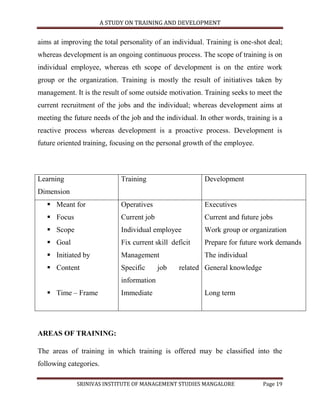
Learning                      Training                    Development
Dimension
    Meant for                Operatives                  Executives
    Focus                    Current job                 Current and future jobs
    Scope                    Individual employee         Work group or organization
    Goal                     Fix current skill deficit   Prepare for future work demands
    Initiated by             Management                  The individual
    Content                  Specific      job   related General knowledge
                              information
    Time – Frame             Immediate                   Long term


AREAS OF TRAINING:

The areas of training in which training is offered may be classified into the
following categories.

             SRINIVAS INSTITUTE OF MANAGEMENT STUDIES MANGALORE               Page 19
A STUDY ON TRAINING AND DEVELOPMENT


Knowledge:

Here the trainee learns about a set of rules and regulations about the job, the staff
and the products or service offered by the company. The aim is to make the new
employee fully aware of what goes on inside and outside the company.

Technical skills:

The employee is taught a specific skill (e.g. operating a machine, handling
computer etc) so that he can acquire that shill and contribute meaningfully.

Social skills: The employee is made to learn about himself and others, and to
develop a right mental attitude towards the job, colleagues and the company. The
principal focus is on teaching the employees hoe to be a teach member and get
ahead.

TYPES OF TRAINING:

There many approaches to training. We focus here on the types of training that are
commonly employed in present day organizations.

Skills Training:

This type of training is most common in the organization. The process here is fairly
simple. The need for training in basic skills (such as reading, writing, computing,
speaking, listening, problem soloing, man gaining oneself, knowing how to learn,
working as part of a team, leading others) is identified through assessment.
Specific training objectives are set and training content is developed to meet those
objectives. Several methods are available for imparting these basic skills in modern
organization (such as lecture, apprenticeship, on- the job, coaching etc).


             SRINIVAS INSTITUTE OF MANAGEMENT STUDIES MANGALORE                Page 20
A STUDY ON TRAINING AND DEVELOPMENT


Refresher Training:

Rapid changes in technology may force companies to go in for this kind of
training. By organizing short term course which in corporate that latest
development in a particular field, the company may keep its employees up-to-date
and ready to take on emerging challenges. It is conducted at regular intervals by
taking the help of outside consultants who specialize in a particular descriptive.

Cross – functional Training:

Cross functional training involves training employees to perform operations in
areas other than their assigned job. There are many approaches to cross functional
training. Job rotation can be used to provide a manager in one functional area with
a broader perspective than he would otherwise have. Department can exchange
personnel for a certain period so that each employee understands how other
department functions.

Team Training:

Team training generally covers two areas: content task and group processes.
Content tasks specify the team‟s goal such as cost control and problem solving.
Group processes reflect the way the member function as team – for example how
they interact with other, how they sort out difference, how they participate etc.

Diversity Training:

Diversity training considers all of the diverse dimensions in the work place – race,
gender, age lifestyles, culture, education, ideas, and background- while designing
training programmes. It aims to create better cross – cultural sensitivity with the
aims of fostering more harmonious and fruitful working relationship among firm‟s
employees.
             SRINIVAS INSTITUTE OF MANAGEMENT STUDIES MANGALORE                Page 21
A STUDY ON TRAINING AND DEVELOPMENT


TRAINING METHODS:

Training methods are usually classified by the location of instruction. On the job
training is provided when the workers are taught relevant knowledge, skill and
abilities at the actual workplace. Off-the-job training on the other hand, requires
that trainees learn at a location other than the real work spot.

    1. Job Instruction Training (JIT)

      The JIT method is a four – step instructional preparation, presentation, and
      performance try out and follow up. It is used primarily to teach workers how
      to do their current jobs. A Trainer, supervisor or co- worker acts as the
      coach. The four steps followed in the JIT methods are:
      i.     The trainee receives an overview of the job, its purpose and its desired
             outcomes, with clear focus on the relevance of training.
      ii.    The trainer demonstrates the job in order to give the employee a
             model to copy.
      iii.   Next, the employee is permitted to copy the trainer‟s way.
             Demonstrates by the trainer and practice by the trainee are repeated
             until the trainee masters the right way to handle the job.
      iv.    Finally, the employee does job independently without supervision.


1. Coaching :
   Coaching is a kind of daily training and feedback given to employee by
   immediate supervision. It involves a continuous process of learning by doing. It
   may defined as an informal, unplanned training and development activity
   provided by supervisor and peers. In coaching, the supervisor explain things
   and answer questions; he throws light on why things are done the way they are;
              SRINIVAS INSTITUTE OF MANAGEMENT STUDIES MANGALORE              Page 22
A STUDY ON TRAINING AND DEVELOPMENT


  he offers a model for trainees to copy ; conducts lot of decision making meeting
  with trainees; procedure are agreed upon and the trainees is given enough
  authority to make divisions and even commit mistakes. Coaching can be taxing
  job in that the coach may not possess requisite skills to guide the learner in a
  systematic way. Sometimes, doing a full day‟s work may be more important
  than putting the learner on track.


2. Mentoring:
  Mentoring is relationship in which a senior manager in organization assumes
  the responsibility    for grooming a junior person. Technical, interpersonal and
  political skills are generally conveyed in such a relationship from the more
  experienced person. A mentor is a teacher, suppose, counselor, developer of
  skills and intellect, host, guide exemplar and most importantly, supporter and
  facilitator in the realization of the vision the young person has about the kind of
  life he wants as an adult. The main objective of mentoring is to help an
  employee attain psychological maturity and effectiveness and get integrated
  with the organization.


3. Job rotation:
  This kind of training involves the movement of trainee one job to another. This

  helps him to have a general understanding of how the organization functions.

  The purpose of job rotation is to provide trainees with a larger organizational
  perspective and a greater understanding of different functional areas as well as a
  better sense if their own career objectives and interests. Apart from reliving
  boredom, job rotation allows trainees to build rapport cooperation among
  departments. The cross-trained personnel offer a great amount of flexibility for
  organizations when transfers, promotions or replacement become inevitable.
            SRINIVAS INSTITUTE OF MANAGEMENT STUDIES MANGALORE                Page 23
A STUDY ON TRAINING AND DEVELOPMENT


4. Apprenticeship Training:
  Most croft workers such as plumbers and carpenters are trained through formal
  apprenticeship programmes. Apprentices are trainees who spend a prescribed
  amount of time working with an experienced guide, coach or trainer.
  Apprenticeships and internships are similar to apprenticeship because that also
  demand high levels of participation from the trainee. An internship is a kind of
  on the job training that usually combines job training with classroom instruction
  in trade schools, colleges or universities. It is also likely that it in these of rapid
  changes I technology, old skills may get outdated quickly. Trainees who spend
  years learning specific skills may find, upon completion of their programmes,
  that the job skills they acquired are no longer appropriate.


OFF-THE- JOB METHODS:

     Under this method of training, the trainee is separated from the job situation
     ad his attention is focused upon learning the materials related to his future
     job performance. There is an opportunity for freedom of expression for the
     trainees. Off-the-job methods are as follows:
  a) Vestibule Training:
    In this method, actual work conditions are simulated in a class room.
    Material, files and equipment- those that are used in actual job performance
    are also used in the training. This type of training is commonly used for
    training personnel for clerical and semi-skilled jobs. The duration of this
    training range from a few days to a few weeks. Theory can be related to
    practice in this method.


             SRINIVAS INSTITUTE OF MANAGEMENT STUDIES MANGALORE                  Page 24
A STUDY ON TRAINING AND DEVELOPMENT


b) Role playing:
   It is defined as method of human interaction that involves realistic behavior in
   imaginary situations. This method of training involves action, doing and
   practice. The participants play the role of certain characters such as the
   production manager, mechanical engineer, superintendents, maintenance
   engineer, quality control inspector, foremen, workers and the like. This
   method is mostly used for developing interpersonal interactions and relations.
c) Lecture method:
  The lecture is a traditional and direct method of instruction. The instructor
  organizes the material and gives it to a group of trainees in the form of a talk.
  To be effective, the lecture must motivate and create interest among the
  trainees. An advantage of lecture method is direct and can be used for a large
  group of trainees. Thus, costs and time involved are reduced. The major
  limitation of the lecture method is that it does not provide for transfer of
  training effectively.
 d) Conference / discussion approach:
  In this method, the trainers deliver a lecture and involve the trainee in a
  discussion so that his doubts about the job get clarified. When big organization
  use this method, the trainer uses audio-visual aids such as black board, mock
  ups and slides; in some cases the lecture are videotapes or audio taped. Even
  the trainee‟s presentation can be taped for self confrontation and self-
  assessment. The conference is, thus a group-centered where there is a
  clarification of ideas, communication of procedures and standards to the
  trainees. Those individuals who have a general educational background and
  whatever specific skills are required- such as typing, shorthand, office
  equipment operation, filling, indexing, recording etc- may be provided with
  specific instructions to handle their respective jobs.
           SRINIVAS INSTITUTE OF MANAGEMENT STUDIES MANGALORE               Page 25
A STUDY ON TRAINING AND DEVELOPMENT


 e) Programmed Instruction:
   This method has becomes popular in recent years. The subject matter to be
   learned is presented in a series of carefully planned sequential units. These
   units are arranged from simple to more complex levels of instructions. The
   trainee goes through these units by answering questions or filling the blanks.
   This method is, thus, expensive and time-consuming.


NEED FOR TRAINING:

   Training is the act of improving one‟s knowledge and skill to improve his/her
   job performance. Training is job – oriented. It bridges the gap between what
   the employee has and what the job demands. For that matter, imparting to
   employees working in all organized sectors of human activity is longer a
   matter of debate. The need for training has been recognized as essential
   activity not only in the business organizations, but also in academic
   institution, professional bodies and the government department.


  IMPARTANCE OF TRAINING:
  The importance of training can best be appreciated with the help of various
  advantages it offers to both employees and employer.


 1. Better performance:
  Training improves employee‟s ability and skills, in turn improves employee‟s
  performance both in quality and quantity. Better or increased employee
  performance directly leads to increased operational productivity and increased


           SRINIVAS INSTITUTE OF MANAGEMENT STUDIES MANGALORE             Page 26
A STUDY ON TRAINING AND DEVELOPMENT


       organizational profits. Improvements in employee performance / productivity
       in development countries lend support to this statement.
  2. Improved Quality:
       In formal training programmes, the best methods of performing jobs are
       standardized and then taught to employees. This offers two – fold benefits.
       Firstly uniformity in work performance helps improve the quality of work or
       service. Secondly better informed or say trained workers are less likely to
       make operational mistakes.
  3. Less supervision:
       A trained worker is self reliant. He knows his work and way to perform it well.
       Therefore, his work requires less supervision. The supervision can devote his
       time on more urgent works.
   4. Less learning period:
       A well planned and systematically organized training programmes reduces the
       time and cost involved in learning. Training enables to avoid waste of time and
       efforts in learning through trial and error method.
  5.     High morale:
       Training not only improves the ability and skills of the employees, but also
       changes employees‟ attitude towards positive. Higher performance, job
       satisfaction, job security and avenues for internal promotion lead to high
       morale among the employees. High morale, in turn, makes employees more
       loyal to the organization.
6. Personal Growth:
  Training improves employee‟s ability knowledge and skills and thus, prevents
  employee‟s obsolesce. This makes employees growth- oriented.
7. Favorable Organizational Climate:


                SRINIVAS INSTITUTE OF MANAGEMENT STUDIES MANGALORE             Page 27
A STUDY ON TRAINING AND DEVELOPMENT


 The aforesaid advantage combined lead to improves and favorable organizational
 climate characterized by better industrial relation and disciplines, reduced
 resistance to change, reduced absenteeism and turnover of employees and
 improves stability of organization.

STEP IN TRAINING PROGRAMMES

 The various step activities involved in developing training programmes can be
 broadly classified into five steps as follows;


              1. Identification of training needs
              2. Setting training objectives
              3. Designing training methods
              4. Administration of training programmes
              5. Evaluation of training
 Training could be traced far back at the Stone Age when people used to transfer
 knowledge in particular activity through signs and deeds to others. It was only
 during industrial revolution the formal and vocational training was started to
 instruct the apprentices about the about the operation of machines. Since then
 there is no looking back in this regard. Today training has become the most
 important organizational activity not only in the business organizations but in the
 educational institution also. It is fact that many organizations have realized the
 need of the training created infrastructure and provided financial support. The
 result of many training programmes have been far less than the desired ones
 because of non-alignment of training programmes with the overall human
 resources development (HRD) strategies of the organization.


             SRINIVAS INSTITUTE OF MANAGEMENT STUDIES MANGALORE              Page 28
A STUDY ON TRAINING AND DEVELOPMENT


      CHAPTER - 1


B.COMPANY PROFILE


SRINIVAS INSTITUTE OF MANAGEMENT STUDIES MANGALORE   Page 29
A STUDY ON TRAINING AND DEVELOPMENT


SRINIVAS INSTITUTE OF MANAGEMENT STUDIES MANGALORE   Page 30
A STUDY ON TRAINING AND DEVELOPMENT


Port is a junction of land and ocean transports and provides a connecting link
between land and sea. It acts as a gateway to the land from the as well as a gateway
to the sea from the land. It is through the port that a country‟s foreign trade is
carried on. The exportable surplus or brought to the port for being loaded into the
ships and sent to other countries. The imports from foreign countries arrive at the
port where they are unloaded for distribution inside the country. In fact the main
function of a port is to develop country‟s foreign trade, Export and Import.

New Mangalore Port Trust


      Mission: To become a leading liquid and multi-cargo port by adopting state
of the art technology, infrastructure and cargo handling systems, complying with
environmental, social, safety and security standards.

      The New Mangalore harbor project started in 1962 was complete in May
1974. The New Mangalore Port was declared as the 9th Major port on 4th May 1974


             SRINIVAS INSTITUTE OF MANAGEMENT STUDIES MANGALORE                Page 31
A STUDY ON TRAINING AND DEVELOPMENT


and was formally inaugurated by the former Prime Minister of India, Smt.Indira
Gandhi on 11th January 1975.

      Till 31st March 1980, Government of India centrally administered both the
project and the port. On 1st April 1980, the port trust board was set up under the
major port trust Act 1963 and was inaugurated by the minister for shipping and
transport, Mr. A.P.Sharma on 31st March 1980. Since then, the port has been
functioning as the 10th major port trust and is fallen in line with other major port
trusts functioning in the country.

   New Mangalore Port is well connected by Rail, Road and Air and is
strategically placed. The New Mangalore Port is popularly known as “THE
GATEWAY OF KARNATAKA.

Historical background:

      Even though the Minor Port of Mangalore was one among the 19 such ports
in the state of Karnataka with a sea-coast of 285 k/ms, the Mangalore Port had a
long maritime history of its own as is evident from the fact that the geographer
Ptolemy of second century AD has made a mention of Mangalore in his
travelogue. The old port of Mangalore had played a vital role in the golden ore of
Karnataka when it served as an important gateway to the illustrious Hindu Empire
of Vijayanagar for brisk trade in silk and spices.

      Being a natural outlet of strategic importance, Hyder Ali and Tippu Sultan
the former rulers of Mysore maintained a dockyard and arsenal at Mangalore in
18th century. The defeat of Tippu Sultan by the British brought this region of south
Karnataka under presidency of Madras Province and this position was retained till
the re-organization of the state in 1956, when the South Kanara and other were
merged with Karnataka state.
             SRINIVAS INSTITUTE OF MANAGEMENT STUDIES MANGALORE              Page 32
A STUDY ON TRAINING AND DEVELOPMENT


Objectives

   To provide port users a high level of customer satisfaction, i.e., quick,
     economical, safe, reliable and efficient service.
   To achieve a good long term user friendly relationship.
   To make a realistic long term traffic and commensurate perspective plan.
   To create modern/latest infrastructure facilities to handle projected traffic
     more efficiently.
   To attract continuous general cargo traffic.
   To generate and to manage adequate internal resources to attain self
     sufficiency for understanding various development works and to ensure a
     fair return on capital employed.
  Organizational structure:


             SRINIVAS INSTITUTE OF MANAGEMENT STUDIES MANGALORE           Page 33
A STUDY ON TRAINING AND DEVELOPMENT


   Minister of surface transport is the supreme head representing central
   government for NMPT. He overall responsibility for efficient management and
   operation of major ports vests in central government followed by board of
   trustees with strength of 17 members. Major ports are autonomous bodies run
   by the Board of trustees, constituted under the major ports act 1963. The
   trustees, appointed on these boards by the central government, representatives,
   interests and workers employed in port.
Organization structure and responsibilities

(i) Civil engineering department:

      The department maintains and operates all civil maintenance works related
to port operation and execute revenue and capital works related to infrastructural
development works as well as management of estate. The department is also in
charge of capital and maintenance dredging.

(ii) Financial department:

      The important functions of the financial department are general accounting,
revenue collection, establishment costs analysis, budgeting, auditing and advice the
Chief Executive regarding financial matters. The electronic data processing unit
also functions under this department.

(iii) Traffic department:

      The department administers all cargo handling operation. The department
takes care of the marketing functions. The management service division, registered
cargo handling workers, administrative wing and dock safety units are working
under this department.

             SRINIVAS INSTITUTE OF MANAGEMENT STUDIES MANGALORE              Page 34
A STUDY ON TRAINING AND DEVELOPMENT


(iv) Management services division:

         Management service division of the part is administered by traffic
department. Its functions include preparing presentations as a part of the business
development to highlight the achievements of the port to various port users, trade
and shippers. Besides, this division prepares review reports on various operational
parameters and monitors the port operation to reduce non working time and
improve the turnaround time of the vessels called at the port. Deputy Director is
the head of the port. Deputy Director is the head of the M.S.D. preceded by other
staff.

(v) Marine department:

         The following are the function of marine department:-

-General conservancy of this port.

    Ensure safety by providing fire fighting arrangements.
    Providing pilots for pilot age of vessels.
    Providing tugs and launches to vessels at distress or availing port facility.
Maintain tugs and all floating crafts in a good condition for service. The Deputy
Conservator exercises the overall control over the Marine Department. He is held
responsible for crisis management, vessel related charges such as port dues, pilot
age etc.

(vi) Administration department:

         The personal management and administration co-ordination which includes
arrangements of legal, welfare, labour, public, industrial relations are under the

               SRINIVAS INSTITUTE OF MANAGEMENT STUDIES MANGALORE              Page 35
A STUDY ON TRAINING AND DEVELOPMENT


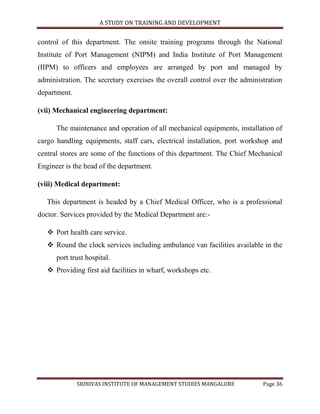
control of this department. The onsite training programs through the National
Institute of Port Management (NIPM) and India Institute of Port Management
(IIPM) to officers and employees are arranged by port and managed by
administration. The secretary exercises the overall control over the administration
department.

(vii) Mechanical engineering department:

      The maintenance and operation of all mechanical equipments, installation of
cargo handling equipments, staff cars, electrical installation, port workshop and
central stores are some of the functions of this department. The Chief Mechanical
Engineer is the head of the department.

(viii) Medical department:

   This department is headed by a Chief Medical Officer, who is a professional
doctor. Services provided by the Medical Department are:-

    Port health care service.
    Round the clock services including ambulance van facilities available in the
      port trust hospital.
    Providing first aid facilities in wharf, workshops etc.


              SRINIVAS INSTITUTE OF MANAGEMENT STUDIES MANGALORE            Page 36
A STUDY ON TRAINING AND DEVELOPMENT


      CHAPTER - 2
             REVIEW
                      OF
     LITERATURE


SRINIVAS INSTITUTE OF MANAGEMENT STUDIES MANGALORE   Page 37
A STUDY ON TRAINING AND DEVELOPMENT


                          REVIEW OF LITERATURE


  A review of literature on evaluation of training was conducted to identify
  methods of effectiveness evaluation for training programs. Five definitions of
  evaluation were identified in the literature.


Kirkpatrick (1971)

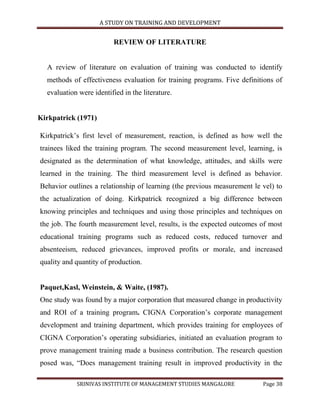
Kirkpatrick‟s first level of measurement, reaction, is defined as how well the
trainees liked the training program. The second measurement level, learning, is
designated as the determination of what knowledge, attitudes, and skills were
learned in the training. The third measurement level is defined as behavior.
Behavior outlines a relationship of learning (the previous measurement le vel) to
the actualization of doing. Kirkpatrick recognized a big difference between
knowing principles and techniques and using those principles and techniques on
the job. The fourth measurement level, results, is the expected outcomes of most
educational training programs such as reduced costs, reduced turnover and
absenteeism, reduced grievances, improved profits or morale, and increased
quality and quantity of production.


Paquet,Kasl, Weinstein, & Waite, (1987).
One study was found by a major corporation that measured change in productivity
and ROI of a training program. CIGNA Corporation‟s corporate management
development and training department, which provides training for employees of
CIGNA Corporation‟s operating subsidiaries, initiated an evaluation program to
prove management training made a business contribution. The research question
posed was, “Does management training result in improved productivity in the

            SRINIVAS INSTITUTE OF MANAGEMENT STUDIES MANGALORE            Page 38
A STUDY ON TRAINING AND DEVELOPMENT


 manager‟s workplace?” The team conducting the research identified that data
 collection needed to be built into the training program for optimal data gathering.
 If managers could use the evaluation data for their own benefit as part of their
 training, they would be more likely to cooperate.


Paulet & Moult, 1987
 British Airways assessed the effectiveness of the Managing People First (MPF)
training by measuring the value shift, commitment, and empowerment of the
trainees. An in-depth interview was used to measure the action potential (energy
generated in the participants by the course) and level of action as a result of the
course. A want level was used to measure the action potential and a do level for the
action. Each measurement was assigned a value of high, medium, or low.
However, high, medium, and low were not defined.


Robert (1988) in his study “The Pygmalion Effect” personal journal describes
the “Pygmalion Effect” or the “Behavior Science Principle” which states that an
employees‟ success is directly related to the company‟s expectation. Good
management training practice is discussed. Such as recognizing employees
potential for improved performance showing confidence in the staff marinating an
in-going dialogue setting, high performance standards complimenting, criticizing
constructively and with empathy, helping people advance and overcome self-
defects.

Alliger and Horowitz (1989)
   Numerous studies reported use of components of the Kirkpatrick Model;
however, no study was found that applied all four levels of the model. Although
level one is the least complex of the measures of evaluation developed by

             SRINIVAS INSTITUTE OF MANAGEMENT STUDIES MANGALORE              Page 39
A STUDY ON TRAINING AND DEVELOPMENT


Kirkpatrick, no studies were found that reported use of level one as a sole measure
of training. One application of the second level of evaluation, knowledge, was
reported by. In this study the IBM Corporation incorporated knowledge tests into
internally developed training. To ensure the best design, IBM conducted a study to
identify the optimal test for internally developed courses. Four separate tests
composed of 25 questions each were developed based on ten key learning
components. Four scoring methods were evaluated including one that used a
unique measure of confidence. The confidence measurement assessed how
confident the trainee was with answers given.


Bushnell (1990) also created a modification to the Kirkpatrick Model by
identifying a four-step process of evaluation. Bushnell‟s model included evaluation
of training from the development through the delivery and impact. Step one
involved the analysis of the System Performance Indicators that included the
trainee‟s qualifications, instructor abilities, instructional materials, facilities, and
training dollars. Step two involved the evaluation of the development process that
included the plan, design, development, and delivery. Step three was defined as
output which equated to the first three levels of the Kirkpatrick Model. Step three
involves trainees‟ reactions, knowledge and skills gained, and improved job
performance. Bushnell separated outcomes or results of the training into the fourth
step. Outcomes were defined as profits, customer satisfaction, and productivity.
This model was applied by IBM‟s global education network, although specific
results were not found in the literature.
Phillips (1991) stated the Kirkpatrick Model was probably the most well known
framework for classifying areas of evaluation. This was confirmed in 1997 when
the America Society for Training and Development (ASTD) assessed the
nationwide prevalence of the importance of measurement and evaluation to human
              SRINIVAS INSTITUTE OF MANAGEMENT STUDIES MANGALORE                 Page 40
A STUDY ON TRAINING AND DEVELOPMENT


resources department (HRD) executives by surveying a panel of 300 HRD
executives from a variety of types of U.S. organizations. Survey results indicated
the majority (81%) of HRD executives attached some level of importance to
evaluation and over half (67%) used the Kirkpatrick Model. The most frequently
reported challenge was determining them impact of the training (ASTD, 1997).


Lookatch (1991) and ASTD (2002) reported that only one in ten organizations
attempted to gather any results-based evaluation. In 1952, Donald Kirkpatrick
(1996) conducted doctoral research to evaluate a supervisory training program.
Kirkpatrick‟s goal was to measure the participants‟ reaction to the program, the
amount of learning that took place, the extent of behavior change after participants
returned to their jobs, and any final results from a change in behavior achieved by
participants after they returned to work.


Wagner & Roland, (1992). Over 20 organizations and 5,000 participants were
studied. Three measures were used to determine behavioral changes. Measure one
was a questionnaire completed by participant s both before and after training. The
second measure was supervisory reports completed on the functioning of work
groups before and after training. The third measure was interviews with managers,
other than the immediate supervisor, to obtain reactions to individual and work-
group performance after an OBERT program. Results reported showed no
significant changes in behavior.


Hopkins (1995)
There are several ways managers can use professional development to increase the
competence, skills, and leadership capacity of their employees. One way to do this
involves managers encouraging employees to pursue continuing education
             SRINIVAS INSTITUTE OF MANAGEMENT STUDIES MANGALORE              Page 41
A STUDY ON TRAINING AND DEVELOPMENT


opportunities     and/or   empowering    employees    through    various   leadership
opportunities within the organization.


Singh has conducted a study on “Attitude Change through Training” in 1998.
The study was conducted with the thirty five officers from different central/state
government/ public sector units/ nationalized banks. And the study was conducted
to explore the impact of importing behavioral skill through training programme
resulting impersonalized attitude and co-operative attitude. Results reveal that
training led to change in attitudes. Experimental training and belief in the source of
communication, facilitated attitude change.


Kirkpatrick, (1998)
From Kirkpatrick‟s doctoral research, the concept of the four Kirkpatrick
measurement levels of evaluation emerged. While writing an article about training
in 1959, Kirkpatrick (1996) referred to these four measurement levels as the four
steps of a training evaluation. It is unclear even to Kirkpatrick how these four steps
became known as the Kirkpatrick Model, but this description persists today). As
reported in the literature, this model is most frequently applied to either
educational or technical training.


Holli and Calabrese (1998) defined evaluation as comparisons of an          observed
value or quality to a standard or criteria of comparison. Evaluation is the process of
forming value judgments about the quality of programs, products, and goals.


Kirkpatrick (1998) recommended that as many as possible of the four levels of
evaluation be conducted. In order to make the best use of organizational resources

                SRINIVAS INSTITUTE OF MANAGEMENT STUDIES MANGALORE             Page 42
A STUDY ON TRAINING AND DEVELOPMENT


of time, money, materials, space, equipment, and manpower, continued efforts are
needed to assess all levels of effectiveness of training programs. Trainers from all
disciplines should develop evaluation plans for training and share the results of
these initiatives.


Jan (1999) in his study “Training and Development” reveals that a majority of
training programme relay that a majority of training programme relay on western
technique. Traditional Vedic approaches to knowledge focusing on the relation of
the athma, pure consciousness serves as the creativity and intelligence should be
viewed as an alternative approach to conduct training.

Warr, Allan and Birdie (1999) evaluated a two-day technical training course
involving 123 mo tor-vehicle technicians over a seven- month period in a
longitudinal study using a variation of the Kirkpatrick Model. The main objective
of this study was to demonstrate that training improved performance, thereby
justifying the investment in the training as appropriate. Warr et al.(1999) suggested
that the levels in the Kirkpatrick Model may be interrelated. They investigated six
trainee features and one organizational characteristic that might predict outcomes
at each measurement level. The six trainee features studied were learning
motivation, confidence about the learning task, learning strategies, technical
qualifications, tenure, and age. The one organizational feature evaluated was
transfer climate which was defined as the extent to which the learning from the
training was actually applied on the job.
Boulmetis and Dutwin (2000) defined evaluation as the systematic process of
collecting and analyzing data in order to determine whether and to what degree
objectives were or are being achieved.


              SRINIVAS INSTITUTE OF MANAGEMENT STUDIES MANGALORE              Page 43
A STUDY ON TRAINING AND DEVELOPMENT


Phillips and Pulliam (2000) reported an additional measure of training
effectiveness,return on investment (ROI), was used by companies because of the
pressures placed on Human Resource Departments to produce measures of output
for total quality management (TQM) and continuous quality improvements (CQI)
and the threat of outsourcing due to downsizing. Great debate was found in the
training and development literature about the use of ROI measures of training
programs. Many training and development professionals believed that ROI was
too difficult and unreliable a measure to use for training evaluation (Barron,
1997).


A study was conducted by HUMAN CAPITAL (2001); a leading pesticides
company provided excellent training for sales executives on selling techniques.
The trainees felt that they could make use of the selling techniques with great
advantage in the market place. Regional managers made no efforts to follow up
new ideas and suggestions. Consequently, sales executives were unable to adapt
techniques learned during the training program.

Schalock (2001) defined effectiveness evaluation as the determination of the
extent to which a program has met its stated performance goals and objectives.

Stufflebeam (2001) defined evaluation as a study designed and conducted to assist
some audience to assess an object's merit and worth. Stufflebeam's (2001)
definition of evaluation was used to assess the methods of evaluation found in this
literature review. The reason for selecting Stufflebeam‟s definition was based on
the applicability of the definition across multiple disciplines. Based on this
definition of evaluation, the Kirkpatrick Model was the most frequently reported
model of evaluation.


             SRINIVAS INSTITUTE OF MANAGEMENT STUDIES MANGALORE             Page 44
A STUDY ON TRAINING AND DEVELOPMENT


Radhakrishna, Plank, and Mitchell (2001) used a learning style instrument
(LSI) and a demographic profile in addition to reaction measures and learning
measures. The three training objectives were to assess knowledge gained
through a Web-based training, to determine participant reaction to Web-based
material and Listserv discussions, and to describe both the demographic profile
and the learning style of the participants. The evaluation of the training began
with an on- line pretest and an on- line LSI. The pretest included seven
demographic questions. The LSI, pretest and posttest, and LSI questionnaire
were paired by the agent's social security numbers. Fifty- five agents of the
available (106) agents completed all four instruments and were included in this
study.
According to Heathfield (2001) there six tips to which helps training and
development that will transfer skills back to the job.

   Provide information for the employee about exactly what training session
   will involve, prior to the training. Explain what is expected of the employees
   at the training session.
   Make clear to the employee that the training is OMS responsibility and she
   needs to take the training seriously.
   Make sure that internal or external training providers supply pre-training
   assignments. Reading or thought- provoking exercises in advance of the
   session promote thoughtful consideration of training content. Exercises or
   self assessment, provided and scored in advance of the session, save
   precious training time for interaction and new information.
   Train supervisors and managers either first or simultaneously so they know
   and understand the skills and information provided in the training session.


          SRINIVAS INSTITUTE OF MANAGEMENT STUDIES MANGALORE              Page 45
A STUDY ON TRAINING AND DEVELOPMENT


      Ask supervisors to meet with employees prior to the training session.
      Determine if key learning points are important for the organization in return
      for the investment of his time in the training. Identify any obstacles the
      employee may expect to experience as he transfers the training to the
      workplace.


Fancsali (2002) Recommends that staff development occur on an ongoing basis.
More specifically, the National Staff Development Council suggests that
“educators” spend at least a quarter of their work time on staff development
activities (Richardson 1997).
Bozionelos (2002)
Placing employees in staff mentorship positions as mentors is another method that
has been identified as increasing employees‟ skills and efficiency, while also
enhancing their reputation among managers, which can lead to greater career
success.
Astroth (2004)
Recommend that training should address what the position entails and the skills
necessary for competency.
Jackson (2006)
With regard to scheduling staff development, suggests that the timing of staff
development can affect the success of the development program, itself.
Consequently, she recommends that the timing of the training schedule be
developed with consideration of staff needs and wants. In terms of strategies for
effective implementation. As for the ideal format of staff development,
recommends that trainings focus on the “main points” and take into account
diverse learning modalities, by including “hands on” activities as well as time for
discussion and questions.
             SRINIVAS INSTITUTE OF MANAGEMENT STUDIES MANGALORE             Page 46
A STUDY ON TRAINING AND DEVELOPMENT


Current Training Needs for Staff
Given the importance of a strong staff in shaping successful youth development
programs, Astroth and Taylor (2004) report on the National Collaboration for
Youth‟s (NCY) efforts to define what successful youth workers are doing.
Essentially, NCY reviewed existing competencies circulating in the field, sought
feedback from many youth-serving organizations 8 and their staff, and ultimately
decided on a set of ten core competencies that “entry-level workers, including part-
time and full-time staff and volunteers, should possess when they begin a job or
should acquire during the first few years to be effective when working with youth,”


According to a report published by the Community Network for Youth
Development, the fast growing need for skilled youth workers highlights the fact
that there is little professional development support for these workers. Little to no
new skill development, low compensation and unclear career ladders may force
youth workers to move from job to job in order to obtain higher wages and/or new
skills and creating barriers for recruitment. Furthermore, this high turnover
detrimentally affects the youth they serve. California is among several states
creating professional support groups, youth development worker mentorship
programs, standards, core competencies for training, opportunities for higher
education, and clearer career pathways for youth workers. In fact, the CNYD
report, “Moving from Knowledge to Action in San Francisco: Creating a
Comprehensive Youth Work Professional Workforce System” lists a number of Bay


P.C. TRIPATHI AND P.N.REDDY (2007)
After the selection of people for various jobs, the next function of management is
to arrange for their training and development. This is because a person, however
             SRINIVAS INSTITUTE OF MANAGEMENT STUDIES MANGALORE               Page 47
A STUDY ON TRAINING AND DEVELOPMENT


carefully selected is not moulded to specifications and rarely meets the demands of
his job adequately. Formerly, it was thought that the training of personnel was
unnecessary on the ground that the new employees would gradually pick up all the
particulars of the job. But as the processes and techniques of production are
becoming more and more complicated, it is being increasingly released that the
formal training is very important not only for new recruit‟s bus also for existing
employees. Training function, in fact, has become the corner stone of sound
management.(Principles of Management page no 176 3rd edition         Tata McGraw-
Hill publishing company limited New Delhi.)


K ASWATHAPPA (2008)
 In simple terms, training and development refer to the imparting of specific
skills, abilities and knowledge to an employee. “More clearly, training and
development may be understood as any attempt to improve current or future
employee performance by increasing an employee‟s ability to perform through
learning, usually by changing the employee‟s attitude or increasing his or her skills
and knowledge. The need for training and development is determined by the
employee‟s performance deficiency, computed as follows: Training and
development need = standard performance – Actual            performance.” (Human
resource management page no 206, 5th edition Tata McGraw-Hill publishing
company limited New Delhi.)


According to Dr. N. Venkateshwara Rao Acharya Nagarjuna University, A
need for HRD, HRD times oct.(2006) Pp.23: training is another sub system. It
refers to the organizations efforts to improve the individual‟s ability to perform a
job or organizational role. Training in often conducted in order to improve
productivity, quality of performance reduce in efficiency and minimize the
             SRINIVAS INSTITUTE OF MANAGEMENT STUDIES MANGALORE               Page 48
A STUDY ON TRAINING AND DEVELOPMENT


accidents it is advisable for ever organization to arrange for its systematic training
for its employees.


According to Arun Monappa and Mirz saiyadain, personal management,
(1990) volume 2 Himalaya publishing house, Pp 179-180: the primary concern of
on organization in its viability, and hence its efficiency and if the organization does
not respond to this pressure it man find itself rapidly losing whatever share of the
market it has, employee training, therefore imports specific skills and knowledge to
employees in order that they contribute to the organization efficiency, and be able
to cope with the pressures of changing environment .


Based on study conducted by Dr.K.N.Ramanuram, Annamalai Nagar, Management
role in productivity HRD times may- (2006) Pp 31 denotes that training In a short-
term process utilizing a systematic and organizing procedure by which non-
managerial personal learn technical knowledge‟s and skills for a definite purpose
of course, all the employees entering the enterprise could not at once learn a new
technology. There in a need for adequate training to employees, it is sure and
certain that will increase per head productivity in the long run.
Beyond Training: Training and Development

Carter (2003) reported that training is generally defines as “ change in behavior” –
Yet, how many trainers and managers forget that, using the term training only as
applicable to “ skills training”? What about the human element? What about those
very same people we want to “train”? What about their individual beliefs,
backgrounds, ideas, needs, and aspiration? In order to achieve long – term results
through training, they broaden their vision to include people development as part
of our strategic planning. Although training covers a broad range of subjects under

             SRINIVAS INSTITUTE OF MANAGEMENT STUDIES MANGALORE                 Page 49
A STUDY ON TRAINING AND DEVELOPMENT


the term “training” without linking it to development narrows our concept of the
training function and leads us to failure.

Cambell (1971), “Training courses are typically designed for a short – term,
started set purpose, such as the operation of some piece of machinery, while
development involves a broader education for long – term purpose.”

Scott (1970) He told about “Instruction can help employees increase their level of
performance on their present assignment. Increased human performance often
directly leads to increased operational productivity and increased company profit.


              SRINIVAS INSTITUTE OF MANAGEMENT STUDIES MANGALORE             Page 50
A STUDY ON TRAINING AND DEVELOPMENT


      CHAPTER - 3


 METHODOLOGY


SRINIVAS INSTITUTE OF MANAGEMENT STUDIES MANGALORE   Page 51
A STUDY ON TRAINING AND DEVELOPMENT


                               METHODOLOGY

The research methods refer to the different methods which are used in research
studies. So, before starting any research a preliminary plan has to be drawn out.
The aim of the study and available resources should be understand at the outset.

     Research is common parlance refer to research for knowledge. It is an original
contribution to the existing stock of knowledge. Making of its advancement it is
the help of study observation comparison and experiment. In this chapter the
research present a clear idea about research methodology which is followed to
conduct this study.

   The validity of any research lines to a great extent in the methodology is “The
systematic and scientific description of how a particular study has been carried
out.” An enquiry would be neither if is done along certain methodological lines
methodology includes the generis of the study the objectives the universe. The
sampling technique adopted the tools of data collection the research design the
limitation of the study undertaken.

   The level of systematic research depend upon proper sampling, collection of
data, keen observation of existing condition, classification and interpretation of
data. At the end of formulation of relation suggestion and conclusion.

Title of Study:

 The study which researcher has undertaken is “A study on Training and
Development”, with special reference to the NMPT, Mangalore.


             SRINIVAS INSTITUTE OF MANAGEMENT STUDIES MANGALORE              Page 52
A STUDY ON TRAINING AND DEVELOPMENT


PROBLEM FORMULATION:

 Training is act of increasing the knowledge and skills of an employee for doing a
particular job. Training is employed as techniques of control and also gives
information for developing new skills of a job. The primary concern of any
organization is to respond to this pressure, it may find itself rapidly losing
whatever share of the market it has.

 The employee training imparts specific skills and knowledge to the employees,
so that they contribute to the organization efficiency and be able to cope with the
pressure of a changing environment. Research methodology is a way to
systematically solve the problem. In order to find out the truth involved in or
problems, certain steps must be taken. In a certain order and the ordered steps are
called a method. This research methodology is very essential.

AIM OF THE STUDY:

 Aim of the researcher is to find out the level of satisfaction of employee and to
know about the different methods of training in the organization.

Objective of Study:

    To study the socio- demographic status of the respondents.
    To study the various Training programmers provided to employees.
    To understand the satisfaction levels of the employees towards Training
      programme.
    To study the importance of Training in maintaining good human relation.
    To understand the importance of Training in acquiring the skills and
      efficiency of employees.


             SRINIVAS INSTITUTE OF MANAGEMENT STUDIES MANGALORE             Page 53
A STUDY ON TRAINING AND DEVELOPMENT


    To draw suggestion though interpretation of employees feedback for
      improvement of Training programme.


HYPOTHESIS:
     “Training is necessary for the overall development of any organization”.


Universe of the study:
  The universe of this study includes 1557 employees of New Mangalore Port
Trust. Employees presently working, among them research selected only 50
respondents for the study. The researcher believes that this is the good
representation of the universe.


The purpose of the study:
   The purpose of the study is to gain more knowledge about Training and
Development to motivate the employees and to study about the training
programmes provided to the employees of the organization.


Sampling Technique:
     The researcher used the simple random sampling method to collecting data.
   Under simple random sampling every item of the universe has equal chance of
   inclusion in the sample. Researcher selected this type of sampling because it
   gives each event in the population an equal probability of being a sample.
INCLUSION CRITERIA:
    All the operational employees were taken for the study.
    All the employees from various departments such as cargo handling
       Employees, Training department, Traffic department, Statistical and
       Research department.
             SRINIVAS INSTITUTE OF MANAGEMENT STUDIES MANGALORE                 Page 54
A STUDY ON TRAINING AND DEVELOPMENT


EXCLUSION CRITERIA:
      Executive Employers and Employees are excluded from the study.
      Dock workers are excluded from the study.


RESEARCH DESIGN:
 The researcher adopted the descriptive research design for the study. Description
studies aim at pertaining accurately the characteristics of particular group or
situation researcher wants to study the practice of training at NMPT. The
descriptive research design helps to researcher to get a detailed study of practice of
training facilities at NMPT, Mangalore.


DATA COLLECTION:
  The data and information has been collected through two sources namely
primary and secondary sources.


Primary Data:
    The researcher collected data through questionnaire method the researcher
collected responses from 50 employees belonging to various department of NMPT.


Secondary Data:
    The secondary data collected with the help of research guide at NMPT by
asking different details about the organization. Details were from annul reports,
Company profile, Articles and reference books of NMPT and also from website of
NMPT.
INSTRUMENT:
  Questionnaire method was used to collect the data from the respondents.


             SRINIVAS INSTITUTE OF MANAGEMENT STUDIES MANGALORE                Page 55
A STUDY ON TRAINING AND DEVELOPMENT


DATA PROCESSING AND ANALYSIS:
 The information collected from the respondents through above mentioned method
has been processed using relevant tools as mentioned bellow:
Editing-
  Editing is done in two ways. Field editing is done to check the correction of
entries. This is done on the spot each day after the interview schedule, which are
field to check the correction of entries. Central editing is done for discarding any
complete schedule or clarifying ambiguities in entries if the respondents are able to
be locating before moving off.
Coding:
   The collected data through interview schedule has been arranged in the
processing system in the numerical from. The numerical symbols have been
assigned to the variable which courses the proper evaluation. This method in
analysis by reducing the quantity of the data.
Tabulation:
    Arrangement of data into concise and logical order is the next step. Percentage
are worked out after grouping the data into seta and categories, charts and diagram
will be prepared where ever necessary.
 Limitations of the study:
   Every study has its own limitation due to unavailable circumstance.
       The duration of the study is not sufficient for an in depth study.
       The study is limited only to the employees of NMPT, Mangalore.
       Collected the data within the work schedule.
       All departments have not covered on the base of time and limitation and
           work procedure.
       Study conducted only for academic purpose and self interest.
       Within the time limitation the study has been conducted.
              SRINIVAS INSTITUTE OF MANAGEMENT STUDIES MANGALORE              Page 56
A STUDY ON TRAINING AND DEVELOPMENT


 CHAPTER - 4
     ANALYSIS
        AND
INTERPRETATION


SRINIVAS INSTITUTE OF MANAGEMENT STUDIES MANGALORE   Page 57
A STUDY ON TRAINING AND DEVELOPMENT


ANALYSIS AND INTERPRETATION


      Analysis and interpretation are central steps in the research process involves
breaking down existing complex factor into simple parts and putting the part
together in new arrangement for the purpose interpretation. Thus the goal of
analysis is to summaries the date in such a way that they provide answer to the
questions that the research interprets.


      Interpretation is the research for brooder means of research findings through
interpretation the meaning and implementation becomes clear.


      Analysis it‟s not complete method interpretation and interpretation cannot
proceed without analysis systematically so as to arrive and findings through
interpretation these are two methods to analyze collected data one method through
graphical figure representation and the other through table.


              SRINIVAS INSTITUTE OF MANAGEMENT STUDIES MANGALORE             Page 58
A STUDY ON TRAINING AND DEVELOPMENT


Table No. 1

Sex of the          Sl. Sex of the        No of         Per       Respondents.
                    No Respondents     Respondents     cent
                    01 Male                30          60.00

                    02 Female               20         40.00

                         Total              50         100.00


              70%

              60%

              50%

              40%
                                 60%
              30%
                                                 40%
              20%

              10%

              0%
                           Male              Female


             SRINIVAS INSTITUTE OF MANAGEMENT STUDIES MANGALORE         Page 59
A STUDY ON TRAINING AND DEVELOPMENT


From the above Table out of total 50 respondents more than half 30 respondents
(60.00 per cent) are male and remaining less than quarter 20 respondents (40.00
per cent) are female.

      It is inferred from the above interpretation that majority 60 per cent
respondents are male.


                                          Table No. 02

                                    Age of the Respondents.

           Sl. Age of the Respondents                     No of the               Per
           No                                            Respondents             cent
           01 Below 20 years                                 00                  00.00
           02 21-25 years                                         00             00.00
           03 26-30 years                                         04             08.00
           04 31-40 years                                         13             26.00
           05 Above 40years                                       33             66.00
                                       Total                      50            100.00


              70%
              60%
              50%
              40%
                                                                                    66%
              30%
              20%
                                                                       26%
              10%
                                                        8%
               0%          %              %
                        Belove 20     21-25 years   26-30 years    31-40 years Above 40 years
                          years


             SRINIVAS INSTITUTE OF MANAGEMENT STUDIES MANGALORE                                 Page 60
A STUDY ON TRAINING AND DEVELOPMENT


From the above Table out of total 50 respondents, less than quarter 33 respondents
(66.00 per cent) are belonging to the age group of above 40 years, 13 respondents
(26.00 per cent) of them are between the age group of 31-40years, 04 respondents
(08.00 per cent) of them are between 26-30 years

It is inferred from the above interpretation that Majority of the respondents are
belonging to the age group of 40 years and above.

                                  Table No. 03

                       Marital status of the Respondents.

              Sl. Marital status             No of the        Per
              No                            Respondents      cent
              01 Yes                            21           42.00
               02 No                             29          58.00
                       Total                     50         100.00


                                      Yes   No


                                                    Yes
                                                    42%
                          No
                         58%


             SRINIVAS INSTITUTE OF MANAGEMENT STUDIES MANGALORE            Page 61
A STUDY ON TRAINING AND DEVELOPMENT


From the above table show that among 50 respondents, more than half i.e. 29
respondents (58.00 per cent) are Unmarried, and remaining 21 respondents (42.00
per cent) are married.

It clearly indicates from the above interpretation that, Majority of the employees
are Unmarried.


                                    Table No. 04

                            Educational Qualification.

              Sl.     Educational            No of the          Per
              No      Qualification         Respondents        cent
              01    Undergraduate               26             52.00
              02    Graduate                       23          46.00
              03    Master degree                  01          02.00
              04    ITI/Diploma                    00          00.00
                         Total                     50         100.00


             SRINIVAS INSTITUTE OF MANAGEMENT STUDIES MANGALORE            Page 62
A STUDY ON TRAINING AND DEVELOPMENT


               52%
                                46%


                                                   2%
                                                                  0%
       Undergraduate
                           Graduate
                                            Master degree
                                                             ITI/Diploma


Above table shows that out of 50 respondents, just above the quarter i.e. 26(52.00
per cent) of the respondents are Undergraduate are Graduate Holders, less than half
i.e. 23(46.00 per cent) of them are Master degree Holders, and remaining 1(2.00
per cent) respondents are master degree holders.

It is inferred from the above analysis that majority 26(52.00 per cent) of the
respondents are Undergraduates.

                                       Table No. 05

                                      Work experience

              Sl.      Work experience          No of the      Per
              No                               Respondents     cent
              01       Below 1 years               01         02.00
              02       1-5years                    00         00.00
              03       6-10 years                  01         02.00
              04       11-15 years                 13         26.00
              05       16-20 years                 35         70.00
                           Total                   50         100.00


             SRINIVAS INSTITUTE OF MANAGEMENT STUDIES MANGALORE             Page 63
A STUDY ON TRAINING AND DEVELOPMENT


     80%

     70%

     60%

     50%

     40%
                                                                                     70%
     30%

     20%
                                                                  26%
     10%

      0%        2%              0%              2%
            Below 1years     1-5 years       6-10 years        11-15 years       16-20 years


From above table out of total 50 respondents just more than half 35 respondents
(70.00 per cent) have work experience of above 16-20 years, just above the quarter
13 (26.00 per cent) respondents possess work experience of 11-15 years, 1 (2.00
per cent) 0f them possess 6-10 years of work experience, and remaining 1 (2.00 per
cent) of the respondents have the work experience of 1 years.

It is inferred the above analysis that majority 35 (70.00 per cent) have the work
experience of above 16-20 years.

                                         Table No. 06

                       Training programmes are conducted.

               Sl. Response of the                No of the                   Per
               No   Respondents                  Respondents                 cent
               01 Monthly                            07                      14.00
               02 Quarterly                               09                 18.00
               03 Annually                                34                 68.00
                           Total                          50             100.00


             SRINIVAS INSTITUTE OF MANAGEMENT STUDIES MANGALORE                                Page 64
A STUDY ON TRAINING AND DEVELOPMENT


           70%                                             68%

           60%

           50%

           40%

            30%

            20%           14%             18%

            10%

             0%

                      Monthly
                                     Quarterly
                                                       Annually


From the above table out of 50 respondents, more than half i.e. 34 respondents
(68.00 per cent) of the respondents are trained annually, 09 (18.00per cent) of them
are trained quarterly, and remaining 07 (14.00 per cent) of the respondents are
trained monthly.

 It is inferred from the above analysis that majority 34 respondents (68.00 per
cent) often trained annually.

                                   Table No. 07

                     Necessary for the Training Programme.

         Sl. Response of Respondents               No of the         Per
         No                                       Respondents       cent
         01 Fully necessary                           16            32.00
         02 Necessary to some extent                  23            46.00
         03 Not necessary                             09            18.00
         04 Not at all                                02            04.00
                         Total                        50           100.00


             SRINIVAS INSTITUTE OF MANAGEMENT STUDIES MANGALORE              Page 65
A STUDY ON TRAINING AND DEVELOPMENT


From the above table out of total 50 respondents, just below half 23 (46.00 per
cent) respondents opinioned that training programme is necessary to some extent,
16 (32.00 per cent) respondents need training programmes, 09 (18.00 per cent)
respondents feel training programmes are not necessary and remaining 02 (04.00
per cent) respondents feel training programme are not at all necessary.


It is inferred from the above analysis that majority 23 (46.00 per cent) respondents
opinioned that training programme is necessary to some extent.


                                   Table.No.08

             Opinion regarding duration of Training programme.

               Sl.   Response of            No of the          Per
               No   Respondents            Respondents         cent
               01 Adequate                     09             18.00
               02 Inadequate                   13             26.00
               03 Can be improved              28             56.00
                      Total                    50             100.00


             SRINIVAS INSTITUTE OF MANAGEMENT STUDIES MANGALORE              Page 66
A STUDY ON TRAINING AND DEVELOPMENT


     60%
                                                              56%
     50%

      40%

      30%                               26%
                     18%
      20%

      10%
       0%

                Adequate
                                   Inadequate
                                                       Can be improved


From the above table we can see that 28 (56.00 per cent) of the respondents say
that duration of training programme can be improved, where 13 (26.00 per cent) of
the respondents feel that training duration is inadequate and the rest of the
respondents 09 (18.00 per cent) reported that duration of the programme is
adequate.

It is inferred from the above analysis that majority 28 (56.00 per cent) respondents
say that duration of training programme can be improved.

                                  Table No. 09

            Opinion to get trained in the areas of their preference.

              Sl.  Response of              No of the           Per
              No   Respondents             Respondents         cent
              01 Yes                           37              74.00
              02 No                              13            26.00
                       Total                     50           100.00


            SRINIVAS INSTITUTE OF MANAGEMENT STUDIES MANGALORE               Page 67
A STUDY ON TRAINING AND DEVELOPMENT


                      26%


                                                                           Yes
                                                                           NO
                                                          74%


From above table out of 50 respondents, more than half 37 (74.00 per cent) of the
respondents opinioned that they are trained in their preference areas and remaining
13 (26.00 per cent) of the respondents do not agree to the above mentioned
statement.

It is inferred from the above analysis that majority 37 (74.00 per cent) of the
respondents opinioned that they are trained in their preference areas.

                                    Table No.10

                Kind of Training getting from the organization.

               Sl.  Response of              No of the           Per
               No   Respondents             Respondents         cent
               01 Technical                     06              12.00
               02 Manual                          04            08.00
               03 Official                        34            68.00
               04 Safety                          06            12.00

             SRINIVAS INSTITUTE OF MANAGEMENT STUDIES MANGALORE             Page 68
A STUDY ON TRAINING AND DEVELOPMENT


                05 Any other                               00            00.00
                             Total                         50            100.00


         70%                                    68%

         60%

         50%

         40%

         30%

         20%
                     12%                                          12%
                                     8%
         10%
                                                                             0%
          0%
                 Technical       Manual      Official           Safety   Any other


From above table out of 50 respondents 34 (68.00 per cent) respondents are getting
official training, 6 (12.00 per cent) respondents are getting technical training,
6(12.00 per cent) respondents are getting safety training and the remaining 4(8.00
per cent) respondents are getting manual training.

It is inferred from the above analysis that majority 34(68.00 per cent) respondents
are getting official training.

                                          Table No.11

                  Adequate importance is given for the training.

               Sl.    Response of                        No of the          Per
               No    Respondents                        Respondents        cent
               01 Not at all true                           10             20.00
               02 To some extent                            25             50.00
               03 Very true                                 15             30.00


               SRINIVAS INSTITUTE OF MANAGEMENT STUDIES MANGALORE                    Page 69
A STUDY ON TRAINING AND DEVELOPMENT


                        Total                     50          100.00


From above table out of 50 respondents 25 (50.00 per cent) respondents opinioned
that adequate importance is given for training to some extent, 15 (30.00 per cent)
respondents opinioned that „Training is given adequate importance‟ and the
remaining 10(20.00 per cent) respondents opinioned that training is not at all
given adequate importance.


It is inferred from the above analysis that majority 25 (50.00 per cent) respondents
opinioned that adequate importance is given for training to some extent.


                                   Table No.12

  Senior line managers are eager in helping juniors to develop them through
                                   training.

             Sl.    Response of               No of the          Per
             No     Respondents              Respondents        cent
             01 Disagree                         13             26.00
             02 Agree to some extent              26            52.00

             SRINIVAS INSTITUTE OF MANAGEMENT STUDIES MANGALORE              Page 70
A STUDY ON TRAINING AND DEVELOPMENT


             03 Agree                             11           22.00
                       Total                      50          100.00


From above table out of 50 respondents 26 (52.00 per cent) respondents agree to
some extent that senior line managers are eager to help juniors in developing them
through training, 13(26.00 per cent) respondents disagree that „Senior line
managers are eager to help juniors to develop them through training‟ and the
remaining 11(22.00 per cent) respondents agree to the above statement.

It is inferred from the above analysis that majority 26 (52.00per cent) respondents
agree to some extent that senior line managers are eager to help juniors in
developing them through training.


                                    Table No.13

      Adequate free time is given to the employees to reflect and plan for
                       improvement after the training.


              Sl.     Response of          No of the          Per
              No      Respondents         Respondents         cent

             SRINIVAS INSTITUTE OF MANAGEMENT STUDIES MANGALORE             Page 71
A STUDY ON TRAINING AND DEVELOPMENT


               01 Not Agree                      11          22.00
               02 Agree to some                  28          56.00
                  extent
               03 Agree                          11          22.00
                       Total                     50          100.00


From above table out of 50 respondents 28 (56.00 per cent) respondents Agree to
some extent that adequate free time is given to the employees to reflect and plan
for improvement after the training.11(22.00 per cent) respondents agree and
disagree that adequate free time is given to the employees to reflect and plan for
improvement after the training‟ respectively.

It is inferred from the above analysis that majority 28 (56.00per cent) respondents
Agree to some extent that adequate free time is given to the employees to reflect
and plan for improvement after the training.


                                   Table No.14

                    Training programmes are organized well.

              Sl.   Response of             No of the         Per
              No    respondents            Respondents       cent
              01    Very well                  06            12.00
              02    Well                       15            30.00

             SRINIVAS INSTITUTE OF MANAGEMENT STUDIES MANGALORE             Page 72
A STUDY ON TRAINING AND DEVELOPMENT


                 03 Average                              23              46.00
                 04 Not well                             06              12.00
                 05 Very poor                            00              00.00
                            Total                        50             100.00


             50%

             40%

             30%
                                                46%
             20%
                                     30%
             10%
                          12%                                 12%
                 0%                                                     0%
                       Very well    Well      Average    Not well   Very poor


From the above table out of 50 respondents, more than half i.e. 23 respondents
(46.00 per cent) of the respondents opinioned that training programmes are
organized to an average extent, 15 (30.00 per cent) say that training programmes
are well organized and remaining 06 (12.00 per cent)respondents opinioned that
training programmed is organized very well and poor respectively

 It is inferred from the above analysis that majority 23 respondents (46.00 per
cent) of the respondents opinioned that training programmes are organized to an
average extent


                                           Table No.15

          Evident change in the performance after getting training.

                 Sl.    Response of the            No of the              Per
                 No      respondents              Respondents             cent

            SRINIVAS INSTITUTE OF MANAGEMENT STUDIES MANGALORE                   Page 73
A STUDY ON TRAINING AND DEVELOPMENT


               01 Yes                             39            78.00
               02 No                              11            22.00
                        Total                     50           100.00


                         78%
     80%

     60%

     40%                                                22%

     20%

      0%
                        Yes                            No


From above table out of 50 respondents, more than half 39 (78.00 per cent) of the
respondents say that there is an Evident change in their performance after getting
training, and remaining 11(22.00 per cent) of the respondents say no to it.

It is inferred from the above analysis that majority 39 respondents (78.00 per cent)
say that there is an Evident change in their performance after getting training


                                   Table No. 16

  Training programmes will provide an opportunity to bring out the hidden
                                  skills.

               Sl.   Response of the          No of the          Per

             SRINIVAS INSTITUTE OF MANAGEMENT STUDIES MANGALORE                   Page 74
A STUDY ON TRAINING AND DEVELOPMENT


              No       Respondents             Respondents          cent
               01 Yes                                  40          80.00
               02 No                                   10          20.00
                         Total                         50          100.00


                                  80%
            80%
            70%
            60%
             50%
             40%
             30%                                             20%
             20%
             10%
              0%

                            Yes
                                                        No


From above table out of 50 respondents, more than half 40 (80.00 per cent) of the
respondents say that Training programmes will provide an opportunity to bring out
the hidden skills, and remaining 10 (20.00 per cent) of the respondents say no to it.

It is inferred from the above analysis that majority 39 respondents (78.00 per cent)
Training programmes will provide an opportunity to bring out the hidden skills.


                                        Table No. 17

                   Aware of the selection procedure for training.


             SRINIVAS INSTITUTE OF MANAGEMENT STUDIES MANGALORE               Page 75
A STUDY ON TRAINING AND DEVELOPMENT


              Sl.    Response of the          No of the           Per
              No       respondents           Respondents          cent
              01    Random                       02              04.00
              02    Need based                   15              30.00
              03    Seniority                    11              22.00
              04    Appraisal                    08              16.00
              05    Departments                  12              24.00
              06    Any other                    02              04.00
                       Total                     50              100.00


From above table out of 50 respondents 15 (30.00 per cent) respondents opinioned
that selection procedure for training is need based, 12 (24.00 per cent) are of the
opinioned that it is based on Departments, 11(22.00 per cent) respondents
opinioned that is based on seniority, 08 (16.00 per cent) respondents say it is on the
appraisal and remaining 02 (04.00 per cent) respondents opined selection
procedure for training is based on random and any other criteria respectively.

It is inferred from the above analysis that majority 15 (30.00 per cent) respondents
opinioned that selection procedure for training is need based.


                                Table No.18
          Development of the personality after attending the training.


               Sl. Response of the           No of the            Per
               No respondents               Respondents          cent
               01 Yes                           43               86.00

             SRINIVAS INSTITUTE OF MANAGEMENT STUDIES MANGALORE                Page 76
A STUDY ON TRAINING AND DEVELOPMENT


                02 No                               07              14.00
                         Total                      50              100.00


       90%
       80%
       70%
       60%
       50%                     86%
       40%
       30%
       20%
                                                              14%
       10%
        0%
                         Yes                             No


From above table out of 50 respondents, more than half 43 (86.00 per cent) of the
respondents say that their personality developed after attending the training and
remaining 07 (14.00 per cent) of the respondents opinioned negative to it.

It is inferred from the above analysis that majority 39 respondents (78.00 per cent)
say that their personality developed after attending the training.


                                     Table no. 19

                     Procedure of training need to be changed.

               Sl.    Response of the         No of the               Per
               No      respondents           Respondents             cent
               01          Yes                   31                  62.00

             SRINIVAS INSTITUTE OF MANAGEMENT STUDIES MANGALORE              Page 77
A STUDY ON TRAINING AND DEVELOPMENT


                         02          No                      19          38.00
                                  Total                      50          100.00


                        70%
                        60%
                        50%
           Axis Title


                         40%
                         30%                 62%

                         20%
                                                                   38%
                         10%
                          0%

                                       Yes
                                                                  No


From above table out of 50 respondents, more than half 31 (62.00 per cent) of the
respondents say that Procedure of training need to be changed, and remaining 19
(38.00 per cent) of the respondents opinioned that procedure of training need not
be changed.

It is inferred from the above analysis that majority 31 respondents (62.00 per cent)
say that Procedure of training need to be changed.


                                               Table.No.20

  Interest that will be considered while setting the objectives of the training
                                  programme.

                          Sl.   Response of the       No of the          Per
                          No     respondents         Respondents         cent

                        SRINIVAS INSTITUTE OF MANAGEMENT STUDIES MANGALORE        Page 78
A STUDY ON TRAINING AND DEVELOPMENT


                01 Employees                        15       30.00
                02 Employer                         11       22.00
                03 Both                             24       48.00
                      Total                         50      100.00


From above table out of 50 respondents 24 (48.00 per cent) respondents opinioned
that both employees and employers Interest will be considered while setting the
objectives of the training programme, 15(30.00 per cent) are of the opinioned that
employees „Interest will be considered while setting the objectives of the training
programme‟, and the remaining 11(22.00 per cent) respondents opinioned that it is
employers, interest will be considered while setting the objectives of the training
programme .

It is inferred from the above analysis that majority 24 (48.00per cent) respondents
opinioned that both employees and employers Interest will be considered while
setting the objectives of the training programme.


                                   Table.No.21

                   Training will improve confidence in work.

               Sl. Response of the          No of the         Per
               No respondents              Respondents        cent

              SRINIVAS INSTITUTE OF MANAGEMENT STUDIES MANGALORE            Page 79
A STUDY ON TRAINING AND DEVELOPMENT


               01 Yes                             44          88.00
               02 No                              06          12.00
                        Total                     50         100.00


                                 88%
            100%

             80%

             60%

             40%                                                            Yes
                                                                            No
              20%                                   12%
               0%

                           Yes
                                               No


From the above table shows out of 50 respondents more than half 44 (88.00 per
cent) opinioned that their confidence level in work increased and remaining 06
(12.00 per cent) respondents opinioned that their confidence level did not increased
the confidence level of work.

It is inferred from the above analysis that majority 44 (88.00per cent) respondents
opinioned that their confidence level in work increased.


                                   Table No. 22

                          Trained on safety measures.


             SRINIVAS INSTITUTE OF MANAGEMENT STUDIES MANGALORE              Page 80
A STUDY ON TRAINING AND DEVELOPMENT


               Sl. Response of the            No of the           Per
               No   respondents              Respondents         cent
               01 Yes                            14              28.00
               0s2 No                               36           72.00
                        Total                       50          100.00


        80%                                               72%
        60%
        40%                    28%

        20%
         0%

                         Yes
                                                         No


From the above table shows out of 50 respondents more than half 36 (72.00 per
cent) respondents opinioned that they are not trained on safety measures, and
remaining 14 (28.00 per cent) respondents are trained in the safety measures.

It is inferred from the above analysis that majority 36 (72.00per cent) respondents
opinioned that they are not trained on safety measures.


                                     Table No. 23

                     Developments after getting the training.

         Sl.      Response of the respondents            No of the       Per

               SRINIVAS INSTITUTE OF MANAGEMENT STUDIES MANGALORE              Page 81
A STUDY ON TRAINING AND DEVELOPMENT


          No                                          Respondents       cent
          01    Skills development                        10             20
          02    Aptitude development                      04             08
          03    Updating the existing knowledge           08             16
          04    Acquiring new knowledge                   28             56
                            Total                         50            100


From the above table out of total 50 respondents, just below half 28 (56.00 per
cent) respondents opinioned that new knowledge is acquired after getting the
training, 10 (20.00 per cent) respondents it is skills development, 08 (16.00 per
cent) respondents say it is updating the existing knowledge, and remaining 04
(08.00 per cent) respondents feel their aptitude develops after getting the training.

It is inferred from the above analysis that majority 28 (56.00 per cent) respondents
opinioned that new knowledge is acquired after getting the training.


                                    Table No. 24

    Training centre is well equipped to organize the training programmes.


               SRINIVAS INSTITUTE OF MANAGEMENT STUDIES MANGALORE               Page 82
A STUDY ON TRAINING AND DEVELOPMENT


               Sl.    Response of the             No of the         Per
               No      respondents               Respondents       cent
               01    Yes                             42            84.00
               02    No                                 08         16.00
                          Total                         50         100.00


             90%
             80%
             70%
             60%
             50%
                                   84%
              40%
              30%
              20%
              10%
               0%                                            16%

                             Yes
                                                         No


From the above table shows out of 50 respondents more than half 42 (84.00 per
cent) answered that training centre is well equipped for organizing the training
programme and remaining 08 (16.00 per cent) of the respondents opinioned
negatively to the above.

It is inferred from the above analysis that majority 42 (84.00per cent) respondents
are of the opinion that training centre is well equipped for organizing the training
programme.


                                         Table No. 25

            Resource person of the training progrmme are efficient.


              SRINIVAS INSTITUTE OF MANAGEMENT STUDIES MANGALORE             Page 83
A STUDY ON TRAINING AND DEVELOPMENT


              Sl. Response of the               No of the       Per
              No   respondents                 Respondents     cent
              01 Yes                               31          62.00
               02   No                             19          38.00
                         Total                     50          100.00


                           38%
                                                                         Yes
                                                                         No
                                                 62%


From above table out of 50 respondents, more than half 31 (62.00 per cent) of the
respondents say that „Resource person of the training progrmme are efficient‟ and
remaining 19 (38.00 per cent) of the respondents opinioned that resource person
for the training programme is not efficient.

It is inferred from the above analysis that majority 31(62.00 per cent) respondents
say that „Resource person of the training progrmme are efficient.


                                   Table. No. 26

   The organization considers training as a part of organizational strategy.
             SRINIVAS INSTITUTE OF MANAGEMENT STUDIES MANGALORE                Page 84
A STUDY ON TRAINING AND DEVELOPMENT


              Sl.    Response of the         No of the          Per
              No       respondents          Respondents         cent
              01    Strongly agree              14             28.00
              02    Agree                       22             44.00
              03    Somewhat agree              06             12.00
              04    Disagree                    08             16.00
                        Total                   50             100.00


From the above table out of 50 respondents more than half 22 (44.00 per cent) of
the respondents agreed that the organization considers training as a part of
organizational strategy, 14 (28.00 per cent) respondents strongly agree that the
organization considers training as a part of organizational strategy 08 (16.00 per
cent) of the respondents disagree for the same and remaining 06 (12.00 per cent) of
the respondents somewhat agree for the above mentioned view.


It is inferred from the above analysis that majority 22(44.00per cent) respondents
agreed that the organization considers training as a part of organizational strategy.


                                   Table.No.27

              Number of training programmes attended in a year.

             SRINIVAS INSTITUTE OF MANAGEMENT STUDIES MANGALORE               Page 85
A STUDY ON TRAINING AND DEVELOPMENT


               Sl. Response of the          No of the          Per
               No   respondents            Respondents        cent
               01 Less than 10                 20             40.00
               02 11-20                           11         22.00
               03 21-40                           08         16.00
               04 More than 41                    11         11.00
                      Total                       50         100.00


From the above table out of total 50 respondents, just below half 20 (40.00 per
cent) respondents opinioned that less than 10 training programmes are attended by
them in a year, 11 (22.00 per cent) respondents attended 11-20 training
programmes, 11 (22.00 per cent) respondents attended more than 41 training
programmes, and remaining 08 (16.00 per cent) respondents attended            21-40
training programmes in a year.


It is inferred from the above analysis that majority 20 (40.00 per cent) respondents
opinioned that that less than 10 training programmes are attended by them in a
year.


                                   Table No. 28

                             Trainings are more for.

             SRINIVAS INSTITUTE OF MANAGEMENT STUDIES MANGALORE              Page 86
A STUDY ON TRAINING AND DEVELOPMENT


               Sl.      Response of the       No of the         Per
               No         respondents        Respondents       cent
               01     Senior staffs              09            18.00
               02     Junior staffs              09            18.00
               03     New staffs                   06          12.00
               04     Based on                     26          52.00
                      requirement
                         Total                     50         100.00


From the above table out of total 50 respondents, just below half 26 (52.00 per
cent) respondents opinioned that trainings are organized more based on
requirement, 09 (18.00 per cent) respondents opinioned that trainings are more to
the senior staffs, 09 (18.00 per cent) respondents say it is for junior staffs, and
remaining 06 (12.00 per cent) respondents opinioned that trainings are more for the
new staff.


It is inferred from the above analysis that majority 26 (56.00 per cent) respondents
opinioned that trainings are organized more based on requirement.


                                    Table No. 29

        Important barriers to training and development progarammes.

             SRINIVAS INSTITUTE OF MANAGEMENT STUDIES MANGALORE              Page 87
A STUDY ON TRAINING AND DEVELOPMENT


          Sl. Response of the respondents            No of the         Per
          No                                        Respondents       cent
          01 Time                                       04            08.00
          02 Money                                        19          38.00
          03 Lack of interest by the staff                14          28.00
          04 Non-availability of skilled                  13          26.00
             trainer
                       Total                              50         100.00


From the above table out of total 50 respondents, more than half 19 (38.00 per
cent) respondents answered that Money is Important barriers to training and
development progarammes, 14 (28.00 per cent) respondents opinion that it is lack
of interest by the staff, 13 (26.00 per cent) respondents say it is non-availability of
skilled trainer, and remaining 04 (08.00 per cent) respondents say it is the time the
important barrier to training and development programmes in the organization.


It is inferred from the above analysis that majority 19 (38.00 per cent) respondents
opinioned that Money is Important barriers to training and development
progarammes.


                                    Table.No.30

                          Mode of training method used.

             SRINIVAS INSTITUTE OF MANAGEMENT STUDIES MANGALORE                 Page 88
A STUDY ON TRAINING AND DEVELOPMENT


               Sl.     Response of the           No of the        Per
               No        respondents            Respondents      cent
               01 Job rotation                      10           20.00
               02 External training                  20          40.00
               03 Conference/discussion              04          08.00
               04 Programmed instruction             16          32.00
                           Total                     50        100.00


From the above table out of total 50 respondents, more than half 20 (40.00 per
cent) respondents answered that External training Mode of training method used,
16 (32.00 per cent) respondents say it is Programmed instruction, 10 (20.00 per
cent) respondents say it is Job rotation, and remaining 04 (08.00 per cent)
respondents say it is Conference/discussion mode is used for the training in the
organsation.


It is inferred from the above analysis that majority 20 (40.00 per cent) respondents
opinioned that External training Mode of training method used.


                                      Table.No.31

        Enough practical‟s are conducted during the training sessions.


               SRINIVAS INSTITUTE OF MANAGEMENT STUDIES MANGALORE            Page 89
A STUDY ON TRAINING AND DEVELOPMENT


                 Sl.      Response of the         No of the          Per
                 No         respondents          Respondents         cent
                 01      Strongly agree              03             06.00
                 02      Agree                       21             42.00
                 03      Somewhat agree              13             26.00
                 04      Disagree                    13             26.00
                             Total                   50             100.00


            45%
            40%
            35%
            30%
            25%
                                          42%
            20%
            15%                                     26%           26%
            10%
             5%               6%
             0%
                       Strongly agree   Agree    Somewhat      Disagree
                                                   agree


From above table shows that out of 50 respondents, just above the quarter i.e.
21(42.00 per cent) of the respondents are agree that enough practical‟s are
provided during the training session, 13(26 per cent) of the respondents somewhat
agree to the above statement, 13(26.00 per cent) of the respondents do not agree to
the above statement and remaining 3(06.00 per cent) of the respondents strongly
agree that enough practices are provided during the training session in the
organization.

It is inferred from the above analysis that majority 21(42.00 per cent) of the
respondents that enough practical‟s are provided during the training session.

                                          Table.No.32

         Employees are motivated to attend the training programmes.

                SRINIVAS INSTITUTE OF MANAGEMENT STUDIES MANGALORE              Page 90
A STUDY ON TRAINING AND DEVELOPMENT


                Sl.    Response of the         No of the         Per
                No       respondents          Respondents        cent
                01    Strongly agree              08            16.00
                02    Agree                       20            40.00
                03    Somewhat agree              12            24.00
                04    Disagree                    10            20.00
                          Total                   50            100.00


From above table shows that out of 50 respondents, just above the quarter i.e.
20(40.00 per cent) of the respondents agree that employees are motivated to attend
the training, 12(24.00 per cent) of the respondents somewhat agree to the above
statement, 10(20.00 per cent) of the respondents disagree that employees are
motivated to attend the training and remaining 08(16.00 per cent) of the
respondents strongly agree that employees are motivated to attend the training.

It is inferred from the above analysis that majority 20(40.00 per cent) of the
respondents are agree that employees are motivated to attend the training.


                                   Table.No.33

    Duration needed for the implementation of the training programmes.
             SRINIVAS INSTITUTE OF MANAGEMENT STUDIES MANGALORE              Page 91
A STUDY ON TRAINING AND DEVELOPMENT


              Sl.  Response of the            No of the       Per
              No    respondents              Respondents      cent
              01 Less than 1 month               17
                                                             34.00
              02   1-2 months                    13          26.00
              03   2-4 months                    09          18.00
              04   More than 4 months            11          22.00
                      Total                      50          100.00


From above table shows that out of 50 respondents, just above the quarter i.e.
17(34.00 per cent) of the respondents opinioned that less than 1 month Duration is
needed for the implementation of the training programmes, 13(26.00 per cent) of
the respondents say the duration should be between 1-2 months, 11(22.00 per cent)
of the respondents opinion the duration to be more than 4 months, and remaining
09(18.00 per cent) of the respondents opinion that the training duration is 2-4
months.

It is inferred from the above analysis that majority 17(34.00 per cent) of the
respondents opinioned that less than 1 month Duration is needed for the
implementation of the training programmes.


                                  Table.No.34

      The kind of training imparted for the newly recruited employees.

             SRINIVAS INSTITUTE OF MANAGEMENT STUDIES MANGALORE            Page 92
A STUDY ON TRAINING AND DEVELOPMENT


             Sl. Response of the           No of the       Per cent
             No   respondents             Respondents
             01 Technical training            11             22.00
              02 Management                    18            36.00
                 training
              03 Presentation skill            13            26.00
              04 Other                         08            16.00
                        Total                  50           100.00


From above table shows that out of 50 respondents, just above the quarter i.e.
18(36.00 per cent) of the respondents opinioned that management training is
imparted for the newly recruited employees, 13(26.00 per cent) of the respondents
opinioned that presentation skills are imparted to the newly recruited employees,
11(22.00 per cent) of the respondents opinioned that technical skill are imparted,
and remaining 08(16.00 per cent) of the respondents opinioned that any other
trainings are imparted to the newly recruited employees.


It is inferred from the above analysis that majority 18(36.00 per cent) of the
respondents opinioned that management training is imparted for the newly
recruited employees.


                                  Table No. 35


             SRINIVAS INSTITUTE OF MANAGEMENT STUDIES MANGALORE            Page 93
A STUDY ON TRAINING AND DEVELOPMENT


    Training and development programmes needed to make their carrier
                        aspirations to come true.

            Sl.    Response of the               No of the         Per
            No       respondents                Respondents       cent
            01 Leadership training                  12            24.00
            02 External degree study                 18           36.00
            03 Formal meeting                        15           30.00
               procedures
            04           other                       05          10.00
                      Total                          50          100.00


From the above table out of total 50 respondents, more than half 18 (36.00 per
cent) respondents answered that External degree study is needed to make their
career aspirations to come true, 15 (30.00 per cent) of the respondents opinioned it
is formal meeting procedures, 12 (24.00 per cent) of the respondents say it is
leadership training, and remaining 05 (10.00 per cent) of the respondents say it is
other study is needed to make their career aspirations to come true.

It is inferred from the above analysis that majority 18 (36.00 per cent) of the
respondents answered that External degree study is needed to make their career
aspirations to come true.


                                   Table.No.36


             SRINIVAS INSTITUTE OF MANAGEMENT STUDIES MANGALORE              Page 94
A STUDY ON TRAINING AND DEVELOPMENT


     The conditions that have to be improved during the training session.


       Sl.   Response of the respondents             No of the        Per
       No                                           Respondents      cent
       01 Re-design the job                             08           16.00
       02 Remove interference                             10         20.00
       03 Re- organize the work place                     15         30.00
       04 Upgrade the information of the                  17         34.00
          material given during training
                        Total                             50         100.00


From the above table out of total 50 respondents, more than half 17 (34.00 per
cent) respondents answered that Upgrade the information of the material given
during training should be improved during the training session, 15 (30.00 per cent)
of the respondents opinioned to reorganize the work place, 10 (20.00 per cent) of
the respondents opinion that interference should be removed, and remaining 08
(16.00 per cent) of the respondents opinioned that job should be redesigned during
the training sessions.


It is inferred from the above analysis that majority 17 (34.00 per cent) of the
respondents Upgrade the information of the material given during training should
be improved during the training session.


                                     Table.No.37

              SRINIVAS INSTITUTE OF MANAGEMENT STUDIES MANGALORE              Page 95
A STUDY ON TRAINING AND DEVELOPMENT


       Skills that should be possessed by the trainer to make it effective.


      Sl.    Response of the respondents                No of the       Per
      No                                               Respondents     cent
      01 Should possess only technical skills              10          20.00
       02 People skills or soft skills are more             21         42.00
          important than technical skills
       03 Generalist makes better personnel                 10         20.00
          managers that specialist
       04 Found of talking to people                        09         18.00
                           Total                            50         100.00


From the above table out of total 50 respondents, more than half 21 (42.00 per
cent) of the respondents opinioned that the trainer should possess People skills or
soft skills are more important than technical skills, 10 (20.00 per cent) respondents
opinioned that trainer should possess technical skills and Generalist is better than
the specialist, and remaining 09 (18.00 per cent) of the respondents opinioned that
trainer should be Found of talking to people .

It is inferred from the above analysis that majority 21 (42.00 per cent) of the
respondents that the trainer should possess People skills or soft skills are more
important than technical skills


                                   Table.No.38
             SRINIVAS INSTITUTE OF MANAGEMENT STUDIES MANGALORE                 Page 96
A STUDY ON TRAINING AND DEVELOPMENT


          Reason for the shortage of skilled man power at workplace.

     Sl.      Response of the respondents               No of the        Per
     No                                                Respondents      cent
     01 Lack of planning                                   12           24.00
     02 Lack of support from senior staff                    15         30.00
     03 Lack of proper guidance and training at              16         32.00
        workplace
     04 Lack of quality education at primary and             07         14.00
        secondary level
                        Total                                50        100.00


From above table out of 50 respondents 16 (32.00 per cent) respondents opinioned
that due to the Lack of proper guidance and training at workplace there is a
shortage of skilled man power at work place, 15(30.00 per cent) are of the opinion
that Reason for the shortage of skilled man power at workplace‟ is Lack of support
from senior staff , 12(24.00 per cent) respondents opinioned that it is Lack of
planning, and remaining 07 (14.00 per cent)of the respondents opinioned that it is
Lack of quality education at primary and secondary level.


It is inferred from the above analysis that majority 16 (32.00 per cent) respondents
due to the Lack of proper guidance and training at workplace there is a shortage of
skilled man power at work place.


                                   Table.No.39
             SRINIVAS INSTITUTE OF MANAGEMENT STUDIES MANGALORE              Page 97
A STUDY ON TRAINING AND DEVELOPMENT


                      Training needed to perform other jobs.

Sl. No           Response of the respondents              No of the      Per cent
                                                         Respondents
  01     Safety awareness                                    16           32.00
  02     Negotiation skills                                  10           20.00
  03     Machine operations                                  14           28.00
  04     Occupational health                                 10           20.00
                        Total                                50           100.00


         40%         32%
                                                 28%
         30%
                                   20%                          20%
         20%

         10%

         0%
                   Safety     Negotiation    Machine     Occupational
                 awareness       skills     operations      health


From the above table that out of 50 respondents just more than half 16 (32.00 per
cent) of the respondents opinioned that safety awareness is needed to perform other
jobs, 14 (28.00 per cent) of the respondents opinioned that they need training on
machine operations, 10 (20.00 per cent) of the respondents say they need
negotiation skills, and remaining 10 (20.00 per cent) of the respondents need
training on the occupational health to perform the other job.

It is inferred from the above analysis that majority 16 (32.00 per cent) respondents
opinioned that safety awareness is needed to perform other jobs.


               SRINIVAS INSTITUTE OF MANAGEMENT STUDIES MANGALORE            Page 98
A STUDY ON TRAINING AND DEVELOPMENT


                                          Table.No.40

                  General complaints about the training sessions.

      Sl.           Response of the respondents                       No of the   Per
      No                                                             Respondents cent
      01      Take away precious time of employees                       10      20.00
      02      Too many gaps between the sessions                         16      32.00
      03      Training sessions are unplanned                            15      30.00
      04      Boring and not useful                                      09      18.00
                            Total                                        50      100.00


     35%
     30%
     25%
     20%
     15%                                 32%                   30%
     10%           20%                                                                18%
      5%
      0%
            Take away precious      Too many gaps     Training sessions are   Boring and not useful
            time of employees    between the sessions      unplanned


 From the above table that out of 50 respondents just more than half 16 (32.00 per
cent) of the respondents complained that training programme has Too many gaps
between the sessions, 15 (30.00 per cent) of the respondents complain that training
sessions are unplanned, 10 (20.00 per cent) of the respondents complained that
training sessions Takes away precious time of employees, and remaining 09 (18.00
per cent) of the respondents complained that training sessions are Boring and not
useful.

It is inferred from the above analysis that majority 16 (32.00 per cent) respondents
complained that training programme has too many gaps between the sessions.


              SRINIVAS INSTITUTE OF MANAGEMENT STUDIES MANGALORE                                  Page 99
A STUDY ON TRAINING AND DEVELOPMENT


                                  Table. No. 41

                 Degree to which the training objective is met.


      Sl. Response of the respondents               No of the          Per
      No                                           Respondents        cent
      01 All the objective are met                     11             22.00
       02 Some objective are met                        22            44.00
       03 Met according to the need                     14            28.00
       04 None of the objectives are met                03            06.00
                       Total                            50            100.00


From the above table that out of 50 respondents just more than half 22 (44.00 per
cent) of the respondents opinioned that Some training objective is met after the
training programme, 14 (28.00 per cent) of the respondents opinioned that training
objective is met according to the need, 11 (22.00 per cent) of the respondents
opinioned that all the training objectives are met in the training, and remaining 03
(06.00 per cent) of the respondents say that none of the training objectives are met
after the training programme.


It is inferred from the above analysis that majority 22 (44.00 per cent) respondents
opinioned that some training objective is met after the training programme.


             SRINIVAS INSTITUTE OF MANAGEMENT STUDIES MANGALORE               Page 100
A STUDY ON TRAINING AND DEVELOPMENT


                                         Table.No.42

         Come across with any problems during the training sessions.


                  Sl.   Response of the          No of the     Per
                  No      respondents           Respondents   cent
                  01    Yes                         12        24.00
                  02    No                             38     76.00
                          Total                        50     100.00


           80%
            70%
            60%
            50%
            40%
                                                       76%             Yes
            30%
                                                                       No
            20%
                                   24%
            10%
             0%

                             Yes
                                                  No


From above table out of 50 respondents, more than half 38 (76.00 per cent) of the
respondents opinioned that they dint come across any problems during the training
session, and remaining 12 (24.00 per cent) of the respondents opinioned that they
came across some problems during the training sessions.

It is inferred from the above analysis that majority 38 (76.00 per cent) respondents
opinioned that they dint come across any problems during the training session.

             SRINIVAS INSTITUTE OF MANAGEMENT STUDIES MANGALORE              Page 101
A STUDY ON TRAINING AND DEVELOPMENT


         CHAPTER - 5
MAJOR. FINDINGS.
SUGGESTIONS.
CONCLUSION


   SRINIVAS INSTITUTE OF MANAGEMENT STUDIES MANGALORE   Page 102
A STUDY ON TRAINING AND DEVELOPMENT


Now it is time for reaping. This study on “TRAINING AND DEVELOPMENT” in
NMPT, Mangalore has opened up many dark areas. The dynamic respondents have
spelt out their perception and views.

Hereby the researcher makes a few observations from the answers derives a few
suggestion for improving the Training and development of the company. Since,

this study is taken up purely for academic interest of the student the suggestions
may not be controversial.

FINDINGS:

   The final chapter attempts to recapture the major findings of this study, it aims
at highlighting the implications of these findings.

      Majority 60 per cent respondents are male.
      Majority of the respondents are belonging to the age group of 40 years and
      above.
       Majority of the employees are Unmarried.
      Majority 26(52.00 per cent) of the respondents are Undergraduates.
      Majority 35 (70.00 per cent) have the work experience of above 16-20 years.
      Majority 34 respondents (68.00 per cent) often trained annually.
      Majority 23 (46.00 per cent) respondents opinioned that training programme
      is necessary to some extent.
      Majority 28 (56.00 per cent) respondents say that duration of training
      programme can be improved
      Majority 37 (74.00 per cent) of the respondents opinioned that they are
      trained in their preference areas.
      Majority 34(68.00 per cent) respondents are getting official training.


               SRINIVAS INSTITUTE OF MANAGEMENT STUDIES MANGALORE              Page 103
A STUDY ON TRAINING AND DEVELOPMENT


Majority 25 (50.00 per cent) respondents opinioned that             adequate
importance is given for training to some extent.
majority 26 (52.00per cent) respondents agree to some extent that senior line
managers are eager to help juniors in developing them through training
Majority 28 (56.00per cent) respondents Agree to some extent that adequate
free time is given to the employees to reflect and plan for improvement after
the training.
Majority 23 respondents (46.00 per cent) of the respondents opinioned that
training programmes are organized to an average extent
Majority 39 respondents (78.00 per cent) say that there is an Evident change
in their performance after getting training
Majority 39 respondents (78.00 per cent) Training programmes will provide
an opportunity to bring out the hidden skills.
Majority 15 (30.00 per cent) respondents opinioned that selection procedure
for training is need based.
Majority 39 respondents (78.00 per cent) say that their personality developed
after attending the training
Majority 31 respondents (62.00 per cent) say that Procedure of training need
to be changed.
Majority 24 (48.00per cent) respondents opinioned that both employees and
employers Interest will be considered while setting the objectives of the
training programme.
Majority 44 (88.00per cent) respondents opinioned that their confidence
level in work increased.
Majority 36 (72.00per cent) respondents opinioned that they are not trained
on safety measures.


       SRINIVAS INSTITUTE OF MANAGEMENT STUDIES MANGALORE            Page 104
A STUDY ON TRAINING AND DEVELOPMENT


Majority 28 (56.00 per cent) respondents opinioned that new knowledge is
acquired after getting the training.
Majority 42 (84.00per cent) respondents are of the opinion that training
centre is well equipped for organizing the training programme.
Majority 31(62.00 per cent) respondents say that „Resource person of the
training progrmme are efficient.
Majority 22(44.00per cent) respondents agreed that the organization
considers training as a part of organizational strategy.
Majority 20 (40.00 per cent) respondents opinioned that that less than 10
training programmes are attended by them in a year.
Majority 26 (56.00 per cent) respondents opinioned that trainings are
organized more based on requirement.
Majority 19 (38.00 per cent) respondents opinioned that Money is Important
barriers to training and development progarammes.
Majority 20 (40.00 per cent) respondents opinioned that External training
Mode of training method used.
Majority 21(42.00 per cent) of the respondents that enough practical‟s are
provided during the training session.
Majority 20(40.00 per cent) of the respondents are agree that employees are
motivated to attend the training.
Majority 17(34.00 per cent) of the respondents opinioned that less than 1
month Duration is needed for the implementation of the training
programmes.
Majority 18(36.00 per cent) of the respondents opinioned that management
training is imparted for the newly recruited employees.
Majority 18 (36.00 per cent) of the respondents answered that External
degree study is needed to make their career aspirations to come true.
       SRINIVAS INSTITUTE OF MANAGEMENT STUDIES MANGALORE               Page 105
A STUDY ON TRAINING AND DEVELOPMENT


     Majority 17 (34.00 per cent) of the respondents Upgrade the information of
     the material given during training should be improved during the training
     session.
     Majority 21 (42.00 per cent) of the respondents that the trainer should
     possess People skills or soft skills are more important than technical skills
     Majority 16 (32.00 per cent) respondents due to the Lack of proper guidance
     and training at workplace there is a shortage of skilled man power at work
     place.
     Majority 16 (32.00 per cent) respondents opinioned that safety awareness is
     needed to perform other jobs.
     Majority 16 (32.00 per cent) respondents complained that                training
     programme has Too many gaps between the sessions.
     Majority 22 (44.00 per cent) respondents opinioned that some training
     objective is met after the training programme.
     Majority 38 (76.00 per cent) respondents opinioned that they dint come
     across any problems during the training session.


                                SUGGESTIONS

Following are some of the suggestions that may be recommended for the
improvement of the training programme.


     As Majority 28 (56.00 per cent) respondents say that duration of training
     programme can be improved management should take proper measures to
     take some initiation in improving the training and development
     programmers.


              SRINIVAS INSTITUTE OF MANAGEMENT STUDIES MANGALORE             Page 106
A STUDY ON TRAINING AND DEVELOPMENT


As Majority 36 (72.00per cent) respondents opinioned that they are not
trained on safety Measures Company need to take some measures to train
the employees relating to safety and health aspects so that employees can
protect their health during the emergency situations.


As Majority 17 (34.00 per cent) of the respondents Upgrade the information
of the material given during training should be improved company can take
certain measures to provide updated information‟s to the employees so that
the trainees will get the new information‟s.


                                 Conclusion
The New Mangalore Port is the fastest growing port in India; as a result it
has all modern techniques of cargo-handling which makes work faster and
easier. The success of every organization depends on its resource, if the
organization is able to manage its resources well then it can excel.
  Training make a very important contribution to the development of the
organization‟s human resources and hence to the achievement of its aims
and objectives. To achieve its purpose, training needs to be effectively
managed so the right training is given to the right people, in the right form,
at the right time and it the right costs. Training has gained importance in
present day environment where jobs are complex and change rapidly.
Training is a learning experience designed to achieve a relatively permanent
change in an individual that will improve the ability to perform on the job.
Training is planned programme designed to improve performance and bring
about measurable changes in knowledge, skills, attitude and social behavior
of employees.


       SRINIVAS INSTITUTE OF MANAGEMENT STUDIES MANGALORE              Page 107
A STUDY ON TRAINING AND DEVELOPMENT


        ANNEXTURE – 1


   BIBLIOGRAPHY


SRINIVAS INSTITUTE OF MANAGEMENT STUDIES MANGALORE   Page 108
A STUDY ON TRAINING AND DEVELOPMENT


                        BIBLIOGRAPHY

Arun Monappa and Mirz Saiyadain, Personal Management, Himalaya
publishing house, New Delhi, volume 2 (1990) pp. 179-180.


Chhabra T.N, Human Resource Management, Dhanpat Rai and Co (P) Ltd.
New Delhi. Fourth revised edition, (2008) pp.225.

Dr.N. Venkateshwara Rao Acharya Nagarjuna University,
A need for HRD, HRD times Andhra Pradesh oct. (2006) p.23.


Dr.K.N.Ramanuram, , Management Role in productivity HRD times
Annamalai Nagar May- (2006) pp. 31.


K .ASWATHAPPA Human Resource Management 5th edition Tata
McGraw-Hill publishing company limited New Delhi. (2008) pp 206.


Mamoria C.B, Personnel Management, 12th Edition, Himalaya Publishing
House Mumbai. (1994) pp.320.

P.C. TRIPATHI AND P.N.REDDY, Principles of Management Tata
McGraw-Hill publishing company limited New Delhi. 3rd edition      (2007)
pp. 176.


P. Subba Rao Personnel and Human Resource Management Third revised
and enlarged edition, Himalaya Publishing House, New Delhi (2003), pp.
152-153, 156, 159-161, 166.


      SRINIVAS INSTITUTE OF MANAGEMENT STUDIES MANGALORE          Page 109
A STUDY ON TRAINING AND DEVELOPMENT


     Tripati P.C. Personnel Management and Industrial Relations, Sultan Chand
     and Sons, New Delhi. 17th revised edition, (2004) pp.210.


     V.S.P. Rao, Human Resources Management (Text and Cases)”, Anuraga
     Jain for Excel books, New Delhi Second Edition, (2006-2007) pp. 189-207.


     JOURNALS.
           The Lagoon (House journal of New Mangalore Port Trust),
           October 2008, vol- III No 7.
           Administrative Reports Of new Mangalore Port Trust (2007-
           2008) Broachers of NMPT.

Internet resources

     www.NMPT.com
     www.hrguru.com
     www.kfli.com
     www.indianportassociation.com


            SRINIVAS INSTITUTE OF MANAGEMENT STUDIES MANGALORE         Page 110
A STUDY ON TRAINING AND DEVELOPMENT


  ANNEXURE - 2
QUESTIONNAIRE


SRINIVAS INSTITUTE OF MANAGEMENT STUDIES MANGALORE   Page 111
A STUDY ON TRAINING AND DEVELOPMENT


                               QUESTIONNAIRE

Dear sir/madam,
Myself Mr. DHANARAJ NAIK.P.G.4th semester M.S.W. student specializing in
HRD. Studying in srinivas institute of management studies Mangalore, affiliated to
Mangalore University. I have under taken Research project as part of the study
curriculum. The title of the research project is “TRAINING AND
DEVELOPMENT”WITH REFERENCE TO NEW MANGALORE PORT
TRUST. PANAMBUR MANGALORE.
     I kindly request you read each statement carefully and give appropriate
answers. This study is conducted for academic purpose only. I also assure you that
information given by you will be kept confidential.
 Hence I solicit your kind co-operative in this respect and kindly to spare few
minutes for filling questionnaire.


Thanking you,                                                  yours faithfully
                                                              (Dhanarajnaik.P.G,)


                To study the socio- demographic states of the respondents.
 PART-A
1) Respondent No                :
2) Sex of the respondent        : Male ( ) female ( )
3) Age of the respondent        : a) Below 20 years (     )
                                    b) 21- 25 years   (   )
                                    c) 26-30 years    (   )
                                    d) 31-40 years    (   )
                                    e) Above 40years (    )
4) Department                   :
5) Designation                  :

             SRINIVAS INSTITUTE OF MANAGEMENT STUDIES MANGALORE             Page 112
A STUDY ON TRAINING AND DEVELOPMENT


6) Marital status                    : Married (     )    Unmarried (   )
7) Educational qualification         : a) Under graduate ( )
                                       b) Graduate        ( )
                                       c) Master degree ( )
                                       d) ITI/Diploma     ( )
8) Experience in years               : a) Below 1 years ( )
                                        b) 1- 5 years     ( )
                                        c) 6- 10 years    ( )
                                        d) 11- 15 years ( )
                                        e) 16-20 years    ( )
   To study the various Training programmers provided to employees.
PART-B
9) How often are you trained?
      Monthly ( )       Quarterly (      )   Annually (     )
10) Is Training Programme Necessary?
      a) Fully Necessary (         ) b) Necessary to some extent ( )
      c) Not necessary (           ) d) Not at all            ( )

  11) What is your opinion regarding duration of Training Programme?
      Adequate (    )     Inadequate (       ) can be improved (   )
  12) Whether you have the opinion to get trained in the areas you prefer?
      Yes (    )    No (       )
  13) What kind of training you‟re getting from organization?
         f) Technical ( )
         g) Manual ( )
         h) Official ( )
         i) Safety ( )
         j) Any other ( )

              SRINIVAS INSTITUTE OF MANAGEMENT STUDIES MANGALORE             Page 113
A STUDY ON TRAINING AND DEVELOPMENT


          To understand the satisfaction levels of the employees towards
            Training programme.
 14) Training of employees is given adequate importance in your organization?
 Not at all true (       )     to some extent (      )     very true (       )
 15) Senior line managers are eager to help their juniors In providing training to
them for Development?
      Disagree (         )     agree to some extent (       ) Agree (            )
16) Employees returning from training are given adequate free time to reflect and
plan improvement in organization?
     Not agree (         )     Agree to some extent (        )   Agree ( )
17) How well the Training Programs are organized?
     a) Well ( )               b) Well       ( )     c) Average ( )
    d) Not at all        ( ) e) Very poor ( )
18) Do you feel some evident change in your performance after getting training?
          Yes (      )                              No (     )
19) Do you think that the training programmes will provide an opportunity to bring
out the hidden skills?
          Yes (      )                              No (     )
20) Selection procedure for training is done through?
      a) Random                  (       ) b) Need based         (       )
      c) Seniority               (       ) d) Appraisal          (       )
      e) Department                  (    ) f) Any other             (       )
21) Do you observed any development in your personality after attending the
training?
          Yes (      )                              No (     )
22) Do you feel the procedure of training needs to be changed?
          Yes (      )                              No (     )

             SRINIVAS INSTITUTE OF MANAGEMENT STUDIES MANGALORE                      Page 114
A STUDY ON TRAINING AND DEVELOPMENT


23) Whose interest will be considered while setting objectives for the Training
Programme?
      a) Employees ( )               b) Employer ( )            c) Both ( )
          To study the importance of training in maintaining good human
            relation.
24) Do you feel training will increase your confidence in work?
          Yes (       )                          No (       )
25) Are you trained on safety Measures?
          Yes (       )                          No (       )
26) What below are the developments after getting the training?
  a) Skills development (        )    b) Aptitude development (      )
  c) Updating the existing knowledge (           ) d) Acquiring new knowledge (     )


27) Whether training center is well equipped for organizing training programme?
        Yes (     )                             No (    )
28) Do you feel that resources person of training program is efficient?
          Yes (       )                          No (       )

29) Your Organization considers training as a part of organizational strategy. Do
    you agree with this statement?

a) Strongly agree (        ) b) Agree ( )

c) Somewhat agree( ) d)Disagree (           )


30) How many training programmes will you attend in a year?

   a) Less than 10 ( ) b) 11-20( )
   c) 21-40 ( )            d) More than 41( )


             SRINIVAS INSTITUTE OF MANAGEMENT STUDIES MANGALORE                   Page 115
A STUDY ON TRAINING AND DEVELOPMENT


31) To whom the training is given more in your organization?

   a) Senior staff ( ) b) Junior staff ( )

   b New staff ( ) d) Based on requirement( )

32) What are all the important barriers to training and development in your
organization?

    a) Time ( )          b) Money (    )

    c) Lack of interest by the staff ( )
    d) Non-availability of skilled trainer (   )
          To understand the importance of Training in acquiring the skills
           and efficiency of employees.


33) What mode of training method is normally used in your organization?

   a) Job rotation ( )                b) External training ( )

   c) Conference/discussion( )        d) Programmed instruction( )

34) “Enough practical‟s is given for us during training session”? Do you agree with
this statement?

  a) Strongly agree ( )     b) Agree( )
  c) Somewhat agree( ) d) Disagree ( )

35) Employees are motivated to attend the training. Do you agree with this
statement?
    a) Strongly agree ( )       b) Agree ( )
    c) Somewhat agree ( )        d) Disagree ( )

36) How long will it take to implement the trained process?

    a) Less than 1 month( ) b) 1-2 months( )
    c) 2-4 months ( )       d) More than 4 months ( )

             SRINIVAS INSTITUTE OF MANAGEMENT STUDIES MANGALORE            Page 116
A STUDY ON TRAINING AND DEVELOPMENT


<


    37) What type of training is being imparted for new recruitments in your
        organization?

    a)Technical training ( )
    b)Management training( )
    c)Presentation skill ( )
    d)Other ( )

38) What Training and Development do you need to make your career aspirations
    to come true?

       a) Leadership training( ) b) External Degree Study( )
       c)Formal meeting procedures ( ) d)Other ( )


               To understand the nature of the organization.
    39) What are the conditions that have to be improved during the training
        sessions?

       a) Re-design the job ( ) b)Remove interference ( )
       c)Re-organize the work place ( )
       d)Upgrade the information of the material given during training( )

    40) What are the skills that the trainer should possess to make the training
        effective?

        a)   Should possess only Technical skills ( )
        b)   People skills or Soft skills are more important than Technical skills ( )
        c)   Generalist makes better Personnel managers that Specialist ( )
        d)   Fond of talking to people ( )
    41) Reason for shortage of skilled man power at workplace are:

        a) Lack of planning ( )
        b) Lack of support from senior staff (     )
        c) Lack of proper guidance and training at workplace ( )
        d) Lack of quality education at primary and secondary level ( )


                 SRINIVAS INSTITUTE OF MANAGEMENT STUDIES MANGALORE             Page 117
A STUDY ON TRAINING AND DEVELOPMENT


 42) To perform other jobs in your organisation, what training or experience
     would you required?

      a) Safety awareness ( )  b) Negotiation skills ( )
      b)Machine operations ( ) d)Occupational health( )

            To draw suggestion through interpretation of employees
             feedback for improvement of Training programme.
43)       What are the general complaints about the training session?

   a)   Take away precious time of employees ( )
   b)   Too many gaps between the sessions ( )
   c)   Training sessions are unplanned ( )
   d)   Boring and not useful ( )


44) Comment on the degree to which the training objective are met during the
    training sessions:

  a) All the objectives are met( )      b) Some objectives are met ( )
  c)Met according to the need (      ) d) None of the objectives are met ( )

45) Have you ever come across any problem during the training session conducted
in your organization?

  a) Yes     ( )            b) No ( )


              SRINIVAS INSTITUTE OF MANAGEMENT STUDIES MANGALORE           Page 118

Training & development dhanu

  • 1.
    A STUDY ONTRAINING AND DEVELOPMENT “A STUDY ON TRAINING AND DEVELOPMENT” WITH REFERENCE TO NEW MANGALORE PORT TRUST, MANGALORE. DHANARAJ NAIK. P.G (Reg No: 092130508) UNDER OF THE GUIDE Mr.PRADEEP.M.D DEPARTMENT OF SOCIAL WORK SRINIVAS INSTITUTE OF MANAGEMENT STUDIES Mangalore – 575 001 2010-2011 SRINIVAS INSTITUTE OF MANAGEMENT STUDIES MANGALORE Page 1
  • 2.
    A STUDY ONTRAINING AND DEVELOPMENT “A STUDY ON TRAINING AND DEVELOPMENT” WITH REFERENCE TO NEW MANGALORE PORT TRUST, MANGALORE. DISSERTATION SUBMITTED TO MANGALORE UNIVERSITY IN PARTIAL FULFILLMENT OF THE REQIUREMENTS FOR MASTERS DEGREE IN SOCIAL WORK (M.S.W) SUBMITTED BY DHANARAJ NAIK P.G. (Reg.092130508) DEPARTMENT OF SOCIAL WORK SRINIVAS INSTITUTE OF MANAGEMENT STUDIES MANGALORE – 575 001 2010-2011 SRINIVAS INSTITUTE OF MANAGEMENT STUDIES MANGALORE Page 2
  • 3.
    A STUDY ONTRAINING AND DEVELOPMENT DECLARATION I hereby declare that the study was carried out by me in the year 2010- 2011 as a partial fulfillment of the requirements for the Masters’ degree in Social Work (M.S.W) in Mangalore University, under the guidance of Mr.Pradeep.M.D B.A.(Law), LL.B., M.S.W., (LL.M) Lecturer, Department of Social Work, Srinivas Institute of Management Studies, Pandeshwar, Mangalore. The research work, either fully or partially, has not previously formed the basis for the award of any degree, diploma or other similar title in any organization/institution/universities. Place: Mangalore Date: /04/2011 DHANARAJ NAIK.P.G. SRINIVAS INSTITUTE OF MANAGEMENT STUDIES MANGALORE Page 3
  • 4.
    A STUDY ONTRAINING AND DEVELOPMENT DEDICATED TO My beloved Parents Gangyanaik, Pujar & Gouribai My Well Wishers And All My Sweet Friends and College Staff SRINIVAS INSTITUTE OF MANAGEMENT STUDIES MANGALORE Page 4
  • 5.
    A STUDY ONTRAINING AND DEVELOPMENT Acknowledgement „The value of special people cannot be measured but only treasured‟ At the outset I would like to express my sincere appreciation thanks and gratitude to my guide, Mr.Pradeep.M.D B.A. (Law), LL.B., M.S.W., (LL.M) Lecturer, Department of Social Work, Srinivas Institute of Management Studies, for input guidance, valuable suggestions, content, encouragement and appreciation throughout the period of study. I express my sincere gratitude to Mr. P. Tamilvanan, Chairman, New Mangalore Port Trust and Mr. C. Harichandran, Secretary, New Mangalore Port Trust, for giving me an opportunity to carry out the research project in their esteemed organization. I also extend my thanks to Mr. T. Khalid, Statistical and Research Officer, Management Services Division, New Mangalore Port Trust, Mr. Osmond Fernandez, Senior Research Assistant, Mr. Sadashiva B. R., Deputy Traffic Manager, HRD cell of NMPT and employees and staff of New Mangalore Port trust. My heartfelt thanks to all my friends, field mates and class mates for helping and sharing materials in success of my study. Last but not the least, I would say that it is the love and prayer of my parents, my sister, my friend and my family and also their moral support and a lot more than words can express to complete this dissertation work. Place: Mangalore Date: /04/2011 DHANARAJ NAIK P.G. SRINIVAS INSTITUTE OF MANAGEMENT STUDIES MANGALORE Page 5
  • 6.
    A STUDY ONTRAINING AND DEVELOPMENT CONTENTS CHAPTER TITLE PAGE NO. 1. A. INTRODUCTION 01-19 B. COMPANY PROFILE 20-26 2. REVIEW OF LITREATURE 27-39 3. METHODOLOGY 40-45 4. ANALYSIS & INTERPRETATION 46-87 5. MAJOR FINDINGS, SUGGESTION 88-92 AND CONCLUSION ANNEXURE – 1 B IBLIOGRAPHY 93-94 ANNEXURE - 2 QUESTIONNAIRE 95-101 SRINIVAS INSTITUTE OF MANAGEMENT STUDIES MANGALORE Page 6
  • 7.
    A STUDY ONTRAINING AND DEVELOPMENT LIST OF TABLES SI. NO Title Page. No 46-87 01 Sex of the Respondents. 46 02 Age of the Respondents. 47 03 Marital status of the Respondents. 48 04 Educational Qualification. 49 05 Work experience 50 06 Training programmes are conducted. 51 07 Necessary for the Training Programme 52 08 Opinion regarding duration of Training programme. 53 09 Opinion to get trained in the areas of their preference. 54 10 Kind of Training getting from the organization. 55 11 Adequate importance is given for the training 56 12 Senior line managers are eager in helping juniors to 57 develop them through training. 13 Adequate free time is given to the employees to reflect 58 and plan for improvement after the training. 14 Training programmes are organized well. 59 15 Evident change in the performance after getting 60 training. 16 Training programmes will provide an opportunity to 61 bring out the hidden skills. 17 Aware of the selection procedure for training. 62 18 Development of the personality after attending the 63 training. 19 Procedure of training need to be changed. 64 20 Interest that will be considered while setting the 65 objectives of the training programme. SRINIVAS INSTITUTE OF MANAGEMENT STUDIES MANGALORE Page 7
  • 8.
    A STUDY ONTRAINING AND DEVELOPMENT 21 Training will improve confidence in work. 66 22 Trained on safety measures. 67 23 Developments after getting the training. 68 24 Training centre is well equipped to organize the training 69 programmes. 25 Resource person of the training progrmme are efficient. 70 26 The organization considers training as a part of 71 organizational strategy. 27 Number of training programmes attended in a year. 72 28 Trainings are more for. 73 29 Important barriers to training and development 74 progarammes. 30 Mode of training method used. 75 31 Enough practicals are conducted during the training 76 sessions. 32 Employees are motivated to attend the training 77 programmes. 33 Duration needed for the implementation of the training 78 programmes. 34 The kind of training imparted for the newly recruited 79 employees. 35 Training and development programmes needed to make 80 their carrier aspirations to come true. 36 The conditions that have to be improved during the 81 training session. 37 Skills that should be possessed by the trainer to make it 82 effective. 38 Reason for the shortage of skilled man power at 83 workplace. 39 Training needed to perform other jobs. 84 40 General complaints about the training sessions. 85 41 Degree to which the training objective is met. 86 42 Come across with any problems during the training 87 sessions. SRINIVAS INSTITUTE OF MANAGEMENT STUDIES MANGALORE Page 8
  • 9.
    A STUDY ONTRAINING AND DEVELOPMENT CHAPTER -1 a. INTRODUCTION SRINIVAS INSTITUTE OF MANAGEMENT STUDIES MANGALORE Page 9
  • 10.
    A STUDY ONTRAINING AND DEVELOPMENT INTRODUCTION Training and Development is the framework for helping employees to develop their personal and organizational skills, knowledge, and abilities. The focus of all aspects of Human Resource Development is on developing the most superior workforce so that the organization and individual employees can accomplish their work goals in service to customers. All employees want to be valuable and remain competitive in the labour market at all times, because they make some demand for employees in the labour market. This can only be achieved through employee training and development. Hence employees have a chance to negotiate as well as employer has a good opportunity to select most suitable person for his vacancy. Employees will always want to develop career-enhancing skills, which will always lead to employee motivation. There is no doubt that a well trained and developed staff will be a valuable asset to the company and thereby increasing the chances of his efficiency in discharging his or her duties. Trainings in an organization can be mainly of two types; Internal and External training sessions. Internal training involves when training is organized in-house by the human resources department or training department using either a senior staff or any talented staff in the particular department as a resource person. The game of economic confutation as rules. This requires responding to customers‟ needs for quality, variety, customization convince timeliness. Meeting these new standards requires a workforce that is technically trained in all respects. It requires people who are capable analyzing solving job related problem working comparatively in teams and „changing hats‟ and shifting from job as well. Training has in increased in importance in today‟s environment where jobs are complex and SRINIVAS INSTITUTE OF MANAGEMENT STUDIES MANGALORE Page 10
  • 11.
    A STUDY ONTRAINING AND DEVELOPMENT change rapidly. Companies that pay lip-service to the need for training, by lazily setting aside a few hours a year, will soon find themselves at the receiving end when talented employees leave in frustration and other employees find it difficult to beat rivals with new products, sophisticated designs and improving ways of selling .to survive and flourish in the present day corporate jungle companies should invest time and money in upgrading the knowledge and skills of their employees constantly. For any company that stops injecting itself with intelligence is going to die. Every organization needs to have well – trained and experienced people to perform the activities that have to be done. The effective functioning of any organization requires that employees learn to perform their jobs at satisfactory level of proficiency. An effective organization wishes to have amongst its ranks individuals that are qualified to accept increasing responsibilities. So that organization needs in their present jobs, but also to develop their capabilities of other jobs, for which they might later be considered. Training enables the employee to get acquainted with jobs and also increase their aptitude, skills and knowledge. It makes newly recruited employees fully productive in the minimum of time. Even for the old workers, it is necessary to refresh them and to enable them to keep up with new methods and techniques as well as new machine and equipments for doing the work. Thus, training is not a „One step process‟ but it is a „continuous or never ending process‟ because it increase the knowledge and skills of new employees in performing their jobs and serves as a refresher course for the old employees training job will never be finished as long as organization remains operation. SRINIVAS INSTITUTE OF MANAGEMENT STUDIES MANGALORE Page 11
  • 12.
    A STUDY ONTRAINING AND DEVELOPMENT Training can be introduced simply as a process of assisting a person for enhancing his efficiency and effectiveness to a particular work area by getting more knowledge and practices. Also training is important to establish specific skills, abilities and knowledge to an employee. For an organization, training and development are important as well as organizational growth, because the organizational growth and profit are also dependent on the training. But the training is not a core of organizational development. It is a function of the organizational development. Training is different form education; particularly formal education. The education is concerned mainly with enhancement of knowledge, but the aims of training are increasing knowledge while changing attitudes and Competences in good manner. Basically the education is formulated with in the framework and to syllabus, but the training is not formed in to the frame and as well as syllabus. It may differ from one employee to another, one group to another, even the group in the same class. The reason for that can be mentioned as difference of attitudes and skills from one person to another. Even the situation is that, after good training programme, all different type skilled one group of employees can get in to similar capacity, similar skilled group. That is an advantage of the trainings .In the field of Human Resources Management, Training and Development is the field concern with organizational activities which are aimed to bettering individual and group performances in organizational settings. It has been known by many names in the field HRM, such as employee development, human resources development, learning and development etc. Training is really developing employees‟ capacities through learning and practicing. SRINIVAS INSTITUTE OF MANAGEMENT STUDIES MANGALORE Page 12
  • 13.
    A STUDY ONTRAINING AND DEVELOPMENT On the other hand external training is normally arranged outside the firm and is mostly organized by training institutes or consultants. Whichever training, it is very important for all staff and helps in building career positioning and preparing staff for greater challenges in developing world. However the training is costly. Because of that, people who work at firms do not receive external trainings most of times. The cost is a major issue for the lack of training programmes in Sri Lanka. But nowadays, a new concept has come with these trainings which is “Trainers through trainees”. While training their employees in large quantities, many countries use that method in present days to reduce their training costs. The theory of this is, sending a little group or an individual for a training programme under a bonding agreement or without a bond. When they come back to work, the externally trained employees train the employees who have not participated for above training programme by internal training programmes. Employers of labour should enable employees to pursue training and development in a direction that they choose and are interested in, not just in company-assigned directions. Companies should support learning, in general, and not just in support of knowledge needed for the employee's current or next anticipated job. It should be noted that the key factor is keeping the employee interested, attending, engaged, motivated and retained. For every employee to perform well, especially Supervisors and Managers, there is a need for constant training and development. The right employee training, development and education provides big payoffs for the employer in increased productivity, knowledge, loyalty, and contribution to general growth of the firm. In most cases external trainings for instance provide participants with the avenue to meet new set of people in the same field and network. The meeting will give them SRINIVAS INSTITUTE OF MANAGEMENT STUDIES MANGALORE Page 13
  • 14.
    A STUDY ONTRAINING AND DEVELOPMENT the chance to compare issues and find out what is obtainable in each others environment. This for sure will introduce positive changes where necessary. It is not mentioned in any where that the employers, managers and supervisors are not suitable for training programmes. They also must be highly trained if they are expected to do their best for the organization. Through that they will have best abilities and competencies to manage the organization. Training employees not only creates a more positive corporate culture, but also add a value to its key resources. Raw human resources can make only limited contribution to the organization to achieve its goals and objectives. Hence the demands for the developed employees are continuously increasing. Thus the training is a kind of investment. CONCEPTUAL FRAMEWORK Training often has been referred to as teaching specific skills and behavior. It is usually reserved for people who have to be brought up to performing level in some specific skills. The skills are almost always behavioral as distinct from conceptual or intelligence. Development, in contrast is considered to be more general than training and more oriented to individual needs in addition to organizational needs and it is most often aimed towards management people. There is more theory involved with such education and hence less concern with specific behavior than is the case with training. Usually the intent of development is to provide knowledge and understanding will enable people to carry out non technical organizational functions more effectively such as problem solving, decision making and relating to people. SRINIVAS INSTITUTE OF MANAGEMENT STUDIES MANGALORE Page 14
  • 15.
    A STUDY ONTRAINING AND DEVELOPMENT Meaning The term „Training‟ is concerned with impacting specific skills for a particular purpose. Training refers to a planned effort by a company to facilitate employees‟ learning of job-related competencies. These competencies include knowledge, skills, or behaviours that are critical for successful job performance in the immediate term or near future. This is in contrast with development, which is training that provides employees with competencies for anticipated future jobs and roles. The goal of training is for employees to master the knowledge, skill, and behaviours emphasized in training programs and to apply them to their day-to-day activities. High-leverage training is linked to strategic business goals and objectives, uses an instructional design process to ensure that training is effective, and compares or benchmarks the company‟s training programs against training programs in other companies. High-leverage training practices also help to create working conditions that encourage continuous learning. Continuous learning requires employees to understand the entire work system, including the relationships among their jobs, their work units, and the company. Employees are expected to acquire new skills and knowledge, apply them on the job, and share this information with other employees. Managers take an active role in identifying training needs and help to ensure that employees use training in their work. To facilitate the sharing of knowledge, managers may use informational maps that show where knowledge lies within the company (for example, directories and/or skills inventories that list what individuals do as well as the specialized knowledge they possess) and use SRINIVAS INSTITUTE OF MANAGEMENT STUDIES MANGALORE Page 15
  • 16.
    A STUDY ONTRAINING AND DEVELOPMENT technology such as groupware or the internet that allows employees in various business units to work simultaneously on problems and share Information. Training is used to improve employee performance, which leads to improved business results. Training is seen as one of several possible solutions to improve performance. Other solutions can include such actions as changing the job or increasing employee motivation through pay and incentives. Today there is a greater emphasis on: • Providing educational opportunities for all employees. • An ongoing process of performance improvement that is directly measurable rather than organizing one-time training events. • The need to demonstrate to executives, managers, and trainees the benefits of training. • Learning as a lifelong event in which senior management, trainer managers, and employees have ownership. • Training being used to help attain strategic business objectives, which help companies, gains a competitive advantage. Measuring the return on investment in research and development, marketing, sales, and human resources is key for demonstrating the value to the business. Each of Medtronic‟s businesses uses a scorecard to measure success and return on investment. Medtronic is currently developing metrics to measure how training contributes to the company‟s success. Definitions: “Edwin. B.Ellppo” has defined “Training as the cut of increasing the knowledge and skills of an employee for doing a particular job”. SRINIVAS INSTITUTE OF MANAGEMENT STUDIES MANGALORE Page 16
  • 17.
    A STUDY ONTRAINING AND DEVELOPMENT “Michael Armstrong” defines “Training as the systematic development of the knowledge skills and attitudes acquired by an individual to perform adequately a given task or job”. “Michael J.Jucious” “Training is any process by which the attitude, skills and abilities of employees to perform specific jobs are improved”. “Michael Armstrong” “Training is the systematic modification of behavior through learning which occurs as a result of education, instruction, development. The above definition suggests that training enhance the skill and capabilities of the individuals in an organization. For training to be successful, the employees have to be convinced of its utility and effectiveness. A successful training program, which in turn enhance organizational performance. THEORETICAL FRAME WORK The Efficiency of an organization depends on the capacity and talents of its personnel and how motivated they are capability of the depends on his ability to work and type of training he receives. After the employees have been selected for various positions in an organization, training them for the specific tasks to which they been assigned assumes great importance. It is true in many originations that before employees are fitted into a harmonious working relationship with the other employees, he is given adequate training. Training is the act of increasing the knowledge and skills of an employee for performing a particular job. The major outcome of training is learning. Trainees learn new habits, refined skills and useful knowledge during the training that helps him improve performance. Training SRINIVAS INSTITUTE OF MANAGEMENT STUDIES MANGALORE Page 17
  • 18.
    A STUDY ONTRAINING AND DEVELOPMENT enables an employee to do his present job more efficiently and prepare himself for a higher level job. Training is needed to serve the following purposes.  Newly recruited employees require training so as to perform their tasks effectively. Instruction, guidance, coaching help them to handle jobs competently without any wastage.  Training is necessary to prepare existing employees for higher level jobs (promotion).  Existing employees require refresher training so as to keep abreast of the latest development operation. In face of rapid technological changes, this is an absolute necessity.  Training is necessary when a person moves from one job to another (transfer). After training the employee can change jobs quickly, improve his performance levels and achieve career goals comfortable.  Training is necessary to make employees mobile and versatile. They can be placed on various jobs depending on organizational needs.  Training is needed to bridge the gap between what the employees has and what the job demands. Training is needed to make employees more productive and useful in the long run.  Training is needed for employees to again acceptance from peers (learning a job quickly and being able to pull their own weight is one of the best ways for them to gain acceptance. Thus, training is meant for operatives and development is meant for managers. Training tries to improve a specific skill relating to a job whereas development SRINIVAS INSTITUTE OF MANAGEMENT STUDIES MANGALORE Page 18
  • 19.
    A STUDY ONTRAINING AND DEVELOPMENT aims at improving the total personality of an individual. Training is one-shot deal; whereas development is an ongoing continuous process. The scope of training is on individual employee, whereas eth scope of development is on the entire work group or the organization. Training is mostly the result of initiatives taken by management. It is the result of some outside motivation. Training seeks to meet the current recruitment of the jobs and the individual; whereas development aims at meeting the future needs of the job and the individual. In other words, training is a reactive process whereas development is a proactive process. Development is future oriented training, focusing on the personal growth of the employee. Learning Training Development Dimension  Meant for Operatives Executives  Focus Current job Current and future jobs  Scope Individual employee Work group or organization  Goal Fix current skill deficit Prepare for future work demands  Initiated by Management The individual  Content Specific job related General knowledge information  Time – Frame Immediate Long term AREAS OF TRAINING: The areas of training in which training is offered may be classified into the following categories. SRINIVAS INSTITUTE OF MANAGEMENT STUDIES MANGALORE Page 19
  • 20.
    A STUDY ONTRAINING AND DEVELOPMENT Knowledge: Here the trainee learns about a set of rules and regulations about the job, the staff and the products or service offered by the company. The aim is to make the new employee fully aware of what goes on inside and outside the company. Technical skills: The employee is taught a specific skill (e.g. operating a machine, handling computer etc) so that he can acquire that shill and contribute meaningfully. Social skills: The employee is made to learn about himself and others, and to develop a right mental attitude towards the job, colleagues and the company. The principal focus is on teaching the employees hoe to be a teach member and get ahead. TYPES OF TRAINING: There many approaches to training. We focus here on the types of training that are commonly employed in present day organizations. Skills Training: This type of training is most common in the organization. The process here is fairly simple. The need for training in basic skills (such as reading, writing, computing, speaking, listening, problem soloing, man gaining oneself, knowing how to learn, working as part of a team, leading others) is identified through assessment. Specific training objectives are set and training content is developed to meet those objectives. Several methods are available for imparting these basic skills in modern organization (such as lecture, apprenticeship, on- the job, coaching etc). SRINIVAS INSTITUTE OF MANAGEMENT STUDIES MANGALORE Page 20
  • 21.
    A STUDY ONTRAINING AND DEVELOPMENT Refresher Training: Rapid changes in technology may force companies to go in for this kind of training. By organizing short term course which in corporate that latest development in a particular field, the company may keep its employees up-to-date and ready to take on emerging challenges. It is conducted at regular intervals by taking the help of outside consultants who specialize in a particular descriptive. Cross – functional Training: Cross functional training involves training employees to perform operations in areas other than their assigned job. There are many approaches to cross functional training. Job rotation can be used to provide a manager in one functional area with a broader perspective than he would otherwise have. Department can exchange personnel for a certain period so that each employee understands how other department functions. Team Training: Team training generally covers two areas: content task and group processes. Content tasks specify the team‟s goal such as cost control and problem solving. Group processes reflect the way the member function as team – for example how they interact with other, how they sort out difference, how they participate etc. Diversity Training: Diversity training considers all of the diverse dimensions in the work place – race, gender, age lifestyles, culture, education, ideas, and background- while designing training programmes. It aims to create better cross – cultural sensitivity with the aims of fostering more harmonious and fruitful working relationship among firm‟s employees. SRINIVAS INSTITUTE OF MANAGEMENT STUDIES MANGALORE Page 21
  • 22.
    A STUDY ONTRAINING AND DEVELOPMENT TRAINING METHODS: Training methods are usually classified by the location of instruction. On the job training is provided when the workers are taught relevant knowledge, skill and abilities at the actual workplace. Off-the-job training on the other hand, requires that trainees learn at a location other than the real work spot. 1. Job Instruction Training (JIT) The JIT method is a four – step instructional preparation, presentation, and performance try out and follow up. It is used primarily to teach workers how to do their current jobs. A Trainer, supervisor or co- worker acts as the coach. The four steps followed in the JIT methods are: i. The trainee receives an overview of the job, its purpose and its desired outcomes, with clear focus on the relevance of training. ii. The trainer demonstrates the job in order to give the employee a model to copy. iii. Next, the employee is permitted to copy the trainer‟s way. Demonstrates by the trainer and practice by the trainee are repeated until the trainee masters the right way to handle the job. iv. Finally, the employee does job independently without supervision. 1. Coaching : Coaching is a kind of daily training and feedback given to employee by immediate supervision. It involves a continuous process of learning by doing. It may defined as an informal, unplanned training and development activity provided by supervisor and peers. In coaching, the supervisor explain things and answer questions; he throws light on why things are done the way they are; SRINIVAS INSTITUTE OF MANAGEMENT STUDIES MANGALORE Page 22
  • 23.
    A STUDY ONTRAINING AND DEVELOPMENT he offers a model for trainees to copy ; conducts lot of decision making meeting with trainees; procedure are agreed upon and the trainees is given enough authority to make divisions and even commit mistakes. Coaching can be taxing job in that the coach may not possess requisite skills to guide the learner in a systematic way. Sometimes, doing a full day‟s work may be more important than putting the learner on track. 2. Mentoring: Mentoring is relationship in which a senior manager in organization assumes the responsibility for grooming a junior person. Technical, interpersonal and political skills are generally conveyed in such a relationship from the more experienced person. A mentor is a teacher, suppose, counselor, developer of skills and intellect, host, guide exemplar and most importantly, supporter and facilitator in the realization of the vision the young person has about the kind of life he wants as an adult. The main objective of mentoring is to help an employee attain psychological maturity and effectiveness and get integrated with the organization. 3. Job rotation: This kind of training involves the movement of trainee one job to another. This helps him to have a general understanding of how the organization functions. The purpose of job rotation is to provide trainees with a larger organizational perspective and a greater understanding of different functional areas as well as a better sense if their own career objectives and interests. Apart from reliving boredom, job rotation allows trainees to build rapport cooperation among departments. The cross-trained personnel offer a great amount of flexibility for organizations when transfers, promotions or replacement become inevitable. SRINIVAS INSTITUTE OF MANAGEMENT STUDIES MANGALORE Page 23
  • 24.
    A STUDY ONTRAINING AND DEVELOPMENT 4. Apprenticeship Training: Most croft workers such as plumbers and carpenters are trained through formal apprenticeship programmes. Apprentices are trainees who spend a prescribed amount of time working with an experienced guide, coach or trainer. Apprenticeships and internships are similar to apprenticeship because that also demand high levels of participation from the trainee. An internship is a kind of on the job training that usually combines job training with classroom instruction in trade schools, colleges or universities. It is also likely that it in these of rapid changes I technology, old skills may get outdated quickly. Trainees who spend years learning specific skills may find, upon completion of their programmes, that the job skills they acquired are no longer appropriate. OFF-THE- JOB METHODS: Under this method of training, the trainee is separated from the job situation ad his attention is focused upon learning the materials related to his future job performance. There is an opportunity for freedom of expression for the trainees. Off-the-job methods are as follows: a) Vestibule Training: In this method, actual work conditions are simulated in a class room. Material, files and equipment- those that are used in actual job performance are also used in the training. This type of training is commonly used for training personnel for clerical and semi-skilled jobs. The duration of this training range from a few days to a few weeks. Theory can be related to practice in this method. SRINIVAS INSTITUTE OF MANAGEMENT STUDIES MANGALORE Page 24
  • 25.
    A STUDY ONTRAINING AND DEVELOPMENT b) Role playing: It is defined as method of human interaction that involves realistic behavior in imaginary situations. This method of training involves action, doing and practice. The participants play the role of certain characters such as the production manager, mechanical engineer, superintendents, maintenance engineer, quality control inspector, foremen, workers and the like. This method is mostly used for developing interpersonal interactions and relations. c) Lecture method: The lecture is a traditional and direct method of instruction. The instructor organizes the material and gives it to a group of trainees in the form of a talk. To be effective, the lecture must motivate and create interest among the trainees. An advantage of lecture method is direct and can be used for a large group of trainees. Thus, costs and time involved are reduced. The major limitation of the lecture method is that it does not provide for transfer of training effectively. d) Conference / discussion approach: In this method, the trainers deliver a lecture and involve the trainee in a discussion so that his doubts about the job get clarified. When big organization use this method, the trainer uses audio-visual aids such as black board, mock ups and slides; in some cases the lecture are videotapes or audio taped. Even the trainee‟s presentation can be taped for self confrontation and self- assessment. The conference is, thus a group-centered where there is a clarification of ideas, communication of procedures and standards to the trainees. Those individuals who have a general educational background and whatever specific skills are required- such as typing, shorthand, office equipment operation, filling, indexing, recording etc- may be provided with specific instructions to handle their respective jobs. SRINIVAS INSTITUTE OF MANAGEMENT STUDIES MANGALORE Page 25
  • 26.
    A STUDY ONTRAINING AND DEVELOPMENT e) Programmed Instruction: This method has becomes popular in recent years. The subject matter to be learned is presented in a series of carefully planned sequential units. These units are arranged from simple to more complex levels of instructions. The trainee goes through these units by answering questions or filling the blanks. This method is, thus, expensive and time-consuming. NEED FOR TRAINING: Training is the act of improving one‟s knowledge and skill to improve his/her job performance. Training is job – oriented. It bridges the gap between what the employee has and what the job demands. For that matter, imparting to employees working in all organized sectors of human activity is longer a matter of debate. The need for training has been recognized as essential activity not only in the business organizations, but also in academic institution, professional bodies and the government department. IMPARTANCE OF TRAINING: The importance of training can best be appreciated with the help of various advantages it offers to both employees and employer. 1. Better performance: Training improves employee‟s ability and skills, in turn improves employee‟s performance both in quality and quantity. Better or increased employee performance directly leads to increased operational productivity and increased SRINIVAS INSTITUTE OF MANAGEMENT STUDIES MANGALORE Page 26
  • 27.
    A STUDY ONTRAINING AND DEVELOPMENT organizational profits. Improvements in employee performance / productivity in development countries lend support to this statement. 2. Improved Quality: In formal training programmes, the best methods of performing jobs are standardized and then taught to employees. This offers two – fold benefits. Firstly uniformity in work performance helps improve the quality of work or service. Secondly better informed or say trained workers are less likely to make operational mistakes. 3. Less supervision: A trained worker is self reliant. He knows his work and way to perform it well. Therefore, his work requires less supervision. The supervision can devote his time on more urgent works. 4. Less learning period: A well planned and systematically organized training programmes reduces the time and cost involved in learning. Training enables to avoid waste of time and efforts in learning through trial and error method. 5. High morale: Training not only improves the ability and skills of the employees, but also changes employees‟ attitude towards positive. Higher performance, job satisfaction, job security and avenues for internal promotion lead to high morale among the employees. High morale, in turn, makes employees more loyal to the organization. 6. Personal Growth: Training improves employee‟s ability knowledge and skills and thus, prevents employee‟s obsolesce. This makes employees growth- oriented. 7. Favorable Organizational Climate: SRINIVAS INSTITUTE OF MANAGEMENT STUDIES MANGALORE Page 27
  • 28.
    A STUDY ONTRAINING AND DEVELOPMENT The aforesaid advantage combined lead to improves and favorable organizational climate characterized by better industrial relation and disciplines, reduced resistance to change, reduced absenteeism and turnover of employees and improves stability of organization. STEP IN TRAINING PROGRAMMES The various step activities involved in developing training programmes can be broadly classified into five steps as follows; 1. Identification of training needs 2. Setting training objectives 3. Designing training methods 4. Administration of training programmes 5. Evaluation of training Training could be traced far back at the Stone Age when people used to transfer knowledge in particular activity through signs and deeds to others. It was only during industrial revolution the formal and vocational training was started to instruct the apprentices about the about the operation of machines. Since then there is no looking back in this regard. Today training has become the most important organizational activity not only in the business organizations but in the educational institution also. It is fact that many organizations have realized the need of the training created infrastructure and provided financial support. The result of many training programmes have been far less than the desired ones because of non-alignment of training programmes with the overall human resources development (HRD) strategies of the organization. SRINIVAS INSTITUTE OF MANAGEMENT STUDIES MANGALORE Page 28
  • 29.
    A STUDY ONTRAINING AND DEVELOPMENT CHAPTER - 1 B.COMPANY PROFILE SRINIVAS INSTITUTE OF MANAGEMENT STUDIES MANGALORE Page 29
  • 30.
    A STUDY ONTRAINING AND DEVELOPMENT SRINIVAS INSTITUTE OF MANAGEMENT STUDIES MANGALORE Page 30
  • 31.
    A STUDY ONTRAINING AND DEVELOPMENT Port is a junction of land and ocean transports and provides a connecting link between land and sea. It acts as a gateway to the land from the as well as a gateway to the sea from the land. It is through the port that a country‟s foreign trade is carried on. The exportable surplus or brought to the port for being loaded into the ships and sent to other countries. The imports from foreign countries arrive at the port where they are unloaded for distribution inside the country. In fact the main function of a port is to develop country‟s foreign trade, Export and Import. New Mangalore Port Trust Mission: To become a leading liquid and multi-cargo port by adopting state of the art technology, infrastructure and cargo handling systems, complying with environmental, social, safety and security standards. The New Mangalore harbor project started in 1962 was complete in May 1974. The New Mangalore Port was declared as the 9th Major port on 4th May 1974 SRINIVAS INSTITUTE OF MANAGEMENT STUDIES MANGALORE Page 31
  • 32.
    A STUDY ONTRAINING AND DEVELOPMENT and was formally inaugurated by the former Prime Minister of India, Smt.Indira Gandhi on 11th January 1975. Till 31st March 1980, Government of India centrally administered both the project and the port. On 1st April 1980, the port trust board was set up under the major port trust Act 1963 and was inaugurated by the minister for shipping and transport, Mr. A.P.Sharma on 31st March 1980. Since then, the port has been functioning as the 10th major port trust and is fallen in line with other major port trusts functioning in the country. New Mangalore Port is well connected by Rail, Road and Air and is strategically placed. The New Mangalore Port is popularly known as “THE GATEWAY OF KARNATAKA. Historical background: Even though the Minor Port of Mangalore was one among the 19 such ports in the state of Karnataka with a sea-coast of 285 k/ms, the Mangalore Port had a long maritime history of its own as is evident from the fact that the geographer Ptolemy of second century AD has made a mention of Mangalore in his travelogue. The old port of Mangalore had played a vital role in the golden ore of Karnataka when it served as an important gateway to the illustrious Hindu Empire of Vijayanagar for brisk trade in silk and spices. Being a natural outlet of strategic importance, Hyder Ali and Tippu Sultan the former rulers of Mysore maintained a dockyard and arsenal at Mangalore in 18th century. The defeat of Tippu Sultan by the British brought this region of south Karnataka under presidency of Madras Province and this position was retained till the re-organization of the state in 1956, when the South Kanara and other were merged with Karnataka state. SRINIVAS INSTITUTE OF MANAGEMENT STUDIES MANGALORE Page 32
  • 33.
    A STUDY ONTRAINING AND DEVELOPMENT Objectives  To provide port users a high level of customer satisfaction, i.e., quick, economical, safe, reliable and efficient service.  To achieve a good long term user friendly relationship.  To make a realistic long term traffic and commensurate perspective plan.  To create modern/latest infrastructure facilities to handle projected traffic more efficiently.  To attract continuous general cargo traffic.  To generate and to manage adequate internal resources to attain self sufficiency for understanding various development works and to ensure a fair return on capital employed. Organizational structure: SRINIVAS INSTITUTE OF MANAGEMENT STUDIES MANGALORE Page 33
  • 34.
    A STUDY ONTRAINING AND DEVELOPMENT Minister of surface transport is the supreme head representing central government for NMPT. He overall responsibility for efficient management and operation of major ports vests in central government followed by board of trustees with strength of 17 members. Major ports are autonomous bodies run by the Board of trustees, constituted under the major ports act 1963. The trustees, appointed on these boards by the central government, representatives, interests and workers employed in port. Organization structure and responsibilities (i) Civil engineering department: The department maintains and operates all civil maintenance works related to port operation and execute revenue and capital works related to infrastructural development works as well as management of estate. The department is also in charge of capital and maintenance dredging. (ii) Financial department: The important functions of the financial department are general accounting, revenue collection, establishment costs analysis, budgeting, auditing and advice the Chief Executive regarding financial matters. The electronic data processing unit also functions under this department. (iii) Traffic department: The department administers all cargo handling operation. The department takes care of the marketing functions. The management service division, registered cargo handling workers, administrative wing and dock safety units are working under this department. SRINIVAS INSTITUTE OF MANAGEMENT STUDIES MANGALORE Page 34
  • 35.
    A STUDY ONTRAINING AND DEVELOPMENT (iv) Management services division: Management service division of the part is administered by traffic department. Its functions include preparing presentations as a part of the business development to highlight the achievements of the port to various port users, trade and shippers. Besides, this division prepares review reports on various operational parameters and monitors the port operation to reduce non working time and improve the turnaround time of the vessels called at the port. Deputy Director is the head of the port. Deputy Director is the head of the M.S.D. preceded by other staff. (v) Marine department: The following are the function of marine department:- -General conservancy of this port.  Ensure safety by providing fire fighting arrangements.  Providing pilots for pilot age of vessels.  Providing tugs and launches to vessels at distress or availing port facility. Maintain tugs and all floating crafts in a good condition for service. The Deputy Conservator exercises the overall control over the Marine Department. He is held responsible for crisis management, vessel related charges such as port dues, pilot age etc. (vi) Administration department: The personal management and administration co-ordination which includes arrangements of legal, welfare, labour, public, industrial relations are under the SRINIVAS INSTITUTE OF MANAGEMENT STUDIES MANGALORE Page 35
  • 36.
    A STUDY ONTRAINING AND DEVELOPMENT control of this department. The onsite training programs through the National Institute of Port Management (NIPM) and India Institute of Port Management (IIPM) to officers and employees are arranged by port and managed by administration. The secretary exercises the overall control over the administration department. (vii) Mechanical engineering department: The maintenance and operation of all mechanical equipments, installation of cargo handling equipments, staff cars, electrical installation, port workshop and central stores are some of the functions of this department. The Chief Mechanical Engineer is the head of the department. (viii) Medical department: This department is headed by a Chief Medical Officer, who is a professional doctor. Services provided by the Medical Department are:-  Port health care service.  Round the clock services including ambulance van facilities available in the port trust hospital.  Providing first aid facilities in wharf, workshops etc. SRINIVAS INSTITUTE OF MANAGEMENT STUDIES MANGALORE Page 36
  • 37.
    A STUDY ONTRAINING AND DEVELOPMENT CHAPTER - 2 REVIEW OF LITERATURE SRINIVAS INSTITUTE OF MANAGEMENT STUDIES MANGALORE Page 37
  • 38.
    A STUDY ONTRAINING AND DEVELOPMENT REVIEW OF LITERATURE A review of literature on evaluation of training was conducted to identify methods of effectiveness evaluation for training programs. Five definitions of evaluation were identified in the literature. Kirkpatrick (1971) Kirkpatrick‟s first level of measurement, reaction, is defined as how well the trainees liked the training program. The second measurement level, learning, is designated as the determination of what knowledge, attitudes, and skills were learned in the training. The third measurement level is defined as behavior. Behavior outlines a relationship of learning (the previous measurement le vel) to the actualization of doing. Kirkpatrick recognized a big difference between knowing principles and techniques and using those principles and techniques on the job. The fourth measurement level, results, is the expected outcomes of most educational training programs such as reduced costs, reduced turnover and absenteeism, reduced grievances, improved profits or morale, and increased quality and quantity of production. Paquet,Kasl, Weinstein, & Waite, (1987). One study was found by a major corporation that measured change in productivity and ROI of a training program. CIGNA Corporation‟s corporate management development and training department, which provides training for employees of CIGNA Corporation‟s operating subsidiaries, initiated an evaluation program to prove management training made a business contribution. The research question posed was, “Does management training result in improved productivity in the SRINIVAS INSTITUTE OF MANAGEMENT STUDIES MANGALORE Page 38
  • 39.
    A STUDY ONTRAINING AND DEVELOPMENT manager‟s workplace?” The team conducting the research identified that data collection needed to be built into the training program for optimal data gathering. If managers could use the evaluation data for their own benefit as part of their training, they would be more likely to cooperate. Paulet & Moult, 1987 British Airways assessed the effectiveness of the Managing People First (MPF) training by measuring the value shift, commitment, and empowerment of the trainees. An in-depth interview was used to measure the action potential (energy generated in the participants by the course) and level of action as a result of the course. A want level was used to measure the action potential and a do level for the action. Each measurement was assigned a value of high, medium, or low. However, high, medium, and low were not defined. Robert (1988) in his study “The Pygmalion Effect” personal journal describes the “Pygmalion Effect” or the “Behavior Science Principle” which states that an employees‟ success is directly related to the company‟s expectation. Good management training practice is discussed. Such as recognizing employees potential for improved performance showing confidence in the staff marinating an in-going dialogue setting, high performance standards complimenting, criticizing constructively and with empathy, helping people advance and overcome self- defects. Alliger and Horowitz (1989) Numerous studies reported use of components of the Kirkpatrick Model; however, no study was found that applied all four levels of the model. Although level one is the least complex of the measures of evaluation developed by SRINIVAS INSTITUTE OF MANAGEMENT STUDIES MANGALORE Page 39
  • 40.
    A STUDY ONTRAINING AND DEVELOPMENT Kirkpatrick, no studies were found that reported use of level one as a sole measure of training. One application of the second level of evaluation, knowledge, was reported by. In this study the IBM Corporation incorporated knowledge tests into internally developed training. To ensure the best design, IBM conducted a study to identify the optimal test for internally developed courses. Four separate tests composed of 25 questions each were developed based on ten key learning components. Four scoring methods were evaluated including one that used a unique measure of confidence. The confidence measurement assessed how confident the trainee was with answers given. Bushnell (1990) also created a modification to the Kirkpatrick Model by identifying a four-step process of evaluation. Bushnell‟s model included evaluation of training from the development through the delivery and impact. Step one involved the analysis of the System Performance Indicators that included the trainee‟s qualifications, instructor abilities, instructional materials, facilities, and training dollars. Step two involved the evaluation of the development process that included the plan, design, development, and delivery. Step three was defined as output which equated to the first three levels of the Kirkpatrick Model. Step three involves trainees‟ reactions, knowledge and skills gained, and improved job performance. Bushnell separated outcomes or results of the training into the fourth step. Outcomes were defined as profits, customer satisfaction, and productivity. This model was applied by IBM‟s global education network, although specific results were not found in the literature. Phillips (1991) stated the Kirkpatrick Model was probably the most well known framework for classifying areas of evaluation. This was confirmed in 1997 when the America Society for Training and Development (ASTD) assessed the nationwide prevalence of the importance of measurement and evaluation to human SRINIVAS INSTITUTE OF MANAGEMENT STUDIES MANGALORE Page 40
  • 41.
    A STUDY ONTRAINING AND DEVELOPMENT resources department (HRD) executives by surveying a panel of 300 HRD executives from a variety of types of U.S. organizations. Survey results indicated the majority (81%) of HRD executives attached some level of importance to evaluation and over half (67%) used the Kirkpatrick Model. The most frequently reported challenge was determining them impact of the training (ASTD, 1997). Lookatch (1991) and ASTD (2002) reported that only one in ten organizations attempted to gather any results-based evaluation. In 1952, Donald Kirkpatrick (1996) conducted doctoral research to evaluate a supervisory training program. Kirkpatrick‟s goal was to measure the participants‟ reaction to the program, the amount of learning that took place, the extent of behavior change after participants returned to their jobs, and any final results from a change in behavior achieved by participants after they returned to work. Wagner & Roland, (1992). Over 20 organizations and 5,000 participants were studied. Three measures were used to determine behavioral changes. Measure one was a questionnaire completed by participant s both before and after training. The second measure was supervisory reports completed on the functioning of work groups before and after training. The third measure was interviews with managers, other than the immediate supervisor, to obtain reactions to individual and work- group performance after an OBERT program. Results reported showed no significant changes in behavior. Hopkins (1995) There are several ways managers can use professional development to increase the competence, skills, and leadership capacity of their employees. One way to do this involves managers encouraging employees to pursue continuing education SRINIVAS INSTITUTE OF MANAGEMENT STUDIES MANGALORE Page 41
  • 42.
    A STUDY ONTRAINING AND DEVELOPMENT opportunities and/or empowering employees through various leadership opportunities within the organization. Singh has conducted a study on “Attitude Change through Training” in 1998. The study was conducted with the thirty five officers from different central/state government/ public sector units/ nationalized banks. And the study was conducted to explore the impact of importing behavioral skill through training programme resulting impersonalized attitude and co-operative attitude. Results reveal that training led to change in attitudes. Experimental training and belief in the source of communication, facilitated attitude change. Kirkpatrick, (1998) From Kirkpatrick‟s doctoral research, the concept of the four Kirkpatrick measurement levels of evaluation emerged. While writing an article about training in 1959, Kirkpatrick (1996) referred to these four measurement levels as the four steps of a training evaluation. It is unclear even to Kirkpatrick how these four steps became known as the Kirkpatrick Model, but this description persists today). As reported in the literature, this model is most frequently applied to either educational or technical training. Holli and Calabrese (1998) defined evaluation as comparisons of an observed value or quality to a standard or criteria of comparison. Evaluation is the process of forming value judgments about the quality of programs, products, and goals. Kirkpatrick (1998) recommended that as many as possible of the four levels of evaluation be conducted. In order to make the best use of organizational resources SRINIVAS INSTITUTE OF MANAGEMENT STUDIES MANGALORE Page 42
  • 43.
    A STUDY ONTRAINING AND DEVELOPMENT of time, money, materials, space, equipment, and manpower, continued efforts are needed to assess all levels of effectiveness of training programs. Trainers from all disciplines should develop evaluation plans for training and share the results of these initiatives. Jan (1999) in his study “Training and Development” reveals that a majority of training programme relay that a majority of training programme relay on western technique. Traditional Vedic approaches to knowledge focusing on the relation of the athma, pure consciousness serves as the creativity and intelligence should be viewed as an alternative approach to conduct training. Warr, Allan and Birdie (1999) evaluated a two-day technical training course involving 123 mo tor-vehicle technicians over a seven- month period in a longitudinal study using a variation of the Kirkpatrick Model. The main objective of this study was to demonstrate that training improved performance, thereby justifying the investment in the training as appropriate. Warr et al.(1999) suggested that the levels in the Kirkpatrick Model may be interrelated. They investigated six trainee features and one organizational characteristic that might predict outcomes at each measurement level. The six trainee features studied were learning motivation, confidence about the learning task, learning strategies, technical qualifications, tenure, and age. The one organizational feature evaluated was transfer climate which was defined as the extent to which the learning from the training was actually applied on the job. Boulmetis and Dutwin (2000) defined evaluation as the systematic process of collecting and analyzing data in order to determine whether and to what degree objectives were or are being achieved. SRINIVAS INSTITUTE OF MANAGEMENT STUDIES MANGALORE Page 43
  • 44.
    A STUDY ONTRAINING AND DEVELOPMENT Phillips and Pulliam (2000) reported an additional measure of training effectiveness,return on investment (ROI), was used by companies because of the pressures placed on Human Resource Departments to produce measures of output for total quality management (TQM) and continuous quality improvements (CQI) and the threat of outsourcing due to downsizing. Great debate was found in the training and development literature about the use of ROI measures of training programs. Many training and development professionals believed that ROI was too difficult and unreliable a measure to use for training evaluation (Barron, 1997). A study was conducted by HUMAN CAPITAL (2001); a leading pesticides company provided excellent training for sales executives on selling techniques. The trainees felt that they could make use of the selling techniques with great advantage in the market place. Regional managers made no efforts to follow up new ideas and suggestions. Consequently, sales executives were unable to adapt techniques learned during the training program. Schalock (2001) defined effectiveness evaluation as the determination of the extent to which a program has met its stated performance goals and objectives. Stufflebeam (2001) defined evaluation as a study designed and conducted to assist some audience to assess an object's merit and worth. Stufflebeam's (2001) definition of evaluation was used to assess the methods of evaluation found in this literature review. The reason for selecting Stufflebeam‟s definition was based on the applicability of the definition across multiple disciplines. Based on this definition of evaluation, the Kirkpatrick Model was the most frequently reported model of evaluation. SRINIVAS INSTITUTE OF MANAGEMENT STUDIES MANGALORE Page 44
  • 45.
    A STUDY ONTRAINING AND DEVELOPMENT Radhakrishna, Plank, and Mitchell (2001) used a learning style instrument (LSI) and a demographic profile in addition to reaction measures and learning measures. The three training objectives were to assess knowledge gained through a Web-based training, to determine participant reaction to Web-based material and Listserv discussions, and to describe both the demographic profile and the learning style of the participants. The evaluation of the training began with an on- line pretest and an on- line LSI. The pretest included seven demographic questions. The LSI, pretest and posttest, and LSI questionnaire were paired by the agent's social security numbers. Fifty- five agents of the available (106) agents completed all four instruments and were included in this study. According to Heathfield (2001) there six tips to which helps training and development that will transfer skills back to the job. Provide information for the employee about exactly what training session will involve, prior to the training. Explain what is expected of the employees at the training session. Make clear to the employee that the training is OMS responsibility and she needs to take the training seriously. Make sure that internal or external training providers supply pre-training assignments. Reading or thought- provoking exercises in advance of the session promote thoughtful consideration of training content. Exercises or self assessment, provided and scored in advance of the session, save precious training time for interaction and new information. Train supervisors and managers either first or simultaneously so they know and understand the skills and information provided in the training session. SRINIVAS INSTITUTE OF MANAGEMENT STUDIES MANGALORE Page 45
  • 46.
    A STUDY ONTRAINING AND DEVELOPMENT Ask supervisors to meet with employees prior to the training session. Determine if key learning points are important for the organization in return for the investment of his time in the training. Identify any obstacles the employee may expect to experience as he transfers the training to the workplace. Fancsali (2002) Recommends that staff development occur on an ongoing basis. More specifically, the National Staff Development Council suggests that “educators” spend at least a quarter of their work time on staff development activities (Richardson 1997). Bozionelos (2002) Placing employees in staff mentorship positions as mentors is another method that has been identified as increasing employees‟ skills and efficiency, while also enhancing their reputation among managers, which can lead to greater career success. Astroth (2004) Recommend that training should address what the position entails and the skills necessary for competency. Jackson (2006) With regard to scheduling staff development, suggests that the timing of staff development can affect the success of the development program, itself. Consequently, she recommends that the timing of the training schedule be developed with consideration of staff needs and wants. In terms of strategies for effective implementation. As for the ideal format of staff development, recommends that trainings focus on the “main points” and take into account diverse learning modalities, by including “hands on” activities as well as time for discussion and questions. SRINIVAS INSTITUTE OF MANAGEMENT STUDIES MANGALORE Page 46
  • 47.
    A STUDY ONTRAINING AND DEVELOPMENT Current Training Needs for Staff Given the importance of a strong staff in shaping successful youth development programs, Astroth and Taylor (2004) report on the National Collaboration for Youth‟s (NCY) efforts to define what successful youth workers are doing. Essentially, NCY reviewed existing competencies circulating in the field, sought feedback from many youth-serving organizations 8 and their staff, and ultimately decided on a set of ten core competencies that “entry-level workers, including part- time and full-time staff and volunteers, should possess when they begin a job or should acquire during the first few years to be effective when working with youth,” According to a report published by the Community Network for Youth Development, the fast growing need for skilled youth workers highlights the fact that there is little professional development support for these workers. Little to no new skill development, low compensation and unclear career ladders may force youth workers to move from job to job in order to obtain higher wages and/or new skills and creating barriers for recruitment. Furthermore, this high turnover detrimentally affects the youth they serve. California is among several states creating professional support groups, youth development worker mentorship programs, standards, core competencies for training, opportunities for higher education, and clearer career pathways for youth workers. In fact, the CNYD report, “Moving from Knowledge to Action in San Francisco: Creating a Comprehensive Youth Work Professional Workforce System” lists a number of Bay P.C. TRIPATHI AND P.N.REDDY (2007) After the selection of people for various jobs, the next function of management is to arrange for their training and development. This is because a person, however SRINIVAS INSTITUTE OF MANAGEMENT STUDIES MANGALORE Page 47
  • 48.
    A STUDY ONTRAINING AND DEVELOPMENT carefully selected is not moulded to specifications and rarely meets the demands of his job adequately. Formerly, it was thought that the training of personnel was unnecessary on the ground that the new employees would gradually pick up all the particulars of the job. But as the processes and techniques of production are becoming more and more complicated, it is being increasingly released that the formal training is very important not only for new recruit‟s bus also for existing employees. Training function, in fact, has become the corner stone of sound management.(Principles of Management page no 176 3rd edition Tata McGraw- Hill publishing company limited New Delhi.) K ASWATHAPPA (2008) In simple terms, training and development refer to the imparting of specific skills, abilities and knowledge to an employee. “More clearly, training and development may be understood as any attempt to improve current or future employee performance by increasing an employee‟s ability to perform through learning, usually by changing the employee‟s attitude or increasing his or her skills and knowledge. The need for training and development is determined by the employee‟s performance deficiency, computed as follows: Training and development need = standard performance – Actual performance.” (Human resource management page no 206, 5th edition Tata McGraw-Hill publishing company limited New Delhi.) According to Dr. N. Venkateshwara Rao Acharya Nagarjuna University, A need for HRD, HRD times oct.(2006) Pp.23: training is another sub system. It refers to the organizations efforts to improve the individual‟s ability to perform a job or organizational role. Training in often conducted in order to improve productivity, quality of performance reduce in efficiency and minimize the SRINIVAS INSTITUTE OF MANAGEMENT STUDIES MANGALORE Page 48
  • 49.
    A STUDY ONTRAINING AND DEVELOPMENT accidents it is advisable for ever organization to arrange for its systematic training for its employees. According to Arun Monappa and Mirz saiyadain, personal management, (1990) volume 2 Himalaya publishing house, Pp 179-180: the primary concern of on organization in its viability, and hence its efficiency and if the organization does not respond to this pressure it man find itself rapidly losing whatever share of the market it has, employee training, therefore imports specific skills and knowledge to employees in order that they contribute to the organization efficiency, and be able to cope with the pressures of changing environment . Based on study conducted by Dr.K.N.Ramanuram, Annamalai Nagar, Management role in productivity HRD times may- (2006) Pp 31 denotes that training In a short- term process utilizing a systematic and organizing procedure by which non- managerial personal learn technical knowledge‟s and skills for a definite purpose of course, all the employees entering the enterprise could not at once learn a new technology. There in a need for adequate training to employees, it is sure and certain that will increase per head productivity in the long run. Beyond Training: Training and Development Carter (2003) reported that training is generally defines as “ change in behavior” – Yet, how many trainers and managers forget that, using the term training only as applicable to “ skills training”? What about the human element? What about those very same people we want to “train”? What about their individual beliefs, backgrounds, ideas, needs, and aspiration? In order to achieve long – term results through training, they broaden their vision to include people development as part of our strategic planning. Although training covers a broad range of subjects under SRINIVAS INSTITUTE OF MANAGEMENT STUDIES MANGALORE Page 49
  • 50.
    A STUDY ONTRAINING AND DEVELOPMENT the term “training” without linking it to development narrows our concept of the training function and leads us to failure. Cambell (1971), “Training courses are typically designed for a short – term, started set purpose, such as the operation of some piece of machinery, while development involves a broader education for long – term purpose.” Scott (1970) He told about “Instruction can help employees increase their level of performance on their present assignment. Increased human performance often directly leads to increased operational productivity and increased company profit. SRINIVAS INSTITUTE OF MANAGEMENT STUDIES MANGALORE Page 50
  • 51.
    A STUDY ONTRAINING AND DEVELOPMENT CHAPTER - 3 METHODOLOGY SRINIVAS INSTITUTE OF MANAGEMENT STUDIES MANGALORE Page 51
  • 52.
    A STUDY ONTRAINING AND DEVELOPMENT METHODOLOGY The research methods refer to the different methods which are used in research studies. So, before starting any research a preliminary plan has to be drawn out. The aim of the study and available resources should be understand at the outset. Research is common parlance refer to research for knowledge. It is an original contribution to the existing stock of knowledge. Making of its advancement it is the help of study observation comparison and experiment. In this chapter the research present a clear idea about research methodology which is followed to conduct this study. The validity of any research lines to a great extent in the methodology is “The systematic and scientific description of how a particular study has been carried out.” An enquiry would be neither if is done along certain methodological lines methodology includes the generis of the study the objectives the universe. The sampling technique adopted the tools of data collection the research design the limitation of the study undertaken. The level of systematic research depend upon proper sampling, collection of data, keen observation of existing condition, classification and interpretation of data. At the end of formulation of relation suggestion and conclusion. Title of Study: The study which researcher has undertaken is “A study on Training and Development”, with special reference to the NMPT, Mangalore. SRINIVAS INSTITUTE OF MANAGEMENT STUDIES MANGALORE Page 52
  • 53.
    A STUDY ONTRAINING AND DEVELOPMENT PROBLEM FORMULATION: Training is act of increasing the knowledge and skills of an employee for doing a particular job. Training is employed as techniques of control and also gives information for developing new skills of a job. The primary concern of any organization is to respond to this pressure, it may find itself rapidly losing whatever share of the market it has. The employee training imparts specific skills and knowledge to the employees, so that they contribute to the organization efficiency and be able to cope with the pressure of a changing environment. Research methodology is a way to systematically solve the problem. In order to find out the truth involved in or problems, certain steps must be taken. In a certain order and the ordered steps are called a method. This research methodology is very essential. AIM OF THE STUDY: Aim of the researcher is to find out the level of satisfaction of employee and to know about the different methods of training in the organization. Objective of Study:  To study the socio- demographic status of the respondents.  To study the various Training programmers provided to employees.  To understand the satisfaction levels of the employees towards Training programme.  To study the importance of Training in maintaining good human relation.  To understand the importance of Training in acquiring the skills and efficiency of employees. SRINIVAS INSTITUTE OF MANAGEMENT STUDIES MANGALORE Page 53
  • 54.
    A STUDY ONTRAINING AND DEVELOPMENT  To draw suggestion though interpretation of employees feedback for improvement of Training programme. HYPOTHESIS:  “Training is necessary for the overall development of any organization”. Universe of the study: The universe of this study includes 1557 employees of New Mangalore Port Trust. Employees presently working, among them research selected only 50 respondents for the study. The researcher believes that this is the good representation of the universe. The purpose of the study: The purpose of the study is to gain more knowledge about Training and Development to motivate the employees and to study about the training programmes provided to the employees of the organization. Sampling Technique: The researcher used the simple random sampling method to collecting data. Under simple random sampling every item of the universe has equal chance of inclusion in the sample. Researcher selected this type of sampling because it gives each event in the population an equal probability of being a sample. INCLUSION CRITERIA:  All the operational employees were taken for the study.  All the employees from various departments such as cargo handling Employees, Training department, Traffic department, Statistical and Research department. SRINIVAS INSTITUTE OF MANAGEMENT STUDIES MANGALORE Page 54
  • 55.
    A STUDY ONTRAINING AND DEVELOPMENT EXCLUSION CRITERIA:  Executive Employers and Employees are excluded from the study.  Dock workers are excluded from the study. RESEARCH DESIGN: The researcher adopted the descriptive research design for the study. Description studies aim at pertaining accurately the characteristics of particular group or situation researcher wants to study the practice of training at NMPT. The descriptive research design helps to researcher to get a detailed study of practice of training facilities at NMPT, Mangalore. DATA COLLECTION: The data and information has been collected through two sources namely primary and secondary sources. Primary Data: The researcher collected data through questionnaire method the researcher collected responses from 50 employees belonging to various department of NMPT. Secondary Data: The secondary data collected with the help of research guide at NMPT by asking different details about the organization. Details were from annul reports, Company profile, Articles and reference books of NMPT and also from website of NMPT. INSTRUMENT: Questionnaire method was used to collect the data from the respondents. SRINIVAS INSTITUTE OF MANAGEMENT STUDIES MANGALORE Page 55
  • 56.
    A STUDY ONTRAINING AND DEVELOPMENT DATA PROCESSING AND ANALYSIS: The information collected from the respondents through above mentioned method has been processed using relevant tools as mentioned bellow: Editing- Editing is done in two ways. Field editing is done to check the correction of entries. This is done on the spot each day after the interview schedule, which are field to check the correction of entries. Central editing is done for discarding any complete schedule or clarifying ambiguities in entries if the respondents are able to be locating before moving off. Coding: The collected data through interview schedule has been arranged in the processing system in the numerical from. The numerical symbols have been assigned to the variable which courses the proper evaluation. This method in analysis by reducing the quantity of the data. Tabulation: Arrangement of data into concise and logical order is the next step. Percentage are worked out after grouping the data into seta and categories, charts and diagram will be prepared where ever necessary. Limitations of the study: Every study has its own limitation due to unavailable circumstance.  The duration of the study is not sufficient for an in depth study.  The study is limited only to the employees of NMPT, Mangalore.  Collected the data within the work schedule.  All departments have not covered on the base of time and limitation and work procedure.  Study conducted only for academic purpose and self interest.  Within the time limitation the study has been conducted. SRINIVAS INSTITUTE OF MANAGEMENT STUDIES MANGALORE Page 56
  • 57.
    A STUDY ONTRAINING AND DEVELOPMENT CHAPTER - 4  ANALYSIS  AND INTERPRETATION SRINIVAS INSTITUTE OF MANAGEMENT STUDIES MANGALORE Page 57
  • 58.
    A STUDY ONTRAINING AND DEVELOPMENT ANALYSIS AND INTERPRETATION Analysis and interpretation are central steps in the research process involves breaking down existing complex factor into simple parts and putting the part together in new arrangement for the purpose interpretation. Thus the goal of analysis is to summaries the date in such a way that they provide answer to the questions that the research interprets. Interpretation is the research for brooder means of research findings through interpretation the meaning and implementation becomes clear. Analysis it‟s not complete method interpretation and interpretation cannot proceed without analysis systematically so as to arrive and findings through interpretation these are two methods to analyze collected data one method through graphical figure representation and the other through table. SRINIVAS INSTITUTE OF MANAGEMENT STUDIES MANGALORE Page 58
  • 59.
    A STUDY ONTRAINING AND DEVELOPMENT Table No. 1 Sex of the Sl. Sex of the No of Per Respondents. No Respondents Respondents cent 01 Male 30 60.00 02 Female 20 40.00 Total 50 100.00 70% 60% 50% 40% 60% 30% 40% 20% 10% 0% Male Female SRINIVAS INSTITUTE OF MANAGEMENT STUDIES MANGALORE Page 59
  • 60.
    A STUDY ONTRAINING AND DEVELOPMENT From the above Table out of total 50 respondents more than half 30 respondents (60.00 per cent) are male and remaining less than quarter 20 respondents (40.00 per cent) are female. It is inferred from the above interpretation that majority 60 per cent respondents are male. Table No. 02 Age of the Respondents. Sl. Age of the Respondents No of the Per No Respondents cent 01 Below 20 years 00 00.00 02 21-25 years 00 00.00 03 26-30 years 04 08.00 04 31-40 years 13 26.00 05 Above 40years 33 66.00 Total 50 100.00 70% 60% 50% 40% 66% 30% 20% 26% 10% 8% 0% % % Belove 20 21-25 years 26-30 years 31-40 years Above 40 years years SRINIVAS INSTITUTE OF MANAGEMENT STUDIES MANGALORE Page 60
  • 61.
    A STUDY ONTRAINING AND DEVELOPMENT From the above Table out of total 50 respondents, less than quarter 33 respondents (66.00 per cent) are belonging to the age group of above 40 years, 13 respondents (26.00 per cent) of them are between the age group of 31-40years, 04 respondents (08.00 per cent) of them are between 26-30 years It is inferred from the above interpretation that Majority of the respondents are belonging to the age group of 40 years and above. Table No. 03 Marital status of the Respondents. Sl. Marital status No of the Per No Respondents cent 01 Yes 21 42.00 02 No 29 58.00 Total 50 100.00 Yes No Yes 42% No 58% SRINIVAS INSTITUTE OF MANAGEMENT STUDIES MANGALORE Page 61
  • 62.
    A STUDY ONTRAINING AND DEVELOPMENT From the above table show that among 50 respondents, more than half i.e. 29 respondents (58.00 per cent) are Unmarried, and remaining 21 respondents (42.00 per cent) are married. It clearly indicates from the above interpretation that, Majority of the employees are Unmarried. Table No. 04 Educational Qualification. Sl. Educational No of the Per No Qualification Respondents cent 01 Undergraduate 26 52.00 02 Graduate 23 46.00 03 Master degree 01 02.00 04 ITI/Diploma 00 00.00 Total 50 100.00 SRINIVAS INSTITUTE OF MANAGEMENT STUDIES MANGALORE Page 62
  • 63.
    A STUDY ONTRAINING AND DEVELOPMENT 52% 46% 2% 0% Undergraduate Graduate Master degree ITI/Diploma Above table shows that out of 50 respondents, just above the quarter i.e. 26(52.00 per cent) of the respondents are Undergraduate are Graduate Holders, less than half i.e. 23(46.00 per cent) of them are Master degree Holders, and remaining 1(2.00 per cent) respondents are master degree holders. It is inferred from the above analysis that majority 26(52.00 per cent) of the respondents are Undergraduates. Table No. 05 Work experience Sl. Work experience No of the Per No Respondents cent 01 Below 1 years 01 02.00 02 1-5years 00 00.00 03 6-10 years 01 02.00 04 11-15 years 13 26.00 05 16-20 years 35 70.00 Total 50 100.00 SRINIVAS INSTITUTE OF MANAGEMENT STUDIES MANGALORE Page 63
  • 64.
    A STUDY ONTRAINING AND DEVELOPMENT 80% 70% 60% 50% 40% 70% 30% 20% 26% 10% 0% 2% 0% 2% Below 1years 1-5 years 6-10 years 11-15 years 16-20 years From above table out of total 50 respondents just more than half 35 respondents (70.00 per cent) have work experience of above 16-20 years, just above the quarter 13 (26.00 per cent) respondents possess work experience of 11-15 years, 1 (2.00 per cent) 0f them possess 6-10 years of work experience, and remaining 1 (2.00 per cent) of the respondents have the work experience of 1 years. It is inferred the above analysis that majority 35 (70.00 per cent) have the work experience of above 16-20 years. Table No. 06 Training programmes are conducted. Sl. Response of the No of the Per No Respondents Respondents cent 01 Monthly 07 14.00 02 Quarterly 09 18.00 03 Annually 34 68.00 Total 50 100.00 SRINIVAS INSTITUTE OF MANAGEMENT STUDIES MANGALORE Page 64
  • 65.
    A STUDY ONTRAINING AND DEVELOPMENT 70% 68% 60% 50% 40% 30% 20% 14% 18% 10% 0% Monthly Quarterly Annually From the above table out of 50 respondents, more than half i.e. 34 respondents (68.00 per cent) of the respondents are trained annually, 09 (18.00per cent) of them are trained quarterly, and remaining 07 (14.00 per cent) of the respondents are trained monthly. It is inferred from the above analysis that majority 34 respondents (68.00 per cent) often trained annually. Table No. 07 Necessary for the Training Programme. Sl. Response of Respondents No of the Per No Respondents cent 01 Fully necessary 16 32.00 02 Necessary to some extent 23 46.00 03 Not necessary 09 18.00 04 Not at all 02 04.00 Total 50 100.00 SRINIVAS INSTITUTE OF MANAGEMENT STUDIES MANGALORE Page 65
  • 66.
    A STUDY ONTRAINING AND DEVELOPMENT From the above table out of total 50 respondents, just below half 23 (46.00 per cent) respondents opinioned that training programme is necessary to some extent, 16 (32.00 per cent) respondents need training programmes, 09 (18.00 per cent) respondents feel training programmes are not necessary and remaining 02 (04.00 per cent) respondents feel training programme are not at all necessary. It is inferred from the above analysis that majority 23 (46.00 per cent) respondents opinioned that training programme is necessary to some extent. Table.No.08 Opinion regarding duration of Training programme. Sl. Response of No of the Per No Respondents Respondents cent 01 Adequate 09 18.00 02 Inadequate 13 26.00 03 Can be improved 28 56.00 Total 50 100.00 SRINIVAS INSTITUTE OF MANAGEMENT STUDIES MANGALORE Page 66
  • 67.
    A STUDY ONTRAINING AND DEVELOPMENT 60% 56% 50% 40% 30% 26% 18% 20% 10% 0% Adequate Inadequate Can be improved From the above table we can see that 28 (56.00 per cent) of the respondents say that duration of training programme can be improved, where 13 (26.00 per cent) of the respondents feel that training duration is inadequate and the rest of the respondents 09 (18.00 per cent) reported that duration of the programme is adequate. It is inferred from the above analysis that majority 28 (56.00 per cent) respondents say that duration of training programme can be improved. Table No. 09 Opinion to get trained in the areas of their preference. Sl. Response of No of the Per No Respondents Respondents cent 01 Yes 37 74.00 02 No 13 26.00 Total 50 100.00 SRINIVAS INSTITUTE OF MANAGEMENT STUDIES MANGALORE Page 67
  • 68.
    A STUDY ONTRAINING AND DEVELOPMENT 26% Yes NO 74% From above table out of 50 respondents, more than half 37 (74.00 per cent) of the respondents opinioned that they are trained in their preference areas and remaining 13 (26.00 per cent) of the respondents do not agree to the above mentioned statement. It is inferred from the above analysis that majority 37 (74.00 per cent) of the respondents opinioned that they are trained in their preference areas. Table No.10 Kind of Training getting from the organization. Sl. Response of No of the Per No Respondents Respondents cent 01 Technical 06 12.00 02 Manual 04 08.00 03 Official 34 68.00 04 Safety 06 12.00 SRINIVAS INSTITUTE OF MANAGEMENT STUDIES MANGALORE Page 68
  • 69.
    A STUDY ONTRAINING AND DEVELOPMENT 05 Any other 00 00.00 Total 50 100.00 70% 68% 60% 50% 40% 30% 20% 12% 12% 8% 10% 0% 0% Technical Manual Official Safety Any other From above table out of 50 respondents 34 (68.00 per cent) respondents are getting official training, 6 (12.00 per cent) respondents are getting technical training, 6(12.00 per cent) respondents are getting safety training and the remaining 4(8.00 per cent) respondents are getting manual training. It is inferred from the above analysis that majority 34(68.00 per cent) respondents are getting official training. Table No.11 Adequate importance is given for the training. Sl. Response of No of the Per No Respondents Respondents cent 01 Not at all true 10 20.00 02 To some extent 25 50.00 03 Very true 15 30.00 SRINIVAS INSTITUTE OF MANAGEMENT STUDIES MANGALORE Page 69
  • 70.
    A STUDY ONTRAINING AND DEVELOPMENT Total 50 100.00 From above table out of 50 respondents 25 (50.00 per cent) respondents opinioned that adequate importance is given for training to some extent, 15 (30.00 per cent) respondents opinioned that „Training is given adequate importance‟ and the remaining 10(20.00 per cent) respondents opinioned that training is not at all given adequate importance. It is inferred from the above analysis that majority 25 (50.00 per cent) respondents opinioned that adequate importance is given for training to some extent. Table No.12 Senior line managers are eager in helping juniors to develop them through training. Sl. Response of No of the Per No Respondents Respondents cent 01 Disagree 13 26.00 02 Agree to some extent 26 52.00 SRINIVAS INSTITUTE OF MANAGEMENT STUDIES MANGALORE Page 70
  • 71.
    A STUDY ONTRAINING AND DEVELOPMENT 03 Agree 11 22.00 Total 50 100.00 From above table out of 50 respondents 26 (52.00 per cent) respondents agree to some extent that senior line managers are eager to help juniors in developing them through training, 13(26.00 per cent) respondents disagree that „Senior line managers are eager to help juniors to develop them through training‟ and the remaining 11(22.00 per cent) respondents agree to the above statement. It is inferred from the above analysis that majority 26 (52.00per cent) respondents agree to some extent that senior line managers are eager to help juniors in developing them through training. Table No.13 Adequate free time is given to the employees to reflect and plan for improvement after the training. Sl. Response of No of the Per No Respondents Respondents cent SRINIVAS INSTITUTE OF MANAGEMENT STUDIES MANGALORE Page 71
  • 72.
    A STUDY ONTRAINING AND DEVELOPMENT 01 Not Agree 11 22.00 02 Agree to some 28 56.00 extent 03 Agree 11 22.00 Total 50 100.00 From above table out of 50 respondents 28 (56.00 per cent) respondents Agree to some extent that adequate free time is given to the employees to reflect and plan for improvement after the training.11(22.00 per cent) respondents agree and disagree that adequate free time is given to the employees to reflect and plan for improvement after the training‟ respectively. It is inferred from the above analysis that majority 28 (56.00per cent) respondents Agree to some extent that adequate free time is given to the employees to reflect and plan for improvement after the training. Table No.14 Training programmes are organized well. Sl. Response of No of the Per No respondents Respondents cent 01 Very well 06 12.00 02 Well 15 30.00 SRINIVAS INSTITUTE OF MANAGEMENT STUDIES MANGALORE Page 72
  • 73.
    A STUDY ONTRAINING AND DEVELOPMENT 03 Average 23 46.00 04 Not well 06 12.00 05 Very poor 00 00.00 Total 50 100.00 50% 40% 30% 46% 20% 30% 10% 12% 12% 0% 0% Very well Well Average Not well Very poor From the above table out of 50 respondents, more than half i.e. 23 respondents (46.00 per cent) of the respondents opinioned that training programmes are organized to an average extent, 15 (30.00 per cent) say that training programmes are well organized and remaining 06 (12.00 per cent)respondents opinioned that training programmed is organized very well and poor respectively It is inferred from the above analysis that majority 23 respondents (46.00 per cent) of the respondents opinioned that training programmes are organized to an average extent Table No.15 Evident change in the performance after getting training. Sl. Response of the No of the Per No respondents Respondents cent SRINIVAS INSTITUTE OF MANAGEMENT STUDIES MANGALORE Page 73
  • 74.
    A STUDY ONTRAINING AND DEVELOPMENT 01 Yes 39 78.00 02 No 11 22.00 Total 50 100.00 78% 80% 60% 40% 22% 20% 0% Yes No From above table out of 50 respondents, more than half 39 (78.00 per cent) of the respondents say that there is an Evident change in their performance after getting training, and remaining 11(22.00 per cent) of the respondents say no to it. It is inferred from the above analysis that majority 39 respondents (78.00 per cent) say that there is an Evident change in their performance after getting training Table No. 16 Training programmes will provide an opportunity to bring out the hidden skills. Sl. Response of the No of the Per SRINIVAS INSTITUTE OF MANAGEMENT STUDIES MANGALORE Page 74
  • 75.
    A STUDY ONTRAINING AND DEVELOPMENT No Respondents Respondents cent 01 Yes 40 80.00 02 No 10 20.00 Total 50 100.00 80% 80% 70% 60% 50% 40% 30% 20% 20% 10% 0% Yes No From above table out of 50 respondents, more than half 40 (80.00 per cent) of the respondents say that Training programmes will provide an opportunity to bring out the hidden skills, and remaining 10 (20.00 per cent) of the respondents say no to it. It is inferred from the above analysis that majority 39 respondents (78.00 per cent) Training programmes will provide an opportunity to bring out the hidden skills. Table No. 17 Aware of the selection procedure for training. SRINIVAS INSTITUTE OF MANAGEMENT STUDIES MANGALORE Page 75
  • 76.
    A STUDY ONTRAINING AND DEVELOPMENT Sl. Response of the No of the Per No respondents Respondents cent 01 Random 02 04.00 02 Need based 15 30.00 03 Seniority 11 22.00 04 Appraisal 08 16.00 05 Departments 12 24.00 06 Any other 02 04.00 Total 50 100.00 From above table out of 50 respondents 15 (30.00 per cent) respondents opinioned that selection procedure for training is need based, 12 (24.00 per cent) are of the opinioned that it is based on Departments, 11(22.00 per cent) respondents opinioned that is based on seniority, 08 (16.00 per cent) respondents say it is on the appraisal and remaining 02 (04.00 per cent) respondents opined selection procedure for training is based on random and any other criteria respectively. It is inferred from the above analysis that majority 15 (30.00 per cent) respondents opinioned that selection procedure for training is need based. Table No.18 Development of the personality after attending the training. Sl. Response of the No of the Per No respondents Respondents cent 01 Yes 43 86.00 SRINIVAS INSTITUTE OF MANAGEMENT STUDIES MANGALORE Page 76
  • 77.
    A STUDY ONTRAINING AND DEVELOPMENT 02 No 07 14.00 Total 50 100.00 90% 80% 70% 60% 50% 86% 40% 30% 20% 14% 10% 0% Yes No From above table out of 50 respondents, more than half 43 (86.00 per cent) of the respondents say that their personality developed after attending the training and remaining 07 (14.00 per cent) of the respondents opinioned negative to it. It is inferred from the above analysis that majority 39 respondents (78.00 per cent) say that their personality developed after attending the training. Table no. 19 Procedure of training need to be changed. Sl. Response of the No of the Per No respondents Respondents cent 01 Yes 31 62.00 SRINIVAS INSTITUTE OF MANAGEMENT STUDIES MANGALORE Page 77
  • 78.
    A STUDY ONTRAINING AND DEVELOPMENT 02 No 19 38.00 Total 50 100.00 70% 60% 50% Axis Title 40% 30% 62% 20% 38% 10% 0% Yes No From above table out of 50 respondents, more than half 31 (62.00 per cent) of the respondents say that Procedure of training need to be changed, and remaining 19 (38.00 per cent) of the respondents opinioned that procedure of training need not be changed. It is inferred from the above analysis that majority 31 respondents (62.00 per cent) say that Procedure of training need to be changed. Table.No.20 Interest that will be considered while setting the objectives of the training programme. Sl. Response of the No of the Per No respondents Respondents cent SRINIVAS INSTITUTE OF MANAGEMENT STUDIES MANGALORE Page 78
  • 79.
    A STUDY ONTRAINING AND DEVELOPMENT 01 Employees 15 30.00 02 Employer 11 22.00 03 Both 24 48.00 Total 50 100.00 From above table out of 50 respondents 24 (48.00 per cent) respondents opinioned that both employees and employers Interest will be considered while setting the objectives of the training programme, 15(30.00 per cent) are of the opinioned that employees „Interest will be considered while setting the objectives of the training programme‟, and the remaining 11(22.00 per cent) respondents opinioned that it is employers, interest will be considered while setting the objectives of the training programme . It is inferred from the above analysis that majority 24 (48.00per cent) respondents opinioned that both employees and employers Interest will be considered while setting the objectives of the training programme. Table.No.21 Training will improve confidence in work. Sl. Response of the No of the Per No respondents Respondents cent SRINIVAS INSTITUTE OF MANAGEMENT STUDIES MANGALORE Page 79
  • 80.
    A STUDY ONTRAINING AND DEVELOPMENT 01 Yes 44 88.00 02 No 06 12.00 Total 50 100.00 88% 100% 80% 60% 40% Yes No 20% 12% 0% Yes No From the above table shows out of 50 respondents more than half 44 (88.00 per cent) opinioned that their confidence level in work increased and remaining 06 (12.00 per cent) respondents opinioned that their confidence level did not increased the confidence level of work. It is inferred from the above analysis that majority 44 (88.00per cent) respondents opinioned that their confidence level in work increased. Table No. 22 Trained on safety measures. SRINIVAS INSTITUTE OF MANAGEMENT STUDIES MANGALORE Page 80
  • 81.
    A STUDY ONTRAINING AND DEVELOPMENT Sl. Response of the No of the Per No respondents Respondents cent 01 Yes 14 28.00 0s2 No 36 72.00 Total 50 100.00 80% 72% 60% 40% 28% 20% 0% Yes No From the above table shows out of 50 respondents more than half 36 (72.00 per cent) respondents opinioned that they are not trained on safety measures, and remaining 14 (28.00 per cent) respondents are trained in the safety measures. It is inferred from the above analysis that majority 36 (72.00per cent) respondents opinioned that they are not trained on safety measures. Table No. 23 Developments after getting the training. Sl. Response of the respondents No of the Per SRINIVAS INSTITUTE OF MANAGEMENT STUDIES MANGALORE Page 81
  • 82.
    A STUDY ONTRAINING AND DEVELOPMENT No Respondents cent 01 Skills development 10 20 02 Aptitude development 04 08 03 Updating the existing knowledge 08 16 04 Acquiring new knowledge 28 56 Total 50 100 From the above table out of total 50 respondents, just below half 28 (56.00 per cent) respondents opinioned that new knowledge is acquired after getting the training, 10 (20.00 per cent) respondents it is skills development, 08 (16.00 per cent) respondents say it is updating the existing knowledge, and remaining 04 (08.00 per cent) respondents feel their aptitude develops after getting the training. It is inferred from the above analysis that majority 28 (56.00 per cent) respondents opinioned that new knowledge is acquired after getting the training. Table No. 24 Training centre is well equipped to organize the training programmes. SRINIVAS INSTITUTE OF MANAGEMENT STUDIES MANGALORE Page 82
  • 83.
    A STUDY ONTRAINING AND DEVELOPMENT Sl. Response of the No of the Per No respondents Respondents cent 01 Yes 42 84.00 02 No 08 16.00 Total 50 100.00 90% 80% 70% 60% 50% 84% 40% 30% 20% 10% 0% 16% Yes No From the above table shows out of 50 respondents more than half 42 (84.00 per cent) answered that training centre is well equipped for organizing the training programme and remaining 08 (16.00 per cent) of the respondents opinioned negatively to the above. It is inferred from the above analysis that majority 42 (84.00per cent) respondents are of the opinion that training centre is well equipped for organizing the training programme. Table No. 25 Resource person of the training progrmme are efficient. SRINIVAS INSTITUTE OF MANAGEMENT STUDIES MANGALORE Page 83
  • 84.
    A STUDY ONTRAINING AND DEVELOPMENT Sl. Response of the No of the Per No respondents Respondents cent 01 Yes 31 62.00 02 No 19 38.00 Total 50 100.00 38% Yes No 62% From above table out of 50 respondents, more than half 31 (62.00 per cent) of the respondents say that „Resource person of the training progrmme are efficient‟ and remaining 19 (38.00 per cent) of the respondents opinioned that resource person for the training programme is not efficient. It is inferred from the above analysis that majority 31(62.00 per cent) respondents say that „Resource person of the training progrmme are efficient. Table. No. 26 The organization considers training as a part of organizational strategy. SRINIVAS INSTITUTE OF MANAGEMENT STUDIES MANGALORE Page 84
  • 85.
    A STUDY ONTRAINING AND DEVELOPMENT Sl. Response of the No of the Per No respondents Respondents cent 01 Strongly agree 14 28.00 02 Agree 22 44.00 03 Somewhat agree 06 12.00 04 Disagree 08 16.00 Total 50 100.00 From the above table out of 50 respondents more than half 22 (44.00 per cent) of the respondents agreed that the organization considers training as a part of organizational strategy, 14 (28.00 per cent) respondents strongly agree that the organization considers training as a part of organizational strategy 08 (16.00 per cent) of the respondents disagree for the same and remaining 06 (12.00 per cent) of the respondents somewhat agree for the above mentioned view. It is inferred from the above analysis that majority 22(44.00per cent) respondents agreed that the organization considers training as a part of organizational strategy. Table.No.27 Number of training programmes attended in a year. SRINIVAS INSTITUTE OF MANAGEMENT STUDIES MANGALORE Page 85
  • 86.
    A STUDY ONTRAINING AND DEVELOPMENT Sl. Response of the No of the Per No respondents Respondents cent 01 Less than 10 20 40.00 02 11-20 11 22.00 03 21-40 08 16.00 04 More than 41 11 11.00 Total 50 100.00 From the above table out of total 50 respondents, just below half 20 (40.00 per cent) respondents opinioned that less than 10 training programmes are attended by them in a year, 11 (22.00 per cent) respondents attended 11-20 training programmes, 11 (22.00 per cent) respondents attended more than 41 training programmes, and remaining 08 (16.00 per cent) respondents attended 21-40 training programmes in a year. It is inferred from the above analysis that majority 20 (40.00 per cent) respondents opinioned that that less than 10 training programmes are attended by them in a year. Table No. 28 Trainings are more for. SRINIVAS INSTITUTE OF MANAGEMENT STUDIES MANGALORE Page 86
  • 87.
    A STUDY ONTRAINING AND DEVELOPMENT Sl. Response of the No of the Per No respondents Respondents cent 01 Senior staffs 09 18.00 02 Junior staffs 09 18.00 03 New staffs 06 12.00 04 Based on 26 52.00 requirement Total 50 100.00 From the above table out of total 50 respondents, just below half 26 (52.00 per cent) respondents opinioned that trainings are organized more based on requirement, 09 (18.00 per cent) respondents opinioned that trainings are more to the senior staffs, 09 (18.00 per cent) respondents say it is for junior staffs, and remaining 06 (12.00 per cent) respondents opinioned that trainings are more for the new staff. It is inferred from the above analysis that majority 26 (56.00 per cent) respondents opinioned that trainings are organized more based on requirement. Table No. 29 Important barriers to training and development progarammes. SRINIVAS INSTITUTE OF MANAGEMENT STUDIES MANGALORE Page 87
  • 88.
    A STUDY ONTRAINING AND DEVELOPMENT Sl. Response of the respondents No of the Per No Respondents cent 01 Time 04 08.00 02 Money 19 38.00 03 Lack of interest by the staff 14 28.00 04 Non-availability of skilled 13 26.00 trainer Total 50 100.00 From the above table out of total 50 respondents, more than half 19 (38.00 per cent) respondents answered that Money is Important barriers to training and development progarammes, 14 (28.00 per cent) respondents opinion that it is lack of interest by the staff, 13 (26.00 per cent) respondents say it is non-availability of skilled trainer, and remaining 04 (08.00 per cent) respondents say it is the time the important barrier to training and development programmes in the organization. It is inferred from the above analysis that majority 19 (38.00 per cent) respondents opinioned that Money is Important barriers to training and development progarammes. Table.No.30 Mode of training method used. SRINIVAS INSTITUTE OF MANAGEMENT STUDIES MANGALORE Page 88
  • 89.
    A STUDY ONTRAINING AND DEVELOPMENT Sl. Response of the No of the Per No respondents Respondents cent 01 Job rotation 10 20.00 02 External training 20 40.00 03 Conference/discussion 04 08.00 04 Programmed instruction 16 32.00 Total 50 100.00 From the above table out of total 50 respondents, more than half 20 (40.00 per cent) respondents answered that External training Mode of training method used, 16 (32.00 per cent) respondents say it is Programmed instruction, 10 (20.00 per cent) respondents say it is Job rotation, and remaining 04 (08.00 per cent) respondents say it is Conference/discussion mode is used for the training in the organsation. It is inferred from the above analysis that majority 20 (40.00 per cent) respondents opinioned that External training Mode of training method used. Table.No.31 Enough practical‟s are conducted during the training sessions. SRINIVAS INSTITUTE OF MANAGEMENT STUDIES MANGALORE Page 89
  • 90.
    A STUDY ONTRAINING AND DEVELOPMENT Sl. Response of the No of the Per No respondents Respondents cent 01 Strongly agree 03 06.00 02 Agree 21 42.00 03 Somewhat agree 13 26.00 04 Disagree 13 26.00 Total 50 100.00 45% 40% 35% 30% 25% 42% 20% 15% 26% 26% 10% 5% 6% 0% Strongly agree Agree Somewhat Disagree agree From above table shows that out of 50 respondents, just above the quarter i.e. 21(42.00 per cent) of the respondents are agree that enough practical‟s are provided during the training session, 13(26 per cent) of the respondents somewhat agree to the above statement, 13(26.00 per cent) of the respondents do not agree to the above statement and remaining 3(06.00 per cent) of the respondents strongly agree that enough practices are provided during the training session in the organization. It is inferred from the above analysis that majority 21(42.00 per cent) of the respondents that enough practical‟s are provided during the training session. Table.No.32 Employees are motivated to attend the training programmes. SRINIVAS INSTITUTE OF MANAGEMENT STUDIES MANGALORE Page 90
  • 91.
    A STUDY ONTRAINING AND DEVELOPMENT Sl. Response of the No of the Per No respondents Respondents cent 01 Strongly agree 08 16.00 02 Agree 20 40.00 03 Somewhat agree 12 24.00 04 Disagree 10 20.00 Total 50 100.00 From above table shows that out of 50 respondents, just above the quarter i.e. 20(40.00 per cent) of the respondents agree that employees are motivated to attend the training, 12(24.00 per cent) of the respondents somewhat agree to the above statement, 10(20.00 per cent) of the respondents disagree that employees are motivated to attend the training and remaining 08(16.00 per cent) of the respondents strongly agree that employees are motivated to attend the training. It is inferred from the above analysis that majority 20(40.00 per cent) of the respondents are agree that employees are motivated to attend the training. Table.No.33 Duration needed for the implementation of the training programmes. SRINIVAS INSTITUTE OF MANAGEMENT STUDIES MANGALORE Page 91
  • 92.
    A STUDY ONTRAINING AND DEVELOPMENT Sl. Response of the No of the Per No respondents Respondents cent 01 Less than 1 month 17 34.00 02 1-2 months 13 26.00 03 2-4 months 09 18.00 04 More than 4 months 11 22.00 Total 50 100.00 From above table shows that out of 50 respondents, just above the quarter i.e. 17(34.00 per cent) of the respondents opinioned that less than 1 month Duration is needed for the implementation of the training programmes, 13(26.00 per cent) of the respondents say the duration should be between 1-2 months, 11(22.00 per cent) of the respondents opinion the duration to be more than 4 months, and remaining 09(18.00 per cent) of the respondents opinion that the training duration is 2-4 months. It is inferred from the above analysis that majority 17(34.00 per cent) of the respondents opinioned that less than 1 month Duration is needed for the implementation of the training programmes. Table.No.34 The kind of training imparted for the newly recruited employees. SRINIVAS INSTITUTE OF MANAGEMENT STUDIES MANGALORE Page 92
  • 93.
    A STUDY ONTRAINING AND DEVELOPMENT Sl. Response of the No of the Per cent No respondents Respondents 01 Technical training 11 22.00 02 Management 18 36.00 training 03 Presentation skill 13 26.00 04 Other 08 16.00 Total 50 100.00 From above table shows that out of 50 respondents, just above the quarter i.e. 18(36.00 per cent) of the respondents opinioned that management training is imparted for the newly recruited employees, 13(26.00 per cent) of the respondents opinioned that presentation skills are imparted to the newly recruited employees, 11(22.00 per cent) of the respondents opinioned that technical skill are imparted, and remaining 08(16.00 per cent) of the respondents opinioned that any other trainings are imparted to the newly recruited employees. It is inferred from the above analysis that majority 18(36.00 per cent) of the respondents opinioned that management training is imparted for the newly recruited employees. Table No. 35 SRINIVAS INSTITUTE OF MANAGEMENT STUDIES MANGALORE Page 93
  • 94.
    A STUDY ONTRAINING AND DEVELOPMENT Training and development programmes needed to make their carrier aspirations to come true. Sl. Response of the No of the Per No respondents Respondents cent 01 Leadership training 12 24.00 02 External degree study 18 36.00 03 Formal meeting 15 30.00 procedures 04 other 05 10.00 Total 50 100.00 From the above table out of total 50 respondents, more than half 18 (36.00 per cent) respondents answered that External degree study is needed to make their career aspirations to come true, 15 (30.00 per cent) of the respondents opinioned it is formal meeting procedures, 12 (24.00 per cent) of the respondents say it is leadership training, and remaining 05 (10.00 per cent) of the respondents say it is other study is needed to make their career aspirations to come true. It is inferred from the above analysis that majority 18 (36.00 per cent) of the respondents answered that External degree study is needed to make their career aspirations to come true. Table.No.36 SRINIVAS INSTITUTE OF MANAGEMENT STUDIES MANGALORE Page 94
  • 95.
    A STUDY ONTRAINING AND DEVELOPMENT The conditions that have to be improved during the training session. Sl. Response of the respondents No of the Per No Respondents cent 01 Re-design the job 08 16.00 02 Remove interference 10 20.00 03 Re- organize the work place 15 30.00 04 Upgrade the information of the 17 34.00 material given during training Total 50 100.00 From the above table out of total 50 respondents, more than half 17 (34.00 per cent) respondents answered that Upgrade the information of the material given during training should be improved during the training session, 15 (30.00 per cent) of the respondents opinioned to reorganize the work place, 10 (20.00 per cent) of the respondents opinion that interference should be removed, and remaining 08 (16.00 per cent) of the respondents opinioned that job should be redesigned during the training sessions. It is inferred from the above analysis that majority 17 (34.00 per cent) of the respondents Upgrade the information of the material given during training should be improved during the training session. Table.No.37 SRINIVAS INSTITUTE OF MANAGEMENT STUDIES MANGALORE Page 95
  • 96.
    A STUDY ONTRAINING AND DEVELOPMENT Skills that should be possessed by the trainer to make it effective. Sl. Response of the respondents No of the Per No Respondents cent 01 Should possess only technical skills 10 20.00 02 People skills or soft skills are more 21 42.00 important than technical skills 03 Generalist makes better personnel 10 20.00 managers that specialist 04 Found of talking to people 09 18.00 Total 50 100.00 From the above table out of total 50 respondents, more than half 21 (42.00 per cent) of the respondents opinioned that the trainer should possess People skills or soft skills are more important than technical skills, 10 (20.00 per cent) respondents opinioned that trainer should possess technical skills and Generalist is better than the specialist, and remaining 09 (18.00 per cent) of the respondents opinioned that trainer should be Found of talking to people . It is inferred from the above analysis that majority 21 (42.00 per cent) of the respondents that the trainer should possess People skills or soft skills are more important than technical skills Table.No.38 SRINIVAS INSTITUTE OF MANAGEMENT STUDIES MANGALORE Page 96
  • 97.
    A STUDY ONTRAINING AND DEVELOPMENT Reason for the shortage of skilled man power at workplace. Sl. Response of the respondents No of the Per No Respondents cent 01 Lack of planning 12 24.00 02 Lack of support from senior staff 15 30.00 03 Lack of proper guidance and training at 16 32.00 workplace 04 Lack of quality education at primary and 07 14.00 secondary level Total 50 100.00 From above table out of 50 respondents 16 (32.00 per cent) respondents opinioned that due to the Lack of proper guidance and training at workplace there is a shortage of skilled man power at work place, 15(30.00 per cent) are of the opinion that Reason for the shortage of skilled man power at workplace‟ is Lack of support from senior staff , 12(24.00 per cent) respondents opinioned that it is Lack of planning, and remaining 07 (14.00 per cent)of the respondents opinioned that it is Lack of quality education at primary and secondary level. It is inferred from the above analysis that majority 16 (32.00 per cent) respondents due to the Lack of proper guidance and training at workplace there is a shortage of skilled man power at work place. Table.No.39 SRINIVAS INSTITUTE OF MANAGEMENT STUDIES MANGALORE Page 97
  • 98.
    A STUDY ONTRAINING AND DEVELOPMENT Training needed to perform other jobs. Sl. No Response of the respondents No of the Per cent Respondents 01 Safety awareness 16 32.00 02 Negotiation skills 10 20.00 03 Machine operations 14 28.00 04 Occupational health 10 20.00 Total 50 100.00 40% 32% 28% 30% 20% 20% 20% 10% 0% Safety Negotiation Machine Occupational awareness skills operations health From the above table that out of 50 respondents just more than half 16 (32.00 per cent) of the respondents opinioned that safety awareness is needed to perform other jobs, 14 (28.00 per cent) of the respondents opinioned that they need training on machine operations, 10 (20.00 per cent) of the respondents say they need negotiation skills, and remaining 10 (20.00 per cent) of the respondents need training on the occupational health to perform the other job. It is inferred from the above analysis that majority 16 (32.00 per cent) respondents opinioned that safety awareness is needed to perform other jobs. SRINIVAS INSTITUTE OF MANAGEMENT STUDIES MANGALORE Page 98
  • 99.
    A STUDY ONTRAINING AND DEVELOPMENT Table.No.40 General complaints about the training sessions. Sl. Response of the respondents No of the Per No Respondents cent 01 Take away precious time of employees 10 20.00 02 Too many gaps between the sessions 16 32.00 03 Training sessions are unplanned 15 30.00 04 Boring and not useful 09 18.00 Total 50 100.00 35% 30% 25% 20% 15% 32% 30% 10% 20% 18% 5% 0% Take away precious Too many gaps Training sessions are Boring and not useful time of employees between the sessions unplanned From the above table that out of 50 respondents just more than half 16 (32.00 per cent) of the respondents complained that training programme has Too many gaps between the sessions, 15 (30.00 per cent) of the respondents complain that training sessions are unplanned, 10 (20.00 per cent) of the respondents complained that training sessions Takes away precious time of employees, and remaining 09 (18.00 per cent) of the respondents complained that training sessions are Boring and not useful. It is inferred from the above analysis that majority 16 (32.00 per cent) respondents complained that training programme has too many gaps between the sessions. SRINIVAS INSTITUTE OF MANAGEMENT STUDIES MANGALORE Page 99
  • 100.
    A STUDY ONTRAINING AND DEVELOPMENT Table. No. 41 Degree to which the training objective is met. Sl. Response of the respondents No of the Per No Respondents cent 01 All the objective are met 11 22.00 02 Some objective are met 22 44.00 03 Met according to the need 14 28.00 04 None of the objectives are met 03 06.00 Total 50 100.00 From the above table that out of 50 respondents just more than half 22 (44.00 per cent) of the respondents opinioned that Some training objective is met after the training programme, 14 (28.00 per cent) of the respondents opinioned that training objective is met according to the need, 11 (22.00 per cent) of the respondents opinioned that all the training objectives are met in the training, and remaining 03 (06.00 per cent) of the respondents say that none of the training objectives are met after the training programme. It is inferred from the above analysis that majority 22 (44.00 per cent) respondents opinioned that some training objective is met after the training programme. SRINIVAS INSTITUTE OF MANAGEMENT STUDIES MANGALORE Page 100
  • 101.
    A STUDY ONTRAINING AND DEVELOPMENT Table.No.42 Come across with any problems during the training sessions. Sl. Response of the No of the Per No respondents Respondents cent 01 Yes 12 24.00 02 No 38 76.00 Total 50 100.00 80% 70% 60% 50% 40% 76% Yes 30% No 20% 24% 10% 0% Yes No From above table out of 50 respondents, more than half 38 (76.00 per cent) of the respondents opinioned that they dint come across any problems during the training session, and remaining 12 (24.00 per cent) of the respondents opinioned that they came across some problems during the training sessions. It is inferred from the above analysis that majority 38 (76.00 per cent) respondents opinioned that they dint come across any problems during the training session. SRINIVAS INSTITUTE OF MANAGEMENT STUDIES MANGALORE Page 101
  • 102.
    A STUDY ONTRAINING AND DEVELOPMENT CHAPTER - 5 MAJOR. FINDINGS. SUGGESTIONS. CONCLUSION SRINIVAS INSTITUTE OF MANAGEMENT STUDIES MANGALORE Page 102
  • 103.
    A STUDY ONTRAINING AND DEVELOPMENT Now it is time for reaping. This study on “TRAINING AND DEVELOPMENT” in NMPT, Mangalore has opened up many dark areas. The dynamic respondents have spelt out their perception and views. Hereby the researcher makes a few observations from the answers derives a few suggestion for improving the Training and development of the company. Since, this study is taken up purely for academic interest of the student the suggestions may not be controversial. FINDINGS: The final chapter attempts to recapture the major findings of this study, it aims at highlighting the implications of these findings. Majority 60 per cent respondents are male. Majority of the respondents are belonging to the age group of 40 years and above. Majority of the employees are Unmarried. Majority 26(52.00 per cent) of the respondents are Undergraduates. Majority 35 (70.00 per cent) have the work experience of above 16-20 years. Majority 34 respondents (68.00 per cent) often trained annually. Majority 23 (46.00 per cent) respondents opinioned that training programme is necessary to some extent. Majority 28 (56.00 per cent) respondents say that duration of training programme can be improved Majority 37 (74.00 per cent) of the respondents opinioned that they are trained in their preference areas. Majority 34(68.00 per cent) respondents are getting official training. SRINIVAS INSTITUTE OF MANAGEMENT STUDIES MANGALORE Page 103
  • 104.
    A STUDY ONTRAINING AND DEVELOPMENT Majority 25 (50.00 per cent) respondents opinioned that adequate importance is given for training to some extent. majority 26 (52.00per cent) respondents agree to some extent that senior line managers are eager to help juniors in developing them through training Majority 28 (56.00per cent) respondents Agree to some extent that adequate free time is given to the employees to reflect and plan for improvement after the training. Majority 23 respondents (46.00 per cent) of the respondents opinioned that training programmes are organized to an average extent Majority 39 respondents (78.00 per cent) say that there is an Evident change in their performance after getting training Majority 39 respondents (78.00 per cent) Training programmes will provide an opportunity to bring out the hidden skills. Majority 15 (30.00 per cent) respondents opinioned that selection procedure for training is need based. Majority 39 respondents (78.00 per cent) say that their personality developed after attending the training Majority 31 respondents (62.00 per cent) say that Procedure of training need to be changed. Majority 24 (48.00per cent) respondents opinioned that both employees and employers Interest will be considered while setting the objectives of the training programme. Majority 44 (88.00per cent) respondents opinioned that their confidence level in work increased. Majority 36 (72.00per cent) respondents opinioned that they are not trained on safety measures. SRINIVAS INSTITUTE OF MANAGEMENT STUDIES MANGALORE Page 104
  • 105.
    A STUDY ONTRAINING AND DEVELOPMENT Majority 28 (56.00 per cent) respondents opinioned that new knowledge is acquired after getting the training. Majority 42 (84.00per cent) respondents are of the opinion that training centre is well equipped for organizing the training programme. Majority 31(62.00 per cent) respondents say that „Resource person of the training progrmme are efficient. Majority 22(44.00per cent) respondents agreed that the organization considers training as a part of organizational strategy. Majority 20 (40.00 per cent) respondents opinioned that that less than 10 training programmes are attended by them in a year. Majority 26 (56.00 per cent) respondents opinioned that trainings are organized more based on requirement. Majority 19 (38.00 per cent) respondents opinioned that Money is Important barriers to training and development progarammes. Majority 20 (40.00 per cent) respondents opinioned that External training Mode of training method used. Majority 21(42.00 per cent) of the respondents that enough practical‟s are provided during the training session. Majority 20(40.00 per cent) of the respondents are agree that employees are motivated to attend the training. Majority 17(34.00 per cent) of the respondents opinioned that less than 1 month Duration is needed for the implementation of the training programmes. Majority 18(36.00 per cent) of the respondents opinioned that management training is imparted for the newly recruited employees. Majority 18 (36.00 per cent) of the respondents answered that External degree study is needed to make their career aspirations to come true. SRINIVAS INSTITUTE OF MANAGEMENT STUDIES MANGALORE Page 105
  • 106.
    A STUDY ONTRAINING AND DEVELOPMENT Majority 17 (34.00 per cent) of the respondents Upgrade the information of the material given during training should be improved during the training session. Majority 21 (42.00 per cent) of the respondents that the trainer should possess People skills or soft skills are more important than technical skills Majority 16 (32.00 per cent) respondents due to the Lack of proper guidance and training at workplace there is a shortage of skilled man power at work place. Majority 16 (32.00 per cent) respondents opinioned that safety awareness is needed to perform other jobs. Majority 16 (32.00 per cent) respondents complained that training programme has Too many gaps between the sessions. Majority 22 (44.00 per cent) respondents opinioned that some training objective is met after the training programme. Majority 38 (76.00 per cent) respondents opinioned that they dint come across any problems during the training session. SUGGESTIONS Following are some of the suggestions that may be recommended for the improvement of the training programme. As Majority 28 (56.00 per cent) respondents say that duration of training programme can be improved management should take proper measures to take some initiation in improving the training and development programmers. SRINIVAS INSTITUTE OF MANAGEMENT STUDIES MANGALORE Page 106
  • 107.
    A STUDY ONTRAINING AND DEVELOPMENT As Majority 36 (72.00per cent) respondents opinioned that they are not trained on safety Measures Company need to take some measures to train the employees relating to safety and health aspects so that employees can protect their health during the emergency situations. As Majority 17 (34.00 per cent) of the respondents Upgrade the information of the material given during training should be improved company can take certain measures to provide updated information‟s to the employees so that the trainees will get the new information‟s. Conclusion The New Mangalore Port is the fastest growing port in India; as a result it has all modern techniques of cargo-handling which makes work faster and easier. The success of every organization depends on its resource, if the organization is able to manage its resources well then it can excel. Training make a very important contribution to the development of the organization‟s human resources and hence to the achievement of its aims and objectives. To achieve its purpose, training needs to be effectively managed so the right training is given to the right people, in the right form, at the right time and it the right costs. Training has gained importance in present day environment where jobs are complex and change rapidly. Training is a learning experience designed to achieve a relatively permanent change in an individual that will improve the ability to perform on the job. Training is planned programme designed to improve performance and bring about measurable changes in knowledge, skills, attitude and social behavior of employees. SRINIVAS INSTITUTE OF MANAGEMENT STUDIES MANGALORE Page 107
  • 108.
    A STUDY ONTRAINING AND DEVELOPMENT ANNEXTURE – 1 BIBLIOGRAPHY SRINIVAS INSTITUTE OF MANAGEMENT STUDIES MANGALORE Page 108
  • 109.
    A STUDY ONTRAINING AND DEVELOPMENT BIBLIOGRAPHY Arun Monappa and Mirz Saiyadain, Personal Management, Himalaya publishing house, New Delhi, volume 2 (1990) pp. 179-180. Chhabra T.N, Human Resource Management, Dhanpat Rai and Co (P) Ltd. New Delhi. Fourth revised edition, (2008) pp.225. Dr.N. Venkateshwara Rao Acharya Nagarjuna University, A need for HRD, HRD times Andhra Pradesh oct. (2006) p.23. Dr.K.N.Ramanuram, , Management Role in productivity HRD times Annamalai Nagar May- (2006) pp. 31. K .ASWATHAPPA Human Resource Management 5th edition Tata McGraw-Hill publishing company limited New Delhi. (2008) pp 206. Mamoria C.B, Personnel Management, 12th Edition, Himalaya Publishing House Mumbai. (1994) pp.320. P.C. TRIPATHI AND P.N.REDDY, Principles of Management Tata McGraw-Hill publishing company limited New Delhi. 3rd edition (2007) pp. 176. P. Subba Rao Personnel and Human Resource Management Third revised and enlarged edition, Himalaya Publishing House, New Delhi (2003), pp. 152-153, 156, 159-161, 166. SRINIVAS INSTITUTE OF MANAGEMENT STUDIES MANGALORE Page 109
  • 110.
    A STUDY ONTRAINING AND DEVELOPMENT Tripati P.C. Personnel Management and Industrial Relations, Sultan Chand and Sons, New Delhi. 17th revised edition, (2004) pp.210. V.S.P. Rao, Human Resources Management (Text and Cases)”, Anuraga Jain for Excel books, New Delhi Second Edition, (2006-2007) pp. 189-207. JOURNALS. The Lagoon (House journal of New Mangalore Port Trust), October 2008, vol- III No 7. Administrative Reports Of new Mangalore Port Trust (2007- 2008) Broachers of NMPT. Internet resources www.NMPT.com www.hrguru.com www.kfli.com www.indianportassociation.com SRINIVAS INSTITUTE OF MANAGEMENT STUDIES MANGALORE Page 110
  • 111.
    A STUDY ONTRAINING AND DEVELOPMENT ANNEXURE - 2 QUESTIONNAIRE SRINIVAS INSTITUTE OF MANAGEMENT STUDIES MANGALORE Page 111
  • 112.
    A STUDY ONTRAINING AND DEVELOPMENT QUESTIONNAIRE Dear sir/madam, Myself Mr. DHANARAJ NAIK.P.G.4th semester M.S.W. student specializing in HRD. Studying in srinivas institute of management studies Mangalore, affiliated to Mangalore University. I have under taken Research project as part of the study curriculum. The title of the research project is “TRAINING AND DEVELOPMENT”WITH REFERENCE TO NEW MANGALORE PORT TRUST. PANAMBUR MANGALORE. I kindly request you read each statement carefully and give appropriate answers. This study is conducted for academic purpose only. I also assure you that information given by you will be kept confidential. Hence I solicit your kind co-operative in this respect and kindly to spare few minutes for filling questionnaire. Thanking you, yours faithfully (Dhanarajnaik.P.G,)  To study the socio- demographic states of the respondents. PART-A 1) Respondent No : 2) Sex of the respondent : Male ( ) female ( ) 3) Age of the respondent : a) Below 20 years ( ) b) 21- 25 years ( ) c) 26-30 years ( ) d) 31-40 years ( ) e) Above 40years ( ) 4) Department : 5) Designation : SRINIVAS INSTITUTE OF MANAGEMENT STUDIES MANGALORE Page 112
  • 113.
    A STUDY ONTRAINING AND DEVELOPMENT 6) Marital status : Married ( ) Unmarried ( ) 7) Educational qualification : a) Under graduate ( ) b) Graduate ( ) c) Master degree ( ) d) ITI/Diploma ( ) 8) Experience in years : a) Below 1 years ( ) b) 1- 5 years ( ) c) 6- 10 years ( ) d) 11- 15 years ( ) e) 16-20 years ( )  To study the various Training programmers provided to employees. PART-B 9) How often are you trained? Monthly ( ) Quarterly ( ) Annually ( ) 10) Is Training Programme Necessary? a) Fully Necessary ( ) b) Necessary to some extent ( ) c) Not necessary ( ) d) Not at all ( ) 11) What is your opinion regarding duration of Training Programme? Adequate ( ) Inadequate ( ) can be improved ( ) 12) Whether you have the opinion to get trained in the areas you prefer? Yes ( ) No ( ) 13) What kind of training you‟re getting from organization? f) Technical ( ) g) Manual ( ) h) Official ( ) i) Safety ( ) j) Any other ( ) SRINIVAS INSTITUTE OF MANAGEMENT STUDIES MANGALORE Page 113
  • 114.
    A STUDY ONTRAINING AND DEVELOPMENT  To understand the satisfaction levels of the employees towards Training programme. 14) Training of employees is given adequate importance in your organization? Not at all true ( ) to some extent ( ) very true ( ) 15) Senior line managers are eager to help their juniors In providing training to them for Development? Disagree ( ) agree to some extent ( ) Agree ( ) 16) Employees returning from training are given adequate free time to reflect and plan improvement in organization? Not agree ( ) Agree to some extent ( ) Agree ( ) 17) How well the Training Programs are organized? a) Well ( ) b) Well ( ) c) Average ( ) d) Not at all ( ) e) Very poor ( ) 18) Do you feel some evident change in your performance after getting training? Yes ( ) No ( ) 19) Do you think that the training programmes will provide an opportunity to bring out the hidden skills? Yes ( ) No ( ) 20) Selection procedure for training is done through? a) Random ( ) b) Need based ( ) c) Seniority ( ) d) Appraisal ( ) e) Department ( ) f) Any other ( ) 21) Do you observed any development in your personality after attending the training? Yes ( ) No ( ) 22) Do you feel the procedure of training needs to be changed? Yes ( ) No ( ) SRINIVAS INSTITUTE OF MANAGEMENT STUDIES MANGALORE Page 114
  • 115.
    A STUDY ONTRAINING AND DEVELOPMENT 23) Whose interest will be considered while setting objectives for the Training Programme? a) Employees ( ) b) Employer ( ) c) Both ( )  To study the importance of training in maintaining good human relation. 24) Do you feel training will increase your confidence in work? Yes ( ) No ( ) 25) Are you trained on safety Measures? Yes ( ) No ( ) 26) What below are the developments after getting the training? a) Skills development ( ) b) Aptitude development ( ) c) Updating the existing knowledge ( ) d) Acquiring new knowledge ( ) 27) Whether training center is well equipped for organizing training programme? Yes ( ) No ( ) 28) Do you feel that resources person of training program is efficient? Yes ( ) No ( ) 29) Your Organization considers training as a part of organizational strategy. Do you agree with this statement? a) Strongly agree ( ) b) Agree ( ) c) Somewhat agree( ) d)Disagree ( ) 30) How many training programmes will you attend in a year? a) Less than 10 ( ) b) 11-20( ) c) 21-40 ( ) d) More than 41( ) SRINIVAS INSTITUTE OF MANAGEMENT STUDIES MANGALORE Page 115
  • 116.
    A STUDY ONTRAINING AND DEVELOPMENT 31) To whom the training is given more in your organization? a) Senior staff ( ) b) Junior staff ( ) b New staff ( ) d) Based on requirement( ) 32) What are all the important barriers to training and development in your organization? a) Time ( ) b) Money ( ) c) Lack of interest by the staff ( ) d) Non-availability of skilled trainer ( )  To understand the importance of Training in acquiring the skills and efficiency of employees. 33) What mode of training method is normally used in your organization? a) Job rotation ( ) b) External training ( ) c) Conference/discussion( ) d) Programmed instruction( ) 34) “Enough practical‟s is given for us during training session”? Do you agree with this statement? a) Strongly agree ( ) b) Agree( ) c) Somewhat agree( ) d) Disagree ( ) 35) Employees are motivated to attend the training. Do you agree with this statement? a) Strongly agree ( ) b) Agree ( ) c) Somewhat agree ( ) d) Disagree ( ) 36) How long will it take to implement the trained process? a) Less than 1 month( ) b) 1-2 months( ) c) 2-4 months ( ) d) More than 4 months ( ) SRINIVAS INSTITUTE OF MANAGEMENT STUDIES MANGALORE Page 116
  • 117.
    A STUDY ONTRAINING AND DEVELOPMENT < 37) What type of training is being imparted for new recruitments in your organization? a)Technical training ( ) b)Management training( ) c)Presentation skill ( ) d)Other ( ) 38) What Training and Development do you need to make your career aspirations to come true? a) Leadership training( ) b) External Degree Study( ) c)Formal meeting procedures ( ) d)Other ( )  To understand the nature of the organization. 39) What are the conditions that have to be improved during the training sessions? a) Re-design the job ( ) b)Remove interference ( ) c)Re-organize the work place ( ) d)Upgrade the information of the material given during training( ) 40) What are the skills that the trainer should possess to make the training effective? a) Should possess only Technical skills ( ) b) People skills or Soft skills are more important than Technical skills ( ) c) Generalist makes better Personnel managers that Specialist ( ) d) Fond of talking to people ( ) 41) Reason for shortage of skilled man power at workplace are: a) Lack of planning ( ) b) Lack of support from senior staff ( ) c) Lack of proper guidance and training at workplace ( ) d) Lack of quality education at primary and secondary level ( ) SRINIVAS INSTITUTE OF MANAGEMENT STUDIES MANGALORE Page 117
  • 118.
    A STUDY ONTRAINING AND DEVELOPMENT 42) To perform other jobs in your organisation, what training or experience would you required? a) Safety awareness ( ) b) Negotiation skills ( ) b)Machine operations ( ) d)Occupational health( )  To draw suggestion through interpretation of employees feedback for improvement of Training programme. 43) What are the general complaints about the training session? a) Take away precious time of employees ( ) b) Too many gaps between the sessions ( ) c) Training sessions are unplanned ( ) d) Boring and not useful ( ) 44) Comment on the degree to which the training objective are met during the training sessions: a) All the objectives are met( ) b) Some objectives are met ( ) c)Met according to the need ( ) d) None of the objectives are met ( ) 45) Have you ever come across any problem during the training session conducted in your organization? a) Yes ( ) b) No ( ) SRINIVAS INSTITUTE OF MANAGEMENT STUDIES MANGALORE Page 118