TRAINING AND
DEVELOPMENT
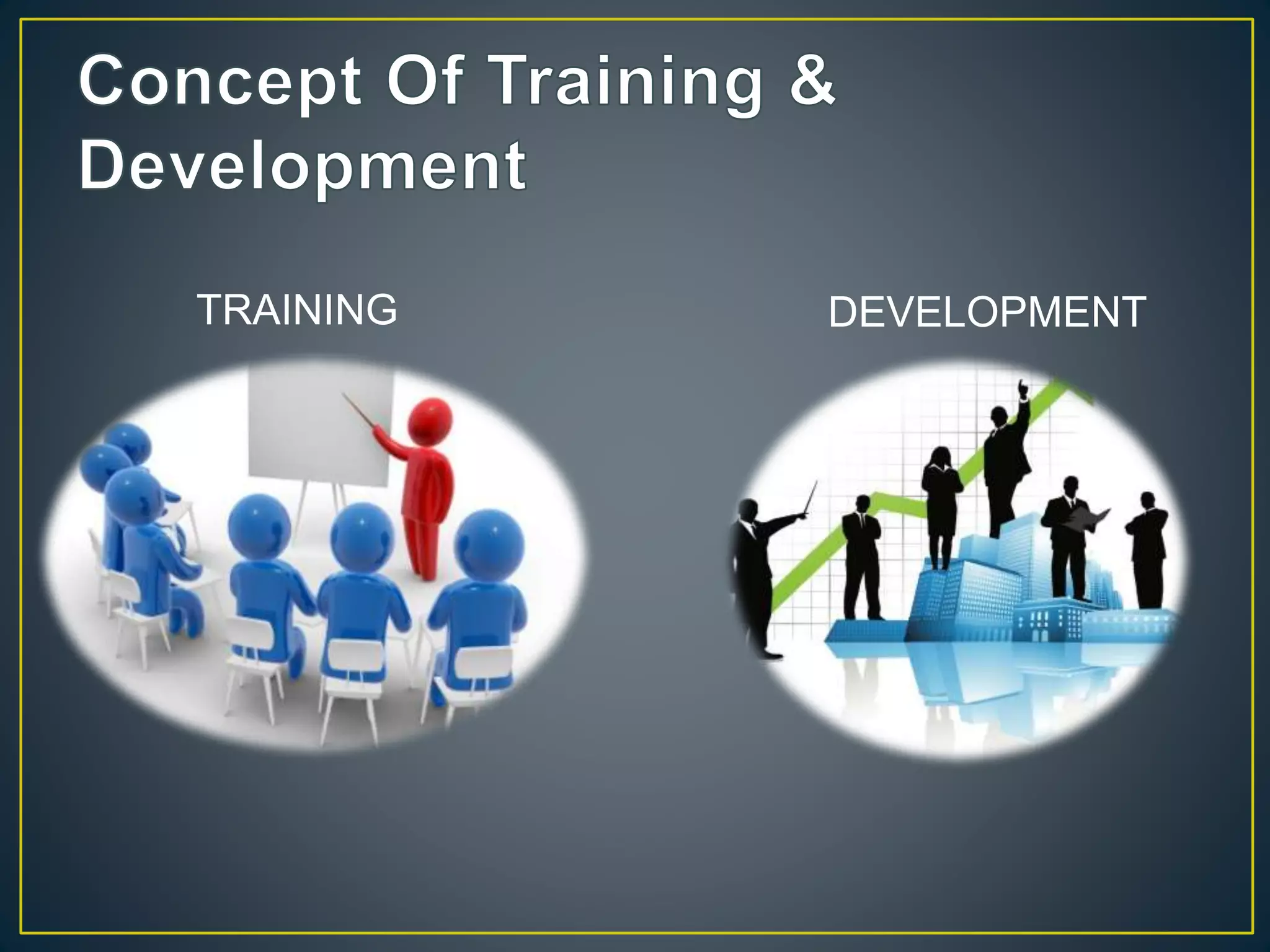
TRAINING DEVELOPMENT
Training
The act of increasing the skills of an employee for doing
a particular job, and thus it’s a process of learning a
sequence of programmed behaviour to do that particular
job.
Development
It refers broadly to the nature and direction of change
induced in employees, through the process of training
and educative process.
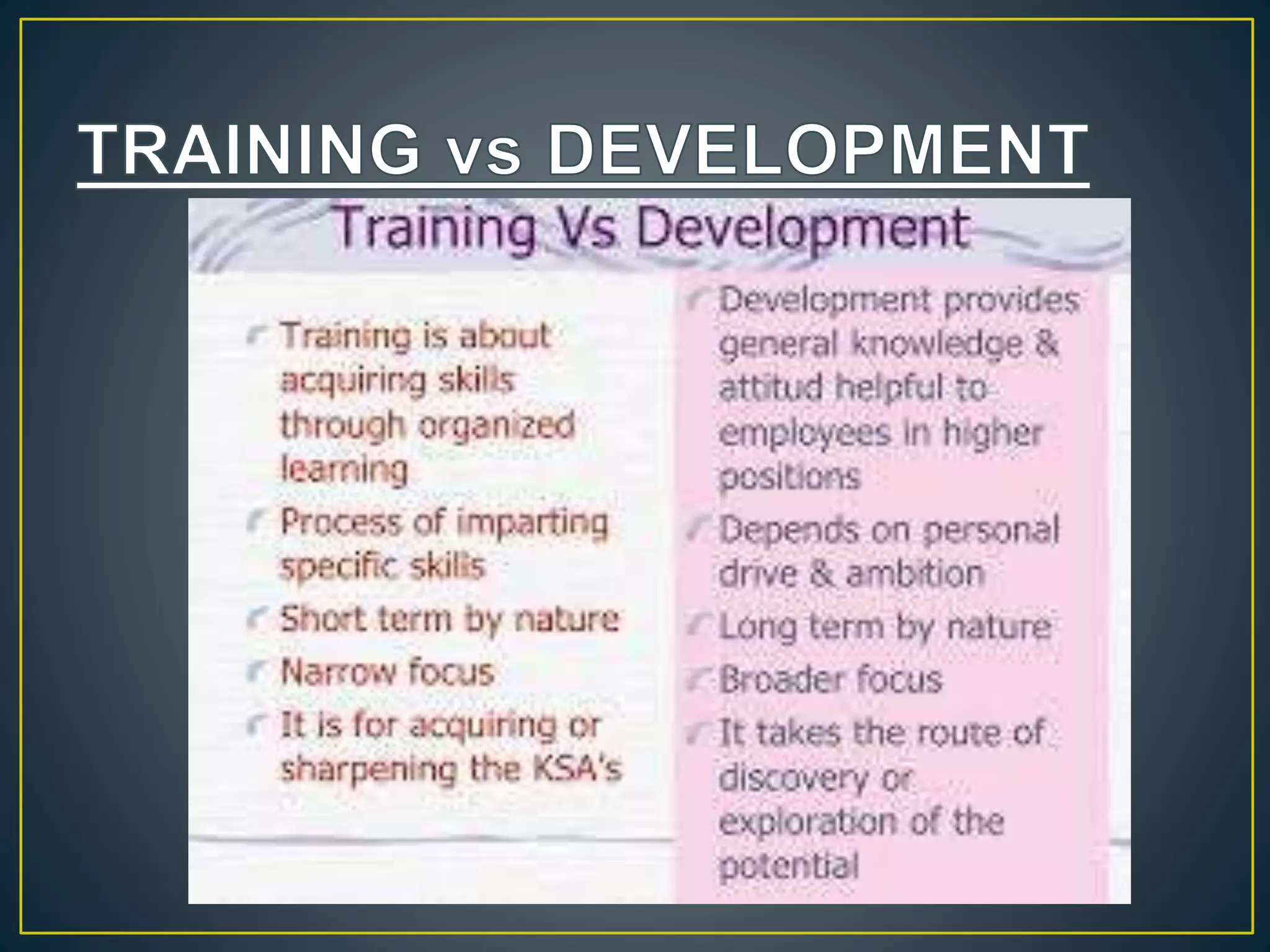
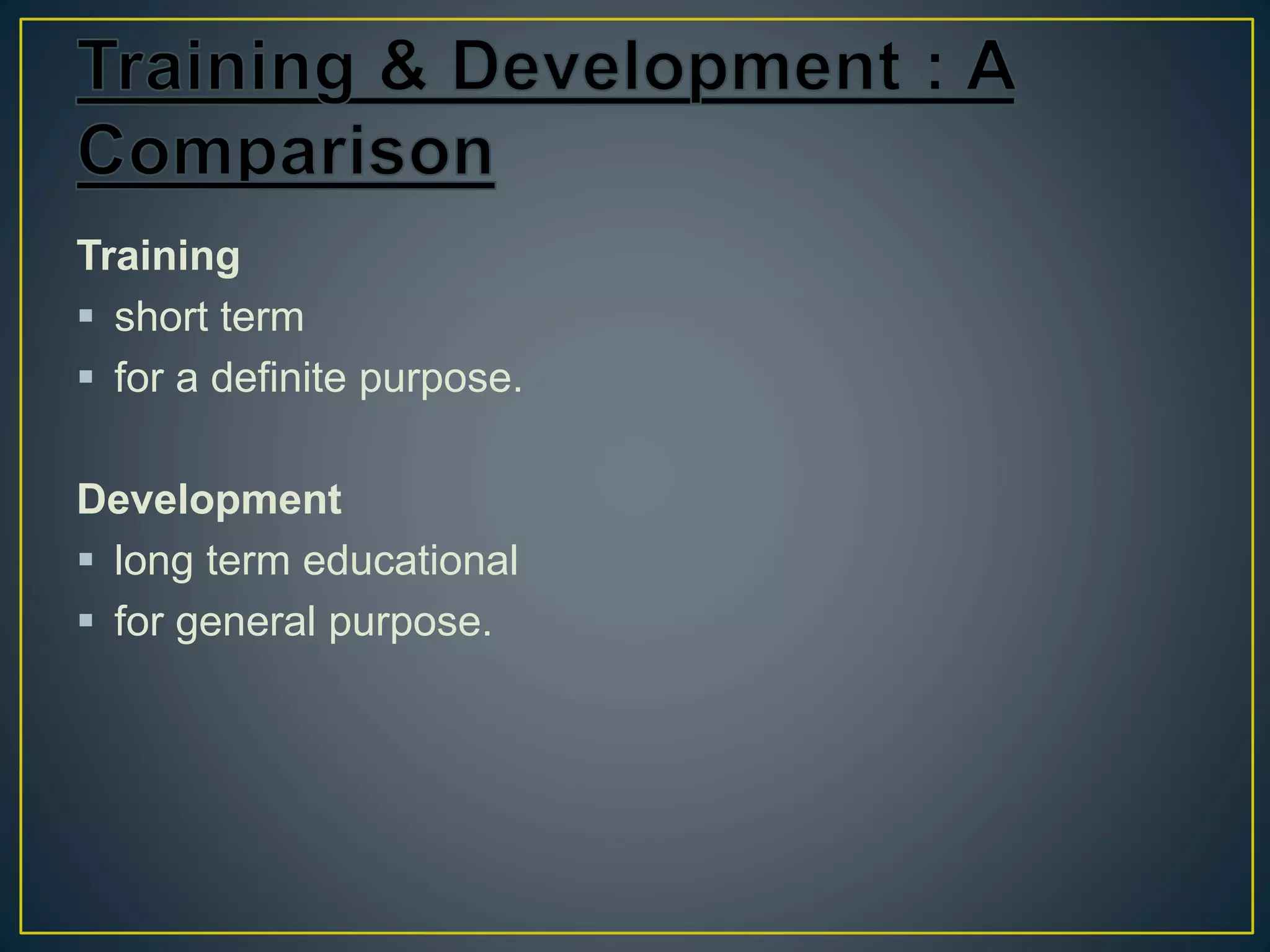
Training
 short term
 for a definite purpose.
Development
 long term educational
 for general purpose.
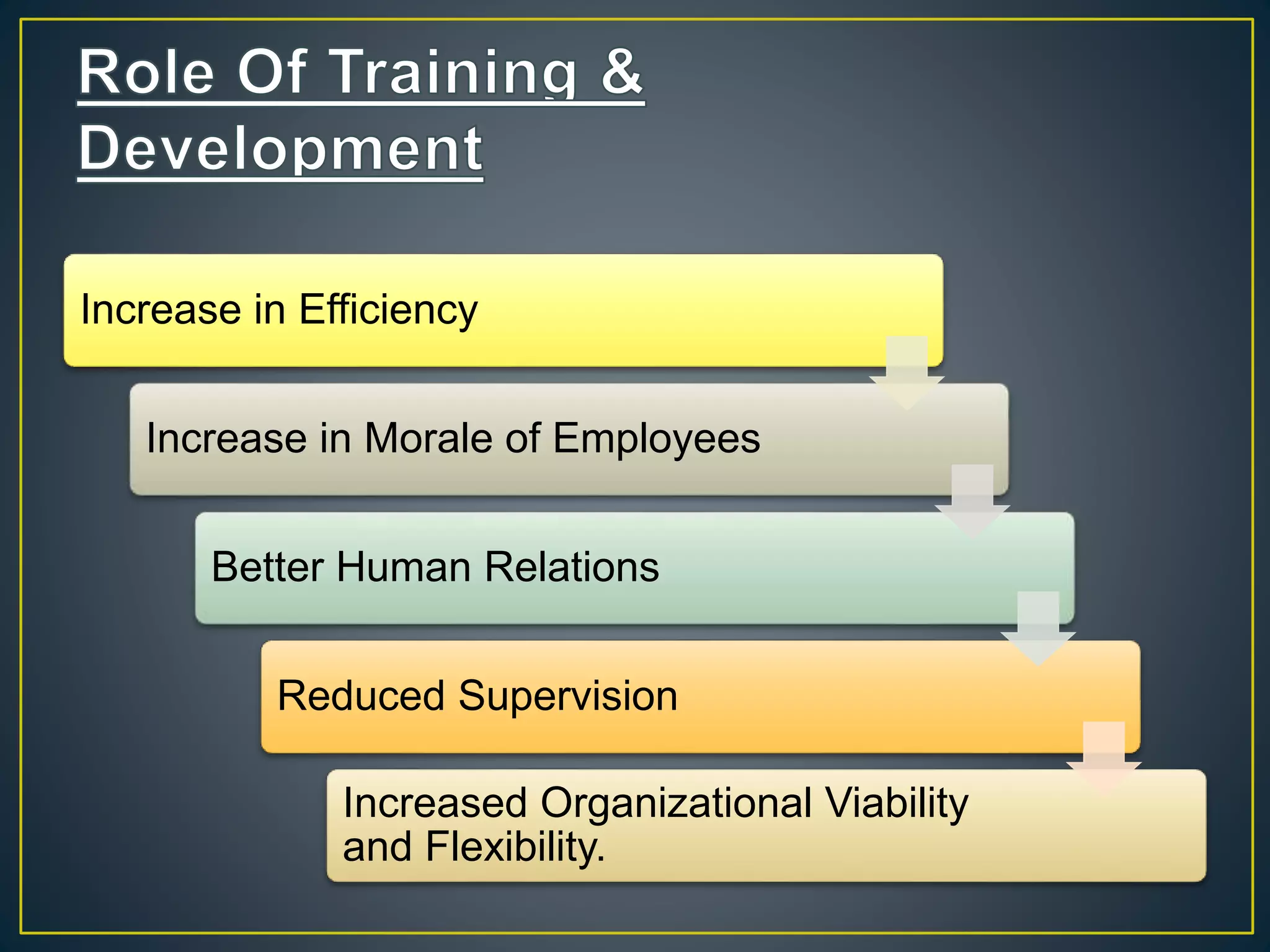
Increase in Efficiency
Increase in Morale of Employees
Better Human Relations
Reduced Supervision
Increased Organizational Viability
and Flexibility.
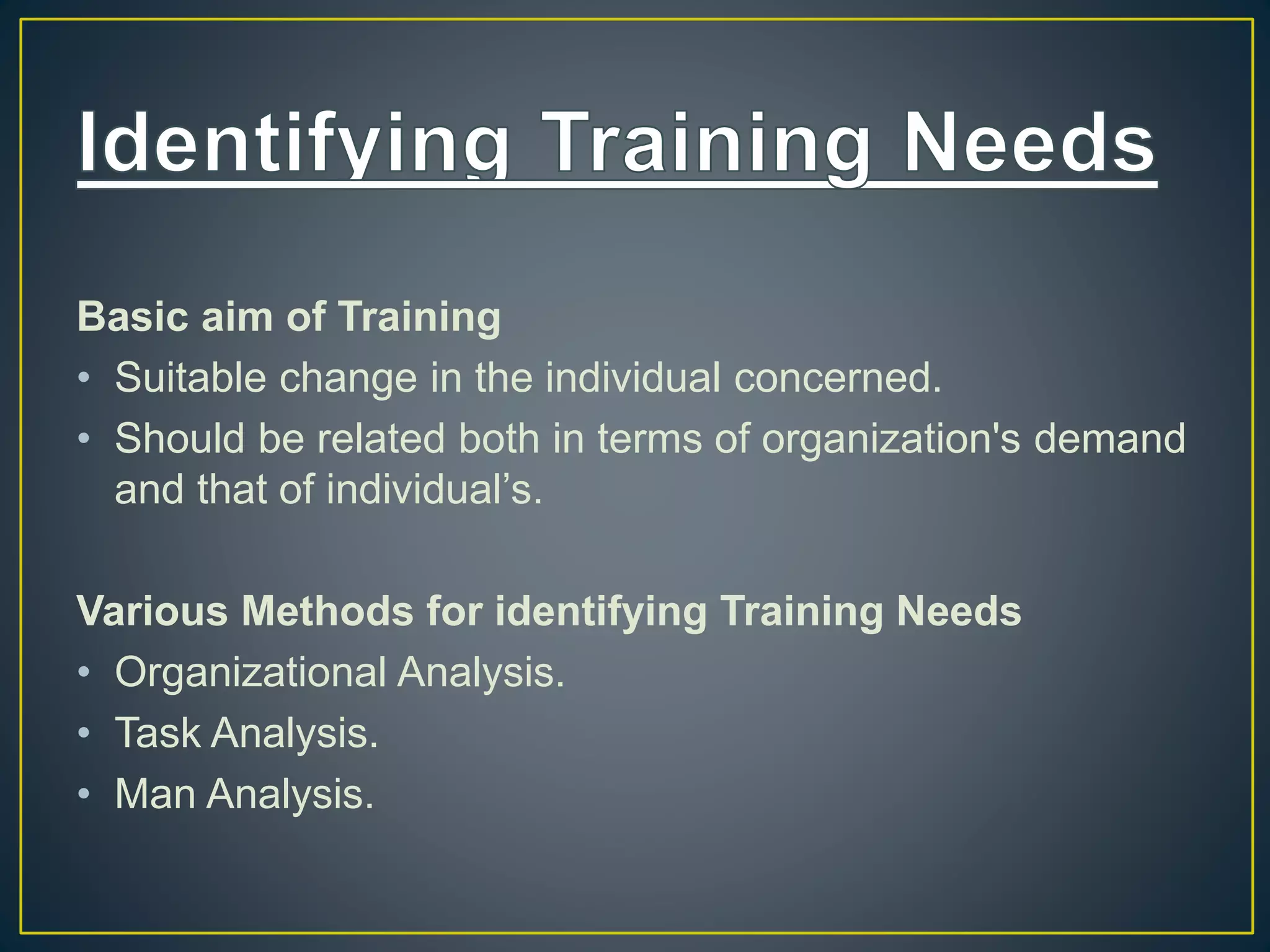
Basic aim of Training
• Suitable change in the individual concerned.
• Should be related both in terms of organization's demand
and that of individual’s.
Various Methods for identifying Training Needs
• Organizational Analysis.
• Task Analysis.
• Man Analysis.
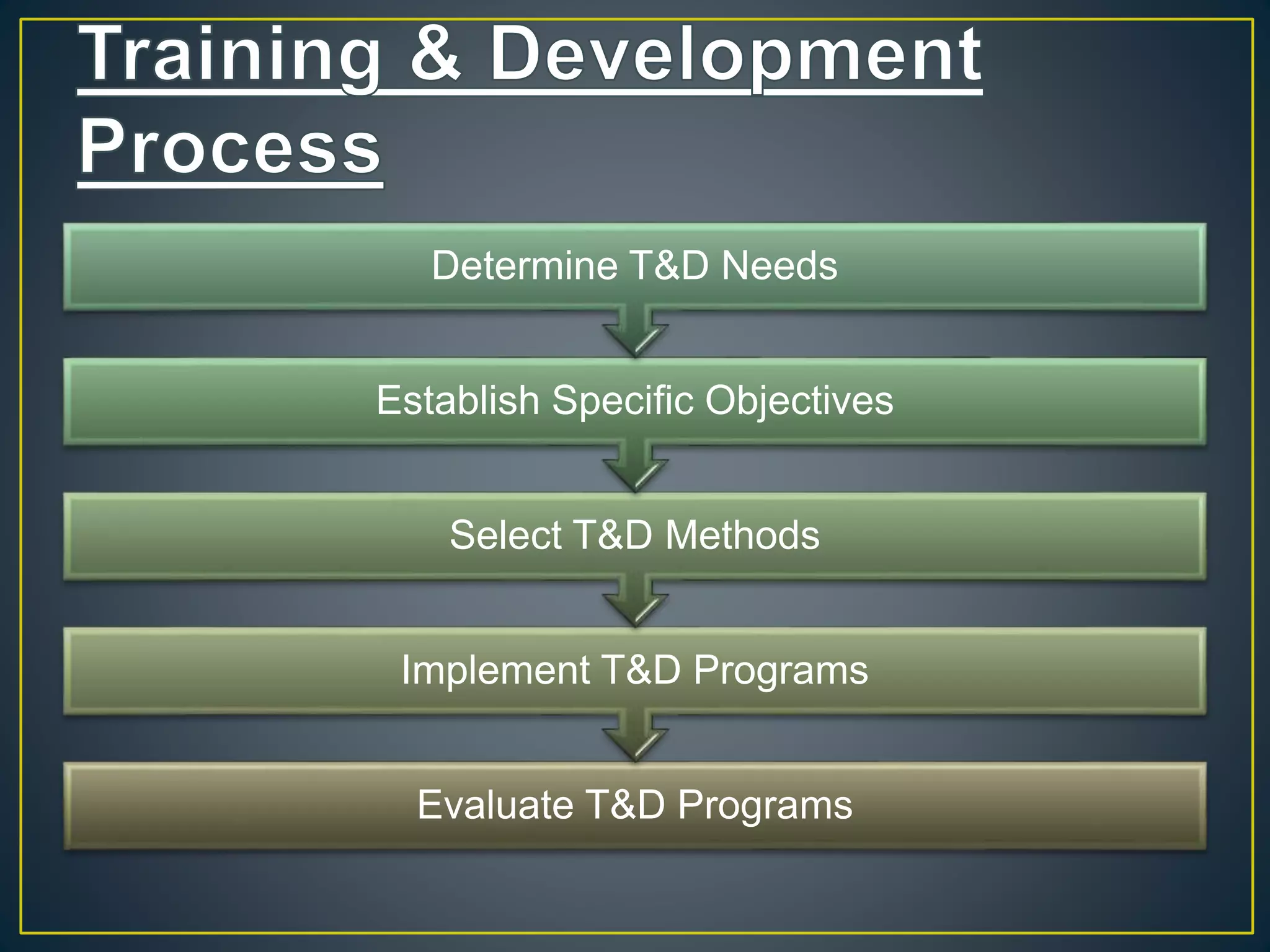
Evaluate T&D Programs
Implement T&D Programs
Select T&D Methods
Establish Specific Objectives
Determine T&D Needs
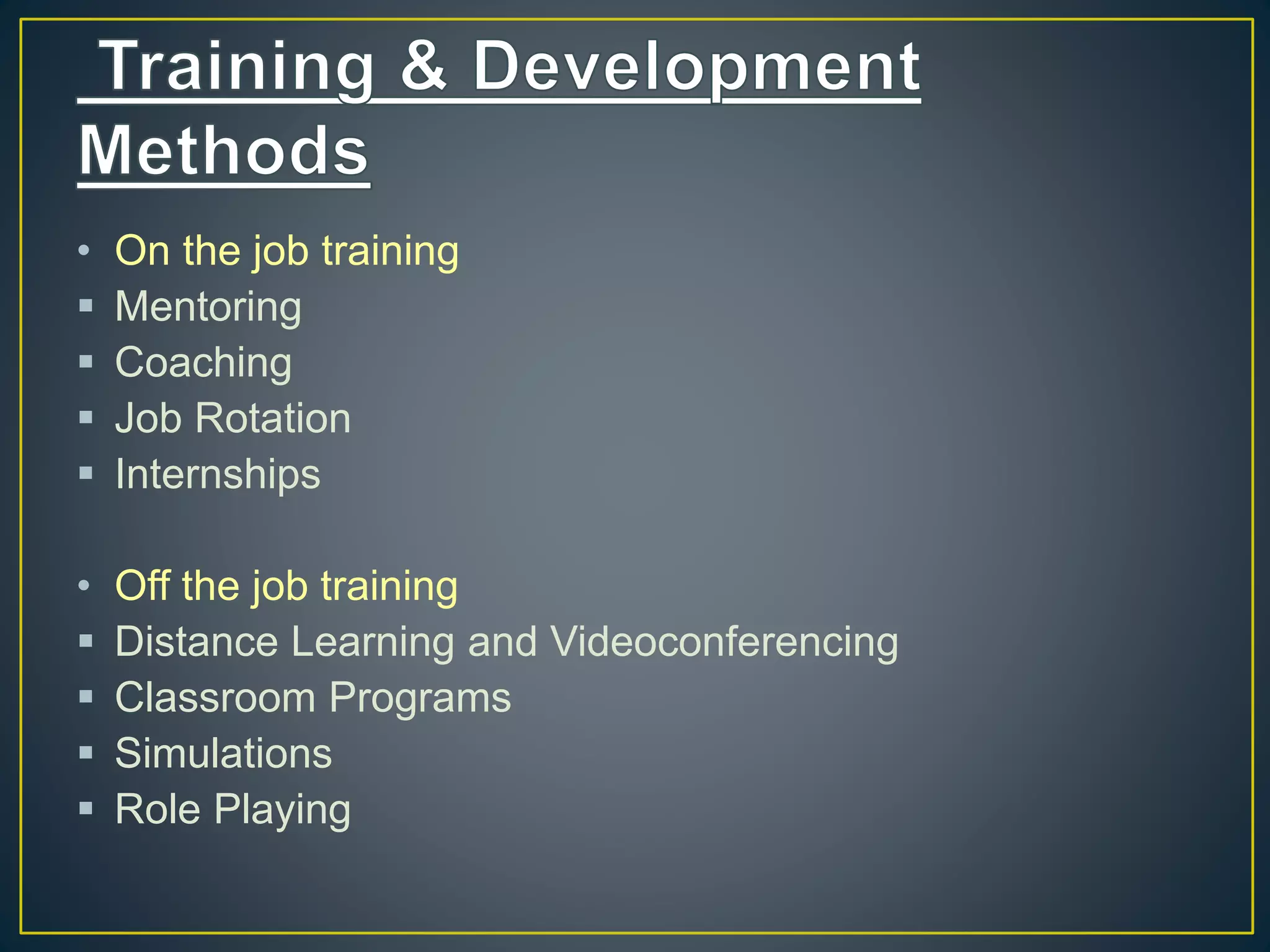
• On the job training
 Mentoring
 Coaching
 Job Rotation
 Internships
• Off the job training
 Distance Learning and Videoconferencing
 Classroom Programs
 Simulations
 Role Playing
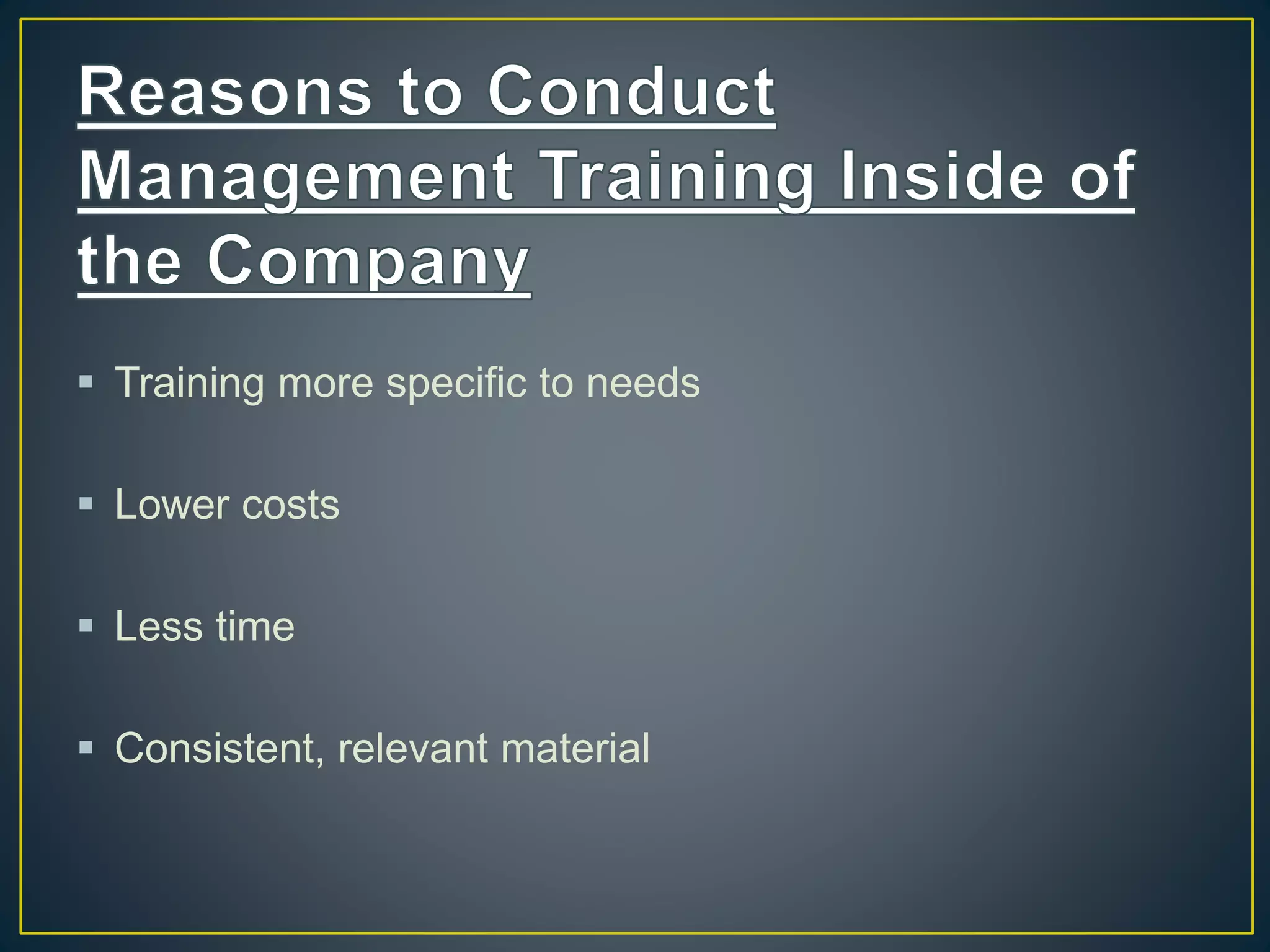
 Training more specific to needs
 Lower costs
 Less time
 Consistent, relevant material
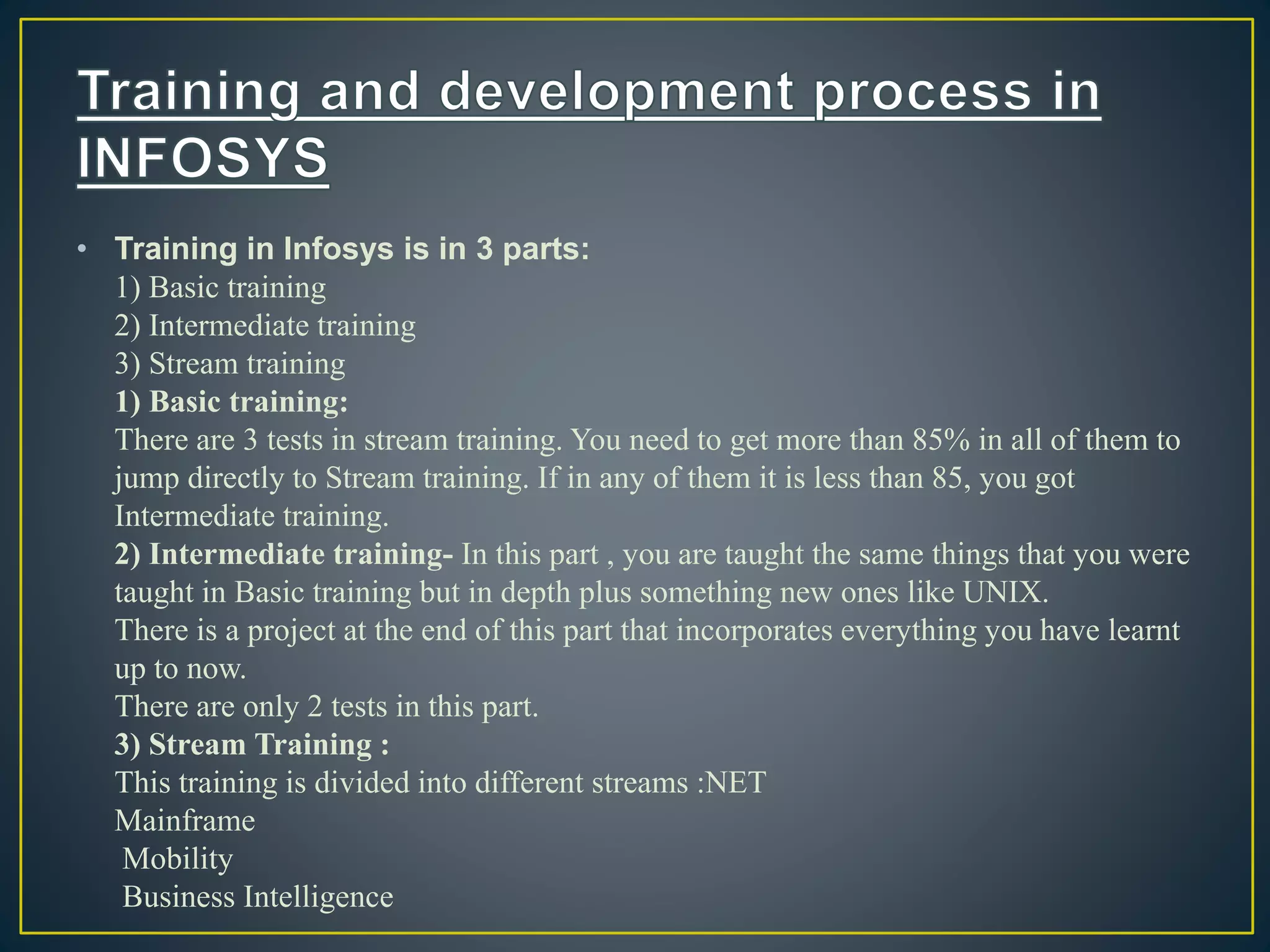
• Training in Infosys is in 3 parts:
1) Basic training
2) Intermediate training
3) Stream training
1) Basic training:
There are 3 tests in stream training. You need to get more than 85% in all of them to
jump directly to Stream training. If in any of them it is less than 85, you got
Intermediate training.
2) Intermediate training- In this part , you are taught the same things that you were
taught in Basic training but in depth plus something new ones like UNIX.
There is a project at the end of this part that incorporates everything you have learnt
up to now.
There are only 2 tests in this part.
3) Stream Training :
This training is divided into different streams :NET
Mainframe
Mobility
Business Intelligence
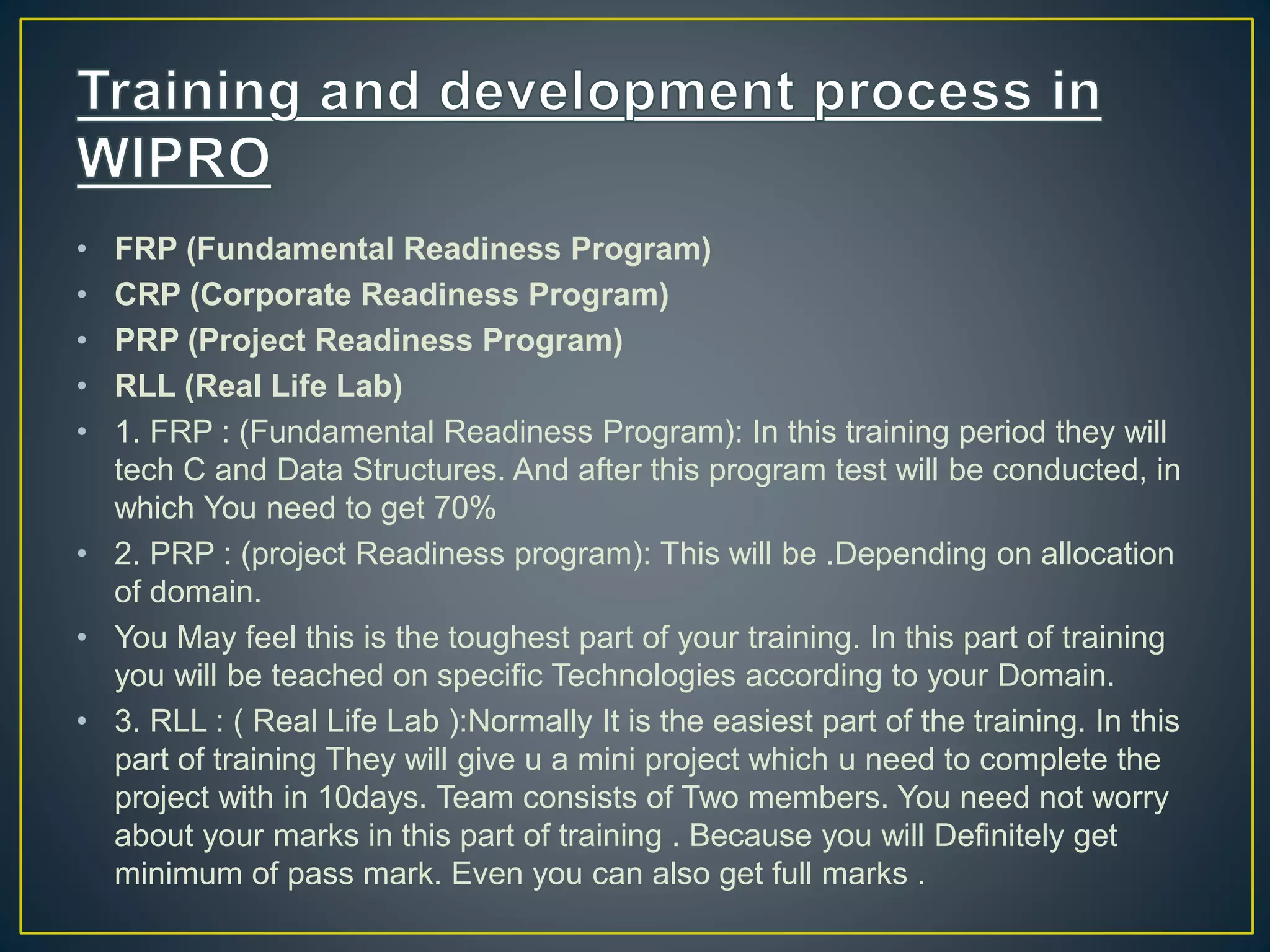
• FRP (Fundamental Readiness Program)
• CRP (Corporate Readiness Program)
• PRP (Project Readiness Program)
• RLL (Real Life Lab)
• 1. FRP : (Fundamental Readiness Program): In this training period they will
tech C and Data Structures. And after this program test will be conducted, in
which You need to get 70%
• 2. PRP : (project Readiness program): This will be .Depending on allocation
of domain.
• You May feel this is the toughest part of your training. In this part of training
you will be teached on specific Technologies according to your Domain.
• 3. RLL : ( Real Life Lab ):Normally It is the easiest part of the training. In this
part of training They will give u a mini project which u need to complete the
project with in 10days. Team consists of Two members. You need not worry
about your marks in this part of training . Because you will Definitely get
minimum of pass mark. Even you can also get full marks .
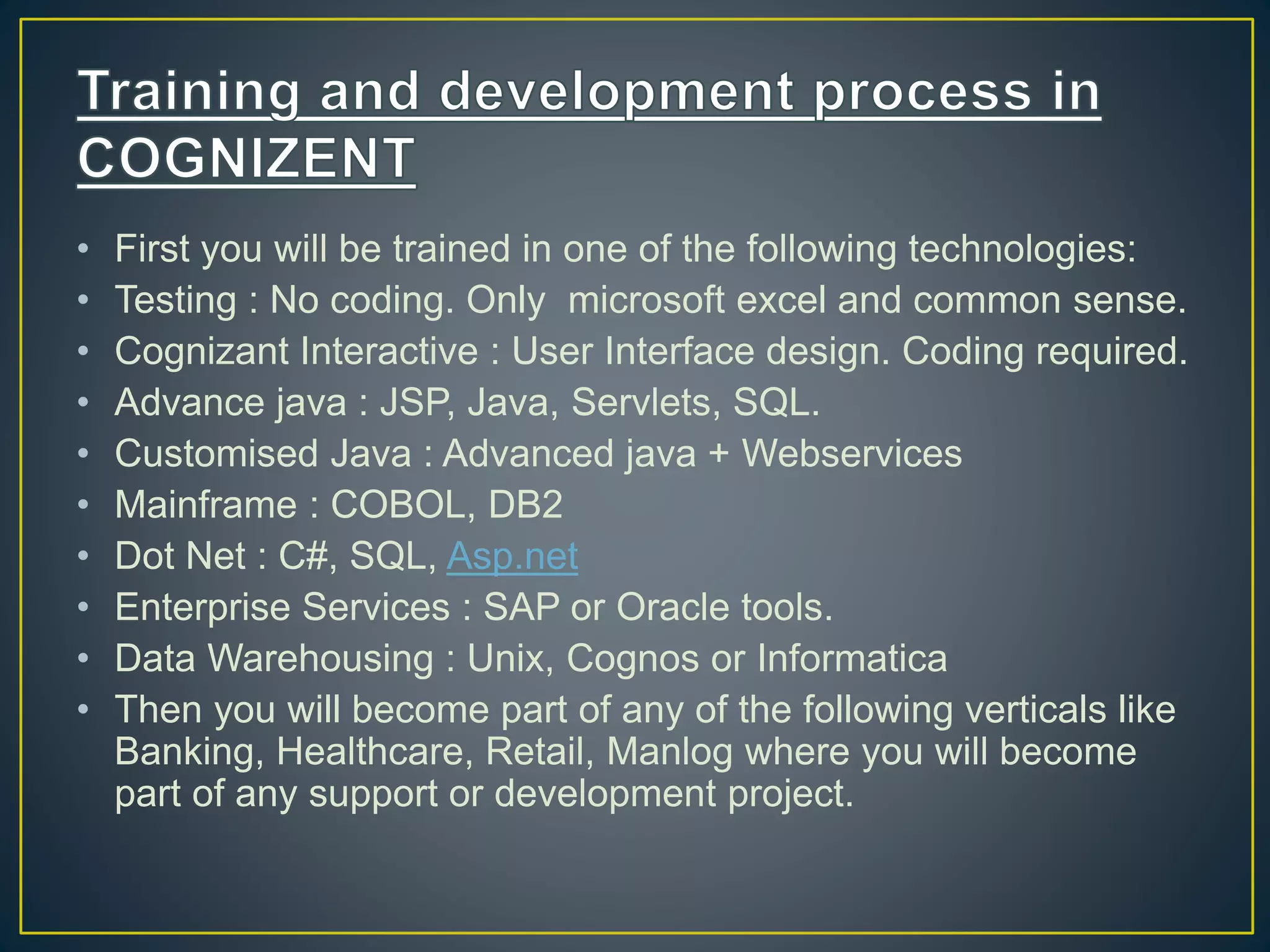
• First you will be trained in one of the following technologies:
• Testing : No coding. Only microsoft excel and common sense.
• Cognizant Interactive : User Interface design. Coding required.
• Advance java : JSP, Java, Servlets, SQL.
• Customised Java : Advanced java + Webservices
• Mainframe : COBOL, DB2
• Dot Net : C#, SQL, Asp.net
• Enterprise Services : SAP or Oracle tools.
• Data Warehousing : Unix, Cognos or Informatica
• Then you will become part of any of the following verticals like
Banking, Healthcare, Retail, Manlog where you will become
part of any support or development project.
Training and development

Training and development

  • 1.
  • 3.
  • 5.
    Training The act ofincreasing the skills of an employee for doing a particular job, and thus it’s a process of learning a sequence of programmed behaviour to do that particular job. Development It refers broadly to the nature and direction of change induced in employees, through the process of training and educative process.
  • 6.
    Training  short term for a definite purpose. Development  long term educational  for general purpose.
  • 7.
    Increase in Efficiency Increasein Morale of Employees Better Human Relations Reduced Supervision Increased Organizational Viability and Flexibility.
  • 8.
    Basic aim ofTraining • Suitable change in the individual concerned. • Should be related both in terms of organization's demand and that of individual’s. Various Methods for identifying Training Needs • Organizational Analysis. • Task Analysis. • Man Analysis.
  • 9.
    Evaluate T&D Programs ImplementT&D Programs Select T&D Methods Establish Specific Objectives Determine T&D Needs
  • 10.
    • On thejob training  Mentoring  Coaching  Job Rotation  Internships • Off the job training  Distance Learning and Videoconferencing  Classroom Programs  Simulations  Role Playing
  • 11.
     Training morespecific to needs  Lower costs  Less time  Consistent, relevant material
  • 13.
    • Training inInfosys is in 3 parts: 1) Basic training 2) Intermediate training 3) Stream training 1) Basic training: There are 3 tests in stream training. You need to get more than 85% in all of them to jump directly to Stream training. If in any of them it is less than 85, you got Intermediate training. 2) Intermediate training- In this part , you are taught the same things that you were taught in Basic training but in depth plus something new ones like UNIX. There is a project at the end of this part that incorporates everything you have learnt up to now. There are only 2 tests in this part. 3) Stream Training : This training is divided into different streams :NET Mainframe Mobility Business Intelligence
  • 14.
    • FRP (FundamentalReadiness Program) • CRP (Corporate Readiness Program) • PRP (Project Readiness Program) • RLL (Real Life Lab) • 1. FRP : (Fundamental Readiness Program): In this training period they will tech C and Data Structures. And after this program test will be conducted, in which You need to get 70% • 2. PRP : (project Readiness program): This will be .Depending on allocation of domain. • You May feel this is the toughest part of your training. In this part of training you will be teached on specific Technologies according to your Domain. • 3. RLL : ( Real Life Lab ):Normally It is the easiest part of the training. In this part of training They will give u a mini project which u need to complete the project with in 10days. Team consists of Two members. You need not worry about your marks in this part of training . Because you will Definitely get minimum of pass mark. Even you can also get full marks .
  • 15.
    • First youwill be trained in one of the following technologies: • Testing : No coding. Only microsoft excel and common sense. • Cognizant Interactive : User Interface design. Coding required. • Advance java : JSP, Java, Servlets, SQL. • Customised Java : Advanced java + Webservices • Mainframe : COBOL, DB2 • Dot Net : C#, SQL, Asp.net • Enterprise Services : SAP or Oracle tools. • Data Warehousing : Unix, Cognos or Informatica • Then you will become part of any of the following verticals like Banking, Healthcare, Retail, Manlog where you will become part of any support or development project.