TRADENOMICS How To Be Prepared During Times of  ECONOMIC  Uncertainty, Growth, and/or Stagnation. By Mike Kleinhenz
FIRST OF ALL… I am an “ economic enthusiast ”. I studied economics as a point of emphasis during my  undergraduate   studies. I continued emphasizing this discipline during my  graduate   studies. I was part of a published economic study ( researcher ) centered around real-estate valuations in pre/post collegiate cities. I trade technically and fundamentally , but constantly keep at least one eye focused on  economic analysis  and trends ( decision making ).
WHAT IS ECONOMICS? Essentially , it is a social science that studies production, distribution, and consumption. Non-essentially , it is a “ problem solving model ” and/or “ way of thinking ” that often-times involves emotions & rational thought. Some of the best problem solvers in the world have been economists ( Keynes, Smith, etc… ). Great books to read are: “ The Undercover Economist ” and/or “ Freakonomics ”.
ESSENTIALLY… … we allow economic analysts to gather and distribute the information; we have very little control ( if any at all ) over the “ specifics ” of economics, but…
NON-ESSENTIALLY… We individually analyze the information in search of  trends  that positively or negatively affect the markets [ sound familiar? ]. We use this information to make more  efficient  decisions on a daily basis. An “ economist’s motto ” of efficiency… There is  NO   SHAME   in taking advantage of negative economic news ( e.g., SHORTING; PUTS ). Emotions are our  enemy / friend ; no need to “ over think ”; no need to “ over   analyze ”;  OBSERVE !
TRADENOMIC  ANALYSIS  -  OPA : O BSERVE Take note of current economic situations; reports. P REPARE Develop strategies;  know what’s going on ; create a working  game plan  for different scenarios. A CT Reaction Trading : gauge the emotion in the markets  AFTER  an event and “ go with the flow ”. Speculating : within good reason, act  BEFORE  the event in hopes of windfall profits;  hedge yourself .
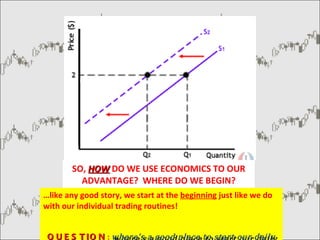
SO,  HOW   DO WE USE ECONOMICS TO OUR ADVANTAGE?  WHERE DO WE BEGIN? … like any good story, we start at the  beginning  just like we do with our individual trading routines! QUESTION :  where’s a good place to start our daily trading efforts?
OVERALL ASSESSMENT! [  D e v e l o p  a  f o r e c a s t  ] Any successful trading routine will  probably  include an  assessment  of the broad markets . It makes sense to swim  in the direction of the current  rather than fight against it. Then develop a short-term “ forecast ” to determine where it makes sense to place our focus ( such as specific sectors/industry groups ). Must be  flexible  and  adaptive   after concluding our daily assessments;  we live in volatile times .
GENERAL ECONOMICS… Economic indicators gather the past, apply it to the present, in order to help create a vision of the near future. FOR EXAMPLE : If a set of economic indicators suggest that the economy is going to do better  or  worse in the future than we had previously expected, we may decide to change our investing/trading strategy. * This is why a stern focus on  economic indicators  and  reports  is so important; it helps us  DECIDE  and BE  PREPARED  for strategy shifts.
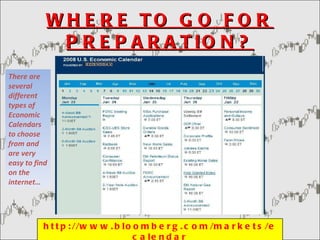
WHERE TO GO FOR PREPARATION? http://www.bloomberg.com/markets/ecalendar There are several different types of Economic Calendars to choose from and are very easy to find on the internet…
DAILY / WEEKLY ECONOMIC ASSESSMENTS  ( Start at the top & work down ). The broadest measurement of our country’s economic stability has always come from the quarterly Gross Domestic Product ( GDP ) reports. The definition of a RECESSION is  TWO   CONSECUTIVE  quarters of  NEGATIVE   Gross Domestic Product growth…BUT the  NBER  ( National Bureau of Economic Research ) usually has final say in the matter… This is  BY FAR  the biggest  quarterly  report that we ( as traders ) should pay attention to.  If the economy (GDP) is growing then there is reason to believe that the markets will/should exhibit positive emotions in an aggregate manner  especially  during the time of the announcement. [  http://www.bea.gov   ] Most recent quarter; first quarter of 2008; reported in early June of this year.
ECONOMIC RELATIONSHIP CLASSIFICATIONS & TIME VARIANCE RELATIONSHIP CLASSIFICATIONS: Procyclic, Countercyclic, & Acyclic TIME VARIANCES: Leading, Lagging, & Coincident
1/3 TYPE OF ECONOMIC REPORTS Procyclic :  A procyclic ( or procyclical ) economic indicator is one that moves in the same direction as the economy. So if the economy is doing well, this number is usually increasing, whereas if we're in a recession this indicator is decreasing. The Gross Domestic Product ( GDP ) is an example of a procyclic economic indicator.
2/3 TYPE OF ECONOMIC REPORTS Countercyclic :  A countercyclic ( or countercyclical ) economic indicator is one that moves in the opposite direction as the economy. The unemployment rate gets larger as the economy gets worse so it is a countercyclic economic indicator.
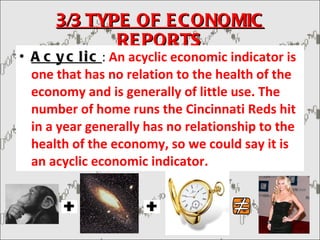
3/3 TYPE OF ECONOMIC REPORTS Acyclic :  An acyclic economic indicator is one that has no relation to the health of the economy and is generally of little use. The number of home runs the Cincinnati Reds hit in a year generally has no relationship to the health of the economy, so we could say it is an acyclic economic indicator.
TIMING is EVERYTHING LEADING : Leading economic indicators are indicators which change  before   the economy changes.  Stock market returns are a leading indicator  [ as the stock market usually begins to decline before the economy declines and they improve before the economy begins to pull out of a recession . ]   Leading economic indicators are the most important type for investors  as they help predict what the economy will be like in the future.  LAGGING : A lagged economic indicator is one that does not change direction until a few quarters  after   the economy does. The unemployment rate is a lagged economic indicator  [ as unemployment tends to increase for 2 or 3 quarters  after  the economy starts to improve . ]   COINCIDENT : A coincident economic indicator is one that simply moves at the  same time  the economy does. The  Gross Domestic Product  (GDP) is a coincident indicator.
THE “SUPER SEVEN” CATAGORIES Total Output, Income, and Spending  Employment, Unemployment, and Wages  Production and Business Activity  Prices  Money, Credit, and Security Markets  Federal Finance  International Statistics
OUTPUT, INCOME, & SPENDING Gross Domestic Product (GDP) [ quarterly ]  Real GDP [ quarterly ]  Business Output [ quarterly ]  National Income [ quarterly ]  Consumption Expenditure [ quarterly ]  Corporate Profits [ quarterly ]  Real Gross Private Domestic Investment [ quarterly ] All of these reports are both  coincident  and a  procyclical   economic indicators.
Employment, Unemployment, and Wages  The Unemployment Rate [ monthly ]  Lagged, Countercyclical Level of Civilian Employment [ monthly ]  Coincident, Procyclic Average Weekly Hours, Hourly Earnings, and Weekly Earnings [ monthly ]  Lagged, Procyclic Labor Productivity [ quarterly ] Lagged, Procyclic
PRODUCTION & BUSINESS ACTIVITY Industrial Production and Capacity [ monthly ]  New Construction [ monthly ]  New Private Housing & Vacancy [ monthly ]  Business Sales and Inventories [ monthly ]  Manufacturers' Shipments, Inventories, and Orders [ monthly ]  ALL are  Leading ,  Procyclical  Indicators… [  A slowdown in the housing market during a boom often indicates that a recession is coming, whereas a rise in the new housing market during a recession usually means that there are better times ahead.  ]
PRICES This category includes both the prices  consumers  pay as well as the prices  businesses  pay for raw materials and include: Producer Prices (PPI) [ monthly ]  Consumer Prices (CPI) [ monthly ]  Prices Received And Paid By Farmers [ monthly ]  These measures are  all  measures of changes in the  price level  and thus measure  inflation . Inflation is  COINCIDENT   and a  PROCYCLICAL   economic indicator.
Money, Credit, and Security Markets Money Stock [ monthly ]  -  Coincident/Procyclical Bank Credit at Commercial Banks [ monthly ] –  Coincident/Procyclical  Consumer Credit [ monthly ] –  Coincident/Procyclical Interest Rates & Bond Yields [ weekly & monthly ] –  Coincident/Procyclical Stock Prices and Total Yields [ weekly & monthly ]  –  Leading/Procyclical
FEDERAL FINANCE Federal Receipts (Revenue)[ yearly ]  Federal Outlays (Expenses) [ yearly ]  Federal Debt [ yearly ]   Governments generally try to stimulate the economy during recessions and to do so they increase spending without raising taxes. This causes both government spending and government debt to rise during a recession, so they are  COINCIDENT   economic indicators. They tend to be  COUNTERCYCLICAL   to the business cycle .
INTERNATIONAL STATISTICS Industrial Production and Consumer Prices of Major Industrial Countries [ quarterly ] U.S. International Trade In Goods and Services [ quarterly ]  U.S. International Transactions [ quarterly ] All are  COINCIDENT   and  COUNTERCYCLICAL When times are good people tend to spend more money on both domestic  and  imported goods. The level of exports tends  not  to change much during the business cycle.
WHAT TO DO…??? Major [ economic ] reports ( such as GDP and others ) are very similar to individual corporate earnings announcements, but rather than affecting one company  it affects the markets as a collective whole . HEDGE ,  HEDGE , and Take Advantage?! Prior to these announcements, it makes a lot of sense to  hedge  your current positions. Inverse-related ETF’s and/or Indices are a good idea to look at and consider for this ( $ VIX, DXD, QID, SDS ). A little bit of speculation can sometimes put us in great situations (avoid the “ Vegas Mentality ”).
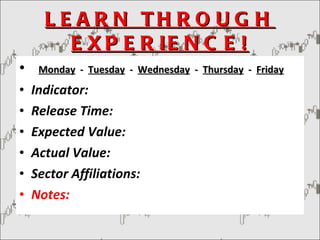
LEARN THROUGH EXPERIENCE!    Monday   -  Tuesday   -  Wednesday   -  Thursday   -  Friday   Indicator:            Release Time:            Expected Value:            Actual Value:        Sector Affiliations:     Notes:            
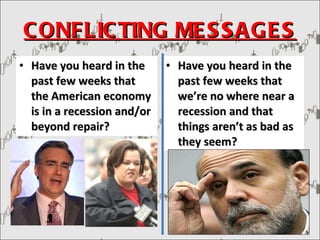
CONFLICTING MESSAGES Have you heard in the past few weeks that the American economy is in a recession and/or beyond repair? Have you heard in the past few weeks that we’re no where near a recession and that things aren’t as bad as they seem?
“ IT’S THE ECONOMY, STUPID!” -  James Carville GROUP QUESTION :  What is your current assessment/analysis of the U.S. economy?   Why?  How can we use this assessment to our  advantage ?
CURRENT ECONOMIC ASSESSMENT Housing and Finance are getting  crushed . Inflation is on the  RISE  (see  CPI/PPI  reports). The U.S. Dollar is  hurting . Food and Energy are  consuming us!  ( CPI/PPI ) Over extended  fiscally ( debt, debt, debt ). Individual companies are still  nominal . Manufacturing/Production is at a  low point . … but the GDP is still  GROWING !
… can you say, “ STAG / FLATION ”? Another term being applied to our current economic condition is:   “ A ‘ Goldilocks ’ Economy ”. Not  too   hot Not  too   cold Are the  BEARS  coming home?
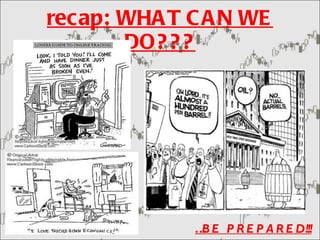
recap: WHAT CAN WE DO??? … BE PREPARED!!!
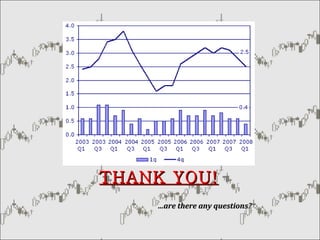
THANK YOU! … are there any questions?

Tradenomics power point-kleinhenz-june2008

  • 1.
    TRADENOMICS How ToBe Prepared During Times of ECONOMIC Uncertainty, Growth, and/or Stagnation. By Mike Kleinhenz
  • 2.
    FIRST OF ALL…I am an “ economic enthusiast ”. I studied economics as a point of emphasis during my undergraduate studies. I continued emphasizing this discipline during my graduate studies. I was part of a published economic study ( researcher ) centered around real-estate valuations in pre/post collegiate cities. I trade technically and fundamentally , but constantly keep at least one eye focused on economic analysis and trends ( decision making ).
  • 3.
    WHAT IS ECONOMICS?Essentially , it is a social science that studies production, distribution, and consumption. Non-essentially , it is a “ problem solving model ” and/or “ way of thinking ” that often-times involves emotions & rational thought. Some of the best problem solvers in the world have been economists ( Keynes, Smith, etc… ). Great books to read are: “ The Undercover Economist ” and/or “ Freakonomics ”.
  • 4.
    ESSENTIALLY… … weallow economic analysts to gather and distribute the information; we have very little control ( if any at all ) over the “ specifics ” of economics, but…
  • 5.
    NON-ESSENTIALLY… We individuallyanalyze the information in search of trends that positively or negatively affect the markets [ sound familiar? ]. We use this information to make more efficient decisions on a daily basis. An “ economist’s motto ” of efficiency… There is NO SHAME in taking advantage of negative economic news ( e.g., SHORTING; PUTS ). Emotions are our enemy / friend ; no need to “ over think ”; no need to “ over analyze ”; OBSERVE !
  • 6.
    TRADENOMIC ANALYSIS - OPA : O BSERVE Take note of current economic situations; reports. P REPARE Develop strategies; know what’s going on ; create a working game plan for different scenarios. A CT Reaction Trading : gauge the emotion in the markets AFTER an event and “ go with the flow ”. Speculating : within good reason, act BEFORE the event in hopes of windfall profits; hedge yourself .
  • 7.
    SO, HOW DO WE USE ECONOMICS TO OUR ADVANTAGE? WHERE DO WE BEGIN? … like any good story, we start at the beginning just like we do with our individual trading routines! QUESTION : where’s a good place to start our daily trading efforts?
  • 8.
    OVERALL ASSESSMENT! [ D e v e l o p a f o r e c a s t ] Any successful trading routine will probably include an assessment of the broad markets . It makes sense to swim in the direction of the current rather than fight against it. Then develop a short-term “ forecast ” to determine where it makes sense to place our focus ( such as specific sectors/industry groups ). Must be flexible and adaptive after concluding our daily assessments; we live in volatile times .
  • 9.
    GENERAL ECONOMICS… Economicindicators gather the past, apply it to the present, in order to help create a vision of the near future. FOR EXAMPLE : If a set of economic indicators suggest that the economy is going to do better or worse in the future than we had previously expected, we may decide to change our investing/trading strategy. * This is why a stern focus on economic indicators and reports is so important; it helps us DECIDE and BE PREPARED for strategy shifts.
  • 10.
    WHERE TO GOFOR PREPARATION? http://www.bloomberg.com/markets/ecalendar There are several different types of Economic Calendars to choose from and are very easy to find on the internet…
  • 11.
    DAILY / WEEKLYECONOMIC ASSESSMENTS ( Start at the top & work down ). The broadest measurement of our country’s economic stability has always come from the quarterly Gross Domestic Product ( GDP ) reports. The definition of a RECESSION is TWO CONSECUTIVE quarters of NEGATIVE Gross Domestic Product growth…BUT the NBER ( National Bureau of Economic Research ) usually has final say in the matter… This is BY FAR the biggest quarterly report that we ( as traders ) should pay attention to. If the economy (GDP) is growing then there is reason to believe that the markets will/should exhibit positive emotions in an aggregate manner especially during the time of the announcement. [ http://www.bea.gov ] Most recent quarter; first quarter of 2008; reported in early June of this year.
  • 12.
    ECONOMIC RELATIONSHIP CLASSIFICATIONS& TIME VARIANCE RELATIONSHIP CLASSIFICATIONS: Procyclic, Countercyclic, & Acyclic TIME VARIANCES: Leading, Lagging, & Coincident
  • 13.
    1/3 TYPE OFECONOMIC REPORTS Procyclic : A procyclic ( or procyclical ) economic indicator is one that moves in the same direction as the economy. So if the economy is doing well, this number is usually increasing, whereas if we're in a recession this indicator is decreasing. The Gross Domestic Product ( GDP ) is an example of a procyclic economic indicator.
  • 14.
    2/3 TYPE OFECONOMIC REPORTS Countercyclic : A countercyclic ( or countercyclical ) economic indicator is one that moves in the opposite direction as the economy. The unemployment rate gets larger as the economy gets worse so it is a countercyclic economic indicator.
  • 15.
    3/3 TYPE OFECONOMIC REPORTS Acyclic : An acyclic economic indicator is one that has no relation to the health of the economy and is generally of little use. The number of home runs the Cincinnati Reds hit in a year generally has no relationship to the health of the economy, so we could say it is an acyclic economic indicator.
  • 16.
    TIMING is EVERYTHINGLEADING : Leading economic indicators are indicators which change before the economy changes. Stock market returns are a leading indicator [ as the stock market usually begins to decline before the economy declines and they improve before the economy begins to pull out of a recession . ] Leading economic indicators are the most important type for investors as they help predict what the economy will be like in the future. LAGGING : A lagged economic indicator is one that does not change direction until a few quarters after the economy does. The unemployment rate is a lagged economic indicator [ as unemployment tends to increase for 2 or 3 quarters after the economy starts to improve . ] COINCIDENT : A coincident economic indicator is one that simply moves at the same time the economy does. The Gross Domestic Product (GDP) is a coincident indicator.
  • 17.
    THE “SUPER SEVEN”CATAGORIES Total Output, Income, and Spending Employment, Unemployment, and Wages Production and Business Activity Prices Money, Credit, and Security Markets Federal Finance International Statistics
  • 18.
    OUTPUT, INCOME, &SPENDING Gross Domestic Product (GDP) [ quarterly ] Real GDP [ quarterly ] Business Output [ quarterly ] National Income [ quarterly ] Consumption Expenditure [ quarterly ] Corporate Profits [ quarterly ] Real Gross Private Domestic Investment [ quarterly ] All of these reports are both coincident and a procyclical economic indicators.
  • 19.
    Employment, Unemployment, andWages The Unemployment Rate [ monthly ] Lagged, Countercyclical Level of Civilian Employment [ monthly ] Coincident, Procyclic Average Weekly Hours, Hourly Earnings, and Weekly Earnings [ monthly ] Lagged, Procyclic Labor Productivity [ quarterly ] Lagged, Procyclic
  • 20.
    PRODUCTION & BUSINESSACTIVITY Industrial Production and Capacity [ monthly ] New Construction [ monthly ] New Private Housing & Vacancy [ monthly ] Business Sales and Inventories [ monthly ] Manufacturers' Shipments, Inventories, and Orders [ monthly ] ALL are Leading , Procyclical Indicators… [ A slowdown in the housing market during a boom often indicates that a recession is coming, whereas a rise in the new housing market during a recession usually means that there are better times ahead. ]
  • 21.
    PRICES This categoryincludes both the prices consumers pay as well as the prices businesses pay for raw materials and include: Producer Prices (PPI) [ monthly ] Consumer Prices (CPI) [ monthly ] Prices Received And Paid By Farmers [ monthly ] These measures are all measures of changes in the price level and thus measure inflation . Inflation is COINCIDENT and a PROCYCLICAL economic indicator.
  • 22.
    Money, Credit, andSecurity Markets Money Stock [ monthly ] - Coincident/Procyclical Bank Credit at Commercial Banks [ monthly ] – Coincident/Procyclical Consumer Credit [ monthly ] – Coincident/Procyclical Interest Rates & Bond Yields [ weekly & monthly ] – Coincident/Procyclical Stock Prices and Total Yields [ weekly & monthly ] – Leading/Procyclical
  • 23.
    FEDERAL FINANCE FederalReceipts (Revenue)[ yearly ] Federal Outlays (Expenses) [ yearly ] Federal Debt [ yearly ] Governments generally try to stimulate the economy during recessions and to do so they increase spending without raising taxes. This causes both government spending and government debt to rise during a recession, so they are COINCIDENT economic indicators. They tend to be COUNTERCYCLICAL to the business cycle .
  • 24.
    INTERNATIONAL STATISTICS IndustrialProduction and Consumer Prices of Major Industrial Countries [ quarterly ] U.S. International Trade In Goods and Services [ quarterly ] U.S. International Transactions [ quarterly ] All are COINCIDENT and COUNTERCYCLICAL When times are good people tend to spend more money on both domestic and imported goods. The level of exports tends not to change much during the business cycle.
  • 25.
    WHAT TO DO…???Major [ economic ] reports ( such as GDP and others ) are very similar to individual corporate earnings announcements, but rather than affecting one company it affects the markets as a collective whole . HEDGE , HEDGE , and Take Advantage?! Prior to these announcements, it makes a lot of sense to hedge your current positions. Inverse-related ETF’s and/or Indices are a good idea to look at and consider for this ( $ VIX, DXD, QID, SDS ). A little bit of speculation can sometimes put us in great situations (avoid the “ Vegas Mentality ”).
  • 26.
    LEARN THROUGH EXPERIENCE!  Monday - Tuesday   - Wednesday   - Thursday   - Friday   Indicator:           Release Time:           Expected Value:           Actual Value:       Sector Affiliations:    Notes:          
  • 27.
    CONFLICTING MESSAGES Haveyou heard in the past few weeks that the American economy is in a recession and/or beyond repair? Have you heard in the past few weeks that we’re no where near a recession and that things aren’t as bad as they seem?
  • 28.
    “ IT’S THEECONOMY, STUPID!” - James Carville GROUP QUESTION : What is your current assessment/analysis of the U.S. economy? Why? How can we use this assessment to our advantage ?
  • 29.
    CURRENT ECONOMIC ASSESSMENTHousing and Finance are getting crushed . Inflation is on the RISE (see CPI/PPI reports). The U.S. Dollar is hurting . Food and Energy are consuming us! ( CPI/PPI ) Over extended fiscally ( debt, debt, debt ). Individual companies are still nominal . Manufacturing/Production is at a low point . … but the GDP is still GROWING !
  • 30.
    … can yousay, “ STAG / FLATION ”? Another term being applied to our current economic condition is: “ A ‘ Goldilocks ’ Economy ”. Not too hot Not too cold Are the BEARS coming home?
  • 31.
    recap: WHAT CANWE DO??? … BE PREPARED!!!
  • 32.
    THANK YOU! …are there any questions?