TRADEMARKS - ARE YOUR BRANDS
PROTECTED?
Donna H. Hartman
INTELLECTUAL PROPERTY
1. Types of Intellectual Property:
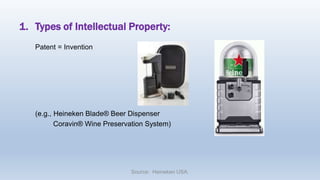
Patent = Invention
(e.g., Heineken Blade® Beer Dispenser
Coravin® Wine Preservation System)
Source: Heineken USA.
1. Types of Intellectual Property:
Copyright = Artistic or Literary Works
(e.g., Book, music, artwork, etc.)
Designated by © [Year] [Name]
1
1. Types of Intellectual Property:
Trademark = Brand (Name and/or logo)
BALLYHOO®
Designated by TM or ®
1
2. What is a Trademark?
A trademark (or service mark), as defined by the US Patent and
Trademark Office (USPTO), is generally:
“a word, phrase, symbol, or design, or a combination thereof, that
identifies and distinguishes the source of the goods of one party
from those of others.”
Trademarks are governed by The Lanham Act a/k/a Trademark Act of 1964, 15 USC §§ 1051 et.
Seq.
2. What is a Trademark?
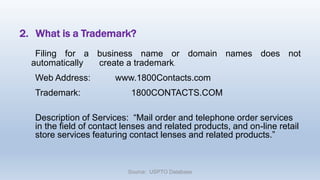
Filing for a business name or domain names does not
automatically create a trademark.
Web Address: www.1800Contacts.com
Trademark: 1800CONTACTS.COM
Description of Services: “Mail order and telephone order services
in the field of contact lenses and related products, and on-line retail
store services featuring contact lenses and related products.”
Source: USPTO Database
3. Types of Marks
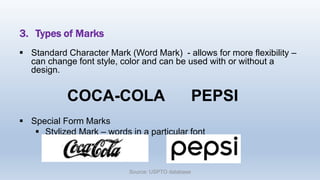
 Standard Character Mark (Word Mark) - allows for more flexibility –
can change font style, color and can be used with or without a
design.
COCA-COLA PEPSI
 Special Form Marks
 Stylized Mark – words in a particular font
Source: USPTO database
3. Types of Marks
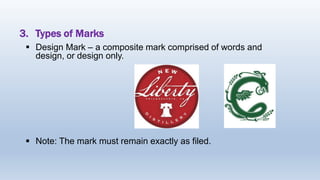
 Design Mark – a composite mark comprised of words and
design, or design only.
 Note: The mark must remain exactly as filed.
4. How are Trademarks Protected?
 Federal Registration – File with the United States Patent and
Trademark Office (USPTO)
 State Registration – File with the State (Secretary of State)
 Common Law – No filing required; limited in geography.
 Symbols Used - ®, TM or SM
5. When To File For Protection.
 Ideally - Prior to using a mark (e.g., concept for a new business)
– Protect idea
– Registration process takes time
 After using a mark;
– Concerns:
• Application may be suspended due to a likelihood of confusion with
a Registered mark or pending application
– (1) sound alike (e.g., phonetic equivalents),
– (2) look alike,
– (3) have the same meaning (e.g., foreign equivalent translation), and/or
– (4) create the same general (overall) commercial impression.
• Costly to change mark
6. Trademark Filing Basis
• In Use (Section 1(a)) - Trademarks are used in
commerce. Already selling the products or services.
• Intent-to-Use (Section 1(b)) – Have an idea but have
not yet started selling in commerce. Bona fide
intention
• Foreign: Section 44(d) or 44(e), Section 66(a) –
Based upon a foreign trademark application or
registration.
6. Benefits of Filing for Federal Registration
• Public notice of ownership of the mark
• Exclusive right to use the mark nationally
• Use of the federal registration symbol “® ”
• The ability to sue in federal court
• May file with U.S. Customs and Border Protection
to prevent importation of infringing goods
• A basis to obtain registration in foreign countries
Source: USPTO Website
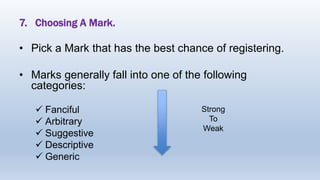
7. Choosing A Mark.
• Pick a Mark that has the best chance of registering.
• Marks generally fall into one of the following
categories:
 Fanciful
 Arbitrary
 Suggestive
 Descriptive
 Generic
Strong
To
Weak
7. Choosing A Mark (continued)
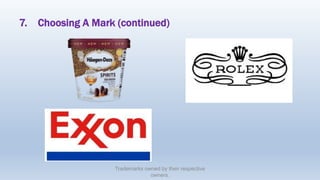
• Fanciful (Strong):
The strongest marks
Invented words
No other known meaning.
7. Choosing A Mark (continued)
Trademarks owned by their respective
owners.
7. Choosing A Mark (continued)
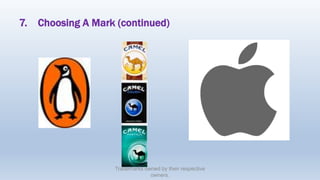
• Arbitrary (Strong):
• Actual words with a known meaning
• No association or relationship with the goods or services.
7. Choosing A Mark (continued)
Trademarks owned by their respective
owners.
7. Choosing A Mark (continued)
• Suggestive (Strong):
• Suggests, but does not describe, qualities or characters of the
goods or services.
• Imagination required
7. Choosing A Mark (continued)
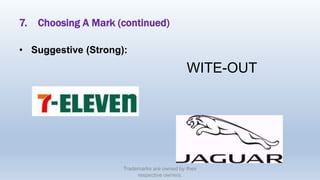
• Suggestive (Strong):
WITE-OUT
Trademarks are owned by their
respective owners.
7. Choosing A Mark (continued)
• Descriptive (Weak):
 Describe a feature, function, use, characteristic, quality, function, feature or ingredient
of the goods or services.
 No imagination required
 Does not identify the source
 May be refused registration on the Principal Register unless it acquires
distinctiveness or secondary meaning through extensive use in commerce for at least
five (5) years.
• Examples: RED RED WINE
RED & BLACK PEPPER VODKA
JAMAICAN RUM PUNCH
Source: TMEP Section 1209.01(b)
7. Choosing A Mark (continued)
• Generic (Weak):
• The weakest marks
• Never registrable or enforceable against third parties
• Common or everyday names for goods or services
• Everyone has the right to use such terms
• If part of a mark, others will not be prevented from using
the term
7. Choosing A Mark (continued)
• Generic (Weak):
Examples: BEER
GIN
TEQUILA
7. Other Potential Grounds for Refusal
• A Surname;
• Geographically Descriptive of the origin of the
goods/services;
• Disparaging or offensive;
• A foreign term that translates to a descriptive or
generic term;
• An individual’s name or likeness;
• The title of a single book and/or movie; or
• Matter that is used in a purely ornamental
manner. (e.g., Trademark on a hat)
7. Police Marks
• It is important to police marks
• Over time, they can become generic even if they were strong
initially
• License use of marks
• Send cease & desist letters when appropriate
• Examples – Asprin
– Laundromat
– Dry Ice
– Yo-Yo
8. Process
• Conduct a trademark clearance search
• File application -Trademark examiner assigned (3 months)
• Application reviewed (1 month)
• If an objection, the trademark examiner will issue an Office Action outlining
the reasons for the objection. (6 months to respond)
• If no objections, mark published in Trademark Official Gazette
• Once published, the public has 30 days to object (oppose)
• If opposed, it could delay registration
• If no opposition, a Notice of Allowance issued (2 months after opposition
period ends)
• A Statement of Use to be filed or a 6-month extension (max. 4 times)
• Registration certificate issued (1-2 months) (barring any unforeseen
circumstances).
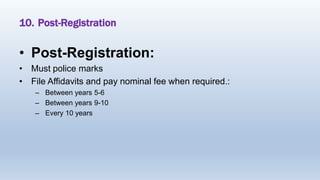
10. Post-Registration
• Post-Registration:
• Must police marks
• File Affidavits and pay nominal fee when required.:
– Between years 5-6
– Between years 9-10
– Every 10 years
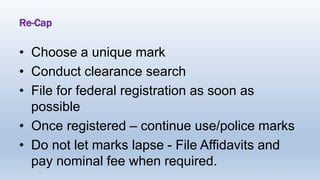
Re-Cap
• Choose a unique mark
• Conduct clearance search
• File for federal registration as soon as
possible
• Once registered – continue use/police marks
• Do not let marks lapse - File Affidavits and
pay nominal fee when required.
Thank You!
dhartman@olenderfeldman.com
Media Partners
Media Partners
Sponsors and Partners

Trademarks - Are Your Brands Protected?

  • 1.
    TRADEMARKS - AREYOUR BRANDS PROTECTED? Donna H. Hartman
  • 2.
  • 3.
    1. Types ofIntellectual Property: Patent = Invention (e.g., Heineken Blade® Beer Dispenser Coravin® Wine Preservation System) Source: Heineken USA.
  • 4.
    1. Types ofIntellectual Property: Copyright = Artistic or Literary Works (e.g., Book, music, artwork, etc.) Designated by © [Year] [Name] 1
  • 5.
    1. Types ofIntellectual Property: Trademark = Brand (Name and/or logo) BALLYHOO® Designated by TM or ® 1
  • 6.
    2. What isa Trademark? A trademark (or service mark), as defined by the US Patent and Trademark Office (USPTO), is generally: “a word, phrase, symbol, or design, or a combination thereof, that identifies and distinguishes the source of the goods of one party from those of others.” Trademarks are governed by The Lanham Act a/k/a Trademark Act of 1964, 15 USC §§ 1051 et. Seq.
  • 7.
    2. What isa Trademark? Filing for a business name or domain names does not automatically create a trademark. Web Address: www.1800Contacts.com Trademark: 1800CONTACTS.COM Description of Services: “Mail order and telephone order services in the field of contact lenses and related products, and on-line retail store services featuring contact lenses and related products.” Source: USPTO Database
  • 8.
    3. Types ofMarks  Standard Character Mark (Word Mark) - allows for more flexibility – can change font style, color and can be used with or without a design. COCA-COLA PEPSI  Special Form Marks  Stylized Mark – words in a particular font Source: USPTO database
  • 9.
    3. Types ofMarks  Design Mark – a composite mark comprised of words and design, or design only.  Note: The mark must remain exactly as filed.
  • 10.
    4. How areTrademarks Protected?  Federal Registration – File with the United States Patent and Trademark Office (USPTO)  State Registration – File with the State (Secretary of State)  Common Law – No filing required; limited in geography.  Symbols Used - ®, TM or SM
  • 11.
    5. When ToFile For Protection.  Ideally - Prior to using a mark (e.g., concept for a new business) – Protect idea – Registration process takes time  After using a mark; – Concerns: • Application may be suspended due to a likelihood of confusion with a Registered mark or pending application – (1) sound alike (e.g., phonetic equivalents), – (2) look alike, – (3) have the same meaning (e.g., foreign equivalent translation), and/or – (4) create the same general (overall) commercial impression. • Costly to change mark
  • 12.
    6. Trademark FilingBasis • In Use (Section 1(a)) - Trademarks are used in commerce. Already selling the products or services. • Intent-to-Use (Section 1(b)) – Have an idea but have not yet started selling in commerce. Bona fide intention • Foreign: Section 44(d) or 44(e), Section 66(a) – Based upon a foreign trademark application or registration.
  • 13.
    6. Benefits ofFiling for Federal Registration • Public notice of ownership of the mark • Exclusive right to use the mark nationally • Use of the federal registration symbol “® ” • The ability to sue in federal court • May file with U.S. Customs and Border Protection to prevent importation of infringing goods • A basis to obtain registration in foreign countries Source: USPTO Website
  • 14.
    7. Choosing AMark. • Pick a Mark that has the best chance of registering. • Marks generally fall into one of the following categories:  Fanciful  Arbitrary  Suggestive  Descriptive  Generic Strong To Weak
  • 15.
    7. Choosing AMark (continued) • Fanciful (Strong): The strongest marks Invented words No other known meaning.
  • 16.
    7. Choosing AMark (continued) Trademarks owned by their respective owners.
  • 17.
    7. Choosing AMark (continued) • Arbitrary (Strong): • Actual words with a known meaning • No association or relationship with the goods or services.
  • 18.
    7. Choosing AMark (continued) Trademarks owned by their respective owners.
  • 19.
    7. Choosing AMark (continued) • Suggestive (Strong): • Suggests, but does not describe, qualities or characters of the goods or services. • Imagination required
  • 20.
    7. Choosing AMark (continued) • Suggestive (Strong): WITE-OUT Trademarks are owned by their respective owners.
  • 21.
    7. Choosing AMark (continued) • Descriptive (Weak):  Describe a feature, function, use, characteristic, quality, function, feature or ingredient of the goods or services.  No imagination required  Does not identify the source  May be refused registration on the Principal Register unless it acquires distinctiveness or secondary meaning through extensive use in commerce for at least five (5) years. • Examples: RED RED WINE RED & BLACK PEPPER VODKA JAMAICAN RUM PUNCH Source: TMEP Section 1209.01(b)
  • 22.
    7. Choosing AMark (continued) • Generic (Weak): • The weakest marks • Never registrable or enforceable against third parties • Common or everyday names for goods or services • Everyone has the right to use such terms • If part of a mark, others will not be prevented from using the term
  • 23.
    7. Choosing AMark (continued) • Generic (Weak): Examples: BEER GIN TEQUILA
  • 24.
    7. Other PotentialGrounds for Refusal • A Surname; • Geographically Descriptive of the origin of the goods/services; • Disparaging or offensive; • A foreign term that translates to a descriptive or generic term; • An individual’s name or likeness; • The title of a single book and/or movie; or • Matter that is used in a purely ornamental manner. (e.g., Trademark on a hat)
  • 25.
    7. Police Marks •It is important to police marks • Over time, they can become generic even if they were strong initially • License use of marks • Send cease & desist letters when appropriate • Examples – Asprin – Laundromat – Dry Ice – Yo-Yo
  • 26.
    8. Process • Conducta trademark clearance search • File application -Trademark examiner assigned (3 months) • Application reviewed (1 month) • If an objection, the trademark examiner will issue an Office Action outlining the reasons for the objection. (6 months to respond) • If no objections, mark published in Trademark Official Gazette • Once published, the public has 30 days to object (oppose) • If opposed, it could delay registration • If no opposition, a Notice of Allowance issued (2 months after opposition period ends) • A Statement of Use to be filed or a 6-month extension (max. 4 times) • Registration certificate issued (1-2 months) (barring any unforeseen circumstances).
  • 27.
    10. Post-Registration • Post-Registration: •Must police marks • File Affidavits and pay nominal fee when required.: – Between years 5-6 – Between years 9-10 – Every 10 years
  • 28.
    Re-Cap • Choose aunique mark • Conduct clearance search • File for federal registration as soon as possible • Once registered – continue use/police marks • Do not let marks lapse - File Affidavits and pay nominal fee when required.
  • 29.
  • 30.
  • 31.
  • 32.