Brand, Logo and Other IP  Concerns for Wineries Scott Hervey Weintraub Genshlea Chediak Law Corporation www.weintraub.com www.theiplawblog.com @Weintraub_Law © Weintraub Genshlea Chediak 2011
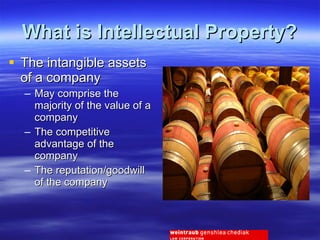
What is Intellectual Property? The intangible assets of a company May comprise the majority of the value of a company The competitive advantage of the company The reputation/goodwill of the company
Types of Intellectual Property Patents Inventions Designs Trade Secrets Secret Inventions Methods Customer Lists Tools Trademarks Brands Trade names Trade dress Copyrights Photographs Software Web pages Databases
What is a Trademark? Word, saying, logo, brand, sign, mark - even sound, color, or smell Triggers association in the market with owner/source Means of protecting goodwill The exclusive right to use a brand (mark) for products or services
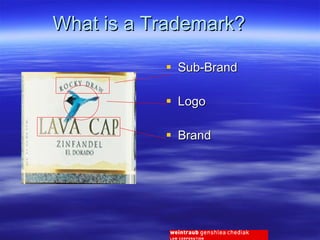
What is a Trademark? Sub-Brand Logo Brand
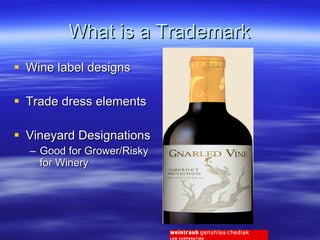
What is a Trademark Wine label designs Trade dress elements Vineyard Designations Good for Grower/Risky for Winery
Types of Marks Common Law Marks Arises from actual use Protection in areas of use in commerce  Registered Marks Federal registration (presumed ownership throughout the nation) State filing also available Trademarks Service Marks Certification Marks Collective Marks Trade Dress
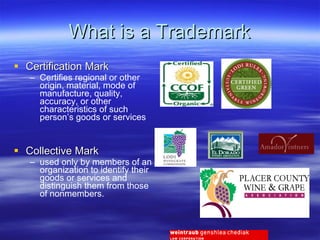
What is a Trademark Certification Mark Certifies regional or other origin, material, mode of manufacture, quality, accuracy, or other characteristics of such person’s goods or services Collective Mark used only by members of an organization to identify their goods or services and distinguish them from those of nonmembers.
Initial Concerns:  Choice of Mark Strength of trademark depends on the nature of the mark: Fanciful/coined (Kodak) Arbitrary (Yahoo, Apple) Suggestive (Roach Motel) Indicates nature quality or characteristic Descriptive (Tahoe Plumbing, Park ‘N Fly) Directly related to meaning Generic (Escalator) Common name
Why Chose a Strong Trademark? Strong trademarks accomplish source identification. More identifiable to consumer. More difficult for others to infringe, intentionally or unintentionally Easier and less costly to register.  Less chance of similarity with preexisting marks. No need for costly revisions of mark. Stronger Legal Protection
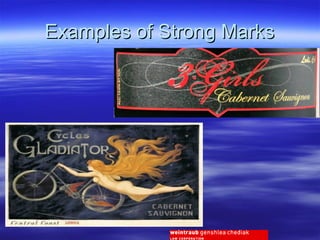
Examples of Strong Marks
Strength of Trademark Descriptive marks are generally not registrable unless develop secondary meaning (acquired distinctiveness) Generic marks are not registrable
Special Labeling Issues Use of an American Viticulture Area Designation (AVA) 85% of the wine is from grapes from the AVA Appellation of origin A country, a U.S. state, and a  U.S. county – i.e., Lodi County, California 75% of the wine is from grapes from the appellation Conjunctive Labeling Requires main AVA to be used in conjunction with sub-AVA (e.g.  Fair Play, El Dorado)
Special Labeling Issues US – EU Wine Accords March 10, 2006 – the US agreed to limit the use of certain semi generic names on non-European wines Burgundy (France), Malaga (Spain) , Chablis (France), Marsala (Italy) , Champagne (France), Moselle (France), Chianti (Italy), Port (Portugal) , Claret (France), Rhine (Germany) , Haut Sauterne (France), Sauterne (France), Hock (Germany), Sherry Grandfather Provision Under the “grandfather” provision, any person or his or her successor in interest may continue to use a semi-generic name on a label of a wine not originating in the EU,  provided  the semi-generic name is only used on labels for wine bearing the same brand name, or the brand name and the fanciful name, if any, that appear on a COLA that was issued prior to March 10, 2006.
Special Labeling Issues All Wine Labels Must Be Approved By TTB Certificate of Label Approval (COLA) Does not confer trademark rights  Organic and Other “Green” Claims FTC is scrutinizing “green” claims
Choosing a Trademark:  The Search What is a trademark search? Snapshot of the world as it exists at the moment in time when you seek the trademark.  Perform a trademark search BEFORE settling on a mark. Why do a trademark search? Development of a trademark is costly.  Before you spend money, make sure you can use it! Using someone else’s trademark, even accidentally, can get you sued.
How to Perform a Trademark Search? Don’t rely on a Google Search! Google DOES NOT review State and Federal Databases or other proprietary databases Full trademark search includes: Trademarks registered through the Patent and Trademark Office Trademarks registered through local states Trademarks used in various databases Trademarks used in domain names Unregistered business names
Protecting Trademarks  Federal Registration Constructive notice nationwide of the claim to ownership Evidence of ownership and priority of use Allows registration with US customs to prevent importation Domain name disputes Application Use or intent to use Based on foreign application/registration
Protecting Trademarks TM,  ®,  SM  Trademark owners must police their own marks Why? There is no governmental body that enforces marks and punishes infringement. Failure to police mark can weaken protection or result in loss of mark (abandonment) How? No oral permission to Third Parties Always grant permission in writing and with conditions restraining use. Create proper licenses.  Demand unlicensed use immediately stop
Licenses:  Trademarks The Naked License Occurs when the TM owner grants permission to a third party, but does not retain the right to approve the manner (or otherwise supervise quality) in which the mark is used. Effect: Mark can be cancelled by the PTO.  Why?  Mark assures consistency and quality.  If the mark owner insists on neither, the trademark can be lost.
Copyrights
What is a copyright? Original work of authorship fixed in a tangible medium Articles, programs, web pages, multi-media Technology, software, databases No protection of functional aspects Exclusive right to reproduce, derivative works, copy, perform, display, transmit  Exceptions such as fair use for criticism, comment, teaching, reporting
What is a copyright? Generally lasts for life of author plus 70 years Joint works are owned by both authors equally Copyright notice ©, name, and year Circled “p” for sound recordings Can register at later time Registration allows attorney’s fee recovery, statutory damages, etc.
Copyrights and Employees/Agents Generally, author has ownership. Under Work for Hire doctrine: A copyrighted work prepared by an employee within the scope of employment is owned by the employer Certain types of work commissioned from an independent contractor with a written agreement may be designated as “work for hire” owned by commissioning party Other types of work may be assigned Need written assignment documentation with all employees/agents
Work for Hire  Effect of relying on oral agreement or not using such language… The contracting party owns nothing more than a copy of the work Does  NOT  own the Copyright in the work.
  Trade Secrets
What is a Trade Secret? Various types of information (formula, pattern, compilation, program, device, method, techniques, process) derives independent economic value from not being generally known or readily ascertainable by proper means by persons who can derive economic value  reasonable efforts to maintain its secrecy A protected idea that provides a competitive advantage in a market More than one person may hold a trade secret
Trade Secret Misappropriation Acquisition by improper means (known or reason to know) or under circumstances with duty to maintain secrecy/limit use (may include acquired by accident or mistake) Disclosure or use without actual or implied consent
Trade Secret Misappropriation Must use reasonable efforts under circumstances to protect Non-disclosure agreements Employee training Disclose on a need to know basis Limit access and availability Other internal controls Policy of marking problematic if not followed
Departing Employees Very significant area of trade secret disputes. Actions for injunction or special damages if show willful and malicious. Customer lists Employer ownership of trade secrets If relates to business of employer (for inventor) or developed on company time (other employees)
Departing Employees Public policies allowing competition California prohibition of employee covenants not to compete under B&P Code 16600 Other states have varying levels of prohibitions
Bringing it All Together Effectively manage all your intellectual property Know Your Inventory: Have a firm understanding of all IP assets. Yearly Review Transparent communication with other departments (e.g., advertising, web design) Take Reasonable Steps to Protect Your Intellectual Property: Unprotected and Protected assets.  Which make sense for company to pursue protection? Prevent Unintended Liabilities: Perform Trademark search.  Don’t infringe. Agreements with vendors guaranteeing right to use material (in websites, advertisements, etc.)
Thank You

Wine law

  • 1.
    Brand, Logo andOther IP Concerns for Wineries Scott Hervey Weintraub Genshlea Chediak Law Corporation www.weintraub.com www.theiplawblog.com @Weintraub_Law © Weintraub Genshlea Chediak 2011
  • 2.
    What is IntellectualProperty? The intangible assets of a company May comprise the majority of the value of a company The competitive advantage of the company The reputation/goodwill of the company
  • 3.
    Types of IntellectualProperty Patents Inventions Designs Trade Secrets Secret Inventions Methods Customer Lists Tools Trademarks Brands Trade names Trade dress Copyrights Photographs Software Web pages Databases
  • 4.
    What is aTrademark? Word, saying, logo, brand, sign, mark - even sound, color, or smell Triggers association in the market with owner/source Means of protecting goodwill The exclusive right to use a brand (mark) for products or services
  • 5.
    What is aTrademark? Sub-Brand Logo Brand
  • 6.
    What is aTrademark Wine label designs Trade dress elements Vineyard Designations Good for Grower/Risky for Winery
  • 7.
    Types of MarksCommon Law Marks Arises from actual use Protection in areas of use in commerce Registered Marks Federal registration (presumed ownership throughout the nation) State filing also available Trademarks Service Marks Certification Marks Collective Marks Trade Dress
  • 8.
    What is aTrademark Certification Mark Certifies regional or other origin, material, mode of manufacture, quality, accuracy, or other characteristics of such person’s goods or services Collective Mark used only by members of an organization to identify their goods or services and distinguish them from those of nonmembers.
  • 9.
    Initial Concerns: Choice of Mark Strength of trademark depends on the nature of the mark: Fanciful/coined (Kodak) Arbitrary (Yahoo, Apple) Suggestive (Roach Motel) Indicates nature quality or characteristic Descriptive (Tahoe Plumbing, Park ‘N Fly) Directly related to meaning Generic (Escalator) Common name
  • 10.
    Why Chose aStrong Trademark? Strong trademarks accomplish source identification. More identifiable to consumer. More difficult for others to infringe, intentionally or unintentionally Easier and less costly to register. Less chance of similarity with preexisting marks. No need for costly revisions of mark. Stronger Legal Protection
  • 11.
  • 12.
    Strength of TrademarkDescriptive marks are generally not registrable unless develop secondary meaning (acquired distinctiveness) Generic marks are not registrable
  • 13.
    Special Labeling IssuesUse of an American Viticulture Area Designation (AVA) 85% of the wine is from grapes from the AVA Appellation of origin A country, a U.S. state, and a U.S. county – i.e., Lodi County, California 75% of the wine is from grapes from the appellation Conjunctive Labeling Requires main AVA to be used in conjunction with sub-AVA (e.g. Fair Play, El Dorado)
  • 14.
    Special Labeling IssuesUS – EU Wine Accords March 10, 2006 – the US agreed to limit the use of certain semi generic names on non-European wines Burgundy (France), Malaga (Spain) , Chablis (France), Marsala (Italy) , Champagne (France), Moselle (France), Chianti (Italy), Port (Portugal) , Claret (France), Rhine (Germany) , Haut Sauterne (France), Sauterne (France), Hock (Germany), Sherry Grandfather Provision Under the “grandfather” provision, any person or his or her successor in interest may continue to use a semi-generic name on a label of a wine not originating in the EU, provided the semi-generic name is only used on labels for wine bearing the same brand name, or the brand name and the fanciful name, if any, that appear on a COLA that was issued prior to March 10, 2006.
  • 15.
    Special Labeling IssuesAll Wine Labels Must Be Approved By TTB Certificate of Label Approval (COLA) Does not confer trademark rights Organic and Other “Green” Claims FTC is scrutinizing “green” claims
  • 16.
    Choosing a Trademark: The Search What is a trademark search? Snapshot of the world as it exists at the moment in time when you seek the trademark. Perform a trademark search BEFORE settling on a mark. Why do a trademark search? Development of a trademark is costly. Before you spend money, make sure you can use it! Using someone else’s trademark, even accidentally, can get you sued.
  • 17.
    How to Performa Trademark Search? Don’t rely on a Google Search! Google DOES NOT review State and Federal Databases or other proprietary databases Full trademark search includes: Trademarks registered through the Patent and Trademark Office Trademarks registered through local states Trademarks used in various databases Trademarks used in domain names Unregistered business names
  • 18.
    Protecting Trademarks Federal Registration Constructive notice nationwide of the claim to ownership Evidence of ownership and priority of use Allows registration with US customs to prevent importation Domain name disputes Application Use or intent to use Based on foreign application/registration
  • 19.
    Protecting Trademarks TM, ®, SM Trademark owners must police their own marks Why? There is no governmental body that enforces marks and punishes infringement. Failure to police mark can weaken protection or result in loss of mark (abandonment) How? No oral permission to Third Parties Always grant permission in writing and with conditions restraining use. Create proper licenses. Demand unlicensed use immediately stop
  • 20.
    Licenses: TrademarksThe Naked License Occurs when the TM owner grants permission to a third party, but does not retain the right to approve the manner (or otherwise supervise quality) in which the mark is used. Effect: Mark can be cancelled by the PTO. Why? Mark assures consistency and quality. If the mark owner insists on neither, the trademark can be lost.
  • 21.
  • 22.
    What is acopyright? Original work of authorship fixed in a tangible medium Articles, programs, web pages, multi-media Technology, software, databases No protection of functional aspects Exclusive right to reproduce, derivative works, copy, perform, display, transmit Exceptions such as fair use for criticism, comment, teaching, reporting
  • 23.
    What is acopyright? Generally lasts for life of author plus 70 years Joint works are owned by both authors equally Copyright notice ©, name, and year Circled “p” for sound recordings Can register at later time Registration allows attorney’s fee recovery, statutory damages, etc.
  • 24.
    Copyrights and Employees/AgentsGenerally, author has ownership. Under Work for Hire doctrine: A copyrighted work prepared by an employee within the scope of employment is owned by the employer Certain types of work commissioned from an independent contractor with a written agreement may be designated as “work for hire” owned by commissioning party Other types of work may be assigned Need written assignment documentation with all employees/agents
  • 25.
    Work for Hire Effect of relying on oral agreement or not using such language… The contracting party owns nothing more than a copy of the work Does NOT own the Copyright in the work.
  • 26.
    TradeSecrets
  • 27.
    What is aTrade Secret? Various types of information (formula, pattern, compilation, program, device, method, techniques, process) derives independent economic value from not being generally known or readily ascertainable by proper means by persons who can derive economic value reasonable efforts to maintain its secrecy A protected idea that provides a competitive advantage in a market More than one person may hold a trade secret
  • 28.
    Trade Secret MisappropriationAcquisition by improper means (known or reason to know) or under circumstances with duty to maintain secrecy/limit use (may include acquired by accident or mistake) Disclosure or use without actual or implied consent
  • 29.
    Trade Secret MisappropriationMust use reasonable efforts under circumstances to protect Non-disclosure agreements Employee training Disclose on a need to know basis Limit access and availability Other internal controls Policy of marking problematic if not followed
  • 30.
    Departing Employees Verysignificant area of trade secret disputes. Actions for injunction or special damages if show willful and malicious. Customer lists Employer ownership of trade secrets If relates to business of employer (for inventor) or developed on company time (other employees)
  • 31.
    Departing Employees Publicpolicies allowing competition California prohibition of employee covenants not to compete under B&P Code 16600 Other states have varying levels of prohibitions
  • 32.
    Bringing it AllTogether Effectively manage all your intellectual property Know Your Inventory: Have a firm understanding of all IP assets. Yearly Review Transparent communication with other departments (e.g., advertising, web design) Take Reasonable Steps to Protect Your Intellectual Property: Unprotected and Protected assets. Which make sense for company to pursue protection? Prevent Unintended Liabilities: Perform Trademark search. Don’t infringe. Agreements with vendors guaranteeing right to use material (in websites, advertisements, etc.)
  • 33.

Editor's Notes

  • #7 Vineyard Designations: 1) building a brand for the grower. Unless you have a long term contract, it may not be best to grow the grower’s brand
  • #12 These are very strong brands for wine because they have little or nothing to do with wine. They also aren’t sur names so they are more likely to be remembered.
  • #14 Conjunctive labeling requirements are being driven at the State level. January 2010 Sonoma County Vintners Assn voted to require conjunctive labeling to raise visibility of Sonoma county