Trademarks: A Primer
Presenters:
Karen Tyler and Justin McCabe, Partners at
Dunkiel Saunders Elliott Raubvogel & Hand, PLLC
Trademarks
• Purposes and Types
• Conflicts and Issues
• Selecting a Mark
• Developing a Brand
• Registration Process
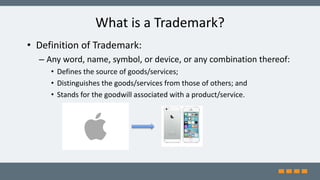
What is a Trademark?
• Definition of Trademark:
– Any word, name, symbol, or device, or any combination thereof:
• Defines the source of goods/services;
• Distinguishes the goods/services from those of others; and
• Stands for the goodwill associated with a product/service.
Policy
• Benefits of Trademarks:
– Early thoughts:
• Advertising protection
• Use to prove manufacturer; ownership resolution
• Guarantee of quality (or not)
– Modern
• Reduce information and transaction costs by allowing customers to estimate
the nature and quality of goods before purchase
What can be a TradeMark?
• Made up words (XEROX)
• Common words (APPLE)
• Alphanumeric combinations (V-8)
• Logos
• Packages or labels (think Campbell's soup can)
• Colors
• Product shapes (Coca-Cola bottle)
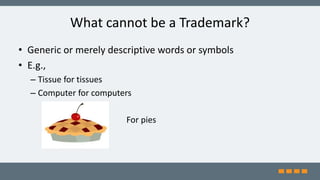
What cannot be a Trademark?
• Generic or merely descriptive words or symbols
• E.g.,
– Tissue for tissues
– Computer for computers
For pies
Types of Trademarks
• 5 Categories (from strongest to least strong)
– Fanciful
• XEROX, GOOGLE, EXXON
– Arbitrary
• APPLE for computers
• FORD, SEQUOIA, TUNDRA for automobiles
• CAMEL FOR CIGARETTES
Types of TM’s Cont.
– Suggestive
• MICROSOFT
• COPPERTONE
• LAND ROVER
• TICKETMASTER
• PURELY SOFT
– Somewhat Descriptive
• TRAILER SUPPLY
• STAPLES
• TTABLOG
– Generic – car, computer, aspirin, etc.
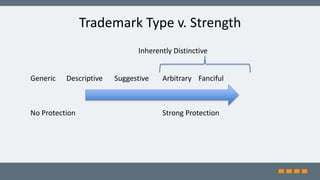
Trademark Type v. Strength
Inherently Distinctive
Generic Descriptive Suggestive Arbitrary Fanciful
No Protection Strong Protection
Why is Strength Important?
• Strength of mark defines scope of protection
– Inherently distinctive marks are given broader scope than other
marks
• Example:
– If someone tried to register APLE for consulting services, APPLE for computers would
have a strong case
– If someone tried to register APLE for pies and the existing mark was APPLE for bakeries,
may have weak case
• Descriptive marks may not be registrable and may be more
likely to have a crowded field:
• E.g., TRACTOR SUPPLY coexists with TEXAS TRAILER SUPPLY, etc.
Conflicts and Issues
• Trademarks (in the U.S.) are established by using the mark in
commerce
– It is possible to register your mark before using it
• Issues arise when:
– You want to register a mark that is similar to an already registered
mark or a mark that is already in use for similar goods/services
– You begin using a mark that is already in use or has been registered
• Using a mark that is already registered or in use can cost a lot
of $$$ to fix…
Allagash v. Pelletier
• What’s the situation?
– ALLAGASH WILD proposed for registration
– ALLAGASH (the beer company) opposed based upon their
registration
• Rule
– “[a]lthough confusion, mistake or deception about source or origin is
the usual issue posed under Section 2(d), any confusion made likely
by a junior user’s mark is cause for refusal; likelihood of confusion
encompasses confusion of sponsorship, affiliation or connection.”
Allagash v. Pelletier
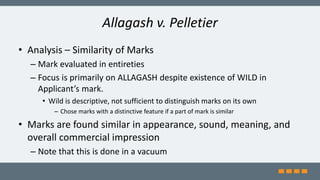
• Analysis – Similarity of Marks
– Mark evaluated in entireties
– Focus is primarily on ALLAGASH despite existence of WILD in
Applicant’s mark.
• Wild is descriptive, not sufficient to distinguish marks on its own
– Chose marks with a distinctive feature if a part of mark is similar
• Marks are found similar in appearance, sound, meaning, and
overall commercial impression
– Note that this is done in a vacuum
Allagash v. Pelletier
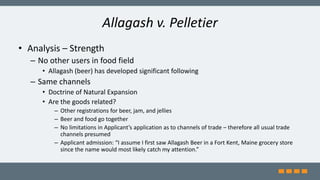
• Analysis – Strength
– No other users in food field
• Allagash (beer) has developed significant following
– Same channels
• Doctrine of Natural Expansion
• Are the goods related?
– Other registrations for beer, jam, and jellies
– Beer and food go together
– No limitations in Applicant’s application as to channels of trade – therefore all usual trade
channels presumed
– Applicant admission: “I assume I first saw Allagash Beer in a Fort Kent, Maine grocery store
since the name would most likely catch my attention.”
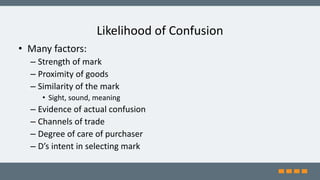
Likelihood of Confusion
• Many factors:
– Strength of mark
– Proximity of goods
– Similarity of the mark
• Sight, sound, meaning
– Evidence of actual confusion
– Channels of trade
– Degree of care of purchaser
– D’s intent in selecting mark
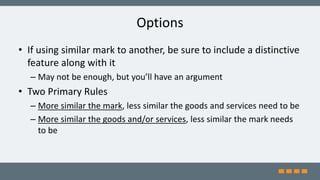
Options
• If using similar mark to another, be sure to include a distinctive
feature along with it
– May not be enough, but you’ll have an argument
• Two Primary Rules
– More similar the mark, less similar the goods and services need to be
– More similar the goods and/or services, less similar the mark needs
to be
Selecting a Mark
• Research before committing!
– USPTO and web
– Compare similarity of mark and similarity of goods/services offered
• Remember that the more unique your mark is (e.g., coined) the more
different the goods and services need to be if you find the same mark
– Example: You wouldn’t be able to use XEROX for anything computer related or paper
related, but XEROX diapers? Maybe.
• Ideally – coin your own
• Still good – arbitrary
• Suggestive marks are going to give you headaches…
Developing a Brand
• Consistent (read as exact) use – do not stray!
– Vermont Trading Company and Vermont Trading Co. and VT Trading
Company are NOT the same marks.
• Have usage guidelines (next slide)
• Do not let unlicensed uses of your mark fester
• Protect your mark
– Registration
– Regular review of use
Trademark Use Guidelines
• Trademarks are adjectives, not NOUNS.
– BISSELL® vacuum cleaner
– Trademark’s should not be used possessively
• Trademarks have to be used EXACTLY AS REGISTERED
– No plurals
– No changing “and” with “&”
• Trademarks should be distinguished:
– Capital letters, italics, bold type, different font size, etc.
Proper Attribution
• Symbol ® should only be used in connection with a registered
mark
– Can result in claims of unfair competition
– Mexico -> criminal charges possible
• TM and SM symbols:
– Unregistered marks
• Descriptive term in a stylized form
– Strategy – don’t use so that “fair use” can be claimed (in other words,
the mark is either not be used in a trademark sense or is descriptive)
Registration and Use
• Application filed
– Wait 3 to 7 months
• Examiner evaluates
– Issues office action (or not)
– Common issues:
• Likelihood of confusion
• Descriptiveness
• Disclaimer
• Revisions to goods and services
Registration and Use (cont.)
• Mark is published
– 3rd Parties may opposed if they believe they will be harmed by
allowance
• No opposition or (unsuccessful opposition)
– Mark proceeds to registration
• After registration, rights are not completely secure –
cancellation proceedings are possible
• Continued maintenance required
Thanks!
• Karen Tyler, ktyler@dunkielsaunders.com
• Justin McCabe, jmccabe@dunkielsaunders.com
Find out more about Dunkiel Saunders and trademark/ip law at:
www.dunkielsaunders.com
www.greenmountainip.com
Or follow Justin: @justinip

Trademarks: A Primer

  • 1.
    Trademarks: A Primer Presenters: KarenTyler and Justin McCabe, Partners at Dunkiel Saunders Elliott Raubvogel & Hand, PLLC
  • 2.
    Trademarks • Purposes andTypes • Conflicts and Issues • Selecting a Mark • Developing a Brand • Registration Process
  • 3.
    What is aTrademark? • Definition of Trademark: – Any word, name, symbol, or device, or any combination thereof: • Defines the source of goods/services; • Distinguishes the goods/services from those of others; and • Stands for the goodwill associated with a product/service.
  • 4.
    Policy • Benefits ofTrademarks: – Early thoughts: • Advertising protection • Use to prove manufacturer; ownership resolution • Guarantee of quality (or not) – Modern • Reduce information and transaction costs by allowing customers to estimate the nature and quality of goods before purchase
  • 5.
    What can bea TradeMark? • Made up words (XEROX) • Common words (APPLE) • Alphanumeric combinations (V-8) • Logos • Packages or labels (think Campbell's soup can) • Colors • Product shapes (Coca-Cola bottle)
  • 6.
    What cannot bea Trademark? • Generic or merely descriptive words or symbols • E.g., – Tissue for tissues – Computer for computers For pies
  • 7.
    Types of Trademarks •5 Categories (from strongest to least strong) – Fanciful • XEROX, GOOGLE, EXXON – Arbitrary • APPLE for computers • FORD, SEQUOIA, TUNDRA for automobiles • CAMEL FOR CIGARETTES
  • 8.
    Types of TM’sCont. – Suggestive • MICROSOFT • COPPERTONE • LAND ROVER • TICKETMASTER • PURELY SOFT – Somewhat Descriptive • TRAILER SUPPLY • STAPLES • TTABLOG – Generic – car, computer, aspirin, etc.
  • 9.
    Trademark Type v.Strength Inherently Distinctive Generic Descriptive Suggestive Arbitrary Fanciful No Protection Strong Protection
  • 10.
    Why is StrengthImportant? • Strength of mark defines scope of protection – Inherently distinctive marks are given broader scope than other marks • Example: – If someone tried to register APLE for consulting services, APPLE for computers would have a strong case – If someone tried to register APLE for pies and the existing mark was APPLE for bakeries, may have weak case • Descriptive marks may not be registrable and may be more likely to have a crowded field: • E.g., TRACTOR SUPPLY coexists with TEXAS TRAILER SUPPLY, etc.
  • 11.
    Conflicts and Issues •Trademarks (in the U.S.) are established by using the mark in commerce – It is possible to register your mark before using it • Issues arise when: – You want to register a mark that is similar to an already registered mark or a mark that is already in use for similar goods/services – You begin using a mark that is already in use or has been registered • Using a mark that is already registered or in use can cost a lot of $$$ to fix…
  • 12.
    Allagash v. Pelletier •What’s the situation? – ALLAGASH WILD proposed for registration – ALLAGASH (the beer company) opposed based upon their registration • Rule – “[a]lthough confusion, mistake or deception about source or origin is the usual issue posed under Section 2(d), any confusion made likely by a junior user’s mark is cause for refusal; likelihood of confusion encompasses confusion of sponsorship, affiliation or connection.”
  • 13.
    Allagash v. Pelletier •Analysis – Similarity of Marks – Mark evaluated in entireties – Focus is primarily on ALLAGASH despite existence of WILD in Applicant’s mark. • Wild is descriptive, not sufficient to distinguish marks on its own – Chose marks with a distinctive feature if a part of mark is similar • Marks are found similar in appearance, sound, meaning, and overall commercial impression – Note that this is done in a vacuum
  • 14.
    Allagash v. Pelletier •Analysis – Strength – No other users in food field • Allagash (beer) has developed significant following – Same channels • Doctrine of Natural Expansion • Are the goods related? – Other registrations for beer, jam, and jellies – Beer and food go together – No limitations in Applicant’s application as to channels of trade – therefore all usual trade channels presumed – Applicant admission: “I assume I first saw Allagash Beer in a Fort Kent, Maine grocery store since the name would most likely catch my attention.”
  • 15.
    Likelihood of Confusion •Many factors: – Strength of mark – Proximity of goods – Similarity of the mark • Sight, sound, meaning – Evidence of actual confusion – Channels of trade – Degree of care of purchaser – D’s intent in selecting mark
  • 16.
    Options • If usingsimilar mark to another, be sure to include a distinctive feature along with it – May not be enough, but you’ll have an argument • Two Primary Rules – More similar the mark, less similar the goods and services need to be – More similar the goods and/or services, less similar the mark needs to be
  • 17.
    Selecting a Mark •Research before committing! – USPTO and web – Compare similarity of mark and similarity of goods/services offered • Remember that the more unique your mark is (e.g., coined) the more different the goods and services need to be if you find the same mark – Example: You wouldn’t be able to use XEROX for anything computer related or paper related, but XEROX diapers? Maybe. • Ideally – coin your own • Still good – arbitrary • Suggestive marks are going to give you headaches…
  • 18.
    Developing a Brand •Consistent (read as exact) use – do not stray! – Vermont Trading Company and Vermont Trading Co. and VT Trading Company are NOT the same marks. • Have usage guidelines (next slide) • Do not let unlicensed uses of your mark fester • Protect your mark – Registration – Regular review of use
  • 19.
    Trademark Use Guidelines •Trademarks are adjectives, not NOUNS. – BISSELL® vacuum cleaner – Trademark’s should not be used possessively • Trademarks have to be used EXACTLY AS REGISTERED – No plurals – No changing “and” with “&” • Trademarks should be distinguished: – Capital letters, italics, bold type, different font size, etc.
  • 20.
    Proper Attribution • Symbol® should only be used in connection with a registered mark – Can result in claims of unfair competition – Mexico -> criminal charges possible • TM and SM symbols: – Unregistered marks • Descriptive term in a stylized form – Strategy – don’t use so that “fair use” can be claimed (in other words, the mark is either not be used in a trademark sense or is descriptive)
  • 21.
    Registration and Use •Application filed – Wait 3 to 7 months • Examiner evaluates – Issues office action (or not) – Common issues: • Likelihood of confusion • Descriptiveness • Disclaimer • Revisions to goods and services
  • 22.
    Registration and Use(cont.) • Mark is published – 3rd Parties may opposed if they believe they will be harmed by allowance • No opposition or (unsuccessful opposition) – Mark proceeds to registration • After registration, rights are not completely secure – cancellation proceedings are possible • Continued maintenance required
  • 23.
    Thanks! • Karen Tyler,ktyler@dunkielsaunders.com • Justin McCabe, jmccabe@dunkielsaunders.com Find out more about Dunkiel Saunders and trademark/ip law at: www.dunkielsaunders.com www.greenmountainip.com Or follow Justin: @justinip