Speaker: Tracy Lang First Secretary Bureau of International Cultural and Educational Relations Ministry of Education
An Overview on Students’ Learning in Taiwan through Internationalization TRACY  LANG First Secretary Bureau of International Cultural and Educational Relations Ministry of Education
1. Policies of International Education, in Taiwan, Enacted by the Ministry of Education (1) Take “Developing a Global Perspective” as one of the important “Education Policy Projects” 1) Strengthen international competitive capacity, improve ranking in the  world, and establish excellent universities.  2) Encourage overseas studies, enroll foreign students, and activate  international exchange activities. 3) Participate in international service and promote foreign service. 4) Enact career and technical education, encourage international  activities.
(2) Plans and Actions 1) Establish the “Taiwan International Education Tour Association”. 2) Implement and promote the “Secondary School Exchange  International Programme”. 3) Implement and promote “The 5-Year (2 nd  Round) Program of  High School’s Second Foreign Languages Education”.  4) Create a website for international exchange activities between  high schools and vocational high schools.
5) Create a “Host Family Programme” for international students  to come to Taiwan.  6) International education seminars. 7) Providing Professional In-service Training for Administrators,  Teachers and Staff at Primary and Secondary Schools. 8) Create a White Paper on International Education for High Schools  and Primary Schools in Taiwan.
2.   The Current Situation Regarding    International Education at the    Primary and Secondary Schools in    Taiwan (1) Through the internet: 1) Plan Participants and Future School Partners in Germany. 2) Construct an internet connection regarding international  education in Taiwan: “iEARN Taiwan”. 3) Joint project ” Connecting Classrooms” with British Council
(2) Through on-site courses:   1)  High schools and vocational schools’ reception of  international students 2)  International Education Tour of high school and vocational  school students. 3)  Secondary School Exchange International (SSEI) Program 4)  Promoting the concept of English villages 5)  Exchange students 6)  Second Foreign Languages Education
(3) Developing  international dimension into school  curriculum : Schools implement educational projects of International education  and embedded courses. (4)Supporting Networks:  “ Families with A Warm Heart— Plans for international  students’ Host families”
3. Relevant and successful outcomes of the    promotion of international education in    Taiwan (1) Taiwanese Vocational High School Students  Study Abroad:  Shu-te Home Economics & Commercial  High School’s collaborate with Australian Meee  College of Health and Beauty
(2) Hsin-ren Elementary School’s Sri Lanka  courses of global perspectives:  example of the integrated courses and  curriculum (3) Other International Projects of Collaboration in Taiwan: K-12 Schools
高雄市私立樹德家事商業職業學校 Reporting unit : Shute Vocational High School 國際交流與專業技能的養成 澳洲光療指甲技能研習之旅 The Expansion of an International Perspective  and Cultivation of Expertise –  the Australian  Light Therapy Nail Skills Workshop
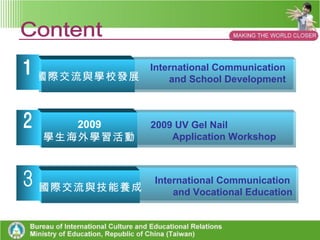
國際交流與學校發展 International Communication  and Vocational Education 2009 學生海外學習活動 國際交流與技能養成 Content 1 2 3 International Communication and School Development 2009 UV Gel Nail  Application Workshop
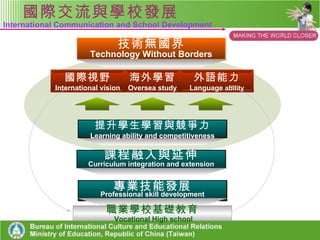
國際交流與學校發展 International Communication and School Development 技術無國界 Technology Without Borders 海外學習 Oversea study 外語能力 Language  ability 國際視野 International vision 提升學生學習與競爭力 Learning ability and competitiveness 課程融入與延伸 Curriculum integration and extension 專業技能發展 Professional skill development 職業學校基礎教育 Vocational High school
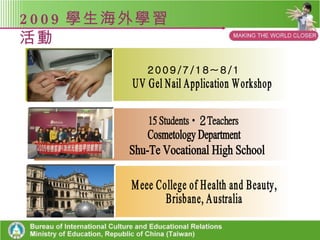
2009 學生海外學習活動 Meee College of Health and Beauty,  Brisbane, Australia UV Gel Nail Application Workshop Shu-Te Vocational High School Cosmetology Department 2009/7/18~8/1
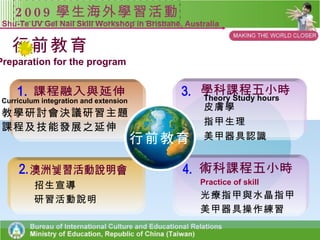
2009 學生海外學習活動 Shu-Te UV Gel Nail Skill Workshop in Brisbane, Australia 行前教育 學科課程五小時 1. 2. 3. 4. 課程融入與延伸 澳洲研習活動說明會 術科課程五小時 行前教育 Preparation for the program Theory Study hours 皮膚學 指甲生理 美甲器具認識 Practice of skill 光療指甲與水晶指甲 美甲器具操作練習 招生宣導 研習活動說明 Curriculum integration and extension 教學研討會決議研習主題 課程及技能發展之延伸
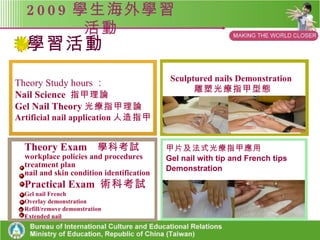
2009 學生海外學習活動 學習活動 Theory Study hours : Nail Science  指甲理論 Gel Nail Theory 光療指甲理論 Artificial nail application 人造指甲 甲片及法式光療指甲應用 Gel nail with tip and French tips  Demonstration Theory Exam  學科考試 workplace policies and procedures treatment plan nail and skin condition identification Practical Exam  術科考試 Gel nail French Overlay demonstration Refill/remove demonstration Extended nail Sculptured nails Demonstration 雕塑光療指甲型態
2009 學生海外學習心得
Learning To Be A World Citizen  Through International Education: Sharing The Curriculum of  “Going Forward to Sri Lanka” By Sing-Ren Elementary School In Taipei County
1.Curriculum Background (1) Realizing the Education Department’s international educational policy and ideas. (2) Immersing the “World Connection” content into the Grade 1-9 Curriculum  (3) Responding to the trends of international education in other countries. (4) Combining the needs for developing the  curriculum in schools.
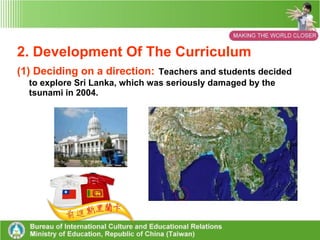
2. Development Of The Curriculum (1) Deciding on a direction:   Teachers and students decided to explore Sri Lanka, which was seriously damaged by the tsunami in 2004.
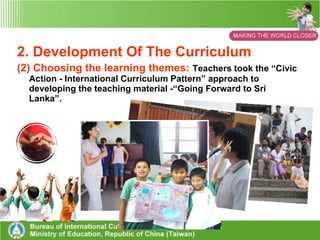
2. Development Of The Curriculum (2) Choosing the learning themes:   Teachers took the “Civic Action - International Curriculum Pattern” approach to developing the teaching material -“Going Forward to Sri Lanka”.
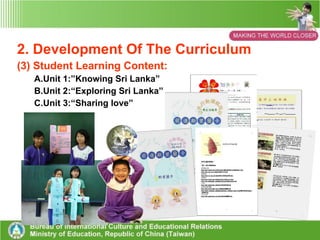
2. Development Of The Curriculum (3) Student Learning Content: A.Unit 1:”Knowing Sri Lanka”  B.Unit 2:“Exploring Sri Lanka”  C.Unit 3:“Sharing love”
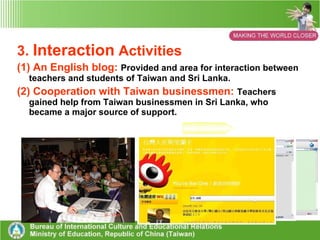
3.  Interaction  Activities (1) An English blog:   Provided and area for interaction between teachers and students of Taiwan and Sri Lanka. (2) Cooperation with Taiwan businessmen:   Teachers gained help from Taiwan businessmen in Sri Lanka, who became a major source of support.
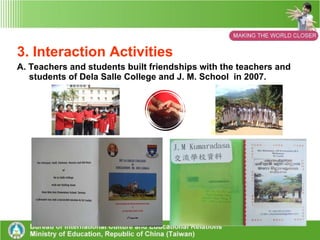
3. Interaction Activities A. Teachers and students built friendships with the teachers and students of Dela Salle College and J. M. School  in 2007.
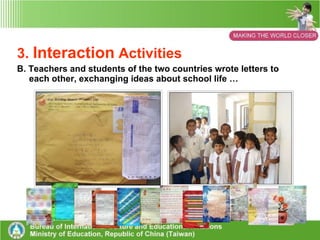
3.  Interaction  Activities B. Teachers and students of the two countries wrote letters to each other, exchanging ideas about school life …
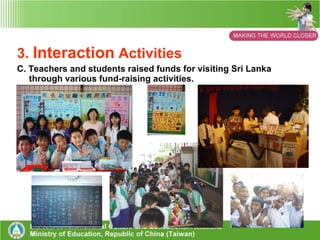
3.  Interaction  Activities C. Teachers and students raised funds for visiting Sri Lanka through various fund-raising activities.
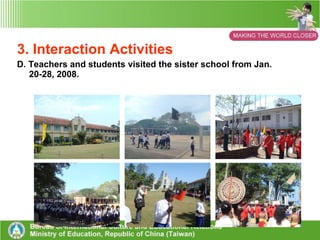
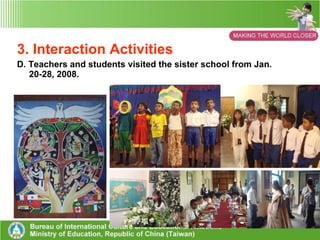
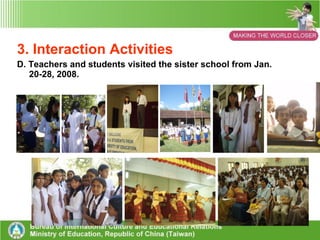
3. Interaction Activities D. Teachers and students visited the sister school from Jan. 20-28, 2008.
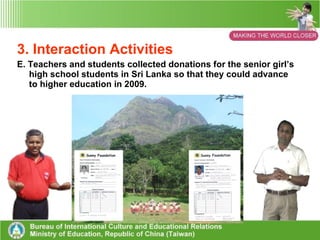
3. Interaction Activities E. Teachers and students collected donations for the senior girl’s high school students in Sri Lanka so that they could advance to higher education in 2009.
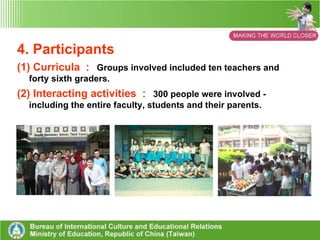
4. Participants (1) Curricula : Groups involved included ten teachers and forty sixth graders. (2) Interacting activities : 300 people were involved - including the entire faculty, students and their parents.
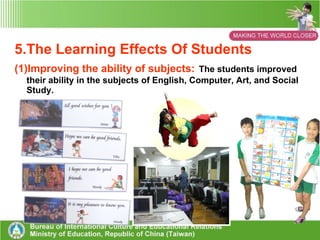
5.The Learning Effects Of Students (1)Improving the ability of subjects:   The students improved their ability in the subjects of English, Computer, Art, and Social Study.
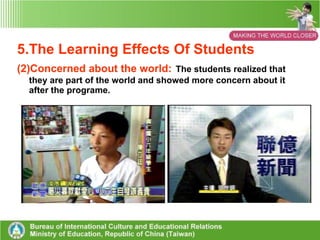
5.The Learning Effects Of Students (2)Concerned about the world:   The students realized that they are part of the world and showed more concern about it after the programe.
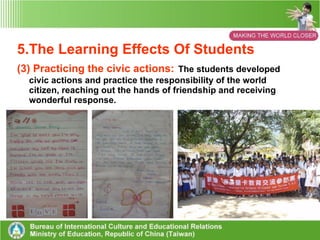
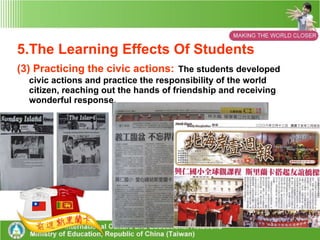
5.The Learning Effects Of Students (3) Practicing the civic actions:   The students developed civic actions and practice the responsibility of the world citizen, reaching out the hands of friendship and receiving wonderful response.
Other International Projects of Collaboration in Taiwan  K-12 Schools National Fenghsin Senior High  Doris Tsueyling Wu
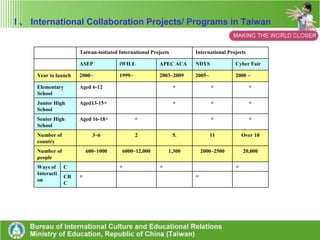
I 、 International Collaboration Projects/ Programs in Taiwan   Taiwan-initiated International Projects International Projects ASEP iWILL  APEC ACA  NDYS Cyber Fair Year to launch 2000~ 1999~ 2003~2009 2005~ 2000 ~ Elementary School Aged 6-12 ◎ ◎ ◎ Junior High School Aged13-15◎  ◎ ◎ ◎ Senior High School Aged 16-18◎ ◎ ◎ ◎ Number of country  3~6 2 5. 11 Over 10 Number of people 600~1000 6000~12,000 1,300 2000~2500 20,000 Ways of Interaction C ◎ ◎ ◎ CRC ◎ ◎
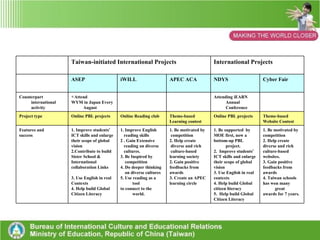
Taiwan-initiated International Projects International Projects ASEP iWILL  APEC ACA  NDYS Cyber Fair Counterpart international activity ◎ Attend  WYM in Japan Every August Attending iEARN Annual Conference Project type Online PBL projects Online Reading club Theme-based Learning contest Online PBL projects  Theme-based  Website Contest Features and  success 1. Improve students ’ ICT skills and enlarge their scope of global  vision  2.Contribute to build  Sister School &  International  collaboration Links 3. Use English in real  Contexts  4. Help build Global  Citizen Literacy 1. Improve English  reading skills 2 . Gain Extensive  reading on diverse  cultures. 3. Be Inspired by  competition  4. Do deeper thinking  on diverse cultures  5. Use reading as a tool  to connect to the world. 1. Be motivated by competition  2. Help create  diverse and rich culture-based  learning society 2. Gain positive  feedbacks from  awards 3. Create an APEC  learning circle  1. Be supported  by  MOE first, now a  bottom-up PBL project.  2.  Improve students ’   ICT skills and enlarge  their scope of global  vision  3. Use English in real  contexts 4. Help build Global  citizen literacy 5.  Help build Global  Citizen Literacy 1. Be motivated by  competition  2. Help create  diverse and rich  culture-based  websites. 3. Gain positive  feedbacks from  awards 4. Taiwan schools  has won many great  awards for 7 years.
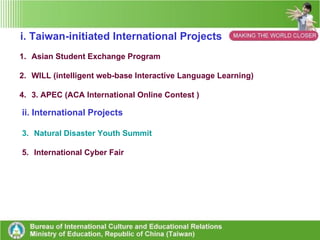
i. Taiwan-initiated International Projects  Asian Student Exchange Program WILL (intelligent web-base Interactive Language Learning) 3. APEC (ACA International Online Contest ) ii. International Projects Natural Disaster Youth Summit International Cyber Fair
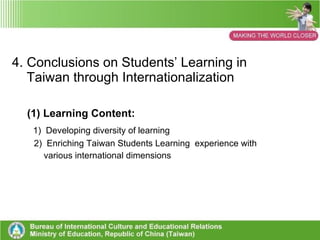
4. Conclusions on Students’ Learning in    Taiwan through Internationalization (1) Learning Content:   1)  Developing diversity of learning 2)  Enriching Taiwan Students Learning  experience with  various international dimensions
(2)  Methods of Learning: 1)  Establishing multiple ways of learning in supporting of  international education 2)  Approaching diversity learning through course work and virtual  activities (3)  Goals for Creating Effective Learning: 1) Cultivating students’ awareness regarding international and  global affairs. 2)  Assisting students to become global citizens. 3)  Improving our students’ abilities to solve problems and cope  with challenges that arise for them when working globally.
Thank you for your attention

Tracy Lang - Ministry of Education Taiwan

  • 1.
    Speaker: Tracy LangFirst Secretary Bureau of International Cultural and Educational Relations Ministry of Education
  • 2.
    An Overview onStudents’ Learning in Taiwan through Internationalization TRACY LANG First Secretary Bureau of International Cultural and Educational Relations Ministry of Education
  • 3.
    1. Policies ofInternational Education, in Taiwan, Enacted by the Ministry of Education (1) Take “Developing a Global Perspective” as one of the important “Education Policy Projects” 1) Strengthen international competitive capacity, improve ranking in the world, and establish excellent universities. 2) Encourage overseas studies, enroll foreign students, and activate international exchange activities. 3) Participate in international service and promote foreign service. 4) Enact career and technical education, encourage international activities.
  • 4.
    (2) Plans andActions 1) Establish the “Taiwan International Education Tour Association”. 2) Implement and promote the “Secondary School Exchange International Programme”. 3) Implement and promote “The 5-Year (2 nd Round) Program of High School’s Second Foreign Languages Education”. 4) Create a website for international exchange activities between high schools and vocational high schools.
  • 5.
    5) Create a“Host Family Programme” for international students to come to Taiwan. 6) International education seminars. 7) Providing Professional In-service Training for Administrators, Teachers and Staff at Primary and Secondary Schools. 8) Create a White Paper on International Education for High Schools and Primary Schools in Taiwan.
  • 6.
    2. The Current Situation Regarding International Education at the Primary and Secondary Schools in Taiwan (1) Through the internet: 1) Plan Participants and Future School Partners in Germany. 2) Construct an internet connection regarding international education in Taiwan: “iEARN Taiwan”. 3) Joint project ” Connecting Classrooms” with British Council
  • 7.
    (2) Through on-sitecourses: 1) High schools and vocational schools’ reception of international students 2) International Education Tour of high school and vocational school students. 3) Secondary School Exchange International (SSEI) Program 4) Promoting the concept of English villages 5) Exchange students 6) Second Foreign Languages Education
  • 8.
    (3) Developing international dimension into school curriculum : Schools implement educational projects of International education and embedded courses. (4)Supporting Networks: “ Families with A Warm Heart— Plans for international students’ Host families”
  • 9.
    3. Relevant andsuccessful outcomes of the promotion of international education in Taiwan (1) Taiwanese Vocational High School Students Study Abroad: Shu-te Home Economics & Commercial High School’s collaborate with Australian Meee College of Health and Beauty
  • 10.
    (2) Hsin-ren ElementarySchool’s Sri Lanka courses of global perspectives: example of the integrated courses and curriculum (3) Other International Projects of Collaboration in Taiwan: K-12 Schools
  • 11.
    高雄市私立樹德家事商業職業學校 Reporting unit: Shute Vocational High School 國際交流與專業技能的養成 澳洲光療指甲技能研習之旅 The Expansion of an International Perspective and Cultivation of Expertise – the Australian Light Therapy Nail Skills Workshop
  • 12.
    國際交流與學校發展 International Communication and Vocational Education 2009 學生海外學習活動 國際交流與技能養成 Content 1 2 3 International Communication and School Development 2009 UV Gel Nail Application Workshop
  • 13.
    國際交流與學校發展 International Communicationand School Development 技術無國界 Technology Without Borders 海外學習 Oversea study 外語能力 Language ability 國際視野 International vision 提升學生學習與競爭力 Learning ability and competitiveness 課程融入與延伸 Curriculum integration and extension 專業技能發展 Professional skill development 職業學校基礎教育 Vocational High school
  • 14.
    2009 學生海外學習活動 MeeeCollege of Health and Beauty, Brisbane, Australia UV Gel Nail Application Workshop Shu-Te Vocational High School Cosmetology Department 2009/7/18~8/1
  • 15.
    2009 學生海外學習活動 Shu-TeUV Gel Nail Skill Workshop in Brisbane, Australia 行前教育 學科課程五小時 1. 2. 3. 4. 課程融入與延伸 澳洲研習活動說明會 術科課程五小時 行前教育 Preparation for the program Theory Study hours 皮膚學 指甲生理 美甲器具認識 Practice of skill 光療指甲與水晶指甲 美甲器具操作練習 招生宣導 研習活動說明 Curriculum integration and extension 教學研討會決議研習主題 課程及技能發展之延伸
  • 16.
    2009 學生海外學習活動 學習活動Theory Study hours : Nail Science 指甲理論 Gel Nail Theory 光療指甲理論 Artificial nail application 人造指甲 甲片及法式光療指甲應用 Gel nail with tip and French tips Demonstration Theory Exam 學科考試 workplace policies and procedures treatment plan nail and skin condition identification Practical Exam 術科考試 Gel nail French Overlay demonstration Refill/remove demonstration Extended nail Sculptured nails Demonstration 雕塑光療指甲型態
  • 17.
  • 18.
    Learning To BeA World Citizen Through International Education: Sharing The Curriculum of “Going Forward to Sri Lanka” By Sing-Ren Elementary School In Taipei County
  • 19.
    1.Curriculum Background (1)Realizing the Education Department’s international educational policy and ideas. (2) Immersing the “World Connection” content into the Grade 1-9 Curriculum (3) Responding to the trends of international education in other countries. (4) Combining the needs for developing the curriculum in schools.
  • 20.
    2. Development OfThe Curriculum (1) Deciding on a direction: Teachers and students decided to explore Sri Lanka, which was seriously damaged by the tsunami in 2004.
  • 21.
    2. Development OfThe Curriculum (2) Choosing the learning themes: Teachers took the “Civic Action - International Curriculum Pattern” approach to developing the teaching material -“Going Forward to Sri Lanka”.
  • 22.
    2. Development OfThe Curriculum (3) Student Learning Content: A.Unit 1:”Knowing Sri Lanka” B.Unit 2:“Exploring Sri Lanka” C.Unit 3:“Sharing love”
  • 23.
    3. Interaction Activities (1) An English blog: Provided and area for interaction between teachers and students of Taiwan and Sri Lanka. (2) Cooperation with Taiwan businessmen: Teachers gained help from Taiwan businessmen in Sri Lanka, who became a major source of support.
  • 24.
    3. Interaction ActivitiesA. Teachers and students built friendships with the teachers and students of Dela Salle College and J. M. School in 2007.
  • 25.
    3. Interaction Activities B. Teachers and students of the two countries wrote letters to each other, exchanging ideas about school life …
  • 26.
    3. Interaction Activities C. Teachers and students raised funds for visiting Sri Lanka through various fund-raising activities.
  • 27.
    3. Interaction ActivitiesD. Teachers and students visited the sister school from Jan. 20-28, 2008.
  • 28.
    3. Interaction ActivitiesD. Teachers and students visited the sister school from Jan. 20-28, 2008.
  • 29.
    3. Interaction ActivitiesD. Teachers and students visited the sister school from Jan. 20-28, 2008.
  • 30.
    3. Interaction ActivitiesE. Teachers and students collected donations for the senior girl’s high school students in Sri Lanka so that they could advance to higher education in 2009.
  • 31.
    4. Participants (1)Curricula : Groups involved included ten teachers and forty sixth graders. (2) Interacting activities : 300 people were involved - including the entire faculty, students and their parents.
  • 32.
    5.The Learning EffectsOf Students (1)Improving the ability of subjects: The students improved their ability in the subjects of English, Computer, Art, and Social Study.
  • 33.
    5.The Learning EffectsOf Students (2)Concerned about the world: The students realized that they are part of the world and showed more concern about it after the programe.
  • 34.
    5.The Learning EffectsOf Students (3) Practicing the civic actions: The students developed civic actions and practice the responsibility of the world citizen, reaching out the hands of friendship and receiving wonderful response.
  • 35.
    5.The Learning EffectsOf Students (3) Practicing the civic actions: The students developed civic actions and practice the responsibility of the world citizen, reaching out the hands of friendship and receiving wonderful response.
  • 36.
    Other International Projectsof Collaboration in Taiwan K-12 Schools National Fenghsin Senior High Doris Tsueyling Wu
  • 37.
    I 、 InternationalCollaboration Projects/ Programs in Taiwan Taiwan-initiated International Projects International Projects ASEP iWILL APEC ACA NDYS Cyber Fair Year to launch 2000~ 1999~ 2003~2009 2005~ 2000 ~ Elementary School Aged 6-12 ◎ ◎ ◎ Junior High School Aged13-15◎ ◎ ◎ ◎ Senior High School Aged 16-18◎ ◎ ◎ ◎ Number of country 3~6 2 5. 11 Over 10 Number of people 600~1000 6000~12,000 1,300 2000~2500 20,000 Ways of Interaction C ◎ ◎ ◎ CRC ◎ ◎
  • 38.
    Taiwan-initiated International ProjectsInternational Projects ASEP iWILL APEC ACA NDYS Cyber Fair Counterpart international activity ◎ Attend WYM in Japan Every August Attending iEARN Annual Conference Project type Online PBL projects Online Reading club Theme-based Learning contest Online PBL projects Theme-based Website Contest Features and success 1. Improve students ’ ICT skills and enlarge their scope of global vision 2.Contribute to build Sister School & International collaboration Links 3. Use English in real Contexts 4. Help build Global Citizen Literacy 1. Improve English reading skills 2 . Gain Extensive reading on diverse cultures. 3. Be Inspired by competition 4. Do deeper thinking on diverse cultures 5. Use reading as a tool to connect to the world. 1. Be motivated by competition 2. Help create diverse and rich culture-based learning society 2. Gain positive feedbacks from awards 3. Create an APEC learning circle 1. Be supported by MOE first, now a bottom-up PBL project. 2. Improve students ’ ICT skills and enlarge their scope of global vision 3. Use English in real contexts 4. Help build Global citizen literacy 5. Help build Global Citizen Literacy 1. Be motivated by competition 2. Help create diverse and rich culture-based websites. 3. Gain positive feedbacks from awards 4. Taiwan schools has won many great awards for 7 years.
  • 39.
    i. Taiwan-initiated InternationalProjects Asian Student Exchange Program WILL (intelligent web-base Interactive Language Learning) 3. APEC (ACA International Online Contest ) ii. International Projects Natural Disaster Youth Summit International Cyber Fair
  • 40.
    4. Conclusions onStudents’ Learning in Taiwan through Internationalization (1) Learning Content: 1) Developing diversity of learning 2) Enriching Taiwan Students Learning experience with various international dimensions
  • 41.
    (2) Methodsof Learning: 1) Establishing multiple ways of learning in supporting of international education 2) Approaching diversity learning through course work and virtual activities (3) Goals for Creating Effective Learning: 1) Cultivating students’ awareness regarding international and global affairs. 2) Assisting students to become global citizens. 3) Improving our students’ abilities to solve problems and cope with challenges that arise for them when working globally.
  • 42.
    Thank you foryour attention