Paul Prinsloo, Department of
Business Management,
University of South Africa (Unisa)
@14prinsp
‘Openness’ in open, distance
and distributed learning
Planning & Quality Assurance in
partnership with Talent
Management @Unisa
24 July 2019
ImagebyInspiredImagesfromPixabay
Acknowledgement
I do not own the copyright of any of the images in this
presentation. I therefore acknowledge the original copyright
and licensing regime of every image used.
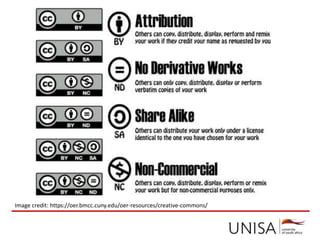
This presentation (excluding the images) is licensed
under a Creative Commons Attribution 4.0 International
License.
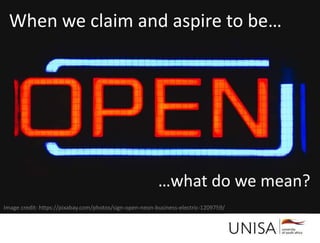
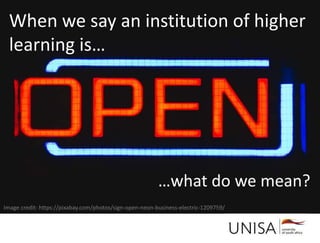
When we say an institution of higher
learning is…
…what do we mean?
Image credit: https://pixabay.com/photos/sign-open-neon-business-electric-1209759/
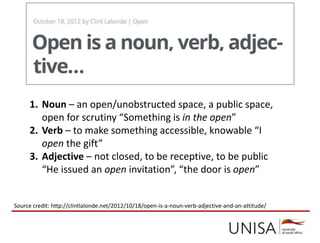
Source credit: http://clintlalonde.net/2012/10/18/open-is-a-noun-verb-adjective-and-an-attitude/
1. Noun – an open/unobstructed space, a public space,
open for scrutiny “Something is in the open”
2. Verb – to make something accessible, knowable “I
open the gift”
3. Adjective – not closed, to be receptive, to be public
“He issued an open invitation”, “the door is open”
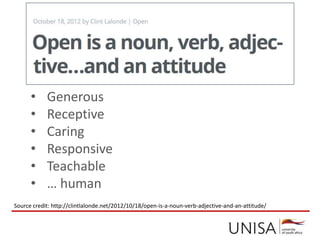
Source credit: http://clintlalonde.net/2012/10/18/open-is-a-noun-verb-adjective-and-an-attitude/
• Generous
• Receptive
• Caring
• Responsive
• Teachable
• … human
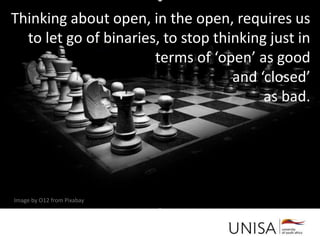
Thinking about open, in the open, requires us
to let go of binaries, to stop thinking just in
terms of ‘open’ as good
and ‘closed’
as bad.
Image by O12 from Pixabay
ImagebySusanneJutzeler,sujufotografiefromPixabay
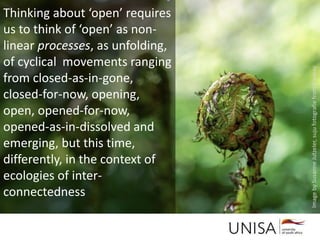
Thinking about ‘open’ requires
us to think of ‘open’ as non-
linear processes, as unfolding,
of cyclical movements ranging
from closed-as-in-gone,
closed-for-now, opening,
open, opened-for-now,
opened-as-in-dissolved and
emerging, but this time,
differently, in the context of
ecologies of inter-
connectedness
What does ‘open’ mean in the
context of an open, distance learning
institution?
Or, is ‘open’ in open, distance
learning a ‘given’, ‘obvious’ and not
worthy of reflection?
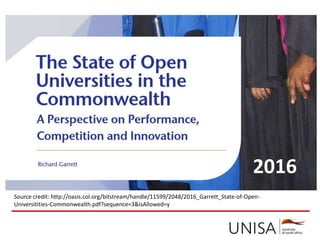
Source credit: http://oasis.col.org/bitstream/handle/11599/2048/2016_Garrett_State-of-Open-
Universitities-Commonwealth.pdf?sequence=3&isAllowed=y
2016
Source credit: http://oasis.col.org/bitstream/handle/11599/2048/2016_Garrett_State-of-Open-
Universitities-Commonwealth.pdf?sequence=3&isAllowed=y
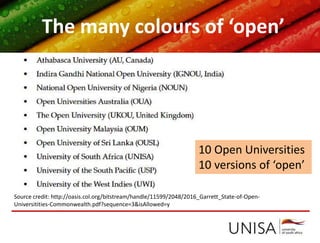
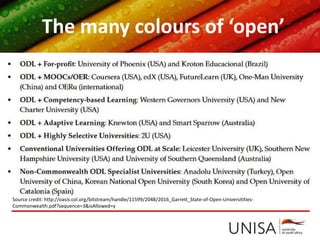
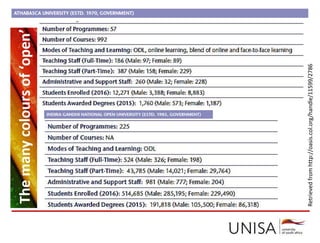
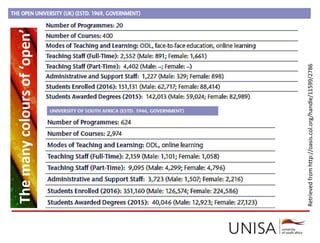
The many colours of ‘open’
10 Open Universities
10 versions of ‘open’
Source credit: http://oasis.col.org/bitstream/handle/11599/2048/2016_Garrett_State-of-Open-Universitities-
Commonwealth.pdf?sequence=3&isAllowed=y
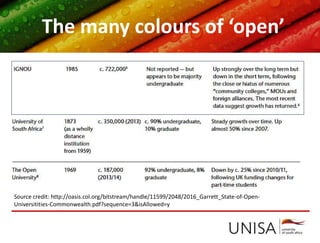
The many colours of ‘open’
Source credit: http://oasis.col.org/bitstream/handle/11599/2048/2016_Garrett_State-of-Open-
Universitities-Commonwealth.pdf?sequence=3&isAllowed=y
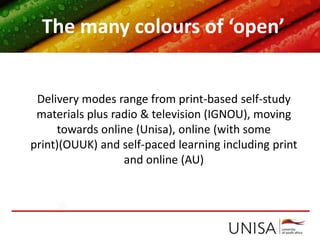
The many colours of ‘open’
Delivery modes range from print-based self-study
materials plus radio & television (IGNOU), moving
towards online (Unisa), online (with some
print)(OUUK) and self-paced learning including print
and online (AU)
2017
Retrieved from http://oasis.col.org/handle/11599/2786
Mishra, Sanjaya
Retrievedfromhttp://oasis.col.org/handle/11599/2786
The many colours of ‘open’
Instead of judging and comparing ‘levels’ levels of
‘openness’, let us consider the nuances and often
unique possibilities of ‘open’ in each geopolitical and
institutional context
Image by InspiredImages from Pixabay
Mapping ‘open’ at Unisa
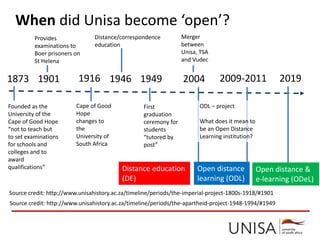
When did Unisa become ‘open’?
1873
Founded as the
University of the
Cape of Good Hope
“not to teach but
to set examinations
for schools and
colleges and to
award
qualifications”
1946
Distance/correspondence
education
Source credit: http://www.unisahistory.ac.za/timeline/periods/the-imperial-project-1800s-1918/#1901
1901
Provides
examinations to
Boer prisoners on
St Helena
1916
Cape of Good
Hope
changes to
the
University of
South Africa
1949
First
graduation
ceremony for
students
“tutored by
post”
Source credit: http://www.unisahistory.ac.za/timeline/periods/the-apartheid-project-1948-1994/#1949
2004
Merger
between
Unisa, TSA
and Vudec
2009-2011 2019
Distance education
(DE)
Open distance
learning (ODL)
ODL – project
What does it mean to
be an Open Distance
Learning institution?
Open distance &
e-learning (ODeL)
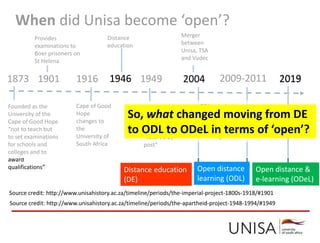
When did Unisa become ‘open’?
1873
Founded as the
University of the
Cape of Good Hope
“not to teach but
to set examinations
for schools and
colleges and to
award
qualifications”
1946
Distance
education
Source credit: http://www.unisahistory.ac.za/timeline/periods/the-imperial-project-1800s-1918/#1901
1901
Provides
examinations to
Boer prisoners on
St Helena
1916
Cape of Good
Hope
changes to
the
University of
South Africa
1949
First
graduation
ceremony for
students
“tutored by
post”
Source credit: http://www.unisahistory.ac.za/timeline/periods/the-apartheid-project-1948-1994/#1949
2004
Merger
between
Unisa, TSA
and Vudec
2009-2011 2019
Distance education
(DE)
Open distance
learning (ODL)
ODL – project
What does it mean to
be an Open Distance
Learning institution?
Open distance &
e-learning (ODeL)
1946 2004 2019
So, what changed moving from DE
to ODL to ODeL in terms of ‘open’?
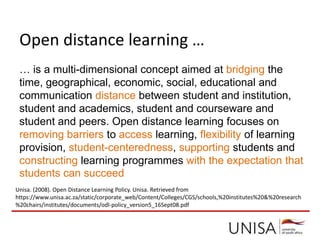
Open distance learning …
Unisa. (2008). Open Distance Learning Policy. Unisa. Retrieved from
https://www.unisa.ac.za/static/corporate_web/Content/Colleges/CGS/schools,%20institutes%20&%20research
%20chairs/institutes/documents/odl-policy_version5_16Sept08.pdf
… is a multi-dimensional concept aimed at bridging the
time, geographical, economic, social, educational and
communication distance between student and institution,
student and academics, student and courseware and
student and peers. Open distance learning focuses on
removing barriers to access learning, flexibility of learning
provision, student-centeredness, supporting students and
constructing learning programmes with the expectation that
students can succeed
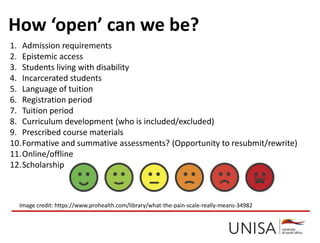
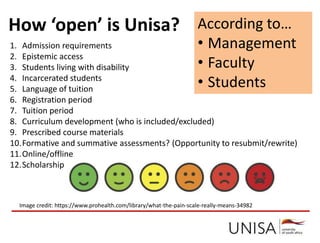
How ‘open’ is Unisa?
1. Admission requirements
2. Epistemic access
3. Students living with disability
4. Incarcerated students
5. Language of tuition
6. Registration period
7. Tuition period
8. Curriculum development (who is included/excluded)
9. Prescribed course materials
10.Formative and summative assessments? (Opportunity to resubmit/rewrite)
11.Online/offline
12.Scholarship
According to…
• Management
• Faculty
• Students
Image credit: https://www.prohealth.com/library/what-the-pain-scale-really-means-34982
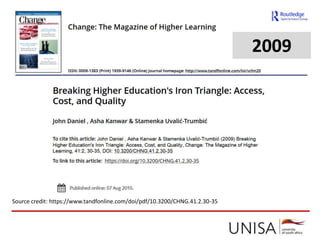
Source credit: https://www.tandfonline.com/doi/pdf/10.3200/CHNG.41.2.30-35
2009
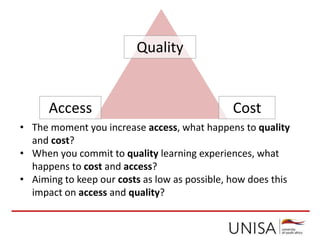
Quality
Access Cost
• The moment you increase access, what happens to quality
and cost?
• When you commit to quality learning experiences, what
happens to cost and access?
• Aiming to keep our costs as low as possible, how does this
impact on access and quality?
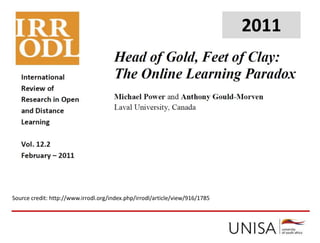
Source credit: http://www.irrodl.org/index.php/irrodl/article/view/916/1785
2011
Quality
Access Cost
“[D]istance education can achieve any two of the
following: flexible access, quality learning experience
and cost-effectiveness – but not all three at once”
(Kanuka & Brooks, 2010, in Power and Gould-Morven, 2011, p. 23)
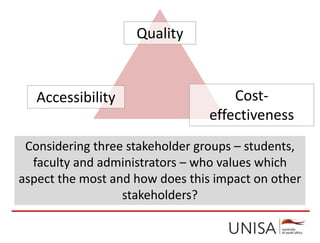
Quality
Accessibility
Considering three stakeholder groups – students,
faculty and administrators – who values which
aspect the most and how does this impact on other
stakeholders?
Cost-
effectiveness
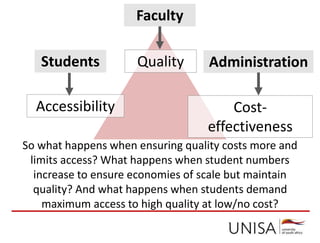
So what happens when ensuring quality costs more and
limits access? What happens when student numbers
increase to ensure economies of scale but maintain
quality? And what happens when students demand
maximum access to high quality at low/no cost?
Quality
Accessibility Cost-
effectiveness
Faculty
AdministrationStudents
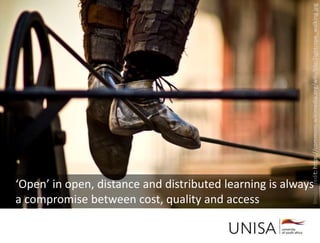
Imagecredit:https://commons.wikimedia.org/wiki/File:Tightrope_walking.jpg
‘Open’ in open, distance and distributed learning is always
a compromise between cost, quality and access
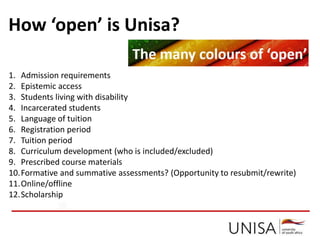
How ‘open’ is Unisa?
1. Admission requirements
2. Epistemic access
3. Students living with disability
4. Incarcerated students
5. Language of tuition
6. Registration period
7. Tuition period
8. Curriculum development (who is included/excluded)
9. Prescribed course materials
10.Formative and summative assessments? (Opportunity to resubmit/rewrite)
11.Online/offline
12.Scholarship
1. Admission requirements
Sourcecredit:http://www.openuniversity.edu/study/admissions-applications
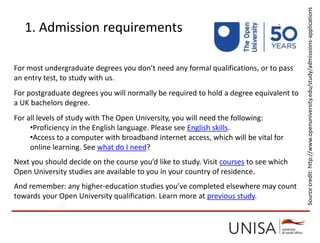
For most undergraduate degrees you don’t need any formal qualifications, or to pass
an entry test, to study with us.
For postgraduate degrees you will normally be required to hold a degree equivalent to
a UK bachelors degree.
For all levels of study with The Open University, you will need the following:
•Proficiency in the English language. Please see English skills.
•Access to a computer with broadband internet access, which will be vital for
online learning. See what do I need?
Next you should decide on the course you’d like to study. Visit courses to see which
Open University studies are available to you in your country of residence.
And remember: any higher-education studies you’ve completed elsewhere may count
towards your Open University qualification. Learn more at previous study.
1. Admission requirements (cont.)
Source credit: https://www.athabascau.ca/admissions/requirements/#tab1
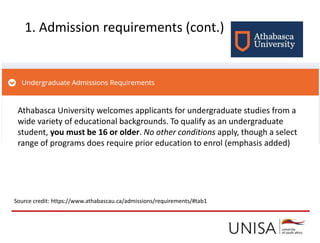
Athabasca University welcomes applicants for undergraduate studies from a
wide variety of educational backgrounds. To qualify as an undergraduate
student, you must be 16 or older. No other conditions apply, though a select
range of programs does require prior education to enrol (emphasis added)
1. Admission requirements (cont.)
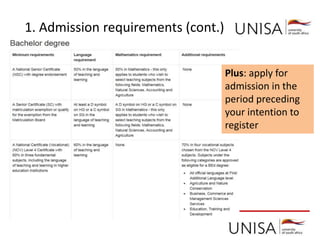
Plus: apply for
admission in the
period preceding
your intention to
register
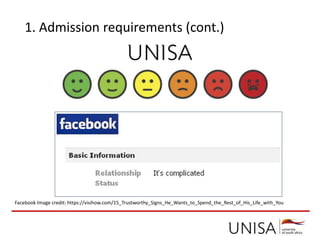
Facebook Image credit: https://visihow.com/15_Trustworthy_Signs_He_Wants_to_Spend_the_Rest_of_His_Life_with_You
1. Admission requirements (cont.)
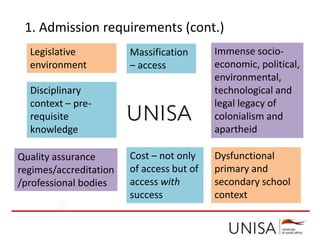
Legislative
environment
Disciplinary
context – pre-
requisite
knowledge
Dysfunctional
primary and
secondary school
context
Immense socio-
economic, political,
environmental,
technological and
legal legacy of
colonialism and
apartheid
Quality assurance
regimes/accreditation
/professional bodies
Massification
– access
Cost – not only
of access but of
access with
success
1. Admission requirements (cont.)
Legislative
environment
Disciplinary
context – pre-
requisite
knowledge
Dysfunctional
primary and
secondary school
context
Immense socio-
economic, political,
environmental,
technological and
legal legacy of
colonialism and
apartheid
Quality assurance
regimes/accreditation
/professional bodies
Massification
– access
Cost – not only
of access but of
access with
success
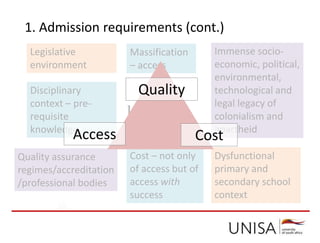
Cost
Quality
Access
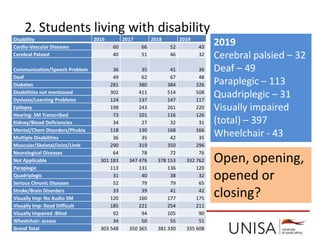
2. Students living with disability
Disability 2016 2017 2018 2019
Cardio-Vascular Diseases 60 66 52 43
Cerebral Palsied 40 51 46 32
Communication/Speech Problem 36 35 41 36
Deaf 49 62 67 48
Diabetes 281 380 384 326
Disabilities not mentioned 302 411 514 508
Dyslexia/Learning Problems 124 137 147 117
Epilepsy 198 243 261 220
Hearing: SM Transcribed 73 101 116 126
Kidney/Blood Deficiencies 34 27 32 31
Mental/Chem Disorders/Phobia 118 130 168 166
Multiple Disabilities 36 35 42 35
Muscular/Skeletal/Joint/Limb 290 319 350 296
Neurological Diseases 64 78 72 76
Not Applicable 301 183 347 476 378 153 332 762
Paraplegic 113 131 136 120
Quadriplegic 31 40 38 32
Serious Chronic Diseases 52 79 79 65
Stroke/Brain Disorders 33 39 41 42
Visually Imp: No Audio SM 120 160 177 175
Visually Imp: Read Difficult 185 221 254 211
Visually Impaired :Blind 92 94 105 90
Wheelchair: access 34 50 55 51
Grand Total 303 548 350 365 381 330 335 608
2019
Cerebral palsied – 32
Deaf – 49
Paraplegic – 113
Quadriplegic – 31
Visually impaired
(total) – 397
Wheelchair - 43
Open, opening,
opened or
closing?
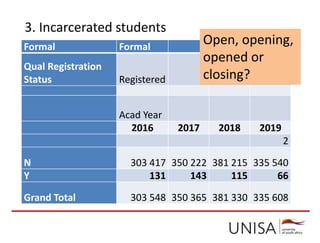
3. Incarcerated students
Formal Formal
Qual Registration
Status Registered
Acad Year
2016 2017 2018 2019
2
N 303 417 350 222 381 215 335 540
Y 131 143 115 66
Grand Total 303 548 350 365 381 330 335 608
Open, opening,
opened or
closing?
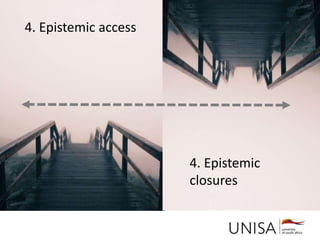
4. Epistemic access
4. Epistemic
closures
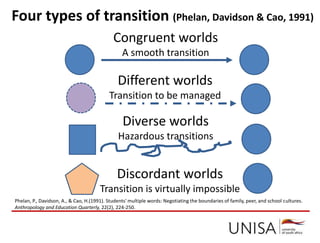
Four types of transition (Phelan, Davidson & Cao, 1991)
Congruent worlds
A smooth transition
Different worlds
Transition to be managed
Diverse worlds
Hazardous transitions
Discordant worlds
Transition is virtually impossible
Phelan, P., Davidson, A., & Cao, H.(1991). Students' multiple words: Negotiating the boundaries of family, peer, and school cultures.
Anthropology and Education Quarterly, 22(2), 224-250.
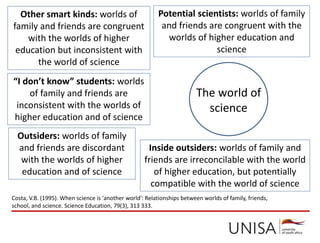
The world of
science
Potential scientists: worlds of family
and friends are congruent with the
worlds of higher education and
science
Other smart kinds: worlds of
family and friends are congruent
with the worlds of higher
education but inconsistent with
the world of science
“I don’t know” students: worlds
of family and friends are
inconsistent with the worlds of
higher education and of science
Outsiders: worlds of family
and friends are discordant
with the worlds of higher
education and of science
Inside outsiders: worlds of family and
friends are irreconcilable with the world
of higher education, but potentially
compatible with the world of science
Costa, V.B. (1995). When science is 'another world': Relationships between worlds of family, friends,
school, and science. Science Education, 79(3), 313 333.
Imagecredit:https://pixabay.com/en/binary-code-man-display-dummy-face-1327512/
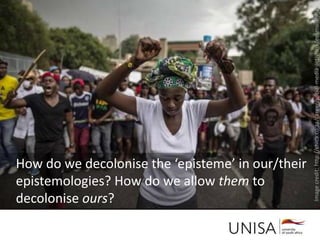
How do we decolonise the ‘episteme’ in our/their
epistemologies? How do we allow them to
decolonise ours?
Imagecredit:http://chica.co.za/career/social-media-activism-feesmustfall/
Image credit: https://pixabay.com/en/runner-obstacle-run-sport-jump-555074/
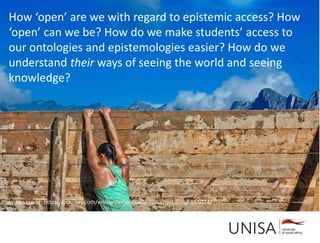
How ‘open’ are we with regard to epistemic access? How
‘open’ can we be? How do we make students’ access to
our ontologies and epistemologies easier? How do we
understand their ways of seeing the world and seeing
knowledge?
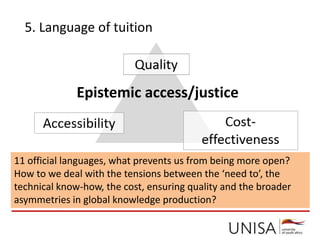
5. Language of tuition
11 official languages, what prevents us from being more open?
How to we deal with the tensions between the ‘need to’, the
technical know-how, the cost, ensuring quality and the broader
asymmetries in global knowledge production?
Epistemic access/justice
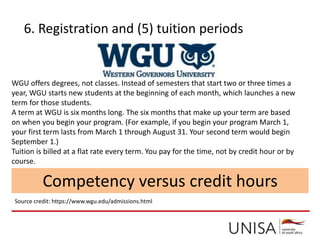
6. Registration and (5) tuition periods
Source credit: https://www.wgu.edu/admissions.html
Competency versus credit hours
WGU offers degrees, not classes. Instead of semesters that start two or three times a
year, WGU starts new students at the beginning of each month, which launches a new
term for those students.
A term at WGU is six months long. The six months that make up your term are based
on when you begin your program. (For example, if you begin your program March 1,
your first term lasts from March 1 through August 31. Your second term would begin
September 1.)
Tuition is billed at a flat rate every term. You pay for the time, not by credit hour or by
course.
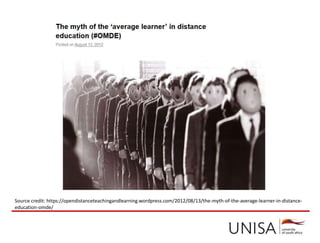
Source credit: https://opendistanceteachingandlearning.wordpress.com/2012/08/13/the-myth-of-the-average-learner-in-distance-
education-omde/
7. Registration and (5) tuition periods
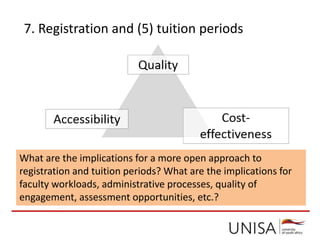
What are the implications for a more open approach to
registration and tuition periods? What are the implications for
faculty workloads, administrative processes, quality of
engagement, assessment opportunities, etc.?
8. Curriculum
development
(whose voices
are included/
excluded)
Image by pablojuliann from Pixabay
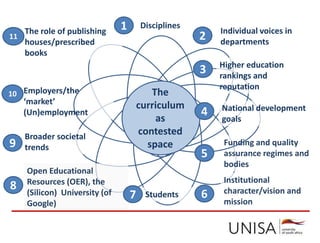
Employers/the
‘market’
(Un)employment
Broader societal
trends
Students
Individual voices in
departments
Higher education
rankings and
reputation
Funding and quality
assurance regimes and
bodies
Disciplines
The role of publishing
houses/prescribed
books
Open Educational
Resources (OER), the
(Silicon) University (of
Google)
The
curriculum
as
contested
space
National development
goals
1
2
3
4
5
7
8
9
10
11
6
Institutional
character/vision and
mission
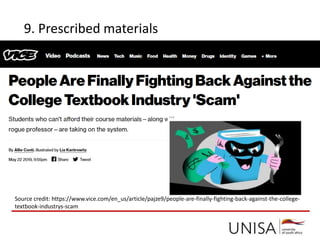
9. Prescribed materials
Source credit: https://www.vice.com/en_us/article/pajze9/people-are-finally-fighting-back-against-the-college-
textbook-industrys-scam
9. Prescribed materials (cont.)
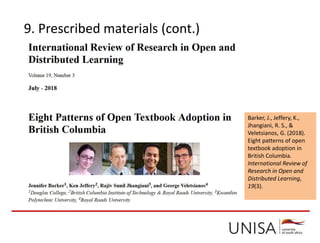
Barker, J., Jeffery, K.,
Jhangiani, R. S., &
Veletsianos, G. (2018).
Eight patterns of open
textbook adoption in
British Columbia.
International Review of
Research in Open and
Distributed Learning,
19(3).
9. Prescribed materials (cont.)
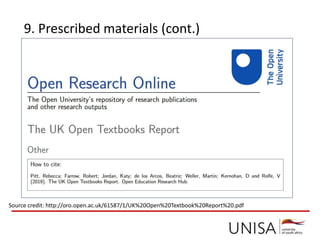
Source credit: http://oro.open.ac.uk/61587/1/UK%20Open%20Textbook%20Report%20.pdf
9. Prescribed materials (cont.)
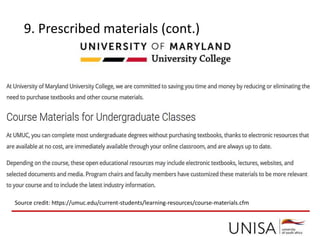
Source credit: https://umuc.edu/current-students/learning-resources/course-materials.cfm
9. Prescribed materials (cont.)
• South Africa is the most unequal country in the world
• Our students face severe inter-generational challenges -
many face a daily battle for survival
• Prescribed textbooks add to the cost of higher education
So, at a university that claims to embrace and
serve humanity, why are we still prescribing
textbooks on undergraduate level?
10. Formative and summative assessments?
(Opportunity to resubmit/rewrite)
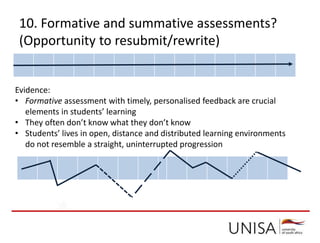
Evidence:
• Formative assessment with timely, personalised feedback are crucial
elements in students’ learning
• They often don’t know what they don’t know
• Students’ lives in open, distance and distributed learning environments
do not resemble a straight, uninterrupted progression
10. Formative and summative assessments?
(Purpose)
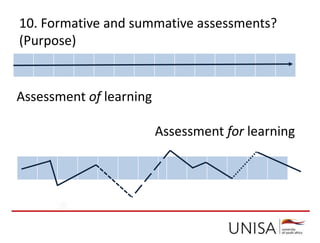
Assessment of learning
Assessment for learning
10. Formative and summative assessments?
(Opportunity to resubmit/rewrite)
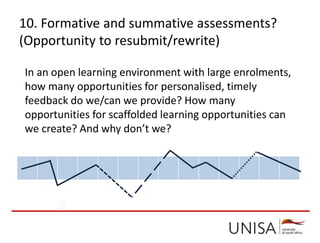
In an open learning environment with large enrolments,
how many opportunities for personalised, timely
feedback do we/can we provide? How many
opportunities for scaffolded learning opportunities can
we create? And why don’t we?
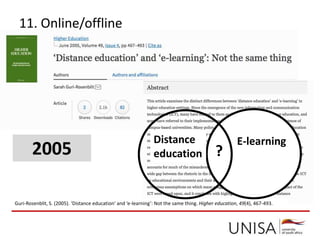
Guri-Rosenblit, S. (2005). ‘Distance education’ and ‘e-learning’: Not the same thing. Higher education, 49(4), 467-493.
2005
Distance
education
E-learning
?
11. Online/offline
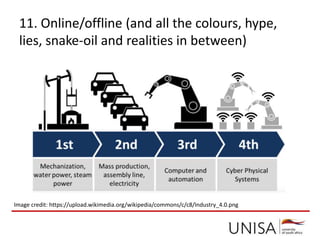
11. Online/offline (and all the colours, hype,
lies, snake-oil and realities in between)
Image credit: https://upload.wikimedia.org/wikipedia/commons/c/c8/Industry_4.0.png
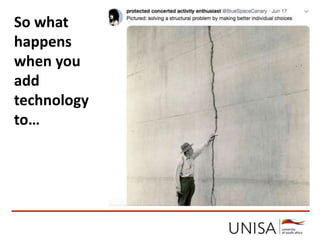
So what
happens
when you
add
technology
to…
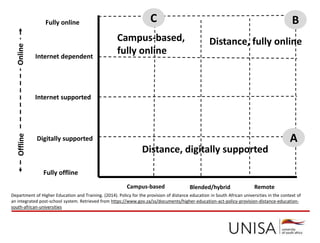
Department of Higher Education and Training. (2014). Policy for the provision of distance education in South African universities in the context of
an integrated post-school system. Retrieved from https://www.gov.za/ss/documents/higher-education-act-policy-provision-distance-education-
south-african-universities
OfflineOnline Fully online
Fully offline
Digitally supported
Internet supported
Internet dependent
Campus-based Blended/hybrid Remote
A
BC
Distance, digitally supported
Distance, fully onlineCampus-based,
fully online
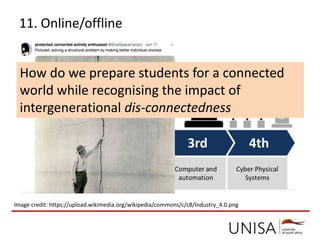
11. Online/offline
Image credit: https://upload.wikimedia.org/wikipedia/commons/c/c8/Industry_4.0.png
How do we prepare students for a connected
world while recognising the impact of
intergenerational dis-connectedness
11. Scholarship
How ‘open’ are
teaching, research
and praxis @Unisa?
• Amid the emphasis on research
outputs, researcher rankings
and researcher reputation?
• The seeming obsession with
quantification, reporting and
auditing
• Increasing administrative
workloads
• Unbearable tensions between
teaching and research
• Regimes protecting Intellectual Property and emphasis on the
commercialisation of research
• The immense potential of alternatives for sharing praxis,
research and reflections on teaching practice
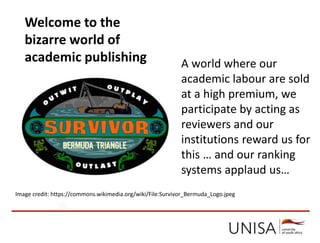
Image credit: https://commons.wikimedia.org/wiki/File:Survivor_Bermuda_Logo.jpeg
Welcome to the
bizarre world of
academic publishing A world where our
academic labour are sold
at a high premium, we
participate by acting as
reviewers and our
institutions reward us for
this … and our ranking
systems applaud us…
Image credit: https://simple.wikipedia.org/wiki/Star_Wars_Episode_V:_The_Empire_Strikes_Back
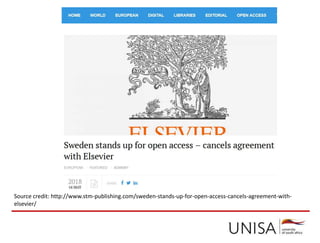
Source credit: http://www.stm-publishing.com/sweden-stands-up-for-open-access-cancels-agreement-with-
elsevier/
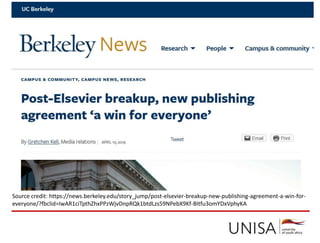
Source credit: https://news.berkeley.edu/story_jump/post-elsevier-breakup-new-publishing-agreement-a-win-for-
everyone/?fbclid=IwAR1ciTpthZhxPPzWjvDnpRQk1btdLzs59NPebX9Kf-BItfu3omYDxVphyKA
Image credit: https://oer.bmcc.cuny.edu/oer-resources/creative-commons/
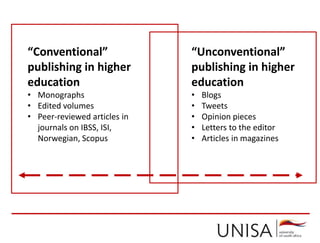
“Conventional”
publishing in higher
education
• Monographs
• Edited volumes
• Peer-reviewed articles in
journals on IBSS, ISI,
Norwegian, Scopus
“Unconventional”
publishing in higher
education
• Blogs
• Tweets
• Opinion pieces
• Letters to the editor
• Articles in magazines
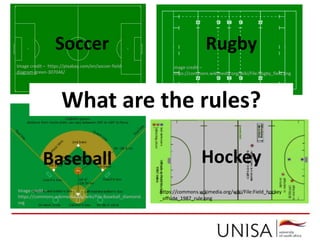
Soccer Rugby
Baseball Hockey
What are the rules?
Image credit – https://pixabay.com/en/soccer-field-
diagram-green-307046/
Image credit –
https://commons.wikimedia.org/wiki/File:Rugby_field.png
Image credit –
https://commons.wikimedia.org/wiki/File:Baseball_diamond.
svg
https://commons.wikimedia.org/wiki/File:Field_hockey
_offside_1987_rule.png
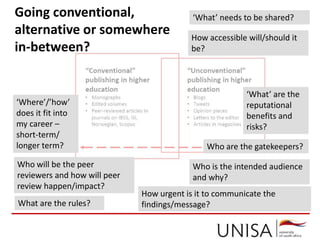
‘What’ needs to be shared?
How urgent is it to communicate the
findings/message?
‘What’ are the
reputational
benefits and
risks?
How accessible will/should it
be?
Who will be the peer
reviewers and how will peer
review happen/impact?
Who are the gatekeepers?
Who is the intended audience
and why?
‘Where’/’how’
does it fit into
my career –
short-term/
longer term?
What are the rules?
Going conventional,
alternative or somewhere
in-between?
Imagecredit:https://pixabay.com/en/binary-code-man-display-dummy-face-1327512/
Goodier, S., & Czerniewicz, L. (2015). Academics' online
presence: a four-step guide to taking control of your
visibility. [Third edition]
Retrieved from http://open.uct.ac.za/bitstream/handle/11427/2652/GoodierOnlinePresenceV3.pdf?sequence=11
When we claim and aspire to be…
…what do we mean?
Image credit: https://pixabay.com/photos/sign-open-neon-business-electric-1209759/
How ‘open’ can we be?
1. Admission requirements
2. Epistemic access
3. Students living with disability
4. Incarcerated students
5. Language of tuition
6. Registration period
7. Tuition period
8. Curriculum development (who is included/excluded)
9. Prescribed course materials
10.Formative and summative assessments? (Opportunity to resubmit/rewrite)
11.Online/offline
12.Scholarship
Image credit: https://www.prohealth.com/library/what-the-pain-scale-really-means-34982
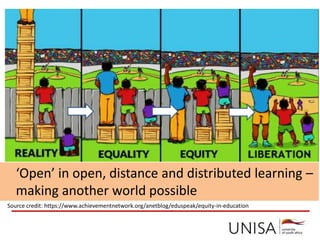
‘Open’ in open, distance and distributed learning –
making another world possible
Source credit: https://www.achievementnetwork.org/anetblog/eduspeak/equity-in-education
THANK YOU
Paul Prinsloo (Prof)
Research Professor in Open Distance Learning (ODL)
College of Economic and Management Sciences,
Samuel Pauw Building, Office 5-21, P.O. Box 392
Unisa, 0003, Republic of South Africa
T: +27 (0) 12 433 4719 (office)
prinsp@unisa.ac.za
Skype: paul.prinsloo59
Personal blog:
http://opendistanceteachingandlearning.wordpress.com
Twitter profile: @14prinsp

‘Openness’ in open, distance and distributed learning

  • 1.
    Paul Prinsloo, Departmentof Business Management, University of South Africa (Unisa) @14prinsp ‘Openness’ in open, distance and distributed learning Planning & Quality Assurance in partnership with Talent Management @Unisa 24 July 2019 ImagebyInspiredImagesfromPixabay
  • 2.
    Acknowledgement I do notown the copyright of any of the images in this presentation. I therefore acknowledge the original copyright and licensing regime of every image used. This presentation (excluding the images) is licensed under a Creative Commons Attribution 4.0 International License.
  • 3.
    When we sayan institution of higher learning is… …what do we mean? Image credit: https://pixabay.com/photos/sign-open-neon-business-electric-1209759/
  • 4.
    Source credit: http://clintlalonde.net/2012/10/18/open-is-a-noun-verb-adjective-and-an-attitude/ 1.Noun – an open/unobstructed space, a public space, open for scrutiny “Something is in the open” 2. Verb – to make something accessible, knowable “I open the gift” 3. Adjective – not closed, to be receptive, to be public “He issued an open invitation”, “the door is open”
  • 5.
    Source credit: http://clintlalonde.net/2012/10/18/open-is-a-noun-verb-adjective-and-an-attitude/ •Generous • Receptive • Caring • Responsive • Teachable • … human
  • 6.
    Thinking about open,in the open, requires us to let go of binaries, to stop thinking just in terms of ‘open’ as good and ‘closed’ as bad. Image by O12 from Pixabay
  • 7.
    ImagebySusanneJutzeler,sujufotografiefromPixabay Thinking about ‘open’requires us to think of ‘open’ as non- linear processes, as unfolding, of cyclical movements ranging from closed-as-in-gone, closed-for-now, opening, open, opened-for-now, opened-as-in-dissolved and emerging, but this time, differently, in the context of ecologies of inter- connectedness
  • 8.
    What does ‘open’mean in the context of an open, distance learning institution? Or, is ‘open’ in open, distance learning a ‘given’, ‘obvious’ and not worthy of reflection?
  • 9.
  • 10.
  • 11.
  • 12.
  • 13.
    The many coloursof ‘open’ Delivery modes range from print-based self-study materials plus radio & television (IGNOU), moving towards online (Unisa), online (with some print)(OUUK) and self-paced learning including print and online (AU)
  • 14.
  • 15.
  • 16.
  • 17.
    The many coloursof ‘open’ Instead of judging and comparing ‘levels’ levels of ‘openness’, let us consider the nuances and often unique possibilities of ‘open’ in each geopolitical and institutional context
  • 18.
    Image by InspiredImagesfrom Pixabay Mapping ‘open’ at Unisa
  • 19.
    When did Unisabecome ‘open’? 1873 Founded as the University of the Cape of Good Hope “not to teach but to set examinations for schools and colleges and to award qualifications” 1946 Distance/correspondence education Source credit: http://www.unisahistory.ac.za/timeline/periods/the-imperial-project-1800s-1918/#1901 1901 Provides examinations to Boer prisoners on St Helena 1916 Cape of Good Hope changes to the University of South Africa 1949 First graduation ceremony for students “tutored by post” Source credit: http://www.unisahistory.ac.za/timeline/periods/the-apartheid-project-1948-1994/#1949 2004 Merger between Unisa, TSA and Vudec 2009-2011 2019 Distance education (DE) Open distance learning (ODL) ODL – project What does it mean to be an Open Distance Learning institution? Open distance & e-learning (ODeL)
  • 20.
    When did Unisabecome ‘open’? 1873 Founded as the University of the Cape of Good Hope “not to teach but to set examinations for schools and colleges and to award qualifications” 1946 Distance education Source credit: http://www.unisahistory.ac.za/timeline/periods/the-imperial-project-1800s-1918/#1901 1901 Provides examinations to Boer prisoners on St Helena 1916 Cape of Good Hope changes to the University of South Africa 1949 First graduation ceremony for students “tutored by post” Source credit: http://www.unisahistory.ac.za/timeline/periods/the-apartheid-project-1948-1994/#1949 2004 Merger between Unisa, TSA and Vudec 2009-2011 2019 Distance education (DE) Open distance learning (ODL) ODL – project What does it mean to be an Open Distance Learning institution? Open distance & e-learning (ODeL) 1946 2004 2019 So, what changed moving from DE to ODL to ODeL in terms of ‘open’?
  • 21.
    Open distance learning… Unisa. (2008). Open Distance Learning Policy. Unisa. Retrieved from https://www.unisa.ac.za/static/corporate_web/Content/Colleges/CGS/schools,%20institutes%20&%20research %20chairs/institutes/documents/odl-policy_version5_16Sept08.pdf … is a multi-dimensional concept aimed at bridging the time, geographical, economic, social, educational and communication distance between student and institution, student and academics, student and courseware and student and peers. Open distance learning focuses on removing barriers to access learning, flexibility of learning provision, student-centeredness, supporting students and constructing learning programmes with the expectation that students can succeed
  • 22.
    How ‘open’ isUnisa? 1. Admission requirements 2. Epistemic access 3. Students living with disability 4. Incarcerated students 5. Language of tuition 6. Registration period 7. Tuition period 8. Curriculum development (who is included/excluded) 9. Prescribed course materials 10.Formative and summative assessments? (Opportunity to resubmit/rewrite) 11.Online/offline 12.Scholarship According to… • Management • Faculty • Students Image credit: https://www.prohealth.com/library/what-the-pain-scale-really-means-34982
  • 23.
  • 24.
    Quality Access Cost • Themoment you increase access, what happens to quality and cost? • When you commit to quality learning experiences, what happens to cost and access? • Aiming to keep our costs as low as possible, how does this impact on access and quality?
  • 25.
  • 26.
    Quality Access Cost “[D]istance educationcan achieve any two of the following: flexible access, quality learning experience and cost-effectiveness – but not all three at once” (Kanuka & Brooks, 2010, in Power and Gould-Morven, 2011, p. 23)
  • 27.
    Quality Accessibility Considering three stakeholdergroups – students, faculty and administrators – who values which aspect the most and how does this impact on other stakeholders? Cost- effectiveness
  • 28.
    So what happenswhen ensuring quality costs more and limits access? What happens when student numbers increase to ensure economies of scale but maintain quality? And what happens when students demand maximum access to high quality at low/no cost? Quality Accessibility Cost- effectiveness Faculty AdministrationStudents
  • 29.
    Imagecredit:https://commons.wikimedia.org/wiki/File:Tightrope_walking.jpg ‘Open’ in open,distance and distributed learning is always a compromise between cost, quality and access
  • 30.
    How ‘open’ isUnisa? 1. Admission requirements 2. Epistemic access 3. Students living with disability 4. Incarcerated students 5. Language of tuition 6. Registration period 7. Tuition period 8. Curriculum development (who is included/excluded) 9. Prescribed course materials 10.Formative and summative assessments? (Opportunity to resubmit/rewrite) 11.Online/offline 12.Scholarship
  • 31.
    1. Admission requirements Sourcecredit:http://www.openuniversity.edu/study/admissions-applications Formost undergraduate degrees you don’t need any formal qualifications, or to pass an entry test, to study with us. For postgraduate degrees you will normally be required to hold a degree equivalent to a UK bachelors degree. For all levels of study with The Open University, you will need the following: •Proficiency in the English language. Please see English skills. •Access to a computer with broadband internet access, which will be vital for online learning. See what do I need? Next you should decide on the course you’d like to study. Visit courses to see which Open University studies are available to you in your country of residence. And remember: any higher-education studies you’ve completed elsewhere may count towards your Open University qualification. Learn more at previous study.
  • 32.
    1. Admission requirements(cont.) Source credit: https://www.athabascau.ca/admissions/requirements/#tab1 Athabasca University welcomes applicants for undergraduate studies from a wide variety of educational backgrounds. To qualify as an undergraduate student, you must be 16 or older. No other conditions apply, though a select range of programs does require prior education to enrol (emphasis added)
  • 33.
    1. Admission requirements(cont.) Plus: apply for admission in the period preceding your intention to register
  • 34.
    Facebook Image credit:https://visihow.com/15_Trustworthy_Signs_He_Wants_to_Spend_the_Rest_of_His_Life_with_You 1. Admission requirements (cont.)
  • 35.
    1. Admission requirements(cont.) Legislative environment Disciplinary context – pre- requisite knowledge Dysfunctional primary and secondary school context Immense socio- economic, political, environmental, technological and legal legacy of colonialism and apartheid Quality assurance regimes/accreditation /professional bodies Massification – access Cost – not only of access but of access with success
  • 36.
    1. Admission requirements(cont.) Legislative environment Disciplinary context – pre- requisite knowledge Dysfunctional primary and secondary school context Immense socio- economic, political, environmental, technological and legal legacy of colonialism and apartheid Quality assurance regimes/accreditation /professional bodies Massification – access Cost – not only of access but of access with success Cost Quality Access
  • 37.
    2. Students livingwith disability Disability 2016 2017 2018 2019 Cardio-Vascular Diseases 60 66 52 43 Cerebral Palsied 40 51 46 32 Communication/Speech Problem 36 35 41 36 Deaf 49 62 67 48 Diabetes 281 380 384 326 Disabilities not mentioned 302 411 514 508 Dyslexia/Learning Problems 124 137 147 117 Epilepsy 198 243 261 220 Hearing: SM Transcribed 73 101 116 126 Kidney/Blood Deficiencies 34 27 32 31 Mental/Chem Disorders/Phobia 118 130 168 166 Multiple Disabilities 36 35 42 35 Muscular/Skeletal/Joint/Limb 290 319 350 296 Neurological Diseases 64 78 72 76 Not Applicable 301 183 347 476 378 153 332 762 Paraplegic 113 131 136 120 Quadriplegic 31 40 38 32 Serious Chronic Diseases 52 79 79 65 Stroke/Brain Disorders 33 39 41 42 Visually Imp: No Audio SM 120 160 177 175 Visually Imp: Read Difficult 185 221 254 211 Visually Impaired :Blind 92 94 105 90 Wheelchair: access 34 50 55 51 Grand Total 303 548 350 365 381 330 335 608 2019 Cerebral palsied – 32 Deaf – 49 Paraplegic – 113 Quadriplegic – 31 Visually impaired (total) – 397 Wheelchair - 43 Open, opening, opened or closing?
  • 38.
    3. Incarcerated students FormalFormal Qual Registration Status Registered Acad Year 2016 2017 2018 2019 2 N 303 417 350 222 381 215 335 540 Y 131 143 115 66 Grand Total 303 548 350 365 381 330 335 608 Open, opening, opened or closing?
  • 39.
    4. Epistemic access 4.Epistemic closures
  • 40.
    Four types oftransition (Phelan, Davidson & Cao, 1991) Congruent worlds A smooth transition Different worlds Transition to be managed Diverse worlds Hazardous transitions Discordant worlds Transition is virtually impossible Phelan, P., Davidson, A., & Cao, H.(1991). Students' multiple words: Negotiating the boundaries of family, peer, and school cultures. Anthropology and Education Quarterly, 22(2), 224-250.
  • 41.
    The world of science Potentialscientists: worlds of family and friends are congruent with the worlds of higher education and science Other smart kinds: worlds of family and friends are congruent with the worlds of higher education but inconsistent with the world of science “I don’t know” students: worlds of family and friends are inconsistent with the worlds of higher education and of science Outsiders: worlds of family and friends are discordant with the worlds of higher education and of science Inside outsiders: worlds of family and friends are irreconcilable with the world of higher education, but potentially compatible with the world of science Costa, V.B. (1995). When science is 'another world': Relationships between worlds of family, friends, school, and science. Science Education, 79(3), 313 333.
  • 42.
    Imagecredit:https://pixabay.com/en/binary-code-man-display-dummy-face-1327512/ How do wedecolonise the ‘episteme’ in our/their epistemologies? How do we allow them to decolonise ours? Imagecredit:http://chica.co.za/career/social-media-activism-feesmustfall/
  • 43.
    Image credit: https://pixabay.com/en/runner-obstacle-run-sport-jump-555074/ How‘open’ are we with regard to epistemic access? How ‘open’ can we be? How do we make students’ access to our ontologies and epistemologies easier? How do we understand their ways of seeing the world and seeing knowledge?
  • 44.
    5. Language oftuition 11 official languages, what prevents us from being more open? How to we deal with the tensions between the ‘need to’, the technical know-how, the cost, ensuring quality and the broader asymmetries in global knowledge production? Epistemic access/justice
  • 45.
    6. Registration and(5) tuition periods Source credit: https://www.wgu.edu/admissions.html Competency versus credit hours WGU offers degrees, not classes. Instead of semesters that start two or three times a year, WGU starts new students at the beginning of each month, which launches a new term for those students. A term at WGU is six months long. The six months that make up your term are based on when you begin your program. (For example, if you begin your program March 1, your first term lasts from March 1 through August 31. Your second term would begin September 1.) Tuition is billed at a flat rate every term. You pay for the time, not by credit hour or by course.
  • 46.
  • 47.
    7. Registration and(5) tuition periods What are the implications for a more open approach to registration and tuition periods? What are the implications for faculty workloads, administrative processes, quality of engagement, assessment opportunities, etc.?
  • 48.
    8. Curriculum development (whose voices areincluded/ excluded) Image by pablojuliann from Pixabay
  • 49.
    Employers/the ‘market’ (Un)employment Broader societal trends Students Individual voicesin departments Higher education rankings and reputation Funding and quality assurance regimes and bodies Disciplines The role of publishing houses/prescribed books Open Educational Resources (OER), the (Silicon) University (of Google) The curriculum as contested space National development goals 1 2 3 4 5 7 8 9 10 11 6 Institutional character/vision and mission
  • 50.
    9. Prescribed materials Sourcecredit: https://www.vice.com/en_us/article/pajze9/people-are-finally-fighting-back-against-the-college- textbook-industrys-scam
  • 51.
    9. Prescribed materials(cont.) Barker, J., Jeffery, K., Jhangiani, R. S., & Veletsianos, G. (2018). Eight patterns of open textbook adoption in British Columbia. International Review of Research in Open and Distributed Learning, 19(3).
  • 52.
    9. Prescribed materials(cont.) Source credit: http://oro.open.ac.uk/61587/1/UK%20Open%20Textbook%20Report%20.pdf
  • 53.
    9. Prescribed materials(cont.) Source credit: https://umuc.edu/current-students/learning-resources/course-materials.cfm
  • 54.
    9. Prescribed materials(cont.) • South Africa is the most unequal country in the world • Our students face severe inter-generational challenges - many face a daily battle for survival • Prescribed textbooks add to the cost of higher education So, at a university that claims to embrace and serve humanity, why are we still prescribing textbooks on undergraduate level?
  • 55.
    10. Formative andsummative assessments? (Opportunity to resubmit/rewrite) Evidence: • Formative assessment with timely, personalised feedback are crucial elements in students’ learning • They often don’t know what they don’t know • Students’ lives in open, distance and distributed learning environments do not resemble a straight, uninterrupted progression
  • 56.
    10. Formative andsummative assessments? (Purpose) Assessment of learning Assessment for learning
  • 57.
    10. Formative andsummative assessments? (Opportunity to resubmit/rewrite) In an open learning environment with large enrolments, how many opportunities for personalised, timely feedback do we/can we provide? How many opportunities for scaffolded learning opportunities can we create? And why don’t we?
  • 58.
    Guri-Rosenblit, S. (2005).‘Distance education’ and ‘e-learning’: Not the same thing. Higher education, 49(4), 467-493. 2005 Distance education E-learning ? 11. Online/offline
  • 59.
    11. Online/offline (andall the colours, hype, lies, snake-oil and realities in between) Image credit: https://upload.wikimedia.org/wikipedia/commons/c/c8/Industry_4.0.png
  • 60.
  • 61.
    Department of HigherEducation and Training. (2014). Policy for the provision of distance education in South African universities in the context of an integrated post-school system. Retrieved from https://www.gov.za/ss/documents/higher-education-act-policy-provision-distance-education- south-african-universities OfflineOnline Fully online Fully offline Digitally supported Internet supported Internet dependent Campus-based Blended/hybrid Remote A BC Distance, digitally supported Distance, fully onlineCampus-based, fully online
  • 62.
    11. Online/offline Image credit:https://upload.wikimedia.org/wikipedia/commons/c/c8/Industry_4.0.png How do we prepare students for a connected world while recognising the impact of intergenerational dis-connectedness
  • 63.
    11. Scholarship How ‘open’are teaching, research and praxis @Unisa? • Amid the emphasis on research outputs, researcher rankings and researcher reputation? • The seeming obsession with quantification, reporting and auditing • Increasing administrative workloads • Unbearable tensions between teaching and research • Regimes protecting Intellectual Property and emphasis on the commercialisation of research • The immense potential of alternatives for sharing praxis, research and reflections on teaching practice
  • 64.
    Image credit: https://commons.wikimedia.org/wiki/File:Survivor_Bermuda_Logo.jpeg Welcometo the bizarre world of academic publishing A world where our academic labour are sold at a high premium, we participate by acting as reviewers and our institutions reward us for this … and our ranking systems applaud us…
  • 65.
  • 66.
  • 67.
  • 68.
  • 69.
    “Conventional” publishing in higher education •Monographs • Edited volumes • Peer-reviewed articles in journals on IBSS, ISI, Norwegian, Scopus “Unconventional” publishing in higher education • Blogs • Tweets • Opinion pieces • Letters to the editor • Articles in magazines
  • 70.
    Soccer Rugby Baseball Hockey Whatare the rules? Image credit – https://pixabay.com/en/soccer-field- diagram-green-307046/ Image credit – https://commons.wikimedia.org/wiki/File:Rugby_field.png Image credit – https://commons.wikimedia.org/wiki/File:Baseball_diamond. svg https://commons.wikimedia.org/wiki/File:Field_hockey _offside_1987_rule.png
  • 71.
    ‘What’ needs tobe shared? How urgent is it to communicate the findings/message? ‘What’ are the reputational benefits and risks? How accessible will/should it be? Who will be the peer reviewers and how will peer review happen/impact? Who are the gatekeepers? Who is the intended audience and why? ‘Where’/’how’ does it fit into my career – short-term/ longer term? What are the rules? Going conventional, alternative or somewhere in-between?
  • 74.
    Imagecredit:https://pixabay.com/en/binary-code-man-display-dummy-face-1327512/ Goodier, S., &Czerniewicz, L. (2015). Academics' online presence: a four-step guide to taking control of your visibility. [Third edition] Retrieved from http://open.uct.ac.za/bitstream/handle/11427/2652/GoodierOnlinePresenceV3.pdf?sequence=11
  • 75.
    When we claimand aspire to be… …what do we mean? Image credit: https://pixabay.com/photos/sign-open-neon-business-electric-1209759/
  • 76.
    How ‘open’ canwe be? 1. Admission requirements 2. Epistemic access 3. Students living with disability 4. Incarcerated students 5. Language of tuition 6. Registration period 7. Tuition period 8. Curriculum development (who is included/excluded) 9. Prescribed course materials 10.Formative and summative assessments? (Opportunity to resubmit/rewrite) 11.Online/offline 12.Scholarship Image credit: https://www.prohealth.com/library/what-the-pain-scale-really-means-34982
  • 77.
    ‘Open’ in open,distance and distributed learning – making another world possible Source credit: https://www.achievementnetwork.org/anetblog/eduspeak/equity-in-education
  • 78.
    THANK YOU Paul Prinsloo(Prof) Research Professor in Open Distance Learning (ODL) College of Economic and Management Sciences, Samuel Pauw Building, Office 5-21, P.O. Box 392 Unisa, 0003, Republic of South Africa T: +27 (0) 12 433 4719 (office) prinsp@unisa.ac.za Skype: paul.prinsloo59 Personal blog: http://opendistanceteachingandlearning.wordpress.com Twitter profile: @14prinsp