LUMBAR TRACTION
MANUAL THERAPY
DONE BY : KIRUTHIKA KARTHIKEYAN
SUSHMITHA RAMAIAH PUSHPAMALA
504 GROUP
GENERAL MEDICINE
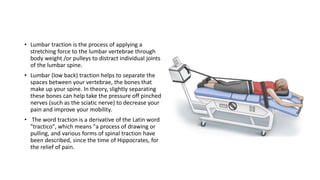
• Lumbar traction is the process of applying a
stretching force to the lumbar vertebrae through
body weight /or pulleys to distract individual joints
of the lumbar spine.
• Lumbar (low back) traction helps to separate the
spaces between your vertebrae, the bones that
make up your spine. In theory, slightly separating
these bones can help take the pressure off pinched
nerves (such as the sciatic nerve) to decrease your
pain and improve your mobility.
• The word traction is a derivative of the Latin word
"tractico", which means "a process of drawing or
pulling, and various forms of spinal traction have
been described, since the time of Hippocrates, for
the relief of pain.
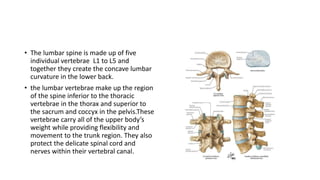
• The lumbar spine is made up of five
individual vertebrae L1 to L5 and
together they create the concave lumbar
curvature in the lower back.
• the lumbar vertebrae make up the region
of the spine inferior to the thoracic
vertebrae in the thorax and superior to
the sacrum and coccyx in the pelvis.These
vertebrae carry all of the upper body’s
weight while providing flexibility and
movement to the trunk region. They also
protect the delicate spinal cord and
nerves within their vertebral canal.
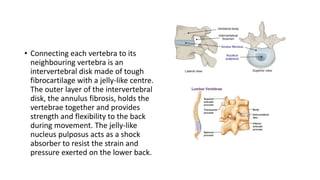
• Connecting each vertebra to its
neighbouring vertebra is an
intervertebral disk made of tough
fibrocartilage with a jelly-like centre.
The outer layer of the intervertebral
disk, the annulus fibrosis, holds the
vertebrae together and provides
strength and flexibility to the back
during movement. The jelly-like
nucleus pulposus acts as a shock
absorber to resist the strain and
pressure exerted on the lower back.
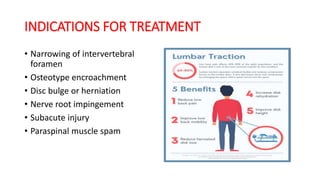
INDICATIONS FOR TREATMENT
• Narrowing of intervertebral
foramen
• Osteotype encroachment
• Disc bulge or herniation
• Nerve root impingement
• Subacute injury
• Paraspinal muscle spam
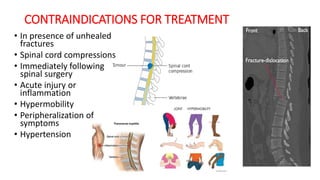
CONTRAINDICATIONS FOR TREATMENT
• In presence of unhealed
fractures
• Spinal cord compressions
• Immediately following
spinal surgery
• Acute injury or
inflammation
• Hypermobility
• Peripheralization of
symptoms
• Hypertension
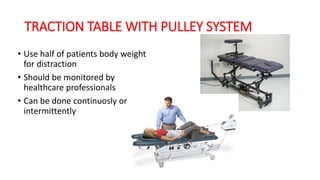
TRACTION TABLE WITH PULLEY SYSTEM
• Use half of patients body weight
for distraction
• Should be monitored by
healthcare professionals
• Can be done continuosly or
intermittently
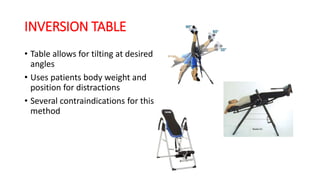
INVERSION TABLE
• Table allows for tilting at desired
angles
• Uses patients body weight and
position for distractions
• Several contraindications for this
method
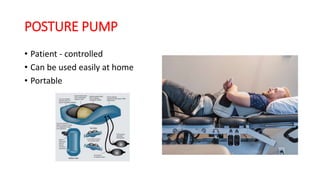
POSTURE PUMP
• Patient - controlled
• Can be used easily at home
• Portable
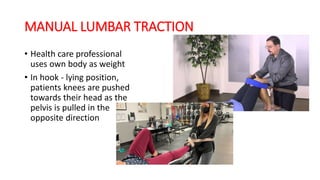
MANUAL LUMBAR TRACTION
• Health care professional
uses own body as weight
• In hook - lying position,
patients knees are pushed
towards their head as the
pelvis is pulled in the
opposite direction
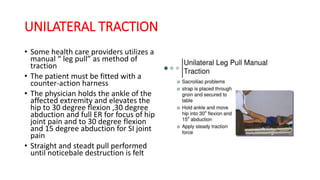
UNILATERAL TRACTION
• Some health care providers utilizes a
manual “ leg pull” as method of
traction
• The patient must be fitted with a
counter-action harness
• The physician holds the ankle of the
affected extremity and elevates the
hip to 30 degree flexion ,30 degree
abduction and full ER for focus of hip
joint pain and to 30 degree flexion
and 15 degree abduction for SI joint
pain
• Straight and steadt pull performed
until noticebale destruction is felt
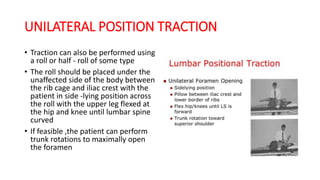
UNILATERAL POSITION TRACTION
• Traction can also be performed using
a roll or half - roll of some type
• The roll should be placed under the
unaffected side of the body between
the rib cage and iliac crest with the
patient in side -lying position across
the roll with the upper leg flexed at
the hip and knee until lumbar spine
curved
• If feasible ,the patient can perform
trunk rotations to maximally open
the foramen
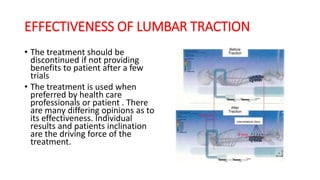
EFFECTIVENESS OF LUMBAR TRACTION
• The treatment should be
discontinued if not providing
benefits to patient after a few
trials
• The treatment is used when
preferred by health care
professionals or patient . There
are many differing opinions as to
its effectiveness. Individual
results and patients inclination
are the driving force of the
treatment.
sush kiru manual therapy.pptx

sush kiru manual therapy.pptx

  • 1.
    LUMBAR TRACTION MANUAL THERAPY DONEBY : KIRUTHIKA KARTHIKEYAN SUSHMITHA RAMAIAH PUSHPAMALA 504 GROUP GENERAL MEDICINE
  • 2.
    • Lumbar tractionis the process of applying a stretching force to the lumbar vertebrae through body weight /or pulleys to distract individual joints of the lumbar spine. • Lumbar (low back) traction helps to separate the spaces between your vertebrae, the bones that make up your spine. In theory, slightly separating these bones can help take the pressure off pinched nerves (such as the sciatic nerve) to decrease your pain and improve your mobility. • The word traction is a derivative of the Latin word "tractico", which means "a process of drawing or pulling, and various forms of spinal traction have been described, since the time of Hippocrates, for the relief of pain.
  • 3.
    • The lumbarspine is made up of five individual vertebrae L1 to L5 and together they create the concave lumbar curvature in the lower back. • the lumbar vertebrae make up the region of the spine inferior to the thoracic vertebrae in the thorax and superior to the sacrum and coccyx in the pelvis.These vertebrae carry all of the upper body’s weight while providing flexibility and movement to the trunk region. They also protect the delicate spinal cord and nerves within their vertebral canal.
  • 4.
    • Connecting eachvertebra to its neighbouring vertebra is an intervertebral disk made of tough fibrocartilage with a jelly-like centre. The outer layer of the intervertebral disk, the annulus fibrosis, holds the vertebrae together and provides strength and flexibility to the back during movement. The jelly-like nucleus pulposus acts as a shock absorber to resist the strain and pressure exerted on the lower back.
  • 5.
    INDICATIONS FOR TREATMENT •Narrowing of intervertebral foramen • Osteotype encroachment • Disc bulge or herniation • Nerve root impingement • Subacute injury • Paraspinal muscle spam
  • 6.
    CONTRAINDICATIONS FOR TREATMENT •In presence of unhealed fractures • Spinal cord compressions • Immediately following spinal surgery • Acute injury or inflammation • Hypermobility • Peripheralization of symptoms • Hypertension
  • 7.
    TRACTION TABLE WITHPULLEY SYSTEM • Use half of patients body weight for distraction • Should be monitored by healthcare professionals • Can be done continuosly or intermittently
  • 8.
    INVERSION TABLE • Tableallows for tilting at desired angles • Uses patients body weight and position for distractions • Several contraindications for this method
  • 9.
    POSTURE PUMP • Patient- controlled • Can be used easily at home • Portable
  • 10.
    MANUAL LUMBAR TRACTION •Health care professional uses own body as weight • In hook - lying position, patients knees are pushed towards their head as the pelvis is pulled in the opposite direction
  • 11.
    UNILATERAL TRACTION • Somehealth care providers utilizes a manual “ leg pull” as method of traction • The patient must be fitted with a counter-action harness • The physician holds the ankle of the affected extremity and elevates the hip to 30 degree flexion ,30 degree abduction and full ER for focus of hip joint pain and to 30 degree flexion and 15 degree abduction for SI joint pain • Straight and steadt pull performed until noticebale destruction is felt
  • 12.
    UNILATERAL POSITION TRACTION •Traction can also be performed using a roll or half - roll of some type • The roll should be placed under the unaffected side of the body between the rib cage and iliac crest with the patient in side -lying position across the roll with the upper leg flexed at the hip and knee until lumbar spine curved • If feasible ,the patient can perform trunk rotations to maximally open the foramen
  • 13.
    EFFECTIVENESS OF LUMBARTRACTION • The treatment should be discontinued if not providing benefits to patient after a few trials • The treatment is used when preferred by health care professionals or patient . There are many differing opinions as to its effectiveness. Individual results and patients inclination are the driving force of the treatment.