FAO
Rome, Italy
26 – 29 June, 2018
Justin Chisenga
Capacity Development Officer
Tracking Capacity Development
7th Capitalization Meeting
EU Land Governance Programme
Three Dimensions of Capacity Development - Recap
Technical
capacity in
the broad
areas
of food and
agriculture
Functional
capacities to
enable country
actors to plan,
manage and
sustain change.
Capacity: "the ability of people, organizations and society as a whole to
manage their affairs successfully”.
Capacity development: “the process of unleashing, strengthening and
maintaining of such capacity". (OECD DAC )
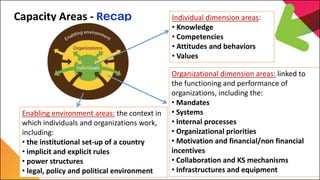
Capacity Areas - Recap Individual dimension areas:
• Knowledge
• Competencies
• Attitudes and behaviors
• Values
Organizational dimension areas: linked to
the functioning and performance of
organizations, including the:
• Mandates
• Systems
• Internal processes
• Organizational priorities
• Motivation and financial/non financial
incentives
• Collaboration and KS mechanisms
• Infrastructures and equipment
Enabling environment areas: the context in
which individuals and organizations work,
including:
• the institutional set-up of a country
• implicit and explicit rules
• power structures
• legal, policy and political environment
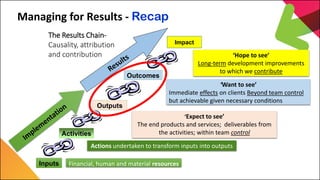
Managing for Results - Recap
The Results Chain-
Causality, attribution
and contribution
Inputs
Activities
Outputs
Outcomes
Impact
‘Hope to see’
Long-term development improvements
to which we contribute
‘Want to see’
Immediate effects on clients Beyond team control
but achievable given necessary conditions
‘Expect to see’
The end products and services; deliverables from
the activities; within team control
Actions undertaken to transform inputs into outputs
Financial, human and material resources
7th Capitalization Meeting
EU Land Governance Programme
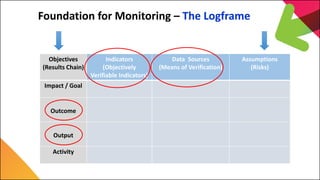
Foundation for Monitoring – The Logframe
Objectives
(Results Chain)
Indicators
(Objectively
Verifiable Indicators)
Data Sources
(Means of Verification)
Assumptions
(Risks)
Impact / Goal
Outcome
Output
Activity
7th Capitalization Meeting
EU Land Governance Programme
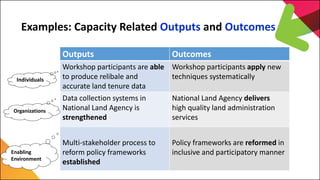
Examples: Capacity Related Outputs and Outcomes
Outputs Outcomes
Workshop participants are able
to produce relibale and
accurate land tenure data
Workshop participants apply new
techniques systematically
Data collection systems in
National Land Agency is
strengthened
National Land Agency delivers
high quality land administration
services
Multi-stakeholder process to
reform policy frameworks
established
Policy frameworks are reformed in
inclusive and participatory manner
Individuals
Organizations
Enabling
Environment
7th Capitalization Meeting
EU Land Governance Programme
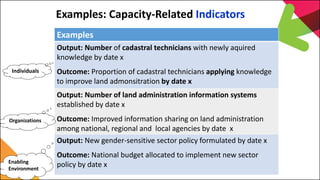
Examples: Capacity-Related Indicators
Examples
Output: Number of cadastral technicians with newly aquired
knowledge by date x
Outcome: Proportion of cadastral technicians applying knowledge
to improve land admonsitration by date x
Output: Number of land administration information systems
established by date x
Outcome: Improved information sharing on land administration
among national, regional and local agencies by date x
Output: New gender-sensitive sector policy formulated by date x
Outcome: National budget allocated to implement new sector
policy by date x
Individuals
Organizations
Enabling
Environment
7th Capitalization Meeting
EU Land Governance Programme
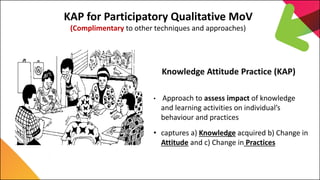
KAP for Participatory Qualitative MoV
Knowledge Attitude Practice (KAP)
• Approach to assess impact of knowledge
and learning activities on individual’s
behaviour and practices
• captures a) Knowledge acquired b) Change in
Attitude and c) Change in Practices
(Complimentary to other techniques and approaches)
7th Capitalization Meeting
EU Land Governance Programme
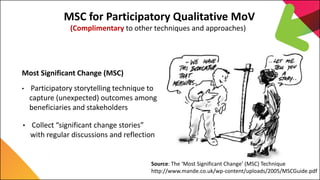
MSC for Participatory Qualitative MoV
Most Significant Change (MSC)
• Participatory storytelling technique to
capture (unexpected) outcomes among
beneficiaries and stakeholders
• Collect “significant change stories”
with regular discussions and reflection
Source: The ‘Most Significant Change’ (MSC) Technique
http://www.mande.co.uk/wp-content/uploads/2005/MSCGuide.pdf
(Complimentary to other techniques and approaches)
7th Capitalization Meeting
EU Land Governance Programme
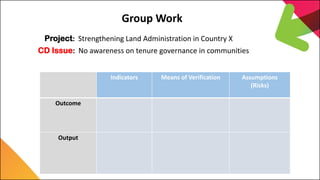
Group Work
Indicators Means of Verification Assumptions
(Risks)
Outcome
Output
Project: Strengthening Land Administration in Country X
CD Issue: No awareness on tenure governance in communities
7th Capitalization Meeting
EU Land Governance Programme
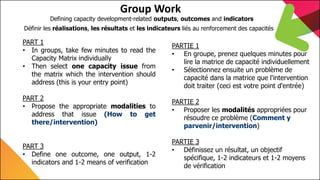
Group Work
PART 1
• In groups, take few minutes to read the
Capacity Matrix individually
• Then select one capacity issue from
the matrix which the intervention should
address (this is your entry point)
PART 2
• Propose the appropriate modalities to
address that issue (How to get
there/intervention)
PART 3
• Define one outcome, one output, 1-2
indicators and 1-2 means of verification
Defining capacity development-related outputs, outcomes and indicators
PARTIE 1
• En groupe, prenez quelques minutes pour
lire la matrice de capacité individuellement
• Sélectionnez ensuite un problème de
capacité dans la matrice que l'intervention
doit traiter (ceci est votre point d'entrée)
PARTIE 2
• Proposer les modalités appropriées pour
résoudre ce problème (Comment y
parvenir/intervention)
PARTIE 3
• Définissez un résultat, un objectif
spécifique, 1-2 indicateurs et 1-2 moyens
de vérification
Définir les réalisations, les résultats et les indicateurs liés au renforcement des capacités
Thank you!
7th Capitalization Meeting
EU Land Governance Programme
FAO
Rome, Italy
26 – 29 June, 2018

Tracking Capacity Development

  • 1.
    FAO Rome, Italy 26 –29 June, 2018 Justin Chisenga Capacity Development Officer Tracking Capacity Development 7th Capitalization Meeting EU Land Governance Programme
  • 2.
    Three Dimensions ofCapacity Development - Recap Technical capacity in the broad areas of food and agriculture Functional capacities to enable country actors to plan, manage and sustain change. Capacity: "the ability of people, organizations and society as a whole to manage their affairs successfully”. Capacity development: “the process of unleashing, strengthening and maintaining of such capacity". (OECD DAC )
  • 3.
    Capacity Areas -Recap Individual dimension areas: • Knowledge • Competencies • Attitudes and behaviors • Values Organizational dimension areas: linked to the functioning and performance of organizations, including the: • Mandates • Systems • Internal processes • Organizational priorities • Motivation and financial/non financial incentives • Collaboration and KS mechanisms • Infrastructures and equipment Enabling environment areas: the context in which individuals and organizations work, including: • the institutional set-up of a country • implicit and explicit rules • power structures • legal, policy and political environment
  • 4.
    Managing for Results- Recap The Results Chain- Causality, attribution and contribution Inputs Activities Outputs Outcomes Impact ‘Hope to see’ Long-term development improvements to which we contribute ‘Want to see’ Immediate effects on clients Beyond team control but achievable given necessary conditions ‘Expect to see’ The end products and services; deliverables from the activities; within team control Actions undertaken to transform inputs into outputs Financial, human and material resources
  • 5.
    7th Capitalization Meeting EULand Governance Programme Foundation for Monitoring – The Logframe Objectives (Results Chain) Indicators (Objectively Verifiable Indicators) Data Sources (Means of Verification) Assumptions (Risks) Impact / Goal Outcome Output Activity
  • 6.
    7th Capitalization Meeting EULand Governance Programme Examples: Capacity Related Outputs and Outcomes Outputs Outcomes Workshop participants are able to produce relibale and accurate land tenure data Workshop participants apply new techniques systematically Data collection systems in National Land Agency is strengthened National Land Agency delivers high quality land administration services Multi-stakeholder process to reform policy frameworks established Policy frameworks are reformed in inclusive and participatory manner Individuals Organizations Enabling Environment
  • 7.
    7th Capitalization Meeting EULand Governance Programme Examples: Capacity-Related Indicators Examples Output: Number of cadastral technicians with newly aquired knowledge by date x Outcome: Proportion of cadastral technicians applying knowledge to improve land admonsitration by date x Output: Number of land administration information systems established by date x Outcome: Improved information sharing on land administration among national, regional and local agencies by date x Output: New gender-sensitive sector policy formulated by date x Outcome: National budget allocated to implement new sector policy by date x Individuals Organizations Enabling Environment
  • 8.
    7th Capitalization Meeting EULand Governance Programme KAP for Participatory Qualitative MoV Knowledge Attitude Practice (KAP) • Approach to assess impact of knowledge and learning activities on individual’s behaviour and practices • captures a) Knowledge acquired b) Change in Attitude and c) Change in Practices (Complimentary to other techniques and approaches)
  • 9.
    7th Capitalization Meeting EULand Governance Programme MSC for Participatory Qualitative MoV Most Significant Change (MSC) • Participatory storytelling technique to capture (unexpected) outcomes among beneficiaries and stakeholders • Collect “significant change stories” with regular discussions and reflection Source: The ‘Most Significant Change’ (MSC) Technique http://www.mande.co.uk/wp-content/uploads/2005/MSCGuide.pdf (Complimentary to other techniques and approaches)
  • 10.
    7th Capitalization Meeting EULand Governance Programme Group Work Indicators Means of Verification Assumptions (Risks) Outcome Output Project: Strengthening Land Administration in Country X CD Issue: No awareness on tenure governance in communities
  • 11.
    7th Capitalization Meeting EULand Governance Programme Group Work PART 1 • In groups, take few minutes to read the Capacity Matrix individually • Then select one capacity issue from the matrix which the intervention should address (this is your entry point) PART 2 • Propose the appropriate modalities to address that issue (How to get there/intervention) PART 3 • Define one outcome, one output, 1-2 indicators and 1-2 means of verification Defining capacity development-related outputs, outcomes and indicators PARTIE 1 • En groupe, prenez quelques minutes pour lire la matrice de capacité individuellement • Sélectionnez ensuite un problème de capacité dans la matrice que l'intervention doit traiter (ceci est votre point d'entrée) PARTIE 2 • Proposer les modalités appropriées pour résoudre ce problème (Comment y parvenir/intervention) PARTIE 3 • Définissez un résultat, un objectif spécifique, 1-2 indicateurs et 1-2 moyens de vérification Définir les réalisations, les résultats et les indicateurs liés au renforcement des capacités
  • 12.
    Thank you! 7th CapitalizationMeeting EU Land Governance Programme FAO Rome, Italy 26 – 29 June, 2018