Coproduction of data and knowledge for the resolution
of land disputes in Myanmar:
lessons from an oil palm land use assessment
Regional Land Governance Forum
Bangkok, 29 May 2018
Dr. Joan Bastide
Initiative of the Government of Myanmar: 26 line agencies (from 11
Ministries and 3 City Councils)
Main objective:
Generate and share accurate land related (spatial) data through an online, open-
access database to support land management and land use planning
Financial support by: Swiss Agency for Development and Cooperation
Total duration: 8 Years (2015-2023)
Technical Assistance Implementing Agencies: Centre for Development
and Environment from University of Bern (Switzerland) & the Land
Core Group
OneMap Myanmar Factsheet
TheOneMapinitiative
Data is needed… But data alone is not enough
Knowledge
Navigating
trade-offs
(sectors and
scale)
Goal oriented
and equitable
decision
making
Sustainable
land
management
Data /
information
FromDatatoKnowledge
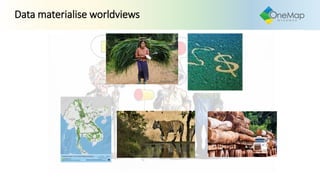
Data materialise worldviews
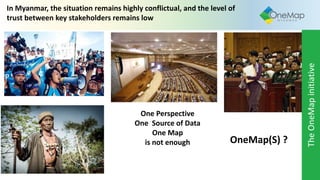
In Myanmar, the situation remains highly conflictual, and the level of
trust between key stakeholders remains low
One Perspective
One Source of Data
One Map
is not enough OneMap(S) ?
TheOneMapinitiative
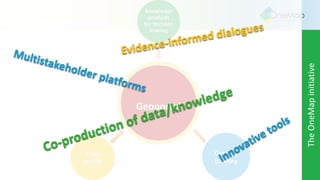
Knowledge
products
for decision
making
Data
quality
Capacity
building
Geoportal
TheOneMapinitiative
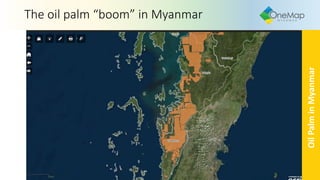
The oil palm “boom” in Myanmar
OilPalminMyanmar
Socio Economic
Environmental
Household Data
Concessions Data
Land use
assessment
Land use
planning and
land reallocation
Impact and quality
assessment of
investments in the
oil palm sector
Develop sectoral
policies/approach
for effective land
use, and
sustainable oil palm
industry
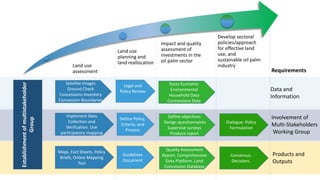
Legal and
Policy Review
Satellite Images
Ground Check
Concessions Inventory
Concession Boundaries
Data and
Information
Define objectives
Design questionnaires
Supervise surveys
Produce report
Define Policy,
Criteria, and
Process
Implement Data
Collection and
Verification. Use
participatory mapping
Dialogue. Policy
Formulation
Products and
Outputs
Quality Assessment
Report. Comprehensive
Data Platform. Land
Concession Database
Guidelines
Document
Maps, Fact Sheets, Policy
Briefs, Online Mapping
Tool
Consensus.
Decisions.
Involvement of
Multi-Stakeholders
Working Group
Requirements
Establishmentofmultistakeholder
Group
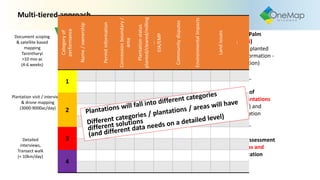
1. General assessment of Oil Palm
plantations (all of Tanintharyi)
(incl. mapping of boundaries, planted
oil palm and basic context information -
profile matrix for each plantation)
2. More detailed assessment of
complete area of selected plantations
Detailed mapping (incl. drone) and
more detailed context information
3. Detailed field survey and assessment
for selected high priority areas and
selected issues within a plantation
Large area /
limited level of detail
Small area /
Very high level of detail
Multi-tiered approach
Selection
Selection
Plantation visit / interviews
& drone mapping
(3000-9000ac/day)
Detailed
interviews,
Transect walk
(< 10km/day)
Document scoping
& satellite based
mapping
Tanintharyi
>10 mio ac
(4-6 weeks) Categoryof
performance
Name/ownership
Permitinformation
Concessionboundary/
area
Plantationstatus
planted/cleared/milling
…
EIA/EMP
Communitydisputes
EnvironmentalImpacts
Landissues
…
1
2
3
4
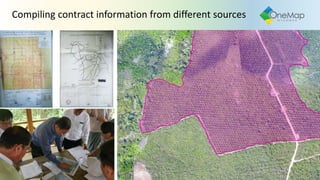
Compiling contract information from different sources
Aregionallevelanalysis
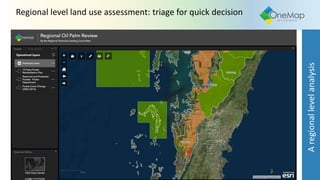
Regional level land use assessment: triage for quick decision
Aregionallevelanalysis
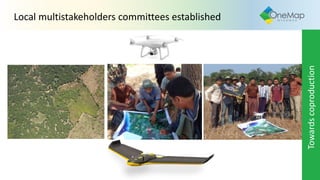
Local multistakeholders committees established
Towardscoproduction
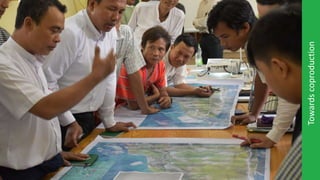
Towardscoproduction
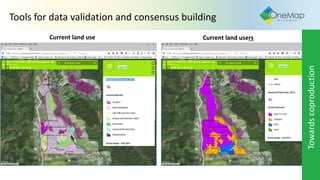
Current land use Current land users
Tools for data validation and consensus building
Towardscoproduction
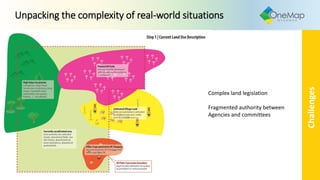
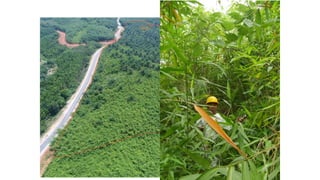
Unpacking the complexity of real-world situations
Challenges
Complex land legislation
Fragmented authority between
Agencies and committees
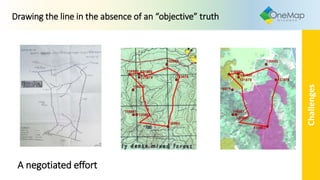
Drawing the line in the absence of an “objective” truth
Challenges
A negotiated effort
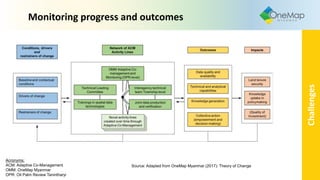
Monitoring progress and outcomes
Acronyms:
ACM: Adaptive Co-Management
OMM: OneMap Myanmar
OPR: Oil Palm Review Tanintharyi
Source: Adapted from OneMap Myanmar (2017): Theory of Change
Challenges
Keeping the process alive
Challenges
• Government pulled between competing priorities
• Reluctance of certain departments and companies
• Civil society groups losing patience
• Competing views on the process
• Misunderstanding from local communities
• Dealing with the absence of formalized processes
• Ensuring synergies with other related initiatives (including
by participating agencies)
Results and conclusions
• Since the beginning of the process, a significant amount of land has been
(or is about to) reclaimed back from companies by the government.
• As part of the process, technical capacities have been introduced and
strengthened.
• Government agencies and companies have been incentivized to speed up
their actions
• Process has been adopted by other committees.
• Recommendation have not been followed by immediate actions.
• Stakeholders use parallel processes. Risks of confusion. (The MSG is one
platform amongst others).
• Complexity and heterogeneity of individual cases poses serious challenges
for fair resolution.
• Transparency, consistency and formalization of the process are important
• Need to move towards a more forward looking approach?
Thank you
www.onemapmyamar.info
Coming soon…

Joan 20180529 mrlg_bkk

  • 1.
    Coproduction of dataand knowledge for the resolution of land disputes in Myanmar: lessons from an oil palm land use assessment Regional Land Governance Forum Bangkok, 29 May 2018 Dr. Joan Bastide
  • 2.
    Initiative of theGovernment of Myanmar: 26 line agencies (from 11 Ministries and 3 City Councils) Main objective: Generate and share accurate land related (spatial) data through an online, open- access database to support land management and land use planning Financial support by: Swiss Agency for Development and Cooperation Total duration: 8 Years (2015-2023) Technical Assistance Implementing Agencies: Centre for Development and Environment from University of Bern (Switzerland) & the Land Core Group OneMap Myanmar Factsheet TheOneMapinitiative
  • 3.
    Data is needed…But data alone is not enough Knowledge Navigating trade-offs (sectors and scale) Goal oriented and equitable decision making Sustainable land management Data / information FromDatatoKnowledge
  • 4.
  • 5.
    In Myanmar, thesituation remains highly conflictual, and the level of trust between key stakeholders remains low One Perspective One Source of Data One Map is not enough OneMap(S) ? TheOneMapinitiative
  • 6.
  • 7.
    The oil palm“boom” in Myanmar OilPalminMyanmar
  • 8.
    Socio Economic Environmental Household Data ConcessionsData Land use assessment Land use planning and land reallocation Impact and quality assessment of investments in the oil palm sector Develop sectoral policies/approach for effective land use, and sustainable oil palm industry Legal and Policy Review Satellite Images Ground Check Concessions Inventory Concession Boundaries Data and Information Define objectives Design questionnaires Supervise surveys Produce report Define Policy, Criteria, and Process Implement Data Collection and Verification. Use participatory mapping Dialogue. Policy Formulation Products and Outputs Quality Assessment Report. Comprehensive Data Platform. Land Concession Database Guidelines Document Maps, Fact Sheets, Policy Briefs, Online Mapping Tool Consensus. Decisions. Involvement of Multi-Stakeholders Working Group Requirements Establishmentofmultistakeholder Group
  • 9.
    1. General assessmentof Oil Palm plantations (all of Tanintharyi) (incl. mapping of boundaries, planted oil palm and basic context information - profile matrix for each plantation) 2. More detailed assessment of complete area of selected plantations Detailed mapping (incl. drone) and more detailed context information 3. Detailed field survey and assessment for selected high priority areas and selected issues within a plantation Large area / limited level of detail Small area / Very high level of detail Multi-tiered approach Selection Selection Plantation visit / interviews & drone mapping (3000-9000ac/day) Detailed interviews, Transect walk (< 10km/day) Document scoping & satellite based mapping Tanintharyi >10 mio ac (4-6 weeks) Categoryof performance Name/ownership Permitinformation Concessionboundary/ area Plantationstatus planted/cleared/milling … EIA/EMP Communitydisputes EnvironmentalImpacts Landissues … 1 2 3 4
  • 10.
    Compiling contract informationfrom different sources Aregionallevelanalysis
  • 11.
    Regional level landuse assessment: triage for quick decision Aregionallevelanalysis
  • 12.
    Local multistakeholders committeesestablished Towardscoproduction
  • 13.
  • 14.
    Current land useCurrent land users Tools for data validation and consensus building Towardscoproduction
  • 15.
    Unpacking the complexityof real-world situations Challenges Complex land legislation Fragmented authority between Agencies and committees
  • 16.
    Drawing the linein the absence of an “objective” truth Challenges A negotiated effort
  • 18.
    Monitoring progress andoutcomes Acronyms: ACM: Adaptive Co-Management OMM: OneMap Myanmar OPR: Oil Palm Review Tanintharyi Source: Adapted from OneMap Myanmar (2017): Theory of Change Challenges
  • 19.
    Keeping the processalive Challenges • Government pulled between competing priorities • Reluctance of certain departments and companies • Civil society groups losing patience • Competing views on the process • Misunderstanding from local communities • Dealing with the absence of formalized processes • Ensuring synergies with other related initiatives (including by participating agencies)
  • 20.
    Results and conclusions •Since the beginning of the process, a significant amount of land has been (or is about to) reclaimed back from companies by the government. • As part of the process, technical capacities have been introduced and strengthened. • Government agencies and companies have been incentivized to speed up their actions • Process has been adopted by other committees. • Recommendation have not been followed by immediate actions. • Stakeholders use parallel processes. Risks of confusion. (The MSG is one platform amongst others). • Complexity and heterogeneity of individual cases poses serious challenges for fair resolution. • Transparency, consistency and formalization of the process are important • Need to move towards a more forward looking approach?
  • 21.

Editor's Notes

  • #2 enabling a multistakeholder environment for the coproduction of data, information and knowledge for sustainable and equitable land governance in Myanmar
  • #7 Knowledge product that address key relevant questions in a timely manner. Processes and dialogues: what are the key issues, questions? We draft a new land law, we need clear information. What are the things we need to influence? Can we influence the paradigm of eradication of shifting cultivation, can we influence the vacant, fallow and vigin land ?