RETHINKING REGIONAL
DEVELOPMENT POLICY-MAKING
LAUNCH EVENT
19 March 2018, Brussels
Joaquim Oliveira Martins
Special Advisor, OECD/CFE
Challenges for regional
and urban policy in the
EU
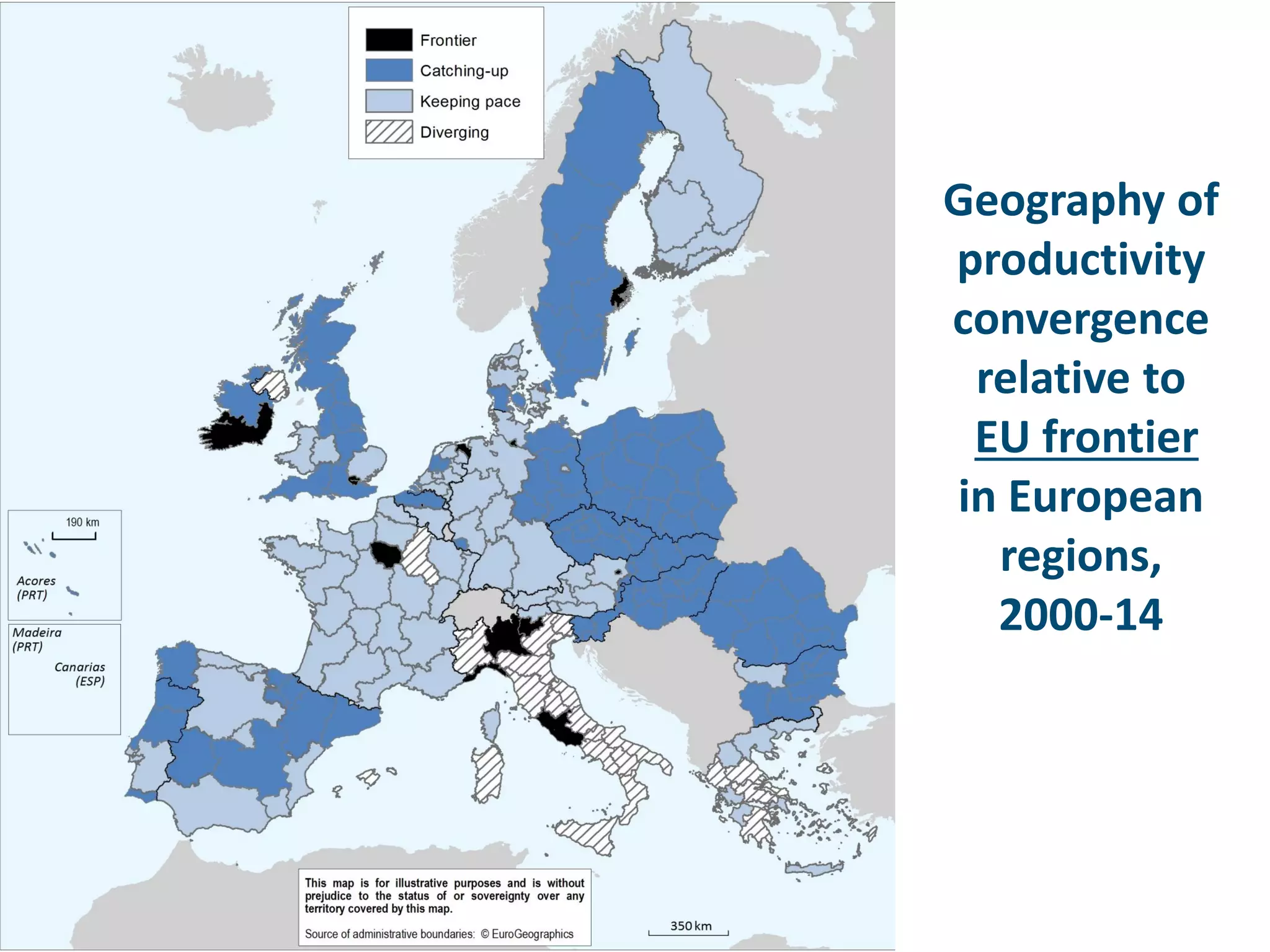
Geography of
productivity
convergence
relative to
EU frontier
in European
regions,
2000-14
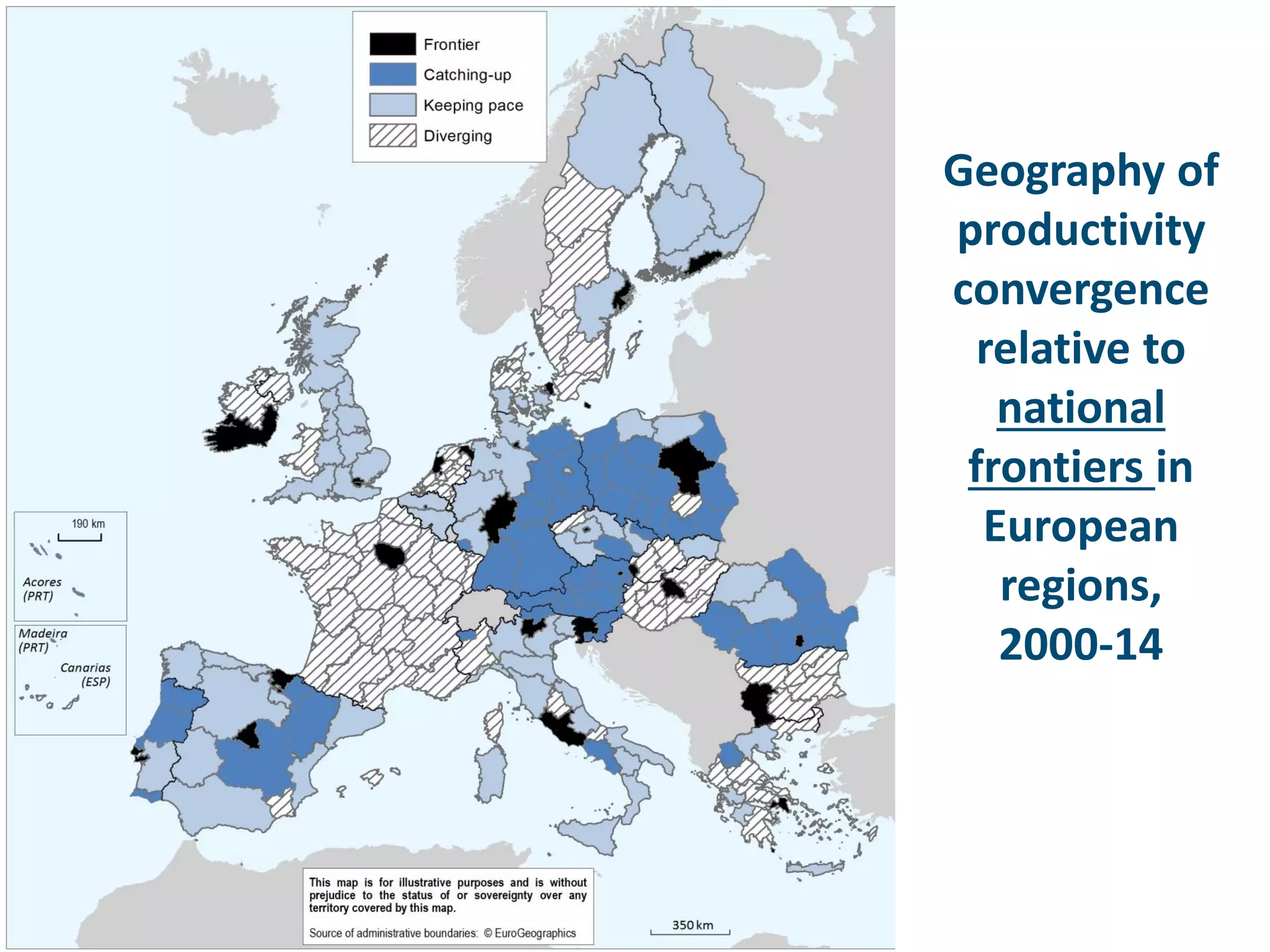
Geography of
productivity
convergence
relative to
national
frontiers in
European
regions,
2000-14
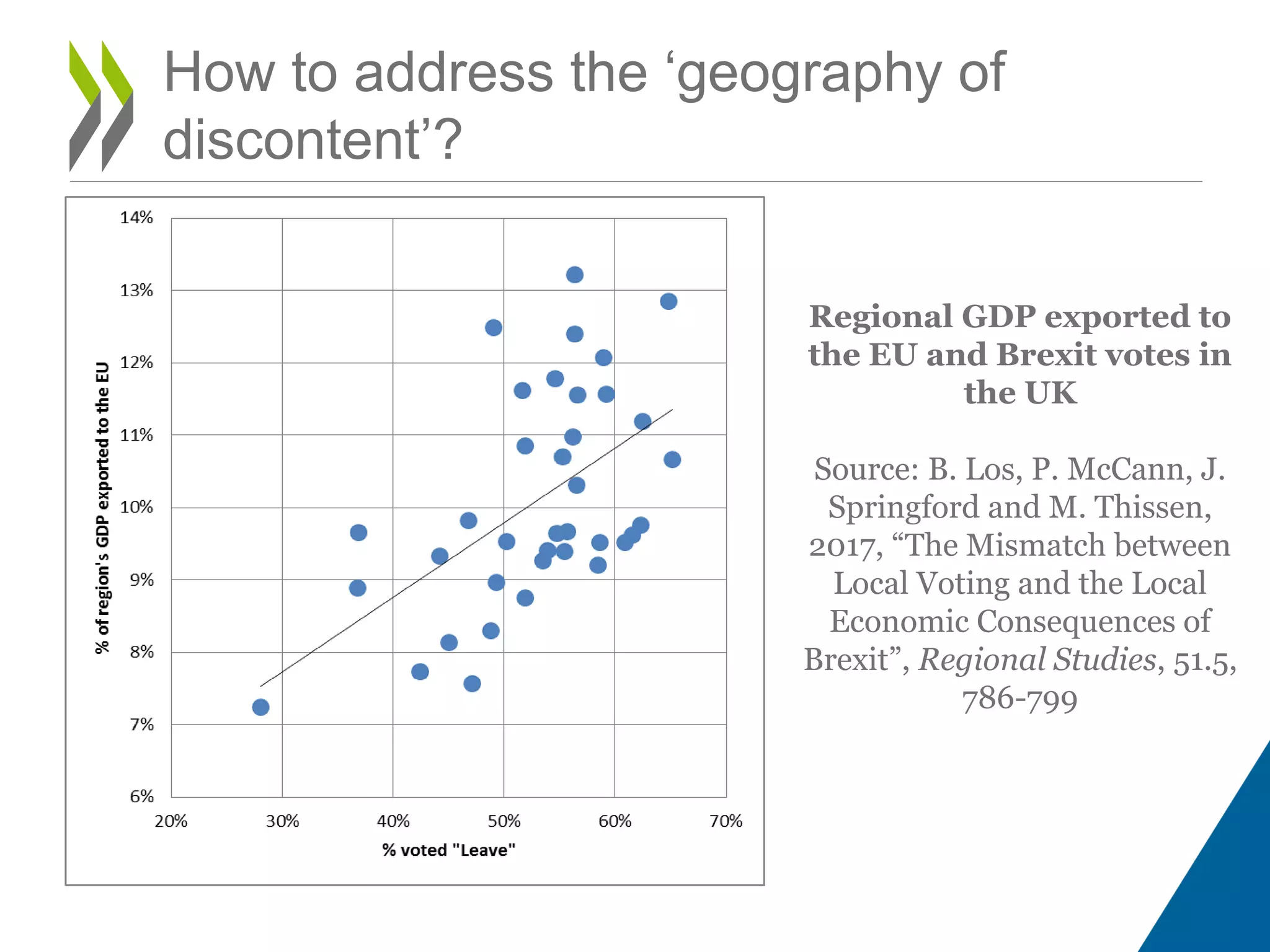
How to address the ‘geography of
discontent’?
Regional GDP exported to
the EU and Brexit votes in
the UK
Source: B. Los, P. McCann, J.
Springford and M. Thissen,
2017, “The Mismatch between
Local Voting and the Local
Economic Consequences of
Brexit”, Regional Studies, 51.5,
786-799
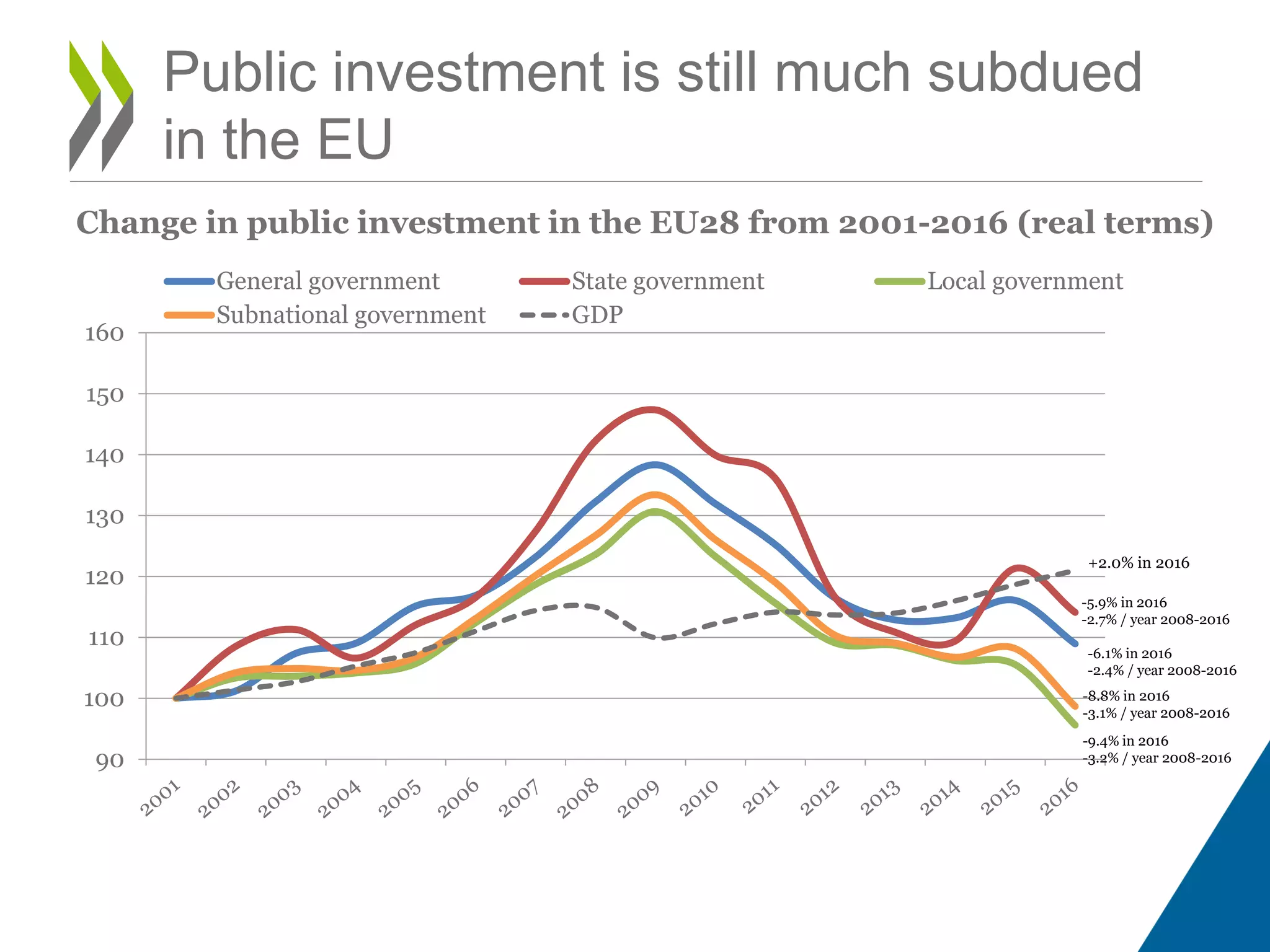
Public investment is still much subdued
in the EU
90
100
110
120
130
140
150
160
General government State government Local government
Subnational government GDP
-6.1% in 2016
-2.4% / year 2008-2016
-5.9% in 2016
-2.7% / year 2008-2016
-8.8% in 2016
-3.1% / year 2008-2016
-9.4% in 2016
-3.2% / year 2008-2016
+2.0% in 2016
Change in public investment in the EU28 from 2001-2016 (real terms)
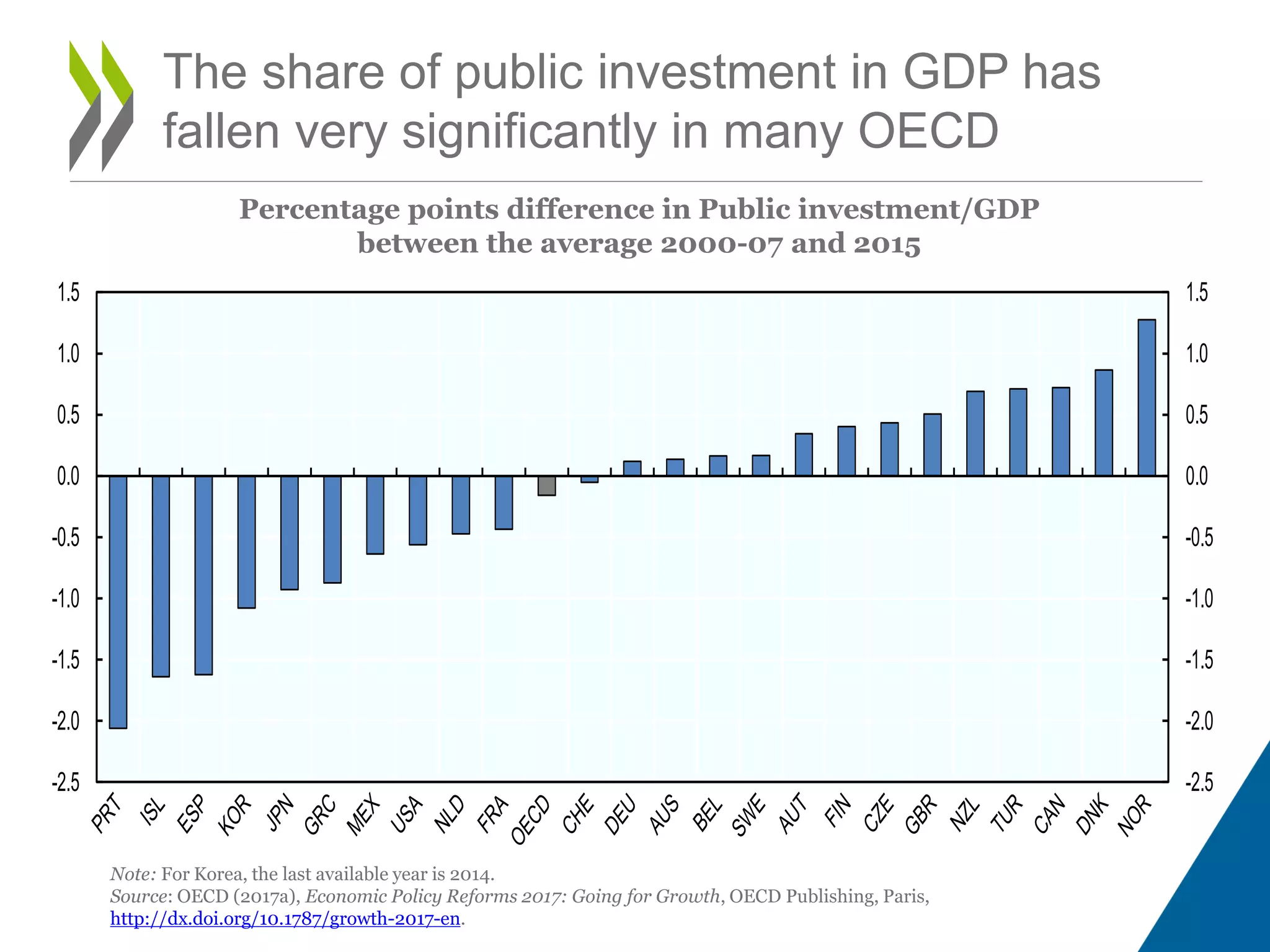
The share of public investment in GDP has
fallen very significantly in many OECD
-2.5
-2.0
-1.5
-1.0
-0.5
0.0
0.5
1.0
1.5
-2.5
-2.0
-1.5
-1.0
-0.5
0.0
0.5
1.0
1.5
Percentage points difference in Public investment/GDP
between the average 2000-07 and 2015
Note: For Korea, the last available year is 2014.
Source: OECD (2017a), Economic Policy Reforms 2017: Going for Growth, OECD Publishing, Paris,
http://dx.doi.org/10.1787/growth-2017-en.
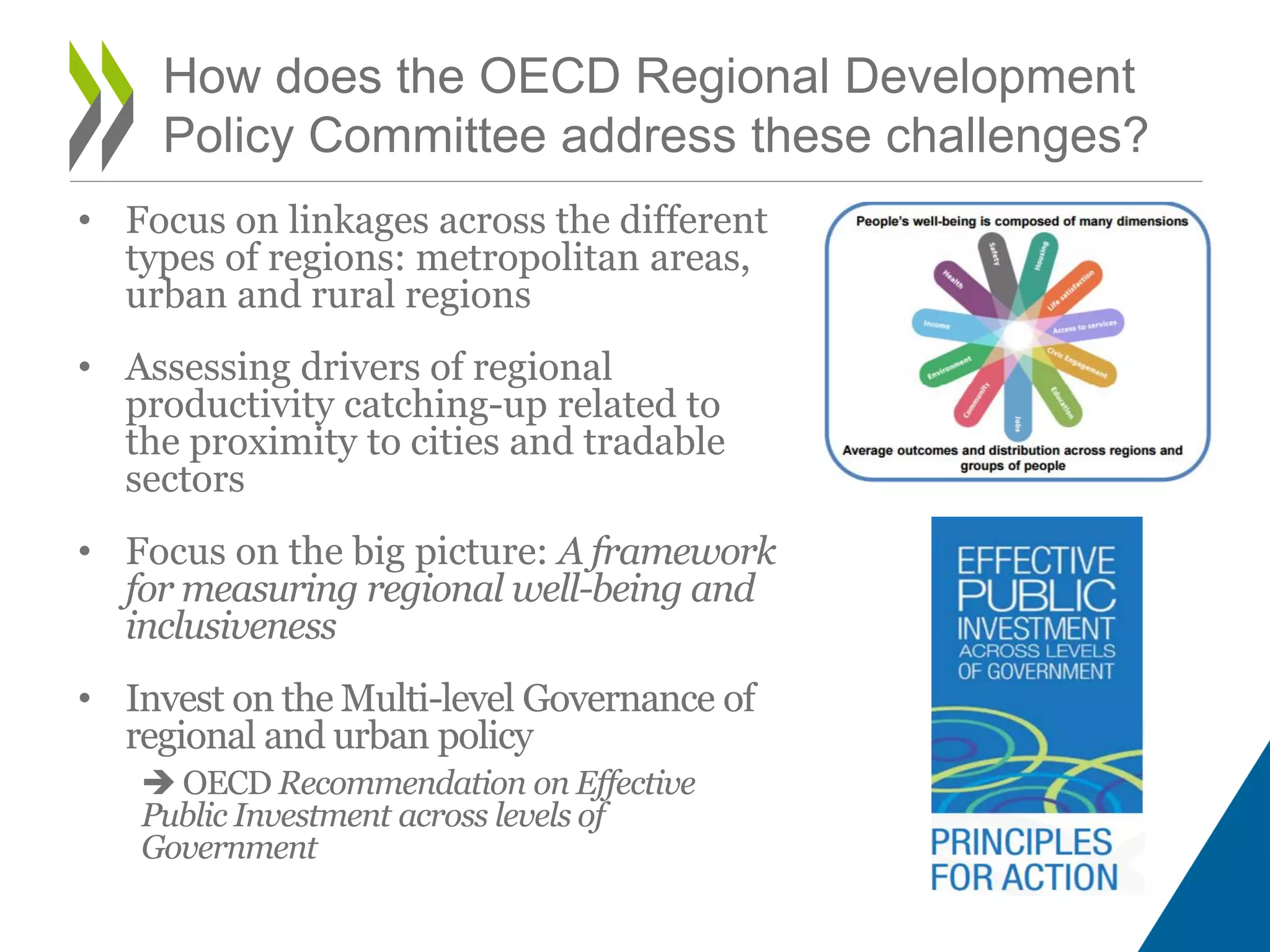
• Focus on linkages across the different
types of regions: metropolitan areas,
urban and rural regions
• Assessing drivers of regional
productivity catching-up related to
the proximity to cities and tradable
sectors
• Focus on the big picture: A framework
for measuring regional well-being and
inclusiveness
• Invest on the Multi-level Governance of
regional and urban policy
 OECD Recommendation on Effective
Public Investment across levels of
Government
How does the OECD Regional Development
Policy Committee address these challenges?
How to improve the
design and delivery of
development
programmes for regions
and cities?
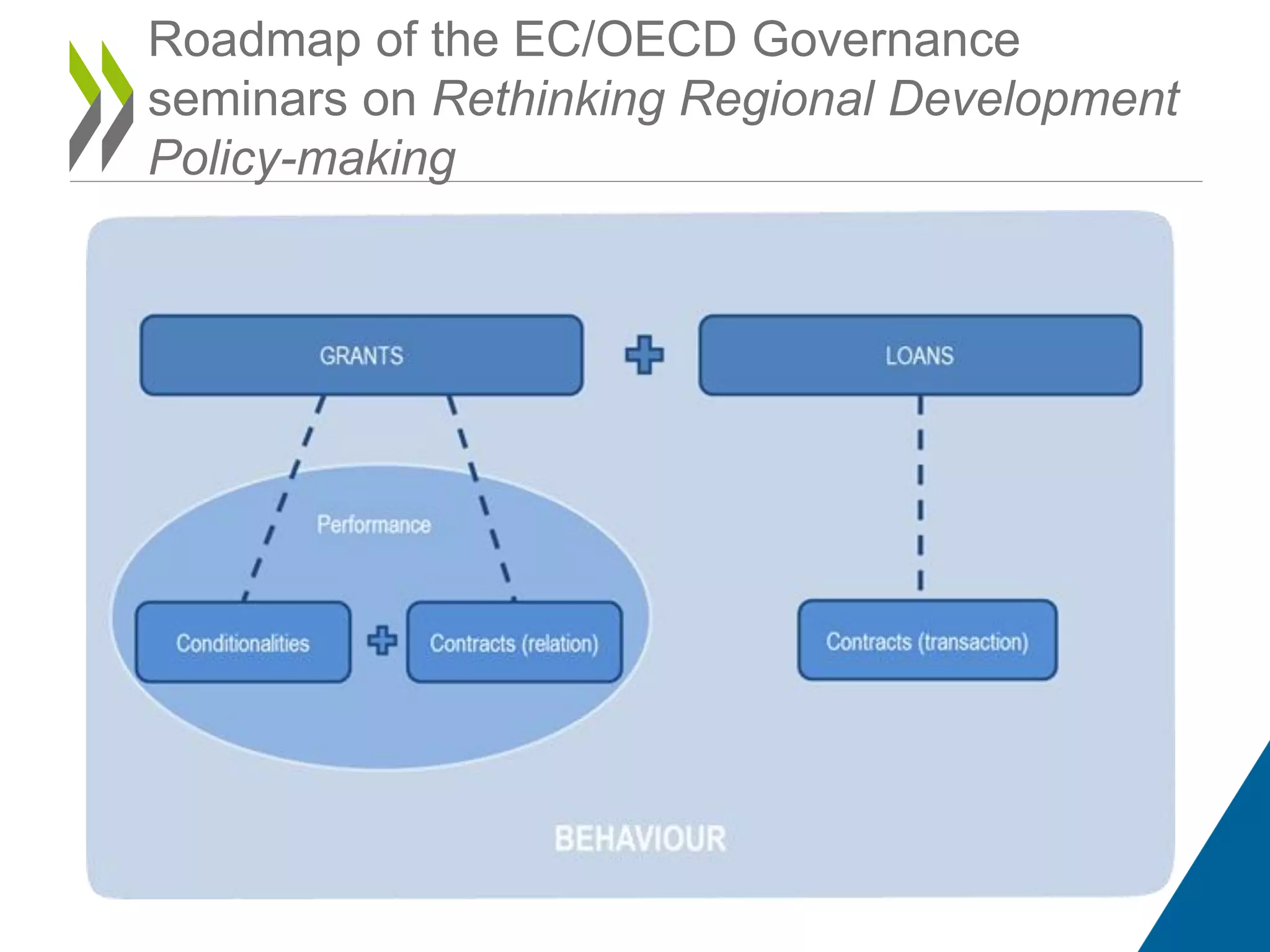
Roadmap of the EC/OECD Governance
seminars on Rethinking Regional Development
Policy-making
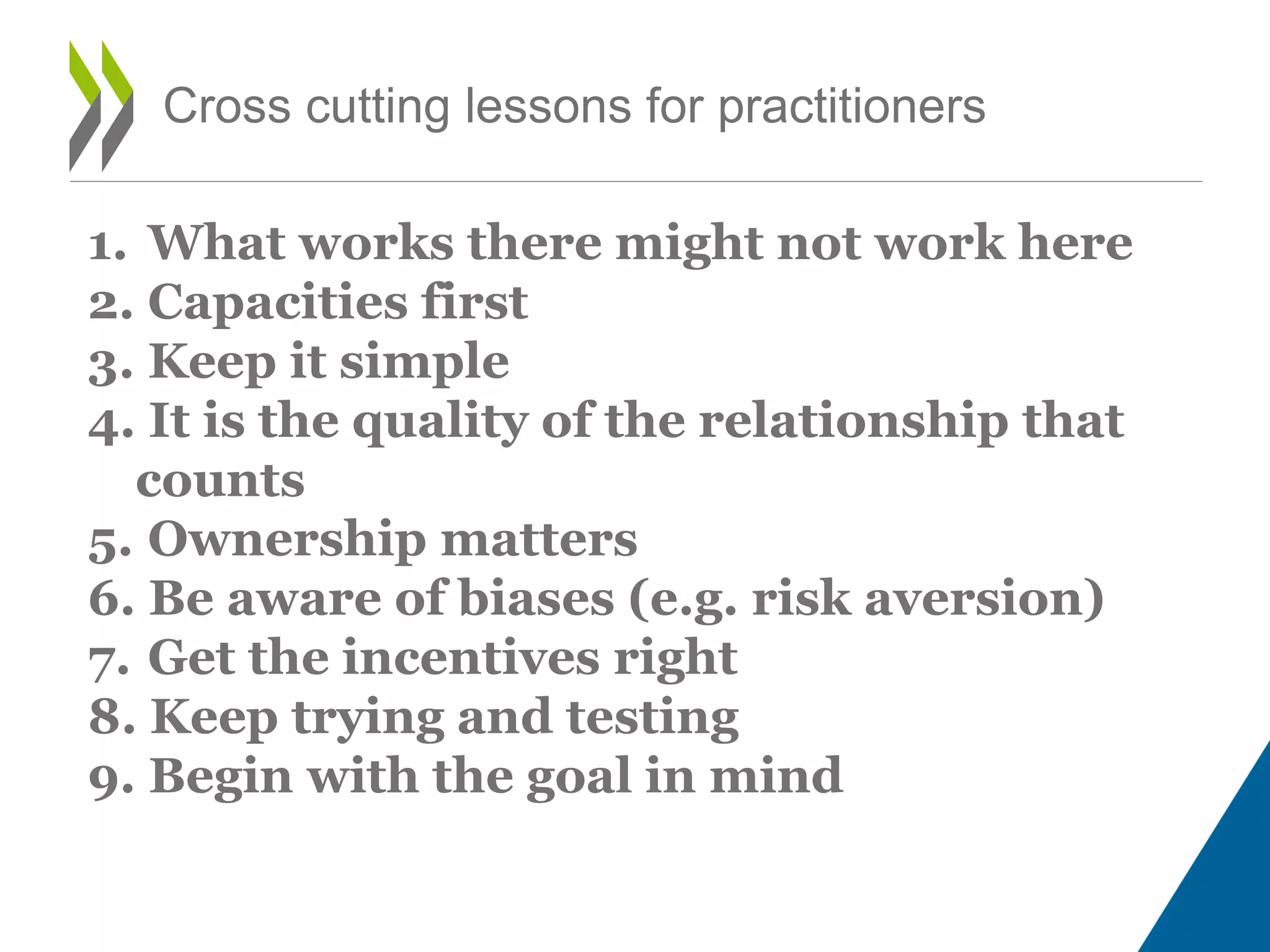
Cross cutting lessons for practitioners
1. What works there might not work here
2. Capacities first
3. Keep it simple
4. It is the quality of the relationship that
counts
5. Ownership matters
6. Be aware of biases (e.g. risk aversion)
7. Get the incentives right
8. Keep trying and testing
9. Begin with the goal in mind
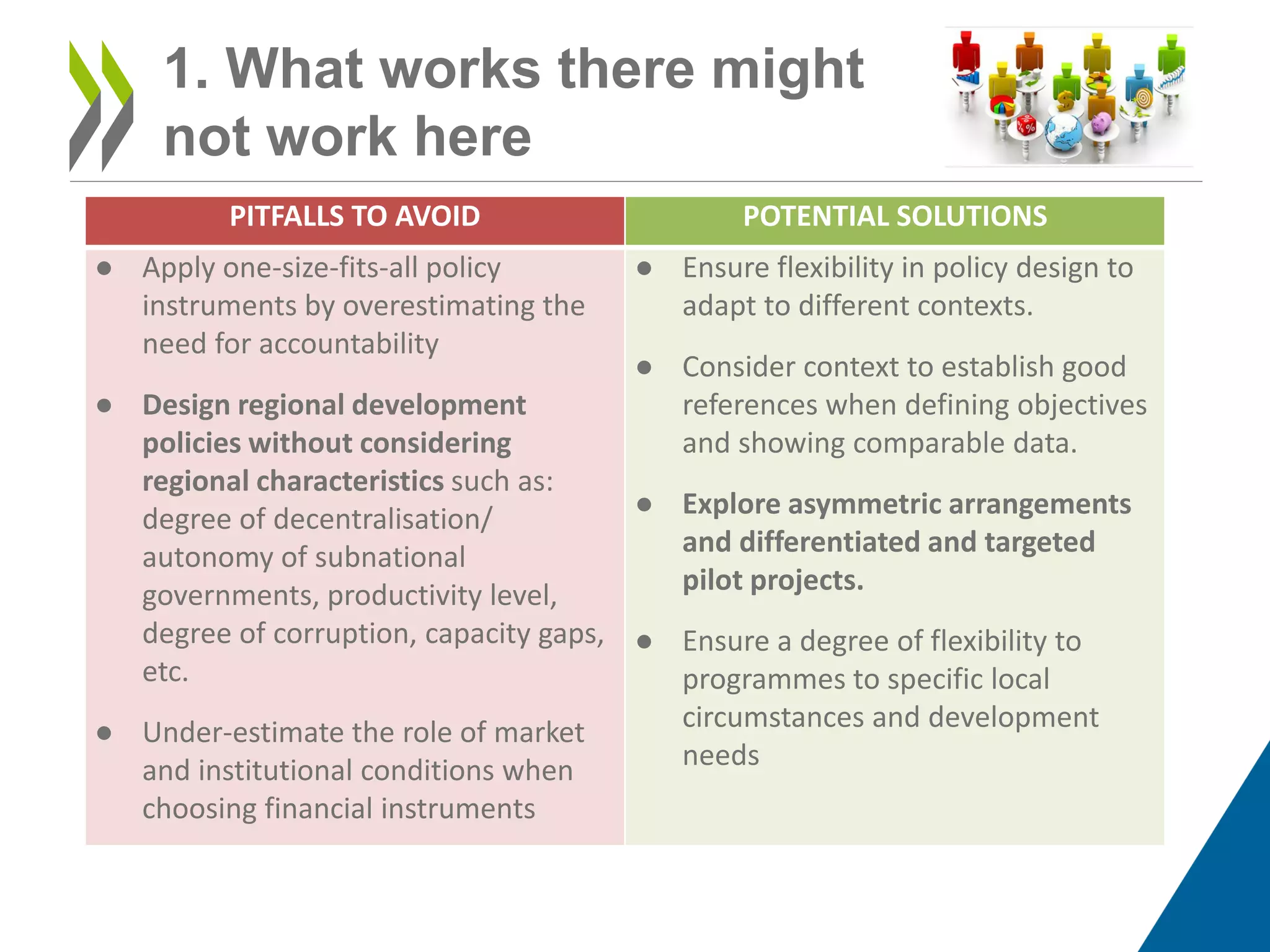
1. What works there might
not work here
PITFALLS TO AVOID POTENTIAL SOLUTIONS
● Apply one-size-fits-all policy
instruments by overestimating the
need for accountability
● Design regional development
policies without considering
regional characteristics such as:
degree of decentralisation/
autonomy of subnational
governments, productivity level,
degree of corruption, capacity gaps,
etc.
● Under-estimate the role of market
and institutional conditions when
choosing financial instruments
● Ensure flexibility in policy design to
adapt to different contexts.
● Consider context to establish good
references when defining objectives
and showing comparable data.
● Explore asymmetric arrangements
and differentiated and targeted
pilot projects.
● Ensure a degree of flexibility to
programmes to specific local
circumstances and development
needs
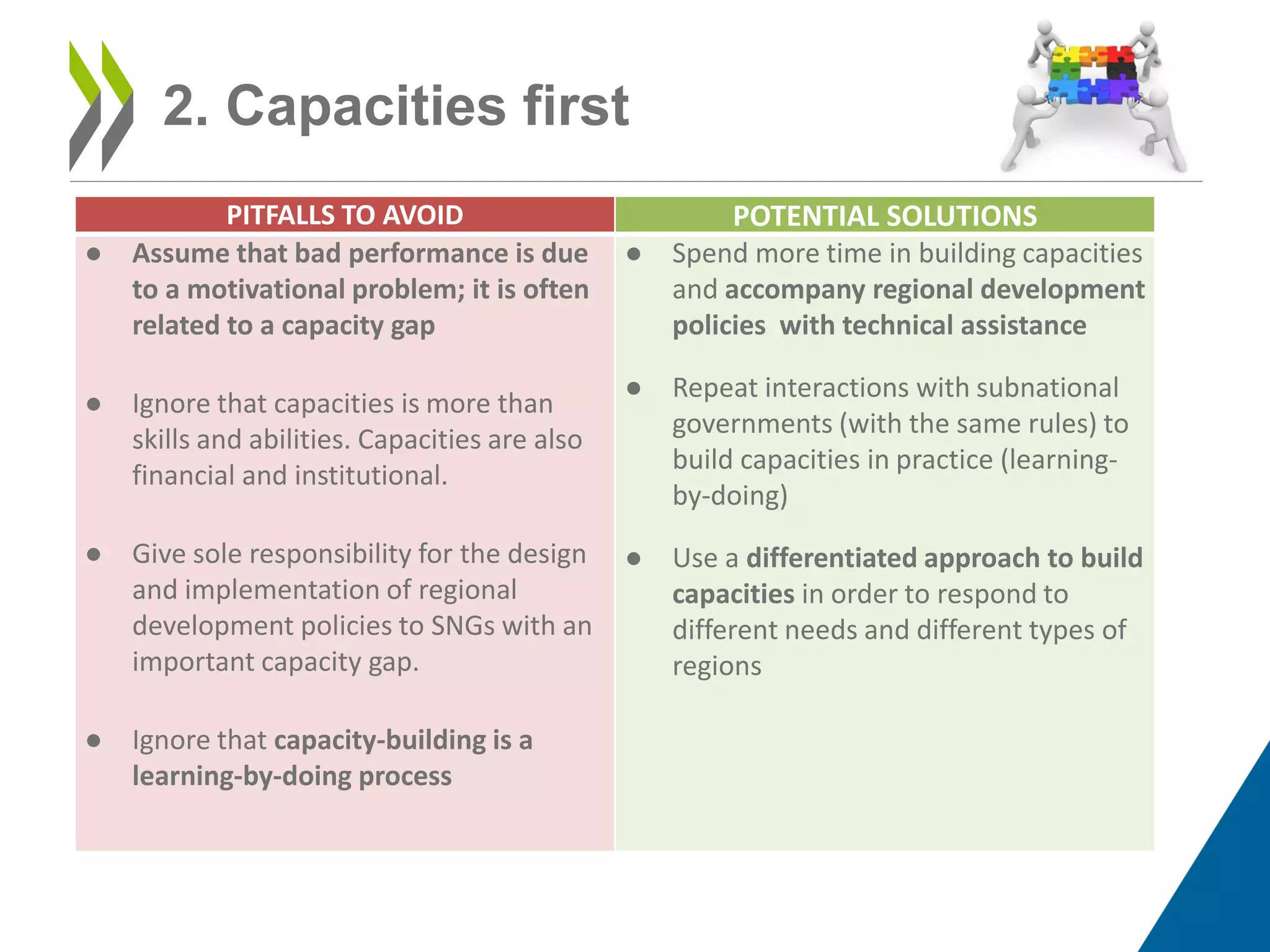
2. Capacities first
PITFALLS TO AVOID POTENTIAL SOLUTIONS
● Assume that bad performance is due
to a motivational problem; it is often
related to a capacity gap
● Ignore that capacities is more than
skills and abilities. Capacities are also
financial and institutional.
● Give sole responsibility for the design
and implementation of regional
development policies to SNGs with an
important capacity gap.
● Ignore that capacity-building is a
learning-by-doing process
● Spend more time in building capacities
and accompany regional development
policies with technical assistance
● Repeat interactions with subnational
governments (with the same rules) to
build capacities in practice (learning-
by-doing)
● Use a differentiated approach to build
capacities in order to respond to
different needs and different types of
regions
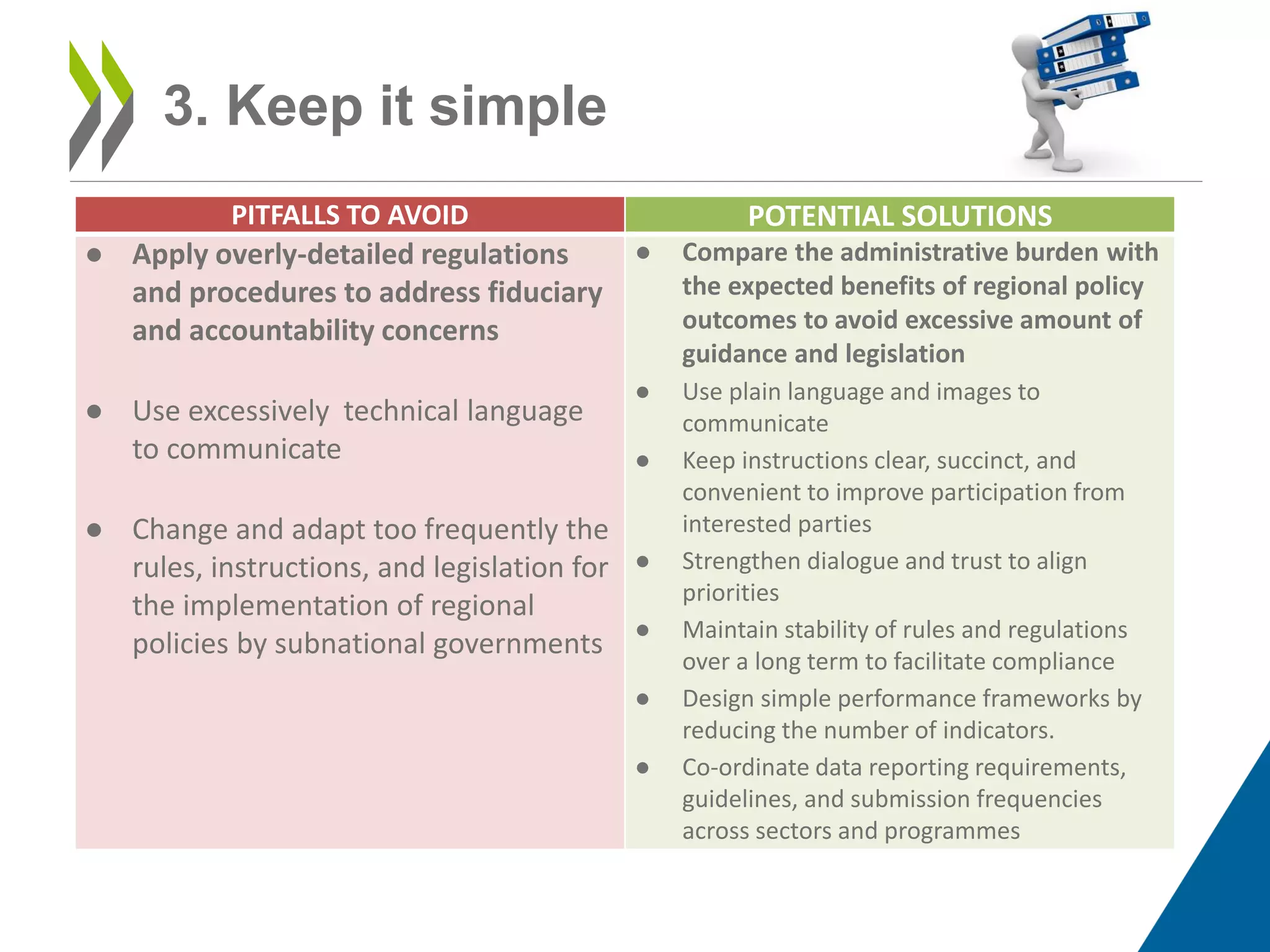
3. Keep it simple
PITFALLS TO AVOID POTENTIAL SOLUTIONS
● Apply overly-detailed regulations
and procedures to address fiduciary
and accountability concerns
● Use excessively technical language
to communicate
● Change and adapt too frequently the
rules, instructions, and legislation for
the implementation of regional
policies by subnational governments
● Compare the administrative burden with
the expected benefits of regional policy
outcomes to avoid excessive amount of
guidance and legislation
● Use plain language and images to
communicate
● Keep instructions clear, succinct, and
convenient to improve participation from
interested parties
● Strengthen dialogue and trust to align
priorities
● Maintain stability of rules and regulations
over a long term to facilitate compliance
● Design simple performance frameworks by
reducing the number of indicators.
● Co-ordinate data reporting requirements,
guidelines, and submission frequencies
across sectors and programmes
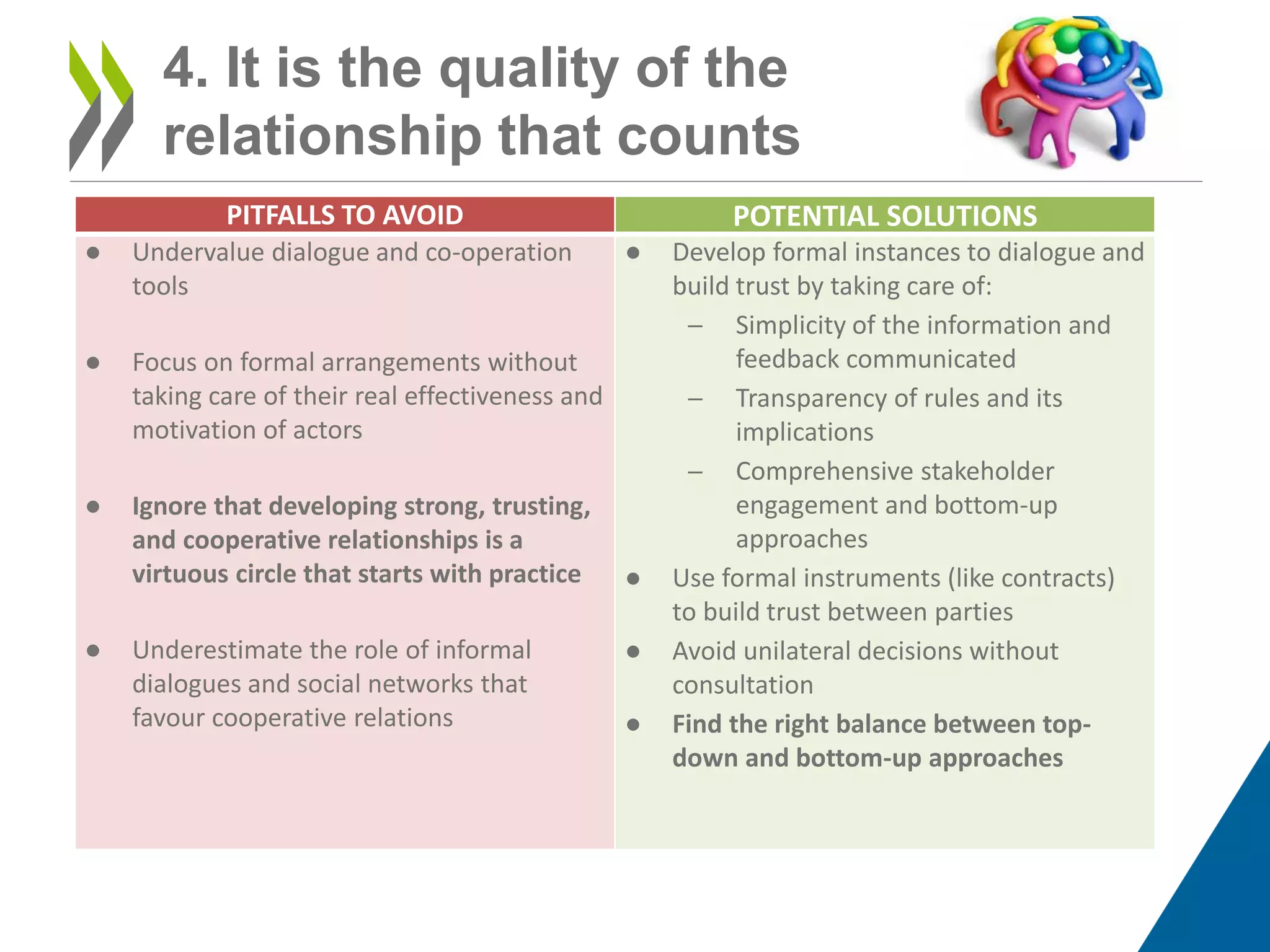
4. It is the quality of the
relationship that counts
PITFALLS TO AVOID POTENTIAL SOLUTIONS
● Undervalue dialogue and co-operation
tools
● Focus on formal arrangements without
taking care of their real effectiveness and
motivation of actors
● Ignore that developing strong, trusting,
and cooperative relationships is a
virtuous circle that starts with practice
● Underestimate the role of informal
dialogues and social networks that
favour cooperative relations
● Develop formal instances to dialogue and
build trust by taking care of:
─ Simplicity of the information and
feedback communicated
─ Transparency of rules and its
implications
─ Comprehensive stakeholder
engagement and bottom-up
approaches
● Use formal instruments (like contracts)
to build trust between parties
● Avoid unilateral decisions without
consultation
● Find the right balance between top-
down and bottom-up approaches
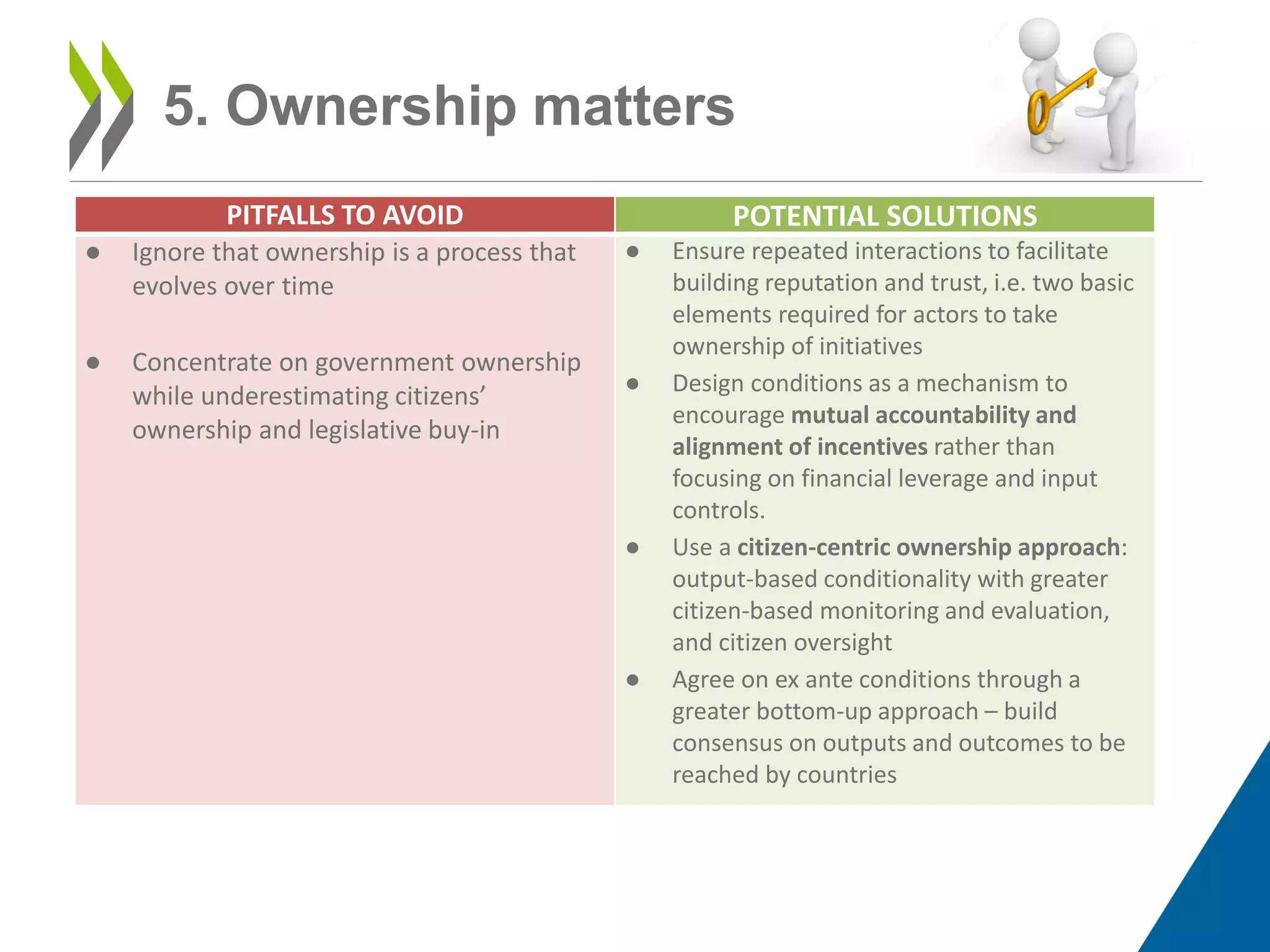
5. Ownership matters
PITFALLS TO AVOID POTENTIAL SOLUTIONS
● Ignore that ownership is a process that
evolves over time
● Concentrate on government ownership
while underestimating citizens’
ownership and legislative buy-in
● Ensure repeated interactions to facilitate
building reputation and trust, i.e. two basic
elements required for actors to take
ownership of initiatives
● Design conditions as a mechanism to
encourage mutual accountability and
alignment of incentives rather than
focusing on financial leverage and input
controls.
● Use a citizen-centric ownership approach:
output-based conditionality with greater
citizen-based monitoring and evaluation,
and citizen oversight
● Agree on ex ante conditions through a
greater bottom-up approach – build
consensus on outputs and outcomes to be
reached by countries
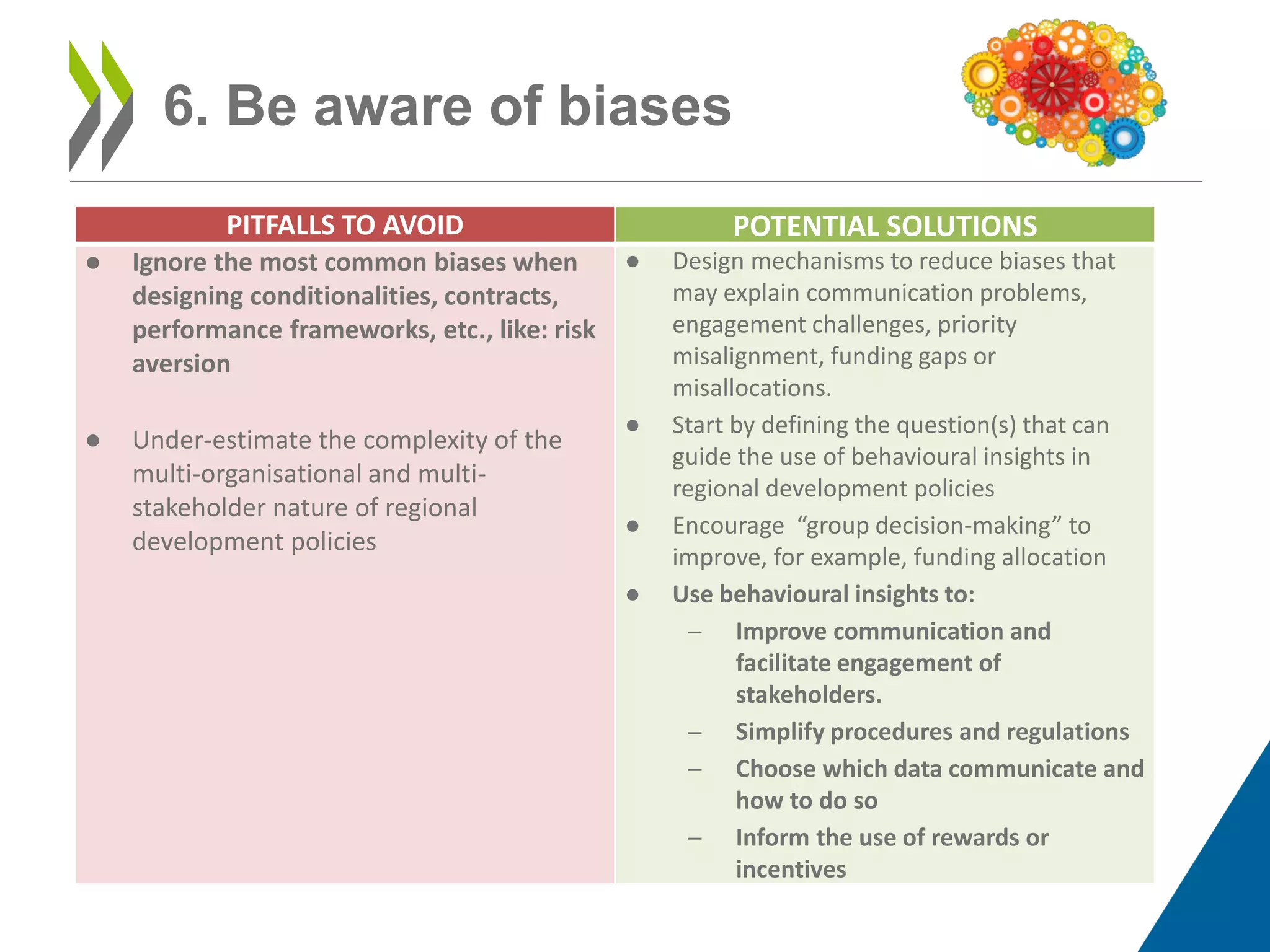
6. Be aware of biases
PITFALLS TO AVOID POTENTIAL SOLUTIONS
● Ignore the most common biases when
designing conditionalities, contracts,
performance frameworks, etc., like: risk
aversion
● Under-estimate the complexity of the
multi-organisational and multi-
stakeholder nature of regional
development policies
● Design mechanisms to reduce biases that
may explain communication problems,
engagement challenges, priority
misalignment, funding gaps or
misallocations.
● Start by defining the question(s) that can
guide the use of behavioural insights in
regional development policies
● Encourage “group decision-making” to
improve, for example, funding allocation
● Use behavioural insights to:
─ Improve communication and
facilitate engagement of
stakeholders.
─ Simplify procedures and regulations
─ Choose which data communicate and
how to do so
─ Inform the use of rewards or
incentives
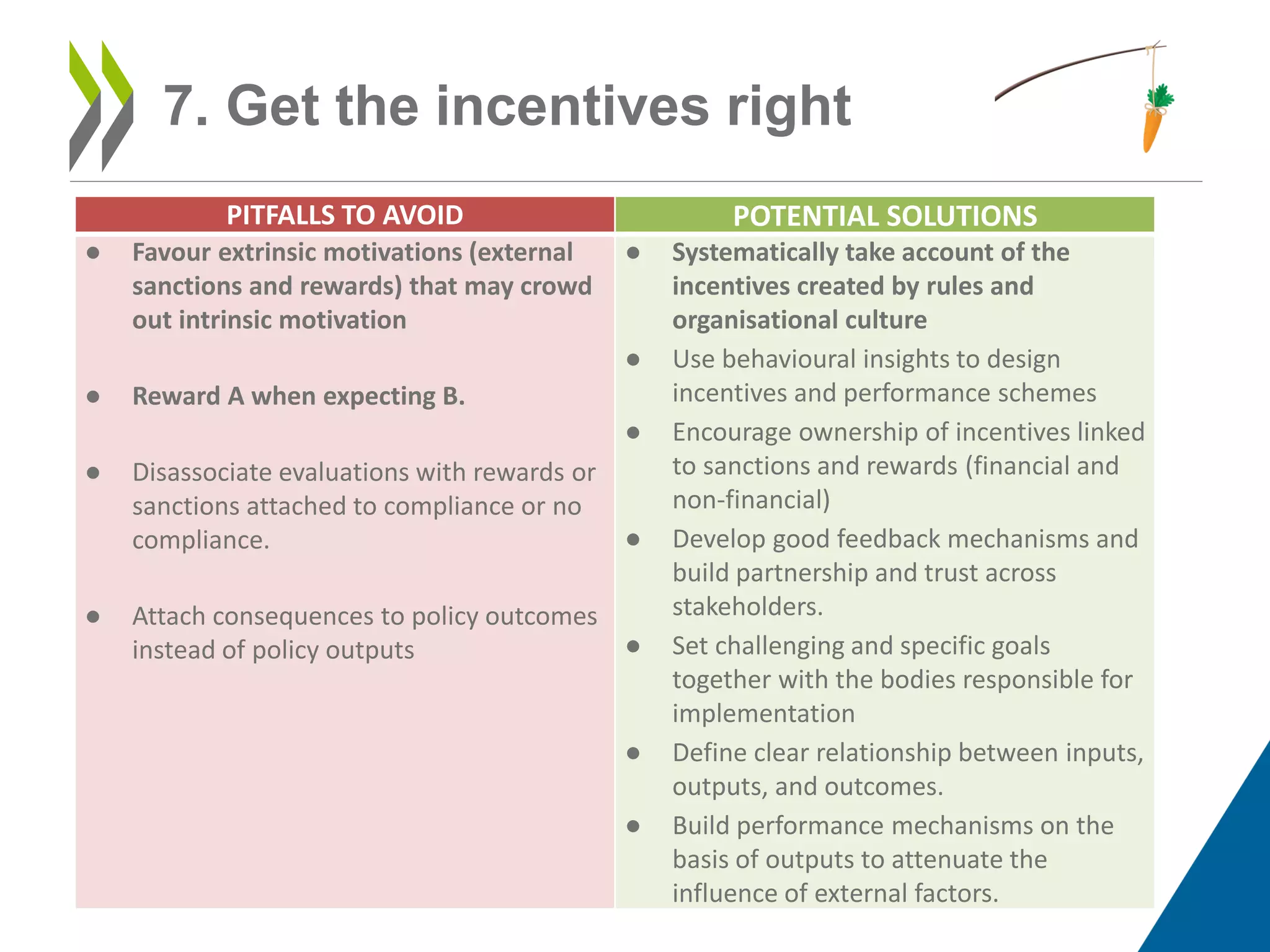
7. Get the incentives right
PITFALLS TO AVOID POTENTIAL SOLUTIONS
● Favour extrinsic motivations (external
sanctions and rewards) that may crowd
out intrinsic motivation
● Reward A when expecting B.
● Disassociate evaluations with rewards or
sanctions attached to compliance or no
compliance.
● Attach consequences to policy outcomes
instead of policy outputs
● Systematically take account of the
incentives created by rules and
organisational culture
● Use behavioural insights to design
incentives and performance schemes
● Encourage ownership of incentives linked
to sanctions and rewards (financial and
non-financial)
● Develop good feedback mechanisms and
build partnership and trust across
stakeholders.
● Set challenging and specific goals
together with the bodies responsible for
implementation
● Define clear relationship between inputs,
outputs, and outcomes.
● Build performance mechanisms on the
basis of outputs to attenuate the
influence of external factors.
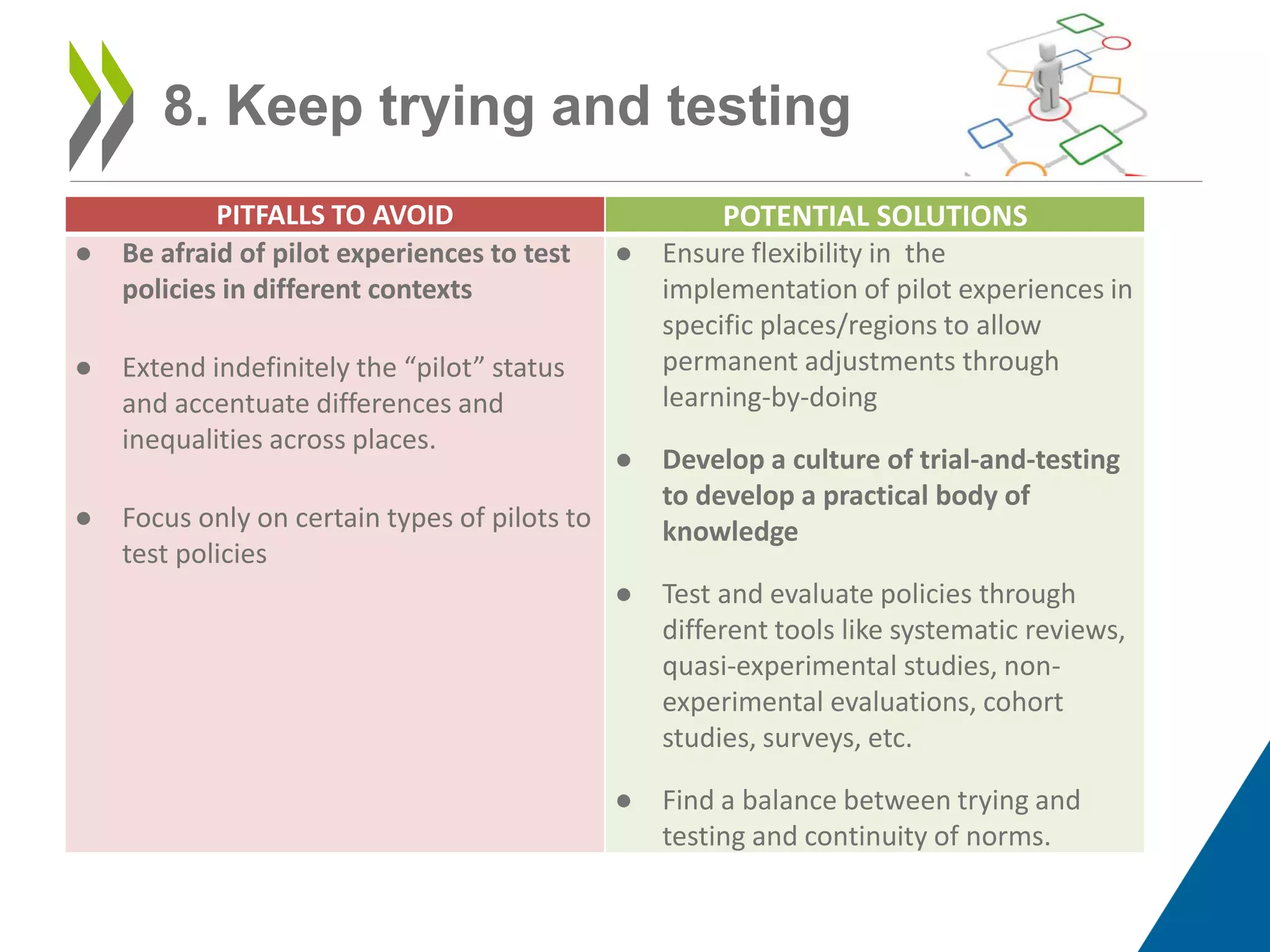
8. Keep trying and testing
PITFALLS TO AVOID POTENTIAL SOLUTIONS
● Be afraid of pilot experiences to test
policies in different contexts
● Extend indefinitely the “pilot” status
and accentuate differences and
inequalities across places.
● Focus only on certain types of pilots to
test policies
● Ensure flexibility in the
implementation of pilot experiences in
specific places/regions to allow
permanent adjustments through
learning-by-doing
● Develop a culture of trial-and-testing
to develop a practical body of
knowledge
● Test and evaluate policies through
different tools like systematic reviews,
quasi-experimental studies, non-
experimental evaluations, cohort
studies, surveys, etc.
● Find a balance between trying and
testing and continuity of norms.
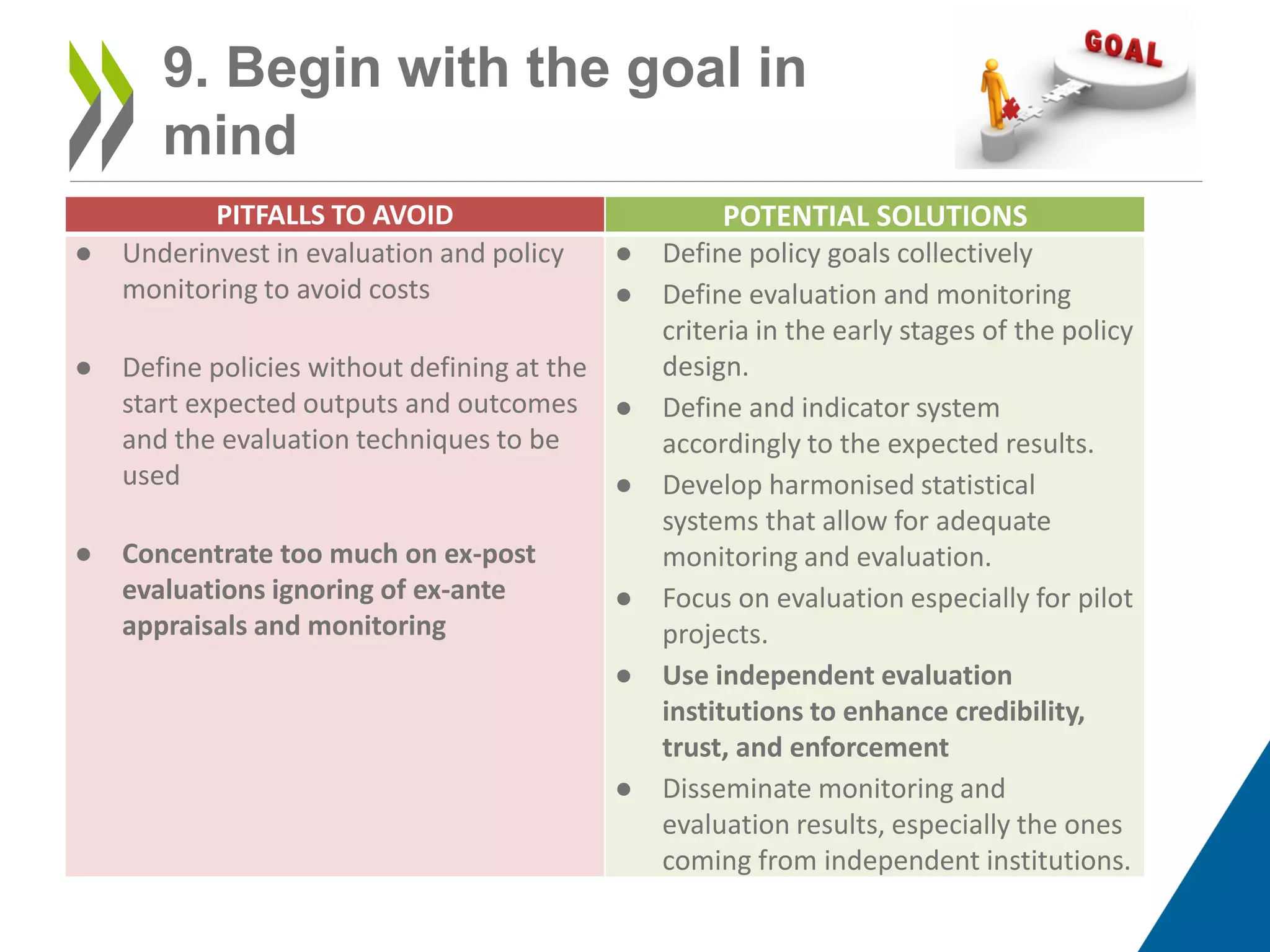
9. Begin with the goal in
mind
PITFALLS TO AVOID POTENTIAL SOLUTIONS
● Underinvest in evaluation and policy
monitoring to avoid costs
● Define policies without defining at the
start expected outputs and outcomes
and the evaluation techniques to be
used
● Concentrate too much on ex-post
evaluations ignoring of ex-ante
appraisals and monitoring
● Define policy goals collectively
● Define evaluation and monitoring
criteria in the early stages of the policy
design.
● Define and indicator system
accordingly to the expected results.
● Develop harmonised statistical
systems that allow for adequate
monitoring and evaluation.
● Focus on evaluation especially for pilot
projects.
● Use independent evaluation
institutions to enhance credibility,
trust, and enforcement
● Disseminate monitoring and
evaluation results, especially the ones
coming from independent institutions.
THANK YOU

Rethinking regional development policy-making

  • 1.
    RETHINKING REGIONAL DEVELOPMENT POLICY-MAKING LAUNCHEVENT 19 March 2018, Brussels Joaquim Oliveira Martins Special Advisor, OECD/CFE
  • 2.
    Challenges for regional andurban policy in the EU
  • 3.
    Geography of productivity convergence relative to EUfrontier in European regions, 2000-14
  • 4.
  • 5.
    How to addressthe ‘geography of discontent’? Regional GDP exported to the EU and Brexit votes in the UK Source: B. Los, P. McCann, J. Springford and M. Thissen, 2017, “The Mismatch between Local Voting and the Local Economic Consequences of Brexit”, Regional Studies, 51.5, 786-799
  • 6.
    Public investment isstill much subdued in the EU 90 100 110 120 130 140 150 160 General government State government Local government Subnational government GDP -6.1% in 2016 -2.4% / year 2008-2016 -5.9% in 2016 -2.7% / year 2008-2016 -8.8% in 2016 -3.1% / year 2008-2016 -9.4% in 2016 -3.2% / year 2008-2016 +2.0% in 2016 Change in public investment in the EU28 from 2001-2016 (real terms)
  • 7.
    The share ofpublic investment in GDP has fallen very significantly in many OECD -2.5 -2.0 -1.5 -1.0 -0.5 0.0 0.5 1.0 1.5 -2.5 -2.0 -1.5 -1.0 -0.5 0.0 0.5 1.0 1.5 Percentage points difference in Public investment/GDP between the average 2000-07 and 2015 Note: For Korea, the last available year is 2014. Source: OECD (2017a), Economic Policy Reforms 2017: Going for Growth, OECD Publishing, Paris, http://dx.doi.org/10.1787/growth-2017-en.
  • 8.
    • Focus onlinkages across the different types of regions: metropolitan areas, urban and rural regions • Assessing drivers of regional productivity catching-up related to the proximity to cities and tradable sectors • Focus on the big picture: A framework for measuring regional well-being and inclusiveness • Invest on the Multi-level Governance of regional and urban policy  OECD Recommendation on Effective Public Investment across levels of Government How does the OECD Regional Development Policy Committee address these challenges?
  • 9.
    How to improvethe design and delivery of development programmes for regions and cities?
  • 10.
    Roadmap of theEC/OECD Governance seminars on Rethinking Regional Development Policy-making
  • 11.
    Cross cutting lessonsfor practitioners 1. What works there might not work here 2. Capacities first 3. Keep it simple 4. It is the quality of the relationship that counts 5. Ownership matters 6. Be aware of biases (e.g. risk aversion) 7. Get the incentives right 8. Keep trying and testing 9. Begin with the goal in mind
  • 12.
    1. What worksthere might not work here PITFALLS TO AVOID POTENTIAL SOLUTIONS ● Apply one-size-fits-all policy instruments by overestimating the need for accountability ● Design regional development policies without considering regional characteristics such as: degree of decentralisation/ autonomy of subnational governments, productivity level, degree of corruption, capacity gaps, etc. ● Under-estimate the role of market and institutional conditions when choosing financial instruments ● Ensure flexibility in policy design to adapt to different contexts. ● Consider context to establish good references when defining objectives and showing comparable data. ● Explore asymmetric arrangements and differentiated and targeted pilot projects. ● Ensure a degree of flexibility to programmes to specific local circumstances and development needs
  • 13.
    2. Capacities first PITFALLSTO AVOID POTENTIAL SOLUTIONS ● Assume that bad performance is due to a motivational problem; it is often related to a capacity gap ● Ignore that capacities is more than skills and abilities. Capacities are also financial and institutional. ● Give sole responsibility for the design and implementation of regional development policies to SNGs with an important capacity gap. ● Ignore that capacity-building is a learning-by-doing process ● Spend more time in building capacities and accompany regional development policies with technical assistance ● Repeat interactions with subnational governments (with the same rules) to build capacities in practice (learning- by-doing) ● Use a differentiated approach to build capacities in order to respond to different needs and different types of regions
  • 14.
    3. Keep itsimple PITFALLS TO AVOID POTENTIAL SOLUTIONS ● Apply overly-detailed regulations and procedures to address fiduciary and accountability concerns ● Use excessively technical language to communicate ● Change and adapt too frequently the rules, instructions, and legislation for the implementation of regional policies by subnational governments ● Compare the administrative burden with the expected benefits of regional policy outcomes to avoid excessive amount of guidance and legislation ● Use plain language and images to communicate ● Keep instructions clear, succinct, and convenient to improve participation from interested parties ● Strengthen dialogue and trust to align priorities ● Maintain stability of rules and regulations over a long term to facilitate compliance ● Design simple performance frameworks by reducing the number of indicators. ● Co-ordinate data reporting requirements, guidelines, and submission frequencies across sectors and programmes
  • 15.
    4. It isthe quality of the relationship that counts PITFALLS TO AVOID POTENTIAL SOLUTIONS ● Undervalue dialogue and co-operation tools ● Focus on formal arrangements without taking care of their real effectiveness and motivation of actors ● Ignore that developing strong, trusting, and cooperative relationships is a virtuous circle that starts with practice ● Underestimate the role of informal dialogues and social networks that favour cooperative relations ● Develop formal instances to dialogue and build trust by taking care of: ─ Simplicity of the information and feedback communicated ─ Transparency of rules and its implications ─ Comprehensive stakeholder engagement and bottom-up approaches ● Use formal instruments (like contracts) to build trust between parties ● Avoid unilateral decisions without consultation ● Find the right balance between top- down and bottom-up approaches
  • 16.
    5. Ownership matters PITFALLSTO AVOID POTENTIAL SOLUTIONS ● Ignore that ownership is a process that evolves over time ● Concentrate on government ownership while underestimating citizens’ ownership and legislative buy-in ● Ensure repeated interactions to facilitate building reputation and trust, i.e. two basic elements required for actors to take ownership of initiatives ● Design conditions as a mechanism to encourage mutual accountability and alignment of incentives rather than focusing on financial leverage and input controls. ● Use a citizen-centric ownership approach: output-based conditionality with greater citizen-based monitoring and evaluation, and citizen oversight ● Agree on ex ante conditions through a greater bottom-up approach – build consensus on outputs and outcomes to be reached by countries
  • 17.
    6. Be awareof biases PITFALLS TO AVOID POTENTIAL SOLUTIONS ● Ignore the most common biases when designing conditionalities, contracts, performance frameworks, etc., like: risk aversion ● Under-estimate the complexity of the multi-organisational and multi- stakeholder nature of regional development policies ● Design mechanisms to reduce biases that may explain communication problems, engagement challenges, priority misalignment, funding gaps or misallocations. ● Start by defining the question(s) that can guide the use of behavioural insights in regional development policies ● Encourage “group decision-making” to improve, for example, funding allocation ● Use behavioural insights to: ─ Improve communication and facilitate engagement of stakeholders. ─ Simplify procedures and regulations ─ Choose which data communicate and how to do so ─ Inform the use of rewards or incentives
  • 18.
    7. Get theincentives right PITFALLS TO AVOID POTENTIAL SOLUTIONS ● Favour extrinsic motivations (external sanctions and rewards) that may crowd out intrinsic motivation ● Reward A when expecting B. ● Disassociate evaluations with rewards or sanctions attached to compliance or no compliance. ● Attach consequences to policy outcomes instead of policy outputs ● Systematically take account of the incentives created by rules and organisational culture ● Use behavioural insights to design incentives and performance schemes ● Encourage ownership of incentives linked to sanctions and rewards (financial and non-financial) ● Develop good feedback mechanisms and build partnership and trust across stakeholders. ● Set challenging and specific goals together with the bodies responsible for implementation ● Define clear relationship between inputs, outputs, and outcomes. ● Build performance mechanisms on the basis of outputs to attenuate the influence of external factors.
  • 19.
    8. Keep tryingand testing PITFALLS TO AVOID POTENTIAL SOLUTIONS ● Be afraid of pilot experiences to test policies in different contexts ● Extend indefinitely the “pilot” status and accentuate differences and inequalities across places. ● Focus only on certain types of pilots to test policies ● Ensure flexibility in the implementation of pilot experiences in specific places/regions to allow permanent adjustments through learning-by-doing ● Develop a culture of trial-and-testing to develop a practical body of knowledge ● Test and evaluate policies through different tools like systematic reviews, quasi-experimental studies, non- experimental evaluations, cohort studies, surveys, etc. ● Find a balance between trying and testing and continuity of norms.
  • 20.
    9. Begin withthe goal in mind PITFALLS TO AVOID POTENTIAL SOLUTIONS ● Underinvest in evaluation and policy monitoring to avoid costs ● Define policies without defining at the start expected outputs and outcomes and the evaluation techniques to be used ● Concentrate too much on ex-post evaluations ignoring of ex-ante appraisals and monitoring ● Define policy goals collectively ● Define evaluation and monitoring criteria in the early stages of the policy design. ● Define and indicator system accordingly to the expected results. ● Develop harmonised statistical systems that allow for adequate monitoring and evaluation. ● Focus on evaluation especially for pilot projects. ● Use independent evaluation institutions to enhance credibility, trust, and enforcement ● Disseminate monitoring and evaluation results, especially the ones coming from independent institutions.
  • 21.