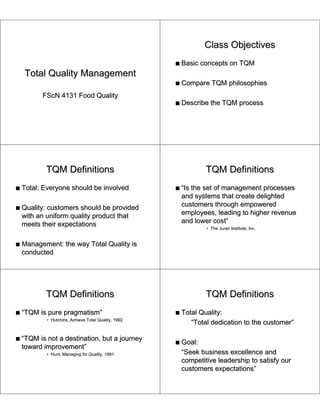
Class Objectives
                                                      s   Basic concepts on TQM
    Total Quality Management
                                                      s   Compare TQM philosophies
          FScN 4131 Food Quality
                                                      s   Describe the TQM process


            TQM Definitions                                       TQM Definitions
s   Total: Everyone should be involved                s   “Is the set of management processes
                                                          and systems that create delighted
s   Quality: customers should be provided                 customers through empowered
    with an uniform quality product that                  employees, leading to higher revenue
    meets their expectations                              and lower cost”
                                                                  • The Juran Institute, Inc.


s   Management: the way Total Quality is
    conducted


            TQM Definitions                                       TQM Definitions
s   “TQM is pure pragmatism”                          s   Total Quality:
            • Hutchins, Achieve Total Quality, 1992
                                                             “Total dedication to the customer”

s   “TQM is not a destination, but a journey
                                                      s   Goal:
    toward improvement”
            • Hunt, Managing for Quality, 1991            “Seek business excellence and
                                                          competitive leadership to satisfy our
                                                          customers expectations”
TQM Pre-requisites                              TQM Principles
s Leadership from the top                    s Commitment of everybody in the
s Effective management of the cost of          organization
  quality                                    s The company’s success depends on the
s Focus on customer satisfaction               participation of everybody
s Continuous improvement in all aspects      s Opportunities for complete participation
  of all operations                            by everybody
s Complete involvement of everyone in        s Opportunities to do their job properly
  quality improvement


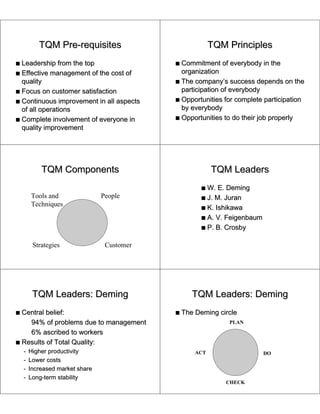
            TQM Components                                 TQM Leaders
                                                       s W. E. Deming
        Tools and                People                s J. M. Juran
        Techniques
                                                       s K. Ishikawa
                                                       s A. V. Feigenbaum
                                                       s P. B. Crosby


         Strategies               Customer


         TQM Leaders: Deming                        TQM Leaders: Deming
s Central belief:                            s   The Deming circle
    94% of problems due to management                          PLAN

    6% ascribed to workers
s Results of Total Quality:
    -   Higher productivity                          ACT                    DO
    -   Lower costs
    -   Increased market share
    -   Long-term stability
        Long-
                                                              CHECK
TQM Leaders: Deming                          TQM Leaders: Deming
s 14 point plan for Western management:        s 14 point plan for Western management:
1. Constancy of purpose                        8. Drive out fear
2. The new philosophy                          9. Break down barriers
3. Cease mass inspection                       10. Eliminate exhortations
4. End “lowest price” purchasing               11. Eliminate targets
5. Constantly improve systems                  12. Permit pride of workmanship
6. Train everyone                              13. Encourage education
7. Institute leadership                        14. Top management’s commitment


         TQM Leaders: Juran                          TQM Leaders: Juran
                                                s 7-Step program:
s   Management is responsible for quality       1. Establish quality policies and guides
    failure and quality improvement
                                                2. Establish quality goals
                                                3. Design quality plans to reach those goals
s   Philosophical trilogy: quality planning,
    quality control and quality improvement     4. Assign responsibility for the plans
                                                5. Provide necessary resources
s   Introduces the term “internal customers”    6. Review progress against goals
                                                7. Evaluate manager performance vs. goals


    TQM Leaders: Feigenbaum                        TQM Leaders: Feigenbaum
 s Control has 4 steps:                         s 10 benchmarks of Quality:
 1. Setting quality standards                   1. Q is a company-wide process
 2. Appraising conformance to standards         2. Q is what the customer says it is
 3. Acting when the standards are               3. Q and cost are a sum not a difference
   exceeded                                     4. Requires individual and teamwork
 4. Planning for improvement in the             5. Q is a way of managing
   standards
TQM Leaders: Feigenbaum                           TQM Leaders: Crosby
s 10 benchmarks of Quality:                     s 5 absolutes of quality:
6. Q and innovation are mutually dependent      1. Quality means conformance, not
7. Q is an ethic                                  goodness or elegance
8. Requires continuous improvement              2. There is no such thing as a quality
9. Is the most cost-effective, least capital-     problem
  intensive route to productivity               3. It is always cheaper to do the job right
10. Is implemented with a total system            the first time
  connected with customers and suppliers


      TQM Leaders: Crosby                             TQM Leaders: Crosby
s 5 absolutes of quality:                       s 14-step process:
4. Cost of quality is the only measure of       1. Management commitment
  performance                                   2. Quality improvement team
5. Zero defects is the only performance         3. Quality measurement
  standard                                      4. Cost of quality
                                                5. Quality awareness
                                                6. Corrective action
                                                7. Zero defects


      TQM Leaders: Crosby                           TQM Leaders: Comparison
s 14-step process:
                                                s All but Crosby rely on Statistics
8. Training
                                                s Deming, Juran and Ishikawa blame
9. Zero defects day
                                                  management for the lack of quality,
10. Goal setting                                  Crosby blames workers.
11. Error cause removal                         s Zero defects: Crosby in favor, Deming
12. Recognition                                   against it
13. Quality councils
14. Do it over again
Vision

                             Commitment
                                                                          TQM Process: Management Commitment
                            Quality Council               Quality audit

 Recognition                  Education                                   s Vital for TQM
                             Organization                                 s Should be visible and by example
                                                                          s Should be transmitted to each
                            Quality improvement     Quality cost
Awareness      Training
                            teams                   measurement
                                                                            employee
                                                                          s Ultimate goal: satisfy customers!
                                                  Target identification
                             Investigation                                s May need selling arguments
                                                     Goal setting
                            Corrective action

                          Quality Improvement


                TQM Process: Quality Council                                        TQM Process: Education

     s Coordinates all corporate efforts to TQM                           s On the business’ own interpretation and
     s Members from each unit of the                                        implementation of TQM
       company                                                            s Will require continuity
     s Develops strategic plans                                           s Needs to define who, what, how, how
     s Addresses key questions for                                          much, and who is responsible
       implementation                                                     s Re-education is necessary
     s Responsible of the TQM Mission
       Statement


                  TQM Process: Organization                               TQM Process: Quality cost measurement

     s   Using the company’s structure an
         organization for quality should be                               s   Methods to measure, document and
         developed based on:
                                                                              analyze the cost of quality are required
         -   Objectives
         -   Delegation
         -   Accountability
         -   Achievement measurement
         -   Efficient communication
TQM Process: Training                             TQM Process: Training


s   What is the difference between                s   Thorough learning of tools and
    Education and Training?                           techniques for quality improvement


                                                          TQM Process: Quality improvement
        TQM Process: Target identification
                                                                   teams (QIT)

s   Identify areas of priority                    s Functions:
                                                  1. Implement unit TQM
s   Including goals to achieve                    2. Solve problems identified by goal
                                                    setting
                                                  3. Address local issues


        TQM Process: Quality improvement                   TQM Process: Investigation and
                 teams (QIT)                                     corrective action

    s   Characteristics                               s   To reach the targets, the QIT should set
        - Intradepartmental                               a system of:
        - Membership is open based on knowledge           - Procedures
          of the operation                                - Forms
        - The leader should know the business             - Documentation
        - Membership is finite
TQM Process: Quality Audit                          TQM Process: Awareness

s Feedback mechanism of TQM                            s Continuous communication about the
s Conducted by the quality council or                    TQM status and advances
  senior managers                                      s Employs communication tools
s Goals:                                               s Compatible with the company’s culture
    -   Verify reported quality improvements
    -   Verify the achievement of goals
    -   Confirm that improvements match targets


         TQM Process: Recognition                             TQM Discussion


s Achievements of individuals and groups          s   How would you decide which philosophy
  should be made public                               or system to use?
s Financial rewards should be included

Tqm

  • 1.
    Class Objectives s Basic concepts on TQM Total Quality Management s Compare TQM philosophies FScN 4131 Food Quality s Describe the TQM process TQM Definitions TQM Definitions s Total: Everyone should be involved s “Is the set of management processes and systems that create delighted s Quality: customers should be provided customers through empowered with an uniform quality product that employees, leading to higher revenue meets their expectations and lower cost” • The Juran Institute, Inc. s Management: the way Total Quality is conducted TQM Definitions TQM Definitions s “TQM is pure pragmatism” s Total Quality: • Hutchins, Achieve Total Quality, 1992 “Total dedication to the customer” s “TQM is not a destination, but a journey s Goal: toward improvement” • Hunt, Managing for Quality, 1991 “Seek business excellence and competitive leadership to satisfy our customers expectations”
  • 2.
    TQM Pre-requisites TQM Principles s Leadership from the top s Commitment of everybody in the s Effective management of the cost of organization quality s The company’s success depends on the s Focus on customer satisfaction participation of everybody s Continuous improvement in all aspects s Opportunities for complete participation of all operations by everybody s Complete involvement of everyone in s Opportunities to do their job properly quality improvement TQM Components TQM Leaders s W. E. Deming Tools and People s J. M. Juran Techniques s K. Ishikawa s A. V. Feigenbaum s P. B. Crosby Strategies Customer TQM Leaders: Deming TQM Leaders: Deming s Central belief: s The Deming circle 94% of problems due to management PLAN 6% ascribed to workers s Results of Total Quality: - Higher productivity ACT DO - Lower costs - Increased market share - Long-term stability Long- CHECK
  • 3.
    TQM Leaders: Deming TQM Leaders: Deming s 14 point plan for Western management: s 14 point plan for Western management: 1. Constancy of purpose 8. Drive out fear 2. The new philosophy 9. Break down barriers 3. Cease mass inspection 10. Eliminate exhortations 4. End “lowest price” purchasing 11. Eliminate targets 5. Constantly improve systems 12. Permit pride of workmanship 6. Train everyone 13. Encourage education 7. Institute leadership 14. Top management’s commitment TQM Leaders: Juran TQM Leaders: Juran s 7-Step program: s Management is responsible for quality 1. Establish quality policies and guides failure and quality improvement 2. Establish quality goals 3. Design quality plans to reach those goals s Philosophical trilogy: quality planning, quality control and quality improvement 4. Assign responsibility for the plans 5. Provide necessary resources s Introduces the term “internal customers” 6. Review progress against goals 7. Evaluate manager performance vs. goals TQM Leaders: Feigenbaum TQM Leaders: Feigenbaum s Control has 4 steps: s 10 benchmarks of Quality: 1. Setting quality standards 1. Q is a company-wide process 2. Appraising conformance to standards 2. Q is what the customer says it is 3. Acting when the standards are 3. Q and cost are a sum not a difference exceeded 4. Requires individual and teamwork 4. Planning for improvement in the 5. Q is a way of managing standards
  • 4.
    TQM Leaders: Feigenbaum TQM Leaders: Crosby s 10 benchmarks of Quality: s 5 absolutes of quality: 6. Q and innovation are mutually dependent 1. Quality means conformance, not 7. Q is an ethic goodness or elegance 8. Requires continuous improvement 2. There is no such thing as a quality 9. Is the most cost-effective, least capital- problem intensive route to productivity 3. It is always cheaper to do the job right 10. Is implemented with a total system the first time connected with customers and suppliers TQM Leaders: Crosby TQM Leaders: Crosby s 5 absolutes of quality: s 14-step process: 4. Cost of quality is the only measure of 1. Management commitment performance 2. Quality improvement team 5. Zero defects is the only performance 3. Quality measurement standard 4. Cost of quality 5. Quality awareness 6. Corrective action 7. Zero defects TQM Leaders: Crosby TQM Leaders: Comparison s 14-step process: s All but Crosby rely on Statistics 8. Training s Deming, Juran and Ishikawa blame 9. Zero defects day management for the lack of quality, 10. Goal setting Crosby blames workers. 11. Error cause removal s Zero defects: Crosby in favor, Deming 12. Recognition against it 13. Quality councils 14. Do it over again
  • 5.
    Vision Commitment TQM Process: Management Commitment Quality Council Quality audit Recognition Education s Vital for TQM Organization s Should be visible and by example s Should be transmitted to each Quality improvement Quality cost Awareness Training teams measurement employee s Ultimate goal: satisfy customers! Target identification Investigation s May need selling arguments Goal setting Corrective action Quality Improvement TQM Process: Quality Council TQM Process: Education s Coordinates all corporate efforts to TQM s On the business’ own interpretation and s Members from each unit of the implementation of TQM company s Will require continuity s Develops strategic plans s Needs to define who, what, how, how s Addresses key questions for much, and who is responsible implementation s Re-education is necessary s Responsible of the TQM Mission Statement TQM Process: Organization TQM Process: Quality cost measurement s Using the company’s structure an organization for quality should be s Methods to measure, document and developed based on: analyze the cost of quality are required - Objectives - Delegation - Accountability - Achievement measurement - Efficient communication
  • 6.
    TQM Process: Training TQM Process: Training s What is the difference between s Thorough learning of tools and Education and Training? techniques for quality improvement TQM Process: Quality improvement TQM Process: Target identification teams (QIT) s Identify areas of priority s Functions: 1. Implement unit TQM s Including goals to achieve 2. Solve problems identified by goal setting 3. Address local issues TQM Process: Quality improvement TQM Process: Investigation and teams (QIT) corrective action s Characteristics s To reach the targets, the QIT should set - Intradepartmental a system of: - Membership is open based on knowledge - Procedures of the operation - Forms - The leader should know the business - Documentation - Membership is finite
  • 7.
    TQM Process: QualityAudit TQM Process: Awareness s Feedback mechanism of TQM s Continuous communication about the s Conducted by the quality council or TQM status and advances senior managers s Employs communication tools s Goals: s Compatible with the company’s culture - Verify reported quality improvements - Verify the achievement of goals - Confirm that improvements match targets TQM Process: Recognition TQM Discussion s Achievements of individuals and groups s How would you decide which philosophy should be made public or system to use? s Financial rewards should be included