Toyota Kata Journey 
La-Z-Boy Tennessee, Dayton, TN 
Maryland World Class Consortia 
Hank Czarnecki – LeanHank@Auburn.edu 
October 2014
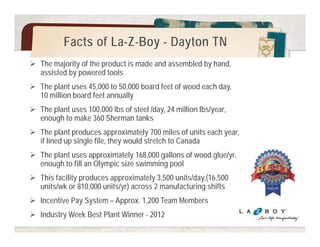
Facts of La-Z-Boy - Dayton TN 
 The majority of the product is made and assembled by hand, 
assisted by powered tools 
 The plant uses 45,000 to 50,000 board feet of wood each day, 
10 million board feet annually 
 The plant uses 100,000 lbs of steel /day, 24 million lbs/year, 
enough to make 360 Sherman tanks 
 The plant produces approximately 700 miles of units each year, 
if lined up single file, they would stretch to Canada 
 The plant uses approximately 168,000 gallons of wood glue/yr, 
enough to fill an Olympic size swimming pool 
 This facility produces approximately 3,500 units/day,(16,500 
units/wk or 810,000 units/yr) across 2 manufacturing shifts 
 Incentive Pay System – Approx. 1,200 Team Members 
 Industry Week Best Plant Winner - 2012
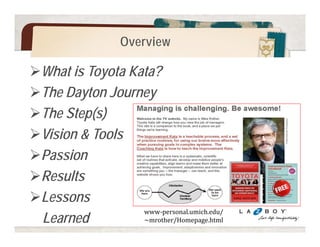
Overview 
What is Toyota Kata? 
The Dayton Journey 
The Step(s) 
Vision & Tools 
Passion 
Results 
Lessons 
Learned www-personal.umich.edu/ 
~mrother/Homepage.html
Toyota Kata in 16 Languages
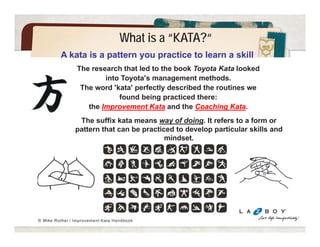
What is a KATA? 
A kata is a pattern you practice to learn a skill 
The research that led to the book Toyota Kata looked 
into Toyota's management methods. 
The word 'kata' perfectly described the routines we 
found being practiced there: 
the Improvement Kata and the Coaching Kata. 
The suffix kata means way of doing. It refers to a form or 
pattern that can be practiced to develop particular skills and 
mindset. 
© Mike Rother / Improvement Kata Handbook
Begin by practicing it this way for a while
What is Toyota Kata? 
 It's a systematic approach to: 
A. Generate Continuous Improvement & 
B. Develop Strong Problem Solvers 
 Combines a scientific pattern with techniques of 
deliberate practice 
 Doing small things on a daily basis to improve a 
process toward a next 'target condition' 
Working toward the target condition by overcoming 
the next obstacle in front of you 
 Kata is a continuous journey that never ends
Improvement Implementation 
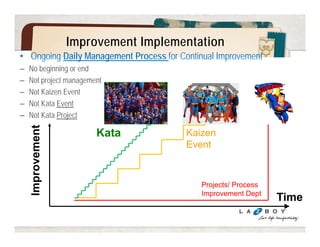
• Ongoing Daily Management Process for Continual Improvement 
– No beginning or end 
– Not project management 
– Not Kaizen Event 
– Not Kata Event 
– Not Kata Project
Escalator video
House of Lean
Balanced??
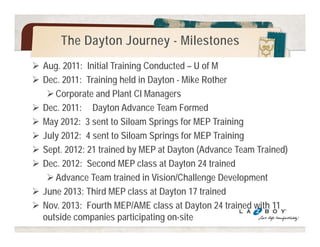
The Dayton Journey - Milestones 
 Aug. 2011: Initial Training Conducted - U of M 
 Dec. 2011: Training held in Dayton - Mike Rother 
 Corporate and Plant CI Managers 
 Dec. 2011: Dayton Advance Team Formed 
 May 2012: 3 sent to Siloam Springs for MEP Training 
 July 2012: 4 sent to Siloam Springs for MEP Training 
 Sept. 2012: 21 trained by MEP at Dayton (Advance Team Trained) 
 Dec. 2012: Second MEP class at Dayton 24 trained 
 Advance Team trained in Vision/Challenge Development 
 June 2013: Third MEP class at Dayton 17 trained 
 Nov. 2013: Fourth MEP/AME class at Dayton 24 trained with 11 
outside companies participating on-site
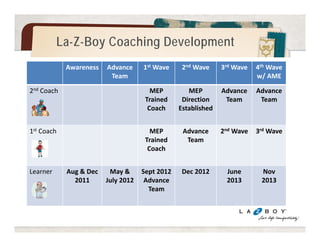
La-Z-Boy Coaching Development 
Awareness Advance 
Team 
1stWave 
Do 
2nd Wave 3rd Wave 
Teach 
4th Wave 
w/ AME 
2nd Coach MEP 
Trained 
Coach 
MEP 
Direction 
Established 
Advance 
Team 
Advance 
Team 
Evolve 
1st Coach MEP 
Trained 
Coach 
Advance 
Team 
2nd Wave 3rd Wave 
Learner Aug & Dec 
2011 
May & 
July 2012 
Sept 2012 
Advance 
Team 
Dec 2012 June 
2013 
Nov 
2013
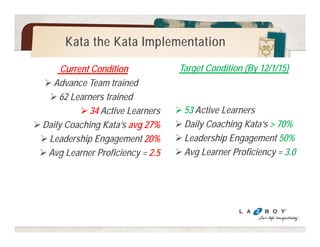
Kata the Kata Implementation 
Current Condition 
 Advance Team trained 
 62 Learners trained 
 34 Active Learners 
 Daily Coaching Kata avg 27% 
 Leadership Engagement 20% 
Avg Learner Proficiency = 2.5 
Target Condition (By 12/1/15) 
 53 Active Learners 
 Daily Coaching Kata > 70% 
 Leadership Engagement 50% 
Avg Learner Proficiency = 3.0
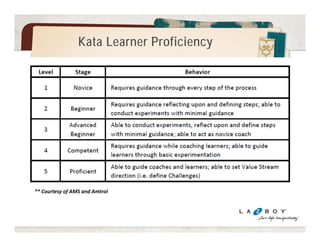
Kata Learner Proficiency
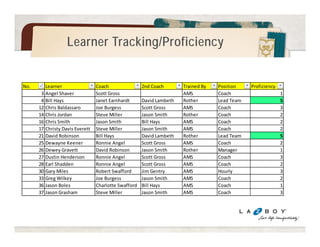
Learner Tracking/Proficiency 
No. Learner Coach 2nd Coach Trained By Position Proficiency 
3 Angel Shaver Scott Gross AMS Coach 1 
4 Bill Hays Janet Earnhardt David Lambeth Rother Lead Team 5 
12 Chris Baldassaro Joe Burgess Scott Gross AMS Coach 3 
14 Chris Jordan Steve Miller Jason Smith Rother Coach 2 
16 Chris Smith Jason Smith Bill Hays AMS Coach 2 
17 Christy Davis Everett Steve Miller Jason Smith AMS Coach 2 
21 David Robinson Bill Hays David Lambeth Rother Lead Team 5 
25 Dewayne Keener Ronnie Angel Scott Gross AMS Coach 2 
26 Dewey Gravett David Robinson Jason Smith Rother Manager 1 
27 Dustin Henderson Ronnie Angel Scott Gross AMS Coach 3 
28 Earl Shadden Ronnie Angel Scott Gross AMS Coach 2 
30 Gary Miles Robert Swafford Jim Gentry AMS Hourly 3 
33 Greg Wilkey Joe Burgess Jason Smith AMS Coach 2 
36 Jason Boles Charlotte Swafford Bill Hays AMS Coach 1 
37 Jason Grasham Steve Miller Jason Smith AMS Coach 3
The Step 
As a Company, everyone from top executives to 
the floor coaches sat in a conference room for 
hours to establish the Vision inside La-Z-Boy. 
Everyone working toward one common goal 
“Changing the Culture at La-Z-Boy” 
This was a huge step in La-Z-Boy making the 
commitment to Kata. (Dec. 2012)
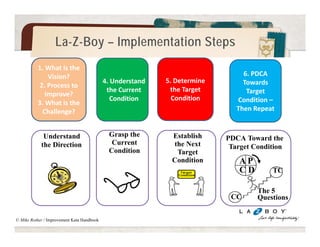
La-Z-Boy – Implementation Steps 
Understand 
the Direction 
Grasp the 
Current 
Condition 
PDCA Toward the 
Target Condition 
The 5 
Questions 
1. What is the 
Vision? 
2. Process to 
Improve? 
3. What is the 
Challenge? 
4. Understand 
the Current 
Condition 
5. Determine 
the Target 
Condition 
6. PDCA 
Towards 
Target 
Condition – 
Then Repeat 
Establish 
the Next 
Target 
Condition 
© Mike Rother / Improvement Kata Handbook
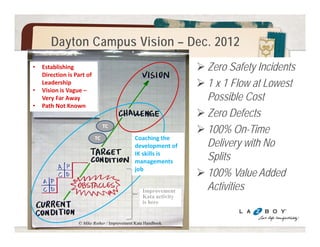
Dayton Campus Vision – Dec. 2012 
• Establishing 
Direction is Part of 
Leadership 
• Vision is Vague – 
Very Far Away 
• Path Not Known 
Improvement 
Kata activity 
is here 
TC 
TC 
Coaching the 
development of 
IK skills is 
managements 
job 
 Zero Safety Incidents 
 1 x 1 Flow at Lowest 
Possible Cost 
 Zero Defects 
 100% On-Time 
Delivery with No 
Splits 
 100% Value Added 
Activities 
© Mike Rother / Improvement Kata Handbook
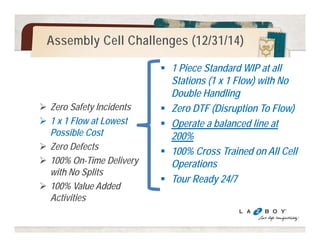
Assembly Cell Challenges (12/31/14) 
 1 Piece Standard WIP at all 
Stations (1 x 1 Flow) with No 
Double Handling 
 Zero DTF (Disruption To Flow) 
 Operate a balanced line at 
200% 
 100% Cross Trained on All Cell 
Operations 
 Tour Ready 24/7 
 Zero Safety Incidents 
 1 x 1 Flow at Lowest 
Possible Cost 
 Zero Defects 
 100% On-Time Delivery 
with No Splits 
 100% Value Added 
Activities
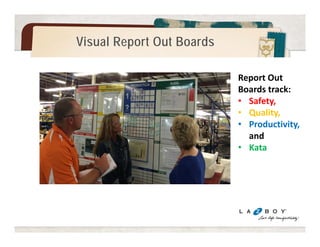
Current Condition -Visual Report Out 
Boards 
Report Out 
Boards track: 
• Safety 
• Quality 
• Productivity 
and 
• Kata 
(Coaching 
Cycles)
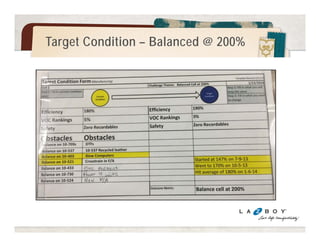
Current & Target Condition 
Balanced @ 200%
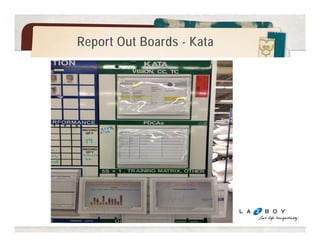
Report Out Boards - Kata
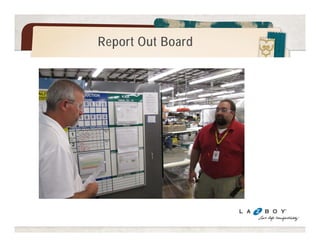
Report Out Board
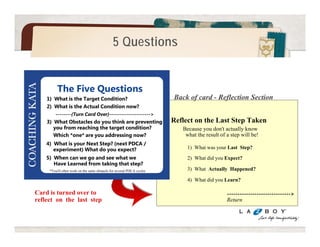
5 Questions 
Back of card - Reflection Section 
Reflect on the Last Step Taken 
Because you don't actually know 
what the result of a step will be! 
1) What was your Last Step? 
2) What did you Expect? 
3) What Actually Happened? 
4) What did you Learn? 
------------------------------> 
Return 
The Five Questions 
1) What is the Target Condition? 
2) What is the Actual Condition now? 
--------(Turn Card Over)---------------------> 
3) What Obstacles do you think are preventing 
you from reaching the target condition? 
Which *one* are you addressing now? 
4) What is your Next Step? (next PDCA / 
experiment) What do you expect? 
5) When can we go and see what we 
Have Learned from taking that step? 
*You'll often work on the same obstacle for several PDCA cycles 
Card is turned over to 
reflect on the last step
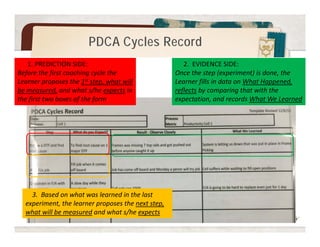
PDCA Cycles to Target Condition 
1. PREDICTION SIDE: 
Before the first coaching cycle the 
Learner proposes the 1st step, what will 
be measured, and what s/he expects in 
the first two boxes of the form 
2. EVIDENCE SIDE: 
Once the step (experiment) is done, the 
Learner fills in data on What Happened, 
reflects by comparing that with the 
expectation, and records What We Learned 
3. Based on what was learned in the last 
experiment, the learner proposes the next step, 
what will be measured and what s/he expects
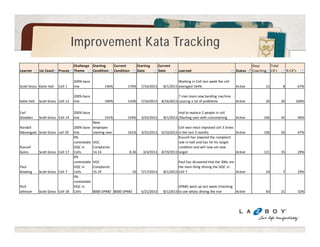
Improvement Kata Tracking 
Learner 1st Coach Process 
Challenge 
Theme 
Starting 
Condition 
Current 
Condition 
Starting 
Date 
Current 
Date Learned Status 
Days 
Coaching 
Total 
CK's % CK"s 
Scott Gross Katie Hall Cell 1 
200% base 
line 146% 170% 7/16/2013 8/1/2013 
Working in Cell last week the cell 
averaged 164% Active 12 8 67% 
Katie Hall Scott Gross Cell 12 
200% base 
line 100% 110% 7/16/2013 8/16/2013 
7 man team now banding machine 
causing a lot of probllems Active 20 20 100% 
Earl 
Shadden Scott Gross Cell 14 
200% base 
line 141% 154% 3/25/2013 8/1/2013 
Had to replace 2 people in cell 
/Starting over with crosstraining Active 106 42 40% 
Randall 
Masengale Scott Gross cell 29 
200% base 
line 
New 
employee 
starting over 161% 3/25/2013 6/10/2013 
Cell won most improved cell 3 times 
in the last 3 months Active 106 50 47% 
Russell 
Goins Scott Gross Cell 17 
0% 
controlable 
DQC in 
Cells 
VOC 
Complaints 
14.14 8.36 3/4/2013 8/19/2013 
Russell has lowered the complaint 
rate in half and has hit his target 
condition and will now set new 
target Active 121 35 29% 
Paul 
Bowling Scott Gross Cell 7 
0% 
controlable 
DQC in 
Cells 
VOC 
Complaints 
15.19 10 7/17/2013 8/1/2013 
Paul has dicovered that the 306s are 
the main thing driving the DQC in 
Cell 7 Active 24 7 29% 
Rick 
Johnson Scott Gross Cell 18 
0% 
controlable 
DQC in 
Cells 8000 DPMO 8000 DPMO 5/21/2013 8/1/2013 
DPMO went up last week /checking 
to see whats driving the rise Active 65 21 32%
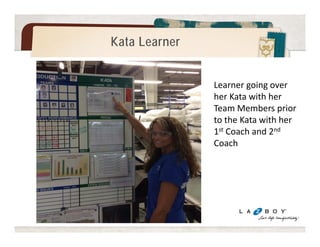
Learner 
Learner going over 
her Coaching Cycle 
with her Team 
Members prior to 
the Coaching Cycle 
with her 1st Coach 
and 2nd Coach
Coaching 
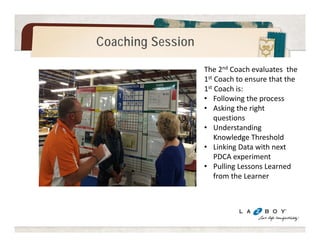
The 2nd Coach evaluates the 
1st Coach to ensure that the 
1st Coach is: 
• Following the process 
• Asking the right 
questions 
• Understanding 
Knowledge Threshold 
• Linking Data with next 
PDCA experiment 
• Pulling Lessons Learned 
from the Learner
The coach is responsible for 
teaching the improvement 
kata, and for the results 
The coach uses the coaching 
kata, asking the 5 TK 
questions 
2nd Coach Participates 
periodically Pays 
particular attention to the 
coach (coaches the coach) 
The learner and 
team use the 
improvement kata 
The team owns the 
target condition and 
works to achieve it. 
Knowledge 
Threshold
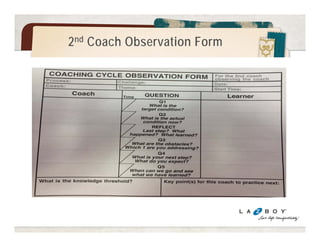
2nd Coach Observation Form
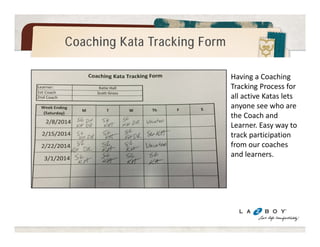
Coaching Tracking Form 
Having a Coaching 
Tracking Process for 
all active “Kata” lets 
anyone see who are 
the Coach and 
Learner. Easy way to 
track participation 
from our coaches 
and learners.
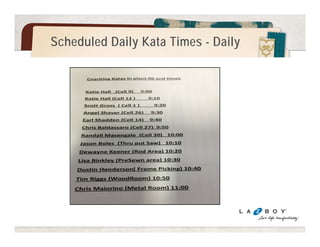
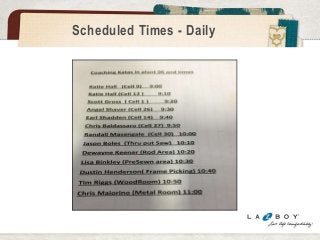
Scheduled Times - Daily
The Passion 
Finding someone to fill a role of a lead person to 
understand Kata and that can help coach Kata 
This person has to have passion in what they do 
They have to want to make a difference everyday 
they walk in the door 
Their passion and enthusiasm is what drives new 
ways of learning 
Passion is what helps change a culture
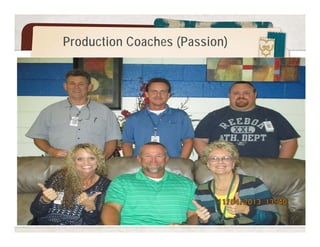
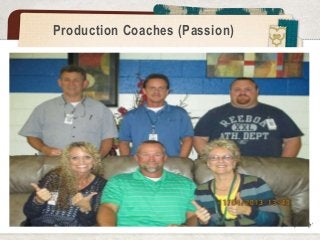
Production Coaches (Passion)
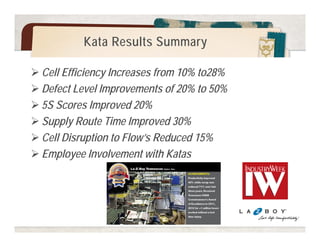
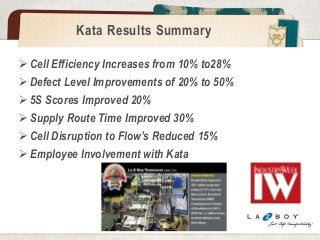
Kata Results Summary 
 Cell Efficiency Increases from 10% to28% 
 Defect Level Improvements of 20% to 50% 
 5S Scores Improved 20% 
 Supply Route Time Improved 30% 
 Cell Disruption to Flow’s Reduced 15% 
 Employee Involvement with Kata
Lessons Learned & Next Steps 
 Lessons Learned 
 Must start with Vision + Challenge 
 Don’t begin IK’s without this 
 Need alignment in Vision/Challenge/Target 
 The 2nd coach is critical to the process 
 Strong tendency to view Kata as Kaizens, as “Events” or “Projects” 
 Must focus on the Learner, not the process or “project” 
 Daily Coaching Kata are critical – this is a learning process 
 Next Steps 
 Increase Daily Coaching Cycles to embed in the culture 
 Increase top management engagement 
 Expand use to non-production areas 
 Continue to drive into the organization “DNA”
Questions? 
Hank Czarnecki 
LeanHank@Auburn.edu 
Auburn Technical Assistance Center 
www.AuburnWorks.org

Toyota Kata at La-Z-Boy

  • 1.
    Toyota Kata Journey La-Z-Boy Tennessee, Dayton, TN Maryland World Class Consortia Hank Czarnecki – LeanHank@Auburn.edu October 2014
  • 2.
    Facts of La-Z-Boy- Dayton TN  The majority of the product is made and assembled by hand, assisted by powered tools  The plant uses 45,000 to 50,000 board feet of wood each day, 10 million board feet annually  The plant uses 100,000 lbs of steel /day, 24 million lbs/year, enough to make 360 Sherman tanks  The plant produces approximately 700 miles of units each year, if lined up single file, they would stretch to Canada  The plant uses approximately 168,000 gallons of wood glue/yr, enough to fill an Olympic size swimming pool  This facility produces approximately 3,500 units/day,(16,500 units/wk or 810,000 units/yr) across 2 manufacturing shifts  Incentive Pay System – Approx. 1,200 Team Members  Industry Week Best Plant Winner - 2012
  • 3.
    Overview What isToyota Kata? The Dayton Journey The Step(s) Vision & Tools Passion Results Lessons Learned www-personal.umich.edu/ ~mrother/Homepage.html
  • 4.
    Toyota Kata in16 Languages
  • 5.
    What is aKATA? A kata is a pattern you practice to learn a skill The research that led to the book Toyota Kata looked into Toyota's management methods. The word 'kata' perfectly described the routines we found being practiced there: the Improvement Kata and the Coaching Kata. The suffix kata means way of doing. It refers to a form or pattern that can be practiced to develop particular skills and mindset. © Mike Rother / Improvement Kata Handbook
  • 6.
    Begin by practicingit this way for a while
  • 7.
    What is ToyotaKata?  It's a systematic approach to: A. Generate Continuous Improvement & B. Develop Strong Problem Solvers  Combines a scientific pattern with techniques of deliberate practice  Doing small things on a daily basis to improve a process toward a next 'target condition' Working toward the target condition by overcoming the next obstacle in front of you  Kata is a continuous journey that never ends
  • 8.
    Improvement Implementation •Ongoing Daily Management Process for Continual Improvement – No beginning or end – Not project management – Not Kaizen Event – Not Kata Event – Not Kata Project
  • 9.
  • 10.
  • 11.
  • 12.
    The Dayton Journey- Milestones  Aug. 2011: Initial Training Conducted - U of M  Dec. 2011: Training held in Dayton - Mike Rother  Corporate and Plant CI Managers  Dec. 2011: Dayton Advance Team Formed  May 2012: 3 sent to Siloam Springs for MEP Training  July 2012: 4 sent to Siloam Springs for MEP Training  Sept. 2012: 21 trained by MEP at Dayton (Advance Team Trained)  Dec. 2012: Second MEP class at Dayton 24 trained  Advance Team trained in Vision/Challenge Development  June 2013: Third MEP class at Dayton 17 trained  Nov. 2013: Fourth MEP/AME class at Dayton 24 trained with 11 outside companies participating on-site
  • 13.
    La-Z-Boy Coaching Development Awareness Advance Team 1stWave Do 2nd Wave 3rd Wave Teach 4th Wave w/ AME 2nd Coach MEP Trained Coach MEP Direction Established Advance Team Advance Team Evolve 1st Coach MEP Trained Coach Advance Team 2nd Wave 3rd Wave Learner Aug & Dec 2011 May & July 2012 Sept 2012 Advance Team Dec 2012 June 2013 Nov 2013
  • 14.
    Kata the KataImplementation Current Condition  Advance Team trained  62 Learners trained  34 Active Learners  Daily Coaching Kata avg 27%  Leadership Engagement 20% Avg Learner Proficiency = 2.5 Target Condition (By 12/1/15)  53 Active Learners  Daily Coaching Kata > 70%  Leadership Engagement 50% Avg Learner Proficiency = 3.0
  • 15.
  • 16.
    Learner Tracking/Proficiency No.Learner Coach 2nd Coach Trained By Position Proficiency 3 Angel Shaver Scott Gross AMS Coach 1 4 Bill Hays Janet Earnhardt David Lambeth Rother Lead Team 5 12 Chris Baldassaro Joe Burgess Scott Gross AMS Coach 3 14 Chris Jordan Steve Miller Jason Smith Rother Coach 2 16 Chris Smith Jason Smith Bill Hays AMS Coach 2 17 Christy Davis Everett Steve Miller Jason Smith AMS Coach 2 21 David Robinson Bill Hays David Lambeth Rother Lead Team 5 25 Dewayne Keener Ronnie Angel Scott Gross AMS Coach 2 26 Dewey Gravett David Robinson Jason Smith Rother Manager 1 27 Dustin Henderson Ronnie Angel Scott Gross AMS Coach 3 28 Earl Shadden Ronnie Angel Scott Gross AMS Coach 2 30 Gary Miles Robert Swafford Jim Gentry AMS Hourly 3 33 Greg Wilkey Joe Burgess Jason Smith AMS Coach 2 36 Jason Boles Charlotte Swafford Bill Hays AMS Coach 1 37 Jason Grasham Steve Miller Jason Smith AMS Coach 3
  • 17.
    The Step Asa Company, everyone from top executives to the floor coaches sat in a conference room for hours to establish the Vision inside La-Z-Boy. Everyone working toward one common goal “Changing the Culture at La-Z-Boy” This was a huge step in La-Z-Boy making the commitment to Kata. (Dec. 2012)
  • 18.
    La-Z-Boy – ImplementationSteps Understand the Direction Grasp the Current Condition PDCA Toward the Target Condition The 5 Questions 1. What is the Vision? 2. Process to Improve? 3. What is the Challenge? 4. Understand the Current Condition 5. Determine the Target Condition 6. PDCA Towards Target Condition – Then Repeat Establish the Next Target Condition © Mike Rother / Improvement Kata Handbook
  • 19.
    Dayton Campus Vision– Dec. 2012 • Establishing Direction is Part of Leadership • Vision is Vague – Very Far Away • Path Not Known Improvement Kata activity is here TC TC Coaching the development of IK skills is managements job  Zero Safety Incidents  1 x 1 Flow at Lowest Possible Cost  Zero Defects  100% On-Time Delivery with No Splits  100% Value Added Activities © Mike Rother / Improvement Kata Handbook
  • 20.
    Assembly Cell Challenges(12/31/14)  1 Piece Standard WIP at all Stations (1 x 1 Flow) with No Double Handling  Zero DTF (Disruption To Flow)  Operate a balanced line at 200%  100% Cross Trained on All Cell Operations  Tour Ready 24/7  Zero Safety Incidents  1 x 1 Flow at Lowest Possible Cost  Zero Defects  100% On-Time Delivery with No Splits  100% Value Added Activities
  • 21.
    Current Condition -VisualReport Out Boards Report Out Boards track: • Safety • Quality • Productivity and • Kata (Coaching Cycles)
  • 22.
    Current & TargetCondition Balanced @ 200%
  • 23.
  • 24.
  • 25.
    5 Questions Backof card - Reflection Section Reflect on the Last Step Taken Because you don't actually know what the result of a step will be! 1) What was your Last Step? 2) What did you Expect? 3) What Actually Happened? 4) What did you Learn? ------------------------------> Return The Five Questions 1) What is the Target Condition? 2) What is the Actual Condition now? --------(Turn Card Over)---------------------> 3) What Obstacles do you think are preventing you from reaching the target condition? Which *one* are you addressing now? 4) What is your Next Step? (next PDCA / experiment) What do you expect? 5) When can we go and see what we Have Learned from taking that step? *You'll often work on the same obstacle for several PDCA cycles Card is turned over to reflect on the last step
  • 26.
    PDCA Cycles toTarget Condition 1. PREDICTION SIDE: Before the first coaching cycle the Learner proposes the 1st step, what will be measured, and what s/he expects in the first two boxes of the form 2. EVIDENCE SIDE: Once the step (experiment) is done, the Learner fills in data on What Happened, reflects by comparing that with the expectation, and records What We Learned 3. Based on what was learned in the last experiment, the learner proposes the next step, what will be measured and what s/he expects
  • 27.
    Improvement Kata Tracking Learner 1st Coach Process Challenge Theme Starting Condition Current Condition Starting Date Current Date Learned Status Days Coaching Total CK's % CK"s Scott Gross Katie Hall Cell 1 200% base line 146% 170% 7/16/2013 8/1/2013 Working in Cell last week the cell averaged 164% Active 12 8 67% Katie Hall Scott Gross Cell 12 200% base line 100% 110% 7/16/2013 8/16/2013 7 man team now banding machine causing a lot of probllems Active 20 20 100% Earl Shadden Scott Gross Cell 14 200% base line 141% 154% 3/25/2013 8/1/2013 Had to replace 2 people in cell /Starting over with crosstraining Active 106 42 40% Randall Masengale Scott Gross cell 29 200% base line New employee starting over 161% 3/25/2013 6/10/2013 Cell won most improved cell 3 times in the last 3 months Active 106 50 47% Russell Goins Scott Gross Cell 17 0% controlable DQC in Cells VOC Complaints 14.14 8.36 3/4/2013 8/19/2013 Russell has lowered the complaint rate in half and has hit his target condition and will now set new target Active 121 35 29% Paul Bowling Scott Gross Cell 7 0% controlable DQC in Cells VOC Complaints 15.19 10 7/17/2013 8/1/2013 Paul has dicovered that the 306s are the main thing driving the DQC in Cell 7 Active 24 7 29% Rick Johnson Scott Gross Cell 18 0% controlable DQC in Cells 8000 DPMO 8000 DPMO 5/21/2013 8/1/2013 DPMO went up last week /checking to see whats driving the rise Active 65 21 32%
  • 28.
    Learner Learner goingover her Coaching Cycle with her Team Members prior to the Coaching Cycle with her 1st Coach and 2nd Coach
  • 29.
    Coaching The 2ndCoach evaluates the 1st Coach to ensure that the 1st Coach is: • Following the process • Asking the right questions • Understanding Knowledge Threshold • Linking Data with next PDCA experiment • Pulling Lessons Learned from the Learner
  • 30.
    The coach isresponsible for teaching the improvement kata, and for the results The coach uses the coaching kata, asking the 5 TK questions 2nd Coach Participates periodically Pays particular attention to the coach (coaches the coach) The learner and team use the improvement kata The team owns the target condition and works to achieve it. Knowledge Threshold
  • 31.
  • 32.
    Coaching Tracking Form Having a Coaching Tracking Process for all active “Kata” lets anyone see who are the Coach and Learner. Easy way to track participation from our coaches and learners.
  • 33.
  • 34.
    The Passion Findingsomeone to fill a role of a lead person to understand Kata and that can help coach Kata This person has to have passion in what they do They have to want to make a difference everyday they walk in the door Their passion and enthusiasm is what drives new ways of learning Passion is what helps change a culture
  • 35.
  • 36.
    Kata Results Summary  Cell Efficiency Increases from 10% to28%  Defect Level Improvements of 20% to 50%  5S Scores Improved 20%  Supply Route Time Improved 30%  Cell Disruption to Flow’s Reduced 15%  Employee Involvement with Kata
  • 37.
    Lessons Learned &Next Steps  Lessons Learned  Must start with Vision + Challenge  Don’t begin IK’s without this  Need alignment in Vision/Challenge/Target  The 2nd coach is critical to the process  Strong tendency to view Kata as Kaizens, as “Events” or “Projects”  Must focus on the Learner, not the process or “project”  Daily Coaching Kata are critical – this is a learning process  Next Steps  Increase Daily Coaching Cycles to embed in the culture  Increase top management engagement  Expand use to non-production areas  Continue to drive into the organization “DNA”
  • 38.
    Questions? Hank Czarnecki LeanHank@Auburn.edu Auburn Technical Assistance Center www.AuburnWorks.org

Editor's Notes

  • #13 This slide just shows the journey from the first training classes through current Sr. Mgt. must be engaged in the process not just “behind” the process Though it has been significant investment for us, we have seen results in increased output, improved quality, leaner processes, etc.
  • #20 From Merek – Chain of PDCA experiments