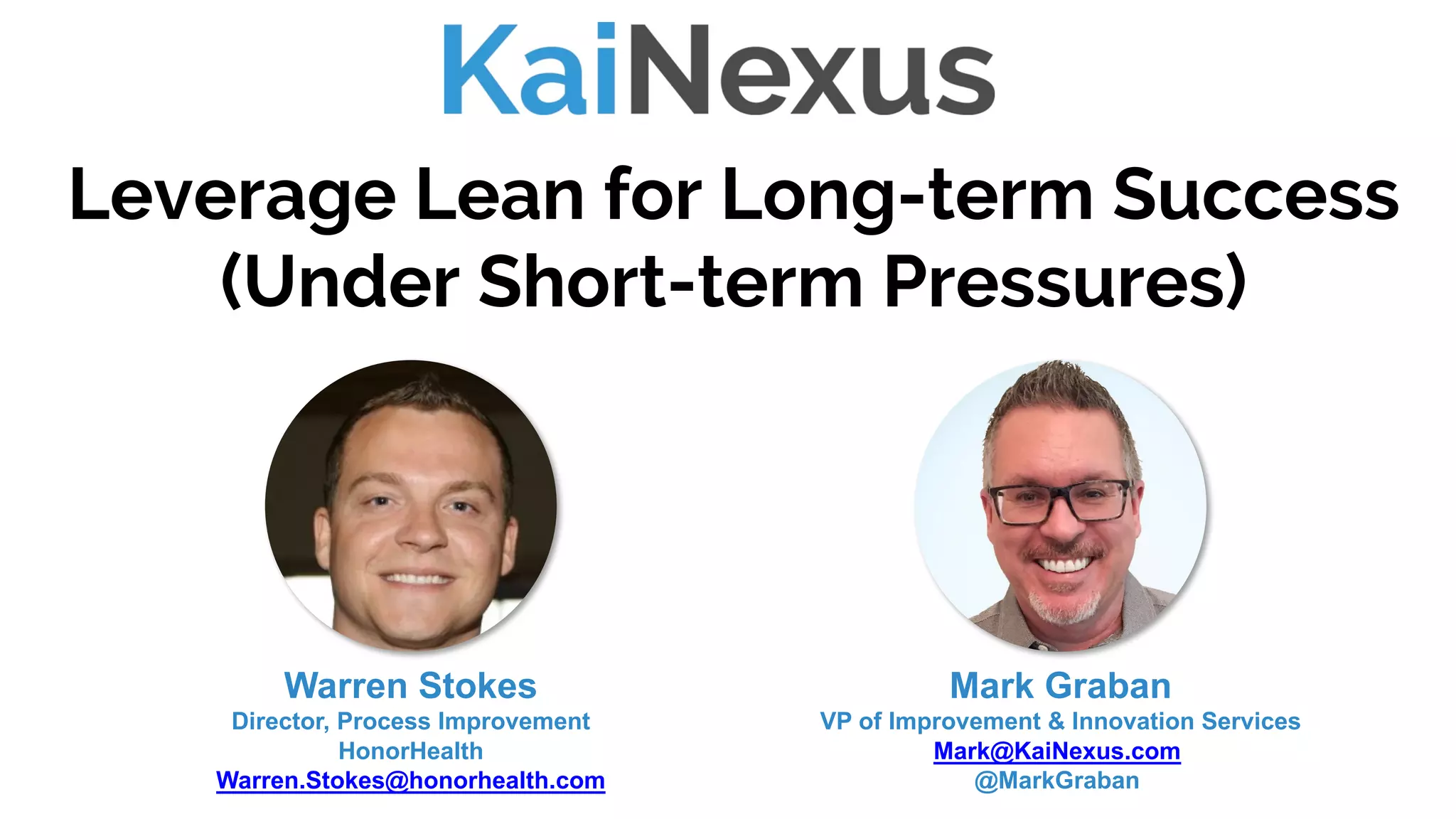
Leverage Lean for Long-term Success
(Under Short-term Pressures)
Mark Graban
VP of Improvement & Innovation Services
Mark@KaiNexus.com
@MarkGraban
Warren Stokes
Director, Process Improvement
HonorHealth
Warren.Stokes@honorhealth.com
Webinar Logistics
• Presentation	(45	minutes)
• Q&A	(10	minutes)
– Use	the	GoToWebinar	
Meeting	Panel	to	
submit	a	question	at
any	time
• Recording	link	&	slides	will	be	sent	via	email
– Also	– see	the	“Handouts”	feature	and	Chat	box
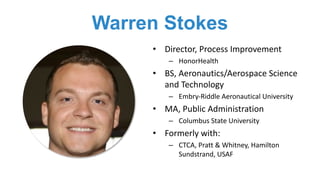
Warren Stokes
• Director,	Process	Improvement
– HonorHealth
• BS,	Aeronautics/Aerospace	Science	
and	Technology
– Embry-Riddle	Aeronautical	University
• MA,	Public	Administration	
– Columbus	State	University
• Formerly	with:
– CTCA,	Pratt	&	Whitney,	Hamilton	
Sundstrand,	USAF
Key Learnings
■ How to leverage the intellectual capital and experience of your frontline employees first
■ To not overcomplicate your Lean improvement with too much of the scientific and not
enough of the practical
■ Why it’s important to build trust and support for continuous improvement
■ How Lean best fits into a larger, long-term continuous improvement strategy in a way
that avoids succumbing to short-term pressures
■ How leadership and a Lean team can create and empower laser-focused energy
How
■ Effective use of Lean language
– Simple
– Practical
■ Defining the problem
– Identify critical data and information
– Prioritize quickly and simply
■ Executing with Rapid Cycles of Improvement
– Alignment to the priorities
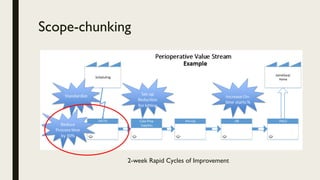
– Scope-chunking
Theme
Lens of Simplicity and Practicality
The Plot
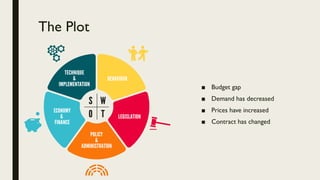
■ Budget gap
■ Demand has decreased
■ Prices have increased
■ Contract has changed
The Plot…continues
Immediate ACTION!
Reduce costs by….10%, 20%, 30%
“We’re committed to Lean, but right now
we don’t have time.”
Approach
BOTH…AND not EITHER…OR!
■ Do not focus on the “One-fell swoop” idea
■ Be mindful of organizational disruption
“….solution to a problem is usually as bad as the problem.”
- Milton Friedman
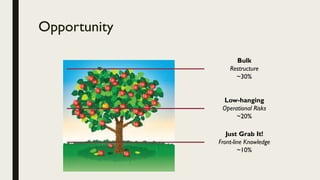
Opportunity
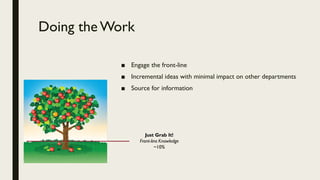
Just Grab It!
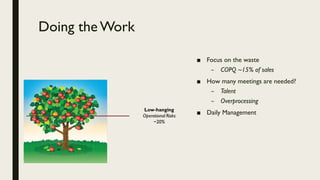
Front-line Knowledge
~10%
Low-hanging
Operational Risks
~20%
Bulk
Restructure
~30%
Align. Quickly
■ Understand your true current state
– Key Business drivers
– Validate the definitions and calculations
■ Turn data into information
– Context – “SoWhat?”
– Picture-ize the data
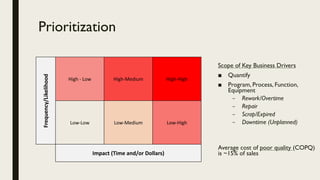
Prioritization
Frequency/Likelihood
High	- Low High-Medium High-High
Low-Low Low-Medium Low-High
Impact	(Time	and/or	Dollars)
Scope of Key Business Drivers
■ Quantify
■ Program, Process, Function,
Equipment
– Rework/Overtime
– Repair
– Scrap/Expired
– Downtime (Unplanned)
Average cost of poor quality (COPQ)
is ~15% of sales
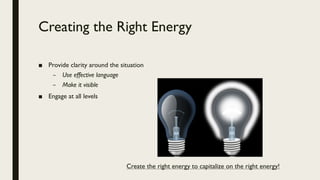
Creating the Right Energy
■ Provide clarity around the situation
– Use effective language
– Make it visible
■ Engage at all levels
Create the right energy to capitalize on the right energy!
Effective Language
■ Risk of stakeholders feeling “targeted”
– Open intellectual capital
– Motivate
■ Be specific with the challenges
■ Avoid generic phrases
– “Just gonna have to do more, with less”
– “Work smarter, not harder”
Effective Language of Lean
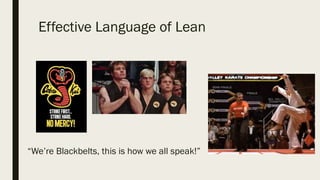
“We’re Blackbelts, this is how we all speak!”
Effective Language of Lean
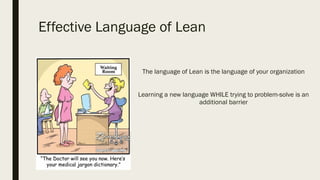
The language of Lean is the language of your organization
Learning a new language WHILE trying to problem-solve is an
additional barrier
Effective Language of Lean
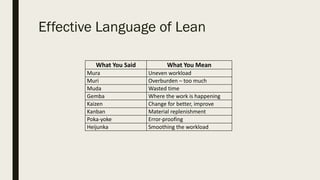
What	You	Said What	You	Mean
Mura Uneven	workload	
Muri Overburden	– too	much
Muda Wasted	time
Gemba Where	the	work	is	happening
Kaizen Change	for	better,	improve
Kanban Material	replenishment
Poka-yoke Error-proofing
Heijunka Smoothing	the	workload
Doing the Work
■ Engage the front-line
■ Incremental ideas with minimal impact on other departments
■ Source for information
Doing the Work
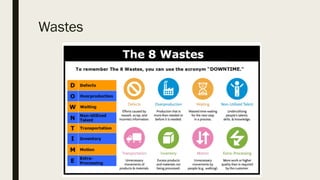
■ Focus on the waste
– COPQ ~15% of sales
■ How many meetings are needed?
– Talent
– Overprocessing
■ Daily Management
Wastes
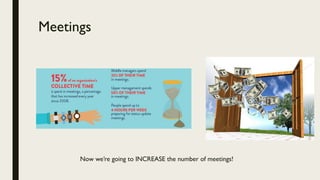
Meetings
Now we’re going to INCREASE the number of meetings!
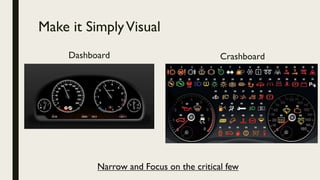
Make it SimplyVisual
Dashboard Crashboard
Narrow and Focus on the critical few
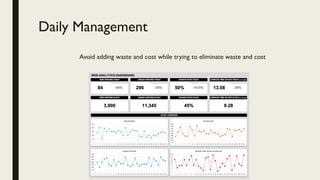
Daily Management
Avoid adding waste and cost while trying to eliminate waste and cost
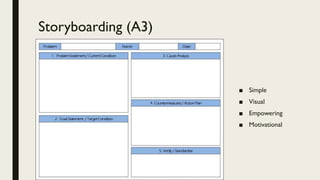
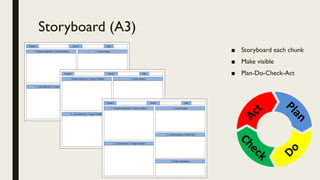
Storyboarding (A3)
■ Simple
■ Visual
■ Empowering
■ Motivational
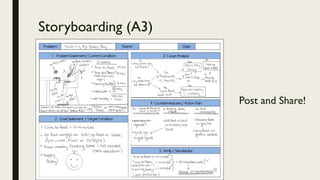
Storyboarding (A3)
Post and Share!
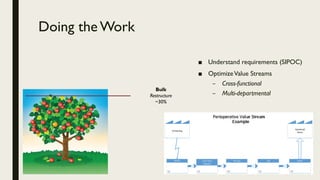
Doing the Work
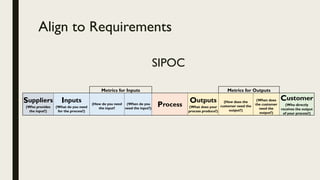
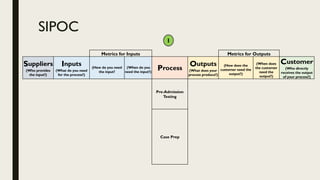
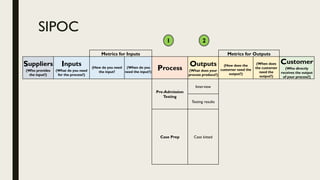
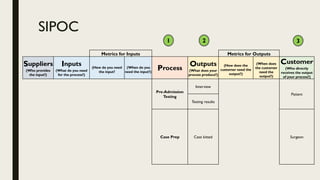
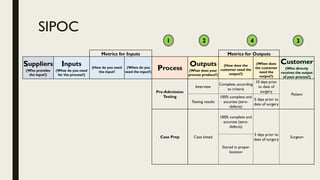
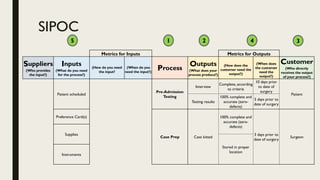
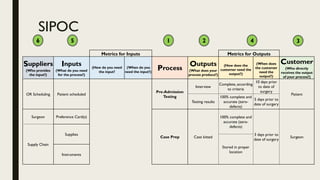
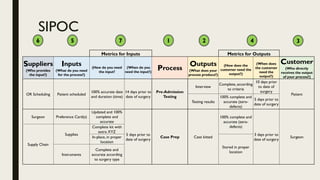
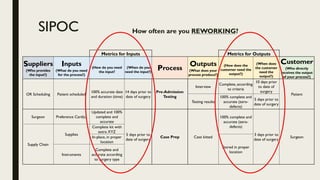
■ Understand requirements (SIPOC)
■ OptimizeValue Streams
– Cross-functional
– Multi-departmental
Align to Requirements
Metrics for Inputs Metrics for Outputs
Suppliers
(Who provides
the input?)
Inputs
(What do you need
for the process?)
(How do you need
the input?
(When do you
need the input?)
Process
Outputs
(What does your
process produce?)
(How does the
customer need the
output?)
(When does
the customer
need the
output?)
Customer
(Who directly
receives the output
of your process?)
SIPOC
SIPOC
Metrics for Inputs Metrics for Outputs
Suppliers
(Who provides
the input?)
Inputs
(What do you need
for the process?)
(How do you need
the input?
(When do you
need the input?)
Process
Outputs
(What does your
process produce?)
(How does the
customer need the
output?)
(When does
the customer
need the
output?)
Customer
(Who directly
receives the output
of your process?)
Pre-Admission
Testing
Case Prep
1
SIPOC
Metrics for Inputs Metrics for Outputs
Suppliers
(Who provides
the input?)
Inputs
(What do you need
for the process?)
(How do you need
the input?
(When do you
need the input?)
Process
Outputs
(What does your
process produce?)
(How does the
customer need the
output?)
(When does
the customer
need the
output?)
Customer
(Who directly
receives the output
of your process?)
Pre-Admission
Testing
Interview
Testing results
Case Prep Case kitted
21
SIPOC
Metrics for Inputs Metrics for Outputs
Suppliers
(Who provides
the input?)
Inputs
(What do you need
for the process?)
(How do you need
the input?
(When do you
need the input?)
Process
Outputs
(What does your
process produce?)
(How does the
customer need the
output?)
(When does
the customer
need the
output?)
Customer
(Who directly
receives the output
of your process?)
Pre-Admission
Testing
Interview
Patient
Testing results
Case Prep Case kitted Surgeon
31 2
SIPOC
Metrics for Inputs Metrics for Outputs
Suppliers
(Who provides
the input?)
Inputs
(What do you need
for the process?)
(How do you need
the input?
(When do you
need the input?)
Process
Outputs
(What does your
process produce?)
(How does the
customer need the
output?)
(When does
the customer
need the
output?)
Customer
(Who directly
receives the output
of your process?)
Pre-Admission
Testing
Interview
Complete, according
to criteria
10 days prior
to date of
surgery
Patient
Testing results
100% complete and
accurate (zero-
defects)
5 days prior to
date of surgery
Case Prep Case kitted
100% complete and
accurate (zero-
defects)
3 days prior to
date of surgery
Surgeon
Stored in proper
location
4 31 2
SIPOC
Metrics for Inputs Metrics for Outputs
Suppliers
(Who provides
the input?)
Inputs
(What do you need
for the process?)
(How do you need
the input?
(When do you
need the input?)
Process
Outputs
(What does your
process produce?)
(How does the
customer need the
output?)
(When does
the customer
need the
output?)
Customer
(Who directly
receives the output
of your process?)
Patient scheduled
Pre-Admission
Testing
Interview
Complete, according
to criteria
10 days prior
to date of
surgery
Patient
Testing results
100% complete and
accurate (zero-
defects)
5 days prior to
date of surgery
Preference Card(s)
Case Prep Case kitted
100% complete and
accurate (zero-
defects)
3 days prior to
date of surgery
Surgeon
Supplies
Stored in proper
location
Instruments
5 4 31 2
SIPOC
Metrics for Inputs Metrics for Outputs
Suppliers
(Who provides
the input?)
Inputs
(What do you need
for the process?)
(How do you need
the input?
(When do you
need the input?)
Process
Outputs
(What does your
process produce?)
(How does the
customer need the
output?)
(When does
the customer
need the
output?)
Customer
(Who directly
receives the output
of your process?)
OR Scheduling Patient scheduled
Pre-Admission
Testing
Interview
Complete, according
to criteria
10 days prior
to date of
surgery
Patient
Testing results
100% complete and
accurate (zero-
defects)
5 days prior to
date of surgery
Surgeon Preference Card(s)
Case Prep Case kitted
100% complete and
accurate (zero-
defects)
3 days prior to
date of surgery
Surgeon
Supply Chain
Supplies
Stored in proper
location
Instruments
6 5 4 31 2
SIPOC
Metrics for Inputs Metrics for Outputs
Suppliers
(Who provides
the input?)
Inputs
(What do you need
for the process?)
(How do you need
the input?
(When do you
need the input?)
Process
Outputs
(What does your
process produce?)
(How does the
customer need the
output?)
(When does
the customer
need the
output?)
Customer
(Who directly
receives the output
of your process?)
OR Scheduling Patient scheduled
100% accurate date
and duration (time)
14 days prior to
date of surgery
Pre-Admission
Testing
Interview
Complete, according
to criteria
10 days prior
to date of
surgery
Patient
Testing results
100% complete and
accurate (zero-
defects)
5 days prior to
date of surgery
Surgeon Preference Card(s)
Updated and 100%
complete and
accurate
5 days prior to
date of surgery
Case Prep Case kitted
100% complete and
accurate (zero-
defects)
3 days prior to
date of surgery
Surgeon
Supply Chain
Supplies
Complete kit with
extra XYZ
In-place, in proper
location
Stored in proper
location
Instruments
Complete and
accurate according
to surgery type
76 5 4 31 2
SIPOC
Metrics for Inputs Metrics for Outputs
Suppliers
(Who provides
the input?)
Inputs
(What do you need
for the process?)
(How do you need
the input?
(When do you
need the input?)
Process
Outputs
(What does your
process produce?)
(How does the
customer need the
output?)
(When does
the customer
need the
output?)
Customer
(Who directly
receives the output
of your process?)
OR Scheduling Patient scheduled
100% accurate date
and duration (time)
14 days prior to
date of surgery
Pre-Admission
Testing
Interview
Complete, according
to criteria
10 days prior
to date of
surgery
Patient
Testing results
100% complete and
accurate (zero-
defects)
5 days prior to
date of surgery
Surgeon Preference Card(s)
Updated and 100%
complete and
accurate
5 days prior to
date of surgery
Case Prep Case kitted
100% complete and
accurate (zero-
defects)
3 days prior to
date of surgery
Surgeon
Supply Chain
Supplies
Complete kit with
extra XYZ
In-place, in proper
location
Stored in proper
location
Instruments
Complete and
accurate according
to surgery type
How often are you REWORKING?
Scope-chunking
2-week Rapid Cycles of Improvement
Storyboard (A3)
■ Storyboard each chunk
■ Make visible
■ Plan-Do-Check-Act
Go!
Leaders
BeVisible!
Do not need a table where a walk will do
Markers instead of Meetings
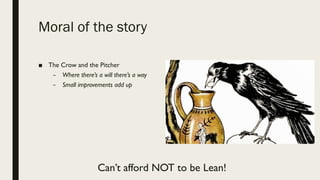
Moral of the story
■ The Crow and the Pitcher
– Where there’s a will there’s a way
– Small improvements add up
Can’t afford NOT to be Lean!
Announcements
(Then Q&A)
Ask Us Anything!
• Mark	Graban	&	Dr.	Greg	Jacobson
• Next	Episode	(#14)	August	15,	1	pm	ET
• Register	&	submit	questions	via	
http://kainexus.com/webinars
• Past	episodes	available	
on	YouTube
Our Next Webinar – Aug 30
• Register	at	www.KaiNexus.com/webinars
• “Teaming	with	Patients	to	Improve	Safety”
Presenters:
• Laura	B.	Townsend
– Co-Founder	&	President	of	Louise	H.	Batz	Patient	Safety	Foundation
• Elise	Matocha
– BSN,	RN,	ONC	Director,	Clinical	Performance	Improvement
• Carol	Wratten
– MD	MBA	FACOG,	Retired	from	Seton	Healthcare	Family
Other Resources
www.KaiNexus.com
KaiNexus Podcasts
• www.KaiNexus.com/podcasts
• Subscribe	via:
– iTunes
– Google	Play
– Stitcher
Q&A
• Web:
– www.kainexus.com
– blog.kainexus.com
• Webinars	on	Demand:
– www.kainexus.com/webinars
• Social	Media:
– www.twitter.com/kainexus
– www.linkedin.com/company/kainexus
– www.facebook.com/kainexus
Mark Graban
Mark@KaiNexus.com
@MarkGraban
Warren Stokes
Director, Process Improvement
HonorHealth
Warren.Stokes@honorhealth.com

How to Leverage Lean for Long-Term Success (Under Short-Term Pressures)

  • 1.
    Leverage Lean forLong-term Success (Under Short-term Pressures) Mark Graban VP of Improvement & Innovation Services Mark@KaiNexus.com @MarkGraban Warren Stokes Director, Process Improvement HonorHealth Warren.Stokes@honorhealth.com
  • 2.
    Webinar Logistics • Presentation (45 minutes) •Q&A (10 minutes) – Use the GoToWebinar Meeting Panel to submit a question at any time • Recording link & slides will be sent via email – Also – see the “Handouts” feature and Chat box
  • 3.
    Warren Stokes • Director, Process Improvement –HonorHealth • BS, Aeronautics/Aerospace Science and Technology – Embry-Riddle Aeronautical University • MA, Public Administration – Columbus State University • Formerly with: – CTCA, Pratt & Whitney, Hamilton Sundstrand, USAF
  • 4.
    Key Learnings ■ Howto leverage the intellectual capital and experience of your frontline employees first ■ To not overcomplicate your Lean improvement with too much of the scientific and not enough of the practical ■ Why it’s important to build trust and support for continuous improvement ■ How Lean best fits into a larger, long-term continuous improvement strategy in a way that avoids succumbing to short-term pressures ■ How leadership and a Lean team can create and empower laser-focused energy
  • 5.
    How ■ Effective useof Lean language – Simple – Practical ■ Defining the problem – Identify critical data and information – Prioritize quickly and simply ■ Executing with Rapid Cycles of Improvement – Alignment to the priorities – Scope-chunking
  • 6.
    Theme Lens of Simplicityand Practicality
  • 7.
    The Plot ■ Budgetgap ■ Demand has decreased ■ Prices have increased ■ Contract has changed
  • 8.
    The Plot…continues Immediate ACTION! Reducecosts by….10%, 20%, 30% “We’re committed to Lean, but right now we don’t have time.”
  • 9.
    Approach BOTH…AND not EITHER…OR! ■Do not focus on the “One-fell swoop” idea ■ Be mindful of organizational disruption “….solution to a problem is usually as bad as the problem.” - Milton Friedman
  • 10.
    Opportunity Just Grab It! Front-lineKnowledge ~10% Low-hanging Operational Risks ~20% Bulk Restructure ~30%
  • 11.
    Align. Quickly ■ Understandyour true current state – Key Business drivers – Validate the definitions and calculations ■ Turn data into information – Context – “SoWhat?” – Picture-ize the data
  • 12.
    Prioritization Frequency/Likelihood High - Low High-MediumHigh-High Low-Low Low-Medium Low-High Impact (Time and/or Dollars) Scope of Key Business Drivers ■ Quantify ■ Program, Process, Function, Equipment – Rework/Overtime – Repair – Scrap/Expired – Downtime (Unplanned) Average cost of poor quality (COPQ) is ~15% of sales
  • 13.
    Creating the RightEnergy ■ Provide clarity around the situation – Use effective language – Make it visible ■ Engage at all levels Create the right energy to capitalize on the right energy!
  • 14.
    Effective Language ■ Riskof stakeholders feeling “targeted” – Open intellectual capital – Motivate ■ Be specific with the challenges ■ Avoid generic phrases – “Just gonna have to do more, with less” – “Work smarter, not harder”
  • 15.
    Effective Language ofLean “We’re Blackbelts, this is how we all speak!”
  • 16.
    Effective Language ofLean The language of Lean is the language of your organization Learning a new language WHILE trying to problem-solve is an additional barrier
  • 17.
    Effective Language ofLean What You Said What You Mean Mura Uneven workload Muri Overburden – too much Muda Wasted time Gemba Where the work is happening Kaizen Change for better, improve Kanban Material replenishment Poka-yoke Error-proofing Heijunka Smoothing the workload
  • 18.
    Doing the Work ■Engage the front-line ■ Incremental ideas with minimal impact on other departments ■ Source for information
  • 19.
    Doing the Work ■Focus on the waste – COPQ ~15% of sales ■ How many meetings are needed? – Talent – Overprocessing ■ Daily Management
  • 20.
  • 21.
    Meetings Now we’re goingto INCREASE the number of meetings!
  • 22.
    Make it SimplyVisual DashboardCrashboard Narrow and Focus on the critical few
  • 23.
    Daily Management Avoid addingwaste and cost while trying to eliminate waste and cost
  • 24.
    Storyboarding (A3) ■ Simple ■Visual ■ Empowering ■ Motivational
  • 25.
  • 26.
    Doing the Work ■Understand requirements (SIPOC) ■ OptimizeValue Streams – Cross-functional – Multi-departmental
  • 27.
    Align to Requirements Metricsfor Inputs Metrics for Outputs Suppliers (Who provides the input?) Inputs (What do you need for the process?) (How do you need the input? (When do you need the input?) Process Outputs (What does your process produce?) (How does the customer need the output?) (When does the customer need the output?) Customer (Who directly receives the output of your process?) SIPOC
  • 28.
    SIPOC Metrics for InputsMetrics for Outputs Suppliers (Who provides the input?) Inputs (What do you need for the process?) (How do you need the input? (When do you need the input?) Process Outputs (What does your process produce?) (How does the customer need the output?) (When does the customer need the output?) Customer (Who directly receives the output of your process?) Pre-Admission Testing Case Prep 1
  • 29.
    SIPOC Metrics for InputsMetrics for Outputs Suppliers (Who provides the input?) Inputs (What do you need for the process?) (How do you need the input? (When do you need the input?) Process Outputs (What does your process produce?) (How does the customer need the output?) (When does the customer need the output?) Customer (Who directly receives the output of your process?) Pre-Admission Testing Interview Testing results Case Prep Case kitted 21
  • 30.
    SIPOC Metrics for InputsMetrics for Outputs Suppliers (Who provides the input?) Inputs (What do you need for the process?) (How do you need the input? (When do you need the input?) Process Outputs (What does your process produce?) (How does the customer need the output?) (When does the customer need the output?) Customer (Who directly receives the output of your process?) Pre-Admission Testing Interview Patient Testing results Case Prep Case kitted Surgeon 31 2
  • 31.
    SIPOC Metrics for InputsMetrics for Outputs Suppliers (Who provides the input?) Inputs (What do you need for the process?) (How do you need the input? (When do you need the input?) Process Outputs (What does your process produce?) (How does the customer need the output?) (When does the customer need the output?) Customer (Who directly receives the output of your process?) Pre-Admission Testing Interview Complete, according to criteria 10 days prior to date of surgery Patient Testing results 100% complete and accurate (zero- defects) 5 days prior to date of surgery Case Prep Case kitted 100% complete and accurate (zero- defects) 3 days prior to date of surgery Surgeon Stored in proper location 4 31 2
  • 32.
    SIPOC Metrics for InputsMetrics for Outputs Suppliers (Who provides the input?) Inputs (What do you need for the process?) (How do you need the input? (When do you need the input?) Process Outputs (What does your process produce?) (How does the customer need the output?) (When does the customer need the output?) Customer (Who directly receives the output of your process?) Patient scheduled Pre-Admission Testing Interview Complete, according to criteria 10 days prior to date of surgery Patient Testing results 100% complete and accurate (zero- defects) 5 days prior to date of surgery Preference Card(s) Case Prep Case kitted 100% complete and accurate (zero- defects) 3 days prior to date of surgery Surgeon Supplies Stored in proper location Instruments 5 4 31 2
  • 33.
    SIPOC Metrics for InputsMetrics for Outputs Suppliers (Who provides the input?) Inputs (What do you need for the process?) (How do you need the input? (When do you need the input?) Process Outputs (What does your process produce?) (How does the customer need the output?) (When does the customer need the output?) Customer (Who directly receives the output of your process?) OR Scheduling Patient scheduled Pre-Admission Testing Interview Complete, according to criteria 10 days prior to date of surgery Patient Testing results 100% complete and accurate (zero- defects) 5 days prior to date of surgery Surgeon Preference Card(s) Case Prep Case kitted 100% complete and accurate (zero- defects) 3 days prior to date of surgery Surgeon Supply Chain Supplies Stored in proper location Instruments 6 5 4 31 2
  • 34.
    SIPOC Metrics for InputsMetrics for Outputs Suppliers (Who provides the input?) Inputs (What do you need for the process?) (How do you need the input? (When do you need the input?) Process Outputs (What does your process produce?) (How does the customer need the output?) (When does the customer need the output?) Customer (Who directly receives the output of your process?) OR Scheduling Patient scheduled 100% accurate date and duration (time) 14 days prior to date of surgery Pre-Admission Testing Interview Complete, according to criteria 10 days prior to date of surgery Patient Testing results 100% complete and accurate (zero- defects) 5 days prior to date of surgery Surgeon Preference Card(s) Updated and 100% complete and accurate 5 days prior to date of surgery Case Prep Case kitted 100% complete and accurate (zero- defects) 3 days prior to date of surgery Surgeon Supply Chain Supplies Complete kit with extra XYZ In-place, in proper location Stored in proper location Instruments Complete and accurate according to surgery type 76 5 4 31 2
  • 35.
    SIPOC Metrics for InputsMetrics for Outputs Suppliers (Who provides the input?) Inputs (What do you need for the process?) (How do you need the input? (When do you need the input?) Process Outputs (What does your process produce?) (How does the customer need the output?) (When does the customer need the output?) Customer (Who directly receives the output of your process?) OR Scheduling Patient scheduled 100% accurate date and duration (time) 14 days prior to date of surgery Pre-Admission Testing Interview Complete, according to criteria 10 days prior to date of surgery Patient Testing results 100% complete and accurate (zero- defects) 5 days prior to date of surgery Surgeon Preference Card(s) Updated and 100% complete and accurate 5 days prior to date of surgery Case Prep Case kitted 100% complete and accurate (zero- defects) 3 days prior to date of surgery Surgeon Supply Chain Supplies Complete kit with extra XYZ In-place, in proper location Stored in proper location Instruments Complete and accurate according to surgery type How often are you REWORKING?
  • 36.
  • 37.
    Storyboard (A3) ■ Storyboardeach chunk ■ Make visible ■ Plan-Do-Check-Act
  • 38.
    Go! Leaders BeVisible! Do not needa table where a walk will do Markers instead of Meetings
  • 39.
    Moral of thestory ■ The Crow and the Pitcher – Where there’s a will there’s a way – Small improvements add up Can’t afford NOT to be Lean!
  • 40.
  • 41.
    Ask Us Anything! •Mark Graban & Dr. Greg Jacobson • Next Episode (#14) August 15, 1 pm ET • Register & submit questions via http://kainexus.com/webinars • Past episodes available on YouTube
  • 42.
    Our Next Webinar– Aug 30 • Register at www.KaiNexus.com/webinars • “Teaming with Patients to Improve Safety” Presenters: • Laura B. Townsend – Co-Founder & President of Louise H. Batz Patient Safety Foundation • Elise Matocha – BSN, RN, ONC Director, Clinical Performance Improvement • Carol Wratten – MD MBA FACOG, Retired from Seton Healthcare Family
  • 43.
  • 44.
    KaiNexus Podcasts • www.KaiNexus.com/podcasts •Subscribe via: – iTunes – Google Play – Stitcher
  • 45.
    Q&A • Web: – www.kainexus.com –blog.kainexus.com • Webinars on Demand: – www.kainexus.com/webinars • Social Media: – www.twitter.com/kainexus – www.linkedin.com/company/kainexus – www.facebook.com/kainexus Mark Graban Mark@KaiNexus.com @MarkGraban Warren Stokes Director, Process Improvement HonorHealth Warren.Stokes@honorhealth.com