Hickman Engineered Systems
Provider Number: H518
Roof Edge Performance and Testing
Course Number : WPH2011FF
Speaker Name/s
Date
Credit(s) earned on completion of
this course will be reported to AIA
CES for AIA members. Certificates of
Completion for both AIA members
and non-AIA members are available
upon request.
This course is registered with AIA
CES for continuing professional
education. As such, it does not
include content that may be
deemed or construed to be an
approval or endorsement by the
AIA of any material of construction
or any method or manner of
handling, using, distributing, or
dealing in any material or product.
_______________________________________
____
Questions related to specific materials, methods, and
services will be addressed at the conclusion of this
presentation.
This presentation is protected by US and International Copyright laws.
Reproduction, distribution, display and use of the presentation without written
permission of the speaker is prohibited.
© Hickman Engineered Systems 2013
Copyright Materials
This course will cover roof edge performance and testing
and review the ANSI/SPRI ES-1 standard that is part of
the International Building Code. The next generation of
the standard, ANSI/SPRI/FM 4435 will also be covered
along with the GD-1 standard that addresses gutters.
The course provides an overview of how to select the
proper roof edge system for a building so that it meets
code and stays on the building.
Course Description
Learning Objectives
Learning Objective 1: Understand the ANSI/SPRI ES-1 Standard
Learning Objective 2: Understand the ANSI/SPRI/FM 4435 ES-1 Standard
Learning Objective 3: Understand the GD-1 Standard
Learning Objective 4: Specify metal edge systems and gutters that meet
code and stay on their buildings.
At the end of the this course, participants will be able to:
ANSI/SPRI ES-1,
ANSI/SPRI/FM 4435 ES-1,
and GD-1
Hickman Engineered Systems
Company History
 In business since 1945
 Invented 1st pre-manufactured roof edge system
 Has over 25 patents
 Continues to be an innovator & leader in the industry
 Located in Asheville, NC
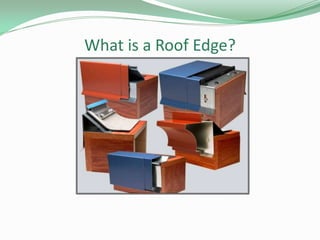
What is a Roof Edge?
 Acts as an effective termination and transition between the
roof and other building components
 Aesthetic feature to the building exterior
 Most importantly, it is a roof’s first line of defense against
wind!
 http://www.youtube.com/watch?v=L9ngIY_fzgg
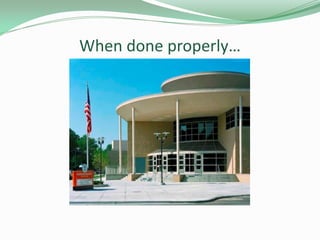
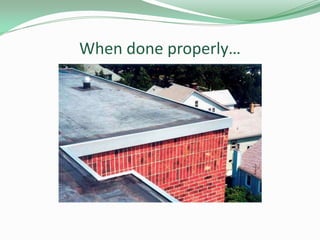
When done properly…
When done properly…
When done properly…
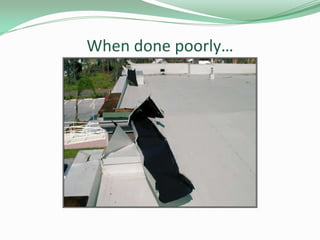
When done poorly…
Three SPRI Edge Standards
ANSI/SPRI ES-1
 Standard that is included in IBC
ANSI SPRI/FM 4435 ES-1
 Revised standard just approved by ANSI
GD-1
 Standard for gutters currently going through the ANSI
review process
Topics for Discussion
 Wind Basics
 Importance of Roof Edge
 Perimeter Roof Edge Details & Standards
 Using the ANSI/SPRI ES-1 Standard
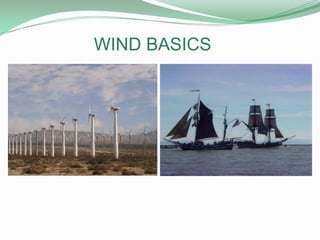
WIND BASICS
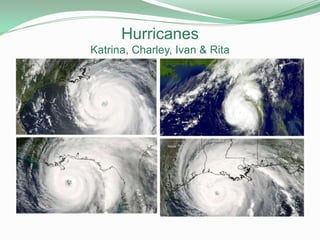
Hurricanes
Katrina, Charley, Ivan & Rita
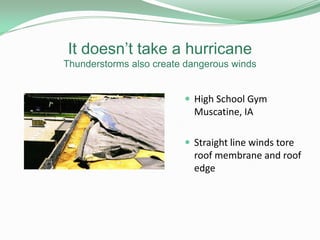
It doesn’t take a hurricane
Thunderstorms also create dangerous winds
 High School Gym
Muscatine, IA
 Straight line winds tore
roof membrane and roof
edge
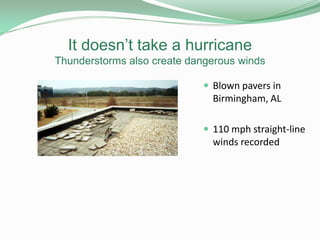
It doesn’t take a hurricane
Thunderstorms also create dangerous winds
 Blown pavers in
Birmingham, AL
 110 mph straight-line
winds recorded
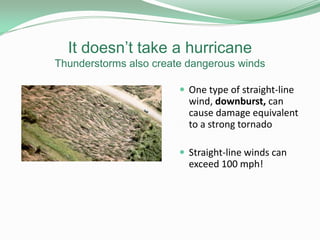
It doesn’t take a hurricane
Thunderstorms also create dangerous winds
 One type of straight-line
wind, downburst, can
cause damage equivalent
to a strong tornado
 Straight-line winds can
exceed 100 mph!
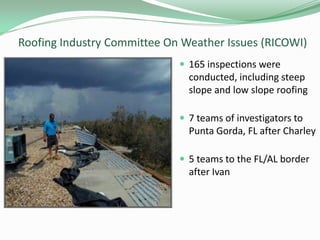
Roofing Industry Committee On Weather Issues (RICOWI)
 165 inspections were
conducted, including steep
slope and low slope roofing
 7 teams of investigators to
Punta Gorda, FL after Charley
 5 teams to the FL/AL border
after Ivan
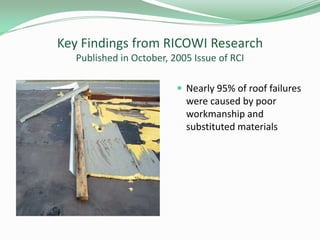
Key Findings from RICOWI Research
Published in October, 2005 Issue of RCI
 Nearly 95% of roof failures
were caused by poor
workmanship and
substituted materials
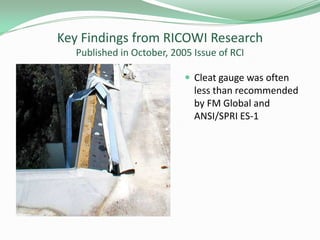
Key Findings from RICOWI Research
Published in October, 2005 Issue of RCI
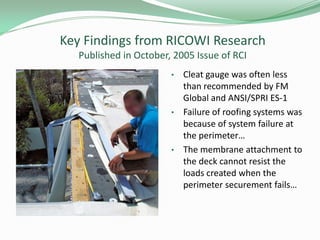
 Cleat gauge was often
less than recommended
by FM Global and
ANSI/SPRI ES-1
Key Findings from RICOWI Research
Published in October, 2005 Issue of RCI
• Cleat gauge was often less
than recommended by FM
Global and ANSI/SPRI ES-1
• Failure of roofing systems was
because of system failure at
the perimeter…
• The membrane attachment to
the deck cannot resist the
loads created when the
perimeter securement fails…
Importance of Perimeter Flashing
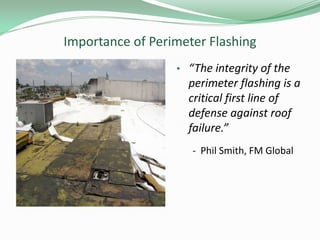
• “The integrity of the
perimeter flashing is a
critical first line of
defense against roof
failure.”
- Phil Smith, FM Global
Importance of Roof Perimeter
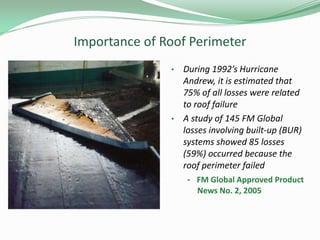
• During 1992’s Hurricane
Andrew, it is estimated that
75% of all losses were related
to roof failure
• A study of 145 FM Global
losses involving built-up (BUR)
systems showed 85 losses
(59%) occurred because the
roof perimeter failed
- FM Global Approved Product
News No. 2, 2005
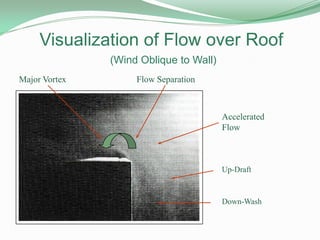
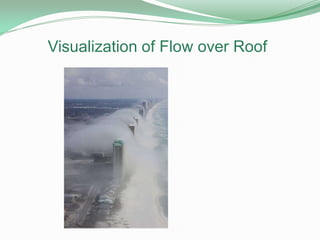
Visualization of Flow over Roof
(Wind Oblique to Wall)
Accelerated
Flow
Flow SeparationMajor Vortex
Up-Draft
Down-Wash
Visualization of Flow over Roof
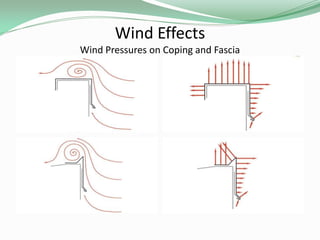
Wind Effects
Wind Pressures on Coping and Fascia
Perimeter Roof Edge
Details & Standards
 SMACNA
 NRCA Details
 FM
 ANSI/SPRI ES-1
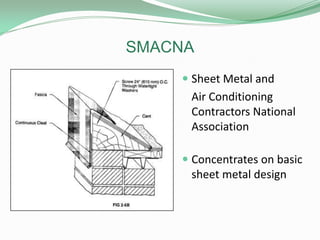
SMACNA
 Sheet Metal and
Air Conditioning
Contractors National
Association
 Concentrates on basic
sheet metal design
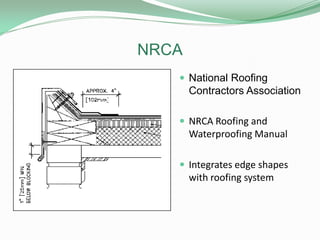
NRCA
 National Roofing
Contractors Association
 NRCA Roofing and
Waterproofing Manual
 Integrates edge shapes
with roofing system
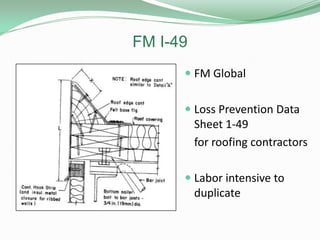
FM I-49
 FM Global
 Loss Prevention Data
Sheet 1-49
for roofing contractors
 Labor intensive to
duplicate
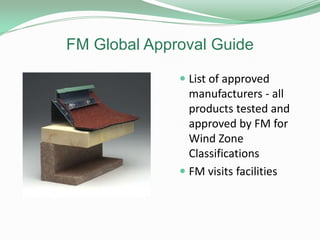
FM Global Approval Guide
 List of approved
manufacturers - all
products tested and
approved by FM for
Wind Zone
Classifications
 FM visits facilities
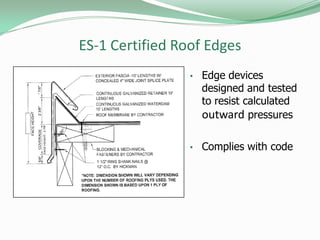
ES-1 Certified Roof Edges
• Edge devices
designed and tested
to resist calculated
outward pressures
• Complies with code
Wind Design Standard for Edge Systems
Used With Low Slope Roofing Systems
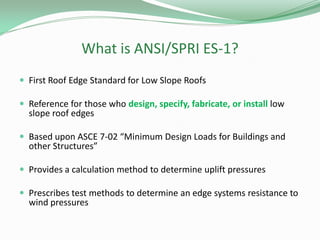
ANSI/SPRI
 The American National Standards Institute (ANSI) coordinates
the development and use of voluntary consensus standards in
the United States
 SPRI is the recognized technical and statistical authority on the
Single Ply Roofing Industry
What is ANSI/SPRI ES-1?
 First Roof Edge Standard for Low Slope Roofs
 Reference for those who design, specify, fabricate, or install low
slope roof edges
 Based upon ASCE 7-02 “Minimum Design Loads for Buildings and
other Structures”
 Provides a calculation method to determine uplift pressures
 Prescribes test methods to determine an edge systems resistance to
wind pressures
1504.5 Edge Securement for Low Slope Roofs
Low slope membrane roof systems metal edge
securement, except gutters, installed in accordance with
Section 1507, shall be designed and installed for wind
loads in accordance with Chapter 16 and tested for
resistance in accordance with ANSI/SPRI ES-1, except the
basic wind speed shall be determined from Figure 1609.
(Figure 1609 is a reference to the latest ASCE Wind Speed Map 7-02)
2003, 2006 and 2009 International Building
Code Requires ES-1
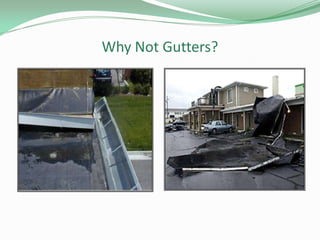
Why Not Gutters?
State Adoption Status
 ES-1 is in 2003, 2006 and 2009 IBC
 States Adopt IBC Into State Code
 All States Have Adopted 2003 or later versions
www.iccsafe.org
http://www.iccsafe.org/gr/Pages/adoptions.aspx
How to Use
ANSI/SPRI ES-1
General Roof Edge Design Considerations
 Wind Speed
 Building Height
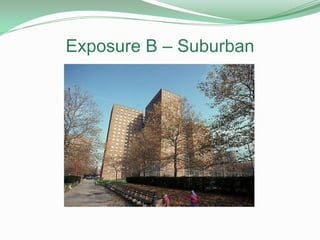
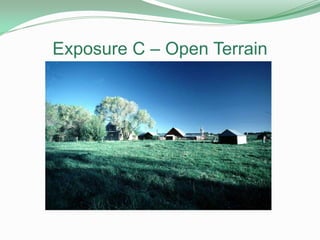
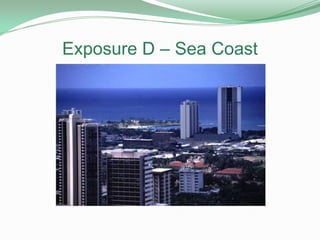
 Building Exposure (Terrain)
 Importance Factor
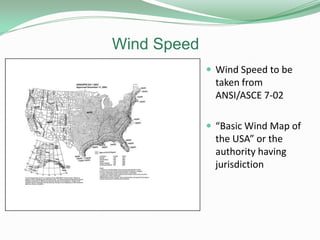
Wind Speed
 Wind Speed to be
taken from
ANSI/ASCE 7-02
 “Basic Wind Map of
the USA” or the
authority having
jurisdiction
The building height shall be measured
from ground level to the mean height of
the roof section under design.
Building Height
The terrain surrounding a building
will influence the exposure of that
building to the wind.
Building Exposure
Exposure B – Suburban
Exposure C – Open Terrain
Exposure D – Sea Coast
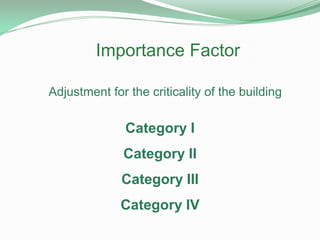
Adjustment for the criticality of the building
Category I
Category II
Category III
Category IV
Importance Factor
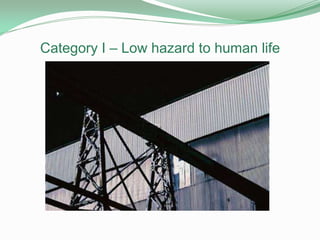
Category I – Low hazard to human life
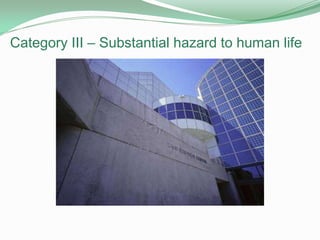
Category III – Substantial hazard to human life
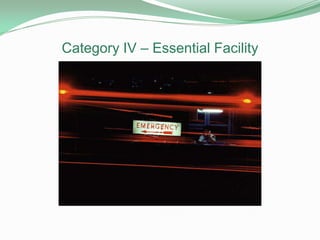
Category IV – Essential Facility
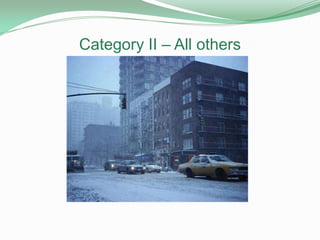
Category II – All others
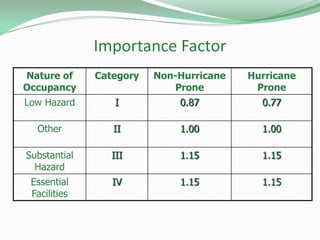
Importance Factor
Nature of
Occupancy
Category Non-Hurricane
Prone
Hurricane
Prone
Low Hazard I 0.87 0.77
Other II 1.00 1.00
Substantial
Hazard
III 1.15 1.15
Essential
Facilities
IV 1.15 1.15
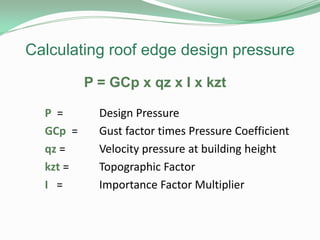
Calculating roof edge design pressure
P = GCp x qz x I x kzt
P = Design Pressure
GCp = Gust factor times Pressure Coefficient
qz = Velocity pressure at building height
kzt = Topographic Factor
I = Importance Factor Multiplier
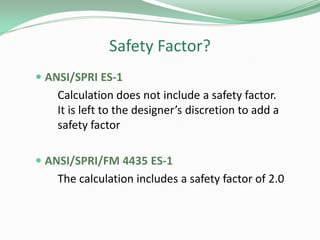
Safety Factor?
 ANSI/SPRI ES-1
Calculation does not include a safety factor.
It is left to the designer’s discretion to add a
safety factor
 ANSI/SPRI/FM 4435 ES-1
The calculation includes a safety factor of 2.0
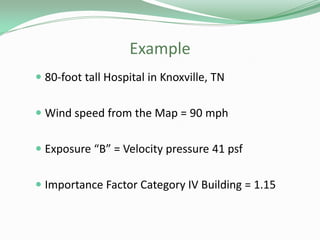
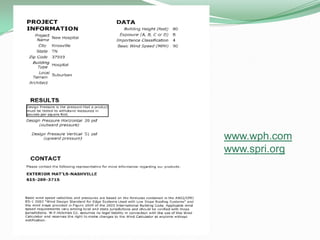
Example
 80-foot tall Hospital in Knoxville, TN
 Wind speed from the Map = 90 mph
 Exposure “B” = Velocity pressure 41 psf
 Importance Factor Category IV Building = 1.15
www.wph.com
www.spri.org
New HotelBillingsMT
www.wph.com
www.spri.org
Test Protocols
There are three tests that make up the
ANSI/SPRI ES-1 Standard:
RE-1
RE-2
RE-3
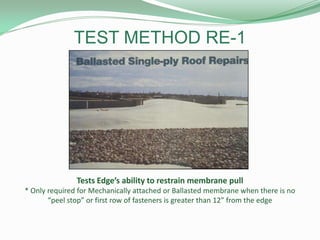
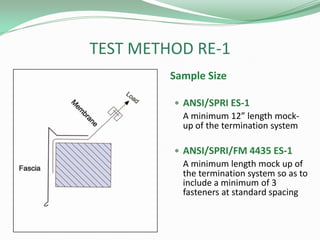
TEST METHOD RE-1
Tests Edge’s ability to restrain membrane pull
* Only required for Mechanically attached or Ballasted membrane when there is no
“peel stop” or first row of fasteners is greater than 12” from the edge
TEST METHOD RE-1
Sample Size
 ANSI/SPRI ES-1
A minimum 12” length mock-
up of the termination system
 ANSI/SPRI/FM 4435 ES-1
A minimum length mock up of
the termination system so as to
include a minimum of 3
fasteners at standard spacing
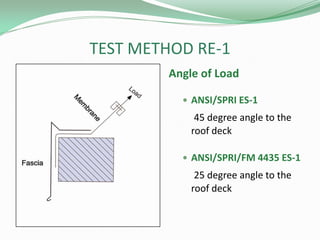
TEST METHOD RE-1
Angle of Load
 ANSI/SPRI ES-1
45 degree angle to the
roof deck
 ANSI/SPRI/FM 4435 ES-1
25 degree angle to the
roof deck
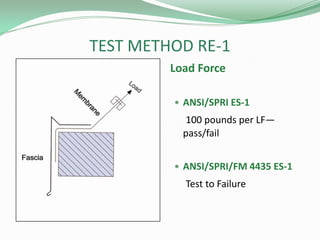
TEST METHOD RE-1
Load Force
 ANSI/SPRI ES-1
100 pounds per LF—
pass/fail
 ANSI/SPRI/FM 4435 ES-1
Test to Failure
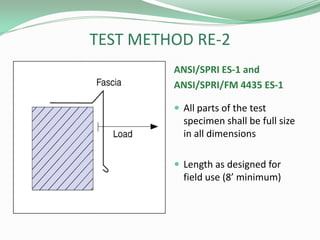
TEST METHOD RE-2
ANSI/SPRI ES-1 and
ANSI/SPRI/FM 4435 ES-1
 All parts of the test
specimen shall be full size
in all dimensions
 Length as designed for
field use (8’ minimum)
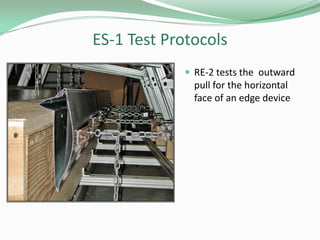
ES-1 Test Protocols
 RE-2 tests the outward
pull for the horizontal
face of an edge device
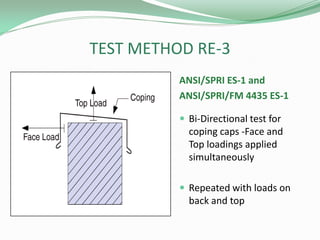
TEST METHOD RE-3
ANSI/SPRI ES-1 and
ANSI/SPRI/FM 4435 ES-1
 Bi-Directional test for
coping caps -Face and
Top loadings applied
simultaneously
 Repeated with loads on
back and top
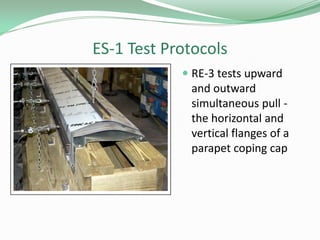
ES-1 Test Protocols
 RE-3 tests upward
and outward
simultaneous pull -
the horizontal and
vertical flanges of a
parapet coping cap
Corner Region
 ANSI/SPRI ES-1
 Double Fasteners in the Corner Region
 ANSI/SPRI/FM 4435 ES-1
 Use System Tested to Resist Calculated Loads
 Fabricate Miters From That System
GD-1
 Load Calculations Similar to ES-1
 Tests similar to ES-1
 Static Load Downward Based on Gutter Volume
 Cycled Load Outward on Face to Failure
 Cycled Load Upward on Bottom to Failure
Other Components of the ANSI/SPRI Standard
 Metal Thickness
 Galvanic Compatibility and Resistance
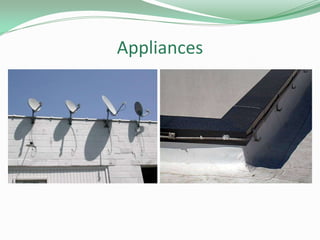
 Appliances
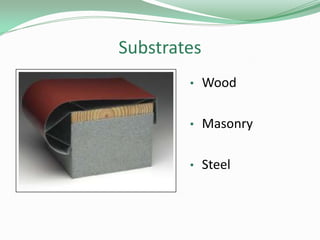
 Substrate
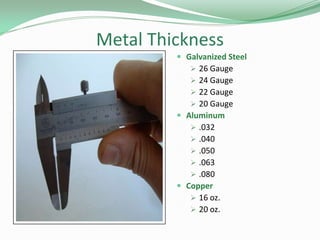
Metal Thickness
 Galvanized Steel
 26 Gauge
 24 Gauge
 22 Gauge
 20 Gauge
 Aluminum
 .032
 .040
 .050
 .063
 .080
 Copper
 16 oz.
 20 oz.
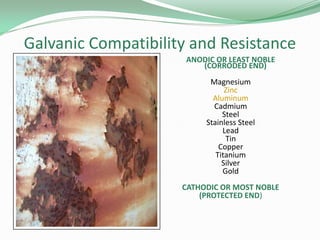
Galvanic Compatibility and Resistance
ANODIC OR LEAST NOBLE
(CORRODED END)
Magnesium
Zinc
Aluminum
Cadmium
Steel
Stainless Steel
Lead
Tin
Copper
Titanium
Silver
Gold
CATHODIC OR MOST NOBLE
(PROTECTED END)
Appliances
Substrates
• Wood
• Masonry
• Steel
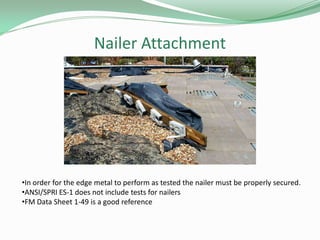
Nailer Attachment
•In order for the edge metal to perform as tested the nailer must be properly secured.
•ANSI/SPRI ES-1 does not include tests for nailers
•FM Data Sheet 1-49 is a good reference
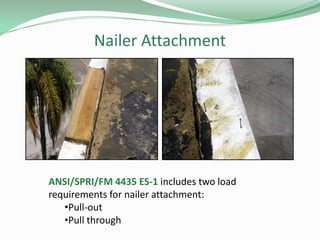
Nailer Attachment
ANSI/SPRI/FM 4435 ES-1 includes two load
requirements for nailer attachment:
•Pull-out
•Pull through
Why use the Standard?
 When roof edges are designed and tested to resist the
anticipated wind forces, you get a better roof
 Without a performance based test, it’s difficult compare
products or defend a specification or detail from
substitution
 Establishes a minimum acceptable criteria for performance
 It is in code!
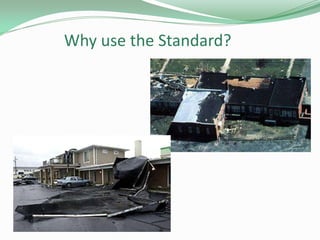
Why use the Standard?
Thank you!
This concludes The American Institute of Architects
Continuing Education Systems Course
Hickman Engineered Systems
PO Box 15005, Arden, NC 28704
800.892.9173
www.wph.com

Roof Edge Performance and Testing

  • 1.
    Hickman Engineered Systems ProviderNumber: H518 Roof Edge Performance and Testing Course Number : WPH2011FF Speaker Name/s Date
  • 2.
    Credit(s) earned oncompletion of this course will be reported to AIA CES for AIA members. Certificates of Completion for both AIA members and non-AIA members are available upon request. This course is registered with AIA CES for continuing professional education. As such, it does not include content that may be deemed or construed to be an approval or endorsement by the AIA of any material of construction or any method or manner of handling, using, distributing, or dealing in any material or product. _______________________________________ ____ Questions related to specific materials, methods, and services will be addressed at the conclusion of this presentation.
  • 3.
    This presentation isprotected by US and International Copyright laws. Reproduction, distribution, display and use of the presentation without written permission of the speaker is prohibited. © Hickman Engineered Systems 2013 Copyright Materials
  • 4.
    This course willcover roof edge performance and testing and review the ANSI/SPRI ES-1 standard that is part of the International Building Code. The next generation of the standard, ANSI/SPRI/FM 4435 will also be covered along with the GD-1 standard that addresses gutters. The course provides an overview of how to select the proper roof edge system for a building so that it meets code and stays on the building. Course Description
  • 5.
    Learning Objectives Learning Objective1: Understand the ANSI/SPRI ES-1 Standard Learning Objective 2: Understand the ANSI/SPRI/FM 4435 ES-1 Standard Learning Objective 3: Understand the GD-1 Standard Learning Objective 4: Specify metal edge systems and gutters that meet code and stay on their buildings. At the end of the this course, participants will be able to:
  • 6.
  • 7.
  • 8.
    Company History  Inbusiness since 1945  Invented 1st pre-manufactured roof edge system  Has over 25 patents  Continues to be an innovator & leader in the industry  Located in Asheville, NC
  • 9.
    What is aRoof Edge?
  • 10.
    What is aRoof Edge?  Acts as an effective termination and transition between the roof and other building components  Aesthetic feature to the building exterior  Most importantly, it is a roof’s first line of defense against wind!  http://www.youtube.com/watch?v=L9ngIY_fzgg
  • 11.
  • 12.
  • 13.
  • 14.
  • 15.
    Three SPRI EdgeStandards ANSI/SPRI ES-1  Standard that is included in IBC ANSI SPRI/FM 4435 ES-1  Revised standard just approved by ANSI GD-1  Standard for gutters currently going through the ANSI review process
  • 16.
    Topics for Discussion Wind Basics  Importance of Roof Edge  Perimeter Roof Edge Details & Standards  Using the ANSI/SPRI ES-1 Standard
  • 17.
  • 18.
  • 19.
    It doesn’t takea hurricane Thunderstorms also create dangerous winds  High School Gym Muscatine, IA  Straight line winds tore roof membrane and roof edge
  • 20.
    It doesn’t takea hurricane Thunderstorms also create dangerous winds  Blown pavers in Birmingham, AL  110 mph straight-line winds recorded
  • 21.
    It doesn’t takea hurricane Thunderstorms also create dangerous winds  One type of straight-line wind, downburst, can cause damage equivalent to a strong tornado  Straight-line winds can exceed 100 mph!
  • 22.
    Roofing Industry CommitteeOn Weather Issues (RICOWI)  165 inspections were conducted, including steep slope and low slope roofing  7 teams of investigators to Punta Gorda, FL after Charley  5 teams to the FL/AL border after Ivan
  • 23.
    Key Findings fromRICOWI Research Published in October, 2005 Issue of RCI  Nearly 95% of roof failures were caused by poor workmanship and substituted materials
  • 24.
    Key Findings fromRICOWI Research Published in October, 2005 Issue of RCI  Cleat gauge was often less than recommended by FM Global and ANSI/SPRI ES-1
  • 25.
    Key Findings fromRICOWI Research Published in October, 2005 Issue of RCI • Cleat gauge was often less than recommended by FM Global and ANSI/SPRI ES-1 • Failure of roofing systems was because of system failure at the perimeter… • The membrane attachment to the deck cannot resist the loads created when the perimeter securement fails…
  • 26.
    Importance of PerimeterFlashing • “The integrity of the perimeter flashing is a critical first line of defense against roof failure.” - Phil Smith, FM Global
  • 27.
    Importance of RoofPerimeter • During 1992’s Hurricane Andrew, it is estimated that 75% of all losses were related to roof failure • A study of 145 FM Global losses involving built-up (BUR) systems showed 85 losses (59%) occurred because the roof perimeter failed - FM Global Approved Product News No. 2, 2005
  • 28.
    Visualization of Flowover Roof (Wind Oblique to Wall) Accelerated Flow Flow SeparationMajor Vortex Up-Draft Down-Wash
  • 29.
  • 30.
    Wind Effects Wind Pressureson Coping and Fascia
  • 31.
    Perimeter Roof Edge Details& Standards  SMACNA  NRCA Details  FM  ANSI/SPRI ES-1
  • 32.
    SMACNA  Sheet Metaland Air Conditioning Contractors National Association  Concentrates on basic sheet metal design
  • 33.
    NRCA  National Roofing ContractorsAssociation  NRCA Roofing and Waterproofing Manual  Integrates edge shapes with roofing system
  • 34.
    FM I-49  FMGlobal  Loss Prevention Data Sheet 1-49 for roofing contractors  Labor intensive to duplicate
  • 35.
    FM Global ApprovalGuide  List of approved manufacturers - all products tested and approved by FM for Wind Zone Classifications  FM visits facilities
  • 36.
    ES-1 Certified RoofEdges • Edge devices designed and tested to resist calculated outward pressures • Complies with code
  • 37.
    Wind Design Standardfor Edge Systems Used With Low Slope Roofing Systems
  • 38.
    ANSI/SPRI  The AmericanNational Standards Institute (ANSI) coordinates the development and use of voluntary consensus standards in the United States  SPRI is the recognized technical and statistical authority on the Single Ply Roofing Industry
  • 39.
    What is ANSI/SPRIES-1?  First Roof Edge Standard for Low Slope Roofs  Reference for those who design, specify, fabricate, or install low slope roof edges  Based upon ASCE 7-02 “Minimum Design Loads for Buildings and other Structures”  Provides a calculation method to determine uplift pressures  Prescribes test methods to determine an edge systems resistance to wind pressures
  • 40.
    1504.5 Edge Securementfor Low Slope Roofs Low slope membrane roof systems metal edge securement, except gutters, installed in accordance with Section 1507, shall be designed and installed for wind loads in accordance with Chapter 16 and tested for resistance in accordance with ANSI/SPRI ES-1, except the basic wind speed shall be determined from Figure 1609. (Figure 1609 is a reference to the latest ASCE Wind Speed Map 7-02) 2003, 2006 and 2009 International Building Code Requires ES-1
  • 41.
  • 42.
    State Adoption Status ES-1 is in 2003, 2006 and 2009 IBC  States Adopt IBC Into State Code  All States Have Adopted 2003 or later versions
  • 43.
  • 44.
  • 45.
    General Roof EdgeDesign Considerations  Wind Speed  Building Height  Building Exposure (Terrain)  Importance Factor
  • 46.
    Wind Speed  WindSpeed to be taken from ANSI/ASCE 7-02  “Basic Wind Map of the USA” or the authority having jurisdiction
  • 47.
    The building heightshall be measured from ground level to the mean height of the roof section under design. Building Height
  • 48.
    The terrain surroundinga building will influence the exposure of that building to the wind. Building Exposure
  • 49.
  • 50.
    Exposure C –Open Terrain
  • 51.
    Exposure D –Sea Coast
  • 52.
    Adjustment for thecriticality of the building Category I Category II Category III Category IV Importance Factor
  • 53.
    Category I –Low hazard to human life
  • 54.
    Category III –Substantial hazard to human life
  • 55.
    Category IV –Essential Facility
  • 56.
    Category II –All others
  • 57.
    Importance Factor Nature of Occupancy CategoryNon-Hurricane Prone Hurricane Prone Low Hazard I 0.87 0.77 Other II 1.00 1.00 Substantial Hazard III 1.15 1.15 Essential Facilities IV 1.15 1.15
  • 58.
    Calculating roof edgedesign pressure P = GCp x qz x I x kzt P = Design Pressure GCp = Gust factor times Pressure Coefficient qz = Velocity pressure at building height kzt = Topographic Factor I = Importance Factor Multiplier
  • 59.
    Safety Factor?  ANSI/SPRIES-1 Calculation does not include a safety factor. It is left to the designer’s discretion to add a safety factor  ANSI/SPRI/FM 4435 ES-1 The calculation includes a safety factor of 2.0
  • 60.
    Example  80-foot tallHospital in Knoxville, TN  Wind speed from the Map = 90 mph  Exposure “B” = Velocity pressure 41 psf  Importance Factor Category IV Building = 1.15
  • 61.
  • 62.
  • 63.
    Test Protocols There arethree tests that make up the ANSI/SPRI ES-1 Standard: RE-1 RE-2 RE-3
  • 64.
    TEST METHOD RE-1 TestsEdge’s ability to restrain membrane pull * Only required for Mechanically attached or Ballasted membrane when there is no “peel stop” or first row of fasteners is greater than 12” from the edge
  • 65.
    TEST METHOD RE-1 SampleSize  ANSI/SPRI ES-1 A minimum 12” length mock- up of the termination system  ANSI/SPRI/FM 4435 ES-1 A minimum length mock up of the termination system so as to include a minimum of 3 fasteners at standard spacing
  • 66.
    TEST METHOD RE-1 Angleof Load  ANSI/SPRI ES-1 45 degree angle to the roof deck  ANSI/SPRI/FM 4435 ES-1 25 degree angle to the roof deck
  • 67.
    TEST METHOD RE-1 LoadForce  ANSI/SPRI ES-1 100 pounds per LF— pass/fail  ANSI/SPRI/FM 4435 ES-1 Test to Failure
  • 68.
    TEST METHOD RE-2 ANSI/SPRIES-1 and ANSI/SPRI/FM 4435 ES-1  All parts of the test specimen shall be full size in all dimensions  Length as designed for field use (8’ minimum)
  • 69.
    ES-1 Test Protocols RE-2 tests the outward pull for the horizontal face of an edge device
  • 70.
    TEST METHOD RE-3 ANSI/SPRIES-1 and ANSI/SPRI/FM 4435 ES-1  Bi-Directional test for coping caps -Face and Top loadings applied simultaneously  Repeated with loads on back and top
  • 71.
    ES-1 Test Protocols RE-3 tests upward and outward simultaneous pull - the horizontal and vertical flanges of a parapet coping cap
  • 72.
    Corner Region  ANSI/SPRIES-1  Double Fasteners in the Corner Region  ANSI/SPRI/FM 4435 ES-1  Use System Tested to Resist Calculated Loads  Fabricate Miters From That System
  • 73.
    GD-1  Load CalculationsSimilar to ES-1  Tests similar to ES-1  Static Load Downward Based on Gutter Volume  Cycled Load Outward on Face to Failure  Cycled Load Upward on Bottom to Failure
  • 74.
    Other Components ofthe ANSI/SPRI Standard  Metal Thickness  Galvanic Compatibility and Resistance  Appliances  Substrate
  • 75.
    Metal Thickness  GalvanizedSteel  26 Gauge  24 Gauge  22 Gauge  20 Gauge  Aluminum  .032  .040  .050  .063  .080  Copper  16 oz.  20 oz.
  • 76.
    Galvanic Compatibility andResistance ANODIC OR LEAST NOBLE (CORRODED END) Magnesium Zinc Aluminum Cadmium Steel Stainless Steel Lead Tin Copper Titanium Silver Gold CATHODIC OR MOST NOBLE (PROTECTED END)
  • 77.
  • 78.
  • 79.
    Nailer Attachment •In orderfor the edge metal to perform as tested the nailer must be properly secured. •ANSI/SPRI ES-1 does not include tests for nailers •FM Data Sheet 1-49 is a good reference
  • 80.
    Nailer Attachment ANSI/SPRI/FM 4435ES-1 includes two load requirements for nailer attachment: •Pull-out •Pull through
  • 81.
    Why use theStandard?  When roof edges are designed and tested to resist the anticipated wind forces, you get a better roof  Without a performance based test, it’s difficult compare products or defend a specification or detail from substitution  Establishes a minimum acceptable criteria for performance  It is in code!
  • 82.
    Why use theStandard?
  • 83.
  • 84.
    This concludes TheAmerican Institute of Architects Continuing Education Systems Course Hickman Engineered Systems PO Box 15005, Arden, NC 28704 800.892.9173 www.wph.com