HAI Solutions & Innovative Medical Devices:
Developing Multidisciplinary Safety & Efficacy Testing Strategies
John Iannone, BME
» Nearly 40 yrs of experience in Medical
Device, Pharma, & Biotech Industry
• Biocompatibilty/Material Qualification
• Toxicology Testing
• Extractables & Leachables
• Microbiology
» FDA Registered
» ISO 17025 Accredited
» GLP & GMP Compliant testing
1
Toxikon Company Profile
HAI Solutions and Innovative Medical Devices
» Healthcare Associated Infections (HAIs)
• Significant risk to public health
• Responsible for excess medical costs
• Multibillion dollar opportunity
» Revisit Old Approaches to Combat HAIs
• Reusable device reprocessing (Case Study)
» New Approaches to Combat HAIs
• Unique designs, Engineering Solutions (Case Study)
• AM Combination products, Innovative Materials (Case Study)
» Safety & Efficacy Testing
• Biocompatibility
• Microbiology
• Chemical Characterization/ E&L
• Toxicology2
Healthcare Associated Infections (HAIs)
» Emergence of Antibiotic Resistance
» Antibiotic Drug Development
» Centralized Introduction and Exposure
» Inability to Eradicate Pathogens from Healthcare Institutions
» Susceptible Patient Populations
3
Antibiotic Resistance over Time
4
Centers for Disease Control and Prevention
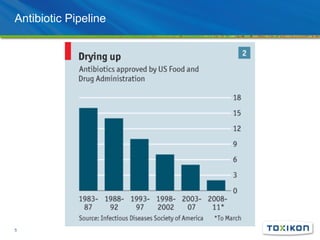
Antibiotic Pipeline
5
» FDA GAIN Act
• Qualifying Pathogens
» CDC
• Antibiotic Resistance
Healthcare Associated Infections
6
Major Site of Infection
Estimated Number of
Infections
Healthcare-Associated Infection (all HAI) 1,737,125
Surgical Site Infection (SSI) 290,485
Central Line Associated Bloodstream Infections (CLABSI) 92,011
Ventilator-associated Pneumonia (VAP) 52,543
Catheter associated Urinary Tract Infection (CAUTI) 449,334
Clostridium difficile-associated disease (CDI) 178,000
Klevens, RM; Edwards, JR; Richards, CL; Horan, T; Gaynes, R; Polloc,k D; Car,d D. Estimating healthcare-associated infections in U.S. hospitals, 2002.
Public Health Rep 2007;122:160-166.
R. Douglas Scott II. The Direct Medical Costs of Healthcare-Associated Infections in U.S. Hospitals and the Benefits of Prevention. CDC CS200891-A.
CDC - 2,299,442 Infections due to antibiotic resistance pathogens.
$28.4 – 45.0 Billion
Healthcare Associated Infections
1:20
Some HAIs will no longer qualify for reimbursements.
7
Spot Light on HAI Solutions
HAI Solutions – Process Focus
CONFIDENTIAL9
Draft Guidance for Industry & FDA Staff
Processing/Reprocessing
Medical Devices in
Health Care Settings:
Validation Methods & Labeling
Draft Guidance, May 2, 2011
Why are Reprocessing Validations Important?
CONFIDENTIAL10
Lawrence F. Muscarella, Clinical Gastroenterology and Hepatology 2010;8:577-580.
HAI Solutions – Products Focus
11
In the News:
Recently, Covidien launched 2 new product lines:
1. Disinfectant Cap (Excelsior Medical)
2. Needleless Connector (NP Medical)
Improve compliance with standard Infection Prevention
Protocols
12
New Products Designed to Improve
Compliance w/Standard Infection Control Protocols
Kendall prefill syringe with removable luer access disinfectant cap
• Integrates the cap into the plunger of the syringe
• Design makes cap readily available
• Using disinfectant cap can
• help prevent pathogens from entering vascular access devices
• promote compliance with infection control protocols
Kendall neutral displacement needleless connector
• Designed to complement best clinical practices to help reduce the risk of
catheter-related blood stream infections
13
New Products Designed to Improve
Compliance w/Standard Infection Control Protocols
NEEDLELESS CONNECTORS:
• A flat, smooth septum surface promotes proper
disinfection
• Maintaining the septum surface integrity over
the life of the product promotes proper
disinfection
• If use & reuse generates gaps or openings, it
creates new surfaces that cannot be easily
reached during disinfection
• Improper disinfection due to compromised
septum surface can result in infusing
contaminated pathogens into the blood stream
• nPulseTM Needle-free Connector has a self-opening split
septum (SOSSTM)
• Avoids forcing the male Luer tip through the septum &
eliminates need for an internal cannula that drags
against the critical septum seal surface
14
New Products Designed to Improve
Compliance w/Standard Infection Control Protocols
7 day extreme use conditioning
• 168 activation cycles & 168 hour activation period
• Staphylococcus aureus inoculation upon the device
septum at a clinically high level (~500 CFU)
• Incubation followed by wiping septum w/ alcohol
nPulse™ test samples showed no growth!
Combination Products, per 21 CFR 3.2(e)
Combined (Physically, Chemically, or Combined/Mixed):
1. Pre-filled Syringes with Drug or Biologic
2. Meter Dosed Inhaler
3. Drug Coated Stents
4. Antimicrobial Treated Catheter
Co-packaged:
1. Disposable or re-use injector with Drug or Biologic
2. Delivery Pump with Drug or Biologic
Separately packaged and cross-labeled:
1. Surgical Kit and Drug
15
Antimicrobial Agents – Innovative Materials
» Main Classes:
• Antibiotics, Antivirals, Antifungals, Preservatives
» Antimicrobial Active Ingredients are:
• Blended into a product
• Bonded onto a material's surface
• Coating treatments applied to another surface
» Utility:
• Resist microbiological growth
• Protect the device formulation
• Protect the patient
16
Why Combination Products?
Drive to improve existing medical devices
• All issues can't be solved with mechanically performing devices
Integrate new technologies to solve existing problems
• Medical device function can be enhanced by including a therapeutic
agent
Build a better Mousetrap!
Example:
• The mechanical septum of a needless connector provides a barrier
which slows ingress of microorganisms that may cause infection
• The integration of an effective antimicrobial agent could stop microbial
growth/ingress
Typical purpose of a Combination Product may be to:
1. use a drug coating in order to augment a property of a medical device, or
2. to use the device as a delivery method for a drug
Focus on Solving HAI Problems
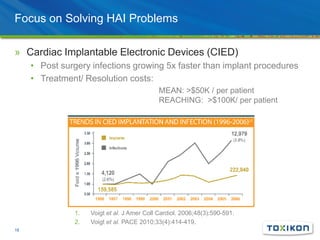
» Cardiac Implantable Electronic Devices (CIED)
• Post surgery infections growing 5x faster than implant procedures
• Treatment/ Resolution costs:
MEAN: >$50K / per patient
REACHING: >$100K/ per patient
1. Voigt et al. J Amer Coll Cardiol. 2006;48(3):590-591.
2. Voigt et al. PACE 2010;33(4):414-419.
18
Focus on Solving HAI Problems
» TyRx, a NJ based startup, Takes Notice
» Develops Antimicrobial pouch
• Deliver targeted antibiotics for CIED related infections
• Delivery is targeted at surgical site
• Delivery is sustained during critical time
» Preclinical data demonstrates effectiveness
» Clinical data exhibits a 94% reduction in infection rates
» Medtronic buys company early 2014 for $160 million
19
Regulatory Path: Multi-disciplinary Testing Needs
Biocompatibility
Chemical
Characterization
Toxicity &
Efficacy
Microbiology
Multi-disciplinary Testing Needs
21 CONFIDENTIAL
Microbiological Efficacy
Antimicrobial Efficacy Testing
Designing Your Efficacy Program
» Neutralization Validation
(AM related)
» Recovery Efficiency
(Material/Device related)
» Microbial Growth & quantitation
• Log Reduction
• Kill Time
23
Efficacy Kinetics
Medical Device Testing - Biocompatibility
Biocompatibility Testing Categories
» Cytotoxicity
» Sensitization
» Irritation &
Intracutaneous Reactivity
» Acute Systemic Toxicity
» Subacute & Subchronic
Systemic Toxicity
» Genotoxicity
» Implantation Reactivity
» Hemocompatibility
» Chronic Systemic Toxicity
» Carcinogenicity
25
Biocompatibility Testing Matrix
26
Contact duration
Cytotoxicity
Sensitivity/Sensitization
Irritation/Intracutaneous
Reactivity
SystemicToxicity
(Acute)
Pyrogenicity
Subacuteand/orSub
chronictoxicity
Genetic
Toxicity/Genotoxicity
Implantation
Hemocompatibility
ChronicToxicity
Carcinogenicity
Reproductive/
Developmental
Biodegradation/
Biodegradable
Category Contact
less than 24 hours   
24 hours to 30 days   
more than a 30 days   
less than 24 hours   
24 hours to 30 days       
more than a 30 days         
less than 24 hours     
24 hours to 30 days       
more than a 30 days         
less than 24 hours      
24 hours to 30 days       
more than a 30 days           
less than 24 hours     
24 hours to 30 days        
more than a 30 days          
less than 24 hours       
24 hours to 30 days         
more than a 30 days           
less than 24 hours     
24 hours to 30 days        
more than a 30 days          
less than 24 hours        
24 hours to 30 days         
more than a 30 days           
 = Evaluation required by ISO, FDA and MHLW
 = Evaluation required by ISO and FDA
 =Evaluation required by FDA
 =Evaluation required by ISO
Circulating Blood
Initial Evaluation Supplemental
Body Contact
Tissue/Bone/Dentin
Device Categories
Tissue/Bone
Blood
Skin
Mucous/Mucosal
Membrane
Breached/Compromised
Surface
Blood Vessels/Blood Path
Indirect
Body Surface
Contact
Device/Surface
Device
Devices
connecting the
internal to the
external/External
communicating
device
Internally
implanted
devices/Implant
device
Chemical Characterization
Biocompatibility Testing Matrix
28
Contact duration
Cytotoxicity
Sensitivity/Sensitization
Irritation/Intracutaneous
Reactivity
SystemicToxicity
(Acute)
Pyrogenicity
Subacuteand/orSub
chronictoxicity
Genetic
Toxicity/Genotoxicity
Implantation
Hemocompatibility
ChronicToxicity
Carcinogenicity
Reproductive/
Developmental
Biodegradation/
Biodegradable
Category Contact
less than 24 hours   
24 hours to 30 days   
more than a 30 days   
less than 24 hours   
24 hours to 30 days       
more than a 30 days         
less than 24 hours     
24 hours to 30 days       
more than a 30 days         
less than 24 hours      
24 hours to 30 days       
more than a 30 days           
less than 24 hours     
24 hours to 30 days        
more than a 30 days          
less than 24 hours       
24 hours to 30 days         
more than a 30 days           
less than 24 hours     
24 hours to 30 days        
more than a 30 days          
less than 24 hours        
24 hours to 30 days         
more than a 30 days           
 = Evaluation required by ISO, FDA and MHLW
 = Evaluation required by ISO and FDA
 =Evaluation required by FDA
 =Evaluation required by ISO
Circulating Blood
Initial Evaluation Supplemental
Body Contact
Tissue/Bone/Dentin
Device Categories
Tissue/Bone
Blood
Skin
Mucous/Mucosal
Membrane
Breached/Compromised
Surface
Blood Vessels/Blood Path
Indirect
Body Surface
Contact
Device/Surface
Device
Devices
connecting the
internal to the
external/External
communicating
device
Internally
implanted
devices/Implant
device
Leachate Migration / Extraction
29
Polymer
Migration
Extraction Solution
Environment of Concern
Extractables & Leachables
30
» Extractables:
Extractables are compounds that migrate from the contact surface
under more aggressive conditions such as elevated temperature,
extended contact time, or aggressive solvent system. Any component
that is added to or pulled from the device or the materials used to
make the device, including degradants and residuals.
What CAN come out.
» Leachables:
Leachables are compounds that migrate from the contact surface
under normal conditions of exposure. Leachables are usually subset
of extractables.
What DOES come out.
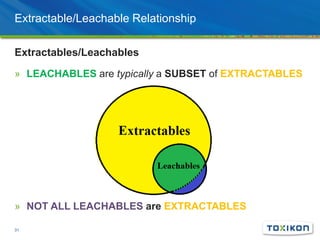
Extractable/Leachable Relationship
31
Extractables/Leachables
» LEACHABLES are typically a SUBSET of EXTRACTABLES
» NOT ALL LEACHABLES are EXTRACTABLES
Chemical Characterization – Extractable & Leachable
SOURCES OF LEACHATES
» Polymer Additives
 Antioxidants, Slip Agents, Fillers, UV Stabilizers, Plasticizers
» Polymer Degradation Products
 Sterilization, Storage/Shelf-Life, Processing
» Residues
 Monomers, Catalyst, Solvents
» Manufacturing Impurities/ Migration from Secondary Materials
 Adhesive, Ink, Paper Binders, Packaging
» Drug/Chemical Additives
 API, Excipients, Antimicrobial Agent
32
Extractable/Leachable Sources
33
Potential
Inorganic
Compounds
of concerns
Metals
Elution Profile Determination
» Screening for what CAN be present
• Identify Universe of potential compounds
» Assess Leaching Behavior
• How much MAY be present?
» Focus on Quantitation of “Target” Compounds
• Include Expected Elutents
• Confirm expected release kinetics
» Assess Potential Toxicological Consequence
• What could be the impact to the Patient?
34
Premarket Notification [510(k)] Submissions for Medical
Devices that Include Antimicrobial Agents
Recomendations
» Determine biocompatibility & toxicological affect of device to patient
» Determine the safe levels of the Antimicrobial Agent (NOAEL)
» Ensure that the integration of the Antimicrobial Agent with the device is
still safe (this is not considered additive, but multiplicative).
Premarket Notification [510(k)] Submissions for Medical
Devices that Include Antimicrobial Agents
Recomendations
» Low levels of toxic leachates exposed to patient with Antimicrobial
Agent may result in new safety concerns.
» Ensure the interaction of leachates & degradants from device are non-
reactive with eluted antimicrobial agent & it’s degradation components.
» Ensure antimicrobial loading is sufficient to demonstrate improved
efficacy
Therapeutic Window: Balancing Efficacy & Safety
» Higher concentrations of Antimicrobial should
improve efficacy
» Lower concentrations of eluted Antimicrobial
should improve safety profile
» Drive allowable limits for optimized BALANCE between Safety and
efficacy
37
» Efficacy: Microbiologically Advantageous with Sustaining Effect
– Agent is effective against pathogens of concern
– Chemical Elution is adequately sustained
» Safety: Biocompatibility, Toxicology per OECD, ISO etc.
– Toxicological effects of the drug/biologic are known or determined
– Evaluation of product use in combination product must
demonstrate maintenance of safety Extractables/Leachables
Controlled Elution - Promote Safety & Efficacy
38
» Therapeutic Window
– Agent elution is controlled to ensure concentration is
sufficiently sustained for Adequate Efficacy
– Agent elution is controlled to ensure concentration does not
exceed toxicologically concerning levels
CONFIDENTIAL
Takeaway Message (Conclusion)
39
» Healthcare Associated Infections (HAIs)
• Significant risk to public health
• Responsible for excess medical costs
» Solving the HAI Problem
• Process Improvement
• Product Innovation
» Regulatory Pathway
• Safety: Biocompatibility & Toxicology
• Efficacy: Microbiology & Chemical Characterization
THANK YOU
John Iannone
Program Manager
Technical Specialist
john.iannone@toxikon.com
15 Wiggins Ave, Bedford, MA 01730
800-458-4141 x7142
40

Innovative Medical Devices: Developing Multidisciplinary Safety & Efficacy Testing Strategies for Combination Products

  • 1.
    HAI Solutions &Innovative Medical Devices: Developing Multidisciplinary Safety & Efficacy Testing Strategies John Iannone, BME
  • 2.
    » Nearly 40yrs of experience in Medical Device, Pharma, & Biotech Industry • Biocompatibilty/Material Qualification • Toxicology Testing • Extractables & Leachables • Microbiology » FDA Registered » ISO 17025 Accredited » GLP & GMP Compliant testing 1 Toxikon Company Profile
  • 3.
    HAI Solutions andInnovative Medical Devices » Healthcare Associated Infections (HAIs) • Significant risk to public health • Responsible for excess medical costs • Multibillion dollar opportunity » Revisit Old Approaches to Combat HAIs • Reusable device reprocessing (Case Study) » New Approaches to Combat HAIs • Unique designs, Engineering Solutions (Case Study) • AM Combination products, Innovative Materials (Case Study) » Safety & Efficacy Testing • Biocompatibility • Microbiology • Chemical Characterization/ E&L • Toxicology2
  • 4.
    Healthcare Associated Infections(HAIs) » Emergence of Antibiotic Resistance » Antibiotic Drug Development » Centralized Introduction and Exposure » Inability to Eradicate Pathogens from Healthcare Institutions » Susceptible Patient Populations 3
  • 5.
    Antibiotic Resistance overTime 4 Centers for Disease Control and Prevention
  • 6.
  • 7.
    » FDA GAINAct • Qualifying Pathogens » CDC • Antibiotic Resistance Healthcare Associated Infections 6
  • 8.
    Major Site ofInfection Estimated Number of Infections Healthcare-Associated Infection (all HAI) 1,737,125 Surgical Site Infection (SSI) 290,485 Central Line Associated Bloodstream Infections (CLABSI) 92,011 Ventilator-associated Pneumonia (VAP) 52,543 Catheter associated Urinary Tract Infection (CAUTI) 449,334 Clostridium difficile-associated disease (CDI) 178,000 Klevens, RM; Edwards, JR; Richards, CL; Horan, T; Gaynes, R; Polloc,k D; Car,d D. Estimating healthcare-associated infections in U.S. hospitals, 2002. Public Health Rep 2007;122:160-166. R. Douglas Scott II. The Direct Medical Costs of Healthcare-Associated Infections in U.S. Hospitals and the Benefits of Prevention. CDC CS200891-A. CDC - 2,299,442 Infections due to antibiotic resistance pathogens. $28.4 – 45.0 Billion Healthcare Associated Infections 1:20 Some HAIs will no longer qualify for reimbursements. 7
  • 9.
    Spot Light onHAI Solutions
  • 10.
    HAI Solutions –Process Focus CONFIDENTIAL9 Draft Guidance for Industry & FDA Staff Processing/Reprocessing Medical Devices in Health Care Settings: Validation Methods & Labeling Draft Guidance, May 2, 2011
  • 11.
    Why are ReprocessingValidations Important? CONFIDENTIAL10 Lawrence F. Muscarella, Clinical Gastroenterology and Hepatology 2010;8:577-580.
  • 12.
    HAI Solutions –Products Focus 11
  • 13.
    In the News: Recently,Covidien launched 2 new product lines: 1. Disinfectant Cap (Excelsior Medical) 2. Needleless Connector (NP Medical) Improve compliance with standard Infection Prevention Protocols 12 New Products Designed to Improve Compliance w/Standard Infection Control Protocols Kendall prefill syringe with removable luer access disinfectant cap • Integrates the cap into the plunger of the syringe • Design makes cap readily available • Using disinfectant cap can • help prevent pathogens from entering vascular access devices • promote compliance with infection control protocols Kendall neutral displacement needleless connector • Designed to complement best clinical practices to help reduce the risk of catheter-related blood stream infections
  • 14.
    13 New Products Designedto Improve Compliance w/Standard Infection Control Protocols NEEDLELESS CONNECTORS: • A flat, smooth septum surface promotes proper disinfection • Maintaining the septum surface integrity over the life of the product promotes proper disinfection • If use & reuse generates gaps or openings, it creates new surfaces that cannot be easily reached during disinfection • Improper disinfection due to compromised septum surface can result in infusing contaminated pathogens into the blood stream
  • 15.
    • nPulseTM Needle-freeConnector has a self-opening split septum (SOSSTM) • Avoids forcing the male Luer tip through the septum & eliminates need for an internal cannula that drags against the critical septum seal surface 14 New Products Designed to Improve Compliance w/Standard Infection Control Protocols 7 day extreme use conditioning • 168 activation cycles & 168 hour activation period • Staphylococcus aureus inoculation upon the device septum at a clinically high level (~500 CFU) • Incubation followed by wiping septum w/ alcohol nPulse™ test samples showed no growth!
  • 16.
    Combination Products, per21 CFR 3.2(e) Combined (Physically, Chemically, or Combined/Mixed): 1. Pre-filled Syringes with Drug or Biologic 2. Meter Dosed Inhaler 3. Drug Coated Stents 4. Antimicrobial Treated Catheter Co-packaged: 1. Disposable or re-use injector with Drug or Biologic 2. Delivery Pump with Drug or Biologic Separately packaged and cross-labeled: 1. Surgical Kit and Drug 15
  • 17.
    Antimicrobial Agents –Innovative Materials » Main Classes: • Antibiotics, Antivirals, Antifungals, Preservatives » Antimicrobial Active Ingredients are: • Blended into a product • Bonded onto a material's surface • Coating treatments applied to another surface » Utility: • Resist microbiological growth • Protect the device formulation • Protect the patient 16
  • 18.
    Why Combination Products? Driveto improve existing medical devices • All issues can't be solved with mechanically performing devices Integrate new technologies to solve existing problems • Medical device function can be enhanced by including a therapeutic agent Build a better Mousetrap! Example: • The mechanical septum of a needless connector provides a barrier which slows ingress of microorganisms that may cause infection • The integration of an effective antimicrobial agent could stop microbial growth/ingress Typical purpose of a Combination Product may be to: 1. use a drug coating in order to augment a property of a medical device, or 2. to use the device as a delivery method for a drug
  • 19.
    Focus on SolvingHAI Problems » Cardiac Implantable Electronic Devices (CIED) • Post surgery infections growing 5x faster than implant procedures • Treatment/ Resolution costs: MEAN: >$50K / per patient REACHING: >$100K/ per patient 1. Voigt et al. J Amer Coll Cardiol. 2006;48(3):590-591. 2. Voigt et al. PACE 2010;33(4):414-419. 18
  • 20.
    Focus on SolvingHAI Problems » TyRx, a NJ based startup, Takes Notice » Develops Antimicrobial pouch • Deliver targeted antibiotics for CIED related infections • Delivery is targeted at surgical site • Delivery is sustained during critical time » Preclinical data demonstrates effectiveness » Clinical data exhibits a 94% reduction in infection rates » Medtronic buys company early 2014 for $160 million 19
  • 21.
  • 22.
  • 23.
  • 24.
    Antimicrobial Efficacy Testing DesigningYour Efficacy Program » Neutralization Validation (AM related) » Recovery Efficiency (Material/Device related) » Microbial Growth & quantitation • Log Reduction • Kill Time 23 Efficacy Kinetics
  • 25.
    Medical Device Testing- Biocompatibility
  • 26.
    Biocompatibility Testing Categories »Cytotoxicity » Sensitization » Irritation & Intracutaneous Reactivity » Acute Systemic Toxicity » Subacute & Subchronic Systemic Toxicity » Genotoxicity » Implantation Reactivity » Hemocompatibility » Chronic Systemic Toxicity » Carcinogenicity 25
  • 27.
    Biocompatibility Testing Matrix 26 Contactduration Cytotoxicity Sensitivity/Sensitization Irritation/Intracutaneous Reactivity SystemicToxicity (Acute) Pyrogenicity Subacuteand/orSub chronictoxicity Genetic Toxicity/Genotoxicity Implantation Hemocompatibility ChronicToxicity Carcinogenicity Reproductive/ Developmental Biodegradation/ Biodegradable Category Contact less than 24 hours    24 hours to 30 days    more than a 30 days    less than 24 hours    24 hours to 30 days        more than a 30 days          less than 24 hours      24 hours to 30 days        more than a 30 days          less than 24 hours       24 hours to 30 days        more than a 30 days            less than 24 hours      24 hours to 30 days         more than a 30 days           less than 24 hours        24 hours to 30 days          more than a 30 days            less than 24 hours      24 hours to 30 days         more than a 30 days           less than 24 hours         24 hours to 30 days          more than a 30 days             = Evaluation required by ISO, FDA and MHLW  = Evaluation required by ISO and FDA  =Evaluation required by FDA  =Evaluation required by ISO Circulating Blood Initial Evaluation Supplemental Body Contact Tissue/Bone/Dentin Device Categories Tissue/Bone Blood Skin Mucous/Mucosal Membrane Breached/Compromised Surface Blood Vessels/Blood Path Indirect Body Surface Contact Device/Surface Device Devices connecting the internal to the external/External communicating device Internally implanted devices/Implant device
  • 28.
  • 29.
    Biocompatibility Testing Matrix 28 Contactduration Cytotoxicity Sensitivity/Sensitization Irritation/Intracutaneous Reactivity SystemicToxicity (Acute) Pyrogenicity Subacuteand/orSub chronictoxicity Genetic Toxicity/Genotoxicity Implantation Hemocompatibility ChronicToxicity Carcinogenicity Reproductive/ Developmental Biodegradation/ Biodegradable Category Contact less than 24 hours    24 hours to 30 days    more than a 30 days    less than 24 hours    24 hours to 30 days        more than a 30 days          less than 24 hours      24 hours to 30 days        more than a 30 days          less than 24 hours       24 hours to 30 days        more than a 30 days            less than 24 hours      24 hours to 30 days         more than a 30 days           less than 24 hours        24 hours to 30 days          more than a 30 days            less than 24 hours      24 hours to 30 days         more than a 30 days           less than 24 hours         24 hours to 30 days          more than a 30 days             = Evaluation required by ISO, FDA and MHLW  = Evaluation required by ISO and FDA  =Evaluation required by FDA  =Evaluation required by ISO Circulating Blood Initial Evaluation Supplemental Body Contact Tissue/Bone/Dentin Device Categories Tissue/Bone Blood Skin Mucous/Mucosal Membrane Breached/Compromised Surface Blood Vessels/Blood Path Indirect Body Surface Contact Device/Surface Device Devices connecting the internal to the external/External communicating device Internally implanted devices/Implant device
  • 30.
    Leachate Migration /Extraction 29 Polymer Migration Extraction Solution Environment of Concern
  • 31.
    Extractables & Leachables 30 »Extractables: Extractables are compounds that migrate from the contact surface under more aggressive conditions such as elevated temperature, extended contact time, or aggressive solvent system. Any component that is added to or pulled from the device or the materials used to make the device, including degradants and residuals. What CAN come out. » Leachables: Leachables are compounds that migrate from the contact surface under normal conditions of exposure. Leachables are usually subset of extractables. What DOES come out.
  • 32.
    Extractable/Leachable Relationship 31 Extractables/Leachables » LEACHABLESare typically a SUBSET of EXTRACTABLES » NOT ALL LEACHABLES are EXTRACTABLES
  • 33.
    Chemical Characterization –Extractable & Leachable SOURCES OF LEACHATES » Polymer Additives  Antioxidants, Slip Agents, Fillers, UV Stabilizers, Plasticizers » Polymer Degradation Products  Sterilization, Storage/Shelf-Life, Processing » Residues  Monomers, Catalyst, Solvents » Manufacturing Impurities/ Migration from Secondary Materials  Adhesive, Ink, Paper Binders, Packaging » Drug/Chemical Additives  API, Excipients, Antimicrobial Agent 32
  • 34.
  • 35.
    Elution Profile Determination »Screening for what CAN be present • Identify Universe of potential compounds » Assess Leaching Behavior • How much MAY be present? » Focus on Quantitation of “Target” Compounds • Include Expected Elutents • Confirm expected release kinetics » Assess Potential Toxicological Consequence • What could be the impact to the Patient? 34
  • 36.
    Premarket Notification [510(k)]Submissions for Medical Devices that Include Antimicrobial Agents Recomendations » Determine biocompatibility & toxicological affect of device to patient » Determine the safe levels of the Antimicrobial Agent (NOAEL) » Ensure that the integration of the Antimicrobial Agent with the device is still safe (this is not considered additive, but multiplicative).
  • 37.
    Premarket Notification [510(k)]Submissions for Medical Devices that Include Antimicrobial Agents Recomendations » Low levels of toxic leachates exposed to patient with Antimicrobial Agent may result in new safety concerns. » Ensure the interaction of leachates & degradants from device are non- reactive with eluted antimicrobial agent & it’s degradation components. » Ensure antimicrobial loading is sufficient to demonstrate improved efficacy
  • 38.
    Therapeutic Window: BalancingEfficacy & Safety » Higher concentrations of Antimicrobial should improve efficacy » Lower concentrations of eluted Antimicrobial should improve safety profile » Drive allowable limits for optimized BALANCE between Safety and efficacy 37
  • 39.
    » Efficacy: MicrobiologicallyAdvantageous with Sustaining Effect – Agent is effective against pathogens of concern – Chemical Elution is adequately sustained » Safety: Biocompatibility, Toxicology per OECD, ISO etc. – Toxicological effects of the drug/biologic are known or determined – Evaluation of product use in combination product must demonstrate maintenance of safety Extractables/Leachables Controlled Elution - Promote Safety & Efficacy 38 » Therapeutic Window – Agent elution is controlled to ensure concentration is sufficiently sustained for Adequate Efficacy – Agent elution is controlled to ensure concentration does not exceed toxicologically concerning levels CONFIDENTIAL
  • 40.
    Takeaway Message (Conclusion) 39 »Healthcare Associated Infections (HAIs) • Significant risk to public health • Responsible for excess medical costs » Solving the HAI Problem • Process Improvement • Product Innovation » Regulatory Pathway • Safety: Biocompatibility & Toxicology • Efficacy: Microbiology & Chemical Characterization
  • 41.
    THANK YOU John Iannone ProgramManager Technical Specialist john.iannone@toxikon.com 15 Wiggins Ave, Bedford, MA 01730 800-458-4141 x7142 40