Regulatory Submission: Applying
GLP in Surgical Efficacy Studies
Curtis Schondelmeyer, DVM
Director Preclinical Veterinary Services and
Efficacy and Surgical Research Services
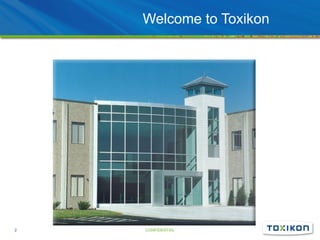
Welcome to Toxikon
CONFIDENTIAL2
Who We Are
Toxikon is a preclinical contract research
organization. We contract and partner with
biotech, pharmaceutical and medical device
industries to deliver exceptional product
development services.
Toxikon is a preclinical contract research
organization. We contract and partner
with biotech, pharmaceutical and medical
device industries to deliver exceptional
product development services.
3
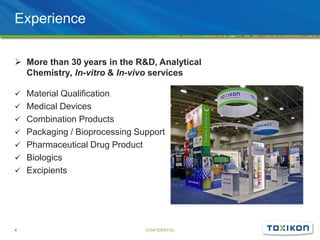
Experience
CONFIDENTIAL4
 More than 30 years in the R&D, Analytical
Chemistry, In-vitro & In-vivo services
 Material Qualification
 Medical Devices
 Combination Products
 Packaging / Bioprocessing Support
 Pharmaceutical Drug Product
 Biologics
 Excipients
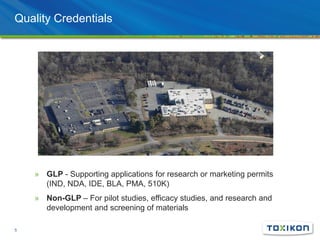
Quality Credentials
» GLP - Supporting applications for research or marketing permits
(IND, NDA, IDE, BLA, PMA, 510K)
» Non-GLP – For pilot studies, efficacy studies, and research and
development and screening of materials
5
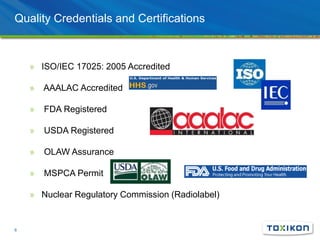
Quality Credentials and Certifications
» ISO/IEC 17025: 2005 Accredited
» AAALAC Accredited
» FDA Registered
» USDA Registered
» OLAW Assurance
» MSPCA Permit
» Nuclear Regulatory Commission (Radiolabel)
6
The Markets We Serve
7
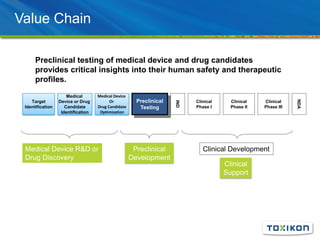
Value Chain
Target
Identification
Medical
Device or Drug
Candidate
Identification
Medical Device
Or
Drug Candidate
Optimization
Preclinical
Testing
Clinical
Phase I
Clinical
Phase II
Clinical
Phase III
NDA
IND
Medical Device R&D or
Drug Discovery
Preclinical
Development
Clinical Development
Preclinical testing of medical device and drug candidates
provides critical insights into their human safety and therapeutic
profiles.
Clinical
Support
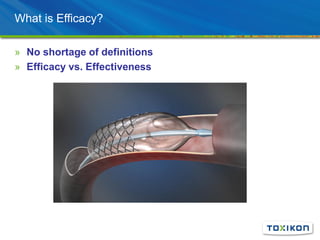
What is Efficacy?
» No shortage of definitions
» Efficacy vs. Effectiveness
Efficacy
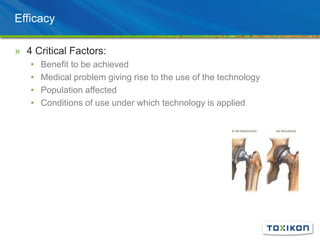
» 4 Critical Factors:
• Benefit to be achieved
• Medical problem giving rise to the use of the technology
• Population affected
• Conditions of use under which technology is applied
Efficacy
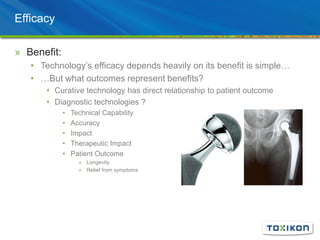
» Benefit:
• Technology’s efficacy depends heavily on its benefit is simple…
• …But what outcomes represent benefits?
• Curative technology has direct relationship to patient outcome
• Diagnostic technologies ?
• Technical Capability
• Accuracy
• Impact
• Therapeutic Impact
• Patient Outcome
» Longevity
» Relief from symptoms
Efficacy
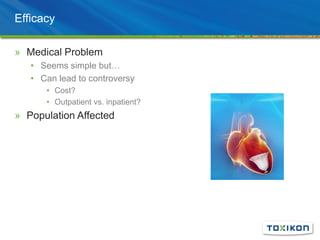
» Medical Problem
• Seems simple but…
• Can lead to controversy
• Cost?
• Outpatient vs. inpatient?
» Population Affected
Efficacy
» Conditions of Use
• Partially determined by the skills/knowledge/abilities of health
personnel
• Average conditions of use
• May differ between hospitals/physicians etc.
• Valuable to have measures of outcome that are not dependent on
differing variables inherent in average conditions of use
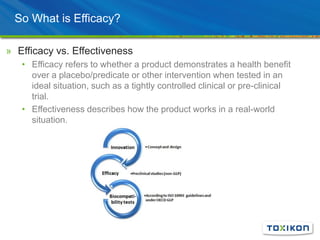
So What is Efficacy?
» Efficacy vs. Effectiveness
• Efficacy refers to whether a product demonstrates a health benefit
over a placebo/predicate or other intervention when tested in an
ideal situation, such as a tightly controlled clinical or pre-clinical
trial.
• Effectiveness describes how the product works in a real-world
situation.
Efficacy and the FDA?
» Effectiveness: “There is reasonable assurance that a
device is effective when it can be determined, based upon
valid scientific evidence, that in a significant portion of
the target population, the use of the device for its intended
uses and conditions of use, when accompanied by adequate
directions for use and warnings against unsafe use, will
provide clinically significant results.” 21 CFR 860.7
Efficacy and the FDA?
» There is some confusion caused by the fact that the FDA has
a mandate to insure that products are "safe and effective,"
but in reality the FDA will approve products that have been
proven to have clinical efficacy, without any required proof of
"clinical effectiveness" by this definition.
Efficacy vs. Safety
» Safety: “There is reasonable assurance that a device is
safe when it can be determined based on valid scientific
evidence that the probable benefits to health from use of the
device for its intended uses and conditions of use, when
accompanied by adequate directions and warnings against
unsafe use, outweigh the probable risks.” 21 CFR 860.7
» Clinical Significance vs. Risk
• This affects you animal numbers
FDA Device Classification: Risk-Based Approach
» • Class 1: Common, low-risk devices
» General controls
» Most exempt from pre-market submission
» • Class 2: More complex, higher risk
» Special controls
» Pre-market notification [510(k)]
» • Class 3: Most complex, highest risk
» (Devices which support or sustain human life; devices which
pose potential unreasonable risk of illness or injury)
» Comprehensive data needed
» Pre-market application [PMA]
Pre-market Notification vs. Pre-market Approval
» Pre-market Notification 510(k)
• Requires:
• Demonstration of Substantial Equivalence to Predicate Device(s)*
“As safe and effective as the predicate device(s)”
• Classes: I, II, some III
» Pre-market Approval
• PMA Requires:
• Demonstration of Reasonable Safety and Effectiveness Class: III
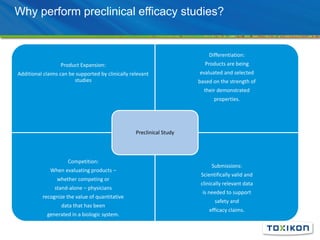
Why perform preclinical efficacy studies?
Product Expansion:
Additional claims can be supported by clinically relevant
studies
Differentiation:
Products are being
evaluated and selected
based on the strength of
their demonstrated
properties.
Competition:
When evaluating products –
whether competing or
stand-alone – physicians
recognize the value of quantitative
data that has been
generated in a biologic system.
Submissions:
Scientifically valid and
clinically relevant data
is needed to support
safety and
efficacy claims.
Preclinical Study
R&D:
Testing Your Idea
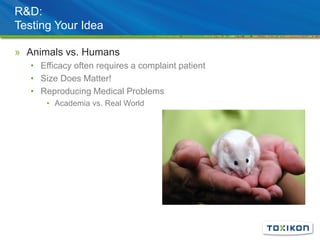
» Animals vs. Humans
• Efficacy often requires a complaint patient
• Size Does Matter!
• Reproducing Medical Problems
• Academia vs. Real World
Designing Efficacy Studies
» Is there guidance?
• Talk to the FDA
» Never under estimate the power of a pilot study!
• Can save time and money
• Non-GLP
» Do your home work
• Established animal models?
• Species?
• Academic studies vs. what is needed to show efficacy
• Controls
• Predicate vs. Negative Controls vs. Both
» Keep them separated
• Safety= Risk
• Efficacy= Clinical Significance
Designing Efficacy Studies
» Animal Numbers
» Knowing your device can save you money
• Participation in your studies?
» Animal model relevance to real world application
• How far do you really need to go?
» Analysis and Endpoints
• Quantitative vs. Qualitative
• Histomorphometry
• MicroCT
• Other testing?
• Biomechanical
Designing Efficacy Studies
» Moving Safety and Efficacy
• Where to begin?
• Combination products
AND LASTLY…….
» GLP vs. Non-GLP
• GLPs and surgical efficacy studies
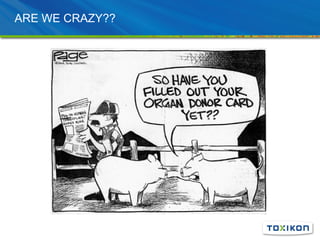
ARE WE CRAZY??
Application of the Standard
» Conducting Nonclinical Laboratory Studies That Support Or
Are Intended To Support Application Of Research Or
Marketing For Products Regulated By The FDA
» Includes:
• Food
• Food Additives
• Animal Food Additives
• Human and Animal Drugs
• Medical Devices For Human Use
• Biological Products
• Electronic Products
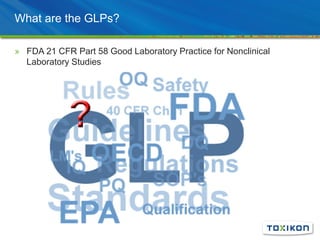
What are the GLPs?
» FDA 21 CFR Part 58 Good Laboratory Practice for Nonclinical
Laboratory Studies
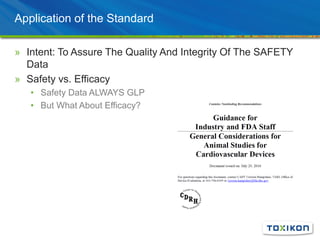
Application of the Standard
» Intent: To Assure The Quality And Integrity Of The SAFETY
Data
» Safety vs. Efficacy
• Safety Data ALWAYS GLP
• But What About Efficacy?
What Does This Really Mean?
» 3 Day Course
» Why Do It Yourself, When You Can Hire Someone To Do It
For You?
• Hire a Consultant
» GLPs May Be Written In Black And White But Really….
» GLPs Are About…
• Managing
• Organizing
• Documenting
…To Assure The Integrity Of The Data And To Be
Able To Reconstruct The Entire Study.
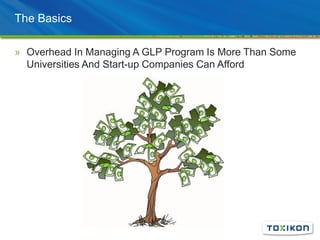
The Basics
» Overhead In Managing A GLP Program Is More Than Some
Universities And Start-up Companies Can Afford
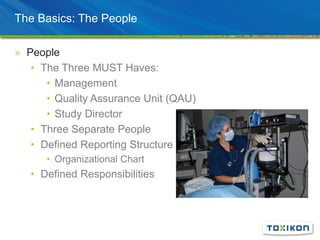
The Basics: The People
» People
• The Three MUST Haves:
• Management
• Quality Assurance Unit (QAU)
• Study Director
• Three Separate People
• Defined Reporting Structure
• Organizational Chart
• Defined Responsibilities
The Basics: The People
» Management
• Overall Responsibility For GLP Testing
• Assures Study Director Has Resources
» Study Director (SD)
• Overall Responsibility For The Conduct Of The Study
• HUGE Responsibility
» QAU
• Monitors For Compliance (Protocols/SOPs)
• Reports Findings To Management And SD To Make Corrective
Actions
The Basics: The People
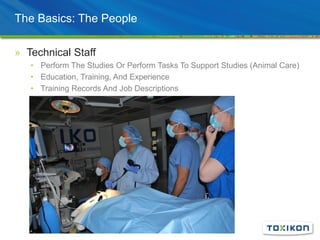
» Technical Staff
• Perform The Studies Or Perform Tasks To Support Studies (Animal Care)
• Education, Training, And Experience
• Training Records And Job Descriptions
The Basics: The Facility
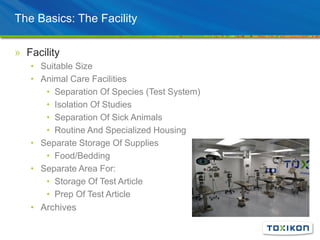
» Facility
• Suitable Size
• Animal Care Facilities
• Separation Of Species (Test System)
• Isolation Of Studies
• Separation Of Sick Animals
• Routine And Specialized Housing
• Separate Storage Of Supplies
• Food/Bedding
• Separate Area For:
• Storage Of Test Article
• Prep Of Test Article
• Archives
The Basics: The Equipment
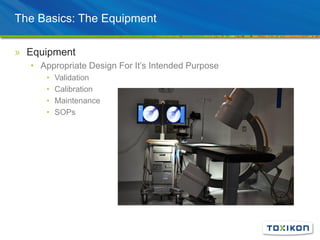
» Equipment
• Appropriate Design For It’s Intended Purpose
• Validation
• Calibration
• Maintenance
• SOPs
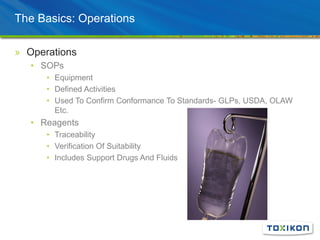
The Basics: Operations
» Operations
• SOPs
• Equipment
• Defined Activities
• Used To Confirm Conformance To Standards- GLPs, USDA, OLAW
Etc.
• Reagents
• Traceability
• Verification Of Suitability
• Includes Support Drugs And Fluids
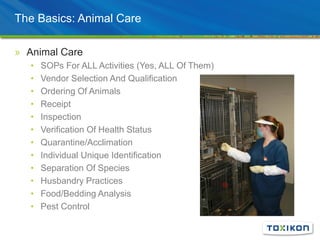
The Basics: Animal Care
» Animal Care
• SOPs For ALL Activities (Yes, ALL Of Them)
• Vendor Selection And Qualification
• Ordering Of Animals
• Receipt
• Inspection
• Verification Of Health Status
• Quarantine/Acclimation
• Individual Unique Identification
• Separation Of Species
• Husbandry Practices
• Food/Bedding Analysis
• Pest Control
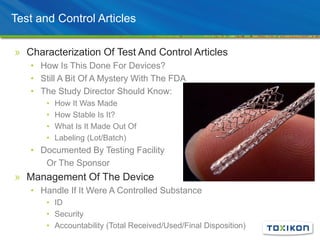
Test and Control Articles
» Characterization Of Test And Control Articles
• How Is This Done For Devices?
• Still A Bit Of A Mystery With The FDA
• The Study Director Should Know:
• How It Was Made
• How Stable Is It?
• What Is It Made Out Of
• Labeling (Lot/Batch)
• Documented By Testing Facility
Or The Sponsor
» Management Of The Device
• Handle If It Were A Controlled Substance
• ID
• Security
• Accountability (Total Received/Used/Final Disposition)
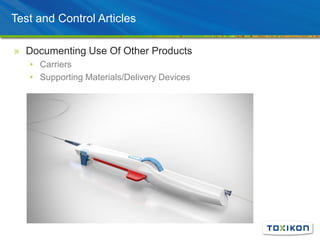
Test and Control Articles
» Documenting Use Of Other Products
• Carriers
• Supporting Materials/Delivery Devices
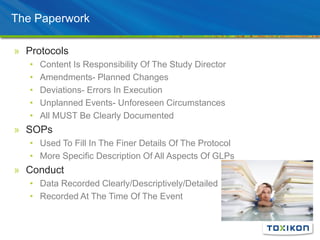
The Paperwork
» Protocols
• Content Is Responsibility Of The Study Director
• Amendments- Planned Changes
• Deviations- Errors In Execution
• Unplanned Events- Unforeseen Circumstances
• All MUST Be Clearly Documented
» SOPs
• Used To Fill In The Finer Details Of The Protocol
• More Specific Description Of All Aspects Of GLPs
» Conduct
• Data Recorded Clearly/Descriptively/Detailed
• Recorded At The Time Of The Event
The Paperwork
» Reports
• Includes Elements Of The Protocol
• Includes Objectives And Procedures
• Include Amendments/Deviations/Unforeseen Circumstances
• Summary Of Data
• Conclusions
» Archiving
• Study Director’s Responsibility
• ALL Data MUST Be Archived
• Send To Archives When Final Report Is Signed
Wrap Up
» What If I Did Not Follow an Aspect of the GLPs?
• Study Could Be Rejected
• You Cannot Make GLP After The Fact
• GLP Exemptions
• Study Director And QA Can Make Statements As To:
• What Sections Were Not Compliant
• Why It Was Not Compliant
• What Risk That Has On The Integrity Of The Study
Special Thanks!
» Amy Schade, RQAR-GLP- Director of Corporate Compliance
» Luke Jandreski, DVM- Study Director Efficacy and Surgical
Research Services
» Lisa Johnson, BA, SRS, RLATg- Study Director Efficacy and
Surgical Research Services
» Helene Anderson- QAU
References
» United States Food and Drug Administration Guidance For Industry (2010). Guidance
Consideration For Animal Studies For Cardiovascular Devices. Retrieved From:
http://www.fda.gov/downloads/MedicalDevices/DeviceRegulationandGuidance/Guidance
Documents/UCM220772.pdf
» United States Food and Drug Administration CFR 21 (2010)-Food and Drugs; Chapter I-
Food and Drug Administration Department of Health and Human Services; Subchapter
H-Medical Devices. Part 870 Cardiovascular Devices. Office of the Federal Register
National Archives and Records Administration. Retrieved from :
http://www.accessdata.fda.gov/scripts/cdrh/cfdocs/cfcfr/CFRSearch.cfm?CFRPart=870
» United States Department of Agriculture (2010). CFR 9, Part 2 Animal Welfare. Office of
the Federal Register National Archives and Records
» United States Public Health Service (2002). Policy on Humane Care and Use of
Laboratory Animals. Office of Laboratory Animal Welfare, National Institutes of Health.
Bethesda, MD.

Regulatory submission: Applying GLP in surgical efficacy studies

  • 1.
    Regulatory Submission: Applying GLPin Surgical Efficacy Studies Curtis Schondelmeyer, DVM Director Preclinical Veterinary Services and Efficacy and Surgical Research Services
  • 2.
  • 3.
    Who We Are Toxikonis a preclinical contract research organization. We contract and partner with biotech, pharmaceutical and medical device industries to deliver exceptional product development services. Toxikon is a preclinical contract research organization. We contract and partner with biotech, pharmaceutical and medical device industries to deliver exceptional product development services. 3
  • 4.
    Experience CONFIDENTIAL4  More than30 years in the R&D, Analytical Chemistry, In-vitro & In-vivo services  Material Qualification  Medical Devices  Combination Products  Packaging / Bioprocessing Support  Pharmaceutical Drug Product  Biologics  Excipients
  • 5.
    Quality Credentials » GLP- Supporting applications for research or marketing permits (IND, NDA, IDE, BLA, PMA, 510K) » Non-GLP – For pilot studies, efficacy studies, and research and development and screening of materials 5
  • 6.
    Quality Credentials andCertifications » ISO/IEC 17025: 2005 Accredited » AAALAC Accredited » FDA Registered » USDA Registered » OLAW Assurance » MSPCA Permit » Nuclear Regulatory Commission (Radiolabel) 6
  • 7.
  • 8.
    Value Chain Target Identification Medical Device orDrug Candidate Identification Medical Device Or Drug Candidate Optimization Preclinical Testing Clinical Phase I Clinical Phase II Clinical Phase III NDA IND Medical Device R&D or Drug Discovery Preclinical Development Clinical Development Preclinical testing of medical device and drug candidates provides critical insights into their human safety and therapeutic profiles. Clinical Support
  • 9.
    What is Efficacy? »No shortage of definitions » Efficacy vs. Effectiveness
  • 10.
    Efficacy » 4 CriticalFactors: • Benefit to be achieved • Medical problem giving rise to the use of the technology • Population affected • Conditions of use under which technology is applied
  • 11.
    Efficacy » Benefit: • Technology’sefficacy depends heavily on its benefit is simple… • …But what outcomes represent benefits? • Curative technology has direct relationship to patient outcome • Diagnostic technologies ? • Technical Capability • Accuracy • Impact • Therapeutic Impact • Patient Outcome » Longevity » Relief from symptoms
  • 12.
    Efficacy » Medical Problem •Seems simple but… • Can lead to controversy • Cost? • Outpatient vs. inpatient? » Population Affected
  • 13.
    Efficacy » Conditions ofUse • Partially determined by the skills/knowledge/abilities of health personnel • Average conditions of use • May differ between hospitals/physicians etc. • Valuable to have measures of outcome that are not dependent on differing variables inherent in average conditions of use
  • 14.
    So What isEfficacy? » Efficacy vs. Effectiveness • Efficacy refers to whether a product demonstrates a health benefit over a placebo/predicate or other intervention when tested in an ideal situation, such as a tightly controlled clinical or pre-clinical trial. • Effectiveness describes how the product works in a real-world situation.
  • 15.
    Efficacy and theFDA? » Effectiveness: “There is reasonable assurance that a device is effective when it can be determined, based upon valid scientific evidence, that in a significant portion of the target population, the use of the device for its intended uses and conditions of use, when accompanied by adequate directions for use and warnings against unsafe use, will provide clinically significant results.” 21 CFR 860.7
  • 16.
    Efficacy and theFDA? » There is some confusion caused by the fact that the FDA has a mandate to insure that products are "safe and effective," but in reality the FDA will approve products that have been proven to have clinical efficacy, without any required proof of "clinical effectiveness" by this definition.
  • 17.
    Efficacy vs. Safety »Safety: “There is reasonable assurance that a device is safe when it can be determined based on valid scientific evidence that the probable benefits to health from use of the device for its intended uses and conditions of use, when accompanied by adequate directions and warnings against unsafe use, outweigh the probable risks.” 21 CFR 860.7 » Clinical Significance vs. Risk • This affects you animal numbers
  • 18.
    FDA Device Classification:Risk-Based Approach » • Class 1: Common, low-risk devices » General controls » Most exempt from pre-market submission » • Class 2: More complex, higher risk » Special controls » Pre-market notification [510(k)] » • Class 3: Most complex, highest risk » (Devices which support or sustain human life; devices which pose potential unreasonable risk of illness or injury) » Comprehensive data needed » Pre-market application [PMA]
  • 19.
    Pre-market Notification vs.Pre-market Approval » Pre-market Notification 510(k) • Requires: • Demonstration of Substantial Equivalence to Predicate Device(s)* “As safe and effective as the predicate device(s)” • Classes: I, II, some III » Pre-market Approval • PMA Requires: • Demonstration of Reasonable Safety and Effectiveness Class: III
  • 20.
    Why perform preclinicalefficacy studies? Product Expansion: Additional claims can be supported by clinically relevant studies Differentiation: Products are being evaluated and selected based on the strength of their demonstrated properties. Competition: When evaluating products – whether competing or stand-alone – physicians recognize the value of quantitative data that has been generated in a biologic system. Submissions: Scientifically valid and clinically relevant data is needed to support safety and efficacy claims. Preclinical Study
  • 21.
    R&D: Testing Your Idea »Animals vs. Humans • Efficacy often requires a complaint patient • Size Does Matter! • Reproducing Medical Problems • Academia vs. Real World
  • 22.
    Designing Efficacy Studies »Is there guidance? • Talk to the FDA » Never under estimate the power of a pilot study! • Can save time and money • Non-GLP » Do your home work • Established animal models? • Species? • Academic studies vs. what is needed to show efficacy • Controls • Predicate vs. Negative Controls vs. Both » Keep them separated • Safety= Risk • Efficacy= Clinical Significance
  • 23.
    Designing Efficacy Studies »Animal Numbers » Knowing your device can save you money • Participation in your studies? » Animal model relevance to real world application • How far do you really need to go? » Analysis and Endpoints • Quantitative vs. Qualitative • Histomorphometry • MicroCT • Other testing? • Biomechanical
  • 24.
    Designing Efficacy Studies »Moving Safety and Efficacy • Where to begin? • Combination products AND LASTLY……. » GLP vs. Non-GLP • GLPs and surgical efficacy studies
  • 25.
  • 26.
    Application of theStandard » Conducting Nonclinical Laboratory Studies That Support Or Are Intended To Support Application Of Research Or Marketing For Products Regulated By The FDA » Includes: • Food • Food Additives • Animal Food Additives • Human and Animal Drugs • Medical Devices For Human Use • Biological Products • Electronic Products
  • 27.
    What are theGLPs? » FDA 21 CFR Part 58 Good Laboratory Practice for Nonclinical Laboratory Studies
  • 28.
    Application of theStandard » Intent: To Assure The Quality And Integrity Of The SAFETY Data » Safety vs. Efficacy • Safety Data ALWAYS GLP • But What About Efficacy?
  • 29.
    What Does ThisReally Mean? » 3 Day Course » Why Do It Yourself, When You Can Hire Someone To Do It For You? • Hire a Consultant » GLPs May Be Written In Black And White But Really…. » GLPs Are About… • Managing • Organizing • Documenting …To Assure The Integrity Of The Data And To Be Able To Reconstruct The Entire Study.
  • 30.
    The Basics » OverheadIn Managing A GLP Program Is More Than Some Universities And Start-up Companies Can Afford
  • 31.
    The Basics: ThePeople » People • The Three MUST Haves: • Management • Quality Assurance Unit (QAU) • Study Director • Three Separate People • Defined Reporting Structure • Organizational Chart • Defined Responsibilities
  • 32.
    The Basics: ThePeople » Management • Overall Responsibility For GLP Testing • Assures Study Director Has Resources » Study Director (SD) • Overall Responsibility For The Conduct Of The Study • HUGE Responsibility » QAU • Monitors For Compliance (Protocols/SOPs) • Reports Findings To Management And SD To Make Corrective Actions
  • 33.
    The Basics: ThePeople » Technical Staff • Perform The Studies Or Perform Tasks To Support Studies (Animal Care) • Education, Training, And Experience • Training Records And Job Descriptions
  • 34.
    The Basics: TheFacility » Facility • Suitable Size • Animal Care Facilities • Separation Of Species (Test System) • Isolation Of Studies • Separation Of Sick Animals • Routine And Specialized Housing • Separate Storage Of Supplies • Food/Bedding • Separate Area For: • Storage Of Test Article • Prep Of Test Article • Archives
  • 35.
    The Basics: TheEquipment » Equipment • Appropriate Design For It’s Intended Purpose • Validation • Calibration • Maintenance • SOPs
  • 36.
    The Basics: Operations »Operations • SOPs • Equipment • Defined Activities • Used To Confirm Conformance To Standards- GLPs, USDA, OLAW Etc. • Reagents • Traceability • Verification Of Suitability • Includes Support Drugs And Fluids
  • 37.
    The Basics: AnimalCare » Animal Care • SOPs For ALL Activities (Yes, ALL Of Them) • Vendor Selection And Qualification • Ordering Of Animals • Receipt • Inspection • Verification Of Health Status • Quarantine/Acclimation • Individual Unique Identification • Separation Of Species • Husbandry Practices • Food/Bedding Analysis • Pest Control
  • 38.
    Test and ControlArticles » Characterization Of Test And Control Articles • How Is This Done For Devices? • Still A Bit Of A Mystery With The FDA • The Study Director Should Know: • How It Was Made • How Stable Is It? • What Is It Made Out Of • Labeling (Lot/Batch) • Documented By Testing Facility Or The Sponsor » Management Of The Device • Handle If It Were A Controlled Substance • ID • Security • Accountability (Total Received/Used/Final Disposition)
  • 39.
    Test and ControlArticles » Documenting Use Of Other Products • Carriers • Supporting Materials/Delivery Devices
  • 40.
    The Paperwork » Protocols •Content Is Responsibility Of The Study Director • Amendments- Planned Changes • Deviations- Errors In Execution • Unplanned Events- Unforeseen Circumstances • All MUST Be Clearly Documented » SOPs • Used To Fill In The Finer Details Of The Protocol • More Specific Description Of All Aspects Of GLPs » Conduct • Data Recorded Clearly/Descriptively/Detailed • Recorded At The Time Of The Event
  • 41.
    The Paperwork » Reports •Includes Elements Of The Protocol • Includes Objectives And Procedures • Include Amendments/Deviations/Unforeseen Circumstances • Summary Of Data • Conclusions » Archiving • Study Director’s Responsibility • ALL Data MUST Be Archived • Send To Archives When Final Report Is Signed
  • 42.
    Wrap Up » WhatIf I Did Not Follow an Aspect of the GLPs? • Study Could Be Rejected • You Cannot Make GLP After The Fact • GLP Exemptions • Study Director And QA Can Make Statements As To: • What Sections Were Not Compliant • Why It Was Not Compliant • What Risk That Has On The Integrity Of The Study
  • 43.
    Special Thanks! » AmySchade, RQAR-GLP- Director of Corporate Compliance » Luke Jandreski, DVM- Study Director Efficacy and Surgical Research Services » Lisa Johnson, BA, SRS, RLATg- Study Director Efficacy and Surgical Research Services » Helene Anderson- QAU
  • 44.
    References » United StatesFood and Drug Administration Guidance For Industry (2010). Guidance Consideration For Animal Studies For Cardiovascular Devices. Retrieved From: http://www.fda.gov/downloads/MedicalDevices/DeviceRegulationandGuidance/Guidance Documents/UCM220772.pdf » United States Food and Drug Administration CFR 21 (2010)-Food and Drugs; Chapter I- Food and Drug Administration Department of Health and Human Services; Subchapter H-Medical Devices. Part 870 Cardiovascular Devices. Office of the Federal Register National Archives and Records Administration. Retrieved from : http://www.accessdata.fda.gov/scripts/cdrh/cfdocs/cfcfr/CFRSearch.cfm?CFRPart=870 » United States Department of Agriculture (2010). CFR 9, Part 2 Animal Welfare. Office of the Federal Register National Archives and Records » United States Public Health Service (2002). Policy on Humane Care and Use of Laboratory Animals. Office of Laboratory Animal Welfare, National Institutes of Health. Bethesda, MD.