1
Lifting & Rigging
Continuing Education
Fourth Quarter 2016
2
Upon completion of this continuing education
module you should be able to:
 Describe the four main causes of crane accidents
 Describe pre-use inspection criteria for hoisting
and rigging equipment
 Describe how sling angles affect sling capacity
 Describe safe manual material handling practices
 Describe the Do’s and Don’ts of forklifts
Objectives
3
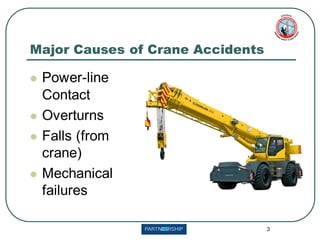
Major Causes of Crane Accidents
⚫ Power-line
Contact
⚫ Overturns
⚫ Falls (from
crane)
⚫ Mechanical
failures
4
Planning Before Startup
⚫ Level the crane
⚫ Ensure support surface is firm
and able to support the load
⚫ Know the basic crane capacities,
and limitations
⚫ Know job site restrictions
⚫ Make other personnel aware of
hoisting activities
⚫ Barricade areas within swing
radius.
⚫ Ensure proper maintenance and
inspections.
5
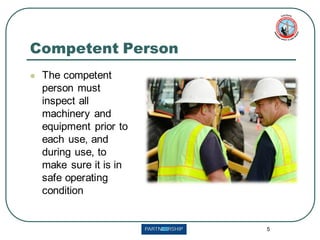
Competent Person
⚫ The competent
person must
inspect all
machinery and
equipment prior to
each use, and
during use, to
make sure it is in
safe operating
condition
6
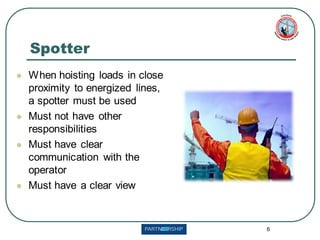
⚫ When hoisting loads in close
proximity to energized lines,
a spotter must be used
⚫ Must not have other
responsibilities
⚫ Must have clear
communication with the
operator
⚫ Must have a clear view
Spotter
7
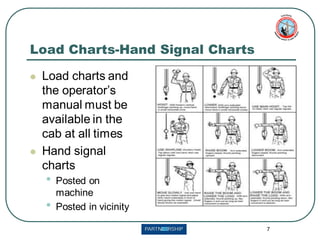
Load Charts-Hand Signal Charts
⚫ Load charts and
the operator’s
manual must be
available in the
cab at all times
⚫ Hand signal
charts
• Posted on
machine
• Posted in vicinity
8
Safe Rigging Practices
Use & Inspection
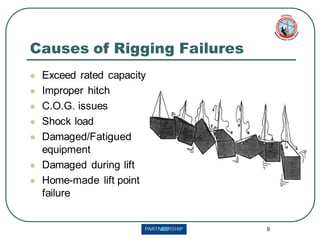
Causes of Rigging Failures
⚫ Exceed rated capacity
⚫ Improper hitch
⚫ C.O.G. issues
⚫ Shock load
⚫ Damaged/Fatigued
equipment
⚫ Damaged during lift
⚫ Home-made lift point
failure
9
10
Inspections
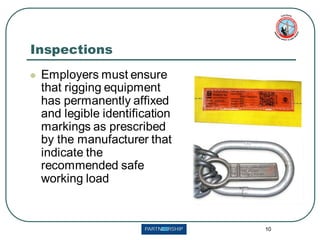
⚫ Employers must ensure
that rigging equipment
has permanently affixed
and legible identification
markings as prescribed
by the manufacturer that
indicate the
recommended safe
working load
11
Inspections
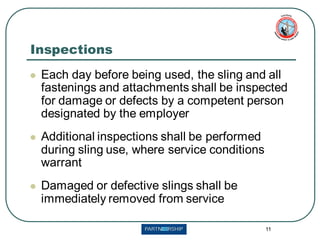
⚫ Each day before being used, the sling and all
fastenings and attachments shall be inspected
for damage or defects by a competent person
designated by the employer
⚫ Additional inspections shall be performed
during sling use, where service conditions
warrant
⚫ Damaged or defective slings shall be
immediately removed from service
122
Wire Rope Inspection
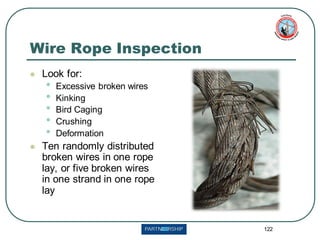
⚫ Look for:
• Excessive broken wires
• Kinking
• Bird Caging
• Crushing
• Deformation
⚫ Ten randomly distributed
broken wires in one rope
lay, or five broken wires
in one strand in one rope
lay
13
Wire Rope Inspection
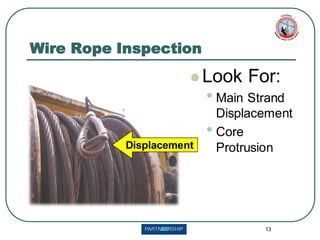
⚫ Look For:
• Main Strand
Displacement
• Core
Protrusion
Displacement
14
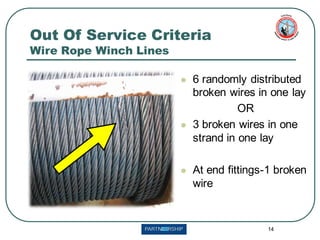
Out Of Service Criteria
Wire Rope Winch Lines
⚫ 6 randomly distributed
broken wires in one lay
OR
⚫ 3 broken wires in one
strand in one lay
⚫ At end fittings-1 broken
wire
15
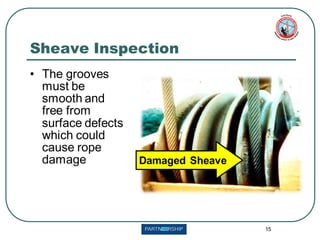
Sheave Inspection
• The grooves
must be
smooth and
free from
surface defects
which could
cause rope
damage Damaged Sheave
16
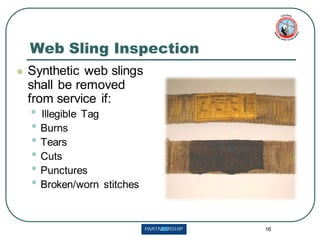
Web Sling Inspection
⚫ Synthetic web slings
shall be removed
from service if:
• Illegible Tag
• Burns
• Tears
• Cuts
• Punctures
• Broken/worn stitches
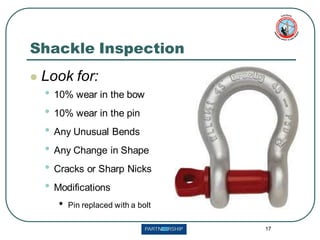
Shackle Inspection
⚫ Look for:
• 10% wear in the bow
• 10% wear in the pin
• Any Unusual Bends
• Any Change in Shape
• Cracks or Sharp Nicks
• Modifications
• Pin replaced with a bolt
17
18
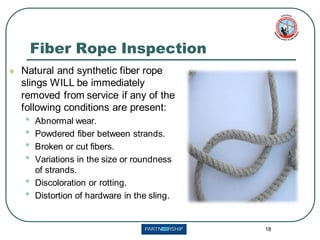
Fiber Rope Inspection
⚫ Natural and synthetic fiber rope
slings WILL be immediately
removed from service if any of the
following conditions are present:
• Abnormal wear.
• Powdered fiber between strands.
• Broken or cut fibers.
• Variations in the size or roundness
of strands.
• Discoloration or rotting.
• Distortion of hardware in the sling.
19
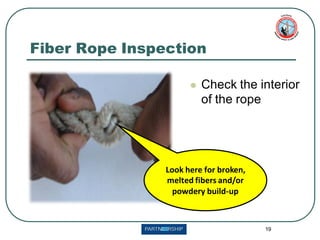
Fiber Rope Inspection
⚫ Check the interior
of the rope
Look here for broken,
melted fibers and/or
powdery build-up
20
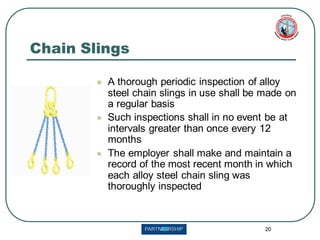
Chain Slings
⚫ A thorough periodic inspection of alloy
steel chain slings in use shall be made on
a regular basis
⚫ Such inspections shall in no event be at
intervals greater than once every 12
months
⚫ The employer shall make and maintain a
record of the most recent month in which
each alloy steel chain sling was
thoroughly inspected
21
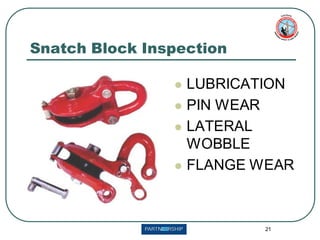
Snatch Block Inspection
⚫ LUBRICATION
⚫ PIN WEAR
⚫ LATERAL
WOBBLE
⚫ FLANGE WEAR
22
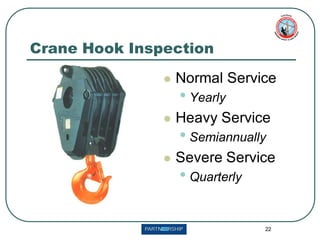
Crane Hook Inspection
⚫ Normal Service
• Yearly
⚫ Heavy Service
• Semiannually
⚫ Severe Service
• Quarterly
23
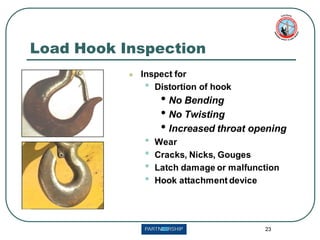
Load Hook Inspection
⚫ Inspect for
• Distortion of hook
• No Bending
• No Twisting
• Increased throat opening
• Wear
• Cracks, Nicks, Gouges
• Latch damage or malfunction
• Hook attachment device
24
Safe Rigging Practices
255
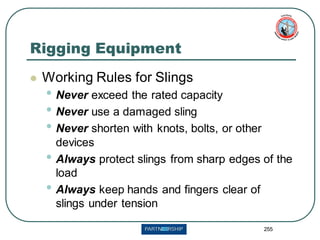
Rigging Equipment
⚫ Working Rules for Slings
• Never exceed the rated capacity
• Never use a damaged sling
• Never shorten with knots, bolts, or other
devices
• Always protect slings from sharp edges of the
load
• Always keep hands and fingers clear of
slings under tension
26
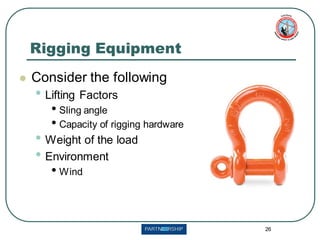
Rigging Equipment
⚫ Consider the following
• Lifting Factors
• Sling angle
• Capacity of rigging hardware
• Weight of the load
• Environment
• Wind
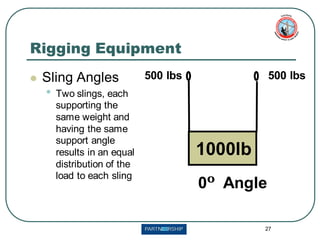
Rigging Equipment
⚫ Sling Angles
• Two slings, each
supporting the
same weight and
having the same
support angle
results in an equal
distribution of the
load to each sling
500 lbs 500 lbs
1000lb
0º Angle
27
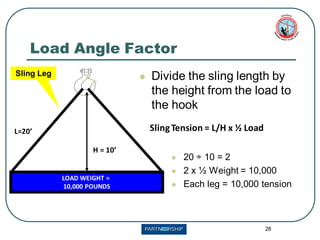
Load Angle Factor
⚫ Divide the sling length by
the height from the load to
the hook
LOAD WEIGHT =
10,000 POUNDS
H = 10’
L=20’ SlingTension = L/H x ½ Load
⚫ 20 ÷ 10 = 2
⚫ 2 x ½ Weight = 10,000
⚫ Each leg = 10,000 tension
Sling Leg
28
29
Manual Material Handling
& Lift Truck
30
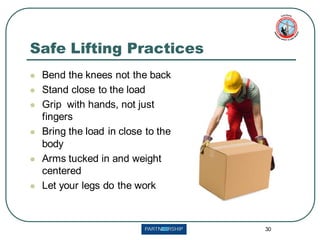
Safe Lifting Practices
⚫ Bend the knees not the back
⚫ Stand close to the load
⚫ Grip with hands, not just
fingers
⚫ Bring the load in close to the
body
⚫ Arms tucked in and weight
centered
⚫ Let your legs do the work
31
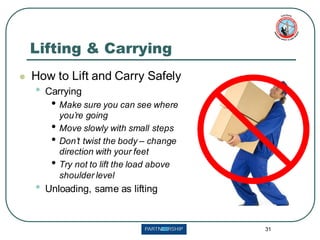
Lifting & Carrying
⚫ How to Lift and Carry Safely
• Carrying
• Make sure you can see where
you’re going
• Move slowly with small steps
• Don’t twist the body – change
direction with your feet
• Try not to lift the load above
shoulder level
• Unloading, same as lifting
32
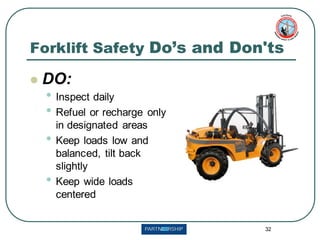
Forklift Safety Do’s and Don'ts
⚫ DO:
• Inspect daily
• Refuel or recharge only
in designated areas
• Keep loads low and
balanced, tilt back
slightly
• Keep wide loads
centered
33
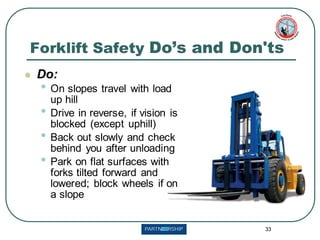
Forklift Safety Do’s and Don'ts
⚫ Do:
• On slopes travel with load
up hill
• Drive in reverse, if vision is
blocked (except uphill)
• Back out slowly and check
behind you after unloading
• Park on flat surfaces with
forks tilted forward and
lowered; block wheels if on
a slope
34
Forklift Safety Do’s and Don'ts
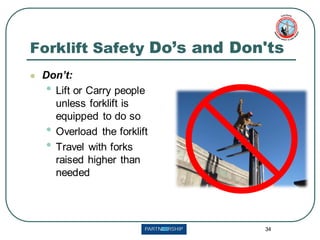
⚫ Don’t:
• Lift or Carry people
unless forklift is
equipped to do so
• Overload the forklift
• Travel with forks
raised higher than
needed
35
Review
1. What are the 4 main causes of crane accidents?
2. Sling angle effects sling capacity? True or False
3. What are some removal criteria for wire rope?
4. You should always lift with your _________ and avoid
_______.
5. When you park a lift truck the forks should be __________
________ and ___________
35

Rigging Training Slides.pdf dxbrdbj dhhe dgh

  • 1.
    1 Lifting & Rigging ContinuingEducation Fourth Quarter 2016
  • 2.
    2 Upon completion ofthis continuing education module you should be able to:  Describe the four main causes of crane accidents  Describe pre-use inspection criteria for hoisting and rigging equipment  Describe how sling angles affect sling capacity  Describe safe manual material handling practices  Describe the Do’s and Don’ts of forklifts Objectives
  • 3.
    3 Major Causes ofCrane Accidents ⚫ Power-line Contact ⚫ Overturns ⚫ Falls (from crane) ⚫ Mechanical failures
  • 4.
    4 Planning Before Startup ⚫Level the crane ⚫ Ensure support surface is firm and able to support the load ⚫ Know the basic crane capacities, and limitations ⚫ Know job site restrictions ⚫ Make other personnel aware of hoisting activities ⚫ Barricade areas within swing radius. ⚫ Ensure proper maintenance and inspections.
  • 5.
    5 Competent Person ⚫ Thecompetent person must inspect all machinery and equipment prior to each use, and during use, to make sure it is in safe operating condition
  • 6.
    6 ⚫ When hoistingloads in close proximity to energized lines, a spotter must be used ⚫ Must not have other responsibilities ⚫ Must have clear communication with the operator ⚫ Must have a clear view Spotter
  • 7.
    7 Load Charts-Hand SignalCharts ⚫ Load charts and the operator’s manual must be available in the cab at all times ⚫ Hand signal charts • Posted on machine • Posted in vicinity
  • 8.
  • 9.
    Causes of RiggingFailures ⚫ Exceed rated capacity ⚫ Improper hitch ⚫ C.O.G. issues ⚫ Shock load ⚫ Damaged/Fatigued equipment ⚫ Damaged during lift ⚫ Home-made lift point failure 9
  • 10.
    10 Inspections ⚫ Employers mustensure that rigging equipment has permanently affixed and legible identification markings as prescribed by the manufacturer that indicate the recommended safe working load
  • 11.
    11 Inspections ⚫ Each daybefore being used, the sling and all fastenings and attachments shall be inspected for damage or defects by a competent person designated by the employer ⚫ Additional inspections shall be performed during sling use, where service conditions warrant ⚫ Damaged or defective slings shall be immediately removed from service
  • 12.
    122 Wire Rope Inspection ⚫Look for: • Excessive broken wires • Kinking • Bird Caging • Crushing • Deformation ⚫ Ten randomly distributed broken wires in one rope lay, or five broken wires in one strand in one rope lay
  • 13.
    13 Wire Rope Inspection ⚫Look For: • Main Strand Displacement • Core Protrusion Displacement
  • 14.
    14 Out Of ServiceCriteria Wire Rope Winch Lines ⚫ 6 randomly distributed broken wires in one lay OR ⚫ 3 broken wires in one strand in one lay ⚫ At end fittings-1 broken wire
  • 15.
    15 Sheave Inspection • Thegrooves must be smooth and free from surface defects which could cause rope damage Damaged Sheave
  • 16.
    16 Web Sling Inspection ⚫Synthetic web slings shall be removed from service if: • Illegible Tag • Burns • Tears • Cuts • Punctures • Broken/worn stitches
  • 17.
    Shackle Inspection ⚫ Lookfor: • 10% wear in the bow • 10% wear in the pin • Any Unusual Bends • Any Change in Shape • Cracks or Sharp Nicks • Modifications • Pin replaced with a bolt 17
  • 18.
    18 Fiber Rope Inspection ⚫Natural and synthetic fiber rope slings WILL be immediately removed from service if any of the following conditions are present: • Abnormal wear. • Powdered fiber between strands. • Broken or cut fibers. • Variations in the size or roundness of strands. • Discoloration or rotting. • Distortion of hardware in the sling.
  • 19.
    19 Fiber Rope Inspection ⚫Check the interior of the rope Look here for broken, melted fibers and/or powdery build-up
  • 20.
    20 Chain Slings ⚫ Athorough periodic inspection of alloy steel chain slings in use shall be made on a regular basis ⚫ Such inspections shall in no event be at intervals greater than once every 12 months ⚫ The employer shall make and maintain a record of the most recent month in which each alloy steel chain sling was thoroughly inspected
  • 21.
    21 Snatch Block Inspection ⚫LUBRICATION ⚫ PIN WEAR ⚫ LATERAL WOBBLE ⚫ FLANGE WEAR
  • 22.
    22 Crane Hook Inspection ⚫Normal Service • Yearly ⚫ Heavy Service • Semiannually ⚫ Severe Service • Quarterly
  • 23.
    23 Load Hook Inspection ⚫Inspect for • Distortion of hook • No Bending • No Twisting • Increased throat opening • Wear • Cracks, Nicks, Gouges • Latch damage or malfunction • Hook attachment device
  • 24.
  • 25.
    255 Rigging Equipment ⚫ WorkingRules for Slings • Never exceed the rated capacity • Never use a damaged sling • Never shorten with knots, bolts, or other devices • Always protect slings from sharp edges of the load • Always keep hands and fingers clear of slings under tension
  • 26.
    26 Rigging Equipment ⚫ Considerthe following • Lifting Factors • Sling angle • Capacity of rigging hardware • Weight of the load • Environment • Wind
  • 27.
    Rigging Equipment ⚫ SlingAngles • Two slings, each supporting the same weight and having the same support angle results in an equal distribution of the load to each sling 500 lbs 500 lbs 1000lb 0º Angle 27
  • 28.
    Load Angle Factor ⚫Divide the sling length by the height from the load to the hook LOAD WEIGHT = 10,000 POUNDS H = 10’ L=20’ SlingTension = L/H x ½ Load ⚫ 20 ÷ 10 = 2 ⚫ 2 x ½ Weight = 10,000 ⚫ Each leg = 10,000 tension Sling Leg 28
  • 29.
  • 30.
    30 Safe Lifting Practices ⚫Bend the knees not the back ⚫ Stand close to the load ⚫ Grip with hands, not just fingers ⚫ Bring the load in close to the body ⚫ Arms tucked in and weight centered ⚫ Let your legs do the work
  • 31.
    31 Lifting & Carrying ⚫How to Lift and Carry Safely • Carrying • Make sure you can see where you’re going • Move slowly with small steps • Don’t twist the body – change direction with your feet • Try not to lift the load above shoulder level • Unloading, same as lifting
  • 32.
    32 Forklift Safety Do’sand Don'ts ⚫ DO: • Inspect daily • Refuel or recharge only in designated areas • Keep loads low and balanced, tilt back slightly • Keep wide loads centered
  • 33.
    33 Forklift Safety Do’sand Don'ts ⚫ Do: • On slopes travel with load up hill • Drive in reverse, if vision is blocked (except uphill) • Back out slowly and check behind you after unloading • Park on flat surfaces with forks tilted forward and lowered; block wheels if on a slope
  • 34.
    34 Forklift Safety Do’sand Don'ts ⚫ Don’t: • Lift or Carry people unless forklift is equipped to do so • Overload the forklift • Travel with forks raised higher than needed
  • 35.
    35 Review 1. What arethe 4 main causes of crane accidents? 2. Sling angle effects sling capacity? True or False 3. What are some removal criteria for wire rope? 4. You should always lift with your _________ and avoid _______. 5. When you park a lift truck the forks should be __________ ________ and ___________ 35